Category: Demographics

  • The Two Worlds of Buenos Aires

    Central Buenos Aires is undoubtedly one of the world’s great tourist destinations. Days could be spent walking among its narrow streets admiring the plentiful art noveau, art-deco, beaux-arts and other architectural styles. The triumphal Avenida 9 de Julio is one of the world’s widest boulevards with two interior roadways of up to seven lanes and two service roads of two lanes, with a Washington Monument type obelisk at Avenida Corrientes (Top photo). Avenida 9 de Julio is bordered by buildings that are both ordinary and impressive, such as the Colon Opera House.
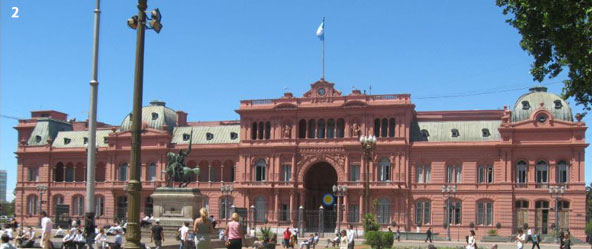
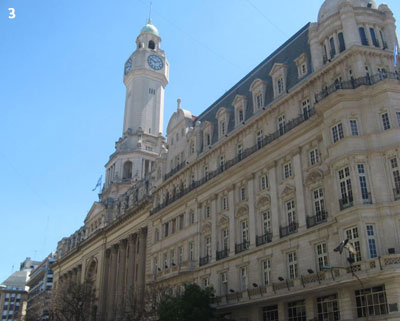
    There is also an attractive area of redevelopment adjacent to the core in the former dock area, Puerto Madero. The old port buildings have been converted to commercial uses, especially restaurants. A number of high-rise condominium buildings have been constructed beyond the old port basins. Government buildings more than match the commercial architecture, with the National Congress and the Casa Rosada, or “Pink House,” with its balconies from which President Peron and his wife Eva used to address the public (Photo 2). Not more than two weeks ago, former President Nestor Kirchner lay in state to be visited by in an emotional outpouring by hundreds of thousands of Argentineans. The city of Buenos Aires also has a distinctive legislative building (Photo 3).
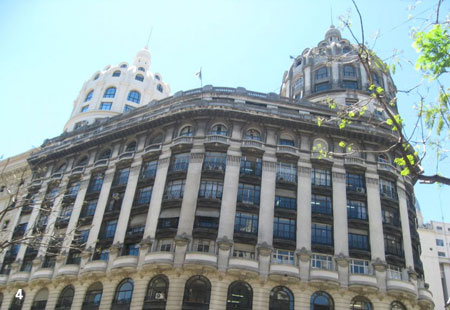
    These older romantic styles make Buenos Aires a wonderful walking environment. Most were erected in the first three decades of the 20th century. This was Buenos Aires at its zenith. Then, Buenos Aires was capital of one of the world’s acknowledged economic powers. Argentina generally ranked around10th in gross domestic product (GDP) per capita during that period (Note 1). Thus, today, the tourist can enjoy the product of that prosperous time.

    Economic Stagnation: More recent years have not been good to the Buenos Aires area and Argentina. The nation has seen decades of ups and downs – but mostly downs. The nation has been buffeted between constitutional governments and military dictatorships. Too often, even the constitutional governments have placed too little emphasis on creating wealth and too much on redistributing it. A failed currency policy in the 1990s destroyed the savings of millions. All of this has led to Argentina’s migration from the top 10 economies to near the bottom of the top 100, now ranked at 82nd in the world in GDP per capita. No top ten nation from early in the 20th century has fallen so far. New Zealand managed to drop from 1st in the world in 1920 to 51st now, but still has a GDP per capita double that of Argentina.

    Argentina suffered the largest sovereign debt default in world history, at $100 billion in 2002. The nation’s former colonial master, Spain, trailed Argentina in GDP per capita throughout the 20th century to the 1980s, yet is now more than twice as prosperous (Figure 1)

    This economic decline is not so evident in the autonomous city of Buenos Aires, which is also called Capital Federal, analogous to the District of Columbia (DC) in the United States. This is the Buenos Aires of tourists, an area only slightly larger than Washington, DC, but with five times the population. The municipality of Buenos Aires is by far the most affluent urbanization in the nation. Even so, there are informal settlements within the city, such as Villa 31. Overall, approximately three percent of the city’s population is in these kinds of informal settlements.
    BA3-bencich
    Population and Distribution: According to the last census (2001), the city of Buenos Aires had fewer people than in 1947, having fallen from 3.0 million residents to 2.8 million. The city is also very dense, at 35,600 persons per square mile (13,700 per square kilometer), which is about one-half the density of Manhattan or the ville de Paris and double the density of the city of San Francisco.

    Most of the population lives in peripheral areas. This dominant suburban growth pattern is typical of world urbanization, as can be seen in such high-income nation capitals as London, Washington, Brussels, Copenhagen has been in the suburbs. Indeed, all growth in Paris has been in the suburbs since 1881. Like the ville de Paris, the city of Buenos Aires now accounts for less than 25 percent of its metropolitan area population (Figure 2).
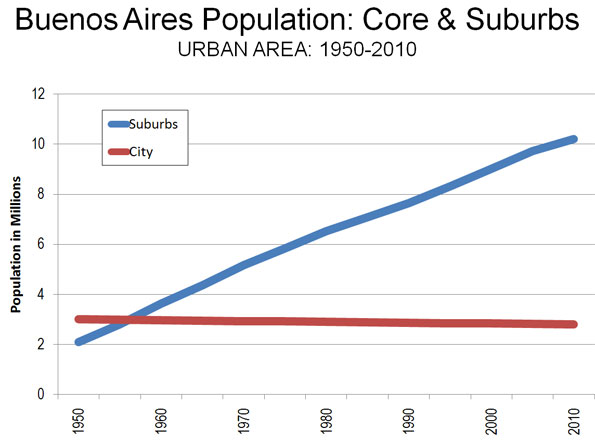
    Overall, the urban area (area of continuous development) has nearly 13 million people and covers more than 1,000 square miles (2,600 square kilometers) for a population density of 12,100 per square mile (4,700 per square kilometer). This is 70 percent more dense than Los Angeles and one-third more than Paris but less than one-eighth that of Dhaka (Bangladesh).

    Suburban Buenos Aires: The suburbs of Buenos Aires differ from those in high-income national capitals. Generally, the suburbs are far poorer than the city and reflect the more recently less affluent Argentina that has emerged in recent decades just as the central area testified to the nation’s former relative wealth. All of suburban Buenos Aires is in the adjacent Buenos Aires province, which has the largest population in the nation.

    Some of the suburbs are affluent, especially to the northwest, where suburban municipalities like Pilar and Tigre contain housing that could easily fit in upper middle income suburbs of the United States or Europe. However, even in these areas, there are close-by developments of low-quality and even informal housing, mostly housing domestic employees to the higher income population.
    The suburban poverty is far more pervasive to the southwest and the southeast. Many neighborhoods look similar to modest suburbs in Mexico City, though without the pervasive informal settlements. More people live in informal settlements in the suburbs than in the city, with estimates putting the number at above 500,000.

    More than the Core: Any thought, however, of Buenos Aires being a “compact city” is dispelled by the vast sea of lights visible on an evening flight out of Ezeiza International Airport. The urbanization stretches 30 to 40 miles in all possible directions, to the northwest, southwest and southeast (with the Rio de la Plata being to the northeast).

    However, probably no urban area illustrates the general rule that urban cores tend to be substantially different from their suburbs. Not only is suburban Buenos Aires far less dense, but it is far less affluent. Any who visits the city alone will have missed more than three-quarters of the reality.

    ————

    Note: GDP per Capita data based upon Angus Maddison’s work for the Organization for Economic Cooperation and Development.

    Photos (by the author):
    Top: Avenida 9 de Julio
    2: Casa Rosada
    3: City of Buenos Aires Legislative & Office Buildings
    4: Bencich Building
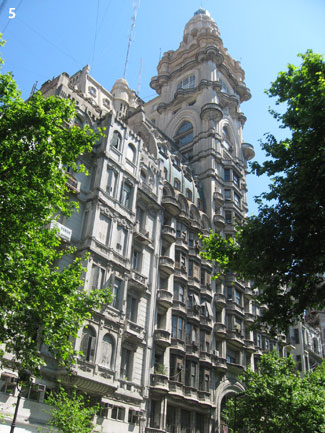
    5: Casa Borolo

    ————

    Wendell Cox is a Visiting Professor, Conservatoire National des Arts et Metiers, Paris and the author of “War on the Dream: How Anti-Sprawl Policy Threatens the Quality of Life

  • Geography of the Election: The Philadelphia Collar Counties – A Splash of Red

    The Obama coalition of 2008 has begun to fracture with independents, women and college educated voters bolting to Republicans and the youth vote seemingly uninterested in this election. But perhaps the most critical change took place in suburbia. This was particularly evident last week in southeastern Pennsylvania, especially in the suburban Philadelphia counties.

    Historically in Pennsylvania statewide Democratic candidates won big in Philadelphia only to see their margin decimated in the traditionally heavily Republican suburban counties of Bucks, Chester, Delaware and Montgomery, known as the Philadelphia “Collar Counties.” This trend began to shift in the 1990s due in large measure to the GOP stance on abortion and other social issues.

    During the 1990s, Democratic candidates were able to claim the mantel of moderation by positioning themselves as fiscally conservative and socially moderate. Affluent, college educated, women, and younger voters from traditionally staunch Republican families joined with established Democratic constituencies including the Jewish community, working class voters from old suburban mill towns, and minority voters to form winning coalitions throughout the collar counties.

    During the 2000s, Democrats would be elected to fill Congressional seats in three of the four collar counties. Not surprisingly, no Republican at the top of the ticket would win Pennsylvania over the next 10 years. The main reason was the collar counties were voting more Democratic with each election. The table below shows the percentage of the vote won by the Republican candidate at the top of the ticket from 2000 – 2008:

    Top of Ticket

    Chester

    Bucks

    Delaware

    Montgomery

    Phila.

    Bush/Gore 2000

    53.4%

    46.3%

    42.7%

    43.8%

    18.0%

    Fisher/Rendell 2002

    41.1%

    43.6%

    33.1%

    31.4%

    14.7%

    Bush/Kerry 2004

    52.0%

    48.3%

    42.3%

    44.0%

    19.3%

    Santorum/Casey 2006

    45.0%

    41.5%

    38.3%

    38.1%

    15.9%

    McCain/Obama 2008

    45.0%

    45.1%

    38.8%

    39.2%

    16.3%


    In 2010, the trend began to favor Republicans again. The GOP picked up a net five Congressional seats including two in the southeast region. It also propelled State House Republicans to a huge victory moving from 99 seats to a projected 111 – 92 majority. Republican Tom Corbett won the governorship by 10 percentage points with 55 percent of the vote. Conservative Pat Toomey outpaced Joe Sestak for the U. S. Senate by two percentage points.

    A look at the trends shows that both statewide Republican candidates ran stronger in the collar counties than did Senator John McCain in 2008 in his bid for President:

    2010 Numbers

    Chester

    Bucks

    Delaware

    Montco

    Phila

    Toomey/Sestak

    53.4%

    53.2%

    43.6%

    45.9%

    16%

    Corbett/Ontorato

    55.9%

    55.4%

    47.0%

    48.3%

    17.1%

    McCain 2008

    45.0%

    45.1%

    38.8%

    39.2%

    16.30%

    Tom Corbett ran nearly 10 percentage points ahead of McCain in the collar counties. In fact, Corbett carried these counties by 22,370 votes as he reversed the top of the ticket trend of the past decade. Although this was not enough to offset the 274,373 he lost by in Philadelphia at least he won enough elsewhere, including in the collar countries, to win a fairly impressive victory statewide.

    Pat Toomey, a clear conservative, ran well ahead of the vote former Senator, and social conservative, Rick Santorum was able to win four years earlier, but he did not perform as well as Corbett did against McCain. This can be explained in part by the fact that his opponent, Joe Sestak, was an elected Congressman from Delaware County.

    2010 Numbers

    Chester

    Bucks

    Delaware

    Montco

    Phila

    Toomey/Sestak

    53.4%

    53.2%

    43.6%

    45.9%

    16%

    Santorum/Casey 2006

    45.0%

    41.5%

    38.3%

    38.1%

    15.9%

    Toomey would lose the collar counties by 27,195 votes. This gave him a much steeper hill to climb in the other 61 counties of Pennsylvania, but at least he was not out of the game as had been McCain, Santorum, and Fisher over the past 10 years.

    Will this change in voting pattern continue? It could if Republicans can hold Independent voters by delivering solid results at both the Federal and State levels. Republicans will now control redistricting in Pennsylvania. This should allow them to consolidate the gains made this year in Congress, but does not change the fact that the Philadelphia collar counties will continue to determine the fate of statewide candidates in Pennsylvania into the foreseeable future.

    The fight in Washington over the next two years will likely be the traditional “heart vs. head” fight of the past where Democrats push for more social programs and Republicans position on the costs of these programs.

    The 2010 election in southeastern Pennsylvania seemed to prove that a bad economy and fears of continuing increases in taxes and debt will add a splash of red to the collar counties “light blue” voters.

    Dennis M. Powell is president and CEO of Massey Powell, an issues management consulting company located in Plymouth Meeting, PA.

  • Geography of the Election: A New Era of Racial Politics

    Laura Jean Berger worked on the Congressional Campaign of Assemblyman Van Tran. This is her account of the results.

    Energy and free beer flowed through Assemblyman Van Tran’s campaign headquarters, the crowd anxiously building with anticipation each time Fox News reported another House seat for the Republicans. Every major network’s live trucks crowded the parking lot of the converted Blockbuster video store, their cameras trained on a stage set for a victory speech.

    But the crowd would be disappointed tonight. Results had Tran and incumbent Democratic Congresswoman Loretta Sanchez tied early in the evening, but she pulled ahead to a nine-point lead by midnight. And now, almost a week later, the wait is not yet over. While national press has declared Sanchez the winner yet again in central Orange County, California, neither candidate has yet conceded or declared victory.

    So why in California’s 47th district — where most have declared Sanchez the winner–will neither candidate make a declaration? Just ask the Orange County Registrar of Voters: the surprise in the ballot box is that there are still approximately 30,000 votes yet to be tallied, as reported by the Orange County Register. In a race where approximately 66,000 ballots cast have been counted thus far, one third of the vote share remains outstanding.

    The race could go either way at this point because those ballots yet to be counted are record numbers of both vote by mail and provisional ballots. If you’re Loretta Sanchez, you know that provisionals will likely break in your favor due to alleged polling place confusion in heavily Democratic Santa Ana. But if you’re Van Tran, you are hoping that the largest Vietnamese community outside Vietnam all decided to vote absentee this year.

    The Voice of OC asserts that “history has shown that absentee and provisional votes often make big differences in municipal elections involving large numbers of Vietnamese voters.” In this district, it seems that race is playing a substantial role in the election results just as it did during the campaign.

    National media attention descended when Sanchez declared on the Spanish television station Univision that the “Vietnamese and the Republicans” were trying to “take this seat…” and also remarked that Tran was very “anti-immigrant.” Her comments ignited a firestorm because Tran is, in fact, a Vietnamese immigrant himself. Sanchez was accused of bringing racial divisiveness into the campaign and later offered an apology for her comments once prompted.

    While the Vietnamese community in Orange County is certainly cohesive, they are not single-issue voters, as opposed to many Hispanics. OC Weekly columnist Gustavo Arellano stated in an interview with Southern California Public Radio, “All really that matters to the Spanish-language media right now is the question of immigration because that is the biggest question that its readership has…Everything else is secondary.” Since Tran has not defined his views on immigration precisely, he is “largely ignored” by Spanish-language media.

    Vietnamese voters, on the other hand, share the country’s priority on jobs yet also consider how either candidate–Vietnamese or not–would handle policy positions toward Vietnam. Sanchez’s work on House Resolution 334 calling for an end to Vietnam’s political imprisonment of those who supported Saigon and the South greatly helped her relationship with the Vietnamese community, approximately fifteen percent of the district’s residents.

    While that number might not seem like much, it’s important to note that the Vietnamese turn out at much higher percentages than Hispanics. Hao-Nhien Vu, managing editor of the largest Vietnamese newspaper in the US, ascribes civic involvement with the fact that “they went through so much to get here.”

    Yet the racial disparity in Orange County plays into a larger statewide picture. Voters in California supported Proposition 20 on Election Day, which gives the power of redistricting state and federal districts to a citizens’ committee as opposed to state legislators. California’s districts have been compared to “Swiss cheese,” but the district bordering the 47th to the north, the 40th, makes some rather interesting jabs around the edges.

    The Republican (and Vietnamese) stronghold of Garden Grove has been seemingly attacked by a cookie cutter, while one could argue that isolating predominantly Hispanic Anaheim and Santa Ana in the same district lumps too many Democratic votes together. Both parties are to blame for drawing illogical districts to maintain the status quo. But there’s an even greater national issue growing in this Petri dish.

    President Barack Obama’s election was seen by many as an advance in the fight against racial politics in the United States. But in light of Sanchez’s and Tran’s campaigns and supporters, when does cohesiveness cross the line? This district is a prime example of a place where there are more minority residents than whites. Therefore, it’s logical that a minority representative would be easily elected.

    But which minority?

    The answer is different for each voter. Identifying with the electorate has always worked well in politics. Sanchez identifies with the Hispanics while Tran pulls in the Vietnamese. Each has their supporters among Anglos and African-Americans. But even so, the inevitable is that one ethnic group is pitted against the other in a sense, and everyone knows it (and now admits it after Sanchez’ aforementioned Univision comments).

    The good news? The issue of race is now forced onto the table. Now that it’s no longer completely taboo, there’s a hope that different ethnic groups can come together and realize the diverse issues they all face. If this can be done, the voters will undoubtedly select the candidate that can best represent them, and that may not be a candidate with whom they identify based on race.

    However, this can only happen once an interracial dialogue is established. It won’t happen overnight. Members of minority voting blocs will and do integrate into the larger political discussion with time. Only after this is achieved will race become the non-issue that it should be in politics.

    As for California’s 47th Congressional district, the jury is still out for this year. And in 2012, who knows what the Citizens’ Redistricting Committee will change? Hopefully this year is one of the last in which race will play such a deciding role in elections. But that depends on the opening of communication channels between groups. As our country gets more diverse, and complex, we could be witnessing the beginning of a new era of racial politics in America.

    Laura Jean Berger is a senior at Chapman University studying Political Science and Communication Studies. A lifelong resident of Glendale, she is an avid classical pianist and a self-diagnosed political junkie.

    Photo by Neon Tommy

  • The Smackdown Of The Creative Class

    Two years ago I hailed Barack Obama’s election as “the triumph of the creative class.” Yesterday everything reversed, as middle-class Americans smacked down their putative new ruling class of highly educated urbanistas and college town denizens.

    More than anything, this election marked a shift in American class dynamics. In 2008 President Obama managed to win enough middle-class, suburban voters to win an impressive victory. This year, those same voters deserted, rejecting policies more geared to the “creative class” than mainstream America.

    A term coined by urban guru Richard Florida, “the creative class” also covers what David Brooks more cunningly calls “bourgeois bohemians”–socially liberal, well-educated, predominately white, upper middle-class voters. They are clustered largely in expensive urban centers, along the coasts, around universities and high-tech regions. To this base, Obama can add the welfare dependents, virtually all African-Americans, and the well-organized legions of public employees.

    These are the groups for whom Obama’s persona and policies pack the greatest appeal. Since Obama took office, the prime beneficiary of fiscal and monetary policies has been Wall Street, which has seen a nice 30% rise in the market and record bonuses. Large corporations, which are largely financed by stocks and bonds, have seen their profits soar over 40%, in part due to access to easy money.

    The financial boomlet is most marked in key creative class strongholds such as Manhattan, Boston and San Francisco, as well as their surrounding, super-affluent suburbs. The largesse benefits not only the traders, but the high-priced lawyers, accountants and publicists serving the financial elite. It has also benefited the high-end consumer industry, including the arts, which support much of the creative class. Not surpisingly, the Democrats scored well in these areas last night despite the GOP tide.

    The creative class also has benefited from the lavish expenditures of public funds to major universities for research. This has lifted the prospects of the professoriate at the elite colleges from which Obama takes much of his advice. Finally the administration has rewarded its friends and funders among Silicon Valley venture capitalists. Once self-described paragons of entrepreneurial risk-taking, they increasingly search out government incentives and subsidies to pay for their large bets on renewable energy technology.

    In contrast, the traditional middle class has not fared well at all. This group consists of virtually everyone who earns the national household median income of $50,000 or somewhat above. They tend to be white, concentrated outside the coasts (except along the Gulf), suburban and politically independent. In 2008 they divided their votes, allowing Obama, with his huge urban, minority and youth base, to win easily.

    Since Obama’s inauguration all the economic statistics vital to their lives–job creation, family income, housing prices–have been stagnant or negative. Not surprising then that suburbanites, small businesspeople and middle-income workers walked out on the Democrats last night. They did not do so because they loved the Republicans but because the majority either fears unemployment or already have lost their jobs. Many were employed in the industries such as manufacturing and construction hardest hit in the recession; it has not escaped their attention that Obama’s public-sector allies, paid with their taxes, have remained not only largely unscathed, but much better compensated.

    Of course, few on the progressive left–more expressive of a dictatorship of the professoriate than that of the proletariat–seem likely to confront these class realities. Many will ascribe last night’s disaster to the dunderheadness of the American people, or to the clever venality of the right. Certainly some tea party candidates, inexperienced and untested, did appear incapable of passing a high school civics test. But the results had less to do with Karl Rove’s money than the Democrats disconnect with the middle class.

    The real problem for the Democrats lies with fundamental demographics. The middle class is a huge proportion of the population. Thirty-five million households earn between $50,000 and $100,000 a year; close to another 15 million have incomes between $100,000 and $150,000. Together these households overwhelm the number of poor households as well as the highly affluent.

    In contrast, the “creative class” represents a relatively small grouping. Some define this group as upward of 40% of the workforce–largely by dint of having a four-year college degree–but this seems far too broad. The creative class is often seen as sharing the hip values of the Bobo crowd. Lumping an accountant with two kids in suburban Detroit or Atlanta with a childless SoHo graphic artist couple seems disingenuous at best. In reality the true creative class, notes demographer Bill Frey, may constitute no more than 5% of the total.

    At the same time, this affluent constituency may be more than offset by another more traditional upper class. This consists of people closely tied to such basic sectors as agriculture, fossil fuel production, suburban home-builders and the aerospace industry. These voters have, for the most part, remained solidly Republican for generations, and but many followed the “creative class” into the Democratic Party in 2006 and 2008. Last night this part of the upper class shifted back toward their political home.

    But the real decider–to use George W. Bush’s unfortunate phrase–remains the much larger, more amorphous middle class. Given the economy of the past two years, the subsequent alienation of this group should pose no mystery. Suburban swing voters didn’t suddenly turn into racists or right-wing cranks. Instead they have seen, correctly, that Obama’s economic policy has to date worked to the advantage of others far more than themselves or their families. Until the Democrats and Obama can prove that they once again can serve the interests of these voters, they will continue to struggle to recapture the optimism so appropriate two years ago.

    This article originally appeared at Forbes.com.

    Joel Kotkin is executive editor of NewGeography.com and is a distinguished presidential fellow in urban futures at Chapman University. He is author of The City: A Global History. His newest book is The Next Hundred Million: America in 2050, released in February, 2010.

    Photo by World Economic Forum

  • “Redneck” Calgary Elects Liberal Muslim Academic Mayor: World Doesn’t End

    Calgary municipal politics rarely makes news outside of the city. Going into this year’s municipal election, I had reason to believe this would change. I came to Calgary to manage the campaign of the runner up from the last election. He is a Muslim (specifically Ishmaili), and an outsider to the political establishment. People told me there’s no way someone like that could be elected in Calgary. I’m happy to say that they were proven wrong. Unfortunately, I had nothing to do with this.

    My former candidate is a colorful guy. He had lived in Calgary for less than five years before running for mayor the first time around. His odds were pretty steep. Mayor Dave Bronconnier had garnered over 80% of the vote in the previous election. His closest rival had just over 5%. My candidate spent over a million dollars of his own money to run a viable campaign against the two term incumbent. He finished that election with a quarter of the votes. Internal polling suggested he had a serious chance, until false allegations concerning his past business dealings in Kenya derailed his candidacy.

    He is also a strong believer that Calgary’s redneck image is outdated. Calgarian values are old fashioned in many ways, many of them good. There is no major Canadian city where people are as supportive of free-enterprise as Calgary. Think of it as Houston North. The economy is largely driven by the oil and gas money, and it is perceived as being a very socially conservative, predominately white city. This perception is out of date. Nearly a quarter of Calgarians are members of visible minority groups, and the city elected Canada’s first Muslim Member of Parliament. My candidate mocked this perception. One of his ice breakers with skeptics of his candidacy was to tell them that “redneck Calgary is ready to elect a brown, bald guy from Kenya” as Mayor. It turns out he was right about the “brown” part.

    I ended up leaving that campaign early. We had different visions for the campaign, and the candidate always wins that argument. He wound up pulling out of the race the day before the election officially got underway. I harbored suspicions that the only reason he came in second the last time was that he happened to be the only guy willing to spend a million bucks to run against a popular incumbent. Had he not run, the two term incumbent would have walked to another landslide victory. Some people were angry with the incumbent, and he was the other name on the ballot they recognized.

    My faith that a member of a visible minority group could be elected Mayor of Calgary dwindled. But in the last few weeks of the campaign, something odd began happening in the polls. A man by the name of Naheed Nenshi started to poll at 20%. Few people took his candidacy seriously before this. His numbers began to climb into the 30% range in the final week. I started making long shot bets with friends that Nenshi would win, but I didn’t really expect it to happen. Surely the polling was wrong. Redneck Calgary couldn’t possibly elect a Liberal Muslim academic as Mayor.

    The polling actually was wrong. Since many young people only have cell phones, they are underrepresented in polls. It turns out that the polls massively underestimated Nenshi’s support. He didn’t just sneak by. Turnout was an astonishing 53%–shattering records for the last 3 decades—and he grabbed 40% of the votes. This was supposed to be a two way race between fiscal hawk alderman Ric McIver, and popular news anchor Barb Higgins. Elections don’t always turn out as they’re scripted by the pundits.

    The fact that we’ve actually elected a Muslim Mayor has lead to a serious rethink of Calgary’s redneck reputation. Pundits claim that this represents a shift in the city’s attitude towards immigrants. I disagree. Like its American energy town counterpart Houston, it’s an open, opportunity-oriented city. People don’t care if you’re white, brown, or from Saskatchewan. Calgary is a magnet for entrepreneurial people. It is a city that was built on people from all over the world seeking opportunities. One fifth of Calgarians are immigrants.

    “Go west, young man” is not a mantra that was exclusively adopted by white Protestant men. Nenshi was born and raised in Calgary, but his mayoralty would not have been possible if it weren’t for the hospitable Calgarian attitude.

    Frankly, he’ll probably do an alright job. Nenshi has an impressive business background, and his knowledge of urban public policy and municipal government is extensive. He’s more of a market liberal, than the dogmatic leftist that his critics painted him as. He wants more public amenities, but understands fiscal prudence and the need for efficient regulations.

    No matter how much his critics called him a socialist, Nenshi was the candidate who was able to convince voters that he knew how to provide the necessary services without breaking the bank. Voters wanted a clear vision of the city’s future, and that’s what Nenshi provided. People knew what they were voting for. Frontrunner Ric McIver offered slightly lower tax increases, combined with major spending initiatives. We’ve all seen what happens when politicians promise tax cuts without a plan to reduce spending. This isn’t a vision, so much as a recipe for disappointment.

    Calgarians wanted to elect a Mayor who would clean up City Hall. Nenshi offered that, and people didn’t care what God he worships (or doesn’t). Calgarians didn’t vote for a Muslim mayor any more than they voted for a Protestant Mayor the last election. They voted for the guy they thought would get things done. That’s the Calgarian attitude.

    Photo by 5of7

    Steve Lafleur is a public policy analyst and political consultant based out of Calgary, Alberta. For more detail, see his blog.

  • New Index Estimates New House Cost Impact of Land Regulation

    In recent decades, an unprecedented variation has developed in the price of new tract housing on the fringe of US metropolitan markets. Nearly all of this difference is in costs other than site preparation and construction, which indicates rising land and regulation costs.

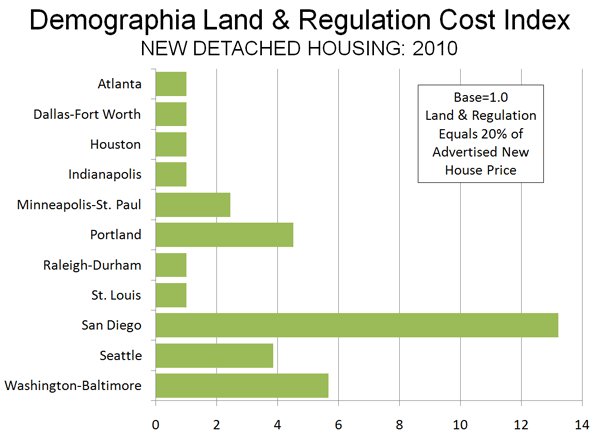
    Our first annual Demographia Residential Land & Regulation Cost Index estimates the price of land and regulation for new entry level houses compared to the historic norm in 11 metropolitan regions (Note 1). Metropolitan regions in which land and regulation costs remain at or below normal have an Index of 1.0 while those with land and regulation costs above normal will have an Index above 1.0 (Figure 1).

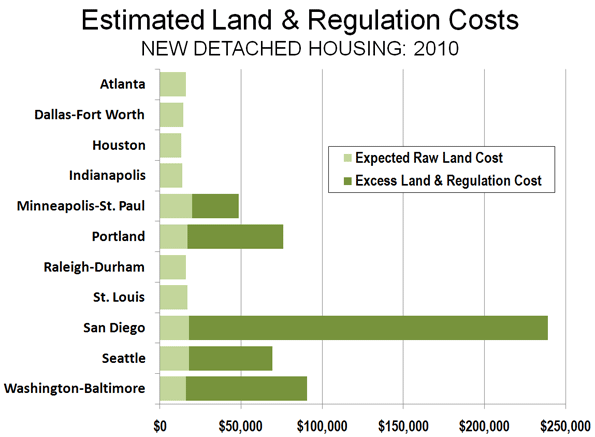
    More restrictive land use regulation is variously referred to as “smart growth,” “growth management” and other terms. More restrictive land use regulation is estimated to have added from nearly $30,000 (in Minneapolis-St. Paul) to more than $220,000 (In San Diego) to the price of a new home.

    Economic research has associated rising residential land costs with more restrictive land use regulations. The table indicates some of the more important price increasing impacts of more restrictive land use regulation.


    More Restrictive Land Use Regulation:

    Factors that Can Drive House Prices Higher

    1.. Increases underlying land costs

    2.. Increases planning and development costs

    3.. Raises financing costs

    4.. Encourages more expensive houses.

    5.. Increases construction costs

    6.. Encourages concentration of market power and land banking

    7.. Encourages land and housing speculation

    The Land and Regulation Ratio

    For decades, construction costs of tract house on the urban fringe in the United States have represented 80% or more of the advertised house price. The balance of 20% or less has been for land and regulation costs and will be referred to as the “land and regulation cost ratio.” In metropolitan markets with less restrictive land use regulation, the historic 20% or less land price ratio remains in place. The Demographia Residential Land & Regulation Cost Index assumes a 20% expected land and regulation ratio.

    In some metropolitan markets, however, house prices have increased far more rapidly than in the rest of the nation. The greater increase in house prices and escalation of land costs above the historic 20% land and regulation cost ratio has occurred in metropolitan markets burdened by more restrictive land use regulations. Urban growth boundaries, limits on the number of houses that can be built, large lot zoning and excessive development impact fees and the like are regulation strategies that increase the cost of land for building houses. These land cost increases are not the result of more rapidly rising construction costs or underlying market forces such as consumer demand.

    More restrictive land use land use regulation also creates obstacles to people buying houses, requiring them to devote more money to housing than necessary and increases their vulnerability to losses in the event of a financial downturn. This exposes mortgage lenders to increased risks of loan defaults. Finally, more restrictive land use regulation makes residential land development more dependent on politics, with the potential for greater influence through campaign contributions.

    The first annual Demographia Residential Land & Regulation Cost Index estimates cost of land and regulation for new entry level houses compared to the historic norm in 11 metropolitan markets. Each of the metropolitan regions in which house prices have risen above normal have adopted more restrictive land use regulations. Conversely, in each of the metropolitan regions in which house prices have not risen above normal levels, there is less restrictive land use regulation. During much of the Post-World War II era, all metropolitan markets had less restrictive land use regulations.

    Results

    The overwhelming majority of new housing in the United States continues to be detached and is built near or on the urban fringe (Note 2). For new detached homes, the Index is 1.0 in six metropolitan markets (Atlanta, Dallas-Fort Worth, Houston, Indianapolis, Raleigh-Durham and St. Louis). This indicates that land use regulation is less restrictive and does not add more than normal to the price of new homes (Note 3).

    In the other five metropolitan markets, the land and regulation cost ratio has risen above 20%, resulting in a higher Index. The Index is 2.4 in Minneapolis-St. Paul, 3.9 in Seattle, 4.5 in Portland, 5.7 in Washington-Baltimore and 13.2 in San Diego. It is estimated that more restrictive land use regulation raises the price of the least expensive detached houses from nearly $30,000 (in Minneapolis-St. Paul) to more than $220,000 (in San Diego) than would be expected if these metropolitan markets had retained less restrictive land use regulation (Figure 2).

    The metropolitan markets with more restrictive regulation have an average Demographia Residential Land & Regulation Cost Index of 5.9 for detached housing, while the metropolitan markets with less restrictive regulation average 1.0.

    Housing Affordability: Through the Bubble and Bust

    There is increasing concern about declining housing affordability across the nation. Even after the deflation of the housing bubble, house prices in some metropolitan markets remain well above pre-bubble prices and historic affordability standards. The housing affordability of the included metropolitan markets is illustrated by land use regulatory category in Figure 3. The Figure indicates the National Association of Home Builders-Wells Fargo Housing Opportunity Index for 1995, the peak of the bubble and early 2010, showing the percentage of households able to afford the median priced house. Similar affordability measures can be reviewed in the Annual Demographia International Housing Affordability Survey.

    Future Editions

    The 11 metropolitan regions included in the initial Demographia Residential Land & Regulation Cost Index were selected to provide a geographical and regulatory balance and because they had sufficient data from which to develop the Index. Additional areas will be added in future editions, with the intention of including all metropolitan regions with more than 1,000,000 population.

    ——-

    Note 1: The Index was derived from a database developed of new house offerings by national, regional and local builders, using internet sites and published metropolitan home guides. The period covered is January through June 2010.

    Note 2: In 2006, more than 85% of new single family houses sold in the United States were detached, according to Bureau of the Census data. Detached housing represents approximately 62% of all US housing units (including multi-unit dwellings).

    Note 3: In each of the metropolitan markets with less restrictive regulation, the estimated construction costs were more than 80% of the house price. By using a 20% land and regulation ratio, the house construction cost was capped at 80% of the house price. In each of the metropolitan markets with more restrictive regulation, the estimated construction cost was less than 80% of the house price.

    Wendell Cox is a Visiting Professor, Conservatoire National des Arts et Metiers, Paris and the author of “War on the Dream: How Anti-Sprawl Policy Threatens the Quality of Life

    Photo: Will County, Chicago urban fringe (By author)

  • The Real OC: Diverse, Dynamic and — Dare I Say — Progressive

    I recently returned to Orange County after a decade’s absence, fully aware that a stereotype of all-white, card-carrying-John Birchers still exists among many who remain unfamiliar with facts on the ground here.

    I never bought that old saw in the first place.

    And now, on a second venture into OC, I’m amazed by how deeply those old stereotypes have been buried under the accumulated accomplishments of everyday folks.

    The truth is that OC can rightfully claim ground as a leader when it comes to all sorts of popular buzzwords that are falsely applied to a lot of so-called cosmopolitan places.

    Start with “diversity,” a sop for all seasons in Los Angeles and other urban centers, where ethnic communities often are treated like so many pawns.

    Then there’s “dynamic,” another adjective that many metropolitan areas seem to think is theirs simply for the taking.

    Dare I add the presumptuous “progressive” to the list of over-used and seldom-earned buzzwords?

    I shall.

    In many ways OC, with its suburban reputation and libertarian leanings, comes closer to living up to the actual meaning of those words compared to many of the so-called cosmopolitan centers that cling to old stereotypes about this place.

    How do I figure?

    Take the campaign between Democratic incumbent Loretta Sanchez and Republican challenger Van Tran for the 47th District seat in the U.S. House of Representatives, an area that includes much of Central County.

    Tran has made Sanchez work hard in her re-election bid, no small feat considering her long incumbency.

    Neither candidate can count on ethnic appeal alone to propel them to the top. Latinos account for about 68% of the population in the district, which helps Sanchez. But voter registration is a different matter. Asians make up a smaller-but-still-significant base for Tran, with about 15% of the district—slightly more than whites. The winner will have to pick up a good chunk of voters outside their respective ethnic bases.

    That makes for a competitive race in a general election.

    And that’s a rarity in too many metropolitan areas.

    Consider Los Angeles, where ethnic communities too readily are factored like so many widgets into the calculus of ethnic politics. Electoral districts are carved up to turn this or that ethnic community into a lock for one political party or another.

    Candidates in these tailored districts typically get in line with power brokers before launching campaigns. There are occasional primary contests. But the differences between candidates in those intraparty affairs are usually so small that any debate is dominated by minute matters rather than any real difference in philosophies or policies.

    That’s stagnation.

    Some so-called cosmopolitan types might look at OC and say that the Sanchez-Tran race is an anomaly because of the challenger’s heritage. The local Vietnamese community ended up in OC after its founders fled a communist government, making it a natural for conservative, Republican politics here. That makes the community an outlier in terms of politics, ethnic or otherwise.

    That might hold up if it weren’t for Phu Nguyen, the Democratic nominee for the 68th District seat in the California Assembly, a territory that stretches from Anaheim to Newport Beach.

    Nguyen and Tran—Democrat and Republican— together belie any notion that the Vietnamese community is an outlier because of over-riding Republican loyalties in the local Vietnamese community.

    Nguyen’s opponent for the Assembly seat, Costa Mesa Mayor Allan Mansoor, points in the same direction as he engages in their high-spirited debate.

    Mansoor is a Republican who springs from Arabic and Finnish stock. The district that he and Nguyen vie to represent takes in parts of Little Saigon and Little Arabia, but does not feature a majority of voters of Vietnamese or Arabic heritage. There’s no big Finnish contingent, either.

    So you have a couple of candidates who can be readily identified by their ethnicities locked in an electoral battle that goes well beyond ethnic politics. They must reach beyond ethnic politics because the district in the heart of OC is too diverse for such narrow appeals.

    I don’t see any saints in the local political lineup. I’m willing to bet that both parties have tried to slice and dice the map to come up with districts that would make cynical use of ethnic communities.

    The point here is that OC attracts the sort of residents who reach beyond the familiar, pushing out here and bumping into one another there. Sure, Little Saigon is the major center of Vietnamese-American life, Santa Ana has an undeniably Latino core, and there is a Little Arabia in Anaheim. Yet those centers function more as cultural touchstones and less as assigned areas for members of those respective ethnic communities.

    The truth is that OC’s population mix is pretty well spread geographically and socioeconomically, with plenty of ambition—political and otherwise—throughout.

    That’s a different sort of diversity compared to what we hear so much about in a lot of so-called cosmopolitan centers.

    Sounds pretty dynamic.

    You might even call it progressive.

    Sullivan is managing editor of the Orange County Business Journal (ocbj.com)

    Photo by vansassa

  • Suburban Nation, but Urban Political Strategy

    Ideologues may set the tone for the national debate, but geography and demography determine elections.

    In America, the dominant geography continues to be suburbia – home to at least 60 percent of the population and probably more than that portion of the electorate. Roughly 220 congressional districts, or more than half the nation’s 435, are predominately suburban, according to a 2005 Congressional Quarterly study. This is likely to only increase in the next decade, as Millennials begin en masse to enter their 30s and move to the periphery.

    Now the earth is shaking under suburban topsoil — in ways that could be harmful to Democratic prospects. “The GOP path to success,” according to a recent Princeton Survey Research Associates study of suburban attitudes, “goes right through the suburbs.”

    The connection between suburbs and political victory should have been clear by now. Middle- and working-class suburbanites keyed the surprising election win of Republican Sen. Scott Brown in Massachusetts in January. Suburban voters were also crucial to the 2009 Republican gubernatorial victories in Virginia and New Jersey, two key swing states.

    Nationally, suburban approval for the Democrats has dropped to 39 percent this year, from 48 percent two years ago. Disapproval for President Barack Obama is also high — nearly 48 percent of suburbanites disapprove, compared to only 35 percent of urbanites. Even Obama’s strong support among minority suburbanites, a fast-growing group, has declined substantially.

    Many suburban voters, notes Lawrence Levy, executive director of the National Center for Suburban Studies at Hofstra University, appear to be undergoing “buyer’s remorse” for backing Obama and the Democrats last time around .

    Much of the suburban distress, of course, stems from the still perilous state of the economy. Obama’s mix of fiscal and monetary policies has provided much succor to Wall Street, where stock prices have soared 30 percent, and to big corporations, whose profits have risen by 42 percent. This has been great for Manhattan plutocrats — but not particularly helpful for the suburban middle class.

    Indeed the indicators most important to suburbanites – private sector employment, weekly earnings, home prices and disposable income – have all stagnated or even fallen since Obama took office. Fifty-three percent of suburban residents, according to the Princeton study, described their financial situation as “bad.” The vast majority have either lost their job or know someone who has lost theirs. Almost 40 percent have either lost their home or know someone who did – up from 27 percent in 2008.

    Given the stubbornness of this recession, neither the current administration or Congress gets credit for improving conditions. Barely 10 percent of suburbanites polled think the stimulus helped, one-third thought it hurt and the rest said it made little difference.

    But there may be other, perhaps more nuanced, reasons for the administration’s suburban disconnect. Many of the administration’s most high-profile initiatives have tended to reflect the views of urban interests – roughly 20 percent of the population – rather than suburban ones.

    When the president visits suburban backyards, it sometimes seems like a visit from a “president from another planet.” After all, as a young man, Obama told The Associated Press: “I’m not interested in the suburbs. The suburbs bore me.”

    More recently, Obama made clear that he is more interested in containing suburbia than enhancing it. In Florida last February, the president declared, “the days of building sprawl” are “over.”

    Much of the Obama policy agenda – from mass transit and high-speed rail to support for “smart growth” policies – appeals to city planners and urbanistas. Transportation Secretary Ray LaHood has spoken openly of “coercing” Americans out their cars and the Department of Housing and Urban Development is handing out grants to regions which support densification strategies that amount to forced urbanization of suburbs.

    This is a problem since the vast majority of Americans – consistently more than 80 percent – do not prefer to live in dense big cities. Most want a house rather than being forced to live in an apartment. And for all but a handful, a car, not a bus or train, remains not only the preferred way to get to work, but often the only feasible means to get work — mostly in the suburbs.

    If the Democrats want to mount an electoral comeback in suburbia, they need to take these realities into account . There are just not enough votes in core cities, upscale close-in suburbs or college towns to knit together a majority.

    Recovering suburbia s is not impossible for Democrats. Obama himself proved this in 2008, by essentially tying for the suburban vote — a remarkable achievement. Bill Clinton won in 1992 and especially 1996 by competing well in suburbs and exurbs. In the last two election cycles, the shift of suburbanites to the Democrats keyed the party’s steady gains in the Congress – accounting for, according to GOP sources, as many as 24 seats in the last two congressional elections.

    Most important, suburbanite identification with the Republican Party has continued to erode over the past two years, according to the Princeton survey. Instead the big winners have been independents, who have grown to 36 percent from 30 percent of the suburban electorate.

    These voters, for the most part, also tend to be less strident in their cultural views than either secular urbanites or rural evangelicals. More than one in five suburbanites is an ethnic minority — which could also help the Democrats.

    But to win even these suburban voters, the Democrats must offer solutions to suburbanites that go beyond devising their forced conversion to dense urbanity. They could refocus their efforts on climate change to suburbs-friendly strategies like telecommuting — perhaps the cheapest, quickest and most socially acceptable way to cut down on greenhouse gas emissions.

    Outside of greater New York, which has half the nation’s transit users, there are already about as many telecommuters as transit riders. Why not work to expand this phenomena, so well suited to the vast majority of the country?

    These suburb friendly approaches should be examined as the Democrats reflect on what many expect to be midterm electoral setbacks. They can only compete successfully on a national basis by jettisoning their apparent disdain toward the aspirations of suburban homeowners and begin treating them with respect.

    This article originally appeared at Politico.

    Joel Kotkin is executive editor of NewGeography.com and is a distinguished presidential fellow in urban futures at Chapman University. He is author of The City: A Global History. His newest book is The Next Hundred Million: America in 2050, released in February, 2010.

    Photo by Caesar Sebastian

  • Shifting Voter Demographics: America is a Different Country

    As we head to the unpredictable 2010 elections, many pundits have been left scratching their heads and admitting that they really have no idea how this election is going to turn out. Nate Silver, today’s most careful analyst of election statistics and forecasting, examined a variety of indicators and concluded that there were more closely contested and hard-to-predict congressional races this election than ever before.

    The biggest reason for this uncertainty lies in the fact that America’s electorate is changing as fast as the country’s demographic and generational characteristics, and in the process these changes overturn old assumptions about how politics works – and too often doesn’t work – in America.

    In 1965 the nation was 89% white and 11% black, about the same as it had been during the previous century. Since then, high levels of Asian and Latin immigration have produced an America today which is 66% white and 33% “people of color,” a tripling of the minority population in only four decades. Remarkably, 10% of Americans are of Mexican descent and about 5% of the electorate speaks primarily Spanish. For the first time in US history a president of mixed race, although one who considers himself to be African-American, resides in the White House.

    The second big demographic change is the emergence of the largest, most diverse generation in American history: the Millenials. Like it or not, this generation will dominate the political and cultural life of 21st century America as much as the Boomers did in the late 20th century. The Millennial Generation, born from 1982-2003, is sometimes condescendingly referred to as the “youth vote,” but it should be more accurately recognized as the biggest and most important new voting cohort in America. There are about 95 million Millennials, about half of whom are now of voting age. One out of four eligible voters in 2012 will come from this generation. That will expand to more than one out of three voters by 2020.

    This is the fundamental driver of American political change: Every two years the percentage of non-whites and Millennials increases, a trend likely to continue in the decades ahead. Non-whites will grow from 33% of the population today to as much 50% by 2042. There will also be a rapid increase in the “mixed race” population, which might further complicate matters.

    As these populations grow, a new political reality will take hold in areas most immediately affected, especially in the Southwest and coastal areas of the country. The power of these population shifts to upend conventional political wisdom was demonstrated by Barack Obama’s victories over heavily favored establishment candidates in both the Democratic primary and the general election in 2008

    These demographic transformations are changing the political loyalties and beliefs of the American electorate. Democrats now have their largest lead in national party identification since the early 1960s. In the most recent Pew survey, only 15% of Americans claimed to be completely unaffiliated independent voters, while about half (48%) identify with the Democratic Party and 37% with the Republican Party. By contrast, in 1994, the last time in which a newly elected Democratic president faced a midterm election against an aroused GOP, the two parties were tied in party identification at 44% each. This Democratic advantage is due in large part to Millennials and Hispanics who identify as Democrats by a 2:1 margin over Republicans.

    Survey data also shows that most Americans continue to favor using government to address their economic concerns and societal challenges. This summer, in a survey conducted for the progressive think tank NDN, a clear majority (54% vs. 31%) of Americans favored a government that actively tries to solve societal and economic problems rather than one that takes a hands-off approach.

    These numbers virtually unchanged since Barack Obama’s inauguration. More recently, only 29% of those surveyed this fall told Pew they wanted all of the Bush-era tax cuts to remain in place, while a majority (57%) preferred either that those on the wealthy should be allowed to expire or that all of the Bush tax cuts should end. Forty percent of adults told an Associated Press survey they didn’t think the new health care law went far enough, while only 20% felt the federal government shouldn’t be involved in healthcare at all. These pro-government attitudes are likely to grow as more and more Millennials enter the electorate. By a 60% to 36% margin the generation favors a bigger government providing more services over a smaller government providing fewer services.

    Rather than being surprised every two years by the changing politics of a nation altered by a rapidly changing demography, pundits would be wiser to anticipate that American politics is going to keep changing and evolving every two years, and will never again look like the politics of the 20th century. In the shorter run, the operative question in this year’s midterm elections is the extent to which the rising elements in the electorate make their presence felt at the polls in November. President Obama, who is concentrating his final campaigning efforts on college campuses and minority neighborhoods, clearly recognizes the challenge—but also the rare opportunity—presented by the 21st century electorate. His success in energizing these newest members of the Democratic Party’s base will determine the still uncertain outcome of the midterm elections.

    But the longer term direction of American politics will clearly continue to be driven by the demographic and generational changes now sweeping the country. And unless the Republican Party finds a way to appeal to the emerging groups, they may find themselves enjoying only the most fleeting kind of renaissance.

    Morley Winograd and Michael D. Hais are fellows of the New Democrat Network and the New Policy Institute and co-authors of Millennial Makeover: MySpace, YouTube, and the Future of American Politics (Rutgers University Press: 2008), named one of the 10 favorite books by the New York Times in 2008.

  • Environmental Consequences of Low Fertility Rates

    But isn’t it great news for the environment that we are having fewer children?”

    We should always stress the positive in life. Were it not for the dramatic slowdown in birthrates that began the late 1960s and 70s, the apocalyptic warnings of overpopulation then voiced Paul Ehrlich, the Club of Rome, and many others could well have come true in short order. We are lucky that they did not. But it is not clear the “the planet” is any better off as a consequence.

    Consider, for example, that when Japan, South Korea, Singapore, and the other Asian Tiger countries first began to experience sharp declines in fertility in the 1970s, their economies simultaneously took off, leading to far higher levels of per capita and total consumption. More recently, China, and to a lesser extent India, have followed the same pattern. Viewed through the lens of demography this does not look like a coincidence.

    The first order effect of fertility decline is that there are proportionately fewer children to raise and educate. This both frees up female labor to join the formal economy, and allows for greater investment in the education of each remaining child. All else being equal, both factors stimulate economic development, and by extension pollution and resource depletion.

    Low fertility societies can put extra burdens on the environment in other ways as well. For example, they have a higher proportion of singles and childless couples, who generally have more money and opportunity to engage in new forms of consumption, such as world travel or eating out regularly, than do people bearing the responsibilities of family life. (Think of Japan’s so-called “parasite singles”—childless, young adults notorious for their high living).

    A rising proportion of childless households also affects the pattern of living arrangements in ways that can be harmful to environment. Five childless singles living in separate housing units, each with its own washer and dryer, stove, refrigerator, etc., will tend to have a bigger environment footprint than a five-person family that lives under one roof, as will be confirmed by any “carbon footprint” calculator. Such factors help to explain why even in places like Japan and Germany where population is already deceasing in absolute size, increases in per capita consumption result in increasing total carbon emissions.

    Of course, over time, low birthrates lead not to just fewer children, but to fewer working age people as well, even as the percentage of dependent elders explodes. This means that as population aging runs it course, it may depress economic activity for a variety of reasons. Yet even if these and other factors related to population aging ultimately cause a Great Recession and thereby tamp down use of natural resources, is still not clear the consequences for the environment are necessarily positive.

    For example, a society that is paying more and more for pensions and health care also has fewer financial resources available for environmental remediation and investment in “green technology” Also, a society facing dwindling numbers of workers available to support each retiree may respond by adopting patterns of production and consumption that save labor but are far more energy intensive and thereby create lots of environmental damage. (Modern industrialized agriculture, with its high inputs of fossil energy, synthetic chemicals, and water, for example, becomes closer to a necessity if there are dwindling numbers of people available to work the land).

    An aging society may also come to believe that there is no other way to preserve an eroding tax base or to pay for old age entitlement than by stimulating economic growth by whatever means. These could include subsiding suburban sprawl, bailing out auto makers, and other measures that are particularly hard on the planet. Finally, once the point of absolute population decline sets in, this may work against the feasibility of mass transit, high speed rail, and other forms of infrastructure that require a high population density to be economically feasible.

    Was Malthus wrong?
    Malthus and his many present day followers could still be right that we face a future of scarcity. Particularly alarming is the declining growth in agricultural productivity. The so-called Green Revolution, which involved the intensive use of petroleum-based fertilizers, synthetic chemical pesticides herbicides, irrigation, genetic engineering of crops and animals, mechanization, and economies of scale, appears to be approaching its limits. Already, the rate of productivity growth on American and European agriculture has dropped substantially in this decade compared to the 1990s, due to such factors as soil and water depletion, the increasing resistance of pests to chemical treatment, and the simple fact that there is only so much fertilizer one can add to soils and still have it benefit crops. World food production no longer produces a surplus, and in recent years has fallen below the rate of population growth. Decreasing genetic diversity in the crops on which humans depend also makes world agricultural production increasingly vulnerable to climate change, which is always occurring regardless of cause. Feeding the next one billion could be a lot harder than feeding the last one billion, even if most are seniors.

    Yet here again, emerging scarcities of food and other natural resources argue against any reversal in the current downward trend in fertility. If a huge and growing portion of mankind already finds the cost of children prohibitive under modern conditions how will they respond in their family planning when the cost of food and energy (to say nothing of health care and pension contributions) rises further?

    Key to understanding here is that phrase “modern conditions,” or more specifically the institutional arrangement that affect the economics of family life far more than the simple “cost of living.” If rising food and energy prices cause a reversal of the global trend toward urbanism and a renewal of small-scale, local production and rural life, this could be begin to restore the economic basis of the family. In that process, children would regain stranding as productive assets and fertility rates could be expected to rise as a result.

    The ongoing rollback of social security and other intergenerational transfer programs around the world pushes in the same direction. But until globalism and the welfare state are damaged to the extent that they lose even their short-term viability, increasing scarcity will push down fertility rates by increasing the cost of children and thereby accelerate global aging with all its attendant challenges.

    Phillip Longman, a senior fellow at the New America Foundation and the Washington Monthly, is the author of The Empty Cradle and many other writings on demographics and social change.

    Photo by Ethan Prater