Category: Economics

  • The Economics of Dependency

    This article first appeared at Foreign Affairs.

    How countries hit the demographic sweet spot.

    Demographics are among the most important influences on a country’s overall economic performance, but compared with other contributors, such as the quality of governance or institutions, their impact is underappreciated.

    Demographic factors, such as the age structure of a population, can determine whether a given economy will grow or stagnate to an even greater extent than can more obvious causes such as government policy. One of the most consequential aspects of demographics as they relate to the economy is a phenomenon known as the “demographic dividend,” which refers to the boost to economic growth that occurs when a decline in total fertility, and subsequent entry of women into the work force, increases the number of workers (and thus decreases the number of dependents) relative to the total population. The demographic dividend has contributed to some of the greatest success stories of the twentieth century, and countries’ ability to understand and capture this dividend will continue to shape their economic prospects well into the future. Continue reading at Foreign Affairs >>>

    Sami Karam is the founder and editor of populyst.net and the creator of the populyst index™. populyst is about innovation, demography and society. Before populyst, he was the founder and manager of the Seven Global funds and a fund manager at leading asset managers in Boston and New York. In addition to a finance MBA from the Wharton School, he holds a Master’s in Civil Engineering from Cornell and a Bachelor of Architecture from UT Austin.

    Photo: infradept

  • Is L.A. Back? Don’t Buy the Hype.

    With two football teams moving to Los Angeles, a host of towers rising in a resurgent downtown and an upcoming IPO for L.A.’s signature start-up, Snapchat parent Snap Inc., one can make a credible case that the city that defined growth for a half century is back. According to Mayor Eric Garcetti, the Rams, Chargers and the new mega-stadium that will house them in neighboring Inglewood, show that “that this is a town that nobody can afford to pass up.”

    And to be sure, Los Angeles has become a more compelling place for advocates of dense urbanism. Media accounts praise the city’s vibrant art scene, its increasingly definitive food scene and urbanist sub-culture. Some analysts credit millennials for boosting the population of the region and reviving the city’s appeal. Long disdained by eastern sophisticates, there’s an invasion from places like New York. GQ magazine called downtown L.A. “America’s next great city” last year.

    Downtown has transformed itself into something of an entertainment district, with museums, art galleries, restaurants, and sports and concert venues. Yet it has not become, like San Francisco or New York, a business center of note. In fact, jobs in the region have continued to move out to the periphery; downtown accounts for less than 5% of the region’s employment, one-third to half the share common in older large cities.

    Downtown’s residential growth needs to be placed in perspective. Since 2000 the population of the central core has increased by only 9,500; add the  entire inner ring and the population is up a mere 23,000. Meanwhile over the same span, the L.A. suburbs have added 600,000 residents. Jobs? Between 2000 and 2014, the core and inner ring, as well as older suburbs, lost jobs, U.S. Census data show, while newer suburbs and exurbs added jobs.

    In our most recent ranking of the metro areas creating the most jobs, Los Angeles ranked a mediocre 42nd out of the 70 largest metro areas; San Francisco ranked first. That’s well behind places like Dallas, Seattle, Denver, Orlando, and even New York and Boston, cities that we once assumed would be left in the dust by L.A.

    A New Tech Hub?

    The emergence of Snap has led some enthusiasts to predict L.A.’s emergence as a hotbed of the new economy. And to be sure, there is a growing tech corridor in the Santa Monica-Marina area that may gradually gain critical mass. Talk of a growing confluence between tech and entertainment content — the signature L.A. product — and the proliferation of new entertainment venues, could position the area for future growth. At the same time, the presence of Elon Musk’s Space X in suburban Hawthorne, near LAX, has excited local boosters.

    Yet despite these bright spots, Los Angeles’ current tech scene is almost piteously small. One consistent problem is venture capital. Despite the massive size of its economy, and huge population, Los Angeles garners barely 5% of the nation’s venture capital, compared to 40% for the Bay Area, 10% for New York and Boston. Companies that were born in L.A. often end up moving elsewhere, like virtual reality pioneer Oculus, which was frog marched to the Bay Area after being acquired by Facebook.

    Indeed, despite bright spots like Snap, since 2001 STEM employment in the L.A. metro area has been flat, in sharp contrast to high rates of job growth in the San Francisco Bay Area, Austin, Houston and Dallas, and the 10% national increase. Tech employment per capita in the L.A. area hovers slightly below the national average, according to a recent study I conducted at Chapman University. Los Angeles County, once the prodigious center of American high-tech, is also now slightly below the national average of engineers per capita.

    The Poverty Economy

    The regional economy, notes a recent Los Angeles Development Corporation report, continues to produce largely numbers of low-wage jobs, mostly in fields like health, hospitality and services. Sixty percent of all new jobs in the area over the next five years will require a high school education or less, the report projects.

    At the same time in the year ending last September, employment dropped in three key high-wage blue collar sectors: manufacturing, construction and wholesale trade notes the EDC The largest gains were in lower-wage industries like health care and social assistance, hospitality and food service.  Since 2007 Los Angeles County has 89,000 fewer manufacturing jobs, which pay an average of $54,000, but 89,000 more in food service that pay about $20,000. No surprise more than one out every three L.A. households have an income under $45,000 a year.

    All this works well for the people who are increasingly coming to enjoy L.A.’s great restaurants, hipster enclaves and art venues. The football teams will add to this mixture, offering employment selling peanuts, popcorn and hot dogs to generally affluent fans in the stands.

    Yet low wages could prove catastrophic in a region that lags only the Bay Area in housing costs. Some 45,000 are homeless throughout the metro area, concentrated downtown but spreading throughout the region all the way to Santa Ana, in the south. Housing prices have risen to five times median household income, highest in the nation and more than twice the multiple in New York, Chicago, Houston or Dallas-Ft. Worth. L.A. leads the nation’s big metro areas in a host of other negative indicators, including the percentage of income spent on housing, overcrowding and homelessness. A city which once epitomized middle class upward mobility is increasingly bifurcated between a wealthy elite, mostly Anglo and Asian, and a largely poor Latino and African-American community.

    A recent United Way study, for example, found that 37% of L.A. families can barely make ends meet, well above the 31% average for the state; the core city’s south and east sides have among the largest concentrations of extreme poverty in the state. Once a beacon for migrants from all over America, L.A. now has a similarly high rate of mass out-migration as New York. But unlike New York, where immigrants continue to pour in, newcomers to the U.S. are increasingly avoiding Los Angeles – it had the lowest growth in its immigrant population of any major metropolitan area over the past decade. Perhaps even more revealing, the Los Angeles area has endured among the largest drops in the number of children since 2000,notes demographer Wendell Cox,  more than New York, Chicago and San Francisco.

    Altered DNA

    The writer Scott Timberg notes that L.A.’s middle class, was once “the envy of the world.” L.A. used to be a place where firemen, cops and machinists could own houses in the midst of a great city. Dynamic, large aerospace firms, big banks and giant oil companies sustained the middle class.

    But the city has lost numerous major employers over the years, most recently longtime powerhouse Occidental Petroleum, and the U.S. headquarters of both Toyota and Nestle. The regional aerospace industry, which provided nearly 300,000 generally high-wage jobs in 1990, is now barely a third that size. High housing cost have devastated millennials, whose home ownership rate has dropped 30% since 1990, twice the national average.

    Many urbanists hail the emergence of a transit-oriented, dense city. Since 1990, Los Angeles County has added seven new urban rail lines and two exclusive busways at the cost of some $16 billion. Yet ridership on the Metropolitan Transportation Authority rail and bus services is now less than its predecessor Southern California Rapid Transit District bus services in 1985, before any rail services were opened. The share of work trips on transit in the entire five-county Los Angeles metropolitan region, has also dropped, from 5.1% in 1980 and 4.5% in 1990 to 4.2% in 2015. Meanwhile the city endures the nation’s worst traffic.

    Some longtime Angelenos are mounting a fierce ballot challenge — known as Measure S — to slow down ever more rapid densification. The ballot measure would bar new high-density construction projects for the next two years. “The Coalition to Preserve L.A.,” which is funding the measure, claims to be leading in the polls for the March 7 vote, but faces well-financed opposition from politically connected large developers, Mayor Garcetti, both political parties, virtually the entire city council, and much of the academic establishment. The L.A. Times denounced Proposition S as a “childish middle finger to City Hall” and its architecture critic Christopher Hawthorne, has urged the citizenry “to move past the building blocks of post-war Los Angeles, including the private car, the freeway, the single-family house and the lawn.”

    Proposition S proponents include many neighborhood and environmental groups, as well progressives and conservatives, including former Mayor Richard Riordan. The people controlling Los Angeles may dream of being the “next” New York but many residents, notes longtime activist Joel Fox, “are tired of the congestion and development and feel that more building will only add to congestion.”

    Renewing La La Land

    Of course, slowing or banning development by popular proposition is probably not the ideal  way to get control over the deteriorating situation. Yet it is clear that the current trajectory towards more dense housing is not addressing the city’s basic problems. Los Angeles, as the movie “La La Land so poetically portrays, remains a “city of dreams” but that mythology is clearly being eroded by a delusional desire to be something else.

    In my old middle-class neighborhood in the San Fernando Valley, heavily populated by people from the creative industry, the worsening congestion, the upsurge of ever taller buildings and ever more present homeless did not reflect the giddiness of “La La Land.”

    Yet despite all these problems, Los Angeles has the potential to make a great comeback. It has a dispersed urban form that allows for innovation and diversity, and an unparalleled physical location on the Pacific Rim. Its ethnic diversity can be an asset, if somehow it can generate higher wage employment to stop the race to the bottom. The basics are all there for a real resurgence, if the city fathers ever could recognize that the City of Angels needs less a new genome but  should build on its own inimitable DNA.

    This piece first appeared in Forbes.

    Joel Kotkin is executive editor of NewGeography.com. He is the Roger Hobbs Distinguished Fellow in Urban Studies at Chapman University and executive director of the Houston-based Center for Opportunity Urbanism. His newest book, The Human City: Urbanism for the rest of us, was published in April by Agate. He is also author of The New Class ConflictThe City: A Global History, and The Next Hundred Million: America in 2050. He lives in Orange County, CA.

    Photo: AdamPrzezdziek

  • Automation, Artificial Intelligence, and Projectile Wooden Shoes

    Sabotage has its root in the French word sabot, which is a kind of wooden shoe. In the early days of the Industrial Revolution craftsmen would throw their shoes into the gears of factory machines. Skilled labor was being replaced with mechanical production, undermining traditional professions, reducing incomes, and removing the social standing of workers. Wealth flowed up to the people who owned the factories and controlled the levers of political power. Sabotage was a form of negotiation. Industrial production was so incredibly efficient and profitable that the craft guilds had no chance of surviving over the long term. And since the cost of manufactured goods dropped like a stone with industrial processes society wasn’t inclined to turn back the clock. What unfolded over the course of a couple of centuries was a series of social, political, and economic convulsions including revolutions, wars, and mass migrations.

    screen-shot-2017-02-14-at-8-09-03-am

    screen-shot-2017-02-14-at-8-08-49-am

    screen-shot-2017-02-14-at-8-09-20-am

    I passed a construction site recently and saw this mobile surveillance pod. This is the beginning of the end of the night watchman. It’s part of the ever expanding panopticon of electronic monitors connected 24/7 to the cloud – complete with facial recognition software and the ability to cross reference an endless number of databases including everyone’s e-mails and geotagged cell phone records. Rent-a-cops are on the way out.

    screen-shot-2017-02-18-at-8-29-21-pm

    screen-shot-2017-02-18-at-8-30-14-pm

    screen-shot-2017-02-18-at-8-29-42-pm

    screen-shot-2017-02-18-at-8-30-03-pm

    Think this is only a big city thing? Try rural Montana. Same same. The squad car parked on the side of the highway with a radar gun is about to fade away. A far more effective and lucrative series of electronic devices will instill discipline in drivers and generate passive municipal revenue instead. Did I mention aerial drones? First they’re used in Afghanistan. Then along the Mexican border. Then poor high crime neighborhoods. Then your quiet little cul-de-sac in Indiana or South Carolina… The code enforcement people are going to love it.

    Screen Shot 2016-03-27 at 10.41.15 PM

    Screen Shot 2016-03-27 at 10.41.39 PM

    How much longer do you think it will be before long haul trucks are fully automated? Autonomous vehicles are cost cutting devices, not the latest upgrade for consumer convenience. What do you think will happen to all the roadside establishments that serve the needs of human truck drivers? Tick tock.

    screen-shot-2017-02-07-at-6-24-10-pm

    This is Google’s newest gadget. It’s comparable to Amazon’s Alexa and Apple’s Siri. Speak to these machines and they perk up. “Play Bohemian Rhapsody.” Or “Order four AA batteries.” Or “When is my next dentist appointment with Dr. Harris?” These devices search the internet and/or various personal files from your phone or computer and seamlessly give you what you want.

    screen-shot-2017-02-18-at-6-20-32-pm

    screen-shot-2017-02-18-at-6-20-54-pm

    Think you’ll be spared because you’re an educated professional? It’s only a matter of time before more advanced versions of artificial intelligence replace an army of human workers in more skilled positions. Medical centers will swap out administrative staff for a suite of voice activated algorithms. Computer programs will eventually read X-Rays and MRI results and provide preliminary diagnoses. Secure pill dispensing machines are already the norm in many hospital pharmacies. Tech support and customer service jobs will disappear. Accountants and paralegals are on that same list. Think outsourcing overseas was a problem for the former middle class? Think illegal immigrants drove down wages? Wait for what’s coming next.

    screen-shot-2017-02-11-at-5-26-33-am

    screen-shot-2017-02-11-at-5-24-40-am

    screen-shot-2017-02-11-at-5-23-25-am

    screen-shot-2017-02-11-at-5-25-55-am

    screen-shot-2017-02-11-at-5-25-03-am

    Here’s a common sight in Silicon Valley. Colonies of second hand RVs parked between a Burger King and a freeway off ramp are occupied by people who have no better option. The middle class tends to write off such populations as alcoholic schizophrenics. I interact with these folks on a regular basis and most have jobs. Some have two or three. They’re adamant that they did nothing wrong, but the larger society has simply discarded them. The median home price in San Jose is $1,085,000. Median rent for a studio apartment is $2,120. Moving to a “cheaper” place like Oakland is no longer an option. Two bedroom apartments there now rent for $3,500 – assuming you can find a vacancy. The minimum wage in these communities ranges between $10.30 and $15 an hour. The numbers don’t add up. There are an awful lot of these homeless camps everywhere these days. This is what a bifurcated economy looks like.

    A friend asked me to write about a possible Minimum Guaranteed Income. The concept is simple enough. If an individual or household earns less than a certain amount of money the government will fill the gap with a cash payment. I remember my social studies teacher talking about a “negative income tax” back in the 1970’s so this isn’t a new idea.

    My response was short and to the point. Not going to happen. Americans reject wealth transfers and chafe at any hint of “social engineering.” Anti-poverty programs are so deeply unpopular that a Minimum Guaranteed Income is a non-starter. And resistance is strongest from the people who would most benefit – the marginal declining middle class.

    The usual solutions aren’t going to work either. Dramatically raising the minimum wage will only encourage more employers to automate more agressively to squeeze labor out of their business models. Jacking up taxes will drive jobs and people out of the state (a process that is already well under way.) Building subsidized housing won’t scale up and is politically toxic. Rent control keeps some people in artificially affordable housing at the expense of their landlords, but does nothing to create new housing – quite the opposite. Reducing regulations and eliminating onerous bureaucracies is structurally impossible since the agencies that administer existing programs are a lot more powerful than the people they’re meant to serve. Moving to Texas works for people who already have a toehold in the middle class, but for those with less skills and no money life in Houston is merely slightly less miserable. The list goes on…

    screen-shot-2017-02-20-at-3-25-18-am

    screen-shot-2017-02-20-at-3-25-08-am

    screen-shot-2017-02-20-at-3-36-01-am

    Screen Shot 2016-02-04 at 7.58.45 PM

    My best guess is we’ll see the implementation of policies that achieve similar goals to a Minimum Guaranteed Income by other means. But they’ll need to be in keeping with the dominant cultural narrative: The Puritan Work Ethic. If you don’t work, you don’t eat. And they’ll have to be designed to filter out people who are deemed unworthy of inclusion. That’s been the pattern for centuries. The military is the primary model. Cradle to grave socialism is perfectly acceptable – often eagerly embraced – by American society if the wealth transfer is to people who are believed to be deserving. The militarization of domestic affairs is a distinct possibility.

    screen-shot-2016-10-12-at-9-23-39-am

    screen-shot-2016-10-12-at-9-49-12-am

    Massive infrastructure building projects are another viable option for employing large numbers of low skill workers. The cost, productive capacity, or return on investment of such projects is essentially irrelevant. Project funding will be allocated by a political process that prioritizes select populations in particular locations. This preserves the existing vested interests – a combination of corporations and big government. Republican. Democrat. Conservative. Liberal. It doesn’t matter. The goal is to allow business-as-usual to limp along for a while longer while mollifying the displaced population. This will work until the feds can no longer borrow and print money. The alternative is a Soviet Union style collapse.

    John Sanphillippo lives in San Francisco and blogs about urbanism, adaptation, and resilience at granolashotgun.com. He’s a member of the Congress for New Urbanism, films videos for faircompanies.com, and is a regular contributor to Strongtowns.org. He earns his living by buying, renovating, and renting undervalued properties in places that have good long term prospects. He is a graduate of Rutgers University.

    All photos by Johnny Sanphillippo

  • The Economic Implications of Housing Supply

    A new paper with the above title by urban economists Edward Glaeser and Joseph Gyourko provides more evidence to back up the Antiplanner’s recent paper on the New Feudalism. One of the major points of that paper was that the Obama administration’s plan to force suburbs to relax zoning codes to allow higher density housing is not the solution to housing affordability problems.

    Glaeser and Gyourko point out that housing is affordable in most of the country despite zoning. In some parts of the country, however, “property rights have essentially been reassigned from existing land owners to wider communities, which have chosen to substantially reduce the amount of new building.” The result is that the supply curve for housing, which is nearly horizontal (meaning changes in demand have little effect on prices) in communities with traditional zoning, becomes very steep in the overly regulated communities (meaning small changes in demand can result in large changes in prices, i.e., prices will be more volatile).

    Glaser & Gyourko make one interesting point that I had not raised. One of the impediments to housing production in California is a state environmental quality act that requires developers to assess the local environmental impacts of new housing. The result is that little new housing has been built in California, forcing people to move to places like Arizona and Texas. But California’s temperate climate means that greenhouse gas emissions there are far lower than in interior states. “If California’s restrictions induce more building in Texas and Arizona, which require far more artificial cooling,” says the paper, “then their net environmental [effects] could be negative in aggregate.”

    The New York Times reported on the paper, but I think the writer misstates one of the main points. Instead of viewing homes as an investment, suggested the reporter, Americans should view them as consumer goods and accept that prices will fall. Americans need to “open our eyes to the negatives of the national obsession of owning a home, expecting its value to rise, and using the levers of local government to keep neighborhoods as they are,” says the Times.

    Yet homeownership isn’t an “obsession”; it is a natural, worldwide desire to have a predictable, stable home life. Nor does “using the levers of local government to keep neighborhoods as they are” make housing unaffordable: instead, it is using the levers of state or regional government to keep rural areas as they are. While the Antiplanner prefers the Houston model of deed restrictions over zoning, city zoning really isn’t a major problem for affordability so long as there is plenty of unzoned land outside the cities.

    In such areas, people don’t buy homes expecting to get rich from rising prices. But they do see the equity they build in their homes as a store of wealth that they can borrow against to start small businesses, put their children through college, or retire on.

    The one thing missing from the Glaeser/Gyourko paper and the Times article is a way out of the housing affordability mess. Glaeser/Gyourko suggest a federal program of building large numbers of homes in unaffordable areas, but considering the kind of homes federal bureaucrats are likely to build, this is likely to do more harm than good. The Times falls back on the Obama solution of building higher densities, but that’s not how most Americans want to live, and it seems silly to demand higher densities in states like California and Oregon that are at least 95 percent rural. The best solution to the conundrum, the Antiplanner has suggested, is through the courts, not legislation.

    Randal O’Toole is a senior fellow with the Cato Institute specializing in land use and transportation policy. He has written several books demonstrating the futility of government planning. Prior to working for Cato, he taught environmental economics at Yale, UC Berkeley, and Utah State University.

  • The Midwest, Redefined

    What if the region we broadly understand as the Midwest, stretching from the foothills of the Alleghenies to the high plains, and from the chilly northern Great Lakes to the Ohio, Mississippi and Missouri river valleys, had been allowed to develop as organically as its eastern and southern — and even western — neighbors?  

    If it had, it would be far better understood, have a much stronger cultural clarity, and more recognized for its contributions to American society and economy.

    Here’s what I mean.  The north central region of the U.S. has been an American paradox since its founding.  Unlike other regions of the country, where a critical mass of settlers established a colony or territory and then pursued legitimacy, the core of the region had its territorial boundaries established long before settlers had a chance to make a major imprint on the land.  That set off a race for control of the region by two already established regions, New England and Appalachia, with vastly different motivations — and cultural mores.  Because they came from different places, they took different paths to the Midwest.  New Englanders came via the Erie Canal and Great Lakes, while Appalachians traveled northward across the Ohio River.  Rather than intermingle and create a new and blended society, the New Englanders and Appalachians tended to maintain their local strongholds, with New Englanders in larger Great Lakes cities, and Appalachians in the upper regions of the Ohio Valley.  And this happened without any reconsideration or adjustment of political boundaries in the Midwest’s early days. 

    This has hampered our understanding of the Midwest ever since.

    Here’s a thought experiment.  Let’s say that instead of New York expanding to the shores of Lake Ontario and Lake Erie because it wanted to control development of the Erie Canal, western New Yorkers fought to establish their own state.  Similarly, let’s say that early settlers of western Pennsylvania recognized their remoteness from Harrisburg and Philadelphia, and decided local control suited them, too.  And let’s further suggest that, instead of becoming part of Ohio, the Connecticut Western Reserve was also allowed to develop as a separate state as well. 

    Ultimately, it’s conceivable that a new map of the Midwest, one that matches more closely to actual American settlement patterns, might look something like this:

    In my mind, as many as six new states could have emerged.  Western New York could’ve become Niagara, with Buffalo and Rochester as its key metropolises.  Western Pennsylvania could’ve become Allegheny, centered on Pittsburgh and Erie.  The Connecticut Western Reserve could’ve become Erie (or Cuyahoga?), greater Chicago could’ve been recognized as its own state, and the upper parts of Michigan, Wisconsin and Minnesota could’ve become Superior.  The southern part of Missouri could’ve become Ozark.

    The benefit of this is that the political environment aligns with the settlement patterns and modern-day networks of the region.  I’ve made similar points before about the cultural geography of the Midwest.  I think that because two different cultural groups inhabited the same space without ever effectively coming together, they’ve never maximized the development potential within either.  Yes, the Midwest was the nation’s manufacturing center for much of the 20th century, but it could be argued that it often did so in spite of rural and agricultural interests that were strong in state capitals like Columbus, Indianapolis and Springfield.  When manufacturing faded, those same interests often promoted the development of cities within their regions that were less tainted by a manufacturing legacy.

    Two years ago, I noted that, irrespective of state boundaries, the Midwest was somewhat aligned like this:

    And yet, the tension that was evident two centuries ago continues today.  For my “Five Midwests’ series, I quoted a passage from James McPherson’s book about the Civil War entitled Battle Cry of Freedom, in which he noted the economic, social and cultural differences between the Hoosiers, Buckeyes and Butternuts of the Ohio Valley, and the Yankees of the Great Lakes.  Today, geographers can track and map broad travel and commuting patterns that illustrate how we’re connected as a nation, and find those patterns still exist:

    “Danville, in central Illinois, is more closely connected to Des Moines, which is hundreds of miles away in Iowa, than it is to Chicago, which is much closer and in the same state.

    That’s not necessarily because there are tons of Danville commuters trekking to Des Moines. Rather, Nelson and Rae’s methodology shows they are both more tightly linked to the necklace of cities in between them—Urbana, Bloomington, Peoria, etc.—than they are to the cities that fall outside the entire zone.”

    Welcome to the characteristic that keeps the Midwest from being well understood as a region.

    Pete Saunders is a Detroit native who has worked as a public and private sector urban planner in the Chicago area for more than twenty years.  He is also the author of “The Corner Side Yard,” an urban planning blog that focuses on the redevelopment and revitalization of Rust Belt cities.

  • TruMpISSION: Impossible – Border Wall

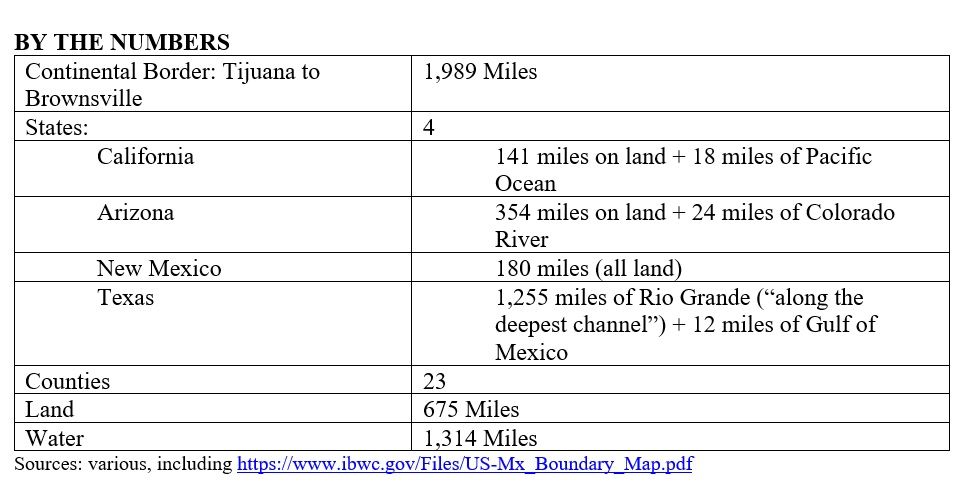
    While running for office, President Trump said the border wall would cost about $8 billion, a figure widely recognized as an unreasonably low estimate”. This week, the Department of Homeland Security (DHS) estimated the cost of construction at $21.6 billion. Figuring out what the wall would cost has been a source of debate for longer than the last election cycle. In 2013, the bipartisan “Gang of Eight” senators set aside $1.5 billion for a plan to add 700 miles of wall – also a completely unrealistic budget.

    In this edition of TruMpISSION: Impossible we examine the numbers behind building a wall along the U.S.- Mexico border. There are five main reasons why this mission is impossible.

    1. It will be hideously expensive. The un-walled portion of the border covers the most difficult terrain, a lot of which could cost $17 million per mile. Historically, building on flat land cost about $4 million per mile. The government spent $2.4 billion between 2006 and 2009 to build a stretch of wall along 670 miles of easy terrain (Secure Fence Act of 2006). A 2009 attempt to build along one rugged stretch of the border was budgeted at $58 million for just 3.5 miles.

    Since most of the easier stuff is already built, I calculated that the cost for the next 1.289 miles could easily run $19.3 billion – I think the new DHS estimate is close to the mark. To put the number into perspective, the cost will be about seven times the entire 2016 budget of the U.S. Border Portal. Construction isn’t the only expense. Section 10 of the Executive Order basically “deputizes” local law enforcement – at the expense of local taxpayers – to act as immigration officers for carrying out deportations.

    2. More than 1,000 of the open border is under water. Building a wall in the water would be wildly expensive and would have to be replaced frequently. In February 2012, construction began to extend began to extend an 18-foot high border fence 300 feet into the Pacific Ocean to seal off the gap that opened at the beach between Tijuana and San Diego during low tide. The private contractor who built it (Granite Construction Company, NYSE:GVA) gave the government a 30-year warranty. The budget for that Surf Fence Project was $4.3 million (I did not find the final cost in any public source). Based on that budget, the cost of building the wall in water could run $75.9 million per mile or about 4.5 times the cost of building on rugged land and nearly 20 times the cost of building the parts on more level ground. Building a fence on the water part of the border would cost close to $9 billion alone.

    3. Maybe Trump does not really mean to build on the border that lies underwater. The Executive Order defines the “Southern border” as only the “land border”. To avoid the extra expense of building in the ocean, the gulf, and two rivers, we can build on the land outside the flood-plain/tidal-zone. It is likely the Mexican president Enrique Peña Nieto has heard of the “adverse possession”. Along the border, state laws transfer rights to abandoned property to the possessor in 5 to 10 years. Building just one half mile from the rivers means the United States could relinquish at least 657 square miles to Mexico. Are we prepared to cede to Mexico an area 1.5 times the size of Los Angeles?

    Fox News has noted that “[w]hile 1,254 miles of [the] borders is in Texas, the state has only 100 miles of wall”. At least 65 miles of the 100 mile route proposed through Texas in 2008 sat a half mile from the border. In some places, like the McAllen area of Texas, the proposed track separated a water reservoir from the pumping stations that bring water to US citizens. Building up to a mile into the US side has already stranded the property of US citizens on the Mexico side of the wall.

    4. The border land that is not under water or already fenced is mostly in private hands. In a January 2016 story Fox News recognized that finishing the wall along the border in Texas could require hundreds of lawsuits by the federal government. The Washington Post also reported going into the 2009 expansion of the wall that much of the planned route would slice through private property. Private property adds an average of $61,491 per mile (based on actual costs in 2012). During the 2009 expansion, 135 private landowners refused to let surveyors onto their property. Seventy percent of the landowners who held out were in Texas. Anybody remember Jade Helm 15 when part of Texas was labeled “hostile territory” during military exercises? The Governor ordered the Texas State Guard to monitor the exercises. What do you think will happen if bulldozers show up uninvited to begin claiming 1,000 miles of Texan’s private property? The federal government can use eminent domain, but it is costly, takes a long time and holds an uncertain outcome.

    5. There may not be enough brick and mortar to build a wall along the US/Mexico border, especially if Trump keeps talking it up. During the 2009 expansion of the wall, cost estimates ballooned as a Border States construction boom led to labor shortages and rising costs for construction materials (e.g., steel and cement). Try building more than 1,000 miles of border wall while re-building transportation infrastructure, the strain will be beyond the global peak in prices seen when shovel-ready projects were initiated under post-financial-crisis stimulus spending.

    The Executive Order gave DHS 180 days (until about the second anniversary of Jade 15) to come up with a plan. DHS also has to figure out how to return deportable aliens “to the territory from which they came” – imagine millions of aliens lined up along the US/Mexico border. DHS has less time (until March 26) to figure out how to pay for the wall by withholding “all bilateral and multilateral development aid, economic assistance, humanitarian aid, and military aid” that the US may be planning to send to Mexico. That sounds like it could actually work to balance the budget outlay. Except that it won’t actually work. Total U.S. foreign aid to Mexico disbursed from all agencies in 2015 was $338.5 million (that’s “million” with an “m”). At that rate, it will take 54 years to recover the cost!

    Aid to Mexico includes $215 million for international drug and law enforcement plus $50 million more for in-country drug enforcement. The other hundred million or so was for justice projects, legal reform, crime prevention and military support. According to former Secretary of Homeland Security Jeh Johnson, “…experience teaches that border security alone cannot overcome the powerful push factors of poverty and violence that exist in Central America. Ultimately, the solution is long-term investment in Central America to address the underlying push factors in the region.”

    [After I calculate the costs for several more truMpISSIONs, I will calculate the cost of financing with debt. Just because something is impossible, doesn’t mean Trump won’t spend your money on it.]

    Susanne Trimbath, Ph.D. is CEO and Chief Economist of STP Advisory Services. Dr. Trimbath’s credits include appearances on national television and radio programs and the Emmy® Award nominated Bloomberg report Phantom Shares. She appears in four documentaries on the financial crisis, including Stock Shock: the Rise of Sirius XM and Collapse of Wall Street Ethics and the newly released Wall Street Conspiracy. Her newest book, Lessons Not Learned: 10 Steps to Stable Financial Markets, was published in November by Spiramus Press (UK). Dr. Trimbath teaches graduate and undergraduate finance and economics.

    Photo: ourfunnyfarm, CC License

  • How Richard Longworth Predicted 20 Years Ago That Globalization Would Cause a Social Crisis

    Global Squeeze: The Coming Crisis for First-World Nations
    Richard C. Longworth
    McGraw-Hill 1998

    Whenever we see the reality of momentous shifts in society, it’s always good to go back and take a look at the people who saw it coming far away. Generally speaking, there were usually people who understood what was happening in advance. For example, Daniel Bell wrote his book The Coming of Post-Industrial Society in 1976. There were probably even other earlier books touting the same theme.

    One person who clearly saw the challenges that globalization would bring to the developed countries was Richard C. Longworth. Longworth was a reporter for most of his career, and a long time foreign correspondent at the Chicago Tribune. Most readers here probably know him from his 2008 book Caught in the Middle: America’s Heartland in the Age of Globalism.

    But arguably more important was his 1998 book Global Squeeze: The Coming Crisis for First-World Nations, a book in which Longworth predicted most of the dynamics that would play out in the next two decades, culminating (so far) with Trump’s election. He predicted massive job displacement from China’s entry into the global trading system, describes how developing world countries would move up the value chain, predicts the erosion of middle-class standards of living, the rise of the gig economy, and the deterioration in race relations. He puts his finger on the nationalism vs. globalism debate and anticipated populist revolt. He didn’t predict everything, but he nailed an awful lot of it.

    I don’t know how this book performed in the market, but its timing was certainly inauspicious. It came out right as the dot com boom was going nova. Just as one contemporaneous event, on March 30 of that year James Glassman and Kevin Hassett wrote an op-ed in the Wall Street Journal (which no longer appears to be online) that became the basis of their now infamous 1999 book Dow 36,000.

    I was then in my late 20s and about to leave Andersen Consulting (now known as Accenture) for a telecom startup. I had no inking of how the future would ultimately play out, but I was incredibly, and naively, optimistic. Since coming out of school at the end of the early 90s recession, the tech industry had been booming beyond belief.  The post-mainframe tech transitions of the 90s, plus the nationalization (and early stage globalization of business) drove fantastic demand for consultants and while collar workers. It was truly the golden age for young people with college degrees. Unlike today’s Millennials, who are experiencing downward economic mobility, our salaries were soaring.

    Having a great employer and living in a nascently gentrifying Chicago, I was living in a bubble. I certainly did not see trouble ahead in these boom times. I was aware that manufacturing was in structural decline, but my assumption was that this was transitional and generational. Future generations would enter the exploding white collar workforce as I had and industrial displacement would be as forgotten as agricultural displacement had been.

    I didn’t see it coming. But Longworth did, even in those boom times.

    A Critique of Free Trade

    It’s interesting to see how Longworth, someone you’d certainly place today as in the mainstream of center-left thinking, was at that time sharply critical of what is now considered conventional wisdom by both parties, such as free trade dogmatism. For example, he criticizes the doctrine of comparative advantage:

    World trade is based on the idea that each nation should make what it makes best and most cheaply, and then trade those wares to another nation for what that nation makes best and most cheaply. In the process, both nations will prosper and will have access to better goods than if they tried to do it all themselves. This is the principle of ‘comparative advantage.’ It also has very little to do with trade in the real world of the global economy….Trade as it exists today bears little resemblance to the textbook images dear to the heart of free traders, for several reasons. One reason deals with the ability of giant firms to create comparative advantage and move it around the globe. If world trade used to take place between companies in different countries, it goes on as often now between branches of the same company operating in many different countries…These are not cases of countries taking advantage of their natural competitive advantages to make goods and services that can be sold freely to less-favored countries. They are cases of companies using technology to build enclosed and controlled trading systems.

    This is part of his general disdain for the economics profession:

    [Robert Z.] Lawrence and most of his mainstream colleagues are devoted free traders, literally trained from their undergraduate days to reject the thought that trade can cause more harm than good. Lawrence has even warned against letting such ideas get around, saying, ‘The very perception that a link exists [between trade and labor problems] could put the continuing evolution of trade and investment flows at risk.’ No one actually accuses these economists of faking their evidence to protect the sanctity of free trade. But it’s clear that many economists have carefully limited their research to product the results they wanted. The growing evidence that free trade can indeed cause severe damage, and that this damage may even outweigh the gains is producing nothing less than a religious crisis among the true believers in the economics departments of American universities.

    They may possibly have had a momentary crisis of faith in the 1990s, but if so, they quickly repented of their heresy. If anything, the economics profession today is more militant and more hysterical about any impingement on global trade than they used to be, even as they finally start to admit, belatedly, that just maybe trade with China has had some negative effects on American workers.

    I’ve been wanting to dig more deeply into trade economics because like Longworth I’m not convinced that the studies that are touted regarding trade’s effect on employment tell us what they are marketed as doing. For example, we frequently hear that research shows that relative few jobs were off shored, and that most job losses have been due to automation and other onshore productivity improvements.

    Yet I then read articles saying that just one company, Apple, and its subcontractors employ 700,000 people in China.  And I wonder: were these 700,000 jobs a) lost to trade/off shoring b) lost to automation or c) counted in some third bucket we’re not being told about? If they aren’t in large part doing jobs that would otherwise be done somewhere else, what the heck are all these untold tens of millions of workers in China manufacturing products for export actually doing?

    Longworth points out the hypocrisy inherent in some free trade arguments by pointing to China’s extremely state managed economy and highly protectionist legal system. By the standard arguments, this should have torpedoed them. Yet China has had a three decade run of fabulous growth so far. Even if they crash tomorrow, that’s remarkable. Far from chasing away businesses, even companies they’ve banned like Facebook continue to prostrate themselves before Emperor Xi hoping to get back in, all while delivering sanctimonious lectures to governments back home. And speaking of the tech industry, Longworth saw that China was using its trade discrimination rules to move up the value chain too:

    [China] has every intention of upgrading its exports from clothing and toys to high-end, high-tech, high-profit goods such as cars, electronics, and pharmaceuticals….and it is using its trade and investment policies to force Western companies to help it achieve this mastery, which it clearly intends to employ to compete with these countries in the future. Western and Japanese companies that want to invest in China are forced to bring in modern technology and teach the Chinese how to use it.

    The Primacy of the Nation and Its Social Integrity

    In contrast to the pre-Trumpian mainstream thinking of the Clinton-Bush-Obama years, Longworth argued that even if it’s economically inefficient, some type of protectionism was necessary in order for developed country societies to survive China’s entrance into the global trade system intact:

    If Japan was a problem, China will be a catastrophe. It seems impossible that the world trade system, with all its benefits, can withstand an assault of this sort….The major nations must now begin planning new rules to limit aggressive exports of this sort and to demand strict reciprocity – equal access to the markets of China…This is of course, both protectionism and managed trade, and will be attacked as such by purists who consider anything less than free trade a sin. But trade is an economic issue, not a theological one. The First World nations have civilizations worth protecting. If the price of that protection is some protectionism aimed at global predators, it seems folly not to pay it.

    This was of course rejected, and these civilizations are in fact badly damaged. And the global trade system is in serious jeopardy as a result, as Longworth predicted.

    This passage also gets at the core debate at the heart of contemporary politics: nationalism vs. globalism. Longworth tables this as they key issue in the opening passage of the book: “What is the purpose of an economy? If it is not solely for the well-being of the people who live within it, what is an economy for?”

    Longworth at this point in time clearly sided with the nationalist perspective, though as we’ll see in part two this review, his personal and political background created cognitive dissonance on this point that caused him to ultimately side with the very people he raked over the coals in this book.

    He saw that on the path the country was on, the prognosis for the middle class was grim and threatened our very understanding of a fair society.  Sadly, he was accurate here too:

    This is the proletarianization of the middle class, which once considered itself set for life in cushioned cubicle of big corporations but now finds itself pitched onto the pavement, a loser in the global competition for jobs. If there is a focal point of the growing debate on the global economy, it is here, where people work….The global emphasis on profits, the unrelenting pressure of the capital markets, and the search for best practice preclude comforting answers. The truth is that no one at this stage can give answers with assurance. The logic of global markets leads to more pressure on workers, not less. Millions of new workers appear on the world market every year, all hungry and ready to compete. The power of computer-driven automation makes it at least possible that, for the first time, new technology will be a job destroyer, not a job creator….This is the “race to the bottom,” a process that drives incomes ever lower. It is also straightforward supply-and-demand economics at work…This is the dehumanization of labor. No other major country treats its workers as commodities in this way, as raw materials or components that can be bargained to the lowest price.

    He also correctly foresaw that race relations would degrade with economic stresses. Not only did this cause the white working class to prioritize its own self-interest (the same as every other group), but if the white working class sneezes, the black working class gets a serious case of Spanish flu. As Longworth says:

    Racial progress, if not racial harmony, is real. The past three decades in particular have seen once-closed doors open for the vast majority of blacks. Anyone who can recall the legal segregation of the immediate postwar years must marvel at the changes. But economic problems threaten much of this progress.

    The retrogression of the racial fabric that we’ve seen is part of that social unraveling that he saw unfettered globalization imposing on America.

    And there’s much more he got right, including seeing the rise of the “gig economy” in a section called “A World of Temps.”

    The Moral Bankruptcy of the American Elite

    One of the major themes woven throughout the book is the moral bankruptcy of America’s elite and more broadly those who, like me at that time, were living large and loving life thanks to this new economy.

    He adopts Robert Reich’s “secession of the successful” thesis:

    The upper 20% retreats to its gated communities in the suburbs, withdrawing not only physically but psychologically and socially from the country around it. They are not only the wealthy, the executives and traders, but also the economists, journalists, and others who tout the global economy largely because they are best equipped to cope with it and most insulated from its effects. These fortunate few go by different names. Rohatyn calls them the “technological aristocracy.” Robert Reich, the former secretary of labor, calls them “symbolic analysts”….I prefer to think of them as global citizens, having more in common with the elites of Tokyo and Frankfurt than with the other Americans who live beyond the gates, in the shantytowns on the outskirts of the global village. Any country needs its elites. It needs their money, and more important, it needs their leadership. Now the United States is losing its elites.

    He talks about the dismal ethics and reckless behavior of much of the financial class:

    American traders usually have more formal schooling than their British counterparts, but they have no less ambition and no more real knowledge of the world. Most know the difference between normal risk and betting the bank. But some don’t. Most are honest. But some aren’t. Barely prepared and innocent of ethics, these traders are pitched into stupendous sums of money.

    He describes how major Western corporations came to think of themselves as post-national, and repudiated the social contract:

    Once the social contract expressed a deal between the wealthy and the poor, between businesses and their employees. Economic change has always brought both gain and pain. But in the short run, the wealthy were more likely to get the gain, and the poor more likely to feel the pain. The great stabilizer of postwar industrial society was the recognition by government and business that, if change creates both winners and losers, then the winners have an obligation to help and compensate the losers. This was more than simple fairness. It was good politics. It was the price that the winners paid to pacify the losers, who had the vote. If the pain became too great, the losers would stop supporting the system that caused the pain. So the Western nations created the safety net, a social balm that soothed the pain and kept the losers non-mutinous.

    This social contract has been broken. Footloose global corporations have stopped paying the taxes that financed it. The slack has been taken up, at least partly, by higher taxes on workers. In other words, workers are financing their own social contract. It’s robbing Peter to pay Peter. The losers are comforting the losers, while the winners pay minimal taxes in Indonesia or buy bonds in cyberspace.

    Or set up shell companies in Ireland or Luxembourg. The merits of corporate taxation are debatable. But we’ve all read the stories of how these Silicon Valley firms have racked up gigantic profits while using complex strategies to pay little if any tax.  It’s indisputable these companies have little concept of the social contract as previous generations understood it.

    These global companies have even seceded from national legal systems in favor of private justice.

    Even the functions that the governments used to do are being taken over by the global market. With no global laws or regulations to discipline these global markets, a sort of privatized form of justice has arisen. Around the globe, private arbitrators and arbitration centers are producing a “transnational legal profession and indeed a transnational private judiciary. These arbitrators, being private, compete for business and so depend on the goodwill of the corporations they judge. These corporations, in turn, use this private judicial system largely to escape the jurisdiction of national courts.

    These private courts can even force nominally sovereign nations to submit to them. That’s because these trade treaties set up international arbitration courts that empower businesses to sue countries outside of those countries’ home court systems. This is nothing less than a destruction of sovereignty, and one of the biggest complaints critics have about these “trade” treaties. There’s a reason it takes 5500 pages to print a so-called “free trade pact” – and it’s not free trade.

    As you can see, there’s a ton that Longworth got right 20 years ago – and he put his finger on issues that are if anything more relevant to public debates now than they were then. In fact, a few anachronisms aside, Global Squeeze holds up very well and is still eminently worth reading today. If nothing else, doing so will make clear that anyone who claims “we didn’t see it coming” isn’t telling the truth. Some people did see it coming. But they were ignored.

    That’s not to say Longworth predicted or got everything right. In the second part of this series I’ll highlight the areas he missed, and also how cognitive dissonance on his part and that of others like him who were sharply critical of globalization back then fatally undermined their efforts at reform and led them to ultimately be perceived as champions of globalization.

    Aaron M. Renn is a senior fellow at the Manhattan Institute, a contributing editor of City Journal, and an economic development columnist for Governing magazine. He focuses on ways to help America’s cities thrive in an ever more complex, competitive, globalized, and diverse twenty-first century. During Renn’s 15-year career in management and technology consulting, he was a partner at Accenture and held several technology strategy roles and directed multimillion-dollar global technology implementations. He has contributed to The Guardian, Forbes.com, and numerous other publications. Renn holds a B.S. from Indiana University, where he coauthored an early social-networking platform in 1991.

  • How the Visa Ban Will Hurt US Innovation

    A key reason for the prosperity found in the United States is the ability of universities and companies to attract the best and brightest people from abroad. Shutting out skilled individuals from entire countries could have grave consequences for America’s intellectual institutions as well as knowledge-intensive businesses. The obstacles put in place following the 2001 terrorist attack did reduce the position of the US in the global competition for talent, yet the regulations were about increasing security and allowed those that had been screened to enter. The new visa ban sends a message to talent from majority-Muslim countries: you are not wanted here, even individuals posing no threat. It is hard to imagine that this will not hurt America’s goodwill significantly, particularly in the European tech-sector where people from countries such as Iran play an important role.

    To illustrate the importance of talent attraction one only needs to look at Silicon Valley, the world’s greatest hub for new technologies and entrepreneurship. It is no coincidence that Silicon Valley has grown in close connection to Stanford University, one of the leading global institutions for learning and research in engineering and sciences. Without the brains attracted to Stanford and other similar universities, innovative American businesses such as Cisco, eBay and Netflix would not be able to dominate the global marketplace. Top entrepreneurs in Silicon Valley and other tech-hubs are understandably concerned about the visa ban. Facebook CEO Mark Zuckerberg was among the first to address the ban publicly, writing on Facebook: “We need to keep this country safe, but we should do that by focusing on people who actually pose a threat”. Since then numerous other CEOs spanning from the Automotive sector to the Pharma industry have made their voices heard against the travel ban.

    Much of the talent that fuels America’s universities and tech hubs comes from abroad. Between 1990 and 2014 for example, the college-educated immigrant population increased 339 per cent from 3.1 to 10.5 million. A group of particular importance is graduate students in fields such as science, engineering and health. It is these individuals whose knowledge and innovative ideas fuel the technologically advanced businesses on which US exports rely. Among the graduate students in these fields, one third are not US citizens or permanent residents, but rather foreign visitors. In some fields, international students make up the majority. An analysis of the latest data shows that 61 per cent of full-time graduate students in computer science are international. In the field of Electrical Engineering the share is even higher, 72 per cent.

    Where do these students come from? China and Korea are countries often associated with global talent influx into the US. But, we should not forget that several Muslim-majority countries, such as Pakistan and Iran, are also of importance, along with Muslim groups from India and Bangladesh. An illustrative example is Maryam Mirzakhani, born in Iran in 1977. Showing an early gift for mathematics, she received a degree from Sharif University of Technology in Tehran. After moving to the US, Maryam earned her PhD from Harvard before becoming a young professor at Stanford. In 2014 she was awarded the International Medal for Outstanding Discoveries in Mathematics. Maryam was the first women to win the medal, unofficially referred to as the “Nobel Prize of mathematics”. Since it was established in 1936, all previous winners have been male.

    Her story is not unique. In 2003, administrators at Stanford University’s Electrical Engineering Department were reportedly startled when the notoriously difficult entrance exam for PhD studies had been aced by a group of foreign students. The majority originated from one place – the same Sharif University where Maryam had studied. Stanford is not an isolated example. Iranian top students are doing well in the International Science Olympiads and flourishing in foreign universities.

    The Trump administration’s visa ban is affecting graduate students from Stanford. The Stanford Daily reported that Mostafa Afkhamizadeh, a Stanford PhD student born in Iran, was visiting his family when the presidential order was unexpectedly announced. The prospects for the fifth-year PhD student remain unclear. Will he be able to travel back to the US to finish his research studies in management science and engineering? Another example is that of Nisrin Omer, a Sudanese Harvard University graduate who is a graduate student in anthropology at Stanford. Although Omer is a legal U.S. resident and has lived in the country since 1993, she was briefly handcuffed and detained at JFK airport. There are more examples to be found amongst Stanford PhD students alone, such as Khashayar Khosravi and his fiancée whose wedding plans have been disrupted by the visa ban simply since they both happened to be born in Iran. We should keep in mind that the next wave of graduate students seeking to apply to foreign universities are taking note of the new risks associated with applying to the US. It helps putting oneself in someone else’s shoes: if you were a talented young Pakistani student, would you apply to a university in the US next year?

    Not long ago, the US was the unchallenged destination of choice for global talents. Following the 2001 terrorist attacks, the Bush administration introduced background checks that made it time consuming for international students from certain countries to enter the US. Some of the brightest international students could not gain entry into Stanford and other top US institutions, which led them to universities in Canada, the UK, and Germany. Suddenly, academic institutions outside the US realized that they could better compete. Universities which have attracted some international talent are more likely to attract additional international talent – since top students from abroad follow in the footsteps of previous top students, and because universities that have learned to attract some talents will have an easier time attracting others.

    The position of the US as the unchallenged destination of global talent has shifted since the policies of the Bush administration. Today, the best American universities are often but not always the top choice. While the US takes the influx of international brains as a given, governments in other countries are keenly aware that we live in a world where competitiveness is increasingly about knowledge. A study presented for Global Affairs Canada last year estimates that after accounting for Canadian scholarships and bursaries, the total annual expenditure of international students, their families, and friends contributed $9.3 billion in GDP to the Canadian economy. The long-term benefit of attracting this human capital from abroad will likely be many times higher. The Canadian government is actively signaling to global talent: we embrace you. This is, to say the least, not quite the positive message sent out by the US.

    The visa ban’s repercussions matter for international exchange between technology firms. Talent from majority-Muslim countries plays a key role in the technology sector not only in the US, but also in a range of other countries. For example, a study found Stockholm, the capital city of Sweden, “is the second most prolific tech hub globally, with 6.3 billion-dollar companies per million people (compared to [Silicon] Valley with 6.9)”. The innovative companies in Stockholm grow in close connection with those in the US, not least in Silicon Valley. In the Stockholm tech sector, people born in Iran and other parts of the Middle East make up a significant share of the engineers, researchers and entrepreneurs. Creating barriers for these individuals to travel to the US – as the visa requirement introduced last year by congressional Republicans did and the Trump ban reinforced – makes it difficult for Silicon Valley to grow along with tech hubs worldwide. The unicorn factory of Stockholm is a single example, many more can be found across Europe. Highly educated people from countries such as Pakistan and Iran play an important role in the European tech sector. They, and their colleagues, are anything but happy with the visa ban.

    While the direct effect of the visa ban is bad news for the US in an increasingly talent driven environment, the message it sends to the world is even worse: the Trump administration is willing to shut people out simply due to their place of birth. A comparison to the tighter rules introduced after the terrorist attack in 2001 is useful to illustrate this point. While certainly causing problems for many individuals, those affected then could sympathize with the effort to increase US security. The policy was about increasing security, not excluding those born in the “wrong countries”. The ban says to educated people from majority-Muslim countries, you are not wanted in the US. In a global knowledge economy, where the obstacle for growth is increasingly a lack of talent rather than a lack of financial capital, this form of policy is not wise. It will certainly hurt the promise of the Trump administration to boost US competitiveness. Republicans in favor of sound economic policies should advocate that the ban be replaced with more nuanced measures focused on security, not exclusion based on nationality.

    Atta Tarki is the CEO of Ex-Consultants Agency, an executive search firm helping Fortune 500 companies solve their most pressing talent needs across the world.

    Dr. Nima Sanandaji is the president of the European Centre for Policy Reform and Entrepreneurship. A number of his books, such as “Debunking Utopia”, “The Nordic Gender Equality Paradox”, “Renaissance for Reforms” and “SuperEntrepreneurs” have gained widespread international attention.

    Photo: Fibonacci Blue from Minnesota, USA (Protest against Donald Trump’s Muslim ban) [CC BY 2.0], via Wikimedia Commons

  • The High Cost of a Home Is Turning American Millennials Into the New Serfs

    American greatness was long premised on the common assumption that each generation would do better than the previous one. That is being undermined for the emerging millennial generation.

    The problems facing millennials include an economy where job growth has been largely in service and part-time employment, producing lower incomes; the Census bureau estimates they earn, even with a full-time job, $2,000 less in real dollars than the same age group made in 1980. More millennials, notes a recent White House report, face far longer periods of unemployment and suffer low rates of labor participation. More than 20 percent of people 18 to 34 live in poverty, up from 14 percent in 1980.

    They are also saddled with ever more college debt, with around half of students borrowing for their education during the 2013-14 school year, up from around 30 percent in the mid-1990s. All this at a time when the returns on education seem to be dropping: A millennial with both a college degree and college debt, according to a recent analysis of Federal Reserve data, earns about the same as a boomer without a degree did at the same age.

    Downward mobility, for now at least, is increasingly rife. Stanford economist Raj Chatty finds that someone born in 1940 had a 92 percent chance of earning more than their parents; a boomer born in 1950 had a 79 percent chance of earning more than their parents. Those born in 1980, in contrast, have just a 46 percent chance.

    Since 2004, homeownership rates for people under 35 have dropped by 21 percent, easily outpacing the 15 percent fall among those 35 to 44; the boomers’ rate remained largely unchanged.

    In some markets, high rents and weak millennial incomes make it all but impossible to raise a down payment (PDF). According to Zillow, for workers between 22 and 34, rent costs now claim upward of 45 percent of income in Los Angeles, San Francisco, New York, and Miami, compared to less than 30 percent of income in metropolitan areas like Dallas-Fort Worth and Houston. The costs of purchasing a house are even more lopsided: In Los Angeles and the Bay Area, a monthly mortgage takes, on average, close to 40 percent of income, compared to 15 percent nationally.

    Like medieval serfs in pre-industrial Europe, America’s new generation, particularly in its alpha cities, seems increasingly destined to spend their lives paying off their overlords, and having little to show for it.

    Rather than strike out on their own, many millennials are simply failing to launch, with record numbers hunkering down in their parents’ homes. Since 2000, the numbers of people aged 18 to 34 living at home has shot up by over 5 million.

    One common meme, particularly in the mainstream media, has been that millennials don’t want to buy homes. The new generation, as Fast Company breathlessly reported, is part of “an evolution of consciousness.” Other suggest the young have embraced “the sharing economy,” so that owning a home is simply not to their taste. The well-named site Elite Daily asserts that the vast majority of millennials are headed to “frenetic metropolis” rather than becalmed suburbs.

    And it’s not just ideologues claiming millennials have evolved out of home ownership. Wall Street speculators like Blackstone are betting that the young are committed to some new “rentership society,” with that firm investing $10 billion to scoop up existing small homes to rent, and even building tracks of homes exclusively for rent.

    It’s not a lifestyle choice, but economics—high prices and low incomesthat are keeping millennials from buying homes. In survey after survey the clear majority of millennials—roughly 80 percent, including the vast majority of renters—express interest in acquiring a home of their own. Nor are they allergic, as many suggest, to the idea of raising a family, albeit often at a later age, long a major motivation for home ownership. Roughly 80 percent of millennials say they plan to get married, and most of them are planning to have children.

    Overall, more than 80 percent of millennials already live in suburbs and exurbs, and they are, if anything, moving away from the dense, expensive cities. Since 2010 millennial population trends rank New York, Chicago, Washington, and Portland in the bottom half of major metropolitan areas while the young head out to less expensive, highly suburbanized areas such as Orlando, Austin, and San Antonio.

    Age will accelerate this process. Economist Jed Kolko notes as people enter their thirties they tend to head out of core cities to suburban locations; roughly one in four people in their mid to late twenties lives in an urban location but by the time those people are in their early thirties, that number drops precipitously and continues dropping into their eighties. In fact, younger millennials, notes the website FiveThirtyEight, are moving to the ’burbs at at a faster clip than previous generations. What’s slowing that trend is economics. Many can’t afford to move or transition to a traditional adulthood.

    The millennial housing crisis is reshaping the geography of opportunity. Although millennial rates of homeownership have dropped nationwide, the most precipitous declines have been in such metropolitan areas as New York, Miami, San Francisco, Portland, Seattle, and Los Angeles. In all these areas, public policy has regulatory barriers in the way of suburban and exurban affordability. It is in these markets where such things as “tiny houses” and “micro-apartments”—not exactly a boon to people looking to start families—are being touted as solutions to housing shortages.

    Nowhere is this dynamic more evident than in California, where the state government has all but declared war on single-family homes by banning new peripheral development, driving up house prices throughout metropolitan areas. Regulatory fees typically add upward of $50,000, two-and-a-half times the national average; new demands for “zero emissions” homes promise to boost this by an additional $25,000.

    Due largely to such regulatory restraints, overall California housing construction over the past 10 years has been less than half of that it averaged from 195 to 1989, forcing prices up, particularly on single-family houses. The state ranks second to the last in middle-income housing affordability, trailing only Hawaii. It also accounts for 14 of the nation’s 25 least affordable metropolitan areas.

    Home ownership rates in California are among the nation’s lowest, with Los Angeles-Orange having the lowest rate of the nation’s 75 large metropolitan areas. For every two homebuyers who come to the state, five families leave, notes the research firm Core Logic.

    The irony is that the state’s progressive policies are contributing to a less mobile society and a potential demographic crisis. For one thing, fewer young people can form families—Los Angeles-Orange had one of the biggest drops in the child population of any of the 53 largest metros from 2010 to 2015.

    This also has a racial component, as homeownership rates African American and Latino households—which often lack access to family wealth—have dropped far more precipitously than those of non-Hispanic Whites or Asians. Hispanics, accounting for 42 percent of all California millennials, endure homeownership roughly half that seen in other parts of the country.

    This is not the planners’ happy future of density dwelling, transit-riding millennials but a present of overcrowding, the nation’s highest level of poverty and, inevitably, a continued drop in fertility in comparison to less regulated, and less costly, states such as Utah, Texas, and Tennessee that have been among those with the biggest surges in millennial migration.

    Once identified with youth, California’s urban areas are now experiencing a significant decline in both their millennial and Xer populations. By the 2030s, large swaths of the state—particularly along the coast—could become geriatric belts, with an affluent older boomer population served by a largely minority servant class. How feudal!

    Ownership of land has always  been a critical component of middle-class wealth and power. Those celebrating the retreat from homeownership among millennials are embracing the long-term decline of that middle class, two thirds of whose wealth is in their homes.

    The potential decline in ownership also represents a direct assault on future American prosperity. Jason Furman, who served as chairman of President Obama’s Council of Economic Advisors, calculated that a single-family home contributes 2.5 times as much to the national GDP as an apartment unit. Investment in residential properties has dropped to its lowest share of overall spending since World War II; by some estimates reviving that would be enough to return America to 4 percent growth.

    With so many millenials unable to afford homes, or even to see a path to future ownership, household formation has been far slower than in the recent past. Rather than a surge of middle-class buyers, we are seeing the rise of a largely property-less generation whose members will remain economically marginal into their thirties or forties. Indeed by 2030, according to a recent Deloitte study, millennials will account for barely 16 percent of the nation’s wealth while home-owning boomers, then entering their eighties and nineties, will still control a remarkable 45 percent of the nation’s wealth.

    If this continues, we may have to all but abandon the notion of the United States as a middle-class nation. Instead of having a new generation that strikes out on their own, we may be incubating a culture that focuses on such things as the latest iPhone, binge watching on Netflix, something they do far more than even their Xer counterparts.

    Progressives who embrace these developments are abandoning one of the central tenets of mainstream liberalism. In the past, many traditional liberals embraced the old American ideal of dispersed land ownership. “A nation of homeowners,” President Franklin D. Roosevelt believed, “of people who own a real share in their land, is unconquerable.” Homeownership is not only critical to the economy but provides a critical element of our already fraying civic society; homeowners not only tend to vote more than renters, but they also volunteer more and, as Habitat for Humanity suggests, provide a better environment for raising children.

    On the flip side, high housing prices tend to suppress birthrates. Many of the places with the highest house costs—from Hong Kong to New York, Los Angeles, Boston, and San Francisco—also have very low birthrates. The four U.S. areas ranked among the bottom 10 in birthrates among the 53 major metropolitan areas in 2015. Over time these can have a dampening impact on economic growth, as is clearly seen today in places like Japan and much of Europe, and increasingly here in the U.S.

    It’s time for millennials to demand politicians abandon the policies that have enriched the wealthy and stolen their future. That means removing barriers to lots of new housing in cities and, crucially, embracing Frank Lloyd Wright’s notion of Broadacre Cities, with expansive development along the periphery.

    These new suburbs, like the Levittowns of the past, could improve people’s lives, while using new technology and home-based work  to make them more environmentally sustainable. They could, as some suggest, develop the kind of urban amenities, notably town centers, that may be more important to millennials than earlier generations. One thing that hasn’t changed is the demand for affordable single-family homes and townhomes. But the supply is diminishing—those under $200,000 make up barely one out of five new homes.

    There are some reasons for hope. The soon-to-develop tsunami of redundant retail space will open up millions of square feet for new homes. A move to prefabricated homes, already common in Europe and Japan, could help reduce costs. Certainly there’s potential demand at the right price—ones that young people can reasonably aspire to and then build lives in.

    The alternative is to travel back to serfdom and a society sharply divided between a small owner class and many more permanent rent payers. By then, the American dream will be reduced to a nostalgic throwback in an increasingly feudalized country.

    This piece first appeared in The Daily Beast.

    Joel Kotkin is executive editor of NewGeography.com. He is the Roger Hobbs Distinguished Fellow in Urban Studies at Chapman University and executive director of the Houston-based Center for Opportunity Urbanism. His newest book, The Human City: Urbanism for the rest of us, was published in April by Agate. He is also author of The New Class ConflictThe City: A Global History, and The Next Hundred Million: America in 2050. He lives in Orange County, CA.

  • In the Automation Debate, Don’t Forget the Job Multiplier Effect

    In his 1950s satire Player Piano, author Kurt Vonnegut describes a dark dystopia where automation has led to a world of meager consumption and desperate idleness. The vision of workers displaced by machines predates this though, and is perhaps most associated with the 19th century Luddite movement where workers sabotaged machinery for fear of losing jobs. In economic thought, the prospect of labor-replacing technology has a still much longer history.

    The opinion of most economists has been that “Luddite fears” are misplaced. New technology is economically synonymous with increased efficiency, new and cheaper products, expanded national income and demand for goods, and ultimately an expanded demand for labor and higher wages. With recent technology, however, most notably robots and artificial intelligence, a growing number of economists are sounding alarm.

    Will the future be one where capital in the form of robots and other machines make remunerative work increasingly obsolete? Will it be one where smart policy aims at the maintenance and fostering of labor-intensive processes, while shunning automation and capital intensity? These two questions increasingly dominate the economic debate. In this brief exploratory paper we highlight an important element in that debate.

    Don’t Forget Multiplier Effects

    The jobs supported by a given industry extend beyond those specifically employed in that industry. A more or less wide variety of produced inputs are needed, and jobs are created as well in the industries supplying these inputs. And the suppliers themselves need inputs, as do their suppliers, and so on, creating an often long and complex chain of input supply and job creation. Importantly, some industries have deeper supply chains than others, and a deep supply chain means higher off-site job effects.

    Turning to economic models, the off-site job effects of a given industry are captured by the employment multiplier of an input-output model. Employment multipliers measure total jobs divided by on-site jobs—a multiplier of 3 means for every job on-site two more are created off-site through supply chain multiplier effects. Now it may be that industry A offers fewer jobs on-site than industry B yet offers more jobs in total when multiplier effects are included. In framing a jobs policy, failure to include multiplier effects could lead to the erroneous choice of B over A.

    Off-site job creation extends beyond the chain of industrial inputs. An industry with a given number of workers and high wages will create more jobs through the effects of personal consumption spending than one paying low wages. Likewise an industry with much capital (buildings, machines, etc.) creates more property income than one with little capital, and this means greater personal consumption spending. More importantly, though, in the case of high-capital industries, considerable annual expenditures will be required to maintain, repair, and periodically replace the capital stock, and this creates jobs in the broad collection of industries that provide these essential capital goods and services.

    Multipliers and Automation

    So we ask the question: Do industries characterized by automation have greater off-site employment effects, i.e., multiplier effects, than other industries? If we had some definitive index of automation by industry we could simply compare industry I-O employment multipliers to this index and determine the answer. Unfortunately, to our knowledge, no such index exists. Is there a suitable surrogate?

    To begin with note that any tool or machine, even simple and inexpensive ones, contribute to the abridgement of labor and thus to some degree of automation. At the same time, a thoroughly automated factory, with its robots and advanced technology, is a very expensive factory, and thus a factory with a high ratio of capital stock to labor. So as a tentative exploration of the relation between automation and employment multipliers, let us compare industry capital-labor ratios and multipliers (see italicized footnote for how we estimate the value of an industry’s stock of capital).

    The multiplier effect we wish to examine includes particularly the action of personal income and induced investment spending. These are derived from our input-output model “closed” with respect to household spending and investment. Such models are strictly intended to portray the economic base of regional economies. When constructed at the national level, they tend to overstate multipliers, the result of assuming, in effect, that all economic activity is explained by national exports. However, absolute size notwithstanding, industry-by-industry comparisons provide an entirely reliable indication of relative multiplier magnitudes.

    Drawing an overall comparison of multipliers and capital-labor ratios, across all of the approximately 1,000 North American Industrial Classification System (NAICS) industries, provides a less than perfect yet solidly positive correlation. Figure 1 shows indicative findings.

    Leading the collection is petroleum refineries (NAICS 324110), with nearly $21 million in plant and machinery per employee and an employment multiplier of nearly 100. Think of the great investment in building a refinery, all the moving parts, the ongoing investment needed to maintain it, all the many inputs per worker and an employment multiplier near 100 is perhaps not surprising, especially as it is derived from a national-level model. Other industries with large capital investments (per worker) and employment multipliers include light truck and utility vehicle manufacturing (336112), petrochemical manufacturing (325110), and tobacco manufacturing (312230).

    At the other extreme, low multiplier-low capital investment, we find fine arts schools (611610). With a modest building, capital, and equipment investment of less than $9,000 per employee, art schools appear with an employment multiplier of barely 1.5. Other sectors at the low end, mainly service sectors, include child day care services (624410), mobile food services (722330), and nail salons (812113). It is easy to see how modest wages and minimal capital investment results in shallow multiplier effects.

    Implications for Policy

    While more research on the particulars of consumer spending and investment effects is warranted, and a more explicit measure of automation than simply the ratio of capital-to-labor would be helpful, our findings are nonetheless indicative of a need to consider multiplier effects in framing policy. As automation proceeds, employment multipliers will, of mathematical necessity, increase: A theoretical factory, fully automated, with no jobs at all, would have an employment multiplier approaching infinity. So in judging which industries fit better with a jobs and industry policy, consider where the inputs come from, including especially the investment goods and services needed to maintain plant and equipment. A factory full of domestically made and serviced robots may employ more workers than it appears.

    * Measuring the value of an industry’s capital stock:

    Among the annual data included in Emsi’s I-O model are figures on the flow of property income by industry. Property income is the return on invested capital. Assuming a uniform rate of return across all industries (we assume 4%, a rough but for our purposes acceptable assumption), the total value of capital in a given industry is computed as the industry’s flow of property income divided by the assumed uniform rate of return. Finally, dividing the value of an industry’s capital stock by the number of its employees provides that industry’s capital-labor ratio: the economist’s standard measure of industry capital-intensity.

    Dr. Robison is EMSI’s co-founder and senior economist with 30 years of international and domestic experience. He is recognized for theoretical work blending regional input-output and spatial trade theory and for development of community-level input-output modeling. Dr. Robison specializes in economic impact analysis, regional data development, and custom crafted community and broader area input-output models. Contact Josh Wright with questions about this analysis.

    Photo credit: Flickr/Steve Jurvetson