Category: Economics

  • The Successful, the Stable, and the Struggling Midwest Cities

    The Midwest has a deserved reputation as a place that has largely failed to adapt to the globalized world. For example, no Midwestern city would qualify as a boomtown but still there remain a diversity of outcomes in how the region’s cities have dealt with their shared heritage and challenges. Some places are faring surprisingly well, outpacing even the national average in many measures, while others bring up the bottom of the league tables in multiple civics measures.

    Let us examine the health of various cities, using population growth as a heuristic proxy for overall civic health. Looking at population change from 2000 to 2008, we will classify a city as “successful” if its metro area population growth exceeded the national average growth rate of 8% during that period, as “stable” if it had a population growth rate between 3% and 8%, and as “struggling” if its growth was less than 3%. Let us also put Chicago into its own category of “global city”. It is simply one of a kind in the Midwest, a colossus of nearly 10 million people, and not easily measured against the other cities. Indeed, it is really three cities in one, a prosperous urban core, an archipelago of successful upscale suburbs and edge based growth to the west and north, with a sea of deteriorating city neighborhoods and stagnant to declining suburbs surrounding them. On our scale, Chicago would be “stable” – its inner core has grown but the city overall has lost population, while the outer ring has grown strongly. As a region, it has grown somewhat below the national average.

    Here are the results of our tiering, including all cities in the Midwest* with metro areas exceeding 500,000 in population:

    Global City
    Chicago (5.2%)

    Successful Cities
    Des Moines (15.6%)
    Indianapolis (12.5%)
    Madison (11.9%)
    Columbus (9.9%)
    Kansas City (9.0%)
    Minneapolis-St. Paul (8.8%)

    Stable Cities
    Cincinnati (7.2%)
    Grand Rapids (4.9%)
    St. Louis (4.4%)
    Milwaukee (3.2%)

    Struggling Cities
    Akron (0.5%)
    Detroit (-0.6%)
    Dayton (-1.4%)
    Toledo (-1.5%)
    Cleveland (-2.8%)
    Youngstown (-6.1%)

    These tiers, based only on a single criterion and arbitrary boundaries, nevertheless basically conform to how these cities are performing both economically and in terms of perceptions.

    A few interesting things emerge:

    1. There are a surprisingly large number of Midwestern cities that are growing faster than the US average population. This indicates pockets of strength, in its larger metros at least, seldom associated with the Midwest.
    2. The clear dominance of the successful list by state capitals. This is so pronounced that I have put forth what I call the “Urbanophile Conjecture”, which is that if you want to be a successful Midwestern city, it helps to be a state capital with a metro area population of over 500,000. The only successful city on the list that is not a state capital is Kansas City.
    3. The 500,000 barrier seems to be important as well. The state capitals below that threshold – Lansing, Springfield, and Jefferson City – would not qualify as successful on this list. Note too that the presence or absence of the major state university does not appear to be a decisive factor. Des Moines and Indianapolis are not home to their states’ flagship universities. The home of the academic powerhouse that is the University of Michigan is the Ann Arbor metro area, which was not included in this list because its population is only about 350,000. Notwithstanding, its growth rate would have put it into the stable category.
    4. In a region in which there is such divergence between the performance of cities, a diversity of city specific policies are required. There is no one size fits all for the Midwest. There may indeed be a base of pan-Midwest policies worth pursuing – improvements in education, attractiveness to migrants, better conditions for innovative entrepreneurship, etc – but successful approaches will be those most tailored to uniquely local conditions. For example, a state capital or University town may have different needs than a place that has neither.

    Some suggested areas to investigate by city tier are:

    • Chicago. How can it ease the gap between the thriving global city of Chicago – largely located around the Loop as well as the northern and western suburbs – and the parts of the region that are falling behind, largely the western city neighborhoods and southern edge of metropolis? How do you do this without sacrificing its overall competitiveness? Can the policies appropriate to each be reconciled?
    • Successful Cities. Their policy focus should be on maintaining favorable demographic and economic conditions, and dealing with decaying areas of their urban cores and the potential for decay in some inner ring suburbs. Should the civic aspiration be desirous of it, tuning the engine to attempt to shift the growth rate into high gear to target a profile closer to the Sunbelt boomtowns would be a further focus area. Each city would need to examine which specific policy levers it could pull to attempt to do this. Clearly modernizing and expanding infrastructure to keep up with growth in these places and maintain their high quality of life is a clear imperative.
    • Stable Cities. Their challenge is to bring growth rates up to average or above average levels. It would be worthwhile for them to study the successful areas, and ask what policies and approaches might be adopted. Kansas City offers the best encouragement here. It has managed to maintain a strong growth rate despite not being a state capital and being part of a bi-state metro region. Kansas City features lows costs, high quality of life, a relatively stable housing marketing, and a pro-business culture. It is clearly a standout and worthy of further study for that reason. It may hold the key for moving the stable cities up into the successful tier. Geographically, it is notable that Kansas City is a border state on the far edge of the Midwest, and could arguably be called a Great Plains city. Is that a factor? Some type of peer city comparison with the successful cities, and especially Kansas City, might be warranted here.
    • Struggling Cities. Unfortunately, there isn’t a magic bullet to solve the long festering problems in these places. All of them were heavily industrialized and have borne the brunt of globalization, particularly in manufacturing. This is especially the case in cities linked to the domestic automobile industry, which is clearly in a state of crisis. Until the automobile industry completes its restructuring, and out migration right sizes some of these areas, there does not seem to be a clear path to restart growth. Youngstown, which brings up the bottom of our league table, perhaps offers the best road forward. It is trying to right-size itself to a permanently smaller, but more sustainable, future population based on an aggressive controlled shrinkage plan that has received extensive national notice. This type of plan is likely something all of these cities need to be actively considering as the large fixed costs support a population base that no longer exists will become increasingly unaffordable as the population further shrinks. These cities likely also will need special state and federal help to back this shrinkage plan.

    * The Midwest is defined as Illinois, Indiana, Iowa, Michigan, Minnesota, Missouri, Ohio, and Wisconsin.

    Aaron M. Renn is an independent writer on urban affairs based in the Midwest. His writings appear at The Urbanophile.

  • Housing Downturn Update: We May Have Reached Bottom, But Not Everywhere

    It is well known that the largest percentage losses in house prices occurred early in the housing bubble in inland California, Sacramento and Riverside-San Bernardino, Las Vegas and Phoenix. These were the very southwestern areas that housing refugees fled to in search of less unaffordable housing in California’s coastal metropolitan areas (Los Angeles, San Francisco, San Diego and San Jose).

    Yet now the prices in these hyper-expensive markets are beginning to fall. Once considered widely immune from the severe housing slump, the San Francisco area now has muscled its way into the list of biggest losers. The newly published first quarter 2009 house price data from the National Association of Realtors indicates that prices are down 52.5 percent from the peak. Only Riverside-San Bernardino and Sacramento have experienced greater losses out of the 49 metropolitan areas with a population of more than 1,000,000 for which there is data (see table below). Other metropolitan areas that have seen prices drop more than 50 percent include Phoenix, Las Vegas and, for very different reasons, that rustbelt sad sack, Cleveland.

    Table 1
    Median House Price Loss: Metropolitan Areas Over 1,000,000 Population
    Rank Metropolitan Area
    Median House Price % Loss from 2000-2008 Peak
    Median House Price Loss from 2000-2008 Peak
          1 Riverside-San Bernardino, CA -57.7% $235,600
          2 Sacramento, CA -56.5% $219,600
          3 San Francisco, CA -52.5% $444,800
          4 Phoenix, AZ -51.9% $139,200
          5 Cleveland, OH -51.5% $74,300
          6 Las Vegas, NV -51.3% $163,800
          7 Los Angeles, CA -48.8% $289,400
          8 San Jose, CA -48.0% $415,000
          9 San Diego, CA -47.5% $291,900
        10 Miami-West Palm Beach, FL -47.3% $185,200
        11 Orlando, FL -43.1% $117,200
        12 Tampa-St. Petersburg, FL -42.2% $98,800
        13 Washington, DC-VA-MD-WV -37.3% $165,900
        14 St. Louis, MO-IL -35.8% $56,300
        15 Chicago, IL -35.2% $100,900
        16 Atlanta, GA -34.4% $60,600
        17 Memphis, TN-MS-AR -34.0% $49,400
        18 Providence, RI-MA -33.6% $102,600
        19 Boston, MA-NH -32.5% $140,200
        20 Cincinnati, OH-KY-IN -28.6% $42,600
        21 Richmond, VA -27.9% $66,800
        22 Indianapolis, IN -26.6% $34,300
        23 Minneapolis-St. Paul, MN-WI -25.9% $60,800
        24 Columbus, OH -24.5% $38,400
        25 Denver, CO -24.1% $61,200
        26 Birmingham, AL -23.2% $39,300
        27 Jacksonville, FL -22.4% $44,600
        28 Charlotte, NC-SC -22.1% $48,700
        29 New York, NY-NJ-PA -21.9% $104,700
        30 Virginia Beach-Norfolk, VA -21.2% $54,000
        31 Kansas City, MO-KS -20.4% $32,400
        32 Seattle, WA -20.1% $79,500
        33 Pittsburgh, PA -19.0% $24,300
        34 Hartford, CT -17.7% $47,800
        35 Portland, OR-WA -17.0% $51,100
        36 Baltimore, MD -16.3% $47,900
        37 New Orleans, LA -15.6% $27,800
        38 Philadelphia, PA-NJ-DE-MD -15.2% $37,000
        39 Louisville, KY-IN -15.1% $21,500
        40 Rochester, NY -14.5% $18,000
        41 Houston, TX -13.6% $21,800
        42 Dallas-Fort Worth, TX -13.5% $21,100
        43 Buffalo, NY -13.1% $15,000
        44 Milwaukee, WI -12.1% $27,800
        45 Salt Lake City, UT -6.7% $16,500
        46 San Antonio, TX -6.2% $9,800
        47 Austin, TX -6.1% $11,900
        48 Raleigh, NC -5.3% $12,600
        49 Oklahoma City, OK -3.3% $4,500

    Cleveland, the newest entrant to the “over 50” club, fell largely because of the collapse of its industrial economy. It remains the only one of the thirteen mega-losers without prescriptive land use policies (sometimes called “smart growth”), which raise house prices by rationing land for development and imposing more stringent regulatory requirements. Cleveland illustrates a point made in a previous commentary: that the huge house price losses in the housing downturn have spread broadly from the original metropolitan areas that precipitated Meltdown Monday, the Lehman Brothers bankruptcy on September 15, and the Panic of 2008.

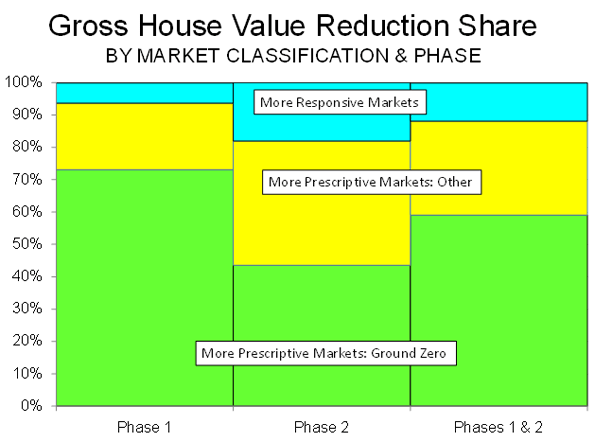
    During Phase I of the housing downturn (through September 2008), the largest losses were concentrated in the “Ground Zero” markets of California, Florida, Las Vegas, Phoenix and Washington, DC. In each of these 11 markets, median house prices dropped at least 25 percent, with per house over $100,000 except in Tampa-St. Petersburg during Phase I. These markets, all with more prescriptive planning, accounted for nearly 75 percent of the gross house value loss in the nation, with other more prescriptive markets accounting for another 20 percent. The more responsive markets, where land use regulation follows more traditional market-driven lines, accounted for slightly more than 5 percent of the loss.

    The Chart below and Table 1 in The Housing Downturn in the United States: 2009 First Quarter Update financial collapse, however, now has spread the losses much more generally. In Phase II, the Ground Zero markets represented 44 percent of the loss, the other more prescriptive markets 38 percent and the more responsive markets 18 percent.

    As of the first quarter of 2009, prices had dropped in all major metropolitan areas. The average per house loss in the Ground Zero markets was still the highest, at 48 percent, though the overall all loss had increased to 34 percent.

    There are indications that the housing downturn may be slowing. The latest data indicates that the median house price increased in March, though not enough to forestall a loss in the first quarter. Another indicator is the fact that the Median Multiple (median house price divided by median household income) has fallen to a national level of 3.1, which is slightly more than the 2.9 historic rate and well below the 4.6 peak.

    The best news of all is that the Median Multiple has dropped to 3.8 in the Ground Zero markets, which is equal to the historic level and well below the peak of 7.3. In the other more prescriptive markets, the Median Multiple is at 3.5, above the 2.9 historic average but well below the peak of 4.8. In the more responsive markets, the Median Multiple has dropped to 2.6, just above the historic average of 2.5 and below the peak figure of 3.2.


    Prices have fallen so much that they now stand at historic 1980 to 2000 Median Multiple levels in 18 of the 49 metropolitan areas. Critically, this includes the Ground Zero markets of Riverside-San Bernardino, Sacramento, Phoenix and Las Vegas.

    Other Ground Zero markets have seen much of their price inflation whittled away, but still have a way to go. Prices need to decline $33,500 to reach the historic Median Multiple level in Los Angeles, $32,300 in Miami, $31,200 in Washington, $18,500 in San Francisco, $11,100 in San Diego and only $1,700 in Tampa-St. Petersburg.

    In other markets, however, prices still have some distance to go before the historic Median Multiple is reached. The largest decrease would have to occur in New York, at $122,000, followed by Portland ($95,000), Seattle ($94,000), Baltimore ($75,000) and Salt Lake City ($74,000). Other markets, including Philadelphia, Virginia Beach, Milwaukee and Ground Zero San Jose would need to have price declines of more than $50,000 to restore their historic Median Multiples. See Table 2.

    Table 2
    Median House Price Reduction Required to Reach Historic Price/Income Ratio (Median Multiple)
    Median House Price Reduction Required to Reach 1980-2000 Median Multiple
    Median Multiple
    Rank Metropolitan Area
    1980-2000 Average
    2000-2008 Peak
    Current (2009: 1st Quarter)
          1 New York, NY-NJ-PA $122,200             3.9            7.7           5.8
          2 Portland, OR-WA $94,700             2.7            5.4           4.4
          3 Seattle, WA $94,400             3.3            6.2           4.7
          4 Baltimore, MD $74,700             2.6            4.6           3.7
          5 Salt Lake City, UT $73,800             2.6            4.3           3.8
          6 Philadelphia, PA-NJ-DE-MD $61,500             2.4            4.2           3.4
          7 San Jose, CA $55,400             4.5          10.2           5.1
          8 Virginia Beach-Norfolk, VA $53,600             2.6            4.7           3.5
          9 Milwaukee, WI $51,400             2.8            4.4           3.8
        10 Boston, MA-NH $41,900             3.5            6.1           4.1
        11 Los Angeles, CA $33,500             4.5          10.1           5.1
        12 Miami-West Palm Beach, FL $32,300             3.4            7.0           4.0
        13 Jacksonville, FL $32,000             2.3            3.6           2.9
        14 Washington, DC-VA-MD-WV $31,200             2.9            5.3           3.3
        15 Providence, RI-MA $29,400             3.1            5.4           3.6
        16 Raleigh, NC $26,700             3.3            3.9           3.7
        17 Austin, TX $20,500             2.8            3.3           3.2
        18 San Francisco, CA $18,500             5.0          11.2           5.2
        19 Denver, CO $18,000             2.9            4.3           3.2
        20 Minneapolis-St. Paul, MN-WI $15,700             2.4            3.6           2.6
        21 Hartford, CT $14,300             3.1            4.2           3.3
        22 San Diego, CA $11,100             4.9            9.5           5.1
        23 Buffalo, NY $10,900             1.9            2.5           2.1
        24 Charlotte, NC-SC $10,100             3.0            4.1           3.2
        25 Richmond, VA $9,500             2.8            4.1           3.0
        26 Louisville, KY-IN $8,100             2.4            3.1           2.6
        27 Chicago, IL $7,800             2.9            4.8           3.0
        28 San Antonio, TX $5,200             3.0            3.3           3.1
        29 Orlando, FL $4,000             2.9            5.2           3.0
        30 Pittsburgh, PA $3,400             2.1            2.8           2.2
        31 Tampa-St. Petersburg, FL $1,700             2.8            4.7           2.8
    Las Vegas, NV  At or Below              3.4            5.3           2.7
    Riverside-San Bernardino, CA  At or Below              3.7            6.6           3.0
    Sacramento, CA  At or Below              3.6            5.6           2.8
    Memphis, TN-MS-AR  At or Below              3.0            3.1           2.0
    New Orleans, LA  At or Below              3.1            3.3           2.8
    Phoenix, AZ  At or Below              2.8            4.7           2.4
    Atlanta, GA  At or Below              2.4            3.1           2.0
    Birmingham, AL  At or Below              3.0            3.5           2.7
    Cincinnati, OH-KY-IN  At or Below              2.3            2.8           2.0
    Cleveland, OH  At or Below              2.2            2.8           1.4
    Columbus, OH  At or Below              2.4            2.9           2.2
    Dallas-Fort Worth, TX  At or Below              2.7            2.7           2.4
    Houston, TX  At or Below              2.5            2.9           2.5
    Indianapolis, IN  At or Below              2.1            2.3           1.7
    Kansas City, MO-KS  At or Below              2.5            2.9           2.3
    Oklahoma City, OK  At or Below              2.8            2.9           2.8
    Rochester, NY  At or Below              2.2            2.4           2.0
    St. Louis, MO-IL  At or Below              2.2            2.9           1.9
    Median Multiple: Median house price divided by median household income.

    These price reductions may or may not occur in over-valued metropolitan areas like New York, Portland and Seattle, all of which are also experiencing serious increases in unemployment. However, given the pervasive evidence that the market is returning to the vicinity of historic price ratios, it would not be surprising if significant price reductions happen in these metropolitan areas, which were previously seen and saw themselves as immune to the fallout that hit the less well-regarded ground zero markets.

    Additional information is available in:
    The Housing Downturn in the United States: 2009 First Quarter Update

    Wendell Cox is a Visiting Professor, Conservatoire National des Arts et Metiers, Paris. He was born in Los Angeles and was appointed to three terms on the Los Angeles County Transportation Commission by Mayor Tom Bradley. He is the author of “War on the Dream: How Anti-Sprawl Policy Threatens the Quality of Life.

  • Let’s Snooker The TARP Babies

    Snook, Texas, a town of less than 600 souls, is best known for being the home of Sodalak’s Country Inn, the originator of country fried bacon. It may seem an odd place to launch a return to financial health, but that’s exactly what Dean Bass has in mind.

    Bass, a veteran banking entrepreneur from Houston, in November bought the tiny First Bank of Snook as part of his plan to build a new financial powerhouse amid the worst economic downturn in a generation. The old bank, which also had a branch 15 miles away in College Station, home to Texas A&M, provided Bass with his charter, as well as access to a strong market on the far periphery of his home town.

    Since buying into Snook’s bank, now renamed the Spirit of Texas Bank, Bass opened a new branch in the Woodlands, northwest of Houston. Over the past six months, the new bank’s assets have doubled to over $70 million, and by the end of the year he expects to break $100 million. Longer-term plans include expanding as well into Austin, Fort Worth and other major Texas markets.

    Bass’ basic strategy: Take advantage of the stumbling TARP-funded banking giants and steal what he calls their “disenfranchised customers.” This approach has implications well beyond the Lone Star State. Like other successful community bankers across the country, Bass believes that the mega-banks have been hopelessly tarred by TARP taxpayer funds. They have been revealed to be, if too big to fail, also too incompetent and poorly run to trust.

    “This is one of the worst banking markets I have ever seen–but the best for people like me,” said Bass, who sold his last venture, Houston-based Royal Oaks Bank, for $38.6 million in 2007. “When else would you see A+ customers fleeing places like Bank of America, Chase and Citi? People can’t even understand their balance sheets and stress tests. Their customers are ready to move on.”

    Over the next few years, the emergence of banks like Spirit of Texas could prove the silver lining in the largely bungled Bush-Obama bail out of the big financial companies. Ironically, the attempt to shore up the mega-dinosaurs has revealed these mega-banks to be creatures of little brain and even less principle. They now seem more akin, as economist Simon Johnson has pointed out, to Third World crony capitalists than paragons of free enterprise.

    In comparison, independent, non-TARP banks like the Spirit of Texas appear like paragons of traditional capitalist virtue and homespun values. For the time being, their rise will be most notable in “the zone of sanity,” the vast range of territory between south Texas to the Great Plains, which largely resisted the housing and stock asset bubbles of the past decade.

    In this region, most homes are well above water and many businesses–in everything from agriculture and energy to manufacturing and high-end business services–remain on solid footing. Of course, notes Randy Newman, president and CEO of Grand Forks, N.D.-based Alerus Financial, many local companies have been slowed by the recession. However, for the most part, places like the Dakotas and Texas enjoy relatively low unemployment and foreclosure rates, making them relatively good places for cultivating new customers.

    Politics and a sense of propriety also may play a role for resurging community banks. In places like the Great Plains, people prefer old-fashioned shots of banking fundamentals to the exotic financial cocktails concocted by the “genius” financiers on the coast. Politicization of banking is even less popular than elsewhere.

    “For the government to come out and stimulate the economy seems OK, but you think, jeepers, this TARP business makes little sense,” says Newman, whose bank enjoys assets of roughly $750 million. “TARP,” he adds, “is simply prolonging or delaying what has to happen. The walking dead will have to die sometime.”

    Uncertainty about the big banks, Newman believes, is leading customers, particularly smaller firms, to rediscover the merits of old-fashioned relationship banking. At banks like his, each loan is scrutinized not only by formula but also by things such as character, markets and a firm’s record of accomplishment.

    “The big banks will tweak their standards system-wide. There are no individuals in their book,” says Newman.” The big banks are geared to mass markets and big customers. But if you are looking at the $1 to $5 million loan a small business wants, the big bank does not look at you as an individual.”

    This up close and personal approach may seem laughably archaic to the once-celebrated “genius” quant jocks and bonus baby M.B.A.s on Wall Street–and perhaps also the brainy financial types running the Obama economic team. Yet if a sustainable private sector economic recovery is to take hold, the key may well lie with smaller bankers who can help small firms survive the recession

    Of course, the administration’s favoritism of the big boys also creates some real problems to community banks. Some fear the mega-banks will use TARP funds to acquire better-run, local institutions. Newman calls this prospect a “travesty.” Given their awful real balance sheets, Newman believes, banks like Citicorp and Bank of America “really shouldn’t be in a position to grow, much less expand.”

    So here’s a better course. Let these giants shrink or even fail. Let their insured depositors seek out new banking relations; with the stronger, well-run community banks. It’s widely believed that some 500 to 1,000 smaller banks may fail in the next year or so, so why not some big boys, too?

    Many economists, both right and left, including Nobel Prize winner Joseph Stiglitz, have urged this course. It would pave the way for well-run banks to expand at the expense of the incompetent and venal. Competition, after all, is supposed to be the basis of capitalism.

    Right now, the zone of sanity probably offers the best chance for this capitalist revolution. However, the shift to smaller banks may prove even more important in reviving the epicenters of lunacy, such as my adopted home state of California. Here, little banks like the privately held Montecito Bank and Trust are quietly expanding as customers leave the TARP babies for an institution a little more personal and grounded in sound banking principles. “Better boring than broke,” jokes Janet Garufis, Montecito’s president and CEO.

    It also helps to be local, she notes, even in a mega-state like California. Much of the damage to the TARP banks came when they bought into sliced and diced mortgages in locations they didn’t know. It turns out that local knowledge counts–not only in real estate, but in deciding about the right business to back.

    “The differences between a big-box bank and community are the difference of night and day,” suggests Garufis, who spent 35 years with Security Pacific, a onetime L.A. area powerhouse. “People like to see the whites of the eyes of the people they are doing business with. We know the community. We are part of it, and we understand what is going on here.”

    Of course, being local, smart and disciplined may not be enough for all these upstart banks. The failures of the mega-banks have increased the costs of things like FDIC insurance for even well-run institutions–in Montecito’s case, from $400,000 to $1.2 million over the past year. Equally challenging, TARP funds are helping the big boys offer slightly higher rates for mass-market products like CDs.

    Rather than focus on saving their Wall Street friends, the administration needs to allow an upsurge in smarter, smaller and better-run banks. Let us give these grassroots capitalists a chance and see what they can do.

    The road to a financial and economic recovery does not run through Wall Street and K Street, which, after all, are the primary originators of our distress. It lies in places that look more like Snook–even if country fried bacon is not to your taste.

    This article originally appeared at Forbes.

    Joel Kotkin is executive editor of NewGeography.com and is a presidential fellow in urban futures at Chapman University. He is author of The City: A Global History and is finishing a book on the American future.
  • Who will win the Car-wars?

    General Motors, the venerable American auto manufacturer is sitting on the cliff’s edge in North America with a recent 3-month loss of $6 billion. However, GM watched its sales in China skyrocket 50% for the month of April, 2009. Ironically, Toyota, the company many Americans now cheer for, has posted a $7.7 billion loss for the first quarter.

    This now proves, without a doubt, that the auto industry – not just in the US – is going through a massive crisis. But it’s clear that American manufacturing has reached a critical, historical turning point. What was once good for General Motors is no longer good for the rest of the nation. The days are gone where an automobile must be designed in the Detroit region and manufactured in the Great Lakes. We have seen a shift in trade and production location from the north to the south. However, geographic arguments are only a small part of the overall challenge to the industry, especially in North America.

    When the dust settles, what will the American auto industry look like?
    Regardless of what some may say, there is no such thing as an “American” vehicle anymore. We are fast shifting into a global economy that requires the sharing and collaboration of multinational resources from across the globe. Consumers demand quality products at very affordable costs. Corporations have no choice but to comply with consumer demand even if it means off-shoring production and even trimming quality in order to save money. In many ways, this is the Wal-Martization of consumer goods.

    The 21st-century automotive industry will be geographically spread throughout North America. Modern technology allows engineers to work from just about any location regardless of population, climate or infrastructure. However, many engineering outfits have found that locating brainpower in dynamic places improves quality and innovation. A dynamic place is a place where the educated and skilled want to work. These includes places like southern California (where most of the design studios are located), Ann Arbor, Austin, and others.

    In the 1980s the Midwest watched the southern states gear up and recruit non-Detroit manufacturers, in large part due to the lack of unions in the land of Dixie. We have seen the southern United States explode in production and manufacturing capability. The two main reasons for this were lack of unions in the South as well as tax-payer funded incentives. However, the idea of receiving incentives from the public coffer can backfire.

    Just about every state offers some form of tax breaks or incentives to corporations looking to construct new facilities. Every large corporation now looks to the state where they can get the most incentives. Everything else, such as skilled workforce, distribution, infrastructure – that all comes secondary. In many ways, this is just an example of robbing Peter to pay Paul. And it doesn’t work. You cannot simply take tax dollars from one area of the state and pour them into another region with the long-shot hope that an industry will grow in that certain region. This is exactly what Tennessee is doing.

    However, the southern states have struggled and will continue to struggle to attract brainpower and engineering talent. What the American public doesn’t realize is that there is a lot more to the creation of a vehicle unit than mere assembly. Besides production, there is fabrication, engineering, design, testing, marketing, legal, and distribution. Even today, much of the world’s automotive intelligence and engineering is located in Southeast Michigan. This fact irks southern powerbrokers who have been so successful at bringing grunt work to their states.

    We will continue to see massive amounts of automotive-related manufacturing relocate to Mexico due to the extremely low cost of production. Many of the Japanese and German manufacturers are already starting to notice the negative consequences of setting up production facilities in the United States. Nissan, Toyota and Honda have all initiated cuts and hiring freezes in their American manufacturing facilities. These companies have also initiated major contact employee programs rather than hire full-time fully-hired help.

    So what happens now in the old auto belt? Certainly, Ohio as well as Michigan must figure out how they can re-deploy their engineering talent. Each seems to graduate a huge number of students year after year but this tends to benefit other places. States such as Wyoming, Arizona, Washington, and others have held job fairs in Michigan in order to gain talent. If there are no jobs in Michigan, why do they keep graduating so many students?

    Even without George Bush and the GOP in power, Texas seems also to be a big beneficiary of this brain drain. But for how much longer can this continue? Remember Texas went bust in the early 1980s with low energy prices. It could happen again.

    Another natural winner in the car-wars could be the southern states, but only once they consolidate their efforts to bring knowledge and engineering to the South. It is much easier to offer incentives for a production facility than to woo an engineering lab.

    Critically, there still seems to be a lack of emphasis on higher education in the south. Even the best universities in the South cannot fully compete with the universities in the Midwest from a technical standpoint. Institutions such as Michigan, Wisconsin, University of Chicago, Michigan State and Indiana are still levels above the universities found in Kentucky, Tennessee and Georgia. The Midwestern schools built their solid knowledge and research background over a period of decades. This cannot easily be duplicated.

    To be sure, the auto-dominated economies of Michigan and Ohio will be shrinking in the future. These states are shedding their manufacturing sectors while reinforcing their knowledge-based sectors. Over time they may find it much easier to morph into a knowledge-based economy by using previous know-how than to build a knowledge economy from scratch. Michigan, for example, may have been hit hard by this global schism in manufacturing, yet it has been left with the know-how and knowledge left over from industry in the form of a strong university system. In contrast, nowhere in the south can we find that.

    In conclusion, some individual Midwestern cities may come out of this crisis better than many expect. Younger workers in the future will look at specific towns such as Madison and Ann Arbor, which offer an excellent quality of life, rather than head off to the sunbelt. This may be particularly true as they enter their 30s and look for a good place to raise their children, hopefully close to grandparents. The Midwest may be down, but not all of it is out – far from it.

    Amy Fritz was born in Cambridge, England during World War II. Her mother was a seamstress and her father a pilot with the RAF. Her uncles worked in various capacities within the British automobile industry and her father became an engineer and professor.

    After studying engineering at Cambridge, Fritz developed an interest in automobiles and went to work for a now defunct automotive supplier. Her occupation took her to Europe, Asia and North America, where she eventually settled as a technical engineering contractor for various auto-related companies. She is now semi-retired and living in the Denver area.

  • Austin’s Secrets For Economic Success

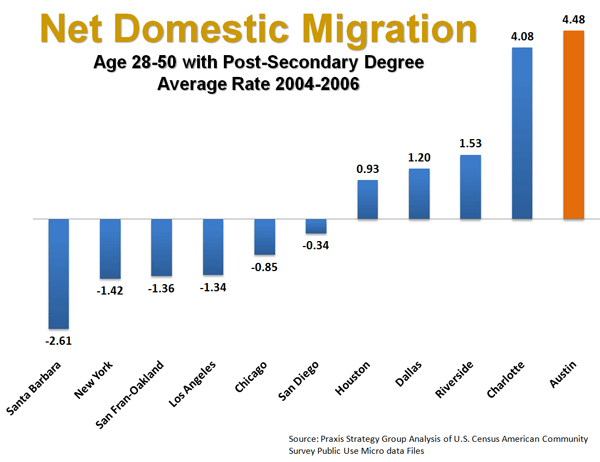
    Few places have received more accolades in recent years than Austin, the city that ranked first on our list of the best big cities for jobs. Understanding what makes this attractive, fast-growing city tick can tell us much about what urban growth will look like in the coming decades.

    Austin’s success is not surprising since, in many ways, it starts on third base. Two of its greatest assets result from the luck of the draw; it’s both a state capital and home to a major research university.

    Our ranking of the best cities for job growth includes many college towns–from Fargo, N.D., (home to North Dakota State) to Athens, Ga., (University of Georgia), Durham-Chapel Hill, N.C., (Duke and University of North Carolina) and College Station, Texas (Texas A&M).

    Being a state capital also helps. Baton Rouge, La., home to both the state government and Louisiana State University, ranked seventh on our list of the best medium-sized cities for employment. This confluence of institutions also accounts in large part for the relatively decent rankings of two Midwestern cities, Indianapolis and Columbus, Ohio, in spite of the generally sad situation in that region.

    That’s because colleges and state governments offer stable employment–since they cannot or will not outsource jobs to India or China. These places also tend to be inhabited by reasonably well-educated people whose stable incomes makes them less vulnerable to contractions in competitive industries like finance, manufacturing, construction or information.

    “We’re pretty close to recession-proof,” suggest Chris Bradford, a local attorney and blogger in Austin. “It’s almost anti-cyclical. In bad times, the students want to stay here.”

    There is a third factor, however, that adds to Austin’s special sauce: the fact that it is located in Texas, the one fast-growing mega-state. With low taxes and low regulation at the state level, Austin–no doubt to many locals’ consternation–is a great environment not only for public sector employment but also private sector growth.

    Its success contrasts dramatically with the relatively poor employment status of capitals in business-unfriendly states (such as Sacramento, Calif., which ranked 60th among large cities) as well as other college towns like Ann Arbor, Mich., home to one of the nation’s best public universities, the University of Michigan. (Among medium-sized cities, Ann Arbor came in 93rd.)

    Austin, essentially, reaps the benefits of being a deep blue, Democratic island in a red-state sea. The university and state government employ large numbers of people who might want higher taxes and greater regulation–but they can talk the redistributionist’s game without feeling any of the pain.

    This is not to say that Austin itself–that is, its urban core area–does not try to trot out its blue, and “green,” trimmings. Like every college town, Austin likes smart growth, mass transit and high density.

    But in reality, Austin is not a dense region. In fact, its metropolitan population per acre puts it in the middle of the nation’s largest areas, well behind not only Los Angeles and New York but also Houston and Dallas.

    Even central Austin seems rather spread out and suburban compared to traditional East Coast cities. Smaller, older homes–mainly cottages–dominate neighborhoods close to downtown. Recent attempts to go high-rise have not been notably successful, as the auction signs on the sides of some new towers suggest.

    Yet the urban center increasingly represents less and less of the area’s total employment and houses fewer and fewer of its residences. Today, the city itself is home to well under half the metropolitan population of 1.5 million.

    As in many regions, notes blogger Bradford, over the past decade the strongest growth has occurred in Austin’s periphery. Even as the city itself has enjoyed strong job and population growth, the biggest increases have taken place in suburban outposts outside city limits, like Williamson, Bastrop and Hays counties, as well as parts of Travis, the county that is home to Austin. In fact, Williamson was the nation’s sixth fastest-growing county last year, while Hays ranked 10th.

    Surprisingly, these suburban areas are the places most driving Austin’s economic success. Why? Two reasons: affordability and livability. By Texas standards, the city is not cheap. It costs between $350,000 and $400,000 for a nice three- or four-bedroom house in a good school district, say, 20 minutes from downtown. However, a similar place in the ‘burbs of Silicon Valley, San Francisco, Boston or Irvine would run at least twice as much.

    Local Realtor and blogger Shannan Gonyea-Reimer adds that, a bit further away from town, home prices can drop as low as $150,000. “People come from California, and they are shocked,” she says.

    This price structure, along with the human capital attracted to the University of Texas, has in turn propelled the rapid expansion of the non-governmental economy in places like Cedar Creek and Round Rock, home to Dell. A recent Brookings study estimates that central Austin employment grew by almost 13% between 1998 and 2006. The number of jobs more than 10 miles from the central business district increased by 77,523, or 62%, according to the study.

    Austin has seen remarkable overall employment growth–almost 34%–in the last decade. With that figure, it leaves its major hip tech rivals in the dust. Over the same period, for example, San Jose/Silicon Valley has lost 6% of its jobs; San Francisco, around 1.6%. Boston, Austin’s other big high-tech competitor, enjoyed only a 1.2% gain.

    Again, this growth stems in part from the unique combination of both an appealing city center and attractive suburbs. The city’s lively urban core remains a lure for affluent professionals, young singles and, of course, students. However, unlike places like New York, Boston and San Francisco, the sprawling ‘burbs provide an affordable place for people to move to when their hardcore clubbing days are over.

    “California might work well for the apartment-dwelling, single-guy lifestyle person, but when you get married, you can’t afford Los Gatos,” says former Silicon Valley entrepreneur Mike Shultz, the CEO of Infoglide, a software firm headquartered on Austin’s outer ring. “In Austin, the same person can grow up, move into a reasonable house and have a reasonable life.”

    This does much to explain why Austin has enjoyed a migration pattern unlike that of its primary competitors. Its residents may start off hip and cool, but the city also accommodates their often inevitable evolution to Ozzie and Harriet. This allows individuals and companies to plan to stick around. One doesn’t have to have the short-term mentality so common in the Bay Area, L.A., Boston or New York.

    Ultimately, it is this combination of a “cool” downtown culture–with excellent restaurants as well as great music–and a more sedate, affordable periphery that makes Austin a home run.

    “It has a hip cool side to it,” Shultz observes, “but it’s also a great place to raise kids.”

    A caveat to all this: We also have to consider scale. With roughly 1.5 million people, Austin simply offers more convenient choices than a megalopolitan behemoth like Los Angeles, New York or the Bay Area. In Austin, nice, single-family homes within walking distance of cool urban streets are not uncommon or absurdly expensive–and even a larger, more affordable house out in the suburbs is usually less than a half an hour from downtown.

    Additionally, Texas, unlike its main rival California, is not teetering on the edge of bankruptcy and is instead a stable long-term bet in this recession. Rather than haggling with bankers or public employee unions, it is busy building its future: attracting new comers, investing in its university and building new transportation infrastructure.

    “Austin is off the charts livable, but it’s in a state that makes it viable,” says Shultz, the entrepreneur. “You can’t say that about California and many of the other places where our competitors are.”

    This article originally appeared at Forbes.

    Joel Kotkin is executive editor of NewGeography.com and is a presidential fellow in urban futures at Chapman University. He is author of The City: A Global History and is finishing a book on the American future.

  • Cap and Trade: Who Wins, Who Loses

    President Obama recently announced his plan for environmental protection and Congress took up the debate. Called “Cap and Trade” Obama explained it simply in several public appearances. The government puts a limit on the total amount of carbon emissions that are acceptable in the United States. Carbon emissions come, basically, from burning carbon-based fuels – natural gas, petroleum and coal – in the production and use of energy. Users and producers of energy emit carbon dioxide (and other pollutants) into the atmosphere.

    As Richard Ebeling writes at the Mises Institute, under cap and trade “the government will formally nationalize the atmosphere above the United States.” The program bypasses fundamental questions like what is pollution, how much does it take to cause harm, who is harmed by it and linking the causation between pollution and harm. Fear of lawsuits, torts and injunctions (which could provide the answers) keeps the Administration from addressing these questions head-on. Reliance on the same, tired old source for solutions – Wall Street – ensures that those being harmed aren’t necessarily the ones who will benefit.

    Under Cap and Trade, each carbon-emitting entity – cars, power plants, factories, etc. – is allotted some share of that total limit, or Cap, permitted for carbon spewed into the air in the United States. For example, a power plant producing electricity for 50,000 homes and businesses might be allowed to emit 2 tons of carbon per year. That’s their “cap,” the maximum amount of carbon they are allowed to put in the air.

    Now for the “trade”: if that plant finds a cleaner way to produce the electricity needed for 50,000 homes and businesses, say only 1 tons of carbon per year, they can sell the right to emit 1 ton of carbon to a power plant that puts 3 tons of carbon into the air while generating electricity for 50,000 homes and businesses. The plant that buys the right to emit an extra 1 ton of carbon per year is not required to limit their emissions to 2 tons – they bought the right for the extra ton.

    It all sounds very lovely as long as the caps will control the total amount of carbon added to the air from the United States. The money gained by selling the rights for “unused” emissions will provide financial incentives to the makers and users of cars, power plants and factories to pay for the technology to be cleaner. Since the money spent to pay for the more efficient technology can be recovered in the Cap and Trade marketplace, the cost of the cleaner energy shouldn’t require higher costs to consumers of the now cleaner air.

    This is great if you live near a power plant that manages to reduce the carbon emissions into the air you breathe below the maximum cap level. Here’s the problem: what if you live next to the power plant that paid for the right to put an extra ton of carbon into the air? Two things happen. First, you will be paying for the extra carbon because the power company will have to charge more to pay the cleaner power company for the right to produce the extra ton of carbon. That leads to the second problem: the extra ton of carbon is being emitted into the air around your home. That means that you could end up paying more for your electricity, while also breathing more polluted air.

    Cap and Trade is not a solution, it is another money-making scheme cooked up by the “dangerous dreamers” of Wall Street. In the EU they at least have the good grace to call it a “Trading Scheme.” A global carbon trading market already exists. “Pollution rights” have been traded since the 1990s when the Environmental Protection Agency held the first auction of air emission allowances, or pollution rights, at the Chicago Board of Trade. Starting with sulfur dioxide allowances, other pollutants were added in the next ten years to eventually create a complete trading market on the Chicago Climate Exchange. “The right to use water or air is more valuable than food, and we can use the price system to allocate that right,” said Richard Sandor at the 2005 Milken Institute Global Conference (yes, that Milken). The Chicago Mercantile Exchange and the New York Stock Exchange are now prepared to expand the environmental markets for industrial pollution, also known as the carbon markets, into “futures and options on more than 40 U.S. and international indexes [for pollution rights].”

    But, really, do we want the same bunch of guys that gave us junk bonds, mortgage-backed securities and credit default swaps allocating air and water? Globally? Into the future?

    Like sending subprime mortgages throughout the global economy, this scheme will allow pollution rights to be bought and sold by anyone. So, it isn’t just the factory next door to the power generator in Detroit that will be emitting the extra tons of carbon – factories in other countries will be able to sell their carbon emitting rights to power companies in Detroit. It’s a great money-making scheme for a solar powered producer in Costa Rica – but a very bad deal for those breathing the air and paying for power in Detroit.

    The Cap and Trade scheme is being supported by President Obama’s main economic advisor, Larry Summers – who once said we should export pollution to Africa because their per capita figures are too low. “I think the economic logic behind dumping a load of toxic waste in the lowest wage country is impeccable and we should face up to that.”

    Cap and Trade gets the polluters mixed up with the victims of pollution. Shouldn’t the money generated from the sale of pollution rights accumulate to the persons harmed by the pollution? The idea that you can structure economic incentives to produce socially beneficial results really ends up being about creating paper profits for the money-traders at the expense of the people living with the pollution. This does not seem like a fair trade to me.

    Susanne Trimbath, Ph.D. is CEO and Chief Economist of STP Advisory Services. Her training in finance and economics began with editing briefing documents for the Economic Research Department of the Federal Reserve Bank of San Francisco. She worked in operations at depository trust and clearing corporations in San Francisco and New York, including Depository Trust Company, a subsidiary of DTCC; formerly, she was a Senior Research Economist studying capital markets at the Milken Institute. Her PhD in economics is from New York University. In addition to teaching economics and finance at New York University and University of Southern California (Marshall School of Business), Trimbath is co-author of Beyond Junk Bonds: Expanding High Yield Markets.

  • Visualizing our 2009 Best Cities for Job Growth Rankings

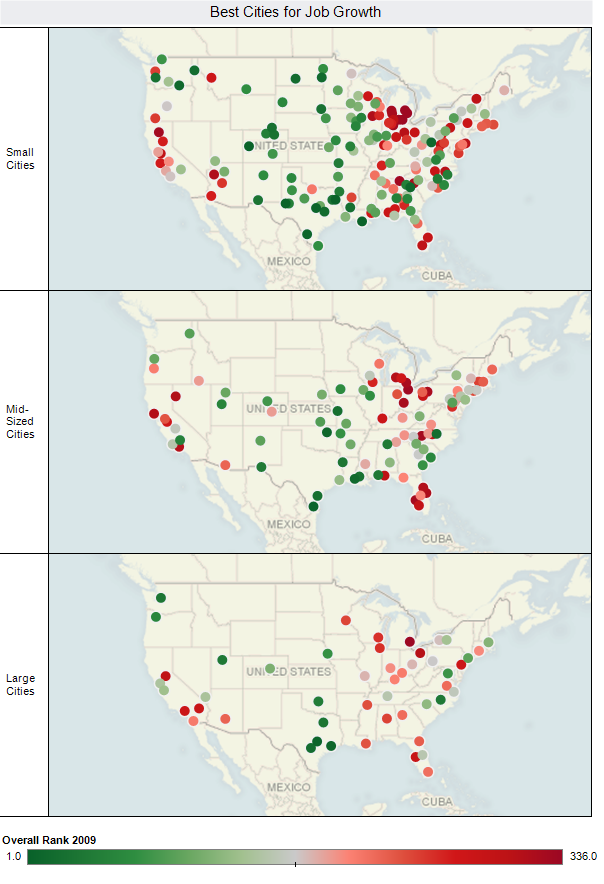
    Here’s some great maps of our annual Best Cities Rankings created by Robert Morton at Tableau Software. Robert used their software tool to plot a color coded point for each city in the rankings by size group, and immediate geographic patterns emerge:

    Check out Robert’s post for a map of the biggest gainers and losers from last year, and a rank change by size scatter plot of each place.

  • Lessons from Chrysler and the Nationalized Economy

    Economists and accountants could very likely have told us six months ago that Chrysler was doomed as a business and that the likely best course of action would be Chapter 11 bankruptcy and restructuring. Doing this in a timely manner would have saved the taxpayers billions of dollars.

    But the politics were not right to permit this to happen at that time. So instead we invested billions of tax dollars to save it, only to find ourselves right back were we started. Except now the clock is striking twelve and it is the right time to reorganize the automaker – politically speaking.

    The politics has worked to “force” Daimler, Cerberus, Banks, UAW and the U.S. taxpayer to forgive nearly $17 billion in debt, and to transfer ownership to a consortium that includes Fiat, U.A.W., and the U.S. and Canadian governments. The same fate may soon await General Motors given the current political atmosphere.

    Government action is not driven so much by economics or accounting as it is by shifts and changes in public opinion and the political winds on Capitol Hill. Regardless of the problem and the consequences of delay, no issue will be dealt with until opinion has been properly shaped around it. This is inefficient by its nature, but government is not a business and cannot fail, so the consequences are never felt by government.

    This means government will often invest in what’s next and ignore what is needed in the present. Why? Because the public likes the new and the novel and grows weary of the old and tried and true. Transportation infrastructure is a great example. It is an accepted fact that our road and bridge infrastructure is failing and will require billions of additional dollars to rebuild and reform into a 21st century, integrated mobility network. Yet there is no political will to address an issue which could seriously undermine our economic competitiveness costing us countless jobs and businesses.

    Politicians know that a solution will require new revenues and very likely a new user fee to augment the current gas tax. Raising taxes is not good for the long term political health of our elected “leaders” because the public does not want to pay for things. So rather than solve a pressing need, government proposes borrowing $8 billion to spend on high speed rail projects like the one to connect Disneyland and Las Vegas. This project works politically because it is filled with perceived benefits and no one really has to pay for them – we can pass it all on to the next generation.

    As we move toward increasing the politicization of our economy where politicians replace CEOs, government becomes a major shareholder in corporations, and the metrics of elections replace standard accounting practices, we should remember the inherent and unintended consequences.

    Businesses succeed or fail based on markets. The government’s attempt to create a false housing market with its affordable housing initiative is arguably one of the major contributing factors to our current recession. They will likely assert their new power in the automobile industry to create “green” cars that may or may not sell. What if consumers choose to buy Japanese, Korean or German label cars made in Mississippi or Alabama, instead of UAW-built cars from Michigan?

    Markets work, and yet they are being ignored. The second most profound economic event of the past year (the collapse of the financial markets being the first) was when the price of gasoline moved above $4.00 a gallon in April of 2008. People drove less. Demand for SUVs plummeted. Ridership of public transportation increased dramatically. Many valued components of American way of life changed almost overnight.

    What is often missed is the fact that government was powerless to do anything about gas prices. Elected leaders looked for scapegoats in speculators and commanded the heads of the Big Oil companies pay homage at their feet. They attacked profits, demanded more drilling, put their environmental agenda on the back burner. The crisis showed them to be feckless on the horns of a dilemma. When prices retreated swiftly in August 2008 and public opinion cooled on the issue, drilling for new energy disappeared from the radar and everything was “green” again. The problem has not disappeared of course, but only public support for a solution. Is this any way to run an economy?

    Businesses concentrate on profit. Elected leaders focus on votes. Bad business decisions are unsustainable in a free market which metes out consequences with failure. Bad political decisions make an elected official unelectable, so it is always better to avoid conflict by putting off the really tough decisions for another day. This is not the way most Americans run their households, but it’s how politicians would run our economy – responding to opinion, not market conditions.

    There are some very difficult decisions as we move through this economic downturn. Do we want more and more of the political processes to be incorporated into our economy on a permanent basis? Banks and financial institutions have already seen first hand the consequences of getting into bed with government. Our automobile industry is next in line. Let’s hope it is the end of the line, but it probably won’t be.

    Dennis M. Powell is president and CEO of Massey Powell an issues management consulting company located in Plymouth Meeting, PA.

  • Credit Cards Flash At The White House

    Back in the 1980s, Citibank CEO John S. Reed looked at the bank’s earnings and said, more or less: This is really a credit card company with six other lines of business. That is, the card portfolio was making lots of dough, and carrying the rest. Commercial lending, real estate lending, clearing, foreign exchange, branch banking — all of them were flat or losing money, while the card business was cooking.

    Membership has its privileges indeed. I am reminded of this today because this past week President Obama has been meeting with the CEOs of the big credit card companies and trying to jawbone them into giving up some of the power they enjoy to goose their earnings by opportunistic manipulation of terms of service to their customers. It’s as if Mobil or BP had the power to come back in the dark of night and siphon off some of the gas they sold you in the afternoon.

    I wish the president well. He made it clear during his session with the card executives that he was familiar with their machinations from personal experience. We have come a long way since the first President Bush marveled at a bar code reader. But I have my doubts. Right now, the whole banking portfolio looks a good deal like Citibank did in those days. Commercial lending, mortgages, trading… all underwater.

    Credit cards may or may not be making money—that shoe doesn’t drop all at once—but when you can squeeze your customers the way all that fine print allows, you don’t give up the franchise lightly. Let’s not forget, the credit card business already had its bailout, in the form of the Bankruptcy Abuse Prevention and Consumer Protection Act of 2005, which functions according to the Law of Goodfellas: Drowning in medical bills? “F* you, pay me.” Swamped by alimony and child support? “F* you, pay me.”

    To that, add: Lost your job, house, and health insurance? “F* you!”

    When I arrived at Citibank in 1980, one of the first speeches I wrote was for the opening of Citibank, South Dakota, which was created expressly for the purpose of lodging the credit card business. Citibank had transplanted this business from New York State because New York still had usury laws, which capped retail interest rates at 12%.

    The bank was in big trouble. In the preceding years, Mr. Reed had flooded the nation with credit cards, a bold move in an era when people did their banking locally. A credit card was generally an extension of an existing banking relationship, replete with a credit history and some suasion of banker over customer. Reed’s folly, as it was occasionally called, entailed giving cards to total strangers by mass mailing—unlike retail banks, the U.S. Post Office could branch across state lines—many of whom were of dubious creditworthiness, or dubious character for that matter. With interest rates capped at 12% by New York law, and overnight money, borrowed as needed from other banks, floating north of that—this was when Paul Volcker was Fed chairman—something had to give. As Walter Wriston put it, “When you borrow money at 14% and lend it at 12%, you can’t make it up on volume.” When I was recruited as a Citibank speechwriter, among the perks my boss mentioned was that I could take out a loan at a low employee rate and buy a CD that paid a higher one.

    New York State legislators never imagined that one of the most venerable of banking institutions would relocate the business to a more favorable venue, a practice called jurisdiction shopping. But armed with some combination of the Bank Holding Company Act and other legislation, and something called the Commerce Clause of the U.S. Constitution, they found their way to South Dakota and its accommodating four-term Governor William Janklow. Governor Janklow’s signature legislative accomplishments were the reinstatement of capital punishment, and lifting the State’s usury limits. (He was later convicted of running a stop sign and hitting a motorcyclist, killing him. The family was precluded from collecting damages because Janklow was heading home from a speech at a country fair, and thus on official business. He is now a practicing lawyer.)

    But enough local color. Suffice it to say that the bank got what it wanted, and so did the State. The bank instantly became South Dakota’s largest employer, and, as we pointed out in our speeches, its college graduates found an employer where they could put their degrees to work without leaving home.

    This was so soon after I started working at Citibank that I was denied my first credit card because I hadn’t been at my job long enough. “I’m writing speeches for the chairman of the bank and for your boss, Rick Braddock,” I told the phone rep. “That may be,” she said, “but you haven’t been employed long enough to qualify.” When I told Rick, he laughed and said, “At least they’re doing their jobs. What do you want, plain vanilla or preferred?”

    Freed from the constraints of New York State law, Citibank survived its catastrophic loan losses and pioneered many now-standard innovations, including risk-based pricing, affinity cards, and a portfolio of cards targeted to different categories and classes of users.

    Even then, the promiscuous marketing of cards and the potential resulting horrors were manifest. Like pornographers’ lawyers, we found the germ of redeeming social importance. We were providing consumers with a tool for managing their personal and family finances. We were freeing working people from the necessity of relying on loan sharks from payday to payday. We were dealing with consenting adults.

    The bankers were fully aware, of course, that in spite of talk about sensible use of credit and managing the household budget, they were really selling liquor to the natives. Behind the scenes was a laboratory where young people with degrees in psychology were kicking the consumer behavior of millions around like a soccer ball, finding ways to hype the impulse to buy, buy, buy, and mining data to place “choices” in front of people based on their previous purchases. We take it all for granted now, with Amazon.com and a thousand other websites, but this took place in the years of the mid-1980s, one of which was 1984.

    By the end of last week, the biggest story out of the credit card summit was that Larry Summers fell asleep, a serendipity that is almost a reenactment of regulatory behavior over the past eight years or more (I am aware of the role Summers played under Clinton). The New York Times reported, “One executive told the president that although her assignment had been to try to persuade the president not to support new restrictions, ‘it was pretty clear I won’t succeed.’” The biggest underlying argument is that with the banks’ other businesses so weak, they don’t want to give up the one cash cow.

    My fear is that whatever new restriction is placed on this weasel industry, whether we have to wait for new Federal Reserve regulations in 2010 or they are expedited, the evil minions at the banks will find a way around it. This is the game they have long played. I have seen their tricks in my own accounts, including that first one that Mr. Braddock granted me. Lower the interest rate? They accelerate the repayment schedule, which means the customer has to pay just as much each month, resulting in lower repayment of interest as a share of the payment.

    It reminds me of the way cigarette companies lower the tar content of cigarettes by perforating the paper. The poor addict drags more often and harder, just to maintain the accustomed nicotine levels. Or the time I paid my balance in full—thousands of dollars worth—when my interest rate was low, then used the card in an emergency, only to find that my rate had shot up to Tony Soprano levels. Why? Because when I had paid my bill in full, they hadn’t yet posted $6 in new interest charges, which went unpaid, and therefore I was now being charged at deadbeat levels.

    Or, as Michael Corleone would put it, just when I thought I was out, they pulled me back in.

    Henry Ehrlich has written speeches as a freelancer for both the new, white-knight CEO of Fannie Mae and the former, disgraced CEO of Freddie Mac. He is author of Writing Effective Speeches and The Wiley Book of Business Quotations.

  • Here in the Real World They’re Shutting Detroit Down

    Once upon a time, not so long ago, in a city at the heart of the American continent, General Motors produced cars, like Pontiac’s “Little GTO,” celebrated in Beach Boys songs that captured the thrill of driving Detroit’s latest creations. Today, as GM struggles to appease the government’s auditors just to stay alive, Kris Kristofferson, with a little help from Mickey Rourke, curses the financial wizards from Wall Street that are “Shutting Detroit Down” while “livin’ it up in that New York town.”

    Never has the inherent tension between the investor class and the country’s manufacturing sector been more pronounced or the stakes in this particular poker game higher for the future of America. Chrysler may be forced into bankruptcy first, but it’s GM’s downfall that represents the true mid-American earthquake.

    Back in the late 1950s, General Motors so dominated the American automobile market that its corporate goals were focused on achieving a 60% market share. The hubris of its executives led them to decide to pick up more and more costs for medical insurance, pensions and retiree benefits, beginning GM’s slide down a slippery slope of poor financial performance

    This posed a huge but not initially recognized risk to GM. By taking on these obligations that didn’t show up as a cost or balance-sheet liability until the government changed its accounting rules in 1992 and required companies to show the cost of “other post-employment benefits” (OPEB) on their books, General Motors lit a ticking time bomb that has now exploded in its face. In 1972, as GM came the closest it would ever come to achieving its sixty-percent market share goal, GM was paying the entire health insurance bill for its employees, survivors and retirees, and had agreed to “30 and out” early retirement that granted workers full pensions after 30 years on the job, regardless of age. Its world then began to come apart.

    In 1973, OPEC’s embargo tripled the price of oil. GM failed to respond quickly enough to the consumer’s sudden demand for fuel-efficient cars. At the same time, the Japanese with their then superior, lean manufacturing techniques stepped into the vacuum, gaining a foothold in the North American car market that they have continued to expand. Ironically, thirty years later the very same inability to shift product offerings during a spike in oil prices precipitated GM’s current difficulties.

    GM’s reluctance to go green is often cited by its new government owners as the reason it’s in so much trouble now, but the crux of GM’s problems really go back to those heady days of market domination and financial profligacy.

    In the 1960s GM’s annual operating margin (profits divided by revenues) averaged 8.7%. The turmoil of the seventies and the pressure from Japanese competition drove those average margins down to 5.5%. Margins fell by about half to an average of 3% in the 1980s, and about half again to 1.3% in the 1990s (not counting the $20 billion hit GM took when the new accounting rules for OPEB took effect.) Finally, in this decade the slide has actually taken the company into an average of negative margins. Now only the government’s suggested radical restructuring seems to offer a way to stop the bleeding.

    It is estimated that the cost of OPEB, essentially GM’s retiree pension and health care programs, have cost the company about $7 billion each year since 1993 and are probably around $10 billion per year now. The bargain auto company management made back in the 60s with labor to provide generous off the balance sheet benefits has now become an albatross that threatens the manufacturing jobs for the Big Three’s own current workers and suppliers across the Midwest. It’s the kind of problem only government can solve.

    But the Obama Administration’s early efforts to do so have been far from promising. First it selected Steve Rattner as its “car czar”, a politically well-connected private equity investor and turnaround artist from “that New York town,” someone with no significant automobile industry experience. In addition, the government’s demands that GM dismantle more brands and shut down more dealerships suggests the process may get a lot uglier by the May 31 decision deadline.

    Luckily the United Auto Workers remain on watch to try to ensure that whatever concessions are demanded of GM’s current and retired employees reflect an equitable shared sacrifice with the company’s bondholders and investors. The kind of GM that emerges from these negotiations will have a huge impact on these workers and on the many industrial towns that depend on the car business for their basic existence.

    Ultimately, the decision on how best to “rescue” GM may turn out to be the most difficult call President Obama will make in his first year in office. He will be pulled by pressures from the green gentry left to force GM’s future products to conform to a pre-determined environmental agenda. He also will face predictable Republican calls to let the market work its will, even if it means the end of the company.

    President Obama will need the wisdom of Solomon to recognize that today’s workers no more deserve to be punished for the mistakes of prior management than CIA agents do for carrying out the orders of their equally arrogant Republican counselors during George W. Bush’s administration. To paraphrase the President’s words, it’s “time to move on” and offer GM the support it needs to “Catch a Wave” and start producing more “Good Vibrations” for America’s hard pressed, but still very critical manufacturing sector.

    Morley Winograd and Michael D. Hais are fellows of the New Democrat Network and the New Policy Institute and co-authors of Millennial Makeover: MySpace, YouTube, and the Future of American Politics (Rutgers University Press: 2008), named one of the 10 favorite books by the New York Times in 2008.