Category: Economics

  • Can Sacred Space Revive the American City?

    By Richard Reep

    During most business downturns, nimble private business owners search for countercyclical industries to which they adapt. During this business downturn, the construction industry finds itself frantically looking for anything countercyclical. Private construction, almost completely driven by the credit market, has stopped, and public construction, driven by tax revenue, has also stalled. Religious institutions, however, seem to be continuing incremental growth and building programs, giving evidence to some people’s answers to spiritual questions being asked today.

    Christian congregations surged in the 1990s, building megachurches in mostly suburban neighborhoods throughout the country. In some cities, mostly in the South, the urban megachurch also became common. Fundraising for these followed patterns that made lending a fairly straightforward risk; many were financed by a combination of patron contributions and lending from local or regional banks. By the early part of this decade, the growth of megachurches was a well-established pattern, and had become a sophisticated niche within the booming development and construction industry, as reported by Forbes Magazine in 2003.

    Churches seem to remain one of the few work sectors for construction firms, architects and planners. This comes at a time when there appears to be very little new development, either private or public in Central Florida. Even small private projects that were funded by cash or private equity have been postponed or cancelled, as the money sits on the sidelines. Yet Christian churches continue to expand, forcing them to accommodate the needs of their worshippers.

    Unlike in the past decade, much of this expansion is taking place in smaller congregations, and is funded mostly by donations, pledges, and bequests. “Our church task force is looking at creative ways to raise money for facility expansion,” commented Scott Fetterhoff, President of Salem Lutheran Church. “We have to have faith however that our congregation, and those looking for spiritual growth in a society with eroding values, will support worthwhile causes.”

    Fetterhoff also displays a very worldly sense of pragmatism. ”Our expansion and outreach program will simply adjust to fit the available budget,” he adds. “On the bright side with a construction industry looking for work, that might allow us to do more for less.”

    This is one example of several recent interviews with local church leaders who are considering a construction project, and all are echoing similar themes. Salem’s expansion includes new classroom space which seems part of a growing interest to provide flexible multi-purpose space for church-based education and community use – largely in lieu of public education. No one in Florida can ignore the continuous stream of news reports of its legislature’s continued reduction of funds for Florida’s public education system, and many in Florida are trying to find alternatives for their children.

    Salem’s decision to expand is emblematic of other stories in the region. This incremental growth may signal a consolidation of sacred space into people’s lives, as we cope with the changes in our secular, consumer-driven culture. Salem Lutheran, and others like it, use the general uncertainty of our economic times to re-focus on faith based relationships. This is a true grass-roots trend.

    On a larger scale, the evangelical movement continues to encourage church construction on a more global, top-led basis, in what is termed “church planting” by its leadership. The surge of interest in nontraditional forms of churches in the Western Hemisphere is well-documented and remarkable, as this Christian movement is supplanting traditional denominations, particularly Catholicism. Religion remains formidable in America, but much of it reflects more of a shift from one form of Christianity to another.

    One organization, Capernaum Ministries, is developing a retreat for Christian pastors and ministers to provide leadership training to church leaders. Its founder, Jim Way, sees his mission as creating “a laboratory for building effective relationships between leaders of various denominations and independent ministries.” Way, a minister and founder of Capernaum Ministries, has affiliations with over 3,000 churches. “I see this as an opportunity to study, and solve, the problem of how the decline of the denominational church influence is affecting American culture”.

    As cities have grown in the past several decades, the well-documented lack of sacred space has been notable as governments meticulously avoid any tangible form of religious expression, and mainstream religions find themselves in retreat. While public space in American cities has always been constitutionally secular, sacred space usually evolved with the development of cities, towns and neighborhoods.

    Sadly, this has been missing from private development for some time. Church growth in the suburbs usually occurs after the fact, not as part of a planned community, for developers are loathe to forfeit profits on a choice parcel of land.

    Church building has historically been a narrow niche market avoided by most design and construction professionals who have preferred more lucrative building types, like hotels or hospitals. If one believes in the organic model of city growth and development, this has been a serious deficiency.

    But now, amidst lower costs for construction and more need for their services, some congregations seem to be taking stock, making plans, and acting. Salem Lutheran, like many, has members who come from the design and construction industries. These congregants know how to efficiently deliver a building, and are offering these skills to their congregations, while their regular businesses sit idle.

    Whether global or grass-roots, the development of sacred space will need to overcome the substantial obstacle of financing, difficult in the best of times, using new means and methods. Nontraditional means including volunteer labor, outright donations, in-kind donations, and bartering will bring costs down to more affordable levels. As projects are realized, alternative practices to achieve affordability could result in interesting innovations.

    If the current economic crisis begs some larger spiritual questions in people, then there may be a countercyclical trend towards investment in sacred space. Faced with lowered expectations and a lost sense of prosperity, people naturally long for some aspect of their lives that transcends the material. Church building, however incremental and small, demonstrates that sacred space is important to enough people to do something about it. Their actions speak loudly in these uncertain economic times.

    Richard Reep is an Architect and artist living in Winter Park, Florida. His practice has centered around hospitality-driven mixed use, and has contributed in various capacities to urban mixed-use projects, both nationally and internationally, for the last 25 years.

  • The Rogue Treasury

    The U.S. Treasury took enormous powers for itself last fall by telling Congress they would use it to “ensure the economic well-being of Americans.” Six months after passage of the Emergency Economic Stabilization Act of 2008 Americans are worse off. Since it was signed into law on October 3, 2008, here are the changes in a few measures of our economic well-being:


    Before TARP

    So Far

    National Unemployment

    7%

    8%

        Lowest state unemployment

    3.3% (WY)

    3.9% (WY)

        Highest state unemployment

    9.3% (MI)

    12% (MI)

    National Foreclosure rate (per 5,000 homes)

    11

    11

        Lowest state foreclosure rate

    < 1 in 7 states

    < 1 in 6 states

        Highest state foreclosure rate        

    68 (NV)

    71 (NV)

    Dow Jones Industrial Average

    10,325

    7,762

    “Before TARP” figures are as close to October 3, 2008 as possible; “So Far” figures are most recent available, which varies by category from February through April. Unemployment and foreclosure rates by state are available at Stateline.org

    The Troubled Asset Relief Program (TARP) was sold to Congress and the American public as an absolute necessity to save the American Dream of homeownership. Once the legislation was passed and the funds were released, however, Treasury decided to give the money to banks with no restrictions on its use – no monitoring, no reporting requirements, no nothing. We are worse off today than we were when the legislation was signed – and are likely to remain so when TARP has its first year birthday later this year.

    Yet, the U.S. government has already paid out $2.9 trillion, with further commitments to raise the total to over $7 trillion – a number that Senator Max Baucus (D-MT) said “is mind-boggling, indeed it is surreal. It’s like having a second government.” The money Treasury is passing out is more than all government spending in 2008. The Senate Finance Committee, of which Baucus is chair, held a hearing on March 31 (TARP Oversight: A Six Month Update). The three parties established as monitors in the 2008 legislation were there to testify. Without exception they “are deeply troubled by the direction in which Treasury has gone.”

    Senator Chuck Grassley (R-IA) suggested [referring to former-Secretary Paulson] that Congress “was awed by a person who comes off of Wall Street, making tens of millions of dollars. … You think he knows all the answers and when it’s all said and done you realize he didn’t know anything more about it than you did.”

    As soon as Treasury got the money they decided to bailout big banks instead of helping homeowners with mortgages bigger than the market value of their homes. Since then, Paulson, Geithner, and Bernanke have refused to comply with demands to produce documents about the TARP recipients’ use of funds.

    Neil Barofsky, Special Inspector General and the one monitor with authority to pursue criminal investigations, directly solicited information from the recipients of TARP funds – all over Treasury’s objections that it couldn’t be done. Barofsky received responses from all 532 recipients. He will be summarizing the findings, but so far knows that some banks used TARP funds to pay off their own debt (including at least one bank that used TARP funds to pay off a loan to another bank that also received TARP funds); some banks made loans they couldn’t otherwise have done. Some banks monitored the funds separately from their other assets; some co-mingled the money with no effort to separate, monitor or control what they did with the TARP bailout money.

    Elizabeth Warren, Chair of the Congressional Oversight Panel, brought up the central issue: once Treasury decided not to bailout homeowners, what was the plan? “What is the strategy that Treasury is pursuing?” she asked. “We have asked this question over and over, with the notion that without a clearly articulated plan and methods to measure progress to goals, we cannot have good oversight.” Warren is still waiting for an answer. She also added that there is no bank in this country that would lend with a policy of “take the money and do what you want with it” – which is exactly what Treasury has done.

    Senator Debbie Stabenow (D-MI) put it bluntly: auto manufacturers get reorganization (through bankruptcy) while banks get subsidization. One side is being held accountable for their past bad decisions and the other side has a total lack of accountability. Her bottom line: “If we don’t make things in this country, we won’t have an economy.”

    Warren laid some of the blame with Congress, who “gave treasury significant discretion” but is unable to get real-time explanations for what is being done with the bailout money. There is no transparency when it comes to Treasury. “Without it, I’m afraid …. Congress and the American people have been cut out of the conversation”, she says. One group in Michigan is being asked to bear enormous pain and another group in New York is not – that’s the way Stabenow sees it and Warren agreed. The alternative offered by Warren is that either Congress manages to “get Treasury to get some religion and put standards in place” or Congress has to step in with new legislation.

    Susanne Trimbath, Ph.D. is CEO and Chief Economist of STP Advisory Services. Her training in finance and economics began with editing briefing documents for the Economic Research Department of the Federal Reserve Bank of San Francisco. She worked in operations at depository trust and clearing corporations in San Francisco and New York, including Depository Trust Company, a subsidiary of DTCC; formerly, she was a Senior Research Economist studying capital markets at the Milken Institute. Her PhD in economics is from New York University. In addition to teaching economics and finance at New York University and University of Southern California (Marshall School of Business), Trimbath is co-author of Beyond Junk Bonds: Expanding High Yield Markets.

  • Borderline Reality

    For years, economic and social observers have taken to redrawing our borders to better define our situation and to attempt to predict the future. Maybe you thought the global financial meltdown has raised anxiety levels in the United States quite enough. But a Russian professor’s decade old prediction of national disintegration suggests much worse on the way.

    Prof. Igor Panarin, a 50-year-old former KGB analyst and a dean of the Russian Foreign Ministry’s academy for future diplomats, estimates there’s a 45-55% chance that the United States will disintegrate like the Soviet Union did sometime in 2010. Mass immigration, economic decline and moral degradation will trigger civil war, the collapse of the dollar and massive social unrest. This in turn will lead to the U.S. breaking into six blocs — with Alaska reverting to Russian control – and other foreign powers grabbing other pieces.

    Panarin’s new map of the United States puts the “Californian Republic” under China’s influence, “the Texas region” under Mexico’s. Hawaii will come under Japanese or Chinese rule, East Coast states will join the European Union, while central northern parts of the US will gradually come under Canada’s influence.

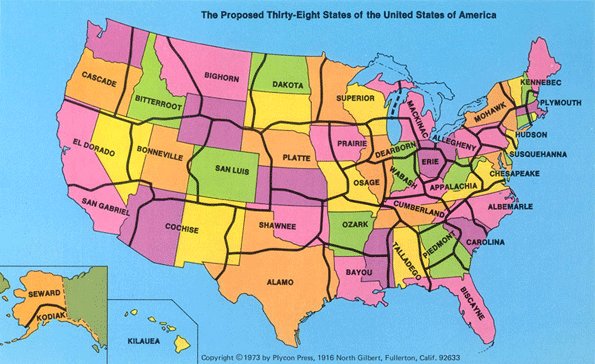
    A less sinister revision of the states that comprise the republic occurred in the 1970s when geography professor C. Etzel Pearcy proposed redrawing the borders of the US states, reducing them from 50 to 38. Pearcy’s framework casts aside the convenience of determining boundaries by using the land’s physical features, such as rivers and mountain ranges, or by the simple usage of latitude and longitude. Instead, his realignment gives high priority to contemporary population density, location of cities, lines of transportation, land relief, and size and shape of individual States.

    In the current fiscal climate some see the new 38 state map as inspired. According to Pearcy, 25% of the expenditures by states can be attributed to the fixed costs associated with the support and maintenance of state governments themselves. For at least some states this kind of savings could be very appealing right now.

    Rethinking, reimagining and then redrawing the borders of maps is by no means a new or even fruitless endeavor. That some if not many borders are where they are for seemingly meaningless or irrational reasons is obvious. Mark Stein’s How the States Got Their Shapes, for example, documents how natural features like rivers come together with the dreams and schemes of people to create today’s jigsaw puzzle of states. Gerrymandering borders for political, economic or religious reasons is both a historical and contemporary reality.

    Any economic planner or strategist worth their salt understands, of course, that borders on a map seldom represent or hold sway over how the real economy operates. Sure there are tangible differences in taxes, regulation and all the things that make up a business environment. But like water, economic activity goes where it wants and finds its own level. This has lead to an increasing amount of policy attention being given to cross-border territories of regions, zones, corridors, clusters, networks and the like.

    North America Re-Imagined
    One of the more reasoned, enduring efforts to make sense of a borderless economic and cultural landscape is Joel Garreau’s landmark work on the The Nine Nations of North America. My 27 year-old copy’s dust jacket asks the reader to forget the traditional map and consider the way North America really works because new realities of power and people are remaking the continent.
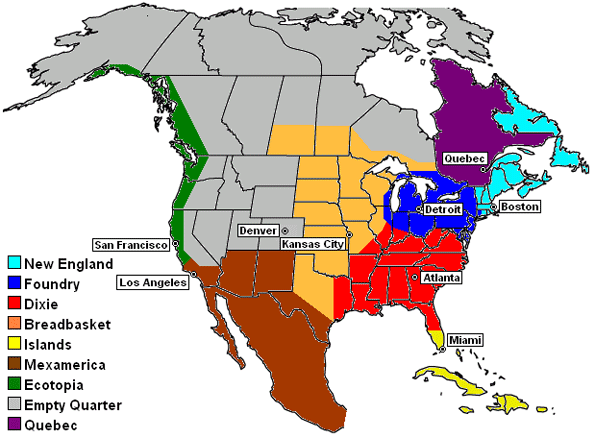

    A recent conference on USA/Canada cross-border economies in the Great Plains confirmed that Garreau’s analysis continues to influence thinking on regionalism. The longevity of his regions lies not only on their basis in actual data but also tied to the distinct “prisms” though which each nation sees the world.

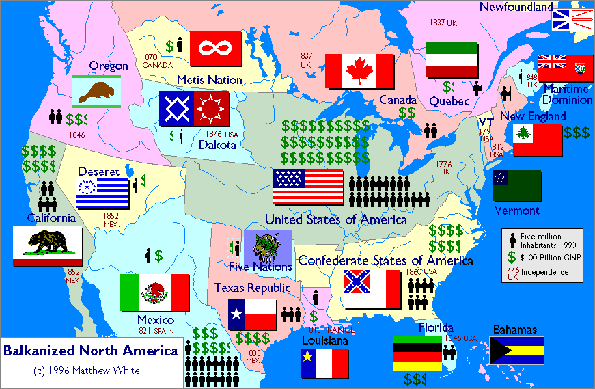
    What could have been in North America, instead of how things really are, is the subject of Matthew White’s 1997 map of a balkanized continent. Here the basic premise is that, in an alternate history beginning in 1787, the westward expansion of the Anglo-American people proceeded pretty much as it did, but the United States government just couldn’t hold the country together against separatists.

    How North America really works and how that is manifested spatially has generated growing interest of late and is reflected in the emergence of cross-border networks and organizations. The government of Canada recently issued an exhaustive report titled The Emergence of Cross-Border Regions Between Canada and the United States: Reaping the Promise and Public Value of Cross-Border Regional Relationships. Here the interest is certainly not on redrawing the borders but on recognizing and building on shared socio-cultural values and furthering relationships between businesses, first and foremost, and universities.

    Mostly a bottom-up phenomenon, these cross-border regional relationships are evidenced by the growth of both informal relationships and formal networks and a rise in cross-border regional co-operative mechanisms. From a policy standpoint the existence of cross-border regions requires new ways of thinking about development, going well beyond our parochial perspective. And this sort of thinking is important because regions – like economic fields of activity – represent the primary theatre in which most activities of international trade and economic integration actually take place.

    Map Forth
    Thematic maps that reconfigure our geography can intrigue and fascinate us. They are really, as some have said, graphic essays that portray spatial variations and interrelationships of geographical distributions. As noted by Norman Joseph William Thrower in Maps and Civilization: Cartography in Culture and Society, thematic maps use the base data of coastlines, boundaries and places, only as point of reference for the phenomenon being explained.

    Sometimes maps can inspire and motivate us by helping to more fully understand the geography of our economic and demographic challenges and opportunities. Perhaps most importantly thematic maps tell a story about places. Some describe the way things really are now while others express a vision of the future. In both cases they can be a graphical point of departure for plans and actions that help us to make the places we inhabit better places to live and work.

    Delore Zimmerman is president and CEO of and publisher of Newgeography.com

  • From Bush’s Cowboy to Obama’s Collusive Capitalism

    Race may be the thing that most obviously distinguishes President Barack Obama from his predecessors, but his biggest impact may be in transforming the nature of class relations — and economic life — in the United States.

    In basic terms, the president is overseeing a profound shift from cowboy to what may be best described as collusive capitalism. This form of capitalism rejects the essential free-market theology embraced by the cowboys, supplanting it with a more managed, highly centralized form of cohabitation between the government apparat and the economic elite.

    Never as pure as its promoters suggested, cowboy capitalism always depended on subsidies to businesses such as corporate farming, suburban development, pharmaceuticals, energy and aerospace. George W. Bush and the Republican majorities of the early 2000s simply drove this essential hypocrisy to a disastrous extreme by increasing deficits and allowing deregulated financial markets to run wild. In the process, they helped drive the world economy off the cliff.

    Not surprisingly, Obama and his backers see their mission to reverse the course. However, the path they are taking may prove no friendlier — and perhaps less so — to the interests of American democracy and the middle class than those of the now-deposed cowboy posse.

    The Obama policy of collusive capitalism is most evident in the financial bailout. He has placed his economic program in the hands of a man — Treasury Secretary Timothy Geithner — who can best be called, as analyst Susanne Trimbath puts it, a “lap dog of Wall Street.” A protégé of former Treasury Secretary and Citicorp board member Robert Rubin, Geithner played a pivotal role in the original Bush bailout of the Wall Street elite.

    Most recently, he proposed selling toxic assets to hedge funds and other financiers, a plan widely denounced by a host of liberal commentators, notably Paul Krugman and Joseph Stiglitz. The Geithner plan, Stiglitz noted this week in a New York Times op-ed, represents “the kind of Rube Goldberg device that Wall Street loves: clever, complex and nontransparent, allowing huge transfers of wealth to the financial markets.”

    The winners in the plan are the top guns of the financial industry, who would welcome further government-sponsored financial consolidation. For them, this would be vastly preferable to the more democratic alternative of selling the remaining assets of the failed large firms to dispersed, healthy, usually smaller, regional institutions.

    Largely missing from even these critiques is precisely why Obama has adopted this collusive approach while mostly avoiding anything smacking of populist anger. Perhaps one has to start with the very obvious fact that the president — despite occasional attacks on the greed of Wall Street — did not run against the financial markets but, rather, with their strong support. As early as the 2008 Democratic primaries, noted New York Times Wall Street maven Andrew Ross Sorkin, Obama had “nailed [down] the hedge fund vote.”

    This group includes the notorious currency speculator George Soros, a major backer of liberal groups in Washington who recently admitted to London’s Daily Mail that he was having “a nice crisis.” Whatever Geithner is doing seems to be working well for Soros and his ilk, although not so beneficently for the people who are losing their jobs and homes.

    I do not mean to suggest the shift to collusive capitalism represents a conspiracy; it simply reflects a changing of the guard among the American elite. The new hegemons include not only financial barons but also powerful interests such as the burgeoning green industry, the high-tech/venture capital complex, urban landowners and, at least in the category of useful idiots, Hollywood and much of the media.

    The new collusive capitalist class differs from the cowboys in its view of government. The collusive capitalists — notably, powerful IT companies and venture capitalists — now look to spur “green” technologies, which are seen as their next meal ticket.

    Others standing to benefit from the rise of collusive capitalism include the university and nonprofit research establishment. Universities have become critical linchpins for the new Democratic Party — providing student shock troops and professorial financial contributions as well as the basic ideological underpinnings and much of the key personnel.

    Are there any dangers for the administration from this approach? In the short run, they certainly have little to fear from the Republicans, whose strident claims about a lurch toward socialism have about as much credibility as their supposed born-again faith in fiscal conservatism.

    A potentially more dangerous threat lies from those parts of the non-gentry left, who fear that collusive capitalism will promote a dangerous further concentration of wealth and power. More immediately, it may also suffer from the limitations of a top-down, green-obsessed strategy that is unlikely to generate enough private-sector jobs, particularly for blue-collar workers.

    This large job creation deficit may take years to become evident but could have a long-term impact on middle-class voters and, perhaps most important, the generally pro-Obama millennial generation workers who are among the prime victims of the current economic malaise. Hopefully, before then, the president will recognize the limitations of collusive capitalism and set out on a broader, more democratic wealth-creating agenda.

    This article originally appeared at Politico.

    Joel Kotkin is executive editor of NewGeography.com and is a presidential fellow in urban futures at Chapman University. He is author of The City: A Global History and is finishing a book on the American future.
  • What About Carmen?

    The national conversation in the wake of President Obama’s introduction of a mortgage relief plan has centered on “fairness” and the conditions to qualify for a mortgage modification. This misses the point. The effects of “innovative” mortgage products were felt far more broadly than the relationship between a single buyer (responsible or not) and his particular mortgage broker (despicable or not). To illustrate the point, meet Mrs. Conservative And Responsible Mortgage Neighbor (“Carmen” for short).

    In 2003, Carmen bid on a home and took a 30 year fixed mortgage with 20 percent down.

    Fast forward to today. Carmen has enjoyed her home and made all of her payments to the bank on time. Unfortunately, her home has dropped in value to the point where it is now significantly underwater . Her investment portfolio has fared just as poorly, losing 40 percent of its value in the last 18 months. All the while, her mortgage obligation has slowly amortized lower.

    If Carmen were to turn to her investments to pay off the loan today, she would come up short. Worldwide deflation has resulted in every asset in our little vignette having fallen by 40 percent. Carmen’s debt burden, however, remains the same,, struck in yesterday’s dollars.

    How does the current mortgage relief plan – which certainly excludes all of the Carmens out there — make sense? The short answer is that it doesn’t. It is neither fair nor effective. It lacks boldness, universality and an understanding of the problem.

    A far better answer to the problem is one time across-the-board principal reductions to all primary residence mortgages originated in the last ten years. Such a plan avoids the piecemeal approach of subjective formulae and doesn’t make personal bankruptcy a precondition to the reduction of principal. It acknowledges that the nation’s housing stock was overvalued because of unintelligent home buyers, products that have been discredited, fairly widespread fraud and inexcusable encouragement by naive government officials. Following the principal reduction, each loan can be re-amortized over its remaining life, resulting in the stimulus of a reduced monthly payment for every American homeowner.

  • London Calling: Bad News For Home Buyers

    The demand for housing in London has outstripped supply since the post-war period, making housing unaffordable to a majority of the city’s low and middle-income families. And although the house price growth of the last two decades has reversed itself recently, it is far from clear that London’s housing problems are in any way diminished. The opportunities for first-time buyers to get into the game may be worse than at any time in recent decades.

    In some ways, the London housing market is unique. The buy-to-let market is almost entirely dominated by private individuals, rather than by big investment funds. For instance, in 2006, two-thirds of the buyers of new private homes in the city were mostly small investors, and the remaining were owner-occupiers. Over half of the buyers are UK-nationals; the rest are of foreign origin. Overseas buyers have been attracted by the idea of holding investments in Sterling, a currency historically seen as stable and appreciating. For instance, South Africans have been enthusiastic investors in London housing as a hedge against the Rand. The city is made up of 3 million dwellings, most of which were built before the 2nd World War, and so the market is almost entirely for second-hand property . In fact, newly built housing in any year constitutes less than half a percent of total stock in London.

    The city is also unusual in that most Londoners are 20 to 39 year-olds. The city’s in-migrants tend to be young, while out-migrants are likely to be older. As a result, not only has the number of households been growing faster than the overall population, but the average size of the household has been falling. The supply of three or more bedroom-flats has shrunk rapidly as a proportion of total supply; it fell to 14% in 2007-08, less than half the level 10 years ago. The supply of new one and two bedroom flats, however, has mushroomed over the same period. This trend is set to continue: of the 570,000 to 710,000 additional households that London will have by 2026, three quarters will be single person households.

    Initial evidence that sub-prime mortgages were defaulting in greater and greater numbers in the United States in February’07 did not seem to have an impact on the UK housing market up until November of that year. The following months witnessed the crash of house prices, which continued their free fall into the final quarter of 2008. According to the Department of Communities and Local Government, properties in the UK lost a record 11.5% of their value over the year ending January’09, although the rate of house price deflation eased slightly in the last quarter. In London, house prices fell by 16% over the same period (the average house price in Greater London is 53% above the UK average).

    Prior to that, the United Kingdom enjoyed a major house price boom for a decade. Growth was fueled primarily by low interest rates, which kept the costs of mortgage finance low, and by shortages in the property market. Financial deregulation and the entry of banks into the mortgage market in the 1980s and 90s meant increased competition and easy availability of mortgage finance. Add to this stable and growing employment in the city, rising incomes and expectations that interest rates would remain low, and the house price boom was hardly surprising. The boom meant that housing became increasingly unaffordable for Londoners.

    But even the recent recession-related fall in house prices and the slump in sales have not necessarily translated into better opportunities to get a foot on to the housing ladder. On the contrary, the current credit crunch is compounding the problem. Falls in house prices in recent months have been accompanied by tightening of mortgage access criteria. Even if a mortgage can be obtained, average deposits and payments remain much higher than average incomes. The average first-time buyer needed to borrow 3.27 times their average income (joint or individual) in 2008, as compared to an income multiplier of 2.42 in 2000, or 2.31 in 1990. Research also shows that Londoners are increasingly dependent on help from family, since deposits can be prohibitive.

    Recent analysis by the Royal Institute of Chartered Surveyors concludes that despite falling prices, London has seen the largest deterioration in housing market accessibility of any region, as would-be-buyers struggle to find deposits or secure affordable mortgages. Indeed, the volume of first-time buyers was 55% lower in August’08 as compared to a year ago, and it seems that in recent months they have been shut out of the housing market in growing numbers. A quarter fewer first time buyers are accessing the market now than at the bottom of the housing market crisis in the early 1990s, and levels are at their lowest for 30 years.

    Although 80% of the housing in the UK is sold on the private market, the government plays an important role by intervening in the market through the provision of social housing, provided through housing associations or registered social landlords. There has been a dramatic surge in the demand for social housing as the recession has started to bite: the housing waiting lists have grown. According to the National Housing Federation, an additional 80,000 are expected to lack a home owing to recession-related repossessions and unemployment.

    However, there are a few encouraging signs. According to government figures published in December’08, the number of new homes being constructed in London did not fall as much as one might have expected as a result of the credit crunch. This is heartening, seeing that house builders have been hit by lower prices, restricted demand, severe problems accessing credit and rising construction costs.

    And surprisingly, according to primelocation.com, house prices in four of the five prime areas in London actually rose in February’09. Central London (3.24%) and West/South-West London (2.84%) saw the highest increase, although prices for property outside of London continued to free fall. The reasons for the rise could be a recent jump in sales. The investor interest pick up might be the result of yields on property rental looking attractive compared to record-low interest rates.

    Rising rents, falling house prices and a potential glut of unsold new market homes can also provide an improved investment opportunity to larger institutions. In his Economic Recovery Plan, announced in December’08, the Mayor of London, Boris Johnson, put aside GBP 5 billion to be channeled into increasing the stock of affordable housing. The funds are also targeted at Londoners who are threatened with repossession, and to help would-be first-time buyers become home owners.

    For the time being, the private rental sector has absorbed the re-directed demand from the housing market, as more people delay buying a home in the current climate of uncertainty. Rents in London have been strong, in some cases even rising over the last few months, especially in the face of diminishing supply of buy-to-let housing. And although the change in average price from Feb-March’09 for central boroughs in London was positive, some of the outlying London boroughs continued to experience falling house prices. Since movements in house prices in London tend to anticipate those across the United Kingdom, these changes provide an indication of what the rest of the country may expect very soon.

    Megha Mukim is currently reading for a PhD at the London School of Economics. Prior to this she was a visiting fellow at the MacMillan Center for International and Area Studies at Yale University.

  • Is Texas Really on the Brink?

    I recently recieved this this link to a short essay and some stats titled “March 31, 2009

  • Kansas City and the Great Plains is a Zone of Sanity

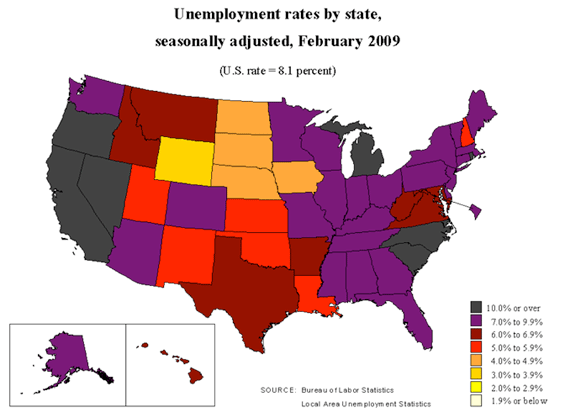
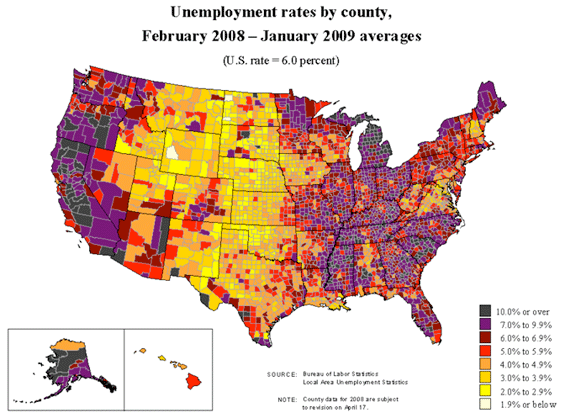
    Over the past year, coverage of the economy appears like a soap opera written by a manic-depressive. Yet once you get away from the coasts – where unemployment is skyrocketing and economies collapsing – you enter what may be best to call the zone of sanity.

    The zone starts somewhere in Texas and goes through much of the Great Plains all the way to the Mexican border. It covers a vast region where unemployment is relatively low, foreclosures still rare and much of the economy centers on the production of basic goods like foodstuffs, specialized equipment and energy.

    People and companies in the zone feel the recession, but they are not, to date, in anything like the tailspin seen in places like the upper Great Lakes auto-manufacturing zone, the Sunbelt boom towns or, increasingly, the finance-dependent Northeast. Last month, for example, New York City’s unemployment experienced the largest jump on record.

    “That whole swath from Texas and North Dakota did not see either the bump or the decline,” notes Dan Whitney, a principal at Landmarketing.com, a real estate research company based in Kansas City, Kan. “People have a more conservative nature here. It’s just saner.”

    The housing market is one indicator of greater sanity. Kansas City housing prices dropped 7% between 2006 and 2008, compared with 10% in Chicago, 15% in San Francisco, 20% in Washington, D.C., and over 30% in Los Angeles. Houston and Dallas, the Southern anchors of the zone, have seen little movement either way in prices.

    One key measurement is affordability. The median multiple for Kansas City housing – that is the number of years of income compared with a median-priced house – has remained remarkably stable at under 3.0. In contrast, notes demographer Wendell Cox, the ratio approached up to 10 in places like Los Angeles and San Francisco, as well as something close to 7 in New York and Miami.

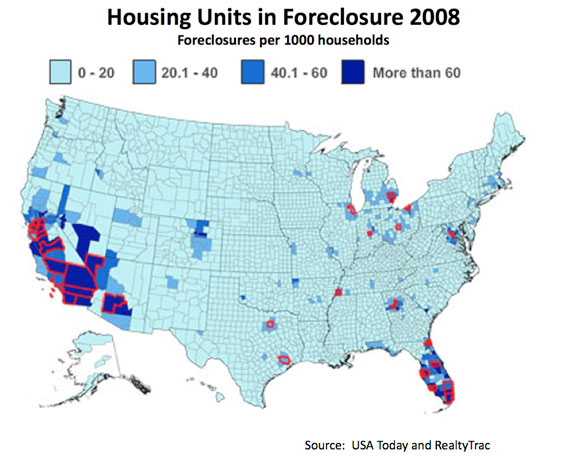
    The result has been that foreclosures – the key driver of many regional economic collapses – have been relatively scarce throughout the zone. This USA Today map reveals how the foreclosures are heavily concentrated in Florida, California, Arizona and Nevada, as well as parts of the old Industrial Belt of the Great Lakes.

    housing_foreclosure_565.jpg

    Analysis by my colleagues at Praxis Strategy Group of the job market’s condition also reveals the divergence between the zone and the rest of the country. Regions from the Northeast, the Great Lakes and the Southeast all have seen significant job losses, and the damage is spreading to the Pacific Northwest, New York and New Jersey. In contrast, the Kansas City area and much of the zone of sanity has experienced only a ratcheting down of its generally steady growth rate. Things are not bustling, but there seem to be few signs of a basic economic collapse.

    unemployment_state_565.gif

    unemployment_country_565.gif

    Sanity, as Whitney put it, may constitute a critical part of the equation. If you discuss why people live in a place like Kansas City, people tend to speak about stability, family-friendliness and the basic ease of everyday life. Many executives, notes Phil DeNicola, who runs Strong Suit Relocation, initially resist a transfer to the region but quickly see the advantages.

    “It is attractive to be here,” notes DeNicola. “You don’t get a lot of highs and lows for years. There is stability instead, particularly for families. It all reduces your stress.”

    Of course, not everyone is satisfied with the status quo. As in many second-tier urban centers, many in Kansas City’s leadership crave being something other than pleasant, affordable and stable. Leaders in the city – home to roughly one in four of the region’s 2 million residents – have been particularly exercised to show that KC can be as hip and cool as New York, L.A. or, at the very least, Chicago.

    “There’s a real kind of self-loathing here,” notes Mary Cyr, a Harvard-trained architect, who works on projects throughout the region. “We feel less than what we are. We do not know what we are as a city. We don’t even realize what we have.”

    Hundreds of millions have been poured and continue to pour into the usual monuments favored by urban policymakers and subsidy-hungry developers – a sparkling new arena, plans for an expanded convention center and a massive entertainment complex called the Power and Light District. Yet at the same time, the city’s budget, like many others, is severely strapped, so much so that City Hall is considering not turning on the city’s iconic fountains this spring.

    Even worse, city and regional issues seem to result in plenty of money for new expressions of wannabe grandiosity. One notable example: plans to build a $700 million-plus light-rail line, the kind of thing that has become the sine qua non for the “monkey see, monkey do” school of urban policymakers across the country.

    This project makes little sense in a region with a well-below-average percentage of jobs in its downtown core – roughly around 7% – with one of the lowest shares of transit-riding residents in the nation. The relative lack of traffic makes a rail system less sensible than could be argued for higher-density urban corridors, where it at least can be imagined that many would give up their cars.

    Ultimately, none of this taxpayer largesse is likely to do much more than replicate the same kind of development that can be found in scores of cities – from St. Louis to Dallas – that have tried it. At best, you get a few blocks of activity but very little in terms of urban dynamism.

    “The growth of downtown is not at all organic – it’s kind of forced,” notes architect Cyr. “They build all those projects in there, and you end up with the huge monumental buildings and the Gap.”

    The problem for the downtown crowd is that Kansas City has remained a quintessential American city, most dynamic in places where private initiative leads the way. Typically the bulk of new growth has taken place in the suburban fringes, but there are several successful nodes within the city, particularly around the lovely, 1920s vintage, privately developed Country Club Plaza area, famous for being the world’s first modern shopping center.

    Similarly, the artist-inspired Crossroads district has also evolved – largely without government help – into a genuine bastion of bohemians, with small companies and locally owned restaurants. With its low-cost commercial and residential space, as opposed to government subsidies, many see the area as precisely the kind of grass-roots urban life with a future in a place like Kansas City.

    Such developments in the city, as well as outside, make it possible to project a very bright future for Kansas City – and across the zone of sanity. Unless there is a massive shift in conditions, the zone should see a return to prosperity earlier than places bogged down with excess foreclosures, shuttering industries, soaring taxes and ever-tightening regulation. Dan Whitney, for example, expects the local housing supply to run out soon – with “tremendous pent-up demand” by the end of the year. If credit conditions improve, new construction should resume within the next 18 months.

    This all reflects the essential attractiveness of cites like Kansas City. Overall, in fact, its rate of domestic in-migration has been higher than much-celebrated Seattle and only slightly below that of Denver. Indeed, since 2000, Kansas City’s regional population has grown 8.6%, more than twice as much as New York, Boston, San Francisco or Los Angeles.

    Unlike the national media, which rarely focus on mundane things that drive most people’s lives, some seem to get the appeal of lower prices, affordable housing options and a generally calm environment. Although never a beacon for newcomers, like Phoenix, Atlanta or Dallas, Kansas City has not suffered the massive out-migration seen in such big metropolitan regions as Los Angeles, San Francisco, Chicago or New York.

    In fact, Kansas City has enjoyed a slow but steady in-migration through the past decade. These newcomers could provide the energy, talent and initiative that a region, known for stability, needs to get to the next level. Attracting more of them – not new prestige projects or subsidized developments – remains the key to the region’s future.

    Instead of trying to duplicate growth patterns that are foundering on the coasts and in countless Rust Belt cities, the denizens of the zone of sanity need to learn how to build on their virtues of stability and affordability. Particularly in hard times, such things count for much more than many – both inside and outside the region – might imagine.

    This article originally appeared at Forbes.

    Joel Kotkin is executive editor of NewGeography.com and is a presidential fellow in urban futures at Chapman University. He is author of The City: A Global History and is finishing a book on the American future.
  • Financial Crisis Boosts Local Markets

    By Richard Reep

    The current economic crisis has many mixed impacts, including the shift of grocery customers to low-cost companies like Wal-mart. Yet at the same time we see a shift to local, community markets in an effort to cope with the new economy. While the global players deliver discounts due to their enormous volume, local community markets offer low-priced produce, goods, and services due to their microscopic volume. This common ground between individual efforts and enormous buying machines yields an interesting treasure trove of passion and hope.

    As folks cope with financial turmoil, their choices for purchasing venues seem to be driven by the need for saving, as well as the need for a good experience. The middlemen, such as the regional and national chains, seem to be squeezed in between truly global players like Wal-mart, and the rising tide of localism appearing at a grass-roots level in so many communities.

    The rise of these small, open-air markets is an encouraging sign of authentic social interaction, after so many assaults upon our social network by the forces of the Old Economy. It suggests a new role for local entrepreneurs and for the revival of community spirit. At these local markets, producer and consumer traffic in direct interaction, without the army of marketing consultants, business analysts, merchandisers, industrial psychologists, and the rest of the hangers-on who have transformed the agora into an often dispiriting and uninteresting shopping experience.

    Now, with the Old Economy in shambles, the New Economy appears to be reviving the community element to our American commercial culture. Even a few years ago the Farmer’s Market was considered an anachronism, something found in rural areas and overlooked by cosmopolitan city dwellers. The fact that these are rising up in our urban and suburban culture speaks to our need for freshness, for authenticity, and for some spontaneity.

    In Central Florida, the Winter Park Farmer’s Market is perhaps the grandfather of the Central Florida market scene, having started sometime in the eighties. No one at the City could remember exactly when it started. Ron Moore, Parks and Recreation Assistant Director now manages the market, and he laughed when asked about its success in a recent interview. “Consulting to other municipalities who want to start up their own markets is a part-time job”, said Moore, his latest effort being Eatonville, whose inaugural Community Market was an exciting event.

    Markets on public property are an important trend in our cities, for they signal the revival of public space. All too often public space has been defined by soulless plazas, many of which are deserted most of the time. But, with the rise of the public market, the classic agora has been revived in Winter Park, Maitland, Downtown Orlando’s Lake Eola, Eatonville, and elsewhere in Central Florida.

    Mr. Moore stated that the Winter Park Farmer’s Market’s summer season is typically the slow time, but last summer was their best one ever, and this winter has been the highest attendance ever, with a waiting list of merchants to get in. He is fine-tuning the mix using common sense, watching people flow and traffic flow. This reflects a locally based entrepreneur who is all instinct and good listening skills; he is not a mall merchandiser using industrial psychology and the appeal of sameness to make sales.


    North of Orlando lays the town of Eatonville, America’s oldest African-American incorporated community, and it is sandwiched between the affluent Winter Park and Maitland areas. The Eatonville Market, for its part, is attracting produce, food items, and flowers, and is worth a visit on a Saturday morning. Complete with a stage, shoppers are treated to a vibrant music scene as well as a shopping venue, and as this market takes off, it will attract more and more people to this historically significant community.


    Public open markets are exciting, but perhaps an even more interesting trend is the private-run market. Organizers of private markets can have more authority over the vendors and their merchandise, and can give their markets more style to suit a specific audience. One of the area’s more interesting markets occurs at night – the Wednesday evening Audubon Community Market, occurring at Stardust Video and Coffee. Founded by Emily Rankin, the Community Market strives to bring items produced specifically in Audubon Park.

    This epitomizes the spirit of the new localism. The fact that it occurs at night makes the market scene unique. Ms. Rankin, in an interview, revealed that the Audubon Park Garden District, which she founded, now includes a network of vegetable gardens, and these are showcased at the market. Her cafe, Roots, serves food at this market, and it provides services, locally grown produce, art, music and other handmade items which rotate on a weekly basis.

    There are many advantages to privately run markets. The Winter Park Farmer’s Market has pages and pages of rules and forms. The private Audubon Community Market is direct, paperless, and quick: Ms. Rankin looks at your product and says, you are in or out. Her management of the market has sustained it through a change in location or two, and she is optimistic that the market will grow in popularity as people start looking locally for what they can’t find globally

    During times of financial stability, people often seek to reduce risk and experimentation, clinging to the tried and true. Certainly retail’s global players focus on cold calculation and maintaining shareholder value. Yet at the grassroots, individuals and families also seek a level of comfort and interaction. The consumer response to community markets suggests that there is a widely felt allegiance with these intrepid street vendors who brave the elements for a dollar’s worth of grapefruit. The shifting economy is allowing individual voices to speak and be heard by a wider audience. This is the coarse of true innovation. Those who persevere in the community market scene could well influence our commercial future for decades to come…

    Richard Reep is an Architect and artist living in Winter Park, Florida. His practice has centered around hospitality-driven mixed use, and has contributed in various capacities to urban mixed-use projects, both nationally and internationally, for the last 25 years.

  • While Fixing Housing, Fix the Regulations

    Everyone knows that subprime mortgages lie at the root of our current financial crisis. Lenders originated too many of them, they were securitized amidst an increasingly complex credit market, and the bubble popped. The rest is painful history.

    Most commentators have explained the source of the problem by pointing either to faulty federal housing policies – such as Fannie Mae’s affordable housing goals, the Fed’s easy money practices, and the Community Reinvestment Act – or to the imprudent zest for gain among investors who miscalculated risk and kept up the demand for bad mortgages. Both views are correct to varying degrees. These perceptions will shape the ongoing policy debate about needed reforms.

    But as this debate advances, we should not lose sight of another consequential, yet mundane, factor in the crisis: the way that regulations raised house prices and created conditions ripe for subprime loans. Regulations may be one of the least debated contributors to the current crisis, and yet their effect on the middle class’s ability to buy homes may arguably have been a key reason why subprime loans flourished in the first place.

    In the heated housing market before 2007, a median income family in the U.S. could only afford 40 percent of homes for sale across the country, compared to more than two-thirds of homes in 1997. Banks got creative and helped ordinary families buy overly expensive homes with risky mortgages. In a hot market, the risks seemed low. People never should have purchased homes they could not afford, but at the same time, rising prices were putting homeownership out of the reach of ordinary families such that unconventional loans seemed a convenient solution.

    Why were housing prices rising so rapidly? Observers have traditionally held that land scarcity drives up prices by preventing supply from meeting demand. But the more likely answer is that regulations on housing overly constricted supply in many parts of the U.S. Through the groundbreaking work of Wendell Cox at Demographia and scholars such as Ed Glaeser at Harvard and Joe Gyourko at the University of Pennsylvania, we have come to see that rules and regulations drive up housing prices much more than we had originally thought. Blaming supply problems on land scarcity has been a convenient excuse for too long for those who see hyper-regulation of housing as a good thing.

    Regulations often limit the number of housing units that can be built on a given lot, or they restrict the number of new home permits that can be issued in a given municipality, making supply a function of rules, not land scarcity. Restrictions to the property itself, such as environmental or design requirements, also raise the cost of construction (see Andres Duany’s thoughtful article on this issue here.).

    Increased regulation on housing has been a quiet, but disquieting, trend. For example, Glaeser has shown that only 50 percent of communities in greater Boston had restrictions on subdivisions in 1975, compared to nearly 100 percent today. Housing prices in the Boston area would have been between 23 and 36 percent lower on the eve of the crisis were it not for burdensome restrictions on housing. While the Boston area’s regulatory impulse may be excessive, it is nonetheless emblematic of a national trend. A recent U.S. Department of Housing and Urban Development has found that more than 90 percent of the subdivisions in a recent national study now have excessive restrictions.

    According to Harvard’s housing research center, the growing cost of regulations has edged smaller builders out of the construction market and increased the market share of the nation’s ten largest builders from 10 to 25 percent since the early 1990s. This doesn’t mean that the larger builders are happy about restrictions. Bob Toll, president of one of the nation’s largest builders, has said that his company quit building “starter homes” for young families years ago because the margins on small homes grew too narrow due to excessive regulations.

    How big is the problem? Most observers have typically agreed that housing regulations account for 15 to 35 percent of a median-priced home in the U.S. These percentages come from a 1991 federal housing commission, and they are likely to have increased considerably since then. If we conservatively use them to calculate the scope of regulations by the time the housing crisis began in earnest in 2007, they suggest that regulations accounted for between $35,850 and $83,650 of a median-priced home. Using the National Association of Homebuilders’ methodology for determining the impact of price increases on home affordability, we can say that regulatory restrictions priced at least 7 million – and as many as 18 million – families out of their local housing markets in 2007. As we have learned, families priced out of their markets still purchased homes – usually with unconventional, risky mortgages.

    Of course, not all housing regulations are bad, and zero regulation would introduce unnecessary risks to homeowners. But the increasing rate of regulation in the U.S. represents one of the nation’s larger assaults on the middle class that defenders of “working families” rarely talk about. Conservatives avoid the issue for federalism reasons, since any effective restraint on land-use planners will likely require the federal government’s involvement. And liberals hide from an honest debate about the effects of regulations for fear that it will derail their environmental agenda that relies up on regulations to limit the kind of housing most people want – such as single family homes.

    Now that there is an over-supply of housing in the U.S., the problem of housing regulations may seem moot. But if we do nothing about this issue, it will trip us up again in the future. While I served in the George W. Bush White House between 2005 and 2007, economists inside and outside the administration offered mixed – and sometimes completely contradictory – assessments of what was happening in the housing sector. We continued to work on our proposed reforms of Fannie and Freddie and the Federal Housing Administration in an effort to reduce the “systemic risk” but approached it more as a theoretical matter than as a perceived, impending crisis. We even had a HUD-based initiative on reducing regulatory barriers that quietly lumbered along but which we never elevated as a major policy issue. We now know that what we were grossly underestimating the scope of a potential crisis. We should have made housing sector reform a front burner issue.

    That is all behind us now, and we can see much more clearly what led to the crisis. We need to look at how rule-makers have for too long been making housing unnecessarily expensive for ordinary families. There is a limit to what the federal government can and should do about local housing regulations, but options exist for President Obama and Congress to consider.

    First of all, just as federal agencies are legally required to analyze the environmental impact of new regulations, Congress could require federal agencies to demonstrate the impact of new federal regulations on the cost of home construction. Federal agencies already have the personnel required for the task, and such a requirement would cost the taxpayer nothing extra. Second, Congress should consider new incentives in existing federal law, from highway construction to affordable housing, that would prompt states and municipalities to reduce burdensome regulations in exchange for federal resources. Third, President Obama could issue an executive order requiring federal agencies to amend regulations that have a negative effect on home construction costs. He could also use the same order to establish a task force whose job would be to identify the chief price-increasing regulations in use around the country to inform the legislative process.

    If we ignore the problem, as the housing market recovers, regulations will once again make housing more expensive than it should be. Unconventional mortgages will no longer be available due to the current crisis, and we will be back in a familiar debate about “affordable housing” in which the federal government is called upon to subsidize housing that others have made too expensive. In other words we return to the status quo in which we once again increase the role of a government that – under both Republican and Democratic administrations – has gotten ever bigger, more expensive and increasingly intrusive.

    Ryan Streeter is Senior Fellow at the London-based Legatum Institute and former special assistant to President George W. Bush for domestic policy.