Category: Economics

  • Rust Belt Outliers

    What kind of migration patterns will emerge as a result of the current economic downturn? The recession is uneven; some places are much worse off than others. Those differences can give labor cause to move. Economic geographer Edward Glaeser thinks cities with marginal manufacturing legacies should attract a lot of people because the well-educated, living in dense urban environments, should get through the crisis relatively unscathed. If Glaeser is correct, then shrinking Rust Belt cities can expect more of the same even after the recovery begins in earnest. Pittsburgh brains should continue to drain.

    Ironically, the latest US Census data indicate that the population decline in the Rust Belt is slowing as a result of less out-migration. A contracting economy has, according to demographer William Frey, helped to stop the bleeding from cities such as “Buffalo, N.Y., Pittsburgh and Cleveland.” One of the cited factors for decreasing geographic mobility is the collapse of the real estate market. Job seekers are stuck in their current place of residence.

    Another pressure to stay put is the economic climate of typical Sun Belt destinations such as Charlotte, NC or Phoenix. Unemployment there might be much worse than what you are seeing in your current location. There is no reason to move because the situation is bad everywhere. The “pull” factors have all but disappeared.

    Of course, evaporating home equity and massive layoffs throughout the country are not mutually exclusive. These two forces could be working in concert to stem the tide from struggling Rust Belt cities and the explanation of the waning migration is quite reasonable. But I’m not so sure it makes sense in the case of Pittsburgh.

    During the mortgage meltdown, the Pittsburgh real estate market has remained remarkably resilient. While foreclosures have decimated Cleveland, Pittsburgh’s prudent financial industry stayed away from bad loans. Pittsburgh is now rated as one of the most stable real estate markets in the entire country. Home ownership isn’t holding back the out-migration of Pittsburghers.

    As for unemployment, the job market is much better in the Pittsburgh region than it is in Charlotte, NC. That’s why solvent financial institutions in Southwestern Pennsylvania are advertising employment opportunities in Pittsburgh South (a.k.a. Charlotte). For those with the ability to relocate, Pittsburgh has a much better job market than Charlotte.

    But if we are talking about Pittsburgh out-migration, we should mention Washington, DC, the #1 destination for those seeking better opportunities than they can find near home. Charlotte is pretty far down that list. Sun Belt economic distress is causing Pittsburghers not to migrate as much to the sunbelt, thus pinpointing the reason for the dramatically falling (from the 2005 peak) net out-migration. In contrast, DC is still a viable job market, with numbers trending towards population gains.

    Are more people moving to Pittsburgh? Few seem to consider the possibility. Perhaps William Frey has access to out-migration data that aren’t public, which is why he lumped Pittsburgh in with Cleveland and Buffalo. But less out-migration doesn’t mean that there isn’t more in-migration. Pittsburgh attracting more talent from other regions would be news.

    Despite the manufacturing legacy that Glaeser details, there are Rust Belt cities that have bucked the population trends. Chattanooga, historically an industrial river city much like Pittsburgh, has begun to grow again after decades of shrinking. Pittsburgh isn’t necessarily doomed to being a shadow of its former self and may well separate even more than it already has from the Rust Belt pack.

    Staying with Glaeser’s observations, the economic geography of Pittsburgh might help us understand why migration fueled growth is possible. Manufacturing cities tend to lack a critical mass of highly educated talent and economic activity is less concentrated. Among Midwestern cities, Pittsburgh’s gains in college attainment since 1970 “have been the most rapid.” Pittsburgh’s human capital assets are much improved. And despite the obvious sprawl, Pittsburgh also enjoys considerable economic density. Its college corridor is just five-miles long, connecting downtown with the University of Pittsburgh and Carnegie Mellon University. Internationally renowned research universities are located in close proximity to the central business district.

    Might the above assets translate into greater in-migration? Perhaps, but the odds are against it. However, something unusual is going on in Pittsburgh. Whether or not that will inform job growth and economic development remains to be seen.

    Read Jim Russell’s Rust Belt writings at Burgh Diaspora.

  • Why We Need A New Works Progress Administration

    As the financial bailout fiasco worsens, President Obama may want to consider a do-over of his whole approach towards economic stimulus. Instead of lurching haphazardly in search of a “new” New Deal symphony, perhaps he should adapt parts of the original score.

    Nothing makes more sense, for example, than reviving programs like the Works Progress Administration (WPA), started in the 1935, as well as the Civilian Conservation Corps (CCC), begun in 1933. These programs, focused on employing young people whose families were on relief, completed many important projects – many still in use today – while providing practical training to and instilling discipline in an entire generation.

    Unemployment today may not be as extreme as in the 1930s, but for whole segments of the population – notably young workers under 25 – it is on the rise. Already young workers with college educations suffer a 7.7% jobless rate, while employment is nearly twice that among young workers overall. Hardest hit, in fact, are young people without college educations, whose real earnings already have dropped by almost 30% over the past 30 years, according to one study.

    Tapping the energies of this new “millennial” generation – those now entering their teens and early 20s – would make enormous sense both for economic and social reasons.

    Not only do they need work, but also, as their chroniclers, authors Morley Winograd and Mike Hais have demonstrated, many share an interest in community-building in ways reminiscent of the last “civic generation” in the 1930s.

    In contrast, the current stimulus, rather than inspiring a new generation, has focused on bailing out failed corporations, few of which will generate much employment. Many of the “new” jobs will be going to the already entitled: highly paid, big-pension-collecting, unionized government workers and well-educated people working in federal and university laboratories.

    Also getting short shrift has been the kind of construction projects that drive fundamental economic growth and competitive advantage. These include roads, freight rail, electrical transmission lines and water services that boost productivity in agriculture, manufacturing, high-end business services and technology. The Chinese are currently targeting their spending on precisely the steps that would aid these sectors.

    This is where a New Deal revival would help. The WPA and the CCC were all about building useful, tangible things that made the country stronger and more competitive. Overall, these and other New Deal programs amassed an amazing record – finishing over 22,000 roads, 7,488 educational buildings and over 7,000 sewer, water and other projects.

    These efforts put to work over 3 million workers. (Compare that to the mere 250,000 slated to work in the expanded AmeriCorps program.) Their earnings helped support 10 million dependents. The WPA also employed 125,000 engineers, social workers, accountants, superintendents, supervisors and timekeepers scattered in every state and community. Ultimately, notes political economy professor Jason Scott Smith, the New Deal intimately touched the lives of more than 50 million people – out of a total U.S. population, in 1933, of 125 million. Now that’s stimulus!

    Critically, the WPA and CCC also left behind useful things for the next generation. As historian Gary Breichin has pointed out, we unknowingly walk, drive and ride through many structures built by these agencies.

    These projects did not act as “lures” for the elites, cognitive and otherwise – as so many of our current efforts do – but rather served a broader purpose for the public. The University of Washington’s Richard Morrill notes that the WPA bequeathed “an enduring legacy” around Seattle: bridges and retaining walls and drainage systems, parks and playgrounds, roads and trails, sewers, recreational facilities, airports, streetcars, low-income housing, as well as programs for musicians, artists and writers.

    The WPA and CCC left a similar mark even on the most remote parts of rural “red” America. In places such as Wishek, N.D., notes native Delore Zimmerman, few people recognize that it was the New Deal-sponsored WPA that built the still-used local pool and the community center. Nor do farmers, many of them rock-ribbed Republicans, readily acknowledge that the windbreaks and other conservation projects started by the CCC helped preserve the land from devastating erosion.

    A public works agenda today, of course, would include different things, like expansion of broadband Internet access and a greater emphasis on private financing and skills training. Yet a neo-WPA would still focus on upgrading and expanding our basic infrastructure, which, by all estimates, is generally in sad shape.

    If this is such a good idea, why is no one else promoting it? Among Republicans and conservatives, of course, nothing done by Franklin Roosevelt – except, perhaps, winning the Second World War – could ever hold much merit. They certainly can argue, with some justification, that it was the war, and not the New Deal, that finally got us out of the Great Depression.

    But this is narrow thinking. America’s post-war boom owed much to the work of WPA, CCC and other New Deal programs. Our late 20th-century expansion required travel along their roads and bridges; their energy plants and transmission lines powered our industrial growth, extending it to formerly poor regions like the South. Water and conservation projects undertaken in the agricultural heartland precipitated a revolution in productivity that has fed much of the world.

    More troubling may be why Democrats – often professed admirers of FDR and his work – have not been eager to revive these programs. One factor may be the enormous power of unions representing public employees. The power of organized public-sector workers, notes historian Fred Siegel, was a non-issue in the 1930s and 1940s.

    Today, though, these groups are powerful enough to boost the cost of any government initiative – because often they require high salaries, costly work rules and, most important, pension benefits. The last thing these unions would sanction would be the mass employment of young workers on a temporary basis at living, but not union-scale, wages and benefits.

    Secondly, there are political obstacles. This administration often appears, as one Democratic mayor from central California put it, like “moveon.org run by the Chicago machine.” Its first priority seems to be to reward allies in organizations – whether in “grassroots” groups like ACORN or in the academy – who also share their political agenda.

    Take, for example, the federal government’s proposed expenditure of $500 million to $600 million for “climate change research.” These funds are almost certain to end up in the pockets of high-end government workers and university-based zealots; as a scientific enterprise, it is likely to be as valid as asking the College of Cardinals in Rome to determine the existence of God. The ultimate result will be to provide new grist for Al Gore’s – and the administration’s – friends in the “green” investment banking world and Silicon Valley.

    This green agenda itself may also constitute a third cause itself for WPA avoidance. Much of the environmental movement – committed largely to reducing the carbon footprint of 300 million Americans – doesn’t want new bridges, roads, ports or much of anything that uses greenhouse gas-spewing concrete. They’d prefer to scale back agriculture and grow just enough organic produce to keep Alice Waters clucking happily in her kitchen.

    A similar disconnect can be seen in energy policy. A new WPA could help build transmission lines to connect the energy-rich parts of the country to the major metropolitan areas. This would spur both industrial development in places like the Great Plains – rich in everything from fossil fuels to wind power – while keeping energy prices down for U.S. consumers and firms.

    Yet so far, the energy program seems focused almost exclusively on providing rich contracts to Silicon Valley firms that are close to the administration. So don’t expect a massive expansion of new transmission lines or any expansion of new, “clean” hydropower. The administration’s green agenda seems to revolve not predominately around better or even cleaner energy, but less.

    And, sadly, conservation is one place a new WPA would be most effective. One possible function for a modern WPA would be to go to neighborhoods – particularly poor and working class ones – and insulate houses. This would certainly save money over having government workers or contractors do the same work.

    All this suggests a profound disconnect between the new administration and the real world.

    The post-industrial educated class that now dominates Washington appears, if not scornful, profoundly detached from the problems facing productive industry. These officials also seem blissfully unaware that the public – as opposed to the academy and the elite media – cares more about jobs than about being green; by nearly three to one, according to the most recent Pew poll, they are more worried about the economy than climate change.

    In many ways, this disconnect is inevitable. Products of the “information age,” Obama’s academically oriented backers seem to have trouble distinguishing between words and actual things. Virtually no one in the upper reaches of this administration has been tested by running a private company, manufacturing a product or bringing in a crop. This administration of “experts” from academia and government service appears to possess little tactile knowledge of the real world.

    In this way, Obama’s great strengths – he is a brilliant communicator and image-builder – are also proving to be a source of profound weakness. Right now, he is selling a post-racial kumbaya and a vague confection of ‘hope.” Financing for these good intentions is likely to ebb, however, as a result of a stunning redistribution of wealth from taxpayers to an expanded class of tax-takers.

    Indeed, for all his communication skills, the president has failed to create an attainable vision of a stronger, wealthier America with better jobs, more wealth and improved infrastructure. Roosevelt and even Truman provided inspiration, too, but they backed it up with practical changes that promised improvements in the day-to-day lives of most Americans.

    These hard times require tangible solutions to basic economic problems. Rather than worry about the generally clueless Republicans, the administration should focus on building a legacy as real and long-lasting as the one left behind by the WPA and CCC.

    More than a mere matter of building roads and bridges and increasing access to cheap energy, the WPA was about restoring a collective spirit, a shared stake, in constructing the sinews of a more competitive, prosperous country. Unfortunately, amidst the confused priorities of this administration, such bold initiatives remain but distant possibilities.

    This article originally appeared at Forbes.

    Joel Kotkin is executive editor of NewGeography.com and is a presidential fellow in urban futures at Chapman University. He is author of The City: A Global History and is finishing a book on the American future.

  • Story of the Financial Crisis: Burnin’ Down the House with Good Intentions and Lots of Greed

    Last week, the Chairman of the Federal Reserve, Ben Bernanke, told Congress that he didn’t know what to do about the economy and the repeated need for bailouts. This week, the Oracle of Omaha Warren Buffett, Chairman of Berkshire-Hathaway told the press that he couldn’t understand the financial statements of the banks getting the bailout money.

    This made it a daunting challenge the other day, when the Program Director for the Bellevue (Nebraska) Kiwanis Club asked me to talk to his group about the current state of the economy. Despite the many often outrageous examples of excessive greed and even criminality, the current debacle began with good intentions: provide opportunities for homeownership to a segment of the population that was historically left out.

    New credit rating systems had to be developed to take into consideration the fact that some immigrant groups prefer to live in extended families (multiple generations in one household). The individual income of any one may not qualify for a loan, but they would all be paying the mortgage. Yet, their family patterns meant assets are only held by the male head of household. That’s just one example, and there are many more. It’s just that banks and others came to realize that the existing systems were excluding people who would actually be very good borrowers. The original “subprime” borrowers were like the original “junk bond” companies – they didn’t fit the mold of a model credit customer. But among them were MCI and Turner Broadcasting – plus Enron and Worldcom, of course.

    Like junk bonds, the new mortgage product came to be abused by borrowers and lenders alike. This was made worse by developments that blurred the line between banks and brokers. Both parties participated in actions that allowed banks to have their in-house brokers sell off their mortgage loans to Wall Street in the form of bonds. This is called “originate and distribute”. The same bank wrote the mortgages, packaged the loans for sale and distributed the bonds to their clients – collecting fees at every stage.

    And here’s where greed entered the picture. The demand for these bonds completely outstripped the supply: senior management put pressure on the troops to write more mortgages and sell more bonds. The fees were pouring in from everywhere. The demand was so great that an average of 40% of the trades failed for lack of delivery – broker-dealers were selling more bonds than were issued. Each bond trade, whether or not there was a failure to deliver, resulted in a commission for the buying and selling broker-dealers. They didn’t have to tell the buyers that there was no delivery – the broker-dealers figured they could fix it later. This was the initial breakdown in regulatory oversight.

    The next one came when no one was watching over the credit rating agencies. According to a story on PBS (originally aired November 21, 2008), managers at Standard & Poor’s credit rating agency were pressured to give the bonds triple-A ratings in the pursuit of ever higher fees. (We’ve yet to learn all the details of the potential collusion between banks, brokers, rating agencies, etc., but more news is coming out all the time – stay tuned!)

    Along the way, it became clear that these investments in mortgage bonds were, in fact, risky – despite their triple-A credit ratings. That’s where the credit default swaps came in – credit default swaps (or CDS) are simply contracts akin to insurance policies. The bond holder pays a small premium up-front and they get all their money back if the bond goes into default which could happen, for example, if the homeowner owing the mortgage in the mortgage bond ends up in foreclosure. This was another idea with good intentions – it made the bonds more popular and sent more money back to the bank for more mortgages.

    The way the theory on structured securities was developed, if a bank can sell the mortgages they can use that cash to write more mortgages and so support local communities that need to expand housing opportunities. It should also disperse the risk, spread it around, so that some economic problem in one town, like a factory closing, won’t cause the local bank to go out of business. Losses on local mortgages would be spread out geographically, spread out over a large number of investors and over different types of investors (individuals, companies, pension plans, etc.) so that no one of them should suffer all the damage.

    Greed enters the picture again: instead of the CDS derivatives being sold only to the people who owned the bonds and only in a quantity equal to the value of the bonds that were issued, an unlimited number of swaps were sold. This is as if you have a $1 million home and someone sold you $20 million worth of insurance. The temptation to burn down the house was just too much. What you see now is arson. They are burning down “the house” to collect on the insurance. Except if it were your typical insurance it would be regulated and you would have to have “an insurable interest” in hand to buy the policy at all. This insures that there would be no more derivatives issued than there are assets. No, these CDS derivative contracts are completely unregulated and unmonitored.

    Sadly there were no video surveillance cameras in place when Wall Street was spreading around the gasoline and striking the match. Yet now we are stuck watching the house – and the economy – burn down.

    Susanne Trimbath, Ph.D. is CEO and Chief Economist of STP Advisory Services. Her training in finance and economics began with editing briefing documents for the Economic Research Department of the Federal Reserve Bank of San Francisco. She worked in operations at depository trust and clearing corporations in San Francisco and New York, including Depository Trust Company, a subsidiary of DTCC; formerly, she was a Senior Research Economist studying capital markets at the Milken Institute. Her PhD in economics is from New York University. In addition to teaching economics and finance at New York University and University of Southern California (Marshall School of Business), Trimbath is co-author of Beyond Junk Bonds: Expanding High Yield Markets.

  • Cash, Not Pretense: An Entrepreneur’s Guide to the Credit Crisis.

    Compared with most businessmen, 41-year-old Charlie Wilson has some reason to like the economic downturn. President of Salvex, a Houston-based salvage firm he founded in 2002, Wilson has seen huge growth in the bankruptcy business over the past year. It is keeping his 10-person staff, and his 55 agents around the world, busy.

    But the credit crunch still creates headaches for Wilson. With loans hard to secure, many would-be customers cannot bid on the merchandise in his inventory. “We are booming with more deals because people are defaulting,” Wilson notes, “but the buyers are gun-shy because they can’t get the money to pay.”

    So what do you do in these circumstances? Charlie Wilson is taking a back-to-basics approach. Rule No. 1: Stay away from people who rely on credit, not cash. This means private companies – including many outside the U.S. – are often better customers than larger, but now cash-strapped, public ones. “The further away I get from Wall Street, the better I feel,” Wilson says.

    Cheap is the new hip. Focus on cutting costs and streamlining operations. Don’t spend money on unnecessary employees or hard infrastructure; use the Internet wherever possible. It helps, Wilson says, to be located in an affordable building and in a place, like Houston, where taxes, regulatory costs and rents are generally cheap. “I work out of a Class C building,” he says, “and now everyone thinks it’s sexy.”

    Expand your range of customers. Look for new customers who have cash resources and access to markets that are still growing. This has led Wilson to look outside the U.S, to places like India or China, where many companies still have cash and see the current crisis as a great opportunity for bargain hunting.

    These three trends – the growing importance of cash, cost cutting and expanding one’s customer base – are defining entrepreneurial response to the credit crash. All three trends can be seen in the strategies of entrepreneurs who are focusing on burgeoning, often cash-oriented immigrant markets.

    Consider the success of La Gran Plaza, a massive Latino-themed shopping center on the outskirts of Ft. Worth, Texas. Not so long ago, La Gran Plaza was a failing suburban shopping center. Now it’s thriving, but only after being regeared to service the cash economy of the local Latino community. Similar success can be seen elsewhere in the country, even in Southern California, which has been hard-hit by the recession but where ethnic malls and supermarkets continue to thrive.

    Some urbanists, like scholar Richard Florida, maintain that the post-crash environment favors densely populated (and very expensive) cities like New York. But in fact, it may make more sense for entrepreneurs concerned with costs to work out of places like Houston, or even the Great Plains states, where local governments are more business-friendly. And everything, from housing to energy, tends to be less expensive.

    Indeed, over the past few recessions, the basic pattern has been that cities come into the downturns late and stay in them longer. In the last decade, many big cities have become very dependent on Wall Street and asset inflation. In 2006, for instance, financial services accounted for a remarkable 35% of all of New York City’s wages and salaries, compared with less than 20% 30 years earlier.

    So it seems likely that the credit crisis will hit pretty hard in those places most addicted to credit – places like New York, San Francisco and Chicago. This occurred early 1980s, the early 1990s and will occur again now. It might even be worse this time around. The federal takeover of the banks will mean lower salaries and bonuses, which will make such places less attractive to ambitious young people. If you are limited to $250,000 a year, it’s much easier to “get by” in Charlotte or Des Moines than it is in Manhattan.

    The biggest hope for New York, Los Angeles and other big cities lies with immigrants and the fact that lower property prices could keep some talented individuals from migrating elsewhere. But the one expensive big city really well-positioned for the credit crunch may be Washington, D.C., since it “creates” its own credit. As key financial decision making shifts to the capital, we can expect to see some financial-industry titans (and their retainers) spending more time in, or even moving to, the capitol. Washington, it’s time for your close-up.

    Beyond the beltway, the credit crunch will eventually benefit places with lower costs of living – including Houston. High rents, strong regulatory restraints and prestige spending make little sense in a cash-short environment. Now, fancy high-rise offices in elite areas are an albatross for even the strongest business.

    The remade economy may hold some much-needed good news for hard-hit sun-belt markets. Some places, like Phoenix, may be poised for a comeback. “Phoenix is paying for being overbuilt, but [lower] prices will attract people back,” explains local economist Elliot Pollack. “The fundamentals that drove the growth are still here with the return of lower costs – the ease of doing business, lower taxes and the attractiveness of the area.”

    But the real winners may be the people now leaving big companies to start new firms. Unburdened by bad habits developed in the bubble, they will be able to fit their business models in lean times. Many won’t mind being in an un-fancy building or neighborhood. Whether they are forming new banks, energy companies or design firms, they will need to do it more efficiently – with less overhead, smarter use of the Web and less pretension.

    “People are watching their companies go under. You get three vice-presidents who get laid off but know their business,” Wilson says. “They start a new company somewhere cheap that is more efficient and streamlined. These are the companies that will survive and grow the next economy.”

    This article originally appeared at Forbes.

    Joel Kotkin is executive editor of NewGeography.com and is a presidential fellow in urban futures at Chapman University. He is author of The City: A Global History and is finishing a book on the American future.

  • Compensation Confidential

    The salary of the chief executive of a large corporation is not
    a market award for achievement. It is frequently in the nature of a warm personal gesture by the individual to himself.

    John Kenneth Galbraith

    What would Galbraith have said about the AIG bonuses?

    When AIG CEO Edward Liddy said the bonus payouts helped retain “the best and the brightest,” he revived a theme that has been common throughout the modern era of executive compensation: an arithmetic correlation between money and talent. Lost on Mr. Liddy, and indeed on much of Wall Street, was the fact that the term was used by David Halberstam to characterize the intellectuals who led us to war and failure in Vietnam. Sweet irony.

    I have been silent witness to the growth of executive compensation entitlement syndrome for the last ten years as a sometime ghostwriter for a prominent company in the field, which shall remain nameless (they pay infinitely more than newgeography.com, and may want to hire me again). This week seems the appropriate moment to share the lessons I learned about the behavioral underpinnings of today’s financial industry bonus crisis.

    1) The seeds of each new scandal in executive pay are sown in the wake of the last one. Remember stock options? They came into vogue in the early 1990s when executives awarded themselves bonuses for laying off vast numbers of workers, rationalizing that they had raised profit margins and deserved a payoff. Congress decided that compensation in excess of $1 million would not be tax deductible to the corporation unless it was geared to performance. As we have learned over and over, performance can be cut to order conveniently when options or other incentives vest. This is what one economist called “the invisible hand of Alexander Portnoy, not that of Adam Smith.” When I began working in executive compensation, CEOs chose which options to cash based on which vintages from a multiyear portfolio were in the money at a particular time.

    And if the resulting tax bill was too high? The stockholders would pick up the tab. Even Apple was caught backdating options for Steve Jobs. Regulators were — and are — perpetually one barn door behind the horses. Who knows what well-intended remedies will be born of the current crisis?

    2) CEOs are as peer conscious as any high school clique, but better paid. Executive comp consultants refer to the Lake Woebegone Effect. To wit, if your pay isn’t above average, or well above average, the board is admitting to the world that you are sub-par…and we wouldn’t want that, would we? So comp committees and their consultants have to find schemes whereby CEO pay keeps rising, perks keep rising, and the water level in Lake Woebegone goes up accordingly until it overflows its banks. If a CEO at a competitor in your industry category is in the 75th percentile, you have to be in the 80th or 90th. World-class management, like a designer accessory, is a function of the price tag.

    3) CEOs are risk averse. They want their money upfront, to justify the risk of taking the new job and the headaches that go with it. Once seated, management finds ways of locking in wealth. The turnover in these jobs is massive. Five years after the Mergers & Acquisitions boom of 1989-91, fewer than half of CEOs who had received sizable recruitment bonuses were still in place (figures courtesy of The Wiley Book of Business Quotations).

    Earlier in this decade, I interviewed a dozen or so CEOs for a Wall Street publication, which deemed them exemplars for a new economic age. Two years later almost all of them were on a list of CEOs who had been indicted or were otherwise disgraced. Of course, the pay levels that justify the risk of failure look a lot like the rewards for success to the rest of us. The bigger scandal comes when the initial contract ink is dry, and they start to manage the company in a way that makes the shareholders feel like they deserve to earn their enormous compensation. That’s when they take risks, as AIG did when the bosses saw the company’s Triple-A credit rating sitting on a shelf and decided to put it on the street in the form of Structured Products.

    What they failed to do was something the barbershop down the street from me, in its capacity as a “number hole”, always remembered to do. If the action was too heavy on a number, they’d lay it off on another bookie…er, banker. Who will hedge the hedgers now that AIG is circling the bowl?

    4) CEOs hate their jobs, mostly. That’s why you have to pay them extra for doing the jobs they are already paid to do, only better. Look, I wouldn’t want to do it either. Corporate jobs are good when business is good and soul-destroying the rest of the time. That was true at my level and I’m sure it’s true at the top, too.

    Come to think of it, even when things were apparently going well, I saw the body language; I heard the mental gymnastics, the ethical contradictions, and the hairsplitting. When you have what comp consultants call “line of sight” for the whole company, you see that it’s a rare event when everything is going well. You make your numbers by selling assets and hope that the problems stay out of the newspapers. But when things are rotten, and they have been rotten for a long time, it’s no wonder that CEOs take everything they can: apartments, jets, club dues, sports tickets, million-dollar furnishings, a piece of the M&A action, stock buybacks, and $440,000 spa weekends complete with manicures and hair styling. They’re like hookers going through a john’s wallet while he’s in the shower. And successful or not, they feel they’ve earned it.

    To be sure, they buy back their humanity with good works, a form of plenary indulgence, as I learned first hand the last time my mother was sent to the emergency room. En route, on the car radio I had listened to the Senate Banking Committee questioning Lehman Brothers chairman Richard S. Fuld. When I arrived, I noticed a plaque on the wall of my mother’s ER cubicle. The space had been donated by Mr. and Mrs. Richard S. Fuld.

    This is the curse of the managerial class, particularly the financial managerial class, and one of the sorry phenomena of our current situation is that everything is financial. Everything is worth what the financial chieftains say it’s worth for as long as they can get away with it. They don’t love the product, the process, or the people. They love the pay package, the perks, and the power. They love the action. When Bear Stearns was melting down, its CEO was incommunicado at a bridge tournament. Isn’t that a bit like a busman’s holiday? What happened to their brains? They hold their breath and search for the greater fool. The best and the brightest, indeed.

    Henry Ehrlich is author of Writing Effective Speeches and The Wiley Book of Business Quotations. He is currently working primarily with companies that are trying to fix the health care mess. Piece of cake.

    Photo by David Shankbone

  • Why The Stock Market Matters

    My father was a career enlisted man in the United States Air Force. I was in the third or fourth grade when he graduated from high school. My mother graduated from high school after I was married. My dad worked for several companies after his Air Force career. He was working for Disney when he died. My mother worked part time in child care from time to time.

    I tell you this to show that this is not a wealthy family. When my dad died, my mother received the standard Disney benefits. My guess is that those benefits were more generous than average for American business, but not extravagant.

    My mother put the death-benefit funds at a bank trust department. They invested the funds in a portfolio that is standard for widows. Some of the funds were put in fixed securities. Some were invested in stocks that were considered safe. These funds, along with some fixed income securities, represent her liquid assets. Her only other assets are her survivor’s share of my father’s pensions, and a small condominium.

    What has happened to her portfolio? Let’s look at the Dow for an indication. The Dow peaked at 14,164.53 on October 9, 2007. It was down to 13,264.82 by the end of 2007. It was only 8,776.39 at the close of 2008. Today, Monday, March 09, 2009, the Dow closed at 6,547.05.

    Since its high, the Dow has lost 53.79 percent of its value. It lost 33.84 percent of its value in 2008. So far this year, it has lost another 25.40 percent. These are huge losses.

    If we apply this year’s average daily loss, we are less than three days from a Dow value of 6,422.94. This was the value of the Dow at the closing on December 4, 1996, the day before Greenspan gave his famous quote on the market’s irrational exuberance. Remember that? It was a very long time ago. We’ve lost more than a decade’s gain in a remarkably short time.

    When asked about the stock market, President Obama dismissed it as unimportant: “You know, the stock market is sort of like a tracking poll in politics,” he said last week. “It bobs up and down day to day, and if you spend all your time worrying about that, then you’re probably going to get the long-term strategy wrong.” It is just a guess, but I’m thinking that if his poll numbers had declined over 25 percent this year, he’d be spending some time worrying.

    A friend of mine dismisses the stock market losses as paper losses. He claims that the firms, factories and other assets still exist. I don’t buy that. If that is the case, why would we have mark-to-market rules? The fact is that many assets have vanished. They are gone. Many more are reduced in value. Certainly, today’s present value of future earnings — the fundamental source of stock value — is far below what it was on October 9, 2007.

    Wealth has disappeared, and that disappearance has serious consequences to real people. Which brings me back to my mother: The combined impact of stock and real estate values has caused her net worth to fall over 50 percent. She’s half as wealthy as she was just a short time ago. That is a problem for her, and it is a problem for America.

    Economists are notorious for disagreeing. However, the belief that people spend out of wealth is about as close to a consensus as one can find. My mother will confirm that belief with her actions. The children and grandchildren will get smaller gifts on their birthdays and at Christmas. She will travel less. She will eat out less. She’ll cut her spending.

    There will be other impacts. My siblings expect an inheritance, and that inheritance is a significant portion of their wealth. Right now, with the inheritance being less than half of what it was, their wealth is down a lot. That means they’ll be spending less. That is a problem for America.

    This sort of wealth destruction is happening to families across the country. It is happening to rich families and to families that are far from rich. The Dow has declined an average of about 50 points a trading day this year. Millions of American families, responding to the steady erosion of wealth, are cutting back their spending plans. This feedback from the stock market to the economy will likely swamp any stimulus plan.

    The message is clear. The stock market matters. Its freefall must be halted before the recovery can begin.

    Bill Watkins, Ph.D. is the Executive Director of the Economic Forecast Project at the University of California, Santa Barbara. He is also a former economist at the Board of Governors of the Federal Reserve System in Washington D.C. in the Monetary Affairs Division.

  • The Former East Germany: Is It Time for Red Nostalgia?

    2009 marks the 20th anniversary of the reunification of East and West Germany into one country. Germany was divided into two separate nations with competing economic and political ideologies. Now it’s time to reassess the results of this melding of two very different systems and the impact on the urban environment.

    Emerging from the ashes as one of the world’s most powerful economies, Germany may be the quintessential example of the triumph of capitalism over communism. Yet now with Frankfurt’s powerful banking sector reeling from the global economic meltdown, reticent Marxists may well be coming out of the woods to proclaim the death of capitalism.

    The sentiment for a bygone communist dream still exists for a small minority of those living in the former German Democratic Republic (GDR), where the unemployment rate has hovered around 18% since reunification. After a recent trip, it seems clear economic growth has stagnated. Job opportunities remain very limited. Rather than attract people with its lower costs and new opportunities, the region continues to see a strong outflow, particularly among the young.

    Yet all is not hopeless in the area comprising the former GDR. The crumbling of the wall and subsequent mass exodus of East Berliners to the west may remain the most vivid symbol of reunification, but the story remains decidedly mixed in Leipzig – the second largest city in the former GDR after Berlin.

    Leipzig can be considered the birthplace of the anti-communist revolution. On October 9th, 1989, in what is known as the “Monday Demonstrations”, protests in Leipzig (pronounced lipe-tsig) came to a head. In what some feared at the time would become another Tiananmen Square nightmare, 70,000 demonstrators peacefully took to the streets chanting, “We are the people”. The Monday Demonstrations served as a turning point in the quest towards reunification. Having witnessed the courage of the citizens of Leipzig, others trapped in the GDR came out and made their voices heard. One month after the Monday Demonstrations, the Berlin Wall came down.
    With just over 500,000 residents, Leipzig is the largest city in the German state of Saxony. Roughly 90 miles south of Berlin, the city lives in the shadow of the much more “sexy” and culturally apt German capital.

    The city has a considerable history, even prior to the events following World War II. Leipzig residents included such notable individuals as the mathematician Gottfried Leibniz and composers Johann Sebastian Bach, Richard Wagner, and Felix Mendelssohn. The playwright Goethe attended the University of Leipzig and referred to the city as ‘little Paris’ in his seminal work Faust. In 1813, Napoleon Bonaparte and his troops were dealt a strategic defeat there in what became known as ‘The Battle of Nations’. More recently, Carl Friedrich Goerdeler, the Mayor of Leipzig from 1930 to 1937, is remembered as being one of the staunchest opponents of the Nazi regime.

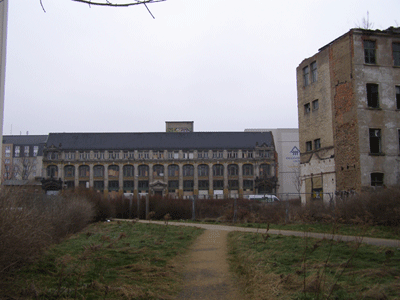
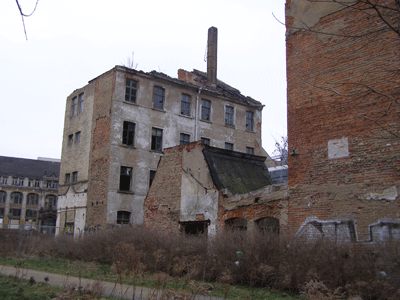
    It is difficult to imagine the breadth of this history while traversing the streets of Leipzig today. The city still certainly has its share of old and beautiful architecture, but much of this is now abandoned, with many structures adjacent to the central core covered in graffiti. In this regard, Leipzig looks like the German equivalent of a decaying American rust-belt city.

    The derelict atmosphere that a new visitor may sense upon arriving in Leipzig is at least partly due to the fact that many long-time residents still live in Soviet-style communist housing blocks at the peripheral edges of the city. Known as Plattenbau, or “plate buildings”, these ubiquitous and dehumanizing structures were communism’s answer to the issue of quickly re-housing East German citizens displaced by the ravages of war. Building these massive housing structures far outside the center also had the advantage of locating workers closer to places of industry.
    Taking into account Leipzig’s urban planning policies under communism, it is no wonder that neighborhoods near the city center appear neglected. Yet, stepping into the pedestrian-only heart of the city also tells a much more encouraging story. Unlike the often failed policies of many American cities to spur a “downtown renaissance”, Leipzig has had considerably more success at revitalizing its once thriving core.

    This is apparent by the number of construction sites around Leipzig’s central core. The city still has the advantage of possessing a significant stock of aesthetically appealing buildings, ranging in style from Baroque to Neoclassical. Furthermore, the University of Leipzig, one of Germany’s oldest, has taken the lead in making the city center a destination by consolidating its operations there. Currently, the University is constructing a new main building off of the city’s main square, Augustusplatz (formerly known as Karl-Marx-platz during the GDR).

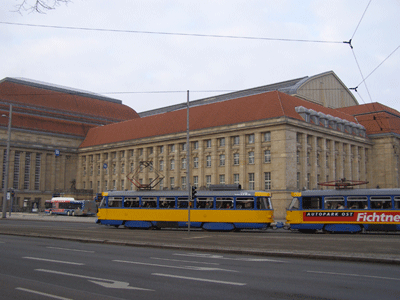
    Public transportation is also a bright spot for Leipzig. Modern streetcars ride above ground to the outer limits of this concentrically laid out city. The efficiency of the streetcar system would turn any American public-transportation proponent green with envy. Moreover, the construction of an ambitious underground metro system is slated to be completed next year, further easing mobility for Leipzigers.
    Leipzig’s location in the central-north portion of continental Europe also has its advantages. As a node for the transport of goods and people through central Europe, the city serves as a bridge between Germany and the once burgeoning but now suffering Eastern European nations. Even so, over time it would be in the city’s best interest to further capitalize on this asset.

    Adding clout to Leipzig’s location as a transportation hub is the city’s central train station – one of Europe’s largest and most historically significant. Grand in scale, Leipzig’s Hauptbahnhof not only sees a great deal of rail traffic from all over Germany, the station doubles as a shopping center for those living in the city. Practically a second “downtown”, the central station boasts everything from a constantly busy grocery store to clothing boutiques, numerous cafes and even two McDonald’s franchises.

    Despite its inspiring history, famous university and state-of-the-art transportation, Leipzig still faces tremendous challenges ahead. The city is not only struggling to attract newcomers but to retain a new generation of Germans born to parents who still remember what it was like to live in the GDR. Economically speaking, Leipzig stands little chance competing with other German cities in the west such as Frankfurt, Cologne or Munich where there are many more job opportunities. Aside from a plant that assembles Porsche’s struggling Cayenne line of SUVs – itself now threatened for both economic and environmental reason – industrial activity in Leipzig is limited. And with the Bohemian behemoth of Berlin not far away, Leipzig would be hard pressed to realize a full renaissance of its status as a prime destination for arts and culture.

    What does this mean for the future? In a sense, Leipzig’s problem is the same problem facing the entire region that comprises the former German Democratic Republic. The issues have been hotly debated in Germany since reunification. Some in the western parts of the country regard cities in the east as a lost cause. Contributing to the contentiousness of the debate is the ‘Solidarity Tax’ instituted to aid in the reunification process. At a rate of 5.5% of annual income tax, many Germans feel their tax dollars are being squandered on frivolous projects in the former GDR – projects that will have little to no impact on those living in the west.

    The renovation of the city center and the construction of the new Leipzig underground metro are examples of projects that benefit from funding from the Solidarity Tax. The key issue now is to see if the eastern cities themselves can use the generous government support and newfound infrastructure to stimulate economic activity and create jobs that will keep people from leaving for good. If this is not addressed immediately, the future of the former GDR looks bleak. The last thing Germany needs, especially in these times of global economic turmoil, is for those living in the east to become nostalgic for the days before the fall of the Iron Curtain.

    Adam Nathaniel Mayer is a native of the San Francisco Bay Area. Raised in the town of Los Gatos, on the edge of Silicon Valley, Adam developed a keen interest in the importance of place within the framework of a highly globalized economy. He currently lives in San Francisco where he works in the architecture profession.

  • One Fundamental Problem: Too Many People Own Homes

    Ben Bernanke made the following statement as he attempted to justify bailing out bad borrowers:

    “…from a policy point of view, the large amount of foreclosures are detrimental not just to the borrower and lender but to the broader system. In many of these situations we have to trade off the moral hazard issue against the greater good.” – Ben Bernanke, February 25, 2009

    I think he is wrong on this, and the moral hazard issue is only a small part of my objections.

    One of the fundamental problems we have right now is that too many people own homes. It sounds harsh, but please bear with me a few sentences. I think we can agree that 100 percent home ownership is not possible, or even desirable. Most of us can remember a time when our income and our jobs were such that home ownership was a bad idea. Home ownership is a commitment that requires a significant amount of stability and discipline. Not everyone is so stable or has the discipline to keep up with the payments.

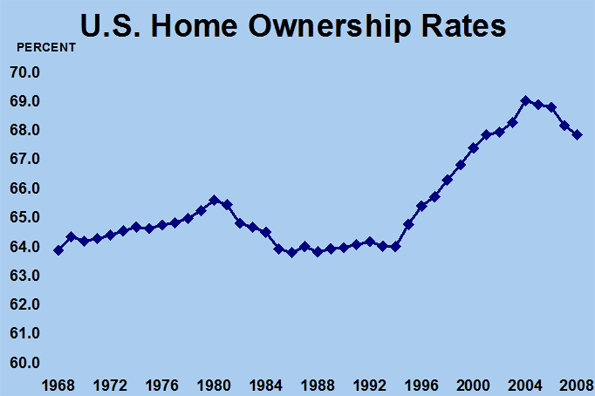
    What is an appropriate national homeownership rate? Theory gives us no answer. We look to the data for a clue. Here’s a chart of home ownership rates since 1968:

    It seems pretty clear that a homeownership rate between 63 percent and 65 percent works pretty well. When we get above that range, problems seem to crop up. This was true in 1980 – the worst recession of the past 30 years – and it is true now.

    In light of these data, let’s think about what Bernanke is saying. He’s arguing that to execute the foreclosures required to move the rate back to that 63 percent to 65 percent range are bad for the economy. So bad in fact, that we’re better off not going there.

    The problem with that argument lies in a lack of historic understanding of the proper levels of homeownership. Financial and real estate markets can’t stabilize until we get closer to that equilibrium. Until we lower the home ownership rate, financial institutions will have a cloud around them, and residential real estate markets will be lifeless. It may not be politically popular, but those are the realities.

    This is a critical issue. For years, economists have believed that the failure of banks to recognize and remove bad assets contributed to Japan’s long period of economic malaise. I agree. Forbearance on bad real estate loans here in the states constitutes much the same thing. Our financial institutions are holding a bunch of bad assets; these are homes that are owned by people who can not afford them – never did, and likely never will. Until the financial institutions recognize those bad assets and get them off their books, our financial institutions won’t have the resources to fund, stabilize and then drive a broader economic recovery.

    What we need is not more mindless beneficence to everyone from Wall Street to Detroit and Main Street. The more we bailout failed financial institutions, automobile manufactures, or any business, the longer we postpone our recovery.

    Recessions are periods when assets are reallocated from less productive to more productive uses. That requires processes like repossession, foreclosure, mergers, and bankruptcy. These processes have been developed over centuries. They are the most efficient methods to restore an economy.

    Why are we suddenly abandoning these processes that have proved themselves in many business cycles? I suppose part of it is the desire to eliminate the business cycle. This is the same thinking that had many – including conservatives – arguing that stocks could not fall during the dot.com bubble or that housing prices would also move up.

    In reality the business cycle can not be eliminated. It can’t be done and it is pure hubris to try. One of the fundamental insights to come out of Real Business Cycle research is that recessions constitute the most efficient response to a negative shock.

    We need to stop wasting resources trying to stem the tide. Instead, let us allow the recession to work for us. In the meantime we can provide a backstop through unemployment benefits and some reasonable fiscal stimulus. But we have to experience some pain and let our processes and institutions work for us. The sooner we get these foreclosures, repossessions, mergers, and bankruptcies behind us, the sooner we will see a return to the only sure cure for a sick economy: real economic growth.

    Bill Watkins, Ph.D. is the Executive Director of the Economic Forecast Project at the University of California, Santa Barbara. He is also a former economist at the Board of Governors of the Federal Reserve System in Washington D.C. in the Monetary Affairs Division.

  • Sunbelt Indianapolis

    For decades, the overwhelming majority of population and economic growth has occurred in the Sun Belt – the nation’s South and West as defined by the United States Bureau of the Census. This broadly-defined area stretches south from the Washington-Baltimore area to the entire West, including anything but sunny Seattle and Portland. Any list of population growth or employment growth among the major metropolitan areas will tend to show the Sun Belt metropolitan areas bunched at the top and the Frost Belt areas (the Northeast and Midwest regions) bunched at the bottom. Since World War II, no state has experienced the growth that has occurred in California.

    However, the trends in the last decade indicate a shift, certainly away from California, which has experienced a net domestic migration (people moving to other parts of the nation). The overall loss reaches over 1.2 million people; the state’s overall population growth rate is now only little more than average. Some metropolitan areas in the Frost Belt have begun to perform better in population and domestic migration, but most continue to experience growth that is well below that of the Sun Belt.

    The exception to this is Indianapolis, which has developed growth rates that would put it right in the middle of Sun Belt metropolitan areas, if it were not in the Frost Belt.

    Indianapolis is a metropolitan area of 1.7 million population. Indianapolis added nearly 11 percent to its population between 2000 and 2007 (latest data available) and ranks 19th in population growth among the 50 metropolitan areas with more than 1,000,000 population (New Orleans has been excluded from this analysis because of the hurricane related population losses). Indianapolis is growing faster than Washington, DC or Seattle and nearly as fast as Portland or Denver. Its population growth rate has been double that of San Diego, triple that of Los Angeles or San Jose and more than six times that of San Francisco, which has seen its growth slow to a rate no better than that of Italy. Overall Indianapolis would rank 18th out of the 32 largest US Sun Belt metropolitan areas in total population growth. It is the fastest growing of the 18 largest Frost Belt metropolitan areas.

    Between 2000 and 2007, the Indianapolis metropolitan area added 55,000 domestic migrants, equal to 3.6 percent of its 2000 population. No other Frost Belt metropolitan area comes close. Columbus and Kansas City had domestic migration gains, at 1.2 percent of their population. All other Frost Belt metropolitan areas lost domestic migrants. Indianapolis, however, would have ranked 17th out of the 32 largest Sun Belt metropolitan areas trailing Portland, but leading Seattle and Denver.

    The distribution of domestic migration within the Indianapolis metropolitan area is also significant. For one-half century various analysts have predicted the decline of the suburbs. Indianapolis, like most metropolitan areas around the country, shows exactly the opposite: the suburbs continue to attract central city residents and have yet to fall into this seemingly inevitable decline.

    While the Indianapolis metropolitan area gained 55,000 domestic migrants from 2000 to 2007, Marion County, the central county which is nearly co-existent with the central city of Indianapolis, lost 46,500 domestic migrants. All of the domestic migration growth was in the suburbs, which attracted 101,800 new residents from Indianapolis/Marion County and the rest of the nation.

    What is it that has allowed Indianapolis to experience Sun Belt growth despite being in the Frost Belt? This is not the place for a full attempt to identify all of the causes, but some observations can be made.

    Perhaps it is most important to understand what is not the cause of the superior growth in Indianapolis. It is not the city’s “unigov” governance structure. In the early 1970s, to the great fanfare of urban planners, Indianapolis merged with most of Marion County, increasing the city’s population by approximately 50 percent. Proponents of local government consolidations often (and speciously) suggest that these consolidations will make metropolitan areas more attractive (this issue is discussed in detail in our Pennsylvania report on local government consolidation). Yet, Indianapolis, one of the nation’s largest consolidated local governments, is losing residents to the suburbs. It is also worthy of note that state taxpayers provided a $1 billion pension bailout to the city last year.

    One factor that clearly makes Indianapolis attractive is its housing affordability, which is the best among metropolitan areas with more than 1,000,000 residents in six nations. According to our 5th Annual Demographia International Housing Affordability Survey, Indianapolis had a Median Multiple (median house price divided by median household income) of 2.2 in the third quarter of 2008, well below the historic norm of 3.0. Indianapolis has been ranked near the top in each of the preceding four editions as well. In recent years, new suburban starter houses of 1,500 square feet have been advertised at less than $110,000, less than the price of land for a house in many metropolitan areas.

    Superior housing affordability constitutes a critical important attractor. At the height of the housing bubble, a household living in the median priced house in Indianapolis would have saved more than $1,000,000 in down payment and mortgage payments over 30 years, compared to San Diego.

    Indianapolis also has the advantage of a comfortable lifestyle. Commuters spend 2 minutes less per day than the national average getting to work, according to the 2007 United States Bureau of the Census American Community Survey. The Texas Transportation Institute indicates that traffic congestion is less severe in Indianapolis than average and that it has become better in the last 10 years. Indicating its usual irrelevance to traffic congestion, Indianapolis has the smallest transit market share of any urban area over 1,000,000 in the nation, at approximately 0.2 percent. This compares to 11 percent in New York, 5 percent in San Francisco and 2 percent in Los Angeles and Portland.

    Where does Indianapolis go from here? So far, Indianapolis has shown resiliency in the current economic crisis. The December 2009 unemployment rate was 6.7 percent, which is below the 7.2 percent national rate. Other parts of Indiana are not doing nearly as well, especially in smaller metropolitan areas that rely to a greater extent on manufacturing. For example, unemployment has reached 15 percent in Elkhart.

    To some extent, the metropolitan area’s huge advantage in housing affordability has been eroded by the collapse of prices in the most expensive Sun Belt metropolitan areas, such as in California and Florida. Yet, Indianapolis remains far more affordable, even after these losses.

    Indianapolis also has an advantages for business. In the State Business Tax Climate Index, Indiana is ranked highly, at 14th in the nation. With the prospect of higher taxes, both at the federal level and in many states, this should help Indianapolis retain an impressive advantage and continue to perform as if it were a Sun Belt metropolitan area, but without the problems associated with the housing bubble, massive congestions and growing social inequality.

    Wendell Cox is a Visiting Professor, Conservatoire National des Arts et Metiers, Paris. He was born in Los Angeles and was appointed to three terms on the Los Angeles County Transportation Commission by Mayor Tom Bradley. He is the author of “War on the Dream: How Anti-Sprawl Policy Threatens the Quality of Life.

  • Urban Inequality Could Get Worse

    President Obama’s stated objective to reduce inequality, as laid out in public addresses and budget plans, is a noble one. The growing income gap – not only between rich and poor, but also between the ultra-affluent and the middle class – poses a threat both to the economy and the long-term viability of our republic.

    But ironically, what seems to be the administration’s core proposal, ratcheting up the burden on “rich” taxpayers earning over $250,000, could have unintended consequences. For one thing, it would place undue stress on the very places that have been Obama’s strongest supports, while providing an unintended boost to those regions that most oppose him.

    At the heart of the matter is the age-old debate about who is “rich.” If you define wealthy as $250,000 a year for a family of four, that means different things in different places. America is a vast country, and the cost of living varies widely. What seems a princely sum in, say, red state Oklahoma City is barely enough to eke out a basic middle-class life in blue bastions like New York, Los Angeles or San Francisco.

    In the recent study on the New York middle class that I conducted with Jonathan Bowles at the Center for an Urban Future, we compared the cost of a “middle class” standard of living in New York and other cities. The report found that Manhattan is by far the most expensive urban area in the country, with a cost of living that’s more than twice the national average. (This is according to a cost of living index developed by the ACCRA, a research group formerly known as the American Chamber of Commerce Researchers Association.)

    But even Queens, the city’s middle-class haven and the only other borough included in the ACCRA analysis, suffers the eighth highest cost of living in the country.

    What does that mean? An individual from Houston who earns $50,000 would have to make $115,769 in Manhattan and $81,695 in Queens to live at the same level of comfort. Similarly, earning $50,000 in Atlanta is the equivalent of earning $106,198 in Manhattan and $74,941 in Queens. (See “New York Should End Its Obsession With Manhattan.”)

    The cost of housing constitutes one critical part of the difference. Average monthly rent in New York was $2,720 in the fourth quarter of 2007, by far the top in the nation. That total was both 55% higher than the second place city, San Francisco, where average effective rents are $1,760, and nearly triple the national average of $975.

    Even in relative boom times, such high costs have been driving many out of New York, and now it could get worse. During tough times, people’s incomes drop, so they are less able to absorb high costs and taxes, which are rising in many blue cities and states. Imposing more taxes on some label-rich New Yorkers or Angelenos, who earn $250,000 a year, won’t make them more likely to stay.

    Perhaps even worse, higher taxes probably won’t help the inequality issue. True, historically and to this day, the greatest levels of inequality occur in low-tax areas like the Mississippi Delta, the Rio Grande Valley and Appalachia. But, increasingly, this unsavory distinction is shared by big cities like New York, Los Angeles and Chicago. In contrast, the most egalitarian states are generally deep red places – such as the Dakotas, Alaska, Nebraska and Wyoming.

    Higher costs – manifested in everyday expenses like sales taxes and energy bills – now contribute in a large way to growing inequality even in the richest, most elite cities. When housing and other costs are factored in, notes researcher Deborah Reed of the left-leaning Public Policy Institute of California, deep-blue mainstays Los Angeles and San Francisco rank among the top 10 counties in America with respect to the percentage of people in poverty. Only New York and Washington, D.C., do worse.

    Worst of all, the rise of inequality in these high-cost blue cities seems to be connected to policy decisions. High taxes and strict regulations have expelled relatively well-paying blue collar jobs in manufacturing and warehousing from expensive urban areas. Without them, an extremely bifurcated economy and society forms because no traditional ladders for upward mobility remain; they are critical to a successful urbanity.

    Back in the 1960s, Jane Jacobs predicted that Latino immigrants to New York, mainly from Puerto Rico, would inevitably make “a fine middle class.” Yet four decades later, in the Bronx, the city’s most heavily Latino county, roughly one in three households lives in poverty – the highest rate of any urban county in the nation.

    At the other extreme, in Manhattan, where the rich are concentrated, the disparities between socioeconomic classes have been rising steadily. In 1980, the borough ranked 17th among the nation’s counties for social inequality; today it ranks first, with the top fifth of wage earners earning 52 times that of the lowest fifth, a disparity roughly comparable to that of Namibia.

    To an old-fashioned Truman Democrat like me, this is bad news. But some modern-day “progressives,” like Richard Florida, celebrate the concentration of rich people. They see them as guarantors that places like New York will be the winners of the post-crash economy. The losers? Goods-producing regions of the Great Plains, the industrial Midwest and, of course, those unenlightened, suburban middle-class people.

    Yet it seems more and more likely that raising taxes for urban middle-income workers will, over the long term, add to the flood of people fleeing to less costly locales with lower taxes. This will be particularly true for the growing ranks of information economy “artisans” who might find critical write-offs for home offices and other business expenses cut from their next tax return.

    None of this is necessary. The “creative destruction” resulting from the downturn might actually prove a boon to these big cities – by making them more affordable for the urban middle class. This help would be accelerated if city governments – as in Los Angeles, New York, Houston and even San Francisco during the early 1990s – nurture local businesses.

    But “growth” – a word not widely embraced in this greenest of administrations – does not seem to be a priority in either Washington or in most city halls. There are murmurs that investment in high-cost, subsidized alternative energy will create vast numbers of new jobs, but this is likely just wishful thinking for everyone but Al Gore’s business partners.

    This is not to say cities’ policies need to return to Bush-style Republicanism. Tax breaks for big-time investors and real estate speculators do not make a sustainable urban policy either. What’s needed is something closer to lunch-bucket liberalism, which focuses on productivity-enhancing initiatives and sparking entrepreneurial growth. America – its cities in particular – could do with more private-sector stimulation and a lot less high-minded social engineering.

    With policies geared toward the latter at the expense of the former, one of the great ironies of the Obama era will continue to unfold.

    By targeting the urban middle class to pay for its deficit and new social programs, the president’s plan could end up draining wealth – and boosting inequality – from our nation’s great cities, where he currently draws overwhelming support, to its hinterlands. Not exactly what the White House had in mind, no doubt, but, sadly, it’s a distinct possibility.

    This article originally appeared at Forbes.

    Joel Kotkin is executive editor of NewGeography.com and is a presidential fellow in urban futures at Chapman University. He is author of The City: A Global History and is finishing a book on the American future.