Category: Economics

  • The Mainstream Media Will Rise Again

    The news media was flattened on November 8th, but its recovery has already started.

    One of the striking features in all the commentary on Facebook about Donald Trump’s victory is the number of times that the words I, me and my appeared in member posts. For example, “I am proud”, “I am optimistic”, or “I am fearful”, “I am worried”, etc. The comments celebrating or lamenting the event were mostly about the way the writer felt about the event, not about the event itself. That looks like a subtle difference but it reveals a demarcating line between an introverted reaction vs. an extroverted one.

    None of this is too surprising because even in normal times, Facebook’s format and primary raison d’être are to enable people to talk about themselves and to update their friends on their comings and goings. On any given day outside of an election period, the blue bannered webpage seems to be 80% introversion (photos and news of one’s own family, or one’s own meal, or one’s own travels, challenges and accomplishments) and 20% extroversion (posts of articles about third parties).

    Anatomy of a Crash

    It was surprising however to observe the same I, me, my phenomenon in the columns of major newspapers in the immediate aftermath of the election. Leading columnists were unusually introspective, if not introverted. Writing in the first person, they felt homeless in America, were horrified, struggled to absorb the impossible and vowed to fight back.

    Of course, columnists are often media superstars and their extensive use of the first person may come from a deliberate effort by the newspaper editors to render the news commentary more personal. That coloring was certainly in full relief in the angst-ridden I haven’t slept in my room since the election and Trump’s election stole my desire to look for a partner among others.

    Nonetheless, whether deliberate or incidental, the I me my device can be seen as a sign that leading dailies, or at least their op-ed pages, have over the years drifted from extroverted to introverted, from objective analysis to star-studded opinion.

    In reality, the op-ed pages need not be so full of personal opinion and subjective thoughts and feelings. Opinion can be objective analysis, and as such can become an arms length discussion of facts without necessarily pointing the reader towards the author’s own views. The op in op-ed then becomes an invitation and encouragement to the reader to form his own opinion, instead of a presentation of the writer’s opinion. Fairly or unfairly, the value placed on the latter has been in steady decline for many years.

    The presentation of facts in support of this new approach requires the inclusion of more soft and hard information and data. As W. Edwards Deming was fond of saying, “without data, you are just another person with an opinion”, or, at his more whimsical, “in God we trust; all others must bring data”. Data in an op-ed does not have to be numerical, so long as the tone and content are objective and analytical. Of course there is some subjectivity in choosing one set of data or facts vs. another but a writer will not be credible if the scope of his analysis is too narrow. An article is enriched by the addition of more and more data. It should be as full of data as possible and as short as necessary to make it a compact and quick read.

    This is painting with a broad brush and we should recognize that the leading dailies still produce outstanding content, including on the op-ed page. But it is fair to say that, in reflecting and understanding the general mood of the country, these papers were blindsided by the more recent upstarts of the internet age and even by savvy Twitter users like Mr. Trump himself and others.

    Social media has revalued upwards the opinion of every person with a computer or smartphone and simultaneously devalued professional opinion leaders such as newspaper columnists, academics and others. Remember that Time Magazine’s Person of the Year in 2006 was YOU. Perhaps it is the new competition from you and from bloggers and micro-bloggers that has led these columnists to emphasize the first person in their writings as if to remind us that their credentials far outweigh those of the random blogger across town. Indeed they do. But in today’s free for all media, opinions are increasingly judged on their own merits, and not as much by the identity of the writer.

    Here is the key to understanding the news media’s endless travails. Of course, digital and social media have played a big role in the decline of advertising at major newspapers, but so has each paper’s own approach to news and commentary. A good first step towards recovery would be to excise or minimize I, me, my from the op-ed page and to shift the whole tenor from introversion to extroversion. With data and facts presented in a rigorous and coherent manner, a columnist becomes much more than “just another person with an opinion”.

    Scraping the Bottom

    At first blush, the current state of play is not that encouraging. In the world of the internet, of blogging, of Facebook and BuzzFeed, it has become more difficult for legacy newspapers to keep up with a changing audience. Millennials may be more interested in short articles that combine news and entertainment than in the type of long form articles and analyses that are the hallmarks of the New York Times and other leading dailies.

    To gauge the prevailing mood, consider the table below which shows the results of several Google searches on November 18th, a randomly chosen date. Although cronyism is arguably a real scourge of our time, there were on Google only 348,000 results for “Hillary cronyism” and 423,000 results for “Trump cronyism”. What is important in the table is how these numbers compare to other searches. Some serious crises like “Flint Michigan water” log in at less than two million results, but the distracting “Trump Rosie” has over 9 million and the promised “Trump build a wall” nearly 35 million, while itself only one tenth of the ubiquitous mega blockbuster “Trump Twitter”.

    Clearly, the more important items are under-covered while the ephemeral and insubstantive get a ton of coverage. It is possible however that this trend towards the superficially satisfying has run its course and that traditional news can regain some advantage. As with any downward spiral, recovery seems more plausible after hitting bottom. Strong brands in any sector can be tarnished for a while but in most cases they can adapt and enjoy a lasting rebound under altered circumstances.

    Although no one can make this prediction with high confidence, there is a nebulous long-observed propensity for big trends to reverse themselves once they have reached an extreme point, as the devaluation of the media has on November 8th. There is also an increasing desire among news consumers to gravitate back to the great time-tested brands in order to gain some immunization against the so-called post-truth world.

    Note for example that since the election, The New York Times has seen a ten-fold increase in daily subscription sign-ups, a signal that many readers are returning to more established brands at a time when fake news is spreading over the internet. Yet this surge may prove short lived if real reforms are not implemented in the wake of the election surprise.

    At any rate, a total subscription count of 2.5 million at the Times seems exceedingly low for what is one of the top news brands in the world. Further, the market value of the New York Times company at $2.4 billion, though it has risen 30% since the election, still underestimates the full potential of the brand.

    Sami Karam is the founder and editor of populyst.net and the creator of the populyst index™. populyst is about innovation, demography and society. Before populyst, he was the founder and manager of the Seven Global funds and a fund manager at leading asset managers in Boston and New York. In addition to a finance MBA from the Wharton School, he holds a Master’s in Civil Engineering from Cornell and a Bachelor of Architecture from UT Austin.

    Photo: ‘New York Times’ photo Copyright © 2016 populyst.net.

  • Trump and California’s Economy

    Defenders of California’s status-quo claim to be proud of California’s economic growth and worry about what Trump will do to that growth. If you are so impolite as to mention that this has been California’s slowest recovery in 70 years, as the following chart shows, you will be told that slow growth is good. It avoids the excesses of previous business cycles.

    That’s nonsense. Slow growth is anti-poor and anti-minority. Here’s a simple way to analyze economic policy: Ask how the policy changes the probability of a young person finding a job. If the policy increases their chances, it’s good policy. If it decreases the probability, it’s bad policy.

    I go farther than that. To me, deliberately enacting a policy that reduces a young person’s prospects is immoral.

    California, and the nation, have lots of policies that reduce young people’s job prospects. So, there are lots of opportunities to increase economic growth. Certainly, it’s possible to present a set of policy proposals that would increase California’s economic growth.

    Evaluating Trump’s economic plan is difficult, though. So far, it’s a mixed bag. It has policies that would increase economic growth. It also has some that would decrease economic growth. I think the best way to evaluate the impact is to look at his major proposals for their growth impact and probability of becoming law.

    Trump has promised to reduce American business’s regulatory burden. That would reduce costs, encourage domestic production and jobs, and provide a strong economic boost. Some of that overhead was created by executive action and can be reversed by executive action. The probability of reversing those regulations is high, as are the economic benefits.

    He’s also promised to eliminate or “fix” Dodd-Frank and the Affordable Healthcare Act. Exactly what he intends to do, fix or eliminate, depends on the tweet of the day. It’s also not clear what fix means. Still, any real change will face significant hurdles, even with a Republican controlled Congress. To be conservative, we need to assume that he will be unsuccessful in his attempts to significantly change these laws. If he does, and it’s done in a way that reduces costs, it will be a happy plus.

    Then there is his immigration policy, if you can figure out what it is. He’s been all over the map, from shipping out all undocumented residents to only shipping out the criminals. Of course, if he is able, as some fear, to move millions of our workers, the economic impact would be seriously negative.

    Realistically, the most he is likely to accomplish is exporting criminals and slowing immigration. The numbers of undocumented criminals is small enough to have no measurable impact on the economy. Decreasing immigration tends to slow economic growth, but it may reduce inequality a bit by reducing competition faced by our low-productivity workers. Overall, Trump’s immigration policies will likely have modest negative economic impacts.

    As in all things Trump, his trade proposals are inconsistent and vague. One thing has been consistent. Trump wants to reduce trade. We can only hope that he’s unsuccessful. The economic impacts of reducing trade would be large and negative. Presumably, Congress will effectively resist his most egregious proposals.

    Reducing trade would particularly hurt California’s economy, as a large percentage of what the United States exports and imports goes through California’s ports, which are a significant portion of the state’s limited remaining industrial assets.

    Taxes are one area of Trump policy clarity. He wants to reduce corporate taxes and reduce the tax impediments to repatriating foreign corporate earnings. By themselves, these would provide an economic stimulus. Repatriating foreign earnings has no obvious downside. By contrast, without some action somewhere else, reducing corporate taxes could increase the severity of our already severe budget challenges. Eliminating deductions, as proposed, would lessen the budget impacts, as would taxing repatriated earnings at the suggested 10 percent rate. These, combined with increased economic activity, potentially brings the long-run budget impact to near zero. Supply-siders would argue that the package would reduce deficits. That’s probably a stretch, although the combination of regulatory reform and tax reform could very well reduce the deficit.

    Trump proposes a stimulus package that appears to be another public capital spending spree. This would add to our budget challenge, but it’s far worse than cutting taxes to businesses. Cutting taxes at least has the benefit of generating new economic activity to offset some of the budget impact. Public capital spending at the national level is non-stimulative and inefficient. Given the budget impacts, zero economic impact is the best we can hope for.

    Some California leaders worry that Trump will retaliate economically for California giving Hillary Clinton a popular-vote victory. I don’t believe that the presidency has enough power for a vindictive new president to exact revenge by economically punishing states that voted for his opponent. If he does, the presidency is way too powerful.

    Overall, it’s likely that Trump’s economic impacts will be a small positive, but with an increase in an already too-large budget deficit. California’s impact could be smaller, or even negative, depending on Trump’s success reducing trade.

    Whatever Trump’s impacts on the national economy, they are likely to be far less for California, as his program will be swamped by California’s own unilateral deindustrialization. While the rest of the nation will be enacting a program intended to be pro-business and pro-job, California is firmly embarked on an agenda that promises to be anti-business and anti-job, with increased regulation and costs for businesses and consumers.

    Examples of California’s anti-business agenda are easy to come by. Governor Brown has recently asked the Federal Government to ban all offshore oil and gas drilling off of California. In the most recent election, Californians renewed their commitment to environmental purity, embracing carbon emissions targets 40 percent below 1990 levels by 2030. Nothing is beyond the reach of California’s environmentally devout. They’ve already regulated cow flatulence, which could lead to backpacks and plumbing to collect cow gas. More likely, it will lead to fewer cows in California, but more in other places and no change in global bovine emissions.

    While it’s entertaining to speculate what California regulates after cow flatulence, there are serious consequences to the state’s regulatory enthusiasm. Unless the rest of the country embraces California’s agenda, very unlikely under a Trump administration, its economy and the nation’s will eventually diverge, even with California’s location, climate, and tech advantages. This will lead to slower economic growth and increased migration out of the Golden State.

    Bill Watkins is a professor at California Lutheran University and runs the Center for Economic Research and Forecasting, which can be found at clucerf.org.

    Photo: Wendell, Flickr

  • “There Can’t Be a Successful Indianapolis Without a Successful Indiana”

    Back in 2008 or 2009 I gave a Pecha Kucha presentation in Indianapolis in which I said:

    “Cities can’t survive on gentrification alone. The broad community has to be a participant in its success. That’s why I’m somewhat down on the notion of the creative class. It’s good as far as it goes, but it’s a self-consciously elitist vision. Where’s the working class in that?

    Arguing among ourselves [city vs. suburbs] is like beggars fighting over table scraps. We need to build the city up without tearing the suburbs down.

    There can’t be a successful Indianapolis without a successful Indiana….While [metro] Indy has 25% of the states’ population, it has 60% of the state’s population growth and 80% of its economic growth. That’s not healthy. Like it or not, we’re dependent on the state for critical infrastructure funds and other things. So our challenge is how to bring the rest of the state along with us.”

    I’ve long been an advocate for the restoration what I call the commonwealth, the idea that we rise and fall together as a people and all have skin the game. This idea has gone by the wayside to say the least.

    It may well be that American society has become irredeemably tribalized. I hope not. At a minimum, there are significant sized groups with fundamentally incompatible ideas of the public good. There’s a lot to unpack in that statement, but not today.

    Richard Florida has talked about a “great reset” of the economy. Clearly we need some sort of institutional reset to contain or resolve these differences. We’ve done this before in creating the original Constitution to replace the Articles of Confederation, fighting a Civil War and redefining the federalism of that constitution, the New Deal era changes, and perhaps others.

    What that looks like, I don’t know. But if we are to reach it without even more severe upheavals, it’s likely to involve some renewed form of federalism, agree to disagree, live and let live, etc – and on durable basis, not just an opportunistic and self-interested one.

    This will involve painful change and difficult decisions. One of them is that we must be willing to give others the freedom to make choices for themselves and their communities that we fundamentally disagree with.

    To the extent that we believe all of the big decisions of our society are morally determined, and thus not properly the subject of political debate, this means we are in a winner take all world. If you want that world, you’d better be really sure you are right and sure you are going to win – because you face ruination if you’re wrong on either count.

    It also means that we need to figure out how to have both love and accountability towards all of our citizens. Right now that means that rural white Republicans in victory cannot ignore the continued urgent need to integrate urban black America into full participation in middle class success and to address other aspects of what Richard Florida has labeled the “new urban crisis.”

    It also means that working class whites must be challenged to change. I have made no secret in these pages that these communities too often have sabotaging traits that really aren’t necessary to cling to – such as the disparagement of ambition for better.

    But urban and left leaning populations, including minority groups, need to likewise address travails of the white working class, and be willing to make painful changes of their own.

    To be honest, I’m not optimistic. But I am hopeful. The future hold possibilities for ill that we cannot know – but it likewise holds the possibility for good things we can’t yet imagine.

    Aaron M. Renn is a senior fellow at the Manhattan Institute, a contributing editor of City Journal, and an economic development columnist for Governing magazine. He focuses on ways to help America’s cities thrive in an ever more complex, competitive, globalized, and diverse twenty-first century. During Renn’s 15-year career in management and technology consulting, he was a partner at Accenture and held several technology strategy roles and directed multimillion-dollar global technology implementations. He has contributed to The Guardian, Forbes.com, and numerous other publications. Renn holds a B.S. from Indiana University, where he coauthored an early social-networking platform in 1991.

    Photo: By Daniel Schwen (Own work) [CC BY-SA 4.0], via Wikimedia Commons

  • How Silicon Valley’s Oligarchs Are Learning to Stop Worrying and Love Trump

    The oligarchs’ ball at Trump Tower revealed one not-so-well-kept secret about the tech moguls: They are more like the new president than they are like you or me.

    In what devolved into something of a love fest, Trump embraced the tech elite for their “incredible innovation” and pledged to help them achieve their goals—one of which, of course, is to become even richer. And for all their proud talk about “disruption,” they also know that they will have to accommodate, to some extent, our newly elected disrupter in chief for at least the next four years.

    Few tech executives—Peter Thiel being the main exception—backed Trump’s White House bid. But now many who were adamantly against the real-estate mogul, such as Clinton fundraiser Elon Musk, who has built his company on subsidies from progressive politicians, have joined the president-elect’s Strategic and Policy Forum. Joining Musk will be Uber’s Travis Kalanick, who half-jokingly threatened to “move to China” if Trump was elected.

    These are companies, of course, with experience making huge promises, and then changing those promises to match new circumstances. Uber, for instance, touted itself as a better deal than a cab for both riders and drivers before it prepared to tout a better deal for riders by replacing its own soon-to-be obsolete drivers with self-driving cars.

    Silicon Valley and its leading mini-me, the Seattle area, did very well under Barack Obama, and expected the good times to continue under Hillary Clinton. Tech leaders were able to emerge as progressive icons even as they built vast fortunes, largely by adopting predictably politically correct issues such as gay rights and climate change, which doubled as a perfect opportunity to cash in on Obama’s renewable-energy subsidies. Increasingly tied to the ephemeral economy of software and media, they felt little impact from policies that might boost energy costs or force long environmental reviews for new projects.

    No wonder Silicon Valley gave heavily to Obama and then Clinton. In 2016, Google was the No. 1 private-sector source of donations to Clinton, while Stanford was fifth. Overall the electronics and communications sector gave Democrats more than $100 million in 2016, twice what they offered the GOP. In terms of the presidential race, they handed $23 million to Hillary, compared to barely $1 million to Trump.

    Yet, there is one issue on which the Valley has not been “left,” and that is, predictably, wealth. It may have liked Obama’s creased pants and intellectually poised manner, but it did not want to see the Democrats become, God forbid, a real populist party. That is one reason why virtually all the oligarchs favored Clinton over Sanders, who had little use for their precious “gig economy,” the H-1B high-tech indentured-servants program, or their vast and little-taxed wealth.

    Jeff Bezos, the Amazon founder with a net worth close to $70 billion, used his outlet, The Washington Post, to help bring down Bernie, before being unable, despite all efforts, to stop Trump. So now Bezos sits by Trump’s side, hoping perhaps that the president-elect’s threats to unleash antitrust actions against Amazon will be conveniently forgotten as an artful “deal” is struck.

    For these and other reasons, there’s little doubt that the tech elite would have been better off under Clinton, who likely would have, like Obama, disdained antitrust actions and let them keep hiding untaxed fortunes offshore. Now, they will have to share the head table with the energy executives they’d hoped to replace with their own climate-change-oriented activities.

    The tech oligarchs have long had a problem with what many would consider social justice. Although the tech economy itself has expanded in the current period, its overall impact on the economy has been less than stellar. For all of its revolutionary hype, it’s done little to create a wide range of employment gains or boost worker productivity.

    To be sure, there have been large surges of employment in the Bay Area, Seattle, and a handful of other places. California alone has more billionaires than any country in the world except China, and nearly half of America’s richest counties.

    But for much of the country, notably those areas that embraced Trump, the tech “disruption” has been anything but welcome news. This includes heavily Latino interior sections, home to many of America’s highest employment rates. Overall, the “booming” high-wage California economy celebrated by progressive ideologues like Robert Reich does not extend much beyond the Valley. In most of California, job gains have been concentrated in low-wage professions.

    Despite its vast wealth, California has the highest cost-adjusted poverty rate in the country, with a huge percentage of the state’s Latinos and African Americans barely able to make ends meet. California metropolitan areas, including the largest, Los Angeles, account for six of the 15 metro areas with the worst living standards, according to a recent report from demographer Wendell Cox. Meanwhile, the middle and working class, particularly young families, continue to leave, with more people exiting the state for other ones than arriving to it from the, in 22 of the past 25 years.

    Even in Silicon Valley itself the boom has done little for working-class people, or for Latinos and African Americans—who continue to be badly underrepresented at the top tech firms as many of those same firms aggressively promote diversity. A study out of the California Budget and Policy Center (PDF) concluded that with housing costs factored in, the poverty rate in Santa Clara County soars to 18 percent, covering nearly one in every five residents, and almost one-and-a half times the national poverty rate. Since 2007, amidst an enormous boon, adjusted incomes for Latinos and African Americans in the area actually dropped (PDF).

    Much of this has to do with change in the Valley’s industrial structure, which has shifted from manufacturing to software and media. The result has been a kind of tech alt-dystopia, with massive levels of homelessness, and housing costs that are prohibitive to all but a small sliver of the local population.

    With a president whose base is outside the Bay Area, and dependent on support in areas where jobs are the biggest issue, the tech moguls will need to find ways to fit into the new agenda. The old order of relentless globalization, offshoring, and keeping profits abroad may prove unsustainable under a Trump regime that has promised to reverse these trends. In some senses the Trump constituency is made up of people who are the target of Silicon Valley’s “war on stupid people.” Inside the Valley, such people are seen as an obstacle to progress, who should be shut up with income supports and subsidies.

    So can Silicon Valley make peace with Donald Trump, the self-appointed tribune of the “poorly educated”? There are two key areas where there could be a meeting of minds. One is around regulation. One of the great ironies of the tech revolution is that the very places that are home to many techies—notably blue cities such as San Francisco, Austin, and New York—also tend to be the very places most concerned with the economic impacts of the industry.

    Opposition to disruptive market makers in the so-called sharing economy like Uber, Lyft, and Airbnb is greatest in these dense, heavily Democratic cities. What’s left of the private-sector union movement and much of the progressive intelligentsia is ambivalent if not downright hostile to the “gig” economy. Ultimately, resistance to regulations relating to this tsunami of part-time employment could be something that Trump’s big business advisers might share in common with the techies.

    More important will be the issue of jobs. It may not work anymore for firms to lower tech wages by offshoring jobs or importing lots of foreign workers under the H-1B visa program, since Trump has denounced it. IBM’s Ginni Rometty, who had been busily replacing U.S. workers with ones in India, Brazil, and Costa Rica, has now agreed to create 25,000 domestic jobs. Other tech companies—including Apple—have also been making noises shifting employment to the United States from other countries. Trump may well feel what “worked” with Carrier can now be expanded to the most dynamic part of the U.S. economy.

    If the tech industry adjusts to the new reality, they may find the Trump regime, however crude, to be more to their liking than they might expect. Companies like Google may never again have the influence they had under Obama, but many techies may be able to adjust. As long as the new president “deals” them in, the techies may be able to stop worrying about Trump and begin to embrace, if not love, him.

    This article first appeared on The Daily Beast.

    Joel Kotkin is executive editor of NewGeography.com. He is the Roger Hobbs Distinguished Fellow in Urban Studies at Chapman University and executive director of the Houston-based Center for Opportunity Urbanism. His newest book, The Human City: Urbanism for the rest of us, was published in April by Agate. He is also author of The New Class ConflictThe City: A Global History, and The Next Hundred Million: America in 2050. He lives in Orange County, CA.

    Photo by Gage Skidmore from Peoria, AZ, United States of America (Donald Trump) [CC BY-SA 2.0], via Wikimedia Commons

    Photo: MCR World

  • Everyday Encounters: Antagonism in the Sharing Economy

    Much has been written about the growth of the sharing economy where information technology, such as mobile apps and automated software facilitate interactions between businesses, individual workers, and customers. Proponents argue that the system provides greater access to goods and services at lower prices while reducing costs for employers and independent contractors. They also claim that, in the gig sector of the sharing economy, workers gain flexibility because they determine their own hours, tools, and working conditions while raising potential earnings.

    Regardless of whether we buy these claims about benefits to workers, there are numerous signs that the sharing economy creates antagonism between workers and customers. The apps and automated systems that underlie these new work structures require both workers and customers to rely on technology, yet the systems are often faulty and poorly designed.  While these systems promise transparency and trust, they also create tensions. For example, such systems unfailingly include algorithmic performance assessment of service industry workers. As technology writer and software engineer Tom Slee has argued, “Rather than bringing a new openness and personal trust to our interactions, [such shifts are] bringing a new form of surveillance where service workers must live in fear of being snitched on, and while the company CEOs talk benevolently of their communities of users, the reality has a harder edge of centralised control.”  The increasing antagonism resulting from the perpetuation of inequality among “stakeholders” has received insufficient attention.

    Service industry workers have long operated as the front-line interface with customers, having to respond to complaints about company practices that they don’t control. Now service workers have even less control due to structural and technological platforms.  When platforms fail, inconveniencing and frustrating customers, workers have little power to resolve disputes.  At the same time given the dependence on technology and lacking access to customer information, they cannot build relationships with customers over time. Indeed, it is almost impossible to contact the same customer service representative twice, so consumers then become obliged to give the same information over and over again. The interactions between customers and workers often predictably devolve, generating frustration, impotence, and anger on both sides and voiceless workers  subjected to performance review by customers following interactions. Dependence on technology estranges service workers from customers, undermining the possibility of finding satisfaction on the job because of increased misunderstandings and conflicts.

    Just as proponents ignore the way automation undermines the quality of work, they also misrepresent what the sharing economy offers to consumers. Although they claim that automation generates a high degree of efficiency and autonomy to customers, they overlook time-consuming administrative inefficiency and poor customer service.  For example, in the gig sector, where a few companies dominate particular markets, companies have little reason to worry about consumer rights. No doubt this contributes to the increasing conflicts and complaints associated with technology and social media in air travel, banking and other financial institutions, cable television and communications companies, insurance and health firms, and universities.

    To make matter worse, customers in the sharing economy must go to great lengths to seek basic information and answers to queries. Even when customers succeed in reaching customer service representatives, they are often treated with robotic indifference or a stilted hyper-courtesy that barely conceals institutional disdain. Customer service representatives often speak in a language of faux-camaraderie that couches authoritarian directives as suggestions as in the ubiquitous “Why don’t you go ahead and. . .” Corporations exacerbate the problem by pairing this passive-aggressive treatment with service fees and other administrative charges, so that customers are not only treated poorly, they pay for that privilege.  This problem affects less educated and less well-off customers, especially, who may have less access to or experience with technology and the Internet and are less able to afford fees or phone charges.

    Some companies will not make themselves available at all, having developed bureaucratic systems that cultivate inaccessibility. For example, Amazon has refused to engage with customers directly by phone. Other companies have trained call center employees to repeat marketing mantras and to speak like machines giving pre-scripted answers that may or may not match a customer query. These bureaucratic obstructions, including automated customer service and phone banks and the outsourcing of customer service “chat” and email services, only deepen the antagonism of customers toward corporations and their intermediaries.

    The antagonism generated by these practices affects working- and middle-class people far more than it does the elite, who often enjoy preferential treatment through concierge services in hospitals or all business-class airports.  Such VIP/concierge services help elites navigate organizations, technology, and services, while most customers must work harder to gain access to restaurants,  hotels, sports and other entertainment events, and a range of other services and sites.  As Cathy O’Neil in Weapons of Math Destruction has noted, “The privileged, we’ll see time and again, are processed more by people, the masses by machines.”

    Non-elites unable to “opt-out” of the antagonistic service economy may find consolation in the techno-future conjured up by Amazon Go, which showcases the pleasures of never having to interact with other humans at all. In glossy ads for what Amazon deems the “world’s most advanced shopping technology,” checkout is eliminated – as are retail clerks — as shoppers employ an app that simply charges them for the items they select.  Privileged relationships with commodities dominate the scene in an ad in which hardly anyone speaks to or even looks at anyone else.

    In the past few months, commentators have explained support for Donald Trump in the US or  “Brexit” in the UK as expressions of populist rage.  One source of that rage may well be everyday encounters of the kinds sketched here.  If working-class people feel like they don’t matter in contemporary capitalism, that may reflect the challenges of working in the sharing economy, with its low wages, limited autonomy, and inherent conflicts, but also the challenges of an antagonistic service culture that mounts daily micro-assaults on people’s dignity and rights.

    Diane Negra is Professor of Film Studies and Screen Culture and Head of Film Studies at University College Dublin. John Russo is a visiting fellow at Kalmanovitz Initiative for Labor and Working Poor at Georgetown University and at the Metropolitan Institute at Virginia Tech. He is the co-author with Sherry Linkon of Steeltown U.S.A.: Work and Memory in Youngstown (8th printing).

    Photo by Colin@TheTruthAbout – https://www.flickr.com/photos/thetruthabout/15172340596/, CC BY-SA 2.0, Link

  • Sydney Lurches to Housing Affordability Disaster

    Now and again Australia erupts in controversy about housing affordability. Each time it follows the same course. Some new statistic or media story confirms that prices are out of control. A senior politician is prompted to call for deregulation and more supply, and is backed-up by the property industry. Then come progressive policy wonks saying no, the issue is high investor demand stimulated by tax concessions. Next emerge the welfare lobby, calling for tax reform as well as more social housing and “inclusionary zoning”. After a round of claims and counter-claims, it all fizzles out.

    From the surveyed general public to the Reserve Bank, almost everyone agrees Sydney has a critical problem. The wrangling isn’t over whether to reduce prices, but how. And that depends on where you fit in the city’s system of interests with a stake in property development and construction.

    Conflict of interests

    Generally, these fall into three groups, with their distinct agendas.

    First, the producers and beneficiaries of Big Projects; large-scale housing and urban renewal schemes, particularly high-end apartment developers, top-tier architectural practices, urban planners, rail transport engineers and “sustainability” consultants. Joining them are governments levying value-based property charges, financial institutions with large home mortgage books, and media groups dependent on luxury apartment advertising. “Three of the biggest forces pushing up dwelling prices (the banks, state governments and councils) are like drug addicts”, writes Robert Gottliebsen, “they are hooked on keeping dwelling prices at the current levels or increasing them further”.

    The high-land-value coalition’s agenda encompasses residential densification, preferably on infill or brownfield sites, transit-oriented-development (TOD), and a tendency to CBD-centrism. On the whole, they are supply-solution advocates and support tax concessions.  

    Second, progressive policy analysts and welfare advocates, closely aligned with the university system and highly educated knowledge-worker elite. They, too, promote inner-urban infill development, higher core and middle-ring densities, and public amenities associated with TOD. While the Big Project coalition is mostly driven by finances, cultural-lifestyle factors loom large for knowledge-welfare types. Hence their demands for more housing near “consumer city” localities crammed with trendy bars, pubs, nightclubs, restaurants, cafes, art galleries, theaters, museums and cinemas. This plays into “creative-class” perspectives on economic growth and an aversion to suburbanization as “unsustainable”. Some of them are supply-solution sceptics, leaning toward demand-management, and most are aggressive critics of tax concessions. They urge more social housing schemes and inclusionary zoning, which Big Project lobbies oppose (with good reason; the evidence suggests it reduces supply and raises prices).  

    Third, fringe or greenfield detached house builders, the mass of low-to-middle income industrial or routine service workers, low-level government employees, marginal small traders, in industries like retail, wholesale, logistics, transport, distribution, manufacturing, construction and trades. This worker-trader class is particularly sensitive to input costs, including the impact of high land values on commercial rents. Many rely on real estate as security for financing and gravitate to homes, offices and plant in low-cost, peripheral, auto-oriented regions like Greater Western Sydney.

    There is some overlap between the groups, with elements of the Big Projects coalition, architects, urban planners, sustainability consultants and engineers, crossing over to the knowledge-welfare elite. Apartment developers routinely deploy creative-class and green arguments for proposals which are integrated into broader densification—TOD zoning and infrastructure arrangements.

    Past affordability eruptions were blown off course by the tax issue. Eventually, Labor embraced reform of negative gearing and CGT concessions as policy, urged on by think tanks like Grattan Institute and McKell Institute, prominent knowledge-welfare voices. Yet according to their own estimates, prices would fall by a measly 2 and 0.49 per cent respectively.

    Considering that Sydney prices have escalated by a staggering 64 per cent since 2012, the focus on tax reform is a distraction. Economists like Judith Sloan and Stephen Koukoulas maintain that if there are any tax impacts at all, they are secondary to supply constraints rather than vice versa.

    Most of the Big Projects coalition and worker-trader class subscribe to a supply-solution in principle. But there are differences on what this means in practice. An explicit apportionment of new housing between brownfield-infill sites and greenfield development was dropped from the NSW Government’s A Plan For Growing Sydney. An outcome is achieved by focusing on 14 Priority Growth Areas and Precincts, only 5 of which contain substantial greenfield potential.

    Growth Areas inside established built-up localities are Rhodes East, St Leonards and Crows Nest, Greater Parramatta to Olympic Peninsula, Sydney Metro Northwest, Sydenham to Bankstown Corridor, Western Sydney Employment Area, Epping and Macquarie Park, Arncliffe and Banksia, and Ingleside Precinct. The outer, peripheral areas with most capacity for new land release or greenfield development are North West Growth Area, South West Growth Area, Greater Macarthur Growth Area, Western Sydney Growth Area and Wilton New Town, which lie within seven Local Government Areas (LGAs); Blacktown, The Hills, Camden, Campbelltown, Liverpool, Penrith and Wollondilly Shire.  

    Under A Plan for Growing Sydney, the authorities are planning for an additional 1.6 million people and 664,000 dwellings across the Sydney metropolitan region by 2031. According to NSW Department of Planning “state and local government area household and implied dwelling projections” to 2031, Blacktown LGA will have 48,300 new dwellings, The Hills LGA 28,650, Camden LGA 38,250, Campbelltown LGA 19,450, Liverpool LGA 32,400, Penrith LGA 20,900 and Wilton New Town, in Wollondilly Shire, 16,000 dwellings. In other words, these fringe priority areas are to accommodate an additional 203,950 dwellings, or around 30 per cent of the extra 664,000 dwellings across metropolitan Sydney.

    Of course, not all construction in the 7 peripheral LGAs will be on new land, so the share of total dwellings on greenfield sites will be even lower. The Urban Development Institute of Australia (UDIA) estimates that Sydney greenfield lot production is running at 11,600 a year and will reach 12,355 a year in 2017/18. If achieved, that translates to 185,325 or 27 per cent of the 2031 metropolitan dwelling forecast (equating a fringe lot to a single dwelling). 

    This month, the Department of Planning released accelerated forecasts totaling 184,300 new houses and apartments across the 33 metropolitan LGAs by 2021. Of these, 8,350 are assigned to The Hills LGA, 13,600 to Blacktown LGA, 11,800 to Camden LGA, 6,700 to Campbelltown LGA, 8,050 to Liverpool LGA, 6,600 to Penrith LGA and 1,450 to Wollondilly Shire. Together, these represent 30 per cent of the metropolitan total. Large increases are channeled into established areas, including 21,450 in Parramatta LGA, 18,250 in Sydney LGA (covering the CBD and surrounds), 12,200 in Canterbury-Bankstown LGA and 10,000 in Bayside LGA. NSW Planning Minister Rob Stokes boasted “we are getting the balance better … getting over the greenfield issue was the biggest thing that needed to be done”. The targets were to be fleshed out in Draft District Plans administered by a new planning politburo, the Greater Sydney Commission (GSC).  

    Within days, however, the GSC announced its own strategy and targets. The total housing target is distributed to 6 Districts across the city, Central, North, West Central, West, South West and South, rather than Priority Growth Areas. Based on a metropolitan total target of 725,000 dwellings for 2 million more people, each Draft District Plan nominates a 20 year target to 2036. The South West District contains 4 of the peripheral LGAs with most potential for greenfield construction, Camden, Campbelltown, Liverpool and Wollondilly. Its 20 year housing target is 143,000 dwellings, or 19 per cent of the metropolitan total. Of the other 3 LGAs with most greenfield potential, Penrith accounts for just part of West District’s target of 41,500 dwellings or 5 per cent of the metropolitan total, while Blacktown and The Hills are in West Central District, which is dominated by Parramatta LGA with minimal new land release capacity.

    Higher the density, higher the prices

    Suppression of greenfield development reflects a view that location and density don’t condition the benefits of supply. Yet this is contrary to a body of economic analysis on the land value impacts of urban containment. Citing LSE economist Paul Cheshire, commentator Phil Hayward gives a cogent account of this in “The Myth of Affordable Intensification”.

    Hayward explains that the more density allowed, the higher the average housing unit price becomes. Cheshire put this down to a bidding-war at the margins of each income-level cohort of society for slightly more space. The less average space available per household, the more intense is the bidding-war effect. Site development potential in an urban land market with a regulatory limit on land supply, writes Hayward, seems to capitalise into site values. When the market allows people to consume as much space as they want, the bidding-war effect is absent.

    Urban land economists like Cheshire and Alan Evans at Reading University consider housing a complex good … consisting of many attributes bundled into one composite good. The land base is a particularly important attribute. With rising population and incomes, restrictions on the quantity of land at the periphery ratchet up values across the whole urban region. The evidence that fixed urban growth boundaries put upward pressure on land and thus house prices is clear. While no formal boundary is proposed for Sydney, delimited Priority Growth Areas and GSC Districts have the same effect, operating as land value traps. Between 2009 and 2014, the Sydney median greenfield lot price ballooned from $269,000 to $339,750, reports the UDIA, even though lots released per annum rose from 2503 to 8597.

    To subdue prices, Cheshire argues in a 2009 paper, it isn’t enough to rezone and release enough residential land to meet anticipated demand:

    If we are to provide stable prices … what we need to predict is the effective demand for housing and garden space given that it is the quantity of land that the system allocates. Then we have to allocate not just the quantity of land predicted as being compatible with price stability but more. Not all the land allocated as available for development will actually be developed. One rule of thumb suggested is that this implies allocating 40 per cent more land than the estimated demand indicates is needed.

    In Sydney’s case, the authorities aren’t just failing to supply a buffer of land above population and demand projections. Worse, their targets and greenfield-infill ratio are shaped by bureaucratic value judgements on where people should settle, rather than land markets.

    On top of this, proximity to amenities is another housing attribute which capitalises into prices. Advocates of TOD demand more housing near public transport hubs, or, better coordination of land use and transport infrastructure, as they put it. But evidence from the US suggests that land values within 800 metres of mass transit can rise by up to 120 per cent. Adjacent property prices can rise by 32 to 45 per cent. 

    Opponents of fringe development object that the housing will be too far from jobs, assuming monocentricity or concentration of jobs in the urban core. Yet the Long-Term Public Transport Plan For Sydney found that of the jobs supposedly in centres, 37.1 per cent were actually spread over 33 dispersed locations. Only the CBD with 12 per cent and South Sydney with 2.5 per cent had more than two per cent of the total. The other 62.9 per cent were scattered randomly.  

    Investigating whether outer suburban workers have extra long commutes, in fact, Alan Davies concluded average commute times don’t vary a lot geographically within large Australian cities. Peter Gordon of the University of Southern California has researched commute times in American cities over decades, reporting remarkable stability of travel times across inner and outer metropolitan sectors despite population growth. Many individual households and firms ‘co-locate’ to reduce commute time, he explains, and this spatial adjustment [is easier] in dispersed metropolitan space.

    One advocate of inner-ring densification denied that it relies on price-hiking growth boundaries, claiming that relaxing floor space regulations in an Alonso-type model will give the same [densification] effect, with infinite city size. However, the Alonso model incorporates an artificial assumption of monocentricity. Higher paying professional jobs may locate closer to the core, on average, than lower paying jobs. But it’s lower paid workers who are most in need of cheaper housing. Recently, Grattan Institute’s John Daley wrote “it’s important that new supply is focused on the inner and middle rings – 2-20km out of the CBD – of our large cities … new developments on the edge tend to be a long way from where additional jobs are being created”.

    In other words, he propagates the myth of monocentricity and implies that worker-trader jobs don’t count.

    NSW Treasurer Gladys Berejiklian has announced that residential construction activity in NSW has hit an all-time high. But if that construction is funneled into increasingly expensive sites, Sydneysiders face a recurring home ownership nightmare.

    This is an edited version of an article first published on The New City.

    John Muscat is a co-editor, along with Jeremy Gilling, of The New City, a web journal of urban and political affairs.

    Photo: Photograph by Gnangarra [CC BY 2.5 au], via Wikimedia Commons

  • The Future of Racial Politics

    From its inception, the American experiment has been dogged by racial issues. Sadly, this was even truer this year. Eight years after electing the first African-American president, not only are race relations getting worse, according to surveys, but the electorate remains as ethnically divided as in any time of recent history.   

    Donald Trump has emerged in most media accounts as the candidate of Anglo voters, with a margin of 21 percentage points over Hillary Clinton among that segment of the electorate. Clinton’s embrace of “identity” politics may have played a role in turning off many of these white non-Hispanic voters, who might otherwise had voted Democratic.

    Many Democrats maintain still, with some justification, that as demographics evolve over the next decade, the increasingly diverse electorate will reward their identification with racial minorities. The country, and the electorate, seem destined to become ever less white in the coming decades.  Between 2000 and 2015, the nation’s population makeup became increasingly minority, from 31 percent to 38 percent. This trend will continue, with the country conceivably becoming 45 percent non-white by 2030 and 53 percent by 2050.

    White Men Can’t Jump, But They Can Still Vote

    It may well be that Democrats this year jumped the demographic gun. Even as the white population diminishes, it retains a dominant influence in elections. One reason: Whites tend to vote more. Most critical, the African-American share of the electorate, which reached record highs with Barack Obama atop the ticket,  actually dropped by a percentage point in 2016. Latino turnout, widely seen as a surge that would elect Clinton, represented  about the same percentage –11 percent — in 2016 as in 2012.  

     Thesedynamics keyed the Trump victory, particularly in heavily white working-class precincts in the Midwest, Pennsylvania and Florida, where he secured his electoral victory. Many of the pivotal states electorates remain very white indeed. In Wisconsin, for example, more than 80 percent of voters are white, and most of them are not residents of liberal college towns like Madison. This is also the case for Pennsylvania, where more than 75 percent of voters are Caucasian. Even Florida – itself a very diverse state — still has a heavily white electorate, accounting for more than 55 percent of voters.  

     These patterns will remain critical past what might be seen as their sell-by date for two critical reasons. One has to do with the concentration of minority voters. Nearly 60 percent of African-Americans live in Southern states where Trump won by dominating a very conservative white electorate. Other minority voters are clustered in big cities in the Northeast, which are not remotely contestable for Republicans.

     Latino voters, and also Asians, are likewise heavily concentrated, particularly in California,   now essentially a non-GOP zone, as well as the similarly politically homogeneous Northeastern cities and Chicago. To be sure, Latinos are also critical in Texas, and Asians too (increasingly so), but for now the Texas white population still outvotes them by a considerable margin.

     Another problem for the much-ballyhooed “emerging Democratic majority” lies in one stubborn fact: The elderly, most of whom are white, are not dying out quickly enough for Democrats to win. Although the extension of life spans may have slowed, or even slightly reversed in some demographic segments, seniors are clearly living longer than before.  

    The Limits of Identity Politics    

    Ignoring the reality of economic decline in the states that swung to Trump, some observers maintain that the increased conservatism among white working-class voters reflects deep-seated racial antagonisms. But this does not explain the considerable movement  of these voters, particularly in the Rust Belt, from support for Obama to support for Trump, as seen in such places as Youngstown, Ohio, Wheeling, W.Va., Macomb County, Mich., and Erie, Pa.

    The Democratic Party made things easier for Trump by adopting identity politics as its mantra. This is particularly maddening when charges of racism are leveled by affluent professionals, academics and bureaucrats, many from elite universities, who are themselves privileged.

    To their credit, some  progressives suggest shifting away — at least in the short run — from identity politics. But racial determinism may now be too central to their ideological core. Bernie Sanders’ campaign spokesperson Symone Sanders, for example, said that when it comes to picking a new leader for the  Democratic National Committee, whites need not apply.    

     Matthew Yglesias, always an excellent window on progressive dogma, insists that “there’s no other kind of politics” but identity politics; Democrats, he asserts, simply need “to do it better.” Progressives seem about as ready to ditch racialist politics  as Southern segregationists were willing to abandon Jim Crow in 1948.

    The Coming GOP Crisis

    For Republicans, identity politics is the gift that keeps giving, but the question is for how long. If you want a nightmare racial scenario for the GOP, just look at California. Since 1994, when the state passed Proposition 187, a measure widely perceived as anti-Hispanic, the Anglo population has dropped by more than 2 million as the state has added 9 million people, including more than 7 million Hispanics. Minorities now account for 62 percent of the population, compared to 43 percent in 1990. The shift in the electorate has been slower but still significant. In 1994, 49 percent of the electorate was Democratic and 37 percent Republican. Due in large part to ethnic change, by 2016 the Democratic margin was 45 percent-26 percent.

    In California this surge in minority voters has accompanied a gradual erosion of the white population, a large portion of which has left for other states. The Golden State  also has gone out of its way to encourage immigration of undocumented aliens by offering them driver’s licenses, subsidized health care and  financial aid for college; 74 percent of all California children under 15 are  now minorities, compared to 66 percent in 2000, and  25 percent of them live below the poverty line. This is 2.5 times the white non-Hispanic rate in California.  

    Despite largely positive results outside the blue coastal states, potentially the biggest long-term problem facing Republicans is in a dominant aspect of geography:  suburbia. Trump lost   some largely affluent suburban areas like Orange County, where 55 percent the population is Latino or Asian, up from 45 percent in 2000.  Perhaps most emblematic of potential GOP problems was Trump’s — and the GOP’s —  loss of Irvine, a prosperous Orange County municipality that is roughly 40 percent Asian.

    Republicans should be even more worried about trends in Texas, where Latinos are already close to a plurality and the Asian population is surging. There are still enough conservative whites to win elections in Texas — Trump won by 10 percentage points — but the margins will continue to shrink. This trend can already be seen in Houston’s sprawling, increasingly multiracial suburbs. Trump, for example, lost solidly middle-class Fort Bend County, by some estimates among the most diverse in the country, which voted Republican in every presidential elections since 1968.

    If this pattern continues, the die may indeed be cast for the GOP. As most minorities now live in the suburbs — a trend that continues to increase — a loss of suburban voters, given the total Democratic lock on inner city electors, would be too much for rural and small-town whites to overcome.  Simply put, by 2030, losses in the multicultural suburbs could make dreams of progressive long-term dominance all but inevitable.

    How Republicans Can Withstand the Racial Shift

    Republicans must reverse these trends if they don’t want to go the way of the dinosaur. They can take some limited satisfaction in knowing that Trump did somewhat  better than Mitt Romney or John McCain among Hispanics and blacks  as well as improving slightly among Asians.

    To expand on these modest gains, Republicans need to focus not on race but economics.  Our recent study for the Center for Opportunity Urbanism demonstrates clearly that minorities generally do far better in red states than in blue ones, based on such factors as income, homeownership, entrepreneurship and migration. Minorities all continue to move in ever larger numbers to red states because their economic climate and regulatory regime work better for them.

    Conservatives can make a case that Barack Obama’s progressive agenda actually favored the highly affluent, who tend to be disproportionately white.  According to a 2016 Urban League study,  African-American levels of economic equality are lower now than in 2009, surely a disappointment for a black middle class so understandably proud of Obama’s elevation.

    The best role model for the GOP could be in Texas. Latinos in the Lone Star State generally do better than their counterparts in California — as measured by homeownership, marriage rates, incomes — and also tend to vote more conservatively. In 2014, for example, Republican Gov. Greg Abbott won 44 percent of Texas Latinos. In contrast, that same year Democratic Gov. Jerry Brown won 73 percent of the Latino vote in California.  

    Other factors, notably upward mobility among  Latinos, African-Americans and Asians, could play a transformative role. As they continue to move to the suburbs, buy houses and start businesses, they may become less likely to support a high-regulation, high-tax and redistributionist agenda. Since 2000, more than 95 percent of the minority growth (black, Asian and Hispanic) in the 52 largest metropolitan areas has been in suburban and exurban areas. Trump did much better among college-educated black males, for example,  than those with no college education — 16 percent vs. 11 percent.

    If more minorities enter the middle class, particularly under Trump, this  could provide an opening for Republicans, just as occurred after the World War II when Italian, Irish, Polish and other eastern European voters moved to the suburbs and assimilated, even intermarried, after years of living apart. A message that targets the middle class aspirations of minorities could be more effective in the long run than appealing merely to xenophobic sentiments shared by an inexorably diminishing population.

    Critically, in the coming  decades, the vast majority of Latinos and Asians will be native-born. They will have spread out increasingly not only within regions but to more conservative parts of the country, notably Texas and the Southeast. At the same time, the population of undocumented workers, the least assimilated and generally the poorest demographic, is already declining, down by 300,000 since 2008. If it continues to decline, which may be likely under Trump, immigration may soon fade away as a primary issue for Latinos.

    Perhaps even more critical, however, may be the growing trend toward intermarriage among minorities. Among second-generation Latinos and Asians, interracial marriage is creating what could become an increasingly fluid racial identity. Intermarriage involving African-Americans is also on the upswing. The new generation of ethnic hybrids, most with one Anglo parent, will no longer be easily pigeon-holed ethnically. Overall, 15 percent of marriages were between partners of different ethnic groups in 2012.

    These are all opportunities to succeed, but the GOP can only prolong itself if it finds a way to reach minority voters based on an appeal of economic mobility. Whether they take this tack, or simply play for time until white voters lose their primacy, may determine whether it is the stupid party that some suggest, and one that, even at its great moment of opportunity, is destined to remain permanently so.

    Ultimately, Republicans could build on Trump’s economic message by demonstrating its efficacy for minority voters. This may be the party’s only hope in the future, given the demographic trends. The competition could also encourage Democrats to focus more on “bread and butter” issues. If future presidential campaigns are waged over key economic issues, rather than pitting ethnicities against one another, the nation will be both unified and stronger.

    This article first appeared on Real Clear Politics.

    Joel Kotkin is executive editor of NewGeography.com. He is the Roger Hobbs Distinguished Fellow in Urban Studies at Chapman University and executive director of the Houston-based Center for Opportunity Urbanism. His newest book, The Human City: Urbanism for the rest of us, was published in April by Agate. He is also author of The New Class ConflictThe City: A Global History, and The Next Hundred Million: America in 2050. He lives in Orange County, CA.

    Wendell Cox is principal of Demographia, an international public policy and demographics firm. He is a Senior Fellow of the Center for Opportunity Urbanism (US), Senior Fellow for Housing Affordability and Municipal Policy for the Frontier Centre for Public Policy (Canada), and a member of the Board of Advisors of the Center for Demographics and Policy at Chapman University (California). He is co-author of the “Demographia International Housing Affordability Survey” and author of “Demographia World Urban Areas” and “War on the Dream: How Anti-Sprawl Policy Threatens the Quality of Life.” He was appointed to three terms on the Los Angeles County Transportation Commission, where he served with the leading city and county leadership as the only non-elected member. He served as a visiting professor at the Conservatoire National des Arts et Metiers, a national university in Paris.

    Photo: Steve White, Creative Commons

  • Agglomeration in Los Angeles

    The Economy of Cities

    Cities have been called “engines of growth”.  What does that mean?

    Fly over a major city and what do you see? Not well defined centers and sub-centers. More likely, an amazing complexity. We argue that what is actually down there, but hard to actually see, is a large number of superimposed and spatially realized supply chains.

    In big cities like Los Angeles, we are well served by large numbers of people (mostly strangers) arranged in complex and usually unfathomable supply chains Their incredible (and hidden) complexity is not a problem.  Shopping is simple; we look at prices and the reputations of sellers and products.  Markets illustrate the stark contrast between how much we get vs how little we have to know.

    Market competition also means a scramble for new ideas. The best performing firms form new ideas first. There are supply chains for things and supply chains for ideas. The latter are harder to identify but clearly essential. New ideas come before new things. Mokyr (2002) notes that we are all on the lookout for useful knowledge.

    Managers are charged with the challenge of deciding what to make vs what to buy.  But the choices require a decision of what to buy where? What is available where?

    Cities are engines of growth because the settlement patterns that evolve (survive) are ones that provide good access – to things we may want to buy and to ideas we may want to hear about and learn about.

    What Kind of City?

    The question here is what kind of city is most congenial to the kind of network formation required for all this to work?

    Urban economists and geographers once described the evolution and spread of cities as an evolution from “pedestrian city” to “streetcar city” to “automobile city” (Mueller, 2004).  But this has been elaborated and updated. Baldwin (2016) describes how economic geography changed as various advances lowered trading costs and communications costs. He separates face-to-face costs from communications costs; the former are the constraint to a “flat world”. The partition recognizes the special nature of tacit information exchange. We do many things electronically but we still travel to meetings, near and far.

    This has led some to assume that dense, traditional cities possess intrinsic advantages. Although some of these are relevant, evidence is that different urban forms can also function successfully.  

    Cities can achieve efficiencies in different ways. Delivering goods or ideas can occur via many modes or media. Possibilities, costs and choices change as technologies evolve, e.g. transactions costs, location choice and urban form evolve. All this suggests that evolving and adapting cities — of differing forms— constitute an essential part of durable economic growth. Just as price discovery is a market process, so is supply chain formation — and chains’ spatial arrangements.

    What matters more than form is the ability to allow the market to function. Economic efficiencies cannot be achieved top-down; top-down involvement must maintain a light touch. Rules should be simple and clear. Approvals that are complex and politicized must be clarified and simplified. There might also be a balance whereby landowner’s rights are not swamped by neighbors’ rights to stop (politicize) development.

    We all have many chains in our lives; we participate in many supply chains as buyers and as sellers. This includes going to work, where we sell our labor. All of us choose (compete for) locations in light of these many interests. This suggests that we are eager to find and secure locations that facilitate our performance in the many supply chains we are involved in. This defines how   we get the cities we have.

    Boundaries and Geography

    Drawing boundaries is never simple. Where does the city or region begin and end? The same is true for important features within cities. What constitutes or defines the center, the downtown, the major sub-centers? Where do “suburbia and “exurbia” begin and end? And what happens beyond these centers, sub-centers, clusters and agglomerations?

    Economists who study cities often describe them via just one number, the (average) density. How can that be adequate?  Cities are complex and distinguished by their peculiar locational arrangements. Most studies of city success rely on simple metropolitan area average densities for the simple reason that these are easily found. Yet it is a leap to describe large and complex places via one single number. Consider that Los Angeles — which does not achieve almost anywhere the densities common to Manhattan or San Francisco —  has been the densest urbanized area in the U.S. since approximately the mid- 1980s. The factoid illustrates the problem of relying on just one number. 

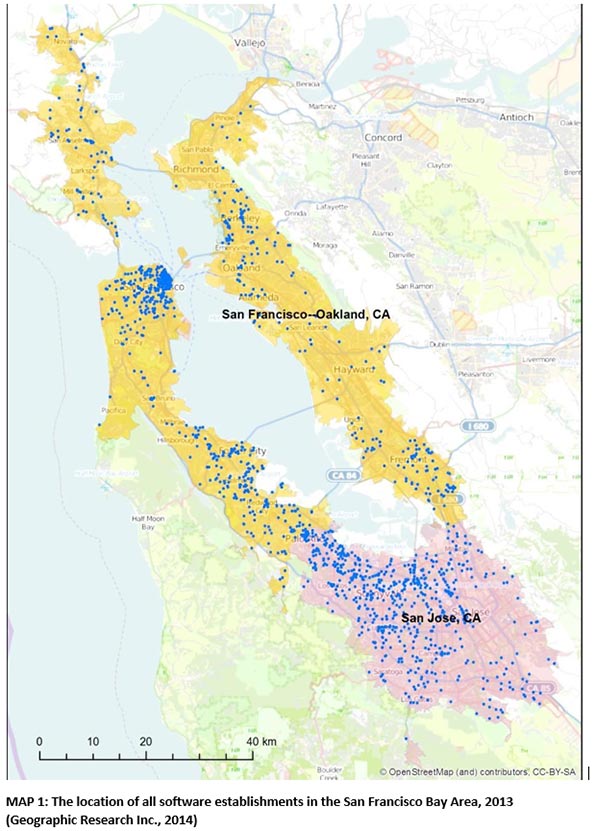
    Map 1 of the location San Francisco Bay Area software firms illustrates the complexities. Does the Bay Area’s overall population density – considerably less than that of Los Angeles, much less than Manhattan – signify anything? Where does the  Silicon Valley a “cluster” or an “agglomeration” begin and where does it end?  Were the map a three-dimensional density surface, there would be peaks as well as low-rise hills. Which ones are sub-centers or clusters?

    The standard labels fall short. Settlement patterns are complex — and emergent. Being near or far from “the action” can be many things. It also involves many possible trade-offs. Less expensive homes for workers? Better schools? Less commuting? Any industry includes many players who will avail themselves of many choices along the ranges of many possible trade-offs.

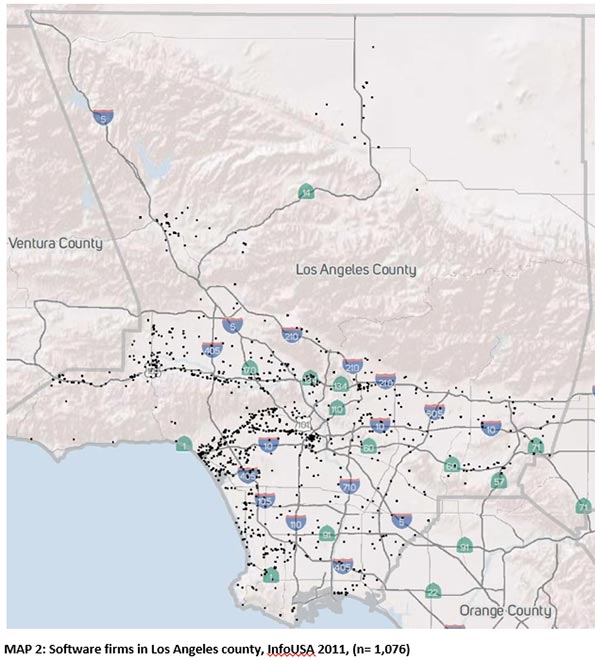
    Map 2 plots locations of software firms in Los Angeles County. The same variety of arrangements and the same questions apply. But both of our maps show that the spread of software firms is always lumpy, but is also dispersed widely.

    Here is one example, from a large literature, of the challenges. Bumsoo Lee (2007) applied several centers identification strategies to the study of employment in major U.S. metropolitan areas. According to one such method, MSAs of more than 3 million inhabitants had roughly 7 percent of jobs in the central business district, 15 percent in the various sub-centers and the remaining 78 percent “dispersed”, outside of any identified center.  

    What L.A. Data Tell Us

    Data on production functions are widely available. Geographically detailed data on the locations of firms are becoming available. In a recent study of Los Angeles, we used two data sources. The first was InfoUSA 2011 with data on businesses in 6,395 census block groups in Los Angeles County. The InfoUSA data indicate business locations with number of employees by NAICS (2007) industrial sector. These were aggregated to create the sectors we wanted to study such as Software and Biotech.  

    We tabulated Los Angeles area co-locations of firms. Employment and firms were spatially aggregated by Census Block Group. The aggregated jobs and firms are divided by the size (acres) of the Census Block Group to calculate employment and firm densities. The median-size Census Block Group in L.A. County is 79 acres. These data were useful for, among other things, calculating pair-wise co-location coefficients. These became dependent variables in multiple regression tests.

    The second data source is US IMPLAN input-output 2013, originally with 536 sectors which were also aggregated to the industrial sectors we were interested in. The technological coefficients, proportions of sector-to-sector purchases, were the independent variables used to test their effects on the observed co-locations of firms. 

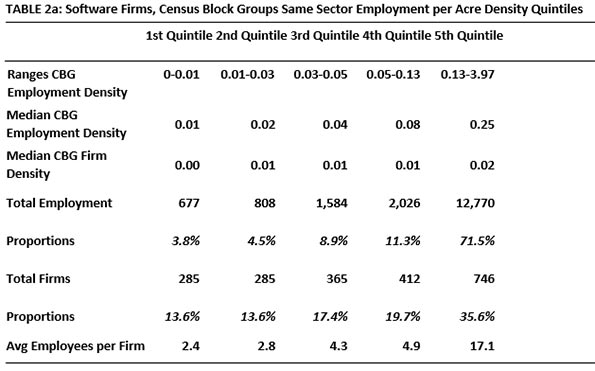
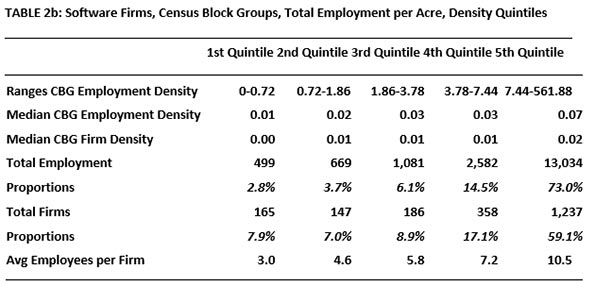
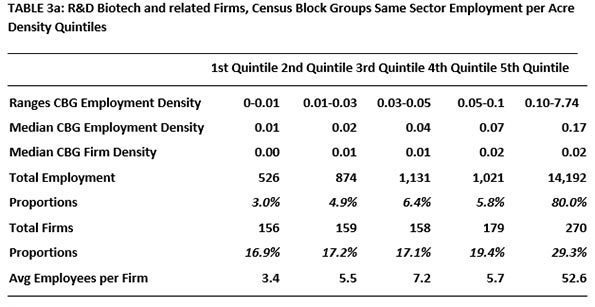
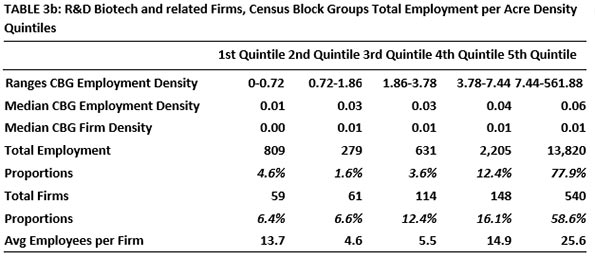
    What kind of spatial arrangements do we see? To avoid the problem of identifying centers and subcenters – and leaving out all the other places, people and jobs — we computed density quintiles. Looking at the number of firms and their sizes in each density quintile, we found that they might or might not be arranged in compact geographic clusters. That’s what our two maps suggest.

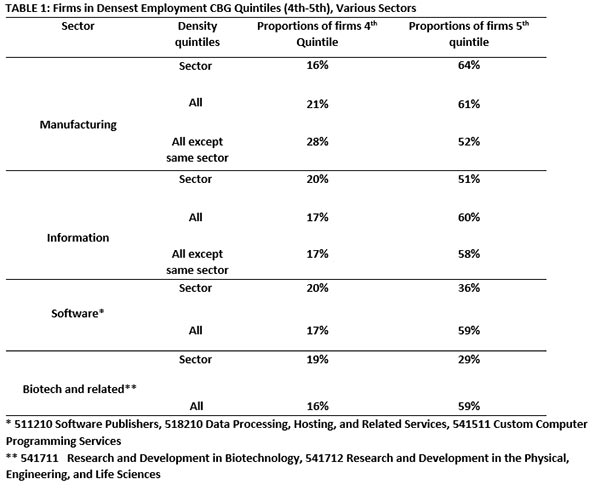
    Table 1 summarizes our findings on firm location in the two densest quintiles. For the large sectors, three kinds of densities were tabulated: for all firms of the sector, for all firms in all sectors and for all firms in all sectors except the sector being studied.

    The two subsectors studied here, Software and Biotech, are prominent in the modern world and unique enough to merit their own categories. They employ about the same number of people in LA County. But these two sectors differ in important ways. Software firms have service as well as research functions. Biotech is more weighted toward the research side. In addition, biotech is the more regulated of the two, most significantly subject to Federal Drug Administration vetting and ruling. “The estimated average pre-tax industry cost per new prescription drug approval (inclusive of failures and capital costs) is: $2,558 million.” (DiMasi, et al 2014). All this suggests greater risk and generally larger firm sizes.

    When it comes to total industry clusters, medium-sized Biotech firms are in the least dense areas; this cannot be said of Software firms. As in the story of the more aggregated sectors, clustering (with same sector firms as well as with others) is apparent. But there are prominent exceptions. Scooping up ideas can be initiated remotely.   Some firms are able to do less up-close interacting and complementing it with the virtual alternative. The blends vary.

    Large proportions of Software and Biotech firms choose the dense quintiles in similar proportions. These agglomerate even though economizing on shipping is not their big concern. As expected, more of the larger Biotech firms are less likely to seek clusters.  

    Firm size differences are also interesting. The largest Software firms (by number of workers) prefer the highest density quintile, whether densities refer to all firms or just same-sector firms. It is not the same for Biotech firms, where many of the medium-sized firms prefer the lowest density quintile, as defined for sectors of all firms. In this sector, that size may be good for internal R and D and information gathering and creation.

    Does density matter? By all means but it is complex. Even for firms in sectors that deal more in information than physical product, nearby densities (of same-sector and well as other-sector) do affect location choice. An interest in establishing networks by which ideas can be shared can explain this. Idea sharing is complex and still requires some degree of nearness. Over 50 years ago, Mel Webber wrote about “Community without Propinquity” (1963). This was years before there was an internet but Webber deserves credit for calling our attention to the fact that we seek and form a variety of very complex links that help explain our locational preferences.

    Peter Gordon is Emeritus Professor, USC Price School of Public Policy. His current research addresses how the nature of cities impacts economic growth prospects. John Cho is Associate Regional Planner at the Southern California Association of Governments. His interests involve transportation networks and their effects on regional development.

    REFERENCES

    Baldwin, Richard (2016) The Great Convergence. Cambridge, MA: Belknap.

    DiMasi, Joseph A. and Henry G. Grabowski and Ronald W. Hansen (2014) Innovation in the Pharmaceutical Industry: New Estimates of R&D Costs. Boston: Tufts Center for the Study of Drug Development, Tufts University.

    Lee, B. (2007). "Edge" or "edgeless" cities? Urban spatial structure in U.S. metropolitan areas, 1980 to 2000. Journal of Regional Science, 47(3), 479-515.

    Mokyr, Joel (2007) “The Market for Ideas and the Origins of Economic Growth in Eighteenth Century Europe” Tijdschrift Voor Sociale en Economische Geshiedenis, 4.

    Muller, Peter O. (2004) “Transportation and Urban Form: Stages in the Spatial Evolution of the American Metropolis” in S. Hanson (ed.) The Geography of Urban Transportation (3rd ed.) Guilford Press.

    Webber, M.M. (1963) “Order in Webber Diversity: Community without Propinquity” in Cities and Space, Lowdon Wingo (ed.) Baltimore: Johns Hopkins University Press.

  • World’s Most Affluent Areas: Dominated by Low Population Densities

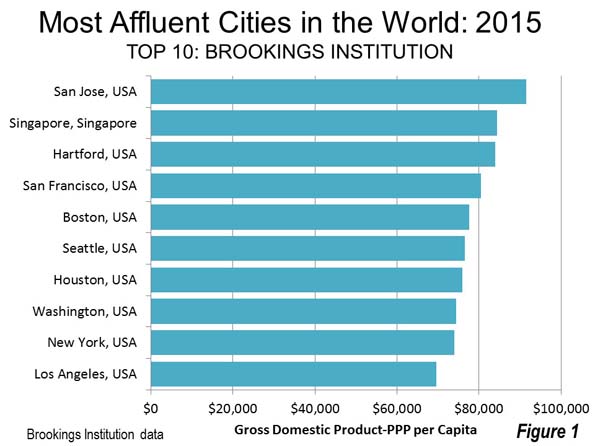
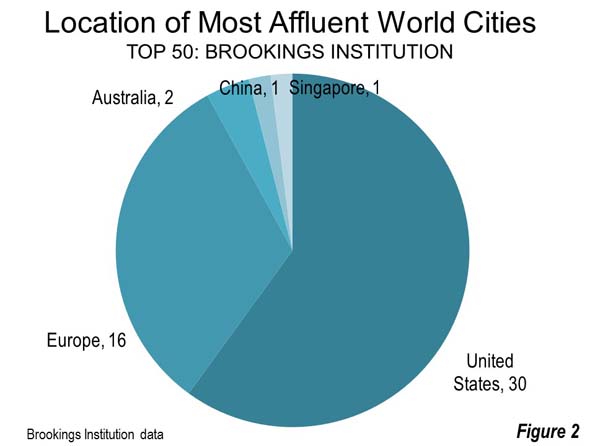
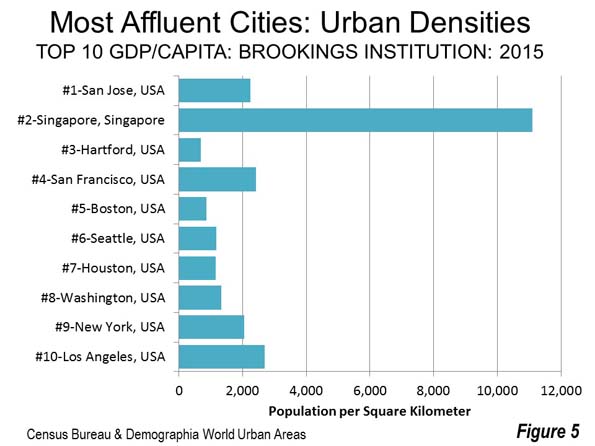
    The Brookings Institution is again out with data on the world’s most affluent metropolitan areas. The GDP data is in Redefining Global Citieswhich contains a treasure trove of data. Again, United States metropolitan areas dominate the highest rankings, capturing nine of the top 10 positions. San Jose is rated with the highest gross domestic product (GDP) per capita, at $91,400 (purchasing power parity or PPP). This is an improvement from third in 2014 and second in 2012 (Figure 1). The top 10 is dominated by cities with relatively low urban densities, like those that characterize San Jose (core of the world’s leading information technology center , Silicon Valley).

    In 2015, San Jose finally passed even less dense Hartford, which had ranked second and first in the two previous reports. In 2014, Macau, the smaller of China’s two Special Administrative Regions (SAR) had ranked number one (the larger SAR is Hong Kong, ranked 32nd). There was a methodology change in 2015 that established a population threshold higher than that of Macau, however the government’s anti-corruption campaign was credited with reducing Macao’s gaming revenue substantially and dropping the GDP per capita by about 15 percent. If it had been rated, Macau’s GDP per capita would have remained in the top 10, but would have fallen from the top.

    Singapore broke into the top 10, positioning itself between San Jose and Hartford, rising from 14th place, with a GDP per capita of $84,300. The Hartford, metropolitan area, which lead the list in 2012 and ranks second in 2014 fell to third place, with a GDP per capita of $84,000. San Francisco rose from nine in 2014 to 4th, with a GDP per capita of $80,600. Boston ranked fifth, with the GDP per capita of $77,700, dropping from fourth place. The top 10 was rounded out by Seattle, Houston, Washington, New York and Los Angeles (Note 1).

    The US dominance was far less in the second 10, with positions 11, 12 and 13 being captured by Zurich, Perth (Australia) and Munich. Paris, often rated highly as a world city, ranked 17th, while Stockholm ranked 19th. The five US entries were Portland (14th), San Diego (16th), Minneapolis St. Paul (17th), Dallas-Fort Worth (18th), and Denver (20th).

    Thirty of the 50 most affluent cities were in the United States, and 16 were in Europe. Australia had two entries, while East Asia had two, Singapore and Hong Kong (Figure 2).

    As usual, the rankings produced results that would surprise people who do not regularly follow this data.  London, which is routinely in a neck and neck competition with New York as the strongest “world” city ranked 35th, just behind Columbus Ohio. Tokyo, home of the world’s largest urban area, ranked 60th, behind Shenzhen, China (59th). Toronto, Canada’s principal city, ranked 53rd, just behind San Antonio. Sydney, Australia’s largest city ranked 47th, just behind St. Louis and just ahead of Detroit.

    Expanded Contents: Redefining Global Cities

    The new Brookings Institution report contains far more data than is indicated above. There is labor productivity data, indicated by GDP per worker. San Jose also leads in this category, and again, nine US metropolitan areas are included in the top 10. The only non-US entrant is the industrial powerhouse of Dongguan, China, one of the world’s least known metropolitan areas, located between Hong Kong, Shenzhen, Guangzhou and Foshan (the latter three municipalities in Guangdong Province).

    The report also contains data on economic growth, tradable clusters, innovation, talent and connectivity (with multiple indictors in each category). With the three reports since 2012, the Brookings Institution has positioned itself as a premier source for regularly published world urban data.

    The Highest Productivity in the Lowest Urban Densities

    There have often been suggestions that productivity and innovation are associated with high urban densities. This year’s data provides ample refutation of any such claim. San Jose, the top city in both GDP per capita and labor productivity, is virtually all suburban, as is indicated by the City Sector Model (Figures 3 and 4). San Jose, without a pre-World War II core and world-class dispersion is illustrated in the photograph at the top.

    The highest built-up urban area density among the top 10 metropolitan areas in GDP per capita is in Singapore, which is also the only one exceeding the world average urban density in the top 30. All of the US metropolitan areas in the top 10 have urban population densities well below that of Singapore (Figure 5) and below that of the average Chinese and Western European urban areas. Indeed, US metropolitan areas, which dominate world affluence, have the lowest urban population densities in the world as is indicated in Figure 6 (Note 2). 

    Note 1: US city data not adjusted for PPP (regional price parities) within the United States. Application of regional price parities to personal or household incomes would yield considerably different rankings.

    Note 2: Built -up urban area data are the only reliable measure for comparing urban densities at the organic city level, which in the economic or functional sense is metropolitan areas, and in the physical sense is contiguous built-up urban areas . This excludes the administrative unit or “municipality,” which is simply a political construct. For further information see: Paul CheshireMax Nathan and Henry G. Overman of the London School of Economics in their recent bookUrban Economics and Urban Policy: Challenging Conventional Policy Wisdom. Virtually all metropolitan areas contain a principal built-up urban area and extensive rural areas (commuting sheds), which may also contain smaller urban areas. Thus, any comparison of metropolitan densities is not an urban comparison, but a mix of urban and rural densities. In most of the few countries that designate metropolitan areas, the rural land areas are substantially greater than the urban land areas. The matter is further complicated by the lack of international “building block” standards for metropolitan areas. These standards produce hugely different mixes of urban and rural in metropolitan areas. For example, the New York urban area represents only 42 percent of the land area. In Riverside-San Bernardino, the principal urban area has 2 percent of the metropolitan land area. In Paris, the land outside the principal urban area represents 83 percent of the metropolitan area. A recent post in the respected Marginal Revolution blog (“China Fact of the Day”) indicated that China’s metropolitan area densities were lower than those of the United States. As noted above, metropolitan density comparisons are not reflective of urban densities. China’s urban densities are nearly five times that of US urban areas (Figure 5).

    Wendell Cox is principal of Demographia, an international public policy and demographics firm. He is a Senior Fellow of the Center for Opportunity Urbanism (US), Senior Fellow for Housing Affordability and Municipal Policy for the Frontier Centre for Public Policy (Canada), and a member of the Board of Advisors of the Center for Demographics and Policy at Chapman University (California). He is co-author of the “Demographia International Housing Affordability Survey” and author of “Demographia World Urban Areas” and “War on the Dream: How Anti-Sprawl Policy Threatens the Quality of Life.” He was appointed to three terms on the Los Angeles County Transportation Commission, where he served with the leading city and county leadership as the only non-elected member. He served as a visiting professor at the Conservatoire National des Arts et Metiers, a national university in Paris.

    Photo by Michael from San Jose, California, USA (Santa Clara Valley – California) [CC BY 2.0], via Wikimedia Commons

  • Babes In Trumpland: The Coming Rise Of The Heartland Cities

    Contrary to the media notion that Donald Trump’s surprising electoral victory represented merely the actions of unwashed “deplorables,” his winning margin was the outcome of rational thinking in those parts of the country whose economies revolve around the production of tangible goods.

    And their economies stand to gather more steam in the years ahead.

    Trump’s victory was largely minted in the suburbs and smaller cities of the new American Heartland, from Pittsburgh to Omaha to Dallas-Ft. Worth. The heartland regions depend on agriculture, home construction, manufacturing and energy, all of which could benefit from the policies of the new presidential administration and Republican Congress. In contrast, Hillary Clinton favored extending the Obama administration’s policies on fossil fuels and housing that may win support in the dense progressive bastions of the East and West coasts, but were viewed with alarm by many tied to heartland industries, some of which have been under pressure from a global decline in commodity prices.

    Trump’s pro-fossil fuel stance may be anathema in the coastal cities, but will have a very positive effect on the many cities in the “oil patch” that extends from Texas’ Permian Basin to North Dakota, Ohio and western Pennsylvania. This is not just a matter of roughnecks out on the Gulf or West Texas; many of the 100,000 or so jobs lost in the energy industry over the past few years were located in major cities, such as Houston, where many of the employees are both well-educated and dwell close to the urban core.

    Most important of all, manufacturing matters in the heartland in ways that no longer resonate in coastal areas, particularly New York and San Francisco. Since 2000, two of America’s historic centers for manufacturing, Los Angeles and New York together have lost over 600,000 manufacturing positions. Trump’s call for more U.S. industrial jobs could turn out a swan song, but every job that stays in America due to his cajoling is more likely to benefit people in suburban St. Louis or Detroit than Manhattan or Malibu.

    Building on Momentum

    Critically, Trump’s election comes at a time when heartland cities already had economic momentum, including in the Rust Belt.

    The stock, real estate and tech booms on the coasts, as well as increased regulation and taxation there, have made interior cities increasingly attractive to relocating companies and migrants. This is most evident in Texas’ leading metropolitan areas — Dallas-Ft. Worth, Austin, San Antonio and, until recently, Houston — which have consistently led the nation in job and population growth.

    When California companies like Apple look to add middle-class jobs, they don’t often do it in the Golden State, but in more affordable places like Austin. Every big Texas city in recent years can show you a big scalp from my adopted home state: Occidental to Houston, for example, or Toyota America and Jacobs Engineering to Dallas.

    Similar patterns can be seen in the rapid expansion of such smaller cities as Nashville, Charlotte, Columbus, Salt Lake City — all in states that Trump won handily. These cities have developed impressive central cores, but have seen larger scale growth on their periphery. Resilient Great Plains cities like Fargo, Omaha and Sioux Falls have spiffed up and attracted investments in everything from tech and financial services to health care.

    Other industries, such as financial services and business and professional services, are also moving increasingly to heartland cities, and some are building impressive presences in health care.

    Voting With Their Feet

    Perhaps the most underreported, but significant shift towards heartland cities has been a human one. Before, educated people generally clustered in favored blue cities such as San Francisco, New York, Boston, Washington, D.C., and Chicago. This thesis was well documented by urban analyst Richard Florida in his “Rise of the Creative Class.”

    Yet when Richard and I were together in Kansas City last month we were treated to a tour of the region’s ascendant neighborhoods, both in the city and in adjacent parts of Kansas.Cities like Kansas City have seen their downtown residential populations surge, but the vast majority of growth there, as well as in the rest of heartland, tends to be on the periphery.

    As growth in New York and other “hip” cities has slowed, populations are shifting to less expensive ones. Research by demographer Wendell Cox has found that since 2010 over 1.45 million people net have moved from Clinton states to those that favored Trump.

    This increasingly includes young people, according to research conducted at Cleveland State University. There has been a sea change in the migration patterns of educated millennials since 2010, with faster growth in heartland cities than the Bay Area, Washington or New York.

    The biggest drivers for migration to Trumpland tends to be housing prices and rents. Housing prices across the New heartland overall Is 3.4 times the median household income (this is a price-to-income ratio called the “median multiple”). This compares to 7.5 times in California and 4.3 times in the Northeast Corridor (Washington to Boston).Given the choice between more expensive locales on the coasts and less expensive ones in the interior, many people have begun to flock to places like Des Moines, Omaha, Indianapolis and Columbus.

    These trends may become more pronounced when the bulk of millennials enter their 30s and begin to start families and buy homes. Derek Thompson of the Atlantic observes: “The great irony of national migration is that media headquarters overwhelmingly reside in the same dense urban areas that other Americans are desperately trying to escape (or cannot afford).”

    A similar trend may soon take place among immigrants. The Trump campaign may have sought to demonize some of the foreign born, notably the undocumented and Muslims, but many of the cities now growing their immigrant populations most rapidly are in the heartland.

    Houston has been gaining more foreign-born residents than Los Angeles; Dallas now has a higher share of foreign-born residents than Chicago.

    Now the immigrants are expanding to other mid-American outposts such as Nashville, Indianapolis and Columbus. Trumpian politicians may seek to exploit xenophobic sentiments, but metropolitan boosters across the heartland are quick to promote their appeal with foreign-born residents, seeking their entrepreneurial energy and enriching cultural influences. When in Nashville, boosters take you not just to the old country music haunts, but to thriving Kurdish, Somali,  and Mexican enclaves.

    Can Trumpland take success?

    Yet for Trump and his allies in the Republican Party, the resurgence of heartland cities will also bring with it risks. Some of those who now find their future in Kansas City or Houston also bring with them attitudes shaped in blue states, something some progressives are counting on. They may have escaped the worst aspects of ultra-high taxes and abusive regulations, but sometimes this does not stop them from wanting to repeat the old patterns in their new homes.

    the core cities in most of the larger heartland metropolitan areas are either deep blue, as is the case in the Great Lakes, or are turning blue, including Dallas and Houston. The suburbs, particularly the new, further out ones, have remained deeply conservative, but this also could change over time as more young people and immigrants migrate there. Heartland success could undermine some of the very reasons for their resurgence.

    Success also has strange impacts on people’s thinking, and ultimately a resurgent heartland, populated by newcomers and immigrants, could take a very different turn in the decades ahead.

    But this can only happen if Democrats somehow learn to craft their appeal to places outside their current deep-blue bastions. Trump may have won in large part due to the misfortunes heaped on these in the past, but, unless challenged, he ultimately may further consolidate his base by riding on the ascendancy.

    This piece first appeared in Forbes.

    Joel Kotkin is executive editor of NewGeography.com. He is the Roger Hobbs Distinguished Fellow in Urban Studies at Chapman University and executive director of the Houston-based Center for Opportunity Urbanism. His newest book, The Human City: Urbanism for the rest of us, will be published in April by Agate. He is also author of The New Class ConflictThe City: A Global History, and The Next Hundred Million: America in 2050. He lives in Orange County, CA.

    Photo by Max Goldberg from USA (Trump Cedar Rapids) [CC BY 2.0 (http://creativecommons.org/licenses/by/2.0)], via Wikimedia Commons