Category: Economics

  • A Summary of the Analysis and Motivators of Growth in the Austin – San Antonio Corridor

    This essay is part of a new report from the Center for Opportunity Urbanism titled “The Texas Way of Urbanism“. Download the entire report here.

    A new economic corridor is emerging in the center of Texas. Hays and Comal Counties are part of the Austin and San Antonio metropolitan areas respectively. But they are not merely suburbs capturing overflow from larger cities. They are becoming part and parcel of an emerging 80-mile long economic corridor between San Antonio and Austin, along the I-35. In the process, this region centered around San Marcos and Hays County, is emerging as a hub in its own right.

    This new corridor is beginning to resemble another Texas style “metroplex” between Dallas and Ft. Worth. It is a development that can also be compared, in some aspects, to other growth corridors, such as the San Jose to San Francisco strip, the Raleigh-Durham area and the Wasatch Front stretching from Ogden through Salt Lake City to Provo.
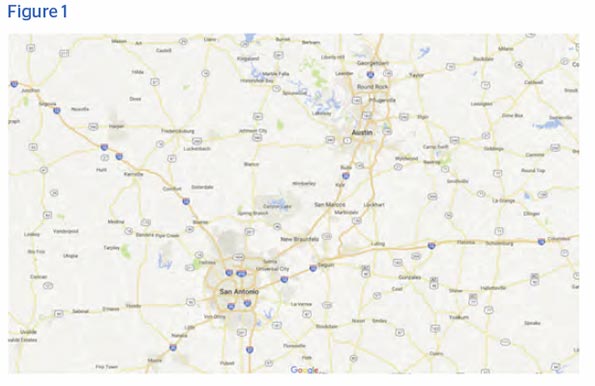
    Texas State Demographer Lloyd Potter foresees an additional 1.5 million people in the corridor by 2030, a nearly 34 percent jump. In Hays and Comal counties, the state projects between 69 and 44 percent in population growth during that period. “Over the next 50 years, Austin and San Antonio will become a single mega-metro area,” Austin Mayor Steve Adler says. “The corridor in between will be the first reflection of this coming future, providing greater connectivity to serve the increasing interdependence and joint economic potential as the two cities grow together.”

    As occurs in many emerging regions, the Austin-San Antonio can be considered multi-directional, extending to and from both larger cities, but also from the emerging hub around San Marcos.

    The San Marcos segment of the Corridor is already more than a bedroom and retail community. Amazon decided to build an 855,000 square foot fulfillment center in San Marcos (Hays County) that will eventually employ 1,000 people. Sysco Corporation opened a distribution facility in New Braunfels (Comal County) that employs 650 people. More importantly, Texas State University in San Marcos, with nearly 40,000 students and a growing research profile, is anchoring an emerging high tech base for the corridor.

    Something big is starting to happen in this once rural region of Texas. This report is divided into three sections that explore – the what, the why, and the future. The best predictor of the future is usually what has happened in the past, let us begin there.

    Dimensions of Regional Growth

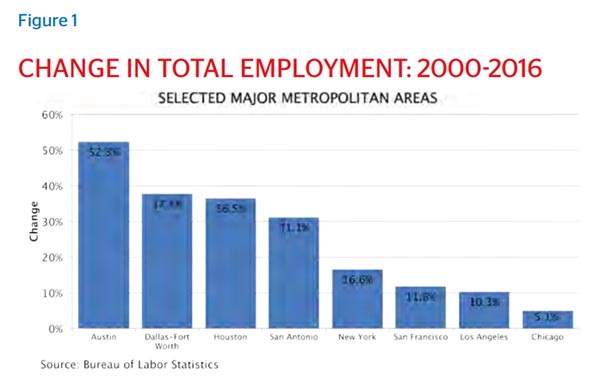
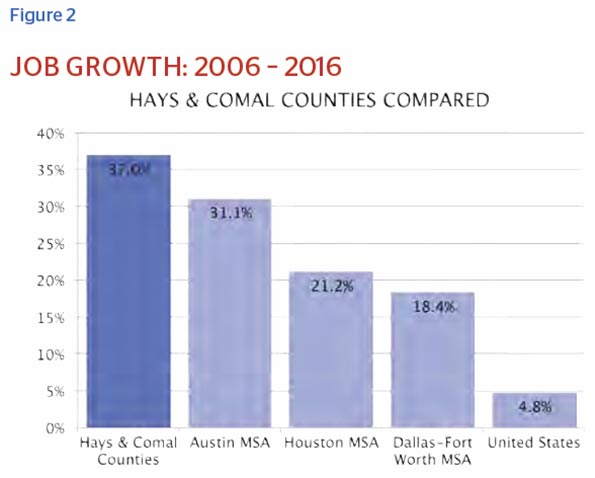
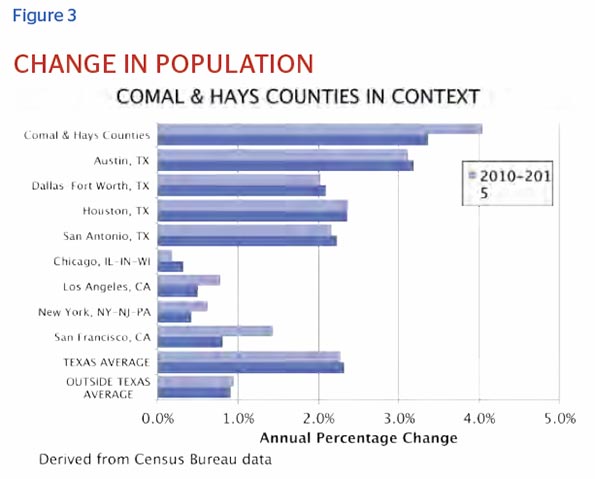
    The rate of growth in Hays and Comal Counties is exceptional, even by the standards of Texas. They are far outpacing the nation in both population and jobs, and growing at twice the rate of Texas as a whole. The two counties exceed even the rest of metro Austin, which has historically been among the leaders in job growth nationally. Three of the 25 fastest growing counties in the country are located in the Austin-San Antonio Corridor.

    The table below highlights the dimensions of this very rapid growth.
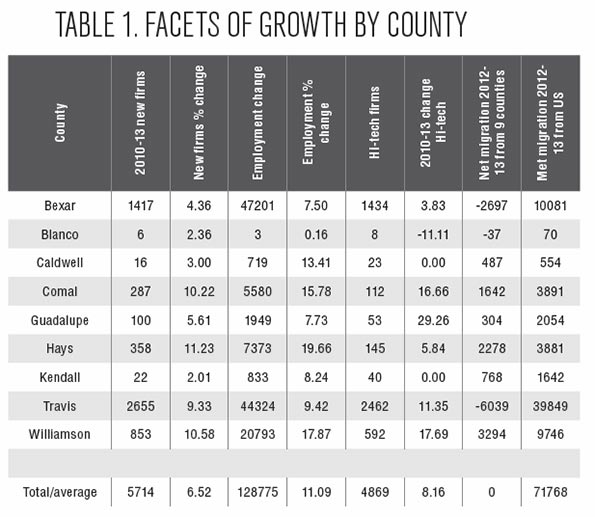
    Employment Growth. There has been a pattern of positive employment growth in all counties, with Hays the leader followed by Williamson then Comal. The entire corridor is among the national leaders in job creation, out-distancing not only the nation but Texas as well.
    New Firms. We see more new firms in all counties, with the highest percentage growth in new firms occurring in Hays, then Williamson and Comal counties. The definition of new firms used here includes opening of new branches or plants by existing firms that operate multiple establishments.

    High-Tech Firms. Growth of high-technology firms occurred in 6 of the 9 counties, with Guadalupe the leader in percentage terms followed by Williamson then Comal and Travis counties.

    Population. The entire San Antonio-Austin corridor has some of the most rapid growth in the country, as we can see in the first slide. The region also contains many of the fastest growing counties not only in Texas but the country.
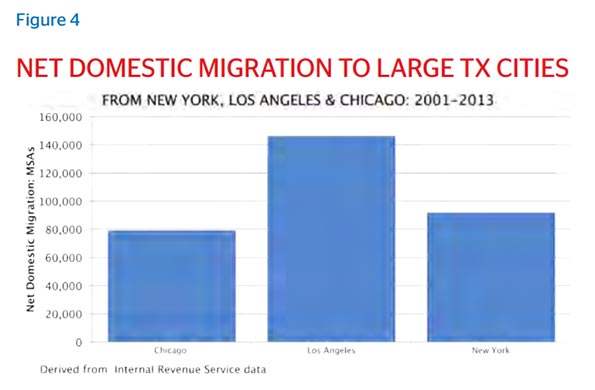
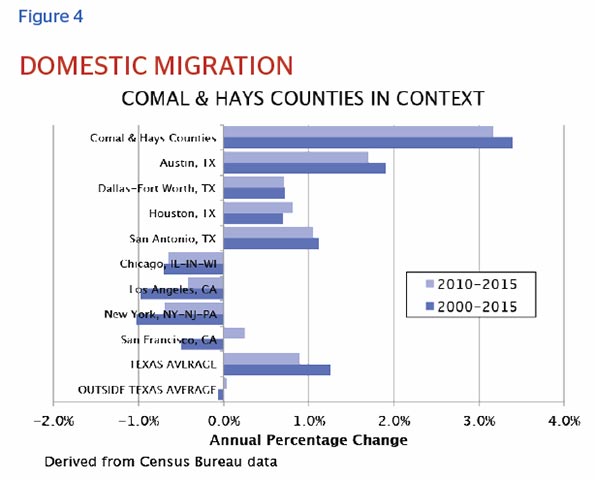
    Migration. Williamson County gained the most population from those living in the nine county region, followed by Hayes and Comal. Overall the entire Corridor has experienced large domestic in-migration, well above Texas averages, and even more so in comparison with large metropolitan areas like New York, Los Angeles and Chicago.
    The following sections provide more detail on this out-sized performance.

    Industries Driving Regional Employment Growth

    Employment growth has been broad across several industries, with the fastest growing industry being Electronic Shopping and Mail-Order Houses. Another cluster of fast growing industries are private (not public) firms involved in education and training (Elementary and Secondary Schools, Other Schools and Instruction, Technical and Trade Schools, Business Schools and Computer and Management Training). This does not include the significant role played by Texas State University in education related to business and computer management and engineering.

    This job growth, of course, has been driven by population growth. In terms of location quotient, the area remains much stronger in lower-end service industries. For example, Hays and Comal counties have 26 and 16 percent of employment in retail industries compared to only 13 percent nationally.

    But this appears to be changing, as evidenced by the growth of key “export” industries — that is goods and services largely consumed elsewhere. This includes key manufacturing fields, such as Industrial Machinery, Motor Vehicle Parts, and Metalworking Machinery. Overall the area is enjoying a manufacturing boom that far exceeds the national average.

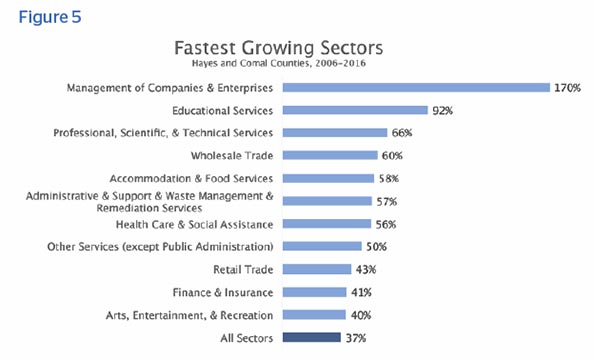
    This growth is also evident in several key service industries such as Management Services, Educational Services, and Professional, Scientific and Technical services. Particularly critical has been the logistics and wholesale industry, which serves not just the local economy but the entire regional and nation, with the massive new Amazon facility representative of this type of growth. Although much of the region’s growth has been in traditionally lower-wage service industries, the fastest growing sectors tend to be higher wage, information fields like management of companies and enterprises, educational, professional, scientific and technical services.
    Is a High Technology Corridor between Austin and San Antonio Emerging?

    Located between the high-tech hub of Austin and the emerging one centered in San Antonio, the region between the two is also showing growth in high-tech firms, as show in table 2 below.
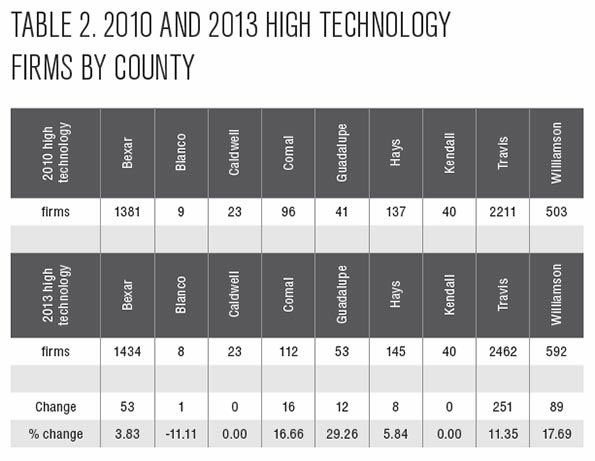
    The most rapid growth has been in Basic Chemical Manufacturing, Software Publishers, Computer Systems Design and Related Services, Commercial and Service Industry Machinery Manufacturing, Scientific Research and Development Services, and Pharmaceutical and Medicine Manufacturing.

    The high-technology industry with the largest number of establishments was Computer Systems Design and Related Services, consistent with the reputation of Austin as an emerging leader in this area of economic activity. Architectural, Engineering, and Related Services had the second largest number of establishments, followed by Scientific Research and Development Services, Oil and Gas Extraction, and Software Publishers.

    The total number of firms in Hays and Comal remains much lower than in the far larger Travis and Bexar Counties, but their growth shows that the San Marcos Corridor segment is already participating in the regional high tech cluster, with potential future upside from its growth.

    If the region is to develop into a larger high tech center, Texas State University will play a vital role in powering that transformation as it continues to expand its research reputation and the funding that goes with it. Texas State has already helped launch an important tech industry venture with the establishment of the Science, Technology and Advanced Research (STAR) Park which sits on 58 total acres dedicated by Texas State for future expansion. Executive Director Stephen Frayser describes the park as an accelerator, now helping eitht for-profit companies to market, including three student startups. STAR One, the first building, broke ground with 14,000 square feet, but filled up quickly. Frayser says, “We have had to expand twice since opening in November, 2012 and will have 36,000 square feet operational by September 1, 2016.”

    How the future growth of Texas State, its research funding quest, and initiatives such as STAR Park play out will do much to determine the degree to which San Marcos’ high tech ambitions take off.

    Population Growth and Migration

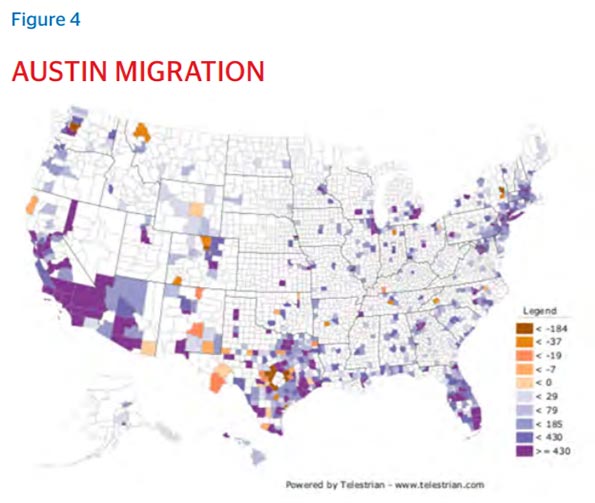
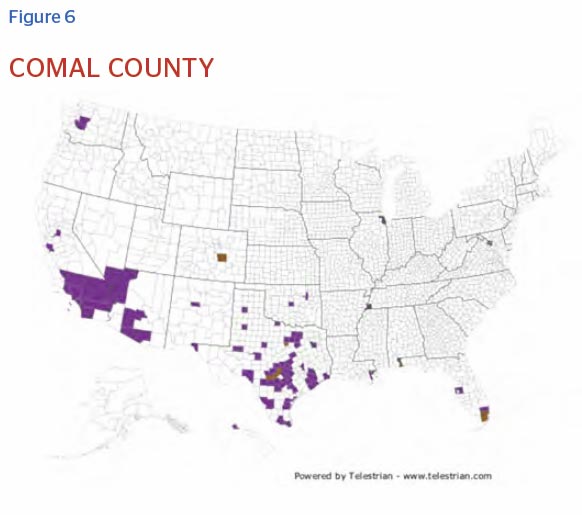
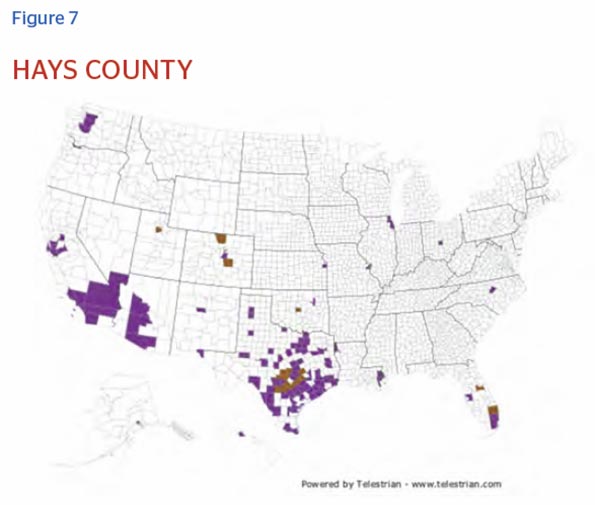
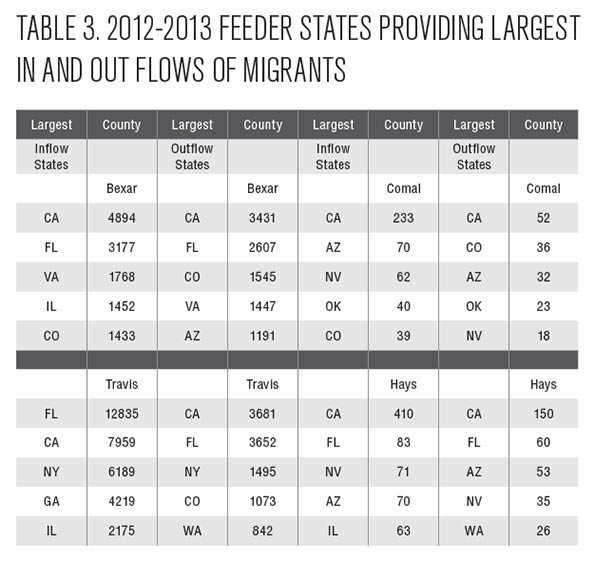
    People are an increasingly critical raw material for economic growth in San Marcos (Hays County) and New Braunfels (Comal County). Overall Hays and Comal have enjoyed among the fastest growth rates of any counties over 100,000 in the nation, easily outpacing even the torrid growth experienced by Austin and other Texas cities. The following map tells us the regions and feeder states from which Hays and Comal Counties have been drawing net migration.
    Outside Texas, California was the largest source of in-migration and also the largest destination for out-migration. (In the case of Travis County, California is the second largest source of in-migration with Florida being first.) Focusing on California and Florida, we see total net gains from California equal to 6,182. In the case of Florida, we see total net gains equal to (9,776 during the 2012-2013 period.
    Explaining Regional Growth: A Geographically Advantaged Region

    What accounts for the growth of the San Marcos Corridor? Three factors loom large: the region’s unique geographic advantages and exceptional quality of life that set it apart from other suburban regions, and the high quality public policy environment of Texas.

    Just as Dallas-Ft. Worth benefitted from being a highly multi-polar “metroplex” that evolved from two formerly distinct urban areas, a similar (if smaller scale and more nascent) effect is taking place between Austin and San Antonio.

    Dallas and Ft. Worth are 33 miles apart. Austin and San Antonio are 80 miles apart. Despite the greater distance, much of the I-35 corridor is already developed between the two. It makes logistical and financial sense to locate some facilities, such as Amazon’s fulfillment center, in the San Marcos Corridor segment to easily serve both markets.

    The same effect applies to people too. Those who live in the corridor have the ability to commute to either major city to work, giving them access to more potential employment opportunities. San Marcos is about 30-45 miles from downtown Austin or San Antonio – a long but doable commute – which is shorter than in many suburban areas. However, in both Austin and San Antonio, there are many jobs located in suburban areas that are closer to San Marcos.
    A look at job growth by occupational category reveals the Hays and Comal advantage. Nationally, the largest 21 broad occupational categories account for one third of all employment. In Austin and San Antonio, 21 broad occupational categories (not necessarily the same) also account for around one-third of all employment.

    Of these 21 categories of jobs, 16 were in common to Austin and San Antonio, and the percentage change in these types of jobs were compared for Austin and San Antonio. Somewhat remarkably, 8 of the 16 job categories show a pattern where either Austin or San Antonio has higher than national employment growth while the other city has lower than national growth.

    This may explain the attraction of Hays and Comal counties where residents can commute to work in either metro area. In the face of jobs requiring specific skills disappearing in one city, workers find new jobs appearing in the other city. They simply need to commute to a new job in the other city, rather than being forced to move.

    This effect is magnified for households with more than one worker. One spouse can work in Austin, the other in San Antonio. Outside of pricey Austin neighborhoods, inexpensive suburban housing can be found throughout the Corridor.

    The Quality of Life Advantage

    Perhaps nothing drives growth in the region more than the quality of life offered by the Corridor. When we asked several business leaders what brought people here it wasn’t too long in the conversation before the discussion turned from the tangible reasons to the intangible, the big intangible being quality of life.

    Dan Stauffer, Vice President of Marketing/Real Estate of McCoy’s Building Supply (which moved its headquarters from Houston to San Marcos decades ago) was quick to bring up the quality of life draw that Austin and San Antonio has for people who move to the area. Again the geographic advantage of the region is key. Austin and San Antonio are culturally very different cities; residents of the San Marcos Corridor visit both and enjoy all they have to offer – then come home and live in the relative peace and tranquility of Central Texas.

    The overpowering quality of life factor in the Corridor is the Texas Hill Country. Bordered west of the Austin/ San Antonio Corridor the Hill Country is immense and very unique. It covers 11,111 square miles, offering plenty of recreational options including tubing opportunities in the Guadalupe River (Comal County), The Blanco (Hays County) and a lot more. Overall the elevation goes from about 510 feet above sea level, just east of San Marcos, to 853 feet in Wimberley to its highest elevation of 2,460 feet further in.

    The Hill Country’s attraction ranges from residents and CEOs who want to move their company to be close to their ranch full time, to city dwellers who have second homes they visit to get away from it all. The Wall Street Journal’s recent article describing a “land rush for the rich” in the Hill Country testifies to its red-hot appeal.

    Near New Braunfels is the Town of Gruene – which features one of America’s oldest Dance halls – Gruene Dance Hall (established 1878). It attracts over 1.2 million guests per year according to Rusty Brockman, Economic Development Director of the Greater New Braunfels Chamber of Commerce. Many artists – legends such as Chubby Checker, Lyle Lovett, and Willie Nelson and relative newcomers like Kevin Costner have performed there according to the Gruene Dance Hall website.

    The Texas Policy Advantage

    Although the region has generally outpaced other Texas cities in terms of the growth, the area’s emergence has much in common with the same things that have driven the growth of other Texas cities.

    There are a unique set of conditions that exist in both Texas and the emerging Central Texas Corridor which do not exist in very many other places. We’re not saying that they individually don’t exist throughout the other 49 states, but together this complete set of free market oriented set of rules and tax rates would be hard to find in too many places. These include being a no income tax state, a right to work state, and having biannual legislative sessions that limit the opportunity for regulatory mischief.

    These reasons provide a base of attraction for businesses and people to consider Texas – and the Austin – San Antonio Corridor – to relocate, expand and grow.

    Source: Tax Policy Advantage, 2015

    Texas also does not impose a traditional corporate income tax, though it does impose a modified gross receipts tax, commonly known as the Margin Tax. However, in 2014, this rate was only 0.975%.

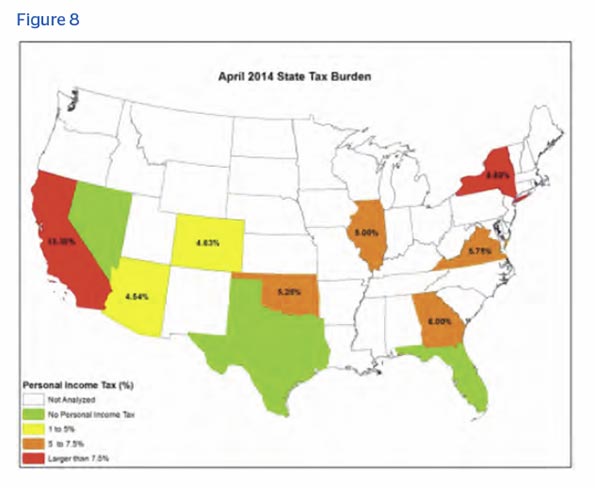
    When doing the math, you can see that individuals and businesses coming from the area’s large feeder states can look forward to keeping more of their own money – a worker or investor from California gets a raise of 13.3% for starters, not to mention much lower property prices. The pretax incomes in some feeder states may be higher, but will in most cases be lower once tax burdens are accounted for.

    Overall, Texas’ tax climate is ranked 10th by the Tax Foundation.188 California, the state sending the most people to the area, ranks 48th. Other key feeder states to the region also score lower than Texas, include Colorado (18th), Illinois (23rd), Arizona (24th), Virginia (30th), Oklahoma (33rd), Georgia (39th) and New York (49th).

    Beyond low taxes, Texas also has a regulatory system that’s friendly to business and housing development. In part this comes from a state legislature that meets only once every two years. Only four states still do this (the others are Montana, Nevada, and North Dakota). The legislatures of every other state meet annually.

    A biannual legislative session does not necessarily guarantee less burdensome regulations, though legislators do have fewer opportunities to regulate. But Texas’ biannual legislature is indicative of its business friendly mindset, which we see clearly in the output. This includes a right to work law, which prohibits employees from being forced to join a labor union.

    Even within Texas, the counties at the center of the Corridor maintain distinct advantages. One key advantage can be seen in such things as property taxes, which comprise the bulk of the tax burden in Texas. Hays and Comal counties, and their cities, offer favorable numbers that attract not only feeder states migrants, but feeder Texas cities and county migrants.

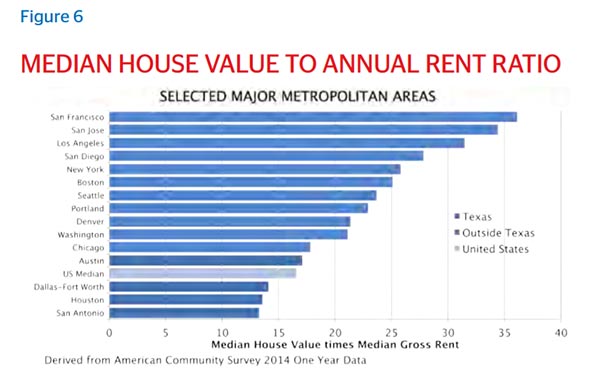
    Home prices constitute an advantage for most Texas cities, but even here, the Hays-Comal hub provides even a higher level of affordability. Low taxes and low housing prices make a very convincing case for companies, and individuals, coupled with strong job growth.
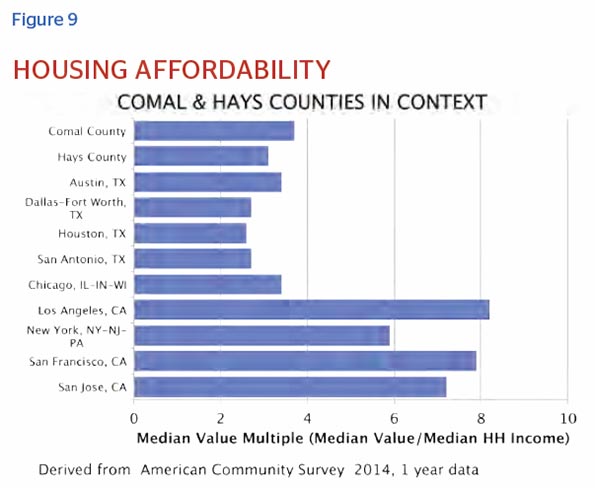
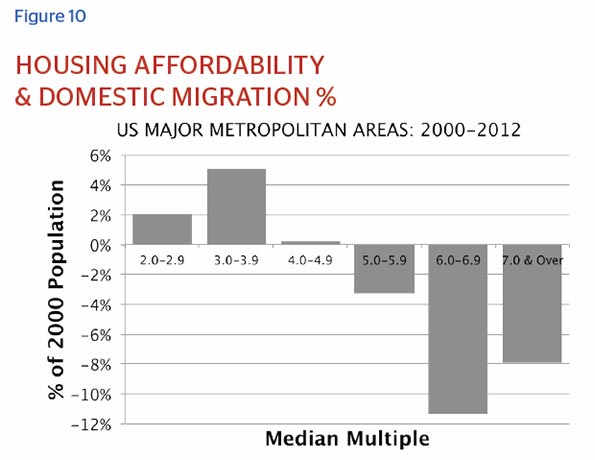
    Housing affordability has become one of the key determinants that attracts new migrants to a region. Those areas with high prices relative to incomes tend to lose migrants while those with lower costs — a median multiple of four or less — tend to attract newcomers.
    The Future of the San Marcos Corridor: A New Start for Texas?

    Lee Graham, President of Mensor LP, a market leader in pressure calibration that moved from Houston in 1978, suggests, “There’s a lot of similarities between what happened with Dallas and Fort Worth 30 years ago with all the communities that filled in between there…. It all developed and filled in.” He went on to say that there is more industry coming on line in the Corridor – even talks about the viability of a future regional airport in Hays or Caldwell County.

    Austin’s Culture Map prognosticated recently with the headline “Could Austin and San Antonio be the Next Dallas-Fort Worth?” They interviewed Austin entrepreneur, author, and speaker Gary Hoover who thinks that by 2050 the US Census Bureau will label Austin and San Antonio as precisely this kind of meg-metro area. He notes: “Just the natural growth of the two cities will cause them to collide”.

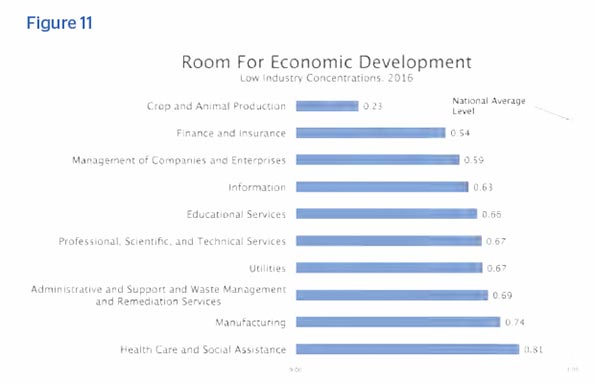
    However, for this vision to become reality, there needs to be greater focus on higher paying jobs in business and professional services, manufacturing and technology. Today Hays and Comal County employment is concentrated in construction (including residential and multifamily), retail trade, accommodation and food services and arts, entertainment and recreation -which has fueled the 37% job growth from 2006-2016. Yet, as we have seen above, the fastest growing sectors are in higher-wage, skilled and technical fields. Despite growth in these fields, the area still lags the national average in many key fields like information, management of enterprises, finance and professional, business and technical services.

    It is critical to note that the Corridor — particularly the Hays-Comal area — has only recently emerged from an essentially rural past. The key is to make sure that this pastto-the-future transition is tilted towards higher wage, high skilled sectors.
    Yet the past does not define the future. Silicon Valley was largely agricultural as late as the 1960s and Raleigh-Durham even later. In contrast Boston’s 128 beltway grew amidst the oldest industrial area in North America, and yet ultimately lost preeminence to the Valley.

    The formula that needs to be applied here is forward looking. An agrarian past is no barrier, and may even, to some extent, be an advantage to a region that wants to capture expanding growth from already strong metropolitan economies. The room to expand, lower cost of living associated with less developed economies, and a commitment to preservation of some open space could prove advantageous over the long term.

    Key Future Challenges

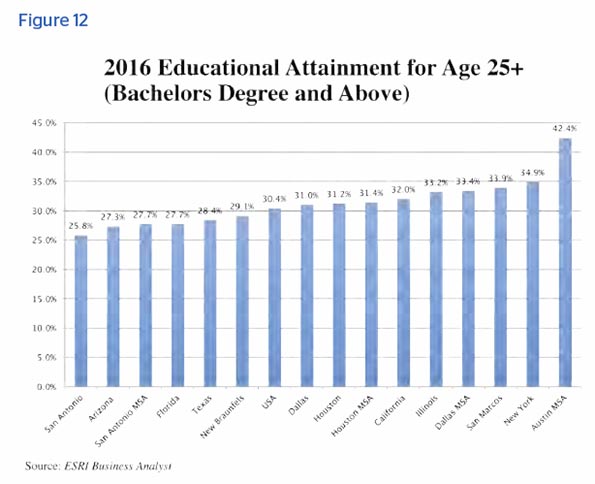
    However, just being at the right place at the right time may not be enough. Hays and Comal Counties face many challenges that must be overcome to achieve long-term success. Education has been a big part of all high-tech corridor successes, and Texas State University is certainly a piece of it. But there is also the challenge of training the existing workforce; although improving, the education level of the counties remains below national standards but competitive to the city and county comparisons nearby (see charts 1 and 2). Efforts to upskill the existing workforce will be critical in the future. Just as important is keeping up with infrastructure needs, particularly transportation.

    Perhaps the greatest vulnerability of the corridor lies with educational attainment. Although the Austin area is very strong, and well above the national average, the San Antonio region is lagging, as is New Braunfels. In contrast, in large part due to Texas State, San Marcos is above the national average in educational attainment. Expanding the area with high concentrations of college educated people seems a critical step to fulfilling the vision of a thriving Corridor between Austin and San Antonio, and the emergence of Hays and Comal as key players in the new regional configuration.

    Fortunately, there are positive efforts and activity in all three areas.

    The Greater San Marcos Partnership, according to President Adriana Cruz, has developed a five-year regional economic development strategy (Vision 2020) aimed at growing the region’s economy to attract the high skilled and wage jobs critical to the region’s future.

    Since 2006, ten new schools have opened in the four Hays County School districts: Hays, San Marcos, Wimberley and Dripping Springs. Three new schools are to open soon in both the Hays and Dripping Springs school districts.

    In Hays County the three workforce development players are Gary Job Corps Center (US Department of Labor), Workforce Solutions Rural Capital Area (multi county community partnership) and Austin Community College (ACC – Hays County falls into their 7,000 square mile service area). Texas State University was recently added to this roster having been named part of the Tech Hire community by the White House. TechHire is designed to train and develop a homegrown information technology workforce that includes ACC, Capital and Rural Capital Workforce Solutions, the City of Austin and the Greater San Marcos Partnership.

    In Comal County, the Central Texas Technology Center in New Braunfels is undergoing a 25,000 square foot expansion (opening for classes in 2016) that will double the size. This is part of the Alamo Community College District. Schools in both Comal school districts have been building new schools at a rapid rate. Comal County has had seven new schools come on line since 2006 with four more due to open within the next few years.

    Then there is the challenge of infrastructure and transportation. Two major highways serve the region. One is I-35, connecting San Antonio to New Braunfels to San Marcos to Kyle to Buda to Austin. The other is State Highway 130, a 90-mile toll way connecting Seguin to Lockhart to North Austin – and boasting an 85 miles per hour speed limit. Capacity is presently adequate, but future growth may put strain on these facilities. Failure to expand infrastructure has already produced traffic problems in Austin.

    There is an ongoing discussion of a commuter rail line connecting Austin to San Antonio that would serve San Marcos. The proposal suffered a serious setback when Union Pacific elected not to support it, and the history of new rail projects is not necessarily encouraging.

    If the area can continuously improve these critical must-haves – work force, education and transportation – the trajectory for the area seems to be very positive indeed. The corridor has many things that are likely to accelerate its growth in the years ahead: the continued growth of Austin and San Antonio, the attraction of the Hill County, Texas State University’s emergence and, the overall business climate of Texas. Of course many things could change but the future looks bright for now.

    When the future becomes the past, we’ll know if we’re right.

    John C. Beddow served as publisher of the Houston Business Journal from 1998 to last year. He successful turned the HBJ fromjust a weekly print product to a 24/7 digital first multi-platform business news channel. He serves on the advisory board of the Houston Technology Center and a recently started his own consulting company – Real Time Consulting, specializing in sales, marketing, media relations and project management. He lives part time in the Hill Country.

    Jim LeSage received his PhD in economics from Boston College and a Master’s degree from University of Toledo, where he was a faculty member from 1988 to 2005. Since 2006 he has been the Jerry and Linda Gregg Fields Endowed Chair in Urban & Regional Economics at Texas State University. He is a Fellow of the Regional Science Association International, Spatial Econometrics Association and Southern Regional Science Association, and a past president of the North American Regional Science Council. He has published over 100 scholarly journal articles, and is co-author with R. Kelley Pace of a 2009 book entitled Introduction to Spatial Econometrics. His research has received past support from the National Science Foundation, and he has given workshops on spatial econometrics in Austria, China, France, Germany, Portugal, Spain and several American universities.

    Top photo: Larry D. Moore [CC BY-SA 3.0 or GFDL], via Wikimedia Commons

  • Military Employment and the Upward Mobility of Latinos in San Antonio

    This essay is part of a new report from the Center for Opportunity Urbanism titled “The Texas Way of Urbanism“. Download the entire report here.

    The long presence of military installations extending back approximately a century has led to the designation of San Antonio as Military City USA. The military continues to be one of the city’s major employers. The area’s six military bases — Fort Sam Houston, Lackland Air Force Base, Randolph Air Force Base, Brooks City-Base, Camp Bullis, and Camp Stanley — together represent one of the largest active and retired military populations in the country. A 2011 study found that the Department of Defense (DoD) had a $27.7 billion impact on the city’s economy; supported 189,148 jobs in the city; granted $4 billion in contracts locally; and provided support for 55,000 DoD retirees in the community.

    The military presence has touched the lives of countless of San Antonians, particularly Latinos in the city. Especially important was the role played by Kelly Air Force Base (AFB) (officially renamed from Kelly Field in 1948)—located in the city’s heavily Latino Westside. Former San Antonio mayor and former secretary of the Department of Housing and Urban Development, Henry Cisneros, who grew up on the Westside, recently recalled with affection that his own father as well as neighbors worked at Kelly.

    Nelson Wolfe, Bexar County judge and former mayor of San Antonio, notes that “For generations of Hispanic families, probably more so than anybody, …it [Kelly AFB] pulled them out of poverty, it gave them hope…. Kelly was the key factor in offering upward mobility for Hispanics.” Kelly provided opportunities for Mexican Americans who for generations had been excluded from opportunities for advancement. Employment at Kelly offered steady work and allowed Mexican American workers—many who were veterans—to buy a home and send their children to college.

    Local artist, Jesse Treviño, himself a veteran of the Vietnam War where he lost his right hand, aptly captures the image of the Latino worker at Kelly in his painting titled “No Te Acabes Kelly Field” meaning “Do Not End Kelly Field.” Sarah Fisch describes the Latino worker featured in the painting: “Here’s a guy with a government desk job, in his cubicle, manning his part of the federal territory, meeting you face to face. You’re forced—challenged—to meet his eyes, to meet this portrait’s subject on his terms. It’s a bracingly powerful image….”

    The 1995 Defense Base Closure and Realignment Commission (BRAC) ordered the closing of Kelly. In 2001, it became part of nearby Lackland AFB, with the majority of operations becoming Port San Antonio, an industrial business park.173 Port San Antonio today is housed on 1,900 acres and is home to 70 private and public organizations along with 12,000 employees working in the aerospace, logistics/ manufacturing, and government/military industries.

    The long-term impact of Kelly on the community and the city’s Latino population remains significant. For example, Arturo V. Perez, who passed away earlier this year, worked for Kelly AFB beginning in the mid-1950s. Perez rose through the ranks from supply clerk to senior engineer. Through his work at Kelly, he was able to make sure that all of his five children graduated from college. While working at Kelly, he earned his GED and completed electronic training, which opened an opportunity for him to work on radios and televisions in the evenings. After he retired from Kelly, Perez opened his own business—Arturo’s Barbacoa (barbacoa is a slowed-cooked version of barbeque), a very popular restaurant that he operated for twenty years.

    Manuel J. Jimenez, who passed away in October 2015, worked at Kelly AFB as an aircraft mechanic after returning from serving in the Philippines during World War II. His work at Kelly helped him provide well for his family. After 36 years, Jimenez retired and opened Pipo’s Lounge, a small bar that grew into a popular family-oriented dancehall.

    A generation of activists, like Luz Medina Escamilla, learned organizing skills at Kelly. Escamilla, who passed away in June 2014, had a successful career spanning four decades at Kelly AFB, rising from key puncher to system analyst. She was a community activist with a deep passion for issues concerning women and education, serving as a delegate at the first United Nations International Conference on Women, held in Mexico City in 1975. Escamilla mentored many local women activists, including María Antonietta Berriozábal, the first Mexican American woman elected to the San Antonio City Council (1981-1991).

    Military employment no longer plays as dominant a role in nurturing upward mobility for Latinos in the city. In their study of Mexican Americans in San Antonio and Los Angeles, Edward Telles and Vilma Ortiz observed a significant drop in military employment in San Antonio from 16 percent among parents in 1970 to 1 percent among their children in 2000. Still, according to the 2010-2014 American Community Survey, Latinos who are U.S. citizens are more likely to hold a federal government job in the San Antonio-New Braunfels Metropolitan Area (4.3%) than in the other three major metropolitan areas of the state (Austin-Round Rock, 2.3%; Dallas-Fort Worth-Arlington, 1.9%; and Houston-The Woodlands-Sugar Land, 1.4%).

    The legacy of military presence in San Antonio remains a critical element for the Latino community. For a generation of Latinos excluded from social and economic opportunities in the private sector, employment in the city’s military bases helped them attain a middle-class life for themselves and their families. Many Latinos in San Antonio today retain a familial link to the military bases in the city. This legacy remains, and constitutes an important part of the success story of this great American city.

    Rogelio Sáenz is Dean of the College of Public Policy and holds the Mark G. Yudof Endowed Chair at the University of Texas at San Antonio. He is also a Policy Fellow of the Carsey School of Public Policy at the University of New Hampshire. Sáenz has written extensively in the areas of demography, Latina/os, race and ethnic relations, inequality, immigration, public policy, social justice, and human rights. He is co-author of Latinos in the United States: Diversity and Change and co-editor of The International Handbook of the Demography of Race and Ethnicity. Sáenz regularly writes op-ed essays on social, demographic, economic, and political issues with his contributions appearing in such newspapers as the Austin American-Statesman, El Paso Times, New York Times, Rio Grande Guardian, and the San Antonio Express-News.

    Top photo: United States Air Force [Public domain], via Wikimedia Commons
  • Opportunity Urbanism: The Tech Edition

    This essay is part of a new report from the Center for Opportunity Urbanism titled “The Texas Way of Urbanism“. Download the entire report here.

    Any observer of urbanism in America knows that Austin tops numerous rankings of urban dynamism. Austin — defined as a metropolitan area, not just the city — is consistently atop Forbes’ annual list of Best Cities for Jobs in America over the past five years, which is why so many people move there in the first place.

    In other surveys Austin has been ranked the number one city for young entrepreneurs, small businesses, jobs, millennial homebuyers, singles, dog owners, and food trucks. Its central downtown ZIP code has more bars per capita than any other ZIP code in the country by a long shot. Last year, Savills ranked Austin over San Francisco as the nation’s best technology city, and college information aggregator Niche ranked the University of Texas, situated on the north end of downtown, as the top public university in America. And, of course, Austin has long claimed the title of “live music capital of the world.”

    No surprise then that a visitor to a gathering of technology entrepreneurs in any mid-size to large American city will hear someone talking about how we need to be more like Austin. And Austin is indeed a success story, but one that on examination does not look exactly how outsiders may expect.

    Our conclusion here is that although Austin’s urban vibe is critical, its success has more to do with some distinctly Texan features, including development on the periphery, low taxes, affordable housing (particularly in comparison with coastal California) and less stringent regulation. It is the culture of opportunity, as much as anything else, that defines the Texas capital, and makes it so distinct from its other “hip and cool” rivals.

    The New Dynamism

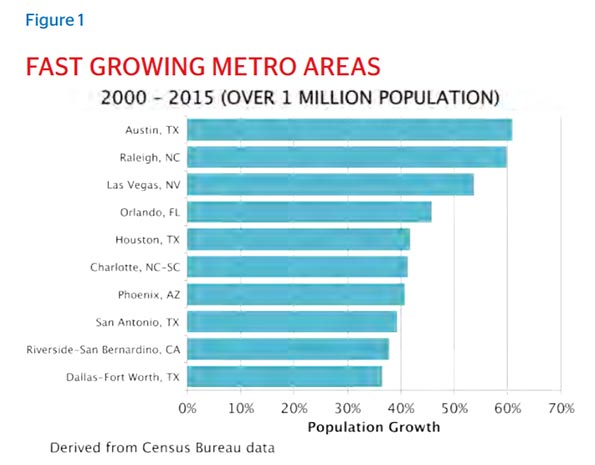
    When George W. Bush was watching the 2000 presidential election results from the governor’s residence in Austin, Texas, he was sitting in a city of 1.2 million people. Since then, Austin has grown 60 percent to over 2 million residents. Only Raleigh, NC, has come close to matching that rate of growth over 15 years. Austin and Raleigh are 20 percentage points ahead of fifth place Houston. Perhaps most remarkable, however, is Austin’s growth since 2010, the worst financial meltdown since the Great Depression. The city grew by 16.6 percent, while Raleigh grew 12.7 percent. Austin has largely defied gravity since the economic collapse.

    Among the nation’s 53 metro areas with populations over 1 million, the fifteen that have experienced double-digit growth since 2000 are all located in the south and west, including Texas’s four largest metros. And of the top 25 fastest-growing cities since 2010, the only city not in the south, west, or northwest is Columbus, Ohio, in 24th position. Columbus is the only city east of the Mississippi River and north of the Mason-Dixon line growing at a rate above six percent.

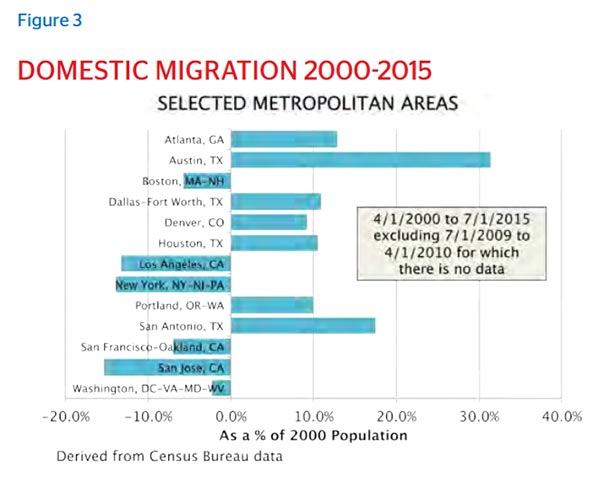
    Weather is a factor but America’s fast-growing cities attract aspiring workers and business owners through a blend of favorable economic conditions, new infrastructure, and increasingly, proximity to talent. Political sclerosis and economic elitism in coastal and northern cities have served as a helping hand, pushing workers away from a toxic blend of rising expenses and falling quality of life. Using a mix of Census data, cross-metro moving requests on moving.com, and cross-metro searches on realtor.com, a recent Realtors study found New York, Chicago, San Jose, and Los Angeles are among the top five cities losing the most domestic migrants to mostly smaller, newer Sun Belt cities. In the same study the top ten gainers are Sun Belt cities, with the exception of Portland, Oregon, all who offer newer, more affordable housing stock than in the prime metro areas of New York, Illinois, and California.

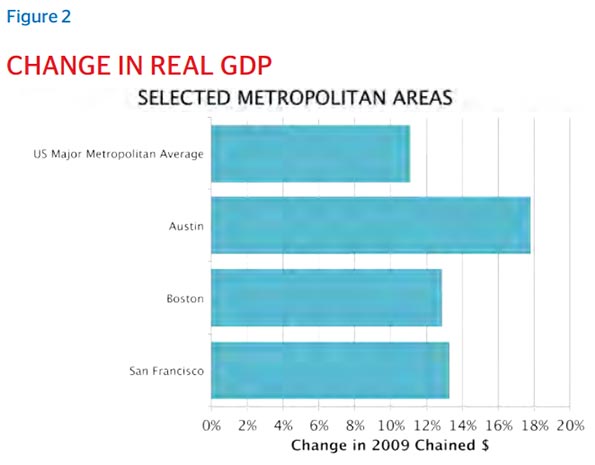
    Arguably no city in the country has taken advantage of these conditions more than Austin. Since 2009, the low point of the Great Recession, its metro area GDP has grown 31 percent. By comparison, San Francisco and Boston each grew by 13 percent during the same period. The national average for U.S. metro areas was 11 percent.

    Demographically, domestic migration drives Austin’s economy. Austin has had to innovate and import a lot of talent. Austin has become a quintessential knowledge economy that thrives not so much by cultivating natural and historical resources, but by absorbing ideas, innovation and talent from elsewhere and selling them as products back to the world.

    Anyone who has spent any time in Austin understands the tension that exists in the city between the defenders of its erstwhile charm as an unconventional music and college town and boosters of its high-growth technology cosmopolitanism. Whatever the community’s gatekeepers contend, however, Austinites themselves think that the massive influx of people is inextricably bound to its economic growth.

    An annual survey of Austin residents casts this phenomenon in clear relief. When asked what they think Austin has gained by its population growth over the past five years, residents cite a stronger economy as their top pick. Compared to the 22 percent of Austinites who cite “more diversity” and 7 percent who say “more creativity,” 42 percent say Austin’s explosive population growth has been a boon to the city’s economy. Even those who have lived in Austin for more than 20 years believe the economy has benefited from great migration to the city.

    An openness to newness, strangers, and change are hallmarks of Austin’s economic culture. Perhaps rooted in the city’s past as a music-centric, indie-friendly college town, these hallmarks have translated well economically for the city.

    The Great Migration Game

    Austin’s migration story can perhaps be understood best in contrast with Silicon Valley. No metro area in America can compare to the Bay Area in terms of the sheer size and force of its technology community, Austin’s attractiveness has grown, in large part , unlike in San Francisco and San Jose, tech workers in Austin are able to afford housing close to the office, raise kids close to good school options, and enjoy a variety of cultural amenities in close proximity.

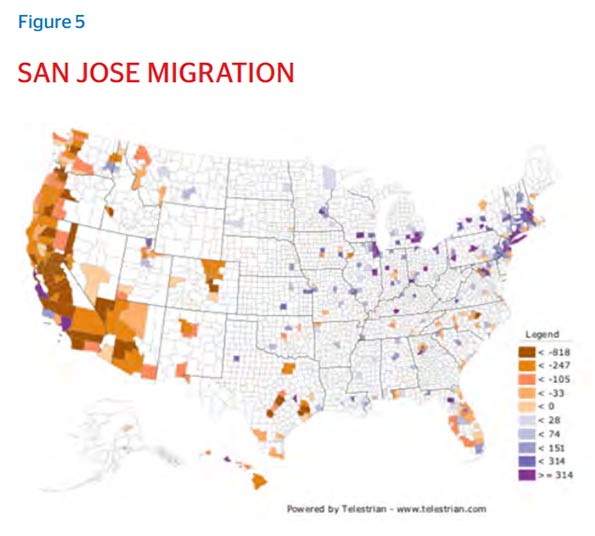
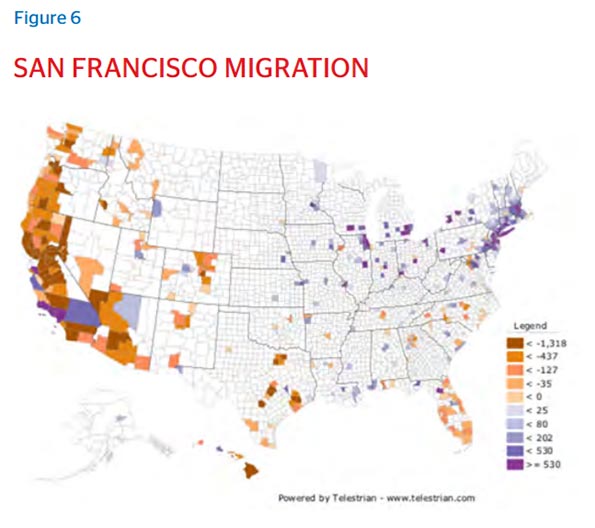
    Between 1991 and 2013, people moved between Austin and 304 MSAs. Of these, Austin only experienced a net loss to eleven. Compare that to San Francisco. The gem of the Bay Area lost population to 133 of the 242 MSAs with which it “traded” population. For San Jose, the figures are 127 out of 253. In other words, while the Bay Area lost population to well over half of the MSAs it has traded with across the country, Austin’s loss was just 3.6 percent.

    Figures 5 and 6 show clearly how the Bay Area has dispatched population to a number of western and southern boomtowns, whereas Austin has pulled in workers and families from every population centers all across the country.

    Silicon Valley is renowned for its high-level talent pool. It attracts the best and the brightest from around the world to work in the most vibrant technology ecosystem in the world. However, when one looks at where U.S. cities export most of their talent, the numbers tell a slightly different story.

    First, Austin is more of a regional talent destination than Silicon Valley. Since 1991, Austin has seen a net population increase of more than 33,000 people from Houston and 21,000 from Dallas. San Jose has lost thousands of people to both Texas cities over the same period of time. So has San Francisco. Perhaps that is expected, given Austin’s proximity to its fellow Texan metropolitan areas.

    But the pull is much greater from California than one would suspect. During the same period, Austin attracted nearly 20,000 migrants from the Los Angeles metropolitan area, which sent only 15,000 to San Jose. Austin also saw thousands of arrivals from San Diego during the same period.

    The other tech-heavy, talent-centric cities in the Northwest also prefer Austin. Net migration from Seattle to Austin has been positive since 1991, while San Francisco and San Jose have lost a combined 25,500 people to Seattle in the same time period. Portland tells an even more dramatic story. A city frequently compared to Austin, Oregon’s commercial capital has lost more people to its Texas peer than it has gained, while Silicon Valley has lost tens of thousands of residents to their northern neighbor. In contrast, since 1991, San Jose and San Francisco have exported nearly 51,000 people to Portland and Austin combined.

    Second, looking at talent centers nationwide, Austin outperforms the Bay Area quite decisively as cities with a high proportion of college-educated residents have consistently chosen the Texas capital as an ultimate destination over Silicon Valley. Raleigh, for example, the only other American city to come close to matching Austin’s rate of growth over the past five years, has lost more people to Austin than it has gained since 1991, but both San Francisco and San Jose have lost population to Raleigh over the same period. In other words, plenty of people are choosing to leave the Bay Area for North Carolina, but the talent base in North Carolina has a fonder eye for Austin.

    Other talent centers display a bias for Austin as well. The three largest cities on Wallet Hub’s 2015 list of the educated cities in America — New York, Los Angeles, and Chicago — have all sent more people to Austin than to the Bay Area, despite an enormous tech-led boom in the area. Washington, D.C. has become a talent boomtown in its own right, owing to the stability of employment for the knowledge workers the federal industrial complex increasingly needs and rewards. Yet it has exported more workers to Austin than to San Jose and San Francisco combined over the past twenty years. Provo and Colorado Springs, the mountain West’s talent hubs, have also lost people to Austin but gained people from San Jose and San
    Francisco.

    Opportunity Cities Win

    For cities aspiring to grow as Austin has grown, the first order of business is to understand Austin as an opportunity city, not just a technology center or music capital. So what are the hallmarks of an opportunity city?

    First, Austin, like other Texas cities, is friendly to those who want to start and grow a business. These are cities in which small businesses not only participate in, but also drive economic growth. A recent study conducted by the American City Business Journals ranked cities with 500,000 or more residents according to 16 indicators constructed to measure the vitality of the small business sectors in American cities. Austin ranked number one on the list because of the relationship between small business job growth and overall economic growth. San Francisco and San Jose ranked sixth and ninth, respectively, bested by nimbler hot spots such as Miami and Provo. Austin has also made other high-level appearances over the past few years on similar rankings, such as CNBC’s “Friendliest Cities for Small Business” list.

    Small businesses are woven into the fabric of Austin’s economic ecosystem. Austin’s small businesses are ahead of the national average and a significant source of the tireless job creation engine for which Austin has earned a national reputation. Companies in Austin with fewer than 100 workers account for 35 percent of the area’s workforce, and yet they created enough jobs in 2009-2011 to offset the job losses caused by Austin’s largest employers after the Great Recession.

    Second, an opportunity city is a jobs city. Small businesses by themselves do not necessarily guarantee that a city will have a healthy jobs environment, but a critical mass of new small companies typically does, especially if a significant minority grow into larger companies.

    Austin reflects the growing body of academic literature on the impact of new firms on the labor market. Startups and other young companies generate the vast majority of net new jobs in America and spur income growth, especially for younger workers. New companies in Austin are the fuel that powers the creation of new jobs at a rate impressively above the national average.

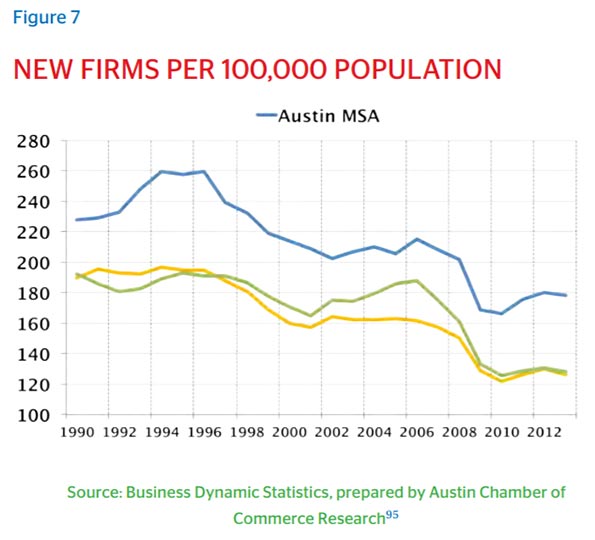
    New firm formation in Austin tracks with general national trends, but it does so at a consistently higher rate. As figure 7 shows, Austin has produced a significantly greater share of new firms per capita compared to the rest of country over the past 20 years, and it rebounded faster post-recession than the nation as a whole. The tech centers of Raleigh, San Francisco, and San Jose have all had lower startup rates than Austin since 2010.

    Austin is the only major metro in Texas creating as many or more new firms than it was pre-recession. Just three years after the nation’s economic nadir, Austin created more new firms in absolute terms than it ever had. It also produces a disproportionately high number of startups for its size. In the Kauffman Foundation’s Index of Startup Activity, Austin has been in the top two spots for a few years running.

    In addition to its startup culture, Austin is a premier relocation destination, especially for companies looking to expand operations in a business-friendly atmosphere with an abundance of talent. Since 2004, nearly one-third of all high-tech company relocations and expansions to Austin from elsewhere have come from California. Among these are household name giants such as Apple, Google, eBay, Oracle, PayPal, and Facebook.

    A churning startup culture drives a dynamic job-creation ecosystem. Austinites work more hours per week than the national average, enjoy the lowest unemployment rate among the nation’s top 50 metro areas and experienced non-farm payroll growth at the 3rd fastest rate last year.

    This has a lot to do with a healthy balance between job growth in all sectors of the economy with particularly strong performances in higher-growth sectors of the economy. Between 2014 and 2016, every sector of Austin’s economy added jobs, except manufacturing, which only declined by less than a percentage point. Since 2010, job growth in professional business services has grown 42 percent and information jobs by 34 percent, and over the past two years Austin has outperformed growth rates nationally in sectors diverse as wholesale trade, construction, leisure and hospitality, and retail.

    Third, an opportunity city attracts professionals on the front end of their careers. One of the best ways to test the dynamism of a region is to look at the degree to which young professionals in their 30s are moving there. Immediately after college, 20-somethings will often move to big cities to get their professional footing and enjoy the fruits of cosmopolitan living. As they approach their thirties, they begin to think about affordability more seriously and consider other opportunity-related factors such as the quality of neighborhoods and schools if they are in the marriage and-kids market. Looked at this way, Austin is the preferred destination for upwardly mobile, aspirational 30-somethings looking to make a life for themselves.

    A recent Niche.com ranking of the 25 best cities for millennials used as its key metric the percentage of 25-34 year olds living in each city. Austin, which ranked second overall on the list, had the highest percentage of 25-34 year olds among the top 25 cities.

    When we compare 25-34 year olds moving to the Bay Area versus Austin, we see several sharp contrasts. Between 2000 and 2014, this group grew by 49 percent in Austin but declined by nearly 4 percent in Silicon Valley. There are now more 25-34 year olds living in Austin than in the San Jose metro area.

    A greater share of 25-34 year-olds in Silicon Valley have a bachelors degree than in Austin, but Austin has been growing its educated young population at a much faster rate. The 25-34 year-old population with at least a bachelors degree has grown in Austin by nearly 61 percent since 2000, compared to 18 percent in San Jose.

    Balancing the Basics: Why Austin Works

    Austin’s success as an opportunity city differs from what has occurred in the Bay Area’s anchor metros, San Francisco and San Jose. These places have led the nation in job creation and startups in recent years and are growing their share of highly-educated young professionals. Yet they are losing population — and company relocations — to Austin. Why is Austin succeeding where San Francisco and San Jose, at some level, are not?

    The answer lies somewhere in the answers provided by those who have made the move from the Bay Area to Austin.

    Vasili Triant, CEO of LiveOps, moved his company from Silicon Valley to Austin after concluding that quality of life and cost issues would keep his company from achieving its growth objectives. Before assuming the helm of LiveOps, Triant moved to the company’s Austin office to direct sales. He and his family were able to buy a home and attend schools in the kind of district that would be utterly uaffordable in the Bay Area. The easy-going yet ambitious nature of Austin’s workforce provided a solid talent pool.

    Meanwhile, back in Silicon Valley, employees at Triant’s company were constantly pushing for pay raises to accommodate the cost of housing, complaining about the multiple hours a day they spent commuting, and worrying about the schools their kids would have to attend. Employees earning over $200,000 were in debt and not contributing to their 401ks.

    Once he was elevated to CEO, Triant confronted his board with the built-in costs of doing business in the Bay Area. He proposed moving the company to Austin, to which the board agreed after reviewing the numbers. Triant likens the difference between the Bay Area and Austin to a difference in premise about what makes a good life worth living in each place. In Silicon Valley one gambles that he or she will make it big, has family money, or just wants to be near the ocean and the mountains. “If your premise about a good life involves saving money for the future and having a good community and school for your kids, then Austin is for you – and the Bay Area won’t be unless you’re phenomenally wealthy,” Triant says.

    Pradeep Vancheeswaran, a Senior Vice President of Global Business Operations at VMWare, lived in California for his entire U.S. professional career, including seven years in the Bay Area, before moving to Austin. The cost of living and the rat-race culture of the Bay Area prompted him and his wife to reconsider whether it was the best place to raise their kids and make a life. On a scouting trip to Austin he saw the kind of home his money could buy, the kind of neighborhood he could live in, and the quality of the schools, and the decision was made. Friends said he was committing career suicide. The opposite has happened, and the family is flourishing in Austin. “Texas gets a bad rap in the Bay Area,” he says. “But the truth is Austin is an inclusive place. We have great neighbors, people are friendly, and I have been able to hire talent here with no problems. In fact, Austin ranks at the top of our global talent assessment and has been a great place to hire for our company.”

    Triant’s and Vancheeswaran’s stories are not uncommon in Austin and exemplify the fundamental pillars supporting Austin’s sustained growth.

    More for Your Money

    Underneath the vibrant regional economy, Austin’s bedrock, not often mentioned in the hype about the city, has been its affordability.

    As Triant and Vancheeswaran’s personal accounts attest, Austin’s diverse and affordable housing stock is a key lure for upwardly mobile professionals. Housing in Austin is growing more expensive but still remains a reasonably good deal, particularly in comparison with the Bay Area, Los Angeles and San Diego, where housing costs more than double that of Austin, adjusted for income.

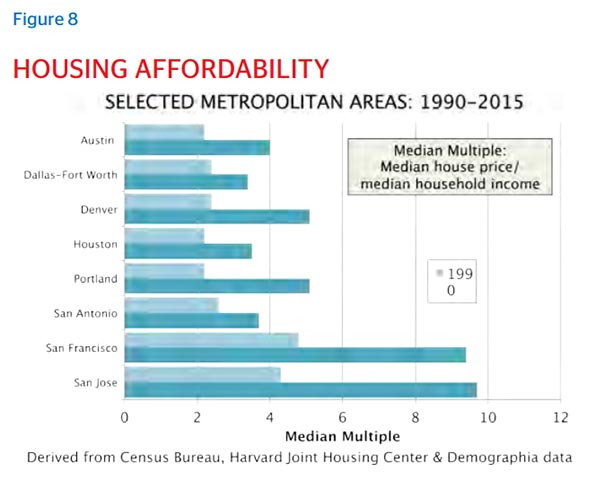
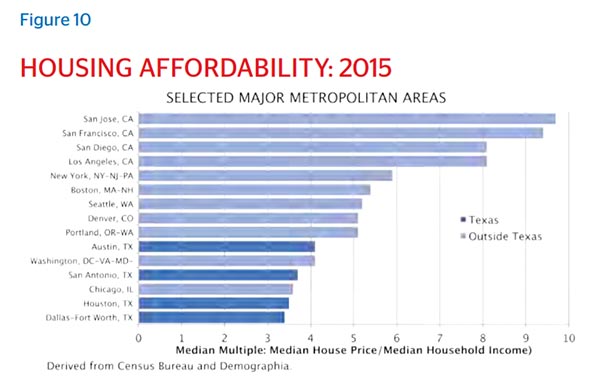
    The key to maintaining housing affordability is to allow supply to keep up with demand. This requires avoiding the restrictions on suburban housing development that have been adopted in places like California, Portland and Seattle, and avoiding the high development charges typical of more restrictively regulated markets. As Figure 8 shows, affordability was nearly identical in Austin, Portland, and Denver in 1990. Since then, unaffordability has grown faster in the latter two markets, which place more restrictions on housing than Austin does. And in the Bay Area, of course, California’s notorious penchant for restricting housing is breaking records for unaffordability.

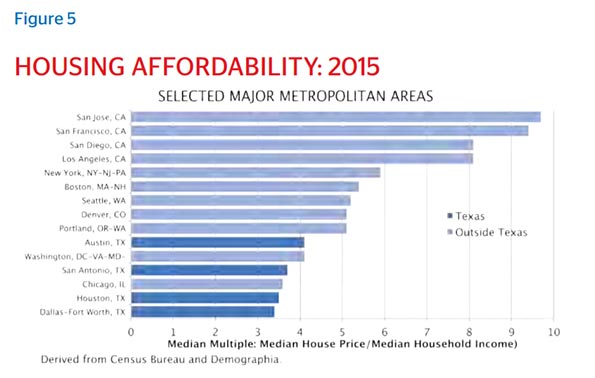
    Using Demographia’s International Housing Affordability Survey, we find that single-family homes in Austin remain more affordable than rival talent centers such as Portland, Denver, Seattle, and Washington, DC. When compared to San Jose, which is the United States’ most unaffordable housing market, it is not hard to see the appeal for Bay Area technology transplants. The median house price in San Jose and San Francisco is nearly ten times the area’s median income, compared to four times in Austin. Technology executives in the Bay Area cite housing costs as the biggest threat to their continued success.

    Still, at four times median income, Austin is facing the beginning of affordability problems. It has grown from an affordable to moderately unaffordable housing market since 2000 and is presently on the cusp of becoming severely unaffordable according to Demographia’s calculations. Trulia’s chief economist agrees, arguing that Austin is on the verge of denting its continued growth trajectory should housing prices climb much farther relative to income.

    When it comes to total cost of living advantages, though, the story improves somewhat for Austin. According to BEA data, between 2008 and 2013 the overall cost of living actually decreased slightly in Austin even as it rose in New York and Washington, DC. Austin’s workforce enjoys a 20 percent cost advantage over residents of New York, who labor under the highest cost of living standards in the nation. Austin costs about the same as Phoenix or Orlando. The Bay Area, by contrast, is an indistinguishable percentage point more affordable than New York. Therefore, it is not surprising that San Francisco and San Jose have seen positive net migration from New York in recent years. If life must cost an unbearable amount, the weather and scenery might as well be better.

    Follow the Money

    Austin’s real median income is the highest of Texas’s four largest metros and even surpasses the New York metro area. Of the nation’s 53 cities with more than one million residents, Austin’s median household income is the tenth highest adjusted for cost of living. African American and Asian median incomes in Austin are fourth and fifth respectively among the largest U.S. cities, and salaries in Austin typically track slightly above the national average for most job categories.

    Given Austin’s emergence as a technology center , the region now has twice as many high-tech jobs as a percentage of all jobs than the national average. Nearly one-quarter of all payrolls in Austin are in the high-tech sector, with an average salary greater than $100,000, nearly double the average salary for all other industries. Though high tech salary growth has slowed in Austin in the past few years compared to the rest of the nation, the average high tech worker in Austin still earns more than the national average. Before the Great Recession, there were more high-tech manufacturing than IT jobs in Austin, but the past five years have seen an explosion of information and other IT-related high tech jobs. The number of IT jobs in Austin has nearly doubled in the past ten years, totaling more than 56,000.

    High-tech manufacturing jobs remain the highest-paying, though, with an average annual salary fetching $122,000. Income growth outside of high tech jobs has grown at a faster rate than tech jobs. Between 2010 and 2015, Austin had the second-highest annual job growth across all industries at 3.7 percent, just a click behind San Francisco’s 3.8 percent growth rate. Austin’s high tech job growth rate of 5.7 percent was also the second-highest nationally, once again behind San Francisco’s peerless 10.7 percent growth rate. These rates of growth have been matched by healthy income growth that makes Austin a premier opportunity city.

    Good Place for the Kids

    Austin’s relative affordability and earning power is buttressed by two additional factors that are especially important to families and young people planning to have children: safety and schools. As Austin has grown, the sheer influx of families with children has placed a premium on the availability of strong educational options and a safe environment.

    Between 2000 and 2014, the number of households in Austin with children under the age of 18 grew 35 percent. By contrast, such households grew 4 percent in San Jose. This does not mean that Austin is necessarily more pro-family or pro-marriage in the sense of cultural norms. The percentage of married adults in Austin has declined just as it has across most urban areas in the past 15 years, as has the percentage of young couples with children.

    But, as sheer volume of families with children moving to Austin in absolute terms shows, the overall environment is very family-friendly. Austin’s schools fare better on most assessments of public school quality than Texas’s other large cities, and families have public school options all across the metro area. For instance, consumer-oriented data analysis sites such as FindtheHome.com rate Austin’s city schools ten points or more ahead of Dallas, Houston, and San Antonio, and the State of Texas’s overall rankings show a substantial percentage of high-performing schools in the metro area. Whether a family chooses to live downtown or the suburbs, there are strong public school options unlike ones one would normally find in large urban areas.

    An annual survey of residents shows that Austinites value choices in education as well. A majority of adults believe the public schools in Austin are a good value for their tax dollars. Yet 59 percent of 18-34-year-olds support school vouchers, as do 50 percent of adults over 35. Fifty-nine percent of all adults either send their kids to charter schools or would consider doing so. Sixty percent of respondents say they chose where to live based on school options.

    Austin is also one of the safest cities in Texas. According to the FBI’s Uniform Crime Reports, Austin ranks 21 out of Texas’s 24 metro areas in the report in crime incidents, well below the other larger metros.106 As a state capital and university town Austin’s growth has “skipped over” the debasements that accompany deindustrialization and largescale losses within working-class economies. But Austin’s growth patterns, variegated and multi-nodal as they are across the metro area, have also created diverse economic centers that have prevented large swaths of the city from falling into decline.

    Option Urbanism: Austin’s Polycentric Character

    The thing that ultimately makes Austin’s population and economic growth work is the multi-nodal quality of the metro area’s growth. Despite its reputation as a “hip” and dense urban area, in reality Austin is a city of districts that balances and disperses urban-style amenities across its urban and suburban landscape.

    Austin’s reputation as an urban hotspot is well-deserved. The Austin City Limits concert venue and annual festival are in or immediately across the Colorado River from downtown. South By Southwest, the global technology, film, and music festival, occurs mostly in venues spread across Austin’s urban core. The heart of the Austin music scene along 6th Street downtown is only a short walk from the Texas state capitol and a mere 13 blocks from the University of Texas at Austin, the state’s flagship university whose iconic tower is a fixture along the Austin skyline. Visitors to Austin over the past decade are always greeted by construction cranes that dot the downtown landscape, as high rises compete with one another to make a new mark on the skyline.

    Suburban Austin

    Demand for downtown living has never been higher in Austin, and yet the cranes and construction zones tend to hide the true locus of Austin’s dynamism—the area’s lively suburbs. This is where the vast majority of the region’s population growth in the past 15 years has occurred. Not merely appendages to downtown, Austin’s suburban communities have done a notable job of incorporating elements of the city’s urban identity into the quality of life its suburban residents experience. One can find food trucks, coffee shops, new restaurants, indie shops of various kinds, music, and festivals dispersed across the metro area. The Barton Creek Greenbelt that stretches southwest off the Colorado River downtown spreads outdoor recreational opportunities, for which Austin is also well-known, across multiple access points through a variety of neighborhoods.

    In 1990, when Austin metro’s population was less than one million, 45 percent of residents lived in the suburbs. Today, 53 percent of Austinites live in the suburbs. The city grew 47 percent between 1990 and 2000, and then another 37 percent between 2000 and 2010. The vast majority of this growth has been suburban in nature.

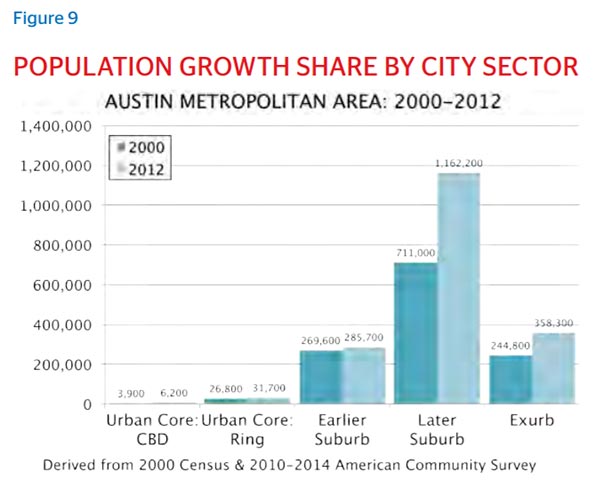
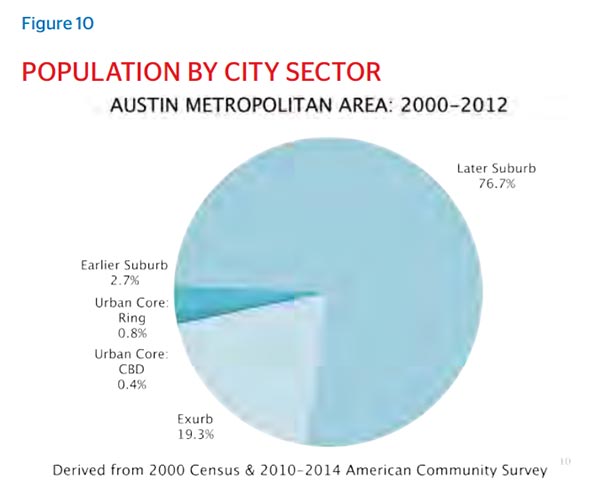
    Using Demographia’s City Sector Model, we see the urban core and urban core’s ring, defined as the central business district and original downtown ring pre-dating World War II, experienced healthy rates of growth but added little in absolute terms between 2000 and 2012. What most people think of as today’s booming downtown Austin only accounted for 1.6 percent to the metro area’s entire growth during this period. Of the 588,000 new residents to Austin during this period, 564,700 of them moved into suburban neighborhoods.

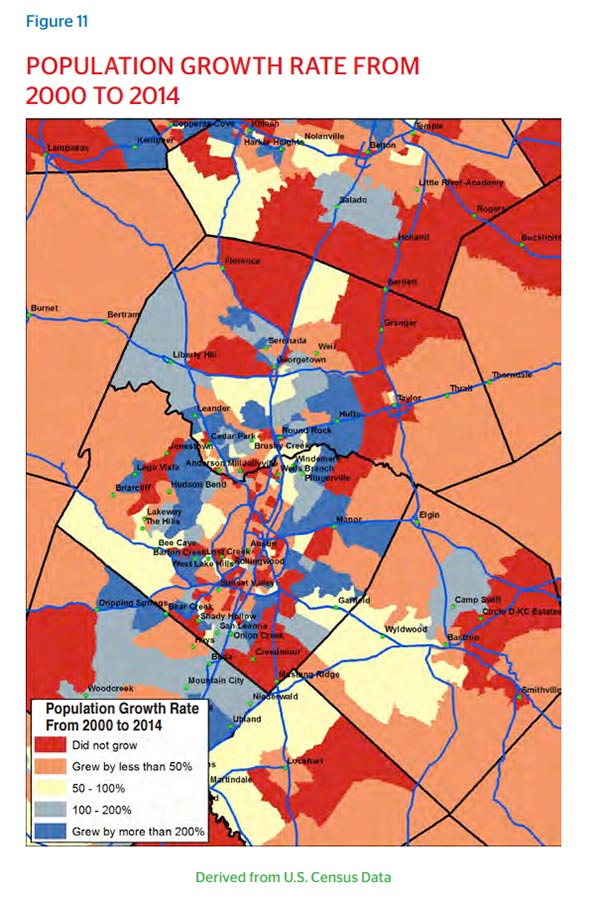
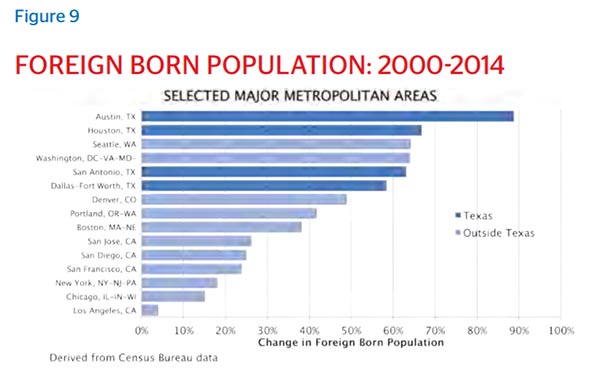
    Figure 11 shows how this growth looks geographically. Central Austin grew very little between 2000 and 2014. The fastest growth, depicted by the grey and blue areas, is largely suburban.

    Homeownership in Austin follows this suburban trajectory. Compared to 30 percent among the nation’s 52 largest metro areas, 62 percent of the owned housing stock in Austin can be found in suburbs in which the median home construction year was after 1980. That figure is less than 10 percent in Silicon Valley. By contrast, 77 percent of owned housing in Silicon Valley is in older suburbs with a median home construction year before 1980, compared to 14 percent in Austin and 41 percent nationally. Another 23 percent of Austin’s owned housing is located in exurban communities, compared to 19 percent nationally and 13 percent in Silicon Valley.

    Austin’s success as an urban model is closely tied to its ability to meet population demand with new housing in new communities. The increasing difficulty to build and afford housing in the Bay Area is effectively making homeownership a phenomenon of aging suburban communities, as greater shares of aspiring homeowners leave the area altogether, as seen earlier.

    Multi-Nodal Tech City

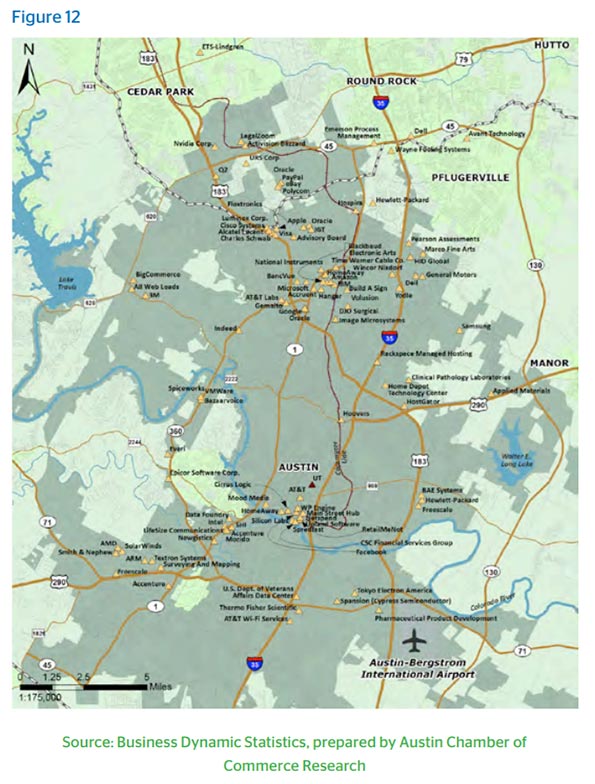
    Austin’s suburban expansion also dominates much of the economy. Nearly half – 43 percent – of tech jobs are in the suburbs and much of the rest in areas outside downtown. Local markets for urban-style amenities such as bars, cafes, and events have arose to meet the demand of a highly-educated, relatively young workforce that nonetheless prefers lower-density suburban living. This creates a district effect that has worked relatively well with Austin’s zoning codes and allowed for either mixed-use, or regional mixes of uses, in various points across the metro area.

    Figure 12, an Austin Chamber of Commerce map of the city’s 100 largest high-tech companies, paints a picture of a multi-nodal tech community that is both urban and suburban. Since 2014, 37 percent of high-tech companies that have moved to Austin have relocated downtown, while the rest are dispersed across the various hubs.

    The heavily concentrated hub downtown and the corridor stretching southwest of downtown offer a diverse array of living options. South Austin interweaves leafy residential neighborhoods around its three north-south district roadways: South Congress, South First, and South Lamar. To the west are rolling, leafy suburban-style communities that offer proximity to downtown. Downtown increasingly offers dense, high-rise living with ample amenities. The Bartin Creek Greenbelt and trails around Lady Bird Lake (created by two dams in the Colorado River) are the centerpieces of Austin’s esteemed outdoor fitness culture.

    Between downtown and the concentration of tech firms along and north of route 183 are patchworks of neighborhoods and districts that blend homes, apartments, restaurants, shops and bars, once again creating options for families and single workers. The Domain, the mixed use complex near the intersection of Routes 1 (Mopac) and 183, is beginning to serve as a kind of “city center” north of downtown. Suburban neighborhoods west, north, and east of the northern tech hub offer an array of suburban options for families and workers. Apple is completing its second-largest campus outside of its California headquarters in the community, and other tech giants such as Google and Oracle have nearby offices.

    Dell anchors the tech community in Round Rock to the north, which effectively functions as a separate city center. Round Rock, with a population of more than 100,000, has more than tripled in size since 1990. Dell employs more than 13,000.

    Austin’s rapid growth, coupled with lagging investments in transportation infrastructure, accounts for why Austinites frequently rank traffic congestion as the biggest problem facing the city. Viewed comparatively, however, average work commute times in Austin match the national average at 25.5 minutes one way, compared to 31.2 minutes in San Francisco and 28.1 minutes in San Jose. Atlanta’s car commute times take a full five minutes longer than Austin’s, and in Washington, DC, an extra ten. Overall, Austin’s average commute times – whether by car, transit, bike or foot – is on part with Indianapolis or Charlotte. For transplants from New York or the Bay Area, commutes are likely to contribute to Austin’s appeal rather than the other way around. Car commute times are lower in Austin than either of those areas, as one might expect, but so are walk-to-work times.

    Despite this relatively good performance, over time traffic congestion along with housing affordability could begin to chip away at the city’s magnetic appeal. But for now, despite the frequent grousing one hears from locals about the traffic, Austinites on average are not worse off than other Americans living in cities larger than 1 million people.

    Austin’s still reasonable commute times reflect the polycentric quality of its economic geography. With commercial and cultural locations spread across the metro area, together with an array of single- and multi-family housing options nearby, Austin offers choices. If a young professional couple wants a single family home with a yard, proximity to restaurants and shops and good schools, they have options. If they want to live in more of a mixed-use apartment community close to work, they have options. Downtown living is increasingly becoming harder for people not commanding top salaries, but it still remains an option for young workers that other cities do not offer.

    Conclusion

    Austin is well-known as a talent center, but students of urbanism would do well to study the geographic nature of the talent economy in Texas’s capital. It is a dispersed talent pool, spread across a relatively affordable metro area with proximity to urban-style amenities.

    Austin has managed to encourage and allow the concurrent development of its central core and inner and outer rings in a way that has made variety a central feature of the Austin model. People, young and old, have options in Austin. Good schools can be found across the metro area meaning people rarely have to sacrifice amenity preferences in order to live close to a good school, which is a conventional understanding of what “moving to the ‘burbs” often entails in most cities.

    Austinites have work options, too, in two ways. The diverse economy, with a high proportion of high tech and other educated workers, offers opportunities in the job market for workers who decide what they are doing is not the right fit for them. Workers also have choices where they work. The polycentric nature of Austin’s commercial hubs makes this possible.

    And even as affordability problems present unprecedented challenges to Austin, the city still offers alternatives for where people want to live. Because of the timing and trajectory of Austin’s population growth, a lot of new housing is available, as well.

    The key to the Austin model’s continued success will be to preserve its core features as an opportunity city and the fundamentals that have made it work until now. Over-planning or limiting growth, concentrating economic strength in too few places, allowing school quality to erode – these are precisely the things that have done significant damage to other previously successful cities in America. Austin’s strength has been in going in the other direction. Its continued success depends upon continuing along the same path it has traveled until now, but with a vision to accommodate what seems as inevitable greater growth.

    Ryan Streeter is the Executive Director of the Center for Politics and Governance at the University of Texas at Austin and Clinical Professor of Public Policy at the LBJ School of Public Affairs. Streeter has conducted policy research projects for think tanks, institutional nonprofits, and public agencies at the federal, state, and local levels. He served as a Special Assistant for Domestic Policy to President George W. Bush, Deputy Chief of Staff for Policy and Strategy to Indiana Governor Mike Pence, and Policy Advisor to Indianapolis Mayor Stephen Goldsmith. He was a Senior Fellow at the Legatum Institute in London, has served as a Transatlantic Fellow with the German Marshall Fund, and was a Research Fellow at the Hudson Institute.

    Top photo: Photo by jdeeringdavis, Licensed under CC License

  • Houston, City of Opportunity

    This essay is part of a new report from the Center for Opportunity Urbanism titled “The Texas Way of Urbanism“. Download the entire report here.

    Creative friction – unchaperoned and unprescribed – is Houston’s secret sauce.

    At a time when Americans’ confidence in all major U.S. institutions – minus the military and small business – has sunk below the historic average, and only about 20 percent of Americans say they spend time with their neighbors, one would expect pessimism to be universal. But come to the concrete sprawl just north of the Gulf and you’ll find a different vibe, one that other cities would do well to emulate.

    Of course things aren’t perfect in Houston, and the region is taking it a bit on the chin due to the drop in oil prices. But look over the mid- and long-term and the place has consistently lured people from around the country and the world.

    People continue to move to the flat and humid city in higher numbers than any other metropolis. According to the United States Census Bureau, from 2014-2015 metro Houston attracted 159,083 total and 62,000 net domestic migrants, topping the Census list on new metro area residents. Critically, the newcomers represent those population groups most telling of a metro’s future: millennials, immigrants, and families.

    “The American Dream is still alive here,” say those migrants, one after another. 81 percent of Houston residents rate the city as a good or excellent place to live, according to the 2016 Kinder Houston Area Survey. That’s up from 70 percent a decade ago. And despite the recent economic slowdown, 62 percent of Houston-area residents rated the local economy as “excellent” or “good.”

    Even the most conventional of popular figures have begun to figure this out. “Houston will surprise you,” wrote Katie Couric when she stopped here on a nationwide tour of up-and-coming cities. It was a more iconic statement than perhaps she realized. Outsiders often misperceive Houston as politically conservative and totally dependent upon the energy business, but the city consistently busts internal expectations, too. In Houston, you don’t have to drive far to run into unexpected languages, unexpected restaurants, a huge informal economy and just a pervasive – and bracing – sense of random.

    “It’s a cat city,” says Bill Arning, director of Houston’s celebrated Contemporary Arts Museum. He moved here in 2009 from Boston. “If you arrive without a tour guide, without a friend who knows the city, it’s hard to figure out where things are. There are no landmarks. Whereas Austin is a dog city – you know where the beautiful people are – Houston is a cat city. Its charms are there, but you’ve got to come to it. You’ve got to take a little time.”

    What sets Houston apart? What about the city makes so many residents confident they will find their version of the American dream here? If it is indeed a city of opportunity, what lessons might other cities absorb and weave into their own policies and cultural fabric? Through many interviews, data sleuthing and the everyday experience of living here, I found five traits that define Houston: affordable proximity, multipolarity, social deregulation, an active future orientation, and humility. What follows is a tour of the city that knows no limits.

    Affordable Proximity

    “There’s always been a haphazard nature to the city, from the beginning,” says Sanford Criner, a native Houstonian as well as vice chairman at CBRE, the world’s largest real estate firm. “Where Chicago – which was founded the same year [1836] – had an economic reason for being the day it was founded, Houston was a real estate play. These guys came down from the northeast – New York, Pennsylvania – and they bought some land and sent out flyers.

    “I’ve seen some [of the flyers], and they’re hysterical,” Criner continues. “‘Salubrious environment!’ said one. ‘Well-watered!’ said another. They’d have this picture that looks like a little Swiss valley, with chalets up the hill, and there wasn’t a house here! It was a scam. But that’s how we now date the founding of our city.”

    Where others saw only wilderness along the banks of Buffalo Bayou, Augustus Chapman Allen and John Kirby Allen saw promise, and convinced people to take a gamble and move. This rambunctious “come one, come all” attitude continues to define the city’s development, 180 years later.

    The city of Houston is famous for its no zoning policies, the fruits of which are visible in the hodge-podge of commercial and residential hubs evident on a first drive in from one of the two airports. The apparent haphazardness may dizzy outsiders, but for Houston residents it’s a gift that my colleague Tory Gattis calls “affordable proximity”: the ability to live near one’s place of employment while keeping the cost of living affordable. It’s a challenge that has become onerous in many cities, but one that Houston manages to tackle with surprising efficiency.

    “It’s definitely true that it’s easier to build things here than elsewhere,” says Criner. “We’ve been able to build things relatively inexpensively and rapidly that have generally benefited everybody.”

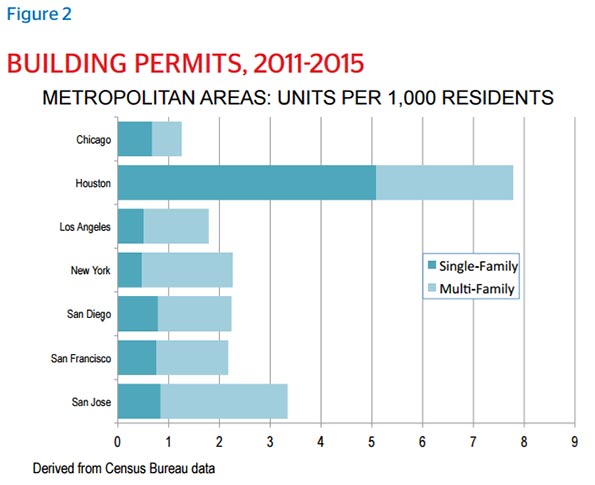
    Since 2010, Houston has expanded its housing stock to issue construction permits for 189,634 new units, paralleling the population growth. This is in sharp contrast to competitor cities such as New York, Los Angeles, Chicago and the Bay Area, where construction tends to lag behind population.

    Houston is uniquely able to create housing to meet demand. The populations in both New York City and Houston have grown significantly in the past six years, but New York, like many big cities, has not come close to meeting demand. A lot of this has to do with sheer land availability and willingness to expand outward, but Houston’s light regulatory touch has crucially allowed developers to be in sync with consumer need and preference, without the red tape that slows other cities’ building and adaptability. A key result has been a greater level of affordability, and of choice.

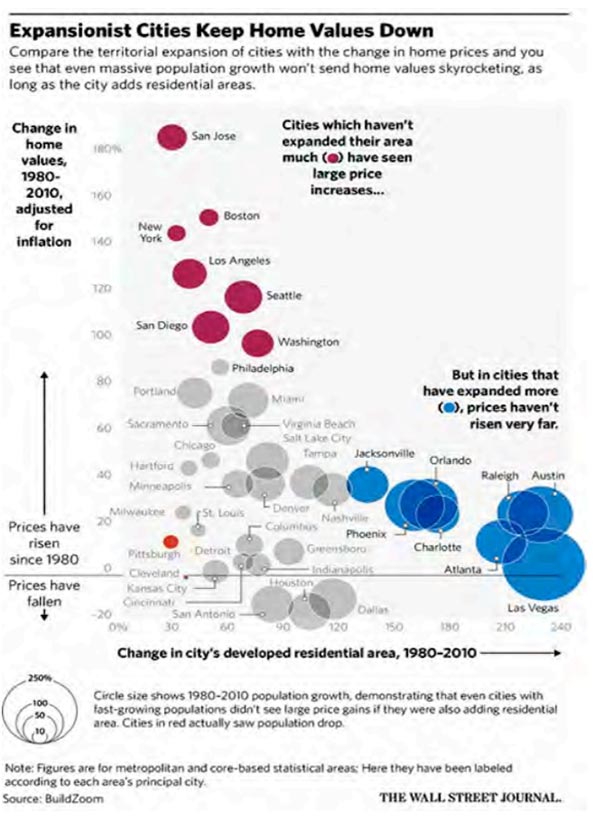
    In April of 2016, The Wall Street Journal highlighted groundbreaking research by Issi Romem, chief economist at real-estate site BuildZoom, showing that the cities that have expanded geographically have kept their house prices more affordable.

    According to the National Association of Home Builders/Wells Fargo Bank Housing Affordability Index, more than 60 percent of homes in the Houston metro area are now considered affordable for median-income families, compared with only 15 percent in Los Angeles, once ground zero for the dream of homeownership. According to Zillow, renters in New York spent 41.4 percent of their income on housing in 2015, whereas the share for their Houston counterparts was just 31 percent.

    The Demographia International Housing Affordability Survey provides ratings for all major metropolitan areas in the U.S., and Houston consistently ranks as more affordable than cities like Portland, New York, San Francisco and San Jose, all of which have more restrictive regulations.

    Houston’s housing is also diverse. Houston has become the national leader in new multifamily units, helping to preserve and expand access to urban living. At the same time, the Houston metro has led the country in new single-family houses.

    Availability of affordable land and a lighter regulatory environment allowing for outward expansion has made it possible for many to afford a residence near the city’s dispersed job centers. In addition, as City Observatory recently reported, a series of reforms adopted in 1999 shrunk the required residential lot size from 5,000 square feet to 1,400 square feet, enabling town home development in high demand areas proximate to jobs.

    Proximity to work is especially appealing to millennials, who have moved to Houston in droves. The U.S. Census Bureau showed a 25 percent increase in millennial residents between 2000 and 2013, with millennials currently making up 24 percent of Houston’s total population. Many of these new adults want to reduce their commutes, or even ditch their cars for the sake of enjoying a more seamless transition between professional and personal life. Houston offers this possibility across urban and suburban areas, the multipolarity of business centers providing flexibility to carve a nice triad of work, residence, and play.

    Despite the impression of endless freeways, Houston’s commute times are better than those in metros of comparable populations. One-way commutes were 28.4 minutes in 2014, according to the American Community Survey, making Houston the fourth best out of nine comparable cities.

    Houston also does very well on an international scale with respect to traffic congestion, according to TomTom in 2015. The region ranked fifth out of the 38 urban areas that have populations over 5 million.

    None of this suggests Houston lacks room for improvement in mobility, but it’s credit to the city’s decision to dramatically increase roadway capacity and arterial streets that it has managed to improve its ranking in traffic congestion while experiencing a huge increase in population. According to the Texas A&M Transportation Institute, in 1984 and 1985 Houston was ranked with the worst congestion in the country, even worse than Los Angeles. Now Houston is ranked 10th, even as it’s nearly doubled its population, from 3.5 million in the mid-1980s to 6.5 million today. Only Atlanta and Dallas can boast similar mobility improvements.

    Multipolarity and Economic Diversity

    Most Americans think of Houston as an oil and gas town. And while energy still undergirds much of the city’s economy, Houston boasts many other assets as well: the world’s largest medical center, one of the world’s busiest ports, the third largest manufacturing hub in the country, a booming technology sector and a wide range of small to medium-sized businesses, including a thriving informal sector of immigrant-run businesses. This has led to demand for labor at all skill and education levels, unique among the top ten largest cities.

    “Best Online Programs in 2016,” said U.S. News & World Report about the University of Houston. “Top Cities for Competitiveness to Attract Investment in Chemicals & Plastics,” said Conway about Houston in 2015. “Best Hospitals for Adult Cancer – University of Texas MD Anderson Cancer Center” said U.S. News & World Report in 2015. “Top Blue-Collar Hot Spots,” said Forbes in 2014. “Most Favorable Metro for STEM Workers [Nationally],” said WalletHub in 2015.

    Houston is no stranger to “Best Of” lists that today’s mayors scour. But what’s notable is the cross-sector nature of the superlatives. According to a June 2016 report from the Texas Workforce Commission, 20.3 percent of Houston’s workers are in Trade, Transportation and Utilities, 15.5 percent are in Professional and Business Services, 12.8 percent in Government, 12.7 percent in Education and Health Services, 10.2 percent in Leisure and Hospitality, 8 percent in Manufacturing and 7.4 percent in Construction.

    The city has learned from its mistakes. The 1980s, which saw a slump in oil prices much greater than that in 2015, bulged in profligate building and overconfidence. According to the Greater Houston Partnership, from 1982 to 1986, developers built more than 100,000 single-family homes, many of them without a signed contract from a purchaser. Even when the region lost more than 200,000 jobs, office developers continued to build, including adding more than 71.7 million square feet of office space while companies were laying off staff and declaring bankruptcy. Today, the office market is tighter, banking is better regulated and better capitalized, and few homes are built without a signed contract. Most importantly, the region is creating jobs that aren’t in energy, including in health care, business and professional services.

    Social Openness: A City for Everyone

    Houston is deregulated economically, but it’s of greater note that it’s deregulated socially. People come here from many walks of life and culture, and the relative youth of the city combined with its scrappy DNA means that there really isn’t a dominant Establishment, certainly not one that wants to block the efforts of ambitious newcomers.

    “If you talk to [old] Houstonians about social mobility,” says Sanford Criner, “they kind of give you this quizzical look. Like, ‘what do you mean?’ Like, ‘Sure, of course.’ It seems obvious.”

    This city’s always been a mixer; you just have to be willing to share what wakes you up in the morning. Marlon Hall is an African American filmmaker and native Houstonian who started Folklore Films, a documentary production company created to “tell better stories to our city about our city.” He and fellow filmmaker Danielle Fanfair have featured former Mayor Annise Parker, arts patron Judy Nyquist, internationally recognized musical artist DJ Sun and other community figures. As the Folklore Films crew has gotten better acquainted with Houston residents from across the social spectrum, Marlon locates the vocational “why” as central to the city’s currency.

    “Houston isn’t driven by who you know,” he says, “but by how you want to be known. It isn’t about what pedigree you have received, but about the possibilities you want to bring to bear.”

    This kind of invitation has attracted the motivated from all over the world, with the city now pulsating with 145 languages. An international city since the day it was founded, now more than one in five Houstonians are foreign-born, with the 2014 American Community Survey reporting that 63.9 percent of the foreign born population were Latin Americans, 25.2 percent were Asian, 5.1 percent were African and 4.6 percent were European. As of the 2010 Census, Greater Houston does not have a majority racial or ethnic group.

    People come to Houston seeking opportunity, and because they sense in the visible randomness the potential for surprise ingredients to leaven the traditions they’re bringing with them. This is as true for immigrants as well as domestic migrants, with the city’s celebrated restaurant scene born out of the unexpected merging of flavors from cultures that don’t typically mix. Underbelly’s Chris Shepherd, Bistro Menil’s Greg Martin and Lucille’s Chris Williams all cite Houston’s diversity as a major factor behind the city’s flavorful palate, in both story and succulence.

    “This is edible history,” says Chris Williams, the founding chef at Lucille’s, a restaurant that takes a modern approach to Southern classics. “The food that we do here pays homage to my great-grandmother, who was a chef and a pioneer and an American icon.”

    It’s not soul food, but Southern. With a rustic European style, and a multi-generational American story at the heart.

    “Like all chefs in [my great-grandmother’s] time, your style of food was defined by what was available to you. What you could afford to work with. The flavors that I grew up with…married with the techniques and the flair that I picked up working in Europe for four years. Everywhere from London to Lithuania. …I’m influenced by the simple rustic dishes – the ones about the culture, not the flashy ones. The perfect piece of fish fresh caught, served with good potatoes, great olive oil, fresh garlic, and a little bit of parsley.”

    Bistro Menil is another spot that takes a slice from Europe and re-interprets the classic dishes for Houstonians. Its patrons come from Rice University, the Medical Center, the Museum District and beyond, the attraction of the world-renowned Menil Collection standing just across the street. Inspired by the concept of cask wine, which head chef Greg Martin discovered on a trip to Rome, Bistro Menil relies heavily on relationships with cosmopolitan – yet locally centered – Houstonians.

    “I don’t want to compete with that dish that you had in Rome,” Martin says, aware of ingredient limits this side of the Atlantic. “I want to reinterpret it with more of a New American approach, with some fresh eyes on our market, using our ingredients. Our ingredients and produce come from everywhere…I work really closely with a local importer. We’ve been working together for 30 years. He brings in our duck legs from Canada, our jamón Serrano from Spain. He brings all of our cheese in from France, Italy and Spain.”

    It’s not just the food that shows Houstonians willing to work together across silos and lift up the local talent. “We have a very supportive gallery scene,” says Bill Arning, of the Contemporary Arts Museum. “Even the galleries that show a lot of major international and national artists, like the Texas Gallery and McClain Gallery, will not only show local artists, they’ll place them in the top collections in town. That’s unusual.”

    The social egalitarianism combined with a pervasive “show me what you got” curiosity creates something very unique. Hipster cocktail bars seem no more privileged than authentic Vietnamese restaurants than classic barbecue and the iconic Rodeo. The lack of zoning makes thoroughfares like Westheimer Road, which stretches for miles from the city center to the distant suburbs, an avenue of cultural mismatches: The New York Times’-celebrated Underbelly is sandwiched between three tattoo parlors, a Catholic guild clothing store and the latest in coffee-roasted curation. There are so many opportunities to mix with those different from you that only the snobby find themselves bored and excluded. Creative friction – unchaperoned and unprescribed – is Houston’s secret sauce.

    “This is a city that does not believe in censorship,” says Arning.

    Agile, Active, and Future-Orientated

    Houston is not Silicon Valley, but its entrepreneurial DNA is unmistakable, dispersed across many fields. The city emanates a conviction that people should have the freedom to determine their destiny, sometimes to the point of overlooking those that don’t have such clear vision, nor the resources and social networks to make it happen. The city is growth- and future-oriented, embracing change and risk. True to its namesake in Sam Houston – himself a failure before reinventing himself – Houston grants permission to fall hard.

    “Houston is the only town where a person with no prior experience in a particular vocation can get joint venture capital for something they’ve never done before,” says local arts patron Judy Nyquist in one of Marlon’s Folklore Films. “Simply by virtue of their commitment to their idea, and how it can make the city better.”

    This is true across sectors – for-profit, social service, and philanthropic.

    Ella Russell of E-dub-a-licious Treats was an African American single mom working for AT&T when a breakup with her partner caused significant financial hardship. Her two boys, then age 3 and 9, came home from school asking to bring in treats for a holiday party. Russell felt helpless, all disposable income had run dry. But she did find sugar, flour and eggs in her pantry.

    “I scraped up change to buy a bag of chocolate chips,” Russell recalls, “so I could make chocolate chip cookies. The kids took them in, and then I brought the leftovers in to work. My coworkers loved them, saying every future potluck would have to have my cookies.”

    Three years later, her friends urged Russell to turn the sweetness into a business.

    “I had no business experience other than what I knew working in corporate America,” Russell says. “I really winged it; I had no basis but the support of my friends.” In a couple years, she went from serving family and friends to delivering in seven different states.

    In the burgeoning scholarship entrepreneurship of the last decade, the work of Saras D. Sarasvathy of the Darden Business School at the University of Virginia stands out. She’s coined a term called “effectual reasoning” to describe the mindsets of master entrepreneurs, one that pairs well with Houston’s soil:

    Brilliant improvisers, the entrepreneurs don’t start out with concrete goals. Instead, they constantly assess how to use their personal strengths and whatever resources they have at hand to develop goals on the fly, while creatively reacting to contingencies. By contrast, [highly successful] corporate executives use causal reasoning. They set a goal and diligently seek the best ways to achieve it.

    Sarasvathy likes to compare expert entrepreneurs to Iron Chefs: “[They are] at their best when presented with an assortment of motley ingredients and challenged to whip up whatever dish expediency and imagination suggest,” she writes. “Corporate leaders, by contrast, decide they are going to make Swedish meatballs. They then proceed to shop, measure, mix, and cook Swedish meatballs in the most efficient, cost-effective manner possible.”

    If we could take her comparative study and extrapolate from it particular civic traits, you might see Chicago as the sort of personality for corporate leaders, Houston for the entrepreneurial. The city is rife with improvisers, fueled by a deep prioritization of human relationships, an affection for eccentrics and a perennial optimism that loves to build before over-planning. The fact that there are lots of open spaces to create, and fill, encourages new entrants into any kind of market, be it technological, artistic, or consumption-oriented.

    This goes well beyond profit-seeking ventures. The Chronicle of Philanthropy identifies Houston as one of the country’s most generous cities, ranking at #11 for giving as a percentage of adjusted gross income – three stops behind Dallas.

    “As [Dallas-Fort Worth and Houston] have each become centers of gushing economic production, and matured as communities, an energetic competition has grown up in their creation of impressive new parks, museums, hospitals, universities, and arts centers,” wrote Ari Schulman in the Fall 2015 issue of Philanthropy Magazine. “Burgeoning circles of local patriots wielding newly minted fortunes have dramatically changed the quality of life in both cities over the past decade or so.”

    This enhanced quality of life has involved a deeper renaissance in the arts, a proliferation in family-friendly green spaces, advancements in medical facilities and, increasingly, innovative educational ventures. Houston’s acclaimed Museum of Fine Arts is currently undergoing a $450 million redesign, two-thirds of that already raised with the help of giant gifts from pipeline entrepreneur Richard Kinder and money-manager Fayez Sarofim. Kinder and his wife Nancy have also given $30 million to a public-private partnership aimed at reviving a snaking bayou from a stagnant waterway to an attractive waterfront graced by 20 miles of hike-and-bike trails, canoe launches, playgrounds, art installations, and outdoor performance venues.

    “This kind of public-private partnership happens all the time,” says Criner. “In lots of other cities, philanthropic organizations tend to be run by the same group of guys that have been running stuff for a long time, and they treat them like their own turf. You don’t see that here at all. This is way more like, “if you can help, come on! What can you do? We’ll put you to work.”

    “We have a tradition of philanthropy that my colleagues in other cities [envy],” agrees Arning, of the Contemporary Arts Museum. “Privileged young people here feel they need to find their philanthropies early on. That is something uniquely Houston.”

    Humility and Cultural Accessibility

    Long considered the unattractive hothouse of the south, Houston has suffered from a long-running inferiority complex when comparing itself to other cities. Even since rising to the top of dozens of “Best of” lists in the last five years, the residue from generations of modesty remains.

    Before Marlon Hall was running Folklore Films, he and Danielle began something called the Eat Gallery, an incubator for budding chefs around the city that sought to turn food trucks into restaurants. In ramping up for this effort, they went around and asked Houstonians questions about where they found meaning, where they felt they fit, where they felt they made a difference. They discovered that people had low city esteem.

    “They’d go to a great ballet, and they’d be like, wow, this reminds me of Chicago, Hall recalls. “They’d go to a musical performance and be like, oh, this feels like New York. People were telling the worst stories to the city about the city.

    “So we said, what if we told better stories to Houstonians about Houstonians, featuring people that folks know and celebrate? But what if we began their stories with their brokenness, so that people would know that there’s something inherently broken about every beautiful person? So that’s what we did, that’s why we started Folklore Films. To raise the city esteem.”

    Folklore discovered that Houston is a city of new beginnings. When you move here, the past intrigues less than how you intend to exploit the future. Whether you’re an immigrant from overseas or a fellow American that’s left some entrenched failure behind, Houston pulses with a forward-looking frankness grounded in a humility shaped by whatever came before. This drive paired with an individual and corporate self-awareness defines the city’s character – culturally, spiritually and even economically.

    “There’s this at-homeness that people from Houston have,” Hall says. “When I think about people who have left Houston to do other things, like Beyonce, there’s this comfort to be who one is. She walks around with hot sauce in her purse – I mean, who else can say that from where else?”

    “There’s something about Houston that’s like…I’m not afraid to be who I am, even if it’s full of seeming contradictions.”

    “The collective body in Houston is significantly more adventurous than most cities,” Arning of the Contemporary Arts Museum says. “Both in use and collection. In most collection cities, you hear who supported or recommended the collection before going. Houstonians, because of their wildcat nature, [will try anything] they like.”

    Houston’s increasing diversity keeps the city vibrant and ever ready to accept change and innovation. There is no room for insularity because there is no homogeneity. Your ideas are constantly being chiseled and countered by the Other. No one has the luxury of feeling superior because everyone’s in a gem tumbler with folks not like them. It makes the city competitive, but not in a way that produces monopolies.

    “I think that Houston has come to this place where it’s a ‘My Space,’” says Marlon. People want to take ownership of their lives and creations here. “There’s a desire to own who you are in Houston, which is different from owning a business, a house a car.”

    Houston residents tend to be proud of their individual accomplishments, and feel an affection toward the place that allowed those accomplishments to happen. But there’s a recognition that success is the result of many different pieces coming together, usually organically and iteratively. The environment invites people to fulfill their individual destiny, and almost discourages any person or governing body to take credit for Houston’s successes as a whole.

    “I hesitate to say things like ‘I’m proud of Houston,’” Sanford Criner says. “What gives you the right to take pride in a place? Did you build it? Did you do it?”

    Challenges to Sustaining Opportunity

    Houston continues to beat the odds to this day. And while its adventurous impulse is what continues to draw people to Houston and make it the emblem opportunity city for 21st century dynamics and demographics, it must still be said that what you put into the world must survive. Houston is a much better place to live than it was 30 years ago. But will it continue on this trajectory, or even sustain the fruits of its triumphs?

    Houstonians recognize there needs to be a concerted effort to reform and improve Houston’s educational opportunities, its transportation and traffic infrastructure, and a more general care to respect tradition and an intensive effort toward more inclusive mobility. The city’s grown so big, so fast, it could inevitably buckle under its own weight.

    “We are not on track to make headway on a lot of the issues that are facing us,” says James Llamas, of Traffic Engineers, Inc. “We’re growing way faster than we’re adding transportation capacity or options, at the same time there does seem to be recognition that we need to do something and what we’ve been doing isn’t going to continue to work.”

    Despite precedent, massive infrastructure may not be the answer, especially given the shifting preferences of a younger population and the costs of maintenance. New mayor Sylvester Turner is considering expanding to two HOV lanes and providing express bus service. Others advocate for densification of the more traditional gridded neighborhoods that are far from holding their population capacity – but without adding infrastructure, and without pushing anyone out.

    And then there’s the perennial education challenges.

    “We are now in a different economy where education is critical,” says Stephen Klineberg, founding director of the Kinder Institute. “It never used to be critical, especially not in Texas. You made money by land – by exploiting all the natural resources you needed on the land. The great cattle, timber, oil. The source of wealth in the 21st century Houston, is knowledge. …If you don’t have education beyond high school, with the technical skills that allow you to get the jobs of the 21st century, and compete, you’re not going to make it. Texas hasn’t come fully to grips with it.”

    Conclusion

    In the last 20 years, Houston has cultivated a series of signaling mechanisms that continue to draw people into its orbit. It’s a welcoming city, supported by affordability and diversity. Majority opinion says “anything is possible if you’re willing to work hard,” a conviction increasingly on the decline in the rest of the country. And, crucially, it’s cultivated the conditions necessary for entrepreneurs to have a field day. “The assortment of motley ingredients” noted by innovation scholar Sarasvathy describes Houston in a nutshell, and the regulatory instinct has been to stay light, allowing imported imaginations to run experiments without interference.

    The city’s not beautiful upon first blush, nor does it offer the charm of pedestrian fancy that denser cities boast. But in an era of civic unrest, with many up and down the social spectrum feeling disconnected and robbed of agency, Houstonians can still shape their destiny. The city’s the clay; residents the potters. The wide range of home sizes and work-life arrangements makes Houston like the cowboy boot its Rodeo celebrates – adaptable to the needs of each life stage as residents progress through singleness, marriage, family and retirement. Residents are not trapped by the regulatory, financial or even social limits that other cities increasingly impose. The mindset is one of abundance, not scarcity.

    “This is the genius of this place,” wrote Cort McMurray in the Houston Chronicle in January of 2016, in a profile of an Iraqi refugee who had come to Houston with a B.S. in Chemistry, currently cleaning pools. “Houston will always be shambolic and stretched and not quite finished. We will never be the most beautiful city, or the most pedestrian-friendly city, or the most efficiently planned city: The heat and soul-sapping humidity, our adolescent fascination with cars and speed and shiny things, our perpetual craving for something new, all conspire against our best civic aspirations. Houston is a place to start over, and we do starting over better than any other city on the planet.”

    In an age of heightened political frustration, a sclerotic economy and shifting structural tectonics, it could be that the “starting over” ethos that Houston embodies is precisely what the country itself needs, and what other cities should seek to foster in their own policies and cultural climates. Innovation, reinvention and reinterpretation, after all, lie at the heart of the American genius.

    Anne Snyder is a Fellow at the Center for Opportunity Urbanism, a Houston-based think tank that explores how cities can drive opportunity and social mobility for the bulk of their citizens. She is also the Director of The Character Initiative at The Philanthropy Roundtable, a pilot program that seeks to help foundations and wealth creators around the country advance character formation through their giving. She previously worked at The New York Times in Washington, as well as World Affairs Journal and the Ethics and Public Policy Center. She holds a Master’s degree in journalism from Georgetown University and a B.A. in philosophy and international relations from Wheaton College (IL), and has published in The Atlantic MonthlyNational JournalThe Washington PostCity Journal and elsewhere.

    Top photo: Photo by Chris Doelle, Licensed under CC License.

  • The Texas Urban Model

    This essay is part of a new report from the Center for Opportunity Urbanism titled "The Texas Way of Urbanism". Download the entire report here.

    The future of American cities can be summed up in five letters: Texas. The metropolitan areas of the Lone Star state are developing rapidly. These cities are offering residents a broad array of choices — from high density communities to those where the population is spread out — and a wealth of opportunities.

    Historically, Texas was heavily dependent on commodities such as oil, cotton, and cattle, with its cities largely disdained by observers. John Gunther, writing in 1946, described Houston as having “…a residential section mostly ugly and barren, without a single good restaurant and hotels with cockroaches.” The only reasons to live in Houston, he claimed, were economic ones; it was a city “…where few people think about anything but money.” He also predicted that the area would have a million people by now. Actually, the metropolitan area today is well on the way to seven million.

    It would no doubt shock Gunther to learn that Texas now boasts some of the most dynamic urban areas in the high income world. Approximately 80 percent of all population growth since 2000 in the Lone Star state has been in the four largest metropolitan areas. People may wear cowboy boots, drive pickups and attend the big rodeo in Houston, but they are first and foremost part of a great urban experiment.

    The notion of Texas as an urban model still rankles many of those who think of themselves as urbanists. Most urbanists, when thinking of cities of the future, keep an eye on the past, identifying with the already great cities that follow the traditional transit dependent and dense urban form: New York, London, Chicago, Paris, Tokyo. And yet, within these five urban areas, there are large, evolving, dynamic sections that are automobile oriented and have lower density.

    Measuring Employment Success

    Since 2000, Dallas and Houston have increased jobs by 31 percent, growing at three times the rate of increase in New York and five times as rapidly as Los Angeles. Texas’ smaller but up-and-coming metropolitan regions are also thriving, with San Antonio and Austin, for example, boasting some of the most rapid job growth in the country.

    This growth is not all at the low end of the job market, as some suggest. Over the past fifteen years Texas cities have generally experienced faster STEM (Science, Technology, Engineering and Math-related) job growth than their more celebrated rivals. Austin and San Antonio have grown their STEM related jobs even more quickly than the San Francisco Bay Area has grown theirs, while both Houston and Dallas-Fort Worth have increased STEM employment far more rapidly than New York, Los Angeles or Chicago.

    The Texas cities also have enjoyed faster growth in middle class jobs, those paying between 80 percent and 200 percent of the median wage at the national level. Since 2001, these jobs have grown 39 percent in Austin, 26 percent in Houston, and 21 percent in Dallas-Fort Worth, a much more rapid clip than experienced in San Francisco, New York or Los Angeles, while Chicago has actually seen these kinds of job decrease.

    Recent Pew Research Center data illustrates that between 2000 and 2014, out of the 53 metropolitan areas with populations of more than 1,000,000, San Antonio had the second largest gain in percentage of combined middle-income and upper-income households; the percentage of households in the lower-income segment dropped. Houston ranked 6th and Austin ranked 13th, while Dallas-Fort Worth placed 25th, still in the top half.

    Much of the credit for this growth in jobs goes to the state’s reputation for business friendliness. Texas is consistently ranked by business executives as the first or second leading state. Needless to say, New York, California and Illinois do not fare nearly as well. The Texas tax burden ranks 41st in the country. Compare this to New York, which has the highest total state tax burden, Texas rates are also far lower than those in New York, neighbors Connecticut and New Jersey, or in California.

    The Demographic Equation

    No surprise, then, that people are flocking to the Texas cities. Over the last ten years, Dallas-Ft. Worth and Houston have emerged as the fastest growing big cities of more than five million people in the high-income world, growing more than three times faster in population than New York, Chicago, Los Angeles or Boston. Among the 53 US major metropolitan areas, four of the top seven fastest growing from 2010 to 2015 were in Texas.

    Foreign immigration, a key indicator of economic opportunity, is now growing much faster in Texas’ cities than in those of its more established rivals. Between 2000 and 2014 alone, Texas absorbed more than 1.6 million foreign born citizens. In numbers, that’s slightly less than California took in, but in proportion to Texas’ population it is 60 percent more.

    During that same time period the Latino population of Austin grew by 90 percent; Dallas-Fort Worth and Houston each grew by about 75 percent. In contrast, the Latino population in Los Angeles grew only 17 percent.

    Houston now has a far higher percentage of foreign born residents than Chicago does. Dallas-Ft. Worth draws even with Chicago in that measurement, with an immigrant population that has grown three times as fast as that of the Windy City since 2000.

    Economic opportunity explains much of the difference. Texas’ vibrant industrial and construction culture has provided many opportunities for Latino business owners. In a recent measurement of best cities for Latino entrepreneurs, Texas accounted for more than one third of the top 50 cities out of 150. In another measurement, San Antonio and Houston boasted far larger shares of Latino-owned businesses than Los Angeles, which also has a strong Latino presence.

    Texas is not a totally successful environment for minorities. Poverty levels for blacks and Hispanics remain high, and education levels lag in Houston, Dallas-Fort Worth and San Antonio. But the key factor is that Texas cities present superior prospects for upward mobility.

    Domestic Migration Trends

    Since 2000, Dallas-Ft. Worth has gained 570,000 net domestic migrants, and Houston has netted 500,000. In contrast, the New York area has had a net loss of over 2.6 million people, while Los Angeles hemorrhaged a net 1.6 million, and Chicago nearly 900,000. Dallas-Fort Worth, Houston, Austin and San Antonio were all among the top eleven in total net domestic migration gains. The smaller Texas cities have also experienced large gains in migrants.

    Many newcomers come from places — notably, California — where many Texans once migrated. Between 2001 and 2013, more than 145,000 people (net) have moved from greater Los Angeles to the Texas cities, while about 80,000 have come from Chicago and 90,000 from New York.

    As Dallas Morning News columnist Mitchell Schnurman says, “If oil prices don’t go up, Texas can always count on California — and New York, Florida, Illinois and New Jersey.”

    Creating the Next Generation of Urbanites

    Texas urban growth has occurred more or less in conjunction with market demand, without the strict controls and grandiose ‘visions’ that dominate planning in New York and California. Overall housing prices in Texas cities remain, on average, one-half or less than those in coastal California cities such as San Francisco, San Jose, San Diego and Los Angeles. They are a third below those in New York, and have not experienced the huge spikes in housing inflation seen elsewhere in the Northeast Corridor, such as in Boston.

    The lower house prices in Texas facilitate greater aspirations to home ownership, particularly among young people. The financial leap from renting to owning is far less daunting in Texas than it is the Northeast, or in some western US cities.

    These lower prices have been a boon to ethnic minorities, who make up an ever-growing percentage of the population in cities nationwide. Latinos and African-Americans are far more likely to be home owners in Texas cities than in New York, Los Angeles, Boston or San Francisco.

    A review of US Department of Commerce Bureau of Economic Analysis data indicates that housing costs are responsible for virtually all of the cost-of-living differences between the nation’s approximately 380 metropolitan areas. Consequently, it is far cheaper to live in Texas cities — even Austin — than in Boston, New York, Los Angeles, San Diego, Chicago and, most of all, the San Francisco and San Jose metropolitan areas.

    Some observers lament that, due to market forces, the vast majority of Texas metropolitan growth — nearly 100 percent — has taken place in the suburbs and exurbs. Yet the Texas cities mirror nationwide experiences: there is essentially no difference between the share of metropolitan development in the Texas suburbs and the share in most other areas. The average share for all major metropolitan areas is 99.8 percent, including in Portland, Oregon, the much ballyhooed model for densification.

    Ironically, dense housing development has grown more rapidly in Texas cities than it has in California, where the state has tried to mandate dense development. Building permit rates indicate that Texas cities have led the nation in both low density single family housing and in high density multifamily development. Between 2010 and 2015, Texas’ largest cities held three of the top five positions among the 53 major metropolitan areas in the issuance of multifamily building permits. Austin led the nation in these permits, while Houston and Dallas-Fort Worth had higher multifamily building permit rates than San Jose, Denver, Portland, Washington, or Los Angeles. At the same time, these three Texas cities also were in the top 10 in single-family building permits. Who occupies these new residences? Between 2010 and 2014 Texas cities, led by Austin and San Antonio, experienced higher rates of growth among college educated 25 to 34 year olds than did traditional ‘brain centers’ like New York, Boston, Chicago and even San Francisco. During the tech boom of the late 1990s, more people moved from Texas to the Bay Area than vice versa; in the current one, the pattern is reversed. A recent San Jose Mercury poll found that one-third of all Bay Area residents hope to leave the area, primarily citing high housing costs and overall cost of living.

    As young people mature, Texas’ major urban areas provide them with an array of choices. Texas city-dwellers, unlike many New Yorkers or San Franciscans, do not need to choose between living a middle class family lifestyle or staying in a city they love. Texas housing policies that allow organic growth driven by the market are attractive to young people seeking to establish careers or families, and to those who are already newly-established.

    These trends will have a long-term demographic impact, and suggest a continuing Texan ascendency. According to the American Community Survey’s ranking of elementary-age school children per family, Austin, Dallas-Fort Worth, Houston and San Antonio rank in the top six among the 53 major metropolitan areas. By comparison, Chicago ranks twenty-second, Los Angeles twenty-seventh, New York thirty-sixth, and San Francisco 45th.

    The Lone Star State is already home to two of the nation’s five largest metropolitan areas, the first time in history that any state has so dominated the nation’s large urban centers. At its current rate of growth, Dallas-Ft.Worth, could surpass Chicago in the 2040s, as would Houston a decade later. By 2050 the Lone Star state could dominate America’s big urban centers even more than it does now.

    Joel Kotkin is executive editor of NewGeography.com. He is the Roger Hobbs Distinguished Fellow in Urban Studies at Chapman University and executive director of the Houston-based Center for Opportunity Urbanism. His newest book, The Human City: Urbanism for the rest of us, will be published in April by Agate. He is also author of The New Class ConflictThe City: A Global History, and The Next Hundred Million: America in 2050. He lives in Orange County, CA.

    Wendell Cox is principal of Demographia, an international public policy and demographics firm. He is a Senior Fellow of the Center for Opportunity Urbanism (US), Senior Fellow for Housing Affordability and Municipal Policy for the Frontier Centre for Public Policy (Canada), and a member of the Board of Advisors of the Center for Demographics and Policy at Chapman University (California). He is co-author of the “Demographia International Housing Affordability Survey” and author of “Demographia World Urban Areas” and “War on the Dream: How Anti-Sprawl Policy Threatens the Quality of Life.” He was appointed to three terms on the Los Angeles County Transportation Commission, where he served with the leading city and county leadership as the only non-elected member. He served as a visiting professor at the Conservatoire National des Arts et Metiers, a national university in Paris.

    Welcome To Texas” flickr photo by David Herrera is licensed under CC BY 2.0

  • The Emergence of Texas Urbanism; The Triangle Takes Off

    This essay is part of a new report from the Center for Opportunity Urbanism titled "The Texas Way of Urbanism". Download the entire report here.

    Throughout the history of the United States, much of the nation’s economic vitality can be traced to specific regions and their mastery of the productive sectors which propelled the country forward. Today we see this most evident in the remarkable emergence of the “Texas Triangle” encompassing Houston, Dallas-Ft. Worth, and Austin-San Antonio.

    The role of metropolitan regions reflects a steady theme of shifting economic power throughout American urban history. The early stages of commercial growth and then the first wave of industrial innovation established the economic strength of the New York-Connecticut-Massachusetts region; the global roles of New York City and Boston owe much to this early start, in part due to the talent networks and capital that clustered in these cities.

    Heavy industry, the next phase of industrial growth — autos, steel, and appliances — blossomed in the early Twentieth Century, transforming metros from Cleveland to Chicago into global economic powers. These areas provided the country much of the wherewithal to win the Second World War. Over the last 75 years, technology breakthroughs and Asia-Pacific trade relationships have steadily accelerated the importance of the extended West Coast region from Seattle to San Diego.

    More recent has been the rise of other regions, many which were once backwaters. This includes Miami, with its strong ties to the Caribbean and South America; the Southern belt of cities reaching in an arc from Charlotte and Raleigh to Atlanta and Nashville. Then there’s the rising Intermountain West, centered largely in the metros of Denver, Salt Lake City and Phoenix.

    But no place has seen more dramatic and steady economic and demographic growth than the Texas Triangle, formed by the Dallas-Fort Worth metro at its northern point in North Texas; the Houston metro at its southeastern edge on the Gulf Coast; and Austin-San Antonio at its western tip in Central Texas.

    The growth of these areas has transformed Texas from a largely agricultural and commodities-producing state into a highly urbanized and economically sophisticated place. Together the metropolitan areas of the Texas Triangle have a population of more than 18 million residents. The Texas Triangle metros together account for more than 66% of the population of Texas and 77% of the GDP of the nation’s second largest state.

    This emergence is now globally acknowledged. In terms of economic strength, each of the Texas Triangle metros ranked among the top six strongest urban areas in the nation in a post-recession analysis by the Praxis group and their economic output together would position the Texas Triangle as the fifth strongest regional economy in the U.S. in a framework created by metropolitan scholar Richard Florida. The fact that these measurements use a variety of factors suggests the powerful and pervasive nature of the Texas urban ascendency.

    One way to look at the importance of the Texas Triangle is to examine the vital and often quite unique economic contributions which each metropolitan area contributes to the nation’s well-being.

    • Houston is the acknowledged energy capital of the world with its complex of energy headquarters, financing institutions, research centers, and petroleum processing and transportation facilities. Its medical center houses more clinical institutions and life sciences research facilities than any other medical complex in the world.

    • Dallas-Fort Worth is an established financial center, telecommunications pioneer, and its two airports are the hubs of flights connecting the Southwestern U.S. to the nation and to the world. It has become a favored location for corporate expansions and relocations for both domestic and foreign companies.

    • Austin and San Antonio are connected by 75 miles of continuous urbanization, including the vital region around San Marcos and a string of the fastest growing small cities in the nation. Austin is home to world-class companies, particularly in technology, the University of Texas, and also is home to the government of the nation’s second largest state. San Antonio is home to the nation’s second largest concentration of cybersecurity companies, to three major Armed Forces commands, to an international automotive manufacturing hub centered on Toyota, and to the most visited destinations in the state, the Alamo and the Riverwalk.

    Although not as established as a global center as the metropolitan networks on the East and West coasts, the Texas Triangle now occupies an increasingly important place among the world’s commercial centers. There are now 53 Fortune 500 firms headquartered in the Triangle metros, including American Airlines, AT&T, and Exxon Mobil in Dallas-Fort Worth; USAA and Valero, and Whole Foods in San Antonio and Austin; and Conoco-Phillips and Halliburton in Houston. Global headquarters, such as Occidental Petroleum, and national operational headquarters, such as those of Toyota USA and Mitsubishi Heavy Industries, underscore that the global role of the Texas Triangle is ascendant.

    The Texas Triangle is also home to a concentration of high-quality higher education. Nationally-ranked research institutions such as the University of Texas at Austin and Rice University in Houston are joined by such major public institutions as the University of Houston; the University of Texas campuses at San Antonio, Dallas, and Arlington; and the Texas A&M campus in San Antonio. Excellent private institutions include Southern Methodist University in Dallas, Texas Christian University in Fort Worth, and Trinity University and Incarnate Word University in San Antonio. Within the geographic expense of the Texas Triangle are such powerhouses as Texas A&M University in College Station and Baylor University in Waco.

    The Texas Triangle is connected to the commercial centers of the globe through its impressive transportation assets. The Port of Houston is the second largest port by volume of tonnage in the U.S. The state boosts major airline hubs for American Airlines at DFW Airport, for United Airlines at George Bush Houston International, and for Southwest Airlines at Love Field in Dallas, as well as extensive international airline connections from Austin and San Antonio. Major cargo volumes flow on the state’s highway grid, most notably on the NAFTA Highway, IH-35, which delineates the western spine of the Texas Triangle and expedites the greatest volume of international freight from any inland port to markets across the nation.

    This economic ascendency owes much to pro – business Texas policies, largely embraced by both major political parties, that stress job creation and wage growth as the best strategies for continued and broadened prosperity. Investments in roads, water, power, broadband, ports and essential public facilities, such as higher education campuses, remain priorities in state and municipal budgets.

    But what really makes the Triangle grow is its people, animated by the spirit of new opportunity luring work-ready in-migrants from other states and ambitious immigrants from around the world. Texas attracts investors, entrepreneurs, researchers, inventors, and workers who recognize a state committed to reducing barriers to economic success and to creating the financial, educational, and physical conditions for growth and upward mobility.

    That combination of the policy regime, the physical facilities, and the human energies has created an economic juggernaut now claiming its place among the great commercial networks of the world. The nation can look to the Texas Triangle for future breakthroughs in innovative products and creative services. But beyond that the world can look to the Texas Triangle for examples of cities that combine a passion for growth with a determination to improve the lives of people.

    Henry Cisneros is Chairman of City View companies, which have invested in and built more than 90 urban residential projects since 2000 in 13 states. Mr. Cisneros is also Chairman of the Executive Committee of Siebert Cisneros Shank, one of the nation’s most successful minority-owned public finance and capital markets firms, having participated in more than $2.5 trillion in municipal and public authority issuances and corporate transactions. Mr. Cisneros was Mayor of San Antonio for four terms and was Secretary of the U.S. Department of Housing and Urban Development in President Clinton’s Cabinet from 1993-97. He is a corporate board member of Univision Communications and La Quinta Holdings and is Vice Chairman of Habitat for Humanity International and a board member of the Bipartisan Policy Center in Washington D.C.

    Photo: NASA [Public domain], via Wikimedia Commons
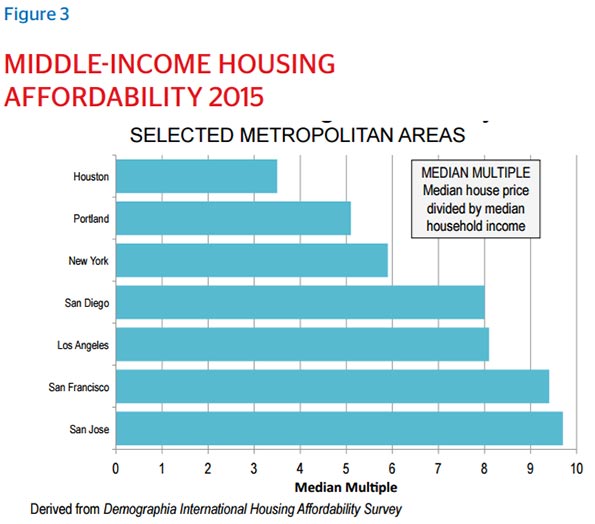
  • Three Steps to Fix America’s Election Process

    Almost everyone agrees that we just finished the most painful election season in anyone’s living memory, an agony made worse by the fact that it was nearly two years long. Fortunately, we aren’t doomed to repeat it, as we know many other countries have shorter and more civil election campaigns. Three changes to our method of electing presidents could reduce costs, save time, and make the process less divisive and more welcoming to voters.

    First, we should replace individual state primaries with a national primary in June. Individual primaries not only stretch out the election season and give a few states an inordinate say in the nominations, they also promote divisiveness because they force presidential candidates to concentrate on local issues that are outside the scope of the office of the president.

    Second, we should abolish the electoral college. Hillary Clinton won at least 200,000 more votes than Donald Trump, the second election in sixteen years where the winner of the popular vote didn’t win the election. Trump himself once wrote that “the electoral college is a disaster for democracy.”

    The traditional argument for the electoral college is that it encourages candidates to campaign throughout the country instead of one region and to pay attention to the small states as well as the large. In fact, it does exactly the opposite, leading candidates to focus on a handful of large battleground states that tend to flip between red and blue.

    This suppresses voter participation because people in other states know their votes won’t count, at least in the presidential race, which for many is the draw that brings them into the polling booth. Less than 56 percent of eligible voters cast ballots on Tuesday, and while some didn’t vote because they didn’t like the candidates, others abstained because they realized their vote wouldn’t affect the outcome in their particular state.

    A close look at the Washington Post‘s election map reveals that the real geographic divide is not between east and west, north and south, or big states and little states, but between urban and rural. Clinton won blocks of states on the West Coast and in the Northeast because those states are heavily urbanized, not because they have any common regional interest. The county map shows that major cities in red states such as Texas and Utah went for Clinton while rural areas in California and New York went for Trump. A strong correlation between the urban/rural split and Trump’s margin of victory/loss reveals that the degree of urbanization accounts for more than half of any state’s electoral result.

    Residents of New York City have more in common with people in San Francisco than they do with those in Plattsburgh, while residents of Portland have more in common with people in Austin than they do with those in Roseburg. In short, the electoral college fails to account for the geographic factors that are truly important. Eliminating the college would force candidates to appeal to a wider range of voters, thus stimulating voter participation and reducing alienation.

    The third change is to have a runoff if neither candidate gets a majority of the votes. A low-cost way to do this is through an instant runoff, where voters rank their choices. The candidate winning the fewest votes is eliminated and a winner is decided from amongst the rest of the votes. Whether a ranked vote or a separate election, a runoff could give third-party candidates more of a chance, especially if applied to state and local offices, because voters wouldn’t feel they are “wasting their votes” when they vote for a third party.

    These proposals might not have changed the winner of Tuesday’s election; Donald Trump clearly tapped into voter anger that many other people missed. On the other hand, if these changes were already in place, that anger might not have existed. Candidates would run very different campaigns: we’d have a shorter, less-costly election season; greater voter confidence that the system isn’t “rigged” by the electoral college; and more opportunities for people to express support for third party candidates.

    While there may be other good ways of fixing our election process, if we do nothing the best we can hope for is that the next election won’t be quite as bad as this one. That’s not a very happy thought, especially since, under the current system, the next presidential election campaign will begin in two years and the next congressional campaign will begin in two months.

    Randal O’Toole is a senior fellow with the Cato Institute specializing in land use and transportation policy. He has written several books demonstrating the futility of government planning. Prior to working for Cato, he taught environmental economics at Yale, UC Berkeley, and Utah State University.

    Photo by: By Tom Arthur from Orange, CA, United States (vote for better tape) [CC BY-SA 2.0], via Wikimedia Commons
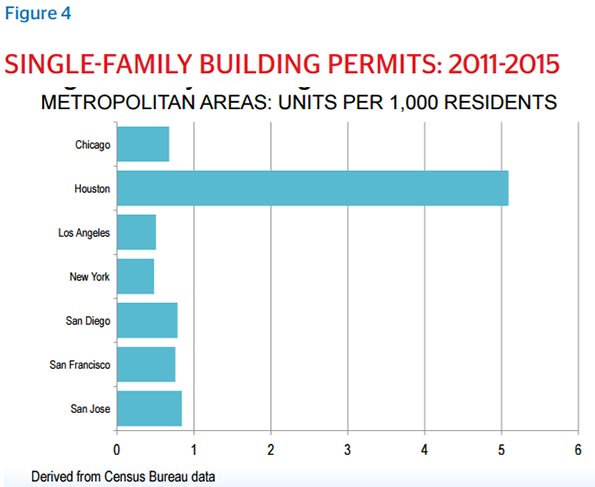
  • Five Ideas to Make America Greater

    Donald Trump’s presidential campaign was based on the notion that he could “Make America Great Again.” But beyond the rhetoric — sometimes lurching into demagoguery — the newly elected president comes to office, as one commentator suggests, “the least policy-savvy president in history.”

    To succeed, Trump must adopt innovative policies that transcend traditional right-left divides. He needs to find ways to help his heavily white, working-class base while expanding his appeal to minorities, millennials and educated people who are now largely horrified by his ascendency.

    In the short run, his biggest problem may lie with his own Republican Party establishment, which, rather than “drain the swamp,” would simply like to create one of its own. The looming presence of corporate lobbyists, swarming around the administration like hungry flies, is not encouraging at all, nor are GOP congressional plans to re-establish “earmarks.”

    The key lies not in empowering a different set of K Street parasites, but rather in reversing income stagnation. If he cannot, his triumph may prove to be no more consequential than an absurdist, Latin American-style telenovela.

    A flatter, fairer tax

    The basic instinct among many Republicans tends toward reducing taxes on their richest donors and making life easier for the ultrarich, including some on Trump’s economic team. Trump’s imperative should, instead, be to make the tax system fairer for the middle and working classes. One way would be to make a graduated flat tax that would mean that the rich, who make most of their money from investments, pay the same rate for capital gains as the rest of us do for income.

    Democrats will, no doubt, still charge Trump with being “unfair,” but, as Ronald Reagan proved 20 years ago, Americans support incentives for work if they don’t unfairly tilt conditions to the ultrarich. Main Street business owners, the most hostile constituency to the Obama administration’s policies, pay taxes based on their income and can’t manipulate the system like Apple, Google, Wall Streeters or, for that matter, real estate developers like Trump himself.

    A middle ground for immigration

    Opposition to illegal immigration helped drive the Trump campaign early on, but, outside of the GOP base, there is little support for a mass roundup of the undocumented. The vast majority of Americans, over 70 percent, also oppose “open borders.” After all, even President Obama evicted 2 million people during his two terms in office.

    Trump also can begin reordering our immigration policies toward skilled workers who are interested in becoming citizens. At the same time, Trump could score points by undermining the H1-B visa program, which allows Silicon Valley firms, along with corporations like Disney and Southern California Edison, to lay off American workers and replace them with temporary indentured servants.

    Read the entire piece at The Orange County Register.

    Joel Kotkin is executive editor of NewGeography.com. He is the Roger Hobbs Distinguished Fellow in Urban Studies at Chapman University and executive director of the Houston-based Center for Opportunity Urbanism. His newest book, The Human City: Urbanism for the rest of us, will be published in April by Agate. He is also author of The New Class ConflictThe City: A Global History, and The Next Hundred Million: America in 2050. He lives in Orange County, CA.

    Photo: Gage Skidmore from Peoria, AZ, United States of America (Make America Great Again hat) [CC BY-SA 2.0], via Wikimedia Commons
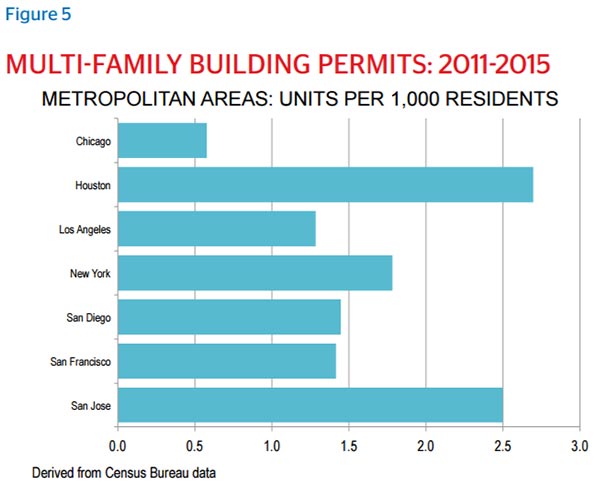
  • Here’s How Donald Trump Could End America’s New Feudalism

    One obvious, if little discussed, reason the progressive wave receded last week: The left’s increasingly unappealing economic agenda. In the past, progressives focused on improving conditions for working and middle class Americans through economic growth, home ownership and expansive infrastructure projects.

    Today, notes former Bill Clinton aide William Galston, progressives rarely promote economic growth, having developed a particular hostility to many of the industries—energy manufacturing, transportation and agriculture—that offer economic opportunity to millions of Americans. This new environmental orientation has been less than enthusiastically embraced away from the coasts, where Trump, not coincidentally, triumphed.

    In contrast to the old Democratic notions embraced by the likes of Harry Truman or the late California Governor Pat Brown, today’s progressives promote social control and the consolidation of a cognitively determined world order. Its promise amounts to forging a kind of high-tech middle ages in which the new aristocracy—techies, media grandees, financial moguls, academics, high-level bureaucrats—dominate while the middle class becomes increasingly serf-like.

    In this new neo-feudalism, property ownership, like power, is concentrated in ever fewer hands.

    Trumpism as anti-feudalism

    The Trump victory tapped into a class rebellion among middle- and working-class voters who feelthe most alienated and pessimistic about the future. The post-industrial, asset-inflated world so beneficial to the Apples, Googles, media stars and the trustifarians in glamour cities has been less kind to the middle and working class, whose incomes have dropped or stagnated over the past decade and a half.

    While some percentage of Trump’s supporters were fundamentally “deplorable,” this wasn’t the KKK triumph imagined by scriptwriter Adam Sorkin. Rather, he won with the support of many people who had previously voted for Barack Obama.

    White working class voters, endless mocked and sometimes even demonized in the media, were massively underestimated by the pollsters, as well — who used 2012 exit polls that undercounted as many as 10 million white voters over 45 to build their models for who would turn out in 2016. 

    And Trump dominated those voters, winning them by 40 percentage points — a 15 point improvement over Mitt Romney’s margin. Trump’s opponent, it should be noted, was also white.

    How feudalism could trump populism.

    It remains to be seen how Trump’s voters will feel about their choice in the years to come, but the basic incoherence of his world-view, along with the corporatist leaning of the Republican majority in Congress, could undermine any attempt to restore upward mobility

    There are fundamentally three forces driving our post-modern feudalization, all of them related. One is globalization, highlighted throughout the campaign, and clearly responsible for considerable job losses for certain classes and certain regions. As countries such as China and India move up the value-added chain, even higher-paid workers will face mounting economic competition. San Jose and Raleigh soon could feel some of  the pain that Youngstown and Flint have absorbed for decades.

    The second is immigration which, for all its many blessings, tends to depress wages for lower and middle workers. Many native-born Americans who used to enjoy steady work have joined the rapidly expanding, and economically vulnerable, precariat made up of contingent, irregularly employed workers. Both Bernie Sanders and Trump identified the problems faced by such workers by unrestricted immigration.

    Undereducated whites are not the only ones who are suffering from downward mobility. Trump trailed but still considerably outperformed previous GOP nominees among both Latinos and African Americans. Increasingly, educated workers are threatened by such things as -IB visas for skilled workers, which essentially replaces indigenous skilled workers with imported indentured servants. This has already resulted in job losses among IT workers at places like the Disney Company and Southern California Edison.

    The third driver of feudalization lies in the concentration of business and property ownership. Lenin once identified “small scale production” as what “gives birth spontaneously to capitalism and the bourgeoisie.” America’s small firms are in retreat while large corporations increasingly dominate everything from food to technologyFor the first time in our modern history, exits from business now exceed new incorporations.

    Similarly, home ownership has dropped to its lowest level in five decades, with the decline steepestamong young people. More millennialsnow live with their parents than with a partner. And when they do move out, they are often trapped into renting, often at high rates, with little chance of ever buying a house.

    The Religious Slant of Ecotopia

    The first feudal era was characterized by constrained class mobility, a decline of middle orders and a persistent concentration of power, first in feudal lords and later kings. But what held Medieval society together was an attachment to common articles of faith. Catholic dogma defined and justified the ascension of the aristocracy and royalty, and explained in theological terms both why the poor should accept their fate, and why middle-class aspirations were a threat to the moral order.

    Today religion is in, pardon the pun, secular decline. Particularly in the bluest states, it has been replaced by two new faiths. One is the green religion, now focused on climate change. The other new faith is technological determinism, the idea that there is a magical, disruptive solution to any problem, including those relating to nature.

    Nowhere are these two religions more commingled than in America’s Ecotopia, which extends from Northern California to the Pacific Northwest and is both the home to our leading tech companies and birthplace of modern environmentalism.

     Structural changes help explain this melding. Today Silicon Valley profits have become more centered on software and media than hardware, so the constraints associated with environmental regulations, such as high energy and water costs, have become less important to oligarchs. At the same time many Silicon Valley companies — notably Tesla/Solar City — have sought to profit from the shift to “green” energy, feeding on the beneficent federal subsidies attached to it.

    For these interests, the GOP’s great sweep represents a bit of an unexpected setback. The federal subsidies driving some of these industries are likely to be scaled back. Used to a cozy relationship with the White House, the tech elite, with the notable exception of Peter Thiel, finds itself on the outside looking in.

    Acolytes of the technocratic green ideology, hostile to Trump, geographically and ideologically removed from the rest of the nation and already functioning as a kind of wealthy, cossetted alt-nation, are now talking vaguely about succession. That conversation is driven in part by apocalyptic predictions about climate change generally accepted without skepticism in media, academic and political circles.

     Although couched in scientism, green politics should be seen as somewhat faith-based, a craving more about piety than practical reality. Both Bjorn Lomborg and NASA’s Richard Hansen, one of the earliest heralds of climate change, doubt that the measures embraced by the Paris accords will prove remotely effective in reducing temperature rise. California , a recent report demonstrates. could literally fall into the ocean with no appreciable impact on global temperature, particularly given that countries like China continue to boost their coal capacity.

    Neo-feudalism and the fate of the middle class.

    Most critically, the theology of green progressives will do as little good for today’s middle and working class people as extreme Catholic dogma did for the medieval peasantry. Overall, according to a recent Social Science Council report, California is now the most unequal state when it comes to “well being,” combining stupendous, mostly coastal wealth with the highest rate of poverty in the nation, concentrated inland.

    Neo-feudalism diminishes  the property owning middle-class. In the Bay Area, regional governments are now seeking to limit all new development to a mere fraction of the area’s land mass, all but guaranteeing the future generations will face almost impossibly high housing prices. And a new set of state regulations, including a requirement that new houses have “zero” net energy use all but guarantees that houses, over time, will continue becoming ever more expensive.

    The Bay Area’s regional plan also says goodbye to the American dream, suggesting that 82 percent of all new housing should be rental. Ultimately there will be little left for “little people” save for low end service jobs and benefit-less roles in the gig economy   created by the oligarchs  . Tech firms in the Valley employ shockingly few Latinos or African Americans, who make up barely 6 percent, for example, of Facebook’s workforce. And that’s better than the average of barely 5 percent among the leading tech firms.

    Older industries do far better on these terms. In manufacturing, 16.2% of workers are Latinos and 9.7% are African America, according to 2015 data.  In mining, quarrying and oil and gas extraction, Latinos make up 16.9% of the workforce and African-Americans 4.8%, while in agriculture, forestry, fishing and hunting, nearly a quarter of the workforce—23%—is Latino and 2.7 percent is African-American.

    As the green ideology undermines the last bastions of the middle and working class economy, some of the most extreme “ethnic cleansing” is taking place in such cities as San Francisco, Portland and Seattle, where high prices, regulations ,  sometimes aided local redevelopment,  have worked to push minorities to the poorer suburbs, or out of the region entirely.

    Oligarchs and Alms for the Poor

    Silicon Valley’s answer to this to this reality is hardly reassuring. At a conference on environmental economics several years back, I discussed with a prominent Silicon Valley venture capitalist the impact of these policies on homeownership and family formation. A low birthrate didn’t faze him because he believed “we really don’t need people now,” at least not those without special skills. Ultimately robots will do most of the basic work, he explained.

    Of course, if the largely childless hipsters on of San Francisco may accede to this view, it’s unlikely that many others, including the poor and undocumented immigrants, will embrace the post-human perspective at the heart of Silicon Valley. Of course the oligarchs have a solution to the marginalization of the masses: a pool of subsidies to help cover artificially inflated housing and energy costs. Elon Musk and other valley heavyweightssupport a government-sponsored minimum income for what they regard as an  increasingly redundant population.

    The oligarchs do not want risk a rebellion from below; the Trump victory demonstrates that potential. Yet don’t worry much about their being burdened by their call for societal generosity. Skilled at tax avoidance, they’ll pass the bill on to the remaining middle and working class residents, while the regulatory clerisy, both in government and the universities, enjoy pensions and other protections unavailable to the masses.  

    Trump and the New Feudalism

    For all the awfulness associated with Trump, his election stemmed from a disinclination among Americans to accept their place in the new technocratic order. Trump is best praised for some of the enemies he has made—movie stars and hierarchs of the environmental left, the racial grievance industry, the high-tech oligarchs, the bureaucracy and a university system that serves largely as a giant re-education camp. Not surprisingly, those enemies are having a collective fit about his victory.

    Yet for all the pleasure one can derive from this spectacle, it’s dubious that Trump, himself the licker off a silver spoon, will be effective at slowing America’s slide towards neo-feudalism. After all, his basic policy instincts tend to be wrong: cutting taxes on the rich is not what the middle and working classes need. And banning illegal immigration and engaging in trade wars may help some industries, but will certainly hurt others. By themselves, there’s no chance that those steps will restore prosperity to so many Americans.

    But Trump’s working-class-fueled victory should finally convince the operatives in both parties that restoring upward mobility constitutes our  great political challenge. There could be some common ground in policies that embrace things like expanding skills  education and economically useful infrastructure, relaxing federal regulation and reducing taxation of small enterprise.

    What Trump deserves credit for—perhaps the only thing he deserves credit for—is derailing the predictable transition of the same old insiders who would feed at the trough in a Clinton Inc. administration. Now it’s up to the rest of us—those who supported him and those, like me, who did not—to determine that making America “great again” also means standing up to the new feudalism, and chasing this regressive order back into the darkness of the past, where it belongs.

    This piece first appeared at The Daily Beast.

    Joel Kotkin is executive editor of NewGeography.com. He is the Roger Hobbs Distinguished Fellow in Urban Studies at Chapman University and executive director of the Houston-based Center for Opportunity Urbanism. His newest book, The Human City: Urbanism for the rest of us, will be published in April by Agate. He is also author of The New Class ConflictThe City: A Global History, and The Next Hundred Million: America in 2050. He lives in Orange County, CA.

    Photo by Gage Skidmore from Peoria, AZ, United States of America (Donald Trump) [CC BY-SA 2.0], via Wikimedia Commons
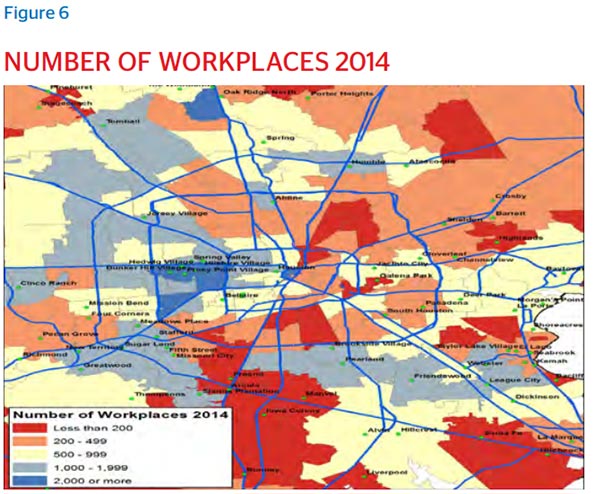
  • San Francisco Observations
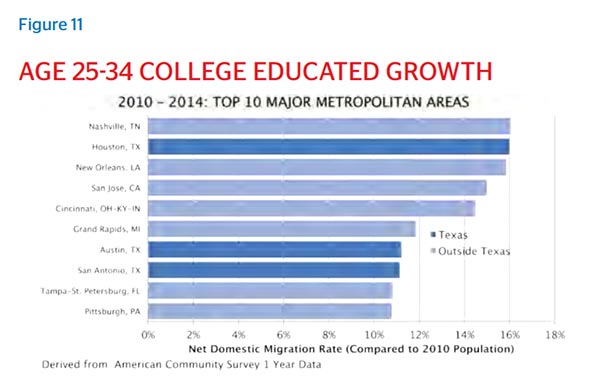
    I made quite a few trips to San Francisco during the late 90s into the early 2000s, but hadn’t been back in a very long time – probably close to 15 years.

    Recently I was there for a conference and a long weekend and got to spend some time exploring the city. I won’t claim a comprehensive review, but I did have a few takeaways to share.

    1. Fewer homeless than expected. Based on the rhetoric you read in the papers, I expected SF to be overrun with aggressive homeless people. This wasn’t the case. There were visible homeless to be sure, but no more than I remember from 15 years ago and no more than I see in New York. And they were not particularly aggressive in any way.

    2. A curiously low energy city. It’s tough to judge any American city’s street energy after living in New York, but San Francisco felt basically dead. Tourist areas around Union Square and the Embarcadero were crowded, and the Mission on a Friday night was hopping, but otherwise the city was very quiet. Haight-Ashbury was nearly deserted and many neighborhoods had the feel of a ghost town. It’s very strange to be walking around a city with such a dense built fabric but so few people.

    3. San Francisco is too small to support a centralized economy. The Financial District has a number of skyscrapers, and SOMA is awash in construction – the biggest changes I observed were in this district – but central San Francisco is too small to serve as a global city business center. And the city as a whole is not big enough to support that kind of a resident base. The bottom line is that San Francisco’s constrained geography renders the construction of a CBD in the style of a Chicago or New York very difficult. Also, at only around 856,000 people – an all time record high – the absorption capacity of the city is limited. Contrast with NYC at 8.5 million, LA with 4 million and Chicago with around 2.7 million in much bigger geographies. Also, the transport geography of San Francisco does not include the type of massive commuter rail system that NYC, London, Chicago, etc. have. In short, I don’t see SF having the capacity for a much greater degree of employment centralization.

    4. Major construction is undesirable in San Francisco. As I’ve written before, San Francisco is one of America’s most achingly beautiful cities with a very unique building stock. It’s also, like Manhattan, mostly fully developed. So new construction in most places would involve demolition of the existing building stock. No surprise SOMA is where the construction is, because there’s room to do it and/or lower quality buildings to replace. To make a serious increase in the quantity of residential or office space would involve significant damage to the character of the city and would not in my view be desirable. Nor, given the point above about its small size, is it likely to make much of a difference anyway. It’s hard to see how the city of San Francisco itself changes its trends without an economic pullback.

    5. San Francisco doesn’t feel like it has the services of a high tax city. Taxes are high in San Francisco, but it many ways it doesn’t feel like it. In New York, our taxes are high, but the level of services is highly visible, at least in Manhattan. Just as one small example, SF’s storm drains were often partially blocked with leaves, and there were pools of standing water even on Market St. In NYC, BID employees or building supers regularly clear storm drains and sweep water into sewers. Our parks are in better shape. I was surprised to see that SF still has curbs with no ADA ramps. In short, while the city is beautiful and such, it doesn’t radiate the feel of high services.
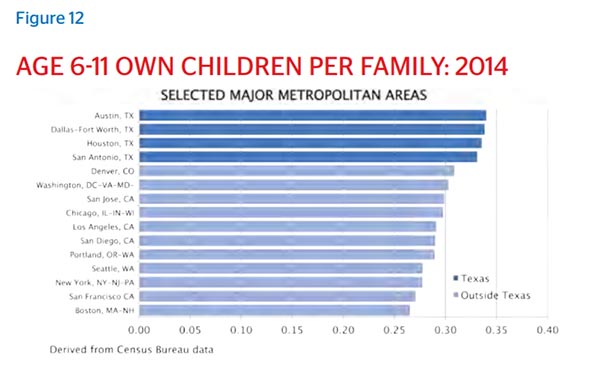
    6. Barrier and POP transit system. I ran into a curious situation while riding transit. Muni, the city’s transit agency, has a light rail system called Muni Metro. It runs as a subway under Market St. Because it runs on street elsewhere, the trainsets are pretty short. I rode the subway portion, which has a barrier system. But then on the train my ticket was checked again by a conductor. Why have barriers if you are running a POP system on top of it? I’m glad I saved my ticket.

    7. San Francisco Opera. I attended my first opera in San Francisco. The San Francisco Opera is a very globally respected company. The opera, Janacek’s The Makropulous Case, was very good. It was well-patronized but there were plenty of empty seats too. It has the feel of the Lyric Opera of Chicago, where the majority of attendees are subscribers. The average age was very high – much higher than the Met Opera, which although suffering a serious attendance problem draws quite a few young people. The SF Opera’s patron base is getting up there. I also took a look through the program. I did not see a single tech company on their list of corporate sponsor, nor did I see any tech names I recognized on their major donor list. Opera in San Francisco appears to be an old money affair, with the emphasis on old. This doesn’t bode well for the future of this flagship cultural organization if it can’t find a way to tap into younger attendees and donors. I’d have to caveat this somewhat given that my investigation is very limited. But this is a trend affecting many similar organizations.

    Aaron M. Renn is a senior fellow at the Manhattan Institute, a contributing editor of City Journal, and an economic development columnist for Governing magazine. He focuses on ways to help America’s cities thrive in an ever more complex, competitive, globalized, and diverse twenty-first century. During Renn’s 15-year career in management and technology consulting, he was a partner at Accenture and held several technology strategy roles and directed multimillion-dollar global technology implementations. He has contributed to The Guardian, Forbes.com, and numerous other publications. Renn holds a B.S. from Indiana University, where he coauthored an early social-networking platform in 1991.