Category: Economics

  • Memo to the Next President: Don’t Forget the Working Class

    At the end of most US presidential elections, most Americans are ready to see the last of campaign ads, social media commentaries and tension-fraught news coverage. That’s even more true this year. But more than in most recent elections, we shouldn’t expect the frustrations and divisions that have surfaced over the past 18 months to disappear after the ballots have been counted. Tensions over class and race, especially, may die down, but they aren’t going away. If a new president will take them on, something good might yet emerge from this ugly election.

    Although it’s true that working-class voters are declining in number, they have drawn increasing attention over the past several elections, in part because, as Ruy Teixeira and his colleagues at The Democratic Strategist have been arguing for a while, they remain a crucial demographic. And this year, the white working class has not only been recognized as a key voting bloc, it has been an active player, demanding that the country and its leaders recognize the economy does not work for many Americans.

    Amid far too many reports that have pinned Donald Trump’s success on the white working class, this year’s election coverage also has drawn attention to real problems, many of them rooted in class and racial inequalities. If the next president wants to succeed she (or he) must address what design experts call “wicked problems” — big, complex issues that resist simple explanations or one-dimensional solutions. It won’t be easy.

    The election has created the conditions for addressing the first of those: class resentment. I don’t mean the resentment poor and working-class people feel toward the wealthy. I mean the resentment they feel toward a government that doesn’t seem to care about them or have the will to address economic inequality. I’m also talking about resentment toward a public discourse that denigrates and blames working-class people for not being more like the middle class. WNYC’s On the Media provided a terrific overview of that discourse in a series of reports about common and problematic assumptions that shape reporting on poverty. As host Brooke Gladstone explained, reliance on these assumptions generates media that reinforces the idea that people are poor because they don’t work hard or because they make bad choices. No matter how much we might deplore some of the behavior and attitudes that have surfaced in the election, we can’t address the class-based cultural divide by dismissing poor and working-class people as “deplorables” who lack the critical thinking skills that college education provides.

    Good leadership could address class resentment not only with better policies — more on that below — but also by taking it seriously. While claims that Trump’s support comes primarily from the white working class are problematic, both he and Bernie Sanders won votes this year because they addressed working-class people’s sense of being left behind by the economy and put down by the media. Both also recognized a simple truth about American culture: Class is a central and increasingly important divide. A good president will acknowledge that, but also will lead the way in fostering deeper and more critical conversations about the economic, social and cultural roots of those divisions.

    Of course, the cultural divide reflects a very real and serious economic gap, and a good leader must be willing to talk about its sources and consequences — including the way contemporary global capitalism, neoliberal ideology and technology drive economic changes that deepen inequality. We need to create more jobs through infrastructure projects among other strategies. But we also need policies that address not only the quantity of jobs but also their quality — what they pay, how they are structured and how workers are protected from exploitation as well as physical and psychological injuries. Raising the minimum wage is just a start. American economic leaders need to look critically at the effects of the “gig economy” and rising precarity, a term some scholars have coined to describe the uncertainty facing many workers who can’t count on a regular paycheck. Instead of pushing for everyone to go to college, we need to focus on ensuring that the thousands of working-class jobs that our economy will continue to produce are good jobs. This doesn’t necessarily mean bringing back manufacturing. It probably does mean bringing back the labor movement, with a broader and more inclusive social unionism.

    Inequality doesn’t stem only from employment, however. As Jack Metzgar has argued, we need tax policies that focus less on the persistent fantasy of trickle-down economics and instead put cash into the pockets of the working class, who will spend it. We could expand the earned income tax credit and increase credits to help families pay for child care, housing or college. We also need to take another look at health care. The Affordable Care Act was a step in the right direction, with in its emphasis on providing insurance to those who hadn’t had it previously, but it still relies on the private insurance industry. It’s time to develop a single-payer system that puts first the needs of ordinary people, not those of a profit-based industry.

    Perhaps the most troubling problem that has surfaced in this year’s election is racism. While some have challenged stories that present racism as a white working-class problem, we also know that racism and racial divisions are real problems for working-class people. Racism is a class issue, in multiple ways. First, racial division undermines the class solidarity that could generate social change movements. It also distracts people from the real source of their problems — not other poor and working-class people, but the economic and political system that, as Guy Standing has suggested, is rigged against workers and what, in today’s economy, he has named the “precariat.”

    At the same time, racism presents a threat to working-class people. While the profiling and anxieties that underlie police violence toward black people sometimes target middle-class (and upper-middle-class) African-Americans, working-class black men are probably at greater risk. Here, too, we need policies that more forcefully address racial injustice and divisions, to ensure that citizens are protected by the police rather than needing protection from them. But we also need policies that facilitate more racial interaction. Among the most interesting insights on this year’s election was Jonathan Rothwell’s analysis of Gallup poll data, which revealed that Trump’s strongest support came from white people living in highly segregated areas. Racism is a structural issue, not just a matter of morality or attitudes, and we need to address it with policies that challenge housing and education segregation and inequities.

    None of this is easy, and these “solutions” are as limited as they are idealistic. I’m sure there are better ideas out there. Our next president needs to find them. She (or he) must pay attention — not only to the anger and frustration of working-class people but also to the complex nature of the problems that generate those feelings.

    In 2008, Barack Obama’s campaign tried to keep his supporters’ momentum going by creating Organizing for America, which became Organizing for Action, a network of community organizing groups that largely faded from the national picture. This year, we need more.

    Whatever the result of Tuesday’s election, neither the media nor the new president should stop talking about and listening to the working class. It’s time to move from campaign mode to action, from courting working-class voters to addressing the conditions of their lives.

    Note: This essay was first published by Moyers & Company.

    Sherry Linkon is a Professor of English and Director of the Writing Program at Georgetown University.  She is co-author, with John Russo, of Steeltown USA: Work and Memory in Youngstown (Kansas 2002) and is working on a book-length study of contemporary American literature about deindustrialization.

    Photo by: By Michael Vadon [CC BY-SA 2.0], via Wikimedia Commons

  • The Improbable Demographics Behind Donald Trump’s Shocking Presidential Victory

    n an election so ugly and so close, one is reluctant to proclaim winners. But it’s clear that there’s a loser — the very notion of the United States of America.

    Instead we have populations and geographies that barely seem to belong in the same country, if not on the same planet. The electorate is so divided that many states went for either Donald Trump or Hillary Clinton by lopsided margins. The Northeast was solidly Democratic, with Clinton winning New York, Massachusetts and Vermont with three-fifths of the vote or more. Washington, D.C., heavily black and the seat of the bureaucracy and pundit class, delivered an almost Soviet-style 93% to 4% margin.

    On the other side were a series of states where Trump won just as easily, including Tennessee and Kentucky, with three-fifths of the vote, and West Virginia, by a margin of two-to-one  – higher than those attained by 2012 GOP presidential candidate Mitt Romney.

    Much of the rest of the map has followed the usual patterns: Democratic domination of Illinois and the West Coast, while Republicans held the South. Where the election was decided was in previous battleground states: Florida, North Carolina and Ohio.

    The Revolt of Middle America

    America is a nation of many economies, but those that produce real, tangible things — food, fiber, energy and manufactured goods — went overwhelmingly for Trump. He won virtually every state from Appalachia to the Rockies, with the exceptions of heavily Hispanic Colorado, Nevada and New Mexico, and President Obama’s home base of Illinois.

    Some of his biggest margins were in energy states — Texas, Oklahoma, West Virginia, Wyoming, North Dakota — where the fracking revolution created a burst of prosperity. Generally speaking, the more carbon-intensive the economy, the better the Republicans did. Many of his biggest wins took place across the energy-producing regions of the country, including Ohio, Texas, Louisiana, Wyoming, Idaho, and especially West Virginia, where he won by a remarkable margin of 68% to 27%. The energy industry could well be the biggest financial winner in the election.

    The Green Trap

    Clinton’s support for climate change legislation, a lower priority among the electorate than other concerns, was seen as necessary to shore up support from greens threatening to attack her from the left. Yet the issue never caught on the heartland, which tends to see climate change mitigation as injurious to them.

    This may have proven a major miscalculation, as the energy economy is also tied closely to manufacturing. Besides climate change, the heartland had many reasons to fear a continuation of Obama policies, particularly related to regulation and global trade, which seems to have been a big factor in Trump’s upset win in normally moderate to liberal Wisconsin.

    Trump either won, or closely contested all the traditional manufacturing states — Ohio, Wisconsin, Indiana, Iowa and even Michigan, where union voters did not support Clinton as they had Obama and where trade was also a big issue. Trump did consistently better than Romney in all these states, even though Romney was a native of Michigan. Perhaps the most significant turnaround was in Ohio, which Obama won with barely 51%  of the vote in 2012. This year Trump reversed this loss and won by over seven points.

    Agricultural states, reeling from the decline of commodity prices, not surprisingly, also went for the New Yorker.

    Premature Epitaphs For The White Voter

    Race, as is often the case, played a major role in the election. For much of the election, commentators, particularly in the dominant Eastern media, seemed to be openly celebrating what CNN heralded as “the decline of the white voter.” The “new America,” they suggested, would be a coalition of minorities, educated workers and millennials.

    To be sure, the minority share of the electorate is only going to grow — from less than 30% today to over 40% in 2032 — as more white Americans continue to die than be born. Just between 2012 and 2016, the Latino and Asian electorate grew 17% and 16%, respectively; the white electorate expanded barely 2%.

    In Colorado the new minority math was seen, with a strong showing among Latinos, the educated suburbs around Denver and millennials.

    That may be the future, but now is now. Exit polling nationwide showed Trump won two-to-one among people without a college degree, matched Clinton among college graduates, losing only those with graduate degrees, a group that has voted for the Democrats since 1988.

    But there’s simply more high school graduates then those with graduate degrees. And for now there are a lot more whites than minorities. As we look into the future, these groups will fade somewhat but right now they can still determine elections. Nowhere is this clearer than in Trump’s decisive win in Florida, a state that is home to many white retirees, including from the old industrial states.

    Latinos may be the one group in the “new America” that made a difference for Clinton, not only in Colorado, but also in Nevada. Republicans paid a price for Trump’s intemperate comments on immigration and about Mexico.

    They also made states like Texas and North Carolina closer, and may have helped secure Clinton’s win in Virginia. In contrast, neither African-Americans or millennials seem to have turned out as heavily, both in numbers and percentage terms, as they did for President Obama. Trump appears to have made some modest gains with both groups, contrary to the conventional wisdom.

    Class Warrior

    Class has been a bigger factor in this election than in any election since the New Deal era. Trump’s insurgency rode largely on middle- and working-class fears about globalization, immigration and the cultural arrogance of the “progressive” cultural elite. This is something Bill Clinton understandsbetter than his wife.

    Trump owes his election to what one writer has called “the leftover people.” These may be “deplorables” to the pundits but their grievances are real – their incomes and their lifespans have been decreasing. They have noticed, as Thomas Frank has written, that the Democrats have gone “from being the party of Decatur to the party of Martha’s Vineyard.”

    Many of these voters were once Democrats, and feel they have been betrayed. And they include a large swath of the middle class, whose fury explains much of what happened tonight. Trump has connected better with these voters than Romney, who won those making between $50,000 and $90,000 by a narrow 52 percent margin. Early analysis of this year’s election shows Trump doing better among these kind of voters.

    At the same time, however, affluent voters — those making $100,000 and above — seem to have tilted over to the Democrats this year. This is the first time the “rich” have gone against the GOP since the 1964 Goldwater debacle. Obama did better among the wealthy, winning eight of the 10 richest counties in 2012. In virtually all these counties, Clinton did even better.

    What does this mean for America’s traditional middle class, whose numbers have been fading for a generation? Long the majority, notes Pew, they are no longer, outnumbered by the lower and upper classes combined. Yet like the Anglo population, in this election what’s left of America’s middle class has shown itself not ready to face the sunset.

    Now What?

    Given the unpredictable nature of Trump, it’s hard to see what he will do. Although himself a businessman, he was opposed overwhelmingly by his own class. Clinton won more support from big business and the business elite. If you had a billionaire primary, Clinton would have won by as much as 20 to 1.

    Initially many of those business interests closest to both Obama and Clinton — Wall Street, Silicon Valley, Hollywood — will be on the outside looking in. Their advantages from tax avoidance could be lessened. Merger-mania, yet another form of asset inflation, will continue unabated, particularly in the tech and media space.

    The clear challenge for (I can’t believe I am writing these words) President Trump will not be so much to punish these enemies, but to embrace those people — largely middle class, suburban, small town and white — who are not part of his world, but made him President. If he embraces his role as a radical reformer, he could do much good, for example with a flatter tax system, restoring federalism, seizing the advantage of the energy revolution and reviving military preparedness.

    The question is whether he will, or is capable, of doing these things. A Hillary Clinton administration would have been safer, and predictable, but it would not have addressed the very things that made Americans turn to this bizarre political poseur. Now it’s up to Trump to live up to his promise to restore the country’s self-confidence, and, for the rest of us, to make sure he does it in accordance with the Constitution and basic decency.

    This piece first appeared at Forbes.

    Joel Kotkin is executive editor of NewGeography.com. He is the Roger Hobbs Distinguished Fellow in Urban Studies at Chapman University and executive director of the Houston-based Center for Opportunity Urbanism. His newest book, The Human City: Urbanism for the rest of us, will be published in April by Agate. He is also author of The New Class ConflictThe City: A Global History, and The Next Hundred Million: America in 2050. He lives in Orange County, CA.

    Photo by Gage Skidmore [CC BY-SA 3.0], via Wikimedia Commons

  • Economic Participation Matters Most

    This piece first appeared at Real Clear Policy.

    POLICIES FOR THE NEXT ADMINISTRATION. PART 10: ECONOMIC INEQUALITY

    This is the tenth in a series on the major policy ideas — from Left and Right — that should guide the next presidential administration’s agenda. (For the opposing view, see David Madland, “A Path Forward for the Middle Class and the Country.”)

    Do we want to live in a society in which people profit when they have new ideas, products, and abilities that others are willing to pay for? If so, then we will also have economic inequality. 

    To most economists and ordinary Americans, inequality is the price we pay for an economy that rewards innovation, risk, and hard work. The topic has been a recurrent theme in our recent political discourse, however, because of two things: the outsized income of the nation’s top earners and the stagnation, or tepid growth, of middle-class incomes. The question is whether we think these two trends say something bad about America, and if so, what public policy can do about them.

    On the first issue, the rising incomes of the rich, politicians and advocates who want to reduce inequality typically rely on one of three rationales. 

    First, there is the “piece of the pie” rationale. This view regards the economy as a kind of zero-sum game in which larger slices of the economic pie for the rich mean less for everyone else. But the evidence for this view is dubious at best. Even Paul Krugman has claimed to be a skeptic of the idea that inequality affects economic performance.

    The second rationale is a kind of moral objection: It is simply wrong, or unfair, for the rich to earn so much. Behind the veil of ignorance, as the political philosopher John Rawls taught us to think, no one would choose to live in a society where 1 percent of the population earns more than $430,000 while everyone else averages one-eighth that amount. But, the fact is, we live in a non-Rawlsian reality in which many would roll the dice and say, “I’ll take those odds!” 

    Besides, as polls suggest, everyday Americans just don’t care about inequality as much as they care about upward mobility. They may dislike faceless “bankers” and “CEOs of insurance companies,” but they admire Steve Jobs and Mark Zuckerberg, whose earnings make most bankers and insurance executives look middle class.

    The third rationale blames cronyism, the “rigged game,” for making people rich. It is unlikely that cronyism is the main driver of the top 1 percent’s income. Still, as research from Boston University’s Jim Bessen shows, there is a positive relationship between growing corporate profits and lobbying. And Sutirtha Bagchi and Jan Svenjar have found that inequality is greater in countries whose richest citizens earn their wealth through cronyism rather than free enterprise. We live in an era in which the CEO of Goldman Sachs praises Dodd-Frank for making things better for Goldman. Clearly, we have policy work to do to fix this.

    But the energy policymakers and pundits spend worrying about the super-rich might be better spent focusing on the second initial question: What do we do about lower and middle-class incomes that are not rising as they should? 

    If we get this question right, maybe the first one becomes less important. This seems to be what Adam Smith’s mentor and friend David Hume had in mind back in 18th-century Scotland. Hume observed merchants, who were not welcome in elite society, earning “great profits” by importing and exporting novel and innovative products. Their success made them “rivals in wealth to the ancient nobility.” Commercial exchange had narrowed the gap between the birthright rich and an enterprising class of hardscrabble commoners. 

    Not only merchants saw their lot improve. The growing taste for newer and better products prompted ordinary people to become innovators and to get in on the action, producing “every home commodity to the utmost perfection of which it is susceptible…[S]teel and iron, in such laborious hands, [had] become equal to the gold and rubies of the Indies.”

    What Hume called “luxury” — goods from overseas and improved products through innovation at home — was no longer the domain of kings and aristocrats alone. The iPhone 4 replaced the flip phone, and the iPhone 6 surpassed the iPhone 4 — not just for the king, but for you. Not only did luxury make life better, it opened up new opportunities to earn a living for those making the products. 

    Detouring through 18th-century Scotland reminds us that upward mobility comes not primarily from redistributing money from the nobility to the poor but through economic participation — that is, encouraging work in those sectors of the economy where innovation and growth are robust.

    The problem in America today is that some people are participating in the growing, opportunity-rich parts of the economy and others are not. It is the inequality among the 99 percent, not the 1 percent, that matters most in America. MIT’s David Autor has calculated that growth in income between the top and bottom of the 99 percent between 1979 and 2012 was four times greater than the redistribution of income from the entire 99 percent to the top 1 percent.

    The so-called “hollowing out” of the middle class can be understood in these terms. As Pew has reported, of the 11 percent decrease in middle-class households between 1971 and 2015, 7 percentage points are the result of families moving up and out of the middle class. Of the remaining 4 percent that moved down, a large share can be explained by the growth in immigrants working in low-wage jobs. 

    The best way up for people is — and always has been — the capacity to participate in the economy as an employee, entrepreneur, or owner. No amount of redistributive policy can achieve the same result. The safety net, as the name implies, is to prevent downward mobility; it has never been a very good trampoline. 

    Given the gap between the top and bottom of the 99 percent, we need to focus with revolutionary zeal on increasing economic participation among marginalized workers. To do this, our approach to workforce development should emphasize the following:

    1. High school certification paths in high-demand skills. Career and technical education needs to move from a sideshow to a central part of high school curricula. The programs should be flexible, using online learning platforms and easily convertible physical space so schools can quickly offer new programs as market demand changes. Also, in place of textbook economics, students should learn about the role of investors and owners in the economy, how firms are formed, what innovation is, and which companies are successful and why.

    2. Apprenticeships for the American economy. Current workforce-development funding should shift to support on-the-job training more than classroom vocational training. Given the flexibility of the U.S. labor market, employers should bear minimal cost in the event that the apprentice leaves for another company.

    3. Increased rate of new business creation. This may sound more pro-entrepreneur than pro-worker, but the reality is that new companies: create most of the new jobs each year; employ a disproportionate number of young people; and pay on par with more established firms. Sophisticated startups with patents and Delaware registrations are doing well. The rest, not so much. Local clubs, entrepreneur networks, school partnerships, and other ways of connecting would-be entrepreneurs to real entrepreneurs as well as to investors and lenders are needed now more than ever.

    We need a policy environment that connects people to the growing, highly productive sectors of our economy. This will do more to “make work pay” than conventional ideas such as setting wage floors, making marginally effective community colleges “free,” and strengthening unions. The only way to increase mobility and deal with inequality is to increase the earning power and vocational prospects of people who are currently on the outside looking in.

    This piece first appeared at Real Clear Policy.

    Ryan Streeter is the Executive Director of the Center for Politics and Government at the University of Texas at Austin.

  • Can Working Class, Elite Form Alliance?

    Can the party of oligarchy also be the party of the people? Besides fending off the never-ending taint of corruption, which could weaken the extent of her “mandate,” this may prove the central challenge of a Hillary Clinton regime.

    No candidate in recent memory — at least, not since Lyndon B. Johnson in 1964 — has enjoyed more universal support from the rich, powerful and well-connected. They have provided her with “a towering cash advantage,” as a recent Bloomberg column described it, over her opponent. By one estimate, she is getting funds from 20 times as many billionaires as Trump.

    Yet, at the same time, Clinton faces a challenge from strident, and often anti-business, populists who now control much of the party base. The presidency may soon belong to Hillary, but its heart belongs to Vermont Sen. Bernie Sanders and Massachusetts Sen. Elizabeth Warren.

    These trends will pose a difficult, but not necessarily insurmountable, challenge. The Peronist Kirschners, Nestor and Christina, ruinously dominated Argentina’s politics for 12 years by providing lavish favors for business supporters while they expanded the country’s welfare state.

    Perhaps a more uplifting model could be gleaned from late 19th-century Britain, where “Tory Democracy” sought to forge an alliance between the struggling working class and the traditional landed gentry. This strategy was largely designed by Benjamin Disraeli, who served two terms as prime minister.

    This piece first appeared at The Orange County Register.

    Joel Kotkin is executive editor of NewGeography.com. He is the Roger Hobbs Distinguished Fellow in Urban Studies at Chapman University and executive director of the Houston-based Center for Opportunity Urbanism. His newest book, The Human City: Urbanism for the rest of us, will be published in April by Agate. He is also author of The New Class ConflictThe City: A Global History, and The Next Hundred Million: America in 2050. He lives in Orange County, CA.

    Photo by Gage Skidmore from Peoria, AZ, United States of America – Hillary ClintonCC BY-SA 2.0

  • Cat and Mouse in Frogtown

    A friend recently expressed an interest in how some cities are reforming their land use regulations. “I mean, there are places like LA that say they’ve thrown out the code books and are rewriting their zoning.” My short response was… No. The reality is that the city plays an expensive and byzantine game of cat and mouse with each individual neighborhood.

    screen-shot-2016-09-20-at-12-46-43-am


    There’s a little sliver of brassiere shaped land wedged between the Los Angeles River and the Golden State Freeway that sums up a lot of what constitutes the land use regulation process in LA. When poor Mexicans were forcibly removed in order to build Dodger Stadium in the late 1950’s they resettled in this inexpensive semi-industrial zone called the Elysian Valley, which is also commonly known as Frogtown.

    screen-shot-2016-09-24-at-5-53-58-pm

    screen-shot-2016-09-24-at-5-54-44-pm

    screen-shot-2016-09-25-at-5-12-11-pm

    screen-shot-2016-10-01-at-4-30-10-pm

    It’s been a solid working class neighborhood for decades. Families have long managed to own modest homes and live in respectable obscurity among the auto body shops, plumbing supply warehouses, and municipal maintenance facilities.

    screen-shot-2016-10-01-at-8-26-31-pm

    screen-shot-2016-10-02-at-2-15-09-pm

    screen-shot-2016-09-25-at-5-35-22-pm

    screen-shot-2016-09-25-at-5-35-49-pm

    screen-shot-2016-09-25-at-5-49-55-pm

    screen-shot-2016-09-25-at-6-00-20-pm

    In recent years the adjacent neighborhoods of downtown Los Angeles, Echo Park, Silver Lake, Atwater Village, and Glassell Park (all previously ignored and undervalued) have become newly fashionable and prohibitively expensive. Pent up market demand acts like a balloon – if you squeeze the middle the ends bulge. In this case home buyers, renters, and businesses have scoured the area looking for alternatives. Frogtown is a centrally located and relatively affordable compromise.

    screen-shot-2016-10-02-at-9-02-47-pm

    screen-shot-2016-10-02-at-9-20-26-pm

    screen-shot-2016-10-02-at-9-21-04-pm

    Design firms, architects, photographers, tech incubators, high end specialty fabricators, and other such enterprises have moved in to the nondescript buildings of Frogtown. If you’re willing to celebrate concrete block walls and corrugated steel as honest industrial materials you can create the trendy Dwell look with paint and landscaping on the cheap. Compare this process with the expense of restoring a more exotic historic property in a tony neighborhood.

    screen-shot-2016-10-02-at-9-13-11-pm

    screen-shot-2016-10-02-at-9-09-21-pm

    screen-shot-2016-10-02-at-9-08-32-pm

    screen-shot-2016-10-02-at-9-07-54-pm

    screen-shot-2016-10-02-at-9-07-03-pm

    screen-shot-2016-10-02-at-9-06-32-pm

    Art Yanez is a Los Angeles native and the son of immigrants. He’s also the principal of FSY Architects. He purchased three contiguous parcels in Frogtown and created a campus for his firm.

    screen-shot-2016-10-17-at-5-18-27-pm

    screen-shot-2016-10-02-at-9-15-37-pm

    screen-shot-2016-10-02-at-9-15-50-pm

    screen-shot-2016-10-02-at-9-19-49-pm

    screen-shot-2016-10-02-at-9-06-02-pm

    screen-shot-2016-10-02-at-9-05-53-pm

    screen-shot-2016-10-02-at-9-12-49-pm

    screen-shot-2016-10-02-at-9-04-15-pm

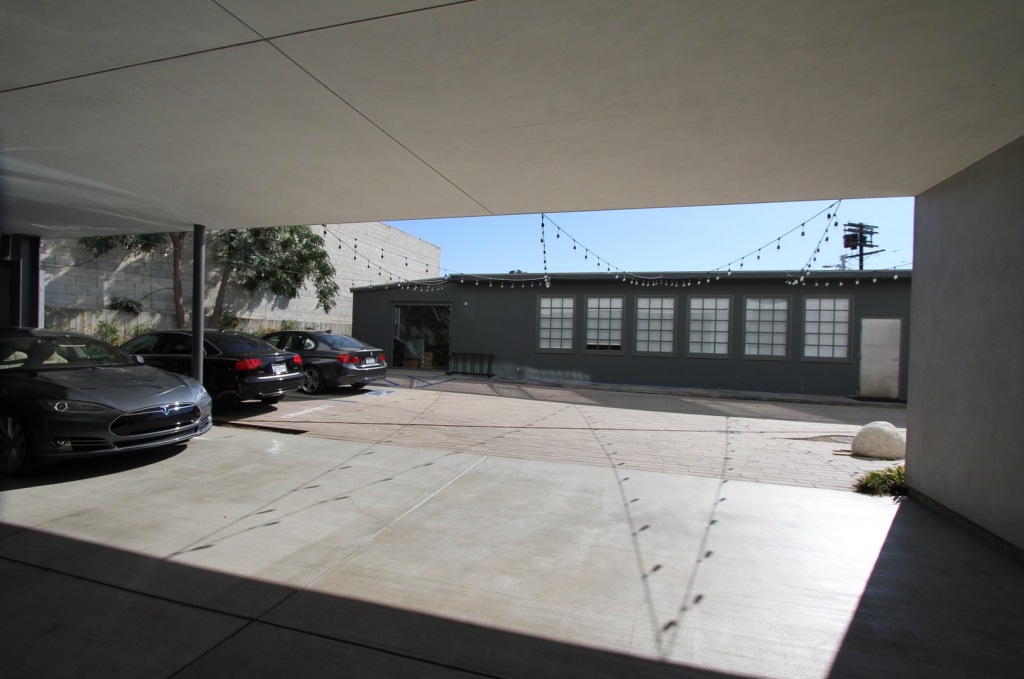
    The space incorporates pre-existing industrial warehouses as well as new construction with shops and offices that are now rented for supplemental income. The architecture firm’s own offices are currently oversized to accommodate anticipated expansion as business continues to ramp up. But construction is a cyclical industry, so the space can be subdivided and rented during future downturns.

    screen-shot-2016-10-02-at-9-12-41-pm

    screen-shot-2016-10-02-at-9-16-58-pm

    screen-shot-2016-10-02-at-9-11-58-pm

    screen-shot-2016-10-02-at-9-12-06-pm

    The new building achieves the legally required off street parking standard as well as the fire marshal’s demand that a full size fire engine be able to drive around the entire structure in an emergency. The parking is convenient (this is Los Angeles after all), but the outdoor space does double duty as a plaza for human activities on occasion. Strings of cafe lights, movable furniture, potted plants, and people transform the place quickly and easily.

    screen-shot-2016-10-02-at-9-21-21-pm

    screen-shot-2016-10-02-at-9-03-00-pm

    screen-shot-2016-10-02-at-9-16-40-pm

    screen-shot-2016-10-02-at-9-14-17-pm

    screen-shot-2016-10-02-at-9-02-32-pm

    screen-shot-2016-10-02-at-8-02-41-pm

    screen-shot-2016-10-02-at-8-02-50-pm

    Part of FSY’s strategy was to create a place that would activate the entire community, not just a building containing offices. The initial concept involved repurposing shipping containers and pressing them into service as small shops. The building code wouldn’t permit that so a stick built version mimics the container look and scale. Actual containers are parked in back and are used for low cost storage. Local artists were invited to install distinctive motifs for the exterior of the corner cafe. All of this was as-of-right construction within the established city code.

    screen-shot-2016-10-01-at-4-30-34-pm

    screen-shot-2016-10-01-at-8-24-41-pm

    screen-shot-2016-10-01-at-4-30-58-pm

    screen-shot-2016-10-01-at-8-27-09-pmscreen-shot-2016-10-01-at-8-25-40-pm

    screen-shot-2016-10-01-at-8-23-39-pm

    For the last century the Los Angeles River has been a concrete industrial drainage canal sealed off by barbed wire fences and cinder block walls. Most people in LA have no particular relationship to the “riverfront.” But that’s changing as city officials have announced a billion dollar program to transform the river into a ribbon of green and blue public amenities lead by none other than starchitect Frank Gehry.

    screen-shot-2016-09-24-at-5-55-16-pm

    screen-shot-2016-09-24-at-5-55-37-pm

    screen-shot-2016-09-24-at-5-55-51-pm

    The success of small infill developments in Frogtown along with the city’s plans to transform the river have attracted large scale production developers. Previously ignored sites began to sprout upscale apartment buildings and condo complexes on dead end streets at the river’s edge.

    This process was viewed with scorn by existing property owners and community organizers who haven’t forgotten how their families were bulldozed to make way for Dodgers Stadium. So they lobbied for new regulations to make it harder to build anything new and to work around the perception that political figures are corrupt and on the take for developer’s money. The new regulations now make projects like Art Yanez’s building non-conforming and subject to special review processes for height, bulk, and so on.

    The result is that now only very small projects can be built as-of-right, and only very large and expensive projects can overcome the newly implemented regulatory hurdles. All the incremental in-between projects that might have been built are now much less viable and far more expensive to push through. This is what land use policy actually looks like on the ground.

    John Sanphillippo lives in San Francisco and blogs about urbanism, adaptation, and resilience at granolashotgun.com. He’s a member of the Congress for New Urbanism, films videos for faircompanies.com, and is a regular contributor to Strongtowns.org. He earns his living by buying, renovating, and renting undervalued properties in places that have good long term prospects. He is a graduate of Rutgers University.

    Top photo: John Sanphillippo

  • Were Urban Freeways a Good Idea?

    It’s almost a truism in urbanist circles that construction of urban freeways was a bad idea.

    Indianapolis Monthly magazine takes a somewhat more charitable view in its retrospective on the 40th anniversary of the completion of the downtown “inner loop” freeway.

    “But even before its grand opening, the inner loop—31 miles of interstate within I-465, built at a cost of nearly $300 million—had begun paying downtown dividends. Real estate values around the superhighway increased in the early 1970s, reversing a 35-year decline, and Mayor Hudnut also credited the road with stimulating such projects as the Hilton Hotel, the Indiana National Bank building, and the $150 million expansion of Eli Lilly & Co.

    Hudnut predicted the new freeway would spur 20,000 new jobs, and state legislators embraced the spirit: In 1973, when a federal reimbursement slowdown threatened to add 10 years to its completion date, they fronted the money for the last leg of I-65/I-70.”

    The conventional wisdom is that downtown freeways were unmitigated disasters. It says they destroyed vast tracts of urban neighborhoods, with a racist targeting of black ones, then remained as huge barriers to redevelopment.

    The Indy Monthly article acknowledges the downsides of the construction:

    “But little relief awaited the neighborhoods that were carved up for the inner loop. The project displaced a total of 17,000 residents, including 6,000 from Fountain Square (one-fourth of the population).

    Linda Osborne, owner of Arthur’s Music Store, remembers Fountain Square as a vibrant full-service community during the 1950s and early ’60s. “There were theaters, grocery stores, shoe stores—all the things you have in a small town,” says Osborne, whose family business opened in 1952. Interstate construction, however, dug a wide channel that isolated Fountain Square from downtown. Then as now, a Virginia Avenue bridge carried traffic over the chasm, but the commercial district soon tanked, Osborne says.”

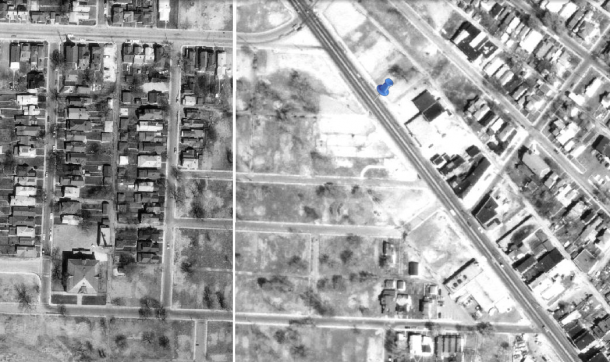
    I previously posted an article documenting the destruction in Fountain Square. It features pictures from Historic Indianapolis, including this one showing the scale of the destruction.

    historic indianpolis

    I don’t have Fountain Square’s demographics at the time, but what evidence I do have suggests it was a largely white community, which it remains to this day. So in this case the place with the most destruction wasn’t a minority area.

    Indy Monthly also points out the example of downtown Ft. Wayne. That city decided to go with a bypass option rather than a downtown alignment. The result was that they did indeed prevent neighborhoods from being destroyed, but those neighborhoods and the city’s downtown severely declined anyway. While there are some interesting things going on downtown Ft. Wayne to be sure, it’s unarguable that Indy’s downtown is on a completely different plane of development, though to be sure Indy is a much larger city.

    In fact, this is the pattern we see. Urban decline happened pretty much everywhere, urban freeway or no. When there’s a downtown freeway to blame, people do that. Where there’s not, people blame the bypass. Hence most attributing of blame for decline to urban freeways is simply incorrect.

    Indy Monthly argues that the freeway system provided for convenient access to downtown. Without that access. businesses would have fled, it would be impossible to host large events, etc.

    There is something to this, I think. If there were no freeway access to downtown Indianapolis, it seems likely it would be a much diminished urban center. Keep in mind, there was limited transit access and no real prospect of creating it.

    But we should separate two things, the freeways that provide access to downtown and the ones that run through it. It’s certainly possible that freeway spurs could have been built into the center of the city without building them as through-routes. This is the idea behind much of the boulevarding advocacy movement.

    Twice within the last decade, the state implemented multi-month closures of the Indianapolis inner loop to through traffic. This was a good real world test of whether it was needed at all.

    I wasn’t living there at the time but did do some driving around rush hour during one of the closures. The best alternate route for through traffic is to use I-465 to the south. This did get heavily congested, suggesting that this road would need to be widened prior to removing the inner loop. Some folks did say some surface routes near downtown were more congested during rush hour. But there didn’t seem to be any show-stoppers to permanent closure.

    In my view, removal of the inner loop is feasible, though highly unlikely to ever occur. But it goes to show that the benefits of freeway access to downtown could have been implemented in ways that were less invasive, using freeway spurs and boulevard distributors. In this scenario, the inner loop itself would no longer be a barrier, and the demolition associated with its construction could have been largely avoided. The freeway spurs could have been build with lower capacity, since no through traffic need be designed for. Some interchange complexes would have been eliminated.

    Removing or never building the inner loop would indeed likely add to peak of the peak congestion. The extent to which this dominates local thinking is hard to overstate. It’s revealing that the biggest source Indy Monthly used for quotes was Bill Benner, a sports columnist, and sports and events loom large.

    “To fully appreciate Indy’s middle-aged expressway, imagine 65,000-plus NFL fans spilling out of Lucas Oil Stadium and heading home on the stoplight-laden likes of Meridian Street, Washington Street, Kentucky Avenue, and other prime thoroughfares of yesteryear. Or don’t imagine it—because without this key piece of infrastructure, there might never have been a Lucas Oil Stadium.

    “It was a series of dominoes,” Benner recalls. “Without the interstate, it would have really held back downtown development. So maybe you don’t have the Hoosier Dome, or the Indianapolis Colts, or the Super Bowl. And maybe you don’t have Circle Centre or Victory Field.”

    Designing a transport system around sports event peaks, particularly low-frequency ones like NFL home games, illustrates the Faustian bargain Indianapolis made to revive its downtown.

    Indianapolis made its downtown America’s most friendly to major events. So you can get people to and from the Super Bowl the one time the city hosts it. (I would suspect getting people to and from the Indianapolis Motor Speedway for so many decades powerfully shaped this mode of thinking).

    But the design of the transport system is very hostile to almost everything else, whether that be residential uses or pedestrian access. This has changed somewhat with the Cultural Trail, Georgia St. and others. But to truly change the game would require a major change in psychological orientation to be able to care less about peak of the peak congestion after Colts games and more about the average ordinary experience of the city. I suspect a similar dynamic is at play in many other places.

    Aaron M. Renn is a senior fellow at the Manhattan Institute, a contributing editor of City Journal, and an economic development columnist for Governing magazine. He focuses on ways to help America’s cities thrive in an ever more complex, competitive, globalized, and diverse twenty-first century. During Renn’s 15-year career in management and technology consulting, he was a partner at Accenture and held several technology strategy roles and directed multimillion-dollar global technology implementations. He has contributed to The Guardian, Forbes.com, and numerous other publications. Renn holds a B.S. from Indiana University, where he coauthored an early social-networking platform in 1991.

    Photo: By reddit user MikeSanborn. Cf. https://www.reddit.com/r/indianapolis/comments/3jx7n5/my_favorite_view_of_indianapolis/cut6n4k?context=3 (https://imgur.com/oJLlvTS) [CC BY 4.0], via Wikimedia Commons

  • The Cities Where Your Salary Will Stretch The Furthest 2016

    When Americans consider a move to another part of the country, they sometimes are forced to make a tough choice: should they go to a city with the best job opportunities, or a less economically vital area that offers a better standard of living, particularly more affordable housing? However,  there are still plenty of metropolitan areas in the U.S. where you can get the best of both worlds.

    Center for Opportunity Urbanism senior fellow Wendell Cox has developed a set of rankings that identify metropolitan areas where salaries are relatively high relative to costs, and you get more for your paycheck. Our list is geographically and demographically diverse, both in terms of the top 20 and the places closest to the bottom.

    The COU Standard of Living Index takes the 2015 mean pay per job in the 106 metropolitan statistical areas with more than 500,000 population and adjusts it by cost of living. Metro areas that have a large proportion of high-wage jobs tend to do best, such as San Jose, Calif., and Houston. The biggest differences in terms of cost of living generally have to do with housing; costs for goods varied by 23 percent and for services by 35 percent in 2014 across the metropolitan data, but for rents the differential between the most and least expensive metro areas is 194 percent and, for housing purchased in 2014, a remarkable 775 percent. The composite cost of living index underlying the COU Standard of Living Index is developed from a blend of annual rent as well as home ownership costs for prospective home buyers.

    I have divided the top and bottom rankings into four basic groups: expensive but worth it; moderately priced but still high income; expensive but so costly as to  be economically barely worth it; and, finally, areas that are cheap, but not for the right reasons.

    Expensive, But Worth It

    There are several high-cost areas that do very well in this ranking, largely because they offer high incomes to match. The metro area with the highest annual wage when adjusted for cost of living is San Jose, the center of Silicon Valley. The cost of living there is 63 percent higher than the national average, the highest in the nation, but with the highest nominal pay per job at $112,300 ($27,000 above the next best), the metro area still ends up with the highest adjusted paycheck of $68,850.

    Four other high-cost areas also make our top 10. Two are in Connecticut: No. 4 Bridgeport-Stamford, where the cost of living is 45 percent above the national average, and No. 5 Hartford, where costs are 15 percent above the national average. But higher wages — $85,400 for Bridgeport and $62,600 for Hartford — give residents the buying power to absorb those costs, and places these metros areas high on the list.The other two are No. 6 Boston and 10th-ranked Seattle.

    One common thread that helps these metro areas overcome high costs is a high concentration of jobs in better paying fields such as technology and business and professional services.

    Opportunity Cities: Less Expensive And Economically Vital

    The other five top cities in our Standard of Living index fit a very different mold. These are what may be seen “opportunity cities,” where there are relatively high wages and somewhat low costs. If the successful blue cities can be seen as something of “gated communities” for well-educated, largely white and Asian residents, these cities offer a higher standard for a broader and often more diverse population.

    The epitome of opportunity cities, Houston, takes second place. Like San Jose, Houston has a strong concentration of engineering talent and STEM jobs, many of them related to the energy industry. The average annual paycheck in America’s Energy Capital is $65,000, well above the national average, and with a cost of living barely 5 percent above the usual, it’s only eroded slightly to an adjusted worth of $62,300.

    The other cities in our top 10 tend to feature high growth in STEM employment but moderate to low costs. They include No. 3 Durham, N.C., located in the tech-rich Research Triangle area, No. 7 Atlanta and No. 8 Detroit. In all these areas the cost of living is around the national average, but salaries are higher. You may be surprised by Detroit, but this ranking looks at the total metro area, which is in much better shape than the core city. With good-paying jobs, many connected to the revived auto industry, the Detroit metro area is in far better shape than is commonly suggested.

    Of course, the Motor City may lack the glamour and stratospheric wages of Silicon Valley, but its far lower costs offer a surprising high standard of living. Nor is it the only Rust Belt city that ranks highly. Consider No. 13 Cincinnati, No. 15 Pittsburgh, No. 16 Cleveland and No. 19 St. Louis. In the future it may make sense for more individuals and companies to take a second look at these areas.

    Expensive, And Not Producing Enough Good Jobs To Make Up For It

    Not all expensive cities are worth the cost, particularly if you are considering a move. Take 89thplace San Diego and 97th place Los Angeles, two California cities with idyllic climates and dynamic histories, but that now have become too expensive to offer a high standard of living for anyone not making far more than the local average salary.

    The tragedy for these Southern California metro areas is that, while they have seen a rapid escalation in housing prices and rents, they have not been able to take a meaningful part in the tech boom that has driven up wages in San Jose and the Bay Area. San Diego’s mean wage of $58,000 might seem more than respectable, but with a cost of living 36 percent above the national average, it reduces the real pay in this attractive coastal city to a more modest $42,700.

    Most critical, however, is the clear downshift in the standard of living in my adopted home region, greater Los Angeles. Once L.A. was full of high-wage jobs, many of them tied to aerospace and manufacturing, as well as high-end business services. Those industries have been eroding for well over a decade, replaced, in large part, by lower-wage positions in hospitality, retail and health. Now it is one of the poorest big cities in America, yet one with extraordinarily high costs, particularly for housing. The cost of living in LA is 46 percent above the national average, driving real wage from a respectable nominal average $59,000 to a dismal adjusted $40,400.

    Left Behind

    Most of the metro areas at the bottom half of our list are smaller, with barely a million people or less. Many of these are in high-cost regions, notably our last-place finisher, Honolulu. In the Hawaiian capital, the average paycheck is $48,800 but when you factor in our cost of living modifier, the real income falls to $33,900. That’s partly due to a lack of developable land that drives up property prices and also due to the high proportion of necessities that are imported, including food and oil.

    This pattern is repeated by many areas in our bottom 10, including the California cites Stockton (94th), Fresno (98th), Riverside-San Bernardino (102nd) and Santa Rosa (105th). In all these cases, incomes tend to be  modest, but costs, particularly for housing, are higher than their economies would logically warrant. Much of the “credit” here may well belong to California’s restrictive land use and housing policies, and generally poor climate for manufacturing, agriculture and other blue-collar businesses.

    What does this tell us? Metro areas that want  to improve in these rankings need to focus not just on developing their economies, but also policies that keep costs competitive with other regions.

    Center for Opportunity Urbanism
    Standard of Living Index: 2015
    Rank (of 106) Metropolitan Area Annual Pay Per Job, Adjusted by COU CoL Index
    1 San Jose, CA $68,855
    2 Houston, TX $62,305
    3 Durham, NC $59,526
    4 Bridgeport-Stamford, CT $58,704
    5 Hartford, CT $57,050
    6 Boston, MA-NH $56,979
    7 Atlanta, GA $56,647
    8 Detroit,  MI $56,421
    9 Dallas-Fort Worth, TX $55,529
    10 Seattle, WA $55,123
    11 Charlotte, NC-SC $55,122
    12 Washington, DC-VA-MD-WV $54,525
    13 Cincinnati, OH-KY-IN $54,265
    14 Birmingham, AL $54,256
    15 Pittsburgh, PA $54,168
    16 Cleveland, OH $54,059
    17 Minneapolis-St. Paul, MN-WI $53,668
    18 Denver, CO $53,526
    19 St. Louis,, MO-IL $53,519
    20 Nashville, TN $53,144
    21 Des Moines, IA $53,115
    22 Kansas City, MO-KS $53,009
    23 Austin, TX $53,002
    24 Memphis, TN-MS-AR $52,911
    25 Columbus, OH $52,319
    26 Philadelphia, PA-NJ-DE-MD $51,912
    27 Fayetteville (Bentonville), AR-M $51,876
    28 San Francisco, CA $51,723
    29 Baton Rouge, LA $51,492
    30 Chicago, IL-IN-WI $51,425
    31 Raleigh, NC $50,980
    32 Tulsa, OK $50,798
    33 Indianapolis. IN $50,781
    34 Akron, OH $50,578
    35 Harrisburg, PA $50,483
    36 Louisville, KY-IN $50,390
    37 Richmond, VA $50,053
    38 Oklahoma City, OK $50,018
    39 New York, NY-NJ-PA $49,760
    40 New Orleans. LA $49,739
    41 Albany, NY $49,578
    42 Phoenix, AZ $49,403
    43 Sacramento, CA $49,323
    44 Portland, OR-WA $49,262
    45 Dayton, OH $49,203
    46 Winston-Salem, NC $49,079
    47 Knoxville, TN $49,060
    48 Milwaukee,WI $49,022
    49 Baltimore, MD $48,771
    50 Toledo, OH $48,705
    51 Wichita, KS $48,608
    52 Melbourne (Palm Bay), FL $48,230
    53 Augusta, GA-SC $48,065
    54 Omaha, NE-IA $47,956
    55 San Antonio, TX $47,910
    56 Little Rock, AR $47,900
    57 Chattanooga, TN-GA $47,877
    58 Jacksonville, FL $47,810
    59 Madison, WI $47,510
    60 Rochester, NY $47,486
    61 Grand Rapids, MI $47,459
    62 Salt Lake City, UT $47,368
    63 Syracuse, NY $47,239
    64 Greensboro, NC $47,013
    65 Greenville, SC $46,762
    66 Buffalo, NY $46,500
    67 Columbia, SC $46,437
    68 Tampa-St. Petersburg, FL $46,410
    69 Allentown, PA-NJ $46,141
    70 Springfield, MA $45,585
    71 Providence, RI-MA $45,323
    72 Worcester, MA-CT $45,236
    73 Jackson, MS $45,196
    74 Colorado Springs, CO $45,017
    75 New Haven CT $44,848
    76 Charleston, SC $44,613
    77 Miami, FL $44,589
    78 Orlando, FL $44,527
    79 Virginia Beach-Norfolk, VA-NC $44,290
    80 Las Vegas, NV $44,265
    81 Spokane, WA $43,770
    82 Albuquerque, NM $43,486
    83 Tucson, AZ $43,484
    84 Bakersfield, CA $43,464
    85 Boise, ID $43,103
    86 Scranton, PA $43,082
    87 Lakeland, FL $42,907
    88 Youngstown, OH-PA $42,766
    89 San Diego, CA $42,716
    90 Lancaster, PA $42,227
    91 Modesto, CA $42,034
    92 Portland, ME $41,902
    93 Cape Coral-Fort Myers, FL $41,547
    94 Stockton, CA $40,512
    95 Provo, UT $40,473
    96 Sarasota (North Port), FL $40,434
    97 Los Angeles, CA $40,432
    98 Fresno, CA $40,226
    99 El Paso, TX $40,074
    100 Oxnard, CA $40,049
    101 Ogden, UT $39,966
    102 Riverside-San Bernardino, CA $38,598
    103 Daytona Beach (Deltona), FL $38,242
    104 McAllen, TX $38,182
    105 Santa Rosa, CA $35,370
    106 Honolulu, HI $33,903

    Joel Kotkin is executive editor of NewGeography.com. He is the Roger Hobbs Distinguished Fellow in Urban Studies at Chapman University and executive director of the Houston-based Center for Opportunity Urbanism. His newest book, The Human City: Urbanism for the rest of us, will be published in April by Agate. He is also author of The New Class ConflictThe City: A Global History, and The Next Hundred Million: America in 2050. He lives in Orange County, CA.

    Photo by w:Flickr user Bill Jacobus [CC-BY-2.0], via Wikimedia Commons

  • Job Creation Under the Next President

    Retraining the employed and the unemployed for higher value-added skills is now more important than simply adding to the number of jobs.

    Coal and steel magnate Wilbur Ross, a senior policy advisor to the Trump campaign, has just made in the pages of the Wall Street Journal an economic prediction that looks mathematically unattainable.

    Writing with Professor Navarro of UC – Irvine, Mr. Ross forecast that policies enacted by a President Trump would lead to the creation of 25 million new jobs, ostensibly over an eight year period:

    Donald Trump will cut taxes, reduce regulation, unleash our abundant energy and eliminate our trade deficit through muscular trade negotiations that increase exports, reduce imports and eliminate cheating. These policies will double our economic growth rate, create 25 million new jobs, boost labor and capital incomes, generate trillions of additional tax revenues and reduce debt as a percentage of GDP.

    To evaluate the 25 million figure, remember that new job creation during the booming Ronald Reagan and Bill Clinton two-term presidencies amounted to 16.1 million and 22.5 million, respectively. Given the growth of the population, you could say that a 25 million target compares reasonably to these figures. It is optimistic but, on the face of it, not outlandish.

    That is, until you scrutinize the underlying demographics. A new job requires not only an open paid position but also a person to occupy this position. In order to have 25 million new jobs, we need 25 million people to fill these jobs. So does the US even have 25 million people who would be available in the next eight years? It doesn’t seem like we do.

    job numbers

    Now as at any time, there are three main sources of new workers:

    Increase in working-age population: During the 1980s decade (which includes the two Reagan terms), the population aged 20 to 64 grew by 18.5 million. During the 1990s (including the two Clinton terms), it grew by 19.1 million. In the coming decade ending in 2025 by contrast, it will only grow by a much smaller 2.6 million.

    What explains this decline in growth for this segment? Simply put, there were many more new babies in the 1960s than in the 1910s, resulting in strong growth in the 1980s. But there were only a few more babies in the 2000s than in the 1950s, resulting in lower growth in the 2016-25 decade. Put another way, a rising number of boomers are turning 65 every year and exiting the 20-64 age bracket. This means that, unlike in the 1980s and 1990s, a large percentage of people going into these 25 million jobs will have to come from other sources.

    Immigration: Assuming an annual influx of one million immigrants (green card holders), we estimate another 7 new million workers for the decade, and a prorated 5.6 million over eight years.

    The idle and unemployed: The current official unemployment rate is hovering around 5%. However, the U6 measure of unemployment now stands at 9.7%, not far from its historical average. If we assume generously that U6 will drop by 3% towards its low of October 2000, there would be an additional 4.8 million people available for work.

    Adding all these figures (and making adjustments from 10 to 8 years where needed), we see that there is still a shortfall of 12.5 million people, or half the 25 million needed to meet the new supply of jobs.

    Keeping an open mind, we could speculate that an additional 12 or 13 million people, counting for example a large number of women and elderly, could decide to join or remain in the labor force. But this seems unlikely within the big economic boom described by Mr. Ross and Professor Navarro. If the economy will be doing that well, fewer spouses may choose to work and more people will retire early.

    Finally, the next President could increase the number of immigrants to address the labor force shortfall. This decision would require doubling or tripling the number of visas and green cards awarded annually, a policy that runs against the grain of Trump campaign pledges.

    To sum up, an optimistic level of job creation under the next President, whether Trump or Clinton, would be 12 to 15 million. But even this lower target will prove to be too ambitious if, as is widely anticipated, automation and the internet of things take over more job functions.

    Further, because the marginal demand for jobs will be less than in the past, an effort to boost the supply looks not only ill-fated but also misdirected, like that of a general preparing to fight the last war. At this juncture of changing demographics and increased automation, it will be more important to upgrade jobs to higher value-added functions than to simply count the number of net new jobs. Bringing the old jobs back would in theory provide much needed relief to households that are struggling, but retraining these same workers for better jobs will ultimately lead to more favorable outcomes.

    In this vein, investments in education and retraining seem more critical now than in the past. Rather than merely adding jobs, a more promising employment strategy for the next President would be to facilitate retraining programs for people who have not kept up with the economy because of outsourcing or other factors.

    All this will probably be unconvincing to Mr. Ross and Professor Navarro who downplay the role of demographics in the economy and who believe that a sufficient amount of can-do spirit will overcome the facts of a hard-nosed analysis:

    Some falsely assert that the U.S. and other developed countries have settled into a “new normal” of slower economic growth due to greater competition from developing countries and demographic changes beyond our control.

    But to quote Mr. Trump’s running mate, Gov. Mike Pence, “People in Scranton know different. People in Fort Wayne know different.”

    We shall see.

    One clear fact remains however: the golden decades ending in 2005 were in part powered by a fast-growing population and a declining dependency ratio, two conditions that are now fading.

    Sami Karam is the founder and editor of populyst.net and the creator of the populyst index™. populyst is about innovation, demography and society. Before populyst, he was the founder and manager of the Seven Global funds and a fund manager at leading asset managers in Boston and New York. In addition to a finance MBA from the Wharton School, he holds a Master’s in Civil Engineering from Cornell and a Bachelor of Architecture from UT Austin.

    Photo: neetalparekh

  • Real Estate Doesn’t Make an Economy

    From Southern California to Shanghai and London, inflated real estate prices have evolved into a simulacrum for broader prosperity. In an era of limited income gains, growing inequality, political dysfunction and fading productivity, the conjunction of low interest rates and essentially free money for the rich and well-placed has sparked the construction of often expensive, high-density residential housing.

    This heady period of rapid real estate asset inflation could soon be coming to an end, followed by a potentially nasty correction in high-density, high-cost, more urban core locations. Since the 2008 crash, centered in overpriced single-family housing, density has been the new mantra, a trend largely echoed in the media, academia and among the planning professions.

    The notion that dense, expensive urban real estate would dominate the future rested on two assumptions. First, it was widely explained to developers that millennials would prefer to rent small apartments for the foreseeable future, padding the profits of the investor class. Second, it was assumed that money would continue to pour into elite Western cities from the newly rich of China, Russia, Latin America and the Middle East.

    Today, both trends are diminishing. Millennials are getting older, and by 2018 more will be in their 30s — when most people seek out single-family homes — than in their 20s. We are already reaching “peak urban millennials,” as University of Southern California demographer Dowell Myers suggests, while the replacement generation, known as the “Z” or “plurals,” will be somewhat less numerous.

    At the same time, high-end residential investors from the once booming BRICS countries — Brazil, Russia, India, China and South Africa — are, with the exception of India, now experiencing slower or negative growth. They are likely to be a far less reliable source of funds for high-end luxury housing.

    Read the entire piece at the Orange County Register.

    Joel Kotkin is executive editor of NewGeography.com. He is the Roger Hobbs Distinguished Fellow in Urban Studies at Chapman University and executive director of the Houston-based Center for Opportunity Urbanism. His newest book, The Human City: Urbanism for the rest of us, will be published in April by Agate. He is also author of The New Class ConflictThe City: A Global History, and The Next Hundred Million: America in 2050. He lives in Orange County, CA.

    Photo by Mark Lyon — Full Floor For Rent.

  • Corporate Mustard Showroom Helps Explain New York’s Retail Rent Crisis

    The story of skyrocketing rents has two components: residential and commercial.

    My New York neighborhood, the Upper West Side, features fairly stable residential rents, but commercial rents seem to have been soaring. This has caused the familiar angst over the loss of neighborhood businesses to the ubiquitous bank branches and drug stores.

    But today even chains are getting priced out. The quintessential marker of gentrification, Starbucks, was recently forced to relocate in my neighborhood. They vacated their stores at 67th and Columbus when the landlord raised their rent to $140,550/month.

    You’ve got to sell a lot of grande’s to cover that kind of rent check. How many businesses can realistically survive at this location? (Maybe none – it’s still vacant).

    A block up the street, another store helps illustrate the forces sending retail rents through the roof. It’s the Maille “mustard boutique” at 68th and Columbus pictured above.

    Maille is a supermarket brand of dijon mustard. It’s a product of Unilever, the Anglo-Dutch food and consumer products giant. You may not know Unilever, but you know their brands, including Hellman’s, Dove, Lipton, and even Ben and Jerry’s.

    This particular location provides mustard tastings, and sells dijon in a variety of flavors not typically available. I believe they also have some vinegars. I was once needed some dijon and purchased a jar of their regular flavor for $7 – which is $3 more it sells for at the grocery store a few blocks away.  They apparently charge as much as $99 for a jar of black truffle mustard.

    I don’t know what their monthly rent is. It’s a smaller, mid-block store than the former Starbucks location. Based on square footage equivalents, the rent would be somewhere around $30,000 a month.

    Can you really sell enough mustard to cover that kind of rent (to say nothing of the “mustard sommelier” and other employees they have on staff and all the other costs of operations)? I see people in the store, but it’s never crowded. And it’s rare to see someone walking out with a shopping bag.

    It strikes me as dubious that this store could even break even, much less turn a profit that would earn the required return on invested capital.

    But ultimately it doesn’t matter if this store makes money or not. The rent isn’t even a rounding error to Unilever and can easily be justified as a marketing expense.

    If there’s one thing it’s not hard to find in this world, it’s gourmet mustard. This neighborhood needs a corporate mustard showroom like it needs a hole in the head.

    But we have one anyway. And there’s actually a second location in the Flatiron. These are the only Maille stores in the US, save for what appears to be a popup going into a Connecticut mall.

    You can tell a lot of amazing “only in New York” stories. But this is an example of a bad one. These showrooms may be exclusive to the city, but they put upward pressure on retail rents and make it harder for actual neighborhood serving businesses to make it. (This location was closed over the summer for a sidewalk replacement project and I was hopeful it wouldn’t reopen – alas, it was to be denied).

    Multiply two Maille mustard showrooms by all the other major corporations who use NYC as a branding platform, and it’s easy to get a sense as to why retail rents are so high in Manhattan.

    Aaron M. Renn is a senior fellow at the Manhattan Institute, a contributing editor of City Journal, and an economic development columnist for Governing magazine. He focuses on ways to help America’s cities thrive in an ever more complex, competitive, globalized, and diverse twenty-first century. During Renn’s 15-year career in management and technology consulting, he was a partner at Accenture and held several technology strategy roles and directed multimillion-dollar global technology implementations. He has contributed to The Guardian, Forbes.com, and numerous other publications. Renn holds a B.S. from Indiana University, where he coauthored an early social-networking platform in 1991.

    Photo: Maille mustard “boutique” on Columbus Ave at 68th St.