Category: Economics

  • Can California Transition to Next Tech Wave?

    The consumer technology boom, largely responsible for a resurgence in California’s economy after the tech wreck of 2001, seems to be coming to an end. The signs are widespread: slowing employment, layoffs from bell-weather social media companies, the almost embarrassing difficulty of finding buyers for Twitter, the absorption of Yahoo by Verizon and the acquisition by Microsoft of LinkedIn.

    This is not to minimize the great things which have been accomplished over 15 years of massive investment in these technologies. Mark Zuckerberg founded Facebook in 2004, and is now worth some $55 billion, up $15 billion from last year. In 2015, more than 1 billion people globally used Facebook applications every single day. The “app economy” created by Steve Jobs and Apple is equally impressive. What would we have done with our free time if it were not for Farmville, Angry Birds and Pokemon Go?

    The tech boom has changed the face of wealth in America. Tech oligarchs, mostly clustered in the Bay Area, which dominates some 40 percent of employment in search and web publishing, now account for one quarter of the wealth of the Forbes 400 richest Americans. This tilting of wealth is not going away, and may shape the business world for a generation.

    Concentration and contraction

    Overall though, the economic impact of these technologies has been limited. Google’s Alphabet Inc. and Facebook Inc. together employ fewer than 75,000 people, one-third fewer than Microsoft, worth only a fraction its value. Snapchat, the star of Silicon Beach, employs several hundred people, hardly enough to reverse a long-term decline in Southern California tech employment.

    More troubling still are changes in the Bay Area tech culture. In its 1980s heyday, Silicon Valley was a Wild West of start-ups, new companies and ideas, and lots of jobs. Today, it resembles increasingly the cozy and fundamentally uncompetitive world of Detroit’s Big Three — Ford, Chrysler and General Motors. The Valley is increasingly dominated by a handful of companies — Google, Facebook and Apple — while conditions for startups, even well-funded ones, have deteriorated markedly.

    Read the entire piece at The Orange County Register.

    Joel Kotkin is executive editor of NewGeography.com. He is the Roger Hobbs Distinguished Fellow in Urban Studies at Chapman University and executive director of the Houston-based Center for Opportunity Urbanism. His newest book, The Human City: Urbanism for the rest of us, will be published in April by Agate. He is also author of The New Class ConflictThe City: A Global History, and The Next Hundred Million: America in 2050. He lives in Orange County, CA.
    Marshall Toplansky is Senior Advisor to Chapman University in the area of Data & Analytics, as well as adjunct faculty member at the Argyros School of Business and Economics. Formerly Managing Director of KPMG’s national center of excellence in Data & Analytics, Marshall co-founded big data company Wise Window, a pioneer in analyzing social media, blogs and news stories to track and predict business and political trends. Marshall is Chairman of the Cicero Institute, a strategy and research institution in Salt Lake City, Utah. He is past Managing Director of the Harvard Business School Association of Orange County, and was elected to the Computing Industry Hall of Fame for his role in creating the industry’s largest technical service certification program, A+, which has certified more than 3 million computer technicians worldwide.

  • The House Prices are Too Damned High

    In recent years, the plight of renters in a stagnant economy has been covered extensively. A book title incorporated the phrase “the rent is too damn high” (by Matthew Iglesias). The “Rent is Too Damn High Party” ran candidates in both city and state of New York elections. However, as bad as rent increases have been, more serious has been the escalation of house prices in the major metropolitan areas of the United States.

    The Expected Nexus

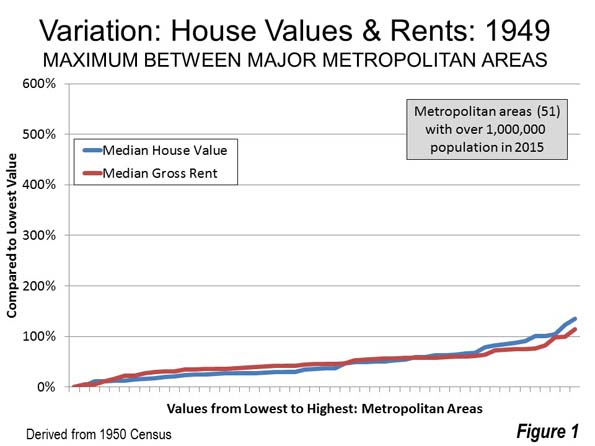
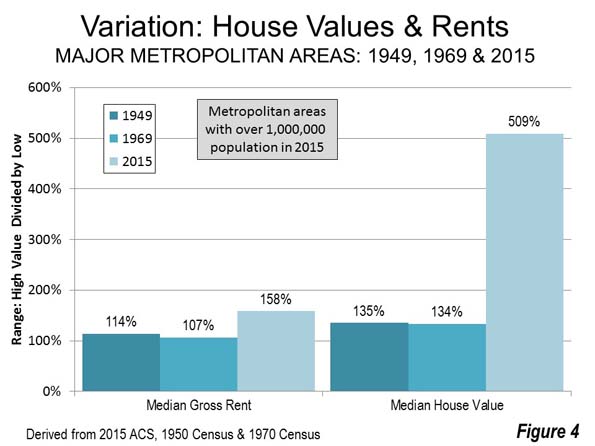
    Generally, a closely aligned relationship between trends in owner occupied and rented housing costs would be expected . This was certainly true until 1970 (Note 1).  In 1949 there was a 135 percent difference between the lowest median household value and the highest in the major metropolitan areas (Note 2). There was a similar 114 percent difference between the lowest gross rent and the highest (Figure 1). The house value variation was 18 percent higher than the rent variation.

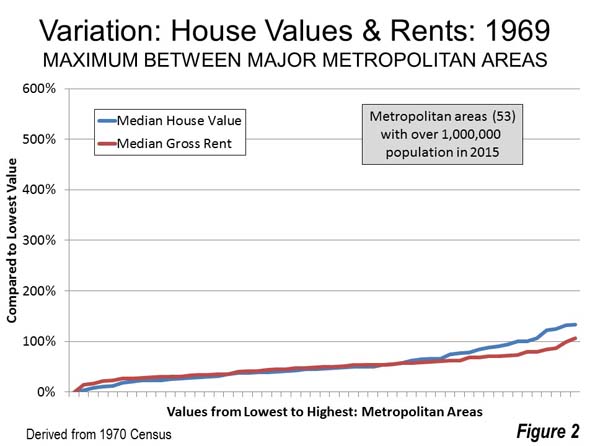
    By 1969 median house values varied a maximum of 134 percent from the lowest figure to the highest, a slight reduction from the 135 percent difference across the United States in 1949. Median gross rents varied a maximum of 107 percent among the same metropolitan areas, down modestly from 1949’s 114 percent (Figure 2). The house value variation was 25 percent higher than the rent variation.

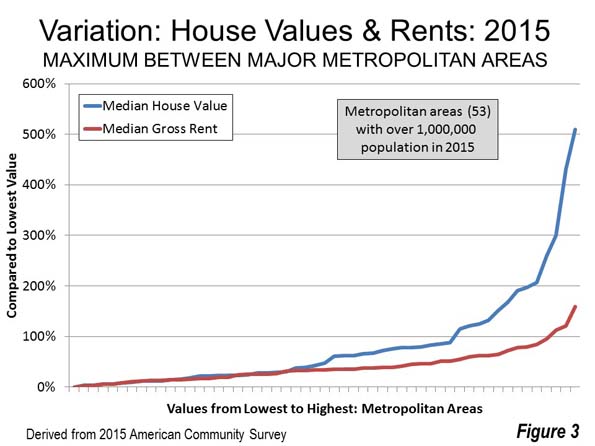
    The close relationship between the variations in house value and rent   was substantially broken in more recent decades. The 2015 American Community Survey shows that the variation among the major metropolitan areas in median house values is now a staggering 509 percent. The range between the least expensive and most expensive rental markets is a much smaller 158 percent (Figure 3). The difference in the variations between house value and rents across the nation rose to 222 percent, nearly nine times the 1969 figure.

    Among the 10 metropolitan areas with the largest house price increases between 1969 and 2015, house values increases averaged 226 percent, nearly 350 percent more than the 65 increase in median rents, both figures inflation adjusted (Figure 4).

    Of course, the hideously expensive California metropolitan areas are well represented, such as San Jose, San Francisco, Los Angeles and San Diego, among the most impacted. Even inland Sacramento, with significant housing affordability problems often over-shadowed by the Bay Area, is included. However, the huge differences extend to metropolitan areas outside California, such as Denver, Baltimore, Portland, Seattle and Boston.

    The broken relationship between rent and house value could imply severe distortion in either the rental market or the owned housing market.

    If the Rent is Too Damn Low

    Distortions in the market could have prevented rents to retain their relationship with rising house values.

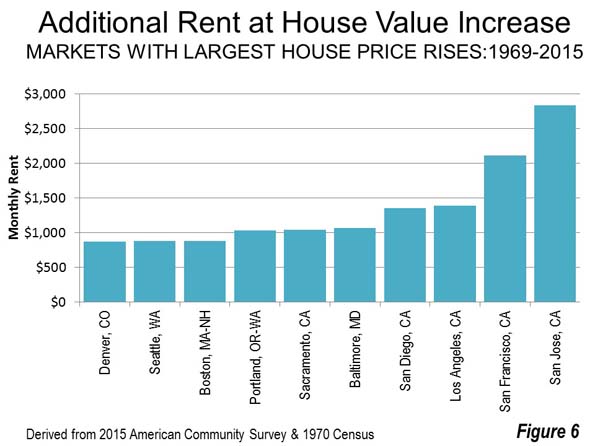
    The implications are ominous. If the increase in rents had kept up with the increase in house values, the median gross rent in the San Francisco metropolitan area would have been approximately $3,700 per month, compared to the actual $1,600 per month in 2015. This would suggest that rents in 2015 were $2,100 below market in San Francisco. If this is true, then the rent is too damn low in San Francisco. The situation would be even worse down the road in San Jose where to keep up with house prices rents need to be $4,700 per month, $2,800 per month higher than market.

    If the rental market is distorted, then rents are far too low in other metropolitan areas. In Los Angeles, San Diego, Baltimore, Sacramento and Portland rents are between $1,000 and $1,400 too low. Rents would be at least $800 below market in Boston, Seattle and Denver (Figure 5).

    If House Prices are Too Damn High

    If the owned housing market became distorted relative to the rental market between 1969 and 2015, then it is the rents that are too damn high.  If house values had risen at the same rate as rents, none of the 53 markets would have exceeded a price to income ratio of 5.0, which denotes is denoted as “severely unaffordable” in the Demographia International Housing Affordability Survey. This would be a substantial improvement, given that 11 major markets actually were severely unaffordable in 2015.

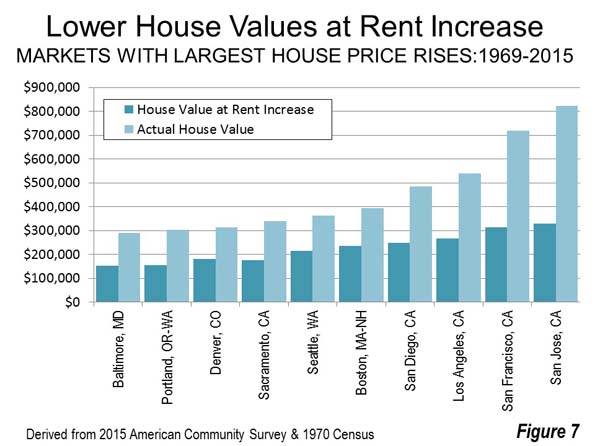
    The 10 major metropolitan areas with the largest house value increases would have had hugely lower house prices. In San Jose, the median house value would have been equal to 3.2 years of median household income in 2015. This is considerably better than the actual 8.1 years, representing a 55 percent improvement. In San Francisco the median house value would have been equal to 3.5 years of median household income. This would be a 60 percent improvement on the actual 8.1 ratio in 2015 (Note 3). 

    In Los Angeles, Portland, Sacramento and San Diego, house values would have been about 50 percent less if they had risen at the same rate as rents. In Boston, Denver and Seattle, house prices would have been between 40 percent and 45 percent less (Figure 6).

    It’s the House Prices that are Too Damned High

    Rents have risen faster than incomes, but nothing compared to the increase in house prices. Clearly, house prices are too damn high. The huge increase between 1969 and 2015 in house prices is an anomaly that has become extreme in recent decades. The ranges in rents (1949, 1969 and 2015) and the ranges in house values in 1949 and 1969 were far more similar and reflected a reality more in line with the stability that would be expected in non-distorted markets (Figure 7). Indeed, the large increase in the 1969-2015 rent range could well have been influenced upward by the virulent house price increase (reflected in land prices).

    It seems likely that rents across the country are much more reflective of an efficiently operating market, while there are serious distortions in the owned housing market.

    Finally, owner-occupied housing, especially detached housing, has been under assault by restrictive urban planning regulations since 1970. House prices are most out of alignment in markets where this has occurred, especially in California, Oregon, Washington, and the Denver, Baltimore and Washington, DC metropolitan areas. More often than not, these regulations have evolved into urban containment policy (Note 4), which draws arbitrary lines around cities beyond which detached housing tracts are not permitted (See: Urban Containment, Endangered Working Families and Beleaguered Minorities). Obviously, as in goods and services generally, this regulatory over-reach makes housing less affordable (See: People Rather than Places, Ends Rather than Means: LSE Economists on Urban Containment).

    There has been no such assault on multi-family building, which represents the bulk of rentals. This is not to suggest that rental regulation is perfect, only that the market distortions have been far more severe in reference to the owned housing market in some metropolitan areas, such as those identified above.

    All of this has serious consequences for the nation and its threatened middle income households. With median household incomes below nearly two decades ago (perhaps for the first time in US history), economic stagnation and younger people burdened by rising college debt, lower house prices are a necessity in the over-regulated metropolitan areas. Yet there seems little desire on the part of most governments, particularly in the most severely impacted markets, to do much about it.

    Note 1: These censuses collected house value and rent data for the previous year, 1949 and 1969 respectively. The rent and house value data referenced in this article was first available in the 1950 census.

    Note 2: The 53 metropolitan areas with more than 1,000,000 population in 2015 (in 1950, only 51 of these had achieved metropolitan area status). The rent ranges cited in this article are calculated by dividing the highest major metropolitan area rent by the lowest major metropolitan area rent in the particular year. The house value ranges cited in this article are calculated by dividing the highest major metropolitan area house value by the lowest major metropolitan area house value in the particular year.

    Note 3: Some analysts cite topographic barriers for creating the scarcity of land that has driven house price up so much in the San Francisco Bay Area (which includes both the San Francisco and San Jose metropolitan areas). As indicated in a previous article, there is far more land available for greenfield residential development in the Bay Area than would be required by even the strongest population growth.

    Note 4: With respect to urban containment policy, Boston is an exception, which is the only seriously unaffordable major metropolitan area in the Demographia International Housing Affordability Survey that does not have urban containment policy. Boston has large lot zoning so expansive that it has created a severe shortage of land for development, with urban containment-like effects on house prices. Boston’s urbanization covers more land area than all urban areas in the world except New York and Tokyo, despite having only a fraction of their populations (See: The Evolving Urban Form: Sprawling Boston).

    Photo: Sacramento: An inland California unaffordable housing market (by author)

    Wendell Cox is principal of Demographia, an international public policy and demographics firm. He is a Senior Fellow of the Center for Opportunity Urbanism (US), Senior Fellow for Housing Affordability and Municipal Policy for the Frontier Centre for Public Policy (Canada), and a member of the Board of Advisors of the Center for Demographics and Policy at Chapman University (California). He is co-author of the "Demographia International Housing Affordability Survey" and author of "Demographia World Urban Areas" and "War on the Dream: How Anti-Sprawl Policy Threatens the Quality of Life." He was appointed to three terms on the Los Angeles County Transportation Commission, where he served with the leading city and county leadership as the only non-elected member. He served as a visiting professor at the Conservatoire National des Arts et Metiers, a national university in Paris.

  • A Capital Improvement and Revitalization Idea for Detroit

    You may have heard that Detroit is in the midst of a modest but enduring revival in and around its downtown. Residents and businesses are returning to the city, filling long-vacant skyscrapers, prompting new commercial development and revitalizing adjacent old neighborhoods. As a former Detroiter I’m excited to see the turnaround. After so many false starts, Detroit’s post-bankruptcy rebound seems very real.

    However, there seems to be a growing awareness that the city’s current revival has its limits. On one hand, what’s happening now in Detroit could be considered a rather elongated recovery for the city instead of growth, as the city races to catch up with cities that have had a 20-year head start on urban revitalization. One could argue that the Motor City is slowing losing its taint, and the investment that’s coming to the city now is investment that never left, or never left at such a scale, in other cities. Maybe its reclamation rather than revitalization.

    But more broadly speaking, there’s a sentiment that the city’s revival hasn’t been inclusive. In a majority-black city, startlingly few African-Americans appear to be involved in the rebound, either as developers, homebuyers or even consumers of new amenities. Because of this, two vastly different kinds of fears seem to trouble much of the city’s black community — the revitalization could burn through the city like a wildfire and lead to widespread displacement, or the rebound could peter out before it has a chance to transform even more of the city.

    How can that be? Maybe because people and businesses are coming back not because of an economic change in the city, but a socio/cultural one. Detroit is still the Motor City, and that won’t change anytime soon. Detroit will remain the headquarters of American auto production and be a key manufacturing center for generations to come, and it will continue to ride the wave of manufacturing ebbs and flows. That’s why I say the economy is driving little of what’s happening in Detroit today. The Big Three are only eight years away from a true existential threat, and are still in the process of righting the ship. By my eyes, Detroit still hasn’t found a new economic raison d’etre that could vault it into the next phase of its development.

    As the fears that drove white and middle-class flight from the city from the 1960’s onward recede into the distant memory, many people are willing to reconsider Detroit and return.

    Detroit is at an interesting juncture in its history. After 125 years of focusing on its national and global economic prominence and leaving city-building behind, maybe now Detroit can focus on being a thriving, livable city. For everyone. There is an opportunity for Detroit to build on its rich urban design legacy to include more of the city, and more of its people, in its revival. There is an opportunity to set the stage for good — even innovative — urban development in the Motor City as the city continues to search for a new economic catalyst.

    I believe the city should undertake a capital improvement/revitalization plan that utilizes its grand arterial streets — Gratiot, Woodward Grand River and Michigan avenues — and Grand Boulevard, the parkway necklace around the city’s inner core, as assets and foundations for growth. After that, the city could extend similar improvements to the locations where the arterial streets intersect with the defunct Detroit Terminal Railroad, further out from the city center. Finally, the improvements could be extended even further outward to Detroit’s other boulevard necklace, Outer Drive, near the city limits. Just as interstate highway development had the net impact of opening up outer bands of suburbia to city residents, this plan could open up languishing parts of the city for revitalization.

    Here’s the five-phase process:

    • Transform Gratiot, Woodward, Grand River and Michigan avenues into true boulevards — landscaped medians, streetscaping, wide sidewalks, bike lanes, etc. — from their sources in downtown Detroit to their intersections with Grand Boulevard.

    • Establish public squares where each new boulevard intersects with Grand Boulevard.

    • Develop a connected greenway along the path of the former Detroit Terminal Railroad.

    • Extend boulevard treatment along Gratiot, Woodward, Grand River and Michigan avenues to a new terminus at Outer Drive.

    • Complete and connect Outer Drive where necessary, and establish new public squares where the boulevards intersect with Outer Drive.

    Each step of the plan would include zoning changes along the affected areas with the intent of increasing residential and commercial development choice, and send a signal that the city is ready for transformation.

    Here’s how this project would look conceptually, looking at the entirety of Detroit:

    image of detroit

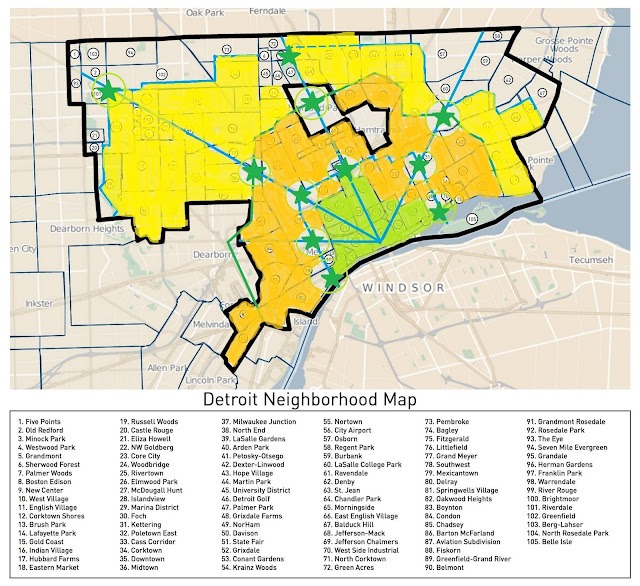
    First, please excuse my crude Microsoft Paint illustration. Hey, it serves its purpose. Second, let’s consider the broad areas of the city highlighted in various colors. The green areas are the downtown and downtown-adjacent areas that have been experiencing a pretty significant rebound over the last 5-10 years. In fact, you could say that revitalization took hold there with the opening of the Comerica Park baseball stadium in 2000 and the Ford Field football stadium in 2002. This area also includes the Midtown area north of downtown that includes Wayne State University and a host of city cultural institutions. The orange areas are the parts of the city that capture the dystopian imagination of Detroit. This area is quite — but not totally — abandoned, where much of the city’s older residential and industrial treasures have been lost. There’s still some intact neighborhoods that have a solid walkable foundation, but they’re often disconnected from each other by some serious abandonment. The yellow areas are the areas that might be described as imperiled; they could soon look like the orange zone if action isn’t taken, and in fact some parts of it (like the Brightmoor neighborhood, on the far west side, are quite abandoned already). The gray or uncolored areas on the far northeast and northwest edges of the city represent the most stable residential neighborhoods of the city, but they, too, are threatened by the challenges experienced by the rest of the city.

    When you hear Detroiters expressing concern that downtown revitalization isn’t reaching the neighborhoods, they often come from the yellow and gray/uncolored areas, with fewer and fewer voices coming from the relatively open orange areas. Viewed this way it can be understood that people see the city’s rebound as having a low ceiling; there is a half-empty quarter that sits between them and the promise of revitalization.

    My idea is to utilize strategic infrastructure investment and zoning reform to attract new development to key corridors, utilizing the city’s radial network. The radial blue lines on the map emanating from their intersection downtown represent (clockwise, from the left) Michigan, Grand River, Woodward and Gratiot avenues. The blue line that connects them, just outside the green revitalization area, is Grand Boulevard. The blue line that connects the radial streets further out is Outer Drive. The green stars represent public squares or plazas that could be built, and the light green circles indicate an approximate extent of impact outward from the squares or plazas. The green line that serves as the dividing line between the yellow and orange areas is the Detroit Terminal Railroad, and it would become a connecting trail.

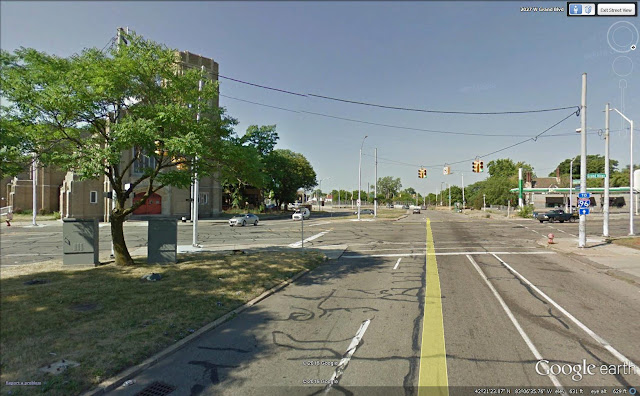
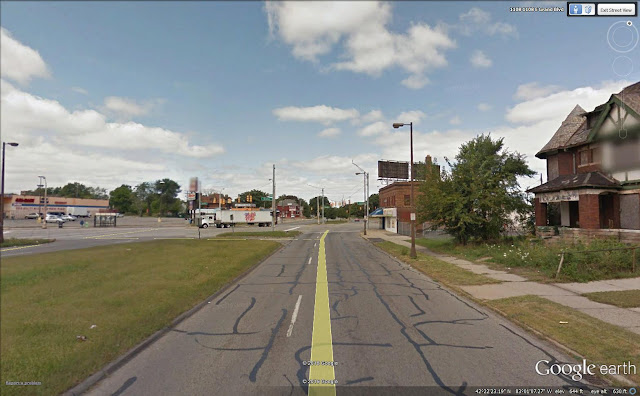
    Detroit was blessed early on with an excellent radial street system, but it quickly abandoned it as growth took hold in the early 20th century. Detroit missed an opportunity for grand public spaces at the same time that other cities were incorporating them into their urban fabric — and those public spaces became the foundation for their rebound. Consider this image, where Grand River Avenue intersects with Grand Boulevard:

    google image of grand river avenue intersecting with Grand Boulevard

    Or, worse yet, where Gratiot Avenue and Grand Boulevard meet:

    google image of Gratiot Avenue and Grand Boulevard

    This was a missed opportunity for Detroit to have majestic entryways into neighborhoods beyond the city center. This was also a missed opportunity to develop areas that could become more mixed use and multifamily in character, as opposed to the dominant single-family home city that Detroit is today.

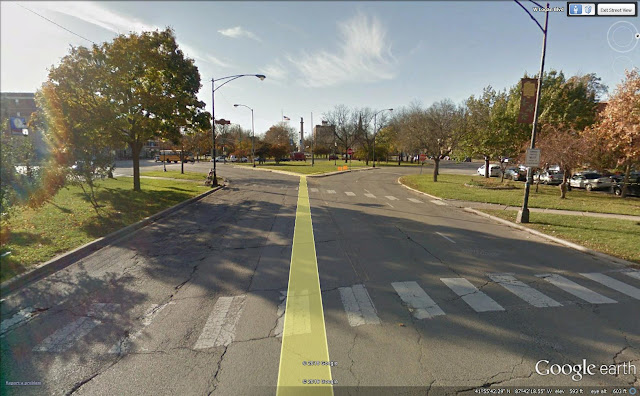
    If Detroit had the foresight 100 years ago to make strategic infrastructure investments, it could have put in place something like Chicago’s Logan Square, located at Milwaukee Avenue and Logan Boulevard (also a radial street and boulevard intersection):

    google image of Chicago's Logan Square

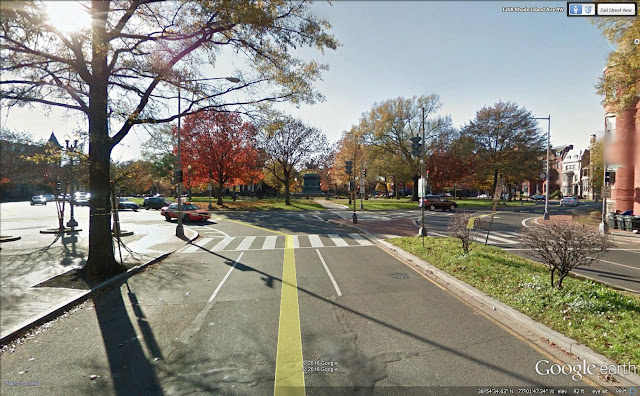
    Or Logan Circle, in Washington, DC:

    google image of Logan Circle

    The public squares on the radial avenues could have the effect of drawing development and revitalization outward from the city center, as has happened in Chicago and DC. This could continue outward to the DTR trail and Outer Drive, if the city sees success in such a measure, finds the appropriate resources and desires to extend it further.

    Detroit should certainly see the merits of such an investment. The city renovated and rededicated a new Campus Martius Park in 2004, and it has become a focal point for downtown revitalization.

    Without a doubt, this would be a costly measure, maybe even a folly for a city just out of municipal bankruptcy and still struggling to provide basic city services. that’s why I would envision this as a long term proposal, perhaps a 10-year project.

    That’s the basis of the idea. I’ll follow up with more details soon.

    Top photo: detroit.curbed.com

    Pete Saunders is a Detroit native who has worked as a public and private sector urban planner in the Chicago area for more than twenty years.  He is also the author of “The Corner Side Yard,” an urban planning blog that focuses on the redevelopment and revitalization of Rust Belt cities.

  • Today’s Orange County: Not Right Wing—and Kinda Hip

    What comes to mind when you think about Orange County? Probably, images of lascivious housewives and blonde surfers. And certainly, at least if you know your political history, crazed right-wing activists, riding around with anti-UN slogans on their bumpers in this county that served as a crucial birthplace of modern movement conservatism in the 1950s.

    Yet today, Orange County—or the OC, as locals call it—is becoming a very different place. Today close to half the population of this 3-million person region south of Los Angeles are minorities, primarily Latino and Asian, and the county’s future belongs largely to them.

    These days you color the OC both ethnically diverse and politically purplish. The Republican share of the electorate has dropped from 55 percent in 1990 to under 40 percent today. Two of the seven people who represent the area in Congress are Latino, and a third is of Middle Eastern descent. Four of the 10 people the county sends to Sacramento are minorities, three Asians and one Hispanic. Asians, now 20 percent of the local population, represent the majority on the county Board of Supervisors. In 2012 Mitt Romney took the county with 53 percent of the vote; this year it may be far closer than that.

    The cultural landscape is also changing. What was historically a land of hamburger dives (we still have some) and little Mexican restaurants (we have many) is now home to some of Southern California’s best restaurants—including two on the top 30 list ofLos Angeles Times food critic Jonathan Gold. The OC is also home to one of the country’s leading venues for new plays, South Coast Repertory. Alongside the ubiquitous malls have arisen some of the nation’s most innovative urban environments, some of them revived small town main streets, from Santa Ana’s 4th Street Market to Orange to Laguna Beach and Fullerton.

    When urbanists talk about the future, they usually imagine an environment of dense buildings, connected by train transit and highly centralized workplaces. Yet the bulk of all the nation’s economic and population growth takes place in “post-suburbia,” a term first applied to the OC. Post-suburbia, noted two urban scholars in 1991, reflects a “decentralized, multi-centered area” that puts “into question the mainstream urbanist’s concept of central-city dominance.”

    This new geography of urbanity—far more than the much-discussed recovery of the urban core—dominates our metropolitan life; since 2000 over 80 percent of all metropolitan area jobs and population have remained outside the urban core. Post-suburbia predominates among our most demographically and economically vital regions, including STEM-intensive regions such as Silicon Valley, the northern reaches of Dallas, the western suburbs of Houston, Johnson County west of Kansas City or virtually anything around Raleigh or Austin. Orange County’s STEM sector (PDF) has expanded at twice the rate of L.A. County, despite all the considerable hype about the emergence of “Silicon Beach.”

    Post-suburbia was not designed to be a traditional commuter suburb, where people pile onto trains or the highways to get “downtown.” The vast majority of OC people work in the plethora of county worksites, and many others, particularly from the Inland Empire to the east, drive into the area for work.

    What places like the OC sell is both work and quality of life. The area ranks 10th out of 3,111 counties in the U.S. for natural amenities, and even outpaces Los Angeles among cities for best recreation. The roads are less congested, and there’s more open space. Urban Los Angeles has 9.4 acres of parks and recreation areas per 1,000 residents; Irvine has 37 acres per 1,000 residents, meaning that over 20 percent of the city’s land is dedicated to parks, five times the national average. No wonder the Irvine city motto is “Another Day in Paradise.”

    All changes are not for the better, of course, and one of the chief problems in today’s OC is the cost of housing. Irvine is a city of 236,000 people that was once a classic Anglo suburb and is now 40 percent Asian and less than half white. Housing, once distinctly middle class, now averages near $800,000, in large part due to purchases by Chinese investors. According to the real-estate information firm DataQuick, the 25 most common last names of homebuyers last year were Chen, Lee, and Wang.

    The landscape has also changed, with massive rows of multi-family houses crowding the wide boulevards of the city, clogging traffic and making “paradise” a little less bucolic. Since 2000, Orange County’s prices have increased 3.5 times that of incomes, one of the highest rates of increase in the country. The middle class who came to experience a Disneyland urban existence now finds the county largely beyond their means.

    These price increases have benefited many older property owners, particularly along the strip near the Pacific Ocean—now among the most expensive places to live in the country—but have sent rents soaring as well. Santa Ana, right next door to Irvine, is home now to much of the county’sgrowing homeless population, now estimated at 15,000, in large part reflecting rents increasingly out of reach to the working poor. If one full-time worker rents a two-bedroom apartment in Orange County they can expect to spend over 40 percent of their income (PDF) on rent.

    High prices are making the OC increasingly unaffordable for young families. Despite the assertions by density advocates, most millennials remain deeply interested in home ownership and generally move to places they can afford a house, which is usually somewhere else. This is one reason why Orange County, once an epicenter of youth culture, is going grey—and quickly.

    Orange County’s old folks feel little reason to move, short of being carried out feet first. The OC’s perfect weather, coupled with Proposition 13 protections, keeps seniors in their homes long after their offspring have left. With grey ponytails common even among surfers, the OC by 2040 is on track to be the oldest major county in California.

    The big hope may be the aging of millennials who by 2018 will on average be over 30. With safe cities and exceptional schools, the OC is a great place for “grownup millennials” looking to raise a family. Kina De Santis, CMO of the Orange County-based tech startup Motormood, calls it “very family oriented,” and Lee Decker, CMO at IGNITE Agency praises it for having the right environment for those with families who still want to focus on their startups, explaining, “As I prepare to get married to my kick ass and ridiculously supportive fiancé, I’m deciding to firmly root myself here in OC.” 

    In a famous scene from the play Hamilton, the future treasury secretary and his friend, Marquis de Lafayette, celebrate America’s revolutionary victory with the words—“immigrants, we get the job done.” As the OC evolves in the coming decades, the fast-growing foreign born population, and their offspring, will play the leading roles.

    In 1970, 80 percent of OC residents were non-Hispanic white. Many feared new immigrants, with the OC Grand Jury—a body of 19 to 23 members impaneled for one year to investigate and report on both criminal and civil matters within the county—in 1993 calling for a three-year ban on all immigration. Since 2000, the area’s Latino growth rate has been roughly 50 percent greater than Los Angeles’s. By 2014, the non-Hispanic white population dropped to 43 percent of the population, while the Hispanic share rose to 35.3 percent.

    The growth of the Asian population has been, if anything, more dramatic. One critical turning point was the arrival of the Vietnamese after the 1975 fall of Saigon, which turned Westminster from a sleepy town to one of the largest settlements of Vietnamese outside the mother country. More recently, Koreans and ethnic Chinese have arrived in significant numbers.

    Since 2000, Orange County’s Asian population has been growing at roughly 3 percent annually, roughly 50 percent faster than Los Angeles County. The OC’s rate is roughly equal to that of such Asian migration centers as Santa Clara, San Francisco, and New York. Overall, Orange County is the nation’s fourth most heavily Asian county over 1 million, at roughly 20 percent.

    Although they differ in appearance from the old OC denizens, these new OC residents are attracted by many of the same things that brought earlier immigrants to the area—single family homes, parks, and good public schools. They have created a dazzling series of ethnic “villages” from the heavilyVietnamese band from Westminster to Garden Grove, to the expanding “Little Korea” in the same area, the “Little Arabia in Anaheim and the El Centro Cultural de Mexico, located in Santa Ana.

    These newcomers and their kids are reshaping the OC’s culture, which plays a huge part in the area’s economy, employing well over 50,000 people; overall, the county lags only New York and Los Angeles in terms of the role of creative industries. In the past much of this was tied to the surfer culture, most notably serving as the fashion capital of the surf wear world—known to some Boomer adepts as “Velcro valley,” built around surf wear icons Hurley, Quicksilver, and O’Neill. The creative sector is adding jobs across a range of other industries such as architecture and interior design. Orange County is increasingly proving itself capable to draw the talent and support the lifestyle to compete with other creative powerhouses such as Los Angeles and New York.

    Immigrants provide much of the impetus. Much of the best food in Orange County is produced by newcomers and their children. The immigrant reshaping of the OC also is reflected in the bustling ethnic shopping malls that dot the county, packed with shops selling groceries, clothing, travel packages, and videos to the increasingly diverse population. Even more important is the growing cross-fertilization of ethnic styles and tastes. Urban amenities such as locally owned restaurants, bars, and retail shops at Huntington Beach’s Pacific City, keep things interesting as people are increasingly looking to spend their money on regionally tuned experiences (PDF), rather than typical suburban chains.

    Perhaps the most influential figure here is Shaheen Sadeghi, a Persian-American and former CEO of the surf wear line Quicksilver. Sadeghi’s company has taken a dozen sites, many of them deserted industrial and warehouse spaces, and converted them into exciting urban spaces. Perhaps his most impressive is the Packing House in Anaheim, a gigantic food court located in a former fruit-packing facility, which teems with ethnic food vendors.

    Critically, Sadeghi’s vision goes well beyond the usual urbanist dreamscape of a culture dominated by hip singles and childless couples. He wants to appeal to families, just in an updated way. “The international community tends to be more family oriented,” he notes, “on the weekend at the Packing House you’ll see a family from Asia putting all the tables and chairs together.”

    Building this new vision for OC will not be easy, he realizes, given the regulatory vise exercised by California regulators on small business. Yet he sees the area’s decentralization—epitomized by the county’s 34 separate cities—as providing consumers with greater diversity and choice. “Each city has its own identity, brand, and culture,” he suggests. “It’s like there’s more cookies in the cookie jar.”

    Sadeghi is bringing the old OC model to the future, proving that post-suburban “sprawl” can coexist with diversity and culture. Like the visionaries who created Disneyland, Irvine and other earlier iconic expressions of the county’s past, innovators like Sadeghi are willing to buck models, urban or otherwise, in pursuit of a unique sensibility. The OC should not aspire to become another Brooklyn, he suggests, but exploit all its natural advantages, as well as its efflorescent diversity to reinvent itself. “After all,” he says with an inner reassurance those of us who live here tend to have, “we still have a couple of things no one else has—ocean and good weather. And they aren’t going away.”

    Joel Kotkin is executive editor of NewGeography.com. He is the Roger Hobbs Distinguished Fellow in Urban Studies at Chapman University and executive director of the Houston-based Center for Opportunity Urbanism. His newest book, The Human City: Urbanism for the rest of us, will be published in April by Agate. He is also author of The New Class ConflictThe City: A Global History, and The Next Hundred Million: America in 2050. He lives in Orange County, CA.
  • Diedre McCloskey’s Trickle-Out Economics

    Economics, history, English and communications Professor Diedre N. McCloskey, of the University of Illinois, Chicago offers a unique interpretation of economic history  that is well summarized in the subtitle of her book, “Bourgeois Equality: How Ideas, Not Capital or Institutions Enriched the World.”

    This is a magisterial volume, which Matthew Ridley praised in his Times of London review, saying “It is so rich in vocabulary, allusion and fact as to be a contender for the great book of our age.” That is not an exaggeration.

    As would be expected of any economic history, McCloskey emphasizes the material advancement that has transformed human lives in so much of the world since 1800. Finding that that the cradle of this advancement was northwestern Europe, and in particular the Netherlands and Great Britain, McCloskey rejects notions of geographic or cultural determinism, suggesting it could have arisen from other parts of the world, especially China and India.

    Not Capital Nor Institutions

    Despite predominant theories to the contrary, neither capital accumulation nor institutions were pivotal in the substantially rising standards of living. McCloskey creatively illustrates the problem with institutions:

    “You can set up British – style courts of law, and even provide the barristers with wigs, but if the judges are venal and the barristers have no professional pride and if the public disclaims them both, then the introduction of such a nice sounding institution will fail to improve the rule of law.”

    She rejects the idea that the progress of the previous two centuries represented the continuation of progress already underway. Indeed, annual economic growth had staggered along at from less than 0.1 before 1800. McCloskey contrasts this with what she calls a “hockey stick” phenomenon, in which per capita incomes grew by factors of from 10 to 30 times — 1,000 percent to 3,000 percent  per cent from 1800 to 2010.

    The Problem

    The problem was the bifurcation of society into a small privileged class and a far larger number of commoners, the bourgeoisie. Opportunity was largely limited to the privileged class.

    “The former aristocratic or Christian or Confucian elites, then, had contempt for business, and taxed it or regulated it at every opportunity, keeping it within proper bounds. Such social regulation was the chief obstacle preventing the march to the modern, namely, the withholding of honor from betterment and dignity from ordinary economic lives.”

    The result was a social structure characterized by “extortion, not protection,” what McCloskey calls the “Aristocratic Deal.”

    The Great Enrichment

    However, this was to change in the years leading up to 1800. McCloskey describes changing attitudes that encouraged participation of commoners and a “partial erosion of hierarchy.” The “Aristocratic Deal” was replaced by the “Bourgeois Deal,” which became “unevenly, the ruling ideology.”

    “The deal crowded out earlier ideologies, such as ancient royalty or medieval struck aristocracy or early modern mercantilism or modern populism. The bettering society of liberalism which, when true to itself, was not led by the great king or the barons of the bureaucrats or the mob, all of whom took their profits from zero sum and the monopoly of violence.”

    McCloskey refers to this advancement as the “Great Enrichment.” The key was what she calls “trade-tested betterment,” characterized as commoners joined   a free market for ideas. All of this led to a radical improvement in the standard of living, the result of “allowing free entry to compete with the monopolies that the aristocrats or the plutocrats had arranged under the aegis of a captured government.”

    This liberated ordinary people, who became generally equal under the law who were “freed from ancient suppression of their hopes.” The Great Enrichment, she says, is the most important secular event since the invention of agriculture,” adding that it “restarted history.”

    Reversion

    But for all the progress, there have been strong headwinds. According to McCloskey, the rhetoric took a decidedly negative turn about around 1848, the banner year of revolutions. It was led by the “clerisy,” artists, the intelligentsia, journals, professionals and bureaucrats, which “misled its earlier commitment to a free and dignified common people.” She attributes the attack to a “new and virulent detestation of the bourgeoisie.”

    In more recent years, the clerisy has sought to replace the focus on equality of opportunity with equality of results. McCloskey objects, so much so that a chapter is entitled: “What Matters is not Equality of Outcome, but the Condition of the Working Class.” She effectively makes the case that poverty can be generally measured only absolutely, not relatively.” Otherwise there can be no eradication of poverty. “

    Nonetheless, she is concerned about low income citizens, indicating the need to find effective ways to reduce poverty. She shares the concerns of the Left: “In our desire to help the poor, we bleeding heart libertarians stand in solidarity with our social democratic friends – if not usually agreeing with them on exactly which policies have helped the poor.” Her concern is that “we actually help the billion [the world’s remainingpoor], not merely indulge our indignation and our conviction of ethical superiority by supporting policies that in fact make them worse off.”

    A Sampling of Observations

    Throughout the book, McCloskey provides useful observations.

    Importantly, she notes that an economy exists for the benefit of consumers, not producers. “After all the point of an economy’s production for production for consumption not protection of existing jobs using old tools – horses candles and control drill presses.”

    She challenges much of “progressive” thought, noting that protection of trades and jobs is inappropriate and that government should not be in the business of choosing winners (or losers).

    She discusses “first act, second act and third act” economics, which requires competent analysts to look beyond the immediate consequences to the ultimate consequences of policy. Henry Hazlitt made this the core of his best-selling book Economics in One Lesson, seven decades ago, though economists, often working for governments, have not always heeded this advice.

    Finally, McCloskey colorfully dismisses much of the current politically correct thought: “…end-state egalitarians would argue that markets ‘enslave’ and therefore the people can be saved only by forced – march liberation, hopefully provided by the Brahmans now in power…”

    High Density Economics

    Bourgeois Equality is the second of two great volumes on economic history in just a year. The first was The Rise and Fall of American Growth: The U.S. Standard of Living Since the Civil War by Professor Robert Gordon of Northwestern University, a long ride on the Chicago El (Metro) from McCloskey’s University of Illinois, Chicago . Both volumes are yet more evidence of Chicago’s high density of ground-breaking economic analysis.

    The setting of the two books is considerably different, with Gordon focusing on the United States and technological advancement. Gordon is somewhat more pessimistic about the future, which is understandable from his historic analysis. McCloskey’s view is more optimistic.

    Nonetheless, my years have taught me a profound respect for the ability of entrenched institutions, to block achievement of better living standards, while professing the opposite. This makes me prone to pessimism (as I indicated in the Gordon review). Professor McCloskey would not agree:

    "Pessimism on the basis of the most alarming of today’s trends is jolly good fun. … But since 1800 it has been a poor predictor."

    Trickle-Out Economics

    For decades there have been debates about “trickle-down economics.” More recently, Nobel Laureate Paul Krugman characterized the Obama stimulus programs as “trickle-up economics” (the effect of which is debatable). Professor McCloskey tells us that that economic growth comes from ordinary people not by the beneficence of those above. We could call it “trickle-out” economics.” To the considerable extent her analysis is right, McCloskey describes that may be the ultimate flowering of democracy.

    Wendell Cox is principal of Demographia, an international public policy and demographics firm. He is a Senior Fellow of the Center for Opportunity Urbanism (US), Senior Fellow for Housing Affordability and Municipal Policy for the Frontier Centre for Public Policy (Canada), and a member of the Board of Advisors of the Center for Demographics and Policy at Chapman University (California). He is co-author of the “Demographia International Housing Affordability Survey” and author of “Demographia World Urban Areas” and “War on the Dream: How Anti-Sprawl Policy Threatens the Quality of Life.” He was appointed to three terms on the Los Angeles County Transportation Commission, where he served with the leading city and county leadership as the only non-elected member. He served as a visiting professor at the Conservatoire National des Arts et Metiers, a national university in Paris.

    Photo: Cover: Bourgeois Equality: How Ideas, Not Capital or Institutions Enriched the World.

  • America’s Next Great Metropolis Is Taking Shape In Texas

    If you drive south from Dallas, or west from Houston, a subtle shift takes place. The monotonous, flat prairie that dominates much of Texas gives way to a landscape that rises and ebbs.

    The region around Highway 35 is called the Hill Country, and although it does not seem so curvy to a Californian, it is some of the very nicest country in the state of Texas, attracting a growing coterie of wealthy boomers. It also turns out to be a growth corridor that is expanding more rapidly than any in the nation. The area is home to three of the nation’s 10 fastest-growing counties with populations over 100,000 since 2010.

    In fact, there is no regional economy that has more momentum than the one that straddles the 74 miles between San Antonio and Austin. Between these two fast-growing urban centers lie a series of rapidly expanding counties and several smaller cities, notably San Marcos, that are attracting residents and creating jobs at remarkable rates.

    Anchoring one end of the region is Austin, which has been the all-around growth champion among America’s larger cities for the better part of a decade. Texas Monthly has dubbed it the “land of the perpetual boom.”

    Austin has been ranked among the top two or three fastest-growing cities for jobs virtually every year since we began compiling our annual jobs rankings. Since 2000, employment in the Austin area has expanded 52.3%, 15 percentage points more than either Dallas-Ft. Worth or Houston.

    Comparisons with the other big metros are almost pathetic. Austin’s job growth has been roughly three times that of New York, more than four times that of San Francisco, five times Los Angeles’ and 10 times that of Chicago. Simply put, Austin is putting the rest of the big metro areas in the shade.

    Nor can Austin be dismissed as a place where low-skilled workers flee, as was said about other former fast-growing stars, notably Las Vegas. Just look at employment in STEM (science-, technology-, engineering- and math-related fields). Since 2001, Austin’s STEM workforce has expanded 35%, compared to 10% for the country as a whole, 26% in San Francisco, a mere 2% in New York and zero in Los Angeles. And contrary to perceptions, the vast majority of this growth has taken place outside the entertainment-oriented core, notes University of Texas professor Ryan Streeter, with nearly half outside the city limits.

    Austin has also been sizzling in the business services arena, the largest high-wage job sector in the country. Since 2001, employment in business services in the Austin area has grown 87%, more than any of the large Texas towns.

    No surprise then that Austin has become a magnet for people. Its population has grown at the fastest rate among U.S. metro areas above a million in the nation since 2000, an amazing 60%. That’s more than twice as fast as Atlanta, three times more than hipster haven Portland, roughly six times San Francisco and San Jose, and more than six times Los Angeles or New York. Much of the growth is coming from migration rather than births, and it boasts the highest rate of net in-migration of all the big Texas cities. The biggest sources of newcomers, according to an analysis of IRS data by the Manhattan Institute’s Aaron Renn, are California, the Northeast and Florida.

    San Antonio: The Emerging Upstart

    During the decades of Texas’ urban boom, San Antonio has been considered a laggard, a somewhat sleepy Latino town with great food and tourist attractions and a slow pace of life. “There has been a long perception of San Antonio as a poor city with a nice river area,” says Rogelio Sáenz, dean of the public policy school at the University of Texas-San Antonio.

    Economic and population data say otherwise. Since 2000, San Antonio has clocked 31.1% job growth, slightly behind Houston, but more than twice that of New York, and almost three times that of San Francisco and Los Angeles.

    And many of the new jobs are not in hospitality, or low-end services, but in the upper echelon of employment. This reflects the area’s strong military connections, which have made it a center forsuch growth industries as aerospace, and cyber-security. Although slightly behind Austin, San Antonio’s STEM job growth since 2001 — 29% — is greater than that of all other Texas cities, as well as San Francisco’s, and three times the national average.

    Similar growth can be seen in such fields as business and professional services, where the San Antonio area has expanded its job base by 44% since 2000. This just about tracks the other Texas cities, and leaves the other traditional business service hotbeds — New York, San Francisco, Chicago and Los Angeles — well behind. The city has also expanded its financial sector; the region ranked seventh in our latest survey of the fastest-growing financial centers. Once again, there is a military connection; much of the area’s financial growth has been based on USAA, which provides financial services to current and former military personnel around the country, and employs 17,000 workers from its headquarters in the city’s burgeoning northwest.

    But perhaps most encouraging has been the massive in-migration into San Antonio. Long seen as a place dominated by people who grew up there, the metro area has become a magnet for new arrivals. Since 2010, its rate of net domestic in-migration trails only Austin among the major Texas cities. Significantly, the area’s educated millennial population growth ranks in the top 10 of America’s big cities, just about even with Austin, and well ahead of such touted “brain centers” as Boston, New York, San Francisco.

    In the process, San Antonio is emerging as an attractive alternative for young professionals and families to an Austin that has become more congested and expensive. The cost of living in San Antonio is significantly lower than the other Texas cities, and less than half that of places like San Francisco and Brooklyn. As the vanguard of millennials moves into the family forming, childbearing and house-buying years in the coming decade, San Antonio, with its increasingly lively music, art and restaurant scence, is likely to grow in attractiveness.

    Greater San Marcos: Whoa Nellie!

    As impressive as San Antonio and Austin’s progress has been, the most dramatic locus for growth in the region is between the two cities. The San Marcos area, which lies at the center of the corridor, has clocked growth that is among the most rapid in the nation by several measures. Looking at population, two of the 10 fastest growing counties in the country since 2010 are located in this corridor — Hays and Comal. Their growth rate, 4% per annum since 2010, exceeds Austin’s 3% and is almost double the growth rate of Dallas-Ft. Worth and Houston.

    As is usual in Texas, and most American cities, urban growth tends to expand outwards, not only for population but also for jobs. Over the past decade, Hays and Comal’s job growth rate has been an astounding 37%, outpacing Austin’s impressive 31% growth, the other Texas cities, and over six times the pace of the country overall.

    Local boosters suggest that this growth will transform the San Marcos area into something like other suburban nerdistans, such as San Jose/Silicon Valley, north Dallas, Orange County and Raleigh-Durham. Certainly some of the same advantages those areas enjoyed are emerging, including the growth of Texas State University at San Marcos (now with over 38,000 students) as a major center of higher education.

    Equally important, note researchers John Beddow and James LeSage, the central location of the San Marcos area allows families to choose from not only local jobs, but those located in both San Antonio and Austin. And to be sure, tech, education, business and professional services are all growing rapidly, but so far much of the development is lower on the food chain, such as food service and wholesale trade. Amazon, for example, just recently opened a sprawling, 855,000-square-foot warehouse in San Marcos, which is slated to employ upwards of 1,000 people.

    Choices To Be Made

    If you were to look for the next great American metropolis, there’s probably no better bet than the emerging San Antonio-Austin corridor. The elements are all there: major universities, including the Austin and San Antonio campuses of the University of Texas, job and population growth, low housing prices and a burgeoning tech community. Perhaps even more important, this part of Texas is only marginally tied to the energy industry, which has become a huge drag on the economy of the state’s largest city, Houston.

    Yet there remain many challenges. One is transportation, particularly around freeway allergic Austin, although San Antonio has an excellent and largely free-flowing system. The Austin bottleneck is particularly troublesome because much of the city’s growth is to the north, which means commuters living in the San Marcos region have to navigate through painfully slow freeways. Another is education, despite the university presence. San Marcos and Austin may be above the national average in terms of the percentage of college-educated residents, but San Antonio and New Braunfels, a large town south of San Marcos, still lag.

    To maintain the area’s natural beauty, steps must be taken to prevent development from overrunning the Hill Country.

    But none of this should stop this region from coalescing into something that represents a Texas version of Silicon Valley — a little less dependent on the highest end of companies, less expensive and more diversified — providing a powerful new entrant among the nerdistans that increasingly dominate our national economy.

    This piece first appeared in Forbes.

    Joel Kotkin is executive editor of NewGeography.com. He is the Roger Hobbs Distinguished Fellow in Urban Studies at Chapman University and executive director of the Houston-based Center for Opportunity Urbanism. His newest book, The Human City: Urbanism for the rest of us, will be published in April by Agate. He is also author of The New Class ConflictThe City: A Global History, and The Next Hundred Million: America in 2050. He lives in Orange County, CA.
  • The New War Between the States

    In this disgusting election, dominated by the personal and the petty, the importance of the nation’s economic geography has been widely ignored. Yet if you look at the Electoral College map, the correlation between politics and economics is quite stark, with one economy tilting decisively toward Trump and more generally to Republicans, the other toward Hillary Clinton and her Democratic allies.

    This reflects an increasingly stark conflict between two very different American economies. One, the “Ephemeral Zone” concentrated on the coasts, runs largely on digits and images, the movement of software, media and financial transactions. It produces increasingly little in the way of food, fiber, energy and fewer and fewer manufactured goods. The Ephemeral sectors dominate ultra-blue states such as New York, California, Oregon, Washington, Massachusetts, Maryland, and Connecticut.

    The other America constitutes, as economic historian Michael Lind notes in a forthcoming paper for the Center for Opportunity Urbanism, the “New Heartland.” Extending from the Appalachians to the Rockies, this heartland economy relies on tangible goods production. It now encompasses both the traditional Midwest manufacturing regions, and the new industrial areas of Texas, the Southeast and the Intermountain West. 

    Contrary to the notions of the Ephemerals, the New Heartland is not populated by Neanderthals. This region employs much of the nation’s engineering talent, but does so in conjunction with the creation of real goods rather than clicks. Its industries have achieved  generally more rapid productivity gains than their rivals in the services sector. To some extent,  energy  and food producers may have outdone themselves and, since they operate in a globally competitive market, their prices and profits are suffering.

    Despite deep misgivings about the character of Donald Trump, these economic interests have led most Heartland voters  somewhat toward the New York poseur, and they are aligning themselves even more to down-ticket GOP candidates. In generally purple states like Missouri, Ohio and Iowa, where manufacturing is key, Trump still leads—at least he was before the latest spate of Trump crudeness was revealed, this time regarding women.

    The Republicans’ strongest base is in the energy belt where Trump has suggested policies that call for greater domestic production. This naturally resonates with businesses and working people in states ranging from Texas, Oklahoma and Louisiana to West Virginia, Wyoming and Alaska, which have borne the brunt of nearly 100,000 layoffs so far this year. It’s no surprise that all of these states constitute increasingly a lock for the GOP.

    Historical Precedents

    The conflict of economic interests has long defined American politics. America’s revolution was largely started by New England merchants rebelling against colonialist policies that sought to strangle our nascent capitalism in its infancy. The great economic tensions of the early 19th century centered on a struggle between the Jeffersonian and Jacksonian yeomanry and the powerful merchant class in the great Northeastern cities. A major point of contention was around such issues as the establishment of a national bank and high tariffs, bitterly opposed in the nation’s interior and the South.

    The biggest national crisis in our history underscored this clash of competing economic interests. Although the galvanizing issue on both sides of the Mason-Dixon line was slavery, the Civil War was also a war, as Karl Marx suggested, of competing economic visions: the agrarian, slave-fueled economy of the South vs. the rapidly industrializing Northeast and Midwest. 

    Post-war conflicts revolved about hostility between the urbanizing North and the more rural South and West. Finance and industrial capital, usually in cities like New York and Chicago, was largely Republican and protectionist. Democrats tried to cobble a coalition of Southern agriculturalists and the big city, ethnic working class. With the onset of the Great Depression, Democrats gained primacy by melding this coalition to a rising and increasingly progressive professional class.

    In the past, Democrats competed in the Heartland and backed its key industries. Lyndon Johnson was a proud promoter of oil interests; Robert Byrd never saw a coal mine he didn’t like for all but the end of his career. Powerful industrial unions tied the Democrats to the production economy. Now those voters feel abandoned by their own party, and even are dismissed as “deplorables”  

    Increasingly few Heartland Democrats, outside of some Great Lakes states, win local elections. In the vast territory between Northeast and the West Coast, Democrats control just one state legislature, the financial basket case known as Illinois.

    For their part, Republicans are becoming extinct in the Ephemeral states, a process hastened by the growing concentration of media on the true-blue coasts. Wall Street, Silicon Valley and Hollywood have been drifting leftward for a generation, and Trump has accelerated this movement. Joined by the largely minority urban working and dependent classes, progressives now have a lock on   the Northeast and the West Coast.

    The New Battle Lines

    The new conflict between regions reflects a conflict between different ways of making money. Ephemeral America’s media and academic adjuncts generally portray the New Heartland’s economy as exploitative and environmentally harmful. A massive oil discovery in Alaska may be welcome news there, but a horrific prospect in places like Seattle, New York, or San Francisco.

    Climate change increasingly marks a distinct dividing line. Manufacturing, moving goods, industrial scale agriculture, fossil fuel energy all consume resources in ways many progressives see as harming the planet. Progressives threaten these industries with increasingly draconian schemes to reduce greenhouse gas emissions. Gone are the days of supporting moderate shifts — which could work with some Heartland economies — from coal to gas and improving mileage efficiency.

    Instead the demand from the left is for a radically rapid de-carbonization, which will reduce jobs in the Heartland and lower living standards everywhere. In California, Jerry Brown  is fretting about ways to curb cow flatulence, an obsession that is unlikely to be popular in Kansas, Nebraska or Iowa.

    These divergent politics between states are accelerating the gap between the two economies. Since 2010, as the recovery kicked off, the big industrial job growth took place mostly in the Heartland — in Detroit, Charlotte, Atlanta, Phoenix and Houston. New York, Los Angeles, Philadelphia and Boston all managed to lose jobs. Since 2000, Los Angeles and New York together have lost over 600,000 manufacturing positions.

    As industry weakens in an area, opposition to radical climate mitigation declines. Someone representing an increasingly de-industrialized east Los Angeles or Brooklyn feels no pressing reason to advocate for industry. High energy and housing prices, both connected to draconian climate change policies, gradually empty out the middle-class families, the demographic bulwark of the GOP. Meanwhile, in their coastal bastions, the grandees of Silicon Valley and Wall Street increasingly disdain anything reliant on fossil fuels.

    The New Heartland has reason to resist such policies, which could turn what have been burgeoning economies back into backwaters. Regulatory regimes that radically boost energy costs, as in California and New York, hasten de-industrialization. The  rapid decline of areas such as interior California and upstate New York testifies what may be in store for the Heartland under a Hillary Clinton administration and a Congress controlled by the Democratic Party.

    This conflict will deepen in light of the ongoing gradual decline of key tangible industries — durable goods like heavy equipment and car manufacturing, fossil fuel energy, agribusiness. Back in 2012, all these sectors were doing well, something that helped President Obama win much of the old Rust Belt. In the current economic climate Republicans could still make significant progress, even with Trump at the top of the ticket. 

    In the process, the GOP, to the horror of many of its grandees and most entrenched interests, is becoming transformed. It is becoming something of a de facto populist party, based in the New Heartland, while the Democrats remain the voice of the coastal oligarchies who almost without exception back Hillary

    In the immediate future, given the likely trajectory of a Clinton presidency, things may get tougher times for the New Heartland and its industries. Federal regulators will ape their California counterparts, extending controls that seem sensible in San Francisco into dramatically different geographies.

    But don’t count the New Heartland, or the GOP, out. Once Trump is gone, there will be enough political will and money to mount a counter-offensive against the Ephemerals. The new War Between the States will not end in November. It will have hardly just begun.

    This piece first appeared in Real Clear Politics.

    Joel Kotkin is executive editor of NewGeography.com. He is the Roger Hobbs Distinguished Fellow in Urban Studies at Chapman University and executive director of the Houston-based Center for Opportunity Urbanism. His newest book, The Human City: Urbanism for the rest of us, will be published in April by Agate. He is also author of The New Class ConflictThe City: A Global History, and The Next Hundred Million: America in 2050. He lives in Orange County, CA.
  • Solidarity, not Division: Understanding London’s East End

    The East End of London has a long history of working-class community. It has been a place of industry, where the river Thames and the river Lea have provided work for many people. The area attracted many immigrants, including workers from Africa since Tudor times, sailors from China, former slaves from America, French Protestants facing religious persecution in the 1600s and Irish weavers working in the textile industries. There have been Jewish communities in the East End for centuries, too. The twentieth century saw an increase in immigrants from the former British colonies, including South Asia, particularly Bangladesh. Not only has it been a place to seek a livelihood, but it has also been a place of refuge.

    One side of my family hails from the East End and North East London, so I have a strong personal connection to this part of London. My ancestors worked in the local industries and on the river. We might not technically be ‘Cockneys’ (in that we weren’t all born within earshot of Bow Bells), but we are Cockney by nature. Family gatherings would include a raucous ‘knees-up’ (dancing and singing) and traditional local fare of jellied eels. We’re a working-class family who have lived in East London for generations.

    So I was interested when I came across a recent short BBC documentary called Last Whites of the East End. I was disturbed by the title, which suggested that white people in the area are somehow endangered – an odd idea and potentially a racist one. This racism was confirmed when I watched the show. The documentary focused on residents of Newham, one of the poorest working-class boroughs in England. The filmmakers interviewed a number of working-class residents about their experiences of living in the East End and the decisions of some of them to leave the area. The majority of the subjects were white, though they also included one man of Bangladeshi background and one man of white and Afro-Caribbean heritage.

    The narration of the documentary presented a racist agenda, describing the neighbourhood as at ‘tipping point’ with the ‘lowest white population in the UK’. It also noted a ‘dwindling cockney community’ who were in danger of disappearing in the face of increased immigration. Some of those interviewed were moving outside of London, to places like Essex, so they could live in areas with larger white populations. Some described themselves as ‘traditional East Enders’ and lamented the loss of the old community. They spoke of local services being shut down and the closure of the local pub. The film presented the interviewees as embodying white racism and a fear of the other, highlighting their reluctance to build bridges due to perceived differences. As one young white woman explained, they wanted to ‘stay with their own’.

    But there were many contradictions in the documentary, too. It included an elderly white woman, who was preparing to leave her home and move out of London, not due to her fear of her Muslim neighbours (as implied by the narration, despite the fact that she was obviously upset to say goodbye to her Somali neighbour), but because she was elderly and alone and wanted to move closer to her daughter. Like many of her neighbours, she had once been a new arrival to the neighbourhood, moving there from the north of England. The two people of colour in the film both spoke of their connections to the local area and their identification as East Enders. Like their white neighbours, they pointed to the changing environment, but I’d suggest that the changes they were criticising were not tied to the latest influx of new immigrants.

    Instead, they are matters of class. Gentrification and austerity are disrupting the lives of the working-class residents of the East End, not immigration. Housing has become too expensive, and government funding cuts are squeezing local schools and health services. Interviewees complained about the closure of a club which wasn’t just a local pub but also a community centre that elderly residents relied on for social events and to reduce isolation. Some white people are leaving, but, as I’ve seen with some friends and family members, that’s for financial reasons. They can purchase bigger properties if they sell their London homes, or they can pay less rent by moving to areas outside of London with smaller populations and less pressure on local services. And of course, not all of those leaving London are white.

    The documentary downplays this part of the story. It also downplays the working-class solidarity that connects residents despite their differences. Residents of the East End share the experience of hardship and struggle, and this shared struggle has a very long history. The East End has a tradition of political radicalism and collective action. East Enders have looked after each other during tough times and shown a united front against hostile external forces. Famously, in 1936, the local community stood up against a group of anti-Semitic fascists who wanted to march through a Jewish area. The confrontation, known as the Battle of Cable Street, was won because the community put their bodies on the line to keep the fascists out. The same community rallied during the Second World War and looked after each other during the bombing raids of the Blitz. More recently, local people have been supporting each other and engaging in collective action in the face of forced evictions as local public housing is sold and redeveloped for private profit.

    If the ‘traditional East End’ is disappearing, that isn’t because some working-class white are moving out of London. Working-class communities are not made up of just white people, and I’ve certainly never known a London that was mono-cultural. Yes, there are racist white working-class people. But the East End of London is a diverse and dynamic place, and always has been. It has also been a place of solidarity and struggle. The filmmakers chose to emphasize division instead of showing how East Enders act collectively, and it cast immigrants as a threat, when the real threats facing this community are austerity and gentrification.

    This piece first appeared at Working-Class Perspectives.

    Photo Credit: Daryl Hutchison, @daryldactyl

  • OC Model: A Vision for Orange County’s Future

    This is the introduction to a new report on Orange County published by the Chapman University Center for Demographics and Policy titled, "OC Model: A Vision for Orange County’s Future." Read the full report (pdf) here.

    Blessed by a great climate and a highly skilled workforce, Orange County should be at the forefront of creating high wage jobs. The fact that it is not should be a worrying sign to the area’s business, academic, political and media leaders. Despite some signs of recovery in OC, long-term trends, such as a dependence on asset inflation and low wage employment, seem fundamentally incompatible with sustainable and enduring growth in the County.

    To be sure, asset inflation benefits established property owners, and those who work in the real estate sector, but the surge in property prices and an ever increasing number of touristic venues does not provide enough of a viable base for coming generations. Given the area’s high costs — which can at best be mollified — the area’s prosperity depends on building up its cadre of well-paying high value jobs in promising fields as professional business services, technology and design-oriented cultural industries.

    The good news: the county retains some strength in all these fields. But many long-term trends, as we will demonstrate below, are not encouraging. Once one of the nation’s most powerful high-end economies, the county is in danger of losing momentum to other markets.

    Reversing this trend will require a more holistic assessment of current realities. It also requires a strong, coherent strategy targeted to high-wage growth sectors. Instead of the current obsession with real estate and tourism projects, the County needs to focus more on what professional business services, technology, finance and science-based companies need in order to succeed.

    This necessitates a conscious effort, led by the business community, to develop a strategic direction for Orange County. There are a number of models to choose from, ranging from the most successful, Silicon Valley to greater Boston to the North Carolina Research Triangle, and many more. In each case, the growth from established university research centers — Stanford, MIT, Harvard, as well as the University of North Carolina, Duke and North Carolina state — extended from the university’s base to its periphery. This strong cooperation among universities, government and the private sector is critical to the emerging tech and business service corridor developing between the Texas cities of Austin and San Antonio.

    Read the full report (pdf) here.

  • Is there a future for the GOP?

    Whether he loses or, more unlikely, wins, Donald Trump creates an existential crisis for the Republican Party. The New York poseur has effectively undermined the party orthodoxy on defense, trade and economics, policies which have been dominant for the last half century within the party but now are falling rapidly out of fashion among the rank and file.

    In this sense, Trump’s nomination could be seen as both an albatross and something of a life preserver. His rallying of a large working-class base, particularly in the Heartland, provides a potential new direction for the party that has lost irretrievably the business elite, the coastal states, minorities and the educated young. Clearly, the party needs to revise its electoral strategy.

    Geography and economics

    Trump’s raw and poorly considered economic nationalism positions the GOP against Hillary Clinton’s crony corporate establishment — anchored by Wall Street, Silicon Valley and the coastal media. This resonates broadly among many Americans, who are increasingly disaffected with the oligarch-dominated, big-bank-driven economy.

    Now the Democrats have become the party of the urban gentry, public employees and the government-dependent poor, an identification that hurts them elsewhere.In contrast, Trump’s strongest support comes from small towns and, to a lesser extent, the suburbs. In these geographic heartlands, low labor participation rates, declining incomes, struggling Main Street businesses and collapsing opportunity incite resentment and a call for radical change. The disconnect with the power centers is further stoked by the celebratory coverage received by the asset/inflation-driven “false economy.”

    Clearly, the traditional Republican path to victory — pandering to the ultrarich — seems misplaced, if not a trifle masochistic. Trump may boast about how he benefited from cronyism, but his critiques resonate more with the owner of a bar on a small town Main Street or a 20-person machine shop who knows that he can’t count on the Treasury Department defending his tax avoidance, as has occurred in the case of big-time Democratic donor Apple.

    Similarly, Trump’s crude assault on undocumented immigration makes more sense to many lower-skilled Americans who compete with them for jobs. Additionally, Trump’s attack on the Democrats’ ever more strident decarbonization drive has brought Appalachia firmly into the GOP realm, and may also deliver some key Midwestern swing states, such as Iowa and Ohio.

    Bill Clinton, who once effectively reached such voters, now denounces the “coal people” like they are a bunch of mindless Bubbas. His wife’s recent attack on Trump supporters as homophobes, racists and xenophobes revealed an unflattering glimpse at the inner thoughts of the “party of the people.”

    Read the entire piece at The Orange County Register.

    Joel Kotkin is executive editor of NewGeography.com. He is the Roger Hobbs Distinguished Fellow in Urban Studies at Chapman University and executive director of the Houston-based Center for Opportunity Urbanism. His newest book, The Human City: Urbanism for the rest of us, will be published in April by Agate. He is also author of The New Class ConflictThe City: A Global History, and The Next Hundred Million: America in 2050. He lives in Orange County, CA.
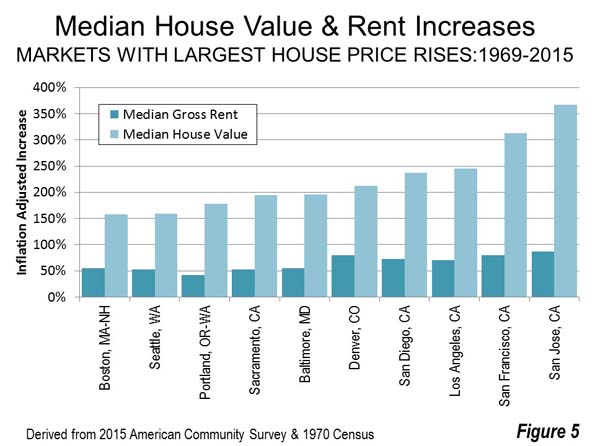
    Photo by Gage Skidmore from Peoria, AZ, United States of America (Donald Trump) [CC BY-SA 2.0], via Wikimedia Commons