Category: Economics

  • Asia Dominates Largest World Seaports

    The Port of Shanghai is by far the largest seaport in the world, according to the authoritative 2014 figures published by the American Association of Port Authorities. AAPA is an "alliance of the ports of Canada, the Caribbean, Latin America and the United States."

    Ranking seaports is no simple matter. There are two fundamental rankings, Cargo tonnage and containers. Containers are measured in "20 foot equivalent units," or TEU’s. Cargo tonnage, for example, includes bulk commodities, such as copper or oil. Cargo tonnage is unloaded at ship side and transferred to another mode of transport (such as freight rail or truck) to continue toward its destination. Containers are intermodal, meaning that they can be directly transferred from the ship to other modes of transport without being emptied.

    Shanghai leads the world in both cargo tonnage and container volume. This supremacy was achieved only recently. Singapore had been the premier world port in both tonnage and containers during the much of the 2000s. Shanghai became dominant in cargo in the middle 2000’s and overtook Singapore in containers by 2010.

    Container Volumes

    All of the largest container ports are in Asia with Rotterdam being the largest non-Asian port at number 11. Seven of the top 10 are in China.

    Top ranking Shanghai handles more than 36 million TEUs annually. The port of Shanghai includes facilities on the Huangpu River (Graphic 1), which flows through the city and the Bund, the Yangtze River and the new offshore Yangshan Deepwater port in the mouth of Hangzhou Bay (Photo above). This facility was opened in the middle 2000’s for container traffic and is connected to the mainland by the 33 kilometer (20 mile) long Donghai bridge.

    Singapore is the second largest container port, handling nearly 34 million TEUs (Graphic 2). Shenzhen, just across the border from Hong Kong is the world’s third largest port, well behind Singapore, with 24 million TEUs. Hong Kong ranks fifth, and was the largest in the container port in the world until displaced by Singapore in the early 2000’s (Graphic 3).

    Ningbo, less than 80 kilometers (50 miles ) across Hangzhou Bay from the port of Shanghai is the world’s fifth largest container port.

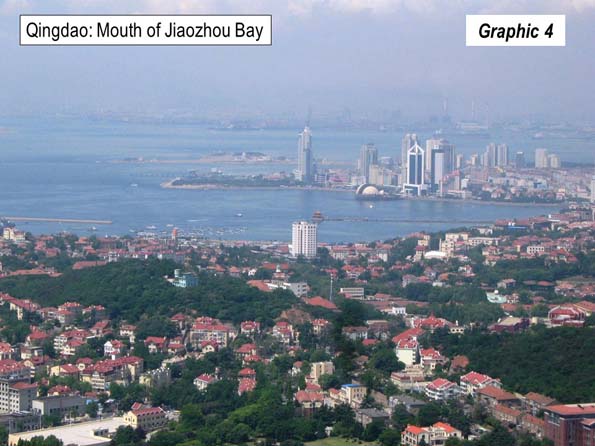
    Busan, in South Korea ranks sixth. Qingdao, on China’s Shandong peninsula is the seventh largest (Graphic 4). Guangzhou ranks 8th (Graphic 5) and Dubai ranks 9th. Tianjin, located in China’s fourth largest urban area, is approximately 160 kilometers (100 miles) from Beijing.

    Graphic 6 shows the 10 largest container points in the world and selected additional ports.



    Cargo Volumes

    Twelve of the largest cargo ports in the world are in Asia, with the exception of Port Hedland, in the state of Western Australia’s resource-rich Pilbara region. This is the  largest non-Asian port (#5). Eight of the top 12 ports are in China.

    In 2014, the port of Shanghai handled approximately 680 million tons of cargo (Note). Singapore was ranked second with approximately 580 million tons. Guangzhou and Qingdao were the third and fourth largest cargo ports. Port Hedland, was the fifth largest cargo port. Three of the second five were located in China, including #6 Tianjin, #8 Ningbo and #9 Dalian (Graphic 7), Manchuria’s largest cargo port.

    Rotterdam was the seventh largest cargo port and the largest port in Europe, though had dropped from being the largest in the early 2000’s, before it was overtaken by Singapore. Busan was the 10th largest cargo port.

    Graphic 8  shows the 10 largest cargo points in the world and selected additional ports.


    Large Port Regions

    China, with most of the world’s largest ports has considerable regional port concentrations. The two Yangtze Delta ports (Shanghai and Ningbo) had approximately 1.1 billion tons of cargo and 52 million TEU’s. The Pearl River Delta ports (Guangzhou, Hong Kong and Shenzhen) handle nearly 1.0 million tons of cargo and 57 million TEU’s. The Bohai Bay ports (Tianjin and Qinhuangdao), to the east of Beijing account for more than 700 million annual tons of cargo and a much more modest 14 million TEUs.

    The adjacent Los Angeles and Long Beach ports also handled 14 million TEU’s in 2014. The Tokyo Bay ports (Tokyo, Yokohama and Chiba) processed 7 million TEU’s while the port of New York and New Jersey handled 6 million.

    Other large regional cargo port concentrations lie along Louisiana’s lower Mississippi River (the ports of South Louisiana, New Orleans, Baton Rouge and Plaquemines), with cargo tonnage of 430 million, The Tokyo Bay ports handle 370 million tons annually. The adjacent ports of Los Angeles and Long Beach process 130 million tons of cargo annually. Historically prominent ports, such as New York and London have smaller volumes (115 million and 45 million respectively).

    The Ascendance of Asia

    The big story in port statistics is the ascendance of Asia, especially China. It was not a long time ago that European ports were the largest. Recently published research indicates that Asian container shipments between China and Europe/North America  in 2012 were five times their 1990 rate. This compares to an approximate doubling between Europe and North America over the period. The result is that European and North American ports no longer dominate the statistics.

    In 2014, East Asia accounted for 60 percent of the container volume among the 100 largest ports. This is four times the volume of European ports (14 percent) and six times that of North American ports. All of the rest of the world accounts for only 16 percent of the total (Graphic 9).

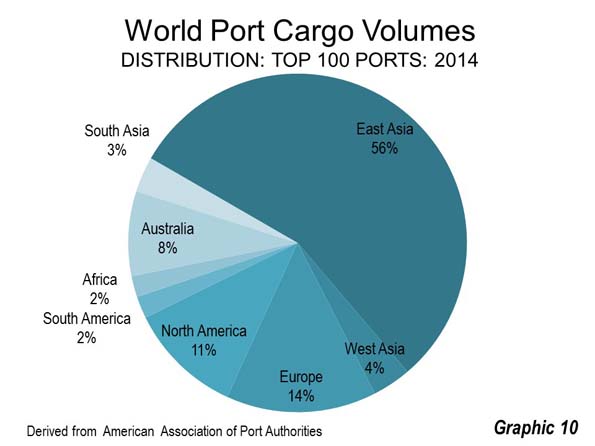
    The distribution of cargo traffic is similar. East Asia accounts for 56 percent of the top 100 port volume, four times the volume of Europe (14 percent) and five times that of North America (11 percent). Australia accounts for 8 percent, 60 percent of which is attributable to the Western Australian terminals of Port Hedland and Dampier, with their substantial commodity shipments to China. The rest of the world accounts for 11 percent of volumes (Graphic 10).

    The world of ports is by no means static. With the expanded Panama Canal now in operation, the maximum capacity of container ships has been nearly tripled. This means that US Gulf of Mexico and Atlantic ports are more competitively positioned by being able to berth the larger ships originating from Asia. This permits substitution, for example, of longer and less costly ocean voyages for intermodal truck and rail shipment across the United States,

    According to China DailyMaersk, the largest container ship company in the world, is routing its Asia to US East Coast traffic through the Panama Canal. A Maersk press release said ”Using the new Panama Canal locks, Maersk Line is able to significantly reduce the transit days from Asian to North American ports. The transit times from Shanghai and Ningbo to Newark, Norfolk and Baltimore are now five to 10 days faster,." James Newsome of the South Carolina Ports Authority described to China Daily the economics that now favor Atlantic ports: "…if Asian cargo bound for Charlotte, North Carolina, landed in Los Angeles, it would cost $2,000 to send it across the US by rail. If it landed in Charleston, it would cost only $600 by truck."

    Gulf of Mexico ports as US shippers become more competitive from lower costs. A natural gas shipment from the Gulf Coast would save 5,000 nautical miles (5,750 miles) and nine days using the canal, according to Martin Houston of Tellurian Investments.

    A number of Gulf and Atlantic ports are investing in improved infrastructure to accommodate the new traffic and larger ships. This includes ports like Houston, Savannah, Charleston (South Carolina), Miami and others. Perhaps the most impressive investment is raising the historic Bayonne Bridge so that the Port of New York and New Jersey can accommodate the larger ships.

    Of course the winners in this changing world will be consumers, who can expect lower prices as shipping becomes less expensive.

    Note: AAPA urges caution in interpreting cargo tonnage figures, because of differing tonnage definitions.

    Wendell Cox is principal of Demographia, an international pubilc policy and demographics firm. He is a Senior Fellow of the Center for Opportunity Urbanism (US), Senior Fellow for Housing Affordability and Municipal Policy for the Frontier Centre for Public Policy (Canada), and a member of the Board of Advisors of the Center for Demographics and Policy at Chapman University (California). He is co-author of the "Demographia International Housing Affordability Survey" and author of "Demographia World Urban Areas" and "War on the Dream: How Anti-Sprawl Policy Threatens the Quality of Life." He was appointed to three terms on the Los Angeles County Transportation Commission, where he served with the leading city and county leadership as the only non-elected member. He served as a visiting professor at the Conservatoire National des Arts et Metiers, a national university in Paris.

    Photo: Yanghsan Intermodal Port, Shanghai (All photos by author)

  • Two Views of West’s Decline

    Summer is usually a time for light reading, and for the most part, I indulged the usual array of historical novels, science fiction as well as my passion for ancient history. But two compelling books out this year led me to more somber thoughts about the prospects for the decline and devolution of western society.

    One, “Submission” by the incendiary French writer Michel Houellebecq, traces the life of a rather dissolute French literature professor as he confronts a rapidly Islamifying France. The main character, Francois, drinks heavily, sleeps with his students and focuses on the writing of the now obscure French writer, J.K. Huysmans. Detached from politics, he watches as his native country divides between Muslims and the traditional French right led by the National Front’s Marine Le Pen.

    Ultimately, fear of Le Pen leads the French left into an alliance with the Muslim Brotherhood, handing power over to an attractive, clever Islamist politician. With all teaching posts requiring conversion to Islam, Francois in the end “submits” to Allah. Francois motives for conversion merge opportunism and attraction, including to the notion that, in an Islamic society, high prestige people like himself get to choose not only one wife, but several, including those barely past puberty.

    The other declinist novel, “The Family Mandible” by Lionel Shriver, is, if anything more dystopic. The author covers a once illustrious family through the projected dismal decades from 2029 to 2047. Like the Muslim tide that overwhelms Francois’ France, the Brooklyn-based Mandibles are overwhelmed in an increasingly Latino-dominated America; due to their higher birthrate and an essentially “open border” policy, “Lats” as they call them, now dominate the political system. The president, Dante Alvarado, is himself an immigrant from Mexico, due to a constitutional amendment — initially pushed to place Arnold Schwarzenegger in the White House — that allows non-natives to assume the White House.

    Collapse is from within

    Some critics have lambasted author Shriver as being something of a Fox style right-wing revisionist while others have labeled Houellebecq as an “Islamophobe.”

    But these books are far more nuanced than orthodox Muslims or progressives might assume. For one thing, neither book blames the newcomers for the crisis of their respective societies. The collapse, they suggest, is largely self-inflicted.

    Read the entire piece at The Orange County Register.

    Joel Kotkin is executive editor of NewGeography.com. He is the Roger Hobbs Distinguished Fellow in Urban Studies at Chapman University and executive director of the Houston-based Center for Opportunity Urbanism. His newest book, The Human City: Urbanism for the rest of us, will be published in April by Agate. He is also author of The New Class ConflictThe City: A Global History, and The Next Hundred Million: America in 2050. He lives in Orange County, CA.

  • Robert Gordon’s Notable History of Economics and Living Standards

    Professor Robert J. Gordon’s The Rise and Fall of American Growth: The U.S. Standard of Living Since the Civil War is a magisterial volume that will benefit any serious student of economics, demographics or history. I took the opportunity of the 28 hours of sunlight on a round trip from Detroit to Shanghai to read it, which was a productive and delightful way to make the time go faster.

    Gordon is the Stanley G. Harris Professor in the Social Sciences and Professor of Economics at Northwestern University, in Evanston, Illinois. This review will summarize the basic thesis of the nearly 800 page book, and refers to Gordon’s comments on urbanization and transport, which are of particular interest to newgeography.com readers.

    The principal value of The Rise and Fall of American Growth, lies in its comprehensive history of the standard of living. Professor Gordon dedicates about 80 percent of the text to this issue, while using the last 20 percent for his prognostications. He uses a passage from Steven Landsberg, the University of Rochester (NY) economist to remind of the substantial and historically recent improvement in the standard of living.

    Modern humans first emerged about 100,000 years ago. For the next 99,800 years or so, nothing happened. Well, not quite nothing. There were wars, political intrigue, the invention of agriculture—but none of that stuff had much effect on the quality of people’s lives. Almost everyone lived on the modern equivalent of $400 to $600 a year, just above the subsistence level…. Then—just a couple of hundred years ago—people started getting richer. And richer and richer still.

    The bad news, according to Gordon, is that most of the real progress in the standard of living took place between 1870 and the early 20th century — sparked by groundbreaking advances, such as electricity, the telephone, improved sanitation, and the internal combustion engine. 

    Progress, productivity and economic growth have been slower since 1970, according to Gordon, in part because subsequent technological improvements have tended to be incremental rather than transformational. For example, Gordon suggests that: "Leaving aside audio, visual, and computer-related equipment…  the only new piece of household equipment introduced after 1950 was the microwave oven."

    Gordon notes that improvements to information technology have not restored the earlier stronger growth rates. He quotes Nobel Prize winning economist, Robert J. Solow, “You can see the computer age everywhere but in the productivity statistics." Gordon laments the fact that primary and secondary education has made large investments in information technology without any evident improvement in test scores: "Colleges spend vast sums on smart classrooms that require ubiquitous handholding by support staff, without any apparent benefit to educational outcomes."

    There are a number of interesting videos on the Internet featuring Gordon. In some he uses an interesting illustration, asking participants what they would rather have the sanitary improvements of the three decades following the Civil War (such as sewers and flush toilets) or the advancements of the Internet and the smart phone? I suspect any choosing information technology over sanitation have not seriously considered what life was like with chamber pots, outhouses, open sewers (if there were sewers at all), water drawn from a remote communal pump and streets covered by horse droppings.

    Suburbs  

    Gordon has his criticisms of post-World War II suburbanization, but graciously points out their advantages without any of the all too familiar polemic.

    The distinction between the city and the suburb can be overdone. Adjectives to describe each exaggerate the differences. Cities can be described as bad (dangerous, polluted, concrete) or good (diverse, dense, stimulating), and so can suburbs (homogeneous, sprawling, and dull vs. safe, healthy, and green).

    Gordon recognizes that:  

    Artists and intellectuals were disdainful of suburbs from the start. They were repulsed by the portrayal of suburbs as “brainless utopias” in the television sitcoms of the 1950s and 1960s. Much of the negativism reflected class divisions—those leaving the cities for the new suburbs of the 1950s were the former working class who were in the process of becoming middle class, including factory workers, retail store employees, and school teachers."  

    Gordon describes the economic advantages of US suburbanization:

    The suburban sprawl in the United States compared to that in Europe has advantages in productivity that help to explain why the core western European countries never caught up to the U.S. productivity level and have been falling behind since 1995.

    One reason for this is that:

    The European land use regulations that contain suburban sprawl and protect inner-city pedestrian districts have substantial costs in reducing economy-wide productivity and real output per capita.

    He also cites a factor often missed in comparing the greater suburbanization of the US compared to Europe: "An important contributor to sprawl was arithmetic—the U.S. population more than doubled between 1950 and 2010, whereas population growth in countries such as Germany, Italy, and the United Kingdom was less than 20 percent.Even so, European suburban growth has dwarfed that of urban core sectors over the past half century.

    He also decries the land use regulations that "create artificial scarcity."

    Urban Transport

    Gordon says that" "Much of the enthusiastic transition away from urban mass transit to automobiles reflected the inherent flexibility of the internal combustion engine—it could take you directly from your origin point to your destination with no need to walk to a streetcar stop, board a streetcar, often change to another streetcar line (which required more waiting), and then walk to your final destination." To this day, this advantage virtually bars any serious increase in transit’s importance in the city. Even a more than doubling of gasoline prices and the largest economic decline since the Great Depression were not enough to attract drivers to transit, with the major metropolitan drive-alone market share rising from 73.2 percent in 2000 to 73.6 percent in 2013.

    Gordon quotes automobile historian James J. Flink on the benefits of automobility, such as "an antiseptic city, the end of rural isolation, improved roads, better medical care, consolidated schools, expanded recreational opportunities, the decentralization of business and residential patterns, a suburban real estate boom, and the creation of a standardized middle-class national culture."

    Further, he says that "One of the benefits of the automobile … was the freedom it gave to farmers and small-town residents to escape the monopoly grip of the local merchant and travel to the nearest large town or small city." This appropriately stresses the point that the standard of living is not based rising incomes alone, but also requires keeping the prices of goods and services   low through competitive pressures.

    The Future?

    The only really controversial part of the book concentrates on the future. Here, Gordon indicates the likelihood that future growth will be more modest. George Mason University economist Tyler Cowen is more optimistic in  a Foreign Affairs review. Yet of his standard of living history, Cowan says, “Gordon’s analysis here is mostly correct, extremely important, and at times brilliant—the book is worth buying and reading for this part alone."

    Gordon also suggests policies he thinks would help spur additional growth, such as raising the minimum wage. Harvard economist Edward Glaeser disagrees on the minimum wage, but is less critical than Cowan about Gordon’s view of the economic future.

    The latest data (2014) shows real median household incomes to be lower than 1998 and economic growth to be glacial. My fear is that history might be on Gordon’s side.

    Wendell Cox is principal of Demographia, an international pubilc policy and demographics firm. He is a Senior Fellow of the Center for Opportunity Urbanism (US), Senior Fellow for Housing Affordability and Municipal Policy for the Frontier Centre for Public Policy (Canada), and a member of the Board of Advisors of the Center for Demographics and Policy at Chapman University (California). He is co-author of the "Demographia International Housing Affordability Survey" and author of "Demographia World Urban Areas" and "War on the Dream: How Anti-Sprawl Policy Threatens the Quality of Life." He was appointed to three terms on the Los Angeles County Transportation Commission, where he served with the leading city and county leadership as the only non-elected member. He served as a visiting professor at the Conservatoire National des Arts et Metiers, a national university in Paris.

    Photo: The Rise and Fall of American Growth: The U.S. Standard of Living Since the Civil War(http://press.princeton.edu/images/k10544.gif)

  • Welcome To Y’all Street: The Cities Challenging New York For Financial Supremacy

    From the earliest days of the Republic, banking and finance has largely been the purview of what one historian calls the “Yankee Empire.” Based largely in New York and Boston, later on financial centers grew along the main route of Yankee migration to Chicago and San Francisco.

    Yet, if you look at where financial jobs are now headed, perhaps it’s time, as the Dallas Morning News cheekily suggested recently, to substitute Y’all Street for Wall Street. Finance, increasingly conducted electronically, is no longer tethered to its traditional centers. Large global financial companies like UBSDeutsche Bank Morgan Stanley and Goldman Sachs are all committed to relocating operations to less expensive locations.

    In the U.S., this has benefited the South the most. This year’s list of the metro areas that are increasing employment in financial services at the fastest rate is led by first-place Nashville-Davidson-Murfreesboro-Franklin, Tenn., No. 2 Dallas-Plano-Irving, Texas, No. 4 Austin-Round Rock, Texas, and No. 5 Charlotte-Concord-Gastonia N.C.-S.C.

    Financial service employment is important, particularly since the recovery from the 2008 financial meltdown. The industry is second in the U.S. only to the professional and business services sector in terms of the number of people it employs in high-paying jobs (average salary: $62,860), and its recent growth has been spread across the country. Of the 70 large metro areas we studied, only three have lost financial jobs since 2010.

    Methodology

    To generate our ranking, we looked at employment growth in the 366 metropolitan statistical areas for which BLS has complete data going back to 2005, weighting growth over the short-, medium- and long-term in that span, and factoring in momentum — whether growth is slowing or accelerating. (For a detailed description of our methodology, click here.)

    The South Rises Again

    The shift to the South seems to be based on several factors: lower costs (including for housing), less regulation and expanding markets, driven by rapid population growth. As population has shifted to the South, most notably low-tax states like Tennessee and Texas, it has clearly increased local demand for financial services. But there’s also another factor: the migration of financial jobs from traditional centers such as New York, Chicago and Los Angeles.

    Our top emerging financial superstar, Nashville, has all these characteristics.

    Since 2010, the area’s financial workforce has expanded 24.5 percent to 60,900. Population growth and in-migration rates have been spectacular.

    Between 2010 and 2014, in-migration accounted for 65.4 percent of local population growth, the fifth highest proportion among the nation’s top 25 metro areas that added more than 100,000 people, while the overall population soared 10 percent.  Since the recession ended in 2009, employment has grown 21 percent while per capita income has risen 4 percent. Financial sector growth has come from firms with U.S. headquarters in the New York area, such as Switzerland-based UBS, as well as from locally based financial firms, like the investment bank Avondale Partners.

    But the biggest raw job gains, as we also found in professional and business services, are in No. 2 Dallas-Plano-Irving, where financial employment has expanded 23.2 percent since 2010 to 226,100 jobs, making the metro area the third-biggest financial services hub in the nation behind New York and Chicago. If the adjacent Ft. Worth area is added in, the region boasts a total of 282,000 financial job, behind only New York. Unlike Houston, slowed by the oil industry downturn, Dallas is on a super-sized roll.

    The Big D’s drive to become “y’all street” also stems from the recipe of large-scale population growth, low taxes, affordable housing and business friendliness. Large corporate relocations, such as Toyota from California, creates new demand both from business and consumers.

    To be sure, a New Yorker could scoff at the idea of Dallas replacing Manhattan as a financial center as something akin to the old Texas insult: all hat and no cattle. Yet it might behoove uppity Gothamites to pay more attention to the big Texas metroplex. The area’s dispersed financial institutions may not look like those associated with Manhattan, but they are growing more quickly, and in a place where middle managers can thrive on modest salaries. Then there’s the advantages of its central location, one of the things that led Comerica to move its headquarters to Dallas in 2007. More recently, State Farm and Liberty Mutual have opened large operations in the northern suburbs.

    But it’s not just Texas and Tennessee that are dominating the dispersion of financial services jobs. Before the recession, No. 5 Charlotte, N.C., had risen to become the second-largest financial center in the country, home to Bank of America and Wachovia. Wachovia fell hard in the financial crisis, and was swallowed by Wells Fargo, but BofA soldiers on, and the area clearly has recovered from the recession doldrums. Since 2010, the metro area’s financial workforce has grown 14.2 percent to 86,100 jobs, with 5 percent growth last year alone.

    The Rise Of The Mormon Belt?

    Outside the south, the other big growth area for financial services lies in the Intermountain West, the vast region between California’s Sierras and the Rockies. Two metro areas stand out in terms of financial growth: No. 3 Salt Lake City area and No. 6 Phoenix. Like the Texas cities, these metro areas offer middle managers a huge housing advantage; home prices, adjusted for incomes, are roughly half those in New York, Los Angeles and San Francisco.

    Salt Lake City’s financial services job count has grown 19.9 percent since 2010 to 55,200 jobs, with 6.2 percent growth last year alone. The Utah capital has gained particular renown as Goldman Sachs’fourth-largest global hub, and is slated to keep growing. Particularly attractive for Goldman is the language skills of returning Mormon missionaries.

    Rapid financial growth is now common across the “Mormon belt” that stretches from Arizona to Idaho. Among mid-sized metro areas (those with less than 450,000 nonfarm jobs),  Boise ranks second for financial services job growth, followed byProvo-Orem, Utah, and No. 5 Clearfield-Ogden. With young and well-educated workforce, and relatively low (particularly compared to California) housing prices, these areas are creating a whole new archipelago of financial centers.

    At the southern end of the Mormon belt sits Phoenix. Like the southern financial boom towns, the Valley of the Sun is booming both demographically and in terms of jobs; financial positions are up 19.7 percent since 2010.

    Much of this follows the movement of people from other parts of the country, notably California and the Midwest. Financial companies, too, are migrating south such as Chicago-based Northern Trust, which moved 1,000 jobs last year to Tempe, a close in Phoenix suburb. Growth in financial services has helped bring some life back to the long torpid office market, attracting new investors.

    The Big Boys

    Despite the growth in the top cities on our list, the central position of New York remains unassailable. After hard times amid the financial crisis, employment has risen a modest 6.3 percent since 2010 to 461,500, over 200,000 more than second-place Chicago, and salaries are on the rise again.

    What has changed is where the challenges may come from. Its onetime main rivals, 56th place Chicago-Naperville- Arlington Heights and Los Angeles (57th) are not even keeping pace, and seem destined to fall even further behind. Similarly,  other likely financial rivals, like No. 21 San Francisco-Redwood City-South San Francisco, No. 39 Boston-Cambridge-Newton or No. 49 Seattle-Bellevue-Everett aren’t growing fast enough to mount a major challenge.

    If New York’s supremacy is to be challenged, it will instead likely be from the lower-cost places that dominate our list in the South and Intermountain West. With the exception of Dallas, no single one of these metro areas could conceivably grow to be big enough to threaten Gotham’s leadership, but over time they could in aggregate weaken its predominance, spreading financial power to what are largely relatively youthful financial centers.

    This piece originally appeared in Forbes.

    Joel Kotkin is executive editor of NewGeography.com. He is the Roger Hobbs Distinguished Fellow in Urban Studies at Chapman University and executive director of the Houston-based Center for Opportunity Urbanism. His newest book, The Human City: Urbanism for the rest of us, will be published in April by Agate. He is also author of The New Class ConflictThe City: A Global History, and The Next Hundred Million: America in 2050. He lives in Orange County, CA.

    Michael Shires, Ph.D. is a professor at Pepperdine University School of Public Policy.

  • California for Whom?

    “Old in error,” writes historian Kevin Starr, “California remains an American hope.” Historically, our state has been a beacon to outsiders seeking a main chance: from gold miners and former Confederates to Midwesterners displaced by hardship, Jews seeking opportunity denied elsewhere, African Americans escaping southern apartheid, Asians fleeing communism and societal repression, Mexicans looking for a way out of poverty, counter-culture émigrés looking for a place where creation can overcome repression.

    Yet, this notion of California as a land of outsiders is being turned on its head, our state’s dream repackaged — often with the approval of its ruling hegemons — as something more like a medieval city, expelling the poor and the young, while keeping the state’s blessings to the well-educated, well-heeled, and generally older population.

    Some boosters of the current order, such Gov. Jerry Brown, contend that the affluent and the educated are still coming, while the less educated and well-heeled, are leaving. They cite this as evidence that the “declinists” are wrong. Yet, the reality remains that California is losing its allure as a place of opportunity for most.

    COMING AND GOING

    California has been “bleeding” people to other states for more than two decades. Even after the state’s “comeback,” net domestic out-migration since 2010 has exceeded 250,000. Moreover, the latest Internal Revenue Service migration data, for 2013-2014, does not support the view that those who leave are so dominated by the flight of younger and poorer people. Of course, younger people tend to move more than older people, and people seeking better job opportunities are more likely to move than those who have made it. But, according to the IRS, nearly 60,000 more Californians left the state than moved in between 2013 and 2014. In each of the seven income categories and each of the five age categories, the IRS found California lost net domestic migrants.

    Nor, viewed over the long term, is California getting “smarter” than its rivals. Since 2000, California’s cache of 25- to 34-year-olds with college, postgraduate and professional degrees grew by 36 percent, below the national average of 42 percent, and Texas’ 47 percent. If we look at the metropolitan regions, the growth of 25- to 34-year-olds with college degrees since 2000 has been more than 1.5 to nearly 3 times as fast in Houston and Austin as in Silicon Valley, Los Angeles, or San Francisco. Even New York, with its high costs, is doing better.

    In fact, the only large California metropolitan area which has seen anything like Texas growth has been the most unlikely, the Inland Empire. The coastal areas, so alluring to the media and venture capitalists, are losing out in terms of growing their educated workforces, most likely a product of high housing prices and, outside of the Bay Area, weak high-wage job growth.

    The location of migrants tells us something about where the allure of California remains the strongest, and where it has been supplanted. Almost all of the leading states sending net migrants here are also high-tax, high-regulation places that have been losing domestic migrants for years — New York, Illinois, Michigan and New Jersey. In contrast, the net outflow has been largely to lower-cost states, notably Texas, as well as neighboring Western states, all of which have lower housing prices.

    And, finally, there is the issue of age. Historically, California has been a youth magnet, but that appeal is fading. In 2014, according to the IRS data, more than two-thirds of the net domestic out-migrants were reported on returns filed by persons aged from 35 to 64. These are the people who are most likely to be in the workforce and be parents.

    CLASS AND ETHNIC PATTERNS

    Upward mobility has long been a signature of California society. Yet, 22 of the state’s large metro areas have seen a decline in their middle class, according to a recent Pew Research Center study. Los Angeles, in particular, has suffered among the largest hollowing out of the middle-income population in the country. In places like the Bay Area, there’s a growing upper class, while in less glamorous places like Sacramento, it’s the low end that is expanding at the expense of the middle echelons.

    The economy, too, has been tending toward ever more bifurcation, with some growth in tech and business services, largely in the Bay Area. Elsewhere, the overwhelming majority of jobs created since 2007 have come from lower-paying professions, such as health and education and hospitality, or, recently, from real estate-related activities. Overall, traditional, higher-paying, blue-collar jobs – such as construction and durable goods manufacturing – have continued to lose ground. Most California metropolitan areas, most notably Los Angeles, lag most key national competitors — including Texas metro areas, Phoenix, Nashville, Tenn., Charlotte, N.C., and Orlando, Fla. — in higher-paid new jobs in business services and finance.

    But the biggest losers of egalitarian aspirations have been the constituencies most loudly embraced by the state’s progressive establishment: black and brown Californians. Nowhere is this disparity greater than in home ownership, the signature measure of upward mobility and entrance into the middle class. Overall, Latino homeownership in California is 41.9 percent; nationally, it’s 45 percent, and in Texas it’s 55 percent. Similarly, among African Americans, homeownership is down to 34 percent in California, compared to 41 percent nationally and 40.8 percent in Texas. In Los Angeles, which has the lowest overall homeownership percentage among the nation’s largest metro areas, only 37 percent of Hispanics own their own homes, compared to 50 percent in Dallas-Fort Worth.

    CALIFORNIA’S ROAD FORWARD

    One popular progressive theory for how to address the economy lies in trying to emulate places like Massachusetts, a state whose per-capita income ranks among the highest in the country. Yet, this approach fails to confront the huge demographic differences between the states.

    Let’s start with ethnicity. Eighty percent of Massachusetts’ population is comprised of non-Hispanic whites or Asians, who traditionally have higher incomes, while in California whites and Asians constitute only 52 percent. Some 80 percent of the Boston metropolitan area is non-Hispanic white or Asian, compared to only 46 percent the population in the Los Angeles-Orange County area, and 40 percent in the Inland Empire. California has a poverty rate, adjusted for housing costs, of 23.4 percent, while Massachusetts, with its lower share of more heavily disadvantaged minority populations, registers just 13.8 percent.

    California could only resemble Massachusetts if it successfully unloaded much of its disadvantaged minority and working-class population. Although some might celebrate the movement of poorer people out of the state, our poverty rate is unlikely to decrease, since historically disadvantaged ethnicities (African Americans and Hispanics) account for 58 percent of the under-18 population in California, and only 25 percent in Massachusetts.

    Simply put, California faces a gargantuan challenge of generating a better standard of living for a huge proportion of its population. To be sure, both the San Francisco and San Jose metropolitan areas can thrive, like Massachusetts, in a highly education-driven economy. But states like California, Texas and Florida are too diverse, in class and race, to follow the “Massachusetts model.” We need good blue-collar and white-collar, middle-income jobs to keep a more diverse, and somewhat less well-educated, population adequately housed and fed.

    This should be the primary concern of our state. But the governor and legislators seem more interested today in re-engineering our way of life than improving outcomes. True, if you drive up housing and energy prices, some of the poor will leave, but so, too, will young people, the future middle class. Though our largest coastal metropolitan counties — Los Angeles, Orange, San Diego, Alameda, Contra Costa, San Mateo and San Francisco — have long been younger than the rest of country, soon they will be more gray than the nation.

    The demographic future of California seems increasingly at odds with the broad “dream” that Starr and others evoke so powerfully. We are headed ever more toward a state of divided realities, of poorer, downwardly mobile people, largely in the interior and in inner-city Los Angeles or Oakland, and a rapidly aging, wealthier, whiter enclave hugging the coast. For those with the right education, inheritance and a large enough salary, the California dream still shines bright, but for the majority it seems like a dying light.

    This piece first appeared in the Los Angeles Daily News.

    Joel Kotkin is executive editor of NewGeography.com. He is the Roger Hobbs Distinguished Fellow in Urban Studies at Chapman University and executive director of the Houston-based Center for Opportunity Urbanism. His newest book, The Human City: Urbanism for the rest of us, will be published in April by Agate. He is also author of The New Class ConflictThe City: A Global History, and The Next Hundred Million: America in 2050. He lives in Orange County, CA.

    Wendell Cox is principal of Demographia, an international pubilc policy and demographics firm. He is a Senior Fellow of the Center for Opportunity Urbanism (US), Senior Fellow for Housing Affordability and Municipal Policy for the Frontier Centre for Public Policy (Canada), and a member of the Board of Advisors of the Center for Demographics and Policy at Chapman University (California). He is co-author of the “Demographia International Housing Affordability Survey” and author of “Demographia World Urban Areas” and “War on the Dream: How Anti-Sprawl Policy Threatens the Quality of Life.” He was appointed to three terms on the Los Angeles County Transportation Commission, where he served with the leading city and county leadership as the only non-elected member. He served as a visiting professor at the Conservatoire National des Arts et Metiers, a national university in Paris.

    Photograph: Great Seal of the State of California by Zscout370 at en.wikipedia [CC BY-SA 3.0],from Wikimedia Commons

  • Today’s Tech Oligarchs Are Worse Than the Robber Barons

    Yes, Jay Gould was a bad guy. But at least he helped build societal wealth. Not so our Silicon Valley overlords. And they have our politicians in their pockets.

    A decade ago these guys—and they are mostly guys—were folk heroes, and for many people, they remain so. They represented everything traditional business, from Wall Street and Hollywood to the auto industry, in their pursuit of sure profits and golden parachutes, was not—hip, daring, risk-taking folk seeking to change the world for the better.

    Now from San Francisco to Washington and Brussels, the tech oligarchs are something less attractive: a fearsome threat whose ambitions to control our future politics, media, and commerce seem without limits. Amazon, Google, Facebook, Netflix, and Uber may be improving our lives in many ways, but they also are disrupting old industries—and the lives of the many thousands of people employed by them. And as the tech boom has expanded, these individuals and companies have gathered economic resources to match their ambitions.

    And as their fortunes have ballooned, so has their hubris. They see themselves as somehow better than the scum of Wall Street or the trolls in Houston or Detroit. It’s their intelligence, not just their money, that makes them the proper global rulers. In their contempt for the less cognitively gifted, they are waging what The Atlantic recently called “a war on stupid people.”

    I had friends of mine who attended MIT back in the 1970s  tell me they used to call themselves “tools,” which told us us something about how they regarded themselves and were regarded. Technologists were clearly bright people whom others used to solve problems or make money. Divorced from any mystical value, their technical innovations, in the words of the French sociologist Marcel Mauss, constituted “a traditional action made effective.” Their skills could be applied to agriculture, metallurgy, commerce, and energy.

    In recent years, like Skynet in the Terminator, the tools have achieved consciousness, imbuing themselves with something of a society-altering mission. To a large extent, they have created what the sociologist Alvin Gouldner called “the new class” of highly educated professionals who would remake society. Initially they made life better—making spaceflight possible, creating advanced medical devices and improving communications (the internet); they built machines that were more efficient and created great research tools for both business and individuals. Yet they did not seek to disrupt all industries—such as energy, food, automobiles—that still employed millions of people. They remained “tools” rather than rulers.

    With the massive wealth they have now acquired, the tools at the top now aim to dominate those they used to serve. Netflix is gradually undermining Hollywood, just as iTunes essentially murdered the music industry. Uber is wiping out the old order of cabbies, and Google, Facebook, and the social media people are gradually supplanting newspapers. Amazon has already undermined the book industry and is seeking to do the same to apparel, supermarkets, and electronics.

    Past economic revolutions—from the steam engine to the jet engine and the internet—created in their wake a productivity revolution. To be sure, as brute force or slower technologies lost out, so did some companies and classes of people. But generally the economy got stronger and more productive. People got places sooner, information flows quickened, and new jobs were created, many of them paying middle- and working-class people a living wage.

    This is largely not the case today. As numerous scholars including Robert Gordon have pointed out, the new social-media based technologies have had little positive impact on economic productivity, now growing at far lower rates than during past industrial booms, including the 1990s internet revolution.

    Much of the problem, notes MIT Technology Review editor David Rotman, is that most information investment no longer serves primarily the basic industries that still drive most of the economy, providing a wide array of jobs for middle- and working-class Americans. This slowdown in productivity, notes Chad Syverson, an economist at the University of Chicago Booth School of Business, has decreased gross domestic product by $2.7 trillion in 2015—about $8,400 for every American. “If you think Silicon Valley is going to fuel growing prosperity, you are likely to be disappointed,” suggests Rotman.

    One reason may be the nature of “social media,” which is largely a replacement for technology that already exists, or in many cases, is simply a diversion, even a source oftime-wasting addiction for many. Having millions of millennials spend endless hours on Facebook is no more valuable than binging on television shows, except that TV actually employs people.

    At their best, the social media firms have supplanted the old advertising model, essentially undermining the old agencies and archaic forms like newspapers, books, and magazines. But overall information employment has barely increased. It’s up 70,000 jobs since 2010, but this is after losing 700,000 jobs in the first decade of the 21st century.

    Tech firms had once been prodigious employers of American workers. But now, many depend on either workers abroad of imported under H-1B visa program. These are essentially indentured servants whom they can hire for cheap and prevent from switching jobs. Tens of thousands of jobs in Silicon Valley, and many corporate IT departments elsewhere, rent these “technocoolies,” often replacing longstanding U.S. workers.

    Expanding H-1Bs, not surprisingly, has become a priority issue for oligarchs such as Bill Gates, Mark Zuckerberg, and a host of tech firms, including Yahoo, Cisco Systems, NetApp, Hewlett-Packard, and Intel, firms that in some cases have been laying off thousands of American workers. Most of the bought-and-paid-for GOP presidential contenders, as well as the money-grubbing Hillary Clinton, embrace the program, with some advocating expansion. The only opposition came from two candidates disdained by the oligarchs, Bernie Sanders and Donald Trump.

    Now cab drivers, retail clerks, and even food service workers face technology-driven extinction. Some of this may be positive in the long run, certainly in the case of Uber and Lyft, to the benefit of consumers. But losing the single mom waitress at Denny’s to an iPad does not seem to be a major advance toward social justice or a civilized society—nor much of a boost for our society’s economic competitiveness. Wiping out cab drivers, many of them immigrants, for part-time workers driving Ubers provides opportunity for some, but it does threaten what has long been one of the traditional ladders to upward mobility.

    Then there is the extraordinary geographical concentration of the new tech wave. Previous waves were much more highly dispersed. But not now. Social media and search, the drivers of the current tech boom, are heavily concentrated in the Bay Area, which has a remarkable 40 percent of all jobs in the software publishing and search field. In contrast, previous tech waves created jobs in numerous locales.

    This concentration has been two-edged sword, even in its Bay Area heartland. The massive infusions of wealth and new jobs has created enormous tensions in San Francisco and its environs. Many San Franciscans, for example, feel like second class citizens in their own city. Others oppose tax measures in San Francisco that are favorable to tech companies like Twitter. There is now a movement on to reverse course and apply “tech taxes” on these firms, in part to fund affordable housing and homeless services. Further down in the Valley, there is also widespread opposition to plans to increase the density of the largely suburban areas in order to house the tech workforce. Rather than being happy with the tech boom, many in the Bay Area see their quality of life slipping and upwards of a third are now considering a move elsewhere.

    Once, we hoped that the technology revolution would create ever more dispersion of wealth and power. This dream has been squashed. Rather than an effusion of start-ups we see the downturn in new businesses. Information Technology, notes The Economist, is now the most heavily concentrated of all large economic sectors, with four firms accounting for close to 50 percent of all revenues. Although the tech boom has created some very good jobs for skilled workers, half of all jobs being created today are in low-wage services like retail and restaurants—at least until they are replaced by iPads and robots.

    What kind of world do these disrupters see for us? One vision, from Singularity University, co-founded by Google’s genius technologist Ray Kurzweil, envisions robots running everything; humans, outside the programmers, would become somewhat irrelevant. I saw this mentality for myself at a Wall Street Journal conference on the environment when a prominent venture capitalist did not see any problem with diminishing birthrates among middle-class Americans since the Valley planned to make the hoi polloi redundant.

    Once somewhat inept about politics, the oligarchs now know how to press their agenda. Much of the Valley’s elite–venture capitalist John Doerr, Kleiner Perkins, Vinod Khosla, and Google—routinely use the political system to cash in on subsidies, particularly for renewable energy, including such dodgy projects as California’s Ivanpah solar energy plant. Arguably the most visionary of the oligarchs, Elon Musk, has built his business empire largely through subsidies and grants.

    Musk also has allegedly skirted labor laws to fill out his expanded car factory in Fremont, with $5-an-hour Eastern European labor; even when blue-collar opportunities do arise, rarely enough, the oligarchs seem ready to fill them with foreigners, either abroad or under dodgy visa schemes. Progressive rhetoric once used to attack oil or agribusiness firms does not seem to work against the tech elite. They can exploit labor laws and engage in monopoly practices with little threat of investigation by progressive Obama regulators.

    In the short term, the oligarchs can expect an even more pliable regime under our likely next president, Hillary Clinton. The fundraiser extraordinaire has been raising money from the oligarchs like Musk and companies such as Facebook. Each may vie to supplant Google, the company with the best access to the Obama administration, over the past seven years.

    What can we expect from the next tech-dominated administration? We can expect moves, backed also by corporate Republicans, to expand H-1B visas, and increased mandates and subsidies for favored sectors like electric cars and renewable energy. Little will be done to protect our privacy—firms like Facebook are determined to limit restrictions on their profitable “sharing” of personal information. But with regard to efforts to break down encryption systems key to corporate sovereignty, they will defend privacy, as seen in Apple’s resistance to sharing information on terrorist iPhones. Not cooperating against murderers of Americans is something of fashion now among the entire hoodie-wearing programmer culture.

    One can certainly make the case that tech firms are upping the national game; certain cab companies have failed by being less efficient and responsive as well as more costly. Not so, however, the decision of the oligarchs–desperate to appease their progressive constituents–to periodically censor and curate information flows, as we have seen at Twitter and Facebook. Much of this has been directed against politically incorrect conservatives, such as the sometimes outrageous gay provocateur Milo Yiannopoulos.

    There is a rising tide of concern, including from such progressive icons as former Labor Secretary Robert Reich, about the extraordinary market, political, and culture power of the tech oligarchy. But so far, the oligarchs have played a brilliant double game. They have bought off the progressives with contributions and by endorsing their social liberal and environmental agenda. As for the establishment right, they are too accustomed to genuflecting at mammon to push back against anyone with a 10-digit net worth. This has left much of the opposition at the extremes of right and left, greatly weakening it.

    Yet over time grassroots Americans may lose their childish awe of the tech establishment. They could recognize that, without some restrictions, they are signing away control of their culture, politics, and economic prospects to the empowered “tools.” They might understand that technology itself is no panacea; it is either a tool to be used to benefit society, increase opportunity, and expand human freedom, or it is nothing more than a new means of oppression.

    This piece first appeared in The Daily Beast.

    Joel Kotkin is executive editor of NewGeography.com. He is the Roger Hobbs Distinguished Fellow in Urban Studies at Chapman University and executive director of the Houston-based Center for Opportunity Urbanism. His newest book, The Human City: Urbanism for the rest of us, will be published in April by Agate. He is also author of The New Class ConflictThe City: A Global History, and The Next Hundred Million: America in 2050. He lives in Orange County, CA.

    Official White House Photo by Pete Souza.

  • A Partnership-Driven Process to Promote Entrepreneurship in Ghana

    In Ghana, about 80 percent of the working-age population is self-employed in an economy of improvisation and self-reliance where the quest to make a living is played out daily. The complexity of operating in the business environment — characterized sometimes as fetching water with a basket — has deterred many entrepreneurs from upgrading their business skills, raising capital and taking risks to grow. So many remain in the informal sector — a fluctuating medley of businesses that are agile enough to navigate the ever-changing jumble of economic headwinds but unable to scale up in any meaningful way.

    The hope and promise of local development is that people will be empowered to achieve a higher standard of living in terms of economic prosperity and quality of life. With the advent of Ghana’s formal decentralization policy, the nation’s 216 district assemblies are now the designated champions of local development, which depends considerably on strengthening small and medium-sized enterprises by improving local competitiveness.

    In May, 300 representatives of Ghana’s metro and rural districts assembled in Kumasi, a sprawling city of more than 2 million people, for the second annual Conference on Local Government. Praxis Africa organized the conference on behalf of the Ministry of Local Government and Rural Development, which focused on the United Nations sustainable development goals. Agreed to by 193 countries to mark out a roadmap for global prosperity, the SDGs have a goal of 7 percent growth per year in the world’s least developed countries. Ghanaian President John Mahama has been appointed co-chair of a group of SDG advocates by UN Secretary-General Ban Ki-moon, making the SDGs a prominent dimension of Ghana’s development plans.

    Ghana’s ministers of Local Government and Rural Development, Chieftaincy and Traditional Affairs, and Fisheries and Aquaculture Development, plus the deputy minister of Communication and the regional Ashanti minister all highlighted the need for sustainable, inclusive growth that creates employment and prosperity. Multi-stakeholder partnerships involving government, the private sector and civil society were hailed as the glue that holds the development process together. Collins Dauda, minister of Local Government and Rural Development, affirmed that public/private partnerships are a new way of dealing with the traditional Ghanaian way of doing things, which is known as the “do-and-share” principle.

    Partnership-driven development is essential in an age where many successful enterprises are less the product of an individual entrepreneur than of the assembled resources, knowledge, and other inputs and capabilities that can be mobilized in a local entrepreneurial ecosystem. In Ghana, formalization and growth of micro, small and medium-sized enterprises is essential for development. There is wide agreement that lack of access to finance and markets, low levels of education, poor business skills and an absence of suitable mentors are among the biggest obstacles that entrepreneurs face. Praxis Africa’s guidance to the districts in working with entrepreneurs is to help them by:

    • Understanding the area’s economic advantages and opportunities.
    • Connecting with the business and financial resources that are available locally, regionally and nationally.
    • Navigating the local business environment, including permitting and regulations.
    • Championing infrastructure development that is essential for conducting business.

    Decentralization of economic development is not unique to Ghana, as a confluence of potent forces is creating an era of localism and decentralization across the planet — driven in part by increasing global connectedness. There is no single formula for success for any community in the 21st century. Nonetheless, to foster and sustain a robust local economy, a community must take full advantage of its unique combination of resources, culture, infrastructure, core competencies in industry and agriculture and the skills of entrepreneurs and workers. 

    Delore Zimmerman, president of Praxis Strategy Group in Fargo, N.D., and co-founder of Praxis Africa.

    Photo: a panel discussion as part of the second annual Conference on Local Government, held in may in Kumasi, Ghana. IMAGE: PRAXIS AFRICA

  • California: The Economics of Delusion

    In Sacramento, and much of the media, California is enjoying a “comeback” that puts a lie to the argument that regulations and high taxes actually matter. The hero of this recovery, Gov. Jerry Brown, in Bill Maher’s assessment, “took a broken state and fixed it.”

    Yet, if you look at the long-term employment trends, housing affordability, inequality and the state’s long-term fiscal health, the comeback seems far less miraculous. Silicon Valley flacks may insist that the “landscape now has been altered,” so prosperity is now permanent, but this view is both not sustainable and deeply flawed.

    Jobs: The long view

    Since 2010, California has begun to generate jobs at a rate somewhat faster than the nation, but this still has just barely made up for the deep recession in 2007. The celebratory notion that true-blue California is outperforming red states like Texas is valid only in a very short-term perspective. Indeed, even since 2010, the job growth in Austin and Dallas has been higher than that in the Bay Area, while Los Angeles has lagged well behind.

    If you go back to 2000, the gap is even more marked. Between 2000 and 2015, Austin has increased its jobs by 50 percent, while Raleigh, Houston, San Antonio, Dallas, Nashville, Orlando, Charlotte, Phoenix and Salt Lake City – all in lower-tax, regulation-light states – have seen job growth of 24 percent or above. In contrast, since 2000, Los Angeles and San Francisco expanded jobs by barely 10 percent. San Jose, the home of Silicon Valley, has seen only a 6 percent expansion over that period.

    Regional concentration

    As Chapman University economist and forecaster Jim Doti recently suggested, the California boom is exceedingly concentrated in one region. “It’s not a California miracle, but really should be called a Silicon Valley miracle,” Doti noted in his latest forecast. “The rest of the state really isn’t doing well.”

    Read the entire piece at The Orange County Register.

    Joel Kotkin is executive editor of NewGeography.com. He is the Roger Hobbs Distinguished Fellow in Urban Studies at Chapman University and executive director of the Houston-based Center for Opportunity Urbanism. His newest book, The Human City: Urbanism for the rest of us, will be published in April by Agate. He is also author of The New Class ConflictThe City: A Global History, and The Next Hundred Million: America in 2050. He lives in Orange County, CA.

    Bill Watkins is a professor at California Lutheran University and runs the Center for Economic Research and Forecasting, which can be found at clucerf.org.

  • A Window Into the World of Working Class Collapse

    Some time back my brother recommended I watch the documentary film Medora, about a high school basketball team from rural Southern Indiana. I finally got around to doing it.

    Someone described this film as an “inverse Hoosiers“, which is an apt description. Hoosiers is a fictional retelling of the Milan Miracle, the legendary story of how tiny Milan High School (enrollment 161) won the state’s then single-class basketball championship in 1954.

    There’s no such happy ending in prospect in Medora (available on Netflix). The town’s basketball team had gone 0-22 the season before the film. The question is not whether they will win a championship or even the sectional, but if they can win just a single game.

    The basketball team is a proxy for the community as a whole, a once proud town fallen on hard times.  The town of Medora (pop ~700) and its surrounds, locals believe, used to be prosperous, socially cohesive, and have a great basketball team too.

    This history is part mythological. I don’t doubt that these towns once had all the doctors and lawyers and such that people say they did. I’ve heard the same stories about where I grew up (two counties south). But that was a different era and I doubt there was ever real prosperity. Rural and small town life has always been tough in America.

    But the social history certainly has much truth.  Even in my own childhood I remember that people not only didn’t lock their houses, they left their keys in their cars.  City water service, cable TV, garbage pickup, and even private telephone lines may not have been available, but it had its upsides too.

    Today those Mayberry like characteristics are long gone.

    In Medora we see not only poverty, but nearly complete social breakdown. I don’t recall a single player on the team raised in an intact family. Many of them lived in trailer parks. One kid had never even met his father. Others had mothers who themselves were alcoholics or barely functional individuals. They sometimes bounced around from home to home (grandmother, etc.) or dropped out of school to take care of a problematic mother.

    These kids are also remarkably unsophisticated about the world. Once we see someone drive to Louisville – to pick his mother up from a rehab center – and another time one kid visits a seminary, but otherwise there’s no indication that these kids have spent much time or in some cases ever left Medora. One flirts with enlisting in the military. Another with what appears to be a for-profit technical college. But all of these are clearly unable to apply an independent knowledge or critical thought to what the sales reps for these entities are telling them.

    Much of what structure exists in the town and the kids lives appears to be imported. Both the coach and one assistant coach appear to be from Bedford – 30 miles away. Neither really seems equipped to deal with these troubled kids.

    Nothing indicates that these kids have much prospect of success in life.

    Yet we see that there’s also little motivation on the part of the people in the town to actually change that.  They are steeped in nostalgia and cling to a idealized vision of a past community that they surely know can never be reclaimed, yet insist on grasping until it is physically pried from their grip.

    Medora is one of the last unconsolidated small town high schools left in Indiana. (I attended a small school, but one that was already consolidated, with the uninspiring name of South Central High School).  It’s clearly not really viable as an independent school – it’s facing a major budget shortfall during the film – yet they steadfastly refuse to consider consolidation.

    The town residents believe that the loss of the school would be the death knell of their community. They aren’t wrong about that. Merging the school would destroy the locus of identity. But the cold reality is that the modern world doesn’t need towns like Medora anymore. Always changing is the future as they say, but it’s hard to imagine anything that would sustainably restore the town.  America is full of towns like Medoras. Some of them may experience a miracle. Most won’t, and will slowly bleed away to a dysfunctional rump community. (Interesting, Medora’s population grew by 23% during the 2000s, something worthy of further investigation).

    The residents of Medora refuse to surrender their town and resolutely refuse to leave. In that they are not unlike the handful of people hanging on in depopulated Detroit neighborhoods who will accept planned shrinkage only over their dead bodies. It’s irrational to those of us who have no such attachment to a place, but it is clearly a sentiment that animates many such people all over the world.

    The National Review’s Kevin Williamson blames the residents of these towns for their own demise. This is manifestly false. The people in these communities did not change the structure of the economy to render their homes obsolete. They did not invent the technology that destroyed the need for agricultural labor. They did not create the divorce revolution. They did not invent Oxycontin.  These towns have always been belated, sometimes unwilling consumers of what is created elsewhere.

    Yet the fact that outside forces acted on them does not absolve them from taking action now. Williamson is right about that. Much of the rural Midwest was settled by homesteaders who ventured off into the risky unknown, or German immigrants like the Renn family. These places were created by people who embodied different values than those who live there now, people who had no choice but to do something desperate in response to desperate conditions.

    I chose to leave my hometown. Many other chose to stay. I know that many people there think it is God’s country and can’t imagine anyone ever leaving. I don’t want to claim that their attachment to place is less valid than my lack of it. Even in the city, to the extent that no one is attached to the place, to their neighborhood, for anything other than immediate self-interest, that’s not a good sign for the long term. I see today the consequences of viewing places purely as a mechanism for extracting personal or corporate profit in the now.

    Yet the reality is that to the extent that people do choose to stay in the Medoras of this world, their future prospects aren’t good. Nor are those of their children. But if they leave their towns will die, along with a way of life. This isn’t a pleasant choice. They didn’t ask to be faced with it. But it’s the choice they face nevertheless.

    Aaron M. Renn is a senior fellow at the Manhattan Institute, a contributing editor of City Journal, and an economic development columnist for Governing magazine. He focuses on ways to help America’s cities thrive in an ever more complex, competitive, globalized, and diverse twenty-first century. During Renn’s 15-year career in management and technology consulting, he was a partner at Accenture and held several technology strategy roles and directed multimillion-dollar global technology implementations. He has contributed to The Guardian, Forbes.com, and numerous other publications. Renn holds a B.S. from Indiana University, where he coauthored an early social-networking platform in 1991. His personal urban affairs website is Urbanophile, where this piece originally appeared.

  • Why Clinton Could Lose the Working Class in Ohio

    In the latest Quinnipiac poll, Hillary Clinton and Donald Trump are tied in battleground Ohio. This suggests a very close race in Ohio in the fall. Economic issues, especially trade, led many former Democrats to cross party lines to support Trump in the Republican primaries. Many who hadn’t voted in recent elections joined them. We’re likely to see a repeat of this in November unless Democrats change their trade policies. None of this should surprise Democrats, especially those in Ohio.

    As a professor of labor studies and co-director of the Center for Working-Class Studies at Youngstown State University for more than 30 years, I had many opportunities to talk politics with workers there. In 2000, many told me that, after voting for Democrats all their lives, they were choosing guns, gays and God over Al Gore, who had been a primary spokesman for the North American Free Trade Agreement (NAFTA) seven years earlier. In 2002, Northeast Ohio Democrats threw out eight-term congressman Tom Sawyer on the basis of his support for NAFTA, despite Sawyer having a 90 percent voting record on labor issues.

    Since the passage of NAFTA, Ohio Republicans have controlled state government save for a brief interlude caused by Republican corruption in 2006. At the same time, two Democrats — Sen. Sherrod Brown and Rep. Tim Ryan, who replaced Sawyer — have been elected and re-elected in no small part due to their opposition to NAFTA and the pending Trans-Pacific Partnership (TPP). Clearly, trade policy poses a problem for Democrats and their presumptive candidate. Clinton has been tied to former President Bill Clinton’s NAFTA legislation and its Wall Street proponents. While she has stated that she is against TPP at this time, many Ohioans hear that as weasel words that only contribute to their distrust of Clinton.

    It is widely speculated that the Obama administration will push for TPP acceptance in the lame-duck session following the 2016 general election. According to a tweet from CNN’s Dan Merica, Clinton says she will not lobby Congress on the issue. But this will only undermine her credibility and provide Trump with an incentive to continue to demagogue the issue.

    In Ohio, about 60 percent of voters in 2012 did not have a college degree, one of the most commonly used (though problematic) proxies for identifying working-class voters. Slightly more than half of them voted for Obama, according to CNN exit polls. But while Obama won a majority of working-class votes in Ohio, he lost among whites, winning only 41 percent of their votes. This suggests that a significant portion of Obama’s working-class support in 2012 came from Ohio voters of color, not white voters. Four years later, the combination of white working-class support for Trump, as we saw in the primary, and expected lower African-American turnout — Clinton is unlikely to inspire the enthusiasm that Obama generated — may swing Ohio’s prized electoral votes to the presumptive Republican nominee.

    Clinton needs the support of working-class Ohioans – the very people who have been hurt the most by trade policy. To do that, she needs to stop insisting that trade is good. Her current stance is similar to wooing West Virginia coal miners by touting the benefits of non-carbon fuels. Similarly, she should stop talking about retraining and promising high-tech jobs, which only reminds voters of how hollow such programs have been in the past.

    Instead, Clinton should acknowledge that we have lost the trade war and pledge to use every legal means at her disposal to protect American workers and industries from the continued onslaught of imports. This would include initiating trade cases against countries that target American industries by subsidizing their exports, exploiting workers, manipulating their currencies, and polluting the environment.

    She should threaten to impose tariffs on every imported product from countries that refuse to implement the same U.S. Occupational Safety and Health Administration and U.S. Environmental Protection Agency regulations and federal, state and local tax requirements that are imposed on American businesses.

    At the very least, Clinton should do more than promise to build a strong infrastructure program. Such a program would put the skills, materials and physical strength of working-class Ohioans to work and improve Ohio’s competitive economic environment. Clinton has identified specific programs but she needs to do more to explain how she will pay for them. Otherwise, her campaign platform will sound too much like an echo of past hollow campaign promises.

    Clinton should also stress making college affordable for the working class and those living in poverty. Not everyone wants a desk job in front of a computer, and older workers may not be interested in retraining for high-tech jobs. But they do want more education and training for their kids.

    Finally, working people worry about how they will fare economically after retirement. They know that Wall Street oversold 401(k) plans and that traditional pensions are disappearing. Clinton needs to reject Wall Street’s calls for changes in Social Security and offer a specific program to maintain private pension plans without cutting benefits.

    If Clinton does not develop a strong and believable working-class agenda, I predict that the Democrats will lose Ohio in November, and that would open the door to a Trump victory nationally.

    This piece first appeared in the Plain Dealer on June 26,2016, and was re-posted at Working Class Studies blog.

    John Russo is a visiting fellow at Kalmanovitz Initiative for Labor and Working Poor at Georgetown University and at the Metropolitan Institute at Virginia Tech. He is the co-author with Sherry Linkon of Steeltown U.S.A.: Work and Memory in Youngstown (8th printing).

    Photo by Gage Skidmore from Peoria, AZ, United States of America – Hillary ClintonCC BY-SA 2.0