Category: Economics

  • The U.S. Cities Creating The Most White-Collar Jobs, 2016

    The information sector may have glamour and manufacturing, nostalgia appeal, but the real action in high-wage job growth in the United States is in the vast realm of professional and business services. This is not only the largest high-wage part of the economy, employing just under 20 million people at an average salary of $30 an hour, it’s also one the few high-wage sectors in which employment has expanded steadily since 2010, at more than 3% a year, adding nearly 3 million white-collar jobs.

    In many ways, the business and professional service sector may be the best indicator of future U.S. economic growth. It is not nearly as vulnerable to disruption as energy, manufacturing or information employment, and more deeply integrated into the economy, including professions like administrative services and management, legal services, scientific research, and computer systems and design.  In a pattern we have seen in other sectors, much of the growth is concentrated in two very different kinds of places: tech-rich metro areas and those that offer lower costs, and often more business-friendly atmospheres.

    To generate our rankings of the best places for business services jobs, we looked at employment growth in the 366 metropolitan statistical areas for which BLS has complete data going back to 2005, weighting growth over the short-, medium- and long-term in that span, and factoring in momentum — whether growth is slowing or accelerating. (For a detailed description of our methodology, click here.)

    Tech Strikes Again

    There is a growing confluence between technology and business services, as more companies use the Internet to conduct commerce.

    This can be seen in several of our top-ranked large cities. Business service employment in the San Francisco-Redwood City-South San Francisco MSA has grown a remarkable 45% since 2010, placing it second on our list, slightly faster than third-ranked Austin-Round Rock, which clocked 42% growth over the same span, and No. 4 San Jose-Sunnyvale-Santa Clara, where business services employment expanded 36%.

    It’s questionable whether this pattern will continue, particularly in the high-cost Bay Area. There are signs of a slowdown in Silicon Valley and San Francisco, with more space being subleased and property prices seeming to have peaked, albeit at extraordinary high levels. In contrast the future for less expensive areas — increasingly attractive to millennials as well as companies — may be far brighter, as companies shift employment to places their employees can live decently.

    Resurgence In Middle America

    This pattern can be seen in the balance of our top-performing regions. It starts with our top-ranked metro area, Nashville, Tenn., which has seen business service employment grow 47.2% since 2010 to 152,700 jobs, with 7.7% growth last year alone. Some of this comes from the establishment of branch offices of Silicon Valley companies like Lyft and Everbright, as well as the expansion of the area’s strong health care and entertainment industries.

    Nashville’s appeal to millennials is unsurpassed, with the strongest growth rate in net migration of college-educated people aged 25-34 of any metro area in the country, and the reasons are not hard to find. It’s a charming city located in a temperate part of the country, with both excellent, and affordable, urban and suburban options.

    But if Nashville is the belle of the business service ball, fifth-ranked Dallas-Ft. Worth is now the beast. The Texas powerhouse’s business services workforce has expanded 28.9% since 2010 to 458,200. The Dallas-Ft. Worth area has plenty of appeal to big companies with a large cohort of middle-income managers, as a paper to be published this fall by Southern Methodist University’s Klaus Desmet and Cullum Clark well describes. These jobs pay well enough to live well in Dallas’ nicer suburbs, such as Plano and Frisco, but not remotely enough to buy a house, or even a condo, in Los Angeles, San Francisco or New York.

    This accounts, in part, for the relocation of Toyota America’s headquarters from Torrance, Calif., to the north Dallas suburbs, and likely plays a role in the plans of Jacobs Engineering, a longtime fixture in Pasadena, to relocate its headquarters to downtown Dallas.

    In many ways, argues urban analyst Aaron Renn, Dallas is becoming the new Chicago. It is anchored by a large airport, a diverse economy and a location in the middle of country. Even as downtown Chicago has attracted some notable new corporate headquarters in recent years, these generally employ relatively few people, while companies that need access to a large white-collar workforce, like Toyota and Jacobs, have been gravitating to the Big D.

    How About The Big Boys?

    As manufacturing has declined in our largest cities, professional and business services have become the prime generator of high-end jobs. Yet among the country’s largest business service centers there is a growing divergence between the winners and laggards.

    The most impressive performance among metro areas with over 500,000 business and professional service jobs has been New York. With 714,000 business service jobs, the Big Apple is without question the leader in the field, but more importantly it continues to grow. Since 2010, New York has grown its professional and business service employment by an impressive 22%, helping it rank 14th on our list. This reflects the city’s continued preeminence in such fields as law, design, marketing, public relations and advertising.

    But the other traditional business service leaders have not fared nearly as well. Gotham’s traditional rival, Chicago-Naperville-Arlington Heights, still has 673,000 business service jobs but has seen only a modest growth just under 15%, ranking 43rd. Whatever may have been gained in generally small scale “executive headquarters” has not been enough to make the vast Chicagoland region a big winner.

    Things are even less positive in 60th place Los Angeles-Long Beach-Glendale, the third largest business service area. Since 2010, its 13.8% growth is well below the national average. Nor is the slack in the Southland being picked up by the area’s sprawling suburbs, with Santa Ana-Anaheim-Irvine ranking a modest 39th and San Bernardino-Riverside clocking in at 52nd. The Bay Area business services world may be still booming, but south of the Tehachapi, progress is slow.

    Will Business Services Continue To Disperse?

    Those who suggest dense concentrations have efficiencies that overcome higher costs can take some solace from our numbers, but not too much. Many of the fastest growing business service centers are hardly paragons of dense urbanism, including No. 7 Orlando-Kissimmee-Sanford, Fla., and No. 8 Richmond, Va., where employment jumped 10% last year. Even sprawling Atlanta, which has lost some of its ‘90s era luster, is now growing its business service sector at a faster pace than New York and light years ahead of much denser Chicago and Los Angeles. It ranks 13th.

    The shift to less expensive places seems certain to continue, in part due to the growing role of Internet communications, which breaks down formerly insurmountable distance barriers. Looking at the full list of the 366 metro areas we examined, the fastest-growers include many smaller communities, led by overall No. 1 New Bedford, Mass., where business services employment has grown 58.5% since 2010 to 6,200 jobs, as well as No. 3 Monroe, Mich., No. 4 Lake Charles, La., and No. 6 Lawton, Okla.

    Essentially business service growth seems destined to break down into three types: (1) large and expensive metro areas — San Francisco-Silicon Valley and New York — whose economic dynamism is strong enough to counter high costs; (2) less expensive, but still large metros such as Nashville, Dallas-Ft. Worth, Richmond and a host of Florida cities that can be expected to garner a lion’s share of the new growth; and (3) smaller communities where business service sector jobs, particularly at the lower end, may be increasingly attracted as employers pursue an affordable quality of life. While the short term has favored the largest cities, the long term is pointing toward more migration to midsized and smaller destinations.

    This piece first appeared at Forbes.

    Joel Kotkin is executive editor of NewGeography.com. He is the Roger Hobbs Distinguished Fellow in Urban Studies at Chapman University and executive director of the Houston-based Center for Opportunity Urbanism. His newest book, The Human City: Urbanism for the rest of us, will be published in April by Agate. He is also author of The New Class ConflictThe City: A Global History, and The Next Hundred Million: America in 2050. He lives in Orange County, CA.

    Michael Shires, Ph.D. is a professor at Pepperdine University School of Public Policy.

    Photograph: Downtown Nashville from BigStockPhoto.com

  • Silicon Valley and the Logic of the Globalized Economy

    The technology driven global economy is brutally competitive and has put enormous stress on businesses to adapt or die.

    I lived through this at Accenture. When I started the firm was a partnership that did almost entirely consulting, mostly in an on-shore, on-site model with bespoke solutions.  By the time I left, the company had become a publicly traded corporation that pulled in huge revenues from completely new businesses like long-term outsourcing contracts, delivered contracts through blended on-shore/off-shore model that was heavily delivery center based, and tried to sell standardized solutions. The company’s name had even changed. It was a far more competitive business at the end of my tenure than it was at the beginning.

    Having lived through it, this wasn’t pleasant. It involved radical cultural change. Candidly, I don’t know anyone who came from the “before” era who really liked the “after” one, even if they thrived in both.

    With the exception of the IPO, which was arguably a partner cash out, all of these actions were more or less forced on Accenture by the global marketplace.  Had the company not made changes, it might easily have would up another has-been. I’m assuming there’s been further major change since I left, since that’s just the nature of the economy today.

    To see the ultimate logic of the global economy we need only to look at Silicon Valley. The following passages in a recent New York Times magazine piece on Netflix caught my eye:

    There is another underappreciated aspect of Netflix that Hastings views as a competitive advantage: what he calls its “high performance” culture. The company seeks out and rewards star performers while unapologetically pushing out the rest.

    One person who helped Hastings create that culture is a woman named Patty McCord. The former head of human resources at Pure Software, she was also Hastings’s neighbor in Santa Cruz. She car-pooled to work with him and socialized with his family on weekends. “I thought the idea for Netflix was kind of stupid,” she told me. But she trusted Hastings’s instincts and wanted to keep working with him. Her title was chief talent officer.

    The origins of the Netflix culture date to October 2001. The internet bubble burst the year before, and Netflix, once flush with venture capital, was running out of money. Netflix had to lay off roughly 50 employees, shrinking the staff by a third. “It was Reed’s first layoffs,” McCord says. “It was painful.”

    The remaining 100 or so employees, despite working harder than before, enjoyed their jobs more. McCord and Hastings concluded that the reason was that they had held onto the self-motivated employees who assumed responsibility naturally. Office politics virtually disappeared; nobody had the time or the patience. “There was unusual clarity,” McCord says. “It was our survival. It was either make this work or we’re dead.” McCord says Hastings told her, “This is what a great company feels like.”

    ….

    For those who fit in, Netflix was a great place to work — empowering and rational. There are no performance reviews, no limits on vacation time or maternity leave in the first year and a one-sentence expense policy: Do what is in the company’s best interest. But those who could not adapt found that their tenure at Netflix was stressful and short-lived. There was pressure on newcomers to show that they had what it took to make it at Netflix; those who didn’t were let go. “Reed would say, ‘Why are we coming up with performance plans for people who are not going to work out?’ ” McCord says. Instead, Netflix simply wrote them a check and parted ways.

    In 2004, the culture was codified enough for Netflix to put it on a sequence of slides, which it posted on its corporate website five years later. It is an extraordinary document, 124 slides in all, covering everything from its salaries (it pays employees what it believes a competitor trying to poach them would) to why it rejects “brilliant jerks” (“cost to effective teamwork is too high”). The key concept is summed up in the 23rd slide. “We’re a team, not a family,” it reads. “Netflix leaders hire, develop and cut smartly, so we have stars in every position.”

    One of my last interviews at Netflix was with Tawni Cranz, the company’s current chief talent officer, who started under Patty McCord in 2007. Five years later, McCord, her mentor, left. When I asked her why, she visibly flinched. She wouldn’t explain, but I learned later that Hastings had let her go.

    You may recall a similar take on Silicon Valley corporate culture from the Times on Amazon. Journalism, a field that has been squeezed hard by technology and economic change, seems to look very askance at the Silicon Valley model.

    What we see here is the “superstar” model, where firms are looking to hire all “A players” who are willing to be ridiculously committed to work, in a strong common culture, where there’s tremendous focus on performance – “high performance” in the case of Netflix (and Accenture – whose tag line is “High Performance. Delivered.”)

    Because Silicon Valley has largely gotten a pass from the rules and norms that apply to every other industry in America, they’ve been able to take this to the next level, so we see it in the purest form. The results in Silicon Valley speak for themselves.

    You can say that this is inhumane, but look at how many sectors in tech have become de facto winner take all. Netflix has serious competition out there, and it’s not at all clear they will be the long term winner. Their focus on being that winner is not at all misplaced according to the rules of the marketplace.

    In short, this remorseless, amoral, brutal global economy is producing a sort of superstar talent economy in the developed world, whereby if you want to succeed, you need to be not just good but the best and utterly devoted to success.

    Reality might not be quite that bleak, but this is clearly a force that’s been at work.

    Most of us have probably had some experience with this kind of increasingly competitive and demanding environment. I know I have. You have to be a lot tougher coming out of school today than when I did.

    Now consider that most of you reading me probably have an IQ of 115+.  And we are all still feeling the heat, although some of us surely thrive on it at some level.  Imagine what it’s like for people who have a below average IQ, which is by definition half the population.

    If we proceed on with the superstar economy, where enormous value can be delivered with relatively small teams of ultra top players, what does that mean for the social environment?  It’s worth pondering what the future would look like if the Netflix/Amazon models of personnel became more standard.  The nature of technology and global competition seems to be pushing things in that direction.

    Aaron M. Renn is a senior fellow at the Manhattan Institute, a contributing editor of City Journal, and an economic development columnist for Governing magazine. He focuses on ways to help America’s cities thrive in an ever more complex, competitive, globalized, and diverse twenty-first century. During Renn’s 15-year career in management and technology consulting, he was a partner at Accenture and held several technology strategy roles and directed multimillion-dollar global technology implementations. He has contributed to The Guardian, Forbes.com, and numerous other publications. Renn holds a B.S. from Indiana University, where he coauthored an early social-networking platform in 1991.

  • European GDP: What Went Wrong

    First the two world wars, then a decline in the birth rate.

    Newspapers these days are full of stories on World War I which started 100 years ago. They are also full of stories on today’s anemic European economy, as for example with Italy’s negative growth rate in the second quarter and France’s struggle to reach 1% GDP growth this year. At first blush, these two sets of stories are unrelated. But on closer look, it is apparent that the economy today is a distant echo of the war a century ago. And it all comes down to Europe’s demographics.

    In my view, there are essentially three main catalysts of economic growth: innovation, demographics, and a favorable institutional framework. To illustrate this, imagine that a firm develops the best smartphone in the world but that there is only a potential market of 1 million buyers. Clearly, the wealth created by this innovation would be far smaller than if the potential market was 100 million buyers. Thus the importance of demographics.

    Now imagine that there is a market of 1 billion people but that there is no innovation of any kind. In this case, wealth creation would be greatly stunted and, with few new assets being created, wealth would become essentially a game of trading existing resources. Thus the importance of innovation. Finally, imagine a country where institutions are weak, where contract law is weak, where access to capital is difficult, where the government is corrupt and political risk is high. Here again there would not be much innovation because there would not be much capital or much incentive to innovate. Thus the importance of a favorable institutional framework.

    Too many deaths

    So going back to Europe, we could say that it has some innovation and that it has a favorable institutional framework, though in both cases to a lesser extent than the United States. What Europe lacks most is a strong demographic driver. It is enlightening in this regard to look at the sizes of European populations in the year 1900 vs. today:

     Population (millions)  1900 2014 Growth CAGR  TFR 
    France 38 66 74% 0.5%  1.98
    Germany 56 81 45% 0.3%  1.42
    Italy 32 61 91% 0.6%  1.48
    Russia 85 146 72% 0.5%  1.53
    Spain 20.7 46.6 125% 0.7%  1.50
    United Kingdom 38 64 68% 0.5%  1.88
    Brazil 17 203 1094% 2.2%  1.80
    China 415 1370 230% 1.1%  1.66
    Egypt 8 87 988% 2.1%  2.79
    India* 271 1653 510% 1.6%  2.50
    Indonesia 45.5 252 454% 1.5%  2.35
    Japan 42 127 202% 1.0%  1.41
    Mexico 12 120 900% 2.0%  2.20
    Nigeria 16 179 1019% 2.1%  6.00
    Philippines 8 100 1150% 2.2%  3.07
    United States 76 318 318% 1.3%  1.97

    * includes India, Pakistan, Bangladesh and Burma.

    Source: Various, United Nations. Data may include errors. Estimates vary due to shifting borders and uneven reporting.

    Two important points stand out:

    First, in 1900, European countries were not only the world’s economic and military powers. They were also among the most populous countries in the world. By contrast today, Russia is the only country in the top 10 most populous. Then Germany is 16th and France is 20th. More importantly, some of the new demographic powers, India, Nigeria, Egypt, Mexico, the Philippines and Indonesia, are growing at a healthy clip, as can be seen from their Total Fertility Ratios (TFR, see table) whereas European countries are growing very slowly at TFRs that will ensure stagnation or shrinkage in the sizes of their population. A ranking ten or twenty years from now may show no European countries in the top 20 most populous countries.

    Second, comparing European population sizes in 2014 vs. 1900 reveals a very slow annual increase in the 114 year period. And this is where the effects of the two World Wars, of the Spanish Influenza and of communism can be seen. Populations have grown with a CAGR of less than 1% per year for the last 114 years.

    The United States had fewer casualties in the two World Wars, more immigration and a strong post-war baby boom, resulting in a healthy 1.3% population CAGR and a near quadrupling of the population over the past 114 years. However, as I wrote previously, the US faces slower, sub 1% population growth in the next few decades.

    Here is the tally of deaths for some countries in the two World Wars:

     Millions of deaths  WW1 % of pop WW2 % of pop
     France    1.7 4.3%   0.6 1.4%
     Germany    2.8 4.3%   8.0 10.0%
     Italy    1.2 3.3%   0.5 1.0%
     Soviet Union    3.1 1.8% 22.0 14.0%
     UnitedKingdom    1.0 2.0%   0.5 0.9%
     United States    0.1 0.1%   0.4 0.3%

    Source: Various. Estimates vary widely and may include errors.

    Estimates of deaths from the Spanish Influenza of 1918-19 vary widely from 20 to 50 million people worldwide. And Stalin’s purges are estimated to have killed over 20 million. Tens of millions of people and a larger number of descendants would have been added to today’s European population had these events not occurred. I made the case last year that Europe’s economies and markets suffer from weak domestic demand and have for a long time been driven by events outside of Europe itself.

    Too few births

    In general, a large number of countries are facing a more challenging demographic period in the next fifty years compared to the last fifty. Since the 1970s, there had been a steady decline in the dependency ratios (the sum of people under 14 and over 65 divided by the number of people aged 15 to 64) of the US, Western Europe, China and others. This decline is explained by a lower birth rate and was accelerated by large numbers of women joining the work force in several countries. There were fewer dependents and more bread winners than in previous decades.

    In future years, dependency ratios are expected to rise due to the aging of the population in most countries and a decline in the number of workers per dependent. In the United States for example, baby boomers are swelling the number of dependents who rely on younger generations to support them in retirement (whether through taxes or through buoyant economy and stock market). But because boomers had fewer children than their parents, the burden on these children will be that much greater than it was on the boomers themselves.

    In effect, our demographics have pulled forward prosperity from future years. Had there been more children in the West in the 1970-2000 period, there would have been less overall prosperity during that time, but we would now look forward to stronger domestic demand and a stronger economy going forward.

    Note in the table below that the dependency ratio of Japan bottomed around 1990 which is the year when its stock market reached its all-time high; and that the dependency ratios in Europe and the US bottomed a few years ago around the time when stock markets reached their 2007 highs. The fact that several stock indices are now at higher peaks than in 2007 can be largely credited to America’s faster pace of innovation and to near-zero interest rates. Case in point: Apple’s market value has more than tripled since 2007.

    DependencyRatios

    India will soon be the most populous country in the world but because its dependency ratio is still declining, its growth profile may improve in future years. The same is true of Subsaharan Africa where the fertility rate is still high but declining steadily thanks to improved health care for women and declining infant mortality. As such both India and Subsaharan Africa could see faster economic growth than elsewhere, provided the institutional framework can be improved towards less corruption and more efficiency.

    Europe is in a bind in the sense that, even if it had the wherewithal to do so, it cannot now raise its birth rate without making its demographic situation worse in the near term (by raising its dependency ratio faster). For the foreseeable future, its economy will become even more dependent on exports towards the United States and emerging markets. The new frontier for European exports may well be in the old colonies of the Indian subcontinent and of Subsaharan Africa.

    Sami Karam is the founder and editor of populyst.net and the creator of the populyst index™. populyst is about innovation, demography and society. Before populyst, he was the founder and manager of the Seven Global funds and a fund manager at leading asset managers in Boston and New York. In addition to a finance MBA from the Wharton School, he holds a Master’s in Civil Engineering from Cornell and a Bachelor of Architecture from UT Austin.

    Lead photo 4 August 1914 (via Wikipedia)

  • The U.S. Cities Where Manufacturing Is Thriving

    Perhaps no sector in the U.S. economy generates more angst than manufacturing. Over the past quarter century, manufacturing has hemorrhaged over 5 million jobs. The devastation of many regional economies, particularly in the Midwest, is testament to this decline. If the information sector has been the golden child of the media, manufacturing has been the offspring that we pity but can’t comfortably embrace.

    Yet manufacturing remains critically important. Over the period from 1997 to 2012, labor productivity growth in manufacturing—3.3% per year—was a third higher than the rest of the economy. Clearly manufacturing is no technological laggard, accounting in 2012 for 68.9% of all R&D expenditures by U.S. businesses and employing 36% of the nation’s scientists and engineers, the largest share of any industry.

    So even as employment has declined or stagnated, the impact of manufacturing on local economies remains profound. Manufacturing has the highest multiplier effect of any sector of the economy. According to the Commerce Department, a dollar of final demand for manufacturing generates $1.33 in output from other sectors of the economy, considerably higher than the multiplier for information ($0.80) and more than twice as high as such fields as retail trade ($0.66) and business services ($0.61). Other estimates place this impact far higher.

    The Midwest Revival

    Our list of the fastest-growing manufacturing regions differs considerably from our rankings of the best cities for jobs overall, and of the strongest information economies. To avoid the distortions and wild swings that can occur in economies with few industrial jobs, we focused on the 48 metropolitan statistical areas with at least 50,000 manufacturing positions.

    As with our other rankings in this series, the list is based on employment growth in the sector over the short-, medium- and long-term, going back to 2005, and we factor in momentum — whether growth is slowing or accelerating. (For a detailed description of our methodology, click here.)

    Manufacturing has enjoyed something of a renaissance since 2009 — after 12 years of declines, it has gained back 828,000 jobs. But like everything in economics, or life, the resurgence has not been equally distributed. In sharp contrast to other areas of the economy, the industrial heartland has some real winners.

    Grand Rapids-Wyoming, Mich., has boosted its industrial workforce by 29% since 2010 to 110,800 workers, with 5.4% job growth last year alone, placing it first on our list. This growth has been very diversified, with many specialty firms engaged not only in auto parts, but also food, aerospace and defense. The metro area seems to be breaking all the shibboleths ascribed to the “Rust Belt” — unemployment dropped to 3.3% this year, population growth and the birthrate are now well above the national average. For most of our strongest manufacturing economies, however, the real driver has been the recent resurgence in automobile sales, which are now at record levels. Despite all the talk of “peak car” a few years ago, with oil prices in the dumps and the population now once again headed to lower-density areas, driving hit a new peak in 2015 in terms of total vehicle miles traveled.

    The next four fastest-growing industrial areas are all auto-dependent, led by second-ranked Elkhart-Goshen, Ind., where the big business is the highly cyclical recreational vehicle industry. Since 2010, industrial employment has grown 37% in the area to 60,500 jobs.

    In No. 3 Louisville/Jefferson County, which abuts the border of Indiana and Kentucky, the industrial workforce has expanded 25.6% since 2010 to 60,500 jobs. Like Grand Rapids, its base is widely diversified. The largest industrial employers include Ford, which makes pickup trucks and SUVs at two plants in the area; GE Appliances, whose sale to China’s Haier was just completed; Publishers Printing and spirits maker Brown-Forman Corp.

    But the big story, and the big numbers, are in the greater Detroit area, where there are roughly 240,000 manufacturing jobs. About 149,000 of them are in suburban Warren-Troy-Farmington Hills, also known as “automation alley,” where the area’s industrial workforce has expanded by 30.6% since 2010, helping it to a fifth-place showing on our list. In fourth place is Detroit-Dearborn-Livonia, where industrial employment surged 27% since 2010.

    High-Tech Centers Rebound

    Although their growth rates are roughly half those of the auto stars that dominate the top of the list, there has been a healthy recovery in manufacturing jobs in traditional high-tech and aerospace-dominated economies, mostly in the west. No. 6 San Diego-Carlsbad, which, like most metro areas, has lost industrial employment over the past decade, has seen a bit of a rebound since 2010, with an 11.5% expansion to 106,700 jobs concentrated mostly in aerospace and nondurable goods.

    No. 7 Denver-Aurora-Lakewood’s industrial workforce has grown 12.7% since 2010 and 3.7% last year alone, while No. 10 Portland-Vancouver-Hillsboro, Ore.-Wash., where Intel recently completed an expansion, has posted industrial job growth of 12.4% since 2010. A $3 billion plant in suburban Hillsboro has spurred a migration of suppliers as well.

    Despite concerns about the loss of electronics manufacturing to Asia, there has even been a small surge in industrial employment in high-cost, highly regulated Silicon Valley. After losing tens of thousands of manufacturing jobs in the wake of the bursting of the dot.com bubble in 2000, No. 19 San Jose-Sunnyvale-Santa Clara has seen a modest 5.9% upsurge in industrial employment since 2010, helped by the growth of electric vehicle maker Tesla, which now employs about 15,000. The Valley will likely never be the industrial powerhouse it was in decades past (today’s manufacturing employment of 161,900 is still 38% lower than the peak in 2000), but, as firms seek to marry digital technology into the “internet of things,” the area may still continue to produce some real goods, likely before any mass production phase, for the foreseeable future.

    The Big Losers: Los Angeles And Chicago

    A large number of manufacturing-rich areas are continuing to lose industrial jobs, often at a rapid rate. Nearly a third of the 100 largest manufacturing metro areas registered declines in employment in the last two years. This year’s worst performer is Newark, N.J., where manufacturing employment is off almost 4% since 2013 and more than 6% since 2010.

    Perhaps even more disturbing has been the decline of the nation’s two largest agglomerations of industrial jobs, No. 43 Chicago-Naperville-Arlington Heights and No. 27 Los Angeles-Long Beach. Chicago’s decline can be traced, at least in part, to the decline of its traditional industries, such as steel and metal fabrication. For decades, many of these jobs have disappeared, moved south or abroad, and the decline continues,  with  jobs down nearly 1.7% since 2010. Since 1990, the area has lost a remarkable 45% of its industrial jobs.

    But if Chicago’s loss can be attributed to the overall decline of the old industrial base, Los Angeles’ steady losses have come from a more modern mix of aerospace, design and specialty manufacturing. Since 2010 — despite the rapid growth in many manufacturing areas — Los Angeles has managed to lose an additional 3.37% of its industrial jobs. Over the past 25 years, the Big Orange has seen its once thriving industrial base fall from 785,400 to 356,100 jobs—a decline of almost 55%. In both Chicago and Los Angeles, the decline of manufacturing has accompanied demographic stagnation, high rates of poverty and mediocre overall job growth.

    Does Manufacturing Actually Matter?

    In many ways, the answer to that question depends on who you are and the structure of your local economy. To be sure, the San Francisco metro area (San Francisco-Redwood City-South San Francisco), despite a mere 35,500 industrial jobs, too few to even make our list, has transformed its economy so dramatically that the loss of industry seems to have had little impact. New York, once a manufacturing mecca, makes the list at No. 30, but now has barely 78,900 industrial jobs. Yet the city continues to outperform most other large metro areas in terms of overall job growth.

    In places where other sectors such as information or business services have picked up the slack, the overall impact has not led to regional decline. The old blue collar workforce may have suffered, but the shift to a post-industrial future has not been disastrous for the overall economy.

    But few places are as glamorous or alluring as New York or San Francisco, with their appeal to the highly educated, foreign capital and millennial workers. As we can see in Los Angeles and Chicago, as well as many places in the middle of the country, manufacturing still matters, and its decline, or resurgence, remains an issue of paramount importance.

    This piece first appeared at Forbes.

    Joel Kotkin is executive editor of NewGeography.com. He is the Roger Hobbs Distinguished Fellow in Urban Studies at Chapman University and executive director of the Houston-based Center for Opportunity Urbanism. His newest book, The Human City: Urbanism for the rest of us, will be published in April by Agate. He is also author of The New Class ConflictThe City: A Global History, and The Next Hundred Million: America in 2050. He lives in Orange County, CA.

    Michael Shires, Ph.D. is a professor at Pepperdine University School of Public Policy.

  • Southern California Still Best place to Get Creative

    Over the past decade, Southern California has lagged well behind its chief rivals – New York and the Bay Area, as well as the fast-growing cities of the Sun Belt – in everything from job creation to tech growth. Yet, in what the late economist Jack Kyser dubbed “the creative industries,” this region remains an impressive superpower.

    By creative industries, we mean not just Hollywood’s film and television complex, which remains foundational, but those serving a host of other lifestyle-oriented activities, from fashion and product design to engineering theme parks, games and food. We may be lagging Silicon Valley in technology and New York in finance or news media, but when it comes to entertaining people, and defining lifestyle, the Southland remains a powerful, even primal, force.

    Overall, according to the Los Angeles County Economic Development Corp., creative industries employ more than 418,000 people in L.A. and Orange counties. This is larger than second-place New York, and more than five times larger than the San Francisco and Seattle regions. Orange County and Los Angeles account for 80 percent of statewide employment in entertainment and fashion. In toys, L.A. and O.C. account for over two-thirds of statewide jobs.

    As a whole, visual- and performing-arts providers have done best in percentage terms, growing by 23.8 percent, followed closely by fine arts and performing-arts schools, with 23.2 percent growth. The SoCal creative economy took a big hit during the recession, when overall employment decreased 14.5 percent, compared with 8 percent for all other industries. But recent trends speak to the resiliency of the region’s creative industries. From 2009-14, employment finally began to grow, even as the rest of L.A.’s economy was still shrinking.

    As other local industries fade, the creative ones become more important, making up a growing share of the regional economy. New research by Chapman University’s Marshall Toplansky and Nate Kaspi found Orange and Los Angeles counties boast among the highest per capita employment in these creative fields of any major region in the country.

    Read the entire piece at The Orange County Register.

    Joel Kotkin is executive editor of NewGeography.com. He is the Roger Hobbs Distinguished Fellow in Urban Studies at Chapman University and executive director of the Houston-based Center for Opportunity Urbanism. His newest book, The Human City: Urbanism for the rest of us, will be published in April by Agate. He is also author of The New Class ConflictThe City: A Global History, and The Next Hundred Million: America in 2050. He lives in Orange County, CA.

    Charlie Stephens is a researcher and MBA candidate at Chapman University’s Argyros School of Business and Economics; he is founder of substrand.com.

  • The End of Job Growth

    Pew Charitable Trusts recently posted an analysis of population projections that show several states with stagnant to declining workforces.

    This means that for nearly 20 states, it’s basically impossible to add jobs in the future. How can you add more jobs with fewer workers?

    That doesn’t mean there won’t be cyclical ups or downs or that some slack in the system might be taken up with some growth, but overall, stagnation to decline in jobs is going to follow.

    Pew’s article mentions states fighting to retain a high skill labor force, but this doesn’t seem very likely. Most of these places are in the north and northeast and have been stagnant for a long time.

    What’s going to change the migration of population to the South and West? While change is always possible, it’s not obvious what might cause it.

    Cities and states need to think hard about what this means for them. It seems to me is that one effect will be to fuel intrastate divergence, as success pools into islands in an era of overall shrinkage. You can argue we’re already seeing this.

    For most localities who aren’t among the favored winners, the reality is that they need to do what I advocated for Buffalo, and find a new psychology of civic improvement that isn’t rooted in growth – in population, jobs, or building stock. (I should add, Buffalo is in a far better position than most and could enjoy a relatively bright future – but it probably won’t be a big growth story)

    This won’t be easy.

    One of the great assumptions of the American worldview is the equating growth with success in our communities. Communities that are adding people, adding jobs, building new things, etc. are seen to be succeeding, whereas shrinking or stagnant ones must be failing.

    Everybody believes this. Even those who talk about “growth without growth” or tout increasing per capita income as the real measure of economic development invariably tout growth if there’s a figure that shows it.

    Lots of urbanists like to pooh-pooh Texas growth, but when 60,000 people move into downtown Chicago, or transit ridership soars in New York, or tech jobs explode in the Bay Area, they immediately tout and trumpet those figures as signs of success.

    And good for them. The point is that we all view growth as the measure of success.

    What would a new psychology look like?

    One example would be the boutique model. Rather than trying to be bigger, you become more exclusive. This isn’t a model that’s applicable to these stagnant places however.

    More realistically, these places need to focus on healing from or managing their problems (including managing decline in some places like rural communities).  Some areas of focus:

    • Pension and debt issues
    • Environmental remediation
    • Segregation
    • Raising educational attainment (to high school at least), even if that means the people subsequently leave
    • Infrastructure
    • Restructuring core services to be sustainable

    Not easy, and realistically requiring outside financial and technical assistance.

    What’s more, this is a to do list, not a psychology of success. How can one begin to articulate a positive, affirmational view of a place’s future that captures some program like this?

    Perhaps there are other ways to think about this too. Please share thoughts in the comments if you have them.

    The key is that with a shrinking working age population, there’s little prospect of job growth. So any governor in one of these places who has that as a long term economic objective is bound to be frustrated. This is a reality that will have to be faced.

    Aaron M. Renn is a senior fellow at the Manhattan Institute, a contributing editor of City Journal, and an economic development columnist for Governing magazine. He focuses on ways to help America’s cities thrive in an ever more complex, competitive, globalized, and diverse twenty-first century. During Renn’s 15-year career in management and technology consulting, he was a partner at Accenture and held several technology strategy roles and directed multimillion-dollar global technology implementations. He has contributed to The Guardian, Forbes.com, and numerous other publications. Renn holds a B.S. from Indiana University, where he coauthored an early social-networking platform in 1991.

    Top map image via Pew Stateline

  • The Cruel Information Economy: The U.S. Cities Winning In This Critical Sector

    Arguably the most critical industry in the new economy, information is also often the cruelest. It is the ultimate disruptor of jobs and growth, blessing some regional economies but leaving most in the dust. Overall, the sector accounts for almost 3 million jobs, but it has only added a paltry net 70,000 jobs over the last five years. The overall numbers mask a loss of about 200,000 jobs in newspapers, book publishing, broadcasting and telecommunications, while employment in software publishing, data processing and other tech-driven information jobs has expanded by a modest 240,000 jobs (manufacturing, by comparison, has produced three times that amount in the same period).

    Our rankings for the best cities for information jobs are perhaps the most skewed of any occupational category. With more traditional industries like business services, hospitality and construction, employment tends to rise across all the country’s metropolitan areas, if not at the same pace everywhere. In the case of the information sector, the vast majority of the metropolitan statistical areas for which we have data have lost information jobs since 2010 (204 out of 336 MSAs).

    Yet there are clear winners in the information sweepstakes, with a handful of metro areas that have seized the initiative in the field and run with it.

    Information, particularly its media segment, has shown a strong proclivity to concentrate in a handful of places. Whether it’s a matter of where venture funds are concentrated, or that cross-fertilization and creative flair are driving this, it’s hard to say. But in the emerging digital economy, notes a recent Neiman study, clusters industries in the places where creators of content live. For the most part, as of yet, blue collar metro areas need not apply.

    Info-Age Winners

    Our rankings are based on employment growth in the sector over the short-, medium- and long-term, going back to 2005, and factor in momentum — whether growth is slowing or accelerating. (For a detailed description of our methodology, click here.)

    At the top of our list of the largest metropolitan statistical areas, not surprisingly, is San Francisco-Redwood City-South San Francisco. Since 2010, led by the growth of such companies as TwitterFacebook and Salesforce.com, the metro area’s information employment has expanded 62% to 61,000 jobs. The pace of growth is slowing, to 6.85% last year, but still very healthy.

    Right behind San Francisco is the larger information-based economy of its neighbor Silicon Valley. The San Jose metro area, home to such information economy titans as Google and Netflix, has 76,000 information jobs, up a none-too-shabby 57.4% since 2010; last year its 9.3% job growth rate outstripped even San Francisco. Together these two areas have emerged as the superstars of the information age, and no other large metro is really close in terms of growth.

    Yet the information boom has other epicenters that have emerged over the past decade. Among the large metro areas, Seattle-Bellevue-Everett ranks seventh on our list. It boasts 98,000 information jobs, third most in the country behind much larger New York and Los Angeles. Since 2010 the Puget Sound powerhouse, home to Microsoft, Amazon and a host of start-ups, has seen its information employment expand a healthy 15.3%.

    Seattle’s little brother, Portland-Vancouver-Hillsboro, Ore., ranks eighth. Since 2010 Portland’s information employment has grown over 12% to 25,500 workers.

    Among the very largest of our metro areas, New York has managed fairly impressive growth in its media-dominated information sector, with employment expanding 12.1% since 2010 to 191,000 workers, second in total numbers, and with no sign of growth flagging.

    It’s doing much better than the Big Apple’s two traditional rivals, Chicago and Los Angeles. The Windy City and its environs have expanded information employment by 5% since 2010 to with 73,100 jobs, placing it 19th. Los Angeles follows in 20th place. L.A. is home to the largest information sector in the U.S., with 203,800 workers, but despite its well-established base, much of it in entertainment, it has managed only 3.5% growth since 2010.

    Will Information Jobs Head To The Sun Belt?

    The growth of information employment in large, dense and expensive urban areas, notably New York and San Francisco, has been widely celebrated by advocates of traditional cities. Yet this same pattern also developed in the last tech bubble in the late 1990s, and then reversed as companies collapsed, and many of the survivors moved operations to less expensive regions.

    Could we see a repeat now? High housing costs are putting homeownership out of reach even for fairly affluent families in San Francisco and New York. Already some tech workers are relocating to lower-cost areas. Many more may do so in the future, suggests a recent Beacon Economics study, or resign themselves to being permanent renters.

    This year’s list may show some of the places both tech and information jobs may be headed in the next few years. The clear rising star is Phoenix, which ranks third. The desert city’s information workforce has expanded by 39.29% since 2010, the third highest increase of any metropolitan area, just behind the Bay Area twins. In recent years a growing list of Bay Area firms have expanded into the Valley of the Sun, including DoubleDutch, Gainsight, Uber, Prosper Marketplace, Yelp, Weebly, BoomTown and Shutterfly. Silicon Valley Bank set up shop there five years ago as well.

    Other lower-cost locales are also doing well on our big metro list, including No. 4 Raleigh, N.C., No. 5 Austin-Round Rock, Texas,  and No. 10 Ft. Lauderdale, Fla. All have enjoyed double-digit information job growth since 2010.

    Although information jobs tend to concentrate in bigger metros, there are several smaller metro areas that appear to be on the cusp of becoming key hubs for the industry. The fastest growth over the past five years has been in Provo-Orem, Utah, where information employment has expanded 43.8% to 11,400 jobs. Other fast-rising smaller stars include Flagstaff, Ariz.,  Durham-Chapel Hill, N.C.,  Madison, Wisc., Bend-Redmond, Ore., and Portsmouth, N.H. All these metro areas have enjoyed information job growth of 20% or more since 2010, albeit off small bases.

    The Likely Future of Information Growth

    Clearly information jobs cluster, although they do so in varied kinds of environments. To be sure, the biggest players likely will continue to be in the largest cities, notably in the Bay Area, New York, Seattle and, as long as Hollywood stays strong, Southern California as well. But the high prices in these areas seem to be leading to growth in a host of second-tier cities spread from Florida to Arizona, where tech workers can enjoy a combination of lower home costs and at least some urban amenities.

    Similarly, while most smaller cities may never become information hubs, some clearly will. For the most part these will be either university towns such as Chapel Hill (home to the University of North Carolina), Provo-Orem (Brigham Young) and Madison (University of Wisconsin). Other will be located in amenity-rich, scenic areas like Flagstaff and Bend, Ore., where outdoor-oriented tech workers may find a way to work remotely from the big city hubs.

    But under any foreseeable future, it’s unlikely that information job growth will be strong enough to help in a measurable way the fortunes of most communities. Traditional advantages in terms of taxes, location on rivers or the ocean, or access to cheap energy is simply not enough to lure these jobs to a wide array of locales. Information may be a stellar force in some areas, but it has very picky tastes that preclude it from being as transformative in job creation as it is in our daily lives.

    This piece first appeared at Forbes.

    Joel Kotkin is executive editor of NewGeography.com. He is the Roger Hobbs Distinguished Fellow in Urban Studies at Chapman University and executive director of the Houston-based Center for Opportunity Urbanism. His newest book, The Human City: Urbanism for the rest of us, will be published in April by Agate. He is also author of The New Class ConflictThe City: A Global History, and The Next Hundred Million: America in 2050. He lives in Orange County, CA.

    Michael Shires, Ph.D. is a professor at Pepperdine University School of Public Policy.

  • A Berning Rift Growing Among Democrats

    The mainstream media are having a field day, and rightfully so, chronicling the meltdown of the once-formidable Republican Party. Less focus has been placed on what may be equally, or greater, divisions emerging among Democrats, both in California and around the country.

    The largest gap within the party was revealed recently in Orange County, where Bernie Sanders denounced the Walt Disney Co. for paying “starvation wages” to most of its workers while rewarding the CEO with $46 million this year. To Sanders supporters, Disney is a clear “class enemy,” but to Hillary Clinton, the Disney brass represent a source of campaign cash, part of the fairly uniform support for her among establishment Democrats across the board.

    Increasingly, the Democratic Party is divided between two elements of its coalition – an oligarchy that supports Clinton and a base of workers, many of them younger, who favor Sanders. To the Clintonites, her positions on gay rights, the environment and feminism make her an acceptable progressive. However, to those who back Bernie, her embrace of, and by, the oligarchs, amid rising economic inequality, represents a glaring contradiction with someone supposedly leading “the party of the people.”

    Corporate Liberalism vs. Social Democracy

    Clinton’s ascendency reflects the gentrification of the Democratic Party. Since the 1990s, argues historian Michael Lind, the Democrats have evolved from the party of the people to become, increasingly, an instrument of those in media, technology, entertainment and finance who dominate our post-industrial economy. In contrast, Republicans, increasingly isolated from these rising corporate powers, are being forced, often unwillingly, to become the party of populist American nationalism.

    Certainly, Clinton, more than any other candidate in modern times, symbolizes the convergence of economic and political power. She enjoys across-the-board support from Hollywood, Silicon Valley, Washington’s K Street lobbyists and Wall Street. Clinton also personally collected a cool $21 million in speaking fees from a host of powerful Wall Street financial and other big corporate interests during 2013-15. She certainly appears like a future president bought and paid for.

    Read the entire piece at the Orange County Register.

    Joel Kotkin is executive editor of NewGeography.com. He is the Roger Hobbs Distinguished Fellow in Urban Studies at Chapman University and executive director of the Houston-based Center for Opportunity Urbanism. His newest book, The Human City: Urbanism for the rest of us, will be published in April by Agate. He is also author of The New Class ConflictThe City: A Global History, and The Next Hundred Million: America in 2050. He lives in Orange County, CA.

    Photo by Michael Vadon (Own work) [CC BY-SA 4.0], via Wikimedia Commons

  • Trump’s Industrial Belt Appeal

    In his still improbable path to the White House, Donald Trump has an opening, right through the middle of the country. From the Appalachians to the Rockies, much of the American heartland is experiencing a steady decline in its fortunes, with growing fears about its prospects in a Democratic-dominated future. This could prove the road to victory for Trump.

    The media  like to explain Trump’s appeal by focusing on the racial and nationalistic sentiments of his primarily white supporters in places like the Midwest and in small towns. Perhaps more determinative are the mounting economic challenges facing voters in that part of the country. Much of this has to do with an industrial structure facing growing challenges from a high dollar, decreasing commodity prices and a pending tsunami of environmental regulation.

    Unlike the Democrats’ coastal strongholds, which depend increasingly on such professions as media, software, finance, and high-end business services, the middle swath of the country depends far more on manufacturing, resource extraction, and agriculture. All these so-called “tangible” industries are facing serious declines, which in a close election could swing some critical states such as Ohio, Colorado, Wisconsin, Indiana, Michigan, and Iowa into the Republican column. Seven of the 10 most manufacturing-dependent metro areas in America are in the Midwest battleground states. Another lies in yet another purple state, North Carolina. 

    Economic Slowdown in Mid-America

    When President Obama ran for re-election in 2012, the tangible economy was on a roll. Super-charged by the federal bailout, the car industry was roaring back, restoring jobs and confidence in the country’s midsection. The president was even described by The Washington Post as a “man on a mission” to save American manufacturing. And the two states then with the fastest declines in unemployment since the onset of the Great Recession—Ohio and Michigan—are in the Midwest.

    At the same time, Obama benefited from the resurgence of domestic oil and gas production that   stimulated growth in steel, heavy equipment, and industrial sector employment. This fortunate confluence was fortuitous for the Democrats, who carried most of the states outside the South buoyed by this nascent industrial rebirth. Good times in coal country helped the president in parts of Virginia; the energy boom helped lock up Colorado for him.

    Hillary Clinton likely will not enjoy a similar tailwind this year. Manufacturing indexes have tended downward over the past year, and the energy sector has been in full-scale retreat. This not only impacts oil patch bastions Texas, Louisiana, and Oklahoma, which are unlikely to vote Democratic anyway, but also the battlegrounds states Pennsylvania and Ohio. Agricultural economies in the midsection are also reeling.

    Clinton will argue that job growth is on the rise nearly everywhere, but more than half of the increase has come in low-wage sectors such as retail and food service, which is one key reason  for persistently weak income growth.

    The damage is not yet universal, but can be seen clearly in many areas. Many Rust Belt and Appalachian regions are once again hemorrhaging residents. In a recent survey of metropolitan economies for Forbes, economist Michael Shires and I traced the job growth in communities across the country. The bottom 10 among the 70 largest metropolitan areas reads like a stroll down Rust Belt Lane: Hartford, Conn., Milwaukee, Detroit, Albany, N.Y., Newport News, Va., Birmingham, Ala., Cleveland, Newark, N.J., Pittsburgh, Buffalo and — in last place — Rochester, once one of the beacons of industrial innovation in the country and now part of New York’s upstate disaster area.

    Last year, amid some decent employment growth nationally, almost all these areas suffered sub-1 percent job declines after enjoying growth rates well above that in previous years. More grievously affected are a host of smaller communities, many of them in the Midwest and industrial Northeast, several already seeing negative job growth. At the bottom of the list are places like Johnstown, Pa., and Elmira, N.Y., where the Democrats’ “hope and change” promise has failed to reverse dismal local economies.

    Enter Trump 

    Throughout his divisive campaign, Donald Trump has fattened up on these voters, winning by landslides in places like upstate New Yorkcentral and western Pennsylvania, the industrial suburbs of Detroit, northern Indiana and the resource-dependent parts of Colorado. In hard-hit Erie County, N.Y., home to Buffalo, Trump won two-thirds of the primary vote.

    Also appealing to similar populist sentiment, Bernie Sanders has won some of the same areas, often decisively. For his part, Trump’s only serious Rust Belt setbacks occurred in Ohio (where John Kasich ran as a virtual favorite son candidate), Iowa (where evangelicals still wield outsized influence) and Minnesota, which is arguably the most post-industrial of the central states. Recent announcements by such large companies as Ford and United Technologies  to move jobs to Mexico have reinforced Trump’s appeal.

    Trump’s support, as Nate Silver has shown, is not comprised only of knuckle-dragging Neanderthals. On average, they earn above-average incomes and boast education levels that also exceed the national average. Some are professionals and merchants on Main Street, who acutely ride the ups and downs of the tangible economy. These voters may also be susceptible to rants about Mexican “rapists” and certainly would not favor a massive incursion of Muslim refugees. But their primary concerns are economic, not social. If they really favored regressive social policies, Ted Cruz was their man.

    The trajectory of the Democratic race—as well as that of the economy—could help Trump expand his appeal to such voters. Hillary Clinton once tended to be supportive of industrial and energy development; her State Department gave tacit approval to the Keystone XL Pipeline. Now, under pressure from Bernie Sanders’ left-wing legions, she has backed away from support for this organized-labor-backed project. The divisions between the public sector unions and those in the industrial sector could boost Trump’s turnout in states where manufacturing and energy still matter.

    To make matters more difficult, Clinton may be saddled at the convention with a ban on fracking. This stance warms the hearts of bicoastal enviros, but is unpopular in large parts of the nation’s heartland. Likewise, the Obama administration’s all-out assault on fossil fuels has already cost Clinton any shot at formerly Democratic-leaning West Virginia, and is likely to hurt her across  theAppalachian belt, which includes portions of Pennsylvania, North Carolina, Virginia and Ohio. Even if oil and gas prices rise, the Obama proposals for higher taxes and regulation of energy seem destined to slow any recovery in this high-paying, largely blue-collar industry.

    In addition, Trump is showing unanticipated strength in several key states dependent on coal-fired electricity. He’s currently running even with Clinton in Ohio and Pennsylvania, both of which twice went for Obama. This should be enough to keep Clinton’s advisers, who are planning to deploy massive resources to these states, awake at night.      

    In this respect, Clinton faces a difficult situation. Ever more dependent on her party’s post-industrial urban core, she will be hard-pressed to moderate her stance on environmental issues.  Her predecessor and her husband were able to finesse this ground by feinting toward the moderate middle in campaign years, but such ideological contortionism is getting harder to pull off.

    Megabuck donors like San Francisco’s Tom Steyer are committed to forcing Clinton to embrace   progressive green orthodoxy. This will leave many mid-America workers and businesspeople feeling abandoned and, thus, potentially more receptive to Trump’s pitch. Ultimately, suggests historian Michael Lind, Trump could presage the transformation of the GOP into a middle-class populist party, with a strong Midwestern as well as Southern base, while the Democrats rest their hopes on an unlikely coalition of the coastal gentry, the hyper-educated, minorities, and the poor.

    So far, the crass New York billionaire has played brilliantly on middle-American resentments, many of them well-founded. He promises repeatedly to cut a “better deal” for them. If he can convincingly make his case, Donald Trump also might yet close the most successful real estate deal of his lifetime: occupancy of the White House.

    This piece originally appeared at Real Clear Politics.

    Joel Kotkin is executive editor of NewGeography.com. He is the Roger Hobbs Distinguished Fellow in Urban Studies at Chapman University and executive director of the Houston-based Center for Opportunity Urbanism. His newest book, The Human City: Urbanism for the rest of us, will be published in April by Agate. He is also author of The New Class ConflictThe City: A Global History, and The Next Hundred Million: America in 2050. He lives in Orange County, CA.

  • SF Vs LA: Different Strokes In Urban Development

    Book Review: “The Rise and Fall of Urban Economies: Lessons from San Francisco and Los Angeles.” Michael Storper, Thomas Kemeny, Naji P. Makarem and Taner Osman; Stanford University Press, 2015.

    How and why do places differ in their pace of economic development? Why do some flourish while others lag? These are among the most profound questions in economics and related fields. Are explanations found in geography, culture, institutions, or fortune?

    In “The Rise and Fall of Urban Economies: Lessons from San Francisco and Los Angeles,” Michael Storper, Thomas Kemeny, Naji P. Makarem and Taner Osman consider these questions for two great cities. Storper, Kemeny, Makarem and Osman (hereafter SKMO) direct their attention to the Los Angeles and San Francisco “extended metropolitan regions” — the Census Bureau’s Consolidated Statistical Areas (CSAs) — in the post-1970 years. SKMO claim to have a plausible story about LA/SF divergence, which they do a fine job of presenting in this clearly written and well documented volume.

    Both areas were established centers in high-amenity coastal California settings with similar levels of economic success in base-year 1970. But their fortunes have diverged ever since, with San Francisco taking a significant lead.

    What happened?

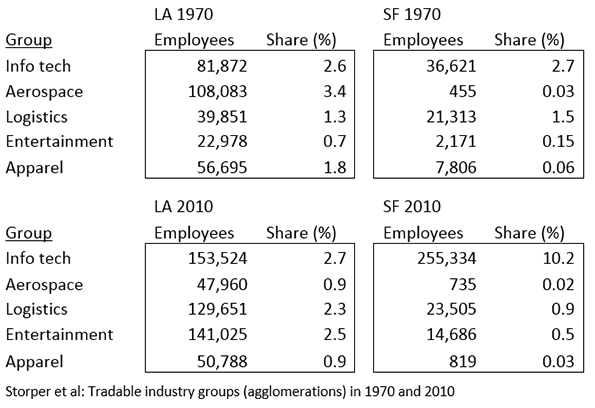
    Much of SKMO’s story springs from employment trends summarized in their table, below, which shows jobs data by major sector for their beginning and ending years for each region. Looking at employment shares, both areas had a similarly sized IT sector in 1970, but the Bay Area’s grew spectacularly while LA’s stayed about where it was. LA was specialized in aerospace and defense but, as is well known, that sector declined as the Cold War ended. Both geographic areas started almost equally in share of logistics jobs, but SF’s specialization in that sector subsided, while LA’s grew. LA’s lead in entertainment grew. Both areas lost jobs in apparel, but this hit LA harder, as the region had been more specialized in that sector.

    The LA area was long recognized for its leadership in the entertainment industry, just as the San Francisco area was for its leadership in tech. Yet “Hollywood” has been emulated in many places, including India, South Korea, China, and several European countries, while Silicon Valley’s would-be emulators, though numerous, have been far less auspicious.

    The post-1970s success of the SF region owes much to Silicon Valley, and SKMO note that, on average, SF’s tech sector salaries were higher than those in LA’s entertainment sector. Lots has been written about the unique culture of innovation and entrepreneurialism found in The Valley. There are real and aspiring ‘techno-hubs” practically all over the world. But the Holy Grail — to identify and bottle some kind of formula to spawn another Silicon culture — has not been discovered.

    SKMO note various Silicon Valley pre-1970s events: how the electronics industry had its roots in radio hobbyists, and the 1960s convergence of hippies and techies. The authors identify eleven historical “critical turning points.” Some are private business choices (“Hollywood’s creation of a new project-based organizational structure in the 1950s and 1960s”); some are more in the realm of public policy (“Los Angeles’ Alameda Corridor Project in the 1980s and 1990s”). Others (Steve Jobs liked The Whole Earth Catalog) also make the list, but without any clear direction for today’s planners.

    The authors devote a chapter to what local governments in each of the two regions spent and prioritized. Bay Area government spending was greater in the 1990s, as well as in the first decade of the 2000s. While Bay Area public transit spending was much greater, SKMO admit that both areas suffer bad traffic congestion, and back away from concluding the extra Bay Area public spending had payoffs. They end up concluding that we simply do not know enough about the programs that were funded to make strong statements about how spending might have (or should have) been re-allocated among programs.

    The key chapter of the book addresses what the authors call ‘Beliefs and Worldviews in Economic Development’: “We will see … how the Los Angeles Economic Roundtable and Chamber of Commerce generated very different narratives from those of the Bay Area Council and Joint Venture Silicon Valley… Bay Area leadership has had a more focused and time-consistent perception of its regional economy as a new knowledge economy. Greater Los Angeles leadership beliefs and worldviews have been inconsistent over time, with fleeting conceptions of the New Economy subsequently crowded out by the perception of Greater Los Angeles mainly as a gateway to international trade and logistics and specialized manufacturing.”

    We have to be careful here. The sequence of events is significant: Did important policy choices pre-date the good (SF) or the bad (LA) events the authors document? The unique entrepreneurial and innovative culture bred in Silicon Valley has no discernible starting date. Did the view of Bay Area elites of a new knowledge economy lead the way, or simply acknowledge facts on the ground?

    In their study of LA and SF, SKMO say little about how both areas have failed to reign in housing costs. By failing to contain the rising costs of most households’ single largest expenditure, both regions have failed. Labor markets cannot do their job when many people’s location choices are restricted. In all of their talk of the best regional development strategy, this essential one is not touched on in the study.

    But, caveats aside, “The Rise and Fall of Urban Economies” is data-rich, wide-ranging and provocative. Anyone interested in the American West’s two premier cities should read this important book.

    Peter Gordon is an Emeritus Professor, Price School of Public Policy at the University of Southern California. He now teaches each summer at Zhejian University in Hangzhou, China, and is currently at work on a book that explores how modern cities contribute to economic growth. He blogs at petergordonsblog.com.