Category: Economics

  • Can Southland be a ‘New York by the Pacific’?

    Throughout the recession and the decidedly uneven recovery, Southern California has tended to lag behind, particularly in comparison to the Bay Area and other booming regions outside the state. Once the creator of a dispersed, multipolar urban model – “the original in the Xerox machine” as one observer suggested – this region seems to have lost confidence in itself, and its sense of direction.

    In response, some people, notably Los Angeles Mayor Eric Garcetti, favor creating a future in historical reverse, marching back toward becoming a more conventional, central core and transit-dominated region – a kind of New York by the Pacific. Eastern media breathlessly envision our region transforming itself from “car-addicted, polluted and lacking in public transit” into a model of new-urbanist excellence.

    Here’s a basic problem. Their L.A. of the future – the one that wins plaudits from places like GQ magazine – essentially negates the region’s traditional appeal, offering the middle and even working classes, a suburban-like lifestyle in one of the world’s great global cities.

    Vive la difference

    UCLA’s Michael Storper correctly notes how far the Southland has fallen behind its traditional in-state rival, the San Francisco Bay Area. Storper correctly traces much of this gap to the domination of the Los Angeles tech sector by aerospace firms and the fact that this area also had a broad base of nontech-oriented manufacturing.

    Can we become a second San Francisco? Regions, like people, do not easily transform themselves into something else. For one thing, the Los Angeles area’s diverse industrial legacy tended to attract a larger share of historically poorer blacks and Hispanics than the Bay Area, whose population is 33 percent black and Hispanic. In contrast, 55 percent of the five-county Southland area’s population has either Hispanic or African American backgrounds, according to data from the 2014 American Community Survey.

    Read the entire piece at The Orange County Register.

    Joel Kotkin is executive editor of NewGeography.com. He is the Roger Hobbs Distinguished Fellow in Urban Studies at Chapman University and executive director of the Houston-based Center for Opportunity Urbanism. His newest book, The Human City: Urbanism for the rest of us, will be published in April by Agate. He is also author of The New Class ConflictThe City: A Global History, and The Next Hundred Million: America in 2050. He lives in Orange County, CA.

  • Are Compact Cities More Affordable?

    Housing affordability has been a tenacious and intractable urban problem for as long as stats have been kept. Several cities recently declared it a crisis. But what kind of problem is it? Opinions vary widely. An economic problem, or a social one? A land resource issue? Or, as traded wisdom would have it, the result of reliance on the wrong urban form? Proposed solutions vary accordingly. Now, new evidence rules out one potential source of unaffordable housing: clearly, it is not an urban form problem. The widely-believed theory that a city’s lack of affordable housing can be fixed with increased compactness — when combined with public transit — is apparently wrong.

    In a recent article we questioned a publicized correlation between a compactness index level (i.e., urban form) and housing affordability. The argument supporting compactness is that it enables the use of public transit and active mobility modes, which reduce transport expenses sufficiently to eclipse the higher cost of housing prevalent in compact districts. We challenged that assumption, and found that data from eighteen US regional metro regions showed no such effect. Even if it were at all present, it would not be sufficiently pronounced to be an effective solution. Those conclusions were based on a regional look at the problem.

    While the aggregate regional data undermined the urban form theory of affordability, what do sub-regional level data show? At this finer level, could the housing-plus-transportation burden work to the advantage of households? To answer this question, we used data from 18 districts of the Metro Vancouver (BC) region. In this case, the official data exclude certain types of households — a critical limitation. But, given that such disaggregated data are rare, an effort at deciphering their meaning is warranted.

    The two subject groups were Working Homeowners and Working Renters. First, we looked at whether or not the working homeowners could find accommodation that suited their income without stretching themselves thin.

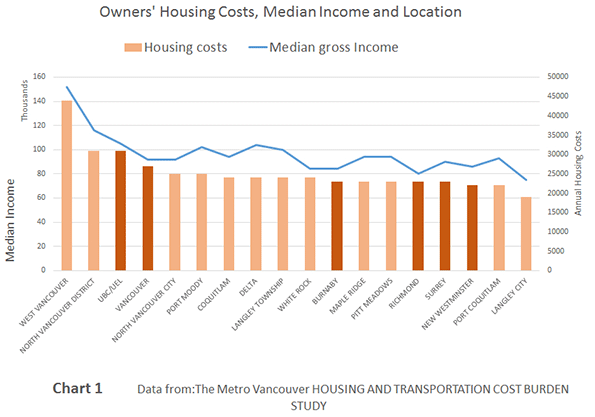
    Chart #1 shows the progression of housing costs in each sub-regional district, and the corresponding household median income. The in-step slopes of the two data sets suggest that working home-owning households have housing costs in tune with their earnings. This implication is further confirmed by the strong correlation (R2= 0.8598) between their income and their housing expenses.

    Housing costs that are proportional with income are a positive sign, but can these homeowners actually make their mortgage payments without financial stress? The data says yes, they can. This group’s average ratio of housing payments to income is 26%. It never exceeds 30%, the accepted threshold of financial strain.

    Instructively, from an urban form perspective, the highest ratios occur in the central, compact district; a confirmatory finding. Equally expected are that the lowest cost-to-income ratios occur in districts furthest from the center; these districts are either suburban or exurban.

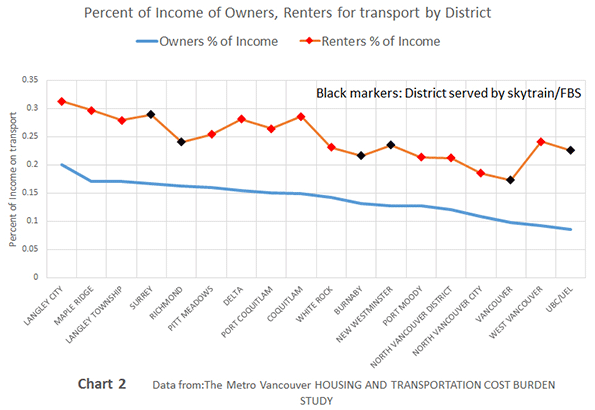
    But are any of these home-owning households disadvantaged by excessive transportation costs due to their location? The data show a normal, average transportation expense of 14% of income and a range from about 8% to 20%. The ratios do increase with distance, but bear no significant correlation with income (R2= 0.0178).

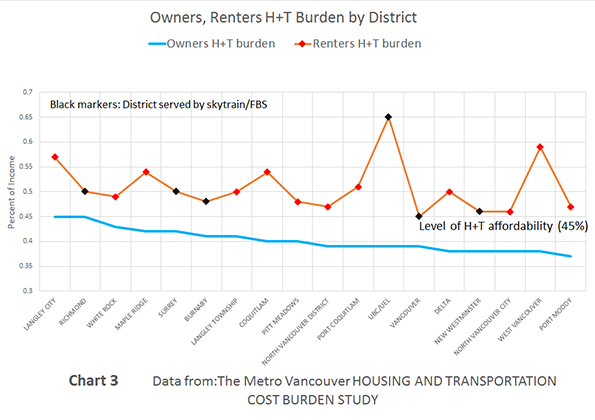
    When choosing the place of residence, do homeowners consider housing costs, but disregard transportation costs? If so, could this lead to an affordability problem as measured by the combined costs? Apparently not. Chart #3 graphs (blue line) this group’s cost burden for combined housing and transportation (H+T) expenses, which never exceed the recognized affordability threshold: 45% of income.

    Conclusion? Metro Vancouver’s 305,000 households of working homeowners with mortgages aren’t experiencing financial strain due to their housing costs, no matter what their preferred housing form, location or transportation arrangements. The urban and suburban locations of the city structure fully satisfy their housing and transport needs. Neither compactness nor its absence has a negative impact on their finances.

    The data paints an entirely different picture for the 224,000 working households that rent their accommodations. Their average H+T burden (Chart #3; orange line) is 51% of their median income, and it ranges from the 45% threshold of affordability to an extreme of 65%.

    This picture, however, is not the result of high housing costs; rents register in the affordable range in all locations but two. The average working renter’s housing cost is 26%, which mimics that of a homeowner, and the range is below the stress level of 30%, with only two outliers (out of 18 districts) at 35% and 45% of income. For renters, as is the case for homeowners, the highest housing costs occur in the more compact districts. The outliers are found in elite social cluster districts — highly desirable neighborhoods — entirely unrelated to urban form.

    Given that rent costs are within the affordable range in all but two locations, we may infer that the Metro Region provides a sufficient range of housing costs for this group in its current urban/suburban structure.

    These findings are reinforced by the proportionality of incomes and housing expenses for both homeowners and renters. The incomes of renter households range from 45% to 63% of homeowners by location, and their rent costs are from 45% to 65%, an almost identical range.

    It would seem, then, that the excessive H+T burden renters face can be attributed partially to the transportation costs of this group. However, contrary to expectations, of the six districts that have rapid rail service (sky-train; black markers on Chart #3), not one manages to have a total burden below the affordability threshold. That even goes for the two suburban districts that offer the lowest rents.

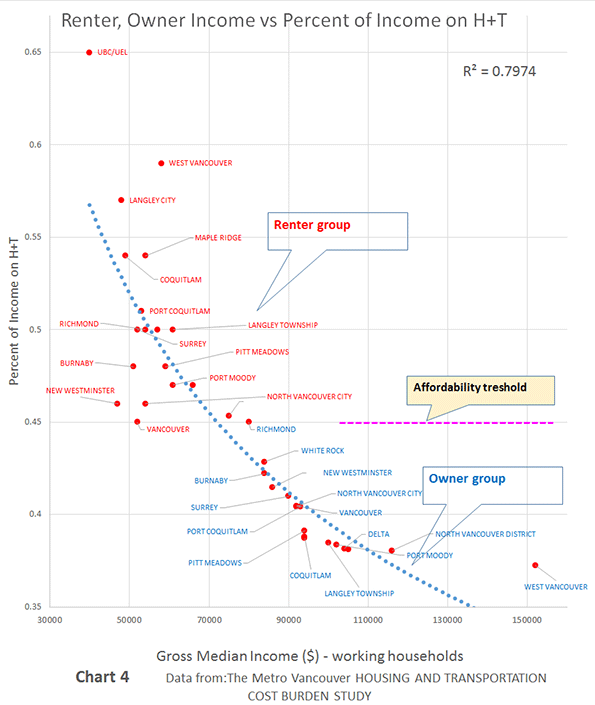
    Chart #4 clearly shows the division between the earnings of owners and renters, and the affordability threshold that separates them. The belief that a compact urban form provides a path to solving housing affordability problems appears untenable.

    Overall, the data shows that for working homeowners there are no locations in the Metro Vancouver Region, whether urban, suburban or exurban, that push housing costs or the combined costs of housing and transportation above the affordability threshold. Urban form is not affecting budgets in these households.

    For working renters, rents are affordable in 16 of the 18 districts, whether urban, suburban or exurban. However, when transportation costs are added to their housing costs, the new sum puts them in financial stress, even in districts served by rapid rail transit.

    This sub-regional, limited analysis confirms the findings of our earlier regional look: compactness and access to transit do not produce the affordability benefits that have been claimed. The compact urban form does not equal more affordable living, particularly for the less affluent.

    Fanis Grammenos heads Urban Pattern Associates (UPA), a planning consultancy. UPA researches and promotes sustainable planning practices including the implementation of the Fused Grid, a new urban network model. He is a regular columnist for the Canadian Home Builder magazine, and author of Remaking the City Street Grid: A model for urban and suburban development. Reach him at fanis.grammenos at gmail.com.

    Flickr photo by Nick Kenrick: The Neighbourhood of East Van

  • The Best Small And Medium-Size Cities For Jobs 2016

    When we look at how the U.S. economy is performing, we usually focus on the largest metropolitan areas. But some 29% of non-farm jobs in the U.S. are in small and midsize metro areas. And since they tend to be less economically diverse and more volatile, these metro areas often are where we can more clearly see the fissures in the economy — the sectors that are growing, and which are shrinking.

    In this year’s edition of our Best Cities For Jobs survey, 13 of the 20 metro areas with the fastest job growth are small (under 150,000 total nonfarm jobs) and medium-sized (between 150,000 and 450,000 total nonfarm jobs).

    Many of the smaller places creating jobs at the fastest pace are located in booming regions like the Intermountain West, near college towns and in regions with attractive natural amenities. Meanwhile, times are turning tougher in West Texas and other energy-dependent areas.

    The winners and losers also reflect demographic trends, notably the tsunami of downshifting boomers, that will shape our society and economy for years to come.

    The Utah Superstars

    As is the case with larger areas, it usually helps if a smaller region has more than one economic pillar. This is certainly true for our No. 1 city overall, St. George, Utah. The job count in this metro area has grown a remarkable 32 percent since 2010. Last year St. George’s job growth rate was 7 percent, roughly 3.5 times faster than the national rate, and one reason the area leaped 30 places in our overall rankings from last year.

    Located in the scenic southwestern part of the state near the Arizona border, and a magnet for retirees and tourists, St. George has had a remarkable population boom, growing from fewer than 100,000 residents in 2000 to 155,600 people as of 2015.

    This demographic surge can be seen where you would expect it, with rapid growth in construction sector jobs – up over 50 percent since 2010 — as well as leisure and hospitality, where employment expanded 37.8 percent over the same span.

    Yet this is not just a sleepy retirement and tourist town. The metro area has a median age of 32, three years older than the Utah average, but well below the national average of 37.2. Despite this younger demographic, job growth has occurred in sectors that tend to employ older workers, such as manufacturing, up 40.9 percent since 2010, and professional business services, up 34.6 percent.

    Not surprisingly if you want to find other local economies that reflect this kind of dynamic, the best place to look is elsewhere in the Beehive State. Our second-ranked area nationally, Provo-Orem has also achieved rapid job growth, with employment expanding 27.4 percent since 2010. Like St. George, this metro area has enjoyed strong growth in construction and hospitality, but also in higher-wage fields, including information, which has expanded employment 43.9 percent since 2010, and professional business services, up 34.3 percent.

    Home to Brigham Young University, the Harvard of Mormondom, the metro area is among the youngest in the nation, largely due to large Mormon families. It’s also, according to Gallup, the most religious as well as one of the best educated: almost 40 percent of its population over 25 holds bachelor’s degrees and almost 5 percent have advanced degrees, just ahead of San Jose, Calif., and Nashville, Tenn.

    Also placing highly from Utah is No. 15 Ogden-Clearfield, which rose 25 notches over last year. Employment has expanded 16.2 percent since 2010. Like St. George and Provo-Orem, this region has experienced strong expansion in its construction and hospitality sectors, but also boasts great economic diversity. Since 2010, manufacturing employment has grown 10.4 percent while professional business service jobs have expanded a healthy 31.3 percent.

    The Amenity Regions

    Of course, you don’t have to be a Latter Day Saint to have a successful small city. But it helps a great deal if you happen to be in a place that has standout natural and cultural amenities. This trend may be greatly enhanced by the movement of seniors, particularly affluent ones, to what may be called “amenity regions” throughout the country. Contrary to the urban mythology pressed by the mainstream media, Census data shows that seniors are not moving “back to the city” in great numbers but generally to smaller, less dense regions, if they move at all.

    Being in a nice place, of course, is an asset for any city; after all, entrepreneurs and young families also like to live somewhere good times beckon. At the same time, some of these areas also benefit from a strong hospitality and second home market. Another critical advantage belongs to college towns which, by their very nature, usually offer more by way of arts, restaurants and entertainment than other places.

    The highest ranked of these metro areas this year is Fayetteville-Springdale-Rogers, AR-MO, which comes in sixth on our overall list. It enjoys the benefits of being home to the University of Arkansas as well as close to the Ozark Mountains, one of the premier recreation areas in middle America. Since 2010, employment in the metro area has jumped 19.6 percent, or 40,000 jobs, with a 4.7 percent expansion last year. Like other top small cities, the areas has enjoyed strong growth in construction and hospitality jobs, up 37.2 percent since 2010, but also professional and business services, which expanded 38.2 percent over the same time period.

    Some other of the fastest-growing areas metro are tourism and retirement destinations on the tech-rich West Coast. Five years ago, Napa, Calif., and Bend-Redmond, Wash., were mired toward the bottom of our ranking in 344th and 36rd place, respectively. But as the coastal tech economies have surged, so have they, rising to 13th and 14th place this year. Hospitality and construction have been the big job gainers for both, with some jobs added in professional services as well.

    Losing Ground In The Oil Patch

    As tech-linked areas ascend, many energy-producing towns are slipping, with oil and gas prices in the dumps and the coal industry racked by the government-guided transition to cleaner forms of power production.

    West Virginia’s metropolitan areas have all suffered major declines on our list, with Wheeling dropping 54 places from last year’s survey to 396th on a 0.7 percent contraction in employment on the year. In Charleston, W.V., which has fallen to five spots from the bottom of our list, mining and natural resources employment declined 9.8 percent last year and is off 31.5 percent since 2010. Big job losses have occurred also in Wyoming, a major coal producing area, where Cheyenne dropped 82 places to 206th as mining and natural resources employment contracted 6.2 percent last year.

    Many once red-hot areas in the oil patch have taken devastating hits. Former high-flyer Victoria, Texas, dropped from 24th place last year to 115th. But no place reflects the flagging fortunes of the West Texas energy economy more than Midland, which, just last year ranked first on our list; this year it’s at 139th after losing 14.7 percent of its natural resources jobs and 6.9 percent of its jobs overall. Odessa fell from third last year to 173rd this year on the back of an 8.8 percent contraction in employment, and 20.4 percent in the natural resources sector.

    Several Louisiana metro areas have suffered steep job losses, including Houma-Thibodaux, down 183 places on our list to 325th after an 8 percent contraction in employment. Several smaller Oklahoma communities have taken serious hits, including Tulsa, which dropped to 222nd. Bismarck, N.D., a prime beneficiary of the Bakken oil boom, dropped 67 places from last year to 102nd as 6.8 percent of its natural resources jobs evaporated, while Bakersfield, Calif., one of the country’s largest oil producing areas dropped 70 places to 109th as natural resources employment contracted 11.5 percent.

    The Rust Belt: Is The Bounce Back Over?

    The picture is less uniform in the industrial sector than in energy. Some manufacturing-oriented areas are booming, such as No. 4 Gainesville, Ga., and No. 10 Columbus, Ind., home to Cummins. Nationwide manufacturing employment grew a paltry 0.3 percent last year, with some local declines that devastated the affected economies.

    In the Midwest, the big losers include Midland, Mich., which dropped 75 places to 245th, Green Bay, Wisc., which fell 83 places to 286th, and Fond du Lac, Wisc., which lost 173 places to 293rd. In Pennsylvania, Scranton-Wilkes Barre-Hazelton fell 97 places to 373rd and Williamsport dropped an astounding 212 places since last year to 383rd, with manufacturing employment off 13.2 percent since 2010 and overall employment down 3.5% last year. And then there’s Johnson, Pa., in last place at 421st.

    Like the energy economies, the industrially oriented metro areas are likely to stagnate for the time being as declines in global markets, the high dollar as well as lower demand from the energy sector take their toll. The International Monetary Fund predicts a modest 3.2 percent global growth rate for 2016, held down in significant part by a faltering Chinese economy. At the same time, OPEC overproduction and the addition of Iranian oil to global markets will likely keep the price below the $70-$80 per barrel range that energy producers need to start expanding energy investments again.

    This means, for the time being at least, the strongest smaller cities will be those which attract people and companies from bigger places by offering better amenities, cheaper housing, better schools, growing populations and, in many cases, college campuses—all offering a better quality of life but in a smaller, usually more affordable place.

    This piece first appeared at Forbes.

    Joel Kotkin is executive editor of NewGeography.com. He is the Roger Hobbs Distinguished Fellow in Urban Studies at Chapman University and executive director of the Houston-based Center for Opportunity Urbanism. His newest book, The Human City: Urbanism for the rest of us, will be published in April by Agate. He is also author of The New Class ConflictThe City: A Global History, and The Next Hundred Million: America in 2050. He lives in Orange County, CA.

    Michael Shires, Ph.D. is a professor at Pepperdine University School of Public Policy.

    By UtahStizzle (Own work) [Public domain], via Wikimedia Commons
  • De-Industrialization and the Displaced Worker

    Much has been made of working class pain in this election, but the problems go well beyond that.  I don’t like the 1% vs. 99% frame, but it captures something important about our society, namely a sort of bifurcation that has occurred between top and bottom. Roughly the top 20% are doing quite well, and increasingly live in communities surrounded by others like themselves. The bottom 80% does not seem to be faring so well on a variety of social and economic statistics.

    The policies offered by the mainstream of both parties has more or less boiled down to “more of the same stuff we’ve always pitched.” Clearly, the public is looking for something different.

    That’s the subject of my column now out in the May issue of Governing magazine called “De-Industrialization and the Displaced Worker.”  Here’s an excerpt:

    In George O. Smith’s science fiction short story “Pandora’s Millions,” society collapses when the invention of a “matter replicator,” like the ones from Star Trek, instantly renders most of the economy, and money itself, obsolete. Being a short story, this is resolved quickly with the invention of a substance that can’t be duplicated, followed by rebuilding the economy and society around services. Real life doesn’t always recover so quickly from disruptions, as we are finding out.

    Unsurprisingly, this has generated discontent. Back through to the 1980s and ’90s, this was mostly limited to displaced industrial workers. Today that has grown to a much broader spectrum, from young master’s degree holders with piles of student loan debt who are stuck working at Starbucks to corporate middle managers losing their jobs to outsourcing or foreigners working here under H1-B visas.

    This has percolated through to the political system, with the rise of Donald Trump and Bernie Sanders, both questioning many of the premises of the current economic system. America is more receptive to these arguments than many ever would have believed possible. That’s because the current system has lost legitimacy in the minds of many. Not only did it fail to deliver the promised benefits to them, but then government turned around and bailed out the big banks in the financial crash.

    Click through to read the whole thing.

    Aaron M. Renn is a senior fellow at the Manhattan Institute, a contributing editor of City Journal, and an economic development columnist for Governing magazine. He focuses on ways to help America’s cities thrive in an ever more complex, competitive, globalized, and diverse twenty-first century. During Renn’s 15-year career in management and technology consulting, he was a partner at Accenture and held several technology strategy roles and directed multimillion-dollar global technology implementations. He has contributed to The Guardian, Forbes.com, and numerous other publications. Renn holds a B.S. from Indiana University, where he coauthored an early social-networking platform in 1991.

    Image by Flickr/Mirko Tobias Schäfer – CC BY 2.0

  • Scandinavian Women Do Well, Except at the Top

    In which part of the world should we expect most women to reach the top? The answer has to be the Nordic countries. According to The Global Gender Gap report, for example, Iceland is the most gender equal country in the world followed by Norway, Finland and Sweden. Yet as I will discuss below, this has not translated in women making it to “the top”, as one might expect. This a paradox that I will seek to address.

    Around the world, the Nordic countries are often idealized as the most gender equal places in the world. To a large degree, this admiration is warranted. But it is time to realize that the very same system is holding back women’s ability to reach the top.

    To begin with, the Nordics have a unusual gender equal history. The tradition of gender equality has roots in Viking culture. For example, Scandinavian folklore is primarily focused on men who ventured on longboats to trade, explore and pillage. Yet the folklore also includes shiledmaidens, women chosen to fight as warriors. Byzantine historian John Skylitzes records that women were indeed participating in Nordic armies during the 10th century. The fact that women were allowed to bear arms, and train as warriors, suggests that gender segmentation in early Norse societies was considerably more lax – or at least more flexible – than other parts of contemporary Europe. Evidence also suggests that women in early Nordic societies could inherit land and property, that they kept control over their dowry and controlled a third of the property they shared with their spouses. In addition, they could, under some circumstances at least, participate in the public sphere on the same level as men.

    Medieval law, which likely reflects earlier traditions, supports this notion. Medieval inheritance laws in Norway for example followed family relations through both male and female lines. Additionally, women could opt for a divorce. These rights might not seem impressive today, but they were rather unusual in a historical context. In many contemporary European and Asian societies, the view was that women simply belonged to their fathers or husbands, having little right to property, divorce or inclusion in the public sphere.

    Nordic gender egalitarianism continued after the Viking age, particularly in Sweden. In much of the world, women were excluded from participating, at least fully, in the rise of early capitalism during the 18th and 19th centuries. In essence, free markets and property rights were institutions that initially excluded women. Although Sweden and the other Nordic countries were far from completely egalitarian, they challenged contemporary gender norms by opening up early capitalism for women’s participation.

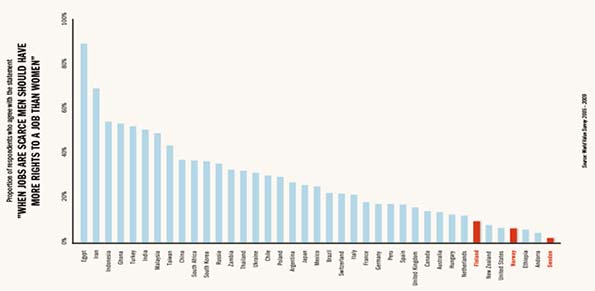
    As shown below, the World Value Survey has asked respondents around the world whether they believe that men should be prioritized over women if jobs are scares. In modern market economies, fewer agree with this notion. In Switzerland for example, 22 per cent believe that men should have more right to a job than women, compared to 16 per cent in the United Kingdom and 14 per cent in Canada and Australia. Sweden has the lowest share agreeing with this view, merely 2 per cent. Norway (6 per cent) and Finland (10 per cent) are also amongst the countries with egalitarian views.

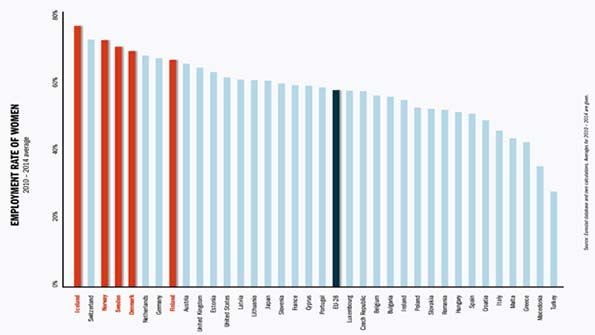
    In addition, the Nordic welfare states have encouraged women to enter the labor market early on. Still today Nordic countries are ahead of most of Europe in this regard. Child care cost and paid maternity, services provided largely by the public sector in the Nordic welfare states, can in part explain the high labor participation amongst both parents. Such systems are much more extensively funded by the public sector in the Nordics compared to other modern economies, and particularly so compared to the Anglo-Saxon nations. Although even here, the United States, still not a full welfare state, does surprisingly well.

    A long history of gender equality, gender equal norms, many women actively participating in the labor market and family friendly welfare policies – surely this should be seen as the recipe for many women reaching the top of the business world? In the new book The Nordic Gender Equality Paradox I show that this is not the case. In Nordic countries surprisingly few women have made to the top echelons.   

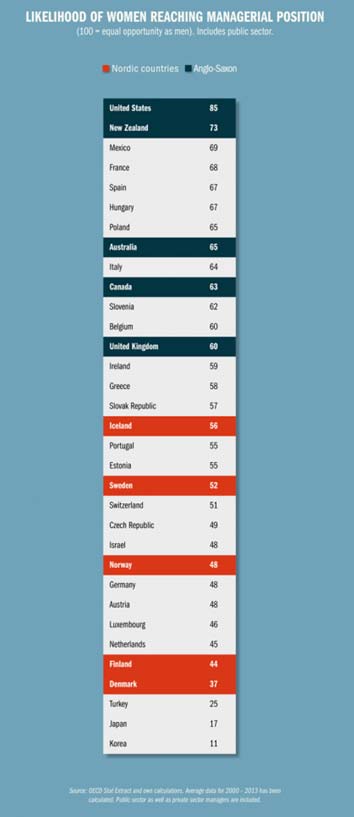
    The OECD gathers information about the proportion of employed persons which have managerial responsibilities in different developed economies. In the table below the share of women managers in different countries is shown as a percentage of the share of male managers. This calculation yields a measure of the likelihood of the average employed women to reach a managerial position compared to the average employed man. The likelihood of a women reaching a managerial position as compared to the same likelihood for a man in the United States is found to be 85 per cent. This is far higher than any other country in the study. As a comparison, the same share is 60 per cent in the United Kingdom and 52 in Sweden. Norway (48 per cent), Finland (44 per cent) and Denmark (37 per cent) score even lower.

    It should be emphasized that this measure includes public sector managers, which inflates the figures for Nordic countries compared to if private sector managers had been studied. The data paints a clear picture: The United States, where welfare state programs do not subsidize women’s parental leave has more women reaching managerial positions than any of the Nordic welfare states.

    Why is it that Nordic countries fail to reach their gender equal potential? Shouldn’t these countries be heads and shoulders above the US when it comes to the share of women climbing to the top? Progressive theorists would naturally assume this. But in reality there is a paradox here; the egalitarianism of the Nordics has clear limits.   At the end of 2014 for example, The Economist ran a story entitled A Nordic mystery

    “Visit a typical Nordic company headquarters and you will notice something striking among the standing desks and modernist furniture: the senior managers are still mostly men, and most of the women are [program administrators]. The egalitarian flame that burns so brightly at the bottom of society splutters at the top of business.”

    As I explain in The Nordic Gender Equality Paradox there is a logical answer to the apparent paradox: policy matters. Numerous studies support the conclusion that the large welfare states in the Nordics, although designed to aid in women’s progress, in fact are hindering the very same progress. Social democratic systems do provide a range of benefits for women, such as generous parental leave systems and publicly financed day care for children. The models however also have features that are detrimental to woman’s careers.

    To give an illustrative example, public sector monopolies in women-dominated areas such as health and education seem to substantially reduce the opportunities for business ownership and career success amongst women. Welfare state safety nets in particular discourage women from self-employment. Overly generous parental leave systems encourage women to stay home rather than work. Substantial tax wedges make it difficult to purchase services that substitute for household work, which reduces the ability of two parents to engage fully in the labor market.

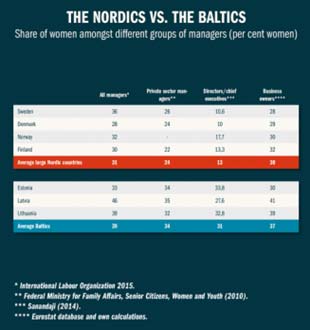
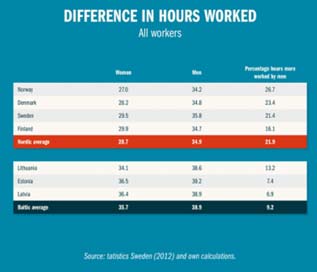
    The Nordic welfare model has, perhaps unintentionally, created a model where many women work but seldom in the private sector and seldom enough hours to be able to reach the top. For example, it might seem as a puzzle why the Baltic countries – which have much more conservative and family oriented cultures – have a higher share of women amongst managers, top executives and business owners than their Nordic neighbors. As shown below, a key factor is difference in working time. In the Nordic societies the average employed man works fully 22 per cent more hours than the average working women. In the Baltic model, where families have greater choice in organizing their lives compared to the Nordic welfare states, the gap is only 9 per cent. On top of this comparison, which looks at working individuals, many Nordic women also take long parental leaves, paid to do so by the welfare state, and thus fall behind in their careers. Of course Baltic mothers are also much concerned for the upbringing of their children. However, many of them solve the equation by getting help from family, perhaps grandmother, to watch the children or buy services to alleviate household work – something easier to do in low-tax countries.

    Thus, for all their gender equal progress, the Nordic countries in fact have relatively few women entrepreneurs, managers and executives. And there is really not a paradox why this situation has developed. It’s all about the policy choices made in the Nordics.

    As is clear, an expansive welfare state may be good for some things, but expanding the ranks of managers for women is not one of them. The feminist heritage that dates back to the age of the Vikings needs to be combined with a more free-market and small government approach if Nordic societies are to fulfill their gender equal potential. Perhaps this is also a lesson to the rest of the world, where progressive policies are often seen as the recipe for promoting women’s careers.

    Nima Sanandaji is the president of the European Centre for Policy Reform and Entrepreneurship (www.ecepr.org) and a research fellow at the Centre for Policy Studies and at the Centre for Market Reform of Education. His latest book, The Nordic Gender Equality Paradox, can be ordered here.

  • Developing Economies Dominate Per Capita GDP-PPP Growth

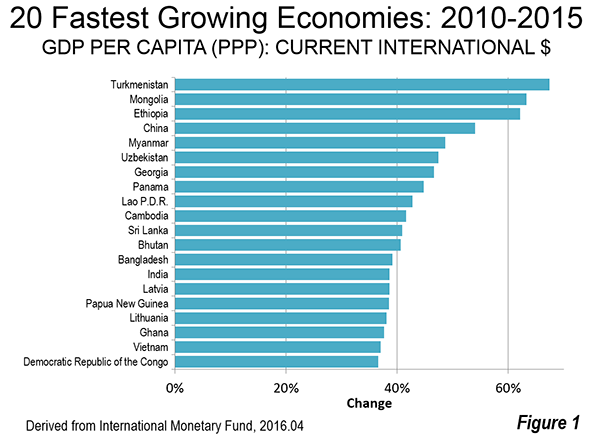
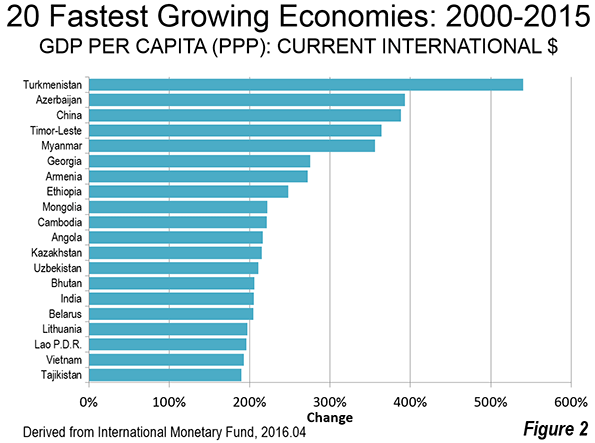
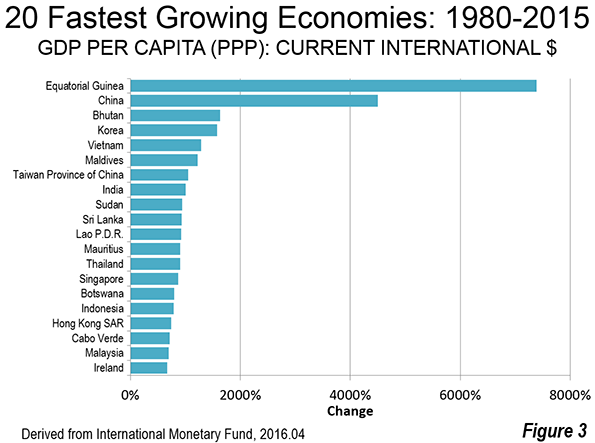
    The world’s developing economies have dominated purchasing power economic growth over the last 35 years, according to the most recent gross domestic product (GDP-PPP) per capita data from the International Monetary Fund (IMF). This article summarizes economic growth for three periods, including from the earliest IMF data (1980 to 2015), the intermediate 2000 to 2015 period and the more recent 2010 to 2015 timeframe. The full data is available on the Demographia website, at http://www.demographia.com/db-imf2015.pdf.

    GDP per capita provides a measure of comparative income for individuals in an economy, as opposed to overall GDP data, which is a measure of an economy’s total production. This is an important distinction, because an economy may have a very high overall GDP, while its residents have relatively low income. For example, India has the world’s fourth largest GDP, yet with its population approaching 1.3 billion, ranks 126th in GDP per capita (out of the 190 countries and sub-national geographies included in the database). On the other hand, China’s Macao Special Administrative Region has the third highest GDP per capita in the world, but barely manages to be within the 100 largest economies, due to its much smaller population (approximately less than 600,000).

    Fastest Growing Economies

    2010-2015: The most recent period exhibited remarkable geographic diversity among the fastest growing economies. Asia contributed 13 entries out of the top 20, with Africa adding three (Ethiopia, Ghana and the Democratic Republic of the Congo), Europe two (Latvia and Lithuania), Oceana one (Papua New Guinea) and North America one (Panama). The fastest growing economy was Turkmenistan, at 67 percent, closely followed by Mongolia at 63 percent and Ethiopia at 61 percent. China, which has sustained strong growth throughout all of the periods examined, ranked fourth at 54 percent. Myanmar, now emerging from decades of dictatorship,  was the fifth fastest growing economy, at 49 percent (Figure 1).

    The top 20 included two of the world’s poorest economies, third ranked Ethiopia, with a GDP per capita of $1,800 and the Democratic Republic of the Congo (DRC), which ranked 19th, with a GDP per capita of $800 (both figures are after the 2010-2015 increase). The improvement in the DRC is thus very encouraging, but it is  from a severely impoverished base.

    2000-2015: Perhaps surprisingly, nine of the 20 fastest growing economies over the interim period (2010-2015) are former Soviet republics. Turkmenistan was, as between 2010 and 2015, the fastest growing, at 540 percent. Turkmenistan was joined by fellow former Soviet Azerbaijan , which grew 393 percent. Other former Soviet republics in the top 20 included Georgia, Armenia, Kazakhstan, Uzbekistan, Belarus, Lithuania and Tajikistan.  However, the largest former Soviet republic of all, the Russian Federation, was not among the fastest growing but placed a respectable 45th .

    China ranked third in economic growth, only slightly below Azerbaijian.at 388 percent. Timor-Leste, recovering from its intense ethnic conflict, ranked fourth. Myanmar ranked fifth.

    1980-2015: Over the longer period (1980-2015), Equatorial Guinea grew the fastest, at more than 8,000 percent, driven by its rich oil resources. China ranked second, at 4,500 percent. This huge increase was from a second worst in the world GDP per capita, which was a mere  $300 in 1980. Small Bhutan ranked third, at 1,627 percent, followed by the Republic of Korea (South Korea), which grew 1,572 percent, to become one of the world’s strongest economies. Vietnam ranked fifth, growing 1,283 percent (Figure 3).

    Three of the world’s richest economies, with GDP’s per capita above $50,000, were also among its fastest growing between 1980 and 2015. These included Singapore (14th), Hong Kong (17th) and Ireland (20th).

    Slowest Growing Economies

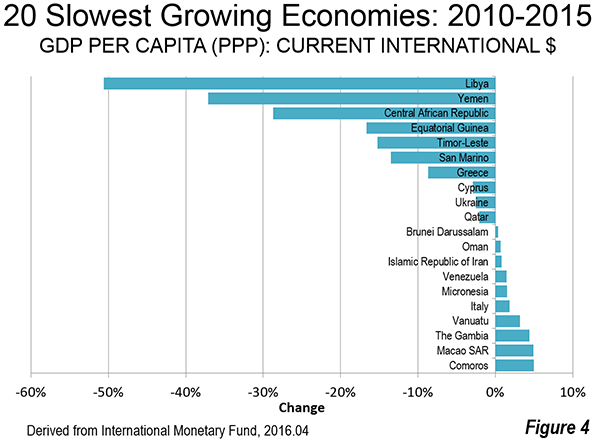
    2010-2015: The slowest growing economies in the last five years have suffered serious civil disorder.  Troubled Libya experienced a more than halving of its GDP per capita between 2010 and 2015. In 2010, Libya had a GDP per capita of $29,600, more than long-time European Union (EU-15) members Greece ($29,000) and Portugal ($26,500). By 2015, Libya had dropped to $14,600, less than Brazil ($15,600) and the Dominican Republic ($15,000).

    Similarly unstable Yemen experienced a loss of 37 percent, from $4,200 to $2,700.

    The Civil war ravaged Central African Republic lost 29 percent in GDP per capita. This is made worse by the fact that the Central African Republic ranked 185th in GDP per capita in 2010 out of the 189 geographies for which there is data. The 2015 data shows the Central African Republic to rank dead last in GDP per capita, 190th out of 190.

    Oil producing Equatorial Guinea experienced a loss of 17 percent in its GDP per capita, which is particularly significant, since Equatorial Guinea had the largest gain of any economy between 1980 and 2015.

    Three current European Union members were among the slowest growing economies. Greece had the 7th largest loss (-8.8 percent), while Cypress had the 8th largest loss (2.9 percent). Italy was the 16th slowest growing economy, gaining 1.8 percent (Figure 4).

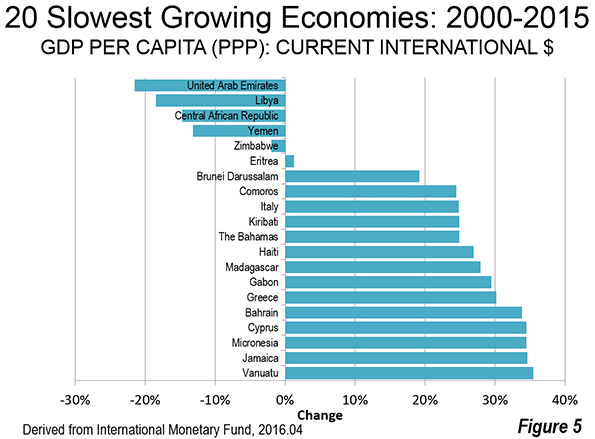
    2000-2015: The largest loss in GDP per capita between 2000 and 2015 was experienced by the oil producing United Arab Emirates. The next three greatest losses were in Libya, the Central African Republic and Yemen, which also sustained the largest losses between 2010 and 2015. The same three European Union members as in 2010-2015 made the 2000-2015 slowest growth list, Italy, Greece and Cypress (Figure 5).

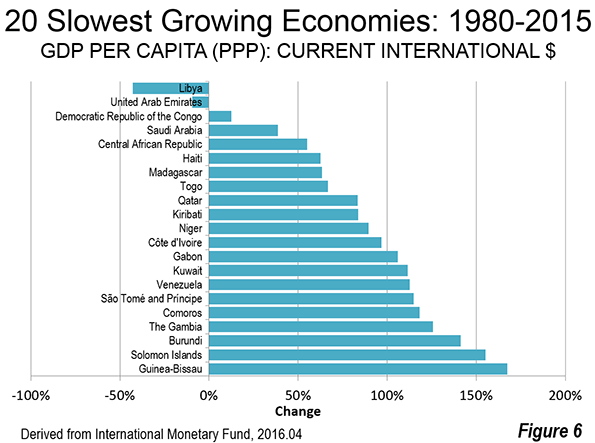
    1980-2015: Libya and the United Arab Emirates were the only geographies to post GDP per capita losses over the past 35 years. Miniscule growth was experienced in the third slowest growing Democratic Republic of the Congo, though as indicated above, the DRC managed to make the top 20 in growth between 2010 and 2015.

    The Future

    While there is much to celebrate about economic growth over the last 35 years and even in the more recent periods, far too much of the world lives in poverty and middle-income standards of living are declining, especially in the high-income world. These factors were the subject of discussions at the 2014 Brisbane G20 conference, when world leaders adopted a communique stressing a commitment to improving standards of living and eradicating poverty.

    Yet, a year and half later, International Monetary Fund Managing Director Christine Lagarde expressed a cautionary note in introducing the organization’s latest World Economic Outlook. The IMF indicated that Director Legarde warned that the recovery remains too slow, too fragile, with the risk that persistent low growth can have damaging effects on the social and political fabric of many countries. It is to be hoped that future reports will show large numbers of people exiting poverty, and a resumption in the rise of middle-income living standards. If these run in tandem, the world economy will be in the best shape in history.

    Wendell Cox is principal of Demographia, an international pubilc policy and demographics firm. He is a Senior Fellow of the Center for Opportunity Urbanism (US), Senior Fellow for Housing Affordability and Municipal Policy for the Frontier Centre for Public Policy (Canada), and a member of the Board of Advisors of the Center for Demographics and Policy at Chapman University (California). He is co-author of the “Demographia International Housing Affordability Survey” and author of “Demographia World Urban Areas” and “War on the Dream: How Anti-Sprawl Policy Threatens the Quality of Life.” He was appointed to three terms on the Los Angeles County Transportation Commission, where he served with the leading city and county leadership as the only non-elected member. He served as a visiting professor at the Conservatoire National des Arts et Metiers, a national university in Paris.

    Photograph: Addis Abeba, capital of Ethiopia (3rd fastest growing economy 2010-2015)

  • The Best Cities For Jobs 2016

    While speculation is mounting that they’re overheating, the tech boom is still creating jobs at a rapid pace in the Bay Area and Silicon Valley, placing them atop our annual assessment of The Best Cities For Jobs for the third year in a row. A number of secondary tech centers are posting strong growth as well on the back of the boom, as well as spillover from Northern California as high prices push expanding companies and startups to locate elsewhere.

    Tech job growth has been strong, but it’s not been equally distributed across the country. For example, U.S. employment in software publishing is up 5.5% from last year to a weighted total of 343,000 jobs, 26% above the sector’s prior peak amid the dot-com bubble in 2001. The twin capitals of the U.S. tech industry have accounted for much of the growth. Employment in the information sector in the San Francisco-Redwood City-South San Francisco metropolitan statistical area expanded 6.8% last year, capping a torrid growth rate of 62% since 2010. At the same time the metro area’s professional business service sector — which employs almost four times as many as information (270,000) at such firms as Salesforce.com, Uber and Oracle — has grown an impressive 45% since 2010. Overall, the San Francisco metro area clocked 4.6% employment growth last year, and an impressive 23.8% since 2010, placing it first on our list of The Best Cities For Jobs for the second year in a row.

    In the neighboring San Jose-Sunnyvale-Santa Ana MSA, information sector employment has expanded 57% since 2010; its business services sector, smaller than that of San Francisco’s, has posted 36.4% job growth over the same span. Taken together, these two metro areas have been best positioned to take advantage of the growth of social networking and the smartphone economy, which have soared even as many of the older Valley firms — Intel, Hewlett Packard, Yahoo — have faced tough times. Job growth in the San Jose metro area was 4.1% last year,  and 20.8% since 2010, placing it second on our list.

    Yet the success of the Bay Area, particularly its western strip along the San Francisco Peninsula, also has had a spillover impact on other tech hubs. High housing prices, intensified by the force of California’s regulatory regime, has driven many employers to seek other, more affordable locations. A recent study by California’s Legislative Analyst’s Office found that the area’s top tech executives see high housing prices as the biggest barrier to future growth.

    If this is a headache for these tech moguls, it’s manna from heaven for upstart metro areas like Austin-Round, Texas (sixth place on our list of Best Cities For Jobs); Raleigh, N.C. (ninth); Denver-Aurora-Lakewood (seventh) and Portland, Ore. (10th). Although not inexpensive by national standards, these areas are natural catch-basins for tech workers and companies. Employment in Austin’s information sector, for example, has expanded an impressive 34% since 2010, while professional business services jobs have grown 42%. In Raleigh, the tech region with some of the lowest housing costs, information sector employment has increased 18.5% since 2010 and professional business services almost 28%.

    Methodology

    Our rankings are based on short-, medium- and long-term job creation, going back to 2004, and factor in momentum — whether growth is slowing or accelerating. We have compiled separate rankings for America’s 70 largest metropolitan statistical areas (those with nonfarm employment over 450,000), which are our focus this week, as well as medium-size metro areas (between 150,000 and 450,000 nonfarm jobs) and small ones (less than 150,000 nonfarm jobs) in order to make the comparisons more relevant to each category. (For a detailed description of our methodology, click here.)

    The Return Of The Sun Belt

    In the wake of the housing bust, many Sun Belt economies suffered, particularly in the Southeast and Intermountain West. Some believed that the half-century-long era of Sun Belt growth was nearing its end. Yet as the latest Census trends reveal, it is precisely to the Sun Belt where Americans once again are moving, taking their talents, ambitions and hopes with them.

    This resurgence is epitomized by Orlando, which jumped 14 places this year to third, capping a comeback from its dismal 2010 ranking of 36th among the largest MSAs. Job growth last year was 4.6%, equaling that of the San Francisco-Silicon Valley region.

    Orlando’s resurgence has been driven by growth in professional business service jobs (up 26.8% since 2010) , construction-related employment (up 11.5%) and by its largest sector, hospitality, up 22%. The metro area’s population has exploded from 1.2 million in 1990 to 2.3 million today. Much of this recent growth has come from domestic migration, which has accelerated two and half fold since the end of the recession. This has fueled a modest resurgence in construction employment, which expanded 4.6% in the last year in the Florida city.

    The growth of domestic migration has sparked job gains in fields such as construction, retail, education and health, as well as steady growth in business services.  This back to the Sun Belt pattern can be seen in the strong performance of No. 4 Nashville-Davidson-Murfreesboro-Franklin, Tenn., and No. 8 Charlotte-Concord-Gastonia, which are also seeing a payoff from the corporate headquarters and manufacturing jobs they have lured from higher-cost metro areas like Los Angeles. Even cities devastated by the housing bubble like Phoenix, which gained 10 places this year to 17th, and Las Vegas, which gained nine places to 22nd, are clearly on the comeback trail. The death of the Sun Belt has turned out to be more the stuff of coastal dreams than reality.

    Full List: The Best Big Cities For Jobs 2016

    As has been the case for more than a decade, Texas boasts by far the most high-growth hubs of any state. The fifth-ranked Dallas metro area remains a steady fountain of new jobs, attracting many new companies in recent years, most notably Toyota. Besides No. 6 Austin, 12th-ranked San Antonio has also been on a roll, enjoying both strong growth in population (up 11.2% over the past five years and more than 39% since 2000) as well as in jobs.

    Decline In The Tangible Economy

    But not all the news in Texas is good, with the sputtering of years-long growth in hard industries such as energy and manufacturing, which tend to provide high-paying blue collar work. The recent weakness in energy prices has been felt heavily in Houston, a star performer for much of this decade. The energy capital has descended to 24th on this year’s list from sixth last year, the largest drop of any metro area in the country. Economist Bill Gilmer, head of the Institute of Regional Forecasting at the University of Houston, expects somewhere close to 50,000 local energy jobs will disappear before things get better.

    Fortunately, unlike during the early ’80s oil bust, Houston’s economy appears to be diverse enough to weather the storm. Rapid growth in health services (the area is home to the world’s largest medical center), as well as education has kept employment expanding slightly, with 0.7% job growth over the past year, but well off the pace from its five-year increase of 16.4%. Until energy prices rise again, it’s unlikely this dynamic city will get its mojo back entirely.

    With an estimated 250,000 energy jobs gone, other energy centers have also been hard-hit. Ft. Worth-Arlington, home to energy giant Halliburton, dropped 15 places to 28th while Oklahoma City slipped four positions to 37th and New Orleans fell five to 48th. Although not as energy-dominated as Houston, oil and gas has been an important producer of high-wage jobs in these metro areas.

    Perhaps equally worrisome, there are signs that manufacturing-oriented economies are also losing momentum. Unlike Houston, these metro areas rarely have placed among the top 10 Best Large Cities For Jobs, but many had been moving up our rankings in recent years. Not anymore.

    Much of the worst damage has taken place in the Midwest. For example, Grand Rapids dropped three places to 37th, Cincinnati fell nine to 50th, Milwaukee slipped seven to 61st, and Detroit dipped two to 62nd. But the damage also extends to some of the non-Midwestern industrial centers; for example 65th-ranked Birmingham-Hoover, Ala., dropped 10 places, as did Pittsburgh, which had a strong energy sector as well. Our two bottom feeders, 69th-place Buffalo-Cheektowaga–Niagara Falls and last-place Rochester, N.Y., each dropped seven rungs.

    The Big Three

    America’s three largest metropolitan areas — New York, Los Angeles and Chicago– also rarely crack the top 10, but this year clear differences have emerged among them. By far the healthiest economy is New York City, which moved up one place to 16th. Since 2010 the Big Apple has added an impressive 530,000 jobs, paced by a 29.7% expansion in hospitality sector employment and 22% growth in professional business services jobs.

    The story is not so pleasant in Los Angeles-Long Beach-Glendale. As its longtime Bay Area rival has boomed, Los Angeles employment growth has been mediocre, ranking it 42nd this year. Although leisure and hospitality employment has boomed, up 28.1% since 2010, and business and professional services has grown a decent, if unspectacular, 13.8% in the last five years, growth has been slow in information, barely 3.5% over the same period; employment in L.A.’s manufacturing sector declined 3.4% to 356,100 – still a substantial number but a shadow of its former might.

    Full List: The Best Big Cities For Jobs 2016

    Doing even worse is Chicago, which dropped three slots to 47th. The Windy City economy has posted modest growth in professional and business services, and its hospitality industry, while on the upswing, has added jobs at a considerably slower pace than either New York or Los Angeles. And like Los Angeles, its industrial sector continues to shrink, down 1.7% since 2010 to 281,000 jobs. In the most recent Census, the Chicago area led the nation in population decline.

    If you’ve made it this far, there’s one clear takeaway: the health of the American economy looks very different depending on where you live. Right now, growth momentum belongs to the tech centers and the Sun Belt. Don’t expect a major shift in the pecking order until the tech boom or the housing market weaken, or until manufacturing and energy pull themselves out of the current morass.

    This piece first appeared at Forbes.

    Joel Kotkin is executive editor of NewGeography.com. He is the Roger Hobbs Distinguished Fellow in Urban Studies at Chapman University and executive director of the Houston-based Center for Opportunity Urbanism. His newest book, The Human City: Urbanism for the rest of us, will be published in April by Agate. He is also author of The New Class ConflictThe City: A Global History, and The Next Hundred Million: America in 2050. He lives in Orange County, CA.

    Michael Shires, Ph.D. is a professor at Pepperdine University School of Public Policy.

  • Would Reaganomics Work Today?

    The key drivers that propelled the Reagan economy are now tapped out or out of favor.

    The name of Ronald Reagan is frequently evoked by the current contenders to the GOP nomination. Donald Trump speaks admiringly of the 40th President of the United States and uses a truncated version of his 1980 campaign slogan “Let’s Make America Great Again”. Ted Cruz promises to implement Reagan’s solution of lower taxes, lower regulation and a stronger military. Before he bowed out recently, Marco Rubio was equal in his praise. And John Kasich stakes an even more tangible claim by reminding us that he is the only candidate who actually worked with Reagan.

    But if Reagan’s economy is something we can reproduce, we should first understand the most important drivers of that economy. Arthur Laffer, the father of supply-side economics, said in 2006 that the four pillars of Reaganomics were sound money, low taxes, low regulation and free trade. In addition to these four, we add our own two which are more contextual enablers than proactive policies: demographics and innovation. It is our contention that the first four would not have succeeded without the last two.

    Demographics: Reagan’s time in office coincided with powerful demographic tailwinds, namely a strong decline in the dependency ratio (DR), an accelerated rise in the American work force, and a rich demographic dividend. The dependency ratio (red line in the first chart below) is the ratio of dependents to workers, calculated as the sum of people aged less than 20 and over 64 divided by the number of people aged 20-64. When the US total fertility rate (TFR, the average number of children per woman) declined from 3.5 children per woman in 1960 to less than 2 in 1975, the dependency ratio followed with a lag, falling from 0.9 in 1970 to 0.76 in 1980, 0.70 in 1990 and 0.66 in 2010.

    Under the right conditions when the dependency ratio falls, the economy can reap a demographic dividend. With fewer dependents, households are able to divert more of their income toward discretionary spending, savings and investments, helping create more innovative companies that in turn boost the incomes of households. That is more or less the dynamic that propelled the US economy during the 1980s and 1990s.

    Screen Shot 2016-03-10 at 2.58.14 PM

    Looking at the future now, the dependency ratio bottomed in 2010 and is set to rise again from 0.66 in 2010 to 0.71 in 2020 to 0.83 in 2035. This increase is due mainly to the aging of the population and the increased number of dependents aged 65 or over. It is essentially a reversal of the powerful dynamic that benefited the economy in the 1980s and 1990s. The demographic tailwinds seen during the Reagan presidency have turned into headwinds.

    Screen Shot 2016-03-10 at 2.58.14 PM (1)

    In the second chart, we can see that the size of the US population aged 20-64 (red line) rose strongly from 1970 to 2015 and will level off and rise more slowly from here on. The population aged 30-59 (blue line), arguably the most productive and highest-earning and highest-spending segment, rose strongly starting in 1980 and flattened out around 2010. So here again, the two Reagan terms benefited from a rapid increase in the size of the work force. Clearly the most favorable period, the one with the highest acceleration, was from around 1983 to 2000, matching the economic boom of the Reagan to Clinton years.

    Note in passing that a similar chart for Europe, America’s top trading partner, shows an even more troubling picture. Excluding eastern Europe and Russia (red line below), the population aged 20-64 will fall from a peak of 267 million in 2010 to an estimated 232 million in 2050. Including eastern Europe and Russia, it will fall from 459 million to 370 million.

    Screen Shot 2016-03-14 at 4.57.43 PM

    (the charts above were derived by populyst from data produced by the UN Population Division).

    Innovation: Reagan came to office at a time of great innovations in computer technology. Innovation was then and remains now one of the most potent drivers of the economy. We have every reason to hope that America will remain as innovative as it was in the past. But the rate of innovation will certainly suffer if skilled foreign professionals are unable or unwilling to come and work in the United States because of more restrictive visa or residency policies.

    Interest Rates: Reagan started his first term with very high inflation and interest rates. Both started to decline during his presidency, helping stabilize and grow the economy and boosting the stock market. But we now face the risk of deflation. And interest rates are at rock bottom. As shown in the chart below from Goldman Sachs, the 10-year US Treasury yield was near 16% when Reagan took office and it is now at 2%, near all-time historic lows. Real rates are still negative and the Federal Reserve has few options left in its efforts to stimulate the economy through monetary policy.

    Screen Shot 2016-03-13 at 7.46.05 AM
    (click image to enlarge)

    Taxes: It is true that President Reagan enacted important tax cuts but these cuts came at a time when the marginal income tax rate was much higher than it is today. The chart below from the Tax Foundation shows that the top rate in 1980 was 70% and is now 39.6%.

    Screen Shot 2016-03-13 at 7.26.58 AM

    The top corporate income tax rate was 46% in 1981 vs. 35% today. And the top rate for long-term capital gains was 28% vs. 20% today (plus a 3.8% Medicare tax since 2013).

    Reagan’s tax cuts came at a time when spending on entitlement was relatively small compared to what it will be in the years ahead. Even at current levels of taxation, the federal budget deficit is expected to start rising again due to additional spending on old-age entitlements. The Congressional Budget Office predicts an expansion in the deficit from $439 billion in 2015 to $810 billion in 2020 and $1,226 billion in 2025. (see pages 147-149 of this CBO publication.)

    And as shown in the chart below from the St. Louis Fed, the federal debt is now much higher at over 100% of GDP, vs. 31% when Reagan took office.

    Screen Shot 2016-03-14 at 10.43.38 AM (2)

    It seems clear therefore that there is not as much scope for cutting taxes in the current environment as there was in the early 1980s. Unless accompanied by other changes, implementation of a flat tax or general cuts in tax rates are likely to increase the debt and deficit beyond the already high projections.

    Free Trade: Opening new markets and lowering trade barriers were cornerstones of US policy in the 1980s and 1990s. If today European demand is slackening and China is entering a slower period, there could be new markets for US exports in the Asian and African frontier markets that are experiencing a demographic boom. Expanding trade to these new markets would spur new demand for American goods.

    But free trade is now under attack from parties who argue that too many American jobs have gone abroad to China, Mexico and others. The presidential primaries have shown so far that a non negligible segment of the American electorate has been receptive to this argument. This means that the openness of free trade could in coming years be slowed or indeed reversed.

    Adding it all up, the table summarizes the scope for success of Reaganomics today vs. in 1981.

    Screen Shot 2016-03-15 at 10.55.18 AM

    Hoping for a replay of the Reagan years through action on the same economic levers will most likely result in disappointment. Leading 2016 candidates have expressed hostility towards free trade and have called for restrictions on all forms of immigration. In addition, the underlying context is now less conducive to growth than it was in 1981.

    Nonetheless, another component of the Reagan formula was a healthy dose of optimism. Economic prospects seemed insurmountable in 1981 but the ensuing boom surpassed expectations. The US economy remains flexible and innovative and will find a way to muddle through until contextual factors improve and higher growth returns.

    Sami Karam is the founder and editor of populyst.net and the creator of the populyst index™. populyst is about innovation, demography and society. Before populyst, he was the founder and manager of the Seven Global funds and a fund manager at leading asset managers in Boston and New York. In addition to a finance MBA from the Wharton School, he holds a Master’s in Civil Engineering from Cornell and a Bachelor of Architecture from UT Austin.

    Photo by White House Photographic Office – National Archives and Records Administration

  • America’s Software And Tech Hotspots

    Where is America’s tech and software industry thriving? In a new study conducted for the San Diego Regional Economic Development Corp., researchers took an interesting stab at that question, assessing which metro areas have the strongest concentrations of software developers, spread across a broad array of industries, as well as the best compensation and job growth, and access to venture capital funding.

    What they found is a geography dominated by traditional tech centers, particularly those with strong universities. The San Jose, Calif., metro area and Seattle led the way, followed by San Francisco and Boston. The back half of the top 10 is a bit more surprising, featuring Baltimore, Atlanta and Washington, D.C.

    All these metro areas have outsized concentrations of software developers compared to the national average. San Jose boasts an unparalleled concentration of talent, with 69.7 software developers per 1,000 employees, five times the average among the nation’s 50 largest metro areas. Seattle runs second with a concentration of 38.3 per 1,000 workers.

    These areas tend to have different areas of expertise. Software is now critical to many industries; not just computers, but also manufacturing, finance and services. In places like Washington and Baltimore, much of the work is related to the federal government, as is also true for seventh-ranked San Diego, which has long had a major military presence. The Bay Area, of course, dominates fields such as new media, search and computer systems design. In San Diego they tend to work in scientific research much more than their counterparts elsewhere in California.

    These ratings matter not so much in terms of the number of jobs — software publishers have added a net of 50,000 jobs since 2001, up 19%. Yet as software use has grown, there has been impressive growth across the board in the number of programmers: According to EMSI, the profession has added 350,000 jobs since 2003, 27 percent growth. Jobs in this category also carry a decent paycheck, with a median hourly wage of $44. In 2015, notes the San Diego report, software firms received $23.8 billion in venture capital—a 400% increase in investment since 2010.

    Greater Concentration Or Decentralization?

    Clearly metro areas like San Diego have good reason to sell themselves as software hotspots; the industry has grown three times faster in employment than the overall economy and expects 18.1 percent growth this year.

    But not all hotspots are equal, which is also true of tech in general. Indeed, according to EMSI data, the share of high-tech employment in the Silicon Valley/San Jose area’s economy  is more than six times the national average. Others that rank more than twice the national average include Washington D.C., San Francisco, Seattle, Boston, Raleigh and Austin, who are also our leaders in software. Others on the software list, such as San Diego, are above the national average, but only slightly – San Diego’s overall share of tech jobs relative to the national average has actually declined since 2001.

    Clearly metro areas that have had long-established tech communities do well, but perhaps this may prove not so much the wave of the future but the resonance of the past. In fact, if we look at which areas are having the most tech growth, many are not what would be widely considered tech hubs. Indianapolis, for example, has seen a 102 percent growth since 2001 in tech jobs while Las Vegas, Jacksonville and Nashville have seen strong growth of over 80 percent or more, and each has boosted its share of jobs in tech dramatically.

    But perhaps the most critical advantage is to those areas which have both high concentrations of tech jobs and also rapid growth. These areas would seem best positioned to advance in the coming years and include some of the study’s software superstars. Austin for example has expanded tech employment since 2001 by 89% and boosted its location quotient (the ratio of local share to national share of jobs in a sector) for tech employment from 2.14 to 2.32. Raleigh, San Francisco and Seattle have also expanded both in relative and absolute tech employment.

    Essentially we may be witnessing two parallel, and notionally conflicting developments, notes analyst Mark Schill of the Praxis Strategy Group. There are clearly a series of regions, as identified by the report, that have achieved critical mass in software and across many other tech fields. Yet at the same time, the most rapid growth is taking place largely in non-traditional tech hubs, including places like Salt Lake City, San Antonio, and Phoenix, all seeing rapid growth in tech jobs as well as a growing concentration.

    Big City Tech Bust

    The software study also reveals something that might not please many advocates for an urban-centered tech world. Despite their strident efforts to promote themselves as tech and software centers, our three largest cities — New York, Los Angeles and Chicago — have not fared terribly well. The one dense urban center that has seen rapid growth in terms of tech jobs and share has been the San Francisco-Oakland area, which has the advantage of being located next to Silicon Valley and the dominant centers of venture capital. The region also includes parts of the Peninsula, like San Mateo, that have emerged as important suburban tech hubs.

    In Los Angeles, the decline of the aerospace industry has stripped away its primary tech anchor. L.A., Chicago and NYC have posted average tech growth. If all the hype ascribed to “Silicon Alley” or “Silicon Beach” were matched by their performance, the numbers would look very different.

    This can be seen by comparing growth in software jobs, an area where dense urban areas are widely held to have big advantages. Between 2010 and 2014 software employment expanded only 13.6 percent in New York, and 11.7 percent in Los Angeles, compared to the median growth of 13.4 percent.

    This parallels their less than spectacular performance in our analysis of EMSI tech employment. Despite the almost endless discussion of Gotham as tech job hub, New York’s tech growth since 2001 has been a below average 27% while its tech locational quotient has dropped from 1.15 to 1.06, roughly the national average. Chicago did even worse, growing just 24% and actually seeing its locational quotient drop to 0.98, below the national average. But the big loser has been Los Angeles, once a premier tech hub, but clearly losing its edge. Since 2001 L.A. has managed only 9 percent tech growth and its relative concentration in tech jobs has fallen to 0.74, well below the national average.

    Looking Ahead

    The San Diego study, as well as our own analysis, suggests a diverse future for software and other tech related fields. First, there are the clear winners — places like San Francisco, Silicon Valley, Raleigh, Seattle, Austin — which continue to add both new jobs and boost their share of tech and software employment. Areas like these enjoy both momentum and critical mass, which all but guarantees a prosperous future for these metro areas as software comes to dominate more of our lives, and other industries.

    The second group, which includes key players like San Diego and Boston, will be fighting to hold onto their positions. They have experienced some growth, but their share of tech jobs has been falling and they may not have the momentum to make up for other disadvantages such as high housing prices and taxes. Such things may not slow superstar cities like San Francisco, but they seem to take some of the wind out of the sales of these less dynamic tech centers.

    Third, and most troubling, will be those places like New York and Los Angeles where the tech economy is often hailed as a savior, but does not seem, in relative terms, to be living up to the feverish advertising. Here high housing prices may be exacting a strong toll on the workforce. NYC and L.A. are both among the bottom six in terms new jobs in STEM (science, technology, engineering and mathematics-related positions); both actually have lost such workers since 2001, and now have workforces considerably less skilled in tech fields than the national average.

    Finally, and this is not something widely acknowledged, has been the strong gains of less expensive, less heralded cities. They do not always have above average concentrations of tech and software workers, but are experiencing impressive gains. Take Phoenix, where tech employment has expanded 78 percent since 2000, while software employment has grown 28.8 percent since 2010. Phoenix’s tech location index is, remarkably, now higher than that of Los Angeles. Other, not widely appreciated big gainers in software include Nashville (43.5 percent gain), Atlanta (48.6 percent) and Charlotte (up 42 percent).

    Given the ability of software firms to locate where they wish due to the intrinsic nature of their industry, we should expect not just consolidation to continue in certain markets, but also a simultaneous rapid dispersion of tech jobs. Yet neither the agglomeration nor the dispersion is likely to be evenly distributed. Among the nation’s 53 largest metropolitan areas, just 20 saw their relative concentrations of high-tech employment increase since 2001. Mapping the future of tech and software employment will need to consider both factors and those regions which fit neither the low-cost model or that of the hyper-concentrated area may need to sit and reconsider how they can get back into the digital game.

    This piece first appeared in Forbes.

    Full List: America’s Top 10 Software Hotspots (Forbes slideshow)

    Joel Kotkin is executive editor of NewGeography.com. He is the Roger Hobbs Distinguished Fellow in Urban Studies at Chapman University and executive director of the Houston-based Center for Opportunity Urbanism. His newest book, The Human City: Urbanism for the rest of us, will be published in April by Agate. He is also author of The New Class ConflictThe City: A Global History, and The Next Hundred Million: America in 2050. He lives in Orange County, CA.

  • Geography and the Minimum Wage

    Most commentary on California’s decision to increase the state minimum wage to $15 over time is either along the lines of it being a boon to minimum-wage workers and their families or a disaster for California’s economy.  Neither is accurate.  Different regions sill see different outcomes.  Central California, the great valley that runs from Bakersfield to Redding, once again, will bear a disproportionate burden. 

    Some workers’ income will increase, but hardly enough to afford a standard of living that most readers would find acceptable.  At 40 hours a week and working 52 weeks a year, the minimum-wage worker will earn $31,200 a year before taxes.  Try living on that in San Francisco or Santa Barbara.

    Then, there are the workers who will lose their job, or never get one in the first place.

    A $15 an hour wage would devastate some economies, but California is different.  Individuals and families may be devastated.  Regions may be devastated.  Coastal California, with the possible exception of Los Angeles and the far northern counties, will do just fine.  You will probably not be able to see an effect in their data.

    Central California is another story.

    California is in transition from a tradable goods and services producing economy to a consumption and non-tradable services producing economy.  Tradable goods and services are goods and services that can be consumed far from where they are produced.  Manufacturing is the classic example of tradable products, but thanks to the internet, services are also increasingly tradable. 

    These days, many services that were once non-tradable are tradable.  Tax preparation, legal research, accounting, and term-paper writing are examples of tradable services that were once non-tradable.  As a friend of mine says, anything done at a computer can be done anywhere in the world.

    Non-tradable services are those that must be consumed where they are produced.  Lawn care, haircuts, and home maintenance are some examples.

    The distinction is important because a minimum wage increase affects each differently.

    The initial impact of a minimum wage increase is to increase the cost of the goods or services, tradable or non-tradable.  It’s what happens after the increase in cost that makes the difference.

    Consider a minimum wage increase on one side of a street and not the other side.  You might consider walking across the street for a burrito, cup of coffee, or haircut, if the price is cheaper there.  This is the substitution effect.  It will be almost non-existent for non-tradable services with a statewide minimum wage increase.  No one will drive to Arizona for a haircut or cup of coffee. 

    Non-tradable services are left with only a price effect, to be discussed in a bit.

    Tradable producers, though, face a formidable substitution effect.  They are competing with producers worldwide.  If they raise their prices, it is likely that enough customers will switch to other producers that tradable producers will be forced to relocate for lower-wage workers of go out of business.  If they lack monopoly power, they are unlikely to be able to absorb the cost increase.

    One impact of California’s minimum-wage increase, then, will be an acceleration of California’s transformation to non-tradable services production and the permanent loss of tradable sector jobs, outside of fields like software.

    It is fundamental to economics that the higher the cost of any good or service, the less that will be consumed.  This is the price effect, and it affects tradable producers differently than non-tradable producers.

    Unless they have monopoly power, tradable producers will not see a price effect.  The world price will remain the same.  Total world consumption will stay the same.  The distribution of sellers, however, will change.  Agriculture is an excellent example of competitive world markets.  California will likely provide a smaller share of the world’s agricultural output.

    If the tradable producer has monopoly power, the price effect may be large or small.  If it is small, they will see a small decline in sales.  If it is large, they may have to absorb the increase, sacrificing some of their monopoly profits.

    Non-tradable producers will face a price effect.  How big that price effect is depends on the wealth of their customers and how essential the service is to the consumer.  A wealthy person will probably not change their behavior because of, say, a ten percent increase in the cost of haircuts.  A poor person may reduce the frequency of haircuts.

    Tradable sector and non-tradable sector businesses will attempt to minimize the cost increase of a minimum wage hike.  This is most easily achieved by replacing some labor with capital.  This is the production function effect.  Assembly line workers may be replaced with robots.  Waiters may be replaced with tablets at the table, as we’ve already seen in some restaurants.

    Some would argue that there is another effect, an income effect.  The idea is that the increased income, and spending of minimum-wage workers will more than offset the price and substitution effects.  This violates another fundamental economic principle, the one that asserts that there are no free lunches.  The minimum wage earner’s new income is not new wealth miraculously provided by the minimum-wage fairy.  For every new dollar the minimum-wage worker has to spend, someone else has one less dollar to spend. In fact, due to inefficiencies (distortions in product mix and markets resulting from non-market prices) created by the transfer, someone else must forego more than one dollar in order to create the dollar provided by wage increase.

    Analysis of price and substitution effects implies that different California regions will be affected differently by the minimum wage increase.

    Because wages are generally lower in Central California than in Coastal California, the minimum wage increase will be more impactful in Central California, amplifying both price and substitution effects relative to Coastal California.  Central California’s economy is also more dependent on tradable-goods production than is Coastal California, it will, therefore, be hurt more by the decline in tradable-goods producers.  Similarly, because Central California’s income is less than Coastal California’s, it will also see a greater price effect on its non-tradable producers.

    Central California is seemingly in perpetual recession.  Even in good times, many Central California counties see double-digit unemployment.  Colusa County’s unemployment rate was over 20 percent in the most recent data release.  The region also sees disparate impacts from California’s high energy costs, water policies, and regulatory infrastructure, all of which hit them much harder.

    Coastal Californians underestimate the economic differences between California’s regions.  They are huge.  California simultaneously has some of America’s wealthiest communities and some of its poorest.  It’s important that we remember that California, with about 12 percent of America’s population, has 35 percent of the nation’s welfare recipients.

    Most of California’s wealthy coastal citizens never see California’s poor inland communities.  Yet, wealthy Coastal Californians — particularly from San Francisco — dominate state policy.  They implement policy as if the entire state were as wealthy as the communities they live in.  The minimum wage increase is just the latest example.

    Decency would seem to require that California find ways to accommodate the circumstances and needs of our least advantaged citizens and regions.  We don’t though.  Instead we create policy that hurts our least advantaged and makes their challenging lives even more so.

    Bill Watkins is a professor at California Lutheran University and runs the Center for Economic Research and Forecasting, which can be found at clucerf.org.

    Unemployed woman photo by BigStockPhoto.com.