Category: Economics

  • What’s the Best Way Up for Minorities?

    In presidential election years, it is natural to see our political leaders also as the brokers of our economic salvation. Some, such as columnist Harold Meyerson, long have embraced politics as a primary lever of upward mobility for minorities. He has positively contrasted the rise of Latino politicians in California, and particularly Los Angeles, with the relative dearth of top Latino office-holders in heavily Hispanic Texas. In Los Angeles, he notes, political activism represents the “biggest game in town” while, in Houston, he laments, politics takes second place to business interests and economic growth.

    In examining the economic and social mobility of ethnic groups across the country, however, the politics-first strategy has shown limited effectiveness. Latinos, for example, have dramatically increased their elected representatives nationally since the 1990s, particularly in California. But both Latinos and African Americans continue to move to, and appear to do better in, the more free-market, politically conservative states, largely in the South.

    Two Paths to Success

    Throughout American history, immigrants and minorities have had two primary pathways to success. One, by using the political system, seeks to redirect resources to a particular group and also to protect it from majoritarian discrimination, something particularly necessary in the case of the formerly enslaved African Americans.

    The other approach, generally less well-covered, has defined social uplift through such things as education, hard work and familial values. This path was embraced by early African American leaders such as Booker T. Washington and Marcus Garvey. Today, the most successful ethnic groups – Koreans, Middle Easterners, Jews, Greeks and Russians – demonstrate the validity of this method through high levels of both entrepreneurial and educational achievement.

    Read the entire piece at The Orange County Register.

    Joel Kotkin is executive editor of NewGeography.com and Roger Hobbs Distinguished Fellow in Urban Studies at Chapman University, and a member of the editorial board of the Orange County Register. He is also executive director of the Houston-based Center for Opportunity Urbanism. His newest book, The New Class Conflict is now available at Amazon and Telos Press. He is also author of The City: A Global History and The Next Hundred Million: America in 2050. He lives in Orange County, CA.

    Photo “asian american” by flicker user centinel.

  • New Report: Building Cities for People

    This is the introduction to a new report: “Building Cities for People” published by the Center for Demographics and Policy. The report was authored by Joel Kotkin with help from Wendell Cox, Mark Schill, and Ali Modarres. Download the full report (pdf) here.

    Cities succeed by making life better for the vast majority of their citizens. This requires less of a focus on grand theories, architecture or being fashionable, and more on what occurs on the ground level. “Everyday life,” observed the French historian Fernand Braudel, “consists of the little things one hardly notices in time and space.” Braudel’s work focused on people who lived normal lives; they worried about feeding and housing their families, keeping warm, and making a livelihood.

    Adapting Braudel’s approach to the modern day, we concentrate on how families make the pragmatic decisions that determine where they choose to locate. To construct this new, family- centric model, we have employed various tools: historical reasoning, Census Bureau data, market data and economic statistics, as well as surveys of potential and actual home-buyers.

    This approach does not underestimate the critical role that the dense, traditional city plays in intellectual, cultural and economic life. Traditional cities will continue to attract many of our brightest and most capable citizens, particularly among the young and childless. But our evidence indicates strongly that, for the most part, families today are heading away from the most elite, more congested cities, and towards less expensive cities and the suburban periphery. (See report appendix “Best Cities for Families”)

    New York, San Francisco, and Los Angeles long have been among the cities that defined the American urban experience. But today, families with children seem to be settling instead in small, relatively inexpensive metropolitan areas, such as Fayetteville in Arkansas and Missouri; Cape Coral and Melbourne in Florida; Columbia, South Carolina; Colorado Springs; and Boise. They are also moving to less celebrated middle-sized metropolitan areas, such as Austin, Raleigh, San Antonio and Atlanta.

    Traditional cities will continue to attract many of our brightest and most capable citizens, particularly among the young and childless. But our evidence indicates strongly that, for the most part, families today are heading away from the most elite, celebrated cities, and towards less expensive cities and the suburban periphery.

    Download the full report (pdf).

  • The New Masters of the Universe

    Every age produces its own brand of oligarchs – feudal lords, banking gnomes, captains of industry. Our age has its own incipient ruling class, the tech oligarchs.

    The ascendency of these new hegemons is barely complete, and could conceivably be slowed or even reversed. But the tidal wave of new wealth, and even greater influence, will not be easily turned back. Six of the world’s 20 richest people are from tech or related industries like media and entertainment. In America, the media-tech sector in 2014 accounted for five of the top wealthiest people. Not surprisingly, most self-made billionaires are either quite old (the Koch Brothers, the Waltons, Warren Buffett) or got rich the traditional way: they inherited it. In contrast, virtually all self-made billionaires under 40 are techies.

    The making of a new ruling class

    With their massive, and early, accumulated wealth, the tech oligarchs will dominate us long after the inheritors have financed the last art museum or endowed the newest hospital. Two decades from now, many tech oligarchs will still be young enough to be counting their billions and thinking up new ways to ‘disrupt’ our lives – for our own good, of course.

    This tech elite differs from the founding generation of Silicon Valley. The early leaders – Bob Packard, Bob Noyce, Andrew Grove, Jerry Sanders – tended to be centrist and pragmatic. After all, the early Valley was heavily subsidised by the military and NASA, and produced industrial products that faced enormous competition. They also managed vast organisations with large numbers of ordinary employees. Like other industrialists, they were concerned with low-cost power and water, reasonable labour regulation and the health of the overall manufacturing economy.

    This changed when a combination of keen Asian competition and Californian regulation gradually shifted the chip and computer manufacturers out of Silicon Valley, which has lost roughly 80,000 manufacturing jobs since 2000. The new Valley is predominately post-industrial. For example, only 30 of about 16,000 production workers for the iPod are based in the US.

    As Silicon Valley became software valley, tech firms no longer needed large numbers of semi-skilled workers and the network of small subcontractors to keep the industrial machine going. Those services, if needed, could be performed in India, China, Utah, Texas or North Carolina. ‘The job creation has changed’, notes long-time San Jose economic development official Leslie Parks. ‘We used to be the whole food chain and create all sorts of middle-class jobs. Now, increasingly, we don’t design the future – we just think about it. That makes some people rich, but not many.’

    What has made ‘the sovereigns of cyberspace’, to quote author Rebecca MacKinnon, so wealthy is precisely what made John D Rockefeller so rich: control of markets. Google, for example, accounts for over 60 per cent of search, while, alongside Apple, it control almost 90 per cent of the operating systems forsmartphones. Similarly, over half of American and Canadian computer users use Facebook, making it easily the world’s dominant social-media site.

    More important still, the tech oligarchs control portions of their companies that would make most oilmen or auto executives fantastically rich. Indeed, owners of only one energy-related firm, Koch Industries, have made it into the top 10 of the Forbes 400. The CEO and chairman of Exxon-Mobil, America’s largest oil company, Rex Tillerson, controls 0.04 per cent of Exxon stock, while Google’s Sergey Brin, Larry Page and Eric Schmidt control roughly two thirds of the company’s voting stock. Larry Ellison, the founder of Oracle, Bill Gates and Mark Zuckerberg also control outsized shares of their firms.

    These firms are now so rich that they resemble countries. Besides General Electric, a classic conglomerate, Apple, Microsoft, Cisco, Oracle and Google often have more dollars on hand than the US government. And their influence can be felt in every office, home and phone through intrusive software that provides a trove of personal data that would make the old KGB turn from red to green with envy. As Google’s Eric Schmidt put it: ‘We know where you are. We know where you’ve been. We can more or less know what you’re thinking about.’

    The politics of the intangible class

    The liberation from the constraints of the tangible economy has inflamed the ambitions of the oligarchs. ‘Politics for me is the most obvious area [to be disrupted by the web]’, suggests former Facebook president Sean Parker. The success with which social media assisted President Obama’s re-election effort offers clear support to Parker’s assertion.

    In allying with Obama, tech is moving in the opposite direction to much of the business community, particularly small business, which Gallup finds a hotbed of anti-Obama sentiment. Other traditional industries like oil and gas have also turned overwhelmingly to the right, as Obama has targeted them for their role in climate change. In 1990, energy firms gave out almost as much to Democrats as Republicans; in 2014 they gave over three times as much to the GOP.

    In contrast, the oligarchs, as they have become ever richer, are clearly moving leftwards. In 2000, the communications and electronics sector was basically even in its donations; by 2012, it was better than two to one Democratic. Microsoft, Apple and Google – not to mention entertainment companies – all overwhelmingly lean to the Democrats with their donations.

    The transformer and the disrupters

    There seems a natural affinity between President Obama, who sees himself as a force for transformation, and the tech oligarchs, who love ‘disruption’. Each shares a high estimate of their basic intelligence and foresight; it is an alliance of those who feel they should own and shape the future.

    ‘We need to run the experiment, to show what a society run by Silicon Valley looks like’, venture capitalist Chamath Palihapitiya recently argued. This effort could appeal to a public that tends to regard the tech firms as better than more mundane businesses or the government. Indeed, when Steve Jobs, a 0.000001 per center worth $7 billion, and rugged capitalist of the classic type, passed away, protesters openly mourned his demise.

    One critical PR advantage the tech firms enjoy is that most, with a notable exception of Amazon, don’t mistreat blue-collar workers, or unions, since they have few of either. This gets them a free pass from social-justice warriors unavailable to traditional firms. Andrew Carnegie and Henry Ford mostly exploited workers in Pittsburgh or Detroit, and paid a price; the exploitation of the oligarchs takes place far away in Chengdu, Guangzhou or India.

    This alliance with the Democrats will not fade after Obama leaves office. Obama has enlisted several tech giants – including venture capitalist John Doerr, LinkedIn billionaire Reid Hoffman and Sun Microsystems co-founder Vinod Khosla – to help plan out his no doubt lavish and highly political retirement. Many former Obama aides have gone to work for tech firms. Uber, for example, uses Obama campaign manager David Plouffe to lead its PR team, while other former officials have descended to other tech firms such as AirBnB, Google, Twitter and Amazon.

    What is the ideology of Silicon Valley?

    Silicon Valley may be progressive in its social or environmental positions, but it has little interest in class politics, an issue being pushed by Vermont Senator Bernie Sanders in the Democratic primaries. ‘They don’t like [Bernie] Sanders at all’, notes San Francisco-based researcher Greg Ferenstein, who has been polling internet company founders for an upcoming book. Sanders’ emphasis on income redistribution, protecting union privileges and pensions hardly reflects the views of the tech elite. ‘He’s an egalitarian liberal’, Ferenstein explains, ‘these people are tech liberals. Equality is a non-issue in Silicon Valley.’

    What are ‘tech liberals’? Ferenstein provides a picture of an unconscious elitism that runs through their worldview. Although their industry is overwhelmingly based in the San Francisco Peninsula’s suburban sprawl, the internet oligarchs, he claims, want ‘everyone’ to move to the urban centre, something not remotely practical for most middle- and working-class families. They also advocate for strict environmental laws and ever higher energy prices, which don’t threaten their lifestyles, but are often devastating to those below them.

    Yet there is a danger that the issue of inequality could eventually affect the tech industry’s PR. Unlike the earlier products, such as computers or semiconductors, the products the tech industry now develop have provided little of value to the rest of society, whether in terms of jobs (outside of the Bay Area) or boostingproductivity. The social-media industry has made the likes of Mark Zuckerberg fantastically wealthy, but it’s difficult to maintain it has improved living conditions for most Americans.

    At the same time, well-financed Valley ‘disruption’ can be seen as a threat to many businesses and individuals. These already include groups such as cab drivers, owners and workers at small hotels, realtors and travel agents, and newspaper scribblers, all of whom are being driven out of the middle class. The much-needed ‘sharing economy’ often offers these workers part-time employment without much in the way of benefits.

    Even in the tech industry itself, American workers find themselves increasingly replaced by imported foreign workers. Oligarchs such as Mark Zuckerberg are anxious to expand H1B and other ‘guest-worker programmes’ that bring in low-cost indentured tech workers to the Valley, as well as to IT departments across corporate America.

    Of course, this hardly makes the tech oligarchs unique – after all, capitalists have always sought out the cheapest source of labour, and understandably so. But it does mean that, in oligarchic America, where even getting a degree in computer science and software does not guarantee a bright future, the hip, PR-friendly ‘don’t be evil’ appearance of tech companies may soon be looking a little less cool.

    Techies on the green team

    Perhaps nothing separates the oligarchy from the rest of business than its support for Obama’s climate-change policies. Many industries see these policies as a direct threat to their very existence, but this means little to moguls, who can shift their energy needs to cheaper locales, such as the Pacific Northwest or the South. In California, such policies have less an impact on the temperate coast than in the less glamorous interior. As one recent study found, the summer electrical bills in rich, liberal and temperate Marin come to $250 monthly, while in impoverished, hotter Madera, the average is twice as high.

    Not that there’s anything cynical about the tech oligarchy’s commitment to green policies. It is entirely sincere – the oligarchs really do believe, as do many liberal, Democratic types, that they are fighting the good fight. But that doesn’t mitigate the effects of their worldview.

    Still, the oligarch’s energy politics are not entirely based on the greater good. ForSilicon Valley and Wall Street supporters, there are also some business opportunities in the assault on fossil fuels. Cash-rich firms like Google and Apple, and many high-tech financiers and venture capitalists, have invested in subsidised green energy firms. Some, like Elon Musk, exist largely as creatures of subsidies. Neither SolarCity nor Tesla would be so attractive, or might not even exist, without generous handouts.

    The brave new world of the oligarchs

    If we want to get some idea how an oligarch-dominated economy works, take a look at my adopted home state – of over 40 years – of California, the home of the most powerful oligarchs. The Golden State sees itself as the ‘brains’ of the tech culture and proof of the bountiful ingenuity of ‘the creative class’.

    Yet behind the media glitz, California is increasingly a bifurcated state, divided between a glamorous software- and media-based economy concentrated in certain coastal areas, and a declining, and increasingly impoverished, interior. Overall, nearly a quarter of Californians live in poverty, the highest percentage of any state, including Mississippi, and, according to a recent United Way study, close to one in three people are barely able to pay their bills.

    So how do the oligarchs make this work politically? One way is simply to make alliances – through contributions and media support – with politicians who are most hurt by California’s regulatory vice. This strategy is evident in the odd coupling of San Francisco hedge-fund billionaire, Tom Steyer, the biggest funder of climate-change hysteria, and his Latino sidekick, California Senator Kevin de Leon, who represents impoverished East Los Angeles.

    The new political configuration works in classic medieval fashion, with the rich providing the necessities for the poor, without providing them opportunity for upward mobility or the chance, God forbid, to buy a house in the outer suburbs. With the fading of California’s once powerful industrial economy – Los Angeles has lost much of its manufacturing base over the past decade – its working classes now must be mollified by symbolic measures, such as energy rebates, subsidised housing and the ever illusive chimera of ‘green jobs’.

    This ‘upstairs-downstairs’ California coalition could presage the country’s political future. Perhaps it’s best to think of it as a form of high-tech feudalism, in which the upper classes run the show, but bestow goodies on the struggling masses. This alliance will allow the present tech oligarchs to thrive without facing a populist challenge that could interfere with their profits and expansion into other markets.

    In the oligarchic era, the bottom line is an increasing concentration of power in ever fewer hands. Romantic notions that the high-tech era would be marked by a surge of small, independent companies are belied by the market domination of a few firms and their expansion into ever more business areas. Companies like Google begin to morph into conglomerates, or American versions of Japan’skeiretsu, with interests in such businesses as health, media and autonomous vehicles.

    Similar keiretsu are forming around companies such as Apple, Amazon and Facebook, which now can buy their way into what were once seen as unrelated markets. This is married to increased media power, which will allow them to set the agenda in coming decades. This is being accomplished both through the purchase of old media – the most important being the purchase by Amazon’s Jeff Bezos of the venerable Washington Post – or by new sites controlled by firms like Yahoo, the No1 news site in the US, with 110million monthly viewers, or Google’s news site with 65,000,000 users.

    The intrusion of tech firms into media is likely to become even more pervasive as the millennial generation grows up and the older cohorts begin to die off. Among those over 50, only 15 per cent, according to a Pew report, get their news over the internet; among those under 30, the number rises to 65 per cent.

    Ultimately the ambitions of the oligarchs are boundless. Firms like Amazon CEO Jeff Bezos’ Blue Origin, and Elon Musk’s Space X, seek to lead the world in space exploration. If NASA continues to retreat from many areas of space exploration, it is likely that, in the future, the heavens may end up belonging to the oligarchs as well.

    When historians write the history of this age, their attention likely will focus on the rise of these oligarchies. They already control California, with its unparalleled creative and technical prowess, as well as the dominant cultural power centre in the English-speaking world. Tomorrow the new oligarchs will be looking to consolidate their power in Washington. And the day after that, maybe the world and galaxy as well.

    This piece originally appeared at Spiked.

    Joel Kotkin is executive editor of NewGeography.com and Roger Hobbs Distinguished Fellow in Urban Studies at Chapman University, and a member of the editorial board of the Orange County Register. He is also executive director of the Houston-based Center for Opportunity Urbanism. His newest book, The New Class Conflict is now available at Amazon and Telos Press. He is also author of The City: A Global History and The Next Hundred Million: America in 2050. He lives in Orange County, CA.

    Official White House Photo by Pete Souza.
  • Los Angeles: City Of Losers?

    When I arrived in Los Angeles four decades ago, it was clearly a city on the rise, practicing its lines on the way to becoming the dominant metropolis in North America. Today, the City of Angels and much of Southern California lag behind not only a resurgent New York City, but also L.A.’s longtime regional rival, San Francisco, both demographically and economically.

    Forty years ago, San Francisco was a quirky, backward-looking town, a haven for the gilded rich and hippies, a quaint but increasingly insignificant town. The Dodgers and the Lakers ruled the California sporting world.

    Today things couldn’t be more different. San Francisco and its much bigger southerly neighbor, Silicon Valley, have morphed into the global epicenter of the technology industry, with 25 tech companies on the Fortune 500. In contrast, Los Angeles County, which has almost twice as many people, is home to only 15 Fortune 500 firms total.

    Meanwhile, the Giants and the Golden State Warriors have become consistent winners while the Dodgers, Angels and Clippers disappoint and the Lakers are painfully unwatchable.

    Although there is a desire to repeat L.A.’s success with the 1984 Olympics and bring football back to town, that would only put a happy veneer over the city’s core problem: the long-term decline of its business sector. In 1984, the city had a strong and highly motivated business elite highlighted by 12 Fortune 500 companies, who could help sponsor the games and provide management expertise. Now there are only three within city limits, with the departure of major corporations such as Lockheed, Northrop Grumman, Occidental Petroleum and Toyota, and the loss of hundreds of thousands of manufacturing jobs.

    In contrast, the Bay Area is full of thriving companies and successful entrepreneurs, many of them astoundingly young. Of the 30 richest people in the country, five live in the Bay Area; Southern California has only one, the Irvine Company visionary Chairman Donald Bren, and he’s in his eighties. The Bay Area accounts for the vast majority of American billionaires under 40; if not for Snapchat’s founders, Evan Spiegel and Bobby Murphy, as well Elon Musk, who lives in L.A. but spends much of his time working in Northern California, where Tesla and Solar City are located, L.A. would be off the list.

    This unfavorable contrast with the Bay Area, sadly, is not just a recent development. Since 1990 Los Angeles County has added a paltry 34,000 jobs while its population has grown 1.2 million. In contrast, the Bay Area, which added roughly the same number of people during the same time, gained a net 500,000 jobs, mostly in the suburbs. In 1990 Los Angeles had around the same number of private-sector jobs per person as the Bay Area, roughly 410 per 1,000; today Los Angeles’ private-sector jobs to population ratio has dropped to 364 per 1,000 while the Bay Area’s has grown to 415. Worse yet, while the Bay Area has increased its share of high-wage jobs to 33 percent since 1990, Los Angeles percentage fell to 27.7 percent.

    How L.A. Blew It In Technology

    As recently as the 1970s, as UCLA’s Michael Storper has pointed out, L.A. stood on the cutting edge not only in hardware, but also software. Computer Sciences Corp. was the first software company to be listed on a national stock exchange. In 1969, UCLA’s Leonard Kleinrock invented the digital packet switch, one of the keys to the Internet.

    In 1970, IT’s share of the economy in greater Los Angeles and in the Bay Area was about the same (in absolute terms it was bigger in L.A.). By 2010, IT’s share was four times bigger in the north than in the south.

    Storper links the decline in large part to the strategies of the biggest high-tech companies in the L.A. area: Lockheed Martin, Rockwell and TRW focused on defense and space, essentially becoming dependent on government spending. In contrast, the Bay Area technology community, although also initially tied to Washington, began to move into more commercial applications. In the process they also developed a huge network of venture capitalists who would continue to help found and finance fledgling firms.

    Today the San Jose area enjoys the highest percentage of workers in STEM (science technology engineering and mathematics-related jobs) in the country, over three times the national average. San Francisco and its immediate environs, largely as a result of the social media boom, now has a location quotient for STEM jobs of 1.75, meaning it has 75% more tech jobs per capita than the national average. In contrast, the Los Angeles area barely makes it to the national average.

    Southern California remains an attractive to place to live, but it’s hard to imagine it as the next Silicon Valley. L.A. had its chance, and, sadly, it blew it.

    The Growing Demographic Crisis

    Storper and other critics suggest that Los Angeles failed in part because it tried to maintain high-wage blue collar industries while the Bay Area focused on information and biotechnology. The problem now, however, are the factors in L.A. that drive industry away, such as ultra-high electricity prices and a high level of regulation. Even amidst the recent industrial boom in many other parts of the country, Los Angeles has continued to lose manufacturing jobs; Los Angeles’ industrial job count stands at 363,900, still the largest number in the nation, but down sharply from 900,000 just a decade ago.

    This decline places L.A in a demographic dilemma. Like the Midwestern states that lured African-American to fill industrial jobs during the Great Migration, L.A. attracted a large number of largely poorly educated immigrants, mostly from Mexico and Central America. These people came for jobs in factories, logistics and home-building, but now find themselves stranded in an economy with little place for them outside low-end services.

    Although inequality and racial disparities also exist in the Bay Area, the issue is far more relevant in Southern California. The Bay Area’s population is increasingly dominated by well-educated Anglos and Asians. San Francisco’s population is 22 percent black or Hispanic; in Los Angeles, this percentage approaches 60 percent.

    Poverty and lack of upward mobility are the biggest threats to the region. In Los Angeles, a recent United Way study found 35 percent of households were “struggling,” essentially living check to check, compared to 24 percent for the Bay Area.

    recent study by the Public Policy Institute of California and the Stanford Center on Poverty and Inequality found that, once adjusted for cost of living, Los Angeles has the highest level of poverty in the state, 26.1 percent. Rents are out of control for many people who are struggling in an increasingly low-wage dominated economy. In fact, Los Angeles now is the least affordable city for renters, based on income, according to a recent UCLA paper.

    Is There A Way Out?

    Despite these myriad challenges, Los Angeles, and indeed all of Southern California, is far from a hopeless case. It is unlikely to become the next Detroit and is better positioned by natural and human resources than it’s similarly troubled big city competitor Chicago. It still enjoys arguably the best climate of any major city in the world, remains the home of Hollywood, the nation’s dominant ports and a still impressive array of hospitals and universities.

    At least some of the city’s leadership has begun to recognize the challenges facing the region. “The city where the future once came to happen,” a devastating blue ribbon report recently intoned, “is living the past and leaving tomorrow to sort itself out.”

    This recognition might be the first step toward a turnaround, but the area really has increasingly little control over its own fate. Today San Francisco and its immediate environs, despite its much smaller population, is home to virtually every powerful politician in the state: both its U.S. Senators, the Governor, the Lieutenant Governor and the Attorney General. Not surprisingly, state policies on everything from greenhouse gases, urban density and transit to social issues follows lines that originate in, and largely benefit, San Francisco.

    Most troubling of all, the local leadership seems clueless about how to resuscitate the economy, or even how this vast region actually operates. Neither another Olympics nor getting a football team or two will make a difference. Even worse is the effort by Mayor Eric Garcetti to densify the city to resemble a sun-baked version of New York.

    This has been part of the agenda for developers, greens and most local academics for the better part of 30 years. But the problem remains: Los Angeles, and even more so its surrounding region, is notNew York, nor can it ever be. It is, and will remain, a car-dominated, multi-polar city for the foreseeable future. After all the vast majority of Southern California’s population growth — roughly 75 percent — came after the Second World War and the demise of the Red Cars, L.A.’s  much lamented pre-war transit system.

    Some outside observers such as progressive blogger Matt Yglesias now envision L.A. as “the next great transit city.” Yet in reality, despite spending $10 billion on new transit projects, the share of transit commuters has actually dropped since 1990; today nearly 31 percent of New York area commuters take public transportation, while 6.9 percent do so in Los Angeles-Orange County.

    People take cars because, for most, it’s the quickest way to work. Few transit trips take less time, door to door than traveling by car, not to mention the convenience of working at home. The average transit rider in Los Angeles spends 48 minutes getting to work, compared to people driving alone, at 27 minutes.

    This reflects L.A.’s great dispersion of employment, which is not compatible with a transit-driven culture. In greater New York, 20 percent of the workforce labors in the central core; in San Francisco, the percentage is roughly 10 percent. But barely 2 percent do so in Los Angeles. The current, much ballyhooed revival of downtown Los Angeles then is less a reflection of economic forces, than the preferences of a relatively small portion of population for a more urban lifestyle and as market for Asian flight capital. Its population of 50,000 is about the same as Sherman Oaks or the recently minted city of Eastvale in the Inland Empire.

    Rather than seek to become someplace else, Los Angeles has to confront its key problems, like its woeful infrastructure, particularly roads, among the worst in the country, and a miserable education system. These are among the likely reasons why people with children are leaving Los Angeles faster than any major region of the country.

    Yet Los Angeles is not without allure. Overall Los Angeles-Orange has grown its ranks of new educated workers between 25 and 34 since 2011 as much as New York and San Francisco and much more than Portland.

    Perhaps most promising is the region’s status as the number one producer of engineers in the country, almost 3,000 annually. This raw material is now being somewhat wasted, with as many as 70 percent leaving town to find work.

    What Los Angeles needs to do is to provide the entrepreneurial opportunities to keep its young at home, particularly the tech oriented. As the Bay Area has shown, it is possible to reshape an economy based on pre-existing strength. For L.A. the best regional strategy would be based on a remarkably diverse economy dominated by smaller firms, a population that, for the most part, seeks out quiet residential neighborhoods and often prefers working closer to home than battling their way to what remains a still unexceptional downtown.

    One place where Los Angeles could shine is in melding the arts and technology. Unlike New York, which has relatively few engineers, Los Angeles still has the largest supply in the country. The Bay Area may be more appealing to nerddom, but is unexceptional in the arts. This revival will not come from the remaining suits in L.A.; roughly half of workers in the arts are self-employed, according to the economic forecasting firm EMSI.

    This entrepreneurial trend will continue since, with the studio system clearly in decline, as large productions go elsewhere, digital players such as Netflix, Amazon, Apple as well as Los Angeles based Hulu have become more important. Los Angeles could expand its arts-related niche by supplying the content that these expanding digital pipelines require.

    Given the corporate exodus, and the difficult California business climate, overall L.A.’s recovery must come from the bottom up, and be dispersed throughout the region. According to Kauffman Foundation research, the L.A. area already has the second highest number of entrepreneurs per 100 people in the country, just slightly behind the Bay Area.

    The next L.A. can succeed, but not by trying to duplicate New York or San Francisco. Instead there’s a need for greater appreciation why so many millions migrated here in the first place: great weather, beaches, suburban-like living and entrepreneurial opportunities. Only when the local leadership rediscovers the uniqueness of L.A.’s DNA can the region undergo the renaissance of this most naturally blessed of places.

    This article first appeared at Forbes.

    Joel Kotkin is executive editor of NewGeography.com and Roger Hobbs Distinguished Fellow in Urban Studies at Chapman University, and a member of the editorial board of the Orange County Register. He is also executive director of the Houston-based Center for Opportunity Urbanism. His newest book, The New Class Conflict is now available at Amazon and Telos Press. He is also author of The City: A Global History and The Next Hundred Million: America in 2050. He lives in Orange County, CA.

    Photo: Downtown Los Angeles toward the Hollywood Hills and the San Fernando Valley (by Wendell Cox)

  • How Oklahoma City Decided to Change Its Image

    I was in Oklahoma City for the first time earlier this year. I got to see a lot of the things I’d heard about, such as the in-progress Project 180, a $175 million plan to rethink and rebuild every downtown street.

    OKC is not yet where it needs to be in a number of respects. Very little of the side has sidewalks, for example. But they are pedaling in the right direction, and making some smart choices about what to do – and equally as importantly, how to pay for it. If you visit you’ll also get a sense of the city’s ambitions for more.

    I have a short piece in the most recent City Journal about OKC, which is now available online.  Here’s an excerpt:

    In 1991, Oklahoma City lost out to Indianapolis in the competition for a United Airlines maintenance base. Mayor Ron Norick wanted to know why. He was certain that Oklahoma City had put the most compelling financial deal on the table for United. The company answered that its decision had nothing to do with the subsidy package. Rather, United simply couldn’t imagine its employees living in a place as bleak as Oklahoma City. “The quality of life had sunk so low we couldn’t buy someone’s attention,” as current mayor Mick Cornett puts it. “No matter how many incentive dollars we put in place, corporate America wasn’t interested in us.”

    Click through to read the whole thing.

    Aaron M. Renn is a senior fellow at the Manhattan Institute and a Contributing Editor at City Journal. He writes at The Urbanophile, where this piece originally appeared.

  • Deindustrialization, Depopulation, and the Refugee Crisis

    The refugee crisis facing Western nations has begun to peak both demographically and politically.  The United Nations has reported that more than 6.5 million Syrians have fled to neighboring countries and Europe, and even nations that until recently welcomed refugees are frantically trying to change immigration policy or protect borders. In contrast, as migration has swelled the population in some places, in others, like the Rust Belt of the United States, depopulation undermines future economic development.  Some have begun to ask whether population trends can or should determine policy. The answer is yes.

    To understand the significance of depopulation in the Rust Belt, imagine that a plague hit the Midwest and four million people had vanished. What would be the economic consequences for the region, its institutions and for individuals?  Deindustrialization has operated much like a plague, and just as with a plague, the long term social and economic costs are substantial. The region can’t “just get over it.”  Deindustrialization, and the depopulation associated with it, continues to be a drag on the region both economically and socially.

    For example, in Youngstown, Ohio, steel mills began closing almost 40 years ago.  The city’s population is now around 62,000, a decline of more than 50 percent since the 1970s.  A community once known at the “City of Homes” now has more than 4000 vacant properties. Youngstown’s economic redevelopment program has largely failed. Attempts at economic redevelopment around prisons, fracking, 3-D printing and casinos have had only limited success, at best. They seem more like examples of the economics of desperation than serious efforts to revitalize the local economy. Appeals by business and government leaders to redefine this as a  “shrinking city” and exhortations for the community to exhibit “adaptive resilience” have proven shallow.  With little economic growth, such approaches feel too much like cruel optimism.

    Youngstown mayor John McNally has said that his most important task is to stop the depopulation.  A city like Youngstown needs to stop the hemorrhaging and get an infusion of energy.  Would the city gain by encouraging refugees to move to Youngstown? Other communities have tried this approach, encouraging immigrants to move to depopulated areas and gaining new economic activity in the process. Weather-challenged Winnipeg, the capital of Manitoba, has taken advantage of the Manitoba Provincial Nominee Program, which “selects applicants who demonstrate they have the potential and the desire to immigrate and settle themselves and their families in the Canadian province of Manitoba.” Immigrants may apply through different categories such as General, Family Support, International Student, Employer, Strategic Initiative, or Business Immigration. An Economic Development study reports that Winnipeg’s metropolitan population has grown to 780,000, 100,000 higher than earlier projections. The population increase includes about 85,000 immigrants. Between 2009-2014, the local economy stabilized with unemployment below the national average and higher labor force participation and wage growth. In 2014, the city was touted by KPMG as the No. 1 low cost manufacturing location in aerospace, chemical, electronics assembly, pharmaceuticals and telecommunications equipment in North America.

    On a smaller scale, some locations have also stemmed depopulation through the employment of existing ethnic enclaves as portal communities. Even in places like deindustrialized metro Detroit, depopulation was offset by an influx of Mexican and Middle Eastern immigrants into existing enclaves, transforming areas that were thought of as ghost towns. While traditional immigrant/refugee communities, like those in the Detroit Metro region were quite large, much of the new resettlement has been more geographically diverse and dispersed than it once was. For example, over 70,000 Bosnian refugees have resettled in St. Louis within the region over the last 20 years.

    The New York Times reported in 2014 that new immigrants are more often to be found in midsize cities, like Dayton, Ohio than in New York, Chicago, and other large cities.   Like Youngstown, Dayton had lost over 40% of its population.  But city officials embraced immigration by establishing a “Welcoming Dayton” plan in 2011. The plan encouraged new immigrants and refugees to relocate in this Southwestern Ohio community and developed support groups to help newcomers adjust to their new community.  Most of the new growth in Dayton has been the result of the relocations and the city is in the process of accelerating the plan.

    Another example is Utica, New York. In 2002, this deindustrialized city established the Mohawk Valley Resource Center for Refugees (MVRCR). Over 10,000 immigrants, largely from Bosnia and Vietnam, relocated to the Utica Area.  The 2012 U.S. census reports that 17.6 percent of Utica’s population was foreign born and 26.6 could speak a language other than English. NPR reported that the resettlement succeeded in part because Utica had low housing costs and many low-skilled jobs that were unfilled as result of depopulation. Refugees found jobs as meat cutters, greenhouse workers, and nursing home attendants. Some saved enough money to go into business themselves. They bought low-priced homes and rehabbed them, began to pay taxes, and purchased goods and services. No doubt, the refugees initially generated costs to taxpayers in terms of housing subsidies, Medicaid, Welfare, and education, but over time, repopulation stemmed depopulation and provided a glimmer of hope for economic revitalization.

    Winnipeg, Dayton, and Utica are examples of small-scale attempts at repopulation using relatively small-scale government initiatives and ethnic portal communities. But the scale of today’s refugee crisis suggests the need for larger scale efforts, including, perhaps, a national program.  For example, the German government has developed an administrative formula that distributes refugees and asylum seekers among the 16 German states.  According to Thomas Greven, a political scientist at the Free University of Berlin, the distribution plan is based primarily on population and economic data, with the most refugees assigned to the depopulated parts of East Germany. The hope is that these new arrivals will develop their own micro-economies that will contribute to the revitalization of the region.

    No doubt, the surge in refugees in Germany has caused resentment toward the policy and government in the short term.  Yet the German government has announced its willingness to accept 800,000 new refugees largely from the Syrian war, promised greater economic aid to state and local communities, and enlisted German companies to cope with the influx of refugees. While the German efforts reflect ethical and moral commitment, there is more to the story. The German population has been dropping for some time. Its population has become older and new birth rates are among the lowest in the world.  The German government and business leaders understand that “demographics are destiny,” and if it is to be a leader in economic growth it needs not only more people but also younger people – like the refugees.

    Will any large immigration/refugee repopulation policy be considered in the US? It does not appear so given some recent attempts – by localities, states, and even the U.S. Congress — to discourage immigration and refugees. But the Federal government has final authority over immigration policy matters. If the US were to follow Germany’s approach and offer relocation incentives, Rust Belt communities have the infrastructure and housing to accommodate many refugees. In turn, the new immigrants could establish microeconomic communities, compliment established markets, invest earnings and consume in the local economy and become a source for new tax revenue.

    No doubt, this will be a political challenge given the current zeitgeist. But such a policy would be moral and ethical and in the best traditions of America. It could also help boost the economies of cities that are still struggling to recover from deindustrialization.  One thing that is for certain, if St. Louis can resettle 70,000 Bosnians in a15 year period, the US can certainly accommodate more than the 10,000 Syrian refugees currently slated for resettlement, especially in the deindustrialized and depopulated in the Rust Belt.

    John Russo is a visiting fellow at Kalmanovitz Initiative for Labor and Working Poor at Georgetown University and at the Metropolitan Institute at Virginia Tech. He is the co-author with Sherry Linkon of Steeltown U.S.A.: Work and Memory in Youngstown (8th printing).

  • The Cities Where Your Salary Will Stretch The Furthest 2015

    Average pay varies widely among U.S. cities, but those chasing work opportunities would do well to keep an eye on costs as well. Salaries may be higher on the East and West coasts, but for the most part, equally high prices there mean that the fatter paychecks aren’t necessarily getting the locals ahead.

    To determine which cities actually offer the highest real incomes, Mark Schill, research director at Praxis Strategy Group, conducted an analysis for Forbes of the 53 largest metropolitan statistical areas, adjusting annual earnings by a cost factor that combines median home values from the U.S. Census (20%) with a measure of regional price differences from the U.S. Bureau of Economic Analysis (80%).

    The takeaway: When cost of living is factored in, most of the metro areas that offer the highest effective pay turn out to be in the less glitzy middle part of the country. 

    Ranking first is the Houston-the Woodlands-Sugar Land metro area, followed by one high-cost outlier: San Jose-Sunnyvale-Santa Clara, Calif., aka Silicon Valley. Although average wages in the San Jose area are $38,000 higher than Houston’s $60,096, the much lower cost of living in Houston means residents there are effectively slightly better off. Adjusted for costs, Houston’s average real income is $62,136. A big contributing factor is Houston’s low home prices: the ratio of the median home price there ($215,000 in the third quarter) to median annual household income is 3.1, compared to 7.5 in the San Jose area (median 3Q home price: $795,000).

    San Jose’s high ranking is somewhat of an anomaly: the very high salaries paid by the tech industry in a metro area made up of largely affluent suburban communities go a long way to make up for the high prices. San Jose’s prices were the third highest among major U.S. metro areas in 2013, the most recent year for which the BEA has data — 21.3% above the national average — while the average annual wage of $98,247 as of this year ranks first.

    Another example of a higher-cost success story is the Hartford, Conn., metro area, which ranks fourth on our list with adjusted annual real earnings of $54,590. One of the lowest-density regions in the country, it boasts many small, prosperous communities with high housing prices surrounding a largely impoverished but small core city (population: 125,000 ). In 2011, the Harford metro area was ranked by Brookings as the most productive metropolitan region in the world.

    But for the most part, it’s the low-cost heartland that dominates the top 15 of our ranking of Cities Where Your Salary Stretches The Furthest. Manufacturing powerhouse Detroit-Warren-Dearborn ranks third with cost-adjusted annual earnings of $55,950. The metro area is comfortably affordable, including an average home price value of $136,400, but also boasts strong wages given the area’s high concentration of factory and engineering jobs, which tend to pay better than other industries, particularly for blue-collar workers.

    Low costs are an advantage that unites a number of the top-ranked heartland metro areas, including Cleveland-Elyria (seventh), where prices of goods and services are 10.5% below the national average, and Cincinnati (ninth), where prices are 9.5% below the national average. In all these areas, the cost of a house is about 20% of what passes for normal in Silicon Valley.

    Hip, But Increasingly Not Worth It

    Perhaps the biggest surprise in our survey is the low rankings of the “cool” cities that are widely discussed as the places that offer the best economic opportunities.

    Take for instance San Francisco, a city that has become the epicenter of “disruptive” tech companies Uber, Lyft, Airbnb, Salesforce.com that are changing our service economy, as well as Twitter. With an average annual salary of $74,794, you would think people would be fat and happy in Baghdad by the Bay. But soaring home prices — median value, $657,300 — have raised costs so high that the area ranks a poor 41st on our list.

    The tech boom has also raised prices in Austin, which ranked fifth when we last did this ranking in 2012, but falls to 19th this year. Over the past year, the average home value in the Texas capital has risen by $24,000, twice the increase experienced in the rest of the country. Median prices now average $217,9000, well above the national median of $188,000 for all large metropolitan regions. This is still not ridiculous, but costs do seems to be eroding some of Austin’s still powerful advantage.

    Similarly, greater New York City also fared poorly, ranking 33rd, in large part due to high housing prices and the overall cost of living: prices there are 22.3% above the national average, according to BEA data, making it the second-costliest metro area in the nation.

    Some of the biggest gaps between cost of living and salary are in Southern California, which has experienced significant house price gains without the income growth that makes San Jose more competitive. Already high, prices in San Diego-Carlsbad (51st), Los Angeles-Long Beach-Anaheim (52nd) and Riverside-San Bernardino (last among the 53 largest metro areas) have all risen considerably above the national average.

    Long-Term Implications

    Our paycheck analysis does not impact everyone equally. Given the central role of housing, for example, long-term residents who bought their homes before prices began to rise dramatically can keep a bigger portion of their take-home pay, and if they decide to sell, they’ll benefit greatly from inflated values. More directly impacted may be young adults and immigrants, most of whom do not own their own homes, and often lack the resources to buy in the more expensive markets.

    Over time this could influence where young families and singles chose to migrate. Since 2010, according to an upcoming study by Cleveland State’s Center for Population Dynamics, there has been a marked shift of college educated workers aged 25 to 34. While between 2008 and 2010, metro areas like San Francisco, New York, Los Angeles, San Jose and Chicago enjoyed the biggest upticks in this coveted population, over the most recently studied period, 2010-13, the leaders were generally less expensive places like Nashville, Pittsburgh, Orlando, Cleveland, San Antonio, Houston and Dallas-Ft. Worth.

    This suggests that areas that have both high-wage jobs and low costs are likely to gain momentum in coming years, particularly if the economy expands. This is not to say that people do not like the excitement and culture associated with San Francisco, Los Angeles or New York, but many may be finding that the price of admission to these fabled places may be too high.

    This could be a great opportunity for less-heralded communities, from Arizona and Texas to Ohio, to gain more educated workers and the companies that require them.

    Metropolitan Average Annual Earnings Adjusted for Cost of Living and Home Values
    Rank MSA Name Adjusted Ave Annual Earnings
    1 Houston-The Woodlands-Sugar Land, TX $62,136
    2 San Jose-Sunnyvale-Santa Clara, CA $56,147
    3 Detroit-Warren-Dearborn, MI $55,950
    4 Hartford-West Hartford-East Hartford, CT $54,590
    5 Dallas-Fort Worth-Arlington, TX $54,497
    6 Atlanta-Sandy Springs-Roswell, GA $53,922
    7 Cleveland-Elyria, OH $53,841
    8 Pittsburgh, PA $53,726
    9 Cincinnati, OH-KY-IN $53,405
    10 St. Louis, MO-IL $53,115
    11 Charlotte-Concord-Gastonia, NC-SC $52,508
    12 Birmingham-Hoover, AL $51,710
    13 Kansas City, MO-KS $51,460
    14 Memphis, TN-MS-AR $51,339
    15 Boston-Cambridge-Newton, MA-NH $50,373
    16 Columbus, OH $50,369
    17 Chicago-Naperville-Elgin, IL-IN-WI $50,351
    18 Nashville-Davidson–Murfreesboro–Franklin, TN $50,168
    19 Austin-Round Rock, TX $50,154
    20 Minneapolis-St. Paul-Bloomington, MN-WI $50,117
    21 Indianapolis-Carmel-Anderson, IN $49,790
    22 Oklahoma City, OK $49,771
    23 Seattle-Tacoma-Bellevue, WA $49,514
    24 Philadelphia-Camden-Wilmington, PA-NJ-DE-MD $48,976
    25 Louisville/Jefferson County, KY-IN $48,807
    26 Milwaukee-Waukesha-West Allis, WI $48,341
    27 Denver-Aurora-Lakewood, CO $48,287
    28 Washington-Arlington-Alexandria, DC-VA-MD-WV $48,102
    29 Buffalo-Cheektowaga-Niagara Falls, NY $48,071
    30 New Orleans-Metairie, LA $47,956
    31 San Antonio-New Braunfels, TX $47,837
    32 Rochester, NY $47,660
    33 New York-Newark-Jersey City, NY-NJ-PA $47,649
    34 Jacksonville, FL $47,230
    35 Raleigh, NC $47,164
    36 Richmond, VA $47,002
    37 Grand Rapids-Wyoming, MI $46,480
    38 Phoenix-Mesa-Scottsdale, AZ $46,281
    39 Tampa-St. Petersburg-Clearwater, FL $45,826
    40 Baltimore-Columbia-Towson, MD $45,184
    41 San Francisco-Oakland-Hayward, CA $45,082
    42 Portland-Vancouver-Hillsboro, OR-WA $44,451
    43 Salt Lake City, UT $43,857
    44 Sacramento–Roseville–Arden-Arcade, CA $43,254
    45 Miami-Fort Lauderdale-West Palm Beach, FL $42,976
    46 Las Vegas-Henderson-Paradise, NV $42,960
    47 Providence-Warwick, RI-MA $42,827
    48 Orlando-Kissimmee-Sanford, FL $42,463
    49 Tucson, AZ $42,264
    50 Virginia Beach-Norfolk-Newport News, VA-NC $42,226
    51 San Diego-Carlsbad, CA $37,395
    52 Los Angeles-Long Beach-Anaheim, CA $35,691
    53 Riverside-San Bernardino-Ontario, CA $34,040
    Figure is the average annual wages, salaries and proprietor earnings adjusted for cost of living usine BEA Regional Price Parities (80%) and variation in Census median home value among the 53 regions (20%). Data Sources: EMSI 2015.2 Employment Data, U.S. Bureau of Economic Analysis Regional Price Parities, U.S. Census American Community Survey
    Analysis by Mark Schill, mark@praxissg.com


    This piece first appeared at Forbes.com.

    Joel Kotkin is executive editor of NewGeography.com and Roger Hobbs Distinguished Fellow in Urban Studies at Chapman University, and a member of the editorial board of the Orange County Register. He is also executive director of the Houston-based Center for Opportunity Urbanism. His newest book, The New Class Conflict is now available at Amazon and Telos Press. He is also author of The City: A Global History and The Next Hundred Million: America in 2050. He lives in Orange County, CA.

    Photo by w:Flickr user Bill Jacobus [CC-BY-2.0], via Wikimedia Commons

  • When Detroit Stood Tall and Shaped the World

    My recent post about how urban planning decisions helped lead to the Motown sound in Detroit was inspired by David Maraniss’ new book Once in a Great City: A Detroit Story.

    The book takes a deep dive into Detroit 1963, a city that was, although in some ways already in decline, in others near its zenith.

    It’s a great read, in particularly for the depth of characterization. Too often Detroit writing is a story of heroes, villains, and victims. Maraniss rejects that approach and provides mostly nuanced portrayals of Detroiters that allows them to be the actual real, red-blooded human beings that they are.

    I just posted a review of the book over at City Journal.  Here’s an excerpt:

    In his new book, Once in a Great City: A Detroit Story, Pulitzer Prize winner David Maraniss takes a fascinating and engrossing look at the Motor City during this fateful year. Under Henry Ford II (“the Deuce”) and hard-charging salesman Lee Iacocca, the Ford Motor Company was set to unveil its revolutionary Mustang. The civil rights struggle was creating tensions in Detroit and elsewhere, but Mayor Jerome Cavanagh was committed to addressing discrimination and reforming the police. Detroit was about to transform the American musical landscape with Motown Records, whose roster of superstar artists included Smokey Robinson, Diana Ross and the Supremes, Stevie Wonder, and Marvin Gaye. The United States Olympic Committee even nominated Detroit as the American representative to host the 1968 summer Olympics, though it lost out to Mexico City. On the more dubious side, the mafia had a powerful presence in the Motor City, where colorful mob boss Tony Jack Giacalone rode around town in his garish “Party Bus” painted blue and silver, the colors of the NFL’s Detroit Lions.

    Click through to read the whole review or buy the book.

    Aaron M. Renn is a senior fellow at the Manhattan Institute and a Contributing Editor at City Journal. He writes at The Urbanophile, where this piece originally appeared.

  • Are We Heading for An Economic Civil War?

    When we speak about the ever-expanding chasm that defines modern American politics, we usually focus on cultural issues such as gay marriage, race, or religion. But as often has been the case throughout our history, the biggest source of division may be largely economic.

    Today we see a growing conflict between the economy that produces consumable, tangible goods and another economy, now ascendant, that deals largely in the intangible world of media, software, and entertainment. Like the old divide between the agrarian South and the industrial North before the Civil War, this threatens to become what President Lincoln’s Secretary of State, William Seward, defined as an “irrepressible conflict.”

    Other major economic divides—between capital and labor, Wall Street versus Main Street—defined politics for much of the 20th century. But today’s tangible-intangible divide is particularly tragic because it undermines America’s peculiar advantage in being a powerhouse in both the material and non-material worlds. No other large country can say that, certainly not China, Japan, or Germany, industrial powerhouses short on resources, while our closest cousins, such as Canada, Australia, and New Zealand, remain, for the most part, dependent on commodity trade.

    The China syndrome and the shape of the next slowdown

    Over the past decade, the United States has enjoyed two parallel booms that combined to propel the economy out of recession. One was centered in places like Houston, Dallas-Ft. Worth, Oklahoma City, and across much of the Great Plains. These areas were all located in the first states to emerge from the recession, and benefited massively from a gusher in energy jobs due largely to fracking.

    At the same time, another part of the economy, centered in Silicon Valley as well as Seattle, Austin, and Raleigh/Durham, has also been booming. Though far more restricted than their counterparts in the “tangible” economy in terms of both geography and jobs, the tech/digital economy did not lag when it came to minting fortunes. By 2014, the media-tech sector accounted for six of the nation’swealthiest people. Perhaps more important, 12 of the nation’s 17 billionaires under 40 also hail from the tech sector.

    Until China’s economy hit a wall this fall, these two sectors were humming along, maybe not enough to restore the economy to its ’90s trim robustly enough to improve conditions in many parts of the country. But as China begins to cut back on commodity purchases, many key raw material prices—copper and iron to oil and gas as well as food stuffs—have fallen precipitously, devastating many developing economies in South America, Africa, the Middle East, and Southeast Asia.

    Plunging prices are also beginning to hurt many local economies in the U.S., particularly in the “oil patch” that spreads from west Texas to North Dakota. This is one reason why overall economic growth has fallen, and is unlikely to revive strongly in the months ahead. Overall, according to the most recent numbers, job growth remains slow and long-term unemployment stubbornly high while labor participation is stuck at historically low levels. Much of this loss is felt by the kind of middle and working class people who tend to work in tangible industries.

    But it’s not just the much maligned energy economy that is in danger. The recovery of manufacturing was one of the most heartening “feel good” stories of the recession. Every Great Lakes state except Illinois now enjoys an unemployment rate below the national average, and several, led by the Dakotas, Minnesota, Nebraska, and Iowa, boast unemployment that is among the lowest in the nation. Now a combination of a too-strong dollar, declining demand for heavy equipment, and falling food prices threaten economies throughout the Great Lakes and the Great Plains.

    Waging war on the tangible economy

    President Obama’s emphasis on battling climate change—aimed largely at the energy and manufacturing sectors—in his last year in office will only exacerbate these conflicts. For one thing, the administration’s directive to all but ban coal could prove problematic for many Midwest states, including several—Iowa, Kansas, Ohio, Illinois, Minnesota, and Indiana—that rely the most on coal for electricity. Not surprisingly, much of the opposition to the Environmental Protection Agency’s decrees come from heartland states such as Oklahoma, Indiana, and Michigan. The President’s belated rejection of the Keystone Pipeline is also intensely unpopular, including among traditionally Democratic-leaning construction unions.

    These policies have also succeeded to pushing the energy industry, in particular, to the right. In 1990 energy firms contributed almost as much to Democrats as to Republicans; last year they gave more than three times as much to the GOP.

    In contrast, the tech oligarchs and their media allies largely embrace the campaign against fossil fuels. Environmental icon Bill McKibben, for example, has won strong backing in Silicon Valley for his drive to marginalize oil much like the tobacco industry was ostracized earlier. Meanwhile the onetime pragmatic interest in natural gas as a cleaner replacement for coal is fading, as the green lobby demands not just the reduction of fossil fuel but its rapid extermination.

    Embracing the green agenda costs Silicon Valley little. High electricity prices may take away blue collar jobs, but they don’t bother the affluent, well-educated, Telsa-driving denizens of the Bay Area, who also pay less for power. But those rates are devastating to the less glamorous people who live in California interior. As one recent study found, the average summer electrical bill in rich, liberal andtemperate Marin County was $250 a month, while in impoverished , hotter Madera, the average bill was twice as high.

    Many Silicon Valley and Wall Street supporters also see business opportunities in the assault on fossil fuels. Cash-rich firms like Google and Apple, along with many high-tech financiers and venture capitalist, have invested in subsidized green energy firms. Some of these tech oligarchs, like Elon Musk, exist largely as creatures of subsidies. Neither SolarCity nor Tesla would be so attractive—might not even exist—without generous handouts.

    In this way California already shows us something of what an economy dominated by the intangible sectors might look like. Driven by the “brains” of the tech culture, the ingenuity of the “creative class,” and, most of all, by piles of cash from Wall Street, hedge funds, and venture capitalists, the tech oligarchs have shaped a new kind of post-industrial political economy.

    It is really now a state of two realities, one the glamorous software and media-based economy concentrated in certain coastal areas, surrounded by a rotting, and increasingly impoverished, interior. Far from the glamour zones of San Francisco, the detritus of the fading tangible economy is shockingly evident. Overall nearly a quarter of Californians live in poverty, the highest percentage of any state. According to a recent United Way study, almost one in three Californians is barely able to pay his or her bills.

    Silicon Valley’s political agenda

    For the time being, with the rest of the economy limping along, the tech oligarchs seem, if anything, ever more arrogant and sure that they will define the future of the country’s politics. At a time when most small business owners hold Obama in low regard, the Democratic Party can consider the tech sector as an intrinsic part of its core political coalition. In 2000 the communications and electronics sectorwas basically even in its donations; by 2012 it was better than two to one democratic.

    Once largely apolitical or non-partisan in their approach, firms like Microsoft, Apple and Google now overwhelmingly lean to the Democrats. President Obama has even enlisted several tech giants—including venture capitalist John Doerr, Linked In billionaire Reid Hoffman, and Sun cofounder Vinod Khosla—to help plan his no doubt lavish and highly political retirement.

    The love-fest between Obama and Silicon Valley grows from a common belief in being extraordinary. The same media that has marveled at Obama’s celebrated brilliance also hails Silicon Valley’s ascendency as a triumph of brains over brawn.

    Yet in reality many traditional industries such as energy and manufacturing still depend on skilled engineers. Indeed, after Silicon Valley, the biggest concentration of engineers per capita (PDF) can be found in brawny metros like Houston and Detroit. New York and Los Angeles, which like to parade as tech hotbeds, rank far behind.

    In contrast to engineers laboring in Houston or Detroit, those who work in Silicon Valley focus largely on the intangible economy based on media and software. The denizens of the various social media, and big data firms have little appreciation of the difficulties faced by those who build their products, create their energy, and grow their food. Unlike the factory or port economies of the past, those with jobs in the new “creative” economy also have little meaningful interaction with working class labor, even as they finance politicians who claim to speak for those blue collar voters.

    This may explain the extraordinary gap between the economies—and the expectations—of coastal and interior California. The higher energy prices and often draconian regulations that prevented California from participating in the industrial renaissance are hardly issues to companies that keep their servers in cheap energy areas of the Southwest or Pacific Northwest and (think Apple) manufacture most if not all of their products in Asia.

    In the process the Democrats, once closely allied with industry, are morphing into a post-industrial party. Manufacturing in strongholds like Los Angeles, long the industrial center of the country, continues to erode. In a slide that started with the end of the Cold War, Southern California’s once-diverse industrial base has eroded rapidly, from 900,000 jobs just a decade ago to 364,000 today. New York City, which in 1950 boasted 1 million manufacturing jobs, now has fewer than 100,000. Overall, manufacturing accounts for barely 5 percent of state domestic product in New York and 8 percent in California, compared to 30 percent in Indiana and 19 percent in Michigan.

    This divide could become decisive in the election. In contrast to advances in energy, autos, and homebuilding, which produced good blue collar and middle-skilled jobs, the benefits of the current tech boom have been limited, both in terms of job creation (outside of the Bay Area) and increased productivity, for the vast majority of voters.

    This underlying economic conflict is redefining our politics less along lines of ideology and more in terms of interests. Increasingly states that follow the Obama line on energy, such as New York and California, are not contestable for Republicans. But elsewhere—beyond the coasts—there may be greater resistance.

    Among those who are likely to revolt are those workers and entrepreneurs in the oil patch, those who build heavy machinery, and those who grow large quantities of food. The recent Republican win in Kentucky was in part based on opposition to anti-coal regulations coming from the Obama administration. As the EPA ramps up its regulatory onslaught, one can expect energy-dependent industries and regions to recoil, particularly at a time when their industries are headed into a recession. Republicans claims that regulatory policies hurt the tangible economies will gain traction if car factories and steel mills start shutting down again, while farmers plant fewer soybeans and developers build fewer suburban homes.

    The emergence of an economic civil war?

    Hillary Clinton may praise the economic progress under President Obama, and win the nods of those in the tech, media, and financial community who have done very well on his watch. There’s enough momentum from these industries to guarantee that the entire West Coast and the Northeast will fold comfortably, and predictably, into the Clinton column, despite rising concern about crime, homelessness, and loss of middle class jobs. But the very same policies that attract the tech world voter to Clinton will just as certainly alienate many working class and middle class Democrats in places like Appalachia, the Gulf Coast, and particularly the politically pivotal Great Lakes.

    The stakes could be huge. If the Republicans can convince most voters in the middle of the country that the coastal-driven policy agenda is a direct threat to their interests, the GOP will likely carry the day. But if the Democrats can convince the country that coastal California and New York City represent the best future for us all, then get ready for Hillary, because nothing else—certainly not the old social issues—will stop her.

    This piece first appeared at The Daily Beast.

    Joel Kotkin is executive editor of NewGeography.com and Roger Hobbs Distinguished Fellow in Urban Studies at Chapman University, and a member of the editorial board of the Orange County Register. He is also executive director of the Houston-based Center for Opportunity Urbanism. His newest book, The New Class Conflict is now available at Amazon and Telos Press. He is also author of The City: A Global History and The Next Hundred Million: America in 2050. He lives in Orange County, CA.

  • Is California’s Bubble Bursting?

    California has a long history of boom and bust cycles, but over the past 25 years or so, California’s cycles appear to be becoming more volatile, with increasing frequency, higher highs, and lower lows.  The fast-moving business cycle may not provide the time necessary for many people to recover from previous busts, and may be too limited in its impact. Even now, 22 of California’s 58 counties have unemployment rates of 7.5 percent or higher. Eleven California counties have unemployment rates of at least nine percent.  And these, we are told, are the best of times.

    Policy behavior is predictable throughout the business cycle. 

    Sacramento is awash in cash during a boom, because California’s revenues are more closely related to asset prices than economic activity.  As the economy grows, particularly in an era of ultra-low interest rates, asset prices climb faster than the economy grows, and California is flush.  Sacramento acts as if the boom will continue forever.  Spending commitments are increased, or taxes are decreased.  Politicians congratulate themselves on “fixing” the budget problem.

    For Sacramento, economic busts and the resulting fiscal crisis are acts of God, completely independent of policy.  State revenues fall more rapidly than economic activity falls, because asset prices fall faster than overall economic activity. Sacramento tries to transfer the fiscal pain to local governments.  Mostly, they are successful. As of July, Local government employment was still down almost five percent from its pre-recession high, while state government employment is up about 4.5 percent over the same period.

    Sacramento is currently enjoying a boom, but this boom, like all booms, will ultimately lead to a bust.  There are signs that California’s confrontation with its next bust could come soon.

    Asset prices are cause for concern.  After a five-year Bull Market that saw cumulative gains of over 70 percent, the S&P is little changed this year.  Over the past 60 days, it’s been very volatile.  California’s median home price is up over 70 percent from its recession low.  It too has recently shown volatility, reflecting the huge differences between regional markets.

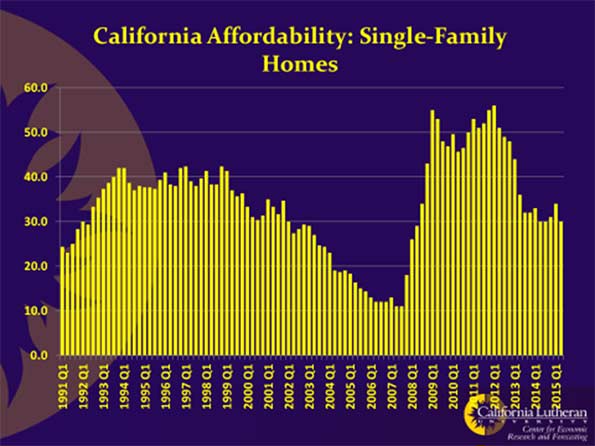
    Housing affordability (percentage of population that could afford the median home) is down too.  It’s fallen from over 50 percent to about 30 percent.  We can’t be sure, but it’s probably below a sustainable level.  That is, below a level that can sustain a middle-class population.  Several California communities have lower levels home ownership rates, but places like Marin County have minimal middle classes.

    California’s tech sector has served the state well over the past business cycle.  In quarter after quarter the Bay Area has led the state in job creation.  In many quarters, the Bay Area was the only California region to gain jobs.

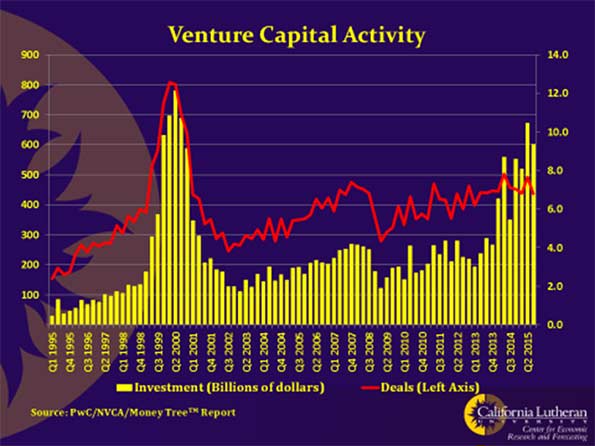
    But California’s tech sector can be very volatile, as the last dot.com bust in 2000 showed.  Today, venture capital investment is near the levels we saw just before tech’s big bust.  The number of deals is lower though.  It’s not clear that it is again a bubble about to bust, the possibility should be seriously considered.  Ideally, we would have a plan to deal with the subsequent fiscal challenges.

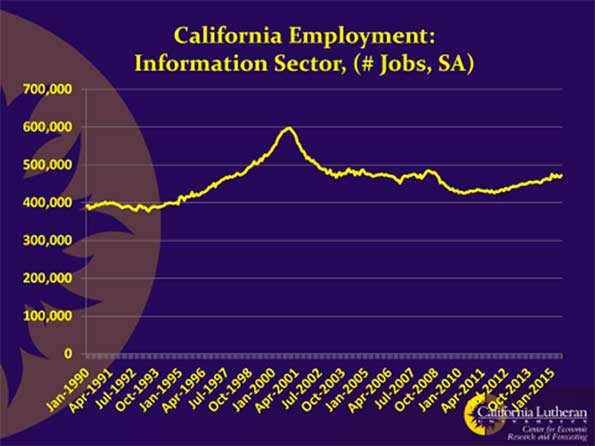
    If tech does decline, the impacts will be more than fiscal.  California’s Information sector, down more than 100,000 jobs from its previous high, still has not recovered from the dot.com bust:

    Recent data imply that continued economic growth, even the slow growth we’ve become accustomed to, is threatened.  California’s most recent jobs report was a big disappointment.  National data was disappointing too.  Only 20 states saw employment increases in September.

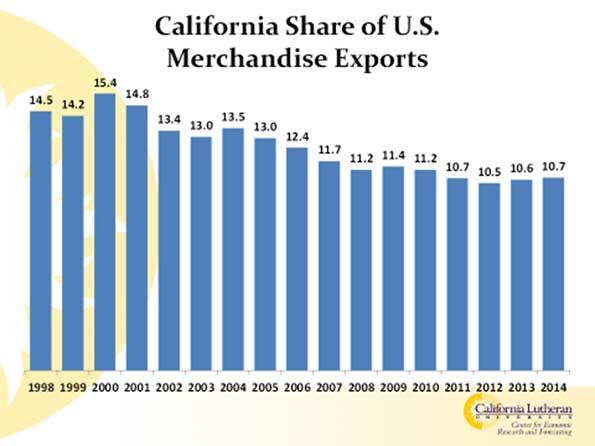
    California’s position on the Pacific Rim between Asia’s manufacturing sector and the world’s largest consumer market guarantees that trade is an important sector for California.  Increasingly, however, that sector is at risk.  China’s economic growth is weakening.  Competing ports in Mexico and Canada threaten California’s trade sector, as does the Panama Canal expansion.  California’s response has been to ignore the challenges and to refuse to expand ports to accept today’s largest ships.  California’s share of North American trade will surely continue to decline:

    An economic downturn would have a huge impact on California and its citizens.  California’s budget surplus is precarious, and the state has failed to make any real changes in California’s fiscal structure.  Instead of using California’s period of good fortune to reduce the budget’s vulnerability to volatile asset prices, by broadening the tax base, Sacramento has amazingly elected to increase revenue volatility by augmenting the status quo with a temporary tax.

    The games that partisan politicians play leads me to the conclusion that they either don’t believe that their policies adversely affect real lives, or they don’t care.  Certainly, economic outcomes   affect real lives.  There is abundant evidence that unemployment and poverty cause drug abuse, domestic violence, broken families, poor health outcomes, and many other social pathologies.

    The question, then, is do policies affect economic outcomes?  In their book Why Nations Fail, Acemoglu and Robinson compare side-by-side communities that appear identical but have different economic outcomes, cities like Nogales Arizona and Nogales Mexico.  These two cities, and the other pairs in the book, are identical, except for being in different countries.  They are adjacent to other.  They have the same resources.  They are demographically very similar.  They only differ by political regimes.   Acemoglu and Robinson find that policy decisions and the inclusiveness of the decision process have dramatic impacts on economic outcomes, and thus people’s lives.

    California policy is dominated by a rich coastal elite who control most of the media, finance campaigns, rule over the universities and generally dominate all discussion.  The result is extreme inequality, persistent nation-leading poverty, high housing costs, and limited opportunity for California’s most disadvantaged populations.  And, California’s most disadvantaged will pay the most for California’s next downturn.  They won’t write checks, because they can’t.  Their net worth won’t decline, because it’s already at or below zero.  They’ll pay a far higher cost in broken homes, broken families, and broken lives.

    Bill Watkins is a professor at California Lutheran University and runs the Center for Economic Research and Forecasting, which can be found at clucerf.org.