Category: Economics

  • The Comeback Of The Great Lakes States

    For generations the broad swath of America along the Great Lakes has been regarded as something of a backwater. Educated workers and sophisticated industries have tended to gather in the Northeast and on the West Coast, bringing with them strong economic growth.

    Yet increasingly these perceptions are outdated. The energy hotbeds of Texas, Oklahoma and North Dakota may have posted the strongest employment growth since 2007, and were among the first states to gain back all the jobs lost in the recession. But a group of less heralded places from Minnesota to western Pennsylvania have also enjoyed a considerable revival, as energy, manufacturing, logistics and other basic industries have rebounded.

    Every Great Lakes state except for Illinois now has an unemployment rate below the national average, a stunning reversal from previous decades.

    Ironically the state most popularly associated with long-term economic decline, Michigan, has been lauded in a Pew study as perhaps the ”biggest success story.” From the state’s nadir of household employment in November 2009 through this July, the Wolverine State has added 302,543 jobs, a 7.2% increase.

    An Industrial Comeback

    One clear key to improving conditions in Michigan and elsewhere is the revival of America’s industrial economy. Following a generation of falling employment, the sector has been on something of a rebound since 2010, adding some 855,000 jobs. Although many of these new jobs are in the Southeast and Texas, Great Lakes states have been at the center of the turnaround. The fastest growth in industrial employment over the past five years has been in three Michiganmetro areas — Detroit, Warren and Grand Rapids – and Toledo, Ohio.

    Structural and political factors are behind the Midwestern recovery. Rising wages in China and the North American energy boom have helped make U.S. companies more cost competitive. German electricity prices, for example, are almost three times the average for the United States. Energy production has been a major driver in large swaths of the heartland, notably Pennsylvania, Ohio, and Oklahoma, where fracking has sparked new development.

    This growing competitiveness can be seen in a surge of capital investment. Four of the top 10 statesfor new plant and equipment investment in 2014 are in the Great Lakes region, according to Site Selection Magazine: Ohio, Illinois, Michigan, and Pennsylvania.

    Changing Geography Of Human Capital

    For generations the Great Lakes has been hemorrhaging people to the rest of the country, mainly the South and West. But that outflow has recently slowed, and in some cases reversed. According to demographer Wendell Cox, the rate of outmigration from Cleveland and Detroit has been cut by half or more while some metro areas, including Indianapolis and Columbus, Ohio, are firmly in positive territory. In contrast, Los Angeles, New York and even the Silicon Valley hub of San Jose continue to lose people to other regions.

    More surprising is the movement of younger college-educated people. American Community Survey numbers show some of the fastest growth in the population of educated workers between 2005 and 2013 occurred in places such as Pittsburgh, Columbus, Indianapolis and, yes, Cleveland, which, according to Cleveland State’s Richey Piiparinen, are attractive due to lower costs and a more family-friendly environment.

    Another analysis of the changes in the population of educated workers since 2005, by Mark Schill at the Praxis Strategy Group, reflects this shift. The rate of increase in the population of people 25 to 35 with graduate degrees was slightly higher in Pittsburgh than in San Francisco. Grand Rapids, Buffalo, Indianapolis, Columbus and Louisville did even better (albeit off low bases). These citiesare even considered something of new “hipster havens,” as young people look to these old industrial cities as better bargains for life and work.

    This brain gain parallels another important shift — the growing relevance of the Great Lakes workforce to companies here and around the world. The region already possesses the nation’s largest store of engineers in the country. STEM employment in a host of fields from manufacturing and medicine to business services is surging fast in many of these areas. Between 2004 and 2014, according to an analysis by Schill, several Midwestern states — Iowa, Michigan, Oklahoma, the Dakotas — added STEM jobs at double digit rates, equaling the percentage increases enjoyed by California and easily outpacing New York.

    It turns out that much STEM growth takes place out of the high-profile world of search engines, social media and “disruptive” business service firms. In many cases technical innovations, in the words of the French sociologist Marcel Mauss, constitute “a traditional action made effective,” often in manufacturing, medicine and other fields not always associated with “tech.” The social media and search explosion, so prominent in the Bay Area, home to a remarkable 40% of such jobs, often obscures the serious innovation taking place in the Midwest. For example, much of the earliest advances in self-driving vehicles came not from Google but tractor maker John Deere.

    As it looks to develop auto software for cars, Google looks to, in the words of the autonomous car project’s director, “a lot of amazing companies in the Detroit area and international than know how to make cars.”

    The Great Lakes position as an innovation center is based on a unique combination of engineeringschools and a high concentration of engineers. Dayton and Detroit rank among the top 12 metro areas in the country in terms of engineers per capita, with a higher concentration than Boston, San Francisco, New York, Los Angeles and Chicago.

    One particular hot spot is the area around Warren and Troy, Mich., sometimes referred to “automation alley.” This is where software meets heavy metal, with a plethora of companies focusing on factory software and new computer-controlled systems for automobiles. It is home to engineering software firms like Altair, which has been expanding rapidly, and also where General Motors recently announced plans for a $1 billion tech center, employing 2,600 salaried workers.

    Other tech development has been tied to the health care industry, including such regional standouts as the Cleveland Clinic and Mayo Clinic. Madison, Wisc., has a strong government and education employment base but also is home to growing number of technology firms, with information employment since 2009 up an impressive 36.1%. But much of the growth is related to health care, with the leading local company being medical software maker Epic, which employs 6,800 at its sprawling campus in nearby Verona.

    Qmed ranks California as the best state for medical device makers, but also ranking highly are Minnesota, Indiana, Pennsylvania and Wisconsin.

    In the coming years, more talent should be heading to these area. Housing prices in the San Francisco Bay Area, Los Angeles and New York are at least two to three times higher than most Great Lake metro areas. This is a boon to those who bought far in the past, but a barrier to entry to young aspirational families. To live in San Francisco, particularly for those who hope to raise a family, is increasingly impossible.

    It has also led some companies to locate elsewhere, particularly to the Pacific Northwest. In 2011, 1 in 7 people in the Bay Area searched Redfin.com for homes outside of the Bay Area. Now it’s 1 in 4. Adam Wiener, Redfin’s chief growth officer, announced to other executives last month: “The dam has broken.”

    Potential Threats

    Ultimately the durability of the Great Lakes recovery depends on building off its natural strengths in engineering, its central location along water routes, ample natural resources and low living costs. Pro-business policies have enhanced these advantages and made several Midwestern governors intoserious national political figures, namely Snyder in Michigan, Walker in Wisconsin, and Ohio’s Kasich.

    Yet there are serious clouds on the horizon, perhaps the biggest of which is looming EPA greenhouse gas regulations, which could shut down many coal-fired power plants in the region and raise electric rates. 

    International forces – notably the devaluation of the Chinese yuan – threaten the industrialresurgence. A strong dollar tends to make exports pricier and imports more competitive. Such changes may not matter too much on the coasts, but Midwestern states are far more dependent on manufacturing. According to the U.S. Bureau of Economic Analysis, many of the states with the highest percentage of their GDP tied to manufacturing are in the region, led by Indiana, where 25%of GDP is tied to industry, followed closely by Iowa, Ohio, Wisconsin, and Michigan.

    Ultimately the Great Lakes cannot recover fully unless it continues the revival of its core industries, while expanding in other fields based on the movement of skilled labor coming to the region. If the region can continue its progress, it will be a major boon not only to the people who live there, but to the country that needs an infusion of economic sanity, and down to earth production, to complement the growth of finance, media and communications that dominate so many business headlines.

    This piece first appeared in Forbes.

    Joel Kotkin is executive editor of NewGeography.com and Roger Hobbs Distinguished Fellow in Urban Studies at Chapman University, and a member of the editorial board of the Orange County Register. He is also executive director of the Houston-based Center for Opportunity Urbanism. His newest book, The New Class Conflict is now available at Amazon and Telos Press. He is also author of The City: A Global History and The Next Hundred Million: America in 2050. He lives in Orange County, CA.

    Photo courtesy of BigStockPhoto.com.
  • As Rivals Stumble, America Steps Up

    As its former rivals in Asia and Europe slip into torpor and even decline, America, almost despite itself, is recovering its perch as the world’s bastion and predominant power. This is all the more remarkable given that our government is headed by someone who largely rejects traditional ideas about American exceptionalism, preferring to “lead from behind.”

    Just a quick look around the world makes clear that the United States has emerged as a relative hot spot in a chilly global economy. China is devaluating its currency and ratcheting down its growth expectations. Japan and Europe continue to lag, as they have for the past decade or two. Indeed, with the possible exception of India, no major country appears on the rise, and several once-ballyhooed rising stars – Russia, Brazil, South Africa – now seem headed for prolonged economic eclipse.

    Time for new thinking

    America’s mainstream media and intellectual classes now face a quandary. Generally attracted over the past century to economic models other than our own, they have shifted their admiration from Mussolini’s Italy and Stalin’s Soviet Union in the 1930s and, in the 1960s and beyond, Japan, Germany and, most recently, China.

    Now all those fashionable role models are clearly unravelling. Instead of seeking to imitate other countries, perhaps it’s time to find ways to bolster our own capabilities. President Obama may prefer to lead from behind, but that has not turned America into the world’s caboose. The country, in its fundamentals, is potentially far stronger and resilient than many believe.

    This is not to say that we cannot learn from abroad. There are specific things we should try to emulate, like the Chinese commitment to infrastructure building, northern Europe’s craft training, Japanese industrial precision, Korean technological development and water management strategies from Israel. Even Stalinism produced a terrific subway system in Moscow that still puts ours to shame.

    Read the entire piece at The Orange County Register.

    Joel Kotkin is executive editor of NewGeography.com and Roger Hobbs Distinguished Fellow in Urban Studies at Chapman University, and a member of the editorial board of the Orange County Register. He is also executive director of the Houston-based Center for Opportunity Urbanism. His newest book, The New Class Conflict is now available at Amazon and Telos Press. He is also author of The City: A Global History and The Next Hundred Million: America in 2050. He lives in Orange County, CA.

    Baby photo by Bigstock.

  • Economic Progress is More Effective Than Protests

    The election of Barack Obama promised to inaugurate the dawn of a post-racial America. Instead we seem to be stepping ever deeper into a racial quagmire. The past two month saw the violent commemoration of the Ferguson protests, “the celebration” of the 50th anniversary of the Watts riots, new police shootings in places as distant as Cincinnati and Fort Worth, and renewed disorder, tied to a police-related shooting, in St. Louis last week.

    When President Obama was elected, two-thirds of Americans thought race relations were good. Now six in 10 think they are bad, according to a New York Times poll, including some 68 percent of African Americans.

    This extreme alienation creates a rich soil for resurgence of a cramped form of black nationalism, as revealed in such widely read books as Ta-Nehisi Coates’s Between the World and Me. Coates, like the black nationalists of the ’60s, is fawned over by today’s progressive gentryNew York Times film critic A.O. Scott gushed that Coates’s writing is “essential, like water or air.” Yet the new nationalists do not, like many previous iterations, look to Africa for salvation, and as a potential place of re-settlement. Instead they may look to Africa for inspiration, but seem content to stew in the American racial cauldron, always apart but also here.

    Yet to this reader, it’s hard to regard Coates’s book as anything more than a narrow selfie that holds little hope for any future racial progress. To Coates, America itself seems irredeemable, its very essence tied to racial oppression and brutality. America is not about ideals not yet fulfilled, but a legacy of “pillaging,” the “destruction of families,” “the rape of mothers,” and countless other outrages. Today’s abusive police—and clearly some can be so described—are not outliers who should be punished but “are merely men enforcing the whims of our country, correctly interpreting its heritage and legacy.” His alienation from America is so great that he admits to little sympathy for the victims of 9/11.

    He has particular contempt for those blacks who seek to succeed within the American system, although Coates, a talented rhetorician, has clearly done well for himself. To him, they are deluded into believing they can make their way by “acting white, of talking white, of being white.” African-American families that have broken away from the inner city or the poor small town and found a home in the suburbs, he suggests, “would rather live white than live free.” In language no doubt reassuring to New York urbanistas, he even accuses these blacks of participating in a grand global destruction merely because they drive cars and live in suburbs.

    Coates’s book also reinforces other nationalist voices such as can be found in certain vocal corners of the “Black Lives Matter” movement, which seems to have little room for the inclusive humanism that characterized the early ’60s civil rights campaigners. They shout down genuine progressives like Bernie Sanders and poseurs like Martin O’Malley for insisting that “all lives matter.” In this world-view all police are tarred similarly; in this construct, clear abuses, such as the Eric Garner case, are no different than that of Michael Brown in Ferguson, which even the Obama Justice Department found unworthy of federal prosecution.

    The current radicalization of some prominent black thinkers poses some challenges to Democrats in particular, reflecting their increased dependence on lopsided support from African Americans. Republicans may be doomed to become “the white man’s party,” as my old friend Harold Meyerson suggests, but who thinks the GOP’s insularity deserves emulating? Do the new black nationalists think they have anything to sell outside the confines of liberal bastions or inner-city African-American communities?

    Ultimately this program represents a dead end, both for the country and its increasingly diverse population. Ta-Nehisi Coates can’t expect to castigate whites as brutes who need to oppress blacks for both self-esteem and economic survival and then expect these same brutes to get on board with concessions, subsidies, and even reparations. Many academics and mainstream journalists may go along with such a program, but this is not a reasonable strategy for the rest of the country.

    ***

    When desegregation began in earnest in the ’60s, the hope was that we would see the emergence of greater equality between minorities and whites. And to be sure, there was reduction in black poverty in the booming ’60s, and then again during the Reagan and Clinton expansions. Yet in ensuing years, and especially with the onset of the Great Recession, this progress reversed, in large part because black and Latino families bore the brunt of the foreclosure crisis. African Americans saw their household wealth plunge 31 percent during the recession, including a steep 35 percent decline in their retirement assets, according to the Urban Institute. By comparison, the wealth of white families fell a relatively mild 11 percent from 2007 to 2010.

    This growing disparity has prompted demands for expanded racially-derived benefits that, according to advocates like former Attorney General Eric Holder, should be a permanent part of national policy. “The question,” says Holder, “is not when does it end, but when does it begin … When do people of color truly get the benefits to which they are entitled?”

    This idea has been further expanded by the Obama administration’s commitment to correcting what it calls “disparate impact,” which would force communities—presumably middle-class suburbs—to accommodate poor and minority residents at taxpayer expense, if the federal Housing and Urban Development or the courts deem it appropriate.

    Such an approach negates the aspirations of middle-class families, including many African Americans who have headed to the suburbs for a better life.Upwardly mobile African Americans have been deserting core cities for years: Today, only 16 percent of the Detroit area’s African Americans live within the city limits.

    The big problem here is the emphasis on legal remedies and identity politics, rather than focusing on economic empowerment for Americans of all ethnicities. Perhaps as much as any senior government official, Holder argued in support of a quota regime, which at its logical extreme guarantees that even the children of black billionaires get preferences easier than a white kid brought up in an Appalachian hovel.

    Yet this is the same official who gently treated Wall Street malefactors—the very people in large part responsible for millions of foreclosures, including those that affected many blacks—to an extent that even the usually pro-Obama Rolling Stone openly wondered if he was a “Wall Street double agent.”

    The Obama years—following the previous disasters left over from the Bush regime—have been largely an economic disaster for black America. Child poverty is at the highest level in 20 years, and among African Americans it stands at a disastrous 38 percent, rising even during the recovery. After decades of gradual decline, concentrated urban poverty has grown rapidly over the past decade.

    Nor have African Americans benefited much from the recovery. White American unemployment is either about the same or below what it was before the recession levels, while the gap with African Americans has grown, in some states two and a half times that of the majority population. In Washington, D.C., the fundamental center of blue-state America, it’s five times as high.

    Far more helpful than expanding racial quotas would have been steps to put African Americans to work, particularly teenagers, who suffer nearly 30 percent unemployment rate, twice the national average. Many African Americans, for example, could have benefited more from a revival of the old Works Progress Administration, which would have put unemployed and underemployed people to work, than from any extension of affirmative action in universities. It’s hard to see how doling out “green” subsidies and breaks to Silicon Valley and Wall Street crony capitalists has been much of a benefit to African-American communities, or other underserved minorities.

    Nor is the overall Obama environmental program—particularly on energy—helpful to African-Americans who need jobs in basic industries and in some places, such as California, are stuck with high electricity bills. Harry Alford, head of the U.S. Black Chamber of Commerce, accuses the EPA of “apparent indifference to the plight of low-income and minority households,” which he calls “inexcusable.”

    For Coates’s part, he claims several times in his book that America depends on the oppression of blacks—who, he claims, represent “the essential below,” an oppressed class of workers whose sweat and blood propel America’s economy. This may well have been true in the times when cotton was king and the South produced most of our exports. But for many states in 2015, the fact is that the low-wage labor force is now made up of workers largely from Latin America or Asia, who do the grueling work that blacks too often performed in the past.

    In a multi-racial society—where African Americans are in many places the second- or third-largest minority—black communities must focus on developing a competitive economic advantage. There are traditions here to draw on, from such disparate figures as Booker T. Washington and Marcus Garvey, who emphasized the need to be competitive with other peoples. The role models are not posturing Black Panthers but those who built institutions like Tuskegee Institute or even Howard University, Coates’s “Mecca.” Instead, Coates seems to prefer the theatrical racialism of the Panthers, whose legacy of violence left little in terms of tangible accomplishments, but who, like him, can count on the continued fawning approval of white intellectuals.

    Revolutionary posturing and racial redress may appeal to New York publishers, but economic success requires more than identity politics. Community members must loan to each other, start banks and nonprofits, and seek to dominate specific niches. In contrast, how much independent wealth or how many jobs have been created by the likes of Al Sharpton, whose career is largely one of extracting money from frightened corporate donors seeking anti-racist absolution?

    Ultimately the fate of black America is no different from the fate of the country as a whole: Both depend on economic progress more than political agitation. In a recent study I conducted with colleagues at the Center for Opportunity Urbanism, we found that the cities where African Americans and other minorities did best—measured by employment, income, homeownership—were those that created the most jobs, particularly for mid-skilled workers, and kept costs, particularly for housing, low.

    These included primarily regions in the least “progressive” parts of the country, such as the Southeast. Since 2000, when the census registered the first increase in the region’s black population in more than a century, the “Great Migration” to the North has now reversed and is heading back South. In our survey, the South accounted for a remarkable 13 of the top 15 metro areas for African Americans. Blacks in Texas, for example, suffer an unemployment rate 50 percent lower than blacks in California. School segregation, notes the University of California’s Civil Rights Project, is greatest in the Northeast and urban areas and least pronounced in the Southeast and the suburbs. 

    ***

    Despite all the negative aspects of America’s tortured racial history, comparing today’s situation to that of the early 20th or even 19th centuries—most particularly in the South—is misleading and hyperbolic. America is no longer a black-white country and many newcomers, such as Asians, also suffered severe discrimination but have made enormous progress. Yet today Asians enjoy higher incomes and levels of education than whites. Increasingly they are no longer the subjects of affirmative action, but among its primary victims.

    Perhaps even more revealing has been the progress of African immigrants, who represent one of the fastest-growing parts of our newcomer population. Between 2000 and 2010, their numbers grew from 800,000 to more than 1.6 million, and since 2010 grew by another 100,000, expanding faster as an immigrant group than those from any part of the world. Like African Americans, they are moving increasingly to Southern states, notably Texas and Virginia. As a group, they have done well in terms of income, education, and entrepreneurship.

    To be sure, most Africans in America, like Latinos and Asians, do not carry with them the burdens of slavery, or as consistent a long history of legal discrimination. They came here by choice and this no doubt influenced their behavior. Yet the success of other minorities does suggest that lingering racism, so deeply entwined in the analysis of Coates and other neo-black nationalists, does not present an insurmountable barrier.

    Of course, there is no clear pattern of such discrimination by police against Asians, and no way to distinguish the experiences of African immigrants from other blacks in terms of crime. Yet each group each is physically distinct, and they have not allowed this fact to prevent their ascendency in American society. This is not to say that serious changes in policing are not necessary—there certainly are—but that the focus of ethnic uplift needs to be focused not on what “they” do to you, but what you can manage to accomplish yourself despite their depredations.

    America’s racial divide cannot be bridged anymore by demonizing the country than by ignoring the issue. America is not, and won’t be, entirely “color blind” any time soon. But that is somewhat beside the point—the key to economic success lies not in celebrating or exploiting victimhood but in people moving forward both as individuals and groups.

    Simply put, to suggest that America is as racist today as in 1865 or 1965 is absurd, given the reality of the Obama presidency or, more specifically, given the demonstrable change in national attitudes. In 1958, a mere 4 percent of the population endorsed racial intermarriage, while today that percentage has risen to 87 percent. These views are particularly deeply felt among millennials, who are themselves the most diverse generation in American history.

    In the long run, demanding an economy with sufficient opportunities represents the best way to address racial disparities. The new black nationalists may be feted by the intellectually chic, but in the end their strategies can only leave their people in a cul-de-sac of disappointment, anger, rage, and, ultimately, impotence.

    This piece first appeared in The Daily Beast.

    Joel Kotkin is executive editor of NewGeography.com and Roger Hobbs Distinguished Fellow in Urban Studies at Chapman University, and a member of the editorial board of the Orange County Register. He is also executive director of the Houston-based Center for Opportunity Urbanism. His newest book, The New Class Conflict is now available at Amazon and Telos Press. He is also author of The City: A Global History and The Next Hundred Million: America in 2050. He lives in Orange County, CA.

    Photo by flickr user amir aziz

  • When Stocks Drop, California Suffers

    I recently made a couple of tweets/Facebook posts pointing out that market declines threaten California’s budget surplus. I referenced articles in the WSJ and Bloomberg, and I thought the observation was non-controversial—almost banal.

    So I was surprised at the feedback. One person asked why. Another said it doesn’t mean anything until holders of declining assets cash out. Yet another pointed out that the wealthy were back to where they were eight months ago. Finally, one said we wouldn’t know of the impact until after the end of the next budget year.

    Let’s answer the question “Why?” first: A decline in asset prices would have a detrimental impact on California’s budget because California’s tax system is extraordinarily progressive, with the result that a few really wealthy people pay a huge proportion of California’s taxes. California’s Legislative Analyst’s Office has estimated that the top one percent of California’s population paid half of the state’s income taxes in 2012. Income taxes are California’s major revenue source, comprising about 65 percent of the state’s income.

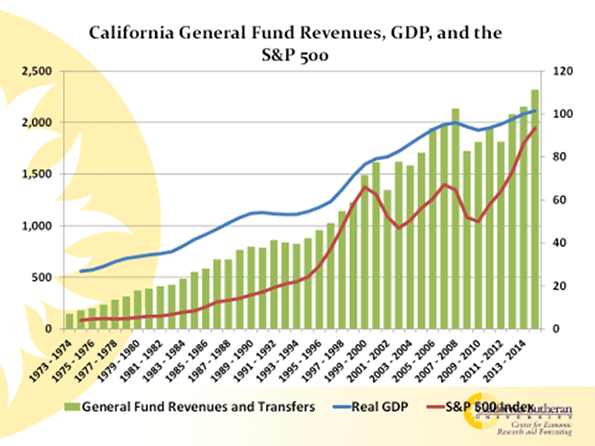
    Since much of wealthy people’s income is from increased asset values—capital gains—rather than from wages that have been paid to them, their income, and thus California’s tax revenue, is more volatile than the economy. California revenue tracks changes in asset values more closely than it tracks changes in economic growth. See the following chart:

    The increased revenues from the dot-com boom, the 2000s asset boom, and today’s boom are readily apparent in the chart. The declines that inevitably follow booms are also apparent.

    California goes through these repeating cycles like a bad dream. Asset prices increase. California’s revenues increase. Sacramento spends that windfall as if asset prices will continue to rise forever. Worse, legislators commit to future spending as if the boom will continue forever.

    Of course, booms don’t go on forever. Inevitably, prices fall. The gains that drive California’s revenue turn into losses, and California faces yet another budget crisis. Sacramento responds by raising taxes on the wealthy, and increasing the state’s reliance on the few wealthy. This pretty much guarantees that the problem will be even worse in the next cycle.

    It’s a self-reinforcing boom and bust cycle of ever increasing revenue volatility.

    It’s amazing to me that California’s leadership continues to do this, and that Californians allow it. It can only be possible because so few Californians understand the state’s finances. The people who responded to me are relatively well informed; far better informed than most Californians. Yet, even they don’t know how California’s revenues work.

    It appears that California’s susceptibility to asset volatility is California’s best kept secret. That needs to change.

    Governor Brown was hailed as a hero when proposition 30 was passed, raising taxes on those who earn over $250,000 a year. It was even retroactive. California’s revenues soared, a result of the combination of new taxes and a huge bull market on Wall Street. It was said that Brown had solved California’s deficit problem. What he really did was sow the seeds of California’s next budget crisis.

    What about the next response I heard, the objection that losses have to be realized before they impact California’s budget? Can we be realistic? The people who pay over half of California’s income taxes have resources that are unimaginable to most of us. You can bet your net worth that, for tax purposes, they recognize losses as quickly as possible and do their best to never realize gains. The gains we’ve seen were only reluctantly recognized. The losses will be enthusiastically recognized.

    The comment about retained wealth—that the wealthy were back to where they were eight months ago—is a red herring. Wealth is irrelevant. Income taxes are paid on changes to wealth, not wealth. And, we don’t have to wait until after the fact, or until the end of the fiscal year, to know what the story will be. We don’t even need a real bust to see California’s surplus slip away. The surplus is dependent on increasing asset values. It’s not necessary for asset prices to decline for the surplus to be eliminated. All that is required is that asset values cease increasing.

    I thought it was irresponsible for people to cheer California’s surplus without at least recognizing its fragility. Ignoring the fragility now, when asset prices are especially volatile, is foolhardy. Our governor and legislators know what will become of California’s surplus when asset prices decline. They should be developing a plan.

    Of course, California’s leadership is not working on a plan. Instead, the best of them (admittedly a low hurdle) continue to pat themselves on the back and hope for the best. Some do worse by attempting to increase California’s spending even more.

    Besides developing a plan to deal with the sure-to-come deficit, Sacramento should be working on a plan to make California’s revenues more closely track broad economic activity, instead of volatile asset prices. This would require a broader tax base and a less progressive income tax. Unfortunately, that’s not likely to happen.

    Bill Watkins is a professor at California Lutheran University and runs the Center for Economic Research and Forecasting, which can be found at clucerf.org.

    Flickr photo by Thomas Hawk: The Good Life; the Ritz Carlton, Laguna Niguel, California.

  • Special Report: Maximizing Opportunity Urbanism with Robin Hood Planning

    This is the first section of a new report authored by Tory Gattis for the Center for Opportunity Urbanism titled Maximizing Opportunity Urbanism with Robin Hood Planning. Download the full report (pdf) here.

    Across America and the developed world, we face a well-reported crisis of income stagnation, rising inequality, a declining middle class, and a general lack of broad prosperity. Yet contemporary urban planning seems disconnected from this crisis, focusing instead on pedestrian aesthetics, environmentalism, and appealing to the supposed preferences of the wealthy and the “creative class.” This approach increasingly dominates urban thinking, expressed often as New Urbanism or Smart Growth. In this perspective, dense and usually older cities like New York, Portland, and San Francisco have been held up as models. For the most part, planners see their world through the perspective of an architect – an architect of the physical form of cities. But what if they tried the perspective of an economist – an architect of opportunities for people to have a better life?

    Cities matter far more than they used to as engines of opportunity and upward social mobility – the very essence of the American Dream. As the basis of the economy has shifted from industry to services, proximity to others now matters more than ever before. A factory can be anywhere and ship its products anywhere, but, generally speaking, most services need to be in-person. This is pushing more and more of the population to agglomerate around not so much cities, as defined by their political boundaries, but major metros, including numerous suburban rings, where the vast majority of the population resides. In many metros, limited housing supply has driven up home prices and rents to levels where much of the middle and working classes are either unable to buy or must pay a heavy portion of their incomes in mortgages or rents.

    This is occurring as economic and technological factors have directed ever more wealth to a relatively small population of elites, whose demand for specialized services – whether personal spending or that of the corporations they control – has become a major part of the economy. Economic opportunity is driven not just by proximity to others in general, but by proximity to the very small but critically influential super-affluent class – what Citigroup research calls the “Plutonomy”. iv In some markets, such as Miami, New York and San Francisco, the locational preferences of this class – who often have several residences and many are foreign buyers – has been yet another driver of major metro agglomeration and higher housing prices, particularly where there are strong land use regulations.

    Family sizes have shrunk and reduced fertility rates are leading towards destabilizing demographic implosions in Europe, Japan, and China – and the U.S. trend is moving in the same direction.vi As nations seek to improve fertility rates, one of the greatest challenges is a shortage of family-friendly housing with sufficient space. If that space is not affordable, then people do the next best alternative: shrink their family size. Whereas families used to be comfortable with multiple children per bedroom, the modern standard is one bedroom for every child – not to mention the “home office” for virtual work by the dual-income parents. With the large suburban house both regulatory out-of-favor and unaffordable in some metropolitan areas, families are forced to shrink to live in expensive density, or pay very high prices and rents for what used to be considered standard middle class homes.

    The planning community generally has few answers to these dilemmas, but in practice the steps they often advocate may actually be making it worse. A dominant tenet of Smart Growth actually seeks to restrict suburban development and encourage density to contain urban expansion. Draconian regulations – and ever higher costs – are piled on any new developments. On the other side, pressure from NIMBY homeowners often limits development of any kind – including high-density. In some areas, exclusionary zoning – such as tight restrictions on multi-family housing – is used to prevent minority, disadvantaged, or lower-income populations from moving in nearby.

    All in all, the net effect is a suffocating restriction on new housing supply even as demand increases, leading to skyrocketing home prices. This has the effect of making affluent NIMBY homeowners, who are disproportionately white and older, quite happy since their homes prices, sans new competition, are almost certain to increase. But the system works like a “Robin Hood in reverse” for younger, middle and working class families that lose out. This is a major driver of inequality – in fact, recent analysis indicates that homeownership completely accounts for the rise in inequality in recent decades. xii Planners have to take a hard look in the mirror and face an uncomfortable truth: whether they have been conscious of it or not, they have been direct accomplices in the rise of inequality and the decline of the middle and working class.

    Download the full report (pdf) from the Center for Opportunity Urbanism.

    Tory Gattis is a Founding Senior Fellow with the Center for Opportunity Urbanism, and co-authored the original Opportunity Urbanism studies. Tory writes the popular Houston Strategies blog and its twin blog at the Houston Chronicle, Opportunity Urbanist, where he discusses strategies for making Houston a better city. He is the founder of Coached Schooling, a startup to create a high-tech network of affordable private schools ($10/day) combining the best elements of eLearning, home and traditional schooling to reinvent the one-room schoolhouse for the 21st century. Tory is a McKinsey consulting alum, TEDx speaker, and holds both an MBA and BSEE from Rice University.

  • In Comparing Metro Areas, the Devil is in the Details

    Frequently I see examples of metro areas comparing themselves to other, more successful metro areas.  Metro area movers and shakers take a deep dive into the intricacies of what makes a “good” place tick, and try to implement the takeaways in their metro.  This is a reasonable action, but I believe it misses the point.  There is more to examine by taking a deep dive within your own metro than looking at another.

    Surely there are physical scale, density and economic differences between metro areas that are worth exploring.  But those differences can be overstated.  Milwaukee, for example, will never be the Silicon Valley, for a host of reasons. Just as importantly, the reverse is true. 

    When I see that, say, Kansas City wants to do what Portland’s doing, or Grand Rapids wants to do what Nashville’s doing (totally fabricated examples, I might add), I cringe for three reasons — 1) distinctiveness, not homogeneity, should be the hallmark of cities and metro areas; 2) metro areas are already far more alike than different, in terms of their built environment and even their economies; and 3) there is more inequality that is evident within metro areas than between them.

    Why is it that, when looking at the marketplace of metros, they try to emulate successes rather than striking out for distinctiveness?  This generally stands in opposition to what happens in business, where firms seek to deliver a product that is of better quality, or less expensive, or offers more options, in order to stand out in the marketplace. 

    Unfortunately we end up having metro areas chasing advantages they will never be able to attain.  The Bay Area’s combination of entrepreneurship and top-tier education, leading to the R&D work that supports Silicon Valley, is only tangentially replicable in a handful of metros nationwide.  The low-tax, low-cost advantage that many interior metro areas enjoy over their coastal brethren is not something that can be done in the high-tax, high-cost coastal metros.

    Addressing the third point will lead to greater city and metro growth than trying to replicate what any other metro area purports to be doing at a metro scale.

    Let me offer one example.  Below you’ll see a table that shows the top 25 metro areas from 2010, organized by median household income.  The data is from the Census Bureau’s American Community Survey in 2011 (although there is more recent data available, the reason for using this dataset will become clearer below):

    Median household income for the top 25 metro areas falls within a fairly narrow range.  Together, the metros have a median of medians, if you will, of $57,783, with a standard deviation of about $7,300.  The Tampa/St. Petersburg metro area comes in at the lowest ($46,890), while San Francisco/Oakland comes in as the highest ($76,911). 

    At the metro level, there are easy answers to explain why some metro areas are where they are — the supercharged, tech-driven or eds-and-meds economies lift San Francisco and Boston, while the presence of larger numbers of retirees in some Sun Belt metros, and deindustrialization that saw jobs move away, depresses incomes in Tampa, Miami, Pittsburgh or Detroit. 

    It’s data like this that reinforces the simple tropes that drive our understanding of metro areas.

    But what if we look within a metro area?

    I have a dataset that has 2011 American Community Survey data for 283 municipalities within the Chicago metro area, as well as the 55 zip codes that comprise the city of Chicago.  This data covers about 8.5 million of the 9.5 million within the broader metro area, excluding a handful of outlying exurban counties in Illinois as well as a few counties in Indiana and Wisconsin.  By looking at finer grained data that examines municipalities, and breaks down the behemoth that is the region’s core city of Chicago, we can see how there are greater differences within the a metro area than between them.

    Median household income falls within a far broader range within the Chicago area than in the top 25 MSA dataset.  In 2011, the median of median household incomes for the 338 places identified was $68,325, which is completely understandable when one considers higher income suburban municipalities being over-represented in the dataset.  The range, however, is what stands out — the highest median household income was in North Shore Kenilworth ($242,188) while the lowest was in Chicago’s 60621 zip code, which corresponds with the city’s Englewood neighborhood ($19,692).  What’s crazy, though, is that the standard deviation for median household income in the Chicago area in 2011 ($32,700) is nearly double the actual number for the 60621 zip code. 

    There were 68 municipalities and city zip codes that had median incomes below $50,000 in 2011; there were 54 municipalities and city zip codes above $100,000.  One group presently drives metro area economic policymaking, while another remains largely ignored.

    There is greater variation within metros than there is between them.  This idea should inform our urban policymaking.  (Note: I use Chicago only because I have the data for it.  I imagine other metros, particularly large ones, will have similarly large ranges; the range likely decreases as metros get smaller, but remains to some extent.)

    For decades economic developers have relied on two economic strategies to improve conditions that influence data points like median household income — 1) attract more skilled businesses and workers, and 2) work like hell to retain skilled businesses and workers. The first strategy works in metros that have relied on migration for growth; the second works almost nowhere.

    As I see it, there is an opportunity for dramatic metro area improvement by those that focus on talent development, rather than talent attraction or retention.  When metro areas focus on the successes of our nation’s metro area “winners”, and try to implement a talent attraction/retention strategy, they relegate themselves to the whims of a select group who, for a variety of reasons, can choose to be anywhere.  Developing talent — investing in early, secondary and higher education, forging strong links between higher education and the business community, supporting entrepreneurship and investment — can pay dividends.  At some point, metros that become proficient at talent development will find that that activity evolves into talent attraction, creating the vibrant economic environment that all metros desire.

    Pete Saunders is a Detroit native who has worked as a public and private sector urban planner in the Chicago area for more than twenty years.  He is also the author of “The Corner Side Yard,” an urban planning blog that focuses on the redevelopment and revitalization of Rust Belt cities.

    Lead photo: View of the Life Sciences Complex, UB School of Medicine at the University at Buffalo, with downtown Buffalo, NY in the background.  Panoramas such as this can make any place look fantastic, but the devil is in the details.  Source: medicine.buffalo.edu.

  • The Cities Leading A U.S. Manufacturing Revival

    Manufacturing may no longer drive the U.S. economy, but industrial growth remains a powerful force in many regions of the country. Industrial employment has surged over the past five years, with the sector adding some 855,000 new jobs, a 7.5% expansion.

    Several factors are driving this trend, including rising wages in China, the energy boom and a growing need to respond more quickly to local customer demand and the changing marketplace.

    To generate our rankings of the best places for manufacturing jobs, we evaluated the 373 metropolitan statistical areas for which the U.S. Bureau of Labor Statistics has complete data over the past decade. Our rankings factor in manufacturing employment growth over the long term (2003-14), medium term (2009-14) and the last two years, as well as momentum.

    The Rust Belt Is Back

    No part of America suffered more from the de-industrialization of the past 40 years than the Great Lakes states. Yet as manufacturing  has come back, particularly the auto industry, many of the region’s economies have begun to resurge. Despite all the fashionable chatter over the question of whether we’ve reached “peak car,” the auto industry has enjoyed six straight years of increased sales, driven by low interest rates, the need to replace older cars and rising consumer confidence.

    The epicenter of this trend is exactly where the industrial decline hit hardest: Michigan, which sweeps the top three places on our list of the big cities generating the most new manufacturing jobs. The state has now recovered about 40% of the manufacturing jobs it lost during the recession. The Detroit-Dearborn-Livonia metropolitan area ranks No. 1 among the country’s 70 largest metropolitan areas for manufacturing employment growth over the time period for our study. Since 2009 the Detroit area has seen a remarkable 31.3% rebound to 89,300 industrial jobs, including a 9.8% expansion last year. This growth has helped begin to reverse a long-standing decline in employment overall—still down 12.3% since 2003—with overall employment up 5.9% since 2009.

    Detroit’s recovery is not just a matter of inertia, but reflects a unique combination of circumstances. The area is home not only to many skilled workers, but boasts the second largest concentration of engineers among the country’s 85 largest metro areas, behind only Silicon Valley.

    In second place is Warren-Troy-Farmington, in the Detroit suburbs, where manufacturing employment is up 38.8% since 2009. In third place is Grand Rapids-Wyoming, a longtime furniture-making hub where an uncommonly high share of jobs is in manufacturing, one in five; the metro area has seen industrial employment rebound 27.9% since 2009.

    Another Midwest hotspot has been Toledo, Ohio, only 60 miles from Detroit, which ranks first among the mid-sized cities we evaluated, with a 17.4% jump in industrial employment since 2009.

    Southern Cooking

    The other big cluster of industrial hotspots is in the Southeast. Manufacturing has been heading to the region for several decades, recently primed by  major investments from German and Japanese companies, among others. A prime example is Nashville-Davidson-Murfreesboro, Tenn., No. 4 on our list, where manufacturing employment has jumped 23.9% since 2009. Japan’s Nissan and Bridgestone have establishing manufacturing plants in Central Tennessee, which has also created opportunities for small domestic parts companies in the region. Nissan also relocated its U.S. headquarters to the area in 2006 from Southern California. And domestic auto makers are have become major players in the Southeast—Ford employs some 14,000 in the Louisville, Ky., area, which checks in at No. 7 among our largest MSAs. The South, notes a recent Brookings study, now has the highest number of workers in the country employed in “advanced industries,” which tend to be the higher paying, more technically oriented parts of the factory economy.

    Other areas that have become primary places for new industrial investment include such Deep South locations as Savannah, Ga., No. 2 on our mid-sized list, as well as No. 8 Columbia, S.C., a major center for German car companies, and No. 10 Charleston, S.C., which has benefited from the expansion of Boeing and aerospace suppliers there. These areas missed much of the  industrial revolution a century ago but are playing an impressive game of catch-up. Each has seen their industrial workforces grow over 20% since 2009. Other southern stars include Cape Coral-Ft Meyers, Fla., No. 4 on our mid-sized city list. Our small cities list also turns up Southern outperformers:  No. 2 Naples-Immokalee-Marco Island and No. 3 Sebastian-Vero-Beach, Fla.

    The Energy Belt

    Falling oil prices may be causing the oil and gas industry to rein in exploration and drilling budgets, but it provides an enormous boon for downstream industries such as refining and petrochemicals. This could keep industrial job growth going in two of our top MSAs that are in the oil patch.  Oklahoma City, where manufacturing job growth has soared 23.1% since 2009, ranks sixth, and  Houston, where the industrial workforce has expanded 19.8% over the same time  span, ranks ninth. Houston now is home to 257,300 manufacturing jobs, the third largest concentration in the country.

    As in Detroit, Houston’s industrial rise is powered by more than by brawn. The area ranks sixth among the nation’s major metros in number of engineers per capita. If the Bay Area is master of the digital economy, Houston ranks as the technological leader of the material one; it is the capital for the energy-driven revival of U.S. industry.

    Smaller energy-rich areas that have also experienced rapid industrial growth. These include two Louisiana metro areas, No. 3 Baton Rouge and No. 7 Lafayette, third and seventh, respectively on our mid-sized metro area list, as well as Midland, Texas, fifth on our small areas list. Perhaps most surprising, given its location in anti-carbon California, has been the steady growth in Bakersfield,  which stands fifth on the mid-sized list and is home to some of the nation’s largest oil fields. With 20.3% industrial growth since 2009, the area, sometimes known as “little Texas,” is the only metro area in the Golden State to make it to the top 10 in either the large or mid-sized list.

    A Shift To Smaller Cities

    Once American industry was identified predominately with big cities: New York in 1950, according to economic historian Fernand Braudel, had the largest industrial economy in the world, employing a million workers, mostly at small manufacturers. In the 1970s and 1980s, the industrial zeitgeist moved increasingly to Los Angeles, which vied with Chicago as the largest center for factory jobs.

    Today this pattern is changing dramatically. Besides the move toward the south and energy hotbeds, industry has been expanding in smaller cities as well as suburban areas beyond the core cities, says University of Washington geographer Richard Morrill. This is not unique to the United States; Germany, which has perhaps the most admired industrial sector in the world, also has dispersed its industrial base, largely to smaller cities.

    The reasons for this shift vary, from strict environmental laws in Northern cities, as well as stronger unions, and cheaper land elsewhere.

    For example, although the New York state capital Albany ranks fifth on our big metro area list, driven in large part by semiconductor manufacturing, New York City stands at a weak 62nd out of 70. Since 2009, New York has lost 3.3% of its manufacturing jobs; the city’s industrial workforce now stands at a paltry 74,700, a dramatic decline from some 400,000 as recently as the early 1980s.

    Yet with its powerful array of media, business service and hospitality businesses, New York appears to be able to withstand deindustrialization more than the two largest industrial MSAs, Chicago and Los Angeles. The one-time “city of big shoulders“ and its environs has also lost industrial jobs since 2009, down to 278,000 from 286,500 in 2011, and a far cry from the 461,600 it had in 2000.

    The decline has been, if anything, more rapid in 59th place Los Angeles. This process began with the loss of more than 90,000 aerospace jobs since the end of the Cold War. Los Angeles’ industrial job count stands at 363,900 — still the largest in the nations but down sharply from 900,000 just a decade ago.

    Does Industrial Growth Still Matter?

    Clearly deindustrialization has a bigger impact in some areas than others. Cities like San Francisco and New York appear better positioned for the post-industrial transition than Chicago or Los Angeles, where manufacturing lingered longer and the elite service or tech industries are not nearly as predominant. Yet the impact of industrial decline — or resurgence — may be more important in the future than many suppose.

    This is particularly critical for blue-collar workers, for whom industrial jobs tend to pay more. Welders and other skilled workers are increasingly in short supply, particularly as baby boomers begin to leave the workforce. Many of the cities which did well in our rankings are among the best in building new training partnerships with their industrial employers—these are skills that are decreasingly taught in the modern secondary and college curricula. In some places, vocational skills have recently been commanding higher post-graduation salaries than traditional college degrees.

    Industrial growth also provides an opportunity for emerging cities, particularly in the South and the energy belt, to add to their employment base and, in some cases, their connections with international markets. Over-dependence on manufacturing, as the Rust Belt experience showed, can be dangerous, and the need to diversify employmentremains critical. Threats to future growth include the strong dollar, the decline in the energy sector and economic weakness abroad reducing exports.

    But factory jobs remain an important asset for many regions. They may not be the central force they once were, but these jobs seem likely to continue making a big difference in the fates of many economies, both big and small.

    This piece originally appeared at Forbes.

    Joel Kotkin is executive editor of NewGeography.com and Roger Hobbs Distinguished Fellow in Urban Studies at Chapman University, and a member of the editorial board of the Orange County Register. He is also executive director of the Houston-based Center for Opportunity Urbanism. His newest book, The New Class Conflict is now available at Amazon and Telos Press. He is also author of The City: A Global History and The Next Hundred Million: America in 2050. He lives in Orange County, CA.

    Michael Shires, Ph.D. is a professor at Pepperdine University School of Public Policy.

    Auto manufacturing photo by BigStockPhoto.com.

  • LA’s Tale of Two Cities

    It’s the best of times and the worst of times in Los Angeles.

    Los Angeles is now attracting notice as a so-called “global city,” one of the world’s elite metropolises. It is ranked #6 in the world by AT Kearney and tied for 10th in a report by the Singapore Civil Service College that I contributed to.  Yet it also has among the highest big city poverty rates in the nation, and was found to be one of the worst places in America for upward mobility among the poor. Newspaper columns are starting to refer to LA as a “third world city.”

    Though the Bay Area gets the headlines, the LA region likes to boast it’s coming on strong in tech.  With a diverse set of marquee names including Snapchat, Tinder, Oculus, and SpaceX, LA’s startup scene continues to grow. But tech growth overall has been middling, ranking 28th out of the country’s sixty-six largest region in information job growth, according to a recent Forbes survey.

    More disturbing, job growth has also been slow, ranking 35th overall, at a time when it’s long time rivals in the Bay Area occupy the top job and tech rankings. Some of this reflects the loss of a key industry, aerospace, but also the departure of major corporations such as Lockheed,  Northrup Grumman, Occidental Petroleum, and Toyota, which has left LA’s once vaunted corporate community but is a shell of its former self.

    Yet LA’s glitz factor remains potent. The fashion industry has gained considerable recognition.  Tom Ford set up shop and brought his runway show to the city. Locally grown brands like Rodarte have a major following.   LA also is increasingly a global center of gravity in the art world.

    Yet behind the glitz, in the city of Los Angeles, aging water mains regularly erupt and the streets and sidewalks decay, with the city’s own report estimating it has an $8.1 billion infrastructure repair backlog.

    One report chronicles the flight of cash-strapped New York creatives fleeing to sunny, liberating, and less expensive LA.  Another how high prices and the Southern California grind are sending those same creatives packing.

    What’s going on here?

    What we are witnessing is LA changing in the context of the two tier world —divided between rich and poor — that we live in. This has been made worse by a city that has excessively focused on glamour at the expense of broad based opportunity creation.

    Los Angeles may be a creative capital and a great place to live as a creative worker, but it was always much more than that. It was also a great place to build the middle class American Dream or run a business that employed people at scale. For example, it was and still today remains the largest manufacturing center in the United States.  Yet it has lost half of its manufacturing job base since 1990.  That’s over half a million manufacturing jobs lost in the region since then, with over 300,000 of those just since 2000. Unlike Detroit, Houston, Nashville and even Portland, the region has not benefited at all from the resurgence of US manufacturing since 2009.

    Manufacturing decline, of course, is hardly unique to LA, but the city’s problems are particularly acute because region is so huge and diverse, being both the second largest metro area in the country, and the most diverse major region in America.  LA has a higher share of Hispanic population than any major metro apart from San Antonio – one twice as high as the Bay Area.  The LA/Inland Empire’s 8.4 million Hispanics would by themselves be the fourth largest metro area in the country, and are more than the total number of people living in the Bay Area. The area also has over a million black residents.

    With their heavily well-educated populations the Bay Area and Boston can perhaps get away with operating as sort of luxury boutiques for upscale whites and Asians, however dubious a decision that may be. Not so LA.

    The problem is that LA and California more broadly have adopted the luxury boutique mindset.  Policies are made in ways that favor the glamorous industries like Hollywood, high tech, and the arts – industries that don’t employ a lot of aspiring middle class people, particularly Hispanics or blacks.  

    These policies include strongly anti-growth land use and environmental policies designed to produce the kind pristine playgrounds favored by glamour industries and creative elite. But they have rendered the region increasingly unaffordable to all but the highly affluent or those who were lucky enough to buy in long ago. 

    Tech firms and entertainment companies can afford to pay their key workers whatever they need to live in LA.  That’s tougher for more workaday businesses. Ditto for business regulations, where many industries don’t have the margins to spend on things like a phalanx of compliance attorneys.

    Now that high prices are starting to hurt younger hipsters who want to join the creative industries, this is starting to get attention. But if it’s a problem for young, educated Millennials, it’s a disaster for the working class. 

    LA does deserve credit for potentially opportunity expanding investments in transit. But if transit can be seen as a potential winner, most political  leaders seem more concerned with finding ways to simply attempt to politically reallocate some money to those being squeezed by their policies, all at the expense of growth. The $15 minimum wage is Exhibit A. Like rent control, a high minimum wage benefits a few lucky winners while harming others and making it harder to justify business investment that would create more jobs and entry level opportunities onto the ladder of success, while raising consumer prices. The fact that nearly half of LA’s workers might be covered by the new minimum is a damning testament to the erosion of the region’s middle class job base.

    The real measure of success for LA is not how many runway shows, startups, and elite rankings it can achieve, but whether it can recover its role as an engine of opportunity for its large and diverse population to achieve their American Dream. Local leaders would be better served looking for policies that will expand opportunity instead of the ones they are following that actually reduce it.

    Aaron M. Renn is a Senior Fellow at the Manhattan Institute for Policy Research and a Contributing Editor at its magazine City Journal.

  • The Cities Creating The Most White-Collar Jobs

    In our modern economy, the biggest wellspring of new jobs isn’t the information sector, as hype might lead some to think, but the somewhat nebulous category of business services. Over the past decade, business services has emerged as easily the largest high-wage sector in the United States, employing 19.1 million people. These are the white-collar jobs that most people believe offer a ladder into the middle class. Dominated by administrative services and management jobs, the sector also includes critical skilled workers in legal services, design services, scientific research , and even a piece of the tech sector with computer systems and design. Since 2004, while the number of manufacturing and information jobs in the U.S. has fallen, the business services sector has grown 21%, adding 3.4 million positions.

    Given these facts, mapping the geography of business services employment growth is crucial to getting a grip on the emerging shape of regional economies. And because business services cover such a wide spectrum of activities, there is no one kind of area that does best. Business services thrive in a host of often different environments, far more so than the more narrow patterns we see in manufacturing or information. To generate our rankings of the best places for business services jobs, we looked at employment growth in the 366 metropolitan statistical areas for which BLS has complete data going back to 2003, weighting growth over the short-, medium- and long-term in that span, and factoring in momentum — whether growth is slowing or accelerating. (For a detailed description of our methodology, click here.)

    Tech-Service Hubs
    Increasingly much of what we call tech is really about business services. Companies that primarily use technology to sell a product generally require many ancillary services, from accounting and public relations to market research. Apple, Google, and Facebook clearly demand many services, and that’s one reason why San Jose-Sunnyvale-Santa Clara ranks first on our big metro areas list (those with at least 450,000 jobs). Since 2009, business service employment has expanded 34.7% in the area; just last year the sector expanded 7.9%. The Bay Area’s other tech rich region, San Francisco-Redwood City-South San Francisco, ranks second.

    This linkage of tech with business services can be seen in other information-oriented parts of the country. Both third-ranked Raleigh, N.C., and No. 5 Austin, Texas, are also tech hubs, and boast rapidly expanding business service sectors. They are also much less expensive places to do business, which may suggest these areas will be well positioned to capture more service jobs if bubble-licious stock and real estate prices undermine some of the economic logic that has driven business in the Bay Area.

    The key here may also be cultural. Workers in business services tend to be well educated, and younger employees may well share the lifestyle preferences that have led workers to the Bay Area, as well as such moderately hip places as Austin. Their higher wages help defray the spiraling costs of living in these desired locations and millennials’ and, at least until their 30s, keep them closer to the urban core.

    Sun Belt Service Boom Towns
    The balance of our top 10 business service locations are all in the Sun Belt. For the most part, these are lower cost places that have enough amenities and transportation links to attract and nurture business service firms. The strongest example is Nashville, ranked fourth on our list, where business service employment has soared 41.4% over the past five years. Much of this growth is tied to health services, entertainment and staffing services.

    The re-emergence of No. 10 Atlanta-Sandy Springs-Roswell is particularly marked, as we saw in our overall rankings. Business service growth has led economist Marci Rossell to predict a net gain of 140,000 jobs for the metro area this year, which would be the first time it has netted more than 100,000 since 1999.

    The Traditional Big Players
    Business services have long clustered in the largest American cities. But with the exception of the Bay Area, greater Dallas and Atlanta, few of our biggest metro areas did particularly well on our list. Indeed of those areas with over 2 million business service jobs, the next highest ranking belongs to No. 21 Houston, which has seen a healthy 27.8% growth in this sector since 2009.

    Other mega-regions have not done nearly as well. The largest business service economy, that of New York City, with over 4.1 million jobs in this sector, ranks 29th, with good but not spectacular 20.5% growth over the past five years. But New York, as we have seen on our overall list of The Best Cities For Jobs, consistently outpaces its major rivals. Chicago lags on our business services list in 42nd place, with 18.1% growth over the past five years, and Los Angeles, which once saw itself as a serious challenger to New York, ranks 44th, with 17.4% job growth over that span.

    Perhaps the biggest surprise has been the relatively weak record of the capital area. A major beneficiary of the stimulus, it appears now to be slipping in ways no one could have anticipated. The Washington- Arlington- Alexandria MSA, with over 2.5 million business service jobs, ranked 65th out of the 70 largest metro areas; neighboring Silver Spring-Frederick- Rockville won the dubious distinction of coming in dead last, the only large metro area to actually lose business service jobs. Washington’s “beltway bandits” have long thrived during periods of government growth. But after a boom during the early stimulus, Republican controls on spending have filtered into the business service economy. “D.C.,” noted the Washington City Paper, “went from the star of the recession to the runt of the recovery.”

    Potential Rising Stars
    Some might type-cast business service jobs as the domain of large metropolitan regions, clustered particularly in well-developed downtowns. Yet growth also is occurring in small and mid-sized cities, which often enjoy lower costs than their big city cousins. These are clearly some advantages to being in a big urban center in terms of amenities and face-to-face connections, but smaller cities are generally more attractive to middle class families, particularly to middle managers who might not be able to live decently in the hyper-expensive areas.

    One prime example is our fastest growing mid-sized region, Provo-Orem, Utah, where business service employment has surged 46.5% since 2009 to 29,600 jobs. Located south of Salt Lake City, and home to Brigham Young University, the area has long attracted manufacturers and tech firms, who provide a base for business service providers. Indeed small and mid-sized college towns have seen some of the most rapid growth. This includes our No. 1 small and overall metro area, Auburn-Opelika Ala., which has posted 66.7% growth in business services employment since 2009 (albeit off a small base – total employment in the metro area is just 60,700). Just behind is Tuscaloosa, Ala., another small town built around a big university (“Roll Tide”) and some smaller colleges. (For our overall top 10 list, click here.)

    But, as we have seen elsewhere, business service growth also tends to be strongest in areas with expanding other industries. For example, Fayetteville-Springdale-Rogers, Ark., ranked fourth on our mid-sized metro area list, is also home to Walmart, a company that provides opportunities for local business service firms. Overall 11 of the top 12 areas for business service job growth are small and one, Provo-Orem, is midsized.

    These rapidly growing service regions could prove big winners in the years ahead. As telecommunication technology consistently destroys the tyranny of distance, more service firms may find it less expensive, and convenient, to locate their activities elsewhere. Just as manufacturing shifted out of the bigger cities, we could soon see a movement of business service providers as well, which would be a great boom to hundreds of small and medium-size regions.

    Joel Kotkin is executive editor of NewGeography.com and Roger Hobbs Distinguished Fellow in Urban Studies at Chapman University, and a member of the editorial board of the Orange County Register. He is also executive director of the Houston-based Center for Opportunity Urbanism. His newest book, The New Class Conflict is now available at Amazon and Telos Press. He is also author of The City: A Global History and The Next Hundred Million: America in 2050. He lives in Orange County, CA.

    Michael Shires, Ph.D. is a professor at Pepperdine University School of Public Policy.

    Big Tiger Paw” by Josh Hallett – originally posted to Flickr as Big Tiger Paw. Licensed under CC BY 2.0 via Wikimedia Commons.

  • Who Should Immigration be Helping?

    Recent revelations about the firing of American tech workers and their replacement by temporary visa holders reveal, in the starkest way, why many Americans are wary of the impact of untrammeled immigration. Workers in American companies have been removed from their jobs not because they could not perform them, but because their replacements, largely from India, are simply cheaper and, likely, more malleable.

    The H-1B temporary visa program was purportedly designed to help tech firms hire specialized talent to fill needs not adequately addressed by the U.S. labor market. But what it has really become is a way to lay off workers for cheaper ones.

    Silicon Valley’s Phony War

    A looming shortage of domestic tech talent has long been a siren song played in Silicon Valley by grandees such as Facebook’s Mark Zuckerberg. It is common to hear them claim the visa program must be expanded for them to compete.

    Immigrant entrepreneurs and technical staff are hugely important, but the notion about “shortages” of IT workers is dicey at best. A 2013 report from the labor-aligned Economic Policy Institute found that the country is producing 50 percent more IT professionals each year than are being employed. EPI estimates “guest workers” now account for one-third to one-half of all new IT job holders, much of them through contracts with Infosys and Tata Consultancy Services, both based in India. These two firms, according to EPI, have cost over 12,000 U.S. workers their jobs this year alone.

    Read the entire piece at The Orange County Register.

    Joel Kotkin is executive editor of NewGeography.com and Roger Hobbs Distinguished Fellow in Urban Studies at Chapman University, and a member of the editorial board of the Orange County Register. He is also executive director of the Houston-based Center for Opportunity Urbanism. His newest book, The New Class Conflict is now available at Amazon and Telos Press. He is also author of The City: A Global History and The Next Hundred Million: America in 2050. He lives in Orange County, CA.

    Photo by telwink