Category: Economics

  • Where Do We Still Make Stuff in America?

    The deindustrialization of the United States has been widely considered to be a major force in shaping the economy. It’s one thing to measure where decline has been greatest but where has manufacturing survived or even grown? I use Bureau of Labor Statistics data on manufacturing jobs by county for 1967 and 2014. The results were so surprising that I at first could not believe it.

    In 1967 the US had 19,423,000 manufacturing jobs, 25% of an employed labor force of 76 million, while in 2014 there were 11,900,000 such jobs, constituting only 8.3 % (that is one-third of the 1967 share). Almost 12 million is still a lot of jobs, and higher productivity probably means that the sheer amount of stuff produced may not have fallen, but the role of manufacturing in employment has certainly shrunk and as we shall see, greatly relocated.

    I reproduce a large table, because it is so interesting, indeed so astounding. There are three sections, first counties  with over 25,000 manufacturing jobs in 2014 ( there were far more in 1967), then counties with over 50,000 jobs in 1967, but under 25,000 in 2014,  and third, a few counties with over 4000 manufacturing jobs in 2014, and where these were a high share (over 40%) of the local labor force. These were the some of the winners from geographic relocation.  I also map these changes. The maps include three additional sets of counties: counties with between 10 and 25,000 jobs in 2014, counties with between 25 and 50,000 jobs in 1967, and counties from 33 to 40% in manufacturing in 2014.  These groups are summarized in Table 1.

    Table 1: Manufacturing Change 1967-2014 (Measured in 1,000s)
    Set # of Counties Character 2014 jobs % 1967 jobs % Change % % Change
    1A
    19
    > 25k in 2014, gain 1,102 718 385 54
    1B
    50
    > 25k in 2014 loss 2,616 6,698 -4,082 -61
    2
    26
    > 50k in 1967 435 2,828 -2,403 -85
    3 & 6
    58
    > 33% manuf in 2014 343 232 111 48
    4A
    65
    10 to 25K in 2014, gain 1,164 682 482 71
    4B
    71
    10 to 25k in 2014, loss 1,018 1,909 -841 -44
    5
    26
    25 to 50k, 1967 355 1,029 -674 -66
    Mapped
    315
    7,083 60 13,555 70 -6,472 87 -48
    Unmapped
    2,835
    4,822 40 5,758 30 -976 13 -17
    US
    3,170
    ALL 11,900 19,323 -7,423 -38


    The 315 mapped counties include 60% of the 2014 manufacturing jobs and some 70% of the jobs in 1967. It is evident that the counties with high numbers of manufacturing jobs in 1967 bore the brunt of losses from 1967 to 2014. In contrast,   the smaller, mostly unmapped counties lost only modestly as a set. Many larger counties did gain or hold steady, largely outside the traditional manufacturing belt of the north, or from older core counties into new growing suburbs, as we shall see.  Since the losses in the larger mapped counties are so much higher a share of the total jobs in 1967 than in 2014, we have a yet stronger indication of de-concentration.

    I’ll begin with the biggest losers, who are on table 2.  Now New York City may be thriving in 2014, but it has utterly transformed from an industrial dominance to a minor backwater — the four boroughs dropping their industrial employment from almost 900,000 to a paltry 67,000 jobs, a drop of 92.5%.  In New York County (Manhattan) the fall was even more precipitous: 96%. This is not a misprint. Do not turn off your computer! These are joined by an 84% decline for the New Jersey suburbs: 416,000 to 65,000.  Philadelphia, greater Boston, St. Louis, and, yes, especially Baltimore, city and county, experienced the same kind of precipitous decline. Can we begin to understand the basis for riot and unrest in these core cities, whose manufacturing departed as soon as integration opened manufacturing jobs to black workers! As a set, these counties lost 2.83 million manufacturing jobs, a drop of 85%.

    Table 2
    Set 1:  More than 25,000 Manufacturing Jobs in 1967
    County   Manuf Jobs 1967 Manuf Jobs 2014 Change % Change
    United States 19,323,000 11,900,000 -7,423,000 -38.2
    Snohomish County, Washington 16,000 60,156 44,156 276.0
    Harris County, Texas 123,000 164,479 41,479 33.7
    San Diego County, California 64,000 97,346 33,346 52.1
    Maricopa County, Arizona 59,300 91,348 32,048 54.0
    DuPage County, Illinois 24,500 53,913 29,413 120.1
    Riverside County, California 17,000 41,519 24,519 144.2
    Orange County, California 126,000 150,020 24,020 19.1
    Waukesha County, Wisconsin 20,000 43,232 23,232 116.2
    Elkhart County, Indiana 31,300 53,705 22,405 71.6
    Salt Lake County, Utah 26,000 46,402 20,402 78.5
    San Bernardino County, California 30,000 46,822 16,822 56.1
    Washington County, Oregon 12,000 27,919 15,919 132.7
    Ottawa County, Michigan 16,000 31,831 15,831 98.9
    El Paso County, Texas 19,000 31,000 12,000 63.2
    Pinellas County, Florida 18,000 28,305 10,305 57.3
    Fresno County, California 15,500 25,269 9,769 63.0
    Bexar County, Texas 26,000 30,474 4,474 17.2
    Suffolk County, New York 49,000 51,967 2,967 6.1
    Newport News city, Virginia 25,000 26,503 1,503 6.0
    Sum of gaining counties 717,600 1,102,210 384,610 54.0
    Tulsa County, Oklahoma 39,000 37,197 -1,803 -4.6
    Kent County, Michigan 60,000 57,371 -2,629 -4.4
    Tarrant County, Texas 76,000 70,421 -5,579 -7.3
    Lake County, Illinois 41,000 35,174 -5,826 -14.2
    Kane County, Illinois 39,000 30,327 -8,673 -22.2
    Bucks County, Pennsylvania 40,000 27,061 -12,939 -32.3
    Greenville County, South Carolina 41,000 26,782 -14,218 -34.7
    Hillsborough County, New Hampshire 40,000 25,287 -14,713 -36.8
    Sedgwick County, Kansas 56,000 40,629 -15,371 -27.4
    Alameda County, California 80,000 63,679 -16,321 -20.4
    Multnomah County, Oregon 49,000 32,206 -16,794 -34.3
    Santa Clara County, California 120,000 100,981 -19,019 -15.8
    York County, Pennsylvania 51,000 31,890 -19,110 -37.5
    Lancaster County, Pennsylvania 54,000 33,212 -20,788 -38.5
    Guilford County, North Carolina 54,000 32,428 -21,572 -39.9
    Winnebago County, Illinois 49,000 25,024 -23,976 -48.9
    Berks County, Pennsylvania 56,000 29,439 -26,561 -47.4
    Miami-Dade County, Florida 58,000 30,387 -27,613 -47.6
    Macomb County, Michigan 94,000 59,114 -34,886 -37.1
    Hennepin County, Minnesota 109,000 72,307 -36,693 -33.7
    Dallas County, Texas 138,000 94,078 -43,922 -31.8
    Oakland County, Michigan 94,000 47,243 -46,757 -49.7
    Franklin County, Ohio 76,000 28,991 -47,009 -61.9
    Jefferson County, Kentucky 90,000 40,666 -49,334 -54.8
    Bristol County, Massachusetts 78,000 26,935 -51,065 -65.5
    Middlesex County, New Jersey 82,000 28,277 -53,723 -65.5
    Essex County, Massachusetts 94,000 38,451 -55,549 -59.1
    Jackson County, Missouri 85,000 25,870 -59,130 -69.6
    St. Louis County, Missouri 97,000 35,884 -61,116 -63.0
    Summit County, Ohio 93,000 27,965 -65,035 -69.9
    King County, Washington 146,000 79,631 -66,369 -45.5
    Montgomery County, Pennsylvania 106,000 39,566 -66,434 -62.7
    Hamilton County, Tennessee 95,000 25,092 -69,908 -73.6
    Bergen County, New Jersey 107,000 33,434 -73,566 -68.8
    Marion County, Indiana 120,000 42,808 -77,192 -64.3
    New Haven County, Connecticut 115,000 31,792 -83,208 -72.4
    Montgomery County, Ohio 110,000 26,188 -83,812 -76.2
    Erie County, New York 134,000 42,606 -91,394 -68.2
    Hartford County, Connecticut 151,000 57,332 -93,668 -62.0
    Monroe County, New York 133,000 38,958 -94,042 -70.7
    Fairfield County, Connecticut 130,000 35,507 -94,493 -72.7
    Hamilton County, Ohio 152,000 45,901 -106,099 -69.8
    Middlesex County, Massachusetts 166,000 59,454 -106,546 -64.2
    Worcester County, Massachusetts 165,000 34,677 -130,323 -79.0
    Milwaukee County, Wisconsin 181,000 48,963 -132,037 -72.9
    Allegheny County, Pennsylvania 195,000 36,428 -158,572 -81.3
    Cuyahoga County, Ohio 277,000 69,606 -207,394 -74.9
    Wayne County, Michigan 396,000 71,526 -324,474 -81.9
    Los Angeles County, California 855,000 359,532 -495,468 -57.9
    Cook County, Illinois 831,000 181,315 -649,685 -78.2
    Sum of losing counties 6,698,000 2,615,592 -4,082,408 -61.0
    Table 2, set 2: Over 50,000 in 1967 and Under 25,000 in 2014
        Manuf Jobs 1967 Manuf Jobs 2014 Change % Change
    Bronx NY 59,000 6,000 -53,000 -89.8
    Kings NY 220,000 18,000 -202,000 -91.8
    Onondaga NY 59,000 19,000 -40,000 -67.8
    Queens NY 132,000 22,000 -110,000 -83.3
    Westcheste NY 73,000 12,000 -61,000 -83.6
    New York,  NY NY 482,000 21,000 -461,000 -95.6
    Lucas OH 62,000 16,000 -46,000 -74.2
    Stark OH 63,000 23,000 -40,000 -63.5
    Philadelphia PA 264,000 23,000 -241,000 -91.3
    Providence RI 93,000 22,000 -71,000 -76.3
    Fulton GA 65,000 18,000 -47,000 -72.3
    Nwcastle DE 53,000 13,000 -40,000 -75.5
    Lake IN 98,000 23,000 -75,000 -76.5
    Baltimore MD 68,000 11,000 -57,000 -83.8
    Baltimoecity MD 107,000 12,000 -95,000 -88.8
    Hampden MA 65,000 21,000 -44,000 -67.7
    Norfolk MA 58,000 21,000 -37,000 -63.8
    Suffolkk MA 85,000 8,000 -77,000 -90.6
    Ramsey MN 72,000 23,000 -49,000 -68.1
    Essex NJ 124,000 18,000 -106,000 -85.5
    Hudson NJ 107,000 8,000 -99,000 -92.5
    Passaic NJ 83,000 18,000 -65,000 -78.3
    Union NJ 102,000 21,000 -81,000 -79.4
    StLouis city MO 132,000 17,000 -115,000 -87.1
    San Francisco CA 52,100 7,500 -44,600 -85.6
    Delaware PA 59,600 13,000 -46,600 -78.2
    2,837,700 434,500 -2,403,200 -85
    Table 2, set 3: High Manufacturing Share, Over 4,000 Jobs
    Manuf Jobs 1967 Manuf Jobs 2014 Change % Change
    Jackson County, Alabama 3,200 5,196 1,996 62.4
    Boone County, Illinois 8,300 7,619 -681 -8.2
    DeKalb County, Indiana 4,200 8,128 3,928 93.5
    LaGrange County, Indiana 1,200 5,141 3,941 328.4
    Noble County, Indiana 4,700 8,351 3,651 77.7
    Whitley County, Indiana 2,000 4,541 2,541 127.1
    Marion County, Iowa 1,400 6,128 4,728 337.7
    Ford County, Kansas 1,000 6,272 5,272 527.2
    Pontotoc County, Mississippi 1,100 6,199 5,099 463.5
    Scott County, Mississippi 2,000 4,883 2,883 144.2
    Alexander County, North Carolina 2,600 3,284 684 26.3
    Bladen County, North Carolina 1,000 5,565 4,565 456.5
    Auglaize County, Ohio 5,300 7,339 2,039 38.5
    Shelby County, Ohio 7,900 10,052 2,152 27.2
    Williams County, Ohio 5,900 6,337 437 7.4
    Elk County, Pennsylvania 9,400 6,587 -2,813 -29.9
    Newberry County, South Carolina 3,700 4,831 1,131 30.6
    Titus County, Texas 800 5,865 5,065 633.1
    Box Elder County, Utah 2,300 6,206 3,906 169.8
    Trempealeau County, Wisconsin 1,200 6,418 5,218 434.8
    69,200 124,942 55,742 80.0


    The first set of counties include some winner and more losers.   The winners grew from 718,000 to 1,102,000 jobs, or up 54%, but this is dwarfed by the colossal loss of 4.1 million out of 6.7 million jobs, a loss of 61% in manufacturing jobs.  The losers are somewhat like set 2, just not quite so extreme. Included are the two counties which lost the most—Cook (Chicago) and Los Angeles-  650,000 and 500,000!  Other big losses include Wayne (Detroit), 324,000, Cuyahoga (Cleveland), 207,000, Milwaukee, 132,000, Hamilton (Cincinnati), 106,000, Allegheny (Pittsburgh), 159,000, and Worcester, MA, 136,000.  

    The gaining larger counties are the beneficiaries of two forms of de-concentration – from the north to the south and west, and from older core counties to their suburbs.  Growing industrial centers in the south and west include Harris (Houston), San Diego, Maricopa (Phoenix), Fresno, Bexar (San Antonio),  Salt Lake, and Pinellas, FL (St. Petersburg), but as or more important is the growth of suburbs, notably Orange, CA, Suffolk, NY (way out there), San Bernardino-Riverside, Waukesha, WI, Washington, OR, and the biggest winner of all, Snohomish, WA, where Boeing builds big jets, and the home of the late Senator Henry Jackson. This leaves two growing smaller metro areas of the north: Ottawa, MI, and Elkhart, IN, one of the fastest growing and most successful examples of manufacturing and income growth.

    Sets 1 and 2 represent the larger manufacturing cores of 1967, 2014 or both. But in 1967 they held 57% of all manufacturing jobs, while in 2014, their share dropped to 35% (10.3 million versus 4.2 million), again illustrating the basic geography of de-concentration.

    Sets 3 and set 6 counties, with high manufacturing shares in 2014, include many successful micropolitan or suburban counties in all regions. A few counties with high manufacturing shares in 2014 are suburban, often to smaller metropolitan areas, e.g. Scott, KY, (Lexington). Many more are exurban to medium sized metro areas, as to Springfield, MO, Raleigh, NC, Des Moines, IA or Jackson, MS, and especially 3 counties in northeastern IN, in exurban territory beyond Ft. Wayne and Elkhart.

    Some success stories are in more remote small town areas, as AL, AR, TN, MO, OH, SD, NC, SD, TX, and KS, for example, Ford County (Dodge City) and McPherson (Hutchinson Space Center).   

    Set 4 counties, with 10,000 to 25,000 manufacturing jobs in 2014, again include both losers (71 counties, losing 841,000 jobs, or 44%) and winners, gaining 682,000 jobs, or 71%.  Losses are not so severe as for the sets 1, 2, and 5 counties, but are still significant, as in PA, 6 more counties, OH, 3 more, NJ, 3 more, MI, 3 more, and 1 each in MN, CT, IN, KS, CO (Denver), and also several in the south, as in AL (Jefferson-Birmingham), TN, (Shelby-Memphis) and Knox, and NC, 2 counties.

    Counties gaining the most include 6 TX counties, Travis (Austin), 2 Houston suburbs, 2 Dallas suburbs, and Potter (Amarillo), 5 CA counties, Kern and Merced in the central valley, and suburban Sonoma, Ventura and Napa, 3 Atlanta suburban counties, 3 UT counties, suburban or exurban to Salt Lake, 2 in CO, Weld (Greeley) and Larimer (Ft. Collins), 2 in LA, and in OH (exurban and small town in the west of the  state). Thus almost all are large metro suburbs or smaller independent metro counties. From the list it is clear that these counties well represent the twin trends of suburban-exurban spillover or relocation, as well as the broader de-concentration from the north to the south and west.        

    Several set 5 counties, 25,000 to 50,000 jobs in 1967, are also in the set 4 list (10,000 to 25,000 job in 2014), often with significant losses. Some with even higher losses, to under 10,000 manufacturing jobs in 2014, include counties in IL, IN, LA (Orleans), MI, NJ, NY (4 more), and PA (4 more).

    What do the maps tell us?

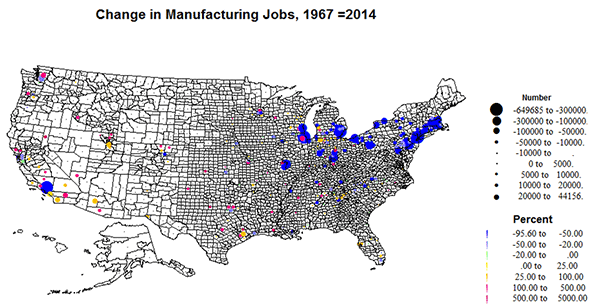
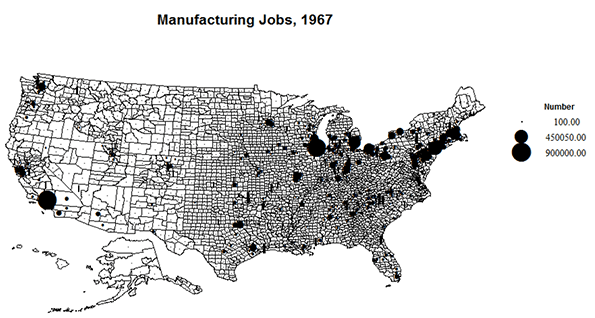
    The preceding discussion has probably induced the curious reader to peruse the maps to find places of decline versus growth. The maps show data for only 10 percent of US counties, 315 of 3170.  Yet these contained 70% of manufacturing jobs in 1967, and 60% in 2014.
    The 1967 and 2014 maps of jobs in manufacturing depict the broad distribution of loss. Although the sheer density and size of places in the traditional industrial belt of the north stand out, a few big losses in the west, notably Los Angeles and San Francisco, appear. But the rests of the south, the plains and the west suggest a widespread if modest expansion, often in proximity to larger declining counties.

    The pattern of change from 1967 to 2014 displays the patterns of change in numbers and rates of growth versus decline.  Losses are largest and almost continuous from Detroit east to Boston, while in the south, the Midwest and west, the big losers are in older, long standing large centers, Like, LA, SF, New Orleans, St. Louis, Minneapolis, Chicago, Cincinnati, and Indianapolis. These are interspersed with growing centers of manufacturing in TX, across the west, but also quite prominent in suburban and exurban and new industrial places in the south and Midwest, e.g. MS, AL, GA, TN, LA and AR,  but in substantial numbers in different areas of OH, IN, MI, WI, IL and MN, KS and MO. While the growth in the burgeoning west and TX might be an expected product of sheer population, and located both in suburbs, as around LA, SF, Portland and Seattle, much was in new independent place such as Boise, Phoenix, Tucson, Salt Lake, Greeley and Ft. Collins, Reno and Las Vegas. In contrast, a pattern of core decline but impressive suburban-exurban growth occurred in parts of the Midwest, in MI, IN, OH, WI, MN, and MO.

    Conclusion

    Yes, the decline of manufacturing as a dominant part of the labor force is large and rea. But America still makes a lot of stuff, much in quite different places, so that there is no longer a distinctive industrial belt, but in a more dispersed pattern. Many of the older centers of manufacturing, like NY, Boston, Philadelphia, and Chicago and Los Angeles, have long since transformed into world centers of services, while others, like Pittsburgh, Detroit and Cleveland appear to be in a process of transformation.

    Some may view this transformation and the huge decline in manufacturing jobs as a benign market effect in which the US specializes in services while much of making things is out-sourced to lower cost countries. But in much of the real America far too few equivalent middle class jobs have replaced the lost jobs.  Perhaps what the US needs now is serious innovation in making new kinds of things, and bring manufacturing up to 19 million and beyond! Instead I suspect the ever-wise market will innovate with robots, presaging a time when the country will complete its transformation to an owner and servant society.

    Richard Morrill is Professor Emeritus of Geography and Environmental Studies, University of Washington. His research interests include: political geography (voting behavior, redistricting, local governance), population/demography/settlement/migration, urban geography and planning, urban transportation (i.e., old fashioned generalist).
  • The Cities Winning The Battle For Information Jobs 2015

    We are supposed to be moving rapidly into the “information era,” but the future, as science fiction author William Gibson suggested, is not “evenly distributed.” For most of the U.S., the boomlet in software, Internet publishing, search and other “disruptive” cyber companies has hardly been a windfall in terms of employment. As jobs in those areas have been created, employment has shriveled in old media like newspaper, magazine and book publishing (these industries lost a net 172,000 jobs from 2009 through 2014). In the 52 largest metropolitan areas that we studied, information employment declined for roughly half from 2009 through 2014. Overall, in information industries (a sprawling sector that also includes movie and TV production, radio and another big job loser, telecom) employment has shrunken 4.2% since 2009 to 2.7 million jobs, while total nonfarm employment in the U.S. grew by 5.1%.

    Yet looking at the information sector give us an important picture of how these changes have shifted jobs to certain regions and away from others. Our rankings are based on employment growth in the sector over the short-, medium- and long-term, going back to 2003, and factor in momentum — whether growth is slowing or accelerating. (For a detailed description of our methodology, click here.)

    By far the biggest winners in the information sweepstakes are areas that developed a strong engineering base before the rise of the Internet. This has provided the platform for the rapid growth of web-based businesses, including in fields such as entertainment, media, hospitality and transportation (like Uber). It’s not surprising then that the metro areas that have posted the strongest information job growth over the past 11 years are San Jose-Sunnyvale-Santa Clara and San Francisco-Redwood City-South San Francisco.

    The growth in these hot spots has been nothing short of spectacular: information employment rose 60.2% from 2009 through 2014 in the San Jose area to 70,900 jobs, 6.9% of total employment in the metro area, while the San Francisco area has seen a 51.3% surge over the same time span to 55,800 jobs, representing 5.4% of the total workforce there.

    After the dot-com bubble burst, Silicon Valley tech employment declined consistently until 2010, since which the rebound has been dramatic. While San Francisco and areas in the northern end of Silicon Valley have not yet reached the peak employment levels seen during the bubble era, the southern end centered in San Jose and Santa Clara has easily outstripped its peaks of the early 2000s. And with information employment continuing to surge, it’s too early to say these areas have hit their “information” peak. Last year, the number of information jobs jumped 16.0% in San Jose while San Francisco experienced an 8.3% jump.

    Other traditional tech centers that have thrived in the new era include No. 9 Seattle-Bellevue-Everett, Wash., where information employment has grown a healthy 9.2% since 2009 and No. 14 Boston, where employment is up 5.1% since 2009. Compared to the Bay Area, these regions appear less at the center of the web-based media and services industries, but their overall tech economies remain very strong.

    The Rise Of Sun Belt Information Hubs

    Some of the most rapid growth in information, however, is taking place not in the older established tech hotbeds but in the lower-cost metropolitan areas of the Sun Belt. Five of our top 10 ranked metropolitan areas are located in the belt that stretches from the Atlantic coast to Arizona, led by No. 3 Austin-Round Rock, Texas, where information employment has risen 30.8% since 2009 to 25,800 positions.

    Some of this reflects a gradual movement of companies, notably from Silicon Valley, to the Texas capital. Smaller Bay Area firms such as digital advertising firm Marin Software have expanded there while Apple is expected to add 3,600 jobs there over the next few years.

    Several other Sun Belt tech hubs also are high on our list. In fourth place is Raleigh, N.C., on the strength of a 13.8% jump in information employment since 2009. It’s followed in fifth place by No. 5 Charlotte-Concord-Gastonia, N.C., which boasts significant sources of venture capital, and No. 8 San Antonio-New Braunfels, Texas, which has seen the rise of locally based companies such as Execupay as well as large scale expansion of Bay Area firms such as Oracle that are flocking to the region.

    One big advantage these economies have compared to the ultra-pricey Bay Area is lower home costs, something that matters to tech workers as they enter their 30s. But the biggest challenge for some of these up and coming areas, such as Phoenix, is the dearth of large locally headquartered companies that can help create a management talent base and some tech street cred.

    The Battle Of The Bigs

    One key battleground for information supremacy is in the country’s media centers. The clear winner has been No. 7 New York, which has recorded a 13.0% jump in information jobs since 2009 to 185,200 jobs – second most in the country behind the Los Angeles metro area. That came amid an 11.8% decline over the same timespan in all publishing jobs not involving the Internet (note that we don’t have the level of detail at the local level to separate out software publishing from that figure, but it’s safe to assume the bulk of the decline was in newspapers and book and magazine publishing). The 13% jump reflects strength in new media as well as motion pictures, TV and radio, more so than technology, a field in which New York remains very much an also ran, right in the middle of the pack in terms of creating STEM and tech employment. But boosters claim this is changing, pointing out that there are now 7,000 tech firms employing 100,000 people in the area.

    Although New York is well behind the Bay Area in pace of growth, it is clearly outperforming its traditional media rivals in the rush towards digital media. Its growth dwarfs that of No. 29 Chicago, where information employment has ticked up 0.4% since 2009. The Los Angeles-Long Beach-Glendale metro area, still home to the largest number of information workers, has managed lackluster growth of 3.5% since 2009, including a 2.0% decline last year, which puts it 28th place on our list. For all the talk about L.A.’s emergence as a new media rival to the Bay Area, the numbers suggest this is more hope than reality. Over the past five years motion picture and television employment has not been hard-hit like traditional publishing but is only experiencing slow growth. No Facebook, Google or Apple equivalent has emerged in Southern California, although some hold out hope for L.A.-based Snapchat.

    A decade or two ago there was talk about the nation’s capital challenging New York’s media dominance. But as has become evident over the past year, the Beltway’s appeal is dropping, even when it comes to producing sound-bites and punditry. The core Washington D.C.-Arlington-Alexandria metropolitan division places a mediocre 43rd, with a 3.9% decline in information employment since 2009. Other areas around the capital did poorly also, including 41st-ranked Northern Virginia and 46th-place Silver Spring-Frederick-Rockville Md. which also have lost information jobs since 2009.

    Surprises And Up And Comers

    Generally speaking manufacturing, energy and logistics-oriented economies do not do well in terms of information jobs. As of now there’s no Rust Belt version of Facebook or Google, and most factory towns do very poorly. But there’s one outstanding exception to this rule: Warren-Troy-Farmington Hills, Mich., which places 10th on our list. This area, sometimes referred to “automation alley,” is Michigan’s premier tech region. It is where software meets heavy metal, with a plethora of companies focusing on factory software and new computer-controlled systems for automobiles. It is home to engineering software firms like Altair, which has been expanding rapidly, and also where General Motors recently announced plans for a $1 billion tech center, employing 2,600 salaried workers.

    If we are looking for future information hubs, one place to look would be our small and mid-sized metro area lists. Here the top ranks are dominated by college towns, including Baton Rouge, La., home to Louisiana State University, where information employment has surged 28.6% since 2009. It places third on our mid-size cities list, which also features such high-flying college towns as fourth place Provo-Orem, Utah (Brigham Young), No. 5 Durham-Chapel Hill (Duke, University of North Carolina), No. 6 Madison (University of Wisconsin), and No. 7 Ann Arbor (University of Michigan).

    The information sector may not be a big job generator, but it does play a critical role in several of our most important economies, including the San Francisco, New York, Los Angeles and Austin metro areas. The clear shift we are seeing towards consolidation of media with tech – a la Apple, Netflix and Google — will likely underpin a movement of these coveted jobs from traditional media centers to the Bay. But  given the unfriendly business atmosphere in California, and the super-high prices for houses, it also makes sense to look at secondary information centers, both in the Sun Belt and among college towns, which may attract even more of these jobs in the years ahead.

    Joel Kotkin is executive editor of NewGeography.com and Roger Hobbs Distinguished Fellow in Urban Studies at Chapman University, and a member of the editorial board of the Orange County Register. He is also executive director of the Houston-based Center for Opportunity Urbanism. His newest book, The New Class Conflict is now available at Amazon and Telos Press. He is also author of The City: A Global History and The Next Hundred Million: America in 2050.  He lives in Los Angeles, CA.

    Michael Shires, Ph.D. is a professor at Pepperdine University School of Public Policy.

  • Why We Should Nourish Strong Families

    Every social, economic, and public policy issue can be seen, at its base, as a family issue. The data and evidence are overwhelming, and have been for decades: family structure is the principal variable in the entire list of economic and social indicators. Voluminous academic research confirms that strong family environments correlate highly with positive educational, economic and social outcomes, and inversely with negative outcomes: incidence of crime and imprisonment; inability to obtain and retain employment; the incidence and persistence of poverty; out-of-wedlock births; entitlement dependence; substance abuse and dependence; domestic violence; and others. Even income and wealth inequality — inequality of life’s outcomes — correlates closely with family structure.

    Strong family structure is the single most powerful explanatory correlate in social science; stronger, even, than race. Two-parent black American families, for example, outscore single-parent white families by all measures of well-being. That’s why it is distressing that less than half of US kids live in a traditional family.

    Where does inequality start? – Much has been made of income inequality in the US; it might even be one of the biggest issues in next year’s presidential election. But the biggest reason for income inequality is single parenthood. Research by Harvard economist Raj Chetty and his colleagues concludes that the single strongest correlate of upward economic mobility across geographic regions of America is the fraction of children that do not live in single-parent families.

    Earlier this year, Our Kids: The American Dream in Crisis by Robert Putnam, attracted much attention. Putnam argues that access to the core institutions that foster the development of children – strong families, strong schools, strong communities – is increasingly separate and unequal. How did this happen? Putnam points to the usual suspects (the first being loss of manufacturing jobs), but his descriptions of life paths actually tell the American story of the past 50 years: great rewards go to those with human capital (skills, education, and determination), but not to those without. As it happens, those traits correlate closely with strong family structure. Hence, as family cohesion deteriorates, outcomes diminish for kids in those households.

    When looking at social, cultural, and economic phenomena it is difficult to separate cause from effect. The retreat from marriage and the decline in men’s labor force participation rates have occurred simultaneously. But numerous studies have found that employment and participation rates have remained consistently higher for married fathers than for married men with no children and unmarried men with no children. Sadly, these effects persist across generations.

    Family Fragmentation – Family fragmentation is the biggest domestic problem facing this country. So writes Mitch Pearlstein, head of the Center of the American Experiment and author of Broken Bonds: What Family Fragmentation Means for America’s Future.

    According to Pearlstein, about 40 percent of babies born in America these days are born outside of marriage. That’s true of about 30 percent of non-Hispanic whites, more than 50 percent of Hispanics, and more than 70 percent of blacks. Why does it matter? Because data show that children raised by their two biological (or adoptive) parents do substantially better in every respect in life than those who are not. They do better in school and in higher education; they do better at jobs and economically; and they develop more stable and lasting relationships personally. In other words, they are more likely to earn success, personal satisfaction and happiness.

    According to Brookings Institution scholar Isabel Sawhill, family fragmentation is propelling a bifurcated society. Among the wealthiest 20 percent of whites, divorce rates and single parenthood have declined to 1950s levels. But among the poorest 30 percent of whites – and among much larger percentages of Hispanics and blacks – divorce and single parenthood have become a way of life.

    What to do? – Strong, healthy families are conducive to a rich, safe, healthy, productive society, one with wide opportunities, social and geographic mobility, and cultural, moral and civic strength. Families lead to and are supported by an independent, self-reliant population. Do we not all agree these are worthwhile goals? And does that not suggest we should be promoting strong, healthy families?

    The promotion of family is a cultural cause. What can we do? For one, those of us who see empirical evidence of the importance of family can disseminate the facts. For another, those of us who, through personal experience, are aware of the social and economic benefits of strong families, could preach what we practice, as suggested by Charles Murray in his book, Coming Apart.

    Does this view devalue or stigmatize non-traditional families — single, same-sex, unrelated households, for example? No, the modern conception of family now includes those formations. And to those who say “check your privilege,” I say, share and spread the privilege.

    Dr. Roger Selbert is a trend analyst, researcher, writer and speaker. Growth Strategies is his newsletter on economic, social and demographic trends. Roger is economic analyst, North American representative and Principal for the US Consumer Demand Index, a monthly survey of American households’ buying intentions.

    Flickr photo by Sarah R: Moroccan-inspired vegetable soup

  • Smaller Stars: The Best Small And Medium-Size Cities For Jobs 2015

    A look at job growth in America’s small and medium-size cities provides a very different, perhaps more intimate portrait of the ground-level economy across a wider swathe of the country than our survey last week of The Best Big Cities For Jobs. It takes us to many states that lack large cities, particularly in the Midwest and South. In contrast to our big city list, information technology is a driving factor in only a handful of smaller metro areas – grittier sectors like energy and manufacturing are the livelihood of a good many, as well as tourism for a surprisingly large number of thriving places that have become vacation meccas for the increasing number of affluent residents of major urban areas.

    The 421 metropolitan statistical areas we evaluated in our rankings, ranging from large to small, account for 87.6% of all U.S. nonfarm employment.  Of them, the country’s small MSAs (those with less than 150,000 nonfarm jobs) and medium-sized ones (between 150,000 and 450,000 nonfarm jobs) account for just over a third of U.S. urban employment.  Job creation in these communities since 2000 has been roughly comparable to the nation’s larger metro areas — total nonfarm employment has increased 7.5% in small and medium-size MSAs compared to 7.8% for large ones.

    Our rankings are based on employment growth over the short-, medium- and long-term, going back to 2003, and factor in momentum — whether growth is slowing or accelerating. (For a detailed description of our methodology, click here.)

    The Slipstream Economies

    A good number of our top-ranked smaller cities are posting strong job growth in the slipstream of larger economies. This is clearly the case with our top-ranked medium-size metro area, Provo-Orem, and its northern Utah neighbor, No. 7 Ogden-Clearfield. Both are located along the Wasatch Front not far from the somewhat bright lights of Salt Lake City (and more importantly its airport) and are heavily Mormon. Provo is home to Brigham Young University, the academic center of the Mormon universe with over 29,000 students. That group’s social cohesion, which translates into a high percentage of families with children, as well as emphasis on education and enterprise, underlay the success of these areas.

    But what is most striking about these two metro areas is the diversity of their economic growth. Since 2009, for example, employment in the Provo-Orem area is up 23.5%, with gains in virtually every sector, paced by increases in construction and natural resources (60%), information (30.1%), business services (46.5%) and even manufacturing (16.4%). With the exception of information jobs, Ogden has showed a similar, albeit less spectacular pattern of widespread economic growth over the same time period.

    Other slipstream economies that are thriving include our second-ranked small city. Greeley, Colo., slightly over an hour’s drive from the Denver airport. Greeley rose seven places from last year, powered largely by 114% employment growth since 2009 in construction and natural resources (oil and gas mostly) as well as solid expansions in business services (up 29.8%) and manufacturing (up 17.2%). As in the case of Provo and Ogden, Greeley benefits from being close to a dynamic large metro area, but can couple that with prized small town attributes like less traffic, good schools, relatively low housing prices and safe streets.

    Energy Hot Spots: Not All Cold Yet

    Until the recent tumble in energy prices, big oil towns reliably dominated our list. For all sorts of reasons, including fierce local opposition, big metro areas don’t tend to produce oil and natural gas, though the technical and business aspects are dominated by a few, notably Houston. The price plunge had not yet translated into heavy job losses in many energy towns by January 2015, which is as far as our data goes, although some clearly were already hurting.

    Take our top-ranked small city, Midland, and nearby No. 3-ranked Odessa, which are in the oil-rich Permian Basin of West Texas. Employment grew 9.1% in Midland last year, the fastest pace of any metro area in the country. Since 2009 the west Texas town has logged almost insane 45.8% expansion in its job base, with a large boost not only in natural resources and construction (108.4% growth), but also manufacturing (up 72.2%), wholesale trade (80.6%) , professional business services (up 40%) as well as leisure and hospitality (likely rooms for the roughnecks). Odessa boasts similar, albeit somewhat less gaudy numbers.

    But you don’t have to be in Texas to be an energy boomtown. Bakersfield, Calif., No. 6 on the medium-size list, has managed to retain a strong energy economy in a state that has all but declared war on fossil fuels. Bakersfield has been described as “little Texas,” and it has enjoyed strong, very un-Californian employment growth in such areas as manufacturing, up 17.8% since 2009, trade (19.8%) and natural resources and construction (40.8%). Blue collar employment may be suffering in much of California, but not down in this metro area, best known for country stars like Merle Haggard and highly resistant to the San Francisco-style economic post-industrial model that dominates the state.

    Yet there’s no question that there are problems in the oil patch. Some of the biggest decliners on our list from last year are big energy towns, such as Lafayette, La., which slid 43 places to 48th on the mid-size cities list, and Anchorage, Alaska, down 25 places to 63rd. On our small city list, Bismarck, N.D., a major hub for that state’s shale boom, dropped from second last year to 19th this year, and Houma-Thibodaux, La., tumbled 61 places to 81st.

    Playground Towns

    Looking across the country, however, many of the small cities doing the best are not those that produce anything tangible like energy or cars. There’s been a strong resurgence in what may be considered playgrounds for the expanding ranks of the affluent residents of major urban areas, particularly on the West Coast, where Silicon Valley is minting many millionaires along with its famous billionaires, as well as along the East Coast, where second home and retirement-oriented communities are booming. Last year, vacation home sales broke the national record.

    Among the playground areas that are prospering on our small cities are No. 4 Naples-Immokalee-Marco Island, Fla., where employment expanded 5.4% last year to 136,200 jobs, Napa, Calif. (eighth, with 15.6% job growth since 2009), and Redmond-Bend, Ore. (12th). On our mid-size list, Santa Rosa, Calif., (Sonoma County) ranks 12th and Santa Barbara- Santa Maria, Calif., 17th.

    In some of these places, not surprisingly, leisure and hospitality are the largest industry — 19.6% of the workforce in Naples is employed in this sector. Economist Bill Watkins, who has studied these trends in California and Oregon, suggests that the growth of the playground cities reflects the emergence of America’s haute bourgeoisie. “The well-to-do go to these places,” he notes, fueling both their growth and, in hard times, their sometimes sharp declines. “They have second homes and can spend a lot of money.” Watkins’ analysis of Bend, Ore.’s economy, for example, shows that upwards of 80% of the volatility in its economy can be traced to what is occurring in California, notably the Bay Area.

    Industrial Cities:Some Up, Some Down

    For generations manufacturing in the U.S. has been moving to smaller cities, largely in the South, while Midwestern and northeastern industrial cities have been taking it on the chin. With a modest growth in manufacturing, some small and mid-size cities have done surprisingly well, although many continue to lag, and even fall further in the rankings.

    Columbus, Ind., a manufacturing hub that is home to diesel engine maker Cummins, epitomizes the up and down nature of industrial economies. Right now Columbus, riding a new wave of investment from Cummins and other manufacturers, has risen to fifth on our small city list, and is at record high employment. Since 2009 the Indiana metro area’s job count has expanded 23.4% to 51,800, paced by an impressive 43.2% jump in manufacturing.

    Sadly, this is not the case for many manufacturing towns. As with the large city list, many of the bottom dwellers are old industrial centers. On the mid-size list, take  91st place Youngstown-Warren-Boardman, Ohio-Pa., where employment is down 6.6% from 2003, or No. 85 Toledo, Ohio, off 5.4% from 2003. Among small cities furniture manufacturing center Rocky Mount, N.C., fell to 255th, down 4.4% since 2009, while old steel center Weirton-Steubenville, W.V.-Ohio, dropped to 254th place, with employment down 12.7% since 2003.

    College Towns And The Future For Small Cities

    The future of small city America depends heavily on how these areas adjust to changing economic times. Given that manufacturing and agriculture are becoming less labor intensive, to stay competitive, smaller cities will need to move more aggressively into knowledge-based fields like software, medical services and higher-end business services. Mid-sized college towns like No. 1 Provo, Boulder, Colo. (14th), Lexington, Ky. (19th), and Madison, Wisc. (20th), have experienced steady growth.

    Diversification of the economy may be the best guide to future smaller city growth. Madison, for example, has a strong government and education employment base but also is home to growing number of technology firms, with information employment up an impressive 36.1% since 2009. Medical software maker Epic employs 6,800 at its sprawling campus in nearby Verona.

    But perhaps the best example of successful small city growth may be Fargo, N.D., a long time butt of sophisto jokes, which ranks sixth on our small metro area list. Fargo, which is also home to North Dakota State University, may not have the cool factor of San Francisco or even Madison, but its economy is extraordinarily balanced, and not nearly as energy-dependent as other North Dakotan cities like Bismarck or Williston. It has posted double-digit employment growth since 2009 in everything from construction and manufacturing to business services and hospitality.

    As many of America’s most prosperous metro areas become ever more expensive and highly regulated, notably in California and the Northeast, small-city America could enjoy a renaissance in coming years. But it will take determination on the part of local leaders and residents to begin expanding their economic strategy beyond any one niche, and instead develop a growth economy that can insulate themselves from the downturns that affect any single industry over time.

    Joel Kotkin is executive editor of NewGeography.com and Roger Hobbs Distinguished Fellow in Urban Studies at Chapman University, and a member of the editorial board of the Orange County Register. He is also executive director of the Houston-based Center for Opportunity Urbanism. His newest book, The New Class Conflict is now available at Amazon and Telos Press. He is also author of The City: A Global History and The Next Hundred Million: America in 2050.  He lives in Los Angeles, CA.

    Michael Shires, Ph.D. is a professor at Pepperdine University School of Public Policy.

    Photo: “Provo Downtown Historic District” by Tricia SimpsonOwn work. Licensed under CC BY-SA 3.0 via Wikimedia Commons.

  • Malls Washed Up? Not Quite Yet

    Maybe it’s that reporters don’t like malls. After all they tend to be young, highly urban, single, and highly educated, not the key demographic at your local Macy’s, much less H&M.

    But for years now, the conventional wisdom in the media is that the mall—particularly in the suburbs—is doomed. Here a typical sample from The Guardian: “Once-proud visions of suburban utopia are left to rot as online shopping and the resurgence of city centers make malls increasingly irrelevant to young people.”

    To be sure, there are hundreds of outmoded malls, long-in-the-tooth complexes most commonly found in working-class suburbs and inner-ring city neighborhoods. Some will never come back. By some estimates, something close to 10 to 15 percent of the country’s estimated 1,000 malls will go out of business over the next decade; many of them are located in areas where budgets have been very tight, with locals tending to shop at “power centers” built around low-end discounters such as Target or Walmart.

    But the notion that Americans don’t like malls anymore is misleading. The roughly 400 malls that service more-affluent communities—like those typically anchored by a Bloomingdale’s or Nordstrom—recovered most quickly from the recession, and now appear to be doing quite well.

    To suggest malls are dead based on failure in failed places would be like suggesting that the manifest shortcomings of Baltimore or Buffalo means urban centers are not doing well. Like cities, not all malls are alike.

    Looking across the entire landscape, it’s clear the mall is transforming itself to meet the needs of a changing society but is hardly in its death throes. Last year, vacancy rates in malls flattened for the first time since the recession. The gains from e-commerce—6.5 percent of sales last year, up from 3.5 percent in 2010—has had an effect, but bricks and mortar still constitutes upwards of 90 percent of sales. There’s still little new construction, roughly one-seventh what it was in 2006, but that’s roughly twice that in 2010.

    Shopping in stores, according to a recent study from A.T. Kearney, is preferred over online-only by every age group, including, most surprisingly, millennials, although many of them research on the web, then visit the store, and sometimes then order on line. The malls that are flourishing tend to be newer or retrofitted and are pitched at expanding demographic markets. These “cathedrals of commerce” in the past tended to reflect the mass sameness of mid-century America; those in the future focus on distinct niches—ethnic, income, even geographical—that are not only viable but highly profitable.

    This leaves us with a tale of two kinds of malls. One clear dividing line is customer base. In the ’80s and before, malls succeeded fairly universally, notes Houston investor Blake Tartt. But now it’s a matter of being in the right place. “Everything has changed and you have to be with the right demographics,” he suggests. “It’s not so much about the mall but the location that matters.”

    Old malls in declining areas, notes a recent analysis by the consultancy Costar, do truly face a “bleak future” and should look to be converted into apartments, houses, corporate headquarters, or churches.

    In contrast, affluent urban areas are becoming an unexpected hotspot for malls—even outlet malls are opening open in the urban core. You now see gigantic malls in places like Manhattan: the Shops on Columbus mall in Manhattan, the world’s fifth-most profitable mall, looks inside like it was teleported from Orange County, California, or, god forbid, Long Island.

    This is not unusual across the world. Malls are on the march in many of the world’s biggest cities, including Istanbul, Mumbai, Singapore, and Dubai. Today Asia is the site of seven of the world’s 10 largest malls, in places like Beijing, Dubai, and Kuala Lumpur.

    In the developing world, malls grow as local shopping streets either gentrify or decay. This is particularly true in fast-growing developing countries where malls are often seen as an escape from hot, humid, dirty and even dangerous urban environments. Indian novelist and Mumbai blogger Amit Varma suggests that these folks like malls “because they are relatively clean and sanitized” as opposed to the city’s pollution-choked, beggar-ridden and often foul-smelling streets.

    Ethnic Malls

    Within the U.S., demographic change is creating opportunities for a new breed of mall-maker. Across the country, savvy investors and developers have been buying older malls, which tended to serve either Anglo or African-American customers, and shifting them instead to focus on fast-growing ethnic markets. Such malls can now be found in traditional Latino areas such as Southern California and Texas, but they also exist in Atlanta, Las Vegas, Oklahoma City, and Charlotte, places that have recently become major hubs for immigrants.

    “We had a terrific recession,” notes Los Angeles-based mall maven Jose Legaspi, who has developed 12 such malls around the country. “You do well if you target specific niches that are growing. You can’t make it with a plain vanilla mall. We are creating in these places a Hispanic downtown.”

    Fort Worth’s 1.2 million-square-foot La Gran Plaza, which Legaspi manages, epitomizes the advantages of such marketing. When investor Andrew Segal bought the mall in 2005, it was a failing facility that primarily serviced a working-class Anglo population. Barely 15 percent of the mall’s tenants were both open and paying rent.

    Segal quickly recognized that the area around the mall—like much of urban Texas—was becoming more diverse, in this case largely Latino.

    Segal and Legaspi redid the once prototypical plain vanilla mall to look more like a Northern Mexican town plaza, a design pattern developed by Los Angeles architect David Hidalgo. Latino customers are drawn to amenities like large and comfortable family bathrooms, an anchor supermarket, mariachi music shows, and even Catholic masses. There is also a “swap meet” that accommodates small vendors, something that Legaspi sees as essential to creating “a carnival of retail experiences.” By 2008, when the face-lift was complete, the mall achieved 90 percent occupancy. Today La Gran Plaza is effectively “full,” says Segal, who is considering a further expansion of the mall.

    The viability of ethnic malls in hard times demonstrated their viability in better ones. When Dr. Alethea Hsu opened her Diamond Jamboree Center in Irvine, California, the state was reeling from the recession. Yet from the time she opened in 2008, her mall, which focuses on Orange County’s large and expanding Asian population, has been fully occupied. It includes various realty offices, hair salons, medical offices, a Korean supermarket, and a small Japanese department store, all primarily aimed at a diverse set of Asian customers. The biggest problem—for those interested in choosing among various kinds of Chinese, Vietnamese, Korean, or Japanese cuisine—is not that it’s deserted but that it’s often difficult to get a parking space.

    Be sure of this: The ethnic mall is no flash in the pan, at least as long as immigrants pour into this country. By 2000, one in five American children already were the progeny of immigrants, mostly Asian or Latino; today they make up as much as one-third of American kids. These kids, and their own offspring, not to mention Anglo or African-American friends, have been brought up with food and fashion tastes that often originate in Mexico, Taiwan, Japan, Korea, or China. When I was a kid growing up in New York, you went to Chinatown or Little Italy for an ethnic infusion. Now you get in your car, park, and get options not so dissimilar than what you would find—usually in a mall—in Mexico City, Mumbai, or Singapore.

    The World According to Rick

    For most of America, says Los Angeles developer Rick Caruso, the future lies in replicating the function that Main Street once served. Rather than simply a center for instant consumption and transactions, the mall is a social meeting point, says Caruso, who has 10 developments under his belt. To make it all work means adding often unconventional amenities such as live entertainment or the lighting of Christmas trees and the Chanukah menorah.

    This is part of a broader mall trend in which developers see their properities as community and entertainment centers, an approach adopted now by mainstream mall developers such as Westfield, whose projects are increasingly open-air and built around amenities such as health clubs and trendy restaurants and cafes.

    The ultimate example may be the Caruso-owned Grove, a giant open-air mall that lies next to the Farmers’ Market, one of the oldest and beloved shopping areas in Los Angeles. The world’s eighth-most profitable mall, the Grove is laid out like a Disneyesque Main Street and is particularly appealing to families and tourists. Overall, the Grove now ranks among L.A.’s leading tourist attractions. This reflects both the development’s pleasant, pedestrian-oriented design as well as proximity to the Farmer’s Market, which remains, as has been traditional, largely a collection of small, idiosyncratic stalls.

    A sense of place is what makes the Grove—and, to a lesser extent, Caruso’s other developments—work. Located in the Miracle Mile district of L.A., it attracts a huge urban population that includes old Jewish shoppers from the immediate area as well as the growing ranks of hipsters, tourists, and the rest of the vast diversity that is Los Angeles. Caruso’s other centers, like the Commons in suburban Calabasas and The Promenade in Westlake, may lack global appeal but they succeed as anchors of their communities. Without developed, large historic downtowns, these communities still need a central place, and for them, the malls, however imperfectly, come closest to delivering it.

    In today’s environment, Caruso suggests, a mall has to offer something that online retailers, power centers, or catalogs cannot provide: a social experience. “You have to differentiate yours, offer a place for people to gather for holidays. People are yearning for a place to connect with each other. We are not building just town centers, but the centers of towns.”

    Ironically these malls are fulfilling a role that some urbanists have denounced the suburbs for lacking. “What do most urbanists want?,” asks David Levinson, director of the Networks, Economics, and Urban Systems Research Group. “A lively, pedestrian realm, clean, free of automobiles, with a variety of activities, the ability to interact with others and randomly encounter friends and acquaintances. This is what the shopping mall gives.”

    The New Town Center: With Suburban Revival, New Hope for Malls

    The notion of dead malls has been connected to a similar idea about the inevitable demise of the suburbs, which appeared possible at the height of the recession, but has since been shown to be largely false. Suburbs may not be booming as in the ’90s, but they are now growing as fast as core cities, and constitute more than 70 percent of all new population and 80 percent of new job growth since 2010.

    Surprisingly, the most recent numbers suggest that the outer suburbs and exurbs, once consigned to Hades by the new urbanist crowd, have begun to roar back. Millennials, as they get older, notes Jed Kolko, now seem to be moving to what he calls “the suburbiest” areas farther out on the periphery. 

    It is in these areas that malls may have their greatest future. In communities like Irvine, where the Spectrum development has become the de facto downtown, or Sugar Land, a highly diverse outer suburb of Houston, the “town center” is essentially a mall in brick, made to look like an old Main Street but filled with chain stores and specialty restaurants. Many residents of fast-growing communities like Sugar Land, which has 83,000 residents, are relative newcomers, and for them such town centers are the focus of their communities.

    It is time to dispense with the twin memes of mall- and suburb-bashing, and begin appreciating and improving how most Americans live and shop. The malls of the future indeed may be very different in many ways—more segmented by income and ethnicity, more entertainment- and experience-oriented. But they will continue to serve an important focus for most American communities. And at a time when many of our most celebrated cities have themselves become giant malls (is there any place on Earth more boring than the area around Times Square?), the future of malls may prove brighter, and even more transformative, than commonly imagined.

    This piece first appeared at The Daily Beast.

    Joel Kotkin is executive editor of NewGeography.com and Roger Hobbs Distinguished Fellow in Urban Studies at Chapman University, and a member of the editorial board of the Orange County Register. He is also executive director of the Houston-based Center for Opportunity Urbanism. His newest book, The New Class Conflict is now available at Amazon and Telos Press. He is also author of The City: A Global History and The Next Hundred Million: America in 2050.  He lives in Los Angeles, CA.

    Photo: “Thegrove“. Licensed under CC BY-SA 3.0 via Wikipedia.

  • The Best Cities For Jobs 2015

    Since the U.S. economy imploded in 2008, there’s been a steady shift in leadership in job growth among our major metropolitan areas. In the earliest years, the cities that did the best were those on the East Coast that hosted the two prime beneficiaries of Washington’s resuscitation efforts, the financial industry and the federal bureaucracy. Then the baton was passed to metro areas riding the boom in the energy sector, which, if not totally dead in its tracks, is clearly weaker.

    Right now, job creation momentum is the strongest in tech-oriented metropolises and Sun Belt cities with lower costs, particularly the still robust economies of Texas.

    Topping our annual ranking of the best big cities for jobs are the main metro areas of Silicon Valley: the San Francisco-Redwood City-South San Francisco Metropolitan Division, followed by San Jose-Sunnyvale-Santa Clara, swapping their positions from last year.

    Our rankings are based on short-, medium- and long-term job creation, going back to 2003, and factor in momentum — whether growth is slowing or accelerating. We have compiled separate rankings for America’s 70 largest metropolitan statistical areas (those with nonfarm employment over 450,000), which are our focus this week, as well as medium-size metro areas (between 150,000 and 450,000 nonfarm jobs) and small ones (less than 150,000 nonfarm jobs) in order to make the comparisons more relevant to each category. (For a detailed description of our methodology, click here.)

    An Economy Fit For Geeks

    Venture capital and private-equity firms keep pouring money into U.S. technology companies, lured by the promise of huge IPO returns. Last year was the best for new stock offerings since the peak of the dot-com bubble, with 71 biotech IPOs and 55 tech IPOs. It’s continuing to fuel strong job creation in Silicon Valley. Employment expanded 4.8% in the San Francisco Metropolitan Division in 2014, which includes the job-rich suburban expanses of San Mateo to the south, and employment is up 21.2% since 2009. This has been paced by growth in professional business services jobs in the area, up 9% last year, and in information jobs, which includes many social media functions – information employment expanded 8.3% last year and is up 28.7% since 2011.

    San Jose which, like San Francisco, was devastated in the tech crash a decade ago, has also rebounded smartly. The San Jose MSA clocked 4.9% job growth last year and 20.0% since 2009. Employment in manufacturing, once the heart of the local economy, has grown 8% since 2011, after a decade of sharp reversals, but the number of information jobs there has exploded, up 16% last year and 35.7% since 2011.

    Meanwhile, there’s been a striking reversal of fortune in the greater Washington, D.C., area, while the greater New York area has also fallen off the pace. In the years after the crash, soaring federal spending pushed Washington-Arlington-Alexandria to as high as fifth on our annual list of the best cities for jobs; this year it’s a meager 47th, with job growth of 1.5% in 2014, following meager 0.2% growth in 2013, while Northern Virginia (50th) and Silver Spring-Frederick-Rockville (64th) also lost ground, dropping, respectively, five and 15 places.

    Job growth has also slowed in the greater New York region, which also was an early star performer in the immediate aftermath of the recession, in part due to the bank bailout that consolidated financial institutions in their strongest home region. Virtually all the areas that make up greater New York have lost ground in our ranking: the New York City MSA has fallen to 17th place from seventh last year, as employment growth tailed off to 2.6% in 2014 from 3.2% in 2013. Meanwhile Nassau-Suffolk ranks 49th, Rockland-Westchester 60th and Newark is second from the bottom among the biggest metro areas in 69th place.

    The Shift To ‘Opportunity Cities’ Continues

    Not every tech hot spot has the Bay Area’s advantages, which include venture capital, the presence of the world’s top technology companies and a host of people with the know-how to start and grow companies.

    But other metro areas have something Silicon Valley lacks: affordable housing. Most of the rest of our top 15 metro areas have far lower home prices than the Bay Area, or for that matter Boston, Los Angeles or New York. And they also have experienced strong job growth, often across a wider array of industries, which provides opportunities for a broader portion of the population.

    The combination of lower prices and strong job opportunities are what earns them our label of “opportunity cities.” The Bay Area may attract many of the best and brightest, but it is too expensive for most. Despite the current boom, the area’s population growth has been quite modest — San Jose has had an average population growth rate of 1.5% over the past four years. In contrast, seven of our top 10 metro areas, including third place Dallas-Plano-Irving, Texas, and No. 4 Austin, Texas, are also in the top 10 in terms of population growth since 2000. If prices and costs are reasonable, people will go to places where work is most abundant.

    In the Dallas metro area, the job count grew 4.2% last year, paced by an 18.6% expansion in professional business services, while overall employment is up 15.7% since 2009. Job growth last year in Austin, Texas, was a healthy 3.9%, while the information sector expanded by 4.7% and since 2011 by 17.8%.

    Many Texas cities, of course, have benefited from the energy boom — the recent downturn in oil prices make it likely that growth, particularly in No. 6 Houston, will decelerate in coming years.

    But what is most remarkable about the top-performing cities is the diversity of their economies. Most have tech clusters, but several, such as Houston, Nashville, Tenn., Dallas and Charlotte, N.C., have growing manufacturing, trade, transportation and business services sectors. The immediate prognosis, however, may be brightest in places like Denver and Orlando, where growth is less tied to energy than business services, trade and tourism. Nashville, which places fifth on our list, has particularly bright prospects, due not only to its growing tech and manufacturing economy, but also its strong health care sector which, according to one recent study, contributes an overall economic benefit of nearly $30 billion annually and more than 210,000 jobs to the local economy.

    The Also-Rans

    Some economies lower in our rankings have made strong improvements, notably Atlanta-Sandy Spring-Roswell, which rose to 12th this year, a jump of 12 places. Long a star performer, the Georgia metro area stumbled through the housing bust, but it appears to have regained its footing, with strong job growth across a host of fields from manufacturing and information to health, and particularly business services, a category in which employment has increased 24% since 2009.

    In California, one big turnaround story has been the Riverside-San Bernardino area, which gained six places to rank 11th this year as it has again begun to benefit from migration caused by coastal Southern California’s impossibly high home prices.

    Several mid-American metro areas also are showing strong improvement. Louisville-Jefferson County, Ky., jumped fifteen places to 21st, propelled by strong growth in manufacturing, business services and finance. Kansas City, Kan. (23rd), and Kansas City, Mo. (46th), both made double-digit jumps in our rankings. In Michigan, Detroit-Dearborn-Livonia, bolstered by the recovery of the auto industry, gained six places to 59th, while manufacturing hub Warren-Troy-Farmington Hills picked up two to 39th. These may not be high growth areas, but these metro area no longer consistently sit at the bottom of the list.

    Losing Ground

    One of the biggest resurgent stars in past rankings, New Orleans-Metairie, dropped 17 places to 43rd, while Oklahoma City fell 17 places to 33rd. These cities lack the economic diversity to withstand a long-term loss of energy jobs if the sector goes into a prolonged downturn.

    Yet perhaps the most troubling among the also-rans are the metro areas that have remained steadily at the bottom. These are largely Rust Belt cities such as last place Camden, N.J., which has been at or near that position for years.

    Future Prospects

    Now the best prospects appear to be in tech-heavy regions, but it’s important to recognize that a key contributor to the tech sector’s frenzy of venture capital and IPOs had been the Federal Reserve’s unprecedented monetary interventions, which are now phasing out. As it is, headwinds to expansion in the Bay Area are strong. High housing prices, according to recent study, may make it very difficult for these companies to expand their local workforces. The median price of houses in tech suburbs like Los Gatos now stand at nearly $2 million — rich for all but a few — while downtown Palo Alto office rents have risen an impossible 43% in the last five years.

    Companies like Google, which has run into opposition over its proposed new headquarters expansion, may choose to shift more employment to other tech centers, such as Austin, Denver, Seattle, Raleigh and Salt Lake City, where the cost of doing business tends to be less. Similarly the stronger dollar could erode the modest progress made by some industrial cities, such as Detroit and Warren, as it gives a strong advantage to foreign competitors.

    Normally we would expect these processes to play out slowly. But in these turbulent times, it’s best to keep an eye out for disruptive changes — a new economic cataclysm, should one occur, could quickly shift the playing field once again.

    Joel Kotkin is executive editor of NewGeography.com and Roger Hobbs Distinguished Fellow in Urban Studies at Chapman University, and a member of the editorial board of the Orange County Register. He is also executive director of the Houston-based Center for Opportunity Urbanism. His newest book, The New Class Conflict is now available at Amazon and Telos Press. He is also author of The City: A Global History and The Next Hundred Million: America in 2050.  He lives in Los Angeles, CA.

    Michael Shires, Ph.D. is a professor at Pepperdine University School of Public Policy.

  • A Leaky Economy

    Real gross domestic product is growing at an anemic pace. Exports are down, and state and local governments are spending less. The consumer price index is falling in a condition known as deflation. Even national defense spending is down. Despite the bad news, consumer spending and home building are rising. Real disposable personal income is roaring ahead at growth rates of 6.2 percent in the first quarter of 2015 and 3.6 percent at the end of 2014. Even the personal savings rate is up (5.5 percent so far this year and 6.2 percent at the end of 2014). These consumer factors are attributed to an increase in government social benefits, though, and not to jobs and economic prosperity. Social Security makes payments to more than 64 million Americans and nearly 3 million more receive federal government retirement checks. More than 20 percent of the US population is basically living on fixed-incomes.

    The banks also continue to benefit from government largess. The Federal Reserve’s Open Market Committee has been holding onto the view “that the current 0 to 1/4 percent target range for the federal funds rate remains appropriate” for more than five years. The stated purpose of offering this free money to banks is to maintain high employment. Although the Fed declines to set a specific goal, they generally believe that the unemployment rate should be around “5.2 percent to 6.0 percent.” For perspective, the US unemployment rate averaged 6.15 percent last year (2014); compare that to an average unemployment rate of 4.62 percent in 2007, the year before the financial crisis that was the reason for dropping the federal funds rate to zero.

    The offsetting condition that could thwart the Fed’s efforts to bolster the economy is high inflation – too much money chasing too few goods. The Fed has a stated goal of keeping inflation at or below 2%. As long as there are enough people working, producing plenty of goods and having money to spend on those goods, inflation this should not be a problem. In the 12 months just ended, consumer prices fell 0.1 percent. In 2007, prices rose about 2.1 percent. The most recent peak inflation was nearly 6 percent in 2008 and the peak deflation was about -2.4 percent in 2009.

    As long as there is some unemployment, wages and prices will not rise too rapidly – if we had more jobs than workers there would be a tendency for employers to bid up wages in trying to attract the best workers. But we are facing the opposite situation. Despite so much Federal Reserve money pouring into banks, the economy is slowing and deflating.

    There is worse news. Corporate fixed investment is running higher than the cash being generated by businesses. This was true in 2007 right before the crash and also in 1977 when Hyman Minsky wrote about “the era of the post-World War II financial crunches, squeezes, and debacles.” Corporations investing more than they are earning is the kind of event the Fed means when they write: “The Committee currently anticipates that, even after employment and inflation are near mandate-consistent levels, economic conditions may, for some time, warrant” continuing their loose money policy. They are referring to exactly this condition where an incipient financial crisis can be triggered by increases in interest rates.


    Borrowing to Make Ends Meet: Then

    $ Billions

    2003

    2004

    2005

    2006Q4

    2007Q3

    Internal funds (US)

    732.0

    850.7

    1061.3

    747.2

    782.4

    Internal funds (total)

    831.3

    928.4

    995.0

    935.8

    912.3

    Fixed investment

    747.5

    788.3

    889.7

    1000.6

    1057.0

    Source: Flow of Funds, Table F.102 Nonfarm Nonfinancial Corporate Business March 6, 2008 (Federal Reserve System, Washington, D.C.)

    Borrowing to Make Ends Meet: Now

    $ Billions

    2010

    2011

    2012

    2013Q4

    2014Q4

    Internal funds (US)

    1520.4

    1575.2

    1569.2

    1607.2

    1590.2

    Internal funds (total)

    1676.7

    1728.5

    1761.0

    1844.6

    1782.6

    Fixed investment

    1178.6

    1297.4

    1415.2

    1512.9

    1681.0

    Source: Flow of Funds, Table F.103 Nonfinancial Corporate business March 12, 2015 (Federal Reserve System, Washington, D.C.)


    The reasoning is quite simple: if businesses are investing more than they are making, they must be borrowing to do it. Fixed investment – the construction of things like buildings, plants and factories – has to be paid for before it produces income. That means taking a lot of short term loans, refinancing them when they come due and sometimes borrowing a little more to cover the interest due on the last loan. If interest rates rise between the planning phase and when the completed project starts generating revenue, that is what triggers Minsky’s “incipient” financial crisis. The only difference between the gap in 2007 and the gap in 2014 is that some of it is being made up by foreign earnings – a source that may not hold up as Europe teeters on its third recession in six years, China’s growth slows and Japan continues to struggle. The possibility of the Fed raising interest rates is receding further and further into the future.

    Falling prices and low interest rates might sound like “good” things. They are not. Low interest rates favor borrowers (and speculators) but it harms the elderly and baby-boomers going onto pensions because it reduces the rate of return they can earn on their safe-harbor investments like savings accounts and government bonds. Speculators in stocks, real estate, collectibles, etc. make out in a low-interest rate environment with deflation. Safe-and-sound investors are more likely to lose because they are more likely to depend on interest for income. This is especially true for households living on fixed incomes and have a low tolerance for investment risk.

    This is another Lesson Not Learned by US policymakers: Banks and businesses find a way around Fed policy while consumers take it on the chin. We will all be better off when businesses depart from the crony-capitalist cycle of dependency on Federal Reserve hand outs. The business and consumer winners in the post-Capitalist society will be the ones who learn to accumulate human-capital knowledge instead of staking the health of the economy on financial capital. Capital flows are characterized by panics and manias. It will take human knowledge to resolve the financial crises that follow.

    Susanne Trimbath, Ph.D. is CEO and Chief Economist of STP Advisory Services. Dr. Trimbath’s credits include appearances on national television and radio programs and the Emmy® Award nominated Bloomberg report Phantom Shares. She appears in four documentaries on the financial crisis, including Stock Shock: the Rise of Sirius XM and Collapse of Wall Street Ethicsand the newly released Wall Street Conspiracy. Dr. Trimbath was formerly Senior Research Economist at the Milken Institute. She served as Senior Advisor on United States Agency for International Development capital markets projects in Russia, Romania and Ukraine. Dr. Trimbath teaches graduate and undergraduate finance and economics.

    Photo: “Federal Reserve” by Dan SmithOwn work. Licensed under CC BY-SA 2.5 via Wikimedia Commons.

  • Better Suburbs = Better Cities: Employment and the Importance of the Suburban Economy

    Australia’s inner city areas and CBDs are a focus of media and public policy attention, with good reason. But it’s also true that the real engines of employment are outside the inner city areas and that the dominant role of our suburban economy as an economic engine is grossly understated, even ignored. This is not good public policy. It’s not even common sense. 

    I have a view that the focus on urban renewal and inner urban economic development has become a policy obsession of late. It’s the trendy thing to quote Richard Florida’s ‘creative class’ theories which become the excuse to increasingly spoil inner city workers with transport, cultural and other forms of taxpayer funded infrastructure. There was a time when inner city areas, if not recapitalised, risked pockets of blight. But those days have passed. Today, it is the suburban landscape – much derided in fashionable inner city policy circles – that risks pockets of blight if not brought back to the attention of policy makers and strategically recapitalised.

    The imperative is simple: the suburban economy is so much larger than inner city areas. As a rule of thumb, between 8 and 9 out of ten jobs in our major metro regions of Brisbane, Sydney and Melbourne are suburban. Only one in ten or at most two in ten, are found in the inner city areas. Achieving a 10% improvement in the suburban economic engine is hypothetically equivalent to achieving an 80% improvement in the economic performance of the inner cities. 

    So why this preoccupation with the inner cities to the detriment of the suburbs?

    First, a quick review of the evidence as provided in the Census. 

    In Brisbane, the CBD itself accounts for 12.5% of the Brisbane region’s employment numbers – one in eight. The combined CBD and inner city areas – including the CBD – account for around 170,000 jobs.  That’s not a very big number.  As a proportion of state-wide jobs, it’s less than 9%. As a proportion of the 925,000 jobs across the metro region of Brisbane, it’s less than one in five – and that’s with including the near city areas like South Brisbane, Fortitude Valley and Spring Hill. 

    In Sydney in 2011, the CBD accounted for only 8.3% of all jobs in New South Wales, and for only 13.4% of all jobs in wider metropolitan Sydney. Including the surrounding areas of Pyrmont, Ultimo, Potts Point, and Woolloomooloo raises this share to just 9.7% of all jobs in the state and 15.6% of jobs in metropolitan Sydney. So one in ten state-wide jobs and one in every six or seven metro wide jobs. 

    In Melbourne, the CBD is home to just 7.6% of the state’s total employment, and to just 10.6% of all jobs in greater Melbourne. Including the ‘fringe’ locations of Docklands and Southbank sees this share rise to only 10.3% of the state and 14.3% of greater Melbourne, which is one in ten of all jobs in the state and one in seven metro wide jobs.

    In none of these centres is the concentration of inner city jobs close to one in four metro wide jobs. Yet if you asked a room full of people – industry and planning experts included –a significant proportion will think the figures are much higher. I’ve done this several times at workshops and presentations and there are a worrying proportion of people who seem to think the figure is more than 50%. A wider survey of the general public might even put the figure higher – it would be an interesting exercise to find out.

    Suburban employment centres are by nature much more widely dispersed. Teachers, doctors, dentists, tradies, factory workers, shop workers and so on do not rely on close proximity to each other to perform their work, as do CBD employment markets. In the suburban business districts of our metro regions, workforce concentrations typically fall into a band somewhere between 3,000 and 5,000 jobs per square kilometre. Places with super-regional shopping centres will tend to be at the upper end of that scale while industrial areas at the lower end. CBDs, by contrast, can easily have pockets where the employment density sails past 10,000 or 20,000 jobs per square kilometre.

    But however dispersed these suburban jobs may be, it doesn’t make them any less important to the economy – particularly given their dominant role as employment and economic engines.

    So why then the preoccupation with the inner cities and why the dearth of policy interest in the suburbs? 

    Perhaps the inner cities are seen as more glamorous? There are more higher paying jobs and more CEOs to the square mile than anywhere else. It’s where cultural facilities and seats of government are found. It’s where the most expensive real estate is. Basically, any concentration of money plus power is always going to grab attention. It’s an age when celebrity tweets capture more media and public attention than important issues of economic policy. The CBDs and inner city areas are widely seen as ‘where it’s at’ and where the cool people are. ‘Nuff said?

    Sadly, even policy makers seem to have fallen for the inner city bling over suburban substance. The importance of transport workers, freight workers, teachers, doctors, tradies or suburban white collar employment to the economy receives next to no policy comment. The performance of suburban transport systems, the need to promote higher employment density in key centres, the pathways by which property owners could be encouraged to partner with public sector agencies for suburban centre improvement – none of these seem to appear as workshop or forum topics promoted by any of the leading industry groups. 

    I suspect there’s also a strong element of cultural cringe as it applies to our suburban heritage. Frequently mocked as a cultural wasteland or ‘home of the bogan’, there’s an almost desperate desire to prove we’re an advanced society by focussing on the lifestyles and achievements of our inner city areas and the people who live and work there, to the exclusion of all else. ‘Urbanists’ grab headlines and appear as keynotes at any number of planning conferences. Sub urbanists (and there are plenty of them) are evidently persona non grata.

    It’s as if a prosperous, successful and highly efficient suburban economy simply doesn’t cut it in the global race for attention and status amongst cities, which seems almost exclusively focussed on the how much like downtown New York or downtown Paris every other city can pretend to be. 

    The reality is that the inner city economy is reliant on – not divorced from – the performance of the suburban economy. In the same way that there can be no public sector without a profitable private sector, I suggest that a strong and prosperous inner city economy relies heavily on a strong and prosperous suburban economy. And in the same way that strategic infrastructure and policy decisions are needed for the inner city to operate at optimum efficiency, the exact same applies to suburban economies.  

    The question is whether this balance is being achieved.

    Ross Elliott has more than 20 years experience in property and public policy. His past roles have included stints in urban economics, national and state roles with the Property Council, and in destination marketing. He has written extensively on a range of public policy issues centering around urban issues, and continues to maintain his recreational interest in public policy through ongoing contributions such as this or via his monthly blog The Pulse.

  • Flexible Economic Opportunism: Beyond Diversification in Urban Revival

    Discouraging employment data have recently dampened optimism about America’s economic recovery. These challenges are nothing new for developed regions long beset by manufacturing decline amidst globalization. Exemplars of this trend, America’s rust belt cities have battled unemployment, decaying infrastructure, and social challenges since economic decline emerged in the 1960s. In response, some now cultivate service, knowledge, and tourism industries. Explaining these new growth models, analysts often espouse the virtues of diversification. However, legacy industrial systems and native constraints (e.g. geography and culture) can hinder this strategy. Chasing diversification for its own sake diverts policy attention from a more valid determinant of growth. Post-industrial urban policy should target structural flexibility, enabling diversification or specialization – neither deserving preeminent status – to occur naturally.

    In exploring rival economic development strategies, two management theories are particularly relevant: Michael Porter’s competitive advantage and Harry Markowitz’s portfolio theory. Competitive advantage describes the strategic orientation of business operations and brand image to command an inimitable market position. Portfolio theory is the logic behind investment diversification to maximize returns for given risk preferences. In management, these are not rival theories. However, when applied to urban economic development they present a direct contrast. The former can be likened to specialization, and the latter to diversification.

    In attempting to revive their economies, cities often reduce strategic options to the simple dichotomy of specialization versus diversification. Some compromise by favoring a primary industry and enabling the emergence of secondary industries. Economic orthodoxy generally argues that diversification is the wiser choice in volatile economies. This portfolio-style approach assumes that stability in one industry offsets decline in another. This argument is convincing: many “single-engine” economies have underperformed amidst globalization. Besides the usual cases, overlooked examples are Oakland, California (shipbuilding and automobiles), Birmingham, Alabama (steel), and upstate South Carolina (textiles). A similar fate befell the British Midlands and German Ruhr Valley, where recovery strategies have generated mixed results. Instability in single-industry dependence is not limited to manufacturing. Las Vegas, where the pro-cyclical tourism mirrors national economic trends, remains fairly irrelevant outside its casinos and related industries.

    By contrast, many successful cities boast diversified economies. New York has a path-dependent advantage in finance, with recent volatility offset by tourism, business services, and the arts. The 1986 collapse in oil prices tested the resilience of Sunbelt boomtown Houston, whose shipping industry offset energy sector declines while banking, finance, and healthcare kept the city competitive. Large cities are naturally more diversified, but smaller cities can also exhibit diversification: examples are Austin, Texas (research, education, and technology), Nashville, Tennessee (entertainment, insurance, and health care), and Tampa, Florida (military, tourism, trade, and retirement services). Austin added jobs even during the 2008 recession, and has routinely been labelled the nation’s best-performing economy in recent years. These examples show that economic resilience is dependent more on diversified industrial portfolios than on size.

    Nevertheless, a larger story underlies America’s revitalization champions. While the flag of diversification flies high, at the base of the pole stands structural flexibility, arguably a more durable, achievable, and powerful mechanism for growth. Cities prepared to re-orient towards emerging opportunities maintain development potential across economic cycles. Furthermore, flexibility gives cities of any size hope for transformative growth. Not every city has the native advantages to meaningfully diversify, but flexibility can be their wild-card strategy.

    Two former manufacturing cities have exhibited post-industrial flexibility: Pittsburgh and Bilbao. Once the pride of America’s post-WWII steel industry, Pittsburgh suffered a precipitous decline in the 1980s as manufacturing moved overseas. 200,000 jobs and nearly half the population were lost. However, Pittsburgh’s situational advantages provided a flexible platform for revival. Well-endowed cultural institutions and flourishing medical, education, and research sectors supported a lifestyle economy based on knowledge, services, and creative entrepreneurship. Pittsburgh’s economic performance was seventh best in the nation during the 2008 recession, an example of how flexible planning, private sector creativity, and situational advantages converged to make progress halting seemingly irreversible decline. Similarly, Bilbao, Spain, sharply declined after the withdrawal of manufacturing. Without its economic engine and facing crisis-level unemployment, it creatively turned to tourism and culture. The government’s stated commitment to collaborative policy making and quality-of-life now complements efforts to sustain post-industrial competitiveness. Like Pittsburgh, Bilbao has used flexible, opportunistic planning to pursue economic growth.

    Despite their highly publicized transformations, however, these post-industrial success stories are not without challenges. The Pittsburgh metropolitan area has failed to gain population for years, and lost nearly 5,000 residents between mid-2013 and mid-2014. The city’s stagnant job growth has led some claim that Pittsburgh’s amenities, rather than employment opportunities, are a relocation magnet. Others claim that flat overall job growth conceals local economic restructuring, as manufacturing industries give way to the creative sector. Despite recent signs of a recovery, Spain’s persistent unemployment (23.8% in the first quarter of 2015) indicates that the nation, and particularly secondary cities such as Bilbao, continues to struggle in the stubborn wake of the 2010 euro crisis. Further, Bilbao’s top-down approach of museum-based revitalization has failed to generate vitality in the grassroots cultural scene, where artists have collectively mobilized but still struggle to obtain financial support.

    Manchester has recently enjoyed consistent growth, and is now considered the UK’s healthiest economy outside of London. Like Pittsburgh and Bilbao, the city experienced rapid mid-century decline with the closure of its shipping port and loss of heavy manufacturing. The city’s economic revival has pivoted towards knowledge, services, and entertainment, a strategy attracting recognition for liveability and cultural vibrancy. Financial services now outsize manufacturing and engineering, with no single industry representing more than 16% of the economy. Poised to benefit further from devolutionary reforms and “northern powerhouse” status, Manchester has garnered recognition for its economic diversity and entrepreneurial spirit. The city exemplifies a flexible approach to post-industrial development, particularly for a hinterland region overshadowed by a dominant neighbour (London).

    Other efforts at revitalization, however, have produced lesser results. Like Pittsburgh and Bilbao, Cleveland’s steel industry flourished in the mid-20th century before industrial decline gutted the city of jobs and population. In 1969 the emblematic Cuyahoga River fire brought national attention to Cleveland’s economic crisis. Since 1990 the city has caught fire once again – in a revival driven by services, tourism, and entertainment. Global connections in knowledge industries and education complement Cleveland’s flexible economic vision. However, the city still struggles with disinvested neighbourhoods, ageing infrastructure, and regional competition from Pittsburgh, where flexible strategies also target culture and technology.

    Taken superficially, these revival cases support the concept of diversification. Cities focusing on a singular competitive advantage – geography, image, or path-dependent conditions – tend to specialize but often struggle to re-configure inflexible industrial infrastructure for new opportunities. Regardless, specialization versus diversification is a false choice. Beyond this continuum, the true survival instinct is structural flexibility. Diversification often correlates with overall growth but is more a lagging indicator of opportunistic preparedness. Flexible policy broadens structural capabilities and builds resilience into urban systems, in either a specialized or diversified economy. The outputs include infrastructure both hard (transport, technology and housing) and soft (education, culture, and institutions). In providing platforms for investment that adapt to global trends, this strategy transforms industrial determinism into flexible economic opportunism.

    Kris Hartleyis a visiting researcher at Seoul National University and PhD Candidate at the National University of Singapore, Lee Kuan Yew School of Public Policy. For more details about his argument, see his book Can Government Think? Flexible Economic Opportunism and the Pursuit of Global Competitiveness.

  • Working at Home: In Most Places, the Big Alternative to Cars

    Working at home, much of it telecommuting, has replaced transit as the principal commuting alternative to the automobile in the United States outside New York. In the balance of the nation, there are more than 1.25 commuters who work at home for each commuter using transit to travel to work, according to data in the American Community Survey for 2013 (one year). When the other six largest transit metropolitan areas are included (Los Angeles, Chicago, Philadelphia, Washington, Boston and San Francisco), twice as many people commute by working at home than by transit.

    Overall, working at home leads transit in 37 of the 52 major metropolitan areas (over 1 million population in 2013).

    The Top Ten

    Not surprisingly, most of the strongest work at home markets are technology hubs. However, the strength of working at home, and particularly its growth in these metropolitan areas may seem at odds with the huge expenditures on urban rail. Nine of the top 10 working at home metropolitan areas have built or expanded rail systems, yet working at home has grown far faster than transit. The exception is Seattle, where transit has grown faster, but nearly all the increase has been on buses and ferries. Only two of the top ten metropolitan areas have larger transit shares than work at home shares.

    Here are the top 10 working at home major metropolitan areas (Figure). Market shares are shown to the second digit to eliminate ties.

    • Denver has the highest working at home commute share, at 7.14%. Like nine of the other top 10 major metropolitan areas, Denver has an urban rail system. Even so, Denver’s transit work trip market share is a full third lower, at 4.41%. In 2000, working at home had only a lead over transit (4.58% v. 4.45%).
    • Technology hub Austin places a close second, at 6.87%. Austin’s working at home commute share is nearly 3 times its 2.37% transit share. Working at home increased from 3.60% in 2000, while transit dropped from 2.51%, despite the addition of a rail line.
    • Portland, also a technology hub, and a decorated model among urban planners, ranks third in working at home commute share, at 6.40%. Transit share slightly smaller, at 6.37%. In 1980, however, transit’s market share was nearly a third again its present level (8.4%), before the first of its six rail lines opened. In contrast, working at home has nearly tripled its share from 2.2% in 1980. In 2000, working at home attracted 4.60% of commuters in Portland, well below the 6.27% transit share.
    • San Diego ranks fourth in working at home, with a 6.38% market share. The California city built the first of the modern light rail lines in the early 1980s. San Diego’s transit market share is approximately one half its working at home share (3.17 percent). In 2000, working at home had a commute share of 4.40%, while transit’s share was 3.31%.
    • Raleigh, another technology hub, ranks fifth in working at home with a 6.16% market share. Raleigh is the only metropolitan area among the top 10 that does not have an urban rail system. Raleigh’s transit work trip market share is 1.03%. In 2000, working at home had a commute share of 3.46%, while transit’s share was 0.86%, modestly below the 2013 figure.
    • Atlanta ranks sixth in working at home, with a 5.96% market share. Atlanta has built more miles of high quality Metro (grade separated subway and elevated rail) than anywhere outside Washington and San Francisco in the last half century. Even so, Atlanta has experienced a more than 50% decline in its transit market share and now that share is barely half that of working alone (3.08%). In 2000, working at home had a commute share of 3.47%, while transit’s share was 3.46%.
    • San Francisco, another technology hub, ranks seventh in working at home, with a 5.94% market share. San Francisco is unique in having a substantially higher transit than work at home market share (16.13%). San Francisco is the second strongest transit market in the United States, trailing only New York (30.86%). In 2000, working at home had a commute share of 4.27%, while transit’s share was 13.77%.
    • Phoenix nearly equals San Francisco, with a 5.85% working at home market share. This is more than double the 2.61% transit market share. In 2000, working at home had a commute share of 3.66%, while transit’s share was 1.93%.
    • Sacramento ranks 9th in working at home market share, at 5.56%, more than double its 2.65% transit work trip share. In 2000, working at home had a commute share of 4.03%, while transit’s share was 2.67%.
    • Seattle, also a technology hub, has a working at home market share of 5.38%, for a ranking of 10th. Like San Francisco has a higher transit work trip market share (9.31%). In 2000, working at home had a commute share of 4.17%, while transit’s share was 6.97%.

    The work at home and transit market shares are indicted for each major metropolitan area in the table.

    Where Working at Home is the Weakest

    In most of the strongest transit metropolitan areas, as opposed to cities that have systems that simply are not so widely used, working at home doesn’t usually achieve second place to cars.  As noted above, San Francisco has a considerably stronger transit share than virtually any major metropolitan area outside New York.

    New York, by far the largest transit market in the United States, is also the largest work at home market in raw numbers (386,000). Yet, New York’s transit market share (30.86%) is seven times its work at home share (4.17%).

    Chicago, Washington and Boston have transit market shares approximately three times that of working at home, while Philadelphia’s transit share is 2.5 times as high.

    This is not to say that working at home is in decline. Strong working at home gains — nearly 50% to over 100% from 2000 to 2013 — were made in each of these six metropolitan areas. Yet, with its smaller base, working at home is not likely to exceed transit in the near future.

    Los Angeles is a possible exception. Since 2013, working at home has closed approximately 60% of the gap with transit. Continuation of present trends would have working at home becoming the most popular alternative to cars in Los Angeles before 2020.

    The Future?

    Working at home has grown despite having received little attention in urban planning, compared to that of expensive rail projects. Its success has eliminated millions of daily work trips, reduced greenhouse gases and responded to the desire for better lifestyles by many. With continuing improvements in technology, and higher acceptance among companies and government agencies, working at home seems likely to continue its growth in the coming decades.

    Work at Home to Transit Commuting Ratio
    Major Metropolitan Areas: 2013
    Metropolitan Area Work at Home Work Trip Share Transit Work Trip Share Work at Home Commuters per Transit Commuter
    Atlanta, GA 5.96% 3.08% 1.93
    Austin, TX 6.87% 2.37% 2.89
    Baltimore, MD 4.10% 6.79% 0.60
    Birmingham, AL 2.79% 0.78% 3.57
    Boston, MA-NH 4.46% 12.76% 0.35
    Buffalo, NY 2.62% 2.92% 0.90
    Charlotte, NC-SC 5.19% 1.74% 2.98
    Chicago, IL-IN-WI 4.32% 11.75% 0.37
    Cincinnati, OH-KY-IN 3.85% 2.17% 1.78
    Cleveland, OH 3.80% 3.25% 1.17
    Columbus, OH 4.14% 1.69% 2.44
    Dallas-Fort Worth, TX 4.98% 1.39% 3.58
    Denver, CO 7.14% 4.41% 1.62
    Detroit,  MI 3.52% 1.68% 2.09
    Grand Rapids, MI 4.22% 1.62% 2.61
    Hartford, CT 3.50% 3.07% 1.14
    Houston, TX 3.69% 2.37% 1.56
    Indianapolis. IN 3.93% 1.12% 3.51
    Jacksonville, FL 4.99% 1.07% 4.66
    Kansas City, MO-KS 4.08% 1.22% 3.35
    Las Vegas, NV 3.18% 3.47% 0.92
    Los Angeles, CA 5.13% 5.84% 0.88
    Louisville, KY-IN 2.77% 1.71% 1.63
    Memphis, TN-MS-AR 2.37% 1.15% 2.07
    Miami, FL 4.76% 4.07% 1.17
    Milwaukee,WI 3.52% 3.65% 0.96
    Minneapolis-St. Paul, MN-WI 4.88% 4.64% 1.05
    Nashville, TN 4.50% 1.02% 4.43
    New Orleans. LA 2.67% 2.70% 0.99
    New York, NY-NJ-PA 4.17% 30.86% 0.13
    Oklahoma City, OK 3.07% 0.54% 5.74
    Orlando, FL 5.05% 1.73% 2.92
    Philadelphia, PA-NJ-DE-MD 3.99% 10.00% 0.40
    Phoenix, AZ 5.85% 2.61% 2.25
    Pittsburgh, PA 3.71% 4.89% 0.76
    Portland, OR-WA 6.40% 6.37% 1.01
    Providence, RI-MA 3.23% 2.68% 1.21
    Raleigh, NC 6.16% 1.03% 5.96
    Richmond, VA 4.25% 1.34% 3.18
    Riverside-San Bernardino, CA 5.00% 1.46% 3.42
    Rochester, NY 3.39% 2.53% 1.34
    Sacramento, CA 5.56% 2.65% 2.10
    Salt Lake City, UT 5.13% 3.25% 1.58
    San Antonio, TX 4.33% 2.51% 1.72
    San Diego, CA 6.38% 3.17% 2.01
    San Francisco-Oakland, CA 5.94% 16.13% 0.37
    San Jose, CA 4.05% 4.24% 0.96
    Seattle, WA 5.38% 9.31% 0.58
    St. Louis,, MO-IL 4.09% 2.91% 1.40
    Tampa-St. Petersburg, FL 5.11% 1.38% 3.70
    Virginia Beach-Norfolk, VA-NC 3.38% 1.71% 1.98
    Washington, DC-VA-MD-WV 5.02% 14.16% 0.35
    From: American Community Survey, 2013 (One Year)


    Wendell Cox is principal of Demographia, an international public policy and demographics firm. He is co-author of the "Demographia International Housing Affordability Survey" and author of "Demographia World Urban Areas" and "War on the Dream: How Anti-Sprawl Policy Threatens the Quality of Life." He was appointed to three terms on the Los Angeles County Transportation Commission, where he served with the leading city and county leadership as the only non-elected member. He served as a visiting professor at the Conservatoire National des Arts et Metiers, a national university in Paris. Wendell Cox is Chair, Housing Affordability and Municipal Policy for the Frontier Centre for Public Policy (Canada), is a Senior Fellow of the Center for Opportunity Urbanism and is a member of the Board of Advisors of the Center for Demographics and Policy at Chapman University.

    Photo by By Rae Allen, “My portable home office on the back deck”