Category: Economics

  • The Uncelebrated Places Where America’s Farm Economy Is Thriving

    We consume their products every day but economists give them little attention, and perhaps not enough respect. Yet America’s agriculture sector is not only the country’s oldest economic pillar but still a vital one, accounting for some 3.75 million jobs — not only in the fields, but in factories, laboratories and distribution. That compares to about 4.3 million jobs in the tech sector (which we analyzed last month here). Net farm income totaled $108 billion in 2014, according to preliminary figures from the USDA, up 24% from 2004.

    This growth may not be impressive by Silicon Valley standards, but most farms and agribusinesses are likely to be with us longer than the latest social media darlings. Online crazes like FarmVille may come and go, but people always have to eat, and in the rest of world, many of them are eating more, and, as the old saying goes, “higher on the hog.” As the world’s leading exporter of agricultural products, the U.S. farm sector is capitalizing on that. The dollar value of U.S. agricultural exports rose to a record $152.5 billion in 2014, making up about 9% of total U.S. goods exports for the year. It’s one of a short list of sectors in which the United States has continued to consistently post a trade surplus — $42 billion last year.

    For 2013, the USDA estimated that agricultural exports supported about 1.1 million full-time private-sector jobs, which included 793,900 off the farm (in the food processing industry, the trade and transportation sector and in other supporting industries).

    There are many communities in America where agriculture is still a primary industry — even the dominant one. Working with Mark Schill, head of research at the Grand Forks, N.D.-based Praxis Strategy Group, we analyzed the performance of the nation’s largest 124 agriculture economies and put together a list of the strongest ones. We ranked the 124 metropolitan statistical areas based on short- and long-term job growth (2004-14 and 2012-14) in 68 agriculture-related industries (including food processing and manufacturing, wholesaling and farm equipment), average earnings in these communities, earnings growth, and the share of agribusiness in the local workforce.

    Short On Water, But Still In The Lead

    California may be struggling with a terrible drought, but its agricultural economy still thrives in the domestic and international markets. Six of our top 10 U.S. agricultural economies are in California, including No. 1 Madera, No. 3 Merced and No. 6 Bakersfield. These California regions have a similar profile: an outsized concentration in agribusiness, roughly 10 times the national average, reasonable growth, and low but rising wages.

    All these areas did poorly during the recession, and some, notably Merced, have served as exemplars of what The New York Times described as the “ruins of the American dream.” Many California farm communities, particularly those closer to the ultra-pricey Bay Area, hoped that lower land prices would bring skilled workers, and maybe jobs, to their towns from places like Silicon Valley.

    But if this aspiration to become a high-tech exurb has floundered in many places, the traditional agricultural economy has continued to roll along. Since 2004, agribusiness employment in our top-ranked agricultural economy, Madera, has surged 36.6%, which is impressive given that nationwide over the same time span, agribusiness employment has remained pretty much unchanged. Although pay for local agriculture-related jobs remains relatively low, wages have risen 15.7% over the past decade to $26,557 for the 14,700 people in this sector. (Note that farm owners on the whole are doing quite well. In 2013, the average farm household income was $118,373, according to the Congressional Research Service, 63% higher than the average U.S. household income of $72,641.)

    The key to California farming is dominance in specialized, high-value sectors. California accounts for a remarkable 80% of the world’s almonds, and that lucrative cash crop has been key to Madera’s prosperity — the county produced $623 million worth of almonds in 2013. The area is a big producer of milk and grapes as well, and has a thriving organic farm sector.

    Most of the other California leaders share a similar profile, but with sometimes different specializations. Grapes dominate No. 3 Bakersfield’s agricultural production, while Salinas (eighth), where we have both worked as consultants, describes itself as “the salad bowl of the world,” growing 70% of the nation’s lettuce. The area’s specialization in “fresh” has also made it a center of agricultural research and marketing, which provide higher-income opportunities than more traditional farm-based activities. The Salinas area  has also developed a thriving winery scene along the nearby Santa Lucia Mountains as well as a burgeoning number of organic farms production sector in recent years.

    Heartland Hotspots

    The other hot spot for the agriculture economy is the nation’s breadbasket. Our second-ranked agriculture hub, Decatur, Ill., grows the cash crops that built Middle America — corn and soybeans cover 80% of the area’s land. Due largely to the more mechanized nature of the area’s wet corn milling industry, and the large related industries, notably Archer Daniels Midland, the average local agribusiness worker makes $85,900 a year, almost three times the wages in Madera and other California farm areas.

    In fourth place is St. Joseph, a metropolitan statistical area that straddles the Missouri and Kansas border. The area has become a major center for food processing companies – particularly meat — as well as animal pharmaceuticals. It’s a major hub along the Kansas City Animal Health Corridor, where nearly a third of the $19 billion global animal health industry is concentrated.

    Other heartland growth areas include No. 11 Grand Island, Neb., No. 12 Evansville, Ind., and No. 14 Waterloo-Cedar Falls, Iowa. All these areas specialize in the agribusinesses that have long defined agriculture in the Midwest: cattle, grains and corn.

    Just two areas in our top 10 are outside California and the heartland. Yakima, Wash., markets itself as the “fruit bowl of the nation,” and accounts for roughly 60% of the nation’s apple production, as well as a major share of cherries and pears. About 30% of the local workforce is employed in agriculture or related businesses. Perhaps the most surprising entrant on our list is the only large metro area in the top 10: ninth place Atlanta-Sandy Springs-Roswell. While agribusiness is not dominant in Atlanta, it makes the list due to high rankings in agribusiness wages ($74,932, 2nd) and wage growth (up 24.5% since 2004). This is driven by high-value sectors such as flavoring syrups and concentrates for the beverage industry (Coca-Cola is based in the city), farm machinery manufacturing, coffee and tea, and breweries. Its high ranking also reflects the vast sprawl of the area, which still also includes many large poultry producers, as well growers of rye, peanuts and pecans.

    The Agricultural Future

    Even as population growth slows in the United States and other developed nations, higher birth rates in emerging markets mean the world will require a 70% increase in food production by 2050. The shift of China alone from self-sufficiency in grains such as wheat, corn and soybeans to import dependence all but guarantees growth opportunities for American producers.

    To be sure, agricultural producers and the areas they are concentrated in face many challenges. Climate change is expected to impact the growing of certain crops. Severe water shortages, like the one California is experiencing, could threaten many agricultural areas throughout the traditionally arid West.

    These challenges will force food producers and processors to adapt. But what kind of farms will meet the challenge? It seems likely that most of the demand will be filled by large, often family-controlled concerns, as has been the trend for decades. As of 2012, some 66% of U.S. farm production by dollar value was accounted for by just 4% of the country’s farms. The century-long process of mechanization that has steadily reduced the numbers of farm workers has moderated in recent decades. The farms of the future are increasingly high-tech and run by highly skilled professionals and technicians.

    Simply put, large producers tend to be better suited to adapt to change, and particularly at marketing abroad. But at the same time, we can expect growth in more specialized fields, such as organic fruits, vegetables and meat as well as wine and specialty products, like olive oil. In fact two California areas known for artisanal production have logged considerable growth in recent years and placed highly on our list: Napa (13th) and Santa Maria-Santa Barbara (16th). In future years, we can expect that many other areas, even in the heartland, may look to these niches for profits.

    The notion of a stable peasantry, so important in a country like France, and the romantic attachment to farming among many urbanities, does not apply to most of rural America.

    As de Tocqueville noted in the first half of the 19th century, agriculture in America is a business. “Almost all farmers of the United States,” he observed,” combine industry with agriculture; most of them make agriculture a trade.”

    The idea of living on the land may impress old hippies, urban exiles and hipsters, but for most U.S. agricultural communities, the attachment comes from producing jobs, incomes and opportunities for local residents. This may not be as utopian an approach as some might like, but it has brought more food to more tables than any farming economy in the world.

    Rank Region (MSA) Score 2004 – 2014 %  Job Change 2012 – 2014 % Job Change 2014 Wages, Salaries, & Proprietor Earnings 2004-2014 Earnings Change 2014 Location Quotient 2014 Sector Jobs
    1 Madera, CA 63.3 36.6% 9.2%  $ 26,557 15.7% 11.5   14,730
    2 Decatur, IL 59.7 7.7% 1.8%  $ 85,907 13.8% 4.4     5,768
    3 Merced, CA 58.8 14.9% 10.2%  $ 33,383 3.9% 11.2   22,770
    4 St. Joseph, MO-KS 58.4 159.9% -0.1%  $ 44,800 11.9% 3.5     5,333
    5 Yakima, WA 56.9 27.9% 2.3%  $ 27,075 14.2% 12.0   34,537
    6 Bakersfield, CA 55.2 44.6% 10.7%  $ 26,594 3.2% 8.3   70,559
    7 Visalia-Porterville, CA 54.7 14.2% 2.9%  $ 30,536 12.0% 11.1   44,799
    8 Salinas, CA 53.8 17.2% 5.8%  $ 32,509 -0.9% 11.7   57,221
    9 Atlanta-Sandy Springs-Roswell, GA 53.0 2.8% 1.0%  $ 74,932 24.5% 0.5   30,758
    10 Hanford-Corcoran, CA 52.3 0.7% 1.3%  $ 38,676 14.1% 9.3   11,559
    11 Grand Island, NE 51.4 32.3% -0.2%  $ 41,632 14.5% 7.0     8,158
    12 Evansville, IN-KY 50.6 21.2% 10.3%  $ 46,548 12.5% 1.3     5,041
    13 Napa, CA 50.0 15.5% 4.2%  $ 51,483 -4.8% 7.7   15,008
    14 Waterloo-Cedar Falls, IA 47.0 6.9% -0.9%  $ 62,298 5.1% 4.7   11,155
    15 Modesto, CA 46.6 -2.9% 1.7%  $ 42,215 10.3% 6.2   28,978
    16 Santa Maria-Santa Barbara, CA 46.1 23.2% 8.0%  $ 29,722 5.3% 4.5   24,148
    17 Chico, CA 46.0 19.6% 8.0%  $ 37,430 7.6% 2.6     5,485
    18 Yuma, AZ 45.6 -18.7% -1.6%  $ 27,921 22.7% 7.9   14,062
    19 Santa Rosa, CA 45.3 7.9% 7.6%  $ 41,952 3.5% 3.3   17,864
    20 Kennewick-Richland, WA 44.9 29.8% 1.2%  $ 29,603 8.2% 6.3   19,308
    21 Wenatchee, WA 44.4 10.2% 0.0%  $ 21,851 4.8% 10.1   14,404
    22 Gettysburg, PA 44.4 16.9% 2.2%  $ 37,146 2.9% 6.1     6,032
    23 Davenport-Moline-Rock Island, IA-IL 44.4 10.4% 0.8%  $ 61,311 3.5% 2.6   12,469
    24 Walla Walla, WA 43.9 2.5% -1.4%  $ 32,919 6.3% 8.6     6,907
    25 Boston-Cambridge-Newton, MA-NH 43.6 27.1% 8.2%  $ 46,168 2.2% 0.4   27,025
    26 Grand Rapids-Wyoming, MI 43.3 16.8% 6.7%  $ 37,050 9.5% 1.6   20,959
    27 Sioux Falls, SD 43.2 0.4% 4.2%  $ 43,743 11.9% 1.9     7,326
    28 Louisville/Jefferson County, KY-IN 43.0 -15.2% -1.1%  $ 53,691 24.1% 0.7   11,775
    29 New Orleans-Metairie, LA 42.8 -8.0% 1.4%  $ 59,275 13.3% 0.5     6,968
    30 Omaha-Council Bluffs, NE-IA 42.0 5.4% 3.9%  $ 46,590 7.3% 1.6   20,208
    31 Santa Cruz-Watsonville, CA 41.9 2.0% 2.9%  $ 33,401 10.8% 3.9   11,167
    32 Canton-Massillon, OH 41.7 25.1% 8.6%  $ 40,484 -2.6% 1.4     6,009
    33 Fresno, CA 41.5 4.0% -0.3%  $ 29,168 7.6% 6.8   66,982
    34 Amarillo, TX 41.5 14.7% 4.2%  $ 38,692 6.1% 2.4     7,411
    35 Des Moines-West Des Moines, IA 41.4 5.4% 0.1%  $ 59,584 4.8% 1.5   13,798
    36 Cincinnati, OH-KY-IN 41.3 3.6% 7.8%  $ 49,291 -0.2% 0.6   16,821
    37 Kalamazoo-Portage, MI 41.1 6.4% 5.0%  $ 32,065 12.5% 1.9     7,031
    38 Minneapolis-St. Paul-Bloomington, MN-WI 40.9 -1.5% 3.3%  $ 49,930 8.6% 0.8   39,300
    39 Houston-The Woodlands-Sugar Land, TX 40.8 -7.3% 6.5%  $ 51,866 3.5% 0.3   21,060
    40 Birmingham-Hoover, AL 40.5 1.3% 10.9%  $ 38,714 0.3% 0.5     6,401
    41 San Diego-Carlsbad, CA 39.9 4.6% 10.1%  $ 33,886 3.3% 0.5   19,359
    42 Bellingham, WA 39.7 19.8% 4.5%  $ 30,171 6.5% 2.3     5,441
    43 Oxnard-Thousand Oaks-Ventura, CA 39.4 26.2% 0.2%  $ 31,156 7.8% 3.5   30,982
    44 Appleton, WI 39.3 7.6% 0.5%  $ 43,222 5.0% 2.9     9,032
    45 Cedar Rapids, IA 39.1 7.1% 1.2%  $ 60,098 -4.5% 1.6     5,922
    46 Gainesville, GA 39.1 19.7% 4.2%  $ 34,848 -9.1% 5.1   10,420
    47 Columbus, OH 39.1 -15.7% 0.0%  $ 60,747 7.4% 0.6   14,524
    48 Peoria, IL 39.0 -5.6% -4.0%  $ 48,075 20.9% 1.1     5,132
    49 San Jose-Sunnyvale-Santa Clara, CA 39.0 -5.0% 9.2%  $ 38,179 2.5% 0.4   11,750
    50 Grand Forks, ND-MN 38.9 -10.8% -4.2%  $ 39,268 19.3% 3.5     5,303
    51 Phoenix-Mesa-Scottsdale, AZ 38.8 -2.2% 6.5%  $ 37,495 7.5% 0.4   22,154
    52 San Luis Obispo-Paso Robles-Arroyo Grande, CA 38.6 26.0% -0.7%  $ 32,695 11.1% 2.5     7,682
    53 Portland-Vancouver-Hillsboro, OR-WA 38.6 2.6% 7.1%  $ 34,455 4.8% 1.0   29,146
    54 Sioux City, IA-NE-SD 38.5 -4.7% -1.0%  $ 42,084 -1.9% 5.8   13,565
    55 Greeley, CO 37.6 11.8% 2.1%  $ 32,324 -3.4% 4.8   12,935
    56 Reading, PA 37.5 5.0% 5.8%  $ 38,675 -2.7% 1.9     8,553
    57 Fargo, ND-MN 37.5 3.9% -3.3%  $ 53,253 6.0% 1.9     6,805
    58 Joplin, MO 37.4 -21.2% -1.4%  $ 40,138 15.9% 2.4     5,003
    59 Yuba City, CA 37.2 -14.0% -3.1%  $ 32,690 13.9% 4.6     6,050
    60 Green Bay, WI 37.1 20.6% 3.3%  $ 36,437 -4.0% 2.8   12,150
    61 Stockton-Lodi, CA 37.1 -2.4% -2.4%  $ 35,861 8.1% 4.3   25,296
    62 Salem, OR 36.7 3.2% 3.2%  $ 26,949 1.6% 4.0   17,217
    63 Chicago-Naperville-Elgin, IL-IN-WI 36.7 -7.5% 2.2%  $ 51,126 2.0% 0.6   67,224
    64 Seattle-Tacoma-Bellevue, WA 36.7 0.6% 5.6%  $ 39,415 2.7% 0.3   16,642
    65 Wichita, KS 36.5 7.1% 3.1%  $ 51,114 -5.5% 0.9     7,260
    66 St. Cloud, MN 36.3 13.1% 3.6%  $ 34,545 -0.8% 2.2     5,877
    67 Richmond, VA 36.2 -5.2% 8.2%  $ 38,672 -2.3% 0.4     5,900
    68 Hartford-West Hartford-East Hartford, CT 35.7 12.0% 4.8%  $ 37,100 0.6% 0.4     6,376
    69 Rochester, NY 35.3 5.7% 5.6%  $ 36,398 -3.1% 1.1   14,768
    70 Charlotte-Concord-Gastonia, NC-SC 35.2 -0.2% 3.3%  $ 40,743 2.3% 0.5   15,328
    71 Baltimore-Columbia-Towson, MD 35.1 13.4% 2.8%  $ 46,016 -3.7% 0.4   13,801
    72 Vineland-Bridgeton, NJ 34.8 34.2% -2.9%  $ 36,070 -4.2% 3.9     6,008
    73 El Centro, CA 34.6 -5.7% -9.0%  $ 27,952 10.9% 7.3   12,420
    74 Ogden-Clearfield, UT 34.5 33.6% 2.7%  $ 33,771 -2.4% 0.8     5,185
    75 Jackson, MS 34.4 -14.0% -1.2%  $ 36,223 16.1% 0.8     5,237
    76 Kansas City, MO-KS 33.8 -9.3% -0.9%  $ 50,538 2.8% 0.5   14,001
    77 Harrisonburg, VA 33.6 -10.4% 0.0%  $ 34,844 -4.3% 4.6     7,585
    78 Indianapolis-Carmel-Anderson, IN 33.5 12.4% -0.9%  $ 51,997 -4.9% 0.6   16,132
    79 Memphis, TN-MS-AR 33.5 -17.5% -2.3%  $ 55,272 3.0% 0.6     9,734
    80 Boise City, ID 33.3 -5.1% -1.8%  $ 36,627 8.3% 1.7   12,560
    81 San Francisco-Oakland-Hayward, CA 32.9 -2.1% 2.8%  $ 44,038 -3.7% 0.4   21,369
    82 Fort Smith, AR-OK 32.6 -22.2% -2.3%  $ 34,447 8.0% 3.0     8,706
    83 Rochester, MN 32.5 9.2% -0.4%  $ 36,864 -1.1% 1.8     5,470
    84 San Antonio-New Braunfels, TX 32.5 10.4% -4.9%  $ 39,201 12.2% 0.5   11,860
    85 Las Cruces, NM 32.4 -12.9% -1.1%  $ 23,719 12.3% 2.7     5,506
    86 Salt Lake City, UT 32.3 -1.1% -0.1%  $ 39,698 4.4% 0.3     6,090
    87 Harrisburg-Carlisle, PA 32.2 -19.9% -2.2%  $ 47,083 5.2% 0.9     7,431
    88 Denver-Aurora-Lakewood, CO 31.8 -2.2% 2.6%  $ 48,162 -9.4% 0.4   14,651
    89 Sacramento–Roseville–Arden-Arcade, CA 31.6 9.9% 1.0%  $ 38,510 -3.0% 0.7   16,298
    90 Lancaster, PA 31.2 -18.0% -2.3%  $ 45,489 -2.5% 2.4   15,195
    91 Goldsboro, NC 30.9 -6.0% -0.2%  $ 31,551 -6.1% 3.9     5,053
    92 Knoxville, TN 30.8 1.2% -0.9%  $ 36,956 2.9% 0.6     5,745
    93 Fayetteville-Springdale-Rogers, AR-MO 30.7 -14.2% -2.8%  $ 33,593 3.0% 3.0   17,130
    94 Milwaukee-Waukesha-West Allis, WI 30.7 -13.6% 3.3%  $ 43,829 -8.4% 0.6   14,113
    95 Detroit-Warren-Dearborn, MI 30.0 -7.5% 4.3%  $ 33,166 -3.8% 0.2   10,978
    96 Providence-Warwick, RI-MA 30.0 -5.5% 0.7%  $ 33,580 2.7% 0.3     6,187
    97 Columbia, SC 29.5 0.0% 0.8%  $ 32,795 -1.6% 0.9     8,184
    98 Urban Honolulu, HI 29.5 -6.3% 2.8%  $ 29,767 -1.1% 0.6     7,576
    99 York-Hanover, PA 29.5 -1.9% -2.3%  $ 43,359 -4.7% 1.4     6,338
    100 St. Louis, MO-IL 29.3 -19.6% -7.4%  $ 55,033 4.5% 0.6   20,054
    101 New York-Newark-Jersey City, NY-NJ-PA 29.3 0.9% 2.0%  $ 42,074 -9.8% 0.3   63,059
    102 Miami-Fort Lauderdale-West Palm Beach, FL 29.1 -0.7% 1.0%  $ 32,275 -1.1% 0.5   31,740
    103 Virginia Beach-Norfolk-Newport News, VA-NC 29.0 -26.5% -4.2%  $ 45,284 6.8% 0.4     8,457
    104 Cleveland-Elyria, OH 28.7 -7.1% 2.1%  $ 35,946 -5.8% 0.5   13,914
    105 Nashville-Davidson–Murfreesboro–Franklin, TN 27.4 3.0% -3.8%  $ 39,609 -1.3% 0.5   10,847
    106 Lexington-Fayette, KY 27.3 -15.2% -6.2%  $ 32,557 9.7% 1.4     9,763
    107 Riverside-San Bernardino-Ontario, CA 27.3 -15.0% -0.8%  $ 32,745 0.5% 0.7   26,357
    108 Philadelphia-Camden-Wilmington, PA-NJ-DE-MD 26.9 -6.9% 0.2%  $ 40,376 -9.6% 0.5   38,965
    109 Pittsburgh, PA 26.7 -20.2% 0.1%  $ 34,121 -0.5% 0.3     7,765
    110 Raleigh, NC 26.4 -17.6% 1.0%  $ 40,219 -9.4% 0.4     6,022
    111 Oklahoma City, OK 26.3 -12.3% -5.2%  $ 37,948 4.6% 0.4     6,099
    112 Lakeland-Winter Haven, FL 25.6 -14.9% -8.7%  $ 43,105 -0.4% 2.2   11,733
    113 Orlando-Kissimmee-Sanford, FL 25.2 -4.8% -0.2%  $ 33,141 -7.5% 0.4   12,851
    114 Buffalo-Cheektowaga-Niagara Falls, NY 25.1 -21.6% -1.4%  $ 41,848 -8.4% 0.6     7,851
    115 Naples-Immokalee-Marco Island, FL 24.9 -22.9% -8.2%  $ 25,014 13.7% 1.9     6,572
    116 Dallas-Fort Worth-Arlington, TX 24.7 -9.1% 0.0%  $ 47,118 -18.2% 0.3   28,697
    117 Los Angeles-Long Beach-Anaheim, CA 24.6 -19.1% -3.7%  $ 43,853 -5.8% 0.4   59,217
    118 Tampa-St. Petersburg-Clearwater, FL 23.6 -14.5% 1.3%  $ 26,027 -7.7% 0.6   20,043
    119 Chattanooga, TN-GA 22.8 -18.2% -8.1%  $ 42,812 -2.2% 0.9     5,466
    120 Salisbury, MD-DE 22.3 -13.6% -9.3%  $ 32,913 -2.2% 2.7   10,914
    121 McAllen-Edinburg-Mission, TX 22.0 -38.2% -11.7%  $ 26,476 20.1% 1.1     7,330
    122 North Port-Sarasota-Bradenton, FL 20.7 -5.3% -4.6%  $ 32,039 -11.5% 1.3     9,269
    123 Washington-Arlington-Alexandria, DC-VA-MD-WV 18.9 -19.7% -3.8%  $ 31,162 -8.9% 0.1   10,945
    124 Allentown-Bethlehem-Easton, PA-NJ 13.2 -16.4% -10.8%  $ 49,598 -24.4% 0.6     5,176


    To determine the top regions for agribusiness, Mark Schill of Praxis Strategy Group, mark@praxissg.com, examined employment data in 68 ag- and food production-related industries, including crop and animal production. Only metropolitan areas with at least 5,000 total jobs in the 68 industries are included in the analysis. The five measures are equally-weighted. Location quotient is the local share of jobs in agribusiness divided by the national share in the same industry group. Data is from Economic Modeling Specialists, Intl (EMSI).

    Joel Kotkin is executive editor of NewGeography.com and Roger Hobbs Distinguished Fellow in Urban Studies at Chapman University, and a member of the editorial board of the Orange County Register. He is also executive director of the Houston-based Center for Opportunity Urbanism. His newest book, The New Class Conflict is now available at Amazon and Telos Press. He is also author of The City: A Global History and The Next Hundred Million: America in 2050.  He lives in Los Angeles, CA.

    Mark Schill is a community process consultant, economic strategist, and public policy researcher with Praxis Strategy Group.
  • 21st Century California Careers

    California is undergoing profound change.  Most strikingly, people are leaving the Golden State, which was once the preferred destination of migrants worldwide.  California’s domestic migration has been net negative for over 20 years.  That is, for 20 years, more people have been leaving California for other states than have been arriving from other states.  The state’s population is only growing because of a relatively high birthrate, mostly among immigrants.

    Domestic migration is not a one-way street.  It may be net negative, but lots of people are coming to the state.  It’s just that more are leaving. Generally speaking, low and middle-income people are leaving.  Those coming tend to be wealthier and older than those leaving.  They are people who can afford California’s higher costs and limited opportunity.  These migratory trends are increasing income-inequality in America’s most unequal state.

    Businesses are leaving the state too, but not all businesses.  Tradable goods producers are leaving California, because the state has for ten years maintained the single worst business climate in America.  Tradable goods are goods that can be produced in one place and consumed in another.  Manufacturing is the classic example, but technology is changing what is a tradable good.

    Today, many jobs that used to be considered non-tradable services are now tradable services.  Back-office accounting functions can be done anywhere, as can legal research or title research.  Just about any job that is done at a computer is now a tradable service.

    Unless they have a monopoly, tradable goods and tradable service providers face relentless price competition.  California’s high-cost environment is forcing them to relocate to lower-cost communities to survive.  Tradable producers won’t be providing 21st Century California jobs.

    California, with its beaches, deserts, mountains, cosmopolitan cities and other attractions, is a major tourism destination.  These amenities also make California a wonderful place to live for those who can afford it.  So, wealthy people come to or stay in California, and then try to close the gate behind them.  Our cities become ever more divided between the older haves and the younger have-nots, between opulent consumption and not-so-much consumption.

    So who will provide jobs for 21st Century Californians?  In a single word the rich and upper middle class affluents. When they come as tourists, they spark demand for leisure and hospitality jobs.  Consequently, this sector has been California’s second most rapidly growing sector with over 15 percent (239,400 jobs) growth since the beginning of the recession in October 2007.  Only healthcare grew faster or created more California jobs.  Since it is hard to guide tourists or change bed sheets remotely, these are non-tradable services jobs. 

    The resident rich will also create jobs.  We see this already in places like Santa Barbara, where there are types of jobs that were unimaginable until recently.  People will come to your house to cook your gourmet meal, clean your house, bathe your dog, trim your toenails, and supervise your exercise. They’ll even bring an athletic gym in the back of a truck.  There are doggy day care centers, with web cams to watch your puppy while you’re separated.  There is a pet cremation center.  There is a dog bakery.  Some people make a living walking other people’s dogs, while some people make a living taking older, apparently poorly-motivated, people for exercise walks.   

    Huge amounts of money are spent on homes, and not just on the purchase.  Remodels are almost perpetual for some, and they are happy to pay huge sums for quality craftsmanship.  So it is with cars.  Car collectors used to be hands-on.  Today, many hire someone to restore their cars.

    The list of services that wealthy people are willing to pay for is unlimited.  Rich people, indeed all of us if we could afford it, enjoy paying someone else to do even mildly unpleasant chores. 

    This has resulted in rapid-for-California growth in non-tradable services jobs.  According to the California Employment Development Department, non-tradable services jobs grew 14 percent since 2000, while tradable-goods jobs declined by 24 percent.

    We’ve seen this before.  Domestic service was a large sector in Victorian England, peaking about 1891 when internal combustion engines and automobiles brought renewed economic growth.  This provided new opportunities for workers and raised the cost of service workers.

    California won’t see a new burst of economic or job growth in tradable sectors, particularly when the current tech boom evaporates. This is because California’s coastal elites will more successfully restrain growth than did their Victorian predecessors, perpetuating and increasing the state’s income inequality. 

    While the Irish Potato Famine and popular pressure forced the Corn Laws’ repeal, California’s elite face no such pressure.  In California’s one-party system, environmental purity easily trumps economic opportunity, and since California is only a state, it has a relief valve for disaffected citizens.  They can easily leave, and everyone that leaves increases the sustainability of the Coastal Elite’s no-growth, consumption based economy.

    California’s bureaucracy will provide plenty of jobs too.  When the bureaucracy decides everything, as it does in California, it’s a unique source of middle class jobs.  Working for California’s bureaucracy pays well, but other options can be more profitable.  Lobbying and fighting the bureaucracy can be big business.  As it is, every California community has people whose only job is to help businesses and people navigate the local bureaucracy.

    California’s formidable tech sector will diminish as a source of jobs and economic growth.  Venture capital’s changing economics and California’s ever-increasing costs will drive new growth to up-and-coming centers of innovation, places like Austin.  As it is, Austin, with 73.9 percent growth in tech-sector jobs between 2004 and 2014, saw more rapid growth in tech-sector jobs than San Jose, with 70.2 percent growth in tech-sector jobs over the same period.

    We’ll be left with a bunch of rich people and a big bureaucracy and the people who serve them.  California will still be a beautiful place, but it’ll hide an increasingly ugly social reality.

    Bill Watkins is a professor at California Lutheran University and runs the Center for Economic Research and Forecasting, which can be found at clucerf.org.

  • Dispersion and Concentration in Metropolitan Employment

    The just released County Business Patterns indicates a general trend of continued employment dispersion to the newer suburbs (principally the outer suburbs) and exurbs but also greater concentration in the central business districts of the 52 major metropolitan areas in the United States (over 1 million population in 2013). County Business Patterns is a Census Bureau program that provides largely private-sector employment data by geography throughout the nation.

    This article examines the most recent data, for 2013, with comparisons to 2007, which was the peak employment year and preceded the Great Recession, the most substantial economic decline in the United States since the Great Depression. There are also comparisons to 2010, the year in which national employment reached its lowest level (trough) before beginning what is, so far, a long and fairly arduous recovery. The analysis uses the City Sector Model (Note)

    2007-2013 Trend

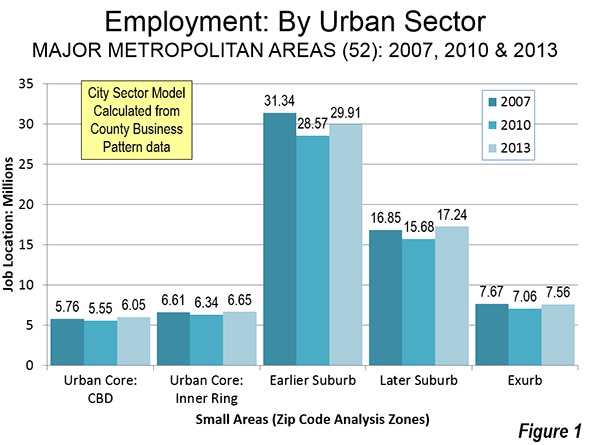
    Job losses were registered in each of the five urban sectors between the employment peak of 2007 and the trough of 2010. Three of the urban sectors have recovered to above their 2007 employment levels. However, overall major metropolitan area employment remains lower by approximately 800,000. Since the 2010 trough, the largest numeric gains have been in the newer suburbs. The Central Business Districts (CBDs) of the Urban Core have recovered more than double their 2007 to 2010 numeric loss. In contrast, the balance of the Urban Core, the Inner Ring experienced a modest increase over its 2007 employment peak. The exurbs have not yet fully recovered. By far the largest losses between 2007 and 2010 were in the earlier suburbs (principally inner suburbs), where employment dropped 2.8 million and has recovered less than one half of that loss (Figure 1).

    Dispersion and Concentration

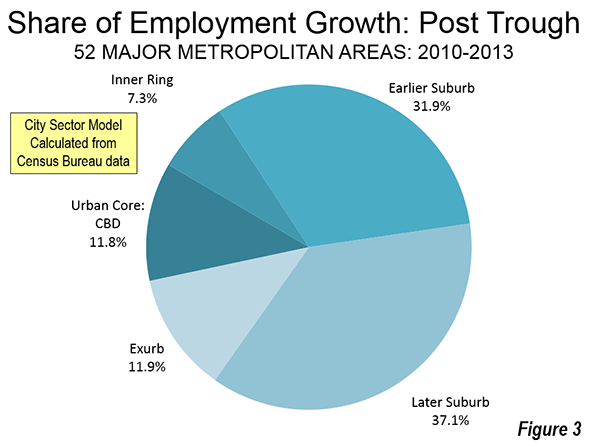
    The dispersion and concentration is most evident in the shares of employment by urban sector (Figure 3). Three of the urban sectors increased their share of metropolitan employment between 2007 and 2013. The largest increase was in the newer suburban areas, which rose from 24.7 percent to 25.6 percent of metropolitan employment. The central business districts also increased their share of employment, from 8.4 percent in 2007 to 9.0 percent in 2013. This trend is similar to the City Observatory (Joe Courtright) findings that urban cores outperformed suburbs in job growth between 2007 and 2011. The Courtright findings were for areas within three miles of the largest city center, while the findings here relate to the generally smaller CBDs (Figure 2).The gains in other sectors were at the expense of the earlier suburbs, which experienced a loss from 45.9 percent to 44.4 percent of metropolitan employment between 2007 and 2013.


    From the 2010 Trough to 2013

    Since the trough of 2010, there were numeric gains in all of the urban sectors. The gains were concentrated in the suburbs and exurbs, which accounted for 80.9 percent of the employment growth from 2010 to 2013. This nearly equals the 81.9 percent share of employment in these areas in 2007. The urban core, including the CBD and inner ring, captured 19.1 percent of the 2010 to 2013 employment growth, better than their combined 18.1 percent share in 2007 (Figure 3).

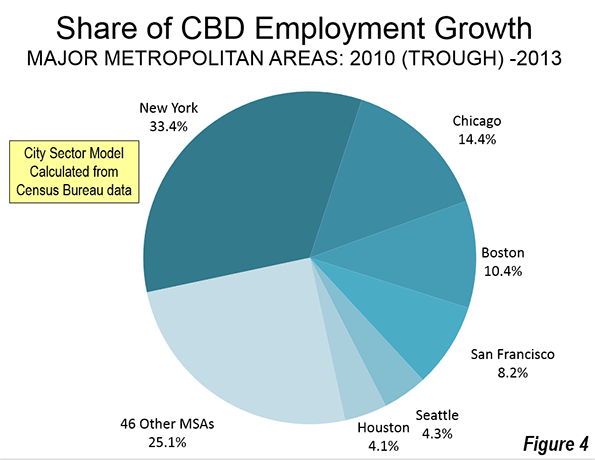
    There was also geographic concentration in the CBD gains between the 2010 trough and 2013. Approximately two-thirds of the CBD employment gain between 2007 and 2013 was in four metropolitan areas: New York, Chicago, Boston and San Francisco. Along with Seattle and Houston, these metropolitan areas account for 75 percent of the CBD growth. All of the 46 other major metropolitan areas contributed 25 percent of the gain (Figure 4).

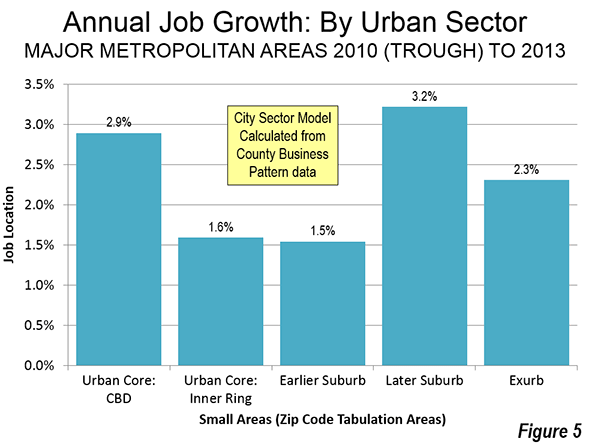
    Between 2010 and 2013, the largest annual percentage employment gain was in the later suburbs, at 3.2 percent. The CBDs, experienced the second strongest growth at 2.9 percent. However, numeric gain in the later suburbs was more than three times that of the CBDs, due to their already much larger employment base (Figure 5).

    Returning to Normalcy?

    For decades, most employment growth has been outside the urban cores of the major metropolitan areas, as had been the case with residential population gains. The Great Recession interfered with these patterns, but normalcy may be returning. Brookings Institution Demographer William Frey recently commented on later population trends (through 2014), suggesting "renewed growth in suburban and exurban counties." The new data indicates renewed employment growth in suburban and exurban areas. At the same time, it would not be surprising for the revival in the CBDs to continue, even if the numbers are relatively small in the metropolitan area context, where the dominance of suburban and exurban job growth seems likely to continue.

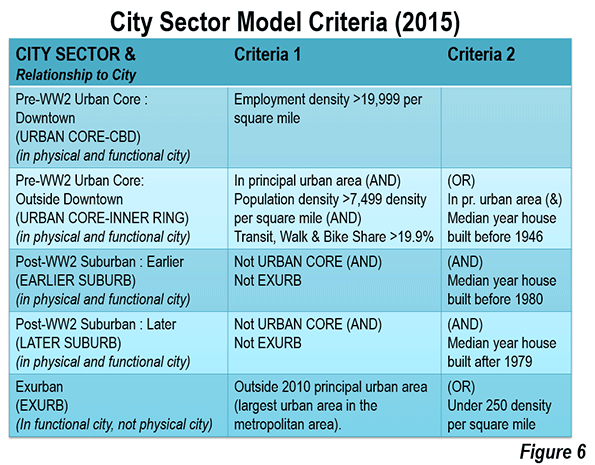
    Note: The analysis is based on the City Sector Model (Figure 6), which classifies small areas (ZIP codes, more formally, ZIP Code Tabulation Areas, or ZCTAs) in metropolitan area in the nation based upon their behavioral functions as urban cores, suburbs or exurbs. The criteria used are generally employment and population densities and modes of work trip travel. The purpose of the urban core sectors is to replicate, to the best extent possible, the urban form as it existed before World War II, when urban densities were much higher and when a far larger percentage of urban travel was on transit or by walking. The suburban and exurban sectors replicate automobile oriented suburbanization that began in the 1920s and escalated strongly following World War II.

    Photo: New York: Columbus Circle (by author)

    Wendell Cox is principal of Demographia, an international public policy and demographics firm. He is co-author of the "Demographia International Housing Affordability Survey" and author of "Demographia World Urban Areas" and "War on the Dream: How Anti-Sprawl Policy Threatens the Quality of Life." He was appointed to three terms on the Los Angeles County Transportation Commission, where he served with the leading city and county leadership as the only non-elected member. He served as a visiting professor at the Conservatoire National des Arts et Metiers, a national university in Paris. Wendell Cox is Chair, Housing Affordability and Municipal Policy for the Frontier Centre for Public Policy (Canada), is a Senior Fellow of the Center for Opportunity Urbanism and is a member of the Board of Advisors of the Center for Demographics and Policy at Chapman University.

  • A Fix for California Water Policy

    Critics of California’s current water policy advocate more infrastructure spending on things like dams, canals, and desalination plants.  Many would also curtail water releases for the benefit of fish and other wildlife.

    Certainly, infrastructure spending would be better than wasting money on the governor’s high-speed-train fantasy.  However, California cannot spend enough money on water infrastructure to prevent water shortages.  And, solving California’s water shortage does not require an end to “dumping water” to save fish.

    California has a history of droughts lasting as long as 200 years.  You can dam every canyon in California and line the coast with desalination plants, and you won’t solve the water shortage in a 200-year drought, or even a ten-year drought.  Under the current allocation and pricing system, California will simply consume every new drop of water produced. We will have a water shortage all the same.

    Consider Westborough and Hillsborough, in the South San Francisco area. Hillsborough consumes more than four times the water per person as Westborough, just six miles away. Increasing the supply of water in California will simply allow Westborough to be more like its neighbor. The problem is how to constrain demand in places like Hillsborough.

    California policy makers prefer to use authoritarian conservation policies and police-state enforcement tactics to allocate water and control demand.  These polices do not end water shortages.  They perpetuate the shortage, and they add to the burdens imposed by energy and growth policies which are already driving businesses and people out of the state.

    Eliminating California’s water shortages in the presence of recurring droughts will require that the state resort to something truly radical — a free market in water.  This will require that ownership of water be clearly defined, that resale be allowed, and that we adopt a market-clearing price.

    We know what this looks like. Water markets equipped Australia to endure the 1995-2009 Millennium Drought. This was the worst Australian drought since European settlement.  Total water stored declined to just 27 percent of capacity. Yet water trading allowed Australian cities to avoid the most severe water restrictions. It protected agricultural businesses, and it ensured that the country’s endangered habitats and species received adequate water.

    Remarkably, in an end-of-drought survey, over 90 percent of Australian farmers reported that water markets were important to their businesses’ survival. There are many lessons for California here.  A key one is that the tension between water users is completely the creation of policy. There is no need for the tensions between the agricultural industry and California’s cities, between growers and endangered fish, between Hillsborough and Westborough, between neighbors. Water markets can balance competing uses in a way that benefits all.

    To work, markets need something to trade. The basis for trade in a functioning water market is exclusive access to a share of water from a specific body. Australian water laws provide this. California’s water laws do not.

    In California, water rights are often tied to land ownership. The right to surface- or ground-water is conferred by owning the land and often can only be transferred by selling the land. If a land owner wants to use the water, he needs only to put a straw in the ground or the stream. The landowner is entitled to “reasonable and beneficial” use of the water, but that right only extends to the borders of the property.  He can use all the water he can pump, but he has to use it on his land. There are legal barriers preventing the sale of water.

    This creates a “use it or lose it” system of water allocation, with lots of absurdities.  We have growers using sprinklers to irrigate low-value crops like alfalfa in our deserts, while neighbors shame each other for watering their lawns and cities establish water police to enforce arbitrary rationing goals.  We have huge aquifer overdrafts, with massive damage to the environment and to highways and canals.

    California water users are drawing from a common pool. Since they cannot do anything with their water except use it or lose it, an individual’s incentive is to use as much water as possible, before it’s gone and his neighbor gets it. During a drought, it’s literally a race to the bottom of the well. A functioning water market would provide each user with a specific allocation. Then, as the supply of water diminishes during a drought, remaining allocations would become more valuable, increasing the economic return to conservation.

    Prices in a functioning water market would behave just like those in any number of other healthy markets. Consider gasoline or coffee beans. Over the past year, the price of gasoline in California declined by 30 percent, reflecting new supplies and slower demand growth in some markets. In 2014, coffee bean prices increased by 72 percent, in fewer than four months, reflecting a severe drought in Brazil. Australia’s water behaves the same. During the Millennium Drought, water’s price increased by 20 times, from a low of $25 AUD per acre foot to $500 AUD. Naturally, when the rains returned, the price fell.

    California water prices are much more stable over time, but they vary a lot by geography. California municipalities see prices that vary by about 12 times. For example, Ventura pays pumping charges of just $120 per acre foot, while San Diego is purchasing desalinated water for $2,200 per acre foot. Price discrepancies like this defy economic laws. There is certainly nothing resembling a scarcity price for water.

    When you pay your personal water bill, the price that you pay does not signal that we are facing a critical water shortage. Water prices have increased incrementally, but not nearly enough to convey our dire situation. The gas lines of the 70s reminds us of what a world without scarcity pricing looks like.  Remember how quickly shortages disappeared when price controls were abandoned?

    California does not need another speech by the Governor.  It doesn’t need another legislative proposition promising additional water supply 20 years or more later (think Proposition 1). It doesn’t need more dams or canals.  Remarkably, it doesn’t even need more rain, although more rain would be nice.

    What California needs is a process to define who owns the water and how much is available.  A comprehensive rewrite of California’s water laws is the best way to achieve this, but this is probably politically impossible, especially since that rewrite would require Sacramento to cede control of water allocation to the markets.  Alternatively, California has a court-mediated alternative in place.  The process, adjudication, is far from perfect, but it can work.

    Twenty-three of California’s more than 400 groundwater basins have already undergone adjudication. While not models of efficient water use, adjudicated basins are a big improvement over non-adjudicated basins. Unfortunately, the current legal infrastructure requires a minimum of 10 years for the adjudication process to work.  This is obviously too slow to help with our immediate problem. Sacramento legislators have promised to implement policies to expedite adjudication, but we are still waiting for them to deliver. This should be California’s single highest legislative priority.

    Absent meaningful reform, litigation will take on an increasingly important role. Significant Proposition 218 cases have already been decided in San Juan Capistrano and Ventura. The Ventura case is especially noteworthy. The City sued the local water purveyor over pumping charges which are greater than those of local farmers. Suing to lower the City’s already low water prices during a severe shortage shows impressive audacity. Fortunately, an appeals court ruled that the current rate system is legal. Ventura’s pumping charges are not going down anytime soon.

    The San Juan Capistrano decision seems less helpful. There, an appeals court ruled that the City’s tiered rate system, which increases the cost of water as the number of units increases, is illegal under Proposition 218. We ask the question again, what will constrain the demand for water in places like Hillsborough? Or San Juan Capistrano? We are not qualified to object to the legal decision on its merits. But the cost of water for all users in San Juan Capistrano very likely ought to be higher than it is today. A free market in water would tell us just how much higher.

    Finally, allowing a market price for water would contribute to increased supply during droughts.  Businesses and business people are amazingly efficient at taking advantage of profit opportunities.  Who knows where water would come from if the price were higher? Water districts would have economic incentives to explore supply alternatives such as rain catchment, waste water reuse and desalination. Residents would have incentives to explore household alternatives such as grey water irrigation systems. Maybe Mexico would put in desalination plants and sell it to us? Maybe some business would use tankers to import water?  We don’t know how markets would provide the water, but they would.  We see this with oil, coffee, and every other commodity.  It’s time for California to move to a market price for water.  It’s time to end the current nonsense.

    Matthew Fienup teaches graduate econometrics and works for the Center for Economic Research and Forecasting at California Lutheran University, where he specializes in applied econometric analysis and the economics of land use. He is currently working on his PhD at the Bren School of Environmental Science and Management at the University of California Santa Barbara. He holds a Masters Degree in Economics from UCSB. Bill Watkins is a professor at California Lutheran University and runs the Center for Economic Research and Forecasting, which can be found atclucerf.org.

    Photo by TCAtexas (Own work) [CC BY-SA 3.0], via Wikimedia Commons

  • America’s Cities Mirror Baltimore’s Woes

    The rioting that swept Baltimore the past few days, sadly, was no exception, but part of a bigger trend in some of our core cities towards social and economic collapse. Rather than enjoying the much ballyhooed urban “renaissance,” many of these cities are actually in terrible shape, with miserable schools, struggling economies and a large segmented of alienated, mostly minority youths.

    We are witnessing an unwelcome reprise of the bad old days of the late ’60s, when much of American core cities went up in smoke. Already this year there have been serious disturbances in St. Louis as well as neighboring Ferguson. There’s also been a cascading of urban violence in cities such as Chicago, where the murder rate in 2013 exceeded that of the Capone era. Overall, the geography of fear remains very much what it was a half century ago. The most dangerous places in in the U.S. in terms of violent crime tend to be heavily black cities, led by Detroit, Oakland, Memphis, St. Louis, and Cleveland. Baltimore ranks sixth.

    Of course not everything is as it was. Some cities, notably New York and Los Angeles, are much safer today, and there remains a strong pull for younger people, particularly the well-educated, to move to core cities, at least in their 20s. Black urban professionals enjoy opportunities that were rare a generation ago to reach the highest levels in our most elite cities.

    But, as Baltimore makes clear, we are still very far from what Aaron Ehrenhalt has labeled the “great inversion,” in which our cities change into affluent redoubts while the suburbs devolve into future slums. In reality, this is very far from the truth: cities are, if anything, becoming more bifurcated than ever, with a large, and seemingly unmovable, population that has benefited little from the gentrification of some urban neighborhoods, including some in Baltimore itself.

    The Persistence of Concentrated Poverty

    Perhaps the biggest sign of how limited the urban renaissance has been is to look at the growth of precisely the kind of highly concentrated poor areas like those that blew up in Baltimore. Yet although the suburbs’ share of poverty may have increased, the average poverty rate in the historical core municipalities in the 52 largest U.S. metro areas remains at 24.1 percent, more than double the 11.7 percent rate in suburban areas—despite a considerable urban turnaround in this period.

    BALTIMORE, MD - AUGUST 20: Vacant houses on August 20, 2010 in Baltimore, Maryland . There are an estimated 30,000 vacant homes in Baltimore. More than one third of these buildings are now owned by the city.  (Photo by David S. Holloway/Getty Images)David S. Holloway/Getty

    In fact, neighborhoods suffering entrenched urban poverty (PDF) actually grew in the first decade of the new millennium, increasing in numbers from 1,100 to 3,100 and in population from two to four million. In other words, poverty spread but also became far more intense in cities. “This growing concentration of poverty,” note urban researchers Joe Cortright and Dillon Mahmoudi, “is the biggest problem confronting American cities.”

    Certainly Sandtown-Winchester—where Freddie Gray, whose death sparked the riots, grew up—fits this mode. As the liberal Think Progress website explains, more than half of that neighborhood’s people between the ages of 16 and 64 are out of work and the unemployment rate is double that for the rest of the city. Median income is below the poverty line for a family of four, and nearly a third of families live in poverty. About a quarter to a third of the buildings are vacant, compared to 5 percent in the city as a whole.

    Yet the people in these neighborhoods do not represent the majority of black America. Besides the gap between blacks and whites, there is also a growing one among African-Americans themselves. This is painfully obvious in the Baltimore region which, extending to the Washington, D.C., suburbs, has some of the highest black wages and homeownership rates of any of the county, and ranks among the best places for African-Americans in a new study I co-authored for the Center for Opportunity Urbanism.

    In fact, five of the ten wealthiest black communities in America are in Maryland. Needless to say, residents in those towns are not rioting. There is an increasingly enormous gap between entrenched poor communities, such as those in Baltimore, and a rapidly expanding black suburban population. Barely half of the 775,000 African-Americans in the Baltimore metropolitan region live in the city, and those outside do far better than inside the city limits. In the last decade, suburban Baltimore County added160,000 blacks, far more than moved into the city (PDF). The black suburbanites not only make more money than their urban counterparts but their life expectancy (PDF) is at least eight years longer.

    These trends can be seen nationwide. In the last two decades of the 20th century, more blacks moved into the suburbs than in the previous 70 years, a trend that continues unabated. The 2010 Census indicated that 56 percent of African Americans in major metropolitan areas live in the suburbs. This movement was particularly marked among families with children; the number of black children living in cities like New York, Oakland, Atlanta, Los Angeles all dropped precipitously, as families sought out safer streets, better schools, and more affordable space.

    The Changing Nature of Urban Economies

    African-Americans came to Baltimore and other northern cities in large part to work in the steel, port, and other blue collar, industrial businesses that flourished in mid-century America. Yet most of those jobs are now gone, leaving behind those who must scramble to find work in the growth industries of today—education, technology, medical services. This is the case in almost all heavily black cities, not only in the Northeast, but the Midwest and even parts of coastal California. But today’s star urban industries, notably technology and high-end business services, employ few working class blacks. African-Americans, for example, occupy only the tiniest sliver of jobs—roughly 2 percent—in Silicon Valley. Nor have African Americans done well in the tech boom, driven by software-related firms more likely to staff themselves with Indian technocoolies than boys up from the ’hood. Between 2009 and 2011, earnings dropped 18 percent for blacks and 5 percent for Latinos, according to a 2013 Joint Venture Silicon Valley report.

    Overall the places where these industries have grown often produce not more opportunities for poor people or minorities but rather a subtle form of “ethnic cleansing.” A recent report from the Urban League, for example, pointed out that the very cities most praised as exemplars of urban revival—San Francisco, Chicago and Minneapolis—also suffer the largest gaps between black and white incomes. Notwithstanding the rhetoric, much of the “hip cool” world increasingly consists of monotonic “white cities” with relatively low, and falling, minority populations, such as San FranciscoPortland, and Seattle. These places are achingly political correct in theory, but are actually becoming whiter and less ethnically diverse as the rest of the country diversifies. The situation has changed so much that former MayorGavin Newsom even initiated a task force to address black out-migration.

    Inverting the Inversion

    Baltimore proves that the “great inversion,” insofar as it exists at all, positively affects a relatively small part of the urban population, particularly in historically black cities. Cities may well have become a popular abode for the young, well-educated, and the rich (usually white), but they also contain another, usually much larger population of those, mostly minorities, who have been left behind in the urban evolution. Midwestern urban analyst Pete Saunders describes Chicago in this manner: “one third San Francisco, two thirds Detroit.”

    This is precisely what we see in Baltimore and many traditionally black cities. Everything that does not work in cities today—education, for example, and sometimes law enforcement—most directly affects minorities and the poor. Crime may be down overall in many cities, but not necessarily in predominately minority neighborhoods. As blogger Daniel Hertz has demonstrated, violent crime has actually increased since the early ’90s in several large, predominately African-American Chicago neighborhoods.

    Clearly what we are seeing then is not an urban kumbaya you see in TV ads for fast food and web services, but a hardening of class and racial divisions. Suburban poverty and crime may have increased in recent years, but they are not nearly as entrenched on the periphery as they are in the city. Places like inner Baltimore function essentially as a kind of dead-end, a cul-de-sac for dreams of a better future.

    The Changing Geography of African-American Opportunity

    We are witnessing a very unwelcome resurgence of racial tensions over the past six years, with concern about racism at the highest level since the Rodney King riots in 1992. Today, particularly in the divisive aftermath of Ferguson and other police-related controversies, two in five Americans feel race relations have gotten worse since President Obama took office, while only 15 percent thought they had gotten better.

    How do we reverse this ugly trend? Sadly it takes more than good intentions and handouts. To be sure, the initial Great Society programs helped reduce chronic black poverty. But the poverty rate was already dropping: in the prosperous early ’60s, black poverty plummeted from 56 percent to 34 percent; in contrast, in the years after President Lyndon Johnson launched the war on poverty, it dropped only slightly, to 32 percent. But by the ’70s this progress—despite the implementation of such programs as affirmative action—slowed to a crawl, in large part due to cascading social problems, particularly in industrial cities like Baltimore.

    Many progressives have blamed conservatives starting with President Reagan for the conditions that still prevail for many African Americans. Yet it turns out that expansive era was pretty good for blacks, if not for their leaders. Even as poverty spending growth slowed, the poverty rate dropped in the Reagan years to around 30 percent for African-Americans. Similarly the economic boom of the Clinton era saw even greater progress, with poverty dropping to 25 percent. It began to rise again, albeit slowly, during the tepid recovery of the Bush era, but then began to rise more steeply during the Great Recession, and through the slow, and also tepid, recovery of the Obama years.

    Clearly an improved economy is more important than ramping up social spending. Indeed, according to USC’s Luke Phillips, states. like New York, Massachusetts , California and Illinois spend almost twice as much on welfare payments than do states like North Carolina, Texas, or Florida, both in terms of GDP and state spending. Yet the best results for African Americans in our Center for Opportunity Urbanism study were found overwhelmingly in the former Confederacy, states generally not well known for their generosity to the poor or interest in racial redress.

    This is leading to a stunning reversal in black migration patterns. Between 1910 and 1970 six million African Americans migrated from the South to the North in what became known as the Great Migration. But since World War II the migration has changed course: ambitious blacks now head toward the suburbs, or the South. Between 2000 and 2013, the African American populations of Atlanta, Charlotte, Orlando, Houston, Dallas-Fort Worth, Raleigh, Tampa-St. Petersburg, and San Antonio all experienced growth of close to 40 percent or higher, well above the average of 27 percent for the 52 metropolitan areas.

    “Blacks who have relocated tend to be either retirees or well-educated, well-off middle-agers with children,” John Giggie, associate professor of history and director of graduate studies at the University of Alabama in Tuscaloosa, toldBET.com. They move to the South not because they like the politics (most probably don’t) but because they seek economic progress. Part of the reason may be that sunbelt cities have more broad based opportunites for middle and working class residents than have the increasingly post-industrial economies of California and the Northeast corridor.

    Our leadership class, black and white, misses all this. Sending Al Sharpton, President Obama’s highly publicized advisor, to Baltimore hardly bodes well for improving things on the ground. A little bit of catharsis, perhaps, but at some point you need to deal with reality.

    It would be far better if some CEOs or investors—American, Asian, or European—came to the old Chesapeake city bearing plans for expanding jobs and opportunities. That, at least, would begin to address the economic and social isolation that, inevitably, finds its expression in fires on the street. Good jobs and the prospect of a better future—not good intentions—is what ultimately matters.

    This piece first appeared at The Daily Beast.

    Joel Kotkin is executive editor of NewGeography.com and Roger Hobbs Distinguished Fellow in Urban Studies at Chapman University, and a member of the editorial board of the Orange County Register. He is also executive director of the Houston-based Center for Opportunity Urbanism. His newest book, The New Class Conflict is now available at Amazon and Telos Press. He is also author of The City: A Global History and The Next Hundred Million: America in 2050.  He lives in Los Angeles, CA.

    Photo by Voice of America, Victoria Macchi

  • Building a New California

    The Golden State has historically led the United States and the world in technology, quality of life, social innovation, entertainment, and public policy. But in recent decades its lead has ebbed. The reasons for this are various. But there is one area of decay whose story is a parable for California’s other plights—that area is infrastructure.

    California’s infrastructure, like California, has had a golden past full of larger-than-life personalities and heroic deeds. But in recent decades the state has lost its innovative edge, resting on the laurels of its past successes without adequately preparing for any such bold endeavors in the future. California’s infrastructure imperative, then, is this: to accomplish bold, ambitious projects that promise a transformed and vibrant future for California, yet are still practical and sensible, and have proven viability.

    Should California manage to get its act together and embark upon a course of infrastructure renewal, it will be taking one of several steps necessary to transform itself into an opportunity society again. Systemic reforms beyond infrastructure will be necessary to renew Californian society and lower the cost of living, raise the quality of life, and create opportunities for entrepreneurs and middle-class families. But infrastructure is a fantastic place to start.

    Aside from basic infrastructure renewal like fixing up roads and bridges, expanding our water storage capacity, and reforming public policy and internet regulation to provide a world-class infostructure, there are three main physical infrastructure projects California should be focusing on to bring the state forward into the 21st Century. These are driverless car networks, a new nuclear energy grid, and an archipelago of desalination plants.

    The current strategy for the future of California’s transportation system is wildly unrealistic. Passenger rail is simply too ineffective to justify building an expensive new High Speed Rail system that wouldn’t even be able to pay for itself. Commuter rail usage rates have been on the decline. A better way forward would be to embrace the power of computerization in the transport sector, and put our population on a path towards using self-driving cars.

    The benefits of a driverless car network are numerous. They include greater safety, optimized traffic flow, reduced congestion, higher productivity, and cheaper, more effective travel for those unable to afford a car. The possibilities are endless. Already a test range at the University of Michigan is exploring what a driverless car system would look like. One could expect such a system to seriously reduce traffic congestion, improve transport speeds, conserve energy, nearly eliminate accidents, increase worker productivity, and generally revolutionize driving.

    So how could California go about transitioning to a driverless car system? In the short run, there wouldn’t be much in the way of new construction to worry about. It’s mostly a question of technological investment and regulatory reform.

    First, the state of California should partner with major universities and tech firms currently working on driverless car systems, and fund research and innovation projects geared towards enhancing the vehicles.

    Once driverless cars are tested, California should work to lower the barriers to their deployment. This might include reforming insurance and licensing laws, to make it easier for people to purchase one. It would also help to offer incentives for middle-class individuals to purchase these new vehicles, too, such as tax deductions.

    As with all public goods and services, government policy towards transportation ought to be designed with providing the widest array of convenient options for consumers, rather than forcing people into a single system or expecting them to use costly, uneconomical, heavily subsidized services. The call for a driverless car system is not to rid the roads of traditional vehicles. Nor is this a call to abandon rail or buses or cease investing in bike paths and walkways. This plan, rather, would seek to make one particularly middle-class-convenient option more available.

    The next area California should focus on is its energy generation system, through a new nuclear generator fleet. Currently California generates energy with a combination of coal, oil, natural gas, and renewable power. Governor Brown has launched ambitious initiatives to have as much as 50% of the state’s electricity generated by renewables within a few decades (which doesn’t do anything to make energy cheaper for working and middle-class citizens and families, much less businesses.) Meanwhile the state’s use of fossil fuels for energy generation for backup continues to grow as unstable renewable energy sources go online.

    We need an ambitious energy infrastructure plan if we are to both provide cheap, readily-available energy to the masses of California’s citizens (and thus provide them with a lower cost of living and higher quality of life) and to continue the state’s commitment to combatting climate change. Incidentally, there is a way to achieve both of these goals, while growing the state’s economy at the same time. California should open its fossil fuel fields to exploitation, levy a carbon tax on the profits, and use that revenue from the carbon tax to fund an ambitious nuclear program that could generate a majority of the state’s electricity within a few decades.

    California’s antipathy toward fossil fuels has led it to impose onerous regulations that hurt growth and provide little environmental reward; the deposits of oil and gas off the coast and in the interior have been made even more accessible by the fracking revolution, and if it wanted to, California could become an energy giant. So California could open its fields for drilling, fighting off regulations and lawsuits by various anti-oil interest groups, and begin reaping huge revenues through the imposition of a light carbon tax.

    This light carbon tax would go towards funding research in advanced nuclear energy, and towards a fund for establishing a fleet of a dozen or so advanced nuclear plants across the state. This would signify California’s continued commitment to reducing carbon emissions and adopting advanced energy.

    These new nuclear reactors are not the hulking behemoths of Three Mile Island. Some new reactors have been designed to be as small as a car and power a small city. They are extremely safe. And, far more importantly, nuclear energy is the gift that keeps on giving. In civilizational terms, nuclear energy can power our society forever. And it provides far more bang for the buck than solar or wind, the current green fetish power sources.

    Finally, California seriously needs to confront the water scarcity challenge that has perennially afflicted it throughout its history, and seek a permanent solution for providing cheap and plentiful water to the residents of this parched coastal strip. Desalination is the best way to secure that.

    We are currently in the midst of what appears to be the worst drought California has faced in its entire history as a state, and this does not bode well for the future growth of California. Adequate water is one of those resources that every civilization has depended on. Although California is not literally “down to one year of water” as a recent LA Times article misleadingly claims, we are in a shortage that is economically catastrophic, environmentally devastating, and entirely unnecessary- for it is man-made. Better water policy in past years, allowing Californians to use more of their river water, could have staved it off, as could better storage infrastructure construction. But these projects and policies were never put in place to the degree necessary to stop this drought from happening.

    Rationing and conservation may indeed be the short-term solution, but we need to look to a longer-term solution- and buying more water from other states doesn’t solve the problem.

    Many arid coastal countries – including Australia, Israel, and some of the Persian Gulf states – use desalination plants to water their burgeoning populations, and it is something of a miracle that Southern California has gotten by without such systems. We have a long coastline on which we could build numerous desalination plants, powered by the aforementioned fleet of nuclear reactors. This system could more than satisfy the needs of California residents, farmers, and industries, while simultaneously reducing the pressure on our streams, rivers, and reservoirs.  It would be incredibly capital-intensive and costly, and would perhaps lead to some unforeseen environmental consequences. But it is a better water policy than what we are doing now.

    This infrastructure program would likely require budget, tax and regulatory reform, as well as the broad support of the majority of Californians. It would represent a reasonable response to the now excessive power of the environmental lobby.

    But more than fiscal reform and public support, it would require a newfound political moxie in both the private sector and the public sector. We need a new generation of visionary William Mullhollands, Henry Huntingtons,  and Pat Browns to pursue these and other reforms to turn our Golden State golden again.

    Can it be done? With some political maneuvering and engineering ingenuity, sure. Will it be done? That’s a choice that our next generation of political leaders will have to make for themselves.

    Luke Phillips is a student studying International Relations at the University of Southern California. He is an editorial intern for the magazine The American Interest and a research associate at the Center for Opportunity Urbanism.

  • Global Cities in the 21st Century: a Chicago Model?

    As America’s “third” city, Chicago competes for international attention against the usual rivals: New York and Los Angeles. Even San Francisco, next to Silicon Valley, claims prominence for its cutting-edge industries and progressive culture. Ultimately, though, Chicago’s domestic peers have global status through definitive leadership in industries with visibility and impact (New York in finance, Los Angeles in entertainment, Houston in energy, and San Francisco in technology and innovation). Chicago has dim prospects of replicating such undisputable competitive advantages, but it may not need to.

    Global status in the 21st century favors international collaboration over industry dominance, for three reasons. First, the innovative nature of emerging industries and modernizing traditional industries shifts competitive determinants from resources to ideas. This equalizes the international knowledge race, with companies seeking ideas regardless of geographical origin. Second, technology-enabled connectivity integrates previously isolated regions into the global economy, creating what a recent Foreign Affairs article labels a “unified global marketplace for labor.” Third, the dynamic knowledge sector rewards flexibility over size; footloose over big and rigid. Accordingly, local workforce size loses relevance, good news for small cities. The digital revolution enables geographic dispersal of talent through “internet-based globalization.” In short, collaboration enables flexible capacity, while international collaboration taps a vastly more diverse and hungry talent pool.

    Is Chicago prepared to abandon pursuit of industry dominance and seek global status in the hyper-connected knowledge economy? The city already boasts corporate prominence and diverse lifestyle amenities, and has even seen post-recession growth in emerging creative industries like high-tech and film. Chicago also has a lively private sector, and visionary, pro-developmental planning from both its recent and distant past. In 2013 the city committed US$ 3 billion to revive urban neighborhoods, through a public-private initiative that Mayor Rahm Emanuel insists will help Chicago “live up to its potential as the global city that it should be.” Such factors make a city great, but do they make it global?

    Despite being a paragon of economic diversification, Chicago lacks an undisputed position in any transformative and globally relevant industry, as enjoyed by its coastal rivals. The city is even perceived by some as a striver whose influence is more regional than global. For example, in a 2012 New York Times article, a relocation expert stated that global business and political leaders “have an idea of Chicago that is 20 or 30 years out of date.” Indeed, Chicago has a development history that is steady but not exceptional. Before its recent struggles, the city’s plodding, linear economic progress was a product of the typical determinants: population growth and path-dependent agglomeration. Outdated theories recommend that Chicago aim for inimitable dominance in an emerging industry. However, such efforts would be misplaced in the current global economy.

    In practice, a growth approach favoring industry dominance has two problems. First, it ignores the fact that the most elite global cities acquired prominence the hard way: through gradual institutional evolution. Dominance across multiple industrial eras is only the shiny product of underlying economic, social, and political circumstances that generated structural flexibility. These circumstances, rather than industry prominence itself, should be the focus of urban growth strategies prioritizing prepared opportunism over industrial roulette.

    Second, the industry dominance approach unduly emphasizes competition, with a zero-sum philosophy that marginalizes collaboration. No industrial windfall or shock-opportunity has fundamentally transformed Chicago’s competitive position since the 19th century, when connectivity through railroads, canals, and westward expansion made the city a trading and logistics hub. Chicago can now develop global status through connectivity of a new sort, as a collaborative leader in emerging global networks for trade and production. It can even anchor an inter-governmental urban network addressing economic challenges in large inland cities lacking inimitable competitive advantages.

    Historically, an unchallenged advantage in trending industries generates global visibility and relevance. However, modern embodiments of the dominance model are fundamentally unstable, in particular due to sector cyclicality. Only three cities have historically maintained near-permanent global status: Tokyo, London, and New York. Their type of competitive advantage is institutionally entrenched and therefore largely inimitable, although Tokyo has struggled throughout Japan’s multi-decade economic slump. Aside from these mega-cities, Chicago’s global aspirations face significant competition from ambitious secondary cities. Rapid economic growth in Asia has attracted capital to places whose names were just decades ago scarcely recognizable in the West (e.g. Wuhan and Guangzhou, both with populations comparable to New York’s).

    A 21st century growth strategy should not assume zero-sum economic competition, but instead emphasize membership in the right “clubs.” Inter-urban cooperative networks are increasingly common; for example, Singapore is collaborating with Indian cities on “smart” development. This type of soft-diplomatic relationship is a form economic symbiosis that emerges from a “flattening” world. Networks also emerge around industry complementarity (e.g. Los Angeles-Nashville-Austin in entertainment, Oklahoma City-Dallas-Houston in energy, and Singapore-New York-Frankfurt in finance). Chicago must contemplate what it offers as a network partner, and move early in establishing inter-urban relationships to jointly capture global opportunities.

    Recent history is littered with failed urban growth strategies derived from outdated models. For example, to quickly garner status many cities have made grandiose commitments such as Olympic bids, sports stadiums, and ambitious megaprojects. Such efforts are cheap and politically expedient to announce, but drain municipal coffers during implementation. Chicago can alternatively stake its future on the more sustainable and farsighted growth model of networked interdependence. An internationally connected economy may not be glamorous, but it is certainly “global” and can also be diverse and stable, as quietly proven by some of the world’s more creative secondary cities (e.g. Toronto, Sydney, Amsterdam, and Bangalore). Chicago must decide first what kind of status is wants, and ultimately whose company to keep.

    Kris Hartley is a Visiting Researcher at Seoul National University and PhD Candidate at the National University of Singapore. He focuses on economic policy, urban planning, and governance innovation, and has a decade of experience with government agencies, community development corporations, and research institutes. His book Can Government Think? Flexible Economic Opportunism and the Pursuit of Global Competitiveness proposes a model for urban economic growth through the alignment of institutional structures and administrative processes supporting evidence-based policy. His work is available at www.krishartley.com.

  • The Valley And The Upstarts: The Cities Creating The Most Tech Jobs

    No industry generates more hype, and hope, than technology. From 2004 to 2014, the number of tech-related jobs in the United States expanded 31%, faster than other high-growth sectors like health care and business services. In the wider category of STEM-related jobs (science, technology, engineering and mathematics), employment grew 11.4% over the same period, compared to 4.5% for other jobs. The Commerce Department projects that growth in STEM employment will continue to outpace the rest of the economy through 2018.

    But all the new tech jobs have not been evenly distributed across the country. To determine which areas are benefiting the most from the current tech boom, Mark Schill, research director at Praxis Strategy Group, analyzed employment data from the nation’s 52 largest metropolitan statistical areas from 2004 to 2014. He looked at the change in employment over that timespan in companies in industries we associate with technology, such as software, engineering and computer programming services. (Note that this includes everyone at these companies, such as non-tech employees like janitors and receptionists). He also looked at the change in the numbers of workers in other industries who are classified as having STEM occupations (science, technology, engineering and mathematics-related jobs). This captures the many tech workers who are employed in businesses that at first glance may not seem to have anything to do with technology at all. For instance just 7% of the nation’s 1.5 million software developers and programmers work at software firms — the vast majority are employed in industries as disparate as manufacturing, finance, and business services.

    Our list features some well-known outperformers, but also some surprising metro areas usually not associated with venture capital and Silicon Valley. We also found that some high-profile metro areas that like to tout themselves as the “next Silicon Valley” are actually at best the middle of the pack in terms of tech and STEM job growth.

    The Strongest Engines

    At the top of our list is a group of cities that have long been identified with tech growth. Our No. 1 city, Austin, Texas, boasts the strongest expansion in tech sector employment of any of the nation’s 52 largest metropolitan areas from 2004 to 2014, 73.9%,  as well as 36.4% growth in STEM jobs, the fourth-highest growth rate in the country. Coming in a close second is Raleigh, N.C.,  part of the renowned Research Triangle region, home to outposts of multinationals like Bayer, BASF, GlaxoSmithKline, IBM and Cisco. The Raleigh metro area posted a 39% increase in STEM jobs from 2004-14, the fastest growth in the nation, albeit from a smaller base than many of the other biggest metro areas.

    However, the Bay Area continues to reign as the tech center with the most momentum. San Jose, which covers most of Silicon Valley, ranks third with 70.2% growth in tech sector employment since 2004 and a hefty 25.8% increase in STEM employment. The San Francisco metro area, which includes San Mateo to the south, ranks fifth with a 67.4% jump in tech industry employment as well as a STEM jobs increase of 27.5%.

    There may be more tech industry employees and workers in STEM occupations in the New York City, Washington, D.C., and Los Angeles metro areas, but San Jose has the strongest concentration of tech horsepower in the nation, with by far the highest per capita concentration of people in engineering professions. San Jose’s tech industry is responsible for 14.1% of all jobs, almost five times the national average of 2.9%. The share of STEM workers is 15.5% of its total workforce, three times the 5.0% proportion in the overall U.S. population. Both figures are easily the highest in the nation. San Francisco clocks in at second nationally with 7.6% of its jobs in tech industries and is fifth in STEM representation, at 8.7% of all workers, behind San Jose, the nation’s capital, Seattle, and our No. 1 city, Austin.

    Silicon Valley’s thick concentration of titans like Intel, Apple, Oracle, Google and Facebook has created an innovative ecosystem, which, as Pando Daily’s Michael Carney describes, supports a “systematic irrationality and a feedback loop” that encourages many tech entrepreneurs to turn down the easy early exit of selling out to a bigger company and make the commitment to grind for a decade or more in the hopes of joining the afore-mentioned standouts as a massive success.

    No other area apart from Seattle (No. 7 on our list) comes close in this regard to nurturing tech giants. The success of the Bay Area and Valley also attracts outsiders who want to be close to the action, including foreign players like Samsung, and old economy stalwarts that need a tech infusion like Wal-Mart.

    The Surprise Tech Upstarts

    Some of the others in our top 10 are not as renowned as tech centers, but have experienced rapid growth over the past decade. The biggest surprise may be No. 4 Houston, which enjoyed a 42.3% expansion of jobs in tech industries and a big 37.8% boost in STEM jobs from 2004-14. Much of the growth was in the now sputtering energy industry, but also medical-related technology, which continues to grow rapidly. Houston is the home to the Texas Medical Center, the world’s largest concentration of medical facilities. It also ranks second to San Jose in engineers per capita.

    The Mountain West metropolises of Salt Lake City (sixth) and Denver (11th) also have posted impressive growth, and now boast considerably higher share of tech and STEM workers in their populations than the national average; in Salt Lake City 5.9 percent of jobs are in tech industries and 4.1% are in STEM. Denver is even more impressive with 7.3% of jobs in tech industries and 5.1% working in STEM.  Salt Lake City’s gains are linked to a continued migration of tech firms, largely from Silicon Valley, whereas Denver is making waves as a start-up incubator.

    The other top cities on our growth list all tend to be emerging tech centers. These include No. 8 Nashville, where strong growth in data centers and systems design firms is at least partially tied to its strength in the health sector, No. 9 Jacksonville, driven by IT and computer programming services firms, and, perhaps most surprising, No. 10 Memphis, whose 35% tech growth since 2012 is due mostly to significant recent growth in engineering services. However, the tech sectors in these cities are still very small — Memphis had only 7,800 tech industry workers last year — and all three still trail the national average for the share of tech workers in the population.

    More Hat Than Cattle?

    Some journalists and pundits believe tech is moving from its suburban roots and towards dense, large cities. And there’s some truth to the fact that the social media boom, and some tech-driven services, appeal naturally to the same creative and culturally minded workforce concentrated in core cities. But this shift is not too evident in terms of job creation. High-tech growth in city centers may have more to do with tech sector expansion in general occurring in every type of geography.

    Suburban Silicon Valley, for example, has nearly twice the concentration of tech jobs as San Francisco; even amidst the social media boom, the Valley since 2012 has greatly outpaced the City and its immediate suburbs in terms of both new tech and STEM employment. The largest tech projects going up in the Bay Area — new headquarters for Google, LinkedIn and Apple – are being built in the Valley, not the city.

    Unlike San Francisco, cities located far from tech centers have not done nearly as well as often reported. Chicago has been desperate to portray itself as a major tech center, developing elaborate facilities for companies, while promoting its own high-tech icon, Groupon, and crowing over the high-profile names its lured to open up offices in the city, like Google. Mayor Rahm Emmanuel has even proposed expanded bike lanes as part of his plan to lure tech-savvy members of the “creative class” to his city.

    Yet despite all the noise, Chicago ranked a mediocre 33rd on our growth list, with 20.3% tech industry employment growth from 2004-14 and a mere 3.8% growth in STEM jobs. Both numbers are below the national average, as is the region’s percentage of employees in tech and STEM.

    How about Los Angeles, with its fabulous weather, elite universities (Caltech, University of Southern California, UCLA, Cal Poly Pomona and Harvey Mudd College) and close ties to the creative engine of Hollywood? Local boosters like to claim that the metro area is undergoing a full-scale “tech boom” focused on the west side in its so-called “Silicon Beach.” To be sure, the region still boasts the second largest pool of STEM workers in the country, in part due to its legacy of manufacturing, led by its shrunken but still sizable aerospace industry (63,000 jobs, down by 90,000 since the end of the Cold War). But Los Angeles’ large STEM numbers are to a great degree a function of the massive population of the metro area – the percentage of STEM employees in the workforce is 4.9%, a hair below the national average of 5%, while 2.5% of its workforce is in tech industries, trailing the national average of 2.9%. Los Angeles lands a poor 38th on our growth list, with an 18.7% expansion in tech industry jobs since 2004 and a 4% increase in STEM jobs, a shade below the national average of 4.2%.

    But perhaps the biggest surprise is New York, whose boosters are now claiming it to be the No. 2 tech center in the nation and the Valley’s chief rival. However, on our job growth list New York sits in a mediocre 35th place, with 24.3% growth in tech industry employment over the past 10 years, and only 4% in the last two. In STEM, New York still has the largest number of jobs of any metro area in the nation at 428,000 as of 2014, but that’s up a paltry 2.7% since 2004, and, as in the case of L.A., is a function of its large population. The percentage of STEM employees in the local workforce falls short of the national average at 4.4%. New York has gained about 51,000 technology industry jobs since 2004 and 12,000 since 2012, giving it a total of roughly 265,000 tech jobs. But that’s some 70,000 fewer than the Bay Area, an economy about one third the size of New York’s.

    Critically, most New York “tech” seems more linked to media than actual physical products, essentially replacing many of its old media jobs with newer ones. Part of the problem for New York is that it’s profoundly weak in engineering talent, ranking 78th out of 85 metropolitan areas in engineers per capita.

    The Bay Area Versus The Rest

    The current social media bubble will surely pop, but as Michael S. Malone and others have noted, the Bay Area’s preeminence will likely continue, fueled by its unique concentration of engineers, entrepreneurs, and risk capital. Instead of losing out to New York, Silicon Valley and San Francisco are luring many top performers from Wall Street. Google alone has 1,200 employees who formerly worked for large U.S. investment banks, and migration from the Big Apple to California is now at its highest level since 2006.

    In the coming years the engineering-centered Valley seems better positioned to seize on the challenges posed by the “Internet of things,” including systems for heating and cooling and autonomous cars, as well as biotechnology. In the long run, the Valley’s hegemony is threatened not by any one place, but by several that offer significant technical expertise, with far lower housing costs. San Francisco is already by far the nation’s least affordable metro area. Only 11% of residents making the median annual income can afford to buy a home, according to the NAHB/Wells Fargo Housing Opportunity Index – and the median income is in the San Francisco area is a hefty $100,400. The Valley is not far behind at 21.8%. The high prices throughout the Bay Area has become a concern of tech executives, who fear they will have troubles attracting more experienced engineers and managers.

    No matter the headlines, the reality is that future tech growth is more likely to be created by the less sexy business services sectors than by Internet media or software publishers. In the last decade three often-ignored industries — engineering services, systems design and custom programming – added nearly 750,000 jobs, while software providers and Internet properties added less than 200,000. The decentralizing force of these boring sectors is what’s driving growth in the second- and third-tier tech cities.

    But despite these trends, don’t expect the landscape of American technology, particularly at the high end, to change dramatically in the near future. Inertia is a powerful force, as is the enormous concentration of venture funds and expertise around the Bay Area. But if no one area can hope to challenge Silicon Valley’s lead position, it is likely tech growth will continue to flow to other areas that could collectively take the tech capital of the world down a notch or two.

    2015 Metropolitan Tech-STEM Growth Index
    Rank Region (MSA) Score 2004-2014 Tech Industry Growth 2012-2014 Tech Industry Growth 2014 Tech Industry LQ 2004-2014 STEM Occuptn Growth 2012-2014 STEM Occuptn Growth 2014 STEM Occuptn LQ
    1 Austin 87.4 73.9% 21.8% 1.90 36.4% 11.2% 1.77
    2 Raleigh, NC 85.7 62.3% 17.0% 2.23 39.0% 13.4% 1.63
    3 San Jose 78.1 70.2% 19.6% 4.92 25.8% 10.2% 3.11
    4 Houston 77.8 42.3% 18.5% 1.26 37.8% 12.3% 1.30
    5 San Francisco 70.5 67.4% 13.0% 2.64 27.5% 7.9% 1.74
    6 Salt Lake City, UT 70.0 62.4% 11.0% 1.44 33.3% 7.5% 1.17
    7 Seattle 66.5 58.3% 7.4% 2.34 37.6% 6.2% 1.94
    8 Nashville 65.3 68.6% 15.1% 0.68 14.7% 7.6% 0.80
    9 Jacksonville, FL 62.7 58.4% 13.5% 0.87 16.0% 8.2% 0.84
    10 Memphis, TN 61.0 35.3% 34.9% 0.41 5.0% 7.4% 0.63
    11 Denver 56.4 34.5% 10.1% 1.79 24.4% 7.8% 1.47
    12 Indianapolis 55.9 52.2% 8.2% 0.88 15.0% 7.4% 1.04
    13 Charlotte, NC 54.8 36.4% 8.7% 0.81 23.8% 7.1% 0.96
    14 Phoenix 54.1 51.1% 13.3% 0.90 13.9% 5.1% 1.10
    15 Kansas City, MO 54.0 46.2% 11.2% 1.49 16.5% 6.0% 1.11
    16 Portland, OR 52.5 33.2% 9.6% 1.10 19.8% 7.2% 1.31
    17 San Antonio 52.1 43.5% 4.3% 0.92 26.6% 4.8% 0.82
    18 Dallas 52.1 43.9% 6.0% 1.11 22.0% 5.4% 1.20
    19 Boston, MA 50.9 43.4% 9.9% 2.28 16.0% 5.2% 1.59
    20 Sacramento 47.5 47.8% 6.7% 0.94 11.6% 4.7% 1.36
    21 Grand Rapids 46.7 26.4% 13.2% 0.50 7.1% 7.6% 0.95
    22 Louisville, KY 46.5 23.7% 10.8% 0.57 16.4% 6.0% 0.74
    23 San Diego 45.4 33.8% 7.2% 1.81 16.0% 4.7% 1.44
    24 Las Vegas 45.1 13.6% 15.0% 0.57 8.8% 8.0% 0.47
    25 Tampa 43.7 26.8% 10.7% 0.99 4.2% 7.4% 0.91
    26 Orlando 42.9 18.3% 8.7% 0.96 13.9% 6.4% 0.82
    27 Baltimore 40.0 30.4% 5.2% 1.55 16.6% 2.6% 1.42
    28 Atlanta 38.0 19.1% 5.7% 1.22 10.2% 5.4% 1.10
    29 Minneapolis 37.8 17.8% 7.7% 1.07 11.0% 4.6% 1.24
    30 Cincinnati, OH 37.0 20.6% 8.7% 0.81 8.1% 4.0% 1.04
    31 Pittsburgh, PA 35.8 25.2% 3.1% 1.06 14.4% 2.5% 1.06
    32 Miami 35.0 3.6% 13.3% 0.64 -1.0% 7.3% 0.62
    33 Chicago, IL 34.3 20.3% 8.8% 0.91 3.7% 3.8% 0.93
    34 Richmond, VA 32.4 33.9% -2.9% 0.79 9.7% 2.2% 1.00
    35 New York 32.2 24.3% 4.7% 0.96 5.0% 2.7% 0.89
    36 Cleveland 32.1 21.7% 5.3% 0.74 4.1% 3.2% 0.91
    37 Hartford 31.9 30.7% 4.9% 0.89 4.9% 1.2% 1.12
    38 Los Angeles 31.1 18.7% 4.9% 0.86 2.1% 4.0% 0.99
    39 Detroit 29.2 6.2% 8.5% 1.97 -2.3% 5.4% 1.44
    40 Columbus, OH 27.9 9.5% 3.1% 1.07 9.4% 2.3% 1.19
    41 Riverside 25.5 12.8% 0.1% 0.33 4.7% 2.7% 0.53
    42 Providence 24.9 13.1% 1.3% 0.76 0.5% 3.1% 0.88
    43 New Orleans 24.8 21.6% 8.0% 0.68 -11.1% 2.4% 0.68
    44 Oklahoma City, OK 23.9 0.4% -4.8% 0.49 15.5% 2.6% 0.96
    45 Buffalo 23.2 26.3% -2.4% 0.80 3.1% -0.1% 0.85
    46 Birmingham 22.7 3.3% 2.7% 0.65 1.7% 2.8% 0.82
    47 St. Louis, MO 21.9 9.5% -3.5% 0.89 3.1% 2.9% 1.00
    48 Philadelphia, PA 21.6 10.0% 2.4% 1.17 0.6% 1.2% 1.09
    49 Rochester, NY 19.9 12.0% 8.1% 0.74 -4.5% -0.8% 1.06
    50 Washington, DC 16.4 7.3% -4.7% 2.59 10.8% -2.0% 2.07
    51 Milwaukee 16.3 0.1% -2.8% 0.76 1.5% 1.6% 0.99
    52 Virginia Beach 8.0 -2.2% -7.3% 1.04 1.5% -1.5% 1.05

    To determine the metro areas that are generating the most tech jobs, Mark Schill of Praxis Strategy Group,  mark@praxissg.com, examined employment data in two different categories. Half our ranking is based on changes in employment at companies in high-technology industries, such as software and engineering. (This includes all workers at these companies, some of whom, like janitors or receptionists, do not perform tech functions). Half is based on changes in the number of workers classified as being in STEM occupations, which captures tech workers who are employed in all industries, including those not primarily associated with technology, such as finance or business services. We ranked the 52 largest U.S. metropolitan statistical areas by the growth in tech and STEM employment from 2004 to 2014, as well as for their more near-term growth from 2012 to 2014 to give credit for current momentum.

    This piece originally appeared at Forbes.

    Joel Kotkin is executive editor of NewGeography.com and Roger Hobbs Distinguished Fellow in Urban Studies at Chapman University, and a member of the editorial board of the Orange County Register. He is also executive director of the Houston-based Center for Opportunity Urbanism. His newest book, The New Class Conflict is now available at Amazon and Telos Press. He is also author of The City: A Global History and The Next Hundred Million: America in 2050.  He lives in Los Angeles, CA.

    Mark Schill is a community process consultant, economic strategist, and public policy researcher with Praxis Strategy Group.
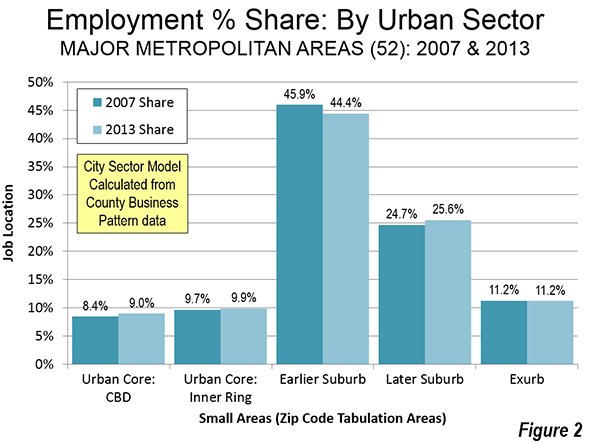
    Photo “Sixth Street Austin” by Larry D. Moore. Licensed under CC BY-SA 3.0 via Wikimedia Commons.

  • Why California’s Salad Days Have Wilted

    “Science,” wrote the University of California’s first President Daniel Coit Gilman, “is the mother of California.” In making this assertion, Gilman was referring mostly to finding ways to overcoming the state’s “peculiar geographical position” so that the state could develop its “undeveloped resources.”

    Nowhere was this more true than in the case of water. Except for the far north and the Sierra, California – and that includes San Francisco as well as greater Los Angeles – is essentially a semiarid desert. The soil and the climate might be ideal, but without water, California is just a lot of sunny potential, but not much economic value.

    Yet, previous generations of Californians, following Gilman’s instructions, used technology to build new waterworks, from the Hetch Hetchy Dam to the L.A. Aqueduct and, finally, the California State Water Project and its federal counterpart, the Central Valley Project. These turned California into the richest farming area on the planet and generated opportunities for the tens of millions who came to live in the state’s cities and suburbs.

    Read the entire piece at The Orange County Register.

    Joel Kotkin is executive editor of NewGeography.com and Roger Hobbs Distinguished Fellow in Urban Studies at Chapman University, and a member of the editorial board of the Orange County Register. He is also executive director of the Houston-based Center for Opportunity Urbanism. His newest book, The New Class Conflict is now available at Amazon and Telos Press. He is also author of The City: A Global History and The Next Hundred Million: America in 2050.  He lives in Los Angeles, CA.

    Photo of Lake Palmdale California Water Project by Kfasimpaur (Own work) [Public domain], via Wikimedia Commons

  • Asian Augmentation

    California, our beautiful, resource-rich state, has managed to miss both the recent energy boom and the renaissance of American manufacturing. Hollywood is gradually surrendering its dominion in a war of a thousand cuts and subsidies. California’s poverty rate – adjusted for housing costs – is the nation’s worst, and much of the working class and lower middle class is being forced to the exits. Our recent spate of high-tech growth has created individual fortunes, but few jobs, outside the Bay Area. The agricultural heartland is suffering not only from drought, but from green policies that allow a torrent of unused water to flow into the Sacramento Delta and San Francisco Bay while huge parts of the Central Valley go fallow.

    But California retains one powerful trump card that our leaders in Sacramento have not yet found a way to squander: Its link to Asia. True, the state’s growth-restrained ports are increasingly tied up, and, over time, much of our trade with China and other Asian countries might pass, instead, through the Panama Canal en route to Houston and other ports. But geography, culture and family ties have a way of overcoming even the most deluded policy environments.

    In the 19th century, many in California railed against the “Asian invasion,” and led the drive to restrict Asian immigration to America. As early as 1850, Asians accounted for one-tenth of the state’s non-native American population. Early on, Chinese, Indian and Japanese immigrants showed remarkable ingenuity, largely as farmers and merchants, which only made whites more antagonistic. “Indispensable as the Chinese are,” one grower report admitted, “they must go, as gradually as possible.”

    Read the entire piece at the Orange County Register.

    Joel Kotkin is executive editor of NewGeography.com and Roger Hobbs Distinguished Fellow in Urban Studies at Chapman University, and a member of the editorial board of the Orange County Register. He is also executive director of the Houston-based Center for Opportunity Urbanism. His newest book, The New Class Conflict is now available at Amazon and Telos Press. He is also author of The City: A Global History and The Next Hundred Million: America in 2050.  He lives in Los Angeles, CA.

    Wendell Cox is principal of Demographia, an international public policy and demographics firm. He is co-author of the “Demographia International Housing Affordability Survey” and author of “Demographia World Urban Areas” and “War on the Dream: How Anti-Sprawl Policy Threatens the Quality of Life.” He was appointed to three terms on the Los Angeles County Transportation Commission, where he served with the leading city and county leadership as the only non-elected member. He was appointed to the Amtrak Reform Council to fill the unexpired term of Governor Christine Todd Whitman and has served as a visiting professor at the Conservatoire National des Arts et Metiers, a national university in Paris.

    Map courtesy of U.S. Census.