Category: Economics

  • The U.S. Cities Where Hispanics Are Doing The Best Economically

    Since 1980, the percentage of Americans who claim Hispanic heritage has grown from 6% to 17%. By 2040, Latinos will constitute roughly 24% of the population.

    Many Democrats no doubt see President Obama’s executive actions on immigration as a step not only to address legitimate human needs, but their own political future. But perhaps a more important question is how these new Americans will fare economically.

    We decided to look into which of America’s 52 largest metropolitan areas present Hispanics with the best opportunities. We weighed these metropolitan statistical areas by three factors — homeownership, entrepreneurship, as measured by the self-employment rate, and median household income  — that we believe are indicators of middle-class success. Data for those is from 2013. In addition, we factored in the change in the Hispanic population from 2000 to 2013 in these metro areas, to judge how the community is “voting with its feet.” Each factor was given equal weight. Our findings parallel our recent study of the economic fortunes of African-Americans, but with some important differences.

    Surviving Hard Times

    The recession was particularly tough on Hispanics, who suffered a 44% drop in household wealth from 2007 to 2010, compared to a 31% decline for African-Americans and 11% for whites. Lower home values are to blame for much of this – many young Hispanic families bought homes just before the recession hit, explains the Urban Institute, but because they generally had higher debt-to-asset ratios than other ethnic groups, the steep drop in housing prices resulted in a sharper decline in their wealth. Hispanics’ home equity dropped 49% over those years.

    The recession and the weak recovery have contributed to a change in the demographics of the U.S. Hispanic population – immigration has slowed while the U.S.-born Latino workforce has continued to expand at a brisk clip. In 2013, for the first time in almost two decades, the U.S.-born accounted for the majority of Hispanic workers in the country (50.3%), up from 43.9% in 2007, according to the Pew Foundation.

    During the recovery, U.S.-born Hispanics have made strong job gains, adding 2.3 million to the ranks of the employed from the fourth quarter of 2009 through the fourth quarter of 2013, compared with a loss of 37,000 jobs in the recession. But that has only slightly outpaced growth in the Hispanic working-age population.

    Hispanic unemployment has come down to 6.5%, but wages have been stagnant – Pew reports a slight gain in earnings of full-time Hispanic workers through the end of 2013, but that came as a result of the retreat of lower-paid illegal immigrants from the workforce.

    The Unexpected Place Where Latinos Have Done Best

    The prime U.S. cities for Latinos have long been New York, Miami, Chicago and Los Angeles. The Los Angeles metropolitan area alone has more than 5 million Latinos, including an estimated 1 million undocumented immigrants. Yet it no longer is necessarily the best place for them, ranking only a middling 32nd in our survey. L.A.’s once thriving industrial economy has been in a secular decline, and in the process thousands have lost employment. At the same time, construction work has been slow, another traditional source of employment. High housing costs have also put homeownership out of reach. A 2013 Fannie Mae study found that Latinos place greater emphasis on homeownership than the rest of the population.

    Given the diminished possibilities of buying a home or finding a decent job in the Los Angeles metropolitan area, Latinos have been flocking to the suburban periphery that encompasses much of adjacent Riverside and San Bernardino counties, also known as the Inland Empire, which ranks second in our survey. From 2000 through 2013, the Latino population in the area soared 74%, compared to a 15% population gain for Los Angeles.

    Not surprisingly, given its substantially lower home costs, roughly half those of Los Angeles, the Inland region has a relatively high Latino homeownership rate of 55.3%, compared to 37.7% in Los Angeles. Rates of self-employment are also higher than in L.A. (23.5% to 21.3%) and so too are median household incomes ($47,200 vs. $45,200). The metro area was devastated in the housing bust, but it’s coming back faster than the coastal economy. Although total employment is some 30,000 jobs below its 2007 level, California Lutheran University economist Dan Hamilton notes that Riverside-San Bernardino’s 2.2% job growth over the past year compares well with the 2.0% increase in Orange County and 1.3% in L.A.

    Latinos also fared middling in California’s other high-cost metro areas. San Jose ranks 22nd and San Francisco-Oakland ranks 25th.

    The same factors that make Riverside-San Bernardino a good place for Hispanics — lower housing costs and decent job growth — characterize most of the metropolitan areas that lead our list. That is particularly true of our No. 1 metro area, Jacksonville, Fla., which is just 40 miles north of St. Augustine, founded by the Spanish in 1565, making it the longest continuously settled city in what is now the United States.

    The metro area’s Hispanic homeownership rate of 55% is notably higher than the 43% average in the 52 largest U.S. metropolitan areas.  The median household income of $50,170 is also well above the major metro average of $41,740. Like many Florida cities, Jacksonville was hard-hit by the recession, but over the past year, the region has added close to 22,000 jobs. Jacksonville’s Hispanic population has grown 148% since 2000.

    Other Florida metro areas where Hispanics are prospering are Tampa-St. Petersburg (12th),  Orlando (13th), and Miami (16th).

    Not surprisingly, Latinos are also doing very well in a number of Texas cities. Like Florida, the state has relatively low housing prices, as well as a generally more buoyant economy, with strong growth in blue-collar fields such as construction, manufacturing and energy. The Lone Star State’s four big metro areas all place in the top 10, with Houston ranking fourth, followed by Dallas-Fort Worth (seventh), San Antonio (eighth) and Austin (ninth). They all are above average in terms of homeownership rates, self-employment and median household income.

    Like African-Americans, Latinos have done relatively well in No. 3 Baltimore, where their numbers have increased since 2000 by 175%, with a median household income of $59,940, second highest in the nation behind the adjacent Washington, D.C., area (No. 5), where the median household income for Hispanics is $65,736.

    Shifting Patterns

    In recent years, immigration overall has shifted to the Southeast away from many of the traditional “gateway” cities. Today the largest growth in foreign-born Americans is in the Southeast and Texas; since 2010 the old Confederacy attracted over 1.5 million foreign-born residents, more than the Northeast and Midwest together.

    None of the traditional gateway cities rank in the top 10 on our list. After Miami, the highest ranking of them is Chicago, at 18th, thanks to relatively lower home prices and a high Latino homeownership rate (51.4%).

    In contrast, New York, home to the country’s second largest Latino community after Los Angeles, ranks a poor 42nd. This reflects one of the lowest rates of Hispanic homeownership in the country, 26.5%, and modest population growth of roughly 29% since 2000, compared to an average of 96% for the 52 largest U.S. metro areas. New York Latino households earn a median of $42,980. That’s slightly above the 52 major metro median of $41,740, but given the sky-high housing costs in the Gotham area, it doesn’t go very far. In the Bronx, where the population is 55% Hispanic, roughly 30% of households are below the poverty line, the highest rate of any large urban county.

    As was the case with African-Americans, the metro areas at the bottom of our list are all faded industrial centers. Milwaukee ranks last, preceded by Providence, R.I. ; Hartford, Conn.; and Buffalo and Rochester, N.Y.

    Forging The American Future

    Identifying where Latinos are going, and doing well, is critical not just for them but the future of the country. One out of every four American children are Latino and since 2000 they have accounted for two-thirds of all net job gains made in the country. Latinos are also playing a key role in the recovery from the housing bust, accounting for 56% of all new owner households created between 2010 and 2013.

    What our research and migration trends suggest is that the geography of Latino opportunity is rapidly changing. The Latinization of America is gathering strength in parts of the South that offer a better deal for new Americans and their offspring than New York, Los Angeles or Chicago. You want a little salsa on those grits?

    BEST CITIES FOR HISPANICS/LATINOS
    Metropolitan Area Rank Score Home Ownership Rate Median Household Income Share of Total Self Employment Change in Population: 2000-2013
    Jacksonville, FL       1   80.3 54.9% $50,171 17.1% 148.2%
    Riverside-San Bernardino, CA       2   78.8 55.3% $47,196 23.5% 74.3%
    Baltimore, MD       3   74.0 47.5% $59,939 9.8% 175.3%
    Houston, TX       4   71.6 52.3% $43,020 22.9% 68.4%
    Washington, DC-VA-MD-WV       5   70.7 45.4% $65,736 11.0% 105.0%
    Virginia Beach-Norfolk, VA-NC       6   70.2 47.2% $50,197 9.8% 156.6%
    Dallas-Fort Worth, TX       7   66.8 50.0% $41,622 22.1% 70.3%
    San Antonio, TX       8   66.3 56.9% $42,377 23.3% 43.8%
    Austin, TX       9   65.4 44.6% $43,712 20.9% 83.4%
    St. Louis,, MO-IL       9   65.4 56.5% $50,570 7.8% 92.2%
    Sacramento, CA     11   63.9 43.9% $45,667 21.8% 66.1%
    Tampa-St. Petersburg, FL     12   63.5 49.4% $39,757 17.1% 100.4%
    Orlando, FL     13   61.5 46.7% $38,721 17.1% 128.1%
    Pittsburgh, PA     14   59.1 48.4% $55,108 7.3% 102.4%
    Salt Lake City, UT     14   59.1 49.5% $42,232 10.8% 78.3%
    Miami, FL     16   58.2 52.6% $41,547 17.7% 46.2%
    Las Vegas, NV     17   57.7 40.8% $42,789 16.8% 101.5%
    Chicago, IL-IN-WI     18   55.8 51.4% $45,349 11.1% 36.7%
    Oklahoma City, OK     19   55.3 48.5% $38,054 10.0% 121.4%
    Seattle, WA     20   53.4 35.6% $48,903 9.9% 112.4%
    Richmond, VA     21   52.4 41.8% $38,186 9.8% 196.1%
    San Jose, CA     22   51.9 38.8% $59,150 19.9% 23.7%
    San Diego, CA     23   51.4 38.6% $46,875 21.3% 40.8%
    Charlotte, NC-SC     24   51.0 42.9% $38,843 8.6% 174.6%
    Denver, CO     25   50.5 44.7% $42,071 13.5% 53.7%
    Phoenix, AZ     25   50.5 44.9% $38,704 19.9% 61.1%
    San Francisco-Oakland, CA     25   50.5 38.5% $56,269 19.8% 34.9%
    Cincinnati, OH-KY-IN     28   48.1 41.3% $42,271 6.8% 190.6%
    Atlanta, GA     29   47.6 42.8% $38,919 8.8% 116.9%
    Kansas City, MO-KS     29   47.6 47.1% $40,432 7.8% 90.7%
    New Orleans. LA     29   47.6 41.7% $46,146 8.2% 74.2%
    Los Angeles, CA     32   44.2 37.7% $45,202 21.3% 15.3%
    Raleigh, NC     33   43.8 39.6% $37,572 8.4% 177.7%
    Minneapolis-St. Paul, MN-WI     34   42.3 40.9% $42,764 7.6% 90.0%
    Detroit,  MI     35   41.8 61.5% $41,276 7.5% 39.8%
    Louisville, KY-IN     36   39.4 41.3% $35,571 6.5% 206.8%
    Philadelphia, PA-NJ-DE-MD     37   38.9 43.3% $36,365 8.9% 81.4%
    Memphis, TN-MS-AR     38   37.0 40.5% $32,041 8.1% 156.2%
    Portland, OR-WA     39   36.5 33.3% $40,486 9.6% 83.8%
    Nashville, TN     40   35.6 38.2% $36,458 7.3% 176.5%
    Grand Rapids, MI     41   35.1 47.7% $35,114 8.3% 54.4%
    New York, NY-NJ-PA     42   34.6 26.5% $42,981 13.3% 29.4%
    Birmingham, AL     43   32.7 40.3% $32,165 6.9% 174.1%
    Indianapolis. IN     43   32.7 35.5% $27,293 7.7% 195.5%
    Boston, MA-NH     45   31.7 24.5% $39,080 10.7% 65.6%
    Cleveland, OH     46   30.3 43.9% $38,762 7.6% 45.7%
    Columbus, OH     47   29.3 28.1% $38,520 6.9% 155.6%
    Rochester, NY     48   27.9 37.7% $26,315 12.2% 55.1%
    Buffalo, NY     49   25.0 33.8% $30,489 12.0% 50.8%
    Hartford, CT     50   24.5 29.9% $30,453 11.4% 54.7%
    Providence, RI-MA     51   21.2 23.8% $28,622 10.0% 64.5%
    Milwaukee,WI     52   19.2 34.7% $32,308 7.6% 68.3%
    Calculated from 2013 American Community Survey & EMSI data
    Analsys by Wendell Cox

    This piece first appeared at Forbes.

    Joel Kotkin is executive editor of NewGeography.com and Roger Hobbs Distinguished Fellow in Urban Studies at Chapman University, and a member of the editorial board of the Orange County Register. He is also executive director of the Houston-based Center for Opportunity Urbanism. His newest book, The New Class Conflict is now available at Amazon and Telos Press. He is also author of The City: A Global History and The Next Hundred Million: America in 2050.  He lives in Los Angeles, CA.

    Wendell Cox is principal of Demographia, an international public policy and demographics firm. He is co-author of the “Demographia International Housing Affordability Survey” and author of “Demographia World Urban Areas” and “War on the Dream: How Anti-Sprawl Policy Threatens the Quality of Life.” He was appointed to three terms on the Los Angeles County Transportation Commission, where he served with the leading city and county leadership as the only non-elected member. He was appointed to the Amtrak Reform Council to fill the unexpired term of Governor Christine Todd Whitman and has served as a visiting professor at the Conservatoire National des Arts et Metiers, a national university in Paris.

    Jacksonville photo by Don Dearing (Flickr: Jacksonville, FL) [CC BY-SA 2.0], via Wikimedia Commons

  • U.S. Economy Needs Hardhats Not Nerds

    The blue team may have lost the political battle last year, but with the rapid fall of oil and commodity prices, they have temporarily gained the upper hand economically. Simultaneously, conditions have become more problematical for those interior states, notably Texas and North Dakota, that have benefited from the fossil fuel energy boom. And if the Obama administration gets its way, they are about to get tougher.

    This can be seen in a series of actions, including new regulations from the EPAand the likely veto by the president of the Keystone pipeline, that will further slow the one sector of the economy that has been generating high-paid, blue collar employment. At the same time, housing continues to suffer, as incomes for the vast majority of the middle class have failed to recover from the 2008 crash.

    Manufacturing, which had been gaining strength, also now faces its own challenges, in large part due to the soaring U.S. dollar, which makes exports more expensive. Amidst weakening demand in the rest of the world, many internationally-oriented firms such as United Technologies and IBM forecast slower sales. Low prices for oil and other commodities also threatens the resurgence of mainstream manufacturers such as Caterpillar, for whom the energy and metals boom has produced a surge in demand for their products.

    Left largely unscathed, for now, have been the other, less tangible sectors of the economy, notably information technology, including media, and the financial sector, as well as health services. In sharp contrast to manufacturing, energy, and home-building, all of these sectors except health care are clustered in the high-cost, blue state economies along the West Coast and the Northeast. As long as the Fed continues to keep interest rates very low, and maintains its bond-buying binge, these largely ephemeral industries seem poised to appear ever more ascendant. No surprise then that one predictably Obama-friendly writer called the current economy “awesome” despite weak income growth and high levels of disengagement by the working class in the economy. If Wall Street and Silicon Valley are booming, what else can be wrong?

    Should the whole economy become more bluish?

    One consistent theme of blue-state pundits, such as Richard Florida, is that blue states and cities “are pioneering the new economic order that will determine our future.” In this assessment, the red states depend on an economy based on energy extraction, agriculture and suburban sprawl. By this logic, growing food for mass market consumers, building houses for the middle class, making cars, drilling for oil and gas—all things that occur in the red state backwaters—are intrinsically less important than the ideas of nerds of Silicon Valley, the financial engineers of Wall Street, and their scattered offspring around the country.

    But here’s a little problem: these industries do not provide anything like the benefits that more traditional industries—manufacturing, energy, housing—give to the middle and working classes. In fact, since 2007, according to the Bureau of Labor Statistics, the information and technology sectors have lost more than 337,000 jobs, in part as traditional media jobs get swallowed by the Internet. Even last year, which may well prove the height of the current boom, the information and technology industry created a net 2,000 jobs. And while social and on-line media may be expanding, having added 5,000 jobs over the last decade, traditional media lost ten times as many positions, according to Pew.

    In contrast, energy has been a consistent job-gainer, adding more than 200,000 jobs during the same decade. And while manufacturing lost net jobs since 2007, it has been on a roll, last year adding more than 170,000 new positions. Construction, another sector hard hit in the recession, added 213,000 positions last year. The recovery of these industries has been critical to reducing unemployment and bringing the first glimmer of hope to many, particularly in the long suffering Great Lakes region.

    These tangible industries seem to be largely irrelevant to deep blue economies. A prospective decline of energy jobs, for example, does not hurt places like California or New York, which depend heavily on other regions to do the dirty work. Overall, for example, California, despite its massive energy reserves, created merely 15,000 jobs since 2007, barely one-tenth as many as in Texas. Energy employment in key blue cities such as New York and San Francisco has remained stagnant, and actually declined in Boston.

    Similarly, a possible slowdown in manufacturing—in part due to an inflated dollar, depressed international demand, and the loss of industrial jobs tied to energy—will affect different regions in varying degrees. Since 2009, the manufacturing renaissance has been strongly felt in traditional hubs like Detroit, Grand Rapids, and Louisville, as well as energy-charged places such as Houston and Oklahoma City. All saw manufacturing growth of 10 percent or more. Meanwhile New York, Los Angeles, Chicago, San Francisco, and Boston all lost industrial positions.

    Finally, there remains the housing sector, a prime employer of blue collar workers and the prime source of asset accumulation for middle class families. Sparked by migration and income growth, construction growth has been generally stronger in Texas cities but far more sluggish in New York and California, where slower population growth and highly restrictive planning rules make it much tougher to build affordable homes or new communities. Last year at the height of the energy boom, Houston alone built more single family homes than the entire state of California.

    If you think inequality is bad now …

    The new ephemera-based economy thrills those who celebrate a brave new world led by intrepid tech oligarchs and Wall Street money-men. The oligarchs in these industries have gotten much, much richer during the current recovery, not only through stocks and IPOs, but also from ultra-inflated real estate in select regional areas, particularly New York City and coastal California. As economist George Stiglitz has noted, such inflation on land costs has been as pervasive an effect of Fed policy as anything else.

    Even in Houston, some academics hail the impending “collapse of the oil industrial economy,” even as they urge city leaders to compete with places like San Francisco for the much ballyhooed “creative class.” Yet University of Houston economist Bill Gilmer notes that low energy prices are driving tens of billions of new investment at the port and on the industrial east side of the city. This growth, he suggests, may help offset some of the inevitable losses in the more white collar side of the energy complex.

    The emergence of a new ephemera-led economy bodes very poorly for most Americans, and not just Texans or residents of North Dakota. The deindustrialized ephemera-dominated economy of Brooklyn, for example, has made some rich, but overall incomes have dropped over the last decade; roughly one in four Brooklynites, overwhelmingly black and Hispanic, lives in poverty. Similar patterns of increased racial segregation and middle class flight can be found in other post-industrial cities, including one-time powerhouse Chicago, where areas of  concentrated poverty have expanded in recent years.

    Nowhere is this clearer than in ephemera central: California. Once a manufacturing juggernaut and a beacon of middle class opportunity, the Golden States now suffers the worst level of poverty in the country. While Silicon Valley and its urban annex, San Francisco, have flourished, most of the state—from Los Angeles to the Inland regions—have done poorly, with unemployment rates 25 percent or higher than the national average. The ultra-“progressive” city now suffers the most accelerated increase in inequality in the country.

    Similar trends have also transformed Silicon Valley, once a powerful manufacturing, product-producing center. As the blue collar and much of older middle management jobs have left, either for overseas or places like Texas or Utah, the Valley has lost much of its once egalitarian allure. San Jose, for example, has long been home to the nation’s largest homeless encampment. Black and Hispanic incomes in the Valley, notes Joint Venture Silicon Valley, have actually declined amidst the boom, as manufacturing and middle management jobs have disappeared, while many tech jobs are taken by predominately white and Asian younger workers, many of them imported “techno-coolies.”

    In contrast, the recoveries in the middle part of the country have been, to date, more egalitarian, with incomes rising quickly among a broader number of workers. At the same time, minority incomes in cities such as Houston, Dallas, Miami, and Phoenix tend be far higher, when compared to the incomes of Anglos, than they do in places like San Francisco, New York, or Boston. In these opportunity cities, minority homeownership—a clear demarcation of middle income aspiration—is often twice as high as it is in the epicenters of the ephemeral economy.

    To succeed in the future, America needs to run on all cylinders.

    The cheerleaders of the ephemeral economy often point out that they represent the technological future of the country, and concern themselves little with the competitive position of the “production” economy—whether energy, agriculture, or manufacturing. They also seek to force the middle class into ever denser development, something not exactly aspirational for most people.

    Nor is the current ephemera the key to new productivity growth. Social media may be fun, but it is not making America more competitive or particularly more productive (PDF). Yet there has been strong innovation in “production” sectors such as manufacturing, which alone accounts for roughly half (PDF) of all U.S. research and development.

    What is frequently missed is that engineering covers a lot of different skills. To be sure the young programmers and digital artists are important contributors to the national economy. But so too are the many more engineers who work in more mundane fields such as geology, chemical, and civil engineering. Houston, for example, ranks second (PDF) behind San Jose in percentage of engineers in the workforce, followed by such unlikely areas as Dayton and Wichita. New York, on the other hand, has among the lowest percentage of engineers of major metropolitan areas.

    To be sure, an aerospace engineer in Wichita is not likely to seem as glamorous as the youthful, urbanista app-developers so lovingly portrayed in the media. Yet these engineers are precisely the people, along with skilled workers, who keep the lights on, planes flying and cars going, and who put most of the food on people’s tables.

    The dissonance between reality and perception is most pronounced in California. The state brags much about the state’s renewable sector to the ever gullible media. But in reality high subsidized solar and wind account for barely 10 percent ofelectrical production, with natural gas and coal, now mostly imported from points east, making up the vast majority. In terms of transportation fuels, the state has a96 percent dependence on fossil fuels, again large imported, despite the state’s vast reserves. Los Angeles, although literally sitting on oil, depends for 40 percent of its electricity on coal-fired power from the Intermountain West.

    Equally critical, the now threatened resurgence of the industrial and energy sectors could reverse trends that have done more to strengthen the U.S. geopolitical situation than anything else in recent decades. Foreign dictators can easily restrict a Google, Facebook, or Twitter, or create locally-based alternatives; for all its self-importance, social media has posed no mortal danger to authoritarian countries. In contrast, the energy revolution has undermined some of the world’s most venal and dangerous regimes, from Saudi Arabia and Iran to Russia and Venezuela.

    In no way do I suggest we don’t need the ephemeral sectors. Media, social and otherwise, remain important parts of the American economy, and testify to the country’s innovative and cultural edge. But these industries simply cannot drive broader based economic growth and opportunity. Part of the problem lies in the nature of these industries, centered largely in Silicon Valley and San Francisco, which require little in terms of blue collar workers. Another prime issue is that these areas can only import so many people from the rest of country due to extraordinary high housing costs.

    Under current circumstances, the centers of the ephemeral economy such as New York or San Francisco cannot accommodate large numbers of upwardly mobile people, particularly families. These, for better or worse, have been vast gated communities that are too expensive, and too economically narrow, to accommodate most people, except those with either inherited money or elite educations. This is why Texas—which has created roughly eight times as many jobs as California since 2007 and has accounted for nearly one-third of all GDP growth since the crash—remains a beacon of opportunity, and the preferred place for migrants, a slot that used to belong to the Golden State.

    As a country, we stand at the verge of a historical opportunity to assure U.S. preeminence by melding our resource/industrial economy with a tech-related economy. Our strength in ephemera can be melded with the power of a resource and industrial economy. In the process, we can choose widespread and distributed prosperity or accept a society with a few pockets of wealth—largely in expensive urban centers—surrounded by a downwardly mobile country.

    The good news is America—alone among the world’s largest economies—has demonstrated it can master both the ephemeral and tangible economies. To thrive we need to have respect not for one, but for both.

    This piece first appeared at The Daily Beast.

    Joel Kotkin is executive editor of NewGeography.com and Roger Hobbs Distinguished Fellow in Urban Studies at Chapman University, and a member of the editorial board of the Orange County Register. He is also executive director of the Houston-based Center for Opportunity Urbanism. His newest book, The New Class Conflict is now available at Amazon and Telos Press. He is also author of The City: A Global History and The Next Hundred Million: America in 2050.  He lives in Los Angeles, CA.

  • An Economic Win-Win For California – Lower the Cost of Living

    A frequent and entirely valid point made by representatives of public sector unions is that their membership, government workers, need to be able to afford to live in the cities and communities they serve. The problem with that argument, however, is that nobody can afford to live in these cities and communities, especially in California.

    There are a lot of reasons for California’s high cost of living, but the most crippling by far is the price of housing. Historically, and still today in markets where land development is relatively unconstrained, the median home price is about four times the median household income. In Northern California’s Santa Clara County, the median home price in October 2014 was $699,750, eight times the median household income of $88,215. Even people earning twice the median household income in Santa Clara County will have a very hard time ever paying off a home that costs this much. And if they lose their job, they lose their home. But is land scarce in California?

    The answer to this question, despite rhetoric to the contrary, is almost indisputably no. As documented in an earlier post, “California’s Green Bantustans,” “According to the American Farmland Trust, of California’s 163,000 square miles, there are 25,000 square miles of grazing land and 42,000 square miles of agricultural land; of that, 14,000 square miles are prime agricultural land. Think about this. You could put 10 million new residents into homes, four per household, on half-acre lots, and you would only consume 1,953 square miles. If you built those homes on the best prime agricultural land California’s got, you would only use up 14% of it. If you scattered those homes among all of California’s farmland and grazing land – which is far more likely – you would only use up 3% of it. Three percent loss of agricultural land, to allow ten million people to live on half-acre lots.”

    So why is it nearly impossible to develop land in California? The answer to this is found in the nexus between financial special interests, who benefit from asset bubbles, and powerful environmentalist organizations who apparently view human settlements as undesirable blights that should be minimized. In the San Francisco Bay Area, to offer a particularly vivid example, the Santa Cruz mountains are being targeted to be cleansed of human habitation. Instead of creating wildlife corridors, they are eliminating human corridors. Is this really necessary?

    Human Cleansing – The Evacuation Plan for the Santa Cruz Mountains

    20141203_RingDo you want to live in the mountains?
    Forget it. Only billionaires and non-humans allowed.

    If you are familiar with the San Francisco peninsula, you will see that the area proposed for the “Great Park of the Santa Cruz Mountains” encompasses nearly the entire mountain range. A coalition of environmentalist organizations and government agencies are proposing to create a park of 138,000 acres, that’s 215 square miles, in an area that ought to make room for weekend cabins, mountain dwellers, and vacation communities. Why, in a region where homes cost so much, is so much land being barred to human settlement? The pristine stands of redwoods in Big Basin and Henry Cowell State Park were preserved a century ago. There is nothing wrong with preserving more land around these parks. But do they have to take it all?

    This is far from an isolated example. Urban areas in California, primarily Los Angeles and the San Francisco Bay Area, have been surrounded by “open space preserves” where future development is prohibited and current residents are harassed. Ask the embattled residents of Stevens Canyon in the hills west of the Silicon Valley, if there are any of them left. Once you’re in a “planning area,” watch out. Backed by bonds sold to naive voters, endowments bestowed by billionaires, and the power of state and federal laws that make living on any property at all increasingly difficult, the relentless land acquisition machine continues to gather momentum. Anyone who thinks there isn’t a connection between setting aside thousands of square miles in California for “habitat” and the price of a home on a lot big enough to accommodate a swing set for the kids needs to have their head examined.

    It doesn’t end with open space that is actually purchased, cleansed of humanity, and turned into government ran preserves for plants and wildlife, however. Acquiring permits to build on any land is nearly impossible in California. Land developers who fight year round to try to build housing for people shake their heads in disbelief at the myriad requirements from countless state, federal and local agencies that make the permit process take not months or years, but decades. And it isn’t just farmland, or wetland, or special riparian habitats where development is blocked. It’s everywhere. Even semi-arid rangeland is off limits for housing unless you are prepared to spend millions, fight for decades, and have the staying power to pursue multiple expensive projects simultaneously since many will never, ever get approved.

    What is the result? Here is an aerial photo of a subdivision in the Sacramento area, one that every hedge fund billionaire turned environmentalist in California – especially one who runs cattle on his own special 1,800 acre fiefdom in the Santa Cruz mountains on a property that just happens to be in a “non-targeted area” – might consider living in for the rest of his life in order to understand the human consequences of his ideals – cramped homes on 40′x80′ lots, at a going price in October 2014 of $250,000. Notwithstanding being condemned to a claustrophobic existence at a level of congestion that would drive rats in a cage to madness, $250,000 is a pittance for a billionaire. But for an ordinary worker, $250,000 is a life sentence of mortgage servitude. And even this, the single family dwelling, is under attack by “smart growth” environmentalists and public bureaucrats who prefer density to having to divert payroll and benefits to finance infrastructure. The excess! The waste! Stack them and pack them and let them ride trains!

    Priced to Sell at $250,000 – Housing for Humans on 40′x80′ Lots

    201402_Sacramento-500pxNo mountain air, ocean breezes, or open space for the little people.
    Buy a permit, get in line, visit for a day, but then come home to this.

    When public employee union leadership talk about the importance of paying their members a “middle class” package of pay and benefits, they’re right. Government workers should enjoy a middle class lifestyle. But they need to understand that the asset bubbles caused by high prices for housing are not only making it necessary to pay them more, but are also creating the inflated property tax revenue that they rely on for much of their compensation. They need to understand that the phony economic growth caused by everyone borrowing against their inflated home equity is what creates the stock market appreciation that their pension funds rely on to remain solvent. And they need to understand that all of this is a bubble, kept intact by crippling, misanthropic land use restrictions that hurt all working people.

    There is another path. That is for public employee union leadership to recognize that everyone deserves a chance at a middle class lifestyle. And the way to do that is not to advocate higher pay and benefits to public employees, but to advocate a lower cost of living, starting with housing. One may argue endlessly about how to regulate or deregulate water and energy production, essentials of life that also have artificially inflated costs. But as long as suburban homes consume less water than Walnut orchards – and they do, much less – build more homes to drive their prices way, way down. There’s plenty of land.

    Ed Ring is the executive director of the California Policy Center, where this piece first appeared.

  • California’s Rebound Mostly Slow, Unsteady

    California, after nearly five years in recession, has made something of a comeback in recent years. Job growth in the state – largely due to the Silicon Valley boom – has even begun to outpace the national average. The state, finally, appears to have finally recovered the jobs lost since 2007.

    To some, this makes California what someone called “a beacon of hope for progressives.” Its “comeback” has been dutifully noted and applauded by economist Paul Krugman, high priest of what passes for the American Left.

    In reality, however, California’s path back remains slow and treacherous. California Lutheran University economist Bill Watkins, like other economists, is somewhat bullish on the state’s short-run situation, but suggests that the highly unequal recovery, particularly for the middle class, could prove problematic over time.

    “It’s very narrow and not broad-based,” he observes. “That is very troubling.”

    Things certainly are better than they were, a few years back but still are far from ideal. Right now, California employment is about 1.1 percent above 2007 levels, slightly below the 1.4 percent growth for the country. In contrast, Texas’ economy has created jobs at roughly 10 times that rate. With a population much smaller than California’s, the Lone Star State added more than 1.2 million jobs, compared with 162,000 for California. No great surprise, then, that California has become, by far, the largest exporter of domestic migrants – more than twice that of any other state – to Texas.

    Our unemployment rate, while falling, at 7.3 percent in October was still the nation’s fifth-highest. Even as California has improved, Texas continues to grow as fast, or faster, than the Golden State. According to the U.S. Bureau of Labor Statistics, Texas ranked third in growth over the past year, while California achieved a respectable ninth. It’s possible, though, that with falling oil prices, California might edge out Texas in growth for 2014, but the performance gap – due to the narrowness of the recovery – is likely to remain huge for the foreseeable future.

    Regional Disparities

    Most of the gains in high-wage jobs in California since 2007 have been in professional and business services – up almost 200,000 – a sector that clusters along the coast. Most strong job gains have been concentrated in the Bay Area, primarily along the 50-mile strip from San Francisco to San Jose. At the same time, conditions have remained sluggish both in less tech-oriented Los Angeles and the Inland economies.

    The Sacramento region, for example, remains down 32,000 jobs from 2007 levels; most other Central Valley communities, with the exception of oil-fired Bakersfield, remain stuck at or below their 2007 levels. The Inland Empire may be improving, but remains down 30,000 jobs. Other blue-collar economies, such as Oakland, just across the Bay from booming San Francisco, remains 9,000 jobs below its 2007 level. Los Angeles County, historically the linchpin of the state economy, is down 44,000 jobs.

    Improving the economy in these areas may be very difficult as California’s regulatory environment makes it hard for many firms to expand as easily as they can in Nevada, Arizona, Utah or Texas. Under current circumstances, even when Silicon Valley firms expand their middle-management workforce, they are likely to do it in other more business-friendly states – or abroad – than move further east toward the Central Valley.

    Blue Collar Bust

    One of the great success stories in America the past few years has been the growth of the blue-collar economy. Credit goes to, first and foremost, the energy boom that accelerated growth not only in states like Texas, North Dakota and Oklahoma, but also in Ohio and Pennsylvania, where fracking has expanded. This energy boom has also spilled over into the industrial sector, creating new demand for such things as pipes and sparking a recovery in the auto industry, both in the traditional Rust Belt and the newly industrialized zones of the Southeast.

    California, sadly, has remained largely on the sidelines during this great boom, which is one reason why its population suffers the highest poverty rate in the country. Since 2007, for example, Texas has added some 54,000 jobs in the natural-resource extraction sector. California, with some of the nation’s largest oil reserves, has added 15,000. Critically, this sector provides high-wage jobs not only to geologists and managers, but also to an assortment of blue-collar workers, who earn wages, according to Economic Modeling International, of roughly $100,000 annually.

    A similar pattern can be seen in manufacturing. As the economy has recovered, U.S. industrial expansion has increased, with employment up 2 percent in the past year. Manufacturing in California, meanwhile, has grown at half that rate. Over the past seven years, the Golden State has lost some 200,000 manufacturing jobs, and, with the state’s high energy costs, it’s difficult to see how this pattern will reverse in the foreseeable future.

    Wholesale trade and warehousing represents another key blue-collar industry but California has had virtually no growth here since 2007, while Texas has gained well over 100,000 positions. Future growth for the state in this area may be slowed as trade moves away from the chronic congestion, environmental and labor conflicts surrounding California ports, particularly the key Los Angeles-Long Beach complex. Instead, traffic is headed to more business-friendly facilities along the Gulf Coast and Southeast, as well as to the west coasts of Canada and Mexico.

    Similarly, construction, a critical blue-collar sector, and the one that employs more Latinos than any other, has been slow to grow in California, where construction employment remains 190,000 jobs below 2007 levels. Even in the past year, with rising home prices, California construction growth has lagged well behind that of Texas. Looking forward, with ever stricter restraints on single-family housing, the prospects for growth are limited.

    Silicon Valley a savior?

    Today, most of the hope about California centers on Silicon Valley. “Silicon Valley,” notes economist Watkins, “is the last goose laying golden eggs in California.” It’s hard not to be impressed with the massive wealth accumulation around Silicon Valley and its urban annex, San Francisco. This growth has boosted the state’s improved short-term financial position. But it’s highly improbable that the Valley’s information sector – even at today’s often-absurd valuations – can create enough jobs to sustain the rest of the state. Since 2007, notes economist Dan Hamilton, the state has gained less than 11,000 information jobs, hardly sufficient to make up for the massive losses from the recession.

    So, in what sectors are the job gains concentrated? Generally, not necessarily the sectors that create middle-class jobs. The biggest winners, outside of business services, have been generally lower-wage sectors such as education and health care, up 24 percent since 2007 – a remarkable 464,000 jobs – as well as leisure and hospitality, which has grown 10 percent, or almost 158,000 positions.

    The class implications of this unbalanced growth are profound. Even in Silicon Valley, Latinos and African Americans have seen wages fall, and the area has been home to the nation’s largest homeless encampment. Meanwhile, many solid middle-class employers – Boeing, Chevron, Charles Schwab and Toyota – continue to shift jobs out of state; Occidental Petroleum, a longtime boon to the Southern California economy, pulled up stakes and moved to Houston.

    So, rather than break out the organic champagne to toast California’s comeback, as the Jerry Brown administration would have us do, we would do better to address the ever-growing economic divide in the state. And, to be sure, with little prospects for renewed middle-class and blue-collar job growth, California should not be held up as a model for other states, particularly those that lack both California’s innovation economy and its remarkable natural advantages.

    In fact, neither is this situation ideal for most Californians – particularly if you are concerned about the state’s middle class and the consequences of an expanding, often undereducated population with little prospect of ascending the economic ladder.

    This piece first appeared at the Orange County Register.

    Joel Kotkin is executive editor of NewGeography.com and Roger Hobbs Distinguished Fellow in Urban Studies at Chapman University, and a member of the editorial board of the Orange County Register. His newest book, The New Class Conflict is now available at Amazon and Telos Press. He is author of The City: A Global History and The Next Hundred Million: America in 2050. His most recent study, The Rise of Postfamilialism, has been widely discussed and distributed internationally. He lives in Los Angeles, CA.

  • Divergent Demographic and Economic Trends in Chicago

    The fortunes of the city of Chicago have become clouded in recent years as concerns over its weakening finances and heavy debt obligations have grown. The tally for the unfunded public employee debt obligations of Chicago’s overlapping units of local governments (including those for public schools, parks, and county services) is now approaching $30 billion. Moreover, the city government has been criticized for its practices of funding current public services with proceeds from the issuance of long-term debt and the long-term leases of public assets (such as its parking meter system). However, faith in Chicago’s ability to address its debts has not fallen so far as that in Detroit’s, chiefly because the Windy City’s economic trends display more vibrancy.

    Population change is a prominent indicator of the health of an urban economy because it reflects a city’s ability to hold on to its residents (as opposed to losing them to the suburbs or other locales). Over the past few decades, similar to other central cities, Chicago has experienced an erosion in its population share of the broader metropolitan statistical area (MSA);[1] in contrast, the surrounding suburbs have seen their share climb. According to the U.S. Census, Chicago held 38% of the MSA’s population in 1980, with this share falling to 35% by 1990; in the subsequent 20 years, Chicago’s population share of the MSA decreased another 3 percentage points per decade, reaching 29% by 2010 (see table below). During the 1980–2010 period, Chicago lost a total of over 300,000 residents. At the same time, suburban Chicago gained close to 2 million in population. Since 2010, the city of Chicago’s population and population share of the MSA have strengthened somewhat, though the (off-Census year) estimates are probably not as reliable.

    While population trends can be telling for a city’s prospects, they can also belie changes in its residents’ wealth and income. Despite the city of Chicago’s population loss over the past few decades, its economic trends have been generally more encouraging.[2] Household income is an important indicator of Chicago’s fortunes relative to those of its suburbs. In 1990, median household income in the city was just 67% of the median household income in suburban Chicago. By 2010, this income ratio had climbed to 73% (see table below). Decomposing household income statistics by (self-reported) racial/ethnic group reveals that this trend was pervasive for the three largest groups: non-Hispanic white, black, and Hispanic. The ratio of city median income to suburban median income among white households experienced the greatest change; it rose from 77% in 1990 to 98% (near parity) in 2010.

    These robust trends are echoed by Chicago’s rising share of adults aged 25 and older who have attained at least a bachelor’s degree. In 1990, among adults aged 25 and older, 19% of those residing in the city had attained a four-year college degree versus 28% of those residing in the suburbs (see table below). By 2010, Chicagoans in this age demographic had almost reached the same share in this regard as their suburban counterparts (33% for city residents versus 35% for suburban residents). The non-Hispanic whites again experienced the greatest change among the three largest racial/ethnic groups. In 1990, 29% of the white city population aged 25 and older had a four-year college degree—the same percentage as the white suburban population in this age demographic; however, by 2010, 55% of such white city dwellers had a bachelor’s degree, while 39% of their white suburbanite counterparts did. Between 1990 and 2010, the city’s black population also made substantial gains in education, as evidenced by the share of black adults aged 25 and older with a bachelor’s degree having risen from 11% to 17%.

    By “drilling down” through the data to examine specific neighborhoods, we can see how geographically concentrated the city’s gains in college-educated adults aged 25 and older have been. These gains have been highly concentrated in Chicago’s central business district (“the Loop”) and the surrounding areas, as well as the neighborhoods west of Chicago’s northern lakeshore. As shown in the table below, dramatic gains in the college-educated population were seen in the Loop and the neighborhoods just south, west, and north of it. For example, the Near South Side saw an increase in the share of adults with a four-year college degree climb from 9% in 1980 to 68% in 2010. No less dramatic were such gains in Chicago’s neighborhoods west of its northern lakeshore: The shares of the college-educated population there typically doubled or tripled between 1980 and 2010 (in the case of the North Center neighborhood, this share increased sixfold—from 11% in 1980 to 66% in 2010).

    As one might expect, many college-educated Chicago residents work in proximity to their residence. Of those living in the Central Area and Mid-North Lakefront, an estimated 57% work in the Central Area of Chicago and 79% work somewhere in the city.[3] Of those who do work in the Central Area, an estimated 19% travel to work by driving alone (as opposed to walking, public transit, bike, and carpooling); this percentage is much smaller than the nearly 70% of metropolitan Chicago workers who travel to work by driving alone.[4] The trends highlighted thus far point to the fact that the city of Chicago draws and retains many jobs. By one count, the city of Chicago’s Central Area is the domicile of over half a million jobs. As seen below, job counts in the Central Area have remained fairly constant over the past 13 years, even while job levels in the remainder of the city and in the remainder of Cook County have been falling.

    Meanwhile, compensation levels per job have continued to climb in Chicago’s Central Area, reflecting a work force with greater skills and education. Annual compensation per worker on the payroll in Chicago’s Central Area exceeds that of the overall MSA by 50%.

    Many of the trends shown here bode well for the city of Chicago, despite the fiscal challenges it currently faces. To be sure, many large central cities in the Midwest, including Detroit, are experiencing strong growth of both jobs and households centered around their central areas and downtowns. In this, the central Chicago area enjoys a strong start.

    William Sander (Ph.D., Cornell University) is professor of economics at DePaul University in Chicago.  He has also taught at the University of Illinois at Urbana-Champaign and the University of the Philippines.

    William A. Testa (Ph.D., Ohio State University) is Vice President and Director of Regional Programs, Federal Reserve Bank of Chicago.  He has also taught at Tulane University.

    Flickr photo by Chris Smith: Pritzker Pavilion, Millennium Park

    ________________________________________

    [1] Current and historical delineations of MSAs are available atwww.census.gov/population/metro/(Return to text)

    [2] This is not to say that all parts of the city have been on the economic upswing. Several Chicago neighborhoods have seen severe deterioration in wealth and income, as well as in living conditions, as evidenced by increasing incidences of homelessness and crime in certain areas in the past few decades; see, e.g., http://danielkayhertz.com/2013/08/05/weve-talked-about-homicide-in-chicago-at-least-one-million-times-but-i-dont-think-this-has-come-up/(Return to text)

    [3] This statement covers 113,000 workers living in these areas as of the year 2000. Estimates were pulled from www.rtams.org and are based on the Census Transportation Planning Package (CTPP), “which is a special tabulation of the decennial U.S. Census for transportation planners” and “contains detailed tabulations on the characteristics of workers at their place of residence (‘part 1’), at their place of work (‘part 2’), and on work trip flows between home and work (‘part 3’)” (see www.rtams.org/rtams/ctppHome.jsp). Workers who work at home are excluded. See also http://definingdowntown.org/wp-content/uploads/docs/Defining_DowntownReport.pdf; this report ranks Chicago second among major U.S. cities in terms of the percentage of residents living within one mile of downtown who work downtown (figure 3 in the report), and ranks Chicago first in terms of population growth in the downtown area over the period 2000–10 (figure 4 in the report).(Return to text)

    [4] Estimates are from www.rtams.org and are based on the Census Transportation Planning Package (CTPP). (Return to text)

    This post originally appeared in Chicago Fed Midwest Economy on December 3, 2014.

  • 2014’s Top Stories at New Geography

    We’ve come to the end of another year at New Geography. Here’s a look back at the most popular pieces from 2013. Happy New Year, and thanks for reading.

    12. The Rust Belt Roars Back from the Dead In December, Joel and Richey Piiparinen laid out the case for the rustbelt resurgence based on human capital and a new maker economy. This piece also appeared at The Daily Beast.

    11. Best Cities Rankings Our annual Best Cities for Jobs rankings crunched by Michael Shires are based on an index of short-, medium-, and long-range job growth.

    10. How Segregated is New York City? Daniel Hertz uses a series of maps to show that New York City is more segregated than many people realize. Be sure to check out Daniel’s blog: City Notes.

    9. Affordable Cities are the New Sweet Spots Photographer and keen city observer Johnny Sanphillippo uses a Cincinnati neighborhood to point out that older, affordable urban neighborhoods are great places to be. He concludes that “It’s like moving to the suburbs except you get to live in a great vibrant city instead of a crappy tract house on a cul-de-sac an hour from civilization.” Read more from Johnny at GranolaShotgun.com.

    8. Composite Traffic Congestion Index Shows Richmond Best In June, Wendell Cox combined the results of the three major American traffic congestion indexes to show the best and worst metropolitan areas for traffic.

    7. Special Report: 2013 Metropolitan Area Population Estimates In April Wendell summarized the results of the latest Metropolitan Area population estimates.

    6. Our Father, Who Art in the Apple Store In this Forbes column, Joel ponders the implications of our increasingly techno-centric culture.

    5. The U.S. Middle Class is Turning Proletarian Joel argues that the biggest issue facing American society is the gradual decent of the middle class to proletarian status. What to do about it? Encourage growth of blue-collar industries over those profiting from asset inflation, address the costs of education, promote skills training, and work to ensure the benefits of capitalism inure to all. This piece also appeared in Forbes.

    4. The Metro Areas with the Most Economic Momentum Going into 2014 One year ago, Joel and I created this economic performance index of the nation’s 52 largest metropolitan areas using 8 short-term indicators, covering jobs, unemployment, income growth, migration, birth rates, and education. This piece was also published by Forbes.

    3. America’s Smartest Cities This piece covers our human talent index of all the nation’s metropolitan areas. Places ranking at the top increased their share of residents with a bachelor’s degree the fastest, added the most educated residents, and have the highest current educational attainment rates.

    2. The Demographics that Sank the Democrats in the Midterm Elections Joel’s post-mortem from November’s mid-term elections was this year’s second most read piece on the site. It also appeared at Forbes.

    1. Largest World Cities: 2014 This year’s most read article is Wendell’s intro to his annual World Urban Areas publication, a comprehensive report listing population, land area, and density data for the world’s urban areas. The report is the only annually published inventory of these data for the world’s urban areas of more than 500,000 population.

  • Russian Rublette

    Is the demise of the ruble, together with falling crude oil prices, comeuppance for President Vladimir Putin’s expansionist dreams? That’s certainly the storyline of those holding faith in economic sanctions. In their eyes, he foolishly land grabbed eastern Ukraine and Crimea, and in exchange got back a cratered Russian economy, with a debased currency and little access to Western financial markets. Heck of a job, Vlad.

    The victors, presumably, are the sanction wizards of Washington and London who stared down the barrels of Putin’s tanks and fifth columnists. Under the theory that the Russian economy is a kleptocracy that sustains Putin in power, the sanctions were targeted at presidential cronies and their “sectoral” holdings, such as those in the oil business (the rallying cry should have been “Don’t fire until you see the whites of their proxy statements”).

    Amazingly, even the dysfunctional US Congress found time in its lame-duck session to vote additional sanctions against the Russian oil sector, although hidden in the fine print of the midnight legislation were goodie bags for Washington lobbyists, who are in line for a $60 million windfall to, as the New York Times reported, “promote democracy, independent news media, uncensored Internet access and anticorruption efforts in Russia.”

    For the moment, despite the free fall of his currency, President Putin remains defiant. Tired of getting finger-waggled for the benefit of western TV audiences, he ghosted from the G-20 summit in Brisbane. Heading early to the airport, Putin must have made a mental note to repay his Western confessors, someday, with the same currency that they fetched from Russian coffers.

    The irony of the allied attacks on the ruble, Russia, and President Putin is that the biggest losers may end up being the high-minded Western countries that would consign Russia and her Kremlin leadership to the dustbin of history.

    The Russian ruble—or should I say the new ruble—was reissued after the 1998 credit collapse in Russia. The previous currency was holdover Soviet bitcoin, issued on the full faith and credit of defunct tractor communes, and convertible, at best, into assets that the oligarchs had already claimed for themselves.

    In free fall as I write, the ruble is best understood as an oil junk bond, for which par is about $117 a barrel (the break-even point for Russia’s budget). Below that price, the ruble falls; above it, the currency strengthens. The reason it remains tied to oil is because the Russian economy has yet to stimulate a large enough middle class to free its markets from petroleum dependence.

    Sadly, Russia’s economy is like that of a Gulf state: it has oil revenues and anointed princes who share in the state’s wealth. Everyone else is a variation on guest workers from the Philippines.

    Despite the structural imbalance of Russia’s economy, the nation’s fundamentals are stronger than you might think. Its foreign currency reserves are $418 billion, placing it sixth in world rankings, way ahead of the US with $132 billion and even ahead of South Korea, which has $364 billion.

    Nor has Russia engaged in the same reckless deficit spending that defined the United States during the feel-good years. Despite the chimes of death, the projected budget deficit for Russia in 2014 is still only about 389 billion rubles (roughly $7 billion, depending on the ruble-dollar exchange rate), while the deficit for the US could reach $500 billion.

    Gross government debt, as a percentage of gross domestic product (GDP), in Russia remains a relatively healthy 10 percent, unlike that of the United States, which has maxed out its borrowings at more than 100 percent of GDP.

    Russia’s external or foreign debt is a manageable $715 billion compared to that of the U.S., which is on the hook for $17 trillion. It might not have a CVS drugstore on every corner or iPhones in every hand, but since emerging from communism in the early 1990s it has, reasonably, lived within its means.

    Even in the most solvent nations, circulating national currencies are best understood as company scrip; bonds drawn on faceless central banks that allow citizens to transact their daily business. As storehouses of wealth, national currencies make about as much sense as holding baseball cards or those Raleigh coupons that used to be included with packs of cigarettes.

    Not for a long time has any world currency been convertible to gold, silver, or any other commodity. At best they are unsecured loans undertaken by citizens in favor of their central banks. All that backs them is political confidence, something ebbing right now in Russia.

    Fortunately for the Russians, their economy is better able to withstand economic isolation than many others. The country can be self-sufficient in food and energy, and one of the few advantages learned in the hothouse years of Soviet communism is how to live apart from Western markets and malls.

    One reason the West decided to fight Russian expansion with sanctions as opposed to bayonets is that the encroachments into Ukraine came at a time of oversupply in Western energy markets.

    By turning down the taps of Russian oil companies — or by at least limiting their access to Western financial markets — the Obama administration was throwing a subsidy bone to domestic energy producers, which were already choking on glutted markets and depressed stocks.

    Nor do the Western allies fear much from Russian retaliation. Moscow laughably imposed travel bans on Obama administration and congressional figures, to keep them from vacationing in Omsk, but it has left open the pipelines that supply Western Europe with natural gas.

    In the same vein, while it may have been aggressive in protecting the rights of Russians living in Ukraine, it refrained from imposing its own sanctions when the US launched similar wars of national liberation in Afghanistan, Iraq, Libya, Serbia, and Somalia.

    The unspoken risk in the great game of economic sanctions and currency strangulation is that the United States has a lot more to lose should, say, China join Russia someday in playing pin-the-tail-on-the-dollar, or if Russia decides to lash back at the Americans by, for example, stirring the cauldron in the Middle East.

    Already Putin’s push-back in favor of Syria’s president Assad turned a civil uprising into a regional war. Russia might also decide to damn the $60 million in press-release torpedoes and take more, if not all, of Ukraine.

    Watching the takedown of another country’s currency — I am assuming that the West is gloating over Putin’s misfortunes — has the air of harmless fun. The assumption is that only a few banks, rogue states, or crony capitalists will suffer.

    Worth further consideration, however, is that currency collapses and hyperinflation have often ushered in civil war and continental instability. Rarely have the effects been contained to the country of origin and its discontents.

    The dissolution of its legal tender, Assignats, in part turned the French Revolution away from the rights of man and into a counting house for disembodied heads. Weimar’s wheelbarrow currencies had disastrous effects beyond Germany’s market squares.

    The last Russian tsar abdicated in 1917, at a moment when his currency had collapsed, and the West lived with the consequences of what followed for almost a century.

    Matthew Stevenson, a contributing editor of Harper’s Magazine, is the author, most recently, of Remembering the Twentieth Century Limited, a collection of historical travel essays, and Whistle-Stopping America. His next book, Reading the Rails, will be published in 2015. He lives in Switzerland.
    Flickr photo by James Malone. The “old” ruble: Russian note for 100 Rubles; 1993.

  • Our Father, Who Art In The Apple Store: The Decline Of Christmas And The Looming Tech Nightmare

    In the past, this season was marked by a greater interest in divinity, the family hearth and the joy of children. Increasingly our society has been turning away from such simple human pleasures, replacing them with those of technology.

    Despite the annual holiday pageantry, in the West religion is on the decline, along with our society’s emphasis on human relationships. Atheism seems to be getting stronger, estimated at around 13 percent worldwide but much higher in such countries as Japan, Germany and China. “The world is going secular,” claims author Nigel Barber. “Nothing short of an ice age can stop it.”

    In contrast, the religion of technology is gaining adherents. In a poll in the U.K., about as many said they believe Google to have their best interests at heart as God. Religious disbelief has been rising particularly among U.S. millennials, a group that, according to Pew, largely eschews traditional religion and embraces technology as a primary value. Some 26 percent profess no religious affiliation, twice the level of their boomer parents; they are twice as irreligious at their age as any previous generation.

    For millennials, religion is increasingly a matter of personalized “self knowledge” that need not be pursued in church, or as part of their community. Computer scientist Allen Downey has done interesting research that shows that Internet use is a primary driver of declining interest in religion.

    Not surprisingly, religious organizations are in a digital panic. In recent months, some have bemoaned how companies like Google or Apple have replaced churches as creators of the ultimate values. Apple, in particular, notes Brett Robinson, author of “Appletopia,” has adherents who back their products with “fanatical fervor.” Tech products feed into “a celebration of the self” that contradicts most religious teachings, he argues. Even the protocols for using our phones or computers emulate those found in religious services, writes Robinson.

    Our growing digital fixation has also impacted human relationships. Social media has some great positives, particularly for helping potentially isolated groups such as the mentally ill  and seniors. And it is an effective way to keep in touch with far-flung friends and relatives. However, as social media consultant Jay Baer notes, avid users of social media tend to have lots of “friends” but the fewest personal ties.

    As a people, we are becoming digitally detached, argues De Paul professor Paul Booth. Many particularly millennials, increasingly prefer “mediated communication” over face-to-face interaction, also preferring to text than talk on the phone. “Friends,” as defined by Facebook, has little to do with friendship as understood down the centuries: people to talk to and spend time with in a social setting.

    Perhaps most disturbing, reliance on social media tends to work against forming intimate ties, which rest on such real-world factors as proximity and shared experiences, says Rachna Jain, a psychologist who specializes in marriage and divorce. Many millennials have delayed marriage and family formation, in part due to the economy, but it’s possible that technology-enabled distancing is also playing a role.

    Technology As Religion

    Technology’s emergence as a secular religion has been with us since the 19th century. Saint Simon and later Marx identified it as capable of replacing God in creating an earthly paradise. Industrial entrepreneurs like Thomas Edison also believed they were laying the foundation for a new millennium; he prophesied electricity would reduce the need for sleep, help improve the senses and promote the equality of women.

    This notion grew after World War II, which launched a period of rapid technological changes — jet aircraft, missile technology and nuclear power. The growing interest in technology, predicted Daniel Bell in his landmark 1973 The Coming of Post-Industrial Society, would foster the “preeminence of the professional and technical class.” This emergent new “priesthood of power” would eventually overturn the traditional hierarchies and industries and, in process, create the rational “ordering of mass society.”

    Despite the threat of thermonuclear war, the 1950s and 1960s were suffused with a spirit of technological optimism. In his classic 1967 book “The Technological Society,” French philosopher Jacques Ellul drew a contemporary picture of the world of 2000, complete with regular shuttle service to the moon, synthetic foods and an end to hunger and poverty.

    Tech Dreams, Tech Nightmares

    Today technological change may be slower, but its effects on society are more profound, and threatening basic social institutions. Like Marx or Saint Simon, the new tech “gods,” epitomized by Steve Jobs, have pointedly dismissed religion and held themselves as the ultimate “disrupters” of the existing civilization. Techno-evangelist Nicholas Negroponte has even suggested that “digital technology” could turn into “a natural force drawing people into greater world harmony.”

    So we continue to make the mistake of conflating technology, which does bring many blessings, with the improvement of society. As computer industry pioneer Willis Ware warned almost four decades ago, new communication technology, rather than simply making information more universally available, could also increase the “intensive and personal surveillance” of individuals. This has resulted not so much in the creation of a surveillance state” as whatDavid Lyons has referred to as a “surveillance society,” where those who control information include not only state players but certain well-positioned private ones.

    Far from being liberating and diffusing wealth, the emerging information economy serves “a new tiny class of people,” the tech visionary Jaron Lanier argues, particularly at companies like Google, Facebook and Apple that are repeatedly accused of abusing private information. As Google’s Eric Schmidt put it: “We know where you are. We know where you’ve been. We can more or less know what you’re thinking about.”

    In the coming years Google and other digital heavyweights hope to involve themselves ever more in our most mundane activities, whether by monitoring our physical functions or figuring out ways to profit from our inner-most thoughts. Yet the vision at places like Google goes well beyond the mundane, aspiring to powers once believed to be the province of divinities.

    Entrepreneur and inventor Ray Kurzweil, now the director of engineering at Google, sees information technology developing to the point that our biological intelligence will be merged, even subsumed, into that of intelligent machines. Freed from the constraints of life and death by imprinting our brain patterns on software, he predicts, “the entire universe will become saturated by our intelligence.”

    This “transhumanist” vision reflects Kurzweil’s almost obsessive concern with aging – he takes around 150 vitamin supplements a day in hopes of delaying his own demise. This cannot be dismissed as the whimsies of a lone inventor – Kurzweil is an enormously influential figure at the pinnacle of one of the world’s most important technology and media companies, one that is exploring “biological computing,” which seeks to duplicate the brain’s functions in machine language.

    Such research could have powerful and positive impacts, but the insistence on seeing information technology as the solution to basic human problems rests on a new vision that we are machines that can be infinitely improved. This suggests the growth of an ever greater chasm, according to Kurzweil, between those who refuse or are incapable of cybernetically augmenting themselves — what he labels MOSHs or Mostly Original Substrate Humans — and those who do. “Humans who do not utilize such implants are unable to meaningfully participate in dialogues with those who do,” writes Kurzweil.

    Bill Joy, a founder of Sun Microsystems, warns that some in Silicon Valley envision a society where human labor is largely replaced by automatons operated by Bell’s “ priests of the machine.” The current decline in labor force participation, particularly among the young, could just be the beginning. All one can hope, Joy suggests, is that they serve as “good shepherds to the rest of the human race.” But under any circumstance, he predicts, the mass of humanity “will have been reduced to the status of domestic animals.”

    Whatever the advantages that we can derive from technology, this vision of the future violates the basic moral principles of both civil society and religious faith. Before we plug ourselves in for eternity, we might consider, this holiday season, to take a non-digital path to reviving our soils, whether by reading your bible, enjoying Shakespeare, tossing a football with your kids, or simply taking a walk in the woods. Technology might help shape what humanity can do, but it cannot make us any more human. That’s up to us.

    This piece first appeared at Forbes.

    Joel Kotkin is executive editor of NewGeography.com and Roger Hobbs Distinguished Fellow in Urban Studies at Chapman University, and a member of the editorial board of the Orange County Register. His newest book, The New Class Conflict is now available at Amazon and Telos Press. He is author of The City: A Global History and The Next Hundred Million: America in 2050. His most recent study, The Rise of Postfamilialism, has been widely discussed and distributed internationally. He lives in Los Angeles, CA.

    Steve Jobs photo by Justdoit709 (Own work) [CC BY-SA 3.0], via Wikimedia Commons

  • States Taxes on Internet Commerce

    The Internet Tax Freedom Act (ITFA), signed into law by President Clinton in 1998 and extended three times since, was scheduled to expire on November 1, 2014 if Congress did nothing – which they are very good at. ITFA placed a moratorium on new taxes either for Internet access services or for products and services not already taxed in local commerce. A more definitive action, the Marketplace Fairness Act (MFA), has been attached to various versions of the ITFA renewals. The MFA would force all remote vendors (regardless of physical presence) to collect and remit sales taxes for every state where buyers take delivery of goods (and services, if subject to sales taxes).

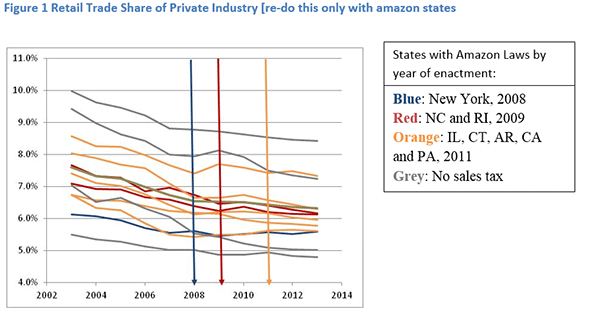
    About seven states had charges on Internet access fees prior to the first ITFA, which included a grandfather clause for them. Eight states passed “Amazon Laws” since 2008. New York was first. Big retailers like Amazon and Overstock terminated agreements with small in-state e-tailers who earned revenue by linking their websites with the big companies’. Amazon sued the state of California over being forced to collect sales tax because they had related businesses in the state. The Direct Marketing Association got a U.S. District court to stop the state of Colorado from requiring remote vendors to notify residents that they are responsible for paying sales taxes and to provide information to the state for them to enforce collections.

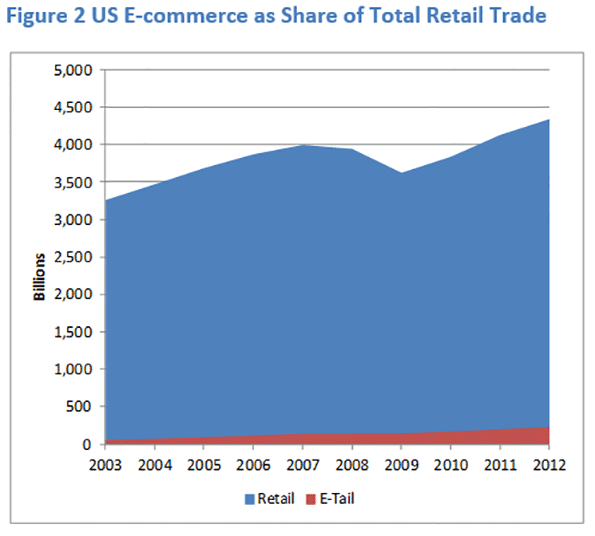
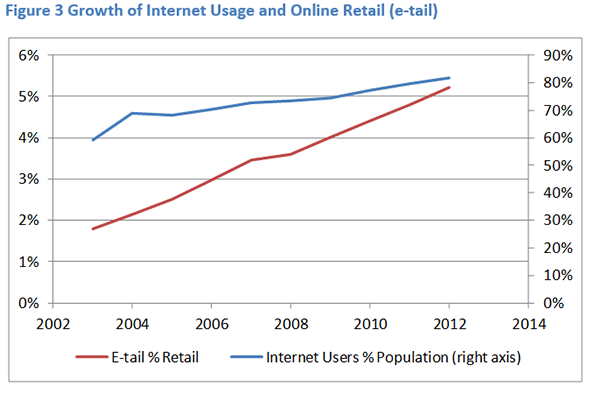
    I ran a statistical analysis to test whether enacting Internet sales tax laws (“Amazon Laws”) had an impact on total retail sales in the state. When we control for the share of the population that are Internet users – something not taken into account by other data analysts – we found no statistically significant impact on retail trade from enacting Amazon Laws. A sample of our results are presented visually in the chart. Note, especially, that even states with no sales tax saw a decline in retail trade around 2008-2009, the time of the first Amazon Laws. The drop is likely due to the global economic recession.

    After sixteen years and four extensions of ITFA, plus numerous lawsuits, Amazon is collecting sales taxes on purchases made by customers from 23 states with one more slated to be added in 2016. Including the five states without sales tax, that covers about 69% of Americans, according to the Wall Street Journal (October 1, 2014). Amazon has a physical presence in just 21 states and only 8 states have “Amazon Laws.”

    Most news reports on the subject of Internet sales taxes present only a partial rhetoric, similar to this:
    “At issue is a bill that would allow states to collect sales tax revenue from online retailers outside their borders. Right now, states can only collect sales taxes from a business with a physical location in that state.”

    But the real point “at issue” is the inability of states to enforce existing tax laws. Forcing e-tailers to collect the tax means they will incur costs well-beyond that of terrestrial retailers because they must collect and remit for 49 more states than local retailers. To be completely fair, local retailers would have to check the identification of buyers and collect and remit state sales taxes to the states where the buyers reside. Imagine the burden on retailers in states with high visitor traffic – like Nevada, California, New York, or Florida.

    Every state wants to know the potential income from extending sales tax to out-of-state Internet retailers. Recently, we completed an analysis of this potential in Nevada for the Las Vegas Global Economic Alliance. We found that the increased tax revenue would be quite small and likely to remain so for several more years. At the same time, the cost to the states could be quite high. These costs may diminish in the future as retailers and states with Amazon Laws are forced to work out operational solutions. Given that many states already have working arrangements with Amazon and other large national retailers (including through multi-state agreements), there appears to be little benefit from new state tax legislation on this issue.

    In reality, only a small part of internet commerce is taxable. Manufacturers’ e-commerce shipments were more than one-half of all online sales in 2012. Much of these sales are not subject to state sales tax regardless of the location of the buyer or the seller because they are purchased for re-sale. In most of the US, total retail trade is a declining share of private industry. The part of e-commerce that matters from a sales tax perspective is retail consumer sales: just $227 billion in 2012, or about 5.2% of total retail trade in the United States.

    Business-to-business (B2B) sales are about 90% of all e-commerce, of which only about 13% is taxable. Of retail sales provided through e-commerce, more than 10% of the value is in motor vehicles where taxes are easily collected because most states require proof that taxes have been paid to register a vehicle. There is wide variation in the estimates of uncollected sales tax. One study from 2014 found significantly smaller estimates than an earlier study because they surveyed the states about compliance and then checked the online order platforms of several large e-tailers for compliance. The earlier study (2010) simply assumed an extremely small tax compliance rate among sellers.

    Many online retailers are remote geographically and/or economically from their buyers. This connection of the e-tailer to the state is referred to as “nexus”.  An important difficulty for e-tailers has to do with identifying the state entitled to the sales tax. A simple example illustrates this problem. If a resident of Nevada purchases a bar-b-que grill to be delivered and used at his vacation home in Utah from a retailer in California, who gets the tax? And who bears the cost of compliance which court decisions place on the taxing state?

    Some e-commerce businesses claim state taxes on e-commerce are detrimental the states’ ability to compete with surrounding states. This attitude belies some lack of understanding about the issues. If these businesses are selling to residents in the same state, they should already be collecting sales tax. It is only the population of the other states that should be of concern. In fact, Amazon founder Jeff Bezos is reported to have selected Washington as home for his Internet retailer, at least in part, because of the small state population from which he would be obligated to collect sales taxes. Washington’s population ranks 13th among states – that leaves 37 states with fewer people for internet retailers to choose from, including many that have a lower share of internet usage in the population (see the table at the end of this article for a complete list).

    More than 10% of e-commerce retail sales are conducted over Ebay, where many small retailers make up most of the sellers’ market. Legislative proposals generally include an exception for small sellers – usually those with between $500,000 and $1,000,000 sales annually delivered to the state. There is some evidence that buyers prefer to purchase from local sellers even when making online purchases: Ebay shoppers are 7% more likely to buy from an in-state vendor. But, research also indicates that states with no sales tax are no more likely than other states to generate in-state purchase preferences among online shoppers. 

    E-tail is growing but it has yet to reach the levels predicted in early research. For example, in 1999 the National Governors Association forecast e-commerce would reach $300 billion by 2002. Even ten years further into the future, e-commerce in the US was just $192 billion.

    Forcing e-tailers to collect sales taxes for every states is wrought with technical and legal pitfalls and unproven financial payoffs. Many states are finding a fast and reliable way to increase collections without creating new sales tax schemes. States with income taxes provide a space on the form for reporting it and states without an income tax provide convenient online filing – a process already familiar to consumers of e-commerce a. Several states provide look-up tables based on income (compared to saving and calculating actual purchase receipts) to make paying your sales tax on out-of-state purchases more convenient.

    One of the main reasons for low compliance with consumer sales tax payments is lack of knowledge: Ask a random person on the street if they know they are liable for sales taxes on out-of-state purchases and chances are they will say “no.” Oklahoma aired a television ad that included a list of the projects that sales tax collections could fund (e.g., education, police, and fire). As a result, the number of income tax returns with sales tax payments leaped by 20%. These options will produce faster results at a lower cost than defending new tax legislation at the state or federal level.

    Susanne Trimbath, Ph.D. is CEO and Chief Economist of STP Advisory Services. Dr. Trimbath’s credits include appearances on national television and radio programs and the Emmy® Award nominated Bloomberg report Phantom Shares. She appears in four documentaries on the financial crisis, including Stock Shock: the Rise of Sirius XM and Collapse of Wall Street Ethicsand the newly released Wall Street Conspiracy. Dr. Trimbath was formerly Senior Research Economist at the Milken Institute. She served as Senior Advisor on United States Agency for International Development capital markets projects in Russia, Romania and Ukraine. Dr. Trimbath teaches graduate and undergraduate finance and economics.


    State Sales Tax and Internet Usage

    State

    Sales Tax Rate (%)

    Retail (% Private Industries GDP)

    Internet Users (% population)

    Private Industries GDP ($mil)

    Alabama

    4.0

    8%

    65.0

    156,917

    Alaska

    0

    4%

    84.0

    49,414

    Arizona

    5.6

    9%

    78.5

    233,547

    Arkansas

    6.5

    7%

    66.8

    103,810

    California

    7.5

    6%

    79.7

    1,851,147

    Colorado

    2.9

    6%

    79.9

    243,303

    Connecticut

    6.35

    6%

    86.5

    218,141

    Delaware

    0.0

    5%

    80.4

    54,193

    Florida

    6.0

    9%

    78.8

    668,823

    Georgia

    4.0

    7%

    76.5

    378,343

    Hawaii

    4.0

    9%

    82.6

    55,818

    Idaho

    6.0

    9%

    82.2

    49,840

    Illinois

    6.25

    6%

    78.5

    630,775

    Indiana

    7.0

    6%

    73.5

    277,853

    Iowa

    6.0

    6%

    77.5

    138,367

    Kansas

    6.15

    7%

    78.9

    118,833

    Kentucky

    6.0

    7%

    68.8

    151,035

    Louisiana

    4.0

    6%

    67.7

    223,985

    Maine

    5.5

    10%

    82.8

    45,636

    Maryland

    6.0

    7%

    82.3

    265,329

    Massachusetts

    6.25

    5%

    86.2

    381,249

    Michigan

    6.0

    7%

    78.4

    367,147

    Minnesota

    6.875

    6%

    82.1

    267,937

    Mississippi

    7.0

    10%

    53.3

    83,605

    Missouri

    4.225

    7%

    72.4

    235,769

    Montana

    0.0

    7%

    73.6

    35,665

    Nebraska

    5.5

    6%

    80.2

    89,736

    Nevada

    6.85

    8%

    80.0

    113,774

    New Hampshire

    0.0

    8%

    90.1

    57,963

    New Jersey

    7.0

    6%

    87.8

    470,251

    New Mexico

    5.125

    8%

    68.0

    68,052

    New York

    4.0

    6%

    81.5

    1,130,320

    North Carolina

    4.75

    6%

    71.8

    387,032

    North Dakota

    5.0

    6%

    75.9

    44,281

    Ohio

    5.75

    7%

    76.7

    484,156

    Oklahoma

    4.5

    7%

    67.9

    144,100

    Oregon

    0.0

    5%

    86.1

    186,325

    Pennsylvania

    6.0

    6%

    77.8

    563,086

    Rhode Island

    7.0

    6%

    81.0

    44,003

    South Carolina

    6.0

    9%

    67.0

    147,884

    South Dakota

    4.0

    7%

    72.9

    38,572

    Tennessee

    7.0

    8%

    72.9

    246,840

    Texas

    6.25

    6%

    68.6

    1,313,557

    Utah

    5.95

    7%

    87.6

    116,212

    Vermont

    6.0

    9%

    81.7

    24,170

    Virginia

    5.3

    6%

    77.8

    359,664

    Washington

    6.5

    8%

    85.7

    333,994

    West Virginia

    6.0

    8%

    70.5

    58,325

    Wisconsin

    5.0

    6%

    83.0

    240,059

    Wyoming

    4.0

    5%

    79.4

    36,357

    US Total

    7%

    84.2

    14,058,314

    Sources: State sales tax rates 2014 from Federal of Tax Administrators (does not include any municipal or special district sales tax); Internet Usage 2010 from InternetWorldStats.com; GDP 2012 from Bureau of Economic Analysis

  • Time to Bring Back the Truman Democrats

    Once giants walked this earth, and some of them were Democrats. In sharp contrast to the thin gruel that passes for leadership today, the old party of the people, with all its flaws, shaped much of the modern world, and usually for the better. Think of Franklin Roosevelt or Harry Truman, John Kennedy, or California’s Pat Brown, politicians who believed in American greatness, economic growth, and upward mobility.

    For more than 40 years, the Democratic Party has drifted far from this tradition, its policies increasingly a blend of racial and gender politics combined with a fashionable brand of environmental fanaticism. No longer does it constitute a reliable, middle class-based alternative to the corporatist mindset of the Republicans. “Today’s Democrats have no more in common with Franklin Roosevelt, Harry Truman, John F. Kennedy and Lyndon Johnson ,” notes author Michael Lind, “than today’s Republicans have in common with Abraham Lincoln or Dwight Eisenhower. “

    To regain their relevancy, Democrats need to go back to their evolutionary roots. Their clear priorities: faster economic growth and promoting upward mobility for the middle and working classes. All other issues—racial, feminine, even environmental—need to fit around this central objective. In survey after survey, economic issues such as unemployment, the economy, and the federal budget top the list of concerns while affirmative action, gay rights, and climate change barely register.

    From Obama Back to Jackson

    Democrats do not need to become Republican lite, as was true among some New Democrats (I was a fellow with the Progressive Policy Institute, the New Democrats think tank). Democrats need to respond aggressively to the crony capitalism practiced by many Republicans, particularly regarding Wall Street. But they can’t do that if all they offer in its place are policies that service instead their own cronies not only in finance, but technology and media as well.

    Right now it’s hard to make the case that the Democrats have a strategy to improve the economic prospects of the middle class. The New York Times’s Tom Edsall notes notes that after six years of Obama, voters stubbornly hold unto pessimistic views about the future. Of course, declining or stagnant wage growth started well before this president took office. Nevetheless, Democratic rule has not only failed to halt the trend, but appears to have accelerated it.

    Not surprisingly, many middle and working class voters, particularly whites, have deserted the Democrats in increasing numbers. This November, notes Gallup, support for Obama among white college graduates dropped to 41 percent while his support among those without degrees fell to a pathetic 27 percent.

    Critically, in 2014 this erosion began to extend to millennials; white millennials, particularly those without BAs (the vast majority), went Republican. This is a generation that, according to the Census, is both somewhat more educated than previous ones but far more likely to live in poverty.

    Although likely to reject Republican views on social issues, such as gay marriage, millennials may not become “permanently blue,” as imagined by some boomer progressives. Faced with the consequences of slow, and poorly distributed growth, they are already less likely to see themselves as environmentalists than the national average and particularly the generally better off boomers.

    Some progressives suggest that working class voters, particularly whites, can be lured back to the party by expanding the welfare state even further. But such an approach works against the traditional pride in self-sufficiency espoused by many in the American middle class. The old Jacksonians challenged financial power—then the Bank of the United States—but also worked to expand the economy, opening new lands to settlement, and encouraging home ownership and grassroots entrepreneurship.

    The Key Issue: Energy and Climate Change

    It would be difficult to find an issue with less resonance with the vast majority of voters than climate change. Concern over the environment has dropped since the Recession, notes Gallup, with climate change ranking near the bottom in voter concerns. In this sense, the emergence of Tom Steyer and other gentry yokes the party to a message with limited appeal once you get a few miles inland from either coast.

    This does not reflect lack of interest in a better environment. Instead, it is a rejection of the Clerisy’s “solutions” to environmental challenges—such as banning suburbs, hiking electricity rates, and opposing new pipelines. These policies don’t hurt the super-rich; they hurt middle and working class voters. Lower oil prices, a product of fracking and other new drilling technologies, represents a boon to the dispersed, largely suburban electorate. But at the same time cheap gas offends progressive writers like the New Yorker’s Michael Specter, who argues that lower oil prices simply reinforces our addiction to an “industrial form of crack.”

    In the next decade, the Obama administration’s bizarrely naïve “agreement” with China threatens to further weaken middle class interests. The South China Morning Post suggests westerners should be skeptical about prospects that China will sacrifice economic growth and, even more important, political stability in favor of planetary salvation. As one Canadian commentator put it, the Chinese deal constituted “a promise in a rented tuxedo” by a country that will cross “its coal fired heart” while the U.S. and the E.U. essentially disarm their economies with ever more draconian regulation.

    Sadly, this choice between growth and climate change may not be necessary. The development of new drilling techniques has sparked a shift from coal fired power to natural gas that has allowed the U.S. to reduce its emissions faster than any major country, far more, indeed, than the self-righteous Europeans whose expensive and inefficient green policies have left them burning more coal.

    Expanding, Not Constraining Geography

    The rapid shrinking of the party’s geographic base is one clear legacy of the Obama years. Energy policy has been key here. Democratic losses have been heavy in those parts of the country that either produce fossil fuels, such as Louisiana, Texas, Colorado, Utah, and Montana, or those, notably in the upper Midwest, that depend on cheap fossil fuels to drive their still critical manufacturing sectors.

    The losses of Democrats in states like Ohio, Michigan, and Wisconsin are arguably the most critical since these are traditionally swing states. The Steyer strategy of wiping out fossil fuels and raising energy costs might appeal to the denizens of climatically mild and highly affluent San Francisco. But people in a hardscrabble factory town in less temperate central Ohio or in greater Detroit , or even interior California, are less well-positioned to indulge green purity.

    And how about the South? As recently as 2008, Democrats held one-third of the South’s Senate seats. Now it’s down to three, two in Virginia and the other in Florida. Convinced the region is lost permanently, some suggest suggest that Democrats “dump Dixie” so as not to have to appeal to voters in what one progressive writer denounced as a “fetid place.”

    But the South accounts for almost 40 percent of the nation’s population, an impossibly large region to simply write off. But even progressives who want to take back the South, such as the New Republic’s Michael Cooper seek to build a coalition of poor whites and minorities in alliance with the growing numbers of graduate-educated professionals. This does not really address the aspirational reasons why so many Americans have been migrating to this region.

    In many ways these attitudes reflect the increasingly urban-centric focus of the party. It diverges dramatically from the approach of traditional Democrats, from Roosevelt and Truman to Clinton, himself the former governor of a poor Southern state, who looked favorably on dispersing growth, particularly to the traditionally poor South, intermountain West and Great Plains, as well to the suburban interior.

    Hostility to the non-urban regions includes a detestation of suburbia. Progressive theorists, like Salon’s Benjamin Ross, like to pin the detested “suburban sprawl” on Ronald Reagan, ignoring the basic fact that suburban growth was fostered for a half century by a Democratic controlled Congress, and was also favored by Democrats from Truman through Clinton. No surprise then that aside from wealthy coastal suburbs, the Democratic base has shrunk to the urban cores and college towns.

    Infrastructure for Growth

    Senator Charles Schumer’s retro perspective about the folly of enacting Obamacare in 2009 revealed much. Schumer rightly pointed out that Obamacare, for all the positives associated with expanding health care coverage, helped a relatively small part of the electorate, as well as the insurance companies.

    A far better move in the early years of Obama’s first term would have been to implement a updated version of the New Deal’s Works Progress Administration. A new WPA would have helped create jobs and provided some training to underemployed or unemployed youth. It could have left a legacy of improved roads, bridges, expanding port facilities, and affordable (usually bus) mass transit options that would appeal to many Americans.

    In contrast to Obamacare, a neo-WPA would have been a difficult target for the GOP. It likely would have appealed to many business people on Main Street, few of whom are free-market fundamentalists. But moves to push such a program elicited opposition from critical parts of the party base, including feminists, who feared that public works would disproportionately help “burly men.”

    Greens also were less than enthusiastic about new massive public works. Environmentalists today generally prefer to limit roads and block new water projects, even in parched California. So the Obama stimulus will be forever linked to insider deals with green energy epitomized by the Solyndra fiasco and massive loans to politically allied venture capitalists.

    Class Not Race

    The growing opposition towards Hillary Clinton’s ascension has one thing right: Democrats should not be seen as the second party of Wall Street. Obama’s recovery and Fed policy have, as Democrats like Elizabeth Warren like to point out, often favored the financial oligarchs, although their support for Democrats makes them far less keen on taking on the Silicon Valley Venture Capitalists, who have also profited under Obama. High valuations—even absurd ones—enrich the insiders who found companies, underwriters, and merger mavens, but those valuations have done precious little for the vast majority of Americans.

    Faced with the loss of middle class voters, the administration seems determined to double down on its current coalition. So to whom do they turn to determine their future political direction? Not to a successful elected official from a swing district or a Main Street businessperson but to Google’s Eric Schmidt, an oligopolist of the first order from the party’s new heartland around the San Francisco Bay Area.

    Given their cozy ties to Wall Street and oligarchs like Schmidt, the Democrats have failed to push class warfare as an issue, preferring instead to play the racial trump card. They allow issues to be dominated by such flawed emissaries as the detestable Al Sharpton, whose job seems to be the stoking of African-American ire. Similarly, the president’s executive order on undocumented residents follows this approach, by trying to appeal to Latino racial interests.

    Yet race politics has limited appeal to whites, and ultimately may not guarantee keeping many minority voters in check. After all, minorities have fared poorly under Obama: a recent Pew study found minority incomes dropped 9 percent between 2010 and 2013, while only 1 percent among whites. Hispanics, notes a recent Pew survey economic issues easily trump immigration. Texas Republicans, for example, got close to half the vote among Latinos in that state, and similar results were found in Kansas. Even in places as blue-leaning as Colorado, Latino support for pro-growth Republicans has been growing. And Asians also showed a shift toward the GOP in the mid-terms.

    Embrace Exceptionalism

    Historically Democrats, like Republicans, believed in American Exceptionalism. This sometimes spills over into messianic overkill—for example, under Woodrow Wilson and George W. Bush—but overall the ideal of a uniquely American national profile has been embraced by Democrats from Jefferson and Jackson to Roosevelt, Truman and, arguably the last of the breed, Bill Clinton.

    President Obama, in contrast, has openly rejected this notion, perhaps reflecting the world view of academics and much of the financial world that sees American Exceptionalism as some sort of patriotic nonsense. In the past the old Democrats saw the country’s broad resources and continental scale as primary sources of national greatness. Early conservationists did not oppose the expansion of industry, mining, or growth as inimical to progressive ideals; instead, they sought to restrain the abuses of the capitalist classes in order to prevent gouging as well as to preserve resources and open space for future generations.

    In sharp contrast to their modern “heirs,” both Progressives and New Dealers were builders of dams, roads, and electrical power systems. They embraced the notion of a growing America, whose economy could be expanded for the benefit of the majority.

    Is There a Messenger For Dino-Democrats?

    Hillary of the many houses, $200,000 speaking gigs, Wall Street linkages, and her aging, wealthy glitterati backers does not exactly appear the ideal messenger for a neo-Jacksonian revival. Rather than the “shot and a beer” Hillary who came back to almost save her 2008 effort, she now reflects gentry views on both economics and climate change in ways that do not significantly diverge from President Obama.

    With dissatisfaction with the economic status quo strong among many traditional Democrats, it’s likely populist candidates could emerge. Some imagine Senator Elizabeth Warren as the charismatic leader of a progressive version of the “tea party.” She has been a strong and vocal critic of Wall Street, which is to her credit, but her base lies not in middle class voters but among academia and wealthy Boston suburbs. On environmental issues, she seeks to out-green Hillary, something that might not appeal to voters in Ohio, Indiana, and a host of other key states.

    Bernie Sanders, the self-described socialist, represents an emotionally appealing alternative to the endlessly grifting Clintons and the law professor Warren. But Sanders, a representative of the Northeastern vacation state of Vermont, also opposes fossil fuel development. This approach would greatly limit his appeal beyond the Northeast and the west coast. It’s hard to envision him campaigning for votes at Great Lakes factories that depend on coal power, or appealing to construction workers who would love to see the Keystone and other pipelines built.

    Right now, former Virginia Senator James Webb may prove the best vehicle for dino-Democratic ideas. A self-conscious inheritor of the Jacksonian tradition, Webb epitomizes the individualist and populist values of his Scotch-Irish forebears. With a strong military background, he also appeals to nationalists who inhabit the South, Appalachia, and the non-coastal parts of the West. Whether his candidacy takes off is still an open question, but the ideas and spirit he embodies could revive a Democratic tradition that, although now submerged, might provide the party with a way out of its current morass. 

    This piece first appeared at The Daily Beast.

    Joel Kotkin is executive editor of NewGeography.com and Roger Hobbs Distinguished Fellow in Urban Studies at Chapman University, and a member of the editorial board of the Orange County Register. His newest book, The New Class Conflict is now available at Amazon and Telos Press. He is author of The City: A Global History and The Next Hundred Million: America in 2050. His most recent study, The Rise of Postfamilialism, has been widely discussed and distributed internationally. He lives in Los Angeles, CA.