Category: Economics

  • Agrarianism Without Agriculture?

    The ever-surprising Ralph Nader has recently been reading some paleo-conservative sources, and has written a book entitled Unstoppable; the Emerging Left-Right Alliance to Dismantle the Corporate State. In the Acknowledgements at the end, he specifically thanks Intercollegiate Studies Institute, a conservative think tank, for keeping in print a tome from the 1930s called Who Owns America? A New Declaration of Independence. Nader devotes the seventh chapter of his book to a discussion of this volume. He quotes Edward Shapiro’s 1999 foreword at some length:

    In his 1999 foreword to the reissued edition, historian Edward S. Shapiro called Who Owns America? “one of the most significant conservative books published in the United States during the 1930s” for its “message of demographic, political, and economic decentralization and the widespread ownership of property” in opposition “to the growth of corporate farming, the decay of the small town, and the expansion of centralized political and economic authority.” ……

    In this mix, there was espoused a political economy for grass-roots America that neither Wall Street nor the socialists nor the New Dealers would find acceptable. It came largely out of the agrarian South, casting a baleful eye on both Wall Street and Washington, D. C. To these decentralists, the concentrated power of bigness would produce its plutocratic injustices whether regulated through the centralization of political authority in Washington or left to its own monopolistic and cyclical failures. They were quite aware of both the corporate state fast maturing in both Italy and Nazi Germany and the Marxists in the Soviet Union ……

    Nor did they believe that a federal government with sufficient political authority to modestly tame the plutocracy and what they called “monopoly capitalism” could work, because its struggle would end either in surrender or with the replacing of one set of autocrats with another. As Shapiro wrote in the foreward, “while the plutocrats wanted to shift control over property to themselves, the Marxists wanted to shift this control to government bureaucrats. Liberty would be sacrificed in either case. Only the restoration of the widespread ownership of property, Tate said, could ‘create a decent society in terms of American history.’”

    Although the decentralists were dismissed by their critics as impractical ….. their views have a remarkable contemporary resonance given today’s globalized gigantism, absentee control, and intricate corporate statism, which are undermining both economies and workers. They started with the effects of concentrated corporate power and its decades-long dispossession of farmers and small business. They rejected abstract theories by focusing instead on such intensifying trends as the separation of ownership from control; the real economy of production in contrast to the manipulative paper economy of finance; and the growth of “wage slavery,” farm tenancy, and corporate farming. One can only imagine what they would say today! (Nader, pp. 139-141.)

    I apologize for the long quote. These people advocated doing away with the “joint stock corporation” for the most part, to be replaced by cooperatives. I’m not sure about the liability of members of these cooperatives, but that’s a major issue. Without limited liability, I would hesitate to co-invest in any project unless all the partners were as liquid and wealthy as myself, otherwise guess who ends up holding the bag! And it is to be noted that many insurance companies, and some savings and loans, including, until the 1980s, all federally chartered ones, were in fact “mutual” and owned by their depositors or policy holders.

    They did not succeed as far as agricultural land was concerned. The concentration of agricultural land under fewer and fewer owners, and even more the oligopolies of processing food through such entities as Cargill, Tyson, and Archer Daniels Midland, proceeded apace. But “widely distributed property ownership” resurfaced on another front; the urban-suburban one. The New Deal first chartered the Federal Housing Administration to underwrite and guarantee loans for homes, and in Truman’s time the Veterans Administration and other reforms brought this regime into full flower. So instead of their forty acres and a mule, people got their ¼ acre and an automobile, the only practical way to travel from their ¼ acre to wherever they wanted to go.

    Eventually people came to see their ¼ acre with a house on it as an “investment,” and further, a “source of wealth.” But this was not a truly agrarian source of wealth. Farms depend for their value on the quality of their soil and their productivity as farms. They are truly commercial real estate. But residences depend for their value only to a minor degree on what is on the property itself, but rather on what is around it; and suburbanites demanded that covenants, or the Government in the form of City Hall or County Hall, control their neighbors and what is around them. Part of the reason for living in the suburbs, after all, is the presence of trees and green space. (The suburbanites have therefore been friendly to the environmental cause, as long as it did not touch their automobiles.) There was also the factor that just as printing money dilutes its value, “printing” a large number of houses in an area dilutes their value as well. And, the more development, the more traffic comes to resemble that of the centralized portion of the city and one’s automobile gets stuck in it. Fact: the borough of Irvine, where my office is, imposes a “cap and trade” system on those who would desire to build or repair commercial structures, and what one buys in this marketplace is not carbon or pollution, but potential car trips that one’s project might be potentially using. The suburban model, in the end, demanded that to preserve suburban values, that the building of suburbs be stopped! That’s the irony of the whole thing.

    Howard Ahmanson of Fieldstead and Company, a private management firm, has been interested in these issues for many years.

  • To Fight Inequality, Blue States Need To Shift Focus To Blue-Collar Jobs

    In the coming election, we will hear much, particularly from progressives, about inequality, poverty and racism. We already can see this in the pages of mainstream media, with increased calls for reparations for African-Americans, legalizing undocumented immigrants and a higher minimum wage.

    There’s no question that minorities’ economic wellbeing has deteriorated since the economy cratered in 2007. African-America youth unemployment is now twice that of whites, while the black middle class, once rapidly expanding, has essentially lost the gains made over the past 30 years,  says the Urban League.

    Conservatives may not have the answers but it’s clear that a progressive regime has not worked either.

    The net worth of blacks and Hispanics has declined relative to whites. The black poverty rate stood at 27.2% in 2012, and for Hispanics, 25.6%. At the same time as poor kids are flocking here from Central America, child poverty among Latinos has risen sharply, from 27.5% in 2007 to 33.7% percent in 2012.

    One would think these statistics would make someone question at least somewhat boilerplate progressive polices, which certainly have not worked better than standard brand conservatism. But often the common answer to these trends has been a call for more “progressive” social policies that would seek to redistribute wealth and to enforce racial equity in everything from housing to university admission. Given Republican control of the House, these racial and class politics are increasingly most keenly felt in the states and cities.

    There are numerous signs of this, including Seattle’s $15 an hour minimum wage and similar proposals in other cities. The thrust of New York Mayor Bill De Blasio’s administration seems to be to provide ever more succor to the city’s large, heavily minority, poor and working-class population through early childhood education and more subsidized housing.

    As an old Democrat, I am sympathetic to the concerns. But it’s dubious the deep blue cities have found a solution. Let’s start with the gap between rich and poor. For the most part the regions and states with the widest gap between the classes are overwhelmingly dominated by modern progressivism.

    The capital of blue America, New York City, has easily the worst levels of inequality in the country, with an income distribution that approaches that of South Africa under apartheid, notes demographer Wendell Cox.

    But New York is hardly the only progressive stronghold  with searing inequality. A recent Brookings report  found that of the regions with the greatest income disparity only one, Atlanta, is located in a red-leaning state. These include San Francisco, Miami, Boston, Washington, D.C., New York, Oakland, Chicago and Los Angeles. The lowest degree of inequality was found generally historically more conservative cities like Ft. Worth, Texas; Oklahoma City; Raleigh, N.C.; and Mesa, Ariz. Income inequality has risen most rapidly in the probably the most left-leaning big American city of luxury progressivism, San Francisco, where the wages of the poorest 20% of all households have actually declined amid the dot-com billions.

     Since most of the urban poor are minorities, these disparities are also reflected in racial terms. Among the nation’s 15 largest metropolitan statistical areas, according to an analysis by Praxis Strategy Group’s Mark Schill, the biggest gap between black and white incomes as of 2012 was also in San Francisco, where African-Americans made 49% of whites’ income. Chicago, Detroit and Philadelphia are a shade behind at 50% to 51%.

    In contrast, African-Americans score better in comparison with whites in less expensive, more suburban areas. In Riverside, Calif., black incomes are over 81% of whites, highest among the nation’s 15 largest metro areas; in the Phoenix region, black income is 73% of whites; in Houston, 65%. This is not a case of Democratic rule being the problem; the real issue is what kind of  Democrat. In cities like Phoenix, Riverside and Houston, Democratic mayors are usually very pro-business, and rarely engage in the kind of rhetoric one hears in places like New York or Seattle.

    A somewhat similar pattern can be seen among Latinos. The worst disparities – 50% to 54% of white income – are in greater Boston, Philadelphia and New York. Again, the lowest disparity was in Riverside, where Hispanic incomes were 84% of whites, followed at 81% by Miami – a city that is neither cheap nor sprawling, but has a population of generally more prosperous Cuban-Americans. In third place is Phoenix, at 73%, a city, that ironically, has been castigated as a capital of anti-Latino sentiment.

    Part of the difference is the strong growth of higher-paid, blue-collar jobs in places like Houston, Oklahoma City, Salt Lake and Dallas compared to rapidly de-industrializing locales such as New York, San Francisco, Chicago and Los Angeles. Even Richard Florida the guru of the “creative class,” has admitted that the strongest growth in mid-income jobs has been concentrated in red-state metros such as Salt Lake City, Houston, Dallas, Austin and Nashville. Some of this reflects a history of later industrialization but other policies — often mandated by the state — encourage mid-income growth, for example, by not imposing high energy prices with subsidies for renewables, or restricting housing growth in the periphery. Cities like Houston may seem blue in many ways but follow local policies largely indistinguishable from mainsteam Republicans elsewhere.

    Nowhere is this relationship between job growth and racial disparities clearer than in California, where regulations have slowed construction and industrial growth even as Silicon Valley has enjoyed a giddy boom. In Silicon Valley, Hispanic and African-American incomes have sagged, as manufacturing and many middle management positions have been reduced. But the real problems for poorer and minority residents can be seen in the state’s interior regions, where many communities still suffer close to double digit unemployment or worse.

    Part of the problem also lies with costs, particularly for housing. Simply put most working Americans, and most minorities, cannot earn enough to maintain a decent quality of life in most of America’s biggest cities. This is particularly true of big, diverse blue cities like New York and Los Angeles, where the average paycheck, adjusted for cost, ranks worst among the major metropolitan regions.

    High housing prices, notes economist Jed Kolko, are a key reason why even with a boom, population growth remains slow in the Bay Area. In contrast, Houston, which also is booming, has seen rapid population growth and in-migration. Since 2000, Houston’s population has grown 30%, three times as rapid as the Bay Area.

    One boomtown epitomizes opportunity while in the other growth has largely benefited the well-educated and well-placed. Between 2000 and 2012 income growth in Houston has been 53% while in San Francisco — despite the tech boom — it has been 35%.

    Minorities and, particularly, immigrants have been drawn to these sprawling, growing regions as the best places to improve their life. Over the past decade, the foreign-born populations of Houston and Dallas expanded roughly 50%; Atlanta saw nearly 70% growth. In contrast, immigration growth in New York, Chicago and San Francisco was under 20%.

    Immigrants are coming to these areas, in many cases, in order to buy a house. In Houston, according an analysis by demographer Wendell Cox, 52% of African Americans and 42% of Hispanics own their own homes. In Los Angeles, this percentage is in the 30s, and in New York and Boston, minority ownership is even smaller. The Atlantic may say the Sun Belt is where the “American dream goes to die” but an examination of the statistics suggests, these critics may need their compasses readjusted.

    Much the same can be said about progressive policies. Unlike some on the party-line right, I do not think that concerns about inequality and stunted upward mobility are fabrications by left-wing academics.

    The question is how to address the issue. We should consider that last time African-Americans made big strides in income were when the economy was booming under Presidents Reagan and Clinton, both of whom have been criticized for “trickle down” policies. They have done far worse under the present more conventionally progressive region.

    If they are honest, it’s time for progressives to deal with these trends with some sense of realism; you don’t have to be a conservative to favor good blue-collar growth. All too often progressive mouthpieces like the New Republic, while admitting black inequality is at the highest level in decades, emphasize such symbolic (and political unlikely) steps, as reparations and and expansion of means-tested subsidies that would help minorities and poor but leave out the middle class, and mostly white, majority.

    Such approaches will do little effectively, except to make some progressives feel even more self-righteous. But real progress on race and poverty requires a growing economy that provides opportunities for the broadest part of population. Clearly the regulatory and tax regimes that stunt middle- and working-class opportunities does not help. Blue-state progressive can whine about race, inequality and poverty with the best of them, but they would contribute far more if they started to address these issues with something other than well-rehearsed indignation and rhetoric.

    This story originally appeared at Forbes.

    Joel Kotkin is executive editor of NewGeography.com and Distinguished Presidential Fellow in Urban Futures at Chapman University, and a member of the editorial board of the Orange County Register. He is author of The City: A Global History and The Next Hundred Million: America in 2050. His most recent study, The Rise of Postfamilialism, has been widely discussed and distributed internationally. He lives in Los Angeles, CA.

    Unemployed woman photo by BigStockPhoto.com.

  • America Down But Not Out

    America, seen either from here or from abroad, doesn’t look so good these days. The country that maintained world peace for decades now “leads by behind,” or not at all. You don’t have to have nostalgia for George W. Bush’s foreign policy to wish for someone in the White House who at least belongs in the same room with the likes of Vladimir Putin. Some wags now suggest that President Barack Obama has exceeded Jimmy Carter in foreign policy incompetence – Carter certainly was more effective in the Middle East.

    What about space? Remember, we won the space race but now have to depend on Russian launch vehicles to do much of anything in orbit. President Obama thought we could rely on the Russians to provide us with cheap rides into orbit, but Putin squashed that notion after we objected to his actions in Ukraine. John Kennedy must be turning over in his grave.

    And as for our domestic economy, the best you can say is “It could be worse,” particularly if you look at what’s happening in torpid Europe. It’s a sign of our utter lack of confidence that the current administration, and much of the punditry, still thinks we should follow the Continent’s economic and social policies.

    Yet, despite all these challenges – and two presidencies the public ranks among the worst in history – it’s far too early to write off the United States. After all, no one else is doing very well. Even the widely touted BRICS countries – Brazil, Russia, India, China and South Africa – face slowing growth and mounting social problems.

    There are several factors that help explain why the USA’s long-term prospects are better than many Americans may assume.

    Entrepreneurial edge

    The essential strength of the U.S. economy has rested on having two things that rarely occur together – an innovative culture combined with massive natural resources. Whole industries, notably technology, years ago thought to be lost to Japanese and other Asian competitors, have recentralized in the United States. In 1990, six of the world’s top 10 semiconductor companies were Japanese; by 2011, five U.S. chip companies dominated the top 10, which included only two Japanese companies, Toshiba and Renesas. And their combined revenue in 2012 was less than half that of world leader Intel’s $49.7 billion.

    As of now, there’s not a key technology sector where the U.S. is not in the lead. We dominate social media, software and biotechnology. In fact, about the biggest technical threat we face is from the administration’s bizarre desire to surrender control of the Internet to foreign countries, many of whom, the president may acknowledge, do not share our values or relish our current predominance. Over time, to be sure, there will be challengers, notably China, South Korea and India, but none are likely to gain predominance in the near future. The same can be said in media; Hollywood still reigns supreme and U.S. dominance in fashion, lifestyle and music remains mostly in place.

    The advantage of size

    Other important countries are geographically large, but none – apart from Australia or Canada – is particularly rich. Russia is an oil plutocracy but beyond energy and weapons doesn’t export much else. China has a large land mass, but less resources, and its ability to feed itself will be increasingly constrained by pollution and diminishing water supplies. The country, by some estimates, has lost 28,000 rivers.

    In contrast, America has a huge agricultural base, spread across a vast continent. If California goes dry for a spell, for instance, there’s lots of water and fertile soil in the northern Plains, the Southeast, the Midwest and parts of the Northwest. Size is a form of arbitrage that allows production to move from one place to another. Others are investing heavily in farm land and other real estate, evidence not of American decline, but, instead, of the patterns of investment that led to the country’s great expansion in the 19th century.

    The energy revolution

    The United States could be on the cusp of another period of broad-based industrial expansion, spurred, in part, by its rapidly growing natural gas and oil production. The current energy and industrial boom, notes Joe Kaeser, president of the German multinational conglomerate Siemens, “is a once-in-a-lifetime moment.” Cheap and abundant natural gas is luring investment from manufacturers in Europe and Asia, who now must depend on often-insecure and more expensive sources of energy.

    The energy revolution has helped spark an industrial boom. There is already a shortfall, notes a recent Boston Consulting Group study, of some 100,000 skilled manufacturing positions in the U.S. By 2020, according to BCG and the government’s Bureau of Labor Statistics, the nation could face a shortfall of around 875,000 machinists, welders, industrial-machinery operators and other highly skilled manufacturing professionals.

    New capitalist revolution needed

    America’s capacity for perpetual renewal – what one Japanese scholar Fuji Kamiya calledsokojikara, a latent power to overcome seemingly insurmountable obstacles – persists but is limited by our political leadership in both parties as well as misguided economic policies. We need to alter contemporary capitalism’s tendency to favor and encourage transactions among investors and asset inflation, rather than fostering broad-based growth that rewards people adequately for their labor.

    Fortunately, the capitalist system, particularly one under democratic control, allows for the possibility of reform, as occurred in 19th century Britain and early 20th century America. What is needed now is structural reform that can shift priorities away from rent-seeking and towards true wealth creation.

    One clear priority is to reduce “financialization” of the economy. Over the past three decades, financial-services firms have doubled their share of the economy. The Obama recovery, with its bailouts of large banks and free-money policies for investors, has accelerated this trend, as companies have tended to be slow to reinvest profits in new products and innovations, preferring, instead, to engage in mergers or stock buybacks that raise share prices and reward investors, but do little for the overall economy.

    In contrast, financial institutions often regard productive industries – notably manufacturing – as hampering short-term financial gains. This has repeatedly pushed companies to strip their industrial assets, typically moving them overseas.

    Reforming capitalism toward a broader and more inclusive focus may not appeal to some – Wall Street investors, speculators in high-end real estate and tech oligarchs – who have done just fine the past five years. But, when asked what mattered more to them, most Americans preferred economic growth to redistribution, noted a 2014 studyconducted by the Global Strategy group, a Democratic consulting firm.

    Polls of popular opinion in the United States and the United Kingdom find key ecological concerns, such as climate change, well down the list, behind such issues as the economy, immigration, crime, unemployment and even the state of morality. What Americans want most, notes political commentator Mike Barone, is “an economic boom.”

    Such a broad-based economic boom is necessary if we are to restore America’s promise for this generation and, more importantly, the next. The country still has all the requisite advantages to lead in the next century and restore the middle class – if only the political leaders either rise to the occasion, or get thrown out.

    This article first appeared in the Orange County Register.

    Joel Kotkin is executive editor of NewGeography.com and Distinguished Presidential Fellow in Urban Futures at Chapman University, and a member of the editorial board of the Orange County Register. He is author of The City: A Global History and The Next Hundred Million: America in 2050. His most recent study, The Rise of Postfamilialism, has been widely discussed and distributed internationally. He lives in Los Angeles, CA.

    USA map image by BigStockPhoto.

  • Success and the City: Houston’s Pro-growth Policies Producing an Urban Powerhouse

    David Wolff and David Hightower are driving down the partially completed Grand Parkway around Houston. The vast road, when completed, will add a third freeway loop around this booming, 600-square-mile Texas metropolis. Urban aesthetes on the ocean coasts tend to have a low opinion of the flat Texas landscape—and of Houston, in particular, which they see as a little slice of Hades: a hot, humid, and featureless expanse of flood-prone grassland, punctuated only by drab office towers and suburban tract houses. But Messrs. Wolff and Hightower, major land developers on Houston’s outskirts for four decades, have a different outlook.

    “We may not have all the scenery of a place like California,” notes the 73-year-old Mr. Wolff, who is also part owner of the San Francisco Giants. “But growth makes up for a lot of imperfections.”

    A host of newcomers—immigrants and transplants from around the United States—agree. The city’s low cost of living and high rate of job growth have made Houston and its surrounding metro region attractive to young families. According to Pitney Bowes,PBI +2.11% Houston will enjoy the highest growth in new households of any major city between 2014 and 2017. A recent U.S. Council of Mayors study predicted that the American urban order will become increasingly Texan, with Houston and Dallas-Fort Worth both growing larger than Chicago by 2050.

    Houston’s economic success over the past 20 years—and, more remarkably, since the Great Recession and the weak national recovery—rivals the performance of any large metropolitan region in the U.S. For nearly a decade and a half, the city has added jobs at a furious pace—more than 600,000 since early 2000, and 263,000 since early 2008.

    The much more populous greater New York City area has added 103,000 jobs since 2008, and Los Angeles, Chicago, Phoenix, Atlanta and Philadelphia remain well below their 2008 levels in total jobs. Los Angeles and Chicago, like Detroit, have fewer jobs today than they did at the turn of the millennium.

    Many of Houston’s jobs pay well, too. Using Praxis Strategy Group calculations that factor in the cost of living as well as salaries, Houston now has among the highest, if not the highest, standard of living of any large city in the U.S. The average cost-of-living-adjusted salary in Houston is about $75,000, compared with around $50,000 in New York and $46,000 in Los Angeles.

    Since 2001, the energy industry has been directly responsible for an increase of 67,000 jobs in Houston, and it now employs more than 240,000 people in the area. These include many technical positions, one reason the region now boasts the highest concentration of engineers outside Silicon Valley. The jobs should keep coming: University of Houston economist Bill Gilmer estimates that $25 billion to $40 billion in new petrochemical facilities is on its way to Greater Houston.

    Houston also has seen a surge in mid-skills jobs (usually requiring a certificate or a two-year degree) in fields such as manufacturing, logistics and construction, as well as energy. Many of these jobs pay more than $100,000 a year. And according to calculations derived from the Bureau of Labor Statistics by the Praxis Strategy Group’s Mark Schill, since 2007 Houston has led the 52 major metropolitan areas in creating these jobs, at a rate of 6.6% annually. In contrast, mid-skills jobs have declined by more than 10% in New York, Los Angeles, Chicago, and San Francisco, which have not been friendly to such industries.

    Houston’s growth is more than oil-industry luck; it reflects a unique policy environment. The city and its unincorporated areas have no formal zoning, so land use is flexible and can readily meet demand. Getting building permits is simple and quick, with no arbitrary approval boards making development an interminable process. Neighborhoods can protect themselves with voluntary, opt-in deed restrictions or minimum lot sizes.

    The flexible planning regime is also partly responsible for keeping Houston’s housing prices relatively low. On a square-foot basis, according to Knight Frank, a London-based real-estate consultancy, the same amount of money buys almost seven times as much space in Houston as it does in San Francisco and more than four times as much as in New York. Houston has built a new kind of “self-organizing” urban model, notes architect and author Lars Lerup, one that he calls “a creature of the market.”

    Housing-market flexibility has also benefited some of the city’s historically neglected areas. The once-depopulating Fifth Ward has seen a surge of new housing—much of it for middle-income African-Americans, attracted by the area’s long-standing black cultural vibe and close access to downtown as well as the Texas Medical Center. Rather than worry about gentrification, many locals support the change in fortunes. “In Houston, we don’t like the idea of keeping an image of poverty for our neighborhood,” explained Rev. Harvey Clemons, chairman of the Fifth Ward Community Redevelopment Corporation. “We welcome renewal.”

    Houston’s explosive economic growth has engendered another kind of boom: a human one. Between 2000 and 2013, Greater Houston’s population expanded by 35%—while New York, Los Angeles, Boston, Philadelphia, and Chicago grew by 4% to 7%. According to a 2012 Rice University study, Greater Houston is now the most ethnically diverse metro region in America, as measured by the balance between four major groups: African-American, white, Asian and Hispanic. “This place is as diverse as California,” notes David Yi, a Korean-American energy trader who moved to Houston from Los Angeles in 2013. “But it is affordable, with good schools.”

    The growth-friendly attitude is what holds everything together in Houston, and it will be crucial whenever the next slowdown comes—when oil prices could drop, say, to below $100 a barrel. It remains to be seen whether a large influx of newcomers to Greater Houston from the ocean coasts will clamor, as they have elsewhere—notably, in Colorado—for a more controlled, high-regulation urban environment. For now, though, most Houstonians see the city as a place that works—for minorities and immigrants, for suburbanites and city dwellers—and few want to fix what isn’t broken.

    This article first appeared in the Wall Street Journal.

    Joel Kotkin is executive editor of NewGeography.com and Distinguished Presidential Fellow in Urban Futures at Chapman University, and a member of the editorial board of the Orange County Register. He is author of The City: A Global History and The Next Hundred Million: America in 2050. His most recent study, The Rise of Postfamilialism, has been widely discussed and distributed internationally. He lives in Los Angeles, CA.

    Tory Gattis is a Social Systems Architect, consultant and entrepreneur with a genuine love of his hometown Houston and its people. He covers a wide range of Houston topics at Houston Strategies – including transportation, transit, quality-of-life, city identity, and development and land-use regulations – and have published numerous Houston Chronicle op-eds on these topics.

    Houston photo by BigStockPhoto.com.

  • Growth, Not Redistribution the Cure for Income Inequality

    Ever since the publication this spring of Thomas Piketty’s book “Capital in the 21st Century,” conservatives and much of the business press, such as the Financial Times, have been on a jihad to discredit the author and his findings about increased income inequality in Western societies. Some have even equated growing attacks on inequality with anti-Semitism, with at least one Silicon Valley venture capitalist, Tom Perkins, comparing anti-inequality campaigners to Nazis.

    For their part, progressives have taken to embracing the book like acolytes who have found a new gospel for their talking points. Paul Krugman predictably describes the bookas “the most important economics book of the year – and, maybe, the decade.”

    Piketty’s book is neither the Sermon on the Mount nor the “Communist Manifesto.” Its findings are, to be sure, far from conclusive, and may well have omitted some relevant points. The French economist’s solutions, as we will discuss, are also wanting. But conservatives, and business interests, should not see these shortcomings as a “get out of jail free” card on the pressing issues of class, inequality and reduced upward mobility.

    Conservatives, Businesses Need to Wake Up

    There are numerous measurements of reduced upward mobility from many other sources, notably the Federal Reserve, which are based on different data sets. Virtually all the conclusions are stark: The middle-class share of the economy is dropping as the vast majority of new dollars flow into the hands of a relative few.

    During the recovery from the Great Recession, income among the three middle quintilesdropped by 1.2 percent, while those of the top 5 percent of incomes grew by over 5 percent. This represents the acceleration of a long-term trend. Overall, the middle 60 percent of Americans have seen their share of the national pie fall from 53 percent in 1970 to barely 45 percent in 2012.

    More important, still, may be perceptions. Conservative economists can scoff at Piketty’s findings, but more and more Americans are alienated from the current economic system. For many, according to a 2013 Bloomberg poll, the American Dream seems increasingly out of reach. This opinion prevails by a 2-1 margin among Americans, rising to 3-1 among those making under $50,000 a year, but also is held by a majority earning over $100,000.

    At the same time, Americans, by more than 2-1, believe they enjoy fewer economic opportunities than did their parents and feel they will experience far less job security and disposable income. They also see growing ties between powerful business interests and government, with the vast majority feeling that government contracts go to the well-connected. Less than one-third believe the country operates under a free-market system.

    For business and for free-market conservatives these attitudes have consequences.Nearly 60 percent of the public, notes Gallup, favor some steps to increase the redistribution of wealth, almost twice as many who felt the current system was “fair.” Sentiments in this direction are even stronger among millennials, with some surveys suggesting that the majority are even sympathetic to socialism. Business needs to learn this lesson: Capitalism can only be sustained if it achieves a semblance of social democratic aims; without this, the system loses credibility and is seen as more oppressive than liberating.

    Good news for Democrats

    All this could be considered good news for Democrats, particularly the party’s left wing, which has gained growing sway over the party, particularly in urban areas. But there’s this problem with the Obama record: Rather than a shift to a more broad distribution of income, some 95 percent of the income gains during President Obama’s first term went to barely 1 percent of the population while incomes declined for the lower 93 percent of earners. As one writer at the left-leaning Huffington Post put it, “The rising tide has lifted fewer boats during the Obama years – and the ones it’s lifted have been mostly yachts.”

    Leftist reaction to this failure has been building in recent years, not only during the Occupy movement, but in the increasingly open criticism of the Obama approach by populist – as opposed to gentry – liberals. Progressives, such as Massachusetts U.S. Sen. Elizabeth Warren, have made it clear that, on this issue, at least, the administration has had few, if any, answers.

    Searching for Solutions

    This leads us into what could be “terra incognita.” Over the past several decades, we have seen two basic approaches to economic policy. One approach can be called “trickle down,” with tax cuts designed particularly to provide incentives for investors.

    Obama has tried a different approach, imposing higher taxes on upper-income professionals and small-business owners (while not touching the lower capital-gains rate for the very rich) as well as a regulatory regime particularly tough on firms without a strong lobbying presence.

    The failure of the Obama approach convinces some of the Left that the solution lies with the expanded “social state” advocated by their new guru, Piketty, steps which, they hope, will forcibly redistribute wealth. Like Piketty, they seem to feel that economic growth, traditionally a prime source of social uplift, is little more than an “illusory” solution.

    In reality, redistribution by the state would certainly help some, notably lower-income workers, but it’s doubtful it would improve material conditions for much of the middle class or the poor. Such a state is unlikely to increase upward mobility. The 50-year “war on poverty” in the United States, for example, initially helped reduce the percentage of the poor, but has achieved few gains since the 1960s.

    Despite $750 billion spent annually on welfare programs, up 30 percent since 2008, a record 46 million Americans were in poverty in 2012. Indeed, racial and ethnic economic disparities have grown under Obama.

    In much the same way, the European welfare state – held up as an exemplar by many progressives – has fallen on hard times, attracting the lowest levels of political support in several decades. Certainly, it holds little hope for young people, whose interests wane before a government increasingly focused on the growing ranks of pensioners. Overall unemployment rates in Europe are generally higher than in the U.S., and particularly for the young, where joblessness reaches 20 percent and higher in some countries. Indeed, much of the continent’s youth are widely described as “the lost generation.”

    Pervasive inequality and limited social mobility have been well-documented in larger European countries, including France, which has among the world’s most-evolved welfare states. The same is true in Scandinavia, often held up as the ultimate exemplar of egalitarianism. The Nordic countries have much to recommend them, but they, too, face rapidly growing inequality. Indeed, over the past 15 years, the gap between the wealthy and other classes has increased in Sweden four times more rapidly than in the United States.

    Ultimately, expanding welfare states, which can ameliorate class inequality, also depress economies and create the conditions for social stagnation. Indeed, as New Deal architect Franklin Roosevelt warned, a system of unearned payments, no matter how well-intended, can serve as “a narcotic, a subtle destroyer of the human spirit” by reducing people’s incentives to better their lives.

    In contrast, significant gains in poverty reduction, among those employed, at least, have come when both the economy and the job market expand, as occurred during both the Reagan and Clinton eras. Clearly, as both of these presidents recognized, the best antidote to poverty remains a robust job market. As Mike Barone has pointed out, the best economic results for the middle class have come under either free-market leaders like Reagan or Margaret Thatcher, or moderate liberals, like Clinton or Tony Blair.

    What we need, then, is a new focus on economic growth, accompanied by tax changes that both allow marginal rates to fall while equalizing capital gains with income taxes. This would lower the increasingly onerous burden on small businesses and middle-class families, and spark more grass-roots “up from the bottom” growth. It would also shift the economic paradigm away from speculative investment and toward rewarding work and enterprise. Critically, it could slow, perhaps reverse, the precipitous drop in labor force participation rates, particularly among young Americans, a harbinger of Europeanization in the worst sense.

    We should neither dismiss the issue of inequality, as many conservatives might wish to, or take the wrong steps to address it. Americans need to have a serious debate on how to confront the most important issue of our times – the growing class divide – with not just ceaseless rhetoric from the political class that, for the most part, to recall Shakespeare’s “MacBeth,” “is full of sound and fury, signifying nothing.”

    This article first appeared in the Orange County Register.

    Joel Kotkin is executive editor of NewGeography.com and Distinguished Presidential Fellow in Urban Futures at Chapman University, and a member of the editorial board of the Orange County Register. He is author of The City: A Global History and The Next Hundred Million: America in 2050. His most recent study, The Rise of Postfamilialism, has been widely discussed and distributed internationally. He lives in Los Angeles, CA.

  • There Will Be No Real Recovery Without The Middle Class

    What if they gave a recovery, and the middle class were never invited? Well, that’s an experiment we are running now, and, even with the recent strengthening of the jobs market, it’s not looking very good.

    Over the last five years, Wall Street and the investor class have been on a bull run, but the economy has been, at best, torpid for the vast majority of the population. Despite blather about our “democratic capitalism,” stock ownership is increasingly concentrated with the wealthy as the middle class retrenches. The big returns that hedge funds, real estate trusts or venture capitalist receive are simply outside the reach of the vast majority.

    A recent study by the Russell Sage Foundation suggests these patterns of inequality, which have been developing over the last several decades, have become more pronounced in the post-Recession years. In 2013 the wealth of those at the 90th and 95thpercentiles was actually higher than 10 years ago. Everyone else is lower.

    The labor market may be strengthening, with the unemployment rate falling to 6.1% last month, but too many of the new jobs are low wage or part time. They aren’t providing the kick the economy got in the last, more broad-based expansion from robust consumer spending.

    Wage growth has been weak, rising 2.5% annually since 2009, according to Bloomberg, compared with a 4.3% annual rise from 2001 to 2007. Consumer spending, which makes up roughly 70% of the economy, has expanded an average 2.2% since the recession ended, behind the 3% advance in the prior expansion.

    And many working-age people are still sitting discouraged on the sidelines – the labor force participation rate remains the lowest since 1979.

    People in marginal or part-time jobs are not likely to drive consumer spending. Instead we have seen the emergence of a new, top-heavy consumer market. Since 1992 the top 5% of households have increased their share of total spending to almost 40%, up from 27% in 1992.

    Former Citigroup economist Anjay Kapur has described this situation as a “plutonomy,” in which the economy is increasingly based on the global wealthy and their tastes and predilections.

    Meanwhile broader consumer confidence remains weak. Last year some two-thirds of Americans polled by the Washington Post and the Miller Center said they felt life had become tougher over the last five years compared to just 7% who thought theirs had improved. Pollsters also have found almost two-thirds of parents felt their children would do worse in life, a stunning shift from far more optimistic readings back in 1999.

    The Housing Market

    Historically housing has been the primary asset held by the middle and working class. Despite government efforts to keep mortgages affordable, post-crash, growth has been slow, and much of the buying restricted to investors, including major financial interests. Particularly damaging, there has been a marked decline in the “trade up market” and even more so, sales to first-time buyers, whose share of the market has declined to under 30%, well below the historic average of 40%. This reflects the weak economy, tighter lending standards, and, for younger customers, the heavy burden of student loans.

    Some on Wall Street hope to profit from a perceived shift in America to a “rentership society.” Housing more of the population in rental apartments would do little to improve social mobility, as people end up working not for their own equity but to pay the mortgage of their landlords. Nor can the economic payoff from apartment construction come close to that of single-family homes. According to the National Association of Home Builders, building 100 new single-family homes adds 324 jobs to the average metropolitan economy in the year of their construction and 53 jobs annually in the following years. This compares to 122 jobs per 100 new apartments in the year of construction and 32 in the following years. With home starts at less than a third their 2005 level, lack of construction employment also deals a body blow to one of the primary sources of higher-paying blue collar jobs.

    The Emasculation Of Small Business

    In previous recoveries, small businesses have provided much of the spark and job creation. Not so this time. Small business start-ups have declined as a portion of all business growth from 50% in the early 1980s to 35% in 2010, while its share of employment dropped down from 20% to 12%. Indeed, a 2014 Brookings report revealed that small business “dynamism,” measured by the growth of new firms compared with the closing of older ones, has declined significantly over the past decade, with more firms closing than starting for the first time in a quarter century.

    Nor is the future prognosis too good. The rise of the regulatory state, including the Affordable Care Act and higher taxes, amplified in deep blue states such as California, has hit smaller businesses hard. The gradual culling of smaller banks, traditional lenders to entrepreneurs, and the growing concentration of assets in the “too big to fail” banks, historically unfocused on the needs of small companies or individual proprietors, suggests credit may remain tough for grassroots entrepreneurs.

    Needed: A New Paradigm

    The recession and the weak recovery have taught us you cannot have strong economic growth without the participation of the vast majority of Americans. We’ve run an experiment under Bernanke, Bush and Obama to pump up the economy from above, and what we’ve done is squash the aspirations of those middle orders, particularly small business and the self-employed.

    This issue should be at the center of the political debate.  I would welcome suggestions from the right and left about how best to restart a broad-based economic recovery. The best ideas may come from across the spectrum, such as flatter taxes, supported by many conservatives, as well as new spending on major infrastructure projects as improved roads, rivers and ports that generally come from more liberal groups.

    The good news is the fundamentals for a broader-based prosperity, including the creation of high-paying blue-collar jobs, remain in place. Progress is already evident in the energy and some manufacturing-oriented regions. Restarting the housing sector — particularly the single-family home component — would do wonders for middle and working class people in many regional economies, as can be seen, for example, in Houston, where more homes will be built this year than in the entire state of California. Nationwide, the gap between  between demand and potential housing, according to the NAB, is roughly 1 million homes, which translates into close to 3 million jobs.

    How to drive growth to these and other productive sectors may require not only changes in government policy but also reacquainting the investor class with the virtues of long-term growth, productivity and the revival of the mass economy. Perhaps once they do investors might earn something other than intense dislike from the rest of the population.

    This story originally appeared at Forbes.

    Joel Kotkin is executive editor of NewGeography.com and Distinguished Presidential Fellow in Urban Futures at Chapman University, and a member of the editorial board of the Orange County Register. He is author of The City: A Global History and The Next Hundred Million: America in 2050. His most recent study, The Rise of Postfamilialism, has been widely discussed and distributed internationally. He lives in Los Angeles, CA.

  • The California Economy: A Strength Vs Weakness Breakdown

    Part two of a two-part report. Read part 1.

    The problem with analyzing California’s economy — or with assessing its vigor — is that there is not one California economy. Instead, we have a group of regions that will see completely different economic outcomes. Then, those outcomes will be averaged, and that average of regional outcomes is California’s economy. It is possible, even likely, that no region will see the average outcome, just as we rarely see average rainfall in California.

    California’s Silicon Valley region continues to be a source of innovation, economic vigor, and wealth creation. But the Silicon Valley, named because silicon is the primary component of computer chips, no longer produces any chips. The demands for venture capital are also changing, with the demand for cash falling because new products often take the form of apps instead of something that is manufactured. This type of investing doesn’t need the infrastructure that the Silicon Valley provides. Increasingly, other communities such as Boston, Northern Virginia, and Houston are becoming centers of technological innovation.

    Workers recognize the changes. They may not know the reasons, but they know the impacts, and they are voting with their feet. Domestic migration — migration between states, — is a good measure of how workers see opportunity. California’s domestic migration, in a dramatic reversal of a 150-year trend, has now been negative for over 20 consecutive years. That is, for over 20 years more people have left California for other states than have come to California from other states. Workers simply haven’t seen opportunity in California. How can this be? Why would people be leaving when jobs are being created in the Silicon Valley?

    The Silicon Valley jobs are rather specific. They require higher skill sets than most workers possess. One consequence is that the Silicon Valley’s prosperity hasn’t helped California’s other workers much. We are left with a situation where California’s tech firms search worldwide for workers, while California workers search for work.

    It didn’t have to be this way. High housing prices and environmental regulations, a result of state policies, have driven away the jobs that could be performed by typical California workers. Those jobs are now in Oregon, Texas, or China.

    A short distance away, in California’s Great Central Valley, there is poverty as persistent, deep, and widespread as anyplace in the United States. A recent report shows that California has three of the 20 fastest growing US cities in terms of jobs. It has four in the bottom 20.

    For a while, at least, the differences between California’s fastest growing regions and its slowest (or declining) areas will grow. In general, coastal areas will see more rapid economic growth than inland ones. Even within these broad regions, there will great heterogeneity. Bakersfield, boosted by a booming oil sector, will see stronger growth than Stockton. San Jose, with its thriving tech sector, will see far more growth than Santa Barbara or Monterey. Furthermore, the best performer among California’s inland cities will probably see faster growth than the slowest growing coastal city.

    On average, California’s economic growth will be far below its potential. In most of the state it will be disappointingly low to dismal, as California’s economy is held back by well-meaning but seriously flawed regulations. At the same time, a few super-performing cities may see spectacular growth, at least for a few years.

    Eventually, even California’s most vibrant economies will slow, gradually strangled by the lack of affordable housing and of an infrastructure necessary to move people from affordable housing to their jobs. People are willing to drive very long distances daily in pursuit of the twin goals of income security and the American dream of a home in the suburbs. The traffic on Highway 14 between Palmdale and Los Angeles reminds us of this twice every working day. But, they need roads, and affordable housing within commuting distance.

    Different growth rates and different levels of economic vitality will exacerbate the vast gulf that exists between California’s wealthiest communities and its poorest. Inequality will increase as California’s fabulously wealthy become ever wealthier, and California’s poor suffer in surprising silence, living on whatever aid we give them, denied the hope and the basic dignity that comes from a job.

    Domestic outmigration will increase, but the people who leave won’t be California’s poorest. Instead, young middle-class people will lead the exodus, as they move to wherever opportunity is more abundant. This, of course, will further increase California’s inequality and decrease its economic vitality.

    We will also see an increase in consumption communities. Already, many of California’s coastal communities are reflexively averse to any new activity that actually creates value, opting instead to become ever more exclusive playgrounds for the very rich. These communities will see rising home prices as they restrict new units, and will see rising demand, a result of ever greater concentrations of wealth worldwide and the unmatched amenities available in Coastal California.

    By contrast, some inland areas will see declining home values and eventually declining populations, as the lack of opportunity drives potential home buyers to places like Phoenix and Houston.

    For many of us, this is a depressing forecast, and it is fair to ask whether or not it is inevitable. It isn’t. Few things are. At a statewide level, I hope that representatives of California’s large and growing minority communities demand policies that support the opportunity that previous generations of Californians enjoyed. Absent such demands, California’s policies are unlikely to change.

    At a local level, cities would do well to eliminate all policies that contribute to economic stagnation. When a business is making locational decisions, it reviews lists of positive and negatives for the candidate communities. No place has only positives, and few places have only negatives. California cities are endowed with one huge positive: California is a wonderful place to live. That’s not enough, though. A city would do well to minimize the list of negatives.

    For businesses, an aggressive minimum wage is a negative, as it raises costs. Uncertainty and delay in a city’s response to an economic proposal increases the risk and costs of proposals. It’s a negative. So is unaffordable housing, as it increases wage demands and makes it harder for businesses to recruit top talent. The best way for a city to encourage the supply of affordable housing is to allow new-home development.

    Finally, areas of economic blight increase crime, raise city costs, reduce city revenues, and are unattractive to businesses considering moving to or expanding in an area. Cities need to be flexible in responses to proposals for these areas. Our work at CERF convinces us that we will need less commercial space in the future. Therefore, almost any proposal for dealing with these areas is preferable to inflexible adherence to existing zoning or plans.

    California cities are constrained by California policy. That doesn’t mean that California cities are without tools for economic development. Almost any California city — no matter which region it is in — is a better place to live than almost any city in, say, Texas. If that can be leveraged by minimized costs, flexibility, and creativity in adapting to the needs of job-creating businesses, a California city, even today, can assist businesses creating opportunity for its citizens

    This is the second part of a two-part report. Bill Watkins is a professor at California Lutheran University and runs the Center for Economic Research and Forecasting, which can be found at clucerf.org

    Flickr photo by Aude Lising: The Central California Coast, viewed from the Pacific Coast Highway — one of California’s unmatched amenities.

  • The California Economy: When Vigor and Frailty Collide

    Part one of a two-part report

    California is a place of extremes. It has beaches, mountains, valleys and deserts. It has glaciers and, just a few miles away, hot, dry deserts. Some years it doesn’t rain. Some years it rains all winter. Those extremes are part of what makes California the attractive place that it is, and, west of the high mountains, California is mostly an extremely comfortable place to live.

    Today, we have some new extremes. Some of our coastal communities are as wealthy as any in the world. At the other extreme, we have some of America’s poorest communities. San Bernardino, for example, has America’s second-highest poverty rate for cities with population over 200,000.

    From the beginning, we’ve had the fabulously wealthy. For the first 140 years after gold was found, California was a place where people could find, or, more correctly, build, success. The new part is the poverty. It used to be that the poor were mostly newcomers, people who hadn’t yet had time to show that they had what it takes. Today, our poverty is dominated by families who have been here a long time. While San Bernardino certainly has some newcomers, it is mostly a city of native Californians.

    The change became visible in the early 1990s. Many analysts will tell you that the change was caused by the collapse of the Soviet Union and the resulting peace dividend, which led to a dramatic downsizing of America’s defense sector, once a major component of California’s economy.

    I believe the way to think about this is that the downsizing of the defense sector exposed the weaknesses in California’s economy, as opposed to causing them. Sure, the downsizing had an economic impact. California lost hundreds of thousands of jobs. But the defense sector eventually bounced back and again became a source of good jobs. The problem is that it bounced back someplace else. It didn’t come back in California. In fact, it continues to decline in California.

    The decline in California’s economic opportunities began way before the 1990s. As the 1960s progressed, Californians, or at the least the ones making decisions, changed their priorities. California’s spending for infrastructure had once consumed between 15 and 20 percent of the State’s budget. It precipitously fell to five percent or below.

    In the ’50s and early ’60s, governors Goodwin Knight and Pat Brown presided over a fabulous investment boom in universities, highways, water projects and the like. None of their successors has even attempted anything on that scale. The profound prosperity that accompanied and followed California’s investment boom hid the impacts of subsequent policy changes for decades.

    The decline in public capital spending wasn’t the cause of our changed priorities. It was the change in priorities that caused the change in spending. It is as if we decided that we were wealthy enough, and that future spending would be on social and environmental programs. If we weren’t looking for economic growth, why invest?

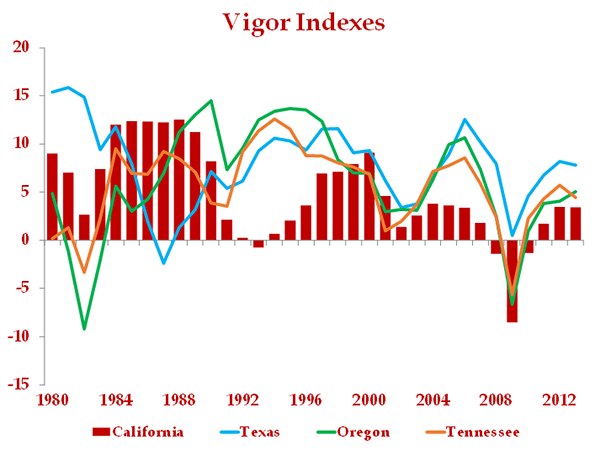
    At California Lutheran University’s Center for Economic Research and Forecasting, we’ve created a vigor index. It’s composed of net in-migration, job creation, and new housing permits, each equally weighted. It is quite sensitive to changes in economic opportunity. For example, in 2000, North Dakota had the nation’s lowest score, 0.9, and Nevada led the nation with a score of 24.1. By 2013, North Dakota led the country with a score of 20.0, while Nevada had seen its index value fall to only 6.4.

    In the following chart, we show California’s index (red bars) compared to that of Texas, Oregon, and Tennessee, from 1980 through 2013.

    California is apparently different than the comparison states. The Tennessee, Oregon, and Texas indexes have behaved more similarly to each other than to California since the late 1980s. Texas’ index behaved uniquely in the early 1980s, because of its dependency on oil and the long-term decline in oil prices that occurred during the 1980s.

    California appears to be different than the other states throughout the period, but the nature of the difference has changed. Prior to the late 1980s, California tended to outperform the others. For example, its score didn’t decline nearly as much as the others during the early 1980s recession. Given California’s resource endowment, we think this is natural.

    Since 1990, though, California’s vigor index has generally remained below those of Texas, Tennessee, and Oregon. Indeed, since 1990, California’s score has rarely exceeded the score of any of the comparison states, and it has never led them all.

    The index also shows that California’s investment in infrastructure during the 1950s and 1960s helped drive economic opportunity for two decades. It took two decades without any investment before we saw the consequences of the decision to not invest.

    Recently, California has seen budget surpluses and faster job growth than the average American state. The forces for the status quo now claim that this confirms the wisdom of their policies. They are wrong.

    California’s budget surpluses are a product of a temporary tax, and an incredible bull market in equities. Our dependence on a highly progressive income tax means that California’s fiscal condition swings on the fortunes of a small group of wealthy individuals.

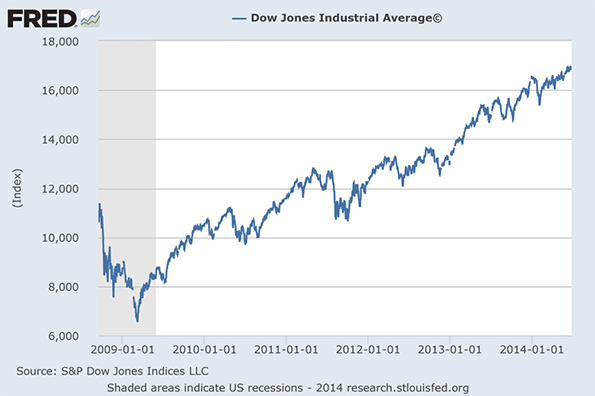
    Equity markets have been amazing over the past few years. The Dow has increased by over 10,000 since it bottomed out on March 9, 2009, and it appears to be divorced from economic activity. It increases on good news and bad, propelled by an unprecedented monetary expansion. Right now, California’s largest taxpayers are reaping huge profits in the stock markets, and California is reaping huge windfalls in its tax revenues.

    Someday, the market gains will cease, or worse reverse. Someday, too, the temporary tax will expire. California’s surpluses will wash away like sand on a beach. The state will face a new crisis, a result of a progressive tax structure where revenues swing on paper profits and losses, not on economic activity.
    As for our job gains being better than the average state’s, California should not be average.

    Employment should be far higher than it is. Even the weak job growth we’ve seen is largely a legacy of a previous age. California has the world’s best venture capital infrastructure, partly because of the investment previous generations of Californians made in the university system. It is also, in part, a result of chance.

    An amazing period of innovation was initiated in Coastal California by a few incredibly talented individuals, who were funded by a few far-sighted capitalists. It was one of those rare coincidences that happen from time to time and change the world. The eventual result was the Silicon Valley and economic powerhouses such as Intel, HP, Apple, Yahoo, Google, Facebook, Twitter, and many more.

    Another result was the creation of a private, capitalist, vibrant infrastructure. It takes time and vast sums of money before a new idea generates profits. Product design is just the first step. An organization needs to be created to produce and sell the product. Factories need to be designed. Marketing plans need to be put in place.

    No inventor or entrepreneur can be expected to have all of the necessary skills or money to turn an idea into a profitable firm. So, an infrastructure appeared. The Silicon Valley’s world-leading venture capital markets and the support structure to enable the fabulous innovation and economic value created there was not the result of any government program or initiative. It was the spontaneous result of lots of people driven to innovate and profit from those innovations. It was capitalism at its very best.

    California’s Silicon Valley became the place for talented young people to turn great ideas into reality. It was also the place to go if you had money and wished to invest in vibrant, risky new technologies, or if you knew how to design factories, how to market products, how to build organizations, or how to finance rapid growth. The infrastructure that arose is supporting California today. This amazing capitalist engine of jobs, innovation and wealth is the source of most of California’s economic vigor. But it is a legacy that will eventually slip away, unless California changes its priorities.

    This is the first part of a two-part report. Bill Watkins is a professor at California Lutheran University and runs the Center for Economic Research and Forecasting, which can be found at clucerf.org.

    Flickr photo by mlhradio. A California extreme: Mountains on The Trona-Wildrose Road, at the edge of the Panamint Valley. One of the most remote deserts in North America, in one of the most remote corners of California; the salt flats of Panamint Valley to the west, and Death Valley to the east.

  • Confessions of a Rust Belt Orphan

    How I Learned to Stop Worrying and Love Northeast Ohio

    Go to sleep, Captain Future, in your lair of art deco
    You were our pioneer of progress, but tomorrow’s been postponed
    Go to sleep, Captain Future, let corrosion close your eyes
    If the board should vote to restore hope, we’ll pass along the lie

    -The Secret Sound of the NSA, Captain Future

    As near as I can tell, the term “Rust Belt” originated sometime in the mid-1980s. That sounds about right.

    I originated slightly earlier, in 1972, at St. Thomas Hospital in Akron, Ohio, Rubber Capital of the World. My very earliest memory is of a day, sometime in the Summer of 1975, that my parents, my baby brother, and I went on a camping trip to Lake Milton, just west of Youngstown. I was three years old. To this day, I have no idea why, of all of the things that I could remember, but don’t, I happen to remember this one. But it is a good place to start.
    image
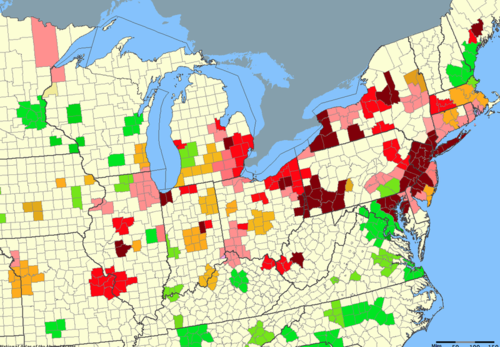
    Image Source: Wikipedia: Change in total number of manufacturing jobs in metropolitan areas, 1954-2002. Dark red is very bad. Akron is dark red.

    The memory is so vivid that I can still remember looking at the green overhead freeway signs along the West Expressway in Akron. Some of the signs were in kilometers, as well as in miles back then, due to an ill-fated attempt to convert Americans to the Metric system in the 1970s. I remember the overpoweringly pungent smell of rubber wafting from the smokestacks of B.F. Goodrich and Firestone. I recall asking my mother about it, and her explaining that those were the factories where the tires, and the rubber, and the chemicals were made. They were made by hard-working, good people – people like my Uncle Jim – but more on that, later.

    When I was a little bit older, I would learn that this was the smell of good jobs; of hard, dangerous work; and of the way of life that built the modern version of this quirky and gritty town. It was the smell that tripled Akron’s population between 1910 and 1920, transforming it from a sleepy former canal-town to the 32nd largest city in America. It is a smell laced with melancholy, ambivalence, and nostalgia – for it was the smell of an era that was quickly coming to an end (although I was far too young to be aware of this fact at the time). It was sometimes the smell of tragedy.

    We stopped by my grandparents’ house, in Firestone Park, on the way to the campground. I can still remember my grandmother giving me a box of Barnum’s Animals crackers for the road. She was always kind and generous like that.

    Who were my grandparents? My grandparents were Akron. It’s as simple as that. Their story was Akron’s story. My grandfather was born in 1916, in Barnesboro, a small coal-mining town in Western Pennsylvania, somewhere between Johnstown, DuBois, and nowhere. His father, a coal miner, had emigrated there from Hungary nine years earlier. My grandmother was born in Barberton, in 1920. Barberton was reportedly the most-industrialized city in the United States, per-capita, at some point around that time.

    They were both factory workers for their entire working lives (I don’t think they called jobs like that “careers” back then). My grandfather worked at the Firestone Tire & Rubber Company. My grandmother worked at Saalfield Publishing, a factory that was one of the largest producers of children’s books, games, and puzzles in the world. Today, both of the plants where they worked form part of a gutted, derelict, post-apocalyptic moonscape in South Akron, located between that same West Expressway and perdition. The City of Akron has plans for revitalizing this former industrial area. It needs to happen, but there are ghosts there…

    My name is Ozymandias, King of Kings, 
    Look on my works, ye Mighty, and despair!
    Nothing beside remains. Round the decay 
    Of that colossal wreck, boundless and bare 
    The lone and level sands stretch far away.

    -Percy Bysshe Shelley, Ozymandias

    My grandparents’ house exemplified what it was to live in working-class Akron in the late 1970s and early 1980s. My stream-of-consciousness memories of that house include: lots of cigarettes and ashtrays; Hee-HawThe Joker’s Wild; fresh tomatoes and peppers; Fred & Lamont Sanford; Archie & Edith Bunker; Herb Score and Indians baseball on the radio on the front porch; hand-knitted afghans; UHF/VHF; 3, 5, 8, and 43; cold cans of Coca-Cola and Pabst Blue Ribbon (back when the pop-tops still came off of the can); the Ohio Lottery; chicken and galuskas (dumplings); a garage floor that you could eat off of; a meticulously maintained 14-year-old Chrysler with 29,000 miles on it; a refrigerator in the dining room because the kitchen was too small; catching fireflies in jars; and all being right with the world.

    I always associate the familiar comfort of that tiny two-bedroom bungalow with the omnipresence of cigarette smoke and television. I remember sitting there on May 18, 1980. It was my eighth birthday. We were sitting in front of the TV, watching coverage of the Mount St. Helens eruption in Washington State. I remember talking about the fact that it was going to be the year 2000 (the Future!) in just twenty years. It was an odd conversation for an eight year old to be having with adults (planning for the future already, and for a life without friends, apparently). I remember thinking about the fact that I would be 28 years old then, and how inconceivably distant it all seemed. Things seem so permanent when you’re eight, and time moves ever-so-slowly.

    More often than not, when we visited my grandparents, my Uncle Jim and Aunt Helen would be there. Uncle Jim was born in 1936, in West Virginia. His family, too, had come to Akron to find work that was better-paying, steadier, and (relatively) less dangerous than the work in the coal mines. Uncle Jim was a rubber worker, first at Mohawk Rubber and then later at B.F. Goodrich. Uncle Jim also cut hair over at the most-appropriately named West Virginia Barbershop, on South Arlington Street in East Akron. He was one of the best, most decent, kindest people that I have ever known.

    I remember asking my mother once why Uncle Jim never washed his hands. She scolded me, explaining that he did wash his hands, but that because he built tires, his hands were stained with carbon-black, which wouldn’t come out no matter how hard you scrubbed. I learned later, that it would take about six months for that stuff to leach out of your pores, once you quit working.

    Uncle Jim died in 1983, killed in an industrial accident on the job at B.F. Goodrich. He was only 47. The plant would close for good about a year later.

    It was an unthinkably tragic event, at a singularly traumatic time for Akron. It was the end of an era.

    Times Change

    My friend Della Rucker recently wrote a great post entitled The Elder Children of the Rust Belt over at her blog, Wise Economy. It dredged up all of these old memories, and it got me thinking about childhood, about this place that I love, and about the experience of growing up just as an economic era (perhaps the most prosperous and anomalous one in modern history) was coming to an end.

    That is what the late 1970s and early 1980s was: the end of one thing, and the beginning of a (still yet-to-be-determined) something else. I didn’t know it at the time, but that’s because I was just a kid.

    In retrospect it was obvious: the decay; the deterioration, the decomposition, the slow-at-first, and then faster-than-you-can-see-it unwinding of an industrial machine that had been wound-up far, far, too-tight. The machine runs until it breaks down; then it is replaced with a new and more efficient one – a perfectly ironic metaphor for an industrial society that killed the goose that laid the golden egg. It was a machine made up of unions, and management, and capitalized sunk costs, and supply chains, and commodity prices, and globalization. Except it wasn’t really a machine at all. It was really just people. And people aren’t machines. When they are treated as such, and then discarded as obsolete, there are consequences.

    You could hear it in the music: from the decadent, desperately-seeking-something (escape) pulse of Disco, to the (first) nihilistic and (then) fatalistic sound of Punk and Post-Punk. It’s not an accident that a band called Devo came from Akron, Ohio. De-evolution: the idea that instead of evolving, mankind has actually regressed, as evidenced by the dysfunction and herd mentality of American society. It sounded a lot like Akron in the late 1970s. It still sounds a little bit like the Rust Belt today.

    As an adult, looking back at the experience of growing up at that time, you realize how much it colors your thinking and outlook on life. It’s all the more poignant when you realize that the “end-of-an-era” is never really an “end” as such, but is really a transition to something else. But to what exactly?

    The end of that era, which was marked by strikes, layoffs, and unemployment, was followed by its echoes and repercussions: economic dislocation, outmigration, poverty, and abandonment; as well as the more intangible psychological detritus – the pains from the phantom limb long after the amputation; the vertiginous sensation of watching someone (or something) die.

    And it came to me then 
    That every plan 
    Is a tiny prayer to Father Time

    As I stared at my shoes
    In the ICU
    That reeked of piss and 409

    It sung like a violent wind
    That our memories depend
    On a faulty camera in our minds

    ‘Cause there’s no comfort in the waiting room
    Just nervous paces bracing for bad news

    Love is watching someone die…

    -Death Cab For Cutie, What Sarah Said

    But it is both our tragedy and our glory that life goes on.

    Della raised a lot of these issues in her post: our generation’s ambivalent relationship with the American Dream (like Della, I feel the same unpleasant taste of rust in my mouth whenever I write or utter that phrase); our distrust of organizations and institutions; and our realization that you have to keep going, fight, and survive, in spite of it all. She talked about how we came of age at a time of loss:

    not loss like a massive destruction, but a loss like something insidious, deep, pervasive.

    It is so true, and it is so misunderstood. One of the people commenting on her blog post said, essentially, that it is dangerous to romanticize about a “golden age”; that all generations struggle; and that life is hard.

    Yes, those things are all true. But they are largely irrelevant to the topic at hand.

    There is a very large middle ground between a “golden age” and an “existential struggle”. The time and place about which we are both writing (the late 1970s through the present, in the Rust Belt) is neither. But it is undoubtedly a time of extreme transition. It is a great economic unraveling, and we are collectively and individually still trying to figure out how to navigate through it, survive it, and ultimately build something better out of it.

    History is cyclical. Regardless of how enamored Americans, in general, may be with the idea, it is not linear. It is neither a long, slow march toward utopia, nor toward oblivion. When I look at history, I see times of relative (and it’s all relative, this side of paradise) peace, prosperity, and stability; and other times of relative strife, economic upheaval, uncertainty, and instability. We really did move from one of those times to the other, beginning in the 1970s, and continuing through the present.

    The point that is easy to miss when uttering phrases like “life is hard for every generation” is that none of this discussion about the Rust Belt – where it’s been, where it is going – has anything to do with a “golden age”. But it has everything to do with the fact that this time of transition was an era (like all eras) that meant a lot (good and bad) to the people that lived through it. It helped make them who they are today, and it helped make where they live what it is today.

    For those that were kids at the time that the great unraveling began (people like me, and people like Della) it is partially about the narrative that we were socialized to believe in at a very young age, and how that narrative went up in a puff of smoke. In 1977, I could smell rubber in the air, and many of my family members and friends’ parents worked in rubber factories. In 1982, the last passenger tire was built in Akron. By 1984, 90% of those jobs were gone, many of those people had moved out of town, and the whole thing was already a fading memory. Just as when a person dies, many people reacted with a mixture of silence, embarrassment, and denial.

    As a kid, especially, you construct your identity based upon the place in which you live. The whole identity that I had built, even as a small child, as a proud Akronite: This is the RUBBER CAPITAL OF THE WORLD; this is where we make lots and lots of Useful Things for people all over the world; this is where Real Americans Do Real Work; this is where people from Europe, the South, and Appalachia come to make a Better Life for themselves; well, that all got yanked away. I couldn’t believe any of those things anymore, because they were no longer true, and I knew it. I could see it with my own two eyes. Maybe some of them were never true to begin with, but kids can’t live a lie the way that adults can. When the place that you thought you lived in turns out not to be the place that you actually live, it can be jarring and disorienting. It can even be heartbreaking.

    We’re the middle children of history, man. No purpose or place. We have no Great War. No Great Depression. Our great war is a spiritual war. Our great depression is our lives.

    Tyler Durden, Fight Club

    I’m fond of the above quote. I was even fonder of it when I was 28 years old. Time, and the realization that life is short, and that you ultimately have to participate and do something with it besides analyze it as an outside observer, has lessened its power considerably. It remains the quintessential Generation X quote, from the quintessential Generation X movie. It certainly fits in quite well with all of this. But, then again, maybe it shouldn’t.

    I use the phrase “Rust Belt Orphan” in the title of this post, because that is what the experience of coming of age at the time of the great economic unraveling feels like at the gut-level. But it’s a dangerous and unproductive combination, when coupled with the whole Gen-X thing.

    In many ways, the Rust Belt is the “Generation X” of regions – the place that just doesn’t seem to fit in; the place that most people would just as soon forget about; the place that would, in fact, just as soon forget about itself; the place that, if it does dare to acknowledge its own existence or needs, barely notices the surprised frowns of displeasure and disdain from those on the outside, because they have already been subsumed by the place’s own self-doubt and self-loathing.

    A fake chinese rubber plant
    In the fake plastic earth
    That she bought from a rubber man
    In a town full of rubber plans
    To get rid of itself

    -Radiohead, Fake Plastic Trees

    The whole Gen-X misfit wandering-in-the-Rust Belt-wilderness meme is a palpably prevalent, but seldom acknowledged part of our regional culture. It is probably just as well. It’s so easy for the whole smoldering heap of negativity to degenerate into a viscous morass of alienation and anomie. Little good can come from going any further down that dead-end road.

    Whither the Future?

    The Greek word for “return” is nostosAlgos means “suffering.” So nostalgia is the suffering caused by an unappeased yearning to return.
    – 
    Milan Kundera, Ignorance

    So where does this all leave us?

    First, as a region, I think we have to get serious about making our peace with the past and moving on. We have begun to do this in Akron, and, if the stories and anecdotal evidence are to be believed, we are probably ahead of the region as a whole.

    But what does “making our peace” and “moving on” really mean? In many ways, I think that our region has been going through a collective period of mourning for the better part of four decades. Nostalgia and angst regarding the things that have been lost (some of our identity, prosperity, and national prominence) is all part of the grieving process. The best way out is always through.

    But we should grieve, not so we can wallow in the experience and refuse to move on, but so we can gain a better understanding of who we are and where we come from. Coming to grips with and acknowledging those things, ultimately enables us to help make these places that we love better.

    We Americans are generally not all that good at, or comfortable with, mourning or grief. There’s a very American idea that grieving is synonymous with “moving on” and (even worse) that “moving on” is synonymous with “getting over it”.

    We’re very comfortable with that neat and tidy straight, upwardly-trending line toward the future (and a more prosperous, progressive, and enlightened future it will always be, world without end, Amen.)

    We’re not so comfortable with that messy and confusing historical cycle of boom-and-bust, of evolution and de-evolution, of creation and destruction and reinvention. But that’s the world as we actually experience it, and it’s the one that we must live in. It is far from perfect. I wish that I had another one to offer you. But there isn’t one on this side of the Great Beyond. For all of its trials and tribulations, the world that we inhabit has one inestimable advantage: it is unambiguously real.

    “Moving on” means refusing to become paralyzed by the past; living up to our present responsibilities; and striving every day to become the type of people that are better able to help others. But “moving on” doesn’t mean that we forget about the past, that we pretend that we didn’t experience what we did, or that we create an alternate reality to avoid playing the hand that we’ve actually been dealt.

    Second, I don’t think we can, or should, “get over” the Rust Belt. The very phrase “get over it” traffics in denial, wishful thinking, and the estrangement of one’s self from one’s roots. Countless attempts to “get over” the Rust Belt have resulted in the innumerable short-sighted, “get rich quick” economic development projects, and public-private pyramid-schemes that many of us have come to find so distasteful, ineffective, and expensive.

    We don’t have to be (and can’t be, even if we want to) something that we are not. But we do have to be the best place that we can be. This might mean that we are a smaller, relatively less-prominent place. But it also means that we can be a much better-connected, more cohesive, coherent, and equitable place. The only people that can stop us from becoming that place are we ourselves.

    For a place that has been burned so badly by the vicissitudes of the global economy, Big Business, and Big Industry, we always seem to be so quick to put our faith in the Next Big Project, the Next Big Organization, and the Next Big Thing. I’m not sure whether this is the cause of our current economic malaise, or the effect, or both. Whatever it is, we need to stop doing it.

    Does this mean that we should never do or dream anything big? No. Absolutely not. But it does mean that we should be prudent and wise, and that we should tend to prefer our economic development and public investment to be hyper-nimble, hyper-scalable, hyper-neighborhood-focused, and ultra-diverse. Fetishizing Daniel Burnham’s famous “Make no little plans…” quote has done us much harm. Sometimes “little plans” are exactly what we need, because they often involve fundamentals, are easier to pull-off, and more readily establish trust, inspire hope, and build relationships.

    Those of us that came of age during the great economic unraveling and (still painful) transition from the Great American Manufacturing Belt to the Rust Belt might just be in a better position to understand our challenges, and to find the creative solutions required to meet them head-on. Those of us that stuck it out and still live here, know where we came from. We’re under no illusions about who we are or where we live. I think Della Rucker was on to something when she listed what we can bring to the table:

    • Determination
    • Long-game focus
    • Understanding the depth of the pit and the long way left to climb out of it
    • Resourcefulness
    • Ability to salvage
    • Expectation that there are no easy answers
    • Disinclination to believe that everything will be all right if only we do this One Big Thing

    When I look at this list, I see pragmatism, resilience, self-knowledge, survival skills, and leadership. It all rings true.

    He wanted to care, and he could not care. For he had gone away and he could never go back any more. The gates were closed, the sun was gone down, and there was no beauty but the gray beauty of steel that withstands all time. Even the grief he could have borne was left behind in the country of illusion, of youth, of the richness of life, where his winter dreams had flourished.

    “Long ago,” he said, “long ago, there was something in me, but now that thing is gone. Now that thing is gone, that thing is gone. I cannot cry. I cannot care. That thing will come back no more.”

    -F. Scott Fitzgerald, Winter Dreams

    So, let’s have our final elegy for the Rust Belt. Then, let’s get to work.

    This post originally appeared in Jason Segedy’s Notes From the Underground on November 2, 2013.

    Segedy is the Director of the Akron Metropolitan Area Transportation Study, the Metropolitan Planning Organization serving Akron, Ohio.  As a native of Akron, and as an urban planner, he has a strong interest in the future of places throughout the Great Lakes region, and in the people that inhabit them.
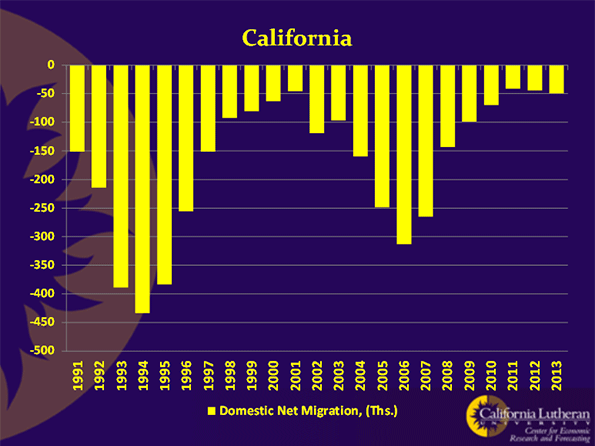
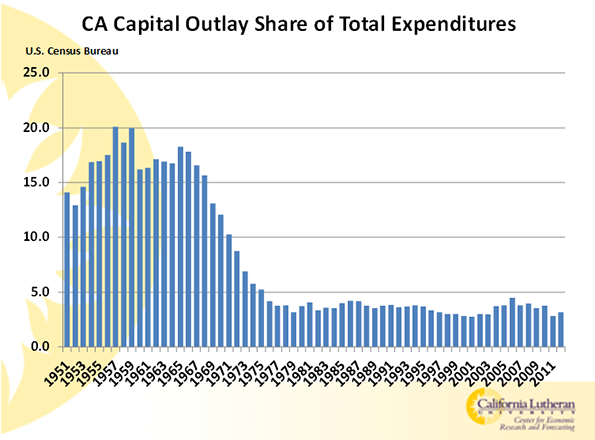
  • Energy Preferences to Play Big Role in November

    The November election will be played out along all the usual social memes – from gay marriage, racism and immigration to the “war against women.” But what may determine the outcome revolves around one key economic issue: energy. This has all come to a boil now as President Obama has backed an Environmental Protection Agency effort to accelerate tougher emissions standards, something that could shutter hundreds of coal-fired power plants and slow fossil fuel development across the country.

    The energy issue has become in our era what tariffs were in the 19th century: an increasingly insurmountable partition that separates Americans by region and class and which, ultimately, touches on the long-term economic trajectory of the country.

    Of course, we have always had politics over energy – given regional variations in sources and kinds of supplies – but, until recently, both parties generally favored developing more oil and natural gas, largely because of the associated high-wage employment growth and potential for reducing the nation’s trade deficit. Now, energy increasingly has become a deeply partisan issue, with Democrats largely in opposition to fossil-fuel development and Republicans, fairly predictably, in support.

    Reflecting this trend has been the rise of opposing sets of contributors whose primary concerns are wrapped around energy. On the Republican side, energy industry contributors, including the billionaire industrialist Koch brothers, have become increasingly dominant. More than 90 percent of campaign donations from the oil and gas industries in 2012 went to Republicans.

    At the same time, environmentally focused Democratic contributors, led by hedge-fund manager Tom Steyer, have made being anti-fossil-fuel de rigueur for most candidates in the party. Steyer and his allies have become the favorite place to go for cash for Senate Majority Leader Harry Reid of Nevada and other top Democrats.

    The Geography of Energy

    The most-evident division – and most politically relevant – is geographic. A huge swath of the country, mainly along the Gulf Coast, Texas and the Great Plains, where shale-oil production has grown fourfold since 2007, is enjoying an energy boom that has created a surge in other high-wage, blue-collar fields such as manufacturing and construction. With the delays in approving the Keystone XL oil pipeline and looming new EPA emissions standards, Democratic senators and candidates from these states are, understandably, trying to distance themselves from their party’s increasingly anti-fossil-fuel policies.

    More significant, over time, may be how energy plays out in the country’s major political battleground, the rust-belt states. Most of these states are highly dependent on coal for electricity, and some, such as Pennsylvania, Ohio and West Virginia, are seeking to develop new oil and gas finds. Policies that limit fossil-fuel development, may prove a tough sell in some districts and could cost the Democrats several additional Senate seats.

    In contrast, the most fervent support for strict climate-change legislation comes mostly from states – notably, the Northeast – that produce little in the way of energy and use relatively little carbon to power their economies. These states need less power than other areas as they already have deindustrialized and have very little population growth.

    Two other ultrablue bastions, California and the Pacific Northwest, also advocate a green energy position. The Northwest relies largely on hydro power for its robust industrial sector, lessening dependence on carbon-based energy for electricity. California, itself rich in fossil fuels, largely disdains its resources, and its leaders prefer, for ideological reasons, to subsidize expensive renewable energy. Roughly one-fourth of all energy used in California comes from out of state, much of it from coal. But since this “dirty” power comes from elsewhere, the progressives in places like Hollywood and Silicon Valley can still feel good about our state’s “enlightened” policies, whatever their real effect.

    The Class Divide

    Historically, Democrats have been big supporters of expanding the energy sector, which includes such things as dams, nuclear power plants and pipelines. But the growing influence of the green movement has reversed that. Green policies are widely embraced by largely Democratic crony capitalists in places like Silicon Valley. They also enjoy almost universal support in academia, where boycotts of fossil-fuel companies are increasingly common. The media, too, is an ally, as is the predictably progressive entertainment industry.

    Rest assured, we will never see an HBO series that celebrates George Mitchell, the entrepreneur most responsible for developing fracking. But campus-climate scientists who diverge in any way from the party line on global warming are routinely excoriated as“deniers” of “settled” science, even in the face of 15 years of relatively stable global temperatures. The media has also become a fierce defender of climate orthodoxy. TheLos Angeles Times, as well as the website Reddit, have chosen to exclude contributions from skeptics.

    Of course, many traditional Democrats, notably in the construction trades and manufacturing, oppose this drift. Construction unions are apoplectic about the president’s endless delays on Keystone XL, which has two-thirds support from the public. The United Mineworkers, not surprisingly, oppose the new EPA emissions limits, claiming they will cost upward of 75,000 mining jobs.

    Some Ohio construction unions, incensed by green opposition to both Keystone and fracking, have shifted support to prodevelopment GOP Gov. John Kasich, despite his conflict with public employee groups. The only prominent national Democrat to identify as pro-fossil-fuel is former Montana governor Brian Schweitzer whose possible run for the presidential nomination seems a bit quixotic in a party increasing dominated by environmental activists and their gentry allies.

    What Kind of America do we want?

    Ultimately, the energy debate reflects a larger discussion about the future of the country and the economy. This is not merely about emissions and climate change, per se. California’s Draconian laws, even supporters admit, will have no appreciable effect on a global basis, particularly given the state’s already relatively low carbon footprint (largely a factor of the mild climate and the slow growth in its interior in recent years). Indeed, virtually all the world’s significant increases in CO2 are coming from developing countries; since 1990, China has increased its emissions almost threefold, while America’s have dropped. China now emits roughly twice as much greenhouse gas as the U.S.

    Some of the steps taken by environmental and renewable-energy interests against natural gas development can even be seen as counterproductive. The U.S.’s better recordon reducing emissions reflects overwhelmingly the shift from coal to natural gas for generating electricity, which has helped the U.S. reduce its carbon emissions more than either Asia or Europe.

    Fracking, like any energy technology – including wind and solar – clearly creates environmental problems. There should be strong rules to regulate fracking to make it safer, as Colorado’s Democratic Gov. John Hickenlooper has worked to pass in his state. In addition, major reductions can be achieved through a shift away from oil and coal and toward natural gas, as well as conservation efforts.

    Progressives, in particular, need to focus far more on what effects an ultrahigh-cost energy economy would have on the middle and working class. More attention should be paid in accelerating the current spike in job-creating foreign investment into the country, attracted in large part by the development of low-cost, clean natural gas. In contrast, policies hostile to fossil fuels will drive industry to less-environmentally conscious countries, particularly in the developing world.

    Sadly, none of this is necessary. America’s economic future is best guaranteed by marrying the successes of Silicon Valley and Hollywood with a robust blue-collar sector that includes fossil fuels, manufacturing, logistics and construction. Emissions can be cut, for the time being, by such steps as replacing coal for generating electricity, improving efficiencies, promoting telework and boosting the use of natural gas for transportation.

    Dividing the country, and the electorate, into totally polarized camps over energy may benefit the consultants in both camps who feed off contentious and expensive election campaigns, but will do little to help the futures of most Americans.

    This article first appeared in the Orange County Register.

    Joel Kotkin is executive editor of NewGeography.com and Distinguished Presidential Fellow in Urban Futures at Chapman University, and a member of the editorial board of the Orange County Register. He is author of The City: A Global History and The Next Hundred Million: America in 2050. His most recent study, The Rise of Postfamilialism, has been widely discussed and distributed internationally. He lives in Los Angeles, CA.

    Photo by gfpeck