Category: Economics

  • Post-Nagin, New Orleans Is On Way To Becoming A Model City

    Last week’s conviction of former New Orleans Mayor Ray Nagin on 20 charges of bribery and fraud marks the end of a tumultuous era in the city’s history, and perhaps also the beginning of a new era in American urban politics. Perhaps most remarkable was the almost total lack of protest in New Orleans over the downfall of Nagin, who had relied heavily on polarizing racial politics in his last five years in office.

    This is among the many hopeful signs in the Crescent City and its environs. Over the past year as I’ve put together a report on the future of New Orleans, I have seen a city once described by Joel Garreau in his Nine Nations of North America (1981)as a “marvelous collection of sleaziness and peeling paint,” clean up its politics, restart and diversify its economy, and begin the slow process of reducing its deep-seated crime problem.

    In the past, the “pay to play” politics and corruption epitomized by Nagin and former congressman William Jefferson were widely winked at in New Orleans as if it were just local color. “We like our politics like our rice — dirty,” a Katrina evacuee in Houston once told me with a knowing smile.

    Katrina changed that. The natural disaster was made far worse by the corruption and incompetence of virtually every key institution, starting with police and the levee boards. With the city largely underwater and much of its population forced to flee, some urban experts, such as Harvard’s Ed Glaeser, wondered if we would be better off to encourage people to leave the area permanently, perhaps with vouchers, to seek a better life elsewhere.

    Yet it is here that the real turnaround began. Business leaders, who had seen Nagin as an ally during his first term, realized he was not up to the extraordinary challenges posed by the disaster. The man who some called “Ray Reagan” for his business-friendly policies was morphing into the worst kind of racial demagogue, a kind of bayou version of Coleman Young or Sharpe James. His appeal to keep New Orleans a “chocolate city” and his now well-documented graft frustrated those who wanted to revive the city and its surrounding region.

    “When Nagin came in, he was seen as a reformer,” recalls Greg Rusovich, former chairman of the New Orleans Business Council, which includes 70 of the Crescent City’s largest businesses. “But after Katrina he really turned into a racial politician and surrounded himself with incompetents.”

    This incompetence, Rusovich suggests, slowed New Orleans’ recovery as Nagin proved unable to help direct the massive federal aid, and the many private donations, that came into the city. Eventually, voters tired of poor public services and began to demand a more competent regime.

    The current mayor, Mitch Landrieu, first elected in 2010 and easily re-electedwith strong black support this month, has brought a climate of technocratic competence to the city. With the active backing of business leaders, the city has attracted large-scale corporate investment, including a 300-person General Electric software development center, as well as a surge of videogame and entertainment companies.

    This growth was in large part sparked by a steady movement of young, educated people into the city. For decades, New Orleans’ “best and brightest” tended to move elsewhere; now the flows for the Crescent City have turned positive, including from the West Coast and the Northeast. By last year, theAtlantic Cities, the leading mouthpiece for “hip” urbanism, proclaimed New Orleans potentially the nation’s “next great innovation hub.”

    Yet for all the hoopla surrounding the growth in the information sector, it is unlikely to be enough to sustain the New Orleans region’s recovery. Not only are the total numbers of such jobs still small, in the realm of 2,600 for entertainment, STEM employment is lower than a decade ago due to cutbacks at the NASA facilities at Michoud as well as in aerospace. More important, the growth of tech and entertainment jobs will likely be insufficient to address the fundamental issues of race and poverty that have bedeviled the city throughout much of its history.

    Today, in part due to the return of evacuees, the poverty rate for the metro area stands at 19%, close to the pre-Katrina level and well above the national average of 15%. The differential between white and black incomes is some $6,000 per household above the national average and some observers, including many African-Americans, fear that the gentrification of parts of the city is reinforcing the class and racial divides that existed before the flood.

    Many African-Americans, notes city employee Lydia Cutrer, have “trust issues after many broken promises, and feel like outsiders are taking over.” Or, as Sherby Guillory, a health care worker who now lives in Houston, described the recovery efforts: “They want to build a shining city on a hill, but without the people.”

    Ultimately, to deal with these concerns, New Orleans needs to focus on the industries that drove its economy for much of its history: energy and trade. These are the primary providers of high-wage jobs, many of which are blue collar. The New Orleans area lost energy jobs from 2007-12, in part due to the Gulf drilling moratorium in the wake of the BP disaster, but activity is rising again and low natural gas prices have prompted a surge in chemical and refinery investment in south Louisiana.

    recent report by the Greater New Orleans Community Data Center concluded that over 10,000 energy, petrochemical and related advanced manufacturing jobs could be added in the region by 2020; in contrast the digital media sector was projected to expand by roughly 2,200 positions. Finding ways to accelerate this development, while using new revenues to shore up the fragile ecosystem, needs to become the primary focus of new development efforts.

    This vision for post-Katrina New Orleans will no doubt meet opposition from those who would like the city to evolve into a humid, southern version of San Francisco. Yet this makes little sense for a place whose history, location and ethnic heritage suggest a more economically diverse future. Having survived Katrina and Ray Nagin, the next task should be to see how to make sure that the recovery reaches into those neighborhoods that have historically been left behind. Rather than stand only as a charming artifact of its past, New Orleans can become a role model in showing how cities can not only survive, but create a prosperous future.

    This piece originally appeared at Forbes.

    Joel Kotkin is executive editor of NewGeography.com and Distinguished Presidential Fellow in Urban Futures at Chapman University, and a member of the editorial board of the Orange County Register. He is author of The City: A Global History and The Next Hundred Million: America in 2050. His most recent study, The Rise of Postfamilialism, has been widely discussed and distributed internationally. He lives in Los Angeles, CA.

    New Orleans photo courtesy of Jon Sullivan.

  • Sustaining Prosperity: A Long Term Vision for the New Orleans Region

    This is the executive summary from a new report Sustaining Prosperity: A Long Term Vision for the New Orleans Region, authored by Joel Kotkin for Greater New Orleans, Inc. Download the full report from GNO, Inc. here: gnoinc.org/sustainingprosperity

    The recovery of greater New Orleans represents one of the great urban achievements of our era. After decades of slow economic, political and social decline, hurricane Katrina seemed a kind of coup de grâce, smothering the last embers of the region’s vitality. In the fall of 2005 it was entirely logical to see New Orleans as just a potential exemplar of failed urbanization, much as we might see in Detroit1, Cleveland, and a host of other once great cities – for example Naples, Lisbon, Antwerp and Osaka – that have tumbled from their once great importance.2

    Yet in New Orleans’ case, disaster engendered not continued decline, but the revival of the en­tire region, its economy, and social and political institutions. Like Chicago after the great fire of 1871, San Francisco in the wake of the 1906 earthquake and fire, or New York following 9-ll, New Orleans has rebounded in ways that have defied expectations.

    Critical to making New Orleans a resilient city has been the transformation of the civic culture. This has much to do with the commitment of New Orleanians to their city – like Chicagoans, New Yorkers and San Franciscans in the past. “A city,” notes urban historian Kevin Lynch,” is hard to kill if it possesses unique cultural appeal, geographic assets and people who are determined to save the city they love.”3

    New Orleans resiliency since Katrina constitutes much more than improved levees or better evacuation procedures; more than new brick and mortar applied to what had been an aging, deterio­rating region. New Orleans has made enormous progress in cleaning up its famously corrupt political system, and also made huge strides in improving its educational infrastructure. Once considered one of the worst places to do business, the region, and the state of Louisiana, has undergone a marked improvement to its reputation. It has emerged as a good place for commerce – something of a “Cin­derella” in economic development terms.4 Allison Plyer of the Greater New Orleans Community Data Center put it, “Greater New Orleans is in some ways rebuilding better than before”.5

    Our analysis shows this progress in a host of indicators. Once a below-average job producer, the region has expanded its employment since the 2007 recession far faster than the national average. It recovered all the jobs lost in the recession by 2012 – and then some – while the nation remained three percent below its pre-recession level. Entrepreneurial activity also has grown faster than the national average by a wide margin.6

    More important still, the region finally began to reverse a demographic decline that, for a gen­eration or more, saw young, educated people and families depart for other locales to seek out a better life. The concentration of 25 to 35 year olds has increased far more quickly in the region than it has in the nation as a whole. Indeed since 2007, New Orleans region has experienced the fastest growth in educated population in the nation.7

    Many economic trends favor the region’s continued ascendency. These include the still nascent US energy boom, which represents arguably the greatest shift in global economic power since the end of the Cold War and the rise of China; the massive flow of investment, domestic and foreign, into lower-cost locales and most particularly into the Third Coast, the burgeoning region around the Gulf of Mexico; and finally the expansion of US trade with Latin America and the Caribbean basin.

    To these powerful forces we can also add demographic and social factors that work to the region’s advantage. One key is a relatively low cost of living, which, in effect, gives area residents and businesses a leg up on their East and West coast rivals. This is critical in attracting net migration from those regions, with their storehouse of educated residents and skilled workers.8 Another force is the breadth of skills that can be easily found in the region, including higher paid skilled professionals ex­perienced in transportation and material moving, installation, maintenance and repair, construction, manufacturing and energy.

    A future scenario can be constructed where greater New Orleans emerges as one of the bright­est spots in the North American economy. Not only does the region have natural advantages in terms of energy resources and transportation, it can claim primary sources of higher-wage employment. It also possesses a cultural cachet that attracts educated workers, but in a cost and regulatory environ­ment that appeals to business investors.

    This is most notable in the growth of the region’s rapidly evolving information industry, in­cluding software, videogames and an expanding film/television industry. Over the past five years, New Orleans has come to enjoy a locational concentration equal to that of New York, and has emerged as a major player in this sector.

    Challenges Ahead: Economic, Social and Environmental

    As the region moves further from the immediate post-Katrina crisis, the great momentum of the last five years is clearly slowing down. Job creation remains positive, but has gradually fallen towards national norms. Indeed, since 2010, after years of running ahead, the region’s job growth rate actually trailed the national average. This could be simply a sign that, after recovering more slowly, the rest of the country is now catching up. But the slowdown relative to other cities should be taken seriously, as it could represent a loss of critical momentum.

    “Concert Of Economic Forces” That Can Make Recovery Permanent

    To overcome its legacy of poverty and inequality, the New Orleans region needs to focus not on just one sector but on five critical ones. In a highly competitive national and global economy, re­gions need to work on their unique strengths, establishing advantages that can lead to more, and bet­ter, job creation. Most particularly, the region needs to develop a broad, but still highly selective, base of industries that can create the higher-wage jobs necessary for the uplift not of a few New Orleani­ans, but for the many.

    1. The first, and most evident, is the region’s cultural legacy, which serves as a major source of jobs for local people as well as a lure for talented people from elsewhere. This, of course, includes the still very important tourism industry, but also encompasses generally higher-wage professions in film, television, video game software and even medical research.

    The growth in information sector employment, something relatively new to the region, rep­resents a clear breakthrough. It allows the region to take advantage of its essential cultural assets, by attracting companies and highly skilled workers. Although it is unlikely that the New Orleans region will ever become as tech-dependent as, say, Silicon Valley — which may prove a good thing, given that industry’s volatility — New Orleans can look forward to a sustained increase in high-paying, and high-visibility, employment. Perhaps most critically, it has an excellent opportunity to make itself the cultural capital of the Third Coast, the burgeoning region around the Gulf, something the region desperately needs and a role that New Orleans is uniquely positioned to fulfill.

    Yet although these industries are important, they alone cannot sustain a long-term, broad recovery. Wages in the tourism industry and the arts tend to be low – one reason for the city’s per­sistently poor income distribution in the past – and higher-wage jobs, except in engineering services and entertainment, remain below national norms in total jobs and will take many years to reach true critical mass. Perhaps most critically, these industries alone cannot produce enough high-wage skilled jobs for the region’s working class population.9

    2. The river system. Its location at the shipping terminus of the Mississippi River, across the regions the region’s ports – New Orleans, South Louisiana, St. Bernard, Manchac, Plaquemines and Grand Isle Port – is the historic reason for the region’s existence and one of the key factors in its future success. The region needs to work to compete successfully with its Third Coast rivals, notably Houston, as well as Mobile and Tampa. Growing trade with the Caribbean and the completion of the Panama Canal expansion project increase the opportunities for expanded logistics and cargo han­dling. In addition, the river provides an ideal spur to new industrial production, such as the Nucor Steel plant in St. James Parish, which some see as the precursor of a new zone, akin to Germany’s Ruhr Valley, that could emerge between New Orleans and Baton Rouge.

    Given the devastation of the region’s unique ecological environment, the river presents unique challenges to be addressed. At the same time, the river offers the region new opportunities to develop yet another nascent sector: environmental remediation. The RESTORE Act funds will bring billions to the Gulf help alleviate the region’s own environmental issues, but could also support the unique expertise and skills related to the profound challenges of maintaining coastal regions. This can be seen already in the over $210 million that has flowed to expert Louisiana companies as a result of Hurricane Sandy.10

    3. The energy revolution. Perhaps no sector has more potential to generate higher wage jobs across the region, particularly for working class residents, than the current energy revolution. This is rapidly shifting economic power to North America, and it’s a shift for which the region has a front row seat. Louisiana and the greater New Orleans area boast enormous oil and gas reserves, but the region has not kept up with Houston or even smaller cities in terms of energy-related jobs. Yet there has been continued growth in many upstream services, such as petro-industrial development and exploration, even if headquarters employment has dropped. With the resolution of the BP disaster, it is hoped that the region will recover more employment in this high-wage sector.

    4. Environmental remediation. This is both a major challenge and an opportunity for economic development. Simply put, there is no long-term future for the region if the environment that sup­ports it collapses. Katrina, after all, was not the first ecological disaster to hit the region, and it won’t be the last. Finding ways to restore coastal wetlands and manage the river and other water resources in a sustainable manner not only preserves the environment that New Orleanians cherish, but could also create significant business opportunities down the road; More than 4% of Dutch GDP is related to water management, and more than 50% of that is related to international projects and the export of water expertise and services.11

    The region has already received $1.3 billion from various BP criminal settlements that will be applied to river diversion and barrier island restoration projects. Over $600 million is already budget­ed for projects being let in 2014 alone, signifying great potential to expand the region’s expertise and capacity in this sector.12

    5. The construction of infrastructure. New industries require new or improved roads, better freight and harbor access, reliable, inexpensive electricity, and improved air service. The region is moving ahead on many of these fronts, from the expansion of the airport to major port improvements and the development of a new biomedical district along the Canal Street corridor. A region that has historically lagged in forward-looking improvements is showing clear signs of determination to catch up with competitors in the country and around the world.13

    Yet all these efforts must be done in conjunction with a long-term commitment to preserve the very environment that New Orleanians treasure. This is the ultimate challenge to sustaining and expanding regional prosperity in the era ahead.

    This concert of economic forces is critical to driving down poverty rates and raising incomes across class and racial lines. This can only be realized if there is a conscious effort to promote broad-based, sustainable growth in a diversity of industries. This requires placing a greater emphasis, among other things, on higher education, particularly on engineering and the biosciences, and, per­haps even more, on community colleges, technical schools and certificate training. The area may now be attracting more college-educated workers, but it still lags behind the national average, reflecting a legacy of out-migration of skilled workers over the past few decades.14

    This is the executive summary from a new report Sustaining Prosperity: A Long Term Vision for the New Orleans Region, authored by Joel Kotkin for Greater New Orleans, Inc. Download the full report from GNO, Inc. here: gnoinc.org/sustainingprosperity

    Joel Kotkin is executive editor of NewGeography.com and Distinguished Presidential Fellow in Urban Futures at Chapman University, and a member of the editorial board of the Orange County Register. He is author of The City: A Global History and The Next Hundred Million: America in 2050. His most recent study, The Rise of Postfamilialism, has been widely discussed and distributed internationally. He lives in Los Angeles, CA.

    Endnotes
    1 http://www.newgeography.com/content/003897-root-causes-detroit-s-decline-should-not-go-ignored
    2 http://www.theatlantic.com/business/archive/2012/01/the-10-fastest-growing-and-fastest-declining-cities-in-the-world/251602/#slide16
    3 Lawrence J. Vale and Thomas J. Campanella, “Conclusion: Axioms of Resilience”, in The Resilient City, editors, Lawrence J. Vale and Thomas J. Campanella, Oxford University Press, (New York: 2005), pp.335-353
    4 http://chiefexecutive.net/best-worst-states-for-business-2012
    5 The New Orleans Index, by Allison Player, 2013
    6 Allison Plyer, Elaine Ortiz, Ben Horwitz and George Hobor, The New Orleans Index at Eight: Measuring Greater New Orleans Progress Towards Prosperity, Greater New Orleans Community Data Center August 13, 2013, p.6-7
    7 newgeography.com/content/002044-americas-biggest-brain-magnets
    8 http://www.newgeography.com/content/002950-the-cities-where-a-paycheck-stretches-the-furthest
    9 Author’s analysis of data from EMSI, Inc.
    10 http://www.bp.com/en/global/corporate/sustainability/environment/managing-our-impact-on-the-environ­ment/complying-with-regulations/clean-water-act-provision.html; http://www.restorethegulf.gov/council/about-gulf-coast-ecosystem-restoration-council
    11 Dale Morris, Senior Economist, Royal Netherlands Embassy
    12 http://www.nfwf.org/gulf/Pages/home.aspx;
    13 http://biodistrictneworleans.org/
    14 Plyer, etal, op. cit., p.12

  • The U.S. Middle Class Is Turning Proletarian

    The biggest issue facing the American economy, and our political system, is the gradual descent of the middle class into proletarian status. This process, which has been going on intermittently since the 1970s, has worsened considerably over the past five years, and threatens to turn this century into one marked by downward mobility.

    The decline has less to do with the power of the “one percent” per se than with the drying up of opportunity amid what is seen on Wall Street and in the White House as a sustained recovery. Despite President Obama’s rhetorical devotion to reducing inequality, it has widened significantly under his watch. Not only did the income of the middle 60% of households drop between 2010 and 2012 while that of the top 20% rose, the income of the middle 60% declined by a greater percentage than the poorest quintile. The middle 60% of earners’ share of the national pie has fallen from 53% in 1970 to 45% in 2012.

    This group, what I call the yeoman class — the small business owners, the suburban homeowners , the family farmers or skilled construction tradespeople– is increasingly endangered. Once the dominant class in America, it is clearly shrinking: In the four decades since 1971 the percentage of Americans earning between two-thirds and twice the national median income has dropped from 61% to 51% of the population, according to Pew.

    Roughly one in three people born into middle class-households , those between the 30th and 70th percentiles of income, now fall out of that status as adults.

    Neither party has a reasonable program to halt the decline of the middle class. Previous generations of liberals — say Walter Reuther, Hubert Humphrey, Harry Truman, Pat Brown — recognized broad-based economic growth was a necessary precursor to upward mobility and social justice. However, many in the new wave of progressives engage in fantastical economics built around such things as “urban density” and “green jobs,”  while adopting policies that restrict growth in manufacturing, energy and housing. When all else fails, some, like Oregon’s John Kitzhaber, try to change the topic by advocating shifting emphasis from measures of economic growth to “happiness.”

    Other more ideologically robust liberals, like New York Mayor Bill de Blasio, call for a strong policy of redistribution, something with particular appeal in a city with one of the highest levels of income inequality in the country. Over time a primarily redistributionist approach may improve some material conditions, but is likely to help create a permanent underclass of dependents, including part-time workers, perpetual students, and service employees living hand to mouth, who can make ends meet only if taxpayers subsidize their housing, transportation and other necessities.

    Given the challenge being mounted by de Blasio and hard left Democrats, one would imagine that business and conservative leaders would try to concoct a response. But for the most part, particularly at the national level, they offer little more than bromides about low taxes, particularly for the well-heeled investor and rentier classes, while some still bank on largely irrelevant positions on key social issues to divert the middle class from their worsening economic plight.

    The country’s rise to world preeminence and admiration stemmed from the fact that its prosperity was widely shared. In the first decades after the Second World War, when the percentage of households earning middle incomes doubled to 60%, it was no mirage, but a fundamental accomplishment of enlightened capitalism.

    In contrast, the current downgrading of the middle class undermines the appeal of the “democratic capitalism” that so many conservative intellectuals espouse. In reality, capitalism is becoming less democratic: stock ownership has become more concentrated, with the percentage of adult Americans owning stock the lowest since 1999 and a full 13 points less than 2007. The fact that poverty — reflected in such things as an expansion of food stamp use — has now spread beyond the cities to the suburbs, something much celebrated among urban-centric pundits, is further confirmation of the yeomanry’s stark decline.

    How our political leaders respond to this challenge of downward mobility will define the future of our Republic. Some see a future shaped by automation that would “permanently end” what one author calls “the age of mass human labor,” allowing productivity to rise without significant increases in wages. In this world, the current American middle and working class would be economically passé.

    One would hope business would have a better option that would restart upward mobility. Lower taxes on the investor class, less regulation of Wall Street, and the mass immigration of cheap workers — all the rage among investment bankers, tech oligarchs and those with inherited wealth — does not constitute a compelling program of middle-class uplift. Nor does resistance, particularly among the Tea Party, to make the human and physical infrastructure investment that could help restore strong economic growth.

    Fortunately history gives us hope that this decline can be turned around. The early decades of the Industrial Revolution saw a similar societal decline, as once independent artisans and farmers became fodder for the factory lines. Divorce and drunkenness grew as religious attendance failed. But a pattern of reform, in Britain, America and even Germany, helped restore labor’s place in the economy, and rapid growth provided the basis not only for the expansion of the middle class, but remarkably improvements in its well-being.

    A pro-growth program today could take several forms that defy the narrow logic of both left and right.  We can encourage the growth of high-wage, blue-collar industries such as construction, energy and manufacturing. We can also reform taxes so that the burdens fall less on employers and employees, as opposed to those who simply profit from asset inflation. And rather than impose huge tuitions on students who might not  finish with a degree that offers employment opportunities, let’s place new emphasis on practical skills training for both the new generation and those being left behind in this “recovery.” Most importantly, the benefits of capitalism need be more widely shared if business hopes to gain support from the middle class for their agenda.

    This story originally appeared at Forbes.com.

    Joel Kotkin is executive editor of NewGeography.com and Distinguished Presidential Fellow in Urban Futures at Chapman University, and a member of the editorial board of the Orange County Register. He is author of The City: A Global History and The Next Hundred Million: America in 2050. His most recent study, The Rise of Postfamilialism, has been widely discussed and distributed internationally. He lives in Los Angeles, CA.

  • Has Scott Walker Really Turned Around Wisconsin?

    I’ve seen a few pieces in the conservative press lately boasting about Scott Walker’s performance as governor of Wisconsin. For example, the American Spectator ran an article called “Wisconsin Thrives Under Scott Walker“:

    In 2011, Wisconsin had a whopping deficit of $3.6 billion dollars. But a cooperate tax cut and collective bargaining reforms invigorated the state economy. Now, the state is boasting a $911 million surplus, credited to “good stewardship of the taxpayers’ money.”

    And what will Walker do? Buy his wife a $19,000 dress? Increase his paycheck? Go on vacation? Nope. He’s proposing $800 million in tax cuts. “What do you do with a surplus? Give it back to the people who earned it. It’s your money,” Walker said.

    I find these articles revealing because they show how the Tea Party mindset has affected the definition of success in Republican circles generally. Why has Scott Walker been a success in their view? Because Wisconsin’s state government is financially healthy. The actual people of Wisconsin take a back seat to that. A friend of mine in Indiana summed up the mindset when she noted that many people today equate the financial health of government with the well-being of the people in the state.

    This I think is the Tea Party mindset writ large. As I’ve noted before, under Tea Party influence, Republicans have come to see government as purely a fiscal machine in which nearly the entirety of good policy consists in reducing the amount of money flowing through it. This is rooted in a single factor determinism view of economics. Much like Marxism, it has a base and a superstructure. The base in Tea Party thinking is government. If you shrink it, the theory goes, prosperity must inevitably follow.

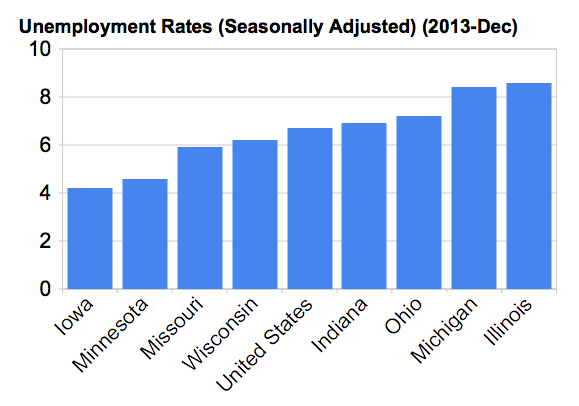
    The fiscal health of government is no doubt important. But to determine if Wisconsin is actually “thriving” you need to look at statistics that actually affect people. So let’s do that. Scott Walker took office in January 2011. So here is the percentage change in jobs in Midwest states between December 2010 and December 2013 from the Bureau of Labor Statistics:


    Wisconsin actually doesn’t rank that well in job growth during Scott Walker’s administration, barely beating fiscal basket case Illinois. The state looks better in its unemployment rate:


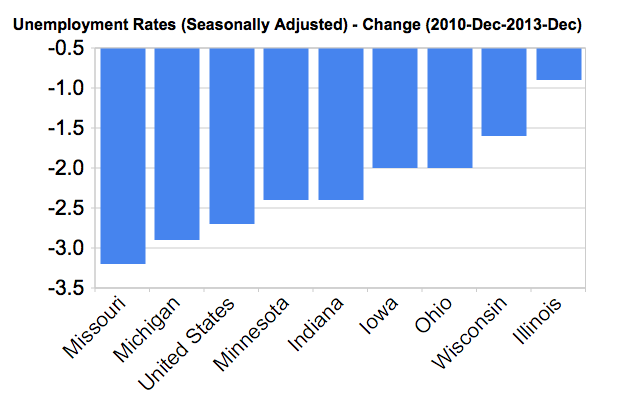
    However, in part that’s because Wisconsin’s unemployment rate was already low on a relative basis when Walker took over. It ranks near the bottom in reducing its unemployment rate, though obviously reductions are harder to come by when you’re already lower. Michigan had nowhere to go but down.


    I actually support many of Scott Walker’s reforms. Public sector unions clearly need to be reigned in or even eliminated as they are a huge barrier to rational fiscal management and effective service delivery in addition to being an inherently corrupting political force. Items like allowing unions to force localities to buy health insurance through union affiliated firms at inflated rate were clearly abusive.

    It’s also early to judge, and this is monthly data that is fairly volatile, even though it’s seasonably adjusted and with a same month comparison. There just isn’t that much other data available.

    What I object to is declaring victory when the budget is balanced. The attitude exposed by this is profoundly revealing and shows everything that’s wrong with Tea Party type thinking. It’s obvious that people claiming Wisconsin has thrived under Walker didn’t even take a cursory look at the actual economic performance of the state.

    Wisconsin balanced its budget? Big deal. You’re supposed to balance the budget. That’s just doing your job. It shows how far we’ve come that you can receive plaudits simply for meeting what should have been the baseline expectation.

    The charts above should also cause a reconsideration of the notion that government finances are the primary determinant of business climate and economic growth. There are states on both the left and right of that issue that are both thriving and struggling. Part of it is that states have limited power in the modern economy. There’s only a limited amount they can do to make things better, whereas they can definitely screw it up.

    Also, the natural condition of a participant in a marketplace is failure. The vast majority of new businesses fail. Similarly, places can fail too, and having a budget surplus can’t necessarily stave that off.

    My view is that while state governments are weak actors and there’s a risk of screwing it up, the likelihood of failure in the marketplace is high enough that government does actually have to try to do things. By all means prudent finances and a good regulatory climate need to be maintained, but if you think that’s enough to save you, you’ve got another thing coming. Now that Scott Walker has repaired the budget, what’s his actual plan moving forward to try to build actual personal and marketplace success for Wisconsin residents and businesses? That’s what will determine his actual legacy. It’s in whether he boosts the fortunes of the state’s residents over the longer term, and manages to bend the curve of progress in a positive direction over time.

    Aaron M. Renn is an independent writer on urban affairs and the founder of Telestrian, a data analysis and mapping tool. He writes at The Urbanophile, where this piece originally appeared.

    Scott Walker photo by AndyLindgren.

  • Possible Sign of Trouble for Los Angeles

    A quarter century ago, the Los Angeles-Orange County area seemed on the verge of joining the first tier of global cities. As late as 2009, the veteran journalist James Flanigan could pen a quasiserious book, “Smile Southern California: You’re the Center of the Universe,” which maintained that L.A.’s port, diversity and creativity made it the natural center of the 21st century.

    A very different impression comes from a newer report, The Los Angeles 2020 Commission, which points out that, in reality, the region “is barely treading water while the rest of the world is moving forward.” The report, which focuses on the city of Los Angeles, points to many of the problems – growing poverty, a shrinking middle class, an unbalanced city budget, an underachieving economic and educational system – that have been building for decades.

    Sadly, “the 2020” report more accurately reflects L.A.’s current situation than Flanigan’s more optimistic view. All the more remarkable – and, perhaps, ironic – is that the signatures on the report come from many of the same political figures, union leaders and political advocates who have done so much to create this very sad situation. Disappointingly, the L.A. City Council already has started making its excuses, while the report’s authors, as the Daily News’ Rick Orlov notes, have already started “softening” their sometimes-harsh assessment.

    It is difficult, for example, to take seriously a report that, on the one hand, worries over pension costs but is signed, and supported, by the likes of County Labor Federation boss Maria Elena Durazo and L.A. Department of Water and Power union head Brian D’Arcy. For the most part, the commission was made up of lawyers and others who feed off the very pattern of insider deals and misdirected investment strategies that have so humbled a great city, and region. No surprise, then, that their biggest concrete recommendations were to speed up the pouring of concrete for their various pet projects, some of which make sense, while other don’t.

    Nevertheless, the report suggests that, perhaps, at last, even the most comfortably entrenched leaders are finally waking up to the predicament they and their colleagues have helped create. What they need now is a strategy that restores to Los Angeles the global status that is a prerequisite for progress.

    Why does being a global city matter so much? In large part, it is the best way to compete in a globalizing economy where the successful cities are defined not by size or population, but by the unique services they offer the world. In an ongoing study I am directing for the Chapman University Center for Demographics and Policy, with the assistance of the Singapore Civil Service College, we identified the leading world cities. We focused on such things as financial services, industrial specialization, media and culture.

    Size doesn’t always matter

    In the business of global cities, many of the biggest urban areas – in fact, all the largest ones, excluding Tokyo – failed to make the top 30. Instead, New York and London did best, along with such Asian cities as Tokyo, Hong Kong and Singapore. Perhaps our most surprising finding was that California’s two great metropolitan areas, the San Francisco Bay Area and Los Angeles, ranked sixth and seventh, respectively.

    Why, despite all its problems, is Southern California ranked so high? This is largely a reflection of several factors – notably, a still-sizeable tech sector, a huge port and strong cultural diversity – but, most importantly, because of Hollywood. Great global cities, by our calculations, are often what can be seen as “necessary cities.” They dominate economic niches to an extent that someone from outside the region is compelled to do business there.

    Hooray for Hollywood

    This is true, for example, for finance and media in New York and London, while the Bay Area dominates tech. Similarly, Hollywood is nearly synonymous with the American entertainment industry, which is by far the largest in terms of revenue and influence in the world. Last year, the industry enjoyed a trade surplus of roughly $12 billion; film and television industry exports totaled nearly $15 billion. Every major global movie studio in the world is located in Los Angeles, which is also a key hub of the music industry.

    So dominant is Los Angeles’ entertainment industry that many countries, trying to preserve their own cultural industries, have placed strict quotas on the number of English-language films that can be shown and songs that can be played on the radio. Los Angeles-Orange County once also enjoyed a dominant position in aerospace, but this industry has dramatically faltered, as the sector shrank by some 240,000 jobs as companies moved elsewhere, taking with them much of the region’s technical talent.

    The port of Los Angeles, another economic linchpin, remains somewhat dominant but the trade sector faces growing competition and suffers from the kind of institutional malaise that affects so much of business here. The region retains a foothold in the auto sector as the U.S. base for some Asian makers. Even here, however, there are clouds, as Nissan relocated to Nashville, Tenn., and Honda moved top executives to Ohio in order to be nearer to its manufacturing. More promising, the new Hyundai U.S. headquarters in Fountain Valley signals that global carmakers still see L.A.-Orange County as a “necessary” place.

    The region has held on to a leading, if somewhat smaller, share of entertainment, but L.A.’s other traditional industrial strengths, such as aerospace and defense, have badly eroded. One bright spot is technology. Somewhat surprisingly, the Startup Genome project ranked Los Angeles as having the second-strongest startup ecosystem in the United States. Yet, overall, L.A. has been losing ground in terms of employment, technology employment and net migration to other ascendant regions.

    Tech titans

    Perhaps the most critical factor affecting L.A.’s global status revolves around technology. It was shocking to me, at least, with L.A.’s focus on global ties, that the Bay Area has now slightly nosed out Southern California in our study’s rankings, largely due to that region’s technological preeminence. The region hosts the largest concentration of cutting-edge tech firms in the world. This fact alone allows the Bay Area to play a profound role in how globalization works, notes analyst Aaron Renn (www.urbanophile.com), particularly since innovations coming from that region arguably are a more primal enabler than advanced producer services. Indeed, according to one study, three Bay Area counties – San Francisco, San Mateo and Santa Clara – rank as the top three for concentration of tech jobs, and are among the leaders in growth.

    More serious still, Silicon Valley’s technological push is threatening to upend the structure of Hollywood and media. Over the past decade, Internet and software publishing, which are heavily centered in the Bay Area, have added close to 100,000 new jobs, while traditional media – based largely in New York and Los Angeles – have lost almost three times as many jobs.

    Google and Yahoo already are ranked among the largest media companies in the world. (Yahoo refers to itself as a digital media, rather than a technology, company.) Apple now has a great deal of control over consumer distribution of entertainment products like music and video. The entrance of Netflix, and other tech firms, into the television production business could further undermine L.A.’s entertainment dominance. To the new-tech oligarchs, older industries are prisoners to what one venture capitalist derisively called “the paper economy,” soon to be swept aside by the rising digital aristocracy.

    These issues, and challenges, are what the 2020 Commission people should be addressing in their search for solutions to the L.A. region’s relative decline. As our research indicates, Los Angeles-Orange County remains a major world city, but its upward trajectory is threatened by changes in technology and the rise of other regions in the U.S. and abroad. Now that members of the L.A. establishment have acknowledged “the truth,” perhaps it’s time for them to come up with ideas that can make the truth more pleasant.

    This story originally appeared at The Orange County Register.

    Joel Kotkin is executive editor of NewGeography.com and Distinguished Presidential Fellow in Urban Futures at Chapman University, and a member of the editorial board of the Orange County Register. He is author of The City: A Global History and The Next Hundred Million: America in 2050. His most recent study, The Rise of Postfamilialism, has been widely discussed and distributed internationally. He lives in Los Angeles, CA.

    Photograph: Downtown Los Angeles from Echo Park (by Wendell Cox)

  • How a Few Monster Tech Firms are Taking Over Everything from Media to Space Travel and What it Means for the Rest of Us

    The iconic view of tech companies almost invariably stress their roots in people’s garages, plucky individual entrepreneurs ready to challenge all comers. Yet increasingly the leading tech firms – Amazon, Apple, Facebook, Amazon and especially Google – have morphed into vast tech conglomerates, with hands in ever more numerous, and sometimes not obvious, fields of endeavor.

    Ironically, the very entrepreneurial form that defeated Japan’s bid for global technological dominance is morphing into an American version of the famed keiretsu that have long dominated the Japanese economy. The keiretsu,epitomized by such sprawling groups as Mitsubishi, Sumitomo and even Toyota, spread across a vast field of activities, leveraging their access to finance as a means to expand into an ever-increasing number of fields. The can best be understood, notes veteran Japan-based journalist Karel van Wolferen, as a series of “intertwined hierarchies.”

    Increasingly, American technology is dominated by a handful of companies allied to a small but powerful group of investors and serial entrepreneurs. These firms and individuals certainly compete but largely only with other members of their elite club. And while top executives and investors move from one firm to another, the big companies have constrained competition for those below the executive tier with gentleman’s agreements not to recruit each other’s top employees.

    At the top of the American keiretsu system stands a remarkably small group whose fortunes depend in part on monetizing invasions of privacy to use the Internet as a vehicle for advertising. These are not warm and cuddly competitors. Both Google and Microsoft have been accused of using anti-competitive practices to keep out rivals, in part by refusing to license technology acquiring of potential competitors.

    “Tech is something like the new Wall Street,” notes economist Umair Haque,“Mostly white mostly dudes getting rich by making stuff of limited social purpose and impact.”  

    Like their soul brothers on Wall Street , America’s elite tech firms – and their owners – have become fantastically cash rich.  Besides GE, a classic conglomerate, the largest cash hordes now belong to Apple, Microsoft, Cisco, Oracle and Google, all of whom sometimes have more dollars on hand than the US government.  Seven of the eight biggest individual winners from stock gains in 2013 were tech entrepreneurs, led by Jeff Bezos who added $12 billion to his paper wealth, Mark Zuckerberg who ranked in an additional $11.9 billion while Google founders, Sergey Brin and Larry Page, had their wallets expanded by roughly $9 billion.

    This wealth reflects in large part the oligopolistic nature of many key tech sectors, for example, the Apple-Google duopoly on mobile phone software, Microsoft’s dominant position in operating systems for PCs, Google’s utter control of search, and Facebook’s domination of social media. In most cases, these fields are controlled at levels of eighty percent or more.    

    America’s new gilded age giants are similar to Japan’s keiretsu but they also share a lineage with the early 20th Century trusts that controlled railroads, cotton, silver and other commodities. Those early fortunes helped provide the foundation for such banking firms as J.P. Morgan, Goldman Sachs, Oppenheimer, and Lehman Brothers, as well as the basis for the Rockefeller and Hearst empires. Their wealth, in the era before income taxes, was immense; by the 1880s the revenues of Cornelius Vanderbilt’s railroad empire were greater than those of the federal government.

    The control of immense resources by a small group of tech firms, like the oligopolies of the earlier industrial magnates, produces a steady cash-flow them to look further afield for new opportunities and expand into potentially huge new markets. But even more importantly, it gives them the opportunity to fail and still live to acquire another day.

    Google’s recent sale of Motorola’s mobile division, at a paper loss of nearly $10 billion, would have led to bankruptcy head-rolling at many firms but for Google it hardly left a scratch. A $10 billion failure barely threaten a company whose last quarterly revenues neared $17 billion, has cash on hand of over $56.5 billion and whose market cap is now nearly $380 billion.

    Indeed, if any of the tech powers on track to become a full-fledged keiretsu, it’s likely to be Google. Over the past year the company has ventured into a host of fields, such as robotics, energy, mapping, and driverless cars – fields that have great potential but are only tangentially related to their core business. The recentacquisition of Nest, a company founded by Apple alum Tony Fadell , brings Google into the “smart home” marketplace, part of the so-called “internet of things”. This gives these firms a new capacity to harvest ever greater information hauls from your once “dumb,” but at least private, household appliances.

    These investments and cross-industry ties are changing firms like Google in fundamental ways.  As industry veteran Michael Mace observes, Google has stopped being a “unified product company” and is turning instead into what he calls “a post-modern conglomerate.” Its goal, he notes, is no longer to dominate search, or even the internet, but to invest, and hopefully, control anything that uses information technology, including everything from logistics and medical devices to the most mundane household devices.

    By investing widely and eating up developing markets, the “the Gang of Four” internet companies—Microsoft, Apple, Facebook and Google—have two key advantages: almost unlimited capital resources, and tech expertise and credibility. Allied with venture firms, and a vast reservoir of technical experts, the tech oligarchies, for example, already  dominate such promising fields robotics, with Silicon Valley home to half of all venture invested in the field, over 70 percent of employees, and a whopping 90 percent of market cap.  

    Others are turning to space, a field once dominated by NASA, once a key contractor for the Valley. Headquartered in the old aerospace center of Los Angeles, Space X, the largest of the space startups, was founded by billionaire Elon Musk, who previously founded PayPal and Tesla. By 2013, Space’s X’s total employment, including contractors, topped 3800.

    Musk is not alone in the space game. Amazon CEO Jeff Bezos founded his own private space exploration company, Blue Origin, which has launched two vehicles into space, Charon and Goddard. It intends to build orbital space stations, and serves as a contractor for NASA. Like the nascent space industry’s third new player, Richard Branson’s ‘Virgin Galactic,’ these firms are all the pet projects of billionaires fascinated by space. If NASA continues to retreat from many areas of space exploration, it is likely that in the future the heavens too may end up belonging to the oligarchs.

    The Media power-shift

    A Google or Amazon space-ship may still be in the distant future, but we can already see the impact of the new keiretsu on information and culture. In the past, more hardware-oriented companies provided the “pipelines” through which traditional media disseminated their product. But increasingly, it’s the tech oligarchs who control the news and information industry.

    Google, by some estimates, already enjoys more advertising revenues than either the newspaper or magazine industry. And they’re positioned to take over the the hardware side by supplanting the traditional telecommunications companies with their own series of global pipelines.

    This big tech takeover also previews a geographic shift from traditional centers of power like New York and Los Angeles to the new seats of influence, most notably Silicon Valley, San Francisco and the Puget Sound area.

    The transitions of power and influence have come at heavy costs. 

    As the new software-based media expanded over the last decade, massive losses have pummeled newspapers, music, book and magazine publishing Since 200. The paper publishing industry, traditionally concentrated in the New York area, has lost some 250,000 jobs, while internet publishing and portals generated some 70,000 new positions, many in the Bay Area or Seattle.

    To the new oligarchs, the old media are just part of what one venture capitalist derisively called “the paper economy” destined to be swept away by the new digital aristocracy. As relatively young people who have already amassed fortunes, the tech giants have the time to disseminate their views to the public, both the mass and the influential higher echelons. Another $200 million new venture with a mission to support largely left of center investigative reporting, is being backed by eBay founder Pierre Omidyar.

    Buying up prestigious media outlets, an old tactic for consolidating influence that was previously used by gilded age moguls like William Randolph Hearst, has surfaced among the new tech giants, exemplified in the recent purchase of the venerable New Republic by Facebook co-founder, and Obama tech guru, Chris Hughes, who is reportedly worth $850 million.

    But perhaps more critical than buying old outlets will be the growth of their own oligarch controlled news media. Yahoo is now the #1 news sites in the U.S. with 110,000,000 monthly viewers, and Google News isn’t far behind at #4 with 65,000,000 users. The Valleyites are also moving into the culture business with both YouTube (owned by Google) and Netflix now creating original entertainment content.

    The tech firms control over media is likely to become even more pervasive as the millennial generation grows and the older cohorts begin to die off. Among those over 50 only 15 percent, according to a Pew report get their news over the internet; among those under 30, the number rises to 65 percent.   

    Impact on Innovation

    Is this concentration of tech power a good thing? To some extent, the country benefits from having a Google, Amazon, Microsoft or Apple at the forefront of such fields as healthcare, robotics and space. They possess the resources and the technical know-how to develop and market new product lines that smaller, more specialized start-ups might lack.

    Indeed the shift of resources from social media and advertising to robotics or space travel has to be considered a basically positive development. Unlike the social media revolution, which appears to have done relatively little to benefit the overall economy, the developments in space travel or driverless cars, may provide advantages that are more widely shared.

    Yet, there is also a major problem with over-rich and over-confident oligopolies. It’s a lesson demonstrated by Japan’s arc over the past two decades and in the story of the big three US automakers and their era of domination – both examples show how concentration of power can stifle innovation and positive growth. Already some economists see a slowing in the pace of technical breakthroughs. In the 1980s personal computer boom, scores of companies competing across a broad array of tech sectors resulted in few long-term winners but a rapid evolution of technology. In contrast, it is not easy to argue that Google’s search function or Microsoft’s code are any better today than they were three or even five years ago.

    As the tech firms move further from their entrepreneurial roots, one critic notes,many take on “a timid, bureaucratic spirit” that responds to the needs of investors and focuses on preserving already established business lines.

    Would we be better off with say, a garage-bound Steve Jobs developing the software for robotics, rather than having development managed in a corporate structure that answers the demands of Wall Street analysts? Trusting a small, often closely knit group of investors, to oversee critical industries of the future, does not seem to be the best strategy to maintain and deepen our technological lead.

    Digital innovation should be spurring the creation of new competitive companies. Yet,  instead it is fostering an American version of the Japanese keiretsu, where firms like Amazon, Google, Apple and Microsoft try to use their unfathomable riches to dominate the entire technological future. This is not a step forward but one that can limit Americans’ ability to renew the entrepreneurial genius at the heart of our national character.

    This story originally appeared at The Daily Beast.

    Joel Kotkin is executive editor of NewGeography.com and Distinguished Presidential Fellow in Urban Futures at Chapman University, and a member of the editorial board of the Orange County Register. He is author of The City: A Global History and The Next Hundred Million: America in 2050. His most recent study, The Rise of Postfamilialism, has been widely discussed and distributed internationally. He lives in Los Angeles, CA.

    Facebook photo by BigStockPhoto.com.

  • America’s Glass Half-empty, or Half-full?

    The stock market is high, real estate prices have resurged, even the unemployment rate is dropping, yet Americans still feel pretty down about the future. A survey released in January by the AP-NORC Center for Public Affairs Research had 54 percent of respondents expecting American life to go downhill over the coming decades. In a December survey, 23 percent of respondents said things will improve over time.

    Yet, in reality, there are several huge trends – economic, environmental, demographic – working in favor of the United States. Despite 13 straight years of underwhelming leadership, the U.S. can emerge extraordinarily blessed from the Great Recession and lackluster recovery, if Americans take advantage of our current situation.

    Why, then, so glum? One explanation clearly is the shape of the economic recovery, which, due in part to Federal Reserve monetary policy, has favored the rich by primarily promoting stock market and other asset growth. “Qualitative easing,” notes one former high-level Fed official, essentially constituted a “too big to fail” windfall for the largest Wall Street firms. Executives at these same firms set new compensation records in 2011, just three years after the financial “wizards” left the world economy on the brink of economic catastrophe.

    As people on Wall Street, and their hipper counterparts in Silicon Valley, celebrate their good fortune, most people are not doing well, and they know it. Unemployment may have dropped officially, but the percentage of Americans in the workforce is now at the lowest level since December 1977. Huge parts of our society now face long-term unemployment or, at best, a marginal existence at the low end of the job market.

    This trend is most disturbing because it has been going on for a long time and, generally, has been getting worse. Since 1973, for example, the rate of growth of the “typical family’s income” in the United States has slowed dramatically; for males, it has actually gone backward when adjusted for inflation, at least until the early 1980s. In contrast, in 2012, the top 1 percent of earners accounted for one-quarter of all American income, the highest percentage in the past century.

    So, given these problems, why should anyone be optimistic? After all, by 2020, the CIA suggested in 2005, the U.S. world position will have eroded because of the rise, most notably, of India and China; many business leaders share this assessment.

    Nevertheless, here are five reasons for optimism.

    Everyone else is in worse shape

    Looking for a global hot spot that’s doing better? Look again. Virtually all America’s much-vaunted competitors of yesterday – notably, Japan and the European Union – have suffered slow economic and demographic growth. The much-ballyhooed winner of tomorrow, China, also appears to be slowing. Political corruption, soaring local debt and massive levels of pollution are creating a crisis of confidence, reflected by the growing exodus of the educated and affluent from China and Hong Kong , with many ending up in the United States.

    The other members of the so-called BRIC countries – a term coined by one of the geniuses at Goldman Sachs – also are stagnating. Brazil’s successful bids to host the 2016 Summer Olympics and this summer’s soccer World Cup have made ever more obvious the country’s massive poverty and political incompetence, made all the worse by a slowing economy. India, too, is experiencing weak growth and increased political instability. Russia’s uncrowned czar, Vladimir Putin, may be outmaneuvering our gullible, indecisive president but the country Putin controls is going nowhere, with the population stagnating and its weakening economy utterly dependent on extractive resources. Turkey, another favorite of the investment banks, is also showing signs of distress and instability.

    Energy revolution

    Barack Obama has tried to take credit for America’s huge shift toward self-sufficiency in oil and gas, a movement driven largely by wildcatters and independents. Of course, it would have never happened if he had his druthers; under his administration, energy production on federal lands has dropped steadily. Nevertheless, the president seems smart enough not to shut off this amazing development on private and state lands, despite incessant pressure from his environmentalist supporters.

    The energy revolution, notably in natural gas, changes everything. It allows us to tell many of the world’s leading malefactors – Russia, Venezuela, Iran and Saudi Arabia – to keep their oil. It also is driving continued improvement in air quality and reduced levels of greenhouse gases. American natural gas, rapidly replacing coal as an energy source, has turned this country into what one green think tank, the Breakthrough Institute, called “the global climate leader.” We are lowering our emissions far more rapidly than are the Europeans, people widely praised by some U.S. greens for having superior policies.

    Manufacturing resurgence

    For all the concern expressed about the “end of the car era,” the U.S. auto industry is doing pretty well, in fact, selling vehicles at about the levels experienced before the Great Recession. General Motors, nearly dead five years ago, is now investing $1.3 billion to upgrade five Midwest factories. New auto plants, particularly those of European and Asian carmakers, are being erected across the South. But the resurgence of U.S. manufacturing is about more than cars; there also is huge investment in other industries, notably in pharmaceuticals and refining, notably tied to the energy revolution.

    Critically, the vast supplies of oil and, most importantly, natural gas, are pushing down manufacturing costs well below those imposed on Asian and European firms. This is where industrial jobs have been growing the fastest, and are likely to expand in years ahead. In fact, U.S. industrial and energy production has driven U.S. exports to a record level, one clear sign that the nation’s competitiveness is beginning to move beyond our traditional strengths in entertainment, services and agriculture.

    Demographic advantages

    As in other countries, The U.S. birth rate fell during the recession, but this decline has now stopped as the economy has crawled back. Over the past decade, the U.S., through somewhat high birth rates and immigration, has avoided the kind of demographic implosions that afflict most of our key competitors. In the next few decades, the working population of Americans is expected to grow substantially, while those in Japan, Korea, Europe and China all taper off.

    America’s relative youth helps not only fiscally – with more young people to carry the burden of a swelling retiree population – but also culturally. Despite the rise of entertainment and media in other countries (for example, Bollywood films or Korean pop music), the domination of new culture remains overwhelmingly American. Critically, this applies not only to Hollywood but even more so to digital media, where U.S. domination is both overwhelming and terrifying our competitors, particularly the autocrats in Moscow and Beijing.

    Blessings of federalism

    Perhaps America’s greatest strength lies in its constitutional order. Unlike other countries, the U.S. was defined by a separation of powers that accommodates regional differences. The calls from Washington by both Left and Right for more national solutions is misplaced; whether used to promote conservative or liberal policies, one size does not fit nearly all in a country as diverse and differentiated as the United States.

    Instead, we need to let our states and regions seek out the approaches that work best for them. If Ohio and Pennsylvania allow fracking, and it creates significantly better results than those in anti-fossil-fuel states like New York and California, that would send a message to other states, but does not have to reflect a national policy.

    America’s regions have enormous assets and advantages in the global economy. If we allow them to exploit what they have, there may be more hope for the future than many now believe.

    This story originally appeared at The Orange County Register.

    Joel Kotkin is executive editor of NewGeography.com and Distinguished Presidential Fellow in Urban Futures at Chapman University, and a member of the editorial board of the Orange County Register. He is author of The City: A Global History and The Next Hundred Million: America in 2050. His most recent study, The Rise of Postfamilialism, has been widely discussed and distributed internationally. He lives in Los Angeles, CA.

    USA map image by BigStockPhoto.

  • Blue-Collar Hot Spots: The Cities Creating The Most High-Paying Working-Class Jobs

    It’s a common notion nowadays that American blue-collar workers are doomed to live out their lives on the low-paid margins of the economy. They’ve been described as “bitter,” psychologically scarred and even an “endangered species.”  Americans, noted one economist, suffered a “recession” but those with blue collars endured a “depression.”

    Yet in recent years, according to research by Mark Schill of the Praxis Strategy Group, there’s been a strong revival in higher-paid blue-collar industries in many of our largest metropolitan areas, and the momentum is, if anything, building. Schill analyzed employment changes from 2007 to 2013  among a group of higher-paying blue-collar industries: oil and gas and mining; construction; manufacturing; and wholesale trade, transportation, warehousing and waste handling. Compensation in these sectors average $58,000 a year; in oil and gas, pay tops $100,000. In any case, these fields pay far better than alternative sources of employment for people without college degrees, such as retailing ($27,500), food service ($16,000), hospitality, or the arts ($31,000). Nationally, this cross section of higher-value blue-collar industries employs 31.3 million people, just more than a fifth of the nation’s workforce, up 1.3 million jobs since 2010.

    This blue-collar resurgence seems likely to be  more than a merely cyclical phenomenon. The U.S. edge in energy and manufacturing, increasingly linked, has sparked major new investments by both domestic and foreign producers. The new energy finds have created employment in the construction and operation of such things as pipelines and refineries, and have also led manufacturers to plan new factories here due to electricity and feedstock costs that are now well below those in Europe or East Asia.

    The Boston Consulting Group suggests other factors sparking this revival. This includes  rising wages in China as well as sometimes unpredictable business conditions that are leading some large U.S. companies to move some production to America from China.

    Overall, since 2010 the number of high-value manufacturing jobs is up 167,000 in the 52 largest metropolitan areas while energy extraction added 50,000 positions. (Heavily subsidized renewables enjoyed a much smaller increase.) The wholesale trade and material handling sectors have added almost 300,000 jobs in  that time. And as the economy has recovered somewhat, demand for housing, including in some once distressed exurban areas, has sparked a nascent revival in higher-paying construction employment. This key blue-collar sector, devastated by the recession, has gained roughly 200,000 jobs since 2010.

    This revival is not evenly spread. The big winner is the Houston metro area, in large part due to the energy industry, which has added 23,000 jobs since 2010. It also reflects local growth in the high-wage manufacturing (up 30,000 jobs) and trade and transport sectors (up 26,000), while construction employment has surged nearly 20,000, a number matched only by the much larger New York metro area. Houston tops our list of the cities creating the most good blue-collar jobs. (Our ranking is based 50-50 on growth from 2007-13 and 2010-13.) Not far behind in second place is Oklahoma City, which has clocked a similarly broad increase, led by 28% growth in energy employment, 6% in construction and 15% in manufacturing.

    Many of the other metro areas in our top 10 fit the same mold — traditionally business-friendly Sun Belt locales with strong energy sectors, and expanding manufacturing.

    A Surge In The West

    The Intermountain West also continues to create manufacturing and trade jobs at a rapid rate. This region’s blue-collar star is Salt Lake City, which places seventh on our list, led by a strong expansion in energy sector employment and trade and transport, with decent growth in manufacturing.

    It’s not merely a “red state” phenomena. Progressive-dominated Denver places 11th on our list, with 32% growth in energy jobs as well as a 10% increase in construction employment. Similarly Portland (9th) and Seattle (10th) have produced more opportunities for blue-collar workers. This has been paced largely by strong growth in manufacturing, aided by low energy costs from hydro. Intel INTC +0.2% is building a large new factory near Portland, while Boeing BA -2.5% has continued to add jobs in the Seattle area – its headcount in Washington State is up 17% since 2010. Construction has also been healthy, in part due to migration from more expensive California, as well as trade, which ties into the region’s close ties to the Pacific Rim.

    In contrast the “big enchilada” economies of California have lagged, and overall employment in high-paying blue collar sectors remains well below 2007 levels. But since 2010, there has been a modest uptick in manufacturing and construction in San Jose/Silicon Valley, which ranks 13th on our list, while San Francisco (16th) has seen some recovery in the transportation and trade sectors.

    The Revival Of The Rust Belt

    No part of the country is more associated with high-paid blue-collar work, and its decline, than the Rust Belt. Employment in most Rust Belt cities is well below 2007 levels, but since 2010 there has been a resurgence in high-paying manufacturing industries, led by the third-ranked Detroit area, which added 37,000 jobs.

    This is clearly tied to the recovery of the U.S. auto industry. The East and West Coast media love to yammer about the demise of the car, but the industry’s production has returned to 2007 levels and automakers are investing in the region. GM has committed to spend over $1.3 billion to upgrade five factories in Ohio, Indiana, Detroit and the nearby Michigan cities of Flint and Romulus.

    It’s more than an autos story in the region. Grand Rapids, which has a highly diverse manufacturing sector, including many furniture companies,  has increased industrial employment 16% since 2010, putting it fourth on our list. Other Rust Belt metro areas making a blue-collar comeback  are Louisville, Ky. (12th), Minneapolis (15th), Columbus, Ohio (18th), and Pittsburgh (19th).

    The Laggards

    Some metro areas have continued to lose high-wage blue-collar jobs, led by Las Vegas (down 4.2% since 2010), Orlando (-13.6% since 2007), Providence, Rochester and Philadelphia. Our two largest industrial metro areas, Chicago and Los Angeles, have seen slow growth, ranking 25th and 28th, respectively. Rapidly de-industrializing New York ranks 35th, despite the metro area’s surge in construction employment.

    Yet overall, demand is rising for highly skilled workers at U.S. industrial and energy companies.

    At a time when the wages of college graduates have been falling, it might behoove more young people to realize that, in many cases, a degree in art is not worth as much as a certificate for machining, welding, plant management or plumbing. Some metro areas are bolstering their efforts in this area, notably New Orleans, Columbus, Nashville and even creative class-oriented Portland.

    To be sure, the golden days for working-class employment are over, but the future may prove to be a lot less dismal, particularly in some regions, than generally proclaimed by those who have rarely seen in the inside of factory or a refinery.

    Blue Collar Industry Growth Index
    Rank Region (MSA) Score Growth, 2010-2013 Growth, 2007-2013 2013 Avg Earnings Concentration, 2013
    1 Houston 97.3 12.6% 6.6% $102,726 1.41
    2 Oklahoma City 95.2 12.6% 4.4% $68,526 1.00
    3 Detroit 80.5 13.5% -12.3% $80,964 1.10
    4 Grand Rapids 80.2 11.3% -6.5% $66,157 1.30
    5 Nashville 80.1 12.1% -8.7% $64,217 1.01
    6 Austin 78.6 10.0% -4.7% $84,780 0.88
    7 Salt Lake City 71.7 8.3% -6.5% $67,794 1.09
    8 Dallas 70.3 7.2% -5.2% $79,645 1.15
    9 Portland 68.8 8.4% -9.7% $78,439 1.13
    10 Seattle 66.7 7.6% -9.5% $84,921 1.06
    11 Denver 66.1 6.9% -8.3% $77,652 0.94
    12 Louisville 64.4 6.3% -8.3% $66,783 1.26
    13 San Jose 62.2 5.4% -8.1% $148,369 1.20
    14 Charlotte 61.7 7.2% -13.5% $67,555 1.05
    15 Minneapolis 61.4 6.0% -10.2% $80,834 0.99
    16 San Francisco 60.2 6.3% -12.3% $96,017 0.82
    17 San Antonio 60.1 3.8% -5.7% $57,763 0.80
    18 Columbus 59.7 5.9% -11.7% $67,612 0.91
    19 Pittsburgh 59.0 4.0% -7.4% $70,676 0.96
    20 Phoenix 58.5 8.7% -20.3% $73,253 0.95
    21 Birmingham 57.4 5.6% -13.2% $68,810 1.08
    22 Milwaukee 54.5 4.1% -11.9% $74,417 1.18
    23 Virginia Beach 53.8 3.4% -10.9% $64,353 0.79
    24 Indianapolis 52.2 2.7% -10.5% $72,993 1.13
    25 Chicago 51.8 3.6% -13.3% $81,077 1.06
    26 Kansas City 51.4 2.7% -11.3% $67,777 0.98
    27 Baltimore 51.3 2.6% -11.1% $75,899 0.77
    28 Los Angeles 51.1 3.5% -13.8% $73,019 0.98
    29 New Orleans 50.4 1.0% -7.7% $78,854 1.06
    30 Raleigh 50.1 3.9% -15.8% $71,675 0.83
    31 Memphis 49.9 2.0% -10.8% $74,353 1.24
    32 Boston 49.1 1.9% -11.3% $91,328 0.78
    33 Miami 49.0 4.5% -18.3% $60,559 0.82
    34 San Diego 47.7 2.7% -14.6% $79,572 0.77
    35 New York 47.5 1.5% -11.7% $83,900 0.73
    36 Atlanta 47.4 2.6% -14.9% $73,156 1.01
    37 Cincinnati 47.1 1.8% -13.0% $71,311 1.12
    38 Tampa 46.9 4.5% -20.4% $60,296 0.76
    39 Buffalo 46.3 1.3% -12.4% $68,672 0.90
    40 St. Louis 46.1 2.5% -15.8% $72,353 0.96
    41 Hartford 44.5 0.6% -12.3% $82,968 0.96
    42 Richmond 44.4 2.4% -17.1% $66,079 0.85
    43 Riverside 44.4 4.0% -21.6% $56,220 1.06
    44 Cleveland 43.9 1.7% -15.7% $70,419 1.09
    45 Jacksonville 38.7 2.0% -21.6% $64,006 0.85
    46 Sacramento 37.9 2.3% -23.2% $68,535 0.69
    47 Washington 37.5 -0.4% -16.2% $75,597 0.50
    48 Philadelphia 37.2 -1.1% -14.7% $81,843 0.83
    49 Rochester 35.1 -1.6% -15.3% $70,776 0.96
    50 Providence 32.8 -1.2% -18.6% $68,235 0.91
    51 Orlando 31.7 0.3% -23.7% $60,493 0.70
    52 Las Vegas 1.0 -4.2% -41.1% $66,445 0.60

    Data source: QCEW Employees, Non-QCEW Employees & Self-Employed – EMSI 2013.4 Class of Worker. Analysis by Mark Schill, Praxis Strategy Group, mark@praxissg.com. The analysis covers 37 "blue collar" industry sectors at the 3-digit NAICS classification level, each averaging at least $40,000 in average annual pay (including benefits). Industries include oil and gas extraction, utilities, heavy and specialty construction, most manufacturing, merchant wholesale industries, most transportation sectors, warehousing and storage, and waste management.

    This story originally appeared at Forbes.com.

    Joel Kotkin is executive editor of NewGeography.com and Distinguished Presidential Fellow in Urban Futures at Chapman University, and a member of the editorial board of the Orange County Register. He is author of The City: A Global History and The Next Hundred Million: America in 2050. His most recent study, The Rise of Postfamilialism, has been widely discussed and distributed internationally. He lives in Los Angeles, CA.

    Auto manufacturing photo by BigStockPhoto.com.

  • Rich, Poor, and Unequal Zip Codes

    Income inequality is an increasingly dominant theme in American culture and politics. Data from the IRS covering mean and median income of filing households for 2012 by zipcode allow us to map and interpret the fascinating geography of income differences. Where are the richest areas, the poorest and the most unequal?

    The IRS data do not give us the distributions of incomes, so this report does not tell us where the largest numbers of rich or poor populations will be found; this can be done from the American Community Survey for large enough units of geography. With the IRS data, the median is the income of the household halfway between poorest to richest after all are ranked by income. The mean, or average income, is the aggregate income of all households divided by the number of households filing a return. 

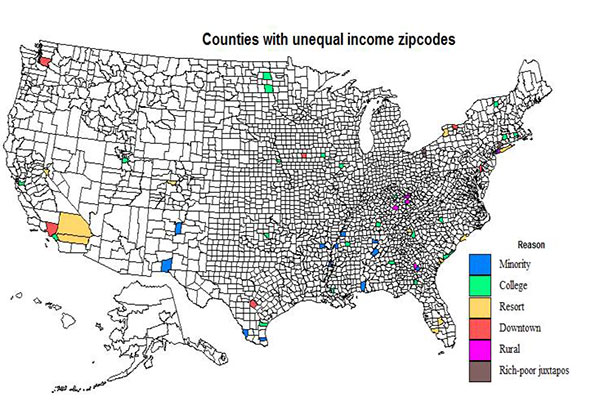
    Most of the over 44,000 US zip codes have a sufficient mix of lower to higher income households that they do not stand out as extremely rich or poor. Even many zips with very low mean or median incomes are not so extreme since most of the poor population actually lives in more mixed income areas. Very unequal areas are defined here as having a far higher mean than median income, indicating an imbalance of incomes, e.g. a few very high income households inflate the average over the more typical, median income.

    The Richest Zip Codes

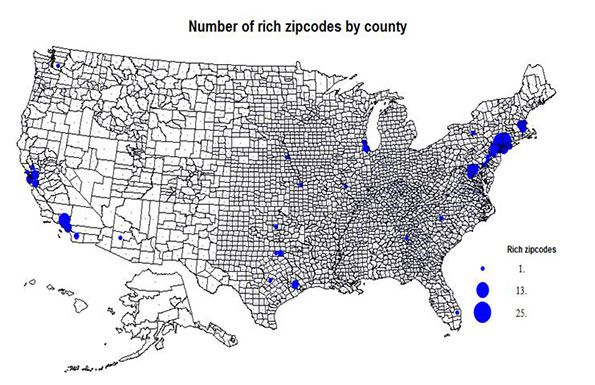
    Figure 1 maps the 170 zip codes with more than 1000 people and median incomes over $150,000 or mean incomes over $200,000. The most astounding thing about the map (which shows the number of rich zip codes by the county they are part of) is their  concentration  in a few areas, led by the country’s premier global city, greater New York city, with 75 of the 170. New York is followed by Washington DC with 23, another sign of the growing wealth of the national capital.  Boston follows with 10, Los Angeles, 18, San Francisco (14), and Chicago (6) and then a scattering in other leading metropolitan areas. There is no such concentration of the super-rich in any rural or small town area. But many are quasi-rural suburban and exurban.

    Richest Zip Codes
    State County Place Zipcode Mean (thousands)
    NY Westchester Purchase 10577 363
    NY Nassau Westbury 11568 351
    IL Cook Kenilworth 60043 342
    NY Westchester Pound Ridge 10576 338
    CA San Mateo Atherton 94027 337
    PA Montgomery Gladwyne 19035 333
    CA Los Angeles Bel Air 90077 327
    NJ Essex Short Hills 07078 322
    NY Nassau Glen Head 11548 316
    CT Fairfield Weston 06883 286
    CT Fairfield New Canaan 06840 308
    IL Cook Glencoe 60022 297


    But, the reader will protest, there are huge numbers of rich folk in Texas, Florida, Ohio, Pennsylvania, and other states. The reason is that these many rich households are “diluted” in impact because the zip codes are more variable in income. There really is something remarkable about the overwhelming affluence of the key suburban areas of Westchester and Nassau, New York; Fairfield, CT; Fairfax, VA; and Howard and Montgomery, MD. But I believe the map is telling and accurate at highlighting the utter dominance of the economic power of New York and then Washington. Boston retains power beyond its size, while Los Angeles, Chicago, San Francisco, and upstarts in the South scramble for a place.

    The Richest Areas

    The zip code with the highest and the 4th highest incomes are in Westchester County, close to the Connecticut border. The second richest, Westbury, is in Nassau county, New York, which also has the 9th richest. Also in the NYC suburbs are the 8th, in New Jersey just 20 miles west of New York, while 10th and 11th richest are both located  in Fairfield County, CT.

    Chicago’s north Cook county has the 3rd (Kenilworth) and 12th (Glencoe) richest areas.  Los Angeles is home to the 7th richest, Bel Air (northwest of Beverly Hills), Atherton, in San Mateo county, is the 5th richest, and Gladwyne in Montgomery County, PA is the 6th richest.  Greater New York then is home to 7 of the 12 richest, followed by Chicago with 2.  Quite a concentration. 

    The Poorest Zip Codes

    The list and map (Figure 2) of counties with poor zip codes may surprise the reader more. I divide the 94 poorest areas into five types:

    • minority population domination, 35 areas,
    • college or university student majorities, with 25 places,
    • rural (in the sense of small communities in these counties having been left behind or declined) some 25 areas,
    • five inner city areas dominated by single men, 5, and
    • two areas dominated by a large military base.

    The poor college areas are zip codes for student dormitory housing, people who are temporarily poor; some military base areas are similarly poor because of barrack housing of single people.

    The poorest minority dominated areas are mainly Black and in the rural to small city South, except for a few Hispanic dominated areas in the west. The college poor areas are scattered across the country, especially in the East, the military base communities in Texas and Oklahoma. The rural set is surprisingly concentrated mainly in the north, especially in Michigan. The few inner city poor areas are in Los Angeles, Waterbury, CT: Portland, OR; Youngstown and Canton, OH; an odd set. A few of the rural areas also have correctional institutions.

    Poorest Zip Codes
    State County Place Zipcode Median
    NE Douglas Omaha 68178 $2,499
    KY Elliott Burke 41171 $3,494
    GA Clinch Cogdell 31634 $3,886
    FL Gulf Wawahitchka 32465 $4,481
    CT Tolland Storrs 06269 $6,124
    WI Dane Madison 53706 $6,359
    VA Nottoway Blackstone 23824 $6,421
    MI Clare LeRoy 49665 $6,639
    TN Rutherford Murfreesboro 37132 $7,125
    IN Delaware Muncie 47306 $6,750
    NY Cattaraugus Salamanca 14779 $7,395


    If I had relaxed limit by including more smaller population areas, or not quite such low incomes, many more college, military base, minority majority counties would appear on the map. But as noted up front, virtually none of these poorest zip codes are in big cities or their metropolitan areas, where millions of poor households live, simply because these metro zip codes tend to be large and more heterogeneous. This also does not factor in the cost of living, which can be high in some regions, particularly on the east and west coasts.

    The Poorest Areas

    The 12 poorest zip codes are different and quite varied in character. Five of the zip codes are essentially college or university student housing, and thus not indicative of an adult working population. Three areas are in part poor because of the presence of correctional institutions or adult care institutions. Two of these also have a significant minority (Black) population. Two rural areas, in GA and VA have high Black shares. This leaves two northern rural areas in Michigan (high seasonal dependency) and in New York, Salamanca, also a seasonal resort, as well as an Indian reservation.

    Unequal Zip Code

    The unequal zip codes (67) are mainly areas where the mean is at least twice the median, showing the disproportionate effect of a few very wealthy households. One critical area for high inequality are primarily beach or mountain communities with richer retirees serviced by lower-paid workers; these include 13 areas in California, South Carolina, Florida, New York, Nevada, North Carolina, and Colorado. Downtowns (8 areas) include a few actual downtown CBD zip codes with an older poor population and newer rich folk. Rural here identifies mainly small Kentucky zip codes with a very imbalanced income pattern (7 areas). Finally I note a few zip codes in exurban areas where there appears to be a juxtaposition of an older resident population, and newer wealthier households (3 areas). This pattern may become more common in both exurban and rural small-town environmental amenity areas.

    Most Unequal Zip Codes
    State County Place Zipcode Median Mean
    CA Alameda Berkeley 94720 $16,192 $79,238
    SC Pickens Clemson 29634 $12,159 $51,444
    LA E Carroll Transylvania 71286 $28,961 $96,377
    TX Starr 3 zips 78536etc $29,722 $98,048
    KY Elliott Ezel 41425 $29,980 $65,676
    TN Rutherford Murfreesboro 37132 $7,125 $21,863
    MA Suffolk Boston 02111 $31,442 $62,087
    VA Radford Radford 24142 $15,931 $46,860
    ND Cass Fargo 58105 $24,750 $70,633
    DC DC WashingtonDC 20006 $12,103 $32,155
    TX Bexar San Antonio 78205 $25,779 $69,628
    NC New Hanover WrightsvilleBch 28480 $70,375 $184,658
    NV Douglas Glenbrook 89413 $68,512 $172,004


    The Most Unequal Areas

    Of the 13 most unequal areas, 6 are college or university zip codes, areas with poor students and much higher income professionals. Two are downtown zip codes, Boston and San Antonio, two are minority population areas, Louisiana and Texas. Two are resort areas, in Nevada and North Carolina, but several similar areas are not far down on the list. One Kentucky area is classed as just rural, but again other similar counties are on the fuller list.

    Several zip codes are on both the poorest and the unequal zip code lists, most commonly the college and the minority-dominated areas. Rich suburban and exurban areas tend to be fairly consistently rich, resort areas tend to be more unequal.

    Conclusion

    The zip code data provide a partial, highly localized look at the geography of inequality. If American society continues to accept extreme income, the geography of inequality will only become not only more extreme, but more pronounced in a diverse set of locations.

    Richard Morrill is Professor Emeritus of Geography and Environmental Studies, University of Washington. His research interests include: political geography (voting behavior, redistricting, local governance), population/demography/settlement/migration, urban geography and planning, urban transportation (i.e., old fashioned generalist).

  • Selfies Replace Focus on Big Picture

    Maybe it’s my age, but, somehow, the future does not seem to be turning out the way I once imagined. It’s not just the absence of flying cars, but also the lack of significant progress in big things, like toward space colonization, or smaller ones, like the speed for most air travel or the persistence of poverty.

    Indeed, despite the incessant media obsession with technology as the driver of society, it seems we are a long way from the kind of dramatic change that, say, my parents’ generation experienced. Born at the end of the horse-and-buggy age, they witnessed amazing changes – from the development of nuclear power and the jet engine to the first moon landing.

    In contrast, my children’s experience with technological change is largely incremental – a shifting of digital platforms, from desktops to laptops to tablets and iPhones. The new raft of minidevices are ingenious and much more powerful than even the high-end desktop computers of a decade ago. But this wave of technology is not doing much except, perhaps, to make us ever more distracted, disconnected and obsessed with trivia.

    As one former Facebook employee put it succinctly: “The best minds of my generation are thinking about how to make people click ads. That sucks.”

    One clear sign of our technological fail: the stagnant, or even declining, living standards for most Americans. New technology is not creating much-cheaper and better housing, nor is it reducing poverty or creating a new wave of opportunity for grass-roots businesses. In fact, the current “tech boom” has done little to improve incomes much outside a few stretches of the Bay Area, a handful of college towns, and overhyped city media districts.

    Even Silicon Valley’s proud tradition of truly ground-breaking innovation in engineering has slowed as the tech hub has become dominated by media and advertising-driven software companies. The prospect of the easy score in social media, notes longtime entrepreneur Steven Blank, “marks the beginning of the end of the era of venture capital-backed big ideas in science and technology.”

    Worse of all, the stagnating tech world is steadily reducing our own dreamscape. Zohar Liebermensch, a student from my “history of the future” class at Chapman University, compared the initial visions of Disneyland’s Tomorrowland with later concepts. Over each generation since the park opened in 1955, she found, designers had to ratchet down the more ambitious projections – such as a manned mission to Mars – as the prospects dropped for their actually occurring.

    Disneyland, she noted, also cut back on refurbishment in the “Carousel of Progress” exhibit, focused on the future “typical” American family. In the early years of the park, updates were needed every three years. That became six years, then nine. The attraction now hasn’t been significantly modified in 18 years. “This increased changeless period,” she notes, “waves another flag of concern, as it demonstrates Disney’s view that there has been no noteworthy progress in almost two decades.”

    Science fiction testifies most strongly about our technological underachievement. Stanley Kubrick’s “2001: A Space Odyssey,” notes author David Graeber, assumed that a 1968 movie audience would find it “perfectly natural” that, by 2001 – now, more than a decade ago – there would be regular commercial flights to the moon, advanced space stations and hyperadvanced computers with human personalities.

    Essentially, our new tech doesn’t offer anything like the revolutionary and broadly felt changes brought about by electricity, jet travel or, for that matter, indoor plumbing. Meanwhile, the major productivity enhancements spawned by the computer and Internet revolutions, notes Northwestern University economist Robert J. Gordon, have already taken place, while the new social-media technology has done very little for productivity.

    This trend has long-term implications for our society and economy. Increasingly, economists, such as Tyler Cowen, suggest that are we seeing a slowing of breakthroughs, with benefits increasingly accruing to a relative handful. We may hope to create a terrestrial “Star Trek” reality, but the society we are creating looks increasingly more like something out of the Middle Ages.

    Can this decline in our dreamscape somehow be reversed? First, we need to look at the basic causes for our current narrow-casted view of technology. One is a relative lack of competition. In the 1980s personal computer boom, there were scores of companies competing across a broad array of tech sectors, resulting in a few winners, but a rapid evolution of technology.

    Today most of the large new niches – mobile software, Web search, social media – are dominated by a handful of companies. The model has shifted from fierce competition to what might be seen as a series of oligopolies dominated by a handful of sometimes shifting companies, largely controlled by a small but powerful group of investors and entrepreneurs. Job creation, even in the boom, has been much slower than in previous booms as tens of thousands of the people engaged in building the backbone of the information age – telecom, semiconductor and computer product firms – are being replaced by numbers of younger, cheaper and often foreign workers.

    At the top of this system stands a remarkably small group whose fortunes depend largely on using the Internet as a vehicle for advertising, often based on gross invasion of privacy. “Tech is something like the new Wall Street,” notes economist Umair Haque, “Mostly white, mostly dudes, getting rich by making stuff of limited social purpose and impact.”

    Perhaps the biggest loss here may be psychological, the decline of what historian Frederick Jackson Turner called “the expansive character of American life.” Instead of exploring new frontiers, we now obsess over mobile apps, and our Big Picture has devolved into a procession of “selfies.” If anything, in most critical areas, such as housing and transport, we seem to be looking backward, to the days of small apartments, trolley cars or trains. A crowded, poorer future, not a tech nirvana, beckons.

    If it’s not prosperity for more people, what is the end game of the new tech model? Much of it is profoundly narcissistic, seeking to replace the physical world with a digital one and making most of humanity superfluous. Inventor Ray Kurzweil, now director of engineering at Google, advocates a path to “transhumanism,” with the ultimate aim of creating a kind of immortality by imprinting our brain patterns as software. This “transhumanist” vision also reflects an almost obsessive concern of the 65-year-old inventor, who takes about 150 vitamin supplements a day in hopes of delaying his own demise.

    The potential class implications of Kurzweil’s transhumanist agenda are particularly troubling. It is likely that much of the new biological technology for many years, perhaps for decades, will not be easily accessed except by the very rich. Those left behind, Kurzweil believes, will end up as what he dubbed MOSHs – Mostly Original Substrate Humans. “Humans who do not utilize such implants are unable to meaningfully participate in dialogues with those who do,” he writes.

    Sun Microsystems co-founder Bill Joy suggests that the focus on human-machine interface will end up with “the elite” having greater control over the masses. And, because human work no longer will be necessary, most of us will become superfluous, a useless burden on the system. “If the elite consists of softhearted liberals,” he suggests, they may play the role of “good shepherds to the rest of the human race.” But, under any circumstances, he predicts, the mass of humanity “will have been reduced to the status of domestic animals.”

    Clearly, as a society, we need to start thinking about how technology can serve broader human purposes. This is not an impingement on private enterprise: The Internet, and the microprocessor, were developed largely at taxpayer expense, notably through the Defense Department and NASA. Digital technology should be spurring the creation of new competitive companies, not, as we see now, fostering an American version of the Japanese cartels called keiretsu, where firms like Amazon, Google, Apple and Microsoft use their unfathomable riches to dominate a host of fields, from robotics and space travel to health care, even publishing.

    Instead of allowing technology to promote oligopoly, we need to spark competition to speed up innovation that could benefit the majority of people, as opposed to creating a class of fabulously rich superhumans. We also need again to expand our physical frontiers – both in space and, with intelligence, on Earth – so more people can live comfortably, with privacy and maximum freedom of action. Let’s make Tomorrowland again a place we would like to have our children inhabit.

    This story originally appeared at The Orange County Register.

    Joel Kotkin is executive editor of NewGeography.com and Distinguished Presidential Fellow in Urban Futures at Chapman University, and a member of the editorial board of the Orange County Register. He is author of The City: A Global History and The Next Hundred Million: America in 2050. His most recent study, The Rise of Postfamilialism, has been widely discussed and distributed internationally. He lives in Los Angeles, CA.

    Creative Commons photo "Engineers" by Flickr user ensign_beedrill