Category: Economics

  • Why State Economic Development Strategies Should Be Metro-Centric

    Globalization, technology, productivity improvements, and the resulting restructuring of the world economy have led to fundamental changes that have destroyed the old paradigms of doing business. Whether these changes are on the whole good or bad, or who or what is responsible for bringing them into being, they simply are. Most cities, regions, and US states have extremely limited leverage in this marketplace and thus to a great extent are market takers more than market makers. They have to adapt to new realities, but a lack of willingness to face up to the truth, combined with geo-political conditions, mean this has seldom been done.

    Three of those new realities are:

    1. The primacy of metropolitan regions as economic units, and the associated requirement of minimum competitive scale. It is mostly major metropolitan areas, those with 1-1.5 million or more people, that have best adapted to the new economy. Outside of the sparsely populated Great Plains, smaller areas have tended to struggle unless they have a unique asset such as a major state university. Even the worst performing large metros like Detroit and Cleveland have a lot of economic strength and assets behind them (e.g., the Cleveland Clinic) while smaller places like Youngstown and Flint have also gotten pounded yet have far fewer reasons for optimism. Many new economy industries require more skills than the old. People with these skills are most attracted to bigger cities where there are dense labor markets and enough scale to support items ranging from a major airport to amenities that are needed to compete.

    2. States are not singular economic units. This follows straightforwardly from the first point. As a mix of various sized urban and rural areas, regions of states have widely varying degrees of economic success and potential for the future. Their policy needs are radically different so the one size fit all nature of government rules make state policy a difficult instrument to get right. Additionally, many major metropolitan areas that are economic units cross state borders.

    3. Many communities may never come back, and many laid-off workers may never be employed again. Realistically, many smaller post-industrial cities are unlikely to ever again by economically dynamic no matter what we do. And lost in the debate over the n-th extension of emergency unemployment benefits is the painful reality that for some workers, especially older workers laid off from manufacturing jobs, there’s no realistic prospect of employment at more than near minimum wage if that. As Richard Longworth put it in Caught in the Middle, “The dirty little secret of Midwest manufacturing is that many workers are high school dropouts, uneducated, some virtually illiterate. They could build refrigerators, sure. But they are totally unqualified for any job other than the ones they just lost.” This doesn’t even get to the big drug problems in many of these places. This isn’t everybody, but there are too many people who fall into that bucket.

    I want to explore these truths and potential state policy responses using the case study of Indiana. An article in last week’s Indianapolis Business Journal sets the stage. Called “State lags city with science, tech jobs” it notes how metropolitan Indianapolis has been booming when it comes to so-called STEM jobs (Science, Technology, Engineering, Math). Its growth rate ranked 9th in the country in study of large metro areas. However, the rest of Indiana has lagged badly:

    Indiana for more than a decade has blown away the national average when it comes to adding high-tech jobs. But outside the Indianapolis metro area, there isn’t much cause for celebration.

    Careers in science, technology, engineering and math—typically referred to as STEM fields—have surged in growth compared to other careers in Marion and Hamilton counties. It’s a boon for economic development, considering the workers earn average wages almost twice as high as all others, and employers sorely need the skills. Dozens of initiatives focus on building STEM jobs in the state.

    A recent report ranked the Indianapolis-Carmel metro area ninth in the country in STEM jobs growth since the tech bubble burst in 2001. But while the metro area has grown, the rest of Indiana has barely budged from the early 2000s, an IBJ analysis of U.S. Bureau of Labor Statistics found.

    Indianapolis grew its STEM job base by 39% since 2001 while the rest of the state grew by only 10% (only 6% if you exclude healthcare jobs). Much of the state actually lost STEM jobs.

    This divergence between metropolitan Indianapolis (along with those smaller regions blessed with a unique asset like Bloomington (Indiana University), Lafayette (Purdue University) and Columbus (Cummins Engine)) and the rest of the state is a well-worn story by now. Here are a few baseline statistics that tell the tale.


    Item Metro Indianapolis Rest of Indiana
    Population Growth (2000-2012) 15.9% 4.1%
    Job Growth (2000-2012) 5.9% -7.2%
    GDP Per Capita (2012) $50,981 $34,076
    College Degree Attainment (2012) 32.1% 20.1%

    Additionally, there does appear to be something of a brain drain phenomenon, only it’s not brains leaving the state, it’s people with degrees moving from outstate Indiana to Indianapolis. From 2000-2010 a net of about 51,000 moved from elsewhere in Indiana to metro Indianapolis. As Mark Schill put it in the IBJ:

    “Indianapolis is somewhat of a sponge city for the whole region,” said Mark Schill, vice president of research at Praxis Strategy Group, an economic development consultant in North Dakota.

    The situation in Indiana, Schill said, is common throughout the United States: States with one large city typically see their engineers, scientists and other high-tech workers flock to the urban areas from smaller towns.

    Even I find it very surprising that of my high school classmates with college degrees, half of them live in Indianapolis – this from a tiny rural school along the Ohio River in far Southern Indiana near Louisville, KY.

    What has Indiana’s policy response been to this to date? I would suggest that the response has been to a) adjust statewide policy levers to do everything possible to reflate the economy of the “rest of Indiana” while b) making subtle tweaks attempt to rebalance economic growth away from Indianapolis.

    On the statewide policy levers, the state government has moved to imposed a one size fits all, least common denominator approach to services. The state centralized many functions in a recent tax reform. It also has aggressively downsized government, which now has the fewest employees since the 1970s. Tax caps, a comparative lack of home rule powers, and an aggressive state Department of Local Government Finance have combined to severely curtail local spending as well. Gov. Pence took office seeking to cut the state’s income tax rate by 10% (he got 5%), and now wants to eliminate the personal property tax on business. Indiana also passed right to work legislation.

    I call this “the best house on a bad block strategy.” I think Mitch Daniels looked around at Illinois, Ohio, and Michigan and said, “I know how to beat these guys.” Indiana is not as business friendly as places like Texas or Tennessee, but the idea was to position itself to capture a disproportionate share of inbound Midwest investment by being the cheapest. (I’ll get to Pence later).

    The subtle tweaks have been income redistribution from metro Indianapolis (documented by the Indiana Fiscal Policy Institute) and using the above techniques and others to apply the brakes to efforts by metro Indy to further improve its quality of life advantage over many other parts of the state (see my column in Governing magazine for more). One obvious example is a recent move by the Indiana University School of Medicine to build full four year regional medical school campuses and residency programs around the state with the explicit aim of keeping students local instead of having them come to Indianapolis for medical training.

    What there’s been next to nothing of is any sense of metropolitan level or even regional thinking. The state does administer programs on a regional level, but the strategy is not regionally oriented and the administrative borders don’t even line up. Here are the boundaries of the various workforce development boards:
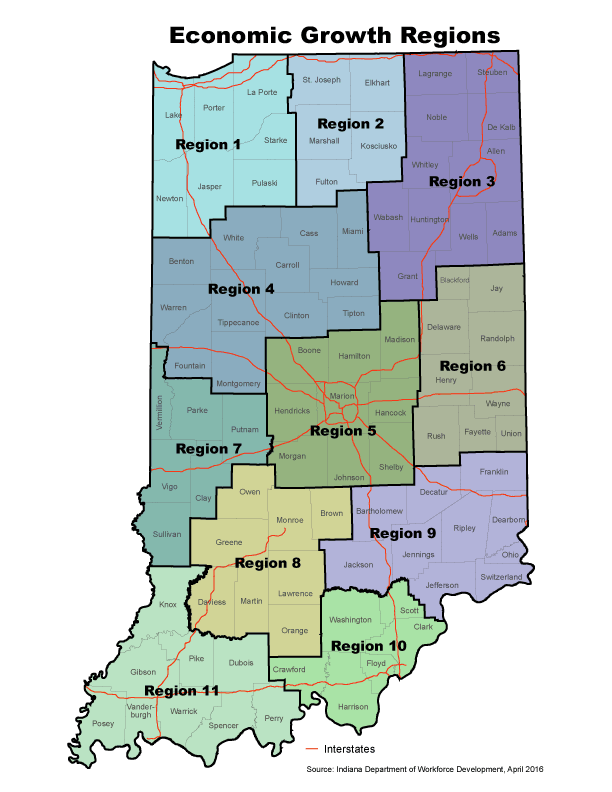

    There’s a semi-metropolitan overlay, but as I’ve long noted places like Region 6 are economic decline regions, not economic growth regions. Here’s how the Indiana Economic Development Corp. sees the world:


    These are not just agglomerations of the workforce districts, there are numerous differences between them. The point is that clearly the organization is driven by administrative convenience and the political need for field offices, not a metro-centric view of the world or strategy.

    Add it all up and it appears that Indiana has decided to fight against all three new realities above rather than adapting to them. It rejects metro-centricity, imposes a uniform policy set, and is oriented towards trying to reflate the most struggling communities. I don’t think this was necessarily a conscious decision, but ultimately that’s what it amounts to.

    When you fight the tape, you shouldn’t expect great results and clearly they haven’t been stellar. Since 2000, Indiana comfortably outperformed perennial losers Michigan and Ohio on job growth (well, less job declines), but trailed Kentucky, Wisconsin, Minnesota, Iowa, and Missouri. But notably, Indiana only outpaced Illinois by a couple percentage points. That’s a state with higher income taxes (and that actually raised them) that’s nearly bankrupt and where the previous two governors ended up in prison. Yet Indiana’s job performance is very similar. What’s more, Hoosier per capita incomes have been in free fall versus the national average, likely because it has only become more attractive to low wage employers.

    Fiscal discipline, low taxes, and business friendly regulations are important. But they aren’t the only pages in the book. Workforce quality counts for a lot, and this has been Indiana’s Achilles heel. (My dad, who used to run an Indiana stone quarry, had trouble finding workers with a high school diploma who could pass a drug test and would show up on time every day – hardly tough requirements one would think). Also aligning with, not against market forces is key.

    I will sketch out a somewhat different approach. Firstly, regarding the chronically unemployed, clearly they cannot be written off or ignored. However, I see this as largely a federal issue. We need to come to terms with the reality that America now has a population of some million who will have extreme difficulty finding employment in the new economy (see: latest jobs report). We’ve shifted about two million into disability rolls, but clearly we’ve to date mostly been pretending that things are going to re-normalize.

    For Indiana, the temptation can be to reorient the entire economy to attract ultra low-wage employers, then cut benefits so that people are forced to take the jobs. I’ve personally heard Indiana businessmen bemoaning the state’s unemployment benefits that mean workers won’t take the jobs their company has open – jobs paying $9/hr. Possibly the 250,000 or so chronically unemployed Hoosiers may be technically put back to work through such a scheme – eventually. But it would come at the cost of impoverishing the entire state. Creating a state of $9/hr jobs is not making a home for human flourishing, it’s building a plantation.

    Instead of creating a subsistence economy, the focus should instead be on creating the best wage economy possible, one that offers upward mobility, for the most people possible, and using redistribution for the chronically unemployed. You may say this is welfare – and you’re right. But I would submit to you that the state is already in effect a gigantic welfare engine. In addition to direct benefits, the taxation and education systems are redistributionist, and the state’s entire economic policy, transport policy, etc. are targeted at left-behind areas (i.e., welfare). Even corrections is in a sense warehousing the mostly poor at ruinous expense. So Indiana is already a massive welfare state; we are just arguing about what the best form is. I think sending checks is much better than distorting the entire economy in order to employ a small minority at $9/hr jobs – but that’s just me. Again, we are in uncharted territory as a country and this is ultimately going to require a national response, even if it’s just swelling the disability rolls even more. I do believe people deserve the dignity of a job, but we have to deal with the unfortunate realities of our new world order.

    With that in mind, the right strategy would be metro-centric, focusing on building on the competitively advantaged areas of the state – what Drew Klacik has called place-based cluster – and competitively advantaged middle class or better paying industries.

    Contrary to some of the stats above, this is not purely an Indianapolis story. Indiana has a number of areas that are well-positioned to compete. Here’s a map with key metro regions highlighted:
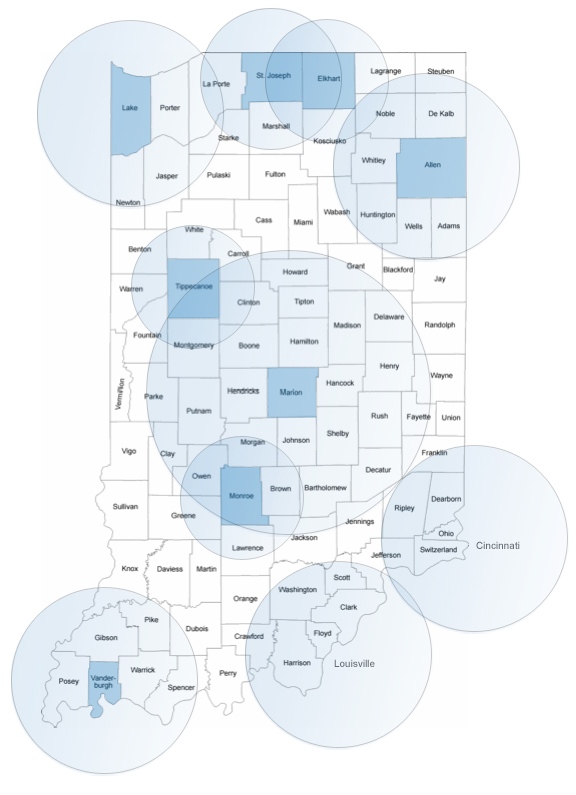


    This may look superficially like the maps above, but it is explicitly oriented around metro-centric thinking. Metro Indy has been doing reasonably well as noted. But Bloomington, Lafayette, and Columbus (sort of small satellite metros to Indy) have also done very well. In fact, all three actually outperformed Indy on STEM job growth.

    Additionally, three other large, competitively advantaged metro areas take in Indiana territory: Chicago, Cincinnati, and Louisville. These are all, like Indy, places with the scale and talent concentrations to win. True, none of the Indiana counties that are part of those metros is in the favored quarter. But they still have plenty of opportunities. I’ve written about Northwest Indiana before, for example, which should do well if it gets its act together.

    This covers a broad swath of the state from the Northwest to the Southeast. It comes as no surprise to me that Honda chose to locate its plant half way between Indianapolis and Cincinnati, for example.

    The state should align its resources, policies, and investments to enable these metro regions to thrive. This doesn’t mean jacking up tax rates. Indiana should retain its competitively advantaged tax structure. But it should mean no further erosion in Indiana’s already parsimonious services. The state is already well-positioned fiscally, and in a situation with diminishing marginal returns to further contraction.

    Next, empower localities and regions to better themselves in accordance with their own strategies. This means an end to one size fits all, least common denominator thinking. These regions need to be let out from under the thumb of the General Assembly. That means more, not less flexibility for localities. Places like Indianapolis, Bloomington, and Lafayette would dearly love to undertake further self-improvement initiatives, but the state thinks that’s a bad idea. (I believe this is part of the subtle re-balancing attempt I mentioned).

    It also means using the state’s power to encourage metro and extended region thinking. For example, last year within a few months of each other the mayors of Indianapolis, Anderson, and Muncie all made overseas trade trips – separately and to different places. That’s nuts. The state should be encouraging them to do more joint development.

    This also means recognizing the symbiotic relationship that exists between the core and periphery in the extended Central Indiana region, clearly the state’s most important. The outlying smaller cities, towns, and rural areas watch Indianapolis TV stations, largely cheer for its sports teams, get taken to its hospitals for trauma or specialist care, fly out of its airport, etc. Metro Indianapolis and its leadership have also basically created and funded much of the state’s economic development efforts (e.g., Biocrossroads) and many community development initiatives (the Lilly Endowment). Many statewide organizations are in effect Indianapolis ones that do double duty in serving the state. For example, the Indiana Historical Society. (There is no Indianapolis Historical Society).

    On the other side of the equation, Indianapolis would not have the Colts and a lot of other things without the heft added from the outer rings out counties that are customers for these amenities. It benefits massively from that, particularly since it’s a marginal scale city. One of the biggest differences between Indy and Louisville is that Indy was fortunate enough to have a highly populated ring of counties within an hour’s drive.

    So in addition to aligning economic development strategies around metros, and freeing localities to pursue differentiated strategies, the state should encourage the next ring or two of counties that are in the sphere of influence of major metros to align with their nearest larger neighbor.

    Contrary to popular belief, this is a win-win. When I was in Warsaw, Indiana, people were concerned that many highly paid employees of the local orthopedics companies lived in Ft. Wayne. From a local perspective, that’s understandable and obviously they want to be competitive for that talent and should be all means go for it. On the other hand, what if Ft. Wayne wasn’t there for those people to live in? Would those orthopedics companies be able to recruit the talent they need to stay located in small town Indiana?

    It’s similar for other places. Michael Hicks, and economist at Ball State in Muncie, said, “Almost all our local economic policies target business investment and masquerade as job creation efforts. We abate taxes, apply TIFs and woo businesses all over the state, but then the employees who receive middle-class wages (say $18 an hour or more) choose the nicest place to live within a 40-mile radius. So, we bring a nice factory to Muncie, and the employees all commute from Noblesville.” Maybe Muncie isn’t completely happy about this, understandably. But would they have been able to recruit those plants at all (and the associated taxes they pay and the jobs for anybody who does stay local) if higher paid workers didn’t have the option to live in suburban Noblesville? Would the labor force be there?

    I saw a similar dynamic in Columbus. Younger workers recruited by Cummins Engine chose to live in Greenwood (near south suburban Indy). Columbus wants to keep upgrading itself to be more attractive – a good idea. But the ability to reverse commute from Indy is an advantage for them.

    Louisville, Kentucky has one of the highest rates of exurban commuting the country because so many Hoosiers in rural communities drive in for good paying work.

    This is the sort of thinking and planning that needs to be going on. Realistically, most of these small industrial cities and rural areas are not positioned to go it alone and they shouldn’t be supported by the state in attempting to do so. They need to a align with a winning team.

    There are two groups of places that require special attention. One is the mid-sized metro regions of Ft. Wayne, Evansville, and South Bend-Elkhart. These places are too far from larger metros and aren’t large enough themselves to have fully competitive economies. No surprise two of the three lost STEM jobs. Evansville has done better recently on the backs of Toyota, but has a vast rural hinterland it cannot carry with its small size. The region has done ok of late, but it has also received gigantic subsidies in the form of multiple massive highway investments, and now a massive coal gasification plant subsidy. I don’t believe this is sustainable. These places need special assistance from the state to devise and implement strategies.

    The other grouping consists of rural and small industrial areas that are too far outside the orbit of a major metro to effectively align with it. This would includes places like Richmond or Blackford County. They might get lucky and land a major plant, but realistically they are going to require state aid for some time to maintain critical services.

    For the last two groups especially, there also needs to be a commitment by the state’s top brain hubs – Indy and the two university towns – to applying their intellectual and other resources to the difficult problem at hand. Part of that involves helping them be the best place of their genre that they can. While cities are competitively advantaged today, not everybody wants to live in one. So there is still an addressable market, if not as large, for other places.

    Put it together and here’s the map that needs to be changed. It’s percentage change in jobs, 2000-2012:
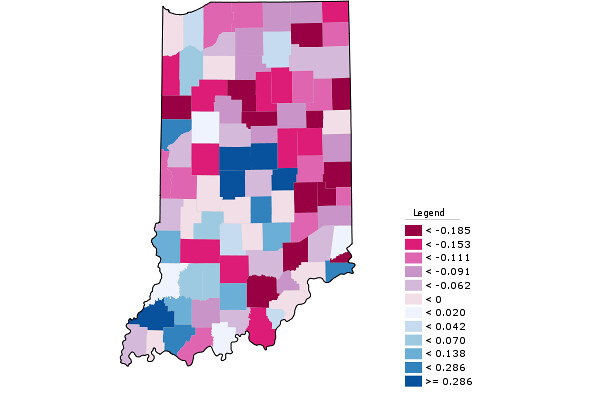


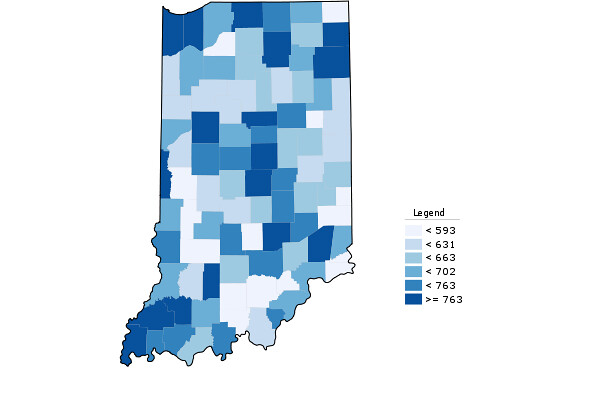
    Pretty depressing. Urban core counties had some losses, but suburban Indy, Chicago, and Cincy did decently (Louisville’s less well), plus Bloomington area, Lafayette, and Columbus. You see also the strong performance of Southwest Indiana which is fantastic, but the sustainability of which I think is in question. Wages are higher in metro areas too, by the way. Here’s the average weekly wage in 2012, which shows most of the state’s metros doing comparatively well:


    In short, I suggest:

    – Retain lean fiscal structure but limit further contractions
    – Goal is to build middle class or better economy, not bottom feeding
    – Align economic development efforts to metro areas, particularly larger, competitively advantages locations. Align capital investment in this direction as well.
    – Greater local autonomy to pursue differentiated strategies for the variegated areas of the state
    – Special attention/help to strategically disadvantaged communities, but not entire state policy directed to servicing their needs.
    – Utilization of transfers for the chronically unemployed pending a federal answer, but again, not redirection of state policy to attract $9/hr jobs.

    This requires a lot of fleshing out to be sure, but I think is broadly the direction.

    Back to Gov. Mike Pence, would he be on board with this? He’s Tea Party friendly to be sure and interested in fiscal contraction. But he’s not a one-trick pony. He’s actually taken some interesting steps in this regard. He is subsidizing non-stop flights from Indianapolis to San Francisco for the benefit of the local tech community. He also wants to establish another life sciences research institute in Indy. And he’s talked about more regionally focused economic development efforts. It’s a welcome start. I think he groks the situation more than people might credit him for. Keep in mind that he did not establish the state’s current approach, which arguably even pre-dated Mitch Daniels, and he has to deal with political realities. And if as they say only Nixon could go to China, then although a reorienting of strategy is not about writing big checks, still perhaps only someone with conservative bona fides like Pence can push the state towards a metro-centric rethink.

    Aaron M. Renn is an independent writer on urban affairs and the founder of Telestrian, a data analysis and mapping tool. He writes at The Urbanophile, where this piece originally appeared.

  • The Divisions In The One Percent And The Class Warfare That Will Shape Election 2014

    There’s general agreement that inequality will be the big issue of this election year. But to understand how this will play out you have to go well beyond the simplistic “one percent” against everyone else mantra that has to date defined discussion of inequality.

    Instead our politics increasingly are being shaped by a complex interplay of class interests across the electorate; class, not merely inequality, is emerging as the driving force of our politics. As Marx among others recognized, class structures can be complicated and contain many separate tendencies. For example, even the much-discussed “one percent” is hardly a cohesive group, but one deeply divided in ideology, geography and industry.

    For example, out of the 20 richest Americans on the 2013 Forbes 400 list, six have a record of favoring the Democrats in political donations, including the top two, Bill Gates and Warren Buffett. Eleven reliably back Republican candidates and causes, while Google founder Larry Page has only donated to his company’s PAC, Larry Ellison has funded both sides and Michael Bloomberg defies easy categorization.

    All three of the top individual political contributors last year — the Soros family, Jets owner Fred Wilpon and Facebook co-founder Sean Parker — also lean to the “party of the people.”

    The Democrats’ new and ascendant oligarchy, based in Silicon Valley, Hollywood, Wall Street and the media, are generally concentrated in the country’s most unaffordable cities, places with high degrees of inequality.

    This alliance is based not solely on attitude, but also sometimes self-interest. Hedge funds siphon up money from public pension funds desperate for the large gains necessary to meet the extravagant, unfunded benefits increases of Democratic politicians. Venture capitalists and companies and core Democratic supporters invest in “green” technology, made profitable largely by mandates, subsidies and government-backed loans.

    These oligarchs represent very different interests than the more traditional plutocracy, based largely in such mainstream endeavors as fossil fuel energy, agribusiness, manufacturing and suburban home development. These worthies, too, are obviously not slum-dwellers, but also live in more dispersed locations such as Houston, Dallas-Fort Worth, Atlanta, Oklahoma City and a host of much more obscure places, at least part of the time. They reflect the somewhat more conservative, fiscally particularly, world view of the broader 1% than their more left-leaning counterparts.

    With the power of money and access to media (particularly the new oligarchs), the two competing factions of the “one percent” will pour millions into trying to win over the other classes. The two key ones are what I call the yeomanry — the small property-owning, private-sector middle class — and America’s modern-day “clerisy”: university professors and administrators, government bureaucrats and those business interests tied closest to the governmental teat.

    One can expect with fair assurance that the clerisy will strongly support the president and the progressive wing of the Democratic Party. There are few groups as lock-step liberal as the universities, particularly the most important and influential ones. In 2012, A remarkable 96 percent of all donations from Ivy League employees went to the president, something more reminiscent of Soviet Russia than a properly functioning pluralistic academy. Public employee unions, charter members of the clerisy, have been among the biggest contributors to federal candidates, overwhelmingly Democrats over the past decade.

    Less certain are the political leanings of the yeomanry. These are not the people who generally benefit from the expansion of government; they are basically stuck being taxpayers. Their distaste for regulation varies, but is most strongly felt when it impacts their businesses or their communities. In 2008, rightfully disgusted by the failures of the Bush administration, they were divided, but in 2012 small business shifted decisively to the right — not enough to save the awful Romney campaign, but they still helped maintain the GOP majority in the House.

    The political calculus of the yeomanry, however, is very complex. Those who are older, and those who already own property, are likely to keep shifting toward the right, as long as the Republican lunatic fringe is kept under control. Obamacare taxes and the cancellations of individual insurance plans hit this group directly in the bottom line, and may do so even more in the future. But for younger members of this group, struggling to buy property or launch proper careers, may look to Washington to provide their health care and provide breaks on their student loans.

    Arguably the yeomanry will determine the winners in 2014. The big issue here may be over expectations for the future. Today there are many, on both right and left, who are telling the yeomanry that their day in the sun is over. Tyler Cowen suggests in the future “the average” skilled worker can expect to subsist on rice and beans. If they stay on the East or West Coast, they also may never be able to buy a house. On the left, particularly among greens and urban aesthetes, the message is not so different except they tend to think abandoning property ownership is a good thing, since multi-unit rental housing is more environmental friendly and communal.

    Sadly many member of the yeoman class — the vast majority of Americans today — believe that the pessimists are correct, and expect their children, will fare worse in the future. If they accept this conclusion, they may be tempted to join the third of Americans who consider themselves “lower” class. With increasingly little prospect of upward mobility, these voters understandably look to Washington and state capitals to redistribute wealth up to them.

    How this class politics plays out this year will determine the 2014 results, and likely politics for the generation to come. Oligarchs favoring Republicans will focus on how redistribution takes from the yeomanry to give to the poor and associated crony capitalists. The failings of Obamacare, the rise in taxes and regulations all play to their advantage. This will play well with the income categories – $50,000 to $200,000 annually — that now constitute the class base of the GOP.

    In opposition, the new oligarchs, and their allies in the clerisy, will seek to convince enough of the yeoman class that they need the government to enjoy anything like a middle-class life. The Obama cartoon The Life of Julia, with its emphasis on the helping hand of government , is not directed at the poor but what used to be an upwardly mobile class. Julia implicitly rejects traditional American middle-class values such as property ownership, marriage and family and embraces a new vision tied to growing dependency to both the Democratic Party and the state.

    Sadly, neither of these approaches addresses the key issue: weak economic growth and a decline in upward mobility. Republicans, in particular, do not tend to associate these things. They seem to believe that faster GDP growth will rebalance our inequality, or at least make it palatable. This misses the fact that we have just gone through one of the most unequal recoveries in history, accelerating the concentration of wealth in ever fewer hands. Growth, clearly, is not enough; what kind of growth must be part of the discussion.

    This perspective is critical if we are to address our class divide. Simply put we need to go beyond both “trickle down” economics — which both sets of oligarchs are understandably fine with — and a redistributionist approach, something that strengthens the hand of the clerisy and the politically connected at the expense of the yeomanry. What we need is something that combines largely free-market, libertarian economics with something like the traditional goal of social democracy.

    “We can have democracy in this country, or we can have great wealth concentrated in the hands of a few,” noted Justice Louis Brandeis,“but we can’t have both.” Over time, even conservatives and libertarians have to recognize that a republic irrevocably divided between the rich and the dependent poor can not turn out well. And for their part, progressives need to realize that the middle class can not be expected to serve as a piggy bank to assuage their delicate consciousness.

    The real issue before us is not inequality per se, but how to spread the ownership of property and improve opportunity; without this America devolves from the world’s exemplar into a second-rate Europe, with less charm, more division, and a national dream finally extinguished.

    This story originally appeared at Forbes.com.

    Joel Kotkin is executive editor of NewGeography.com and Distinguished Presidential Fellow in Urban Futures at Chapman University, and a member of the editorial board of the Orange County Register. He is author of The City: A Global History and The Next Hundred Million: America in 2050. His most recent study, The Rise of Postfamilialism, has been widely discussed and distributed internationally. He lives in Los Angeles, CA.

    Creative Commons photo “Income Inequality” by Flickr user mSeattle.

  • Political, Economic Power Grow More Concentrated

    Generally speaking, we associate the quest for central government control to be very much a product of the extremes of left and right. But increasingly, the lobby for ever-greater concentration of power – both economically and politically – comes not from the fringes, but from established centers of both parties and media power.

    Recently, for example, an article by Francis Fukuyama, a conservative-leaning intellectual, called for greater consolidation of federal power, most particularly, the Executive Branch. Ironically, Fukuyama’s call for greater central power follows a line most often adopted by “progressive” Democrats, who seek to use federal power to enforce their views on a host of environmental, economic and social issues even on reluctant parts of the country.

    This rush to concentrate powers in Washington seems odd, given the awful rollout of the Affordable Care Act, which seems almost like a parody of a government-managed big program, overly complex and almost impossible to implement. ACA has led even some honest liberals, like the New York Times Tom Edsall, to wonder if “the federal government is capable of managing the provision of a fundamental service through an extraordinarily complex system?”

    To give the Left credit, many liberals would have preferred something less complex, perhaps like the single-payer system, that perhaps would be less amenable to confusion, and exemptions for privileged groups, like congressional staffs. But President Obama and his Democratic allies chose to work with many powerful interests, notably pharmaceutical companies and health insurers, who are in position to capitalize on this bizarre and, in many ways, inexplicably complicated, health care “reform.”

    Other cautionary tales of overcentralization of federal power abound. Recent scandals like NSA eavesdropping and IRS political targeting, would have offended progressive defenders of civil liberties. However, with a favorite Democrat in the Oval Office, and conservatives the primary victims of abuse, their response has been far more muted than if, say, Mitt Romney was president.

    Top-down economy

    Equally critically, many progressives also increasing favor a more centralized economy. With a few brave exceptions, notably Vermont’s feisty socialist Sen. Bernard Sanders and incorrigibles such as Ralph Nader, there have been too-few voices willing to challenge the growing corporatization of the Democratic Party and the ongoing concentration of power in ever-fewer hands.

    Historically, progressives made much about their objections to both government abuse and unrestrained corporate power. After all, progressives (as well as populists) pushed the earliest restraints on trusts and other large corporate combinations. But, now, the very people Theodore Roosevelt defined more than a century ago as the “malefactors of great wealth” have won powerful friends in the progressive camp.

    Take, for instance the growing concentration of banking assets. Over the past 40 years, the asset share of the top five banks has grown from 17 percent to more than 50 percent of the total. This, however, is not enough for some progressive thinkers. Liberal pundits, like Matt Yglesias and Steve Rattner, in fact, think it would be better if we got rid of most smaller financial institutions.

    Some of this is Washington-New York “we know best” elitism at its worst. These are the institutions and individuals that a studied corporatist and influence peddler like Rattnerwould identify with, naturally. Yglesias, for his part doesn’t like small banks in part because they are run by “less-bright and not-as-good guys” as the benevolent geniuses on Wall Street, who almost cracked up the world economy.

    This confluence of large government and big business can be seen in the flow of funds to the Center for American Progress, the Obama-friendly think tank whose head, John Podesta, was just named the president’s latest chief of staff. The center’s primary funders include a who’s who of big corporations, including Apple, AT&T, Bank of America, BMW of North America, Citigroup, Coca-Cola, Discovery, GE, Facebook, Google, Goldman Sachs, PepsiCo, PG&E, the Motion Picture Association of America, Samsung, Time Warner, T-Mobile, Toyota, Visa, Wal-Mart and Wells Fargo.

    These donations reflect a growing lurch of bigger businesses toward the corporatist Democrats; this is particularly true in such fields as media, telecommunications, high technology and health care, where looming environmental and labor reforms are perceived as less a threat than among smaller firms.

    Rise of regulators

    Most worrisome, the increased focus on bigness has engendered growing support for what amounts to government by administrative diktat. As Fukuyama and others argue, our present messy system, particularly Congress, seems incapable of meeting challenges facing the country. This leads to a notion that we need a new “top down” solution through the exercise of greater executive power.

    As is increasingly the case, any attempt to push back against centralization elicits a torrent of name-calling. Objecting to a more expansive federal government, suggests some, smacks of “neo-Confederate” ideology, a charge particularly loaded when the agglomeration of power in Washington is being led by our first African-American president.

    These assaults mask a more dangerous reality: a dismissal of democracy and embrace of authoritarian solutions. Former Obama budget adviser Peter Orszag and the New York Times’ Thomas Friedman have argued that power should shift from contentious, ideologically diverse elected bodies – subject to pressure from the lower orders – toward credentialed “experts” operating in Washington, Brussels or the United Nations. These worthies regard popular will as lacking in scientific judgment and societal wisdom.

    There is no adequate political response to this dangerous tendency. Republicans talk about abuse of power, but, when in office, seem more than willing to indulge in it (with the run-up to the Iraq war and with the Patriot Act). Similarly, few Republicans seem to understand that economic concentration – favored by their remaining friends on Wall Street and the corporate community – tends inevitably to lead to the political variety.

    So far, Republicans have been forced to choose between their own corporatists, who simply favor shifting government largesse to their favorite causes, such as defense or farm subsidies, and the Tea Party movement, whose members often oppose virtually any government initiative, for example, infrastructure improvement, even at the local level, something sure to limit their appeal to a wider electorate.

    Growing distrust

    Yet the situation is far from hopeless. Obama’s ineffective rule has done little to vouch for centralized government. Trust in governmental institutions – the White House, Congress, the courts – is at the lowest ebb in decades. The percentage of people who see the federal government as being too powerful, notes Galluphas surged from barely 50 percent, when President Obama took power, to well over 60 percent today, the highest level ever recorded.

    In such a climate, some thoughtful liberals, such as Yale’s Jacob Hacker, suggest that progressives should avoid embracing an authoritarian, top-down ruling philosophy. “The Democrats have the presidency now,” he suggests, “[but] they won’t hold it forever.” They are essentially “feeding a beast” that, at some date, may turn against them with a vengeance.

    This suspicion of “top down” solutions also extends even to one of the most critical parts of the Democratic base: the millennial generation. Although they have been a core constituency for Barack Obama, they appear to be drifting somewhat away from their lock-step support, with the presidential approval level, according to a recent study by the Harvard Institute of Politics, now under 50 percent.

    Much of the problem, notes generational chronicler Morley Winograd, lies with millennials’ experience with government, which to them often seems clunky and ineffective. The experience with the ACA is not likely to enhance this view, Winograd suspects. “Millennials,” he notes, “have come to expect the speed and responsiveness from any organization they interact with that today’s high tech makes possible. Government, on the other hand, is handcuffed by procurement rules and layers of decision-making, from deploying much of this technology to serve citizens. The result is experiences with government, from long lines at the DMV office to the botched website rollout for Obamacare, causes millennials to be suspicious of, if not downright hostile to, government bureaucracies.”

    It may be here, in the meshing of technology and public purpose, that we may find a new focus that is neither reflexively hostile (as some Tea Partiers appear) to government per se or simply interested in expanding the list of self-interested political clients. The key to future effective government lies not so much in its radical downsizing as in dispersing power to the local level, something that fits both into the mentality of the new generation and the decentralist traditions that have animated our history.

    This story originally appeared at The Orange County Register.

    Joel Kotkin is executive editor of NewGeography.com and Distinguished Presidential Fellow in Urban Futures at Chapman University, and a member of the editorial board of the Orange County Register. He is author of The City: A Global History and The Next Hundred Million: America in 2050. His most recent study, The Rise of Postfamilialism, has been widely discussed and distributed internationally. He lives in Los Angeles, CA.

    Barack Obama photo by Bigstock.

  • The Abuse of Art in Economic Development

    City building is an imperfect process. Poverty, segregation, and income disparities persist, or worsen, despite longstanding efforts to affect change. The unsightliness of these social failures are called “blight”. Blight is commonly thought to be the antithesis to beauty.

    Urban revitalization efforts have been infatuated with idea that removing blight creates the conditions for community good. Specifically, the field of aesthetics—or that branch of philosophy that deals with the principles of beauty and artistic taste—has for long been held up as a lens through which society can be ordered, with the thinking that beautification can “rehab” the masses.

    For instance, the early 20th-century upper crust framed the conditions of poverty this way: the deprived were laggards on the evolution toward modernity, and they needed aesthetic inspiration. So arose the City Beautiful Movement, whose premise, according to Julie Rose at the University of Virginia, “was the idea that beauty could be an effective social control device”.

    Put simply, outside pretty would arouse inside pretty, inspiring civic loyalty and morality in the impoverished.

    A line in the 1904 classic “Modern Civic Art, or The City Made Beautiful” puts it frankly: “[M]odern civic art can now hope to banish the slum thus to redeem the tenement and to make its own conquests thorough.”

    Cleveland tried its hand with this approach. Back in the early 1900s the city’s elites commissioned then-starchitect Daniel Burnham to create the Group Plan. The Plan called for a City Beautiful civic center, which involved demolishing downtown housing tenements and commercial structures deemed expendable, with a series of elegant Beaux Arts-style buildings eventually being constructed around a plaza-like green space, now known as the “Mall”. It was believed such a central source of civic beauty would radiate out into the city, curing ills of all types. The beauty would be timeless, without half-life—always anchoring Cleveland’s progression, like a compass of godliness.

    Courtesy of groupplan.dhellison.com

    It didn’t work. Today, Cleveland is wayward, with a poverty rate of over 30 percent, and more vacant houses than perhaps ever before. Such failures made plain the fact that impoverishment cannot be “prettied” out of the city.

    The use of aestheticism in city building has not gone away. In fact efforts have redoubled over the last decade. The idea is no longer about flushing impoverishment out of the city system, but rather using art—particularly the romanticization of the artist and the act of creation—to spark economic growth.

    In the article “Artists, Aestheticisation and the Field of Gentrification”, scholar David Ley discusses this strategy, whereby a neighborhood moves from “from junk to art and then on to commodity”, or form poor to reinvested in. The gist of the process—one with roots in 1960s France to present-day everywhere—goes something like this:

    Artists, as members of the bohemian vanguard, historically seek affordable, gritty locations. They do this out of necessity—most of the creative class is paid pittance—but also for creativeness.

    “Hardship was the price one paid for being in the thick of it,” wrote artist David Byrne in the article “Will Work for Inspiration”.

    Where artists cluster, so does the concept of anti-conformity and “cool”. Here, according to Ley, the space of the artist and the space of middle class youth overlap, bringing an era’s hipsters into a neighborhood’s fold. Things can turn quickly after that. Developers and entrepreneurs constantly sniff out the next big thing so as to buy lower and rent higher, with the scent pegged to “what the kids like”, hence the incessant “Millennial” fixation. Eventually, as gentrification continues, the artists and hipsters give way to professionals, until a landscape of wealth and conformity fills in the “starving artist” romanticism that greased its path.

    Notwithstanding which side of the gentrification debate one falls on, the fact of the matter is that this form of city revitalization—from junk, to art, to commodity—is rampant, becoming defacto neighborhood development. In Cleveland, the arts-fueled districts of Tremont, Detroit Shoreway, Collinwood, and St. Clair-Superior speaks to the popularity of this approach.

    This isn’t to say it inevitably works. There are only so many artists and hipsters to go around, and not everywhere is Portland, Austin, or Brooklyn. And so when Anywhere, USA does the art-as-development approach, things do not always go as planned.

    In the recent piece called the “Best of All Possible Worlds”, writer Mark Lane travels to Evansville, Indiana, where a public art contest sparked “a debate over class, race, and good taste”. The story details how the town’s arts district plan devolved into land-grabbing by a quasi-governmental agency whose attempt at subsidizing housing for artist attraction often turned into the demolition of stately structures, if only because getting artists to move to small town Indiana is hard.

    Courtesy of The Believer

    Courtesy of The Believer

    Beyond the wisdom of such a strategy, the piece examines the role of art as an aesthetic discipline, noting that the use of art in city revitalization is commonly not art for art’s sake, but is rather employed as a means to “fertilize” low-income neighborhoods for the arrival of the creative class.

    “It’s not about the art,” noted an Evansville city planner to Lane. “Art is just another tool for economic sustainability.”

    Such is a far cry from Picasso’s purpose of art, which is “washing the dust of daily life off our souls”.

    Curiously, you don’t hear much from the mouthpieces of the art establishment as to the way the discipline is being used: as a means to create commercial order. Historically, the beauty and need of civic art has been about allowing the brokenness of life to enter into the artist’s realm so that the pain and suffering of humanity could be recast through the value of creation. Here, the soul is the audience, with the ovation meant to reverberate into how we “do” community.

    But civic art as “junk, to art, to commodity” achieves something else. It turns the act of creation into the act of “creative classification”. And given our current economic inequalities and the erosion of the middle class, it is fair to wonder why a field that can heal the soul is being used to patch a system that adds dust to our daily living by the day.

    Richey Piiparinen is a writer and policy researcher based in Cleveland. He is co-editor of Rust Belt Chic: The Cleveland Anthology. Read more from him at his blog and at Rust Belt Chic.

    Top photo courtesy of aaronacker.com

  • NewGeography’s Top Stories of 2013

    A new year is upon us, here’s a look back at a handful of the most popular pieces on NewGeography from 2013. Thanks for reading, and happy New Year.

    12. Gentrification as an End Game, and the Rise of “Sub-Urbanity” In January Richey Piiparinen points out that gentrification driven by affluent young people moving back to the city might be creating “a ‘sub-urbanity’ that is emerging when the generalization of gentrification meets the gentrification of the mind.”

    11. The Cities Winning the Battle for the Biggest Growth Sector in the U.S. Joel and I put this index together to measure growth and concentration of the professional, technical, and scientific services sector among the nation’s largest metropolitan areas. As high-end services become easier to export, this sector is becoming a critical region-sustaining sector in many parts of the country. This piece also ran at Forbes.com.

    10. A Map of America’s Future: Where Growth will be Over the Next Decade Working with Forbes Magazine in September, Joel and I laid out seven regions and three city-states across the nation. Regional economic diversity is one of America’s most critical attributes.

    9.  The Dutch Rethink the Welfare State Nima Sanandaji outlines the trajectory of the social services culture in the Netherlands.

    8.  Suburb Hating is Anti-Child In this provocative, widely-discussed piece, Mike Lanza takes it to politicians and commentators who advocate against suburbs, pointing out that “we need to fix suburbs and the way families utilize them,” but “what we shouldn’t do is try to force families to live in dense city centers.”

    7.  Fixing California: The Green Gentry’s Class Warfare Joel Kotkin points out that many green policies are pro-gentry and anti-middle class, particularly in California. This piece originally appeared at U-T San Diego.

    6.  How Can We Be So Dense? Anti-Sprawl Policies Threaten America’s Future In this piece from Forbes, Joel Kotkin argues that high-density housing advocates should be open to a broader range of housing options because policies pushing high density often favor real estate investors over the middle class and the concept of upward mobility.

    5.  Class Warfare for Republicans Joel takes the Republican Party to task for ignoring the issue of class and small business growth in favor of rhetoric about social conservatism, gun control, and free market idealism. This piece originally ran in the Orange County Register.

    4.  Houston Rising: Why the Next Great American Cities Aren’t What you Think In this piece from The Daily Beast, Joel argues that a city’s most important quality is its ability to foster upward mobility and to sustain a middle class, not its urban form.

    3.  The New Power Class Who Will Profit from Obama’s Second Term Who stands to benefit most from the second Obama administration? Joel argues that it’s the plutocrats of Silicon Valley and new media industries and the clerisy of academia. This piece originally appeared at Forbes.com.

    2.  Why are there so Many Murders in Chicago? Aaron Renn lays out seven possible reasons contributing to violent crime in Chicago and calls for an adjustment in strategy to fight it.

    1.  Gentrification and its Discontents: Notes from New Orleans The most read piece of the year is this excellent expose of gentrification and its impact on the culture and age demographics of New Orleans by local geographer Richard Campanella.

    Mark Schill is a community strategist and analyst with Praxis Strategy Group and New Geography’s Managing Editor.

  • The Metro Areas With The Most Economic Momentum Going Into 2014

    America’s economy may be picking up steam, but it remains a story of parts, with the various regions of the country performing in often radically divergent ways.

    To identify the regions with the most momentum coming out of the recession, we turned to Mark Schill, research director for the Praxis Strategy Group, who crunched a range of indicative data from 2007 to today for the nation’s 52 largest metropolitan statistical areas. To gauge economic vitality, we used four metrics: GDP growth, job growth, real median household income growth and current unemployment. To measure demographic strength we looked at population growth, birth rate, domestic migration and the change in educational attainment. All factors were weighted equally.

    Our assumption is that strong local economies attract the most people and create the best conditions for family formation, which in turn generates new demand. Strong productive industries drive demand for such things as heath care, business services and retail, as well as single-family houses, a critical component of local growth and still the aspirational goal of the vast majority of Americans. This, of course, depends on economic factors, which drive perceptions of better times and provide the income necessary to qualify for a mortgage.

    Our results are based on metrics often overlooked in assessments that are focused primarily on either asset inflation — stocks or out-of-control housing prices — or are built around anecdotal, cherry-picked data from, for example, just one part of a metropolitan region. Despite all the attention lavished on places like Manhattan or Chicago’s central core, virtually all the fastest-emerging economies coming out of the recession are either in the Southeast, Texas, the Great Plains or the Intermountain West. Of our top 10 metro areas, only one is on the east or west coast: 10th-ranked San Jose/Silicon Valley.

    Most of the strongest local economies combine the positive characteristics associated with blue states — educated people, tech-oriented industries, racial diversity — with largely red, pro-business administrations. This is epitomized by our top-ranked metro area, Austin, Texas, which has enjoyed double-digit growth in GDP, jobs, population and birthrate since 2007. The Texas capital has a very strong hipster reputation, attracting many of the same people who might otherwise end up in Silicon Valley or San Francisco, but it also boasts the low taxes, light regulation and reasonable housing prices that keep migrants there well past their 30s.

    As has been the case for most of the past five years, Texas cities are clearly the place to be in terms of job creation, wealth formation and overall growth. All the other major Lone Star cities place highly on our list, including second-place San Antonio and Houston (fourth). Clearly many parts of the Sun Belt have not died off, as many Eastern pundits gleefully predicted during the recession. The migration of Americans southward, thought by the Eastern press to have petered out, has resumed, particularly to Texas and Sun Belt cities with strong economies.

    One critical factor propelling growth has been the energy revolution, which is rapidly transforming big swathes of middle America into a production hub for fossil fuels and the best place to secure cheap electric power. Besides the Texas cities, other energy capitals doing well including Salt Lake City (No. 3) and Denver (No. 7) — both of which also boast burgeoning tech sectors — as well as Oklahoma City (No. 8).

    One canary in the coalmine suggesting future dynamism is a rising share of highly educated people in the population. Places like Nashville, Denver and Salt Lake are all getting smarter faster, increasing their numbers of educated people faster than “brain” regions such as Seattle (14th), San Francisco (22nd), Boston (26th), New York (31st), Chicago (40th) and Los Angeles (44th). Another survey looking at areas that have gained the most young college graduates since 2006 found similar trends, with Nashville, New Orleans, Dallas, Austin, San Antonio and Houston among the leaders. More important still, in these high- growth cities, educated labor is not tethered to the current social media bubble, but to more diverse industries such as medical services, energy, manufacturing and business services.

    Other evidence of these areas’ dynamism includes high rates of birth and family formation. After several years of declines, the nation’s fertility rate now appears to be rebounding somewhat, with some demographers predicting we may on the cusp of a “birth bounce,” in part as millennials start entering their 30s. Certainly this welcome trend will accelerate if the economy continues to gain strength.

    So where will these new families likely settle? With the exception of  Washington D.C. (12th), virtually all the areas with the fastest projected rates of household formation are in the Sun Belt, led by Houston, which is expected to add 140,000 new households by 2017, the largest increase in the nation, nearly twice as many as much larger New York. Indeed despite some of the most active homebuilding in the nation, the energy capital clearly needs more homes; sales have been so strong that it has now reached the lowest inventory in recent history.

    Critically, most of these cities embrace growth, whether in their urban cores or suburban peripheries. In contrast, some strong economies, such as San Jose and San Francisco, are also among the most restrictive in terms of new construction, leading to ever escalating prices that tends to force 30-somethings and families out of the region. High housing costs also play a depressing role in always hyped New York, as well as Los Angeles and Chicago; all suffer high rates of domestic out-migration and depressed household formation. Chicago is now projected to have virtually no job growth next year, not a good sign in an economy that remains well below its 2007 employment level.

    What other regions are likely to lag, even amid a strengthening recovery? The list includes Sun Belt metro areas where the housing bubble hit hardest and job growth has not revived, such as Las Vegas (51st) and Riverside-San Bernardino, Calif. (49th). In these cities real per capita household income remains almost 20% below 2007 levels. With fewer people able to afford new homes, these areas have roughly 8% fewer jobs than five years ago.

    Other bottom-dwellers include several industrial cities where even a resurgence in manufacturing has failed to erase the catastrophic losses suffered in the recession. Detroit ranks dead last at 52nd; Providence, R.I., 50th; and Cleveland 48th. All three have fewer people than in 2007 and at least 5% fewer jobs than.

    These differentials between regions could widen further in the future, as the impact of the energy revolution deepens and the current social media craze begins to die down. This happened after the first dot-com bust at the beginning of the last decade, sending roughly half of California’s tech workers out of the industry or out of the state.

    Sky-high housing costs, coupled with stricter mortgage restrictions, could accelerate the development of new, less pricey tech centers, including Seattle, New Orleans (16th) and Pittsburgh (19th). Once the venture capital punch bowl is removed, it is likely the surviving social media firms will need to find more affordable places to locate, if not their leading researchers, at least much of their marketing and administration.

    Looking across the board, it seems likely that the best places to look for work, or invest, will be those that have diversified their economies, kept costs down and attracted a broad cross-section of migrants from other parts of the country. These may not all be the favored cities of the media, or the pundit class, but they are the places offering a variety of positives to residents at every stage of life. These balanced regions are the places employers and families are most likely to flock to. Such places have not only transcended the worst effects of the recession, but seem primed to take advantage of a nascent expansion that could redraw the map of the country.

    2014 Regions to Watch Index
    Rank Region (MSA) Score GDP Growth, 2007-2012 Job Growth, Aug-Oct 07-13 Population Change, 07-12 Unemplymt Rate 2013 Median Real Hshld Inc Growth, 07-12 Dommestic Mig Rate 10-12 Birth rate, 10-12 Pt Change in Educ. Attain Rate, 07-12
    1 Austin 82.8 21.7% 11.8% 16.3% 5.4% -5.4% 17.0 14.2 2.2%
    2 San Antonio 69.7 11.2% 6.2% 11.1% 6.2% 0.4% 9.2 14.2 2.2%
    3 Salt Lake City 69.4 10.7% 3.7% 8.3% 4.4% -5.3% 0.8 17.0 3.0%
    4 Houston 67.7 12.3% 9.2% 11.5% 6.3% -4.7% 5.2 15.3 1.9%
    5 Nashville 64.4 11.5% 6.5% 8.4% 6.7% -8.4% 7.0 13.3 4.0%
    6 Dallas 62.9 9.3% 6.4% 10.2% 6.2% -6.0% 6.9 14.7 1.7%
    7 Denver 62.1 6.6% 3.4% 9.4% 6.6% -5.7% 8.2 13.4 3.4%
    8 Oklahoma City 61.4 9.2% 5.3% 8.1% 5.1% -3.1% 7.1 14.3 0.7%
    9 Raleigh 58.8 8.9% 2.9% 14.9% 6.8% -6.3% 10.9 13.2 0.6%
    10 San Jose 58.2 15.3% 2.6% 7.3% 6.7% -2.2% -1.3 13.4 2.7%
    11 Portland 55.9 23.6% -0.7% 7.1% 7.1% -7.1% 4.8 12.2 2.5%
    12 Washington 55.3 8.0% 2.9% 9.1% 5.6% -4.2% 2.3 13.8 0.9%
    13 Minneapolis 54.0 6.1% 1.2% 4.7% 4.7% -6.3% 0.0 13.0 2.6%
    14 Seattle 52.3 9.0% 0.8% 7.5% 5.8% -7.2% 3.9 12.6 1.6%
    15 Columbus 49.6 2.2% 2.5% 5.6% 6.2% -6.2% 1.4 13.5 1.7%
    16 New Orleans 49.2 8.6% 3.7% 11.9% 7.1% -16.7% 6.1 13.2 1.1%
    17 Baltimore 49.2 8.2% 1.9% 3.2% 7.2% -5.1% 0.1 12.2 3.0%
    18 Louisville 48.4 5.6% 0.7% 4.0% 7.9% -3.4% 0.2 12.7 2.9%
    19 Pittsburgh 46.7 4.6% 2.6% 0.1% 6.7% -0.1% 1.4 10.0 2.9%
    20 Richmond 46.7 4.8% -0.2% 4.9% 6.0% -9.7% 2.4 12.0 2.4%
    21 San Francisco 46.3 3.7% -1.0% 6.5% 6.4% -8.1% 2.3 11.9 2.2%
    22 Indianapolis 45.9 3.3% 1.5% 5.6% 7.1% -11.9% 1.1 14.2 1.9%
    23 Charlotte 45.6 4.5% 1.9% 10.1% 8.5% -11.0% 7.8 13.0 0.9%
    24 Grand Rapids 45.0 -2.4% 3.6% 2.4% 6.6% -6.7% 0.9 13.3 1.9%
    25 Kansas City 44.9 3.9% -1.1% 4.3% 6.5% -8.0% -1.1 13.6 1.9%
    26 Boston 44.9 7.6% 3.0% 4.3% 6.4% -4.9% -0.1 11.2 1.1%
    27 Virginia Beach 42.0 2.2% -1.5% 2.2% 6.0% -7.8% -3.4 13.4 1.8%
    28 Phoenix 41.7 -4.8% -6.3% 7.8% 7.0% -14.5% 4.8 13.7 2.6%
    29 Birmingham 41.4 0.7% -6.5% 2.7% 5.8% -10.5% -1.7 13.7 2.6%
    30 Buffalo 41.4 2.0% 1.0% -0.3% 7.3% 1.2% -2.5 10.5 2.5%
    31 San Diego 40.6 -1.0% -1.9% 6.8% 7.3% -11.8% 0.2 14.3 1.3%
    32 Philadelphia 39.1 1.9% -1.9% 2.3% 8.1% -6.9% -2.4 12.3 2.8%
    33 Atlanta 38.9 -0.5% -1.5% 7.7% 8.1% -13.7% 3.2 13.6 1.2%
    34 New York 38.9 1.9% 1.6% 3.1% 7.9% -6.1% -5.8 12.7 1.9%
    35 Milwaukee 37.6 0.3% -3.8% 2.4% 7.1% -8.6% -2.9 13.1 2.0%
    36 Jacksonville 37.6 -5.4% -3.3% 5.4% 6.6% -16.2% 3.5 12.8 2.1%
    37 St. Louis 35.8 0.2% -3.6% 1.5% 7.2% -10.1% -3.7 12.3 2.6%
    38 Cincinnati 35.6 1.3% -3.4% 2.1% 7.0% -9.0% -3.0 12.9 1.4%
    39 Tampa 33.5 -3.4% -2.4% 4.3% 6.9% -14.0% 5.9 10.9 1.0%
    40 Chicago 33.0 0.2% -2.5% 2.0% 9.1% -9.7% -5.9 13.2 2.5%
    41 Orlando 32.9 -5.7% -2.0% 8.1% 6.6% -18.3% 7.4 12.0 -0.2%
    42 Rochester 32.8 -2.2% 0.2% 1.0% 6.9% -9.3% -3.2 11.0 1.6%
    43 Miami 32.3 -4.3% -3.9% 6.3% 7.4% -14.4% 3.8 11.6 0.9%
    44 Memphis 31.2 -4.0% -5.8% 3.0% 9.6% -9.8% -1.7 14.5 1.7%
    45 Los Angeles 31.1 -2.5% -4.6% 3.3% 8.9% -10.9% -3.2 13.5 1.8%
    46 Hartford 29.1 -6.9% -1.0% 1.3% 8.0% -6.4% -5.0 10.0 2.2%
    47 Sacramento 26.4 -6.0% -7.9% 5.5% 8.3% -14.1% 0.8 12.9 0.5%
    48 Cleveland 25.1 -1.9% -5.5% -1.3% 7.0% -12.1% -5.8 11.0 1.7%
    49 Riverside 23.6 -9.0% -8.1% 7.0% 10.1% -18.5% 2.3 14.9 0.4%
    50 Providence 23.4 -0.4% -4.2% -0.1% 9.1% -9.4% -4.3 10.5 1.4%
    51 Las Vegas 21.6 -10.4% -8.6% 7.1% 9.6% -20.1% 1.5 13.8 0.7%
    52 Detroit 18.3 -6.0% -5.6% -1.9% 9.7% -13.5% -4.7 11.5 1.8%

    Analysis by Mark Schill, Praxis Strategy Group, mark@praxissg.com
    Data Sources: Bureau of Economic Analysis, Bureau of Labor Statistics, U.S. Census Population Estimates Program, U.S. Census American Community Survey

    This story originally appeared at Forbes.

    Joel Kotkin is executive editor of NewGeography.com and Distinguished Presidential Fellow in Urban Futures at Chapman University, and a member of the editorial board of the Orange County Register. He is author of The City: A Global History and The Next Hundred Million: America in 2050. His most recent study, The Rise of Postfamilialism, has been widely discussed and distributed internationally. He lives in Los Angeles, CA.

  • The Blue-Collar Heroes of the Inland Empire

    The late comedian Rodney Dangerfield (nee Jacob Cohen), whose signature complaint was that he “can’t get no respect,” would have fit right in, in the Inland Empire. The vast expanse east of greater Los Angeles has long been castigated as a sprawling, environmental trash heap by planners and pundits, and its largely blue-collar denizens denigrated by some coast-dwellers, including in Orange County, who fret about “909s” – a reference to the IE’s area code – crowding their beaches.

    The Urban Dictionary typically defines the region as “a great place to live between Los Angeles and Las Vegas if you don’t mind the meth labs, cows and dirt people.” Or, as another entry put it, a collection of “worthless idiots, pure and simple.” Nice.

    In reality, the people who live along the coast should appreciate the “909ers” since they constitute the future – if there is much of one – for Southern California’s middle class. The region has suffered considerably since the Great Recession, in part because of a high concentration of subprime loans taken out on new houses. Yet, for all its problems, the Inland Empire has remained the one place in Southern California where working-class and middle-class people can afford to own a home. With a median multiple (median house price divided by household income) of roughly 3.7, the area is at least 40 percent less expensive than Los Angeles and Orange County, making it the region’s last redoubt for the American dream.

    Without the 909ers, Southern California would be demographically stagnant. From 2000-10, according to the census, San Bernardino and Riverside counties added more than 1 million people, compared with barely 200,000 combined for Los Angeles and Orange counties. And, despite the downturn that impacted the Inland Empire severely and slowed its growth, the area since 2010 has continued to grow more quickly, according to census estimates, than the coastal counties.

    Families & foreign-born

    Perhaps nothing illustrates the appeal of the region better than the influx of the foreign-born. In the past decade, Riverside and San Bernardino counties grew their foreign-born population by more than 300,000. In contrast, Los Angeles and Orange added barely one third as many. The rate of foreign-born growth in the Inland Empire, notes demographer Wendell Cox, was roughly 50 percent, while Los Angeles and Orange counties managed 2.6 percent growth. The region, once largely white, now has a population that’s 40 percent Latino, the single largest ethnic group.

    And then there’s families. As demographer Ali Modarres has pointed out, the populations of Los Angeles, as well as Orange County, are aging rapidly while the numbers of children have dropped. In contrast, families continue to move into the Inland Empire, one reason for its relatively vibrant demography. Over the past decade, while Orange County and Los Angeles experienced a combined loss of 215,000 people under age 14 – among the highest rates in the U.S. of a shrinking population of children – the Inland Empire gained more than 20,000 under-14s.

    For these basic demographic reasons, the Inland Empire remains critical to Southern California’s success. And there are some signs of progress. Unemployment has plummeted from more than 13 percent to 9.6 percent, higher than in Orange County but considerably better than Los Angeles’ 10.2 percent. There are also some signs of growth, as signaled by some new residential development, and interest in the area from overseas investors.

    Coastals call shots

    The long-term outlook, however, remains clouded, in large part, because of state and regional economic policies that undermine the very nature of the predominately blue-collar 909 economy. This reflects in part the domination of the state by the coastal political class, concentrated in the Bay Area but with strong support in many Southern California coastal communities. The Inland Empire, where almost half the population has earned a high school degree or less, compared with a third of residents in Orange County, is particularly dependent on the blue-collar employment undermined by the gentry-oriented direction of state regulatory policy.

    Losses of jobs in these blue-collar fields, notes economist John Husing, have helped swell the ranks of poor people in the area, from roughly 12 percent of the population to 18 percent over the past 20 years. Part of the problem lies in a determination by the state to discourage precisely the kind of single-family-oriented suburban development that has attracted so many to the region. The decline of construction jobs – some 54,000 during the recession – hit the region hard, particularly its heavily immigrant, blue-collar workforce. This sector has made only a slight recovery in recent months. Ironically, the nascent housing recovery could short-circuit further gains by boosting housing prices and squashing any potential longer-term recovery.

    Other state policies – such as cascading electricity prices – also hit the Inland Empire’s once-promising industrial economy. With California electricity prices as much as two times higher than those in rival states, energy-consuming industries are looking further east, beyond state lines.

    Indeed, according to recent economic trends, job growth is now occurring fastest in places like Arizona, Texas, even Nevada, all of which compete directly with the Inland Empire. As the nation has gained a half-million manufacturing jobs since 2010, such jobs have continued to leave the region. Had the regulatory environment been more favorable, notes economist John Husing, the Inland Empire, with industrial space half as expensive that in Los Angeles and Orange, would have been a major beneficiary.

    Finally, there is a major threat to the logistics industry, which has grown rapidly over 20 years, adding 71,900 jobs from 1990-2012, a yearly average of 3,268. The potential threat is posed by the expansion of the Panama Canal, and the resulting expansion of Gulf Coast ports, all of which could reduce these positions dramatically in coming decades. Husing suggests that attempts by the regional Air Quality Management District to slow this industry’s expansion is a “a fundamental attack on the area’s economic health.”

    Keys to rebound

    Can the Inland Empire still make another turnaround, as it did after the previous deep regional recession 20 years ago? Some, such as the Los Angeles Times, see the key to a rebound in boosting transit, something that, despite huge investment, accounts for barely 1.5 percent of the IE’s work trips, even less than the 7 percent in Los Angeles or 3 percent in Orange County.

    This “smart growth” solution remains oddly detached from economic or geographic reality; more transit usage may be preferable in some ways but can only constitute a marginal factor in the near or midterm future. What the Inland Empire needs, more than anything, is an economic environment that spurs middle-class jobs, notably in logistics, manufacturing and construction.

    Equally important, the area needs to focus more on quality-of-life issues that may attract younger, educated workers, increasingly priced out of the coastal areas. This means a commitment to better parks and schools, attractive particularly to families. This approach has helped a few communities, such as Eastvale, near Ontario, become new bastions of the middle class.

    Without a resurgence in the Inland Empire, all of Southern California can expect, at best, to see the area age and lose its last claim to vitality. This should matter to everyone in Southern California whether they live there or not. Without the 909ers, we are not only without the butt of jokes from self-styled sophisticates, we will have lost touch with the very aspirational dynamic that has forged this region throughout its history. It’s time maybe to give them some respect.

    This story originally appeared at The Orange County Register.

    Joel Kotkin is executive editor of NewGeography.com and Distinguished Presidential Fellow in Urban Futures at Chapman University, and a member of the editorial board of the Orange County Register. He is author of The City: A Global History and The Next Hundred Million: America in 2050. His most recent study, The Rise of Postfamilialism, has been widely discussed and distributed internationally. He lives in Los Angeles, CA.

  • What is a City For?

    The attached report is derived from a speech given last spring in Singapore at the Singapore University of Technology and Design. The notion here is to lay out a new, more humanistic urban future, not one shaped primarily by large developers, speculators and transient global workers. Singapore was a particularly difficult case to look at since it has no room to spread out, something we still have in much of the rest of the world. Yet the city has been very innovative in the development of open space, and its public housing agency, the Housing Development Board, has worked hard to accommodate the needs of families. I have been struck by how people in different countries want the same things: safety, space, privacy, convenience, and affordable housing. The speech is a call to reconsider our urban priorities and make the city responsive to its denizens.

    Download the full .pdf document.

    Introduction

    What is a city for? In this urban age, it’s a question of crucial importance but one not often asked. Long ago, Aristotle reminded us that the city was a place where people came to live, and they remained there in order to live better, “a city comes into being for the sake of life, but exists for the sake of living well” (Mawr, 2013).

    However, what does “living well” mean? Is it about working 24/7? Is it about consuming amenities and collecting the most unique experiences? Is the city a way to reduce the impact of human beings on the environment? Is it to position the polis — the city — as an engine in the world economy, even if at the expense of the quality of life, most particularly for families?

    I start at a different place. I view “living well” as addressing the needs of future generations, as sustainability advocates rightfully state. This starts with focusing on those areas where new generations are likely to be raised rather than the current almost exclusive fixation on the individual. We must not forget that without families, children, and the neighbourhoods that sustain them, it would be impossible to imagine how we, as a society, would “live well.” This is the essence of what my colleague, Ali Modarres and I call the ‘Human City’.

    Living well should not be about where one lives, but how one lives, and for whom. Families can thrive in many places, but these bearers of the next generation are not the primary focus of much of the urbanist community. I am referring here to urban neighbourhoods like in Singapore or in the great American cities, as well as the country’s vast suburbs. These are not necessarily the abodes of the glittering rich, or the transitory urban nomadic class, who dominate our urban dialogue, but a vast swath of aspiring middle- and working- class people. They are not necessarily the places that hipsters gravitate to, or lure people thinking of a second or third house.

    Download the full .pdf document.

    Published by the Lee Kuan Yew Centre For Innovative Cities

    Joel Kotkin is executive editor of NewGeography.com and Distinguished Presidential Fellow in Urban Futures at Chapman University, and a member of the editorial board of the Orange County Register. He is author of The City: A Global History and The Next Hundred Million: America in 2050. His most recent study, The Rise of Postfamilialism, has been widely discussed and distributed internationally. He lives in Los Angeles, CA.

  • Where Working-Age Americans Are Moving

    Barrels of ink and money have been devoted to predictions of where Americans will migrate, particularly younger ones. If you listen to big developer front groups such as the Urban Land Institute or pundits like Richard Florida, you would believe that smart companies that want to improve their chances of cadging skilled workers should head to such places as downtown Chicago, Manhattan and San Francisco, leaving their suburban office parks deserted like relics of a bygone era.

    A close look at recent migration data shows that a significant number of younger people do indeed prefer urban life and can endure, temporarily at least, the high housing costs that go with it. However, the data also show that as they age, Americans continue, in general, to shift to suburbs, and later smaller communities, looking to buy homes and start families. Last week we explored an expert analysis of these trends by demographer Wendell Cox that showed distinctly different migration patterns from 2007 to 2012 among different age groups. (See: “The Geography Of Aging: Why Millennials Are Headed To The Suburbs“) In this article we will look at the metro areas that they went to.

    Our analysis is based on 15-year age cohorts of the working-age population: people who in 2007 were 15-29, 30-44 and 45-59. We looked at the changes in the population numbers of these cohorts five years later in 2012 in the 51 U.S. metropolitan statistical areas with a population over 1 million.

    Youth Magnet Cities

    Most attention tends to go to the youngest of these cohorts, which aged from 15-29 in 2007 to 20-34 in 2012. It includes students, the unmarried and childless — people in the earliest stages of their careers. This is historically the age group most likely to move from one region to another. Although the vast majority of this cohort live in suburbs or smaller towns, our research does show sizable increases in their numbers in many of the larger, expensive cities, particularly those with strong economies.

    From 2007 to 2012, tech-heavy cities generally saw the biggest growth in numbers in this age group. The San Francisco metro area placed first among the largest U.S. metro areas with a 20.7% increase in its population in this age group. Young people, it should be expected, tend to be less sensitive to ultra-high rents (particularly if they work for a successful company or their parents subsidize them). It was followed by Seattle (20.3% growth), Washington, D.C. (18.1%), and Austin, Texas (18.1%).

    But tech centers were not the only gainers. Some up-and-coming metro areas, notably Orlando, Las Vegas and New Orleans, also registered high levels of youth migration.

    In contrast many of the country’s large “hip and cool” cities did not fare nearly as well. Despite its endless self-promotion as a youth magnet, New York placed 19th (8.6% growth, though in absolute numbers in gained the most in this demographic, 323,000), while Los Angeles was 31st and Boston 22nd. Chicago, the much hyped (and hoped for) magnet for the young promoted by the Urban Land Institute in a recent Wall Street Journal article, places 41st – its population in this demographic actually dropped 0.6%. The lowest rungs are dominated by the traditional Rust Belt hard-luck cases: Cleveland (47th), Buffalo (48th), Rochester (49th), Detroit (50th) and last-place Riverside-San Bernardino, which lost 9.4% of its population in this age cohort from 2007 to 2012.

    View Full List Gallery at Forbes: The Cities Where Working-Age Americans Are Moving

    But Where Do They Go After 35?

    As we explained in the last article, perhaps the most important group to watch is the one that aged from 30-44 in 2007 to 35-49 in 2012. This is the group just ahead of the millennials, and the one most likely to provide hints of where the millennials will move as 20 million enter their 30s over the next decade: the dreaded (at least for some) age of marriage, settling down and, in most cases, starting families. This group has shown remarkably different proclivities than the younger cohort. For one thing, they are not going to San Francisco, which drops to 30th place in this cohort – the city lost a net 0.7% of the age group from 2007 to 2012. Other high-cost urban areas also did very poorly with this demographic, including Boston (40th, -2.3%), New York (45th, losing a net 3.9%, or 161,000 people), San Jose (46th), Los Angeles (47th) and Chicago (49th, -5.2%).

    Who wins this group may be critical, since these are people entering their prime who earn more than younger cohorts, particularly in this economy. Census Bureau data indicates that average household incomes are 28% higher where heads of households are 35-45 years old than those in the 25-34 cohort. The gap grows to 34% against householders who are 45 to 54. This group seems very sensitive to both job markets and housing prices. With the exception of the Washington, D.C., area (No. 6), whose government-driven economy continues to flourish, virtually all the top 10 cities enjoy strengthening private-sector economies and relatively low housing prices. At the top of the list is the New Orleans area, whose population in this age group rose 19.3% from 2007 to 2012. The Big Easy’s gains are related, at least in part, to the return of people who fled after Katrina, but it also reflects a newfound demographic vitality backed by substantial economic improvements. It is followed by Miami, San Antonio and Raleigh. Houston and Oklahoma City also did well.

    These are the cities that will appeal most to aging millennials, suggests generational chronicler Morley Winograd. Older millennials, he notes, tend to be very interested in home ownership, family and being good parents. The tough economic times they face, plus often crushing college debt, will force many of them to move not to “luxury cities” where they could never afford a home suitable for child-raising, but to places that are, as he puts it, “less expensive and certainly downscale from the places where they grew up.”

    Mature Adult Markets

    The migration patterns are similar, although not uniformly so, in the next cohort, aged between 50 and 64 in 2012. Mostly still working, and earning close to peak wages, this generation tended to move to less expensive cities as well. New Orleans also ranks first, with a 7.9% gain in this cohort from 2007 to 2012. Low housing costs are another factor in New Orleans’ rebound. You can say much the same for other Sun Belt metro areas, such as San Antonio (third in this demographic with a 7.3% gain), No. 4 Tampa-St. Petersburg (5.0%), No. 5 Austin and No. 7 Oklahoma City.

    Interestingly, the California rankings in this cohort are almost the mirror image of the youth brigade. Riverside-San Bernardino, last in the youth list, for example, ranked second, while Sacramento, 43rd on the youth list, seems to get more appealing as people age. In the 30something group, the area rises to 32nd, and boasts a strong ninth place ranking in growth in the 50-64 cohort (+2.0%).

    Editorialists at local papers, such as the Sacramento Bee, are obsessed with increasing density and luring hipsters. Yet the California capital region, while not drawing many younger people, does very well in luring adult migrants from the far more expensive, and denser, Bay Area and Los Angeles-Orange County. In contrast, in this cohort, San Francisco ranks 40th with a 4.4% decline in population, Los Angeles-Orange County 44th (-5.6%), and San Jose 49th (-7.3%).

    The Upshot For Investors And Companies

    A look at these three working-age cohorts suggests a far more complex, and possibly perplexing, challenge to both companies and regions. our demographic analysis suggests the movement of the youngest workers to “hip, cool”cities that is so celebrated by ULI and other professional urban boosters faces some serious time constraints, particularly as workers age.

    High-profile companies such as Google (itself located in very suburban Mountain View) seek outposts in places like downtown Chicago or New York, where youthful labor, often less expensive, is readily available. But most companies in technology — particularly those with an engineering focus as opposed to social media — depend heavily on older, skilled workers, most of whom live in suburbs. Much the same can be said of professional services, and finance and industrial companies.

    This may explain in part why, despite the claims made by urban boosters, office space construction and absorption is currently considerably stronger in suburbs than in the core cities. A recent Costar report says suburban San Jose, Sacramento, San Jose, Austin, Kansas City and Charlotte are enjoying particularly strong net office absorption. This trend, largely ignored in the media, may accelerate in the future.

    The key again is millennials as they enter their 30s. Like previous generations, many will end up either living in suburbs, or moving to less expensive cities as they get ready to buy homes and start families. The notion that “everyone” wants to move, and more importantly stay, in expensive core cities no doubt appeals to journalists based in places like Washington, D.C., San Francisco or Manhattan. But the actual reality is far more complex and more favorable to the continued dispersion of the workforce. Banking on the shifting tastes of 20somethings only works for so long; in the end, only a minority of workers remain Peter Pans, living their youthful urban dreams well into their 40s and 50s.

    View Full List Gallery at Forbes: The Cities Where Working-Age Americans Are Moving

    This story originally appeared at Forbes.

    Joel Kotkin is executive editor of NewGeography.com and Distinguished Presidential Fellow in Urban Futures at Chapman University, and a member of the editorial board of the Orange County Register. He is author of The City: A Global History and The Next Hundred Million: America in 2050. His most recent study, The Rise of Postfamilialism, has been widely discussed and distributed internationally. He lives in Los Angeles, CA.

    Unemployed woman photo by BigStockPhoto.com.

  • Suburban Corporate Wasteland

    I was a guest on the show “Where We Live” on WNPR radio in Connecticut this week. The theme was “Suburban Corporate Wasteland” – the increasing numbers of white elephant office campuses in suburbs. Apparently Connecticut has several of these and some buildings are actually being demolished because there’s no demand for them.

    The entire program is worth a listen, particularly if you are someone trying to figure out how to redevelop one of these things. Several local officials join to talk about efforts to do that in their towns. If you want to just hear Yours Truly, I’m on for about 10 minutes starting at 38:30. Follow this link to listen to the show.

    There are a number of challenges converging to put pressure on suburban office campuses in some places:

    1. Decentralization has run its course. There was a massive wave of suburbanization in the post-War era that has finished. That’s not to say things are going to be re-centralizing. Rather, the massive move from the core to the periphery is largely complete. The development pattern of the United States will continue to be decentralized, but it will largely be driven by organic growth rather than relocations. I think something similar happened with driving. The factors driving VMT growth above the rate of inflation – more cars per household, women entering the workforce, and such – are pretty much played out in terms of driving huge additional travel miles.

    2. Corporate M&A and industry restructurings have dampened demand in some areas. In Connecticut specifically, a number of the complexes in question were from pharmaceutical and insurance companies. There has been a lot of consolidation in the pharma industry, for example. And with a challenging environment for new drug development, pharma companies are now really focusing on cost cutting and reducing overhead, not building massive new office parks.

    3. The nature of work is changing. There was a popular trend for a while towards massive suburban office HQ campuses. For example, Sears moved from its namesake tower in downtown Chicago to a big campus in Hoffman Estates. These campuses had tons of free parking and lots of onsite amenities like gyms, dry cleaners, cafeterias, day care, etc. They also offered an idyllic, almost pastoral setting in some respects. Workers could spend their days cocooned inside the campus. Today’s firms are less vertical integrated and more networked. They are heavily globalized and collaborative. They’ve also figured out that people who don’t get out and engage with the world around them end up cut off from information flows, leaving them a step behind. Workers are also demanding more flexible working conditions. And of course there’s cost cutting pressures. This leads to things like hoteling, co-working, and telecommuting – no massive suburban office park needed.

    4. In select industries and cities, there has been a resurgence in the fortunes of downtown offices. This has particularly been the case in high tech. Google’s second largest office is in Manhattan. Salesforce.com’s Exact Target unit employs a thousand people in downtown Indianapolis. Amazon is building a large urban campus is Seattle. Many companies in Chicago have relocated downtown from the suburbs. I’ve probably seen more announcement of these types of moves in Chicago than anywhere else. I’d caution that in most downtowns the trends in private sector employment have remained negative. But in select locales and industries, things have been looking up. In industries where there’s a need for proximity to high end business services or where there are unique clustering or labor force issues, downtowns will retain an appeal.

    Put it all together and it’s clear office space demand is weaker than it used to be. Joel Kotkin recently surveyed the same trends and suggests that the US may have hit “peak office”. The idea is not that office space will actually decline, rather that it won’t be growing at the same rates as in the past. This will affect both urban and suburban markets.

    It’s easy to see how these trends combined to pound a place like Connecticut. It’s next to NYC, the premier central business district zone in America. But it is also far enough to make commuting to most of it a pain (even the express train to Stamford takes about an hour). And it’s an expensive and business hostile environment to boot. Large scale employers who want a suburban footprint can find many better places.

    We are in fact seeing this happen in finance. Goldman Sachs is booming in Manhattan, but has what I believe is their second largest US office in Salt Lake City, presumably housing back office functions. Deutsche Bank is building a big facility in Jacksonville. JP Morgan Chase has a huge presence in Columbus, Ohio, where its former Bank One unit was based. A place like Connecticut is the odd man out. Suburban Chicago is probably set to be another loser. But in smaller cities the suburbs will do much better.

    Also, don’t be too quick to write the eulogy for the suburban office campus, even in the tech industry. A recent article in Der Spiegel featured Silicon Valley’s new “monuments to digital domination” – including Apple’s $5 billion Norman Foster designed campus, Frank Gehry’s campus for Facebook, and others for Google, NVidia, and Samsung. In Houston, Exxon Mobil is putting the finishing touches on a three million square foot campus that will employ 10,000 people. But unlike Google moving 2,500 people to downtown Chicago, projects like that don’t make national headlines.

    I don’t think there will be a massive back to downtown wave, and the suburban office park is not dead. But there are headwinds facing suburban office space, particularly in expensive, mature markets.

    Aaron M. Renn is an independent writer on urban affairs and the founder of Telestrian, a data analysis and mapping tool. He writes at The Urbanophile, where this piece originally appeared.