Category: Economics

  • Downsizing the American Dream

    At this time of year, with Thanksgiving, Hanukkah and Christmas, there’s a tendency to look back at our lives and those of our families. We should be thankful for the blessings of living in an America where small dreams could be fulfilled.

    For many, this promise has been epitomized by owning a house, with a touch of green in the back and a taste of private paradise. Those most grateful for this opportunity were my mother’s generation, which grew up in the Great Depression. In her life, she was able to make the move from the tenements of Brownsville, Brooklyn, first to the garden apartments of Coney Island and Sheepshead Bay, and, eventually, to a mass-produced suburban house on Long Island.

    This basic American dream of upward mobility may not, according to the pundit class, planners and many developers, be readily available for my children. Indeed, in the years since the 2007 housing bust, there’s been a steady stream of commentary suggesting a future that resembles the past, where most people were renters and, in urban centers, lived chock-a-block in crowded apartment buildings.

    The advocates for a return to this not-so-great past are a diverse lot, spanning the ideological spectrum from the free-market Right to the green, regulation-loving Left. Many on the right, such as economist Tyler Cowen, suggest that the era of the “average” American is now past, and that most of us will have to dial down our expectations about how we live, particularly in costly places such as California. The blessed 15 percent might aspire to live high on the hog, and even in luxury, but for the rest of us it’s eating rice and beans, and living small. Goodbye, Levittown, and back to Brownsville.

    Some in the financial community also salivate at the possibilities contained in downgrading the American dream. The very people who rode the mortgage boom and left millions of homeowners to deal with the consequences, now hail the ushering of what Morgan Stanley’s Oliver Chang has dubbed a “rentership society.” Rather than purchasing a home, the middle class is now being downgraded into either renting a foreclosed home snatched by the Wall Street sharpies or being stuffed into small, multifamily housing.

    In either case, the financial hegemons win, since they, essentially, get to have someone else to pay their mortgages. As for society, it’s a losing proposition. Rather than the yeoman with his own place, and the social commitment that comes with it, we now have the prospect of a vast lower class permanently forced to tip its hat to – and empty its wallet for – its economic betters. This is the fate ardently hoped for by many urbanists, who see a generation of permanent renters as part of their dream of a denser America.

    One would expect that this diminution of the middle class would offend liberals, who historically supported both the expansion of ownership and the creation of a better life for the middle class. But today’s liberals – or progressives – share Wall Street’s enthusiasm, albeit for different reasons, for renting and ever-greater densities.

    This reverses the policies of the New Deal and its successors. Half of postwar suburban housing, notes historian Alan Wolfe, depended on some form of federal financing. In fact, the progressive position increasingly is worse than that of free-market conservatives and their Wall Street allies. The Right sees profit in densification and renting, but would likely support other options if they seemed advantageous. In contrast, the progressive Left increasingly sees the single-family home and ownership – what made middle-class people like my mother lifelong Democrats – as outdated, even destructive.

    This can be seen in the writings of progressive thinkers like Richard Florida, who, in the midst of the mortgage crisis, proclaimed homeownership as “overrated” and urged Americans to give up the dream of owning their own digs, particularly in the much-disrespected suburbs. In Florida’s “creative age,” the proper aspiration is to live in a dense, expensive city, such as San Francisco or Manhattan, where only a fraction of the population can conceivably own their residence.

    To accommodate this vision, we inevitably get back to a world that looks similar to that of the tenement era. Already, in part due to regulatory policies making new construction prohibitively expensive, there is severe overcrowding in New York, the Bay Area and throughout Southern California. According to the Center for Housing Policy and National Housing Conference, 39 percent of working households in the Los Angeles metropolitan area spend more than half their incomes on housing, along with 35 percent in the San Francisco metro area and 31 percent in the New York City area. The national rate is 24 percent, itself far from tolerable.

    What we are witnessing today is oddly reminiscent of the Brooklyn of my mother’s childhood. She and her four siblings generally lived in three or fewer rooms, sharing her bed with her sisters until she got married. Yet, over time my mother’s generation did well, and all my relatives were able to ascend into the middle class, or even better, by the late 1950s. Most bought homes on Long Island, although one purchased a co-op in Brooklyn.

    Today, our cognitive betters embrace a more déclassé vision, with fewer families, more singles and less focus on upward mobility. Indeed, some, particularly among the environmental community, actually embrace downward mobility. Millennials, by not buying homes and cars, and perhaps also not growing into family life, are portrayed by the green magazine Grist as “a hero generation” – one that will march willingly, even enthusiastically, to a downscale future.

    How will we live in this brave new America? It won’t be exactly a return to the tenements that housed Depression era families, but will involve much smaller, less-communal arrangements. To serve the hip and cool youthful urban crowd, planners embrace microunits of 200-300 square feet. These are either being built or planned in such cities as Seattle, New York, San Francisco, Santa Monica and Portland. Soon, they will become something every second-tier wannabe burg will want to duplicate in their often madcap drive to ape cool cities’ hip urbanism.

    Such units may make developers’ mouths water with anticipation of ever more profitable cramming. But in the process, they will be further encouraging the shift away from housing for married couples, not to mention, children. Families do not make up the prime market for dense housing; married couples with children constitute barely 10 percent of apartment residents, less than half the percentage for the overall population.

    And what if you can’t afford a trendy “pad” in a hip downtown? The urban advocates embrace another dismal back-to-the-future solution: the boarding house. It’s time, argues the Atlantic recently, to jettison our “middle-class norms of decency” governing housing and bring back the boarding house of the 19th and early 20th centuries.

    All said, this is a dismal future being dialed up for the next generation, largely by boomer ideologues and their developer allies. It’s not clear, fortunately, that the millennials will willingly go along. This gives us hope that, when families celebrate the holidays decades from now, they still will have as much to be thankful for as did my mother’s generation, or for that matter, my own.

    This story originally appeared at The Orange County Register.

    Joel Kotkin is executive editor of NewGeography.com and Distinguished Presidential Fellow in Urban Futures at Chapman University, and a member of the editorial board of the Orange County Register. He is author of The City: A Global History and The Next Hundred Million: America in 2050. His most recent study, The Rise of Postfamilialism, has been widely discussed and distributed internationally. He lives in Los Angeles, CA.
  • Manufacturing, Exports, and the R&D X-Factor

    A recent visit by President Obama to an Ohio steel mill underscored his promise to create 1 million manufacturing jobs. On the same day, Commerce Secretary Penny Pritzker announced her department’s commitment to exports, saying “Trade must become a bigger part of the DNA of our economy.”

    These two impulses — to reinvigorate manufacturing and to emphasize exports — are, or should be, joined at the hip. The U.S. needs an export strategy led by research and development, and it needs it now. A serious federal commitment to R&D would help arrest the long-term decline in manufacturing, and return America to its preeminent and competitive positions in high tech. At the same time, increasing sales of these once-key exports abroad would improve our also-declining balance of trade.

    It’s the best shot the U.S. has to energize its weak economic recovery. R&D investment in products sold in foreign markets would yield a greater contribution to economic growth than any other feasible approach today. It would raise GDP, lower unemployment, and rehabilitate production operations in ways that would reverberate worldwide.

    The Obama administration is proud of the 2012 increase of 4.4 percent in overall exports over 2011. But that rise hasn’t provided a major jolt to employment and growth rates, because our net exports — that is, exports minus imports — are languishing. Significantly, the U.S. is losing ground in the job-rich arena of exported manufactured goods with high-technology content. Once the world leader, we’ve now been surpassed by Germany.

    America’s economic health won’t be strong while its trade deficit stands close to a problematically high 3 percent of GDP (and widening). Up until the Reagan administration, we ran trade surpluses. Then, manufacturing and net exports began to shrink almost in tandem.

    Our past performance proves that we have plenty of room to grow crucial manufacturing exports, and even eliminate the trade gap. The rehabilitation should begin with a national commitment to basic research, which in turn boosts private sector technology investment. The resulting rise in GDP would be an important counterbalance to a slightly higher federal deficit.

    Just-completed Levy Economics Institute simulations measured how a change in the target of government spending could influence its effectiveness. The best outcomes came about when funds were used to stoke innovation specifically in those export-oriented industries that might yield new products or cost-saving production techniques. When a relatively small stimulus was directed towards, for example, R&D at high tech manufacturing exporters, its effects multiplied. The gains were even better than the projections for a lift to badly needed infrastructure, which was also considered.

    Economists haven’t yet pinpointed a percentage figure that reflects the added value of R&D, but there’s a strong consensus that it is significant. Despite the riskiness of each research-inspired experiment, R&D overall has proven to be a safe bet. Government-supported research tends to be pure rather than applied, but, even so, when aimed to complement manufacturing advances, small doses have a good track record.

    Recognition that R&D outlays bring quantifiable returns partly explains why the federal National Income and Product Accounts have recently been altered to conform with international standards. NIPA will now treat R&D spending as a form of fixed investment. This will be a powerful tool to help reliably gauge its aftermath.

    Private sector-based innovation has also proved to be far more likely to occur when it is catalyzed by a high level of public finance. (For amazing examples, check out this just-released Science Coalition report.) Contractors spend more once government has kicked in; productivity rises and prices drop.

    The prospect of a worldwide positive-sum game is far more realistic than the “currency wars” dynamic so often raised by the media. Overseas buyers experience lower prices and the advantages of novel products. Domestic consumers, meanwhile, enjoy higher incomes and more employment, with some of the earnings spent on imports.

    An export-oriented approach faces multiple barriers. Anemic economies across the globe could spell insufficient demand. Another challenge lies in the small absolute size of the America’s export sector.

    But the range of strategic policy options for the U.S. is limited. A rapid increase in research-based exports is the only way we see to simultaneously comply with today’s politically imposed budget restrictions and still promote strong job and GDP growth.

    Instead of stimulating tech-dependent producers, though, we’ve been allowing manufacturing to stagnate and competitiveness to erode. Public R&D spending as a percentage of GDP has dropped, and is scheduled for drastic cuts under the sequester.

    Sticking with the current plan means being caught up in weak growth and low employment for years. Jobs are being created at a snail’s pace, with falling unemployment rates largely a reflection of a shrinking workforce.

    For our R&D/export model, we posited a modest infusion of $160 billion per year — about 1 percent of GDP — until 2016. We saw unemployment fall to less than 5 percent by 2016, compared with CBO forecasts that unemployment will remain over 7 percent. Real GDP growth — instead of hovering around 3.5 percent, by CBO estimates, on the current path — gradually rose to near 5.5 percent by the end of the period.

    We need this boost. It’s urgent that we bring down joblessness and grow the economy. A change in fiscal policy biased towards R&D shows real promise as a viable way to help rescue the recovery.

    Dimitri Papadimitriou is president of the Levy Economics Institute of Bard College, a professor at Bard, and a widely published economist. His policy positions include a past vice-chairmanship of the Trade Deficit Review Commission of the U.S. Congress. This article originally appeared under the title “The U.S. Economy Needs an Exports-Led Boost,” at Reuters.Com.

    Photo by Lawrence Jackson: President Obama at the ArcelorMittal Steel factory in Cleveland, Ohio; November 2013.

  • Silicon Valley is No Model for America

    Its image further enhanced by the recent IPO of Twitter, Silicon Valley now stands in many minds as the cutting edge of the American future. Some, on both right and left, believe that the Valley’s geeks should reform the nation, and the government, in their image.

    Increasingly, the basic meme out of the Valley, and its boosters, is that, as one venture capitalist put it: “We need to run the experiment, to show what a society run by Silicon Valley looks like.” The rest of the country, that venture capitalist, Chamath Palihapitiya, recently argued, needs to recognize that “it’s becoming excruciatingly, obviously clear to everyone else, that where value is created is no longer in New York, it’s no longer in Washington, it’s no longer in L.A. It’s in San Francisco and the Bay Area.”

    But do we really want these people in control? Not if we care at all about privacy, social justice, upward mobility and the future of our democracy.

    In control

    Let’s start with the Valley’s political agenda, which is increasingly enmeshed with that of the Obama-led Democratic Party. The scary thing about the Valley’s political push is not its ideology, which is not particularly coherent, but its unparalleled potential to dominate the national political agenda.

    Joe Green, a former roommate of Facebook founder Mark Zuckerberg and head of the Valley lobbying group FWD.us, made this clear in a memo leaked to the political site Politico. Green contended that “people in tech” can become “one of the most powerful political forces” since they increasingly “control” what he labeled “the avenues of distribution.”

    Some liberals might be thrilled by the prospect of having such powerful allies, but not if they retain any concern, for example, for civil liberties. This is not merely a matter of informing people, as traditional media does, but using technology to penetrate the private lives of every individual consumer, largely for the economic gain of those “people in tech.”

    There certainly seems no desire to curtail their ongoing invasion of people’s privacy. Facebook, for example, recently disabled a key feature in its website to guarantee privacy. The Huffington Post has already constructed a long list of Google’s more-egregious violations. No surprise, then, that Silicon Valley firms have been prominent in trying the quell bills addressing Internet privacy, in both Europe and closer to home.

    Increasingly, the oligarchs see invasive technology as something of their divine right, as well as a source of unlimited profits. As Google boss Eric Schmidt put it: “We know where you are. We know where you’ve been. We can more or less know what you’re thinking about.”

    Tax avoiders

    Perhaps more shocking for many liberal friends of the Valley folks is their attitude toward paying taxes. Here, the tech firms appear to have developed at least as much skill at manipulating the political system as the financial system. The New York Times recently described Apple as “a pioneer in tactics to avoid taxes,” while Facebook paid no taxes last year, despite making a profit of over $1 billion. For its part, Google avoided paying $2 billion by putting its revenue in a shell company in Bermuda.

    OK, you can argue that the Valley tech types are a bit arrogant, dismissive of privacy rights and greedy. But is all that offset by their benefit to the economy? Tech industry boosters, such as UC Berkeley’s Enrico Moretti, extol the virtues of the “technigentsia,” claiming they constitute the key to a growing economy. This is also the conventional wisdom in both parties, among both Left and Right and throughout the media.

    Yet, over the past decade, the Valley’s record on job creation is far from superlative. From 2000-12, Valley tech companies lost well over 80,000 jobs in high-tech manufacturing. Even with the current surge in hiring, Silicon Valley’s employment in fields related to science, technology, engineering and mathematics has still not recovered all the earlier losses, according to estimates by Economic Modeling Specialists Inc.

    You hope your kid may get a good job at Facebook or Google. Well, increasingly those being sought by Valley employers are not the sons and daughters of the American middle – much less, working – class. A recent study by the left-leaning Economic Policy Institute points out that many Valley tech firms would rather hire “guest workers” – now accounting for one-third to one half of all new IT job holders. These workers are valued partly because they will work for less, and do not mind living in crowded, overpriced apartments as much as do native-born Americans.

    The Valley defends its expanding the ranks of what Indians often refer to as “technocoolies,” based on an alleged critical shortage of skilled workers in the STEM fields. But, as EPI demonstrates, this country is producing 50 percent more information-technology graduates each year than are being employed, so the preference for foreign guest workers seems more tied to finding cheaper, more-pliable workers.

    Even worse, those kinds of tech jobs being created in the Valley produce opportunities only for a narrow subset of highly skilled, or well-connected, employees. As industrial jobs – the mainstay of the Valley’s heavily minority working and middle classes – have cratered, most new jobs in the Valley, according to an analysis by the liberal Center for American Progress, earn less than $50,000 annually, far below what is needed to live a decent life in this ultrahigh-cost area.

    New Feudalism

    Rather than a beacon for upward mobility, the Valley increasingly represents a high-tech version of a feudal society, where the vast majority of the economic gains go to a very select few. The mostly white and Asian tech types in Palo Alto or San Francisco may celebrate their IPO windfalls, but wages for the region’s African American and large Latino populations, roughly on third of the total, have actually dropped, notes a recent Joint Venture Silicon Valley report, down 18 percent for blacks and 5 percent for Latinos, from 2009-11.

    Meanwhile, the poverty rate in Santa Clara County since 2001 has soared from 8 percent to 14 percent; today one of four people in the San Jose area is underemployed, up from a mere 5 percent just a decade ago. The food-stamp population in Santa Clara County, meanwhile, has mushroomed from 25,000 a decade ago to almost 125,000 last year. San Jose, the Santa Clara County seat, is also home to North America’s largest homeless encampment, known as “the Jungle.”

    What the Valley increasingly offers America is an economic model dominated by the ultrarich, and generally well-educated, with few opportunities for working-class people, women and minorities. As Russell Hancock, president of Joint Venture Silicon Valley, recently acknowledged, “Silicon Valley is two valleys. There is a valley of haves, and a valley of have-nots.”

    This is a far cry from the kind of aspirational place for middle- and working-class people that the Valley represented just a decade or so ago. Instead, the Valley, and its urban annex San Francisco, increasingly resemble a “gated” community, where those without the proper academic credentials, and without access to venture funding, live a kind of marginal existence in crowded housing, or are forced to commute to distant jobs as servants to the Valley’s upper crust.

    This exclusive future is being further enhanced by gentry liberal policies – as opposed to traditional social democratic policies – widely embraced by the Valley leadership. Instead of looking to spark growth in construction, logistics, manufacturing and other traditional sources of middle-class employment, the Valley’s leadership generally embrace “green” policies that limit suburban homebuilding, drive up energy prices and otherwise make it impossible for businesses capable of offering better paying blue-collar, or even middle-management work.

    None of this suggests that the Valley does not have a critical role to play in the recovery of the American economy. Just like Wall Street, Beverly Hills or, for that matter, Newport Beach, clusters of well-connected and well-educated people play a critical role in taking risks in investment and innovation, whether it involves technology, finance, fashion or media. Yet given their dangerous hubris, disdain for privacy rights, lower rates of tax compliance and minimal ability to create middle-class jobs, the Valley’s elite should not be held up as supreme role models, much less the hegemons, of the Republic. That is, unless we have decided that we wish to live in a high-tech, 21st century version of a highly ossified, feudal society.

    This story originally appeared at The Orange County Register.

    Joel Kotkin is executive editor of NewGeography.com and Distinguished Presidential Fellow in Urban Futures at Chapman University, and a member of the editorial board of the Orange County Register. He is author of The City: A Global History and The Next Hundred Million: America in 2050. His most recent study, The Rise of Postfamilialism, has been widely discussed and distributed internationally. He lives in Los Angeles, CA.
  • Moving to the Heart of Europe

    Europe’s demographic dilemma is well known. Like East Asia and to a lesser degree most of the Western Hemisphere, Europe’s birth rates have fallen so far that the population is becoming unable to replenish itself. At the same time, longer  life spans have undermined the poulation’s ability to withstand a growing  old age dependency ratio, challenging the financial ability (and perhaps even willingness) of a smaller relative workforce in the decades to come. The EU-27 (excluding Croatia) over 65 population is projected by Eurostat to increase 75 percent relative to its working age population (15-64) between 2015 and 2050, more than either the 60 percent increase the UN projects in the United States and Japan (though Japan’s current ratio is much higher than the EU or the US).

    This problem could be partially addressed by international migration, which could increase the size of labor force required to support expensive social welfare commitments. Our analysis of available Eurostat data (European Commission) data indicates that international migration to the European Union (EU) is strong. Further, migration has been shifting with the changing economic fortunes of EU nations, led by strong growth in the “heart of Europe” but slowing growth along much of the periphery of the former EU-15.This suggests that strong economic growth may be the key to solving, or at least ameliorating,  Europe’s looming demographic crisis.

    All EU-15 Nations have Attracted Migrants

    Since the 2004 enlargement of the European Union, now at 28, with the recent addition of Croatia, the former EU-15 has attracted millions of international migrants, including many from the newer entrants to the original fifteen memnbers. Eurostat data indicates that nearly 11 million people more people moved to these nations between 2005 and 2012 than moved away.

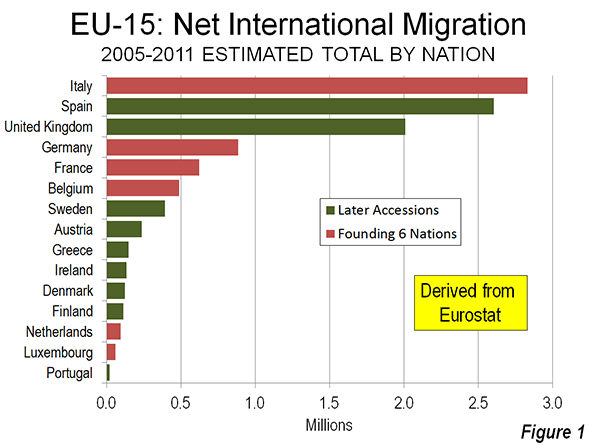
    The changes are stunning. All 15 nations have had net international migration gains since 2005. The leader is Italy, which has added a net 2.8 million international migrants, the equivalent of 4.7 percent of its population. This is more than Italy’s total population gain between 1975 and 2000. Spain has added 2.6 million net international migrants, the equivalent of 5.6 percent of its population. The United Kingdom added 2.0 million international migrants, the equivalent of 3.2 percent of its population.  

    Deep in the Heart of Europe

    Perhaps most surprising are that gains the heart of Europe, six nations that established the European Coal and Steel Community in the early 1950s, which was to become today’s European Union (Belgium, France, Germany, Luxembourg, Italy, and the Netherlands) (Figure 1).

    Germany and France had net international migration of 885,000 and 625,000 respectively. In both countries this was equal to one percent of the population. However, Belgium had the largest relative addition of international migrants. Its 490,000 net increase was equal to four percent of its population.

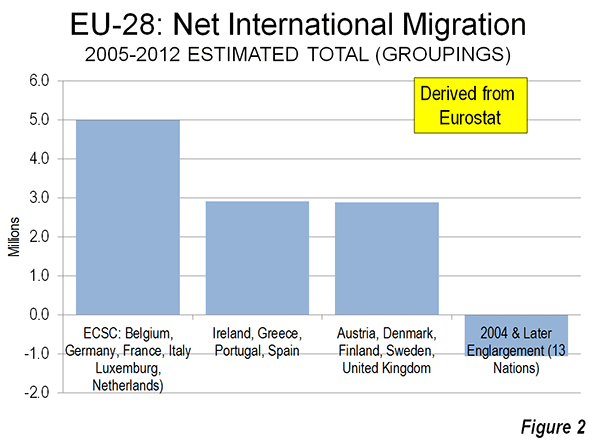
    Overall, the six founding nations of the European Union attracted a net 5.0 million international migrants 2005 to 2012. This is more than the population of all urban areas in the six nations except for Paris, Milan and the Rhine-Ruhr.

    Five additional economies, the United Kingdom, Austria, Sweden, Denmark and Finland added a net 2.8 million international migrants. Even Portugal, Ireland, Greece and Spain, despite their fragile economies, posted substantial gains, adding 2.8 net international migrants (Figure 2).

    The PIIGS Minus Italy

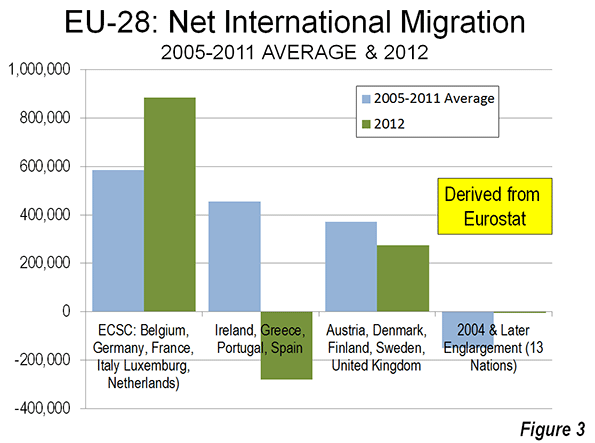
    Five nations have been designated the PIIGS by the international financial community, due to their financial reverses. These include Portugal, Ireland, Italy, Greece and Spain. All, except Italy, have seen their international migration rates fall precipitously. Between 2005 and 2011, these four nations combined added an average of 450,000 net international migrants. By 2012, they lost more than 275,000 net international migrants. In contrast, Italy, one of the EU founders, continued its strong trend, adding approximately 365,000 net international migrants in 2012, up from its 2005 to 2011 average of 350,000.

    The six founding members picked up some of the “PIIGS minus Italy” losses. In 2012, these nations added nearly 885,000 net international migrants, which is well above their 585,000 average for 2005 to 2011. The other five nations (United Kingdom, Austria, Sweden, Denmark and Finland) fell to a 275,000 net international migration gain in 2012, compared to their 2005-2011 average of 370,000.

    The new 13 members did much better than before, losing only 5,000 net international migrants in 2012. Their average from 2005 to 2011 was a 150,000 loss (Figure 3).

    Ireland and Spain

    Spain and Ireland illustrate the connection between declining economies and declining international migration.

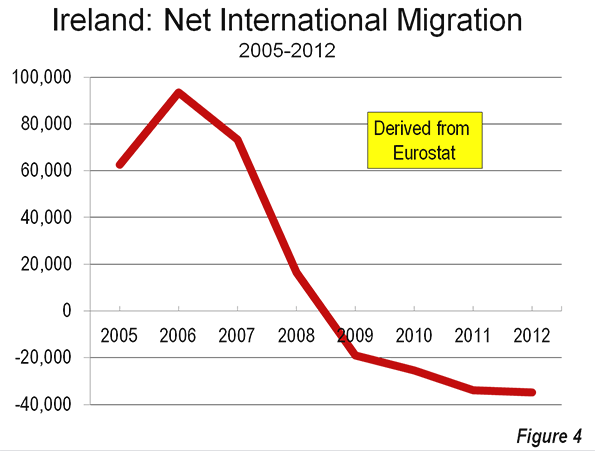
    The Irish Times noted in a recent article that the latest data from the European commission indicates that Ireland now has the worst net international outmigration rate in the European Union. Just six years ago, the Times reports, Ireland’s net international in migration rate was the highest in Europe. Over the past four years (Figure 4), Ireland has lost approximately 35,000 net international migrants annually (Ireland’s housing bubble and the resulting national financial crisis are described in Urban Containment and the Housing Bubble in Ireland).

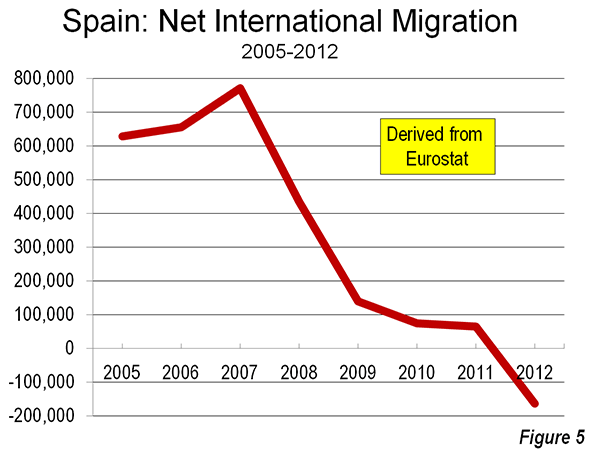
    Spain’s decline in net international migration has been every bit as spectacular. At its peak, Spain was attracting a net international migration approaching 800,000. Last year, Spain lost 165,000 international migrants (Figure 5).

    The 13 New Members

    The net international migration gains in Europe’s heart have not been good news for Eastern Europe, where the newer European Union members are located. Overall, these nations lost approximately 1,050,000 international migrants between 2005 and 2012, though as noted above, the loss was minimal in 2012. This more recent improvement may be the result of weak economic conditions in many western and southern European countries.

    Romania and Lithuania were the biggest losers. Romania lost nearly a net 1,000,000 international migrants, equal to nearly five percent of its population. Lithuania did even more poorly, losing 300,000 international migrants, nearly 10 percent of its population. Both nations lost overall population.

    Migration and Economic Growth

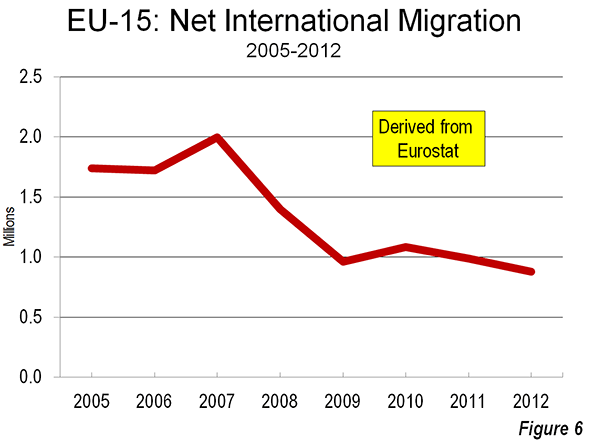
    Despite the resurgence of growth in the heart of Europe, the financial crisis has taken a toll. As in the United States, migration has fallen significantly, as many of the economic opportunities have dried up. By 2012, the net international migration to the EU-15 had been reduced to 900,000 from approximately 2 million in 2007. As throughout history, the demand for international migration is driven principally by the aspirations for a better quality of life. As a result, migration will tend to be greater where there is a wider gulf between the employment and economic opportunities in receiving countries than in countries that lose migrants.

    Wendell Cox is a Visiting Professor, Conservatoire National des Arts et Metiers, Paris and the author of “War on the Dream: How Anti-Sprawl Policy Threatens the Quality of Life.

    Photo: Genoa, Italy (by author)

  • Los Angeles: Will The City Of The Future Make It There?

    When I arrived in Los Angeles almost 40 years ago, there was a palpable sense that here, for better or worse, lay the future of America, and even the world. Los Angeles dominated so many areas — film, international trade, fashion, manufacturing, aerospace — that its ascendency seemed assured. Even in terms of the urban form, L.A.’s car-dominated, multipolar configuration was being imitated almost everywhere; it was becoming, as one writer noted, “the original in the Xerox” machine.

    Yet today the nation’s second-largest city seems to have fallen off the map of ascendant urban areas. Today’s dynamic cities in terms of job and population growth are the “new Los Angeleses,” such as Houston, Dallas, Phoenix or Charlotte; at the same time L.A. lags many more traditional “legacy” cities in job creation and growth, notably New York, Boston and Seattle. Worst of all, L.A. has lost its status as the dominant city on the West Coast; that title, in terms of both economic and political power, has shifted to the tech-heavy Bay Area.

    With a weak economy and little media outside Hollywood, the city has lost much of its cachet. A Businessweek survey last year ranked San Francisco asAmerica’s best city to live in. Los Angeles was 50th, behind such unlikely competitors as Cleveland, Omaha, Tulsa, Indianapolis and Phoenix. In another survey that purported to identify the top 10 cities for millennials, Seattle ranked first, followed by Houston, Minneapolis, Dallas, Washington, Boston and New York. Neither L.A. nor Orange County made the cut.

    L.A.’s relative decline reflects a collective inability to readjust to changing economic conditions. Some of this has to do with the end of the Cold War, but also with the loss of the headquarters of many of the area’s top defense contractors, such as Lockheed and, most recently, Northrop Grumman. In 1990, the county had 130,100 aerospace workers. A decade later, that number dropped by more than half to 52,400. By 2010, the county’s aerospace jobs numbered 39,100.

    With the exception of drone technology, the region’s aerospace industry, as one analyst put it, has become “dormant,” a victim of a talent drain and a difficult business environment. This decline has weakened the metro area’s standing as an industrial center — L.A. has lost almost 20% of its manufacturing jobs since 2007. Meanwhile STEM employment in the Los Angeles-Santa Ana area is still stuck below its 2002 levels; once arguably the world’s largest agglomeration of scientists and engineers, the region has now dipped below the national average in the proportion of STEM jobs in the local economy.

    In contrast to the Bay Area, whose tech community also was largely nurtured by defense contracts and NASA, L.A.’s defense and aerospace industries never pivoted into the vast civilian market. Capital, too, has played a role. The L.A. area has lots of rich people, but a relatively weak venture capital community. For example, the Bay Area was a recipient of roughly 45% of U.S. venture capital investment in the third quarter of 2013, while far more populous Los Angeles-Orange County took in under 6.5%.

    The growth of VC-financed companies is one reason why L.A. has been less able to produce high wage jobs than its northern rival. According to a recent projection by Economic Modeling Specialists Inc., high-wage jobs will account for only 28% of L.A.’s job growth from 2013 through 2017 compared to 45% in the Bay Area.

    Far greater problems can be seen further down the economic food chain. The state’s heavy industry — traditionally the source of higher-paid blue-collar employment — entirely missed the nation’s broad manufacturing resurgence. In the first decade of the 2000s, according to an analysis by the Praxis Strategy Group, L.A. lagged all but 10 of the nation’s 51 large metro areas in creating manufacturing jobs.

    Two other once-unassailable economic niches in L.A., its port and entertainment, also are under assault. The expansion of the Panama Canal has increased the appeal of the Gulf ports, as do plans for expanded port facilities in Baja, California.  These shifts threaten many of the roughly 500,000 generally well-paid blue-collar jobs in the local logistics industry.

    Then there’s the slow but steady erosion of L.A.’s dominance in its signature industry, entertainment. Motion picture employment is down 11,000 since 2001. In the same period New York has notched modest gains alongside growth in New Orleans and Toronto. New announcements of industry expansions and an uptick in production in L.A. show that Tinseltown is far from dead, but challenges continue to mount from overseas and domestic competitors.

    Perhaps most shocking has been the tepid response to this relative decline among L.A.’s business and political leaders. Once local entrepreneurs imagined great things, like massive water and port systems, dominated the race for space and planned out the suburban dreamscapes of Lakewood, Valencia and the Irvine Ranch.

    Arguably the signature achievement of this past decade, and the one getting the most attention in the media, has been the revival of downtown as a residential and cultural hub. Having essentially abandoned the model of a multipolar city, L.A. has poured billions in infrastructure and subsidies into a half-baked attempt to turn Los Angeles into a faux New York. This is something of a fool’s errand since barely 3% of area residents work downtown, and most cultural consumers live far away on the westside or in the San Fernando Valley.

    New Mayor Eric Garcetti is also a density advocate, and is placing huge bets on the massive building of high-end high-rise housing, all this despite weak job and population growth. In his campaign he emerged as the candidate of developers who want to densify the city, including Hollywood, over sometimes fierce grassroots opposition.

    Compared to his inept and economically clueless predecessor, Antonio Villaraigosa, Garcetti represents something of an upgrade. He at least knows jobs matter at least as much as development deals for contributors. Yet he remains pretty much a creature of the failed leadership culture of L.A., which is dominated by public employee unions, subsidy-seeking developers and greens, largely from the city’s affluent westside.

    Can L.A. turn itself around? The essential ingredients that drove the city’s ascendency remain: its location on the Pacific, its near-perfect climate and spectacular topography. The key now is for the region to build an economic strategy that allows it to use its assets, and build around its increasingly immigrant-dominated grassroots economy. Innovation in music, fashion and food continue at the grassroots level, with much of the inspiration coming from the city’s increasingly racially diverse mestizo culture.

    What L.A. needs now is not a slick media campaign, but a concerted effort to tap this neighborhood-centered energy. The city of the future needs to reinvent itself quickly, before it fades further behind its competitors on the coasts and in Texas. Successful cities such as  Boston, San Francisco, Seattle  and Houston all managed to find ways to nurture new industries to supplement their traditional ones. Los Angeles should be able to do the same, but only if it seizes on its fundamental assets can it again become a city with a future.

    This story originally appeared at Forbes.com.

    Joel Kotkin is executive editor of NewGeography.com and Distinguished Presidential Fellow in Urban Futures at Chapman University, and a member of the editorial board of the Orange County Register. He is author of The City: A Global History and The Next Hundred Million: America in 2050. His most recent study, The Rise of Postfamilialism, has been widely discussed and distributed internationally. He lives in Los Angeles, CA.
  • Is Economic Development Dead?

    When Bill De Blasio won New York’s mayoral election a few weeks ago, it came as no surprise to anyone. His impassioned analogies to New York’s “Tale of Two Cities” and his call for a city that provided not just for the wealthiest one or two percent, but for all, appealed to the growing sense that New York is an increasingly unfair and unequal place.

    The angst felt by New Yorkers is not contained only to that city. In Chicago, real estate companies have poured investment into the Loop and a handful of adjacent residential and mixed-use neighborhoods. Yet, whole swaths of the city’s south and southwest side have remained in a state that would rival war-zones and have earned the city a reputation as America’s murder and gang capital du jour. San Francisco’s recent transit strikes, and the ensuing scandal that followed a Silicon Valley tycoon’s less than empathetic statements on Facebook have highlighted that city’s class tensions.

    Saskia Sassen pointed out in her 1991 book The Global City that globalization and modern technologies should push wealth and geopolitical power to a small number of globally connected and powerful metropolises. And in many ways, this thesis has born itself out as financial centers in New York and, to a lesser extent, Chicago and Boston as well as technology in San Francisco and “Eds and Meds” in Philadelphia, Pittsburgh and Boston have all “revitalized” these legacy cities that only thirty years ago would have been widely assumed to be dead. Meanwhile, smaller, less connected legacy cities have shrunk in global importance.

    Left out of many people’s analysis of Sassen’s writings – an analysis that equates geopolitical power with urban success – is the simple fact that a geopolitically powerful city does not always mean a city of evenly distributed wealth or equality. The urban poor in New York, Chicago, or Philadelphia are not necessarily better off than those in Buffalo, St. Louis, or Detroit. In some ways, the low cost of living in “unsuccessful” legacy cities means that quality of life is in many cases better than in those cities widely regarded as a success.

    Given our assumptions about urban success – that it should involve a thriving private sector, a critical mass of wealthy taxpayers, and a sustainable level of investment (as an aside, I know few people who would describe investment in New York as “sustainable” at this point) – it should come as no surprise that the method most commonly employed to realize these goals, economic development, would fail so spectacularly to deliver positive changes in the lives of the urban poor.

    While a thriving private sector, a critical mass of wealthy taxpayers, and a sustainable level of investment certainly register among the necessary descriptions of a successful city, urban economic development too often equates better cities with attracting better people at the cost of dealing with the populations already residing within a city. While the last few decades have seen the resurgence of once decrepit metropolises through TIFs and BIDs and tax breaks aimed at capturing employers of what Richard Florida would describe as “the creative class” – engineers, lawyers, artists, and bankers – De Blasio’s win, along with political movements like Occupy Wall Street augur a shift in focus from the technocratic priorities of Giuliani or Daley to a De Blasio-style redistributive view of urban justice.

    So far I have ignored a bit of nuance between Bloomberg’s market-oriented (some might say neoliberal) focus on growth in “creative class” (high skill and high pay) sectors, and his classically progressive restraints in other initiatives (smoking, trans fat) and the degree to which other mayors have followed New York’s lead in this type of leadership. While I tend to hope that a market-oriented solution to urban problems can be found, the vehicle for urban revitalization seems almost irrelevant when we consider the degree to which it has benefitted the urban wealthy at the exclusion, and occasionally cost, of the urban poor.

    Obviously, inequities in quality of life have been most pronounced in New York where wealth is profligate and new construction has been tightly regulated, pushing cost of living ever upward. Yet, the De Blasio election means less for New York’s poor than it does for the country as a whole. Whether the Rahm Emanuels and Michael Nutters of America’s cities are replaced by De Blasio democrats in the next election will mean a lot for the priorities of development in our cities.

    It’s easy to dismiss the De Blasio win as an event isolated to the confines of New York as the logical end to both Bloomberg’s overreaching policies and “quality of life” initiatives which arguably placed a premium on attracting and retaining the wealthy. But, we should not ignore the very real possibility that De Blasio’s win, and the disdain growing for economic development-focused politicians, may lead to a spiral of urban disinvestment wherein wealthier taxpayers leave cities, making cities ever less attractive places to live, thereby further escalating the effects repelling the middle and upper classes from urban cores. The reason we should not ignore this possibility, though it may seem inflammatory at first consideration, is simple: we are still recovering from its effects throughout the last half of the previous century.

    Yet, De Blasio is probably not as leftist as right-leaning pundits have bombastically proclaimed in the wake of his election. Hopefully, De Blasio and the growing urban left can pull off a type of development that prioritizes development for all, not just for the wealthiest residents, without falling into the traps of the union-entrenched Democrat machines that oversaw the urban perdition of the last half century. The death of urban economic development may well be upon us, but hopefully if it is, something that provides for the development of the whole city will emerge.

    Sam Hersh is currently a student of urban studies at Haverford College in Pennsylvania hoping to use the worlds’ cities to more effectively catalyze human opportunity when he graduates. He can be reached at shershey1@gmail.com.

    Photo courtesy of Bill de Blasio.

  • Progressive Policies Burden the Yeoman Class

    Obamacare’s first set of victims was predictable: the self-employed and owners of small businesses. Since the bungled launch of the health insurance enrollment system, hundreds of thousands of self-insured people have either had their policies revoked or may find themselves in that situation in the coming months. More than 10 million self-insured people, many of them self-employed, could meet a similar fate.

    Unlike large companies or labor unions, which have sought to delay or duck implementing the Affordable Care Act, what could be called the yeoman class lacks the political might to make much of a dent in Washington policies. Indeed, in the Obama era, with its emphasis on top-down solutions and Chicago-style brokering, Americans who work for themselves probably are more marginalized today than at any time in recent memory.

    Virtually every major initiative of this administration – from taxation and regulation to monetary policy and Obamacare – has been promulgated with little concern for the self-employed. Many feel themselves subject to an apparent attempt to transfer middle class incomes to the poor just as ever more wealth concentrates in the “1 percent.” Not surprisingly, 60 percent of business owners surveyed by Gallup expressed opposition to the administration.

    The divide between the yeoman and the political community marks a major departure from the norms of American history. After all, people came to America in large part to secure “a piece of the pie,” whether through owning a small business or a farm, goals often unattainable in Europe. Thomas Jefferson, notes historian Kenneth Jackson, “dreamed of the U.S. as a nation of small yeoman farmers who would own their own land and cultivate it.”

    The rural yeoman ascendency lasted well into the late 19th century, when the populist movement fell to triumphant industrial capitalism. Yet the drive to disperse property did not end there, but resurfaced in the expansion of urban homeownership, something strongly supported by the New Deal administration. “A nation of homeowners,” President Franklin Roosevelt believed, “of people who own a real share in their land, is unconquerable.” From 1940-60, nonfarm homeownership rose from 43 percent of Americans to more than 58 percent.

    Early on, some progressives, particularly among intellectuals, recoiled against the rise of a class of petty landowners. Some of them, historian Christopher Lasch observed, saw “a republic of producers” as necessarily “narrow, provincial and reactionary.” This view is echoed today by Democrats such as former Clinton administration adviser Bill Galston, who dismisses small business as “a building block of the Republican base.” Democrats, he suggests, should instead seek a reconciliation with Big Business and its powerful cadre of lobbyists.

    An expanding cohort

    Yet, Democrats someday may rue tossing off the yeoman class. Unlike such groups as white racists, defense hawks and social conservatives, all of whose ranks are thinning, the numbers of the self-employed are growing. Independent contractors, according to Jeffrey Eisenach, an economist at George Mason University, have increased by 1 million since 2005; one in five works in such fields as management, business services or finance, where the percentage of people working for themselves rose from 28 percent to 40 percent from 2005-10. Many others work in fields like energy, mining, real estate or construction. Altogether, there are as many as 10 million such independent workers, constituting upward of 7.6 percent of the U.S. labor force and earning more than $626 billion.

    This shift to self-employment is occurring even in heavily regulated states like California. Since 2001, the number of self-employed people in the Golden State grew by 15.6 percent, versus a gain of 9.4 percent for the nation. In terms of states’ share of self-employed in the workplace, California ranks in the top five; three of the others, Vermont, Maine and Oregon also are blue states.

    Why is this the case? Ironically, this may be a reaction to expansive regulatory regimes that tend to both reduce corporate employment and also encourage some individuals “to take their talents” solo into the marketplace without having to deal with, for example, labor laws and environmental regulations.

    At the same time, technology allows people to work in an increasingly dispersed manor. The number of telecommuters has soared by 1.7 million workers over the past decade, a 31 percent increase in market share, and now accounts for 4.3 percent of all employment.

    Obamacare is only one aspect of government’s assault on the yeoman class. Attempts to regulate housing and encourage denser, usually rental, units ultimately works against the interests of home-based small businesses by raising house prices. The extra bedroom that becomes the home office now can be seen as “wasteful” even if – in terms of generating greenhouse gases – working at home is far more efficient than commuting, even by mass transit.

    Alienating allies

    Over time, these conflicts could threaten the interests of some groups that now reside firmly in the Obama majority coalition. This reflects the changing demographics of small enterprise; the yeomanry is slowly becoming far more diverse. From 1982-2007, for example, African American-owned businesses increased by 523 percent; Asian American-owned businesses grew by 545 percent; Hispanic American-owned businesses by 696 percent; businesses owned by whites increased by 81 percent. Today, minority-owned firms make up 21 percent of the nation’s 27 million small businesses.

    Immigrants, a largely Democratic-leaning constituency, constitute a growing part of the entrepreneurial landscape. The immigrant share of all new businesses, notes the Kauffman Foundation, grew from 13.4 percent in 1996 to 29.5 percent in 2010. They also constitute roughly a quarter of founders of high-tech start ups, and have done so for most of the past generation.

    Women, another Obama-leaning group, have also expanded their footprint; over the past 15 years, the number of women-owned firms has grown by one and a half times the rate of other small enterprises. These companies account for almost 30 percent of all enterprises; from 1997-2012, the number of women-owned U.S. firms increased by 54 percent, versus an overall growth rate for all firms of 37 percent.

    Eventually, the potential yeoman backlash may also spill over to millennials, another key Obama constituency. As a generation, their desire for homeownership and economic self-reliance runs headlong into both the tepid economic recovery and regulatory policies. Over time, as they age, their interests could diverge from the expanding welfare state, whose primary mission appears to be to transfer wealth not only from the middle class to the poor but from younger to older Americans.

    As millennials age, many will seek to buy homes, start businesses and families. In contrast to their common, often-naïve embrace of the idea of bigger government, developed in their student years, experiences as potential homeowners and parents, as well as business owners, might make them skeptical of “top down” solutions imposed by largely baby boomer ideologues.

    Reply from the Right?

    Yet, this will be no cakewalk for conservatives. It is not enough to simply dismiss Obamacare, or other regulations, without endorsing some of the measures’ positive attributes, such as assuring one’s children or protecting the rights of those with “pre-existing conditions.” The yeomanry may want less-Draconian legislation, but they may not be so anxious to leave their health care utterly exposed to unfettered market forces.

    Democrats, in fact, could make a run at this constituency, particularly if the Republicans continue a political approach that alienates, in particular, a more diverse yeomanry – gays, many women and ethnic minorities, immigrants and creative professionals. Here, in fact, it might be better to be more radical than less, proposing something more like a Canadian “single payer” health system that would separate employment status from health care. Democrats also could also support some form of minimum coverage designed for the growing numbers of Americans who work for themselves.

    Ultimately, over time, the yeoman constituency, although poorly organized and without a programmatic agenda, is one that needs to be addressed, if for no other reason than they constitute a growing portion of the workforce. The party, or movement, that successfully does this will have a great opportunity to seize the political future.

    This story originally appeared at The Orange County Register.

    Joel Kotkin is executive editor of NewGeography.com and Distinguished Presidential Fellow in Urban Futures at Chapman University, and a member of the editorial board of the Orange County Register. He is author of The City: A Global History and The Next Hundred Million: America in 2050. His most recent study, The Rise of Postfamilialism, has been widely discussed and distributed internationally. He lives in Los Angeles, CA.
    Official White House Photo

  • The Surprising Cities Creating The Most Tech Jobs

    With the social media frenzy at a fever pitch, people may be excused for thinking that Silicon Valley is still the main engine for growth in the technology sector. But a close look at employment data over time shows that tech jobs are dispersing beyond the Valley and its much-celebrated urban annex of San Francisco.

    We turned to Mark Schill, research director at Praxis Strategy Group, to analyze job creation trends in the nation’s 52 largest metropolitan areas from 2001 to 2013, a period that extends from the bust of the last tech expansion to the flowering of the current one. He looked at employment in the industries we normally associate with technology, such as software, engineering and computer programming services. He also analyzed the numbers of workers in other industries who are classified as being in STEM occupations (science, technology, engineering and mathematics-related jobs). This captures the many tech workers who are employed in businesses that at first glance may not seem to have anything to do with technology at all. For instance just 8% of the nation’s 620,000 software application developers work at software firms — the vast majority are employed in industries as disparate as manufacturing, finance, and business services.

    The four metro areas that have generated tech jobs at the fastest pace over the past 12 years are far outside the Bay Area, in the southern half of the country, in places with lower costs of living and generally friendly business climates. In first place: Austin-Round Rock-San Marcos, Texas, where tech companies have expanded employment by 41% since 2001 and the number of STEM workers has risen by 17% over the same period. Looking at the near-term, 2010-13, the Austin metro area also ranks first in the nation.

    The keys to Austin’s success lies largely in its affordability and high quality of life, both in its small urban core and rapidly expanding suburbs. Best known as the hometown of Dell, a host of West Coast tech titans have set up shop there in recent years, including AMD, Cisco, Hewlett-Packard, Intel and Oracle.

    Much the same can be said about Austin’s East Coast doppelganger, Raleigh-Cary, N.C., which ranks second on our list. Like Austin, Raleigh-Cary is a big college metro area, and also hosts the state capital, something that tends to lessen wild swings during industry downturns. Like Austin, Raleigh is not a primary center of the social media boom, but it has registered a 54.7% increase in tech sector employment since 2001 and an impressive 24.6% rise in STEM jobs. Much of the growth comes from global companies such as IBM,GSK, Syngenta, RTI International, Credit Suisse, and Cisco.

    The next two spots go to two surprising metro areas with a less than stellar degree of tech cred: Houston-Sugarland-Baytown, Texas, and Nashville-Franklin-Murfreesboro, Tenn. Not much of a role for social media here, but STEM employment has expanded 24% in Houston since 2001 thanks to boom times for the increasingly technology-intensive energy industry. The Houston metro area ranks second only to Silicon Valley in the proportion of engineers in its workforce.

    In Nashville, tech employment is up 65.8%, largely due to the area’s rise as a hospital management and healthcare IT hub, with a 160% spike in jobs in computer systems design services.

    The Strange Case of Silicon Valley

    How about the Bay Area, the legendary center of the tech industry? There has certainly been considerable growth in the San Francisco-Oakland-Fremont MSA, which has logged a 28% expansion of tech company jobs. The region is unique as a beneficiary of the social media boom: Twitter and other tech darlings are concentrated in the area, with many others in adjacent San Mateo County. Tech employment in San Francisco  plunged by nearly half between 2000 and 2004, but now appears back to the levels experienced in the first dot-com boom.

    In contrast, San Jose-Sunnyvale-Santa Clara — home to roughly 40% of the nation’s venture capital— clocks in at a mediocre 25th on our list. How could this be, giving the presence of such iconic companies as Google, Intel, Facebook and Apple? After all, the area has gained 20,000 jobs in Internet publishing and web search since 2001. However that pales next to the decline in high-tech manufacturing, where the area has lost an estimated 80,000 jobs. This may be one key reason why STEM employment has dropped 12% in the San Jose area over the past 12 years despite the success of so many tech firms over that period. In San Francisco, STEM employment is up, but only a tepid 5.5%.

    This disappointing trend also extends to some other historically strong tech areas, most of which have grown recently but are still struggling with losses over a decade ago. This includes Boston-Cambridge-Quincy (26th) and San Diego-Carlsbad-San Marcos (28th), both of which were early tech high-fliers. Boston-area tech companies have expanded employment by 16% since 2001, but the number of STEM jobs is down 1.6%. The San Diego area registered strong growth in tech and STEM employment in the first years of the millennium, but since 2010 gains have been few. Being first may earn a region kudos, but does not seem to guarantee continued rapid growth.

    But not all of the early high-fliers are underperforming. The Seattle-Tacoma-Bellevue area has remained a consistent tech performer, ranking 7th on our list with 45.5% growth in tech company employment and a 19.5% jump in STEM jobs. One reason for this may lie in the diversity of companies in the region, from software giant Microsoft to dominate etailer Amazon as well as Boeing, a long-time massive employer of technical workers. Seattle’s success, like that of Houston and Nashville, has much to do with both manufacturing and trade as well as an associated rising demand for software services; it is often forgotten that a majority of the country’s scientists and engineers work for manufacturers, and that industrial companies account for 68% of business R&D spending, which in turn accounts for about 70% of total R&D spending.

    Is Tech Moving Downtown?

    Perhaps nothing has captured the imagination of the media and professional urban boosters as much as the notion that tech jobs are moving from the suburbs to the inner core. Although there is some evidence of growth in social media jobs in some central business districts, notably San Francisco, most large urban centers have not done particularly well in technology over the past decade.

    In some ways, this reflects the extreme volatility of Internet-based software and marketing firms, which, unlike tech hardware or customer support services, have shown a notable tendency to concentrate in urban cores. In some places, notably New York, these sectors have grown at the expense of traditional media and advertising employment, which have fallen off dramatically in recent years. None of the three largest metro areas in the country — New York, Los Angeles and Chicago — made it into the top half of our rankings. New York, where any two nerds in a room can expect gushing media attention, clocks in at 36th. Some locals claim the city is now second to the Silicon Valley in tech, but that is widely off the mark. Since 2001, Gotham’s tech industry growth has been a paltry 6% while the number of STEM related jobs has fallen 4%.

    The chances of Gotham becoming a major tech center are handicapped not only by high costs and taxes, but a distinct lack of engineering talent. On a per capita basis, the New York area ranks 78th out of the nation’s 85 largest metro areas, with a miniscule 6.1 engineers per 1,000 workers, one seventh the concentration in the Valley.

    This means that tech growth is likely to be limited largely to areas like new media, which will be hard-pressed to replace jobs lost in more traditional information industries. Since 2001 newspaper publishing has lost almost 200,000 jobs nationwide, or 45% of its total, while employment at periodicals has dropped 51,000,or 30%, and book publishing, an industry overwhelmingly concentrated in New York, has lost 17,000 jobs, or 20% of its total.

    The prospects for Los Angeles-Long Beach-Santa Ana (38th) and Chicago-Joliet-Naperville (42nd) seem no better. Due in large part to the continuing shrinkage of its aerospace sector, the number of STEM jobs in the L.A. area is down 6.3% since 2001though tech industry employment has grown a modest 12%. For its part, Chicago has experience significant decline in both tech employment and STEM jobs over the past 12 years.

    On the positive side of the ledger, L.A. at least still boasts the largest number of engineers in the country. Chicago, in comparison, has barely half as many engineers per capita as L.A. This suggests that Los Angeles may prove better positioned in terms of developing tech-related jobs than its Midwestern rival.

    Look To The Hinterland

    Where should we look for future tech growth? Certainly long-term you can’t count out Silicon Valley and its enormous, and uniquely deep reservoir of engineering expertise. Seattle also seems a safe bet, in part due to its lower energy and housing costs, at least compared to San Francisco and the Valley.

    But perhaps the biggest trend over time will be dispersion. After the top five on our list come a series of less-celebrated metro areas, including Salt Lake City, Indianapolis, Baltimore, Jacksonville, Kansas City and Denver. These areas are generally less expensive than the trendier cities, and could attract more tech investment once the current bubble conditions die down.

    The future of tech may be best represented not by the fresh-faced 20something social media CEOs lionized by the media but by the huge tech corridor along I-15 between Salt Lake and Provo, now filling up with offices of such tech titans as Intel, Adobe and eBay. In recent years the University of Utah has led all universities in fostering startups; it may not have the cachet of Stanford yet, but the trend lines are encouraging. A critical factor here may be the cost of living, particularly for over-30 engineers who can never really hope to buy a house in San Francisco or Silicon Valley but can find housing prices 50% or less than what they would pay on the coast.

    Further out expect other, often smaller communities to emerge as tech hot spots. One recent report from the Progressive Policy Institute spotlighted fast high-tech growth in such places as Madison County, Ala., exurbs like Virginia’s Loudon County, as well as resurgent Orleans parish, Louisiana. Another study, this one by the Bay Area Council, found that of the 10 fastest-growing tech centers in America, seven have populations around or under 150,000.

    This suggests that, contrary to the conventional wisdom, tech employment is likely not to grow fastest in our biggest and most expensive urban cores, but spread out across an ever-widening geography. None will likely rival Silicon Valley, with its enormous resources and powerful inertia, but they will make themselves heard in the marketplace.

    Tech-STEM Metropolitan Growth Rankings, 2001-2013
      Rank Score Tech Industry 2001-2013 growth Tech Industry 2010-2013 Growth STEM Occupation 2001-2013 growth STEM Occupation 2010-2013 Growth
    Austin-Round Rock-San Marcos, TX 1 82.8 41.4% 24.1% 17.1% 15.7%
    Raleigh-Cary, NC 2 82.3 54.7% 18.5% 24.6% 12.3%
    Houston-Sugar Land-Baytown, TX 3 74.0 18.6% 15.2% 24.1% 14.4%
    Nashville-Davidson–Murfreesboro–Franklin, TN 4 72.4 65.8% 20.5% 12.3% 8.0%
    San Francisco-Oakland-Fremont, CA 5 70.1 28.0% 25.0% 5.5% 13.8%
    Salt Lake City, UT 6 69.7 38.0% 15.0% 19.2% 10.4%
    Seattle-Tacoma-Bellevue, WA 7 69.0 45.5% 11.2% 19.5% 10.1%
    San Antonio-New Braunfels, TX 8 67.4 45.1% 12.7% 21.9% 7.4%
    Indianapolis-Carmel, IN 9 67.2 50.4% 21.3% 10.6% 7.5%
    Baltimore-Towson, MD 10 64.1 50.7% 9.8% 19.6% 6.4%
    Jacksonville, FL 11 63.7 83.5% 6.4% 14.3% 4.4%
    Dallas-Fort Worth-Arlington, TX 12 63.5 20.5% 19.6% 8.3% 11.7%
    Kansas City, MO-KS 13 60.1 30.0% 18.5% 7.1% 8.8%
    Phoenix-Mesa-Glendale, AZ 14 56.6 29.7% 17.4% 4.8% 7.9%
    Denver-Aurora-Broomfield, CO 15 54.8 5.7% 17.6% 5.7% 10.2%
    Pittsburgh, PA 16 52.5 14.8% 14.0% 8.2% 7.6%
    Detroit-Warren-Livonia, MI 17 52.2 -3.5% 21.5% -13.8% 16.8%
    Las Vegas-Paradise, NV 18 51.9 34.3% 3.3% 19.0% 4.0%
    Oklahoma City, OK 19 49.8 22.9% 4.3% 8.4% 8.6%
    Riverside-San Bernardino-Ontario, CA 20 49.2 31.5% 8.5% 16.8% 1.3%
    Grand Rapids-Wyoming, MI 21 48.2 -5.1% 6.8% 0.9% 14.4%
    Charlotte-Gastonia-Rock Hill, NC-SC 22 48.2 13.4% 7.7% 6.4% 8.5%
    Portland-Vancouver-Hillsboro, OR-WA 23 47.6 14.4% 9.5% 4.4% 7.9%
    Cincinnati-Middletown, OH-KY-IN 24 47.5 14.1% 14.7% 2.6% 6.5%
    San Jose-Sunnyvale-Santa Clara, CA 25 47.2 18.0% 17.0% -11.9% 10.9%
    Boston-Cambridge-Quincy, MA-NH 26 45.4 16.2% 13.3% -1.6% 7.1%
    Sacramento–Arden-Arcade–Roseville, CA 27 44.4 40.8% 3.6% 7.8% 2.4%
    San Diego-Carlsbad-San Marcos, CA 28 43.6 30.2% 1.5% 11.3% 3.0%
    Atlanta-Sandy Springs-Marietta, GA 29 43.5 3.3% 13.0% -0.9% 7.8%
    Washington-Arlington-Alexandria, DC-VA-MD-WV 30 43.3 18.1% 1.3% 17.6% 2.2%
    Orlando-Kissimmee-Sanford, FL 31 41.7 22.4% 1.5% 11.7% 2.9%
    Louisville/Jefferson County, KY-IN 32 41.2 -17.0% 13.1% 1.5% 8.6%
    Minneapolis-St. Paul-Bloomington, MN-WI 33 40.5 -0.6% 9.0% 2.4% 6.7%
    Milwaukee-Waukesha-West Allis, WI 34 39.9 -3.1% 14.4% -3.8% 7.0%
    Tampa-St. Petersburg-Clearwater, FL 35 39.6 19.8% 10.9% -4.5% 4.8%
    New York-Northern New Jersey-Long Island, NY-NJ-PA 36 36.7 5.9% 12.2% -4.1% 4.3%
    Virginia Beach-Norfolk-Newport News, VA-NC 37 36.3 15.8% 0.7% 6.2% 3.0%
    Los Angeles-Long Beach-Santa Ana, CA 38 33.1 12.0% 6.9% -6.3% 4.1%
    Richmond, VA 39 33.0 25.7% -1.0% 1.4% 1.9%
    St. Louis, MO-IL 40 33.0 22.9% 5.1% -4.1% 2.0%
    Providence-New Bedford-Fall River, RI-MA 41 32.3 23.7% 2.7% -2.1% 1.6%
    Chicago-Joliet-Naperville, IL-IN-WI 42 31.6 -7.5% 12.1% -9.3% 5.5%
    Buffalo-Niagara Falls, NY 43 29.3 17.8% 0.3% -0.1% 0.8%
    Cleveland-Elyria-Mentor, OH 44 28.3 3.7% 6.4% -9.1% 3.7%
    Rochester, NY 45 28.2 -7.5% 17.5% -13.6% 2.6%
    Memphis, TN-MS-AR 46 27.6 -9.7% 5.1% -4.3% 4.0%
    Philadelphia-Camden-Wilmington, PA-NJ-DE-MD 47 26.4 5.1% 2.8% -3.5% 1.3%
    Birmingham-Hoover, AL 48 25.1 -15.3% 7.1% -6.5% 3.3%
    Hartford-West Hartford-East Hartford, CT 49 23.9 6.9% 2.6% -5.8% 0.4%
    Miami-Fort Lauderdale-Pompano Beach, FL 50 20.9 2.6% 0.5% -7.3% 0.6%
    New Orleans-Metairie-Kenner, LA 51 20.9 12.6% 5.9% -14.7% -0.3%
    Analysis by Mark Schill, Praxis Strategy Group, mark@praxissg.com
    Data Source: EMSI Class of Worker, 2013.4 – QCEW, Non-QCEW, and self-employed
    Note: The Columbus MSA is excluded from this analysis because tech job shifts in that region appear to be due to firms changing industrial classifications.

    This story originally appeared at Forbes.

    Joel Kotkin is executive editor of NewGeography.com and Distinguished Presidential Fellow in Urban Futures at Chapman University, and a member of the editorial board of the Orange County Register. He is author of The City: A Global History and The Next Hundred Million: America in 2050. His most recent study, The Rise of Postfamilialism, has been widely discussed and distributed internationally. He lives in Los Angeles, CA.
    Computer engineer photo by BigStockPhoto.com.

  • Shareable Cities: Blurring the Lines


    “We believed then as we do now, that the sharing economy can democratize access to goods, services, and capital – in fact all the essentials that make for vibrant markets, commons, and neighborhoods. It’s an epoch shaping opportunity for sustainable urban development that can complement the legacy economy. Resource sharing, peer production, and the free market can empower people to self-provision locally much of what they need to thrive. Yet we’ve learned that current U.S. policies often block resource sharing and peer production. – From the report “Policies for Shareable Cities”


    “Digital information technology contributes to the world by making it easier to copy and modify information. Computers promise to make this easier for all of us. Not everyone wants it to be easier.” – Richard Stallman, “Why Software Should Not Have Owners”

    Not long ago there were pretty clear boundaries between the personal sphere and the commercial one, as well as more clear boundaries between public and private space. What’s more, most things, both personal and commercial, were heavily based on a model of exclusive use. Today these lines are increasingly dissolving in ways that upset current business models and lifestyles. It portends a present and a future in which property is increasingly shared, not exclusive, and where there are a mixture of public, private, personal, and commercial entities intersecting in the same spaces. The key driver of this is technology, which has reduced barriers and transaction costs in a way that enables things like car sharing that would have been impossible not long ago. However, our legal frameworks have often not kept up with this. Some people who benefit from the current models would like to keep it that way. But if we let the marketplace evolve, then institute good rules to fit this new reality, it promises to hold huge benefits to the public.

    First an example that’s by now old hat. In an age before cell phones and personal computers, there was a more rigorous separation of work and personal life. People need to be physically co-located in a office. They commuted there every day, worked in a dedicated personal office or cubicle, then went home where work as a rule did not intrude. Today’s workers are checking email every waking hour (and even being interrupted during the night), while also spending much more time on personal things (online banking, fantasy football, or random web surfing) while in the office. The internet has enabled distributed work environments, in which teams collaborate from offices, airports, and homes around the world. Companies increasingly have turned to “hoteling” or other shared space concepts in the office on the assumption employees no longer need dedicated space. Many people have flexible work arrangements or otherwise telecommute. In the latter case, home and office have literally merged.

    This has had huge benefits across the board. Companies love it because they can access cheap labor pools overseas, effectively recruit people with a need for workplace flexibility, and reduce their office space needs. Joel Kotkin has said the latter trend may mean America has hit “peak office.” Workers get the flexibility they like, can save on commuting costs, access geographically remote clients, etc. The environment benefits from reduced commuting. The ultimate green commute is one you don’t have to make. I would say that the balance of the benefits here has accrued to business, while workers have sometimes had arrangements they don’t like forced on them. Still, on the whole this shows great promise of being a win, win, win.

    The “hoteling” concept and “just in time” delivery aren’t limited to corporate uses. Things like car share are bringing them to the household market. The average personal car is supposedly idle 90% of the time. When you factor in all the additional infrastructure costs needed to support a one person, one car model (e.g., parking), the deadweight loss from all that idle capacity is stunning. Imagine factories that sat idle 90% of the time doing nothing. If a corporate manager had this low a rate of asset utilization, he’d be in deep trouble.

    When you sign up for Zipcar or another service, you avoid some of this deadweight loss. By effectively sharing a fleet of vehicles with others, a relatively small number of cars can serve a large number of people, greatly improving asset utilization rates and delivering big value to consumers, even when they are paying a business to manage the fleet for them. It’s a huge form of productivity gain. This also has the effect of converting transportation from a largely fixed cost to a mostly variable one, with signficiant impacts on the decision making process for everything that involves transportation (mostly positive, I believe).

    Though having a limited addressable market at present, obviously car sharing in the Zipcar style poses a threat to the entire US car industry, arguably one of the most important employers in the country and one President Obama himself personally intervened to save during the meltdown. Clearly the highest levels of politics in America will defend the car industry, though to date there’s been very little complaint from them about car sharing.

    Things have been different when it’s transport service providers who are threatened. Public transit agencies have long been unrelentingly hostile to jitney services. Today car service booking tool Uber and ride sharing company Lyft have experienced an all out regulatory assault from entrenched interests. Lyft is a particularly interesting case. It’s a peer to peer ride sharing platform. Just as 90% of the time a private car is unused, when it is used, 80% of the available seat capacity goes vacant. Again, this is a massive deadweight loss. (The amount of theoretically wasted capacity in the world of private cars is stunning). Imagine an airline trying to make a business out of 20% load factors. It just doesn’t work, yet we as individuals run a “business” like that every time we drive our cars solo. Lyft helps fill up those empty seats, and even get some money – “donations” – in the process.

    In other words, Lyft is a business that effectively turns your personal vehicle into a pseudo-livery vehicle. I’ve long argued that we should have “every car a jitney” by legalizing it and having personal auto polices cover ancillary commercial use as a matter of course. Lyft is trying to solve that problem and make it happen. Obviously the traditional “commercial” sector (e.g., taxis), which is highly regulated and subject to many taxes and fees hates this. They feel, rightly to some extent, that there’s a double standard. This is the type of conflict and legal uncertainty are spurred when the boundaries between personal and business, and between exclusive and shared use, start breaking down.

    The big kahuna in provoking outrage of late has been AirBnB, an application that lets people rent out rooms in their homes as de facto hotel spaces. Again, the same principle applies. An empty bedroom is deadweight loss just like an empty office or an idle factory. It makes sense to put those spaces to work where feasible. This had been done previously in the form of house swaps and couch surfing. But the rise of commercially oriented AirBnB has raised hackles, especially in governments that have strict rules and high taxes on hotels. There have been a number of media articles of late taking note of or weighing in on the controversy. For example, in the New York Times piece, “The Airbnb Economy in New York: Lucrative but Often Illegal.”

    Again, the benefits are clear in the improved utilization of space which is a pure efficiency gain. What’s more, AirBnB was even used by the government during Hurricane Sandy to find temporary free housing for those displaced by the storm. Peter Hirshberg noted that this type of distributed app might be the real killer app for smart cities, and will play an increasingly important role in urban resiliency. But it legitimately does create a set of parallel environments and rule sets, and exposes a world in which ancillary commercial activity at a residence is something that doesn’t really fit into our existing categories.

    The list of situations like this are endless. Many zoning laws don’t appropriately allow home based businesses. Fund raising bake sales have been banned because it’s not legal to sell products prepared at home. In some places there have been issues with selling vegetables from home gardens.

    Then there’s the disputes arising from the increasing use of public space for commercial purposes, whether that be curb side intercity bus service or food trucks. Pushcart style food vendors, often ethnic, are also often technically illegal (e.g., rogue elotes stands).

    In short, traditional barriers are falling and boundaries are dissolving, especially when it comes to those key dimensions of personal-commercial, exclusive-shared, and public-private.

    I don’t want to suggest all of the complaints about these are unfounded, though many of them are pure rent seeking. From the standpoint of someone running a fully commercial operation, who complies with massive amounts of costly red tape, it certainly seems unfair that others are allowed to operate what are basically businesses under a lighter tough regulatory scheme. The status quo isn’t necessarily where we need to be.

    But let’s take a step back and look at the big picture. Our economy is in huge need of a massive injection of dynamism and new value creation. Many observers have said we need a completely new economic model. Walter Russell Mead has called this “beyond blue”. Richard Florida styles it the “great reset”. But clearly the old ways of doing things aren’t working and we need change.

    This new style “shareable” economy based on peer to peer production in a distributed, small scale form is one that promises to provide at least part of the answer. It also renders addressable a huge amount of previously trapped value. Companies reaped huge amounts of gains by eschewing vertical integration in favor of more networked relationships. That’s corporate-speak for peer to peer sourcing. Similarly, things like hoteling, just in time delivery, etc. have let to much greater and more effective asset utilization. The amount of under-utilized assets in the household sector is stunning. This is about bringing to that household sector the same types of efficiency boosting and value creating techniques previously employed only by traditional businesses.

    But beyond the sheer efficiency gains, I think it’s under appreciated in developed countries how economic informality can create economic dynamism. Peruvian economist Hernando de Soto noted that lack of property titles and difficulties of the formal economy perpetuated poverty because people in developing countries couldn’t access the system for credit to fuel business, etc. In the developed world we’ve got a similar problem brewing. Our economy has been largely entirely formalized to the point where we are choking in red tape that has produced an economic system that has failed too many of its residents and leading to the creation of these informal economies as a safety valve. And our societies are very ill equipped to deal with that as we’ve become excessively formalized.

    We don’t need to establish property titles as we already have them, but we do need regulatory systems that enable entrepreneurship and new business models like peer to peer to thrive. What’s more, I think enabling some level of an informal sector to flourish is actually a good thing, as it’s a de facto “incubator” for new ideas that can later be developed into a more officialized system. Without a toleration of informality, these would never get off the ground. I’ve highlighted how this worked with regards to uncertain property titles on abandoned buildings in Berlin that helped launch the creative scene there. I also highlighted similar trends in Detroit. Those again were born of desperation, but we’re starting to get there in our economy more broadly.

    It seems hypocritical to me for businesses to suggest that consumers be prohibited from doing exactly what business does every single day to improve productivity and generate more value. (It would hardly be the first time though. Business love globalization – for themselves. They can buy raw materials in Brazil, manufacture in China, do their IT in India, etc. But you try applying “consumer direct globalization” by purchasing your drugs from Canada or buying an out of region DVD and see how far you get. It’s a completely two tier system designed to free corporations while trapping the consumer in hyper-segregated markets).

    This would seem to be one area where the left and right could agree. Free marketers should love light-touch regulation and lower taxes in the new peer to peer economy. The left should like the way it frees consumers from dependency on big business/neoliberalism, sustainability, etc.

    Adjusting our rules to make this happen is an imperative. A non-profit called Shareable and the Sustainable Economies Law Center recently issued a report called “Policies for Shareable Cities” that talk about what a lot of places have been doing to make this happen. For example, they explained how Portland updated its zoning code to allow “food distribution” an accessory use in all zones in order to facilitate the development of the Community Supported Agriculture Model. Similarly, Marcus Westbury has talked about the need to update the software of cities in order to help redevelopment, as he helped with in the Renew Newcastle project.

    But beyond new rules, maybe we should just go along with no rules for a while, and let this sector develop. After all, that’s what we did with tech. The government took a hands off approach and the feds even prohibited levying taxes. This helped the United States build a massive industry off internet technology, one that has continued to thrive even with the rise of offshoring. We should do the same here to see if we can replicate that success with peer to peer shared production in the household/personal sector.

    Aaron M. Renn is an independent writer on urban affairs and the founder of Telestrian, a data analysis and mapping tool. He writes at The Urbanophile, where this piece originally appeared.

    Tapei bike share photo by Richard Masoner.

  • Affordability: Seattle’s Ace in Becoming the Next Tech Capital

    Silicon Valley has been well recognized as the nation’s hub of technology, having easily surpassed both Southern California and Massachusetts, but it’s now Seattle that may emerge as its greatest rival. Home to tech giants such as Microsoft and Amazon, Seattle has attracted creative and entrepreneurial talent, which has been the foundation to its low unemployment rate of 5.9% and continuous economic growth. Many former employees from Microsoft and Amazon have founded startups and small businesses in Seattle.

    The primary reason for Seattle’s continuous expansion: the metro beats Silicon Valley in affordability on many different avenues. For instance, one of Silicon Valley’s major turnoffs for up and coming entrepreneurs has been its unaffordable housing.

    Increasing wages in Silicon Valley have been matched with skyrocketing housing prices in the Bay area, which has become one of the most expensive places to live in the nation. Due to the low number of homes available, bidding wars have become a common problem when buying a home in the area. As a result, San Francisco has witnessed 20+% increases in median home prices over the past year. In May, San Francisco’s median home price was $1 million, a 32% jump from the previous year. Average listing prices in cities such as Los Gatos, San Francisco, Cupertino, Redwood City, San Mateo, and Sunnyvale are anywhere between $1.1 and $1.4 million. To illustrate what this means to a young entrepreneur or skilled technologist looking for a home, the median price to buy a 2-bedroom home in San Francisco would cost $880,000, whereas in Seattle it would cost $385,000.

    Seattle’s lower office rent and expanding office space development also have made Seattle become an appealing alternative to Silicon Valley. Jones Lang LaSalle reported this year that Seattle’s average office rental rate is $20.86 with a 0.2% annual rent growth, as opposed to San Francisco’s average office rental rate, which is $25.80, with a 0.9% annual rent growth rate. The Seattle-Bellevue area also has the second highest number of office leases in the country, behind Houston. This is one reason why so many tech companies have moved or expanded its office space in Seattle. For example, Facebook recently doubled its current rental space and Zynga, an online gaming company, rented space in downtown Seattle as well. Google also has created two centers in Seattle and its suburbs, bringing in a total of over 900 employees.  

    Washington also bests California in tax incentives, a large factor in attracting tech companies and keeping existing ones at home. California has the second highest individual capital gains tax in the nation, while Washington has none. Recently, a judge ruled California’s Qualified Small Business tax bill to be unconstitutional; the policy used to give tech companies a deduction that reduced the state’s capital gains tax rate from 9% to 4.5%. The state’s tax board is estimated to retroactively collect about $128 million from 2,500 entrepreneurs (amounting to about $50,000 per person).

    Washington also has no income tax and offers a plethora of tax incentives to high tech companies. The state gives a good number of sales tax deferrals, waivers, and business tax credits to the high tech sector, particularly for research and development spending. The business and occupation tax credit also saved $50 million to almost 1,700 high tech-firms in 2010. Computer software companies accounted for the $12 million property-tax break in the same year. Tech companies, especially Microsoft, have been able to avoid sales tax on construction costs, materials, and new equipment because Washington gives deferrals for the construction of buildings for high-tech projects dedicated to research and development. Evidently, the growth in the tech sector has contributed to Seattle’s expansion in office space development.

    This year, there is a developing  36-acre office and apartment development and a grocery distribution center one mile from Bellevue’s downtown area that is slated to be converted into a $2.3 billion district of stores, apartments, and office buildings, two of which will have 490,000 square feet. Expansions of Microsoft and Amazon are expected to fill the office space. Research firm Reis Inc. estimates about 30 million square feet of office buildings, apartments, and stores will be completed in 2013, according to the Wall Street Journal.

    But perhaps most of all, Seattle could be highly appealing for tech companies and individual entrepreneurs simply because the cost of living is cheaper. Providing much of the high tech environment of  Silicon Valley   Seattle also gives a greater bang for your buck than San Francisco. The Department of Housing and Urban Development estimates that San Francisco County’s median income is $99,400 and King County’s median income is $85,600. However, $100,000 salary in San Francisco is comparable to living on roughly a $70,000 salary in Seattle, according to CNN’s Cost of Living Calculator. Keeping these comparisons in mind, housing costs about 53% less in Seattle and groceries costs about 13% less. Utilities, transportation, and health care costs are roughly the same.

    In addition, Washington also has the fourth lowest electricity prices in the nation, another major incentive for tech companies. This reflects the region’s huge hydroelectric generating capacity. In contrast California’s electricity prices — driven up by mandates for renewable energy sources like solar and wind — are now almost double that of Washington.

    One final notable difference is that unlike Silicon Valley, Seattle’s economy also rests on a healthy composition of many different established industries. The strong mix of the tech, retail, and manufacturing have been the key factor in Seattle’s staggering job growth, which has grown four times faster than the rest of the country; retail and manufacturing jobs have increased twice as fast. Boat building companies such as Kvichak Marine Industries, retail companies such as Nordstrom, Nike, and Costco, and travel companies like Expedia Inc., Boeing, and Alaska Airlines create Seattle’s diverse portfolio.

    Despite its well-recognized reputation and sophisticated style, Silicon Valley ultimately may lose its edge largely on this issue of affordability. When it comes down to it, a sustainable and cost-friendly environment is what makes a desirable destination for tech companies and entrepreneurs. Lower housing prices, lower office rent, numerous tax incentives, and lower costs of living could very well be the pivotal determinants in taking Silicon Valley’s place as the next tech capital.

    Tina Kim is an undergraduate at UCLA majoring in Communications and minoring in Urban Planning. 

    Photo by Wendell Cox.