Category: Economics

  • Root Causes of Detroit’s Decline Should Not Go Ignored

    Recently Detroit, under orders from a state-appointed emergency manager, became the largest U.S. city to go bankrupt. This stirred predictable media speculation about why the city, which at 1.8 million was once America’s 5th-largest, declined in the first place. Much of the coverage simply listed Detroit’s longtime problems rather than explaining their causes. For example a Huffington Post article asserted that it was because of “racial strife,” the loss of “good-paying [sic] assembly line jobs,” and a population who fled “to pursue new dreams in the suburbs.” Paul Krugman, who has increasingly become America’s dean of misguided thinking, downplayed the city’s pension obligations, instead blaming “job sprawl” and “market forces.” The implication is that Detroit’s problem just arose organically from structural economic changes, and within decades somehow produced a city of abandoned homes and unlit streets.

    But a closer look suggests that Detroit’s problems, which include 16% unemployment, 36% poverty, and 60% population decline, were self-inflicted by a half-century of government excess. Thomas Sowell nicknamed this excessiveness the “Detroit Pattern”, and defined it as the city’s habit for “increasing taxes, harassing businesses, and pandering to unions.” These three problems have proven as instrumental to decline as the “Big Three” automakers once were to Detroit’s rise. Analyzing their background, and potential for reform, could expedite the city’s turnaround.

    The foremost measure would be addressing taxes. Currently Detroit has one of America’s largest tax burdens for major cities, offering notoriously bad services in return (police response times average 58 minutes, and 40% of streetlights do not work). Its property tax rates are the nation’s highest, exceeding 4% for some buildings. This has caused particular disinvestment in the city’s large stock of abandoned homes, some of which sell for below $1000, but are avoided since they get assessed at far above their actual worth, leaving owners with inflated tabs.

    Detroit could also help its cause with a business climate that better encouraged entrepreneurship. For decades it has done the opposite, championing a growth policy that mirrored the city’s overly-centralized private sector. It has gambled—with tax breaks, subsidies, and extensive eminent domain—on stadiums, casinos, office towers, factories, and a downtown monorail, only to find that these didn’t produce nearly the anticipated benefits. Meanwhile it has squelched small businesses, which are generally better at creating jobs, with a cobweb of protectionist regulations—on food trucks, taxis, movie theaters, and so on. This was summarized in economist Dean Stansel’s recent “economic freedom” study, which ranked the regulatory and tax climates of U.S. metro areas. In a field of 384, Detroit placed 345th.

    These regulations have emanated from Detroit’s vast, union-controlled public bureaucracy. Recent debate about this bureaucracy has focused on retirement benefits, which apologists note are far less generous than in other big cities. But this does not detract from the sheer number of retirees, which at 20,000 are nearly twice Detroit’s existing public workforce, and account for obligations of potentially half the city’s $18 billion debt.

    Less discussed is the way unions protect existing workers also, by stifling needed service reforms. When a philanthropist offered $200 million in 1999 to open the city’s first charter school, which would require changes to state law, the Detroit Federation of Teachers organized a work stoppage to protest in Lansing, ultimately causing withdraw of the donation. Various other city unions (which total 47) have resisted reduction or privatization of water utilities, trash-pickup, street lighting, and transportation. This is despite the city having proven wildly incompetent at providing these services itself, a point made recently in the Wall Street Journal by a former transportation chief. He claimed that unionization of the 1,400-employee DDOT had ensured worker protections for rampant absenteeism and poor performance, thus creating a climate in which 20% of scheduled buses did not arrive. Similar protections from firings and layoffs existed in other city departments, he wrote, perhaps explaining why Detroit, at over 10,000 workers, remains one of the most overstaffed big cities in America, while managing to do so little with them.

    Of course many would argue that Detroit’s post-World War II racial conflicts were the real reasons for decline. More plausible is that these conflicts were inflamed by that era’s top-down government policies, which became all the worse when enforced by seemingly prejudiced officials. Throughout the 1950s and 1960s white mayors steamrolled roadways through functioning black neighborhoods like Black Bottom, and housed the displaced in dangerous, high-rise government projects. Funding for this and other “urban renewal” came from federal programs like President Johnson’s Model Cities, and using Detroit as a flagship, was meant to modernize aging urban communities. But the programs instead fragmented them, including a Detroit black population that, according to Sowell, then had 3.4% unemployment and “the highest rate of home-ownership of any black urban population in the country.” For them this “renewal” created a housing shortage, and along with discrimination and police brutality, inspired riots in 1967.

    These riots killed dozens, injured nearly 1,200, and along with the ones inspired by Martin Luther King’s assassination, immediately spurred a mass white exodus. This cemented the demographic changes needed for both the 1973 election of Detroit’s first black mayor, Coleman Young, and subsequent policies that instead targeted the city’s whites. A paper by economist Edward Glaeser argues that this was done intentionally by Young as a way to further drive political rivals to the suburbs, and increase the share of his poor black voting base. He did this, writes Glaeser, by cutting off services in white neighborhoods, imposing onerous taxes, and displacing thousands of Polish households for a GM factory in the Poletown neighborhood. This led to further white exodus and diminishment of the tax base.

    All these are examples of rampant abuses, under both black and white leadership, that have resulted because of Detroit’s notorious governing “pattern.” But one silver lining of its bankruptcy is the opportunity for structural change. This could occur by channeling the urban reforms—from charter schools, to defined-contribution pensions, to looser permitting, to plain-old lower taxes—that have helped other U.S. cities the last two decades. If these reforms can thrive in the Motor City than they probably can anywhere, turning it at the very least back into a functioning city, and at best into a reemerging economic star.

    Scott Beyer is traveling the nation to write a book about revitalizing U.S. cities. His blog, Big City Sparkplug, features the latest in urban news. Originally from Charlottesville, VA, he is now living in different cities month-to-month to write new chapters.

    Photo by Kate Sumbler.
  • America Hanging in There Better Than Rivals

    To paraphrase the great polemicist Thomas Paine, these are times that try the souls of optimists. The country is shuffling through a very weak recovery, and public opinion remains distinctly negative, with nearly half of Americans saying China has already leapfrogged us and nearly 60 percent convinced the country is headed in the wrong direction. Belief in the political leadership of both parties stands at record lows, not surprisingly, since we are experiencing what may be remembered as the worst period of presidential leadership, under both parties, since the pre-Civil War days of Franklin Pierce and James Buchanan.

    Yet, despite the many challenges facing the United States, this country remains, by far, the best-favored part of the world, and is likely to become more so in the decade ahead. The reasons lie in the fundamentals: natural resources, technological excellence, a budding manufacturing recovery and, most important, healthier demographics. The rest of the world is not likely to cheer us on, since they now have a generally lower opinion of us than in 2009; apparently the "bounce" we got from electing our articulate, handsome, biracial Nobel laureate president is clearly, as Pew suggests, "a thing of the past."

    But as the Romans used to say, don’t let the bastards get you down. After all, it’s not like our competitors are stealing the march on us. Start with Europe. Just a few years ago, writers like Jeremy Rifkin and Steven Hill were telling us that Europe was the "model" for the world. Expand the welfare state, curtail capitalist excess, provide a comfortable partner to the rising nations of the world, and, well, enjoy a long and comfortable early retirement.

    Now, that early retirement is quickly turning into a kind of senility. Not only is Europe continuing to age – particularly along its Southern rim – but the fiscal pressures of ultrahigh unemployment, approaching 30 percent or above, among the young and the costs of maintaining a strong welfare state could create what urban analyst Aaron Renn has labeled "a demographic Lehman Brothers."

    At the same time the near-collapse of the Southern-rim countries threatens the viability of Europe’s banks, including those in Germany. Increasingly, Germany lives largely so the rest of Europe can die more quickly. Like a prototypical science-fiction villain, Germany – with fewer children than it had in 1900 – relies increasingly on the blood taken from the decaying Southern rim countries. By 2025, Germany’s economy will need 6 million additional workers, likely from such countries as Spain, Italy, Greece and Portugal, to keep its economic engine humming, according to government estimates.

    Asian anemia

    What about our prime Asian competitors? Japan has been the sick man of Asia for more than two decades. It’s now desperate enough to unleash Bernanke-like money-printing policies to supply some desperately needed economic Viagra. With a weaker currency, and more money from the Tokyo exchange, there could be a temporary recovery, but Japan’s long term prognosis is not good.

    What Japan really needs is more animal spirits – particularly the kind that produce offspring. By 2050, according to UN estimates, Japan will have 3.7 times as many people at least age 65 than 15 and younger. By then, there will be 10 percent more Japanese over 80 than under 15. Without an unlikely embrace of immigration, Japan is destined to become the nation in wheelchairs.

    China poses a more serious challenge, but the Middle Kingdom appears headed toward what one analyst calls "the end" of its amazing and profound economic miracle. Growth, once projecting Chinese global preeminence, is slowing precipitously. The country now faces a growing rank of competitors from lower-wage countries poised to take market share from the Middle Kingdom.

    China faces growing political instability at the grass-roots level, a mountain of state-issued bad debt and a festering environmental crisis, which threatens long-term food supplies and could create massive health problems. China is rapidly aging. It will have 60 million fewer people under age 15 by 2050, while gaining nearly 190 million people at least 65, approximately the population of Pakistan, the world’s fourth-most populous country.

    The so-called BRICS (Brazil, Russia, India, China and South Africa), once the darlings of the investment banking set, all are facing slowing growth and rising political instability. It doesn’t help that most are either total or partial kleptocracies, dependent on commodity exports or cheap labor. This is not a solid foundation for ascendency as newer emerging nations – Myanmar, Indonesia, Vietnam – ramp up.

    ENERGY SHIFT

    On all these accounts, North America, including our Canadian and Mexican neighbors, looks best-positioned. The first, and, arguably, most important game-changer is the energy revolution that could realign the economic stars for decades to come. The shale oil and natural gas boom, as the Economist recently noted, is as illustrative of America’s future, and genius at reinvention, "as the algorithms being generated in Silicon Valley."

    The energy boom’s best aspect, besides the emergence of relatively cleaner natural gas, is making global tyrants, such as those ruling Saudi Arabia and Russia, nervous about their future place in the world. These worries alone should send a three-word message to our leaders: Go for it.

    But North America is not, like Russia, a one-trick pony. The U.S. remains the world’s leading food producer and exporter, sending out more of such critical commodities as soybeans, corn and wheat than any other country. After decades of decline, the U.S. industrial base is growing again, and, although job growth is likely to be limited, our manufacturing sector is already the most productive in the world. With the advantages of a decent legal order, a huge domestic market and available workforce, the U.S. has remained the largest recipient of foreign investment on the planet, roughly five times that so far accumulated in China.

    Technology can be a fickle industry, but at this point of the game, it’s fair to say the U.S. is winning that race. As potentially dangerous as the tech giants may become over time, the U.S. dominance in everything from software code (Microsoft) and design (Apple), search (Google), e-retailing (Amazon), and social networking (Facebook) is nothing short of astounding. We even lead in the coffee business (Starbucks) that keeps all those nerds typing code late into the night.

    Cultural influence

    Then there’s the matter of culture. For years, Asian, Third World and European cultural warriors have plotted to knock the U.S. off its pre-eminent perch. But the European film industry is a shadow of its once-glorious efflorescence; much the same can be said about the once-splendid Japanese cinema. To be sure, Chinese films, Korean pop stars and Bollywood are rising forces, but U.S. exports more than $14 billion annually in film and television. On a global level, no one can compete with Hollywood as a packager of images and dreams – and Silicon Valley’s control of new distribution technology could further boost this advantage.

    Finally, there’s the matter of demographics. The United States, like its competitors, is aging, but not as quickly as our prime rivals. The birth rate has slowed with the recession, but it’s likely to come back toward replacement levels in the years ahead as millennials enter their thirties en masse, and immigrants continue coming to the country. America should be the only one of the top five economies with a growing workforce over the next few decades.

    So, if things are so good, why do they seem so bad? Sixteen years of lackluster leadership has not helped – a succession of two spendthrift presidents, one a too-happy warrior with a weak sense of the limits of even an imperial power, and the other, a posturing and arrogant academic oddly disconnected from the fundamental grass-roots drive that moves his country’s economy. Yet I prefer to see it in a more positive light: If we can do better than our major competitors under such leadership, how great a country is this?

    Joel Kotkin is executive editor of NewGeography.com and Distinguished Presidential Fellow in Urban Futures at Chapman University, and a member of the editorial board of the Orange County Register. He is author of The City: A Global History and The Next Hundred Million: America in 2050. His most recent study, The Rise of Postfamilialism, has been widely discussed and distributed internationally. He lives in Los Angeles, CA.

    This piece originally appeared at The Orange County Register.

    USA map image by BigStockPhoto.

  • Mobility for the Poor: Car-Sharing, Car Loans, and the Limits of Public Transit

    Public transit systems intend to enhance local economies by linking people to their occupations. This presents problems for many  low-income families  dependent on transit for commuting. With rising prices at the gas pump, much hope has been placed on an influx of investment into public transit to help low-income households. But does public transit really help the poor? While the effect of transit access on job attainment is murky, several alternatives such as car loans and car-sharing programs have seen real results in closing the income gap. For Christina Hubbert, emancipation from public transit has been a change for the better. NBC News reports:

    A car means Hubbert no longer spends two hours each way to and from work in suburban Atlanta. It means spending more time with her 3-year-old daughter — and no longer having to wake her up at 5 every morning so she can be in the office by 8. It also means saving hundreds of dollars each week in day care late fees she incurred when she couldn’t get to the center before its 6:30 p.m. closing time.

    Research finds that car-ownership is positively correlated with job opportunities while no such relationship exists with access to transit stations. Furthermore, increased transit mobility has been proven to have no effect on employment outcomes for welfare recipients. The notion that newer and nearer public transit creates benefits for all is inaccurate; it only creates opportunities for those who live near the transit stations, and those opportunities are limited. A study by the Brookings Institute finds that, among the ten leading metropolitan areas in the US, less than 10% of jobs in a metropolitan area are within 45 minutes of travel by transit modes. Moreover, 36% of the entry-level jobs are completely inaccessible by public transit. This is not surprising given the fact that suburbia houses two-thirds of all new jobs.

    The mismatch between people and jobs can be reconciled in two ways: car loans and car-sharing services. Basic car-sharing involves several people using the same car or a fleet of cars, as with the ZipCar. The concept has branched out to on-demand car sharing services, such as Lyft, mobile apps which link riders with drivers.

    Car loans on the other hand have been around for a while and offer affordable financing for a car without a required down payment. Ways to Work, one of the largest loan providers in the U.S., includes courses on personal finance and credit counseling. By making vehicle travel more attractive, these two disruptive innovations threaten the expansion of public transit – and its powerful associated lobbies – in three ways:

    1. It’s more cost-efficient and time-efficient.

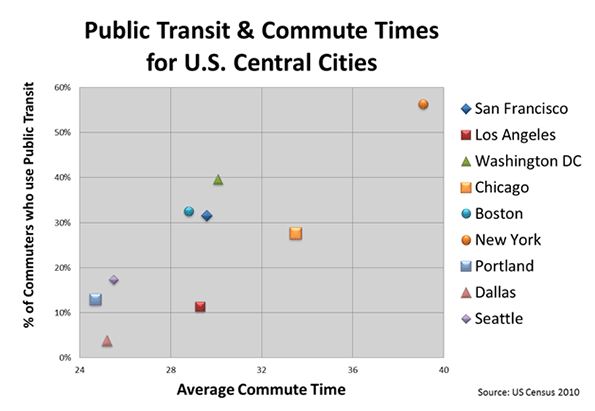
    To improve the way we move people, transit developments must save both time and money. Sadly, transit lines are notorious for their extraordinary costs and long delays. Data from the 2010 Census reveals that people living in central cities with a higher proportion of transit riders experience longer commutes. And since transit riders have more cumbersome commutes, they are much more likely to be tardy or absent from work.

    The hefty price tag of transit projects also triggers concern. For example, the cost per new passenger of the Washington Metro line to Dulles Airport was estimated at $15,000 annually. That’s about the same as the current poverty threshold for a household of two.

    Car-loan programs on the other hand are largely cost-efficient, producing real fiscal benefits to borrowers, employers, and taxpayers. A survey of 4,771 borrowers and their employers finds that borrowers have greater job security as a result of access to vehicles. With access to credit, borrowers increase their purchasing power by an average of $2,900 each year and save about $250 by avoiding payday loans and checks-for-cash outlets. Employers gain as well through cost savings due to increase retention and reduced absenteeism and tardiness, which amount to $817 and $1130 per borrower respectively. In large part, providing vehicle financing is a smart investment since it reduces the number of low-income families on social welfare – an annual cost savings of $2,900 for each borrower coming off public assistance.

    Given its clear advantages, car sharing is increasing. Recent reports find that shared-use vehicle organizations have been lucrative. Between August 2012 and July 2013, car-sharing ridership grew by 112 percent and the number of vehicles increased by 52 percent. And although car-sharing is not typically used to transport the poor, having on-demand car service makes it so that door-to-door access is more available and affordable. If car-sharing continues to grow at its current rate, it’s reasonable then to assume that these pseudo-taxi services will be eventually be affordable enough so that people would choose to be chauffeured rather than drive their own vehicles.

    2. Vehicle ownership provides greater access to jobs and economic opportunities.

    Instead of being limited to a few areas that are transit-oriented, families with cars have access to more jobs and economic opportunities. Public transit lines are limited in their geographical coverage and take time to make often numerous stops.  Transfers are inefficient and time-consuming, making much of that coverage impractical. Also regular transit riders have limited employment options since they’re only able to consider jobs in the vicinity of transit stops and stations.

    3. Travel by car  is responsive to current travel patterns

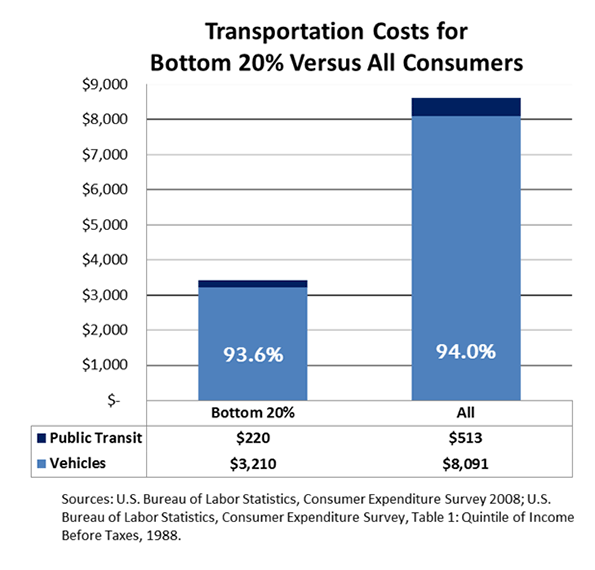
  • A common misperception is that low-income people do not have cars. In reality, 86% of the poor have cars, compared to 95% of the entire population. The high percentage of poor families with cars reveals how automobile culture has become fixed into American ideals of economic well-being and prosperity. And contrary to stereotypes, the poor and the rich similarly spend about 94% of their transportation costs on vehicle travel versus public transit, challenging the notion that low-income travel behavior is unlike that of the rest of the population. As such, providing the poor with cars dramatically levels the playing field as they are the ones who would gain the most from increased access to employment destinations and education facilities.

    A strong argument posited by public transit advocates is that as more cars use the road, congestion and pollution will intensify. And to be sure, public transit is more environmentally friendly than motor vehicles. The Amalgamated Transit Union (ATU), the largest union representing transit workers in North America, reports that one full bus eases the road of thirty-five cars, and that existing transit usage cuts national gasoline consumption by 1.4 billion gallons annually. Yet, on average, this result can only   be achieved if buses were always full, which they are not – authorities from the Los Angeles Metro estimate that their buses run at an average of 42% capacity.

    But is it equitable to ask the poor to forgo mobility and economic gain for the environment? Considering that most Americans experience some degree of social mobility via vehicle ownership, it’s far more reasonable to allow  low-income families greater access to opportunity. In addition, new fuel efficiency standards for cars set by the Obama administration will decrease overall GHG emissions substantially; according to forecasts by the Department of Energy, carbon emissions from light-duty vehicles will drop 21% between 2010 and 2040 in spite of a 40% increase in driving. This shows that, even with more cars on the road, environmental goals can be accomplished.

    Although the eligibility requirements are stricter in some areas than others, every state in the U.S. has a program for low-income residents to have access to car loans. Car-sharing is also rapidly expanding, but  marketing now is geared towards millennials on a budget rather than low-income families. Both innovations, however, respond to new demands faced by future workers, who are likely to find employment in dispersed locations and may make more trips per workday since many may have multiple part-time jobs. With more efficient ways of getting people to work, it’s time to challenge the assumption that the expansion of public transit is the best way to meet the needs of America’s hard-pressed working class.

    Jeff Khau graduated from Chapman University with a degree in business entrepreneurship. Currently, he resides in Los Angeles where he is pursuing his dual-masters in urban planning and public policy at the University of Southern California.

    Photo by Romana Klee, #113 zipcar.

  • What Detroit Has Really Taught America

    Nothing. Seriously. Not a damn thing.

    Oh, the occasion is being used to opine on our state of affairs, but nothing is structurally taking shape in America to prevent the next Detroit from occurring. In fact, Detroit is occurring every day inside most of us. We are all getting bankrupt in so many little ways.

    America is in a precarious position. Our economy is based on consumption. Our consumption is based on our livelihood. Our livelihood is based on our employment, and in our jobless “recovery”, there just aren’t many decent jobs. With technological advances, it is likely to get worse. Writes columnist Bill McClellan in the St. Louis Dispatch:

    [T]he day is coming when trucks will drive themselves. People in the trucking industry say it is inevitable. Within a decade or so, truck drivers will be obsolete. There are currently 5.7 million truck drivers.

    McLellan continues, discussing an email he received from a reader:

    Pat B. is a conservative businessman. He wrote, “Regarding the truck drivers, I think the bigger issue is how society is going to deal with nonproductive people vs. productive people. Automation will allow ‘productive’ people to be much, much more productive than the ‘nonproductive’ people. Theoretically, a very small segment of the population could produce almost everything. How will we deal with this?”

    Good question. Currently, Detroit is ground zero of it. So much busted there, so many poor, so many with blue- and white-collar skills in the new no-collar economy. Do we let the city die on the vine? Au revoir Rust Belt?

    Well, a consensus is becoming clear. We need to “First World” Detroit. Get it and other post-industrial cities on the right path.

    Enter New York.

    Courtesy of Smithsonian

    In the late 1970′s, New York City was in trouble: the threat of bankruptcy, and the Bronx was on fire, literally, with broadcaster Howard Cosell famously being attributed to saying “There it is ladies and gentleman, The Bronx is burning” as cameras panned to a fire in an abandoned elementary school during Game 2 of the 1977 World Series. Put simply, the 1970’s NYC was not unlike the modern day Detroit—insolvent fiscally, aesthetically, and, in many respects, sociologically. “Broken youth stumbling into the home of broken age,” wrote Frank Rose in the Village Voice.

    But with crisis comes opportunity, particularly for those who can afford to be opportunistic. Specifically, in the book by Paul Harvey entitled The Brief History of Neoliberalism, the crossroads of NYC’s late-70’s fiscal crisis gets center stage. Here, the groundwork for the city’s co-optation had been laid for some time, with the 1960’s urban crisis increasing municipal desperation. Financial institutions smelled blood, and they saw occasion. What happened dictates urban redevelopment to this day. Writes Harvey (h/t Cleveland Frowns):

    At first financial institutions were prepared to bridge the gap, but in 1975 a powerful cabal of investment bankers (led by Walter Wriston of Citibank) refused to roll over the debt and pushed the city into technical bankruptcy. The bail-out that followed entailed the construction of new institutions that took over the management of the city budget.

    Harvey states that the new budget strategy amounted to “a coup by the financial institutions against the democratically elected government”, one that would subsequently de-emphasize social and physical infrastructure for the priority of a “good business climate”. Harvey continues:

    But the New York investment bankers did not walk away from the city. They seized the opportunity to restructure it in ways that suited their agenda…This meant using public resources to build appropriate infrastructures for business…coupled with subsidies and tax incentives for capitalist enterprises…[T]he investment bankers reconstructed the city economy around financial activities, ancillary services such as legal services and the media…and diversified consumerism (with gentrification and neighborhood ‘restoration’ playing a prominent and profitable role). City government was more and more construed as entrepreneurial rather than a social democratic or even managerial entity.

    Fast forward to now and you can see how this framework has made modern day New York. A billionaire mayor. Impressive wealth accumulation. Lower crime. Gentrifying areas that are spreading into many parts of the city. The scene in the Bronx:

    The South Bronx is on the upswing and this new project proves it,” said Kathy Zamechansky, President of KZA Realty Group. “A gleaming new building is just what this area needs to add life and vitality to a neighborhood…

    All good, right?

    Not exactly. Commoditizing public welfare has come with very personal costs. Particularly, New York City’s economic sphere epitomizes the worsening two-tier system in America, with one study finding that “three of the four most [income] segregated metropolitan areas [in the country] are in the New York City region”. In the city itself, the income disparity rates from subway stop to subway stop are at Namibian levels. “Get off at Chambers St., and you’re averaging $205,192,” writes Fishbowl NY. “Hop off at Kingsbridge Rd., and you’re at $18,610”.

    Income Disparity New York

    There is cost to personal freedom as well, with Mayor Bloomberg’s “stop-and-frisk” tactics ruled as a violation to the constitutional rights of minorities. The increase in police stops have been significant since Bloomberg took office, going from 160,851 in 2003 to 685,724 in 2011. In a 195-page response just released, the federal judge wrote: “No one should live in fear of being stopped whenever he leaves his home to go about the activities of daily life”.

    Heck, there’s even consternation from the city’s creative types. Specifically, New York’s legacy of nurturing the next generation of thought is being homogenized by the fact that elites talking to elites creates for shitty cultural capital. Writes Gawker’s Hamiliton Nolan on how the influx of money is turning the city into “a game of urban Candy Crush”, “Everything is an orgy of destruction! Who’s hip now? Nobody!” Echoes creative class troubadour Lena Dunham:

    It’s news to no one that the middle class and up-and-coming talent struggle in this city. As a result, New York is seeing an exodus of its creative population. As Dunham says, “If they struggle for too long, they’re leaving New York for Seattle, Chicago, Austin, and in some cases, even Tampa. We can’t have our generation’s Patti Smith moving to Tampa. That’s going to seriously f*ck our shit up.

    But the bridge had been crossed. Not simply for the reasons Dunham fingers, but because New York City is the head of a teetering set of bones. Writes eminent economic scholar Joseph Stiglitz in a recent essay entitled “The Wrong Lesson from Detroit’s Bankruptcy”:

    Rather than deal purposefully with this changing economic landscape with useful policies encouraging the growth of other industries, our government spent decades papering over the growing weaknesses by allowing the financial sector to run amok, creating “growth” based on bubbles. We didn’t just let the market run its course. We made an active choice to embrace short-term profits and large-scale inefficiency.

    America does have an urban renewal program, but it is aimed more at restoring buildings and gentrification than at maintaining and restoring communities, and even at that, it is languishing.

    Which brings us back to Detroit. Consider it America’s “Back to the Future” moment. There is municipal bankruptcy. There is fiscal management being taken away from an elected government. There are financial institutions wreaking havoc on the middle class via a collective Alfred E. Neuman-like exasperation. There is the subsidy environment going full bore in the midst of economic trauma, with the Governor of Michigan giving the okay to Detroit billionaire Mitch Ilitch on his $650 million dollar publicly-subsidized hockey arena one day after signing off on the country’s largest city bankruptcy filing. And then there’s the gentrification-as-economic-development silver bullet, with real estate developer Dan Gilbert buying up downtown properties for the price of a song and then using the spatial grease of placemaking to fill his square feet with the rise of the creative class. “Stand up and gentrify: 7 days in Detroit” reads a series running in the The Windsor Star.


    “It was a face that didn’t have a care in the world, except mischief.” Quote from Mad editor Harvey Kurtzman.

    Taken together, the framework of Detroit’s progression is to simply go forth into who we are as a country—a group of people on a collision course with the inevitable failings of economic disparity, or more generally: a nation without good jobs.

    Should Detroiters be worried?

    Maybe. Reads the New York Observer: “Bloomberg Warns the Next Mayor Could Follow Detroit Into Bankruptcy”.

    Back to the future indeed.

    Richey Piiparinen is a writer and policy researcher based in Cleveland. He is co-editor of Rust Belt Chic: The Cleveland Anthology. Read more from him at his blog and at Rust Belt Chic.

    Lead photo courtesy of Vice.

  • Here’s a Way to Flood the US Housing Market with One Trillion Dollars

    Members of the millennial generation – born between 1982 and 2003 – carry a student debt burden of close to one trillion dollars. This is the group that includes many just entering the stage in life when people tend to settle down and start families. Even though Millennials are marrying later than previous generations, they would still be the prime market for sales of single family starter homes, if only they could afford them. As interest rates rise along with home  prices, the only way this key consumer segment will be able to afford to buy a house is if the nation, out of its own self-interest, finds a way to relieve Millennials of their crushing student loan obligations.

    Millennials are the first generation in American history that has been asked to self-finance the cost of the education needed for America to be economically successful. Shortly after the ratification of the Constitution, Congress passed legislation setting aside land in the new territories for the establishment of the iconic one room school houses to assure its newest citizens had the skills required to be good farmers and domestic servants. Even as the country was engaged in a devastating Civil War, a state-by-state movement to mandate universal and free primary education for every child swept the nation and became a permanent part of American society. Then, when the Industrial Revolution generated a demand for factory and office workers with a high school education, the nation expanded the concept to make such an education available equally to young men and women without any requirement to pay tuition.      

    The situation has changed, but the need for an educated young generation has not. The difference is that at least two years of post-secondary education has become a must-have ticket for a young generation seeking to make its way in the world. Yet we have suddenly yanked the universal, free education rug out from under them and asked them to pay for it by not only going into debt, but assuming a debt that is not even dischargeable in bankruptcy court.

    The result is a rising tide of student debt that threatens to undermine the economic vitality of the nation. According to the Federal Reserve, student debt rose by a factor of more than eight between 2001 and 2012, twice as fast as home loans and far in excess of the modest increases in other forms of indebtedness during the same time period. A recently released report by the Consumer Financial Protection Bureau indicates that about one in four student loans is now either in default or in programs designed to help borrowers in distress. This analysis looked only at loans made through the direct student loan program totaling about $570 million, not older ones that may have been offered by banks and other private sector lenders. If borrowers are unable to repay their loans in the long run, the federal government and taxpayers will have to absorb the losses. Why, then, not recognize the problem now and bail out the borrowers so that they can put the windfall to good use in an economy desperately needing a new boost in consumer spending?

    The Great Recession seriously disrupted household formation and consumer spending.  According to an analysis by Merrill Lynch, in the decade before the financial markets’ collapse in 2008, one-third of all housing turnovers came from homeowners older than  55, and about one-third of those sales were to buyers under 34. Since then sales of homes have fallen by about two million units, leaving the economy 2.5 million households below normal levels. Millennials represent about 22% of the US population and control $200 billion of direct purchasing power, not counting their influence on their parent’s spending decisions. Over the next five years, a quarter of Millennials will enter their peak spending years, making them the best hope for reviving the housing market.

    Millennials have expressed a strong preference for living in the type of suburban communities in which they grew up, especially when it’s time, as it is for many of them now, to raise a family. Their first home needn’t be “move in ready;” about a third of them say they would prefer a “fixer upper.” And more than 80% of the generation believe they would find a way to pay for the cost of any repairs themselves rather than borrow the money from their parents. A wave of new home buying would not only give a sharp boost to the durable goods industry that depends on new household formation for its growth, but would also provide a ready-made army to fix up some of the country’s declining, inner ring suburban housing stock.

    There are legitimate public policy issues about how to fix the problem of financing American higher education. Some might argue that we should tackle that problem before dealing with student loan debtors. But with the economic recovery still proceeding at too slow a pace for most middle class Americans, an equally good case can be made that the country should deal with student loan debt either first or as part of a comprehensive reform of  financing higher education. The economy could use the boost, as could the morale of America’s largest and most diverse generation.

    Morley Winograd and Michael D. Hais are co-authors of the newly published Millennial Momentum: How a New Generation is Remaking America and Millennial Makeover: MySpace, YouTube, and the Future of American Politics and fellows of NDN and the New Policy Institute.

    New home photo by BigStockPhoto.com.

  • Young Tech Tycoons Pushing Left Coast Ahead Of East In Democratic Power Structure

    There are two deep-blue regions that are critical to the Obama administration: the Northeast and the coastal region between San Jose and Seattle that truly deserves the moniker of the Left Coast. They dominate the Democratic donor list, and provide the administration with most of its appointees and much of its ideological moorings.

    Yet this common ground conceals a shift in the balance of power between these two blue strongholds. The power of the high-tech heavy Left Coast is waxing while the old Boston-to-Washington corridor is waning. Jeff Bezos’ purchase of The Washington Post simply confirms this movement of the political tectonic plates.

    The Rise of the Tech Oligarchs

    Wall Street was the star of the 1980s, but today, it’s the tech industry that offers “the same heady mix of mystery, power and money,” as Om Malik puts it. The Left Coast’s ascendency is based largely on its increased domination of this critical sector. Thirty years ago, East Coast giants such as ITT and Eastman Kodak ranked among the largest tech firms, with little representation from the Left Coast. Today the region accounts for seven of the top 10 tech companies.

    The Left Coast is also home to four of the world’s top seven software companies. The software for most of the world’s computers comes from either Microsoft in Seattle or Google and Apple in the Bay Area. Search is almost completely dominated by Google, social media by Facebook. Bezos’ Amazon overwhelms its e-tailing competitors.

    This has generated an enormous shift in the geography of American wealth. In 1990 most of the richest Americans lived in the Northeast or were part of the old energy/agriculture economy in the middle of the country. Today five of the nation’s 15 wealthiest people reside in the Bay Area or the Puget Sound; only two, Michael Bloomberg and George Soros, come from Wall Street. More importantly, the Left Coast oligarchs tend to be much younger than their East Coast counterparts; six of the world’s 29 billionaires under 40 hail from the Left Coast, three from Wall Street.

    Seizing the Means of Communications

    The best historical analogy can be found at the turn of the 20th century as entrepreneurs from America’s industrial expansion — John D. Rockefeller, Andrew Carnegie, E.H. Harriman and JP Morgan — moved to influence government and politics, first by buying political influence and later through foundations. Many of the great newspaper tycoons of the time, for example William Randolph Hearst, heir of a great Colorado mining fortune, also used their money in influence mass opinion, a pattern repeated, ironically in 1933, when Wall Street financier Eugene Meyer bought the moribund Washington Post, greatly enhancing his family’s influence for decades.

    But these newbies come with an extra media advantage: they dominate virtually all the emerging transmission systems for information. Google, Apple and Facebook all are emerging as major disseminators of entertainment as well. This shift promises to inflict collateral damage on both Hollywood and the Manhattan-centered advertising industry. The recent shotgun merger of Omnicom and Plublicis reflects the weakened position of traditional ad firms at a time that Google alone has more ad revenues than the entire print publishing industry combined.

    Reshaping the Political Landscape

    Once largely divorced or distant from politics, the Left Coasters such as Amazon, Apple, Facebook and Google have all greatly expanded their lobbying operations. Many tech firms, notably Facebook and Apple, pay minimal taxes, meaning they have a strong stake in defending their current privileges . They also have reason to work to make it difficult to protect the privacy of netizens since so much of their profit depends on selling personal information to corporations.

    This fluency with data has also made the Left Coasters critical contributors of campaign expertise for President Obama and other Democrats. Now they are starting to fund the next generation of pliable favorites, most recently Newark Mayor and senatorial aspirant Cory Booker.

    The rise of the Left Coast oligarchs will likely accelerate the extinction of the traditional working-class Democratic Party. Bezos and other Left Coasters tend to be progressive on social issues, but vehemently opposed to unions, here and abroad.

    Bezos and other online retailers will need to defend themselves against attacks on the job-destroying aspects of their shops; since 2003 there has been a loss of roughly 800,000 retail jobs while the electronic side of the industry has generated less than 180,000.

    Mark Zuckerberg and others leading the charge for immigration reform also have an interest in assuring a steady supply of lower cost, lower hassle “techno-coolies” for their software shops.

    This may not endear the oligarchs to a large part of American middle class who would prefer those jobs go to themselves, or their children. Left Coasters also embrace green policies that entail high energy prices, arguably more acceptable in the mild, if a bit, wet climate of the Left Coast but economically disadvantageous to far less temperate middle America.

    Conservatives, for their part, hope that the Left Coast moguls prove more libertarian than statist. But they may miss the fundamental law of oligarchy: when a company dominates a sector, they usually seek to use the government to consolidate their position. Google and other tech firms, for example, have been more than happy to feed off the crony capitalist trough — for example in backing renewable energy schemes — when opportunity strikes.

    What’s the Future?

    Demography is working against the East Coast, now the oldest part of the country, with the smallest population under 20. The region’s aging population will likely blunt innovation there. In contrast, despite high housing prices, the Left Coast’s population grew 10%  in the last decade compared to 6% for the Northeast; Census projections to 2023 suggest the Northeast will continue to lag as well over the next ten years.

    As urban analyst Aaron Renn has noted, Seattle, Portland and San Francisco also boast a very politically incorrect advantage. Despite their worship at the altar of diversity, these cities have smaller populations of African-Americans and Latinos, who tend to be more economically disadvantaged. The Northeast is three times as black as the Left Coast. In contrast, the Left Coast’s largely upwardly mobile Asians account for 15% of the local population, three times their proportion on the East Coast.

    The Left Coast also enjoys by far the highest concentration of people engaged in STEM jobs — roughly 50% higher the national average. Since 2005 STEM employment has expanded by double-digit percentages in Seattle, San Jose and San Francisco, compared to much more modest gains in New York and Boston. In some fields like e-tailing, the Left Coast, not surprisingly, dominates, with Seattle and San Jose leading the way.

    Given the current economic trajectory, more traditional East Coast dominated-industries — from brick and mortar retail to publishing and media — can be expected to crumble before the onslaught of the Bay Area and Seattle. The old cities of the East may hold their social prestige and legacy well into the current century, but the blue balance of power seems destined to keep tilting toward the Left Coast.

    Joel Kotkin is executive editor of NewGeography.com and Distinguished Presidential Fellow in Urban Futures at Chapman University, and a member of the editorial board of the Orange County Register. He is author of The City: A Global History and The Next Hundred Million: America in 2050. His most recent study, The Rise of Postfamilialism, has been widely discussed and distributed internationally. He lives in Los Angeles, CA.

    This piece originally appeared at Forbes.

    Facebook photo by BigStockPhoto.com.

  • Entrepreneurs Turn Oligarchs

    For a generation, most Americans, whatever their politics, have largely admired Silicon Valley as an exemplar of enlightened free-market capitalism. Yet, increasingly, the one-time folk heroes are beginning to appear more like a digital version of President George W. Bush’s “axis of evil.” In terms of threats to freedom and privacy, we now may have more to fear from techies in Palo Alto than the infinitely less-competent retro-Reds in North Korea.

    Once, we saw the potential unsurpassed human liberation available through information technology. However, Silicon Valley, as shown in the NSA scandal, increasingly has become intimately tied to the surveillance state. Technology has enabled powerful firms – including Verizon, Apple, Facebook, Microsoft and Google – to channel everyone’s email and cellphone calls to the national security apparatus.

    “It’s as bad as reading your diary,” Joss Wright, a researcher with the Oxford Internet Institute, recently told the Associated Press, adding, “It’s far worse than reading your diary. Because you don’t write everything in your diary.”

    Nor does the snooping relate only to national security. If my emails to friends and family arguably constitute a potential threat to national security, that’s one thing. The massive monitoring and largely unapproved tapping into our data for profit is quite another.

    Google, which, in the first half of 2012, took in more advertising dollars than all U.S. magazines and newspapers combined, has amassed an impressive list of privacy violations, notes the Huffington Post. Even the innocent-seeming Gmail service is used to collect and sell information; Google’s crew in Palo Alto may know more about the casual user than most of us suspect.

    Even Apple, arguably the most iconic Silicon Valley firm, has been hauled in front of courts for alleged privacy violations. For its part, Consumer Reports recently detailed Facebook’s pervasive privacy breaches, including misuse of information as detailed as health conditions, details an insurer could use against you, when someone is going out of town (convenient for burglars), as well as information pertaining to everything from sexual orientation to religious and ethnic affiliation.

    Despite ritual denials about such invasions of privacy, the new communications moguls have little reason to stop, and lots of financial reasons to continue. As for concerns over privacy, the new oligarchs take something of a blasé attitude. Eric Schmidt, Google’s chairman, in 2009 responded to concerns over privacy with this gem: “If you have something that you don’t want anyone to know, maybe you shouldn’t be doing it in the first place.”

    First came the engineers

    These autocratic sentiments have evolved over time. Initially, Silicon Valley was dominated by engineers whose primary obsession was using information technology to make the physical world work better. Many of them from Midwestern schools, that early workforce came to the Santa Clara Valley for the same suburban, middle-class lifestyle that earlier brought millions to the aerospace hubs of the Los Angeles Basin and Long Island. They may have been nerds, but not a class apart.

    The early Valley deserved our admiration for taking new technologies – semiconductors, in particular – and applying them to practical concerns ranging from machine tools to spacecraft and defense. The Internet itself was not invented by swashbuckling entrepreneurs but evolved from the Pentagon’s Defense Advanced Research Projects Agency – DARPA. Eric Schmidt and Mark Zuckerberg did not pay to build the Internet; the taxpayers did.

    The new Valley elite are simply the latest to refine and exploit information technology for their own, often enormous, personal benefit. Nothing wrong with making money, to be sure, but this ambition is no different than those of Cornelius Vanderbilt, E.H. Harriman, J.P. Morgan, Andrew Carnegie, John D. Rockefeller, Henry Ford and Thomas Watson. Each innovated in a key industry, established oligarchic control and became fantastically rich.

    But even by the standards of bygone moguls, the new oligarchs’ wealth has not been widely shared. Big Oil and the Big Three automakers created hundreds of thousands of jobs for a wide range of workers. In contrast, the tech oligarchs’ contributions to American employment are relatively negligible.

    Google, for example, employs 50,000 people; Facebook, 4,600; Twitter, less than a thousand, while GM employs 200,000; Ford, 164,000; and Exxon, more than 100,000. Even in the current boom, new job creation has been relatively insipid. From 1959-71, Silicon Valley produced 100,000 tech jobs; by 1990 it generated an additional 150,000 and, in the 1990s boom, another 170,000. After losing more than 108,000 high-tech jobs from 2000-08, there has been a net gain of no more than 20,000 to 30,000 positions since 2007.

    The geographical area enriched by the oligarchs has also narrowed. In previous Silicon Valley booms, outlying areas such as Sacramento and Oakland also benefited; not so much this time. Nor is the population expanding much, as one would expect from an economic boom. Although the massive outflow of domestic migrants over past decade – more than 20,000 annually – has slowed, still, more domestic migrants are leaving than coming. Part of this has to do with having the nation’s highest housing prices relative to income, more than twice that of competitor regions like Austin, Texas, Raleigh, N.C., or Salt Lake City.

    Rather than a place of aspiration, the Valley increasingly resembles an extremely expensive gated community, with prices set impossibly high particularly for all but the most affluent new entrants.

    What Needs to Be Done?

    Americans need to wake up to the reality of this new, and increasingly ambitious, ruling class. “The sovereigns of cyberspace,” like the all-powerful Skynet computer system in the “Terminator” series, are only recently focused on politics, and have concentrated largely in the Democratic Party (where the price of admission tends to be cheaper than in the old-money-dominated GOP). And it’s not just money they are throwing at the game, but also the skillful political use of technology, as amply demonstrated in President Obama’s re-election.

    Like the moguls of the early 20th century, who bought and sold senators like so many cabbages, the new elite constitute a basic threat to democracy. They dominate their industries with market shares that would make the old moguls blush. Google, for example, controls some 80 percent of search, while Google and Apple provide the operating system software for almost 90 percent of smartphones. Similarly, more than half of Americans, and 60 percent of Europeans, use Facebook, making it easily the world’s dominant social media site. In contrast, the world’s top 10 oil companies account for barely 40 percent of the world’s oil production.

    Like the Gilded Age moguls, the tech oligarchs also personally dominate their companies. Sergey Brin, Larry Page and Eric Schmidt, for example, control roughly two-thirds of the voting stock in Google. Brin and Page each is worth more $20 billion. Larry Ellison, the founder of Oracle, owns just under 23 percent of his company; worth $41 billion, Forbes ranked him the country’s third-richest person. Bill Gates, the richest, is worth a cool $66 billion and still controls 7 percent of his firm. Newcomer Mark Zuckerberg’s 29.3 percent stake in Facebook was worth $16 billion as of July 25, according to Bloomberg.

    This combination of market and ownership concentration needs to be curbed. Taking a page from the Progressive Era, author and historian Michael Lind suggests that companies like Google, given their enormous market share, should be regulated like utilities. Others, within the European Union and elsewhere, look to apply antitrust legislation, once used to break up Standard Oil. One innovative approach, as Jaron Lanier suggests in his new book, “Who Owns the Future,” includes forcing companies to pay for the privilege of using your data, thereby “spreading the wealth” from a few hegemons to the wider populace.

    Threat is bipartisan

    These changes will require both Left and Right to change their attitudes. Progressives, for example, have tended to embrace the Valley’s population for its generally “liberal” views on social issues and the environment. They have largely ignored the industry’s poor record on hiring non-Asian minorities and the lavish, energy-consuming lifestyles of the oligarchs themselves.

    Some on the left are seeing the light. Britain’s left-leaning Guardian newspaper has been in the forefront unveiling the NSA scandals and the complicity in them of the tech giants. Credit belongs to the EU, which, particularly in contrast with our government, has been asking the toughest questions about loss of privacy and the dangers of oligopolistic control. With Barack Obama secure in the White House, some American leftists have also begun to recognize the extreme inequality that has accompanied, and likely been worsened by, the ascendency of the digital aristocracy.

    Conservatives, for their part, can only face up to the new “axis of evil” by stepping outside their ideology strictures and instinctive embrace of wealth. The increasingly monopolistic nature of the high-tech community, and its widespread disregard for the privacy of the individual, should concern conservatives, as it would have the framers of the Constitution.

    What needs to be accepted, by both conservatives and liberals, is that privacy matters, as does the threat posed to democracy by oligarchy. Until people focus on the potential for evil before us and discuss ways to curb abuses, this small and largely irresponsible class, likely in league with government, will usher in not the promised cornucopia but a gilded-age reign of Big Brother.

    Joel Kotkin is executive editor of NewGeography.com and Distinguished Presidential Fellow in Urban Futures at Chapman University, and a member of the editorial board of the Orange County Register. He is author of The City: A Global History and The Next Hundred Million: America in 2050. His most recent study, The Rise of Postfamilialism, has been widely discussed and distributed internationally. He lives in Los Angeles, CA.

    This piece originally appeared in The Orange County Register.

    Official White House Photo by Pete Souza.

  • In the Spotlight: Higher Ed Degree Output by Field and Metro

    It might stem from the dot-com crash, the increased popularity of certifications and onsite employer training, or various other reasons. Regardless, the key finding from EMSI and CareerBuilder’s analysis of higher education degree output over the last decade is still eye-opening: Computer and IT degrees completed in the U.S. have declined 11% since 2003.

    The decrease in computer-related degrees comes at a time when the number of related computer and IT jobs grew 13% nationally, and while the number of degrees in other major fields — health, business, liberal arts and humanities, and engineering — has soared.

    Jobs-Degrees-Final

    Our analysis looked at the output of associate’s degrees and above nationally and for the nation’s largest 150 metro areas. Education completion data comes from the National Center of Education Statistics, via EMSI’s Analyst tool, and we matched the degrees to our jobs data using a customized program-to-occupation mapping. You can find a summary of the analysis in CareerBuilder’s release, and we’ve included more findings by field and metro below.

    Note: The NCES data comes from its Integrated Postsecondary Education Data System (IPEDS) and accounts for all colleges and universities that participate or are applicants for any federal financial assistance program authorized by the Higher Education Act (HEA), which includes most of the well-known federal loans (e.g., Pell Grants, Stafford Loans). All public colleges and universities and a number of private postsecondary schools accept federal assistance loans and therefore are included in this analysis. We excluded Phoenix, Davenport, Iowa, and other cities whose higher ed output is dominated by large for-profit universities. 

    Computer and IT

    Computer-related degree output at U.S. universities and colleges flatlined from 2006 to 2009 and have steadily increased in the years since. But the fact remains: Total degree production (associate’s and above) was lower by almost 14,000 degrees in 2012 than in 2003. The biggest overall decreases came in three programs — computer science, computer and information sciences, general, and computer and information sciences and support services, other.

    This might reflect the surge in certifications and employer training programs, or the fact that some programmers can get jobs (or work independently) without a degree or formal training because their skills are in-demand.

    Of the 15 metros with the most computer and IT degrees in 2012, 10 saw decreases from their 2003 totals. That includes New York City (a 52% drop), San Francisco (55%), Atlanta (33%), Miami (32%), and Los Angeles (31%).

    Here’s a look at the performance of 20 largest metros with the most computer and IT degrees in 2012:

    MSA
    Computer/IT Degrees 2003
    Computer/IT Degrees 2012
    Growth/Decline
    % Growth/Decline
    Concentration
    New York-Northern New Jersey-Long Island, NY-NJ-PA
    12,102
    5,793
    -6,309
    -52%
    0.86
    Washington-Arlington-Alexandria, DC-VA-MD-WV
    4,353
    5,697
    1,344
    31%
    2.32
    Chicago-Joliet-Naperville, IL-IN-WI
    5,403
    4,451
    -952
    -18%
    1.25
    Los Angeles-Long Beach-Santa Ana, CA
    5,088
    3,510
    -1,578
    -31%
    0.81
    Boston-Cambridge-Quincy, MA-NH
    2,625
    2,455
    -170
    -6%
    0.92
    Atlanta-Sandy Springs-Marietta, GA
    3,321
    2,229
    -1,092
    -33%
    1.77
    Pittsburgh, PA
    2,073
    2,101
    28
    1%
    2.00
    Minneapolis-St. Paul-Bloomington, MN-WI
    1,754
    2,003
    249
    14%
    1.24
    Baltimore-Towson, MD
    2,047
    1,931
    -116
    -6%
    1.85
    Philadelphia-Camden-Wilmington, PA-NJ-DE-MD
    2,316
    1,873
    -443
    -19%
    0.78
    Dallas-Fort Worth-Arlington, TX
    2,037
    1,699
    -338
    -17%
    1.00
    Miami-Fort Lauderdale-Pompano Beach, FL
    2,457
    1,670
    -787
    -32%
    0.75
    Seattle-Tacoma-Bellevue, WA
    1,793
    1,560
    -233
    -13%
    1.33
    Virginia Beach-Norfolk-Newport News, VA-NC
    942
    1,413
    471
    50%
    2.15
    San Diego-Carlsbad-San Marcos, CA
    1,573
    1,398
    -175
    -11%
    1.11
    Detroit-Warren-Livonia, MI
    1,380
    1,332
    -48
    -3%
    1.42
    Indianapolis-Carmel, IN
    447
    1,223
    776
    174%
    1.63
    Houston-Sugar Land-Baytown, TX
    1,062
    1,165
    103
    10%
    1.00
    Denver-Aurora-Broomfield, CO
    1,673
    1,114
    -559
    -33%
    1.30
    Salt Lake City, UT
    486
    1,057
    571
    117%
    1.67


    Health Professions

    Health degrees have increased by 112% since 2003 — an addition of 288,194 total degrees. Related jobs in the U.S. have increased 18.6% over that time.

    Many metros have seen their output of health degrees at least double. This includes Los Angeles (109% growth), Miami (159%), and Minneapolis (193%).

    Here’s a look at the 20 largest metros with the most health degrees in 2012:

    MSA
    2003 Health Degrees
    2012 Heath Degrees
    Growth/Decline
    % Growth/Decline
    Concentration
    New York-Northern New Jersey-Long Island, NY-NJ-PA
    16,363
    30,445
    14,082
    86%
    0.94
    Los Angeles-Long Beach-Santa Ana, CA
    7,681
    16,031
    8,350
    109%
    0.77
    Chicago-Joliet-Naperville, IL-IN-WI
    7,622
    14,128
    6,506
    85%
    0.83
    Miami-Fort Lauderdale-Pompano Beach, FL
    5,438
    14,068
    8,630
    159%
    1.31
    Philadelphia-Camden-Wilmington, PA-NJ-DE-MD
    7,593
    13,554
    5,961
    79%
    1.19
    Boston-Cambridge-Quincy, MA-NH
    6,483
    11,513
    5,030
    78%
    0.90
    St. Louis, MO-IL
    3,500
    9,760
    6,260
    179%
    1.65
    Minneapolis-St. Paul-Bloomington, MN-WI
    2,959
    8,673
    5,714
    193%
    1.12
    Dallas-Fort Worth-Arlington, TX
    3,137
    7,039
    3,902
    124%
    0.86
    Indianapolis-Carmel, IN
    1,764
    6,911
    5,147
    292%
    1.92
    Pittsburgh, PA
    3,316
    6,480
    3,164
    95%
    1.29
    Washington-Arlington-Alexandria, DC-VA-MD-WV
    2,978
    6,227
    3,249
    109%
    0.53
    Houston-Sugar Land-Baytown, TX
    3,142
    5,916
    2,774
    88%
    1.06
    Baltimore-Towson, MD
    3,241
    5,857
    2,616
    81%
    1.17
    San Francisco-Oakland-Fremont, CA
    2,965
    5,857
    2,892
    98%
    0.87
    Tampa-St. Petersburg-Clearwater, FL
    1,661
    5,593
    3,932
    237%
    1.13
    Detroit-Warren-Livonia, MI
    2,790
    5,543
    2,753
    99%
    1.23
    Seattle-Tacoma-Bellevue, WA
    2,519
    4,932
    2,413
    96%
    0.88
    Cincinnati-Middletown, OH-KY-IN
    1,829
    4,930
    3,101
    170%
    1.38
    Denver-Aurora-Broomfield, CO
    2,172
    4,696
    2,524
    116%
    1.14


    The number of registered nursing degrees has gone from 88,482 in 2003 to 193,528 in 2012, a 119% increase. Registered nursing is the third-largest degree-awarding program in the U.S., behind business administration and liberal arts and humanities.

    RN_Chart

    Engineering (and Engineering Technologies)

    The are 37,138 more engineering and engineering technology degrees in 2012 than 2003, a 37% increase. Related jobs in the U.S. have increased 5.7% during that time. The biggest degree increases have come in biomedical engineering, mechanical engineering, and civil engineering.

    Tulsa has seen the largest percentage increase (222%) of engineering/engineering technology degrees among the 150 largest metros. What explains the huge jump? It mostly stems from a massive increase in output of engineering technology degrees in the area. For example, the Spartan College of Aeronautics and Technology in Tulsa produced 454 engineering tech degrees in 2003, up from 57 in 2003.

    In San Jose, Ann Arbor, Raleigh, and Tulsa, at least 15% all associate’s-and-above degrees awarded are in engineering or engineering technologt. Raleigh has the highest concentration at 17%. The national share is 5%, so Raleigh’s concentration index is 3.36 — meaning it’s more than three times as concentrated as the national average (1.00).

    The following table gives the metros with the highest concentration of engineering and engineering technology degrees:

    MSA
    Engineering Degrees (2003)
    Engineering Degrees (2012)
    Growth/Decline
    Concentration
    Raleigh-Cary, NC
    2,091
    2,201
    5%
    3.36
    Tulsa, OK
    335
    1,079
    222%
    3.22
    San Jose-Sunnyvale-Santa Clara, CA
    2,809
    3,472
    24%
    3.08
    Ann Arbor, MI
    2,220
    2,881
    30%
    2.99
    Huntsville, AL
    409
    691
    69%
    2.75
    Dayton, OH
    1,003
    1,504
    50%
    2.25
    Worcester, MA
    568
    1,088
    92%
    2.23
    Greenville-Mauldin-Easley, SC
    715
    1,059
    48%
    2.13
    Baton Rouge, LA
    839
    1,019
    21%
    2.13
    Fayetteville-Springdale-Rogers, AR-MO
    366
    660
    80%
    2.02
    Salinas, CA
    262
    506
    93%
    1.91
    Youngstown-Warren-Boardman, OH-PA
    329
    362
    10%
    1.82
    Peoria, IL
    231
    309
    34%
    1.72
    Allentown-Bethlehem-Easton, PA-NJ
    884
    741
    -16%
    1.68
    Knoxville, TN
    597
    839
    41%
    1.67
    Atlanta-Sandy Springs-Marietta, GA
    2,851
    3,633
    27%
    1.67
    Austin-Round Rock-San Marcos, TX
    1,741
    2,136
    23%
    1.65
    Palm Bay-Melbourne-Titusville, FL
    286
    450
    57%
    1.62
    Pittsburgh, PA
    2,611
    2,886
    11%
    1.59
    Flint, MI
    488
    492
    1%
    1.58
    Beaumont-Port Arthur, TX
    293
    373
    27%
    1.56
    Wichita, KS
    329
    462
    40%
    1.55
    Madison, WI
    1,320
    1,314
    0%
    1.53
    York-Hanover, PA
    156
    151
    -3%
    1.50
    Toledo, OH
    874
    891
    2%
    1.50


    Education

    Education degrees have increased 18% since 2003. That’s an increase of 52,391 from 2003 to 2012. Related jobs in the U.S. have increased 6.3% from 2003-2012.

    Education degrees make up 8.8% of all associate’s-and-above completions nationally, down from 10.6% in 2003. The highest concentration belongs to Beaumont-Port Arthur, Texas, with 4.4 times the national average of education degrees.

    Another Texas metro, El Paso, has seen a 346% increase in education degrees since 2003, while Denver (170%), Minneapolis-St. Paul (125%), Austin (114%), and Dallas (106%) have also seen major gains.

    Ed-degrees

    Business, Management and Marketing

    There are 176,972 more degrees nationally in 2012 than 2003, a 33% increase. Related jobs in the U.S. have increased 1.2 percent from 2003-2012, an addition of 218,173 jobs.

    Nearly 1 in 5 degrees awarded in the U.S. (18.1%) are in business, management and marketing, the highest share of any major field of study. For many large metros, business degrees make up a sizable percentage of total higher education output (25% of all degrees in Chicago and Milwaukee, 24% in Washington, D.C., and 23% in Atlanta).

    MSA
    2012 Business, Managament, Marketing Degrees
    Share of Total Degrees
    Concentration
    Colorado Springs, CO
    5,099
    33%
    1.85
    Grand Rapids-Wyoming, MI
    1,939
    30%
    1.67
    Fort Wayne, IN
    1,388
    30%
    1.65
    Montgomery, AL
    946
    29%
    1.62
    Chicago-Joliet-Naperville, IL-IN-WI
    30,741
    25%
    1.39
    Milwaukee-Waukesha-West Allis, WI
    4,892
    25%
    1.36
    Canton-Massillon, OH
    843
    24%
    1.34
    Flint, MI
    1,506
    24%
    1.34
    Omaha-Council Bluffs, NE-IA
    3,368
    24%
    1.34
    Washington-Arlington-Alexandria, DC-VA-MD-WV
    20,098
    24%
    1.31
    St. Louis, MO-IL
    9,943
    23%
    1.29
    Columbia, SC
    2,529
    23%
    1.29
    Atlanta-Sandy Springs-Marietta, GA
    9,853
    23%
    1.25
    Columbus, OH
    6,600
    23%
    1.25
    South Bend-Mishawaka, IN-MI
    1,561
    22%
    1.24


    Liberal Arts and Humanities

    The U.S. produced 124,681 more degrees in 2012 than 2003, a 47% increase. This is the third fastest-growing degree category in the U.S. by total degrees added, behind health professions and business, management, and marketing.

    Liberal arts and humanities degrees make up 10% of all associate’s-and-above completions, roughly the same share as in 2003. Of the 10 metros with the highest concentrations of these degrees, seven are in Florida — led by Ocala (66% of all degrees), Port St. Lucie (64%), and North Port-Bradenton-Sarasota (50%).

    Despite growth in many metros, notable decreases in liberal arts and humanities degrees have occurred in Tulsa (51% decline), San Jose (38%), San Diego (30%), San Francisco (23%), and Ann Arbor (20%).

    LibArts

    Joshua Wright is an editor at EMSI, an Idaho-based economics firm that provides data and analysis to workforce boards, economic development agencies, higher education institutions, and the private sector. He manages the EMSI blog and is a freelance journalist. Contact him here.

    Illustration by Mark Beauchamp.

  • E-Shopping Bubbling While Retail Bums Along

    We recently explored the post-recession tsunami of online retail and discovered that e-shopping’s future is anything if not bright. According to a report by Forrester Research, by 2016, not only are 192 million U.S. consumers projected to be be clicking “checkout” (up 15% since 2012), but those 192 million will also be spending an average of 44% more.

    But does this mean we should expect traditional retail to flatline? Well, no. As we showed here, the flourishing of specific retail subsectors (e.g., warehouses/supercenters) certainly cheers up total gloom-and-doom predictions.

    Nevertheless, traditional retail and e-shopping scream for comparison. Whatever their destiny, they could hardly differ more in size, stability, and growth patterns so far, and so let’s take a look.

    A Comparison

    Here’s how the two industries break down:

    Traditional retail: NAICS 44-45, except for electronic shopping and electronic auctions

    E-shopping: electronic shopping (454111) and electronic auctions (454112)

    A quick comparison between retail and e-shopping shows two very different stories. Traditional retail, of course, has been around forever with its ups and downs, while e-shopping is still technically a teenager — and like a teen, it’s growing wicked fast.

    Chart - Traditional Retail Jobs 2002-2013


    • Retail jobs declined 1% from 2002 to 2013. The industry grew 3% from 2002-2007, then tanked 7% from 2007-2010 and has yet to recover even its 2002 status.
    • The industry had 15.7 million jobs in 2002 and now has 15.5 million (loss of 200,000 jobs).
    • The average annual earnings per job is $32,433.
    • Jobs multiplier: 1.32. This means that every job in retail creates a third of another job elsewhere — or, put another way, every three jobs in retail create one job in another industry. (Note: We excluded induced effects in our calculations to avoid the double-counting that comes when looking at spending at the national level.)
    • Department stores have taken a colossal hit, dropping almost without respite from 811,000 jobs to 489,000 (40% loss).
    • In an age when manager positions are stepping on the gas, it’s troubling to see that within the retail industry, general & operations managers have declined 15% the past 10 years (a loss of 35,000 jobs).

    Chart - E-shopping Jobs 2002-2013

    • E-shopping grew 161% from 2002 to 2013 (averaging 15% a year). The industry has spiked 42% just since 2009, coming out of the recession when it still managed to inch up 4%. In fact, e-shopping isn’t far behind the fastest-growing industry sector of the past 10 years — mining, quarrying, and oil & gas extraction (NAICS 21), which has grown 60% since 2002 and 26% since 2009.
    • With 173,737 jobs, e-shopping’s labor force can’t even compare with traditional retail’s.
    • On the other hand, the jobs pay significantly more: $65,000 (annual average).
    • Jobs multiplier: 1.46, slightly higher than traditional retail’s, which is a little surprising. (Again, we left out induced effects.)

    One thing we notice is the huge discrepancy in jobs between these two industries. Traditional retail, for all its loss, is still 90 times the size of e-shopping, whose growth is not quite as jaw-dropping, perhaps, as it might seem at first. Sure, it’s booming, but then, it’s always easier to top 160% growth when you start out so tiny.

    No, the most interesting fact here is not how many jobs e-shopping is adding to the economy, but how many jobs it isn’t. It creates good consumer prices, serves more customers, makes more dough, and has completely changed the way we view products (literally and figuratively). And it does all these things with a smaller workforce.

    This trend of online-based business and a smaller, more tech-based workforce is well illustrated by the Kodak vs. Instagram conversation (read more here and here). At its peak, Kodak employed 140,000 while Instagram, at the time that it was purchased by Facebook in April 2012, employed a mere baker’s dozen. In short, the American economy has always been obsessed with efficiency. If we can do more with less, we will, and the internet is apparently accelerating that process.

    The Story in the States

    Let’s take a closer look at the top states for job growth and decline for both these industries.

    States for Top Job Growth and Decline - Traditional Retail

    Retail jobs have flourished the most in North Dakota (21%), Nevada (15%), Utah (11%), and Arizona (10%). Each of those states, it should be noted, have fast-growing populations and/or economies. The worst decline has taken place in Michigan (15%), Ohio (14%), Rhode Island (13%), and Wisconsin (10%).

    States for Top Job Growth and Decline - E-shopping

    For e-shopping, it’s mostly just a question about where it has grown a lot and where it has grown a ton. Only two states have seen an actual decline in jobs. Idaho leads the way crazy 3,370% growth (from 40 to 1,400 jobs), followed by Utah (800%, from 700 to 6,200 jobs), and Indiana (780%, from 670 to 5,900 jobs). The states that have done the least well are Alaska (20%, from 80 down to 60 jobs), South Dakota (3%, from 92 to 89 jobs), Virginia (mere 5% growth, from 2,000 to 2,140 jobs), and New Mexico (11%, from 127 to 141 jobs).

    Here’s a complete look at the growth/decline of each industry in all 50 states (plus Washington D.C.), as well as how they rank:

    State % Change in Retail Jobs Rank % Change in E-Shopping Rank
    North Dakota 21% 1 85% 37
    Nevada 15% 2 140% 31
    Utah 11% 3 804% 1
    Arizona 10% 4 37% 45
    South Dakota 9% 5 -3% 50
    Texas 8% 6 68% 42
    Idaho 7% 7 3368% 1
    Florida 7% 8 74% 39
    District of Columbia 7% 9 652% 4
    Arkansas 6% 10 134% 33
    New York 6% 11 179% 26
    Alaska 5% 12 -19% 51
    Hawaii 5% 13 125% 35
    North Carolina 4% 14 198% 24
    Washington 4% 15 271% 17
    South Carolina 1% 16 135% 32
    Tennessee 1% 17 114% 36
    Colorado 1% 18 307% 12
    Oklahoma 0% 19 277% 15
    Montana 0% 20 72% 40
    New Mexico 0% 21 11% 48
    Delaware -1% 22 126% 34
    Oregon -1% 23 456% 8
    Virginia -1% 24 5% 49
    West Virginia -1% 25 189% 25
    Vermont -1% 26 298% 14
    Wyoming -2% 27 68% 41
    New Hampshire -2% 28 334% 11
    Louisiana -2% 29 275% 16
    Georgia -2% 30 146% 29
    California -3% 31 156% 28
    Alabama -3% 32 53% 44
    New Jersey -4% 33 218% 23
    Massachusetts -4% 34 220% 22
    Missouri -4% 35 220% 21
    Iowa -4% 36 246% 19
    Kentucky -5% 37 455% 9
    Maryland -5% 38 435% 10
    Nebraska -5% 39 242% 20
    Pennsylvania -6% 40 76% 38
    Maine -6% 41 146% 30
    Minnesota -6% 42 554% 7
    Illinois -6% 43 65% 43
    Mississippi -7% 44 171% 27
    Connecticut -7% 45 13% 47
    Indiana -7% 46 781% 3
    Kansas -8% 47 21% 46
    Wisconsin -10% 48 304% 13
    Rhode Island -13% 49 634% 5
    Ohio -14% 50 572% 6
    Michigan -15% 51 255% 18

    E-Shopping Hot Spots

    E-shopping has also developed quite a few hot spots across the nation, and a handful of MSAs have very high job concentrations. Here are the MSAs where e-shopping’s concentration (measured in terms of location quotient, LQ) is highest:

    MSA 2013 Jobs 2013 Avg. Earnings Per Job 2013 National LQ
    Fernley, NV 710 $55,306 48.05
    Hannibal, MO 590 $13,789 26.83
    Galesburg, IL 426 $27,766 12.17
    Grand Forks, ND-MN 748 $43,981 10.27
    Mexico, MO 114 $22,497 9.27
    Ottawa-Streator, IL 538 $21,666 7.31
    Hood River, OR 111 $26,422 6.46
    Seattle-Tacoma-Bellevue, WA 14,515 $120,560 6.39
    Thomasville-Lexington, NC 328 $36,346 6.02
    Huntington-Ashland, WV-KY-OH 759 $30,910 5.53
    Americus, GA 84 $22,717 5.5
    Salt Lake City, UT 4,277 $64,051 5.17
    Moultrie, GA 98 $31,360 4.9
    Chico, CA 463 $68,168 4.88
    Provo-Orem, UT 1,046 $48,062 4.05
    Indianapolis-Carmel, IN 4,430 $41,354 3.96
    San Jose-Sunnyvale-Santa Clara, CA 4,608 $240,899 3.87
    Bend, OR 312 $32,260 3.72
    Port St. Lucie, FL 604 $22,611 3.72
    Meadville, PA 137 $39,731 3.34
    Mankato-North Mankato, MN 208 $18,374 3.09

    Seattle, home to Amazon.com, stands out for its sheer number of jobs (14,500). So too does San Jose, eBay’s headquarters, with 4,600. These two MSAs are also where most of the earnings are pooled.

    We should also note Indianapolis, where job growth since 2009 approaches 4,000 and tops 500%. In fact, e-shopping is Indianapolis’s fastest-growing industry of the past 10 years, climbing 4,500% since 2002. (Indiana, remember, is third in the nation for e-shopping growth: nearly 800%.)

    The city with the highest concentration of online retail jobs is Fernley, Nev., home to an Amazon distribution center. Currently the town of 53,000 is 48 times the national average for e-shopping. Moreover, about 6% of the town’s workforce (710 out of 12,800 jobs) are in the e-shopping industry.

    However, this isn’t as golden as Fernley was back in 2007, when e-shopping’s concentration was 107 times greater than the national average. During the recession, Fernley lost 30% of its e-shopping jobs, and has yet to recover them.

    Galesburg, Ill., has a similar recession story but bounced back quickly. The town of 32,000, with a concentration 12 times that of the national average, has rapidly regained its jobs — and then some — over the past year.

    E-shopping - Fernley vs. Galesburg

    For towns like Fernley and Galesburg, perhaps the lesson is that e-shopping is much less place-bound than traditional retail. All these small towns with high concentrations run a certain risk with e-shopping if the big companies were to move operations elsewhere.

    The map and table below show the 2009-2013 job performance of online retail in the towns with the highest job concentrations (containing at least 100 e-shopping jobs). We see both huge gains and huge declines (in terms of % growth):

    MSAs - 100+ E-shopping jobs


    MSA 2009 Jobs 2013 Jobs Change % Change 2013 Average Earnings 2009 LQ 2013 LQ
    Akron, OH 150 174 24 16% $34,974 0.60 0.49
    Albany-Schenectady-Troy, NY 79 102 23 29% $29,447 0.23 0.22
    Allentown-Bethlehem-Easton, PA-NJ 177 357 180 102% $32,915 0.67 0.95
    Ann Arbor, MI 50 128 78 156% $32,806 0.32 0.55
    Atlanta-Sandy Springs-Marietta, GA (12060) 1,655 2,454 799 48% $56,564 0.92 0.94
    Austin-Round Rock-San Marcos, TX 737 1,666 929 126% $48,277 1.19 1.75
    Baltimore-Towson, MD 432 478 46 11% $73,551 0.42 0.32
    Baton Rouge, LA 111 125 14 13% $46,293 0.37 0.30
    Bellingham, WA 118 158 40 34% $33,482 1.73 1.64
    Bend, OR 191 300 109 57% $33,132 3.60 4.02
    Birmingham-Hoover, AL 167 218 51 31% $35,155 0.43 0.40
    Boise City-Nampa, ID 377 895 518 137% $56,366 1.77 2.89
    Boston-Cambridge-Quincy, MA-NH 1,709 3,054 1,345 79% $67,988 0.89 1.09
    Boulder, CO (14500) 376 561 185 49% $48,869 2.88 2.89
    Bremerton-Silverdale, WA 53 116 63 119% $46,891 0.69 1.12
    Bridgeport-Stamford-Norwalk, CT 1,017 898 -119.00 -12% $111,274 3.02 1.88
    Brownsville-Harlingen, TX 103 128 25 24% $21,781 0.98 0.83
    Buffalo-Niagara Falls, NY (15380) 185 258 73 39% $26,681 0.45 0.45
    Canton-Massillon, OH 36 128 92 256% $41,449 0.28 0.69
    Cape Coral-Fort Myers, FL 176 194 18 10% $37,279 1.09 0.83
    Charleston-North Charleston-Summerville, SC (16700) 86 137 51 59% $35,397 0.37 0.40
    Charlotte-Gastonia-Rock Hill, NC-SC 277 571 294 106% $50,665 0.42 0.58
    Charlottesville, VA 191 102 -89.00 -47% $29,774 2.41 0.93
    Chattanooga, TN-GA 94 164 70 74% $31,012 0.52 0.63
    Chicago-Joliet-Naperville, IL-IN-WI 2,580 4,557 1,977 77% $59,758 0.77 0.96
    Chico, CA 243 458 215 88% $68,695 3.98 5.42
    Cincinnati-Middletown, OH-KY-IN 1,009 1,625 616 61% $39,261 1.30 1.49
    Cleveland-Elyria-Mentor, OH 770 785 15 2% $54,287 0.98 0.71
    Coeur d’Alene, ID 31 118 87 281% $22,609 0.71 1.94
    Colorado Springs, CO (17820) 233 366 133 57% $27,687 1.01 1.10
    Columbia, MO 93 153 60 65% $36,494 1.33 1.48
    Columbia, SC 59 104 45 76% $35,458 0.21 0.26
    Columbus, OH 3,094 3,324 230 7% $34,355 4.33 3.22
    Dallas-Fort Worth-Arlington, TX 2,950 3,334 384 13% $51,152 1.27 0.96
    Davenport-Moline-Rock Island, IA-IL 107 186 79 74% $50,847 0.75 0.91
    Dayton, OH 111 175 64 58% $26,891 0.38 0.43
    Deltona-Daytona Beach-Ormond Beach, FL 179 157 -22.00 -12% $36,650 1.42 0.88
    Denver-Aurora-Broomfield, CO 1,465 1,936 471 32% $54,863 1.49 1.33
    Des Moines-West Des Moines, IA 143 148 5 3% $35,543 0.56 0.40
    Detroit-Warren-Livonia, MI 712 826 114 16% $47,384 0.53 0.42
    Eau Claire, WI 131 194 63 48% $29,794 2.14 2.16
    El Paso, TX 514 791 277 54% $17,522 2.17 2.28
    Elkhart-Goshen, IN 18 124 106 589% $34,131 0.24 0.99
    Eugene-Springfield, OR 94 177 83 88% $25,883 0.81 1.08
    Fayetteville-Springdale-Rogers, AR-MO 88 162 74 84% $42,470 0.56 0.69
    Fernley, NV (22280) 704 710 6 1% $55,306 72.77 53.93
    Fort Collins-Loveland, CO 147 186 39 27% $39,192 1.35 1.16
    Fort Wayne, IN 54 207 153 283% $48,876 0.34 0.91
    Galesburg, IL 277 424 147 53% $27,835 12.45 13.61
    Grand Forks, ND-MN 268 746 478 178% $44,038 5.99 11.51
    Grand Rapids-Wyoming, MI 693 765 72 10% $85,872 2.47 1.79
    Greensboro-High Point, NC 255 177 -78.00 -31% $36,448 0.95 0.47
    Hannibal, MO (25300) 413 590 177 43% $13,789 31.34 30.11
    Harrisburg-Carlisle, PA 136 209 73 54% $31,602 0.55 0.59
    Hartford-West Hartford-East Hartford, CT 283 486 203 72% $30,435 0.59 0.72
    Honolulu, HI 116 228 112 97% $30,149 0.29 0.40
    Hood River, OR 65 110 45 69% $26,564 6.20 7.16
    Houston-Sugar Land-Baytown, TX 1,442 1,809 367 25% $40,959 0.70 0.58
    Huntington-Ashland, WV-KY-OH 181 759 578 319% $30,904 2.04 6.21
    Indianapolis-Carmel, IN 698 4,367 3,669 526% $41,569 1.03 4.38
    Jacksonville, FL 328 484 156 48% $39,193 0.70 0.72
    Kansas City, MO-KS 671 865 194 29% $38,886 0.86 0.78
    Knoxville, TN 115 226 111 97% $38,606 0.44 0.61
    Lakeland-Winter Haven, FL 97 105 8 8% $39,221 0.62 0.48
    Las Vegas-Paradise, NV 1,128 2,013 885 78% $56,095 1.71 2.15
    Lexington-Fayette, KY 177 280 103 58% $38,517 0.90 0.96
    Lincoln, NE 68 339 271 399% $48,179 0.52 1.80
    Little Rock-North Little Rock-Conway, AR 85 123 38 45% $30,742 0.32 0.33
    Logan, UT-ID 85 135 50 59% $22,246 2.10 2.30
    Los Angeles-Long Beach-Santa Ana, CA 7,839 8,519 680 9% $60,101 1.74 1.32
    Louisville/Jefferson County, KY-IN 126 201 75 60% $38,956 0.27 0.29
    Madison, WI 258 516 258 100% $58,625 0.97 1.36
    Manchester-Nashua, NH 280 353 73 26% $60,692 1.83 1.64
    Mankato-North Mankato, MN 60 206 146 243% $18,459 1.45 3.44
    Medford, OR 107 176 69 64% $39,243 1.63 1.90
    Memphis, TN-MS-AR 284 319 35 12% $34,885 0.59 0.47
    Mexico, MO 12 114 102 850% $22,497 1.54 10.40
    Miami-Fort Lauderdale-Pompano Beach, FL 2,647 3,210 563 21% $54,616 1.47 1.23
    Milwaukee-Waukesha-West Allis, WI (33340) 804 1,162 358 45% $34,887 1.28 1.30
    Minneapolis-St. Paul-Bloomington, MN-WI 611 1,130 519 85% $41,066 0.45 0.57
    Nashville-Davidson–Murfreesboro–Franklin, TN 498 785 287 58% $36,789 0.82 0.85
    New Haven-Milford, CT 110 183 73 66% $68,783 0.38 0.44
    New Orleans-Metairie-Kenner, LA (35380) 160 212 52 33% $35,863 0.38 0.35
    New York-Northern New Jersey-Long Island, NY-NJ-PA 7,402 13,923 6,521 88% $76,745 1.13 1.47
    North Port-Bradenton-Sarasota, FL 177 174 -3.00 -2% $37,516 0.88 0.62
    Ocala, FL 57 104 47 82% $39,066 0.75 0.97
    Ogden-Clearfield, UT 291 557 266 91% $39,442 1.84 2.39
    Oklahoma City, OK 97 163 66 68% $48,017 0.21 0.24
    Omaha-Council Bluffs, NE-IA 654 824 170 26% $53,708 1.80 1.60
    Orlando-Kissimmee-Sanford, FL 544 1,001 457 84% $53,066 0.70 0.88
    Ottawa-Streator, IL 297 535 238 80% $21,722 6.43 8.16
    Oxnard-Thousand Oaks-Ventura, CA 209 272 63 30% $42,119 0.81 0.74
    Palm Bay-Melbourne-Titusville, FL (37340) 143 217 74 52% $42,583 0.92 1.00
    Peoria, IL 58 149 91 157% $36,634 0.42 0.75
    Philadelphia-Camden-Wilmington, PA-NJ-DE-MD 1,335 2,372 1,037 78% $50,131 0.63 0.80
    Phoenix-Mesa-Glendale, AZ 3,332 4,062 730 22% $62,002 2.42 2.03
    Pittsburgh, PA 1,077 1,002 -75.00 -7% $50,314 1.23 0.80
    Port St. Lucie, FL 93 561 468 503% $22,448 0.92 3.87
    Portland-South Portland-Biddeford, ME 188 214 26 14% $44,201 0.88 0.72
    Portland-Vancouver-Hillsboro, OR-WA 1,202 1,944 742 62% $37,203 1.47 1.63
    Poughkeepsie-Newburgh-Middletown, NY 169 136 -33.00 -20% $35,261 0.84 0.49
    Providence-New Bedford-Fall River, RI-MA 279 306 27 10% $23,727 0.52 0.41
    Provo-Orem, UT 556 961 405 73% $49,202 3.72 4.18
    Racine, W 91 110 19 21% $28,197 1.57 1.32
    Raleigh-Cary, NC 378 537 159 42% $49,990 0.94 0.90
    Redding, CA 117 134 17 15% $57,004 2.22 1.88
    Reno-Sparks, NV (39900) 661 386 -275.00 -42% $40,630 4.29 1.81
    Richmond, VA 294 221 -73.00 -25% $36,861 0.61 0.32
    Riverside-San Bernardino-Ontario, CA 649 1,003 354 55% $38,227 0.63 0.69
    Rochester, NY 238 271 33 14% $33,405 0.62 0.50
    Sacramento–Arden-Arcade–Roseville, CA 770 1,016 246 32% $40,959 1.06 1.01
    Salem, OR (41420) 182 225 43 24% $29,941 1.42 1.28
    Salt Lake City, UT 2,006 2,654 648 32% $63,187 4.10 3.60
    San Antonio-New Braunfels, TX 1,594 926 -668.00 -42% $62,759 2.26 0.89
    San Diego-Carlsbad-San Marcos, CA 1,504 2,132 628 42% $62,877 1.34 1.32
    San Francisco-Oakland-Fremont, CA 2,919 4,010 1,091 37% $87,280 1.79 1.67
    San Jose-Sunnyvale-Santa Clara, CA (41940) 810 1,459 649 80% $102,195 1.14 1.37
    San Luis Obispo-Paso Robles, CA 139 205 66 47% $39,356 1.59 1.53
    Santa Barbara-Santa Maria-Goleta, CA 122 132 10 8% $48,521 0.79 0.60
    Santa Rosa-Petaluma, CA (42220) 111 175 64 58% $41,602 0.72 0.80
    Scranton–Wilkes-Barre, PA 247 403 156 63% $31,560 1.25 1.46
    Seattle-Tacoma-Bellevue, WA 7,570 14,226 6,656 88% $120,821 5.45 7.03
    Spokane, WA 408 502 94 23% $60,997 2.38 2.09
    Springfield, MA 88 102 14 16% $41,527 0.37 0.30
    Springfield, MO 165 136 -29.00 -18% $30,943 1.09 0.62
    St. George, UT 143 162 19 13% $30,715 3.74 2.85
    St. Louis, MO-IL 1,102 2,260 1,158 105% $50,619 1.07 1.56
    Tallahassee, FL 95 149 54 57% $40,553 0.72 0.82
    Tampa-St. Petersburg-Clearwater, FL 2,990 1,252 -1738.00 -58% $44,406 3.34 0.98
    Thomasville-Lexington, NC 10 241 231 2310% $40,154 0.30 4.97
    Toledo, OH 88 335 247 281% $29,519 0.38 1.01
    Tucson, AZ 468 373 -95.00 -20% $31,186 1.56 0.89
    Vallejo-Fairfield, CA 42 127 85 202% $18,672 0.40 0.85
    Virginia Beach-Norfolk-Newport News, VA-NC 301 241 -60.00 -20% $43,710 0.47 0.27
    Washington-Arlington-Alexandria, DC-VA-MD-WV 1,250 1,639 389 31% $64,473 0.53 0.48
    Wichita, KS 287 114 -173.00 -60% $28,774 1.22 0.35
    Wilmington, NC 65 188 123 189% $42,190 0.57 1.17
    Worcester, MA 278 653 375 135% $38,345 1.09 1.77

    Conclusion

    There’s no doubt we should keep an eye on the exciting growth in e-shopping. Yet we should also be aware that individual online companies do tend, by their very nature, to be smaller and less sturdy than traditional brick-and-mortar stores. They fluctuate rapidly and often drastically, which could be a little unsettling for towns where e-shopping is heavily concentrated.

    Gwen Burrow is an editor at EMSI, an Idaho-based economics firm that provides data and analysis to workforce boards, economic development agencies, higher education institutions, and the private sector. Contact her here.

  • America’s Engineering Hubs: The Cities With The Greatest Capacity For Innovation

    America has always been a nation of tinkerers. Our Founding Fathers, notes author Alec Foege, were innovators in areas ranging from agriculture (George Washington, Thomas Jefferson) and electricity (Benjamin Franklin) to the swivel chair (Jefferson).

    Engineering advances drove America’s quest for industrial supremacy in the 19th century, many of them borrowed (sometimes illegally) from the then very resourceful British Isles. By the early 19th century, the U.S. was producing its own major inventions, including the steamboat and cotton gin. By the end of that century, the U.S. was clearly on the way to industrial preeminence. The growth of engineering schools — MIT, the Case Institute, Stevens Institute of Technology, as well as departments at the great land grant universities — generated a steady supply of engineers. For much of the last 70 years, America, has been the world’s leading center of engineering excellence, dominating markets from steel and cars to energy and aerospace.

    Today, as well, where engineers concentrate, we can expect the greatest capacity for innovation. According to research from Houston Partnership economist Patrick Jankowski, there is a wide range of concentrations of engineering talent among the country’s 85 largest metropolitan areas. For the most part, regions with higher concentrations of engineers tend to do better, and seize the leadership of key industries.

    Nowhere is this more true than in America’s top engineering hub, San Jose/Silicon Valley. The Valley’s ratio of 45 engineers per 1,000 employees is twice as high as any other big metro area. This deep reservoir of talent remains the Valley’s key asset, and has made it by most measurements the nation’s most affluent metro area.

    This preeminence dates to the Valley’s early history, particularly in research sponsored by the Defense Department and NASA. This large high-tech workforce was then backed by venture capitalists, many of them also engineers by training, to form by far the most dominant high-tech region in the world. The presence of Stanford, now rated the nation’s second leading engineering school by U.S. News & World Report after MIT, Berkeley, ranked third and Santa Clara, at No. 14, gives the area an unmatched capacity to produce technologists.

    More surprising, perhaps, is the second city on our list: Houston. The world energy capital is home to 59,000 engineers — second most in the U.S. after the much larger Los Angeles metro area — and has a concentration of 22.4 engineers per 1,000 employees. Although it does not match the Bay Area in elite engineering schools, Houston is home to Rice University and the University of Houston, both highly regarded, and, perhaps equally important, a strong sub-structure of trade and technical schools that feed into the engineering pool.

    Key here is the energy industry, which is far more technology-dependent than many might believe. Houston is arguably now the country’s most important emerging city, with the largest job growth of any major metro area. Not only can engineers make money there, unlike in Silicon Valley, they can also afford to buy a house.

    More surprising still is the metro area with the third-highest concentration of engineers: Wichita, Kan., with 21 engineers per thousand employees. In this case, the driver is manufacturing, particularly aerospace. But recent cuts by Boeing threaten the future of the self-proclaimed “air capital of the world.” As a result, Wichita has not done nearly as well economically of late as San Jose or Houston, but its reservoir of engineering talent suggests considerable potential if they stick around.

    These top three engineering cities tell us much about the source of American innovation, and the remarkable diversity that makes this country an engineering powerhouse. It involves three essential industries — information technology, energy and manufacturing. Each has a distinct geographic makeup that reflects differing kinds of engineering talent.

    The High-Tech Centers

    No place comes close to Silicon Valley in terms of concentrations of engineers, but several other traditional tech centers make the top 10, led by San Diego in fifth place, a major center for biotech. Boston, home to No. 1 engineering school MIT, ranks eighth, and Denver, which boasts both a thriving tech and energy sector, is 10th. Other tech regions that rank in the top 20 include Seattle (13th), San Francisco (18th) and Austin (19th). None of these areas can claim even half of Silicon Valley’s per capita engineering base, but have thrived during the current high-tech boom.

    The Energy Cities

    When thinking of energy, we might think of wildcats covered with crude (like James Dean in Giant), but this is becoming an industry very dependent on highly trained geophysicists, petroleum engineers, chemical engineers and other specialists. This explains the ninth-place ranking for Bakersfield, “the oil capital of California,” a city better known for country music and cruising than technology. Over 15,000 people work in this generally high-wage industry in the onetime Okie capital. Energy jobs are also big in No. 14 Baton Rouge, La., home to Louisiana State University, which sends many of its engineering graduates into the Gulf of Mexico energy industry.

    Manufacturing Hubs.

    Detroit’s bankruptcy has shed a bad light on rustbelt centers, but in reality the industrial Midwest has been on something of a roll in recent years, with many states, from Wisconsin and Ohio to Iowa, boasting lower unemployment than the national average. One key element has been the increasingly innovative nature of U.S. manufacturing, notably in the auto industry. Little-recognized Dayton, which ranks fourth, has attracted major investment for advanced manufacturing in autos and aerospace.

    Other manufacturing cities high on our list include No. 6 Greenville-Easley, S.C., home to many European auto-related firms. And despite the city bankruptcy we should not ignore No. 12 Detroit, where most of the metro area’s 30,000 engineers live in the economically healthy suburban regions.

    These numbers, of course, focus on concentration as opposed to absolute numbers of engineers. In terms of raw numbers, by far the largest player is Los Angeles, with some 70,000 engineers. Yet it ranks only 33rd by concentration, a far cry from the region’s aerospace-oriented heyday. But L.A.’s legacy still makes an ideal setting for some tech ventures, notably Elon Musk’s SpaceX.

    In terms of total engineers, L.A. is followed by Houston, with 59,000, Washington-Arlington-Alexandria with 49,000 (11th in terms of concentration), Boston with 43,000 and then San Jose and Dallas (29th), each with 40,000 or so engineers. Each has a critical mass that allows them to tackle big engineering projects, while also staffing potential spin-offs and start-ups. Some of these areas, notably the Valley, know how to make more money with their workforce than others.

    The Have-not Regions

    One surprisingly weak area is greater New York, which ranks 78th, with a miniscule 6.1 engineers per 1,000 workers, and some 20,000 fewer engineers than Los Angeles. The New York media and the city’s chattering classes may like to talk up the Big Apple as a high-tech center, but the relative lack of engineering talent should spark a tad of skepticism over whether the nation’s largest urban area is really up to the task of competing against engineer-rich places like Boston, San Diego, Seattle, Denver or Austin, much less stand up to Silicon Valley, with seven times the concentration of engineers.

    The rest of the bottom of the list is depressingly familiar, in terms of economic also-rans. El Paso, Texas, ranks last among the 85 largest metropolitan areas, followed by Las Vegas, Scranton-Wilkes Barre, Pa., and Fresno. These cities are going to have a very tough time competing for high-tech jobs in the immediate future. To make something, whether digital or tangible, the first step lies in gathering in the talent that can make things happen, but as of yet, they have not made much headway.

    Joel Kotkin is executive editor of NewGeography.com and Distinguished Presidential Fellow in Urban Futures at Chapman University, and a member of the editorial board of the Orange County Register. He is author of The City: A Global History and The Next Hundred Million: America in 2050. His most recent study, The Rise of Postfamilialism, has been widely discussed and distributed internationally. He lives in Los Angeles, CA.

    This piece originally appeared at Forbes.

    Creative Commons photo “Engineers” by Flickr user ensign_beedrill