Category: Economics

  • Aspirational Cities: U.S. Cities That Offer Both Jobs and Culture Are Mostly Southern and Modest Sized

    A city at its best, wrote the philosopher René Descartes, provides “an inventory of the possible.” The city Descartes had in mind was 17th-century Amsterdam, which for him epitomized those cities where people go to change their circumstances and improve their lives. But such aspirational cities have existed throughout American history as well, starting with Boston in the 17th century, Philadelphia in the 18th, New York in the 19th, Chicago in the early 20th, Detroit in the 1920s and 1930s, followed by midcentury Los Angeles, and San Jose in the 1980s.

    Yes, the great rule of aspirational cities is that they change over time, becoming sometimes less entrepreneurial, more expensive, and demographically stagnant. In the meantime, other cities, often once obscure, suddenly become the new magnets of opportunity.

    To determine America’s current aspirational hotspots, we focused in large part on economic indicators, such as employment growth, per capita income, and unemployment. But we also took into account demographic factors, such as the growth of domestic migration and the movement of college-educated people and the foreign born.

    Finally, we considered quality-of-life factors such as traffic congestion, housing affordability, and crowding—which are keenly relevant to young families hunting for the places with the best “inventory of the possible.” In a sense, we believe aspirational cities reflect a kind of urban arbitrage, where people look for those places that provide not just economic and cultural opportunity but a cost structure that allows them to enjoy their success to the fullest extent.
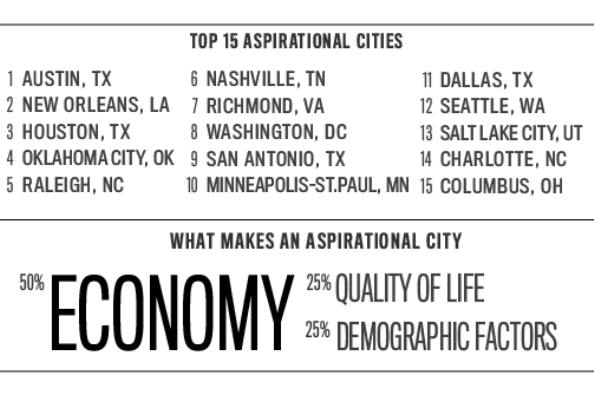
    Our top two cities reflect the importance of this arbitrage opportunity. Both No. 1, Austin, Texas, and No. 2, New Orleans, are places where people can enjoy the cultural amenities and attitudes of “progressive” blue states but in a distinctly red-state environment of low costs, less regulation, and lower taxes. These places have lured companies and people from more expensive regions, notably California and the Northeast, by being not only culturally rich but also amenable to building a career, buying a home and, ultimately, raising a family in relative comfort.

    Like the Texas state capital and the legendary Crescent City, most of our top cities are located in the American South and lower Midwest, and they attract businesses and people not only from other sections of the country but also increasingly from abroad as well. These include No. 3, Houston, and the smaller but burgeoning oil town of No. 4, Oklahoma City. These are followed by three fast-growing, low-cost Southern cities: No. 5, Raleigh-Cary, North Carolina; No. 6, Nashville; and No. 7, Richmond, Virginia.
    Not all our top aspirational cities are in Dixie. If there’s enough growth and opportunity, solidly blue-state regions can perform well enough to stay near the top of these rankings. Such cities include No. 8, Washington, D.C., and No. 10, Minneapolis–St. Paul, as well as No. 12, Seattle; No. 16, Denver; and even No. 22, Boston. In these cities, high-tech and professional-service growth has created enough wealth to offset higher costs while offering the next generation the chance to live in a culturally vibrant place where affording a home and raising a family are still possible.

    Perhaps more surprising is the high aspirational ranking of some old Rust Belt and Great Lakes cities. The middle part of the country has been losing people and jobs for half a century, but more recently several urban areas within or bordering the Midwest have established enough of an aspirational culture to reverse the pattern of out-migration and begin luring people from the coasts. These include such diverse places as No. 15, Columbus, Ohio; No. 17 Louisville, Kentucky; No. 21 Pittsburgh; and No. 23, Indianapolis.

    Of course, not everyone will find a perfect match in one of these cities. For those with extraordinary technical skills, for example, it still may make sense to move to the hotbed of the San Francisco Bay Area—notably No. 24, San Francisco, and No. 27, San Jose—where economic opportunity partially offsets extraordinarily high costs, at least for a certain portion of the population.

    This applies as well even to cities toward the bottom of the list, including No. 46, New York, and, in last place, No. 51, Los Angeles. If you want to break into businesses such as finance, media, and entertainment, you have little choice but to concentrate on New York or Southern California. These areas may also prove more attractive to people who have inherited money (critical to affording houses or paying high rents), as well as those whose business is closely tied to these great cities’ ethnic economies.

    People must also make tradeoffs when they decide where to locate. Some value a big house and yard, while others cannot abide a city without a decent opera or good Thai food. And those obsessed with, say, their children’s educations will clearly find a broader variety of schools and cultural institutions in San Francisco or New York than in Oklahoma City.

    But for those who lack these specific demands, and for those whose priority is achieving a middle- or upper-middle-class quality of life, the less expensive, often smaller, and less congested cities seem to have the greatest appeal. This may offend the sensibilities of retro-urbanists, who tend to cluster in the great legacy cities, along with our tribes of cultural tastemakers, but the hard reality shows that, for the most part, people move to places that offer not merely the best lattes or artisanal pizzas but the great opportunity for advancement.

    The Geography of Growth

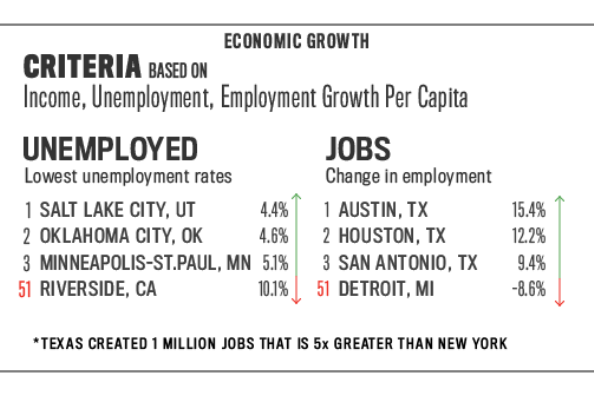
    We give economic growth roughly half of the weight in these rankings. This consists of three factors: employment growth, unemployment, and per capita income. This is where some of the coastal cities still do well, notably San Jose, whose recent job growth places it first, as well as No. 4, Washington, and No. 7, Seattle. The local economies in these areas have all been driven by the rapid expansion of high-tech and professional services, which explains their particularly high per capita GDP numbers.

    Yet most of the big winners in the economic-aspiration sweepstakes are concentrated elsewhere, notably in Texas. Since the recession, the Lone Star State has created 1 million new jobs, five times as many as New York state. In contrast, Florida and California have lost a half million positions. Not surprising, Texas accounts for four of the top 11 regions for economic opportunity (No. 2, Austin; No. 3, Houston; No. 9, San Antonio; and No. 11, Dallas).

    No big economic region outperforms Houston, a metropolitan area of more than 5 million people that boasts arguably the strongest big-city economy in the nation. Not only the global hub of the energy industry, it also boasts the nation’s largest medical center and has dethroned New York City as the nation’s leading export center. Other strong performers include No. 7, Salt Lake City; No. 8, Oklahoma City; and No. 11, New Orleans, all of which have enjoyed strong job growth over the past five years.

    What Do You Get for the Money?

    Strong economic growth—particularly high per capita incomes—represents half of our ranking, but this is balanced by considerations such as cost of living, housing, and traffic congestion. “Everyday life,” observed the great French historian Fernand Braudel, “consists of the little things one hardly notices in time and space.” This reality is particularly critical for young and prospective families, for whom a higher salary or glamorous environment may mean less than the prospect of owning a decent home, particularly without the necessity of a long, dispiriting commute.
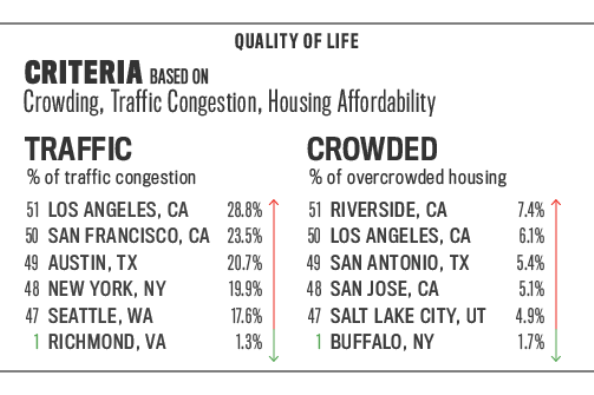
    These factors, we believe, will become more paramount as members of the large millennial or “echo boom” generation enter their late 20s, 30s, and even 40s over the next decade. This demographic—projected by the census to expand by roughly 8 million by 2025—is likely to prove intensely interested in owning their own homes. Indeed, research by generational analysts Morley Winograd and Mike Hais demonstrates that not only do millennials aspire to homeownership, but among the oldest cohorts of this group, now just entering their 30s, interest in buying a house actually surpasses that of their boomer parents.

    This difference in the affordability of housing relative to incomes plays a major role in boosting the rankings of some strong aspirational areas, notably Raleigh; Richmond; Charlotte, North Carolina; Kansas City; and Indianapolis. Along with traffic congestion, it tends to bring down the rankings of most California metropolitan areas, including San Francisco, San Jose, Los Angeles, and San Diego, as well as such hipster hotspots as New York and Miami. We also include “doubling up,” where more than one family lives in a household, as a surrogate for poverty (since metropolitan poverty rates are not adjusted for the cost of living).

    Demographic Destiny

    The last component of our rankings, accounting for roughly a quarter, lies in demographic trends. Like playing defense in basketball, the most important thing here is to watch the feet. The question is movement: where are people going, and where are they not? This tells us much about future trends and how people, as opposed to the media, actually view the best places for them to settle.
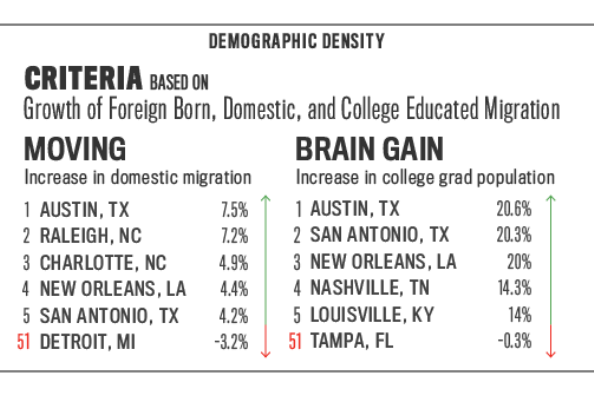
    Our methodology concentrates on three metrics: domestic migration, growth of foreign-born population; and growth in the number of college-educated people. These groups reflect what may be thought of as “the canaries in the coal mine”—indicators of where people seeking a better life are choosing to settle. This factor seems to jibe with our overall rankings more than any other component.

    The biggest beneficiaries tend, not surprisingly, to be places that are economically vibrant but not prohibitively expensive, such as Austin, Houston, San Antonio, Dallas, Raleigh, Nashville, Richmond, and Charlotte. Over the past decade these areas have enjoyed by far the fastest growth not only in migration, but in college-educated people and perhaps most surprisingly in number of foreign-born people. Today immigrants are flocking to such unlikely places as Nashville, Richmond, Louisville, and Charlotte. As for the college-educated, they, too, are also migrating to these same aspirational cities, as well as to new hipster hotspots such as New Orleans and Nashville. The increase in B.A.-degree holders in these cities averages in the double digits or higher over the past decade, in some cases more than twice the growth in such traditional “brain gain” cities as Seattle, San Jose, San Francisco, New York, and Boston.

    The Urban Future

    As the younger generation, as well as newly arrived immigrants, begins to look for places to settle, raise families, and start businesses, they will flock increasingly to these affordable and demographically, economically dynamic regions. Yet it is likely that other factors—global economics, shifts in immigration, and technological changes—could influence the aspirational landscape in the years to come.

    In thinking about the future, then, it is important to recall that not long ago some of the cities near the top of today’s aspirational list were facing seemingly irreversible economic decline, demographic stagnation, and even loss and deterioration of basic infrastructure. You only have to recall the dismal ’70s in Seattle, where post-Vietnam budget cuts inspired some to ask that “whoever is last to leave turn out the lights,” or Houston and Dallas–Fort Worth after the oil bust in the ’80s, when those cities were widely known for their “see through” office buildings and abandoned housing complexes.

    It’s always possible that unpredictable and major shifts could topple today’s aspirational cities from the top of the list. However, given current conditions and the most likely accrual of current trends, we can expect that most of the cities at the top of the aspirational rankings will remain there for some time to come.

    Joel Kotkin is executive editor of NewGeography.com and Distinguished Presidential Fellow in Urban Futures at Chapman University, and a member of the editorial board of the Orange County Register. He is author of The City: A Global History and The Next Hundred Million: America in 2050. His most recent study, The Rise of Postfamilialism, has been widely discussed and distributed internationally. He lives in Los Angeles, CA.

    Wendell Cox is a Visiting Professor, Conservatoire National des Arts et Metiers, Paris and the author of “War on the Dream: How Anti-Sprawl Policy Threatens the Quality of Life.

    This piece originally appeared at the Daily Beast.

    Creative Commons photo “Austin Skyline” by Flickr user StuSeeger

  • Should Uncle Sam Chase a Scandinavian Model?

    When American progressives dream their future vision of America, no place entices them more than the sparsely populated countries of Scandinavia. After all, here are countries that remain strongly democratic and successfully capitalist, yet appear to have done so despite enormously pervasive welfare systems.

    Paul Krugman, the current high priest of progressive economics, approves of Sweden’s high level of spending on benefits as an unadulterated economic plus. He says that Sweden, unlike other European states like France, thrives despite its high tax rate and notes that, while half of all children are born out of wedlock, those children have far less poverty than American children. Progressive pundit Richard Florida, for his part, claims that Sweden is the most creative place on Earth, just ahead of the U.S.

    Some even suggest America should adopt wholesale the Scandinavian system as a policy imperative. The Washington Post praises Sweden as the “rock star” of the financial crisis and lists five ways the U.S. could learn from Sweden. ThinkProgress lauds Sweden’s ability to achieve the world’s highest rate of “social progress” despite a lower per capita income than the U.S. Writer David Dietz, contributor to PolicyMic, sees countries such as Sweden, Norway and Denmark as models that can guarantee both future economic growth and a way for America “to regain its global edge and cement its economic dominance.”

    But before we all go out drinking aquavit, shouting “skol” and dyeing our hair blonde, it makes sense to recognize that not only is relatively small, historically homogenous Scandinavia an ill-suited role mode for a megapower like the U.S., but that, in many ways, the Nordic system may be far more limited than its admirers here might acknowledge.

    Of course, it’s not that there’s not something to learn from these or other countries. Certainly Europe’s chilly corner seems in much better shape than the rest of the continental mess. Given today’s circumstances, recent books extolling the EU as a model such as Stephen Hill’s “Europe’s Promise” or Jeremy Rifkin’s “The European Dream” seem just slightly absurd.

    In truth, Scandinavian countries have performed better than the dismal continental norm in large part because, with the exception of recession-wracked Finland, they have stayed out of Euro currency.

    But even those outside the Euro-destruct zone are not doing as well as widely asserted. Overall unemployment in Sweden, at 8.4 percent, is also higher than that of the U.S.

    Even Norway is underperforming. The last quarter its GDP grew .3 percent, down from an expected .8 percent. As long as mainland Europe is gripped by negative growth and record unemployment, export-oriented Scandinavian countries will continue to struggle.

    In addition, not all the reasons for Scandinavia’s relative health are those that would warm the heart of U.S. progressives. These countries, led by Sweden, have reformed many aspects of their welfare state, including such things as labor laws, and reduced taxes in ways that make them more competitive – and far less egalitarian than in the past.

    Another positive factor for Scandinavia lies in their exploitation of resources, something many progressives, notably green policy aficionados, tend to view with disdain. Sweden exports loads of iron ore to drive its economy and employs massive dams to drive hydropower, which accounts for 42.8 percent of their energy. Norway benefits from a gusher of oil and gas that, producing nearly 2 million barrels of oil per day, making it the 14th largest oil producer in the world despite having a population of 5 million. If anything, Norway can be a model socialist economy because its economic base resembles the Nordic enclave of North Dakota. Overall, the tiny country produces nearly 15 times as much oil per person than the U.S.

    There’s also the matter of scale. Demographically, Scandinavia’s population is microscopic compared to our far vast multi-ethnic Republic. Taken together the four Scandinavian countries – Finland, Denmark, Sweden and Norway – are home to barely 26 million people, far fewer than California and about the same as Texas. These hardy souls are widely dispersed. The population density of Norway and Finland is roughly half that of the U.S., while that of Sweden is one-third less.

    Sweden, to put things in perspective, has fewer people than Los Angeles County. Norway and Finland are less populous than Minnesota, which is about the closest thing we have to Scandinavia. The Minneapolis-Saint Paul region, with 3.6 million residents, would be by far the biggest urban area in the region. Overall American Nordics, including those of mixed ancestry, total 11 million, more than the population of Sweden, by far the region’s largest country.

    Scandinavia’s greatest strength may lie in its least political correct asset: its Nordic culture. Scandinavians’ traditional interest in education, hard work and good governance serves them well both at home and abroad. It’s not socialism that is primarily responsible.

    After all, America’s Scandinavians, although largely the descendents of poor immigrants also are pretty successful, earning more on average than their counterparts back home.

    A Scandinavian economist, for example, once stated to Milton Friedman: “In Scandinavia, we have no poverty.” To which the caustic Nobel Prize winner replied: “That’s interesting, because in America among Scandinavians, we have no poverty, either.” Indeed, the poverty rate for Americans with Swedish ancestry is only 6.7 percent, half the U.S. average which is on par with the poverty rate at home.

    Yet these cultural attributes, notes Swedish based commentator Nima Sanandaji, now appear to be eroding in part because of rising immigration. Long highly homogeneous, the Nordic countries – notwithstanding their liberal kumbaya rhetoric – are facing huge problems absorbing immigrants. Despite populations that are more than 90 percent native, there is growing unease about concentrations of largely Muslim immigrants around large cities like Copenhagen, Malmo and Stockholm.

    These immigrants are not doing remotely as well as those counterparts in the U.S. or Canada. Unemployment rates can reach as high as 80 percent among African and Middle Eastern immigrants in Scandinavia.

    In May, there was a major riot in Stockholm’s heavily Muslim, dense and highly planned inner suburbs. Many immigrants do not seem to embrace the Scandinavian ethos that having strong welfare system available does not mean people should take undue advantage of it.

    More troubling still, notes Sanandaji, who is of Swedish-Kurdish ancestry, many young Scandinavians also seem to be rejecting the old Nordic social compact. Increasing numbers of people under 40 are retiring early, citing disabilities and sickness.

    These trends point to serious problems for countries whose birthrates, despite widely praised natalist policies, are dropping and generally are below ours. With immigration growing ever more unpopular, further demographic decline in the Nordic countries seems inevitable.

    As a result, the Scandinavian welfare state faces challenges arguably far worse than those here at home. The Bank of Finland, for example, warns that an aging population and large public debt would cause a “risk that Finland will drift onto a path of fading economic growth, persistently high unemployment and deteriorating public finance.”

    To be sure, America faces many of these same problems, but it seems silly to look for solutions in a region of the world that is not only fundamentally different but also faces equal, or even greater challenges. Rather than adopt solutions forged in the Nordic cold, American progressives would do better to hone their prescriptions to meet the illnesses of the very different patient here at home.

    Joel Kotkin is executive editor of NewGeography.com and Distinguished Presidential Fellow in Urban Futures at Chapman University, and a member of the editorial board of the Orange County Register. He is author of The City: A Global History and The Next Hundred Million: America in 2050. His most recent study, The Rise of Postfamilialism, has been widely discussed and distributed internationally. He lives in Los Angeles, CA.

    This piece originally appeared at The Orange County Register.

  • America’s Emerging Housing Crisis

    The current housing recovery may be like manna to homeowners, but it may do little to ease a growing shortage of affordable residences, and could even make it worse. After a recession-generated drought, household formation is on the rise, notes a recent study by the Harvard Joint Center on Housing Studies, and in many markets there isn’t an adequate supply of housing for the working and middle classes.

    Given problems with regulations in some states, particularly restrictions on new single-family home development, the uptick in housing prices threatens both prospective owners and renters, forcing people who would otherwise buy into the rental market. Ownership levels continue to drop, most notably for minorities, particularly African Americans. Last year, according to the Harvard study, the number of renters in the U.S. rose by a million, accompanied by a net loss of 161,000 homeowners.

    This is bad news not only for middle-income Americans but even more so for the poor and renters. The number of renters now paying upward of 50% of their income for housing has risen by 2.5 million since the recession and 6.7 million over the decade. Roughly one in four renters, notes Harvard, are now in this perilous situation. The number of poor renters is growing, but the supply of new affordable housing has dropped over the past year.

    So while the housing recovery — and the prospect of higher prices — does offer some relief to existing homeowners, it’s having a negative impact further down the economic ladder. For the poorest Americans, nearly eight decades of extensive public subsidies have failed to solve their housing crisis. Given the financial straits of most American cities — particularly those like Detroit that need it the most — it’s unlikely the government can rescue households stressed by the cost of shelter.

    As one might suspect, the problem is greatest in New York, New Jersey and California, say the Harvard researchers .In those three states 22% of households are paying more than 50% of pre-tax income for housing, while median home values and rents in these states are among the highest in the country. According to the Center for Housing Policy and National Housing Conference, 39% of working households in the Los Angeles metropolitan area spend more than half their income on housing, 35% in the San Francisco metro area and 31% in the New York area. All of these figures are much higher than the national rate of 24%, which itself is far from tolerable.

    Other, poorer cities also suffer high rates of housing poverty not because they are so expensive but because their economies are bad. In the most distressed neighborhoods of Baltimore, Chicago, Cleveland and Detroit, where vacancy rates top 20%, about 60% of vacant units are held off market, indicating they are in poor condition and likely a source of blight.

    America’s emerging housing crisis is creating widespread hardship. This can be seen in the rise of families doubling up. Moving to flee high costs has emerged as a major trend, particularly among working-class families. For those who remain behind, it’s also a return to the kind of overcrowding we associate with early 20th century tenement living.

    As was the case then, overcrowded conditions create poor outcomes for neighborhoods and, most particularly, for children. Overcrowding has been associated with negative consequences in multiple studies, including greater health problems. The lack of safe outside play areas is one contributing factor. Academic achievement was found to suffer in overcrowded conditions in studies by American and French researchers. Another study found a higher rate of psychological problems among children living in overcrowded housing.

    This is occurring as a generation of middle-class people — weighed down by a poor economy, inflated housing prices and often high student debt — are being pushed to the margins of the ownership market. There will be some 8 million people entering their 30s in the next decade. Those struggling to move up face rising rents and dismal job prospects. It’s not surprising that a growing number of Americans now believe life will be worse for their children.

    How do we meet this problem? How about with a sense of urgency? Not that government can solve the problem, but we should consider trying to encourage the kind of entrepreneurs who in the past created affordable “start up” middle- and working-class housing in places like Levittown (Long Island), Lakewood (Los Angeles) and the Woodlands (Houston). Government policy should look at opportunities to create housing attractive to young families, which includes some intelligent planning around open space, parks and schools.

    There’s certainly much that government can stop doing. The drive for “smart growth” is increasingly hostile to the very idea of single-family housing. Instead the emphasis, for example in the newly adopted Bay Area plan, is on high-density housing around transit links and virtual prohibition on single-family housing on the urban fringe, without which much higher housing prices — owned and rental — are inevitable. This may appeal to some — especially those in what historian Robert Bruegmann calls “the incumbent’s club: who are already comfortably housed and benefit financially from policy-induced housing shortages. But for the majority of Americans, including immigrants, who would prefer a single-family home, this is bad news indeed.

    The situation is worst in high-regulation states with out-of-whack rent and housing cost inflation. Until the 1970s, housing costs were only a little higher relative to income in metropolitan areas like San Francisco and New York compared to elsewhere in the country, staying within the same ratio of roughly 3 to 1. Then came the anti-growth regulatory regime that has doubled house prices relative to incomes, and even more so in San Francisco and San Jose.

    But this is not just a California issue. Other states — Oregon, Washington, Maryland — have adopted similar policies. According to Brookings Institution economist Anthony Downs, the housing affordability problem is rooted in the failure to maintain a “competitive land supply.” Downs notes that more urban growth boundaries can convey monopolistic pricing power on sellers of land if sufficient supply is not available, which, all things being equal, is likely to raise the price of land and housing that is built on it.

    Generally speaking, as prices rise, single-family homes become scarcer and rents also rise. The people at the bottom, of course, suffer the most, since the lack of new construction, and the inflated prices for houses, also impacts the rental market. Since 1980, the average house price as reported by the National Association of Realtors has moved in near-lockstep with rents, as reported in the Consumer Price Index, except for the worst years of the housing bubble.

    To be sure, this does not mean we should build more of the classic suburbs of the 1980s. There needs to be thought as to how to provide housing for people who live near work, or encourage more peopleto work at least part-time at home. It is also imperative that policy provides greater opportunity for people to purchase the housing they prefer and that is also affordable. Technology allows for most jobs to disperse, for tremendous opportunity for overall savings for households. Long linear parks — and even some smaller farms — could provide the critical link to nature and recreation that many households seek.

    More than anything we need to recognize that we are not building a reasonable future for the next generation by forcing them to work to pay someone else’s mortgage, that of the landlord. This is the opposite of the American dream and certainly doesn’t reflect the future our parents sought, nor is it one we should bequeath to our children.

    Joel Kotkin is executive editor of NewGeography.com and Distinguished Presidential Fellow in Urban Futures at Chapman University, and a member of the editorial board of the Orange County Register. He is author of The City: A Global History and The Next Hundred Million: America in 2050. His most recent study, The Rise of Postfamilialism, has been widely discussed and distributed internationally. He lives in Los Angeles, CA.

    This piece originally appeared at Forbes.

    Creative Commons photo “Signs of the Times” by Flickr user coffeego

  • Manufacturing in Los Angeles: A Test Case in Why Increasing Concentration Isn’t Always a Positive

    What comes to mind when you think of Los Angeles’ big industries? Motion pictures and other entertainment sectors, yes. Real estate and corporate headquarters, too. But probably not manufacturing.

    No other sector, however, contributes more to the Los Angeles metro area’s gross regional product – the final market value of all goods and services in a region – than manufacturing. It accounted for 11% of L.A.’s GRP in 2012, narrowly beating out the real estate and rental and leasing sector (10%).

    Manufacturing is also the fourth-largest major industry sector in Los Angeles by employment, with nearly 535,000 jobs. But the manufacturing labor market has taken a beating in L.A. — and the downward spiral began years before the Great Recession. In 2001, in fact, manufacturing was the largest sector in L.A., accounting for more than 800,000 jobs, many of which were centered in two sub-industries: computer/electronic products and apparel.

    The Apparel Manufacturing Story

    Apparel manufacturing is a particularly interesting case study for L.A. manufacturing as a whole. Nearly 10% of all manufacturing jobs in the Los Angeles metro — a little over 52,000 —  are in this subsector. And 40% of workers in apparel manufacturing are sewing machine operators whose overall median earnings in L.A. are $9.48 per hour.

    ApparelMfg

    Jobs in apparel manufacturing have declined 43% in Los Angeles since 2001, a reduction of some 40,000 jobs. But nationally, the industry has fared worse; it’s lost 63% of its workforce since 2001. This explains why the concentration of apparel manufacturing jobs in L.A., as measured by location quotient, is actually increasing, despite the heavy local cutbacks.

    ApparelMfg2L.A. has 7.8 times the national average of these jobs, after having 4.9 times the national average in 2001. Looking at it another way, a third of all apparel manufacturing jobs in America are in the Los Angeles metro (and 89% of these jobs in California are in L.A.).

    Why has L.A.’s concentration increased so much? Because location quotient compares the industry’s share of regional employment with its share of national employment. In this case, apparel manufacturing is dwindling as a share of all jobs nationally and in L.A. But the rate of decline hasn’t been as sharp in Los Angeles as it has been in the nation.

    In many cases, a high concentration like apparel manufacturing’s in L.A. signals that it’s a key local industry. And to be sure, apparel manufacturing still has a large presence and helps bring money into the region. Further, there are sub-industries inside apparel manufacturing that are adding jobs. But this is an example of why increasing concentration isn’t always a positive.

    Many firms have moved apparel manufacturing operations overseas, and the jobs that have remained in the U.S. are mostly unappealing: low-wage, low-skill, with little career potential. In L.A., the average earnings per job in apparel manufacturing is $44,859 — a figure that includes workers at all levels, from management to the production floor. That annual salary is only slightly higher than the national average ($43,947).

    Compare the above numbers to industries with increasing employment and increasingconcentration. The following are some of the real emerging industries in L.A., and most pay well, too:

    • Other scientific and technical consulting services, a professional services industry that has doubled in concentration since 2001 and added the third-most jobs of any detailed industry in L.A. over that time. This industry pays $60,828 per job and has gone from 6,900 jobs in 2001 to over 42,000 in 2013.
    • Port and harbor operations. This industry is 14 times more concentrated in L.A. than the nation, and it’s grown 27% since 2001. (Plus, average earnings are $111,650.)
    • Surgical and medical instrument manufacturing, which has more than doubled in employment and concentration in L.A. And it requires a diverse and mostly high-skilled workforce that is paid well.

    And while it’s hard to label entertainment industries in L.A. as “emerging,” there are a stream of related industries that fit the criteria of high growth and increasing specialization. Most notably, teleproduction and other postproduction services (11.5 times more concentrated than nation; 19% growth), motion picture and video production (10.3 times more concentrated; 31% growth, though it’s declined 2008), and agents and managers for artists, athletes, entertainers, and other public figures (7 times more concentrated; 59% growth) fit that mold.

    Other Manufacturing Sectors in L.A.

    We’ve focused on apparel manufacturing, and briefly touched on surgical and medical instrument manufacturing. The performance of other detailed manufacturing industries is also worth noting. In all, 352 of the 472 manufacturing subsectors classified by the U.S. Census Bureau have lost jobs since 2001 in Los Angeles. The two most notable declines have come aircraft manufacturing (-16,502 jobs, a 50% loss) and search, detection, navigation, guidance, aeronautical, and nautical system and instrument manufacturing (-15,664 jobs, a 42% loss). Both used to be major industries in L.A., and both have bled high-paying jobs.

    But there are growth areas in L.A.’s manufacturing scene. The following table shows 17 detailed industries that have added at least 500 jobs since 2001 in L.A., topped by surgical and medical instrument manufacturing:

    NAICS Code Description 2001 Jobs 2013 Jobs Change % Change 2001 National Location Quotient 2013 National Location Quotient 2013 Avg. Earnings Per Job 2012 Establishments
    Source: QCEW Employees, Non-QCEW Employees & Self-Employed – EMSI 2013.2 Class of Worker
    339112 Surgical and Medical Instrument Manufacturing 4,861 11,268 6,407 132% 1.05 2.15 $128,685 82
    315232 Women’s and Girls’ Cut and Sew Blouse and Shirt Manufacturing 2,151 7,046 4,895 228% 6.43 21.26 $49,550 165
    336414 Guided Missile and Space Vehicle Manufacturing 8,131 11,594 3,463 43% 3.54 5.11 $157,273 29
    312111 Soft Drink Manufacturing 3,089 5,398 2,309 75% 0.81 1.71 $86,690 29
    339116 Dental Laboratories 3,749 6,026 2,277 61% 1.63 2.8 $56,424 345
    311991 Perishable Prepared Food Manufacturing 1,581 3,666 2,085 132% 1.62 2.35 $39,344 50
    311941 Mayonnaise, Dressing, and Other Prepared Sauce Manufacturing 476 1,429 953 200% 0.86 2.46 $68,096 19
    334419 Other Electronic Component Manufacturing 4,647 5,563 916 20% 1.19 2.18 $80,262 90
    311811 Retail Bakeries 6,339 7,156 817 13% 1.8 2.08 $26,520 488
    336112 Light Truck and Utility Vehicle Manufacturing 13 805 792 6092% 0 0.45 $73,522 5
    333996 Fluid Power Pump and Motor Manufacturing 1,247 2,022 775 62% 1.26 2.52 $108,005 13
    332722 Bolt, Nut, Screw, Rivet, and Washer Manufacturing 6,906 7,677 771 11% 3.19 4.83 $78,025 65
    332912 Fluid Power Valve and Hose Fitting Manufacturing 3,042 3,659 617 20% 1.56 2.41 $96,089 46
    336415 Guided Missile and Space Vehicle Propulsion Unit and Propulsion Unit Parts Manufacturing 425 957 532 125% 0.82 2.2 $125,893 6
    335129 Other Lighting Equipment Manufacturing 780 1,305 525 67% 1.37 3.39 $68,257 31
    331111 Iron and Steel Mills 503 1,020 517 103% 0.1 0.27 $55,782 37
    334510 Electromedical and Electrotherapeutic Apparatus Manufacturing 4,623 5,135 512 11% 2 2.15 $99,271 70


    Notice the second industry on the list — women’s and girls’ cut and sew blouse and shirt manufacturing. It’s part of the declining apparel manufacturing sector, but it’s one of the rare growth subsectors that we mentioned above. And also of note is guided missile and space vehicle manufacturing, which has made an 86% jump in jobs since 2010 and pays big wages. This industry would no doubt also fall in the emerging category, given it’s increasing concentration and employment.

    Joshua Wright is an editor at EMSI, an Idaho-based economics firm that provides data and analysis to workforce boards, economic development agencies, higher education institutions, and the private sector. He manages the EMSI blog and is a freelance journalist. Contact him here.

  • What Detroit’s Bankruptcy Teaches America

    As has long been expected, the city of Detroit has officially filed for bankruptcy.  While many will point to the sui generis nature of the city as a one-industry town with extreme racial polarization and other unique problems, Detroit’s bankruptcy in fact offers several lessons for other states and municipalities across America.

    The Day of Reckoning Can Take Much Longer Than We Think to Come

    What’s most surprising about Detroit’s bankruptcy is not that it happened, but how long it took to get there. In authorizing the bankruptcy filing Gov. Rick Snyder talked about “60 years of decline.” He’s not joking. It’s been widely known that Detroit has been in trouble for a very long time.

    Time Magazine ran a 1961 story called “Decline in Detroit.”  Jane Jacobs described its lack of vitality in her 1961 classic “The Death and Life of Great American Cities”:

    Researchers hunting the secrets of the social structure in a dull-gray district of Detroit came to the unexpected conclusion there was no social structure….Virtually all of Detroit is as weak on vitality and diversity as the Bronx. It is ring superimposed upon ring of gray belts. Even Detroit’s downtown itself cannot produce a respectable amount of diversity. It is dispirited and dull, and almost deserted by seven o’clock of an evening….Detroit today is composed of seemingly endless miles of low density failure.

    Moving from urban planning to economics. She wrote in 1969’s “The Economy of Cities”:

    This was the prosperous and diversifying economy from which the automobile industry emerged two decades later to produce the last of the important Detroit exports and, as it turned out, to bring the city’s economic development to a dead end.

    These are both well known, but the record of troubles in Detroit even predates this, going back at least to Life Magazine’s 1942 article “Detroit Is Dynamite” which gave a prescient warning to the city just a year before 1943’s race riot.

    For a city as uniquely troubled as Detroit to remain in serious decline for such an extended period of time before going bankrupt is a testament to the sheer resilience of cities. It also suggests that those predicting eminent doom for their own city unless it changes its ways are likely to end up as false prophets.

    Indeed, Detroit’s day of reckoning may not even yet be fully given that various challenges to the bankruptcy filing are expected. The fact that Detroit has limped along for so long suggests that cities may be able to survive nearly definitely as “zombie municipalities” similar to zombie banks. Though this may possibly end a Greek style crisis at some point, a very lengthy existence as the undead would seem to be possible.

    Decline Poisons Civic Culture and Sunders the Commonwealth

    Detroit also illustrates that once decline starts it sets in motion a toxic civic dynamic that makes the tough choices needed to turn things around nearly impossible. Just as growth begets growth, decline begets decline, and part of the reason is social dynamics.

    This comes about because in a city in decline – such as in late imperial Rome –people start thinking only about themselves and no longer come to see themselves as part of a greater enterprise or commonwealth. The city and suburbs, blacks and whites, taxpayers and unions no longer see their fortunes as linked. Rather than rising and falling together, it’s every man for himself.

    When the pie is growing, it’s easy to come to an agreement over how to divide it because everybody can get a bigger slice at the same time. But when the pie is stagnant or shrinking, zero-sum thinking takes over. To make a sacrifice is seen to in effect allow someone else to profit at your expense. Perhaps these dynamics were present latently before, but tough times bring out the real civic character.

    In Detroit’s case everyone from public employee unions who refuse to give up any of their benefits (and will no doubt fight to deny the bankruptcy filing) to suburban towns that would rather pretend the city does not exist have played a role in setting the disaster. With nobody willing to sacrifice for the greater good, prisoner’s dilemma logic results happen. You can see this playing out in nearly any troubled American city. By contrast, it seems to be healthier places like Denver that have managed to build stronger regional civic consensus. It’s simply easier in those places.

    Instead, Detroit chased conventional wisdom approaches and fad of the month type endeavors ranging from constructing the fortress-like Renaissance Center to the People Mover to former Gov. Jennifer Granholm’s “Cool Cities” program, none of which did anything but generate hype. What they all had in common is a transfusion of subsidies to the city (and taking on debt) rather than building a consensus around addressing the real issues.

    America Doesn’t Learn Lessons From the Past

    The last thing Detroit teaches us is that America too often doesn’t learn from its mistakes. Detroit’s troubles have been evident for quite some time, yet it’s hard to see that many other post industrial cities have managed to carve out a different path. Rather, they pretended that Detroit’s civic was somehow unique due to its auto industry dependence – and managed to ignore other failed cities as well – while embarking on the same turnaround strategy via conventional wisdom and silver bullets.

    They have even managed to ignore failures much closer to home. Booming new suburbs can look just 5-10 miles down the road to see yesterday’s hot spot now turned into a festering mess of dead and dying malls, declining schools, increasing poverty, and falling home prices. Yet most of them are simply replicating the same pattern that is destined to fail financially over the long term in any region without either severe building restrictions or very high population growth.

    Sadly, none of these augur favorably for change. Detroit may continue to garner special international attention as a train wreck people can’t stop watching, but less spectacular slow motion civic failures seem likely to remain commonplace unless somebody finds a way to overcome these forces.

    Aaron M. Renn is an independent writer on urban affairs and the founder of Telestrian, a data analysis and mapping tool. He writes at The Urbanophile.

    Photo by Kate Sumbler.

  • Little Housing Boom on the Prairie

    The great North Dakota boom, driven by oil development and strong agricultural markets, has continued to put the state at the top of economic growth rankings. The state can now add “housing growth” to the list.

    As the region’s oil industry expands and matures, the market for more permanent housing solutions has heated up. According to recently released Census data, North Dakota led the nation in housing growth in 2012, increasing its supply of housing by 2.3% in just one year. Overall national growth was 0.3%.

    While much of this growth has been focused on the oil patch, the entire state has seen strong economic growth, job creation, and accompanying strength in the housing market. Cities located hours outside the oilfield are reporting shortages of housing and tight markets for existing housing. Shortages of housing have also been reported in small towns throughout the state, as job-seekers move to the region looking to find work in the state’s growing oil and ag industries. A review of the new Census data bears out such reports. North Dakota is home to 8 of the top 100 counties nationwide for housing growth, including 4 of the top 10. Williams and McKenzie County, in the heart of the Bakken development, placed number one and two nationally, respectively, but counties far outside the oil patch also showed strong rates of growth.

    The new shift towards more permanent housing construction will probably come as a relief to communities and officials throughout the state, who have been scrambling to find solutions to shortages. While temporary housing for oil workers has boomed throughout the oilfield, local officials have begun to explore limits on such “man camps”, citing their negative effects on local communities, impact on permanent development, strain on infrastructure, and safety concerns. The state has also seen rising rates of homelessness, and faced challenges finding enough workers to fill job openings- often due to lack of places for those interested in moving to the region to work. As estimates of the amount of recoverable oil in the Bakken continue to climb, larger, out of state developers have begun to enter the region, looking to take advantage of what may be a longer, more sustained expansion. With 21,000 job openings currently unfilled statewide and the potential for tens of thousands of wells remaining to be drilled over the next three decades, the pressure for more housing growth to meet the needs of expanding businesses is likely to continue.

  • Angry Young Men

    “’Angry young men’ lack optimism.” This was the title of a BBC News story earlier this year, exploring the deeply pessimistic views that some young working class British hold about their own future. Two-thirds of the young men from families of skilled or semi-skilled workers, for example, never expect to own their own home. Angry young men, this time of immigrant origin, were also recently identified as the group causing riots in Swedish suburbs such as Husby. As Swedish Prime Minister Fredrik Reinfeldt noted, the riots were started by a core of “angry young men who think they can change society with violence”.

    The social unrest occurring in Western Europe is often ascribed to the lack of integration into society among immigrants. It is true that dependency of public handouts rather than self-reliance has become endemic in Europe’s well‑entrenched and extensive welfare states. In Norway for example, the employment rate of immigrants from Asia is only 55 percent, compared to 70 percent for the non-immigrant population. Amongst African immigrants the figure is merely 43 percent.  In neighboring Sweden, a recent government report noted that the employment rate of Somalians was merely 21 percent. This can be compared to 46 percent in Canada and 54 percent in the US for the same group. The low incentives for transitioning from welfare to work in Sweden and Norway compared to in Canada and the US explain at least part of this difference.

    But a failure of integration is hardly the sole explanation for the social unrest which extends well beyond immigrant youth. Why not add another relevant perspective to the puzzle, namely the increasing marginalization that some young men feel across the continent? This frustration is hardly an excuse for violence, but relates to important social phenomena which deserve to be explored, and targeted with the right policies.

    Youthful exclusion from the labor market constitutes a major challenge to European economies. Unemployment for European youth is in many countries more than twice the level of adult workers. The youth unemployment in advanced economies is, according to the International Labour Organization, estimated at an average level of 18 percent. Some countries, such as Switzerland, Austria and Germany, fare relatively well with a rate below ten percent. In others, such as the UK, France and Sweden, around one in five of the youth is unemployed. In Spain and Greece the share recently peaked at a rate of one in two.

    It is hardly news that youth who face unemployment have a tendency to become angry, and to translate this anger to violence. What has become increasingly evident is how much this situation pertains particularly to men. 

    To begin with we can see that a number of societal trends in particular favor women’s career opportunities. Girls tend to perform better in school, regardless of class, place of residence or ethnicity. Young women also, not only in developed countries but even globally, now constitute the majority of students in higher education. Another important change which in particular benefits women’s career opportunities is urbanization. Large cities attract talented young people like magnets. The attraction tends to be greatest for young women, who find employment and opportunities for entrepreneurship in the sprawling service sectors. Men who remain behind in less densely populated areas sometimes struggle to find both work and a spouse.

    As a whole, we have little reason to feel sorry for men in the labor market. Since women still take the primary responsibility for children and family, men can on average invest much more time on their careers and thus more often reach the top. But while some men succeed, others fall behind. Men end up dominating not only the top of society but also the bottom. After having failed in school, many men face rejection in both the labor market and the marriage market. They are left with little in terms of social capital, in terms of valuable know-how and established social networks.

    One reason for why frustration grows is that for men the link between success in work and success in finding a partner is very strong. Men without higher education for example face a higher chance of never becoming a parent, whilst men with higher degrees face the lowest chance (the relation is the opposite for women, where the individuals with higher education face the highest risk of remaining childless).  Extreme opinions, racism and violence are not uncommon among young men who feel they have little chance of making their way in society.

    We should of course stress individual responsibility. But awareness of the alienation felt by some young men has the danger of morphing into a considerable long-term problem, even in wealthy European nations. In previous generations, a considerable amount of “simple jobs" existed in manufacturing, forestry, agriculture and the like which were suited for young individuals with limited education. Today, such jobs are far less available.

    Part of the explanation is that technological changes and increasing global competition are pushing the labor market towards higher degree of specialization. Another reason is that policies in many modern countries, due in part to bureaucratic regulation, work to slow industrial development. Although industrial job growth is clearly possible and very promising in developed nations, many politicians wrongly believe that new industry has no future in rich Europe.

    The lacking interest to open up for growth in manufacturing is combined with the fact that education systems in countries such as the UK and Sweden are not good at encouraging students with low academic interest to ready themselves for manufacturing and other technical jobs – the situation is much different in for example Germany and Switzerland, with promising apprentice systems. In addition a strong social stigma has begun to become associated with not having a higher degree. This prompts individuals to choose even university courses that aid them little if any on the labor market, rather than take available simple jobs and climb the career ladder by developing practical knowledge.   

    Frustrated young men should never be excused in their acts of violence. But we must take their lack of hope seriously. Both policies and the education system should be reformed, so that the simple entry-level jobs that are suited for young men who lack academic skills or interest are opened up. Such policies would as an added bonus boost growth, employment and in particular benefit smaller cities and rural regions. We surely need ample policies to boost women’s’ career opportunities and entrepreneurship, but we should also recognize the challenges tied to the increasing marginalization for the men who feel little hope of progressing in society by following the rules.

    Dr. Nima Sanandaji is a Swedish author of Kurdish-Iranian origin. He has written two books about womens carreer opportunities in Sweden, and is upcoming with the report “The Equality Dilemma” for Finnish think-tank Libera.

    Husby riot photo by Wiki Commons user Telefonkiosk.

  • How the Left Came to Reject Cheap Energy for the Poor

    Eighty years ago, the Tennessee Valley region was like many poor rural communities in tropical regions today. The best forests had been cut down to use as fuel for wood stoves. Soils were being rapidly depleted of nutrients, resulting in falling yields and a desperate search for new croplands. Poor farmers were plagued by malaria and had inadequate medical care. Few had indoor plumbing and even fewer had electricity.

    Hope came in the form of World War I. Congress authorized the construction of the Wilson dam on the Tennessee River to power an ammunition factory. But the war ended shortly after the project was completed.

    Henry Ford declared he would invest millions of dollars, employ one million men, and build a city 75 miles long in the region if the government would only give him the whole complex for $5 million. Though taxpayers had already sunk more than $40 million into the project, President Harding and Congress, believing the government should not be in the business of economic development, were inclined to accept.

    George Norris, a progressive senator, attacked the deal and proposed instead that it become a public power utility. Though he was from Nebraska, he was on the agriculture committee and regularly visited the Tennessee Valley. Staying in the unlit shacks of its poor residents, he became sympathetic to their situation. Knowing that Ford was looking to produce electricity and fertilizer that were profitable, not cheap, Norris believed Ford would behave as a monopolist. If approved, Norris warned, the project would be the worst real estate deal “since Adam and Eve lost title to the Garden of Eden.” Three years later Norris had defeated Ford in the realms of public opinion and in Congress.

    Over the next 10 years, Norris mobilized the progressive movement to support his sweeping vision of agricultural modernization by the federal government. In 1933 Congress and President Roosevelt authorized the creation of the Tennessee Valley Authority. It mobilized thousands of unemployed men to build hydroelectric dams, produce fertilizer, and lay down irrigation systems. Sensitive to local knowledge, government workers acted as community organizers, empowering local farmers to lead the efforts to improve agricultural techniques and plant trees.

    The TVA produced cheap energy and restored the natural environment. Electricity from the dams allowed poor residents to stop burning wood for fuel. It facilitated the cheap production of fertilizer and powered the water pumps for irrigation, allowing farmers to grow more food on less land. These changes lifted incomes and allowed forests to grow back. Although dams displaced thousands of people, they provided electricity for millions.

    By the 50s, the TVA was the crown jewel of the New Deal and one of the greatest triumphs of centralized planning in the West. It was viewed around the world as a model for how governments could use modern energy, infrastructure and agricultural assistance to lift up small farmers, grow the economy, and save the environment. Recent research suggests that the TVA accelerated economic development in the region much more than in surrounding and similar regions and proved a boon to the national economy as well.

    Perhaps most important, the TVA established the progressive principle that cheap energy for all was a public good, not a private enterprise. When an effort was made in the mid-’50s to privatize part of the TVA, it was beaten back by Senator Al Gore Sr. The TVA implicitly established modern energy as a fundamental human right that should not be denied out of deference to private property and free markets.

    The Rejection of the State and Cheap Energy

    Just a decade later, as Vietnam descended into quagmire, left-leaning intellectuals started denouncing TVA-type projects as part of the American neocolonial war machine. The TVA’s fertilizer factories had previously produced ammunition; its nuclear power stations came from bomb making. The TVA wasn’t ploughshares from swords, it was a sword in a new scabbard. In her 1962 book Silent Spring, Rachel Carson described modern agriculture as a war on nature. The World Bank, USAID, and even the Peace Corps with its TVA-type efforts were, in the writings of Noam Chomsky, mere fig leaves for an imperialistic resource grab. 

    Where Marx and Marxists had long viewed industrial capitalism, however terrible, as an improvement over agrarian feudalism, the New Left embraced a more romantic view. Before the arrival of “progress” and “development,” they argued, small farmers lived in harmony with their surroundings. In his 1973 book, Small is Beautiful, economist E.F. Schumacher dismissed the soil erosion caused by peasant farmers as “trifling in comparison with the devastations caused by gigantic groups motivated by greed, envy, and the lust for power.” Anthropologists like Yale University’s James Scott narrated irrigation, road-building, and electrification efforts as sinister, Foucauldian impositions of modernity on local innocents. 

    With most rivers in the West already dammed, US and European environmental groups like Friends of the Earth and the International Rivers Network tried to stop, with some success, the expansion of hydroelectricity in India, Brazil and elsewhere. It wasn’t long before environmental groups came to oppose nearly all forms of grid electricity in poor countries, whether from dams, coal or nuclear. “Giving society cheap, abundant energy,” Paul Ehrlich wrote in 1975, “would be the equivalent of giving an idiot child a machine gun.” 

    Elaborate justifications were offered as to why poor people in other countries wouldn’t benefit from cheap electricity, fertilizer and roads in the same way the good people of the Tennessee Valley had. Biomass (eg, wood burning), solar and efficiency “do not carry with them inappropriate cultural patterns or values.” In a 1977 interview, Amory Lovins added: “The whole point of thinking along soft path lines is to do whatever it is you want to do using as little energy — and other resources — as possible.” 

    By the time of the United Nations Rio environment conference in 1992, the model for “sustainable development” was of small co-ops in the Amazon forest where peasant farmers and Indians would pick nuts and berries to sell to Ben and Jerry’s for their “Rainforest Crunch” flavor. A year later, in Earth in the Balance, Al Gore wrote, “Power grids themselves are no longer necessarily desirable.” Citing Schumacher, he suggested they might even be “inappropriate” for the Third World.

    Over the next 20 years environmental groups constructed economic analyses and models purporting to show that expensive intermittent renewables like solar panels and biomass-burners were in fact cheaper than grid electricity. The catch, of course, was that they were cheaper because they didn’t actually deliver much electricity. Greenpeace and WWF hired educated and upper-middle class professionals in Rio de Janeiro and Johannesburg to explain why their countrymen did not need new power plants but could just be more efficient instead.

    When challenged as to why poor nations should not have what we have, green leaders respond that we should become more like poor nations. In The End of Nature, Bill McKibben argued that developed economies should adopt “appropriate technology” like those used in poor countries and return to small-scale agriculture. One “bonus” that comes with climate change, Naomi Klein says, is that it will require in the rich world a “type of farming [that] is much more labor intensive than industrial agriculture.” 

    And so the Left went from viewing cheap energy as a fundamental human right and key to environmental restoration to a threat to the planet and harmful to the poor. In the name of “appropriate technology” the revamped Left rejected cheap fertilizers and energy. In the name of democracy it now offers the global poor not what they want — cheap electricity — but more of what they don’t want, namely intermittent and expensive power. 

    From Anti-Statism to Neo-Liberalism

    At the heart of this reversal was the Left’s growing suspicion of both centralized energy and centralized government. Libertarian conservatives have long concocted elaborate counterfactuals to suggest that the TVA and other public electrification efforts actually slowed the expansion of access to electricity. By the early 1980s, progressives were making the same claim. In 1984, William Chandler of the WorldWatch Institute would publish the “The Myth of the TVA,” which claimed that 50 years of public investment had never provided any development benefit whatsoever. In fact, a new analysis by economists at Stanford and Berkeley, Patrick Klein and Enrico Moretti, find that the “TVA boosted national manufacturing productivity by roughly 0.3 percent and that the dollar value of these productivity gains exceeded the program’s cost.”

    Even so, today’s progressives signal their sophistication by dismissing statist solutions. Environmentalists demand that we make carbon-based energy more expensive, in order to “harness market forces” to cut greenhouse gas emissions. Global development agencies increasingly reject state-sponsored projects to build dams and large power plants in favor of offering financing to private firms promising to bring solar panels and low-power “microgrids” to the global poor — solutions that might help run a few light bulbs and power cell phones but offer the poor no path to the kinds of high-energy lifestyles Western environmentalists take for granted.

    Where senators Norris and Gore Sr. understood that only the government could guarantee cheap energy and fertilizers for poor farmers, environmental leaders today seek policy solutions that give an outsized role to investment banks and private utilities. If the great leap backward was from statist progressivism to anarcho-primitivism, it was but a short step sideways to green neoliberalism.

    But if developed-world progressives, comfortably ensconced in their own modernity, today reject the old progressive vision of cheap, abundant, grid electricity for everyone, progressive modernizers in the developing world are under no such illusion. Whether socialists, state capitalists, or, mostly, some combination of the two, developing world leaders like Brazil’s Lula da Silva understand that cheap grid electricity is good for people and good for the environment. That modern energy and fertilizers increase crop yields and allow forests to grow back. That energy poverty causes more harm to the poor than global warming. They view cheap energy as a public good and a human right, and they are well on their way to providing electricity to every one of their citizens. 

    The TVA and all modernization efforts bring side effects along with progress. Building dams requires evicting people from their land and putting ecosystems underwater. Burning coal saves trees but causes air pollution and global warming. Fracking for gas prevents coal burning but it can pollute the water. Nuclear energy produces not emissions but toxic waste and can result in major industrial accidents. Nevertheless, these are problems that must be dealt with through more modernization and progress, not less.

    Viewed through this lens, climate change is a reason to accelerate rather than slow energy transitions. The 1.3 billion who lack electricity should get it. It will dramatically improve their lives, reduce deforestation, and make them more resilient to climate impacts. The rest of us should move to cleaner sources of energy — from coal to natural gas, from natural gas to nuclear and renewables, and from gasoline to electric cars — as quickly as we can. This is not a low-energy program, it is a high-energy one. Any effort worthy of being called progressive, liberal, or environmental, must embrace a high-energy planet.

    Shellenberger and Nordhaus are co-founders of the Breakthrough Institute, a leading environmental think tank in the United States. They are authors of Break Through: From the Death of Environmentalism to the Politics of Possibility.

    This piece originally appeared at TheBreakthrough.org.

  • The Associate’s Degree Payoff: Community College Grads Can Get High-Paying Jobs, and Here Are Some Examples

    For some students, the decision to enroll at a community college is simple. A two-year school offers the credential they need at a much lower cost than a university, and the earnings post-degree are on par with — or better than — what they would make after going to a four-year school.

    Less debt, similar salary — the math adds up.

    But outside fields that require specific certificates or degrees, it’s not always clear to students which higher education path they should take. And as Jeffrey Selingo wrote in a recent Wall Street Journal weekend essay, a number of websites are cropping up that allow students and parents to compare the return on investment from college to college.

    Based on first-year salaries of graduates (one of the metrics included at CollegeMeasures.org via state unemployment insurance programs), Selingo points out that some community college degrees have been shown to have a stronger early return than bachelor’s degrees.

    Think a community-college degree is worth less than a credential from a four-year college? In Tennessee, the average first-year salaries of graduates with a two-year degree are $1,000 higher than those with a bachelor’s degree. Technical degree holders from the state’s community collegesss often earn more their first year out than those who studied the same field at a four-year university.

    Take graduates in health professions from Dyersburg State Community College. They not only finish two years earlier than their counterparts at the University of Tennessee at Knoxville, but they also earn $5,300 more, on average, in their first year after graduation.

    This isn’t new information by any means. In 2011, the Georgetown Center on Education and the Workforce, an EMSI client, released its well-publicized “College Payoff” report. Anthony Carnevale and his colleagues looked at median lifetime earnings — a key distinction from the sources that Selingo cites — for all educations levels by occupation to show that 28.2% of associate’s degree graduates out-earn bachelor’s degree holders. This is just one example of what Georgetown referred to as “earnings overlap” (see the following chart).

    Georgetown’s report provides clear evidence that degree level matters when it comes to lifetime earnings. But another critical element is the actual job that a person chooses.

    There are many fields — in healthcare, engineering, technology, manufacturing, etc. — in which associate’s degree graduates can make just as much or more than bachelor’s degree holders. But what specific careers are we talking about? Let’s take a look using the Georgetown study and EMSI data.

    Well-Paying Jobs That (Often) Take an Associate’s Degree to Get

    To get a sense of the top-earning jobs in which the majority of workers have an associate’s degree, we looked the educational attainment breakdown by detailed occupation from U.S. Census Bureau’s American Community Survey, via EMSI’s Analyst. This data is only available at the national level; the most recent numbers are from 2009 (see here).

    The following occupations are ones in which associate’s degree holders (or associate’s degree plus some college) comprise the largest percentage of workers. Note that the educational attainment varies for most occupations (e.g., most CEOs have a bachelor’s, some have a master’s, a few have less than a high school diploma). Also, the educational requirements for some occupations change over time. For registered nurses, the typical education needed for entry, as assigned by the BLS, is an associate’s degree — even though 43% of all nurses hold a four-year degree. For this reason, we excluded RNs from our analysis. (We also excluded air traffic controllers because only 14% have an associate’s degree).

    1. Radiation Therapists ($37.36 median hourly earnings)

    Associate’s degree holders make up 42% of this healthcare occupation, slightly higher than bachelor’s degree grads (38%). For both degree levels, workers in this field earn $2.1 million in their lifetimes, per Georgetown. And the job outlook is strong, too. Radiation therapist jobs have increased 14% nationally since 2001, and the female-dominated occupation is projected to grow another 6% from 2012-2015.

    2. Dental Hygienists ($34.77)

    The bulk of hygienists (57%) have associate’s degrees, followed next by bachelor’s degrees (30%). Georgetown lumped these workers in with other healthcare practitioners and technical occupations, but still the lifetime earnings are similar — $2.1 million for two-year degree holders; $2.2 million for four-year grads.

    This lucrative, female-dominated occupation is projected to grow 8% from 2012-2015.


    3. Nuclear Medicine Technologists ($33.96)

    Far and away the largest chunk of workers in this field have associate’s degrees (45%). Although nuclear medicine technologists are not included in the Georgetown report, associate’s degree holders among a larger subset of workers, diagnostic related technologists and technicians, earn $2.2 million in their lifetimes, compared to $2.4 million among bachelor’s degree grads.

    4. Nuclear Technicians ($32.85)

    The first non-healthcare field on our list, these workers are not to be confused with nuclear medicine technologists. Nearly 45% of these workers have an associate’s degree or some college, compared to 24% who have bachelor’s degrees and 23% who have a high school diploma or equivalent. (Note: Georgetown does not report lifetime earnings at the two-year level for nuclear technicians).

    More than a third of fewer than 9,000 nuclear technicians in the U.S. work in two specific industries — electric power distribution and fossil fuel electric power generation.

    5. Diagnostic Medical Sonographers ($31.83)

    Similar to No. 3 on our list, nuclear medicine technologists, 45% of workers in this field have an associate’s degree.

    This field has seen a 63% increase in jobs since 2001, from 34,752 to an estimated 56,514. And it’s projected to grow another 12% from 2012-2015.

    6. Aerospace Engineering and Operations Technicians ($29.48)

    Only 23% of these workers have associate’s degree, but another 33% have some college/no degree, which is why the typical education needed to enter this occupation (as assigned by the BLS) is an associate’s degree.

    Unlike the previous occupations on this list, the job market for aerospace techs isn’t so rosy. Employment in this field declined 16% from 2001-2012 (with the bulk of the jobs losses from 2001-2003 and 2008-2010). It’s projected to decline by 2% from 2012-2015.

    7. Engineering Technicians, Except Drafters, All Other ($28.54)

    Like aerospace technicians, more than half of these workers (56%) have either an associate’s degree or some college/no degree. But unlike the above occupation, this field is growing: employment increased 5% from 2001-2012 and is projected to go up 4% from 2012-2015.

    8. Respiratory Therapists ($27.04)

    A whopping 56% of respiratory therapists hold an associate’s degree, followed by 24% with a bachelor’s degree. The lifetimes earnings, as reported by Georgetown, are the same as for radiation therapists: $2.1 million for both degree levels.

    This is one of the strongest-performing associate’s degree occupations. The U.S. had 28% more respiratory therapists in 2012 than in 2001, and the field is projected to grow 8% through 2015.

    Note: This list doesn’t include the many high-paying jobs available through vocational technical education. Plumbers, electricians, welders — and an array of other skilled trades — often offer better wages than bachelor’s degree-required fields. See our piece on the aging skilled trades workforce here.

    Joshua Wright is an editor at EMSI, an Idaho-based economics firm that provides data and analysis to workforce boards, economic development agencies, higher education institutions, and the private sector. He manages the EMSI blog and is a freelance journalist. Contact him here.

  • Did the Midwest Ever Have Strong Coastal Connections?

    Pete Saunders recently described how, after being built in part with eastern money, West Coast outposts like San Francisco and Los Angeles never relinquished their East Coast connections. This created bi-coastal connectivity that continues to play dividends for both coast at the expense of relatively disconnected “flyover country.”

    But I wonder: did most places in the Midwest ever have great connections to the East Coast (especially New York City) to begin with? It brought to mind William Cronon’s tour de force book “Nature’s Metropolis: Chicago and the Great West” in which he documented the rise of Chicago and the rest of the Midwest together as an integrated system. One of the things he did was try to trace financial flows. This wasn’t easy, but he looked at things like bankruptcy and probate records, as well as other people’s research into correspondent banking relationships.

    What Cronon found is that Chicago served as the the gateway that connected the rest of the Midwest to eastern markets. This was true physically via the industrial works in Chicago that converted raw materials into finished goods, railroads, etc. But it was also true financially. Cronon notes:

    By choosing Chicago to be the greatest concentration of railroad capital on the continent, and by giving Chicago merchants special access to credit and discounts that made wholesaling possible, New Yorkers and other eastern capitalists place it atop the western system at the very moment that settlement in the region began its most explosive growth
    ….
    Canadian geographer A. F. Burghardt has used less grandiloquent language to describe this same process. In his phrase, Chicago became a “gateway city” by serving as the chief intermediary between newly occupied farms and town in the West and the maturing capitalist economy of the Northeast and Europe.

    Writing specifically about finance, Cronon notes:

    In 1884 a Chicago guidebook author could report, “Our banks are now depended on to a great extent to furnish Eastern exchange for other cities, and Chicago has become the recognized financial center of the West – bearing the same relation to the West that New York does to the entire country.”

    If one moves further down the urban hierarchy, the implications of these banking linkages for Chicago’s regional hinterland become clearer still. By looking at medium-sized cities that used Chicago banks for their principal correspondent relations, one discovers that Chicago’s financial hinterland extended from Cleveland in the east to Denver in the west. Three decades later, in 1910, it extended all the way west to Seattle, San Francisco, and Los Angeles.

    What this suggests to me, though I didn’t see Cronon explicitly state it, is that much of the Midwest may never have had much in the way of independent East Coast connections. Rather, their connections were with Chicago, relationships that definitely continue to the modern day. Thus it may be less a matter of Midwestern cities giving up East Coast ties as never having had much of them in the first place.

    Chicago, by contrast, had not only its original East Coast connections, but also developed networks to the West. The persistence of these networks is one of the many factors that enabled Chicago to more readily adapt to the global era than other Rust Belt locales. Chicago may be the only Midwest city with reasonably strong coastal connections.

    It would be interesting to study the development of financial relationships in cities over time. Saunders posited that New York money originally financed San Francisco, but Cronon notes the dominance of Chicago connections by 1910. San Francisco ultimately became the major west coast financial center in its own right and retains a significant finance center function through its venture capital concentrations.

    Cleveland as the easternmost extent of Chicago’s hinterland is something we see today. Indeed, I’ve been told the west side of the Cleveland region tilts towards Chicago and the east side towards New York even today.

    In any case, I’m not making definitive claims, just looking for potential explanations for the paucity of Midwest networks. Cronon basically makes the argument that Chicago and the Midwest were the original “megaregion” and as a result, perhaps Midwestern cities developed networks that were excessively Chicago-centric. Given the historic status of Chicago as a gateway city to national and global markets, my idea that Chicago should see itself as the Midwest’s global gateway seems directionally correct.

    Aaron M. Renn is an independent writer on urban affairs and the founder of Telestrian, a data analysis and mapping tool. He writes at The Urbanophile where this piece originally appeared.

    Photo by Doug Siefken