Category: Economics

  • As the North Rests on Its Laurels, the South Is Rising Fast

    One hundred and fifty years after twin defeats at Gettysburg and Vicksburg destroyed the South’s quest for independence, the region is again on the rise. People and jobs are flowing there, and Northerners are perplexed by the resurgence of America’s home of the ignorant, the obese, the prejudiced and exploited, the religious and the undereducated. Responding to new census data showing the Lone Star State is now home to eight of America’s 15 fastest-growing cities, Gawker asked: “What is it that makes Texas so attractive? Is it the prisons? The racism? The deadly weather? The deadly animals? The deadly crime? The deadly political leadership? The costumed sex fetish conventions? The cannibal necromancers?” 

    The North and South have come to resemble a couple who, although married, dream very different dreams. The South, along with the Plains, is focused on growing its economy, getting rich, and catching up with the North’s cultural and financial hegemons. The Yankee nation, by contrast, is largely concerned with preserving its privileged economic and cultural position—with its elites pulling up the ladder behind themselves.

    This schism between the old Confederacy and the Northeastern elites is far more relevant and historically grounded than the glib idea of “red” and “blue” Americas. The base of today’s Republican Party—once the party of the North—now lies in the former secessionist states, along with adjacent and culturally allied areas, such as Appalachia, the southern Great Plains, and parts of the Southwest, notably Arizona, largely settled by former Southerners.

    “In almost every species of conceivable statistics having to do with wealth,” John Gunther wrote in 1946, “the South is at the bottom.” But even as Gunther was writing, the region had begun a gradual ascendancy, now in its seventh decade. That began with a belated post-WWII push to promote industrialization, much of it in relatively low-wage industries such as textiles. “Southerners don’t have any rich relatives. God was a Northerner,” the head of the pro-development Southern Regional Council told author Joel Garreau in 1980. “Without a heritage of anything except denial, Southerners, given a chance to improve their standard of living, are doing so.”

    While the Northeast and Midwest have become increasingly expensive places for businesses to locate, and cool to most new businesses outside of high-tech, entertainment, and high-end financial services, the South tends to want it all—and is willing to sacrifice tax revenue and regulations to get it. A review of state business climates by CEO Magazine found that eight of the top 10 most business-friendly states, led by Texas, were from the former Confederacy; Unionist strongholds California, New York, Illinois, and Massachusetts sat at the bottom.

    The South’s advantages come in no small part from decisions that many Northern liberals detest—lack of unions, lower wages, and less stringent environment laws. But for many Southerners, particularly in rural areas, a job at the Toyota plant with a $15-an-hour starting salary, and full medical benefits, is a vast improvement over a minimum-wage job at Wal-Mart, much less your father’s fate chopping cotton on a tenant farm.

    And the business-friendly policies that keep costs down appeal to investors. Ten of the top 12 states for locating new plants are in the former confederacy, according to a recent study by Site Selection magazine. In 2011 the two largest capital investments in North America (PDF)—both tied to natural-gas production—were in Louisiana.

    More recently, the region—led by Texas—has moved up the value-added chain, seizing a fast-growing share of the jobs in higher-wage fields such as auto and aircraft manufacturing, aerospace, technology, and energy. Southern economic growth has now outpaced the rest of the country for a generation and it now constitutes by far the largest economic region in the country. A recent analysis by Trulia projects the edge will widen over the rest of this decade, owing to factors including the region’s lower costs and warmer weather.

    These developments are slowly reversing the increasingly outdated image of the South as hopelessly backward in high-value-added industries. Alabama and Kentucky are now among the top-five auto-producing states, while the Third Coast corridor between Louisiana and Florida ranks as the world’s fourth-largest aerospace hub, behind Toulouse, France; Seattle; and California.

    Southern growth can also be seen in financial and other business services. The new owners of the New York Stock Exchange are based in Atlanta.

    While the recession was tough on many Southern states, the area’s recovery generally has been stronger than that of Yankeedom: the unemployment rate in the region is now lower than in the West or the Northeast. The Confederacy no longer dominates the list of states with the highest share of people living in poverty; new census measurements (PDF), adjusted for regional cost of living, place the District of Columbia and California first and second. New York now has a higher real poverty rate than Mississippi.

    Over the past five decades, the South has also gained in terms of population as Northern states, and more recently California, have lost momentum. Once a major exporter of people to the Union states, today the migration tide flows the other way. The hegira to the sunbelt continues, as last year the region accounted for six of the top eight states attracting domestic migrants—Texas, Florida, North Carolina, Tennessee, South Carolina, and Georgia. Texas and Florida each gained 250,000 net migrants. The top four losers were New York, Illinois, New Jersey, and California.

    These trends suggest that the South will expand its dominance as the nation’s most populous region. In the 1950s, the Confederacy, the Northeast, and the Midwest all had about the same populations. Today the South is nearly as populous as the Northeast and the Midwest combined, and the Census projects the region will grow far more rapidly (PDF) in the years to come than its costlier Northern counterparts.

    Yankees tend to shrug off such numbers as largely the chaff drifting down. “The Feet are moving south and west,” The Atlantic’s Derek Thompson wrote in 2010, “while the Brains are moving toward coastal cities.”

    To be sure, some Yankee bastions, such as Massachusetts and Connecticut, enjoy much higher percentages of educated people than the South. Every state in the Southeast falls below the national average of percentage of residents 25 and over with at least a bachelor’s degree—but virtually every major Southern metropolitan region has been gaining educated workers faster than their Northeastern counterparts. Over the past decade, greater Atlanta added over 300,000 residents with B.A.s, more than the larger Philadelphia region and almost 70,000 more than Boston.

    The region—as recently as the 1970s defined by its often ugly biracial politics—has become increasingly diverse, as newly arrived Hispanics and Asians have shifted the racial dynamics. While the vast majority of 19th-century immigrants to America settled in the Northeast and Midwest, today the fastest-growing immigration destinations—including Nashville, Atlanta, and Charlotte—are in the old Confederacy. Houston ranked second in gaining new foreign-born residents in the past decade, just behind New York City, with nearly three times its size. And Houston and Dallas both now attract a higher rate of immigration than Boston, Chicago, Seattle, or Philadelphia.

    These immigrants are drawn to the South for the same reasons as other Americans—more jobs, a more affordable cost of living and better entrepreneurial opportunities. A 2011 Forbes ranking of best cities for immigrant entrepreneurs—measuring rates of migration, business ownership, and income—found several Southeastern cities at the top of the list, with Atlanta in the top slot, and Nashville coming in third.

    Then there’s the most critical determinant of future power: family formation. The South easily outstrips the Yankee states in growth in its 10-and-under population. Texas and North Carolina expanded their kiddie population by over 15 percent; and every Southern state gained kids except for Katrina-ravaged Louisiana. In contrast New York, Rhode Island, and Michigan lost children by a double-digit margin while every state in the Northeast as well as California suffered net losses.

    The differences are most striking when looking at child-population growth among the nation’s 51 largest metropolitan areas. Eight of the top ten cities for growth in children under 15 were located in the old Confederacy—Raleigh-Cary, Austin, Charlotte, Dallas, Houston, Orlando, Atlanta, and Nashville. New York, Los Angeles, and Boston, along with several predictable rust-belt locals, ranked in the bottom 10.

    Historically, regions with demographic and economic momentum tend to overwhelm those who lack it. Numbers mean more congressional seats and more electoral votes, and governors who command a large state budget and the national stage. Unless there is a major political change, the South’s demographic elevation will do little to help Democrats there, who, like Northern Republicans, appear to be an endangered species.

    Pundits including the National Journal’s perceptive Ron Brownstein suggest that the GOP’s Southern dominance has “masked” the party’s decline in much of the rest of the country. Other, more partisan voices, like the New Yorker’s George Packer simply dismiss Southern conservatives as overmatched by the Obama coalition of minorities, the young, and the highly educated. The even more partisan Robert Shrum correctly points out that the Southern-dominated GOP is increasingly out of step with the rest of the country on a host of social and economic issues, from income inequality to support for gay marriage.

    “A lot of sociologists have projected that the South will cease to exist because of things like the Internet and technology,” Jonathan Wells told Charlotte Magazine. An associate professor of history at UNCC and author of Entering the Fray: Gender, Culture, and Politics in the New South, Wells predicts the region “will lose its distinctive identity that it had in the past.”

    It’s unlikely, though, that the South will emulate the North’s social model of an ever-expanding welfare state and ever more stringent “green” restrictions on business—which hardly constitutes a strong recipe for success for a developing economy. It’s difficult to argue, for example, that President Obama’s Chicago, broke and with 10 percent unemployment, represents the beacon of the economic future compared to faster-growing Houston, Dallas, Raleigh, or even Atlanta. People or businesses moving from Los Angeles, New York, or Chicago to these cities will no doubt carry their views on social issues with them, but it’s doubtful they will look north for economic role models.

    Instead, you might see some political leaders, even Democrats, in states such as Pennsylvania, Ohio (a Civil War hotspot for pro-Southern Copperheads), and Michigan come to realize that pro-development policies, such as fracking, offer broader benefits than the head-in-the-sand “green” energy policy that slow growth in places like New York and California. The surviving Southern Democrats (by definition, a tough breed) like Houston Mayor Anise Parker have shown that you can blend social liberalism with “good old boy” pro-business policies.

    Politicians like Parker, along with Republicans such as former Florida governor Jeb Bush, represent the real future of the states that once made up the Confederacy. As they look to compete with the Northeast and California for the culture, and high-test and financial-service firms that are forced to endure the high cost of the coasts, Southerners are likely to at least begin shrugging off their regressive—and costly—social views on issues like gay marriage.

    Bluntly put, if the South can finally shake off the worst parts of its cultural baggage, the region’s eventual ascendancy over the North seems more than likely. High-tech entrepreneurs, movie-makers, and bankers appreciate lower taxes and more sensible regulation, just like manufacturers and energy companies. And people generally prefer affordable homes and family-friendly cities. Throwing in a little Southern hospitality, friendliness, and courtesy can’t hurt either.

    Joel Kotkin is executive editor of NewGeography.com and a distinguished presidential fellow in urban futures at Chapman University, and a member of the editorial board of the Orange County Register . He is author of The City: A Global History and The Next Hundred Million: America in 2050. His most recent study, The Rise of Postfamilialism, has been widely discussed and distributed internationally. He lives in Los Angeles, CA.

    This piece originally appeared at The Daily Beast.

    Photo by Belle of Louisville.
  • Economy Needs More than Tech Sector

    We are entering a domain where looms a lost decade of income, growth and opportunity – and maybe it’s time to address that fact. Yes, the stock market is high, social-media types are rolling in billions, and asset inflation now extends to the residential home, the one investment where the middle and upper-middle classes can make a "killing." But, overall, everyone but the wealthy – the top 7 percent – are continuing to get pummeled, notes a recent Pew study.

    Actually, it’s worse than that in terms of the great progressive value, "equality." Hurt particularly has been the middle class – whatever the ethnicity – whose jobs have been decreasing most rapidly, while much of the new employment is in very low-paid work. In reality, many of the major metro regions with the greatest degree of inequality are in deep-blue states like California, New York or, in the belly of the beast, Washington D.C.

    But, outside of pontificating, neither political party is ready to address this issue. Under an alliance of the ostensible "party of the people" and the corporate serfs of the Republican Party, Wall Street, arguably the primary felon of the Great Recession, has been protected from any serious reform. Indeed, with Federal Reserve Chairman Ben Bernanke essentially giving it free money, the financial industry gets to party on, while middle-class incomes stagnate or fall.

    All most of us are left with is the hopeful upside in housing, but this boom is being fueled largely by investors, including some investment interests who fueled the previous bubble. Meanwhile, in California and other states, the pipeline for new housing, particularly the single-family homes preferred by the vast majority of people, faces an ever-more rigorous regulatory torture test.

    The entire political system reflects the growing class divisions in our society. Essentially, it is devolving into a battle between two factions – the tech oligarchs, allied with the public sector and much of academia, against the old power structure of agribusiness, energy, manufacturing and consumer products, including housing. It is a conflict that holds little promise.

    Popular oligarchs?

    Like Skynet in the "Terminator" films, the Silicon Valley billionaires, and their counterparts in places like Seattle, are now conscious of their real and potential power. "Politics for me is the most obvious area [to be disrupted by the Web]," suggests former Facebook President Sean Parker.

    The success with which the tech industry assisted President Obama’s re-election effort offers clear support for Parker’s assertion. In addition, the tech oligarchs have lots of quick money – of the world’s 29 billionaires under age 40, 10 come from the tech sector.

    Perhaps more important still, unlike most of American business, the tech oligarchs are widely beloved by much of the population. As Christopher Lasch noted, modern society teaches "people to want a never-ending supply of new toys." People love their toys, and as long as Apple, Google and the rest keep supplying them, those firms are likely to remain something of American heroes.

    Yet, for the most part, these people – including those in the entertainment sector – are not generating lots of middle-wage jobs, or any at all. Over the past decade, the information sector has lost more than 850,000 jobs. Social-media firms do not employ very many people overall; and many of their employees do not require high salaries as long as they get to play in the glitiziest sandbox. There are still 40,000 fewer people working in Silicon Valley than in 2001.

    Blue-collar heroes

    In contrast, energy continues to create a high number of good-paying jobs – 200,000 in Texas alone – for both white- and blue-collar professions. Manufacturing has made a modest recovery, and there are at least some stirrings in construction, as well. Oil riggers, machine-tool firms and suburban homebuilders may not often be celebrated, but they certainly do more for the middle-class economy, at least in terms of jobs, than the tech oligarchs.

    This is not to suggest that we should favor one sector over another. Or that there are not many positive effects from social media and the Internet. Information technology could provide the basis for a more practical way of life, with more people working from home, higher levels of productivity and less need to waste so much time – and resources – in travel.

    But the real world matters at least as much, if not more. The next generation, we can safely say, will not have it easy. Degrees in the liberal arts and, of course, law, are no longer guaranteed tickets to the upper-middle class; sometimes they serve as little more than calling cards for far less-prestigious work. Even many American IT graduates, perhaps nearly half, notes a recent Economic Policy Institute study, are having a hard time finding steady work.

    The key for society – and for geographic regions – lies not in obliterating one economy in favor of another. Some firms, such as Google, seem committed to energy policies, for example, that guarantee high electricity prices and, likely, poorer reliability. They can play with green-sponsored land policies, which help make new homes in the Bay Area absurdly expensive, because their employees already have houses and, if not, they can afford almost anything, anyway.

    Yet, such policies cause havoc in the real economy; high energy prices, and likely reliability problems, are a potential negative for many industries, particularly manufacturing. Regulations that favor high-density occupancy and impose ultrarigorous rules make it difficult to build new housing projects. Yet, by itself the tech economy is no panacea, in large part because it is less and less focused on middle-class jobs. Those can be pushed out to other countries or to the cheaper, more business-friendly great American interior. Tech doesn’t seem likely to turn around the economy in Oakland, much less in Stockton, Sacramento or Santa Ana.

    Work together

    What needs to happen – and soon – is a truce between the tech sector and the "real economy." They need each other; innovation can help make Detroit competitive, but society really benefits if that car is designed and made in the United States. Tech can drive the economy, but it is simply not enough by itself. Living on the creative edge cannot create sufficient employment, opportunities or an overall positive impact on day-to-day life. A generation hooked on Facebook – and working at Starbucks – is not likely to be terribly productive or successful.

    California, particularly Southern California, could prove a leader here. The region’s legacy – from the aqueducts to the development of aerospace, planned communities and entertainment visual effects – has been about the applications of technology. It retains the intellectual firepower through its concentration of universities and retains at least a residue of talent from the aerospace sector. The still-dominant entertainment industries, and the influential design community, also provide powerful assets that could spur new local industries with jobs potential.

    But if we are to move this notion forward, there must be a clear idea of what our goal is – not a few very good jobs but a broad array of opportunities. Detached from productive use, tech by itself can be largely a diversion and, sometimes, painfully disruptive. Rather than seeing tech as some kind of alchemy that will save us all, we need to see it, as the French sociologist Marcel Mauss noted, as "a traditional action made effective" – and a way to kick our lethargic economic engine into higher gear.

    Joel Kotkin is executive editor of NewGeography.com and a distinguished presidential fellow in urban futures at Chapman University, and a member of the editorial board of the Orange County Register. He is author of The City: A Global History and The Next Hundred Million: America in 2050. His most recent study, The Rise of Postfamilialism, has been widely discussed and distributed internationally. He lives in Los Angeles, CA.

    This piece originally appeared in the Orange County Register.

  • The Unexotic Underclass

    The startup scene today, and by ‘scene’ I’m sweeping a fairly catholic brush over a large swath of people – observers, critics,  investors, entrepreneurs, ‘want’repreneurs, academics, techies, and the like – seems to be riven into two camps.

    On one side stand those who believe that entrepreneurs have stopped chasing and solving Big Problems – capital B, capital P: clean energy, poverty, famine, climate change, you name it.  I needn’t replay their song here; they’ve argued their cases far more eloquently elsewhere In short, they contend that too many brains and dollars have been shoveled into resolving what I call ‘anti-problems’ –  interests usually centered about food or fashion or ‘social’ or gaming.  Something an anti-problem company  might develop is an app  that provides  restaurant recommendations based on your blood type, a picture of your childhood pet, the music preferences of your 3 best friends, and the barometric pressure of the nearest city beginning with the letter Q.  (That such an app does not yet exist is reminder still of how impoverished a state American scientific education has descended.  Weep not! We redouble our calls for more STEM funding.)

    On  the other side stand those who believe that entrepreneurs have stopped chasing and solving Big Problems – capital B, capital P – that there are too many folks resolving anti-problems… BUT  just to be on the safe side, the venture capitalists should keep pumping tons of  money  into  those anti-problem entrepreneurs because you never know when some corporate leviathan – Google, Facebook, Yahoo! – will come along and buy what yesterday looked like a nonsense app and today is still a nonsense app, but a nonsense app that can walk a bit taller, held aloft by the insanities of American exceptionalism.  For not only is our sucker birthrate still high in this country (one every minute, baby!), but our suckers are capitalists bearing fat checks.

    On the other other side, a side that receives scant attention, scanter investment, is where big problems – little b, little p – reside.  Here, you’ll find a group I’ll refer to as the unexotic underclass.  It’s rather quiet in these parts, except during campaign season when the politicians stop by to scrape anecdotes off the skin of someone else’s suffering.  Let’s see who’s here.

    To your left are single mothers, 80% of whom, according to the US Census,  are poor or hovering on the nasty edges of working poverty.  They are struggling to raise their kids in a country that seems to conspire against  any semblance of proper rearing: a lack of flexibility in the workplace; a lack of free or affordable after-school programs;  an abysmal public education system where a testing-mad, criminally-deficient curriculum is taught during a too-short school day; an inescapable lurid wallpaper of sex and violence that covers every surface of  society;  a cultural disregard for intelligence, empathy and respect;  a cultural imperative to look hot, spend money and own the latest “it”-device (or should I say i-device) no matter what it costs, no matter how little money Mum may have.

    Slightly to the right, are your veterans of two ongoing wars in the Middle East. Wait, we’re at war? Some of these veterans, having served multiple tours, are returning from combat with all manner of monstrosities ravaging their heads and bodies.  If that weren’t enough, welcome back, dear vets, to a flaccid economy, where your military training makes you invisible to an invisible hand that rewards only those of us who are young and  expensively educated.

    Welcome back to a 9-month wait for medical benefits.  According to investigative reporter Aaron Glantz, who was embedded in Iraq, and has now authored The War Comes Home: Washington’s Battle against America’s Veterans, 9 months is the average amount of time  a veteran waits for his or her disability claim to be processed after having filed their paperwork.  And by ‘filed their paperwork,’ I mean it literally: veterans are sending bundles of papers to some bureaucratic Dantean capharnaum run by the Department of Veterans’ Affairs,  where, by its own admission, it processes 97%  of its claims by hand, stacking them in heaps on tables and in cabinets.

    In the past 5 years, the number of vets who’ve died before their claim has even been processed has tripled. This is America in 2013: 40 years ago we put a man on the moon; today a young lady in New York can use anti-problem technology if she wishes  to line up a date this Friday choosing only from men who are taller than 6 feet, graduated from an Ivy, live within 10 blocks of Gramercy, and play tennis left-handed…

    …And yet, veterans who’ve returned from Afghanistan and Iraq have to wait roughly 270 days (up to 600 in New York and California) to receive the help — medical, moral, financial – which they urgently need, to which they are honorably entitled, after having fought our battles overseas.

    Technology, indeed, is solving the right problems.

    Let’s keep walking.  Meet the people who have the indignity of being over 50 and finding themselves suddenly jobless.  These are the Untouchables of the new American workforce: 3+ decades of employment and experience have disqualified them from ever seeing a regular salary again.   Once upon a time, some modicum of employer noblesse oblige would have ensured that loyal older workers be retained or at the very least retrained, MBA advice be damned.  But, “A bas les vieux!” the fancy consultants cried, and out went those who were  ‘no longer fresh.’  As Taylor Swift would put it, corporate America and the Boomer worker  “are never ever getting back together.”  Instead bring in the young, the childless, the tech-savvy here in America, and the underpaid and quasi-indentured abroad willing to work for slightly north of nothing in the kinds of conditions we abolished in the 19th century.

    For, in the 21st century, a prosperous American business is a soaring 2-storied cake: 1 management layer at top thick with perks, golden parachutes, stock options, and a total disregard for those beneath them; 1 layer below of increasingly foreign workers (If you’re lucky, you trained these people before you were laid off!), who can’t even depend on their jobs because as we speak, those sameself consultants – but no one that we know of course — are scouring the globe for the cheapest labor opportunities, fulfilling their promise that no CEO be left behind.

    Above all of this, the frosting on the cake,  the nec plus ultra of evolutionary corporate accomplishment: the Director of Social Media.  This is the 20-year old whose role it is to “leverage social media to deliver a seamless authentic experience across multiple digital streams to strategic partners and communities.”  In other words, this person gets paid six figures to send out tweets. But again, no one that we know.

    Time and space and my own sheltered upbringing  defend me from giving you the whole tour of the unexotic underclass, but trust that it is big, and only getting bigger.

    ___________________________________

    Now, why the heck should any one care? Especially a young entrepreneur-to-be.  Especially a young entrepreneur-to-be whose trajectory of nonstop success has placed him or her leagues above the unexotic underclass.  You should care because the unexotic underclass can help address one of the biggest inefficiencies plaguing  the startup scene right now: the flood of  (ostensibly) smart, ambitious young people desperate to be entrepreneurs; and the embarrassingly idea-starved landscape where too many smart people are chasing too many dumb ideas, because they have none of their own (or, because  they suspect no one will invest in what they really want to do).  The unexotic underclass has big problems, maybe not the Big Problems – capital B, capital P – that get ‘discussed’ at Davos.  But they have problems nonetheless, and where there are problems, there are markets.

    The space  that caters to my demographic – the cushy 20 and 30-something urbanites – is oversaturated. It’s not rocket science: people build what they know.  Cosmopolitan, well-educated young men and women in America’s big cities are rushing into startups and building for other cosmopolitan well-educated young men and women in big cities.  If you need to plan a trip, book a last minute hotel room, get your nails done, find a date, get laid, get an expert shave, hail a cab, buy clothing, borrow clothing, customize clothing, and share the photos instantly, you have Hipmunk, HotelTonight, Manicube, OKCupid, Grindr, Harry’s, Uber, StyleSeek, Rent the Runway, eshakti/Proper Cloth and Instagram respectively to help you. These companies are good, with solid brains behind them, good teams and good funding.

    But there are only so many suit customisation, makeup sampling, music streaming, social eating, discount shopping, experience  curating companies that the market can bear.  If you’re itching to start something  new, why chase the nth  iteration of a company already serving the young, privileged, liberal jetsetter? If you’re an investor, why revisit the same space as everyone else?  There is life, believe me, outside of NY, Cambridge, Chicago, Atlanta, Austin, L.A. and San Fran.

    It’s where the unexotic underclass lives.  It’s called America.  This underclass is not some obscure niche market.  Take the single mothers. Per the US Census Bureau, there are 10 million of them  today; and an additional 2 million single fathers.  Of the single mothers, the majority is White, 1 in 4 is Hispanic, and 1 in 3 is Black.  So this is a fairly large and diverse group.

    Take the veterans. (I will beat the veteran drum to death.) According to the VA’s latest figures, there are roughly 23 million vets in the United States.  That number sounds disturbingly high; that’s almost 1 in 10 Americans.  Entrepreneurs and investors like big numbers.  Other groups you could include in the underclass: ex-convicts, many imprisoned for petty drug offenses, many released for crimes they never even committed.  How does an ex-convict get back into society?  And navigate not just freedom, but a transformed technological landscape?  Another group, and this one seems to sprout in pockets of affluence: people with food allergies.  Some parents today resort to putting shirts and armbands on their kids indicating what foods they can or can’t eat.  Surely there’s a better fix for that?

    Maybe you could fix that.

    ___________________________________

    Why do I call this underclass unexotic?  Because, those of us, lucky enough to be raised in comfortable environs – well-schooled, well-loved, well-fed – are aware of only 2 groups: those at the very bottom and those at the very top.

    We have clear notions of what the ruling class resembles – its wealth,  its connections, its interests.  Some of you reading this will probably be part of the ruling class before you know it.  Some of you probably already are.  For the 1% aspirants (and there’s no harm in having such aspirations), hopefully by the time you get there, you will have found meaningful problems to solve – be they big, or Big.

    We have clear ideas of what the exotic underclass looks like because everyone is clamoring to help them.  The exotic underclass are people who live in the emerging and third world countries that happen to be in fashion now -– Kenya, Bangladesh, Brazil, South Africa. The  exotic underclass are poor Black and Hispanic children (are there any other kind?) living in America’s urban ghettos.  The exotic underclass suffer from diseases that have stricken the rich and famous, and therefore benefit from significant attention and charity.

    On the other hand, the unexotic underclass, has the misfortune of being insufficiently interesting.  These are the huddles of Whites – poor, rural working class – living in the American South, in the Midwest, in Appalachia.  In oh-so-progressive Northeast, we  refer to them as ‘hicks’ and ‘hillbillies’ and ‘trailer trash,’ because apparently, this is the one demographic that American manners have forgotten.

    The unexotic underclass are the poor in Eastern Europe, and Central Asia, who just don’t look foreign enough for our taste.  Anyone who’s lived in a major European city can attest to the ubiquity of desperate Roma families, arriving from Bulgaria and Romania, panhandling in the streets and on the subways. This past April, the employees of the Louvre Museum in Paris went on strike because they were tired of being pickpocketed by hungry Roma children.   But if you were to go to Bulgaria to volunteer or to start a social enterprise, how would the folks back on Facebook know you were helping ‘the poor?’  if the poor in your pictures kind of looked like you?

    And of course, the biggest block of the unexotic underclass are the ones I alluded to earlier: that vast, suffocating mass right here in in America. We don’t notice them because they don’t get by on $1 a day. We don’t talk about them because they don’t make $1 billion a year.  The only place where they’re popular is in Washington, D.C. where President Obama and  his colleagues in Congress can can use members of the underclass to spice up their stump speeches: “Yesterday, I met a struggling family out in yadda yadda yadda…” But there’s only so much Washington can do to help out, what with government penniless and gridlocked, and its elected officials occupying a caste of selfishness, cowardice and spite, heretofore unseen in American politics.

    __________________________________

    If you’re an entrepreneur looking for ideas, consider looking beyond the city-centric, navel-gazing, youth-obsessed mainstream.  That doesn’t mean you need to fly to the end of the world.  Chances are there are more people addressing the Big Problems of slum dwellers in Calcutta, Kibera or Rio, than are tackling the big problems of hardpressed folks in say, West Virginia, Mississippi or Louisiana.

    To be clear, I’m not painting the American South as the primary residence of all the wretched of the earth. You will meet people down there who are just as intelligent and cultured and affluent as we pretend everyone up North is.

    Second, I’m not pitting the unexotic against the exotic.  There is nothing easy or trendy about the work being done by the brave innovators on the ground in Asia, Africa, and Latin America.  Some examples of that work: One Earth Designs which helps deliver clean energy and heating solutions to communities in rural China; Sanergy, which is bringing low-cost sanitation to Kenya’s poorest slums;  Samasource, which provides contract work to youth and women in Haiti, Ghana, Kenya, Uganda and India.  These are young startups with young entrepreneurs who attended the same fancy schools we all know and love (MIT, Harvard, Yale, etc.), who lived in the same big cities where we all congregate, and worked in the same fancy jobs we all flocked to post-graduation.  Yet, they decided they would go out and  tackle Big Problems – capital B, capital P. We need to encourage them, even if we could never imitate them.

    If we can’t imitate them,and we’re not ready for the challenges of the emerging market, and we have no new ideas to offer, then maybe there are problems, right here in America for us to solve…The problems of the unexotic underclass.

    ____________________________________

    Now, I can already hear the screeching of meritocratic,  Horatio Algerian Silicon Valley,

    “What do we have to do with any of this? The unexotic underclass has to pull itself up by its own bootstraps!  Let them learn to code and build their own startups!  What we need are more ex-convicts turned entrepreneurs, single mothers turned programmers, veterans turned venture capitalists!
    The road out of welfare is paved with computer science!!!”

    Yes, of course.

    There’s nothing wrong with the entrepreneurship-as-salvation gospel. Nothing wrong with teaching more people to code.  But it’s impractical in the short term, and misses the greater point in the long term:   We shouldn’t live in a universe of solipsistic startups…  where I start a company and produce things only for myself and for people who resemble me.  Let’s be honest.  Very few of us are members of this unexotic underclass.  Very few of us even know anyone who’s  in it.   There’s no shame in that.  That we have  sailed on a yacht of good fortune most of our lives — supportive generous families, a stable peaceful democracy, excellent schooling, prestigious careers and companies, relatively good health – is nothing to be ashamed of. Consider yourselves remarkably blessed.

    What is shameful though, is that in a country with so many problems, with such a heaving underclass, we find the so-called ‘best and brightest,’ the 20-and 30-somethings who emerge from the top American graduate and undergraduate programs, abandoning their former hangout,Wall Street, to pile into anti-problem entrepreneurship.

    Look, I worked for Goldman Sachs immediately after graduating from Wellesley. After graduating from MIT, I worked at a hedge fund. I am not throwing stones.   Here in hell, the stones wouldn’t reach you anyhow… If you’re under 30 and in finance, you’ve definitely noticed the radical migration of your peers from Wall Street to Silicon Valley and Silicon Alley.   This should have been a good exchange.  When I first entered banking, leftist hippie that I was (and still am), my biggest issue was what struck me as a kind of gross intellectual malpractice:  how could so many bright historians and economists, athletes and engineers, writers and biogeneticists, from every great school you could think of – Princeton, Berkeley, Oxford, Harvard, Imperial, Caltech, Amherst, Wharton, Yale, Swarthmore, Cambridge, and so on — be concentrated into a single sector, working obscene hours at a sweatshop to manufacture money?

    When I look at the bulk of startups today – while  there are notable exceptions (Code for America for example, which invites local governments to request technology help from teams of coders) – it doesn’t seem like we’ve aspired to something nobler: it just looks like we’ve shifted the malpractice from feeding the money machine to making inane, self-centric apps. Worse,  is that the power players, institutional and individual — the highflying VCs, the entrepreneurship incubators, the top-ranked MBA programs, the accelerators, the universities,  the business plan competitions have been complicit in this nonsense. 

    Those who are entrepreneurially-minded but young and idea-poor need serious direction from those who are rich in capital and connections.  We see what ideas are getting funded, we see money flowing like the river Ganges towards insipid me-too products, so is it crazy that we’ve been thinking small?  building smaller? that our “blood and judgment” to quote Hamlet, have not been  “so well commingled?”

    We need someone bold (and older than us) to stand up for Big Problems which are tough and dirty.  But what we especially need is someone to stand up for big problems – little b, little p –which are tough and dirty and too easy to overlook.

    We need:

    A Ron Conway, a Fred Wilson-type at the venture level to say, ‘Kiddies, basta with this bull*%!..  This year we’re only investing in companies targeting the unexotic underclass.”

    A Paul Graham and his Y Combinator at the incubator level, to devote one season to the underclass, be it veterans, single moms or overworked young doctors, Native Americans, the list is long:  “Help these entrepreneurs build something that will help you.”

    The head of an MIT or an HBS or a Stanford Law at the academic level, to tell the entire incoming class: “You are lucky to be some of the best engineering and business and law students, not just in the country, but in the world.  And as an end-of-year project, you are going to use that talent to develop products, policy and programs to help lift the underclass.”

    Of the political class, I ask nothing.  With a vigor one would have thought inaccessible to people at such an age, our leaders in Washington have found ever innovative ways to avoid solving the problems that have been brought before them.  Playing brinkmanship games with filibusters and fiscal cliffs;  taking money to avoid taking votes.  They are entrepreneurs of the highest order: presented with 1 problem, they manage to create 5 more. They have demonstrated that government is not only not the answer, it is the anti-answer…

    The dysfunction in D.C. is a big problem.

    Entrepreneurs: it looks like there’s work for you there too…

    C.Z. Nnaemeka studied Philosophy at Wellesley; logically, she has spent most of her time in finance, beginning at Goldman Sachs. Born in Manhattan to Nigerian parents, she attended French schools, graduating from the Lycée Français de New York. Since then she has alternated between writing, banking, and consulting to startups in Europe, Latin America, and Australia. Previously, she lived in Paris where she founded a political discussion group and was a foreign affairs commentator for the conservative newspaper, Le Figaro. She graduated from MIT in 2010, focusing on Entrepreneurship + Innovation.

  • Toward a Self Employed Nation?

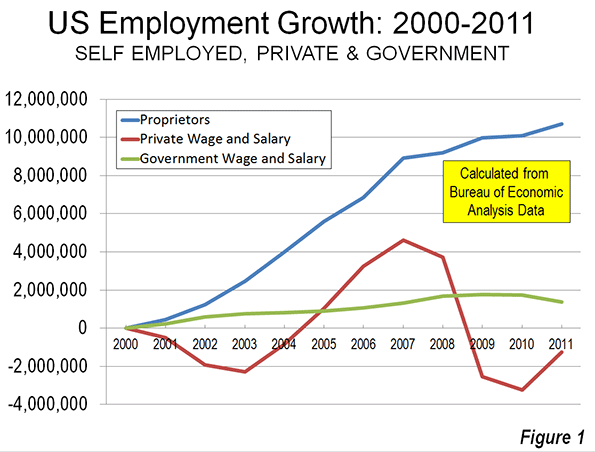
    The United States labor market has been undergoing a substantial shift toward small-scale entrepreneurship. The number of proprietors – owners of businesses who are not wage and salary employees, has skyrocketed, especially in the last decade. Proprietors are self employed business owners who use Internal Revenue Service Schedule C to file their federal income tax. Wage and salary workers are all employees of any establishment (private or government), from executives to non-supervisory workers.

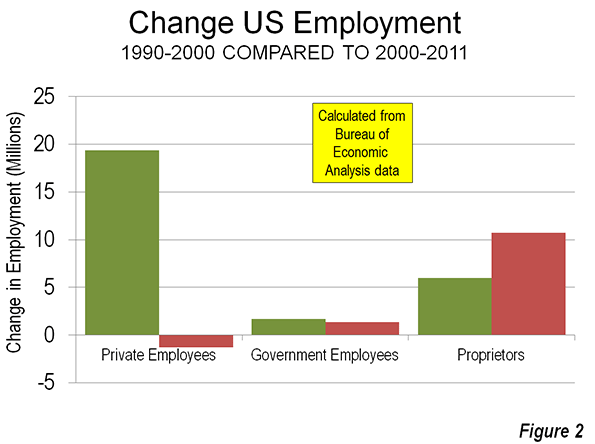
    From 2000 to 2011, the number of non-farm proprietors grew by 10.7 million. Total wage and salary employment grew by only 105,000 between 2000 and 2011. Government employment, including federal, state and local, grew 1.36 million, while private employment declined by 1.26 million (Figure 1).

    As a result, 99 percent of the total increase in employment from 2000 to 2011 was in the self-employed, according to Bureau of Economic Analysis of the United States Department of Commerce data. By comparison, during the 1990s, self employment accounted for only 22 percent of the increase in jobs nationally (Figure 2). The economic impact of the increase in self employment may be less, however, than its gross numbers, because many of the self employed are also engaged in wage and salary employment (Note).

    Self Employment Gains in the Great Recession

    Perhaps most striking is the fact that the number of entrepreneurs continued to grow in the Great Recession and what might be called the continuing Great Malaise. From 2007 to 2011, there was an increase of 1.8 million proprietors. This annual growth of nearly 450,000 was more modest than between 2000 and 2007, when the average number of proprietors grew 1.28 million, nearly three times as fast. The continuing growth in proprietors starkly contrasts with the loss of 5.9 million in private sector jobs. Government employment grew 44,000.

    A Longer Term Trend

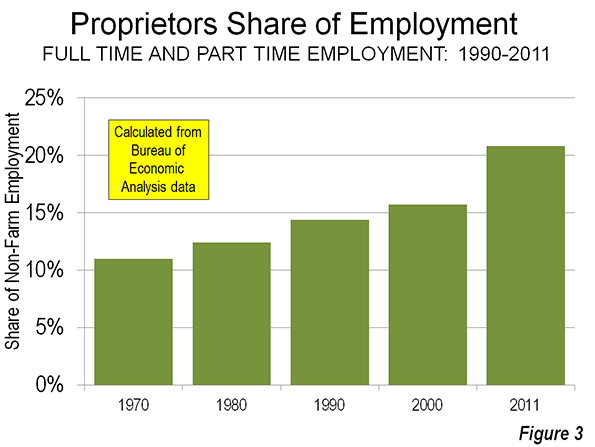
    The data from 2000 to 2011 indicates an acceleration of an already developing trend of greater self employment, which can be traced back to at least 1970 (the earliest data readily available). In 1970, proprietors were 11.0 percent of employment, a figure that rose to 15.6 percent by 2000. The greatest increase occurred after 2000, when the number of proprietors increased 42 percent. In 2011, proprietors represented 21 percent of employment, nearly double their proportion in 1970 (Figure 3).

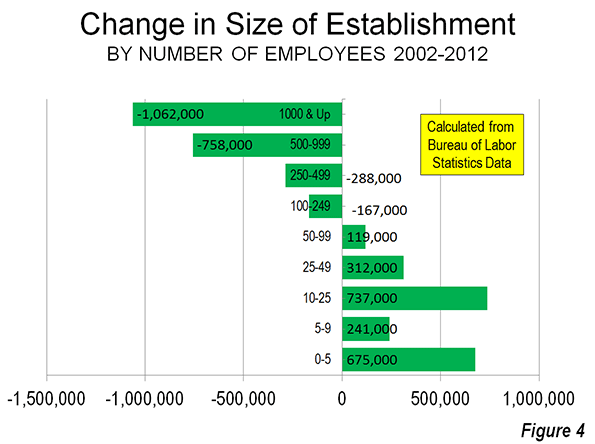
    This increase in proprietors (and their generally smaller commercial establishments) tracks with the continuing decline in average establishment size (Figure 4). United States Bureau of Labor Statistics data shows that between 2002 and 2012, there was a loss of 2.3 million private jobs in establishments with 100 or more employees. Establishments with 500 or more employees experienced a reduction of 1.8 million jobs, 80 percent of the large establishment (100 and over) losses. These losses were nearly made up by gains in establishments with under 100 employees (2.1 million).

    State Self Employment Trends

    Self employment added the largest number of jobs in 40 states between 2000 and 2011 (Table). Its percentage increase exceeded both those of private and government employment in all but two states (North Dakota and Alaska)

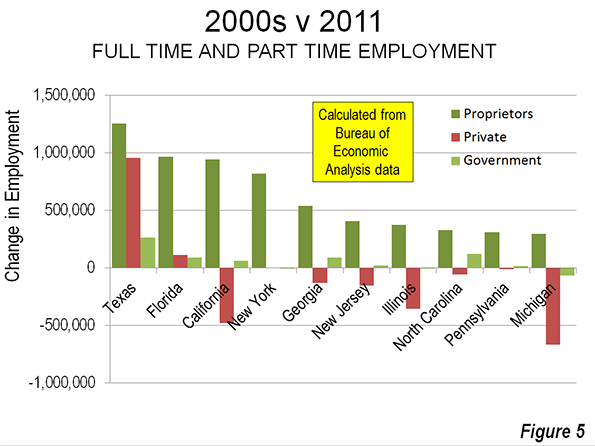
    Texas added the largest number of proprietors between 2000 and 2011. The Lone Star state added 1.26 million proprietors. Florida ranked second, added 970,000 proprietors, followed by California with 940,000. New York with its long laggard economic growth , added 820,000 proprietors. Georgia ranked 5th, adding 540,000. The next five included fast growing North Carolina (8th), as well as slower growing New Jersey, Illinois, Pennsylvania and Michigan (yes, Michigan).

    The story, however, was much different among these states in wage and salary employment. Texas, with the nation’s most vibrant and business friendly big state economy (according to chiefexecutive.net), added 1.22 million wage and salary jobs, 960,000 of which were in the private sector. Florida did somewhat worse, adding only 201,000 jobs, 113,000 in the private sector. California lost 480,000 private sector jobs, while adding 62,000 government jobs. Public and government employment changed little in New York. Georgia lost 131,000 private jobs, while adding 87,000 to government payrolls, while New Jersey and Illinois suffered private sector losses of 155,000 and 355,000 respectively (Figure 5 and Table).

    EMPLOYMENT CHANGE BY TYPE OF JOB: 2000-2011
    Wage & Salary Employment Total Employment
      Private Government Total Proprietors
    Alabama            (69,050)          22,297        (46,753)          154,522           107,769
    Alaska             39,839          12,355         52,194             9,621             61,815
    Arizona            126,805          51,509       178,314          245,934           424,248
    Arkansas              (8,806)          27,902         19,096           47,141             66,237
    California           (479,691)          62,143      (417,548)          941,071           523,523
    Colorado              (8,740)          70,077         61,337          209,084           270,421
    Connecticut            (64,857)            3,022        (61,835)          168,636           106,801
    Delaware            (11,550)            6,597         (4,953)           35,349             30,396
    District of Columbia             46,402          27,180         73,582           29,288           102,870
    Florida            113,353          88,063       201,416          968,006        1,169,422
    Georgia           (131,337)          87,525        (43,812)          537,451           493,639
    Hawaii             33,157          17,126         50,283           35,638             85,921
    Idaho             37,459            8,327         45,786           54,325           100,111
    Illinois           (354,730)           (5,481)      (360,211)          374,270             14,059
    Indiana           (180,865)          18,415      (162,450)          105,068            (57,382)
    Iowa             10,472          11,440         21,912           49,320             71,232
    Kansas            (17,794)          21,022          3,228           74,747             77,975
    Kentucky            (48,771)          39,826         (8,945)           86,259             77,314
    Louisiana               8,380         (16,543)         (8,163)          219,700           211,537
    Maine            (11,858)            1,060        (10,798)           23,994             13,196
    Maryland             28,580          54,102         82,682          249,229           331,911
    Massachusetts            (96,684)           (4,699)      (101,383)          211,607           110,224
    Michigan           (666,239)         (66,184)      (732,423)          294,215          (438,208)
    Minnesota              (3,680)            6,886          3,206          155,151           158,357
    Mississippi            (64,479)            5,696        (58,783)           87,067             28,284
    Missouri           (107,603)          12,903        (94,700)          138,189             43,489
    Montana             38,149            7,163         45,312           31,068             76,380
    Nebraska             15,922          12,470         28,392           42,849             71,241
    Nevada             75,814          35,526       111,340          136,382           247,722
    New Hampshire              (7,892)            9,275          1,383           41,525             42,908
    New Jersey           (155,108)          21,622      (133,486)          405,353           271,867
    New Mexico             48,017          11,506         59,523           37,120             96,643
    New York               2,427           (5,997)         (3,570)          818,861           815,291
    North Carolina            (58,042)        121,486         63,444          329,109           392,553
    North Dakota             65,306            7,595         72,901           15,776             88,677
    Ohio           (514,436)           (5,380)      (519,816)          277,931          (241,885)
    Oklahoma             28,310          41,462         69,772          106,262           176,034
    Oregon             19,047          16,878         35,925           95,406           131,331
    Pennsylvania            (11,087)          17,678          6,591          310,306           316,897
    Rhode Island            (15,349)           (4,281)        (19,630)           29,356              9,726
    South Carolina            (42,912)            9,998        (32,914)          242,447           209,533
    South Dakota             28,301            7,155         35,456           20,290             55,746
    Tennessee            (84,441)          33,905        (50,536)          196,021           145,485
    Texas            956,988        264,871    1,221,859       1,255,773        2,477,632
    Utah            109,728          33,864       143,592          137,781           281,373
    Vermont              (4,419)            4,179            (240)           21,467             21,227
    Virginia             90,766          64,639       155,405          282,009           437,414
    Washington             77,224          62,267       139,491          170,512           310,003
    West Virginia               8,796            9,736         18,532           20,765             39,297
    Wisconsin            (81,794)          13,783        (68,011)          148,572             80,561
    Wyoming             33,972          10,034         44,006           21,077             65,083
    United States        (1,259,000)     1,364,000       105,000     10,698,900      10,803,900

    The Future?

    Robert Fairlie, one of the nation’s leading experts on self-employment and a professor at the University of California, Santa Cruz, associates much of the increase in proprietors during the Great Recession to higher unemployment rates, measured at the local level. This is consistent with the rise in self employment during the Great Recession and the huge wage and salary job losses. At the same time, the larger increases in the decade before the Great Recession may indicate a strong underlying trend toward self employment. Certainly, this is supported by the rise of the Internet, which provides cheaper access to information and more comprehensive marketing opportunities.

    The future could see stronger self employment gains. As the baby boom generation reaches retirement age, it is likely that many former employees will turn to self employment to increase their incomes.

    Finally, the increasing global competitiveness could continue to reduce establishment sizes and encourage greater self employment. Stronger business regulation, including the mandates of the new medical care system ("Obamacare") could result in stunted employment growth, or even losses, forcing more people into self-employment even if they continue to work with current employers as contractors.

    America may not become a "nation of shopkeepers," like 19th century Britain, but is   increasingly becoming a self-employed nation. It will be challenging for governments, both at the national and local level to develop regulatory and tax structures that encourages this entrepreneurial expression, and perhaps more problematic, figure out to aid their conversion into larger businesses.

    Wendell Cox is a Visiting Professor, Conservatoire National des Arts et Metiers, Paris and the author of “War on the Dream: How Anti-Sprawl Policy Threatens the Quality of Life.

    —-

    Note: This article uses Bureau of Economic Analysis employment counts — the number of jobs, rather than employees (an employee may have more than one job). The database in this analysis includes full and part time employment. Last year’s Forbes article used a different database, limited to people who make their livings principally from self employment.

    Self employment photo by BigStockPhoto.com.

  • Retrofitting the Dream: Housing in the 21st Century, A New Report

    This is the introduction to "Retrofitting the Dream: Housing in the 21st Century," a new report by Joel Kotkin. To read the entire report, download the .pdf attachment below.

    In recent years a powerful current of academic, business, and political opinion has suggested the demise of the classic American dream of home ownership. The basis for this conclusion rests upon a series of demographic, economic and environmental assumptions that, it is widely suggested, make the single-family house and homeownership increasingly irrelevant for most Americans.

    These opinions — which we refer to as ‘retro-urbanist’ — gained public credence with the collapse of the housing bubble in 2007. The widespread media reports of foreclosed housing in suburban tracts, particularly in the exurban reaches of major metropolitan areas, led to widespread reports of the “death of suburbia” and the imminent rise of a new, urban-centric “generation rent.”

    Yet despite this growing “consensus” about the future of housing and home ownership, our analysis of longer-term demographic trends and consumer preferences suggests that the “dream,” although often deferred, remains relevant. We see this in the strength of suburbs, as well as in the growth of the post-war “suburbanized cities” that generally have been the fastest growing regions of the country. These trends are notable in the three key demographic groups that will largely define the American future: aging boomers, immigrants, and the emerging millennial generation.

    This does not mean that suburbia, or home construction patterns, will not change in the coming decades. Higher energy prices, for example, could necessitate shorter commutes, even with automobile fuel efficiency improvements. The emerging concentration of employment centers could help bring this about by improving job housing balance. There is a need to fully make use of the high speed digital communication that can promote both dispersed and home-based work.

    For these and other reasons McKinsey & Company, among others, has noted that meeting environmental challenges does not require the kind of radical alteration of lifestyles and aspirations so widely promoted in the media, academia, and among some real estate interests. Equally important, there has been little consideration of the profound economic and social benefits of both home ownership and low to medium density living. These include, on the economic side, the huge impact on employment from home construction and the ancillary industries associated with household upkeep and improvement.

    More important still may be the social benefits. Most serious studies have shown that lower-density, homeowner-oriented communities are more socially cohesive in terms of volunteerism, neighborly relations, and church attendance, than denser, renter-oriented communities. Suburban and lower density urban neighborhoods are particularly critical for the growth of families and the raising of children, an increasingly important factor in a ‘post-familial’ era of plunging birthrates.

    To be sure, housing has been changing rapidly from the model developed in the 50s, and this process will continue over the next generation. Houses today are more energy efficient, and look to accommodate home-based work, as well as extended, multigenerational families. Similarly, the suburbs and low/mid density urban communities are already far more diverse, in terms of ethnicity and age profile, than the homogeneous communities often portrayed in media and academic accounts. This trend is also likely to accelerate.

    Ultimately, we believe that the dream is not at all dead, but is simply evolving. America’s tradition of property ownership, privacy, and the primacy of the family has constituted a critical aspect of our society since before the nation’s founding. It will need to remain so in the decades ahead if the country is to prove true to the aspirations of its people and the sustainability of its demographics.

    Joel Kotkin is executive editor of NewGeography.com and a distinguished presidential fellow in urban futures at Chapman University, and a member of the editorial board of the Orange County Register. He is author of The City: A Global History and The Next Hundred Million: America in 2050. His most recent study, The Rise of Postfamilialism, has been widely discussed and distributed internationally. He lives in Los Angeles, CA.

  • The Cities That Are Stealing Finance Jobs From Wall Street

    Over the past 60 years, financial services’ share of the economy has exploded from 2.5% to 8.5% of GDP. Even if you believe, as we do, that financialization is not a healthy trend, the sector boasts a high number of relatively well-paid jobs that most cities would welcome.

    Yet our list of the fastest-growing finance economies is a surprising one that includes many “second-tier” cities that most would not associate with banking. To identify the cities making the biggest gains, we ranked metropolitan statistical areas’ employment growth in the sector over the long-term (2001-12), mid-term (2007-12) and the last two years, as well as momentum.

    Best Cities for Jobs in Finance Industries

    New High-Fliers

    Tops on our list among the 66 largest metro areas is Richmond, Va., where financial sector employment has grown an impressive 12% since 2009. This reflects the presence of large banks such as Capital One Financial , the area’s largest private employer with 10,900 jobs, and SunTrust Banks , which employs 4,400. The insurer Genworth Financial is based in Richmond, and Wells Fargo and Bank of America also have sizable operations there. Along with the Northern Virginia metropolitan statistical area (an area encompassing the state’s suburbs of Washington, D.C., including Fairfax, Arlington, Loudoun and Prince William counties), which is No. 7 on our list, the Old Dominion is quietly becoming a major financial power.

    In once-gritty Pittsburgh, which places second on our list, financial services is now the largest contributor to the regional GDP, according to the Allegheny Conference. Long seen as a backwater, the area has begun to lure the kind of highly trained workers used by financial firms, leading Rust Belt analyst Jim Russell to joke, “Pittsburgh is becoming the new Portland.” Financial employment there has grown nearly 7% since 2009. The strongly reviving local economy spans everything from energy to medical technology.

    Like Pittsburgh, some of the areas doing well in financial services are also thriving generally. These include such Texas high-fliers as No. 3 Ft. Worth-Arlington, where financial services employment has expanded over 12% since 2007, as well as No. 4 San Antonio-New Braunfels. And it is not real estate that is driving this boom—in Fort Worth, for example, the “real estate and rental and leasing” sub-sector of financial services shed jobs over the last five years while the “finance and insurance” subsector expanded almost 20%.

    Some metro areas that aren’t exactly setting the world on fire are scoring in the financial job sweepstakes. Jacksonville, Fla., ranks fifth on our list and St. Louis, MO-IL ranks eighth. In St. Louis, financial sector employment is up 6.4% since 2007 by our count, and the number of securities industry jobs has increased 85% to 12,000 over that span, according to the Wall Street Journal.

    What’s Driving Dispersion of Financial Services?

    The largest traditional financial centers appear to be losing their edge. New York, home to by far the largest banking sector with 436,000 jobs, places a meager 52nd on our list of the cities winning the most new jobs in the sector. Big money may still be minted in Gotham, but jobs are not. Since 2007 financial employment in the Big Apple is down 7.4%.

    The next four biggest financial centers are also doing poorly. San Francisco-San Mateo ranks 37th – remarkably poor given that San Francisco placed first overall on our 2013 list of The Best Cities For Jobs. Meanwhile Boston-Cambridge-Quincy ranks 44th (despite notching a strong 17th place ranking on our overall list), Los Angeles-Long Beach is 47th, and Chicago-Joliet-Naperville is 57th.

    So what gives here? A key factor is cost-cutting. As firms look to move back office and some sales functions to less expensive locales, the traditional financial centers are losing out. Between 2007 and 2012, New York, Boston, Los Angeles, Chicago and San Francisco lost a combined 40,000 finance jobs.

    In addition to lower rents in the cities that rank highly on our list, workers come cheaper, too: the average annual salary for securities industry jobs in St. Louis is $102,000, according to the Wall Street Journal, compared with $343,000 in New York.

    This trend is not just limited to the high-profile investment banks and brokerages. Insurance, the quieter and tamer part of the financial services sector (it has roughly the same number of jobs today as it did in 2001 and 2007), has seen an exodus of jobs into these lower-cost regional markets as well. Illinois-based insurance giant State Farm, for example, recently signed mega-leases in Dallas, Phoenix and Atlanta.

    Manufacturing And Energy Drive Changes

    The manufacturing revival in the Rust Belt and the Midwest is creating financial sector jobs in midsized cities (those with overall employment totaling 150,000 to 450,000).  Tops on that list is Ann Arbor, Mich., followed by Green Bay, Wisc., No. 16 Grand-Rapids-Wyoming, Mich., and No. 19 Madison, Wisc. Among small cities, Owensboro, Ky., ranks first, followed by No. 3 Kankakee-Bradley, Ill., No. 5 Clarksville, Tenn.-Ky., No. 11 Bloomington-Normal, Ill., and No. 13 Michigan City-La Porte, Ind. With low commercial and industrial market costs and available workforces, these regions could prove attractive to manufacturers re-shoring U.S. operations.

    The top of the financial services rankings for midsized and small cities is also liberally sprinkled with places where hot energy economies are driving employment in all sectors. The midsized list features Bakersfield-Delano, Calif., in third place, the Texas towns of El Paso and McAllen-Edinburg-Mission in fifth and ninth place, respectively, and No. 10 Lafayette, La. Our small cities ranking includes the Texas towns of Odessa (2nd), Midland (fourth) and Sherman-Denison (10th), and Cheyenne, Wyo. (14th). More economic activity will continue to flow to these regions both as they grow and as their suppliers move closer to reduce costs.

    What The Future Holds

    Historically financial services clustered in big cities, but increasingly cost is leading financial institutions to focus on smaller metropolitan areas. With the connectivity of the Internet and growth of educated workforces in many smaller metros, it has become increasingly possible for financial firms to locate many key functions outside of the traditional money centers.

    Some places can boast advantages beyond just lower costs. Jacksonville, and Miami-Kendall (No. 13 on our big cities list) benefit from the huge demand for financial advisers in Florida. The Sunshine State ranks fourth in the number of financial advisors, and this seems likely to grow as at least some of the expanding ranks of down-shifting boomers — some with decent nest eggs– head down south to retire or start second careers. This demographic trend could also benefit Phoenix, which already hosts substantial operations of Bank of America, JPMorgan Chase and Wells Fargo.

    Perhaps no low-cost metro area has greater long-term advantages than Salt Lake City, 12th on our list. The unique linguistics skills of the largely Mormon workforce have attracted big financial firms such as Goldman Sachs, who need people capable of conversing in Lithuanian, Chinese or Tagalog. Salt Lake City, with 1,400 employees, is the investment bank’s sixth largest location in the world.

    “We consider Salt Lake a high leverage location,” notes Goldman managing director David W. Lang. “There’s a huge cost differential and you have a huge talent-rich environment.”

    As we saw in manufacturing and information sectors, the financial services industry appears to be undergoing a profound geographic shift. Once identified largely with such storied locales as Wall Street, Chicago’s LaSalle Street or San Francisco’s Montgomery, the financial sector — like much of the economy — is dispersing, perhaps even more rapidly. Over time, this could accelerate the process of economic decentralization that has been occurring, fairly steadily, for the better part of a half century.

    Best Cities for Jobs in Finance Industries

    Joel Kotkin is executive editor of NewGeography.com and a distinguished presidential fellow in urban futures at Chapman University, and a member of the editorial board of the Orange County Register. He is author of The City: A Global History and The Next Hundred Million: America in 2050. His most recent study, The Rise of Postfamilialism, has been widely discussed and distributed internationally. He lives in Los Angeles, CA.

    Michael Shires, Ph.D. is a professor at Pepperdine University School of Public Policy.

    This piece originally appeared at Forbes.com.

    Downtown Richmond photo by CoredesatChikai.

  • The Vatican Bank: In God We Trust?

    When the cardinals sent billowing white smoke from their conclave and elected Jorge Mario Bergoglio as Pope Francis I, little did the Catholic Church realize that two millennia of ecumenical liturgy might come unraveled on the heresy of offshore banking regulations. Among the many frustrations that drove Pope Benedict XVI to take early retirement was his role as guardian angel of the Institute for the Works of Religion (the formal title for the Vatican Bank), which can no longer get past compliance questions by answering that its beneficial owner is “the Almighty.”

    The financial inquisition results, according to Concordat Watch, recently included “…two blows to the reputation of the Vatican Bank… The US State Department for the first time listed the Vatican as potentially vulnerable to money laundering, a notch below those states for which it has solid proof of this.” The second revelation was that banking giant JPMorgan Chase had closed its papal account.

    Benedict XVI’s day job presumably encompassed giving the sacrament to the bank’s audit committee (made up of cardinals), and among the many attacks against the church the most successful have been those of global regulators who have had little patience accepting Vatican credit on faith.

    The bank is located in a tax haven — Vatican City, population 800, with a legal system on tablets — lets its managers come to work in robes and sandals, and has clients that deal in cash gathered on collection plates. Because of this, post-2008 regulators have looked upon the Institute as just another bolt-hole trafficking in black money, if not clearing the accounts of pharmaceutical sinners, bigamists, or Lutherans.

    Founded in 1942, at a time when the Catholic Church needed some latitude when transferring money between good and evil, the Institute has operated around the world as the cardinals’ piggy bank. Along with taking the deposits of Sunday’s offerings, it has also handled pay-outs of hush money to abused altar boys and booked advances against papal indulgences.

    In response to probing questions from the watchdogs — Who is the ultimate beneficiary? Do you know the source of the funds? — the cardinals who run the bank, sometimes with the help of lay bankers, have only had answers that led to further investigations.

    Imagine telling some pencil pusher from the European Central Bank, the Bank of Italy, or the US Federal Reserve that the shareholder of record is “one God in three persons.”

    Nor did Benedict XVI find much absolution in the press coverage of his bank, which treated the operation as little different from some Mafia numbers racket.

    Take, for example, a recent New York Times article that, in thirty paragraphs, managed to link the bank to the failed Banco Ambrosiano — whose former chairman, Robert Calvi, found eternal salvation in 1982 while hanging from Blackfriar’s Bridge — insurance fraud, front companies, suspicions of money laundering, Cuban payments, and management incompetence. In the last case, for example, the CEO was described as a “German aristocrat,” as if his days were spent quail hunting or chasing Sabine women.

    Amusingly, the Times’ reporters were unable to distinguish, on a visit to the headquarters, the bank managers from the security guards. (A correction was later published, but no picture of the dapper security personnel.)

    Nor did the paper of record show much numeric literacy, summing up the Vatican Bank’s accounts, in their entirety, as having in 2011 “20,772 clients, 68 percent of them members of the clergy, and $8.2 billion in assets under its management. The bank has said it has around 33,000 accounts.”

    As God’s credit union issuing debit cards and checkbooks to clergymen, it is doubtful that the bank manages $8.2 billion at its discretion for its clients (including 14,124 men and women of the cloth). More likely, the $8.2 billion in “assets” are liabilities, demand deposits due to its clients and not “under management.” I doubt that the average priest has savings at the bank of $400,000 and that the bank is investing such money in stocks and bonds.

    Nevertheless, the article varies little from other disparaging accounts about the bank that level charges of compliance heresy, and imply that its senior managers, including the fired president Ettore Gotti Tedeschi, are regulatory apostates.

    Part of the reason that the Vatican Bank earns such poor grades from international regulators, not to mention from the US State Department, is because the Institute is believed “vulnerable” to the risk of processing terrorist funds. The belief that the Vatican Bank is funneling money to al-Qaeda says more about the bonfires of the regulators than it does about Catholicism. The Catholic Church historically has had more in common with Homeland repression than it has with fifth columnists. To use the worn phrase, “know your client.”

    The degree to which international bank regulation is just an excuse for Regulatus Pax Americana can be discerned in a report by Moneyval — the monitoring committee of the Council of Europe — on the Vatican Bank’s efforts to recite its compliance rosaries. It concludes: “The Holy See has come a long way in a very short period of time and many of the building blocks of a system to combat money laundering and the financing of terrorism are now formally in place.”

    Perhaps the reason the cardinals went with Cardinal Bergoglio as their front man is because he looks like the last man at a conclave who would short derivatives, or know how to hedge (either in ecumenical or currency terms) the church’s overexposure to developing markets.

    In his first comments on the global financial crisis, the Argentine Jesuit attacked the “cult of money” and “ideologies which uphold the absolute autonomy of markets and financial speculation, and thus deny the right of control to States, which are themselves charged with providing for the common good.” Noble sentiments indeed, but not ones often heard from a bank chairman or a Vatican theologian, especially one wearing a triregnum.

    Francis I’s words are a long way from those of a predecessor, Leo X, who in 1513 wrote to his brother, the Duke of Nemours, “Since God has given us the papacy, let us enjoy it.” Or those of Leo’s Medici ancestor, Cosimo the Elder, who in the fifteenth century was approached by an archbishop to stop the clergy from gambling. “Maybe first,” said the Medici banker, “we should stop them from using loaded dice.”

    Unfortunately for the Pope and his financial acolytes, many international regulators are out to prove that all banks are processing payments for the devil. In the meltdown’s aftermath, a small unregulated bank is unusually suspect, especially when operating in a “sacerdotal-monarchical state established under the 1929 Lateran Treaty” and reporting to an abstract nominee with an ethereal address. Nor can it help that the bank is a market-maker in loaves and fishes.

    The best that the new Pope can hope for is that the regulators will dispense with a fiery auto-da-fé and instead accept the bank’s penance of its heresy and apostasy. Maybe the central bankers will allow the Vatican to grant itself an indulgence for all those spiritual options marketed in Sicily? High ranking clergy could even argue that, under the company’s accounting rules (as divined from scripture), origination revenue is recognized when the sin is committed, not when the soul is saved.

    After all, running a bad bank — as Citigroup, Bank of America, Goldman Sachs, and many other heathens know — is not a mortal sin.

    Matthew Stevenson, a contributing editor of Harper’s Magazine, is the author of Remembering the Twentieth Century Limited, a collection of historical travel essays. His next book is Whistle-Stopping America.

    Flickr Photo: security personnel in Vatican City, by Trishhhh

  • Southern California Economy Not Keeping Up

    One of Orange County’s top executives asked me over lunch recently why Southern California has not seen anything like the kind of tech boom now sweeping large parts of the San Francisco Bay Area. In many ways, it is just one indication of how this region – once seen as the cutting edge of American urbanism – has lost ground not only to its historic northern rival, but also to some venerable East Coast cities, as well as the boom towns of Texas and the recovering metropolitan areas of the Southeast.

    This divergence became particularly clear to me as I put together the most recent Forbes Best Places for Jobs with Pepperdine University economist Mike Shires. Our rankings focus heavily on momentum: What areas are growing fastest now and have made the best progress over the past decade. For me, a 40-year resident of the Los Angeles Basin (Shires is a native of San Diego), the results were far from encouraging.

    To be sure, Los Angeles, Orange County and Riverside-San Bernardino are up somewhat from their dismal showings in past years, in part due to the housing recovery. But none did well enough to ascend even to mediocrity. Yet, of 66 regions with more than 450,000 jobs, Los Angeles ranked No. 49, while Riverside-San Bernardino clocked in at No. 45, and Santa Ana-Anaheim-Irvine did best, with a still-less-than-middling No. 38.

    These rankings were way below those registered in the country’s emerging economic powerhouse, Texas, which placed a remarkable four regions in the top 10 (Fort Worth, Dallas, Houston, Austin) or rising burgs such as No. 2, Nashville, No. 3, Salt Lake City, and No. 9, Denver. We also got smoked by such low-exposure places as No. 13, Columbus, Ohio, No. 15, Oklahoma City, and No. 16, Indianapolis.

    But our relative decline is not merely a reflection of the natural effects of lower costs and better business climate. We also lagged well behind such famously expensive, and hyper-regulated, places as No. 14, Seattle, No. 17, Boston, and No. 18, New York City. Worse of all, Southern California was left completely in the dust by its two great interstate rivals, the No. 1-ranked San Francisco Bay Area and No. 7-ranked San Jose/Silicon Valley. The only California cities to do worse than the Southland were No. 56, Oakland, and No. 57, Sacramento.

    Why is the Southern California economy lagging, even in this recovery? Much of the answer can be found by looking at the information sector, which is driving much of the Bay Area’s growth. As my luncheon partner, who is investing heavily in the Silicon Valley, suggested, the entire wave of new tech companies has largely bypassed Southern California.

    This is not merely a question of achieving less growth, but actually losing ground, while the Bay Area metros soar. Since 2007, for example, the information sector – which includes software, media and entertainment – surged 18 percent in the San Francisco-San Mateo area and by a remarkable 25 percent in the San Jose-Silicon Valley region. In contrast, the Los Angeles information sector declined by 7.3 percent, while in Orange County, once a tech hotbed, it dropped by 21 percent.

    These declines impact not only demonstrably tech-oriented jobs, but also professional and business services that often serve tech clients. Over the past five years, these jobs have been growing smartly in San Francisco and decently in Silicon Valley, while declining in both Orange County and Los Angeles. Only recently have these sectors showed any sign of recovery in the Southland, but at a far weaker rate than in the Bay Area.

    Why is this happening? Certainly the answers are complex. Historically, the L.A.-Orange County tech economy has been strongly tied to aerospace and defense, and these sectors have been declining under President Barack Obama. The defense sector also has tended to shift toward more politically potent places like Texas, Georgia and Alabama, where politicians actually work on behalf of industrial jobs. With the exception of drone technology, the Southern California region’s aerospace industry, as one analyst put it, has become “dormant,” a victim of a talent drain and a gradual withdrawal of aerospace giants, most recently, Northrop, from the region.

    Like Los Angeles, Silicon Valley’s tech community was largely birthed by the Defense Department and NASA, something rarely acknowledged by the region’s hagiographers. But, starting in the 1980s, the Bay Area began to apply early innovations in semiconductor design and software to other industries, such as personal computers, the Internet and, more recently, social media and mobile devices, something that has generated not only jobs, but also buzz.

    Capital, too, has played a role. The L.A. area has lots of rich people, but a relatively weak venture capital community. The Bay Area has roughly five times as much venture capital – more than $10 billion – as the far more populous L.A.-O.C. region. New York and New England also enjoy far more money in local venture investment firms than does Southern California.

    Politics and image-making also has contributed to the Southland’s eclipse. California politics are now almost totally dominated by Bay Area politicians – from Gov. Jerry Brown to Lt. Gov. Gavin Newsom and Attorney General Kamala Harris. Both our U.S. senators are from San Francisco and its environs. Their economic orientation, when they have one, tends to be to worship at the altar of allied Bay Area software giants, like Google, and social media firms such as Twitter or Facebook. Life in cyberspace makes less-direct demands on green “progressive” sensibilities than making airplanes or garments, or the work of processing trade with Asia.

    In general, the Bay Area economic mindset tends to disdain the tangible economy – manufacturing, wholesale trade, construction – critical to the more diverse and more blue-collar-oriented Los Angeles-area economy. California’s tight land-use regulation and soaring energy prices do not much impact the Bay Area giants, since they simply shift their energy-intensive operations to places like Texas or Utah. And, as for soaring housing prices, people who cannot afford Bay Area prices also can be shifted to Salt Lake City, Austin, Texas, or Raleigh, N.C.

    In contrast, Southern California, like much of the Central Valley, is far less able to slough off the green-dominated policies of the Bay Area political cliques. Los Angeles, for example, still has 360,000 manufacturing jobs, down more than 18 percent since 2007, and Orange County has an additional 160,000 such jobs, after a drop of 11 percent the past five years. In contrast, San Francisco-San Mateo has only 36,000 industrial jobs. These, too, have been declining rapidly, but have far less impact on the economy than down here.

    Then, there’s the question of image. According to a recent Bloomberg Businessweek survey, San Francisco ranked as “best city” to live in. Suburban San Jose ranked No. 33.

    Los Angeles? Try No. 50, behind such places as Cleveland, Omaha, Neb., Tulsa, Okla., Indianapolis and Phoenix.

    In another survey, identifying the top 10 cities for “millennials,” Seattle ranked first, followed by such cities as Houston, Minneapolis, Dallas, Washington, Boston and New York. Needless to say, neither Los Angeles nor Orange County made the cut.

    Is there something we can do about this decline? I think this is more than just a marketing issue. Southern California, a region that largely invented itself out of combination of real estate speculation and great climate, needs to rediscover the roots of its success. Once our entrepreneurs imagined and forced into being great things, such as massive water and port systems; they dominated the race for space and planned out the suburban dreamscapes of Lakewood, Valencia and the Irvine Ranch. With the possible exception of Elon Musk and Space X, Southern California’s entrepreneurial guile is now decidedly low-key – food trucks, ethnic shopping, reality shows, hipster-oriented lofts and shopping areas.

    This limited vision extends to politics as well. As recently as the 1980s, the region boasted an aggressive business community that bullied Sacramento and bestrode Washington like a colossus. Now, our business leaders cringe like supplicants before well-funded greens, racialist warlords and public employee unions. We need business and community leaders to match the increasing arrogance and audacity of the Silicon Valley oligarchs, to force legislators to address the needs of our economically diverse, and still tangibly oriented economy.

    This also requires that the cultural resources of the region – Hollywood, the fashion industry, universities and colleges – become more engaged in something larger than protecting their narrow interests. At some point, they should realize that, as our region loses luster, so, too, does the fundamental attractiveness of their institutions and industries.

    Until this happens, Southern California – despite its cultural richness, ideal climate and great history of economic vigor – will continue to lag, performing, at best, to its current level of underachievement, slouching toward a permanent state of mediocrity.

    Joel Kotkin is executive editor of NewGeography.com and a distinguished presidential fellow in urban futures at Chapman University, and a member of the editorial board of the Orange County Register. He is author of The City: A Global History and The Next Hundred Million: America in 2050. His most recent study, The Rise of Postfamilialism, has been widely discussed and distributed internationally. He lives in Los Angeles, CA.

    This piece originally appeared in the Orange County Register.

  • The Cities Winning The Battle For Information Jobs

    The information industry has long been a darling of the media — no surprise since the media constitutes a major part of this economic sector, which includes publishing, software, entertainment and data processing. Yet until the last few years, it has been a sector in overall decline, with almost 850,000 jobs lost since 2001. The biggest losses have been in telecommunications (half a million jobs gone since 2001) and print publishing (books, newspapers, magazines), which lost 290,000 jobs — 40% of its 2001 job base.

    Yet over the past two years, spurred largely by social media and the growing use of data in business, there has been something of a resurgence in the information sector, with strong hiring in software publishing, data processing and other information services. To identify the cities making the biggest gains, we ranked metropolitan statistical areas’ employment growth in the sector over the long-term (2001-12), mid-term (2007-12) and the last two years, as well as momentum.

    Best Cities for Information Sector Jobs

    The Usual Suspects

    On our large cities list (the 66 metropolitan statistical areas with more than 450,000 jobs), the top two, perhaps not surprisingly, are San Jose-Sunnyvale-Santa Clara, Calif., aka Silicon Valley, followed by San Francisco-San Mateo-Redwood City. Since 2007, the number of information jobs in the Valley has grown by 25%, although this has not offset the large job losses in manufacturing, construction and government. Overall, San Francisco comes off a bit better: information employment is up less over the same period, 18%, but it has suffered less grievous losses in its smaller industrial and construction sectors. The San Francisco metro area ranks No. 1 on our 2013 list of The Best Cities For Jobs.

    Several other of our top performers come from what we might consider the usual suspects of high-tech hype, including Boston (No. 4), where information employment is up over 8% since 2007, and Seattle (15th), which has posted solid if not overwhelming growth of 4% in the sector since 2007, but has a much stronger manufacturing scene than the Bay Area. (See: America’s New Manufacturing Boomtowns)

    The Rising Stars

    But the big story in the information sector may be the emergence of a whole series of smaller metro areas that are usually less expensive. Some of the names here would also not surprise, such as Austin, Texas (fifth), and Raleigh-Cary, N.C. (eighth). They have been pulling information jobs from places like Boston, New York and the Bay Area for almost a generation. For example, Apple decided last year to center its Americas operations division in Austin, which is likely to bring upward of 3,000 information jobs to the Texas capital.

    Less well-known has been the growth in other upstart locations. Perhaps the most dramatic player is third-place New Orleans-Metairie-Kenner, where information employment is up 28% since 2009. The information sector in the area, where I am currently working as a consultant to the regional development agency, GNO, Inc., is very broad-based, including companies in digital effects, videogames, software development as well as a burgeoning film and television industry. The recent decision by General Electric to place its new technology center and its 300 new technology jobs in New Orleans is another sign of the Crescent City’s emergence as a viable information hub.

    GE is representative of a growing trend to place high-tech jobs in a new cadre of low-cost locations. In addition to New Orleans, the conglomerate has announced, over the past year, new technology centers in Detroit; Richmond, Va.; and San Ramon, Calif. While these expansions were not enough to reverse the overall poor showing on our large cities list of Richmond (second to last out of 66) and Detroit (60th), they reflect a growing tendency of businesses to tap relatively low-cost pools of talent.

    In many ways, New Orleans’ success story in information — the migration of jobs to lower cost, but still attractive, regions — is mirrored in other metro areas in our rankings. This includes No. 6 Atlanta, whose 85,000-strong information sector is now the nation’s fourth largest, if you combine Silicon Valley and San Francisco into one region. As in New Orleans, mega-companies also see Atlanta as a major and affordable talent center. General Motors, for example, recently announced plans to set up its new software center in the Atlanta suburbs, bringing more tech jobs.

    Several other large but affordable metro areas are also gaining momentum, most of which are in the Sun Belt. These include seventh-place San Antonio, which has experienced strong growth in such fields as cyber-security, and Phoenix (ninth),which traditionally draws talent and companies from California, and has also won a 1,000-person strong GM tech center in suburban Chandler.

    Finally, tech and media watchers should look out for 10th-place Nashville-Murfreesboro-Franklin, Tenn. Like New Orleans, the country music capital has a very strong media base and provides newcomers with everything from a hip urban ambiance to bucolic country suburbs. Its information sector is also helped by growth in health and manufacturing in the area.

    What About The Big Boys?

    New York, with some 174,000 information jobs, and Los Angeles, with over 190,000, retain the largest clusters of information industry jobs, but they are not growing as quickly as our top 10 metros. New York, at No. 13, has enjoyed only modest 3.2% growth in employment in the sector since 2007, and, despite all the renewed hype about “Silicon Alley,” growth ground to a halt over the past year. Overall since 2001 New York has lost some 16,000 information jobs, many of them directly tied to a big drop in publishing employment.

    But the Big Apple is an information boom town compared to Los Angeles (28th), with information employment there dropping 7.3% since 2007. L.A. today has 25,000 fewer information jobs than in 2001. Things appear to be more stable recently, but the big issue for L.A. lies in the decline of the entertainment industry, which dominates much of the area’s information sector. Since 2007, the Big Orange has lost roughly 9,000 jobs connected to the motion picture, television and recording industry, something the region has not found a way to redress.

    The only information hub that arguably has done consistently worse is Chicago, which has lost 30,000 information jobs since 2001. Many of those losses came from publishing and telecom, which suffered huge losses early in the last decade. Since then, the information sector decline has slowed and last year the area eked out growth of 0.4%.

    Best Cities for Information Sector Jobs

    Little Wonders

    Information businesses historically cluster in big cities, but there are now several smaller regions whose sectors are now growing rapidly. On our medium-size metro area list (between 150,000 and 450,000 jobs), the top spot goes to Trenton-Ewing, N.J., which enjoyed 9.2% growth in the sector since 2007 and appears to be attracting software development jobs. There’s also been considerable growth in Utah, which boasts Provo-Orem (fourth) and Ogden-Clearfield (sixth). Combined with Salt Lake City, a respectable 17th on the large metro area list, the Wasatch Front appears to be a real comer in the information economy.

    The mid-sized list, like the rising stars, appears very much to be driven by lifestyle preferences and the proximity of universities to provide raw talent. If there’s a more physically attractive metro area than No. 2 Santa Barbara-Santa Maria-Goleta, Calif., we’d like someone to find it for us. Lansing-East Lansing, Mich. (third), and Madison, Wisc. (fifth), may be a lot colder and less spectacularly beautiful than Santa Barbara, but as college towns and state capitals, they boast considerable amenities and a constant flow of recent graduates. Much the same can be said of No. 7 Baton Rouge, La., which also enjoys the benefits of an expanding energy industry. Albuquerque, N.M. (eighth), and Huntsville, Ala. (ninth), while not state capitals, are home to major national science laboratories that also attract a deep pool of local technology talent.

    The impact of the modern energy industry on information grows from the need of oil and gas firms to use technology to discover, maintain and expand their operations. This can be seen in our number one small metro for information jobs, Cheyenne, Wyo., as well as the Texas towns of College Station-Bryan (third) and Tyler (fourth). The link between manufacturing and information is evident in some of the small metros, including No. 2 Flint, Mich., and No. 8 Columbus, Ind.

    Who’s Left Behind?

    The information industry’s growth has missed many, if not most American metro areas. This includes many large cities in California, including Oakland-Fremont-Hayward (58th on our large cities list), Sacramento-Arden Arcade-Roseville (63rd) and San Bernardino-Riverside (64th). Given its proximity to both Silicon Valley and San Francisco, Oakland’s slow recovery is a bit surprising, but remember it was only when growth in Silicon Valley went hyper-critical during the ’90s dot-com bubble that Oakland finally surged. Other poor performers include last-place Camden, N.J.; Oklahoma City (62nd), Kansas City, Kan. (61st).

    Yet to an extent not well appreciated in the media, a slow-growing or even shrinking information sector isn’t necessarily an economic kiss of death. Information remains a relatively small, if highly obsessed over, sector of our economy. Additionally, some of these jobs are being subsumed into the indistinguishable category of business services as more and more firms bring them in-house as part of the normal course of doing business. Nonetheless, while you can certainly thrive without it, given the glitz factor, most metro areas would probably prefer to rank among those that are winning these jobs than missing out on them.

    Joel Kotkin is executive editor of NewGeography.com and a distinguished presidential fellow in urban futures at Chapman University, and a member of the editorial board of the Orange County Register. He is author of The City: A Global History and The Next Hundred Million: America in 2050. His most recent study, The Rise of Postfamilialism, has been widely discussed and distributed internationally. He lives in Los Angeles, CA.

    Michael Shires, Ph.D. is a professor at Pepperdine University School of Public Policy.

    This piece originally appeared at Forbes.com.

  • America’s Off-The-Radar Tech Hubs

    At the moment, the technology sector is the focus of a lot of attention — and with good reason. Tech industries have helped turn San Jose and Austin into major economies and brought other large metros, like Detroit, through tough spells. But which small, off-the-radar towns out there also deserve recognition as technology hubs?

    To explore this question, we analyzed 70 high-tech occupations identified by BLS economist Daniel E. Hecker. The list includes everything from computer systems analysts to forest and conservation technicians. Many of the highlighted economies contain a strong contingent of one or two of these occupations, while other occupations may not be especially concentrated in the region.

    In order to locate these economies, we had to explore some obscure parts of EMSI’s extensive database. For one thing, we removed cities with very large populations since many of them would come as no surprise. (We already know that Seattle, San Jose, and Austin are capitals of the tech sector.) Cities with very small numbers of tech workers were also cut from the list; if an influx of 10 tech workers could radically shift the economy, it can be hard to gauge whether or not the industry is really growing.

    We chose to highlight MSAs that have 1,000-50,000 jobs in the industry, have grown by more than 10% since 2001 and more than 0% since 2010, and also have promising concentration (measured by location quotient, LQ). Another factor that we took into account is whether or not the industry grew during the recession (2007-09). After applying all these filters to our data, we chose 11 MSAs which have exhibited impressive growth but which have also, for the most part, sneaked under the radar.

    The list starts with Los Alamos, N.M., and Williston, N.D., which have already gained attention for their growing economies. Then we’ll move from smallest to largest MSA, examining a key tech occupation in each.


    Los Alamos, New Mexico

    Population: 18,294

    Tech workers: 4,559 jobs

    Highlighted tech occupation: Biochemists and Biophysicists (410)

    Why you should be watching: Tech occupations in Los Alamos have skyrocketed in the last 11 years, with a gobsmacking 325% growth since 2001. Currently, the city has a concentration of tech workers almost six times that of the nation. The median wage of these workers is $51.47/hr, which is much higher than the average for the occupation.

    Between 2005 and 2007, Los Alamos gained 3,750 jobs in the tech sector. The occupations barely dipped during the recession and have remained steady since, with only a slight decline in the last year.

    What’s causing all these insane numbers? Obviously, the Los Alamos National Laboratory. As an example of just how unique this city is, consider this fact: there are 252 nuclear technicians in Los Alamos. The LQ for that occupation in the region is 254.42. Basically, this means that if nuclear technicians were as concentrated nationwide as they are in Los Alamos, they would make up the 10th largest occupation in the United States, with 2,184,588 jobs.

    Williston, North Dakota

    Population: 25,107

    Tech workers: 926 jobs

    Highlighted tech occupation: Petroleum Engineers (211)

    Why you should be watching: The number of tech workers in Williston has grown 324% since 2001, and 93% in the last three years. Although there are only 928 workers, they are getting paid a median hourly wage of $46.29 and those paychecks have already had significant economic impact on the state. That’s what an oil boom will do for you.

    As you can see, there are twice as many petroleum engineers as the next largest tech occupation. And the second largest occupation is geological and petroleum technicians, which are also involved in the oil industry.

    Los Alamos and Williston are not really surprises when it comes to tech centers. Both have appeared in the news for several years now as emerging economies. As we look at these other regional economies and evaluate them as potential tech hubs, we can compare them to the exploding economies of Los Alamos and Williston.

    Susanville, California

    Population: 34,019

    Tech workers: 1,258 jobs

    Highlighted tech occupation: Forest and Conservation Technicians (761)

    Why you should be watching: Susanville is another one of those cities with growth in a lot of different areas. The fact that it is a logging town keeps the economy tied to local industries and helps it stay well-rounded. The most impressive thing about Susanville is that during the recession, the number of tech workers grew by 18%.

    Whenever we find an industry or occupation that grew during the recession, we usually discover that it was strongly supported by the government. Susanville is no different. According to EMSI’s inverse staffing pattern, the government sector accounts for 95% of all tech-related occupations. Below are the three government industries and their portions of tech occupations:

    • Federal government, civilian, excluding postal service (65.7%)
    • State government, excluding education and hospitals (25.6%)
    • Local government, excluding education and hospitals (3.2%)

    It’s not too surprising that the regional economy has been doing so well.

    Pullman, Washington

    Population: 45.4K

    Tech workers: 1,299 jobs

    Highlighted tech occupation: Electrical Engineers (163)

    Why you should be watching: Small economies sometimes have a better chance of withstanding economic recession because they can be self-contained. This is especially true of Pullman, where the economy is almost entirely driven by two forces: Washington State University and Schweitzer Engineering Laboratories. Even with a mere 1,283 tech jobs in the area, the sector grew 38% since 2001 and, more impressively, 9% during the recession.

    The line graph displays the increase of electrical engineers since 2001. While 163 jobs might not seem like very much, the growth is dramatic enough to warrant comment.

    St. Marys, Georgia

    Population: 50,957

    Tech workers: 992 jobs

    Highlighted tech occupation: Civil Engineers (136)

    Why you should be watching: Out of the MSAs we examined for this report, St. Marys has the most consistent growth across the board. The tech sector has grown 88% since 2001 and 50% since 2010, increasing the LQ by 0.53 in the last eleven years. Most of this growth is probably caused by the Naval Submarine Base Kings Bay, but the occupations that have grown are quite varied.

    The table below shows the top five industries for tech occupations in St. Marys. As you can see, engineering services is at the top of the list, followed by federal government, civilian.

    NAICS Industry Occupation Group Jobs in Industry (2012) % of Occupation Group in Industry (2012) % of Total Jobs in Industry (2012)
    541330 Engineering Services 468 47.2% 52.3%
    901199 Federal Government, Civilian, Excluding Postal Service 194 19.6% 8.5%
    336414 Guided Missile and Space Vehicle Manufacturing 100 10.1% 18.9%
    541519 Other Computer Related Services 37 3.8% 42.7%
    524114 Direct Health and Medical Insurance Carriers 29 2.9% 8.1%

    Engineering services accounts for the most tech jobs in the region (468 jobs), and government jobs come next with 194 tech jobs. Guided missile and space vehicle manufacturing are tied to the government as well, as most of that research is probably happening at the Naval Submarine Base.

    Helena, Montana

    Population: 76,801

    Tech workers: 3,109 jobs

    Highlighted tech occupation: Forest and Conservation Technicians (371)

    Why you should be watching: Helena is another one of those plucky economies that refused to buckle during the recession. Helena has a quite a few tech workers (3,144 in 2012), but they are spread out evenly over many occupations. Since Helena is the state capital, the largest employer of tech workers is the state government (comprising 1,321 jobs), but the tech sector as a whole grew almost 12% in the last three years.

    Forest and conservation technicians account for 371 jobs in the tech sector, followed by civil engineers at 336 jobs. Forest and conservation technicians grew 48% growth since 2001 (most of that taking place 2005-2009. It’s easier to understand this growth knowing that 96% of the forest and conservation technician jobs in Helena are in state or federal government.

    Dubuque, Iowa

    Population: 95.5K

    Tech workers: 3,041 jobs

    Highlighted tech occupation: Software Developers, Systems Software (430)

    Why you should be watching: Dubuque has seen strong growth among tech workers in the last ten years, especially in software developers. Since 2010, the tech economy has increased by 3,126 jobs. Many of these jobs are due to the presence of IBM’s Global Delivery Center and other developing tech companies. Dubuque is currently #8 on Forbes’ list of best small places for businesses and careers.

    Lexington Park, Maryland

    Population: 109,409

    Tech Workers: 7,789 jobs

    Highlighted tech occupation: Electronics Engineers, Except Computer (1,438)

    Why you should be watching: During the recession, Lexington Park’s proximity to D.C. propped up its economy. The city grew 9% from 2007 to 2009, but its tech industry has grown 5.2% since then. Tech workers are 3.48 times more concentrated in Lexington Park than in the rest of the nation, for which the city can thank the Patuxent Naval Air Station.

    This graph represents the top industries for electronics engineers, except computer engineers, in Lexington Park. All together, the industries staffed by electronics engineers have increased 56%, compared to 16% in the 50 largest metropolitan statistical areas and 19% in the nation as a whole. Most of this growth has occurred in research and development in the physical, engineering, and life sciences (NAICS 541712), which has seen 93% since 2001, and in engineering services, which has seen 84% growth since 2001.

    Midland, Texas

    Population: 143.4K

    Tech workers: 4,484 jobs

    Highlighted tech occupation: Petroleum Engineers (927)

    Why you should be watching: The 4,484 tech jobs in Midland aren’t the most impressive thing about the city. What is impressive is the 23.4% growth in the last three years and the $42.76 hourly wage. A increase of 83% since 2001 is nothing to snort at either. That’s what the oil industry will do for you.

    The line graph below represents the growth of petroleum engineers since 2001. The blue line stands for the Midland MSA. Green stands for all 11 tech centers highlighted in this post. Brown and red stand for the 50 largest MSAs in the nation and the nation as a whole, respectively.

    Despite the fact that petroleum engineers drive the Midland economy, the 11 tech centers have increased in petroleum engineers slightly faster. Both are significantly ahead of the nation as a whole, however. What’s not reflected on this chart is the fact that the petroleum engineers occupation in Midland has a regional LQ of 45.16. With such a high concentration of a single occupation, Midland’s economy is primed for expansion as other industries and occupations rush in to support the oil industry.

    Trenton, New Jersey

    Population: 368.9K

    Tech workers: 17,573 jobs

    Highlighted tech occupation: Software Developers, Applications (2,899)

    Why you should be watching: The Trenton-Ewing area used to be a big hub for manufacturing jobs, but has since shifted its focus. Government, health care, and technology are currently the largest industries in the area. Tech workers have increased 11% since 2001 and grew 3% during the recession, and workers earn a median wage of $41.23/hr.

    Trenton’s highlighted tech occupation is software developers, which is spread out over several different industries. Here are the five industries that employ the most software developers in Trenton-Ewing.

    Custom computer programming services has gained quite a few software developers and investment banking and securities dealing has more than doubled its numbers. Software publishers take the cake with an increase of zero to 160 since 2001.

    Madison, Wisconsin

    Population: 583.8K

    Tech workers: 25,597 jobs

    Highlighted tech occupation: Computer Support Specialists (3,827)

    Why you should be watching: Madison has 26,722 tech workers and grew 28% over the last 10 years. It could be hard to maintain such a high concentration of tech workers, but the LQ of tech workers in Madison has grown from 1.31 in 2001 to 1.61 in 2012. Madison is currently #89 on Forbes’ list of the Best Places for Business and Careers and #38 in job growth.

    The complete data is reproduced below.

    Metropolitan Statistical Area 2012 Jobs 2001-12 % Change 2007-09 % Change 2010-12 % Change Median Hourly Earnings 2001 Location Quotient 2012 Location Quotient LQ Change
    Source: QCEW Employees, Non-QCEW Employees & Self-Employed – EMSI 2013.1 Class of Worker
    Los Alamos, NM (31060) 4,585 325% -2% -3.8% $51.47 2.42 5.91 3.49
    Williston, ND (48780) 928 324% 24% 93.7% $46.29 0.47 0.65 0.18
    St. Marys, GA (41220) 974 88% -3% 49.8% $34.02 0.55 1.08 0.53
    Midland, TX (33260) 4,488 83% 4% 23.4% $42.76 0.88 1.17 0.29
    Susanville, CA (45000) 1,246 74% 18% 0.7% $22.42 1.42 2.41 0.99
    Dubuque, IA (20220) 3,126 63% 1% 12.8% $30.96 0.75 1.10 0.35
    Lexington Park, MD (30500) 7,659 55% 9% 5.2% $45.26 2.62 3.48 0.86
    Helena, MT (25740) 3,144 39% 7% 11.9% $25.99 1.36 1.53 0.17
    Pullman, WA (39420) 1,283 38% 9% 9.3% $33.67 1.10 1.37 0.27
    Madison, WI (31540) 26,722 28% 2% 5.7% $32.57 1.31 1.61 0.30
    Trenton-Ewing, NJ (45940) 17,887 11% 3% 0.2% $41.23 1.48 1.59 0.11

    Christian Leithart is a tech writer with EMSI. Follow them on Twitter @DesktopEcon.