Category: Economics

  • America’s New Manufacturing Boomtowns

    Conventional wisdom for a generation has been that manufacturing in America is dying. Yet over the past five years, the country has experienced something of an industrial renaissance. We may be far from replacing the 3 million industrial jobs lost in the recession, but the economy has added over 330,000 industrial jobs since 2010, with output growing at the fastest pace since the 1990s.

    Looking across the country, it is clear that industrial expansion has been a key element in boosting some of our most successful local economies. The large metro areas with the most momentum in expanding their manufacturing sectors also rank highly on our list of the cities that are generating the most jobs overall, including Houston-Sugarland-Baytown, Texas, which places first on our list of the big metro areas that are creating the most manufacturing jobs; Seattle-Bellevue-Everett, Wash. (third); Oklahoma City, Okla. (fourth), Nashville-Davidson-Murfreesboro-Franklin, Tenn. (No. 6); Ft. Worth, Texas (No. 9); and Salt Lake City, Utah (No. 10).

    Our rankings factor in manufacturing employment growth over the long-term (2001-12), mid-term (2007-12) and the last two years, as well as momentum. They identify those places where the market tells us the best storylines for manufacturing are being written.

    Best Cities for Manufacturing Jobs

    The Energy Boom and Industrial Growth

    What is striking about this revival is both its sectoral and geographic diversity. For Houston, the booming energy industry is driving job growth in metal fabrication, machinery and chemicals. Since 2009, Houston industrial employment has grown 15%, almost three times as fast as the overall economy. Of course, industrial growth also tends to create jobs in other sectors, notably construction and professional and business services.

    Much the same pattern of energy-driven growth can be seen in Oklahoma City, where the number of industrial jobs is also up 15% since 2009. This dynamic is also occurring in smaller metro areas. Energy cities did particularly well on our ranking of mid-sized metro areas (those with between 150,000 and 450,000 jobs overall), including third-place Lafayette, La.; Tulsa, Okla (fifth); Anchorage (sixth); Baton Rouge, La. (eighth); Bakersfield-Delano, Calif. (No. 13); and Beaumont-Port Arthur, Texas (No. 14).

    On our small cities list (under 150,000 jobs), two energy cities stand out, No. 4 Odessa and No. 7 Midland.

    The Great Lakes Revival

    The other big story in manufacturing has been the recovery of the auto industry. Essentially we see two parallel expansions, one based around the revival of U.S. automakers and their suppliers, particularly around the Great Lakes, and another that’s keyed by foreign-based firms, particularly in the Mid-South and Southeast.

    Among the larger metro areas, the star of the U.S.-led recovery is No. 5 Warren-Troy-Farmington Hills, Mich., an area that is widely known as “automation alley.” This region epitomizes the transition of manufacturing to more automated, high-tech production methods. After decades of losses, the area’s industrial employment increased 26% from 2009 through 2012.

    More hopeful still has been the industrial recovery of the quintessential factory region, Detroit-Livonia-Dearborn, No. 8 on our large metro area list. The Detroit resurgence is for real, with manufacturing employment up 18% since 2009. The industrial expansion has also sparked high-tech employment growth across Michigan that in 2010-2011 stood at almost 7% compared to 2.6% nationwide.

    Another big winner from the auto rebound has been Louisville-Jefferson County, Ky., No. 2 on our large cities list. Industrial employment in the area has expanded nearly 15% since 2009. Smaller cities in the region have also staged an impressive recovery. Columbus, Ind., No. 1 on our small city list, is benefiting from the growth of auto suppliers such as PMG Group as well as the expansion of a nearby Honda facility.

    The South Rises Again

    Many “progressive” intellectuals love to hate the South. The region, industrializing rapidly for decades, took a big hit when the recession devastated the manufacturing sector everywhere.

    But more recently many Southern areas have enjoyed considerable growth in a host of industries, from petrochemicals and autos to aerospace. This can be seen in two of the South’s largest metropolitan regions, Nashville, Tenn. (No. 6 on our list), and Virginia Beach, Va. (No. 7 ). In Nashville, much of the manufacturing job growth is auto-related, sparked in large part by the expansion of smaller plants and the nearby Nissan facilities.

    In contrast, Virginia Beach’s manufacturing job growth has been very diverse, reaching into fields as broad as fabricated metals and autos. Expanding investment from abroad, notably in aerospace and autos, has paced growth in other southern cities, notably Mobile, Ala., No. 1 in the mid-sized category, which has become a major production hub for Europe-based Airbus. Similarly, in Florence-Muscle Shoals, Ala., No. 3 on our small city list, industrial employment growth has been paced by the expansion of Navistar, as well as a host of smaller specialized manufacturers.

    Western Movement

    The West is often identified as a key high-tech and lifestyle mecca, but it also includes some of the nation’s top industrial growth centers. At the top of the pile sits No. 3 Seattle-Bellevue-Everett, home to Microsoft, Amazon and Starbucks SBUX, but also the birthplace of Boeing and its primary manufacturing location. Although the aerospace giant has moved some production elsewhere, Seattle has enjoyed nearly 13% growth in manufacturing employment since 2009.

    But the Emerald City is not the only western hotspot for manufacturing growth. Aided by low hydro-electric energy prices — as much as a third less than historic rival California –Washington State boasts several thriving industrial areas. Kennewick-Pasco-Richland earned the No. 2 spot in our small city rankings while Wenatchee comes in at No. 11. Low energy prices helps attract firms in diverse industries ranging from metals to food processing.

    The other western manufacturing hotspot is Utah, which also has low energy prices and a favorable business climate. Salt Lake City, which is becoming a perennial on many of our lists, has enjoyed a rapid expansion of technology-driven manufacturing, most notably a huge Intel-Micron flash memory plant, aerospace and recreation sports equipment industries. Also in the Beehive State, Ogden-Clearfield ranks No. 8 on our mid-sized list.

    Who’s Losing Ground?

    The bottom of our list generally divides into two categories: long-declining industrial hubs and places that are starting to de-industrialize rapidly. In many ways California represents the antithesis of the other western manufacturing economies, with its lethal combination of high energy prices and strict regulation. According to the California Manufacturing and Technology Association, the Golden State lost a full third of its industrial base from 2001 to 2010, and has yet to participate in the nation’s industrial recovery. Since 2010, manufacturing employment nationwide has grown more than 4% while in California industrial jobs have barely grown.

    With the exception of oil-rich Bakersfield, no California metro area approaches the top rungs of our manufacturing list. Most worrisome is the poor performance of Los Angeles-Long Beach, which ranked 46th out of 66 large metro areas. Still the nation’s largest manufacturing region, L.A. has lost some 4.7% of its industrial jobs since 2010, declining as the nation’s factory economy surged forward. Doing even worse is neighboring San Bernardino-Riverside, traditionally where L.A. firms expand, ranking a dismal 64th.

    But not all the bad news is in California. The most poorly performing manufacturing metro areas include such old industrial hubs as Camden-Union, rock bottom at No. 66, which has lost 7% of its manufacturing jobs since 2009 and a remarkable 23% since 2007. Both No. 62 Newark-Union, N.J., and No. 56 Rochester, N.Y., are also rapidly becoming industrial has-beens.

    Clearly America’s nascent industrial revival still has not reached many parts of the country. But given the evident relationship between growing economies generally and a vibrant manufacturing sector, perhaps more regions will place greater emphasis on industrial employment as they seek to recover from the Great Recession.

    Best Cities for Manufacturing Jobs

    2013  Mfg Rank – Large MSAs Area 2013 Weighted MFG INDEX 2012 MFG Employment (1000s) 2012  Mfg Rank – Large MSAs 2013 Mfg Rank Change from 2012
    1 Houston-Sugar Land-Baytown, TX 87.1         248.3 4 3
    2 Louisville-Jefferson County, KY-IN 82.2           72.5 47 45
    3 Seattle-Bellevue-Everett, WA Metropolitan Division 80.4         169.9 1 (2)
    4 Oklahoma City, OK 79.1           35.6 2 (2)
    5 Warren-Troy-Farmington Hills, MI Metropolitan Division 77.2         143.3 5 0
    6 Nashville-Davidson–Murfreesboro–Franklin, TN 75.7           70.4 48 42
    7 Virginia Beach-Norfolk-Newport News, VA-NC 75.4           55.1 33 26
    8 Detroit-Livonia-Dearborn, MI Metropolitan Division 71.0           80.4 24 16
    9 Fort Worth-Arlington, TX Metropolitan Division 70.1           92.8 9 0
    10 Salt Lake City, UT 67.8           55.7 3 (7)
    11 San Antonio-New Braunfels, TX 64.9           47.0 7 (4)
    12 Birmingham-Hoover, AL 64.5           37.5 46 34
    13 Charlotte-Gastonia-Rock Hill, NC-SC 64.3           71.0 22 9
    14 Milwaukee-Waukesha-West Allis, WI 59.5         119.5 10 (4)
    15 Minneapolis-St. Paul-Bloomington, MN-WI 59.2         181.5 15 0
    16 Austin-Round Rock-San Marcos, TX 59.2           51.1 8 (8)
    17 Fort Lauderdale-Pompano Beach-Deerfield Beach, FL Metropolitan Division 58.0           26.7 16 (1)
    18 San Jose-Sunnyvale-Santa Clara, CA 57.7         156.5 11 (7)
    19 Omaha-Council Bluffs, NE-IA 57.4           31.6 14 (5)
    20 Santa Ana-Anaheim-Irvine, CA Metropolitan Division 56.9         158.0 20 0
    21 Phoenix-Mesa-Glendale, AZ 56.6         117.8 43 22
    22 Denver-Aurora-Broomfield, CO 56.3           63.4 34 12
    23 Indianapolis-Carmel, IN 55.3           83.7 50 27
    24 Portland-Vancouver-Hillsboro, OR-WA 54.8         114.7 19 (5)
    25 Cincinnati-Middletown, OH-KY-IN 54.7         106.0 6 (19)
    26 Pittsburgh, PA 54.1           89.3 28 2
    27 Cleveland-Elyria-Mentor, OH 53.9         122.4 18 (9)
    28 Columbus, OH 53.0           65.6 21 (7)
    29 Sacramento–Arden-Arcade–Roseville, CA 52.6           34.1 57 28
    30 San Diego-Carlsbad-San Marcos, CA 52.5           93.1 29 (1)
    31 Honolulu, HI 52.4           10.8 36 5
    32 Atlanta-Sandy Springs-Marietta, GA 51.6         148.8 25 (7)
    33 Raleigh-Cary, NC 51.2           27.2 45 12
    34 Chicago-Joliet-Naperville, IL Metropolitan Division 50.9         324.7 26 (8)
    35 Nassau-Suffolk, NY Metropolitan Division 49.3           73.4 35 0
    36 Buffalo-Niagara Falls, NY 49.0           50.9 12 (24)
    37 Jacksonville, FL 47.6           28.0 53 16
    38 Boston-Cambridge-Quincy, MA NECTA Division 47.2           91.5 23 (15)
    39 Hartford-West Hartford-East Hartford, CT NECTA 46.7           56.8 27 (12)
    40 Bergen-Hudson-Passaic, NJ 46.5           60.2 17 (23)
    41 San Francisco-San Mateo-Redwood City, CA Metropolitan Division 44.9           36.2 37 (4)
    42 Oakland-Fremont-Hayward, CA Metropolitan Division 43.5           79.9 44 2
    43 St. Louis, MO-IL 42.0         109.0 31 (12)
    44 Providence-Fall River-Warwick, RI-MA NECTA 41.6           50.8 36 (8)
    45 Dallas-Plano-Irving, TX Metropolitan Division 40.9         164.2 30 (15)
    46 Los Angeles-Long Beach-Glendale, CA Metropolitan Division 40.8         362.7 49 3
    47 Memphis, TN-MS-AR 40.2           43.7 42 (5)
    48 Las Vegas-Paradise, NV 39.0           20.2 51 3
    49 Orlando-Kissimmee-Sanford, FL 38.7           37.7 40 (9)
    50 Philadelphia City, PA 38.6           23.1 55 5
    51 West Palm Beach-Boca Raton-Boynton Beach, FL Metropolitan Division 37.1           15.2 56 5
    52 New York City, NY 35.7           75.2 58 6
    53 Edison-New Brunswick, NJ Metropolitan Division 34.0           58.4 64 11
    54 Richmond, VA 33.9           31.9 65 11
    55 Tampa-St. Petersburg-Clearwater, FL 33.3           58.9 41 (14)
    56 Rochester, NY 32.9           57.9 32 (24)
    57 New Orleans-Metairie-Kenner, LA 32.1           29.8 38 (19)
    58 Northern Virginia, VA 30.7           21.9 39 (19)
    59 Bethesda-Rockville-Frederick, MD Metropolitan Division 30.5           15.8 54 (5)
    60 Kansas City, MO 29.6           37.8 13 (47)
    61 Putnam-Rockland-Westchester, NY 27.7           24.5 63 2
    62 Newark-Union, NJ-PA Metropolitan Division 27.5           63.4 52 (10)
    63 Miami-Miami Beach-Kendall, FL Metropolitan Division 26.8           35.0 59 (4)
    64 Riverside-San Bernardino-Ontario, CA 25.5           86.4 62 (2)
    65 Washington-Arlington-Alexandria, DC-VA-MD-WV Metropolitan Division 24.6           32.0 61 (4)
    66 Camden, NJ Metropolitan Division 21.9           35.3 60 (6)

    Manufacturing rankings by Michael Shires.

    Joel Kotkin is executive editor of NewGeography.com and a distinguished presidential fellow in urban futures at Chapman University, and a member of the editorial board of the Orange County Register. He is author of The City: A Global History and The Next Hundred Million: America in 2050. His most recent study, The Rise of Postfamilialism, has been widely discussed and distributed internationally. He lives in Los Angeles, CA.

    Michael Shires, Ph.D. is a professor at Pepperdine University School of Public Policy.

    This piece originally appeared at Forbes.com.
    by Angry Aspie.

  • America’s New Oligarchs—Fwd.us and Silicon Valley’s Shady 1 Percenters

    When Steve Jobs died in October 2011, crowds of mourners gathered outside of Apple stores, leaving impromptu memorials to the fallen businessman. Many in Occupy Wall Street, then in full bloom, stopped to mourn the .001 percenter worth $7 billion, who didn’t believe in charity and whose company had more cash in hand than the U.S. Treasury while doing everything in its power to avoid paying taxes.

    A new, and potentially dominant, ruling class is rising. Today’s tech moguls don’t employ many Americans, they don’t pay very much in taxes or tend to share much of their wealth, and they live in a separate world that few of us could ever hope to enter. But while spending millions bending the political process to pad their bottom lines, they’ve remained far more popular than past plutocrats, with 72 percent of Americans expressing positive feelings for the industry, compared to 30 percent for banking and 20 percent for oil and gas. 

    Outsource Manufacturing, Import Engineers

    Perversely, the small number of jobs—mostly clustered in Silicon Valley—created by tech companies has helped its moguls avoid public scrutiny. Google employs 50,000, Facebook 4,600, and Twitter less than 1,000 domestic workers. In contrast, GM employs 200,000, Ford 164,000, and Exxon over 100,000. Put another way, Google, with a market cap of $215 billion, is about five times larger than GM yet has just one fourth as many workers.

    This is an equation that defines inequality: more and more wealth concentrated in fewer hands and benefiting fewer workers.

    While Facebook and Twitter have little role in the material economy, Apple, which continues to collect the bulk of its profit from physical goods—computers, iPads, iPhones and so on—has outsourced nearly all of its manufacturing to foreign companies like Foxconn that employ workers, often in appalling conditions, in China and elsewhere. About 700,000 people work on Apple’s physical products for subcontractors, according to the New York Times, but almost none of them are in the U.S. “The jobs aren’t coming back,” Jobs bluntly told President Obama at a 2011 dinner in Silicon Valley.

    Not so much anti-union as post-union, the tech elite has avoided issues with labor by having so few laborers who could be organized. Andrew Carnegie and Henry Ford exploited workers in Pittsburgh and Detroit, and had to deal with the political consequences; the risks are much less if the exploited are in Chengdu and Guangzhou.

    “There doesn’t seem to be a role” for unions in this new economy, explained Internet entrepreneur and venture capitalist Marc Andreessen, because people are “marketing themselves and their skills.” He didn’t mention what people without skills in demand at tech companies might do.

    But Americans with those skills shouldn’t rest easy, either. These same companies are always looking to cut down their domestic labor costs. Mark Zuckerberg, in particular, is pouring money into a new advocacy group, Fwd.us, with a board consisting of big-name Valley luminaries, to push “comprehensive immigration reform” (read: letting Facebook bring in a cheaper labor force). In a remarkably cynical move, Fwd.us has separate left- and right-leaning subgroups to prod politicians across the political spectrum to sign on to the bill that would pad the company’s bottom line.

    Ostensibly, the increase in visas for high-skilled computer workers is a needed response to the critical shortage of such workers here—a notion that has been repeatedly dismissed, including in a recent report from the Obama-aligned Economic Policy Institute, which found that the country is producing 50 percent more IT professionals each year than are being employed in the field. The real appeal of the H1B visas for “guest workers”—who already take between a third and half of all new IT jobs in the States—is that they are usually paid less than their pricy American counterparts, and are less likely to jump ship since they need to remain employed to stay in the country. Facebook’s lobbyists, reports the Washington Post, have pressed lawmakers to remove a requirement from the bill that companies make a “good faith” effort to hire Americans first.

    The Valley of the Oligarchs

    Even as market caps rise, the number of Americans collecting any cut of that new wealth has scarcely moved. Since 2008, while IPOs have generated hundreds of billions of dollars of paper worth, Silicon Valley added just 30,000 new tech–related jobs—leaving the region with 40,000 fewer jobs than in 2001, when decades of rapid job growth came to an end.

    The good jobs that are being created are also heavily clustered in one region, the west side of the San Francisco peninsula—a distinct and geographically constrained zone of privilege. The area boasts both formidable technical talent and, more important still, roughly one third of the nation’s venture funds along with the world’s most sophisticated network of tech-savvy investment banks, publicists, and attorneys.

    But little of the Valley’s wealth reaches surrounding communities. Just across the bridge to the East Bay are high crime rates and an economy that’s lost about 60,000 jobs since 2001 with few signs of recovery. Inland, in the central Valley, double-digit unemployment is the norm and local governments are cutting police and other core services and even trying to declare bankruptcy.

    “We live in a bubble, and I don’t mean a tech bubble or a valuation bubble. I mean a bubble as in our own little world,” Google’s Schmidt boasted to the San Francisco Chroniclein 2011. “And what a world it is. Companies can’t hire people fast enough. Young people can work hard and make a fortune. Homes hold their value. Occupy Wall Street isn’t really something that comes up in a daily discussion, because their issues are not our daily reality.”

    Inside the bubble zone, centered around the bucolic university town of Palo Alto, employees at firms like Facebook and Google enjoy gourmet meals, child-care services, even complimentary house-cleaning. With all these largely male, well-paid geeks around, there’s even a burgeoning sex industry, with rates upwards of $500 an hour.

    Those at top of the tech elite live very well, occupying some of the most expensive and attractive real estate in the country. They travel in style: Google maintains a fleet of private jets at San Jose airport, making enough of a racket to become a nuisance to their working-class neighbors. They have even proposed an $85 million flight center, called Blue City Holdings, to manage airplanes belonging to Google’s founders, Larry Page and Sergey Brin, and its executive chairman, Eric Schmidt. Like the Russian oligarchs, currently making a run on Tuscany’s castles and resorts, the Valley elite have embraced conspicuous consumption, albeit dressed up in California casual. In San Francisco, San Mateo, and Santa Clara counties combined, luxury vehicles accounted for nearly 21 percent of new car registrations from April 2011 to March 2012, more than twice the national average. Home prices in places like Palo Alto and the fashionable precincts of San Francisco go for well over a million—and routinely trigger all-cash bidding wars.

    We’re the best thing happening in America,” one tech entrepreneur told the Los Angeles Times. Even a reporter for the New York Times, usually worshipful in its Valley coverage, described the spending as “obscene.” An industry party he attended included a 600-pound tiger in a cage and a monkey that posed for Instagram photos.

    But past the conspicuous consumption, the most outstanding characteristic of the new oligarchs may be how quickly they have made their fortunes—and how much of the vast wealth they’ve held on to, rather than paid out to shareholders or in taxes. Ten of the world’s 29 billionaires under 40 come from the tech sector, with four from Facebook and two from Google. The rest of the list is mostly inheritors and Russian oligarchs.

    Tech oligarchs control portions of their companies that would turn oilmen or auto executives green with envy. The largest single stockholder at Exxon, CEO and chairman Rex Tillerson, controls .04 percent of its stock. No direct shareholder owns as much as 1 percent of GM or Ford Motors. In contrast, Mark Zuckerberg’s 29.3 percent stake in Facebook is worth $9.8 billion. Sergey Brin, Larry Page and Eric Schmidt control roughly two thirds of the voting stock in Google. Brin and Page are worth over $20 billion each. Larry Ellison, the founder of Oracle and the third richest man in America, owns just under 23 percent of his company, worth $41 billion. Bill Gates, who’s semi-retired from Microsoft, is worth a cool $66 billion and still controls 7 percent of his firm. 

    The concentration of such vast wealth in so few hands mirrors the market dominance of some of the companies generating it. Google and Apple provide almost 90 percent of the operating systems for smart phones. Over half of Americans and Canadians and 60 percent of Europeans use Facebook. Those numbers dwarf the market share of the auto Big Five—GM, Ford, Chrysler, Toyota, and Honda—none of whom control much more than a fifth of the U.S. market. Even the oil-and-gas business, associated with oligopoly from the days of John Rockefeller, is more competitive; the world’s top 10 oil companies collectively account for just 40 percent of the world’s production.

    Greater Representation with Minimal Taxation

    Despite this vast wealth, and their newfound interest in lobbying Washington, the tech firms are notorious for paying as little as possible to the taxman. Facebook paid no taxes last year, while making a profit of over $1 billion. Apple, “a pioneer in tactics to avoid taxes,”has kept much of its cash hoard abroad, out of reach of Uncle Sam. Microsoft has staved off nearly $7 billion in tax payments since 2009 by using loopholes to shift profits offshore, according to a recent Senate panel report.

    And now, these 1 percenters—who invested heavily in Obama—are looking to help shape the “public good” in Washington and, as with Fwd.us, what they’re selling as good for us all is what aligns with their interests.

    There’s been a huge surge of Valley investment in Washington lobbying, not just on immigration but also on issues effecting national, industrial, and science policy. Facebook’s lobbying budget grew from $351,000 in all of 2010 to $2.45 million in just the first quarter of this year. Google spent a record $18 million last year. In the process, they have hired plenty of professional Washington parasites to make their case; exactly the kind of people Valley denizens used to demean.

    The oligarchs believe their control of the information network itself gives them a potential influence greater than more conventional lobbies. The prospectus for Fwd.usheaded up by one of Zuckerberg’s old Harvard roommates—suggests tech should become “one of the most powerful political forces,” noting “we control massive distribution channels, both as companies and individuals.”

    One traditional way the wealthy attain influence is purchasing their own news and media companies. Facebook billionaire and former Obama tech guru Chris Hughes (who owes his fortune to having been another of Zuckerberg’s college roommates) has already started on this road by buying the New Republic. (His husband, perhaps not incidentally, is running for the New York State Assembly.) Leaving old-media legacy purchases aside, Yahoo is now the most-read news site in the U.S., with over 100 million monthly viewers, and the Valleyites are also moving into the culture business with both Google-owned YouTube and Netflix getting into the entertainment-content business.

    Great wealth, and high status, particularly at a young age, often persuades people that they know best about the future and how we should all be governed. Twitter founder Jack Dorsey, a 37-year-old resident of San Francisco, recently announced on 60 Minutes that he’d like to be mayor—of New York, a city he’s never lived in.

    Expect more of this kind of hubris from the new oligarchs. Some cities, ranging from Seattle, where Amazon is leading the charge, to Las Vegas and even Detroit now are counting on tech giants to expand or restore their damaged central cores.

    But if those oligarchs do come, they will have little interest in retaining or expanding blue-collar jobs in construction or manufacturing, which they see as passé; the housing they build and even the public amenities they invest in will be for their own employees and other members of the “creative class.” The best the masses can hope for are jobs cutting hair, mowing grass, and painting the toenails of the oligarchs and their favored minions. You won’t see much emphasis, either, on basic skills training and community colleges, which are critical to auto manufacturers, oil refiners, and other older businesses and can provide opportunity for upward mobility for middle- and working-class youth.

    Yet these limitations will not circumscribe the ambitions of the new oligarchs, who see their triumph over cyberspace as a prelude to a power grab in the real world, a proposition they’ve tested over the last three presidential cycles. “Politics for me is the most obvious area [to be disrupted by the Web],” suggests former Facebook president and Napster founder Sean Parker.

    If You’re the Customer, You’re the Product

    Perhaps an even bigger danger stems from the ability of “the sovereigns of cyberspace” to collect and market our most intimate details. Moving beyond the construction of platforms for communication, the oligarchs trade on the value of the personal information of the individuals using their technology, with little regard for social expectations about privacy, or even laws meant to protect it. Google has already been caught bypassing Apple’s privacy controls on phones and computers, and handing the data over to advertisers. The Huffington Post has constructed a long list of the firm’s privacy violations. Apple is being hauled in front of the courts for its own alleged violations while Consumer Reports recently detailed Facebook’s pervasive privacy breaches—culling information from users as detailed as health conditions, details an insurer could use against you, when one is going out of town (convenient for burglars), as well as information pertaining to everything from sexual orientation to religious affiliation to ethnic identity.

    As Google’s Eric Schmidt put it: “We know where you are. We know where you’ve been. We can more or less know what you’re thinking about.”

    But while Facebook and Google have been repeatedly cited both in the United States and Europe for violating users’ privacy, the punishments have been puny compared to the money they’ve made by snatching first and accepting a slap on the wrist later. 

    It’s no surprise then that Silicon Valley firms have been prominent in trying to quell bills addressing Internet privacy, both in Europe and closer to home. Washington is where big firms have always gone to change the rules to protect their own prerogatives and pull the ladder up on smaller competitors. Like previous oligarchical interests, the Valley, predictably, has become a regular and crucial fundraising stop for Obama and other Democrats crafting those rules.

    Al Gore—who owes much of his Romney-sized fortune to lucrative positions on the board of Apple and as a senior adviser to Google, as well as to energy investments heavily backed by federal funds—has emerged as the symbol of the lucrative, if shady, intersection of those two worlds.

    Green is an easy sell in the Valley. If California electricity is too unreliable or expensive, firms will just shift their power-consuming server farms to places with cheap electricity, such as the Pacific Northwest or the Great Plains. Middle-class employees who, in part due to green “smart growth” policies, can no longer afford to live remotely close to Palo Alto or in San Francisco, can be shifted either abroad or to more affordable locales such as Salt Lake City, Phoenix, or Austin, Texas. Meanwhile, with supply restricted, the prices on houses owned by the oligarchs and their favored employees continue to rise into the stratosphere.

    What we have then is something at once familiar and new: the rise of a new ruling class, arrogant and self-assured, with a growing interest in shaping how we are governed and how we live. Former oligarchs controlled railway freight, energy prices, agricultural markets, and other vital resources to the detriment of other sectors of the economy, individuals, and families. Only grassroots opposition stopped, or at least limited, their depredations.

    But today’s new autocrats seek not only market control but the right to sell access to our most private details, and employ that technology to elect candidates who will do their bidding. Their claque in the media may allow them to market their ascendency as “progressive” and even liberating, but the new world being ushered into existence by the new oligarchs promises to be neither of those things.

    Joel Kotkin is executive editor of NewGeography.com and a distinguished presidential fellow in urban futures at Chapman University, and a member of the editorial board of the Orange County Register. He is author of The City: A Global History and The Next Hundred Million: America in 2050. His most recent study, The Rise of Postfamilialism, has been widely discussed and distributed internationally. He lives in Los Angeles, CA.

    This piece originally appeared in the The Daily Beast.

    Official White House Photo by Pete Souza.

  • Slow the Presses!

    It has been a difficult time for newspapers. The industry has experienced serious challenges due to multiple factors going back at least to the early 1960s when the three major television networks began their extensive and widely popular evening news programs, with the likes of Walter Cronkite, Chet Huntley and David Brinkley.

    Recent Setbacks

    The rise of the Internet over the last two decades has posed a much larger challenge. More people were able to access more interactive news sources, including the Internet editions of major newspapers, nearly all of which were free in the beginning. Then there was Apple, with its ground-breaking iPad which made accessing news sources more user-friendly. Newspapers competed hard to design their own applications, which often required paid subscriptions. Of course, Ipad has competitors now and many newspapers have implemented paid firewalls for their Internet sites.

    However, the Great Recession may have dealt the most important blow to the print edition. The collapse of the housing market brought a catastrophic decline in real estate and help wanted classified advertisements, a key source of revenues. Added to this was a drop in overall business, which also reduced advertising revenues.

    Some large newspapers such as The Wall Street Journal,and The New York Times claim they have gained circulation. However, looking beneath the gross numbers provided by the Alliance for Audited Media, it is clear that virtually all of the gains are in on line editions, while print editions continue to decline. Even the online gains may be overstated, because a print edition subscriber who is also an online edition subscriber gets counted twice for the same newspaper.

    Smaller Press Runs

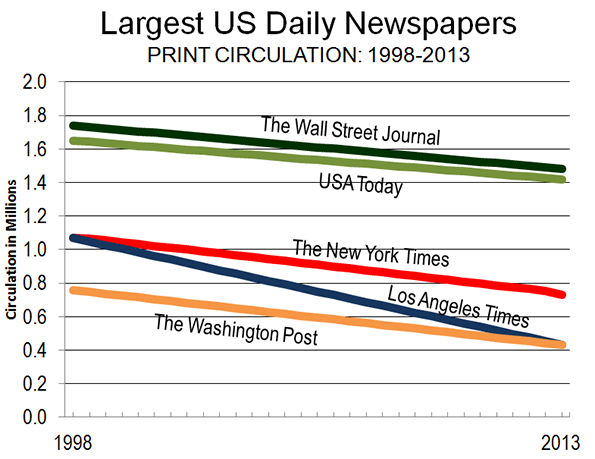
    A review of the change in circulation in the nation’s 20 largest newspapers since 1998 indicates the depth of the losses. The year 1998 is chosen because newspaper circulations remained at high levels and the losses to Internet editions and other media sources has not yet occurred.

    From 1998 to 2013, the 20 largest newspapers lost more than 5 million of their 13.4 million weekday print subscribers, a loss of nearly four out of ten subscribers (39 percent). At the same time, there were substantial differences among the top 20 papers in their losses (Table).

    Top 15 Newspapers in 1998: 1998-2013 Print Circulation
    Newspaper 1998 2013 % Change
    The Wall Street Journal      1,740      1,481 -14.9%
    USA Today      1,653      1,424 -13.8%
    The New York Times      1,067         731 -31.5%
    Los Angeles Times      1,068         433 -59.5%
    The Washington Post         759         431 -43.2%
    New York Post         438         409 -6.6%
    Chicago Tribune         673         368 -45.3%
    New York Daily News         723         360 -50.1%
    Arizona Republic         435         286 -34.3%
    Newsday (Long Island)         572         266 -53.5%
    Houston Chronicle         551         231 -58.0%
    Minneapolis Star Tribune         335         228 -32.0%
    The (Cleveland) Plain Dealer B.         382         216 -43.4%
    The Denver Post         342         214 -37.5%
    San Diego Union-Tribune         378         194 -48.7%
    The Dallas Morning News         480         191 -60.3%
    The Philadelphia Inquirer         429         185 -56.9%
    Chicago Sun-Times         486         185 -62.0%
    Newark Star-Ledger         407         180 -55.7%
    The Boston Globe         471         172 -63.5%
    Total    13,389      8,185 -38.9%
    In thousands
    Source: Alliance for Audited Media & predecessor


    Losers and Catastrophic Losers

    All of the newspapers lost subscribers, but some lost many more than others. The New York Post, a tabloid owned by Rupert Murdoch, posted the smallest loss, less than 30,000 of its 1998 subscriber base of 438,000.

    USA Today, Gannett’s unique national general-interest newspaper, experienced the second smallest loss, at 13.8 percent. USA Today, also the newest newspaper on the list (1982), is the nation’s second-largest newspaper and fell from a circulation of 1.65 million in 1990 to 1.42 million in 2013.

    Another Murdoch title, The Wall Street Journal, purchased in 2007, did a third-best in holding onto its print readership. The Journal retained its position as the largest daily newspaper in the nation, with circulation dropping from 1.74 million in 1998 to 1.48 million in 2013. This amounted to a small loss compared to other newspapers (14.9 percent). The 260,000 loss in actual subscribers was larger than the total current daily circulation of 10 of the top 20 US newspapers (such as the Houston Chronicleand The Boston Globe).

    The nation’s third largest newspaper, The New York Times, lost nearly one-third of its print circulation between 1998 and 2013. Even so, this was less than the loss rate of all but three newspapers (The New York Post, The Wall Street Journal and USA Today).

    The largest relative circulation loss was atThe Boston Globe, which saw a departure of nearly two-thirds (63.5 percent) of its subscribers. This was more than double the losses by its owner, The New York Times.

    Two other newspapers lost 60 percent or more of their readers between 1998 and 2013. The Chicago Sun-Times experienced a loss of 62 percent while The Dallas Morning News saw 60 percent of its subscribers flee. This huge loss is particularly notable, given that the Dallas-Fort Worth metropolitan area is one of the fastest growing regions in the world. For example, in Phoenix, which has also grown very rapidly, theArizona Republic lost only one third of its readership, having taken advantage of the rapidly expanding market.  

    Perhaps most disastrous has been the decline at the Los Angeles Times. For more than two decades, the LA Times had been the nation’s third or fourth largest newspaper, following The Wall Street Journal, USA Today and sometimes The New York Times. This ranking was not much changed in 2013, as the LA Times was the fourth largest newspaper.

    However, over 15 years, the LA Times lost nearly 6 out of every 10 of its subscribers. In 1998, the LA Times had 1,000 more subscribers than The New York Times, at 1,088,000. By 2013, print subscriptions at LA Times had fallen to 433,000. Over the period, The New York Times managed to secure a stranglehold on third position, opening a nearly 300,000 subscriber lead over the LA Times. Should the losses at the LA Times continue at this rate, it could be passed by both The Washington Post and the New York Post within a couple of years (Figure).

    In raw subscriber numbers, the LA Times losses were the most precipitous by far at 635,000, compared to second largest loss at the New York Daily News at 363,000. The Daily News continues a long slide,   having been the nation’s largest newspaper for decades to the 1970s. It is now the third-largest paper in the three paper New York City market, having been passed by the New York Post some time ago. The Daily News, however, still leads the suburban Newsdayand Newark Star-Ledger.

    Even Bigger Losses

    Some of the larger declines in newspaper circulation are not evident in the latest data. For example, The San Francisco Chronicle experienced a drop of 65 percent in its circulation from 1998 to 2012 (2013 data not available). The spectacular decline of Detroit’s two metropolitan dailies has outstripped all of the others over a longer period of time. In the middle 1980s, the Detroit Free Press and the Detroit News each had circulations of approximately 650,000. By 2012, the Free Press had fallen to approximately 135,000 and the News to under 80,000. These drops were much larger than the city of Detroit’s population loss. Now, the two papers offer home delivery only three days of the week (Thursday, Friday and Sunday), while subscribers are encouraged to use internet editions on other days.

    Of course, over the last 15 years, a number of familiar titles have been closed, such as the Rocky Mountain News (Denver), the separate Atlanta Journal and Constitution (now combined as the Atlanta Journal-Constitution) and the Cincinnati Post. The Seattle Post-Intelligencer took the intermediate step of shutting down its print edition, but retaining an Internet edition, which has remained a strong presence online.

    Where from Here?

    There have been other changes as well. Virtually all of the US broadsheets (the wide, familiar print format) are now printed in more compact editions, having been reduced from approximately 15 inches wide to 12 or even 11 inches wide (28, 30.5 and 38 centimeters). There are international format changes, as well. The Times of London (weekday edition) converted from broadsheet to tabloid in 2004, while The Sydney Morning Herald and Melbourne’s uniquely named The Age switched to tabloid format in March.

    The communications business has changed   over the past two decades. Newspapers have been trying to cope, but it   seems unlikely that print editions will experience any resurgence. The open question is whether the newer online strategies will save them from oblivion, but that’s hard to predict.

    Wendell Cox is a Visiting Professor, Conservatoire National des Arts et Metiers, Paris and the author of “War on the Dream: How Anti-Sprawl Policy Threatens the Quality of Life.

    Photo: Los Angeles Times headquarters courtesy of WikiCommons

  • The Average Manufacturing Establishment Is Smaller Than You Think, and Getting Smaller

    The common image of American manufacturing, as Harold L. Sirkin wrote in Bloomberg Businessweek, is of huge plants with waves of assembly-line workers producing cars and refrigerators. But there’s a whole other world of niche manufacturers in the U.S., and these small firms are more typical — and should be more of a priority, Sirkin argued — than you might think.

    Some 250,000 manufacturers in the U.S. have fewer than 500 employees. Studies show these smaller businesses produce more innovations per employee than large manufacturers. And truth be told, it is generally from these small companies that the jobs of the future will spring. Indeed, as David Rocks and Nick Leiber observed last summer, smaller manufacturers have been leading the “reshoring” wave that my colleagues and I have been writing about.

    The average manufacturing establishment was home to 35.3 jobs in 2012, according to EMSI’s 2013.2 dataset. That’s larger than retail trade (14.4 jobs per establishment), finance and insurance (11.9), and the average size across all industries (15.7 jobs, as the following chart from the BLS shows).

    But like all establishments, manufacturing work sites are getting smaller — dramatically smaller, in fact, over the last 12 years.

    Note: An establishment is a single physical location of some type of economic activity — in other words, a business. A single company may have multiple establishments.

    In 2001, the average manufacturing establishment had 41.8 jobs. By 2007, it was 38.3. And in 2012, as we mentioned, it was 35.3.

    Part of the substantial drop in the last five years is likely the result of the recession — a period in which many employers go through a “cleansing,” as mentioned in a 2012 paper by the Eleanor Choi and James Spletzer of the BLS. The two economists also concluded, when looking across the board, that “establishments are starting smaller and staying smaller. The average size of establishment births (new startups, excluding seasonal businesses) in the 1990s was around 7.6 employees, whereas the average size of births fell from 6.8 employees in 2001 to 4.7 employees in 2011.”

    Another notable trend: Since 2010, job growth in manufacturing has predominantly been in sub-sectors with larger-than-average establishment sizes. Consider this table:

    NAICS Code Description 2012 Jobs 2010-12 % Job Change 2012 Establishments Jobs Per Establishments (2012)
    Source: QCEW Employees – EMSI 2013.2 Class of Worker BETA
    331 Primary Metal Manufacturing 399,767 11% 5,658 70.7
    333 Machinery Manufacturing 1,090,723 10% 29,015 37.6
    336 Transportation Equipment Manufacturing 1,445,062 9% 14,282 101.2
    332 Fabricated Metal Product Manufacturing 1,391,954 9% 58,067 24.0
    316 Leather and Allied Product Manufacturing 29,436 5% 1,255 23.5
    335 Electrical Equipment, Appliance, and Component Manufacturing 370,810 4% 7,341 50.5
    326 Plastics and Rubber Products Manufacturing 641,042 3% 13,090 49.0
    312 Beverage and Tobacco Product Manufacturing 189,476 3% 5,918 32.0
    339 Miscellaneous Manufacturing 575,852 2% 30,936 18.6
    311 Food Manufacturing 1,457,721 1% 29,334 49.7
    334 Computer and Electronic Product Manufacturing 1,096,643 0% 18,795 58.3
    325 Chemical Manufacturing 784,101 0% 16,180 48.5
    324 Petroleum and Coal Products Manufacturing 111,472 0% 2,387 46.7
    313 Textile Mills 118,205 -1% 3,065 38.6
    321 Wood Product Manufacturing 334,995 -1% 14,594 23.0
    327 Nonmetallic Mineral Product Manufacturing 365,302 -1% 16,575 22.0
    337 Furniture and Related Product Manufacturing 351,304 -1% 18,743 18.7
    322 Paper Manufacturing 380,900 -3% 5,714 66.7
    314 Textile Product Mills 115,898 -3% 7,198 16.1
    315 Apparel Manufacturing 149,036 -5% 7,279 20.5
    323 Printing and Related Support Activities 461,503 -5% 30,499 15.1
    Total 11,861,203 3% 335,924 35.3

    Primary metal manufacturing, which includes foundries and steel mills, grew the most from 2010 to 2012 — 11%, which equates to nearly 39,000 new jobs. It has the second-most jobs per establishment (70.7) among all manufacturing sub-sectors. Transportation equipment manufacturing had the third-fastest growth rate, at 9%, and it has the most jobs per establishment (101.2).

    At the bottom of the table are printing and related support activities, apparel manufacturing, and textile product mills. All three have jobs-per-establishments ratios of 20.5 or fewer, far below the 35.3 average.

    This isn’t to say that there’s a clear relationship between establishment size and employment growth; the results are too varied to make that declaration (see fabricated metal product manufacturing), and statistical analysis doesn’t bear that out. But at a time when establishments are shrinking, most of the best-performing manufacturing industries are ones that still have sizable establishments.

    Joshua Wright is an editor at EMSI, an Idaho-based economics firm that provides data and analysis to workforce boards, economic development agencies, higher education institutions, and the private sector. He manages the EMSI blog and is a freelance journalist. Contact him here.

  • Can Public Banks Help Fix Local Finance?

    Are public banks the answer for the recession-induced decline in municipal revenue and other ills that plague our cities? It’s a solution being discussed in more than one American city.  

    Mike Krauss, a founder of the Public Banking Institute and a chairmen of the Pennsylvania Pubic Bank Project, both non-profits that promote public banking, said this month an ad hoc committee made up of Philadelphia City Council members and civic groups started working on the adoption of language for a public bank in the city. He also said the measure is being adopted out of a need for “affordable and sustainable credit.” The PPBP is leading the effort for public banking in the city.

    The recession’s impact on municipal taxes and anger at Wall Street were factors in the push for a public bank. Krauss described the losses to Philadelphia’s school district, street, police and fire departments as “phenomenal.”  

    Krauss mentioned North Dakota’s public bank, founded in 1919 to promote agriculture, commerce and industry in the state, as a role model for cities. The North Dakota bank arose in reaction to farmers’ anger over the predatory practices of East Coast and Minneapolis banks. The bank’s revenues come from the state’s general revenue fund. Krauss cites the Bank of North Dakota’s 2.9 billion portfolio in a state with a population of roughly 600,000 as an example of its success. Philadelphia has a population of approximately 1.5 million. Krauss also said a public bank would be a job creator for cities and again used the BND as an example, as it produced a job for every 100,000 dollars it loaned.

    Like North Dakota’s bank, the proposed public bank in Philadelphia wouldn’t be a commercial bank that offers checking and savings accounts. It would lend money for city projects and also partner with local commercial banks on loans. There are also efforts underway for public banks in San Francisco and Boston, according to Krauss. 

    Public Banking Institute Chairmen Marc Armstrong said that over a trillion dollars in revenue from states and municipalities are deposited in big Wall Street banks every year. Armstrong also said many of the deposits are used to provide loans for transnational corporations that don’t invest in their states and cities. Public banks can provide loans as low as one percent interest, and Wall Street banks consider their existence as a threat, said Armstrong.  When it comes to taxation and other issues that confront cities, a public bank could be used as a weapon against the rent-seeking – meaning using social and political circumstances to extract more money out of the public – activities by financiers. The public bank would instead invest in higher education, automotive and banking industries and as a tool for productive economic enterprises and individuals. This weapon could in turn create more vibrant activities in urban economies.  

    Krauss admitted the possibilities for the use of revenue generated by a public bank are endless, and he said investment in the school district, infrastructure and public safety would be positives. However, other job creating services and projects could be a reality – free wi-fi, the construction of affordable rental housing for retired people and low income residents, rent-to-own home ownership (or condo) programs, research and development to support public science, scientific innovation and high technology industries, childcare facilities, higher education for city residents, public media, new parks, free or reduced utilities for businesses and individuals, and also investments in energy efficiency, recycling, renewable energy and car sharing.  

    The positive impacts of the above mentioned investments go beyond public banking, as it is the starting point for a more vibrant urban economy, education system and ecology. With a new source of revenue, business taxes could be slashed to promote business formation in public banking inclined cities, and more businesses within city limits would mean even more revenue.    

    Similar to slashing taxes for business, free or reduced costs on wi-fi and utilities would also help local businesses and individuals by reducing their overhead costs and in turn create more jobs, as more money could be spent in the form of investment by businesses themselves and in increased individual purchasing power that works its way back into local businesses.  

    Recycling would have a similar effect, as it’s cheaper for a city to recycle, if the program is a well-run, than to pay for waste collection, land filling and incineration. By reducing the costs of waste, cities could again reduce business taxes and once again create more business formation, and at the same time reduce greenhouse gas emissions. Recycling reduces pollution not only by reducing the waste sent to landfills, but it also reduces the need for cutting down more trees and the inputs needed to manufacture a product.

    Urban and non-urban citizens all create waste and for that reason recycling is a bigger job creator than renewable energy which cannot produce all of our energy due to intermittency and also the cost, as it’s still more expensive than traditional forms. Despite these drawbacks, new revenue could be used to create jobs in solar energy by installing solar panels on public buildings – school district offices, schools, and city hall. Also worth thinking about is the possibility of constructing biogas plants that break down organic waste – which can come from the vast amount of sewage a city creates – to create another, perhaps more reliable form of renewable energy.       

    The additional revenue produced by the use of public banking and increased business formation could also be used to lift the burden of rent-seeking higher education institutions by offering lower interest loans to help young people attain a higher education, affordable rent and affordable home or condo ownership without acquiring crushing debt. Cities could offer a few years of free vocational, art, culinary and business education. The media is full of stories of urban residents burdened with student loan debt which benefits universities, colleges and the government and decreases the amount of money circulating into local businesses. Also, cities would benefit from this investment by creating a new generation of productive workers, chefs and artists and the businesses that are created along with them.

    Low interest loans could also be offered to local real estate interest for rent-to-own condo and house programs and affordable apartments could be constructed with low-interest loan portfolios. Of course, landlords would have to abide by low-rent policies if they are to take advantage of the policies, blunting the rent raising effects of gentrification while maintaining its’ positive side.

    Cities could also put public dollars behind a new innovation in transportation – car sharing – which has been pioneered by Zipcar. Cities could help expand the company’s business by offering it low tax rates and subsides to locate within their borders; those arguing they would wasteful should take a second look at what’s spent on sports stadiums. Or maybe cities could building their own car sharing industry with local business leaders. The expansion of car sharing would mean less impact on the infrastructure and reduce the amount spent on infrastructure. It would also reduce traffic congestion and make it possible for residents of surrounding suburbs to enjoy the city’s attractions.      

    Cities can and should be hubs for creative people and immigrants, as they see life in almost-dead neighborhoods and create gentrifying enterprises such as restaurants, cafes, music venues, art galleries, artisan manufacturing, coffee roasting, small boutique retailers and all sorts of internet and technology businesses. However, cities can’t and shouldn’t lose focus on what sustains critical functions such as public safety, infrastructure and education – revenue. The public bank offers an opportunity for cities to invest in themselves, not the profit portfolios of Wall Street.

    Jason Sibert is a freelance writer who has lived in the St. Louis Metro Area since the late 90’s. He worked for the Suburban Journals for a decade and his work has appeared in various publications over the last four years.

    Photo by David Shankbone.

  • The 2013 Best Cities For Job Growth

    The 2013 edition of our list shows many things, but perhaps the most important is which cities have momentum in the job creation sweepstakes. Right now the biggest winners are the metro areas that are adding higher-wage jobs thanks to America’s two big boom sectors: technology and energy.

    Our rankings are based on short, medium and long-term employment performance, and take into account both growth and momentum — whether growth is slowing or accelerating. (For a detailed description of our methodology, click here.) Consequently, areas that have made the strongest recoveries from deep setbacks often do well. Nowhere is this clearer than in the case of the San Francisco-San Mateo-Redwood City metropolitan division, our top-ranked large metro area (urban regions with more than 450,000 jobs). Over the last year, employment in the San Francisco area expanded a remarkable 4.1%, and is up 3.3% since 2008.

    A decade ago, the San Francisco area was reeling from the collapse of the last dot-com bubble; the damage was so deep that today it has only 0.6% more jobs than in 2001. Its sharp recent growth is primarily in the information sector, which has expanded a torrid 21.3% since 2009.

    Much the same can be said about San Jose-Sunnyvale-Santa Clara, better known as Silicon Valley, which is No. 7 on our large metro area list due to 3.4% job growth last year, and 2.3% growth since 2008; it is also propelled by 25% growth in information jobs since 2007. Yet looking at the longer term, the Valley, like San Francisco, is still rebounding from a deep downturn connected to the dot-com disaster of a decade ago. In fact, the Valley is still down almost 40,000 jobs from 2001.

    Is California Pulling Ahead Of Texas?

    Some East Coast boosters of the Golden State are making this claim, but we don’t see it in this year’s numbers. Besides the tech-rich Bay Area, home to two of our top 10 large metro areas, there are no other major California cities near the top. Most of the state’s big metros are in the poor to middling range over the long term; only Riverside-San Bernardino (45th place on our big cities list) has 10% more jobs than a decade ago. Los Angeles, the state’s dominant urban region, has lost some 120,000 jobs since 2001.

    In contrast, the Texas juggernaut rolls on. Growth there has not only been steady, it’s been widely spread across the state. Texas boasts a remarkable four major metros in our top 10, led by Ft. Worth-Arlington (No. 4), Houston-Sugarland-Baytown (No. 5), Dallas-Plano-Irving (No. 6 ) and Austin-Round Rock, which slips from first place last year to 10th. The state’s other big city, San Antonio, comes in at a very healthy No. 12.

    All these metro areas have more jobs than they did a decade ago — often a lot more. Since 2001, employment in Houston has expanded 20%; in Ft. Worth, it’s up roughly 16%; Dallas; 11%; Austin, a remarkable 26.5%; and San Antonio, 18.4%.

    The Energy Boomtowns

    The unconventional oil and gas boom has helped turn Texas into an economic juggernaut, particularly world energy capital Houston, but growth has also been strong in tech, manufacturing and business services. You see this same kind of blending of energy and other sectors in other strong growth economies elsewhere in the U.S., such as No. 3 Salt Lake City, No. 9 Denver and No. 15 Oklahoma City.

    But the real evidence of energy’s power can be seen in smaller metro areas. Oil-rich Midland, Texas, places first on our list of smaller metro areas (those with less than 150,000 jobs) and also first overall among the country’s 398 metropolitan areas. Nipping at its heels in second place in both categories is Odessa, Texas. On our medium-size cities list, energy towns with strong growth include No. 4 Corpus Christi, Texas; No. 5 Bakersfield, Calif.; and No. 6 Lafayette, La.

    Affordability + Quality of Life = Success

    But you don’t have to be a huge tech hub or energy capital to generate new jobs. The No. 2-ranked place in our big metro ranking, Nashville-Davidson-Murfreesboro-Franklin, Tenn., reflects the power of economic diversity coupled with ample cultural amenities, pro-business policies and a mild climate. Nashville’s 3.8% expansion in employment last year, and 7% growth since 2008, has been propelled by business services, education and health. There’s also been a recent recovery in manufacturing, up over 9% last year, as well as retail and wholesale trade. Like the Texas cities, Nashville has registered long-term growth as well, with 112,000 jobs added since 2001, a nice 16.6% increase.

    Much the same can be said about Charlotte-Gastonia-Rock Hill, N.C., No. 8 on our big city list, whose job base grew 3.3% last year. Virtually every business sector has been on the rebound since 2009, including financial services, despite Bank of America’s continuing troubles. Overall the local economy has added 100,000 jobs since 2001, up almost 13%.

    Steady, diverse growth can be seen in other low-cost and business-friendly towns such as our No. 11 big metro area, Raleigh Cary, N.C.; No. 13 Columbus, Ohio; and No. 15 Indianapolis. The shift towards stronger growth in areas away from the coasts has continued, at least in the more attractive metro areas.

    Who Doesn’t Have It?

    Of course, any list has its share of losers as well as winners. Sadly this includes long-suffering old industrial cities such as our last-placed big metro area, Newark-Union, N.J., which is followed, in order, by Saint Louis, MO-IL; Cleveland-Elyria- Mentor, Ohio; and Providence-Fall River-Warwick RI-MA. All but Providence, which stayed about even, slipped from last year’s rankings.

    But not all factory towns are headed in the wrong direction. No.  51 Detroit-Livonia-Dearborn advanced an impressive 11 places from last year’s list. The key here has not been the much talked about attempt to turn downtown Detroit into a cool place, but the resurgence of the auto industry. Manufacturing employment, concentrated in the region’s suburbs, is up over 18% since 2009 after decades of tumultuous losses.

    Also flailing a bit have been many of our largest, and most often celebrated, metros. Believe it or not, Detroit comes in one place ahead of Chicago-Joliet-Naperville ,Ill., which continues to promote itself as one of the nation’s great comeback stories, but in reality has continued to lose ground. You can tell the same tale about No. 46 Philadelphia, Pa., No. 41 Portland-Hillsboro-Vancouver OR-WA, and No. 37 Miami, which dropped a staggering 16 places despite the much celebrated recovery of its condo market. Selling to South America flight capital (legal or otherwise) and sun-deprived Europeans does not seem to be doing enough to revive the region’s overall economic vigor.

    There are also some signs that the big beneficiaries of the Bernanke-Obama-Bush economic policy may be losing some momentum. New York City, the major winner from the “too big to fail” banking bailout, fell seven places from last year to No. 18. Even Washington-Arlington-Alexandria, D.C., the nation’s prime beneficiary of crony capitalism and fiscal bloat, has lost steam, falling 10 places to No. 26 — a big decline from its No. 6 rankings in 2010 and 2011. We are usually loath to celebrate declines, but Washington’s loss, reflecting a slowdown in government growth, may be evidence that some equilibrium between the public and private sectors is slowly being restored.

    Joel Kotkin is executive editor of NewGeography.com and a distinguished presidential fellow in urban futures at Chapman University, and a member of the editorial board of the Orange County Register. He is author of The City: A Global History and The Next Hundred Million: America in 2050. His most recent study, The Rise of Postfamilialism, has been widely discussed and distributed internationally. He lives in Los Angeles, CA.

    Michael Shires, Ph.D. is a professor at Pepperdine University School of Public Policy.

    This piece originally appeared at Forbes.com.

  • Bank Collapse in Cyprus: Which Way Now?

    Having run out of options to solve its bigger problems, European Union commissioners, in the spirit of famed bank robber Willy Sutton, have decided to go after depositors’ money on Cyprus for a simple reason: “That’s where the money is.” Will the current shake down of bank depositors on Cyprus save or sink the Euro? It stretches the imagination to fathom how putting bank depositors in play will comfort European Union bondholders or other EU banks.

    In exchange for $13 billion in bailout money for the Cyprus government, the EU has demanded that the local banking system, bloated with offshore deposits including many from Russia and Eastern Europe, pony up in the interests of Euro harmony.

    An island divided into Greek and Turkish spheres of influence, Cyprus was allowed into the EU, and later the Euro, as an early attempt to gloss over European ethnic fault lines and pump hot money into the sovereign debts of Greece and East European countries. Greek Cyprus is the tax haven of choice for Russian companies and oligarchs, many of whom register their worldwide assets under Cypriot holding companies and maintain huge deposits in the local banking system.

    Before the recent crisis, the Cypriot banking system held assets in its banks and fiduciary companies that amounted to more than five times the country’s gross domestic product.

    Business as usual in Cyprus meant that, with few questions asked locally, an overseas investor — including many from Serbia, Romania, and the Ukraine, as well as Russia—could set up a front company, open a bank account, and run his or her financial empire away from the long arm of any government accountants.

    The problem for the Cypriot banks wasn’t attracting deposits, it was finding a place to put them once they arrived by SWIFT (the international transfer system), the Fed Wire, or suitcases.

    Confusing their swelling balance sheets with the genius of J.P. Morgan, local bankers made several fatal mistakes. They lent their newfound money to the Greek government by buying its bonds, they invested in now-failing real estate deals, and they funded these long-term bets with deposits that could be withdrawn in less than ninety days.

    In justifying these strategies to clients, the Cyprus banks claimed that their long positions in Greek government bonds, denominated in Euros, came with an implicit EU guarantee, which also served as a reason to pay minimum rates on short-term deposits, and to bet the ranch on long-term Euro bonds. The Euro gave Cyprus cover for punting.

    In the era of the Greek drachma, German leader Angela Merkel would not have delayed a hair appointment to keep Greece solvent, let alone to save its lovechild in Nicosia, a Balkan money-changing city hard up against the border of the Turkish mercenary state in northern Cyprus. Still, even today, the Cypriot pyramid might have withstood the lazy stress test of a buoyant market.

    The first Cyprus rescue plan called for the island’s bank depositors (whose deposits totaled $82 billion at the peak) to cough up 10% of their wealth into the stabilization fund. That financial haircut, however, called also for a 7% trim from local clients, not just a shave for Russian oligarchs. Local Cypriots voted with their middle fingers.

    Although the inspiration to drain local bank accounts to offset subsidies from Brussels was attributed to EU bureaucrats, if not Merkel and French President François Hollande, the impulse for an open season on passbook savings comes from the worldwide assault on tax havens, led by the United States.

    In its search for money to balance it own mismatched accounts, the US has taken the position that the dollar, instead of an international commodity or method of exchange, is a national loyalty oath, and is imposing tax obligations on those that have some in their wallets. Even though the EU is more a tariff union than a functioning government, Brussels has warmed to the idea that bank depositors within its fragile borders are fair game for a fleecing.

    The revised Cyprus plan walked back from skimming all bank deposits, and shook down the depositors only of the two largest banks, the Bank of Cyprus and Laiki (Cyprus Popular) Bank. It demanded the sale of $500 million in the central bank’s gold, unsettling financial markets.

    While the heist was in the planning stage, all Cypriot banks were closed, to keep the hot money from turning into flight capital, once removed.

    The Bank of Cyprus will survive, barely, although Laiki is going belly up, which through the magic of bankruptcy laws will put its €24 billion in deposits at the disposal not just of local liquidators but also of EU “structural reformists,” who have more in common with Butch Cassidy and the Sundance Kid than with International Monetary Fund economists.

    The biggest losers are the Cyprus banks’ shareholders, bondholders, and depositors, who are being bled dry so that the Euro might live. Think of these write-downs as a pan-European tax, assessed mostly on shady front companies that don’t vote in German regional elections. Russian President Vladimir Putin isn’t thrilled that his offshore economy was chosen to make the world safe for par-value Spanish bonds.

    As a consequence, bank depositors will flee not just failing Mediterranean banks, but those in Milan, London, and Frankfurt. They will seek safety in gold, real estate, art, stock markets, and hedge funds, leaving money-center banks down the road to scramble for their liabilities (in the accounting world, deposits are something you owe).

    The bigger problem with the Cypriot financial collapse of 2013, though, is that it threatens to turn the EU into a divided nation — not unlike Cyprus itself — that may need to balance its books with offshore money and lax accounting.

    More than the crises of Italian elections or French unemployment, the Cyprus bank run threatens to pull apart the rickety architecture of a union that can no longer roll over its Eurobonds on what Willy Loman used: “a smile and a shoeshine.” Because of bad balance sheets in Cyprus, as well as in Spain, Italy, Ireland, and Greece, bondholders are no longer “smiling back” at the EU.

    German Chancellor Otto von Bismarck said in the late nineteenth century that “some damn thing in the Balkans” might drag Russia into war with Austria-Hungary, or with his Prussian confederation. In that instance, the murder of an Austrian archduke in Sarajevo shattered Europe into fragments that lasted for most of the twentieth century, a division that the EU and its Euro were designed to glue together.

    When the dust settles on Cyprus, the losers will be the local economy — headed for a double-digit recession — and Europe’s bank depositors, who in theory should be the backbone of a successful economic union.

    Matthew Stevenson, a contributing editor of Harper’s Magazine, is the author of Remembering the Twentieth Century Limited, a collection of historical travel essays. His next book is Whistle-Stopping America.

    Flickr photo by Leonid Mamchenkov taken in Limassol, Cyprus.

  • Enterprising States 2013: Getting Down to Small Business

    The following is an exerpt form a new report, Enterprising States, released this week by the U.S. Chamber of Commerce Foundation and written by Praxis Strategy Group and Joel Kotkin. Visit this site to download the full pdf version of the report, or check the interactive dashboard to see how your state ranks in economic performance and in the five policy areas studied in the report.

    Nothing better expresses America’s aspirational ideal than the notion of small enterprise as the primary creator of jobs and innovation. Small businesses, defined as companies with fewer than 500 employees, have traditionally driven our economy, particularly after recessions. Yet today, in a manner not seen since the 1950s, the very relevance and vitality of our startup culture is under assault. For the country and the states, this is a matter of the utmost urgency.

    The central motor of the job engine clearly is not firing on all cylinders. Historically, small business has accounted for almost two-thirds of all net new job creation, but recent research shows that the rates of new business startups are at record lows. The “gazelle companies”—fast-growing firms, mostly younger ones—have traditionally made outsized contributions to new job creation. After previous recessions, these businesses drove job growth and, perhaps more important, created innovations that often spread to larger, older, more established firms, which sometimes later acquired them.

    Weak job growth has touched the entire economy. Gross domestic product growth is weak, unemployment remains at nearly 8%, and business sentiment is far from optimal. Despite high stock prices and consistently strong corporate profits, the rate of employment growth remains lower than the rate of the expansion of the workforce. Given the understandable focus of larger firms on boosting productivity and on investing capital into technology, it’s highly unlikely these companies will create enough jobs to dent our huge and growing employment deficit.

    Policymakers ignore small business at their own peril and that of the economy.

    The Changing Nature of Small Business

    Small business may be down, but it is far from out. There have been some small, subtle upward shifts in employment in three of the industries—construction, manufacturing, and retail—that bore the brunt of the recession-driven job losses. Any sustained uptick in growth will further widen the opportunities for small business to expand and perhaps recover something of its past vigor.

    It is critical that states and communities that embrace a pro-enterprise vision address a rapidly changing small business environment. Small business today reflects a host of ethnic, social, and generational changes. Successful programs will need to adapt to these new realities that reflect a far more diverse, and profoundly different, set of players.

    Immigrants constitute a growing and important part of the entrepreneurial landscape. Even in the midst of the recession, newcomers continued to form businesses at a record rate. The number of women-owned firms has grown at one and a half times the rate of other small enterprises over the past 15 years. These companies now account for almost 30% of all enterprises. Finally, there is the issue of generational change. Baby boomers were, on the whole, a profoundly entrepreneurial generation, and by many measurements their Generation X successors have proven even more so. The millennial generation, based on recent assessments, may be somewhat less entrepreneurial than their predecessors.

    We are also witnessing the rise of a new kind of enterprise that often employs no more than the proprietors but frequently provides quite sophisticated high-level products or services. In many cases, these “jobless entrepreneurs” include corporate executives, technicians, and marketing professionals who, by either choice or necessity, have chosen to strike out in their own micro-enterprises. A large portion of this growing “1099 economy” comes from the growing ranks of boomers who are no longer willing or able to work for a larger enterprise. According to the Census Bureau, small business without payroll makes up more than 70% of America’s 27 million companies, with annual sales of $887 billion.

    The States Get Down to Small Business

    Every state has policies and programs that are intended to encourage entrepreneurship and support small business development and expansion. Many states have introduced legislation or established programs to focus on startup companies, and many states have bolstered policies targeted at helping existing businesses grow and expand their markets. State funding of programs for entrepreneurial development is estimated to have increased by 30% between 2012 and 2013.  

    States vary considerably in the policies, regulations, and taxes that affect small business. Most states have an array of loosely integrated small business programs, although some have a more comprehensive, integrated small business policy and program framework. No state has the “best” tax policy for all entrepreneurs. Instead, different states have tax policies that suit certain types of companies better than others. Consequently, the states that are best for new businesses are not always the most favorable for existing small businesses; the states that are best for one business sector may not be best for another.

    States and cities should consider small business development not as a separate cause, but as a basic building block for economic growth. Even if state governments can do little to promote enterprise and small business development directly, there are things they can do to increase the chances that entrepreneurs will thrive. Smart, pragmatic economic policymaking at the state level can play an instrumental role in fostering startups and growing companies, particularly when programs are effectively deployed right where the businesses are located.

    The following are some new and innovative policy and program approaches that states are employing and/or supporting to create and expand small businesses, often in cooperation with local and regional development organizations:

    • Accelerator initiatives that focus on starting high-growth firms by turning startups into enduring companies.
    • Economic gardening initiatives that focus on expanding existing firms with strong growth potential.
    • Business plan competitions to identify companies with exciting ideas and high potential.
    • Business ecosystem initiatives, often with a regional focus, that take a comprehensive approach to creating an environment that is highly conducive to startups.
    • Workforce development initiatives that help small businesses find and train the talent they need to operate and compete.
    • Seed and venture funds that focus on startups and expanding firms.
    • Networking and collaboration initiatives that bring small businesses and self-employed entrepreneurs together with large companies and universities.
    • International trade programs that help small businesses reach out to new global export markets.
    • Streamlined state administrative processes and regulatory procedures for small business by cleaning up the DURT (delays, uncertainty, regulations, taxes) that impede small business success.
    • Broadband investments that provide small businesses of all types with the online access necessary in the 21st century.

    Governors of states recognize the importance of small businesses and often take the lead in reforming state policy and service delivery to make growth and commerce easier for small business. Governors can offer fast-track access to financial resources and a full slate of state services that help small businesses connect with technical expertise, customers, suppliers, and state agencies that interact with small business as regulators or partners in development.

    State and local chambers of commerce are on the front lines of promoting a pro-business free enterprise agenda and thwarting anti-business legislation, regulations, and rules. Across the country, chambers of commerce lead the way in advocating on behalf of their members for lower costs of doing business, fairer taxes, fairer regulations, and less regulatory paperwork. They work with the U.S. Chamber of Commerce, governors, industry, and professional associations to pursue outcomes that are beneficial to all businesses and, thereby, advance America’s free enterprise economy.

    Visit this site to download the full pdf version of the report, or check the interactive dashboard to see how your state ranks in economic performance and in the five policy areas studied in the report.

    Praxis Strategy Group is an economic research, analysis, and strategic planning firm. Joel Kotkin is executive editor of NewGeography.com and author of The Next Hundred Million: America in 2050.

  • The Triumph of Suburbia

    The “silver lining” in our five-years-and-running Great Recession, we’re told, is that Americans have finally taken heed of their betters and are finally rejecting the empty allure of suburban space and returning to the urban core.

    “We’ve reached the limits of suburban development,” HUD Secretary Shaun Donovan declared in 2010. “People are beginning to vote with their feet and come back to the central cities.” Ed Glaeser’s Triumph of the City and Alan Ehrenhalt’s The Great Inversion—widely praised and accepted by the highest echelons of academia, press, business, and government—have advanced much the same claim, and just last week a report on jobs during the downturn garnered headlines like “City Centers in U.S. Gain Share of Jobs as Suburbs Lose.”

    There’s just one problem with this narrative: none of it is true. A funny thing happened on the way to the long-trumpeted triumph of the city: the suburbs not only survived but have begun to regain their allure as Americans have continued aspiring to single-family homes.

    Read the actual Brookings report that led to the “Suburbs Lose” headline: it shows that in 91 of America’s 100 biggest metro areas, the share of jobs located within three miles of downtown declined over the 2000s. Only Washington, D.C., saw significant growth.

    To be sure, our ongoing Great Recession slowed the rate of outward expansion but it didn’t stop it—and it certainly didn’t lead to a jobs boom in the urban core.

    “Absent policy changes as the economy starts to gain steam,” report author and urban booster Elizabeth Kneebone warned Bloomberg, “there’s every reason to believe that trend [of what she calls “jobs sprawl”] will continue.”

    The Hate Affair With Suburbia

    Suburbs have never been popular with the chattering classes, whose members tend to cluster in a handful of denser, urban communities—and who tend to assume that place shapes behavior, so that if others are pushed to live in these communities they will also behave in a more enlightened fashion, like the chatterers. This is a fallacy with a long pedigree in planning circles, going back to the housing projects of the 1940s, which were built in no small part on the evidently absurd, and eventually discredited, assumption that if the poor had the same sort of housing stock as the rich, they would behave in the same ways.

    Today’s planning class has adopted what I call a retro-urbanist position, essentially identifying city life with the dense, highly centralized and transit-dependent form that emerged with the industrial revolution. When the city—a protean form that is always changing, and usually expands as it grows—takes a different form, they simply can’t see it as urban growth.

    In his masterwork A Planet of Cities, NYU economist Solly Angel explains that virtually all major cities in the U.S. and the world grow outward and become less dense in the process. Suburbs are expanding relative to urban cores in every one of the world’s 28 megacities, including New York and Los Angeles.  Far from a perversion of urbanism, Angel suggests, this is the process by which cities have grown since men first established them.

    In the U.S., the hate affair with suburbs and single-family housing, even in the city, dates to their rapid growth in the American boom after the first World War. In 1921 historian and literary criticic Lewis Mumford described the expansion of New York’s outer boroughs as a “dissolute landscape,” “a no-man’s land which was neither town or country.” Decades later, Robert Caro described the new rows of small, mostly attached houses—still the heart of the city’s housing stock—built in the post-war years as “blossoming hideously” as New Yorkers fled venerable, and congested, parts of Brooklyn and Manhattan for more spacious, tree-lined streets farther east, south, and north.

    In the 1950s, the rise of mass-produced suburbs like Levittown, New York, and Lakewood, California, sparked even more extreme criticism. Not everyone benefited from the innovation that allowed the Levitts to pioneer homes costing on average just $8,000—African-Americans were excluded from the original development—but for many middle- and working-class American whites, the housing and suburban booms represented an enormous step forward. The new low-cost suburbia, wrote Robert Bruegmann in his compact history of sprawl, “provided the surest way to obtain some of the privacy, mobility and choice that once were available only to the wealthiest and most powerful members of society.”

    The urban gentry and intelligentsia, though, disdained this voluntary migration. Perhaps the most bitter critic was the great urbanist Jane Jacobs. An aficionado of the old, highly diverse urban districts of Manhattan, Jacobs not only hated trendsetter Los Angeles but dismissed the bedroom communities of Queens and Staten Island with the memorable phrase, “The Great Blight of Dullness.” The 1960s social critic William Whyte, who, unlike Jacobs, at least bothered to study suburbs close up, denounced them as hopelessly conformist and stultifying. Like many later critics, he predicted in Fortune that people and companies would tire of them and return to the city core.

    More recent critiques of suburbia have focused as well on their alleged vulnerability in an energy-constrained era. “The American way of life—which is now virtually synonymous with suburbia—can only run on reliable supplies of cheap oil and gas,” declares James Howard Kunstler in his 2005 peak oil jeremiad, The Long Emergency. “Even mild to moderate deviations in either price or supply will crush our economy and make the logistics of daily life impossible.”

    Too often, the anti-surbanites seem to take a certain perverse comfort in any development, no matter how grim, that “helps” protect Americans from the “wrong choice” of aspiring to space of their own. The housing crash of 2007 was cheered on in some circles as the death knell of the suburban dream, as when theorist Chris Leinberger declared in the Atlantic that soon, poor families would be crowding into dilapidated McMansions in the “suburban wastelands.

    For retro-urbanists such as Richard Florida the reports, however premature, of the death of the suburbs, confirmed deeply held notions about the superiority of dense, urban living.  He summarily declared the single-family house archaic, and the quest for homeownership one of the “countless forms of over-consumption that have a horribly distorting affect on the economy."

    The Real Geography of America

    But the simple fact remains that the single-family home has remained the American dream, with sales outpacing those of condominiums  and co-ops despite the downturn.

    Florida has suggested that simply stating the numbers makes me a sprawl lover While he and other urban nostalgists see the city only in its dense urban core, and the city’s role as intimately tied with the amenities that are supposed to attract the relatively wealthy members of the so-called “creative class,” I see the urban form as ever changing, and consider a city’s primary mission not aesthetic or simply economic but to serve the interests and aspirations of all of its residents.

    Clearly the data supports a long-term preference for suburbs. Even as some core cities rebounded from the nadir of the 1970s, the suburban share of overall share of growth in America’s 51 major metropolitan areas (those with populations  of at least one million) has accelerated—rising from 85 percent in the ’90s to 91 percent in the ’00s. There’s more than a tinge of elitism animating the urban theorists who think that urban destiny rides mostly with the remaining nine percent matters. Overall, over 70 percent of residents in the major metropolitan areas now live in suburbs.

    Surveys, including those sponsored by the National Association of Realtors, suggest roughly 80 percent of Americans prefer a single family house to an apartment or a townhouse. Only 8 percent would prefer to live in an apartment. Yet just 70 percent of households live in a single-family house, while 17 percent live in apartments—suggesting the demand for single-family houses is still not being met. Such housing may be unaffordable, particularly in high-cost urban cores, but there is a fundamental market demand for it.

    To be sure, the Great Recession did slow the growth of suburbs and particularly exurbs—but recent indicators suggest a resurgence. An analysis last October by Jed Kolko, chief economist at the real estate website Trulia, reports that between 2011 and 2012 less-dense-than-average ZIP codes grew at double the rate of more-dense-than-average ZIP codes in the 50 largest metropolitan areas. Americans, he wrote, “still love the suburbs.”

    The Future Demographics of Suburbia

    Ultimately the question of growth revolves around the preferences of consumers. Despite predictions that the rise of singles, an aging population and the changing preferences of millennials will create a glut of 22 million unwanted large-lot homes by 2025, it seems more likely that three critical groups will fuel demand for more suburban housing.

    Between 2000 and 2011, there has been a net increase of 9.3 million in the foreign born population, largely from Asia and Latin America, with these newcomers accounting for about two out of every five new residents of the nation’s 51 largest metropolitan areas. And these immigrants show a growing preference for more “suburbanized” cities such as Nashville, Charlotte, Houston and Dallas-Fort Worth. An analysis of census data shows only New York—with nearly four times the population—drew (barely) more foreign-born arrivals over the past decade than sprawling Houston. Overwhelmingly suburban Riverside–San Bernardino expanded its immigrant population by nearly three times as many people as the much larger and denser Los Angeles–Orange County metropolitan area.

    Clearly, immigrants aren’t looking for the density and crowding of Mexico City, Seoul, Shanghai, or Mumbai. Since 2000, about two-thirds of Hispanic household growth was in detached housing. The share of Asian arrivals in detached housing is up 20 percent over the same span. Nearly half of all Hispanics and Asians now live in single-family homes, even in traditionally urban places like New York City, according to the census’s American Community Survey.

    Nowhere are these changes more marked than among Asians, who now make up the nation’s largest wave of new immigrants. Over the last decade, the Asian population in suburbs grew by about 2.8 million, or 53 percent, while that of core cities grew by 770,000, or 28 percent.

    Aging boomers, too, continue to show a preference for space, despite the persistent urban legend that they will migrate back to the core city. Again, the numbers tell a very different story.

    A National Association of Realtors survey last year of buyers over 65 found that the vast majority looked for suburban homes. Of the remaining seniors, only one in 10 looked for a place in the city—less than the share that wanted a rural home. When demographer Wendell Cox examined the cohort that was 54 to 65 in 2000 to see where they were a decade later, the share that lived in the suburbs was stable, while many had left the city—the real growth was people moving to the countryside. Within metropolitan areas, more than 99 percent of the increase in population among people aged 65 and over between 2000 and 2010 was in low-density counties with less than 2,500 people per square mile.

    With the over-65 population expected to double by 2050, making it by far America’s fastest-growing age group, they appear poised to be a significant source of demand for suburban housing.

    But arguably the most critical element to future housing demand is the rising millennial generation. It has been widely asserted by retro-urbanists that young people prefer urban living. Urban theorists such as Peter Katz have maintained that millennials (the generation born after 1983) have little interest in “returning to the cul-de-sacs of their teenage years.” 

    To bolster their assertions, retro-urbanist point to stated-preference research showing that more than three quarters of millennials say they “want to live in urban cores.” But looking at where millenials actually live now—and where they see themselves living in the future—shows a very different story. In the nation’s major metropolitan areas, only 8 percent of residents aged 20 to 24 (the only millennial adult age group for which census data is available) live in the highest-density counties—and that share has declined from a decade earlier. What’s more, 43 percent of millenials describe the suburbs as their “ideal place to live”—a greater share than their older peers—and 82 percent of adult millenials say it’s “important” to them to have an opportunity to own their home.

    And, of course, as people get older and take on commitments and start families, they tend to look for more settled, and less dense, environments. A 2009 Pew study found that 45 percent of Americans 18 to 34 would like to live in New York City, compared with just 14 percent of those over 35. As about 7 million more millenials—a group the Pew surveys show desire children and place a premium on being good parents—hit their 30s by 2020, expect their remaining attachment to the city to wane.

    This family connection has always eluded the retro-urbanists. “Suburbs,” Jane Jacobs once wrote, “must be difficult places to raise children.” Yet suburbs have served for three generation now as the nation’s nurseries. Jacobs’s treatment of the old core city—particularly her Greenwich Village in the early 1960s—lovingly portrayed these places as they once were, characterized by class, age, and some ethnic diversity along with strong parental networks, often based on ethnic solidarity.

    To say the least, this is not what characterizes Greenwich Village or in Manhattan today. In fact, many of the most vibrant, and high-priced urban cores—including Manhattan, San Francisco, Chicago, and Seattle—have remarkably few children living there. Certainly, the the 300-square-foot “micro-units” now all the rage among the retro-urbanist set seem unlikely to attract more families, or even married couples.

    The Persistence of the Suburban Economy

    As Americans have voted with their feet for the suburbs, employers have followed.

    Despite the attention heaped on a handful of companies like United Airlines and Quicken Loans that have moved “back to the city,” the suburbanization of the overall American economy has continued apace. Historically, suburbs served largely as residential areas, so-called bedroom communities, but their share of steadily.

    Job dispersion is now a reality in virtually every metropolitan area, with twice as many jobs located 10 miles from city centers as in those centers. Between 1998 and 2006, as 95 out of 98 metro areas saw a decrease in the share of jobs located within three miles of downtown, according to a Brookings report. The outermost parts of these metro areas saw employment increase by 17 percent, compared to a gain of less than 1 percent in the urban core. Overall, the report found, only 21 percent of employees in the top 98 metros in America live within three miles of the center of their city.

    This decentralization of jobs was slowed somewhat by the Great Recession, which hit more dispersed industries like construction, manufacturing and retail particularly hard. Yet an analysis of jobs in 2010 by the Rudin Center for Transport Policy and Management found that dispersion had continued. Between 2002 and 2010 only two of the top 10 metropolitan regions (New York and San Francisco) saw a significant increase in employment in their urban core.

    Some observers claim that job growth is coming to the urban core in response to the changing preferences of younger workers, particularly in high-tech fields and as much media attention has been given to a few prominent social media start ups in New York and San Francisco. Similar pronouncements were  made during the great dot-com boom of the late 1990s, and burst along with the bubble. In fact, the number of urban core country tech jobs actually shrank over the past decade, according to an analysis of Science, Technology, Engineering and Management (STEM) jobs by Praxis Strategy Group.

    While companies in walking distance of big-city reporters make news out of all proportion to their importance, virtually all the major tech concentrations in the country—including Silicon Valley—are suburban. San Jose is a postwar suburban core municipality, having experienced the vast bulk of its growth since 1940. Virtually all the nation’s top tech companies—Apple, Google, Hewlett-Packard, Intel, Oracle and even Facebook—are located in suburban settings 45 minutes or more from San Francisco. Apple’s recent plans to construct its new corporate campus in bucolic Cupertino elicited anger from the Environment Defense Fund and other smart-growth advocates, but reflects the fact that the vast majority of the tech industry is located, along with the bulk of its workforce, in the suburbs.

    Apple employs many experienced engineers, many of whom have families and prefer to live in suburbs. In 2012 San Francisco had a significantly lower share of STEM jobs per capita than Santa Clara County. And the new rising stars of the tech world—Austin and Raleigh-Cary—are even more dispersed and car-dependent than San Jose. 

    What Really Matters

    While they’ve weaved a compelling narrative, the numbers make it clear that the retro-urbanists only chance of prevailing is a disaster, say if the dynamics associated with the Great Recession—a rise in renting, declining home ownership and plunging birthrates—become our new, ongoing normal. Left to their own devices, Americans will continue to make the “wrong” choices about how to live.

    And in the end, it boils down to where people choose to live. Despite the dystopian portrays of suburbs, suburbanites seem to win the argument over place and geography, with far higher percentages rating their communities as “excellent” compared to urban core dwellers.

    Today’s suburban families, it should be stressed, are hardly replicas of 1950s normality; as Stephanie Coontz has noted, that period was itself an anomaly. But however they are constituted—as blended families, ones headed up by single parents or gay couples—they still tend to congregate in these kinds of dispersed cities, or in the suburban hinterlands of traditional cities. Ultimately life style, affordability and preference seem to trump social views when people decide where they would like to live.

    We already see these preferences establishing themselves, again, among   Generation X and even millennials as some move, according to The New York Times,toward “hipsturbia,” with former Brooklynites migrating to places along the Hudson River. The Times, as could be expected, drew a picture of hipsters “re-creating urban core life” in the suburbs. While it may be seems incomprehensible to the paper’s Manhattan-centric world view by moving out, these new suburbanites are opting not to re-create the high-density city but to leave it for single-family homes, lawns, good schools, and spacious environments—things rarely available in places such as Brooklyn except to the very wealthiest. Like the original settlers of places like Levittown, they migrated to suburbia from the urban core as they get married, start families and otherwise find themselves staked in life. In an insightful critique, the New York Observerskewered the pretensions of these new suburbanites, pointing out that “despite their tattoos and gluten-free baked goods and their farm-to-table restaurants, they are following in the exact same footsteps as their forebears.”

    So, rather than the “back to the cities” movement that’s been heralded for decades but never arrived, we’ve gone “back to the future,” as people age and arrive in America and opt for updated versions of the same lifestyle that have drawn previous generations to the much detested yet still-thriving peripheries of the metropolis.

    Joel Kotkin is executive editor of NewGeography.com and a distinguished presidential fellow in urban futures at Chapman University, and a member of the editorial board of the Orange County Register. He is author of The City: A Global History and The Next Hundred Million: America in 2050. His most recent study, The Rise of Postfamilialism, has been widely discussed and distributed internationally. He lives in Los Angeles, CA.

    This piece originally appeared in the The Daily Beast.

    Suburbs photo by BigStock.

  • Class Warfare for Republicans

    As a Truman-style Democrat left politically homeless, I am often asked about the future of the Republican Party. Some Republicans want to push racial buttons on issues like immigration, or try to stop their political slide on gay marriage, which will steepen as younger people replace older people in the voting booth. Others think pure market-oriented principles will, somehow, win the day. Ron Paul did best among younger Republican voters in the primaries.

    Yes, ideas do matter, but a simple defense of free markets is not likely to have broad-enough appeal. What Republicans need is a transformative issue that can attract a mass base – and that issue is class.

    Of course, the whole idea of appealing to class may be repellant to most libertarian-conservative or country-club remnants of the Republican Party. Yet, it’s the issue of the day, as President Obama recognized when he went after patrician Mitt Romney. It also may be the issue Obama now most wants to avoid, which explains his current focus on secondary issues like gun control and gay marriage.

    For their part, Republicans need to make Obama own the class issue since his record is fairly indefensible. The fortunes of the middle quintiles of Americans have been eroding pretty much since Obama took office in 2009.

    There’s nothing fundamentally unRepublican about class warfare. After all, the party – led by what was then called Radical Republicans – waged a very successful war against the old slave-holding aristocracy; there’s nothing to be ashamed of in that conquest. Republicans under Abraham Lincoln also pushed for greater landownership through such things as the Homestead Act, which supplied 160 acres of federal land to aspiring settlers.

    No one expects the Republicans to turn socialist, but they can reap benefits from anger over the crony capitalism that has become emblematic of the Obama era. Wall Street and its more popular West Coast counterparts, the venture capital "community," consistently game the political system and, usually, succeed. They win, but everyone else pretty much has to content themselves with keeping up with the IRS.

    This is where the opportunity lies. Republican opposition to Wall Street is already evident in the rise of Texas Republican Rep. Jeb Hensarling to the chairmanship of the House Banking Committee. He and Iowa GOP Sen. Charles Grassley’s attack on "too big to fail" banks are a stark contrast to the likes of New York Democratic Sen. Charles Schumer, the Capitol consigliere of the Wall Street oligarchs, or the prince of gentry liberals and defender of billionaires everywhere, New York City Mayor Michael "luxury city" Bloomberg.

    Who’s angry and ready to raise their raise their pitchforks? Try the self-employed, who are now, according to Gallup, the large constituency most alienated from the present regime. Even the hapless Romney picked up their support against Obama.

    The new core constituency of the GOP can best be identified as the enterprise base. They include small property owners, mainly in the suburbs, those who are married or aspiring to be so. They are more suburban than urban, and likely to work for someone else or themselves as opposed to working for the state. Combine the top half of private employees, over 50 million people, add some 10 million self-employed and you get to a serious economic, and political, base.

    This group also includes many immigrants, particularly Asians, a constituency that should be tilting GOP but still isn’t. They, too, increasingly live in the suburbs, own homes as well as business. And rarely do they benefit from the prevailing crony capitalism.

    The enterprise base is by nature not ideologically rigid. Most, if you talk to them, would generally support sensible infrastructure improvement as well as repairs; they also tilt towards restrained taxation and a lighter regulatory hold. It’s a movement for "Let’s get this fixed and get on with our lives."

    This new orientation would define the Republicans where they are strongest and the administration weakest – on the economy. The new wedge issues must be for a "level playing field" for entrepreneurs and the middle class and definitely not social issues, like opposition to gay rights, or support for old and new unwise wars.

    An enterprise approach, and a focus on restarting real growth, could put the Democrats on their heels and worrying about their own base. Minorities, for example, have done far worse under this administration than virtually any in recent history, including that of George W. Bush. For many, this has been what the Fiscal Times has called "a food stamp recovery."

    Among Obama’s loyalist core, African Americans, unemployment now stands at the highest level in decades; blacks, while 12 percent of the nation’s population, account for 21 percent of the nation’s jobless. The picture is particularly dire in Los Angeles and Las Vegas, where black unemployment is nearly 20 percent, and Detroit, where’s it’s over 25 percent.

    Of course, Republicans have their work cut out for them among African-Americans. But remember that Barack Obama will not be on any future ballots. A return to what Ishmael Reed has called "neo-classical" Republicanism – the same spirit that freed the slaves and fought for equal rights – could make some inroads.

    Latinos, the other major part of the party’s "downstairs" coalition, also have fared badly under Obama and could be even more amenable to a smarter GOP message. They have seen their incomes drop 4 percent over the past three years, and suffer unemployment two full points above the national average. Overall, the gap in net worth of minority households compared with whites is greater today than in 2005. White households lost 16 percent in recent years, but African-Americans dropped 53 percent and Latinos a staggering 66 percent of their precrash wealth.

    But the most critical potential constituency may prove the millennial generation, who hitherto have been a strong constituency for both the president and his party. They continue to suffer the most of any age cohort in this persistently weak economy. Already, the first wave of millennials are hitting their thirties and may be getting restless about being permanent members of "Generation Rent."

    Let’s say, in two or four years, they are still finding opportunity lagging? Cliff Zukin at Rutgers John J. Heidrich Center for Workforce Development, predicts that many will "be permanently depressed and will be on a lower path of income for probably all their [lives]." One has to wonder if even the college-educated may want to see an economy where their educations count for more than a job at Starbucks. Remember: Baby boomers, too, once tilted to the left, but moved to the center-right starting with Ronald Reagan and have remained that way.

    Yet, despite these threats, Democrats may still be rescued by perennially misfiring Republicans. There’s no Stu Spencer, Michael Deaver or Peter Hannaford on the blue team to plot strategy. Missteps remain endemic: A group of North Carolina Republicans recently proposed a measure to establish Christianity as the state religion, only to blocked by the state’s leadership.

    Others think opposing gay marriage is the ticket to revival, even though public opinion, particularly among the young, is swinging in the other direction. Some 70 percent of millennials – people in their early thirties and younger – support gay marriage, twice the rate of those over 50. Social conservatives are also gearing up on the abortion issue even though three in five Americans, according to the latest Pew survey, oppose overturning Roe v. Wade. North Dakota could be showing that America can work, literally and figuratively, but instead the state passes abortion laws that are among the strictest in the country.

    Yet, there’s still hope that some Republicans will recognize this opportunity. I would like to see this, in part, because I have seen one-party politics in action here in California, and it doesn’t work. Even more so, I’d like to see Republicans wage class warfare on behalf of the "enterprise" constituency because Democrats then would have to offer something in response, which could only have good consequences for the rest of us.

    Joel Kotkin is executive editor of NewGeography.com and a distinguished presidential fellow in urban futures at Chapman University, and a member of the editorial board of the Orange County Register. He is author of The City: A Global History and The Next Hundred Million: America in 2050. His most recent study, The Rise of Postfamilialism, has been widely discussed and distributed internationally. He lives in Los Angeles, CA.

    This piece originally appeared in the Orange County Register.

    Lincoln Memorial photo by Bigstock.