Category: Economics

  • Can California Survive a Tech Bust?

    California’s economic revival has sparked widespread notions, shared by Jerry Brown and observers elsewhere, that its economy — and policy agenda — should be adopted by the rest of the country. And, to be sure, the Golden State has made a strong recovery in the last five years, but this may prove to be far more vulnerable than its boosters imagine.

    The driver of the latest California “comeback,” the Silicon Valley-San Francisco tech boom, is beginning to slow in terms of both job growth and startup activity. The most recent job numbers, notes Chapman University economist Jim Doti, show that employment growth in the information sector has slowed over the past year from almost 10 percent to under 2 percent. Particularly hard-hit is high-tech startup formation, which is down by almost half from just two years ago.

    This slowdown extends also to the professional business services sector, which has become increasingly intertwined with tech. In a recent survey of professional business service growth for Forbes magazine, economist Mike Shires and I found that last year Silicon Valley and San Francisco growth rates were considerably lower than those in boomtowns such as Nashville, Tenn.; Dallas, San Antonio and Austin, Texas; Orlando, Fla.; Salt Lake City and Charlotte, N.C. With the exception of Orange County, the rest of Southern California performed below the national average.

    The historical perspective

    Historically, California’s great strength was the diversity of its economy, stretching from high-tech and aerospace to finance, entertainment, energy, basic manufacturing and homebuilding. Yet, during the most recent boom, the growth of high-wage job growth largely took place in one region — the Bay Area — while other sectors generally stagnated or shrank.

    Silicon Valley and its urban annex, San Francisco, have brilliantly expanded the scope of the digital revolution. Google and Apple have become the world’s most valuable companies, and the Valley, along with Puget Sound in the state of Washington, account for four of the 10 wealthiest people on the planet, and virtually all of the self-made billionaires under 40.

    This success has masked greater problems in the rest of the state. Southern California, home to over half the state’s population, has seen only modest high-wage job growth, both in tech and business services, since 2000.

    Read the entire piece at The Orange County Register.

    Joel Kotkin is executive editor of NewGeography.com. He is the Roger Hobbs Distinguished Fellow in Urban Studies at Chapman University and executive director of the Houston-based Center for Opportunity Urbanism. His newest book is The Human City: Urbanism for the rest of us. He is also author of The New Class ConflictThe City: A Global History, and The Next Hundred Million: America in 2050. He lives in Orange County, CA.

    Photo by Coolcaesar at the English language Wikipedia [GFDL or CC-BY-SA-3.0], via Wikimedia Commons

  • You Can Grow Your Own Way

    A confluence of potent forces is creating an era of localism and decentralization across the planet making local decision-making and action more important than ever before. This is particularly true in the economic realm, where cities and regions must take full advantage of their unique combination of resources, culture, infrastructure, core competencies in industry and agriculture and the skills of entrepreneurs and workers.   

    There is no single formula for success for any place in the 21st century. Your economic strategy may need a shot in the arm (or a kick in the butt), a total remodel or perhaps it needs to be meaningfully modernized.

    The NewGeography Economic Opportunity & Growth Forum is a one-day strategy event that helps leaders, innovators and entrepreneurs develop strategies for grappling with challenges and seizing opportunities that will propel local growth.

    The one-day Forum addresses the basic fundamentals to propel growth including policies that stress essential physical infrastructure, investments in basic and skill-oriented education, and a favorable business environment that facilitates free enterprise and entrepreneurship.

    Joel Kotkin, an internationally recognized authority on economic and social trends and, a founder and Executive Editor of NewGeography.com, begins each forum with a high-level look at consequential trends and circumstances that affect local and regional growth. This is followed by an economic assessment of the local and regional economy and subsequent panel discussions involving key local leaders in business, government, education and the civic sectors.

    Each Forum culminates in afternoon strategy sessions that lead to the identification of priorities where enhanced collaboration is needed and action steps are identified for building support and mobilizing resources and talents to put your city or region on a solid growth trajectory.

    NewGeography anticipates doing only two to three Forums in the remainder of 2017 so contact us at your earliest convenience to get the ball moving. Download this pdf for more information about how to bring the forum to your community. For e-mail inquiries contact Delore Zimmerman at delore@praxissg.com.

  • Inequality and the 2016 Election Outcome: A Dirty Secret and a Dilemma

    The presidential election of 2016 occurred at the crest of a national debate over economic inequality,  deeply researched by economists and sociologists since the 1990s, widely perceived to have risen sharply since the 1970s, and a focus of the first serious left-wing insurgency the Democratic Party in four decades, that of Bernie Sanders. Can class and inequality help explain the election result?  The answer appears to be that they can, quite strongly, but in ways that may seem surprising.

    After Donald Trump’s unexpected victory, Hillary Clinton notably blamed Vladimir Putin, Julian Assange and James Comey.  Clinton-friendly commentators fumed against sexism, racism and the other prejudices of the white working class. A book entitled “Shattered” by two journalists put the onus on the data-driven ineptitude of Clinton’s campaign team.  The legal analyst Jeffrey Toobin called attention to vote suppression (through voter ID laws and by other means) especially in Wisconsin and Michigan, and an analysis of turnout by race, conducted by three political science professors and an analyst at Demos, confirmed that had the 2012 black turnout prevailed in 2016, Clinton rather than Trump would have been elected.

    The election was so close that any of these arguments might be considered valid, up to a point. Even so, simple calculations can put some of them into perspective.  For instance, a study showed that about nine percent of Obama’s 2012 voters went over to Trump. If that is correct, then considerably less than five percent of all voters moved from Obama to Trump, when one considers new voters and those who were no longer voting in 2016, while   about half that proportion went from Romney to Clinton.  Another study of voter attitudes in 2016 found no reason even to measure the effect of late-breaking news on vote-switching from Obama to Trump, as opposed to the economy, immigration, “Muslims,” misogyny or perhaps simple dislike of Hillary Clinton. 

    Still, such a verdict begs two important questions:  Why was the election so close in the first place?  And, did economic inequality have anything to do with the outcome?

    To address these issues, two facts need to be borne in mind.  First, rising economic inequality is   subject to common forces across the entire land-mass and population of the country.  It’s a national phenomenon, as most people perceive and measure it.   But American presidential elections are resolved through winner-take-all in the Electoral College, a constitutional confection of the states. So what happens at the national level in the economy is expressed – if at all – in politics at the level of the state.  So to find meaning in this relationship, we need to find a connection between levels or movement of inequalities and the election outcome at the level of the individual states.

    Coefficients of economic inequality across households within states have been available from the Bureau of Economic Analysis on an annual basis only since 2000.  Before that, sample sizes in the Current Population Survey made measuring inequality in small states problematic, since a state with population of (say) half a million might have as few as one hundred households represented in a national sample survey of 60,000 families.  So data at the required level of detail were available only from the decennial census.  This raised an issue of comparative measurement through time, especially since election years coincide with census years only once every two decades.

    To deal with this issue, Travis Hale and I used the detailed annual measures of the Employment and Earnings database of the Bureau of Labor Statistics to construct annual measures of pay inequality that could be calibrated to the Census measures of income inequality, and we showed that these measures generate reliable annual estimates of state-level income inequality back to 1969.  In recent weeks Jaehee Choi has extended Hale’s measures by a decade to 2014, giving us an uninterrupted panel matrix of 2295 inequality measures for 51 states (including DC) over 45 years.

    There are two ways to look at this data.  One is to compare election outcomes to the current level of inequality in each state, and to ask: did the more egalitarian states have a tendency to choose one candidate over the other? The other approach, accessible only through a data set of the type just described, is to look at changes in inequality over time, and to ask, did states where inequality grew more have a tendency to choose one candidate over the other?  Economists are especially drawn to the second approach, because it washes out (“controls for”) differences in the level of inequality across states that may be due to some timeless historical factors. For instance, a state with large cities and wealthy industries (such as international banking) is likely to have a baseline of inequality quite different from a wheat- or corn-growing state on the Great Plains.

    In this case, both approaches generate a similar, striking result. A simple correlation between the level of inequality in each state and the vote share of one candidate in that state is 0.60.  And the correlation between inequality changes and vote share is even higher:  about 0.69 for the case of the changes from 1990 to 2014; depending on base year chosen the correlation fluctuates up to a maximum of about 0.71.  This means that a large share of the election outcome across the states can be explained solely by the relative degree of rising inequality within each state over a quarter-century, give or take.

    A somewhat surprising result

    Using our measure of pay inequality, which avoids any distortion associated with making a conversion to income inequality measures, the fourteen states with the largest increases in inequality after 1990 without exception voted for Hillary Clinton.1 These fourteen included almost all of the large states that Clinton carried, including California, New York, New Jersey, Massachusetts, Virginia and Illinois. The largest Clinton state below the top fourteen is Washington, and after that, Minnesota (which she carried by whisker); the others include Vermont and Delaware, small states embedded in regions (New England, the Mid-Atlantic) where the increase of inequality was much larger than it was in the states themselves. Vermont is not immune from economic change in New York or Massachusetts, nor is Delaware unaffected by events in New Jersey or Maryland.

    Conversely, the seven states with the smallest increase in inequality, and ten of the lowest twelve, all voted for Donald Trump.  These included Wyoming, West Virginia, Oklahoma, Utah, North Dakota, Montana, Alaska, Indiana, Nebraska and Kentucky, as well as the critical Obama-to-Trump states of Ohio and Michigan. In the middle range, we find a series of states that were (or, in the case of Georgia, might have been) competitive including Wisconsin and Pennsylvania, Florida, and North Carolina.

    The correspondence of inequality-change to the election outcome is almost uncanny.

    A plausible explanation emerges with a moment’s thought.  Clinton-majority states are characterized by high-income enclaves of finance, technology, insurance and government contracts, which often exist alongside large low-income minority and immigrant communities, sufficiently separated by geography and political boundary lines to be almost autonomous from each other. Both of these communities vote Democratic, yet out of highly differing political and social interests; the former perhaps most of all for reasons of social liberalism and environmentalism; the latter out of economic interest and historical alliances on civil rights and immigration.  Where they together predominate, Democrats prevail.

    Trump-majority states are largely middle class, and in the swing states they have industrial communities that once employed unionized black workers but have been for decades in decline    increasing the relative weight of the rural, conservative and white.  Where (as in the South, but also Wisconsin, Michigan and Ohio) these states are racially polarized, election manipulation and vote suppression may have accelerated the political and demographic trend. The shift to Trump, in this analysis, occurred in those states left behind by the takeover of the commanding heights of the national economy by finance and technology, and the shift away from manufacturing.  

    Meanwhile, across the South, a parallel shift is underway in the opposite direction – in Georgia, Arizona, North Carolina, and Texas. This shift is incomplete, and it is not yet very far advanced.  But it leans toward a new coalition of pro-trade business elites, an increasing socially-liberal professional class, and an expanding minority vote, strongly buttressed by the immigrant Hispanic community. While attention in the 2016 election focused on the states that defected to Trump, three of these states moved noticeably in Clinton’s direction, relative to where they had been in 2012. 

    To the extent that this analysis can help foretell the future, the fate of the Democratic Party hangs on a strategic choice. Democrats can seek to recapture the decayed industrial states they lost last year, but might regain with a more populist program. That will be the Sanders strategy in 2020, and it will surely be the strategy of any populist competitor. If Trump falls flat and his working class supporters are disaffected in four years, this may be the quick road back to the White House.  But it may fall short, because the Democratic base in those states is eroding, and the challenge of mobilizing sufficient voters to overcome a growing demographic disadvantage will deepen as the years pass. 

    The other choice, is for the Democrats to ride the demographic drift in the South and Southwest, where inequality is likely to rise as the post-industrial economy shifts there. In that case, they can hope to make up for mid-western losses without dramatic change in the political orientation inherited from the Clintons. The party would then eventually return to electoral predominance on an arc of states running south from Virginia and east from southern California. 

    The problem with this strategy is that it will not work in the near term, because it will require a shift in the linchpin state of Texas, which gave Clinton just 43.2 percent of her vote.  This was a distinct improvement over 2012, and came with a Democratic sweep in Harris County, the nation’s third largest. But it’s too early to say it foretells a statewide tipping point in 2020, and perhaps not even in 2024.  And the dilemma is that the alternative, a move to full-throated populism– perhaps the only reasonable strategy for 2020 – could poison the well in the South and Southwest for later years.

    There are, of course, many reasons to be cautious about placing too much weight on any single variable; the political science literature has seen a fair number of forecasting models come and go. Still, the relationship of inequality change to election outcomes seems strong, and rooted in a certain amount of political common sense.  And it has the appeal of paradox:  as each party achieves its stated agenda, the political fortunes of the other party improve.

    Of course, we have already seen that Republicans have no real interest in delivering their promised manufacturing revival.  Sadly, a similar logic holds on the Democratic side.  Given even a slight hope that Hillary Clinton’s political strategy was not wrong but premature, there is little doubt that the powerful forces behind the Democrats will opt for a perpetual coalition based on grotesque inequalities, and on the fostering of false hopes among the brown and the black.

    Figure:  Changing Inequality 1990-2014 and the Clinton vote share, 2016, by state
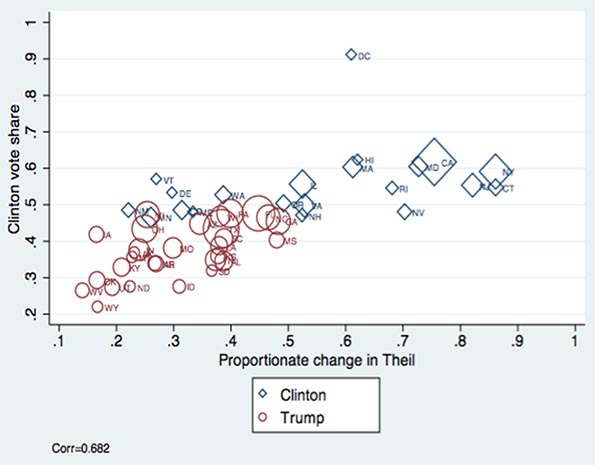
    Each state is weighted by its electoral votes.  Calculations by Jaehee Choi and James Galbraith.

    Change in Inequality 1990-2014 and the Election Outcome, 2016, by State.
    State Change in Pay Inequality 1990 to 2014 (Theil measure), Index Number, 1990 =100 Trump / Clinton Clinton Percentage
    Connecticut 186.4 C 54.6%
    New York 179.6 C 59.0%
    New Jersey 176.7 C 55.5%
    California 172.7 C 61.7%
    Rhode Island 169.4 C 54.4%
    Maryland 168.8 C 60.3%
    Nevada 167.6 C 47.9%
    Hawaii 161.3 C 62.2%
    Massachusetts 160.7 C 60.0%
    District of Columbia 159.4 C 90.9%
    Illinois 149.8 C 55.8%
    Virginia 149.1 C 49.8%
    Oregon 148.1 C 50.1%
    New Hampshire 147.5 C 46.8%
    Georgia 146.7 T 45.9%
    Mississippi 146.7 T 40.1%
    North Carolina 144.2 T 46.2%
    Florida 141.4 T 47.8%
    Washington 139.3 C 51.8%
    Pennsylvania 138.8 T 47.9%
    Louisiana 138.7 T 38.4%
    Wisconsin 138.5 T 46.5%
    Kansas 138.3 T 36.1%
    Alabama 137.4 T 34.4%
    South Carolina 137.3 T 40.7%
    Tennessee 136.2 T 34.7%
    Texas 135.1 T 43.2%
    South Dakota 134.7 T 31.7%
    Maine 132.2 C 47.8%
    Missouri 131.9 T 38.1%
    Colorado 131.8 C 48.2%
    Arizona 131.4 T 45.1%
    Idaho 129.6 T 27.5%
    Delaware 128.8 C 53.4%
    Arkansas 127.3 T 33.7%
    Minnesota 126.4 C 46.4%
    Ohio 126.1 T 43.6%
    Michigan 126.0 T 47.3%
    Kentucky 125.3 T 32.7%
    Nebraska 124.4 T 33.7%
    Vermont 124.3 C 56.7%
    Indiana 123.3 T 37.8%
    Alaska 123.0 T 36.6%
    New Mexico 122.1 C 48.3%
    Montana 121.5 T 35.7%
    North Dakota 120.3 T 27.2%
    Iowa 118.9 T 41.7%
    Utah 117.8 T 27.5%
    Oklahoma 116.2 T 28.9%
    West Virginia 116.0 T 26.5%
    Wyoming 114.5 T 21.9%
    Correlation: 0.687

    James Galbraith is an economist, who teaches at the LBJ School of Public Affairs, The University of Texas at Austin, and directs the University of Texas Inequality Project, at http://utip.lbj.utexas.edu.  His most recent book is Inequality: What Everyone Needs to Know (Oxford, 2016).

    Top image by DonkeyHotey (Hillary Clinton vs. Donald Trump – Caricatures) [CC BY-SA 2.0], via Wikimedia Commons

         Using the measure of income inequality gives a slightly different result:  the top eleven states are all Clinton states.
  • Why Socialism Is Back

    Even as Venezuela falls deeper into crisis, and the former Soviet bloc nations groan under its legacy, socialism is coming back, and in a big way. Its key supporters are not grizzled pensioners yearning for Marxist security, but a whole new generation, most of whom have little memory of socialist failure.

    Although the trend is a-historic, it’s not happening in a vacuum. The primary driver is the global ascendency of neo-liberal capitalism, which in virtually all countries has accelerated inequality. This is particularly true in the United States and the United Kingdom, where the gaps between rich and poor are greatest among developed, democratic countries. In these nations, socialist politicians such as Sen. Bernie Sanders and British Labor leader Jeremy Corbyn (pictured) are now political rock stars among young people.

    In the 2016 presidential primaries, Sanders outpolled Donald Trump and Hillary Clinton put together among younger voters, and is now the nation’s most popular politician. His supporters are gradually taking over much of the Democratic Party, state by state. Corbyn, widely portrayed in the media as a walking time electoral bomb, secured for his party 61 percent of the vote among those under 40 in the recent parliamentary elections. It is increasingly possible that this once-marginal figure could someday occupy 10 Downing St. If the 75-year-old Sanders were a decade younger, he would also have an excellent chance of ascending to the White House.

    A Different Kind of Leftism

    Although neither Sanders nor Corbyn can be labeled classic Stalinists, they do represent a radical departure for their respective parties. Both adopt what are generally seen as far left positions, with Corbyn even suggesting that people displaced by London’s Grenfell fire occupy expensive, but unoccupied units, in the city’s rich precincts. Sanders has called for national health care, massive tax increases for the top income earners — with rates upward of 90 percent — and a ban on new fossil fuel development on federal lands.

    This marks a major departure from past progressive politics in both countries. Democrats and Labour have done best by adhering to the center, and calibrating reforms with the demands of the capital markets. Even President Obama, although revered by progressives, was hardly a radical on economic issues. He did little to stop the consolidation of tech industries — which were also key supporters — as his Justice Department failed to press the anti-trust button. He also supported the expansion of free trade codified as Democratic Party orthodoxy during Bill Clinton’s presidency and which are favored by corporate and commercial interests. Tony Blair and his successor, Gordon Brown, also consistently embraced neo-liberal ideologies and courted support among London’s financial elite.

    In contrast, Sanders, a Senate “independent” for most of his career, is a committed socialist who took his honeymoon in, of all places, the communist Soviet Union. He has adopted positions on trade and special visas for tech workers that are closer to those of Donald Trump than Clinton’s. Corbyn’s leftism is even more extreme than Sanders’, embracing long discarded notions of nationalization of industries, massive re-distribution of income as well as a distinctly pro-Palestinian, pro-Third World view common among European leftists.

    The ‘Precariat’ — the Modern Proletariat

    The “Bernie Bros” who made Sanders such a sudden and unlikely political force in 2016 were disproportionately young white voters who swelled the ranks of the precariat — part-time, conditional workers. The numbers of such people is destined to grow with the emerging “gig economy” and the digitization of retail, which could cost millions of working-class jobs. Even university lecturers in Britain, notes the Guardian, fear that their jobs will be “Uber-ised,” a phenomena also seen at American universities.

    For most Americans, the once promising “New Economy” has meant a descent, as one MIT economist  recently put it, towards a precarious position usually associated with Third World countries. Even Silicon Valley has gone from one of the most egalitarian locales in the country to a highly unequal place where the working and middle class have, if anything, done worse (in terms of income) than before the tech boom.

    For its part, the precariat has rational reasons to embrace socialism, particularly if capitalism seems unlikely to meet their needs. The notion of getting a steady, well-paid, full-time job has vanished for an increasing number of young people. Most millennials are not doing as well as their parents did at the same age. The idea of buying a house — once a sure sign of upward mobility — has declined in much of the U.S. for the current generation, particularly on the coasts, and even more so in the U.K., where house prices are higher and incomes lower. The Grenfell fire was not just something that happens to the poor; it could be the future for many young people who may never live in anything much better.

    How Capitalism Is Failing

    “Capitalism,” Lenin noted, “begins in the village marketplace.” Yet Americans are increasingly loath to start a business. There are now more businesses failing than being born, very different than the pattern of the 1980s and 1990s. The dream of starting a business has often been the way out for people with modest educations and means. Without the societal steam valve of entrepreneurship, the alternative for many millennials is in blue-collar or service jobs, where wages have been falling over the past decade.

    Even in the tech world, which represents the largest opportunity for younger people, start-ups have become increasingly rare. This reflects the growing consolidation of the technology sector, which reduces opportunity even in new fields. As one recent research paper demonstrates, “super platforms” such as Facebook, Google, Amazon, and Apple depress competition, squeeze suppliers and drive down salaries, much as the monopolists of the late 19th century did.

    These tech behemoths assert that their success is based utterly on merit, but they have also exploited their structural advantages, as the most ruthless of moguls did. Companies like Amazon have been able to attract investors even with scant profits, an advantage not enjoyed by their competitors, as investors await the rewards of a near-monopoly. Apple and other tech companies have also become adept at avoiding taxes in a way almost impossible for a business on Main Street. As occurs in corrupted systems, insiders usually do best, almost no matter how well they perform; Yahoo’s Marissa Mayer earned $239 million over five years — almost a million a week —  despite failing to revive one of the net’s earliest stars.

    Intersectionality: The Problem Facing Neo-Socialism

    On the surface, the analytics look good for a socialist revival, particularly in the wake of the almost certain failings of Trump’s ersatz populism. A large number of young people, in both Britain and America, have a more favorable view of socialism than capitalism. They never witnessed the failures of the past and they are reeling under present conditions. And given that many older people feel their children face a diminished future, building a majority for socialism is not inconceivable.

    Yet the neo-socialists face a challenge because their potential coalition is fraught. On numerous policy issues, modern progressivism’s interests diverge starkly from those of potential adherents. Corbyn’s multiculturalism and desire to allow more refugees into Britain may win praise on campuses and in left-wing media, but how attractive is this prospect to British working-class voters, many of whom supported Brexit to help cut back on immigration.

    Similar dynamics exists in the U.S. For example, in discussing politics at the Utah AFL-CIO (where I recently spoke), the local president, Dale Cox, suggested that many parts of the progressive agenda — he specifically mentioned opposition to fossil fuel and mineral development — directly threaten the livelihoods of union laborers. Similarly, police unions also feel alienated from progressives who embrace the agenda of groups like Black Lives Matter. Far better, Cox suggested, would be for progressives to focus on improving the lives of working people in ways that really matter, such as expanding opportunities for business and home ownership, health care, and tax reform.

    These economic positions could gain a majority, but not if the progressives maintain their   polarizing embrace of the most radical aspects of social identity and environmental policy. This in particular threatens to undermine working-class support, particularly in the interior states. The leftists’ thinly disguised distaste for how most Americans live in small towns and suburbs does not help make their case. Until the left decides to focus on the everyday issues that matter to people outside their bubble, the dream of the socialist revival will remain a fantasy.

    This piece originally appeared on Real Clear Politics.

    Joel Kotkin is executive editor of NewGeography.com. He is the Roger Hobbs Distinguished Fellow in Urban Studies at Chapman University and executive director of the Houston-based Center for Opportunity Urbanism. His newest book is The Human City: Urbanism for the rest of us. He is also author of The New Class ConflictThe City: A Global History, and The Next Hundred Million: America in 2050. He lives in Orange County, CA.

    Photo by paulnew (https://www.flickr.com/photos/paulnew/28243001503) [CC BY 2.0], via Wikimedia Commons

  • Canada Turns 150 – Time to Celebrate – But Only in Moderation

    Canada is one of the world’s most successful countries on quality of life and income indicators.  Among the reasons for its success are its foundation of laws, vast natural resources, access to the huge American market, and law abiding citizens.

    Canada was founded by the British Government at the height of the British Empire. French-speaking and English-speaking colonies agreed to join, and then spread west along the 49th parallel border with America.

    Britain bestowed two important advantages on Canada.  One being the rule of law. Canadians, while extremely law abiding, have common legal challenges: the length of time to reach trial, high court costs, and difficulties in prosecution of sophisticated white collar crimes. 

    Crime rates are a fraction of American levels and Canadian ‘no guns allowed’ cities are much safer than in America. Canada’s culture of respect is reflected in law abiding citizens and, outside of Quebec, very little real government corruption. Canada regularly scores among the least corrupt counties in Transparency International’s corruption rankings. 

    The British also left their wonderfully simple parliamentary system.  In Canada, once your party is elected with a majority of the seats in parliament, as Prime Minister you are effectively a benign dictator for 4 years.  The same goes with Canada’s equivalent of the State Governors – our Provincial Premiers.  Do a bad job and expect to lose the next election after 4 years – for the most part, almost all federal and provincial governments last two election cycles. 

    Unlike the USA, with its complex systems of checks and balances, the system in Canada affords its elected political leaders massive power, albeit subject to the robust rule of the English system of common law, which provides excellent and reliable property rights and contract enforcement. 

    After a federal election, the winning part’s leader picks his/her cabinet, senior bureaucrats, and appoints Senators and federal judges to vacancies in the upper house and the judiciary. Appointments are long term, generally outlast two election cycles except for judges and Senators, who serve to the mandatory retirement age.

    As in the US, Canada has three levels of government – federal, provincial and municipal.  Its British constitutional framework, based on “Peace, Order and Good Government”, has produced strong regional and provincial level governments which control major policy areas like healthcare, education and welfare. While the federal government has superior taxation powers, the provinces benefit enormously by owning and controlling all natural resources. 

    The second largest country by land mass, Canada has massive natural resources with large gold mines and the third largest proven oil reserves in the world. Its small population (12% of USA’s population) is made wealthy by vast amounts of oil and gas, minerals, water and forests. 

    Our proximity and close relationship with the USA – 90% of Canadians live within 100 miles of the border, has been vital to Canada’s success.  Not since 1812 have we had a major war with the USA. The 1812-1814 war and other occasions when America attempted to incorporate the northern part of North America helped drive the consolidation of separate British colonies into Canada in 1867.

    For the most part, Canada has recognized and lived peaceably with America. And, the USA has treated Canada better than it has any other country in the world, respecting its independence and providing Canada with massive military protection.  No other country would ever think of attacking Canada, for fear of the USA’s might and reprisal.  Our American relationship has brought great economic advantages – most importantly being almost unfettered access to the enormous US market.

    This reliance on American protection has allowed Canada to save massively on military expenditure.  The USA spends around 3.3% of its GDP on defense, while Canada spends well below 2%.  Although we do lose out on the amazing technologies and manufacturing jobs surrounding military expenditures, our lower costs allow a rich fabric of health and social programs.

    Both Canada and the USA lag well back in the most recent World Health Organization ranking of healthcare systems – Canada 30th in the world, the USA 37th.  The advantage for Canada is that our single payer universal health care system only costs us 11% of GDP, while in the USA the cost to the USA is 18% of its GDP. Canada’s universal – all Canadians are covered – public system is   preferred by Canadians over the American system which leaves many families unable to afford full health coverage that  system’s private insurers offer.

    Canada’s education system substantially outperforms its southern neighbor – scoring high in the top ten rankings in international math, science and reading. Canada’s strong knowledge economy is a great source of innovation and inventions.  The place that invented the telephone (inventor: Alexander Graham Bell) has a technological base that provides a valuable resource for the American tech sector. According to Canada’s National Post newspaper:

    “Silicon Valley technology companies continue to tap Canadian universities for talent. A 2014 report by Riviera Partners, a San Francisco  recruiting company, ranked the University of Waterloo (in Kitchener-Waterloo, Canada’s “Silicon Valley”) outside Toronto second behind only the University of California, Berkeley, in a list of schools that produce the most frequently hired students in the Bay area. Stanford, UCLA, and Cornell tied for third." (italics section added by author)

    We model ourselves as an European alternative to the USA – in terms of social programs and enterprise establishment – and that’s not always to the best.  Canada has opened its borders to an increasing flow of immigrants including refugees, putting pressure on government budgets called in to integrate the newcomers. As in the US, the public sector is a chattering class oasis of 1980s style social engineering.  High-priced and rules focused, our governments and media are increasingly fixated on gender and identity politics. Canada’s state funded broadcaster, the CBC, dwells obsessively on grievance, race and victim politics.

    Canada’s current Prime Minister, Justin Trudeau, seems to be more interested in politically-correct platitudes, gender balance in his Cabinet and fighting climate change than in building an economy.  For all its evident faults, the Trump Administration promotes job creation, economic growth by reversing Obama’s regulatory assaults on the conventional hydrocarbon sector. In contrast Trudeau’s Liberal federal government is thickening regulatory obstacles to more Canadian oil pipelines, banning oil tanker traffic along Canada’s west coast, and raising energy costs in a cold, widely-dispersed, resource based economy via a UN-approved carbon tax policy. 

    Like his father the late Pierre Trudeau, Canada’s Prime Minister from 1968-1984, before him, Justin Trudeau is trying to build a social legacy – not an economic one.

    Despite Canada’s leftish drift under young Trudeau, it will remain one of the safest, kindest, and peaceful greatest countries in the world. Canadians believe in service to society more than service to their country, while abiding by the rule of law, and enjoying the value of high-quality and affordable education. Forty-two per cent of Canadians have university degrees (33% in the USA), and unlike some European citizens, Canadians are not afraid of either work or our large and growing immigrant population, who work even harder.   

    Our current glamorous Prime Minister is strong on EQ  (emotional quotient) , excelling at selfies, platitudes and foreign relations.  Back home in Canada he professes that “budgets will balance themselves” and “root causes” are the reason for terrorism.  But, Canadians are patient, and avoid any and all forms of radical change. 

    No democracy on earth has a more stable political environment something that allows us to avoid the massive political swings found elsewhere.  Decades long debates in Canada center around social issues, such as whether to have our provinces solely fund child care or rely in part on the Federal Government. Recently, a debate raged about changing three words in our national anthem to make the anthem fully Gender Neutral.  While the rest of the world focuses on terrorism, immigration and youth unemployment – Canadians worry about rising  house prices, protecting and improving a ‘too slow’ health care system, and whether our civil servants get a small raise.

    On a global scale, these are good problems to have. 

    Peter Holle is president of the Frontier Centre for Public Policy, an independent western Canada based think tank, www.fcpp.org

    Photograph: Flag of Canada

  • Canada at 150: Perspectives

    Canada and the United States have lived together in peace for more than two centuries, since the War of 1812. Yet, it has not always been easy.

    Elephants provided one of the most graphic descriptions of the two nations living together. There are no elephants in Canada, at least not in the wild. But according to Canada’s third longest serving prime minister, Pierre Elliot Trudeau, there is a big one close by. The Prime Minister characterized Canada’s relationship with the United States in his March 25, 1969 speech to the Washington Press Club (at 1:40 in this Canadian Broadcasting Corporation video clip):

    “Living next to you is in some ways like sleeping with an elephant. No matter how friendly and even-tempered is the beast, if I can call it that, one is affected by every twitch and grunt.”

    Trudeau was the late father of Justin Trudeau, who today is Canada’s 23rd Prime Minister.

    I have always had great admiration for Canada. Perhaps that is because I lived there three years in my formative youth. This article contains some perspectives on Canada that may not be familiar to non-Canadians and perhaps to even some Canadians.

    Canada 150

    Canada is celebrating its 150th anniversary. Canada Day is July 1. On that day in 1867, the British North America Act came into effect. The Act created the Dominion of Canada, a union (confederation) between the province of Canada (which was divided into the provinces of Ontario and Québec) and the colonies of Nova Scotia and New Brunswick, which became provinces. All of this could be traced back to a 1864 conference in Charlottetown, now the capital of Prince Edward Island, which itself did not join the confederation until 1873.

    Like the United States, Canada is a former British colonial holding. Yet there are significant differences. For example, the manner of its separation from the “mother country” could not be more different.

    For the United States, the break was complete and relatively quick. After the July 4, 1776 Declaration of Independence and a war that lasted from 1775 to 1783, the separation was complete.

    When Did Canada Become Sovereignty?

    There is no question today of Canada’s sovereignty — it is a sovereign nation like the United States, China or Japan. Yet Canada seems to have evolved into sovereignty, over many years. Just when did Canada become independent? Opinions vary by 115 years.

    A poll by the Ottawa Citizen found considerable disagreement among Canadians. The majority, 74 percent said that it was 150 years ago, the effective date of the British North America Act (1867). The signing of the Canada Act by Prime Minister Pierre Trudeau and Queen Elizabeth in 1982 got the second most mentions, at 14 percent. And, other dates were mentioned.

    But both dates are unconvincing, according to Professor Jack Jebwab, formerly at one of Canada’s most prestigious universities (McGill University in Montréal) and now president of the Association for Canadian Studies, cites a 1967 Supreme Court decision of Canada, which stated that “sovereignty was acquired in the period between its separate signature of the Treaty of Versailles in 1919 and the Statute of Westminster” (1931).

    Jebwab says that Canada became neither independent nor sovereign in 1867, noting that the meaning of “dominion” was a British Empire term for “semi-independent entities.” The British Parliament, he says, could legislate on Canadian affairs and “override” any local legislation.

    He says that “Identifying the precise date when Canada achieved its independence is not easy.” Jebwab cites a leading constitutional expert Frank Scott to the effect that “at no time prior to the Second World War was the full international personality of the Dominion, as distinct from Great Britain, established beyond equivocation.”

    The Statute of Westminster (1931), which was a “British law clarifying the powers of Canada’s Parliament and those of the other Commonwealth Dominions. It granted these former colonies full legal freedom except in those areas where they chose to remain subordinate to Britain,” according to The Canadian Encyclopedia. This certainly seems to suggest that Canada could have been independent in 1931 if it chose to be. The Statute covered not only the Dominion of Canada, but also the Dominions of Australia, New Zealand, the Irish Free State, South Africa and Newfoundland (now Newfoundland and Labrador, one of Canada’s provinces).

    With respect to the 1982 act, Professor Jebwab notes: “Only with that act was a process introduced that permitted the amending of Canada’s basic constitutional laws without action by the British Parliament, and it declared that no British law passed thereafter would apply to Canada.”

    The Expansion of Canada

    From its beginnings with four provinces (Ontario, Quebec, New Brunswick and Nova Scotia), Canada expanded to 10 provinces and three territories. Manitoba joined as a province in 1870. British Columbia, on the Pacific Coast, joined in 1871, with the promise of a transcontinental railway, which was completed in 1885 (the Canadian Pacific). Prince Edward Island, home to the founding Charlottetown conference, did not join until 1873. Saskatchewan and Alberta became provinces in 1905, bringing the count to nine.

    The province of Newfoundland and Labrador is a special case. Never before a part of Canada, Newfoundland became a dominion of the British Empire in 1907, with equal status with Canada and the other dominions. It, like the other dominions, received a substantial push toward sovereignty with the 1931 Statute of Westminster. Yet, by 1933, the Dominion of Newfoundland found itself in considerable financial difficulty and its legislature disbanded. This may have been the only instance of a former colony voluntarily returning to colonial status. Newfoundland was governed for a decade and a half directly from London. After referendums, Newfoundland became a province of Canada in 1949.

    Canada also assumed the huge territories of the North, now the Yukon, Northwest Territories and Nunavut.

    Prince Albert, Saskatchewan

    Then there is the city of Prince Albert, Saskatchewan, which is not among Canada’s largest, with only 36,000 residents. No one from Prince Albert was at Charlottetown in 1864. Yet Prince Albert has been, in some ways, a cradle of Canadian leadership. The House of Commons (lower house of parliament) constituency of Prince Albert has been represented by a disproportionately large three of Canada’s 23 prime ministers. John A. Diefenbaker (1957-1963) grew up in the area and served Prince Albert during his premiership. William Lyon MacKenzie King, Canada’s longest serving prime minister (1921-1926, 1926-1930 and 1935-1948) represented Prince Albert through four of his six governments. Before he became Canada’s seventh prime minister, Wilfred Laurier held its provisional seat before Saskatchewan became a province in 1905 (when it was a part of the Northwest Territories). St. Albert has been represented by Prime Ministers for 30 of Canada’s 150 years, quite an accomplishment for such a small place.

    Celebrating Canada

    On the complex issue of sovereignty, Professor Jebwab concludes: “We’ve evolved enormously since 1867 and there is much to commemorate in the sovereign nation that we’ve become and that is today widely respected in so many parts of the world.”

    Indeed. Canada has emerged as one of the world’s most successful nations. According to the New York Times, Canada now has the richest middle class in the world. There is much in Canada to be celebrated, and enthusiastically.

    Wendell Cox is principal of Demographia, an international public policy and demographics firm. He is a Senior Fellow of the Center for Opportunity Urbanism (US), Senior Fellow for Housing Affordability and Municipal Policy for the Frontier Centre for Public Policy (Canada), and a member of the Board of Advisors of the Center for Demographics and Policy at Chapman University (California). He is co-author of the "Demographia International Housing Affordability Survey" and author of "Demographia World Urban Areas" and "War on the Dream: How Anti-Sprawl Policy Threatens the Quality of Life." He was appointed to three terms on the Los Angeles County Transportation Commission, where he served with the leading city and county leadership as the only non-elected member. He served as a visiting professor at the Conservatoire National des Arts et Metiers, a national university in Paris.

    Photograph: Centre Block, Parliament of Canada (by author)

  • The Cities Creating The Most High-Wage Jobs

    As the country moves toward full employment, at least as economists define it, the quality of jobs has replaced joblessness as the primary concern. With wages still stagnant, rising an anemic 2.5% in the year to May, the biggest challenge for most parts of the U.S. is not getting more people into the workforce but rather driving the creation of the types of jobs that can sustain a middle-class quality of life.

    To that end, the key sector to watch is business and professional services. By far the nation’s largest high-wage sector — including such fields as law, accounting, architecture, advertising, engineering, scientific research and development, and computer systems design – it employs 20.5 million Americans, roughly the same as the finance and manufacturing industries combined. Over the past decade, the number of people working in business and professional services has expanded by nearly 2.5 million, including an increase of more than half a million jobs in the last year.

    We decided to take a look at which metropolitan areas are gaining the most professional and business services jobs and the trends that are driving some to pull ahead while others fade. Our rankings look at employment in the sector over time— assessing short, medium and long-term job trends and adding in variables for persistence and momentum as well. The results of these trends, based on three-month averages, are normalized and each metropolitan statistical area is assigned a score based on its relative position in each area. The rankings this year produced some surprising results, as well as some familiar stories.

    The shift to affordable places

    Looking at the 70 largest labor markets in the country, the clear winners are affordable, business-friendly locales – and their momentum is growing. These span an array of regions, from the Midwest heartland to the Deep South, Texas and the Intermountain West.

    Our number one metro area for professional and business service jobs, Nashville, Tenn., epitomizes many of the characteristics that drive high-end employment today. Since 2011, Nashville’s job count in professional and business services has expanded a remarkable 42.6% to 160,300, easily the highest growth rate of any major metropolitan area. Management and technical consulting, architecture and related services have led this growth.

    The very forces that lead companies to Nashville — low taxes and a pro-business regulatory environment — also apply to several of our other top 10 places. These include No. 2 Kansas City, Mo., which has logged 28.4% growth since 2011. KC, better known in the rest of the country for barbecue and its music scene (though not quite Nashville), has grown a vibrant economy based in good part on service businesses in architecture and innovative administrative support models (especially for health care providers), accounting for some 100,000 jobs in professional and business services.

    But for the most part of the fastest-growing areas for business services are also the same areas that did best on our overall list. These include the Texas powerhouses of Austin-Round Rock (third), Dallas-Plano-Irving (fifth), and San Antonio-Braunfels (sixth), all of which logged 25% job growth or more since 2011. Salt Lake City, ranked ninth, has become a major magnet for business service, outpacing such hot spots as 21st-ranked Seattle and No. 28 Denver. Charlotte, another consistent performer, ranked eighth.

    The last big region for fast-growing high-wage service jobs is Florida, led by 10th-ranked Orlando, 11th-place Tampa-St. Petersburg-Clearwater and No. 14 Ft. Lauderdale-Pompano Beach-Deerfield Beach. Better known for its huge hospitality industry, Florida cities like Orlando have become major lures to large companies seeking lower costs and taxes. Orlando is home to corporate or regional headquarters of Darden Restaurants, Tupperware, AAA, Deloitte, and the fast-growing auto service firm, Greenway Automotive. Over the last two years, the business services sector grew more than tourism, adding almost 24,000 jobs compared to 21,300 for tourism.

    Places Where Value Still Outpaces Costs

    Yet not all of the economies creating the most high-wage jobs are in the lower-cost states. There remains a handful of places with high taxes and strict regulation that are attractive to businesspeople. Perhaps the best example is San Francisco-San Mateo-Redwood City, which is down two notches from last year to fourth place, but remains on a tear, with over 34% growth since 2011. This growth is driven in large part by the tech industry, which is increasingly integrated into business services.

    One prime example is Salesforce.com, a firm with strong tech assets, but whose customer relationship management tools are firmly in the business service space. The company has quadrupled its sales to $8 billion since 2012 and now employs 6,600 people at its San Francisco headquarters, making it the second largest private employer in the city after the venerable Wells Fargo.

    Seventh-ranked San Jose-Sunnyvale-Santa Clara, the capital of Silicon Valley, has also been able to dodge the cost bullet, enjoying 34% business services job growth since 2011. Other high cost areas that have seen impressive growth in business services include No. 20 New York, with 21.2% growth since 2011 to 735,300 jobS

    the most of any metro area in the nation, as well as No. 24 Boston, with 17.1% growth over the same period. As competitive pressure in these tech-heavy metro areas has surged, it has driven up the local demand for professional services.

    Many other high-cost metro areas have not done so well. In Southern California, 32nd-ranked Anaheim-Santa Ana-Irvine, with a job growth rate of 19.3%, is the pick of the litter. Other parts of this heavily populated area do worse, including San Diego 49th ) and Los Angeles (53rd), where growth was 11.6%, way below the average of 16.5% for large MSAs. Riverside-San Bernardino, which did respectably in our overall job growth survey, ranked a poor 67th in business services, with a 6.9% drop last year.

    What the future may bring

    The future of business services presents a mixed picture. Areas with particularly strong technical expertise, such as the Bay Area and Boston, and financial talent, notably New York, continue to do well. Yet job growth is slowing in all three; San Jose and San Francisco posted the lowest growth among the top 10 metro areas in 2016, well below such places as Nashville, San Antonio and Kansas City.

    Does this suggest a developing trend? Certainly the ease of online communication may grease the skids for firms to locate people in less expensive regions. Although salaries for business professionals are higher in places like San Francisco or New York, the cost of living, particularly housing, cuts into the value of their salaries. Estimated median home prices in the City by the Bay hit $1.5 million in May, more than six times the national median price of $244,800.

    Further down the road, we may also see the shift of some business to small and mid-sized cities, which constituted 10 of the top 12 fastest growing areas for business service jobs, led by such diverse places as Wausau, Wisc., Monroe, Mich., and College Station, Texas. As companies look to cut costs and still offer a middle-class standard of living to their employees, such shifts could be in hand. If so, the much dismissed prospects for small cities may prove far brighter than many may expect.

    This piece originally appeared on Forbes.

    Joel Kotkin is executive editor of NewGeography.com. He is the Roger Hobbs Distinguished Fellow in Urban Studies at Chapman University and executive director of the Houston-based Center for Opportunity Urbanism. His newest book is The Human City: Urbanism for the rest of us. He is also author of The New Class ConflictThe City: A Global History, and The Next Hundred Million: America in 2050. He lives in Orange County, CA.

    Dr. Michael Shires primary areas of teaching and research include state, regional and local policy; technology and democracy; higher education policy; strategic, political and organizational issues in public policy; and quantitative analysis. He often serves as a consultant to local and state government on issues related to finance, education policy and governance. Dr. Shires has been quoted as an expert in various publications including USA TodayNewsweekThe EconomistThe Sacramento Bee, San Francisco Chronicle, and LA Times. He has also appeared as a guest commentator on CNN, KTLA and KCAL to name a few.

    Photo by Peter Miller, via Flickr, using CC License.

  • New Infrastructure in Sub-Saharan Africa

    This post will be continuously updated as we learn about new projects.

    On the three main vectors of wealth creation, African countries have lagged other developing nations for several decades. Sub-Saharan Africa is the poorest region of the world and suffers from poor infrastructure, uneven literacy, endemic corruption, political instability and war. While this is problematic for the present, improving conditions are pointing to a more promising future.

    In particular, sub-Saharan Africa could have a unique opportunity to realize a demographic dividend if its elevated fertility rate and dependency ratio decline in the same way as have those of other countries in the past.

    The experience of China shows that a significant dividend can be reaped if other conducive factors are also present. Most important among them are a growing workforce that is more literate and productive, and an institutional framework that is supportive of economic development.

    Innovation-based productivity gains as we understand them in the West can be scarce in the poorest developing countries. But productivity can be improved quickly through educational programs and through well targeted infrastructure projects.

    There is much to do given that Africa has a large infrastructure deficit. A World Bank Fact Sheet provides the following numbers:

      • Electricity: The 48 countries of Sub-Saharan Africa (with a combined population of 800 million) generate roughly the same amount of power as Spain (with a population of 45 million).

      • Roads: Only one-third of Africans living in rural areas are within two kilometers of an all-season road, compared with two-thirds of the population in other developing regions.

      • Water: Water storage capacity is currently 200 cubic meters per capita and needs to increase to at least 750 cubic meters per capita, a level currently found only in South Africa. Only six million hectares, concentrated in a handful of countries, are equipped for irrigation. Though less than five percent of Africa’s cultivated area, the irrigation-equipped area represents 20 percent of the value of agricultural production.

      • The cost of redressing Africa’s infrastructure deficit is estimated at US$38 billion of investment per year, and a further US$37 billion per year in operations and maintenance; an overall price tag of US$75 billion. The total required spending translates into some 12 percent of Africa’s GDP. There is currently a funding gap of US$35 billion per year.

      Below are some recently announced projects in sub-Saharan Africa that will likely have a large impact on nearby populations. (Some of the links are behind a paywall).

      Uganda-Tanzania pipeline

      Tanzania and Uganda signed on May 26 an intergovernmental agreement for the construction of the world’s longest electrically heated crude-oil export pipeline, which is being designed by Houston-based Gulf Interstate Engineering Co.


      The 1,445-kilometer East Africa Crude Oil Pipeline (EACOP) project, which is being developed by France’s Total SA, China’s CNOOC and UK’s Tullow Oil, would enable the commercialization of the estimated 6.5 billion barrels of crude-oil reserves in Uganda’s Albertine basin. (link)

      Tanzania rail project

      A joint venture of Portuguese and Turkish construction firms has been awarded a $1.2-billion contract for a new 202-kilometer, single-track, 1,435-millimeter-gauge railway line, in Tanzania. The segment is part of the 1631-km Dar es Salaam-Isaka-Kigali and Keza-Musongati railway project connecting the country to neighboring Burundi and Rwanda. (link)

      Landlocked Ethiopia seeking stake in Somali port

      Ethiopia is in talks to acquire shares in a joint venture involving DP World Ltd. that will manage a port in northern Somalia, a Somali official said, a move that could give the fast-growing yet landlocked Horn of Africa economy its first stake in foreign docks. (link)

      Mozambique suspension bridge

      Chinese crews, with the help of German supervisors, are building what will be Africa’s largest suspension bridge, in Mozambique. Slated for completion in the third quarter of this year, the 3,003-meter-long, $725-million Maputo Bridge and Link Roads project will strengthen north-south connections and provide a new road link to South Africa and Swaziland. (link)

      East African Power Plant

      Two foreign-led consortiums have been awarded contracts to build the East Africa-sited, 80-MW Rusumo hydropower project, which is intended to reduce electricity costs and promote renewable power in Tanzania, Rwanda and Burundi. (link)

      Rwanda Airport

      The South African subsidiary of a Portuguese civil construction company has won a two-phase, $818-million contract to construct Bugesera International Airport in Rwanda under a build-own-operate-transfer model, with a view to turning it into central Africa’s premier air transport hub by 2018. (link)

      Tallest Building in Africa

      Kenyan President Uhuru Kenyatta recently laid the foundation stone for what will be the tallest building in Africa in the Upper Hill neighborhood of Nairobi. Construction is underway at the development site, and slated for completion by December 2019.


      The ambitious project will see twin glass-facade towers rise above the city, the larger standing at 300 meters tall, far surpassing the continent’s current leader — Johannesburg’s 223-meter Carlton Centre. (link)

      Zimbabwe Road Expansion

      Zimbabwe has signed an agreement with a Chinese-Austrian consortium to resume the delayed $2.7-billion rehabilitation and expansion of the 971-kilometer Beitbridge-Harare-Chirundu highway, which links landlocked Zimbabwe and Zambia to the ports of Durban and Richards Bay in South Africa. (link)

      Dams in Ethiopia

      Italy’s Milan-based industrial group Salini Impregilo has been awarded a $2.8-billion hydropower project by the Ethiopian Electric Power Corp., a state-controlled company that produces, transmits, distributes and sells electricity in Ethiopia.


      The contract involves the construction, with financing from Italy’s credit agency Servizi Assicuative de Commerce Estero, of the 2,200-MW Koysha Dam on the Omo River in the southern part of the country.


      Salini currently is constructing Ethiopia’s 6,000-MW Grand Ethiopian Renaissance Dam, which, when commissioned in 2017, will be Africa’s largest and the world’s No. 11 largest hydropower project. The Italian construction firm last year completed the 1,870-MW Gibe III hydroelectric power project at a cost of $1.6 billion. (link)

      These are only a few examples of the new infrastructure in Africa. The need for new roads, power plants, rail connections, harbors, water and wastewater facilities, telecommunications etc. is very large and presents a significant opportunity for investors, under the proper governance preconditions.

      This piece originally appeared on Populyst.

      Sami Karam is the founder and editor of populyst.net and the creator of the populyst index™. populyst is about innovation, demography and society. Before populyst, he was the founder and manager of the Seven Global funds and a fund manager at leading asset managers in Boston and New York. In addition to a finance MBA from the Wharton School, he holds a Master’s in Civil Engineering from Cornell and a Bachelor of Architecture from UT Austin.

      Photo: Al Gesh Road, Sahara. (Photo by KaiAbuSir via Wikimedia Commons)

  • How to Take Advantage of the Retail Apocalypse

    Amazon’s stunning acquisition last week of Whole Foods signaled an inflection point in the development of retail, notably the $800 billion supermarket sector. The massive shift of retail to the web is beginning to claw into the last remaining bastions of physical space. In the last year alone, 50,000 positions were lost in the retail sector, and as many as 6 million jobs could be vulnerable nationwide in the long term. Store closings are running at a rate higher than during the Great Recession.

    Yet, there’s an opportunity opening for cities and regions to take advantage of new space for churches, colleges, warehouse space and, most importantly, housing. Nationally, an estimated 15 percent of all mall space will need to find new uses within the next decade. As many as 275 malls, according to Credit Suisse, will close in the next five years — roughly a quarter of the total. America already has four to five times as much retail space per capita as countries such as the United Kingdom or Japan.

    The infill opportunity

    The biggest opportunity for Southern California lies in the production of new housing, which would help to make up for providing less than half the needed supply for the past decade. To date, misguided state policy has created a raft of poor outcomes — rising prices, low inventory, declining affordability, the second-lowest homeownership rate in the nation — in effect, chasing middle-class, younger families out of the state.

    State policy has made things worse by putting ever more regulatory burdens on housing, particularly for those who build single-family homes on the peripheral areas, where lower-cost residences have historically been built. But the state’s policy of pushing “infill” development has also foundered, as the price of new apartments has shot up, in part due to the limited land for developments.

    These policies understandably upset residents of many urban neighborhoods, who feel that developers are seeking carte blanche to make their areas ever more congested and uniform. In contrast, a strategy of focusing on redundant retail properties — think attached townhomes or detached townhouses — would actually produce fewer cars than even a poor-performing mall, and would appeal to such key demographics as first-time homebuyers, immigrants, minorities and downshifting baby boomers.

    Read the entire piece at The Orange County Register.

    Joel Kotkin is executive editor of NewGeography.com. He is the Roger Hobbs Distinguished Fellow in Urban Studies at Chapman University and executive director of the Houston-based Center for Opportunity Urbanism. His newest book is The Human City: Urbanism for the rest of us. He is also author of The New Class ConflictThe City: A Global History, and The Next Hundred Million: America in 2050. He lives in Orange County, CA.

    Photo by Mike Mozart, via Flickr, using CC License.

  • Future Work: What, Where, and Why

    The growth industries and professions of the future will shape our cities in very different ways to the industries and professions that shaped our cities in the past. There are profound implications for urban planning and property, if we’re ready for them.

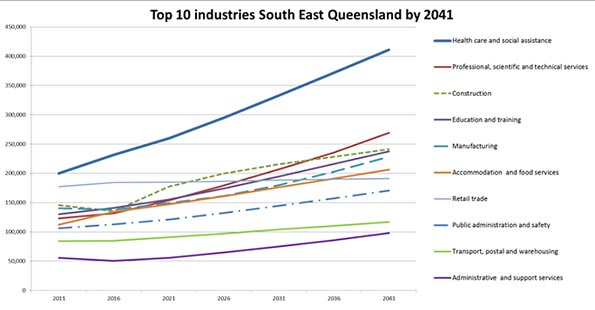
    The biggest growth industry for coming years and for the foreseeable future, the official forecasts all seem to agree on, will be in health care and social assistance. This includes professions from surgeons to GPs to nurses to child care or aged care, various therapies and counsellors, dental, and even laundry workers, cleaners and administrative support roles. Already our biggest single industry, it employs more than 1.5 million Australians. It grew by over 20% in the five years to 2015 and that rate of growth is unlikely to change going forward. Nearly half of everyone in this industry has a bachelor’s degree or some higher education qualification so they’re not all hospital cleaners – many will be skilled professionals.

    This will be followed by the professional, scientific and technical services industry and very close behind that, the education and training industry. Construction, manufacturing (yes, still growing despite all attempts to kill it off) and accommodation and food services round up the top six biggest growth industries of the future.

    This is important because the nature of the growth industries of the future and where they will be located is going to reshape our cities in a very different way to the industries that grew with and shaped our cities in the past. This was highlighted in a recent report on employment in the growing region of South East Queensland, prepared by Macroplan for The Suburban Alliance.

    The health care and social assistance industry is predicted by government authorities to grow more than any other industry in the years to 2041, producing around 220,000 extra jobs. But this industry has very different spatial needs to, say, the legal industry which has the highest inner city concentration of any occupation in the region. In health and social assistance, 200,000 of those 220,000 jobs will likely be in suburban business districts or otherwise scattered across suburbia. The biggest growth industry has little need or preference for clustering in the inner city.

    Consider the implications for transport networks, property development and urban planning. Our urban model, reflecting a 100 years of employment centralization, is changing to one of employment dispersal. Jobs are not moving from the city centre to the suburbs but the industries which fuel growth are changing, and with them, the patterns of employment location.

    Even in the professional, scientific and technical services industry, much of that future growth will occur outside the inner city. Take the generically titled occupation of “professional.” There were 284,300 of these in the South East Queensland region but only 24% of them in the inner city. A further quarter were in a number of defined suburban business districts and the balance – half – elsewhere in suburbia. This is our second biggest growth industry and those patterns of employment distribution are unlikely to change meaning of the 146,000 new jobs in this industry to be created to 2041, the clear majority will likely be suburban based.

    The third biggest growth industry with education professionals also shows little evidence of centralization – only 7% of educators are inner city workers the rest are suburban. Even for those who describe their occupation as “Chief executives, general managers or legislators” there are only 21% of them in the inner city. And for clerical and administrative workers, it’s a similar picture: only 22% are inner city workers. The rest are suburbia based.

    Engineers appear to have a preference for central locations with 42% of the 16,639 engineers of South East Queensland in the inner city as do the lawyers with 65% of them in the entire region to be found in the inner city. But there are only (fortunately?) just over 9,000 lawyers in the entire region so unless there’s to be an unpredicted explosion of work in the legal profession in the future it’s hard to see this occupation fueling demand for space and transport in the inner city of the future.

    Fifty years ago, cities were full of clerical and administrative, managerial and professional workers, shuffling in to centralized offices on trams or trains or buses to clock on at 9am and clock off at 5pm. In the suburbs there were centres of manufacturing and heavy industry. In fifty years’ time, our cities will have different industries generating the bulk of jobs and many of those jobs will need to be based in suburban centres to be closer to their markets or regional transport arteries.

    What’s that going to mean for urban planning, transport systems or property development? Will we see existing commercial and retail centres in the suburbs expand to accommodate a growing need for premises associated with health or medical professions, education or professional suites? Will our city centres evolve to become more entertainment, recreational and culture based hubs for the regions they serve, rather than largely just places of work?

    There’s much more to be explored in this because the implications are profound. Sadly, much of our thinking around urban planning seems firmly rooted in traditional models which owe more to a sentimental rear vision view of urban development rather than a forward looking one.

    Footnote: If you or your organization is interested in exploring what this means in more detail, or for specific regions, please just drop me an email. I’d be very interested to discuss with you. I’ve got a handy presentation which runs through all this in a bit more detail which I’d be happy to share.

    Ross Elliott has more than twenty years experience in property and public policy. His past roles have included stints in urban economics, national and state roles with the Property Council, and in destination marketing. He has written extensively on a range of public policy issues centering around urban issues, and continues to maintain his recreational interest in public policy through ongoing contributions such as this or via his monthly blog, The Pulse.