Category: Economics

  • A Fly-Over State Change of Mind

    Google the phrase “fly-over state.” You will find some unkind and a few nasty characterizations of the states that occupy the middle of the country. Nobody goes to these boring, unremarkable places with their ignorant people, uncultured lifestyles and awful weather. “Fly-over states” are where people never actually go but just fly over to get from the East Coast to the West Coast where the interesting places are.

    Now I don’t want to disparage the coastal states or their “cool” cities because I have many friends living and working there that I would never dream of offending. But the truth is that the middle of the country is doing quite well and can look forward to a bright future with unaccustomed, uncharacteristic optimism.

    The Great Plains turnabout is robust and pervasive, according to “The Rise of the Great Plains,” a report on the future of the American Great Plains recently released by Texas Tech University. Joel Kotkin, Praxis Strategy Group and Kevin Mulligan of TTU’s Center of Geospatial Technology authored the report, which is accompanied by an interactive online atlas of economic, demographic and geographic data.

    Instead of being passed over, the region has surpassed the national norms in everything from population increase to income and job growth during the last decade. After generations of net out-migration, the entire region now enjoys a net in-migration from other states, as well as increased immigration from around the world. Contrary to perceptions of the area as a wind-swept, old-age home, the vast majority of the newcomers are between the ages of 20 and 35.

    “The Rise of the Great Plains” concludes that three critical factors will propel the region’s future in the 21st century.

    First, the region’s vast resources places it in an excellent position to take advantage of worldwide increases in demand for food, fiber and fuel. The region’s manufacturing prowess and increasing trade savvy can propel it into more global markets.

    Second, the hyper-evolution and adoption of advanced technologies has enhanced the development of precision agriculture and energy resources, notably oil and gas previously considered impractical to tap. So, too, the Internet and advanced communications have reduced many of the barriers — socio-economic and cultural — which have isolated the Plains from the rest of the country and the world.

    Third, and perhaps most significantly, are demographic changes. The reversal of out-migration means that the region is again becoming attractive to people with ambition and talent. This is particularly true of leading cities, many of which now enjoy positive net migration not only from their own rural hinterlands, but from metropolitan areas such as Los Angeles, Minneapolis, the San Francisco Bay Area, New York and Chicago.

    Fly-over states forever? Certainly some of the economic realities and perceptions of the Great Plains will persist. Yet, we can accelerate their demise by choosing to make prudent, generative investments in our infrastructure, businesses, institutions, communities and people. By doing so, we ourselves will be empowered to fly over to opportunities wherever they might be found throughout the world.

    Delore Zimmerman is the President of Praxis Strategy Group and Publisher of NewGeography.com. This piece originally appeared in Prairie Business Magazine, January 31, 2013.

  • How The South Will Rise To Power Again

    The common media view of the South is as a regressive region, full of overweight, prejudiced, exploited and undereducated numbskulls . This meme was perfectly captured in this Bill Maher-commissioned video from Alexandra Pelosi, the New York-based daughter of House Minority Leader Nancy Pelosi.

    Given the level of imbecility, maybe we’d be better off if the former Confederate states exiled themselves into their own redneck empire. Travel writer Chuck Thompson recently suggested this approach in a new book. Right now, however, Northeners can content themselves with the largely total isolation of Southerners from the corridors of executive power.

    Yet even as the old Confederacy’s political banner fades, its long-term economic prospects shine bright. This derives from factors largely outside the control of Washington: demographic trends, economic growth patterns, state business climates, flows of foreign investment and, finally and most surprisingly, a shift of educated workers and immigrants to an archipelago of fast-growing urban centers.

    Perhaps the most persuasive evidence lies with  the strong and persistent inflow of Americans to the South. The South still attracts the most domestic migrants of any U.S. region. Last year, it boasted six of the top eight states in terms of net domestic migration — Texas, Florida, North Carolina, Tennessee, South Carolina and Georgia. Texas and Florida alone gained 250,000 net migrants. The top four losers were deep blue New York, Illinois, New Jersey and California.

    These trends suggest that the South will expand its dominance as the nation’s most populous region. In the 1950s, the South, the Northeast and the Midwest each had about the same number of people. Today the region is almost as populous as the Northeast and the Midwest combined.

    Perhaps more importantly, these states are nurturing families, in contrast to the Great Lakes states, the Northeast and California. Texas, for example, has increased its under 10 population by over 17% over the past decade; all the former confederate states, outside of Katrina-ravaged Mississippi and Louisiana, gained between 5% and 10%. On the flip side, under 10 populations declined in Illinois, Michigan, New York and California. Houston, Austin, Dallas, Charlotte, Atlanta and Raleigh also saw their child populations rise by at least twice the 10% rate of the rest country over the past decade while New York, Los Angeles, San Francisco, Boston and Chicago areas experienced declines.

    Why are people moving to what the media tends to see as a backwater? In part, it’s because economic growth in the South has outpaced the rest of the country for a generation and the area now constitutes by far the largest economic region in the country. A recent analysis by Trulia projects the edge will widen in the rest of this decade, sparked by such factors as lower costs and warmer weather.

    But some of this comes as a result of conscious policy. With their history of poverty and underdevelopment, Southern states are motivated to be business friendly. They generally have lower taxes, and less stringent regulations, than their primary competitors in the Northeast or on the West Coast. Indeed this year the four best states for business, according to CEO Magazine, were Texas, Florida, North Carolina and Tennessee. They are also much less unionized, an important factor for foreign and expanding domestic firms.

    Despite a tough time in the Great Recession, overall unemployment in the region now is less than in either the West or the Northeast. As manufacturing has recovered, employment has rebounded quicker in the Southeast than in the rival Great Lakes region.

    A portent of the future can be seen in new investment from U.S.-based and foreign companies. Last year Texas, Louisiana, Georgia and North Carolina were four of the six leading destinations for new corporate facilities.

    Some of this growth is centered on the automobile industry, which is increasingly focused on the southern tier from South Carolina to Alabama. The other big industrial expansion revolves around the unconventional oil and gas boom. The region that spans the Gulf Coast from Corpus Christi to New Orleans includes the country’s largest concentration of oil refineries and petrochemical facilities. In 2011 the two largest capital investments in North America — both tied to natural gas production — were in Louisiana.

    In the long run some critics suggest that the region’s historically lower education levels ensure that it will remain second-rate. Every state in the Southeast falls below the national average of the percentage of residents aged 25 and older with a bachelor’s degree.

    Yet the education gap is shrinking, particularly in the South’s growing metropolitan areas. Over the past decade, the number of college graduates in Austin and Charlotte grew by a remarkable 50%; Baton Rouge, Nashville, Houston, Tampa, Dallas and Atlanta all expanded their educated populations by 35% or more. (See “The U.S. Cities Getting Smarter The Fastest“) This easily eclipsed the performance of such “brain center” metropolitan areas as Los Angeles, New York, San Francisco or Chicago. Then there’s the question of critical mass; Atlanta alone added more than 300,000 residents with bachelor’s degrees over the past decade, more than Philadelphia and Miami and almost 70,000 more than Boston.

    Perhaps more revealing, an analysis by Praxis Strategy Group suggest a good portion of these new educated residents are coming from places such as greater New York, Boston, Chicago and Los Angeles. The South’s new breed of carpetbaggers increasingly bring  diplomas, skills and high wage jobs with them. The main attraction: not only jobs, but lower housing prices, lower taxes and, overall, a more affordable quality of life.

    Rather than some comic-book version of a sleepy old south, the South’s dynamic metropolitan regions — not surprisingly, among the nation’s fastest growing — represent the real future of the region. They are becoming more diverse in every way. Houston and Dallas are already immigrant hotbeds; Nashville. Charlotte, Atlanta, Raleigh and Orlando all have among the nation’s fastest-growing foreign populations.

    Growth in the South, as elsewhere, is concentrated in their suburban rings but there’s also been something of central city revivals in Houston, Raleigh, Atlanta and Charlotte. Increasingly these places boast the amenities to compete with the bastions of hipness in everything from medicine and banking to technology and movies. The new owners of the New York Stock Exchange are based in Atlanta and some financial professionals are moving to low-tax states such as Florida.

    For its part New Orleans, where I am working as a consultant , is challenging New York and Los Angeles in the film and video effects industry. Houston boasts the country’s largest medical center. Raleigh, Austin, Houston and San Antonio rank as the largest gainers of STEM jobs over the past decade.

    Over time, numbers like these will have consequences politically, as well as culturally and economically. In the next half century, more Americans will be brought up Southern; the drawls may be softer, and social values hopefully less constricted, but the cultural imprint and regional loyalties are likely to persist. Rather than fade way, expect Southern influence instead to grow over time. It is more likely that the culture of the increasingly child-free northern tier and the slow-growth coasts will, to evoke the past, be the ones gone with the wind.

    Joel Kotkin is executive editor of NewGeography.com and a distinguished presidential fellow in urban futures at Chapman University, and a member of the editorial board of the Orange County Register . He is author of The City: A Global History and The Next Hundred Million: America in 2050. His most recent study, The Rise of Postfamilialism, has been widely discussed and distributed internationally. He lives in Los Angeles, CA.

    This piece originally appeared at Forbes.com.

    Photo by Belle of Louisville.

  • Prescription for an Ailing California

    Only a fool, or perhaps a politician or media pundit, would say California is not in trouble, despite some modest recent improvements in employment and a decline in migration out of the state. Yet the patient, if still very sick, is curable, if the right medicine is taken, followed by the proper change in lifestyle regimen.

    The first thing necessary: Identify the root cause of California’s maladies. The biggest challenge facing our state is not climate change, or immigration, corporate greed, globalization or even corruption. It’s the demise of upward mobility for the vast majority of Californians, and the rise of an increasingly class-ridden, bifurcated society.

    California’s class problem spills into virtually every aspect of our malaise. It is reflected in both the nation’s highest poverty rate, above 23 percent, and a leviathan welfare state; California, with roughly 12 percent of the population, now accounts for roughly one-third of the nation’s welfare recipients. This burgeoning underclass exacerbates the demand for public services, deprives the state of potential taxpayers and puts enormous pressure on the private sector middle-class to come up with revenue.

    The growing class chasm also distorts state priorities, creating an inordinate demand for public sector employment – and related jobs in health and education – while inculcating deep-seated resentment among private-sector entrepreneurs and professionals toward a state that asks much of them, but gives increasingly little.

    Conservatives generally have recoiled from a class-based analysis, hoping to play on ethnic or cultural fears to advance their agenda of lower taxes and less regulation. Their incoherence and inability to adjust to changing demographics have left them increasingly irrelevant.

    On the other hand, progressives feel comfortable with class as an issue, but see more regulation and ever higher taxes on the private sector as the solution. Yet the experience of the past decade has shown their folly, as California’s middle class has continued to shrink, and poverty has worsened, particularly in the state’s interior. The dangers of a large permanent underclass of unemployed and underemployed should be clear even to the most dreamy progressive.

    Essentially, there is only one practical solution to this dilemma: a program that promotes economic growth. This strategy would transcend the recent reliance on asset-based bubbles that have boosted property markets and technology stocks. Another bubble, whether an investor-driven spike in property values in Newport Beach or a stock mania in Silicon Valley, may provide a temporary boost in revenue but will do very little to improve employment for the vast majority or to stabilize long-term finances.

    The recent surge in tech employment in places like Silicon Valley is neither likely to persist or improve conditions for many Californians. The days of huge employment gains in Silicon Valley – where jobs more than tripled from 1970-2000 – are over. Even in the current boom, the Valley’s employment remains down from a decade ago, and the rest of the state is doing decidedly worse. Social media simply will never be a major job producer or productivity enhancer; Facebook has 4,300 American employees, while old-line firms, like Intel, which have been shifting employment out of the state, have 10 times as many.

    Other proposed bromides, like Gov. Jerry Brown’s promised 500,000 "green jobs," need to be dismissed for what they are – stories we tell our children so they will fall asleep. High-speed rail, another modern-day Moonbeam program, is seen, even by many progressives, such as Mother Jones’ Kevin Drum, as an "ever more ridiculous" boondoggle based on "jaw-droppingly shameless" assumptions.

    Instead of delusion, California needs policies that can boost economic growth in precisely those areas – construction, agriculture, manufacturing and energy – with the best prospects for creating good, high-paying jobs for both blue- and white-collar Californians. Yet, right now the Legislature and, even more so, the empowered state apparat, seem determined to do everything they can to strangle an incipient recovery in these industries.

    Sadly, much of this is done in the name of the environment, but often based on dubious assumptions. Laws that seek to reduce water allocations to the Central Valley are justified as protecting a bait fish, but create windswept new deserts, along with shocking poverty, in the state hinterland. It is no longer enough to protect the still-wild environment; mankind itself must be pushed away from areas that, in some cases, for generations, has provided food for the world, income for families and revenue to the state.

    Concerns over climate change have justified much of the state’s regulatory tsunami. Yet it is absurd to assert that California by itself can change global climate conditions in any meaningful way, given that the big increases of carbon emissions are all coming from the developing world; overall, America’s emissions already are dropping far more quickly than in other high-income parts of the world, largely due to the natural gas boom.

    Yet such mundanities matter little when our greatest policy goal seems to be to make the regulatory apparat, Hollywood and Silicon Valley moguls and their favored nonprofits feel better about themselves; if it provides job opportunity for zealots or the rent-seeking kind for favored venture capitalists and companies like Google, all the better.

    Worse, the consequences of these policies, such as soaring energy prices, likely will not be felt in Portola Valley, Corona del Mar or Pacific Palisades, but, rather, in Santa Ana, Modesto and Oakland. Our regulatory regime already has cost California the opportunity to cash in on two significant booms – in manufacturing and in fossil fuel energy – that are creating middle-income job opportunities and upward mobility in other parts of the country.

    On the environmental side, these policies could have an overall negative effect by driving both people and industries to areas that, because of climate and regulatory environment in their new homes, likely will expand their carbon footprint. Arguably the best thing California can do to reduce global carbon emissions would be to boost its industrial profile. The state also should be leading the shift to natural gas, which California, a potentially big player, so far largely has refused to join.

    Another great opportunity lies in housing, a key source of both white- and blue-collar jobs. Population growth may have slowed, but the pent-up demand, largely from immigrants and millennials, for single-family homes, remains potentially strong. If the supply was increased, and prices moderated, homebuying would become more attractive for families with children. Emissions could be cut in more family-friendly ways, by encouraging more fuel-efficient cars, the dispersion of industry and, most particularly, telecommuting.

    Sparking the revival of these basic industries and higher-wage employment would enhance California’s budget situation over time far more than increasing taxes on the remaining residue of entrepreneurs and professionals. Energy work, in particular, pays high wages, often more than for many tech jobs, and both manufacturing and construction generally provide higher incomes than the low-wage service work that has become the only option for millions of Californians.

    Getting kids from the Central Valley or East Los Angeles working on housing sites, factories and energy facilities is both the most humane, and practical, way to right our fiscal ship. Growth in these industries would also spur the knowledge sector of the economy; many of the strongest gains in STEM (science, technology, engineering and mathematics) jobs in recent years have occurred in manufacturing regions, such as Detroit, or in the energy belt, notably Houston. California’s technical know-how should not be expended simply on developing computer games and social networks; resuscitating the tangible economy would also diversify employment opportunities for the highly skilled.

    Government can play a critical, even determinative, role here. But it needs to shift priorities from redistribution and wealth suppression to providing the basic infrastructure essential for a growth economy. It means transforming our education system from a jobs and pension program for public sector workers and corporate rent-seekers to a focus on providing our economy with the skills – including those used in basic industries – needed for a revived California. It means spending money on the kind of infrastructure, such as gas pipelines, roads, urban bus lines, water and energy systems, that can spur growth instead of misallocations such as high-speed rail and subsidized green energy boondoggles.

    This back-to-basics approach could restore California’s aspirational promise, and not only for a favored few in a handful of favored places, but for the majority of our people, from the mountains to the sea.

    Joel Kotkin is executive editor of NewGeography.com and a distinguished presidential fellow in urban futures at Chapman University, and a member of the editorial board of the Orange County Register. He is author of The City: A Global History and The Next Hundred Million: America in 2050. His most recent study, The Rise of Postfamilialism, has been widely discussed and distributed internationally. He lives in Los Angeles, CA.

    This piece originally appeared in the Orange County Register.

  • Detroit Future City

    Recently the Detroit Works Project released their long awaited strategic plan for the city. This is the one led by Toni Griffin that produced a lot of public controversy because of suggestions it would result in the planned shrinkage or decommissioning (or even forced residential relocations) in sparsely populated neighborhoods.

    Called “Detroit Future City,” this plan doesn’t shy away from facing the tough realities that face Detroit, but its recommendations are somewhat muted with regards to shrinkage. Nevertheless, the message is clear: in a broke, declining city, neighborhood triage is a must.

    The full document is 184 pages. I perused it, but wasn’t able to review at the level of detail I normally like to. Partially this is because it was published in a hyper-annoying “cinemascope” type format that makes it almost impossible to read on screen without magnification and lots of horizontal scrolling. This aspect of the plan’s publication was an immediate knock against it in my view. However, it will share a few observations I gleaned.

    Neighborhood Development

    The plan is notable for admitting that Detroit can never be repopulated. In fact, its only goal is to stabilize population loss 20 years from now, and settle in for a population of 600-800,000 people, or approximately the same as now.

    The plan is frank about the scale of the challenges, including 150,000 vacant and abandoned parcels, empty land equal to the area of Manhattan, and vastly oversized infrastructure relative to the population and industrial base, along with poor service delivery in areas ranging from public safety (Detroit has the second highest violent crime rate in the country) to street lighting (about half of the street lights don’t work).

    Part of that does involve identifying how to deploy infrastructure in neighborhoods. Here’s a graphic on that which will no doubt get some airplay:
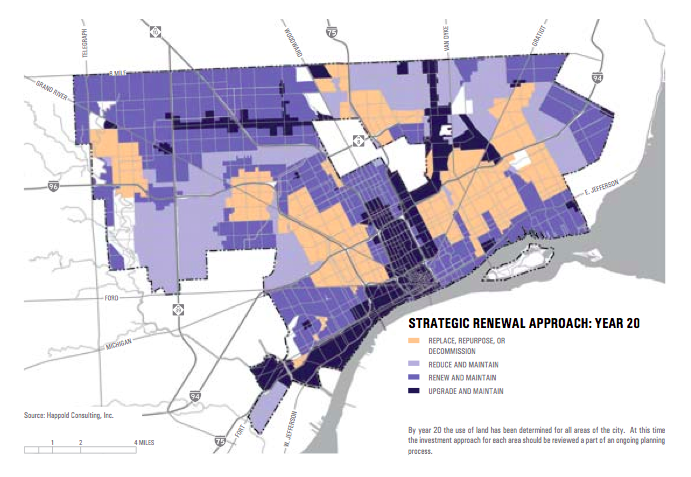


    Some areas are slated for upgrades, others reductions, and some perhaps “decommissioning.”

    The strength of the plan, however, is in its approach to development in which the core concept is to develop a multi-nodal network of neighborhoods, and to have neighborhoods that are strategically differentiated from each others. This is very different from the core-centric or “hub and spoke” model that exists today, and is somewhat similar to my “100 Monument Cirles” concept for Indianapolis. Suffice it to say, I like it. What was missing from this was strengthening neighborhood identify, something Pete Saunders identified as a key weakness of the city.

    A lot of the content behind this is disappointingly standard, however. The focus is green infrastructures, transit, mixed use neighborhoods, etc. This is basically planning conventional wisdom that would be at home in lots of different cities.

    I was pleased to see that they de-emphasized rail transit. Only the M-1 light rail on Woodward remains. The rest of the core network would be BRT. I’d argue that reliable and higher frequency “plain old bus service” is the core need, however. There’s the proposed transit map:
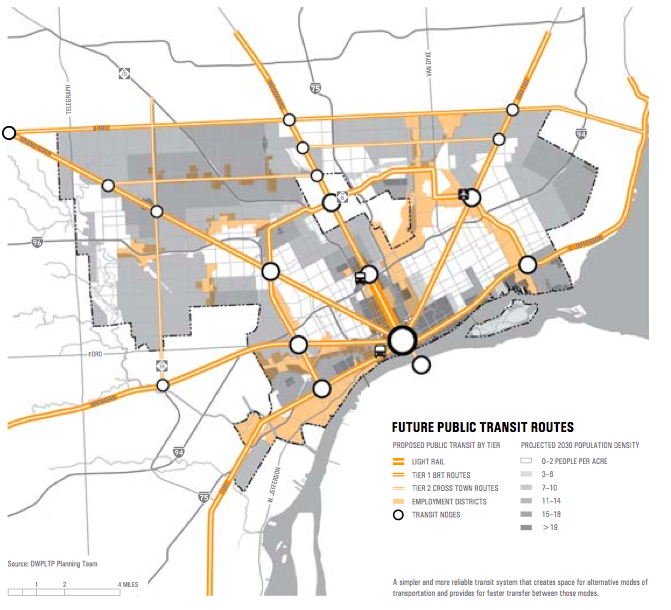


    Some may decry this, but in a city that’s over-infrastructured as it is, the last thing you need is more physical plant to maintain over time.

    And perhaps the focus on green is to some extent understandable given the vast quantity of vacant land in Detroit. One of their intriguing concepts is “landscape as infrastructure”, though it didn’t fully connect with me. They did talk about ideas like medium intensity agriculture and new urban forest typologies. The Hanzt Farm example shows this already underway.

    Lastly, the focus, and especially the near term recommendations around, regulatory restructuring is critical. Detroit benefits today from a sort of laissez-faire environment because government is so ineffective. If government effectiveness were restored, it could easily strangle the good things happening in Detroit, which are largely non-conforming. The answer is to get the regulatory system up to date with what we want to see. I would have preferred to see some types of harder targets around this, such as “85% of new development approved as of right.”

    Economic Development

    The plan considers boosting the number of jobs in Detroit as the most important mission. The city today has the 5th lowest number of jobs per resident of any of the top 100 cities in America, this despite large population losses. Jobs in the city are needed both for residents and rebuild the tax base.

    The numbers on this seemed a bit squishy though. The report says that there is one job for ever four residents of Detroit. As there are about 700,000 residents, this would mean about 175,000 jobs. Yet they say there are 350,000 jobs. (If the resident figure included only working age adults, the projected number of current jobs would be even lower than my estimate).

    The goal by 2030 is to increase this to between 2 and 3 jobs for every resident. This implies simply staggering job growth. Their mid-point population estimate for 2030 is still 700,000, so to go from 0.25/1 to 2/1 or 3/1 implies 700-1100% job growth. This is a CAGR of 11-13% – off the charts. To put it in perspective, metro Houston’s job growth CAGR from 2000 to 2011 was only 1.3%.

    I may be totally off base on what they were getting at in these numbers, but having solid and realistic projections is critical, and, alas, all too rare. Unrealistic growth rate assumptions are common in civic plans, as I highlighted in the example of Cincinnati’s Agenda 360 plan.

    [ Update: I was contacted by someone from the study’s technical committee indicating that the 2 or 3 jobs per resident figure was an error in the PDF that was not present in the official version of the plan. There are apparently about 193,000 jobs in the city, with the plans actual goal a doubling of that over 30 years. Still ambitious, but not mathematically impossible. ]

    The job growth is projected to come from four key target sectors: eds and meds, digital and creative, industrial, and local entrepreneurship. These sectors are reasonable as these things go given where Detroit is, but seem unlikely to drive the major growth they seek, excepting possibly entrepreneurship.

    Neither Wayne State nor Detroit’s health care/life science infrastructure is nation leading. Every city and state in America is chasing eds and meds, and as I noted, the great growth curve in these industries may be over. Additionally, the trend nationally seems to be towards more decentralization of health care infrastructure in metro areas. While I’m sure there will be some growth here, I’m not optimistic about major expansion.

    Similarly, digital and creative jobs are the fad du jour. I strongly doubt anyone will even consider there to be categories of jobs called “digital” or “creative” by 2030. These will be absorbed into industry generally. These are also the same types of sectors being pursued everywhere. Detroit certainly has a concentration of these because of its auto design cluster and just simply being a big city. But other than autos, does it really have a competitive advantage here? The big expansion opportunity would seem to be mostly suburban relocations of the type spearheaded by Dan Gilbert. I wonder how much gas is left in that tank, however.

    The other two are more promising. Local entrepreneurship is a catch-all, but clearly indigenous startups are a great way to boost the economy. The report’s focus on equipping and facilitating minority entrepreneurship was especially relevant. Given the collapse of the city, Detroit’s residents have had to become innovative and self-sufficient of necessity. These skills from the school of hard knocks are in many ways worth much more than formal education when it comes to starting a business. If the city can figure out how to marry these “survival skills” of residents with a commercial orientation, it could be powerful. The same recipe of figuring how to do business in unstable and tough environments is common in the Middle East, where there’s a longstanding entrepreneurial and trading tradition. Unsurprisingly, Middle Easterners have been prominent among those who’ve thrived in Detroit. The challenge is how to activate the similar skills in other ethnicities for business purposes.

    Industrial employment would also seem to be a possible area of growth, but not in the way envisioned in this plan. Industrial employment has been in decline, and new industrial facilities have tended to locate in outlying areas, not traditional urban manufacturing zones.

    However, there are types of industrial businesses that can have a hard time finding a home. For places that are willing to welcome them, there could be opportunity. I noted this around the heavy industrial zone in Northwest Indiana.

    This involves being willing to take on more brown than green industry, however. And it raises a whole host of issues around environmental justice, etc. However, Detroit, as this plan notes, is desperate for jobs. Trade-offs at least need to be considered. Rather than “focusing on the look and feel” of industrial areas, as the plan put it, why not roll out the red carpet for businesses like tanneries, scrap metal processing, etc. that are increasingly unwelcome in places like Chicago? Being friendly to to these types of businesses is probably the most likely road to success in industrial employment.

    Conclusion

    On first read, there’s some interesting stuff in here. They plan is less creative than I’d hoped overall, but probably takes the most aggressive line that was politically realistic. The real questions is, what happens next? Can any of this actually be actioned, or will fiscal and other problems effectively render it a dead letter? Only time will tell.

    Aaron M. Renn is an independent writer on urban affairs and the founder of Telestrian, a data analysis and mapping tool. He writes at The Urbanophile, where this piece originally appeared.
  • World’s Most Affluent Metropolitan Areas: 2012

    Late in 2012, the Brookings Institution published its annual Global Metro Monitor (by Emilia Istrate and Carey Anne Nadeau), which estimates economic data for the 300 world metropolitan areas with the largest gross domestic product (GDP). The Global Metro Monitor also provides estimates of the GDP per capita for each of the qualifying metropolitan areas. The surprising news: after at least five years of the most laggard economic performance in adult memory, the United States continues to dominate the highest GDP per capita data.

    Summary by Geography

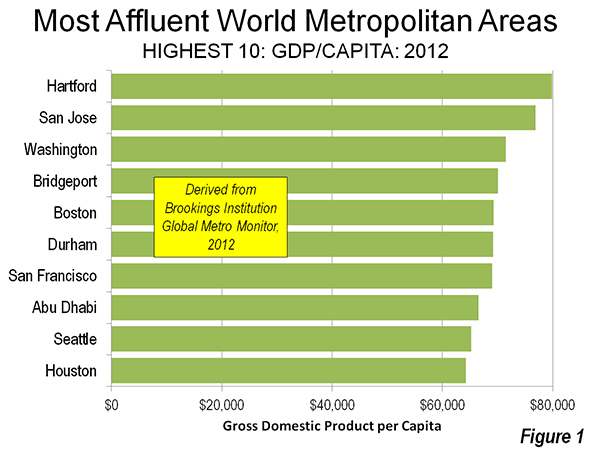
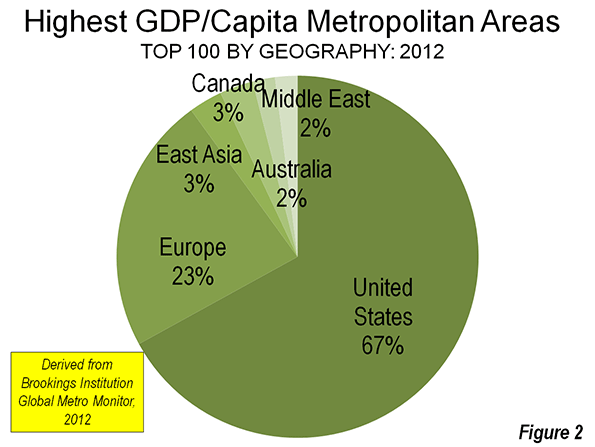
    Among the 10 metropolitan areas with the highest GDP per capita, nine are in the United States (Figure 1). Hartford ($79,900 per capita), for the second year in a row, was ranked the most affluent metropolitan economy by Brookings. The US accounts for 36 of the top 50 metropolitan economies, and 67 of the top 100.

    Europe is also strongly represented, with 23 of the most affluent 100 economies as rated by Brookings. Yet for the most part European metropolitan regions were concentrated between 50th and 100th. Only seven European metropolitan areas made the top 50. The highest ranking was Edinburgh, Scotland ($59,400), at 21st. Two former East Bloc European metropolitan economies also broke into the top 100, Prague at 70th and Moscow at 92nd.

    East Asia placed 3 metropolitan areas in the top 100. Singapore ($62,500) did best at 14th.  Singapore’s ranking behind so many US metropolitan areas may be surprising, since Singapore has a higher GDP per capita than the United States. However, the most affluent US metropolitan areas are more affluent than Singapore, which is both a city and a country. The highest ranking Chinese metropolitan area was Macau, the former Portuguese Special Administrative Region, which ranked 26th.

    No mainland Chinese metropolitan area was in the top 100. However, should China’s economic growth continue at its fast pace, it will not be long before the most affluent metropolitan areas break into the top 100. The strongest candidates could be Suzhou and Wuxi (between Shanghai and Nanjing) and Hong Kong neighbor Shenzhen (Note).

    Two Middle Eastern metropolitan economies were represented in the top 100, both in the top 50. Oil-rich Abu Dhabi ($66,500) was the only metropolitan area outside the United States to place in the top 10, ranking 8th, while Kuwait City ($56,100) ranked 32nd.

    Three of Canada’s largest metropolitan areas made the list, led by Calgary ($61,600), which ranked 15th, while Edmonton ($52,000) rounded out the top 50. Two of Australia’s largest metropolitan areas were represented. The most affluent was Perth ($63,400), which ranked 11th and was the second ranking metropolitan area outside the United States (Figure 2). Perth was also the only Australian metropolitan area to rank in the top 50.

    None of the metropolitan areas of Latin America, South Asia (such as India or Indonesia) or Africa was ranked in the top 100.

    Highlights: Metropolitan Area Highlights

    Some of the metropolitan areas that might have been expected to be ranked the highest were instead well down on the list.

    This is particularly evident with respect to the large financial centers. New York ranked 12th, behind Perth and immediately ahead of Des Moines, which experienced the greatest percentage growth in financial sector jobs in the United States over the last five years (See: The Dispersion of Financial Center Jobs). Other principal financial centers were ranked even lower, London was ranked 51st, behind its perennial competitor, Paris, which was 43rd.

    Other money centers did even worse, with Frankfurt 53rd, Hong Kong 65th, and Tokyo 112th. Canada’s principal financial center, Toronto, was ranked 96th, well behind Calgary and Edmonton (but ahead of Ottawa at 108th, Vancouver at 114th, and Montreal at 150th). Australia’s leading financial center, Sydney, was ranked 88th, far behind Perth but ahead of Melbourne (113th).

    Information technology centers were well represented in the top 10, including San Jose (2nd), Boston (5th), Durham, home to most of Research Triangle Park (6th), San Francisco (7th), and Seattle (9th).

    The high rankings of Abu Dhabi, Perth, Calgary, as well as Houston (10th), Kuwait City (32nd), Oslo (34th) and Edmonton (50th) demonstrate the importance of natural resources to metropolitan economies.

    GDP Per Capita and Urban Population Density

    There has been considerable confusion about cities, productivity and population density. For example, the urban scaling research of the Santa Fe Institute has been misinterpreted to indicate that higher density cities are more productive. In fact, the research specifically denies any such relationship, finding that productivity generally rises simply as a function of higher metropolitan populations (see Density is not the Issue: The Urban Scaling Research). Further, it has often been suggested that as cities grow they become more dense. In contrast, the evidence is overwhelming that cities tend to become less dense as they grow (see The Evolving Urban Form).

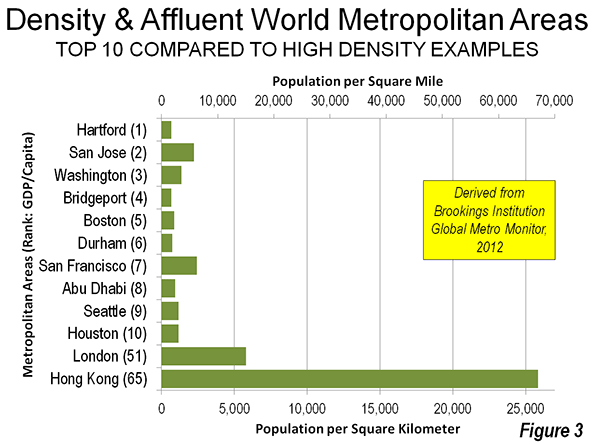
    Supplementing the Brookings Institution GDP per capita estimates with population density estimates (from Demographia World Urban Areas) provides further indication that greater affluence is not associated with higher population density.

    For example, Hartford, with the highest GDP per capita of all 300 metropolitan areas covered by Brookings has an urban area density (1,800 per square mile or 7000 per square kilometer) similar to that of Atlanta, the least dense urban area in the world with more than 2 million population. Bridgeport and Durham (North Carolina) have similarly low densities and are ranked in the top 10. San Jose (5,800 per square mile or 2,200 per square kilometer) and San Francisco (6,300 per square mile or 2,400 per square kilometer) have the highest density urban areas among the 10 most affluent metropolitan areas, though their densities are low to middling by European standards and well below East Asian densities (Figure 3).

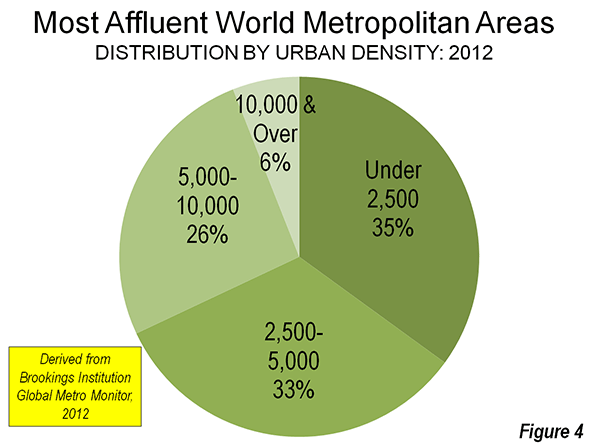
    Out of the 100 most affluent metropolitan areas (Figure 4), 35 have population densities under 2,500 per square mile (1,000 per square kilometer). Many have very low densities, with 17 have density similar to or lower than Atlanta (such as Knoxville, TN, Little Rock, AR, Worcester, MA and Columbia, SC).

    Another 33 metropolitan areas have urban densities between 2,500 and 5,000 per square mile (1,900 per square kilometer). This includes metropolitan areas such as Denver, Perth, Dallas-Fort Worth, Houston, Vancouver, Portland and Seattle. There are also 26 metropolitan areas with between 5000 and 10,000 per square mile (3,900 per square mile), such as Los Angeles, Paris, Stockholm, Toronto and Vienna. There were only six metropolitan areas with urban densities above 10,000 per square mile (3,900 per square kilometer), Macau, Hong Kong, Singapore, London, Kuwait City and Prague.

    The Future?

    The continued strong showing of the United States in the world affluent metropolitan area league tables cannot be taken for granted. While it seems likely that US metropolitan areas will not be displaced by their European counterparts, the strong growth in Canada and Australia could propel their metropolitan areas much higher. And then, there is always China and other increasingly affluent cities of east Asia.

    Wendell Cox is a Visiting Professor, Conservatoire National des Arts et Metiers, Paris and the author of “War on the Dream: How Anti-Sprawl Policy Threatens the Quality of Life.”

    —–

    Note: The GDP per capita of metropolitan areas in China is adjusted, using the population figures from the 2010 census (which included the urban migrant population). The issue is described in Endnote 19 in the Brookings Global Metro Monitor.

  • California’s Politics of Farce

    Karl Marx wrote, "History repeats … first as tragedy, then as farce." Nothing better describes how California, with its unmatched natural and human riches, has begun to morph into what the premier California historian Kevin Starr has called "a failed state" – a term more usually applied to African kleptocracies than a place as blessed as the Golden State.

    The tragedy begins with the collapse of a governance system once widely hailed as a leader in efficiency and foresight but which now perpetually teeters at the brink of insolvency and suffers among the worst credit ratings of all the states. Only 20 years ago, the state’s fiscal debt per capita was just below the national average; now it ranks consistently toward the bottom No surprise, then, that California routinely ranked as the "worst governed" state in America.

    This poor performance has consequences, particularly in terms of business. Today, CEOs rank California as just about the worst place to do business in the country, and have for a remarkable eight years in a row. And it’s not just the plutocrats who are angry; a survey by the economic forecasting firm EMSI shows that, in 2011, California also ranked 50th, just ahead of Michigan, in new business startups.

    Unlike my conservative friends, I do not think the fault lies entirely with the Democrats. Instead, it has to do with the total eclipse of the state’s once-lively two-party system. As Starr has noted, California’s golden age of governance from the 1940s to the 1960s was largely a bipartisan affair, with power shifting between the parties. "Despite their differences," Starr writes, "Democrats and Republicans saw sufficiently eye-to-eye" to embrace policies that drove California’s growth.

    Progressives, for their part, often suggest this paradigm died with the 1978 passage of Proposition 13, which diminished local government and concentrated fiscal power in Sacramento. Yet even as late as early 1990s, when the state was facing a dire recession due to the end of the Cold War, liberal Democrats such as Assembly Speaker Willie Brown and state Sen. John Vasconcellos managed to work well with Republican Gov. Pete Wilson and business leaders like Peter Ueberroth to force policy changes that helped spur the state’s last sustained recovery.

    The more recent demise of California governance stems from demographic trends and political miscalculations that have turned our state increasingly into something akin to Mexico under the old dictatorship of the PRI (Institutional Revolutionary Party). Wilson’s decision to embrace the anti-illegal-immigration measure Prop. 187 as part of his 1994 re-election strategy helped precipitate this shift. Although Prop. 187, which passed easily, helped in the short run, it crippled the Republican Party in the ensuing decades.

    Before 1994, Republicans were capable of winning upward of two-fifths of the Latino vote. But after that, as the Latino portion of the electorate grew, from 7 percent in 1980 to more than 21 percent today, these voters became, much like the African-American vote, essentially a bloc owned by the Democrats. In 2010, Jerry Brown won nearly two-thirds of their votes in his bid to return as governor. Asian voters, despite their decidedly middle-class and entrepreneurial bent, sensed the whiff of nativism among Republicans and also turned to the Democrats. With minority communities’ share of the electorate growing every year, the GOP essentially has backed itself into permanent minority status.

    This has set the stage for a bizarre political farce, where minority representatives in Sacramento – with few exceptions – consistently vote against the interests of their own constituents on issues such as water allocations in the Central Valley or regulations that boost energy and housing prices. In their clamor to join the "progressive" team, they, in effect, are placing the California "dream" outside the reach of the state’s heavily minority working class.

    It’s almost surreal to see people who represent impoverished East Los Angeles and Fresno, for example, vote exactly the same way as those who represent rich, white and older voters in Marin County and Westside Los Angeles. You don’t have to watch "Downton Abbey" to see "upstairs, downstairs" politics. Despite mouthing progressive rhetoric, California’s minority legislators seem intent of creating an increasingly feudalized California.

    And what of the middle class – once the bastion of both the GOP and the kind of "responsible liberalism" that promoted growth under the late Gov. Pat Brown? This largely Anglo group has been shrinking, both for decades as a percentage of California’s population and, during the past 10 years, in absolute numbers. From 2000-10 the number of non-Hispanic whites in the state dropped from 15.8 million to 14.95 million.

    Increasingly, the residual California middle class is either part of the public sector nomenklatura or the swelling ranks of retirees. These people often feel no compulsion to leave California for the reasons – such as weather and high property taxes – that drive their counterparts out of places like New York or Illinois. In contrast, the productive, working-age private middle class, harassed by taxes, regulations and soaring costs, increasingly appears more of an endangered species than the famed Delta smelt.

    Of course, there remain pockets of private sector strength, such as Silicon Valley and Hollywood, as well as the various biomedical and biotech companies that still thrive in places such as Orange County and San Diego. These, however, increasingly represent legacy industries, beneficiaries of past accomplishments and better entrepreneurial conditions. Yet, even here, despite the current tech boom, California’s position over the past decade has declined relative to more business-friendly states.

    In the immediate future, we should expect more of the same from our one-party government. Flush from the passage of Prop. 30, tax increases backed by public sector unions, there is little to restrain them beyond occasional resistance from Gov. Brown. Having made California’s income taxes the highest in the U.S., legislators and local officials are already busily concocting new taxes, fees and another spate of bond issues to prop up the nation’s most-cosseted public sector, and, of course, fund its rich pensions at the expense of mostly middle-class taxpayers.

    Indeed the emphasis on income taxes, representing now close to half of state revenue, creates perverse economic outcomes. With their funds hidden in overseas accounts and other dodges, Hollywood moguls and their Silicon Valley counterparts may hang around, mouthing progressive shibboleths while dining exquisitely. But there is clearly erosion among the less-glamorous entrepreneurial class. The number of households earning above $300,000 dropped by 45,000 from 2006-09, according to the Department of Finance, while those earning under $100,000 has grown by more than 180,000. It’s likely that Prop. 30 will accelerate this trend.

    But it’s not only taxes that will depress growth. Our Mad Hatter one-party, public-sector-dominated state seems keen to press its regulatory assault on employers and job creators. With climate change-related legislation certain to boost already high energy costs, we also can expect industries, from food processing to semiconductors and aerospace, to continue heading to friendlier locales.

    Unless these policies are challenged, California will continue to underperform well below its potential. Even worse, a state that created the modern American Dream of upward mobility will continue to devolve toward a kind of neofeudalism dominated by a few rich, with many poor and a well-fed, tenured government caste. The only way to halt this continuing farce in Sacramento is for Californians of all backgrounds to recognize that government that so earnestly claims to serve "the people" is doing anything but that.

    Joel Kotkin is executive editor of NewGeography.com and a distinguished presidential fellow in urban futures at Chapman University, and a member of the editorial board of the Orange County Register. He is author of The City: A Global History and The Next Hundred Million: America in 2050. His most recent study, The Rise of Postfamilialism, has been widely discussed and distributed internationally. He lives in Los Angeles, CA.

    This piece originally appeared in the Orange County Register.

  • The New Power Class Who Will Profit From Obama’s Second Term

    When President Obama takes the oath of office for the second time, he will also usher in a new era in American power politics. Whereas the old left-wing definition of “who rules” focused on large corporations, banks, energy companies and agribusinesses, the Obama-era power structure represents a major transformation.

    This shift stems, in large part, from the movement from a predominately resource and tangible goods-based economy to an information-based one. In the past, political struggles were largely fought over how to divide up the spoils generated by the basic productive economy; labor, investors and management all shared a belief in the ethos of economic growth, manufacturing and resource extraction.

    In contrast, today’s new hegemons hail almost entirely from outside the material economy, and many come from outside the realm of the market system entirely. Daniel Bell, in his landmark 1973 The Coming of Post-Industrial Society, may have been the first to identify this ascension to “pre-eminence of the professional and technical class.” This new “priesthood of power,” as he put it, would eventually overturn the traditional hierarchies based on land, corporate and financial assets.

    Forty years later the outlines of this transformation are clear. Contrary to the conservative claims of Obama’s “socialist” tendencies, the administration is quite comfortable with such capitalist sectors as entertainment, the news media and the software side of the technology industry, particularly social media. The big difference is these firms derive their fortunes not from the soil and locally crafted manufacturers, but from the manipulation of ideas, concepts and images.

    Apple, Google, Facebook, Amazon and Microsoft are far from “the workers of the world,” but closer to modern-day robber barons. Through their own ingenuity, access to capital and often oligopolistic hold on lucrative markets, they have enjoyed one of the greatest accumulations of wealth in recent economic history, even amidst generally declining earnings, rising poverty and inequality among their fellow Americans.

    Last year the tech oligarchs emerged as major political players. Microsoft, Google and their employees were the largest private-sector donors to the president. More important still, tech workers also provided the president and his party with a unique set of digital tools that helped identify potential supporters among traditionally uninformed and disinterested voters, particularly among the young.

    An even greater beneficiary of the second term will be the administrative class, who by their nature live largely outside the market system. This group, which I call the new clerisy, is based largely in academia and the federal bureaucracy, whose numbers and distinct privileges have grown throughout the past half century.

    Even in tough times, high-level academics enjoy tenure and have been largely spared from job cuts. Between late 2007 and mid-2009, the number of U.S. federal workers earning more than $150,000 more than doubled, even as the economy fell into a deep recession. Even as the private sector, and state government employment has fallen, the ranks of federal nomenklatura have swelled so much that Washington, D.C., has replaced New York as the wealthiest region in the country.

    As a former professor at the prestigious University of Chicago, and a longtime ally of public-sector unions, Barack Obama’s political persona is all but indistinguishable from these new hierarchies. Their support for him has become critical, particularly as the onetime “hedge fund candidate,” decided to wage a very effective class warfare campaign on the hapless Mitt Romney.

    This decreased Obama’s support among the plutocrats, even if they have thrived under his watch, but he made up for this in part by tapping bureaucracies that benefit from expanding government. Indeed the clerisy accounted for five of the top eight sources of Obama’s campaign funding, led by the University of California, the federal workforce, Harvard , Columbia and Stanford. Academic support for Obama was remarkably lock-step: a remarkable 96% of all donations from the Ivy League went to the president, something more reminiscent of Soviet Russia than a properly functioning pluralistic academy.

    To understand the possible implications of the new power arrangement, it is critical to understand the nature of the new clerisy. Unlike traditional capitalist power groups, including private-sector organized labor, the clerisy’s power derives not primarily through economic influence per se but through its growing power to inform opinion and regulate everything from how people live to what industries will be allowed to grow, or die.

    The clerisy shares a kind of mission which Bell described as the rational “ordering of mass society.” Like the bishops and parish priests of the feudal past, or the public intellectuals, university dons and Anglican worthies of early 19th century Britain, today’s clerisy attempts to impart on the masses today’s distinctly secular “truths,” on issues ranging from the nature of justice, race and gender to the environment. Academics, for example, increasingly regulate speech along politically correct lines, and indoctrinate the young while the media shape their perceptions of reality.

    Most distinctive about the clerisy is their unanimity of views. On campus today, there is broad agreement on a host of issues from gay marriage, affirmative action and what are perceived as “women’s” issues to an almost religious environmentalism that is contemptuous toward traditional industry and anything that smacks of traditional middle class suburban values. These views have shaped many of the perceptions of the current millennial generation, whose conversion to the clerical orthodoxy has caught most traditional conservatives utterly flat-footed.

    As befits a technological age, the new clerisy also enjoys the sanction of what Bell defined as the “creative elite of scientists.” Prominent examples include the Secretary of Energy, the Nobel Prize-winning physicist David Chu; science advisor John Holdren; NASA’s James Hansen; and the board of the U.N.’s Intergovernmental Panel on Climate Change. In the words of New York Times hyper-partisan Charles Blow, Republicans have devolved into the “creationist party.” In contrast Obama reigns gloriously hailed as “the sun king” of official science.

    Let’s be clear — this new ascendant class is no threat to either the “one percent,”  or even the much smaller decimal groups. Historically, the already rich and large economic interests often profit in a hyper-regulated state; the clerisy’s actions can often stifle competition by increasing the cost of entry for unwelcome new players. Like Cardinal Richelieu or Louis XIV’s finance minister, Jean-Baptiste Colbert, our modern-day dirigistes favor state-directed capital that has benefited, among others, “green” capitalists, Wall Street “too big to fail” firms and, of course, General Motors.

    More disturbing still may be the clerisy’s regal disregard for democratic give and take. Both traditional hierarchies, or new ones like the Bolsheviks after the 1917 revolution, disdain popular will as intrinsically lacking in scientific judgment and societal wisdom. Some leading figures in the clerisy, such as former Obama budget advisor Peter Orszag, openly argue for shifting power from naturally contentious elected bodies to credentialed “experts” operating in places Washington, Brussels or the United Nations.

    Such experts, of course, see little need for give and take with their intellectual inferiors, in Congress or elsewhere. This attitude is expressed in the administration’s increasing use of executive orders to promote policy goals such as better gun control, reduced greenhouse emissions or reform of immigration. Whatever one’s views on these issues, that they are increasingly settled outside Congress represents a troublesome notion.

    Like empowered bureaucrats everywhere, the clerisy also sometimes reserves a nice “taste” for themselves, much as the old bishops and upper clergy indulged in luxury and even prohibited pleasures of the flesh. Just look at the lavish payouts accorded to Orszag and Treasury Secretary-designate Jacob Lew, who, after serving in the bureaucracy, make millions off the same Wall Street firms that have so benefited from administration policies.

    So who loses in the new order? Certainly unfashionable companies  – oil firms, agribusiness concerns, suburban homebuilders — face tougher times from regulators and the mainstream media . But the biggest losers likely will be the small business-oriented middle class. Not surprisingly Main Street, far more than Wall Street, harbors the gravest pessimism about the president’s second term.

    The small business owner, the suburban homeowner, the family farmer or skilled construction tradesperson are intrinsically ill-suited to playing the the insiders’ game in Washington. Played up to at election time, they find their concerns promptly abandoned thereafter, outliers more than ever in a refashioned political order.

    Joel Kotkin is executive editor of NewGeography.com and a distinguished presidential fellow in urban futures at Chapman University, and a member of the editorial board of the Orange County Register . He is author of The City: A Global History and The Next Hundred Million: America in 2050. His most recent study, The Rise of Postfamilialism, has been widely discussed and distributed internationally. He lives in Los Angeles, CA.

    This piece originally appeared at Forbes.com.

    Official White House Photo by Pete Souza.

  • Rust Belt Cities: Invest in Odysseus, Not Barney Fife

    Given its legacy of shrinking, the Rust Belt has issues. The issues arose naturally, and relate to the fact things leave, or that so much has left. Particularly, when things leave, the mind—both the individual and the collective city mind—can get protective and restrictive. Neediness arises. The smell of desperation ensues like a pall that can tend to hang over cities, influencing decision making on all levels.

    Enter “brain drain”, or that term coined to refer to the outmigration of an area’s educated citizens, particularly it’s young. You know the drill: Johnny goes to State college, comes back home for a spell, but then leaves Cleveland, Ohio for Chicago or New York. That is brain drain. And city leaders hate it, spending billions of dollars to stop it—often at the cost of coming off ridiculous, lame.

    For instance, in Pittsburgh, there was a civic booster campaign thought up to keep educated folks from going. It was called “Boarder Guard Bob”. According to researcher Chris Briem, “Bob” was a Smokey-the-Bear-type of public service announcement made into a Barney Fife character, with the billboard-size messaging of “Bob” intended to “stop young people at Western Pennsylvania’s borders before they had a chance to leave for other cities”. And while this particular retention strategy (luckily) never went to print, various “plug the brain drain” strategies persist in one form or another at exorbitant cost to taxpayers.

    But beyond the near-pitiful messaging, there are major problems with the brain drain approach, especially from an economic development perspective. For example, when, as a community, you are intentionally telling your citizen’s not to go, you are asking them to sacrifice personal development for the benefit of a place. To this point, my colleague, Jim Russell—a leading thinker in brain drain boondoggles and blogger at Burgh Diaspora—says it best, stating: “Discouraging geographic mobility is the same as restricting access to higher education”. In other words, it’s like telling Johnny to stick with his high school diploma so as to forego leaving the community for a 4-year degree.

    What’s more, getting people to stay put does little to grow a local economy. In fact it hurts it. Because leaving home is often a rite of passage. It develops a person. I mean, can you imagine if there was no odyssey in the epic Odyssey? If so, Odysseus wouldn’t be the changed man with perspective and experience as he was when he returned back to his homeland, and so there’d be no “there” there. In this sense, the Rust Belt needs to engage their young to embark on their own “Hero Journey” if only to gain skills and broaden geographic connections. This is international economics 101 (see China, India, Brazil, etc.). It should be a domestic economic priority for the Rust Belt, and it would be if only the Cleveland’s of the world could let go of the protectionism that defines their longstanding existential fears of shrinking into one big pile of ruin porn.

    Of course confidently encouraging outmigration is part and parcel with an understanding that many expats will “boomerang” back. But many are, and at a faster rate. To wit: as the alpha cities of the America like NYC get too expensive or creatively-class cute, many Rust Belt refugees are pivoting back from a certain left-wanting lifestyle if only for the opportunity, tradition, and honest-to-god reality that is “Rust Belt Chic”. And when they do, they often become “economic ass kickers”, which is term Russell uses to exemplify the fruits of the Hero Journey that is not only individually experienced, but felt in the local economy as well.

    Take Sean Watterson, the co-proprietor of the wildly successful restaurant the Happy Dog on Cleveland’s Near West Side. He moved back from D.C. because, according to a recent Plain Dealer article, “Cleveland-ness is like Polish-ness or Irish-ness. It’s an ethnicity”. Here, Watterson not only runs a great hot dog business, but uses his establishment to advance a circulation of ideas by hosting a variety of events like “Life, the Universe, and Hot Dogs”, which is a series hosted by researchers from the Institute for the Society of Origins. Another big hit is the live performances by members of the Cleveland Orchestra called Classical Revolutions.

    Cool sounding events, sure. But there is more to it than that, as such happenings spark cross-fertilization between parts of Cleveland—the blue collar West Side and the intelligentsia of the East Side—that have long been divided, often at the cost of Cleveland as a place of cultural and economic innovation. And how exactly does Watterson’s own “Hero Journey” come into play in his self-stated goal to break down barriers “between east and west and between high culture and low culture”? It likely relates to the fact he experienced experience outside of a legacy city bubble that enabled him to see and cross bridges that others have difficulty envisioning.

    Now, does this mean that cities simply need to let people leave to prosper? Obviously not. If the place expats are boomeranging back to is stagnant and disparate, with openness and connection disabled by a collective insular mentality that: “that’s just the way things are done around here”, well, the boomeranging effect won’t hold. And the economic ass-kickers won’t ass-kick.

    The goal, then, of cities should be on fostering return migrant connections, or to know who they are, why they are there, and to help get them together so that their collective unchained perspective can pop bubbles of inert status quo. This need is real. For instance, take this first-hand return migrant account published in Rust Belt Chic by Dana Marie Textoris:

    Funny how your location-based identity, your physical and mental place in the world, can flip like a switch: Before I was a Clevelander managing to make it in San Francisco….right now I feel a lot like a San Franciscan stuck in Cleveland. In either place, I felt just a little bit Other. A bit of a novelty. Just a tad on the outside looking in. Where does that leave me? Where is home? As I type this, I realize, with sort of an internal groan, that the place I’m left in, the guide to what I’m searching for, is probably just right here, inside me, where my two lives — West Coast and Midwest — are now combined. I’m not really a true Clevelander anymore…I’ve picked up way too much San Francisco for that. The balance I’ve become, a little of this and that, is just what I’m hoping I’ll find, one day.

    So, to all Rust Belt cities—this is where your attention must be turned: not on the ones who are leaving for good reason, but on those returning who have not left for good. They have brought the path of their self-discovery back to your doorstep.

    Don’t close the door by screaming at the backs of others.

    Richey Piiparinen is a writer and policy researcher based in Cleveland. He is co-editor of Rust Belt Chic: The Cleveland Anthology. Read more from him at his blog and at Rust Belt Chic.

  • California’s Demographic Dilemma

    It’s been nearly 20 years since California Gov. Pete Wilson won re-election by tying his campaign to the anti-illegal immigrant measure Proposition 187. Ads featuring grainy images of presumably young Hispanic males crossing the border energized a largely white electorate terrified of being overwhelmed, financially and socially, by the incoming foreign hordes.

    The demographic dilemma facing California today might be better illustrated by pictures of aging hippies with gray ponytails, of legions in wheel-chairs, seeking out the best rest home and unemployed young people on the street corner, watching while middle-age families drive away, seeking to fulfill mundane middle-class dreams in other states.

    The vital, youthful California I encountered when moving here more than 40 years ago soon could be a thing of the past – if we don’t address the root causes of an impending demographic decline. The days of fast population growth have certainly passed; the state’s population growth barely equaled the national average in the past decade. In the urban strips along the coasts, particularly in the Los Angeles Basin, growth has been as little or half that level.

    To be sure, particularly in this region, few would want to see a return to breakneck population growth. But there’s little denying that California has shifted from a vibrant magnet for the young and ambitious to a state increasingly bifurcated between an aging, predominately white coastal population and a largely impoverished, heavily Hispanic interior. This evolution, as suggested in last week’s essay, has much to do with what passes for "progressive" policies – high taxation, regulation and an Ecotopian delusion that threatens to crush the hopes of many blue-collar and middle-class Californians.

    California’s consistent net outmigration over the past two decades continues, albeit at a slower rate. Over that period, California, notes a recent Manhattan Institute report, has lost a net 3.4 million people. This outflow has slowed with the recession and housing bust, but could swell again, as in the past, when the housing market recovers, and people can sell their homes.

    This long-term outmigration likely stems from a combination of persistently weak job growth, relatively higher unemployment rates amid generally far higher housing prices. Until 1970, notes demographer Wendell Cox housing prices in California, including Los Angeles and Orange County, were generally in line with national averages, adjusted for income.

    But over the past four decades, California’s housing prices relative to income have mushroomed to more than twice the national average. This is particularly true in places such as Orange County, where housing prices, particularly near the coast, are so high that younger even solidly middle-class families have little chance to enter the market.

    These high prices are the result not merely of market forces, but also the perverse impact of Proposition 13, which allows people to stay longer in their homes, as well as regulatory restraints on new housing construction. The regulatory vise, if anything, is almost certain to get worse as the state’s "climate change"-inspired regulations seek to all but ban new single-family house construction, all but guaranteeing higher prices.

    Until recently, the impact of net outmigration has been ameliorated by immigration, not just the kind memorialized in Wilson’s grainy ads but of the legal variety, as well. Over the past decade, however, immigration enforcement data indicates that California has suffered a gradual erosion in its appeal to immigrants; this is particularly true for the L.A. Basin. In 2000, for example, Los Angeles-Orange County received 120,000 new immigrants; a decade later the annual intake had dropped by 87,000.

    Essentially, immigration into the L.A. Basin fell 27.5 percent while immigration nationwide remained essentially stable; the numbers of Houston, Dallas, Seattle, Washington and New York, in contrast, remained level or grew.

    Particularly troubling has been the relative decline in Asian immigrants, whose numbers now surpass Hispanics, and who also tend to be better educated than other newcomers. An analysis of migration of Asians conducted by demographer Wendell Cox, shows Asians heading increasingly to places like Houston, Dallas-Fort Worth, Raleigh, N.C., and Nashville, Tenn. Still home to the largest concentration of Asian-Americans, the L.A. Basin’s growth rate is now among the lowest in the nation, 24 percent in the past decade, compared with 39 percent in New York, and more than 70 percent in Dallas-Fort Worth and Houston.

    Some, like USC’s Dowell Myers, suggest slowing migration and population growth may actually be a positive, and claims "the demographic picture is brighter than it is has been in decades." He suggests that, rather than depend on the energy of newcomers, we now ride on "the skills of homegrown Californians."

    Certainly, slower growth may help with our traffic problems and even provide a break on housing inflation, but the contours of our demographics appear less than favorable. Over the past decade, for example, virtually all the largest metropolitan areas – including Silicon Valley – have seen slower percentage growth in college graduates than the national average. The big exception has been Riverside-San Bernardino, which started from a low base but has appeared to attract some college-educated people from the more expensive coastal regions.

    In contrast, largest rate of growth in educated people has taken place in regions such as Raleigh, N.C.; Austin, Texas, Phoenix and Houston; all these cities have increased the number of bachelor’s degrees at least one-third more quickly than the major California cities. Although California retains a strong educational edge, this is gradually eroding, particularly among our younger cohorts. In the population over age 65, California ranks an impressive fourth in terms of people with bachelor’s or higher degrees; but in the population under 35 our ranking falls to a mediocre 28th. If we are becoming more reliant on our native sons than in the past, we may be facing some serious trouble.

    This pattern can also be seen in those with graduate educations, where we are also losing our edge, ranking 19th among the younger cohort. More worrying still is the dismal situation at our grade schools, where California now ranks an abysmal 50th in high school attainment. Our students now rank among the worst-performing in the nation in such critical areas as science and math.

    If these issues are not addressed forcefully, what then is our demographic trajectory? One element seems to be a decline in the numbers of children, particularly in the expensive coastal areas. Over the past decade, according to the Census, the Los Angeles-Orange County region has suffered among the most precipitous drops in its population under age 15 – more than 12 percent – than any large U.S. metropolitan area.

    The numbers are staggering: in 2010 the region had 363,000 fewer people under age 15 than a decade earlier, while competitors such as Dallas-Fort Worth and Houston increased their youngsters by over 250,000 each. Orange County alone suffered an 8 percent decline in its under-15 population, a net loss of 54,000.

    If current trends continue, we may not be able to rely on immigrants to make up for an nascent demographic or vitality deficit. In fact, demographer Ali Modarres notes that L.A.’s foreign born-population is now older than the native-born, as their offspring head off for opportunities in lower-cost, faster-growing regions.

    Ultimately the state’s political and economic leadership needs to confront these demographic shifts, and the potential threat they pose to our prosperity. We can’t just delude ourselves that we attract the "best and brightest" from other states without creating improving the basics critical to families, from other states and abroad, such as education, reasonable housing costs and business climate. California ‘s beauty, great weather and a bounteous legacy remain great assets, but the state can no longer rest on its laurels if it hope to attract, and retain, a productive population capable of rebuilding our state’s now-faded promise.

    Joel Kotkin is executive editor of NewGeography.com and a distinguished presidential fellow in urban futures at Chapman University, and a member of the editorial board of the Orange County Register . He is author of The City: A Global History and The Next Hundred Million: America in 2050. His most recent study, The Rise of Postfamilialism, has been widely discussed and distributed internationally. He lives in Los Angeles, CA.

    This piece originally appeared in the Orange County Register.

    Photo illustration by krazydad/jbum

  • The New Places Where America’s Tech Future Is Taking Shape

    Technology is reshaping our economic geography, but there’s disagreement as to how. Much of the media and pundits like Richard Florida assert that the tech revolution is bound to be centralized in the dense, often “hip” places where  “smart” people cluster. Some, like Slate’s David Talbot, even fear the new tech wave may erode whatever soul is left to increasingly family free, neo-gilded age San Francisco.

    Such claims have been bolstered by the tech boom of the past few years — especially the explosion of social media firms in places like Manhattan and San Francisco. Yet longer-term trends in tech employment suggest such favored media memes will ultimately prove well off the mark. Indeed, according to an analysis by the Praxis Strategy Group, the fastest growth over the past decade in STEM (science, technology, engineering and mathematics-related) employment has taken place not in the most fashionable cities but smaller, less dense metropolitan areas.

    From 2001 to 2012, STEM employment actually was essentially flat in the San Francisco and Boston regions and  declined 12.6% in San Jose. The country’s three largest mega regions — Chicago, New York and Los Angeles — all lost tech jobs over the past decade. In contrast, double-digit rate expansions of tech employment have occurred in lower-density metro areas such as Austin, Texas; Raleigh, N.C.; Columbus, Ohio; Houston and Salt Lake City. Indeed, among the larger established tech regions, the only real winners have been Seattle, with its diversified and heavily suburbanized economy, and greater Washington, D.C., the parasitical beneficiary of an ever-expanding federal power, where the number of STEM jobs grew 21% from 2001 to 2012, better than any other of the 51 largest U.S. metropolitan statistical areas over that period.

    The question is whether the last two to three years, during which places like San Francisco, New York and Boston have enjoyed stronger STEM growth than their peripheries, represents a paradigm shift or is just a cyclical phenomenon. As with tech in general, the long-term trends are not so city-centric; over the past decade,  the core counties nationwide overall have lost about 1.1% of their tech jobs while more peripheral areas have experienced a gain of 3.5%.

    Today’s urban tech boom looks a lot like a rerun of the dot-com boom of the late 1990s. In that period media-savvy dot-com startups proliferated in such places as South of Market in San Francisco and the Silicon Alley in lower Manhattan. At their height, these firms and their founders were as likely to be covered in the fashion and lifestyle sections as on the business pages.

    Yet by the early 2000s, many of these dot-com darlings had merged, been acquired or simply gone out of business. Anchored largely on hype, they fell victim to flawed business models, and rapid industry consolidation.  In San Francisco, for example, tech employment crashed from a high of 34,000 in 2000 to barely 18,000 four years later. Silicon Alley suffered a similar downward trajectory, losing 15,000 of its 50,000 information jobs in the first five years of the decade.

    The peaking social media boom, marked by the weak performance of Facebook’s IPO last year, suggest another bust at the end of the “hype cycle.” Urban darlings such as  San Francisco’s Zynga and Chicago’s Groupon have floundered in spectacular fashion. More are likely to join them.

    These firms may have generated buzz, but they have done not so well at the mundane task of making money. One problem may be that  the most avid users of social media are largely young people from the “screwed” generation who lack much in the way of spending power — a clear turnoff to advertisers. Now , with venture capital flows declining overall,  cooler heads in the Valley are shifting bets to more business-oriented engineering and research-intensive fields more grounded in marketplace realities.

    And what about the future of the Valley — still home to virtually all the Bay Area’s top tech firms? Its glory days as a job generator and economic exemplar seem to have passed. Between 1970 and 1990 the number of people employed in tech in the Valley more than doubled to 268,000, and then burgeoned to over 540,000 in the 1990s. At the peak of the last tech boom in 2001, the unemployment rate in Santa Clara County was a tiny 3%; the Silicon Valley Manufacturing Group confidently predicted there would be another 200,000 jobs by 2010.

    However, at what may be the peak of the current boom, the number of tech jobs in the Valley remains down from a decade ago and unemployment is over 7.7%, just around the national average. In reality, social media was never going to reverse the downward trajectory in the rate of job growth. Old-line companies like  Hewlett-Packard or Intel, with over 50,000 employees in the U.S. alone, were capable of creating a broad range of opportunities for workers; in contrast, the social media big three of Facebook, LinkedIn and Twitter together have less than 6,500 employees.

    As the social media industry matures and consolidates,   employment is likely to continue shifting to less expensive, business-friendly areas. The Bay Area, where the overall cost of living is 68% higher than the national average and housing is the most expensive in the nation, may continue to attract and retain only the highest-end, best-paid workers. But for the most part they will follow the path of established tech firms such as  Apple, Intel, Adobe, eBay and IBM  to lower-cost places like Austin, Columbus and Salt Lake City. A similar phenomena also can be seen in other urban-centered industries, such as entertainment and finance where  virtually all employment growth is in places like St. Louis, Des Moines and Phoenix, even as the largest centers, New York, Chicago, Boston, Los Angeles and San Francisco have suffered significant job losses.

    Demographic forces may further accelerate these trends. The critical fuel for tech growth, educated labor, is now expanding faster in places like Columbus, Austin, Raleigh, Dallas and Houston than in Boston, San Jose and San Francisco. The old centers may still enjoy a lead in brains, but other places are catching up rapidly.

    Companies may also discover that with many millennials starting to hit their 30s, some may seek to leave their apartments to buy houses and start families. In California new local regulations essentially ban the construction of new single-family homes in some of the state’s biggest metro areas, pricing this option out of reach for all but a few, and forcing a key demographic group to seek residence elsewhere.

    Under these conditions, Silicon Valley will be forced to rely increasingly on inertia and mustering of financial resources than innovation. As a result, the nation’s tech map will continue to expand from the Bay Area, Boston, Seattle and Southern California to emerging metropolitan areas in North Carolina, Texas, Utah, Colorado and the Pacific Northwest. In the future parts of Florida, Phoenix, and even Great Plains cities like Sioux Falls and Fargo could also achieve some critical mass.

    Ultimately, one of the main dynamics of the information age — that even sophisticated tasks  can be done from anywhere — works against the dominion of single hegemonic industry centers like Wall Street, Hollywood and Silicon Valley. The tech sector is particularly vulnerable to declustering, due in large part thanks to the freedom from geography created by technologies of its own making.   Silicon Valley may continue to reap riches from the periodic technology  gold rush , but in the longer term, tech growth will continue its long-term dispersion to ever more parts of the country.

    STEM Occupations in the Nation’s 51 Largest Metropolitan Areas
    MSA Name 2001 – 2012 Growth 2005 – 2012 Growth 2010 – 2012 Growth 2012 Location Quotient LQ Change, 2001 – 2012
    Washington-Arlington-Alexandria, DC-VA-MD-WV 21.1% 12.7% 3.7% 2.19 10.6%
    Riverside-San Bernardino-Ontario, CA 18.6% -1.4% 2.2% 0.57 1.8%
    San Antonio-New Braunfels, TX 18.3% 17.2% 4.5% 0.83 1.2%
    Baltimore-Towson, MD 17.9% 11.4% 3.9% 1.37 15.1%
    Raleigh-Cary, NC 17.9% 14.6% 6.2% 1.53 0.0%
    Las Vegas-Paradise, NV 17.2% -2.6% 0.8% 0.52 4.0%
    Salt Lake City, UT 16.3% 18.1% 7.4% 1.16 4.5%
    Houston-Sugar Land-Baytown, TX 15.7% 17.2% 6.6% 1.20 -2.4%
    Seattle-Tacoma-Bellevue, WA 15.4% 22.2% 6.7% 1.86 8.1%
    Jacksonville, FL 13.0% 6.5% 2.4% 0.87 8.7%
    Austin-Round Rock-San Marcos, TX 12.2% 17.2% 9.1% 1.82 -8.5%
    San Diego-Carlsbad-San Marcos, CA 11.3% 8.0% 2.1% 1.38 6.2%
    Columbus, OH 10.4% 12.8% 4.7% 1.27 7.6%
    Orlando-Kissimmee-Sanford, FL 9.4% -1.1% 0.8% 0.84 -3.4%
    Indianapolis-Carmel, IN 6.9% 6.5% 2.7% 1.04 2.0%
    Nashville-Davidson–Murfreesboro–Franklin, TN 6.7% 3.5% 2.4% 0.77 -1.3%
    Sacramento–Arden-Arcade–Roseville, CA 6.4% 3.5% 0.4% 1.33 2.3%
    Oklahoma City, OK 5.5% 9.6% 6.4% 0.89 -1.1%
    Pittsburgh, PA 5.3% 10.3% 4.9% 1.07 5.9%
    Virginia Beach-Norfolk-Newport News, VA-NC 4.8% 2.3% 0.5% 1.10 3.8%
    Charlotte-Gastonia-Rock Hill, NC-SC 4.3% 8.2% 5.7% 0.99 -3.9%
    Kansas City, MO-KS 4.0% 5.8% 4.6% 1.12 4.7%
    Richmond, VA 3.8% 4.4% 3.4% 0.99 0.0%
    Cincinnati-Middletown, OH-KY-IN 3.7% 5.5% 6.8% 1.02 4.1%
    Buffalo-Niagara Falls, NY 3.2% 6.4% 3.6% 0.90 4.7%
    Dallas-Fort Worth-Arlington, TX 3.1% 11.4% 5.5% 1.19 -5.6%
    San Francisco-Oakland-Fremont, CA 2.5% 15.0% 9.9% 1.63 5.8%
    Phoenix-Mesa-Glendale, AZ 2.3% 3.5% 3.9% 1.05 -6.3%
    Minneapolis-St. Paul-Bloomington, MN-WI 2.2% 6.7% 5.9% 1.31 1.6%
    Portland-Vancouver-Hillsboro, OR-WA 1.6% 6.4% 5.4% 1.19 -3.3%
    Louisville/Jefferson County, KY-IN 0.9% 9.6% 6.9% 0.76 0.0%
    Denver-Aurora-Broomfield, CO 0.5% 10.8% 3.7% 1.43 -2.1%
    Atlanta-Sandy Springs-Marietta, GA -1.0% 5.5% 6.5% 1.07 -2.7%
    Boston-Cambridge-Quincy, MA-NH -1.3% 11.2% 6.0% 1.64 -1.2%
    Providence-New Bedford-Fall River, RI-MA -1.5% -1.6% 1.9% 0.88 2.3%
    Philadelphia-Camden-Wilmington, PA-NJ-DE-MD -2.8% -1.4% 1.4% 1.06 -1.9%
    Hartford-West Hartford-East Hartford, CT -4.5% 1.5% 0.3% 1.10 -3.5%
    New York-Northern New Jersey-Long Island, NY-NJ-PA -4.6% 2.8% 3.2% 0.90 -6.2%
    St. Louis, MO-IL -4.8% -1.7% 1.4% 1.05 -0.9%
    Milwaukee-Waukesha-West Allis, WI -6.1% -0.8% 4.0% 1.00 0.0%
    Tampa-St. Petersburg-Clearwater, FL -6.3% -4.3% 2.5% 0.89 -3.3%
    Miami-Fort Lauderdale-Pompano Beach, FL -6.4% -8.3% 0.6% 0.67 -8.2%
    Los Angeles-Long Beach-Santa Ana, CA -7.1% -3.5% 3.1% 0.98 -5.8%
    Memphis, TN-MS-AR -7.3% -4.0% 0.7% 0.62 -4.6%
    Cleveland-Elyria-Mentor, OH -8.8% -2.1% 4.3% 0.89 1.1%
    Chicago-Joliet-Naperville, IL-IN-WI -10.8% -1.4% 3.5% 0.87 -7.4%
    Birmingham-Hoover, AL -11.4% -8.0% -2.0% 0.76 -8.4%
    Rochester, NY -12.0% -2.1% 4.1% 1.14 -10.2%
    San Jose-Sunnyvale-Santa Clara, CA -12.6% 12.4% 8.3% 3.18 -4.8%
    New Orleans-Metairie-Kenner, LA -16.0% -7.4% -2.4% 0.74 0.0%
    Detroit-Warren-Livonia, MI -17.7% -10.3% 10.5% 1.42 -3.4%
    Analysis by Mark Schill, Praxis Strategy Group
    Data Source: EMSI 2012.4 Class of Worker – QCEW Employees, Non-QCEW Employees & Self-Employed 

    The LQ (location quotient) figure in the table above is the local share of jobs that are STEM occupations divided by the national share of jobs that are STEM occupations. A concentration of 1.0 indicates that a region has the same concentration of STEM occupations as the nation. The analysis covers 80 STEM occupations in all industries.

    Joel Kotkin is executive editor of NewGeography.com and a distinguished presidential fellow in urban futures at Chapman University, and a member of the editorial board of the Orange County Register . He is author of The City: A Global History and The Next Hundred Million: America in 2050. His most recent study, The Rise of Postfamilialism, has been widely discussed and distributed internationally. He lives in Los Angeles, CA.

    This piece originally appeared at Forbes.com.

    Computer engineer photo by BigStockPhoto.com.