Category: Economics

  • Cities of Aspiration

    Drew Klacik’s recent post on how he ended up in Indianapolis got me thinking about the unique status of what I’d describe as “cities of aspiration.” Pretty much all cities seem to be reasonably good at attracting people in the following cases:

    1. Recruiting someone to a specific career or other opportunity. In this case, the value of the opportunity is really the question at stake. The attractiveness of the community itself is generally a secondary consideration though may have an impact pro or con.

    2. Luring residents based on a family connection. This would often be the case for “boomerang migration” – people who left and came back, ordinarily after marriage and children. More broadly we could think of this as retaining or attracting those with a historic connection to a place, such as being born there.

    3. Drawing people from a city’s natural catchment area. The size of this area depends on a variety of factors, but pretty much every city has some natural hinterland from which it draws people.

    I call this the “normal model” of attraction. Clearly, a place like Indianapolis does well on all of these types of attraction, as do most similar sized cities I’d argue. That’s how Drew ended up in Indy.

    However, there’s another basis of attraction. This is what I call “aspirational attraction” – it’s people deciding to move or desiring to move to a city from outside of its natural catchment area despite a lack of a job offer or historical connection. I see this as based in one of three primary motivations:

    1. Desire to work in a particular industry that is centered in a particular location. Want to be a country musician? Moving to Nashville helps. Similarly, if you want to be an actor, New York, LA, or Chicago are basically your only options.

    2. Desire to live in a particular city for lifestyle reasons. Portland would be the paradigmatic example here. People sure don’t move there for its job market.

    3. Desire to live in a city because of its reputation for a rapidly growing economy or superior job market. Many of the Sun Belt boomtowns might fall into this category. They’ve got similar quality of life to many other places, but their robust job markets (and perhaps a bit of nicer weather) draw people in.

    Clearly, there are comparatively few places that function as a aspirational cities in a meaningful sense.

    Back to Drew’s piece, I don’t want to put words into his mouth, but my impression was that he sees Indianapolis having a strong “normal model” of attraction but not functioning as an aspirational city. I agree. More than 80% of Indy’s net domestic in-migration comes from elsewhere in Indiana, the city’s natural catchment area, and it isn’t hard to believe that specific opportunities and boomeranging account for almost all the rest. Perhaps the implication of his notion of tradeoffs is that if a city like Indy isn’t aspirationally attractive, you have the luxury of compromise since you probably already have a lock on the market you’re currently capturing. That’s a perfectly valid conclusion to reach, IMO.

    A very serious question cities that function nearly exclusively as normal attractors need to ask themselves is whether they desire to become aspirationally attractive. If so, then some exploration of the basis of that, and a realistic assessment of whether or not it is possible is important to undertake. Included in this would be the implications of not becoming aspirationally attractive. It seems to me that not having some type of aspirational component to your city’s attractiveness ultimately puts a ceiling on what it can achieve. On the other hand, it is far from clear that it’s easy to consciously create an aspirational value proposition where none currently exists.

    Aaron M. Renn is an independent writer on urban affairs and the founder of Telestrian, a data analysis and mapping tool. He writes at The Urbanophile, where this piece originally appeared.

    Photo: sparktography

  • Is California the New Detroit?

    Most Californians live within miles of its majestic coastline – for good reason. The California coastline is blessed with arguably the most desirable climate on Earth, magnificent beaches, a backdrop of snow-capped mountains, and natural harbors in San Diego and San Francisco. The Golden State was aptly named. Its Gold Rush of 1849 was followed a century later by massive post-war growth.

    There is no mystery why California’s population and economy boomed after the Second World War. Education in California became the envy of the world. California’s public school system led the nation in innovation with brand new schools and classrooms. The Community College system that fed its universities was free for its students. A college education at the UC and Cal State systems was inexpensive. UC-Berkeley, with its graduate schools, was arguably the greatest in the world while Stanford developed into the Harvard of the West. An efficient highway system moved California’s automobile driven commerce while fertile soil of the Central Valley became the fruit and vegetable basket of the world.

    The next wave hit in the 80s as former orchards south of San Francisco morphed into the Silicon Valley. Intel and other chip manufacturers led the computer and software revolution bringing high tech jobs and immense new wealth to the Golden State. The dot-com revolution of the 90s brought more gold to California. Innovators like Google and Apple cashed in by nurturing the Internet era. The next decade heralded the greatest housing and mortgage boom in the nation’s history. Developers from Orange County, south of Los Angeles, invented creative financing vehicles that drove home sales, and profits, to record heights by 2006.  
     
    This success has created a problem: Californians, due to their golden history, live unreflective lives. The Tea Party movement generated a political tsunami that swept more than 60 incumbents from political office in 2010, but the wave petered out at California’s state line as Democrats take every elected office in the state.

    The state budget, mandated to balance by law, has been billions in the red for ten straight years. Yet Californians re-elect the same politicians, year after year, who produce budgets with multi-billion dollar deficits. California voters rejected Meg Whitman, the billionaire founder of Ebay, in favor of Jerry Brown. California now has a $16 billion deficit which “assumes” that California voters will pass massive tax increases on themselves. If they do not, the 2013 deficit becomes a mind numbing $20 billion. Yet despite the red ink, Governor Brown signed into law a “high speed rail” bill that will spend $6 billion on a train between Fresno and Bakersfield – not LA and San Francisco as promised. Polls turned against the choo-choo, but there remain no outcry from California voters.

    California voters rejected Carly Fiorina, who ran Hewlett Packard, for Barbara Boxer in the 2010 Senate race. To protect the endangered Delta Smelt, a fish known better as bait, water has been diverted from Central Valley farms to the Pacific Ocean. Orchards in the Central Valley were allowed to wither and die resulting in unemployment in the Central Valley as high as 40%. Imagine Californians on food stamps, living in what was the fruit basket of American.  

    California’s business climate now ranks dead last according to 650 CEOs measured by Chief Executive Magazine. Apple will take 3,600 jobs to its new $280,000,000 facility in Austin Texas – jobs that California would have had in the past. Texas ranked first in the same survey. California’s unemployment rate is consistently higher than 10% of its work force, and there are few jobs for college students who graduate with as much as $100,000 in student loans. Despite overwhelming evidence that bad public policy is chasing away jobs, the same state politicians are sent back to Sacramento every two years.

    California’s public education system, once the envy of the world, now ranks 46th in the nation in per pupil spending and faces a $1.4 billion cut in the fall. In the last month, three California cities declared bankruptcy. More will follow. Take Poway for example. Its school board borrowed $100,000,000 (for 33,000 students) through a Capital Appreciation Bond. The politicians told the voters there would be no payments for 20 years. What they did not explain was the residents must pay back $1 billion dollars on their $100 million loan. Beginning in 2021, tiny Poway will be forced to pay $50 million per year in bond payments. Huge property tax assessments will be required if homes do not appreciate 400% by then, which is unlikely under foreseeable circumstances.   

    Rather than stare at themselves in the mirror, Californians should take a look at Michigan. In the 50s greater Detroit was the fourth-largest city in America with 2 million inhabitants and the world’s most dominant industry: the automobile.

    Most people had a good paying job. Its burgeoning middle class was the model of the world with excellent public schools and universities. Detroit in 2012 is a shadow of that once great metropolis. Its population has shrunk to 714,000. The average price of a home has fallen to $5,700. Unemployment stands at 28.9%. It has a $300,000,000 deficit. There are 200,000 abandoned buildings in the derelict city. Its public education system, in receivership, is a disgrace producing more inmates than graduates. In 2006, the teacher’s union forced the politicians to reject a $200,000,000 offer from a Detroit philanthropist to build 15 new charter schools. Jobs long ago abandoned Detroit for places like South Carolina and Alabama, with their “right to work” laws and low taxes.

    Now Detroit’s Mayor has proposed razing 40 square miles of the 138 square miles of this once great American city returning 70,000 abandoned homes to farmland. Even such a draconian plan may not be enough to save the city. If a hurricane had hit Detroit, more of us would know of this tragedy in our midst, but this fate was man-made and not wrought by nature. Detroit has had one party rule for more than fifty years. Louis C. Miriani served from September 12, 1957 to January 2, 1962 as Detroit’s last Republican mayor. Since that time the Democrats have ruled the Motor City.  John Dingell has served region since 1956. His father was the Congressman from 1930 to 1956. Despite the disastrous decline of their city, Detroit voters send him back to Congress twenty-two times.

    Like Detroit, California now has one party rule. The Democrats of California did not need a single Republican vote to pass their budget. Governor Brown’s plan is to address the nation’s largest deficit by raising taxes instead of cutting spending. If passed, the deficit would drop from $20 billion to a mere $16 billion. The budget does nothing to cure the systemic problems of a bloated bureaucracy. It does not eliminate one of California’s 519 state agencies.  

    Caltrans stopped building highways under Brown’s first term, but the people kept coming. Now 37 million Californians are locked in traffic jams each day. Brown was rewarded for such prescience with re-election as Governor. California’s egotistical politicians passed the Global Warming Solutions Act in 2006 (AB32) to “solve” climate change. Dan Sperling, an appointee to the California Air Resources Board (CARB) and a professor of engineering and environmental science at UC Davis, is the lead advocate on the board for a “low carbon fuel standard.” The powerful state agency charged with implementing AB 32 and other climate control measures, claims the low carbon fuel standard will “only” raise gasoline prices $.30 gallon in 2013. The California Political Review reported implementation of these the policies will raise prices by $1.00 per gallon.

    Detroit was once the most prosperous manufacturing city in the world, a title later secured by California.    Will California follow Detroit down a tragic path to ruin? In 1950, no one could imagine the Detroit of 2010. In 1970, when foreign imports started to make a foothold, the unions and their bought and paid for politicians resisted any change. In the 1990s as manufacturers fled to Alabama and South Carolina, the unions and their political minions held firm, even as good jobs slipped away. No one in Detroit envisioned their future.

    Today, California is following Michigan’s path with exploding pension obligations, a declining tax base, and disastrous leadership. Housing prices have fallen 30 to 60% across the state, evaporating trillions of dollars of equity and wealth. Unemployment remains stubbornly high and under-employment is rife. Do our politicians need any more signs?

    Governor Brown’s budget will first slash money to schools and raise tuition on its students while leaving all 519 state agencies intact. He apparently will protect political patronage at all costs. Jobs, and job creators, are fleeing the state. Intel, Apple, and Google are expanding out of the state. The best and brightest minds are leaving for Texas and North Carolina. The signs are everywhere. Meanwhile, the voters send the same cast of misfits back to Sacramento each year – just as Detroit did before them.

    The beaches are still beautiful. The mountains are still snow capped and the climate is still the envy of the world. Detroit never had that. But will California’s physical attributes be enough? If the people of California want to glimpse their future, they need look no farther than once proud City of Detroit and the once wealthy state of Michigan.

    It can happen here.

    Robert J Cristiano PhD is the Real Estate Professional in Residence at Chapman University in Orange, CA, a Senior Fellow at the Pacific Research Institute in San Francisco, CA and President of the international investment firm, L88 Companies LLC in Denver – Newport Beach – Washington DC – Prague. He has been a successful real estate developer for more than thirty years.

  • The Screwed Election: Wall Street Can’t Lose, and America Can’t Win

    About two in three Americans do not think what’s good for Wall Street is good for America, according to the 2012 Harris poll, but do think people who work there are less “honest and moral than other people,” and don’t “deserve to make the kind of money they earn.” Confidence in banks is at a record low, according to Gallup, as they’ve suffered the steepest fall in esteem of any American institution over the past decade. And people have put their money where their mouth is, with $171 billion leaving the stock market last year alone, and 80 percent of Wall Street communications executives conceded that public perception of their firms was not good.

    Americans are angry at the big-time bankers and brokers, and yet, far from a populist attack on crony capitalism, Wall Street is sitting pretty, looking ahead to a presidential election that it can’t possibly lose. They have bankrolled a nifty choice between President Obama, the largest beneficiary of financial-industry backing in history and Mitt Romney, one of their very own.

    One is to the manner born, the other a crafty servant; neither will take on the power.

    Think of this: despite taking office in the midst of a massive financial meltdown, Obama’s administration has not prosecuted a single heavy-hitter among those responsible for the financial crisis. To the contrary, he’s staffed his team with big bankers and their allies. Under the Bush-Obama bailouts the big financial institutions have feasted like pigs at the trough, with the six largest banks borrowing almost a half trillion dollars from uncle Ben Bernanke’s printing press. In 2013 the top four banks controlled more than 40 percent of the credit markets in the top 10 states—up by 10 percentage points from 2009 and roughly twice their share in 2000. Meantime, small banks, usually the ones serving Main Street businesses, have taken the hit along with the rest of us with more than 300 folding since the passage of Dodd-Frank, the industry-approved bill to “reform” the industry.

    Yet past the occasional election-year bout of symbolic class warfare, the oligarchs have little to fear from an Obama victory.

    “Too big to fail,” enshrined in the Dodd-Frank bill, enjoys the full and enthusiastic support of the administration. Obama’s financial tsar on the GM bailout, Steven Rattner, took to The New York Times to stress that Obamians see nothing systemically wrong with the banking system we have now, blaming the 2008 market meltdown on “old-fashioned poor management.”

    “In a world of behemoth banks,” he explained to we mere mortals, “it is wrong to think we can shrink ours to a size that eliminates the ‘too big to fail’ problem without emasculating one of our most successful industries.”

    But consider the messenger. Rattner, while denying wrongdoing, paid $6.2 million and accepted a two-year ban on associating with any investment adviser or broker-dealer to settle with the SEC over the agency’s claims that he had played a role in a pay-to-play scheme involving a $50,000 contribution to the now-jailed politician who controlled New York State’s $125 billion pension fund. He’s also expressed unlimited admiration for the Chinese economic system, the largest expression of crony capitalism in history. Expect Rattner to be on hand in September, when Democrats gather in Charlotte, the nation’s second-largest banking city, inside the Bank of America Stadium to formally nominate Obama for a second term.

    In a sane world, one would expect Republicans to run against this consolidation of power, that has taxpayers propping up banks that invest vast amounts in backing the campaigns of the lawmakers who levy those taxes. The party would appeal to grassroots capitalists, investors, small banks and their customers who feel excluded from the Washington-sanctioned insiders’ game. The popular appeal is there. The Tea Party, of course, began as a response against TARP.

    Instead, the party nominated a Wall Street patrician, Mitt Romney, whose idea of populism seems to be donning a well-pressed pair of jeans and a work shirt.

    Romney himself is so clueless as to be touting his strong fund-raising with big finance. His top contributors list reads something like a rogue’s gallery from the 2008 crash: Goldman Sachs, JPMorgan Chase, Morgan Stanley, Credit Suisse, Citicorp, and Barclays. If Obama’s Hollywood friends wanted to find a perfect candidate to play the role of out-of-touch-Wall Street grandee, they could do worse than casting Mitt.

    With Romney to work with, David Axelrod’s dog could design the ads right now.

    True, some of the finance titans who thought Obama nifty back in 2008 have had their delicate psyches ruffled by the president’s election-year attacks on the “one percent.” But the “progressives,” now tethered to Obama’s chain, are deluding themselves if they think the president’s neo-populist rancor means much of anything. They get to serve as what the Old Bosheviks would have called  “useful idiots,” pawns in the fight between one group of oligopolists and another.

    This division can be seen in the financial community as well. For the most part Obama has maintained the loyalty of those financiers, like Rattner, who seek out pension funds to finance their business. Those who underwrite and speculate on public debt have reason to embrace Washington’s free spenders. They are also cozy to financiers like John Corzine, the former Goldman Sachs CEO and governor of New Jersey, whose now-disgraced investment company MF Global is represented by Attorney General Eric Holder’s old firm. 

    The big-government wing of the financial elite remains firmly in Obama’s corner, as his bundlers (including Corzine) have already collected close to $20 million from financial interests for the president. Record support has also poured in from Silicon Valley, which has become ever more like a hip Wall Street west. Like its east-coast brethren, Silicon Valley has also increased its dependence on government policy, as well-connected venture capitalists and many in the tech community  have sought to enrich themselves on the administration’s “green” energy schemes.

    Romney, on the other hand, has done very well with capital tied to the energy industry, and others who invest in the broad private sector, where government interventions are more often a complication than a means to a fast buck. His broad base of financial support reflects how relatively few businesses have benefited from the current regime.

    Who loses in this battle of the oligarchs? Everyone who depends on the markets to accurately give information, and to provide fundamental services, like fairly priced credit.

    And who wins? The politically well-situated, who can profit from credit and regulatory policies whether those are implemented by  Republicans or Democrats.

    American democracy and the prosperity needed to sustain it are both diminished when Wall Street, the great engineer of the 2008 crash, is all but assured of victory in November.

    Joel Kotkin is executive editor of NewGeography.com and is a distinguished presidential fellow in urban futures at Chapman University, and contributing editor to the City Journal in New York. He is author of The City: A Global History. His newest book is The Next Hundred Million: America in 2050, released in February, 2010.

    This piece originally appeared in The Daily Beast.

    Wall Street bull photo by Bigstockphoto.com.

  • Characteristics of the Self-Employed

    With EMSI’s new data categories, we can now more closely parse data on the major classes of workers in the labor market. This is a significant shift in how we present employment data, and one of the valuable applications is being able to track and analyze self-employed workers — those whose primary job, their chief source of income, is working on their own.

    In this piece, we’ll use EMSI’s self-employment data to dig into a segment of the workforce that has previously been hard (or impossible) to get at for local researchers and planners. But first, it’s important to distinguish between EMSI’s two proprietors datasets and why we’re only focusing here on the self-employed, the third of our four class of workers.

    We also track what we call extended proprietors. This is distinct, miscellaneous set of workers/income earners, and the fourth category included for subscribers to our web-based labor market research tool. Extended proprietors do side gigs or earn income through a sole proprietorship or partnership, most often (but not always) in addition to their primary job. If surveyed, they would not list this extra work as their main source of income. On the other hand, our self-employed dataset uses the American Community Survey and other publicly available sources to track proprietors who work for their own unincorporated business, practice, or farm. (People with incorporated businesses are considered wage and salary workers for their own companies, and are thus not considered proprietors).

    In short, EMSI’s self-employment data gives an estimate of the true self-employed in the workforce (i.e., those who are primarily self-employed and consider themselves as such). And it does so at the county, ZIP code, MSA, and state level.

    A Note on Monitoring Entrepreneurial Activity

    EMSI’s two new proprietor datasets offer a window into entrepreneurial activity for any level of geography, but we caution against labeling all workers in the self-employed or extended proprietor classes as entrepreneurs. More accurately, inside the extended proprietors dataset are those who pursue extra work opportunities while maintaining their day job, while the self-employed dataset includes those who have taken the additional step and are primarily on their own. Once start-up owners incorporate their business, they fall under the traditional wage and salary worker datasets.

    Another thing to keep in mind: As you compare EMSI’s self-employment numbers at the national level with other sources, you might find higher estimates of the self-employed workforce than EMSI’s. The Current Population Survey, for example, tracks workers’ primary and secondary self-employment, while the ACS — which again is what EMSI uses — keeps tabs on only primary self-employment. A teacher who mows lawns in the summer could fall in the secondary self-employed category in the CPS, but for the purposes of EMSI data, that teacher’s lawn mowing would be found in extended proprietors because if you asked him what he does for a living, he would say teacher.

    Overview

    • There are an estimated 10.6 million self-employed jobs in the US, a 14.4% increase from 2001. From 2006-2008, this group of workers declined nearly 5% before employment mostly leveled off.
    • Self-employed workers make on average $26,921 — more than half the annual average of the total workforce ($56,053).
    • The self-employed population includes a large segment of older workers. Over 30% (3.25 million workers) are 55 or older; this includes more than a million workers who are at least 65. Another 28.2% of self-employed workers are 45-54.
    • Nearly 20% of all self-employed jobs are in the construction industry. Another 15% are classified under “other services (except public administration),” which includes repair & maintenance, personal & laundry services, religious and civic organizations, and private households. The next-largest industry is professional, scientific, and technical services (11% of self-employed jobs).
    • The largest self-employed occupations in the US are child care workers (an estimated 556,523 jobs in 2012), carpenters (459,116 jobs), maids & housekeeping cleaners (441,551), farmers & ranchers (437,999), and construction laborers (380,226).

    Note: The data in this post is from EMSI’s 2012.2 Class of Worker dataset.

    Proportion of All Workers

    Self-employed workers account for 7.1% of all U.S. workers, up from 6.4% in 2001. This percentage is lower that what the Current Population Survey reports, but again, we are looking at those who are primarily self-employed. Note that this proportion does not include peripheral proprietor activity through our extended proprietor dataset.

    Among major sectors, the share of self-employed jobs is greatest in administrative and support services (particularly landscaping and janitorial services); agriculture, forestry, fishing and hunting; construction; and transportation and warehousing. In each of these sectors, 20% or more of the workforce is classified as self-employed.

    As shown in the chart below, agriculture, forestry, fishing and hunting has made the biggest jump in the proportion of self-employed workers since 2001 (from 19.3% to 26%), followed by transportation and warehousing (16.2% to 20.2%).

    While just over 10% of all jobs in the real estate industry are categorized as self-employed, nearly 70% of jobs (more than 5.5 million) in this sector are in the extended proprietors dataset. In this case, extended proprietors include part-time agents or people drawing income in a real estate partnership. The 11% in the self-employed category encompasses those who would list their real estate work as their main source of income.

    Top and Bottom States for Self-Employed

    Driven by a larger-than-average proportion of self-employed jobs in the arts and entertainment sector (as well as in forestry and logging), Vermont has the highest share of self-employment (11.6% of all workers) among all states and the District of Columbia. Maine (10.3%) and Montana (10.1%) are grouped closely together in the second and third spots, followed by California (9.7%), South Dakota (9%), and Idaho (9%).

    By far the smallest share of self-employment is found in Washington, D.C. (2.1%), which is no surprise given that governments workers — regardless of the industry or agency — are considered wage and salary workers. After D.C., Delaware (4.4%), Virginia (5.4%), and New Jersey (5.4%) have the next-smallest shares.

    The following table also shows 2001-2012 self-employment job growth and decline, and no state has expanded its self-employed workforce more than Arizona (36%). The growth of entrepreneurs has also been impressive in Texas (31%), Nevada (31%) and Florida (25%), while Nebraska has lost the largest percentage of self-employed workers (-11%, a loss of almost 9,000 jobs).

    Since the heat of the recession in 2008, Vermont (8%) and Arizona (7%) have led the way in growth among the self-employed.

    State Name 2012 Self-Employed Jobs 2001-2012 % Change 2012 Avg. Annual Wage Proportion of Self-Employed (2012) Rank
    Source: Self-Employed – EMSI 2012.2 Class of Worker BETA
    Vermont 41,529 15% $28,064 11.60% 1
    Maine 69,533 6% $24,717 10.30% 2
    Montana 49,910 -4% $25,834 10.10% 3
    California 1,660,324 21% $28,851 9.70% 4
    South Dakota 42,105 5% $27,093 9.00% 5 (tie)
    Idaho 64,217 13% $24,718 9.00% 5 (tie)
    Oregon 166,412 5% $25,820 8.90% 7
    New Hampshire 59,565 9% $31,172 8.60% 8
    Tennessee 245,723 15% $27,071 8.20% 9
    New Mexico 73,347 9% $23,181 8.10% 10 (tie)
    Colorado 209,822 16% $25,616 8.10% 10 (tie)
    Alaska 30,459 1% $29,248 7.90% 12 (tie)
    Arizona 215,044 36% $24,549 7.90% 12 (tie)
    Texas 934,704 31% $27,079 7.70% 14
    Wyoming 24,575 9% $28,311 7.60% 15 (tie)
    Oklahoma 134,732 0% $24,850 7.60% 15 (tie)
    Washington 251,891 18% $26,057 7.60% 15 (tie)
    Hawaii 55,097 16% $28,896 7.60% 15 (tie)
    Arkansas 97,671 8% $22,687 7.50% 19 (tie)
    Iowa 124,166 5% $24,728 7.50% 19 (tie)
    Florida 589,416 25% $23,508 7.20% 21
    North Dakota 33,105 -4% $27,753 7.10% 22 (tie)
    Kansas 106,887 9% $26,231 7.10% 22 (tie)
    Connecticut 126,400 4% $32,882 7.00% 24
    Nebraska 71,650 -11% $26,269 6.90% 25 (tie)
    Rhode Island 34,567 18% $31,344 6.90% 25 (tie)
    North Carolina 305,895 18% $24,667 6.80% 27 (tie)
    Mississippi 84,600 5% $25,426 6.80% 27 (tie)
    New York 644,061 13% $28,829 6.80% 27 (tie)
    Minnesota 198,691 4% $25,460 6.70% 30 (tie)
    Massachusetts 241,911 13% $31,106 6.70% 30 (tie)
    Louisiana 143,407 17% $26,258 6.70% 30 (tie)
    Missouri 196,695 8% $24,634 6.70% 30 (tie)
    Georgia 288,876 13% $25,189 6.60% 34 (tie)
    Alabama 137,245 14% $26,014 6.60% 34 (tie)
    Michigan 284,673 12% $23,305 6.60% 34 (tie)
    South Carolina 133,602 17% $24,769 6.50% 37
    Kentucky 128,914 -1% $23,896 6.30% 38
    Pennsylvania 378,801 8% $28,930 6.10% 39
    West Virginia 47,775 3% $29,347 6.00% 40 (tie)
    Wisconsin 176,142 -1% $24,811 6.00% 40 (tie)
    Ohio 331,482 5% $25,331 6.00% 40 (tie)
    Maryland 168,572 13% $29,691 5.90% 43
    Indiana 178,485 7% $26,669 5.70% 44 (tie)
    Nevada 70,034 31% $28,109 5.70% 44 (tie)
    Illinois 353,135 12% $26,511 5.70% 44 (tie)
    Utah 75,480 18% $25,027 5.60% 47
    New Jersey 226,039 10% $32,994 5.40% 48 (tie)
    Virginia 223,509 12% $26,574 5.40% 48 (tie)
    Delaware 19,935 4% $28,018 4.40% 50
    District of Columbia 16,680 13% $44,523 2.10% 51
    Total 10,567,489 14% $26,921

    A Look at MSAs

    For the largest metropolitan statistical areas, Riverside, California has the highest percentage of self-employed workers (12.4%), followed by Los Angeles (10.5%). None of the other 30 largest MSAs has a double-digit presence of self-employed workers. Just missing that mark is Miami (9.7%), while San Francisco (9.3%) is also close.

    New York City is right at the national average — 7.1% of its workforce is self-employed. Chicago is at 5.7%.

    For all MSAs regardless of size, Guymon, OK (35.4%) and Rio Grande CIty-Roma, Texas (21.4%) have the largest percentage of self-employed workers. The lowest are Williston, North Dakota (2.6%) and Hinesville-Fort Stewart, Georgia (2.9%).

    Takeaways

    1. Recession’s Toll

    There are almost 400,000 fewer self-employed jobs in the U.S. than in 2006, and the proportion of self-employed workers to the entire workforce is below pre-recession levels.

    2. Highest-Paying Industries are Declining in Self-Employment

    Of the 20 highest-paying industries with at least 100 self-employed jobs at the start of the recession, 17 have fewer self-employed workers in 2012 than in 2008. This includes offices of physicians and offices of dentists, both of which have declined 3%. Almost as pronounced is the drop in self-employment in legal services. In 2008, more than 214,000 self-employed jobs were classified under offices of lawyers; in 2012, it’s estimated to be 209,494, a 2% decline.

    Meanwhile, the largest self-employed occupations tend to be lower-skilled, lower-paying jobs — construction laborers, child care workers, etc.

    3. Older Americans are Working for Themselves

    In 2009, Dane Stangler of the Kauffman Foundation wrote, “Contrary to popularly held assumptions, it turns out that over the past decade or so, the highest rate of entrepreneurial activity belongs to the 55-64 age group.” While our self-employed dataset does not solely contain entrepreneurs (see note above), EMSI data backs up Kauffman’s research. As we showed earlier, over 30% of all self-employed workers are over 55, and another 28% are 45-54.

    4. Majority of Self-Employed are Men

    Of the estimated 10.6 million self-employed jobs in the US, more than 6.6 million (63%) are held by men. This is in contrast to a much more even male/female breakdown (51% male/49% female) when we consider all wage and salary and self-employed jobs.

    Joshua Wright is an editor at EMSI, an Idaho-based economics firm that provides data and analysis to workforce boards, economic development agencies, higher education institutions, and the private sector. He manages the EMSI blog and is a freelance journalist. Contact him here.

  • The Rise of The 1099 Economy: More Americans Are Becoming Their Own Bosses

    While the economy has been miserable for small business, and many larger ones as well, the ranks of the self-employed have been growing. According to research by Economic Modeling Specialists International, the number of people who primarily work on their own has swelled by 1.3 million since 2001 to 10.6 million, a 14% increase.

    This rise is partially reflective of hard times, and many of the self-employed earn only modest livings in fields such as childcare and construction. However the shift to self-employment is likely to accelerate in the future, and into higher-paying professions, for reasons including the ubiquity of the Internet, which makes it easier for some types of business to use independent contractors, as well as the reluctance of large firms to hire full-time employees with benefits.

    Urban analyst Bill Fulton, who has looked into this issue, concludes we may be seeing a fundamental change in how the economy operates. “Even though there may not be jobs in the conventional sense, there is still work,” Fulton notes. “That’s the whole idea of the 1099 economy. It’s just a different way of organizing the economy.”

    If the 1099 economy is the wave of the future, which regions and industries are currently at the forefront? We turned to EMSI for the data. We looked at the change in self-employment numbers for the nation’s 30 largest metropolitan statistical areas from 2001 to the present, and also from 2008, when the economy first nosedived and people started to scramble.

    The results of EMSI’s research are fascinating, and somewhat surprising, perhaps giving us a glimpse of where the future of economic growth may be taking shape. The biggest changes have taken place in four metro areas where the number of self-employed workers expanded over 10% growth between 2008 and 2012. Two of them, Houston and Seattle, have done very well in our previous rankings of economic performance, and the other two, Phoenix and Riverside– San Bernardino, Calif., suffered grievously from the housing bubble.

    In the case of Houston, its 12% rise in the number of self-employed workers reflects not only widening economic opportunity, but also structural changes in the energy industry, the metro area’s prime economic driver. Since 2005, self-employment in the energy industry has grown 35% (and a remarkable 75% for support activities for oil and gas operations). At least part of this influx, EMSI suggests, could be attributed to land owners cashing in on royalties after leasing their property for drilling, but also to the demand for the increasingly specialized, and often high-tech, services required by that industry.

    The entrepreneurial drive in Houston is clearly not a response to economic disaster – the city has a culture that encourages striking out on your own, and low costs and lighter regulation make it easier. Indeed over the past decade, the Texas powerhouse also led the nation in the growth of its 1099 economy, which expanded by a remarkable 51%.

    Like the energy industry, the burgeoning high-tech sector also has become more dependent on the 1099 economy. Encompassing people writing apps, doing technical consulting,  and working in the information sector, the numbers have surged over the past five years. This may help explain the double-digit increase in self-employment over the past five years in Seattle (up 10%) and San Jose (up 11%). In some cases this may be young people working on their own; in others it could be older techies who may have lost full-time jobs but are now consulting.

    Perhaps the most intriguing shift to the 1099 economy can be found not in hotspots like Silicon Valley, but in areas pummeled in the “housing bust” that are only now showing signs of recovery. This includes two areas, Phoenix and San Bernardino-Riverside, Calif., usually disdained by “creative class” pundits as backwaters, that have seen their number of self-employed grow 12% since 2008.

    One contributing factor may be the migration of people to these areas from Southern California, says Rob Lang, a leading expert on economic trends who teaches at the University of Nevada-Las Vegas. For much of the second half of the 20th century, Southern California was, as historian Fred Siegel of the Manhattan Institute aptly put it, the nation’s “capitalist dynamo.” Unlike Houston with energy, or Seattle and San Jose with technology, the Southern California economy was broad based, spanning everything from aerospace and garments to homebuilding  and fast-food restaurants.

    Over the past generation, many heirs to this entrepreneurial tradition have decamped to the Sonoran Desert region, which stretches from California into Arizona, Lang says.

    Of course, Lang notes, Phoenix has long been disdained by urban aesthetes as environmentally “unsustainable”and doomed to economic decline. Its fate, according to accounts during the worst of the housing crash, was to be surrounded by “zombie sub-divisions” that would remain empty for years, perhaps permanently as the desert encroached.

    Yet as the strong self-employment numbers demonstrate, Phoenix may well be on its way to recovery. Brookings recently estimated its rebound since the Great Recession to be the fifth best of the nation’s 100 largest metro areas. Its unemployment rate has dropped from 12% in 2010 to around 7.5% in May 2012. Bankruptcies have fallen dramatically and the housing market is clearly on the mend.

    One clear sign of improvement is foreclosures have dropped 53% over the past year and are now below the national average.   Meanwhile net migration into Phoenix as well as the rest of Arizona is once again on the rise.

    This recovery, notes local economist Elliot Pollack, follows the typical cycle for Phoenix, led by entrepreneurial activity.  “Greater Phoenix is a small business town,” notes Pollack. ”Historically, during periods of growth, there is substantial new business and self employment formation.”

    Phoenix’s self-employment boom suggests that the Valley of the Sun is primed for a comeback. But not all of the top 30 metro areas are seeing anything like this level of new entrepreneurial activity. The 1099 economy has grown at less than half Phoenix’s rate in such “creative”  hotbeds as New York, Los Angeles, San Francisco and Boston. Self-employment is flat in many cities, including St. Louis, Cincinnati and Cleveland, and as actually declined in Kansas City, Chicago and Atlanta.

    It may be too early to declare which economies will finally rebound fully from the ravages of the Great Recession. But for my money, I’d look to those places where people are taking the leap to go out on their own as the ones most likely to reinvent themselves when the economy begins expanding robustly again.

    Rank Region Growth in Self-employed, 2008-2011
    1 Houston-Sugar Land-Baytown, TX 12.2%
    2 Riverside-San Bernardino-Ontario, CA 11.8%
    3 Phoenix-Mesa-Glendale, AZ 11.5%
    4 Seattle-Tacoma-Bellevue, WA 10.0%
    5 Baltimore-Towson, MD 8.6%
    6 San Antonio-New Braunfels, TX 8.1%
    7 Tampa-St. Petersburg-Clearwater, FL 6.5%
    8 Dallas-Fort Worth-Arlington, TX 6.3%
    9 Boston-Cambridge-Quincy, MA-NH 5.6%
    10 Miami-Fort Lauderdale-Pompano Beach, FL 4.9%
    11 Detroit-Warren-Livonia, MI 4.7%
    12 New York-Northern New Jersey-Long Island, NY-NJ-PA 4.6%
    13 Orlando-Kissimmee-Sanford, FL 4.4%
    14 San Francisco-Oakland-Fremont, CA 4.2%
    15 Sacramento–Arden-Arcade–Roseville, CA 4.2%
    16 Los Angeles-Long Beach-Santa Ana, CA 4.1%
    17 San Diego-Carlsbad-San Marcos, CA 4.1%
    18 Portland-Vancouver-Hillsboro, OR-WA 4.1%
    19 Pittsburgh, PA 2.9%
    20 Denver-Aurora-Broomfield, CO 2.9%
    21 Philadelphia-Camden-Wilmington, PA-NJ-DE-MD 2.8%
    22 Washington-Arlington-Alexandria, DC-VA-MD-WV 1.3%
    23 Cleveland-Elyria-Mentor, OH 0.6%
    24 Cincinnati-Middletown, OH-KY-IN 0.5%
    25 St. Louis, MO-IL 0.3%
    26 Las Vegas-Paradise, NV 0.3%
    27 Minneapolis-St. Paul-Bloomington, MN-WI 0.2%
    28 Kansas City, MO-KS -0.7%
    29 Chicago-Joliet-Naperville, IL-IN-WI -2.4%
    30 Atlanta-Sandy Springs-Marietta, GA -6.5%


    Joel Kotkin is executive editor of NewGeography.com and is a distinguished presidential fellow in urban futures at Chapman University, and contributing editor to the City Journal in New York. He is author of The City: A Global History. His newest book is The Next Hundred Million: America in 2050, released in February, 2010.

    This piece originally appeared in Forbes.

    Self employment photo by BigStockPhoto.com.

  • State of Chicago: The New Century Struggle

    This is the second installment in my “State of Chicago” series. Read part one here.

    Last time I looked at Chicago’s 70s and early 80s horrible struggles followed by rebirth and robust out-performance during the 1990s. Today we turn our attention to the first decade of the 21st century. During the 2000s, Chicago experienced a bit of a two-track performance. Parts of the urban core continued to grow robustly, fueled by the real estate bubble and perhaps the greatest urban condo building boom in America. The culinary, cultural, and other scenes in Chicago only improved. Yet while there was a solid core of health at the center, the overall city and region stumbled badly with aggregate statistics that were, bluntly, awful in most respects. I’ve detailed these elsewhere already so won’t go in depth, but let’s review. These are metro area statistics unless otherwise noted.

    Population

    I already discussed how Chicago got shellacked in the 2010 Census. It was the only one of the 15 largest municipalities in the United States as of 2010 to lose population. The cities of New York, Los Angeles, and San Francisco hit all time record high populations. Philadelphia and DC grew for the first time since 1950, and Boston continued growing. But Chicago has now rolled back its population clock a hundred years and stands at its lowest population since 1910.

    Chicago’s metro population growth of 4% was less than half the national average, and virtually all of that came at the exurban fringe. Chicagoland ranked 40 out of 51 large metros for population growth, though it did beat New York, LA, and Boston on a regional basis, which is positive.

    International Population

    This previous data was all from previous writings. I want to highlight a couple of other areas of demographic weakness though. First is international population. Chicago’s percentage of foreign born residents is 17.6%, which beats the national average, but trails New York and LA by over ten percentage points. It ranked 5 out of the 10 largest US metros. On a growth basis in foreign born population, Chicago did beat New York and LA. Those three were at the bottom in the percentage growth category, most likely because they all started from relatively high bases of total foreign born population. On a total change basis Chicago ranked 7th, with New York #1, but sick man LA brought up the bottom, a stunning change of fortunes for them.

    The city of Chicago itself seems to have lost its allure to immigrants. The foreign born population of the city actually declined during the 2000s. Even during a decade of huge Hispanic population growth nationally, Chicago barely grew its Hispanic population. The city of Indianapolis, about a third of Chicago’s size, added nearly twice as many total Hispanic residents. To the extent that immigrants now see Chicago as an opportunity zone, it appears to be suburban Chicago.

    Education

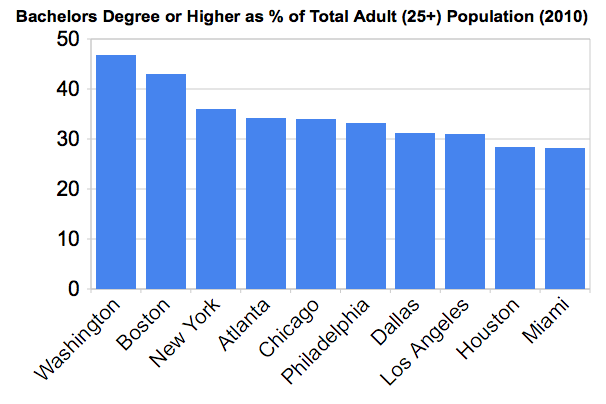
    Chicago’s college degree attainment is in the middle of the pack for the top 10, ranking #5. Considering it came from an industrial heritage, I think this is pretty good.


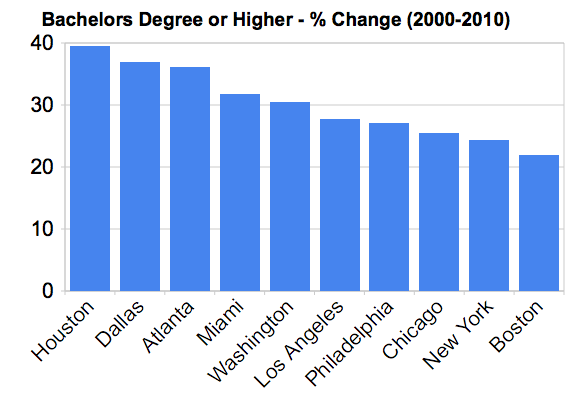
    However, Chicago only ranked 8th out of the top 10 in the growth in population with bachelor’s degrees.


    This hardly suggests that metro Chicago is a talent magnet. If you look at the numbers vs. other large Midwest metros, Chicago is healthy, but not looking like it is pulling away from the pack. I don’t see anything to suggest that Chicago is hoovering up all the college grads in the Midwest.

    Economy

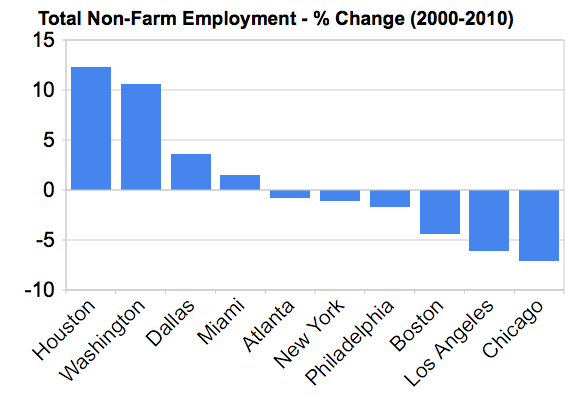
    Chicago lost 323,000 jobs during the 2000s, or 7.1%. The was the worst performance on a percentage basis of any of the 10 largest US metros:


    One of the stats that took some flak from my City Journal piece was that private sector employment in the Loop had dropped by 18.6% during the 2000s. This seems at odds with the massive skyscraper boom and other improvements. This wasn’t my stat. It came from a Chicago Loop Alliance report, and they commissioned a credible analytics firm to do the work, and the data was also reported by the Chicago Sun-Times, so I believe it is solid. A few things to consider:

    – This figure is for the Loop, not the Central Area (a bigger construct). The Loop does have the majority of the Central Area jobs, however.
    – Much of the construction was residential, not commercial. Also, things like the booming Loop U probably brought in more students than jobs.
    – Keep in mind that 2000 was the peak of the dotcom bubble. For reasons I’ll explore later, I believe this hurt Chicago badly. So there’s a tough comp (also why the Bay Area and to a lesser extent Boston look bad on comps vs 2000).
    – Consider major Chicago companies that totally went out of business: Arthur Andersen and Whitman-Hart come to mind.
    – Also consider that pledges of added jobs generally are trumpeted to the sky, while jobs are often cut silently as much as possible.

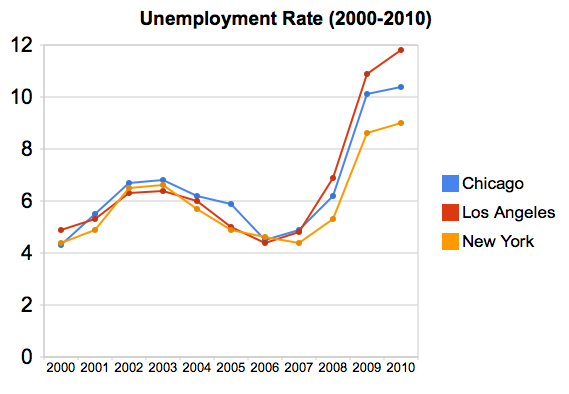
    Looking at unemployment rate in our Chicago vs. NYC/LA chart from before, we now see that Chicago is no longer winning, though is beating LA:


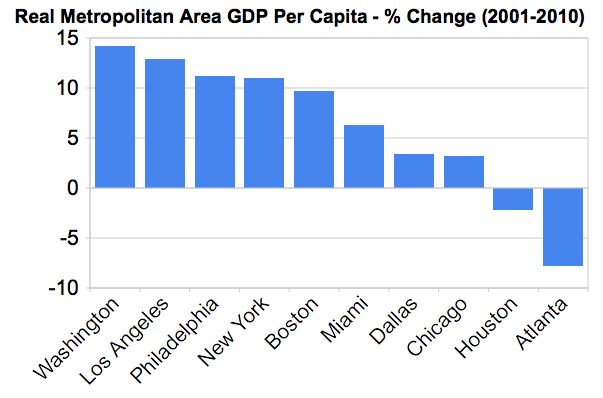
    Chicago is a large economy, but not a particularly high value added one. Out of the ten largest metros, Chicago ranks 8th in per capita GDP. (Chicago is 3rd among large Midwest metros on this figure)


    Chicago also ranked eighth in real per capita GDP growth over the decade.


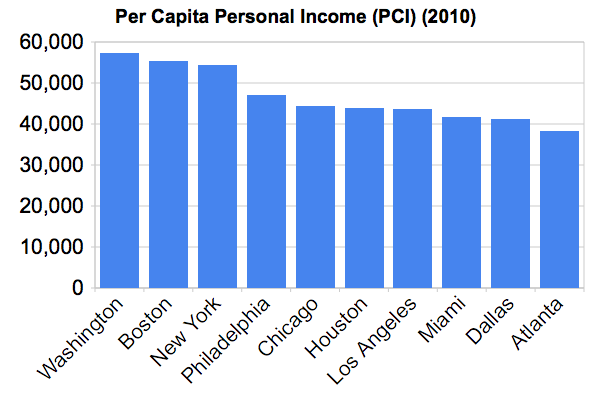
    Chicago ranked 5th out of 10 in per capita personal income, beating LA:


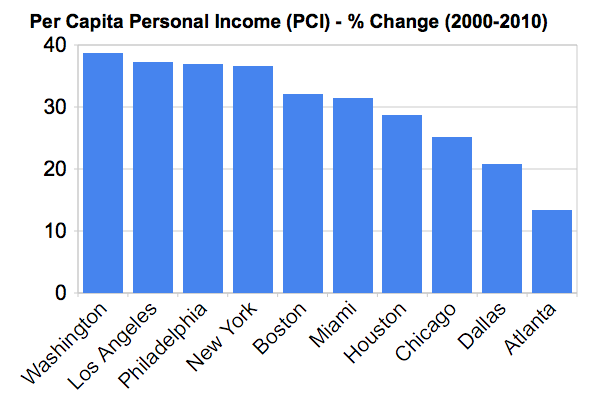
    But Chicago ranked only 8th out of 10 in PCPI growth:


    On the whole, this is a rather uninspiring collection of economic statistics for the Windy City, particularly after it did so well in the 1990s.

    Fiscal Crisis

    No discussion of Chicago’s problems in the 2000s would be complete without a review of its fiscal problems. However, as I already gave the numbers in my City Journal article, I won’t repeat them here. If anything, the problem has only gotten worse since that went to press. While Chicago may not be the worst municipality in terms of fiscal issues, Illinois is the worst state, and that will continue to be a drag until it’s addressed.

    Crime

    Among the biggest complaints about my article was that I didn’t address the crime problem in Chicago. Without a doubt, crime is a problem. Murders are up 38% or so just in 2012. The city of Chicago has a much higher murder rate than the cities of New York or Los Angeles. There has also been a national headline grabbing series of high profile attacks in affluent areas like the Gold Coast and Streeterville. The strength of the Chicago Police Department is somewhere between 500-1000 officers short of where it should be.

    I’m not the best equipped person to talk about crime, but I actually think the crime problem is overstated. Yes, it’s serious. The murder rate especially is troubling. But analyses I’ve read suggest that overall crime isn’t spiraling out of control in Chicago. Also, flash mob type attacks are happening across the country, in places ranging from Philadelphia to Portland. This isn’t a unique to Chicago situation. So I don’t want to claim that Chicago’s crime problems are uniquely bad, though they shouldn’t be minimized.

    Without a doubt the incredible collapse in crime in New York perhaps more than any other single factor fueled that city’s comeback, and it wouldn’t surprise me if it were a big factor in that city’s out performance in the 2000s. Mark Bergen cited some interesting research that suggested that for every murder in your city, 70 people move out. If Chicago had matched New York’s crime performance, it would have held steady or even gained population based on this relationship. If true, wow.

    Regardless, public safety is job #1 for any mayor, so Rahm Emanuel is rightly feeling the heat on this even if he can’t necessarily be blamed for what’s going on.

    Schools

    Others have cited Chicago’s poor public school system. Again, I’m not sure Chicago’s schools are any worse than any other big city system, and there are a number of magnet and neighborhood schools that are now attracting the children of the well-off. I’d have to see something that suggested Chicago took a turn for the worse on schools in the 2000s on a comparative basis.

    Conclusion

    There are more statistics that could be given, and if you want them, I suggest reading the very data rich OECD Territorial Review of Chicago.

    On the whole I think it’s pretty clear that there was trouble in Chicago during the 2000s – and more trouble than most large cities experienced during what was a tough decade nationally.

    Some rightly noted that I discuss the divergent performance of Chicago in the 1990s vs the 2000s, but that my structural factors that weaken Chicago were probably the same in both decades. So why the difference? I want people to know I plan to address that in a future post shortly, but next up we’ll have a look at Chicago’s present day strengths before moving on.

    Read part 1 in this series.

    Aaron M. Renn is an independent writer on urban affairs and the founder of Telestrian, a data analysis and mapping tool. He writes at The Urbanophile, where this piece originally appeared.

    Photo by smik67.

  • The New Geography Of Success In The U.S. And The Trap Of The ‘New Normal’

    This year’s presidential election is fast becoming an ode to diminished expectations. Neither candidate is advancing a reasonable refutation of the conventional wisdom that America is in the grips of a “new normal” — an era of low growth, persistently high unemployment and less upward mobility, particularly for the working class.

    Certainly recent economic news of slowing growth and job creation bolster the pessimists’ case. But Americans may face far better prospects than portrayed by our dueling presidential mediocrities. Let’s look at those states that have found their own way out of the “new normal,” in some cases reversing all the losses of the Great Recession and then some.

    The states that have added the most jobs since 2007 — Texas, North Dakota, Louisiana, Oklahoma and Alaska – are located in a vast energy and commodities corridor extending from the western Gulf to the northern tip of the Continent. New York and Washington, D.C., prime beneficiaries of monetary easing and a growing federal government, have also clawed back.

    But the big winners are in the central energy corridor. Since 2007, Texas has created almost five times as many jobs as New York; California is still down almost 900,000 jobs and Illinois is off close to 300,000.

    This should represent what Walter Russell Mead calls “a new geography of power,” the anointing of new places Americans and business go to find opportunity. One example: five of the six best cities for starting over in 2012, according to TheStreet.com, were in the Dakotas, Utah, Iowa and Nebraska.

    Why the energy and agriculture states? Since the onset of the new century, much of the sustained growth in the world has taken place not in the financial or information capitals, but in regions that produce basic commodities like energy and food. In the high-income world, the consistently best-performing countries since 2008 have also tended to be resource-rich ones such as Norway, Australia and Canada.Blue social policies work best when financed by petro-dollars and minerals sales.

    Domestic and European demand may fall in the next few years, but increasingly global commodity and energy markets are driven by the expanding needs of the major developing countries. This has helped keep energy prices high, particularly for oil. Being good at exploration and drilling has been more profitable than social media. Texas alone has added nearly 200,000 jobs in its oil and gas sector over the past decade and Oklahoma some 45,000. The Lone Star energy sector created twice as many jobs as exist in the software sector in San Jose and San Francisco combined. These jobs have been an outstanding driver of high-wage employment, with an average salary of upwards of $75,000, and located usually in less expensive areas.

    Choice plays an important part in the growth. The energy boom has supercharged the economies of the states that have welcomed this growth, including Texas, Oklahoma, Louisiana, North Dakota, Wyoming and Alaska. It has not been much help to New York and California, which are reluctant to crack rocks to extract even relatively cleaner carbon-based fuels like natural gas. In contrast, long-suffering Ohio and Pennsylvania, where there have been significant new finds of shale oil and gas, appear to have decided that Texas, not California, is the model for spurring growth.

    The energy-producing states can look forward to a bright future in the long run. U.S. oil and Canadian reserves now stand at over 2 trillion barrels and constitute more than three times the total estimated reserves of the Middle East and North Africa. Observers such as the New America Foundation’s Michael Lind believe that new discoveries, particularly of natural gas, mean that we might actually be living in an era of “peak renewables,” and at the onset of a “very long age of fossil fuels.”

    Growth of these sectors — along with construction and manufacturing — could prove critical to our beleaguered working class. There’s not much respect among the university-dominated pundit class for people who work with  their hands or have specific tangible  skills. Instead they need to lower their expectations and seek, as Slate recently suggested, to find work “in the service sector supporting America’s innovative class.”

    In this neo-Victorian society, the “new normal” means a society dominated by  “innovative” or “creative” masters and their chosen, lucky servants. Leave your job and family in the Midwest or Nevada to become a toenail painter in Silicon Valley, San Francisco or Boston. Besides losing any sense of one’s independence, it’s hard to see how a barber or gardener can live decently, particularly with a family, in such expensive places.

    This bleak reality may not inevitable, though. In many places construction employment is on the rise from its nadir in 2010. This recovery has been a nationwide phenomena but is, not surprisingly, most evident in growth states like Montana, Colorado, Indiana, Iowa, Nebraska, Tennessee and Utah.

    At the same time over the last two years the nation has added more than 400,000 manufacturing jobs, led by the industrial states hit hardest by the recession. Though these gains are small compared to the losses earlier in the decade, the growth is encouraging; automakers and other industries already are complaining about severe shortages of skilled labor. Maybe, after all, life as a dog-walker and hostel denizen in Palo Alto is not the best one can hope for if you can make enough to afford a nice suburban house outside Columbus or Detroit.

    The pundit class may be ready to write off the American dream but many Midwest states are working to restore it. Over the past two years Michigan and Ohio have experienced the biggest drop in unemployment of any states in the union; Michigan leads the way with a drop of almost five percentage points, while Ohio comes in second with a nearly three-point decline. Other key Great Lakes battlegrounds—Wisconsin, Indiana and arguably Missouri—have also seen two-point drops in their unemployment numbers.

    Why is this happening? A lot of it has to do with business-friendly state regimes. Unlike Illinois, increasingly the sad sack  of the Midwest, these states have cut taxes, worked to increase the availability of skill training and streamlined regulations. This has allowed them to take advantage of new opportunities.

    Improving the business climate represents the third critical element for overcoming the new normal. Most rundowns of the states with consistently favorable business and tax climates – as judged by executives — start with Texas, Utah and South Dakota. Many states that are recovering best from the recession, like Louisiana, Wisconsin, Florida, Ohio, Michigan and Arizona, all have been improving their rankings in business surveys over recent years.

    But this should not be seen as an exclusively red state phenomenon. Some blue states as well, notably Washington, have worked hard to keep taxes tolerable and have promoted a rapid expansion of their  industrial sector. Democratic-leaning Colorado, under the leadership of pragmatic Gov. John Hickenlooper, has also strived to main a good business climate and promote growth.

    What works, it appears, is not the mindless embrace of GOP or Democratic ideology, but a model that drives economic growth. It’s not rocket science: sensible regulation, moderate taxes and investments to spur job creation and productivity. “There is no Democratic or Republican way to sweep streets,” legendary New York City Mayor Fiorello LaGuardia once remarked and the same is true of economic growth.

    The stories of the successful states tell us the key to success lies  in promoting basic industries like energy, agriculture and manufacturing — which then create business service and high-skilled jobs — combined with a broad agenda favorable to entrepreneurs of all kinds. If only one of our presidential candidates would get the message.

    For more about how states are defying the "new normal," read the 2012 Enterprising States: Policies that Produce report, authored by Joel Kotkin and Praxis Strategy Group.

    Joel Kotkin is executive editor of NewGeography.com and is a distinguished presidential fellow in urban futures at Chapman University, and contributing editor to the City Journal in New York. He is author of The City: A Global History. His newest book is The Next Hundred Million: America in 2050, released in February, 2010.

    This piece originally appeared in Forbes.

    Auto manufacturing photo by BigStockPhoto.com.

  • State of Chicago: The Decline and Rise

    I’ve had it in my head for over a year now to do an in-depth exploration of Chicago, a project I’ve called “State of Chicago.” This is the first a series of pieces that expand on the themes in my recent article “The Second-Rate City?

    First, I’d like to list three reasons why I wrote that piece:

    1. To bring to the attention of Chicago the very poor statistical performance of the city on basic demographic and economic measures.
    2. To write a corrective to the many national puff pieces that have been written on the city that totally overlooked its real and serious problems.
    3. To lay out some frames that I had on the underlying causes that are different from the typical explanations, in particular the excessive focus on “global city” and the “cost of clout.”

    As it turns out, Rahm Emanuel’s own economic plan and the OECD report beat me to the punch on point #1. As a lot of what I wanted to accomplish with State of Chicago was data oriented, my project is now much less ambitious than I’d originally intended since Chicago’s leaders are now, fortunately, owning up to the problems.

    The Fall of Chicago

    Today I want to start out by giving the prequel to my article: Chicago’s Rust Belt decline and subsequent comeback, particularly in the 90s. I think everybody knows that cities had a rough 70s and early 80s. It was the “Rotten Apple” era in New York, for example, a time of needle parks, mugger money, graffiti trains, a brush with bankruptcy, and much more.

    Chicago had a similar rough patch. When Richard Longworth (now of Caught in the Middle and Global Midwest fame) returned to Chicago in 1976 from many years overseas as a foreign correspondent for the Chicago Tribune, it was to a grim, decaying city that, like so many big cities in America at the time, clearly was a city that did not work.

    This was perhaps best symbolized by the city’s inept response to the Blizzard of ’79, which left the city paralyzed for days. Mayor Michael Bilandic’s blizzard response was widely credited for his subsequent re-election defeat. Old mayor Richard J. Daley’s City Hall alliance with business had preserved the Loop as a powerful, if somewhat drab, business district while so many other Midwest downtowns fell into ruin. But otherwise Chicago was a troubled, declining city covered by a veneer of boosterism.

    In 1981 Longworth wrote a damning four part, front page series for the Chicago Tribune called “A City on the Brink” drawing a powerful portrait of a city in crisis. He noted that, “Chicago has become an economic invalid. The situation may be permanent.” The Economist, in a far cry from its praise in the 2000s, described the city as having little more than a “facade of downtown prosperity.”

    The city was losing people, losing businesses, and losing jobs – even in the Loop. Manufacturing was collapsing and the middle class was fleeing, leading to neighborhood decline and eroding the city’s tax base, which in turn degraded the city services residents had come to expect and demand. The decline in services and neighborhoods drove more people way, which led to further declines, perpetuating a vicious cycle.

    University of Illinois at Chicago Professor Pierre de Vise predicted, “I see very little hope for locating economic activities here again.” And a local business executive added, “Is the city being annihilated? It’s probably inevitable.” While careful to note that Chicago was not at the point of New York City’s brush with bankruptcy nadir, Longworth noted it was headed that direction and glumly asked, “What happens when a major city becomes a backwater?”

    The city was failing on nearly every measure. I was struck by how similar Longworth’s litany of statistics were to my own. There was a big different however: back then things were way worse. Today the problems of Chicago take place against a backdrop of many areas of strength in the urban core and a secular uptrend in the fortunes of cities. Given that Chicago has come back from far more dire circumstances than it faces today, there’s reason for optimism in the present.

    Chicago Reborn

    As I noted in City Journal, during the 90s (probably starting in the late 80s), Chicago had a massive comeback. It gained people, it gained jobs, and the core reasserted itself. I moved to Chicago in 1992 when only a few select lakefront precincts were really gentrified. Though I lived in Lincoln Park, I was told not to move west of Racine, not because it was dangerous, but because it was dead. The area where I used to live near Belmont/Ashland/Lincoln was completely boarded up except for the Army-Navy surplus store. Recruiters for my company tried to sell me on the city by telling me it was now a location of the uber-hip coffee chain Starbucks. I watched vast tracts of the city transformed before my eyes. The 90s boom was real. I saw it. I felt it.

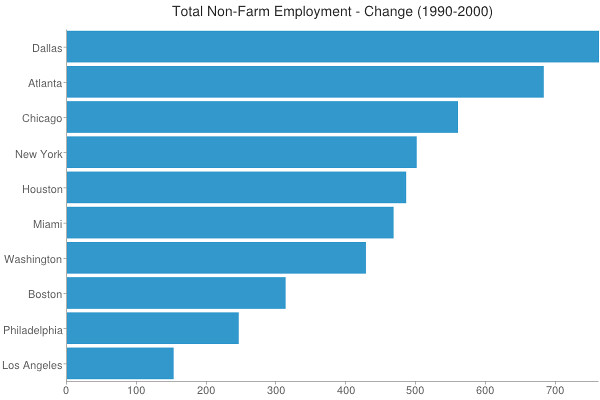
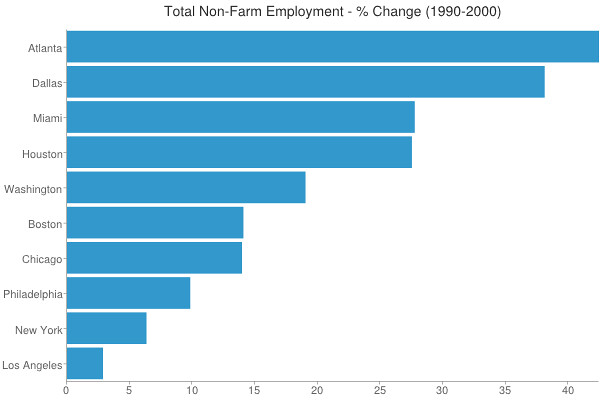
    It also showed up in the data. I don’t want to go too crazy, but I wanted to look at some economic statistics. First, I want to look at metro area job growth in the 1990s for selected cities. I’ll show the percentage gains in a moment, but here’s the raw job growth for the ten largest US metros during the 1990s. (Top ten selected based on today’s 2010 census population).


    Note: Data in thousands

    Chicago actually had the third highest total job growth. Not only did metro Chicago outgrow New York and crush LA (which got bruised by the “peace dividend”), it actually added more total jobs than Houston, everybody’s darling today. Wow. And more than currently booming Washington, DC. In short, Chicago beat out its mature tier one peers while holding its own with the emerging boomtowns. Very impressive.

    Here’s the percentage view:


    Not as impressive vs. the emerging cities, but Chicago held its own with Boston (a big beneficiary of the dotcom boom) and more than doubled up traditional peers New York and LA. I think it’s fair to label Chicago an outperformer here.

    Let’s do a quick look at unemployment rates for the big three:


    As you can see, Chicago metro had a much lower unemployment rate than NYC or LA during most of the 90s. Since unemployment rate is available at the municipal level, here’s a quick look at the big three core cities. We’ll see again that even at the municipality level, the city of Chicago had a lower unemployment rate:


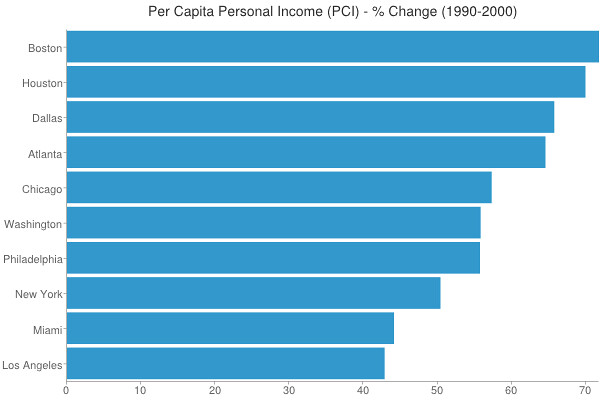
    So in terms of quantitative measures, Chicago was winning in the 90s. But it also seemed to do well qualitatively. I don’t have GDP data going back to the 90s, but I do have per capita personal income. Here’s how the top ten cities fared:


    Boston topped out, perhaps to be expected from the dotcom boom. But Chicago beat NYC and LA again, and also Washington, DC. (Interestingly, the southern boomtowns that did well on this metric in the 90s mostly got killed on it in the 2000s, Houston excepted).

    So I think it’s fair to say that compared to its large mature peers, Chicago economically was the winner (or at least near the top depending on who you put in there) during the 1990s, along with Boston. This is the type of performance Chicago is capable of delivering.

    But beyond the statistical measures, there were many qualitative improvements as well. For example, Chicago was really the early leader in quality of space. After Mayor Daley’s famous trip to Paris, he came back and encased the city in wrought iron. He also put in miles of streetscapes, with median planters, new streetlights and the like. (I happen to think the aesthetic style of these was not appropriate to Chicago, but they clearly upgraded the city in a big way). The CTA saw a brand new L line open to Midway Airport. New cultural facilities blossomed. For example, both the Chicago Symphony and the Lyric Opera undertook $100+ million building projects. And Daley even brought political stability back to the city after the turbulence Bilandic-Bryne years and the racially driven “Council Wars” of the 1980s.

    In a post-Cold War global order, Chicago also emerged as a global city. No longer just a superpower of the American interior, Chicago came to play a critical role in the global economy, through its derivatives exchanges, its professional services complex, and its status as a transport and cultural hub. Globalization became the lens through which the city sees its role in the modern economy, and with some justification. By 2010, Foreign Policy magazine ranked Chicago as the sixth most important global city in the world, for example. Chicago began to regard itself no longer as merely the “Second City,” but as a global player in its own right.

    So in the 1990s, Chicago was riding high. Little did the city know that with the dotcom collapse and the national economic trends of the 2000s, the city was about to enter a tailspin. But there was clearly a lot of real progress and change in the city and a lot for the city to feel good about and be proud of. Chicago was the big city champion of the 90s.

    I don’t want that story to get lost and people to think I’m just picking on Chicago. I’m happy to shout out its accomplishments when merited. But when things aren’t going so well, the city likewise deserves people who are willing to tell the truth.

    In the next installment, we’ll expand a bit on the troubles.

    Aaron M. Renn is an independent writer on urban affairs and the founder of Telestrian, a data analysis and mapping tool. He writes at The Urbanophile, where this piece originally appeared.

    Chicago skyline photo by BigStockPhoto.com.

  • Are Millennials the Screwed Generation?

    Today’s youth, both here and abroad, have been screwed by their parents’ fiscal profligacy and economic mismanagement. Neil Howe, a leading generational theorist, cites the “greed, shortsightedness, and blind partisanship” of the boomers, of whom he is one, for having “brought the global economy to its knees.”

    How has this generation been screwed? Let’s count the ways, starting with the economy. No generation has suffered more from the Great Recession than the young. Median net worth of people under 35, according to the U.S. Census, fell 37 percent between 2005 and 2010; those over 65 took only a 13 percent hit.

    The wealth gap today between younger and older Americans now stands as the widest on record. The median net worth of households headed by someone 65 or older is $170,494, 42 percent higher than in 1984, while the median net worth for younger-age households is $3,662, down 68 percent from a quarter century ago, according to an analysis by the Pew Research Center.

    The older generation, notes Pew, were “the beneficiaries of good timing” in everything from a strong economy to a long rise in housing prices. In contrast, quick prospects for improvement are dismal for the younger generation.

    One key reason: their indebted parents are not leaving their jobs, forcing younger people to put careers on hold. Since 2008 the percentage of the workforce under 25 has dropped 13.2 percent, according to the Bureau of Labor Statistics, while that of people over 55 has risen by 7.6 percent.

    “Employers are often replacing entry-level positions meant for graduates with people who have more experience because the pool of applicants is so much larger. Basically when unemployment goes up, it disenfranchises the younger generation because they are the least qualified,” observes Kyle Storms, a recent graduate from Chapman University in California.

    Overall the young suffer stubbornly high unemployment rates—and an even higher incidence of underemployment. The unemployment rate for people between 18 and 29 is 12 percent in the U.S., nearly 50 percent above the national average. That’s a far cry from the fearsome 50 percent rate seen in Spain or Greece, or the 35 percent in Italy and 22 percent in France and the U.K., but well above the 8 percent rate in Germany.

    The screwed generation also enters adulthood loaded down by a mountain of boomer- and senior-incurred debt—debt that spirals ever more out of control. The public debt constitutes a toxic legacy handed over to offspring who will have to pay it off in at least three ways: through higher taxes, less infrastructure and social spending, and, fatefully, the prospect of painfully slow growth for the foreseeable future.

    In the United States, the boomers’ bill has risen to about $50,000 a person. In Japan, the red ink for the next generation comes in at more than $95,000 a person. One nasty solution to pay for this growing debt is to tax workers and consumers. Both Germany and Japan, which appears about to double its VAT rate, have been exploring new taxes to pay for the pensions of the boomers.

    The huge public-employee pensions now driving many states and cities—most recently Stockton, Calif.—toward the netherworld of bankruptcy represent an extreme case of intergenerational transfer from young to old. It’s a thoroughly rigged boomer game, providing guaranteed generous benefits to older public workers while handing the financial upper echelon a “Wall Street boondoggle” (to quote analyst Walter Russell Mead).

    Then there is the debt that the millennials have incurred themselves. The average student, according to Forbes, already carries $12,700 in credit-card and other kinds of debt. Student loans have grown consistently over the last few decades to an average of $27,000 each. Nationwide in the U.S., tuition debt is close to $1 trillion.

    This debt often results from the advice of teachers, largely boomers, that only more education—for which costs have risen at twice the rate of inflation since 2000—could solve the long-term issues of the young. “Our generation decided to go to school and continue into even higher forms of education like master’s and Ph.D. programs, thinking this will give us an edge,” notes Lizzie Guerra, a recent graduate from San Francisco State. “However, we found ourselves incredibly educated but drowning in piles of student loans with a job market that still isn’t hiring.”

    More maddening still, the payback for this expensive education appears to be a chimera. Over 43 percent of recent graduates now working, according to a recent report by the Heldrich Center for Workforce Development, are at jobs that don’t require a college education. Some 16 percent of bartenders and almost the same percentage of parking attendants, notes Ohio State economics professor Richard Vedder, earned a bachelor’s degree or higher.

    “I work at the Gap and Pacific Pak Ice, two jobs that I don’t see myself working long term nor jobs that are specific to my major,” notes recent University of Washington graduate Marshel L. Renz. “I’ve been applying to five jobs a week and have gotten nothing but rejections.”

    Particularly hard hit are those from less prestigious schools or with majors in the humanities, notes a recent Pew study. Among 2011 law-school graduates, half could not find a job in the legal field nine months after finishing school. But it’s not just the lawyers and artists who are suffering. Overall the incomes earned by graduates have dropped over the last decade by 11 percent for men and 7.6 percent for women. No big surprise, then, that last year’s class suffered the highest level of stress on record, according to an annual survey of college freshmen taken over the past quarter century.

    The proliferation of graduate degrees also impacts those many Americans who don’t go (or haven’t yet gone) to college. High-school graduates now find themselves competing with college graduates for basic jobs in service businesses. Unemployment among 16- to 19-year-olds this summer is nearly 25 percent, while for high-school graduates between 2009 and 2011, only 16 percent have found full-time work, and 22 percent work part time.

    Once known for their optimism, many millennials are turning sour about the future. According to a Rutgers study, 56 percent of recent high-school graduates feel they would not be financially more successful than their parents; only 14 percent thought they’d do better. College education doesn’t seem to make a difference: 58 percent of recent graduates feel they won’t do as well as the previous generation. Only 16 percent thought they’d do better.

    This perception builds on the growing notion among economists that the new generation must lower its expectations. Since the financial panic of 2008, “the new normal” has become conventional wisdom. Coined by Mohamed El-Erian at Pimco, it’s been used to describe our world as one “of muted Western growth, high unemployment and relatively orderly delevering.”

    The libertarian Tyler Cowen, in his landmark work The Great Stagnation, makes many of the same points, claiming that the U.S. “frontier” has closed both technologically and in terms of human capital and resources. He maintains that we’ve already harvested “the low-hanging fruit” and that we now rest on a “technological plateau,” making any future economic progress difficult to achieve. Stagnation is not such a bad thing for people already established in college-campus jobs, think tanks, or powerful financial institutions. But it wipes out the hope for the new generation that they can achieve anything resembling the American Dream of their parents or even grandparents.

    Inevitably, young people are delaying their leap into adulthood. Nearly a third of people between 18 and 34 have put off marriage or having a baby due to the recession, and a quarter have moved back to their parents’ homes, according to a Pew study. These decisions have helped cut the birthrate by 11 percent by 2011, while the marriage rate slumped 6.8 percent. The baby-boom echo generation could propel historically fecund America toward the kind of demographic disaster already evident in parts of Europe and Japan.

    The worst effects of the “new normal” can be seen among noncollege graduates. Conservative analysts such as Charles Murray point out the deterioration of family life—as measured by illegitimacy and low marriage rates—among working-class whites; among white American women with only a high-school education, 44 percent of births are out of wedlock, up from 6 percent in 1970. With incomes dropping and higher unemployment, Murray predicts the emergence of a growing “white underclass” in the coming decade.

    The prospect of downward mobility is most evident in recent discussions about the future of the housing market. Since World War II the expectation of each generation was to own property, preferably a single-family house. The large majority of boomers became homeowners during the Reagan-Clinton era. Yet it is increasingly fashionable to insist this “dream” must be expunged. If millennials ever move out of their parents’ house, they will live in apartments they don’t own. There’s a lot of talk about a “generation rent” replacing a primarily suburban ownership society with a new caste of city-dwelling renters. “I’m hoping that the millennial generation doesn’t set its sights on homeownership as a benchmark of economic stability,” sociologist Katherine Newman suggests, “because it’s going to be out of reach for so many of them.”

    No doubt the prospects for homeownership will be tough in the years ahead. But it’s delusional to believe millennials don’t desire the same things as previous generations, note generational chroniclers Morley Winograd and Mike Hais. Survey research finds that 84 percent of 18- to 34-year-olds who are currently renting say that they intend to buy a home even if they can’t currently afford to do so; 64 percent said it was “very important” to have an opportunity to own their own home.

    And where do millennials see their dream house? According to research at Frank Magid Associates, 43 percent describe suburbs as their “ideal place to live,” compared with just 31 percent of older generations. Even though big cities are often preferred among college graduates in their 20s, only 17 percent of millennials say they want to settle permanently in one. This was the same percentage of members of this generation who expressed a preference for living in rural or small-town America.

    So far, the Great Recession has driven young people around the high-income world to the left. Generations growing up in recessions appear more amenable to arguments for government-mandated income redistribution. And since so few young people pay much in the way of taxes, they are less affronted by the prospect of forking over than older voters, who do. This left-leaning tendency has been on display in recent European elections. In France, 57 percent voters 18 to 24 supported the Socialist François Hollande, one of the reasons why the conservative Nicolas Sarkozy lost. Similarly, 37 percent of those in that age category voted for Syrizia, the far-left party in Greece.

    But Winograd and Hais—and Democratic strategist Ruy Teixeira—say it’s not just economics working for the Democrats. Social issues such as gay marriage, women’s rights, and immigration—a large proportion of millennials are children of newcomers—tend to drive younger voters toward the Democrats. Half of millennials, for example, favor gay marriage, compared with a third of boomers, and some predict the Republican embrace of draconian social conservatism will serve to harden the Democratic tilt of millennials for the foreseeable future.

    Yet Republicans may take heart from some of the more conservative values embraced by the young. As a group, millennials appear to be very family-oriented—being good parents is often their highest priority—and roughly two thirds claim to believe in God. And since their long-term aspirations are not so different from those of earlier generations—they still want to own a home in a nice, secure neighborhood—Republicans could make a case that their economic model will work better with their personal goals.

    Right now, politics is just another place where American millennials are getting screwed. Republicans want to deport young Latinos while cutting investments, such as roads and skills education, that would benefit younger voters. Democrats, meanwhile, seem determined to mortgage the future with high spending on pensions, predominantly for aging boomers; cascading indebtedness; and economic policies unfriendly to the rapid growth necessary to assure upward mobility for the new generation.

    This suggests millennials need to force the parties to cater to them and play hard to get. Being taken for granted, as African-Americans have been, does not always produce the best results for any demographic grouping. Politicians target “soccer moms,” “independents,” and suburban voters precisely because they are not predictable. Millennials should not want to be in anyone’s hip pocket.

    Wanting the next generation to succeed is in everyone’s long-term interest. Eventually they will constitute the majority of parents, potential homeowners, and workers. This year they will comprise 24 percent of voting-age adults, up from 18 percent in 2008; by 2020 they will amount to a third of all eligible voters. And if, by then, they are still a screwed generation, they won’t be the only ones suffering. America will be screwed, too.

    Research assistance by Gary Girod. Portrait interviews by Eliza Shapiro.

    Joel Kotkin is executive editor of NewGeography.com and is a distinguished presidential fellow in urban futures at Chapman University, and contributing editor to the City Journal in New York. He is author of The City: A Global History. His newest book is The Next Hundred Million: America in 2050, released in February, 2010.

    This piece originally appeared in Newsweek Magazine.

    Unemployed photo by BigStockPhoto.com.

  • How Fossil-Fuel Democrats Became An Endangered Species

    In an election pivoting on jobs, energy could be the issue that comes back to haunt Barack Obama and the Democratic Party as the cultural and ideological schism between energy-producing Republican states and energy-dependent Democratic ones widens.

    As the economy has sputtered since 2008, conventional energy has emerged as one of the few robust sources of high-paying work, adding roughly half a million jobs since 2007 as new technologies and changing market conditions have opened up a vast new supply of exploitable domestic reserves. This is good news for Mitt Romney: nine of the ten states that rely most heavily on the sector for jobs are solidly behind him. (Colorado, where polls show Obama with a narrow lead, is the one exception).

    President Obama’s heavy-handed regulation of the booming old-energy economy—the moratorium on offshore drilling following the BP spoil, the decision to block the Keystone XL Pipeline, and the prospect of a fracking ban—and his embrace of green-energy policies has played well in the solidly-Democratic post-industrial coastal economies that he also depends on for fund-raising. But it’s left him with few friends in the energy belt that spans the Great Plains, the Gulf Coast, Appalachia and now some parts of the old rustbelt, despite his election-year claims of an “all-of-the-above” energy policy.

    It’s a far cry from Bill Clinton, whose close ties with Great Plains and Gulf Coast Democrats and energy producers there helped him twice carry Louisiana, Kentucky and West Virginia—all states that appear to be solidly behind Romney this year.

    Today, Democratic senators in regions that depend on fossil fuels are becoming an endangered species. Over the past two years, Virginia’s Jim Webb and Byron Dorgan and Kent Conrad, both from booming North Dakota, have announced their retirement or retired, while Montana’s Jon Tester has distanced himself from the president as he faces a difficult re-election fight. And that diminishing presence in turn means less intra-party resistance to any potential second-term plans to cut the burgeoning fossil-fuel business to size.

    The administration’s hostility to the dirty business of energy, and the sector’s fear of new bans or regulations in a second Obama term that would gut the industry were perhaps best captured by the then-EPA administrator who claimed Administration policy was to “crucify” fossil fuel.

    Yet as Obama pursues a 50-percent-plus-one re-election strategy reminiscent of President Bush in 2004, his energy approach has been embraced by his core constituents, particularly the public-sector union workers and urbanized “creative-class” members. This is particularly true in the coastal enclaves like New York and California that import much of their energy (and in California’s case in particular has declined to exploit its own considerable reserves). Sixty-percent of the electricity in Los Angeles, a key bastion of Obama support, comes from coal-fired plants in Utah and Arizona; much of the natural gas that provides nearly half of the power for California’s grid is imported. While Pennsylvania and Ohio have exploited their large shale reserves that have become vastly valuable in recent year thanks to new extraction techniques and shifting energy prices, New York State has yet to follow suit, even as New York City lacks the supply to match peak summer demand, forcing it to depend on an aging nuclear power plant at Indian Point that’s years overdue to close.

    President Barack Obama defends his energy agenda during his visit to oil and gas production fields located on federal lands outside of Maljamar, N.M., Wednesday, March, 21, 2012. (Pablo Martinez Monsivais / AP Photo)

    If anything, the pressure from environmental activists , many of them well-heeled and living far removed from power sources and the jobs they create, is for Obama to go even further. A few rich donors from the green lobby complain the President has not been environmentally correct enough; Mother Jones actually asked if Obama has been “morphing into Dick Cheney” on energy issues.

    But for the most part, the coasts are on board with Obama’s energy policy. Silicon Valley and Wall Street have invested heavily in the renewable industries favored and frequently propped up by the administration, putting their money where Obama’s mouth is. Silicon Valley hegemons like venture capitalist John Doerr and Wall Street giants like Goldman  Sachs regard the green energy business as a profitable, state-supported way to grow their profits. One disgusted  venture investor described the investors in the heavily subsidized green game as “venture porkulists.

    These investments are now critical to many powerful tech firms, who increasingly have little domestic involvement in the manufacturing businesses that was central to a prior generation of Silicon Valley titans. Google alone has invested more than a billion dollars in the green-energy sector, as the valley’s new dominant clique of venture capitalists and tech executives donate at record levels to the president’s re-election.

    Nowhere is the element of choice inherent in energy policy more evident than in California, home to five of the nation’s twelve largest oil fields and energy reserves equal to those of Nigeria, the world’s tenth-largest producer. As high-paying energy jobs swell payrolls in the Great Plains, the Intermountain West and parts of the Gulf, the Golden State has double-digit unemployment, a collapsed inland economy and a series of bankrupt municipalities. Amidst a great national energy boom, California’s energy production has remained stunted even as the state’s draconian “renewable” energy mandates are slated to drive up its already high electricity rates. The state’s high cost of energy has impacted industry:  despite its vast human and natural resources, the Golden State, with 12 percent of the nation’s population received barely 2 percent of the country’s manufacturing expansions last year.

    Such inattention to California’s resources may be  popular in wealthy precincts of Silicon Valley, San Francisco and west Los Angeles, but the state’s green approach has helped place traditionally manufacturing-oriented communities such as Oakland, east Los Angeles, San Bernardino and Stockton in deep distress. Despite central California’s vast deposits of oil and gas, unemployment rates in some oil-rich areas there are over 15 and sometimes even 20 percent. 

    As economic forecaster Bill Watkins recently told an audience in hard-hit Santa Maria: “If you were in Texas, you’d be rich.”

    Meanwhile  the fossil-fuel energy producers, related chemical manufacturers  and financiers who are getting rich, from the Koch Brothers to Chesapeake Energy and Arch Coal, have been investing in Romney and the super-PACs supporting him.

    Much of the money they’re pouring in will likely be spent persuading voters in the four crucial energy states –long-time producers New Mexico and Colorado and emergent natural gas producers Ohio and Pennsylvania—that will be up for grabs in November. Colorado has generated more than 20,000 while new energy jobs since 2000, third highest in the nation, while Ohio and Pennsylvania combined have created 25,000 new energy jobs in that span—and that’s not counting the services those largely  well-paid workers demand or the new manufacturing jobs making pipes and compressors the industry creates. What all four contested states have in common is that their energy sectors are pitted against powerful competing interests, including true-blue urban constituents, and tourism and technology sectors that employ workers and industries more concerned with the local environment than with energy-driven growth.Still, a boom is a boom, and President Obama is doing his best to claim credit for the huge surge in oil and gas production under his watch, although the increase has been almost completely on private and state lands outside his reach. Production on federal lands has actually dropped. Yet his “all of the above” rhetoric comes off as more evenhanded and substantial than the drill- baby-drill GOP set.

    Romney, though, can point to a series of Obama decisions and priorities—including the painfully slow resumption of Gulf Shore oil operations after the BP spill, the effective veto of the Keystone XL pipeline, and proposed EPA greenhouse gas restrictions—as mortal threats to the American energy boom. He can also contrast the economic rise of energy-friendly Texas with the troubles of hyper-green California.

    Whether Romney, far from a master communicator, is savvy and bold enough to stick the point may prove decisive in November.

    Joel Kotkin is executive editor of NewGeography.com and is a distinguished presidential fellow in urban futures at Chapman University, and contributing editor to the City Journal in New York. He is author of The City: A Global History. His newest book is The Next Hundred Million: America in 2050, released in February, 2010.

    This piece originally appeared in The Daily Beast.

    Oil well photo by BigStockPhoto.com.