Category: Economics

  • It Can Happen Here: The Screwed Generation in Europe and America

    In Madrid you see them on the streets, jobless, aimless, often bearing college degrees but working as cabbies, baristas, street performers, or—more often—not at all. In Spain as in Greece, nearly half of the adults under 25 don’t work.

    Call them the screwed generation, the victims of expansive welfare states and the massive structural debt charged by their parents. In virtually every developed country, and increasingly in developing ones, they include not only the usual victims, the undereducated and recent immigrants, but also the college-educated.

    Nowhere is this clearer than in the European Union’s Club Med of Spain, Greece, Portugal, and Italy, the focal point of the emerging new economic crisis. There’s a growing sense of hopelessness in these places, where debt is turning politics into an ugly choice between austerity, which reduces present opportunities, or renewed emphasis on public spending, which all but guarantees major problems in the bond market, and spending promises that can’t be kept.

    “We don’t know what to do now,” Jaime, a Madrid waiter in his late 20s told me last week. “My wife lost her auditor’s job, and I can’t support the whole family. Maybe we have to move somewhere like Dubai or maybe Miami.”

    Many young Greeks, Italians, Portuguese, and Spaniards already have made their moves, with a half million leaving Spain alone last year. But it’s not just Club Med youths who are contemplating greener pastures. Ireland, which in recent decades actually attracted new migrants, is exporting a thousand people a week. In recession-wracked Britain, nearly half of the population say they would like to move elsewhere.

    Driving this exodus is a growing perception that this collapse is not cyclical but secular. Increasingly, young Europeans are deciding not to start families—the key to future growth—in reaction to the recession. The stories about divorced Spanish or Italian young fathers sleeping on the streets or in their cars are not exactly a strong advertising for parenthood.

    Even in once-rigidly Catholic Spain, marriage and fertility rates have been falling for decades, and family structure weakening. Spaniards are having fewer children now than they did during the brutal civil war of the late 1930s. Alejandro Macarrón Larumbe, a Madrid-based management consultant, in his 2011 book, El Suicidio Demográfico de España, points out that the actual number of Spanish newborns has declined to an 18th-century level.

    This demographic implosion makes sense given the legacy left behind by the boomers, who have held on to generous jobs and benefits but left little opportunity for their children, not to mention a high tax burden on what opportunities they do find. For a generation academics have sold higher education—the more the better—as the cure for unemployment and the great guarantor of success. Yet rising education rates in places like Spain have not created jobs for the rising generation, but only expanded unemployment and falling wages among the ranks of the educated.

    Even America, traditionally a beneficiary of European woes, seems to have turned on its young. College debt is crushing many young people with degrees—particularly those outside the sciences and engineering—that are not easily marketable. The spiking number of people in their 30s working as unpaid interns reflects this erosion of opportunity. This has happened even as the price tag for college has shot up; 94 percent of students who earn a bachelor’s degree now owe money for their educations, compared to 45 percent two decades ago. Here’s a tribute to futility: today a majority of unemployed Americans age 25 and older attended college, something never before seen.

    Governmental priorities here continue to favor boomers and seniors over the young. For a generation, transfer payments have favored the elderly, a trend likely to accelerate as the boomers continue retiring and demand their due. According to Brookings, America spends 2.4 times as much on the elderly as on children. 

    Forced to take lower wages if they can find work at all and facing still-expensive housing in those markets where many of the jobs are, roughly one in five American adults 25 to 34 now live with their parents—almost double the percentage from 30 years ago. Increasingly both Wall Street and green “progressives” urge young people to abandon homeownership for a poorer, more crowded life in expensive, high-density apartment blocks.

    Across the developed world, wages are being cut for young Americans, Europeans, and Japanese as politicians prefer to offer less to the young than to take anything away from those already ensconced in employment, particularly if organized into unions. In the U.S., everything from government jobs to employment in auto factories and even supermarkets is now on a two-tier track, with older workers’ guaranteed pensions and higher salaries not shared by newer hires.

    Pensions represent a bigger generational issue than salaries do. The European welfare state makes America’s seem Scrooge-ish. Their lifetime guarantees are so extensive, and unsustainable, that even the über-frugal Germans are calling for a special tax on younger workers to fund their parents’ pensions.

    This generational transfer will likely be accelerated by an aging electorate. In Spain, notes Larumbe, voters over 60 now make up more than 30 percent of the electorate, up from 22 percent in 1977; in 2050 they will constitute close to a majority. The same patterns can be seen in other European countries and, although less dramatically, in the U.S. as well.

    As a result, boomer- and senior-dominated parties, both right and left, generally end up screwing young people. This occurs even as they proclaim their fulsome concern for “future generations.”

    Politicians on the right, in Europe and elsewhere, scapegoat immigrants in part to hold on to their share of older votes. Left-wing analysts rightly point out that the boomer- and senior-dominated Tea Party here is not likely to cut their own entitlements, preferring instead to push cutbacks in education and other disbursements that aid the young while fighting spending on job creation and productive forms of infrastructure investment.

    Politicians on the left, meanwhile, tend to favor redistribution and “sustainability” over the new wealth creation critical for youthful advancement. Many boomers seem to suspect economic growth itself, as when John Holdren, now President Obama’s senior science adviser, back in the 1970s called for the “de-development” of high-income countries. A cynic might conclude that since the progressive boomers already got theirs, it’s fine for the young to live in an era of limits.

    With the kind of tax and regulatory regime advocated by today’s regressive progressives—already largely adopted in my home state of California—greens and their allies many not have to worry about too much new growth. Only those connected with the government, or able to ride asset inflation, will do well in the new “progressive” order.

    In Europe, east Asia, and America alike, the left and the right have both proven unprepared or unwilling to address the fundamental growth crisis facing the next generation. Neither austerity nor a “progressive” focus on greater government spending and “sustainability” can create the jobs and new opportunities so sorely lacking on the streets of Athens and Madrid and increasingly in American cities as well.

    The developed world’s youth shouldn’t expect much help from an older generation that has preserved its generous arrangements at the cost of increasingly stark prospects for its own progeny. Instead the emerging generation needs to push its own new agenda for economic growth and expanded opportunity.

    Joel Kotkin is executive editor of NewGeography.com and is a distinguished presidential fellow in urban futures at Chapman University, and contributing editor to the City Journal in New York. He is author of The City: A Global History. His newest book is The Next Hundred Million: America in 2050, released in February, 2010.

    This piece originally appeared in The Daily Beast.

    Unemployed woman photo by BigStockPhoto.com.

  • From Connection to Dispersal: Urbanisation in the 21st Century

    Commentators have long studied connections between cities and how these influence their development. The city is the natural focus of trade-based theories of growth. Exporting a surplus, based on local resources and specialisation was – and is – considered the way to city wealth.

    In this world, transport is the key to the trade portal. The cities that dominated world trade in the 19th and 20th centuries were those best connected, initially through their ports and sea links complemented later through strong ties over the airways. Mega-ports and airport hubs were marks of city success. 

    This model may be changing, and we need to change our thinking about the future of our cities with it.

    Connectedness and concentration
    Connectedness is a mantra for the new urbanists: through international connection cities exploit the economies assumed to arise from ever-increasing concentration of people and business. Hence, the city seeking to make its mark globally must invest in ever increasing transport infrastructure. Acknowledging the information age, it may add high-speed broadband to the mix and perhaps, in a symbolic move, an international convention centre.

    But is this the right model for 21st century urbanisation?

    Aviation – moving on
    Think for a moment about what has happened in aviation. The last decade saw a quantum shift from a model whereby a few powerful hubs concentrated movement between a few major centres from which passengers and goods could, in turn, be distributed along local spokes – by regional aircraft, train, coach or car. Airlines based themselves overwhelmingly at these hubs.  The large, twin isle jet reigned supreme. The Airbus A380 is the latest conveyor of that model, but most likely the last.

    Because late in the 20th century there was a divergence between an ageing hub and spoke model and a growing model based on  dense networks connecting more and more cities directly. The single aisle, medium-haul jet took off.  And now the long-haul, highly efficient, medium-sized jet is further expanding this capacity to directly connect former spokes – smaller cities – without the need to hub through major cities.

    And all of this has been supported by the productivity leap brought about by the low cost airline model. More people, more cities, more directly connected than ever before with the capacity to transform economic, political and social relations among them.  [1]

    From transport to logistics
    The transport sector was about moving goods from A to B as cost effectively as regulation allowed; and all too often regulation kept costs up to protect old technology and incumbent operators, whether by surface, air, or sea. That, though, is changing as international transport is liberalised.    

    And today transport is itself transforming into the business of logistics. And logistics is about distribution – through a production chain, between producers and consumers, and among places.  Goods move seamlessly through integrated operations that can deliver almost anything almost anywhere in a matter of days. 

    An informational world
    As the capacity to transport goods went up and the cost went down, academics trying to explain the differential growth of cities appealed to a new notion that dominating the exchange of information was the new key to prosperity.  Knowledge and expertise were concentrated in key informational hubs where they became the centres of capitalist power, the hearths of globalisation.  [2]

    Well that’s changing, too. Information and expertise is becoming dispersed, knowledge ubiquitous.  This is not just about the internet – although it obviously plays a huge part.  It’s also about the explosion of personal mobility as informational cities give way to an informational world.  (It may also be about the potential for implosion as a result of over-concentration, a threat still lingering in the financial centres of the world). 

    Linked cities are giving way to networked communities.

    From consolidation …
    The lesson? Those of us involved in planning the city cannot assume the same structures will prevail in the future as those we inherited from the past.  We tend to plan, though, by looking for repeat patterns, seeking generalisation, extracting principles, predicting the unpredictable.  And because infrastructure – roads, rail, ports – are large scale, expensive, and enduring they become the bones around which we construct our futures. 

    Infrastructure, particularly transport infrastructure, shapes our presumptions about how the city will function and the form it will take. Hence, urban planning is preoccupied with how to consolidate existing structures, increasing their capacity by building up rather than out and moving to mass transit, among other things.

    … to dispersal
    Yet the shifts in 21st century logistics and information technology support dispersal.  And it might just be that dispersal is the key to 21st century urbanisation.
    Light rail systems, dedicated bus lanes, smaller, more fuel efficient vehicles, lower housing costs, more intimate localised but inter-connected sub-urban communities, common information and mobile expertise cutting across diverse tastes, experiences, and places – these may be the way of the future.

    In the developing world where urbanisation is most rapid they may be the only way.  Here dispersal is already the dominant reality. While urbanisation may be exemplified in a few megacities in Asia, these account for only a small part of the total. And even they are marked by rapid peripheral expansion, with distinctive, sprawling, dense and diverse communities on the edge. Democraticised, localised self help institutions and NGOs may be the way to improved sanitation and health care in this environment, and micro-commerce the way to sustainable prosperity. 

    And in the slower-growing cities of the west, the maturing of sub-urban life, a return to lifestyle-focused localism, ageing in place, and the growing importance of community-based care point to a future in which dispersal rather than concentration could be the dominant mode of social and spatial organisation. Central structures may still have a role, but a diminishing one.

    More generally we may have to think of cities themselves as comprising networks of connections, within and across boundaries. The stronger these networks, perhaps, the more resilient the city. But this does not translate to physical density. Proximity is not the issue. Well connected, dense networks will support, if not encourage, dispersal. 

    This is contrary to the currently favoured model in places like my city of origin – Auckland – but it is not at all contrary to the centre within that city that I call home.

    Getting it wrong
    More than ever as we try to plan for the very long-term, we need to open our minds to alternatives. You only need to look at the list of bankrupt airlines (or in and out of Chapter 11 in the US) to appreciate the consequences of overinvesting in the current model on the assumption that it will prevail indefinitely.

    Phil McDermott is a Director of CityScope Consultants in Auckland, New Zealand, and Adjunct Professor of Regional and Urban Development at Auckland University of Technology.  He works in urban, economic and transport development throughout New Zealand and in Australia, Asia, and the Pacific.  He was formerly Head of the School of Resource and Environmental Planning at Massey University and General Manager of the Centre for Asia Pacific Aviation in Sydney. This piece originally appeared at is blog: Cities Matter.

    Aircaft photo by BigStockPhoto.com.


    [1]            See, for example, Centre for Asia Pacific Aviation (2003) Low Cost Airlines in Asia Pacific: A Force for Change and (2009) Global Low Cost Carrier Report
    [2]           E.g. Castells M (1990) The Informational City: Economic Restructuring and Urban Development Blackwell; Sassen S (1991) The Global City, New York, London, Tokyo, Princeton University Press

  • Top Manufacturing Sectors For 2011

    There has been lots of data indicating that domestic manufacturing is regaining some vigor after years of wasting away. Brookings’ Martin Neil Baily and Bruce Katz, writing in the Washington Post, noted:

    Manufacturing employment, output and exports are headed in the right direction: In April, the number of U.S. manufacturing jobs was up 489,000 from the January 2010 low of 11.5 million. The Institute of Supply Management’s manufacturing index has shown 33 consecutive months of expansion.

    Some of this growth may be due to re-shoring efforts. This CNBC article mentions Chesapeake Bay Candle, which outsourced much of its manufacturing workforce 17 years ago and is starting to bring them back. Here is an excerpt:

    A survey by the Boston Consulting Group in February found more than one-third of U.S.-based manufacturing executives at companies with sales greater than $1 billion are either planning or considering bringing production back to the United States from China.

    To inform the discussion a bit more, we tapped into our database and pulled all of the 4-digit NAICS manufacturing sectors (86 in all) to learn more about the recent growth. From the end of 2010 to the end of 2011, our data tells us that the 4-digit manufacturing sectors added just over 200,000 jobs. NOTE: This is less than the Brookings research shows, but we are likely looking at slightly different timeframes and datasets.

    Job Winners

    The industries that gained the most jobs in one year didn’t necessarily go through the roof, but considering what they went through over the previous nine or 10 years, it is safe to say that the trends we are seeing now are pretty significant. Prior to 2010, pretty much every manufacturing sub-sector experienced significant decline. Domestic machinery manufacturing especially stands out. Several sub-sectors gained a healthy number of jobs last year.

    1. Ag, construction and mining machinery manufacturing (NAICS 3331) gained nearly 14,000 new jobs (7% employment growth) and now employs 218,000. From 2001 to 2009, this industry declined by 3%, shedding 7,500 jobs.
    2. Other machinery manufacturing (NAICS 3339, a catch-all industry) gained 12,000 new jobs (5% employment growth) and now employs 237,000. From 2001 to 2009, this industry declined by 26%, shedding 85,000 jobs.
    3. Metalworking machinery manufacturing (NAICS 3335) gained 11,000 new jobs (7% employment growth) and now employs 166,000. From 2001 to 2009, this industry declined by 37%, shedding 91,000 jobs.

    All told, these three sectors added some 37,000 jobs in one year, which is great considering that they actually lost 184,000 over the previous nine years.

    Of all the 4-digit sectors, machine shops (NAICS 3327) gained the most new jobs in one year — about 22,000 jobs or 7% employment growth. There are now some 330,000 employed in this sector. From 2001 to 2009, this industry declined by 11% and shed 38,000 jobs.

    Motor vehicle part manufacturing (NAICS 3363) added 20,000 jobs, which was 3% growth. There are now 435,500 employed in this industry. From 2001 to 2009, this industry declined 46% (a loss of 356,000 jobs).

    Semiconductor manufacturing (NAICS 3344) did well by adding 17,000 new jobs, which represents 4% growth. There are now 386,000 jobs in this sector. From 2001 to 2009, this industry declined by 41% (a loss of 266,000 jobs).

    Finally, aerospace products manufacturing (NAICS 3364) gained 13,000 jobs, which is 3% growth. The current job count stands at 488,000. From 2001 to 2009, this industry declined by 3% (a loss of 14,000 jobs).

    The big thing to note here is how much of this is related to advanced manufacturing.

    Fastest-Growing

    Audio and visual equipment manufacturing (NAICS 3343) had the fastest overall growth from 2010-2011. The big thing to note is that from 2001-2009 the industry actually lost more than half (53%) of its total workforce, a total of 25,000 jobs. During 2011, it managed to gain back 12% or 2,360 jobs. We’d say that a one-year rebound like that is great news after such a huge loss.

    After that, steel product manufacturing (NAICS 3312), which lost 17,000 jobs (-25%) since 2001, had 10% employment growth and added over 5,000 jobs from 2010-11, and foundries (NAICS 3315), which lost 86,000 jobs (-43%), grew by 9% and added nearly 10,000 jobs.

    Highest-Paying

    With an average industry earnings level of $140,000 per year (keep in mind this is averaging the wages and salaries of all workers in the industry together), computer and peripheral equipment manufacturing (NAICS 3341) has the highest earnings. From 2001 to 2009, the industry lost 41% of its workforce or 118,000 jobs. In 2011, it grew by 6%, adding 9,400 jobs.

    After that comes pharmaceutical and medicine manufacturing (NAICS 3254) and petroleum and coal products manufacturing (NAICS 3241), which both average about $102,000 per year. Neither of these final two sectors grew last year.

    Biggest Losers

    Despite the overall growth, some industries are still in decline.

    Printing and related support activities (NAICS 3231) lost 21,000 jobs in one year (-4%), which was the biggest loss of any 4-digit sector. The biggest loser in percent terms was apparel knitting mills (NAICS 3151), which lost 10% of its workforce.


    Below is the complete data table of all 86 sectors.

    Description 2010 Jobs 2011 Jobs Change % Change 2011 Avg. Annual Wage
    Total
    11,487,828
    11,690,458
    202,630
    0.02
    $59,138
    Machine Shops; Turned Product; and Screw, Nut, and Bolt Manufacturing
    311,123
    332,817
    21,694
    7%
    $48,785
    Motor Vehicle Parts Manufacturing
    415,180
    435,493
    20,313
    5%
    $55,050
    Semiconductor and Other Electronic Component Manufacturing
    369,879
    386,407
    16,528
    4%
    $88,772
    Agriculture, Construction, and Mining Machinery Manufacturing
    203,837
    217,594
    13,757
    7%
    $70,602
    Aerospace Product and Parts Manufacturing
    475,009
    487,886
    12,877
    3%
    $87,430
    Other General Purpose Machinery Manufacturing
    225,257
    237,315
    12,058
    5%
    $61,266
    Metalworking Machinery Manufacturing
    155,031
    166,188
    11,157
    7%
    $53,903
    Foundries
    111,056
    121,031
    9,975
    9%
    $50,014
    Computer and Peripheral Equipment Manufacturing
    158,879
    168,224
    9,345
    6%
    $140,228
    Other Fabricated Metal Product Manufacturing
    245,850
    254,972
    9,122
    4%
    $55,840
    Architectural and Structural Metals Manufacturing
    319,567
    327,843
    8,276
    3%
    $46,489
    Coating, Engraving, Heat Treating, and Allied Activities
    121,460
    128,481
    7,021
    6%
    $43,415
    Beverage Manufacturing
    167,187
    173,497
    6,310
    4%
    $51,120
    Ventilation, Heating, Air-Conditioning, and Commercial Refrigeration Equipment Manufacturing
    125,870
    132,160
    6,290
    5%
    $49,587
    Ship and Boat Building
    123,574
    129,773
    6,199
    5%
    $56,065
    Industrial Machinery Manufacturing
    97,824
    103,848
    6,024
    6%
    $71,912
    Motor Vehicle Manufacturing
    152,736
    158,707
    5,971
    4%
    $79,407
    Engine, Turbine, and Power Transmission Equipment Manufacturing
    90,970
    96,758
    5,788
    6%
    $72,697
    Motor Vehicle Body and Trailer Manufacturing
    108,962
    114,439
    5,477
    5%
    $44,994
    Forging and Stamping
    88,269
    93,647
    5,378
    6%
    $52,770
    Steel Product Manufacturing from Purchased Steel
    52,287
    57,449
    5,162
    10%
    $57,738
    Nonferrous Metal (except Aluminum) Production and Processing
    58,036
    62,360
    4,324
    7%
    $61,286
    Plastics Product Manufacturing
    501,678
    505,984
    4,306
    1%
    $45,499
    Other Electrical Equipment and Component Manufacturing
    117,847
    122,012
    4,165
    4%
    $58,774
    Boiler, Tank, and Shipping Container Manufacturing
    84,588
    88,693
    4,105
    5%
    $57,507
    Converted Paper Product Manufacturing
    281,187
    284,673
    3,486
    1%
    $53,341
    Alumina and Aluminum Production and Processing
    54,054
    57,539
    3,485
    6%
    $58,638
    Medical Equipment and Supplies Manufacturing
    303,297
    306,341
    3,044
    1%
    $61,515
    Electrical Equipment Manufacturing
    134,318
    136,968
    2,650
    2%
    $63,766
    Audio and Video Equipment Manufacturing
    20,042
    22,402
    2,360
    12%
    $79,151
    Basic Chemical Manufacturing
    140,942
    143,045
    2,103
    1%
    $88,113
    Fabric Mills
    54,021
    56,110
    2,089
    4%
    $41,628
    Other Miscellaneous Manufacturing
    263,116
    265,031
    1,915
    1%
    $46,223
    Iron and Steel Mills and Ferroalloy Manufacturing
    85,954
    87,603
    1,649
    2%
    $73,636
    Cut and Sew Apparel Manufacturing
    125,398
    126,937
    1,539
    1%
    $36,150
    Manufacturing and Reproducing Magnetic and Optical Media
    25,002
    26,425
    1,423
    6%
    $85,820
    Other Transportation Equipment Manufacturing
    33,191
    34,547
    1,356
    4%
    $63,123
    Railroad Rolling Stock Manufacturing
    18,402
    19,752
    1,350
    7%
    $62,647
    Office Furniture (including Fixtures) Manufacturing
    96,048
    97,283
    1,235
    1%
    $44,807
    Commercial and Service Industry Machinery Manufacturing
    92,184
    93,335
    1,151
    1%
    $64,827
    Bakeries and Tortilla Manufacturing
    276,593
    277,718
    1,125
    0%
    $35,578
    Rubber Product Manufacturing
    121,591
    122,587
    996
    1%
    $51,487
    Resin, Synthetic Rubber, and Artificial Synthetic Fibers and Filaments Manufacturing
    89,107
    90,092
    985
    1%
    $78,720
    Footwear Manufacturing
    13,148
    13,863
    715
    5%
    $35,261
    Cutlery and Handtool Manufacturing
    40,141
    40,830
    689
    2%
    $54,144
    Paint, Coating, and Adhesive Manufacturing
    55,883
    56,555
    672
    1%
    $64,627
    Pharmaceutical and Medicine Manufacturing
    278,781
    279,434
    653
    0%
    $102,299
    Pesticide, Fertilizer, and Other Agricultural Chemical Manufacturing
    35,755
    36,407
    652
    2%
    $73,502
    Other Leather and Allied Product Manufacturing
    10,934
    11,557
    623
    6%
    $35,423
    Animal Food Manufacturing
    51,602
    52,172
    570
    1%
    $52,176
    Spring and Wire Product Manufacturing
    42,338
    42,813
    475
    1%
    $45,935
    Electric Lighting Equipment Manufacturing
    45,298
    45,750
    452
    1%
    $52,943
    Sugar and Confectionery Product Manufacturing
    66,412
    66,834
    422
    1%
    $46,306
    Hardware Manufacturing
    23,529
    23,867
    338
    1%
    $53,447
    Dairy Product Manufacturing
    130,203
    130,532
    329
    0%
    $50,968
    Leather and Hide Tanning and Finishing
    4,015
    4,311
    296
    7%
    $44,342
    Soap, Cleaning Compound, and Toilet Preparation Manufacturing
    100,840
    101,045
    205
    0%
    $63,366
    Other Nonmetallic Mineral Product Manufacturing
    65,438
    65,575
    137
    0%
    $49,114
    Other Chemical Product and Preparation Manufacturing
    84,148
    84,261
    113
    0%
    $62,910
    Grain and Oilseed Milling
    58,689
    58,669
    -20
    0%
    $61,858
    Sawmills and Wood Preservation
    82,512
    82,459
    -53
    0%
    $38,074
    Textile and Fabric Finishing and Fabric Coating Mills
    36,210
    36,151
    -59
    0%
    $41,847
    Lime and Gypsum Product Manufacturing
    13,483
    13,408
    -75
    -1%
    $55,548
    Clay Product and Refractory Manufacturing
    40,381
    40,289
    -92
    0%
    $47,440
    Other Food Manufacturing
    163,346
    163,230
    -116
    0%
    $51,728
    Other Furniture Related Product Manufacturing
    36,427
    36,300
    -127
    0%
    $39,650
    Pulp, Paper, and Paperboard Mills
    111,661
    111,144
    -517
    0%
    $74,825
    Glass and Glass Product Manufacturing
    78,991
    78,420
    -571
    -1%
    $51,877
    Apparel Accessories and Other Apparel Manufacturing
    13,699
    12,973
    -726
    -5%
    $35,757
    Tobacco Manufacturing
    16,251
    15,510
    -741
    -5%
    $95,669
    Petroleum and Coal Products Manufacturing
    110,968
    110,014
    -954
    -1%
    $101,861
    Fiber, Yarn, and Thread Mills
    29,142
    28,113
    -1,029
    -4%
    $34,390
    Household Appliance Manufacturing
    58,658
    57,563
    -1,095
    -2%
    $53,698
    Other Textile Product Mills
    61,833
    60,658
    -1,175
    -2%
    $32,955
    Fruit and Vegetable Preserving and Specialty Food Manufacturing
    173,410
    172,057
    -1,353
    -1%
    $42,885
    Animal Slaughtering and Processing
    485,619
    484,061
    -1,558
    0%
    $33,217
    Apparel Knitting Mills
    18,521
    16,702
    -1,819
    -10%
    $35,513
    Cement and Concrete Product Manufacturing
    169,820
    167,189
    -2,631
    -2%
    $46,464
    Veneer, Plywood, and Engineered Wood Product Manufacturing
    63,204
    60,319
    -2,885
    -5%
    $40,514
    Navigational, Measuring, Electromedical, and Control Instruments Manufacturing
    407,365
    404,342
    -3,023
    -1%
    $89,109
    Other Wood Product Manufacturing
    193,833
    190,791
    -3,042
    -2%
    $34,431
    Textile Furnishings Mills
    57,300
    54,100
    -3,200
    -6%
    $36,515
    Seafood Product Preparation and Packaging
    36,471
    33,132
    -3,339
    -9%
    $37,983
    Communications Equipment Manufacturing
    115,861
    111,978
    -3,883
    -3%
    $98,379
    Household and Institutional Furniture and Kitchen Cabinet Manufacturing
    223,590
    218,463
    -5,127
    -2%
    $34,868
    Printing and Related Support Activities
    485,717
    464,657
    -21,060
    -4%
    $43,810


    State-by-State

    As is our custom in posts like this, we like to provide a state-by-state breakdown. To do this we aggregated all 86 industries together and looked at the distribution of these jobs by state. Here are the results.

    The good news is that 40 out of 51 states (including Washington, D.C.) gained manufacturing jobs.

    Oklahoma had the best single year percentage growth (9%) for manufacturing and added nearly 11,000 new jobs. Its current tally of manufacturing jobs is 133,500. Texas added the most new jobs, 23,000, and Michigan was second with 21,000. Current employment levels in each state are 833,000 and 497,000, respectively.

    California employs the most, 1.2 million, and grew by 1% or 10,000 jobs in 2011.

    Indiana and Wisconsin have the highest concentration of manufacturing jobs. Both are nearly twice the national average, and both employ roughly 450,000 manufacturing workers.

    D.C. has the highest pay (averaging nearly $100,000 per year) but very few manufacturing jobs (about 1,000). Massachusetts, which has 260,000 manufacturing jobs and grew by 2% last year, has the second highest average industry earnings ($78,000).

    Ten states lost jobs. New Jersey was the biggest loser with -8,100 jobs (3% decline). After New Jersey comes Arkansas, which lost 5,100 jobs (-3%) and New York, which dropped 3,500 jobs (-1%).

    The data for each state is below.

    State Name 2010 Jobs 2011 Jobs % Change 2011 Avg. Annual Wage 2010 National Location Quotient (Average is 1.00)
    Total
    11,487,828
    11,690,458
    0.02
    $59,138
    Oklahoma
    122,790
    133,524
    9%
    $47,547
    0.91
    Utah
    110,240
    116,542
    6%
    $50,210
    1.07
    Louisiana
    137,263
    145,003
    6%
    $61,321
    0.83
    South Carolina
    207,789
    219,353
    6%
    $51,111
    1.3
    Washington
    254,839
    266,538
    5%
    $68,111
    1
    Michigan
    475,226
    496,576
    4%
    $61,671
    1.42
    Missouri
    243,033
    253,599
    4%
    $50,367
    1.05
    Arizona
    147,905
    154,034
    4%
    $68,224
    0.7
    Iowa
    200,797
    207,870
    4%
    $50,659
    1.57
    South Dakota
    36,963
    38,208
    3%
    $40,746
    1.04
    Idaho
    53,103
    54,797
    3%
    $51,351
    0.97
    Kansas
    159,776
    164,868
    3%
    $51,944
    1.35
    Nebraska
    91,598
    94,376
    3%
    $43,020
    1.13
    Texas
    810,074
    833,421
    3%
    $65,352
    0.89
    Kentucky
    209,263
    215,162
    3%
    $50,610
    1.33
    Wisconsin
    429,233
    439,887
    2%
    $51,403
    1.83
    Ohio
    620,422
    635,427
    2%
    $54,371
    1.42
    Pennsylvania
    560,428
    572,069
    2%
    $55,099
    1.15
    Vermont
    30,796
    31,431
    2%
    $54,094
    1.17
    Illinois
    559,975
    570,941
    2%
    $61,073
    1.14
    Massachusetts
    254,462
    259,117
    2%
    $78,315
    0.91
    Wyoming
    8,710
    8,858
    2%
    $53,439
    0.35
    Tennessee
    298,290
    303,357
    2%
    $52,828
    1.31
    Florida
    307,489
    311,391
    1%
    $52,500
    0.48
    Minnesota
    292,048
    295,448
    1%
    $57,855
    1.28
    North Dakota
    22,548
    22,803
    1%
    $43,695
    0.68
    Indiana
    447,514
    452,536
    1%
    $55,692
    1.85
    Alabama
    236,259
    238,796
    1%
    $49,608
    1.44
    Virginia
    229,864
    231,927
    1%
    $52,845
    0.7
    California
    1,235,043
    1,244,965
    1%
    $75,079
    0.95
    Oregon
    163,179
    164,466
    1%
    $60,036
    1.14
    North Carolina
    431,536
    434,259
    1%
    $52,551
    1.24
    New Mexico
    29,019
    29,194
    1%
    $53,901
    0.41
    West Virginia
    49,066
    49,307
    0%
    $51,340
    0.79
    Georgia
    343,354
    344,947
    0%
    $51,640
    1.01
    Connecticut
    165,636
    166,385
    0%
    $76,876
    1.17
    New Hampshire
    65,760
    66,055
    0%
    $62,446
    1.23
    Colorado
    125,494
    126,028
    0%
    $61,496
    0.63
    Delaware
    26,137
    26,120
    0%
    $57,090
    0.72
    Rhode Island
    40,328
    40,216
    0%
    $50,621
    1.01
    Hawaii
    12,913
    12,873
    0%
    $40,153
    0.23
    New York
    455,654
    452,083
    -1%
    $61,365
    0.61
    Maine
    50,672
    50,234
    -1%
    $50,836
    0.98
    Mississippi
    135,901
    134,099
    -1%
    $41,709
    1.39
    Maryland
    115,097
    113,196
    -2%
    $66,776
    0.51
    Montana
    16,386
    15,942
    -3%
    $42,569
    0.43
    New Jersey
    255,906
    247,809
    -3%
    $75,142
    0.77
    Arkansas
    160,159
    155,012
    -3%
    $40,584
    1.57
    Nevada
    37,888
    36,329
    -4%
    $51,492
    0.38
    Alaska
    12,735
    11,912
    -6%
    $42,559
    0.42
    District of Columbia
    1,272
    1,168
    -8%
    $97,287
    0.02


    Conclusion

    Folks who watch the economy tend to pay a lot of attention to manufacturing. This is because manufacturing of all types and sizes produces a lot of jobs and, as export-based sectors, bring much-needed dollars into the economy.

    This data offers some glimmers of hope for a very large sector that has been the constant bearer of bad news for as long as anyone can remember. More companies are opting for domestic production and the products they produce (like heavy machinery) are seeing good domestic and worldwide demand.

    In this analysis some of the big winners appear to be machine shops, machinery manufacturers, audio/visual products, aerospace, foundries, metal working, and computer related manufacturing. Let us know if you’d like to learn more about any of the states or sectors we covered.

    Rob Sentz is the marketing director at EMSI, an Idaho-based economics firm that provides data and analysis to workforce boards, economic development agencies, higher education institutions and the private sector. He is the author of a series of green jobs white papers. For more, contact Rob Sentz (rob@economicmodeling.com). You can also reach us via Twitter @DesktopEcon.

    Illustrations by Mark Beauchamp.

  • Seattle Is Leading An American Manufacturing Revival – Top Manufacturing Growth Regions

    In this still tepid recovery, the biggest feel-good story has been the resurgence of American manufacturing. As industrial production has fallen in Europe and growth has slowed in China, U.S. factories have continued an expansion that has stretched on for over 33 months. In April, manufacturing growth was the strongest in 10 months.

    There are a number of reasons for this revival. Rising wages in China – up from roughly one-third U.S. levels to half that in a decade — and problems associated with protection of trademarks and other issues have led many U.S. executives to look back home. Some 22% of U.S. product manufacturers surveyed by MFGWatch reported moving some production back to America in the fourth quarter of 2011, and one in three said they were studying the proposition.

    Certainly how long this expansion can last is an open question, particularly given weakness in Europe and the slowdown in formerly fast-growing developing countries. But one thing is clear: the industrial resurgence is reshaping the economic and employment map in often unexpected ways.

    Now rather than being pulled down by manufacturing, our Best Cities For Jobs survey, conducted by Pepperdine University’s Michael Shires, found that many industrial regions are benefiting from their prowess.

    From 2010 through March, manufacturers added 470,000 jobs and enjoyed a rate of job growth 10% faster than the rest of the private economy. In the past many areas suffered from having too many industrial workers. Now it looks like we will have too few skilled ones, even in hard-hit sectors like the auto industry. In 2011 there were 50,000 unfilled U.S. job openings in industrial engineering, welding, and computer-controlled machine tool operating, according to the forecasting firm EMSI. If the revival continues, this shortage could worsen.

    To determine the cities that are leading the manufacturing revival, we assessed manufacturing employment growth in the 65 largest metropolitan statistical areas. Rankings are based on recent growth trends, as well as job growth over the past five and 10 years, and the MSAs’ momentum (see the bottom of this piece for the full rankings list).

    Where Technology Meets Manufacturing

    In an era of excitement over the Internet, it is often forgotten that a majority of the country’s scientists and engineers work for manufacturers, and that industrial companies account for 68% of business R&D spending, which in turn accounts for about 70% of total R&D spending.

    Nowhere is this linkage between technology and industry more evident than in the Seattle-Bellevue-Everett area, which ranks first on our list of the metropolitan areas leading the manufacturing revival. Over the past year the region was No. 2 in the nation in manufacturing growth, with employment expanding 7.9%. The aerospace sector, led by Boeing, accounted for roughly half this expansion.

    The growth in aerospace and high-tech employment creates precisely the kinds of high-wage jobs, including for blue-collar workers, that are lacking in many parts of the country. In 2010 the average factory wage in the area was $64,925, up 9% from 2007. Most critically, manufacturing activity drives growth in other sectors of the economy. About one in six of all private-sector jobs depend on the manufacturing sector, and every dollar of sales of manufactured products generates $1.40 in output from other sectors, the highest of any industry.

    As manufacturing employment overall has dropped, the percentage of higher-wage, skilled industrial jobs has been climbing over the last decades, particularly in high-technology related fields Overall, according to EMSI data, the average American factory worker earned $73,000 in 2011, $20,000 more than the average job.

    Seattle is not alone in creating high-tech-oriented industrial jobs. Over the past two years Salt Lake City, Utah, which ranks third on our list, has seen significant growth in both electronics and aerospace employment, including a new Northrop Grumman facility. Firms connected to the medical device industry such as Biomerics are also expanding in the area.

    Manufacturing is also rebounding in Austin-Round Rock-San Marcos, Texas, which ranks eighth on our list and No. 1 on our overall list of Best Big Cities For Jobs. Last year industrial employment in the Texas state capital area jumped 5%. Semiconductor firms are a big force, employing over 10,000 workers. Although more known for its high-tech electronics, Austin has also enjoyed an expansion in automobile-related employment as well as medical devices.

    Energy Capitals

    The largest grouping of manufacturing stars have emerged from the Texas-Oklahoma energy belt. With the shale drilling boom unlocking ample supplies of natural gas and lowering prices, petrochemical companies have undertaken major expansions. The rise in drilling and exploration has also sparked greater demand for industrial products such as pipes, drill rigs and other machinery. No surprise that the biggest backers of shale gas exploration are prominent CEOs of industrial firms. A recent study by PwC suggests that shale gas could lead to the development of 1 million industrial jobs.

    The shale drilling revolution is making an impact across the country, in places like North Dakota and Youngstown, Ohio, but the epicenter of this boom remains firmly in the oil patch. The Thunder you hear in Oklahoma City is not just on the basketball court — energy growth has propelled a 1,500 person jump in manufacturing employment, a 6.1% increase, with another 1,000 new jobs expected this year. Oklahoma City ranks second on our list.

    Other energy capitals are also thriving on the industrial front, including Houston (fourth place), San Antonio (seventh) and Ft. Worth-Arlington (ninth). Although energy is the main driver, manufacturing has been on the rise in a broad array of areas, including aerospace, biomedical and food processing. The surging export economy — Texas is easily the nation’s number one exporter — has further bolstered this growth.

    Rustbelt Rebounders

    The high-tech and energy economies may be fast-breaking in terms of industrial growth, but manufacturing’s comeback has put some new bounce in the step of many long forlorn parts of the nation’s “rustbelt.” Warren-Troy-Farmington Hills, Mich., epitomizes this trend. Unlike Detroit, which has suffered mass disinvestment, this more suburban area a half hour drive away has become the epicenter of a new, more tech-oriented auto industry.

    The Warren-Troy area’s rich concentration of skilled tradespeople and industrial engineers has been described as America’s “automation alley.” It continues to attract high-industrial firms from abroad such as Brose, a German car parts manufacturer, which has recently announced a $60 million investment in the area. Even housing is on the rebound, with rents rising at the fourth highest clip in the country, just behind such standouts as San Francisco and Miami.

    Nor is the Midwest manufacturing rebound limited to Michigan. Over the past year sixth-ranked Cincinnati enjoyed 5.4% growth in industrial employment. Manufacturing growth was also strong in Milwaukee-Waukesha-West Allis, Wisc., a center for the production of machine tools and other precision equipment that ranks 10th on our list.

    Who’s Falling Behind

    Of course not all regions have benefited from the industrial resurgence. For example, the nation’s largest industrial area, Los Angeles, ranks a miserable 49th. The area lost some 20% of its industrial jobs since 2006, and the losses continued over the past year. This goes a long way to explain the area’s continued underperformance before, during and, now, in the early days of recovery from the financial crisis.

    Some other large regions did even worse, including such one-time industrial powerhouses as Philadelphia (55th) and New York (59th). Some may argue that these, and other areas, which have been losing manufacturing jobs for decades, no longer need to engage in the messy business of making stuff. But that long fashionable way thinking may be outdated itself, as seen by the improving fortunes of our industrial top 10.

    Top Large Regions for Manufacturing Growth

    Rank Area 2012 Weighted INDEX 2011 Manuf. Employment (000s)
    1 Seattle-Bellevue-Everett, WA Metropolitan Division 81.2 164.3
    2 Oklahoma City, OK 74.8 33.6
    3 Salt Lake City, UT 74.7 55.1
    4 Houston-Sugar Land-Baytown, TX 74.6 229.8
    5 Warren-Troy-Farmington Hills, MI Metropolitan Division 74.4 135.3
    6 Cincinnati-Middletown, OH-KY-IN 71.7 109.3
    7 San Antonio-New Braunfels, TX 70.3 46.3
    8 Austin-Round Rock-San Marcos, TX 69.3 50.9
    9 Fort Worth-Arlington, TX Metropolitan Division 68.3 89.1
    10 Milwaukee-Waukesha-West Allis, WI 67.9 118.5
    11 San Jose-Sunnyvale-Santa Clara, CA 67.3 157.9
    12 Buffalo-Niagara Falls, NY 65.8 52.3
    13 Kansas City, MO 65.2 40.5
    14 Omaha-Council Bluffs, NE-IA 64.7 31.8
    15 Minneapolis-St. Paul-Bloomington, MN-WI 63.5 178.7
    16 Fort Lauderdale-Pompano Beach-Deerfield Beach, FL Metro. Division 63.1 27.1
    17 Bergen-Hudson-Passaic, NJ 62.8 63.3
    18 Cleveland-Elyria-Mentor, OH 61.7 121.2
    19 Portland-Vancouver-Hillsboro, OR-WA 61.1 110.0
    20 Santa Ana-Anaheim-Irvine, CA Metropolitan Division 60.0 154.9
    21 Columbus, OH 58.0 65.2
    22 Charlotte-Gastonia-Rock Hill, NC-SC 57.4 67.9
    23 Boston-Cambridge-Quincy, MA NECTA Division 56.9 94.6
    24 Detroit-Livonia-Dearborn, MI Metropolitan Division 55.8 72.9
    25 Atlanta-Sandy Springs-Marietta, GA 55.2 147.9
    26 Chicago-Joliet-Naperville, IL Metropolitan Division 54.4 322.4
    27 Hartford-West Hartford-East Hartford, CT NECTA 54.1 57.0
    28 Pittsburgh, PA 53.3 87.8
    29 San Diego-Carlsbad-San Marcos, CA 52.8 92.0
    30 Dallas-Plano-Irving, TX Metropolitan Division 52.8 167.4
    31 St. Louis, MO-IL 52.8 111.4
    32 Rochester, NY 51.7 61.1
    33 Virginia Beach-Norfolk-Newport News, VA-NC 51.3 52.0
    34 Denver-Aurora-Broomfield, CO 51.0 61.2
    35 Nassau-Suffolk, NY Metropolitan Division 50.4 72.8
    36 Providence-Fall River-Warwick, RI-MA NECTA 48.8 51.8
    37 San Francisco-San Mateo-Redwood City, CA Metropolitan Division 47.4 36.8
    38 New Orleans-Metairie-Kenner, LA 45.8 31.3
    39 Northern Virginia, VA 43.7 23.0
    40 Orlando-Kissimmee-Sanford, FL 43.4 37.8
    41 Tampa-St. Petersburg-Clearwater, FL 43.3 60.0
    42 Memphis, TN-MS-AR 42.9 44.3
    43 Phoenix-Mesa-Glendale, AZ 42.9 112.3
    44 Oakland-Fremont-Hayward, CA Metropolitan Division 42.3 78.2
    45 Raleigh-Cary, NC 41.5 27.3
    46 Birmingham-Hoover, AL 39.7 35.2
    47 Louisville-Jefferson County, KY-IN 38.8 63.5
    48 Nashville-Davidson–Murfreesboro–Franklin, TN 38.3 62.8
    49 Los Angeles-Long Beach-Glendale, CA Metropolitan Division 38.2 359.7
    50 Indianapolis-Carmel, IN 37.9 80.8
    51 Las Vegas-Paradise, NV 37.1 19.7
    52 Newark-Union, NJ-PA Metropolitan Division 35.2 68.8
    53 Jacksonville, FL 34.5 26.7
    54 Bethesda-Rockville-Frederick, MD Metropolitan Division 34.1 16.1
    55 Philadelphia City, PA 33.3 23.1
    56 West Palm Beach-Boca Raton-Boynton Beach, FL Metropolitan Division 32.4 15.0
    57 Sacramento–Arden-Arcade–Roseville, CA 31.9 32.5
    58 New York City, NY 30.9 73.3
    59 Miami-Miami Beach-Kendall, FL Metropolitan Division 28.9 35.4
    60 Camden, NJ Metropolitan Division 27.5 36.2
    61 Washington-Arlington-Alexandria, DC-VA-MD-WV Metro. Division 27.1 33.6
    62 Riverside-San Bernardino-Ontario, CA 25.5 86.6
    63 Putnam-Rockland-Westchester, NY 24.8 24.6
    64 Edison-New Brunswick, NJ Metropolitan Division 24.3 58.2
    65 Richmond, VA 18.7 30.9

    The index is calculated using the same methodology as our Best Cities for Job Growth, but using only manufacturing employment in each region.

    Joel Kotkin is executive editor of NewGeography.com and is a distinguished presidential fellow in urban futures at Chapman University, and contributing editor to the City Journal in New York. He is author of The City: A Global History. His newest book is The Next Hundred Million: America in 2050, released in February, 2010.

    Seattle waterfront photo by BigStockPhoto.com.

  • Facebook’s IPO Testifies to Silicon Valley’s Power but Does Little for Other Californians

    The  $104 billion Facebook IPO testifies to the still considerable innovative power of Silicon Valley, but the hoopla over the new wave of billionaires won’t change the basic reality of the state’s secular economic decline.

    This contradicts the accepted narrative in Sacramento. Over five years of below-par economic performance, the state’s political, media, and business leadership has counted on the Golden State’s creative genius to fund the way out of its dismal budgetary morass and an unemployment rate that’s the third highest in the nation. David Crane, Governor Schwarzenegger’s top economic adviser, for example, once told me that California could easily afford to give up blue-collar jobs in warehousing, manufacturing, or even business services because the state’s vaunted “creative economy” would find ways to replace the lost employment and income. California would always come out ahead, he said, because it represented “ground zero for creative destruction.”

    Schwarzenegger’s successor, Jerry Brown, and his economic team have been singing the same song, hoping, among other things, that the Facebook offering, and other internet IPOs, might bring in enough money to stave off the state’s massive, growing deficit, now estimated at more than $16 billion. Yet even as the new IPO wave has risen, California’s fiscal situation has worsened while state tax collections around the nation have begun to rise.

    Of course, Facebook’s public offering will help, but only so much. According to the legislative analyst’s office, the Facebook gusher should put an additional $1.5 billion into the state coffers this year, roughly one tenth of the state deficit, with perhaps another billion in the following few years. This constitutes a nice win, but barely enough to sustain the state even over the short—not to mention the long—run.

    The problem lies in large part in the nature of the economy epitomized by Facebook. Being based in cyberspace and driven entirely by software, such companies employ almost exclusively well-educated workers from the upper middle and upper classes. In the past “a booming tech economy created all kinds of jobs,” notes Russell Hancock, president and CEO of Joint Venture Silicon Valley, a key industry research group. “Now we only create these rarefied jobs.”

    As Hancock suggests, this contrasts with previous California booms. Back in the ’80s or even the ’90s, California’s tech booms were felt broadly in Orange and other Southern California counties and appeared to be moving inland to places like Sacramento. Anchored by its then dominant aerospace industry, Los Angeles remained a tech power on its own while enjoying employment from a burgeoning fashion industry, the nation’s dominant port and, of course, Hollywood. 

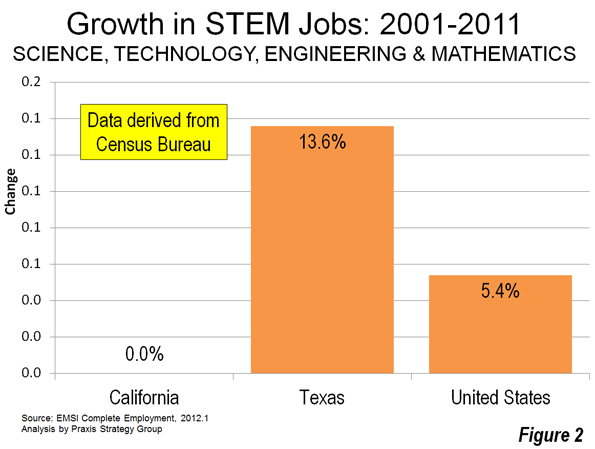
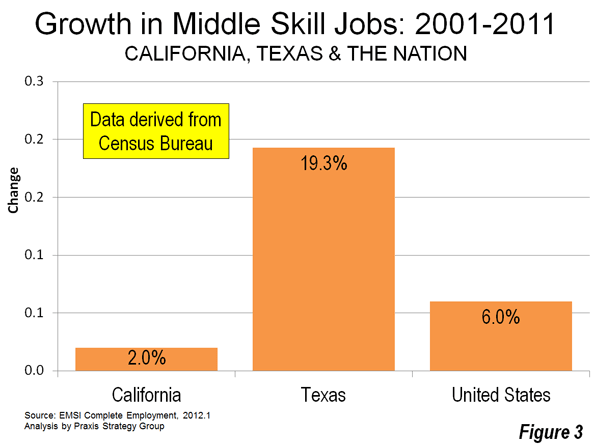
    In contrast, today’s job surge has been largely concentrated in a swath from San Francisco down to Sunnyvale. These firms create the kind of outrageous fortunes celebrated in the media, but their overall employment impact has not been enough to keep California even at parity with the rest of the country. Over the past decade, the state has created virtually no new STEM jobs (science, technology, engineering and math-related employment), while the U.S. experienced a 5.4 percent increase. Arch rival Texas enjoyed a STEM job gusher of 13.6 percent. More important still, mid-skill jobs grew only 2 percent, one third the rate nationally and roughly one fifth the expansion in the Lone Star State.

    Even the Bay Area itself has enjoyed less than stellar growth. Indeed, even now overall unemployment in the Valley remains at 9.3 percent, below the state average of more than 11 percent but higher than the national average. The Valley now boasts 12 percent fewer STEM jobs than in 2001; manufacturing, professional, and financial jobs also have shown losses. Overall, according to research by Pepperdine University economist Mike Shires, the region at the end of last year had 170,000 fewer overall than just a decade ago.

    Today’s Valley boom is also very limited geographically as well, with most of the prosperity concentrated in the Peninsula area, particularly around places like Mountain View (headquarters of Google), Menlo Park (headquarters of Facebook) and in pockets of San Francisco. Meanwhile, San Jose, which fancies itself “the capital of Silicon Valley,” faces the prospect of municipal bankruptcy, a fate increasingly common among cities across the state.

    The magnetic pull of the current tech boom is even weaker across the bay in the Oakland area, where unemployment scales to 14.7 percent. According to the recent rankings of job growth Shires and I did for Forbes, Oakland ranked 63rd out of the nation’s 65 largest metropolitan areas, placing between Cleveland and Detroit.

    Outside of San Diego, which has continued to gain jobs, the echoes of the tech “boom” are even fainter elsewhere in the state. Sacramento placed 60th in the job creation study, just behind Los Angeles, by far the largest region in the state. Former high-flier Riverside-San Bernardino ranked 50th, while the once booming “OC,” Orange County, could do no better than a mediocre 47th.

    These economies have also become technological laggards. According to a study on tech job creation by my colleague Mark Schill, greater Los Angeles, Sacramento, and Riverside-San Bernardino, three large regions, now rank  in the bottom third in tech growth. The Los Angeles area, once the global center of the aerospace industry, now has a lower percentage of jobs in tech-related fields than the national average.

    Beyond the big coastal cities, in places few reporters and fewer venture capitalists travel to, things are often worse. Fresno, Modesto, and Merced have among the weakest employment numbers in the nation. They may be partying in Palo Alto, but things are becoming increasingly Steinbeckian just 50 miles inland.

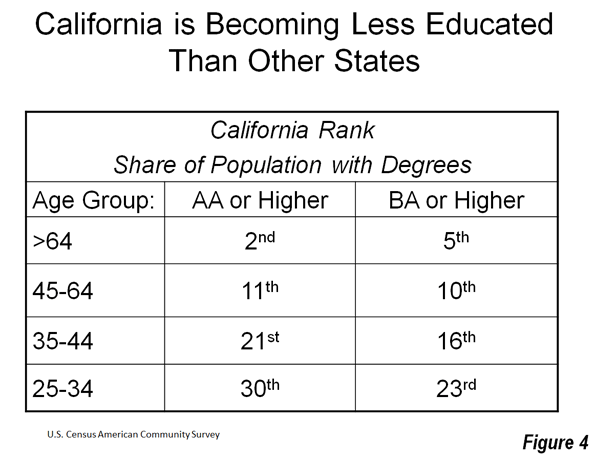
    This is happening even as there has been an ominous decline in the overall quality of California’s talent pool. For residents over age 65, the state ranks 2nd in percentage of people with an AA degree or higher, but among workers 25 to 34 it falls to 30th. Even worse, according to National Assessment of Educational Progress, California eighth graders now rank 47th in science-related skills, ahead only of Mississippi, Alabama, and the District of Columbia.

    None of this seriously affects the new wave of Valley firms. A Google, Apple or Facebook can cream the top not only of the California workforce, but the most gifted drawn from around the world. The old Valley depended on engineers and technicians cranked out in unheralded places like San Jose State and the junior colleges; the new Valley simply mines Stanford, CalTech, Harvard and MIT for its most critical raw material.

    This reflects the contradiction inherent in California’s emerging economy.  High-end, massively financed tech firms like Facebook can endure the Golden State’s weak general education, insanely tough regulations, high energy costs, and rising tax rates. Silicon Valley software firms generally tend to support, or certainly don’t oppose, the draconian energy, land use, and other state regulations widely opposed by other, less ethereal industries.

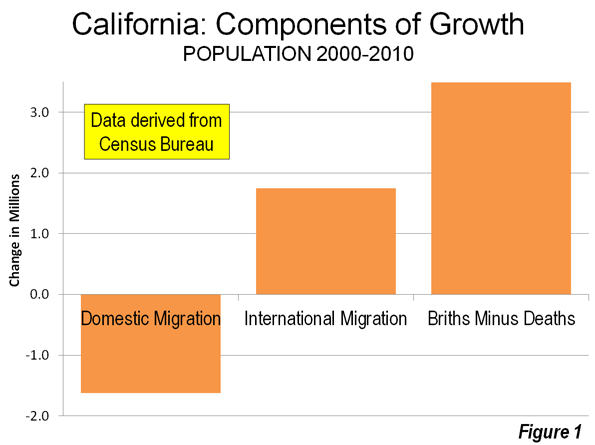
    The main reason: costs cannot be so well sustained outside the favored zones. This explains why people are not flocking in large numbers to California anymore. Last year, according to IRS data, California ranked 50th ahead of only Michigan–for rate of in-migration. So as the most gifted young nerds cluster around Palo Alto, middle-class families leave; between 2000 and 2009, 1.5 million more domestic migrants left the state than came. Even the Bay Area–the epicenter of the boom—has been losing 50,000 domestic migrants a year, due to unsustainably high housing prices and a narrower range of employment options for all but the best educated.

    Many of these people–and companies—are moving to places that are far less attractive in terms of climate or culture, such as Utah, Texas, or even Oklahoma. The migrants may miss the beach or the temperate climate but reap huge benefits from lower home prices, lower taxes, and much better business environments. 

    Of course, any state would welcome the windfall that is coming from Facebook and other dot.com phenomena. But the celebration over IPOs and rich payouts obscures the greater danger that threatens the future of the Golden State. The current boom demonstrates that Californians can no longer count on the prosperity of a few as the harbinger of better things for the rest of us. Instead Californians now inhabit, as a recent Public Policy Institute of California study    suggests, a society that is increasingly class divided, far more so than the national average.

    Ultimately, one should not expect Facebook, or any company, to solve these vast problems. To expect this tech wave to reverse California’s decline is nothing short of delusional. 

    Joel Kotkin is executive editor of NewGeography.com and is a distinguished presidential fellow in urban futures at Chapman University, and contributing editor to the City Journal in New York. He is author of The City: A Global History. His newest book is The Next Hundred Million: America in 2050, released in February, 2010.

    This piece originally appeared in The Daily Beast.

    Facebook photo by BigStockPhoto.com.

  • The Best Cities For Tech Jobs

    With Facebook poised to go public, the attention of the tech world, and Wall Street, is firmly focused on Silicon Valley. Without question, the west side of San Francisco Bay is by far the most prodigious creator of hot companies and has the highest proportion of tech jobs of any region in the country — more than four times the national average.

    Yet Silicon Valley is far from leading the way in expanding science and technology-related employment in the United States.

    To determine which metropolitan areas are adding the most tech-related jobs, my colleague Mark Schill at Praxis Strategy Group developed a ranking system for Forbes that measures employment growth in the sectors most identified with the high-tech economy (including software, data processing and Internet publishing), as well as growth in science, technology, engineering and mathematics-related (STEM) jobs across all sectors. The latter category captures tech employment growth that is increasingly taking place not just in software or electronics firms, but in any industry that needs science and technology workers, from manufacturing to business services to finance. We tallied tech sector and STEM job growth over the past two years and over the past decade for the 51 largest metropolitan statistical areas in the United States. We also factored in the concentration of STEM and tech jobs in those MSAs. (See the end of this piece for a full rundown of our methodology.)

    Anyone who has followed tech over the past 30 years or more understands the cyclical nature of this industry — overheated claims of a “tech-driven jobs boom” often are followed by a painful bust. This is particularly true for Silicon Valley. The remarkable confluence of engineering prowess, marketing savvy and, perhaps most critically, access to startup capital may have created the greatest gold rush of our epoch, but the Valley at the end of 2011 employed 170,000 fewer people than in 2000.

    Most of the job losses came in manufacturing, and business and financial services, sectors with a significant number of STEM workers. Even though the current boom has sparked an impressive 8% expansion in the number of tech jobs in the San Jose-Sunnyvale-Santa Clara metropolitan statistical area over the past two years, and 10% over the past decade, the area still has 12.6% fewer STEM jobs than in 2001. Overall, the recent growth and concentration of tech and STEM jobs remains good enough for the San Jose metro area to take seventh place in our ranking of the Best Cities For Tech Jobs. Next-door neighbor San Francisco, ranked 13th, has enjoyed similar tech and STEM growth over the past two years, but over 2001-2011, its total STEM employment inched up only a modest 0.8%.

    The Established Winners

    So which areas offer better long-term, broad-based prospects for tech growth? The most consistent performer over the period we assessed is the Seattle-Tacoma-Bellevue, Wash., metro area, which takes first place on our list. Its 12% tech job growth over the past two years and 7.6% STEM growth beat the Valley’s numbers. More important for potential job-seekers, the Puget Sound regions has grown consistently in good times and bad, boasting a remarkable 43% increase in tech employment over the decade and an 18% expansion in STEM jobs. Seattle withstood both recessions of the past decade better than most regions, particularly the Valley. The presence of such solid tech-oriented companies as Microsoft, Amazon and Boeing — and lower housing costs than the Bay Area — may have much to do with this.

    Our top five includes two government-dominated regions: the Washington-Arlington-Alexandria MSA places second with 20.6% growth in tech employment since 2001 and 20.8% growth in STEM jobs; and Baltimore-Towson, Md., places fifth with 38.8% growth in tech jobs in the same period and 17.2% growth in STEM. Over the past two years, their tech growth has been a steady, if not spectacular 4%. One key to the stability may be the broadness of the tech economy in the greater D.C. area; as the Valley has become dominated by trends in web fashion, the Washington tech complex boasts substantial employment in such fields as computer systems design, custom programming and private-sector research and development.

    Diversity in tech may also explain the success of other tech hotspots around the country. No. 3 San Diego-Carlsbad-San Marcos, Calif., has ridden growth in such fields as biotechnology and other life and physical sciences research. Over the past decade, tech employment has grown by almost 30% and STEM jobs by 13% in this idyllic Southern California region, and over the past two years, by 15.7% and 6.5%, respectively. Like San Diego, No. 11 Boston is also a well-established tech star, enjoying 11.3% tech growth over the last decade and nearly 10% over the past two years, with a diversified portfolio that includes strong concentrations in biotechnology, software publishing and Internet publishing. STEM employment, however, has remained flat over the past 10 years though.

    New Tech Hotspots

    Which areas are the likely “up and comers” in the next decade? These are generally places that have been building up their tech capacity over the past several decades, and seem to be reaching critical mass. One place following a strong trajectory is Salt Lake City, No. 4 on our list, which has enjoyed a 31% spurt in tech employment over the past 10 years. Some of this can be traced to large-scale expansion in the area by top Silicon Valley companies such as Adobe, Electronic Arts and Twitter.

    These companies have flocked to Utah for reasons such as lower taxes, a more flexible regulatory environment, a well-educated, multilingual workforce and spectacular nearby natural amenities. Perhaps most critical of all may be housing prices: Three-quarters of Salt Lake area households can afford a median-priced house, compared to 45% in Silicon Valley and about half that in San Francisco.

    Several other top players with above average shares of tech jobs are emerging as powerful alternatives to Silicon Valley. Like Salt Lake City, eighth-place Columbus, Ohio, boasts above-average proportions of tech and STEM jobs in the local economy, and benefits from being both affordable and business friendly. The Ohio state capital has enjoyed 31% growth in tech jobs over the past decade and 9.5% in the past two years. Raleigh-Cary, N.C., ranked ninth, is another relatively low-cost, low-hassle winner, expanding its tech employment a remarkable 32.3% in the past decade and STEM jobs 15%.

    Possible Upstarts

    Several places with historically negligible tech presences have broken into our top 10. One is No. 6 Jacksonville, Fla., which has enjoyed a 72.4% surge in tech employment and 17.4% STEM job growth since 2001, mostly as a result of a boom early in the decade in data centers, computer facilities management, custom programming and systems design. Another surprising hotspot: No. 10 Nashville, Tenn., where growth in data processing and systems design fueled tech industry growth of 43% along with 18.5% STEM employment growth over the past decade.

    Who’s Losing Ground

    Some mega-regions with established tech centers have been falling behind, notably No. 47 St. Louis, No. 45 Chicago, No. 41 Philadelphia and No. 39 Los Angeles. These areas still boast strong concentrations of STEM-based employment and prominent high-tech companies, but have suffered losses in fields such as aerospace and telecommunications. Remarkably despite the social media boom, the country’s two dominant media centers — L.A. and No. 33 New York — have also performed poorly enough that their STEM and tech concentrations have fallen to roughly the national average.

    Valley Uber Alles?

    Silicon Valley may be churning out millionaires like burritos at a Mexican restaurant, but looking into the future, one has to wonder if its dominance will diminish. Limited developable land, an extremely difficult planning environment, high income taxes and impossibly stratospheric housing costs may lead more companies and people to relocate elsewhere, particularly if the big paydays needed to make ends meet wind down. Mark Zuckerberg and company can bask in their big IPO this week, but the Valley may soon need to consider what it must do to compete with the many other regions that are inexorably catching up with it.

    Best Metropolitan Areas for Technology Jobs Rankings

    Region Rank Index Score
    Seattle-Tacoma-Bellevue, WA 1 76.0
    Washington-Arlington-Alexandria, DC-VA-MD-WV 2 66.4
    San Diego-Carlsbad-San Marcos, CA 3 66.0
    Salt Lake City, UT 4 58.5
    Baltimore-Towson, MD 5 57.7
    Jacksonville, FL 6 57.6
    San Jose-Sunnyvale-Santa Clara, CA 7 57.2
    Columbus, OH 8 52.9
    Raleigh-Cary, NC 9 51.9
    Nashville-Davidson–Murfreesboro–Franklin, TN 10 51.7
    Boston-Cambridge-Quincy, MA-NH 11 51.4
    San Antonio-New Braunfels, TX 12 50.7
    San Francisco-Oakland-Fremont, CA 13 48.5
    Houston-Sugar Land-Baytown, TX 14 47.6
    Cincinnati-Middletown, OH-KY-IN 15 47.4
    Austin-Round Rock-San Marcos, TX 16 46.8
    Atlanta-Sandy Springs-Marietta, GA 17 46.5
    Portland-Vancouver-Hillsboro, OR-WA 18 46.3
    Detroit-Warren-Livonia, MI 19 46.0
    Dallas-Fort Worth-Arlington, TX 20 44.2
    Denver-Aurora-Broomfield, CO 21 42.9
    Pittsburgh, PA 22 42.9
    Buffalo-Niagara Falls, NY 23 42.3
    Charlotte-Gastonia-Rock Hill, NC-SC 24 42.1
    Indianapolis-Carmel, IN 25 41.5
    Minneapolis-St. Paul-Bloomington, MN-WI 26 41.0
    Providence-New Bedford-Fall River, RI-MA 27 40.5
    Miami-Fort Lauderdale-Pompano Beach, FL 28 40.1
    Richmond, VA 29 39.1
    Phoenix-Mesa-Glendale, AZ 30 38.7
    Louisville/Jefferson County, KY-IN 31 38.6
    New Orleans-Metairie-Kenner, LA 32 38.0
    New York-Northern New Jersey-Long Island, NY-NJ-PA 33 37.8
    Hartford-West Hartford-East Hartford, CT 34 37.6
    Tampa-St. Petersburg-Clearwater, FL 35 36.0
    Oklahoma City, OK 36 35.7
    Orlando-Kissimmee-Sanford, FL 37 35.0
    Riverside-San Bernardino-Ontario, CA 38 33.8
    Los Angeles-Long Beach-Santa Ana, CA 39 33.7
    Las Vegas-Paradise, NV 40 33.4
    Philadelphia-Camden-Wilmington, PA-NJ-DE-MD 41 33.3
    Sacramento–Arden-Arcade–Roseville, CA 42 33.2
    Cleveland-Elyria-Mentor, OH 43 29.9
    Rochester, NY 44 29.5
    Chicago-Joliet-Naperville, IL-IN-WI 45 26.0
    Memphis, TN-MS-AR 46 25.8
    St. Louis, MO-IL 47 24.9
    Kansas City, MO-KS 48 24.4
    Virginia Beach-Norfolk-Newport News, VA-NC 49 24.3
    Milwaukee-Waukesha-West Allis, WI 50 24.1
    Birmingham-Hoover, AL 51 11.3


    Joel Kotkin is executive editor of NewGeography.com and is a distinguished presidential fellow in urban futures at Chapman University, and contributing editor to the City Journal in New York. He is author of The City: A Global History. His newest book is The Next Hundred Million: America in 2050, released in February, 2010.

    Mark Schill is Vice President of Research at Praxis Strategy Group, an economic development and research firm working with communities and states to improve their economies.


    Rankings Methodology

    Our Best Cities for Technology Jobs ranking is a weighted index measuring growth and concentration of technology-related employment in the nation’s 51 largest metropolitan regions. The 51 regions are scored against each other on a 1-to-100 scale. The index includes both tech industry employment data and occupation-based employment data. Our technology industry component covers 11 six-digit NAICS sectors covering information industries such as software publishing, Internet publishing, data processing, and tech-related business services such as computer systems design, custom programming, engineering services, and research and development. The technology industry data covers 4.5 million jobs nationally. The occupation-based component includes 95 science, technology, engineering, and mathematics (STEM) occupations as classified by the federal Standard Occupation Classification system. This covers 8 million STEM workers that could be employed in any industry. Employment data in our analysis is courtesy of EMSI, Inc. and is based upon over 90 federal and state data sources.

    The index comprises four weighted measures: 50% STEM occupation growth, 25% technology industry growth, 12.5% STEM occupation concentration, and 12.5% technology industry concentration. Growth measures are evenly balanced between the 2001-2011 growth rate and the 2009-2011 growth rate, while the concentration measure are job location quotients from 2011.

    Note that there is likely to be some double-counting of STEM workers working in tech industries. The tech industries are also obviously employing others, such as salespeople, managers, janitors, etc.

    Though these types of rankings typically include only industry data, we felt the STEM jobs data captured “tech” more cleanly so we weighted it higher. However we felt it still important to include the data covering the industries that most identify with the high-tech economy.  The heavier weight on STEM helps minimize the effect of a double-counted STEM worker in a tech company.

    Seattle photo courtesy of BigStockPhoto.com.

  • The Export Business in California (People and Jobs)

    California Senate President Pro-Tem Darrell Steinberg countered my Wall Street Journal commentary California Declares War on Suburbia in a letter to the editor (A Bold Plan for Sustainable California Communities) that could be interpreted as suggesting that all is well in the Golden State. The letter suggests that business are not being driven away to other states and that the state is "good at producing high-wage jobs," while pointing to the state’s 10 percent growth over the last decade. Senate President Steinberg further notes that the urban planning law he authored (Senate Bill 375) is leading greater housing choices and greater access to transit.

    This may be a description of the California past, but not present.

    Exporting People

    Yes, California continues to grow. California is growing only because there are more births than deaths and the state had a net large influx of international immigration over the past decade. At the same time, the state has been hemorrhaging residents (Figure 1).

    Californians are leaving. Between 2000 and 2009 (Note), a net 1.5 million Californians left for other states. Only New York lost more of its residents (1.6 million). California’s loss was greater than the population of its second largest municipality, San Diego. More Californians moved away than lived in 12 states at the beginning of the decade. Among the net 6.3 million interstate domestic migrants in the nation, nearly one-quarter fled California for somewhere else.

    The bulk of the exodus was from the premier coastal metropolitan areas. Since World War II, Los Angeles, San Francisco, San Diego and San Jose have been among the fastest growing metropolitan areas in the United States and the high-income world. Over the last decade, this growth has slowed substantially, as residents have moved to places that, all things being considered, have become their preferences.

    More than a net 1.35 million residents left the Los Angeles metropolitan area, or approximately 11 percent of the 2000 population. The San Jose metropolitan area lost 240,000 residents, nearly 14 percent of its 2000 population. These two metropolitan areas ranked among the bottom two of the 51largest metropolitan areas (over 1,000,000 population) in the percentage of lost domestic migrants during the period. The San Francisco metropolitan area lost 340,000 residents, more than 8 percent of its 2000 population and ranked 47th worst in domestic migration (New York placed worse than San Francisco but better than Los Angeles). Each of these three metropolitan areas lost domestic migrants at a rate faster than that of Rust Belt basket cases Detroit, Cleveland and Buffalo.

    San Diego lost the fewest of the large coastal metropolitan areas (125,000). Even this was double the rate of Rust Belt Pittsburgh.

    Exporting Jobs

    California is no longer an incubator of high-wage jobs. The state lost 370,000 jobs paying 25 percent or more of the average wage between 2000 and 2008. This compares to a 770,000 increase in the previous 8 years. California is trailing Texas badly and the nation overall in creating criticial STEM jobs and middle skills jobs (Figures 2 & 3) Only two states have higher unemployment rates than California (Nevada and Rhode Island) . California has the second highest underemployment rate (20.8 percent), which includes the number of unemployed, plus those who have given up looking for work ("discouraged" workers) and those who are working only part time because they cannot find full time work. Only Nevada, with its economy that is overly-dependent on California, has a higher underemployment rate.


    Business relocation coach Joseph Vranich conducts an annual census of companies moving jobs out of California and found a quickening pace in 2012. Often these are the very kinds of companies capable of creating the high-wage jobs that used to be California’s forte. Vranich says that the actual number may be five times as high, which is not surprising, not least because there is no reliable compilation of off-shoring of jobs to places like Bangalore, Manila or Cordoba (Argentina).

    To make matters worse, California is becoming less educated. California’s share of younger people with college degrees is now about in the middle of the states, while older, now retiring Californians are among the most educated in the nation (Figure 4).

    Denying Housing Choice

    It is fantasy to believe, as Steinberg claims, that there are enough single family (detached) houses in the state to meet the demand for years to come. More than 80 percent of the new households in the state chose detached housing over the last decade. People’s actual choices define the market, not the theories or preferences of planners often contemptuous of the dominant suburban lifestyle.

    In contrast, however, the regional plans adopted or under consideration in the Bay Area, Los Angeles and San Diego would require nearly all new housing be multi-family, at five to 10 times normal California densities (20 or more units to the acre are being called for). New detached housing on the urban fringe would be virtually outlawed by these plans. And, when Sacramento does not find the regional plans dense enough, state officials (such as the last two state Attorneys General) are quick to sue. If the "enough detached housing" fantasy held any water, state officials and planners would not be seeking its legal prohibition. To call outlawing the revealed choice of the 80 percent (detached housing) would justify the equivalent of a Nobel Prize in Doublespeak.

    At the same time by limiting the amount of land on which the state preferred high density housing must be built, land and house prices can be expected to rise even further from their already elevated levels (already largely the result of California’s pre-SB 375 regulatory restrictions).

    Transit Rhetoric and Reality

    Transit is important in some markets. About one-half of commuters to downtown San Francisco use transit. The assumptions of SB 375 might make sense if all of California looked like downtown San Francisco. It doesn’t, nor does even most of the San Francisco metropolitan area. Only about 15 percent of employment is downtown, while the 85 percent (and nearly all jobs in the rest of the state) simply cannot be reached by transit in a time that competes with the car. Even in the wealthy San Jose area (Silicon Valley), with its light rail lines and commuter rail line, having a transit stop nearby provides 45 minute transit access to less than 10 percent of jobs in the metropolitan area.

    A recent Brookings Institution report showed that the average commuter in the four large coastal metropolitan areas can reach only 6.5 percent of the jobs in a 45 minute transit commute. This is despite the fact that more than 90 percent of residents can walk to transit stops. Even when transit is close, you can’t get there from here in most cases in any practical sense (Figure 5).

    SB 375 did little to change this. For example, San Diego plans to spend more than 50 percent of its transportation money on transit over the next 40 years. This is 25 times transit’s share of travel (which is less than 2 percent). Yet, planners forecast that all of this spending will still leave 7 out of 8 work and higher education trips inaccessible by transit in 30 minutes in 2050. Already 60 to 80 percent of work trips in California are completed by car in 45 minutes and the average travel time is about 25 minutes.

    For years, planners have embraced the ideal of balancing jobs and housing, so that people would live near where they work, while minimizing travel distances. This philosophy strongly drives the new SB 375 regional plans. What these plans miss is that people choose where to work from the great array of opportunities available throughout the metropolitan area. These varied employment opportunities that are the very reason that large metropolitan areas exist, according to former World Bank principal planner Alain Bertaud.

    People change jobs far more frequently than before and multiple earners in households are likely to work far apart. Similar intentions led to the development up to four decades ago of centers like Tensta in Stockholm, which ended up as concentrated low income areas (Photo). It California, such a concentration would do little to improve transit ridership, even low-income citizens are four to 10 times as likely use cars to get to work than to use transit.


    Tensta Transit Oriented Development: Stockholm

    All of this means more traffic congestion and more intense local air pollution, because higher population densities are associated with greater traffic congestion. Residents of the new denser housing would face negative health effects because there is more intense air pollution, especially along congested traffic corridors.

    Self-Inflicted Wounds

    Worst of all, California’s radical housing and transportation strategies are unnecessary. The unbalanced and one-dimensional pursuit of an idealized sustainability damages both quality of life and the economy. This is exacerbated by other issues, especially the state’s dysfunctional economic and tax policies. It is no wonder California is exporting so many people and jobs. California’s urban planning regime under SB 375 is poised to make it worse.

    Wendell Cox is a Visiting Professor, Conservatoire National des Arts et Metiers, Paris and the author of “War on the Dream: How Anti-Sprawl Policy Threatens the Quality of Life”.

    Net Domestic Migration: 2000-2009
    Rank Metropolitan Area Net Domestic Migration Compared to 2000 Population
    1 Raleigh, NC         194,361 24.2%
    2 Las Vegas, NV         311,463 22.4%
    3 Charlotte, NC-SC         248,379 18.5%
    4 Austin, TX         234,239 18.5%
    5 Phoenix, AZ         543,409 16.6%
    6 Riverside-San Bernardino, CA         469,093 14.3%
    7 Orlando, FL         225,259 13.6%
    8 Jacksonville, FL         126,766 11.3%
    9 Tampa-St. Petersburg, FL         260,333 10.8%
    10 San Antonio, TX         177,447 10.3%
    11 Atlanta, GA         428,620 10.0%
    12 Nashville, TN         123,199 9.4%
    13 Sacramento, CA         141,117 7.8%
    14 Richmond, VA           75,886 6.9%
    15 Portland, OR-WA         121,957 6.3%
    16 Dallas-Fort Worth, TX         317,062 6.1%
    17 Houston, TX         243,567 5.1%
    18 Indianapolis. IN           72,517 4.7%
    19 Oklahoma City, OK           41,082 3.7%
    20 Denver, CO           66,269 3.0%
    21 Louisville, KY-IN           34,381 3.0%
    22 Birmingham, AL           26,934 2.6%
    23 Columbus, OH           34,204 2.1%
    24 Kansas City, MO-KS           31,747 1.7%
    25 Seattle, WA           40,741 1.3%
    26 Minneapolis-St. Paul, MN-WI          (19,731) -0.7%
    27 Memphis, TN-MS-AR            (8,583) -0.7%
    28 Hartford, CT            (9,349) -0.8%
    29 Cincinnati, OH-KY-IN          (17,648) -0.9%
    30 Virginia Beach-Norfolk, VA-NC          (20,005) -1.3%
    31 Baltimore, MD          (36,407) -1.4%
    32 St. Louis, MO-IL          (43,750) -1.6%
    33 Philadelphia, PA-NJ-DE-MD        (115,890) -2.0%
    34 Pittsburgh, PA          (52,028) -2.1%
    35 Washington, DC-VA-MD-WV        (107,305) -2.2%
    36 Providence, RI-MA          (49,168) -3.1%
    37 Salt Lake City, UT          (34,428) -3.5%
    38 Rochester, NY          (40,219) -3.9%
    39 San Diego, CA        (126,860) -4.5%
    40 Buffalo, NY          (55,162) -4.7%
    41 Milwaukee,WI          (74,453) -5.0%
    42 Boston, MA-NH        (235,915) -5.4%
    43 Miami, FL        (287,135) -5.7%
    44 Chicago, IL-IN-WI        (561,670) -6.2%
    45 Cleveland, OH        (136,943) -6.4%
    46 Detroit,  MI        (366,790) -8.2%
    47 San Francisco-Oakland, CA        (347,375) -8.4%
    48 New York, NY-NJ-PA     (1,962,055) -10.7%
    49 Los Angeles, CA     (1,365,120) -11.0%
    50 San Jose, CA        (240,012) -13.8%
    51 New Orleans, LA        (301,731) -22.9%
    Data from US Census Bureau


    —–

    Note:  2000 to 2010 data not available

    Lead photo: Largely illegal to build housing under California Senate Bill 375 planning

  • Small Cities Are Becoming a New Engine Of Economic Growth

    The conventional wisdom is that the world’s largest cities are going to be the primary drivers of economic growth and innovation. Even slums, according to a fawning article in National Geographic, represent “examples of urban vitality, not blight.” In America, it is commonly maintained by pundits that “megaregions” anchored by dense urban cores will dominate the future.

    Such conceits are, not surprisingly, popular among big city developers and the media in places like New York, which command the national debate by blaring the biggest horn. However, a less fevered analysis of recent trends suggests a very different reality: When it comes to growth, economic and demographic, opportunity increasingly is to be found in smaller, and often remote, places.

    Read about how we selected the 2012 Best Cities for Job Growth

    This year’s edition of Forbes’ Best Cities For Jobs survey, compiled with Pepperdine University’s Michael Shires, found that small and midsized metropolitan areas, with populations of 1 million or less, accounted for 27 of the 30 urban regions in the country that are adding jobs at the fastest rate. The three largest metropolitan statistical areas that made the top 30 — Austin, Houston and Salt Lake City — are themselves highly dispersed with sprawling employment sheds.

    Rather than the products of “smart growth” and intense densification, almost all of the fastest-growing metropolitan areas — including larger ones like Silicon Valley and Raleigh — tend to be dominated by suburban-style, single-family homes and utterly dependent on the greatest scourge of the urbanist creed: the private car. But many of the smaller areas also punch above their weight in myriad ways, spanning a host of industries.

    Among the 398 MSAs we ranked for the list, energy towns dominate the top of the table:  Odessa, Texas (100,000), took first place; followed by Midland, Texas (population: 111,000), in second place; Lafayette, La. (fourth, 114,000); Corpus Christi, Texas (sixth, 287,000); San Angelo, Texas (seventh, 92,000); Casper, Wyo. (10th, 54,000); and Bismarck, N.D. (21st, 61,000). These cities’ economies have expanded steadily over the last few years, beneficiaries of a great boom in fossil fuels that, unless derailed by regulators, will continue for the foreseeable future.

    But some of the other best cities for jobs make their livings in different ways, such as No. 12 Glens Falls, N.Y., riding growth in business services and tourism; and No. 15 Columbia, Mo., which is primarily a college and government town. Several smaller communities have bounced back strongly with the recovery of manufacturing, including No. 3 Columbus Ind., No. 11 Williamsport, Pa., and No. 19 Holland-Grand Haven, Mich.

    This shift in opportunity also parallels some compelling demographic trends. In the 1990s, the rate of population growth of areas over 1 million and those below was essentially similar. In contrast, in the subsequent decade, urban areas with fewer than a million people expanded by 15%, compared to barely 9% for larger urban areas, notes demographer Wendell Cox. In those 10 years, areas with fewer than a million people accounted for more than 60% of urban growth. Essentially more Americans are now moving to smaller regions than to larger ones.

    We  see is a very different reality than that often promoted by big city boosters. Large, dense urban regions clearly possess some great advantages: hub airports, big labor markets, concentrations of hospitals, schools, cultural amenities and specific industrial expertise. Yet despite these advantages, they still lag in the job creation race to unheralded, smaller communities.

    Why are the stronger smaller cities growing faster than most larger ones? The keys may lie in many mundane factors that are often too prosaic for urban theorists. They include things such as strong community institutions like churches and shorter commutes than can be had in New York, L.A., Boston or the Bay Area (except for those willing to pay sky-high prices to live in a box near downtown). Young families might be attracted to better schools in some areas — notably the Great Plains — and the access to natural amenities common in many of these smaller communities.

    Perhaps another underappreciated factor is Americans’ overwhelming preference for a single-family home, particularly young families. A recent survey from the National Association of Realtors found that 80 percent preferred a detached, single-family home; only a small sliver, roughly 7 percent, wanted to live in a dense urban area “close to it all.” Some 87 percent expressed a strong desire for greater privacy, something that generally comes with lower-density housing.

    This trend towards smaller communities — unthinkable among big city planners and urban land speculators — is likely to continue for several reasons. For one thing, new telecommunications technology serves to even the playing field for companies in smaller cities. You can now operate a sophisticated global business from Fargo, N.D., or Shreveport, La., in ways inconceivable a decade or two ago.

    Another key element is the predilections of two key expanding demographic groups: boomers and their offspring, the millennials. Aging boomers are not, in large part, hankering for dense city life, as is often asserted. If anything, if they choose to move, they tend toward less dense and even rural areas. Young families and many better-educated workers also seem to be moving generally to less dense and affordable places.

    Perhaps even more surprising, this tendency toward decentralization can be seen around the world: much of the new growth is in smaller cities, with India as a prime example. A recent McKinsey study found that “middle-weight” cities, many of them well under a million, have already started taking a larger percentage of the world’s urban growth.

    McKinsey suggests that the notion that megacities will dominate the urban future constitutes “a common misconception.” Instead surging smaller cities will constitute well over half of the world’s urban growth, gaining ever more share from the megacities over time. This is particularly true in the U.S. which constitutes the epicenter for the new smaller city economy. Of the world’s 600 “middleweight” cities, the U.S. is home to 257. Together they generate 70% of U.S. GDP.

    What does this mean for investors, companies and individuals in the coming decades? For one thing, Wall Street, which tends to obsess over a handful of high-cost, dense, urban markets, may seek out new opportunities in faster-growing smaller cities. Prices tend to be lower and competition for prime space less intense, and the demographic wind is at their backs. Companies looking to expand may find not only a welcome mat from the locals, but also an expanding workforce in these generally more affordable places.

    Finally, particularly for the next generation, the shift to smaller cities provides a whole realm of new options for sinking roots, starting business or a family and owning a home. Smaller city life certainly does not appeal to everyone, or every business, but their growing dynamism provides a welcome option for people who want to get a leg up in the next decade.

    Read about how we selected the 2012 Best Cities for Job Growth

    This piece originally appeared in Forbes.

    Joel Kotkin is executive editor of NewGeography.com and is a distinguished presidential fellow in urban futures at Chapman University, and contributing editor to the City Journal in New York. He is author of The City: A Global History. His newest book is The Next Hundred Million: America in 2050, released in February, 2010.

    Photo: Glens Falls, NY

  • The OECD Reviews Chicago

    “Although still high in absolute terms, GDP and labor productivity growth rates are sluggish – both by US and international standards. The Chicago Tri-State metro-region’s contribution to national growth has slowed over the past decade and the region does not stand out as a top knowledge hub. Despite a dynamic and numerically large labor force, the region has experienced virtually no growth in the size of its prime working-age population and displays limited ability to attract and retain talent when compared to its US peers. More worrisome are the persistence of unemployment and the lack of sufficient job creation.” – OECD Territorial Review, The Chicago Tri-State Metropolitan Area

    The Organization for Economic Cooperation and Development (OECD) is an international organization that has its roots in the administration of Marshall Plan aid to rebuild Europe after World War II. The OECD was invited by the Chicagoland Chamber of Commerce* to perform a “territorial review” of Chicago’s regional economy. I believe this is the first such review the OECD has ever undertaken in the United States. The results were released a couple months ago. Unfortunately, the OECD doesn’t make its reports available for free online, but the Chicagoland Chamber graciously sent me a copy. I did a read through of this inch-thick, 332-page report and wanted to share a few observations about it. As the quote at the top might indicate, this report, like Rahm Emanuel’s economic strategy, was fairly gloomy. My points will be topical and not an integrated narrative as I did not get to undertake as thorough a review as I might like.

    Performing the Study Demonstrates the Challenge

    The review focused on the Chicago metropolitan area, though frequently included the Milwaukee metro area as well. Wisconsin and Indiana were invited to participate in the project, which was notable given the city-centric nature of most civic development initiatives in Chicago and the fact that the lion’s share of the people and economic output are in Illinois. It’s a recognition of the need to think regionally. Wisconsin did participate, but Indiana declined. Explaining why, Indiana economic development chief Mitch Roob said, “We don’t do studies, we do deals.” Indiana also made it clear that it intended to differentiate itself from Illinois to attract jobs, and that luring jobs across the border from Illinois was a core plank in their economic development strategy. (Interestingly, as I’ve documented elsewhere, Indiana has rolled over and actually allowed Kentucky to financially exploit it on the other side of the state, so the behavior is not consistent).

    Indiana Governor Mitch Daniels loves to criticize Northwest Indiana for not getting its act together. Indeed, much of that criticism is fully warranted and Daniels has spent enough time up there to get an up close and personal look at regional dysfunction. Nevertheless, NWI functions as part of the metro Chicago economy. Its success is ultimately tied to Chicagoland’s overall success, not luring jobs from a stagnated region across the border. Indiana may have a few huge gas stations and liquor stores right on the border, but you can’t build an economy on that. (From 2004-2011, Mitch Daniels term in office, Indiana has actually lost a greater percentage of its jobs than Illinois and the migration of people from Illinois to Indiana also slowed, so the “Illinoyned” strategy obviously isn’t working). Indiana should clearly have come to the table for this review.

    The fact that Indiana wouldn’t even participate in a study just goes to show how difficult regional cooperation can be. In that regard, the undertaking of the OECD review itself shows the challenge facing the region. I should note that the report authors did a good job of trying to fairly include and represent Indiana despite the state government’s lack of participation.

    Interesting Statistics

    The OECD review amassed quite a bit of interesting statistical data on Chicago and puts them in the context of other major cities in the 34 countries that comprise in the OECD. I think that by itself made the review worth doing. I might suggest other cities take a look at this to determine if such a study would be relevant to them, particularly as international comparisons can be difficult to pull off.

    This report is a goldmine of stats and there’s way too much to list here, but a few things that jumped out at me:

    • The OECD report benchmarked labor productivity, which is less commonly looked at in economic studies. Chicago’s is above average but growing more slowly than average.
    • Chicago has trailed the nation in job growth. Had Chicago simply matched the national average in job growth since 1990, the region would have 600,000 more jobs than it does today.
    • There was quite a bit of sectoral analysis of Chicago’s economy. In fact, they actually normalize the sectoral composition of Chicago’s economy when looking at job growth to see if its under performance in job growth was due to concentration in slow growing sectors – but it was not.
    • Chicago is known for having America’s second largest business district, but it ranks only fifth out of the top ten regions in America for the percentage of its jobs in the core city. Between 1960 and 1990, over 96% of new regional jobs were created outside downtown.
    • There were many other interesting statistics around labor force participation, mobility of educated labor, elderly dependency ratios, educational attainment, poverty, patents, the structure of governments, taxation, etc.

    Excess High End Talent

    According to the OECD, Chicago suffers from a skills mismatch in its workforce. This is not just true at the bottom end of the economy as might be expected, but also at the top end, where there is a surplus of highly skilled labor:

    At the high end, there is a large pool of high-skilled, highly educated workers, in principle more than sufficient to fill the jobs available at that level … at the high-skill end, data for the tri-state region points to an apparent oversupply.

    To some extent this shouldn’t be a surprise. Chicago is a desirable city for people to live in, particularly for educated workers inside its heartland catchment area. As with other big city talent magnets, the economy doesn’t always supply the right employment for all the people who want to live there. The many articles about unemployment in Portland, for example, illustrates this, and Chicago is similar. In that regard, you might see the skills surplus as a sign of local strength.

    However, the skill concentration in Chicago isn’t producing the type of high end innovation economy seen elsewhere. As the OECD notes, “Indicators suggest that the Chicago Tri-State metro-region does not rank as highly among the US knowledge hubs as one might expect, given the size of its economy and population and its concentration of world-class research universities.”

    Also, Chicago may not be as attractive a talent hub as its aggregate numbers indicate. Again per the OECD:

    To be sure, the Chicago Tri-State metro-region remains an attractive place for many migrants, but it is less attractive than many of its US metro-region peers. Moreover, if the analysis is confined to highly educated people of prime working age (25+, with at least a bachelor’s degree), then the picture is even more problematic. During 2005-09, more such people moved into the area than left it, but the net gain was relatively small compared with other large US metro-regions. Los Angeles, for example, benefited from a net gain of nearly 80,000 highly educated people in 2009, compared with 3,500 for the Chicago Tri-State metro-region.

    When you under-perform as a talent magnet and still can’t put high skilled labor to good use, that’s a definite sign of trouble. This was one thing that was eye opening for me in the study as I’d previously assumed the high end of the market was in pretty good shape and that skill mismatch problems were the result of a large under-educated population vs. open jobs requiring mid-tier skills.

    Policy Prescriptions

    The OECD’s recommendations were not nearly as strong as its assessment of the region’s conditions. This shouldn’t be surprising as it is easy to look at data and see what may be wrong, but it is not always obvious what to do about it. The recommendations fall into five broad categories:

    • Better Skills Matching
    • Improving Innovation and Entrepreneurship
    • Investments in Transportation and Logistics
    • More Green Industry Growth
    • More Effective Institutional Arrangements

    First off, including “green growth” as one of only five major chapter headings is a joke. The aggregate number of jobs identified as specifically green is small. And as I’ve noted many times, there’s no such thing as green industry. Pretty soon there will just be industry again – it will all be green. So if Chicago and the US aren’t doing well at today’s industries, why would we think they would do any better at tomorrow’s? “Green” isn’t some sort of fairy dust you can sprinkle on and work wonders with. If anything, the acceleration of transition to more green practices will only drive more manufacturing offshore, exactly as it did with light bulbs. The track record of trying to create “green jobs” almost everywhere has been poor and has failed to live up to the hype, so I can’t believe the OECD is doubling down on this snake oil.

    For the other areas, the OECD doesn’t break much new ground, though does highlight some interesting international case studies of regions getting it right. The sections more or less regurgitate the laundry list of organizations and initiatives already in place, then tag on “do more and coordinate better.” Examples include, “create region-wide capacity to match skills supply with demand” and “broaden the innovation focus [to include] non-science-and-technology-based innovation.”

    By contrast, there was little focus on what counterproductive initiatives might be trimmed. While, for example, the report notes that many of the excessive numbers of local governmental units probably should be eliminated or merged, it doesn’t really look at how many of the alphabet soup of various non-governmental civic development groups might likewise be better off euthanized. Given the unified civic leadership nexus of Chicago, this should in theory be much easier than killing off governments, which are famously resistant to elimination. It’s hard for civic sector leadership to scold state legislatures about the need to consolidate when they can’t even do it themselves. This shows that the OECD had to deal with local political reality, so it probably pulled a lot punches in the recommendations. Statements of raw flattery such as “All key public and private stakeholders are keenly aware of what needs to be done to address these issues effectively” show the extent to which the OECD wanted to avoid ruffling feathers and challenging the Chicagoland status quo, which is disappointing.

    I might also take issue with the way the problems were attributed to these structural factors without addressing at any great length many of the clear drivers of Chicago’s under-performance. For example, Chicago is the regional capital of a greater Midwest that has been struggling as a whole. It’s tough to swim upstream against that. (I’ll have more to say on other underlying factors in a subsequent analysis of my own).

    In short, this report got it half right in giving us a very good look at the current conditions, strengths, challenges, and international comparisons. Where it lagged was in fully articulating the structural landscape driving the under-performance and developing compelling strategies for turning the ship around. Still, if I were a region out there looking for a good snapshot of where I stood in the marketplace, the OECD would be on my list of people to call.

    * Disclosure: I won a competition sponsored by the Chicagoland Chamber in 2009.

    Aaron M. Renn is an independent writer on urban affairs and the founder of Telestrian, a data analysis and mapping tool. His writings appear at The Urbanophile.

    Chicago skyline photo by Bigstockphoto.com.

  • The Best Cities for Jobs 2012

    Throughout the brutal recession, one metropolitan area floated serenely above the carnage: Washington, D.C.  Buoyed by government spending, the local economy expanded 17% from 2007 to 2012. But for the first time in four years, the capital region has fallen out of the top 15 big cities in our annual survey of the best places for jobs, dropping to 16th place from fifth last year.

    It’s a symptom of a significant and welcome shift in the weak U.S. economic recovery:  employment growth has moved away from the public sector to private businesses. In 2011, for the first time since before the recession, growth in private-sector employment outstripped the public sector. More than half (231) of the 398 metro areas we surveyed for our annual study of employment trends registered declines in government jobs, with public-sector employment dropping 0.9 percent overall. Meanwhile, private-sector employment expanded 1.4 percent.

    Read about how we selected the 2012 Best Cities for Job Growth

    Instead of government, the big drivers of growth now appear to be three basic sectors: energy, technology and, most welcome all, manufacturing. Energy-rich Texas cities dominate our list — the state has added some 200,000 generally high-paying oil and gas jobs over the past decade — but Texas is also leading in industrial job growth, technology and services. In first place in our ranking of the 65 largest metropolitan areas is Austin, which has logged strong growth in manufacturing,  technology-related employment and business services. Houston places second, Ft. Worth fourth, and Dallas-Plano-Irving sixth. Another energy capital, Oklahoma City, ranks 10th, while resurgent New Orleans-Metairie places 13th among the largest metro areas.

    To determine the best cities for jobs, we ranked all 398 current metropolitan statistical areas based on employment data from the Bureau of Labor Statistics covering November 2000 through January 2012. Rankings are based on recent growth trends, mid-term growth, long-term growth and the region’s momentum. (Here is a detailed description of our methodology.) We also broke down rankings by size — small, medium and large — since regional economies differ markedly due to their scale.

    The strong growth of the energy sector, and Texas, is even more evident in our overall ranking, which includes many small and medium-sized metropolitan areas. The top 10 fastest growers overall include such energy-centric places as No. 1 Odessa, Texas; second-place Midland, Texas;  Lafayette, La. (fourth place); Corpus Christi, Texas (sixth), San Angelo, Texas (seventh); and Casper, Wyo. (10th).

    The shift from public to private can be seen in the falling rankings of many of the most government-dependent economies. Outside of Washington, D.C. (where federal employment actually has continued to grow), Bethesda-Rockville-Frederick, Md., took an even more dramatic tumble in our big city table,  dropping 34 places to No. 46.There were sizable relative declines in the rankings of many state capitals such as Springfield, Ill. and Madison, Wisc. College towns, which had previously done well in the face of the recession, have also moved sharply lower in our rankings, due to a combination of state budget cuts and better performance elsewhere. College Station, Texas, plummeted from fourth last year on our overall list to 167th; Fairbanks, Alaska, slid from 15th place to 165th, Corvallis, Ore., tumbled from 40th place to 203rd place; and Cedar Rapids, Iowa, dropped from 81st to 246th.

    Budget constraints have also hurt military towns, which previously had been largely immune to the recession. Last year’s overall No. 1, Killeen-Ft. Hood, Texas, slid to 43rd place; Jacksonville, N.C., home to Camp Lejeune, fell to 102nd from 19th last year; and Lawton, Okla., home to Fort Sill, slipped to 274th from  No. 20 last year.

    In addition to energy, the technology sector has been on a tear. After a decade of tepid growth and some years of job losses, Silicon Valley has blown itself another huge tech bubble, this time driven by the social media craze and a surge in private-equity investment. In the San Jose-Sunnyvale-Santa Clara metro area, the number of information sector jobs is up 36 percent over the past five years; this year the epicenter of Silicon Valley jumped 22 places to No. 5 among the 65 biggest metro areas. The social media boom has also been very good for the San Francisco-San Mateo-Redwood City area, which rocketed 16 places to a solid 17th this year.

    But much of the tech growth in the country has continued to flow to more affordable regions less dependent on venture investment. At the head of the pack is Austin, where Apple recently announced a large expansion,  and Salt Lake City, No. 2 on our big cities list, which is a major destination for expansion for Silicon Valley firms such as Adobe, Twitter and  Electronic Arts. Other big players benefiting from the tech boom include seventh-place Raleigh-Cary, N.C., which has been a consistent top 15 performer for the past seven years; Seattle, which rose 18 places to 14th, and Denver at No. 15.

    Perhaps most encouraging of all has been the expansion of the manufacturing sector. In 2011 manufacturing expanded at three time the rate of overall GDP, according to Mark Perry of the University of Michigan-Flint, and the sector added 425,000 jobs, also outpacing the national average.

    As a result, the fortunes of some of America’s hardest-hit manufacturing regions are improving. Columbus, Ind., rose from 235th overall last year to No. 3 on our list this year.  Michigan is beginning to see some signs of new life: perennial cellar dweller Holland-Grand Haven rose a remarkable 202 places to 19th on the overall list. A slew of other Michigan cities rose more than 100 places, including Grand Rapids (64th place), Bay City (136th), Warren-Troy-Farmington Hills (199th), Muskegon-Norton Shores (219th), and Jackson (233th).  It is a glimmer of hope in a region that has lurked near the bottom of our Best Places rankings for as long as we have published it.

    Another group of big cities that may be seeing light at the end of the tunnel are some of the metro areas hit hardest by the bursting of the housing bubble. Miami, Fla., which ranks 21st among the 65 largest metros, Tampa-St.Petersburg-Clearwater, Fla.  (33rd), Phoenix (45th), Riverside-San Bernardino, Calif. (50th), and even Las Vegas (56th) began to show some signs of new life this past year.

    So amidst all the good news, which big cities are still doing badly, or even relatively worse? Sadly, many of the places still declining are located in our home state of California, including Los Angeles (59th place among the biggest metro areas), Sacramento (60th), and, and just across the Bay from Silicon Valley, Oakland (63rd). Only the old, and to date still not recovering,  industrial towns of Providence, R.I. (64th), and Birmingham-Hoover, Ala. (dead last at No. 65), did worse.  And the glad tidings in manufacturing have not touched all the Rust Belt cities: Camden, N.J. (57th), Newark, N.J. (58th), Cleveland, Ohio (61st), and Detroit (62nd) still feature prominently near the bottom.

    Read about how we selected the 2012 Best Cities for Job Growth

    This piece originally appeared in Forbes.

    Joel Kotkin is executive editor of NewGeography.com and is a distinguished presidential fellow in urban futures at Chapman University, and contributing editor to the City Journal in New York. He is author of The City: A Global History. His newest book is The Next Hundred Million: America in 2050, released in February, 2010.

    Michael Shires, Ph.D. is a professor at Pepperdine University School of Public Policy.

    Austin photo by Bigstockphoto.com.