Category: Economics

  • The New Class Warfare

    Few states have offered the class warriors of Occupy Wall Street more enthusiastic support than California has. Before they overstayed their welcome and police began dispersing their camps, the Occupiers won official endorsements from city councils and mayors in Los Angeles, San Francisco, Oakland, Richmond, Irvine, Santa Rosa, and Santa Ana. Such is the extent to which modern-day “progressives” control the state’s politics.

    But if those progressives really wanted to find the culprits responsible for the state’s widening class divide, they should have looked in a mirror. Over the past decade, as California consolidated itself as a bastion of modern progressivism, the state’s class chasm has widened considerably. To close the gap, California needs to embrace pro-growth policies, especially in the critical energy and industrial sectors—but it’s exactly those policies that the progressives most strongly oppose.

    Even before the economic downturn, California was moving toward greater class inequality, but the Great Recession exacerbated the trend. From 2007 to 2010, according to a recent study by the liberal-leaning Public Policy Institute of California, income among families in the 10th percentile of earners plunged 21 percent. Nationwide, the figure was 14 percent. In the much wealthier 90th percentile of California earners, income fell far less sharply: 5 percent, only slightly more than the national 4 percent drop. Further, by 2010, the families in the 90th percentile had incomes 12 times higher than the incomes of families in the 10th—the highest ratio ever recorded in the state, and significantly higher than the national ratio.

    It’s also worth noting that in 2010, the California 10th-percentile families were earning less than their counterparts in the rest of the United States—$15,000 versus $16,300—even though California’s cost of living was substantially higher. A more familiar statistic signaling California’s problems is its unemployment rate, which is now the nation’s second-highest, right after Nevada’s. Of the eight American metropolitan areas where the joblessness rate exceeds 15 percent, seven are in California, and most of them have substantial minority and working-class populations.

    When California’s housing bubble popped, real-estate prices fell far more steeply than in less regulated markets, such as Texas. The drop hurt the working class in two ways: it took away a major part of their assets; and it destroyed the construction jobs important to many working-class, particularly Latino, families. The reliably left-leaning Center for the Continuing Study of the California Economy found that between 2005 and 2009, the state lost fully one-third of its construction jobs, compared with a 24 percent drop nationwide. California has also suffered disproportionate losses in its most productive blue-collar industries. Over the past ten years, more than 125,000 industrial jobs have evaporated, even as industrial growth has helped spark a recovery in many other states. The San Francisco metropolitan area lost 40 percent of its industrial positions during this period, the worst record of any large metro area in the country. In 2011, while the country was gaining 227,000 industrial jobs, California’s manufacturers were still stuck in reverse, losing 4,000.

    Yet while the working and middle classes struggle, California’s most elite entrepreneurs and venture capitalists are thriving as never before. “We live in a bubble, and I don’t mean a tech bubble or a valuation bubble. I mean a bubble as in our own little world,” Google CEO Eric Schmidt recently told the San Francisco Chronicle. “And what a world it is. Companies can’t hire people fast enough. Young people can work hard and make a fortune. Homes hold their value.” Meanwhile, in nearby Oakland, the metropolitan region ranks dead last in job growth among the nation’s largest metro areas, according to a recent Forbes survey, and one in three children lives in poverty.

    One reason for California’s widening class divide is that, for a decade or longer, the state’s progressives have fostered a tax environment that slows job creation, particularly for the middle and working classes. In 1994, California placed 35th in the Tax Foundation’s ranking of states with the lightest tax burdens on business; today, it has plummeted to 48th. Only New York and New Jersey have more onerous business-tax burdens. Local taxes and fees have made five California cities—San Francisco, Los Angeles, Beverly Hills, Santa Monica, and Culver City—among the nation’s 20 most expensive business environments, according to the Kosmont–Rose Institute Cost of Doing Business Survey.

    Still more troubling to California employers is the state’s regulatory environment. California labor laws, a recent U.S. Chamber of Commerce study revealed, are among the most complex in the nation. The state has strict rules against noncompetition agreements, as well as an overtime regime that reduces flexibility: unlike other states, where overtime kicks in after 40 hours in a given week, California requires businesses to pay overtime to employees who have clocked more than eight hours a day. Rules for record-keeping and rest breaks are likewise more stringent than in other states. The labor code contains tough provisions on everything from discrimination to employee screening, the Chamber of Commerce study notes, and has created “a cottage industry of class actions” in the state. California’s legal climate is the fifth-worst in the nation, according to the Institute for Legal Reform; firms face far higher risks of nuisance and other lawsuits from employees than in most other places. In addition to these measures, California has imposed some of the most draconian environmental laws in the country, as we will see in a moment.

    The impact of these regulations is not lost on business executives, including those considering new investments or expansions in California. A survey of 500 top CEOs by Chief Executive found that California had the worst business climate in the country, and the U.S. Chamber of Commerce calls California “a difficult environment for job creation.” Small wonder, then, that since 2001, California has accounted for just 1.9 percent of the country’s new investment in industrial facilities; in better times, between 1977 and 2000, it had grabbed 5.6 percent.

    Officials, including Governor Jerry Brown, argue that California’s economy is so huge that it can afford to lose companies to other states. But for the local economy to be hurt, firms don’t have to leave entirely. Business consultant Joe Vranich, who maintains a website that tracks businesses that leave the state, points out that when California companies decide to expand, often they do so in other parts of the U.S. and abroad, not in their home environment. Further, Brown is too cavalier about the effects of businesses’ departure. As Vranich notes, many businesses leave California “quietly in the night,” generating few headlines but real job losses. He cites the low-key departure in 2010 of Thomas Brothers Maps, a century-old California firm, which transferred dozens of employees from its Irvine headquarters to Skokie, Illinois, and outsourced the rest of its jobs to Bangalore.

    The list of companies leaving the state or shifting jobs elsewhere is extensive. It includes low-tech companies, such as Dunn Edwards Paints and fast-food operator CKE Restaurants, and high-tech ones, such as Acacia Research, Biocentric Energy Holdings, and eBay, which plans to create 1,000 new positions in Austin, Texas. Computer-security giant McAfee estimates that it saves 30 to 40 percent every time it hires outside California. Only 14 percent of the firm’s 6,500 employees remain in Silicon Valley, says CEO David DeWalt. The state’s small businesses, which account for the majority of employment, are harder to track, but a recent survey found that one in five didn’t expect to remain in business in California within the next three years.

    Apologists for the current regime also claim that the state’s venture capitalists will fund and create new companies that will boost employment. It’s certainly true that in the past, California firms funded by venture capital tended to expand largely in California. But as Jack Stewart, president of the California Manufacturing and Technology Association, points out, a different dynamic is at work today: once a company’s start-up phase is over, it tends to move its middle-class jobs elsewhere, as the state’s shrinking fraction of the nation’s industrial investment indicates. “Sure, we are getting half of all the venture capital investment, but in the end, we have relatively small research and development firms only,” Stewart argues. “Once they have a product or go to scale, the firms move [employment] elsewhere. The other states end up getting most of the middle-class jobs.”

    Radical environmentalism has been particularly responsible for driving wedges between California’s classes. Until fairly recently, as historian Kevin Starr says, California’s brand of progressivism involved spurring economic growth—particularly by building infrastructure—and encouraging broad social advancement. “What the progressives created,” Starr says, “was California as a middle-class utopia. The idea was if you wanted to be a nuclear physicist, a carpenter, or a cosmetologist, we would create the conditions to get you there.” By contrast, he says, today’s progressives regard with suspicion any growth that requires the use of land and natural resources. Where old-fashioned progressives embraced both conservation and the expansion of public parks, the new green movement advocates a reduced human “footprint” and opposes cars, “sprawl,” and even human reproduction.

    The Bay Area has served as the incubator for the new green progressivism. The militant Friends of the Earth was founded in 1969 in San Francisco. Malthusian Paul Ehrlich, author of the sensationalist 1968 jeremiad The Population Bomb and mentor of President Obama’s current science advisor, John Holdren, built his career at Stanford. Today, more than 130 environmental activist groups make their headquarters in San Francisco, Berkeley, Oakland, and surrounding cities.

    The environmentalist agenda emerged in full flower under nominally Republican governor Arnold Schwarzenegger, who initially cast himself as a Milton Friedman–loving neo-Reaganite. On his watch, California’s legislature in 2006 passed Assembly Bill 32, which, in order to cut greenhouse-gas emissions, imposes heavy fees on using carbon-based energy and severely restricts planning and development. One analysis of small-business impacts prepared by Sacramento State University economists indicates that AB 32 could strip about $181 billion per year, or nearly 10 percent, from the state’s economy. At the same time, land-use regulations connected to the climate-change legislation hinder expansion for firms.

    Another business-hobbling mandate is the law requiring that 30 percent of California’s electricity be generated by “renewable” sources by 2020. The state’s electricity costs are already 50 percent above the national average and the fifth-highest in the nation—yet state policies make the construction of new oil- or gas-fired power plants all but impossible and offer massive subsidies for expensive, often unreliable, “renewable” energy. The renewable-fuel laws will simply boost electricity costs further. The cost of electricity from the new NRG solar-energy facility in central California, for instance, will be 50 percent higher than the cost of power from a newly built gas-powered facility, according to state officials. For providing this expensive service, NRG will pay no property taxes on its facilities. By some estimates, green mandates could force electricity prices to rise 5 to 7 percent annually through 2020.

    The renewable-fuel regulations are driving even green jobs out of the state. Cereplast, a thriving El Segundo–based manufacturer of compostable plastic, last year moved its manufacturing operations to Indiana, where electricity costs are 70 percent lower. Fuel-cell firm Bing Energy cited cost and regulatory factors when announcing its move from California to Florida. “I just can’t imagine any corporation in their right mind would decide to set up in California right now,” the firm’s CFO, Dean Minardi, told the Inland Valley Daily Bulletin. Still more rules, aimed at improving water quality and protecting endangered species, could have a devastating effect on the construction and expansion of port facilities, which tend to sustain high-wage blue- and white-collar jobs.

    The political class largely ignores the economic consequences of these policies. Indeed, Governor Brown and others insist that they will create jobs—upward of 500,000 of them—while establishing California as a green-energy leader. To turn Brown’s green dreams into reality, the state has approved enormous subsidies and tax breaks for solar and other renewable-energy producers to supplement those dispensed by the Obama administration. Yet for all this, California has barely 300,000 “green jobs,” many of which are low-wage positions, such as weather-stripping installers. And the solar industry, in California and abroad, is imploding.

    Bill Watkins, head of the economic forecasting unit at California Lutheran University, notes that California’s green policies affect the very industries—manufacturing, home construction, warehousing, and agribusiness—that have traditionally employed middle- and working-class residents. “The middle-class economy is suffering since there is no real opposition to the environmental community,” says Watkins. “You see the Democrats, who should worry about blue-collar and middle-income jobs, give in every time.”

    Progressives and many Occupy protesters mourned the death of high-tech innovator and multibillionaire Steve Jobs. They also tend to view social-networking firms like Facebook more as allies than as class enemies. This embrace of Silicon Valley is nearly as strange as the Occupy movement’s decision to target the ports of Los Angeles and Oakland—large employers of well-paid blue-collar workers. Activists portrayed the attempted port shutdowns as attempts to “disrupt the profits of the 1 percent,” but union workers largely saw them as impositions on their livelihood. As former San Francisco mayor and state assembly speaker Willie Brown wrote in the San Francisco Chronicle: “If the Occupy people really want to make a point about the 1 percent, then lay off Oakland and go for the real money down in Silicon Valley. The folks who work on the docks in Oakland or drive the trucks in and out of the port are all part of the 99 percent.”

    The explanation for the progressives’ hypocritical friendliness to Silicon Valley is simple: money and politics. Venture capitalists and highly profitable, oligopolistic firms like Google (with its fleet of eight private jets) invest heavily in green companies; they were also among the primary bankrollers of the successful opposition to a 2010 ballot initiative aimed at reversing AB 32. The digital elite has become more and more involved in local politics, with executives from Facebook, Twitter, and gaming website Zynga contributing heavily to the recent campaign of San Francisco mayor Ed Lee, for example. Lee has, in turn, been extremely kind to the digerati, extending a payroll-tax break to Twitter and a stock-option break to Zynga and other firms that may soon go public.

    Hollywood manages to outdo even Silicon Valley in its class hypocrisy. Former actor Schwarzenegger doesn’t let his green zealotry stop him from owning oversize houses and driving fuel-gorging cars. Canadian-born director James Cameron, who contents himself with a six-bedroom, $3.5 million, 8,300-square-foot Malibu mansion, talks about the need to “stop industrial growth” and applauds the idea of a permanent recession. “It’s so heretical to everybody trying to recover from a recession economy—‘we have to stimulate growth!’ ” says Cameron. “Well, yeah. Except that’s what’s gonna kill this planet.”

    According to the Tax Foundation, California residents already pay the nation’s sixth-highest state tax rates, and they are likely to keep rising. Three tax-raising measures have already been proposed for the November 2012 ballot. Governor Brown’s proposal, which would boost both income and sales taxes, stands a good chance of passage. Hedge-fund manager Tom Steyer, an investor in environmental firms, has floated a measure that would raise taxes on out-of-state companies that conduct any operations in California and use some of the revenue to subsidize green-friendly building projects. And Molly Munger, a civil rights attorney and daughter of Warren Buffett’s longtime business partner, is pressing a measure to raise income taxes to fund schools. The so-called Think Long proposal, financed by nomadic French billionaire Nicolas Berggruen and overseen by a committee including Google’s Schmidt and billionaire philanthropist Eli Broad, proposes a mild cut in income-tax rates for the highest earners (like themselves) but new taxes on services provided by architects, accountants, business consultants, plumbers, gardeners, and others—the sole proprietors and microbusinesses that represent the one growing element in the state’s beleaguered private-sector middle class.

    More money for social services or education might help alleviate some of the recession’s impact, but it cannot break the vicious cycle from which California currently suffers: weak growth leading to low tax revenues, government boosting taxes to make up the shortfall, and those higher taxes driving businesses and jobs away, resulting in continued weak growth. What California’s middle and working classes need above all is broad, private-sector job growth—and that, fortunately, is a goal still well within reach. The Golden State may be run stupidly, but it retains enormous assets: its position on the Pacific Rim, large numbers of aspiring immigrants, unparalleled creative industries, fertile land, and a treasure trove of natural resources.

    The most promising opportunity is in the contentious area of fossil-fuel energy, a mainstay of the state’s economy since the turn of the twentieth century. California still ranks as the nation’s fourth-largest oil-producing state. Traditional energy has long provided good jobs; nationally, the industry pays an average annual salary of $100,000. And elsewhere, from the Great Plains to eastern Ohio, an oil and gas boom is driving growth.

    But California has thus far excluded itself from the party. Even as production surges in other parts of the country, California companies like Occidental Petroleum report diminishing oil production. The drop-off proves, some environmentalists say, that “peak oil” has been reached, but the evidence shows otherwise: the last few years have seen a fourfold increase in applications for drilling permits in California, largely because of the discovery of the massive Monterey shale deposits—containing a potential 15 billion barrels of oil—and of an estimated 10 billion barrels near Bakersfield. The real reason for the reduced production is that California has rejected most of the drilling applications since 2008. “I asked Jerry Brown about why California cannot come to grips with its huge hydrocarbon reserves,” recalls John Hofmeister, former president of Shell Oil’s U.S. operations. “After all, this could turn around the state. He answered that this is not logic, it’s California. This is simply not going to happen here.”

    The anti-fossil-fuel stance, according to the Los Angeles County Economic Development Corporation, has placed some $1 billion in investment and 6,000 jobs on hold. The sense of wasted opportunity can be palpable. If you travel to Santa Maria, a hardscrabble town near the Monterey formation, you pass empty industrial parks and small, decaying shopping centers. As economist Watkins put it at a recent conference there: “If you guys were in Texas, you’d all be rich.”

    California doesn’t even need to abandon its progressive tradition to narrow the class divide. Homebuilding, manufacturing, and warehousing could expand if regulatory burdens other than those associated with fighting climate change were merely modified—not repealed, but relaxed sufficiently to make it possible to do business, put people to work, and make a profit. New energy production could take place under strict regulatory oversight. Future industrial and middle-class suburban development could be tied to practical energy-conservation measures, such as promoting home-based businesses and better building standards. California’s agriculture industry—currently thriving, thanks to exports—could be less burdened by the constant threat of water cutbacks and new groundwater regulations.

    Even from an environmental perspective, increased industrial growth in California might be a good thing. The state’s benign climate allows it to consume fossil-fuel energy far more efficiently than most states do, to say nothing of developing countries such as China. Keeping industry and middle-class jobs here may constitute a more intelligent ecological position than the prevailing green absolutism.

    More important still is that a pro-growth strategy could help reverse California’s current feudalization. The same Public Policy Institute of California study shows that during the last broad-based economic boom, between 1993 and 2001, the 10th percentile of earners enjoyed stronger income growth than earners in the higher percentiles did. The lesson, which progressives once understood, is that upward mobility is best served by a growing economy. If they fail to remember that all-important fact, the greens and their progressive allies may soon have to place the California dream on their list of endangered species.

    This piece originally appeared in The City Journal.

    Joel Kotkin is executive editor of NewGeography.com and is a distinguished presidential fellow in urban futures at Chapman University, and contributing editor to the City Journal in New York. He is author of The City: A Global History. His newest book is The Next Hundred Million: America in 2050, released in February, 2010.

    Los Angeles aqueduct photo by BigStockPhoto.com.
  • As California Collapses, Obama Follows Its Lead

    Barack Obama learned the rough sport of politics in Chicago, but his domestic policies have been shaped by California’s progressive creed. As the Golden State crumbles, its troubles point to those America may confront in a second Obama term.

    From his first days in office, the president has held up California as a model state. In 2009, he praised its green-tinged energy policies as a blueprint for the nation. He staffed his administration with Californians like Energy Secretary Steve Chu—an open advocate of high energy prices who’s lavished government funding on “green” dodos like solar-panel maker Solyndra, and luxury electric carmaker Fisker—and Commerce Secretary John Bryson, who thrived as CEO of a regulated utility which raised energy costs for millions of consumers, sometimes to finance “green” ideals.

    Obama regularly asserts that green jobs will play a crucial role in the future of the American economy, but California, a trend-setter in the field, has yet to reap such benefits. Green jobs, broadly defined, make up only about 2 percent of jobs in the state—about the same proportion as in Texas. In Silicon Valley, the number of green jobs actually declined between 2003 and 2010. Meanwhile, California’s unemployment rate of 10.9 percent is the nation’s third highest, behind only Nevada and Rhode Island.

    When Governor Jerry Brown predicted a half-million green jobs by the end of the decade, even The New York Times deemed it “a pipe dream.”

    Obama’s push to nationalize many of California’s economy-stifling green policies has been slowed down, first by the Republican resurgence in 2010 and then by his reelection considerations. But California’s politicians, living in what’s become essentially a one-party state, have doubled down on green orthodoxy. As the president at least tries to cover his flank by claiming to support an “all-in” energy policy, California has simply refused to exploit much of its massive oil and gas resources.

    Does this matter? Well, Texas has created 200,000 oil and gas jobs over the past decade; California has barely added 20,000. The state’s remaining energy producers have been slowing down as the regulatory environment becomes ever more hostile even as producers elsewhere, including in rustbelt states like Ohio and Pennsylvania, ramp up. The oil and gas jobs the Golden State political class shuns pay around $100,000 a year on average.

    Instead, California has forged ahead with ever-more extreme renewable energy mandates that have resulted in energy costs roughly 50 percent above the national average and expected to rise substantially from there. This tends to drive out manufacturing and other largely blue-collar energy users.

    Over the past decade the Golden State has grown its middle-skilled jobs (those that require two years or more of post-secondary education) by a mere 2 percent compared to a 5.3 percent increase nationwide, and almost 15 percent in Texas. Even in the science-technology-engineering and mathematics field, where California has long been a national leader, the state has lost its edge, growing just 1.7 percent over the past 10 years compared to 5.4 percent nationally and 14 percent in Texas.

    A recent Public Policy of California study shows that since the recession, the gap between rich and poor has widened more in California than in the rest of the nation. Lower-income workers have seen their wages drop more precipitously than those of the affluent. And the middle class is proportionately smaller and has shrunk more than elsewhere. Adjusted for cost of living, it stands at 47.9 percent in California compared to nearly 55 percent for the rest of the country.

    Meantime, many Californians have been departing for more affordable states, with a net loss of four million residents to other states over the past 20 years (while continuing, of course, to attract immigrants.) Of those who remain, nearly two-in-five Californians pay no income tax, and one in four receive Medicaid.

    There are some people are prospering in California, including many of the affluent supporters who Obama courts on his frequent fundraising forays here. Tenure-protected academics from the University of California constitute his third-largest donor base, while Google ranks fifth and Stanford twelfth, according to Open Secrets.

    Silicon Valley may emerge as the biggest source of campaign cash for Obama and the Democrats in the years ahead. After losing 18 percent of its jobs earlier in the decade, the Valley has resurged, along with Wall Street, aided by the cheap-money-for-the-rich policies of Federal Reserve Chairman Ben Bernanke. But while California’s high-tech job growth, largely in software, has been significant, the rate of increase has been less than half that of key competitors such as Utah, Washington, and Michigan.

    The IPO-lottery, Hollywood, and inherited-wealth crowds can afford the state’s sky-high costs, especially along the coast, but most California businesses can’t. Under Brown and his even less well-informed predecessor, Arnold Schwarzenegger, the official mantra has been that the state’s “creative” entrepreneurs would trigger a state revival. This is very much the hope of the administration, which trots out companies like Facebook, Apple, and Google as exemplars of the American future. “No part of America better represents America than here,”  the president told a crowd at the Computer History Museum in Mountain View last fall.

    Yet Silicon Valley represents just a relatively small part of the state’s economic base. Although the Valley—particularly the Cupertino to San Francisco strip—has recovered from the 2008 market meltdown, unemployment in the blue-collar city of San Jose hovers around 10 percent. The Oakland area, just across the Bay, ranked 63rd out of 65 major metropolitan in terms of employment trends, trailing even Detroit according to a recent analysis done by Pepperdine University economist Michael Shires. Other major California metros, including Los Angeles, Orange County, Riverside-San Bernardino, and Sacramento all ranked near the bottom.

    The newer companies that can afford the sky-high costs of coastal California, and can pay their employees adequately to do the same—places like Google, Apple, Facebook, and Twitter—employ relatively few people compared to older, manufacturing-oriented technology firms such as Hewlett-Packard and Intel. While cherry picking highly educated professionals, the new firms create few local support positions that would spread some of the wealth. What middle-income jobs they do create tend to be located in lower-cost, more business-friendly American cities like Salt Lake City or Austin, or, increasingly, overseas.

    Elite institutions like Stanford still thrive, but the state’s once-great educational system is creaking under reduced funding, massive bureaucracy, and skyrocketing pensions. Once among the best-educated Americans, Californians are rapidly becoming less so. Among people over 64, California stands second in percentage of people with an associate degree or higher; among those aged 25 to 34, it ranks 30th.

    For devoted Californians, accustomed to seeing their state as a national and global exemplar, these trends are deeply disturbing. Yet the key power groups in the state—greens, public employees, and rent-seeking developers—seem intent on imposing ever more draconian regulations on energy and land use, seeking for example, to ban construction of the single-family houses preferred by the vast majority of Californians.

    The increasingly delusional nature of the state’s politics is best captured by the urgent political push to build a fantastically expensive—potentially costing as much as $100 billion—high-speed rail line that would eventually connect the Bay Area, Los Angeles and the largely rural places in between. Obama has aggressively promoted high-speed rail nationally, but has been pushed back by mounting Republican opposition. Yet in one-party California, Jerry Brown mindlessly pushes the project despite the state’s huge structural deficits, soaring pension obligations, and decaying general infrastructure. He’s continued doing so even as the plan loses support among the beleaguered California electorate.

    It’s hard to see how these policies, coupled with a massive income tax increase on the so-called rich (families, as well as many small businesses, making over $250,000), can do anything other than widen the state’s already gaping class divide. Yet given the power of Californian ideas over Obama, one can expect more such policies from him in an electorally unencumbered second term. California’s slow-motion tragedy could end up as a national one.

    This piece originally appeared in The Daily Beast.

    Joel Kotkin is executive editor of NewGeography.com and is a distinguished presidential fellow in urban futures at Chapman University, and contributing editor to the City Journal in New York. He is author of The City: A Global History. His newest book is The Next Hundred Million: America in 2050, released in February, 2010.

    Barack Obama photo by BigStockPhoto.com.

  • As Filmmaking Surges, New Orleans Challenges Los Angeles

    For generations New Orleans‘ appeal to artists, musicians and writers did little to dispel the city’s image as a poor, albeit fun-loving, bohemian tourism haven. As was made all too evident by Katrina, the city was plagued by enormous class and racial divisions, corruption and some of the lowest average wages in the country.

    Yet recently, the Big Easy and the state of Louisiana have managed to turn the region’s creative energy into something of an economic driver. Aided by generous production incentives, the state has enjoyed among the biggest increases in new film production anywhere in the nation. At a time when production nationally has been down, the number of TV and film productions shot in Louisiana tripled from 33 per year in 2002-2007 to an average of 92 annually in 2008-2010, according to a study by BaxStarr Consulting. Movies starring Leonardo DiCaprio, Morgan Freeman, Harrison Ford are being made in the state this year.

    Of course many states and cities have thrown money at the film industry, hoping to establish themselves as cultural centers. Texas, Georgia, British Columbia, Toronto and Michigan all wagered millions in tax dollars to lure producers away from Hollywood and the industry’s secondary hub of New York. There were 279 movies shot in New York State in 2009 and 2010. For all its gains, Louisiana still trails far behind the Empire State with 95 film productions in that period.

    Yet New Orleans and Louisiana possess unique assets which make its challenge far more serious than that of other places. A Detroit, Atlanta or Dallas might be a convenient and cost-efficient place to make a film or television show, but they lack the essential cultural richness that can lure creative people to stay. The Big Easy is attracting that type, plus post-production startups, and animation and videogame outfits, giving a broader foundation to the nascent local entertainment industry.

    “This is different,” notes Los Angeles native and longtime Hollywood costumer Wingate Jones, who started Southern Costume Co. last year to cash in on the growth in production in the state. “It’s the combination of the food and the culture that appeals to people. It must have been a lot like what Hollywood was like in the ’20s and ’30s. It’s entrepreneurial and growing like mad.”

    Critically, Jones adds, Louisiana’s unique culture comes without the fancy New York or Malibu price tag. This is a place where small roadside cafes serve up bowls of gumbo, crayfish and shrimp that would cost three to five times as much in New York, the Bay Area or Los Angeles. Excellent music — from rap to jazz to blues and gospel — can be found simply by walking into a bar and paying the price of a couple of beers. And then there are housing costs, roughly half as high, adjusted for income, than the big media centers.

    This mixture of affordability and culture is attracting young people — the raw material of the creative economy — as well as industry veterans like Jones. In 2011, we examined migration patterns of the college-educated and found, to our surprise, that New Orleans was the country’s leading brain magnet. New Orleans was growing its educated base, on a per capita basis, at a far faster rate than much-ballyhooed, self-celebrated places like New York or San Francisco. In fact, its most intense competition was coming from other Southern cities such as Raleigh, Austin and Nashville, the last two of which also share a strong, and unique, regional culture.

    Another sure sign of the city’s growing appeal has been a torrent of applications to Tulane University, the city’s premier institution of higher education. In 2010 the school received 44,000 applications, more than any other private university in the country. The largest group, more than even those from Louisiana, came from California, with New York and Texas not far behind.

    Increasingly, the Big Easy merits comparison not only to the Hollywood of the 1920s but also Greenwich Village of the ’50s, Haight-Ashbury in the ’60s and “grunge” Seattle in the mid-’80s. These, too, were once appealing places that were less expensive, less predictable and more open to cultural outsiders. Now they’re increasingly too pricey and yuppified for creative people bereft of large trust funds.

    Ironically, Katrina provided the critical spark for this transformation. It devastated the torpid, corrupt political and business culture that viewed the arts as quaint and fit only as a selling point for tourists. In its place came more business-minded administrations in New Orleans and in Baton Rouge, the state capital. In both places, economic developers seized on motion pictures, television, commercials and videogames as potential growth industries that fit well with the state’s expanding appeal to this generation’s creators.

    This piece originally appeared in Forbes.com.

    Joel Kotkin is executive editor of NewGeography.com and is a distinguished presidential fellow in urban futures at Chapman University, and contributing editor to the City Journal in New York. He is author of The City: A Global History. His newest book is The Next Hundred Million: America in 2050, released in February, 2010.

    New Orleans Jazz Band photo by BigStockPhoto.com.

  • California Declares War on Suburbia II: The Cost of Radical Densification

    My April 9 Cross Country column commentary in The Wall Street Journal (California Declares War on Suburbia) outlined California’s determination to virtually outlaw new detached housing. The goal is clear:    force most new residents into multi-family buildings at 20 and 30 or more to the acre. California’s overly harsh land use regulations had already driven housing affordability from fairly typical levels to twice and even three times higher than that of much of the nation. California’s more recent tightening of the land use restrictions (under Assembly Bill 32 and Senate Bill 375) has been justified as necessary for reducing greenhouse gas (GHG) emissions.

    It is All Unnecessary: The reality, however, is that all of this is unnecessary and that sufficient GHG emission reductions can be achieved without interfering with how people live their lives. As a report by the McKinsey Company and The Conference Board put it, there would need to be "no downsizing of vehicles, homes or commercial space," while "traveling the same mileage." Nor, as McKinsey and the Conference Board found, would there be a need for a "shift to denser urban housing." All of this has been lost on California’s crusade against the lifestyle most Californians households prefer.

    Pro and Con: As is to be expected, there are opinions on both sides of the issue. PJTV used California Declares War on Suburbia as the basis for a satirical video, Another Pleasant Valley Sunday, Without Cars or Houses? Is California Banning Suburbia?

    California’s Increasing Demand for Detached Housing? A letter to the editor in The Wall Street Journal suggested that there are more than enough single-family homes to accommodate future detached housing demand in California for the next 25 years. That’s irrelevant, because California has no intention of allowing any such demand to be met.

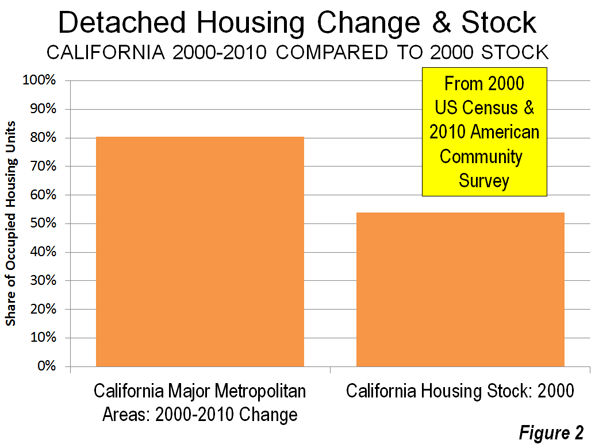
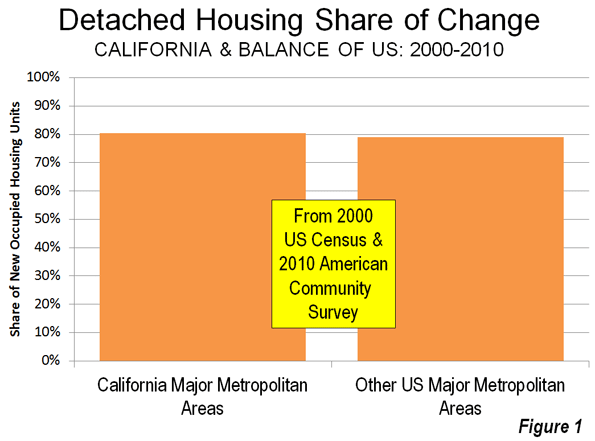
    The data indicates continuing robust demand. In California’s major metropolitan areas, detached houses accounted for 80 percent of the additions to the occupied housing stock between 2000 and 2010, which slightly exceeds the national trend favoring detached housing (Figure 1). If anything, the shift in demand was the opposite predicted by planners, since only 54 percent of growth in occupied housing in the same metropolitan areas was detached in 2000 (Figure 2).


    Watch What they Do, Not What they Say: It does no good to point to stated preference surveys indicating people preferring higher density living. Recently, Ed Braddy noted in newgeography.com (Smart Growth and the New Newspeak) that a widely cited National Association of Realtors had been "spun" to show that people preferred higher density living, from a question on an "unrealistic scenario," and ignoring an overwhelming preference for detached housing – roughly eighty percent – in other questions in the same survey. People’s preferences are not determined by what they say they will do, but rather by what they do.

    Off-Point Criticism: There was also "off-point" criticism, which can be more abundant than criticisms that are "on-point." Perhaps the most curious was by Brookings Institution Metropolitan Policy Program Senior Researcher Jonathan Rothwell (writing in The New Republic) in a piece entitled "Low-Density Suburbs are Are Not Free-Market Capitalism." I was rather taken aback by this, since none of these three words ("free," "market" or "capitalism") appeared in California Declares War on Suburbia. I was even more surprised at the claim that I defend "anti-density zoning and other forms of large lot protectionism." Not so.

    Indeed, I agree with Rothwell on the problems with large lot zoning. However, it is a stretch to suggest, as he does, that the prevalence of detached housing results from large lot zoning. This is particularly true in places like Southern California where lots have historically been small and whose overall density is far higher than that of greater New York, Boston, Seattle and double that of the planning mecca of Portland.

    Rothwell’s own Brookings Institution has compiled perhaps the best inventory of metropolitan land use restrictions, which indicates that the major metropolitan areas of the West have little in large lot zoning. Yet detached housing is about as prevalent in the West as in the rest of the nation (60.4 percent in the West compared to 61.9 percent in the rest of the nation, according to the 2010 American Community Survey). Further, there has been little or no large lot zoning in Canada and Australia, where detached housing is detached, nor in Western Europe and Japan (yes, Japan, see the Note below).  

    On-Point: Urban Growth Boundaries Do Increase House Prices: However, to his credit, Rothwell points out the connection between urban growth boundaries and higher house prices. This is a view not shared by most in the urban planning community, who remain in denial of the economic evidence (or more accurately, the economic principle) that constraining supply leads to higher prices. This can lead to disastrous consequences, as California’s devastating role in triggering the Great Recession indicates.

    The Purpose of Urban Areas: From 1900 to 2010, the urban population increased from 40 percent to 80 percent of the US population. Approximately 95 percent of the population growth over 100 years was in urban areas. People did not move to urban areas the cities for "togetherness" or to become better citizens. Nor did people move out of an insatiable desire for better urban design or planning. The driving force was economic: the desire for higher incomes and better lives. A former World Bank principal urban planner, Alain Bertaud stated the economic justification directly: "large labor markets are the only raison d’être of large cities."

    And for the vast majority of Americans in metropolitan areas, including those in California, those better lives mean living in suburbs and detached houses. All the myth-making in the world won’t change that reality, even if it pushes people out of the Golden State to other, more accommodating pastures.

    The performance of urban areas is appropriately evaluated by results, such as economic outcomes, without regard to inputs, such as the extent to which an area conforms to the latest conventional wisdom in urban planning.

    • Land use policies should not lead to higher housing costs relative to incomes, as they already have in California, Australia, Vancouver, Toronto and elsewhere. If they do, residents are less well served.
    • Transport policies should not be allowed to intensify traffic congestion by disproportionately funding alternatives (such as transit and bicycles) that have little or no potential to improve mobility as seems the likely outcome of radical densification. If they do, residents will be less well served.

    This gets to the very heart of the debate. The “smart growth on steroids” policies now being implemented in California are likely to lead to urban areas with less efficient personal and job mobility, where economic and employment growth is likely to be less than would otherwise be expected. The issue is not urban sprawl. The issue is rather sustaining the middle-income quality of life, which is now endangered by public policy in California, and for no good reason.

    Wendell Cox is a Visiting Professor, Conservatoire National des Arts et Metiers, Paris and the author of “War on the Dream: How Anti-Sprawl Policy Threatens the Quality of Life

    —-

    Note: Despite its reputation for high density living, Japan’s suburbs have many millions of detached houses. In 2010, 47 percent of the occupied housing in Japan’s major metropolitan areas was detached (Tokyo, Osaka-Kobe-Kyoto, Nagoya, Sapporo, Sendai, Hiroshima, Kitakyushu-Fukuoka, Shizuoka and Hamamatsu).

    Photo: An endangered species: Detached houses in Ventura County (Photo by author)

  • California Recovery: No, It Is Not East vs. West

    Every now and then, some East Coast based publication sends a reporter out to California to see how the West Coast’s economy is doing.  I think they write these things sitting at a restaurant patio overlooking the Pacific Ocean.  That can be seductive, and lulled into a comfortable sense that all is well with the world, the reporter always gets it wrong. 

    The most recent example is this New York Times article.  The second paragraph summarizes the article:

    Communities all along the state’s coastline have largely bounced back from the recession, some even prospering with high-tech and export businesses growing and tourism coming back. At the same time, communities from just an hour’s drive inland and stretching all the way to the Nevada and Arizona borders struggle with stubbornly high unemployment and a persistent housing crisis. And the same pattern holds the length of the state, from Oregon to the Mexican frontier.

    The next paragraph contains the mandatory quote from California’s favorite economic Pollyanna, Steve Levy:

    “This is really a tale of two economies,” said Stephen Levy, the director of the Center for Continuing Study of the California Economy. “The coastal areas are either booming or at least doing well, and the areas that were devastated still have a long way to go. The places that existed just for housing are not going to come back anytime soon.”

    The article is accompanied by a photo of a couple driving a red Ferrari convertible.  The caption says "Driving through Newport Beach in Orange County. Communities along the coast have largely rebounded from the recession."

    This is all nonsense.

    There are two reasonable measures of recovery, jobs and real estate values.  You can forget the real estate values measure.  Values throughout California are down from pre-recession highs.  They are down a lot.  Only San Francisco and Marin counties, with median home prices down 27.7 percent and 32.3 percent, respectively, have seen net median home price declines of less than 40 percent.  Monterey and Madera counties top the state in median home price declines, in excess of 67 percent.

    So let’s use jobs.  An area has recovered if it has as many jobs today as it had at the beginning of the recession, December 2008. 

    We monitor 37 California MSAs.  Combined they represent about 96 percent of California’s population.  By jobs, only one of California’s larger MSAs has recovered, and that county does not fit the story.  Not only is Kings County not on the ocean, it doesn’t even border or have a naturally occurring year-round piece of water.  Kings County, with 37,700 jobs, has about 900 more jobs than it had at the beginning of the recession.  Still, Kings County’s unemployment rate is 17 percent.  Some recovery!

    Orange County, which the New York Times article cites as largely rebounded, is down 127,800 jobs from its pre-recession high.  That’s an 8.5 percent decline.  Los Angeles County is down 337,000 or 8.1 percent of jobs.  The difference between unemployment rates, 8.0 percent in Orange County versus 12.1 percent in Los Angeles County, reflects different unemployment levels at the beginning of the recession and the high cost of living in Orange County.  Most people can’t afford to be unemployed long in Orange County.  You either find a job, or you leave.

    Here are the Counties that have lost, on net, less than 6 percent of jobs in the recession:


    County/MSA

    Job gain
    or Loss

    percent change

    Unemployment
    Rate

    Imperial

    -100

    -0.2%

    26.7%

    Kings

    900

    2.4%

    17.0%

    Merced

    -2,800

    -4.8%

    20.0%

    Monterey

    -5,600

    -4.3%

    15.3%

    San Diego

    -66,400

    -5.1%

    9.3%

    San Francisco
    San Mateo
    Marin

    -33,600

    -3.4%

    8.0%
    7.3%
    6.6%

    Santa Clara
    San Benito

    -19,900

    -2.1%

    8.8%
    18.3%

    San Luis Obispo

    -5,900

    -5.7%

    8.7%

    Santa Barbara

    -8,200

    -4.7%

    8.9%

    Santa Cruz

    -3,800

    -4.1%

    13.6%

    Solano

    -6,100

    -4.8%

    10.9%


    It’s hard to find real recovery here.  Three of the sub-10-percent-unemployment-rate counties (Marin, San Luis Obispo, and Santa Barbara) are home to the wealthy, those who serve them, and a very small middle class.  They have not had and will never have anything like robust economies.  Think of them as big Leisure Villages for the terminally fashionable.

    That leaves San Diego, San Francisco, San Mateo, and Santa Clara counties as potential vigorous economies.  Let’s look at these regions’ job creation last month.  Unfortunately, the data are only available by MSA.  San Diego County saw job growth of 1,300 jobs in February, an increase of about 0.11 percent.  Santa Clara/San Benito saw job growth of about 4,100, or 0.46 percent.  San Francisco/San Mateo/Marin saw growth of about 7,100 jobs, or 0.74 percent.

    It looks to me like there is a small island of relative prosperity: San Francisco, San Mateo, and Santa Clara Counties, but even these counties have not fully recovered.  This island is indeed on the coast, but it represents just a small fraction of the coastal county population. 

    The idea that there is some sort of Coastal resurgence in California is just absurd.  Certainly, the 593,800 still unemployed in Los Angeles — by far the state’s most populous — are not likely to agree that “The coastal areas are either booming or at least doing well…"

    Bill Watkins is a professor at California Lutheran University and runs the Center for Economic Research and Forecasting, which can be found at clucerf.org.

    California coast photo by BigStockPhoto.com.

  • The Right Steps to a Post-College Job

    What will become of today’s middle class college students after they graduate? Opposing points of view come, on one side, from a voice of the education establishment, the American Association of Colleges & Universities (AACU), and on the other from rhetorical bomb thrower and author Aaron Clarey Worthless: The Young Person’s Indispensible Guide to Choosing the Right Major.

    Clarey asks: Who has your family hired recently? Whenever you buy a car, or drive on a road, or use a computer you indirectly hire an engineer. And when you put money in a bank, or go to the doctor, or consult an accountant, those people provide a useful service. But when did you ever hire a person competent in feminist theories? When did you last hire a sociologist or a philosopher, or a historian? Chances are – never – unless you were forced to by the involuntary expenditure of your tax dollars. Those degrees, according to Clarey, are worthless.

    If Clarey is dismissive of intellectual pursuits, the AACU is the opposite. Part of its justification for liberal education:

    “Many of the questions shaping higher education today spring from an interdependent world community in the midst of profound social, political, economic, and cultural realignments. Systems are being redesigned, relationships renegotiated, and modes of commerce and communication transformed. The problems we face—as individuals and societies—are urgent and increasingly defined as global: environment and development, health and disease, conflict and insecurity, poverty and hopelessness. Similarly, the goals of democracy, freedom, equity, justice, and peace are increasingly understood to encompass the globe and play out across multiple and complex cultures. Such global challenges cut across academic disciplines and require perspectives beyond the training and experience of most faculty members.”

    While Clarey is an engaging and entertaining writer, the AACU webpage is turgid. Clarey writes for students and their parents; the AACU page is directed to college administrators and faculty. Beyond that, two words pepper the AACU website, but appear not at all in Clarey’s book: “globalization” and “21st Century.”

    Clarey definitely has the easier job when it comes to entertainment value. He scores a lot of points ridiculing the women’s studies major, a pinata full of belly laughs. And surely, if any major is worthless it is women’s studies. That’s just too easy a target, and it’s hard to give Clarey much credit for the criticisms.

    He’s on much weaker ground when he attacks historically legitimate disciplines such as English, philosophy, or history. “English has got to be the most worthless degree in the entire English-speaking world. The reason why should be blindingly obvious. You already speak English.” This is a silly argument, however entertaining. The problem with English is not that it is “worthless,” but rather that it has very little economic value. It’s been oversold – there are way too many English majors for the market to absorb.

    The AACU has a much harder task: defending the value of the liberal arts. The difficulty of the read thus roughly corresponds to the difficulty of the task. Their webpage underplays any claim of direct economic benefit from a liberal education. The supposed benefits lie in citizenship, global awareness, and political sensibility, etc. But an argument for liberal education that ignores earning a living is a weak argument.

    For all the talk about globalization, the AACU clearly has no clue as to what it really is. For college students, it means only one thing: lower salaries. Exceptions include those rare geniuses in business or the culture that beat the odds. But for the remaining 99%, a college degree is a commodity. They are competing against similarly educated people in China, India, Brazil, and around the world. All they have to offer the marketplace is a skill – surgery, law, accounting, programming, writing, etc. – that they must perform at least as well and as cheaply as the competition or a computer.

    For an example of the value of a liberal arts degree, a WSJ article describes “Eric Probola, who got a bachelor’s degree in global cultural studies from Point Park University in Pittsburgh in 2010, accepted an administrative assistant’s job at a nonprofit there for less than $30,000 a year.” Many, many BA graduates are working as secretaries, plumbers, and pizza deliverers. I know more who are going back to school to get nursing degrees. Why didn’t they do it right the first time?

    The AACU uses the term “21st Century” as shorthand for “we’re hip and we’re planning for the future.” Clarey, on the other hand, doesn’t account for the future at all. His solution is that students should major in disciplines that are well paid today, and he chooses engineering as the best example.

    Ten years ago he might have suggested law school, when it really was a ticket into the upper middle class. Since then, both technology and globalization have put paid to that. The same trends may occur in engineering and other disciplines. Clarey doesn’t address this possibility at all.

    In response, I’m guessing that he might say something like, ‘OK, I’m sorry about the lawyers. I really am. And maybe you’re right that ten or twenty years from now engineers will suffer the same fate. I can’t predict the future, and neither can you. But I do know that a student graduating in engineering today will move into a well-paid, upper middle class job. A student graduating in Environmental Policy Studies, with a senior thesis entitled “The Role of Women Farmers on Environmental Sustainability in Southern Malawi,” will not.’ Fair enough. Still, Clarey would benefit from studying the Three Laws of Future Employment.

    The AACU argument goes something like this:

    1. Globalization means that problems (climate change, human rights, etc.) that once were local become global.
    2. Governments, NGOs, and the United Nations, along with multinational corporations, will all take steps to address these pressing concerns.
    3. Students majoring in the liberal arts will increasingly find jobs managing global polity.
    4. Thus students who understand culture, politics, people, language, and science will be in demand.

    In a word, the liberal arts represent the future.

    In my view every step in this chain of reasoning is flawed. But the fatal flaw is economic. Where will governments, NGOs or the UN get the money to hire all these liberal arts students? Are American pensioners going to sacrifice their social security checks to employ the Malawi expert above, or are Malawi farmers going to chip in part of their $3/day profit for the purpose? Clarey is right: most liberal arts graduates will not earn a middle class living. Economically speaking, the degrees are worthless.

    Photo of Student on Steps from the University of Denver.

    Daniel Jelski is a professor of chemistry at SUNY New Paltz, and formerly served as the dean of science and engineering.

  • Commanding Bureaucracies & ‘The New Normal’

    Prior to the fifteenth century, China led the world in technological sophistication. Then, it went into a period of long decline. Here’s what Gregory Clark had to say about it in Farewell to Alms:

    … When Marco Polo visited China in the 1290s he found that the Chinese were far ahead of the Europeans in technical prowess. Their oceangoing junks, for example, were larger and stronger than European ships. In them the Chinese sailed as far as Africa.

    The Portuguese, after a century of struggle, reached Calicut, India, in the person of Vasco da Gama in 1498 with four ships of 70-300 tons and perhaps 170 men. There they found they had been preceded years before by Zheng He, whose fleet may have had as many as three hundred ships and 28,000 men. Yet by the time the Portuguese reached China in 1514, the Chinese had lost the ability to build large oceangoing ships.

    Similarly Marco Polo had been impressed and surprised by the deep coalmines of China. Yet by the nineteenth century Chinese coalmines were primitive shallow affairs, which relied completely on manual power. By the eleventh century AD the Chinese measured time accurately using water clocks, yet when the Jesuits arrived in China in the 1580s they found only the most primitive methods of time measurement in use, and amazed the Chinese by showing them mechanical clocks. The decline in technological abilities in China was not caused by any catastrophic social turmoil. Indeed in the period after 1400 China continued to expand by colonizing in the south, the population grew, and there was increased commercialization.

    China’s technological decline is a fascinating topic, with lessons for us today.

    Right now, the United States is approximately six million jobs short of our pre-recession high, even though we’re almost three years into a recovery. We have about the same number of jobs as we had in 2000. That is worth saying again. On net, the United States has seen no job growth in over a decade, even though we’ve recently seen some slow job growth — slow relative both to past recoveries, and to potential.

    Prospects for improved growth are not good. Already, the Federal Reserve has all but promised to keep I low interest rates through 2013. This is a sure sign that its 300+ economists don’t anticipate significant improvement soon.

    Some observers are claiming that this is ‘the new normal,’ and we have to get used to a future of slower growth. These people are doing us a disservice. The United States still has all of the economic potential it ever had. Our job growth is unacceptably low because of our policy choices.

    Bad policy is not a partisan issue. The disastrous Sarbanes-Oxley was passed during the George W. Bush administration, as was the irresponsible expansion (subsidizing prescription benefits) of the by-then-obviously-troubled Medicare program. The supposedly free-market administration instituted a tariff on steel imports, presided over an increase in government spending as a percentage of gross product, and ran persistent federal budget deficits. Finally, in a panicked reaction to the September 2008 financial crisis, it created the TARP program, a program that exacerbated our financial sector’s existing moral hazard problems.

    The current administration has dramatically expanded the size and scope of government. Today, total government spending is over 35 percent of gross national product. This exceeds that of World War II. Federal debt, as a percentage of GNP, will soon surpass that of World War II, and no decline is in sight. The Dodd-Frank Act does not address any of the problems that caused the 2008 financial crisis, while imposing huge regulatory burdens on financial firms. The healthcare restructure imposes another large regulatory burden while failing to address the fundamental problem: consumption of medical services and payment for medical services have become separated.

    Our bureaucracies are growing at the expense of the private sector. For evidence, look at Joel Kotkin’s piece on the relative prosperity of the Washington DC area, a region that has boomed throughout the recession. Similarly, the Sacramento Bee recently ran an article on the 200,000 plus people trying to get a job with the State government.

    When government bureaucracies become very large, they attract people directly through working conditions, benefits and pay packages, job security, and power. The bureaucracy becomes the place where important decisions are made, and talented people want to make important decisions. Dealing with bureaucracy also becomes a major growth industry. Financial institutions need more compliance officers to stay out of trouble with the regulators. Pharmaceutical companies need people to navigate the approval process for new drugs. Companies across America need specialists to help them comply with employment and environmental regulations. When profits become dependent on regulatory compliance, the best and brightest become employed in facilitating compliance, or finding ways around it. Production suffers as a result.

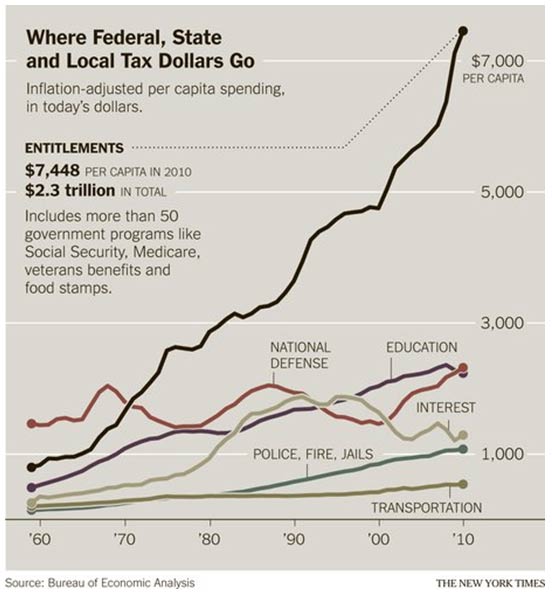
    Some would argue that government is the source of prosperity. Outside of the relatively small government necessary to ensure property rights, this is not true. As the following chart from the New York Times shows, most of government’s increased spending has gone to transfer payments.

    What’s to be done? I’ve argued elsewhere that legal immigration should be increased. That can be done immediately, and it would have immediate impacts. Repeal of Sarbanes-Oxley and Dodd-Frank would also have immediate benefits. Redoing healthcare in such a way that consumption of medical services would be tied to the payment of medical services would help, too. Increasing United States carbon-based energy production would provide an immediate boost.

    In the longer run, government’s share of the economy needs to decline. The least painful way would be to cap inflation-adjusted total government spending, and keep it capped while the economy grows, allowing governments share to decline to, say, 2000 levels. This would require changes to Social Security and Medicare benefits.

    Which brings us back to China. It appears that a large centralized bureaucracy was a significant contributor to China’s decline. It did this through three channels: Central bureaucracies imposed inefficiencies on the economy (just as we saw in the failed USSR). Bureaucracies are also risk averse, which limited China’s upside potential. And, like other bureaucracies, it attracted the best talent.

    This is not to say that the United States is 14th century China, and about to enter into an extended period of decline. But it is to say a cause of the United States sub-par economic performance is its large and growing central bureaucracy.

    Photo by IvanWalsh.com: Museum of Ancient Architecture, Beijing, China

    Bill Watkins is a professor at California Lutheran University and runs the Center for Economic Research and Forecasting, which can be found at clucerf.org

  • Buffalo, You Are Not Alone

    It hurts. When a bigtime Harvard economist writes off your city as a loss, and says America should turn its back on you, it hurts. But Ed Glaeser’s dart tossing is but the smallest taste of what it’s like to live in place like Buffalo. To choose to live in the Rust Belt is to commit to enduring a continuous stream of bad press and mockery.

    I write mostly about the Midwest, but whether we think Midwest or Rust Belt or something else altogether, the story is the same. From Detroit to Cleveland, Buffalo to Birmingham, there are cities across this country that are struggling for a host of historic and contemporary reasons. We’ve moved from the industrial to the global age, and many cities truly have lost their original economic raison d’etre. Reviving them requires the hard work of rebuilding and repositioning them for a new era, a daunting task to be sure.

    But beyond their legitimate challenges, these cities also face the double burden that they are unloved by much of America, and all too often by their own residents. They are forlorn and largely forgotten, except as cautionary tales or as the butt of jokes.

    These cities aren’t sexy. They aren’t hip. They don’t have the cachet of a Portland or Seattle. The creative class isn’t flocking. They are behind in the new economy, in the green economy. Look at any survey of the “best” cities and find the usual suspects of New York, Austin, San Francisco. Look at yet another Forbes “ten worst” list and see Cleveland and Toledo kicked again when they are down. They are portrayed as hopeless basket cases with no hope and no future.

    But I reject that notion. I do not believe in the idea that these cities are beyond repair and unworthy of attention—or affection.

    Someone asked me once why I bother. Why does it matter that these cities come back? Why not just let nature take its course? Why not let Buffalo die, and its people scatter to the winds?

    It’s because it doesn’t just matter to a few proud people in Buffalo, it matters to America. The idea of disposable cities is one that is incompatible with a prosperous and sustainable future for our country. Fleeing Rust Belt cities for neo-Southern boomtowns is nothing more than sprawl writ large. Rather than just abandoning our cores, we’ll now abandon entire regions in the quest for new greenfields to despoil. We can’t have a truly prosperous and sustainable America with only a dozen or so superstar cities that renew themselves from age to age while others bloom like a flower for a season, then wither away. An America littered with an ever increasing number of carcasses of once great cities is not one most of us want to contemplate.

    But beyond that, it’s because I believe we can make it happen. Look closely and the change is already in the air. Globalization taketh away—but it also giveth. Cities like Buffalo or St. Louis now have access to things that even people in Chicago didn’t not that long ago. Amazon, iTunes, and a host of specialty online retailers put the best of the world within reach. Where once you couldn’t get a good cup of coffee, there are now micro-roasters aplenty. Where once your choices were Bud, Miller, or Coors, an array of specialty brews are on tap, often brewed locally. Restaurants are better, with food grown locally and responsibly. Slowly but surely the ship is turning on sustainability, with nascent bike cultures in almost every city, LEED certified buildings, recycling programs, and more. House by house, rehab by rehab, neighborhoods in these cities are starting to come to life.

    Where once moving to one of these cities would have been likened to getting exiled to Siberia, it’s now shocking how little you actually give up. And for every high-end boutique or black tie gala you miss, you get something back in low-cost and easy living. The talent pool may be shallower, but it’s a lot more connected.

    Let’s not get ahead of ourselves. There’s still a long and hard journey ahead. And not every place is going to make it, particularly among cities without the minimum scale. We have to face that reality. But more of them will revive than people think.

    That’s because a new generation of urbanists believes in these cities again. These people aren’t bitter, burdened by the memories of yesteryear and all the goodness that was lost. The city to them isn’t the place with the downtown department store their mother used to take them to in white gloves for tea. It isn’t the place full of good manufacturing jobs with lifetime middle class employment for those without college degrees. The city isn’t a faded nostalgia or a longing for an imagined past. Most of them are young and never knew that world.

    No, this new generation of urbanists sees these cities with fresh eyes. They see the decay, yes, but also the opportunity—and the possibilities for the present and future. To them this is Rust Belt Chic. It’s the place artists can dream of owning a house. Where they can live in a place with a bit of an authentic edge and real character. Where people can indulge their passion for renovating old architecture without a seven-figure budget. Where they have a chance to make a difference—to be a producer, not just a consumer of urban life, and a new urban future. Above all, these people, natives or newcomers, have a deep and abiding passion and love for the place they’ve chosen—yes, chosen—to live.

    Still, it can get lonely, and often depressing. It so often seems like one step forward, two steps back. Making change happen can seem like pushing a rock uphill, like you are up there on some far frontier of the country alone, fighting a quixotic battle. Every historic building demolished, every quality infill project sabotaged by NIMBY’s, every massively subsidized business-as-usual boondoggle, every DOT-scarred transport project is a discouragement.

    But Buffalo, you are not alone. It’s not just you, it’s cities and people across across this country, from St. Louis to Pittsburgh to Milwaukee to Cincinnati to New Orleans to Birmingham, fighting to build a better future. There’s a new movement in all these cities, made up of passionate urbanists committed to a different and better path. Sometimes they are few in number, but they are mighty in spirit— and they are making a difference. Together, they and you can win the battle and make the change happen.

    It won’t be easy. The road will be long. Some, like the great cathedral builders of Europe, may never see completely the fruit of their labors. But the long-ago pioneers who founded these great cities never got to see them in their first glory either. We’ve come full circle. We are present again at the re-founding of our cities. This is the task, the duty, the calling that a new generation has chosen as its own, to write the history of their city anew.

    Go make history again, Buffalo.

    This article originally appeared in Buffalo Rising on June 14, 2010.

    Aaron M. Renn is an independent writer on urban affairs based in the Midwest. His writings appear at The Urbanophile.

    Taste of Buffalo photo by Bigstockphoto.com.

  • What Apple’s Supply Chain Says About US Manufacturing and Middle-Skill Training

    In January, The New York Times released a front-page report on the iEconomy, Apple’s vast and rapidly growing empire built on the production of tech devices almost exclusively overseas. The fascinating story created a wave of attention when it was published, and it’s back in the news after NPR’s “This American Life” retracted its story about working conditions at Foxconn, one of Apple’s key suppliers of iPhones and iPads.

    The end of the “This American Life” episode includes a discussion (audio | transcript) between host Ira Glass and Charles Duhigg, the NYT reporter who wrote the iEconomy piece, on Apple’s supply chain and the reason the tech giant doesn’t produce its insanely popular devices in the U.S. Perhaps you thought the main reason was labor costs; Apple would have to pay American workers much more than the estimated $17 a day (or less) many Chinese workers at Foxconn make. That’s part of it, but “an enormously small part,” Duhigg told Glass.

    Duhigg explained that, in terms of labor costs, producing the iPhone domestically would cost Apple an additional $10 (on the low end) to $65 (on the high end) more per phone. “Since Apple’s profits are often hundreds of dollars per phone, building domestically, in theory, would still give the company a healthy reward,” he wrote in the NYT piece.

    Instead, what matters is Apple’s intricate Chinese supply chain. Duhigg went into detail in his conversation with Glass:

    Compared to the cost of buying chips or making sure that you have a plant that can turn out thousands of these things a day or being able to get strengthened glass cut exactly right within, you know, two days of this thing being due, that’s what’s important. Labor is almost insignificant. What is really important are supply chains and flexibility of factories. You want to be able to be located right next to the plant that makes the screws so that when you need a small change to that screw factory, you can go next door and say, “Give it to me in six hours,” and they can say, “Here you go.” Because if that factory was in another state or on another continent, it would take two weeks. It’s the flexibility within the Chinese manufacturing system, that’s what you can do in Asia that you can’t do in the United States.

    Another major reason why Apple produces the iPhone and iPad abroad is the huge (and available) skilled workforce in China. When Apple needed 8,700 industrial engineers to oversee 200,000 assembly-line workers involved in making the iPhone, the firm looked at how long it would take to find that many workers in the U.S. Its answer: as long as nine months — compared to 15 days in China.

    This boils down, according to Duhigg’s report, to the lack of American workers with “mid-level skills that factories need, executives say.”

    Companies like Apple “say the challenge in setting up U.S. plants is finding a technical work force,” said Martin Schmidt, associate provost at the Massachusetts Institute of Technology. In particular, companies say they need engineers with more than high school, but not necessarily a bachelor’s degree. Americans at that skill level are hard to find, executives contend. “They’re good jobs, but the country doesn’t have enough to feed the demand,” Mr. Schmidt said.

    From Whose Bourn No Manufacturing Returns

    So, what does this mean for manufacturing in the U.S.?  For the most part there are no surprises here. These are known, core issues in the U.S. We’re well aware of the skilled worker drought. We’re aware that we’ve shipped much of our production process off-shore. But, we keep saying to ourselves, we’ve increased our productivity. We’re innovating and we’re keeping the profits, right? To answer that we can say “maybe” and “sorta.”

    There’s currently a debate raging about how we calculate our productivity. It’s a complex issue that we won’t get deep into here (check out this recent article in the Washington Post for more), but the gist is that our methodology for calculating productivity might be overstated. Like, a lot. Biases within this methodology have tended to convert a factory’s price savings through outsourcing into an increase in output. As Peter Whoriskey of the Post puts it:

    For example, suppose a U.S. factory decides to offshore the production of a part for which it used to pay $1. With the switch to an overseas supplier, it might pay 50 cents for the part. If U.S. statistics do not capture this drop in price, the savings by the U.S. factory can show up as a gain in output and productivity.

    Changes like these aren’t an increase in output due to innovation and greater productivity per worker. These are savings, which are certainly great for that factory, and certainly mean better profit margins, but which aren’t productivity increases that we get to point to as the silver-lining of our inky manufacturing cloud.

    That’s one element. The other element sits very near and dear to our heart here at EMSI. There’s a very basic theory at work in our impact studies and I/O model, and it’s that tight supply chains are good. The goal of any regional economy should be to develop complete supply chains. The less that an industry has to bring goods and services into the region from outside, the greater effects we see from increases in those industries. In other words, “Great job, China.” But this leaves the US at a disadvantage. Yes, low-cost Chinese manufacturing has facilitated growth in the US economy. However, this has happened at the expense of the US developing these complete supply chains.

    Maybe If We Ask Real Nice

    Now, this is an extremely complicated issue, and things have developed as they have for a reason. However, when we ask the question, “what would it take to manufacture iPhones in the US?” — a question tantamount to “what would it take to get all of those manufacturing jobs over here?” — if the supply chain is the deciding factor, then the answer might be something along the lines of “too late.” At this point, manufacturing supply chains are so thoroughly concentrated in China that bringing them back to US soil seems more or less impossible. There may be little we can do about manufacturing jobs leaving the US.

    The Data

    However, instead of simply offering some sound — albeit pessimistic — reasoning on the issue, let’s look at some data on manufacturing. Since jobs are in the spotlight, and productivity measures have received some heat, we’ll simplify the issue a little and just look at job growth in manufacturing.

    In terms of industry performance, 74 manufacturing industries saw growth from 2001-2006; 65 saw growth from 2006-2009; and 210 saw growth from 2009-2011. This is, of course, growth of any amount. This indicates a slight, recent uptick in the variety of industries experiencing some amount of growth.

    Typically, we look at net growth for industries. We combine growth and decline to show the overall growth and decline. Here’s net decline for manufacturing for three different periods:

    Net Change Average Annual Net
    2001-2006
    -2,211,513
    -368,586
    2006-2009
    -2,193,021
    -548,255
    2009-2011
    -99,250
    -33,083

    Job loss seems to slow in that 2009-2011 period.

    We’ll look at one more series of data, before we wrap up. What if we look at decline and growth separately instead of simply the net of both? This will allow us a discrete view of whether decline has slowed or growth has quickened, or perhaps a combination of both.

    First, decline:

    Decline Average Annual Decline
    2001-2006
    -2,481,385
    -413,564
    2006-2009
    -2,321,862
    -580,466
    2009-2011
    -300,690
    -100,230

    Manufacturing decline considered on its own appears to have slowed in the past few years.

    Now, growth:

    Growth Average Annual Growth
    2001-2006
    269,872
    44,979
    2006-2009
    128,841
    32,210
    2009-2011
    201,440
    67,147

    Gain in the manufacturing sector seems to have picked up pretty noticeably.

    This analysis is not nuanced. As other sources have made plain, this is a complex issue. However, it remains true here that job growth in manufacturing has picked up somewhat, and that decline has slowed. We’re still seeing net losses, so this isn’t evidence of recovery. However, it does mean that not absolutely every manufacturing job is moving offshore. At least not yet.

    Not to mention that there’s some support for the idea that we’re seeing some “reshoring” — manufacturing jobs coming back to the US. A recent report from The Boston Consulting Group claims that by the end of the decade we could see a reshoring of 600,000 to 1 million jobs. The report explores the seven broad industry sectors “most likely to reach a ‘tipping point’ over the next five years—a point at which China’s shrinking cost advantage should prompt companies to rethink where they produce certain goods meant for sale in North America.” Are we seeing the beginnings of this in our more recent industry data? Or do we stand to lose more manufacturing jobs to China? We’ll have to wait and see.

    Stevenson has worked at EMSI, an Idaho-based economics firm, since 2006. He’s a regular contributor to the EMSI blog. Contact him at josh@economicmodeling.com.

  • Inequality and Economic Growth

    There has been news and conversation about economic inequality and economic growth lately, mostly because the former is increasing steadily and the latter has been less than stellar.

    Of course, there is always a tension between economic growth and equality.  Economic growth implies at least some inequality.  That’s because most people need incentives to create things people value.  They need a reward.  Creating perfect equality necessarily eliminates incentives.

    The reward for innovation or effort doesn’t have to be the full value of an innovation or effort.  The person who invented the wheel did not collect the present value of the innovation.  Similarly, Bill Gates, rich as he is, or the late Steve Jobs, or George Mitchell, the man who helped developed “fracking” did not collect the full value of their innovations.  The fact that people voluntarily agree to pay income taxes demonstrates that they don’t have to consume the full value of their effort.  So, there is room for some redistribution.

    Still, there has to be some reward, some incentives to work or innovate.  That incentive naturally will create inequality. 

    Call incentive the supply side.  If there is a supply side, there must be a demand side.  There is, and that comes from people, but it is not what you might think.

    Economic theory is based on the concept that people are happier when they consume more or better products.  That turns out to not be true.  People are no happier than they were 100 years ago, and we consume a lot more than our great-great grandparents.

    The fact is that since the 1950s in America, and now in many parts of the world, people have been free of the worst Malthusian constraints.  We have plenty to eat and on some measures we don’t really need any more.  Especially with current low birth rates, not just in advanced countries but also in much of the developing world, consumption growth is unnecessary. 

    So, why do we need economic growth?

    We need economic growth because people need more than consumption.

    The great cartoonist Al Cap, the creator of Li’l Abner, understood this.  Li’l Abner, his wife Daisy Mae, and the other residents of Dogpatch sometimes benefitted from the presence of a creature called a Shmoo.  Shmoos bred prolifically, and could create or serve as anything humans wanted.  They were perfectly happy, ecstatic in fact, to be dinner.  With Schmoos around, all human consumption needs were fulfilled, with no effort on the part of the humans.  It didn’t work out so well.  The Shmoos were eventually killed by extermination teams to save humanity and the economy, except for two saved by Li’l Abner and returned to repopulate the Valley of the Shmoon.

    We have similar real-world examples, and it doesn’t work out so well here either.  It turns out that when all consumption needs are provided with little or no effort on the part of the recipient, something is lost.  Drug and alcohol abuse abounds in these populations.  Traditional families are destroyed.  Crime is high.  Violence, including domestic violence, is high.  Morals are abandoned.   Relationships are fluid, frequently violent, and always temporary.  Health is poor, even when healthcare is provided.

    It turns out that when people are provided everything they need, self-destructive behavior is the norm.  It’s almost as if they have no reason to live, and it is a terrible price to pay for consumption. 

    It turns out that a job costs less than dependency, and that’s why we need economic growth.  Jobs and opportunity provide us with some things that consumption can’t.  I think those are pride, dignity, and purpose.

    That doesn’t mean we should abandon the effort to provide a safety net.  People are different, and few of us would be comfortable with the how the least endowed would live without a safety net.  It is also true that the gods of chance can be cruel to even the most capable.  Most of us would like to see some protection provided the unlucky.

    A safety net reduces inequality, and is redistributive.  The trick is to maintain incentives.

    If we are to offer people jobs and opportunity, and we must, we need economic growth.  To realize economic growth, we need to maintain incentives for the most productive and innovative.  Punitive marginal tax rates are counterproductive.

    How support is delivered to the recipients is also extraordinarily important.  The incentive issue should be paramount.  We owe it to the recipients to provide the support in a manner that preserves dignity and pride and always provides a healthy incentive to work.  Far too many existing programs have effective marginal tax rates near, at, or exceeding 100 percent.  This easily happens on means-tested programs, where the next dollar in income could cost the benefit plus the taxes on the new income.  Here’s a quote from a report by the Employment Policies Institute:

    “As an example, in states with ostensibly generous welfare benefits, Professor Shaviro shows that a single mother with two children could increase her earned income from $10,000 per year to $25,000 per year and actually find herself with 2,540 fewer dollars once she accounts for lost tax credits and benefits. Though her earned income more than doubles, she is worse off financially.” 

    It makes no sense to have 100 percent marginal tax rates on high-income individuals.  It makes even less sense to have 100 percent effective marginal tax rates on the least advantaged.

    Bill Watkins is a professor at California Lutheran University and runs the Center for Economic Research and Forecasting, which can be found at clucerf.org