Category: Economics

  • The Geography of Investment Grade Wines

    The world produces more than eight billion gallons of wine each year (including those Algerian reds that taste like lighter fluid). All fifty American states, including Alaska, have thriving local wine industries. The eastern end of Long Island now looks like the Médoc, and one reason that the European Union is suffering its debt hangover is because of the huge subsidies that are paid each year to growers who produce wines that no one wants to drink. But perhaps the biggest success of the industry has been to ferment demand for an oversupply of these barrels.

    Wines have evolved into that most delectable of American tastes: an asset class. The châteaux of Bordeaux are best understood as option houses, existing to serve up financial swaps and derivatives as much as their enchanting blends of Cabernet Sauvignon and Merlot. The street value of a year 2000 case (six bottles!) of Lafite-Rothschild is about $20,000. In fine wines, you can have your subprime and drink it, too.

    I live amongst vineyards in western Switzerland, hard against the French border, but I didn’t understand the evolution of fine wine into a futures contract until I spent time in Shanghai and then went to Hong Kong. (Even though the drink of choice on the train from Shanghai was warm Budweiser served in plastic cups.)

    Once in Hong Kong, I learned that almost a third of the world’s fine wines are stored there in local warehouses, waiting for Chinese billionaires to order up another $12,000 case of Château Ausone, perhaps to wash down a bucket of KFC chicken. (‘Infanticide’ is the term used to describe the practice, prevalent in China, of pulling the cork way too early on wines that need to mature for eight to ten years.)

    The presence of so much Bordeaux wine washing around Chinese treaty ports pushed my curiosity about the direction of the elusive “wine market.” Through bike rides across the Loire Valley, and meetings in places like London and Burgundy, I encountered an industry that has more the bouquet of the petroleum standard, West Texas Intermediate, than of those charming Napa haciendas that get written up in Food & Wine.

    Even the fabled BRICs (Brazil, Russia, India, and China) have been laying out vineyards as though they were steel foundries. And some time back, in Kosovo, while looking at the ravages of war, I was driven to a field that, despite its legacy of atrocity, I was told “would be perfect for Chardonnay.”

    IGW (Investment-Grade Wine) is immune from the laws of supply and demand partly thanks to the genius and perseverance of Robert M. Parker, Jr., a former lawyer from Monkton, Maryland, who managed to transmute the world’s glutted wine market into something as easy to understand, and thus invest in, as municipal bonds rated by Standard & Poor’s.

    Parker, 64, who is officially the editor and publisher of the Wine Advocate magazine, has been described as having “the nose of a dog.” He is said to have tasted some 200,000 wines in his peripatetic career and boasts to his friends that he can remember each of the wines and the scores that he gave them on his scale of 50 to 100, the latter number representing perfection.

    Even if he sounds like the Wilt Chamberlain of wine, Parker has succeeded in translating obscure French and Californian wines into easily indexed numbers, insofar as most liquor stores will post on their shelves little markers that read: “Robert Parker…94.” There’s a New Yorker cartoon of a hesitant man in a wine shop with the punchline: “What do you have in investment-grade reds?”

    Neither Chinese mandarins nor traders from Goldman Sachs would be caught dead drinking anything less than a 90, and those now selling participations in listed fine-wine investment funds need to do little more research than thumb through Parker and scoop up wines listed between 95 and 100.

    Parker’s accomplished biographer, Elin McCoy, quotes the English wine writer Andrew Barr as saying that Parker’s scores are a “victory of American pragmatism over French mysticism;” it has also been said, that “Parker’s genius was to marry Americans’ love of numbers with their equal love of hedonism.”

    Parker started out as a wine consumer advocate, a Ralph Nader of corks, there to warn gullible Americans about the sleazy French châteaux that were unsafe at any sip. By securitizing the wine industry with his easy-to-comprehend scores, Parker enabled la place de Bordeaux, the secondary wine market that buys from the châteaux, to cash millions from futures that he helped to legitimatize.

    In part thanks to Parker’s scoring system, en primeur wine (new vintages still aging in barrels) is sold off each spring to investors and merchants, who pay in advance and only collect their bottles two years later. These sales are the IPOs of the wine industry, and prices are set by Parker’s nose and Asian front money.

    In the wake of Parker, numerous online trading platforms have developed, including one in London, ‘Liv-ex: The Fine Wine Exchange’, that could evolve into a legitimate futures market, like those for soybeans and sugar. For the moment it only matches spot buyers and sellers of fine wine, and benchmarks prices with its Liv-ex indices, which allow investors to see that fine wines were off 12 percent in 2011, but up 121 percent in the last five years.

    What keeps online traders from expanding the reach of their exchanges is the French word provenance, which is a calculation of a wine’s pedigree in the after-sales market. Parker or Wine Spectator can tell you that a 1982 St.-Emilion grand cru rates a 95-point score. But a connoisseur will not buy a bottle in the back-vintage market until he or she knows under what conditions the wine has been stored during the last thirty years.

    The ideal cellar has a consistent temperature of about 54 degrees, humidity of 60-65 percent, and neither vibration nor light. As charming as are those open racks in modern kitchens, they are death to fine wines.

    Another provenance black hole is China, which not only pays top prices for anything decent with a cork, but which has devoted familiar energy and resources to counterfeiting the best Bordeaux. As with Vuitton luggage and Rolex watches, a few Chinese wine masters have matured the fermentation of fraudulent vintages. An ersatz bottle of Château Petrus 2000, if undetected, could be sold for $5000.

    Although some of the world’s finest wines are made in California and Burgundy, investment hot money remains fixed on Bordeaux, which established its classification system in 1855 and, in that French way, decided it did not need to rush through an update in the intervening years.

    The problem with investing in Burgundy is that the vineyards are Byzantine, as a result of French inheritance laws and other arcane transactions, making it hard for inexperienced outsiders to know exactly what wine they are buying. The same estate might have dozens of producers, all bottling their wine with similar labels. In Bordeaux, all you have to do is pony up $1000 for a Château Haut-Brion 2000, and you will have something special now or in twenty years.

    Extraordinary wines made in California routinely place higher than the great French vintages in blind tasting contests. The most celebrated was the so-called “Judgment of Paris” that in 1976 humiliated the French, when the Californians ran the tasting tables. But Californian wines are not where the serious investment money is thrown, in part because it’s hard to get allocations from the exceptional vineyards, which prefer to place their bottles in the hands of Hollywood A-listers or San Francisco divorce lawyers, as opposed to Hong Kong middlemen or London hedge funders.

    Given that there is roughly $4 billion invested in fine wines around the world, does the top tier taste any better than that bottle of Mateus you bought to impress your high school girlfriend? Living for twenty years in a Swiss winemaking village, I can attest that at least our locally consumed wines have gotten dramatically better.

    When we first arrived in this region not far from Beaujolais, the Gamay and Chasselas tasted like something between astringent chalk and raclette cheese. Now there are interesting Pinot Noirs and Chardonnays, although I doubt Parker ever will put a number on the local Gamaret.

    Sadly, one side-effect of the investment capital swirling around grapes has been to “Parkerize” tastes and wines, to increase scores and returns-on-capital. I am sure Parker the oenophile loves the profusion of boutique winemakers that are flourishing around the world. But Parker the ratings agency has inbred his numismatic personal tastes onto an industry desperate for bankers’ acceptances.

    Simon Hoggart, the engaging London Spectator wine columnist and my friend, reports a telling comment made to him by a wine aficionado after a high-end business dinner: “All the wines had been scored 100 by Parker, and I could see why….Of course, they were quite undrinkable.”

    Flickr photo of a fine wine auction by LexnGer.

    Matthew Stevenson is the author of Remembering the Twentieth Century Limited, a collection of historical essays. He lives in one of the wine regions of Switzerland. His next book is Whistle-Stopping America.

    .

  • Debating Higher Ed: STEMs, Skills, Humanities, and Hiring

    Forget about all the perceived problems with the American higher education system, and ponder these two numbers: 12.8 million and 3.4 million.
    The first is the estimate of Americans actively looking for work and unemployed. The second is the number of job openings in the U.S. as of the end of December, according to the Labor Department.

    There are jobs to be had, and plenty of people to fill them – if only they had the right skills. But this is not yet another article on the nation’s well-documented skills mismatch (at least not directly). Rather, it’s on the educational component of this debate, which was recently brought to the surface in a new Georgetown study on the unemployment rates analyzed by students’ major field of study in college, and by columnist Virginia Postrel’s response to it for Bloomberg.

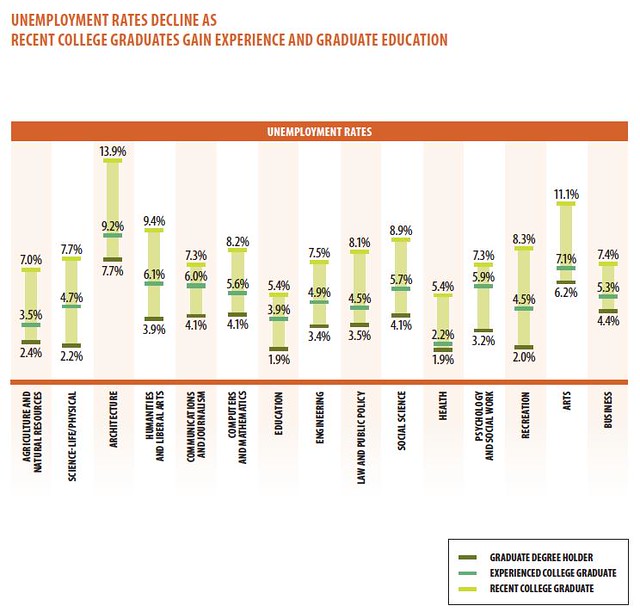
    Georgetown’s Center on Education and the Workforce, analyzing 2009-10 data on graduates from the Census Bureau’s American Community Survey, showed that the worst job prospects are for students coming out of architecture programs (13.9% unemployment), followed by arts (11.1%), humanities and liberal arts (9.4%), social science (8.9%), and law and public policy (8.1).

    Postrel acknowledges some of Georgetown’s findings but goes right at those who think the US needs students to be more career-minded. Looking at national education stats, she argues most Americans are already choosing a college major based on the prospects of landing a job upon graduation. And if the supply of "practical" workers increases, Postrel warns, the quality of the workforce will deteriorate and wages will be lower.

    “Contrary to what critics imagine,” she writes, “most Americans in fact go to college for what they believe to be ‘skill-based education.’ A quarter of them study business, by far the most popular field, and 16 percent major in one of the so-called Stem (science, technology, engineering and math) fields. Throw in economics, and you have nearly half of all graduates studying the only subjects such contemptuous pundits recognize as respectable.” Further, Postrel says those who argue for initiatives to push students in STEM fields – or away from liberal arts – disregard “the diversity and dynamism of the economy, in good times as well as bad.”

    So what’s better? Would the U.S. be better off if more students took a broad-based liberal arts approach to their education, or should more be concerned with learning a specific trade or set of skills?

    Postrel cited the National Center for Education Statistics’ report entitled "2008-09 Baccalaureate and Beyond Longitudinal Study" (PDF here), which looked at graduates from the 2007-08 academic year. Two points should be made on this study: 1) the economy and employment prospects related to certain programs have changed drastically since 2007-08, and 2) the report includes only bachelor’s degree recipients.

    With this in mind, EMSI tapped into the NCES database to get a more recent and thorough picture of the most popular programs areas for recent US grads. We looked at the total number of degrees given out in 2010 (the most recent year available from NCES) at the associate’s, bachelor’s, master’s, and doctorate level among major program categories.

    Our analysis includes degrees at the four main postsecondary levels mentioned above, not certificates or postsecondary awards. We did this to better reflect graduates who have made a more-than-one-year investment in education and have therefore given their decision serious thought.
    A few noteworthy items (see the full data here):

    • Humanities majors account for 12% of graduates in the study Postrel used; according NCES’ latest data, which uses slightly different program classifications, 9.6% of all degrees came in liberal arts and sciences, general studies and humanities. One reason for the lower percentage could be that we included associate’s degrees (as well as bachelor’s, master, and doctorate degrees) in our analysis and the NCES study looked only at bachelor’s degree holders.
    • Business, management, marketing and related programs make up the largest percentage of 2003 and 2010 degree recipients, just under 20% in both years. Postrel said a quarter of all degrees came in business (per the NCES study, it’s 23%).
    • Health professions and related programs made the biggest jump among major program categories — from 9.2% of all degree recipients in 2003 to 12.7% in 2010–and now stands No. 2 overall. The biggest reason for this has been the dramatic increase in registered nursing/LPN and medical assistant degrees (see more on the supply of RNs).
    • As a proportion of all degrees, computer and information sciences took the biggest hit — from 4.6% (127,088) in 2003 to 2.7% (94,730) in 2010.

    These stats point to a few telling short-term shifts. Yes, a significant number of all degree recipients have moved toward skill-based education. But more striking is the decline in students choosing STEM majors as a share of all graduates. In 2003, 21% of degrees awarded in the U.S. were from STEM-related programs. In 2010, that percentage dipped to 19%.

    Postrel would prefer students not be pigeonholed into going the skill-based route, even when it’s STEM-related. Yet it’s hard to ignore the illuminating data from Georgetown’s report: Recent grads in humanities and liberal arts have a 9.4% unemployment rate – lower than architecture, which has taken a beating with the construction downturn, but considerably higher than engineering (7.5%), business (7.4%), and especially health (5.4%).

    So, to go back to the question posed earlier, our economy would seem to be better off – or, to put it another way, unemployment would most improve — if more students earned a skills-based education over a liberal arts degree. At least in the short term, that appears to be the best solution to get people back to work. But outside training for a few fields, there’s no automatic path to a job. Even some new registered nursing grads – with nursing once seen as a lock to find a job – are having a hard time finding employment. And EMSI and others have written about the souring job prospects for lawyers.

    The Great Recession affected every industry in one way or another. Nonetheless, it’s worth repeating: There are 3.4 million jobs openings out there – 39% more than in June 2009. But in a sure sign that something is out of whack, hiring is only up 12% over that same time. 

    Flickr Photo by Jason Morrison: Ann Morrison gets her Masters of Science in Nursing, Pepper Pike, Ohio.

    Joshua Wright is an editor at EMSI, an Idaho-based economics firm that provides data and analysis to workforce boards, economic development agencies, higher education institutions, and the private sector. He manages the EMSI blog and is a freelance journalist. Contact him here.

  • The Three Laws of Future Employment

    As a college educator I am tasked with preparing today’s students for their future careers.

    Implicit is that I should know more about the future than most people. I do not – at least not in the sense of specific predictions. But I can suggest some boundaries on the path forward.

    Let’s start with the three Laws of Future Employment. Law #1: People will get jobs doing things that computers can’t do. Law #2: A global market place will result in lower pay and fewer opportunities for many careers. (But also in cheaper and better products and a higher standard of living for American consumers.) Law #3: Professional people will more likely be freelancers and less likely to have a steady job.

    Usually taken for granted is that future jobs depend on STEM disciplines (science, technology, engineering, and math). This view is eloquently expounded by Thomas Friedman, who argues that the US is falling behind China and India in educating for STEM careers.

    Alex Tabarrok makes a case for STEM in his excellent little e-book, Launching the Innovation Renaissance. He points out that “the US graduated just 5,036 chemical engineers in 2009, no more than we did 25 years ago. In electrical engineering there were only 11,619 graduates in 2009, about half the number of 25 years ago.” Similarly, the numbers of US computer science grads is flat over the past quarter century. Thus Tabarrok believes the US is falling behind in innovation and related technologies.

    But Tabarrok and much of the conventional wisdom are  wrong. The job that electrical engineers did 25 years ago has almost nothing to do with the job they do today. Computers now do much of the work that people used to do – computers design circuits, do all the drafting, plan the manufacturing, etc. It used to be that an electrical engineer designed the electronics in your car. To some extent they still do, but today even the smallest components come with operating systems – in other words, your car is programmed rather than designed. Electrical engineering is a career that follows Law #1: much of it has been (and will continue to be) computerized out of existence.

    Computer science careers illustrate Law #2. Computer science services are among the most tradable in the world. It is literally a global job market. Thus the number of computer scientists graduating from American colleges is an irrelevant number. Further, computer science jobs are themselves being computerized. The job description for today’s computer scientist is only tenuously related to what they did 25 years ago.

    Laws #1 & 2 predict that there will likely be fewer STEM jobs in the future – they are both easily computerized and tradable. People will always be employed in STEM disciplines, many of them highly paid, but they’ll be paid for smarts rather than education. The disciplines will be much more competitive, with older and less talented workers left on the sidelines. Tom Friedman and Alex Tabarrok, reflecting conventional wisdom,  are mistaken in maintaining that increasing STEM education is a key to future economic competitiveness.

    So if computerized, tradable skills won’t create much new employment, if any, what will? Clearly, it will be non-tradable skills that can’t be computerized. At their most valuable these jobs depend on human-human interaction – empathy. Counseling (of any sort: psychiatric, financial, weight loss, etc.), sales, customer service, management, and personal services all rely on empathy, as does waitressing. While much teaching can be computerized, what remains will depend more on empathy than anything else. “They don’t care what you know, but they will know if you care,” is a maxim future teachers should take to heart.

    According to Ronald Coase it is generally cheaper to engage freelance labor than to hire employees, unless the market transaction costs are too high. The internet lowers transaction costs and makes smaller firms (fewer employees) more economical. Thus we arrive at the Third Law of Future Employment: professional people will more likely be freelancers and less likely to have jobs. This already happens in computer science: projects are put out to bid on websites for global competition. Much journalism today is freelance, as is graphic design, engineering, or any number of other skills. The third law predicts this trend will grow.

    The bottom line is that today’s young people need to develop an individually unique set of marketable skills for tomorrow’s job market. A marketable skill is more than an education (which is not a skill), and also more than just job training (a skill, but no larger expertise). The useful benchmark is it takes 10,000 hours to become expert in something.

    I recently had a student – an English major – in my chemistry class. He had no good reason for being there; he could have fulfilled requirements with much less effort. So I asked him why?

    “It fit into my schedule and I felt like doing it. I like it.”

    “What are you going to do with an English degree?” I asked.

    “I’m writing a novel. It’s about cowboys.”

    Now conventional wisdom says this guy is all wet. Alex Tabarrok would have him drop the English degree in favor of chemistry (or chemical engineering). His English professors will say that his chances of publishing a novel (much less earning a living off one) are next to zero. SUNY Chancellor Nancy Zimpher has Six Big Ideas for SUNY – and my student doesn’t fit into any of them.

    But think about the skill set needed to write a novel, of which writing may be the least of it. He has to have something to write about, which means nurturing a general curiosity about the world – not just cowboys, but apparently also chemistry. He learns to be a keen observer of people: their appearance, what they wear, their character, mannerisms, and language. He develops the self-discipline and self-confidence to finish a project because it is intrinsically important, not because people say “Wow, that’s wonderful. You’re writing a novel!” Because of his novel my student becomes expert in many skills that can translate into a wonderful career.

    How is that different from mere education? The typical English major writes papers comparing Proust with Balzac. Not that there’s anything wrong with that, but it isn’t building the 10,000 hours.  It simply amounts to following directions carefully, and eventually collecting a credential. True expertise, by contrast, is something self-generated, following your own passion and talents. This isn’t to say education is always a waste of time, but it will no longer be sufficient to build a career.

    So here is my career advice to today’s students:

    • If you passionately like something and are good at it, then do that. STEM, for example, will always have a place for smart, hardworking people. Likewise, good writing can’t be computerized, but you need both talent and passion to be successful.
    • Start work on the 10,000 hours. Your education may help, but very little you do in school contributes to the total. Be it car detailing, truck driving, computer programming, drawing, writing – acquire an expert skill in something. Write a novel.
    • Empathize if you can. Computers can’t do that. Jobs that involve empathy (along with other skills) will always be in demand.
    • If you got it, flaunt it. That’s something else computers can’t do. Beauty has value, especially for women but also for men. This is wonderfully described in Catherine Hakim’s book, Erotic Capital. Even if you don’t got it, take advantage of youth. Acquire a fashion sense, take care of yourself, look as good as you can.

    Work hard. Have fun. Get rich.

    Daniel Jelski is a professor of chemistry at New Paltz, and previously served as dean of New Paltz’s School of Science & Engineering.

  • Indianapolis: From Naptown to Super City

    I have long touted the sports strategy that Indianapolis used to revitalize its downtown as a model for cities to follow in terms of strategy led economic and community development. I really think it sets the benchmark in terms of how to do it, and it has been very successful.

    Indy is hosting the Super Bowl on Sunday, something that is locally seen as a sort of crowning achievement of the 40 year sports journey. As part of that, the Indianapolis Star and public TV station WFYI produced an hour long documentary on the journey called “Naptown to Super City.” I think it’s a must watch for anyone who is trying to figure out to revitalize their own downtown. An hour isn’t short, but given the billions of dollars cities pour into this, I think it’s worth doing some homework. It tells the story of how Indy went from a deserted downtown where local Jaycees were licensed to take their shotguns and kill pigeons to one where the Super Bowl is being hosted today.

    I’ll talk more about the Indy strategy in a bit, but first the show. If you are in Google Reader this won’t display for you, so click here to watch.


    One thing this brought home for me is the true magnitude of the change. Perhaps I’m being a bit uncharitable, but Indianapolis almost literally started with nothing. It was never a major, important American city. It had no brand in the market. And it had a downtown that was all but dead. Everything they have today was built almost from scratch.

    Why do I think the Indy sports strategy was such a good one? Two reason: it was a good strategic area to go after, and it was backed up with very intelligent execution.

    First, five reasons this was a good strategic goal to pursue:

    1. It just fits the character of the city. Hoosiers love sports. The Indianapolis 500 and high school basketball were long established. It’s something they could behind in a way that they would never have gotten behind being the “vegetarian capital of the world” or something like there. It was authentic to the city. If you watch the video, you’ll note how locals embraced the events that were held that. That goes a long way towards explaining the success of the strategy. You have to be authentic to a place in your development efforts.
    2. It was a whitespace opportunity where Indy could get first mover advantage. Today every city thinks they can make money off sports, but Indy really pioneered the notion that you could use sports as an economic development tool. There were a lot of firsts along the path, and that’s one reason Indy was able to take out a leadership position. Just as one example, Indy was first to do the “build it and they will come” model of building a stadium before having a team. As a result, they were able to grab the Colts, and do it in an era when you didn’t have to mortgage your whole city to make a team relocation happen.
    3. Being America’s top city for sports events was a realistically achievable goal. I know this because the city achieved it. This is in great contrast to the umpteen cities who all claim they’ll be the “best cycling city in America” or some such.
    4. There were huge collateral benefits to sports beyond the direct economic impact of the events and the jobs they support. They bring people to the city to show it off to people who might not otherwise come. They enliven downtown and create events that locals might actually want to attend. They also have been an amazing brand opportunity. Just think of the Colts. How many times a week during football season does the word “Indianapolis” get said on TV? Probably hundreds if not thousands. Imagine if the city had to pay advertising dollars for that exposure? Yes, sports is expensive, but I think it could be justified just as cost-efficient marketing alone. Think about how much companies pay just to put their name on the stadium. How much more is it worth to put your city’s name on the team or the event? Think about how much advertisers will be paying for a 30 second commercial in the Super Bowl? What’s it worth for all those mentions of your city during the Super Bowl again?
    5. It was an initiative that had the possibility of being truly transformative for the city. Again, I know this is true because it was.

    I’m not going to claim these were actually the thoughts going through people’s minds as the sports strategy developed or that it was this calculated. But all of these things were implicitly true all along, and I think clearly the people pushing sports must have gotten it on that at some level. So sports meets the first test of a great strategy in that it set out after a good strategic goal.

    It was also something where there was a level of execution detail that far exceeded what most cities do. In business, it’s one thing to have an idea. It’s another thing to execute on it and achieve market leadership. It’s still another to generate sustainable competitive advantage that keeps you there over the long haul. Indianapolis has managed to do all of these with sports. I’ll highlight eight examples of how it did this:

    1. It invested in world class facilities. A lot of these have remained top rated even long after they opened, like Conseco Fieldhouse, which is still ranked every year as the best arena in the United States.
    2. Two, it laid out an entire district downtown around events hosting, with everything you need in close proximity – venues, the convention center, hotels, shopping, and entertainment. This is something that’s already been widely commented on by Super Bowl visitors who are amazed you don’t have to get shuttled around all over the place and that you can actually walk directly from the media hotel to the hotels where the teams are staying.
    3. Three, because of this Indy is able to effectively “saturation rebrand” downtown for an event and otherwise cater to events in a way that few other cities can or will. In effect, the city has converted its downtown into a giant sound stage. Take a look at the pictures of the city. The whole downtown as been rebranded after the Super Bowl, including, for example, plastering a huge Lombardi Trophy images on the side of the city’s premier hotel. You can debate the value of this to the city, but there’s no denying its value to the NFL. How many cities are willing to do this to the extent Indianapolis is?
    4. Indy created the Indiana Sports Corp. as the first ever non-profit management company for events. Today, everybody has adopted that model.
    5. The city cultivated a large, experienced volunteer base for putting on events that is much more powerful than what others cities have.
    6. Indy has been willing to take calculated risks in support of the strategy. Building the Hoosier Dome with no team to play in it – big risk.
    7. It not only went after the events, it went after the sanctioning bodies that determined where the events would be held. The most important is of course the NCAA, but there are others too. This has resulted in Indy having a “cluster” of these organizations and direct access to the people making decisions that pays incalculable dividends. This is one area where the “face to face” discussions that occur in Indy gives the city a big leg up. It’s not just better for selling, it gives Indy critical advanced intelligence about how these organizations are conceiving of their future events needs.
    8. Last but certainly not least, this has been a sustained, 35 year commitment. It wasn’t a party politics thing. It was a single project thing. It wasn’t a flash in the pan idea. It was something that has been relentlessly pursued over the long haul.

    Add all this up and it is easy to see why still today, three or four decades after it first started and after pretty much every city decided to go after these types of events, Indianapolis is still the best place in America to host a sports event.

    I hope this gives you a flavor why the Indy sports strategy was so good and so successful. It’s certainly something that’s not without its failures and downsides. The fact that sports has consumed disproportionate civic resources is one of them, and one highlighted by the documentary. But on the whole, most people seem very happy with the results.

    Something the video highlights at the end is one essential attribute for success that you can’t plan for or make happen – luck. They ask questions like, what if the “Save the Pacers” telethon had failed back in the 70’s? What if the seats in the Hoosier Dome had been the originally planned variegated colors instead of the Colts blue and white colors when Bob Irsay walked in to check it out? There were many critical turning points where without a lucky break, who knows if the future of downtown Indy might have been radically different in some way. It should give us some humility about the limits of our ability to simply will things into being. On the other hand, it reminds us that if you aren’t in the game, if you aren’t swinging the bat, you don’t have any chance at all of hitting that home run. You have to play if you want to win.

    This piece originally appeared at The Urbanophile.

    Aaron M. Renn is an independent writer on urban affairs based in the Midwest. His writings appear at The Urbanophile, and operates Telestrian, an online tool for economic and demographic data.

    Photo of Lucas Oil Stadium courtesy of BigStockPhoto.com.

  • Who Stands The Most To Win – And Lose – From A Second Obama Term

    As the probability of President Barack Obama’s reelection grows, state and local officials across the country are tallying up the potential ramifications of a second term. For the most part, the biggest concerns lie with energy-producing states, which fear stricter environmental regulations, and those places most dependent on military or space spending, which are both likely to decrease under a second Obama administration.

    On the other hand, several states, and particularly the District of Columbia, have reasons to look forward to another four years. Under Obama the federal workforce has expanded — even as state and localities have cut their government jobs. The growing concentration of power has also swelled the ranks of Washington‘s parasitical enablers, from high-end lobbyists to expense-account restaurants. While much of urban America is struggling, currently Washington is experiencing something of a golden age.

    So what states have the most to lose from a second Obama term? The most obvious is Texas, the fastest-growing of the nation’s big states. Used to owning the inside track in Washington during the long years of Bush family rule, the Lone Star state now has less clout in Congress and the White House than in recent memory. Texans are particularly worried about restrictions on fossil fuel energy development, which is largely responsible for robust growth throughout the state.

    “Obama now wants to take credit for the increased production that has happened, but [increased production] has been opposed in every corner by the administration,” says John Hofmeister, founder of the Houston-based Citizens for Affordable Energy and former CEO of Shell USA. Hofmeister fears that in a second term, with no concern for reelection, Obama could exert even greater controls on fossil fuel development. This would have dramatic, negative implications not only for Texas but for the entire national energy grid, which includes North Dakota, Wyoming, Montana, West Virginia, Oklahoma, Alaska and Louisiana. These states fear that the nation’s recent energy boom, which has generated some of the nation’s strongest job and income growth, could implode in Obama’s second term.

    Take Louisiana, which is still recovering from Hurricane Katrina in 2005 and the BP oil spill in 2010. The administration’s moratorium on offshore drilling, sparked by the spill, has had a deleterious effect on the state’s energy economy, according to a recent study, with half offshore oil and service companies  shifting their operations to other regions and laying off employees.

    Once the moratorium was lifted in 2010, companies have faced long delays for new wells, growing from 60-day delays in 2008 to more than 109 last year  .  “The energy states feel they are being persecuted for their good deeds,” says Eric Smith, director of the Tulane Energy Institute in New Orleans. “There is a sense there are people in the administration who would like this whole industry to go away.”

    Many of these same states also worry about the administration’s proposed downsizing of the military. Obama’s move to cut roughly towards $500 billion in defense spending may make sense, but it  threatens places with large military presences such as Texas, Florida, Oklahoma, Virginia, Georgia, South Carolina and New Mexico.

    The D.C. metro area might also be hit by defense cuts, but overall the it has many reasons to genuflect toward the Obama Administration. Federal wages, salaries and procurement account for 40% of the district’s economic activity, roughly four times the percentage of any state. Expanding regulation on energy, health care and financial services has sparked a steady job boom in lobbying, think tanks and other facets of the persuasion industry — including among Republicans –at a time when employment growth has been sluggish elsewhere.

    D.C. partisans hail their city as the leader of a national urban boom. The district clearly benefits from diminished job opportunities in more market-based economies, particularly for educated 20-somethings.

    No place has flourished as much as the capital, but a second term would be favorable to states such as Maryland, which depend heavily on research spending directed from Washington and where federal spending accounts for fifteen percent of the local economy, over seven times the national average. Maryland agencies such as the National Institutes for Health will likely expand under an increasingly federalized health care system — particularly if Democrats gain more seats in Congress with an Obama win.

    Other big states that may benefit from a second term include New York, California and Illinois. New York benefits largely from the administration’s Wall Street leanings, despite the president’s recent attacks on financial elite. Even for the non-conspiracy theorists, the administration’s ties to Goldman Sachs appear unusually intimate. Powerful allies like Democratic Sen. Charles Schumer, D.C.’s greatest Wall Street booster, suggest big money has little to fear from a second term.

    Overall the administration’s basic policy approach has favored the financial giants. Support for bailouts, seemingly permanent low interest rates, few prosecutions for miscreant investment bankers, the institutionalization of “too big to fail” and easy loans for renewable fuel firms all have benefited the big Wall Street players.

    Of course, a Republican victory would not be a disaster for these worthies. Companies like Goldman Sachs are hedging their bets by sending loads of cash to the likely Republican choice, former Massachusetts Gov. Mitt Romney.

    But other New York interests, such as mass transit funding, would benefit from the current administration’s  generally pro-urban, green sensibilities. Tight regulations on carbon emissions — increasing the price of fossil fuels — may help the competitive position of New York City, which has little industry left and relatively low carbon emissions per capita, in part due to a greater reliance on hydroelectric and nuclear power.

    California also has reasons to root for an Obama victory. Although among the richest states in fossil fuels, particularly oil, the Golden State has become a bastion of both climate change alarmism and renewable energy subsidization. It adamantly won’t develop traditional its energy resources — which would help boost the state’s still weak economy — and Silicon Valley venture firms have eagerly grabbed subsidies and loans for start-ups from Energy Secretary Steven Chu’s seemingly bottomless cornucopia.

    Furthermore,  more powerful EPA would make California’s current “go it alone” energy and environmental problems less disadvantageous compared to more fossil-fuel-friendly states, leveling what is now a tortuous economic playing field.

    Similarly, attempts to push the state’s troubled high-speed rail line — recently described in Mother Jones as “jaw-droppingly shameless” –  will succeed only with strong backing by the federal government. Under a Republican administration and Congress, Brown’s beloved high-speed line would depend entirely on state and private funding, likely terminating the project.

    But no state needs an Obama victory more than his adopted home state of Illinois. To be sure, having a native son in the White House has not prevented the Land of Lincoln from suffering one of the weakest economies in the nation. The state has one of the highest rates of out-migration in the country, according to recent United Van Lines data and Census results.

    Even worse, the Land of Lincoln faces a fiscal crisis so great that it makes California look well-managed.  Without a good friend in the White House, and allies in Congress, Illinois could end up replacing long-struggling, now-improving Michigan as the Great Lakes’ new leading basket case. Count Illinois 20 electoral votes in the Obama column.

    This piece originally appeared in Forbes.com.

    Joel Kotkin is executive editor of NewGeography.com and is a distinguished presidential fellow in urban futures at Chapman University, and contributing editor to the City Journal in New York. He is author of The City: A Global History. His newest book is The Next Hundred Million: America in 2050, released in February, 2010.

    Photo from BigStockPhoto.com.

  • Making Room for the Old and the New Economies

    The announcements by Sens. Ben Nelson (D-Neb.) and Kent Conrad (D-N.D.) that they would not run for reelection reflects what may be the last gasps of the Great Plains Democrats, much as California’s 2010 Democratic landslide assured that Republicans are soon to become endangered species in places like Los Angeles and Silicon Valley.

    The conventional explanation for these trends centers on culture or ideology, but the real cause may lie with an evolving conflict between two dueling political economies.

    On one side lies the information or “creative” economy, centered in coastal big cities and university towns. On the other lies the larger “basic” economy, which produces tangible items like food, manufactured goods and fossil-fuel energy.

    In the past, both political parties had liberals as well as conservatives and operated in both of these economies. Republicans thrived not only in the Heartland but also in information hubs like Silicon Valley, Southern California and even parts of Manhattan.

    Similarly, Democrats were influential in large swaths of the resource and agriculture-dependent parts of the country, including the Great Plains.

    However, this is increasingly no longer true. Plains Democrats, like former Sen. Byron Dorgan of North Dakota, struggled to sell the state’s remarkable energy-driven recovery to an administration hostile to fossil fuels. Many in his state, and other energy centers like Texas, view the Obama administration’s resistance to oil and gas development as an assault on economies that, over the past decade, have had the highest rates of job creation and per capita income growth in the nation.

    Dorgan, frustrated with Obama’s economic policy, chose not to run for reelection in 2010. But his House colleague, Earl Pomeroy, as well as Stephanie Herseth Sandlin (D-S.D.) were defeated. Nelson’s decision reflected a reaction to the strong GOP tide in the Plains. Registered Democrats in Nebraska have dropped from 38 percent to 33 percent just since 2008. The Republicans are at 48 percent.

    This is a remarkable fall from grace. As recently as 2006, Democrats held four of the six Senate seats representing the 650 miles of plains from Nebraska north to the Canadian border. If, as expected, Nelson’s seat is taken by the GOP, there will be only one — Sen. Tim Johnson (D-S.D.), who is up for what might a difficult reelection battle in 2014.

    Yet another energy-state Democrat, Sen. John Tester of Montana, is facing a tough reelection contest. If he is defeated, only a handful of Democrats from energy-producing states — Joe Manchin and Jay Rockefeller of West Virginia and Mary Landrieu of Louisiana — will be left in the Senate.

    For the most part, these Democrats are not being chased from office by cultural brawls over issues like gay rights or abortion — particularly in the socially moderate northern Great Plains. More damaging is the perception that Obama Democrats have little regard, even contempt, for the fundamental economics of basic industries.

    The battle over energy extends beyond the major oil-producing states. In places like eastern Ohio and western Pennsylvania, a nascent shale oil and gas boom is helping strengthen resurgence in industrial jobs lost decades ago. To many business people and workers in cities like Fort Wayne, Ind., looming Environmental Protection Agency regulations on mercury as well as carbon emissions could threaten this nascent revival. Reviving the Rust Belt, many believe, requires the cheap, reliable energy that, in the near future, can come only from fossil fuels.

    Instead, the Obama team reflects an urban, information economy bias. In contrast to President Bill Clinton, who supported industrial and agricultural development back when he was governor of Arkansas, Barack Obama represents an odd admixture of faculty lounge and urban bloc machine. He never developed any links to the basic economy; his worldview appears largely divorced from the realities of production. “It’s MoveOn.org run by the Chicago machine,” according to the mayor of a California farming town, a longtime Democrat.

    This tilt can also be seen in the widely touted strategy of conceding working-class white voters in states like Pennsylvania and Ohio in favor of what Democratic strategist Ruy Texeria calls “the mass upper middle class.”

    Today barely half of white union members, says researcher Alan Abramowicz, tilt Democratic compared with nearly two-thirds who supported them in the 1960s, when Democrats still identified strongly with the industrial and energy sectors.

    This trend may be further accelerated by the prospect of deep defense cuts. Many Plains and Southern states are dependent on defense-related expenditures. In the past, Plains Democrats and Southern Democrats, like retiring Sen. Jim Webb (D-Va.), were the product of or identified strongly with the military. But today, the Democratic Party’s hawkish traditions — extending from Harry S. Truman and Sen. Henry M. Jackson to Georgia’s Sam Nunn and Webb — is all but extinct.

    A parallel development can be seen in the information hubs of the Northeast and West Coast. As recently as the 1990s, Republicans could muster considerable numbers both in Silicon Valley and throughout the Los Angeles Basin. Manhattan’s “silk stocking district” regularly sent Republicans to the House.

    These exceptions barely exist today. Los Angeles County, home to nearly 10 million people, has only one Republican congressman. The Bay Area, which includes the district of House Minority Leader Nancy Pelosi (D-Calif.), and Manhattan each has none. The same pattern is evident at the state and local levels — where almost the entire delegation is now “progressive” Democrats.

    As in the Great Plains, this shift parallels changes in the political economy. Over the past decade, the Bay Area experienced the single largest decline in manufacturing in the country, and New York ranked second. Now the information sector — as well as related finance, health and education sectors — dominate these economies. Even business people in these areas share little in common with business people in the manufacturing or energy economies.

    With dense population and far less reliance on cheap energy like coal, greater metropolitan areas like New York or San Francisco find it easier to embrace the administration’s green (read expensive) energy agenda. Indeed, many companies, including Google and several investment banks, have invested in new renewable fuel and electric battery firms that have received large loans and other subsidies from Washington and sympathetic local governments, notably in California.

    The information economy is also dependent on international markets, capital and, most particularly, brainpower. This makes them more sensitive to the nativist pandering that has been de rigueur in GOP national politics. Republican politicians, who now usually cater to their religious right by campaigning against gay marriage and abortion, turn off even libertarian voters in information hotbeds, where such views are anathema.

    Sadly, these two economic visions exacerbate already existing cultural and political divisions. This also threatens the country’s ability to compete globally at a time of great opportunity. To overcome our competitors, particularly China, the United States needs a Washington that embraces both the information economy — where the United States still remains pre-eminent — and the basic economy — where we are seeing signs of a nascent renaissance.

    Only when both economies are appreciated and supported in both parties can we find the common ground necessary to succeed in the coming decade.

    This piece originally appeared in Politico.

    Joel Kotkin is executive editor of NewGeography.com and is a distinguished presidential fellow in urban futures at Chapman University, and contributing editor to the City Journal in New York. He is author of The City: A Global History. His newest book is The Next Hundred Million: America in 2050, released in February, 2010.

    Photo from BigStockPhoto.com.

  • Welcome Back, Britain! Why The U.K. Doesn’t Need The E.U.

    To some, British Prime Minister David Cameron’s decision to demur from the new euro rescue plan has made the U.K. irrelevant on the world scene. Yet by moving away from the euro zone, Cameron did something more than reaffirm Britain’s opposition to a German-led Europe: He asserted Britain’s greater, historically grounded legacy as the center of the Anglophone world.

    This obstinacy could end up maintaining the U.K.’s global importance by shifting its focus away from “the declining and irritable nations of the old world” and toward its legacy as the center of the English-speaking world.

    Over time cultural ties generally prove more enduring than ideological or geographic ones. The 14th century Arab historian Ibn Khaldun once observed, “Only tribes held together by a group feeling can survive in a desert.” Throughout history, the most powerful, far-reaching cultures — namely the Greek, Roman, Arab, Chinese, Mongol and British empires — shared this intense kinship.

    Like the world’s two other primary global tribes, the Chinese and Indians, Anglo share ancient and deep-seated affiliations. In contrast to the profoundly insular Japanese or the Germans, global tribes are transnational and transcend mere geography. They share not only economic ties but “group feelings” shaped by commonalities of food, language, history, spiritual and political ideals .

    The British are “cousins” to Americans, Canadians, Australians and New Zealanders in ways the French, Germans and Italians are not. When young and educated British emigrate they generally head not to Germany or China but to other English-speaking countries. Retirees might seek out the Spanish or French Rivera, but those building careers go overwhelmingly to Anglophone countries.

    Equally important may be the British connection to other former colonies like India, South Africa and Nigeria that, although not racially Caucasian, function largely in English and retain close ties to the mother country. Any close look at British interests and personal ties reflect the enduring nature of its tribal essence. London’s status as the world’s financial center — the critical reason for Cameron’s break with the E.U. — lies not primarily with Europe, but with its scattered former colonies. Britain is the world’s fourth largest investor and the top investor in the United States, which in turn serves as the U.K.’s biggest export market. The U.K. also plays an outsized role in South Africa, Singapore and India, where it is by far the largest European investor.

    In this sense, the Anglosphere — including places like India — constitutes a kind of transnational family. Usually ignored or scoffed at by globe-trotting pundits and politicians who define the world by geographic proximity, these global linkages are more important than ever.

    Consider the fate of the insular Japanese, who, without a large diaspora, have no recourse but to fall back into the relative obscurity of their home islands. Similarly, the E.U., particularly in its post-Christian,phase has no common tribal essence. Instead the continent seems to be breaking into at least three tribes: an austere neo-Hanseatic Nordic core, a spendthrift and effectively bankrupt Mediterranean south, and a troubled, rapidly depopulating eastern rim.

    The drive to create a powerful European superstate lacks the girding of a common ideology and social norms that give the English-speaking world coherence. Whatever her ambitions, Germany’s Angela Merkel, Chancellor of a prosperous but rapidly aging and militarily weak country, seems more like a wily schoolmarm than an inspirational European leader. She’s no Caesar, Charlemagne or Napoleon who’s capable of uniting the continent by force of ideology, personality and power.

    Given these fundamental flaws, Britain’s best course would be to focus on linkages to her offspring. Taken together the Anglosphere represent more than a quarter of world GDP, and the Queen’s tongue remains the dominant language of international business, science and diplomacy, utterly supplanting French, Russian and German even on the continent. The E.U. may have been constructed largely by French visionaries, but English is spoken by 41% of Europeans, while only 19% speak French.

    More important still, the developing world is turning Anglophone. French schools have been closing even in former colonies such as Algeria, Rwanda and Vietnam, where students have protested against learning the old colonial tongue. English is being widely adopted in China, and it dominates the Gulf economy, where it serves as the dominant language of business in hubs such as Dubai. It is also, of course, the dominant language of India’s burgeoning middle class.

    The linguistic dominance propels the Anglosphere’s dominion over such critical growth industries as technology and culture. Britain may no longer be an industrial superpower, but its media, research institutions, investment banks, courts and culture remain globally relevant. Nearly half the world’s sales of audio-visual products, for example, come from the English speaking world, with Britain constituting the second-largest exporter behind the U.S.

    Technology follows a similar pattern. Three-fifths of global pharmaceutical-research spending comes from Britain and the U.S.; more than 450 of the top 500 software companies in the world are based in the Anglosphere. Out of the ten fastest-growing software companies, six are American and one is British.

    This brain power is backed up by a treasure trove of natural resources. The U.K. itself may lack sufficient raw materials — after all that was what the empire was all about — but its diaspora countries, notably in North America and Oceania, account for much of the world’s food exports and, increasing, its supply of fossil fuel energy.

    How about the thorny issue of politics? In the end, when there’s a crisis the Anglosphere countries can most rely on one another. Time and again, the British, Canadians and Australians have been the peoples who send troops and ships in concert with America. What country is a more American solid ally in Asia than the remarkable English-speaking enclave of Singapore?

    Conversely, when Argentina seized the Falklands, Prime Minister Margaret Thatcher could count on logistical help, first and foremost, from the United States. And as the Australians contemplate an expanding Chinese military presence in their backyard, they look to the Americans to send in the maritime cavalry.

    Sadly the critical nature of these linkages is not fully appreciated by the current U.S. administration. President Obama, the grandson of a Kenyan victimized by the brutal colonial regime, has dissed Britain repeatedly. Opposition to colonialism, of course, resonates with American tradition, but he perhaps went too far when he famously returned the bust of Winston Churchill sent by Tony Blair to President George W. Bush back to Britain.

    More recently Obama has even poisoned the well against Canada, our greatest trade partner and continental soul mate, by rejecting the Keystone XL project. It’s as if he were urging Canada to align itself with China. What’s next a move to ban the import of Australian uranium or Uggs?

    Yet the great strength of tribes, or families, lies in their ability to endure despite the most egregious family foolishness. Even a wayward president, or two, cannot tear asunder what has been hundreds of years in the making.

    This piece originally appeared at Forbes.com.

    Joel Kotkin is executive editor of NewGeography.com and is a distinguished presidential fellow in urban futures at Chapman University, and contributing editor to the City Journal in New York. He is author of The City: A Global History. His newest book is The Next Hundred Million: America in 2050, released in February, 2010.

    Creative Commons photo by Flickr User “angies”.

  • This Is America’s Moment, If Washington Doesn’t Blow It

    The vast majority of Americans believe the country is heading in the wrong direction, and, according to a 2011 Pew Survey, close to a majority feel that China has already surpassed the U.S. as an economic power.

    These views echo those of the punditry, right and left, who see the U.S. on the road to inevitable decline.  Yet the reality is quite different. A confluence of largely unnoticed economic, demographic and political trends has put the U.S. in a far more favorable position than its rivals. Rather than the end of preeminence, America may well be entering  a renaissance.

    Just survey the globe. The European Union’s prolonged crisis will likely end in further decline. Aging Japan has long passed its prime, its market share receding in everything from autos to high tech.  China’s impressive economic juggernaut has slowed down, and the Middle Kingdom faces increased social instability, environmental degradation and a creaky one-party dictatorship.

    While the U.S. has its challenges, it is positioned to achieve a more solid long-term   trajectory than its European and Asian rivals. What it lacks, however, is a strong political leadership capable of seizing this opportunity.

    Resources

    Energy constitutes the biggest ace in the hole for the U.S. For almost half a century, an enormous fossil fuel bill that still accounts for 40% of the nation’s trade deficit has hampered economic growth. Now that situation is changing rapidly.

    Due to vast new finds and improved technology to exploit them, the U.S. is now the world’s largest producer of natural gas and could emerge as the leading oil producer by 2017. Reserves of natural gas — a clean-burning fuel — are estimated at 100 years supply and could generate more than 1.5 million new jobs over the next two decades.

    The U.S. agricultural sector is also booming, with exports reaching a record $135.5 billion in 2011. With global demand increasing, sustained growth  will continue across America’s fertile agricultural regions.

    Manufacturing

    The other big game changer is manufacturing. As President Barack Obama recently acknowledged, this is America’s “moment” to seize the industrial initiative. U.S. manufacturers have expanded their payrolls for two straight years, and they have increased production while Japan, Germany, China and Brazil have scaled back.

    A recent survey of manufacturing CEOs revealed that 85% believed production could shift soon from overseas. Both foreign and domestic manufacturers are alarmed about rising wages and labor unrest in China. Some important Japanese, German and Korean companies also have concerns about China’s policies that favor local firms and abscond with investor’s technology.

    Foreign Investment

    Rising foreign investment reflects the new American competitiveness. Since 2008 foreign direct investment to Germany, France, Japan and Korea has stagnated; in 2009 overall investment in the E.U. dropped 36%.

    In contrast, in 2010 foreign investment in the U.S. rose 49%, mostly coming from Canada, Europe, and Japan. Industrial investment rose $30 billion just between 2009 and 2010, while investment in the energy sector more than tripled to $20 billion.

    The Information Sector

    In the information sector, American domination continues to mount, contrary to predictions of decline over the past two decades. Although high-tech manufacturing has shifted largely to Asia, Americans rule the increasingly strategic software sector.   American-based companies, who constitute more than two-thirds of the world’s 500 largest software companies, including  nine of the top ten.

    Outside the U.S., there are no significant equivalents of Apple, Google, Microsoft, Amazon and Facebook. Hollywood, for its part, rules the entertainment world, producing 40% of world’s audiovisual exports, a dominion that troubles China’s President Hu Jintao, who recently complained  that the “cultural fields” represent “the focal area” for Western “infiltration”.

    Demographics

    The Great Recessionhas slowed population growth everywhere, but the U.S. maintains the   youngest and most vibrant demographic profile of any advanced country. Between 1980 and 2010, the U.S population expanded by 75 million to over 300 million. In contrast many European countries, including Germany, have suffered stagnant growth, while in Russia and Japan populations have already started declining.

    The disastrous fiscal implications of slow or negative population growth are evident in Greece, Spain and Italy, all of which suffer among the world’s lowest fertility rates. Rapid aging also will soon catch up with Germany. By 2030, Germany will have 48 retirees for every 100 workers — that’s barely two workers per retiree. The numbers are even worse in Japan: 53 retirees for every 100 workers by 2030.

    Political Factors

    Given the ineptitude of the last two administrations, enthusiasm about America’s political system is hard to justify. But our constitutional systems of laws and checks on central power remain a critical advantage. Immigration has declined with the recession, but the U.S. can expect to welcome religious and political exiles — such as Middle Eastern Christians displaced by   the “Arab Spring” — as well as Greeks and Irish fleeing Europe’s economic decline.

    Many from Russia and China are seeking to immigrate to the United States, Canada or Australia in order to protect property or just live a freer life. Indeed, among the 20,000 Chinese with incomes over 100 million Yuan ($15 million), 27% have already emigrated and another 47% have said they were considering it, according to a report by China Merchants Bank and U.S. consultants Bain & Co. published in April.

    Needed from Washington: A New American Strategy

    Sadly no leading politician or political party seems ready to   embrace the country’s new strategic advantages.  Many on the left may find the very notion distasteful, having    swallowed declinism with their academic mother’s milk. The president himself dislikes the notion of American “exceptionalism.” Many key Obama backers like SEIU boss Andy Stern and former auto czar Steven Rattner, embrace the superiority of China’s authoritarian system. Others embrace Europe and even Japan as models for an aging superpower.

    Worse still: Some Obama policies work against the well springs of national resurgence.   Threats to raise income taxes on families making over $250,000 directly threatens the aspiring entrepreneurial class more than the real “rich” whose fortunes are protected by low capital gains taxes and family trusts. Most critical: The administration’s hostility to fossil fuel represents a direct threat to the country’s greatest new source of advantage and threatens to strangle America’s recovery in its infancy.

    Not that the Republicans are any less clueless. Many reject the infrastructure needed by an expanding economy — ports, roads, bridges as well as worker training and support for basic research — as mere “pork.” Budget restraint and fiscal discipline are important, but preparing the country for more rapid economic growth requires an active, supportive government.

    Republicans also tend to view immigration as something akin to a hostile invasion. Yet many key industries — notably manufacturing and high tech — rely heavily on immigrant entrepreneurship, intelligence and work values. Running against immigration constitutes an assault on the nation’s increasingly diverse demographics.

    So this is where we now sit.  With all the essential elements for a strong, sustained recovery place, the big question is whether we will find political leaders capable of tapping this country’s phenomenal potential.

    This piece originally appeared at Forbes.com.

    Joel Kotkin is executive editor of NewGeography.com and is a distinguished presidential fellow in urban futures at Chapman University, and contributing editor to the City Journal in New York. He is author of The City: A Global History. His newest book is The Next Hundred Million: America in 2050, released in February, 2010.

    Photo from BigStockPhoto.com.

  • Florida’s Quick Rebound

    Adding nearly 119,000 people in 2011, Florida has capped a decade of steady population increase  to see the state grow 19% since 2000.  Despite 2009, an historic year where more people left than arrived, the overall net growth of Florida has yielded two additional congressional seats, moving the state well on its way towards the becoming third most populous state in the nation.  This ascendancy brings new responsibility to the shoulders of the state’s leaders, and the direction this state takes in the coming years will depend upon how Florida reacts to this influx of new population.  It is time for true leadership to find appropriate voice for our state on the national scene.

    Contrary to the predictions of many within the urbanist intelligentsia, Florida’s farm counties grew the fastest. Osceola County, just south of bustling Orlando, grew by 55%; sleepy Sumter County, northwest of Orlando, grew by 75%; and Flagler County, home to historic St. Augustine, nearly doubled in population. Tampa, Orlando, and Miami have each seen their healthy share of immigration, but Florida’s rural areas have dramatically increased their appeal over a decade ago.

    At first this trend might be puzzling.  Lacking urban amenities such as museums, transit, and Starbucks, parts of rural Florida seem almost timeless.  Wildwood and Leesburg, nestled in the center of Florida, lack both beaches and theme parks.  They have one thing, however, that the urban areas do not have:  affordable housing.  And this is the elusive reality that must be turned around by Florida’s leadership if the state is to grow in a responsible manner.

    The Miami-Dade market has plenty of supply, but the average home lists for $509,000 .  Up in Wildwood, the home lists for $175,000, and you get a lot more house for your money.  People are voting with their feet for affordability.

    It’s not the price alone that seems to be putting people off, however.  Naples, which lists homes even higher than Miami, saw growth over the past ten years at a pace two and a half times that of Miami, and is expected to continue to grow at the same pace through 2015.  Anecdotally, it seems that newcomers have relocated to their vacation homes after selling off their other high-priced property, usually in the north. They sometimes reduced their expectations of what they can receive for their old houses and then permanently located where they prefer to live. If the buyers are older, they still likely made a nice profit over the past few decades.

    In Orange County, meanwhile, relieved realtors are finally starting to say goodbye to distressed properties.  Appraiser Lee Barnes commented that “foreclosures and short sales are 40% fewer, compared to this time last year,” and in an economy fueled by growth, the welcome sight of occupied rooftops means that commercial real estate is beginning to come back.  In fact, Orlando is near the top of the list in expected home price gains for 2012, a dramatic turnaround for the region.

    Florida’s comeback is timed with some key changes in regulating real estate development.  With state oversight all but vanquished by the governor, starving local counties welcome the property tax dollars associated with new growth.  No other revenue, apart from a sales tax, provides much cash to operate government in the Sunshine State. This makes growth a priority.

    But economic activity occurs in two forms:  growth (making more stuff) and development (making stuff better).  Quietly, in the past decade, Florida has added biomedical research clusters to its twin engines of growth and tourism, and this promises to increase greater resilience to the state economy.

    Some signs, however, point to Florida abandoning this strategy and continuing its boom-bust mentality.  The Governor, already warning the legislature of budget cuts in 2012, has expressed disappointment that the job creation return is poor on the State’s venture capital invested in bringing Scripps, Nemours, and other cutting-edge research organizations. He claims that are simply not adding jobs fast enough for his taste.  Abandoning these investments could mean that the organizations reduce their presence or even abandon the state.

    At the same time, Florida’s cities seem to be uncertain about how to tackle the problem of adding density without reducing affordability.  Land prices haven’t wavered much in the recession, with stubborn property owners holding on to assets that won’t sell, and they may benefit from this land-banking strategy in the long run.  Many who escape the Rust Belt and come to Florida express shock at the cost of living in the Sunshine State and are further dismayed over the quality of schools and surprising amount of congestion.  This mismatch between cost of living and quality of life may be part of the reason why Florida’s five largest cities were listed among the nation’s “saddest” in a recent Time poll .

    Casino gambling, a typical 1990s way to boost revenue, is being entertained by the Legislature, but other ideas should be considered as well.  For one thing, investment in the future means a better education system, perhaps a higher priority than ostrich food subsidies (currently exempt from state sales tax ).  Closing tax loopholes and fixing some long-broken parts of Florida’s tax code will help gain some badly-needed revenue.

    Very large infrastructure projects are also important to make Florida competitive.  On the east coast, NASA’s 60-year-old facilities need a major overhaul to continue providing America a spaceport for the 21st century and to pave the way for private space exploration.  This will maintain the deep investment in human capital of which Floridians were once justly proud.  The spaceport has a great deal of synergy with the National Simulation Center, located in Orlando, which is currently the country’s premier provider of military simulation and training.

    In more than one region, the Florida Venture Capital Act has brought world-class biomedical research laboratories, making dramatic advancements in cancer, diabetes, children’s health, and other key areas.  Already surging ahead and competing with area like Boston’s Research Center and the Silicon Valley, Florida must keep its edge in this field by continuing investment in the Venture Capital Fund.

    On the west coast, the Tampa Port Authority is already preparing for the widening of the Panama Canal, working in collaboration with ports of Mobile and Houston to partner with ocean carriers.  Continuing this investment and modernizing the logistics of truck and railroad traffic into the port is critical to make this economic engine prevail in the 21st century.

    Such infrastructure investment will improve Florida’s already existing assets, allowing for prosperity and upward mobility to occur within the state.  Competing with Texas will be difficult, given Florida’s lack of petrochemical resources, but the state’s native industry, tourism, has already made it a world-class destination. Florida’s leadership has already entered the national stage by saying “no” to high speed rail, but it has yet to define what it will say “yes” to.  Without intelligent citizen input, the state will likely fall back on its traditional pattern of being a passive receiver of investment and people, but not a creator of great new enterprises. 

    In contrast to states like California and Texas, Florida has been willing to be eternally passive; Disney World is a classic example.  Florida, a grateful recipient of this California enterprise, has benefitted secondarily, but the real power of this company still resides in Burbank.  This story is played out over and over again, with real estate developers from Dallas and Atlanta continuing to define the face of the state, aided and abetted by Wall Street investors who see Florida primarily as a waterfront real estate asset with some moderate margins available in between coasts.

    It is time for Florida to start doing, instead of being done to.  With investment in real infrastructure, good education and intelligent leadership, Florida can assume its responsibility as one of America’s new high-profile states, capable of exporting science, technology, and culture.  Our population growth contains within it the seeds of a bright future once we fix what is broken about our beautiful state.

    Richard Reep is an Architect and artist living in Winter Park, Florida. His practice has centered around hospitality-driven mixed use, and has contributed in various capacities to urban mixed-use projects, both nationally and internationally, for the last 25 years.

    Photo courtesy of BigStockPhoto.com.

  • The U.S. Economy: Regions To Watch In 2012

    In an election year, politics dominates the news, but economics continue to shape people’s lives. Looking ahead to 2012 and beyond, it is clear that the United States is essentially made up of many economies, each with distinctly different short- and long-term prospects. We have highlighted the five regions that are most poised to flourish and help boost the national economy.

    Our list assumes that we will be living in a post-stimulus environment. Even if President Obama is re-elected, it will largely be the result of the unattractive nature of his opposition as opposed to his economic policies. And given it is unlikely the Democrats will regain the House — and they could still lose the Senate — we are unlikely to see anything like the massive spending associated with Obama’s first two years in office.

    Clearly the stimulus helped prop up certain regions, such as New York City, Washington and various university towns, which benefited from the financial bailout, lax fiscal discipline and grants to research institutions. But in the foreseeable future, fundamental economic competitiveness will be more important. Global market forces will prove more decisive than grand academic visions.

    With that in mind, here are our five regions to watch in 2012.

    1. The Energy Belt. Even if Europe falls into recession, demand from China and other developing countries, as well as threats from Iran to cut off the Persian Gulf, will keep energy prices high. While this is bad news for millions of consumers, it could be a great boon to a host of energy-rich regions, particularly in Texas, Oklahoma, the Dakotas, Montana, Louisiana and Wyoming. New technologies that allow for greater production require higher prices than more conventional methods — roughly $70 a barrel — and most experts expect prices to stay above $100 for the next year.

    Goldman Sachs recently predicted that the U.S. will become the world’s largest oil producer by 2017. The bounty is so great that the key energy-producing states have consistently out-performed the national average in terms of job and income growth. Houston, the nation’s energy capital, has enjoyed the fastest growth in per-capita income in the past decade. No reason to expect this to slow down much this year.

    Energy growth, notes Bill Gilmer, senior economist at the Federal Reserve Bank of Dallas, also sparks “upstream” expansion in a host of other industries, such as chemicals and plastics. Massive new expansions to serve the industry are being planned not only in Texas and Louisiana but in former rust belt states, including now gas-rich Ohio. The big exception is oil-rich California, which seems determined to keep its fossil fuels — and the growth they could drive — out of mind and underground.

    2. The Agricultural Heartland. You don’t have to have oil or gas to enjoy a strong economy. Omaha, Neb., is not in the energy belt, but its strong agriculture-based economy keeps its unemployment rate well under 5%. Demand from developing countries — especially China, which is expected to supplant Canada as our No. 1 agricultural market — should boost the nation’s farm income to a record $341 billion.

    Most of the increased product demand lies in commodities like soybeans, corn, barley, rice and cotton. Contrary to the assumptions of East Coast magazines such as The Atlantic, which paint a picture of a devastated and dumb rural America, places like Iowa are doing very well indeed and are likely to continue doing so. Urban economies like Des Moines are also benefiting and expanding into finance and other non-farm related activities. The once massive out-migration from the region has slowed to something like a balance, with increasingly strong in-migration from places like Illinois and California.

    3. The New Foundry. The revival of Great Lakes manufacturing is one of the heartening stories of the past year, but the biggest beneficiaries of American manufacturing’s revival will likely be in the Southeast and along the Texas corridor connected to Mexico. Future big growth will not come from bailed-out General Motors or Chrysler, with their legacy costs and still-struggling quality issues, but from foreign makers — Japanese, German and increasingly Korean — that build highly rated, energy-efficient vehicles. These countries are not just investing in cars; they also have placed steel mills and aerospace facilities in the rising south-facing foundry.

    Foreign companies have good reasons to look to an expanded U.S. base: aging domestic markets, diminishing workforces and a growing concern over China’s tendency to steal technology and favor state-owned firms. This shift from domestic production has been building for years, in large part due to familiar reasons of less unionization and lower business costs. Of the ten foreign auto assembly plants opened or announced between 1997 and 2008, eight were in Southern right-to-work states. As the recovery has taken hold, new expansions are being announced. In 2011 Toyota opened a new plant in the tiny hamlet of Blue Springs, Miss., just 17 miles from Elvis’ hometown of Tupelo, while Mercedes-Benz announced  $350 million to add capacity to its plant just outside of Tuscaloosa.

    4. The Technosphere. Silicon Valley, as well as the Boston area, has thrived under the stimulus, and worldwide demand for technology products will continue to spark some growth in those areas. Over the past year, San Jose-Silicon Valley, Boston and Seattle all stood in the top five in job creation among the country’s 32 largest metro areas. The coming IPO for Facebook and other Valley companies may heighten the tech sector’s already smug sense of well-being.

    Unfortunately for the rest of California, and even more blue-collar Bay Area communities like San Jose and Oakland, high costs and an unfavorable regulatory environment will keep this bubble geographically constrained. Historic patterns, particularly over the past decade, suggest that as the core tech companies expand, they are likely to head  to business-friendly places such as  Salt Lake City, Raleigh and Columbus, Ohio, which have picked up both tech companies and educated migrants from California.

    5. The Pacific Northwest. This is one blue region in the country with excellent prospects. For one thing, both Washington and Oregon enjoy considerable in-migration, in sharp contrast to New York, California and Illinois. They also have a more varied economy than Silicon Valley, with strong companies connected to retail (Amazon, Costco and Starbucks), aerospace (Boeing) and software (Microsoft).

    The Seattle region, home to all these companies,  is the real standout. It ranked first on our recent list of technology regions and third in industrial manufacturing, a trend likely to continue as Boeing expands production of its new 787 Dreamliner. The business climate and the housing costs are somewhat challenging, but more favorable than in California. The Bay Area and Los Angeles continue to send large numbers of migrants to the Puget Sound region. Over the long term, the area also benefits from possessing ample cheap renewable energy (mostly hydro) and water, which are both  in short supply elsewhere.

    These scenarios, of course, could be changed by either world events — such as an unexpected crash in the Chinese economy — or a stunning Democratic sweep in 2012 that would occasion another round of Obamaian stimulus and ever more heavy-handed regulation. Yet barring such developments, expect the back to basics economy to continue enriching these regions best positioned to take advantage of it.

    This piece also appeared at Forbes.com.

    Joel Kotkin is executive editor of NewGeography.com and is a distinguished presidential fellow in urban futures at Chapman University, and contributing editor to the City Journal in New York. He is author of The City: A Global History. His newest book is The Next Hundred Million: America in 2050, released in February, 2010.

    Photo by BigStockPhoto.com.