Category: Economics

  • Gas Against Wind

    Which would you rather have in the view from your house? A thing about the size of a domestic garage, or eight towers twice the height of Nelson’s column with blades noisily thrumming the air. The energy they can produce over ten years is similar: eight wind turbines of 2.5-megawatts (working at roughly 25% capacity) roughly equal the output of an average Pennsylvania shale gas well (converted to electricity at 50% efficiency) in its first ten years.

    Difficult choice? Let’s make it easier. The gas well can be hidden in a hollow, behind a hedge. The eight wind turbines must be on top of hills, because that is where the wind blows, visible for up to 40 miles. And they require the construction of new pylons marching to the towns; the gas well is connected by an underground pipe.

    Unpersuaded? Wind turbines slice thousands of birds of prey in half every year, including white-tailed eagles in Norway, golden eagles in California, wedge-tailed eagles in Tasmania. There’s a video on YouTube of one winging a griffon vulture in Crete. According to a study in Pennsylvania, a wind farm with eight turbines would kill about a 200 bats a year. The pressure wave from the passing blade just implodes the little creatures’ lungs. You and I can go to jail for harming bats or eagles; wind companies are immune.

    Still can’t make up your mind? The wind farm requires eight tonnes of an element called neodymium, which is produced only in Inner Mongolia, by boiling ores in acid leaving lakes of radioactive tailings so toxic no creature goes near them.

    Not convinced? The gas well requires no subsidy – in fact it pays a hefty tax to the government – whereas the wind turbines each cost you a substantial add-on to your electricity bill, part of which goes to the rich landowner whose land they stand on. Wind power costs three times as much as gas-fired power. Make that nine times if the wind farm is offshore. And that’s assuming the cost of decommissioning the wind farm is left to your children – few will last 25 years.

    Decided yet? I forgot to mention something. If you choose the gas well, that’s it, you can have it. If you choose the wind farm, you are going to need the gas well too. That’s because when the wind does not blow you will need a back-up power station running on something more reliable. But the bloke who builds gas turbines is not happy to build one that only operates when the wind drops, so he’s now demanding a subsidy, too.

    What’s that you say? Gas is running out? Have you not heard the news? It’s not. Till five years ago gas was the fuel everybody thought would run out first, before oil and coal. America was getting so worried even Alan Greenspan told it to start building gas import terminals, which it did. They are now being mothballed, or turned into export terminals.

    A chap called George Mitchell turned the gas industry on its head. Using just the right combination of horizontal drilling and hydraulic fracturing (fracking) – both well established technologies — he worked out how to get gas out of shale where most of it is, rather than just out of (conventional) porous rocks, where it sometimes pools. The Barnett shale in Texas, where Mitchell worked, turned into one of the biggest gas reserves in America. Then the Haynesville shale in Louisiana dwarfed it. The Marcellus shale mainly in Pennsylvania then trumped that with a barely believable 500 trillion cubic feet of gas, as big as any oil field ever found, on the doorstep of the biggest market in the world.

    The impact of shale gas in America is already huge. Gas prices have decoupled from oil prices and are half what they are in Europe. Chemical companies, which use gas as a feedstock, are rushing back from the Persian Gulf to the Gulf of Mexico. Cities are converting their bus fleets to gas. Coal projects are being shelved; nuclear ones abandoned.

    Rural Pennsylvania is being transformed by the royalties that shale gas pays (Lancashire take note). Drive around the hills near Pittsburgh and you see new fences, repainted barns and – in the local towns – thriving car dealerships and upmarket shops. The one thing you barely see is gas rigs. The one I visited was hidden in a hollow in the woods, invisible till I came round the last corner where a flock of wild turkeys was crossing the road. Drilling rigs are on site for about five weeks, fracking trucks a few weeks after that, and when they are gone all that is left is a “Christmas tree” wellhead and a few small storage tanks.

    The International Energy Agency reckons there is quarter of a millennium’s worth of cheap shale gas in the world. A company called Cuadrilla drilled a hole in Blackpool, hoping to find a few trillion cubic feet of gas. Last month it announced 200 trillion cubic feet, nearly half the size of the giant Marcellus field. That’s enough to keep the entire British economy going for many decades. And it’s just the first field to have been drilled.

    Jesse Ausubel is a soft-spoken academic ecologist at Rockefeller University in New York, not given to hyperbole. So when I asked him about the future of gas, I was surprised by the strength of his reply. “It’s unstoppable,” he says simply. Gas, he says, will be the world’s dominant fuel for most of the next century. Coal and renewables will have to give way, while oil is used mainly for transport. Even nuclear may have to wait in the wings.

    And he is not even talking mainly about shale gas. He reckons a still bigger story is waiting to be told about offshore gas from the so-called cold seeps around the continental margins. Israel has made a huge find and is planning a pipeline to Greece, to the irritation of the Turks. The Brazilians are striking rich. The Gulf of Guinea is hot. Even our own Rockall Bank looks promising. Ausubel thinks that much of this gas is not even “fossil” fuel, but ancient methane from the universe that was trapped deep in the earth’s rocks – like the methane that forms lakes on Titan, one of Saturn’s moons.

    The best thing about cheap gas is whom it annoys. The Russians and the Iranians hate it because they thought they were going to corner the gas market in the coming decades. The greens hate it because it destroys their argument that fossil fuels are going to get more and more costly till even wind and solar power are competitive. The nuclear industry ditto. The coal industry will be a big loser (incidentally, as somebody who gets some income from coal, I declare that writing this article is against my vested interest).

    Little wonder a furious attempt to blacken shale gas’s reputation is under way, driven by an unlikely alliance of big green, big coal, big nuclear and conventional gas producers. The environmental objections to shale gas are almost comically fabricated or exaggerated. Hydraulic fracturing or fracking uses 99.86% water and sand, the rest being a dilute solution of a few chemicals of the kind you find beneath your kitchen sink.

    State regulators in Alaska, Colorado, Indiana, Louisiana, Michigan, Oklahoma, Pennsylvania, South Dakota, Texas and Wyoming have all asserted in writing that there have been no verified or documented cases of groundwater contamination as a result of hydraulic fracking. Those flaming taps in the film “Gasland” were literally nothing to do with shale gas drilling and the film maker knew it before he wrote the script. The claim that gas production generates more greenhouse gases than coal is based on mistaken assumptions about gas leakage rates and cherry-picked time horizons for computing greenhouse impact.

    Like Japanese soldiers hiding in the jungle decades after the war was over, our political masters have apparently not heard the news. David Cameron and Chris Huhne are still insisting that the future belongs to renewables. They are still signing contracts on your behalf guaranteeing huge incomes to landowners and power companies, and guaranteeing thereby the destruction of landscapes and jobs. The government’s “green” subsidies are costing the average small business £250,000 a year. That’s ten jobs per firm. Making energy cheap is – as the industrial revolution proved – the quickest way to create jobs; making it expensive is the quickest way to lose them.

    Not only are renewables far more expensive, intermittent and resource-depleting (their demand for steel and concrete is gigantic) than gas; they are also hugely more damaging to the environment, because they are so land-hungry. Wind kills birds and spoils landscapes; solar paves deserts; tidal wipes out the ecosystems of migratory birds; biofuel starves the poor and devastates the rain forest; hydro interrupts fish migration. Next time you hear somebody call these “clean” energy, don’t let him get away with it.

    Wind cannot even help cut carbon emissions, because it needs carbon back-up, which is wastefully inefficient when powering up or down (nuclear cannot be turned on and off so fast). Even Germany and Denmark have failed to cut their carbon emissions by installing vast quantities of wind.

    Yet switching to gas would hasten decarbonisation. In a combined cycle turbine gas converts to electricity with higher efficiency than other fossil fuels. And when you burn gas, you oxidise four hydrogen atoms for every carbon atom. That’s a better ratio than oil, much better than coal and much, much better than wood. Ausubel calculates that, thanks to gas, we will accelerate a relentless shift from carbon to hydrogen as the source of our energy without touching renewables.

    To persist with a policy of pursuing subsidized renewable energy in the midst of a terrible recession, at a time when vast reserves of cheap low-carbon gas have suddenly become available is so perverse it borders on the insane. Nothing but bureaucratic inertia and vested interest can explain it.

    Matt Ridley’s is a journalist and author. His books have sold over 850,000 copies, been translated into 30 languages, been short-listed for seven literary prizes and won three. His latest book “The Rational Optimist: How Prosperity Evolves” argues that human beings are not only wealthier, but healthier, happier, cleaner, cleverer, kinder, freer, more peaceful and more equal than they have ever been.

    Photo “Natural Gas Well at Sunset” by Rich Anderson

  • Political Footballs: L.A.’s Misguided Plans For A Downtown Stadium

    Over the past decade Los Angeles has steadily declined. It currently has one of the the highest unemployment rates (roughly 12.5%) in the U.S, and there’s little sign of a sustained recovery. The city and county have become a kind of purgatory for all but the most politically connected businesses, while job creation and population growth lag not only the vibrant Texas cities but even aged competitors such as New York.

    Rather than address general business conditions, which sorely need fixing, L.A. Mayor Mayor Antonio Villaraigosa and the other ruling elites have instead focused on revitalizing the city’s urban core, which has done little to boost the region’s overall economy in generations. The most recent example of such foolishness is a $1.5 billion plan to build a football stadium, named Farmers Field, downtown,unanimously approved by the city’s City Council and backed by the city’s “progressive” state delegation.

    Like most of  the dominant political class, California Senator and former City Council member  Alex Padilla cites the sad state of the local economy as justification for approving the plan. But, in reality, it’s hard to find something more profoundly irrelevant than a football stadium.

    Indeed years of independent investigations have discovered that urban vanity projects like sports teams and convention centers add little to permanent employment or overall regional economic well-being. As a Minneapolis Fed study revealed, consumers simply shift their expenditures from other activities to the new stadium. Certainly mega-stadiums have done little to boost sad-sack, depopulating cities such as St. Louis, Baltimore or Cleveland.

    Commitments to mega-projects tend to further drive urban areas into debt, largely by issuing more bonds that taxpayers are obligated to pay back. One particularly gruesome case can be found in Harrisburg, Pa., whose underwriting of a minor league baseball team helped push the city into bankruptcy. To get the stadium deal, Los Angeles, already over-indebted and suffering a poor credit rating, will issue another $275 million.

    Such projects often obscure the real and more complex challenge of nurturing broad-based economic growth. This would require substantive change in a city or regional political culture. Instead the football stadium services two basic political constituencies: large unions and big-time speculators, particularly in the downtown area. The fact that the stadium will be built with union labor, for example, all but guaranteed its approval by the city’s trade union-dominated council.

    Downtown developers and “rent-seeking” speculators, the other group behind the project, have siphoned hundreds of millions in tax breaks and public infrastructure in the past decade. They have done so – subsidizing companies from other parts of Los Angeles, entertainment venues and hotels — in the name of a long-held, impossible dream of turning downtown Los Angeles into a mini-Manhattan. Perhaps no company has pushed this more effectively than the stadium developer Anschutz Entertainment Group, a mass developer of generic entertainment districts around the world. AEG has expanded its influence by doling out substantial financial donations to Mayor Villaraigosa and others in the city’s economically clueless political class.

    This explains how the stadium was exempted from the state’s draconian anti-greenhouse gas legislation. The city promises that the stadium will be the “most transit-friendly” football stadium in the nation, which strikes locals as absurd. Football crowds tend to be drawn largely from  affluent types who don’t live anywhere close to downtown and rarely take public transit to their jobs, much less over the weekend. D.J. Waldie, a leading Los Angeles writer, described the entire project as “cloaked in green snake oil.

    An even more nebulous claim is that downtown needs the investment in order to drive regional growth. To be sure, recent years have seen the growth of a central city restaurant scene, and some 30,000 residents now live in the area compared to closer than 20,000 a decade ago. Yet just outside the immediate, highly-subsidized core, population growth in the surrounding parts of central city over the past decade stood at a mere 0.7%, the lowest rate since the 1950s. The vast majority of the region’s population growth took place in the far-flung regions of the San Fernando Valley.

    As an economic engine, downtown LA simply does not warrant the attention, nor the special treatment,  that the city’s ruling elites give it. For one thing, it represents a far smaller part of the city’s economy when you compare it to the urban cores of Washington, D.C., or New York City. Indeed, in New York and D.C. roughly 20% of all employment is in the central core; in Los Angeles it’s barely 2.5%.

    And, despite all the hype, fewer people now work in downtown L.A than in the 1980s and 1990s, when the area was populated by corporations and small businesses, many in manufacturing and trade, instead of hip hangouts. A more recent analysis shows that, despite all the hype, the downtown area has created virtually no new net jobs over the past decade.

    LA’s leaders should therefore focus on the systematic causes for the region’s ailing economy. One source of the problem lies in tough environmental rules that, although lifted on behalf of football, clamp on growth of virtually every other industry, including the city’s port and manufacturing sector. Powerful green interests, for example, make any plan to modernize the port all but impossible. This could prove catastrophic when the widening of the Panama Canal will allow aggressive, cheaper posts in the Gulf or Southeast U.S. to compete with the Pacific Asian trade that has driven LA’s port economy for decades.

    Los Angeles’ huge industrial sector has also been a victim of the regulatory tsunami. Manufacturers have lost roughly one-third of their jobs over the past decade as firms head out to more congenial regions with less onerous regulatory burdens. Sadly, Los Angeles has benefited little from the recent upsurge in manufacturing nationwide when compared with metropolitan areas such as Detroit, Salt Lake City and San Antonio.

    Even Hollywood, an industry less affected by green regulations, has begun to lose steam. Film production has dropped by more than half over the past 15 years. LA’s share of film and television production has eroded as well, with much  of the new work headed to Toronto, New Mexico, New Orleans, New York and Atlanta. All these cities offer richer incentives to attract productions than the world’s self-proclaimed “entertainment capital.”

    Faced with these serious regional challenges, officials should place less emphasis on football and creating another generic downtown and more on the city’s uniquely vibrant and heavily immigrant-driven small-business sector, which has been stifled by the state’s regulatory excess as well as the city’s legendary bureaucracy. Business consultant Larry Kosmont notes that the system is particularly tough on smaller, less politically connected firms. “It usually takes two to three times more to process anything in L.A., compared even to surrounding cities,” Kosmont told the Wall Street Journal. “It makes a big difference if you are a major Korean airline or AEG or if you are an independent entrepreneur.”

    Yet to date these entrepreneurs  receive little respect from City Hall. They  are unlikely to be granted the sort of papal dispensations from green legislation so readily given to the football stadium and other downtown projects. Until the disconnect of the leaders from the city’s real economic essence ends, Los Angeles, a city uniquely blessed by its population, climate and location, will continue to flounder, a perpetual underperformer among America’s great urban areas.

    This piece originally appeared at Forbes.com.

    Joel Kotkin is executive editor of NewGeography.com and is a distinguished presidential fellow in urban futures at Chapman University, and an adjunct fellow of the Legatum Institute in London. He is author of The City: A Global History. His newest book is The Next Hundred Million: America in 2050, released in February, 2010.

    Photo "LA Night Lights" by flickr user Steve Jurvetson

  • Florida Gets Dragged Into the 21st Century

    Righteous cries of outrage and anger dominate Florida these days, as unreasonable assaults upon common sense seem to roll with regularity out of the governor’s office. Recently, Governor Scott   published a list of Florida’s higher education faculty, matching salaries to names.  This act was disingenuously styled as an effort towards transparency, but it was really a good old-fashioned right-wing poke at the eggheads. 

    Sadly, this does the Governor no favors, and reinforces the public’s perception of Scott as a reactionary Neanderthal with no heart or soul, perpetually on the wrong side of every issue.   Perception is important because Scott has done some very useful things:  cutting government, eliminating a bloated bureaucracy, stimulating private development, and questioning the economic benefits of all forms of higher education.  Unfortunately, he seems to cloak these actions in such vindictive, uncivil arrogance that the actions themselves remain mostly unexamined.

    The CEO-turned-Governor drove far-reaching budget cuts and deregulation, putting the state legislature into reactive mode, causing many to long for the days of milquetoast former Governor Charlie Crist.   The end result, however, was a budget that went down, not up, for the first time ever, an accomplishment that eluded Crist and his Republican predecessor, Jeb Bush.

    Along the way Scott also eliminated an entire state agency, the Department of Community Affairs (DCA). Some Floridians reacted badly, seeing their state stripped naked of its only protection against the large, out-of-state developers responsible for much of the economic growth in past decades.  While the governor claimed this move would allow towns and cities to determine their own destiny, no more protection from big brother could also mean that small towns, starved for tax revenue, will quickly cave to development pressure regardless of the broader consequences for property values.

    Taking out the DCA was a bold swipe at a bureaucracy that had seen its day come and go.  Established in 1985 to “manage” growth, the DCA failed to manage its own growth, encountered few real estate deals that it didn’t like, and guaranteed that only the largest, most deep-pocketed developers would prevail.  In this moribund economy, developers have yet to gear up for the next boom.  Instead, smaller, more agile players that meet more specific, localized needs are becoming more active.  Now that this large, lawyer-intensive burden is removed, small businesses may have a chance to compete.  Public outcry at large developments may, in fact, be more effective than an easily co-opted bureaucrat when it comes to land values and protection of sensitive wetlands.

    Scott also made national news by rejecting high speed rail between Orlando and Tampa.  Floridians, who were promised this by Barack Obama, were shocked and surprised.  The loss of this vision, along with the potential jobs that it created, was widely bemoaned.  Scott’s move set off a domino effect that has now come to doom the whole program.

    Federal rail programs, given a bad name by the quaint but inefficient Amtrack, make little practical sense today between Tampa and Orlando.  The distance is so short that the train would not be really high-speed in the true sense of the word; just as it reached its cruising speed, it would have to slow down again for Lakeland and other stops.  Missing some key stops such as Disney and lacking connectivity with other rail systems diminishes ridership, there was a real possibility that it would become a white elephant.

    Typecast as a hatchetman, Scott went against type this summer to fund central Florida commuter rail, and it looks like this 19th century spine running north-south through the region will soon be home to Sunrail.  At the recent panel discussion put on by the Orlando Chapter of the American Institute of Architects , “Sunrail” presented plans for 62 miles of track, complete with dreams of low- to mid-rise density clusters at various stops.   Perhaps figuring that the real costs won’t be known until after he is out of office (Sunrail will be 50% federally funded until 2019), Scott threw the region a bone that will create jobs to build and operate the trains. 

    Symposiums on the best way to develop around train stops are already being held.  Job growth and employment-related cluster development plans at least are being discussed. This is some rare good news for Florida’s development community, whether or not the rail system is capable of supporting itself financially .

    True to his form, however, Scott drew hisses for publicly disparaging anthropology, rhetorically asking the Northwest Business Association if it wanted to spend tax money to “educate more people who can’t get jobs in this field ,” preferring instead to focus tax subsidies on science, engineering, and technology.  The remark reinforces the public’s perception of Scott as a man with no heart or soul who seems bent on alienating – often unnecessarily – many whom he needs for support.

    His words mirror the country’s irrational political rhetoric and serve little purpose other than to inflame emotions.  Intent on making enemies with the media, his abuse of the fourth estate prevents constructive dialogue from taking place.  Fatigue at this rancorous rivalry is so high that Scott has become a big turnoff , and whatever he is associated with could quickly be undone the moment he leaves office.  

    It is important to recognize that Florida, under Scott and previous governors, has made strides in diversifying its economy by adding biomedical research through some shrewd venture capital investment.  The state is badly in need of evolving its education system to support these science, technology, engineering, and manufacturing jobs, in order to keep these employers close to home. Bringing Scripps, Nemours, and other research laboratories to the Sunshine State will mean little unless they are reinforced by curriculums producing graduates that will remain in these fields. 

    Scott can and should promote these ideas with a positive spin, mostly because we don’t want to repeat our 1990s experience with the entertainment industry.   A similar state-sponsored effort to bring the film studios was not coordinated much with education, so when state subsidies vanished, moviemakers quickly relocated elsewhere, leaving little trace of their presence behind.

    Scott’s actions have set changes into motion that will all have long-lasting effects in the state of Florida, if they are allowed to remain in place.  It is important for Floridians to realize these achievements and not be too put off by nasty words, nastily delivered. The important long-term effect may be that Scott, while dividing Floridians often unnecessarily, has begun to position the state for recovery.    When the wounds heal, the Sunshine State will emerge more nimble and less bound to institutions that did not serve it well, and will be better positioned to take advantage of the growth potential of America’s fourth most populous state.

    Richard Reep is an Architect and artist living in Winter Park, Florida. His practice has centered around hospitality-driven mixed use, and has contributed in various capacities to urban mixed-use projects, both nationally and internationally, for the last 25 years.

    Photo: Matthew Ingram

  • HELP WANTED: The North Dakota Boom

    The nation’s unemployment rate has been hovering at nearly nine percent since 2009. But not every state is suffering an employment crisis. In the remote, windswept state of North Dakota, job fairs often bustle with more recruiters than potential workers. The North Dakota unemployment rate hasn’t risen above five percent since 1987.  In the state’s oil country, unemployment hovers at around two percent, and pretty much everyone who wants a job—as long as they are old enough and not incarcerated—is employed.  North Dakota has either tied for or had the lowest unemployment in the country since 2008.   

    The job base of the state (population 672,500) has grown five percent in the past two years. Even more astonishing, there are over 16,000 unfilled jobs, and projections indicate that 45,000 more workers will be needed in the next two years.  Of those jobs, one out of three will be in oil and gas.

    The Booming West

    If you are willing to endure the blazing hot summers and bitterly cold winters, come to western North Dakota, young (or not) man (or woman) and you can get a job. Michael Ziesch has worked with Job Service of North Dakota for the past 15 years and is currently a manager in the Labor Market Information Center. “The average wage in oil and gas is $80,000 plus overtime, and there will likely be plenty of that,” said Ziesch.  Development of the massive Bakken oil field in the western part of the state has tapped out the local workforce.

     If you are not interested in an energy job, consider retail. Employers are paying $15 an hour for convenience store employees and fast food workers. Drive through any community in the area and you will be hard pressed to find a store front devoid of a sign shouting “Help Wanted, Now!” It seems that everything in the state these days ends with an exclamation mark, and for a state filled with unassuming, hardworking, family-centered kind of folks, it’s a little disconcerting.

    New North Dakotans

    Job seekers from outside the state are flocking to Williston, the unofficial capital of the oil boom, located in the remote northwestern corner of North Dakota. The population here has grown from 12,500 to an estimated 22,000 in the past five years.

    Williston is home to 350 oil service companies. Willistonlife.com, an employment and informational website built with the objective of attracting workers to the area, boasts that at any given time, over 1,200 job openings are available in the Williston area alone. On its home page, the website beckons to the nation’s unemployed in large white letters brightly juxtaposed against a black background, “Make Your Move!”

    The wildcat oil culture that the newly arrived encounter, though, is distinctly different than the risk-averse culture of the state. One “New North Dakotan” noted that although long-time residents of the state are pleasant (we smile a lot), helpful (there’s no better place to have a flat tire), kind (we’ll bring you a hot dish if you are sick), and polite (we almost always hold the door open for the person behind us), we are not quite “friendly.” We are a little guarded with folks we didn’t grow up with. Ethnic to us means Norwegian or German. We’re not used to accents other than our own. (And, no, we don’t talk like the actors in the movie Fargo.) One more thing — and this is important — we talk about the weather a lot.

    What should you know before you throw your last $100 in your gas tank and head up to Williston to make cold calls for jobs? Don’t come without a housing plan, or you may find yourself among the hundreds of parking lot denizens, living out of your car.

    New North Dakotans need places to live, creating an enormous construction boom. Williston formerly saw about five new homes a year. So far this year, 2,000 new homes have sprouted up. In 2012, the expectation is for 4,000 more along with apartments, hotels and, outside of town, dormitory-style housing facilities known as ‘man camps’. According to the Williston Herald, since the boom began, the market price of rental housing in Williston has jumped from $300 to $2,000 per month for a modest apartment. Hotels are full and booked for months, charging $170 to $200 a night.  

    Service is hard to come by. Waits of 45 minutes or more are not uncommon at fast-food restaurants. The Dairy Queen closes at 5:00 pm because they can’t retain enough staff to stay open any later, and many small businesses have simply closed their doors for lack of employees. The town’s Wal-Mart doesn’t have enough employees to stock the shelves, so boxes are simply laid open in the middle of the aisles for customers to grab what they need. Locals have discovered a “secret route” into the store to avoid the worst of the incoming traffic, and even the local Luddites have managed to learn how to use the self-checkout lanes as a matter of self-preservation. A professor at Williston State College complained recently that she had to text her husband with a request to pick up clothes hangers while he was out of town visiting relatives because local stores were completely sold out. It’s not only hangers; long lines and low inventory have made running everyday errands a vexing challenge. “It sounds crazy,” this same professor says, “but I order laundry detergent online and have it delivered by UPS to my front door.”

    At Williston State College, faculty often take out their own garbage to help out the strapped maintenance staff.  The school is seeing lower enrollments as students are drawn away from post-secondary education by the lure of instant cash.

    The law of supply and demand has kicked in across all sectors of the community. A severe shortage of contractors, plumbers and electricians means that homeowners wait weeks or even months for simple home projects. The local community college is putting out a second bid for a parking lot because, the first time, they didn’t get any bids at all.

    Even more disturbing in Williston are rumors of impending electricity shortages. Worried about brownouts and blackouts during the long North Dakota winter, many townspeople have picked up generators in Fargo, where they sell for $700, compared to the “sale” price of $1300 in Williston.

    Officials are quick to point out that the state’s larger cities, Bismarck and Fargo, are also thriving. In the Governor’s most recent State of the State address, he posited his explanation of ‘The North Dakota Miracle’: “It is about an educated workforce, low taxation, a friendly regulatory climate.” And if your state happens to be sitting atop 400 billion barrels of oil … hey, it can’t hurt.

    Energy Economics: Boom and Bust

    Oilmen have known for fifty years that beneath North Dakota’s surface lay billions of barrels of oil, perhaps as much as 4 million barrels per square mile.

    In 1952, The Wall Street Journal reported that Williston was receiving a “cornucopia of riches.” Banks were setting new deposit records weekly, and the population had jumped from 7,500 to 10,000.  In the early 1980s, oil prices skyrocketed and the region again became an exploration target as its vast deposits became economically feasible to drill. When prices began to slip, hitting a low of $9 a barrel by 1986, the boom faltered and, even more quickly than it began, it was over. The state spent the later part of the 1990s trying to recover from a brutal bust.

    Today, a perfect storm of two 21st century technologies, hydraulic fracturing and horizontal drilling, along with high prices and unprecedented demand, have come together to make drilling profitable, triggering a new boom that some experts say will be the biggest and longest lasting in the cycle of boom and bust. Conventional wisdom is that this time around the oil boom will be steadier and longer, because oil prices are no longer being defined by the cartels that once controlled the world’s oil prices and, therefore, the economics of energy. In the meantime, the oil pump jacks that dot the skyline are nodding their heads in greeting. Welcome to North Dakota.

    Debora Dragseth, Ph.D. is professor of business at Dickinson State University in Dickinson, North Dakota.

    Photo of Williston, ND traffic jam courtesy of Williston Department of Economic Development.

  • Interactive Data Visualization: The Connection Between Manufacturing Jobs and Exports

    By Hank Robison and Rob Sentz

    We recently observed that there are only about 50 manufacturing sectors out of 472 (6-digit NAICS) that actually gained jobs over the past 10 years. This made us wonder because we keep hearing that manufacturing output is actually improving. Politicians and policymakers tend to assume that an uptick in output would naturally result in an uptick in employment. So we investigated.

    What we found

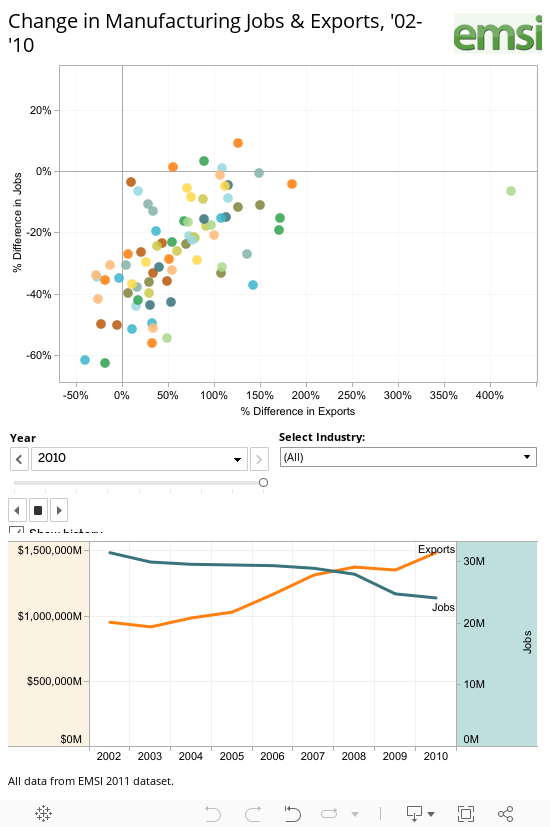
    We placed national export data on top of job totals for each of the 472 manufacturing sectors, and found that manufacturing exports (inflation-adjusted) actually grew by 56% from 02-10 while manufacturing jobs contracted by 23%. Growth in exports have clearly not resulted in more domestic jobs. See the interactive graphic at the bottom of this post for a visualization.

    Across the manufacturing sectors we are actually seeing a predominantly inverse relationship between jobs and exports. To explore this further, we placed each of the 472 industries into one of four categories (again see the graphic):
    1) Those that gained both exports and jobs,
    2) Those that gained exports but lost jobs,
    3) Those that lost exports but gained jobs, and
    4) Those that lost both exports and jobs.

    Some observations

    Those advocating for increased exports as a way of resuscitating jobs in manufacturing need to look at this data. Only 11% of all manufacturing sectors showed gains in jobs and exports, which is not a huge surprise given manufacturing decline. 19% lost jobs AND exports at the same time. Now here is the stat really worth noting — 71% of all manufacturing sectors increased their exports while decreasing their domestic workforce.

    There are some political ramifications here. The Obama Administration has proposed exports as a key to kick-starting the U.S. labor market (see this post from Brookings). Economists and policy experts as well as all of us here at EMSI are huge fans of improving exports. Exports are a principal source of foreign exchange and an important driver for U.S. goods. Export industries also tend to pay higher wages and connect with the rest of the economy through greater multiplier effects, which mean they are key for income and job formation.

    However, as the data suggests things are not that simple. Domestic manufacturers appear to be outsourcing large parts of their work to foreign suppliers. In the process, they employ fewer domestic workers but become more competitive in foreign markets. As a result, exports go up while employment goes down. This is something that policymakers need to consider before pinning too much hope on exports as a way of reviving manufacturing sector employment.

    Conclusion

    There may be a conflict of goals here. On one hand we want high-wage, high-benefit jobs; on the other, “full employment.” But in manufacturing can we have both? If wages, and benefits are pushing producers to outsource then either wages go down (an unattractive prospect), or we adopt policies that spawn productivity growth needed to support high-wages. Are there any other choices?

    Data Graphic

    In this interactive graphic, you can explore EMSI’s data on manufacturing jobs and exports. The data is based on 4-digit NAICS manufacturing sectors. NOTE: 6-digit data was used in the previous analyis.

    Click on the chart to highlight an industry or use the drop-down box. Data in the top half of the graphic shows percentage change in jobs (on the y-axis) and exports (on the x-axis). The bottom line graph simply compares manufacturing jobs and exports over time.

    As we highlighted above, 71% of all manufacturing sectors increased their exports while decreasing their domestic workforce from 2002 to 2010.

    For more information, email Rob Sentz.

  • Obama’s Off-target Class War

    For many conservatives, the notion of class warfare that President Barack Obama now evokes is both un-American and noxious — a crass attempt to cash in on envy among the masses. Yet the problem is not in class warfare itself — but in being clear what class you are targeting.

    In this sense, Obama’s populism is little more than a faux version. He is not really going after the privileges of the super-rich — that would involve actions like removing the advantages of capital gains over earned income or limiting dodges to nonprofit foundations or family trusts. Rather than a war against plutocrats, Obama’s thrust is against the upper end of the middle class, whose income is most vulnerable to higher taxes.

    The president is within his rights to use these class warfare tactics; it’s just too bad he is aiming at the wrong target. Exploiting class divisions, in fact, has long been a part of American politics — from the Jacksonian era through Abraham Lincoln, the New Deal and even Bill Clinton. Obama’s sudden tilt toward class warfare may thrill left-wing commentators such as The American Prospect’s Robert Kuttner. But it’s no real threat to the real ruling classes.

    Though the president’s rhetoric focuses on “millionaires and billionaires,” his proposals do less harm to the ultrarich and their trustifarian offspring than to the large professional and entrepreneurial classes, whose members are earning more than $200,000 a year. More affluent than most Americans, these members of the upper middle class hardly constitute oligarchs. Ninety percent of the targeted class earns less than $1 million annually. Only a tiny sliver, or .01 percent, are billionaires.

    Senate Majority Leader Harry Reid’s proposal to raise the target income level closer to $1 million is a concession to political common sense — but still avoids the big distinction between investor and income earner. Meanwhile, the administration’s rhetorical gambit of using Warren Buffett as the class warfare poster boy reveals its fundamental disingenuousness.

    Many rich do avoid high taxes through dynastic trusts concocted largely to avoid the Internal Revenue Service. Others, like Buffett, put vast amounts into foundations — in his case, the Bill and Melinda Gates Foundation, where it sits tax free. In addition, the patrician class, because its members tend to be more active investors, also pays less, largely because its capital gains earnings are taxed at a low 15 percent rate, less than half that paid by high-income professionals.

    Obama’s biggest problem with class is that his policies have made a bad situation worse. During both the Clinton administration and most of the George W. Bush years, the rich prospered. But so, too, did middle- and working-class homeowners, professionals and construction workers.

    Today, however, only the high-end housing market, roughly 1.5 percent of the market, is flourishing. The vast majority have seen their property values shrink — down 30 percent since 2006. Markets, like Manhattan , which is increasingly dominated by foreign investors, have surged — the average price of a New York condo or co-op has topped $1.4 million, a nifty 3 percent increase over last year.

    But to a large degree, this reflects those who are the biggest beneficiaries of the largesses of Treasury Secretary Timothy Geithner and Fed Chairman Ben Bernanke: hedge fund managers, investment bankers, the corporate aristocracy and officials of “too big to fail” banks. For these financiers, the time since the economic collapse has been very fat years — at least until the European debt crisis.

    The situation, however, has been far worse for small businesses — with serious consequences for job creation. The number of start-ups with employees — the traditional source of new jobs — has dropped 23 percent since 2008. Most entrepreneurs, according to the National Federation of Independent Business, expect the job market to weaken and unemployment to stay high for the foreseeable future.

    “Corporate profits may be at a record high,” said Bill Dunkelberg, chief economist of the National Federation of Independent Business, “but businesses on Main Street are still scraping by.”

    Obama’s phony class war also carries considerable political risk. As Mark Penn, the former Clinton adviser, and others have pointed out, the newest Obama tax strategy most penalizes the professionals who flocked to his cause in 2008 . These voters — concentrated largely in high-tax, high-cost blue states — are also particularly vulnerable to any reduction of write-offs for mortgage interest and state taxes.

    Obama’s left turn also fails to address the America’s biggest problem: how to ignite broad economic growth.

    It should now be clear to all but the most deluded that the administration’s bankrolling of massive solar projects and embrace of hopeless causes like high-speed rail have not reaped much of a bonanza. Indeed, in many places where the administration’s “green” agenda has been adopted most fervently, like California, unemployment rates now surpass even Michigan’s.

    Obama’s misguided economic notions can be seen even when he looks to solve our critical jobs shortage. In addition to the “green jobs” fiasco, the president is looking to Silicon Valley and the information economy — which have lost jobs since 2006. Facebook, Apple, Google and the rest may be swell representatives of American ingenuity — but employ relatively few people in America, and mostly the best educated and thus least vulnerable.

    In contrast, the administration displays relatively little support — and passion — for the many middle-income Americans who depend, directly or indirectly, on industries like oil and gas, warehousing, construction and, except for the bailed-out auto firms, manufacturing. In these sectors, only the fossil-fuel industry has done well — adding more than 500,000 generally well-paying jobs since 2006, despite the Environmental Protection Agency’s best efforts to slow its progress.

    Workers in the energy field – in which salaries average more than $100,000 annually — reasonably fear their jobs could be threatened if Obama is reelected. This could damage his appeal in states like Ohio and Pennsylvania, where many working-class voters are now counting on new oil and gas finds to spur the growth of high-wage employment.

    So how best to confront America’s growing class division? With serious economic growth beyond Wall Street. A flatter tax system with fewer exemptions, limiting trusts and foundations and ending the preference for capital gains would force the wealthy to re-engage the economy. They would have fewer ways to hide their money. Sweep aside both subsidies for oil and gas companies and the renewable industry, regulate sensibly and market forces can drive exploration and development.

    Will Republicans support this approach? Many seem almost incapable of acknowledging the threat to democracy and our social order now posed by the growing concentrations of wealth that eerily recall the 1920s. Others prostitute themselves to fossil-fuel industries — the way the Democrats kowtow to rent-seeking green capitalists. Meanwhile, with Obama’s once strong support on Wall Street weakening, they seem all too eager to dance to big money’s tune to fill their own coffers.

    It’s time to finally acknowledge that the whole “trickle down” from Wall Street approach has been discredited — and with it the current regime of class privilege. You don’t have to be a member of Occupy Wall Street to doubt that what’s good for the top investment bankers is necessarily good for the vast majority of the country.

    Neither mindless budget-cutting nor politically motivated redistribution can solve the growing economic divide or create new wealth. Instead, we need a tax and policy regime that stops favoring financial insiders and instead focuses incentives on the grass-roots hard work and ingenuity that have long been America’s greatest economic asset.

    This piece originally appeared at Politico.com.

    Joel Kotkin is executive editor of NewGeography.com and is a distinguished presidential fellow in urban futures at Chapman University, and an adjunct fellow of the Legatum Institute in London. He is author of The City: A Global History. His newest book is The Next Hundred Million: America in 2050, released in February, 2010.

    Photo of protected Wall Street bull by hunter.gatherer.

  • Silicon Valley Can No Longer Save California — Or The U.S.

    Even before Steve Jobs crashed the scene in late 1970s, California’s technology industry had already outpaced the entire world, creating the greatest collection of information companies anywhere. It was in this fertile suburban soil that Apple — and so many other innovative companies — took root.

    Now this soil is showing signs of exhaustion, with Jobs’ death symbolizing the end of the state’s high-tech heroic age.

    “Steve’s passing really makes you think how much the Valley has changed,” says Leslie Parks, former head of economic development for the city of San Jose, Silicon Valley’s largest city. “The Apple II was produced here and depended on what was unique here. In those days, we were the technology food chain from conception to product. Now we only dominate the top of the chain.”

    Silicon Valley’s job creation numbers are dismal. In 1999 the San Jose-Sunnyvale-Santa Clara area had over 1 million jobs; by 2010 that number shrank by nearly 150,000. Although since 2007 and early 2010 the number of information jobs has increased substantially — up roughly 5000 to a total of 46,000 — the industrial sector, which still employs almost four times as many people as IT, lost around 12,000. Overall the region’s unemployment stands at 10%, well above the national average of 9.1%.

    This is partly because Apple, Intel and Hewlett-Packard have shifted their production — which offered jobs to many lower- and medium-skilled Californians — to other states or overseas. With its focus just at the highest end, the Valley no longer represents the economically diverse region of the 1970s and 1980s. Indeed, it increasingly resembles Wall Street — with a few highly skilled employees and well-placed investors making out swimmingly.

    “Silicon Valley has become hyper-efficient; the region doesn’t create jobs anymore,” says Tamara Carleton, a locally based fellow at the Foundation for Enterprise Development. “In terms of revenue per employee, Facebook’s ratio is unprecedented. Even Apple hasn’t grown significantly this last decade, despite the successful launch of many products and services. While commendable, greater efficiency doesn’t put more jobs in the California economy.”

    This “hyper-efficiency” can be seen in the real state of the valley’s industrial/flex space market. The overall industrial vacancy rate remains 14%, two points higher than in 2009. Areas close to Stanford, such as Palo Alto and Mountain View, have done well, but others on the periphery, such as Gilroy, Milpitas and Fremont, and even parts of San Jose have vacancies reaching over 20%.

    California’s other high-tech centers, with the possible exception of San Diego, are doing worse. The state has been losing high-tech employment over the past decade, while such employment has surged not only in China and Korea, but also in competitor states such as Texas, Virginia, Washington and Utah. According to the annual Cyberstates study, California lost more high-tech jobs — about 18,000 — last year than any other state.

    California’s political leaders, particularly Democrats, still genuflect toward the Valley for economic salvation and job growth. But social media has not proved a jobs-creating dynamo, and it’s clear that the highly subsidized, venture backed “green economy” has floundered miserably and faces a less than rosy future.

    You can feel pride, as an American and Californian, in the legacy of the likes of Steve Jobs but also believe our future cannot be salvaged by high-tech alone. Many of the country’s greatest assets, for example, are physical; in California these include the best climate for any advanced region in the world, fertile soil, a prime location on the Pacific Rim and potentially huge fossil fuel energy reserves, which give it enormous competitive advantages.

    The green theocracy now in control of Sacramento, however, has little interest in these aspects of California. It may prove difficult, if not impossible, to modernize the ports of Los Angeles and Long Beach, prolific sources of good-paying white and blue collar jobs. These ports will soon face increased competition for Asian trade from Gulf and south Atlantic locales eagerly waiting for the 2014 widening of the Panama Canal.

    Administration officials such as Energy Secretary Steven Chu also slate the state’s agriculture for demise by climate change. But just in case he’s wrong, we should note that California’s agriculture — despite green attempts to cut off its water supply — accounts for 40% of state exports. It generates $12.7 billion annually in overseas sales and employs over 400,000 people directly and many thousands more in marketing, processing and warehousing.

    Similarly, California boasts some of the nation’s richest deposits of oil and gas, not only on its sensitive and politically nettlesome coast but along the coastal plains and in the Central Valley. The most recent estimates of the state’s reserves, according to the Energy Information Agency, include nearly 3 billion cubic feet of natural gas and more than three billion barrels of oil, roughly the same as Alaska and more than booming North Dakotas.

    Geologists and wildcatters, usually ahead of the game, believe we have touched only a small part of the state’s energy potential. Some discuss new oil shale discoveries, particularly in the Monterey region, that could dwarf even the massive Bakken find in North Dakota. “If you were in Texas,” quipped economist Bill Watkins to an audience in the hard-hit central California town of Santa Maria, a predominately Latino town north of Santa Barbara, “you’d be rich.”

    A judicious and carefully planned expansion of these resources, particularly in the less populated interior areas, could provide tens of thousands of high-paying jobs. It would also funnel desperately needed revenue to the state. At the same time, such development could forestall much higher energy costs, one of the things driving manufacturers in the state to move elsewhere.

    California is unlikely to take advantage of its physical bounty; its leadership seems to lack enthusiasm for any industrial expansion outside of the “green” economy. Industrial parks across the state are emptying, more houses go into foreclosure and local governments wither on the vine. Unless California begins to take its own economy seriously, it will continue to devolve from the aspirational place that produced not only Steve Jobs but scores of entrepreneurs in everything from movies and oil to agriculture and aerospace.

    The Valley itself will likely do fine. Steve Jobs helped cement the position of Santa Clara Valley as the epicenter of the high-tech world. But this accomplishment does relatively little for the rest of California. What we will miss will not only be Steve Jobs’ creative contributions, but how clearly his opportunistic, entrepreneurial spirit has ebbed away from the Golden State.

    This piece originally appeared at Forbes.com.

    Joel Kotkin is executive editor of NewGeography.com and is a distinguished presidential fellow in urban futures at Chapman University, and an adjunct fellow of the Legatum Institute in London. He is author of The City: A Global History. His newest book is The Next Hundred Million: America in 2050, released in February, 2010.

    Shanghai photo by flickr user acaben

  • Are We Headed For China’s Fat Years?

    Chan Koonchung’s chilling science fiction novel The Fat Years — already an underground sensation in China — will be published in the U.S. January 2012. The book, first published in Hong Kong in 2009, is partly so chilling because it reveals a scenario that is all too plausible. Set in 2013, it takes place after a second financial crisis  (euros, anyone?) that all but destroys the Anglo-American economies and ushers in “China’s golden age of ascendancy.”

    The nation that leads the world in The Fat Years is less bleakly dystopian than the Stalinist state portrayed in George Orwell’s 1984 or the biologically controlled society of Aldous Huxley’s Brave New World. Yet it is supremely authoritarian — harassing and even executing the rare dissident and putting drugs in the water supply to inflate a sense of well-being among the masses.

    This all-powerful Chinese state looks very familiar. It pursues a commercial strategy of plundering resource-rich regions around the world, often working with the most despicable of regimes such as Zimbabwe. And it harnesses and promotes information technology while maniacally censoring the Internet, rendering cyberspace just another outlet for propaganda.

    It is also increasingly self-confident. As one character — a highly placed party cadre in the story — suggests, this new Chinese model represents “the best option in the world as it really exists.”

    Many in the West already accept this notion. According to a recent Pew survey, nearly half of all Americans believe China will surpass America as the world’s leading power. The same poll found that roughly two-thirds of Britons — and many Europeans — believe similarly.

    The higher circles in Washington and New York generally view the Anglo-Saxon democracy as unable to compete with the more ordered, authoritarian Chinese model. Thrilled by what he sees as “China’s green leap forward,” New York Times columnist Thomas  Friedman proclaims the greater advantages of “one-party autocracy.” After all, Chinese autocrats can adopt “policies needed to move a society forward in the 21st century” without needing to check in with the voters. Even conservative pundit Francis Fukuyama, once a believer in the inevitable triumph of market liberalism, feels that “Anglo Saxon capitalism” has squandered its historic moment. “Democracy in America,” he notes, “has less than ever to teach China.”

    Former Obama Management and Budget chief Peter Orszag is the latest to endorse the down-with-democracy movement. Concerned with our inability to deal with our fiscal problems, climate change and rebuilding the economy, Orszag proposes shifting power from Congress to more “independent institutions” made up of unelected policymakers.  He argues that democracy can be “too much of a good thing.”  Comfortably ensconced at bailed-out Citigroup, Orszag has benefited from a financial system that increasingly resembles China’s, with its intimate ties between the state and banks. Crony capitalism, on both sides of the Pacific, it appears, has its rewards.

    Yet perhaps it is too early for the English-speaking democracies to throw in the towel.  Many who now espouse Chinese supremacy previously argued that Japan, and even Europe, was destined to dominate the world.  Yet Pax Niponica never got past the early 1990s; one former inevitable global hegemon has been downgraded to the sick man of Asia.

    Like Japan, China faces many great, if often overlooked, challenges. There’s a devastated environment, growing social unrest and rising competition from other countries, notably the Indian subcontinent. Labor force growth is slowing rapidly, and the country now has up to 30 million more marriage-age boys than girls, an all but certain spur to political unrest. Misallocation of resources by both central and local authorities threatens to create a major property bubble.

    Throughout modern history authoritarian and more centrally controlled countries have proved very good at playing “catch up” and impressing journalists. China’s Communist regime can order investment into everything from high-speed trains to green technology and massive dam construction. The results — like those previously seen in Nazi Germany and Soviet Russia — are often as physically and technologically impressive, although often cruel to both the environment and people stuck in the way.

    But once a country reaches a certain plateau of development, as Japan did in the 1990s, the nature of the competition changes; it becomes harder to target industries that are themselves in constant flux. Workers who have already achieved considerable affluence tend to be harder to bully or motivate.

    Take the battle for cyberspace. Japan’s ballyhooed bureaucracy sought to conquer this frontier through traditional channels. This allowed the internet to become a competition largely among relative young U.S. companies such as Apple, Amazon, Google and Facebook. The much-feared Japanese takeover of the computer and cultural industries back in the 1980s now has petered out into a historical footnote.

    And despite the recent, often spectacular gains of China , the primary English-speaking countries — the  U.S., U.K., Canada, Australia and New Zealand — still control a quarter of the world’s GDP, compared with 15% for the Sinosophere. Their combined per capita income is six times higher.

    Critically the U.S. and its closest cultural allies — New  Zealand, Australia and Canada —  also have enormous physical advantages. These four countries all stand among the eight largest food exporters in the world.  Recent discoveries on the energy front have made North America, particularly the Great Plains, a potentially dominant force in the global oil and gas industries. China lacks the water, and likely to resources, to match up.

    But the real edge lies with culture, particularly the English language, which has decimated all its traditional competitors — French, German and Russian — over the past two decades.  Difficult to learn, Chinese is not likely to replace English any time soon as the dominant language of culture, air travel, science and technology.

    This cultural dominion can be seen in the media as well. The U.S. and its English-speaking allies account for roughly half of all the world’s audio-visual exports. To an extent never seen before, Anglophones dominated how people think, dress and recreate.

    Arguably our biggest advantage lies in the very thing our upper echelons increasingly disdain — our messy multicultural democracy and our addiction to the rule of law. “The secret of U.S. success is neither Wall Street or Silicon Valley but its long-surviving rule of law and the system behind it,” Liu Yazhou, a Chinese two-star general, recently said. “The American system…is designed by genius and for the operation of the stupid.”

    The stunning lack of such constitutional guarantees is just one reason why many of China’s entrepreneurial elite seek to immigrate to the U.S., Canada or Australia.   Indeed, among the 20,000 Chinese with incomes over 100 million Yuan ($15 million), 27% have already emigrated and another 47% have said they were considering it, according to an April report by China Merchants Bank and U.S. consultants Bain & Co.

    To be sure, the U.S. and its allies need to change in order to compete.  Greater incentives for savings, investments and productive industries must supplant those that promote asset speculation and financial manipulation. But we can do this without importing Asia’s   hierarchical structures. Rather than trying to outdo the Politburo in developing crony capitalism we should seek to reinvigorate our diverse, grassroots economy.

    In any competitive race you do not win by emulating your rivals but by building on your intrinsic strengths.  The best way to avoid the scenario laid out in The Fat Years lies not in abandoning the very strengths that drove our historic ascendancy, but by tweaking and enhancing them so that they propel us in the coming decades.

    This piece originally appeared at Forbes.com.

    Joel Kotkin is executive editor of NewGeography.com and is a distinguished presidential fellow in urban futures at Chapman University, and an adjunct fellow of the Legatum Institute in London. He is author of The City: A Global History. His newest book is The Next Hundred Million: America in 2050, released in February, 2010.

    Shanghai photo by flickr user Sprengben

    .

  • States with Largest Presence of STEM-Related Jobs

    Few would argue that STEM-educated workers are vital to advancing innovative ideas and new products. But here’s another fact borne out by labor market data: The regions with the strongest presence of STEM-related employment are heavily dependent on government funding.

    Washington, D.C. has more than two times the concentration of STEM (science, technology, engineering, and math) jobs than the national average, according to EMSI’s latest employment estimates. Fairfax and Arlington counties — whose economies are interconnected to D.C.’s — have helped Virginia expand its presence of STEM-related workers, on a per-capita basis, more than any other state in the last decade.

    Meanwhile, the two counties in the U.S. with the most STEM workers per capita — Los Alamos, N.M., and Butte, Idaho — are home to major Department of Energy national laboratories.

    Defining STEM Employment

    Before we go further, though, we should discuss how we define STEM-related jobs. Just like green jobs or creative workers, there are many definitions of STEM occupations — often different from state to state. Here we used the definition developed by Praxis Strategy Group, an EMSI client and North Dakota growth strategy firm that has co-written the U.S. Chamber of Commerce’s “Enterprising States” report the last two years.

    The definition consists of eight high-level categories (see here for all 93 five-digit occupations):

    • Computer specialists (SOC 15-1)
    • Mathematical science occupations (15-2);
    • Engineers (17-2);
    • Drafters, engineering, and mapping technicians (17-3);
    • Life scientists (19-1);
    • Physical scientists (19-2);
    • Social scientists and related occupations (19-3);
    • Life, physical, and social science technicians (19-4).

    Given this  definition, here are some key facts about STEM-related employment in the US:

    • There are just over eight million estimated jobs in these fields as of 2011. Keep in mind that at this point all 2011 EMSI job figures are estimates.
    • Overall this group has grown by 3.7% since 2001; there were significant dips in the early 2000s and at the onset of the recession. 
    • Men hold nearly three of every four STEM-related jobs (73%). 
    • Nearly 20% of the STEM workforce is 55 years old and above (and 26.6% are between 45-54). This  points a fairly substantial number of potential retirements hitting these fields in the next five to 10 years.

    Praxis includes technicians jobs that typically require two-year degrees because they are often overlooked in the STEM conversation.

    States Gaining/Losing STEM Concentration

    Generally, states that have had the biggest percentage increases in employment in the last decade have also seen modest to healthy gains in their STEM workforces. North Dakota’s STEM employment has soared 31% (compared to 15% across all occupations). Alaska and Utah’s STEM jobs have each grown 18%, while both states have seen double-digit percentage increases in all jobs.

    Results for every state are detailed in the table below. We also included  the change in concentration (measured by location quotient, or LQ) for STEM-related workers from ’01 to ’11 across every state. Using our GIS tool, we were able to compare all 50 states (plus D.C.) by their LQ to see which have gained a comparative advantage.

    Outside D.C., Virginia, Washington State — where more than 70% of STEM workers are located in the Seattle area — Maryland, and North Dakota have seen the biggest increases in STEM concentration in the last decade. Other states who have performed well: Alaska, Rhode Island, Arkansas, and West Virginia.

    California, on the other hand, still has more than 13% of the nation’s overall STEM-related workforce (just over 1 million estimated jobs). But it shed 19,000 STEM jobs in the last decade (a 1.75% decline) and saw its above-average concentration slightly decline.

    Note: A location quotient of 1.00, like Arizona has in 2011, means that state has the same relative concentration of STEM workers as the national average.

    State 2001-2011 STEM Job Change % Change (STEM) 2001-2011 Overall Change % Change (Overall) 2001 STEM LQ 2011 STEM LQ
    District of Columbia (DC) 13,758 20% 78,562 11% 2.00 2.20
    Washington (WA) 36,362 16% 314,900 9% 1.42 1.53
    Virginia (VA) 47,728 17% 348,387 8% 1.35 1.49
    Maryland (MD) 27,826 14% 241,837 8% 1.38 1.48
    Massachusetts (MA) -9,569 -3% 71,653 2% 1.53 1.48
    Colorado (CO) -2,654 -1% 181,752 6% 1.45 1.36
    New Jersey (NJ) -8,979 -3% 174,439 4% 1.23 1.16
    California (CA) -18,996 -2% 471,154 2% 1.18 1.15
    Delaware (DE) -4,459 -14% 25,280 5% 1.38 1.14
    Minnesota (MN) 1,730 1% 84,854 3% 1.12 1.12
    New Hampshire (NH) -955 -2% 41,818 5% 1.18 1.11
    Michigan (MI) -52,084 -17% -369,217 -7% 1.22 1.10
    New Mexico (NM) 6,423 14% 90,068 9% 1.05 1.10
    Alaska (AK) 3,539 18% 51,864 13% 1.02 1.09
    Connecticut (CT) -2,849 -3% 71,855 3% 1.13 1.07
    Texas (TX) 86,347 14% 2,179,616 18% 1.06 1.04
    Utah (UT) 11,969 18% 248,910 18% 1.03 1.04
    Oregon (OR) 4,456 4% 125,822 6% 1.03 1.03
    Idaho (ID) -697 -2% 93,579 12% 1.14 1.02
    Arizona (AZ) 8,975 7% 350,216 13% 1.04 1.00
    Vermont (VT) 623 3% 21,017 5% 0.99 0.99
    Pennsylvania (PA) 11,961 4% 212,861 3% 0.94 0.96
    New York (NY) 974 0% 524,666 5% 0.97 0.94
    Ohio (OH) 515 0% -226,628 -3% 0.88 0.93
    Rhode Island (RI) 1,760 7% 7,036 1% 0.87 0.93
    Illinois (IL) -17,404 -5% -45,841 -1% 0.94 0.91
    Kansas (KS) -2,818 -4% 19,642 1% 0.93 0.90
    North Carolina (NC) 18,377 9% 319,803 7% 0.87 0.90
    Wisconsin (WI) 8,050 6% 65,922 2% 0.82 0.87
    Georgia (GA) 6,447 3% 332,612 7% 0.87 0.85
    Missouri (MO) 1,385 1% 19,824 1% 0.83 0.85
    Florida (FL) 26,341 8% 760,396 9% 0.80 0.81
    Montana (MT) 2,834 14% 62,699 11% 0.78 0.81
    Alabama (AL) 8,153 10% 117,917 5% 0.75 0.80
    Nebraska (NE) 3,326 8% 49,749 4% 0.74 0.78
    Indiana (IN) 1,880 2% -68,167 -2% 0.74 0.77
    Maine (ME) 178 1% 13,400 2% 0.76 0.77
    Wyoming (WY) 2,839 26% 60,177 18% 0.72 0.77
    Iowa (IA) 4,852 8% 46,353 2% 0.69 0.74
    Oklahoma (OK) 6,730 10% 138,146 7% 0.69 0.72
    South Carolina (SC) 8,944 12% 214,997 10% 0.69 0.72
    Hawaii (HI) 4,022 17% 73,132 10% 0.66 0.71
    Kentucky (KY) 6,252 9% 58,998 3% 0.63 0.68
    Arkansas (AR) 5,901 14% 65,655 4% 0.61 0.67
    North Dakota (ND) 3,683 31% 67,224 15% 0.58 0.66
    West Virginia (WV) 3,215 13% 35,869 4% 0.60 0.66
    Louisiana (LA) 5,642 8% 148,018 6% 0.63 0.65
    South Dakota (SD) 1,737 12% 38,620 8% 0.62 0.65
    Tennessee (TN) 5,888 6% 119,340 4% 0.60 0.63
    Nevada (NV) 6,580 19% 214,697 17% 0.59 0.61
    Mississippi (MS) 2,957 8% 41,833 3% 0.52 0.55
    Source: EMSI Complete Employment 2011.3

    STEM-Related Earnings Much Higher In Most States

    STEM-related occupations pay on average between $8 to $18 per hour more than all other jobs looking the nation. This isn’t a surprise, but the disparity in wages is startling in some cases. Consider Virginia, where average hourly earnings in STEM-related employment are almost twice that of all other occupations, according to EMSI’s latest  employment data. The difference is almost as large in California, Colorado, and Maryland. (These are disturbing numbers for California, considering the drop-off of STEM jobs we highlighted earlier. Simply, these high-wage jobs have declined while lower-paying jobs have grown).


    It’s also interesting that most states at the other end of spectrum — those where the difference in STEM-related earnings and all others isn’t as severe –  are sparsely populated. This includes Wyoming, Montana, the Dakotas, and Idaho.

    State 2011 Hourly Earnings (STEM Jobs) 2011 Hourly Earnings (Non-STEM Jobs) Difference
    Wyoming (WY) $26.32 $18.37 $7.95
    Montana (MT) $23.71 $15.74 $7.97
    South Dakota (SD) $23.70 $15.27 $8.43
    North Dakota (ND) $25.25 $16.54 $8.71
    Idaho (ID) $27.07 $16.77 $10.30
    West Virginia (WV) $25.83 $15.44 $10.39
    Mississippi (MS) $25.80 $15.35 $10.45
    Kentucky (KY) $27.39 $16.93 $10.46
    Maine (ME) $28.30 $17.47 $10.83
    Arkansas (AR) $26.46 $15.57 $10.89
    Wisconsin (WI) $29.26 $18.14 $11.12
    Indiana (IN) $28.43 $17.25 $11.18
    Vermont (VT) $29.69 $18.27 $11.42
    New York (NY) $34.02 $22.52 $11.50
    Hawaii (HI) $31.13 $19.60 $11.53

    County-Level Look At Stem Jobs

    Los Angeles County has the largest number of STEM jobs in the U.S. (more than 235,000). But when it comes to job concentration, Santa Clara County overwhelms LA County, largely because of the influence of Silicon Valley. Beyond pockets in California and Washington, however, most of the top counties have some kind of heavy government influence.

    As we mentioned earlier, Los Alamos County, N.M. (with an LQ of 7.10) and Butte County, Idaho (with an LQ of 6.83) have huge STEM presences given their overall workforces. The Idaho National Laboratory is located partially in Butte County — in windswept southeastern Idaho — and employs approximately 4,000 people. The Los Alamos National Lab is the largest employer in northern New Mexico, with an estimated budget of $2.2 billion.

    Virginia has three of the top 10 most concentrated counties in the US (King George, Arlington, and Fairfax). King George County, home to the the U.S. Naval Surface Warfare Center Dahlgren Division, has the fourth-highest earnings for STEM workers of any U.S. county and is five times more concentrated than the national average.

    Martin County, Indiana (pop. 10,334), the fourth-most concentrated county in the nation, is also the site of another Naval Surface Center. And it’s not a surprise that Durham County, N.C., is is also in the top 10 given the Research Triangle.


    Joshua Wright is an editor at EMSI, an Idaho-based economics firm that provides data and analysis to workforce boards, economic development agencies, higher education institutions, and the private sector. He manages the EMSI blog and is a freelance journalist. Contact him here.

    Lead illustration by Mark Beauchamp

  • Gassing Up: Why America’s Future Job Growth Lies In Traditional Energy Industries

    In his new book, The Coming Jobs War, Gallup CEO James Clifton defines what he calls an “all-out global war for good jobs.” Clifton envisions a world-wide struggle for new, steady employment, with the looming threat of “suffering, instability, chaos and eventually revolution” for those who fail to secure new economic opportunities.

    In the U.S., this conflict can be seen as a kind of new war battle the states, each fighting not only for employment but for jobs that pay enough to support a middle-class lifestyle.

    My colleagues at Praxis Strategy Group and I have looked over data for the period after the economy started to weaken in 2006. Using stats from EMSI, based on data from the Bureau of Labor Statistics, we compared sectors by growth, and then by average salary.

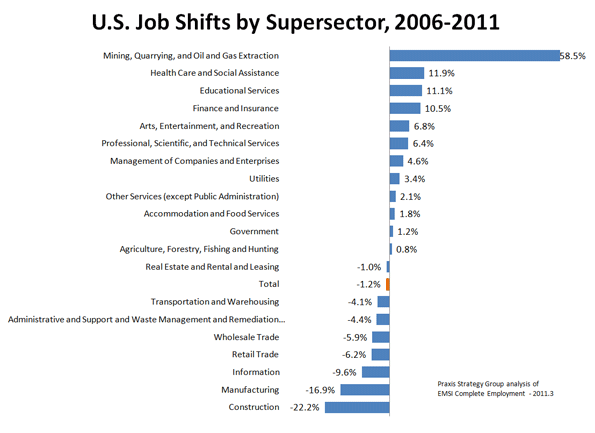
    Not surprisingly “recession-proof” fields such as health care and education expanded some 11% over the past five years. More inexplicably, given its role in detonating the Great Recession, the financial sector expanded some 10%.

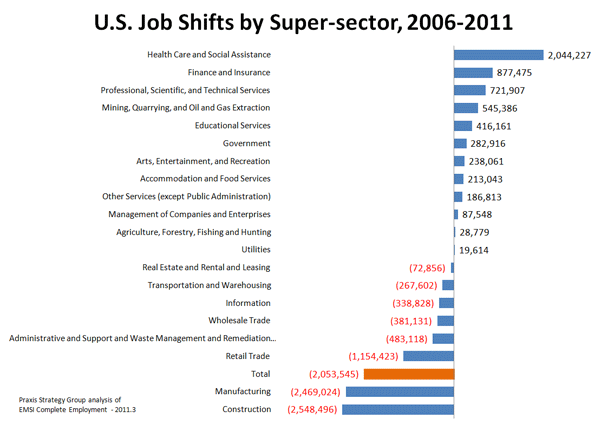
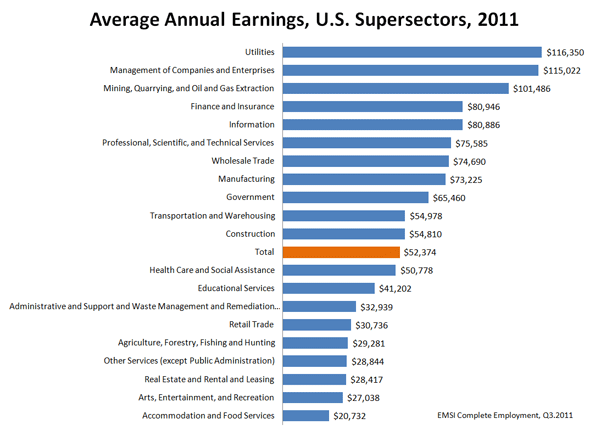
    But the biggest growth by far has taken place in the mining, oil and natural gas industries, where jobs expanded by 60%, creating a total of 500,000 new jobs. While that number is not as large as those generated by health care or education, the quality of these jobs are far higher. The average job in conventional energy pays about $100,000 annually — about $20,000 more than finance or professional services pay. The wages are more than twice as high as those in either health or education.

    Nor is this expansion showing signs of slowing down. Contrary to expectations pushed by “peak oil” enthusiasts, overall U.S. oil production has grown by 10% since 2008; the import share of U.S. oil consumption has dropped to 47% from 60% in 2005.  Over the next year, according to one recent industry-funded study, oil and gas could create an additional 1.5 million new jobs.

    This, of course, violates the widespread notion that the future lies exclusively in the information and technology industries. While technology may well be ubiquitous, as a sector it is far from a reliable creator of high-wage jobs. Since 2006 the information sector has hemorrhaged over 330,000 jobs. And those who do have jobs make on average about $20,000 less than their oil-stained counterparts per year.

    How about those “green jobs” so widely touted as the way to recover the lost blue-collar positions from the recession? Since 2006, the critical waste management and remediation sector — a critical portion of the “green” economy — actually lost over 480,000 jobs, 4% of its total employment. Pay here is lower still, averaging something like $32,000 annually, about one-third that of the conventional energy sector.

    The future of the rest of the “green” sector seems dimmer than widely anticipated. One big problem lies in cost per kilowatt, where wind is roughly twice as expensive and solar at least three times as expensive as electricity produced with natural gas. Given the Solydra   bankruptcy  and their inevitable impact on the renewables industry, it’s also pretty certain that the U.S., at least in the near term, will not be powered by windmills and solar panels.

    So instead of tilting windmills or taking out the trash, what about joining the much ballyhooed “creative class”?  Not so great a bet for those limited in talent or nepotism. The arts, entertainment and recreation sector gained about half as many total jobs as energy, and the pay is nothing to write home about. The average salary for these creative souls is about $27,000, slightly higher than for food service workers, but barely a quarter of the average salary for the oil and gas-dominated sector.

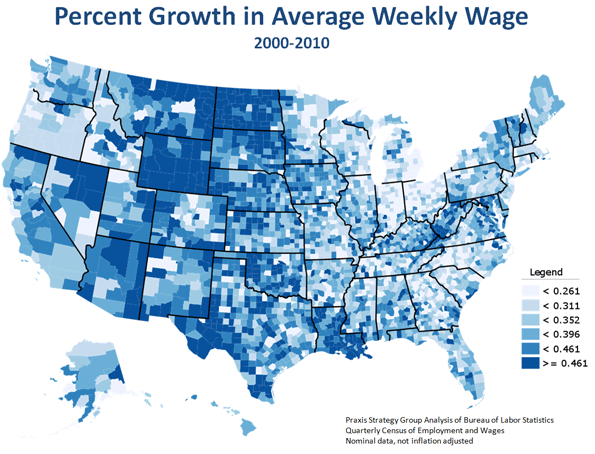
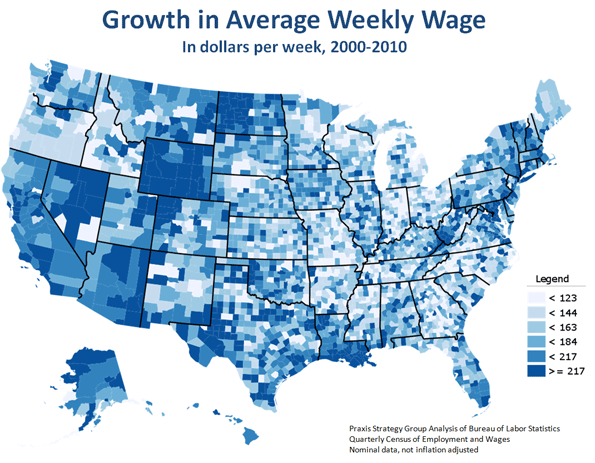
    The relative strength of the energy sector can be seen in changes in income by region over the past decade. For the most part, the largest gains have been heavily concentrated in the energy belt between the Dakotas and the Gulf of Mexico. Energy-oriented metropolitan economies such as Houston, Dallas, Bismarck and Oklahoma City have also fared relatively well. In energy-rich North Dakota there’s actually a huge labor shortage, reaching over 17,000 — one likely to get worse if production expands, as now proposed, from 6000 to over 30,000 wells over the next decade.

    What message does this send to politicians seeking to turn around our moribund economy? Perhaps   they should target oil and gas development as a spur not only to new employment, but to the kind of “good jobs” that Gallup’s Clifton speaks about. With the proper environmental controls, these industries could provide a major jolt to the economy while cutting down on energy imports, reducing debts and bringing jobs back home. As long as Americans consume oil and gas, why not produce close to the market and with reasonable environmental controls?

    The monthly proliferation of new energy finds can provide a much brighter future than many have anticipated. Industry experts say that the shift in energy exploration is moving from the Middle East to the Americas, with rich deposits of oil and gas uncovered from Brazil to the Canadian oil sands.

    Much of the new action is on the U.S. mainland, including the Dakotas, Montana and Wyoming. Increasingly, there’s excitement about finds in long-challenged sections of the Midwest such as Ohio. The Utica shale formation, according to an estimate by Chesapeake Energy, could be worth roughly a half trillion dollars and be, in the words of CEO Aubrey McClendon, “the biggest to hit Ohio, since maybe the plow.”

    Ohio now has over 64,000 wells, with five hundred drilled just year. Recent and potential finds, particularly in the Appalachian basin, could transform the Buckeye State into something of a Midwest Abu Dhabi, creating more than 200,000 jobs over the next decade. The new finds could also help Ohio fund its depleted state coffers without imposing either debilitating budget cuts or economically self defeating new taxes.

    The energy boom also has sparked a spate of new factory expansions, including a $650 million new steel mill to make pipes for gas pipelines. Other local firms are gearing up to make up specialized equipment like compressors.

    Michigan, another perennially hard hit state, is also looking at new energy finds to turbocharge its gradually recovering industrial sector.  While risible former Gov. Jennifer Granholm pushed the notion that Michigan’s recovery lay in “cool cities” and green jobs, the state’s current leaders are focusing on more down-to-earth — and under-the-earth — solutions as part of a strategy to revive industrial production.

    Such growth anywhere is good news, particularly in Midwestern blue-collar towns that have borne the brunt of the recession. Since 2006 manufacturing and construction have shed some 5 million jobs combined — jobs that pay above-average wages, far better than those earned in growing fields such as health care, education or the lower-end service sector.

    The surest road to recovery does not lie in the chimera of “green jobs” or by magically harvesting riches from social networks. It’s in making America a more self-reliant and productive power. The new spate of energy in the Midwest and elsewhere in the country may be one way to do this, if we have the will to take full advantage.

    This piece originally appeared at Forbes.com.

    Joel Kotkin is executive editor of NewGeography.com and is a distinguished presidential fellow in urban futures at Chapman University, and an adjunct fellow of the Legatum Institute in London. He is author of The City: A Global History. His newest book is The Next Hundred Million: America in 2050, released in February, 2010.

    Analysis and charts by Mark Schill, Praxis Strategy Group.

    Photo by flickr user thorinside