Category: Economics

  • What Does Rick Perry Have To Do With Texas’ Success?

    You don’t have to like Rick Perry or his sometimes scary neo-confederate politics to admire what has been happening in Texas over the past decade. Rather than trashing the state in order to demean its governor, perhaps the mainstream media should be thinking about what the Lone Star’s success story means for the rest of the country.

    Texas has done what most of other states — notably the blue coastal ones — have failed to do: create jobs. Over the past decade Texas has created 2.1 million jobs — while New York, California, Massachusetts and Illinois have all lost jobs.

    Its relative performance since 2009 has been even more stellar, producing nearly 40% of all new jobs in the U.S. Its unemployment rate stands at 8.2, well below the national average of 9.1 — an outstanding feat given the fact that the state grew 20%, twice the national average, over the decade. Texas is creating jobs for a growing workforce, while other states like New York or Massachusetts struggle to keep up with stagnant or even declining ones.

    Some self-proclaimed progressives like Paul Krugman attribute Texas’ success to population growth and the attraction of low-wage jobs for rapacious employers.

    “It is interesting how, suddenly, not having a job is better than working at a low-paying one,” notes architect and developer Tim Cisneros. True, many of the new jobs in Texas, as elsewhere, pay low wages and do not offer health benefits. But, says Cisneros, insisting that all the new jobs in Texas are low-paying is just not credible. “When you see the new hospitals and the new headquarters being built by Exxon here in Houston you can see there are lots of different opportunities,” Cisneros says.

    As Cisneros points out, people are not flocking to Texas for the privilege of being exploited any more than they come for the 100 degree summer heat. Many — and not only low-skilled campesinos — come for opportunities, including well-paying ones, that are not as readily available elsewhere.

    According to research conducted by the Praxis Strategy group, Texas has boosted mid-skill jobs — those that require two years or more of post-secondary education — by 16% in the past decade, That’s the third-highest rate in the nation (after much smaller Wyoming and Utah) and three times the national average. In contrast, New York has grown such positions by less than 5%, while California and Massachusetts have expanded them by less than 2%. Illinois, President Barack Obama’s home turf, was among the few states to actually lose mid-skill jobs.

    This pattern also applies to the high-tech and science-based industries. Over the past decade Texas’ number of STEM (science, technology, engineering and math-related) jobs has surged by 11%, one of the fastest rates among the states and four times the national average. California, Massachusetts and Illinois all lost positions in these fields.

    Another reason people go to Texas is their wages get them more there than in the big blue metros. For example, houses in Dallas, Austin or Houston cost three times the median income in these areas — or less. That ratio is twice as high, or higher, in places like New York, San Francisco or Los Angeles.

    These factors — job growth and lower costs — may not matter much to “trustifarians” or tenured professors who increasingly dominate the politics of the American left. But they have made Texas cities irresistible for almost every demographic in America, from boomers to the “young and restless” to families. For good measure, the state’s high-tech mecca, Austin, ranked third in attracting college-educated residents — well ahead hip centers like San Francisco, Boston, New York or Los Angeles.

    To be sure, Texas has benefited from higher energy prices, as Perry’s detractors point out.  According to an analysis by the EMSI economic forecasting group, the energy sector jumped from over 230,000 jobs in 2001 to just under 490,000 in 2011. That’s roughly 10% of all the state’s overall job gains. This parallels job growth in other states that have experienced surges in energy-related employment — such as North Dakota and Wyoming.

    But some of this has to do with making your own “luck.” Energy-rich California has all but declared war on its fossil fuel industry, once one of the nation’s most important. Instead, the state has placed lavish bets on renewable fuel and the much ballyhooed notion that “green jobs” could provide a massive base for new employment — something even the green-friendly New York Times has called “a pipe dream.”  In fact, employment in this field has actually started to tick down, and the prospect of ever higher energy prices associated with “clean” fuels could prove another nail in California’s economic coffin.

    So how much of Texas’ relative success is due to Perry and his fiscal policies? Some — but not too much. Perry has faced budget shortfalls based in part on an expanding state government that has grown through the recession: Texas, notes EMSI’s Joshua Wright, is one of only 10 states where state and local government jobs have grown since 2009, rising by almost 30,000 positions. “These numbers don’t exactly bolster Perry’s small-government agenda claims,”says Wright. Free-marketers also point out that Perry clearly favored, sometimes with state funds, people who had the foresight to back his political career.

    But Perry has won business support for things other than naked cronyism. Jim DeCosmo, CEO of the Austin-based Forestar Group, credits Perry with maintaining a business-friendly regulatory regime and with important steps for tort reform. These, he feels, both encourage Texas businesses to expand in the state and for out-of-state companies to move in.

    Most of the credit for Texas’ success lies primarily in the state’s economic culture. Rice University urban scholar Michael Emerson notes that Texas’ pro-business tilt started well before Perry, and is not restricted to the GOP. Many of the state’s most prominent Democrats — including the man Perry beat for governor last year, former Houston Mayor  Bill White — have been strong advocates of economic growth and across-the-board energy development.

    “I do not feel Perry has   much to do with Texas’ success,” says Houston real estate mogul David Wolff , who last year backed both a GOP challenger to Perry and, later, White. “But at least you can say that he has not appeared to hinder it.”

    In fact, Texas’ current and, more so, future prosperity might be better served  if a pragmatist like White ruled the Lone Star State. Perry’s ideological rigidity on spending and social issues may not be the best fit for a state facing massive ethnic change, including a future Latino majority. And as the state becomes more high-tech oriented, education of its surging workforce will grow as a concern, something that Perry does not seem to see as a priority.

    Yet despite the state’s shortcomings — and those of its current governor –  Texas’ success remains remarkable, particularly in comparison with that of the other major states. Rigid adherence to low taxes and light regulation may  not be the panacea for all economic problems but the opposite approach of ever higher taxes and debilitating regulation clearly has failed in terms of creating jobs and opportunities.

    Rather than demean the Lone Star state, perhaps progressives should begin demonstrating an alternative approach for American prosperity that might actually work someplace other than in the fevered imaginations of academics and pundits.

    This piece originally appeared at Forbes.com.

    Joel Kotkin is executive editor of NewGeography.com and is a distinguished presidential fellow in urban futures at Chapman University, and an adjunct fellow of the Legatum Institute in London. He is author of The City: A Global History. His newest book is The Next Hundred Million: America in 2050, released in February, 2010.

    Photo by Gage Skidmore.

  • Who Lost the Middle Class?

    Forty years from now, politicians, writers, and historians may struggle to understand how America, once the quintessential middle-class society, became as socially stratified as Europe or even Brazil. Should that dark scenario come to pass, they would do well to turn their attention first to New York City and New York State, which have been in the vanguard of middle-class decline.

    It was in mid-1960s New York—under the leadership of a Barack Obama precursor, Hollywood-handsome John Lindsay—that the country’s first top-bottom political coalition emerged. In 1965, Gotham had more manufacturing jobs than any other city in the country.programs failed. New York City responded by inflating its unionized public-sector workforce to incorporate minority workers.

    Higher taxes to pay for bigger government joined higher crime to produce a massive exodus of manufacturing and middle-class jobs. Over the last 45 years, New York has led the country in outmigration. A recent study by E. J. McMahon and Robert Scardamalia of the Empire Center for New York State Policy notes that since 1960, New York has lost 7.3 million residents to the rest of the country. For the last 20 years, “New York’s net population loss due to domestic migration has been the highest of any state as a percentage of population.”

    New York City, meanwhile, solidified its standing as the most unequal city in America. Twenty-five percent of New York was middle-class in 1970, according to a Brookings Institution study. By 2008, that figure had dropped to 16 percent, and the numbers have only plunged further since the financial crisis, with virtually all the new jobs in the city’s hourglass economy coming at either the high end or the low. Only high-end businesses can succeed in a local economy that has the nation’s highest taxes and highest cost of living—and even those businesses, in many cases, weathered the downturn only by living off the Fed’s policy of subsidizing banks. Despite the federal largesse, more of the city’s new jobs are in the low-wage hospitality and food-services industries than in the financial sector. The middle has lost its political voice in a city dominated by the politically wired wealthy and the public-sector unions that service the poor.

    New York is the picture of what the Tea Party fears for the country at large. In the 1970s, liberal mandarins seized the high ground of American institutions in the name of managing social, racial, gender, and environmental justice on behalf of the disadvantaged. Their job, as they saw it, was to protect minorities from the depredations of middle-class mores. In the wake of the Aquarian age, the U.S. developed the first mass upper-middle class in the history of the world. These well-to-do, often politically connected professionals—including the increasingly intertwined wealthy of Wall Street, Hollywood, and Silicon Valley—espoused what might be called gentry liberalism, a creed according to which the middle classes had to be punished for their racism, sexism, and excess consumption.

    And they have been punished—with job losses. These losses are the inevitable result of the costs of an ever-expanding, European-style public sector; environmental restrictions on manufacturing, mining, and forestry, which push high-paying jobs offshore; and illegal immigration, which reduces overall wage levels. At the same time, the decline in the quality of K–12 schools has undermined what was once a ladder of economic ascent. After completing high school today, students are likely to require a raft of remedial courses in college. Then, after college, many middle-class students graduate not with an education but with a credential—and a bag of enormous college loans that paid for the intermittent attention of a highly paid, tenured faculty.

    The private-sector middle class’s plight has been exacerbated by international competition and technological innovation, which have undermined job security, including for unionized manufacturing workers, who had enjoyed an unprecedented prosperity for about a quarter-century. Median household incomes have grown only marginally since the early 1970s, despite the mass movement of women into the workplace. Many dual-earner families have been caught in the two-income tax trap: on the one hand, they pay for services once performed by the homemaker; on the other, notes economist Todd Zywicki, they’re pushed into a higher tax bracket when the wife’s salary is added to the husband’s.

    Adding to the woes of the middle and lower classes is that their families are far less stable than they were a generation ago. The decline of marriage has been driven not only by changing mores but also by a decline in male employment. In 1970, only one of 14 working-age men was out of the workforce. Today, notes Nina Easton, one in five is either “collecting unemployment, in prison, on disability, operating in the underground economy, or getting by on the paychecks of wives or girlfriends or parents.” Whites who don’t attend college have out-of-wedlock birthrates approaching those that triggered Daniel Patrick Moynihan’s concerns about the black family in 1965. Today, four in ten American babies are born out of wedlock.

    During the current downturn, the black and Hispanic middle class has been particularly hard hit. From 2005 to 2009, according to a recent Pew survey, inflation-adjusted wealth fell by 66 percent among Hispanic households and by 53 percent among black households, compared with 16 percent among white households. These families worry with good reason that in the face of continuing high unemployment, they may fall out of the middle class. For the Obama administration and the public-sector unions, the solution to this slide is to force the nearly one in four employers that have contracts with the federal government to pay above-market wages. Here again, New York has been a pacesetter. Recently, public-sector unions and their allies tried to force a developer rebuilding a decayed Bronx armory to follow their wage and hiring guidelines; the deal collapsed, leaving one of the poorest sections of Gotham in the lurch.

    There’s a major difference, though, between New York and the country as a whole. The New York option—move somewhere else—doesn’t apply to private-sector middle-class workers fighting adverse conditions that exist throughout America. So they’ve exercised the classic democratic right of political action, organizing themselves to compete in elections. The Tea Party is the national voice of the private-sector middle class—despite the demonizations heaped upon it by public-policy elites whose own judgment and competence leave much to be desired.

    Middle-class decline should be front and center in 2012, which is shaping up as a firestorm of an election. It’s likely to be a bitter contest, in which the polarized class interests of those who identify with the growth of government and those who are being undermined by its expansion face off without the buffer of mutual goodwill. Liberals, unless they change their tune, will blame Tea Party “terrorists” for the tragedy of a fading middle class. They will continue to delude themselves into thinking, as Al Gore said in 2000, that their rivals represent “the powerful” and that they themselves act on behalf of “the people,” even though President Obama’s policies have poured money into Wall Street and the politically connected “green” businesses that form the upper half of his top-bottom electoral coalition. The question is whether the country will buy this line and, more broadly, whether it will follow the New York model. Should it do so, those future historians will no doubt look at the election of 2012 as the contest in which the middle class staggered past the point of no return.

    This piece originally appeared in The City Journal.

    Fred Siegel is a contributing editor of City Journal, a senior fellow at the Manhattan Institute, and a scholar in residence at St. Francis College in Brooklyn.

    Photo by SEIU International.

  • Commercial Real Estate: Shrinking to Fit

    We are going to need less commercial real estate in the future, at least on a per-unit-of-population basis. Advances in communications technology are causing profound and sometimes unanticipated changes in our lives.

    Retail Markets
    The coming change is most obvious in retail markets. Americans are increasingly shopping online. However, we’ve really just started to scratch the surface. According to the U.S. Census Bureau’s 2009 E-Stats report issued in May, 2011, E-commerce only accounted for 3.99 percent of U.S. retail sales in 2009.

    I was surprised at how small that number was. Certainly it is higher now, and the 2009 number was almost double 2004’s 2.13 percent, but there is huge room for increased internet retail sales. This is a growth business with a capital G.

    Originally, I believed that traditional brick-and-mortar retailers would have the advantages of customer service and product knowledge, and internet purchasers would be product-savvy shoppers looking for products that they already knew about. That has turned out not be the case at all.

    It is true that the initial internet retail sales successes have been in products where technical knowledge is not critical, and tastes are well established; products such as music, movies, and books. However, online retailers have made impressive gains in providing customer assistance to shoppers looking for more technical products.

    Ratings of products and retailers were an initial step, along with detailed technical data. More recently, internet retailers have added chat windows, some with pictures of the salesperson. It won’t be long until voice or live video are offered, if it isn’t already.

    It is now the case that you are more likely to find more informed assistance on the internet than you will from a brick-and-mortar retailer. This is not to say you can’t find good assistance at a traditional retailer. But your online experience is likely to be better than what you will receive if you walk into a store and deal with the first person you bump into.

    As internet sales increase, expect to see fewer traditional retailers and less demand for retail space. Already, shopping centers anchored by a music store, a video store, or a book store have felt the impacts. This is only the beginning.

    Commercial rents will be softer and vacancies higher in large regional centers and in neighborhood strip malls. This will tend to drive retailers to ever larger centers with more traffic. Smaller centers will likely slowly deteriorate and die. In the end, we’ll have fewer retail centers, but the average center will be larger than it is today.

    Office Markets
    While the number of workers telecommuting is still small, it is growing; someday, it will be very large. Initially, the growth in telecommuting was driven by workers’ desires to physically commute on fewer days. Today, the initiative is changing to employers.

    Companies that adapted to telecommuting employees began to learn how to supervise these workers. Some companies have gone further. My son works for a company that has closed many physical offices, but kept most employees. Everyone was told to telecommute.

    For companies that have made the strategic decision to reduce office space, the advantages must be large. Certainly rent goes down, but other expenses go down too. Heating and cooling costs go away. The company no longer needs to support a local network, with the local network’s support costs.

    I haven’t seen research on telecommuters’ productivity, but it is easy to imagine it increases. Think “happy employees are productive employees.” It is also easy to imagine that productivity decreases. Think “unsupervised employees are unproductive employees.” Clearly, telecommuter productivity is the key to profitably running an office-free operation. As someone once said “any job performed on a computer can be performed anywhere.”

    The lower demand will result in lower office space rental prices and higher vacancies. Again, this should lead to office-dependent operations migrating to the better addresses. In the end, the less-desirable buildings will be empty.

    Industrial Markets
    We’ve seen the huge increase in overseas manufacturing, and we’ve seen the steady decline of U.S. manufacturing jobs. That is just the first stage of a profound transformation in the way things are produced. As the song goes., “You ain’t seen nothing yet.”

    Manufacturing’s future is nicely exemplified by three-dimensional printing. Today, you can Google “three dimensional printing” to find links to videos of three-dimensional printers producing amazingly complicated products, or find companies that have three-dimensional printers. Or you can use a three-dimensional printer to produce something.

    I expect the growth of three-dimensional printers to be something like what we saw with copy machines. The first copy machine I used was in a drug store, and it was coin operated. Then, the banks made them available to customers. Today, we all have at least one in our home and one at the office.

    The day will come when three-dimensional printers will be ubiquitous. You will download instructions for products from some company like Amazon. Then you will produce your good, without the need for an industrial building or a brick and mortar retailer. Producers of products that can’t be printed will print parts, reducing the demand for other producers, inventories, and shipping.

    Any Growth Areas?
    Buildings associated with providing healthcare may be the major exception to declining commercial real estate demand. The aging population, new technology, and long-term wealth trends are likely to continue to drive growth in the economy’s only sector that has grown consistently throughout the recession. At least so far, technological advances in medical care have increased demand for space instead of decreasing it.

    Specialized R&D space may also buck the trend. Many of these facilities can be specialized, however, to the point of being profitably used by only one company. That implies that these buildings are risky investments.

    Policy Implications
    The decline in commercial real estate demand will pose serious challenges to governments. We’re already seeing states and local governments struggle with loss in retail taxes from internet sales . Declining revenues are just the beginning, though. Expenses will increase.

    Empty buildings generate crime. In the case of retail centers, the crime will be very public. Nearby residential property values could decrease, with additional lost revenue to governments. Residents will not stand idly by. They will demand effective action — action that could be very expensive.

    To minimize the fiscal damage, local governments will need to be nimble, a characteristic that few governments possess. They will need to be willing to change zoning codes to adapt to the decline in commercial real estate. They need to allow owners of existing space to redevelop or change their product mix. They may need special tax districts to deal with the blight created by vacant properties.

    Growing population and an eventual real recovery will eventually fix the residential real estate problem. Commercial real estate’s challenges will not be so easily addressed. The impacts are not only on owners, developers, and contractors . All of us will be affected. The time to plan for those changes is now.

    Bill Watkins is a professor at California Lutheran University and runs the Center for Economic Research and Forecasting, which can be found at clucerf.org

    Photo by Mark Lyon — Full Floor For Rent.

  • A Detailed Look at Workforce Skill Shortages

    As the United States continues to fight its way out of the Great Recession, more attention has been directed to the question of why is has taken so long for workers to find re-employment. In economist parlance, this is primarily a question of “structural unemployment.” This describes the type of unemployment that results from a mismatch of worker skills and the skills demanded by employers.

    As of April 2011, there were 13.2 million unemployed workers and 2.9 million unfilled job openings. In other words, April’s bulky 8.7% unemployment rate could have been lowered one percentage point (to 7.7%) if just half of the advertised job vacancies were filled by unemployed workers. Obviously, it is not realistic for every position to be filled immediately—it takes time for employers to find the right workers, and vice versa. But the odd pairing of high unemployment and high job vacancies illustrates a structural employment issue, which may have worsened in recent years.

    Historically, when the economy is growing, the unemployment rate is relatively low and the job vacancy rate is relatively high, indicating more job openings than there are workers to fill those positions. Likewise, when the economy is shrinking, the unemployment rate is relatively high and the vacancy rate is relatively low, because there are more workers looking for work than there are jobs. This pattern held between 2008 and mid-2009 but from the second half of 2009 through mid-2011, the vacancy rate has remained surprisingly high when compared to the unemployment rate. 1

    A question that has perplexed jobseekers and economists alike is how there can be so many people looking for work and yet so many unfilled positions in the economy? In an attempt to answer this question, EMSI has taken a fresh look at the skill gap issue using historic jobs and earnings data to determine which segments of the labor market are growing and which are diminishing. Often when examining shifts in the labor market, analysts will look solely at employment changes and highlight the occupations that have increased or declined in total employment, but we believe this is somewhat shortsighted. This method may not tell the whole story. For example, it is possible for employer demand for a certain occupation to increase or remain the same while actual employment levels drop. 2  Therefore, the addition of the earnings measurement over time adds a great deal to this analysis.

    In order to describe this method, a bit of basic economic theory needs to be explained. One of the chief tenants of economics is that in a market that is not exceedingly manipulated by outside forces, demand and supply will meet at a point that is mutually beneficial for both producers and consumers. To put this in labor market economics terms, producers are individuals offering their time and labor for a wage, and consumers are employers seeking the labor of workers in exchange for a wage. The magical meeting place where both groups settle is called “market equilibrium.” Although both parties may not be completely satisfied with the arrangement, they are at least content enough to accept the terms of employment.

    Aggregating the data shows that of all occupations in the potential skills shortages category, 66% are in the fields of healthcare; education; business and finance; and architecture and engineering. Conversely, of all occupations in the potential surpluses category, 63% are in the fields of production; construction and extraction; and installation, maintenance and repair.

    Following this theory, we can expect that any given occupational category (SOC code) will have a wage and employment level that best represents the demand for workers, and the required compensation level for employees. 3 To complicate matters, the economy is never stationary but is in a continuous state of adjustment and realignment. Although the market for certain workers may be at equilibrium in the fourth quarter of one year, changes influencing supply and demand will likely cause that equilibrium to shift such that the equilibrium will be different in the first quarter of the following year. (Think of the demand for commercial fishermen in the Gulf Coast before and after Hurricane Katrina in 2005).

    Based on these theories, EMSI has dug into historic labor market data to look for two characteristic groups:

    1. Potential skill shortages: where employer demand had pushed both employment and earnings upward over time
    2. Potential skill surpluses: where worker availability has exceeded demand and pushed both employment and earnings down over time

    The key word in both of these categories is “potential.” These shortage/surplus measurements are, in fact, only half of the equation. A “skill shortage” only exists if workers have failed to acquire the requisite skills to perform the required tasks at a rate equal to demand. Likewise, a “skill surplus” exists only if workers have failed to retrain and find employment elsewhere after losing their jobs. Both of these measurements are difficult to pin down. In the next post, we will examine whether the potential shortage/surplus occupations have received the requisite amount of workers over the past couple of years, but for the moment it will suffice to examine these increases and decreases in demand over time.

    To perform this analysis, EMSI analyzed 661 SOC codes in terms of jobs and earnings between 1999 and 2010. In order to get the data to line up properly, self-employed workers and every SOC code that ends with “all other” have been excluded. An occupation appears in the potential shortage category if the wage and employment growth between 1999 and 2010 have exceeded the average by a significant degree; and an occupation classifies in the surpluses category if both wages and employment have decreased by a significant degree. 4

    Tables 1 and 2 show the results of this analysis. These tables are ranked by employment in 2010 to provide some gauge of the significance of the potential shortage or surplus. Percent change in employment and percent change in earnings are also shown in these tables.

    Table 1: Top 25 Occupations Facing Potential Skill Shortages

    SOC Description 2010 Employment 1999-2010 Employment % Change 1999-2010 Median Wages % Change
    29-1111 Registered Nurses 2,655,020 20% 17%
    13-2011 Accountants and Auditors 1,072,490 27% 18%
    13-1111 Management Analysts 536,310 78% 11%
    41-4011 Sales Representatives, Wholesale and Manufacturing, Technical and Scientific Products 381,080 11% 23%
    13-2072 Loan Officers 283,330 42% 11%
    11-9111 Medical and Health Services Managers 282,990 23% 20%
    13-1023 Purchasing Agents, Except Wholesale, Retail, and Farm Products 272,370 22% 9%
    29-1051 Pharmacists 268,030 18% 27%
    13-1031 Claims Adjusters, Examiners, and Investigators 262,540 70% 15%
    17-2051 Civil Engineers 249,120 19% 10%
    17-2141 Mechanical Engineers 234,400 16% 7%
    13-2051 Financial Analysts 220,810 55% 15%
    13-1041 Compliance Officers 204,000 65% 16%
    29-2021 Dental Hygienists 177,520 97% 10%
    29-2011 Medical and Clinical Laboratory Technologists 164,430 13% 11%
    25-1071 Health Specialties Teachers, Postsecondary 144,780 101% 6%
    25-2043 Special Education Teachers, Secondary School 141,420 18% 11%
    17-2072 Electronics Engineers, Except Computer 133,660 25% 11%
    11-9151 Social and Community Service Managers 116,480 32% 20%
    29-1127 Speech-Language Pathologists 112,530 31% 12%
    33-3021 Detectives and Criminal Investigators 110,640 33% 14%
    11-9033 Education Administrators, Postsecondary 110,360 15% 16%
    29-1126 Respiratory Therapists 109,270 36% 15%
    25-2042 Special Education Teachers, Middle School 100,510 16% 20%
    29-1122 Occupational Therapists 100,300 27% 12%

    Table 2: Top 25 Occupations Facing Potential Skill Surpluses

    SOC Description 2010 Employment 1999-2010 Employment % Change 1999-2010 Median Wages % Change
    43-5081 Stock Clerks and Order Fillers 1,795,970 0% -6%
    53-3032 Heavy and Tractor-Trailer Truck Drivers 1,466,740 -6% -6%
    47-2031 Carpenters 620,410 -20% -5%
    53-7051 Industrial Truck and Tractor Operators 518,350 -12% -5%
    47-2111 Electricians 514,760 -16% -7%
    53-3031 Driver/Sales Workers 371,670 -4% -15%
    41-9041 Telemarketers 288,760 -41% -8%
    43-9041 Insurance Claims and Policy Processing Clerks 231,570 -14% -8%
    47-2051 Cement Masons and Concrete Finishers 140,950 -7% -5%
    49-3021 Automotive Body and Related Repairers 129,730 -28% -7%
    51-3021 Butchers and Meat Cutters 125,910 -9% -6%
    49-2011 Computer, Automated Teller, and Office Machine Repairers 110,320 -15% -4%
    51-3023 Slaughterers and Meat Packers 88,500 -24% -6%
    47-2081 Drywall and Ceiling Tile Installers 82,320 -30% -11%
    47-2021 Brickmasons and Blockmasons 68,520 -30% -11%
    51-4111 Tool and Die Makers 66,530 -50% -7%
    43-5111 Weighers, Measurers, Checkers, and Samplers, Recordkeeping 66,480 -21% -9%
    19-4031 Chemical Technicians 59,440 -25% -6%
    47-2221 Structural Iron and Steel Workers 58,460 -32% -5%
    13-2082 Tax Preparers 56,990 -2% -13%
    27-2011 Actors 54,740 -35% -22%
    51-4034 Lathe and Turning Machine Tool Setters, Operators, and Tenders, Metal and Plastic 40,970 -51% -7%
    49-9044 Millwrights 36,670 -54% -5%
    51-3093 Food Cooking Machine Operators and Tenders 32,220 -27% -13%
    27-1021 Commercial and Industrial Designers 28,670 -25% -3%

    Analysis

    So what can be gleaned from this analysis? To start at the highest level, this certainly indicates employers’ preferences are shifting away from manual labor occupations and toward knowledge-based occupations. Aggregating the data shows that of all occupations in the potential skills shortages category, 66% are in the fields of healthcare; education; business and finance; and architecture and engineering. Conversely, of all occupations in the potential surpluses category, 63% are in the fields of production; construction and extraction; and installation, maintenance and repair.

    Potential Shortages

    To examine some more specific cases, it is interesting that two of the occupations regularly at the center of skill-shortage discussions, registered nurses and accountants, are at the top of this list. (We must emphasize again that this does not indicate that there is a skills shortage for these occupations but rather that the demand for such workers has increased at a rapid rate over the past 11 years; whether or not the output of students has remained apace with this demand will be explored in the next piece.) It is also not surprising that 10 other healthcare positions land on this list, including occupations such as medical managers, pharmacists, and speech-language pathologists.

    There are also some surprises on this list, such as the contingent of occupations in the business and financial operations category (e.g., loan officers, claims adjusters, and financial analysts). The prevailing theme with these occupations is that each requires individuals with strong interpersonal skills, as well as strong computational and analytical skills. Over the past decade, both the increase in the rate of information sharing and increased complexity of this information can likely explain why employers have been investing higher wages in these workers.

    Management analysts, for example, experienced a wage increase of 11% and employment increase of 78% over the past decade. Their presence on this list highlights the importance of technology in creating job change, as well as changes in business trends. In the past decade, businesses in the professional and technical services sectors have been increasingly hiring businesses and consultants from outside of their own companies to handle departmental work such as advertising, payroll, and human resources. We can account this change, in large part, to the power of technology to move information quickly and efficiently.

    Potential Surpluses

    Many occupations in the manufacturing category have declined sharply in both wages and employment due to offshoring. On this point, we must specifically state that manufacturing skills are not declining on the global scale. Looking worldwide, there are likely more individuals working as industrial truck and tractor operators and tool and die makers in 2010 than there were in 1999, but today many of these positions are now in developing countries. These reflect situations where without the effect of protectionist policies (such as quotas or tariffs) foreign competition has a competitive advantage over American workers because foreign workers are willing to work for lower wages.

    Offshoring is not the only reason that occupations on this list have declined. Just as with the potential surpluses list, technology is the catalyst for many notable changes. Occupations such as stock clerks and order fillers have become less valued in the labor market due to labor-saving technology that efficiently catalogs inventory and computer programs that allow people to make orders for equipment and merchandise without the aid of a middle-man. Likewise, positions such as telephone operators and desktop publishers are quickly becoming obsolete due to advancements that have made telecommunications more accessible for a wider audience.

    The large cohort of construction jobs on this list are a consequence of the precipitous drop in construction employment between 2007 and 2010, and these may or may not represent an actual skill surplus. For example, employment for carpenters had increased every year between 1999 and 2007, but between 2008 and 2010 employment decreased by an average of 14% per year; indicating that this may represent a temporary, or cyclical change. On the other hand, wages consistently decreased for all construction jobs by about 0.5% per year over the last decade. This could indicate that a sustained oversupply issue among construction occupations has allowed employers to pay workers slightly less for their labor. Time will tell whether there are too many or just the right number of people in the workforce with construction skills, but it is difficult to say right now.

    Conclusion

    The dynamic nature of the economy causes routine changes in labor market demand. These data illustrate an important and often overlooked fact: the labor market is driven by all other markets (e.g., markets for cellular phones, houses, and doctor’s office visits, etc.). Over time, we can see labor market changes occurring, for instance, when the number of product orders conducted over the internet increase because there are jobs required to support that increase. At the same time, there are jobs that will be lost because they are no longer the most efficient way to address consumer demand. It is easy to see how skills shortages naturally arise in a market-based economy. When such changes occur, it is imperative that public education, the workforce system, and economic development agencies are able to cope with the changes, and assist workers in the process of moving from areas of skill surplus into areas of skill shortage.

    In the next blog post we will analyze these potential skill gaps from the supply perspective to see whether or the supply of talent has grown at the same rate as the demand for the workers identified here. We will also analyze the knowledge, skills, and abilities (KSAs) that are incumbent to the potential skill shortage occupations in order to see which KSAs could be undersupplied in the labor market.

    Points, a consultant and project manager at EMSI, can be contacted at brian.points@economicmodeling.com. Read more about him here and EMSI Consulting here.

    Illustration by Mark Beauchamp

    1. See page 5 of the Bureau of Labor Statistics’ Job Openings and Labor Turnover highlights from May 2001 for an up-to-date illustration of this relationship: http://www.bls.gov/web/jolts/jlt_labstatgraphs.pdf). It is also worth mentioning that some economists point to the special extension of unemployment benefits that occurred during the recession as a contributing factor to unexpectedly high unemployment. back
    2. This situation occurs when either a) supply drops due to workers’ unionization or the advent of new worker certification requirements that did not previously exist, and/or b) the skills for a certain job category become so specific and technical that only a select group of workers can perform them. back
    3. With this theory, it is assumed that each group of workers is “homogenous.” In other words, no one worker in any occupational category is more knowledgeable or skilled than any other. Of course, in the real labor market some workers are much more capable than others. In such cases, the higher skilled and lower skilled workers each belong to their own occupational groups, which have their own market equilibrium points with different wage and employment levels. back
    4. All wages are in real terms, adjusted for inflation to 2010 dollars. The cut-off point for significance is 0.5 standard deviations from the median. Please be aware: we are not treating this as a standard econometric model in which we are attempting to show a consistent relationship between earnings change and employment change. For this reason, we are not utilizing the same measures for statistical significance that are common to econometric models. back
  • Banana-nomics

    The price of bananas is again making headlines as it pushes up inflation and threatens rising interest rates. But what’s the price of the humble ‘nana got to do with property markets? Plenty.

    Banana prices have risen almost 500% since Cyclone Yasi wiped out much of north Queensland’s banana crop earlier this year. The immutable laws of supply and demand dictate that when supply falls relative to demand, prices will rise. Which is what they have done, and as they did a few years ago when the same thing happened after Cyclone Larry. As banana supply was restored, prices fell. As they will again.

    Banana prices are a self-evident, every day example of supply and demand at work. They’re the sort of example understood by consumers and even school children with no formal economic training. But clearly the lessons are beyond the capacity of some Australian politicians, most land regulators and many town planners. In the very same way that constraints on supply create scarcity value for every day commodities, constraints on supply and scarcity equate to rising prices for all types of real estate, not just housing.

    It starts with misguided planning schemes that aim to direct consumer behaviour and distort their purchasing decisions by limiting choice. This has become commonplace in planning to the point of representing accepted wisdom. One of the most obvious examples has been the continued efforts by some regulators and planning authorities to attack the detached house as a choice – however best suited to the needs of young families – which ‘Australia can no longer afford.’ Like a contemporary version of Stalinist central command, housing choice is distorted via planning schemes that are biased to high density apartments in central locations (that consumers are told is good for society), as opposed to detached housing on the urban boundary (that remains the majority consumer preference). Faced with little choice, more people are forced to choose the option deemed appropriate by higher authorities than themselves, and when this is later reflected in data, the regulators hail this as some sort of fundamental change in consumer preferences. You’re seeing this type of shallow analysis in the media, pushed by various interest groups, on a regular basis now.

    An equally significant consequence of using planning ideology to achieve social engineering outcomes has been the impact on prices. In the case of raw land for housing, we have succeeded in the unimaginable – needlessly elevating prices far beyond the reach of average Australians, on the basis that we may run out of land, in a country where land is plentiful. This has been achieved simply by making raw land for detached housing development scarce because permission is not allowed outside artificially drawn urban planning boundaries. (On top of creating scarcity, of course, new land supply is taxed more aggressively than existing supply, via upfront levies. This is no doubt because there are fewer votes at risk in taxing new housing lots as opposed to raising council rates or other broad based revenue measures. Plus, new supply is tied up in a regulatory tangle which now means it can take 5 or 10 years just to get permission to develop land in areas already described as intended for future housing. Go figure).

    The proof is readily available. In the Brisbane region, for example, the price of vacant land per metre is now 2.3 times (230%) what is was a decade ago. Established house prices also increased, but at a lower rate – they are 1.5 times (150%) the price a decade ago. Average weekly earnings, just to bring it back to earth, are 0.6 times (60% higher) what they were a decade earlier.

    In Melbourne, where supply constraints have been more sensibly managed, land for housing is 1.3 times the price of a decade earlier. Little wonder developers are giving up hope for south east Queensland and focussing their energies in Victoria.

    If the fundamentals of supply and demand (let’s call it banana-nomics) are so obvious in the market for new land for housing, where else are they revealing themselves?

    Recent reports have noted that Australian retail property rents (a lot like our housing prices) are amongst the highest in the world. Research by CB Richard Ellis suggests that rents in Sydney, Melbourne and Brisbane are higher than the better shopping strips in Los Angeles or Milan. How can this be? Los Angeles County has a population of around 10 million people, some of whom are noted big spenders. Retail demand there would dwarf that of Brisbane’s retail spend.

    Once again, the answer lies in supply. LA’s ‘sprawl’ is arguably more about the historically easy dispersion of retail and commercial space along high streets and back roads throughout the metro area, as it is about expanding housing. As LA developed, it was relatively easy to create new retail space, and there is plenty of redundant retail space in older strip areas where secondary traders can operate at low market rents. In Australia, by contrast, planning constraints have been much more onerous. The major retail centres, developed from the 1960s to the late 1990s throughout metropolitan areas largely remain the same major centres we have today. Finding new opportunities for retail expansion is a large hurdle which few clear – protection of the retail hierarchy and existing centres, and preventing a dispersal of retail activity beyond existing areas, is the deliberate intention of urban planning schemes.

    The result has been that those with the existing retail centres have paid for, and now own, a precious commodity: the permission to conduct retail activity, with limited threat of competition in that catchment. Our retail rents have grown because retailers – and consumers – have had limited alternative choices. New retail operators have encountered barriers to entry in the form of planning laws and no-compete clauses, once again reinforcing the value of existing permissions. Just ask Aldi or Costco what they think our planning schemes are doing for competition if you don’t believe it.

    City carparking is another example of banana-nomics at work. A study by Colliers International reveals that city parking costs in Sydney and Melbourne are more expensive than London, Tokyo or New York. Brisbane came in at 14th most expensive on a global list of 156 central business districts. How can it be? The answer is simply that the anti-car crusade has led to planning policies which deliberately seek to limit CBD parking spaces, in the futile hope that this will somehow force people to abandon the convenience (and frequently the necessity) of private transport in favour of buses or trains.

    Those ambitions have never come to much, so regulators then resort to the blunt weapon of taxes – with car parking levies now common in many cities and the prospects of congestion charging for access to CBDs frequently rearing its ugly head. This deliberate attempt to restrict (and then punitively tax) the supply of city parking spaces has the inevitable effect of raising prices.

    But there is one fundamental difference between how banana-nomics works for banana growers and property developers. Banana growers can grow more plants and create more supply. The same can’t be said for developers of property. In housing, new supply is likely to remain constrained by growth boundaries and the preference of regulators towards higher and medium density within existing areas. This will create a floor under the cost of new supply which means that prices are unable to fall (they can’t fall below the cost of production). So raw land is unlikely to get much cheaper, unless there are some radical (and many would say much needed) reforms to planning policies around Australia.

    The same applies to retail property. Retailers (most recently evidence by Solomon Lew’s Just Group comments about retail rents) may object to high rentals, but they won’t get much option. Major retail centres are where the action is, and the alternative (on-line retail) isn’t sufficiently appealing to the majority of consumers, who get more from their shopping trip than just a retail transaction. New shopping centres won’t be created within existing urban boundaries because planning schemes are unlikely to allow further retail dispersion away from existing centres. In the limited cases where approval is granted, existing centre owners will play hard ball, arguing fervently against the free market (witness Westfield’s objections to a new Aldi Store, approved by Brisbane City Council, north of Brisbane). Their actions are understandable, given they’ve outlaid very large investments that are contingent on the existing planning scheme remaining.

    And the same applies to car parking. Unless there’s a monumental shift in policy attitudes to private transport and city car parking, we aren’t going to see multiple new above or below ground public car parks being created in our cities, no matter how much the demand. That will mean prices remain high.

    In all cases, it has been the planning regulations that restrict supply and limit choice, not demand, that have been responsible for making our housing, our retail rents, our car parking and so much more, amongst the costliest in the world. And given that those constraints are unlikely to change, you’re unlikely to see that position reverse itself any time soon.

    The burning question, of course, is how long can it last? If supply costs elevate prices beyond the capacity or desire to pay, people stop buying. Economies slow down. The music stops.

    How do you like them apples?

    Ross Elliott has more than 20 years experience in property and public policy. His past roles have included stints in urban economics, national and state roles with the Property Council, and in destination marketing. He has written extensively on a range of public policy issues centering around urban issues, and continues to maintain his recreational interest in public policy through ongoing contributions such as this or via his monthly blog The Pulse.

    Photo by Fernanado Stankuns.

  • Things They Don’t Tell You About GDP

    I was watching Book TV on C-SPAN last week and I came upon Mr. Ha-Joon Chang talking about his book “23 Things They Don’t Tell You About Capitalism.” For example, Thing #1 is “there is no such thing as a free market.” I actually use this line in my finance and economics courses. If someone thinks there is, I tell them to walk into the office of any securities lawyer and look at the books on the shelf – there are a mountain of regulations just for the stock market. There wasn’t anything in Ha-Joon’s book that I didn’t already know about capitalism – but I spent 11 years in college earning 3 university degrees to learn it. I’m assuming most of my readers have had better things to do than spend that much time in the library.

    It got me thinking. What else doesn’t the general public know about economics? I decided to let you in on some secrets you may not know about the Gross Domestic Product (GDP), a number you see every day in the news as a measure of the performance of the national economy.

    Many people believe that the GDP comes from something like an income statement prepared by accountants.  It does not.  The GDP is an estimate of the total output of all production that occurs in the nation.  The Bureau of Economic Analysis (BEA) estimates the GDP using a variety of assumptions based on information reported from surveys conducted by the Census Bureau and from tax returns submitted to the Internal Revenue Service (IRS).

    The BEA began by creating concepts and a structure of accounts to create an idea for implementing a theoretical income statement for the nation. If the data were 1) accurate, 2) always available, and 3) fit their definitions exactly, then the estimate of income would always equal the estimate of output.  It does not, however.  The “statistical discrepancy” between estimated income and output for the first quarter of 2011 was 1.3 percent of the GDP or about $180 billion.  This discrepancy cannot be accounted for by anything other than how the numbers are created.

    Since some data is simply not available, BEA has to make assumptions about the direction of the changes that they cannot record.  For example, for the first quarter of 2011, the BEA assumed that nondurable manufacturing inventories increased, exports increased, and imports increased. When you read that exports increased this year, that is because the BEA assumed it increased – they did not actually have any data to measure it when they released the new GDP numbers.

    Some data that the BEA needs, such as new car sales, are simply not reported anywhere.  Thus, the BEA developed estimating methods that adjust the data they can collect to match their concepts.  When they need to fill in missing data, the new values are estimated from average list prices, rather than actual sales prices.  For example, “an estimate of expenditures on new cars is calculated as the number of cars sold times average list price” for all cars (at transaction prices—that is, the average list price with options adjusted for transportation charges, sales taxes, dealer discounts, and rebates).  One obvious problem with this approach is that few people pay the actual list price for a car.  Note also that this is not the number of 2010 Toyota Corollas sold times the list price of 2010 Toyota Corolla and the number of 2010 Mercedes C240s sold times the list price of a 2010 Mercedes C240, etc.  It is estimated as the number of all cars sold times the average list price of all cars.

    Some of the data that the BEA uses comes from IRS income tax reports, which use different definitions for income and expenses; or from surveys conducted by the Census Bureau which does not survey all the categories the BEA uses.  Import data comes to us “in a bilateral data exchange” with other countries.  Some values come in as valued at the point of manufacture; the BEA adjusts “these data to foreign port value by adding the cost of transporting the goods” within the other country from the point of manufacture to the point of export to the U.S.  This adjustment is made using average known costs of transportation.

    The BEA also estimates wages as the number of people employed times the average hourly earnings times the average hours worked.  As income inequality rises – hence, salaried employment wages move further away from hourly employment wages – these reported incomes may become increasingly less accurate.  An estimate of interest received may be calculated as the stock of interest-bearing assets times an effective interest rate.  The BEA collects employment data in the middle of the month, which is assumed to represent conditions for the entire month – so they make judgment calls to adjust employment data when there are “significant events” like blizzards on the east coast or hurricanes in Florida, which occur after the data is reported.

    Sometimes there just is no primary source data and the entire category is estimated.  The BEA makes seasonal adjustments, uses moving averages, inputs new data as “best level” or “best change,” and data series are interpolated and extrapolated.  All of that happens before we even begin to discuss the several methods available for calculating adjustments for inflation.

    Don’t put too much weight on every number reported about the economy.  When politicians start talking about, say, the impact of new tax rules on the GDP, they are not just comparing apples and oranges – they are making apple sauce! When someone asks me – a professional economist – how I think the economy is doing, I tell them: “Look out your window.” Do your neighbors have jobs? Are the streets being cleaned and the trash being picked up? Is there more or less traffic when you go to work or the grocery store? Any of those signs will tell you as much as the GDP will about the economy.

    Susanne Trimbath, Ph.D. is CEO and Chief Economist of STP Advisory Services. She will be participating in an Infrastructure Index Project Workshop Series throughout 2010. Her training in finance and economics began with editing briefing documents for the Economic Research Department of the Federal Reserve Bank of San Francisco. She worked in operations at depository trust and clearing corporations in San Francisco and New York, including Depository Trust Company, a subsidiary of DTCC; formerly, she was a Senior Research Economist studying capital markets at the Milken Institute. Her PhD in economics is from New York University. In addition to teaching economics and finance at New York University and University of Southern California (Marshall School of Business), Trimbath is co-author of Beyond Junk Bonds: Expanding High Yield Markets.

    Image courtesy of US BEA.

  • How Los Angeles Lost Its Mojo

    Los Angeles today is a city in secular decline. Its current political leadership seems determined to turn the sprawling capitalist dynamo into a faux New York. But they are more likely to leave behind a dense, government-dominated, bankrupt, dysfunctional, Athens by the Pacific.

    The greatness of Los Angeles stemmed from its willingness to be different. Unlike Chicago or Denver or New York, the Los Angeles metro area was designed not around a central core but on a series of centers, connected first by railcars and later by the freeways. The result was a dispersed metropolis where most people occupied single-family houses in middle-class neighborhoods.

    Lured by the pleasant climate and a business-dominated political economy, industries and entrepreneurs flocked to the region. Initially, the growth came largely from oil and agriculture, followed by the movie industry. Defense and aerospace during World War II and the postwar era fostered a vast industrial base, and by the 1980s Los Angeles had surpassed New York as the nation’s largest port, and Chicago as the nation’s leading industrial center.

    The region hit a rough spot as the end of the Cold War led to massive federal cutbacks in aerospace. Los Angeles County lost nearly 500,000 jobs between 1990 and 1993. But it bounced back, adding nearly 400,000 jobs between 1993 and 1999. Aerospace never fully recovered, but other parts of the industrial belt—including the port and the apparel and entertainment industries—grew. An entrepreneurial class of immigrants—Middle Eastern, Korean, Chinese, Latino—launched new businesses in everything from textiles and ethnic food to computers. The pro-business mayoralty of Richard Riordan and the governorship of Pete Wilson restored confidence among the city’s beleaguered companies.

    Then progress stalled. Employment stayed relatively flat from 2001 until 2005, when Mayor Antonio Villaraigosa was elected, and then started to drop. As of this March, over the entire L.A. metropolitan area, which includes adjacent Orange County, unemployment was 11.4%—the third-highest unemployment rate of the nation’s 20 largest metro areas.

    Why has Los Angeles lost its mojo? A big reason is a decline in the power and mettle of the city’s once-vibrant business community. Between the late 1980s and the end of the millennium, many of L.A.’s largest and most influential firms—ARCO, Security Pacific, First Interstate, Union Oil, Sun America—disappeared in a host of mergers that saw their management shift to cities like London, New York and San Francisco. Meanwhile, says David Abel, a Democratic Party activist and publisher of the influential Planning Report, once-powerful groups like the Los Angeles Chamber of Commerce and the Los Angeles County Economic Development Corporation lost influence.

    The machine that now controls Los Angeles by default consists of an alliance between labor and the political leadership of the Latino community, the area’s largest ethnic population. But since politicians serve at the whim of labor interests, they seldom speak up for homeowners and small businesses.

    Mayor Villaraigosa, a former labor organizer, has little understanding of private-sector economic development beyond well-connected real-estate interests whom he has courted and which have supported him. He has been a strong backer of L.A. Live, a downtown ports and entertainment complex, and other projects that have benefited from favorable tax treatment and major public infrastructure investments. He’s currently supporting a push to build a new downtown football stadium, though L.A. has no professional football team. His biggest priority is to build the so-called subway to the sea, a $40 billion train line to connect downtown with the Pacific.

    But L.A.’s downtown employs a mere 2.5% of the region’s work force; New York’s central business districts, by contrast, employ roughly 20%. “To put the entire focus of development on downtown L.A.,” says Ali Modarres, chairman of the geography department at Cal State Los Angeles, “is to ignore the historical, cultural, economic [and] social forces that have shaped the larger geography of this metropolitan area.”

    Moreover, the mayor’s accent downtown is on housing, not manufacturing. And as Cecilia Estolano, former head of the Community Redevelopment Agency, points out, “downtown housing simply doesn’t create the jobs that small manufacturers do.”

    Meantime, business-strangling regulations proliferate, often with support from a powerful and well-heeled environmental movement, which Mr. Villaraigosa counts on for political support and media validation. There are draconian moves to control emissions at the port from ships and trucks. Also harmful are the city’s efforts to expand the unions’ presence from the docks to the entire network of trucks serving the port—essentially forcing out independent carriers, many of them Latino entrepreneurs, in favor of larger firms using Teamster drivers.

    Such policies could backfire, says economist John Husing, leading shippers to transfer their business to cheaper and less heavily regulated ports such as Charleston, Houston, Savannah and other growth-oriented southern cities. This is particularly dangerous given the planned 2014 widening of the Panama Canal, which will make Southeastern ports far more competitive for Asia-based trade. Mr. Husing notes that L.A.’s port is the largest generator of blue-collar employment in the region.

    Even some liberal Democrats are beginning to realize that the current system isn’t sustainable. Writing recently in the Los Angeles Business Journal, Roderick Wright, a Democratic state senator from south Los Angeles, compared the state and local governments with the Mafia. The “vig” that government takes from local businesses, Mr. Wright argued—both in taxes and in the cost of regulation—has undermined job creation, particularly in working-class districts like his. He also warned that renewable-energy mandates recently imposed by the state would boost the cost of energy in the region, already 53% above the national average, by an additional 20% to 25%.

    Who will challenge the machine and its ruinous economic policy? It’s not likely to be the city’s enervated business sector. But the city’s working and middle classes might, says Ron Kaye, former editor of the San Fernando Valley–based Daily News. He points to the city’s remaining middle-class homeowners, who are concentrated in the San Fernando Valley but also occupy a number of diverse neighborhoods. “These are the places that reflect the whole idea of L.A., as opposed to the Villaraigosa vision of a city of apartment dwellers,” Mr. Kaye says.

    It is uncertain if Los Angeles will experience the Sunshine Revolution it so desperately needs. What is certain is that only when the machine and its masters no longer dictate L.A.’s fate can this diverse and dynamic region resume its ascent toward greatness.

    This piece originally appeared in the Wall Street Journal and is adapted from the Summer 2011 edition of The City Journal.

    Joel Kotkin is executive editor of NewGeography.com and is a distinguished presidential fellow in urban futures at Chapman University, and an adjunct fellow of the Legatum Institute in London. He is author of The City: A Global History. His newest book is The Next Hundred Million: America in 2050, released in February, 2010.

    Photo by pinchof

  • India Conquers the World

    From the exclusive Club Lounge on the 19th floor of Singapore’s Mandarin Oriental, Anish Lalvani gazes out at the city’s skyline, a dazzling array of glass and steel and vertical ambition. The Lalvani family has come a long way since the days when Anish’s paternal grandfather, Tirath Singh Lalvani, got his start in business by retailing medicines to King George VI’s soldiers in Karachi. Back then the city was a part of British colonial India—until independence arrived in 1947, and its inhabitants suddenly found themselves amid the bloody turmoil of the newborn Pakistan. The Lalvanis, like millions of others on both sides of the border, fled for their lives. But instead of making new homes in present-day India, the Lalvanis sought their fortunes abroad. Today the family’s Hong Kong–based Binatone Group employs some 400 people on four continents. “We couldn’t break the old boys’ network,” says Anish. “But overseas we created our own.”

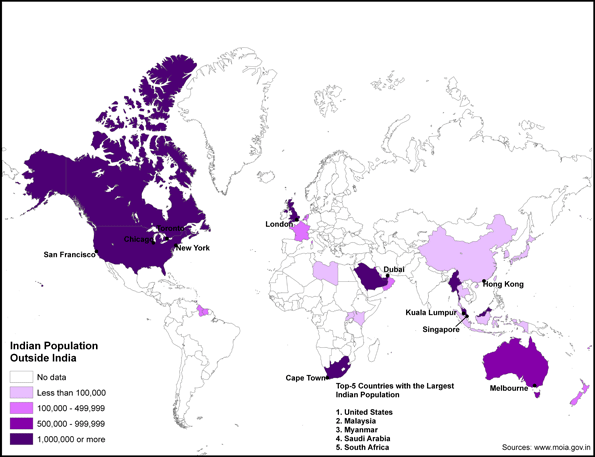
    The Lalvanis’ voyage from refugees to moguls embodies a worldwide phenomenon: the growing size and sway of the Indian diaspora. The exile population now numbers some 40 million people, spread across West Africa, the Americas, and East Asia. And in many of those countries—including the United States, Britain, Canada, Singapore, and Australia—Indian immigrants and their offspring have both higher incomes and higher education levels than the general population.

    The international importance of India itself is rising to an extent unmatched since the onset of the European-dominated global economy in the 17th century. And with the country’s economy growing at roughly 8 percent a year for the past decade—more than double the rate of the United States—India’s influence can only continue to strengthen. Most economists predict that by 2025 the country will outstrip Japan to become the world’s third-largest economy.

    India is more dynamic than any other major country in demographic terms as well. Its population today is 1.21 billion, second only to China’s 1.3 billion, and thanks to the latter’s one-child policy, India’s numbers are expected to surpass those of China by the late ’20s, when India will have an estimated 1.4 billion people versus China’s 1.39 billion. Currently home to the world’s second-largest contingent of English speakers, India seems destined to step into first place, ahead of the United States, by 2020.

    But the mother country’s rise has been more than equaled by that of India’s émigrés. In fact, the diaspora remains one of India’s most important sources of foreign capital. According to the most recent available figures, workers from India in 2009 sent $49 billion in remittances to relatives back home, outpacing China by $2 billion and Mexico by $4 billion. Four percent of India’s gross domestic product comes from North American remittances alone.

    In fact, India’s business community tends to be family–centered, both at home and abroad. Chinese entrepreneurs are more than twice as likely to be financed through banks, most of them state-owned. In contrast, Indian firms and business networks tend to be essentially familial and tribal, extending in networks across the world. “Much of the Indian middle class has ties outside India,” notes researcher Vatsala Pant, formerly with the Nielsen office in Mumbai. “Our ties around the world are also family ties.”

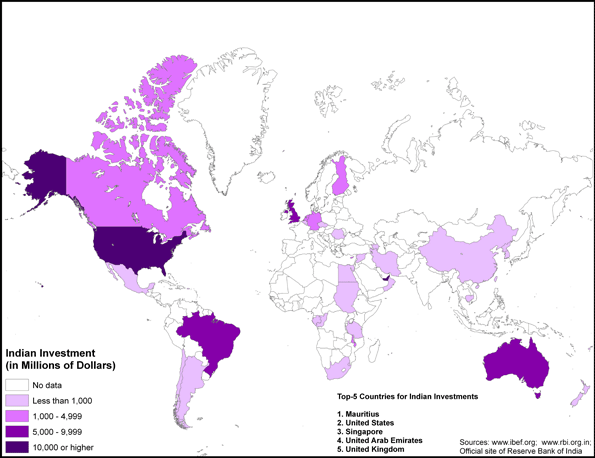
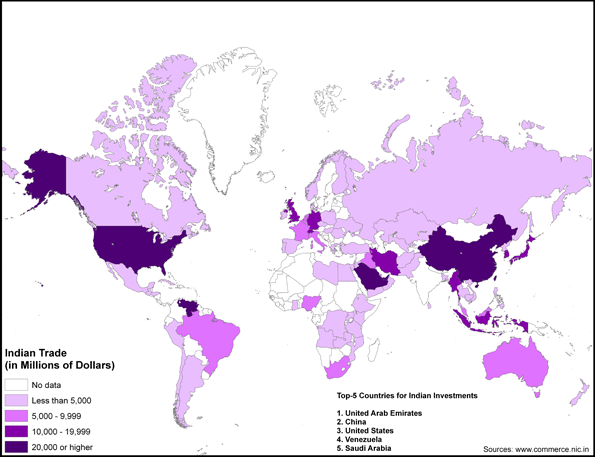
    The importance of such familial links can be seen in the close relationship between diaspora settlement and commerce. The top five areas for Indian investment—Mauritius, the Americas, Singapore, the United Arab Emirates, and the U.K.—have large, established Indian communities and -Indian-run companies that are particularly active in electronics and software.

    Today, even the largest Indian firms, such as Tata and the Reliance Group, are controlled by groups of relatives whose power is enhanced by their wide geographic reach. “We’re very flexible about doing business,” notes Lalvani, who was raised in Britain, is a permanent resident of Hong Kong, and is married to an Indian-American. “We’re global and cosmopolitan—ethnically Indian but also tied to the U.S., U.K., and Hong Kong. They’re all things that make me who I am, and make our business work.”

    That business illustrates nicely the worldwide extent of India’s entrepreneurship. In 1958 Anish’s father, Partap Lalvani, and his uncle Gulu teamed up in London to launch Binatone as a supplier of Asian-built consumer electronics and electrical goods. Its range of products grew to include domestic appliances like kettles, toasters, and irons, and today its employees are active in otherwise neglected markets, such as the former Soviet republics of Central Asia and off-the-grid corners of Africa.

    The Indian diaspora began when Indian workers fanned out across the British Empire during the late 18th century. The exodus intensified after Britain abolished slavery in 1834, setting off a major demand for labor around the globe. Indians were sent out to become contract laborers on Malaya’s rubber plantations, or to work as indentured servants in the West Indies. Although many eventually returned home, others stayed in their new countries, and in many cases became integral parts of the national economy. Some rose to skilled positions in the colonial civil service and military, while others became businessmen, teachers, doctors, and moneylenders.

    Even after the empire’s end, émigrés kept pouring out of India to seek better lives abroad—and with them they brought brains and a willingness to work hard. In the United States, where the Indian diaspora represents less than 1 percent of the population, its members account for roughly 13 percent of the graduate students at the country’s top universities. Overall, 67 percent of people of Indian descent living in America hold at least a bachelor’s degree, compared with 28 percent of the total population. And those statistics are echoed elsewhere in the world. In Canada, people of Indian descent are twice as likely to hold graduate or professional degrees. In Britain, some 40 percent of the medical students and doctors in the National Health Service are of Indian, Pakistani, or Bangladeshi origin.

    Indians’ presence in the business realm is no less notable than in the world of higher learning. According to the latest survey by the University of Essex, the per capita income of ethnic Indians in Britain is about £15,860 (nearly $26,000), higher than that of any other ethnic group in the country and almost 10 percent above the median nation-al income. The study found that the unemployment rate among ethnic Indians is close to half the national average. In the United States, recently published data estimate average household income at $50,000, but it’s $90,000 for ethnic Indians—and a 2007 survey found that between 1995 and 2005, more companies were launched by ethnic Indians than by immigrants from Britain, China, Japan, and Taiwan combined.

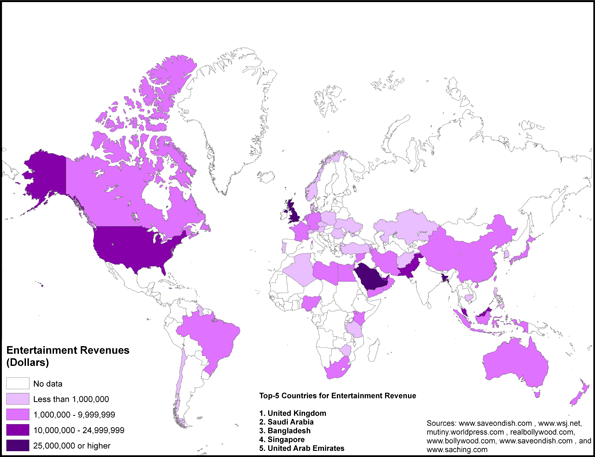
    The expatriates have brought their culture with them—and that too is spreading into the general population wherever they go. Two million Brits enjoy at least one Indian meal per week, and onscreen entertainment from India has permeated the global market. Not so long ago, Bollywood movies were largely intended for domestic consumption, but foreign sales have become significant in recent years, with the large markets in the dominant diaspora countries. Today, Bollywood movies and television shows command an estimated $3 billion to $4 billion in overseas receipts, placing India’s film industry second only to Hollywood itself. In fact, India beats the rest of the world in the number of movies made and tickets sold, and industry sources estimate that as many as a third of ticket buyers in the West are non-Indians.

    Back in India, conditions remain harsh despite the country’s recent advances. The average life span in Mumbai is barely 56 years, a full quarter century less than in Britain and the United States, and poverty across the country remains at shocking levels, with four in 10 Indians living on less than $1.25 a day. Statistics like that are scarcely an incentive for members of the diaspora to return to their homeland.

    For entrepreneurs like Anish Lalvani, however, there’s a more compelling reason to remain abroad: it helps them stay in closer touch with the global marketplace. Having his home base in Hong Kong provides Lalvani with access to Chinese manufacturing and a broad talent pool. “We don’t have many Indians in our management,” he says proudly of the Binatone Group’s operations. “We get the talent from around the world.”

    As large as it may be, Binatone is far from the scale of its Chinese, American, or Japanese competitors. That means it has to keep a keen eye out for new opportunities that the bigger guys have overlooked. Building family businesses through such dogged opportunism is what has driven the expansion of Greater India. “The emerging markets are small, and it takes a lot of flexibility to get in there,” Lalvani says. “We have to go into places where the costs are low, and there are minimal chain stores, so we can get our stuff on the shelves.” But as far as Lalvani and others like him are concerned, it’s a matter of fundamental self-respect. “It’s more than just ginning up cash,” he says. “It’s about not screwing up what your father started.”

    This piece originally appeared in Newsweek.

    Joel Kotkin is executive editor of NewGeography.com and is a distinguished presidential fellow in urban futures at Chapman University, and an adjunct fellow of the Legatum Institute in London. He is author of The City: A Global History. His newest book is The Next Hundred Million: America in 2050, released in February, 2010.

    Parulekar is an engineer by training. He holds a master’s in -finance and an M.B.A.

    Research for this piece was financed by the Legatum Institute.

    Maps by Ali Modarres.

    Photo by lecercle

  • Citizen Bloomberg – How Our New York Mayor has Given Us the Business

    This piece originally appeared in the Village Voice.

    After a charmed first decade in politics, Mayor Mike Bloomberg is mired in his first sustained losing streak.

    His third term has been shaky, marked by the Snowpocalypse, the snowballing CityTime scandal, the backlash to Cathie Black and “government by cocktail party,” and the rejection by Governor Andrew Cuomo of his plan to change how public-school teachers are hired and fired. With just a couple more years left in office, Bloomberg is starting to look every one of his 70 years.

    Soon, he’ll be just another billionaire.

    The mayor’s legacy is remarkably uncertain—largely because he’s done his best to keep New Yorkers in the dark about what it is he’s really set out to do in office.

    In part, this is because the mayor has been far more effective at selling his Bloomberg brand than in getting things done. But it’s also because what he has done—remaking and marketing New York as a “luxury city” and Manhattan as a big-business monoculture—he prefers to discuss with business groups rather than the voting public.

    Withholding information while preaching transparency is a Bloomberg trademark. He aggressively keeps his private life private—meaning not just his weekends outside the city at “undisclosed” locations, but also his spending, his charitable giving, and his privately held business.

    New Yorkers who have received city, campaign, or Bloomberg bucks in one form or another and who expect to do business again in the future agreed to speak anonymously with the Voice about the mayor’s personality, the intersection of his political and private interests, and the goals he aims to achieve.

    Several sources agreed to speak only after hearing what others had said. “It’s Julius Caesar time,” said one source. “There’s lots of knives, but no one wants to be first.” Others refused to be quoted, but encouraged me to give voice to their complaints—which sometimes diverged but often built into a sort of Greek chorus, an indictment of Bloomberg’s mayoralty from those who have seen it in practice, and are vested in it.

    “Hanging out with a billionaire does bad things to your brain,” a source said. “It makes you think you’re right.”

    The candidate who first ran in 2001 on his private-sector résumé and a deluge of advertising never did bother telling voters much about his agenda.

    He pledged in that first run not to raise taxes and to step away from the daily running of his private company if elected to public office, but he brushed aside both vows after the election. In the case of his business, he claimed to have kept his word until his own testimony in a lawsuit unsealed in 2007 showed that he’d been far more active than he’d previously acknowledged.

    The vast redevelopment schemes he unveiled in office were never mentioned on the stump.

    New Yorkers have no trouble picturing Giuliani’s New York, or Dinkins’s “gorgeous mosaic,” or Koch’s “How’m-I-doing?” New York, or Beame’s bankruptcy, or Lindsay’s “Fun City.”

    After two full terms and change, what do you call Bloomberg’s New York? In many ways, the mayor has been merely a caretaker.

    While Bloomberg has called himself the “education mayor,” his claimed success with the public schools has been exposed as largely accounting tricks.

    When asked to describe the boss’s vision for the city, aides and allies tack post-partisanship on to a checklist of Bloomberg LP buzzwords: transparency, data-driven results, and a CEO fixed on the bottom line. Pressed for actual accomplishments, the city’s post-9/11 resurgence usually is mentioned first.

    The attack and its economic fallout played key roles in all three of Bloomberg’s runs, though the story has less to do with strong leadership than with good timing and salesmanship.

    The attack itself, along with his opponent Mark Green’s fumbled response to it, helped put Bloomberg over the top in 2001. The ensuing Fed-sponsored low-interest-rate bubble inflated New York’s markets just in time to help rescue the mayor from record-low approval ratings and ensure his re-election in 2005. When that bubble finally burst in 2008, the Wall Street meltdown became the public rationale for the “emergency” third term.

    “Post-partisanship” has always meant the party of Bloomberg, a convenient handle for a lifelong Democrat who left the party to avoid a contested primary in New York. After the presidential plotting that occupied most of his second term fell short (the big hit that began his losing streak), Bloomberg aimed for a soft landing with a nakedly undemocratic “emergency” bill to allow himself a third term. Instead, it alienated New Yorkers and wrecked his expensively built reputation as a “post-political” leader in the process.

    Transparency has always been something Bloomberg has preferred to pitch rather than practice. In his 1997 business memoir, Bloomberg on Bloomberg—a sometimes valuable guide to the mayor’s approach—he notes that “if public companies change what they’re doing midstream, everyone panics. In a private company like Bloomberg, the analysts don’t ask, and as to the fact that we don’t know where we’re going—so what? Neither did Columbus.” It’s a philosophy Bloomberg brought with him to City Hall.

    “Data-driven”? It’s hard to credit that when crime numbers are artificially deflated by re-classifying rapes as misdemeanors, NYC-reported public school gains disappear when compared to outside measures, and when the city’s 65 percent graduation rate is undercut by state tests showing only 21.4 percent of city students are ready for college.

    “Bloomberg’s data-driven shtick,” said one source voicing a sentiment repeated by several others, “means no one will tell him anything’s failed.”

    As the city’s “CEO,” Bloomberg has managed only to track the ups and downs of Wall Street and the national economy. It’s a strictly replacement-level performance.

    New York went through its rainy-day reserves this year and, with the federal stimulus money spent, now faces $5 billion budget holes in each of the next three fiscal years. The coming budget crunch, says Manhattan Institute fellow Sol Stern, stems in large part from the mayor’s penchant for awarding generous contracts to teachers and other public-sector workers that also add to the pension bills the mayor has at times written off as “fixed costs.”

    Pushing the idea that the city, like a corporation, has a bottom line, Bloomberg diverts attention from the fundamental issue every mayor faces: what the city ought to be doing.

    So what kind of New York has Bloomberg tried to produce?

    The “buck-a-year mayor” offered his business success and vast wealth as his main credentials for running New York. In office, he has envisioned a big-business-friendly city supporting a New Deal welfare state.

    To make that work, he’s promoted “knowledge workers” as New York’s distinguishing resource, the way that waterways, rail lines, and manufacturing facilities were for industrial cities.

    The mayor has often described that group (which, not coincidentally, matches the profile of Bloomberg terminal subscribers) as “the best and brightest,” with no irony intended. The city now acts as its own advertisement to draw in members of the so-called “creative class” who are as likely to work in ICE (Ideas, Culture, Entertainment) as in the city’s traditional FIRE (Finance, Real Estate, Insurance) base. In his typical salesman’s formulation, Bloomberg often suggests that the only alternative to courting that crowd and their wealthy employers would be a cost-cutting race to the bottom.

    How else to pay for the array of services the city provides if not by building a safe and beckoning environment for elites and their Ivy-educated service class to live and work in, unmolested by an untidy big city?

    That promised environment is the vastly expanded and uninterrupted Midtown Central Business District, a coveted goal of the business and real estate communities for nearly a century—if one viewed with suspicion farther south on Wall Street, where Bloomberg effectively ceded control of Ground Zero to a succession of bumbling governors, a major reason that it’s taken a decade for the Trade Center site to even begin rising back up.

    Bloomberg has used a series of mega-plans including his Olympics bid, historic citywide rezoning changes, and pushing the sale of Stuyvesant Town to cut down what remained of working- and middle-class Manhattan. Gone, going, or forcibly shrinking are the Flower District, the Fur District, the Garment District, the Meatpacking District, and the Fulton Fish Market. Even the Diamond District is being nudged out of its 47th Street storefronts and into a city-subsidized new office tower.

    “If New York is a business,” the mayor said in 2003, “it isn’t Walmart—it isn’t trying to be the lowest-priced product in the market. It’s a high-end product, maybe even a luxury product. New York offers tremendous value, but only for those companies able to capitalize on it.”

    (Perhaps oddly, the mayor is a big booster of Walmart’s push to open stores in the city. Earlier this month, he defended the big-box store’s $4 million donation to a city summer job program, snapping at a Times reporter, “You’re telling me that your company’s philanthropy doesn’t look to see what is good for your company?” Asked how Walmart fits into the mayor’s vision, Deputy Mayor Howard Wolfson told me on Twitter that it “fits into the strategy of creating jobs and capturing tax $$ here that are currently going to NJ and LI.”)

    But even as Wall Street has revived, ordinary New Yorkers haven’t benefited from the promised trickle-down.

    Middle-class incomes in New York have been stagnant for a decade, while prices have soared, with purchasing power dropping dramatically. Never mind Manhattan—Queens taken as its own city would be the fifth most expensive one in America. While unemployment in the city has dropped below 9 percent, through June the city had replaced only about half of the 146,000 jobs lost during the recession—and the new jobs have mostly been in low-paying retail, hospitality, and food services positions, according to the Drum Major Institute for Public Policy. Poorly paid health care and social-service jobs, often subsidized by the city, make up 17.4 percent of all private-sector jobs as of 2007, a nearly one-third increase since 1990. Only 3 percent of the private-sector jobs in New York are in relatively high-paying manufacturing positions as of 2007, a figure that’s in the low double digits in Los Angeles, Chicago, and Houston. And the jobs expected to appear over the next decade are also clustered at the bottom of the pay scale.

    A Marist Poll this year showed a striking 36 percent of New Yorkers under 35 intending to leave in the next five years, with 61 percent of that group citing the high cost of living. New York State already leads the nation in domestic out-migration—and New York City has had more than twice the exit rate of struggling upstate locations like Buffalo and Ithaca. More New Yorkers left the city in every year between 2002 and 2006 than in 1993, when the city was in far worse shape, with sky-high crime rates and an economy on the verge of collapse.

    Despite the mayor’s recruiting efforts, people with bachelor’s degrees continue to leave the city in greater numbers than they arrive here, with Brooklyn alone declining by 12,933 such citizens in 2006, according to the Center for an Urban Future, with many of those leaving discouraged by New York’s high costs, and the low quality of the public education available to their children.

    Mike Bloomberg thinks everyone’s dream is to come to the city with an MBA and find an inefficiency to exploit and become a billionaire, or at least get a good job with one, argued three unrelated sources who have worked with the mayor, all of whom asked not to be quoted directly on the mayor’s view of himself. His idea that everyone’s dream is to be on Park Avenue, say those sources, has alienated and insulted outer-borough “Koch Democrats.” Their dream is a house, and Mike Bloomberg diminishes that dream because he thinks everyone wants to be him.

    As Bloomberg memorably put it while floating his candidacy in early 2001: “What’s a billionaire got to do with it? I mean, would you rather elect a poor person who didn’t succeed? Look, I’m a great American dream.”

    Without an impressive public-school system, Bloomberg’s vision for New York falls apart. But the public-school “miracle” the mayor touted for years has proven all pitch and no payoff.

    Despite a massive 40 percent hike in per-pupil spending during Bloomberg’s first two terms, along with a 43 percent boost in teacher pay, the “historic” gains the mayor trumpets failed to register at all on the gold-standard national tests taken by the same students. When new state leaders put an end to the state’s easily gamed tests, what was left of the city’s years of paper gains disappeared.

    The ever-rising test scores Bloomberg had relentlessly promoted fell almost all the way back to the mundane levels that had prevailed when the mayor took control of the system in 2002. The incredible success he’s claimed in closing the achievement gap between black and Hispanic students and their white and Asian peers that’s vexed generations of educators disappeared entirely by some measures.

    Without high-quality schools to produce a cadre of well-educated citizens attractive to employers, Bloomberg’s implicit social contract with New Yorkers—that courting big businesses will help the little guy—breaks down, and the city’s appeal to those businesses is seriously tarnished, along with its long-term appeal to employees with children.

    “Bloomberg yoked his education agenda to his ambitions for higher office,” said Stern, who had initially backed both mayoral control of the schools and Bloomberg’s education agenda. “He recognized that the way he was going to prove [to voters nationwide] that he’d given more bang for the buck was through test scores, while at the same time he was also introducing cash incentives to principals and teachers for getting the scores up.” (That program was quietly shuttered this month after a city-commissioned study found the payments had no impact on student performance.)

    “So he invited the corruption,” Stern said, adding that he expects a numbers-juicing scandal to hit before Bloomberg leaves office. New Chancellor Dennis Walcott, responding to reports of grade-tampering in the city and a nationwide wave of such scandals, announced his own investigation this month, but it remains to be seen if the school system can fairly probe itself, and with the mayor’s reputation hanging in the balance.

    Asked in 2007 how New Yorkers could register their discontent with the schools now that he was presumably term-limited out of office, Bloomberg cracked, “Boo me at parades.”

    Some New Yorkers have taken him up on that, but more significantly they’ve also stopped caring enough to vote.

    The mayor has indeed governed as the city CEO he promised to be in 2001, redefining public life so that businesses are “clients,” citizens “customers,” and Bloomberg the boss entrusted with the city’s well-being, with no need to consult with the board before acting.

    After 1.9 million New Yorkers took to the polls in the 1989 and 1993 contests between Dinkins and Giuliani, less than 1.5 million voted in 2001’s nail-biter, and just 1.3 million turned out in 2005, when the outcome was never in doubt. Bloomberg nonetheless spent $84.6 million running up the score in a 19-point win intended to make him look “presidential.” In 2009, the mayor, responding to internal polls showing most New Yorkers wanted him out, broke the $100 million mark to project inevitability and discourage voters from showing up at all. Despite perfect weather on election day, three out of every four voters didn’t bother to participate. Just 1.2 million New Yorkers voted in an election that Bloomberg won by only 50,000 votes—collecting the fewest winning votes of any mayor since 1919, when there were 3 million fewer New Yorkers and women didn’t have the franchise. For the first time, Bloomberg’s spending failed to translate into popular support.

    As the city’s electorate shrank around him—even as its population grew by more than a million people between 1990 and 2010, Bloomberg’s political stature swelled. The voters who just stayed home allowed the mayor to hold on to power despite an outnumbered base of the city’s social and financial elites and the technocratic planners they often bankroll, a political and governing coalition last seen 40 years ago under fellow party-switcher John Lindsay.

    “My neighbors [in Manhattan] don’t vote in city primaries,” said a source. “They vote in presidential elections where their vote is useless. They’ve privatized their lives. Private schools, country houses, Kindles instead of libraries, cars instead of trains.”

    In exchange for Citizen Bloomberg’s benighted leadership, we’ve accepted a staggering array of conflicts of interest. The mayor’s fortune renders obsolete the “traditional” model of interest groups buying off politicians. He not only does the reverse, buying off interest groups to advance his political agenda but also uses his fortune to staff and support his business. At the same time, he builds the Bloomberg brand that supports it all: Bloomberg LP, the Bloomberg Family Foundation, Bloomberg Terminals, Bloomberg News, Bloomberg View, Bloomberg Government, Bloomberg Law, Bloomberg Markets—not to mention Mayor Bloomberg.

    The mayor wrote his own rules in a remarkably deferential 2002 agreement with the city’s toothless Conflict of Interest Board, and then ignored them when it was convenient, continuing to be regularly involved in his company’s affairs and acting in city matters where Bloomberg LP or Merrill Lynch (which until recently owned 20 percent of Bloomberg LP) had a stake.

    Top-level City Hall workers, favored legislators, and others have moved freely between City Hall and the mayor’s private interests, keeping it in the “Bloomberg Family.” Bloomberg LP is now run by former Deputy Mayor Dan Doctoroff, while the Bloomberg Family Foundation’s approximately $2 billion endowment is controlled, on a “volunteer” basis, by Deputy Mayor Patti Harris. The prospect of a private Bloomberg jackpot job is on a lot of minds around City Hall and throughout New York.

    Craig Johnson, the former state senator who lost a re-election bid after bucking his party to back the mayor in supporting charter schools, was hired this month by Bloomberg Law. “I wasn’t about to let him go to some other company,” Bloomberg said, all but winking. “I was thrilled to see my company hired him. I didn’t have anything to do with that.”

    Beyond the $267 million he spent in three mayoral runs, he documented nearly $200 million more in “anonymous” charitable contributions. And that cool half-billion is just the spending Bloomberg has chosen to disclose.

    Harris, now City Hall’s highest-paid official, came to the administration from Bloomberg LP. Through her control of Bloomberg’s ostensibly anonymous donations passed through the Carnegie Foundation to local institutions, she’s served as the Medici Mayor’s chief courtier—working for the city while using his private fortune to rent the silence, and occasionally the active assent, of its cultural groups on his behalf. That city giving dropped precipitously when Carnegie was replaced by the new Bloomberg Family Foundation, also run by Harris, which is now spreading cash to potential Bloomberg constituencies nationwide.

    As Bloomberg explained in 1997, when Harris worked for Bloomberg LP:  “Her sole job is to decide which philanthropic activities are appropriate for our company and to ensure we get our money’s worth when we donate time, money, and jobs. One of Patti’s questions is, ‘When does helping others help us?’… Not only does Patti commit our dollars, she also follows, influences, and directs how our gifts are used, ensuring our objectives are met.”

    Elsewhere in his memoir, he adds: “Peer pressure: Its impact in the philanthropic world is hard to overstate.”

    Meanwhile, Bloomberg News, supported by income from his sophisticated “Bloomberg terminals,” has grown to employ about 2,500 journalists, and at some of the best rates in the industry.

    After offering up vague statements about avoiding conflicts of interests—no easy task when the boss is a potential presidential candidate, mayor of the nation’s biggest city, and one of that city’s wealthiest men—Bloomberg View debuted in May with a remarkable opening editorial. The editors conceded that they didn’t know yet what their principles would be—”We hope that over time a general philosophy will emerge”—but they were confident they would end up aligned with the “values embodied by Mike Bloomberg, the founder of Bloomberg LP.”

    In June, brand-name Bloomberg pundit Jonathan Alter launched into an exceptionally vitriolic attack on charter school detractor and former Bloomberg education adviser-turned-foe Diane Ravitch. The piece ran with no acknowledgment of the evident conflict of interest in taking shots at perhaps the most prominent critic of Citizen Bloomberg’s education policies, under the Bloomberg View banner.

    Bloomberg seems to view himself as congenitally above such conflicts, explaining in Bloomberg on Bloomberg, “Our reporters periodically go before our sales force and justify their journalistic coverage to the people getting feedback from the news story readers…. In return, the reporters get the opportunity to press the salespeople to provide more access, get news stories better distribution and credibility, bring in more businesspeople, politicians, sports figures and entertainers to be interviewed…. Most news organizations never connect reporters and commerce. At Bloomberg, they’re as close to seamless as it can get.”

    Speaking of seamless, in 2000 Bloomberg rolled out a new city section, just in time for the boss’s run. Jonathan Capehart, brought in from Newsday, ended up doing double duty as candidate Bloomberg’s policy tutor and his host in different corners of the city, according to former Times reporter Joyce Purnick’s biography of the mayor, Mike Bloomberg: Money, Power, Politics. When the mayor-elect reached out to Al Sharpton on election night to tell him “things will be different with me as mayor,” it was Bloomberg News employee Capehart who placed the call.

    Much as City Hall staffers dream of a Bloomberg job as the big payoff for their loyal labors, few reporters will go out of their way to tweak a potential employer, let alone one who frequently lunches with their current boss. And especially one whose long-rumored ambition is to buy the Times one of these days—a buzz that the mayor’s camp hasn’t discouraged, Berlusconi comparisons be damned. (The Italian prime minister and Ross Perot are two of Bloomberg’s neighbors when he weekends in Bermuda).

    Along with Berlusconi, other comparisons heard in various conversations about Bloomberg included his Trump-like leveraging of his name (“It would be me and my name at risk. I would become the Colonel Sanders of financial information services…. I was Bloomberg—Bloomberg was money—and money talked”), his Hearst-like seduction of legislators with private jet rides and self-serving party-jumping, and his Rockefeller-like use of his private fortune on behalf of the state GOP, though for very different reasons.

    The lifelong Democrat who became a Republican to dodge the mayoral primary has also given millions to the state GOP (as well as $250,000 to the Republican National Committee in 2002, and $7 million in support of the 2004 Republican convention in Manhattan). The cash shipments continued even after the mayor left the party in 2007 to hitch his star to the misleadingly named “Independence Party”—run in the city by crackpot cultist Lenora Fulani.

    While Bloomberg’s support for the GOP dwarfed the money he channeled to the Independence Party, both received just a drop from his enormous bucket of cash—which still made Bloomberg easily the state Republicans’ biggest patron, his table scraps their feast. The party repaid that support in part with their ballot line in 2009, two years after he’d left the party, to go along with his “Independence” line, which proved crucial to his 2001 and 2009 wins, and would have been key had his presidential plans moved forward.

    His Albany cash, though, has often failed to pay off. Perhaps that’s because Bloomberg hasn’t been willing or able to salt the state’s interest groups and leadership class as thoroughly as he has the city’s—his political persuasiveness and popularity have always been coterminous with his cash. In each of his terms, major aims—Far West Side development, congestion pricing, and teacher hiring—have been simply abandoned in the capitol without so much as a vote. Those losses came despite dealing with three weak governors before Cuomo, whose dramatic ascent has left the mayor further diminished. (One of Bloomberg’s rare wins in the state capitol, mayoral control of the city schools, was actually given to him by Assembly Speaker Sheldon Silver, the mayor’s most frequent Albany foil—who had withheld the same gift from Mayor Giuliani.)

    Given Citizen Bloomberg’s success in buying off the city’s opinion makers, cultural institutions, community groups, and organized protesters, it’s no wonder the mayoralty began to feel too small for him, and he spent the bulk of his second term trying to leverage it into the presidency. While his signature congestion-pricing plan failed in the city, it succeeded in landing him on the cover of Time. He followed up by a nationwide victory tour with then-Chancellor Joel Klein and well-compensated occasional sidekick Sharpton to tout the school system’s “amazing results.”

    The master salesman, who talked of transparency while keeping his own cards down, used his fortune to establish at City Hall the “benevolent dictatorship” he saw at Salomon and then employed in his private business: “Nor did so-called corporate democracy get in the way. ‘Empowerment’ wasn’t a concept back then, nor was ‘self-improvement’ or ‘consensus,’ ” Bloomberg writes in his business memoir. “The managing partner in those days made all the important decisions. I suspect that many times, he didn’t even tell the executive committee after he’d decided something, much less consult them before. I’d bet they never had a committee vote. I know they never polled the rest of us on anything. This was a dictatorship, pure and simple. But a benevolent one.”

    But dictatorships never last. “Once Bloomberg leaves a room, it doesn’t exist to him,” said one source, skeptical that the mayor would care about maintaining his influence after he exits office. But given the value of his name, he is taking care to be sure that it isn’t damaged in the exit process.

    Campaign filings released last Friday show the lame duck nonetheless spent $5.6 million on TV and direct mail spots promoting himself in March and April. And after failing to groom a successor, the mayor has belatedly been trying to institutionalize parts of the Bloomberg way.

    “The administration is finally trying to do systematic reform, that’s what [Stephen] Goldsmith is here for,” a source said, referring to the former Indianapolis mayor who emerged as a star of the 1990s “reinventing government” movement, and signed on for Bloomberg’s third term as a deputy mayor. “I think he’s really frustrated. He complains a lot about lawyers.”

    While Police Commissioner Ray Kelly reportedly mulls a Republican run, buzz has been building that Bloomberg will support City Council Speaker Christine Quinn, his Democratic partner in changing the term-limits law, as his successor. A slush-fund scandal left her damaged, but a third term she and the mayor pushed through bought her time to recover, along with a chip to cash with him. Mayor Koch last month outright said that Bloomberg had told him he was backing Quinn, before Koch dialed back his words later the same day.
    But some of the Bloomberg-for-Quinn hype has come from operatives with reason to find a new patron once the billionaire exits office. The mayor, meanwhile, has reason to want a pliant speaker in his final years.
    “Even if he does back her,” a source noted, “he’s not giving her $100 million for a campaign, or to wield as mayor. Once he’s gone, it’s done.”

    Contact Harry Siegel at hsiegel@villagevoice.com

    Photo courtesy of Be the Change, Inc. :: Photo credit Jim Gillooly/PEI

  • The Evolving Urban Form: Chicago

    Looks can be deceiving. No downtown area in the western world outside Manhattan is more visually impressive than Chicago. Both the historic Loop and the newer development north of the Chicago River, especially along North Michigan Avenue have some of the most iconic structures outside of emerging Asia. Yet these vertical monuments mask a less celebrated reality: that of dispersing, low density urban area.

    Chicago Combined Statistical Area: Let’s take a close look at the 2010 census data. Overall, the combined statistical area, which includes the metropolitan area (Note 1) and two exurban counties added nearly 365,000 people, for a growth rate of 3.9 percent. This is well below the national growth rate of approximately 10 percent (Map, Figure 1). Chicago followed the general trend of with growth being greatest in the outer suburbs while declines took place both in the inner suburbs and the historical core municipality (Figure 2).

    Massive Core City Loss: The historical core city of Chicago lost but 200,000 people, and fell to a population of 2.7 million, the lowest count since the 1910 census. The population is down 925,000 from 1950 and at the current rate would drop at least 1 million from the 1950 peak by the 2020 census.  Chicago is at risk of joining London and Detroit as the only two historical core municipalities in modern times that have lost more than 1 million people.

    Inner Suburbs: As in New York and Seattle, Chicago’s inner suburbs grew slowly. The inner suburbs include the part of Cook County that is outside the city of Chicago as well as Lake County, Indiana (home of Gary), which shares the city of Chicago’s eastern border. The inner suburbs added fewer than 30,000 residents and grew only one percent.

    This suggests some limitations to the newly developing mantra that has inner suburbs will be the locus of future growth although there are scattered inner suburbs in other cities (such as Hoboken, New Jersey) that did see growth. Perhaps the old mantra, about people returning to the city from which they had never come was finally quashed by the realities of the 2010 census.   

    Outer Suburbs: The outer suburbs, which include the remaining counties of the metropolitan area, grew at a rate of 16.5 percent, actually grew faster than the national average of approximately 10 percent. The outer suburbs added more than 500,000 people. The largest growth, 175,000 was in Will County, to the south, one of the five “collar counties” that used to define the boundaries of the metropolitan area. McHenry County, the most distant of the collar counties added 100,000. The fastest growth was in far suburban and also southern Kendall County, which more than doubled in population.

    Chicago Metropolitan Area: Overall, the Chicago metropolitan area added approximately 360,000 people and grew 4.0 percent from 2000. This is well below the national average population growth rate, however was above that of the Los Angeles metropolitan area, once among the  nation’s of leading growth areas until the last decade.

    Historical Trends: The city of Chicago, like other historical core cities, had previously been dominant in its metropolitan area. The earliest Census Bureau metropolitan area (“metropolitan district”) estimates from 1900 indicated that more than 90 percent of the region’s population was contained in the city of Chicago. By 1950, the city of Chicago had fallen to 66 percent of the metropolitan area as defined in that year.  The city of Chicago now has only 28 percent of the combined statistical area population of 9.7 million (Figure 3, Table and Note 2).

    CHICAGO METROPOLITAN AREA
    POPULATION TREND BY COUNTY: 2000 TO 2010
    1900 1950 2000 2010 Change: 2000-2010 % Change: 2000-2010
    HISTORIC CORE MUNICIPALITY
    Chicago   1,698,575   3,620,962   2,895,671 2,695,598 -200,073 -6.9%
    INNER SUBURBAN      178,052   1,255,982   2,965,634 2,995,082 29,448 1.0%
    Cook County, IL      140,160      887,830   2,481,070 2,499,077 18,007 0.7%
    Lake County, IN        37,892      368,152      484,564 496,005 11,441 2.4%
    OUTER SUBURBAN      378,896      884,980   3,237,011 3,770,425 533,414 16.5%
    DeKalb County, IL        31,756        40,781        88,969 105,160 16,191 18.2%
    DuPage County, IL        28,196      154,999      904,161 916,924 12,763 1.4%
    Grundy County, IL        24,136        19,217        37,535 50,063 12,528 33.4%
    Jasper County, IN        14,292        17,031        30,043 33,478 3,435 11.4%
    Kane County, IL        78,792      150,388      404,119 515,269 111,150 27.5%
    Kendall County, IL        11,467        12,155        54,544 114,736 60,192 110.4%
    Kenosha County, WI        21,707        75,238      149,577 166,426 16,849 11.3%
    Lake County, IL        34,504      179,097      644,356 703,462 59,106 9.2%
    McHenry County, IL        29,659        50,656      260,077 308,760 48,683 18.7%
    Newton County, IN        10,448        11,006        14,566 14,244 -322 -2.2%
    Porter County, IN        19,175        40,076      146,798 164,343 17,545 12.0%
    Will County, IL        74,764      134,336      502,266 677,560 175,294 34.9%
    CHICAGO METROPOLITAN AREA   2,255,523   5,761,924   9,098,316 9,461,105 362,789 4.0%
    EXURBAN METROPOLITAN COUNTIES        75,540      150,332      213,939 224,916 10,977 5.1%
    Kankakee Coiunty, IL        37,154        73,524      103,833 113,449 9,616 9.3%
    La Porte County, IN        38,386        76,808      110,106 111,467 1,361 1.2%
    CHICAGO COMBINED STATISTICAL AREA 2,331,063 5,912,256 9,312,255 9,686,021 364,150 3.9%
    Data from the US Census Bureau


    Since 1950 (Note 3), all of the growth in the Chicago area has been in the suburbs. By 2000, both inner suburbs and the outer suburbs each had more people than the city of Chicago. Today the outer suburbs, with forty percent of the region’s population, represent the largest demographic force in Chicago (Figure 4).

    We do not usually associate Chicago with the dreaded term “sprawl” but Chicago now stands as the third largest urban agglomeration in the world in land area, trailing only New York and Tokyo. The Chicago urban area covers more land than Los Angeles, which has a far higher urban density.

    Dispersing Employment: Chicago’s dispersion extends to employment. Despite having the second strongest central business district in the nation (after Manhattan), jobs are rapidly decentralizing. Last year the Downtown Loop Alliance reported that private sector employment in the Loop fell 20 percent during the last decade. Overall, the downtown area of Chicago now represents approximately 10 percent of regional employment, barely half the percentage of Manhattan or Washington, DC.

    American community survey data from 2009 indicates the total employment in the North West corridor along Interstate 90 has at least as much employment as downtown Chicago. This corridor, anchored by the edge city (Note 4) of Schaumburg, is typical of emerging suburban centers around the nation. Only two percent of workers in this corridor use transit for commuting.

    Another corridor, along Interstate 88 (anchored by Lisle and Aurora) has at least two thirds the employment of downtown, with only one percent commuting by transit. The North Shore corridor encompassing parts of northern Cook County and Lake County is of similar size to the Interstate 88 corridor and has a larger transit work trip market share of five percent.

    Downtown, on the other hand, has the third largest transit work trip market share in the nation, following Manhattan and Brooklyn. In 2000, 55 percent of people working downtown (the larger downtown including the Loop, north of the River and adjacent areas to the west and south) commuted by transit. This illustrates the strength of transit for providing access to the largest, most dense downtown areas in contrast to dispersed suburban areas.

    Perhaps more telling, the number of jobs and resident workers (the “jobs-housing” balance) in the city of Chicago are converging toward equality. According to American community survey data, there are 1.1 jobs in the city of Chicago for each working resident. This is substantially less, for example, than Washington (2.6), Atlanta (2.0), Boston (1.7), San Francisco (1.4) and Baltimore (1.4).

    On the other hand, two of the three large suburban corridors have higher ratios of jobs to workers than the city of Chicago. The Interstate 88 corridor has 1.3 jobs per worker, while the North Shore has approximately 1.5 jobs per worker. The Interstate 90 corridor has slightly more jobs than workers. These data indicate that Chicago is well on the way to a more evenly distributed employment pattern that has become more common around the nation.

    Middle America’s Leviathan: The Chicago area has been very resilient through the years. After nearly a century as the nation’s “second city,” Aaron Renn points out the area could fall from its much cherished “global city” status. Still, Chicago remains the dominant urban area between the coasts. Virtually all of its Midwestern competition has fallen away (such as Detroit, St. Louis and Cleveland). However, in the longer run Chicago could be displaced by Dallas-Fort Worth and Houston. Nonetheless, the urban area’s visually arresting business district will retain its iconic status even if, overall, the region looks more and more like the rest of highly dispersed Middle America.

    ——

    Note 1: This article uses metropolitan area and combined statistical areas as defined by the authoritative US Office of Management and the Budget.

    Note 2: The 1950 references provided because the closest to the Post-War democratization of homeownership and car ownership and expansion of car oriented suburbanization. Before World War II, most US historical core cities were comparatively dense, while a far smaller share of the population lived in the suburbs.

    Note 3: Figure 3 and the Table show data for the 2010 geographical definition of the combined statistical area. Earlier metropolitan area definitions are also referred to in the text.

    Note 4: An “edge city” is a major employment center outside the central business district (downtown).  “Edge city” became a part of the language as a result of Joel Garreau’s 1991 book, Edge City: Life on the Urban Frontier.

    Photograph: Downtown Chicago from the Air (by author)