Category: Economics

  • Enterprising States: Hard choices now, hard work ahead: State Strategies to Renew Growth and Create Jobs

    This is an excerpt from "Enterprising States: Creating Jobs, Economic Development, and Prosperity in Challenging Times" authored by Praxis Strategy Group and Joel Kotkin. The entire report is available at the National Chamber Foundation website, including highlights of top performing states and profiles of each state’s economic development efforts.

    Read the full report.

    Read part one in this series.

    America has the world’s largest economy, the world’s leading universities, the most robust entrepreneurial culture and many of its biggest companies—yet many see this as a diminishing advantage.31 Stagnation, many predict, will extend into the foreseeable future because the economy’s low-hanging fruit has disappeared and so the pace of innovation has slowed; by this argument we are now on a “technological plateau” that will make further growth challenging.32 The United States remains a leader in global innovation, but better-funded, higher-performing hubs of innovation are emerging among determined competitors, notably China.

    In contrast, we believe America’s prospects for competing with other countries are better than commonly assumed, and we are convinced that our strategy for the future is unlikely to be found elsewhere. Unlike our major competitors, we enjoy a huge base of natural resources—such as food and energy—which are likely to become ever more in demand as countries like China and India grow their economies. Most important of all, the United States, particularly in contrast with Europe and East Asia, enjoys relatively youthful demographics, promising an expanding workforce, new consumers and a new flood of entrepreneurs.

    Yet our demographics and resources require intelligent policies that fit our particular situations. As a young country, we will have to find employment for an additional 20 million Americans in this decade. Slow growth, which could be accommodated in rapidly aging Japan or Germany, is not an option for the United States. We will also need to harness all forms of energy, from renewables to fossil fuels. Today, half of our trade deficit consists of energy, and yet we have the oil and gas resources to supply the vast majority of our needs. As we invest in renewables for the long run, the country needs to use the resources that are readily available in order to reduce the deficit and spark job growth.

    Our ability to compete, particularly on the state level, could be compromised by an inability to address our budgetary challenges. According to the Center on Budget and Policy Priorities, states are struggling with budget shortfalls for fiscal 2012 that add up to $112 billion. The most recent Fiscal Survey of the States anticipates considerably more financial stress in the states as the substantial funding made available by the American Recovery and Reinvestment Act of 2009 will no longer be available.

    Most states have already taken actions to streamline and downsize government to meet the new economic realities. This has proven to be challenging given the increased demand for state services during the national recession. Surely, more redesign, streamlining and reform is on the way. To recoup lost revenue, states have taken such actions as eliminating tax exemptions, broadening the tax base, and in some cases increasing rates as well as raising a number of fees. Low tax rates by themselves are not a silver bullet for growth, but it has become clear that outdated state tax systems can undercut economic vitality.

    States are the fulcrum of change in key areas of education, infrastructure, energy, innovation and skills training—something that was confirmed on many fronts in the first Enterprising States study. States and localities are far better positioned than the federal government to foster strategic investment, regulations, taxes and incentives that encourage private sector prosperity. In large part, this is because they are more responsive to local conditions.

    Equally important, a diversified portfolio of opportunity agendas implemented by the individual states will go a long way toward renewing growth and prosperity in the national economy.

    New Era of Leadership by the States?

    As the 2010 Enterprising States study was being completed, the states were implementing sweeping changes to deal with a growing number of challenges. Since then twenty-nine new governors have started their terms. Governors of every state, along with their legislative counterparts, are taking steps to grow their states’ economies, create jobs and compete globally. They want to help businesses prosper, to produce an educated and skilled workforce, and to provide other essential services and infrastructure that foster the entrepreneurship and innovation that will lead to greater productivity and competitiveness.

    The dramatic shortage of job opportunities has driven up the unemployment rate, pushed a large number of workers into part-time jobs, increased underemployment problems, and reduced the number of people who were expected to be active participants in the labor force. There is universal agreement that we need policies and programs that create jobs now, alongside investments to lay the foundations for long-term economic growth. “To keep the American dream of widely shared prosperity alive,” one commentator has argued, “we need to choose entrepreneurship and competition over the vested interests of the status quo.”

    Restoring confidence in the economy by creating a meaningful and compelling plan for moving forward is a top priority for elected officials as well as leaders from business, education, and labor groups throughout the country.

    There is also a stark recognition among the states that solving their fiscal problems is directly connected to creating an economic climate that will foster job creation. Any state with a budget tilting towards insolvency is in a weak position to make and maintain investments in its workforce and economic infrastructure. A state’s fiscal health also has immediate consequences by affecting its credit rating and, thereby, the cost of borrowing money. Unfunded pension obligations, viewed historically as soft debt, are now being considered together with the total value of state bonds to come up with a credit rating.

    Many governors and state legislatures are attempting to strike a balance between budget cuts that could hold back the recovery by putting more people out of work, and spending cuts and government reforms that would create a more business-friendly environment, leading to greater business confidence, private-sector investment and job creation. How this balance is achieved depends on each state’s unique set of circumstances and available assets. Moreover, at their core, these debates reflect the fundamental tensions between the two major visions of American progress, namely: creating equality of condition by boosting wages, improving working conditions, and guaranteeing basic services, and creating equality of opportunity, by creating the conditions whereby individuals can elevate themselves through industry, perseverance, talent, and righteous behavior.

    As noted in The Economist, private capital is mobile and it goes where government works. So while political considerations and ideological rationalizations certainly do influence the mix of austerity measures and public investments, the real opportunity today is for states to redesign government for the 21st century. That means cutting programs that do not spur economic growth and shifting resources, where possible, to those existing or planned programs that will.

    While spending cuts will help control deficient budgets, so will increased revenue brought by economic growth. As states enact budget austerity measures, what job creation initiatives are surviving or receiving increased investment? What are the new priorities for job creation? How are states balancing cuts with critical job-creating initiatives that will stimulate innovation, build infrastructure, provide skills training, and unleash the dynamism of small business?

    Job-Centric States Are Redesigning Government and Investing in Opportunity

    Determining where to cut and where to invest40 is the central challenge of the day. States must carry out short-term strategies to jump-start and/or sustain an as-of-yet lackluster recovery, and cut costs to make state government more efficient and to avoid financial calamity. Simultaneously, though, they must craft and invest in innovations and structural solutions that will foster long-term economic growth while reining in taxes and regulations that stifle job creation.

    In most states, revenues remain stubbornly down from where they were before the recession, and job growth is proving to be more elusive than in most previous recoveries. The strategies now being planned or undertaken by each state are based on their unique sets of interests, resources and capabilities, aligned with the opportunities that they see on the horizon and believe are conceivably within their grasp. Yet all states “will likely need a new network of market-oriented, private-sector-leveraging, performance-driven institutions”41 to restore and revitalize their economies.

    The 2011 Enterprising States study highlights state-driven initiatives to 1) redesign government, including measures to deal with excessive debt levels that inhibit economic growth and job creation, and 2) forward-looking, enterprise-friendly initiatives whose primary goal is to create the conditions for job creation and future prosperity.

    The policy initiatives and programmatic efforts are related to the five policy areas that were included in the original Enterprising States report.

    • Entrepreneurship and Innovation
    • Exports, International Trade and Foreign Direct Investment
    • Workforce Development and Training
    • Infrastructure
    • Taxes and Regulation

What’s different in 2011 and for the foreseeable future is that for many states the imperative for change is real. The choice is simple. To remain a job-creating, fiscally robust economy, states will either change on their own or change will continue to be forced upon them.

Investing In Opportunity

States are taking a hard look at making investments in and implementing initiatives to create and sustain high-growth, higher-wage, 21st century industries.States play a key role in the higher education landscape, so there is considerable support for and investment in programs that educate the future talent pool and foster collaboration between business, education and government on science and technology, technology transfer and entrepreneurial programs. As states evaluate their return on investment, performance-based funding has become a best practice for aligning colleges and universities as partners in workforce preparation and sources of opportunity, growth, and competitive advantage.

High-growth start-ups are the best generators of new jobs, accounting for nearly all net job creation in America in the last twenty-plus years. They are also the firms most likely to raise productivity, a basis for economic growth. They also create jobs that did not previously exist, and solve problems in a way that makes a difference in people’s lives.

States have stepped up their efforts to help companies scale up and grow in order to capture growing domestic and international markets. A number of states have established or expanded seed and growth-stage financing funds. Some have implemented economic gardening programs deliberately designed to focus on expanding existing second-stage companies that have viable growth opportunities. Several states have undertaken initiatives to fix deficiencies in the market that inhibit private-sector investment and entrepreneurial activity. Tax credits for angel investors and state-backed venture capital funds are just two examples.

Companies with a global reach that bring together multiple technologies or complex expertise—such as advanced manufacturing, investment banking, construction and engineering, and natural resources—are likely to drive the nation’s global competitiveness in the next few years, along with more focused technology companies that are part of complex virtual networks.44 For that reason, several states are implementing, and having considerable success with, programs to help companies expand into global markets by assisting in the development of a customized international growth plan. And, some states have made significant headway using focused and purposeful strategies to attract foreign direct investment.

Public-private partnerships and privatization initiatives for economic development and the provision of infrastructure are proliferating throughout the states. Building funds and bonding programs that involve private-sector investors are now widely used to construct specialized facilities for research, demonstration, and technology transfer in key economic sectors. Building on the lessons of the past, states have become considerably more adept at avoiding what Robert Fogel has called “hothouse capitalism,” in which government assumes much of the risk while private contractors and financiers take the profit.

While unemployment remains high, many currently available jobs go unfilled. America faces a shortfall of almost two million technical and analytical workers in the coming years, a situation that stands to thwart economic growth.45 Painfully cognizant of this dilemma, many states are establishing workforce training and development programs that address structural unemployment problems and the mismatch between available jobs and the skills of the existing workforce. The goal is to align training and academic programs with in-demand regional occupations, and to add greater flexibility to workforce training programs that have left some re-trainable individuals slipping through the cracks.

Forward-looking states are modernizing their education and workforce training initiatives by developing people-focused approaches that help and train workers in navigating their careers, provide assistance for entrepreneurs, make lifelong learning loans, and offer wage insurance plans. The goal is to empower people to find better jobs and/or to create new ones. Plainly, making America more globally competitive is vital, but the increasingly obvious gap in our economic discussions is an agenda for making Americans more personally competitive. In this view, forging a new economics for the Individual Age will require rethinking our economy from the bottom up in order to realize future growth and prosperity.

Finally, because energy issues, both current and future, have become such critical factors in business and for economic growth, states are getting serious about policies, initiatives and investments to provide clean, secure, safe and affordable energy tailored to regional, state and local resources. These include renewable energy standards, investments in research, development and commercialization of energy technologies and processes, and the establishment of new financing authorities to build the infrastructure that will extract and transport energy to the places where it will fuel new growth.

Redesigning Government

The fiscal situation of many states has caused them to reconsider the level of services they are providing and, certainly, the way that they deliver them. According to the Government Accountability Office, “Because most state and local governments are required to balance their operating budgets, the declining fiscal conditions shown in our simulations suggest the fiscal pressures the sector faces and foreshadow the extent to which these governments will need to make substantial policy changes to avoid growing fiscal imbalances.”

In The Price of Government: Getting the Results We Need in an Age of Permanent Fiscal Crisis, David Osborne and Peter Hutchinson contend that Industrial Age government is just not up to the tasks and challenges at hand. Centralized bureaucracies, hierarchical management, rules and regulations, standardized services, command-and-control methods, and public monopolies are simply not aligned to Information Age realities. Today, government must be restructured and prepared for rapid change, global competition, the pervasive use of information technologies, and a public that expects quality and has lots of choices.

The keys, according to Osborne and Hutchinson, are to 1) get rid of low-value spending, 2) move money into higher-value, more cost-effective strategies and programs and 3) motivate all managers to find better, cheaper ways to deliver results. In sum, government needs to provide incentives, expect accountability, and allow the freedom to innovate.48
Government redesign efforts that are now underway or in the planning stages often follow the simple guidelines outlined above. Yet various approaches are now being used by state governments, including:

  • Consolidation, reorganization, or elimination of agencies, boards and commissions.
  • Regionalization of governance to decentralize decision-making and to customize and align service delivery with local circumstances.
  • Streamlining and modernizing bureaucratic processes to increase productivity and improve service delivery, often by deploying services online.
  • Experimenting with charter agencies that commit to producing measurable benefits and to saving money—either by reducing expenditures or increasing revenues—in exchange for greater authority and flexibility.

Steps to curb spending and reform taxation in the states have varied widely. States with the most serious fiscal problems are laying off workers, imposing hiring freezes, reducing spending for education and health care and ending or curtailing social services. Aid to local governments has been cut. For many states, current obligations for public pension funds and health insurance costs are unaffordable and future obligations represent a
looming financial disaster. Cuts, concessions and larger contributions from employees are now a necessary part of balancing the state’s checkbook.

Taxes and tax policies vary considerably among the states. To make up for lost revenues, most states have taken such actions as eliminating tax exemptions, broadening tax bases, and in some cases increasing rates as well as raising a number of fees. States have enacted increases in all of the major taxes they levy, including personal income taxes, general sales taxes, business taxes, and excise taxes. However, many states did reduce business taxes with new credits or expanded existing credits to encourage investment and growth in targeted industries.
Uncertainty, above all, is the antagonist of growth, investment, and job creation. States that cannot rid themselves of onerous DURT49 (delays, uncertainty, regulations and taxes) are in peril of putting the heaviest burdens on new and small businesses and on entrepreneurs, the real job creators in a growing economy. In a tight economy these considerations become more stringent for entrepreneurs and companies that are making economic decisions simply because the levels of uncertainty and the stakes are so much higher. Eliminating employment regulations and time-consuming processes that place unreasonable burdens on business can have a significant impact on job creation.

Moreover, the competitive identity of a state today relies increasingly on the degree to which the actions of the private, public and civic sectors are aligned with and corroborate the identity claimed or brand promise. A story must be backed up by actions: to simply proclaim an enterprise-friendly environment is no longer adequate.
States that are doing it right today are responsive and are taking a cooperative, supportive approach to dealing with new and existing companies. Their attitude and operating systems are customer-centric and their emphasis is on streamlining processes for obtaining permits, licenses, and titles.

Many state governments across the country are adopting a fast-track approach to achieving a better balance between the requirements of regulation and the need for new jobs and industry, so that that results have a higher priority than rules. This is the mindset that must guide the interface between government and business.
operating budgets, the declining fiscal conditions shown in our simulations suggest the fiscal pressures the sector faces and foreshadow the extent to which these governments will need to make substantial policy changes to avoid growing fiscal imbalances.”

In The Price of Government: Getting the Results We Need in an Age of Permanent Fiscal Crisis, David Osborne and Peter Hutchinson contend that Industrial Age government is just not up to the tasks and challenges at hand. Centralized bureaucracies, hierarchical management, rules and regulations, standardized services, command-and-control methods, and public monopolies are simply not aligned to Information Age realities. Today, government must be restructured and prepared for rapid change, global competition, the pervasive use of information technologies, and a public that expects quality and has lots of choices.

The keys, according to Osborne and Hutchinson, are to 1) get rid of low-value spending, 2) move money into higher-value, more cost-effective strategies and programs and 3) motivate all managers to find better, cheaper ways to deliver results. In sum, government needs to provide incentives, expect accountability, and allow the freedom to innovate.48

Government redesign efforts that are now underway or in the planning stages often follow the simple guidelines outlined above. Yet various approaches are now being used by state governments, including:

  • Consolidation, reorganization, or elimination of • agencies, boards and commissions.
  • Regionalization of governance to decentralize • decision-making and to customize and align service delivery with local circumstances.
  • Streamlining and modernizing bureaucratic processes • to increase productivity and improve service delivery, often by deploying services online.
  • Experimenting with charter agencies that commit • to producing measurable benefits and to saving money—either by reducing expenditures or increasing revenues—in exchange for greater authority and flexibility.

Steps to curb spending and reform taxation in the states have varied widely. States with the most serious fiscal problems are laying off workers, imposing hiring freezes, reducing spending for education and health care and ending or curtailing social services. Aid to local governments has been cut. For many states, current obligations for public pension funds and health insurance costs are unaffordable and future obligations represent a
looming financial disaster. Cuts, concessions and larger contributions from employees are now a necessary part of balancing the state’s checkbook.

Taxes and tax policies vary considerably among the states. To make up for lost revenues, most states have taken such actions as eliminating tax exemptions, broadening tax bases, and in some cases increasing rates as well as raising a number of fees. States have enacted increases in all of the major taxes they levy, including personal income taxes, general sales taxes, business taxes, and excise taxes. However, many states did reduce business taxes with new credits or expanded existing credits to encourage investment and growth in targeted industries.
Uncertainty, above all, is the antagonist of growth, investment, and job creation. States that cannot rid themselves of onerous DUR (delays, uncertainty, regulations and taxes) are in peril of putting the heaviest burdens on new and small businesses and on entrepreneurs, the real job creators in a growing economy. In a tight economy these considerations become more stringent for entrepreneurs and companies that are making economic decisions simply because the levels of uncertainty and the stakes are so much higher. Eliminating employment regulations and time-consuming processes that place unreasonable burdens on business can have a significant impact on job creation.

Moreover, the competitive identity of a state today relies increasingly on the degree to which the actions of the private, public and civic sectors are aligned with and corroborate the identity

States that are doing it right today are responsive and are taking a cooperative, supportive approach to dealing with new and existing companies. Their attitude and operating systems are customer-centric and their emphasis is on streamlining processes for obtaining permits, licenses, and titles.

Many state governments across the country are adopting a fast-track approach to achieving a better balance between the requirements of regulation and the need for new jobs and industry, so that that results have a higher priority than rules. This is the mindset that must guide the interface between government and business.

Read the full report, including highlights of top performing states and profiles of job creation efforts in all 50 states.

Praxis Strategy Group is an economic research, analysis, and strategic planning firm. Joel Kotkin is executive editor of NewGeography.com and author of The Next Hundred Million: America in 2050
  • Enterprising States: Recovery and Renewal for the 21st Century

    This is an excerpt from "Enterprising States: Creating Jobs, Economic Development, and Prosperity in Challenging Times" authored by Praxis Strategy Group and Joel Kotkin. The entire report is available at the National Chamber Foundation website, including highlights of top performing states and profiles of each state’s economic development efforts.

    Read the full report.

    Read part two in this series.

    Restoring Growth and Upward Mobility: A Call to the States

    Over a year and a half into the recovery, the condition of the American economy is far from satisfactory. For the vast majority of Americans, conditions have improved only marginally since the onset of the Great Recession. Unemployment remains high, job creation meager, and American workforce participation has dropped to near record depths — the lowest rate in a quarter of a century.

    Not surprisingly, this spring’s Washington Post-ABC poll revealed that far more Americans feel the economy is getting worse than getting better. There seems to be what the New York Times described as “a darkening mood” among Americans about the future. Confidence in the Federal Reserve’s policies on the money supply has eroded among economists, as few benefits have accrued to smaller businesses and middle-class households.3 Times are particularly tough for entry level workers, including those with educations, and have been worsening since at least the mid-2000s.

    This stress is felt keenly by state and local officials, even in areas that aren’t suffering from the highest rates of indebtedness or pension liabilities. Without pension reform, the state of Utah, for example, would have seen its contributions to government workers’ pensions rise by about $420 million a year, an amount equivalent to roughly 10 percent of Utah’s spending from its general and education funds. The states often must deal with declining revenues at a time when the demand for services caused by the recession has increased. And, unlike the federal government, states can neither print their own money nor buy their own bonds.

    In the past, states could look to Washington for assistance. Now, whatever the intentions or real achievements of the stimulus package, future increases in federal spending seem likely to be meager at best. The 2010 election effectively ended the nation’s experiment with massive fiscal stimulus from Washington. Indeed, leaders of both parties, President Obama, and perhaps most importantly the capital markets, now acknowledge that deficit reduction will be a priority in the coming years.

    This presents a new, and perhaps unprecedented, challenge for the states. With Washington effectively forced to the sidelines, states will now have to address fundamental economic issues relating to growth and employment on their own. Most will have to do so without significantly increasing their own spending.

    For many states, the short-term prognosis is dire. Altogether, 44 states and the District of Columbia are projecting budget shortfalls for 2012 amounting to $112 billion. The upcoming fiscal year, according to the Center on Budget and Policy Priorities, will be “one of the states’ most difficult budget years on record. Retiree benefits for state employees add yet another strain, with the states facing a $1.26 trillion shortfall.”

    As a result, states and localities increasingly find themselves forced to impose tough, even draconian cuts in spending. This affects not only newly minted conservative Republicans, but new liberal Democratic governors such as California’s Jerry Brown and New York’s Andrew Cuomo. The only real debate now is how much to rely on taxes and how much on cuts in spending to address the fiscal issues ahead. One casualty: infrastructure spending, which was boosted by the stimulus, now seems to be winding down as well.

    This report will try to address the nature of this dilemma and suggest ways to best deal with it. Although we agree with the notion of fiscal probity, ultimately, states can deal with the fundamental problems only by spurring growth and upward mobility. This will not only create new revenues, but also dampen the demand for social services.

    A state can neither cut nor tax itself into prosperity. Weak public infrastructure combined with low taxes has failed through history to create strong state economies, as was long the case in the Southeast. But at the same time many large states—California, New York, Illinois—have raised taxes and spending and have suffered a strong out-migration of middle class citizens and jobs for decades.

    Now, faced with enormous deficits, there is a temptation to reduce those very “crown jewels,” such as the California public university system, into what University of California President Mark Yudof describes as “tatters.” In trying to balance their budgets, states run the risk of undermining their own long-term recoveries.

    The great danger that looms here, in our estimation, is not bankruptcy. Rather, it is long-term stagnation, in which growing demands for social services, combined with weak revenues. foster pressure for more taxes, reduced services or a deadly combination of both. This represents something of a existential problem in a country where the prospect for a better future has long been a hallmark.

    The founders of the republic understood the critical importance of maintaining this aspiration, and European observers were struck by the remarkable social mobility in America’s cities. In the 19th century, American factory workers and their offspring had a far better chance of entering the middle or upper classes than their European counterparts. In politics and in daily life, expansion of opportunity was seen as essential to the American experiment. Writing in 1837, one Whig lawyer in Pittsburgh suggested, “If you deny the poor man the means to better his condition . . . you have destroyed republican principles in their very germ.”

    Today, this traditional faith is being sorely tested in much of the country. Although both stock prices and corporate profits have rebounded, little has been done that has stimulated employment. Large companies may be sitting on large caches of cash, in part due to low interest rates and a buoyant stock market, but capital remains scarce for the small businesses that create most of America’s new jobs. Indeed, entrepreneurial growth, as the Kauffman Foundation recently found, has now slowed down among most segments of the population.

    Of course, there have been remarkable stories of wealth creation and success despite these hard times. But even in Silicon Valley—home to such high-fliers as Google, Apple and Facebook—the overall impact on jobs has been minimal. Of the nation’s 51 largest metropolitan regions, San Jose, the Valley’s heartland, has suffered the largest net loss of jobs over the past decade of any major metropolitan region outside Detroit. The San Francisco area suffered job losses only slightly lower, on a percentage basis, than hard-hit Cleveland.11 Due in part to financial controls, investment in promising new companies has become ever more undemocratic, with the bulk of new money pouring into firms like Facebook coming not from public markets, but from a small, well-heeled cadre of private investors. Venture-backed technology companies, notes Intel co-founder Andy Grove, now find it expensive to “scale” their operations and add employees in California or even the United States. As a result, he suggests, companies tend to indulge in “an undervaluing of manufacturing” that erodes employment. This contrasts with, for example, China, where job creation is considered “the number one objective of state economic policy.”

    Much the same can be said of New York, where the paper economy has been boosted by Fed policy but the creation of middle-income jobs continues to lag. New York City’s current financial boom—Wall Street pay hit a new record in 2011—simply reinforces a level of income inequality that is the highest in the nation. Unemployment in the toniest Manhattan precincts reaches barely five percent, while it’s 20 percent in working-class Brooklyn. Not surprisingly, the city’s distribution of wealth is now twice as unequal as in the rest of the nation. It may seem a model recovery on Wall Street, but it is less so on the streets of the nation’s premier city.

    In contrast, the states that have fared best in creating middle-class jobs have been either those close to the expanding federal government, another major beneficiary of the stimulus, or those that have attended to more basic industries, such as energy production, agriculture and manufacturing. These industries have propelled widespread expansions in the Great Plains, parts of the Intermountain West, Alaska and Texas.

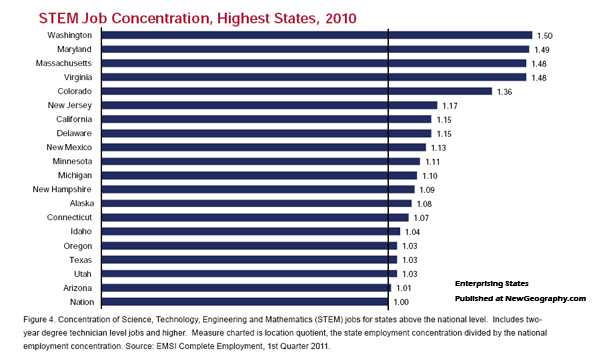
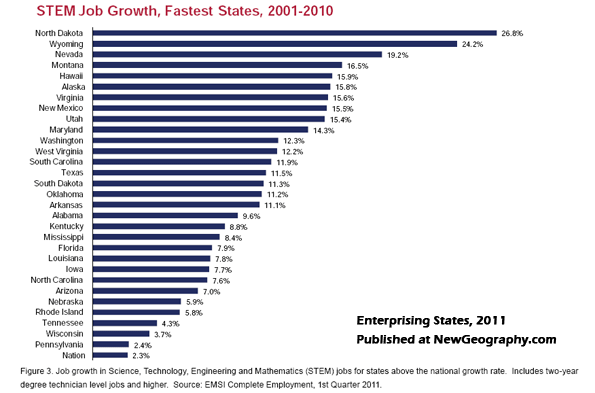
    More interestingly, many of these states have also experienced a surge in STEM—science, technology, engineering and mathematics—related employment. In some states, this has come as a result of continuing state investment in education and training; in most cases, these states have simply tended to create a business-friendly atmosphere for companies of all sorts. They have also generally kept housing costs low, something critical to young families.

    Perhaps the best way to look at our evolving economy is not so much from the point of view of companies or industries, but of individuals. States often focus on their largest employers, but those companies have been cutting jobs for the past decade. Since 2000, large corporations—which employ roughly one-fifth of American workers— have stopped hiring, as they did in the previous decade, and actually reduced their payrolls by nearly three million while adding 2.4 million jobs abroad.

    Andrei Cherny, an Arizona Democrat writing in the journal Democracy, suggests that “both progressives and conservatives have offered little in the way of new answers as their long-held orthodoxies run headlong into new realities.” Cherny admits that the stimulus and the Fed’s strategy of loose money—what he calls “government by hot check”—failed to address the needs of the nation’s large class of small entrepreneurs.

    Left out of the equation are the small businesses that, according to the Bureau of Labor Statistics, employ half of all workers and create 65 percent of all new jobs. Most of these firms are small, under-capitalized, and run by single proprietors or families.

    In this environment, notes economist Ying Lowery, “Business creation is job creation.” The states that will do best are those that create the conditions to lure and retain those who start companies or who are selfemployed. Policies that target managers of hedge funds, venture firms, or large corporations have their place, but the real action—particularly in a world of ever-changing technology and declining long term employment—lies in the movement of individuals.

    Under these conditions, where individuals migrate or decide to settle will have a critical impact on which states or regions grow. Three dynamic population segments— educated workers, immigrants and downshifting boomers—illustrate the factors that drive their migration patterns. In many ways they represent the “canaries in the coal mine”; where they go is generally where the air is good for entrepreneurship.

    The movement of educated workers has become a much discussed topic among pundits and economic developers in recent years. One common assumption is that “the best” migrants tend to move to “hip and cool” locales, generally on one of the coasts. These workers then form the core of growing industries and, more importantly, new ones. Yet the evidence tells a somewhat different, perhaps surprising, story. An analysis of recent Census data on the migration of educated workers finds that the biggest net growth has taken place not in New York, San Francisco and Boston, but in places like Nashville, Houston, Dallas, Austin, and Kansas City. Indeed, many of the leading “creative class” states, notably California, Massachusetts and New York, fared considerably worse than regions in states such as Missouri, Kansas, Texas and Tennessee in terms of net migration numbers.

    These location choices have to do with how individuals make decisions: people move primarily for reasons related to jobs, family, and housing. An analysis of the migration of educated workers, for example, reveals that, for the most part, these workers are moving away from expensive, dense regions to more affordable, generally less dense places. This migration also tends to parallel moves to those states that generally impose fewer regulatory burdens on business.

    Perhaps even more surprisingly, we see a similar pattern in minority and immigrant entrepreneurship. These groups now constitute a growing percentage of business startups. Overall, according to the Kauffman Foundation, foreignborn immigrants in 2010 constituted nearly 30 percent of all new businesses owners, up from 13.4 percent in 1996. This has also been the one outstanding segment of the population whose entrepreneurship rate has grown throughout the current recession.

    As with the case of educated migrants, minority entrepreneurs tend to establish themselves in less expensive, more business-friendly, and generally less heavily regulated metropolitan regions. A recent survey of minority migration and self employment by Forbes found that the best conditions for non-white entrepreneurs were in metropolitan areas in Georgia (Greater Atlanta), Tennessee (Nashville), Arizona (Phoenix), Oklahoma (Oklahoma City), and several Texas cities (Houston, Dallas, San Antonio and Austin). In contrast, most regions in California and the Northeast, outside of the Washington, D.C. metropolitan area, did quite poorly.

    Jonathan Bowles, president of the New York-based Center for an Urban Future, has traced this poor performance to a myriad of factors including sky-high business rents, which stymie would-be entrepreneurs in minority communities. “[Entrepreneurs] face incredible burdens here when they start and try to grow a business,” Bowles suggests. “Many go out of business quickly due to the cost of real estate and things like high electricity costs. It’s an expensive city to do business in without a lot of cash.”

    Boomers are unique compared to traditional senior populations. According to the Kauffman Foundation, they tend to be more likely to start businesses than are younger age groups. In 1996, people between 55 and 64 years of age accounted for 14 percent of entrepreneurs; in 2010 they represented 23 percent.

    Less is known about the migration of aging boomers, a large segment of the population, but evidence so far suggests that they, too, are moving to such states. According to AARP, most boomers prefer to stay close to where they live—mostly in suburbs—or where their children tend to move, that is, to the low-regulation states of the South and West.

    States can draw on these migration patterns in developing their economic policies. Generally, people migrate to states with jobs, and states with population gains generally produce more employment than those with slower growth. Indeed, despite the great disruptions of the mortgage crisis, regions such as Orlando, San Bernardino-Riverside and Las Vegas all recorded double-digit employment gains over the last decade.

    More recent developments suggest that future growth may depend on several critical factors. It is clear, for example, that investments in education—for example in Austin, Raleigh-Durham and parts of the Great Plains—have paid off by attracting both individuals and industries, and have made these areas among the healthiest employment markets in the country. Some of these states have suffered less fiscal distress than states elsewhere in the nation, and have benefited from their educational investment through hard times. Investments in community colleges may prove to be particularly essential, since their role in providing skilled workers has been critical in many states.

    States that have invested in new infrastructure such as ports, airports, roads and improved transit tend to have a leg up on others that have failed to do so. Even relatively low-tax states such as Texas have invested heavily in recent years in roads and port facilities, which are critical to industries locating there. Even during the recession, many industries—from manufacturing and environmental firms to health care and information technology—have had trouble hiring skilled workers. States are responding by creating job-oriented training programs in states like Ohio, New York, Tennessee, Washington and Wisconsin, which have all established technical institutions separate from community colleges. Tennessee alone has 27 such “technical centers” offering one-year certificates for certain jobs.

    Overall, as Delaware Governor Jack Markell has pointed out, businesses generally do not want to eliminate government, but rather want it to be useful for economic growth. Markell, who has done some considerable budgetcutting himself, believes that the focus needs to be on expanding the economy, which will requires improvements not only in schools, but in transportation infrastructure that will make the free market work better.

    Perhaps even more important has been creating a favorable business climate. California, for example, possesses the greatest basic economic attributes of any state: a mild climate, location on the Pacific Rim, a world-class university system, and a legacy of strong infrastructure investment. Yet today, despite the presence of leading global industrial zones such as Hollywood and Silicon Valley, as well as the country’s richest agricultural sector, California’s unemployment remains well above the national average and job growth has remained relatively tepid. After many years in denial, even some of the state’s most progressive politicians realize that something is amiss. In a remarkable development, for example, California leaders including Lieutenant Governor Gavin Newsom recently visited Texas to learn from the large state that has fared best during the long recessionary period. Given the political gap between Californians like Newsom, a former mayor of San Francisco, and Texas Governor Rick Perry, this represents something of a “Nixon in China” moment.

    This is not to say that California, or any other state, should draw its economic policy from another state. Those states that attempt to use tax incentives to “lure” industries with no overwhelming need to relocate — as shown in recent findings about Illinois incentives to movie-makers — are often disappointed. In many cases, the incentive game becomes a classic “race to the bottom,” in which the benefits of new jobs often prove transitory. Since the 1990s, just two percent of job growth and decline has been due to businesses relocating across state borders, yet the costly practice of using unfocused tax expenditures to poach companies continues.

    Nor can states reliably predict which industries will need more workers over the long term. In the 1990s, economist Michael Mandell predicted that cutting-edge industries like high-tech would create 2.8 million new jobs; in reality, notes a 2010 New America Foundation report, they actually shed 68,000.30 Each state and each region has its own peculiar economic DNA. States with exportable products—for example the Great Plains or the Upper Midwest—may need to focus on ways to get their output efficiently to market. Already affordable, they may also choose to increase their attractiveness to high value-added companies and educated individuals by boosting their education systems and making their metropolitan regions more congenial to well-educated migrants.

    In other states such as New York or Massachusetts, the economy is focused on intangible exports like financial services and software. Making themselves more affordable for both individuals and companies may be the best way for states to improve competitiveness. Over the long term, no state economy can sustain its people if it only focuses on the “luxury” sectors; the large number of unemployed and underemployed workers will drain state resources. As those state resources become more limited, decisions about how to structure tax incentives or where to place education and infrastructure investments must be based upon a deep understanding of this economic DNA. Strategic investments will limit wasteful spending and maximize impact in the economic sectors where a state is most likely to grow.

    Ultimately, there is only one route to sustainable state economies, and that is through broad-based economic growth. The road to that objective can vary by state, but the fundamental goal needs to be kept in mind if we wish to see a restoration of hope and American optimism about the future.

    Read the full report, including highlights of top performing states and profiles of job creation efforts in all 50 states.

    Praxis Strategy Group is an economic research, analysis, and strategic planning firm. Joel Kotkin is executive editor of NewGeography.com and author of The Next Hundred Million: America in 2050
  • The Evolving Urban Form: Shanghai

    According to the results of the 2010 census, Shanghai’s population was nearly 1,000,000 people more than had been projected by local authorities. The provincial level of jurisdiction grew from a population of 16.4 million in 2000 to 23.0 million in 2010. Shanghai is one of the world’s fastest growing megacities (urban regions of more than 10 million population). Shanghai’s 6.6 million population growth equals the strong growth of the Manila urban region over the same period but trails the 7.4 million growth in the Jakarta urban region. Shanghai modestly extended its lead over Beijing as China’s largest urban region, where the growth over the same period was 5.8 million.

    As is typical of urban regions around the world, Shanghai’s population gain was concentrated outside the core, in suburban and exurban areas (see table at bottom). A map of Shanghai’s districts can be seen here.

    Suburban Growth: The nine suburban districts grew 69% between 2000 and 2010. The suburban areas grew from 9.5 million in 2000 to 16.0 million in 2010, adding the equivalent of the population of greater Toronto, Dallas-Fort Worth or the Rhine-Ruhr (Essen-Dusseldorf). The suburbs dominated growth, with 99.2% of the population gain

    Sonjiang, to the west of Honquiao airport grew the most, adding nearly 150% to its population. Pudong, a huge district that extends from the new edge city development across the Huangpu River from downtown all the way to Pudong Airport on the Yangtze River added 1.9 million people and now has a population exceeding 5 million (Note).


    Pudong Business District

    The Inner Core: The inner core is the all of the famous Bund, with its Western-style commercial architecture along the Huangpu River and Shanghai’s best known shopping street, Nanjing road. The three districts of the inner core all lost population. Overall, the inner core population dropped from 1.209 million to 926,000, a decline of 23%. This may seem surprising, in view of the large number of high-rise condominium buildings that have been constructed in this area. However, these buildings typically replaced higher density low rise development that was generally not up to modern standards. The inner core has a population density of 119,400 people per square mile (46,100 per square kilometer), down from 155,700 per square mile (60,100 per square kilometer) in 2000. Even so, the inner core retains a population density more than 50% above that of either Manhattan or the ville de Paris. 


    Toward Nanjing Road

    The Outer Core: The six districts of the outer core gained 6%, increasing from 5.723 million to 6.060 million people. Two districts sustained minor losses and another three made modest gains. The district of Putuo was the exception, gaining 23%. The outer core districts had a population density of approximately 60,100 per square mile, or 23,200 per square kilometer in 2010.

    Overall, the entire core grew 0.8% and accounted for 0.8% of the growth in the jurisdiction. The population density was approximately 64,000 per square mile or 25,000 per square kilometer.

    Urban and Rural Shanghai: Overall, Shanghai covers approximately 2,445 square miles (6,333 square kilometers), a land area somewhat more than that of the Statistics Canada defined Toronto metropolitan area (2,279 square miles or 5,901square kilometers). However, Shanghai’s population is nearly four times that of the Toronto area. Even so, Shanghai’s rural population remains at approximately 3,000,000 people.

    Based upon the new census count, it is estimated that the population of the urban area is approximately 20,000,000. The suburban areas, inside the urban area but outside the core are estimated to have a population density of 10,600 per square mile or 4,100 per square kilometer, well below the density of the core. Even so, this suburban density is well above that of all but a few of the urban areas of Western Europe. The suburban areas include a number of undeveloped areas that are completely surrounded by urbanization.

    Decentralized Employment: Shanghai has also developed a decentralized employment base, despite having one of the world’s largest central business districts, with 1.25 million jobs. By comparison, Manhattan has approximately 1,750,000 jobs south of 59th Street, while Tokyo has approximately 4,000,000 jobs inside the Yamanote Loop. The central business district has approximately 15% of Shanghai’s employment.

    Shanghai’s Urban Expansion: Shanghai continues to expand in virtually every direction. It is likely that Shanghai’s urbanization will mean that of Kunshan, an urban area of nearly 1.5 million people located in the Suzhou Prefecture of Jiangsu. In addition, the urbanization is also likely to soon meet that of Taicang, another urban area in Suzhou that has a population of approximately 500,000.  At least one of Shanghai’s Metro lines is planned to be extended to Taicang.

    Shanghai’s urbanization is also poised to spill across the border into the province of Zhejiang. Development is also spreading to the east and southeast in Pudong, including Lingang, which will eventually have 1 million residents. The ocean will prevent further expansion in this direction. Lingang is the point from which a 17 mile (28 kilometer) long bridge crosses one-half of Hangzhou Bay Bridge to Shanghai’s new island port, the largest in the world.

    Shanghai exhibits the same trends that are evident in other world megacities. Like Seoul and Mexico City, the inner core population density is falling. And like Jakarta, Mumbai, Manila and most other large urban areas in the world, the overall population density is declining even as population growth continues.

    Shanghai: Population by District & County (Qu & Xian)
    2010 Census
    POPULATION            
    Sector Area: Square Kilometers  Population: 2000  Population: 2010 Population: Change 2000-2010 % Change % of Growth
    INNER CORE 20.1     1,209,000       926,000      (283,000) -23.4% -4.3%
    Huangpu Qu 4.5        575,000        430,000       (145,000) -25.2% -2.2%
    Jing’an Qu 7.6        305,000        247,000         (58,000) -19.0% -0.9%
    Luwan Qu 8.0        329,000        249,000         (80,000) -24.3% -1.2%
    OUTER CORE 261.4     5,723,000     6,060,000       337,000 5.9% 5.1%
    Changning Qu 38.3        702,000        691,000         (11,000) -1.6% -0.2%
    Hongkou Qu 23.5        861,000        852,000           (9,000) -1.0% -0.1%
    Putuo Qu 54.8     1,052,000     1,289,000        237,000 22.5% 3.6%
    Xuhui Qu 54.8     1,065,000     1,085,000          20,000 1.9% 0.3%
    Yangpu Qu 60.7     1,244,000     1,313,000          69,000 5.5% 1.0%
    Zhabei Qu 29.3        799,000        830,000          31,000 3.9% 0.5%
       
    CORE DISTRICTS 281.5 6,932,000 6,986,000 54,000 0.8% 0.8%
       
    SUBURBAN 6,051.1     9,476,000   16,031,000     6,555,000 69.2% 99.2%
    Baoshan Qu 415.3     1,228,000     1,905,000        677,000 55.1% 10.2%
    Chongming Xian 1,041.2        650,000        704,000          54,000 8.3% 0.8%
    Fengxian Qu 687.4        624,000     1,083,000        459,000 73.6% 6.9%
    Jiading Qu 458.8        753,000     1,471,000        718,000 95.4% 10.9%
    Jinshan Qu 586.1        580,000        732,000        152,000 26.2% 2.3%
    Minhang Qu 371.7     1,217,000     2,429,000     1,212,000 99.6% 18.3%
    Pudong Xin   Qu 1,210.4     3,187,000     5,044,000     1,857,000 58.3% 28.1%
    Qingpu Qu 675.5        596,000     1,081,000        485,000 81.4% 7.3%
    Songjiang Qu 604.7        641,000     1,582,000        941,000 146.8% 14.2%
       
    TOTAL 6,332.6   16,408,000   23,019,000     6,611,000 40.3% 100.0%
       
       
    POPULATION DENSITY          
       
    Sector Area: Square Kilometers  Area: Square Miles  Population/ KM2: 2000 Population/ KM2: 2010 Population/ Mile2: 2000 Population/ Mile2: 2010
    INNER CORE 20.1              7.8         60,100         46,100       155,700       119,400
    Huangpu Qu 4.5               1.7        127,800          95,600        331,000        247,600
    Jing’an Qu 7.6               2.9          40,100          32,500        103,900          84,200
    Luwan Qu 8.0               3.1          41,100          31,100        106,400          80,500
    OUTER CORE 261.4           100.9         21,900         23,200         56,700         60,100
    Changning Qu 38.3             14.8          18,300          18,000          47,400          46,600
    Hongkou Qu 23.5               9.1          36,600          36,300          94,800          94,000
    Putuo Qu 54.8             21.2          19,200          23,500          49,700          60,900
    Xuhui Qu 54.8             21.2          19,400          19,800          50,200          51,300
    Yangpu Qu 60.7             23.4          20,500          21,600          53,100          55,900
    Zhabei Qu 29.3             11.3          27,300          28,300          70,700          73,300
    CORE DISTRICTS 281.5           108.7         24,600         24,800         63,700         64,200
    SUBURBAN 6,051.1        2,336.3           1,600           2,600           4,100           6,700
    Baoshan Qu 415.3            160.3            3,000            4,600            7,800          11,900
    Chongming Xian 1,041.2            402.0              600              700            1,600            1,800
    Fengxian Qu 687.4            265.4              900            1,600            2,300            4,100
    Jiading Qu 458.8            177.1            1,600            3,200            4,100            8,300
    Jinshan Qu 586.1            226.3            1,000            1,200            2,600            3,100
    Minhang Qu 371.7            143.5            3,300            6,500            8,500          16,800
    Pudong Xin   Qu 1,210.4            467.3            2,600            4,200            6,700          10,900
    Qingpu Qu 675.5            260.8              900            1,600            2,300            4,100
    Songjiang Qu 604.7            233.5            1,100            2,600            2,800            6,700
    TOTAL 6,332.6        2,445.0           2,600           3,600           6,700           9,300


    —-

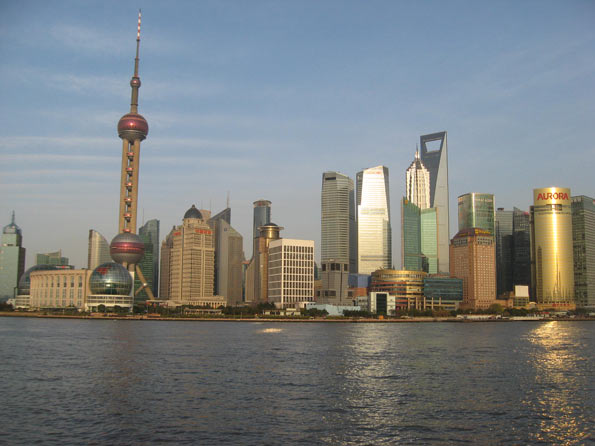
    Lead Photograph: The Bund (all photos by author)

    Note: Pudong includes the large Pudong business district, which is directly across the Huangpu River from the Bund in the central business district. However, Pudong is a relatively new development and was not a part of the urban core. Moreover, Pudong extends far to the east and southeast.

    Wendell Cox is a Visiting Professor, Conservatoire National des Arts et Metiers, Paris and the author of “War on the Dream: How Anti-Sprawl Policy Threatens the Quality of Life

  • The Explosion of Oil and Gas Extraction Jobs

    From Appalachia to Alaska, the growth is eye-popping. Thousands of new jobs have sprouted up, most well-paying and all boons to their regions. There’s no denying oil and gas extraction jobs are on the rise, and not just in Texas and Oklahoma.

    North Dakota is drilling oil at a blistering pace. Pennsylvania and West Virginia, along with parts of New York and Ohio, are seeing a natural gas boom with their Marcellus Shale reserves. And Colorado, Wyoming, Alaska, and other Western states are adding extraction jobs in droves.

    The six fastest-growing jobs for 2010-11, according to EMSI’s latest quarterly employment data, are related to oil and gas extraction. This includes service unit operators, derrick operators, rotary drill operators, and roustabouts. Each is expected to grow anywhere from 9% to 11% this year, in an otherwise stagnant economy.

    But that’s not all. A mixed bag of other extraction and petroleum-related jobs—wellhead pumpers, all other extraction workers, geological and petroleum technicians—are also expected to see healthy gains. In total, nine of the top 11 fast-growing jobs in the nation are tied in one way or another to oil and gas extraction.

    Occupation

    2010 Jobs

    2011 Jobs

    Change

    % Change

    Service unit operators, oil, gas, and mining

    42,110

    46,766

    4,656

    11%

    Derrick operators, oil and gas

    23,323

    25,747

    2,424

    10%

    Rotary drill operators, oil and gas

    28,116

    30,981

    2,865

    10%

    Roustabouts, oil and gas

    75,636

    82,678

    7,042

    9%

    Helpers, extraction workers

    44,303

    47,247

    2,944

    7%

    Petroleum engineers

    29,063

    30,917

    1,854

    6%

    Biomedical engineers

    16,065

    17,061

    996

    6%

    Wellhead pumpers

    24,186

    25,616

    1,430

    6%

    Extraction workers, all other

    23,423

    24,784

    1,361

    6%

    Geological and petroleum technicians

    35,304

    37,205

    1,901

    5%

    What’s driving this employment spike? A push for increased domestic oil production is certainly a factor, as are technology breakthroughs in collecting massive shale gas deposits. But more subtle shifts are also happening, including how federal and state agencies track the oil and gas extraction workforce.

    A Prime Example

    For a case study on the skyrocketing employment picture on the shale front, just look at Pennsylvania. Without a tax on natural gas extraction and perfectly located to take advantage of the Marcellus Shale formation, parts of the commonwealth have become a hotbed for drilling. More than 3,000 wells have been drilled in the last three years, and much more is expected in coming years.

    Since 2008, Pennsylvania has added more than 15,000 jobs in the mining, quarrying, and oil and gas extraction industry, a 41% jump. Only Texas and Oklahoma have added more of these jobs in the last three years. Meanwhile, North Dakota has seen an 80% jump in employment in this sector, second only to Delaware since 2008.

    Where are these well-performing oil and gas jobs located? We mapped the data for the four fastest-growing jobs — roustabouts, service unit operators, derrick operators, and rotary drill operators. Here’s what we found: Texas and Oklahoma of course have a large percentage of these jobs, but California, Alaska, and other Western states have a fair share, too.

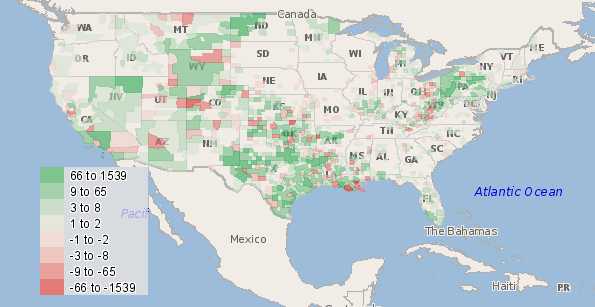
    The map below shows 2-year job growth in these oil and gas extraction jobs for every county in the continental US. Williams County, North Dakota is No. 1 with 1,539 jobs added, which amounts to 80% growth.

    More Than a One-Year Trend

    Mining, quarrying, and oil and gas extraction is expected to grow 6% in the US from 2010-2011. That’s the fastest projected growth among the 20 broadest-level industries—twice the rate in fact, as the next fastest-growing industry (administrative and support and waste management and remediation services,).

    This is hardly a one-year bump, though. Over the last five years, the explosion in the sector has been than staggering—even with a minor employment dip from 2009-2010. The industry added more than 345,000 jobs nationally from 2007 to 2009, and is expected add another 85,000 this year, which equals 11% growth.

    It’s also helpful to break out mining and oil and gas extraction from the broad sector to more specific industries to locate the real driver of the growth. In this case, it’s easy to see: Of the 506,401 new jobs in the sector since 2006, more than 431,000 have been in the crude petroleum and natural gas extraction industry (NAICS 211111). This sub-sector has grown by a whopping 113% nationally in the last six years while mining (except oil and gas) remains at its ’06 employment level.

    Every state except for Maine has added jobs in crude petroleum and natural gas extraction since 2006, with Texas, Oklahoma, California, and Kansas leading the way.

    The Rise of Contract Oil and Gas Workers

    In last month’s GOVERNING Magazine, William Fulton wrote about the “1099 economy”—the shift by employers to hire temporary workers who file a 1099 form with the IRS rather than a W-2 and don’t receive benefits. No other industry has seen this move to 1099 workers more dramatically than mining, quarrying, and oil and gas extraction.

    A recent EMSI analysis revealed that the share of 1099 workers in this sector increased from 33% in 2005 to 53% in 2010, the biggest percentage jump among the 20 broadest-level industries. Mining, quarrying, and oil, and gas extraction now has the third-highest share of contract workers, behind real estate (74%) and agriculture, forestry, fishing and hunting (68%).

    At least part of this influx could be attributed to land owners cashing in on royalties after leasing their property for drilling. Through the quirks of how the Census’ Bureau of Economic Analysis* tracks the oil and gas extraction industry — and how the industry data is tied to occupations — some of these jobs could be counts of landowners who are claiming additional income from oil and gas royalties. If that’s the case, these jobs would be better placed in the real estate and leasing industry.

    Please note: For these reasons, EMSI “noncovered” data (i.e., data on 1099 workers plus more traditional state data, etc.) for oil and gas jobs should be treated with caution. Also, the jobs numbers for 2010 are estimates at this point, so it will take more time to see how these trends play out.

    *The Bureau of Labor Statistics measures only workers covered by unemployment insurance and who thereby file a W-2. EMSI’s “complete” dataset adds proprietors and other “noncovered” workers by combining BLS and state data with various Census datasets.

    Joshua Wright is an editor at EMSI, an Idaho-based economics firm that provides data and analysis to workforce boards, economic development agencies, higher education institutions, and the private sector. He manages the EMSI blog and is a freelance journalist. Contact him here.

    Lead illustration by Mark Beauchamp.

  • Education as an Export

    A trade deficit is a negative balance between a nation’s imports and its exports, so a country with a trade deficit is spending more on imports than it is receiving for selling its exports. Is there any more that can be done to reduce this deficit over the course of time? One potential solution the US trade deficit would be to increase the attractiveness of its higher education institutions to international students, and to therefore increase the amount of money coming into the country. Money from abroad that is spent in the US, such as on tourism, or in this case, on education, is considered an export.

    President Obama identified a key element for future growth of the US economy as “exporting more of our goods,” and whilst this is a great way of decreasing the trade deficit, the actual ability of the country to create more manufactured goods or natural resources is fairly limited.
    But the US has a great potential for growth in the services sector, including financial services, licensing fees, entertainment, and telecommunications. Education could be a particularly high earner for the US, if it were prepared to put more money forward to attract international students.

    The US currently has around 691 thousand international students enrolled in higher education, with the tuition fees estimated to total around $13 billion during the 2009-10 academic year. Consider as well the cost of living for international students, and you can see that the economic impact of international students can be a major earner for the country.

    A University of California at Berkeley Center for Studies in Higher Education paper was released in support of the development of US higher education as an export. The Obama administration has set a goal of doubling export growth by 2015. Whilst this is an ambitious target, it is not beyond achievable.

    Increasing higher education for international students makes viable economic sense not only because the service itself is an extremely profitable one, but also because it will help meet future labour market and growth needs of the country, and fulfil “a diplomatic and cultural mission like no other form of trade”. International students can benefit from the experience of a well-organized educational system.

    There have been countries that have recognised this opportunity for growth and acted upon it. Australia, for example, has grown its educational market to attract more international students, although it has recently announced plans to prop up the educational system with a price hike for lower school years. It seems that the demand for Australian education has been on a steady rise, and there has been a corresponding increase in spending and development by higher education institutions. In the opinion of Michael Andrew, Chairman of Australia’s Skills and Innovation Task Force, after recognising the value of international students and scrutinizing the lengthy application process for higher education, Australia expects that the natural growth in interest will not be enough to keep maintain the industry’s economic boom.

    Andrew has highlighted the benefits of a strong educational policy which educates graduates to opportunities of forming strong links with Australian companies that currently operate in their home countries within Asia and India.

    Australia, the US and Canada would certainly benefit from working harder to encourage learning in industries that are suffering a skills shortage. Foreign students provide what’s been accurately called a ‘rich talent pool’ for industries that these countries have failed to utilize effectively.

    America and Canada differ from Australia in that their markets for labour are already quite saturated, so pushing education as an export and the advantages it can bring to the economy can be overlooked as an investment into future economic development.

    Exporting education can benefit the US in a way that not many other services can, by monetary gain, as well as by continual benefits should international students stay to ply their trades. And even those who don’t remain in the US will thereafter be advocates of the US educational system, and may inspire future generations to learn in the US. Finally, there will always be opportunities for the students to work in their own countries but under US corporations.

    Whether or not the Obama Administration will meet the targets they have set by positioning education as an export is another question in its own right. The US can not expect to grow this lucrative industry without further pushes to attract foreign students looking to learn at the higher education establishments of America.

    Either way, they are on the right track, and are onto how much of an advantage they have over other nations in the education system they can offer. With the right development and marketing, education, sold as an export, could grow to become one of the United States’ highest earners.

    Andy studied International Economics at University but now works as a freelance Search Engine Optimizer and travel advisor for All Inclusive Holidays provider Tropical Sky. Comment here or follow him on his twitter @andym23

    Photo by Evive: International Student Week

  • California’s Green Jihad

    Ideas matter, particularly when colored by religious fanaticism, wreaking havoc even in the most favored of places. Take, for instance, Iran, a country blessed with a rich heritage and enormous physical and human resources, but which, thanks to its theocratic regime, is largely an economic basket case and rogue state.

    Then there’s California, rich in everything from oil and food to international trade and technology, but still skimming along the bottom of the national economy. The state’s unemployment rate is now worse than Michigan’s and ahead only of neighboring Nevada.  Among the nation’s 20 largest metropolitan regions, four of the six with the highest unemployment numbers are located in the Golden State: Riverside, Los Angeles, San Diego and San Francisco. In a recent Forbes survey, California was home to six of the ten regions where the economy is poised to get worse.

    One would think, given these gory details, California officials would be focused on reversing the state’s performance. But here, as in Iran, officialdom focuses more on theology than on actuality.   Of course, California’s religion rests not on conventional divinity but on a secular environmental faith that nevertheless exhibits the intrusive and unbending character of radical religion.

    As with its Iranian counterpart, California’s green theology often leads to illogical economic and political decisions. California has decided, for example,  to impose a rigid regime of state-directed planning related to global warming, making a difficult approval process for new development even more onerous.  It has doubled-down on climate change as other surrounding western states — such as Nevada, Utah and Arizona — have opted out of regional greenhouse gas agreements.

    The notion that a state economy — particularly one that has lost over 1.15 million jobs in the past decade — can impose draconian regulations beyond those of their more affluent neighbors, or the country, would seem almost absurd.

    Californians are learning what ideological extremism can do to an economy. In the Islamic Republic, crazy theology leads to misallocating resources to support repression at home and terrorism abroad. In California green zealots compel companies to shift their operations to states that are still interested in growing their economy — like Texas. The green regime is one reason why CEO Magazine has ranked California the worst business climate in the nation.

    Some of these green policies often offer dubious benefits for the environment. For one thing, forcing California businesses to move to less energy-efficient states, or to developing countries like China, could have a negative impact overall since shifting production to Texas or China might lead to higher greenhouse gas production given California’s generally milder climate.   A depressed economy also threatens many worthy environmental programs, delaying necessary purchases of open space and forcing the closure of parks. These programs enhance life for the middle and working classes without damaging the overall econmy.

    But people involved in the tangible, directly carbon-consuming parts of the economy — manufacturing, warehousing, energy and, most important, agriculture — are those who bear   the brunt of the green jihad. Farming has long been a field dominated by California, yet environmentalist pressures for cutbacks in agricultural water supplies have turned a quarter million acres of prime Central Valley farmland fallow, creating mass unemployment in many communities.

    “California cannot have it both ways, a desire for economic growth yet still overregulating in the areas of labor, water, environment,” notes Dennis Donahue, a Democrat and mayor of Salinas, a large agricultural community south of San Jose. Himself a grower, Donahue sees agricultural in California being undermined by ever-tightening regulations, which have led some to expand their operations to other sections of the country, Mexico and even further afield.

    Other key blue collar industries are also threatened, from international trade to manufacturing. Since before the recession California manufacturing has been on a decline.  Los Angeles, still the nation’s largest industrial area, has lost a remarkable one-fifth of its manufacturing employment since 2005.

    California’s ultra-aggressive greenhouse gas laws will further the industrial exodus out of the state and further impoverish Californians.  Grandiose plans to increase the percentage of renewable energy in the state from the current unworkable 20% to 33% by 2020 will boost the state’s electricity costs, already among the highest in the nation, and could push the average Californian’s bill up a additional 20%.

    Ironically California, still the nation’s third largest oil producer, should be riding the rise in commodity prices, but the state’s green politicians seem determined to drive this sector out of the state.. In Richmond, east of San Francisco, onerous regulations pushed by a new Green-led city administration may drive a huge Chevron refinery, a major employer for blue collar workers, out of the city entirely. Roughly a thousand jobs are at stake, according to Chevron’s CEO, who also questioned whether the company would continue to make other investments inside the state.

    Being essentially a religion, the green regime answers its critics with a well-developed mythology about how these policies can be implemented without economic distress.  One common delusion in Sacramento holds that the state’s vaunted “creative” economy — evidenced by the current bubble over   surrounding social media firms — will make up for any green-generated job losses.

    In reality the creative economy simply cannot  make up for losses in more tangible industries. Over the past decade, as the world digitized, the San Jose area experienced one of the stiffest drops in employment of any of the 50 largest regions of the country; its 18% decline was second only to Detroit.  Much of the decline was in manufacturing and services, but tech employment has generally suffered. Over the past decade California’s number of workers in science, technology, engineering and math-related fields actually shrank. In contrast, the country’s ranks of such workers expanded 2.3% and prime competitors such as Texas , Washington and Virginia enjoyed double-digit growth.

    So who really benefits from the green jihad? To date,  the primary winners have been crony capitalists, like President Obama’s newly proposed commerce secretary, John Bryson, who built a fantastically lucrative  career (he was once named Forbes’  “worst valued chief executive”) while  running the regulated utility Edison International. A lawyer by training, Bryson helped found the green powerhouse National Resources Defense Council. He’s been keen to promote strict  renewable energy  standards  that also happen to benefit solar power and electric car companies in which he holds large financial stakes.

    Other putative winners would be large international companies, like Siemens, that hope to build California’s proposed high-speed rail line, the one big state construction project favored by the green-crony capitalist alliance. Fortunately , the states dismal fiscal situation and  rising cost estimates for the project, from $42 to as high as $67 billion, as well as cuts in federal subsidies, are undermining support for this project even among some liberal Democrats.  Even in a theocracy, reality does, at times, intrude.

    Finally, there are the lawyers — lots of them. A hyper-regulatory state requires legal services just like a theocracy needs mobs of mullahs and bare knuckled religious enforcers. No surprise the number of lawyers in California increased by almost a quarter last decade, notes Sara Randazzo of the Daily Journal. That’s two and a half times the rate of population growth.

    The legal boom has been most exuberant along the affluent coast.  Over the past decade, the epicenter of the green jihad, San Francisco, the number of practicing attorneys increased by 17%, five times the rate of the city’s population increase. In the Silicon Valley, Santa Clara and San Mateo counties boosted their number of lawyers at a similar rate. In contrast, lawyer growth rate in interior counties has generally been far slower, often a small fraction of their overall population growth.

    If California is to work again for those outside the yammering classes, some sort of realignment with economic reality needs to take place.  Unlike Iran, California does not need a regime change, just a shift in mindset that would jibe with the realities of global competition and the needs of the middle class. But at least with California we won’t have to worry too much about national security: Given the greens anti-nuke proclivities, it’s unlucky the state will be developing a bomb in the near future.

    This piece originally appeared at Forbes.com.

    Joel Kotkin is executive editor of NewGeography.com and is a distinguished presidential fellow in urban futures at Chapman University, and an adjunct fellow of the Legatum Institute in London. He is author of The City: A Global History. His newest book is The Next Hundred Million: America in 2050, released in February, 2010.

    Photo by msun523

  • Wind Energy is Not Just Hot Air

    Anaheim Convention Center, Southern California, last week was a hot bed of one of the ultimate forms of renewable energy. The “fuel” used by wind turbines (really the wind) is free for the 30 year life span of the windmill installation, is considered inflation proof, and is 100 % domestically available.

    Just a brief walk through the trade exhibition convinces any visitor of European as well as Chinese commitment to wind energy. One guest speaker, Ted Turner put it: “Just do not look at the next 30 years, look for at least a few hundred years of human energy needs.”

    Conventional energy lobbyists claim that wind is unreliable and will harm operation of the grids. However, grid operators have observed that wind power is more reliable and predictable.

    There are rumors that sound of operating wind will cause a variety of dangerous health effects, including headaches and disturbed sleep. The studies have shown that wind turbines at a distance of 2,000 feet (normal building codes for Wind Mills) have a dB rating close to 45 (comparing that to 55 in an average home in the USA). Normally, two people can carry on a conversation on any wind mill farm. Please remember: this energy source has no side effects such as air or water polluting emissions, no hazardous waste, and has a direct impact on reducing the public health impact of any other energy generation.

    Are birds get affected by wind energy? A very legitimate question by the American Bird Conservancy needs to be addressed with honesty. The bird loss caused by buildings is about 550 million, by power lines 130 million, vehicles 80 million, poisoning by pesticide 67 million, and radio and TV towers close to 4 million. The tabulated loss by wind is under 150,000. Special attention is being paid to bats: The bats and wind energy coalition was formed in 2003 by Bat Conservation International, the U.S. Fish and wild life Service, and the National Renewable Energy Laboratory.
    The view of a wind energy facility or the distance of a home from a wind mill farm had no consistent, measurable or significant impact on home values.

    The current worldwide installed capacity gives a snap shot of Wind energy penetration in a given region. By 2010, the European Union was leading the world with 84,000 MW, China with 42,000 MW and the USA was at 40,000 MW. However, Denmark leads the world as percentage of total power needs fulfilled by Wind Energy: close to 20 % in 2010.

    The potential of up to 20 % electricity generation that can be derived from Wind Energy is feasible, both technically as well as financially by 2030. Most land used to construct wind farms can be used for its original purpose of harvesting, grazing and farming. The actual foot print of turbine farms, roads and generating and transmitting facilities is under 3 percent of total land taken out of commission.

    Wind Energy should be debated in the public forum with both energy independence and long term sustainability for our planet beyond the next election cycle.

  • Transportation Infrastructure: Yankee Ingenuity Keeps California Moving

    A friend was explaining some philosophy to me the other day and he used an analogy to make his point: If you can get a cannibal to use a knife and fork, is that progress? Of course, the answer is "no". So when I heard the next day that transportation infrastructure performance in the US improved significantly at the height of the worst recession since the great depression I had to ask: is that progress?

    We do not want to stop all economic progress just so that a privileged few with access to resources may enjoy an easier ride on the I-95 interstate highway between Wall Street and Congress. Stopping economic growth is not a solution to the problem of crumbling infrastructure in America.

    In fact, my economic analysis shows that transportation infrastructure is a “leading indicator” of economic activity. In other words, infrastructure performance has to improve for a while – and stay improved – before economic activity will pick up in an area. Alternatively, infrastructure performance would have to decline for a while before businesses would leave that location, too. Think about it this way. From the perspective of a company already in business in a particular location, they would not pack up and leave town the first day that, for example, traffic congestion slows down the delivery of products to their customers. Companies like FedEx Freight plan distribution locations 20 years in advance. For a while, they will find a way around congestion. FedEx Freight uses elaborate technology to “route trucks around huge bottlenecks, but this adds circuitous miles and costs”. Their policy is to “minimize the impact as best you can.”

    We see evidence of how business finds a way to make it work even when government and infrastructure try to stand in their way. California ranked 43rd in 1995 and fell further to 47th in 2000 and 2007 among the 50 states (plus D.C.) in the U.S. Chamber of Commerce’s transportation infrastructure performance index. Although California’s infrastructure is crumbling, businesses are finding a way to work around it. California’s economy could grow faster than the rest of the US economy this year.

    In economics we talk about the efficient use of resources – getting the most out of what you have to work with. In a new study getting underway at the University of Delaware, early results indicate that businesses are operating successfully in the United States despite being hampered by problems like congestion and the lack of intermodal-connectivity (that is, being able to move products from trucks to trains and from trains to ships). California, in fact, may be a benchmark state for economic efficiency. They rank at the bottom for infrastructure performance but business is finding a way to make it work.

    My old pal, Larry Summers – former Economic Advisor to President Obama and subverter of all things economic – took a last final swipe at spending on transportation infrastructure in April 2011. In his first public appearance at Harvard University after leaving the White House, he talked about investment in infrastructure as a way to “…tackle high levels of unemployment, especially among the low-skilled.” He just doesn’t get it. He continues to believe that the way to stimulate the economy is to give tax breaks to business – as if they will build their own roads. He just didn’t get that infrastructure is what supports all economic activity. It’s the stuff that business does business on, not the classical economic “capital” that business brings to the table.

    In fact, it costs businesses to have to work around the crumbling infrastructure. When you ask academic, government and researchers to measure that cost, you get a wide range of views about what constitutes a direct or an indirect cost to business from traffic congestion. But some of these costs are undeniable. There is a cost of computer technology for monitoring congestion; the cost of employees for communicating with drivers about alternate routes; the cost of extra fuel; driver overtime resulting from congestion; refunds to customers for missing guaranteed delivery deadlines, etc. etc.

    So, there’s a benefit to business from improving the performance of transportation infrastructure. They will be saving the money that they are spending now to work-around the infrastructure. And money not spent is at least as good as a tax break.

    Disclosure: Dr. Trimbath’s research on the economic impact of transportation infrastructure performance was supported by the National Chamber Foundation and sponsored in part by FedEx Freight. The 2009 Transportation Performance Index will be released on July 19, 2011 in Washington, D.C. It will show a substantial improvement over 2008.

  • Inside Sydney’s Central Business District: the Retail Core

    World famous for its beautiful harbour setting, Sydney’s Central Business District is undergoing a resurgence. As the hub of Australia’s finance sector, it stumbled during the global crisis. Office vacancies jumped from 5.7 per cent in early 2008 to 8.8 per cent in mid 2009, despite stable supply. Ultimately, though, Sydney was spared the worst, owing to its rise as a staging post for trade and investment in the Asia-Pacific region, which averted the havoc of Europe and North America. Recovery is now underway, if slowly. White-collar employment is picking up and the vacancy rate is down to 7.3 per cent. Landlords are again celebrating the prospect of rising rents.

    But there’s a bigger story. This revival is happening amid some notable trends. Post-crisis, the CBD’s functional map is being redrawn by a wave of Asian and other visitors and investors, prominently listed property trusts and pension funds looking for a safe haven, the spatial demands of a transformed white-collar workplace, intensive residential development on the CBD fringe and officials pushing flashy “green” projects. There’s no doubting the importance of these developments, or that they will be hyped by inner-city based media.

    In fact, central Sydney has been losing economic clout, in relative terms, to the periphery or suburban hinterland for some time, a polycentric trend observed in other countries. Between the 1981 to 2001 censuses, encompassing the most active period of economic liberalisation in Australia’s history, Sydney’s general population growth was 23 per cent, while outer areas in Greater Western Sydney grew by 38 per cent. The CBD’s share of Sydney’s jobs shrunk from around 30 per cent to 9 per cent during this period. Four of the five strongest growing Local Government Areas (LGAs) in the year to 30 June 2009 were still in the outer west: Blacktown, Parramatta, The Hills Shire and Liverpool.

    The latest wave of change will prove significant and long-lasting, but the CBD isn’t destined for a return to metropolitan supremacy.

    Sydney CBD
    Sydney CBD

    The retail core

    For theorists of the CBD, peak land value intersection (PLVI) is a pivotal concept. This is the centrally-located point, usually at the intersection of two thoroughfares, where land values are highest. Without doubt, Sydney’s PLVI is the intersection of George and Market Streets. George Street is the CBD’s spine, traversing a north-south axis from Circular Quay to Central Station. Historically, Market Street was the critical entry route from the west, extending from the defunct Pyrmont Bridge (over Darling Harbour), and now from a branch of the Western Distributor. Blocks surrounding the PLVI are typically occupied by upscale department stores, absorbing peak land prices with high turnover of quality goods on multiple floors. Thus Myer and Gowings stores occupy the north-east and south-east corners respectively, and David Jones a site further east along Market Street (the Gowings site is earmarked for refurbishment as a boutique hotel). The iconic Queen Victoria Building arcade sits on the south-west corner.

    According to the “core-frame model”, another tool of CBD theory, activities competing for the highest rents, like upmarket retail and superior grade office towers, concentrate in core blocks, while marginal activities disperse to peripheral blocks. In terms of the theory, the latter are a “zone in transition”, at an intermediate stage between lower grade building stock and future redevelopment. Activities like low-end retail, fast-food, novelty shops, pawnbroking, wholesaling, storage, off-street parking, warehousing and light-manufacturing locate there.

    Traditionally, Sydney’s CBD had a retail core around the PLVI bounded by York, Park, Elizabeth and King Streets, south of an office core bounded by King, Clarence and Macquarie Streets and Circular Quay. Judging by the headlines, the retail core is Sydney’s biggest news. Long a feature of suburban life, the CBD is being transformed by the arrival of mall-style shopping, adding to the mix of department stores, arcades and stand-alone shops. In some ways, it’s catching up with the social evolution of shopping as a “complete experience” linked to identity formation.

    The catalyst is Westfield’s $1.2 billion development at the corner of Pitt Street Mall and Market Street, just a block east of the PLVI. A pedestrianised section of Pitt Street between King and Market Streets (not a regular mall), Pitt Street Mall is the retail core’s epicentre. Last year, global real estate firm CB Richard Ellis (CBRE) rated it the second most expensive street for retail rents in the world. The first was New York’s Fifth Avenue.

    With rents so high, investment dollars are pouring in. Fronting the eastern side of Pitt Street Mall, Westfield’s contemporary glazed-glass structure, box-like at street level but topped by Sydney Tower, converts four properties into 93,000 square metres of retail space, distributed over a six-storey shopping mall. The first stage opened last October. On completion, it will house 330 flagship and specialty fashion outlets, and lifestyle stores, most of them international brands, including Sydney firsts Versace, Gap, Zara and Miu Miu, together with several eateries. Two skybridges link the complex to nearby Myer and David Jones department stores.

    Westfield’s opening coincided with a general revamp of Pitt Street Mall, featuring landscaping, paving and tree-planting by Sydney City Council, and reconstruction of the mall-like Mid-City Centre, 52 shops on four-levels fronting the Mall’s western side, almost opposite Westfield, penetrating west to 420 George Street. One Mid-City store, jewellery retailer Diva, is reputedly paying the highest rent in the CBD, $13,500 per square metre a year.

    Pitt Street Mall’s face-lift set off a reshuffle of fashion and luxury goods retailers around the retail core, with knock-on effects all the way up George Street. Burberry is moving to refurbished premises at 343 George Street, Louis Vuitton to a new flagship store on the corner of King and George Streets, Dior to Castlereagh Street, and Zegna and Prada to Westfield, from Martin Place. This follows the 2008 opening of the world’s largest Apple store, at glass-clad 367 George Street (roughly opposite Mid-City at 420).

    Pitt Street Mall
    Pitt Street Mall

    A sign that the retail core may be busting out of its old confines, and creeping north of King Street, major retail developments are planned in the vicinity of Wynyard railway station, at 301, 333 and 383 George Street. Some of these anticipate the most striking proposal yet: a futuristic commercial and residential precinct on the foreshore of East Darling Harbour, or Barangaroo, seeing the retail core spill into the CBD’s rising “western corridor”, which was a "zone in transition" in the days when Darling Harbour and Walsh Bay were working ports. This $6 billion plan includes 30,000 square metres of retail space and a pedestrian walkway to nearby Wynyard, the CBD’s busiest underground station.

    It’s easy to explain such hyperactivity. Sydney is one of a handful of global cities in a developed country which wasn’t flattened by the financial crisis. There’s a clear international dimension to the CBD’s resurgence. According to Cushman & Wakefield’s International Investment Atlas 2011, the Asia-Pacific is dominating global property investment. Ranked eleventh, Sydney joins 6 other Asia-Pacific cities in the top 20. In the 18 months to June 2010, reports CBRE, Sydney ranked fourth in the world in terms of cross-border investment. Foreign investors accounted for 42 per cent of Australia’s property asset acquisitions in the third quarter of 2010, way above the typical level of 10 to 15 per cent. In these conditions, Sydney shot up to ninth out of 65 cities in AT Kearney‘s 2010 Global Cities Index. And a 2010 survey by real estate agents Jones Lang La Salle rated Tokyo and Sydney the most popular Asian cities for investment. At a time when many asset classes carry outsized risks, Australian commercial property is a safe option.

    Of course, there’s nothing new about Asian investment in the retail core. Three of its most fashionable shopping arcades belong to Ipoh Pty Ltd, which is owned by a Singaporean fund manager: the Queen Victoria Building, The Strand Arcade between Pitt Street Mall and 412-414 George Street, and The Galleries, on the corner of George and Park Streets, the core’s southern edge.

    But urban planners would be wrong to overestimate the impact of all this on the wider metropolitan region. Quite clearly, Westfield’s target market embraces a small minority of Sydney’s 4.5 million residents. Commenting on the mall’s opening, the Group’s managing director hoped it would be a “destination for the people of Sydney, and the 26.8 million domestic and international visitors who come to Sydney each year”. The Australian Financial Review, citing Westfield, reported that it will “service not only 240,000 workers in the [CBD], but 1.5 million in the primary trade area across the richest suburbs and the 26 million tourists who visit the city each year”. David Jones’ CEO expressed similar sentiments, saying “my hope is that Sydney’s CBD retail precinct becomes a world-class shopping destination on a par with the world’s best such as Oxford Street, London, and Rodeo Drive in LA”.

    Much of the investment surge is predicated on large numbers of visitors, and the growth of inner-suburbs ringing the CBD. If the travelling patterns of China’s newly cashed-up middle class are any guide, for instance, these hopes won’t be disappointed. The number of Chinese visitors to Australia is forecast to grow by 7.9 per cent a year, reaching 783,000 a year by 2019. Meanwhile, Sydney LGA’s population is ballooning (the CBD and environs). Between 2001 and 2009, it grew by 38 per cent, or 49,000 new residents. Eager to meet the former state government’s target of 55,000 new residential units over the next decade, Sydney Council is presiding over a number high-density projects on derelict industrial or recreational sites. Most of the newcomers will belong to the same demographic as current residents, younger, upper-income professionals with a taste for inner-city living. They are no cross-section of Sydney’s population. Below average in age, their median weekly income is $717, compared to $518 for the whole metropolitan region.

    To an extent, Sydney CBD is exhibiting features of the global city phenomenon, when highly-developed zones “secede” from their hinterland and develop stronger ties to distinct occupational classes and overseas markets. The revitalised retail core is unlikely to lure the vast majority of shoppers — who live and work far from the CBD — away from suburban megacentres like Chatswood Chase, Miranda Fair, Warringah Mall, Castle Towers, Minto Mall, Top Ryde City, Westfield’s other centres at Bondi Junction, Parramatta, Burwood, Hurstville, Hornsby and Penrith, local retail strips, or the growing number of Australians who shop online. Just as suburban malls attract customers from their surrounding feeder population, the same applies to the retail core, but with a higher proportion of domestic and foreign visitors.

    The CBD’s revival shouldn’t be misinterpreted. It doesn’t herald a return to regional primacy. Calls by green-tinged academics and newspaper editors and columnists for billions to be spent on CBD-centric rail networks are wrongheaded. Such plans can only have a distorting and negative effect on economic vitality across the metropolitan region, especially fast growing outer LGAs. Look at the CBD’s story. For all the contemporary rhetoric linking urban success to green amenity, it owes more to plain old capitalism.

    John Muscat is a co-editor of The New City, where this piece originally appeared. 

    Photo by Christopher Schoenbohm.

  • Listing the Best Places Lists: Perception Versus Reality

    Often best places lists reflect as much on what’s being measured, and who is being measured as on the inherent advantages of any locale.  Some cities that have grown rapidly in jobs, for example, often do not do as well if the indicator has more to do with perceived “quality” of employment.

    Take places like Denver and Seattle. Both do well on what may be considered high-tech measurements – bandwidth, educated migration, entrepreneurial start ups – but have trailed other places in terms of creating jobs. Others, such as Oklahoma City and Raleigh, do better in terms of overall job creation and cost competitiveness.

    There are effectively few truly objective criteria, and the Area Development list does tend to weigh a bit heavy on the factors that help more expensive – although not necessarily the most costly – cities. If cost of doing business, or regulatory environments were given more weight, some of the high fliers would not do as well.

    We prefer to focus less on atmospherics and more on how people, and businesses, are voting for their feet. San Francisco and New York have generally had slower job growth and greater outmigration, but do well on lists that focus on perceived qualitative factors.

    But then there is Austin. Here is one region that has it all, the low costs and favorable regulatory climate of Texas along with the amenities associated with a high-tech region. The area creates a large number of jobs of varying types and is still inexpensive enough to attract young, upwardly mobile families. This gives it a critical advantage over places like Silicon Valley, Los Angeles or New York.  Unlike those three centers, Austin performs extraordinarily well in quantitative measurements.

    The region that most closely matches Austin in these respects is not Seattle and Denver, but Raleigh Durham. Recently a group of leaders from Raleigh made a visit to Denver to learn what makes that city successful. Speaking to the group, we pointed out that by objective measurement – job growth, educated migration, population growth – Raleigh beat Denver by a long shot, yet it was to Denver the group was looking for inspiration. In fact, over the past three years, Americans have moved to Raleigh at a rate more than three times that of Denver.  Perception can be a funny thing which makes a winner feel inferior to a clear runner-up.

    Another strange result is that New York and Houston had the same number of mentions. Yet looking at numbers — from educated migration, job growth, population increase — Houston slaughters New York. People, from the college educated on down are flocking to Houston while fleeing, in rather large numbers, from New York. One has to wonder where the rankers live and where they are coming from. Houston triumphs on performance, while New York, to a large extent, wins on perception. 

    Looking simply at job growth over the past ten years for the Leading Locations mentioned on at least five surveys, the 14 regions separate themselves into three groups.  The top tier of places – Austin, Raleigh, San Antonio, and Houston – all have seen job growth of more than 12% and seem to be recovering from the recession faster than the others.  

    Salt Lake City and Charlotte were tracking with the top tier of places until 2007 but have since fallen to the second tier of cities.  The remainder of the second tier includes steady growers Dallas and Lincoln, along with Oklahoma City, a region that has seen a boom in jobs since bottoming out in 2003.

    The final job growth tier of places includes five regions that have fewer jobs than ten years ago.  Seattle drops just below the zero line after being hit particularly hard by the 2001 and 2008 recessions, while New York and Denver finish near the national rate.  Pittsburgh and Boston spent most of the decade below their 2000 employment levels, but each seem to be recovering from the recession faster than many of the other Leading Locations cities. 

    But perhaps the biggest problem with lists has to do with the size of regions. Much of the fastest growth in America, particularly in terms of jobs, has been in small metros, many with fewer than 1 million or 500,000 residents. Smaller dynamic areas such as Anchorage, Alaska; Bismarck, North Dakota; Dubuque, Iowa; or Elizabethtown, Kentucky – all in the top 25 of NewGeography’s Best Cities for Job Growth 2011 Rankings – are too small to show up on some lists yet may be a location of choice for expansion. This reflects not so much their relative desirability but the fact that, unlike larger regions, they simply are not included on many rankings.

    Ultimately, a list of lists does tell us much, but perhaps only so much for a specific individual or business. For someone interested in the movie business, for example, Los Angeles – and increasingly places like New Orleans or Albuquerque – are great draws, but perhaps not so much for financial services.  The lists of lists are useful to identify hotspots, but for most location decisions, it may be more imperative to drill down to more detailed industry sectors and workforce attributes. And most of all, take the perception factor into account and look instead at the real numbers to tell you where to go.

    This piece first appeared at AreaDevelopment.com, as part of its Leading Locations series discussing best cities rankings.

    Joel Kotkin is a Distinguished Presidential Fellow in Urban Futures at Chapman University in California, an adjunct fellow with the London-based Legatum Institute, and the author of The Next Hundred Million: America in 2050. Mark Schill is Vice President of Research at Praxis Strategy Group, an economic research and community strategy firm.  Both are editors at NewGeography.com, a provider of two surveys for Area Development’s Leading Locations list.

    Photo by mclcbooks