Category: Economics

  • The California economy’s surface strength hides looming weakness

    If you listen to California’s many boosters, things have never been so good. And, to be sure, since 2011, the state appears to have gained its economic footing, and outperformed many of its rivals.

    Some, such as Los Angeles Magazine and Bloomberg, claim that it is California — not the bumbling Trump regime — that is “making America great again.” California, with 2 percent job growth in 2016, gained jobs more rapidly than most states. The growth rate was about equal to Texas and Colorado, but behind such growth centers as Florida, Nevada, Oregon, Washington, Utah and the District of Columbia.

    Bay Area: Still the tower of power

    Over the past few years, the Bay Area has grown faster in terms of jobs than anywhere in the nation. But this year, according to the annual survey of the nation’s 70 largest job markets that I do with Pepperdine University public policy professor Michael Shires for Forbes, there is a discernible slowing in the region. For the first time this decade, San Francisco lost its No. 1 slot to Dallas, which, like most other fastest-growing metros, boasts lower costs and taxes, and has created more middle-class jobs than its California rivals.

    The San Francisco area, which includes suburban San Mateo, remains vibrant. More troubling may be the weakening of the adjacent San Jose/Silicon Valley economy, which dropped six places to eighth — respectable, but not the kind of superstar performance we have seen over the past several years.

    This partly reflects an inevitable slowdown in information job growth. As the startup economy has stalled, and the big players have consolidated their dominance, sector growth has dropped from near double digits to well under half that. Perhaps more telling has been a shift in domestic migration, which was positive in San Francisco earlier in the decade, but has now turned sharply negative. These are clear signs of a boom that is cooling off.

    Read the entire piece at The Orange County Register.

    Joel Kotkin is executive editor of NewGeography.com. He is the Roger Hobbs Distinguished Fellow in Urban Studies at Chapman University and executive director of the Houston-based Center for Opportunity Urbanism. His newest book is The Human City: Urbanism for the rest of us. He is also author of The New Class ConflictThe City: A Global History, and The Next Hundred Million: America in 2050. He lives in Orange County, CA.

    Photo by Todd Jones (Flickr) [CC BY 2.0], via Wikimedia Commons

  • The Best Small and Medium-Size Cities For Jobs 2017

    Much of the U.S. media tends to see smaller cities as backwaters, inevitably left behind as the “best and brightest” head to the country’s mega-regions. The new economy, insists the Washington Post, favors large cities for start-ups and new businesses. Richard Florida has posited the emergence of a “winner take all urbanism” that tends to favor the richest cities, such as New York and San Francisco.

    However this paradigm may reflect cosmopolitan attitudes and rivalries between large cities more than reality, with its complications and nuances. Smaller cities have long been disadvantaged in their ability to attract the most elite companies and Americans on the move, but that may well be changing. Following a post-financial crisis period in which many domestic migrants headed to the big cities, the latest Census data suggests that the flow is now going the other way, with the native born moving to smaller places with between 500,000 and a million people. The new trend in migration, notes the Atlantic’s Derek Thompson, a confirmed big city booster, has been a “great hollowing out,” with Americans leaving places like New York, Los Angeles and San Francisco for the suburbs and less costly, usually smaller cities. (Note that at least in New York’s case, foreign immigrants have been taking their places.)

    To be sure, many smaller towns are suffering, and the bottom of our annual survey of employment trends in America’s 421 metro areas is dominated by them, starting with last place Beckley, W.V.; followed by Johnstown, Pa.; Charleston, W.V.; Weirton-Steubenville, Ohio; and Peoria, Illinois. Yet at the same time small city America — which we define as metro areas with less than 150,000 jobs — accounted for seven of the 10 cities where job growth has been the strongest.

    2017 Best Cities Rankings Lists

    Methodology

    Our rankings are based on short-, medium- and long-term job creation, going back to 2005, and factor in momentum — whether growth is slowing or accelerating. We have compiled separate rankings for America’s 70 largest metropolitan statistical areas (those with nonfarm employment over 450,000), as well as medium-size metro areas (between 150,000 and 450,000 nonfarm jobs) and small ones (less than 150,000 nonfarm jobs), the latter two of which are our focus this week, in order to make the comparisons more relevant to each category. (For a detailed description of our methodology, click here).

    The Utah Model

    What makes for successful smaller cities? There’s no simple formula, but several characteristics loom prominently. One is the extent and quality of its amenities: Many of our top cities are in attractive locations near mountains or the ocean, and tend to be home to colleges and universities. And, almost without exception, they are located in less costly, lower-tax states. Finally, it doesn’t hurt to be relatively close to a bigger urban area and a large airport.

    All these characteristics apply to the best metro area for jobs in 2017 — Provo-Orem, Utah. Located an hour south of Salt Lake City and its big airport, the Provo-Orem area has a population of 603,000 and sits alongside the scenic Wasatch Mountains. It’s home to the well-regarded Brigham Young University. Last year the metro area’s job count expanded an impressive 4.4%, and employment is up 29.2% since 2011. As one might suspect in a college-oriented area, the biggest growth has been in fields that tend to hire educated people, such as business and professional services, in which employment grew 5.8% last year, financial services (up 6.7%) and the information sector (plus 5.8%).

    But Provo is not alone in outstanding job growth in the Beehive State. In addition to its largest metro area, Salt Lake City, which ranks 13th, the small city of Saint George ranks third. Also benefiting from a scenic location in the state’s rugged southwestern corner, it’s less of a college town than a retirement and tourism magnet, which explains much of its 5.7% job growth last year. This was driven in large part by big expansions in health and education, with employment in those sectors up 4.6% last year and some 31.8% since 2011.

    Another Utah superstar is 18th-ranked Ogden-Clearfield. Its 2.9% job growth last year was driven in large part by financial services, with employment up 5.7%, and education and health, up 5.9%.

    So what accounts for one relatively small state that’s home to only 3.1% of the U.S. population placing four cities in the top 20? Among the factors: the nation’s fastest population growth, a highly favorable business climate (Gov. Gary Herbert has made cutting red tape a priority of his administration), a burgeoning tech sector and a Mormon-influenced social culture that seems to encourage citizen engagement in local affairs.

    Other Hot Spots

    The other smaller boom towns are a varied lot, although all share locations in low tax, light regulation states. Some bigger cities — San Francisco, Seattle, San Jose — seem to have found a way to keep growing in higher cost environments, but this does not seem to be the case for smaller cities. Virtually all the small communities in our top 20 — with the exception of No. 8 Fort Collins, Colo., — come from such reddish states as the Carolinas, Texas, Idaho and, of course, Utah.

    Most of the fastest-growing metro areas tend to be in what some have called “amenity regions.” This is certainly the case for Ft. Collins, No. 9 Gainesville, Ga., No. 10 The Villages, Fla., and No. 17 Boise, Idaho. Many of these places, notably the Villages, are attractive to retirees and downshifting boomers while others may also lure young families.

    Yet there are some wide differences among our top small cities. Smaller cities often have very distinctive economies dominated by one or two industries. Sixth-ranked Fayetteville-Springdale-Rogers, a metropolitan area that sprawls between Missouri and Arkansas, is dominated by two forces, Bentonville-based Walmart, and a burgeoning retirement/tourism sector tied to its location in the scenic Ozarks. The area which enjoyed 3.3% job growth last year, and 20.4% since 2011, was paced by an expanding professional and business services sector, up a sizzling 8.0% last year; other dynamic sectors include financial services, up 4.5% last year, as well as the education and health, which grew 4.0%.

    Charleston-North Charleston, which ranked 4th on our list with a 3.2% job growth rate last year and 17.6% since 2011, epitomizes the new dynamic small cities. Not only does the area boast a charming ante-bellum urban core, and some of the country’s best food, it has also become attractive to companies seeking to lower costs. The city is home to Boeing’s 787 Dreamliner assembly plant and to Mercedes-Benz’s $500 million Charleston plant, which will add 1,300 jobs over the next few years. It is also about to house Volvo’s first North American manufacturing plant – a $500 million investment that could add up to 4,000 jobs home. Charleston has also emerged as something of a millennial draw as well, with the largest percentage of residents aged 25 to 34 of any midsized city.

    2017 Best Cities Rankings Lists

    The Future of Smaller Cities

    In contrast to the conventional wisdom, smaller cities may have a brighter future than many expect. Of course, it’s hard to see a rapid turnaround in some deindustrialized cities, particularly in the Midwest. Many energy-dependent cities are down sharply in our ranking from a year ago, including Baton Rouge, La., which dropped 97 places to 191st, and Bismarck, N.D., which plummeted 119 places to 221st. The Trump administration certainly has made noise about helping the energy industry, but the cold reality of the current global oversupply of oil suggests these places won’t be rebounding much in the near term.

    Right now, prospects seem best for amenity rich areas, in part because they appeal to both aging boomer and younger families. The scenic Pacific Northwest is home to many gainers this year, including Olympia-Tumwater, Wash., which gained as impressive 64 places from last year to 21st, Wenatchee, which rose seven spots to 22nd, and Bellingham, which jumped 100 places to 63rd.

    In the South, the attractive coastal city Wilmington, N.C., rose 76 places to 54th, and the Florida beach towns Northport-Sarasota-Bradenton, climbed 28 spots to 35th while Punta Gorda gained 26 places to 39th.

    The future of smaller American cities, in some senses, parallels that of their larger counterparts. Some areas seem positioned for further growth, while many others are stagnating or even dropping. The small city is far from obsolete, with a good number of them poised to expand strongly in the years ahead.

    This piece originally appeared on Forbes.

    Joel Kotkin is executive editor of NewGeography.com. He is the Roger Hobbs Distinguished Fellow in Urban Studies at Chapman University and executive director of the Houston-based Center for Opportunity Urbanism. His newest book is The Human City: Urbanism for the rest of us. He is also author of The New Class ConflictThe City: A Global History, and The Next Hundred Million: America in 2050. He lives in Orange County, CA.

    Dr. Michael Shires primary areas of teaching and research include state, regional and local policy; technology and democracy; higher education policy; strategic, political and organizational issues in public policy; and quantitative analysis. He often serves as a consultant to local and state government on issues related to finance, education policy and governance. Dr. Shires has been quoted as an expert in various publications including USA TodayNewsweekThe EconomistThe Sacramento Bee, San Francisco Chronicle, and LA Times. He has also appeared as a guest commentator on CNN, KTLA and KCAL to name a few.

    Photo by City of St. George (City of St. George) [CC0], via Wikimedia Commons

  • America’s Heartland is Critical to Our Future

    The results of the 2016 presidential election have been ascribed — by the winner’s critics — to racism, hysteria, stupidity, or nostalgia. But what the results most reflected was a looming economic divide. Essentially, Donald Trump won in the parts of the country that grow most of the food, drill for oil and gas, and produce palpable things. The places that went for Hillary Clinton are where intangibles such as media, software, and financial transactions drive the economy.

    Blue America elites denigrate, and even pity, the vast American heartland for its lack of hipness and  dependence on more traditional industries. Inconveniently, however, the vast region located between the Appalachians and the Rockies — and from the Gulf of Mexico to the Canadian border — is also home to roughly half the country’s population and electoral votes.

    Not content merely to attack Trump at every turn, frustrated liberal elites compete with each other to heap scorn on those who voted for him. “These are the folks who think intellectualism is a sign of weakness,” scolds  Gentleman’s Quarterly in a recent piece that calls Trump voters “bigoted morons … who stay willfully ignorant as a point of cultural pride.” Trump voters, adds Salon, should not hope for an industrial revival, since these jobs “are never coming back.” Rather than hope that jobs created by industry will return, one Berkeley economist suggests these voters pack up and move to San Francisco — notwithstanding median housing price approaching $1.2 million.

    Stuff Still Matters

    Yet despite these attitudes, the heartland may yet prove the key to restoring a prosperous and more egalitarian future. As Michael Lind and I show in our new report for the Center for Opportunity Urbanism, heartland-centered industries provide far wider and better-paid work for those without a four-year degree. They also provide more opportunities to blacks and Hispanics, who account for  less than 5 percent of workers in Silicon Valley’s top firms while accounting for 25 percent of those in manufacturing and over 20 percent in the energy sector.   

    Nor are these opportunities disappearing as rapidly as either blue state pundits (or Trump himself) would have us believe. Since 2011, all but 18 of the country’s 70 largest regions, according to Pepperdine University economist Michael Shires, have seen an uptick in industrial jobs. Nor does this trend seem to be fading; openings for new industrial jobs are at the highest level since the onset of the Great Recession.

    Since 2011, nine of the fastest growing industrial areas in the U.S. are in red states, notes Shires. Between 2010 and 2016, the top four – Michigan, Indiana, Ohio, and Tennessee – have accounted for nearly 40 percent of the nation’s new manufacturing jobs.  

    These regions once were fertile ground for Democrats, and could again with a shift in attitude. Allied with trade unions, Democratic candidates took tough stands on international trade and openly promoted expanding manufacturing and energy jobs. Yet, increasingly, the Democratic Party has abandoned these concerns, preferring to talk about putting “coal miners out work,” imposing strict regulation of oil and gas industry growth, and curbing the auto sector. This explains, at least in part, why such states voted against Hillary Clinton in 2016 (while supporting the more populist-themed candidacy of her husband two decades earlier).

    Why the Heartland Matters to the Economy

    Although the industrial workforce has fallen from 10.5 percent to 8.5 percent of all nonfarm employment since 2005, manufacturing contributes to the economy far out of proportion to its shrinking share of employment. In 2013, notes economic historian Lind, the manufacturing sector employed 12 million workers, but generated an additional 17.1 million indirect jobs.  

    Far from being technically regressive, manufacturers also employ most of the nation’s scientists and engineers. Regions in Trump states associated with basic industries — Houston, Dallas-Fort Worth, Detroit, Salt Lake City, Dayton — enjoy among the heaviest concentrations of STEM workers and engineers in the country, far above New York, Chicago and Los Angeles.

    For many communities, manufacturing matters because it creates so much additional output in the rest of the country. Overall, according to the Bureau of Economic Analysis, the multiplier effect for manufactured goods is more than twice that generated by retail, trade, or the professional and business services sector. 

    The contribution of manufacturing to U.S. productivity growth is also disproportionate. From 1997-2012, labor productivity growth in manufacturing — 3.3 percent per year — was a third higher than productivity growth in the private economy as a whole. Manufactured goods also accounted for 50 percent of all exports. By way of contrast, intellectual property payments for services such as royalties to Silicon Valley tech companies and entrepreneurs amounted to $126.5 billion in 2015, which represents less than 6 percent of the $2.23 trillion in total exports that year.

    Finally, there are the natural resource industries, to which the blue state punditry — and unfortunately much of the political class — are largely indifferent, if not openly hostile.

    The Mississippi Basin produces 92 percent of the nation’s agricultural exports by value, as well as most of the feed grains, soybeans, and livestock and hogs produced nationally. Sixty percent of all grain exported from the U.S. is shipped via the Mississippi River through the Port of New Orleans and the Port of South Louisiana.

    The most rapid gains, however, stem from the upsurge in American-produced energy. Now that fracking appears to have turned the corner, the U.S. is on its way to becoming a major exporter of natural gas and petroleum-refined products. And energy jobs pay as well or better than those in the heralded occupations, such as finance, business services and information. Although down from its peak, energy sector employment remains at 2.2 million, well above 2010 levels. Low energy prices and stable sources of supply are among the reasons that industrial firms, including those from abroad, have flocked to large parts of the heartland, notably Texas and Ohio, where energy is a primary generator of high-paying manufacturing employment.

    Last Hope for America’s Middle Class?

    The heartland’s most important contribution may be in providing a new opportunity for the country’s diminishing middle class. An array of scholarship, including a recent study by James Galbraith, a progressive University of Texas economist, has shown that the coastal states have the dubious honor of leading the way in increasing income inequality over the past 15 years. For all their progressive fulminations, cities such as San Francisco, New York and Los Angeles are now the most economically imbalanced in the nation.

    Increasingly, people seeking opportunity are leaving in large numbers from New York or California and heading to places such as Tennessee or Texas. Even traditional large losers of domestic migrants, such as Michigan and Ohio, have seen their out-migration rates drop since 2000. The migration trend has now tipped in favor of the region’s resurgent cities, including Midwestern cities such Des Moines, Indianapolis, Louisville (pictured), and Columbus.

    A critical factor here is the cost of living, particularly housing. In most cities, the price-to-income ratio, called the “median multiple,” is around 3 to 1. This ratio is two or three times higher in the prime regions of California or the Northeast.   

    Perhaps most revealing of the future are changes in youth migration, notably those with college degrees. Research conducted by Cleveland State University suggests a sea change since 2010 in the migration patterns of educated millennials towards heartland cities. In earlier periods the strongest growth did indeed go to hip locals such as San Francisco, San Jose, Washington D.C., Los Angeles and New York. More recently, the big growth has been in such Rustbelt redoubts like Pittsburgh and Cleveland, as well as Sunbelt standouts San Antonio, Houston, and Austin. These trends foreshadow likely migration patterns, and may become more pronounced when the younger cohort begins to start families and seek out homes.  

    These trends suggest that, rather than remaining a hopeless backwater, the heartland could increasingly provide a major contribution to the country’s economic future. These regions may not replace Silicon Valley or Manhattan as generators of hyper-wealth, but seem more likely to offer opportunities for the next American middle class. So, don’t cry for the heartland, or hold it in contempt. Rather than detritus of a fading economy, the middle of America may well hold the key to the future prosperity and American opportunity for the coming decades.

    This piece originally appeared on Real Clear Politics.

    Joel Kotkin is executive editor of NewGeography.com. He is the Roger Hobbs Distinguished Fellow in Urban Studies at Chapman University and executive director of the Houston-based Center for Opportunity Urbanism. His newest book is The Human City: Urbanism for the rest of us. He is also author of The New Class ConflictThe City: A Global History, and The Next Hundred Million: America in 2050. He lives in Orange County, CA.

    Photo by David Grant, obtained via Flickr, using the CC License.

  • Move Over, San Francisco: Dallas Tops Our List Of The Best Cities For Jobs 2017

    Dallas is called the Big D for a reason. Bigger, better, best: that’s the Dallas mindset. From the gigantic Cowboys stadium in Arlington to the burgeoning northern suburbs to the posh arts district downtown, Dallasites are reinventing their metropolis almost daily. The proposed urban park along the Trinity River, my Dallas friends remind me, will be 11 times bigger than New York’s Central Park.

    Here’s something else for them to boast about: the Dallas-Plano-Irving metropolitan area ranks first this year on our list of the Best Cities For Jobs.

    2017 Best Cities Rankings Lists

    It’s a region that in many ways is the polar opposite of the San Francisco and San Jose metropolitan areas, which have dominated our ranking for the last few years. (They still place second and eighth this year, respectively, among the largest 70 metropolitan areas, though San Jose is down sharply from second place last year.)

    Unlike the tech-driven Bay Area, Dallas’ economy has multiple points of strength, including aerospace and defense, insurance, financial services, life sciences, data processing and transportation. Employment in the metro area has expanded 20.3% over the past five years and 4.2% last year, with robust job creation in professional and business services, as well as in a host of lower-paid sectors like retail, wholesale trade and hospitality.

    According to Southern Methodist University’s Klaus Desmet and Collin Clark, Dallas’s success stems in part from the fact that it isn’t looking to appeal to the elite “creative class,” but to middle-class workers and the companies and executives who employ them. Dallas attracts both foreign and domestic migrants, particularly from places like California, where housing is, on an income-adjusted basis, often three times as expensive. This has had much to do with the relocation to the area of such companies as Jacobs Engineering, Toyota, Liberty Mutual and State Farm.

    Methodology

    Our rankings are based on short-, medium- and long-term job creation, going back to 2005, and factor in momentum — whether growth is slowing or accelerating. We have compiled separate rankings for America’s 70 largest metropolitan statistical areas (those with nonfarm employment over 450,000), which are our focus this week, as well as medium-size metro areas (between 150,000 and 450,000 nonfarm jobs) and small ones (less than 150,000 nonfarm jobs) in order to make the comparisons more relevant to each category. (For a detailed description of our methodology, click here.)

    The Rise of Low-Cost Meccas

    Dallas is far bigger (particularly if you add the neighboring 28th-ranked Ft. Worth-Arlington area to the mix) than any of the other metro areas that have prospered by offering cheaper alternatives to coastal cities, with lower taxes and generally more friendly business climates. Among them is No. 3 Nashville-Davidson-Murfreesboro-Franklin, Tenn.

    The metro area has seen rapid job growth, nearly 20.6% since 2011. Last year job growth was across the board, including a 4.1% expansion in manufacturing employment, 5.2% in business professional services, and 2.9% in the information sector.

    Like Dallas, Nashville has become a mecca for companies looking to relocate operations. Some, like UBS, are fleeing the high cost of places like New York or London. Others, like Lyft, are escaping high costs in coastal California. CKE Restaurants, owner of Carl’s Junior and Hardees, is moving operations from coastal California and St. Louis to set up shop in Nashville. All are bringing a diverse new range of jobs to the Music City.

    Other low-cost migration meccas include fourth-place Charlotte-Concord, Gastonia, No. 5 Orlando-Kissimmee-Sanford, and No. 6 Salt Lake City. All boast growing tech centers with rapidly expanding STEM employment, as well as business and professional service growth.

    Boom Towns Get Pricier

    Some thriving metro areas on our list are becoming increasingly expensive, but they still don’t pack the tax and housing punch associated with blue state economies. No. 7 Austin-Round Rock, No. 9 Seattle-Bellevue-Everett and No. 11 Denver-Aurora-Lakewood have been big beneficiaries of the tech boom, and continue to attract migrants from areas like the Bay Area, where housing prices are still twice as high.

    It’s possible for older large cities with strongholds in key industries to generate strong job growth. New York’s population growth in 2016 may be half of what was in 2010, but financial sector job growth and associated professional service firms enable the Big Apple to rank a respectable 25th. Another high-cost area, Boston-Cambridge-Quincy, with its unparalleled concentration of elite colleges, ranks 30th.

    The picture is not so pretty in Los Angeles-Long Beach-Glendale, a region whose housing costs are almost as high as the Bay Area, with the same onerous state regulatory and tax burdens. It ranks 40th this year, with anemic 1.2% job growth in professional and business services over the past three years and 4% in financial services. The L.A. area continues to bleed manufacturing jobs, down 2.1% in the last year and 4.6% since 2013. Even retail and wholesale trade showed weakness in 2016, growing at a lowly 0.7% and 1.7% rate, respectively. The Information sector, highlighted by Snapchat’s splashy IPO, made the best showing for Tinseltown, with employment rising 4.2% in the last year. The sector, which includes entertainment, has seen employment expand an impressive 20.9% since the bottom of the recession in 2011.

    As has been the case almost every year in this millennium, the super-sized metro area doing worst is Chicago. It ranks 51st this year, down four places. Since the Great Recession, Chicago has managed modest job growth of 8.3%, and only a weak 0.7% expansion in 2016. Despite an uptick in financial services jobs over the past two years, and some ballyhooed relocations of corporate headquarters, the metro area has been losing jobs in information, manufacturing, and wholesale trade. Business services was up a scant 0.5% in the last year.

    Demographic Change and Changing Momentum

    The resurgence of expensive areas — notably New York and the San Francisco area — has been propelled largely by demographic trends, notably the movement of highly educated millennials to these areas. Yet as millennials begin to enter their 30s, and seek to buy homes and raise families, the momentum may be turning decisively to regions that are both less expensive but still have considerable appeal to educated workers. Most of the big gainers this year – Dallas, Orlando, Salt Lake, Raleigh, and No. 24 Indianapolis – have developed better inner-city amenities in recent years while keeping housing costs low.

    This shift is being driven in large part by unsustainable housing costs. In the Bay Area, techies are increasingly looking for jobs outside the tech hub, and some companies are even offering cash bonuses for those willing to leave. A recent poll indicated that 46% of Millennials want to leave the San Francisco Bay Area.

    It seems that some areas located in pro-business, low-tax states are increasingly attracting the educated millennials that we usually associate with places like San Francisco, Brooklyn or West L.A. Since 2010, among educated millennials, the fastest growth in migration has been to such lower-cost regions as Atlanta, Orlando, New Orleans, Houston, Dallas-Fort Worth.

    Over time, this migration could restructure the geography of job growth. As the middle class, particularly those of child-bearing age, continue moving out of states like California and into states like Texas. Utah or The Carolinas, the geography of skills changes. New families, a critical engine of job growth, are far more likely to form in Salt Lake City, the four large Texas metropolitan areas, or Atlanta, than in the bluest metropolitan areas like New York, Seattle, Los Angeles or San Francisco, where the number of school-age children trend well below the national average.

    Ultimately, we may be on the cusp of a new economic era in which the cost of housing and living becomes once again a key determinant in regional growth. This trend has been developing for years, but both demographics, notably the aging of millennials, and out of control costs could accelerate it. Many areas may wish to somehow emerge as “the new Silicon Valley,” just as they wished once to be the next “Wall Street” or “Hollywood.” Yet these iconic economies are difficult, to impossible, to duplicate. It might make more sense instead to look the success of places like Dallas — where lower costs are luring companies and talent at a level unrivaled in the nation.

    This piece originally appeared on Forbes.

    Joel Kotkin is executive editor of NewGeography.com. He is the Roger Hobbs Distinguished Fellow in Urban Studies at Chapman University and executive director of the Houston-based Center for Opportunity Urbanism. His newest book is The Human City: Urbanism for the rest of us. He is also author of The New Class ConflictThe City: A Global History, and The Next Hundred Million: America in 2050. He lives in Orange County, CA.

    Dr. Michael Shires primary areas of teaching and research include state, regional and local policy; technology and democracy; higher education policy; strategic, political and organizational issues in public policy; and quantitative analysis. He often serves as a consultant to local and state government on issues related to finance, education policy and governance. Dr. Shires has been quoted as an expert in various publications including USA TodayNewsweekThe EconomistThe Sacramento Bee, San Francisco Chronicle, and LA Times. He has also appeared as a guest commentator on CNN, KTLA and KCAL to name a few.

    Photo by Diann Bayes, obtained via Flickr using a CC License.

  • The New American Heartland: Renewing the Middle Class by Revitalizing the Heartland

    This is the introduction to a new report written by Joel Kotkin and Michael Lind with a team of contributors. Download the full report (pdf) here.

    The greatest test America faces is whether it can foster the kind of growth that benefits and expands the middle class. To do so, the United States will need to meet three challenges: recover from the Great Recession, rebalance the American and international economies, and gain access to the global middle class for the future of American goods and services.

    The fulcrum for meeting these challenges is the combination of industries and resources concentrated in the New American Heartland, the center of the country’s productive economy. Traditionally, the Heartland has been defined as the agriculturally and industrially strong Midwest, alone or perhaps together with the Upper Plains. However, the geographic distribution of US manufacturing and energy extraction has expanded through the growth of new manufacturing zones, largely in Texas, the South and the Gulf Coast.

    Our map of the New American Heartland includes not only the Midwest and Upper Plains, but portions of all the Gulf States — Texas, Louisiana, Mississippi, Alabama, Florida — and the non-coastal southern states of Georgia, Tennessee, and Arkansas.

    It comprises most of the US between the Rocky Mountains and the Appalachians.

    The New Heartland incorporates the old Midwest and much of the South. Alongside it, the new continental periphery consists of the mountain and desert spine of North America from Mexico through to Canada, a region that is likely to remain thinly populated and devoted to resource extraction, tourism and wilderness preservation.

    While every region contributes to American prosperity, the New American Heartland has the potential to play an outsized role in powering economic growth in the twenty-first century.

    Download the full report (pdf) here.

  • The globalization debate is just beginning

    The decisive victory of Emmanuel Macron for president of France over Marine Le Pen is being widely hailed as a victory of good over evil, and an affirmation of open migration flows and globalization. Certainly, the defeat of the odious National Front should be considered good news, but the global conflict over trade and immigration has barely begun.

    On both sides of the Atlantic, there are now two distinct, utterly hostile, opposing views about globalization and multiculturalism. The world-wise policies of the former investment banker Macron play well in the Paris “bubble” — and its doppelgangers in New York, San Francisco, Tokyo and London — but not so much in the struggling industrial and rural hinterlands.

    The trade dilemma

    For much of the past half-century, the capitalist powers, led by the United States, favored free trade, even with terms often vastly unbalanced. Now President Donald Trump has undermined this orthodoxy. But anti-globalism transcends conservatism. Besides the National Front, which won over a third of the vote, doubling its support from 2002, the other rising political force in the country, far-left socialist Jean-Luc Melenchon, is at least as hostile to free trade. Much the same can be said of the ascendant Bernie Sanders wing of the Democratic Party.

    Globalists argue that the free trade regime, primarily promoted by the United States, has been a boon to the world economy. Certainly, the last half-century has seen enormous progress in some countries, most notably in East Asia, and led to a general decline in global poverty. It has also produced lower prices for consumers in America and elsewhere.

    Yet, there has been a price to pay, perhaps not in Newport Beach or Beverly Hills, but definitely in areas such as Lille, France, or Rust Belt Ohio, where workers and communities suffered for free trade “principles.” The trade deficit with China alone, notes the labor backer Economic Policy Institute, has cost the country some 3.4 million jobs between 2001 and 2015.

    Read the entire piece at the Orange County Register.

    Joel Kotkin is executive editor of NewGeography.com. He is the Roger Hobbs Distinguished Fellow in Urban Studies at Chapman University and executive director of the Houston-based Center for Opportunity Urbanism. His newest book is The Human City: Urbanism for the rest of us. He is also author of The New Class ConflictThe City: A Global History, and The Next Hundred Million: America in 2050. He lives in Orange County, CA.

    Photo: By Lorie Shaull from Washington, United States (French Election: Celebrations at The Louvre, Paris) [CC BY-SA 2.0], via Wikimedia Commons

  • Guaranteed Minimum What?

    I was on the road a while back and needed to stop to use the facilities. A chain restaurant on the side of the highway seemed like a reasonable spot. As I headed to the men’s room I noticed iPads on all the tables. These are the new electronic menus. They don’t replace wait staff, but they do make the whole process of ordering food more efficient with a likely reduction in the overall number of humans needed to do the same amount of work. And there are all the other benefits that come with data mining and systems optimization. The global supply chain managers must love it.

    Here’s a multiplex movie theater with a generous supply of self serve ticketing machines. Swipe your card, touch a few icons on a screen, and presto!

    Here’s the automated check out cluster at the big box store. Six or eight self serve machines are now overseen by a single human attendant.

    CafeX is beta testing a robotic barista. Here’s where high tech and high touch converge on the masses.

    Humans are aggressively being eliminated from as many business models as possible. The early adopters will be the largest companies with the most to gain from improvements in efficiency. Over the next few years we’ll see fewer and fewer people behind the counters. There will always be a need for someone to wipe down the tables, mop the floors, and take out the trash so a few minimum wage level positions will linger on. And there will need to be slightly better trained folks to manage the machines. But the overall level of employment in the service economy will consistently contract.

    At the other end of the spectrum I enjoyed lunch at an upscale restaurant. The entree consisted of delicately prepared seasonal wild foraged mushrooms served with local organic mixed greens and “moss” which the attentive wait staff explained was sponge cake infused with pureed parsley. The dish was called The Forest. It was delicious. $80. Spot the difference?

    Agriculture was mechanized a century ago and the population migrated away from small farm towns to big industrial cities where factory jobs were plentiful.

    Industrial cities crested and then were depopulated as factories were sent elsewhere and people moved on to the suburbs to participate in the post industrial service economy.

    We’re now seeing the next wave of creative destruction transforming society. We don’t yet know how it will end. At the moment it looks like people with the skills to create and manage complex systems or build and maintain computer guided equipment will do pretty well. So what about everyone else?

    This isn’t a technical problem. It’s a cultural and political conundrum. Americans aren’t big fans of taxing the rich and redistributing the money to the folks lower down the food chain. We tend to think of that as social engineering and Godless communism. My best guess is that we’re not going to resolve these challenges in any intentional comprehensive logical manner. At least not at first. Instead circumstances are going to overwhelm us until enough of the population is miserable enough to demand real change. That’s been the historical model and it tends to be messy. Big fun.

    This piece first appeared on Granola Shotgun.

    John Sanphillippo lives in San Francisco and blogs about urbanism, adaptation, and resilience at granolashotgun.com. He’s a member of the Congress for New Urbanism, films videos for faircompanies.com, and is a regular contributor to Strongtowns.org. He earns his living by buying, renovating, and renting undervalued properties in places that have good long term prospects. He is a graduate of Rutgers University.

  • The Springfield Strategy

    I just enjoyed an adventure in Springfield, Massachusetts with Steve Shultis and his wife Liz of Rational Urbanism. Steve does a far better job of describing his town and his philosophy than I ever could, but my interpretation can be summed up with an analogy about an old college room mate.

    At the end of my first year at university I was approached by an engineering student who asked if he could be my room mate next year. We didn’t know each other particularly well and didn’t have much in common, but he seemed harmless enough. I shrugged. Sure. We went our separate ways over the summer and in September he appeared at my door. After a few months of successfully sharing accommodations I asked him why he came to me when most guys in his situation would have gone in a very different direction. He explained.

    The average college freshman tends to have an adolescent understanding of what a good independent life might be like. Young men are motivated by peculiar impulses and the siren song of the frat house calls. Beer. Parties. Girls. Sports cars. The prestige of hanging out with rich kids, athletes, and really popular older guys. He said that was usually a big mistake. The furniture is made of plastic milk crates. The place smells like a locker room. People eat ramen and cold day old pizza out of the box. They wear flip flops in the shower because no one has ever cleaned the bathroom. Ever. And when you bring a girl home there are a dozen bigger richer guys with fancier cars than you hovering around. You sit there trying to get your romance on with posters of naked women taped to the walls next to a collection of empty bottles. And you pay extra for all this… It’s just not a great situation.

    Then he made a sweeping motion with his hand indicating our apartment. A pleasing mixture of antiques and modern pieces. Smells like lemons. When he brings a girl home I’m in the kitchen cooking brisket and home made bread. Soft lighting. Ella Fitzgerald is playing in the background. No competition. And it’s cheaper. For him, doing the unorthodox and socially uncomfortable thing was just… rational.

    Back to Springfield. Steve took a version of the same strategy. He and his family live in a gracious four story French Second Empire mansion. The place is huge and everywhere you look there’s a level of detail and quality you can’t find in any home built today. There’s a legal apartment on the lower level that they use as a guest suite.  I looked up the address on a real estate listing site and he paid less for this house than many people spend on their cars. His family has a quality of life and a degree of financial freedom that none of his suburban piers can comprehend.

    Most people load themselves up with massive amounts of debt in order to live the way they believe they’re supposed to. You wouldn’t want to put your kids in a substandard urban school with the wrong element. You wouldn’t want to buy a house that never appreciated in value. You wouldn’t want to have to explain to your friends, family, and co-workers that you live in a slum with poor black people and Puerto Ricans. And where do you park?! It’s so much “better” to soak yourself in debt to buy your way in to the thing you believe you can’t live without.

    A walk around the block brought us to the family doctor, numerous great places to eat, and one of the best little Italian grocery stores I’ve seen in years.

    A few more blocks and we arrived at the civic center, museum district, and numerous pubic parks. Like most older downtown areas Springfield experienced decades of depopulation and disinvestment with white flight to the suburbs and out migration to the sun belt. As the years passed and the economy shifted once again some downtowns boomed, but it was a winner-take-all scenario in Boston, New York, and San Francisco that hasn’t touched second and third tier towns farther afield. Springfield is half empty, but the full half is amazing and spectacularly affordable.

    If you’re looking for a large fully detached home with a yard Springfield has an abundance. These elegant homes are right on the edge of downtown within bicycle distance. This is an excellent alternative to suburban living for families with children who appreciate urban amenities. Homes like these close to Boston sell for millions. In Springfield they sell for pennies on the dollar.

    I like to poke around the ugly parts of town in search of hidden nuggets. The most interesting people tend to need two things: affordable property and a lightly regulated environment. It helps if absolutely no one with any authority cares about the location.

    Gasoline Alley is the old industrial corridor that supplies Springfield with fuel and associated services. More than a few of the older buildings are no longer viable for their original purposes. Lo and behold, the void is being filled with good music, food and drink.

    As much as I appreciate the “creative class’ and the importance of “third places” at the end of the day towns need to be productive before anything else can be supported. Local indoor food production is a viable business model in Springfield. It costs 56¢ to grow a head of lettuce hydroponically and it sells for $3. At first I questioned the level of electricity and other inputs associated with this kind of cultivation. Isn’t it just cheaper and easier to grow things in the ground with sunlight? Turns out… not so much most of the year in Massachusetts.  The alternative is bringing veggies in from California and Florida in refrigerated trucks. That involves far more energy and creates a critical dependency on systems locals have no control over. This particular entrepreneur can’t keep up with demand for his products.

    That takes me to another point that no one seems to be talking about these days. Towns like Springfield were once the economic engines of their day. They managed to engage in national and international trade while doing so in an intensely local manner. The primary resources used for commerce and industry were readily at hand: hydro power from rivers, wood from abundant forests, and minerals from local quarries. And raw materials and finished products were transported along the canal system using nothing more than a mule pulling a barge. If you’re looking for an environmental, renewable, durable, and resilient economic base you could do a lot worse than re-inhabiting the mothballed facilities in a place like Springfield.

    This piece first appeared on Granola Shotgun.

    John Sanphillippo lives in San Francisco and blogs about urbanism, adaptation, and resilience at granolashotgun.com. He’s a member of the Congress for New Urbanism, films videos for faircompanies.com, and is a regular contributor to Strongtowns.org. He earns his living by buying, renovating, and renting undervalued properties in places that have good long term prospects. He is a graduate of Rutgers University.

  • Father of the Bernie Sanders Presidency

    President Trump’s elite-managed populism opens a path for a more genuine version.

    On the usual political spectrum, there are left and right, people who call themselves progressive or conservative, socialist/social democrat or capitalist. But these labels seem to mean less today than in the past. The Trump phenomenon highlighted another divide that has little to do with the historic left and right. Crudely speaking, we can call it coastal vs. non-coastal, urban vs. rural, ethnically diverse vs. more homogeneous, elitist vs. populist. This at least is the way the dominant media sees it.

    (click chart to enlarge)

    At the same time, the old labels are not completely dead. So if we try to overlay the new on the old and to categorize the Trump following, we could say that some of the old guard conservatives joined forces with the new rural populists. This is a little complicated and barely makes sense given that the former include some of the elites, in other words the very same people who have angered the populists for the past decade. Many people who want lower taxes and free trade and globalization voted for the same person, Donald Trump, as did people who want import tariffs and restrictions on the flows of people, capital and goods. Some of the same people who survived in 2008 thanks to Wall Street bailouts voted for the same candidate as did people who are still seething over the bailouts.

    donald_trump_official_portraitWhen a human construct no longer makes sense because it is the product of decades of layering of one strain over another, it may be better to restart with a clean slate and to find new models to explain the present.

    Our own favorite model is to hypothesize that the country has drifted away from laissez-faire for several decades and that it has been moving towards socialism. The current interregnum is the time when cronies rule the land. Starting around 1990, cronyism corrupted laissez-faire, an unsurprising evolution since laissez-faire is never pure anyway. And later cronyism heralded its own final mutation into socialism. The case we made in The Bridge from Laissez-faire to Socialism is that socialism is not the system that replaces capitalism, but the system that replaces one form of cronyism with another. The sequence therefore is laissez-faire to the first form of cronyism to the second form of cronyism.

    The older form of cronyism claims to be capitalistic (thus the oft-seen oxymoron “crony capitalism”) and the newer form claims to be egalitarian but they are essentially the same, except for the identities of the cronies at the top who extract the most wealth for themselves and their friends. Because egalitarianism is usually less efficient at managing wealth, there may also be a smaller number of cronies under socialism, which makes the infighting among its leaders that much more bitter and savage.

    Feel the Bern 2020

    On this theory and on current trends then, Bernie Sanders would be elected President of the United States in 2020.

    This may look like a bold assertion, mitigated only by the fact that Senator Sanders is already aged 75 today. If he were elected in 2020, could he remain in office until the age of 83? Very possible, given the medical profession’s ability to keep us alive and functioning well into our eighties. For example, another socialist, Robert Mugabe of Zimbabwe, is now 93 and intends to run for another five-year term in 2018.

    At any rate, voters will not care about the Senator’s age, just as they did not care about candidate Trump’s own shortcomings. What will matter to them is that candidate Sanders will be the flag bearer leading in his wake a younger Vice-President and a slew of new generation Democrats who will be just as eager to undo four years of Trump/Pence as Trump/Pence have been to undo eight years of Obama/Biden.

    To every action, there is an equal or, in the case of politics, a greater reaction. When President Obama alienated half of the electorate by passing the Affordable Care Act through unorthodox procedures, the seed for the Tea Party and then for the rise of Trump was planted. And Trump has already planted the seed for Sanders or of his young charismatic political heir, whoever he or she may be. Or, if that seed was already planted thanks to Senator Sanders’ own strong showing during the campaign, the President’s recent actions have provided a truckload of nutritious fertilizer. The anti-Trump blowback so far does not look like a slow growing plant.

    The President’s Barbell Strategy

    Although he has styled himself a populist, Mr. Trump is mainly a populist when he fires messages on Twitter or when he holds rallies in rural settings, places where he would otherwise rarely venture except perhaps to play golf. But when he goes back to New York, Washington or Mar-a-Lago, he is once again surrounded through his own choice by the same usual East Coast elites who for three decades have thrived at the courts of the Bushes, the Clintons and the Obamas.

    President Trump’s entourage is more elitist than populistic. Even the unconventional Steve Bannon graduated from Harvard Business School and was a one-time banker, and cannot therefore claim the life story of an authentic populist. Team Trump’s populism is not truly organic, but looks instead like posturing and voyeurism, like that of investment bankers occupying the most expensive seats at a Bruce Springsteen concert. It can be very enjoyable for the elite to glimpse the world of the working class, so long as they are never at risk of becoming a part of it.

    The President’s barbell strategy of on the one hand giving lip service to blue-collar populism while on the road, and on the other hand appointing some of the same people that a dyed in the wool elitist would have also appointed, has paid off very nicely so far. It is however inherently unstable and unsustainable except under the scenario of a thriving economy. To his credit, Mr. Trump knows this, which is why he will be holding a rally for his base every so often as a way to tell them that he has not forgotten them, even though finance and energy billionaires happen to be among his favorite people in the world. Normally, only a casuist would attempt to square this circle but the President’s distinct genius has enabled him to pull if off so far.

    It will be interesting to see for how long this magical balancing act can be maintained. An easy answer would be: until the next economic slowdown. It is fine to play both sides as long as things are improving, or expected to be improving soon. People believe what they want to believe. But failure to deliver for the thriving elite or for the suffering working class will turn either or both into potent Trump adversaries. And this is how an opening would be created for Senator Sanders.

    TRiUMPh of the Cronies

    Sanders-021507-18335- 0004But why Sanders?

    Instead of attacking cronyism, the endemic problem of our age, as a true populist might do, President Trump has instead given it a strong new lease on life. In truth, whether Hillary Clinton or Donald Trump prevailed last November, the die had been cast that the winner would represent the culmination of cronyism in its ultimate triumph. Both Mrs. Clinton and Mr. Trump have crony credentials that exceed those of former presidents. Therefore, the election of POTUS 45 probably signaled the end of something and not the beginning of something, notwithstanding Mr. Trump’s new-dawn declarations to the contrary.

    For evidence of cronyism’s final ascent to the seat of power, consider again Mr. Trump’s selections for cabinet and advisory positions. Several are successful operators in business activities that are often associated with cronyism, in this case narrow sub-sectors of energy, finance, law and real estate. What differentiates them is not their success, which by itself would be admirable, but their success in cracks of the laissez-faire economy that are extractive or rent-seeking and largely reliant on government dealing and connections, which is less admirable.

    The New York Times reported the following on 15 April 2017:

    President Trump is populating the White House and federal agencies with former lobbyists, lawyers and consultants who in many cases are helping to craft new policies for the same industries in which they recently earned a paycheck.

    Socialism’s day would come in four years because Mr. Trump has misread the economic tea leaves and has ascribed the moribund economy to an excess of taxes and regulations instead of to the true culprit, which is deteriorating demographics. As a consequence his efforts to ignite another Reagan style boom and to create 25 million new jobs are unlikely to succeed. Mr. Sanders is one of the most vocal critics of cronyism and his speech will be rich with I-told-you-sos if President Trump’s impending deregulation of Wall Street leads to another financial crisis on top of a weaker economy.

    After being disappointed by both Obama and Trump, the struggling working class and shrinking middle class will be ready to try yet another new thing. Electing a socialist will be the boomers’ last hurrah and the millennials rose-tinted dream of a new paradise finally blanketing the earth. Joel Kotkin recently noted:

    The millennials —arguably the most progressive generation since the ’30s—could drive our politics not only leftward, but towards an increasingly socialist reality, overturning many of the very things that long have defined American life.

    and further:

    The long-term hopes of the American left lie with the millennial generation. The roughly 90 million Americans born between 1984 and 2004 seem susceptible to the quasi socialist ideology of the post-Obama Democratic Party. They are also far more liberal on key social issues—gender and gay rights, immigration, marijuana legalization—than any previous generation. They comprise the most diverse adult generation in American history: some 40 percent of millennials come from minority groups, compared to some 30 percent for boomers and less than 20 percent for the silent and the greatest generations.

    Millennials’ defining political trait is their embrace of activist government. Some 54 percent of millennials, notes Pew, favor a larger government, compared to only 39 percent of older generations. One reason: Millennials face the worst economic circumstances of any generation since the Depression, including daunting challenges to home ownership. More than other generations, they have less reason to be enamored with capitalism.

    Sanders’ Math

    As to Senator Sanders’ math in 2020, it should be remembered that Mr. Trump carried two pivotal states, Michigan and Wisconsin, by very narrow margins in the general election and that Mr. Sanders won both of these states in the primaries. It would not take a lot for both to tip to Mr. Sanders in a possible Sanders-Trump showdown in 2020.

    screen-shot-2017-02-27-at-12-34-45-pm

    The addition of Ohio or Pennsylvania, both of which were won by Trump in 2016 and by Obama in 2008 and 2012, would be sufficient to secure Mr. Sanders victory if no other states changed sides in 2020 vs. 2016.

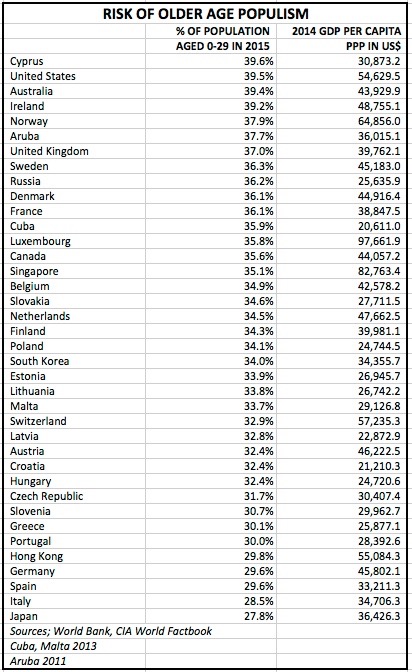
    As noted in So You Want a Revolution, the United States is one of many richer countries at risk of older age populism. These countries have relatively older populations (only 40% or less of the population aged 0-29) and higher GDP per capita ($20,000+).


    Demographics, combined with breakthrough innovations and strong institutions, have made America very wealthy in recent decades. We are now at a critical juncture and at risk of squandering our prosperity by focusing on a wrong set of problems and by empowering the wrong leaders, Trump and stage 1 cronyism that will lead to Sanders and stage 2 cronyism, or socialism.

    Sami Karam is the founder and editor of populyst.net and the creator of the populyst index™. populyst is about innovation, demography and society. Before populyst, he was the founder and manager of the Seven Global funds and a fund manager at leading asset managers in Boston and New York. In addition to a finance MBA from the Wharton School, he holds a Master’s in Civil Engineering from Cornell and a Bachelor of Architecture from UT Austin.

    Bernie Sanders photo by Michael Vadon [CC BY-SA 2.0], via Wikimedia Commons.

  • California Squashes Its Young

    In this era of anti-Trump resistance, many progressives see California as a model of enlightenment. The Golden State’s post-2010 recovery has won plaudits in the progressive press from the New York Times’s Paul Krugman, among others. Yet if one looks at the effects of the state’s policies on key Democratic constituencies— millennials, minorities, and the poor—the picture is dismal. A recent United Way study found that close to one-third of state residents can barely pay their bills, largely due to housing costs. When adjusted for these costs, California leads all states—even historically poor Mississippi—in the percentage of its people living in poverty.

    California is home to 77 of the country’s 297 most “economically challenged” cities, based on poverty and unemployment levels. The population of these cities totals more than 12 million. In his new book on the nation’s urban crisis, author Richard Florida ranks three California metropolitan areas—Los Angeles, San Francisco, and San Diego— among the five most unequal in the nation. California, with housing prices 230 percent above the national average, is home to many of the nation’s most unaffordable urban areas, including not only the predictably expensive large metros but also smaller cities such as Santa Cruz, Santa Barbara, and San Luis Obispo. Unsurprisingly, the state’s middle class is disappearing the fastest of any state.

    California’s young population is particularly challenged. As we spell out in our new report from Chapman University and the California Association of Realtors, California has the third-lowest percentage of people aged 25 to 34 who own their own homes—only New York and Hawaii’s are lower. In San Francisco, Los Angeles, and San Diego, the 25-to-34 homeownership rates range from 19.6 percent to 22.6 percent—40 percent or more below the national average.

    Read the entire piece at City Journal.

    Joel Kotkin is executive editor of NewGeography.com. He is the Roger Hobbs Distinguished Fellow in Urban Studies at Chapman University and executive director of the Houston-based Center for Opportunity Urbanism. His newest book, The Human City: Urbanism for the rest of us, will be published in April by Agate. He is also author of The New Class ConflictThe City: A Global History, and The Next Hundred Million: America in 2050. He lives in Orange County, CA.

    Wendell Cox is principal of Demographia, an international public policy and demographics firm. He is a Senior Fellow of the Center for Opportunity Urbanism (US), Senior Fellow for Housing Affordability and Municipal Policy for the Frontier Centre for Public Policy (Canada), and a member of the Board of Advisors of the Center for Demographics and Policy at Chapman University (California). He is co-author of the “Demographia International Housing Affordability Survey” and author of “Demographia World Urban Areas” and “War on the Dream: How Anti-Sprawl Policy Threatens the Quality of Life.” He was appointed to three terms on the Los Angeles County Transportation Commission, where he served with the leading city and county leadership as the only non-elected member. He served as a visiting professor at the Conservatoire National des Arts et Metiers, a national university in Paris.

    Photo: Dirk Beyer (Own work) [GFDL, CC-BY-SA-3.0 or CC BY-SA 2.5], via Wikimedia Commons