Category: Economics

  • The Protean Future Of American Cities

    The ongoing Census reveals the continuing evolution of America’s cities from small urban cores to dispersed, multi-polar regions that includes the city’s surrounding areas and suburbs. This is not exactly what most urban pundits, and journalists covering cities, would like to see, but the reality is there for anyone who reads the numbers.

    To date the Census shows that  growth in America’s large core cities has slowed, and in some cases even reversed. This has happened both in great urban centers such as Chicago and in the long-distressed inner cities of St. Louis, Baltimore, Wilmington, Del., and Birmingham, Ala.

    This would surely come as a surprise to many reporters infatuated with growth in downtown districts, notably in Chicago, Los Angeles, Denver and elsewhere. For them, good restaurants, bars and clubs trump everything. A recent Newsweek article, for example, recently acknowledged Chicago’s demographic and fiscal decline but then lavishly praised the city, and its inner city for becoming “finally hip.”

    Sure, being cool is nice, but the obsession with hipness often means missing a bigger story: the gradual diminution of the urban core as engines for job creation. For example, while Chicago’s Loop has doubled its population to 20,000, it has also experienced a large drop in private-sector employment, which now constitutes a considerably smaller share of regional employment than a decade ago. The same goes for the new urbanist mecca of Portland as well as the heavily hyped Los Angeles downtown area.

    None of this suggests, however, that the American urban core is in a state of permanent decline. The urban option will continue to appeal to small but growing segment of the population, and certain highly paid professionals, notably in finance, will continue to cluster there.

    But the bigger story — all but ignored by the mainstream media — is the continued evolution of urban regions toward a more dispersed, multi-centered form. Brookings’ Robert Lang has gone even further, using the term “edgeless cities” to describe what he calls an increasingly “elusive metropolis” with highly dispersed employment.

    Rather than a cause for alarm, this form of  development  simply reflects  the protean vitality of American urban forms.  Two regions, whose results were released last week, reveal these changing patterns. One is the Raleigh region, which has experienced a growth rate of 42%, likely the highest of the nation’s regions with a population over 1 million. This metropolitan area, anchored by universities and technology-oriented industries, is among the lowest-density regions in the country, with under 1,700 persons per square mile, slightly less than Charlotte, Nashville and Atlanta.

    Unlike the geographically constrained older urban areas, Raleigh’s historical core municipality experienced strong growth, from 288,000 to 404,000, a gain of 40%. This gain was aided by annexations that added nearly 30% to the area of the municipality (from 113 to 143 square miles). The annexations of recent decades have left the city of Raleigh with an overwhelmingly suburban urban form. In 1950, at the beginning of the post-World War II suburban boom, the city of Raleigh had a population of 66,000, living in a land area of only 11 square miles.

    Even here, however, the suburbs (the area outside the city of Raleigh) gained nearly two-thirds of the metropolitan area growth (65%) and now have 64% of the region’s population. Over the last ten years, the suburbs have grown 43%. It is here that much of the economic growth of the Research Triangle has taken place, as companies concentrate in predominately suburban communities such as Cary.

    Yet in most demographically healthy urban regions, the growth continues to be primarily in the suburban centers. One particularly relevant example is the Kansas City area, a dynamic region anchoring what we have identified as “the zone of sanity.” Like most American regions, the Kansas City area is growing, but in ways that often do not resemble the fantasies of urban density boosters.

    KC’s growth pattern is important and could be a harbinger of what’s to come in this decade. Along with Indianapolis, this resurgent Heartland region is expanding faster than the national average. It is also attracting many talented people, ranking in our top ten list of the country’s “brain magnets,” a performance better than such long-standing talent attractors as Seattle, Portland, San Francisco, and Boston. Between 2007 and 2009, the Kansas City region’s growth in college-educated residents was more than twice the rate of our putative intellectual meccas of New York, Chicago or Los Angeles.

    But despite the wishes of some  in Kansas City’s traditional establishment, this cannot be interpreted as meaning that  the “hip and cool” are being lured en masse to the city’s inner core. Over the past decade, as in most American regions, Kansas City has expanded far more outward than inward. Despite a modest increase in the city’s population of some 18,000 — much of it in the city’s furthest urban boundaries — the city’s population remains below its 1950 high. On the other hand, some 91% of its 200,000 population increase occurred in the suburban periphery.

    Critically, it is important to note that this expansion reflects not so much the growth of “bedroom” communities, but a dramatic shift of employment to the periphery. By far the most important center for this new suburban growth in jobs and people lies across the river in Johnson County, Kan.. Over the past decade, Johnson County has accounted for roughly half of the region’s total growth.

    Johnson County  – which boasts among the highest levels of educated people in the country — also has become the primary locale for many technology and business service firms, with more people commuting into the area than out. This reflects an increasingly suburbanized economic base. Over the past decade the urban core of Jackson County has lost 42,000 jobs, while the surrounding suburbs have grown by 20,000, with the biggest growth in largely exurban Platte County.

    So what does this tell us about the future of the American urban region?  Certainly the expansion of relatively low-density peripheral areas negates the notion of a  ”triumphant” urban core. Dispersion is continuing virtually everywhere, and with it, a movement of the economic center of gravity away from the city centers in most regions.

    But in another way these patterns augur a bright future for an expansive American metropolis that, while not hostile to the urban center, recognizes that most businesses and families continue to prefer lower-density, decentralized settings.  The sooner urbanists and planners can accommodate themselves to this fact, the sooner we can work on making these new dynamic patterns of residence and employment more sustainable and livable for the people and companies who will continue to gravitate there.

    This piece originally appeared at Forbes.com

    Joel Kotkin is executive editor of NewGeography.com and is a distinguished presidential fellow in urban futures at Chapman University, and an adjunct fellow of the Legatum Institute in London. He is author of The City: A Global History. His newest book is The Next Hundred Million: America in 2050, released in February, 2010.

    Kansas City skyline photo by Tim Samoff

  • From the Great Moderation to the Great Stagnation

    For much of the past decade, I was a proponent of the thesis that that the American economy had entered a “great moderation,” where expansions lasted longer and recessions were fewer, shorter and milder. Productivity had seemingly reached a permanently high plateau; inflation seemed tamed. The spreading of financial risk, across institutions and around the world, seemed to have reduced the odds of a crisis.

    Events of the past 30 months have put that thesis to rest.  I gave my mea culpa in Growth Strategies #1039 (October 2009), and also explained why we would instead be experiencing slow growth, high unemployment, low productivity growth, and higher taxes for the foreseeable future. That future has come to pass, and will continue to play out for years to come.

    Where does the economy go from here? Profits are up, the markets are up. Inflation and interest rates are still tame. How to reconcile rising profits, a robust stock market, and other positive indicators with unprecedented bankruptcies, foreclosures, underwater mortgages, business failures, unemployment and underemployment? The “working” economy has decided to move ahead and do fine and just leave millions behind. The future would be bright for many, okay for some and dark for many, and recommend being in the first group. 

    What about the overhang of debt and toxic assets? We seem to have opted for a long and slow process of rationalization, rather than a short, sharp and fast one. That means years of mixed messages and mixed trends: the good, bad and ugly.

    The Shattered American Dream

    A national survey of workers who lost their jobs during the Great Recession, conducted by two professors at Rutgers University, paints a gloomy view of the economic prospects for ordinary Americans.

    More than 15 million Americans are officially classified as jobless. The professors at the John J. Heldrich Center for Workforce Development at Rutgers have been following their representative sample of workers since the summer of 2009. The report on their latest survey, just out this month, is titled: “The Shattered American Dream: Unemployed Workers Lose Ground, Hope, and Faith in Their Futures.”

    Over the 15 months that the surveys have been conducted, just one-quarter of the workers have found full-time jobs, nearly all of them for less pay and with fewer or no benefits. As the report states: “The recession has been a cataclysm that will have an enduring effect. It is hard to overstate the dire shape of the unemployed.”

    Nearly two-thirds of the unemployed workers who were surveyed have been out of work for a year or more. More than a third have been jobless for two years. With their savings exhausted, many have borrowed money from relatives or friends, sold possessions to make ends meet and decided against medical examinations or treatments they previously would have considered essential.

    Older workers who are jobless are caught in a particularly precarious state of affairs. As the report put it:

    We are witnessing the birth of a new class — the involuntarily retired. Many of those over age 50 believe they will not work again at a full-time “real” job commensurate with their education and training. More than one-quarter say they expect to retire earlier than they want, which has long-term consequences for themselves and society. Many will file for Social Security as soon as they are eligible, despite the fact that they would receive greater benefits if they were able to delay retiring for a few years.

    There is a fundamental disconnect between economic indicators pointing in a positive direction and the experience of millions of American families fighting desperately to fend off destitution. Some three out of every four Americans have been personally touched by the recession — either they’ve lost a job or a relative or close friend has. And the outlook, despite the spin being put on the latest data, is not promising.

    No one is forecasting a substantial reduction in unemployment rates next year.
    Carl Van Horn, the director of the Heldrich Center and one of the two professors (the other is Cliff Zukin) conducting the survey, said he was struck by how pessimistic some of the respondents have become — not just about their own situation but about the nation’s future. The survey found that workers in general are increasingly accepting the notion that the effects of the recession will be permanent, that they are the result of fundamental changes in the national economy.

    Fundamental Changes

    Fundamental changes in the American workforce are taking place, and they hold tremendous implications for employers and employees alike. According to an Annual Workforce Trends Study commissioned by Yoh, a human resources firm, 80% of employers expect the size of their non-employee workforce (defined as consultants, independent contractors, temporary employees, and project teams) to stay the same or increase within the next year, even as the economy regains its footing.

    This new, temporary workforce presents issues for employers who will need to manage, compensate, and motivate workers who no longer view themselves as employees committed to a single employer. At the same time, for employees, this new workforce ushers in a new era of free agency, and holds vast implications for how they will build careers in a flexible work environment, where knowledge and skill trump seniority and security.

    Employers’ protracted reliance on a non-employee workforce as the US emerges from a severe recession represents a marked change from past economic recoveries when employers would add temporary talent before transitioning to full-time employees. Historically, temporary employment has served as a bellwether for permanent hiring, but these findings suggest that something much more substantial is occurring to overall workforce composition. Employers are saying that the recent recession has fundamentally changed their employment strategies and led to a “just-in-time” hiring strategy that will make temporary employees an even greater pillar of the American economy.

    The transformation of the workforce composition will have significant implications for both employers and employees. Employers now have the flexibility to quickly adjust the size of their workforce depending on project load.

    Employees, meanwhile, will have to overcome the stigma associated with “temporary talent.” Now that it’s here to stay, “temporary” workers might find themselves engaged in projects for longer periods of time, frequently transitioning into new opportunities and gaining access to jobs that were perhaps previously filled with full-time employees.

    The Great Stagnation

    Tyler Cowen of George Mason University is author of the e-book The Great Stagnation: How America Ate All The Low-Hanging Fruit of Modern History, Got Sick, and Will (Eventually) Feel Better. Cowen argues that in the last four decades, the growth in prosperity for the average family has slowed dramatically in the United States relative to earlier decades and time periods. Cowen argues that this is the result of a natural slowing in innovation, and does not expect a return to prosperity until new areas of research dramatically improve productivity growth.
    Part of Cowen’s core point is that up until sometime around 1974, the American economy was able to experience rapid growth by harvesting low-hanging fruit. There was cheap land to be exploited. There was the tremendous increase in education levels during the postwar world. There were technological revolutions occasioned by the spread of electricity, plastics and the car.

    But that low-hanging fruit is exhausted, Cowen continues, and since 1974, the United States has experienced slower growth, slower increases in median income, slower job creation, slower productivity gains, slower life-expectancy improvements and slower rates of technological change. Cowen argues that our society, for the moment, has hit a technological plateau.

    Is Cowen right? In my view he overlooks the growth of government over the last 40 years as an economic drag. Creative individuals and companies would be a lot more innovative if taxes were lower, regulations fewer, and the system of patents more reasonable.

    If stagnation is to be the new normal, we just can’t afford it. We are a nation, an economy, a society, based on growth. America needs to grow   We must therefore constantly replace, replenish, invent, create, innovate.

    For a long time I have been worried that the US was going the way of Europe: slow growth, high taxes, overregulation, high unemployment and underemployment, debt, deficits and little prospect of change. But perhaps we may have to worry instead is going the way of South America: an oligarchy of prosperous elites, and a great mass of the undereducated, under-skilled and underemployed, with little prospect of hope, change or opportunity.

    If you think I overstate the case, consider the disconnect between the people and governing classes. Only a minority of Americans express confidence in major institutions, according to Gallup. Only a minority of Americans believe that the federal government has the consent of the governed (Rasmussen).  In my view this disconnect may be an even bigger issue than stagnation.

    Dr. Roger Selbert is a trend analyst, researcher, writer and speaker. Growth Strategies is his newsletter on economic, social and demographic trends. Roger is economic analyst, North American representative and Principal for the US Consumer Demand Index, a monthly survey of American households’ buying intentions.

    Photo by Martin Deutsch

  • Is Nashville the Next Boomtown of the New South?

    I traveled to Nashville for the first time in 2007, spending most of my time in the downtown area. I posted my impressions here, noting the high growth and high ambition level as well as the fantastic freeways, but also the generally unimpressive development and built environment.

    I did another fly-by in April 2008. I made a conscious effort to try to get out and see different areas this time around. My tour guide was an Indy native who had spent the last decade or so in the northeast. He’d moved to the city about a year previously, so was seeing some of this for the first time himself. But it worked well, I thought.

    I believe Nashville is an extremely important case study for metros in the Midwest to examine. Here is a city that was a sleepy state capital for many years while other southern towns such as Atlanta and Charlotte took off. Then it began heading on an upwards trajectory. It is not yet at such a high growth rate that it appears to be a completely different sort of place than the Midwest. Its population growth is only 1.9% per year, for example, not much higher than Midwest growth champion Indianapolis at 1.5%. But all the trend lines are accelerating. Corporate headquarters are flocking, in city development is booming, transplants from the north are arriving. It would not surprise me to see this city pop into a higher gear when the economy turns upwards again.

    Nashville is a great case study because we can observe the inflection point in growth more or less as it happens. And also try to make sense of what is driving it. And to understand why Midwestern cities aren’t seeing it. I look at Nashville and ask myself: what does this place have on the Midwest? Compare it to Columbus, Cincinnati, Indianapolis, Louisville, Kansas City, and Milwaukee and see if anything jumps out that would explain it. Some unique factor of Nashville. Consider:

    • Nashville is smaller than most of those places today, so it isn’t size
    • It can’t be just because Nashville is in the south or a no income tax right to work state. Memphis in the exact same state and is hurting. Birmingham and Montgomery haven’t done much in right to work Alabama.
    • Its college degree attainment of 31% is below many comparable Midwest cities, though it should be noted that Nashville is moving up the league tables fast. It was recently ranked the 4th biggest “brain magnet” in the United States.
    • It has no particular unique industry or assets. It can cite its Music City USA image, which certainly drives tourism and money. But Midwestern cities have other equivalent things they can counter with. Plus, it was Music City USA all the time it was a sleepy state capital as well.
    • Just being the state capital doesn’t explain it. Indy and Columbus are both in that role and are getting out paced by Nashville.
    • Having a consolidated city-county government is not unique. Indy and Louisville are both consolidated, and Columbus is quasi-consolidated because of the ability of that city to annex most of Franklin County and even parts of several adjacent counties.
    • There are mountains, but the geography does not appear to be particularly compelling.
    • There are not fabulous historic districts in every region. In fact, while there are some nicer neighborhoods, much of the city is built out exactly like most Midwestern burgs of equivalent size. A lot of it is outright dumpy.
    • Its cultural institutions are not as advanced as Midwestern ones. The Nashville Symphony isn’t going to take on the Cincinnati Symphony any time soon, that’s for sure.
    • It doesn’t have some fortress home grown companies that are driving it.
    • It has Vanderbilt University, but most Midwestern cities have a good school in them too.

    I compare Nashville to the top performing Midwest metros and just scratch my head. Nashville’s arguably got nothing on the Midwest and in many ways is playing from an inferior position. So what is going on?

    I’ll take a shot at explaining a few things I’ve noticed. I’m not saying these are necessarily the answers. But they are things to consider. If I were head of strategy for a Midwestern metro, I’d be conducting an extensive peer city comparison of Nashville to try to figure it out in more detail. But here are some thoughts:

    • First, as I previously noted, is the extremely high ambition level. These guys are clearly looking at places like Atlanta, Dallas, Charlotte, etc. and saying “Why not us?” Their mission is to become one of America’s great cities. There’s no “era of limits” in Nashville. You see this come through, for example, in their convention center plans, which call for 1.2 million square feet. It comes through in their highways, which are being built 8-10 lanes with HOV lanes, as if getting ready to become the much bigger city they plan to be. It shows in the numerous residential high rise and midrise projects. It shows in how Nashville, unlike every comparable Midwest metro, already has a commuter rail line in service. Midwesterners recoil from change, and would view becoming the next Charlotte or Atlanta with horror. But Nashville is eager to move up to the premier league, so to speak.
    • Second is the unabashedly pro-growth and pro-business stance. Every development in the Midwest is opposed by some group of NIMBY’s. Densification, even in downtown areas, is often anathema to influential neighbors. Not in Nashville. Huge tracts of inner city are being rebuilt from vacant lots or single family homes into multi-story town houses or condos. There are midrises all over the place. It does not appear that development has any problem getting approved there.
    • Third is low taxes and costs. Tennessee does not have a state income tax. Electricity from the TVA is dirt cheap. Property taxes cannot be increased without a public vote. It remains to be seen if this environment can be sustained, but for right now, cost appears to be an advantage.
    • Fourth is that they’ve embraced instead of rejecting their heritage. Rather than saying that country music is for hillbillies and an embarrassment to their new ambitions as a big league city, they’ve proudly embraced it. They updated the image with a glitzy, “Nashvegas” spin and made it the core of what Nashville is all about. Most Midwestern elites seem to view their existing heritage negatively. But great cities have to spring from the native soil in which they are born. Their character has to be organic. Import all the fancy stores, restaurants, sports teams, transit lines, etc. you want, but it won’t distinguish your city. Nashville learned this lesson well, probably from Atlanta. The southern boomtowns took their existing Southern heritage, dropped the negative items that needed to be changed, updated the core positive elements, and created the vision of the “New South”. This is something that can be embraced by the masses, unlike the elitist transformations that are often promulgated.
    • Fifth is that, again, they appear to have studied the lessons of places like Dallas, Atlanta, Charlotte, etc. They’ve seen the need for freeways. They’ve looked at the style of development and the neo-traditional urban form. I was very impressed to see that there while most condo developments and such were fairly undistinctive, I did not note any that exhibited poor urban design form. When I consider the poorly designed projects that are frequently implemented in, say, downtown Indianapolis, it is easy to see who gets out more. Nashville has done its homework.
    • Sixth, Nashville is realistic and open to self-criticism without being self-flagellating. I posted my previous take on the city on a discussion forum dedicated to that city. Given the modestly negative tone contained in much of it, I expected to get crucified. Surprisingly, most of them basically agreed with it. Too many cities in the Midwest either engage in naive boosterism or wallow in woe-is-us. Perhaps because of the large number of newcomers, there’s a more realistic assessment of where Nashville stands. And this enables rational decisions about where it needs to go.

    If anyone else has observations to share, I would love to hear them.

    Here are some photographs I took while there. First, a view of the Tennessee capitol building across a green space I believe is called the Bicentennial Mall.


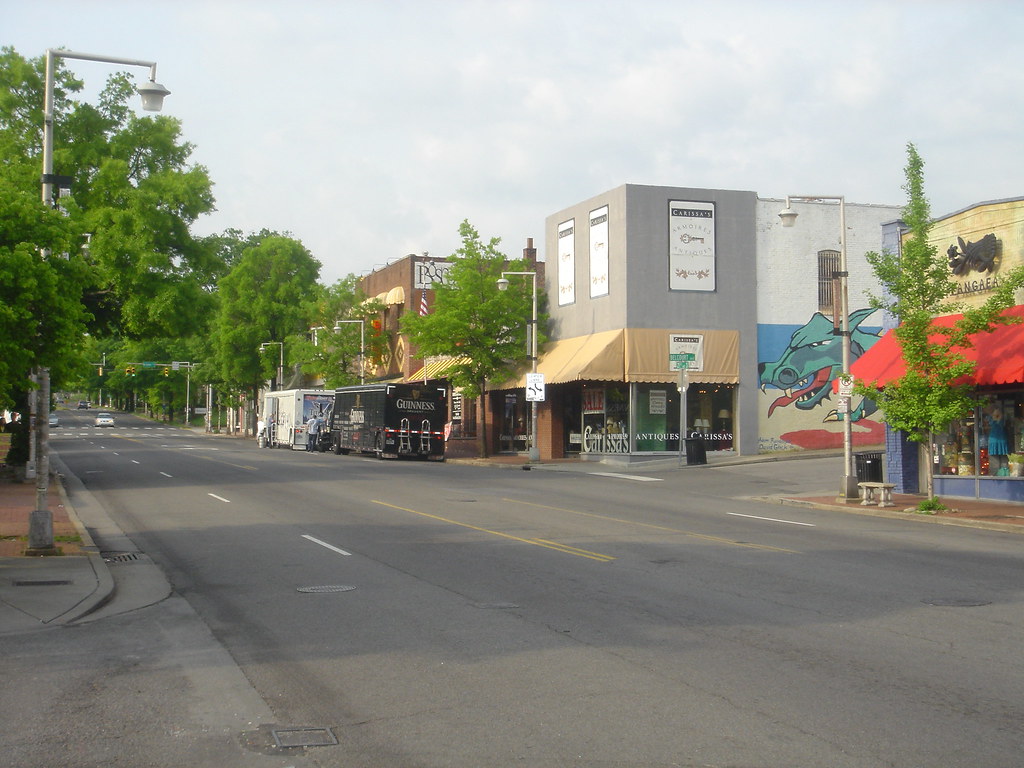
    A street scape in Hillsboro Village, a small commercial district near Vanderbilt University.


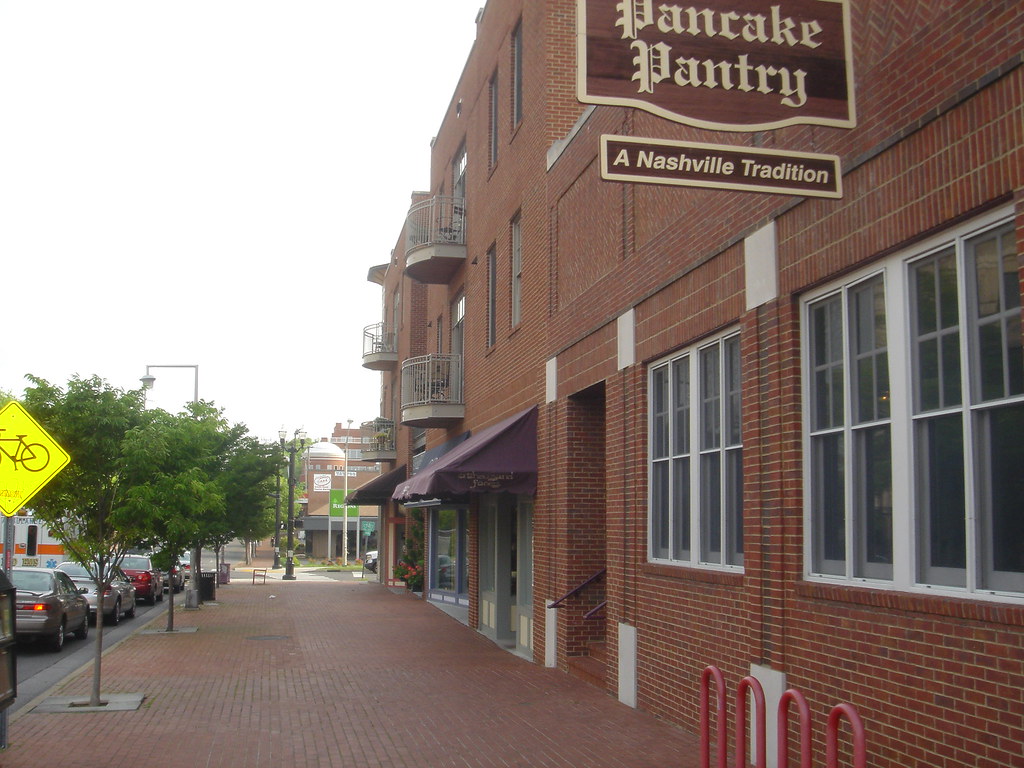
    The Pancake Pantry in Hillsboro Village, a breakfast place of high local repute. I was initially skeptical but the food was actually pretty darn good. This place is huge and there was still a line out the door at 10am on a Friday morning. Pretty crazy.


    The storefronts are a nice urban touch, but if you look behind this building you see a gigantic parking lot. This is perhaps an example of faux-urbanism. Putting the parking lot in the back doesn’t make it any less a strip mall. It is a difference in form, not function.


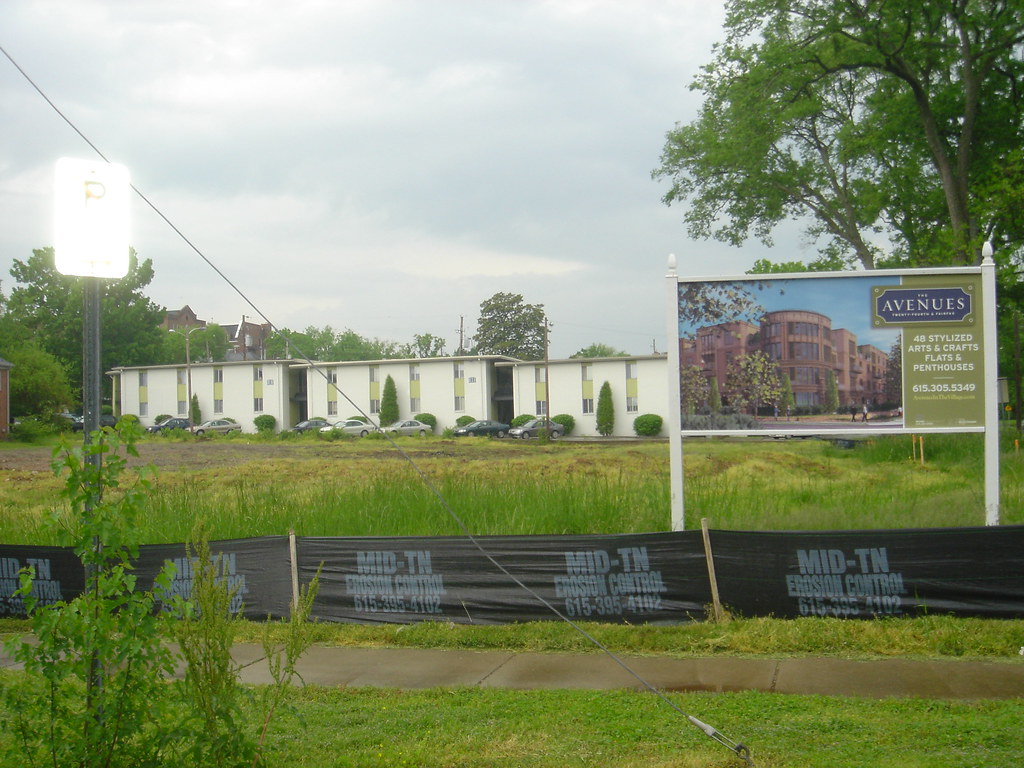
    One of the many vacant lots with a “condos coming soon” sign.


    The main road heading west of out downtown, West End Avenue, is developed at very high densities. I haven’t seen much in the way of this in most Midwestern cities. Midrises line both sides of the road basically from downtown to the interstate loop. It’s a six lane mega-street that moves tons of cars, but appears to have great bus service as well.


    Here is another one under construction.


    A proposed, but I believe not yet funded, high rise development. Indianapolis readers will no doubt recognize one of the towers as a clone of the proposed Intercontinental hotel for Pan Am Plaza that lost out as the convention center anchor hotel.


    If you continue out to the west from here, you run into neighborhoods like Green Hills, which is where the most premier shopping in the area is found, and the suburb of Belle Meade, which serves as Nashville’s mansion district. Unlike traditional Midwestern mansion districts, this one is more rural in nature, with large estates that wouldn’t be out of place in a plantation. I did not take pictures of these areas, however.

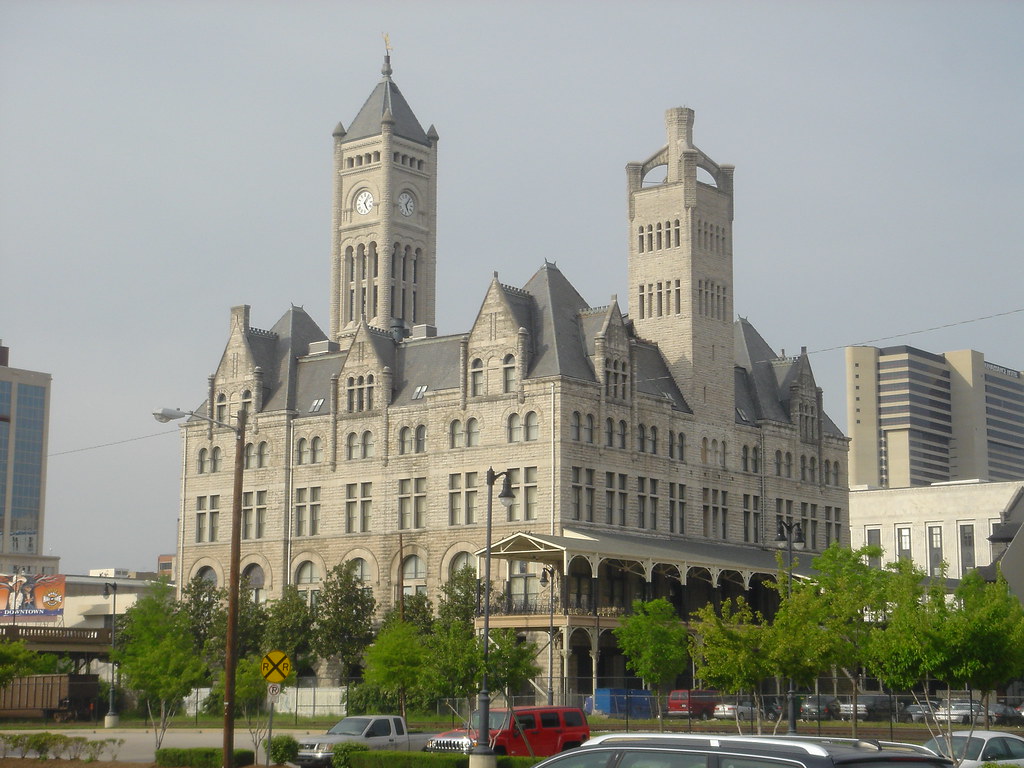
    Back closer to downtown is a nearby area known as the “Gulch”. It is not too far from Nashville’s Union Station.


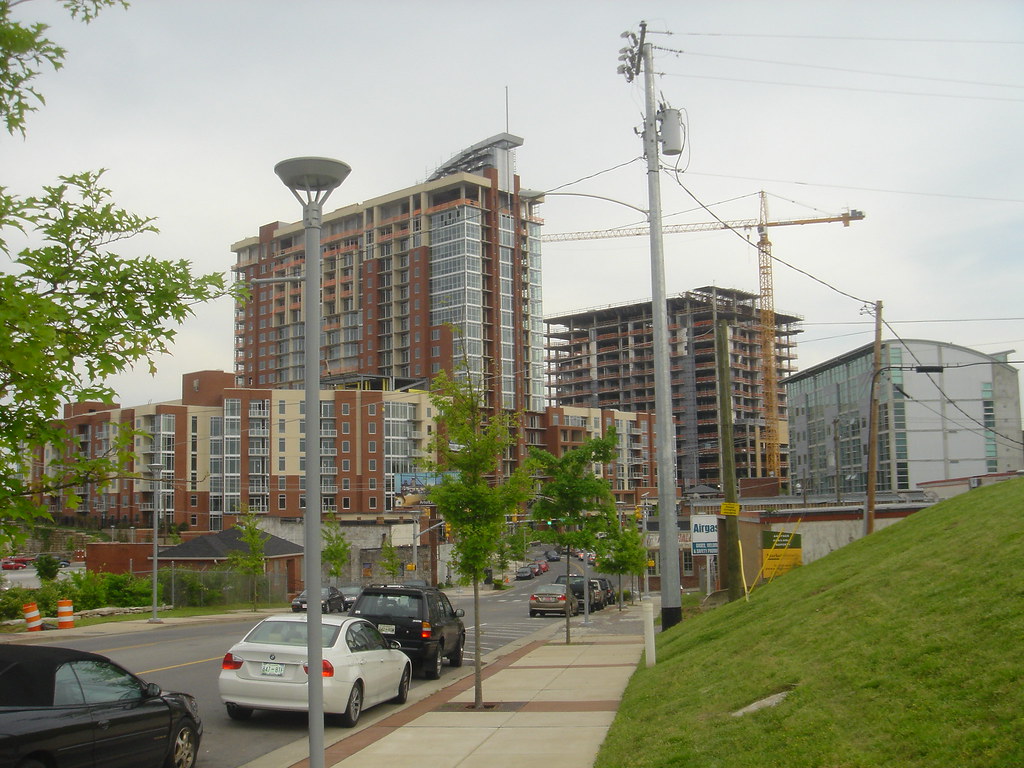
    This appears to be some seedy industrial district that is being transformed all at once by a series of large developments. It also has several clubs and restaurants. I ate at a seafood place called Watermark that was surprisingly good. I believe most of the places are upscale chains, though I’m not sure if Watermark is or not. Here’s a picture of some of the development.


    More development


    North of downtown is a small historic district called Germantown. This was rather unimpressive if you ask me. I didn’t see much that was German about it. It sure isn’t Columbus’ German Village, that’s for sure. There were some restaurants there. I had lunch at one of them which, fortunately for them, I can’t remember the name of because it was terrible. This area is mostly older single family homes.


    The amazing thing about this area is that almost every vacant or industrial parcel was being redeveloped as condos. This really brought home to me the difference between Nashville and the Midwest. Were this, say, the Cottage Home area in Indianapolis, the local neighborhood association would use their historic district status to keep developments like these out. In Nashville, they are seen as a positive. Here are some examples.


    More condos


    More condos with retail space. Sorry for the very blurry pic but it was raining as you can see.


    More condos being built, and still more proposed.


    You get the picture. Also, note from all these photos the lack of design disasters. These are all workmanlike structures. The challenge for Nashville is that while there is a ton of new development, all of it is in a relatively generic, undistinguished style that could be in the downtown of almost any city. I did not get a strong sense of any type of vernacular style emerging. That is something I’d be looking for if I were them.

    Lastly, here’s one suburban example that shows something I pointed out last time. Namely that even in brand new, upscale subdivisions they aren’t putting in sidewalks on both sides of the street. I find this very odd. While I noticed some bike lanes this time around, Nashville’s definitely got a long ways to go when it comes to pedestrian and bicycle friendliness.


    Nashville is definitely a city that is on an upward trajectory. The volume of urban development and the business attraction success are impressive. It is exceeding even the best performing Midwest metros in that regard. However, it still lags the top southern and western metros. The current rate is very healthy, but probably isn’t sufficient to realize the civic ambitions. It remains to be seen whether Nashville can put it in another gear and take its place among the boomtowns, or whether it will merely stay on its current growth path. Either path is possible or a valid civic choice. While always possible, the likelihood that Nashville is going to take a major downtown does not appear high in the short term.


    Aaron M. Renn is an independent writer on urban affairs based in the Midwest. His writings appear at The Urbanophile, where this piece originally appeared.

  • Sputnik Moments, Spending Cuts, and (Remember These?) Jobs

    The stand-off in Washington over spending reductions has pushed aside serious discussion about a far more pressing issue:  job creation.

    Granted, the country is long overdue for action on spending cuts. There is much that our government does that we can live without. Bureaucracies’ programmatic lassitude and congressional appropriators’ adolescent-like lack of discipline have contributed to our nation’s fiscal imbalance.

    To be sure, the federal deficit is heading into a crisis zone the likes of which the United States has never seen, and a fairly dramatic policy response is needed to fix it. But one overlooked way to improve the fiscal picture would be to spark economic growth. This is precisely what worked well in the 1990s, something for which both a Republican Congress and Democratic President could legitimately claim credit.

    But the focus on jobs and economic growth has been lost.

    Democratic leadership chooses to focus on a narrow, government-driven idea of job growth, deluding themselves – against the huge weight of evidence – that government can lead the job growth agenda through stimulus. Republicans have made spending cuts the backbone of their jobs growth strategy, and they have embarked on a campaign to convince voters that if we cut enough spending, investor confidence will return, employers will hire more people, and jobs will return.

    President Obama’s Sputnik moment was truly the stuff of science fiction, or at least the Truman Show, in which we all drive our Priuses from our homes to the train station down the street on our way to work or the gym in a carefully planned world that will – voila! – create millions of jobs.  Republicans, for their part, have been primarily focused on non-defense discretionary spending – that part of the federal budget that accounts for only a little more than a third of all spending and which, if you removed all of it, would still leave the entitlement programs intact that add most to our debt and deficit. After the work of the scalpel is done, Republican theory goes, enough space will be cleared up in the economy for Adam Smith’s invisible hand to start generating jobs in an Austrian school-like spontaneous order, which will generate jobs…and so on.

    Now, to their credit, Republicans have begun talking more seriously about introducing entitlement reforms this year that would address the more serious deficit issues. Given the bipartisan nature of President Obama’s debt commission, the plan should get the support of at least some Democratic members, even if the President and Democratic congressional leadership shove it aside.

    But however much GOP congressional leaders might be wising up on addressing the deficit through fiscal restraint, they are AWOL on addressing it through job creation and growth, without which deficit reduction is much, much more painful.

    Voters know this at some level. In a poll of self-identified conservative Republicans at ConservativeHome.com, a site I edit, respondents are eager to see deep spending cuts, but they also give Republican lawmakers low marks on job creation and economic growth. In a poll we conducted last week, nearly half (49 percent) of respondents said they thought Republicans had been doing a good job of pushing for spending reductions, but 69 percent said Republicans were not doing a good job of explaining what they were doing to create jobs. The party of growth and opportunity has not even convinced its most ardent supporters what it is doing on the economy.

    Meanwhile, Gallup’s numbers this past week painted a troubling picture amidst slightly good news. While their survey showed an unemployment drop from 10.9 percent to 9.8 percent in the past year, this came mostly from gains among the most and least educated. Middle America remains pretty much stuck where it was. And then, as if to pour salt in a wound, Gallup released numbers three days later showing deterioration in jobs numbers in February compared to January.

    We can’t keep going on pretending stimulus, on the one hand, and spending cuts, on the other, are a viable economic growth strategy. There needs to be a realistic plan put forward and the party whose candidate figures this out will win the White House in 2012.

    The plan should consist of at least the following:

    First, tax reform. The President’s debt commission put forward some really good ideas. The best idea winning the most bipartisan support is reforming the corporate tax code. Rather than being a giveaway to big business, lowering America’s ridiculously high rate is the most proven way to create jobs. The OECD, not some right wing group, has concluded this after studying the issue across a number of countries. Also, simplifying the tax code by getting rid of costly deductions would help.

    Second, make it clear what being too big to fail means so investors will know, and start putting more capital into businesses that will create jobs. Luigi Zingales at the University of Chicago has a good idea about clarifying the current financial reform bill along these lines.

    Third, make energy the central component of a growth strategy. The U.S. has the capacity to become a net exporter of natural gas and to re-start a generation of nuclear power production that would make us less dependent on nonrenewable energy. We would also be greener in terms of carbon emission and would create jobs.

    Fourth, build more roads. Forget about those train tracks. We should be scraping together every unused stimulus dollar and wasteful penny of DOT funding to add lanes of highway to our most congested areas. Facilitating commerce and reducing lost revenue due to traffic congestion will also have the benefit of creating needed jobs.

    This would be a start. Whether anyone will take up the challenge is another issue.

    Ryan Streeter is Editor of www.ConservativeHome.com.

    Official White House photo by Pete Souza.

  • The State of Silicon Valley

    Every year, the top officials, policy wonks, and business managers convene at the annual State of the Valley conference to discuss and debate the health of the region. Over a thousand attendees trekked to San Jose, Calif., on Feb. 18 for the release of this year’s report. Published since 1995 by Joint Venture Silicon Valley Network and distributed for free, the new 2011 Index of Silicon Valley reported bleak indicators and a gloomy outlook.

    The event provided Valley insiders a moment to reflect on the economic storm, and the mood was darkly optimistic. A persistent phrase tossed out was the “new normal,” old Wall Street jargon describing a repressed economic environment. Growth is too slow to bring down the unemployment rate, and government intervenes to save a struggling private sector.

    Tally of the Valley

    Certainly Silicon Valley has had its share of troubles suffering from poor state finances and severe global competition. Unemployment has hit nearly 10 percent, higher than when the recession started. The region’s population of three million, comprised of Santa Clara and San Mateo Counties, has continued to drop as talent leaves for opportunity in cheaper pastures. Foreign immigration, considered a critical factor in the region’s entrepreneurship, dropped by 40 percent to its lowest level in the last decade since 2009 and stayed flat through 2010.

    Adding to the woe, Silicon Valley towns are facing budget shortfalls and downsizing their public services. San Jose faces a 10th straight year of red ink, adding up to a gap of $110 million in the next fiscal year. Caltrain plans to close up to 16 stations to survive a record $30.3 million deficit – about one-third of the commuter rail’s operating budget.

    Education has also taken a big hit. The California college system is wheezing from tremendous budget cuts, calculated at $1.4 billion across the state, which hit all three levels of tertiary education. Foothill-De Anza Community College, one of the largest community college districts in the U.S., confronts roughly $10.9 million in cuts on top of drastic budget slashes from previous years.

    Further, the local housing market remains stagnant, and 2010 marked, due in part to a tough regulatory environment, the third consecutive year that Silicon Valley was the least affordable California region for first-time home buyers.

    In the Eye of the Beholder

    It’s a dismal state of affairs if you ask the local old guard. Judy Estrin, former chief technology officer of Cisco Systems, grumbled that one problem was outsourcing. Too many startups were adopting the practice in her view, and she told the audience, “Don’t automatically go to China.”

    Others were concerned that jobs were being shipped simply to towns east across the bay. Much ballyhooed and well-subsidized sectors, such as cleantech, would not produce enough jobs to be economically meaningful in the recovery. Attendees were fearful that the Valley has lost its edge.

    If those who know Silicon Valley best are somewhat pessimistic, the Valley looks golden for many looking from the outside. The day before the conference, President Obama sought money and advice from the Valley’s tech elite, including Steve Jobs of Apple and Mark Zuckerberg of Facebook. Obama’s agenda was to push innovation, and aside from escaping the U.S. capital now and then, it is tellingly that he turned first to Silicon Valley.

    The Valley has also inspired other city governments. New York City – which once boasted its own “Silicon Alley” was winning over the Valley’s decidedly suburban model – recently asked Stanford University to help train its urban talent. As one local reporter put it gleefully, New York is “hoping to replicate our Apple in The Big Apple”.

    Although financial analysts once considered Apple washed up as a stock less than 10 years ago, the technology company is now lauded for transforming the mobile and entertainment industry and turning Silicon Valley into a mobile mecca. Goaded by Apple, mobile manufacturing giant Sony Ericsson is shifting all its product development from Sweden to Silicon Valley. Nokia, the world’s largest mobile phone maker, is also reportedly considering plans to relocate its executives to the Valley.

    Growing Regional Value, Not Growth

    The prevailing question remains: how will Silicon Valley sustain its lead in innovation. For some the response is to either raise taxes or cut public services as a matter of survival. At the State of the Valley conference, the overriding call to action was to unite 110 local governments through centralized regional leadership. However, the notion of a regional governing body had been introduced before in the 1990s and failed instantly in California state legislation.

    So what might the future hold? Last year’s report card aside, financial analysts are cheery about the Valley’s prospects. Silicon Valley Bank’s Financial Group reports that technology spending is expected to grow by more than five percent in 2011. The majority of their clients finished 2010 in better financial shape than the prior year, and median revenues for all early and growth stage technology clients grew 50 percent from the year before.

    The IPO market has woken from its slumber. Seven tech IPOs have already occurred this year, raising $700 million in total, with an average return of 26.5%, according to research firm Renaissance Capital. Even the international press is writing about the next boom being led by Silicon Valley.

    For all the money being generated, Silicon Valley is not producing more jobs in the local economy. Many startups look to Facebook as a leader in the social media space. Its user base of 600 million has generated a massive population that dwarfs that of the U.S. Yet the company has only about 2000 employees. Facebook presents a conundrum. Is it an innovative global leader that has mastered the art of efficient scaling that is the beginning of a new era in Silicon Valley, or has Facebook become the antithesis of economic growth for the U.S. administration?

    Similar to Facebook, Apple is also spurning growth – at least as defined by the conventional measure of new jobs. The company has redefined the tech industry by creating new technologies and new solutions, but not necessarily creating new growth for the region directly. While Apple employs just 30,000 people, the subcontractor that actually assembles its products employs over a million workers, all in China. Developers for Apple’s software applications and hardware accessories are scattered around the world. Instead, Apple has fostered an ecosystem whose heart resides in Silicon Valley.

    Silicon Valley is changing perceptions and practices once again. Like the proverbial cat with nine lives, Silicon Valley has at least several more transformations ahead.

    Tamara Carleton, Ph.D., is a Fellow at the Foundation for Enterprise Development. Her research studies the organizational processes and structures that enable radical technological innovation.

  • Mortgage Meltdown: How Underwriting Went Under

    The White House remedies for the mortgage meltdown were presented on Friday. Congress will debate the life extension, death, or rebirth of federal mortgage entities Fannie Mae and Freddie Mac during the coming weeks.

    When the noise has died down, don’t expect substantial change. But those who hope for genuine financial reform should, nonetheless, listen carefully not only to what Washington says, but to whom it says it. Will the new guidelines call on traditional home-loan bankers to make traditional loans? Or will we hear a shout-out to the investment bankers/mortgage traders who designed the mess?

    In any new financial structure for home loans, the single most important issue will be the ratio of debt to assets that the government will expect lenders to show.

    During the real estate boom, lenders were willing — and able — to provide mortgage brokers with financing for 100 percent or more of the value of a property with the expectation that real estate prices would rise. We witnessed the triumph of the trader over the banker: Profit relied on the sale or refinancing of the asset. For a mortgage originator or securitizer with no plans to hold on to the mortgage, what really matters has been the ability to place it, not the depth of the underwriting or the long-term financial prospects of the home resident.

    A traditional banker, on the other hand, might feel safe with a capital leverage ratio of twelve to one, with careful underwriting to ensure that the borrower would be able to make payments. With equity at risk, something close to that level of underwriting would be essential.

    The trader-think model virtually eliminated mortgage underwriting. What we saw instead has been succinctly described by L. Randall Wray in a Levy Institute Brief: “Property valuation by assessors who were paid to overvalue real estate, credit ratings agencies who were paid to overrate securities, accountants who were paid to ignore problems, and monoline insurers whose promises were not backed by sufficient loss reserves…” Much of the activity didn’t even appear on the balance sheets. Mortgage brokers arranged for finance, investment banks packaged the securities, and the shadow banks — the managed money — held the securities.

    The debt to assets ratios for mortgages climbed. Investment bankers consolidated their liabilities into a single financial market that could have been called the Mortgages & More Shoppe. Mortgage-backed securities were included with commercial banking, and with other financial services where acceptable capital leverage ratios are much higher than for traditional home loans. (For money managers, capital leverage ratios can be 30 to 1 and up to several hundred, with even higher unknown and unquantifiable risk exposures.)

    Income flows took a backseat. Except for the home resident, that is. Because ultimately, all of these financial instruments came to rest on the shoulders of some homeowner trying to service her mortgage out of annual income flows which boiled down to, on average, five dollars worth of debt and only one dollar of income to service it.

    “In an ideal world,” Wray added, “A lot of the debts will cancel, the homeowner will not lose her job, and the FIRE (finance, insurance, and real estate) sector can continue to force 40 percent of… profits in its direction. But that is not the world in which we live. In our little slice of the blue planet, the homeowner missed some payments, the securities issued against her mortgage got downgraded, the monoline insurers went bust, the credit default swaps went bad when AIG failed, the economy slowed, the homeowner lost her job and then her house, real estate prices collapsed, and, in spite of its best efforts to save [the system], the federal government has not yet found a way out of the morass.”

    Whatever the fate of Fannie Mae and Freddie Mac, the coming federal recommendations need to lift underwriting standards up from that morass and back onto solid ground. According to January’s Financial Crisis Inquiry Commission report, about 13 million US homes have already or will soon face foreclosure. The investment bank traders who securitized those mortgages, with a few notable exceptions, have overwhelmingly escaped such suffering. Financial reform should change that equation by demanding a traditional, appropriate ratio of assets to debts in the real estate markets.

    Dimitri B. Papadimitriou is President of The Levy Economics Institute of Bard College. He recently co-edited, with L. Randall Wray, The Elgar Companion to Hyman Minsky. He blogs at Multiplier Effect.

    Photo by Foxtongue

  • A Leg Up: World’s Largest Cities No Longer Homes of Upward Mobility

    Throughout much of history, cities have served as incubators for upward mobility. A great city, wrote René Descartes in the 17th century, was “an inventory of the possible,” a place where people could lift their families out of poverty and create new futures. In his time, Amsterdam was that city, not just for ambitious Dutch peasants and artisans but for people from all over Europe. Today, many of the world’s largest cities, in both the developed and the developing world, are failing to serve this aspirational function.

    Though leading urban theorists love to celebrate the most rarified parts of the city economy—Saskia Sassen refers to “urban glamour zones” that thrive in what New York Mayor Michael Bloomberg proudly calls the “luxury city”—they tend to forget about working- and middle-class residents. Unfortunately, these urban ideas appear to be contagious, as they’re being applied to the expanding cities of Asia and other developing regions. A recent World Bank report argued that large urban concentrations—the denser, the better—are the most prodigious creators of opportunity and wealth. “To spread out economic growth,” the report claimed, is to discourage it.

    A closer look, however, suggests a more nuanced reality. Cities in the developing world are growing, but largely because they’re the only alternative to poverty and even starvation in the countryside. These cities are not only failing to provide opportunities for upward mobility; they’re producing the class inequalities found in “luxury cities” such as London and New York.

    Once rigidly egalitarian, China now has some of the world’s highest rates of income inequality. The central cores of Beijing and Shanghai employ legions of well-paid European and American architects and planners, but few concern themselves with the camps inhabited by poor, often temporary workers, who constitute roughly one-fifth of the population and live in conditions more reminiscent of a Brazilian favela than an “urban glamour zone.”

    This same stratification is also happening in India. Mumbai, one of the fastest-growing cities, is creating wealth at the top of the economic spectrum but leaving millions of others scrambling for mere subsistence. The New York–based author Suketu Mehta has described his hometown of Mumbai (formerly known as Bombay) as “an urban catastrophe,” an example of the mounting woes of rapidly expanding cities in the developing world. “Bombay is the future of urban civilization on the planet,” he wrote. “God help us.”

    A majority of Mumbai’s population now lives in slums, up from one-sixth in 1971—a statistic that reflects a lack of decent affordable housing, even for those gainfully employed. Congested, overcrowded, and polluted, Mumbai has become a difficult place to live. The life expectancy of a Mumbaikar is now seven years shorter than an average Indian’s, a remarkable statistic in a country still populated by poor villagers with little or no access to health care.

    In spite of World Bank proclamations, the most rapid urban growth in India is actually occurring in smaller, less dense cities, such as Bangalore and Ahmedabad, places with lower living costs and more business friendly governments. This mirrors a trend occurring in the United States. In the last decade, middle-income people have been moving out of our megacities. Between 2000 and 2008, according to the demographer Wendell Cox, regions of more than ten million people suffered a 10 percent rate of net domestic out-migration. (Often the only reason for population growth in these cities was immigration.) The big gainers were cities between 100,000 and 2.5 million residents: the business-friendly Texas cities Dallas, Houston, and San Antonio; Raleigh and Durham, North Carolina, which now form the fastest-growing metro area in the nation; and the heartland cities of Columbus, Indianapolis, Des Moines, Omaha, Sioux Falls, and Fargo.

    One reason for this movement has been the shift of jobs away from the coasts to lower-cost, less dense cities. The fastest growth in middle-income jobs has been concentrated in many of the places listed above: Houston, Dallas, Austin, Raleigh-Durham, and Salt Lake City. This pattern also includes high-tech, science-oriented employment. In contrast, those jobs have been stagnant or shrinking in such cities as New York, Los Angeles, San Francisco, and Chicago.

    As a result, America’s largest cities are increasingly divided into three classes: the affluent, the poor, and the nomadic class of young people who generally come to the city for a relatively brief period and then leave. New York, the aspirational city of my grandparents, now has the smallest share of middle-income families in the nation, according to a recent Brookings Institution study, with Los Angeles and San Francisco not far behind. In 1980 Manhattan, New York’s wealthiest borough, ranked 17th among U.S. counties for social inequality; by 2007 Bloomberg’s “luxury city” was first, with the top fifth earning 52 times the income of the lowest fifth, a disparity roughly comparable to that of Namibia.

    Similar patterns can be found in Europe, despite its countries’ more developed welfare states. The U.K. has witnessed a relentless centralization of urban functions in London, as once proud cities such as Manchester, Liverpool, Glasgow, and Birmingham have continued their long slide into obscurity and irrelevance. The bulk of London’s growth, however, has not taken place in the central core but in what the historian James Heartfield calls “the greater southeast.” This vast “conurbation” stretches from west of Heathrow Airport to the booming coastal city of Brighton, roughly an hour’s train ride from the“ city center.

    As the middle class has decamped, central London has become more stratified. Residents and workers there and in the West End account for some of the most concentrated wealth on the planet. At the same time, prospects for London’s middle class have weakened, with many fleeing to the suburbs or even leaving the country. (Britain remains a large exporter of educated workers to the rest of the world.) The major issue here is the high cost of housing. Even in its poorest neighborhoods, London now ranks as one of the most unaffordable places for middle-income people to buy a home.

    Still, life is much tougher for the city’s poor, many of whom live less than an hour’s walk from the wealthiest neighborhoods. Take a stroll just a mile or two from the Thames and you enter a very different London. It is here where you’ll see why the financial capital of the European Union also has the highest incidence of child poverty in Great Britain (more even than in the beleaguered North East). Thirty-six percent of children in London live in poverty, a figure that rises to more than one-half when the city’s housing costs are factored in.

    The same split has emerged in other countries considered far more open than class stratified Britain. A recent University of Toronto study found that between 1970 and 2001, the portion of middle-income neighborhoods in the city had dropped from two-thirds to one-third; poor districts had more than doubled to 40 percent. By 2020, middle-class neighborhoods could fall to less than 10 percent, with the balance made up of poor and affluent residents.

    Much the same can be seen in continental Europe, a trend greatly exacerbated by the growth of immigration. Unlike Amsterdam in Descartes’s time, Europe’s great cities are failing in their historic mission of incorporating newcomers, as German Chancellor Angela Merkel recently conceded. In Berlin, one fourth of the workforce earns less than 900 euros a month, while 36 percent of children are poor. The city once known as “Red Berlin” has emerged as “the capital of poverty and the ‘working poor’ in Germany,” Emma Bode, a left-wing journalist, wrote in 2008.

    Given these global realities, it might be time for our urban boosters to curb their enthusiasm for the “luxury city” and refocus on how to meet the aspirations of their middle- and working-class residents. If they don’t, lack of opportunity will drive more and more of this crucial aspirational class farther and farther away, mostly to smaller cities and suburbs that still offer “an inventory of the possible.”

    This piece originally appeared in Metropolis Magazine.

    Joel Kotkin is executive editor of NewGeography.com and is a distinguished presidential fellow in urban futures at Chapman University, and an adjunct fellow of the Legatum Institute in London. He is author of The City: A Global History. His newest book is The Next Hundred Million: America in 2050, released in February, 2010.

    Photo by Premshree Pillai

  • Why Duany is Wrong About the Importance of Public Participation

    One of the news stories circling lately is an interview with Andres Duany where he asserts that public participation requirements are too onerous to enable great work to be done.   Early in my career I worked as a public historian and historic preservation specialist, so rather than launch immediately into my opinion, let me tell you a true story.

    In the 1950s, business owners in downtowns across the country became agitated over the fact that their central business districts were facing a double challenge: increasing amounts of traffic congestion and increasing competition from new suburban shopping centers.  One of the towns feeling these challenges was Green Bay, Wisconsin, which had a very energetic and forward-thinking business leadership circle. 

    The good men of Green Bay did what most forward-thinking leaders do when faced with a fearful challenge on the horizon: they hired a consultant.  The consultant they chose was Victor Gruen, an architect who had recently gained fame designing the nation’s first enclosed shopping mall, in Edina, Minnesota.  In the couple of years that had lapsed since the Southland Mall plans hit the streets, Gruen had become a celebrity – the Andres Duany of his day. 

    In a 2006 article for the New Yorker, Malcolm Gladwell described Gruen as “short, stout, and unstoppable, with a wild head of hair and eyebrows like unpruned hedgerows.” Gladwell summed up Gruen’s impact pretty succinctly:

    Victor Gruen didn’t design a building; he designed an archetype. For a decade, he gave speeches about it and wrote books and met with one developer after another and waved his hands in the air excitedly, and over the past half century that archetype has been reproduced so faithfully on so many thousands of occasions that today virtually every suburban American goes shopping or wanders around or hangs out in a Southdale facsimile at least once or twice a month. Victor Gruen may well have been the most influential architect of the twentieth century. He invented the mall.

    Gruen asserted in Green Bay, as he did in dozens of other cities in the 1950s and 1960s, that the key to solving downtown’s competition challenge was to completely separate vehicular traffic from pedestrians.  By massively widening Main Street at the north end of the commercial district and completely enclosing the core of the existing commercial district, all of downtown’s problems would be solved.  All the plan required was money and a willingness to be unsentimental and practical.

    You don’t have to be Duany to understand what happened.  It took 20 years for Gruen’s vision to become some form of reality, and during that time the City’s business and political leadership –and its planning staff – stuck to Gruen’s plan as diligently as the real world constraints of financing and private development would allow.  

    By the time it opened in 1977, the new Port Plaza Mall and associated parking lots and garages had obliterated acres of downtown buildings, dislocated a hundred residents.  It sent dozens of businesses to liquidation or to the far edges of the newly-sprawling city where many of them are located today.  If Gruen considered the collateral damage of grand ideas at all, I wager he simply viewed them as the price of progress. 

    All of this might be tolerable from a strict economic standpoint if Gruen’s grand plan had worked.  It didn’t.  Port Plaza Mall was a money-loser from virtually day one.  By the early 1980s, Port Plaza was doing so poorly that the City took the advice of another consultant and bulldozed another full block of buildings to add the magic third anchor, which they were assured was the way to fix the mall’s ails.  By the early 2000s, that anchor was gone. 

    Green Bay, like many other cities that drank the downtown mall Kool-Aid, continues to struggle with a downtown that is dominated by a windowless, dispiriting, too-vacant hulk where its heart should be.  Meanwhile, the region’s former skid row, right across the Fox River within eyesight of the mall, has become the hottest urban neighborhood in the region, and the winner of a Great American Main Street Award. 

    This isn’t simply a story about the virtues of historic preservation.  Gruen’s idea didn’t fail because Green Bay wanted old buildings or because the people who lived and worked in those old downtown buildings did something to undermine the plan.  Like most people of that era, the majority of the City’s leadership and residents placed their faith in the expert and in the concept of progress.  Any gut misgivings they may have had were pushed aside.  The plan was made by a national expert, right?

    Gruen’s mall failed because he envisioned and sold an ideal solution without giving any attention to economic realities, and without consideration of the myriad of unforeseen factors and unintended consequences that could, and did, develop.  Gruen stood at the beginning of an era, and there was no way anyone could anticipate how the world would change in a few short decades.

    The greatest failure of Gruen’s plan was that he did not recognize or acknowledge that his Grand Vision could very well turn out all wrong.     

    We should have learned by now that our Grand Visionary Designers are not infallible. Our landscapes are littered with Grand Visionary Architecture that was supposed to fix something, or create Something Big. And so few of those grand visions ever came out the way they were promised, or managed not to create a new set of problems.  Never heard of Port Plaza?  That’s because there are Port Plazas of one flavor or another in virtually every city in the country.  Some are malls, some are stadiums, some are brutalistic, forsaken parks.  You can pick them out easily by their Grand Design ambitions and their total lack of life. 

    Our failure to learn this lesson is a blot on architecture and planning.

    This history is exactly why Duany is wrong about the importance of public participation.  Public participation is important not just to try to get people to go along with our vision, to give us a chance to yell loud enough to drown them out, or to allow us to demonstrate the superiority of our Grand Vision over their piddling little concerns.  When residents resist a new development  – even when they supposedly “don’t like change” – it doesn’t take many questions or much effort to develop a real understanding of their concerns and their point of view.   

    We fail consistently to realize that the locals are there every day and we are not. Local residents have a level of detail and a critical perspective that can make the difference between whether a proposed project supports the health of the community or creates a new burden.   Much of the time, the real concerns of the residents of an area have to do with nuts and bolts issues that can be fixed with relatively little effort or accommodation.  It’s possible that local resistors might have good reasons why the proposed change is a bad idea.  If we don’t enable and empower them to speak, we have made the same mistake as Gruen and we are likely to create a similar legacy.

    Understanding the real reasons why people oppose a project requires the willingness to do so, the humility to listen, and the internal fortitude and self-assurance to admit that possibly, oh just possibly, we don’t know everything that there is to know.   That is the real mark of wisdom.

    Duany and other marquee designer types have the privilege of maintaining a distance from the dirty work of making a project functional in real life. Don’t overlook the work of the nameless landscape architects and architects who are hired by the developers after the big name architects are paid, have gathered their glory, taken their big checks and left.  It is those highly competent, highly talented professionals who deal with the Grand Architect’s ignored steep slope under that proposed building or those planting beds that will block other drivers’ vision of the charming landscaped driveway emptying out onto a major intersection.  

    Ah, little stuff. Who cares?

    If the people who live around a proposed development oppose a development, chances are those people know something that is important to the health of their neighborhood and the larger community. If we think that we know more than to have to listen to them, then we are no better than little Napoleons in big capes, creating monuments to our hubris that our children and grandchildren will have to clean up. The lessons of the damage caused by our ignorance are all around us.