Category: Economics

  • The Tax Cut that Killed California?

    I studied with the Austrian economists at New York University. The Austrian school of economics (as contrasted to Keynesians or Chicago school economists) work with a theory about business cycles that essentially starts from the understanding that what appear to be almost mechanical, regular ups and downs in the economy are actually caused by the periodic disappointment of the expectations of entrepreneurs. The alternative is to suggest that business owners periodically and collective wake up stupid one morning and start making a lot of bad decisions. A connection to the routine horizons of fiscal policy – for example, the 5-year funding cycle for federal highways – is a more likely cause of what appear to be “cycles”.

    A current example of how government spending policy can make a disaster of the economy by confounding decision making is the changes/not-changes in US tax policy. What if you are a business owner who has a fiscal year that runs from July 1 to June 30? All of your plans for the first half of 2011 would have been based on the tax cuts expiring (which is the reasonable thing to do – don’t change your plans until the law is changed). If the tax cuts are extended, then the last half of your budget is completely changed. In this case, there will be more net income. Being unable to plan for this, according to economic principal-agent theory, will put a lot of cash in the hands of managers who may not spend it in the best interests of the shareholders. The failure of managers to invest wisely when government stimulates business through unexpected and excessive free cash flow is well-documented.

    Now imagine you are a state whose tax policy mirrors the federal policy. Tax cuts to businesses and individuals translate into revenue cuts for states, counties and cities. Any state that opts out of mirroring whatever Washington D.C. passes risks being cut-out of certain federal funding programs in the future. Nebraska, for example, passes a biannual budget. The last one covered the fiscal-years 2009-2011, which was based on the tax cuts expiring at the end of 2010. The difference if the tax cuts are extended will be a $200 million shortfall. Nebraska is a relatively small state, so consider what this will do to the budgets of all the states, plus counties and cities in the U.S. This could be the event that brings the global financial crisis in public debt home, especially to states like California which are already in trouble.

    Note: A good source for more on Austrian economic theory is the Mises Institute at Auburn University. Click this for a brief on “The Austrian Theory of the Business Cycle” from Roger Garrison – who is an expert on the subject.

  • Smart Growth and the Quality of Life

    The idea of “smart growth” should be like mom and apple pie. But take a closer look and you find, for the most part, that smart growth policies often have unintended consequences that are anything but smart.

    If housing is unaffordable, the cost of living is high and people are leaving, it probably means that a state rates higher in smart growth policies. That’s the story from an analysis of the new Smart Growth America state ratings on transportation policies the organization believes would reduce greenhouse gas emissions. The new ratings are based upon strategies recommended in Moving Cooler, a smart growth oriented report authored by Cambridge Systematics in 2009 (Note 1).

    The new Smart Growth America ratings and the Moving Cooler strategies relied, in large measure, on strategies that would force higher population densities, virtually stop development on and beyond the urban fringe, and seek to, in the immortal words of Transportation Secretary Ray Lahood, “coerce” people out of cars.

    Yet when the new ratings are arrayed alongside measures of the quality of life, such as housing affordability and the cost of living, smart growth shows its less attractive side. You can see this, for example, in patterns of domestic migration states with the highest Smart Growth America scores also suffer the highest net domestic out-migration. .

    Quality of Life Indicators: The following analysis compares the Smart Growth America ratings of the states with quality of life indicators, which include lower house prices, a lower cost of living and a greater net domestic migration (Note 2).

    • Housing Affordability: Housing affordability is measured using a median value multiple (Note 3), which is the median house value by the median household income (from the 2009 American Community Survey). Economic research generally indicates that smart growth land use policies lead to higher house prices and lower levels of housing affordability. A lower housing affordability score means that housing is more affordable, and is an indication of a better quality of life. Generally, the median value multiple was 3.0 or below until the housing bubble and remains at that level in some states.
    • Cost of Living: The overall cost of living was examined using regional price parities developed by the Bureau of Economic Analysis (US Department of Commerce) in the form of “regional price parities.” Regional price parities are the domestic equivalent of “purchasing power parities,” which are used to adjust personal income and gross domestic product data between nations. A lower score means that the cost of living is lower and is an indication of a better quality of life.
    • Net Domestic Migration: Net domestic migration rates are for the period of 2000 to 2009 and based upon Bureau of the Census data and is calculated as a percentage of the 2000 population. A higher score means that more people are moving in than moving out. A state with a higher score is more attractive to movers than states with lower scores, which is also an indication of a better quality of life.

    The Top (Mostly Bottom) Ten

    Generally, the states with the highest Smart Growth America ratings perform the worst by these quality of life indicators.

    California is first in Smart Growth America score, at 82 (out of a possible 100). Yet, California ranks 49th in housing affordability, 48th in cost of living and 45th in net domestic migration, having lost 4.4 percent of its population (1.5 million) to other states since 2009. California’s average rank among the quality of life indicators is 47, essentially a mirror image of its Smart Growth America rating. Only New York has a worse average ranking (49th).

    Maryland is second in Smart Growth America score, at 77. However, Maryland ranks 42nd in housing affordability, 41st in the cost of living and 36th in net domestic migration, having lost 1.8 percent of its residents (nearly 100,000) to other states since 2000. Maryland’s average rank is 40th on the quality of life indicators.

    New Jersey ranks third, with a Smart Growth America score of 75. New Jersey ranks 45th in housing affordability, 47th in the cost of living and 47th in domestic migration, having lost 4.5 percent of its population (450,000) to other states during the decade. Among the top ten, only California has a worse average ranking than New Jersey’s, at 46th on the quality of life indicators.

    Connecticut ranks fourth, with a Smart Growth America score of 70. Connecticut ranks 40th in housing affordability, 46th in cost of living and 40th in domestic migration, having lost 2.8 percent (nearly 100,000) of its population. Connecticut’s average rank is 42th in the quality of life indicators.

    Washington is fifth in Smart Growth America score, at 68. Washington ranks 44th in housing affordability and 40th in cost of living. Washington ranked much higher, however, in domestic migration at 14th, with a gain of 4.0 percent (240,000). Washington, like other western states, has been the recipient of strong migration from even more expensive coastal California. Washington’s average rank is 33rd in the quality of life indicators.

    Oregon ranks sixth, with a Smart Growth America score of 65. The state ranks 47th in housing affordability (trailing Hawaii, California and New York), but has a higher average cost of living ranking (31st) and in domestic migration, principally because it, like Washington is a favored destination by people fleeing California.

    Seventh ranked Massachusetts (64) scores much more consistently in the quality of life indicators, at 46th in housing affordability, 45th in the cost of living, 44th in net domestic migration and 45th overall.

    Neighboring Rhode Island (61) ranks eighth and is also a consistent performer, ranking 43rd in housing affordability and net domestic migration, 44th in the cost of living and 43rd overall.

    Delaware and Minnesota share 9th place with a Smart Growth America score of 59. Delaware’s average ranking is 28th, and Minnesota’s average ranking is 29th. Delaware’s ranking, near the top of the bottom 25 is driven by a high net domestic migration rate. Minnesota scores similarly in all quality of life indicators.

    Two states scoring the worst in the quality of life indicators were notably absent in the Top (Mostly Bottom) Ten. New York’s average rank was 49, compared to its Smart Growth America rank of 21. Hawaii’s average quality of life indicator rank was 46 and its Smart Growth America rank was 15. Some of the worst housing affordability and highest costs of living drove their low quality of life scores.

    States with Higher Quality of life Indicators

    The five states with the lowest Smart Growth America scores are Nebraska, North Dakota, West Virginia, Mississippi and Arkansas. These states surely qualify as “flyover” country, being well removed from the more elite coasts. Yet, each of these states scores considerably better than Smart Growth America’s top ten states, with some of the nation’s best housing affordability and lowest costs of living. Slightly more people moved out of these states than moved in. However, bottom ranked Arkansas (Smart Growth America score of 2) attracted 75,000 net domestic residents, almost 1.6 million more than Smart Growth America’s top ranked California and 170,000 more than second ranked Maryland.

    Texas (15th), North Carolina (16th) and Georgia (17th) were among the higher scoring large states in the quality of life indicators. The high Texas ranking resulted from higher rankings in housing affordability and net domestic migration. Georgia and North Carolina had among the highest rankings in net domestic migration.

    Statistical Analyses

    For fun, I did a quick statistical analysis, which indicated that inferior housing affordability and a higher cost of living are associated with a higher Smart Growth America score, at a 99 percent level of confidence (Note 4).

    This relationship is evident in Table 1, which is a summary by Smart Growth America scores. Housing affordability and the cost of living all improve as the Smart Growth America score declines. At this level, a similar relationship is evident in the net domestic migration rate, with the exception of states with a Smart Growth America score of under 20. The states with the highest Smart Growth America ratings (60 and over) lost 2.5 million domestic migrants, while the states with scores from 40 to 60 lost 500,000. States with Smart Growth America ratings under 40 gained 2.5 million domestic migrants, more people than live in all of the nation’s municipalities except for New York, Los Angeles and Chicago. Table 2 provides detailed data for all states.

    Table 1
    Quality of Life Indicator Summary by Smart Growth Score
    Smart Growth America Score
    Housing Affordability
    Cost of Living
    Net Domestic Migration Rate
    Net Domestic Migration
    60 & Over             

    5.1
          

    114.5
    -1.7%
         

    (2,035,132)
    40 to 60             

    4.3
          

    102.2
    1.8%
            

    (501,121)
    20 to 40             

    3.3
            

    87.7
    2.2%
          

    2,576,584
    Under 20             

    2.6
            

    79.2
    -0.5%
                  

    (517)
    Table 2
    Smart Growth America Transportation Ratings & Quality of Life Indicator Summary by State
    Smart Growth America Rating
    Quality of Life Indicators
    State
    Housing Affordability
    Cost of Living
    Net Domestic Migration Rate
    Average Rank
    Value
    Rank
    Value
    Rank
    Value
    Rank
    Value
    Rank
    California
    82
    1
         

    6.5
    49
    129.1
    48
    -4.4%
    45
    47
    Maryland
    77
    2
         

    4.6
    42
    106.5
    41
    -1.8%
    36
    40
    New Jersey
    75
    3
         

    5.1
    45
    125.6
    47
    -5.4%
    47
    46
    Connecticut
    70
    4
         

    4.3
    40
    121.6
    46
    -2.8%
    40
    42
    Washington
    68
    5
         

    5.1
    44
    102.9
    40
    4.0%
    14
    33
    Oregon
    65
    6
         

    5.3
    47
    95.4
    31
    5.2%
    9
    29
    Massachusetts
    64
    7
         

    5.3
    46
    120.8
    45
    -4.3%
    44
    45
    Rhode Island
    61
    8
         

    4.9
    43
    113.7
    44
    -4.3%
    43
    43
    Delaware
    59
    9
         

    4.4
    41
    97.7
    34
    5.8%
    8
    28
    Minnesota
    59
    9
         

    3.6
    26
    92.6
    28
    -0.9%
    32
    29
    Vermont
    57
    11
         

    4.2
    37
    99.5
    36
    -0.2%
    29
    34
    Illinois
    53
    12
         

    3.7
    28
    99.2
    35
    -4.9%
    46
    36
    Virginia
    51
    13
         

    4.3
    38
    102.1
    39
    2.3%
    19
    32
    Wisconsin
    51
    13
         

    3.4
    21
    91.5
    24
    -0.2%
    28
    24
    Hawaii
    50
    15
         

    8.1
    50
    133.4
    50
    -2.4%
    38
    46
    Pennsylvania
    50
    15
         

    3.3
    20
    94.2
    29
    -0.3%
    30
    26
    Arizona
    45
    17
         

    3.9
    30
    94.4
    30
    13.5%
    2
    21
    Florida
    45
    17
         

    4.1
    34
    99.9
    37
    7.2%
    6
    26
    Michigan
    45
    17
         

    2.9
    12
    92.5
    27
    -5.4%
    48
    29
    Nevada
    42
    20
         

    3.9
    32
    100.4
    38
    17.9%
    1
    24
    New York
    41
    21
         

    5.6
    48
    131.8
    49
    -8.7%
    50
    49
    New Mexico
    37
    22
         

    3.7
    27
    83.5
    14
    1.4%
    23
    21
    Colorado
    36
    23
         

    4.3
    39
    97.1
    32
    4.7%
    10
    27
    Utah
    36
    23
         

    4.1
    33
    86.5
    19
    2.4%
    18
    23
    Kentucky
    35
    25
         

    2.9
    13
    80.8
    4
    2.0%
    21
    13
    Tennessee
    35
    25
         

    3.3
    19
    84.7
    18
    4.6%
    12
    16
    Alaska
    34
    27
         

    3.5
    23
    106.7
    42
    -1.2%
    33
    33
    Maine
    33
    28
         

    3.9
    31
    92.2
    26
    2.3%
    20
    26
    South Carolina
    33
    28
         

    3.2
    18
    83.2
    13
    7.6%
    5
    12
    New Hampshire
    32
    30
         

    4.1
    35
    113
    43
    2.6%
    17
    32
    Georgia
    31
    31
         

    3.4
    22
    87.9
    23
    6.7%
    7
    17
    Kansas
    31
    31
         

    2.6
    7
    83.6
    16
    -2.5%
    39
    21
    Idaho
    30
    33
         

    3.8
    29
    82.7
    10
    8.5%
    3
    14
    Iowa
    28
    34
         

    2.5
    3
    82.9
    11
    -1.7%
    35
    16
    Ohio
    28
    34
         

    3.0
    15
    87.2
    21
    -3.2%
    42
    26
    Texas
    27
    36
         

    2.6
    6
    91.7
    25
    4.0%
    15
    15
    North Carolina
    26
    37
         

    3.6
    25
    86.9
    20
    8.2%
    4
    16
    Missouri
    25
    38
         

    3.1
    16
    81.3
    7
    0.7%
    27
    17
    Oklahoma
    24
    39
         

    2.6
    4
    81.6
    8
    1.2%
    24
    12
    Alabama
    23
    40
         

    3.0
    14
    80.8
    4
    2.0%
    22
    13
    Louisiana
    23
    40
         

    3.2
    17
    83.6
    16
    -7.0%
    49
    27
    Montana
    23
    40
         

    4.2
    36
    83.1
    12
    4.4%
    13
    20
    South Dakota
    23
    40
         

    2.8
    11
    82.3
    9
    1.0%
    26
    15
    Wyoming
    21
    44
         

    3.5
    24
    97.4
    33
    4.6%
    11
    23
    Indiana
    20
    45
         

    2.7
    9
    83.5
    14
    -0.4%
    31
    18
    Nebraska
    18
    46
         

    2.6
    5
    87.3
    22
    -2.3%
    37
    21
    North Dakota
    18
    46
         

    2.4
    1
    79.5
    3
    -2.8%
    41
    15
    West Virginia
    13
    48
         

    2.5
    2
    70.3
    1
    1.0%
    25
    9
    Mississippi
    12
    49
         

    2.7
    8
    80.8
    4
    -1.3%
    34
    15
    Arkansas
    2
    50
         

    2.7
    10
    78.2
    2
    2.8%
    16
    9
    Housing Affordability: Median House Value/Median Household Income, 2009
    Cost of Living: Regional Price Parities, 2006
    Net Domestic Migration: 2000-2009 Migration/2000 Population

    ——————-
    Note 1: Moving Cooler has been criticized by Alan Pisarksi (ULI Moving Cooler Report: Exaggerations and Misconceptions) and this author (Reducing Vehicle Miles Traveled Produces Meager Greenhouse Gas Emissions Returns) in previous newgeography.com articles.

    Note 2: There are additional quality of life indicators, such as shorter work trip travel times, less intense traffic congestion, less intense air pollution, more living space, etc.

    Note 3: This measure is based upon median house value, which is the only data available at the state level. The median value multiple is different from the Median Multiple (median house price divided by median household income), which is widely used in metropolitan area analysis (such as in the Demographia International Housing Affordability Survey).

    Note 4: Details of the regression analysis: The dependent variable was the Smart Growth America score. The independent variables were the cost of living indicator and the domestic migration rate. The coefficient of determination (R2) was 0.55. (The positive relationship to the cost of living was strong, with a probability of only 1 in 10,000 that the result could have occurred by chance. The indicated association with the net migration rate was weak; the chance association cannot be ruled out).

    Wendell Cox is a Visiting Professor, Conservatoire National des Arts et Metiers, Paris and the author of “War on the Dream: How Anti-Sprawl Policy Threatens the Quality of Life

  • Toward a Continental Growth Strategy

    North America remains easily the most favored continent both by demography and resources. The political party that harnesses this reality will own the political future.

    America cannot afford a prolonged period of slow economic growth. But neither Democrats nor Republicans are prepared to offer a robust growth agenda. Regardless of what happened in the November midterm elections, the party that can outline an economic expansion strategy suitable to this enormous continental nation will own the political future.

    Economic expansion that barely exceeds the current 2 percent or less is woefully insufficient for the United States. Such meager growth could perhaps work in countries with very low birthrates and limited immigration, such as in much of Europe and Japan, but not in the demographically vibrant United States.

    In the years between 2000 and 2050, Europe’s workforce will decline by 25 percent; Japan’s by 44 percent; China’s by 10 percent. In contrast, America’s workforce is expected to expand by more than 40 percent, adding millions of new entrants from an increasingly diverse population.

    Given the growth in workforce, it is impossible to see how the country succeeds without rapid expansion not only of employment but also a broad-based wealth creation. Despite conservative attempts to dress up the numbers, the vast bulk of all the gains in wealth since 2000 have been achieved by the relatively small number of Americans with incomes significantly above the poverty level. Meantime many middle-tier educated and skilled workers have lost ground while the rate of upward mobility has stagnated.

    The collapse of the housing bubble has eliminated the one way that middle class families took advantage of economic growth during the Bush years. Under Obama, virtually all the gains have been to the stock market (up 30 percent) and corporate profits (42 percent). Meanwhile, weekly earnings, jobs, and home sales price all stagnated or declined. But the biggest price may be paid by young people; even those with degrees have lagged behind in wage growth as they crowd into a labor market potentially far tougher than the one their boomer parents faced.

    All this suggests an emerging “aspiration gap” that could define our politics for much of the next few decades. Today, belief in the achievability of the “American dream,” according to a recent survey by Strategy One, has dropped to the low 40s. Americans may still overwhelmingly believe in the ideal of upward mobility but, as individuals, now only a minority feel they can achieve it themselves.

    The “aspiration gap” fundamentally does not advantage either party at the moment. Democrats are set for large losses in the 2010 election. But party identification and approval for the GOP remain low, particularly among the rising minority and millennial constituencies. Even in suburbia, amid rapidly rising middle class angst, the Republicans, according to a recent Hofstra University poll, have lost more support than the Democrats since 2008. Independents have been the big winner and constitute the largest faction of suburbanites—more than 36 percent, compared to just 30 percent two years ago.

    Our Failing Parties: The Democrats

    Let’s start with the Obamacized Democratic Party. Up through the 1990s, the Democrats still maintained strong links to small businesses, private sector unions, and the old Midwest industrial economy. This gave them reasons to favor growth-inducing policies that could close the “aspiration gap.”

    But today the party has become captured largely by the coastally oriented alliance of public employees, their charges, greens, and the professiorate—what Fred Siegel calls an alliance of the “overeducated and the undereducated.” For the most part, these constituencies are largely detached from the private sector, and thus only tangentially interested in economic growth. Even high unemployment, unsurprisingly, was not the primary concern for an administration dominated by longtime public servants and tenured professors—people who rarely lose their jobs.

    This indifference stems not so much from a traditional socialist agenda, as imagined by some conservatives, but by the nature of the party’s constituencies. It is more a dictatorship of the professoriate than that of the proletariat.

    Further obscuring the growth agenda is the fact that some key advisors consider growth itself inherently evil. Take for instance the president’s science advisor John Holdren. A protégé of the Malthusian Paul Ehrlich, Holdren long has favored the planned “de-development” of Western economies in order to reduce consumption.

    The “de-development” agenda has been bolstered by the growth of the climate change industry. Proposals for “cap and trade” rules or Environmental Protection Agency regulations on greenhouse gases represent profound threats to basic industries like manufacturing, housing, and agriculture. In contrast, they have proven boffo for university research grant-seekers and Silicon Valley venture capitalists, who increasingly focus on “clean” technologies subsidized by government grants and edicts favoring their technologies.

    The climate change agenda also distorts the administration’s approach to infrastructure. Instead of focusing on transportation bottlenecks effecting companies and commuters on a daily basis, the administration has favored massive boondoggles such as high-speed rail or sometimes poorly conceived light-rail systems. These are often too expensive compared to alternatives, and not well-suited to the needs of most American communities or companies.

    Our Failing Parties: The Republicans

    Today, with as many as 25 million Americans unemployed or underemployed, the Democratic Party still seems to be missing a coherent program to put them back to work. Sadly, much the same can be said of the Republicans, who benefit from populist outrage about the stimulus, but also lack an answer to the deepening aspirational gap.

    The fundamental problem is obvious at the level of the Tea Party, the grassroots driving force behind today’s GOP. Tea partiers know what they are against—higher taxes and government spending—but have not developed much in the way of approaches to spur growth.

    This is epitomized by the career of the movement’s patron saint, Sarah Palin. Celebrated by many in the “lower 48,” Palin is widely seen among Alaska’s predominately Republican business community as indifferent to economic growth. As governor, they maintain, she proved more interested in redistribution to the middle class—through larger checks from the state’s energy fund—than in investing in things like new infrastructure.

    “She epitomizes the whole idea of we get a piece and no sense of planning for the future, about thinking about what we need to do,” notes Jim Egan executive director of Commonwealth North, a local think tank.

    Long-term growth, in Alaska and elsewhere, Egan suggests, needs government to play a critical supporting role. The fact that the Obama administration missed its opportunity to focus on basic infrastructure in its bungled, politically driven stimulus does not mean that investing in the future is an inherently bad idea.

    The Republican embrace of austerity represents good policy when it comes to reducing wasteful spending, notably on public employee pensions. But knee-jerk resistance to any government spending could prove detrimental in an increasingly competitive world.

    Needed: A Continental Strategy

    To promote economic growth, the country needs to develop a new national consensus around which I call “a continental strategy.” This would focus on taking advantage of the unique demographic and resource assets of this country as well as its North American neighbors, Mexico and Canada.

    Today the United States faces formidable competitors, notably from China, India, and Brazil. These are proud, vast countries with considerable resources and an expanding middle class population. At least in the short run, they suffer neither the ruinous demography of Japan nor the elaborate welfare burdens of Western Europe.

    Already these countries are investing in their basic infrastructure so that they can tie their vast landmass together and profit from it.

    Hard as it is to imagine amid the wreckage of the stimulus, American history is replete with examples of how government can actually do good things. The public support for canals, railway lines, the New Deal engineering and construction projects, the Interstate Highway, and space programs all greatly benefited the country’s economy. They underpinned first American leadership in the industrial age, and then in the information economy. In recent decades, public investment in basic infrastructure construction and maintenance has declined, even in the face of considerable population growth.

    “One looks back at that map ‘Landscape by Moses,’” writes the sociologist Nathan Glazer, about the legacy of New York City’s “master builder” Robert Moses, “and if one asks what has been added in the 50 years since Moses lost power, one has to say astonishingly: almost nothing.”

    Restoring our priority towards binding together and improving our continental infrastructure remains critical to achieving greater economic growth. Rather than a policy of retrenchment, it would represent a return to an approach that sparked our original ascendency and could gain broad bipartisan support.

    Even today, what makes a continental strategy so compelling lies with this often overlooked reality: North America remains easily the most favored continent both by demography and resources. It possesses the world’s second-largest oil reserves and massive, still largely untapped natural gas supplies.

    North America also constitutes by far the world’s richest agricultural area, with the most arable land. This is a huge advantage as global food demands grow over the next few decades. Critically, the continent also boasts more than four times as much water per capita as either Asia or Europe.

    Most important still, North America retains a unique demographic vitality among all advanced countries. It continues to lure upwardly mobile people from around the world: roughly half of the world’s educated migrants come to America, and a considerable number also head for Canada.

    Ultimately a continental strategy meets the needs of large segments of the country—ranging from immigrants and their children to millennials—who will dominate our emerging job market. These same groups in the coming decades will also shape our political future.

    The party that offers these new voters the greatest opportunities for work, raising a family, and buying a house will be the one that dominates the political future. As generational chroniclers Mike Hais and Morley Winograd, both committed Democrats, have pointed out, millennials are essentially nonideological; they will be attracted to those policies that work, both for society and for their young families.

    Although this year’s political results may please conservative ideologues, they should recognize that this represents only the defeat of poorly executed Obamian statism. The future belongs to whichever party emerges as the true party of growth.

    This article originally appeared at The American.

    Joel Kotkin is executive editor of NewGeography.com and is a distinguished presidential fellow in urban futures at Chapman University. He is author of The City: A Global History. His newest book is The Next Hundred Million: America in 2050, released in February, 2010.

    Photo by IronRodArt – Royce Bair

  • Belly-Up In The Burbs: Bank-Owned Developments

    In 2009, the number of repossessed autos increased to 1.9 million. The number of homes under foreclosure varies from month to month, but the 2009 total was about 2.8 million. For 2010, it seems that a million new foreclosed homes would be conservative, with a large percentage in California. Miss a few payments on an auto loan and you may wake up to an empty driveway. On the other hand, repossession of your home is a long drawn out process.

    What kinds of communities have been hardest hit with foreclosures? Tom Cusack, a retired federal housing manager in Portland, tracks the issue via his Oregon Housing Blog. This summer, he was quoted in the Portland Tribune, saying “The foreclosure activity that is occurring in suburban markets in Oregon is unprecedented. It’s affecting not just rural areas, not just inner-city neighborhoods, but suburban neighborhoods, probably more substantially than any time in the past.”

    Daniel Ommergluck of Georgia Tech also studied this situation. His findings, he says, contradict “…some suggestions that the crises was primarily centered in suburban or exurban communities.” It concluded, “The intrametropolitan location of a zip code appears to have been a less important factor in REO (real estate owned) growth than the fact that a large amount of development in newer communities was financed during the subprime boom.”

    Decades ago, a young couple would have had to save for many years to accumulate the considerable down-payment to buy their first home, and the prospect of losing that home to foreclosure would have been devastating. With the more recent “easy financing,” though, there has been little to risk. The low effort to move into that new housing development has meant less “emotional” investment. When home prices escalated beyond reason in the years prior to the crash, it left many home buyers over-exposed, specifically because of the easy mortgages.

    The local economy also determines which suburbs suffer the most. Certainly homes in prosperous Houston or San Antonio that did not ride the absurd price increases fared much better than Detroit, with its bleak employment picture, where homes are imploding in value.

    Historically, the U.S. suburban home buying market is somewhere between 70% and 80% higher volume than the urban market. In other words, for every ten homes sold, seven or eight of them are likely to be suburban. So, it would stand to reason that the foreclosure crisis would be focused in the suburbs. Yet suburban vs. urban data on the subject is scarce.

    It’s probably more reasonable to assume that the local employment situation would have a larger effect than whether a community is urban or suburban. For example, when the Ford Plant in urban St. Paul closes, there will be 750 employees out of work and at risk of eventual foreclosure if the job market remains depressed. The residential area abutting the Ford plant is actually very nice, suggesting that many of the workers might live in the nearby city, not in the suburbs. Several miles from the Ford Plant is the suburb of Eagan where Lockeed Martin will close down their operation and put some 400 highly paid people out of work. These newly unemployed workers also may ultimately end up with their homes in foreclosure if they cannot gain highly paid employment elsewhere. Thus suburban vs. urban foreclosures are related to a very localized economy.

    There is, however, a greater menace to the suburbs than home foreclosures. It is when an entire development is foreclosed and becomes bank owned. Since the urban foreclosure is likely on a home that has been sold many times since the development — let’s call it ‘Jones Addition’ — was first built in 1925, the developer going broke is meaningless to the urban dweller.

    However, when ‘Jones Acres’ in Pleasantville was opened just five years ago, and phase one sold out with the beginning of phase two of 12 phases just started at the time of the crash, a very different and dangerous scenario arises. You see, Jones Acres is comprised of 500 lots. Of those, perhaps 40 were purchased by new suburban home buyers trusting that the amenities would be built as planned and promised.

    When President Bush announced that we had a 700 billion dollar problem and needed to bail out the banks, those same financial institutions essentially called the loans, which closed down much (probably most) of the nation’s developers. Land was no longer secure, and the development repossessions began. Without the banks funding, developers could not afford to properly maintain the grounds, associations failed, and eventually the banks were the new owners.

    Here in Minnesota, I know of few suburban developments that have not been foreclosed on. This would seem to be a greater threat to the future of the suburbs than individual homes being lost. Yet very little attention has been paid to the volume of bank owned developments. Much of the suburban land was purchased under contracts to farmers that took the land in phases. If a major builder committed to taking down the 500 lots in Jones Acres, and placed a million dollars in initial money ($2,000 a lot for the land), and after 40 lots decided to walk away, it left the farmer holding the land now likely taxed much higher and in danger of foreclosure. It made sense in many scenarios for the major builder to walk away and lose its lot deposits. Later on, if the development failed and the bank needed to unload the property, another major builder might be able to pick up the lots at 10 cents on the dollar, and just sit on the property for years until the housing market starts to recover.

    Since the recession began, a group of us approached banks with an offer to review the approved plans and re-plan some idle developments more efficiently and sustainably. This state of limbo would have been an excellent time to redesign the land into a much more sustainable (and profitable) product with little outlay from the financial institution. We could not find a single bank that was interested in adding value.

    Often the initial developer imagines the details of a neighborhood: the amenities, the architecture, the landscaping, and the marketing. What happens when a bank takes over? The banker most likely lacks this forward vision, and sells the development later to a buyer who offered 1/10th of the initial land cost for an approved platted development. Bah humbug, this buyer says, who needs a front porch, parks are for drug dealers, and if streets were meant to have trees, then the lord would have planted them there! The result is a highly visible, low value community.

    Cities approve developments based upon relationships. The recession eradicated so many promises that may now never be realized. Foreclosed homes in the cities or in the suburbs are less of a problem than foreclosed developments… and in this case, the suburbs lose – big time!

    Photo by Sean Dreilinger: One of two adjacent bank owned homes.

    Rick Harrison is President of Rick Harrison Site Design Studio and Neighborhood Innovations, LLC. He is author of Prefurbia: Reinventing The Suburbs From Disdainable To Sustainable and creator of Performance Planning System. His websites are rhsdplanning.com and performanceplanningsystem.com.

  • Can We Replicate in the 21st Century What we Accomplished in the 20th? Not if We Handcuff Ourselves

    Can the American republic replicate in the 21st century what its people accomplished in the 20th: widespread economic prosperity at home, the conquering of tyrannies and fascist ideologies abroad, the application of science to eradicate disease and improve life? These accomplishments took great efforts and costs, but the benefits were extraordinary. I have been optimistic my whole trend-forecasting career, but now it has become harder to be optimistic.

    We come to the close of the first decade of the 21st century confronted by profound economic, social, political and international challenges. Of course we differ on what policies to pursue; that has always been the case. But now we differ on fundamental goals, purposes and world-view. We don’t even agree on the positive benefits of pursuing prosperity through free-market, private-sector economic growth and development, or about conquering tyranny and fascist ideologies. And science, which used to be the objective pursuit of truth, has become politicized.

    This is a very different world than that experienced by my parents. They experienced a “typically extraordinary” rags-to-riches 20th-century American story. Born around the time of the First World War to first-generation parents, they lived in meager circumstances and worked continuously and constantly from a very young age while going to school, and of course handing their earnings over to their moms to help cover expenses. (I remember my dad telling me one of his earliest memories is a paint brush in his hand and a rope tied around his waist, being lowered into a tight spot his father, a housepainter, could not reach.)

    Dad worked his way through college and optometry school, attending nights and weekends to shorten the route; he wanted to be a surgeon, but this was the fastest path to being called “doctor.” They married young, started a family and moved to the suburbs. Dad started his professional practice and would work all day, come home for family dinner every night, then shoot downstairs and see patients until the rest of us were all in bed asleep. Mom was a wonderful homemaker to us four kids, and was also quite active in community and volunteer activities. When the last of her four kids was in middle school, she went back to work. At 50 years old she started commuting to New York daily, taking the bus into the Port Authority and then walking cross town to her job.

    Yes, they lived the American dream.

    Their legacy: putting all four of us through college (two through graduate school!), and watching all of us, all in long-time first marriages ourselves, do the same for our kids, their grandchildren. And giving us all wicked work ethics as well! Not bad, mom and dad, not bad. We could never thank you enough.

    Could they do it again today? I wonder. They benefited from public education, public transportation, a military that kept us safe, and a free market economy that provided opportunity and rewarded work, thrift, and responsibility. That was a lot, but compared to today, that’s limited government.

    Housing
    Mom and dad bought their house in 1946 for $30,000 and lived in it for nearly 50 years. They had to scratch together every dime they had to come up with the 25% down payment, and were lucky to get the loan at all (I remember my father telling me the loan officer got cold feet at the last moment). But it was a good bet for both the bank and my parents. Federal government policy promoted a stable family home market, stable house financing, a growing economy, private sector employment, etc. Local government was responsive and responsible; property taxes were reasonable. They paid off the loan early, and in what used to an American milestone, owned it outright (with no debt).

    Today the housing market has been exploded, and then imploded. Government policies have promoted instability, speculation, leverage, unimaginable debt, and irresponsibility. Would I advise my daughter, at a comparable stage of life, to buy a home? Not in these circumstances.

    Education
    Dad graduated from City College in New York when expectations and results were of a far higher standard than what exists today. He went to the Southern School of Optometry because it was the cheapest he could find, with the shortest route to graduation. He worked his way through school when it was still possible to do such a thing; he did not go thousands of dollars into debt, let alone tens of thousands, to get an education.

    Today the education industry has wildly inflated prices, and produces poorer results. Would I advise my daughter to go into thousands of dollars of debt to get a degree? Not in these circumstances.

    Starting and running a business
    Dad benefited from low barriers to entry and operation of private businesses. He was not inundated with laws, regulations, permits, fees, taxes and a minefield of liabilities covering every single action he could possibly take.

    Today all businesses are. According to Philip Howard, chair of CommonGood.org and author of Life Without Lawyers: Restoring Responsibility in America, a flood of statutes, rules and regulations is killing the American spirit. Legal mandates have accumulated like sediment in a harbor, robbing small business entrepreneurs of the opportunity to serve us all by hiring, producing goods and services, and thriving.

    Would I advise my daughter to start a business? Not in these circumstances. As Howard writes:

    “Small business owners face legal challenges at every step. Municipalities requires multiple and often nonsensical forms to do business. Labor laws expose them to legal threats by any disgruntled employee. Mandates to provide costly employment benefits impose high hurdles to hiring new employees. Well-meaning but impossibly complex laws impose requirements to prevent consumer fraud, provide disability access, prevent hiring illegal immigrants, display warnings and notices and prevent scores of other potential evils. The tax code is incomprehensible.”

    The very idea of progress today is slowly being strangled. In each of the examples listed above, all of which are keys to our future prosperity and well-being – housing, education, and small business – government intervention has made matters worse. Often designed, ironically, to help those who need it, government policies and programs have had a perverse effect, resulting often in the opposite of what was intended. These policies have stifled, not encouraged, self-reliance and self-sufficiency; have punished, not rewarded, thrift, responsibility and frugality; and have accentuated, not alleviated, poverty and inequality. And they have done so at a staggering cost to future generations.

    And yet, on the other hand, this is still America
    Despite these problems there are reasons to be optimistic about the American future. They include:

    1. SIZE: a large, growing and dynamic (not static) nation
    2. DEMOGRAPHICS: a large, growing and melding (not melting but melding) population
    3. MANUFACTURING, INDUSTRY, TECHNOLOGY & EXPORTS (still the world leader in all these categories)
    4. ENERGY & NATURAL RESOURCES (plentiful, if we have the political will)
    5. CAPITAL (traditional and non-traditional sources)
    6. LAND & AGRICULTURE (plentiful and fertile)
    7. MILITARY POWER & PROWESS (not to impose our will but to protect our interests)
    8. ENTREPRENEURSHIP, INNOVATION, CREATIVITY (they are in our DNA)
    9. EDUCATION, R&D (we realize their value and prioritize them)
    10. CONSUMERS GOTTA SPEND (we are as acquisitive as conditions allow)
    11. THE CULTURE (Americans will not settle for an unsatisfactory status quo)

    Would I advise my daughter to be optimistic, not give up, to go forward and work to better herself and her wonderful country by fighting to change harmful policies?

    You bet I would.

    I bid you a happy new year.

    Dr. Roger Selbert is a trend analyst, researcher, writer and speaker. Growth Strategies is his newsletter on economic, social and demographic trends. Roger is economic analyst, North American representative and Principal for the US Consumer Demand Index, a monthly survey of American households’ buying intentions.

    Photo: Paula Selbert was laid to rest at Riverside Cemetery in Rochelle Park, NJ on December 12, 2010, next to Harold, her beloved husband of 60 years, who passed away in 2003.

  • If California Is Doing So Great, Why Are So Many Leaving?

    Superficially at least, California’s problems are well known. Are they well understood? Apparently not.

    About a year ago Time ran an article, “Why California is Still America’s future,” touting California’s future, a future that includes gold-rush-like prosperity in an environmentally pure little piece of heaven, brought to us by “public-sector foresight.”

    More recently, Brett Arends’ piece at Market Watch, “The Truth About California,” is more of the same. California’s governor elect, Jerry Brown, liked this piece so much that he tweeted a link to it.

    The optimist’s argument about California’s future ultimately hinges on the creativity of the state’s vaunted tech sector, in large part driven by regulation promulgated by an enlightened political class and funded by a powerful venture capital sector.

    No fundamentalist evangelical speaks with more conviction or faith than a California cheerleader expounding on the economic benefits of environmental purity brought about by command and control regulation.

    The more honest cheerleaders acknowledge that California has challenges, including persistent budget problems. Arends denies even the existence of a budget problem, demanding “Er, no, actually. It’s your assertion. You do the math.” Let me help you, Brett. The non-partisan California Legislative Analyst’s Office has done the math. You can find it here. They expect budget shortfalls in excess of $20 billion a year throughout their forecast horizon. This is on annual revenues of less than $100 billion.

    Last week the numbers got even worse, as the Governor-elect, Jerry Brown, acknowledged. The deficit may now be as much as $28 billion this year, and over $20 billion for the foreseeable future. This is more than a nuisance. There’s a reason, after all, why California has among the worst credit ratings of any state.

    Most people outside of California haven’t drank from this vat of the economic equivalent of LSD-laced Kool-Aid. People know that a state is in trouble when it has persistent intractable budget deficits, chronic domestic net out-migration, and 30 percent higher unemployment than the national average. Indeed, California’s joblessness, chronic budget deficits, governors, and credit rating have made the state the butt of jokes worldwide.

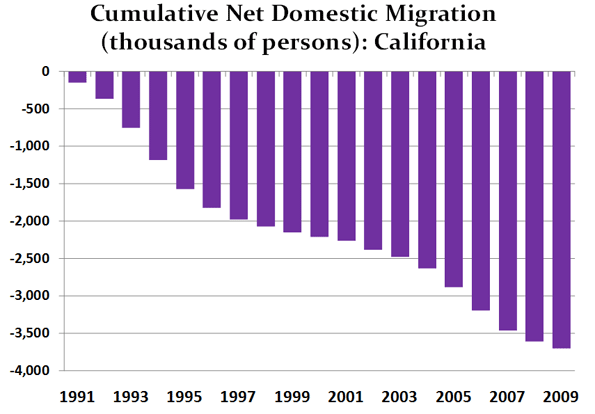
    How bad are things in California? California’s domestic migration has been negative every year since at least 1990. In fact, since 1990, according to the U.S. Census, 3,642,490 people, net, have left California. If they were in one city, it would be the third largest city in America, with a population 800,000 more than Chicago and within 200,000 of Los Angeles’ population.

    We’re seeing a reversal of the depression-era migration from the Dust Bowl to California. While California has seen 3.6 million people leave, Texas has received over 1.4 million domestic migrants. Even Oklahoma and Arkansas have had net-positive domestic migration trends from California.

    Those ultimate canaries in the coal mine, illegal immigrants, recognize California’s problems. Twenty years ago, about half of all United States illegal immigrants went to California. Today, that’s down to about one in four.

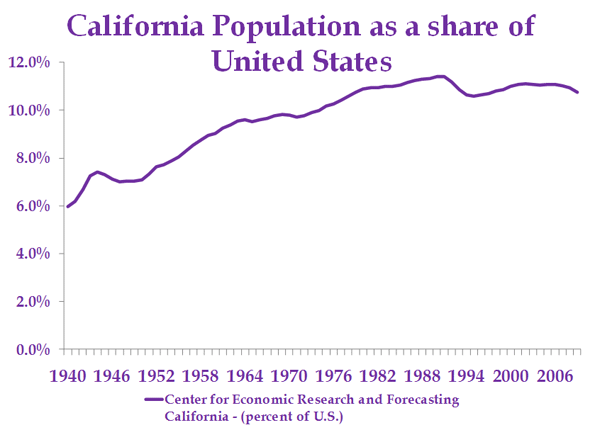
    The result of these migration trends is that California’s share of the United States population has been declining.

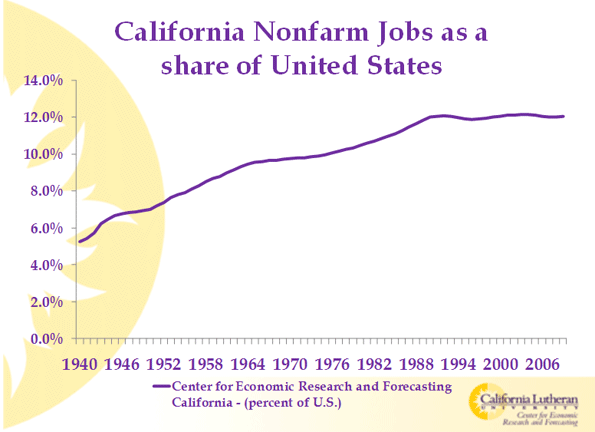
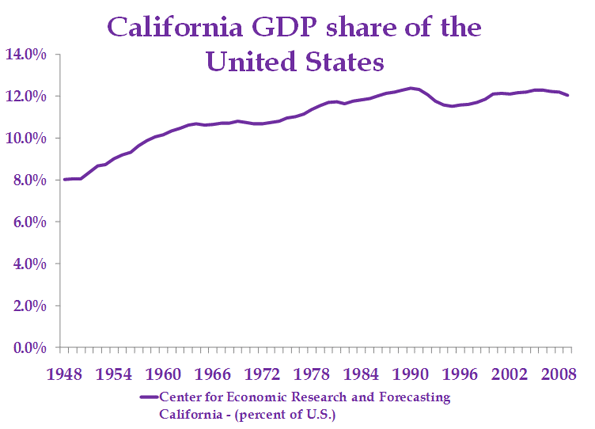
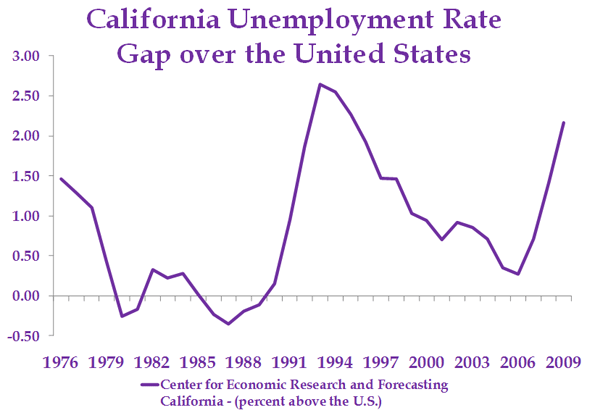
    What do these migrants see that so many of California’s political class do not see? They see a lack of opportunity. California’s share of United States jobs and output has declined since 1990, and its unemployment rate has remained persistently above the United States Average, only approaching the average during the housing boom.

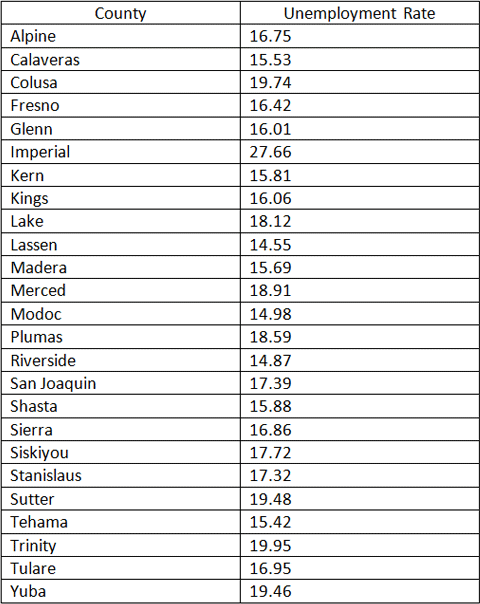
    California’s unemployment is particularly troubling. As of October 2010, only two states, Nevada at 14.2 percent and Michigan at 12.8 percent, had higher unemployment rates than California’s 12.4 percent. California’s unemployment problem is particularly severe in its more rural counties. Twenty-five of California’s 58 counties have unemployment rates higher than Nevada’s:


    These unemployment rates approach depression levels. Some will excuse many of them because they are in agricultural areas, but many assert that low Midwest unemployment rates are due to a booming agricultural sector. Which one is it?

    California’s unemployment problems are not limited to rural and agricultural areas. Most of Riverside County’s population is very urban, yet the County’s unemployment rate is 14.87 percent. On December 7th, the Wall Street Journal listed the unemployment rates for 49 of America’s largest urban regions. California had six of the 19 metro areas with double-digit unemployment. These include such major cities San Diego, San Jose, and Los Angeles.

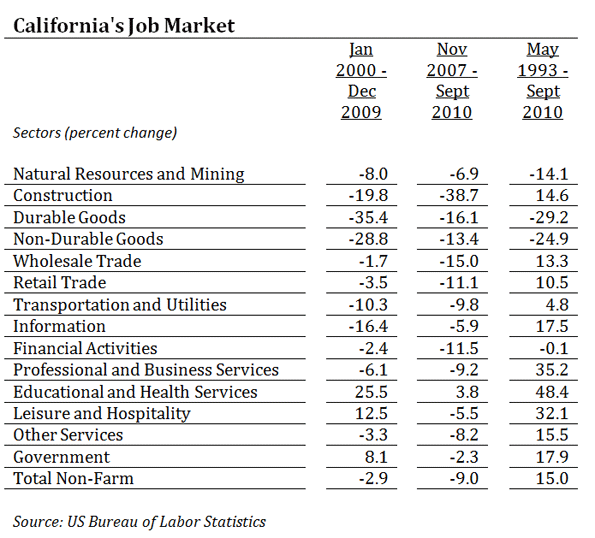
    Just as rural areas are not California’s only depressed areas, agriculture is not California’s only ailing sector. From 2000 to 2009, the only California sectors to gain jobs were government, education and health services, and leisure and hospitality.

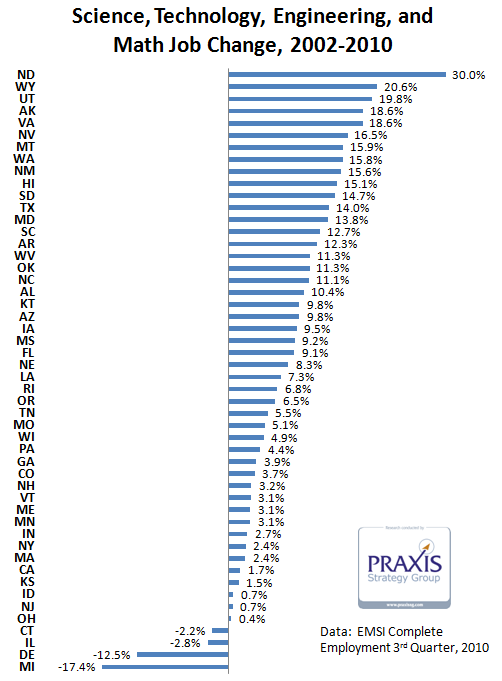
    California’s cheerleaders claim that the state’s future is assured by a vibrant tech sector, but the data do not support that assertion. North Dakota’s Praxis Strategy Group has performed analysis by job skills. They compare Scientific, Technical, Engineering, and Math (STEM) jobs across states. Their analysis shows that California is the Nation’s ninth worst state in creating STEM jobs in post dot-com-bust years. It has produced far fewer new tech jobs than Texas, and far less on average, than the country over the past decade:


    In this respect, California’s precipitous decline is really quite shocking. In just a couple of decades, California has gone from being America’s economic star, a destination for ambitious people from around the world and abundant with opportunity, to home of some of America’s most distressed communities. It has been a man-made, slow motion tragedy perpetuated by a political class that is largely deluded.

    The cheerleader’s faith in command and control regulation and environmental purity is so strong they cannot see anything that contradicts that faith.

    But that faith is misplaced. Joel Kotkin, Zina Klapper, and I performed an extensive review of the economic impacts of one of California’s most important greenhouse gas regulation, AB 32, and found that command and control regulation in general and AB 32 in particular is inefficient, cost jobs, and depress economic activity. California’s Legislative Analyst’s Office agrees, as evidenced by this report.

    More depressing still are the growing ranks of what could be called “the resigned”. They simply have given up. These include a business leadership that is more interested in survival and accommodation than pushing an agenda for growth. Easier to get along here, and expand jobs and opportunities elsewhere, whether in other states or overseas.

    Yet ultimately California’s future is what Californians make of it. No place on Earth has more natural amenities or a more benevolent climate. No place has a location more amenable to prosperity, located between thriving Pacific Rim economies and the entire North American market. No place has more economic potential.

    But unless policy is changed, California’s future is dismal, with the specter of stubbornly high unemployment, limited opportunity, and the continued exodus of the middle class. California’s political class needs first to confront reality before we can hope to avoid a dismal future.

    Bill Watkins is a professor at California Lutheran University and runs the Center for Economic Research and Forecasting, which can be found at clucerf.org.

    Photo by Stuck in Customs

  • Cities That Prosper, Cool or Not

    Over the past few years, the raging debate in economic development has been over whether cities should be cool or uncool. Should cities pursue “the creative economy” by going after arts, culture, creative research & development, and innovation? Or should they focus on the bread-and-butter economy: hard infrastructure, traditional industries like manufacturing, and blue-collar jobs?

    Usually a raging debate is an indication that the wrong question is being asked, and that’s the case here. The question is not whether cities must be cool or uncool in order to prosper. Clearly, there are some cities in each camp that prosper, and some cities in each camp that do not. The question is deeper: In both cool and uncool cities, what is the underlying nature of the economy? Does the city simply import money from other places, or does it export goods and services to other places? Because it is this distinction – not cool or uncool – that serves as the dividing line between prosperity that is real and prosperity that is illusory.

    Not long ago, I was interviewing a retired politician in a fast-growing Southern metropolis. Even though he was a good ol’ boy who had never left home, he bore no resentment for the retired Yankees who flooded his town. In fact, he attributed the whole area’s prosperity to them. A retirement community, he said, “is like a high-wage factory. You build 1,000 houses, you have 1,000 households making $90,000 a year. A high-wage factory without the factory.”

    I grew up in a factory town, and this got me thinking about a factory’s huge and multi-faceted contribution to a region’s economy. But is a retirement community really similar?

    In some ways the answer is yes — and that’s a good thing. The most obvious similarity, as my politician friend pointed out, is that the residents live in town, get steady paychecks to spend locally, and become involved in local life. Like factory workers, retirees can support a whole service economy with their local spending.

    But there’s more to a factory-town economy than simply Saturday grocery shopping by the workers. Factories are in the export business, while retirement communities are in the import business. An export economy spins off all kinds of economic benefits that you don’t get from an import economy. A big factory requires lots of suppliers, and tends to stimulate the creation of an economic cluster — a group of businesses that feed off each other and, in time, find new customers outside the region.

    A retirement community creates a cluster of suppliers, too. But this cluster tends to be composed of local service-sector businesses that create low-wage jobs and aren’t interested in repackaging their services for export outside the region — retailers, contractors, landscapers and pool-maintenance companies.

    There’s also a psychological difference. Factory workers are connected to the local economy in a way that retirees are not. If orders fall off, they might get laid off for a while, switch jobs and go to work over at a supplier, sometimes for more money, sometimes for less. But the point is that they have a stake in the regional economy. Factory workers don’t like traffic jams anymore than the rest of us, but they see the value of an expanding economy. They see how growth can be good as well as bad.

    Retirees see no such thing. They are tied to the global economic system in which their investments are based, or else to the economic fortunes of, say, a government pension system in another part of the country. They might want tax revenue to flow into public coffers in New York or Ohio to protect their public pensions, or they might want interest rates to go up so that their incomes rise.

    But they see no benefit in an expanding local economy. If a bunch of factory workers get laid off, the retirees don’t need to worry, in fact, they might actually benefit because local prices might fall. If business is booming and people are employed and labor rates are going up, they don’t have to worry about that, either. They might even be harmed by it, because their incomes are fixed — not tied to the local economy — and prices will go up.

    A retirement community is not the only type of place that operates this way. Tourist towns and bedroom suburbs function pretty much the same way. All are in the business of importing money from somewhere else, rather than exporting goods and services. And the recession has shown, once again, how fragile import-based economies are. A few years ago, Las Vegas was the biggest boomtown in America. Today, it’s become crash city, largely because the two-tier economy tied to tourism — a few wealthy casino owners and managers, a vast number of low-paid hotel service workers — couldn’t sustain the huge increase in home prices that occurred during the housing bubble.

    There’s nothing new in this distinction between import and export economies. Jane Jacobs laid out the thesis magnificently, almost 30 years ago, in Cities and the Wealth of Nations. But it’s become more relevant in the last couple of years, as the cool v. uncool cities debate has heated up.

    The argument that cool cities are involved in fluff, and therefore aren’t creating real economic growth, is based on the perception that cool cities are in the import business. If you build arts centers and sports stadiums and convention centers and subsidize lofts for artists, you’re not really creating any wealth… or so the argument goes. All you’re really doing is drawing people to your city so you can empty their pockets while they are having a good time; the classic import economy.

    That’s true sometimes, but not always. At its best, a creative economy is generating innovations that turn into products that get exported elsewhere, whether those innovations are fashion trends or software applications or biotech breakthroughs. And in many cases, a more plodding blue-collar economy requires fluffy arts stuff to create the quality of life that will attract top people. My grandfather left the Cornell faculty to run the research lab of a rope manufacturing company in my hometown in upstate New York, but I’m pretty sure one of the attractions was a symphony orchestra that my grandmother, a concert pianist, could perform with now and then.

    Similarly, just because a city is a lunch-bucket town doesn’t mean it’s sending goods and services out into the world and truly creating a lot of wealth. Here again, Las Vegas is a great example. Despite the glitz, Vegas is basically a blue-collar town. It’s job-rich, and workers traditionally didn’t need a lot of education or a high skill level to succeed, they just needed drive. Yet, by and large, the jobs created in Vegas aren’t very good. They’re relatively low-wage service jobs, and they come and go depending on the economy. Vegas’ business leaders are accumulating wealth quickly, and maybe eventually it will become an export economy. But for now, like the retirement community in the South that I mentioned, it depends entirely on importing money.

    It’s time to stop talking about whether towns should be cool or uncool. What really matters is what they are producing. If all they’re producing is some kind of experience that induces people to come to town and spend money, it doesn’t matter how cool the town is; it’s probably not sustainable economically. If, on the other hand, the city is creating and exporting something the world needs – whether that product is cool or uncool – it’s a good bet that both the city and its people will do pretty well for a long time.

    Photo by Stuck in Customs/Trey Ratcliff. Prosperity, or just an illusion? Building 43 at Google.

    William Fulton is a principal at Design, Community & Environment (dceplanning.com) and mayor of Ventura, California. This article is adapted from his new book, Romancing the Smokestack: How Cities and States Pursue Prosperity.

  • Florida Goes Underground

    By Richard Reep

    Last year’s report that Florida had lost people marked a new low in our state’s boom-and-bust history. But this autumn’s news seems to surpass even that sorry milestone with a combination of sluggish tourism, empty state coffers, and a reputation as one of the top real estate foreclosure states. Florida just can’t seem to get out of its own way, and with the fourth highest population in the country, it could have competed with Texas to replace California as one of the best business climates in the nation. Instead, Florida, which boasts one of the lowest tax rates in the nation, continues to see businesses and citizens depart, with newly elected governor Rick Scott recommending even lower taxes as the best solution. Instead, it is high time that Florida fix its real problems of economic monoculturalism and anti-education policies that drive it further and further away from America’s future potential.

    It is no secret by now that a diverse income source is the only way to survive the Millenial Depression. States that have more than one income source, like Texas, were able to adapt policies to favor resilient businesses and industries. In Florida, despite loud and clear input to the state legislature, no change in state policies have been effected this year, once again making tourism and construction growth the focus of job creation.

    The tourism industry knows well its position as “first in, last out” when a recession hits, diversifying its products and geography, enabling at least something to run while everything else stands idle. Thus Marriott International, in the late nineteen eighties, invested in senior living facilities, which bore well through the 1990-93 recession. Regulatory burdens on this market segment eventually caused Marriott to focus on other, less regulated markets, and today its global diversity has caused the company to remain economically sustainable. Florida, with so much sunk cost in tourism, seems unaware that its former tourism dominance has been quietly replaced by such glittering destinations as Brazil, Dubai, and China.

    Agriculture is, of course, Florida’s economic mainstay: even in a recession, people must eat. This industry, however, employs a whopping 44,000 farmers, about a month’s worth of laid-off Florida workers. Clearly, the state should be looking elsewhere to create jobs.

    Governor-elect Scott’s vague promise to increase state venture capital spending while cutting taxes is amusing, in light of similar promises from past politicians. While the state’s Capital Formation Act has attracted investment in biomedical clusters, it takes a great deal of spending to sustain this fund. Similar promises created tax incentives for the film industry, which built studios in the nineteen nineties. Then, when the going got rough, these subsidies evaporated, and the studios promptly moved to New Mexico.

    The money for such schemes comes from the same place that Florida politicians seem to always find money: the education system. Florida, after struggling to get up to 27th in spending per pupil, seems about to find out what it is like to be 50th. And this is a last place finish the state should avoid.

    An educated population can adapt more easily to the changing times, can more competently choose its leaders, and can create wealth for itself. None of these qualities have been demonstrated by Floridians in recent years (think of the 2000 election) and, if the newly elected leadership has its way, none are likely to spring forth in the near future either.

    Florida’s two best hopes are to invest more in its public education system, not less, and to diversify its economy. Recent immigrants from states like Wisconsin and New Jersey, where schools are well funded and taken seriously, express shock and dismay at the public schools in Florida. While states like New York debate the worth of comprehensive assessment tests, Florida has been busy distilling its education system down to a teaching-the-test model, producing little else but test results. Regaining an educated, aware citizenry is critical if the state is to see a future as a contributor to the nation’s recovery.

    The potential to diversify its economy remains strong in Florida. Instead of lowering taxes, however, the new state leadership would do well to consider a more guided regulatory approach that favors a diverse economy. Come and gone are many industries which could return with the right incentives: aviation training, movies and television, solar energy research, and the space program. Research, manufacturing, and commercial jobs in all of these industries could contribute to a rebirth of Florida and spark investment that would produce lasting results.

    Florida’s tax climate favors business, but is oddly mismatched by its regulatory climate. The dodged a bullet with the failure of Amendment 4 – a proposal that all new development would have to face a public vote – and the state’s development industry congratulated itself heartily on this success. This proposal made the ballot because of the cumbersome development process regulated by the state’s Department of Community Affairs, which has widely been perceived to fail at its task, protecting neither nature nor the quality of life for its citizens. Whether or not the new governor gets his wish to eliminate this bloated state bureaucracy remains to be seen, but regulatory reform in the state’s development codes needs to be in the works.

    And tourism, which has been a great economic engine, has a chance to come back. Florida will always be a destination, and while other world places have leapfrogged ahead, tourism is highly competitive, as destinations age rapidly. The enduring romance with Florida will continue, but its famous beaches and theme parks will need to reinvent themselves bigger and better than ever. With a new Legoland in the design phase, and redevelopment at some of the world’s most hallowed ground in the Magic Kingdom, tourism’s long-term future bodes well.

    The smoke has cleared from the election battles. Now, more than ever, Florida’s leadership should be nurturing a more educated citizenry and reforming its regulatory system, rather than keep its tax system at ultra-low levels, to pull itself out of this nosedive. Florida’s natural advantages in climate and accessibility make it ideal for such a wide variety of businesses that very little should stand in its way to diversify the economy and create a productive, vibrant, educated workforce.

    Richard Reep is an Architect and artist living in Winter Park, Florida. His practice has centered around hospitality-driven mixed use, and has contributed in various capacities to urban mixed-use projects, both nationally and internationally, for the last 25 years.

    Photo by Captain Kimo

  • Korea Conflict Shows That Borderlands Are Zones of Danger

    The current conflict between the Koreas illustrates a broader global trend toward chaos along borders separating rich and poor countries. Ultimately, this reflects the resentments of a poor neighbor against a richer one. Feeling it has little to lose, the poorer neighbor engages recklessly in the hope of gaining some sort of tribute or recognition   from the better-heeled neighbor, or at least boosting its own self-respect.

    The Korean situation epitomizes the fundamental danger when rich and poor countries live adjacent to one another. According to 2006 statistics, South Korea has a per capita income of roughly $18,000; the North’s stands at $1,300. Clearly, the threat of leveling Seoul, a wealthy and successful city, has limited South Korea’s ability to respond as it might otherwise to its nasty, militaristic neighbor, whose people live on the brink of starvation.

    Conflicts between poorer peoples and richer neighbors have been part of human history since antiquity. In ancient Mesopotamia the rough Semites attacked and eventually overcame the wealthier, more sophisticated Sumerians. This pattern was repeated throughout the ancient world, for example, pitting Chinese against the peoples of the Steppes, hurling German and Hunnish barbarian races against the Romans, and in countless upheavals throughout Meso-America.

    Although the wealthier neighbor can beat back the threat through better organization and technology, often it’s the poor neighbor who ultimately triumphs.   The Great Arab historian Ibn Khaldun, a student of Mid-east  and Mediterranean politics in the 14th  century, even developed a theory positing that the poorer, hungrier neighbor often held the long term advantage Of the more affluent countries, he writes,  “Time feasts on them, as their energy is exhausted by well-being and their vigor drained by the nature of luxury.”

    As the settled, wealthier nation becomes soft and “senile,” Khaldun observed–and ultimately either unwilling or incapable of overcoming the threat from their more savage neighbor. You can people off only so long before you drain your own treasury and self-respect. If Khaldun is right, the world is going to become a more unsafe place in the coming decade as the great unwashed seek to crash the gilded gates.

    Other changes have made borderlands more dangerous in recent decades. During the Cold War era, such conflicts were often mediated by the two great super-powers. There were clear zones of influence. But in an increasingly chaotic multi-polar world, where power is diffused and technology sometimes favors the rogue, it become increasingly difficult to manage these conflicts. In Korea we can see this in the gamesmanship of China, which further limits any strong American and South Korean response.

    But Korea is hardly the only place where borderlands have become hot zones. There are many places around the world where rich nations abut poorer ones, creating serious potential for major conflict. Among the most worrisome:

    The Saudi/Yemen border. Oil-rich Saudi Arabia boasts a per capita income over 13 times greater than that of its southern neighbor. Criminal elements, illegal immigrants and a growing al Qaeda presence, cross the porous border. These could ultimately undermine the country with the largest proven energy reserves. Over 130 Saudi soldiers have been killed this past year along this 1,100 mile long desolate border region–so desolate it was only demarcated in 2000.

    Israel and Gaza/Palestine. Ancient hatreds make this a particularly worrisome set of borders.  There are huge gaps not only in ideology and religion but income. Israel’s 2006 per capita income was just shy of $18,000, while Palestine’s was under $800 and Gaza’s under $500. Such huge gaps, as can be seen in the Koreas, tend to exacerbate already great tensions.

    Spain/Maghrebian countries. The flow of immigrants from Muslim North Africa into southern Europe has become a major international flashpoint, particularly as Spain, Italy and countries continue to experience major economic dislocation. There are well over 1 million Muslim immigrants in the country. The income difference between these two adjacent worlds can be immense; Spain’s per capita GDP is more than ten times that of Morocco, its closest Arab neighbor. The flow of immigrants and far higher fertility rates among them can be unsettling to some.   ”Tomorrow Europe might no longer be European,” Libya’s Leader Muammar Ghadafi suggested recently.

    U.S./Mexico. Although relations between the two countries have been cordial under both Presidents George W. Bush and Barack Obama, the ground level violence in Mexico–claiming 26,000 deaths since December 2006–is both driving Mexicans north and driving Americans away from the border region. With U.S. per capita incomes over six times that of Mexico, the temptation for criminals, as well as illegal immigrants, to cross the border can be overwhelming, and unsettling. Border violence is way up, leading to calls for tighter controls over immigration.

    Two recently discovered tunnels for drug smuggling near San Diego, complete with rail cars, indicate how inventive some cross-border entrepreneurs can be. But it is a mistake to see borderland as only bastions of criminality and unrest. Until recently the U.S./Mexico border constituted one of North America’s fastest-growing economic regions, marrying U.S. technology and investment with hard-working Mexican labor.

    Perhaps the most positive model of harmonious border relations can be seen along the border of Singapore and Malaysia. Although Singapore’s per capita income is more than five times that of Malaysia, there are ambitious plans to build a vast new business complex in the Iskandar section of Malaysia’s Johore State   The Malaysians envision “a strong and sustainable metropolis of international standing.” Right now the most obvious signs of mega-development in the area are somewhat oversized government buildings.

    If the cross-straits development materializes, this region would both expand the economic footprint of the predominately Chinese city-state and its largely Muslim neighbor. Instead of worrying about drugs, terrorists or illegal migrants, some well-placed Singaporeans see Johore as a base to expand its manufacturers and those of foreign firms.

    There is also a swank upscale “Leisure Farm” that offers green-tinged amenities for Singapore’s often crammed and stressed residents. Some  Singaporeans privately doubt the ability of Malaysians to compete with them in higher-value-added fields, but others wonder if their growing investment across the straits may be creating a tough competitor.

    Ultimately,   the planet’s future depends on successfully integrating the economies of rich countries and poorer ones. Aspiring countries have much to offer their rich neighbors–in terms of markets, labor and entrepreneurial energy. One hopes the world will see more of the commerce-driven model of Malaysia, and less of the kind of potentially dreadful military conflict now brewing along the Korean frontier.

    This article originally appeared at Forbes.com.

    Joel Kotkin is executive editor of NewGeography.com and is a distinguished presidential fellow in urban futures at Chapman University. He is author of The City: A Global History. His newest book is The Next Hundred Million: America in 2050, released in February, 2010.

    Photo by anja_johnson

  • Love and the City

    It has been said that the modern city is soulless, that it is heartless, and that it is brutal. The modern city represents in its scale and complexity one of the most extraordinary of human inventions, but there is also no doubt that everywhere in the world it is also one of our biggest failures.

    The dysfunction of a city in the past was an inconvenience. The dysfunction of a city in the future will be a profound disaster for that city and, ironically, a profound opportunity for another city, of a smarter city. It will be an opportunity for a city that has found out how to position itself better in the world of cities, but more importantly in the eyes and hearts of its citizens.

    All over the world, there is a growing recognition that this brutality must stop; we have to imagine a different kind of city which addresses human needs and that puts the soul back into the city. This is essential to the survival of the city. Put another way, there is a growing understanding that it is actually “love” that will be the prime force in the future economy of successful 21st century cities.

    Who would have thought in the last generation that “love” might become a meaningful topic in a discussion about urban economies, much less a prime force of those economies?

    One important reason for creating a love-based city grows from the struggle today among cities for hegemony. We read all the time about “alpha-cities” and “delta-cities”: the “alphas” enjoy the fruits of labour and the “deltas” just do the labour – they just exist. And why is this?

    Well, it’s because the dynamics of urban growth and competition have fundamentally changed in the last quarter century. The world has become footloose, with people and capital moving at will: business can be done anywhere. Other aspects of life are more important than one’s livelihood and where people choose to settle is not tied down the way it used to be. We can do and be almost anything anywhere.

    The result is a new kind of economic base for our cities, augmenting the traditional economic activities holding our cities together. This is the ideas and service economy and it opens up the imperative to create a city of beauty and quality liveability and style. This is an economy driven by people, their direct needs, their preferences and their day-to-day experiences.

    This ideas and service economy quickly becomes an economy involving almost everyone. If you live in a core city, have you ever tried to get a gardener or a plumber? But, even beyond that, you have to think about all of the professions and vocations that can now demand an enjoyable as well as functioning city.

    We’re not just talking about the service sector or the ‘creatives’, we’re talking about almost everybody. We have to focus the discussion on a city that is liveable for a broad array of its population.

    I worry that in all our creative thinking about sustainable technologies and sustainable urban forms, there may be some strong denial going on about people and their inclinations, denial that will block the way towards sustainability.

    Take the fashion that insists on the primacy of density and mixed use and diversity and sustainable transportation. Sadly, most consumers in the English speaking world, except in a very few of our older gracious places, have shown very little interest in being a part of that kind of city. In my country, two-thirds of Canadians live in auto-dominated suburbs that boast none of these qualities – and that proportion is even higher in America.

    Let’s be blunt: most people hate density because most of it has been so bad; they think of mixed use as probably hitting them negatively and transit is not even in most people’s vocabulary. The ideal of most people is some sort of rural “garden of Eden” that they want to escape to from the city – even if that ends up being an illusory goal.

    I sympathize. The cities we have been building since the War have very seldom offered anything very appealing at almost any density. Who can really fall in love with brutal concrete canyons or anonymous strip malls or wind-swept roads?

    If cities want to offer an alternative, they must change and bring back the human touch – we have to bring placemaking to the very heart of the civic agenda. We have to stop trading away the urban qualities we care about for the urgencies of the moment of modern life.

    We must start to build places that truly appeal to people – yes, places that are sustainable, but also places that are so good that people will choose them. These cities have to have all the human services and they have to have beauty and they have to be gentle. Only then will they become attractive to a wide range of people.

    I call this “Experiential Planning” – learning about and then carefully making the city deliver the experiences people tell us they want in their lives for their families and children.

    Experiential planning looks beyond land-use and transportation patterns to things like character and comfort and health and convenience and the visceral response of the senses and caprice: things that simply make people happy. Happiness is the applied side of love.

    People want all of the efficiencies and choices but they also want more. They want to feel the unique, special spirit of a place as a real thing, not a marketing gimmick. They want their habitat to have a “buzz” that makes them feel good. They want their day-to-day living environment to foster social engagement and neighbourliness not isolation. That is what the contemporary city has often been missing.

    For as long as anyone can remember, modern cities, with very few exceptions, have been shaped by economic activity and politics and the shifting of social groups: the city exploited as a commodity. But that doesn’t have to be the case. We can actually design our cities as an explicit act of creation – grand civic design with the whole city as a canvas. And every city has to find its own way: they should not accept cookie-cutter replications of what’s being done everywhere else.

    To start, every city needs to perform a ritual burning of these outdated and single-purpose rules. Now I am not talking about de-regulation. The city of the future will have to have strong regulations because the possibilities out there for development are just too diverse and the private interests in development too strong. There must be a clear expression of the public interest and public needs to match that of the private sector.

    Also, I want to be clear that this is not a “top-down” agenda. Experiential planning requires an aggressive and diverse engagement of the public at every step along the way to articulate the public perspective and to insure public buy-in and ownership. The general public needs to discuss and debate an overall civic vision and all aspects of urban design.

    In this experiential-based city there will be an alignment of profitability and community building. We will also see people coming back to live in the core city and to suburbs transformed through natural choice and preference. There will be an alignment of consumer selection and sustainable practice. This will include all kinds of people but especially families with children.

    But none of this will happen by accident. We have to make it happen and bring along individual values through a careful process of reconciliation.

    Tomorrow’s city must meet the environmental test and the economic test but it must also meet the experiential test; and that is the test of love; that is the test of soul. It must be beautiful and joyful and sociable and humane and offer a complete rich community life – with all the subtleties of human occupation. That is the real power of an urban love affair.

    Larry Beasley is the retired Director of Planning for the City of Vancouver in Canada. He is now the “Distinguished Practice Professor of Planning” at the University of British Columbia and the founding principal of Beasley and Associates, an international planning consultancy. He chairs the ‘National Advisory Committee on Planning, Design and Realty’ of Ottawa’s National Capital Commission; he is the Chief Advisor on Urban Design for the City of Dallas, Texas; he is on the International Economic Development Advisory Board of Rotterdam in The Netherlands; and he is the Special Advisor on City Planning to the Government of Abu Dhabi in the United Arab Emirates.

    Photo by ecstaticist