Category: Economics

  • Health Care: Booster Shot for Jobs?

    As a former health care human resources executive, I’m often drawn to the local hospital in whatever city I’m visiting. A city’s health care environment reflects its social, cultural and economic state. Because the local medical center complex is often the largest employer in town, it would seem that strong fiscal returns would be rewarded to those cities that strategically aligned their economic development efforts to capitalize on growing this sector. Unfortunately, the health industry has historically been viewed as a local disaster, replete with quality of care issues, bureaucratic inefficiencies and high costs.

    While the spiraling costs, the inefficiencies, and the future of reform are often talked about, little attention is given to health care jobs as springboards to enliven local and regional economies. The steady parade of doctors, nurses, technicians and support staff at our medical establishments provide cities with a huge multiplier effect on nearby housing, restaurants and retail businesses. The trickle-down effect spreads outward to hospital manufacturers, suppliers, pharmaceutical companies, and other ancillary firms that serve as the lifeblood of a functioning health care system. The economic activity of the medical business extends well beyond hospital walls; it’s a high-octane job engine, with the buying power of health professionals helping to sustain struggling communities.

    With current U.S. unemployment rates stagnating at high levels, the robust quantity of workforce activity resonating through hospital corridors is good news for our nation’s cities and regions. According to the U.S. Department of Labor, 1.7 million new jobs have been added to the health care sector since 2001. This figure includes employment gains in health insurance, construction, pharmaceuticals, biotech, the life sciences and other complementary fields. More impressively, the DOL estimates that by 2018 there will be a 21% employment increase in health practitioners (1.6 million jobs) and a 29% increase in health care support roles (1.1 million jobs). Health care also currently boasts the lowest unemployment rate of any industry, and salaries average a respectable $43,700.

    Cleveland, Ohio, is a prime example of a city that has undermined its economic potential by permitting dubious redevelopment efforts – centered on sports complexes and museums – to overshadow assets such as the Cleveland Clinic and the University Hospitals Health System, which together encompass 51,000 employees.

    Like most Rust Belt cities, Cleveland sorely needs an infusion of jobs outside of the long diminished blue collar sector. It could build collaboratively on its health care niche, creating complementary clusters of medically related firms in the life sciences and health information systems that would bring new opportunities and life to the area. The city’s world-class medical establishments could supply the ideal springboard for branding Cleveland as a global medical hub, rather than as the home of the Cleveland Cavaliers and the Rock and Roll Hall of Fame museum.

    One Cleveland-area organization, BioEnterprise, is taking the lead in fueling the growth and commercialization of health care companies in the bioscience sector. A collaborative effort between top medical and higher education institutions in the region, BioEnterprise is a promising attempt to alleviate Cleveland’s persistent difficulties in generating jobs and economic growth.

    The potential economic impact of new health related establishments is also gaining attention in Shawnee, Kansas, where the Economic Development Council is pursuing plans for a Biosciences Development District to attract high-paying job opportunities. And in Solano County, California, local leaders have made savvy use of existing infrastructure, new capital investments and local tax policies to fuel growth in the emerging medical sciences corridor between Sacramento and San Francisco.

    To build a successful future around health care jobs, cities must make creative use of their local and regional assets. For example, a four-year medical school in Spokane, Washington, according to a recent report entitled “America’s Next Great Academic Health Center,” would support more than 9,000 new jobs by 2030 and generate nearly 1.6 billion in new economic activity for the area.

    Here’s a concept of a model for job creation and economic growth: the Medical District Oriented Development (MDOD). These multidisciplinary districts would consist of a cluster of complementary stakeholders: health care entities (hospitals and medical centers, imaging facilities, community health centers, and private and specialty clinics); durable equipment manufacturers and providers, and pharmaceutical and life science research institutions. Livable communities, these districts would include housing, retail, and transportation options operating on the fringe of the medical campus setting.

    Unlike the much discussed Transportation Oriented Development paradigm, MDODs would not be faced with the “cart before the horse” issue; there wouldn’t be a question of whether to create demand before building the infrastructure or vice-versa. The magic behind MDODs would be a health care sector that already possesses a mature yet growing cadre of physicians, nurses, technicians and researchers who would serve as a captive audience for new development initiatives.

    In Sacramento, the U.C. Davis Medical Center campus possesses many of the building blocks of a successful medical district. As the flagship safety-net hospital for Northern California, the Medical Center has successfully collaborated with local task forces and associations to support the redevelopment of nearby neighborhoods, bringing new jobs to the immediate area. It has also spawned new workforce housing, restaurants and other amenities in an area that has faced hard times.

    In addition to collaboration between municipalities and medical institutions, and leveraging a region’s local assets, what else can cities do to manifest economic prosperity through health care centers? Chip and Dan Heath, the bestselling authors of Switch: How to Change Things When Change Is Hard, note that successful transformations begin when this question is asked: What’s working now and how can we do more of it? For city leaders, the question becomes: How can we capitalize on the booming health care sector through new investments in multidisciplinary medical districts, including housing and transportation options?

    When cities and regions choose to create synergies between their communities and their medical campuses, the prognosis is promising for an economic cure.

    Photo: Christiana Care health workers submit Magnet Recognition Program documents to the American Nursing Credentialing Center.

    Michael P. Scott is an associate with Centro, Inc, a Denver-based consulting firm focused on the future of our city centers. He can be reached at michael@becentro.com

  • Political Decisions Matter in State Economic Performance

    California has pending legislation, AB 2529, to require an economic impact analysis of proposed new regulation. Its opponents correctly point out that AB 2529 will delay and increase the cost of new regulation. There will be lawsuits and arguments over the proper methodology and over assumptions. It is not easy to complete a thorough and unbiased economic impact analysis.

    Should California incur the costs and delays of economic impact studies?

    California should, because political decisions matter and too many California politicians don’t believe it. I’ve had a State Legislator, sitting in her office in the Capital, tell me in essence that decisions made in this building won’t impact California’s economy.

    She’s not alone. It is common to hear politicians or their advisors claim that “California will come back” or something similar. They believe that California’s climate and abundant amenities are enough to guarantee prosperity. They are wrong.

    Consider North Dakota, and its booming economy. As of July 2010, North Dakota’s unemployment rate was 3.6 percent, and in 2008, the most recent year for which we have data, its economy grew at a 7.3 percent rate. California’s unemployment rate was 12.3 percent in July 2010, and its 2008 economic growth rate was an anemic 0.4 percent.

    That’s a very big difference. If California had North Dakota’s unemployment rate, it would have over 1.3 million jobs than it has today. That is almost the entire population of Sacramento County and 30 percent more than the entire population of Northern California’s Contra Costa County.

    Why the big difference? Why is North Dakota booming, as the United States suffers its most devastating economic decline in over 70 years? Why is California’s economy, with almost 30 percent higher unemployment than the United States, performing so poorly?

    Does North Dakota have some naturally endowed advantage over California? If so, nobody has noticed it before. It is not climate. California has a friendly Mediterranean climate, while North Dakota has a Northern Continental climate. North Dakota’s mean minimum temperature is below freezing six months of the year, and it gets as low as -60F! Many Californians, living on the coast, can go decades without witnessing a freezing temperature. I remember when we had a multi-day freeze in my hometown of Ventura, sometime in the 1980s. I was freezing; a North Dakotan would be walking around in a t-shirt.

    California has oil and gas. North Dakota has oil and gas. California has over 2,000 miles of beaches. North Dakota doesn’t have beaches. California has magnificent mountains. North Dakota doesn’t have any mountains and only a few hilly areas. Over 20 species of trees reach their largest size in California. Most of North Dakota doesn’t naturally grow many trees.

    Let’s face it. Most Californian’s consider North Dakota to be a cold, windy, God-forsaken piece of dirt best left to the bison. North Dakota’s natural endowment doesn’t explain why it has been growing with vigor while California has been stagnating.

    Maybe North Dakota has been lucky while California has been unlucky? Luck can play a part in economic performance, and North Dakota has almost surely been luckier than California over the past few years, but that can’t be the only explanation.

    It’s hard to point to a single source of North Dakota’s prosperity. Its taxes aren’t particularly low. It has a reasonable safety net for the unfortunate. It does have a booming oil and gas business. Its agriculture sector is doing well. It has a small, but dynamic, tech sector. Its universities remain well funded since the state is actually running surpluses. It has a hardworking, well educated, Midwestern population. Governments and politicians in both parties tend to be business friendly, willing to support business and enter into occasional partnerships. North Dakotans have done lots of things right, and they’ve probably also been a bit lucky.

    It’s just as hard to point to a single source of California’s dismal performance. California hasn’t maximized the economic potential of its oil and gas resources, but its economy is large, and oil and gas alone can’t explain the differences between California and North Dakota. California hasn’t updated its ports to accommodate the most recent and planned ships, but those ports see lots of activity. Many California communities are not business friendly, but some are, particularly some smaller ones inland. California has lost some military bases, but many remain. California is a relatively expensive place to do business, because of taxes and regulation, but California’s workers are more productive, even after adjustment for industrial composition and capital, and California’s consumers still constitute a huge market.

    California’s economy is dying the death of a thousand cuts: a tax here, a regulation there, an unfriendly city council in Coastal California, a lack of infrastructure investment everywhere. These things add up to a significant net negative for California, its businesses, and its workers.

    Californians have done lots of things wrong, and they’ve been a bit unlucky.

    That’s why AB 2529 is a good idea for California, why it’s worth the costs and delays. The analysis will require regulators to consider the economic costs of regulation, something many green activists and Sacramento politicians simply ignore. Perhaps if this regulation had been in place over the past few years, some of California’s 2.2 million unemployed workers would have jobs and once Golden State would not be on the verge of becoming, as historian Kevin Starr has noted, “a failed state”.

    Bill Watkins is a professor at California Lutheran University and runs the Center for Economic Research and Forecasting, which can be found at clucerf.org.

    Photo by Willem van Bergen

  • Iowa’s Agro-Metro Future

    When Brent Richardson, a field rep for Cadillac, was told he’d been transferred to Des Moines, he assumed he’d be spending the next year in a small town environment. Des Moines turned out to have much more bustle than he expected. The city had a robust insurance sector among its diverse industries. And the lifestyle was very similar to what he was able to live in big city suburbs like Naperville, Illinois or Bellingham, Massachusetts. Steeped in a decade of Farm Aid concerts, he also expected the surrounding rural areas to be populated with hardscrabble homesteaders struggling to hang on. Instead, he discovered that farming was big business – and, these days in particular, reasonably profitable. And some of those Iowa farmers turned out to be Cadillac buyers.

    Richardson’s outsider view of Iowa is typical. Few people give it much thought, and those who do conjure up visions of cornfields and American Gothic. There’s some truth to that, but the real Iowa today is much more than that. A resurgent but industrialized agriculture sector and thriving cities give the state a 1-2 “agro-metro” punch, although large areas of the state still struggle.

    Straddling the Midwest and the Great Plains, Iowa is in a region known for trouble. But the state has managed to pile up impressive statistics. Iowa lost fewer jobs than the nation in the last decade, and has consistently maintained a lower unemployment rate. In 2009, Iowa’s unemployment was only 6.0% compared to a national average of 9.3%, a huge differential. Its agricultural sector is booming. So far this year US farm cash incomes were up 23%. That’s increasingly driven by large farm operations, as 75% of farm output comes from just 12% of farms. Iowa is right in the middle of this.

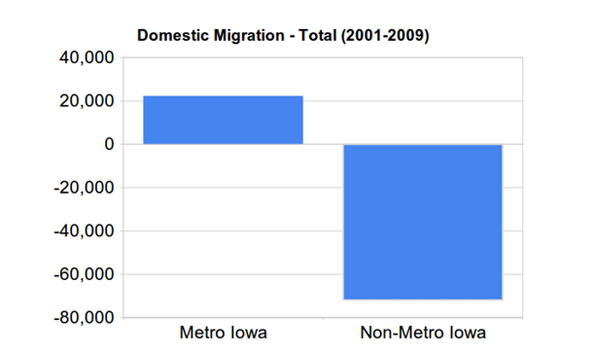
    But if the state as a whole looks reasonably healthy, this obscures its unevenness. Des Moines and big farms are doing well, but many rural and manufacturing communities are not. This is best illustrated by a map of domestic migration over the last decade.

    Net Domestic Migration, 2000-2009, in-migration in gray, out-migration in red. Darker shading denotes intensity.

    This shows net in-migration in grays and net-outmigration in pinks. The darker gray areas are clustered in metro Iowa, which is showing incredible growth, particularly around Des Moines. Des Moines population is actually up 16.5% in the last decade, about double the national average growth rate. In a decade where the US as a whole didn’t add any jobs, Des Moines powered ahead on employment by 9.3%. It’s GDP per capita is actually 12% higher than Chicago’s.

    Many other Iowa metros are likewise doing well. Dubuque recently landed a 1,000 job operation from IBM and grew its employment by over 3% last decade. Dubuque, along with other Iowa metros like Ames and Sioux Falls, grew economic output per capita faster than the average for the rest of America’s cities.

    But for non-metro Iowa, it can be a different story. Some big farmers are doing well, but many places are living up to their Great Plains reputation; they are simply drying up and emptying out. They are too remote, too sparsely populated, too lacking in talent concentrations, and ill prepared for the demands of the global economy.

    As farming transforms, cities thrive, and other areas shrivel, Iowa in changing, splitting into two states as its regions diverge, and becoming increasingly metropolitan in character.

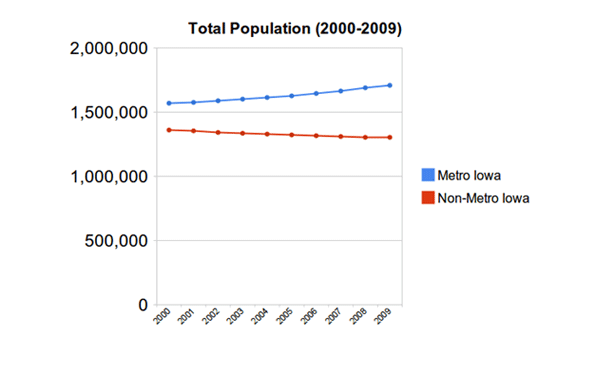
    This divergence is most easily illustrated by a chart of population:

    There are already more people living in metro areas than non-metro areas in Iowa, and the gap is only getting wider. Non-metro Iowa is actually shrinking as people leave and the population re-orders itself in the state:

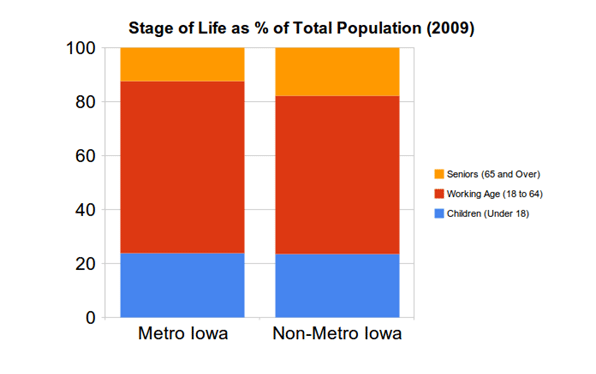
    Non-metro Iowa also has a larger senior population and lower population of working age. Generational turnover will drive even further population declines over time:

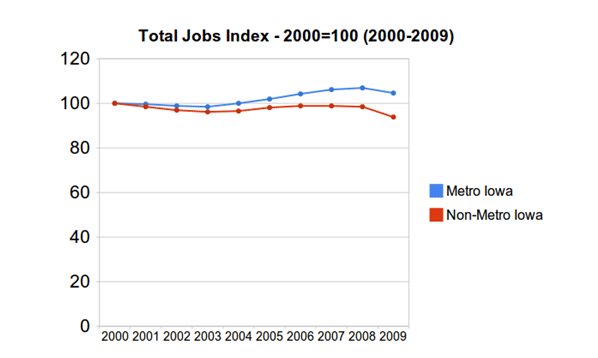
    And of course, these demographic trends are reflected in employment numbers as well, with metro Iowa adding jobs even in the last decade while non-metro Iowa is losing them.

    People’s opinions of Iowa are largely shaped by which of these two states they are looking at. More people tend to think about the struggling parts because that fits the traditional coastal media narrative and those places look big on a map. Iowa’s thriving metro regions are often overlooked because they are smaller and don’t fit the mold espoused by big city urbanists. Des Moines might not look like a Boston or Chicago, but that doesn’t mean it isn’t prosperous – and growing at almost Sunbelt rates.

    Like all of America, Iowa is a state in transition. And while it faces challenges to be sure, it’s managing that change better than most. Iowa’s future is likely to be very different from its small town past. It will be a more urban state, with several thriving metro regions. Farming will remain important, but will increasingly as a big business operation. Iowa’s future will be neither small town nor “hip cool” big city; it will represent the kind of agro-metro future that is emerging across wide swaths of America’s heartland.

    Aaron M. Renn is an independent writer on urban affairs based in the Midwest. His writings appear at The Urbanophile.

    Photo by Pete Zarria

  • Urban Plight: Vanishing Upward Mobility

    Since the beginnings of civilization, cities have been crucibles of progress both for societies and individuals. A great city, wrote Rene Descartes in the seventeenth century, represented “an inventory of the possible,” a place where people could create their own futures and lift up their families.

    What characterized great cities such as Amsterdam—and, later, places such as London, New York , Chicago, and Tokyo—was the size of their property-owning middle class. This was a class whose roots, for the most part, lay in the peasantry or artisan class, and later among industrial workers. Their ascension into the ranks of the bourgeoisie, petit or haute, epitomized the opportunities for social advancement created uniquely by cities.

    In the twenty-first century—the first in which the majority of people will live in cities—this unique link between urbanism and upward mobility is under threat. Urban boosters still maintain that big cities remain unique centers for social uplift, but evidence suggests this is increasingly no longer the case.

    This process reflects a shift in economic and social realities over the past few decades. For example, according to a recent Brookings Institution study, New York and Los Angeles have, among all U.S. cities, the smallest share of middle-income neighborhoods. In 1980, Manhattan ranked 17th among the nation’s counties for social inequality; by 2007 it ranked first, with the top fifth earning 52 times that of the lowest fifth, a disparity roughly comparable to that of Namibia.

    President Obama’s hometown of Chicago shows much the same pattern, according to a recent survey by Crain’s Chicago Business. Conditions have improved for a relative handful of neighborhoods close to the highly globalized central businesses. But for many neighborhoods things have not improved, and in some cases have deteriorated. Even before the recession there were fewer jobs than in 1989 and fewer opportunities for the middle class, many of whom—including more than 100,000 African-Americans—have left the city over the past decade.

    This pattern does not reflect perverse conditions unique to the United States, as many academics and progressive pundits often suggest. Between 1970 and 2001, the percentage of middle-income neighborhoods in Toronto dropped from two-thirds to one-third, while poor districts had more than doubled to 41 percent. According to the University of Toronto, by 2020, middle-class neighborhoods could account for barely less than 10 percent of the population, with the balance made up of both affluent and poor residents.

    Similarly, Tokyo, once widely seen as an exemplar of egalitarianism, is transforming. The city’s post–World War II boom yielded a thriving middle class and remarkable social mobility. That is now giving way to a society where wealth is increasingly concentrated. The poverty rate, including some 15,000 homeless people, has risen steadily to the highest level in decades.

    Much the same process can be seen in great social democratic havens of Europe. In Berlin, Germany’s largest city, unemployment has remained far higher than the national average, with rates at around 15 percent. Some 36 percent of children are poor; many of them are from other countries. The city, notes one left-wing activist, has emerged as “the capital of poverty and the working poor in Germany.”

    To a large extent, urban poverty in Berlin and other European megacities is concentrated among Muslim immigrants. Muslims constitute at least 25 percent of the population of Marseilles and Rotterdam, 20 percent of Malmo, 15 percent of Birmingham, and 10 percent or more of London, Paris, and Copenhagen. Over the next few decades, according to a recent Pew Research Center study, Muslims will constitute a majority of the population in several of these European cities.

    The Case of London

    Perhaps nowhere is the growing class divide more evident than in London, perhaps the world’s most important megacity. Despite a massive expansion of Britain’s huge welfare state, the ladder for upward mobility seems broken, especially in London. This represents a dramatic shift from the period after World War II. In the ensuing decades, incomes for most Londoners grew, access to education expanded, and the sharply drawn and notorious class lines began to blur.

    But contemporary London’s emergence as the headquarters of globalization has had widely differentiated impacts on class. On the one hand, it has paced the emergence of the West End. Many once hardscrabble neighborhoods—including Shoreditch, Islington, and Putney—have gentrified. Yet walk a bare half mile or less from the Thames River, particularly to the south, and you encounter many marginal, and often dismal, districts. These areas have not much benefited from the global economy and are inhabited largely by those who survive at the expanding bottom of the wage profile.

    Equally troubling, globalization’s benefits have disproportionately accrued to those already possessing considerable means; the ranks of top professionals, according to a 2009 report by the British government’s social mobility task force, have been increasingly dominated by the children of the wealthiest families.

    Even less noted has been London’s deepening concentration of poverty. Today more than one-third of the children in inner London are living in poverty, as are one in five in the outer ring communities. London has the highest incidence of child poverty in Great Britain, even more than the beleaguered Northeast.

    Poverty also affects 30 percent of working-age adults, more than one-third of pensioners in inner London, and roughly one in five in outer London. The inner London rates are the worst in Britain. More than 1 million Londoners were on public support in 2002. These figures are certain to become worse as a result of the recession that began in 2008.

    The conditions are certainly not as extreme as those recorded in Friedrich Engels’s searing 1844 tome, The Condition of the Working Class in England, but there remains a macabre relationship between mortality and geography. Steve Norris, a former Conservative Party chairman and onetime head of London Transport, notes that public health data published by the King’s Fund demonstrates that life expectancy in the poorer parts of east London is 4.5 years lower than in West London. That’s six months for every station east of Waterloo on the Jubilee Line. This poverty, Norris adds, extends to many white Londoners. They often live cheek to jowl with immigrants, and feel themselves competing for housing, jobs, and government services. The rich, Norris adds, “Buy their way out of poor quality education and healthcare” while the working and middle classes “queue for public housing for themselves and their children.”

    Of note is the rise of the phenomena among the white working class described as “yobbism.” Large parts of Britain—including less fashionable corners of London—suffer among the highest rates of alcohol consumption in the advanced industrial world. London School of Economics scholar Dick Hobbs, who grew up in a hardscrabble section of east London, traces this largely to the decline of the blue-collar economy in London. Over the past decade, job gains in Britain, like those in the United States, have been concentrated at the top and bottom of the wage profile. The growth in real earnings for blue-collar professions—in industry, warehousing, and construction—generally has lagged those of white-collar workers.

    One other thing is clear: the welfare state has not reversed the growing class divide. Despite its proletarian roots, New Labour, as London Mayor Boris Johnson acidly notes, has presided over what has become the most socially immobile society in Europe.

    The Role of Housing and ‘the Green Factor’

    Housing costs have exacerbated these conditions. Due largely to restrictions on new housing on the periphery, London now ranks, next to Vancouver, as the most expensive city to buy a house in the English-speaking world. Estimates by the Centre for Social Justice finds that unaffordability for first-time buyers doubled between 1997 and 2007. This has led to a surge in waiting lists for government-funded “social housing”; by mid-2008, some 2 million households (5 million people) were on the waiting list for such housing. In London, this number reached one in ten in 2008.

    Broad-based economic growth might seem the most logical solution to this dilemma. In the past, socialists, liberals, and conservatives might vigorously have debated various approaches, but generally agreed about the desired end result: shrinking slums and expanding opportunity for the middle or working class. Today, however, many urban “progressives” do not trouble themselves overmuch about the hoi polloi. Instead, they are more likely to devise policies to lure the much-ballyhooed “creative class” of well-educated, often childless, high-end workers to their cities. This goes along as well with an increased focus on aesthetic and “green” issues.

    In many ways, these approaches actually work at cross-purposes with upward mobility. Green-oriented policies are often hostile to “carbon intensive” industries such as manufacturing, warehousing, or construction that employ middle-income workers. Green policies implicitly tilt towards industries such as media, entertainment, and finance that employ the best-situated social classes.

    Indeed, some climate change enthusiasts, such as The Guardian’s George Monbiot, see their cause in quasi-religious terms. In Monbiot’s words, he is waging “a battle to redefine humanity.” In his view, we must terminate the economic “age of heroism,” supplanting the “expanders” with anti-growth “restrainers.”

    This is not just the latest edition of British “loony Left” thinking. President Obama’s own science advisor, John Holdren, long has embraced the notion of what he calls “de-development” of Western economies to a lower level of affluence. Such approaches impose enormous costs on both the middle and working classes in European and North American cities, particularly given the unlikelihood of similar restrictions on competitors in China, India, Russia, and other countries. A huge shift to renewable fuels, for example, could quadruple the cost of energy in Britain, forcing a large percentage of the population into “fuel poverty.”

    Key Focus: Economic Growth

    The emerging class conflict in the great global cities ultimately could have many ill effects. Persistently high unemployment and underemployment in British metropolitan areas, for example, has spurred nativist sentiment and intolerance towards immigrants. This is true in America today as well. But views towards immigrants generally soften as an economy improves. Broad-based prosperity is a good antidote for intolerance.

    Attacking the class gap requires a redefinition of current views about the overused term “sustainability.” This concept needs to be expanded beyond its conventional environmental definition to reflect broader social and economic values as well. It is one thing to consider how, in an era dominated by dispersed work, core cities might still attract those elite workers needing direct “face-to-face contact.” It is quite another to develop strategies so that the vast majority will be able to find work doing anything other than servicing the needs of the upper echelons.

    In turning away from the fundamental issues of economic growth and upward mobility, these cities are in danger of permanently undermining the very thing that has made great cities so attractive over the centuries. The ultimate worth of urbanity lies in its ability to deliver a better life, not only to the established affluent and the most skilled, but to that broader population who, like others over the millennia, come to a big city to create a better life.

    This article originally appeared at The American.

    Joel Kotkin is executive editor of NewGeography.com and is a distinguished presidential fellow in urban futures at Chapman University. He is author of The City: A Global History. His newest book is The Next Hundred Million: America in 2050, released in February, 2010.

    Photo by ecstaticist

  • Cities: Size Does Not Matter Much Anymore

    The heart and brain are certainly not the largest organs in the human body, but they are arguably the most important. Why? The heart, through a miles-long network of capillaries, keeps every part of the body supplied with nutrients, and the brain, through an equally extensive network of nerves, provides instructions to every part of the body about what to do with those nutrients. They are important not because they are big, but because they are connected to everything else.

    It seems that cities work in much the same way. Some cities are much larger than others, but these size differences play virtually no role in their economic development today. Instead, urban economies depend primarily on cities’ connections to one another through networks of transportation, communication, business transactions, and cultural exchanges. Well-connected cities, regardless of their size, are more likely to develop robust regional economies.

    This is hardly a recent phenomenon. The ancient network of trade routes known as the Silk Road played a major role in the development of cities as commercial centers throughout Asia, and Rome’s imperial power was built upon and maintained by the fact that, proverbially, all roads led there. But, the importance of networks has become more critical recently for cities in the United States.

    In the past, dominated largely by agriculture and mass commodity production, bigger was better. America’s largest cities served as what Walter Christaller dubbed ‘central places.’ These central places served people living in the surrounding territory, as a place to purchase goods and services, and to sell crops and livestock. Bigger cities drew people in from further away, fueling their economic growth. However, as technological developments allowed people and goods to be transported more quickly and cheaply, people were no longer as shackled to the closest big city. Well connected cities, tied to other places by rail lines and highways, and more recently by airline routes and the internet, could benefit from consumers’ demand and workers’ labor in other places.

    Driven by such technological advances, the economic prosperity of American cities has become more tied to their connectedness than their sheer size. But, exactly what kind of connectedness is important can vary from place to place. Cities like New York or Chicago, which drew strength from their size in the past, today thrive largely by being well connected to other cities globally by multiple types of networks, serving simultaneously as transportation hubs, stock exchanges, and cultural centers.

    But the biggest change has been the rise of selected smaller cities. Some, not long ago relatively inconsequential, are now major players due to their linkages in more specialized networks. For example, much of Miami’s remarkable economic and demographic growth, and its status as a global city, is the result of its role as the primary economic and cultural bridge between North America and Central/South America. The Research Triangle in North Carolina and Silicon Valley in California have benefitted from intellectual linkages among universities and the world wide tech industry that join independent towns like Raleigh and Durham into cohesive urban regions. Even very small towns like Bentonville, Arkansas (2007 estimated population: 33,744) can be influential in the world arena with the help of vast supply-chain networks orchestrated by a major corporation (Wal-Mart) and large inflows of people made possible by a major airport (Northwest Arkansas Regional, nearly 1.2 million passengers in 2006).

    What does this change mean for American cities? Perhaps it’s more helpful to consider what it doesn’t mean. The heightened role networks and connectivity for cities likely does not herald the much-hyped death of distance, where internet technologies like high-resolution teleconferencing allow businesses to successfully operate anywhere. Certainly these technologies may simplify routine transactions like training employees at satellite offices, while email and social networking sites may help maintain existing relationships and collaborations over long distances. However, chance encounters that are almost impossible online but common in hallways or on sidewalks are frequently where new relationships are built and new ideas emerge. Even if technology did eliminate the need for proximity, real physical locations would still be significant. Not all cities are well connected, and this type of inequality serves to channel innovation and wealth toward some places and away from others. Although transportation and communication networks could disperse people and resources evenly across the landscape, more often they concentrate people and resources at key bottlenecks and ‘basing points’ in the networks.

    The triumph of networks over size also does not mean the triumph of all small towns over big cities. Size is not bad but simply increasingly irrelevant. Although large cities may encounter inefficiencies due to their size, strategically designed networks can offset many of them. For instance, congestion can be relieved by public transit worth using, or inadequate public services could be bolstered by improving inter-metropolitan coordination. Still, entrepreneurs increasingly seek to locate outside the city’s central core, in smaller suburbs or edge cities. This is a notable development in economic geography, and seems likely to continue. However, the success of these exurbs comes not from their independence from large cities, but instead from their interdependence upon them. Cheap land or favorable tax codes won’t likely transform an isolated small town into an economic powerhouse, while congestion and pollution won’t likely hinder the continued development of a well-connected port city.

    Ultimately, we need to change how we think about cities and their economic growth. Contrary to strategies that seek to ‘grow’ cities by building (or rebuilding) their tax bases, cities do not necessarily need more people or even more companies. Instead, city leaders need to concentrate on growth in terms of cities’ connectivity. Each new capillary or nerve takes a small amount of energy for the body to build, yet they are precisely what make the heart and brain such efficient and important engines of life. Similarly, forging new relationships between cities often does not deplete scarce resources, and cities that are linked to one another can exploit economies of scale by pooling their strengths, making them sleeker and more efficient. A city that stands on its own, no matter how large or small, is likely to burn out in the long run. But, a city that can draw on the resources of the whole world through extensive network connections to other cities, whether it is a metropolis or a hamlet, is likely to thrive.

    Zachary Neal, PhD, is assistant professor of sociology and global urban studies at Michigan State University. This essay draws on his recent study, “From Central Places to Network Bases,” that will appear in the research journal City and Community, and is available here.

    Photo by wzefri

  • Where’s Next: November May Determine Regional Winners

    As the recovery begins, albeit fitfully, where can we expect growth in jobs, incomes and, most importantly, middle class opportunities? In the US there are two emerging “new” economies, one largely promoted by the Administration and the other more grounded in longer-term market and demographic forces.

    The November election and its subsequent massive expansion of federal power may have determined which regions win the post-bust economy, but the stakes in November are particularly acute for some prime beneficiaries of what could be called the Obama economy: the education lobby, Silicon Valley venture firms, Wall Street, urban land interests and the public sector. All backers of his 2008 campaign, these groups have either reaped significant benefits from the stimulus or have used it to bolster themselves from the worst impact of the recession.

    In a sense the Obama policies are designed to overturn the pattern of economic dispersion –towards the exurbs, the south, the intermountain West, and more recently the Plains – that has defined the last half century. The biggest winner, in regional terms, is the Washington area. Even as local governments cut back, the federal establishment continues to swell. Federal employment, excluding the postal service, remains roughly 200,000 larger than in 2008.

    It is not surprising then that the capital district enjoys the highest job growth since December 2009 of any region. Indeed, the Great Recession barely even hit the imperial center. Given its current trajectory, it’s likely to remain the primary boom town along the east coast.

    There are other less obvious regional winners from Obamanomics. Wall Street, despite its recent wailing, has fattened itself on the Fed’s cheap money. It may benefit further from highly complex new financial regulations that will drive smaller, regional competitors either out of business or into mergers with the megabanks.

    Manhattan – a liberal bastion dependent on arguably the greediest, most venal purveyors of capitalism – enjoyed a revived high end consumer economy of high fashion, fancy restaurants and art galleries. Silicon Valley’s financial community also is seeing a surfeit of grants and subsidies for the latest venture schemes, keeping Palo Alto and its environs relatively prosperous. Perhaps this is the positive “change” that Time recently credited in its paen to the stimulus.

    Other regional winners from the Obama economy generally can be found in state capitals and University towns, particularly those with the Ivy or elite college pedigrees that resonate with this most academic Administration. One illustration can be seen in the relatively strong recovery of Massachusetts – home to many prestigious Universities and hospitals – which has seen jobs grow by 2.2 percent since the Obama ascension.

    Similar, albeit less dramatic recoveries can be found in Columbus, Madison and Minneapolis-St.Paul, with their large university communities and regional federal employment centers. Yet the political benefits of this growth may be limited. Many other parts of these same states, including the outer boroughs of New York are not doing well; aside from Columbus, Ohio has continued to skid as its industrial and corporate base dwindles, often moving to more business friendly states.

    At the same time, the strongest growth clusters in those regions that stick to the basics: relatively low taxes, pro-business regulations and continued infrastructure investment. Some regions – particularly in Texas, Alaska, Wyoming and the Great Plains – also have benefited from the growth in such basic industries as agriculture, oil and mining.

    Like resource-producing Canada and Australia, which barely felt the great recession, these economies have been boosted by continued growth in demand from countries like India and China. The current rise in food commodity prices, in part due to poor conditions in Russia and other former Soviet Republics, may further intensify this trend. Beyond the current food crisis, changing consumer tastes in boom markets like China seem certain to boost demand for such products as corn, used to help meet that country’s soaring demand for pork and other meat products.

    But perhaps even more important, once the economy recovers these areas – with their business friendly regimes and lower costs – may continue to siphon much of the next wave of industrial and even tech growth from the more expensive, largely Obama-friendly regions. Caterpillar, for example, one of the likely beneficiaries of expanded exports, recently announced plans to open a new assembly plant not in its Midwestern base but in Victoria, outside Houston.

    This trend has been building for at least a generation and seems likely to intensify under today’s highly competitive global business environment. If we start seeing a recovery in such things as auto sales, one can expect much of the new demand to be meant in efficient, largely foreign owned factories that have been gearing up across the Southeast. Unless powerful federal intervention forces Americans to buy General Motors products like the Volt, consumer preference is likely to be strongest for smart, fuel efficient brands built largely in towns from southern Ohio down to Texas.

    Perhaps even more significantly, these areas are also challenging the Obama regions in such fields as high-technology. Tech hiring has picked up in places like Silicon Valley, New York and DC, but consistently the fastest growth in science, engineering and technical jobs has been in low-cost states such as North Dakota, Virginia, New Mexico, Utah and Texas. Just recently, several major Silicon Valley powerhouses – Adobe, Twitter, Electronic Arts and eBay – announced major new expansions in Utah, a state that is among a brood seeking to move prized businesses, including even entertainment, from the Golden State.

    To a distressingly large extent, the fate of these two distinct economies may hinge on the outcome in November. If the Republicans gain an effective blocking majority – perhaps with a handful of centrist Democrats from growth-oriented states – many favored programs of the Obama economy may be cut or eliminated entirely. These include high-speed rail, increased subsidies for new light rail lines, massive investments in University research and investment breaks for renewable fuels.

    On the other hand, if the Democratic majority persists the tilt towards the Obama economy may even become stronger, as the Democrats will be the ones primarily losing their seats in many growth states. Many policies inimical to the growth states – support for government satrapies like General Motors, tougher restrictions on domestic fossil fuel development and policies designed to curb suburban single family housing – might even intensify.

    In this sense, we need to see November as much as a conflict between growth economies as an ideological contest. The results could determine what regions are next to boom, and whose economy will slow or even decline. What might be best – a compromise recognizing the need to boost growth in all regions – may be a too far a stretch of logic in this political climate.

    This article originally appeared at Forbes.com.

    Joel Kotkin is executive editor of NewGeography.com and is a distinguished presidential fellow in urban futures at Chapman University. He is author of The City: A Global History. His newest book is The Next Hundred Million: America in 2050, released in February, 2010.

    Photo by bcbeatty

  • America’s 21st-Century Business Model

    Current attitudes aren’t too kind to the old American way of doing business. In our globalized economy, the most enthusiastically touted approaches are those adopted by centralized, state-dominated economies such as China, Brazil and Russia as well as–somewhat less oppressively–those of the major E.U. states.

    Yet the U.S. may well be constructing the best sustainable business model for the 21st Century. It is an approach built on the country’s greatest enduring strength–an innovative business culture driven increasingly by a diverse pool of immigrants.

    This model, of course, lacks the kind of centralized control beloved by many pundits. Yet its virtues are also missing from statist-oriented European or East Asian capitalism. These other regions’ systems may be more disciplined in their thinking, but they do not draw as well on the diversity of human experience and connections that drive America’s post-racial economy.

    This is not to suggest that state-based, national capitalism is inferior, but that it may not apply so well to this vast, highly diversified economy–just look at the stimulus. If the U.S. wants to retain pre-eminence, it needs to go with what makes it a great country: its protean national and increasingly post-racial business culture.

    This evolution is increasingly evident at the very top of our economy. Between 1990 and 2005 immigrants started one quarter of all venture-backed public companies. Large American firms are also increasingly led by people with roots in foreign countries, including 14 of the CEOs of the 2007 Fortune 100. Even the top tier of corporate America–once the almost-exclusive reserve of native-born Anglo-Saxon–increasingly reflects the diversification of the larger society.

    Already, for example, eight Indian American CEOs run U.S. corporations with over $2 billion in sales, including companies like Citicorp, Adobe Systems and Pepsico. Pepsi’s historic rival, Coca Cola, is now run by Muhtar Kent, a native of Turkey. Foreign CEOs also include Kellogg’s Australian-born David Mackay and Ethan Allen’s M. Farooq Kathwari, yet another native of India.

    This process will intensify in the coming decades. Take for instance the case of Li Lu, a former Tiananmen Square activist now widely expected to take the helm of Warren Buffett’s Berkshire-Hathaway when the old billionaire retires. Imagine if a former American radical was placed in charge of one of China’s huge state-supported enterprises. Not likely.

    One critical harbinger can be seen in the current crop of students at top U.S. business schools. Between one-third and one-half all students at Stanford, MIT, University of Pennsylvania, University of Chicago and UC Berkeley come from abroad. These schools are training camps for immigrants transitioning into careers as American entrepreneurs.

    Equally important, immigrant commerce also thrives at the grassroots level. It manifests most visibly in the proliferation of small stores, restaurants, food-processing businesses, garment factories and trucking lines. Overall, immigrants are 60% more likely to start a new business than native-born Americans. The number of self-employed immigrants has grown even in New York City, where the number of self-employed among the native-born has dropped.

    Immigrant businesses have thrived by providing basic services, such as banks, insurance agents, funeral homes and grocery stores. Some of these businesses arose because the mainstream community had failed to identify opportunities in these markets or had consciously decided to exclude them.

    This follows a historical pattern. In the past many immigrants succeeded by focusing on an economic specialty–Jews in the garment industry, Chinese in laundries, Greeks in diners, and Italians in green groceries, barbershops and fish stores. Ultimately, some moved beyond these niches and began to develop whole new business models. One clear example is A. P. Giannini’s Bank of Italy in San Francisco, which eventually became Bank of America, a pioneer in mass market branch banking. Other ethnic businesses, often drawing on ways of doing business brought from abroad, have propelled the growth of whole industries, such as the garment industry in New York and later Los Angeles.

    There is clearly something in the immigrant experience that encourages innovation–one can call it the advantage of non-acceptance. Take the founding generation of the film industry–Samuel Goldwyn, Louis B. Mayer, Harry Cohn, Jesse Lasky, Adolph Zukor. They had their roots in the Jewish enclave economy in the eastern cities. The great historian Irving Howe notes that the immigrant need to find an unoccupied or underserved niche shaped these often “vulgar, crude and overbearing” men. That they became founders of the nation’s premier cultural industry, Howe noted, “was something of a miracle and something of a joke.”

    We are now witnessing a continuation of this process, and on a scale simply not seen in other countries. In 2005 the U.S. swore in more new citizens than the next nine countries put together. The national immigration debate may focus largely on low-skilled newcomers, but more than half of all skilled immigrants in the world also come to the U.S. Even with the continent’s slow-growing population, Europe continues to be a major source of American immigrants, particularly skilled workers, with some 400,000 E.U. science and technology graduates residing in the U.S.

    These newcomers are a prime source of entrepreneurial vitality. In the 21st century Asians, like the Jews and Italians before them, have concentrated in specific niches and expanded outside the boundaries of historic ghettos. Indians from the subcontinent, who arrived in large numbers starting in the 1970s, specialized in hotels and motels across the country. Koreans opened up green groceries in New York and Los Angeles. Vietnamese became well-known for nail parlors, and Cambodians for owning doughnut stores. Overall Asian enterprises expanded roughly twice the national average through the first several years of the new century.

    This pattern can be seen particularly in food-related businesses. In Houston, once dominated by Southern cooking, nearly one in three restaurants serves Mexican or Asian cuisine. Together they account for more establishments than hamburger, BBQ and Italian restaurants put together. Nationwide, as pizza, hamburger and “traditional” fast-food restaurants have stagnated, new chains that sell quick, inexpensive Mexican or Asian food have flourished. Immigrant-founded firms such as El Pollo Loco, Wolfgang Puck and Panda Express, are emerging as the McDonalds of 21st-century America.

    The emerging post-racial economy provides two distinct opportunities for American business. First the newcomers offer a new domestic “emerging” market. Taken together, purchases by African-Americans, Asians and Native Americans, according to the Selig Center for Economic Growth at the University of Georgia, have exploded, growing far more rapidly than the national average. Combined with Latinos, these minorities could account for over $2.5 trillion by 2010, close to $1 in every $4 in total U.S. consumer spending.

    But perhaps even more important may be the uniquely international cast of American business. Heads of corporations and senior executives of many leading American firms will not have to go to graduate school in international training; they will have received theirs at home, talking to parents or grandparents who migrated from Mexico, Cuba, Russia, Iran, China, India, Israel or a host of other countries.

    This diversity will allow Americans to tap the global market, and culture, in ways other countries and their state-based enterprises just can’t match. It is in this model, not in imitating foreign ones, that American business can find the path to greater success in the globalized, dispersed economy of the 21st century.

    This article originally appeared at Forbes.com.

    Joel Kotkin is executive editor of NewGeography.com and is a distinguished presidential fellow in urban futures at Chapman University. He is author of The City: A Global History. His newest book is The Next Hundred Million: America in 2050, released in February, 2010.

    Photo by SEIU International

  • Australia 2010: Unstable Politics in a Prosperous Country

    2010 has been something of an annus mirabilis in Australian politics. On 24 June a prime minister was dumped before facing the voters a second time. This was the first time ever for such an early exit. Then the election on 22 August produced a “hung parliament”, an outcome not seen since the 1940s. Having fallen short of enough seats to form government, the major parties are scrambling for the support of four independents and one Green in the House of Representatives.

    If this looks like the politics of a nation mired in economic upheaval, the reality is far different. Australia was one of a handful of advanced countries to avoid recession during the financial crisis. The unemployment rate never rose much above 5 per cent. For some economists, Australia is “the wonder from down under”.

    So why did the Labor government, elected in 2007, fall apart? There was certainly a lack of governing experience after eleven years in opposition. But in a broader sense, the political class is struggling to cope with Australia’s increasingly regionalised economy, and the divergent sources of its new-found prosperity.

    Like many industrialised countries, Australia passed through a seemingly intractable malaise in the 1970s. The country’s predicament appeared worse than that of more diverse and innovative economies like the United States. Relying on agricultural and mineral exports, legacies of a colonial past, Australia’s manufacturing base was inward-looking, outmoded and sclerotic. Disparaging assessments like that of former Singapore Prime Minister Lee Kwan Yew – Australians were destined to be “the poor white trash of Asia” – were common. Some fretted about “the Argentine route”, a country failing to diversify its economy and sliding down world rankings of GDP per capita. As transformed manufactures and high-tech products gobbled up an increasing share of world trade, Australia seemed stuck in the slow lane of commodity exports.

    And then came the 1980s. Protective barriers were slashed, the currency was floated, the financial system was opened up to foreign banks and state-owned agencies were sold off or treated to radical micro-economic reform. By the mid-2000s, the contours of the economy had changed. Activities such as business and property services rose from 10 to almost 15 per cent of GDP over the decade to 2006. Meanwhile manufacturing declined from 15 to 12 per cent. The new economy was dominated by services, now accounting for 68 per cent of GDP. Rather than drag down the economy, however, mining enjoyed parallel growth, from 4.5 to 8 per cent in the same period. China’s explosive arrival on the world scene shifted commodity exports into a very fast lane. These developments set Australia on a growth path that few could have foreseen in the 1970s. A small economy in relative terms to countries like China and the United States, it has evolved into a series of distinct geographic regions.

    The booming commodities export sector, dominated by mining, is concentrated in the northern and western states of Queensland and Western Australia, which account for 74 per cent of onshore mining production. Business and property services are concentrated in the south-eastern states of New South Wales and Victoria, specifically the inner precincts of Sydney and Melbourne, the nation’s emerging global cities. Together, these cities host around 50 per cent of Australia’s finance industry jobs. Public sector services, mostly in health and education, figure prominently in the populous south-east, again skewed towards long-established inner-city localities, where the most prestigious institutions are found. Construction, consumer services, including retail, and light manufacturing, fuelled by demand for household goods and building supplies, thrive in the larger metropolitan regions with high rates of immigration and population growth, like outer Sydney and Melbourne, and increasingly south-east Queensland.

    At the end the true driver of the economy lies with commodities. Today mineral resources make up just under 80 per cent of Australia’s commodity trade and around half of all exports (including services). Australia is the world’s leading exporter of coal and iron ore and ranks high other minerals like zinc and aluminium.

    Reaping the China bounty, former Prime Minister John Howard kept the federal budget in surplus and reduced government debt to zero, while handing out tax cuts and family income supplements. This winning combination delivered Howard eleven years in power. Towards the end of his rule, however, strains in the boom economy began to manifest themselves. Skilled labour shortages and the heated property market began to put pressure on inflation and interest rates, contributing to a sense of policy exhaustion in Howard’s later years.

    By 2007, there was a widespread view that the benefits of the resources boom were not being distributed fairly. The service sector professionals of the south-east, especially in the public sector who dominate the national media, began to shift to Labor as did outer suburban workers, who saw the dream of home ownership slipping beyond their reach. Forced to compete for investment in the open economy, south-eastern state governments, controlled by Labor, were constrained to keep taxes low. An ever larger proportion of their budgets was channelled into health and education services, partly due to close links with powerful public sector unions. There was little left to pay for urban infrastructure on the booming fringes.

    In response, infrastructure costs were shifted onto developers and local government, along with a new set of regulations, and urban consolidation (“smart growth”) was enforced as planning policy, ostensibly to reduce the need for extra resources. These choices reflected the green ideology taking hold in the planning profession, as well as among the professional classes.

    The impact of these measures on housing affordability were disastrous. When the low interest rates of the Howard years began to creep up, the problem turned into a crisis, as the Demographia survey has shown. The property market slowed down, depriving the south-eastern states of even more funds, since property taxes are a significant share of their revenues. This contrasted with conditions in the mining states, prompting the Federal Treasury Secretary to declare Australia a “two speed economy”.

    At the 2007 election, Labor leader Kevin Rudd claimed to have the solutions. Paying lip service to Howard’s fiscal conservatism, he signalled plans to divert mining boom proceeds towards infrastructure and services, including a new deal on health funding and an “education revolution“. Much of this was wrapped up in the rhetoric of climate change, talked up by Rudd as “the greatest moral challenge of our time”. His environmental centrepiece was an Emissions Trading Scheme (cap and trade), a massive revenue raising device for the federal government. In essence it was a mechanism for transferring wealth from the mining states, and their fossil-fuelled economies, to the populous south-east.

    Rudd’s electoral success, and apparent public support for climate action, drove the agenda forward until the crash at Copenhagen. This precipitated a revolt in the opposition Coalition, which replaced ETS supporter Malcolm Turnbull with climate-sceptic Tony Abbott. When Abbott labelled the ETS “a great big new tax on everything“, and blocked its passage in the Senate, public interest in the scheme melted away, particularly in the mining regions. Rudd lost his nerve and shelved it until 2012. For many Australians, he was exposed as a weak leader without the courage of his convictions.

    Rudd refused to give up his dream of redistribution though, turning to Plan B. Having commissioned a review of Australia’s taxation system, he announced a Resource Super Profits Tax, a complex device confiscating up to 40 per cent of mining profits above a threshold. Adopted without consulting the resources industry, it attracted furious opposition from the global mining companies, which launched a powerful advertising campaign against it. Opposition leader Abbott labelled the measure ”a great big new tax on mining”. Opinion polls showed strong opposition to the tax in mining states, and mild support in the south-east. Rudd’s poll ratings fell through the floor. He was soon deposed by his Labor Party colleagues.

    Julia Gillard, the new prime minister, substantially modified the proposal after negotiations with the large miners, but smaller operators remained opposed, along with most of Queensland and Western Australia. Gillard quickly called an election to capitalise on her status as the country’s first female leader. But the legacy of Rudd’s undelivered promises shaped the outcome. Australia’s regional divisions were clearly evident in the voting patterns. Western Australia and Queensland swung to the Coalition, and Queensland proved to be a killing ground, depriving Labor of nine seats. New South Wales also swung to the Coalition, reflecting dissatisfaction with the long-serving state Labor government’s failure to address the infrastructure and housing needs of suburban western Sydney. In contrast, the southern states of Victoria, Tasmania and South Australia swung towards Labor.

    Well over half of Labor’s lost votes moved left to the Greens, who more than doubled their share of the vote, rather than right to the Coalition. Increasing numbers of south-eastern professionals consider the Greens their preferred agent of redistribution. Handing the Greens the balance of power in the Senate, and possibly the House of Representatives (only one seat this time), may prove a better strategy than sticking with a fractured Labor Party. Inevitably though, regional and outer-suburban voters, with their divergent priorities, will react to a green-dominated agenda, which tends to dismiss suburban interests. Over time, and perhaps after the next election, this may mean a shift back to the right and a clear Coalition victory.

    John Muscat is a Sydney lawyer and co-editor of The New City (www.thenewcityjournal.net), a web journal of urban and political affairs.

    Photo by webmink

  • Has America Caught the British Disease?

    As the economy stalls, analysts are worrying that the United States might repeat the experience of Japan’s “lost decade” (actually, two lost decades). Is America turning Japanese? We should be more worried about the prospect that America is turning British.

    The United Kingdom went from creating the first industrial economy and establishing a global empire to lagging Italy by the 1970s. The neoliberal reforms of Thatcher and Blair, intended to modernize the economy, merely replaced a rotting manufacturing economy with an unstable rentier economy centered in the City of London. With a zombie economy characterized by industrial wastelands, off-limits aristocratic landholdings, tourist kitsch and a financial sector that choked on its own excesses, Tony Blair’s “Cool Britannia” looks more like “Ghoul Britannia.”

    The decline of Britain was generations in the making, as Corelli Barnett has argued in his “The Pride and the Fall Books,” a series of polemics that include “The Audit of War” and “The Collapse of British Power.” The industrial strength that made the island nation the pioneer of the modern era was the result of unfashionable people – middle-class manufacturers – in the unfashionable industrial towns of the British midlands.

    Unfortunately, Britain’s industrial revolution was not accompanied by a revolution in values that emphasized making things over inheriting things. The old elite of aristocratic parasites, Church of England drones, and their snobbish retainers like elite lawyers and professors despised upwardly mobile arrivistes, although their children and grand-children might become socially acceptable if they abandoned “trade” for the lifestyle of genteel rentiers and were laundered through public schools like Eton and Oxbridge. The equivalent of Germany’s technical high schools and polytechnics and America’s agricultural and mechanical colleges were (and are) sneered at in Britain as vulgar “redbrick” universities.

    The failure to change Britain’s elite attitudes was accompanied by a failure to change Britain’s temporarily-successful free trade policies when they became anachronistic. From the Tudor era until the nineteenth century, the British state used mercantilist policies of the kind nowadays associated with the “East Asian model” – selective protectionism, subsidies to exporters, procurement, taxes on resource material exports to keep prices low. The American colonies, forbidden to manufacture anything and forced to supply the metropole with food and raw materials in return for high-value-added British manufactures, were part of the mercantilist system, like Scotland, Ireland and India.

    By the 1840s, Britain’s technological supremacy allowed it to take off the protectionist training wheels and practice and preach free trade, confident that its manufactured exports would kill off infant industries in other countries. Beginning in the 1870s, however, the newly-united Germany and post-Civil War America adopted their own high-tariff policies of industry-supporting mercantilism. Despite the warnings of trade reformers like Joseph Chamberlain in the 1880s and 1890s, the British continued to practice one-way free trade, allowing German and American corporations based in their own giant, protected domestic markets to increase their shares of the market in Britain, its dominions and its colonies.

    As British industry shrank under American and German competition, the City of London became even more important. Finance was a clean business, untainted by the grime and odor of the factory, and could be practiced by gentlemen. The British discovered too late that finance follows industry, as the epicenter of global banking migrated from London to New York during World War I.

    Today the U.S. is repeating Britain’s mistakes. First the Japanese and now the Chinese have used a variety of methods, from nontariff barriers (Japan) to currency manipulation (both) to keep U.S. products out of their markets while enjoying unimpeded access to America’s consumer market, the biggest in the world. As in Britain, the center of gravity in the business world has shifted from manufacturing to finance. The catastrophic deregulation of the U.S. financial industry was based on the argument that unless the U.S. scrapped the New Deal era regulations that provided decades of financial stability and steady growth, Wall Street might lose out to the City of London or Hong Kong or Shanghai. For America’s bipartisan oligarchy, Wall Street is more important than Detroit.

    Not content to re-enact the British cycle of deindustrialization and decline, the U.S. imports British pundits to lecture Americans on nineteenth-century free market ideology. Asking dogmatic British free marketers how to organize a successful economy in the twenty-first century is the equivalent of asking unreconstructed Japanese militarists how to run a successful foreign policy or asking Iranian mullahs how to create a world-class R&D sector.

    Innovation without production is not the answer, as Britain’s sad history shows. Britain continued to have a world-class science and technology sector, inventing the jet engine and radar, among other things. But the British were unable to commercialize the products of British R&D because they lacked adequate mass production industries. Similarly, innovation will enrich few Americans other than technologists and venture capitalists if the new products that result are then licensed to be produced in industrial Asia or industrial Europe.

    The irony is that, while the American colonists were right to rebel against their role of hewers of wood and drawers of water in the British Empire, the British mercantile system of the fifteenth through the nineteenth centuries was a great success story, producing not only temporary British supremacy but also modern technological civilization. The Germans, Japanese and Chinese have always practiced subtle and not-so-subtle versions of the technonationalism that Britain pursued before its misplaced confidence led it to adopt the free market ideology that accelerated its downfall. Modern America has more to learn from the pre-liberal, industrializing Britain of the seventeenth and eighteenth centuries that Adam Smith denounced than from the post-1840s Britain that sat nobly on its laurels as it sank beneath the waves it briefly ruled.

    Michael Lind is Policy Director of the Economic Growth Program at the New America Foundation and author of The Next American Nation.

    Photo by **Maurice**

  • The Housing Bubble: The Economists Should Have Known

    Paul Krugman got it right. But it should not have taken a Nobel Laureate to note that the emperor’s nakedness with respect to the connection between the housing bubble and more restrictive land use regulation.

    A just published piece by the Federal Reserve Bank of Boston, however, shows that much of the economics fraternity still does not “get it.” In Reasonable People Did Disagree: Optimism and Pessimism About the U.S. Housing Market Before the Crash, Kristopher S. Gerardi, Christopher L. Foote and Paul S. Willen conclude that it was reasonable for economists to have missed the bubble.

    Misconstruing Las Vegas and Phoenix: They fault Krugman for making the bubble/land regulation connection by noting that the “places in the United States where the housing market most resembled a bubble were Phoenix and Las Vegas,” noting that both urban areas have “an abundance of surrounding land on which to accommodate new construction” (Note 1).

    An abundance of land is of little use when it cannot be built upon. This is illustrated by Portland, Oregon, which is surrounded by such an “abundance of land.” Yet over a decade planning authorities have been content to preside over a 60 percent increase in house prices relative to incomes, while severely limiting the land that could have been used to maintain housing affordability. The impact is clearly illustrated by the 90 percent drop in unimproved land value that occurs virtually across the street at Portland’s urban growth boundary.

    Building is largely impossible on the “abundance of land” surrounding Las Vegas and Phoenix. Las Vegas and Phoenix have virtual urban growth boundaries, formed by encircling federal and state lands. These are fairly tight boundaries, especially in view of the huge growth these areas have experienced. There are programs to auction off some of this land to developers and the price escalation during the bubble in the two metropolitan areas shows how a scarcity of land from government ownership produces the same higher prices as an urban growth boundary

    Like Paul Krugman, banker Doug French got it right. In a late 2002 article for the Nevada Policy Research Institute, French noted the huge increases auction prices, characterized the federal government as hording its land and suggested that median house prices could reach $280,000 by the end of the decade. Actually, they reached $320,000 well before that (and then collapsed).

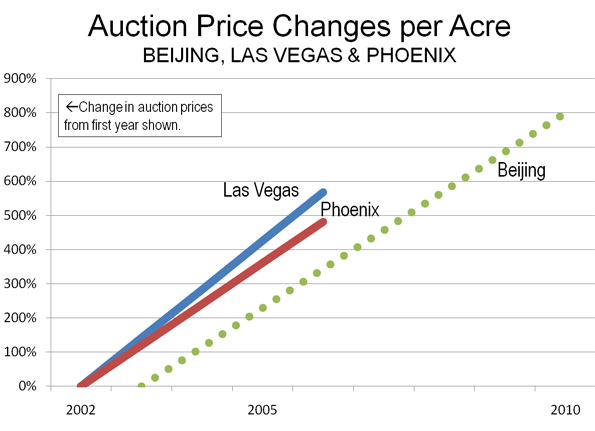
    In Las Vegas, house prices escalated approximately 85% relative to incomes between 2002 and 2006. Coincidentally, over the same period, federal government land auctions prices for urban fringe land rose from a modest $50,000 per acre in 2001-2, to $229,000 in 2003-4 and $284,000 at the peak of the housing bubble (2005-6). Similarly, Phoenix house prices rose nearly as much as Las Vegas, while the rate of increase per acre in Phoenix land auctions rose nearly as much as in Las Vegas.

    In both cases, prices per acre rose at approximately the same annual rate as in Beijing, which some consider to have the world’s largest housing bubble. According to Joseph Gyourko of Wharton, along with Jing Wu and Yongheng Deng Beijing prices rose 800 percent from 2003 to 2008 (Figure). This is true even thought we are not experiencing the epochal shift to big urban areas now going on in China.

    The Issue is Land Supply: The escalation of new house prices during the bubble occurred virtually all in non-construction costs such as the costs of land and any additional regulatory costs. It is not sufficient to look at a large supply of new housing (as the Boston Fed researchers do) and conclude that regulation has not taken its toll. The principal damage done by more restrictive land regulation comes from limiting the supply of land, which drives its price up and thereby the price of houses. In some places where there was substantial building, restrictive land use regulations also skewed the market strongly in favor of sellers. This dampening of supply in the face of demand drove land prices up hugely, even before the speculators descended to drive the prices even higher. Florida and interior California metropolitan areas (such as Sacramento and Riverside-San Bernardino) are examples of this.

    Missing Obvious Signs: There are at least two reasons why much of the economics profession missed the bubble.

    (1) Unlike Paul Krugman, many economists failed to look below the national data. As Krugman showed, there were huge variations in house price trends between the nation’s metropolitan areas. National averages mean little unless there is little variation. Yet most of the economists couldn’t be bothered to look below the national averages.

    (2) Most economists failed to note the huge structural imbalances that had occurred in the distorted housing markets relative to historic norms. Since World War II, the Median Multiple, the median house price divided by the median household income, has been 3.0 or less in most US metropolitan markets. Between 1950 and 2000, the Median Multiple reached as high as 6.1 in a single metropolitan area among today’s 50 largest, in a single year (San Jose in 1990, see Note 2). In 2001, however, two metropolitan areas reached that level, a figure that rose to 9 in 2006 and 2007. The Median Multiple reached unprecedented and stratospheric levels in of 10 or more in Los Angeles, San Francisco, San Diego and San Jose- all of which have very restrictive land use and have had relatively little building. This historical anomaly should have been a very large red flag.

    In contrast, the Median Multiple remained at or below 3.0 in a number of high growth markets, such as Atlanta, Dallas-Fort Worth and Houston and other markets throughout the bubble.. Even with strong housing growth, prices remained affordable where there was less restrictive land use regulation.

    Seeing the Signs: Krugman, for his part, takes a well deserved victory lap in a New York Times blog entitled “Wrong to be Right,” deferring to Yves Smith at nakedcapitalism.com who had this to say about the Federal Reserve Bank of Boston research:

    It is truly astonishing to watch how determined the economics orthodoxy is to defend its inexcusable, economy-wrecking performance in the run up to the financial crisis. Most people who preside over disasters, say from a boating accident or the failure of a venture, spend considerable amounts of time in review of what happened and self-recrimination. Yet policy-making economists have not only seemed constitutionally unable to recognize that their programs resulted in widespread damage, but to add insult to injury, they insist that they really didn’t do anything wrong.

    Maybe we should have known better: beware economists bearing the moment’s conventional wisdom.

    ——

    Note 1: The authors cite work by Albert Saiz of Wharton to suggest an association between geographical constraints and house price increases in metropolitan areas. The Saiz constraint, however, looks at a potential development area 50 kilometers from the metropolitan center (7,850 square kilometers). This seems to be a far too large area to have a material price impact in most metropolitan areas. For example, in Portland, the strongly enforced urban growth boundary (which would have a similar theoretical impact on prices) was associated with virtually no increase in house prices until the developable land inside the boundary fell to less than 100 square kilometers (early 1990s). A far more remote geographical barrier, such as the foothills of Mount Hood, can have no meaningful impact in this environment.

    Note 2: William Fischel of Dartmouth has shown how the implementation of land use controls in California metropolitan areas coincided with the rise of house prices beyond historic national levels. As late as 1970, house prices in California were little different than in the rest of the nation.

    Wendell Cox is a Visiting Professor, Conservatoire National des Arts et Metiers, Paris and the author of “War on the Dream: How Anti-Sprawl Policy Threatens the Quality of Life

    Photograph: $575,000 house in Los Angeles (2006), Photograph by author