Category: Economics

  • The China Syndrome

    China’s ascension to the world’s second-largest economy, surpassing Japan, has led to predictions that it will inevitably snatch the No. 1 spot from the United States. Nomura Securities envisions China surpassing the U.S.’ total GDP in little more than a decade. And economist Robert Fogel predicts that by 2050 China’s economy will account for 40% of the world’s GDP, with the U.S.’ share shrinking to a measly 14%.

    Americans indeed should worry about the prospect of slipping status, but the idée fixe about China’s inevitable hegemony–like Japan’s two decades ago–could prove greatly exaggerated. Countries generally do not experience hyper-growth–the starting point for many predictions–for long. Eventually costs rise, internal pressures grow and natural limitations brake and can even throw the economy into reverse.

    Instead the U.S. has a decent chance of remaining the world’s pre-eminent economy not only over the next decade or two and even by mid-century. There are five key reasons for this contrarian conclusion.

    1. If Water is the “new oil,” China faces a thirsty future. China’s freshwater reserves are about one-fifth per capita those of the United States, notes Steve Solomon, author of Water: The Epic Struggle for Wealth, Power and Civilization. Much of that supply has become dangerously polluted; ours , for the most part, has become cleaner.

    More important, the U.S. has become more efficient in its water usage, says Solomon. China, with a far less developed economy, will face increasing demands from industrial and agricultural users as well as hundreds of millions of households that now don’t enjoy easy access to clean drinking water.

    2. China’s energy demands are soaring, but it lacks adequate domestic resources. China impresses journalists and policy-makers with grand “green” projects and heavy investment in renewables, but two-thirds of the country’s energy comes from that dirtiest of sources. China burns more coal than the U.S., Europe and Japan combined, often using very primitive technology. It has now overtaken the U.S. for the dubious honor of the most total energy use and highest greenhouse gas emissions. Since 1995 China’s dependence on foreign oil has grown from near to approaching 60%, and the country, long a coal exporter, is becoming a major importer of that unfashionable fuel.

    The U.S. meanwhile sits on largely untapped fossil fuel resources, including coal, natural gas and oil. Add Canada to the equation and North America ranks second, behind the Middle East, in energy resources. In contrast to China, America’s energy use and greenhouse emissions appear to be dropping while still enjoying enormous, still largely untapped renewable resources, particularly from wind power in the Plains and biomass.

    3. Food remains pressing problem for China. Scarce water, mass pollution and high energy costs all will limit China’s future food production. By some estimates acid rain falls on a third of all agricultural land; some climate experts predict long-term reductions in the country’s vital rice crop.

    Plagued by floods, China now will have to look to U.S. and Canada to meet demand for crucial foodstuffs, particularly corn. And the food deficit may get worse over time: As China becomes wealthier, demand for high-protein foods like beef and pork will increase. The U.S. remains the world’s most reliable supplier of many of those agricultural products.

    4. China’s rapidly aging population and shrinking workforce will slow growth, perhaps dramatically, by the next decade. Like that of the “Asian tigers” in the ’70s and ’80s, China’s rapid growth has been propelled in part by an expanding young workforce. Due to a very low birthrate, however, this trend will reverse within a decade or two. By 2050 31% of China’s population will be older than 60, compared with barely one-quarter in the U.S. There will be over 400 million elderly, with virtually no social security and few children to support them. Also worrisome: The preference for male children has skewed sex demographics dramatically, with roughly 30 million more marriageable boys than girls.

    The logical solution to this dilemma would be immigration, but China’s culture appears far too insular for such an event. Rather than a benevolent “socialist” super power China, whose population is made up over 90% Han Chinese, will bestride the world as a racially homogeneous, and communalistic “Middle Kingdom.” In contrast, the U.S., despite occasional fits of nativism, remains remarkably successful at integrating cultures from around the globe.

    5. Dictatorship thrives sometimes in a “take off” period, but often fails to compete well with more open societies during later stages of growth. Many American intellectuals and journalists celebrate China’s achievements, much as some of their predecessors admired past “successful” economic regimes in fascist Italy, Nazi Germany and the late Soviet Union. The longest lasting of the authoritarian superpowers, the Soviet state massively misallocated its resources in its unsuccessful competition with the more flexible systems of the U.S. and its allies.

    Big Brother economies experience more subtle problems. Chinese entrepreneurs , according to a survey by the Legatum Institute in London, depend far more than their more nimble and self-reliant Indian counterparts. Overweening Chinese state power also might be chasing many foreign businesses–and some developing countries– toward more congenial investment and trade partners.

    For all these problems, the Chinese emergence remains the dominant business event of our epoch. But world-wide dominion seems highly unlikely. One often overlooked factor: political problems stemming from growing inequality in this officially Marxist state. Over the past 20 years China’s income distribution pattern has shifted from the relative egalitarianism of Sweden, Japan or Germany to that of countries like Argentina and Mexico.

    The class divisions will deepen further as growth inevitably slows. Roughly one-third of 2008’s 5.6 million university graduates have been unable to find work. Things are even worse for those less skilled, rural residents and small manufacturers.

    Ironically, the Communist Party appears to further concentrate wealth and power; most of the richest people in China are linked to the party. Policies push growth, but with diminishing rewards to the masses. Over the last decade the share of GDP going to consumption dropped from 46% to less than 36%.

    Of course, a comparatively small number of skilled, with often well-connected professionals and investors flourishing, but opportunities for economic advancement may now be scarcer for most workers compared to the earlier period of China’s remarkable “liftoff” after 1980. Conditions for the working class in China remain more akin to Dickensian England than a Marxian “worker’s paradise.” China’s dismal health care system for example, ranks according to the World Health Organization, among the world’s most inequitable, 188th out of 191 nations.

    Not surprisingly, class anger has reached alarming proportions, with almost 96% of respondents, according to one recent survey, agreeing that they “resent the rich.”

    America also faces its own share of social problems but not to such an extreme degree. Many Americans resent the affluent, but also dream of becoming them. How else to explain the popularity of paeans to bourgeois vulgarity like Housewives of New Jersey?

    In the coming decades China, not the currently depressed U.S., may face greater headwinds. America’s biggest enemy will prove to be not China, but itself. The U.S. needs to move toward a pro-growth course driven by investments in our productive economy, basic infrastructure and skills-based education as well as sustainable immigration and population growth levels. If the country does these things then Americans will someday look back at their current Sinophobia as a delusion dressed up as irresistible conventional wisdom.

    This article originally appeared at Forbes.com.

    Joel Kotkin is executive editor of NewGeography.com and is a distinguished presidential fellow in urban futures at Chapman University. He is author of The City: A Global History. His newest book is The Next Hundred Million: America in 2050, released in February, 2010.

    Photo: Steve Webel

  • The Disappearance of the Next Middle Class

    Every week we read that yet another major housing project has been turned down by the Courts here in New Zealand because of the need to protect “rural character” or “natural landscapes”. This may well have profound short and long-term consequences for the future of our middle class, as it does for the same class in countries around the advanced world.

    Every week a multitude of smaller developers abandon their projects because Councils’ compliance costs and development contributions make the projects unviable – even if the land were free. And it’s not.

    The New Zealand Institute of Economic Research says the ten-year norm for New Zealand is 26,000 new dwellings built per year. Statistics New Zealand reported only 16,000 dwelling consents issued in 2009. The NZ Property Investors Federation says we are building only 7,000 dwellings a year.

    Some say the Property Investors Federation figures are too low given that Statistics New Zealand’s figures for the year to date suggest we shall issue between 13,000 and 11,000 consents this year, and that the “slippage” between consents and finished dwellings cannot be that great.

    However, this is rather like wondering whether you are driving towards a concrete wall at 100 mph or only 80 mph.

    Any current year estimates confirm we are on a slippery slope to catastrophe.

    Unemployment, especially among young unskilled males is on the rise. Given these dreadful build-rates, should we be surprised, since these workers depend on construction for economic opportunity?

    And why don’t we recognize the cause and do something about it?

    First let’s look at the statistics. A Google search under “construction multipliers” turns up statements such as “building 1,000 houses generates 2,300 permanent full time jobs”. Another will say “Every dollar spent in the sector has a multiplier effect between 2.1 and 2.8.” These “low multiplier” statistics seldom spell out what is meant by “the construction sector”, and most are annual figures, and focus on “permanent full time jobs”. But the construction sector generates a multitude of short-term contracts that presumably slip through the net.

    These low “construction” multipliers are reinforced by a post-modernist ideology that tries to persuade us that housing is an unproductive activity that takes productive rural land out of production and hence undermines the economy. This is the old “primary” industry myth, further reinforced by the quaint animist notion that subdivision causes “death by a thousand cuts”. The surveyors are out there wielding their long knives and watching the Earth Mother bleed to death.

    Smart Growth planners claim the “urban sprawl” that grew around our cities during the post-war decades was the terrible price paid for housing the baby boomers and must be replaced with Smart Growth (or perhaps more accurately, Dense Thinking).

    We have lost sight of the fact that those prosperous decades were actually in large part the result of those large-scale suburban developments.

    US economists generally explain the post-war boom as being driven by the work force switching from weapons to washing machines.

    In New Zealand we used to attribute those golden years to micro-management of the economy, and to import licensing in particular. In reality, our real genius was probably introducing the capitalized family benefit which led to our own “Levittown builders” such as Fletcher Construction and Neil Housing.

    Back in the late sixties, while reading for my thesis in urban development economics, I read a report on the drivers of the post-war boom in America, during the twenty years from 1945 – 1965. Wildavsky’s Oakland Project focused on behavioural analysis rather than econometrics.

    The authors concluded that the suburban development boom laid the foundations for the long-term development of the post-war American middle class.

    An equivalent thought experiment would now read something like this:

    • We begin with a clean greenfields site, presumably being farmed, or just open space of some kind.
    • A developer decides the land is well located for a new 1,000 lot residential development and hires consultants or staff to prepare an application. The process alone takes five to six years and provides unproductive employment for a host of highly paid professionals.
    • The project is then killed off by either the Council or the Courts.

    In a sensible world, as prevailed in the post war years, the project would move on to the next stage:

    • The land development teams move onto the site and start the final surveys, road-building, drainage and stormwater schemes, landscaping, and street-crossings, all required before the builders drive their first profile-pegs into the ground.
    • Then teams of contractors start building the houses, which will have been designed by architects, draughtsmen or architectural designers, and then processed through a simple consenting procedure.
    • The teams of carpenters, glaziers, plumbers, painters, roofers, stoppers, electricians and plumbers all move in to finish the houses ready for occupancy. A gang of maybe ten drain-layers could lay the drains for the 1,000 houses over a five year sales-and-build period – say 20 contracts a year.
    • These teams use products and materials cut from forests, mined from quarries, processed in mills, or produced in factories, or recycled products, all requiring employed labour.

    So after a few years the 1,000 homes may be built and occupied. The analysts in the sixties suggested the 1,000 houses would generate say 5,000 direct contract-jobs over those early years.

    However, they recognized that the real economic activity would continue for another fifteen years or more. The same happens today.

    • As the families move into the houses they buy kitchen equipment, drapes and light fittings, bookshelves, plasma TVs, computers, artworks and wine cellars and so on.
    • The owners lay paving, build decks, plant gardens, and landscape the property.
    • The gardens require lawn mowers, chain saws, hedge trimmers, nursery plants, and barbecues.
    • Then up go the Gazebos, the dog kennels, the play houses, the extra rooms, and so on.
    • And then come the swimming pools, spa pools, home offices, sleep-outs, and solar heaters.

    Many of these improvements are produced by the “sweat-equity” of the DIY owners and are a major means of increasing household wealth and well-being. They arealso a potent form of saving, provided the owners are investing in tangible improvements and not over-priced land.

    These suburban on-site improvements go on forever. Consequently, even today there are about 80,000 certified “alterations” a year in New Zealand – and many more that don’t get near a permit.

    All these activities create jobs for the people who make the spa pools, the plasma TVs, the gardening tools, the cars, and the Gazebos.

    After several years from start up the properties are likely to require a gardener once a week, and maybe a housekeeper one or two days a week, and baby sitters, and whatever else the modern family needs to manage its work-life balance. These are the on-site ‘jobs’, but the families also need teachers, doctors, day-care providers, retail staff and so on and so on.

    The sixties report concluded that every 1000 houses would generate a total of 40,000 contracts and jobs. Which seems outrageous until you divide the 40,000 by the fifteen to twenty years, which comes back to the multipliers of 2.0 to 2.6.

    The sixties thought-experiment reminds us that by driving our residential build-rate from 24,000 a year to a no more than 13,000 a year, and probably much fewer, we are turning off the boiler that regenerates our middle class.

    It also explains why an economy with a low “build-rate” is unlikely to enjoy full employment.
    Those suburbs were not “a sad price to pay for our post war housing” but were the economic driver of “the long summer of content” so well described by Bill Bryson in “The Thunderbird Kid.”

    So why are we allowing our institutions to destroy the ability to regenerate our own suburban middle class?

    Whatever happened to genuine sustainable development? Sustainable for middle class people and families too.

    Owen McShane is Director of the Centre for Resource Management Studies, New Zealand.

    Photo by pie4dan

  • City Thinking is Stuck in the 90s

    The 1990s proved to be quite a nice decade indeed for most of America’s largest cities. It was an era of general prosperity in all of America to be sure, but in contrast to previous decades, the turnaround also extended from the suburbs to many of the nation’s biggest cities, notably New York, Chicago, Miami, San Francisco and San Jose. The notion – popular in the 70s and 80s – associating cities with a sour and fatalistic sense of decline and dysfunction, or even anarchy, in the 90s finally began to evaporate. There emerged a bracing new sense of optimism that these large cities had found a new role for themselves in the world.

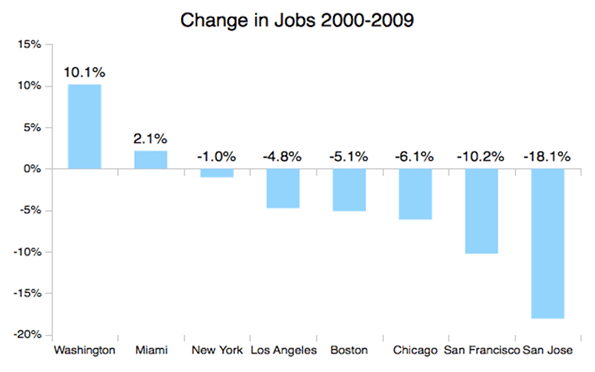
    This is evident from the large decreases in crime in these cities where lawlessness once reigned and also from the job numbers from that decade, when all of America’s tier one metros added jobs.

    Some of these places lagged overall US growth, but considering their lower rate of population growth most of these cities enjoyed robust economies. The aerospace and defense center of Los Angeles, hit hard by the post-Cold War “peace dividend”, and the devastating 1992 riots, was a partial exception.

    The 90s saw the convergence of two trends that profoundly benefited these cities: the digitization and globalization of business. The 90s were the heart of the digital revolution. At its beginning, corporate “data processing” was still dominated by mainframes and personal computers were not yet fully deployed even on corporate desktops. By the end of it, the internet was widespread and had caused a business revolution. In the middle were several waves of technology change and disruption: first client/server, then internet based computing, PC and mobile phone ubiquity in business, the Y2K retrofit, and the beginnings of integrated Enterprise Resource Planning systems.

    The 90s also saw a lesser known revolution in American business: deregulation and structural changes. In the past many businesses that had previously operated on a local or regional basis – banking, utilities, retail, etc – got rolled up into much larger super-regional, national, and increasingly global players.

    These shifts provided big benefits to these tier one cities. Obviously high tech havens like the Bay Area, DC, and Boston did particularly well in this decade. Also performing strongly were professional services hubs like Chicago. These rapid waves of technology and business change created a lot of new openings for professionals to master, not just by creating and implementing technology, but also in adapting business processes to the new realities as well as managing the organizational change journey. These newly rolled up businesses also needed the types of services firepower typically located in larger locales, stimulating further demand. Notably, virtually all of this demand was satisfied with employment growth on shore, much of it in these tier one cities.

    The 2000s, however, were a very different story. This decade began with the dot com bust and its associated recession, a funk from which the Bay Area economy has yet to fully recover despite Silicon Valley’s continued reign as high tech capital. Similarly, while specialized professional services still flourish, the more mainline areas, such as IT implementations or business process outsourcing, found themselves under significant pressure as digital business matured.

    This caused one commentator to famously declare that “IT Doesn’t Matter.” Then the offshore wave, which had been a born in the 1990s, began to suck away services work just as had occurred previously in manufacturing. This included not just low skill business process outsourcing like invoice processing, but also high value IT engineering and other services not dependent on face to face interaction. This, we found out, could be performed by high skill, low cost labor in places like India.

    This helped to create a so-called “lost decade” of job creation in the US during the 2000s. The tier one metros, save for recession-proof Washington, fared even worse, losing jobs during the decade.

    These are facts and trends that barely impacted the world of urbanists, who continued to act as if nothing had changed. The media, located almost totally in primary cities, bought the message but rarely looked at the basic facts.

    As a result, when it comes to thinking about America’s big cities, too many people remain stuck in the 90s.

    Partially this is understandable. The 2000s saw strong increases in GDP per capita in many of these cities. Also, they experienced huge real estate booms and an associated increase in high end amenities of all kinds: swanky hotels, starchitect buildings, upscale new restaurants and shops, etc. But a lot of this has proved somewhat self-delusional. Like Citigroup CEO Chuck Prince’s now infamous statement that “As long as the music is playing, you’ve got to get up and dance,” these cities continued to party like it was 1999 even as their job base continued to erode and the real estate bubble headed for a crash.

    Today, as the Great Recession has civic finances in a vice grip, and places like Chicago and Los Angeles face stunning budget shortfalls, people are less sanguine. Advocates for the big city model still refuse to face up to the core problems that face our large cities. The real issue should not be how to restart the condo boom, but how to restore what drove the resurgence of the 90s: job creation. This is a national problem to be sure, but not one that seems to interest most big city advocates. It’s almost as if there’s an assumption the jobs will come without working for them. The stimulus and bailout, which helped key urban sectors like green building, university research and public employees, is now running out of steam and political support. In the long run they may have served largely to exacerbate complacency.

    So rather than a focus on private sector job growth, many urban boosters have remained free to focus on other things like sustainability and lifestyle enhancers in the assumption they would generate jobs But what if it doesn’t work out that way? What if the current economy, unlike those boom years of the 90s, does not generate enough money and employment to support these huge regions?

    These cities would be well-advised to go beyond counting skyscrapers, new condo construction, green roofs, and bike share programs. Those things are all good, but basic measures of civic health and dynamism like job growth ultimately underpin those things for the long haul. More than anything, these cities need to be fundamentally focused on their commercial success. Their great challenge is figuring out how to recapture that previous era of job growth, and once again become engines of employment.

    Aaron M. Renn is an independent writer on urban affairs based in the Midwest. His writings appear at The Urbanophile.

    Photo by Werner Kunz (werkunz1)

  • Urban Legends: Why Suburbs, Not Dense Cities, are the Future

    The human world is fast becoming an urban world — and according to many, the faster that happens and the bigger the cities get, the better off we all will be. The old suburban model, with families enjoying their own space in detached houses, is increasingly behind us; we’re heading toward heavier reliance on public transit, greater density, and far less personal space. Global cities, even colossal ones like Mumbai and Mexico City, represent our cosmopolitan future, we’re now told; they will be nerve centers of international commerce and technological innovation just like the great metropolises of the past — only with the Internet and smart phones.

    According to Columbia University’s Saskia Sassen, megacities will inevitably occupy what Vladimir Lenin called the “commanding heights” of the global economy, though instead of making things they’ll apparently be specializing in high-end “producer services” — advertising, law, accounting, and so forth — for worldwide clients. Other scholars, such as Harvard University’s Edward Glaeser, envision universities helping to power the new “skilled city,” where high wages and social amenities attract enough talent to enable even higher-cost urban meccas to compete.

    The theory goes beyond established Western cities. A recent World Bank report on global megacities insists that when it comes to spurring economic growth, denser is better: “To try to spread out economic activity,” the report argues, is to snuff it. Historian Peter Hall seems to be speaking for a whole generation of urbanists when he argues that we are on the cusp of a “coming golden age” of great cities.

    The only problem is, these predictions may not be accurate. Yes, the percentage of people living in cities is clearly growing. In 1975, Tokyo was the largest city in the world, with over 26 million residents, and there were only two other cities worldwide with more than 10 million residents. By 2025, the U.N. projects that there may be 27 cities of that size. The proportion of the world’s population living in cities, which has already shot up from 14 percent in 1900 to about 50 percent in 2008, could be 70 percent by 2050. But here’s what the boosters don’t tell you: It’s far less clear whether the extreme centralization and concentration advocated by these new urban utopians is inevitable — and it’s not at all clear that it’s desirable.

    Not all Global Cities are created equal. We can hope the developing-world metropolises of the future will look a lot like the developed-world cities of today, just much, much larger — but that’s not likely to be the case. Today’s Third World megacities face basic challenges in feeding their people, getting them to and from work, and maintaining a minimum level of health. In some, like Mumbai, life expectancy is now at least seven years less than the country as a whole. And many of the world’s largest advanced cities are nestled in relatively declining economies — London, Los Angeles, New York, Tokyo. All suffer growing income inequality and outward migration of middle-class families. Even in the best of circumstances, the new age of the megacity might well be an era of unparalleled human congestion and gross inequality.

    Perhaps we need to consider another approach. As unfashionable as it might sound, what if we thought less about the benefits of urban density and more about the many possibilities for proliferating more human-scaled urban centers; what if healthy growth turns out to be best achieved through dispersion, not concentration? Instead of overcrowded cities rimmed by hellish new slums, imagine a world filled with vibrant smaller cities, suburbs, and towns: Which do you think is likelier to produce a higher quality of life, a cleaner environment, and a lifestyle conducive to creative thinking?

    So how do we get there? First, we need to dismantle some common urban legends.

    Perhaps the most damaging misconception of all is the idea that concentration by its very nature creates wealth. Many writers, led by popular theorist Richard Florida, argue that centralized urban areas provide broader cultural opportunities and better access to technology, attracting more innovative, plugged-in people (Florida’s “creative class“) who will in the long term produce greater economic vibrancy. The hipper the city, the mantra goes, the richer and more successful it will be — and a number of declining American industrial hubs have tried to rebrand themselves as “creative class” hot spots accordingly.

    But this argument, or at least many applications of it, gets things backward. Arts and culture generally do not fuel economic growth by themselves; rather, economic growth tends to create the preconditions for their development. Ancient Athens and Rome didn’t start out as undiscovered artist neighborhoods. They were metropolises built on imperial wealth — largely collected by force from their colonies — that funded a new class of patrons and consumers of the arts. Renaissance Florence and Amsterdam established themselves as trade centers first and only then began to nurture great artists from their own middle classes and the surrounding regions.

    Even modern Los Angeles owes its initial ascendancy as much to agriculture and oil as to Hollywood. Today, its port and related industries employ far more people than the entertainment business does. (In any case, the men who built Hollywood were hardly cultured aesthetes by middle-class American standards; they were furriers, butchers, and petty traders, mostly from hardscrabble backgrounds in the czarist shtetls and back streets of America’s tough ethnic ghettos.) New York, now arguably the world’s cultural capital, was once dismissed as a boorish, money-obsessed town, much like the contemporary urban critique of Dallas, Houston, or Phoenix.

    Sadly, cities desperate to reverse their slides have been quick to buy into the simplistic idea that by merely branding themselves “creative” they can renew their dying economies; think of Cleveland’s Rock and Roll Hall of Fame, Michigan’s bid to market Detroit as a “cool city,” and similar efforts in the washed-up industrial towns of the British north. Being told you live in a “European Capital of Culture,” as Liverpool was in 2008, means little when your city has no jobs and people are leaving by the busload.

    Even legitimate cultural meccas aren’t insulated from economic turmoil. Berlin — beloved by writers, artists, tourists, and romantic expatriates — has cultural institutions that would put any wannabe European Capital of Culture to shame, as well as a thriving underground art and music scene. Yet for all its bohemian spirit, Berlin is also deeply in debt and suffers from unemployment far higher than Germany’s national average, with rates reaching 14 percent. A full quarter of its workers, many of them living in wretched immigrant ghettos, earn less than 900 euros a month; compare that with Frankfurt, a smaller city more known for its skyscrapers and airport terminals than for any major cultural output, but which boasts one of Germany’s lowest unemployment rates and by some estimates the highest per capita income of any European city. No wonder Berlin Mayor Klaus Wowereit once described his city as “poor but sexy.”

    Culture, media, and other “creative” industries, important as they are for a city’s continued prosperity, simply do not spark an economy on their own. It turns out to be the comparatively boring, old-fashioned industries, such as trade in goods, manufacturing, energy, and agriculture, that drive the world’s fastest-rising cities. In the 1960s and 1970s, the industrial capitals of Seoul and Tokyo developed their economies far faster than Cairo and Jakarta, which never created advanced industrial bases. China’s great coastal urban centers, notably Guangzhou, Shanghai, and Shenzhen, are replicating this pattern with big business in steel, textiles, garments, and electronics, and the country’s vast interior is now poised to repeat it once again. Fossil fuels — not art galleries — have powered the growth of several of the world’s fastest-rising urban areas, including Abu Dhabi, Houston, Moscow, and Perth.

    It’s only after urban centers achieve economic success that they tend to look toward the higher-end amenities the creative-classers love. When Abu Dhabi decided to import its fancy Guggenheim and Louvre satellite museums, it was already, according to Fortune magazine, the world’s richest city. Beijing, Houston, Shanghai, and Singapore are opening or expanding schools for the arts, museums, and gallery districts. But they paid for them the old-fashioned way.

    Nor is the much-vaunted “urban core” the only game in town. Innovators of all kinds seek to avoid the high property prices, overcrowding, and often harsh anti-business climates of the city center. Britain’s recent strides in technology and design-led manufacturing have been concentrated not in London, but along the outer reaches of the Thames Valley and the areas around Cambridge. It’s the same story in continental Europe, from the exurban Grand-Couronne outside of Paris to the “edge cities” that have sprung up around Amsterdam and Rotterdam. In India, the bulk of new tech companies cluster in campus-like developments around — but not necessarily in — Bangalore, Hyderabad, and New Delhi. And let’s not forget that Silicon Valley, the granddaddy of global tech centers and still home to the world’s largest concentration of high-tech workers, remains essentially a vast suburb. Apple, Google, and Intel don’t seem to mind. Those relative few who choose to live in San Francisco can always take the company-provided bus.

    In fact, the suburbs are not as terrible as urban boosters frequently insist.

    Consider the environment. We tend to associate suburbia with carbon dioxide-producing sprawl and urban areas with sustainability and green living. But though it’s true that urban residents use less gas to get to work than their suburban or rural counterparts, when it comes to overall energy use the picture gets more complicated. Studies in Australia and Spain have found that when you factor in apartment common areas, second residences, consumption, and air travel, urban residents can easily use more energy than their less densely packed neighbors. Moreover, studies around the world — from Beijing and Rome to London and Vancouver — have found that packed concentrations of concrete, asphalt, steel, and glass produce what are known as “heat islands,” generating 6 to 10 degrees Celsius more heat than surrounding areas and extending as far as twice a city’s political boundaries.

    When it comes to inequality, cities might even be the problem. In the West, the largest cities today also tend to suffer the most extreme polarization of incomes. In 1980, Manhattan ranked 17th among U.S. counties for income disparity; by 2007 it was first, with the top fifth of wage earners earning 52 times what the bottom fifth earned. In Toronto between 1970 and 2001, according to one recent study, middle-income neighborhoods shrank by half, dropping from two-thirds of the city to one-third, while poor districts more than doubled to 40 percent. By 2020, middle-class neighborhoods could fall to about 10 percent.

    Cities often offer a raw deal for the working class, which ends up squeezed by a lethal combination of chronically high housing costs and chronically low opportunity in economies dominated by finance and other elite industries. Once the cost of living is factored in, more than half the children in inner London live in poverty, the highest level in Britain, according to a Greater London Authority study. More than 1 million Londoners were on public support in 2002, in a city of roughly 8 million.

    The disparities are even starker in Asia. Shenzhen and Hong Kong, for instance, have among the most skewed income distributions in the region. A relatively small number of skilled professionals and investors are doing very well, yet millions are migrating to urban slums in places like Mumbai not because they’ve all suddenly become “knowledge workers,” but because of the changing economics of farming. And by the way, Mumbai’s slums are still expanding as a proportion of the city’s overall population — even as India’s nationwide poverty rate has fallen from one in three Indians to one in five over the last two decades. Forty years ago, slum dwellers accounted for one in six Mumbaikars. Now they are a majority.

    To their credit, talented new urbanists have had moderate success in turning smaller cities like Chattanooga and Hamburg into marginally more pleasant places to live. But grandiose theorists, with their focus on footloose elites and telecommuting technogeniuses, have no practical answers for the real problems that plague places like Mumbai, let alone Cairo, Jakarta, Manila, Nairobi, or any other 21st-century megacity: rampant crime, crushing poverty, choking pollution. It’s time for a completely different approach, one that abandons the long-held assumption that scale and growth go hand in hand.

    Throughout the long history of urban development, the size of a city roughly correlated with its wealth, standard of living, and political strength. The greatest and most powerful cities were almost always the largest in population: Babylon, Rome, Alexandria, Baghdad, Delhi, London, or New York.

    But bigger might no longer mean better. The most advantaged city of the future could well turn out to be a much smaller one. Cities today are expanding at an unparalleled rate when it comes to size, but wealth, power, and general well-being lag behind. With the exception of Los Angeles, New York, and Tokyo, most cities of 10 million or more are relatively poor, with a low standard of living and little strategic influence. The cities that do have influence, modern infrastructure, and relatively high per capita income, by contrast, are often wealthy small cities like Abu Dhabi or hard-charging up-and-comers such as Singapore. Their efficient, agile economies can outpace lumbering megacities financially, while also maintaining a high quality of life. With almost 5 million residents, for example, Singapore isn’t at the top of the list in terms of population. But its GDP is much higher than that of larger cities like Cairo, Lagos, and Manila. Singapore boasts a per capita income of almost $50,000, one of the highest in the world, roughly the same as America’s or Norway’s. With one of the world’s three largest ports, a zippy and safe subway system, and an impressive skyline, Singapore is easily the cleanest, most efficient big city in all of Asia. Other smaller-scaled cities like Austin, Monterrey, and Tel Aviv have enjoyed similar success.

    It turns out that the rise of the megacity is by no means inevitable — and it might not even be happening. Shlomo Angel, an adjunct professor at New York University’s Wagner School, has demonstrated that as the world’s urban population exploded from 1960 to 2000, the percentage living in the 100 largest megacities actually declined from nearly 30 percent to closer to 25 percent. Even the widely cited 2009 World Bank report on megacities, a staunchly pro-urban document, acknowledges that as societies become wealthier, they inevitably begin to deconcentrate, with the middle classes moving to the periphery. Urban population densities have been on the decline since the 19th century, Angel notes, as people have sought out cheaper and more appealing homes beyond city limits. In fact, despite all the “back to the city” hype of the past decade, more than 80 percent of new metropolitan growth in the United States since 2000 has been in suburbs.

    And that’s not such a bad thing. Ultimately, dispersion — both city to suburb and megacity to small city — holds out some intriguing solutions to current urban problems. The idea took hold during the initial golden age of industrial growth — the English 19th century — when suburban “garden cities” were established around London’s borders. The great early 20th-century visionary Ebenezer Howard saw this as a means to create a “new civilization” superior to the crowded, dirty, and congested cities of his day. It was an ideal that attracted a wide range of thinkers, including Friedrich Engels and H.G. Wells.

    More recently, a network of smaller cities in the Netherlands has helped create a smartly distributed national economy. Amsterdam, for example, has low-density areas between its core and its corporate centers. It has kept the great Dutch city both livable and competitive. American urbanists are trying to bring the same thinking to the United States. Delore Zimmerman, of the North Dakota-based Praxis Strategy Group, has helped foster high-tech-oriented development in small towns and cities from the Red River Valley in North Dakota and Minnesota to the Wenatchee region in Washington State. The outcome has been promising: Both areas are reviving from periods of economic and demographic decline.

    But the dispersion model holds out even more hope for the developing world, where an alternative to megacities is an even more urgent necessity. Ashok R. Datar, chairman of the Mumbai Environmental Social Network and a longtime advisor to the Ambani corporate group, suggests that slowing migration to urban slums represents the most practical strategy for relieving Mumbai’s relentless poverty. His plan is similar to Zimmerman’s: By bolstering local industries, you can stanch the flow of job seekers to major city centers, maintaining a greater balance between rural areas and cities and avoiding the severe overcrowding that plagues Mumbai right now.

    Between the 19th century, when Charles Dickens described London as a “sooty spectre” that haunted and deformed its inhabitants, and the present, something has been lost from our discussion of cities: the human element. The goal of urban planners should not be to fulfill their own grandiose visions of megacities on a hill, but to meet the needs of the people living in them, particularly those people suffering from overcrowding, environmental misery, and social inequality. When it comes to exporting our notions to the rest of the globe, we must be aware of our own susceptibility to fashionable theories in urban design — because while the West may be able to live with its mistakes, the developing world doesn’t enjoy that luxury.

    This article originally appeared at Foreign Policy

    Joel Kotkin is executive editor of NewGeography.com and is a distinguished presidential fellow in urban futures at Chapman University. He is author of The City: A Global History. His newest book is The Next Hundred Million: America in 2050, released in February, 2010.

    Photo: Mugley
  • In California Cool is the Rule, but Sometimes, Bad is Bad

    Californians value cool. I’m not sure how this came to be. It might be the weather. It might be the entertainment industry. Whatever the reason, Californians don’t get excited. Better to go with flow than to get excited. Things will be ok. Concerned about the economy? Stay cool Dude. It’ll come back. Always has. Always will. Relax.

    It’s not cool to get excited, or heaven forbid, panic. Californians are not quick to react to problems, so confident that eventually the problem will just go away. This was forcefully brought home to me when a member of California’s legislature told me that “It doesn’t matter what we do in this building. California will always rebound.”

    California’s governance is seemingly designed to enforce cool in the government. Term limits, two-thirds requirements, and bipartisan gerrymandering combine to insure that change is not legislated. So you see absurdities, such as the legislature’s worrying about the asbestos content of the State Rock while the budget-less State goes down the path of bankruptcy and economy collapse.

    Institutionalized stasis is why I don’t think it matters who wins the upcoming gubernatorial election. Neither Mercurial Meg Whitman nor Moonbeam Jerry Brown will cause Sacramento to actually do anything to change California’s trajectory.

    Veteran capital-watcher Dan Walters likes to say that when legislators do agree and actually do something important, it’s usually bad. He cites California’s failed “electricity deregulation” back in 2000 as a case in point. The state does have a release valve, the initiative, which is much hated by the political class. But it is their fault. Legislative inaction is probably one reason for the increase we’ve seen in ballot initiatives. Of course, initiatives are seldom the optimal way to create change.

    Proposition 13 is an excellent example. Sacramento was aware of the property-tax problem, but was unable to deal with it. That created a vacuum, and the radical tax reformers stepped in. The result was a far more draconian and less flexible law than necessary or desirable. That’s the way initiatives work. The legislature fails to legislate. Inaction creates a vacuum. The vacuum is filled by more extreme interests. The resulting law is almost always flawed.

    California cool may be legendary, but as the Huey Lewis song says, sometimes bad is bad, and California’s economy is bad, very bad, and it’s not going to get better soon without real change. Plenty of lawmakers, especially the governor, are counting on renewable energy and green industry to provide California with an economic rebirth. It won’t happen. Read why here and here.

    I’m thinking that now would be a good time for Californians to lose their cool.

    Recently, Boeing announced that it is moving two programs from Long Beach California to Oklahoma. The move will cost California about 800 mostly well-paid engineering jobs. This is a relatively small event in an economy the size of California’s, but it is part of a steady drumbeat of businesses leaving California. Northrop Grumman has already decamped. General Dynamics’ San Diego shipbuilding subsidiary, Nassco, is shrinking its workforce by 300 workers, most of them highly skilled. Even the entertainment industry is slowly reducing its footprint in California. The list goes on and on.

    The main reason: California is an expensive place to do business, and the expense is made more onerous by uncertainty about future taxes and regulation. Consequently, those businesses that can increasingly are departing for more reliable, friendlier climes.

    Policy makers may find excuses for each of these events, but the persistence and size of the differences between California’s economic performance and those of better-managed states indicate something few in Sacramento understand: many of California’s economic problems are self inflicted. How big is the difference between California’s economy and other states? The unemployment rate provides one answer: California’s unemployment rate is about 30 percent higher than that of the rest of the country. That’s big, far larger than can be explained by demographic factors.

    High and persistent unemployment is not the only result of California’s job-killing environment. Income inequality is increasing, a legacy of declining opportunity for skilled blue collar workers and a failed educational system. Home prices and sales will not recover for years. Commercial real estate is in freefall, and we may not see anything approaching full occupancy for a decade. Real-per-capita retail sales may never recover, a result of joblessness, high taxes, and increased internet competition. Perhaps the most telling trend is that domestic migration has been negative for most of the past 15 years, as people vote with their feet and seek opportunity in other states.

    About the only source of hope, in a perverse way, is that government revenues are down. By now, it should be clear, even to those who thought their income was independent of economic activity, that a prosperous private sector is a necessary precondition for general prosperity. Professors, non-profit-sector workers, and government employees are learning the hard way their dependence on the private sector. We can hope that personal interest will drive them to more enlightened policy.

    That hope is tempered, though, by the political class’s willingness to embrace the mirage of a free lunch. The AB 32 climate change and SB 375 anti-sprawl bills were the result of a well-meaning search for the Holy Grail of costless environmental and economic virtue.

    Environmental and economic interests are not inherently incompatible, but environmental quality is not costless. In fact, it is a luxury good. Wealthier societies invest far more in environmental protection and rehabilitation than do subsistence societies whose primary concern is finding the next meal. In short, environmental protection requires investment, and wealthier societies are better able to pay the price.

    California’s leadership’s embrace of AB32/SB375 is unlikely to achieve any of its goals. It will be a drag on economic activity. Its impact on global greenhouse gasses will be negligible. Worse, it is very inefficient. Economic research is not ambiguous. Subsidies and command-and-control regulation are far from the cheapest way of improving the environment. The best way to reduce greenhouse gas emissions is through a rebated tax. This would be a carbon tax, where the tax revenue would be rebated to offset a more distortionary tax, say a labor or capital tax. This simultaneously discourages the bad, pollution, while encouraging the good, work or investment.

    AB32/SB375 is certainly not the source of all of California’s problems. The state has lots of them, and it’s time we took a serious approach of addressing them. Maybe, we should lose our cool and demand real leadership from Sacramento.

    Bill Watkins is a professor at California Lutheran University and runs the Center for Economic Research and Forecasting, which can be found at clucerf.org.

    Photo by Duncan H

  • The Golden State’s War on Itself

    California has long been a destination for those seeking a better place to live. For most of its history, the state enacted sensible policies that created one of the wealthiest and most innovative economies in human history. California realized the American dream but better, fostering a huge middle class that, for the most part, owned their homes, sent their kids to public schools, and found meaningful work connected to the state’s amazingly diverse, innovative economy.

    Recently, though, the dream has been evaporating. Between 2003 and 2007, California state and local government spending grew 31 percent, even as the state’s population grew just 5 percent. The overall tax burden as a percentage of state income, once middling among the states, has risen to the sixth-highest in the nation, says the Tax Foundation. Since 1990, according to an analysis by California Lutheran University, the state’s share of overall U.S. employment has dropped a remarkable 10 percent. When the state economy has done well, it has usually been the result of asset inflation—first during the dot-com bubble of the late 1990s, and then during the housing boom, which was responsible for nearly half of all jobs created earlier in this decade.

    Since the financial crisis began in 2008, the state has fared even worse. Last year, California personal income fell 2.5 percent, the first such fall since the Great Depression and well below the 1.7 percent drop for the rest of the country. Unemployment may be starting to ebb nationwide, but not in California, where it approaches 13 percent, among the highest rates in the nation. Between 2008 and 2009, not one of California’s biggest cities outperformed such traditional laggards as New York, Pittsburgh, and Philadelphia in employment growth, and four cities—Los Angeles, Oakland, Santa Ana, and San Bernardino–Riverside—sit very close to the bottom among the nation’s largest metro areas, just slightly ahead of basket cases like Detroit. Long a global exemplar, California is in danger of becoming, as historian Kevin Starr has warned, a “failed state.”

    What went so wrong? The answer lies in a change in the nature of progressive politics in California. During the second half of the twentieth century, the state shifted from an older progressivism, which emphasized infrastructure investment and business growth, to a newer version, which views the private sector much the way the Huns viewed a city—as something to be sacked and plundered. The result is two separate California realities: a lucrative one for the wealthy and for government workers, who are largely insulated from economic decline; and a grim one for the private-sector middle and working classes, who are fleeing the state.

    Graph by Alberto Mena.

    The old progressivism began in the early 1900s and lasted for half a century. It was a nonpartisan and largely middle-class movement that emphasized fostering economic growth—the progressives themselves tended to have business backgrounds—and building infrastructure, such as the Los Angeles Aqueduct and the Hetch Hetchy Reservoir. One powerful progressive was Republican Earl Warren, who governed the state between 1943 and 1953 and spent much of the prospering state’s surplus tax revenue on roads, mental health facilities, and schools. Another was Edmund G. “Pat” Brown, elected in 1958, who oversaw an aggressive program of public works, a rapid expansion of higher education, and the massive California Water Project.

    But by the mid-1960s, as I noted in an essay in The American two years ago, Brown’s traditional progressivism was being destabilized by forces that would eventually transform liberal politics around the nation: public-sector workers, liberal lobbying organizations, and minorities, which demanded more and more social spending. This spending irritated the business interests that had formerly seen government as their friend, contributing to Brown’s defeat in 1966 by Ronald Reagan. Reagan was far more budget-conscious than Brown had been, and large declines in infrastructure spending occurred on his watch, mostly to meet a major budget deficit.

    The decline of progressivism continued under the next governor: Pat Brown’s son, Edmund G. “Jerry” Brown, Jr., who took office in 1975. Brown scuttled infrastructure spending, in large part because of his opposition to growth and concern for the environment. Encouraged by “reforms” backed by Brown—such as the 1978 Dill Act, which legalized collective bargaining for them—the public-employee unions became the best-organized political force in California and currently dominate Democrats in the legislature (see “The Beholden State,” Spring 2010). According to the unions, public funds should be spent on inflating workers’ salaries and pensions—or else on expanding social services, often provided by public employees—and not on infrastructure or higher education, which is why Brown famously opposed new freeway construction and water projects and even tried to rein in the state’s university system.

    The power of the public-employee lobby would come to haunt the recall-shortened gubernatorial reign of Gray Davis, Brown’s former chief of staff. The government workers’ growing demands on the budget, green groups’ opposition to expanding physical infrastructure, and Republican opposition to tax increases made it impossible for either Davis or his successor, Arnold Schwarzenegger, to expand the state’s infrastructure at a scale necessary to accommodate its growing population.

    The new progressives were as unenthusiastic about welcoming business as about building infrastructure. Fundamentally indifferent or even hostile to the existing private sector, they embraced two peculiar notions about what could sustain California’s economy in its place. The first of these was California’s inherent creativity—a delusion held not only by liberal Democrats. David Crane, Governor Schwarzenegger’s top economic advisor, once told me that California could easily afford to give up blue-collar jobs in warehousing, manufacturing, or even business services because the state’s vaunted “creative economy” would find ways to replace the lost employment and income. California would always come out ahead, he said, because it represented “ground zero for creative destruction.”

    Graph by Alberto Mena.

    The second engine that could supposedly keep California humming was the so-called green economy. Michael Grunwald recently wrote in Time, for example, that venture capital, high tech, and, above all, “green” technology were already laying the foundation of a miraculous economic turnaround in California. Though there are certainly opportunities in new energy-saving technologies, this is an enthusiasm that requires some serious curbing. One recent study hailing the new industry found that California was creating some 10,000 green jobs annually before the recession. But that won’t heal a state that has lost 700,000 jobs since then.

    At the same time, green promoters underestimate the impact of California’s draconian environmental rules on the economy as a whole. Take the state’s Global Warming Solutions Act, which will force any new development to meet standards for being “carbon-neutral.” It requires the state to reduce its carbon-emissions levels by 30 percent between 1990 and 2020, virtually assuring that California’s energy costs, already among the nation’s highest, will climb still higher. Aided by the nominally Republican governor, the legislation seems certain to slow any future recovery in the suffering housing, industrial, and warehousing sectors and to make California less competitive with other states. Costs of the act to small businesses alone, according to a report by California State University professors Sanjay Varshney and Dennis Tootelian, will likely cut gross state product by $182 billion over the next decade and cost some 1.1 million jobs.

    It’s sad to consider the greens such an impediment to social and economic health. Historically, California did an enviable job in traditional approaches to conservation—protecting its coastline, preserving water and air resources, and turning large tracts of land into state parks. But much like the public-sector unions, California’s environmental movement has become so powerful that it feels free to push its agenda without regard for collateral damage done to the state’s economy and people. With productive industry in decline and the business community in disarray, even the harshest regulatory policies often meet little resistance in Sacramento.

    In the Central Valley, for instance, regulations designed to save certain fish species have required 450,000 acres to go fallow. Unemployment is at 17 percent across the Valley; in some towns, like Mendota, it’s higher than 40 percent. Rick Wartzman, director of the Peter Drucker Institute, has described the vast agricultural region around Fresno as “California’s Detroit,” an area where workers and businesspeople “are fast becoming a more endangered species than Chinook salmon or delta smelt.” The fact that governments dominated by “progressives” are impoverishing whole regions isn’t merely an irony; it’s an abomination.

    So much for the creative green economy. As for the old progressives’ belief that government shouldn’t scare away productive, competitive, long-term enterprise, that, too, has been abandoned by their successors. “Our economy is not inducing the right kind of business,” says Larry Kosmont, a prominent business consultant in Los Angeles. “It’s too expensive to operate here, and managers feel squeezed. They feel they can’t control the circumstances any more and have to look somewhere else.” The problem isn’t just corporate costs, either. The regulatory restraints, high taxes, and onerous rules enacted by the new progressives lead to high housing prices, making much of California too expensive for middle- and working-class employees and encouraging their employers to move elsewhere.

    Silicon Valley, for instance—despite the celebrated success of Google and Apple—has 130,000 fewer jobs now than it had a decade ago, with office vacancy above 20 percent. In Los Angeles, garment factories and aerospace companies alike are shutting down. Toyota has abandoned its Fremont plant. California lost nearly 400,000 manufacturing jobs between 2000 and 2007, according to a report by the Milken Institute—even as industrial employment grew in Texas and Arizona. A sign of the times: transferring factory equipment from the Bay Area to other locales has become a thriving business, notes Tom Abate of the San Francisco Chronicle.

    Optimists sometimes point out that “new economy” companies like Disney, Google, Hewlett-Packard, and Apple, as well as scores of smaller innovative firms, continue to keep their headquarters in the state. But this is to ignore the fact that many of these companies are sending their middle- and working-class employees to other locales. Evidence of middle-class flight: since 1999, according to California Lutheran University, the state has seen a far steeper decline in households earning between $35,000 and $75,000 than the national average. And blue-collar areas—Oakland, the eastern expanses of greater Los Angeles, and much of central California—have been hit even harder. California’s overall poverty rate has been consistently higher than the national average. In Los Angeles County alone, some 20 percent of the population—2.2 million people—receives some form of public aid.

    Graph by Alberto Mena.

    In short, the economy created by the new progressives can pay off only those at the peak of the employment pyramid—top researchers, CEOs, entertainment honchos, highly skilled engineers and programmers. As a result, California suffers from an increasingly bifurcated social structure. Between 1993 and 2007, the share of the state’s income that went to the top 1 percent of earners more than doubled, to one-quarter—the eighth-largest share in the country.

    For these lucky earners, a low-growth or negative-growth economy works just fine, so long as stock prices rise. For their public-employee allies, the same is true, so long as pensions remain inviolate. Global-warming legislation may drive down employment in warehouses and factories, but if it’s couched in rhetoric about saving the planet, these elites can even feel good about it.

    Under the new progressives, it’s always hoi polloi who need to lower their expectations. More than four out of five Californians favor single-family homes, for example, but progressive thinkers like Robert Cruickshank, writing in California Progress Report, want to replace “the late 20th century suburban model of the California Dream” with “an urban, sustainable model that is backed by a strong public sector.” Of course, this new urban model will apply not to the wealthy progressives who own spacious homes in the suburbs but to the next generation, largely Latino and Asian. Robert Eyler, chair of the economics department at Sonoma State University, points out that wealthy aging yuppies in Sonoma County have little interest in reviving growth in the local economy, where office vacancy rates are close to those in Detroit. Instead, they favor policies, such as “smart growth” and an insistence on “renewable” energy sources, that would make the area look like a gated community—a green one, naturally.

    Graph by Alberto Mena.

    California’s supposedly progressive economics have had profound demographic consequences. After serving as a beacon for millions of Americans, California now ranks second to New York—and just ahead of New Jersey—in the number of moving vans leaving the state. Between 2004 and 2007, 500,000 more Americans left California than arrived; in 2008, the net outflow reached 135,000, much of it to the very “dust bowl” states, like Oklahoma and Texas, from which many Californians trace their origins. California now has a lower percentage of people who moved there within the last year than any state except Michigan. Even immigration from abroad seems to be waning: a recent University of Southern California study shows the percentage of Californians who are foreign-born declining for the first time in half a century. For the first time in its history as a state, as political analyst Michael Barone has noted, California is not on track to gain a new congressional district after the 2010 census.

    This demographic pattern only reinforces the hegemony of environmentalists and public employees. In the past, both political parties had to answer to middle- and lower-middle-class voters sensitive to taxes and dependent on economic growth. But these days, with much of the middle class leaving, power is won largely by mobilizing activists and public employees. There is little countervailing pressure from local entrepreneurs and businesses, which tend to be poorly organized and whose employee base consists heavily of noncitizens. And the legislature’s growing Latino caucus doesn’t resist regulations that stifle jobs—perhaps because of the proliferation of the California equivalent of “rotten boroughs”: Latino districts with few voters where politicians can rely on public employees and activists to dominate elections.

    Blessed with resources of topography, climate, and human skill, California does not need to continue its trajectory from global paragon to planetary laughingstock. A coalition of inland Latinos and Anglos, along with independent suburban middle-class voters in the coastal areas, could begin a shift in policy, reining in both public-sector costs and harsh climate-change legislation. Above all, Californians need to recognize the importance of the economic base—particularly such linchpins as agriculture, manufacturing, and trade—in reenergizing the state’s economy.

    The changes needed are clear. For one thing, California must shift its public priorities away from lavish pensions for bureaucrats and toward the infrastructure critical to reinvigorating the private sector. The state’s once-vaunted power system routinely experiences summer brownouts; water supplies remain uncertain, thanks to environmental legislation and a reluctance to make new investments; the ports are highly congested and under constant threat of increased competition from the southeastern United States, the Pacific Northwest, and eventually Mexico’s Baja California. Fixing these problems would benefit the state’s middle and working classes. Lower electrical costs would help preserve industrial facilities—from semiconductor and aerospace plants to textile mills. Reinvestment in trade infrastructure, such as ports, bridges, and freeways, would be a huge boon to working-class aspirations, since ports in Southern California account for as much as 20 percent of the area’s total employment, much of it in highly paid, blue-collar sectors.

    Another potential opportunity lies in energy, particularly oil. California has enormous reserves not just along its coast but also in its interior. The Democrats in the legislature, which seems determined to block expanded production, have recently announced plans to increase taxes on oil producers. A better solution would be a reasonable program of more drilling, particularly inland, which would create jobs and also bring a consistent, long-term stream of much-needed tax revenue.

    These shifts would likely appeal to voters in the areas—such as the Central Valley and the “Inland Empire” around Riverside—that have been hurt most by the recession and the depredations of the hyper-regulatory state. Indeed, the disquiet in the state’s interior could make the coming gubernatorial election the most competitive in a decade. Jerry Brown, the Democratic candidate, certainly appears vulnerable: his campaign is largely financed by the same public-sector unions whose expansion he fostered as governor; more recently, serving as state attorney general, he was the fiercest enforcer of the Global Warming Solutions Act, which opens him to charges that he opposes economic growth. One hopeful sign that pragmatism may be back in fashion: a new proposed ballot measure to reverse the act until unemployment drops below 5.5 percent, where it stood before the recession. Since unemployment is currently near 13 percent, that would take radical change off the table for quite a while.

    Still, it isn’t certain that California’s inept and often clueless Republicans will mount a strong challenge. For them to do so, business leaders need to get back in the game and remind voters and politicians alike of the truth that they have forgotten: only sustained, broadly based economic growth can restore the state’s promise.

    This article originally appeared at The City Journal.

    Thanks to the Economic Research and Forecasting Project at California Lutheran University for providing analysis and charts.

    Joel Kotkin is executive editor of NewGeography.com and is a distinguished presidential fellow in urban futures at Chapman University. He is author of The City: A Global History. His newest book is The Next Hundred Million: America in 2050, released in February, 2010.

    Photo: Stuck in Customs

  • Flexible Forecasting: Looking for the Next Economic Model

    Last autumn I gave a talk in California’s San Fernando Valley. I was the last of three economists speaking that day, and I watched the other economists’ presentations, each a rosy forecast of recovery and imminent prosperity. So, I was a bit nervous when it was my turn to speak, because I had a forecast of extended malaise. People don’t like to hear bad news, and they do blame the messenger. In the end, I was relieved. No tomatoes, no catcalls.

    That’s how things went last fall and winter. Many economists confidently predicted a rapid recovery, while my group’s forecasts were pretty dismal: weak economic growth with little if any job creation. Today, many of those same economists’ forecasts are far closer to ours. Why?

    Part of the problem is the fact that macroeconomics is an unsettled discipline. We have lots of macroeconomic models, none of which is adequate for all states of the world all the time. Each provides insight, but no single model can cope with the awesome complexity of the world. A large part of the art of forecasting is determining which model is most applicable to the current situation; which ones include insights that are dominant today.

    The problem is exacerbated when economists become excessively committed to a particular model. This isn’t religion or politics, it’s forecasting. It is hard enough. There is no reason to handicap yourself by excessive fealty to some model or doctrine.

    There was another problem that resulted in the change of tune. The world changed in September 2008. We call it a regime shift. It’s a move from one (good) equilibrium to another (bad) equilibrium. Statistical models that worked well in the old regime don’t work in the new regime. We hustled to adjust our models, but admitted that with limited experience in the new regime, we were less confident in our forecasts.

    The problem with a regime shift is that it is similar to a change in the rules of a game. Old relationships don’t hold anymore. Football is an example: If you changed the rules to allow five downs instead of four, nobody would predict punts on fourth down.

    Some economists didn’t recognize the regime shift. They went about their business using the same old models in a new world. Comments about the length of a typical recession or about how sharp declines are followed by rapid recoveries were clear signals that the speaker didn’t understand the situation.

    Some economists were fooled by the stimulus. The rules of accounting cause government spending to be reflected as an increase in economic activity. Stimulus plans such as Cash for Clunkers and tax credits for home purchases moved the timing of transactions, artificially reinforcing the direct spending impacts. Similarly, bailouts and foreclosure prevention programs postponed the recognition of losses.

    Many interpreted the resulting increase in last winter’s reported activity as permanent, but that could not be. We were not building anything or laying the groundwork for sustained prosperity. Instead, we were just continuing the previous decade’s consumption binge. The banks had failed, but the government had stepped in. It became the mother of all banks, borrowing from future citizens and other countries to fuel today’s consumption.

    Regime shifts that lead to a bad equilibrium appear to be similar to bank runs. There need be no basis for panic, but a panic can guarantee the demise of a bank. The result of a panic on a bank ends there. The bank is failed, gone. There may or may not be a contagion effect on another bank.

    A panic can also guarantee an economic decline. But our economy is different than a bank. It can’t fail, in the sense that we can’t shut it down and walk away. We’re all still here after a regime shift. We’re stuck with a mess.

    We did have a mess after September 2008. All of a sudden, everyone’s wealth had declined, a lot. Businesses, consumers and governments were over-leveraged. Risk aversion had increased, perhaps to remain high for decades. Our understanding of economic risks had changed. We had discovered black swans – rare and unexpected outliers — in our system.

    The problem with regime shifts is that we don’t know how to initiate or cause them. We see shifts to bad regimes, and we can see their self-fulfilling nature. Can there be some self-fulfilling process that leads to a shift to a better regime? I hoped so, and I hoped that Obama’s election would initiate such an event. Our forecasts aren’t based on hope though, and it’s just as well that we didn’t forecast that his election would generate a spontaneous recovery.

    Today, enough time has passed that even the most slowly adapting forecasters are forced to confront the post-2008 data and the government’s failed economic efforts. As forecasters confront these facts, their forecasts are becoming increasingly gloomy. Now, forecasts of protracted malaise or even a double-dip recession are increasingly common. Why?

    Because we borrowed to extend a consumption binge, and we compounded that error with omissions and perverse policy.

    The stimulus’s omissions are glaring. We didn’t significantly invest in infrastructure that would improve our future growth. We failed to address the weaknesses in our education sector that fuel increasing inequality, sentence many to a life of hopelessness, and permanently constrain our economic growth. We did nothing to encourage small business’s growth; in an example of perverse policy, we are actually creating a new regulatory regime that favors large companies.

    Then there were the actions that will probably restrain future economic growth. The minimum wage was raised. We had health care reform, but we didn’t address the real problem: the fact that the health care consumer pays an insignificant portion of the bill at the time of consumption. We had financial reform that failed to address the fundamental problems of too-big-to-fail, and we protected risky activities, increasing the regulatory burden and crippling the ability of small banks. We halted much of our offshore drilling.

    Looking forward, there is little reason for optimism. We’re considering huge increases in our energy costs through greenhouse gas regulation. We have a massive tax increase scheduled at the end of the year.

    While a double-dip recession is not the most likely outcome, we can’t reject the possibility. More likely, we face a long slow struggle to overcome ourselves and restore real prosperity. The forecasters’ consensus appears to be moving toward accepting that reality.

    Flickr photo of Petra’s Yoga Poses Around The World

    Bill Watkins is a professor at California Lutheran University and runs the Center for Economic Research and Forecasting, which can be found at clucerf.org.

  • Alaska: Caribou Commons Or America’s Lost Ace?

    The most serious collateral damage from the BP spill disaster could very likely be in the far north, along the Alaskan coast. The problem is not a current spill but the Obama administration’s ban on offshore drilling and what many fear may be a broader attempt to close the state from further resource-related development.

    Such an approach could harm both the local and national economies for decades to come.

    Locking up of this vast northern state–which is home to some 700,000 people and has more coastline than the rest of “lower 48″combined–would be tantamount to the U.S. throwing away a strategic ace in the hole. Alaska contains many of the strategic assets–oil, zinc, lead, gold and, perhaps most critically, rare earth metals–critical in the increasingly multipolar battle for global prosperity.

    The move by some in the administration and green activists to freeze the last frontier recalls Frank and Mary Popper’s proposal to turn the Great Plains into a “buffalo commons” for wildlife, Native Americans and grasslands. In this case, this new Alaska could be labeled “the caribou commons.”

    By now it’s clear that the Great Plains region has value well beyond accommodating vast herds of bison, which have indeed been expanding. According to a recent Portfolio.com survey, four states either completely or partially in the Plains–North Dakota, Texas, South Dakota and Nebraska–rank among the top six states in economic performance.

    Alaska–buoyed in large part by energy production and its spinoffs–ranked second on the list, its residents doing far better than those in what the locals call “the outside.” Yet for all its wealth, Alaska has a peculiar challenge that stems from the fact that the vast majority of its land is owned by the federal government.

    Right now oil drilling represents the most important and contentious issue. Sixteen billion barrels of the black tea have come out of the North Slope alone since the 1980s, more than originally expected. An estimated 56 billion additional barrels exist, much of it in coastal waters.

    For decades, oil has driven Alaska’s prosperity. Before the discovery of the Prudhoe Bay field in 1967, Alaska suffered a per-capita income some 20% below the national average. Today it ranks eighth.

    Roughly 100,000 Alaskans work for energy companies, either directly or indirectly. Jobs in the oilfields, as well as the mines, pay an average of between $70,000 and $100,000 a year. These industries have helped it rise as one of the national leaders in producing good middle-class, blue-collar jobs.

    University of Alaska economist Scott Goldsmith estimates that oil accounts for two-thirds of the state’s growth since it became a state in 1959. Just eliminating the vast fields on Prudhoe Bay tomorrow, he estimates, would wipe out roughly one-third of all the state’s jobs. Oil-related taxes account for roughly 84% of the state’s total revenues.

    Alaska has other industries, such as tourism and fishing, but these pay far lower average wages than energy. “Without oil, we are essentially a third-world country,” notes Dan Sullivan, mayor of Anchorage, home to nearly half the state’s population.

    Not surprisingly, many Alaskans believe a ban on new energy and mining projects would end their relative prosperity. Goldsmith, for one, envisions the state turning into something akin to Maine (ranked 30th in per-capita income), a tourism-dominated playground for the visiting rich scarred by grinding poverty.

    Already oil-fueled revenues that fund government employment have fallen dramatically. Since its peak in 1988 oil flowing through the Alaska pipeline has dwindled from 2 million barrels a day to barely 700,000. This total could fall to under 600,000 by 2018.

    Without the development of new fields, Alaska, which now enjoys the country’s largest rainy day fund, could face a huge fiscal crisis. According to recent University of Alaska estimates, the state could confront California-style insolvency within a decade or two.

    Of course, most Alaskans do not want to see energy–or mining–expanded without strenuous controls. Many of them live in this isolated, often brutally cold place in order to enjoy its natural splendor and bounty. Climate change–irrespective to this summer’s chilly weather–also is a wide concern among people who live adjacent to retreating glaciers and worry about depleting arctic fisheries.

    Yet if Alaskans passionately want to preserve their staggeringly beautiful environment, they also are unlikely to embrace a vision of pristine poverty. Having suffered the depredations of international energy, mining or fishery companies, they also are not anxious to leave their fate to the Environmental Protection Agency or litigation-happy, trust-fund groups such as the Center for Biological Diversity.

    “A lot of people in the lower 48 [states] want us to pay for their sins,” suggests Alaska Sen. Con Bunde, reflecting a widely felt sentiment. “They may never come to Alaska, but knowing it’s there keeps them warm inside at night.”

    To protect their economy, Alaskans will need to learn new skills. For a generation they relied on powerful, now retired longtime Sen. Ted Stevens to protect their industries and make them the largest per-capita beneficiaries of federal largesse.

    Best suited for this role are the powerful Alaska-based, native-owned corporations. Unlike the oil companies run from Dallas, Houston or London, these companies are locally rooted. Together the top 13 native-owned firms possess some $4 billion in assets, a billion-dollar payroll and 12% of the state’s land.

    Taking control of their destiny may also mean changing attitudes common in a society that combines the most rugged individualism with what many call “an entitlement mentality.” After all, this is a place where big oil pays most of the bills and every individual receives an $1,300 annual check from the energy-funded Personal Dividend Fund. “The typical Alaskan doesn’t give a damn about what happens as long as they get their PDF check,” observes Dan Robinson, an economist with the McDowell Group, a local consulting firm.

    To maintain its long-term prosperity, Alaska needs to shift from petro-welfare to investing its energy wealth in the growth and diversification of its key industries. The state, for example, has huge potential for wind, geothermal and tidal production and should be a hub for both new fossil fuel technology as well. It also can use its locale on a key Pacific trade route as a center for advanced logistics (Anchorage Airport carries the world’s fifth-largest cargo tonnage).

    The rest of the country also has a big stake in the fate of America’s Far North. Lost production of energy and mineral resources would make us more dependent on other, often unfriendly countries. With exploration shifting to far less environmentally sensitive places like Mongolia or Africa, you also can count on greater net ecological damage as well.

    Alaska’s concerns may seem remote those in the “lower 48.” But how the 49th state fares may determine whether the rest of America can build a more sustainable and prosperous economy in the decades ahead.

    This article originally appeared at Forbes.com.

    Joel Kotkin is executive editor of NewGeography.com and is a distinguished presidential fellow in urban futures at Chapman University. He is author of The City: A Global History. His newest book is The Next Hundred Million: America in 2050, released in February, 2010.

    Photo: Unhindered by Talent

  • Ownership Subsidies: Dream Homes or Disasters?

    Home ownership has been considered an integral part of the American Dream for as long as anyone can remember. Now it has come under scrutiny, notably in a June Wall Street Journal piece by Richard Florida, which claims that that home ownership reduces employment opportunities for young adults, since it limits their mobility. To support ownership, others — particularly Wendell Cox — have argued that home ownership levels do not correlate with the economic productivity of cities, and cite the rapid suburban development in the Sunbelt as evidence that home ownership is as valuable as ever.

    My inclination is that the truth lies somewhere in between the two sides of the debate. For the sake of simplicity, I’ll refer to them as New Urbanist supporters versus Smart Growth opponents (I realize these are broad generalizations). While they disagree on the merits of home ownership, there’s an interesting point of agreement: both sides oppose subsidies to homeowners. I’d argue that both sides should focus on getting the issue of discontinuing subsidies onto the national agenda.

    Like many 20-something young professionals, I have no aspirations towards home ownership. I ditched my car when I moved out of the suburbs, and I refuse to sign a lease that lasts more than three months. This affords me the flexibility that my life as a freelancer requires. If I were in a profession that didn’t call for a great deal of mobility, perhaps home ownership would be appealing. When North America was a manufacturing powerhouse, most people were in that situation. But an increasingly dynamic labor market requires an increasingly mobile workforce… to an extent.

    For those of us in the 18-30 demographic who work in fairly mobile industries, home ownership isn’t necessarily as big a hindrance as Florida suggests. There are people like me who work in volatile industries and simply can’t be tied down to one city, but we’re in the minority. For the majority, it really depends on the location. If your home is within commuting range of a major city, it should be possible to find work in your field without uprooting.

    But jobs come before home ownership in order of priority. In a scenario where state and local governments create a fiscal climate inhospitable to economic growth, rather than chase cheap housing, people migrate to the strongest economic region (for example, the Sunbelt).

    While home ownership isn’t going to be obsolete any time soon, in decaying cities like Detroit and Buffalo, and in towns far from urban centers, it can be a major hindrance to finding a job. Home owners invest a large amount of their net worth in their homes, and it becomes difficult to simply abandon unsellable homes and pay rent in a new city, though this does happen. There are roughly 90,000 abandoned homes in Detroit alone. Old manufacturing and resource town centers are especially vulnerable, since their economies typically lack the diversity to attract new employment opportunities. This isn’t a fault of government policy, but an unavoidable economic reality.

    Incentives such as the omnibus of initiatives created by the Bush administration’s Ownership Society led to an increase in home ownership levels. But no good can come of home owner subsidies; they lead to inflated prices and distorted patterns of urban development. A survey of first time homeowners in 2009 by Keller Williams Research found that 10% of first time home buyers were primarily motivated to purchase a home because of the $8000 tax credit. A further 4% were primarily motivated by low interest rates. This may seem trivial, but it should be pointed out that the average age of first time US home buyers has decreased to 26. That is a full 8 years younger than in the UK, where the average age is on the upswing. While higher home costs in the UK (partially due to more stringent land use regulations) are probably a major factor, one cannot help but think that the First Time HomeBuyers Tax Credit and subsidized mortgages contributed.

    Subsidies for home ownership are incongruent with the ideological underpinnings of both New Urbanists and Smart Growth opponents (who are mainly conservatives and libertarians). Some Smart Growth opponents are likely to be in favor of these subsidies, since they buy the rationale behind the Ownership Society model. Namely, they believe that ‘pride of ownership’ leads to flourishing communities. On this point, they are probably correct. But the ‘pride of ownership’ argument is based on the ‘broken window theory’ that blight leads to an increase in crime. Ownership Society partisans argue that since owners have more of an incentive to maintain their homes, high home ownership rates should lead to less crime. There is quite a bit of evidence to support this theory. Then again, apartment renters do not control yards or frontage, so the ‘pride of ownership’ argument seems far less relevant with respect to high density development.

    Both sides should take a time out to get the issue of ending housing subsidies on the national agenda. In the wake of a major recession caused partly by misguided housing and mortgage policies, this is an issue that could gain traction with the electorate. The two sides will have plenty of time — and issues — to fight over later.

    “Mid-Century Suburban Home,” Paradise Palms Home, Las Vegas, Nevada by Roadsidepictures

    Steve Lafleur is a public policy analyst and political consultant based out of Calgary, Alberta. For more detail, see his blog.

  • Health Care Development in Central Florida

    By Richard Reep

    In this still cooling economy, Florida seems to be continually buffeted by a perfect storm of unemployment, record foreclosures, and stagnant population growth. As the state continues to suffer, the health care industry has unfolded two planning efforts aimed at building some economic momentum.

    Florida Hospital’s Health Village, an urban revitalization of one of Orlando’s older core neighborhoods, is one planning effort to watch. The other, Lake Nona, is a classic suburban mixed-use campus planned around R&D facilities gilded with stellar names like Scripps and Nemours, occurring in the southeast periphery of Orlando. The vastly different values of their developers underscore the striking contrasts between the development strategies of Health Village and Lake Nona.

    Lake Nona, a small lake just east of Orlando’s airport, is a new development centered around six major research facilities, four of which are under construction. Financing came from a 2006 program, the Florida Capital Formation Act, that has contributed millions to start up biomedical research in the state. Florida’s state venture capital fund lured Scripps, Nemours, Burnham, and M. D. Anderson. Two state universities are also participating, as well as the Veterans Administration with a new facility. This taxpayer investment was supplemented by Tavistock, the master developer of Isleworth fame, and smaller contributions by city, county, and other private investors all creating the impetus to develop this campus.

    Lake Nona’s Robert Adams described his “model” as San Diego’s biomedical cluster, which combines commercial, clinical, research, and educational facilities forming. Employment, in the form of the research facilities, was preceded by a country club and an indistinct mix of Florida residential building types – estate homes, smaller single family homes, and multifamily clusters that are sprinkled amongst golf courses, pretty lakes, and remnant pockets of old Florida wilderness. It’s obvious upon visiting the campus that this is first and foremost a real estate development scheme. Like most developers, Tavistock programmed the uses and zones as if all the land, being flat, were relatively equal in nature except for the slightly more lucrative edges of lakes and the even more lucrative engineered waterways. Currently, the Town Center is an open, flat D-shaped parcel conveniently accessed from Orlando’s beltway, the 417. A comfortable, safe land development scheme with all the usual regulatory battles is underway, and eventually Orlando will find a new, attractive community themed around medical research competing with other new developments for market share.

    In contrast, Florida Hospital selected, among its multiple sites in the state, about 96 acres squeezed between two close, parallel roads (Orange Avenue and Interstate 4) in a dense part of the city where the Adventist Health System quietly bought up dozens of individual parcels of 1930s era Orlando. Like most neighborhoods still suffering in the shadow of Eisenhower’s grand interstate system, this one has languished, and Florida Hospital intends to convert this neighborhood into a Health Village campus anchored by its adjacent hospital campus in a slow, organically grown and financed process.

    Orange Avenue bisects this Health Village, with towering hospital facilities on one side and an aged, mostly 2-story commercial neighborhood on the other. Much of the older residential stock is past its useful life, and owners, grateful for a buyer to release them from the ragged edge of Interstate 4, quickly sold out and left. Inserting the Burnham Institute’s Clinical Research Institute for Diabetes will be the latest revitalization project, and the interior land is intended for residential development catering to hospital professionals and staff within walking distance.

    With 17 hospital locations in Florida alone (the Adventist Health System operates medical facilities throughout the South and Midwest), the choice to locate a health village in a congested urban site is an interesting one. The city deal-making involved in such a move is reminiscent of the negotiations for New York’s Lincoln Center near Columbus Circle in the 1960s, and is rare in Florida where land is cheap. At first glance, it seems like Florida Hospital willingly hamstrung itself with this strategy, as compared to the huge blank slate being developed by Tavistock in Lake Nona.

    Tavistock also has eyes firmly watching the global health care market, and hopes to compete with San Diego, Research Triangle, Dubai’s Medical City, Singapore’s Biopolis, and other stellar research clusters. Lake Nona’s growth potential is relatively large, assuming a smooth flow of funding and continuation of markets. The science-themed real estate development brochures for Lake Nona exude a breezy, hip confidence, putting biomedical research in the background and projecting an alluring lifestyle in the foreground.

    Instead of amping up its marketing campaign to overcome its vastly smaller size, Florida Hospital’s Health Village eschews marketing altogether, as if it is too busy developing it to talk about it. The Adventist Health System is not visibly interested in the temporal nature of global markets, and its stated position as a Christian health care institution quietly suggests that reviving a struggling neighborhood – an exercise most developers would shy away from – is worth the effort. Florida Hospital’s ultimate end appears to be planned on a much longer timescale.

    Both projects are refreshing pathways for Florida, as they represent an attempt to develop future jobs away from the dependence on tourism and second home development. Of the two, right now Lake
    Nona seems much more poised for growth. With a vision for 16,000 jobs at maturity, Lake Nona hopes to capture a substantial portion of the real estate growth attached to those jobs, which is the tried-and-true Old Florida model. Shopping areas, recreational activities, and lifestyle creation will add one more new neighborhood cluster to a multipolar, decentralized region at the expense of 7,000 acres of Florida’s natural environment.

    In contrast, Florida Hospital’s urban build out will benefit existing neighborhoods, certainly a new concept for Floridians. In this respect, Florida Hospital’s tiny contribution to growth (some 800 new residential units are proposed to replace the 150 existing homes) is more than offset by its larger contribution to Orlando’s development as a city. And it delivers this at no expense to Florida’s natural environment.

    Each model offers something to a revived Florida. Florida Hospital’s campus in congested Orlando is instructive as a model for economic activity in the urban future. Religious institutions may become a more important force in the community, given the lack of wealth creation by the standard players in Wall Street and real estate speculation.

    Tavistock could contribute as well, particularly as a move towards a new modality of wealth creation that transcends the traditional Florida focus on consumption activities: shopping malls, hotels, and theme parks. Placing the region on the world stage as a contender in health research can move Florida away from its failed model and towards a future shaped by important diversifications of its employment base.

    Richard Reep is an Architect and artist living in Winter Park, Florida. His practice has centered around hospitality-driven mixed use, and has contributed in various capacities to urban mixed-use projects, both nationally and internationally, for the last 25 years.

    Photo pf Lake Nona development by saikofish