Category: Economics

  • A New War Between The States

    Nearly a century and half since the United States last divided, a new “irrepressible conflict” is brewing between the states. It revolves around the expansion of federal power at the expense of state and local prerogatives. It also reflects a growing economic divide, arguably more important than the much discussed ideological one, between very different regional economies.

    This conflict could grow in the coming years, particularly as the Obama administration seeks to impose a singular federal will against a generally more conservative set of state governments. The likely election of a more center-right Congress will exacerbate the problem. We may enter a golden age of critical court decisions over the true extent of federal or executive power.

    Some states are already challenging the constitutionality of the Obama health care program. Indiana, North Dakota, Mississippi, Nevada and Arizona joined a suit on March 23 by Florida Attorney General Bill McCollum to overturn the law. And Arizona’s right to make its own pre-immigration regulations has gained support from nine other states: Texas, Alabama, Florida, Nebraska, Pennsylvania, South Carolina, South Dakota, Michigan and Virginia.

    These may be just the opening salvos. If the Republicans and conservative Democrats gain effective control of Congress, the White House may choose to push its agenda through the ever expanding federal apparat. This would transform a policy dispute into something resembling a constitutional crisis.

    Such legal kerfuffles are unlikely to serve as precursors to armed conflict. But the political and rhetorical battles will certainly be heated. The federalistas can take heart from the the Civil War of a century and a half ago, which was decisively won by the union. They can also gain some encouragement from the ultimate success of the New Deal and of World War II.

    The federal government’s greatest bragging right–ending the absolute evil of slavery–was secured during the last war between the states. While most Union soldiers may have gone to war for the Union, the final result was an end to slavery. The consolidation of that gain during the 1960s also rests on expanded federalism.

    But the Civil War also was, as Karl Marx observed, a conflict between powerful economic interests. The Southern economy depended heavily on the export of commodities–primarily cotton, but also tobacco and other foodstuffs. It enjoyed profitable trading ties with the capitalistic superpower of the time, Great Britain. The North, in contrast, was an emerging industrial power for whom the British Empire represented the prime competitor.

    After the war the industrial capitalists ran the country virtually unchallenged. They overcame the Southern commodity producers politically and burdened them with high tariffs. By the 1890s American manufacturing surpassed Great Britain. The North became relatively rich while the South and much of the West remained backwaters until the 1950s.

    The economic map looks very different today. Generally speaking, states in relatively good economic shape are concentrated in an economic “zone of sanity” across the vast Great Plains. They are also in the least “fiscal peril,” according to a recent Pew study. Not surprisingly, these states see little reason to extend federal power and increase taxation in order to bail out their more profligate counterparts.

    To a large extent these states, according to Pew, are also the ones willing to reform their pension and other spending to keep down costs. Significantly, strong pension reforms have been enacted in some hard-hit sunbelt states–such as Nevada, Georgia, New Mexico and Arizona–which appear to be following the fiscal model of the zone-of-sanity states.

    In contrast those states most favorable to a more powerful Washington are often the ones suffering the worst fiscal situations. They also seem least willing to solve their structural budget issues. Free-spending, poorly managed states like New York, California, Michigan, Oregon and Illinois–all of which are controlled by the president’s political allies, need massive federal largesse to pay their bills without ruinous tax increases or painful cuts. Some localities in these states could become the Greeks of late 2010 as they head inexorably toward defaults.

    The differences between the states, however, extend beyond budget items. Many of the worst-managed also benefit from more federal spending on academic and medical research, and from subsidies for their often expensive green energy policies. They can also argue, with some justification, that the zone-of-sanity states have benefited in the past from federal crop supports, military spending and highway funding. Now it’s their turn for disproportionate time at the trough.

    Perhaps the most divisive issue will be the Obama administration’s proposed “cap and trade” legislation. For the most part, the strongest opposition comes from coal-dependent, industrial heartland states such as Indiana, whose governor, Mitch Daniels, has denounced the legislation as “imperialism” from Washington. Other keen opposition can be expected among members in both parties from energy-producing states like West Virginia, Texas, Louisiana, Oklahoma, North Dakota, Alaska and Wyoming.

    In contrast “cap and trade” seems less of a problem to the rapidly deindustrializing coastal states. Many of these states pride themselves as exemplars of an emerging low-carbon “information economy” and seem determined to limit their gas-spewing sectors like agriculture, manufacturing and transportation. A strong federal mandate on carbon emissions also would diminish the competitive gap between states like California, burdened by draconian local climate change policies, and less restrictive places like Texas.

    So who is likely to win the emerging new war between the states? Federal partisans might paint their opponents as the new “Confederates” fighting a protracted rear guard action, this time against science and social enlightenment. Certainly some demographic trends–youth attitudes on environmental issues, growing ethnic diversity and urbanization of “rural” states–favor the unionists.

    Yet you can argue that the fiscally strong states will be better positioned for the future. In contrast to the mid-19th-century Confederates, whose population growth paled compared with the Northern states, many of today’s demographic trends favor the anti-federalists.

    Over the past decade America’s population and enterprises have been shifting away from the unionist strongholds. Once depopulating states like Kentucky and the Dakotas are enjoying net in-migration from the rest of the country. Texas gradually threatens to supplant California as the leading destination for the young and ambitious.

    This suggests that after the 2010 census we could see something of a neo-confederate majority in Congress. Historical patterns may be repeating themselves, but they could produce a very different final result.

    This article originally appeared at Forbes.com.

    Joel Kotkin is executive editor of NewGeography.com and is a distinguished presidential fellow in urban futures at Chapman University. He is author of The City: A Global History. His newest book is The Next Hundred Million: America in 2050, released in February, 2010.

    Photo: Marxchivist

  • Chickens from Wal-Mart?

    As I arrived for a visit, my 90 year old father was perusing ads from his favorite big box store for chicken parts. Seizing the moment that all children savor, I sought to impress him with my declaration: “I buy my chicken parts – albeit at higher prices – at the natural foods store; you know daddy, where the chickens ate naturally off the barn yard floor like they did when you were a boy”? Not missing a beat and dashing my hope for an “at a boy,” he retorted: “I saw what those chickens ate off the barnyard floor and I’ll buy my chickens at Walmart(s)!”

    And so, in his own way, my father just about sums it up – and puts me in my place. For one, he certainly doesn’t long for the good old days that were anything but. He was raised poor in Appalachia Kentucky and likely had to work for his supper, wringing the neck of a chicken that ate whatever it could scrape from the dirt. He prefers the modern conveniences like the big box stores so hated by the urbane crowd. And, so we see the clash of the old versus the new; of culture that is good and culture that is changing to fit the times in which we live.

    How does that translate into the lives we lead and where we are going? Note that the “Walmart chicken man” is the same father who observed that computers were evil because they had put blue collar line workers like him on the street. So, in this the age of “technology as savior” and as the end all be all, we are alas seeing a revival of interest in local culture. We are seeing the dawn of small versions of big box stores and the “re-sizing” of American lifestyles. As The Economist (May 15, 2010) has noted, some really smart people may simply wish to live next door to cows and chickens even if my father does not. There’s a notion that small may appeal to people living in an outrageously outsized world. This can be seen in a renewed interest in coming home or staying home in the smaller towns of America.

    But, that return toward local culture goes only so far. The palpable interest in lifestyles that eschew the “cold flickering computer screen in the middle of the night” in favor of warmer and more nurturing places does not mean we can return to the past. Frankly, as my father reminds me, we might not want to. The new small town lifestyle is anything but complacent and “old fashioned.”

    There are stories abounding of telecommuters working for big east/west coast companies inventing software programs – inspired by the springtime hills alive with rosebud trees. There is even the former advertising executive, who commented upon hearing of friend’s involvement in a controversy: “There is always extraordinary life (in the countryside) beyond controversy … I am farming these days and stifling my leadership urges except for cows, goats and Border Collies.”

    As much as we might like to think that youthful retirees and young millennials will relocate to the mythic “Mayberry,” with its homespun values and slow deliberate quality of life, the successful Mayberry has to offer more than nostalgia. The pleasing camaraderie of neighbors is not enough. You also need educational opportunities, good health care and transportation. People may be seeking warmth and nurturance and bucolic scenes but we are demanding lot, fed by the 21st century to hold such contradictory views as shopping at Starbucks or Wal-mart while marching in the street for more locally-owned shops.

    So in the face of all this, how do we build a rural America that can sustain our small towns and offer an alternative lifestyle of Americans who yearn for one? We are accustomed to turning our “lonely eyes” to technology for all the answers and indeed it is critically important. But, the answer for small town rural America lies in merging the blessings of technology with the culture that makes the small town lifestyle so special.

    To put it bluntly: culture eats technology on any day of the week. Examples range from Afghanistan’s impenetrable and powerful ground level tribal network that thwarts the strongest armies – from the British to the Soviets to the US – to the puzzling rejection of educational attainment in Appalachia due to the reality of fear that “getting smart” will only encourage children to leave home. In the rougher part of the world, “staying close to home” is deeply rooted in ancient cultural ties to land and place.

    So, how do we combine the technology that will lift up economic prosperity and build wealth and while understanding better the role of local culture in creating the resilient rural communities of the future? I call it the ultimate “mash-up”. It will require the combination of the five Ps: PERSPECTIVE and hard-nosed research to know where you stand: who is coming to or staying in your community or region; investment in PEOPLE and their education and health and other documented needs; recognition and promotion of PLACE, PRESERVATION of what is dear in our culture; and finally putting all that together with technology that can bring economic PROSPERITY not only in dollars but in quality of life.

    We certainly need to take what technology offers, with its gift of allowing us to live and work anywhere. But this is a hollow benefit unless we imbue it with the culture that makes our lives special. It won’t be computers that will make our rural places unique. It will be the native music, crafts and stories and how we preserve and adapt them to modern times.

    Sylvia Lovely is an author, commentator and speaker on issues relating to communities and how we must adapt to the new landscape that is the 21st century.

    Photo by pfly.

  • Distilling China’s Development

    The economic rise of China has created two growth industries pulling in opposite directions. There’s either the school of blind praise of ‘The China Miracle’ or its opposite, apocalyptic predictions about the country’s impending implosion.

    On the surface, it appears as if the fundamentals of China’s modernization are similar to what the Western nations went through in the past, that is, a mass migration of farmers from the countryside to the urban centers to work in factories and construction sites. Taking into account the enormous scale at which this migration is happening, the country seems to be moving toward what some observers are dubbing the ‘Chinese Century’.

    Similarities aside, however, China’s development is uniquely Chinese. Whereas the U.S. was built upon the backs of immigrants from outside of its borders, China’s development owes its current success to its own huge population. China will never become a nation of external immigrants and will remain a homogenous behemoth long into the future.

    China’s current condition and its immediate future remain shrouded in a state of unsettling mystery. Having lived and worked as an architectural designer in China for nearly a year now, my own fervent curiosity has hardly been assuaged. There are a few things I’ve learned though that should be clarified regarding China’s development. Following, I will attempt to belie some common misconceptions.

    Misconception: As China continues develop, it will become more open to outside influence and the government system will reform itself to become more democratic and free.

    To the naive Western observer, China’s continued economic evolution means that the country must allow more democratic freedoms in order to remain competitive in the future. This assumption is extraordinarily dubious. China’s model is top-down, centralized planning and it has proven to be successful. To argue that it will not continue to work for China is a biased Western-projected fantasy.

    A pre-existing culture of collectivism constitutes one reason why state-driven development continues to blaze forward totally unhinged. When it comes to sensitive issues like media censorship or human rights, most Chinese citizens passively shrug their shoulders knowing full well that protesting will ultimately prove futile and self-defeating. Furthermore, most citizens are too busy hustling to make money and pull themselves up the socioeconomic ladder to be concerned with such matters.

    Perhaps the past two centuries of Chinese history will offer some clues into why the status-quo is so apathetically accepted. China’s experience of 19th and 20th Centuries consisted largely of a series of hardships: the Opium Wars to the fall of the Qing Dynasty, the subsequent Japanese Invasions and Chinese Civil War, and concluding with Mao’s Cultural Revolution. It is obvious that China is much better off now than it has been for the past 200 years.

    This might explain why China’s populace is now seizing the unique opportunity of “reform and opening” to make the best out of the current situation. It might also explain why people are reluctant to disrupt the established order. Thought about in this way, China’s current system of rule is not so much a ‘big-brother’ entity as it is an unspoken collective social contract to keep peace.

    Misconception: China’s rise to global prominence is over estimated. The looming real estate bubble in China means that economic collapse is imminent.

    Doomsday predictions about China’s collapse have become something of a growth industry. Commentators like Gordon Chang and hedge fund manager James Chanos are placing their bets on China’s demise. Many of these criticisms stem from what is speculated to be a coming crash in the real estate market.

    To the central government, constructing new buildings is much more than just providing new and modern accommodations for the populace; it stands for social stability. It doesn’t take an economist to acknowledge that city-building is an important part of economic growth. But what is often overlooked is how city-building is a key part of the modernization process, employing rural migrants and giving them opportunity to earn substantially more than they could as farmers.

    In China, real estate development is only one part of economic growth equation. Chinese leaders are well aware that the mad pace of constructing new buildings cannot last forever and already there seems to be an overabundance of supply in the residential and commercial sectors in first-tier cities like Shanghai and Beijing. Yet China is not anywhere near finished with its construction boom as 2nd, 3rd and 4th tier cities race ahead to catch up with their 1st tier counterparts.

    Looking into the future, China’s leaders are preparing to shift the economic growth to more information-based sectors. The city I live in, Chengdu, the capital of Sichuan province, has already recruited American heavy-hitters such as Cisco and Intel. Chengdu has been successful in doing this by investing in new infrastructure and developing a series of high-tech industrial zones that give foreign companies the option of lower operational costs than found in the increasingly pricey coastal cities.

    Misconception: Revaluing China’s currency will help bring manufacturing jobs back to the U.S.

    China’s economy would not be the success it is today without the foreign investment that flooded through the gates since they first opened in 1978. The number of foreign enterprises directly benefitting from the low cost of labor in China has expanded greatly since that time. China’s maintaining a low valuation of its currency, the Renminbi (RMB), has been a key factor in attracting and keeping investment from overseas businesses.

    Yet the talking heads in Washington have taken to pressuring China to revalue the RMB in order to help ‘rebalance the global economy’. Just ahead of the G20 last month, Treasury Secretary Timothy Geithner told Congress that China’s RMB peg to the U.S. dollar is an ‘impediment to sustainable global growth.’ Responding to the pressure, China announced that it would in fact let the RMB appreciate against the dollar.

    Following China’s announcement, the RMB rose a whopping .4% in value leading to what Economist Paul Krugman called the ‘Renminbi Runaround’. Krugman is correct to call out China on its currency manipulation- but it should be no surprise that what China is doing is simply looking out for its own national interests. A rapid rise in RMB value would cause some serious damage to the Chinese economy.

    American politicians know this but will continue to pressure China to raise the RMB value to score brownie points with their constituents. The reality is that both China’s economy and foreign companies using Chinese labor benefit from the low value of the RMB. For instance, companies such as Apple would not be able to sell their much coveted iPads at reasonable prices if it were not for cheap Chinese labor.

    Pressuring China too much could result in a trade war which would in fact not only hurt Chinese exporters but the American consumer as well. Politicians are also deluded into thinking that manufacturing jobs will come back to the U.S. if China’s RMB goes up. On the contrary, companies will move manufacturing operations to some other place where regulations and labor costs remain substantially lower.

    Conclusion: China’s accomplishments over the past two decades are unprecedented and fascinating. The scale at which change is happening means that complexity and uncertainty are unavoidable facts of life. Many challenges lie ahead, both for China’s domestic issues and its relationship with the rest of the world. As far as China has come, there still is a long way to go as millions still aspire to a better life.

    Adam Nathaniel Mayer is a native of California. Raised in Silicon Valley, he developed a keen interest in the importance of place within the framework of a highly globalized economy. Adam attended the University of Southern California in Los Angeles where he earned a Bachelor of Architecture degree. He currently lives in China where he works in the architecture profession. His blog can be read at http://adamnathanielmayer.blogspot.com/

    Photo by DavidM06

  • Civic Choices: The Quality vs. Quantity Dilemma

    Advocates on opposite sides of urban debates often spend a great deal of time talking past each other. That’s because there’s a certain Mars-Venus split in how they see the world. In effect, there are two very different and competing visions of what an American city should be in the 21st century, the “high quality” model and the “high quantity” model One side has focused on growing vertically, the other horizontally. One group wants to be Neimans or a trendy boutique and ignores the mass market. The other focuses more on the middle class, like a Costco and Target. It should come as no surprise that there’s seldom agreement between the two.

    America’s “High Quality” cities are the traditional large tier-one metro areas, but also include smaller cities like Seattle and Portland. They stress high wage activities such as finance, high tech, and luxury consumption. In this model, traditional growth in areas like population, jobs, or the size of the urban footprint are less important and even seen as a negative. Understandably so. It’s difficult to see, for example, how another million people living in the Bay Area would improve the fortunes of companies like Google or Facebook, or another million Angelenos helping Hollywood.

    Indeed many residents would oppose such growth due to increased traffic, infrastructure spending, and other of the challenges associated with it. In effect, the anti-growth agenda that dominates the culture of many of these places is not based simply on environmental concern, but the economic interests of their dominant regional elites. These places have already achieved the size to support their urban amenities.

    Another reason not to press the growth button: on measures of urban quality such as economic output and income, most are clearly doing very well. Most of these places generate GDP per capita far above the US metro average of $41,737. With the exception of Chicago, they are also growing at a pace that beats the US average. These cities also boast incomes – although often a cost of living – generally well above average, though have been mixed in performance on that metric over the last decade.

    “High Quality” Cities
      Quality Indicators Quantity Indicators
    MSA 2008 Real GDP per Capita Percent Change in GDP per Capita, 2001-2008 2008 Per Capita Income as Pct of US Average PCI Change vs. US Average 2009 Pop. Pop. Pct. Change 2000-2009 2009 Jobs Percent Change in Jobs 2000-2009
    Boston 57916 11.50% 137 -1 4589 4.20% 2408.1 -5.10%
    Chicago 45463 5.50% 113 -4 9581 5.10% 4291 -6.10%
    Los Angeles 47214 16.90% 111 6 12875 3.80% 5200.9 -4.80%
    Miami 40447 15.60% 107 2 5547 10.40% 2201.9 2.10%
    New York 57097 17.60% 137 6 19070 3.90% 8304.5 -1.10%
    Portland 47811 22.40% 99 -9 2242 15.80% 972.4 -0.10%
    San Francisco 60873 10.50% 156 -8 4318 4.40% 1908.8 -10.20%
    San Jose 82880 20.90% 146 -35 1840 5.80% 855.6 -18.10%
    Seattle 55982 11.30% 126 -1 3408 11.60% 1668.7 1.30%
    Washington 61834 15.20% 141 5 5476 13.60% 2950.2 10.10%

    But if these areas are doing well, for those who can afford to live them at least, they tend to do poorly on quantity measures. Many of them have anemic population growth, albeit from a large base. And virtually all of them actually destroyed jobs in the last decade. The ravenous maw of Washington, DC of course, being the great exception.

    This mixed performance isn’t surprising. High end activities are by definition exclusive. The specialized environments they require, and the high value and wealth they create, create expensive places to do business. Unless you have to be in one of these places, such as to take advantage of industry clusters or specialized labor markets, it doesn’t make sense to pay the price to do so. Clearly, mass employers have voted with their feet.

    Four data points from Silicon Valley sum it up. Between 2001 and 2008, the San Jose MSA’s: a) real GDP per capita increased by 20.8% b) total real GDP increased by 25.9%, c) real GDP per job increased by 39.6%, BUT d) total employment declined by 9.4%. That’s the high quality city dynamic in a nutshell.

    America’s “High Quantity” cities follow the opposite pattern. They might have their occasional claims to fame, but few feature the high end business or glamorous lifestyles of America’s premier metros – even though some have spent big bucks on vanity projects to polish their reputations. Rather, what these cities do well is provide quality workaday environments for the middle class. And create jobs – lots of jobs, the Great Recession notwithstanding.

    This is again backed up by the numbers. These cities fare well on quantity measures such as population growth, where they crush the US average of 8.8%, and job growth, where several of them actually managed to post double-digit gains during the generally anemic 2000s.

    “High Quantity” Cities
      Quality Indicators Quantity Indicators
    MSA 2008 Real GDP per Capita Percent Change in GDP per Capita, 2001-2008 2008 Per Capita Income as Pct of US Average PCI Change vs. US Average 2009 Pop. 2009 Jobs Percent Change in Jobs 2000-2009
    Pop. Pct.
      Change
      2000-2009
    Atlanta 43020 -6.00% 95 -16 5475 27.90% 2290.3 0.50%
    Austin 43819 8.50% 93 -16 1705 34.70% 758.2 12.70%
    Charlotte 59191 0.70% 99 -11 1746 30.20% 810.2 5.70%
    Dallas 50067 5.10% 104 -9 6448 24.10% 2864.3 3.70%
    Houston 49182 3.60% 114 1 5867 23.80% 2539 12.60%
    Nashville 43891 9.90% 99 -5 1582 20.10% 723.7 3.30%
    Orlando 42353 13.30% 89 -3 2082 25.70% 1009.5 10.60%
    Phoenix 38009 2.80% 90 -5 4364 33.10% 1719.6 8.90%
    Raleigh 41681 -3.70% 99 -16 1126 40.00% 499.7 14.10%
    Salt Lake City 46453 9.30% 95 0 1130 16.20% 610.8 8.00%

    But all is not well with these cities just because they are adding jobs and people. Their GDP per capita is generally above average, but is growing slowly. Their per capita income may be lower than some, but their cost of living is rock bottom, enabling a high quality of life. But worryingly, those incomes are often not keeping pace with the US average.

    These two dynamics reflect what has happened throughout America, from retail to media, where there has been a great “hour glassing” effect in the marketplace. A small but significant high end is thriving, almost everywhere but particularly in the quality oriented cities. The low end is also doing well, particularly in the quantity oriented cities. Neimans and Wal-Mart, indeed.

    In the future, both models face big challenges. The high quality cities continue to become more exclusive. The problem with getting high end on a smaller base is that your market is asymptotically zero. And as high quality talent gets squeezed out – by being not quite elite enough, for lifestyle, affordability or other reasons – the quantity cities start to poach great people and start stealing even more market share. It’s always easier to climb up the value chain than go down it. At some point, these cities could run out of room to shimmy up the flag pole.

    Some high quantity cities may face even greater risks. America’s great elite metropolises have proven they can stand the test of time. New York, Boston, Chicago, San Francisco – all have made it through many economic cycles, fundamental transformations, and even great physical disasters. Few of the high growth cities have proven they’ve got staying power after exhausting their first great growth phase. Detroit, Cleveland, and other Rust Belt burgs were yesterday’s Sun Belt boomtowns. They serve as a cautionary tale about the risks of not having a quality calling card to fall back on when your allure as a growth story fades

    Partisans of these two models need to learn how to learn from each other. The high quality cities need to learn again the lessons of their youth about the importance of growth. And the high quantity cities need to create environments that will sustain them after they’ve lost greenfield advantages. An hourglass America is not one most of us want to live in for the long term. Maintaining a stable commonwealth for the long term means striving again to restore some new 21st century version of our lost middle ground.

    Data Sources:
    Real GDP per Capita (in 2001 chained dollars) is from the US Bureau of Economic Analysis
    Per Capita Personal Income as a percentage of the US average is from the US Bureau of Economic Analysis.
    Population is the from the annual mid-year estimates from the US Bureau of the Census.
    Total jobs from the US Bureau of Labor Statistics Current Employment Statistics program.
    Data changes are calculated.

    Aaron M. Renn is an independent writer on urban affairs based in the Midwest. His writings appear at The Urbanophile.

    Photo by Werner Kunz (werkunz1)

  • How Obama Lost Small Business

    Financial reform might irk Wall Street, but the president’s real problem is with small businesses—the engine of any serious recovery. Joel Kotkin on what he could have done differently.

    The stock market, with some fits and starts, has surged since he’s taken office. Wall Street grandees and the big banks have enjoyed record profits. He’s pushed through a namby-pamby reform bill—which even it’s authors acknowledge is “not perfect”—that is more a threat to Main Street than the mega-banks. And yet why is Barack Obama losing the business community, even among those who bankrolled his campaign?

    Obama’s big problems with business did not start, and are not deepest, among the corporate elite. Instead, the driver here has been what you might call a bottom-up opposition. The business move against Obama started not in the corporate suites, but among smaller businesses. In the media, this opposition has been linked to Tea Parties, led by people who in any case would have opposed any Democratic administration. But the phenomenon is much broader than that.

    The one group that has fared badly in the last two years has been the private-sector middle class, particularly the roughly 25 million small firms spread across the country. Their discontent—not that of the loud-mouthed professional right or the spoiled sports on Wall Street—is what should be keeping Obama and the Democrats awake at night.

    Small business should be leading us out of the recession. In the last two deep recessions during the early 1980s and the early 1990s, small firms, particularly the mom and pop shops, helped drive the recovery, adding jobs and starting companies. In contrast, this time the formation rate for new firms has been dropping for months—one reason why unemployment remains so high and new hiring remains insipid at best.

    Here’s one heat-check. A poll of small businesses by Citibank, released in May, found that over three quarters of respondents described current business conditions as “fair or poor.” More than two in five said their own business conditions had deteriorated over the past year. Only 17 percent said they expect to be hiring over the next year.

    It’s not hard to see the reasons for pessimism. Entrepreneurs see bailed-out Wall Street firms and big banks recovering, while getting credit remains very difficult for the little guy. In addition, many small businesses are terrified of new mandates, in energy or health, which makes them reluctant to hire new people. Small banks—not considered “too big to fail”—fear that they will prove far less capable of meeting new regulatory guidelines than their leviathan competitors.

    The small business owners I’ve spoken to—like most of the public—generally don’t seem convinced about the effectiveness of the stimulus, even if the administration claims it helped us avert an economic “catastrophe.” Barely one fourth of voters, according to a recent Rasmussen poll, think it helped the economy.

    Obama’s troubles with the bigger firms are more recent. Initially, President Obama wowed the big rich, leading The New York Times to dub him “the hedge fund candidate.” By the time he won the election, he enjoyed wide support from the Business Roundtable, the Silicon Valley venture community and other titans.

    Initially, big business was happy with Obama’s stimulus plan, and more or less was ready to acquiesce to both his health-care reforms and cap and trade. After all, most large companies generally provide some health coverage to their employees. For Wall Street, cap and trade represents just one more wonderful way to arbitrage their way to more profits.

    Of course, some corporate titans will remain loyal to the White House. Take the lucky folks from Spanish- based Abengoa Solar, who are now getting $1.45 billion in federal loan guarantees for an Arizona solar plant that will create under 100 permanent jobs while providing expensive, subsidized energy to perhaps 70,00 homes. If this is stimulus, it’s less jarring than a decaf from Starbucks. Also let’s dismiss those on Wall Street who whine about the administration’s occasionally tough anti-business rhetoric. Wolves should have thicker skins. The Obama administration and Congress have delivered softball financial reform dressed up as major progressive change. They should be grateful, not petulant.

    But there’s clearly something more serious than hurt feelings at play here. The pain felt by small businesses is hitting the big boys, too. After three straight bad years, small businesses buy a lot less stock, business services, and equipment. Big companies can hoard their money and sport big profits, but ultimately they have to sell to consumers and small firms. Maybe that’s something that the media moguls—who after all have to sell to the hoi polloi—have been picking up on, too.

    This has led some Obama allies, like GE’s Jeffrey Immelt, to grouse that Obama does not like business, and vice versa. “Government and entrepreneurs are not in sync,” he explained to reporters in Europe. So, too, has Ivan Seidenberg, the head of the once Obama-friendly Business Roundtable, who denounced the administration recently for creating “an increasingly hostile environment for investment and job creation here in this country.”

    Among businesses of all sizes, there is now a pervasive sense that the administration does not understand basic economics. This is not to say they believe Obama’s a closet socialist, as some more unhinged conservatives claim. That would be an insult to socialism. Obama’s real problem is that he’s a product, basically, of the fantastical faculty lounge.

    For the most part, university professors do not much value economic growth, since they consider themselves, like government workers, a protected class. Many, particularly in planning and environmental study departments, also embrace the views of the president’s academic science adviser, John Holdren, who suggests Western countries undergo “de-development,” which is the opposite of economic growth.

    Of course, such ideas, if taken seriously, have economic consequences. You want to see the future? Come to California, where the regulatory stranglehold is killing our economy. Subsidizing favored interests also is not a winning strategy. There’s simply not enough money to maintain a federal version of Chicago-style baksheesh. The parlous state of Obama’s home state of Illinois—which manages to make even California or New York appear models of prudent management—demonstrates the futility of the subsidize-the-base game.

    The worst part is that none of this was necessary. A stimulus plan that helped workers and communities by recreating a WPA for the unemployed youths might have gained wide support on Main Street. Credits for hiring, reductions in payroll taxes or a regulatory holiday for small firms also might have bolstered business confidence. Business people, particularly at the grassroots level, would also like to see a return for the detested TARP in a freer flow of credit for their firms. They are not so much hostile to Obama as puzzled by his inability to address their needs.

    But for now, the stimulus is widely seen as a wasted opportunity and proof of Washington’s enduring incompetence. As a result, roughly 80 percent of Americans, according to Pew, say they don’t trust the federal government to do the right thing, which does not bode well for a second round of pump-priming.

    This leaves business turning back to the Republicans. Not because most see them as competent or even intelligent; GOP rankings are also at a low ebb. Business owners across the spectrum are forced to embrace the “party of no” because Obama and the Democrats have given them so little to say “yes” to.

    This article originally appeared in The Daily Beast.

    Joel Kotkin is executive editor of NewGeography.com and is a distinguished presidential fellow in urban futures at Chapman University. He is author of The City: A Global History. His newest book is The Next Hundred Million: America in 2050, released in February, 2010.

    Official White House Photo

  • The Democrats’ Middle-Class Problem

    Class, the Industrial Revolution’s great political dividing line, is enjoying Information Age resurgence. It now threatens the political future of presidents, prime ministers and even Politburo chiefs.

    As in the Industrial Age, new technology is displacing whole groups of people — blue- and white-collar workers — as it boosts productivity and creates opportunities for others. Inequality is on the rise — from the developing world to historically egalitarian Scandinavia and Britain.

    Divisions are evident here in the United States. Throughout the 2008 presidential campaign, Barack Obama lagged in appealing to white middle- and working-class voters who supported Hillary — and former President Bill — Clinton.

    Now, these voters, according to recent polls, are increasingly alienated from the Obama administration. Reasons include slow economic growth, high unemployment among blue- and white-collar workers and a persistent credit crunch for small businesses. These factors could cause serious losses for Democrats this fall — and beyond.

    This discontent reflects long-term trends. Since 1973, for example, the rate of growth of the “typical family’s income” in the United States has slowed dramatically. For men, it has actually gone backward when adjusted for inflation.

    The past few years have been particularly rough. About two in five Americans report household incomes between $35,000 and $100,000 a year. Right now, almost three in five are deeply worried about their financial situation, according to an ABC poll from March.

    This should give Democrats an issue, theoretically. But to date, Obama and his party seem incapable of harnessing the growing middle- and working-class unrest.

    In fact, according to recent polls, these have been the voters that Democrats and the president have been losing over the past year as the economic stimulus failed to make a major dent in unemployment.

    Part of this problem lies with the party’s base, which the urban historian Fred Siegel once labeled “the coalition of the overeducated and the undereducated.” Major urban centers like New York, Chicago and San Francisco might advertise themselves as enlightened, but they have lost much of their middle class and suffer the highest levels of income inequality.

    Representatives from these areas now dominate the party and reflect their bifurcated districts. They often stress the concerns of the educated affluent on issues like climate change and gay marriage, while their economic policies focus on the public-sector workers, “green” industries and maintaining the social welfare net.

    Not surprisingly, this agenda does little for the middle-class — mostly suburban — voters.

    Sen. Scott Brown (R-Mass.), for example, won his margin of victory in largely middle- and working-class suburbs, where many voters had backed Obama in 2008, according to demographer Wendell Cox. Brown lost by almost 2-to-1 among poor voters — and also among those earning more than $85,000 a year.

    Given the danger revealed by these numbers, Democrats and other center-left parties around the world should refocus their policies on issues — such as taxes, private-sector job creation and small business — that affect such voters.

    For this growing class divide can be found globally: In China, for example, technological change and globalization have produced a new proletariat that, unlike in the past, is disinterested in warmed-over Maoist ideology.

    Perhaps nothing demonstrates this more clearly than the unrest at the Foxconn Technology Group. Workers produce cool products — for companies like Apple, Dell and Nintendo — but under such oppressive conditions that some have been driven to suicide.

    Mounting protests about Foxconn’s employment practices, and a recent rash of strikes in China’s Honda plants, reveal the disruptive potential of this class conflict.

    Even as China’s corporations and government become richer, inequality is widening. Indeed, over the past 20 years, China has shifted from an income-distribution pattern like that of Sweden or Germany to one closer to Argentina’s or Mexico’s. By 2006, China’s level of inequality was greater than that of the United States or India.

    Not surprisingly, class anger has reached alarming proportions. Almost 96 percent of respondents, according to one recent survey, agreed that they “resent the rich.”

    China’s class divides may be extreme, but similar patterns can be found almost everywhere. From India to Mexico, economic growth has led to a striking increase in the percentage of urbanites living in slum conditions.

    In 1971, for example, slum dwellers accounted for one in six Mumbaikars. Today, they are an absolute majority.

    This almost guarantees greater class conflict in the future, even as India’s economy booms.

    “The boom that is happening is giving more to the wealthy,” said R.N. Sharma of Mumbai’s Tata Institute of Social Sciences. “This is the ‘shining India’ people talk about. But the other part of it is very shocking — all the families where there is not even food security.We must ask: ‘The “shining India” is for whom?’”

    This growing inequality in the developing world is already shaping global politics. The failure of the Copenhagen climate change conference can be largely ascribed to the unwillingness of China, India, Brazil and other developing countries to sacrifice wealth creation opportunities for ecological reasons.

    Like their counterparts in New Delhi and Beijing, politicians in wealthier countries also face class conflict.

    In Britain, for example, even a massive expansion of the welfare state has done little to stop the U.K. from becoming the most unequal among the advanced European democracies.

    Alienation among white working-class voters — particularly those in the public sector or with modest small businesses — may have contributed to the Labour Party’s poor showing in the recent elections, according to Liam Byrne, the former Labour treasury secretary.

    A similar phenomenon appears in Australia. Labor Prime Minister Kevin Rudd, an icon among upper-class liberals, resigned in large part because of a precipitous decline in the polls among middle- and working-class suburban voters.

    What is not clear is whether conservative parties can abandon their often slavish devotion to big corporate interests to take advantage of these new dynamics. For years, these parties have relied on divisive social issues, like immigration, to win working- and middle-class voters. But it’s possible that a focus on profligate government spending might yet increase the right’s appeal among mid-income voters.

    As this current shift to greater inequality continues, the self-styled “popular” parties’ tendency to ignore class issues could prove disastrous.

    Unless they start addressing class issues in effective ways, they may lose not just their historical base but the political future.

    This article originally appeared in Politico.

    Joel Kotkin is executive editor of NewGeography.com and is a distinguished presidential fellow in urban futures at Chapman University. He is author of The City: A Global History. His newest book is The Next Hundred Million: America in 2050, released in Febuary, 2010.

    Official White House Photo by Pete Souza

  • Entrepreneurship Fuels Recession Recovery in Sweden

    In a time when many European nations are burdened by high debts and difficulties to get spending under control, the Swedish economy is amongst the most well managed in Western Europe.

    The nation’s GDP fell dramatically, by more than four percent, when the financial crisis struck. This decline was twice the average of the OECD-15 countries. Despite this, Swedish employment actually increased between the last quarter of 2006 and 2009.

    Sweden was hit hard by the crisis since the country relies heavily on exports. On the other hand, the new center-right government that was elected in 2006 has implemented considerable supply side reforms in terms of tax cuts and tightening of welfare and social insurance benefits. These reforms have encouraged work rather than dependence on handouts, balancing out much of the negative impacts of the crisis.

    This reformist trend is rarely acknowledged in the United States. However, during the last two decades both center-right and social democratic governments have implemented free market reforms, tax reforms, pension reforms, privatization of state owned firms and increased reliance on private production of public services such as education and health care.

    The country has also followed a surprisingly conservative fiscal policy. The welfare state remains, but Sweden is no longer an extreme case in terms of socialist policies. This now helps Sweden stay on top as Europe starts on the road to recovery.

    Bu what are Sweden’s long-term prospects for turning the crisis into an opportunity for growth? As history shows, when the macroeconomic shocks subside, growth to a large extent depends on innovation and entrepreneurship. Typically, entrepreneurship is not included as a factor in economic models. In real life however, the business climate matters.

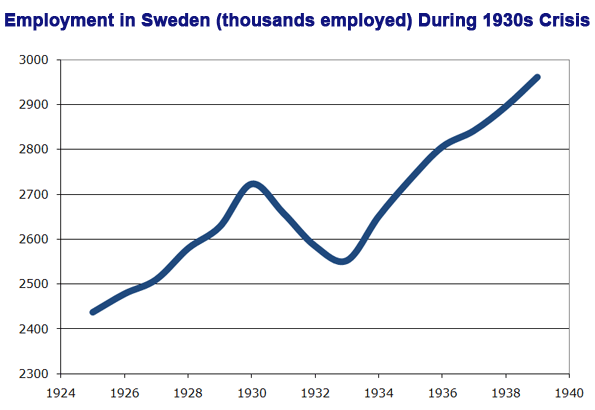
    This is illustrated by how well Sweden handled the great depression. Between 1930-33 170,000 jobs were lost, leading to a six percent drop in employment. However, the downturn soon turned to growth.

    At this time, Sweden was far from a socialist welfare state. The nation boasted low taxes, a flexible labor market and a good business climate. The solution for many who lost their jobs was to start their own business.

    Job creation spurred. Already in 1935 more people were employed compared to before the depression. One reason is that the Swedish economy already had gone through a recession in the 1920s, sparking structural changes.

    New and innovative ventures were started to replace the jobs that had been lost. Several famous Swedish firms, that still today remain as top employers, were formed during and shortly after the depression, such as: Volvo Aero, the mining company Boliden, Securitas and SAAB.

    Swedish social democrats have a surprisingly strong tradition of being quite pro-growth, and even pro-business. However, the hard left resurgence in the 1960s, culminating in the turmoil of 1968 radicalized the Social Democratic party. The tax level started climbing (through hidden taxes on labor and consumption), the labor market became dominated by labor union influence and regulations and the incentives for work, education and entrepreneurship were severely limited.

    As policy shifted, the growth of highly successful entrepreneurial ventures stagnated. A study by economist Sten Axelsson (Axelsson 2006) has examined the entrepreneurial ventures that had the highest revenues in Sweden in 2004. Only two out of 38 firms had been formed after 1970. If the firms were instead ranked after how many the employed, not a single one was shown to have been formed after 1970!

    Another study by economist Jonny Ullström (Ullström 2002) has looked at all the firms that were started in Sweden between 1986 and 1996. Among the 180,000 examined firms, 90 percent had fewer than five employees in 1997. Less than one among a thousand firms had 50 employees or more. Only eight of all the firms had 200 employees or more.

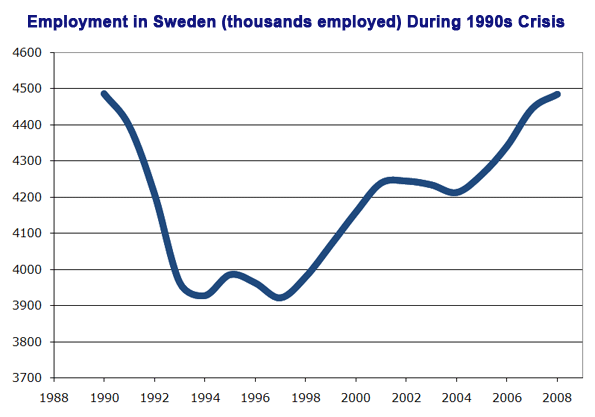
    The drop in entrepreneurship affected Sweden’s ability to deal with downturns. In the beginning of the 1990s, a new crisis hit Sweden. The global economy was growing strongly, but major obstacles faced the Swedish welfare state. Employment fell with almost twelve percent between 1990 and 1993. Within a few years the economy began to grow again. But employment stagnated. It remained until 2008 until Sweden reached the same level of employment as before the crisis.

    However, due to the previously mentioned reforms, the Swedish economy in 2008 was far more flexible than previous years, and thus better able to withstand the international downturn. Since the beginning of the 1990s, Swedish politicians amongst both the right and the left have realized the importance of moving towards greater share of economic freedom and following a generally fiscally conservative path In this time of worldwide crisis, this has helped Sweden’s economy to perform better than many others.

    This is not to say that more reforms are not needed to promote growth and entrepreneurship. Labor market regulations and taxes still depress successful entrepreneurship. For example, a person increasing her or his income with 100 Swedish Kronors has to pay fully 74 Kronors in hidden and visible taxes on employment and consumption taxes.

    Successful entrepreneurs are often highly educated people who already have a good career within large firms. But why spend time and energy on a new venture if up to three quarters of the gains are taxed away?

    Sweden is a nation with a strong history of entrepreneurship, great scientific institutions and strong working ethics. Today the nation stands stronger thanks to reforms towards greater level of economic freedom. But as long as taxes and labor market regulations block the way of growing businesses, the country cannot hope to repeat its stellar recovery course seen during the 1930s.


    Nima Sanandaji is president of the Swedish think tank Captus. He is the author of the book ”Entrepreneurs who go against the stream – what the 90s successful entrepreneurs can teach us” (Swedish title: ¨”Entreprenörer som går mot strömmen – vad 90-talets succéföretagare kan lära om dagens utmaningar”) for Fores.

    Photo by: jdlasica

    References:
    Axelsson, Sten (2006). ”Entreprenören från sekelskifte till sekelskifte – kan företag växa i Sverige?”, in Dan Johansson och Nils Karlsson (ed.), ”Svensk utvecklingskraft”, Ratio.

    Ullström, Jonny (2002). ”Det svenska nyföretagandet 1986-1997: förändringar i företagsstruktur och sysselsättningseffekter”,Vinnova.

  • Stagnation in the City of Angels: Whatever Happened to Ideas?

    It’s only been a couple of years since a red-hot real estate market had our city riding high. The market turned out to be a bubble, of course, and it eventually burst. Gone is the giddiness that comes when folks convince themselves that real estate or high tech stocks or any other trend or commodity can defy gravity and continue upward forever.

    Yet giddiness isn’t the only thing that’s been lost. Ideas have disappeared from the political landscape of Los Angeles.

    That’s particularly unfortunate because there’s plenty of work to be done after bubbles burst—everything from big efforts on the macro-economic level to the everyday challenges of mending lives torn asunder by financial strains. Local government can play a key role in such efforts. That means that politics is part of the picture—and that means that our city’s politicians have a chance to help by coming up with new ideas on how to spur a recovery.

    Yet our recovery is dragging along in Los Angeles. The federal government’s own struggles and the dire straits faced by state officials surely complicate the job at the local level, but those don’t fully explain the malaise we’re living through right now.

    It’s more likely that our city suffers from a dearth of ideas because our politicians became addicted to the red-hot real estate market. It’s looking more and more as though that became their one and only idea. They skimmed off the rising tide of real estate, used the money to buy political points, and stopped thinking about any new ideas.

    It worked for 10 years or so. The values of homes and other properties went up, and so did the city’s revenue. Developers paid fees to build residential and commercial units, buyers paid higher property taxes in the rising market, homeowners borrowed against their houses and spent freely, paying sales taxes along the way.

    All of the action sent streams of revenue to various levels of government, and much of the money found its way to the city’s coffers. Local politicians used the money to take care of donors with favorable deals, satisfy labor unions by expanding payrolls and paychecks for city employees, and provide basic services to enough voters to maintain the status quo.

    Now the revenue streams have dwindled, and there’s not enough for our politicians to finance their old scheme.

    There have been many reactions to our city’s challenges, but not much in the way of ideas. Our politicians have jumped from budget projection to budget projection, cutting here, threatening to cut there. Outside City Hall is a different story, as the populace begins to sense that this is all reaction with no basic idea. Whatever happened last week means nothing this week because the next budget report could prompt any sort of reaction from the politicians. There are no guiding principles or declared values—no ideas—for our city.

    This became clear to me when I realized that our City Councilmembers and our mayor used to send out all sorts of press releases back in the days of the real estate boom. There were notices that some project had been completed or another had just started. They almost always involved the expenditure of city funds, and went on about the politician who flipped whatever switches made the money flow.

    Now the money has dried up, and press releases are few and far between.

    That makes sense—if you accept the premise that spending money is the basis of any and all ideas when it comes to public policy.

    The truth is that more ideas are needed when there’s no money to spend. Yet I can’t remember the last time I saw a press release about an idea from the mayor or a City Councilmember on how to save money without cutting jobs or programs. I don’t recall any notices of a new idea that will maintain services without adding costs. I haven’t seen any communications that indicate our politicians have come up with any new ideas to meet the challenges our city now faces.

    It appears that we have an entire generation of politicians who see spending money as the whole idea of government.

    Well, we’re out of money.

    We need to know if our politicians have any other ideas.

    And they shouldn’t worry if they’re all out—voters are getting a few ideas of their own.

    Jerry Sullivan is the Editor & Publisher of the Los Angeles Garment & Citizen, a weekly community newspaper that covers Downtown Los Angeles and surrounding districts (www.garmentandcitizen.com).

    Photo by: AndrewGorden

  • Economics: Green Shoots & Immigration

    A year ago we were hearing all about green shoots. Analysts claimed to find them everywhere.

    Today, we never see the term. In fact, there seems to be a growing malaise. By the end of June the first quarter’s Gross Domestic Product (GDP) estimate was revised downward a full half a percent, to 2.7 percent. Pundits are depressed. Our President and Secretary of the Treasury are telling the world that the United States cannot lead the world to sustained economic growth. Our Vice President announced that “there’s no possibility to restore eight million jobs lost in the Great Recession.” Our stock markets are down and volatile. Risk premiums have soared.

    What happened?

    Reality happened. The green shoots were always ephemeral, the result of massive government spending increases or temporary government programs. We had housing stimulus programs. We had Cash for Clunkers. We had foreclosure programs. We had bailouts.

    The increased spending and the various programs had an impact. Because of the way GDP is calculated, an increase in government spending results in an increase in GDP, but that is today’s GDP, not tomorrow’s. Tomorrow’s economic growth is a result of investment today, investment in physical capital, technology, and human capital.

    To the extent that government spending detracts from those investments, the growth we saw was cannibalized from the future. For example, the housing stimulus programs served only to change the timing of real estate purchases. Sales fell when the programs ended.

    Even worse, some programs resulted in temporary GDP growth, but were actually detrimental to long-term economic growth. The Cash for Clunkers program destroyed capital, since perfectly good cars were crushed. The foreclosure prevention programs delayed the needed decline in home ownership rates.

    The bailouts prevented assets from being transferred to more productive uses. Bailouts are inefficient, and they prolong periods of economic weakness. Uncertainty and risk premiums remain elevated, holding investment to a minimum, limiting short-term and long-term economic growth. They also leave a hangover of debt, which limits future growth.

    None of the programs addressed the underlying problems of the current economic circumstances, or paved the way for sustained economic growth. The immediate problem was that businesses, consumers, and governments were over-leveraged after September 2008’s asset-value collapse. The longer-term problem was insufficient investment, a result of years of credit-fueled consumption.

    What was needed was investment. What was provided was more credit-fueled consumption. You might be able to borrow your way to prosperity, but to do that you better be investing the borrowed funds. We didn’t do that. Instead we used the government as a bank to increase consumption. Credit-based consumption is not the way to long-term prosperity, regardless of who does the borrowing.

    And, while it appears that most of the decline in asset values has ended, over-leverage is still with us. Indeed, the increase in government leverage makes it more difficult to employ effective government intervention, government investment in productivity-enhancing capital and technology, and investment tax credits.

    Add to these factors the millions of American households, employed and unemployed, that remain over-leveraged. Millions of consumers have been unemployed for months, and many of those still working are uncertain about their future employment. Those who have the income to do so are attempting to pay down debt, and to reduce consumption in the process. The consumer is not likely to soon be a source of rapid economic growth.

    So, we have most or all of the problems of a year ago, but now, because of increased government debt, we have fewer options. Even worse, we now have new problems that were not present in September 2008.

    Today, sovereign default risks are significant and increasing. While potential sovereign debt problems in Europe have received a great deal of attention, the problems are not limited to the continent. Japan continues to have very high debt and deficits. Several U.S. states could also default. A failure of an American state is likely to have impacts very similar to the failure of a small European country.

    I don’t believe that the failure of a country is the most likely outcome, however. Instead, expect to see more international bailouts, just as you can expect to see the federal government bailout several American states.

    Our options are limited, but we do have one option that would provide immediate and sustained economic growth without increasing leverage. That option would be a massive increase in immigration.

    The initial benefits of a new wave of immigration would be seen remarkably quickly. Housing demand would increase, leading to renewed vigor in our real estate markets and the construction industry. Our inner cities would be renewed, as they always have been by immigration waves. New business formations would soar. The tax base would increase, helping to fund debt repayment and baby-boomer retirements.

    Many would oppose such an immigration increase. They worry about increasing job competition, unemployment, crime, and even more demand on welfare programs.

    These fears are misplaced. Criminals are easily sorted out by effective screening processes. People don’t migrate for welfare benefits, but if this is a concern, it is easy to deny immigrant access to social programs for some number of years after immigration. Similarly, people don’t migrate to be unemployed, and unemployment benefits can be denied to immigrants.

    People migrate to more effectively use their human and physical capital, their technology, and their labor. Effectively, immigration would provide new capital, technology, and labor. This is exactly what we need, and it is free. Immigration has served America well in the past. It can serve us well today.

    Red and Green, photo by Rupert Maspero

    Bill Watkins is a professor at California Lutheran University and runs the Center for Economic Research and Forecasting, which can be found at clucerf.org.

  • The Economic Significance of Village Markets

    Flea markets and garage sales have been around for years. But for most New Zealanders, produce markets have been associated with old European villages, or the ethnic markets of Hong Kong and other exotic locations. Village markets focus on locally made crafts, while Flea Markets are essentially centralized garage sales.

    At the true Farmers’ Market vendors may sell only what they grow, farm, pickle, preserve, bake, smoke, or catch themselves from a defined area. There are now over 50 “official” Farmers’ Markets in New Zealand. But when all the flea markets, village markets, and less formal markets are tallied up there must be hundreds throughout New Zealand.

    When I grew up they simply didn’t exist – unless we count the school “Bring and Buy” and Church fétes. We simply shopped in shops. Why is this? Why did my parents feel no need for such markets? I suspect my parents would have regarded such markets as somewhat old-fashioned and even primitive. This was the sort of thing our forebears left behind in Ireland in the 1830s.

    However, they are now a part of our lives. For the last few years I have routinely – effectively every Saturday Morning – shopped at our local market at Mangawhai, a nearby coastal village in Northland. It’s where people sell their own produce, but also sell books, bric-a-brac, power-tools, and other bits and pieces. The market works for me because it is just across the road from my excellent butcher, and next door to the local lending library.

    So what’s the new appeal? The conventional theory is that the rise of these markets reflects a desire for fresh healthy food, and fruit and vegetables grown locally, and in-season rather than imported from far away. It’s also considered green to buy local and support local cultivars, and growers of eco-sourced native plants and so on.

    These markets are also a good place to meet for a chat, and they also provide a convenient means of selling off numerous “priceless objects” now growing mould in the garage.

    Indeed, last weekend, my wife and I decided to win back some space and earn some ready cash. Setting up a stall at the Mangawhai market was easy. We simply phoned the market organizer (from the local Cheese Shop) and booked a trestle table.

    We thought our real cash-cow would be the plants and seedlings but the biggest and most regular seller was our collection of vinyl records dating from US pressings of jazz giants from the sixties. Our first major sale was a high-quality Akai turntable. It was fun to see grandmotherly types shuffle up to the table and enthuse over early discs by Oscar Peterson, Miles Davis, and Billie Holliday. As a bonus we gave the turntable buyer a 1950s 10 inch LP of Bill Hayley and his Comets – Don’t Knock the Rock.

    The last time I thought about these markets was two weeks ago when I wrote the sad story of the urban Onehunga Market that had to close because Auckland City demanded a resource consent that would have cost maybe $30,000 dollars.

    I presume our Mangawhai market operates without such costs because it is housed in the Village Hall, on public ground, shared with the Library and the Museum. Consequently our stall space and trestle cost us only $10 for the morning. But if the Council had demanded say $30,000 for a land use consent, then a twenty-trestle market at $10 a trestle would take 150 weeks to recover just the consenting cost. Obviously, there would have to be many more spaces, or the rental would have to be much higher.

    On our first morning we netted only about $80. (Being newcomers, we were outside and it rained) But even this represented about $20 dollars an hour – not huge but better than the minimum wage. On the other hand it was an $80 dollar return on our $10 dollar capital investment (using simple “homespun” economics). Remember the stuff we were selling had negative value, and I drive back and forth from the village every Saturday anyhow.
    And it was fun. But could such markets become an endangered species? As in so many areas, the culprit is heavy-handed regulation. The high costs of land and development, and the burden of consenting and development contributions already make it nearly impossible for small corner stores to make any return on capital.

    Yet, the stall renter’s capital-productivity is massive. But many regulators cannot stand to see such an opportunity slip from their grasp. So the Onehunga market had to close.

    These village markets remind us of the “power of markets”. As the heavy-handed regulators drive down capital productivity, entrepreneurs have responded by rediscovering the outdoor markets of much earlier times when capital was scarce and labour was plentiful. Market economies are like water-beds – push down on one corner and they bounce up in another.

    We are beginning to see similarly ad hoc responses in the residential and commercial property markets. The regulators have so severely constrained the supply of coastal land in New Zealand that people like my parents, who bought a batch at on the coast at Tairua out of their working class income, no longer have a hope of enjoying the sprint from the Kiwi bach straight into the sea.

    Those who have generated this scarcity then complain that only foreigners can afford to buy our coastal land. But many of us really do want to occupy a beach side property for the best weeks of summer, and then return home to our rural dwellings in the regional towns and villages. Enter the motor home.

    As farmers become more and more regulated by central planners who know nothing about agricultural economics but instead are determined to ‘save the planet’, enterprising farmers will look for new ways to supplement their incomes.

    Well, here’s one way we can solve our mutual problem. First, buy a quality self-contained motor home. Then use Google Maps to find what looks like an ideal bay, with a farm track connecting the main road to the beach.

    Then approach the farmer and negotiate a “right to occupy” this little patch of heaven. It could be no more than the right to park on the spot for perhaps eight weeks a year, but could include an obligation to fence off the area to contain any children or pets. No resource consent, no title, no lease – just a right to drive on to the farm, park on the spot, and drive away if it rains.

    Farmers supplement their income and Kiwis reclaim the low cost beach. The Environmental Puritans will gnash their teeth at the prospect of so many people having fun – but this time we might be ready for them. Markets and human ingenuity can still win in the long run.

    Owen McShane is Director of the Centre for Resource Management Studies, New Zealand.

    Photo of Mangawhai Village Saturday Market by Sids1