Category: Economics

  • America the Cheap

    America is a price dominant culture, and we need to take responsibility for that when we complain about bad customer service, poor infrastructure, etc. Certainly American business and political leadership could be better, but they aren’t the ones who decided to shop at Wal-Mart instead of the local store (favoring short term financial gain over long term community loss). Nor are they the ones who force us to vote for politicians promising something for nothing.

    This is the subject of my latest City Journal piece, “America the Cheap“:

    American politicians understand this. That’s why they frequently promise voters something for nothing, or free stuff with other people’s money. Republicans promise to “eliminate fraud and waste” or to increase government revenues somehow by slashing taxes, or through some other cost-free method. Democrats say that they are going to tax “the rich,” such as when New York City mayoral candidate Bill de Blasio said that he would give all New Yorkers free pre-K education, funded by a special surtax on high-income households (i.e., somebody else).

    European social democracies offer extensive government services and generously funded safety-net programs. But these come with high taxes for the average citizen. Few American politicians are willing to advocate explicitly for that. They keep promising citizens a free lunch. And why not? It seems to be what we want to hear: there’s some magic elixir that can transmute lead into gold.

    The populists are right that corporate, governmental, and cultural elites have too often let America down, and even sometimes acted disgracefully. But that doesn’t mean that the man on the street is off the hook. Just because someone else is guilty doesn’t mean that we’re all innocent. If populism takes a high view of the ordinary citizen, then it should also recognize the importance of these citizens’ decisions in shaping the world we live in.

    Click through to read the whole thing.

    Aaron M. Renn is a senior fellow at the Manhattan Institute, a contributing editor of City Journal, and an economic development columnist for Governing magazine. He focuses on ways to help America’s cities thrive in an ever more complex, competitive, globalized, and diverse twenty-first century. During Renn’s 15-year career in management and technology consulting, he was a partner at Accenture and held several technology strategy roles and directed multimillion-dollar global technology implementations. He has contributed to The Guardian, Forbes.com, and numerous other publications. Renn holds a B.S. from Indiana University, where he coauthored an early social-networking platform in 1991.

    Photo Credit: Mike Kalasnik, CC BY-SA 2.0

  • The Jungle

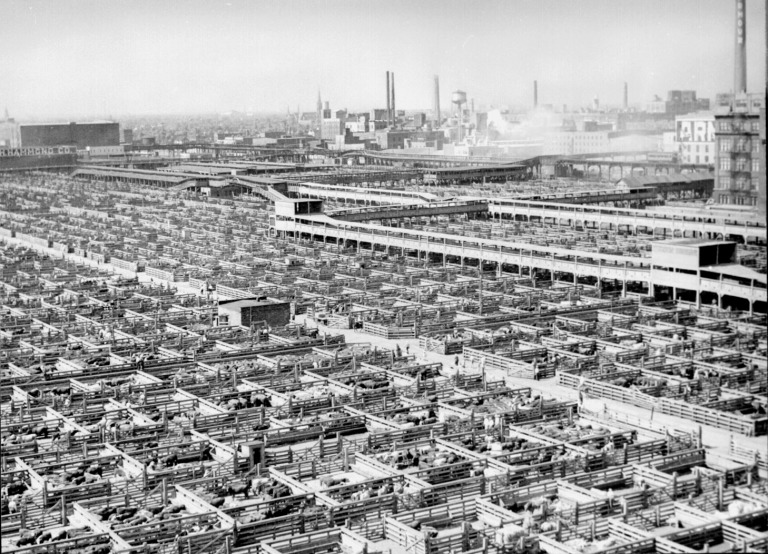
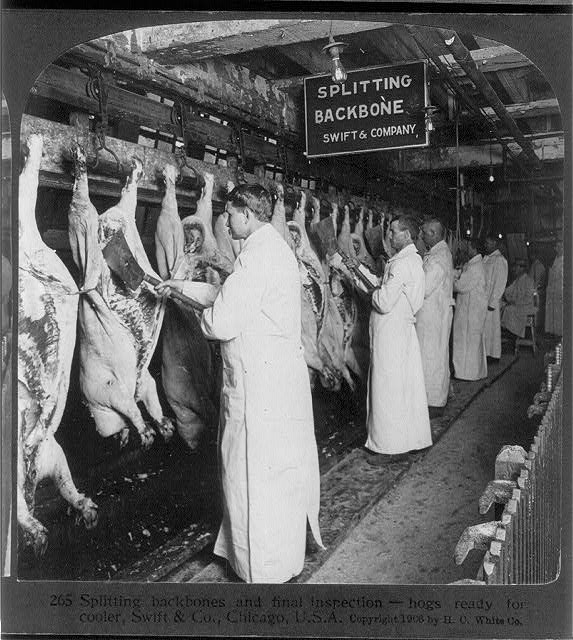
    Upton Sinclair’s 1906 novel The Jungle was intended to inform the larger American public of the miserable working environment and sub survival wages of Chicago’s meat packing employees. The popular response was huge and lead to new government agencies and protections, but not the kind Sinclair had hoped for. By describing the dangerous and unhealthy conditions in slaughterhouses he meant to elicit sympathy for the workers who were denied adequate pay and were routinely maimed or killed on the job with no recourse to improved safety, medical care, or compensation.

    Source

    Source

    What the outraged American public focused on instead was tainted meat from unsanitary facilities. The general population was far less interested in the plight of the Lithuanian immigrant workers Sinclair described than the wholesomeness of the food supply. The Federal Food and Drug Administration was signed in to law by President Theodore Roosevelt in direct response to the uproar over the novel. Making life better for the underclass wasn’t nearly as gripping as making sure fingers weren’t getting ground up into the sausages.

    Source

    Source

    Source

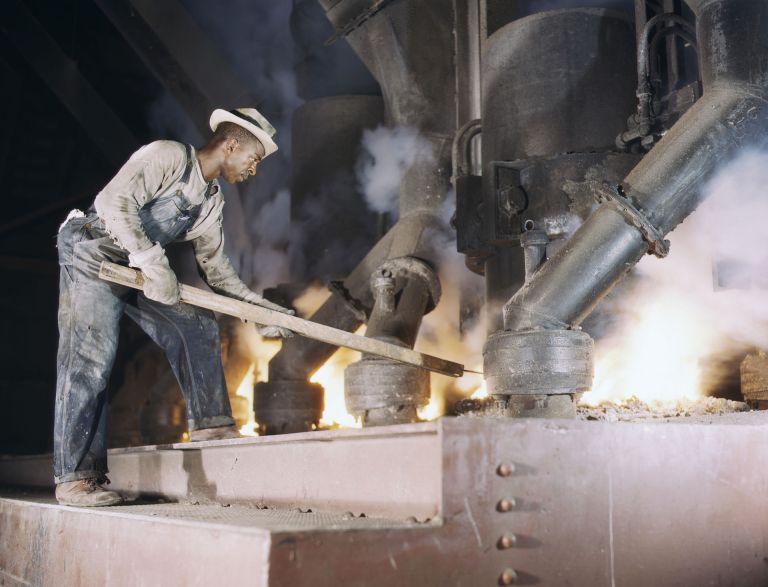
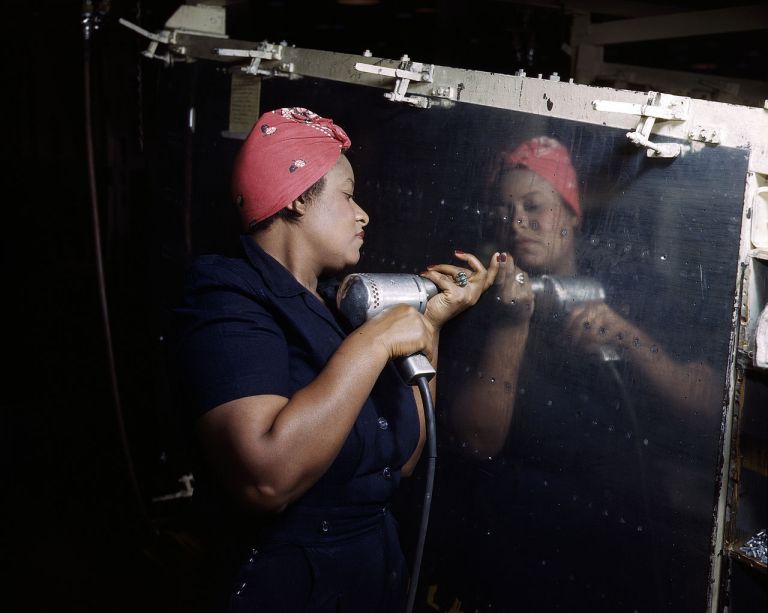
    It wasn’t until the Great Depression of the 1930’s that government – at the insistence of American voters – actually began to create serious labor laws to lift the status of ordinary workers. The pain of being on the wrong end of the stick had migrated from an unloved minority to too many people who thought they were better off – until they weren’t. And it wasn’t until the onset of World War II when labor became scarce relative to the need for wartime production that wages began to rise.

    Americans don’t actually care about the poor and never have. It’s important to keep this in mind. I recently found this comment on an economics website. It sums up the standard response to today’s struggle over increasing inequality.

    “Millions of very decent and good people can’t afford to live in upper middle class cocoon cities like what San Francisco is becoming. We need to allow the responsible members of the shrinking middle class and growing lower classes to isolate themselves from the worst members of the lower classes. People who lack the buying power to move to nice protected towns full of professional workers need ways to separate themselves from social pathology. Our current elites inflict section 8 housing and a growing immigrant lower class on the responsible people who can’t afford bubble city life. This is just so wrong of them. Our elites are our enemies.” Source

    So the problem is that elites are segregating themselves from the declining middle class – and the proposed solution is to provide a separate bubble for the squeezed former middle class to retreat to so they can segregate themselves from people lower down the ladder. Huh? I suppose I have to ask… who decides who is struggling but worthy and who is part of the “social pathology”? And what mechanism might deliver the protection the commentator desires?

    As a society we don’t reach for solutions that might address the underlaying structural flaws that create the underclass or the elites. Instead we look for ways deserving individuals can distance themselves from the effects of those structural defects. We assume a big chunk of the population will be left behind and we don’t mind so long as it’s the undeserving that get screwed. That’s always been our de facto national policy.

    This piece first appeared on Granola Shotgun.

    John Sanphillippo lives in San Francisco and blogs about urbanism, adaptation, and resilience at granolashotgun.com. He’s a member of the Congress for New Urbanism, films videos for faircompanies.com, and is a regular contributor to Strongtowns.org. He earns his living by buying, renovating, and renting undervalued properties in places that have good long term prospects. He is a graduate of Rutgers University.

  • The Politics of Migration: From Blue to Red

    Democratic “blue” state attitudes may dominate the national media, but they can’t yet tell people where to live. Despite all the hype about a massive “back to the city” movement and the supposed superiority of ultra-expensive liberal regions, people are increasingly moving to red states and regions, as well as to suburbs and exurbs.

    This is the basic takeaway from the most recent IRS data and Census Bureau estimates, which have been widely ignored in the established media. Essentially, Americans are rejecting what Walter Russell Mead has labelled “the blue model,” and relocating to cities, states and regions that are less dense, less heavily taxed, and less regulated.

    This suggests not an intrinsic political calculation so much as a series of very personal decisions by individuals and families. People move for varied reasons — cheaper homes, lower  taxes, employment opportunities, better schools, more value to the paycheck — but the upshot is that they are settling in states that tend to be red or, at least, purple in political coloration.

    In 2016 alone, states that supported Donald Trump gained 400,000 domestic migrants from states that supported Hillary Clinton. This came on top of an existing advantage in net domestic red state migration of 1.45 million people from 2010 through 2015. Contrary to popular perception, these blue state emigres aren’t all fleeing economically challenged places such as upstate New York or inland California. Mostly, they have left the  biggest cities, which are the electoral base of the Democratic Party. Metropolitan New York has led the way in out-migration, followed by Los Angeles and Chicago. Since 2000, these metropolitan areas have lost a net 5.5 million domestic migrants to other parts of the country.

    Even economic boom conditions have failed to reverse this trend. Overall, many big blue core cities now have overall population growth rates well below the somewhat tepid national average of 0.7 percent. So, who’s growing? Last year, all 10 of the top gainers in domestic migration were Sunbelt metropolitan areas: Austin, Tampa-St. Petersburg, Raleigh, Jacksonville, Las Vegas, Charlotte, Orlando, Nashville, Phoenix and San Antonio.

    Perhaps most surprising, given the almost universal dismissal of their prospects, has been a shift to smaller cities, a more Trump-oriented part of the urban archipelago. Domestic migration has accelerated to cities between 500,000 and 1 million population, while declining in those above 1 million.

    The Suburban Resurgence

    More important still has been the revival in the suburbs, particularly in Sunbelt metropolitan areas. The most recent estimates suggest that last year was the best for suburban areas since the Great Recession. In 2012, the suburbs of the major metropolitan areas (over 1 million) attracted barely 150,000 more people than core counties, an edge that grew to 556,000 last year. Between 2010 and 2015, suburban counties of major metropolitan areas added 825,000 net domestic migrants, while the urban core counties lost nearly 600,000.

    Critically, since 2010 more than 80 percent of all new jobs in our 53 leading metropolitan regions have been created in suburban locations. Many of the leading tech areas of the country –from Silicon Valley and Raleigh-Durham to tech centers surrounding the big Texas cities — are primarily suburban. The economic future, contrary to the common media memes, will be primarily occurring in the periphery of the hip urban cores.

    This trend may accelerate as millennials begin to enter their 30s and look for safe, affordable places to live. We already see this in the behavior of their predecessors, the X generation. Using census data of those 35-49 as our measurement, since 2000 the percentage of Gen-Xers living in the urban core has dropped by one percentage point, while the percentage living new suburbs and exurbs has grown by six percentage points. The latest estimates indicate over 80 percent of Xers in the 53 largest metropolitan areas lived in suburban areas.

    Gen-Xer shares grew most dramatically in the affordable Sunbelt, like almost completely suburban Raleigh, which saw a 50 percent growth in the share of Xers relative to the national rate. Rapid growth also took place in Las Vegas, Charlotte, Phoenix, Orlando and Salt Lake City as well as the big four Texas cities: Austin, Houston, Dallas-Fort Worth, and San Antonio.

    In contrast the Gen-X population share has remained stagnant in the San Francisco and San Jose areas, while the Los Angeles, New York, Boston, Chicago and Philadelphia areas have all seen declines in their Xer shares both since 2000 and since 2010.  This could be a harbinger of millennial behavior. Like the Xers, millennials are beginning to move into the suburbs, contradicting all predictions to the contrary. Since 2010, the biggest gains in millennial share have been in heavily suburban Orlando, Austin and San Antonio.

    Generally speaking, notes economist Jed Kolko, the peak years for living in higher density multi-family neighborhoods take place between ages 18 and 30. Kolko calculates that while almost a quarter of these under-30 urban dwellers live in these higher density neighborhoods, by age 40 this drops well below 20 percent, and stays there until people are into their 70s. Given that the 30-something population is destined to grow far faster than 20-somethings in the coming decades, the move to suburbia, with its detached housing — particularly in regions with lower home prices — is expected to continue for the foreseeable future.  

    This shift is likely to be driven in large part by unsustainable housing costs. In the San Francisco Bay Area, techies are increasingly looking for jobs outside the region, and some companies are offering cash bonuses for those willing to leave. A recent poll indicated that 46 percent of millennials want to leave the Bay Area. Meanwhile, these “best and brightest” have been gravitating to lower cost areas such as Austin, Orlando, Houston, Nashville, and Charlotte.

    The basics that drive people to the suburbs remain: cheaper real estate, a preponderance of single family housing, better schools, a poverty rate  roughly half  that of core municipalities as well as far lower incidence of violent crime  than in urban cores. This trend will be accelerated, as a recent policy analysis released by the consulting firm Bain shows, by services such as Uber or Lyft, the appeal of working at home as well as the development of automated vehicles.

    Political Implications

    Ultimately, the key political battlegrounds for the future will not be in blue cities but in purple suburbs, particularly in the booming periphery of major cities in red states. No matter how loud and pervasive the voices emanating from the urban core, or for that matter, ungentrified countryside, Trump won the election by taking by a significant five percentage point suburban margin nationally, improving on Romney’s two-point edge, and by more outside the coastal regions.

    This contradicts the confident assertions by the New York Times and other establishment voices that Trump would get his clock cleaned in suburbia, particularly among college-educated voters in upscale communities. Suburban voters made the difference in the crucial Midwestern states of Michigan, Wisconsin and Pennsylvania, and Trump came close to winning in supposedly deep blue Minnesota.

    In Michigan, Trump lost Wayne County (including Detroit) by more than 2-1, but captured four of the five surrounding suburban counties by margins that greatly exceeded that of Michigan native Romney. The pattern was similar in Pennsylvania where Clinton won in the Philadelphia metropolitan area – and Pittsburgh’s urban Allegheny County, while Trump was flipping the state with majorities in nearly every other county. Much the same can be said about Wisconsin and Ohio, states critical as well to the Trump win and the GOP future.

    This pattern is not set in stone. Trump, as the New York Times recently enthused, does suffer from continuing problems with educated suburban voters. Perhaps even more threatening to the GOP is that minorities now account for more than 40 percent of all suburban and exurban residents, growing far faster in the periphery than non-Hispanic whites. Trump lost traditionally right-leaning but rapidly diversifying places such as Orange County, Calif., and Fort Bend County outside of Houston.

    Yet, winning over suburbia in the long run may not be easy for the Democrats. As millennials and Xers, as well as minorities, begin to own property and earn more money, their attitudes on taxes tend to shift to a more conservative perspective, notes a recent Reason poll. Similarly many first-generation Asian immigrants tend to be far more conservative than second- or third-generation Chinese- or Korean-Americans, many of whom have been through college indoctrination and are comfortably ensconced in the generally Democratic-leaning high-end professional class.

    Perhaps the biggest problem for the left lies in their embrace of policies that reject suburban lifestyles and, as we see in California, make housing hard to build and all but unaffordable. Most millennials and Xers, not to mention minorities, cannot afford to live in places like brownstone Brooklyn or San Francisco. In adopting policies to curb “sprawl,” blue state politicians are assaulting the suburban lifestyles clearly preferred by the clear majority. This leftist urban policy does not constitute an ideal strategy to appeal to those, including minorities, who want nothing more than to live comfortable lives on the periphery.

    Right now, the demographic trends do not clearly favor either party. The new generation now forming families — and heading towards the red states — may not be as conservative as boomers but their politics are less lock-step progressive than many believe, even on gender-related issues. They may want health-care reform, good schools, and cleaner environments. But they also want jobs, would like to hold onto more of their paychecks, and cherish the same suburban amenities they enjoyed as children.

    Ultimately, it’s a matter of which politicians can delineate the best path toward greater opportunity and homeownership for middle-class families. The political party that addresses these aspirations is likely to be the one that wins the race in the long run.

    This piece first appeared on Real Clear Politics.

    Joel Kotkin is executive editor of NewGeography.com. He is the Roger Hobbs Distinguished Fellow in Urban Studies at Chapman University and executive director of the Houston-based Center for Opportunity Urbanism. His newest book, The Human City: Urbanism for the rest of us, was published in April by Agate. He is also author of The New Class ConflictThe City: A Global History, and The Next Hundred Million: America in 2050. He lives in Orange County, CA.

    Wendell Cox is principal of Demographia, an international public policy and demographics firm. He is a Senior Fellow of the Center for Opportunity Urbanism (US), Senior Fellow for Housing Affordability and Municipal Policy for the Frontier Centre for Public Policy (Canada), and a member of the Board of Advisors of the Center for Demographics and Policy at Chapman University (California). He is co-author of the “Demographia International Housing Affordability Survey” and author of “Demographia World Urban Areas” and “War on the Dream: How Anti-Sprawl Policy Threatens the Quality of Life.” He was appointed to three terms on the Los Angeles County Transportation Commission, where he served with the leading city and county leadership as the only non-elected member. He served as a visiting professor at the Conservatoire National des Arts et Metiers, a national university in Paris.

    Photo: Mark Turner (Own work) [Public domain], via Wikimedia Commons
  • Leaving California? After slowing, the trend intensifies

    Given its iconic hold on the American imagination, the idea that more Americans are leaving California than coming breaches our own sense of uniqueness and promise. Yet, even as the economy has recovered, notably in the Bay Area and in pockets along the coast, the latest U.S. Census Bureau estimates show that domestic migrants continue to leave the state more rapidly than they enter it.

    First, the good news. People may be leaving California, but, overall, the rate of leaving is about three-quarters less than that experienced in the first decade of the millennium. In the core, booming San Francisco metropolitan area, there was even a shift toward net domestic migration after 2010, something rarely seen since the 1980s.

    Outmigration dropped with the initial economic slowdown of the last recession, particularly as housing prices in some areas, notably the Inland Empire and the Sacramento area, drifted toward the national norm of three times incomes by 2010, having been twice that high or more in the boom times. The initial recovery after 2010 may also have encouraged people to stay as well.

    Back to mounting outmigration

    The San Francisco Bay Area lost more than 600,000 net domestic migrants between 2000 and 2009 before experiencing a five-year respite. Now, sadly, the story seems to be changing again. Housing prices, first in the Bay Area and later in other metropolitan areas, have surged mightily, and are now as high as over nine times household incomes. In 2016, some 26,000 more people left the Bay Area than arrived. San Francisco net migration went from a high of 16,000 positive in 2013 to 12,000 negative three years later.

    Similar patterns have occurred across the state. Between 2010 and 2015, California had cut its average annual migration losses annually from 160,000 to 50,000, but that number surged last year to nearly 110,000. Losses in the Los Angeles-Orange County area have gone from 42,000 in 2011 to 88,000 this year. San Diego, where domestic migration turned positive in 2011 and 2012, is now losing around 8,000 net migrants annually.

    The major exceptions to this trend can be found in the somewhat more affordable interior regions. Sacramento has gained net migration from barely 1,800 in 2011 to 12,000 last year. Even some still-struggling areas, like Modesto and Stockton, have seen some demographic resurgence as people move farther from the high-priced Bay Area.

    Read the entire piece at The Orange County Register.

    Joel Kotkin is executive editor of NewGeography.com. He is the Roger Hobbs Distinguished Fellow in Urban Studies at Chapman University and executive director of the Houston-based Center for Opportunity Urbanism. His newest book, The Human City: Urbanism for the rest of us, was published in April by Agate. He is also author of The New Class ConflictThe City: A Global History, and The Next Hundred Million: America in 2050. He lives in Orange County, CA.

    Wendell Cox is principal of Demographia, an international public policy and demographics firm. He is a Senior Fellow of the Center for Opportunity Urbanism (US), Senior Fellow for Housing Affordability and Municipal Policy for the Frontier Centre for Public Policy (Canada), and a member of the Board of Advisors of the Center for Demographics and Policy at Chapman University (California). He is co-author of the “Demographia International Housing Affordability Survey” and author of “Demographia World Urban Areas” and “War on the Dream: How Anti-Sprawl Policy Threatens the Quality of Life.” He was appointed to three terms on the Los Angeles County Transportation Commission, where he served with the leading city and county leadership as the only non-elected member. He served as a visiting professor at the Conservatoire National des Arts et Metiers, a national university in Paris.

    Photo: Marco Varisco, CC License

  • Deindustrialisation in Sydney

    According to property analysts CoreLogic, the Sydney median vacant land selling price has hit $450,000, a massive 20.5 per cent higher than the same time last year. This follows the New South Wales Valuer-General’s January announcement that in the 12 months to July 2016, land values across the city’s north-western and south-western corridors rose by around 25 per cent. Yet a general reluctance to identify out-of-control land values as the prime cause of our housing crisis is matched by a strange indifference to their distorting effects on Sydney’s economic structure. One exception is Michael Cook of Investa Property Group, who recently captured the essential problem. “South Sydney, once the domain of the industrial juggernaut Goodman, is now dotted with high-density Meriton apartments,” he writes. “Where once ‘office’ or ‘industrial’ was the highest and best use, residential is now commanding the big bucks.”

    Cook’s observations are consistent with this account of classic “deindustrialisation” from land economist Alan Evans of Reading University, applicable in many respects to conditions in Sydney:

    It has already been argued that the high price of land will have led to the substitution of other factors for land where this is possible. Where substitution is more difficult, industries will face higher costs, and competition from countries where land or other prices are lower will force them to contract. The net result will have been a shift of production and employment away from some activities which use a lot of space, primarily in manufacturing industry, and towards activities which use relatively little space, primarily services. In this way the planning system will have contributed to the so-called de-industrialisation of Britain over the last 30 years or so.

    While most of our civic and opinion leaders contemplate a “truly global city” for the world’s best and brightest, processes of contraction and dislocation are reshaping Sydney’s industrial base. “The broad trends being observed within Metropolitan Sydney, amplified over the past two years”, said Sass J-Baleh of Colliers International in March, “has been the shift in preference for industrial users, particularly those large users within the manufacturing and logistics industry sectors, to locate further west of Sydney, and the urban renewal of industrial-zoned land in pockets of inner and middle ring areas.” By ‘urban renewal’ she means the conversion of industrial land for residential and ‘mixed use’ purposes, and ‘pockets of inner areas’ means, mostly, the old industrial transportation axis of South Sydney, stretching from Sydney Harbour down to Central Station, Alexandra Canal, Kingsford-Smith Airport and Port Botany.

    In a 2015 report to the NSW Department of Planning, consultancy Urbis note that “industrial land users traditionally located around Sydney’s East and South subregions (ie Botany, Mascot, Banksmeadow etc) have progressively moved west as the city’s population and urban footprint expanded and competition from alternative land uses increases.” Urbis found that in the east and south industrial development has been “priced out … because of their diminishing industrial base (a function of increased inner-city residential densities and planning pressures).” South Sydney industrial land values for larger sites reached $700 per square metre in 2012, say Urbis, while south west and outer south west values were as low as $300 and $250. In the case of industrial development that differential has a large impact, since it’s “delivered at lower margins than development for other land uses.” In other words “land value has a greater role in determining the overall feasibility of development.”

    Colliers report that South Sydney land and capital values achieved a record growth rate of 19.4 per cent over 2016.

    Across metropolitan Sydney, 35 hectares of industrial land was rezoned for other uses in 2013, of which 18.3 hectares was rezoned for medium-density housing. Unsurprisingly a high 79 per cent occurred in Botany Bay LGA (Local Government Area), the lower sector of the old South Sydney hub closest to the port, encompassing Mascot, Botany and Banksmeadow (renamed Bayside LGA in September 2016). While local industrial land values reached $850 per square metre in 2014, the equivalent figure for residential values in Mascot was $1,385. Hence the observation by Colliers’ Edward Princi in 2015, that “residential approvals and rezoning have reduced the traditional industrial base of the city’s south by about 2 million square metres.” CBRE Research estimate that South Sydney will lose 210,000 square metres of industrial stock over the next 5 years. In contrast, the residential populations of Botany Bay LGA and City of Sydney LGA were forecast to grow by 23 and 30 per cent respectively.

    From the gentrified, inner-city band around the CBD, City of Sydney LGA extends down to the industrial zone’s northern Alexandria-Waterloo-Zetland sector. Here residential land values are more than triple those of Botany Bay, as much as $4,751 per square metre in the old factory suburb of Waterloo, just 4 kilometres south of the CBD. “Greater high density development and ongoing gentrification are underpinning the evolution of South Sydney from a blue collar, industrial working class area to an upmarket, mixed-use precinct with a rapidly growing local population”, say agents Jones Lang Lasalle. In June 2015, City of Sydney Council rezoned what are officially called the Southern Employment Lands (“employment lands” are roughly equivalent to industrial lands in NSW planning jargon) to allow for a range of other business activities and housing (parts like Green Square were already the subject of special arrangements). This may just be a case of responding to pressure from landowners, but Lord Mayor Clover Moore’s “green, global and connected” administration would have needed little encouragement.

    By the 1940s, Alexandria/Waterloo was the “largest industrial municipality in Australia”, 415 hectares crowded with 550 smokestack factories churning out products as diverse as soap, tallow, fertilisers, springs, brushes, aircraft, storage batteries, furniture, sporting goods, glass, matches, industrial gases, paper containers, paints and varnishes. “The Birmingham of Australia”, was its nickname. Today Alexandria, Waterloo and Zetland converge on a very different landscape. “One of the largest urban renewal projects undertaken in Australia”, Green Square is a complex of towers providing 20,000 new apartments around a Town Centre with two public plazas, at least one park, an ‘urban stream’, an aquatic centre, a library, and an underground railway station. With an estimated 2030 population of 61,000 packed into 2.78 square kilometres, it will be the country’s most densely populated urban area. The economic principle, elaborated by Evans and others, that “capital is substituted for land in the production of space as land becomes more expensive”, is thus borne out.

    Other parts of industrial South Sydney are being similarly transformed. In 2015 alone, no less than 1,701 apartments were planned or being built amidst the derelict factories and workingmen’s bungalows of neighbouring Rosebery.

    While South Sydney was the heartland of the old industrial zone, it also branched off along the south shore of the harbour west of the CBD, where waterfront sites attracted bulk commodity processing industries reliant on seaborne transportation. Among them the woolstores at Darling Harbour, timber sawing at Rozelle Bay, coal-fired power generation at White Bay, sugar refining at Pyrmont, then further west as Sydney Harbour becomes the Parramatta River, livestock slaughter at Homebush Bay, iron ore smelting at Rhodes, coal-fired gasworks at Mortlake, and oil refining at Camellia. Over the decades, these industrial hubs were uprooted by rising land values and rents, and factors like the availability of motorised transportation. For instance, Urbis point out that between 1993 and 2012 (before the most recent explosion in prices) standard residential land values within a 15 kilometre radius of Sydney CBD rose at double the rate of small industrial land values, by 8.38 per cent and 4.44 per cent respectively.

    Mostly, the old waterfront sites were rezoned for residential, commercial or recreational purposes, but not other industrial uses. Darling Harbour is now a convention, exhibition and entertainment precinct. Rozelle Bay and White Bay, along with Johnston Bay and Blackwattle Bay, are part of The Bays Precinct, an urban renewal plan for mixed use and 16,000 new dwellings on 95 hectares of derelict waterfront land. The small peninsula of Pyrmont is currently Australia’s most densely populated suburb following the completion of Jacksons Landing, a planned community featuring five massive high-rise apartment blocks. Redeveloped as the site of the Sydney Olympics, Homebush Bay is the subject of a 2030 Master Plan for several 45-storey residential towers housing 21,000 more people in 10,700 new apartments. At Rhodes, a project allowing up to five 25-storey buildings will take the expected population to 11,000, “making it one of the most densely populated areas of Sydney outside the CBD.” And Camellia has its own government Land Use and Infrastructure Strategy, proposing “a town centre … public plazas, high-rise apartments and parks.”

    Dislocating land values are having an impact beyond the traditional zones, however. Now they are rippling out to the secondary or middle ring of industrial sites in Sydney’s central west region. From the 1960s and 1970s, places like Blacktown, Holroyd, Rydalmere, Rosehill, Silverwater, Chullora, Villawood, Milperra, Smithfield, Moorebank and Wetherill Park emerged as industrial centres in conjunction with the shift of working class population to the western suburbs and highway upgrades. Urbis identify Smithfield, Wetherill Park and Chullora, along with South Sydney, as locations from which industrial operators are relocating to the outer west and south west.

    Ray White Commercial’s head of research Vanessa Rader explains that “the market extending from Enfield to Moorebank, taking into account regions such as Milperra, Villawood and Chullora in recent years, has been contracting due to competition from other uses such as retail and residential, resulting in increases in land value …” She describes the region as “home to manufacturing, fabrication and wholesale type uses.” Similar analysis came from CBRE’s Raj Chaudhary, who said “the withdrawal of about 100,000 square metres from the central west industrial market, due to rezoning and conversion to residential, is reducing supply in an already tight market …” Last year’s sale of 3 warehouse units in Holroyd for a price equivalent to more than $3,000 per square metre was “the highest industrial per square metre building rate ever achieved in the area.”

    These processes of contraction, dislocation and relocation have transformed Sydney’s industrial geography. According to the NSW Department of Planning’s last Employment Lands Development Program (ELDP) report, 79 per cent of Greater Sydney’s total zoned employment lands, and 93 per cent of the 22 per cent zoned but not yet developed, are now in the central west, south west and outer west subregions. This is up from 60 per cent of all employment lands in 1991, say Urbis. The question is whether planning authorities are supplying enough zoned land serviced with water, sewerage, electricity and road connections on the western periphery to meet demand from new operators and those driven out of other locations, and to relieve pressure on land values generally. While this will receive more detailed treatment on another occasion, the evidence suggests they are failing. “Under the average take-up rate of 163 hectares per annum there is only 2.8 years of supply”, says the ELDP report, “this does not meet the supply standard for undeveloped and serviced land (5-7 years supply).” Malcolm Tyson of Colliers warns that Sydney could run out of industrial land in just 6 years. Dreaming of “global city” amenities like dense housing, commuter rail, walkability and bike paths, our planning elites may be occupied elsewhere. But this is a crisis in the making.

    John Muscat is a co-editor, along with Jeremy Gilling, of The New City, a web journal of urban and political affairs.

    Photo: Derelict White Bay Power Station, Rozelle, Sydney, 2014

  • Universal Basic Income: A “Social Vaccine” for Technological Displacement?

    John Kenneth Galbraith once said that the beginnings of wisdom were to never trust an economist. Those of us that spent most of our adult lives in deindustrialized communities understood his point.

    As the mills and factories closed in working-class communities like Youngstown, an array of business and academic economists suggested that economic devastation was part of the natural economic order known as “creative destruction.” Disinvestment, technological displacement, downsizing, and outsourcing were all necessary for corporate efficiency and dynamism, regardless of the “temporary” harm to individuals and communities. Capital, they explained, was simply being shifted from old to new investments, and new jobs would magically appear. Of course, workers would have to move or gain new skills in order to claim those jobs. Unfortunately, those predictions were wildly overstated. Capital was not reinvested in productive ways or moved offshore, many workers never found comparable employment, communities deteriorated. Over time, appeals to “creative destruction” were recognized not only as erroneous, but as a cover for capital getaway.

    We should remember this story as we enter a fourth industrial revolution that will merge technologies and blur the lines between digital and biological spheres. In the process, these digital transformations will spread unemployment and increase precarity. As in the past, the digital revolution has been sold as part of modernity and progress, but increasingly technological change is proving more destructive than positive. The New York Times reports that some top researchers have already acknowledged that automation and robotics in manufacturing have resulted in a large net of loss of employment, declining wages, and disruption of working-class communities. The Times concludes that given unemployment levels, “there is no clear path forward, — especially for blue-collar men without college degrees.”

    But it is not just working-class men in industrial jobs who are suffering. Automation also affects jobs in other economic sectors. In fact, 38% of all US jobs are at risk due to automation, including service sector work in fields such as finance, transportation, education, and food services. Nor is technological displacement limited to the working class. Middle-class workers also stand to lose jobs and wages.

    Many corporate executives embrace this change, viewing automation solely in terms of profitability and suitability and ignoring the human costs. As Andrew F. Puzder, chief executive of CKE Restaurants and Donald Trump’s original choice for Secretary of Labor, summed up this attitude in explaining why he would prefer robots over human workers: “They’re always polite, they always upsell, they never take a vacation, they never show up late, there’s never a slip-and-fall, or an age, sex or race discrimination case.” To paraphrase, Harry Braverman, technology is not neutral. Rather, it enters the workplace as “the representative of management masquerading in the trappings of science.”

    Technology leaders understand that their work contributes to displacement and inequality. In “The Disruptors: Silicon Valley Elites’ Vision of the Future,” Greg Ferenstein reports on a survey of tech leaders. He found that most agreed with Paul Graham, the highly influential web leader, that it is the “job of tech to create inequality…You can’t prevent great variations in wealth without preventing people from getting rich, and you can’t do that without preventing them from starting startups.” This view reflects the self-interests of the industry, of course, but it also suggests deep-seated beliefs in technological determinism and the benefits of creative destruction.

    At the same time, working people have become increasingly resistant to the uncritical acceptance of workplace technology, and this contributes to the populist backlash we’re seeing in the U.S. and across Europe. The Brexit vote, the rise of right wing parties in Europe, and Trump’s election all reflects people’s doubts about older economic paradigms and technological determinism, especially in older working-class communities. Alongside racism and xenophobia, these movements also reflect the anxieties of those who are being left behind by economic development.

    Technological and political elites have good reason to worry about the potential for class rebellion, and some have started to rethink their faith in technology or, at least, to ask about how to mitigate the outcomes of technological change. For example, a group of science and technology leaders have established Singularity University (SU), which touts itself as a global community whose mission is “to educate, inspire, and empower leaders to apply exponential technologies to address humanity’s grand challenges.” It holds ‘summits” around the world, underwritten by large international firms, such as Deloitte, that bring together researchers, entrepreneurs, institutions, and governments – most of whom believe deeply in the power of robotics, nanotechnology, artificial intelligence, and powerful computing to transform work and improve lives. Yet SU’s approach is remarkable because it emphasizes the impact of technology on people’s lives. While SU takes a positivist and entrepreneurial approach, arguing that the world’s biggest problems are world’s biggest business opportunities, it clearly understands that any technological advance must take into account its impact on communities.

    Silicon Valley firms also see themselves as potential leaders in developing strategies for a future where many workers will be displaced by technology. Some envision a more direct approach: the universal basic income, which Scott Santens describes as a social “vaccine” for the 21st century. Y-Combinator, a Silicon Valley incubator firm, has begun experimenting with this idea by providing a basic fixed income to 100 families in Oakland, California. Give Directly, a Silicon Valley non-profit, is testing the idea as a way of eliminating poverty by giving each individual in a small village in Kenya $22 a month for 12 years. The New York Times describes the project “as first true test of a universal basic income. Not just given to individuals but to a whole community for an extended period.” Of course, these approaches are not considered socialism; they are defined as providing an “income floor.”

    The potential of these experiments has not been not lost on developed nations, where some see a universal basic income as strategy for ameliorating the impact of automation. The European Parliament, Korea, France, Canada, Finland, Netherlands, and Scotland are all considering a basic income as a strategy for managing a future without work. In the US, growing economic inequality, the rise of contingent work, and the defeat of the Republicans’ alternative to Obamacare had the unexpected consequence of restarting the discussions of expanding the social safety net. For example, the National Academy of Social Insurance is discussing the expansion of Social Security and Medicare and extending unemployment insurance, workers’ compensation, and unemployment and disability insurance as tools to balance the volatility of jobs and income as long-term, full-time, traditional jobs become ever more scarce due to corporate restructuring and technological change. Importantly, these initiatives are gaining public and political support, especially single payer health care.

    The economic displacement of the era of deindustrialization caused great harm to working-class people and their communities. Decades later, as technological displacement threatens not only the working class but many in the middle class as well, business and political leaders alike recognize that it is in their interest to pay attention to the consequences of economic change. Private and legislative initiatives around the universal basic income may not succeed, and some are meeting clear resistance. The European Parliament rejected a report urging them to “seriously consider” basic income as a response to “the economic consequences of automation and artificial intelligence.” Nonetheless, as political unrest grows as a result of technological change such discussions lay the foundation for the new social policies we will need for a future without good jobs.

    John Russo is a visiting fellow at Kalmanovitz Initiative for Labor and Working Poor at Georgetown University and at the Metropolitan Institute at Virginia Tech. He is the co-author with Sherry Linkon of Steeltown U.S.A.: Work and Memory in Youngstown (8th printing).

    Photo: elycefeliz, CC License

  • Trump’s Choice: Populism or Corporatism

    The real division in American politics today is no longer right or left, but rather between populism and an increasingly dominant corporate ruling class. This division is obvious within the Trump administration, elected on a nationalist and populist program but increasingly tilting toward a more corporatist orientation.

    This matters far beyond the personality conflicts within the White House between the incendiary nationalists, led by “chief strategist” Steve Bannon, and a coterie of Wall Street insiders allied with Trump family advisers. The real question is not whether Trump dumps Bannon, who seems to lack the proper temperament for government, but if he is seen as betraying the Middle America constituency that elected him.

    Most traditional conservatives reliably serve large corporate interests, and can be counted on to ignore the basic interests of middle- and working-class voters. This has been clear in the recent health care vote and on internet privacy legislation, and may also soon be obvious in the GOP’s tax reform efforts. Oftentimes, the move to the “center” is really about who is pulling the strings, notably the ubiquitous Goldman Sachs, whose alumni control top posts at both the U.S. Treasury and the National Economic Council. Unlike many Trump voters, these people have reason to be satisfied with the current state of Davos capitalism.

    The origins of the new political order

    The re-emergence of class and geography as primary political determinatives stems from numerous factors: increasing inequality, decline in middle-class jobs, immigration and regulations connected to climate change. These all place Main Street businesses, particularly in the Heartland, at a disadvantage to ever more concentrated, globalist and politically connected larger corporate interests.

    In the primaries, the corporatist worldview generally was embraced by most major GOP candidates, with the notable exception of Trump. Similarly, the race for the Democratic nomination pitted former Secretary of State Hillary Clinton, a legendary magnet for corporate cash and favor-granting, against Sen. Bernie Sanders, a crusty septuagenarian with openly socialist leanings. That Trump won, and Sanders, against determined opposition in the Democratic establishment, almost beat Clinton, reveals just how strong the populist strain has become across the political spectrum.

    Sanders didn’t openly attack then-President Barack Obama, but he assaulted policies tied to the Obama-allied postindustrial corporate elite. He denounced, without naming names, Obama’s remarkable forbearance with the financial titans who engineered the housing bust. Sanders did best not among the affluent or aggrieved minorities, the base of the gentry Democratic Party, but rather among white voters, particularly the younger cohorts, many of whom are swelling the ranks of the precariat of part-time, conditional workers.

    Read the entire piece at The Orange County Register.

    Joel Kotkin is executive editor of NewGeography.com. He is the Roger Hobbs Distinguished Fellow in Urban Studies at Chapman University and executive director of the Houston-based Center for Opportunity Urbanism. His newest book, The Human City: Urbanism for the rest of us, was published in April by Agate. He is also author of The New Class ConflictThe City: A Global History, and The Next Hundred Million: America in 2050. He lives in Orange County, CA.

    Photo: Gage SkidmoreCC License

  • Welcome to South Chicago

    If you’ve been reading my stuff here long enough, you probably know that cringe when I hear people talk about Chicago’s South Side as a monolith, as code for black and poor.  The truth is, there are many facets to the South Side.  It is largely black, but not exclusively so; it is less wealthy than other parts of the city and region, but with pockets of wealth also.  It has its very troubled spots, but it has places of promise.  I’ve written about one part of the South Side here, and recently wrote about a nearby but very different part of the South Side too.  With that in mind, I’m adding another entry into my “Welcome To” series.  Today, I’ll talk about one of the oldest parts of the South Side, and indeed Chicago — the neighborhood of South Chicago.

    Others in the “Welcome To” Series:
    Welcome To Mount Greenwood
    Welcome To Rosemont
    Welcome To The South Side, JRW Style

    South Chicago does indeed fit one image of the South Side: it is a classic late 19th/early 20th century industrial neighborhood, and that sense is captured in the image above.  Virtually from its inception, steel production, port activities and rail transportation defined the community.  Situated at the mouth of the Calumet River as it enters Lake Michigan, the neighborhood was well suited to produce manufactured goods and deliver them to the entire nation. 

    Had things gone a little differently, South Chicago could’ve been at the center of Chicagoland, rather than on the periphery.  The Calumet is in fact a larger river than the Chicago River, closer to the centerpoint for today’s metropolitan area.  There are historical reports that suggest that the early U.S. government nearly established Fort Dearborn where the river empties into Lake Michigan, but later opted for the less flood-prone area further north. 

    The swampy areas around South Chicago may have inhibited early development but never diminished its importance.  Settlement of the area began in the 1830’s, and happened independently of Chicago’s settlement and growth, ten miles to the north.  The Chicago Fire (1871), the establishment of the South Works steel mill (1880), annexation into Chicago (1889), the acquisition of South Works by U.S. Steel (1901), and the creation of the Calumet Harbor/Port of Chicago (1921) all served as catalysts for growth that started in South Chicago and spread to its surrounding communities.   

    South Chicago has a unique physical and demographic character derived from its growth independent of Chicago and relative isolation because of the surrounding swampy land.  To the north, west and south of South Chicago, most residential and commercial development consists of structures built between about 1925-1955.  But within South Chicago itself, you can find plenty of blocks that look like this:

    92nd and Brandon, South Chicago

    or like this:

    90th and Houston, South Chicago

    that have much more of the 1890’s/1900’s/1910’s-era construction that could be found in places much closer to the Loop, like Bucktown or Bridgeport.  When driving into the area, it gives a sense of stepping back in time. 

    South Chicago’s commercial heart, the aptly named Commercial Avenue, also has the rather dusty appearance.  Here’s the primary commercial intersection of 91st and Commercial (presumably scrubbed of all cars and pedestrians just for this Google Earth pic):

    South Chicago is also served by a spur of the Metra Electric line that provides transit service to much of the South Side.  The South Chicago branch begins (or ends, I guess, depending on your perspective) at 93rd and Baltimore, just east of the Commercial Avenue view you see above.  The only electrified train line in Metra’s transit system, and the only one that does not share its tracks with freight lines, South Chicago has regular service that connects it to the Loop within 35 minutes.

    I had the pleasure of working with the South Chicago Chamber of Commerce during my time with the City of Chicago about 25 years ago.  It was then that I found out another unique characteristic of the community — a substantial and long-established Latino community, mostly Mexican, that’s been based in South Chicago for more than 100 years.  Significant Mexican immigration to Chicago began around 1910, with immigrants drawn (or recruited) to the city to work in steel plants and packinghouses, and also pushed by the upheaval of the Mexican Revolution that began around the same time.  Steel mill jobs were plentiful at the time, but so were worker strikes.  Mexican workers were often cast as strike breakers, putting them at odds with recent European immigrants.  By 1960 Latinos made up more than one-third of South Chicago’s population, even as it was less than ten percent citywide.  Today, blacks are the largest racial/ethnic group in the community, but Latinos still make up nearly one-fourth of the population there.

    Developers are trying to bring South Chicago into the 21st century by parlaying its lakefront location into new development.  The former U.S. Steel South Works site, closed in 1992, is the single largest vacant site on the Chicago lakefront.  A development team is working out the details of a purchase of the 430-acre site to build as many as 12,000 residential units and new retail on the site.  This effort comes on the heels of a failed joint venture attempt by U.S. Steel and a developer that fell apart in 2004, and considerable infrastructure investment by the city into the area (remediation of the U.S. Steel site, an extension of Lake Shore Drive, and the creation and upgrade of lakefront parks). 

    I’m guessing that there will come a time when South Chicago sheds its industrial past and embraces its potential.  A key lakefront location, with nearby parks and excellent transit options, and a funky, authentic building stock that might appeal to urban pioneers might mean that South Chicago could get discovered.  We’ll see.

    Pete Saunders is a Detroit native who has worked as a public and private sector urban planner in the Chicago area for more than twenty years.  He is also the author of “The Corner Side Yard,” an urban planning blog that focuses on the redevelopment and revitalization of Rust Belt cities.

    Lead photo: A freighter leaves Lake Michigan and enters the Calumet River Turning Basin in South Chicago, near 95th Street and Lake Shore Drive.  Source: still from youtube.com

  • The other California: A flyover state within a state

    California may never secede, or divide into different states, but it has effectively split into entities that could not be more different. On one side is the much-celebrated, post-industrial, coastal California, beneficiary of both the Tech Boom 2.0 and a relentlessly inflating property market. The other California, located in the state’s interior, is still tied to basic industries like homebuilding, manufacturing, energy and agriculture. It is populated largely by working- and middle-class people who, overall, earn roughly half that of those on the coast.

    Over the past decade or two, interior California has lost virtually all influence, as Silicon Valley and Bay Area progressives have come to dominate both state politics and state policy. “We don’t have seats at the table,” laments Richard Chapman, president and CEO of the Kern Economic Development Corporation. “We are a flyover state within a state.”

    Virtually all the polices now embraced by Sacramento — from water and energy regulations to the embrace of sanctuary status and a $15-an-hour minimum wage — come right out of San Francisco central casting. Little consideration is given to the needs of the interior, and little respect is given to their economies.

    San Francisco, for example, recently decided to not pump oil from land owned by the city in Kern County, although one wonders what the new rich in that region use to fill the tanks of their BMWs. California’s “enlightened” green policies help boost energy prices 50 percent above those of neighboring states, which makes a bigger difference in the less temperate interior, where many face longer commutes than workers in more compact coastal areas.

    The new Bantustans

    Fresno, Bakersfield, Ontario and San Bernardino are rapidly becoming the Bantustans — the impoverished areas designed for Africans under the racist South African regime — in California’s geographic apartheid. Poverty rates in the Central Valley and Inland Empire reach over a third of the population, well above the share in the Bay Area. By some estimates, rural California counties suffer the highest unemployment rate in the country; six of the 10 metropolitan areas in the country with the highest percentage of jobless are located in the central and eastern parts of the state. The interior counties — from San Bernardino to Merced — also suffer the worst health conditions in the state.

    This disparity has worsened in recent years. Until the 2008 housing crash, the interior counties served, as the Kern EDC’s Chapman puts it, as “an incubator for mobility.” These areas were places that Californians of modest means, and companies no longer able to afford coastal prices, could get a second shot.

    But state policies, notably those tied to Gov. Jerry Brown’s climate jihad, suggests Inland Empire economist John Husing, have placed California “at war” with blue-collar industries like homebuilding, energy, agriculture and manufacturing. These kinds of jobs are critical for regions where almost half the workforce has a high school education or less.

    Read the entire piece at The Orange County Register.

    Joel Kotkin is executive editor of NewGeography.com. He is the Roger Hobbs Distinguished Fellow in Urban Studies at Chapman University and executive director of the Houston-based Center for Opportunity Urbanism. His newest book, The Human City: Urbanism for the rest of us, was published in April by Agate. He is also author of The New Class ConflictThe City: A Global History, and The Next Hundred Million: America in 2050. He lives in Orange County, CA.

    Photo: Michael Patrick, CC License.

  • The End of the Asian Era

    For the past 40 years, the Pacific Rim has been, if you will, California’s trump card. But now, in the age of President Donald Trump and decelerating globalization, the Asian ascendency may be changing in ways that could be beneficial to our state.

    Rather than President Barack Obama’s famous “pivot to Asia,” it now might be more accurate to speak of Asians’ pivot to America. Once feared as a fierce competitor, East Asia is facing an end to its period of relentless growth, and now many interests appear to find that the United States offers a more secure, and potentially lucrative, alternative.

    This era reflects profound changes in East Asia’s prospects. They increasingly are coping with many of the demographic, social and economic challenges that have bedeviled the West since the 1970s — competition from cheaper countries, technological obsolescence, a demoralized workforce and diminishing upward mobility. The verve of the late 20th century is being supplanted by the anxieties of the early 21st.

    Demographic decline

    Forty years ago, overpopulation constituted the big issue facing East Asia. Governments from Singapore to Korea and, most importantly, China, imposed anti-natalist policies, fearing that their economic success would be overcome by a tide of new citizens. Today, East Asia confronts the world’s most stagnant demography.

    By 2030, according to the United Nations, Japan, still the world’s third-largest economy, will have more people over 80 than under 15, and, by 2050, it is expected to see its population fall by 15 percent. Many of the other Asian “tigers,” which followed Japan’s model, are saddled with a fertility rate so low that, over the next 35 years, they will join the island nation among the most elderly nations on earth.

    East Asia’s demographic crisis will hit critical mass once China, the planet’s second-largest and most dynamic large economy, feels the full impact of its super-low fertility rate. By 2050, China’s population will have a demographic look like ultraold Japan’s today — but without the higher affluence levels of its Asian neighbor to pay for all of the retirees.

    Technology and the challenge of Trumpism

    The rise of the Pacific Rim was driven, in large part, by manufacturing growth. Following the model of Japan, Asian countries grew by keeping imports out and building enormous surpluses of manufactured goods. The resulting imbalances were accepted by American administrations even when exacerbated by mercantilist policies directed against our own producers.

    The acceptance of such an arrangement ended in 2016 with the election of economic nationalist Donald Trump. But the new trade environment also includes the effective capture of the Democratic Party by elements close to Vermont’s Sen. Bernie Sanders, now America’s most popular politician. Sanders is fiercely skeptical on free trade, and his candidacy even forced Hillary Clinton, a long-time globalist, to back protectionist policies.

    Trump’s proposals to match China’s import fees and to hector companies into keeping jobs in the United States represent a huge threat to the mercantilist Asian economic model. This, at a time when new automation technology, cheaper energy and rising wage rates also are persuading Asian producers to shift production to the United States.

    Read the entire piece at The Orange County Register.

    Joel Kotkin is executive editor of NewGeography.com. He is the Roger Hobbs Distinguished Fellow in Urban Studies at Chapman University and executive director of the Houston-based Center for Opportunity Urbanism. His newest book, The Human City: Urbanism for the rest of us, was published in April by Agate. He is also author of The New Class ConflictThe City: A Global History, and The Next Hundred Million: America in 2050. He lives in Orange County, CA.

    Photo: Gage Skidmore from Peoria, AZ, United States of America (Donald Trump) [CC BY-SA 2.0], via Wikimedia Commons