Category: Economics

  • The Declining Human Footprint

    There are few more bankrupt arguments against suburbanization than the claim that it consumes too much agricultural land. The data is so compelling that even the United States Department of Agriculture says that “our Nation’s ability to produce food and fiber is not threatened” by urbanization. There is no doubt that agricultural production takes up less of the country’s land than it did before. But urban “sprawl” is not the primary cause. The real reason lies in the growing productivity of American farms.

    Since 1950, an area the size of Texas plus Oklahoma (or an area almost as large as France plus Great Britain) has been taken out of agricultural production in the United States, not including any agricultural land taken by new urbanization (Note 1). That is enough land to house all of the world’s urban population at the urban density level of the United Kingdom.

    America’s Spectacular Agricultural Productivity

    Even with less land, agriculture’s performance has been stunning. According to US Department of Agriculture data, US farm output rose 160% between 1950 and 2008. Productivity per acre rose 260%. In particular , California’s farms – often cited as victims of sprawl – have done quite well. Between 1960 and 2004 (Note 2), the state’s agricultural productivity rose 2.3% annually and 3.0% per acre. By comparison national agricultural productivity rose less over the same period at 1.7% overall and 2.2% per acre.

    According to the United States Department of Agriculture, from 1990 to 2004 (latest data), California’s agricultural production rose 32% and on less farm land.

    Of course, there has been substantial reduction of farmland close to some metropolitan areas, but overall the impact of urbanization nationally has not been substantial. For example, since 1950:

    In addition, the nation’s agriculture is subsidized to the tune of more than $15 billion annually, which is strong evidence that more land is being farmed than is required. Subsidies increase the supply of virtually anything beyond its underlying demand. This can be illustrated by imagining how much less transit service there would be if it were not 80% subsidized. Suffice it to say, America is not threatened by “disappearing farmland.”

    America has less farmland because it has not needed as much as before to serve its customers. Thus, considerable farmland has been returned to a more natural state. Generally, this has got to be good for the environment. Land that is left to nature does not require fertilization, for example. The same interests that have frequently claimed that farmland has been disappearing also decry the loss of open space. In fact, the withdrawal of redundant farmland has produced considerable open space – call it open space sprawl.

    Repeat it Often Enough….

    None of this has kept “disappearing farmland” from being a rallying cry among those who would construct Berlin Walls around the nation’s urban areas. Yet the extent to which Bonnie Erbe of Politics Daily and National Public Radio embraced the fiction was surprising. Her “Vanishing Farmland: How It’s Destabilizing America’s Food Supply,” was accompanied by “meant to indict” photograph of farm equipment next to new suburban housing.

    Ms. Erbe’s principal source was a web page from the American Farmland Trust, which seeks to conserve farm land. In its California Agricultural Land Loss & Conservation: The Basic Facts, the American Farmland Trust argues for more “efficient” (i.e. denser) urbanization and claims that, “One-sixth…” (17%) “… of the land urbanized since the Gold Rush … has been developed since 1990.” That might be an impressive figure, if it were not that the state has added 7 million urban residents since 1990, which is one-fourth (25%) of all the urban population added since the Gold Rush and equal to the 1990 population of New York City.

    It is worth noting that California has agricultural preservation measures already in place for farm owners and, finally, that no one can compel an unwilling farm owner to sell their land to a developer or anyone else (except perhaps a government agency through eminent domain).

    In California, as elsewhere in the nation, urbanization has not been the principal cause of farm land reduction. According to the US Census of Agriculture, farmland declined in California from 2002 to 2007 by 2.2 million acres. That 5 year reduction in farmland is approximately equal to the expansion of all California urban areas over the 50 years between 1950 and 2000.

    Most Development is Not Urban

    In the same document, the American Farmland Trust indicates support for the radical urban land regulations. Policies such as in Sacramento’s Blueprint that raise significantly inflate the price of land, make housing less affordable. The agricultural, property and urban planning interests who would ration land for people and their houses have missed a larger targets such as ultra-low density “ranchettes” favored by a small wealthy minority who live in the country, but are not farmers.
    According to the US Department of Agriculture, rural, large lot residential development (non-agricultural) covered 40% more land than all of the nation’s urbanization in 2000. These parcels represent “scattered single houses on large parcels, often 10 or more acres in size.” Further, since 1980, the increase in this rural residential development has been one-third greater than the land area occupied by all of the urban areas in the nation with more than 1,000,000 population.

    Finally, if there is a serious threat to agriculture, it is from over-zealous regulation that has put farmers at risk. Water reductions in the San Joaquin Valley – mostly the result of environmental demands – likely have taken more land out of production than any sprawl-happy developer.

    Declining Human Footprint: An International Phenomenon

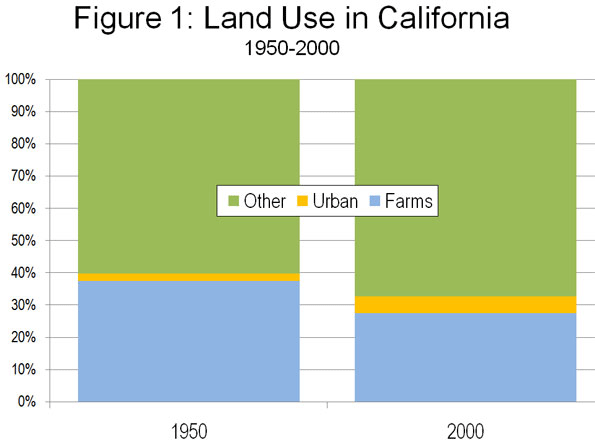
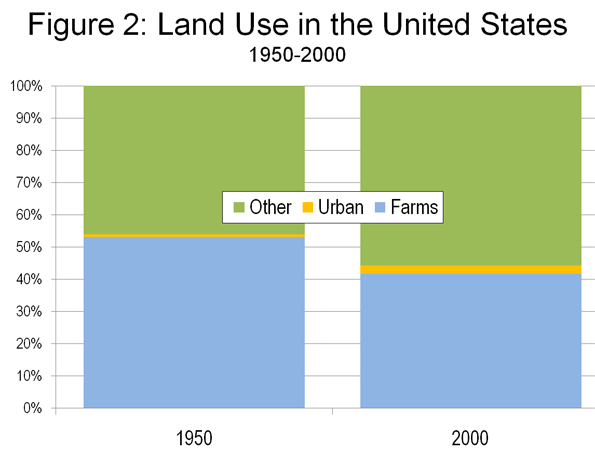
    The human footprint, as measured by the total urban and agricultural land has been declining for decades, both in the nation and California, where the greatest growth has occurred (Figure 1 & 2). The same is also true of Europe (EU-15), Canada and Australia, where all of the urbanization since the beginning of time does not equal the agricultural land recently taken out of production. Even in Japan, the human footprint has been reduced. It may be surprising, but human habitation and food production has returned considerable amounts of land to a more natural state in recent decades, while America’s urban areas were welcoming 99% of all growth since 1950.

    Note 1: This assumption represents the worst case, since not all land on which new urbanization was developed had previously been farmed.

    Note 2: State data is available only between 1960 and 2004.

    Photograph: Metropolitan Chicago, 2007 (Grundy County)

    Wendell Cox is a Visiting Professor, Conservatoire National des Arts et Metiers, Paris. He was born in Los Angeles and was appointed to three terms on the Los Angeles County Transportation Commission by Mayor Tom Bradley. He is the author of “War on the Dream: How Anti-Sprawl Policy Threatens the Quality of Life.

  • Energy’s Other Side

    The BP oil spill disaster likely spells the slowing down, or even curtailing, of offshore oil drilling for the foreseeable future. You can take California, Florida and much of the east coast off the energy-drilling map for years, perhaps decades.

    But if the oil, gas and coal industries are widely detested on the coasts, people in Bismarck, N.D., have little incentive to join an anti-energy jihad. Like other interior energy centers, people in this small Missouri river city of over 100,000 see their rising oil-, gas- and coal-based economy as the key to a far more lucrative future.

    “We have so much work that we don’t know what to do,” explains Niles Hushka, co-founder of Kadrmas, Lee and Jackson, a Bismarck-based engineering firm active in Great Plains energy development. In the next three weeks Hushka’s firm plans to add 70 more people, most of them skilled technicians and engineers.

    The problem in Bismarck is not so much creating jobs but filling positions; the city can be a hard sell due to its relative isolation and harsh climate. Still there’s some virtue to having opportunities. Even at the pit of the recession Bismarck has continued to experience job growth. Today its unemployment rate stands at well under 4%, the lowest rate in the country.

    This economic record is not unique to Bismarck. Other domestic energy centers like Anchorage, Alaska, and Morgantown, W.Va., also rank high among the strongest job markets in the country.

    Many energy towns are not only getting lots of jobs, but they are also becoming richer. One study, done by economist Mike Mandel, finds the highest per capita income growth in regions of Oklahoma, West Texas and Louisiana, where energy growth has driven the economy. Between 2000 and 2008 these areas enjoyed soaring per capita income gains, while many centers of the “creative economy” such as San Jose, Calif., Raleigh-Durham, N.C., and even Austin, Tex., have experienced per capita income declines.

    But few areas are enjoying a greater boom than Bismarck and surrounding parts of western North Dakota. It enjoys a vast array of energy resources, from fossil fuels to biofuels as well as prodigious potential for wind power.

    The real big action now, however, is in oil. New drilling technologies have allowed for the tapping of oil deposits far deeper below the surface. The U.S. Geological Service recently increased its estimate of North Dakota’s economically recoverable oil–much of it in the massive Bakken and Three Forks formations–25-fold to 4.3 billion barrels. These formations also extend to large swaths of northern Montana and southern Saskatchewan, Canada.

    Unlike past oil booms, such as the one that crashed in the 1980s, this one will last a long time. For one thing the voracious demands on energy coming from India, China and other developing countries will keep energy prices high. At the same time resistance to drilling tends to be weaker in remote areas with few residents, notes Debra Dragseth, a professor of business at Dickinson State University.

    The prospect of long-term prosperity tied to oil and gas wealth is already beginning to change the long dismal demographics of the area. A long-term boom could attract a new flow of blue- and white-collar workers to Bismarck and other parts of the plains. This is already starting. Long a net exporter of people–the state’s population is less than it was in 1930–today Bismarck and the state of North Dakota enjoy positive in-migration from the rest of the country.

    Part of the lure is something North Dakota had previously lacked: a plethora of high-paying jobs. Truck drivers in the industry earn as much as $80,000 a year, and wages for skilled professionals tend to go well over $100,000 annually. Meanwhile the cost of living is low, with housing prices a third or less of those on the coasts.

    Of course, work in the oil or gas fields isn’t easy–and it is sometimes dangerous, particularly in the often brutal winters. But opportunities in tough times can prove an irresistible lure to younger people, which is critical for what has been among the country’s most rapidly aging states. “It’s a petroleum land rush,” says 30-year-old Jerry Haas, who now looks for oil sites for the Dallas-based Petro-Hunt interests. “People see it as a great place of opportunity among people my age.”

    Haas, a native of North Dakota, sees more and more out-of-staters coming to Bismarck, in search of generally high-paying, energy-related employment. He has helped organize a 200-member young professionals group to lobby for more youth-oriented amenities in this decidedly conservative Great Plains town.

    The shifts in migration and particularly income–due largely to energy–represent a huge boost to an area that has long suffered from an exodus of young talent and a dearth of high-paying jobs. The key issue now is finding ways to turn the current boom into longer-term prosperity. North Dakota certainly has an unprecedented opportunity to build up its human and physical infrastructure. While other states struggle with huge budget shortages, North Dakota’s government enjoys an oil-driven surplus that is expected to grow in the next year from $500 million to over $1 billion.

    Dragseth believes the energy boom will allow North Dakotans, long ignored or at best dismissed as hopeless rubes, to start dreaming in ways impossible in much of the country. They can envision a future where, for instance, post-secondary education is free and used to lure the top students from around the world. North Dakota could use its good fortunes to gain the human capital it sorely needs. The Gulf disaster may put an ugly face on energy exploration, particularly oil, for many Americans. But in the nation’s oft-ignored interior, the development of new fuels offers the prospect of a previously unimagined prosperity.

    This article originally appeared in Forbes.com.

    Joel Kotkin is executive editor of NewGeography.com and is a distinguished presidential fellow in urban futures at Chapman University. He is author of The City: A Global History. His newest book is The Next Hundred Million: America in 2050, released in Febuary, 2010.

    Photo by k.landerholm

  • BEA Report: Printed Word Surplus? Brave New Books at Book Expo America

    If the future of the printed word lies inside the sleek case of Apple’s new iPad, get ready for illuminated manuscripts that will turn most books into animated cartoons. It was all on display at Book Expo America (BEA), the just-ended annual trade fair extravaganza that pulls together under one roof all the players in the publishing industry.

    BEA met in the vast caverns of New York’s Jacob Javits Center, which for two days was clogged with booksellers, librarians, authors distributors, packagers, literary agents, ghost writers, designers, and editors, all searching for the holy grail of the next bestseller.

    The former Duchess of York, Sarah Ferguson, known to the tabloids as Fergie, was hyping her new book, which I daydreamed might have the title, “Diary of a Bag Woman.” She wasn’t alone: To tout their wares, at BEA, every publisher that can do so arranges for its star authors to sign advance copies of their forthcoming books.

    Other authors on display at this year’s exposition were Ian Frazier, of New Yorker fame, who has a new book about his travels in Siberia, and Gary Trudeau, Doonesbury’s creator, who was flogging an anthology of Zonker’s forty years. The publishers of L. Ron Hubbard accosted me in the aisles with some raptures on Scientology. And I sat through several presentations on the future of electronic books, which are best understood as clouds of literacy delivered with the whoosh of an email.

    The eight hundred pound gorilla in the rooms at the Javits Center was, of course, Amazon, which delivers an endless river of books to readers, but which shaves the margins of publishers and writers.

    There was little evidence of Barnes and Noble or Borders, the overweight gorillas of earlier years. Both retailers now appear in the guise of suburban dinosaurs, heavy on inventory, coffee, and “gift ideas.”

    Who needs to venture to the mall for a book when Amazon can deliver it to your mailbox, or an ebook to your Kindle, seemingly in seconds? Amazon also offers “print on demand” services that, based on your digital file, can print a quality paperback edition of a book in about four hours from when an order is received, sparing the industry the headache of remaindered copies and large warehouses.

    The next step in retailing was on display, as well: the so-called Espresso Book Machine, a $75,000 on-demand printing press that, almost instantly, can print top quality paperback books. Imagine printing out War and Peace as you are waiting to board a (delayed) flight.

    The model of the book publishing industry hasn’t changed since Gutenberg printed his bible. As in the Renaissance, publishers recruit authors to write compelling stories, print them between cardboard, and try to sell the products to captive audiences.

    The author’s take from this production line is about fifteen percent, after expenses have been paid. For a book that sold 20,000 copies with a cover price of $30, the publisher might gross $200,000, while the author could hope to take home about $30,000 — one reason why publishers at BEA entertain each other with expense account lunches while writers live in garrets.

    Even Amazon has no lock on the future of book publishing, especially that of ebooks. Its Kindle, despite being early in the game, is proprietary to Amazon, and the future of electronic publishing may be in the sale of “open format” devices, so that consumers can read their book files on whatever portable reader they happen to own.

    The question of which format will become the ebook industry standard was certainly a buzz topic at BEA. Don’t bet on the iPad sweeping the field; many conventioneers complained that it was heavy. The hot concept at BEA was the enhanced manuscript, which marries the traditional electronic book with Internet hyperlinks.

    Imagine that your child is struggling through a school text on the treaties of Westphalia (the end of the Thirty Years War in 1648). On encountering the word “Münster,” the child is invited to click through to a short film that shows the Papal legate arriving in the German city with his dog or to listen to simulated dialogue between Cardinal Mazarin and the German princes. Elsewhere, maps of Europe’s new nation-state configuration pop up on demand.

    Some of the most crowded stands were those of small and independent publishers. Is the traditional publishing business doomed? Many publishers would appear to be heading to the exits. Their business model is laden with costs (staff, paper, printing, distribution, and warehousing), and their profits are squeezed by Amazon and other online sources.

    The only reason to publish a book with a house like Simon & Schuster is because they have the access to sales and distribution markets. Anyone with a Mac and some patience can turn out an ebook and post it to Amazon. The big publishers may garner shelf space at Barnes and Noble, but big box stores themselves may be going the way of all flesh.

    My guess is that most reading in the future will be done online and electronically, and that readers who want a hard copy of the book will print one from something like the Espresso Book machines.

    The big retailers are likely to fade away, but small independent book shops, places like Margot Farris’s Pages in Manhattan Beach, California, will survive as local centers of literacy, gathering like-minded reading spirits that want something more than an e-file, even if it’s just wine and cheese.

    As a reader, what excited me at BEA? Very little, I confess. Despite wandering a convention center the size of the Astrodome full of books, I saw little that I wanted to read.

    For a long time, publishing has served up specialty books about self-improvement, wine, dogs, antiques, exercise, home repair, and the like. Books about things that interest me — that’s history, travel, essays, classical fiction, baseball, Theodore Dreiser, and the Russo-Japanese War of 1904-05 — seemed lost in the glitzy displays.

    I did pick up a biography of Montaigne, Frazier’s travels to Krasnoyarsk, and an invitation to visit Oman’s Department of Education, whose booth staff, next to the glitter of Harper Collins, looked like contestants on “Lost.”

    As for writers, I fear that printed words will remain an oversupplied commodity, abundant on all sorts of devices, pages, and sites that are notable for their inability to pay writers for their work, even if it is hyperlinked, profusely illustrated, gold embossed, or dedicated to the lives of the saints.

    As a book writer, I might wish it otherwise, and pine for the days when typeset words, printed on heavy stock paper, were all that were required to prod the reader’s illumination. To use the words of E.B. White, who wrote Charlotte’s Web, I write “to amuse myself and for children.” That’s not something iPads, Fergie, or L. Ron Hubbard can take away.

    Photo of Abrams Books’ giant typewriter display, Book Expo America, May, 2010 by gruntzooki: http://www.flickr.com/photos/doctorow/4639586151/

    Matthew Stevenson is the author of Remembering the Twentieth Century Limited, winner of Foreword’s bronze award for best travel essays at this year’s BEA. He is also editor of Rules of the Game: The Best Sports Writing from Harper’s Magazine. He lives in Switzerland.

  • Toronto’s G-20 Conference: Financial Boon or Boondoggle?

    Ever since the ill fated 1999 WTO meeting in Seattle, there has been some debate over the merits of hosting meetings of international organizations in major cities. Some argue that there are economic spin offs from the tourism generated by these conferences, but others argue that the security costs far outweigh the benefits. In the lead up to the G-20 meeting in Toronto, scheduled for June 26-27, there has been a flurry of controversy over the price tag for conference security. The combined security tab for the G-8 and G-20 could end up as high as $900 million dollars (Canadian). The tourism industry does have the potential to reap some gains from the G20.

    The best case scenario for the industry would see 50,000 rooms booked for the conference. Unsurprisingly, Greater Toronto Hotel Association’s Terry Mundell is excited. “It’s a good news story for us,” he claims. If we assume (optimistically) that each room goes for $300/night, the hotel industry could make $30 million out of the deal. On top of this, people will obviously be spending money while they’re in town. Let’s assume that these 50 thousand people consume 4 meals/day at $100/person. This would be a cool $40 million for the restaurant industry. Maybe these folks will have a few drinks. Let’s budget in $100/night. After all, these are affluent folks. That’s $10 million for the bars. Maybe a few souvenirs to bring back for the kids? Let’s say another $10 million. And what if they need some Tylenol? Toothbrushes? Toss in another $10 million. We’re up to about $100 million in direct economic benefits. But wait, people need to get to Toronto, and to get around the city. We’ll be generous and throw in $100 million for airfare, though the benefits of this are not entirely injected into the Canadian economy. Add to that $100/day in cabs, and we have another $10 million. This brings the grand total to $210 million. Far from negligible. Unfortunately, that’s about double the official estimate of $100 million. Like I said, this is a best case scenario.

    On the cost side of the ledger, it is important to note that the costs will be divided between the G-20 Conference in Toronto, and the G-8 conference in Huntsville, 2 ½ hours north of the city. Let’s be extremely generous and assume it is an even split. Of the $833 million already announced, we’ll say $400 million is going to the Toronto conference. This still leaves us with a shortfall of $190 million, even under an extremely optimistic scenario.

    Here’s the bad news: even under the optimistic scenario, we still haven’t factored in opportunity costs. So far it has been confirmed that three Blue Jays games will be moved to Philadelphia, and the University of Toronto will shut down during the conference. In anticipation of former Jays star pitcher Roy Halliday’s first return to Toronto, the team had budgeted for 90,000 fans to attend. At an average revenue of $39/fan, that’s a loss of $3.5 million dollars. It’s hard to say how many fans would have come into the city from out of town, but it wouldn’t be at all unrealistic to say that the city is going to lose at very least another $3.5 million in spin offs.

    Even without any similar cancellations, Seattle business managed to lose at least $10 million in revenue as a result of the WTO meeting in 1999 (not to mention the $2 million in property damage). Furthermore, if the G-20 wasn’t going to be in Toronto, we don’t know how many hotel rooms would have been rented out for other events, or whether the conference goers will crowd out other patrons from restaurants. This is the difficulty with these types of estimates. They take into account the benefits that we see, but not the unseen opportunity costs. It’s hard to count a family that decided not to to Toronto for recreation or a cultural event because they want to avioid crowds or inflated room rates.

    One might argue that the short term costs will be mitigated by long term benefits. After all, some people might like the city so much that they’ll want to visit again. Perhaps some number of people will even want to move to the city. I had a similar experience during the G-20 in Pittsburgh last year (though haven’t followed through). If we look at it this way, any shortfall could be seen as a tourism advertising expense. Will this pay off in the long run? Unfortunately it is impossible to tell.

    So let’s assume that the shortfall for the conference is $200 million dollars. That seems pretty reasonable at this point. Let’s further assume that there will be a non-trivial long term tourism benefit to the city. In fact, let’s assume they make it all back. I still don’t buy into the idea of holding major international political conferences in major cities.

    Here’s why. There is an enormous inconvenience to city residents, which will likely include many people being caught up in violent protests and police retaliation. No one should have to get tear gassed in the name of boosting tourism. I was in Pittsburgh during the last G-20 meeting when stores were being smashed in, and the police were gassing protesters. Given that I was wise enough to stay away from the protests, I didn’t personally witness the chaos. Having said that, there is plenty of footage showing the violent clashes between protesters and police. After Seattle, London, Pittsburgh, and many other cities have endured chaos during these conferences, politicians should have learned their lesson. Forget tourism dollars. These conferences are about solving major economic problems. The G-8 meeting is being held in tiny Huntsville, where the G-20 originally was supposed to be held. That’s how it should be.

    It’s easier to import police to a small town than evacuate the downtown of a major city. Unfortunately, governments have not learned from history They seem determined to let their citizens pay the price for their cherished few days in the sun.

    Steve Lafleur is a public policy analyst and political consultant based out of Calgary, Alberta.

    Photo by Sweet One

  • Urban Economies: The Cost of Wasted Time

    Much has been written in recent years about the costs of congestion, with ground breaking research by academics such as Prud’homme & Chang-Wong and Hartgen & Fields showing that the more jobs that can be accessed in a particular period of time, the greater the economic output of a metropolitan area. Greater access to jobs not only improves economic growth, but it also opens greater opportunities for people and households to fulfill their aspirations for a better quality of living.

    Congestion costs are principally the cost of wasted time, which the most recent Texas Transportation Institute (TTI) Annual Mobility Report places at $15.47 per hour. It is important to understand that much of this cost is not because the car is not moving. It is rather because time that could be used more productively is being consumed.

    Steve Polzin of the University of South Florida has raised a related issue that has been virtually absent from urban planning discussions in a Planetizen blog entitled “The Cost of Slow Travel.” Noting that transit travel time is considerably slower than auto travel times, Polzin broadly estimates that slower travel on transit costs the nation $44 billion, which is two-thirds the $66 billion. Polzin does not suggest that this is a final, “take to the bank” lost productivity number, but does suggest attention to the issue.

    Such thinking is long overdue. Wasted time is wasted time. Most wasted time occurs with respect to travel during peak periods, when most people are commuting to or from work. The $66 billion in wasted time by automobile translates into $550 per commuter per year in the United States (Based upon 2007 commuting data from the American Community Survey). The cost of wasted time for transit is 12 times as high, at $6,500 per commuter, using Polzin’s estimate. Of course, as Polzin is quick to point out, these are not final figures. However, they are a starting point for important (and perhaps “inconvenient”) economic research that has been largely kept off the agenda up until now.

  • Can Europe’s Economy Turn Around If Its Great Cities Continue To Wither?

    Europe’s Greece crisis has turned the world’s attention to the continent’s fundamental flaw: burgeoning public spending and sluggish growth in some of its national economies.

    To the extent that Europe’s more economically fragile countries cannot fix this flaw, Europe poses a global financial risk as toppling EU countries cannot meet their obligations and those left standing cannot prop them up. Only fiscal discipline and boosting growth can save Europe in the long-run.

    And for this reason, we ought to worry about Europe’s cities. Why? Because as large cities increasingly drive national economies in our rapidly urbanizing global community, Europe’s urban growth patterns look alarmingly tepid.

    Around the world, people are clustering together faster than ever at a time when it seems technology should allow them to disperse more easily than ever. As it turns out, innovation and a growing services sector flourish best when lots of people and firms are geographically proximate. Ideas, knowledge and valuable skills are transferred more easily in denser areas.

    There is a direct relationship between economic competitiveness in the 21st century and the growth of metropolitan areas. But Europe’s cities show signs of trouble. They have almost entirely lost the momentum that has driven European pre-eminence for the past 200 years.

    In 1800, only 3% of the world’s population lived in urban areas, and the only Western cities among the world’s 10 largest urban areas were London and Paris. Neither had a population greater than 1 million. Just 100 years later, though, nine of the world’s 10 largest cities were in the West — with four of the top six located in Europe, propelled by their economic predominance through industrialization.

    Other countries followed the model. By the mid-20th century, 30% of the world’s population lived in urban areas, a considerable increase since 1800. But that was only the beginning of an explosive era in urbanization. Between 1960 and 2000, the number of people living in cities worldwide skyrocketed to 3 billion from 750 million.

    Currently, the world’s largest 100 cities generate 25% of global GDP, a figure that will continue to rise over the next few decades — and which will increasingly exclude Europe’s cities.

    Asia and Africa, often regarded poetically as agrarian societies, are leading the global urbanization boom. Today, London is the only European city among the world’s largest 20 metropolitan areas. Paris is 22nd. Among the top 25 cities, they are two of the three slowest-growing areas.

    Late-20th century growth has been driven almost entirely by suburban expansion around core cities. Nevertheless, central cities worldwide have added population on average over the past half century — except in Europe. It is the only continent where core cities have lost population over the past 45 years. While its suburban growth has kept its metropolitan areas growing overall, its net urbanization rate since 1965 is the slowest worldwide.

    Because developed countries are already highly urbanized, their metropolitan areas grow more slowly than those in emerging economies. But Europe’s rate is unusually slow compared to its peer group of developed nations.

    Europe’s main metropolitan areas grew just 28% since 1965, a period during which the United States essentially doubled its urban population. Australia and New Zealand have seen urbanization rates of 90% during the same period. Worldwide, the growth average in urban areas has been 135% since 1965.

    Europe is the only continent with cities growing at less than 1% annually. In Eastern Europe, the growth rate is actually negative. Some cities, such as Munich and Warsaw, have grown at respectable rates and mitigate Europe’s well-known population decline problems. For instance, each city grew between 2000 and 2010, while Germany and Poland each contracted as a whole.

    However, urban growth rates in Europe will likely stay low in coming years, which raises questions about whether Europe’s economy will continue to grow enough to help the continent out of its present troubles.

    European leaders’ disconnect with this important reality was on display several weeks ago when the European Commission chose to announce major carbon emissions in 500 cities at the same time its finance ministers were structuring the massive Greece bailout.

    However important greening urban areas may be, if Europe should be doing anything with its cities these days, it should be figuring out how to put them at the forefront of its economic recovery. The European habit of implementing growth-inhibiting policies — especially in its cities — has to change if the continent hopes to have a prosperous future.

    Given the increasingly metropolitan nature of economic growth around the globe, the health and vitality of Europe’s cities will be key to the continent’s future prosperity. Policymakers need now more than ever to ask serious questions about the origins of future growth. To answer those questions, they need to pay serious attention to their cities.

    This article first appeared at Investors Business Daily.

    Ryan Streeter is a senior fellow at the London-based Legatum Institute, an independent, nonpartisan organization that researches and advocates an expansive understanding of global prosperity.

  • The Future Of America’s Working Class

    Watford, England, sits at the end of a spur on the London tube’s Metropolitan line, a somewhat dreary city of some 80,000 rising amid the pleasant green Hertfordshire countryside. Although not utterly destitute like parts of south or east London, its shabby High Street reflects a now-diminished British dream of class mobility. It also stands as a potential warning to the U.S., where working-class, blue-collar white Americans have been among the biggest losers in the country’s deep, persistent recession.

    As you walk through Watford, midday drinkers linger outside the One Bell pub near the center of town. Many of these might be considered “yobs,” a term applied to youthful, largely white, working-class youths, many of whom work only occasionally or not at all. In the British press yobs are frequently linked to petty crime and violent behavior–including a recent stabbing outside another Watford pub, and soccer-related hooliganism.

    In Britain alcoholism among the disaffected youth has reached epidemic proportions. Britain now suffers among the highest rates of alcohol consumption in the advanced industrial world, and unlike in most countries, boozing is on the upswing.

    Some in the media, particularly on the left, decry unflattering descriptions of Britain’s young white working class as “demonizing a whole generation.” But many others see yobism as the natural product of decades of neglect from the country’s three main political parties.

    In Britain today white, working-class children now seem to do worse in school than immigrants. A 2003 Home Office study found white men more likely to admit breaking the law than racial minorities; they are also more likely to take dangerous drugs. London School of Economics scholar Dick Hobbs, who grew in a hardscabble section of east London, traces yobism in large part to the decline of blue-collar opportunities throughout Britain. “The social capital that was there went [away],” he suggests. “And so did the power of the labor force. People lost their confidence and never got it back.”

    Over the past decade, job gains in Britain, like those in the United States, have been concentrated at the top and bottom of the wage profile. The growth in real earnings for blue-collar professions–industry, warehousing and construction–have generally lagged those of white-collar workers.

    Tony Blair’s “cool Britannia,”epitomized by hedge fund managers, Russian oligarchs and media stars, offered little to the working and middle classes. Despite its proletarian roots, New Labour, as London Mayor Boris Johnson acidly notes, has presided over that which has become the most socially immobile society in Europe.

    This occurred despite a huge expansion of Britain’s welfare state, which now accounts for nearly one-third of government spending. For one thing the expansion of the welfare state apparatus may have done more for high-skilled professionals, who ended up nearly twice as likely to benefit from public employment than the average worker. Nearly one-fifth of young people ages 16 to 24 were out of education, work or training in 1997; after a decade of economic growth that proportion remained the same.

    Some people, such as The Times’ Camilla Cavendish, even blame the expanding welfare state for helping to create an overlooked generation of “useless, jobless men–the social blight of our age.” These males generally do not include immigrants, who by some estimates took more than 70% of the jobs created between 1997 and 2007 in the U.K.

    Immigrants, notes Steve Norris, a former member of Parliament from northeastern London and onetime chairman of the Conservative Party, tend to be more economically active than working-class white Britons, who often fear employment might cut into their benefits. “It is mainly U.K. citizens who sit at home watching daytime television complaining about immigrants doing their jobs,” asserts Norris, a native of Liverpool.

    The results can be seen in places like Watford and throughout large, unfashionable swaths of Essex, south and east London, as well as in perpetually depressed Scotland, the Midlands and north country. Rising housing prices, driven in part by “green” restrictions on new suburban developments, have further depressed the prospects for upward mobility. The gap between the average London house and the ability of a Londoner to afford it now stands among the highest in the advanced world.

    Indeed, according to the most recent survey by demographia.com, it takes nearly 7.1 years at the median income to afford a median family home in greater London. Prices in the inner-ring communities often are even higher. According to estimates by the Centre for Social Justice, unaffordability for first-time London home buyers doubled between 1997 and 2007. This has led to a surge in waiting lists for “social housing”; soon there are expected by to be some 2 million households–5 million people–on the waiting list for such housing.

    With better-paid jobs disappearing and the prospects for home ownership diminished, the traditional culture of hard work has been replaced increasingly by what Dick Hobbs describes as the “violent potential and instrumental physicality.” Urban progress, he notes, has been confused with the apparent vitality of a rollicking night scene: “There are parts of London where the pubs are the only economy.”

    London, notes the LSE’s Tony Travers, is becoming “a First World core surrounded by what seems to be going from a second to a Third World population.” This bifurcation appears to be a reversion back to the class conflicts that initially drove so many to traditionally more mobile societies, such as the U.S., Australia and Canada.

    Over the past decade, according to a survey by IPSOS Mori, the percentage of people who identify with a particular class has grown from 31% to 38%. Looking into the future, IPSOS Mori concludes, “social class may become more rather than less salient to people’s future.”

    Britain’s present situation should represent a warning about America’s future as well. Of course there have always been pockets of white poverty in the U.S., particularly in places like Appalachia, but generally the country has been shaped by a belief in class mobility.

    But the current recession, and the lack of effective political response addressing the working class’ needs, threatens to reverse this trend.

    More recently middle- and working-class family incomes, stagnant since the 1970s, have been further depressed by a downturn that has been particularly brutal to the warehousing, construction and manufacturing economies. White unemployment has now edged to 9%, higher among those with less than a college education. And poverty is actually rising among whites more rapidly than among blacks, according to the left-leaning Economic Policy Institute.

    You can see the repeat here of some of the factors paralleling the development of British yobism: longer-term unemployment; the growing threat of meth labs in hard-hit cities and small towns; and, most particularly, a 20% unemployment rate for workers under age 25. Amazingly barely one in three white teenagers, according to a recent Hamilton College poll, thinks his standard of living will be better than his parents’.

    It’s no surprise then that Democrats are losing support among working-class whites, much like the now-destitute British Labour Party. But the potential yobization of the American working class represents far more than a political issue. It threatens the very essence of what has made the U.S. unique and different from its mother country.

    This article originally appeared in Forbes.com.

    Joel Kotkin is executive editor of NewGeography.com and is a distinguished presidential fellow in urban futures at Chapman University. He is author of The City: A Global History. His newest book is The Next Hundred Million: America in 2050, released in Febuary, 2010.

    Photo by MonkeyBoy69

  • Currency Crisis: Fool’s Gold, The Euro, The Pound and The Dollar

    Lost in the obituaries of the Euro — the European currency — is the extent to which the continent remains a fractured reservoir of national monies. To be sure, the Euro circulates in the larger economies of Western Europe, notably France, Germany, Italy, Spain, and the Netherlands. But as a traveling European, I also have in my wallet Polish złoty, Czech crowns, Serbian dinars, Swiss francs, and British pounds, testaments to the nationalist sentiment that every country should have it own money. (Which is similar to the notion that every country should have its own airline, no matter how much it costs.)

    Countries, like Poland, which are in the European Union, have their currency pegged to the Euro, but because of local budget deficits, they stick with their old notes. Countries like Britain and Switzerland cling to their currencies out of distrust for the common currency. In theory, what they lose in terms of trading convenience, they gain in the coin of economic independence.

    By holding on to the pound, Britain partially sidestepped the recent financial crisis in Europe; London was only on the hook as a member of the common market, not in the currency union.

    At the same time, Britain, as the only issuer of pounds, was left to deal with its own banking crisis without the mutual assistance of Germany and France, one reason why the United Kingdom has such high borrowing obligations.

    Which is better, national money that floats on international markets — the pound is a good example — or a transnational currency like the Euro?

    The rap now against the Euro is that the European Union lacks the authority to impose fiscal discipline in member states. Countries within the Union, it is feared, can borrow to their budget deficit’s content, given that any country in the monetary union enjoys an implicit guarantee from the rest of the pact. For example, Greece could fund its deficit with debt that was issued at rates that equated Greek risk with that of Germany.

    Now that this mug’s game is up, the stronger members of the European Union will only let the weaker names borrow in exchange for surrendering a degree of fiscal and budgetary independence. Will that be enough to save the Euro?

    In answering, it is useful to recall what money is: a zero-coupon bond, issued by an organization, company, or government. Currency may represent value, but underneath the crisp paper it is a sovereign loan. The dollar bill is best understood as the world’s smallest government bond.

    Before there was fiat money, the currency that circulated was either coins or bank drafts, passed around to settle transactions in local markets. The stronger currencies were those of silver or gold, or negotiable instruments issued by a solid creditor, such as a Florentine bank or a London merchant.

    In the early days of the American republic, circulating specie included Peruvian coins (valued for their silver) and Spanish dubloons, sometimes mined in Mexico.

    Now, instead of a private script, money is a national instrument, based on the full faith and credit of sovereign governments, which, as everyone knows, are run by profligate spenders. (If you owned a bank, would you put Nancy Pelosi on the credit committee?)

    Anyone holding U.S. dollars is betting that the Congress will not bankrupt the country with medical, retirement, and national security schemes. In Europe, the Euro gamble is that the large governments, and by extension the European Union, will honor their obligations, many of which were drawn to fund retirement plans that kick in at age sixty-two or to subsidize corporate elephants like the Airbus.

    To be sure, the Euro will survive its current crisis, because neither France, Italy, nor Germany — the big engines of the continental economy — want to rerun the political consequences of a fractured Europe. But just because the Euro will remain in circulation does not mean that it will trade at an exchange rate of €1 = $1.50.

    Keep in mind that Europe is gleeful at the decline of the Euro against the U.S. dollar, which, measured in Europe, has been at an artificially low exchange rate for the last few years. The weak dollar and the strong Euro meant that U.S. industry and exporters had a competitive advantage against European companies. Now that advantage is less pronounced.

    For fun, have a look at the Big Mac Index of The Economist, which prices the global hamburger in world currencies. For the Euro zone, a Big Mac costs $4.62 versus $3.58 for the same happy meal in the United States. China’s triple-decker only costs $1.83, a statistic that is a good measure of the extent to which China keeps its currency, the yuan, artificially low.

    Exchange rates are the new tariffs. In the bad old days of Senator Smoot and Congressman Hawley — co-authors of the 1930 tariff bill that so prolonged the Depression — countries sought competitive trade advantages by slapping on tariffs and import quotas to protect national industries.

    Even today, tariffs protect local farmers and manufacturers from low-priced international competition, but they are considered “unfair,” the trade equivalent of gunboat diplomacy.

    Instead of enacting tariffs, governments now play the game of currency manipulation, and, to use a 1930s expression, “beggar their neighbors” by driving down the value of their money’s exchange rates in international markets. Central banks generally accomplish this by failing to defend, i.e., purchase their currency in world markets.

    Two of the very best currency manipulators are the U.S. and China, one reason for their economic success. The U.S. let the dollar fall after the 2008 crisis, which gave American exporters an advantage over European competitors. The price of European products in the U.S. went up about 25 percent.

    For years China has fueled its economic miracle by pegging the yuan at low exchange rates to the dollar, to make sure that, no matter what the industry, it would be selling the equivalent of Big Macs that cost $1.83.

    In the Euro collapse over the potential Greek default, many see an end to the European common currency. But that will happen only if German taxpayers get tired of bailing out pensioners throwing darts in Dublin or the café klatch on Mykonos.

    In the meantime, by letting its currency fall by twenty percent against the dollar, Europe has shown that it understands the power politics of international exchange rates and that it is willing to take on the Americans and the Chinese at the shell game of cheaper money.

    What’s the risk? The problem in the manipulation racket is that investors can have a hard time judging when a currency is being depreciated for a reason — to stimulate jobs, say — or when it’s broke. The wheelbarrow money of Weimar was bust while the Euro is just overvalued. In most cases, the vital sign of a currency’s health is its rate of inflation, and for the Euro right now it’s negligible.

    For all that diplomatists busy themselves over questions like Israeli settlements and Iranian sanctions, the issue of exchange-rate parity is rarely discussed in world councils.

    The story of unfettered money rarely has a happy ending. Breton Woods, which pegged many currencies to the dollar, and the greenback to gold, was signed in 1944 and broke down in 1971, when Richard Nixon unilaterally took the U.S. off the gold standard.

    Since then, world money has traded like over-the-counter options, even when it’s backed by less collateral than most subprime packages. My own view is that currencies should be pegged to baskets of global commodities, including gold and silver. But governments, like Greece today, or even the U.S., hate the idea of external limits on their ability to raise and spend money.

    Italy was among those countries that thought the 1971 U.S. withdrawal from the gold standard set a dangerous precedent for economic stability. But its warnings went unheeded, and prompted an undeleted response from President Nixon, who on the White House tapes was heard to say, “I don’t give a shit about the lira,” words that might express how many investors will come to think about paper money.

    Latent print developed on US Currency ($1 bill) using fluorescent magnetic power. http://www.flickr.com/photos/jackofspades/1376867166/

    Matthew Stevenson is the author of Remembering the Twentieth Century Limited and editor of Rules of the Game: The Best Sports Writing from Harper’s Magazine. He lives in Switzerland.

  • The Broken Ladder: The Threat to Upward Mobility in the Global City

    Since the beginnings of civilization, cities have been the crucibles of progress both for societies and individuals. A great city, wrote Rene Descartes in the 17th Century, represented “an inventory of the possible”, a place where people could create their own futures and lift up their families.

    In the 21st Century – the first in which the majority of people will live in cities – this unique link between urbanism and upward mobility will become ever more critical. Cities have become much larger. In 1900 London was the world’s largest urban center with seven million people. Today there are three dozen cities with larger populations.

    No longer do a handful of western cities represent the only, or even the most critical, front in the battle for social progress. Mexico City and Mumbai, two cities we have studied, have three times London’s 1900 population. Indeed, of the world’s twenty most populous regions, the preponderance are located in third world or developing countries. The urban drama will play out on a truly global stage, with the most decisive developments taking place in the growing mega-cities of the developing world.

    It is first and foremost in these great cities of the human future that upward mobility must be most accelerated. Urban agglomerations such as Beijing, Shanghai, New Delhi, Sao Paulo, Mumbai, and Mexico City daily stand witness to one of the most rapid expansions of prosperity in history, as well as to wrenching examples of deep seated misery.

    Urbanity in the advanced industrial world is an increasingly interdependent system. The established centers of the global urban culture – New York, Los Angeles, London, Paris, Tokyo, Berlin – provide the critical markets, capital, and technological assistance that drive economic growth in the developing countries, whose growth in turn provides new opportunities for the citizens of the advanced cities.

    These established centers are often seen as occupying the Leninist “commanding heights” of the global economy. Is the kind of centralization we see in these cities, and in other mega-cities around the world, truly inevitable? And is their growth universally desirable? The answers to these questions are vital, notably because it is particularly in these locations that upward mobility now appears to be increasingly stalled. The stasis is reflected in both income trends and popular opinion in the leading centers of advanced world, including the United States, Japan and the United Kingdom.

    Optimists like historian Peter Hall believe that “neither western civilization, nor the western city, shows any sign of decay”. A recent World Bank report insists that large urban concentrations – the more dense the better – are the harbingers of opportunity and wealth creation. “To spread out economic growth”, it argues, is to discourage it. And it is certainly true that as countries modernize, they also urbanize, often quite rapidly. As a result, cities in the developing world – which also receive a great deal of international investment and aid – tend to be growing far more quickly than peripheral regions.

    Yet, in the longer term, the impacts of dense urbanization may not be universally useful at promoting either poverty alleviation or upward mobility. In advanced countries, this is already evident in large urban areas. Indeed, even the strongly pro-urbanist World Bank report acknowledges that as societies reach certain affluence levels, they begin to deconcentrate, with the middle classes in particular moving to the periphery.

    This process reflects a shift in economic and social realities over the past few decades. After nearly a half century of sustained social progress in most advanced countries, income growth for the middle class, even among the best-educated, has slowed considerably, and by some measurements has even turned negative. As we will see, the effects have been particularly tough on the urban middle and working classes in cities as diverse as Toronto, Los Angeles, Tokyo and London.

    Such concerns have been heightened by the current deep recession, which has caused wages to fall in both developing and developed countries. Yet concern over upward mobility was developing even in the relative “boom” times of the recent past, particularly in the advanced western countries, but also in the developing ones. Since 1973, for example, the rate of growth of the “typical family’s income” in the United States has slowed dramatically, and for males has actually gone backwards when adjusted for inflation. This diminishment has been particularly marked in major urban centers such as New York, Chicago, San Francisco and Los Angeles.

    Similar developments can be seen in a host of European cities, including London and Berlin, and even in Tokyo, which long has been seen as distinctly middle class. In all these cities, the middle class appears to be diminishing, while the population living in poverty has increased.

    The reasons for this trend include the impact of technology, aging demographics, globalization, and greater government indebtedness. A critical factor may also be opposition to the very idea of economic growth, something first seen in the 1970s and now increasingly persuasive, at least within large portions of academia, the media, and even parts of the financial community. This attitude is vividly and forcefully expressed, for example, within sectors of the ecology movement.

    Polls of popular opinion in the United States and the United Kingdom find ecological concerns well down the list, behind such issues as the economy, immigration, crime, unemployment and even the state of morality. Yet the agenda to address anthropogenic global warming promotes policies that seem likely to depress economic growth, particularly in cities, through further declines of productive industry, unaffordable housing prices and high levels of taxation.

    As recently seen at the global climate change conference in Copenhagen, few governments in the developing world are anxious to adopt any policy that weakens their ability to spark income and job growth in the near future. The pressing concerns of these cities remain focused on basic issues: sanitation, alleviation of poverty, industrial growth, infrastructure development and employment.

    Policies that prolong poverty and depress mobility seem likely to delay the necessary social consensus needed to enact long-term environmental improvements. When concern for the sustenance of families grows, focus on environmental issues tends to decline, as is already clear in recent surveys in the advanced countries. The much overworked term “sustainability” needs to include both economic and social components, as opposed to strictly ecological ones.

    Within the developing world, as the focus remains on basic economic issues, middle class residents of noted megacities appear to be more optimistic about personal advancement than their counterparts in the advanced countries. This may reflect the fact that countries such as India, China and Brazil have experienced rapid economic growth over the past decade, and expect more of the same in the decades ahead.

    Yet this does not suggest that the rising cities of the Second and Third World are growing in ways that do not deepen inequality. With rapid economic growth, these locations have seen considerable expansion of gaps between rich and poor, particularly with the decline of socialist institutions. Similarly, in some developing cities – Mumbai, Bogota and Sao Paulo, for example – there may be a widening gap between economic success and population density, as growth shifts to places with better infrastructure, less congestion, and less crime.

    In order to look in depth at differing attitudes among urban dwellers, we have focused our research on three megacities that represent different stages of economic development. We start with London, arguably the world’s most important global city, and explore the prospects for upward mobility there.

    Then we look at Mexico City, a city that represents the broad “Second World” of urban centers that have enjoyed some rapid growth but now face increased competition from China and other ascendant locations. Mexico City represents some of the realities that emerging urban centers in the Third World will face as they achieve higher levels of economic development.

    Third, we focus on Mumbai, India’s premier commercial city and financial center. Mumbai reflects the dichotomy of a rapidly growing city in the developing world: increasing wealth and rising expectations among its expanding middle class, with the continued creation of huge populations of destitute slum-dwellers.
    Yet for all the differences between these three great cities, we also find some commonalities. First, their future vitality depends largely on the future of their middle classes. Second, the critical issue for all these places remains how to sustain economic growth to meet the needs and aspirations of their citizens.

    Finally, they share the challenges of the current great economic revolution – what has been called the “post-industrial” era by Daniel Bell or the “third wave” by Alvin Toffler – on the nature of class. The increasing primacy of technology and education, once seen as liberating, could make widespread class mobility far more difficult than in the past.

    As occurred in the early stages of the industrial revolution, the current economic transformation threatens massive displacement of existing classes. Just as the machine age undermined the status of weavers, artisans and small farmers, the current technological epoch could well have similar impacts on not only industrial workers, particularly in the West, but on the supposedly ascendant educated middle class as well.

    This leads us to suggest a primary focus by all great cities on basic economic issues. Current concerns among the dominant cognitive classes in the media, the academic world, and the policy elites, particularly in the First World, have tended to center on aesthetics and “green” issues, as well as on who can draw ‘the best and the brightest”, rather than on how to employ the vast middle or working classes.

    We will explore some of the common challenges that will face all mega-cities as they evolve. Increasingly, they may find that their scale, long seen as an advantage, also produces inherent problems. In a globally interconnected urban environment, they must successfully compete not only with each other, but with smaller scale, and often more efficiently organized, urban areas throughout both the advanced and developing world.

  • The Limits Of The Green Machine

    Environmentalism is strangely detached from the public’s economic goals.

    The awful oil spill in the Gulf–as well as the recent coal mine disaster in West Virginia–has added spring to the step of America’s hugely influential environmental lobby. After years of hand-wringing over global warming (aka climate change), the greens now have an issue that will play to legitimate public concerns for weeks and months ahead.

    This is as it should be. Strong support for environmental regulation–starting particularly under our original “green president,” Richard Nixon–has been based on the protection of public health and safety, as well as the preservation of America’s wild spaces. In this respect, environmentalists enjoy widespread support from the public and even more so from the emerging millennial generation.

    Conservatives who fail to address this concern will pay a price, even more so in the future. The Bush administration’s apparent clubbiness with conventional energy interests has undermined the GOP’s once-proud legacy on environmental causes. The oil spill could prove a great campaign issue for Democrats assigning blame for the disaster on lax Republican regulators and their oil company chums.

    But there’s also a danger for Democrats who tilt uncritically toward “green” policies. Instead of following the environmentalists’ party line, they should adopt a balanced approach adding both economic and social needs to their concept of “sustainability.”

    Sadly, many in the administration seem anxious to extend environmental regulation into virtually every aspect of life. Legitimate concerns over pollution and open space preservation, for example, have now been conflated with a renewed drive to strangle suburbia in favor of forced densification.

    The administration’s “livability” agenda, as suggested by Transportation Secretary Ray LaHood, for example, proposes policies that favor dense urban development over the dispersed living preferred by most Americans. This, notes analyst Ken Orski, represents an unprecedented federal intrusion over traditional local zoning and local decisions.

    This centralizing tendency supports a wide array of interests, notably big city mayors and urban land speculators, and also is eagerly promoted by many architects, the media and planning professors. Not surprisingly, less intrusive ways to reduce energy use, such as telecommuting or the dispersion of worksites closer to people’s homes, have elicited very little administration support.

    Herein lies the Achilles heel of environmentalism–its profound disconnect from public preferences and aspirations. By embracing such a radical social engineering agenda, the greens may end up undermining their own long-term effectiveness.

    The first sign of this pushback, notes analyst Walter Russell Mead, can be seen in growing skepticism about climate change policies both here and in Europe. At a time of severe economic challenges, greens and their political allies need to consider how specific environmental costs threaten an already beleaguered middle and working class.

    Voters, for example, may support strong penalties and stricter controls of energy giants such as British Petroleum or Massey Energy, but roughly six in 10, according to a post-spill NBC/Wall Street Journal poll, continue to back the idea of expanded offshore oil drilling. Voters may embrace new environmental improvements but they also want to keep their jobs.

    This conflict will be on display in the coming struggle over the “cap and trade” proposals in the Senate. Strongest opposition comes from those states and regions most adversely impacted by strict limits on carbon, clustered in the south and Midwest.

    Mitch Daniels, governor of coal-dependent Indiana, even has denounced such proposals as Washington “imperialism.” But Daniels’ opposition also is shared by many Democrats from fossil-fuel-rich states such as North Dakota, West Virginia and Louisiana. Cap and trade even manages to offend many on the left, who see it as yet another opportunity for Wall Street to profit from complex federal regulation.

    On the state level, more draconian mandates on shifting to renewable fuels, such as those in place in California, could also cause future power shortages, as the state auditor warned recently. Such concerns are routinely brushed aside by environmentalist and their prodigious PR machines who prattle on about our coming economic salvation through the creation of “green jobs.”

    In reality, given their dependence on massive subsidies from both taxpayers and rate-payer, it’s unlikely that renewables, as opposed to relatively clean alternatives such as plentiful natural gas, will produce a net positive impact on the economy for years or even decades. Certainly highly aggressive subsidies for wind and solar have not proved any kind of elixir in countries like Spain, where such policies have been long in place but now are being scaled back due to their drain on both the economy and the public budget.

    To some extent, the hype over “green jobs” sometimes appears as something of a PR smokescreen. Prominent greens have long been opposed to the very idea of economic growth and wealth creation, particularly in advanced industrial countries. For decades John Holdren, President Obama’s science advisor, has favored what he calls “de-development” of Western countries in order to preserve natural resources and reduce pollution.

    This approach appears to be gaining support even as the pain of economic dislocation has devastated the advanced countries of the West. Boston University sociologist Juliet Schor, writing in the influential left-leaning The Nation, even attacks “progressive economists”- such as those calling for a second New Deal- for focusing on “climate destabilizing growth” as a way to create new jobs and raise middle class incomes.

    In the Huffington Post one-time investment banker Ann Lee, now an economics professor at NYU, has called for “a new economic ideology” that focuses on “human dignity, creative and degrees of freedom” instead of following traditional measurements of material well-being. This “new” economy, she argues, would provide greater returns to favored groups like artists and, of course, teachers, who she considers severely underpaid.

    This kind of low-carbon academic “esteem” economy appeals to people who already enjoy considerable material wealth and can count on the support of the state. It is not so promising on the West’s aspirational middle and working classes, particularly those employed in the private sector, whose individual strivings would now be compensated by a deadly combination of high taxes and slow growth.

    Until the issues of growth are tackled honestly, the green movement will continue to depend on tragic events such as the Gulf oil spill to maintain its public support. But in the long run, environmentalism will not remain politically “sustainable” if it fails to balance a green future with the economic aspirations of current and future generations.

    This article originally appeared in Forbes.com.

    Joel Kotkin is executive editor of NewGeography.com and is a distinguished presidential fellow in urban futures at Chapman University. He is author of The City: A Global History. His newest book is The Next Hundred Million: America in 2050, released in Febuary, 2010.

    Photo by just.Luc