Category: Economics

  • Las Vegas: The World’s Convening City?

    Conventional wisdom, and in many cases wishful thinking, among many urbanists holds that America’s sunbelt cities are done. Yet in reality, as they rise from the current deep recession, their re-ascendance will shock some, but will testify to the remarkable resiliency of this emerging urban form.

    Origins: Bright Light City

    The epicenter of the sunbelt rebound will be Las Vegas. The desert city has taken a unique road to a world city status. Most places get there by being financial, trade or manufacturing hubs, or can have a concentration of all three in the case of the biggest and most connected world cities. In contrast Las Vegas has achieved world city status via one key sector: entertainment.

    Just about no one saw Las Vegas coming as a world city. Even in the late 20th century few would predict that the region could ever get to 1 million residents, let alone reach two million. In 1970 Jerome Pickard, a demographer working at the ULI—the Urban Land Institute in Washington, DC, projected U.S. metropolitan area populations to the year 2000. These estimates were nearly perfect, but for one major exception—he missed Las Vegas.

    Las Vegas at the time seemed like, to make a bad pun, a one trick town. Its main industry, gambling (or “gaming” in local parlance), was pretty much unique to Nevada. Sure, the city already had landmark hotels and the famous “Strip” was by then iconic enough to influence American architectural theory, but the idea of an overgrown honky-tonk town as a true world city seemed a stretch.

    A generation later, what changed? To start, gambling began to spread throughout the U.S. and indeed the world. First, Atlantic City, NJ, allowed gaming in the late 1970s and soon the floodgates opened. Soon people could gamble on riverboats in the Mississippi and off the Gulf Coast. Then a Supreme Court ruling allowed Native Americans to build and operate casinos—and they did just about everywhere.

    Every time gaming expanded, analysts predicted the demise of Las Vegas. Yet history has shown that the widespread diffusion of gambling only induced a bigger appetite. In this socio-cultural-legal-lifestyle transition, Las Vegas became the epicenter of gaming. Many people who gambled in a nearby Indian reservation were really just warming up for Las Vegas.

    The gaming industry in Las Vegas also matured in two key ways, offering a host of complimentary activities to go along with gambling. The first was the Las Vegas tie into Hollywood and live entertainment. By the 1980s, Las Vegas became one of the world’s largest venues for entertainment, surpassing even Broadway in New York. The city then began to add function after function related to tourism—food, shopping, and perhaps most importantly of all: conventions.

    Las Vegas’s rise also was directly tied to infrastructure. Completed in the 1930s, Hoover dam provided Las Vegas with ample power and water. The other major improvement was a new highway to Los Angeles, which led to Vegas’s discovery by Hollywood figures.

    At the same time, a series of complimentary economic drivers transformed the city over several decades. The casino and entertainment complex constructed in Las Vegas by 1970 soon engendered a proliferation of airline connections and convention business. The city had enough business to warrant non-stop links to just about every other major city in the U.S. The scale of tourism worked to keep landing fees among the lowest of any major American city. In 2008, McCarran Airport ranked 15th in the world for passenger traffic, with 44,074,707 passengers passing through the terminal, and 6th in airplane “movements,” which includes take offs and landings.

    The other advantage Las Vegas possesses is lots of hotel rooms. In fact, nine of the top ten largest hotels in the world can be found on the Las Vegas Strip (which technically lies outside the city proper in unincorporated Clark County, NV). The presence of so many hotel rooms facilitated the emergence of the nation’s largest convention business.

    The city is also a leading center of producer services specific to gaming. Las Vegas is to gaming what Houston is to energy, the command and control center in a booming global business. Like Houston, whose initial energy business growth came from nearby oil wells, Las Vegas’s initial advantage derived from being home to the first large-scale gaming industry. Many overlook the fact that the U.S. is a service exporting powerhouse, with almost a half trillion dollars in overseas sales last year. In fact the U.S. captures over 14 percent of total world service trade, which performed much better in the current recession than did goods trade. Las Vegas is now grabbing a bigger share of these exports.

    As gaming spread, Las Vegas firms that specialize in building and managing mega-resort and entertainment complexes often built, designed, or consulted on new gambling centers from Atlantic City in New Jersey to Macau in China (which recently passed Las Vegas in total gambling revenue). In the current recession, as gaming revenue plummeted in Las Vegas, properties in much of the rest of the world kept performing, especially China. This geographic diversification strengthened the bottom line for such Las Vegas-based companies as MGM-Mirage and Wynn and sustained the local firms that export gaming services.

    To consolidate its gaming and entertainment gains, Southern Nevada must still diversify its industrial mix to reach a multi-dimensional world city status as say Los Angeles. Fortunately Las Vegas has the capacity to further leverage its core industry. At the same time some other key sectors look promising, especially data storage and transmission, and alternative energy technology such as solar and geothermal.

    Finally, Las Vegas is working to improve its transportation links to nearby Southern California and the Sun Corridor complex of Phoenix and Tucson. These regions are increasingly integrated with one another. Las Vegas’s inclusion in the larger Southwestern U.S megaregion should further connect it to the global economy and lift its status as a world city in full.

    The Convening City

    Ultimately, the Las Vegas case for world city status lies in its role as the globe’s leading convening space. There are more face-to-face exchanges in Las Vegas during a major convention than key financial exchanges in New York or London. Las Vegas, on any given week, may comprise the world’s most expert cluster in a particular industry.

    The convening role that Las Vegas plays in the world economy comprises perhaps the biggest opportunity for additional diversification, especially given the way business is evolving in sectors such as business services. These gatherings provide a means of overcoming coordination and incentive problems in uncertain environments. It becomes an environment to create a critical “buzz” around a company, product or industry.

    Most Las Vegas conventions are really about deal making. Conventions also are used for industry education, vendor networking, competitor insights, networking with prospects, hosting an exhibit, and seeing customers. Another dimension to building trust in Las Vegas lies in the fact that it is very much an adult place. It is a wide open, non-moralizing, libertarian place where grownups get to have fun. Las Vegas is a place where you can, and maybe even should, mix business with pleasure.

    To move forward, Las Vegas needs to tweak its branding in a way that signals its dual personalities as a play hard and work hard city. This shift is already under way. The Las Vegas Convention and Visitors Authority now use the tagline “Only Vegas” and an omnibus identity for the city. Their website has two links: one aimed at business community: VegasMeansBusiness.com with the tagline: “Close the deal and make new opportunities.” and one for tourists: VisitLasVegas.com which uses the tagline: “What happens in Vegas, Stays in Vegas.”

    So far Las Vegas has not leveraged its role as convening place to create something on par with the New York Stock Exchange or the Chicago Board of Trade. However, the convention business can be used as the basis of what may become a permanent trade show.

    A harbinger of this future potential for Las Vegas can be seen in its new giant furniture mart, the World Market Center. This grew out of the city’s role in hosting the largest furniture/home wear convention every year. Las Vegas has developed a year round trade show capacity in furnishing with big annual events. This city is now poised to be a leading design center. Architectural and industrial design firms will follow. In this way, Las Vegas could emerge as the Milan of the U.S., where design leads to industrial spin offs.

    Las Vegas can expand this model to host permanent trade shows in a multiple fields from home entertainment and biotechnology to alternative energy. Rather than become a new ghost town, as some urbanists imagine, the city in fact has a bright future, one that will continue to befuddle its many critics while enriching the opportunities of its citizens.

    Robert E. Lang, Ph.D. is one of America’s most respect urban analysts. He is director of both Brooking Mountain West and the Lincy Institute and is a professor of Sociology at the University of Nevada, Las Vegas.

    Photo: by Roadsidepictures
  • Financial Reform or Con Game?

    The news that Goldman Sachs is facing civil fraud charges from the Securities and Exchange Commission came just days before a Washington Examiner story reported that Goldman Sachs, in the company’s annual letter to shareholders, reassured investors that the financial regulatory reform being voted on this week in Congress will “help Goldman’s bottom line.” Yikes!!

    Since the autumn of 2008, all things concerning financial regulation have been moving very rapidly. I often find it impossible to stay in front of it. The legislation is barely made public before it is changed–they even change bills in the days after they are passed. This makes it really hard for the ordinary citizen or even an informed researcher to clearly see where there bill is finally.

    Ultimately, this reminds me of a con game I’ve seen played on the streets in New York called Three-card Monte. It requires very fast hands to effectively manipulate the cards. As the professional con artist rapidly moves three cards – two aces and the queen of hearts – around the table, he challenges you to keep your eye on the queen. You are encouraged by the con and his shill – the co-conspirator among the audience – to place a bet on your ability to keep up with the movements. Of course, you can’t win because the game is fixed. But – and here’s why Goldman’s joy at the financial regulatory reform makes me nervous – you will think that you can win when you see the shill winning.

    Everybody and their brother have gone on record with some argument for or against the current version of financial regulatory reform in Congress this week. The question most often asked is: Will it end “too big to fail?” In my view, it is not the size of the firms but the size of the risks that are the real problem. While I don’t mind losing $5 on a street corner, all Americans mind losing $3.8 trillion in the Bailout.

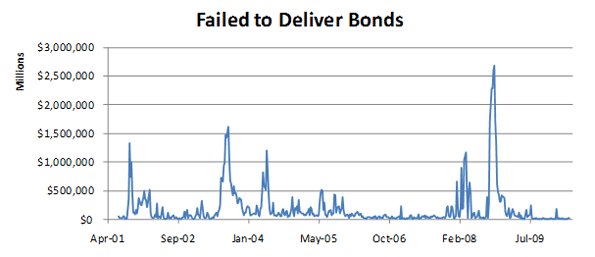
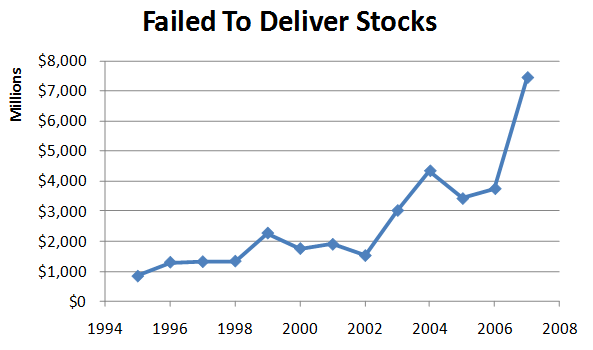
    Here’s the heart of the problem. There is something going on back-stage at Wall Street called the centralized clearing and settlement system. I worked in it in the US and have studied and consulted to the system in the rest of the world. The system we have in the US was exported around the world thanks to the United States Agency for International Development. The system is designed to let all the stocks and bonds traded on the stock exchanges be paid for electronically. To expedite the process – known as settling trades in stocks, bonds and all the other financial instruments – the system accepts an electronic “IOU” for the shares until the real financial papers can be delivered. It requires that the money be paid immediately. The problem is that the system permits dealers to sell more stocks and bonds than exist without any incentive to deliver on time. The centralized settlement system simply holds the “failed to deliver” open indefinitely in the form of an electronic IOU. The value of the IOUs in the system has risen dramatically since 2001.


    Source: Public data, available in annual reports of Depository Trust and Clearing Corporation and its subsidiaries.


    Source: Public data, available from the Federal Reserve Bank of New York.

    Notice the relationship of the timing of the spike in the bond failures to the financial crisis: the 17 primary dealers reporting to the New York Federal Reserve Bank failed to deliver about $2.5 trillion worth of US Treasury securities for 7 weeks in late 2008 – no fines, no sanctions; worst of all, very little press coverage.

    This is the core of the problem – both in practice and in theory. This means supply is infinite – there is no limit to how many bonds can be sold because no one is enforcing delivery. In reality, no one should be able to sell more US Government bonds than the US Government has issued. That’s a problem in the practices supported by the system. The theoretical problem is that all financial instruments, including the bonds issued by city and state governments,, are being sold without any attachment to the real assets. This damages not only buyers in the stock market, but also the companies and governments who are trying to raise the money needed to keep delivering the services that we depend on them to provide.

    The practice of allowing the delivery of electronic IOUs in place of shares of stock or Treasury bills is a process that rewards financial manipulation instead of allocating resources to productive uses – the activity that capital markets should be doing. All the Congressional and the Administration talk about Wall Street reform is to centralize more trades into the existing settlement system – the one with the trillion-dollar hole in it! Someone has convinced them that the centralized system can easily track and account for positions – the actual statistics present a very different picture.

  • The Best Cities For Jobs

    This year’s “best places for jobs” list is easily the most depressing since we began compiling our annual rankings almost a decade ago. In the past–even in bad years–there were always stalwart areas creating lots of new jobs. In 2007’s survey 283 out of 393 metros areas showed job growth, and those at the top were often growing employment by at least 5% to 6%. Last year the number dropped to 63. This year’s survey, measuring growth from January 2009 to January 2010, found only 13 metros with any growth.

    Mike Shires at the Pepperdine School of Public Policy, who develops the survey, calls it “an awful year.” Making it even worse, the source of new jobs in almost all areas were either government employment or highly tax payer-funded sectors like education and health. This year’s best-performing regions were those that suffered the smallest losses in the private economy while bulking up on government steroids.

    So far the recovery has favored the government-dominated apparat and those places where public workers congregate.After all, besides Wall Street, public-financed workers have been the big beneficiaries of the stimulus, with state and local governments receiving more than one-third of all funds. Public employment grew by nearly 2% over the past three years, while private employment has dropped by 7%.

    Private sector workers have also seen their wages decline, while those working for the various levels of government have held their own. Federal workers now enjoy an average salary roughly 10% higher than their private sector counterparts, while their health, pension and other benefits are as much as four times higher.

    Not surprisingly government workers, according to a recent survey, are more likely to see the economy improving than those engaged in the private sector. It’s not so pretty a picture on Main Street; personal bankruptcy filings rose 23% in the year ending in March.

    Small Is Still Beautiful

    Despite these differences, some patterns from previous years still persist. The most prominent is the almost total domination of the top overall rankings by smaller communities. With the exception of Austin, Texas, all the top 10 growers–and all the net gainers–were small communities. Americans have been moving to smaller towns and cities for much of the past decade, as well as jobs, and this recession may end up accelerating the trend.

    At the top of the list stands No. 1 Jacksonville, N.C., whose economy grew 1.4%, paced by 3.3% growth in government jobs. Fast growth, however, is not a stranger to this Southern community, whose employment base has grown 22.8% since 1998. The area includes the massive Marine Base at Camp Lejeune, a beehive of activity since the U.S. started waging two wars in Afghanistan and Iraq. Fort Hood-Temple-Fort Hood in Texas came in fourth place overall with Fayetteville, N.C., home to the Army’s Fort Bragg, placing sixth and Lawton, Okla., home of Fort Sill, close behind at No. 7. Similar explanations can apply to war economy hot spots Fort Stewart (No. 20 overall) and Warner Robbins (No. 26), both in Georgia.

    But perhaps nothing captures the current zeitgeist more than the presence, at No. 23, of Hanford-Corcoran, Calif. A large Air Force base and a state prison have bolstered Hanford-Corcoran’s economy, which shows that even in the Golden State–an economic basket case whose unemployment keeps rising–a large concentration of government jobs still guarantees some degree of growth.

    Not all our top-ranked small stars got their stimulus from Uncle Sam. Energy-related growth explains strong performances from Bismarck and ag-rich Fargo, N.D., at Nos. 2 and 8, respectively. You can also credit some energy-related growth to the high standing of Morgantown, W.Va., (No. 17) and Anchorage, Alaska, (No. 18), which have benefited from consistently high prices of oil and other sources of energy.

    Texas at the Top of Big Cities

    Our list of best places among big cities is dominated this year, as last, by Texas, with the Lone Star State producing fully half of our top 10. This year, like last, the No. 1 big city (those with a more than 450,000 non-farm jobs) was Austin, Texas, which enjoys the benefits of being both the state capital and the home to the University of Texas, as well as a large, and growing, tech sector.

    But the Texas story also includes places that do not enjoy Austin’s often overwrought “hip and cool” image. Broad-based economies, partly in energy, have paced the growth of No. 2 San Antonio, No. 3 Houston, No. 5 Dallas and No. 7 Fort Worth. Other consistent big-city Southern performers include No. 8 big metro Raleigh-Cary, N.C., as well as two ascendant Great Plains metropolises, No. 9 Omaha and No. 11 Oklahoma City. None of these places were too hard-hit by the mortgage meltdown, and they all have retained reputations as business-friendly areas.

    The other big winner among the large areas is an obvious one: No. 6 ranked greater Washington, D.C. While most American communities suffer, our putative Moscow on the Potomac has emerged as the big winner under Barack Obama and the congressional centralizers. Remarkably, federal employment in the area has grown at a smart pace throughout the recession. One partial result: Washington office space is now–for the first time ever–more expensive than that in Manhattan. Northern Virginia, home to many beltway bandit companies, ranks No. 4 on our list.

    The Eds and Meds Economy

    With the productive economy outside energy only now getting its footing, the biggest relative winners have been what could be called the “eds and meds” economies. This includes de-industrialized places such as Pittsburgh (ranked a surprising No. 13), Rochester, N.Y., (ranked No. 17) and Buffalo, N.Y. (No. 20). If you have few more factory jobs to lose, little in-migration and a huge collection of institutions relatively immune to the economic turndown, you have a better chance to look good in bad times. The stimulus tilted more toward education and health than to construction and infrastructure, something that has worked to the favor of these cities.

    We can see this in New York City, whose huge and growing concentration of colleges and hospitals helped propel it to No. 10 among the big regions, its best ranking ever, despite losing almost 130,000 jobs. This is all the more remarkable since the Big Apple was the epicenter of the financial collapse, although that also made it the prime beneficiary of the federal bailout and Wall Street’s boom. Soaring salaries for hedge fund managers and new hires at financial firms could be pacing new growth in the city’s elaborate service industry, from toenail painters, restaurateurs and psychologists to dog walkers and yoga instructors.

    The health of the eds and meds economy, however, has even been enough to lift some traditional bottom-dwelling sad sacks, such as No. 14’s Philadelphia, to unfamiliar, if rather relative, heights. With private-sector growth weak everywhere, cities with lots of big hospitals, universities and nonprofit foundations look better for the time being than they have in a generation.

    The Road Ahead

    We expect our list to change next year, but how it will do so will depend as much on politics as economics. The current policy approaches–with healthy increases in government employment and strong support for education–have worked relatively well for taxpayer-financed economies including those with a strong “eds and meds” sectors. State universities, now confronted with the real pain of the recession felt by state taxpayers, are already crying for heavy increases in federal support.

    But if Congress takes a turn to the center, or even right, after November, the advantageous position of the favored government-supported sectors may erode. Particularly vulnerable will be state workers, whose current federally sanctioned reprieve could be terminated if voters force legislators to start addressing concerns over the huge governmental deficits both locally and nationally. Given D.C.’s unique ability to print money, Washington and its environs will likely continue to expand, as they did under the spendthrift Bush regime, but many state and local governments may be forced onto a stringent diet.

    On the other hand, a welcome return to basic growth in overall economy would further boost those relatively low-cost areas–notably in Texas, the Great Plains and the Intermountain West–that have in recent years enjoyed the strongest trajectory in the non-government related sectors, including natural resource-based industries . These places have pro-business regulatory and tax regimes, lots of available land and affordable housing, which will attract new businesses and workers to their areas.

    This change could also benefit some places, such as Silicon Valley, parts of Southern California and the Pacific Northwest, which despite high costs still retain globally competitive, tech-related sectors. A resurgent job market in these areas would erase the current apparent advantage enjoyed by “eds and meds” based economies in favor of those places that will serve as the real incubators for a revived private sector economy. With the resumption growth, hopefully, our economy next year will begin resembling the more capitalist, competitive one we have enjoyed in the past.

    This article originally appeared at Forbes.com.

    Joel Kotkin is executive editor of NewGeography.com and is a distinguished presidential fellow in urban futures at Chapman University. He is author of The City: A Global History. His newest book is The Next Hundred Million: America in 2050, released in Febuary, 2010.

    Photo: kiril106

  • The Millennial Metropolis

    Back in the 1950s and 60s when Baby Boomers were young, places like Los Angeles led the nation’s explosive growth in suburban living that has defined the American Dream ever since. As Kevin Roderick observed, the San Fernando Valley became, by extension, “America’s suburb” – a model which would be repeated in virtually every community across the country.

    These suburbs – perfectly suited to the sun-washed car culture of Southern California – have remained the ideal for most Americans. And they remain so for the children of Boomer and Generation X parents, Millennials,(born 1982-2003), who express the same strong interest in raising their families in suburban settings.

    According to the most recent generational survey research, done for Washington-based think tank, NDN, by Frank N. Magid Associates, 43 percent of Millennials describe suburbs as their “ideal place to live,” compared to just 31 percent of older generations. In the same survey, a majority of older generations (56%) expressed a preference for either small town or rural living. This may reflect the roots of many older Americans, who are more likely to have grown up outside of a major metropolis, or it may indicate a desire of older people for a presumably simpler lifestyle.

    By contrast, these locations were cited by only 34 percent of Millennials as their
    preferred place to live. A majority (54%) of Millennials live in suburban America and most of those who do express a preference for raising their own families in similar settings. Even though big cities are often thought of as the place where young people prefer to live and work, only 17 percent of Millennials say they want to live in one, less than a third of those expressing a preference for suburban living. Nor are they particularly anxious to spend their lives as renters in dense, urban locations. A full 64 percent of Millennials surveyed, said it was “very important” to have an opportunity to own their own home. Twenty percent of adult Millennials named owning a home as one of their most important priorities in life, right behind being a good parent and having a successful marriage.

    This suggests that some of the greatest opportunities in housing will be in those metropolitan areas that can provide the same amenities of suburban life that Los Angeles did sixty years ago. In this Millennials are just like their parents who moved to the suburbs in order to buy their own home, with a front and back yard, however small, in a safe neighborhood with good schools.

    Given the fact that nearly four in five Millennials express a desire to have children, cities that wish to attract Millennials for the long-term will have to offer these same benefits. These Millennial metropolises also will need to be built with the active participation of their citizens, using the most modern communication technologies, to create a community that reflects this generation’s community-oriented values and beliefs. Metropolises that wish to attract Millennials, will also need to include them in their governing institutions. Such cities will have a leg up on those run by closed, good old boy networks that don’t reflect the tolerance and transparency Millennials believe in.

    The passion of Millennials for social networking and smart phones reflects their need to stay in touch with their wide circle of friends every moment of the day and night. In fact, 83 percent of this generation say that they go to sleep with their cell phone. This group-oriented behavior is reflected in the efforts of Millennials to find win-win solutions to any problem and their strong desire to strengthen civic institutions. Seventy percent of college age Millennials have performed some sort of community service and virtually every member of the generation (94%) considers volunteer service as an effective way to deal with challenges in their local community.

    The other key characteristic of the Millenial metropolis will be how it carves out a safe place for children. The Boomer parents of Millennials took intense interest in every aspect of their children’s lives, earning them the sobriquet “helicopter parents” because of their constant hovering. Now the Generation X “stealth fighter parents” of younger Millennials are turning the Boomer desire to hover and talk into a push for action and better bottom line results.

    This can already be seen in cities like Los Angeles where a parent revolution is successfully challenging the entrenched interests in the Los Angeles Unified School District (LAUSD).

    The idea began with a website, www.parentrevolution.org, that offered a bargain to parents willing to participate in a grass roots effort to improve individual schools. The organizers, led by Ben Austin, a long time advocate on behalf of Los Angeles’s kids, promised that if half of the parents in a school attendance district signed an online petition indicating their willingness to participate in improving their local school, they would “give you a great school for your child to attend.”

    This process has worked both in working class areas like East Los Angeles’ Garfield High School and the Mark Twain Middle School in affluent West LA. With the backing of the parents, Austin went to the Los Angeles school district and demanded that they either put the management of the school “out to bid,” or his organization would be forced to respond to the parent’s demands by starting a charter school in competition with the LAUSD school. Since each child has seven thousand dollars of potential state funding in their back pack, a newly enlightened LAUSD agreed to these demands. When 3000 parents showed up to demonstrate their support of the concept, the school district voted 6-1 to adopt a policy mandating competitive bids eventually be issued for the management of all 250 “demonstrably failing schools” as defined by federal education law.

    The key to building the Millenial metropolis will be to accommodate such changes. Places like Dallas, Houston, Austin, or Raleigh-Durham that have survived the Great Recession reasonably well now are focusing on producing open, accessible communities with good schools and safe streets. These communities appear best positioned to take advantage of the next bloom of urban growth. Of course the ability to provide America’s next great generation with good jobs and a growing economy will also be required if any metropolis wants to attract Millennials. But with the right leadership and a sustained effort to focus on the basics of family living, almost any city has the opportunity to become a leader in the rebirth of America’s Millennial Era metropolises.

    Morley Winograd and Michael D. Hais are fellows of the New Democrat Network and the New Policy Institute and co-authors of Millennial Makeover: MySpace, YouTube, and the Future of American Politics (Rutgers University Press: 2008), named one of the 10 favorite books by the New York Times in 2008.

    Photo: Papalars

  • Beyond the Census: America’s Demographic Advantage

    As the nonstop TV commercials have made clear, the U.S. Census Bureau really hopes you’ve sent back your questionnaire by now. But in reality, we don’t have to wait for the census results to get a basic picture of America’s demographic future. The operative word is “more”: by 2050, about 100 million more people will inhabit this vast country, bringing the total U.S. population to more than 400 million.

    With a fertility rate 50 percent higher than Russia, Germany, or Japan, and well above that of China, Italy, Singapore, South Korea, and virtually all of Eastern Europe, the United States has become an outlier among its traditional competitors, all of whose populations are stagnant and seem destined to eventually decline. Thirty years ago, Russia constituted the core of a vast Soviet empire that was considerably more populous than the United States. Today, Russia’s low birthrate and high mortality rate suggest that its population will drop by 30 percent by 2050, to less than one third that of the United States. Even Prime Minister Vladimir Putin has spoken of “the serious threat of turning into a decaying nation.”

    Perhaps an even more important demographic gap is emerging between the United States and East Asia. Over the past few decades a rapid expansion of their workforce fueled the rise of the East Asian tigers, the great economic success story of our epoch. Yet within the next four decades, a third or more of their populations will be older than 65, compared with only a fifth in America. By 2050, according to the United Nations, roughly 30 percent of China’s population will be more than 60 years old. Lacking a developed social-security system, China’s rapid aging will start cutting deep into the country’s savings and per capita income rates. A slowdown of population growth in poor countries can offer a short-term economic and environmental benefit. But in advanced countries, a rapidly aging or decreasing population does not bode well for societal or economic health.

    Between 2000 and 2050 the U.S. population aged 15 to 64—the key working and school-age group—will grow 42 percent, while the same group will decline by 10 percent in China, nearly 25 percent in Europe, and 44 percent in Japan. Unlike its rivals, America’s economic imperative will lie not in meeting the needs of the aging, but in providing job and income growth for our expanding workforce. What the United States does with its “demographic dividend”—that is, its relatively young working-age population—will depend largely on whether the private sector can generate jobs, an issue that’s particularly critical now, with more than 15 million unemployed.

    Immigrants may be one force that will lead the way: between 1990 and 2005 immigrants started one quarter of all venture-backed public companies. This enterprising spirit is crucial, because U.S. employment has been shifting not to mega corporations but to individuals; between 1980 and 2000, the number of self-employed people expanded tenfold to make up 16 percent of the workforce.

    To create jobs, America needs to pay attention not only to high-tech industries but also the basic ones—construction, manufacturing, agriculture, energy—that will employ our expanding blue-collar workforce. Expanding our basic industries, and focusing on the necessary skills training for those laboring in them, will provide new opportunities for the majority of workers who do not possess college degrees. It also will be critical to addressing the outflow of capital to other countries, and provide the basis for innovations that will create new exports.

    With the mobilization of our entrepreneurs and supportive government policies, the United States should be able to exploit its vibrant demography to assure its preeminence over the next four decades. If we fail to start taking these steps now, our current leaders will have earned the opprobrium that future generations will heap upon them.

    This article originally appeared at the Newsweek.

    Joel Kotkin is executive editor of NewGeography.com and is a distinguished presidential fellow in urban futures at Chapman University. He is author of The City: A Global History. His newest book is The Next Hundred Million: America in 2050, released in Febuary, 2010.

    Photo by Seema K K

  • Telecommute Taxes On The Table

    The Obama Administration has recently been shining a spotlight on the need to eliminate barriers to telework and its growth. Now Congress has legislation before it that would abolish one of telework’s greatest obstacles, the risk of double taxation Americans face if they telecommute across state lines. The Telecommuter Tax Fairness Act (H.R. 2600)would remove the double tax risk.

    H.R. 2600 can and should be enacted as a stand-alone measure. However, Washington is also currently developing or considering a variety of other legislative packages, any one of which would be significantly strengthened if the provisions of H.R. 2600 were added to it. These packages include energy/climate legislation (expected to be unveiled later this month), transportation legislation and small business legislation. Each of these packages, we have been told, would double as a jobs bill.

    Telework is a critical component of any plan to create jobs, as well as any plan to improve our energy security, slow climate change, ease traffic congestion, reduce transportation infrastructure costs and boost small businesses. Congress must not miss the important opportunity that H.R. 2600 and these emerging packages provide to get rid of the tax barrier to telework.

    The Obama Administration’s Focus on Removing Obstacles
    On March 31, the White House hosted a first-of-its kind forum on workplace flexibility, bringing together businesses, employees, advocates, labor leaders and experts to talk about the importance of expanding the use of telework and other practices that enable workers to meet the competing demands of job and family. Obama identified workplace flexibility as an issue that affects “the success of our businesses [and] the strength of our economy – whether we’ll create the workplaces and jobs of the future we need to compete in today’s global economy.” Discussing a new effort within the federal government to increase the number of federal teleworkers, the President said,

    “…this isn’t just about providing a better work experience for our employees, it’s about providing better, more efficient service for the American people – even in the face of snowstorms and other crises that keep folks from getting to the office…. It’s about attracting and retaining top talent in the federal workforce and empowering them to do their jobs, and judging their success by the results that they get – not by how many meetings they attend, or how much face-time they log, or how many hours are spent on airplanes. It’s about creating a culture where, as [the Administrator of the General Services Administration] puts it, “Work is what you do, not where you are.”

    The Federal Communications Commission (FCC) is also urging greater reliance on telework. In the National Broadband Plan delivered to Congress on March 16, the FCC reported that “[m]aking telework a more widespread option would potentially open up opportunities for 17.5 million individuals.” For example, the FCC said, telework can spur job growth among Americans living in rural areas, disabled Americans and retirees. To make the telework option more available, the FCC recommended that Congress “consider eliminating tax and regulatory barriers to telework.”

    What regulatory barrier did the FCC target? The “convenience of the employer” rule – the state tax doctrine that subjects interstate telecommuters to the risk of double taxation. Specifically, a state with a “convenience of the employer” rule can tax nonresidents who telecommute part-time to an employer within that state on the wages they earn at home, even though their home states can tax the same income.

    For many people, the threat of owing taxes to two states can put a long-distance job out of reach. By making telework unaffordable for workers, the tax penalty also thwarts businesses and government agencies trying to tap the cost-saving and other economic benefits telework offers.

    The Telecommuter Tax Fairness Act would bar states from taxing the income nonresidents earn in their home states, and it would prohibit them from applying a “convenience of the employer” rule. Congress should follow the FCC’s counsel to “consider addressing this double taxation issue that is preventing telework from becoming more widespread.”

    Congressional Opportunities to Remove the Tax Barrier
    As noted above, H.R. 2600 can and should be passed as a stand-alone bill. However, Congress could also seize the opportunity to include the provisions of H.R. 2600 in the energy/climate package, the transportation package, or the small business package that lawmakers are working on, and, in the process, make that package more effective.

    How would telecommuter tax fairness strengthen energy and climate legislation? By substituting the use of broadband for the use of cars and mass transit, telecommuters conserve fuel and reduce greenhouse gas emissions. The National Broadband Plan reported that “[e]very additional teleworker reduces annual CO2 emissions by an estimated 2.6-3.6 metric tons per year. [Further, replacing] 10% of business air travel with videoconferencing would reduce carbon emissions by an estimated 36.3 million tons annually.” How can Congress enact an energy bill that does not include such savings?

    The same kind of fairness is a necessary addition to any transportation bill, because broader use of telework can slash transportation costs. By decreasing the demand for roads and rails, telework minimizes wear and tear on existing infrastructure and reduces the need to build more. As a result, telework limits the expense of repairs, maintenance and expansion. The new transportation funding bill should focus more on creating jobs laying broadband conduits and less on jobs laying asphalt. The transportation bill would also benefit from the addition of telecommuter tax fairness, because, by decreasing traffic congestion, telework decreases the hobbling cost of lost productivity.

    Small business legislation? Telework can help small firms hire new people at lower cost: Employers can increase staff without increasing real estate, energy and other overhead expenses. They can also select the most qualified applicants from the broadest geographic area while spending less on recruitment. Telework can increase company efficiency and, as President Obama noted at the workplace flexibility forum, help employers assure continuity of operations when emergencies arise. These are bottom line benefits Washington can offer small businesses without adding to the federal deficit.

    Finally, the success of any legislation designed to jumpstart hiring should include telecommuter tax fairness. It would enable the unemployed — especially those who cannot relocate because their homes are unsalable — to widen the area where they can look for work.

    The Telecommuter Tax Fairness Act was introduced by Representatives Jim Himes (D-CT) and Frank Wolf (R-VA). It has bi-partisan support from lawmakers all around the country. Stakeholders endorsing it include the Telework Coalition, the National Taxpayers Union, the American Homeowners Grassroots Alliance and the Small Business & Entrepreneurship Council, along with the Association for Commuter Transportation and Take Back Your Time. Workplace Flexibility 2010, a public policy initiative at Georgetown University Law Center, has also recommended the elimination of the telecommuter tax penalty.

    Telework is an important part of the solution to the nation’s most urgent problems, including unemployment, foreign oil dependence, climate change, clogged and crumbling travel arteries and the struggle workers face to meet their responsibilities as employees, family members and members of their communities. As federal lawmakers tackle these challenges, they should consider the Administration’s focus on getting rid of regulatory roadblocks to telework. They should heed the FCC’s call to take up the issue of the telework tax penalty, and they should finally enact the Himes-Wolf bill.

    Photo: Representative Jim Himes (D-CT)

    Nicole Belson Goluboff is a lawyer in New York who writes extensively on the legal consequences of telework. She is the author of The Law of Telecommuting (ALI-ABA 2001 with 2004 Supplement), Telecommuting for Lawyers (ABA 1998) and numerous articles on telework. She is also an Advisory Board member of the Telework Coalition.

  • The War For Jobs, Part II: Teamwork On The Frontlines

    So if we are in a new war — this one for business and job growth — what role does local government play?

    It would be a mistake to over-emphasize the role of government, especially at the local level. Despite the claims of politicians from both parties about how many jobs their policies “created,” governments don’t create jobs, at least not in the private sector. Ventura, for example, is estimated to generate about seven to eight billion dollars in annual economic activity. The sales and profitability of thousands of individual businesses are only marginally impacted by what goes on at City Hall, no matter what cheerleaders or critics might claim.

    Still, local government can obviously contribute to a healthier economic climate — and it can certainly get in the way of one.

    There are four broad areas where our impact (good and bad) is greatest: services and infrastructure; taxation; regulation; and encouragement.

    When local Chambers of Commerce advocate for “business-friendly” policies, they usually underplay the most important function of local government: providing vital services (from policing to clean water) and key infrastructure (from roads to sewer pipes). That’s the core function of government, and the more cost-effectively local government does that, the better it is for local business.

    Yet it’s taxation, regulation and “encouragement” that advocates and critics focus on, and argue over endlessly. Important questions. But there is a catalytic spark when encouraging business starts with two simple words: teamwork and focus.

    That’s where we in Ventura are putting our energy to grow business and high value, high wage jobs.

    We’ve put together a team to focus on the business sectors that will drive economic recovery. Alex Schneider directs our successful Ventura Ventures Technology Center. With thirteen start-up high tech businesses, it’s the tangible outcome of our intense focus on new economy business development. On the first of May, Joey Briglio returns to work on green business development. We are transferring Eric Wallner from the Community Services Department to capitalize on his expertise in growing our visitor and creative business sector.

    These new assignments complete the team that also includes Economic Development Manager Sid White and Ventura Business Ombudsman Alex Herrera. White concentrates on Downtown Redevelopment, real estate, Auto Center redevelopment, general business assistance/loan programs, and ongoing work with County Economic Development organizations. Herrera provides personal access and follow-through for local businesses of all sizes. All are assigned to the Community Development Department under Director Jeff Lambert. As City Manager, I’m taking a hands-on approach to working directly with all of them on our new business strategy.

    This is our team. This is our focus.

    Past battles over land use gave Ventura a reputation for being “anti-business.” We can argue ‘til the cows come home whether this was fair or not. But why re-fight those battles? We’re in a new war and our goal is to change our reputation by winning the battles ahead.

    Almost nobody in Ventura wants to pave the city with oversized real estate overdevelopment. Almost everybody wants robust business growth to generate local jobs, enhance the range of private goods and services available to local residents, and to augment revenue to support public services. When 200 Ventura business and community leaders assembled last May for our Economic Summit, what emerged was a community consensus that is as wide as it is deep: focus on growing our own businesses, especially green ones — and increasingly, every business is turning greener.

    In all the buzz about ‘green jobs’ in the energy sector, it’s important to focus on ‘clean tech’ innovation in every field. Our own Patagonia is a blue-chip model for the green future. In recent years, top executives from Walmart, GE and other global giants have visited Patagonia’s downtown Ventura headquarters to study their rigorous focus on reducing waste and shifting to more sustainable supply chains. Is Patagonia a pioneer in renewable forms of energy? No, they make outdoor clothes. Their local workforce exemplifies the opportunity America – and even high-cost coastal California – still has to lead the world in producing globally-competitive quality products and services.

    It was a theme hammered home by Mayor Bill Fulton in his State of the City speech this year:

    “We are fortunate to be located close to two major economic engines… that constantly spin off startup businesses in the high-tech and biotech centers: UC Santa Barbara to our north and Amgen to our south.

    In the past two years, Ventura has made a major effort — unlike any other city in this region — to connect with these institutions, with startup entrepreneurs, and with venture capitalists, to encourage spin-off businesses to locate and grow here in Ventura. And it’s working. Today — for the first time — we are part of the high-tech/biotech business ecosystem.

    “This is a time of great change and uncertainty in our society. Old ways of doing things are falling by the wayside quickly, and new ways are emerging rapidly. Such times can be frightening, but they are also pregnant with great possibilities. We in Ventura are very determined and well positioned to take advantage of those opportunities in order to reinforce Ventura as a great place to live and work.”

    For a city committed to living within our means, we are focusing our team on earning a reputation that Ventura is serious about winning the new war for jobs. We hope to be a pioneer in forging strategy and tactics that will set the standard for other cities in California tackling the urgent task of reinventing the California dream. Reinvigorating the seventh largest economy on the planet will be based on victory in the war on jobs.

    This article is part two of a two-part series by Rick Cole on the war for jobs.

    Flckr photo of Ventura at night by Wink

    Rick Cole is city manager of Ventura, California, and 2009 recipient of the Municipal Management Association of Southern California’s Excellence in Government Award. He can be reached at RCole@ci.ventura.ca.us

  • The War For Jobs Trumps The War For Sales Tax Dollars: Part I

    At the beginning of every war, generals always try to fight the last one. Experienced professionals are often the last to realize the times and terrain have changed.

    Since the passage of Proposition 13 — the 1978 ‘taxpayer revolt’ against California property taxes — most California cities have focused on generating sales tax. Property tax, which had been the traditional backbone of local revenue, was slashed by 60%, sparking an intense Darwinian struggle between cities for sales tax market share. During the nineties, the cities along the 101 Corridor in Ventura County competed intensely in the “mall wars” over which cities would get auto dealers and major retailers. The City of Ventura won some and lost some, but during the last consumer boom we were still number two in the County in sales tax per capita, after Thousand Oaks.

    This intercity competition spawned redevelopment megadeals, tax sharing agreements and fawning over chain stores and “big boxes.” “Public-private partnerships” was the name given to deals cut with favored developers and retailers. Some cities won the lottery (Camarillo declared its strawberry fields next to the freeway “blighted” in order to grab redevelopment funding to build its successful outlet center), and some lost (Oxnard’s planned 600,000 square foot “Riverpark Collection” sits vacant and forlorn, and the city’s downtown theater and restaurant development scrapes along with continuing city subsidies).

    With the steep drop in sales tax revenue across California, cities are tempted to try that much harder to grab a bigger slice of a shrinking pie. That’s why a major retailer that pays low wages to mainly part-time employees stills gets more attention and help from cities than a similar size manufacturer or company headquarters paying top salaries. That’s why cities review detailed reports on their top 100 retailers every quarter and don’t even keep lists of their top 100 employers.

    But that is fighting the last war. In the debt-fueled boom that crashed in 2007, 70% of every dollar was going to consumer spending, as consumers tapped their credit cards and home equity loans. To cash in on that spending spree, developers could continue to build new shopping centers and auto malls.

    Now all that has changed. Consumers not only have less income and credit, they are saddled with more debt. Even a recovery in consumer buying power might not translate into needing more stores, as the Internet changes the way people live, shop and entertain themselves. Retail square footage will be slashed as inventory is digitized (think e-books) or as consumers take advantage of an electronic market that offers infinitely more variety than any store (think Zappos Shoes and More.)

    Today’s sharp drop in sales tax is an economic Pearl Harbor. The next war has already begun. Cities will need to fight, not for more stores, but for high wage private sector jobs that can directly compete in the brutal global economy. There are two basic ways to do that: provide value through local advantage, or provide world-class quality.

    Local advantage is not easy. Local retailers and service businesses still compete with corporate giants by adapting to serve a local clientele. Our downtown is primarily made up of these niche companies, serving local customers and clients. But economies of scale continue to favor bigger players.

    World-class quality is even harder. “Buy American” is a nice slogan, but most Americans pay no attention to labels on their underwear or their autos. To sustain high wage jobs, companies located here must overcome the cost disadvantage of operating in coastal California by providing products or services that are worth the premium.

    Patagonia, the outdoor specialty clothing powerhouse, is a high profile success story for competing in the world economy. Although they do nearly $400 million in annual sales, most of the company’s actual work (manufacturing, shipping, back office functions and retailing) takes place elsewhere. But its highest-value headquarters function remains in Ventura, providing 200 high quality, high wage jobs. Their unique passion for a green supply chain landed them on the cover of Fortune as “The Coolest Company on the Planet.”

    Can cities be as effective at growing these kinds of companies as they have been at luring Walmarts and Lexus dealers?

    Ventura is a test case. Our Ventura Ventures Technology Center and quest for Google Fiber are innovative experiments. We are “incubating” thirteen tiny start-ups – and fostering what Lottay CEO Harry Lin, an experienced high tech entrepreneur, calls a “technology ecosystem” of connected players in the new company game.

    If we succeed in our efforts to promote new and expanded “world class quality” companies and the high wage, high value jobs they produce, will that help pay the bills for city services? Isn’t a new Walmart still a better bet?

    The answer is not clear-cut. A new Walmart will provide some tangible real revenue, particularly if it diverts Ventura residents from driving to Oxnard to shop at their Walmart. But if Walmart primarily takes customers away from our two Targets and our other retail outlets, there’s little actual gain in revenue. And the point is, in a shrinking retail market (lower incomes, lower spending, more diversion to the Internet), there isn’t much opportunity to keep adding new stores, especially in a competitive market where Oxnard is trying to fill up the brand new center they have sitting vacant. To refill our recent sales tax declines, we’d need the net sales tax of about ten new Walmarts, or their equivalent. For obvious reasons, that can’t happen and won’t. It still makes sense to “buy local” where a penny on every dollar stays home to fund city services. But we can’t build enough stores to restore a prosperous economy or the community services we’ve had to slash.

    So while Ventura’s entrepreneurial emphasis on high wage jobs may be experimental, at least we are fighting the right war. It will be a while before we know whether we are winning. But fighting the last war is a sure loser. Even if the economy “recovers,” it will be years before the region’s retail space is filled — if ever. The best thing we can do to create a healthy retail environment is to generate new wealth in our region through robust business and job growth.

    In the early years following Proposition 13, some cities led the way toward retail development in the war for sales tax dollars. Today, Ventura is adopting new tactics and weapons in the war for jobs. That may seem like a new and untested strategy. It is. Yet in a changing world, there is great opportunity to rebuild local prosperity on a new and stronger foundation.

    This article is part one of a two-part series by Rick Cole on the new war for jobs.

    Flckr photo of Ventura by ah zut

    Rick Cole is city manager of Ventura, California, and 2009 recipient of the Municipal Management Association of Southern California’s Excellence in Government Award. He can be reached at RCole@ci.ventura.ca.us

  • Denver Relocation: The Search for Higher Ground

    In 2003 our family relocated to Folsom, California from Carson City, Nevada, after my father-in-law was diagnosed with Parkinson’s disease, to help with his care. In many ways the transition felt like an immersion into what Joel Kotkin calls the “city of aspiration.” Folsom, a Sacramento region suburb of 50,000, was notable for its robust economy, impressive K-12 schools, world-class bike paths, and low crime. It offered a favorable environment for families and upwardly mobile professionals.

    Seven years later, the landscape has certainly changed. My father-in-law has passed on, and California’s high cost of living continues to have a profound impact on our personal finances. This scenario, coupled with the currently dire economic picture, gave my wife and I pause to again rethink our future path. After many long nights of thoughtful dialogue, we came to the realization that it was time to break ties with the Golden State. In early summer, Denver will become our next home.

    This pending relocation offers our family an opportunity to embrace what I call “the geography of place”— the merging of what one wants to do with where one wants to live. As a process, it embodies a deep exploration into our values and upbringing, hopes and fears, past and future. And while a move of any distance can be daunting, it’s this deeper journey of self that makes the experience rich and meaningful.

    Our plans come at a time of decline in nationwide domestic relocation. Prominent demographer William Frey, in conjunction with the Brookings Institution, led a recent study on migration trends. He found that in 2007-08, the overall U.S. migration rate reached its lowest point since World War II, particularly for long-distance moves and renters. His study also indicated that migrations to exurban and newer suburban counties dropped substantially, simultaneously bringing unanticipated population “windfalls” to many large urban centers. The overall rate of decline is largely attributed to the economic slowdown crippling many parts of the nation, leading to job and income loss as well as upside down mortgages.

    Deciding where to settle down during these uncertain times required a well-thought-out process grounded in a clear set of criteria. After much discussion, we developed the five-C approach to classify our optimum home locale:

    1. Culture: Our ideal environment should have a rich, culturally diverse set of demographics. As a biracial family, social acceptance in our community is paramount.

    2. Charm: Our perfect residential picture is a neighborhood that represents a hybrid of walkable urbanism, housing affordability, safety, and community, which are often found in more suburban environs.

    3. Community: We both enjoy opportunities for civic connection. Proximity to hubs of social connection – such as coffee houses and universities – is a must.

    4. Convenience: By choice we are a one-car household, which makes bicycle, light-rail and walkable accessibility to centers of city activity and conveniences key.

    5. Climate: As a native Midwesterner married to a Southern Californian, we found common ground in a locale offering a change of seasons with generally moderate temperature.

    The upshot of our vetting process had some correspondence with a recent Best Cities for a Fresh Start list compiled by relocation.com. Topping that list is Austin, Texas, an impressive city that I recently visited as a part of my urban research study tour. The Dallas/Ft. Worth area came in second, followed by Charlotte, North Carolina. Denver was fourth, with Columbus, Ohio (my hometown) and Indianapolis tying for fifth on the list.

    Our personal list yielded five locations:

    Portland, Oregon: This Pacific Northwest jewel has received much media attention for its progressive urban practices. And for good reason. It boasts strong community and civic vibes, great neighborhoods, a transportation system ranked among the best in the nation, and a hip, urbane population base. In the end, though, the overcast, rainy climate was too much to overcome in a transition from ever-sunny California.

    Ft. Worth, Texas: For economic vibrancy Ft. Worth, with its sister-city, Dallas, tops the list. It also has good reputation for housing options, schools, civic pride, and decent weather. On the downside, property taxes are a bit high (we estimate 6 to 10 times higher than Denver). And as a bi-racial couple we had some reservations since, as one area resident put it, “Texas is still the South.”

    Boise, Idaho: Despite concerns about Boise’s diversity, the area has extremely low housing costs. Its strong university presence (Boise State) and vibrant downtown were also appealing. On the downside, the airport would have posed some travel limitations. Moreover, the area lacks the depth of social and cultural options common in more urbanized settings.

    Indianapolis, Indiana: Having lived in the Indianapolis area in the early ‘90s, this state capital has always held a special place in my heart, with its strong African-American communities, myriad array of spectator sports, and low cost of living. While I’ll always be a Hoosier at heart, the advantages of this Midwestern city were outweighed by its bleak winter climate. My wife’s need for sunshine booted it out of contention.

    And then there was Denver.

    Denver, our city of choice, impressed us with its myriad quality-of-life intangibles. While not on the order of California, it is culturally diverse with a strong sense of civic vibrancy. The area offers a wealth of housing options that fit our parameters: semi-urban, walkable, affordable, and safe.

    Culturally, the city has a young, active vibe to it. People are involved in varied outdoor activities and events, which underscore the recognition of Denver as one of the most physically fit cities in the U.S. Many have also described it as unpretentious. It has a progressive political structure, as well as a strong economic development platform for the future.

    With a population of nearly 600,000, Denver is the 24th most populous city in the U.S. and the 16th most populous metropolitan area in the nation. Geographically, it’s located in the center of the U.S., nestled in a mountain range that makes harsh cold weather and winds a rarity. While the city gets its fair share of snow, the winter months are rarely bleak. In fact, a draw for many residents is the 300-plus days of sunshine the city receives each year.

    We stand to gain immeasurably moving from über-expensive California. And in terms of intangibles, several are prominent. We’re looking to capitalize on Denver’s new urbanist-influenced walkability. The city has lots of options, from the hip and trendy Lo Do District to the established community of Capitol Hill. A key requirement of our ultimate housing choice will be a quality school district, along with proximity to transportation, coffee houses, grocery stores, fine dining venues, and even co-working sites. In our current residence in Folsom, California, it’s a challenge to stroll by foot to area amenities.

    As intellectually inclined individuals, it was also exciting to find that Denver holds the distinction of being the most educated city in the U.S. with the highest percentage of high school and college graduates of any U.S. metropolitan area. According to census estimates, 92% of the metro area population has a high school diploma, and 35% has at least a bachelor’s degree, compared to the national average of 81.7% for high school diplomas and 23% with a college degree.

    And finally, as a former resident of Indianapolis, a city that fed my obsession for spectator sports, Denver’s robust athletics scene certainly raised my heart rate. The hub of professional franchises in football, basketball, baseball, and hockey, it is one of the nation’s top sports meccas. It has certainly sparked a picture in my mind of hanging out at sporting events, beer in hand, enjoying the scene.

    In the end, relocating to a new geographical locale is never smooth. It requires a great deal of thoughtfulness, conversation and patience. My family views it as the ultimate “Mile High” climb for higher ground amid the economic unsettledness currently affecting California. If well-orchestrated, the payoff will be significant: a better quality of life and a rich existence. That’s our hope; that’s our goal for 2010.

    Photo of Denver’s Lo Do district by Michael Scott

    Michael P. Scott is a Northern California urban journalist, demographic researcher and technical writer. He can be reached at michael@vdowntownamerica.com.

  • The Heartland Will Play a Huge Role in America’s Future

    One of the least anticipated developments in the nation’s 21st-century geography will be the resurgence of the American Heartland, often dismissed by coastal dwellers as “flyover country.”

    Yet in the coming 40 years, as America’s population reaches 400 million, the American Heartland particularly the vast region between the Rocky Mountains and the Mississippi will gain in importance.

    To fully appreciate this opportunity, Americans need to see the Heartland as far more than a rural or an agricultural zone. Although food production will remain a crucial component of its economy, high-tech services, communications, energy production, manufacturing and warehouses will serve as the critical levers for new employment and wealth creation.

    This contradicts the common media portrayal of the Great Plains as a kind of Mad Max environment a postmodern, desiccated, lost world of emptying towns, meth labs and militant Native Americans about to reclaim a place best left to the forces of nature.

    Some environmentalists and academics even have embraced the idea, popularized by New Jersey academics Frank J. Popper and Deborah Popper, that Washington, D.C., accelerate the depopulation of the Plains and create “the ultimate national park.” Their suggestion is that the government return the land and communities to a “buffalo commons.”

    Yet ironically, the future of the Heartland particularly its cities will be tied, in part, to growing migration from the expensive, crowded coasts. Already, the growth capacity for “mega- cities” like New York, Chicago and Los Angeles may be approaching their limits as the urban megalopolis of cities, suburbs and exurbs become more crowded and expensive.

    As huge urbanized regions become less desirable or unaffordable for many businesses and middle-class families, more and more Americans will find their best future in the wide-open spaces that, even in 2050, will still exist across the continent. The beneficiaries will include places as diverse as Fargo and Sioux Falls in the Dakotas to Des Moines, Oklahoma City, Omaha and Kansas City.

    Many of these areas are now enjoying both population growth and net domestic in-migration even as the nation’s most ballyhooed “hip cool” regions like the Bay Area, Los Angeles, New York City and Chicago experience slower growth. Fargo, N.D., Sioux Falls, S.D., Des Moines and Bismarck, N.D., for example, all grew well faster than the national average throughout the past decade.

    Economics undergirds this trend. Unemployment in the Great Plains has remained relatively low, even during the recession that began in 2007. For much of the decade, the biggest problem facing many businesses has been finding enough workers.

    In the future, some will thrive by the production of energy or specialized manufactured products. Others will serve as magnets for tourists, hunters, bird-watchers, arts festivals and pageants. Small rural college towns may serve as refuges for empty nesters relocating or returning from the congested, expensive coasts.

    The critical sources for the evolving resurgence of the Heartland lie both in new technology and traditional strengths.

    The advent of the Internet, which has broken the traditional isolation of rural communities, has facilitated the movement of technology companies, business services and manufacturing firms to the nation’s interior. This will reinforce not so much a movement to remote hamlets but to the growing number of dynamic small cities and towns throughout the Heartland.

    The other critical element concerns the traditional role of the Heartland as a producer of critical raw materials. As world competition for food and energy supplies intensifies, a critical primary advantage for the United States in contrast with China, India, Japan and the European Union will lie with the vast natural abundance of its Heartland regions.

    New investment will flow back into the Heartland to tap previously difficult-to-access resources such as oil and gas, while new technologies will exploit prodigious natural sources such as wind.

    Equally critical, the Heartland will reconnect America with its own historic strengths as a great, largely open, continental nation, a place of aspiration that can accommodate future growth. The Heartland reinforces our national character, what Frederick Jackson Turner called “that restless, nervous energy; that dominant individualism, working for good or evil … that buoyancy and exuberance which comes with freedom.”

    As the population expands to 400 million people, Americans will need to tap that spirit more than ever.

    This article originally appeared at the Omaha World Herald.

    Joel Kotkin is executive editor of NewGeography.com and is a distinguished presidential fellow in urban futures at Chapman University. He is author of The City: A Global History. His newest book is The Next Hundred Million: America in 2050, released in Febuary, 2010.

    Photo by: Sacred Destinations