Category: Economics

  • MILLENNIAL PERSPECTIVE: Vintage Fashion & The Twice-Around Economy

    One impact of the recession has been a fundamental change in consumer clothing purchase patterns. Luxury retailers’ losses have been second-hand retailers’ gains. Internet marketers have also been uniquely positioned to benefit.

    Instead of buying new goods, more shoppers are turning to second-hand bargains. Thrift stores, with their low prices, are rising in popularity. As an added bonus, shoppers can walk away with vintage goods that might be worth more than their price tags indicate, because most thrift stores do not check the labels on goods and price them accordingly. (I cannot resist mentioning that I personally recently found a Free People skirt for $5.95 at Goodwill. Still attached was the original store tag: $144.00. )

    Even small vintage boutiques that cater to a higher-end shopper — in Los Angeles, for example, Decades, Resurrection, and The Way We Wore — are actually faring quite well during these difficult economic times. More clothing is available for purchase by vintage store owners as people scramble to come up with extra cash. This allows the stores to choose from a larger selection, and consequently, have greater control over the quality and quantity of their stock. More clothing also equals a faster turnover of goods, keeping the racks refreshed. This means the stock of the store is more appealing to frequent customers who are most likely to make purchases.

    According to an employee at a San Francisco location of Buffalo Exchange, a nationwide, youth-oriented second-hand chain, “More people have definitely been trying to sell [to us], but the number of customers has surprisingly increased as well.” This is partially due to the quicker rotation of stock, but also because customers are searching for high quality clothing at lower prices. Vintage fashion items are usually made out of sturdier fabrics and have superior construction to today’s clothing. For consumers who want affordable clothing that will last, vintage presents a great alternative.

    Consumers are not the only ones with their eyes turned toward vintage fashion. Designers have recently been evoking the 1930s and 1940s in their newest lines, drawing parallels between the current economic recession and the Great Depression. Although reminding consumers of the Great Depression might seem like a poor marketing strategy, it also carries the message that the times will improve and the economic crisis will resolve just as the Great Depression did. The association of vintage items and longevity is also a boon, in that it makes their designs appear more like investments.

    As this designer interest suggests, the trend is fueled by more than pure economics. Vintage items contain elements of nostalgia. To those people who actually lived during the period in which the goods were manufactured, they often call back positive memories. More significant from a marketing viewpoint, for those who are not old enough to have experienced the actual decade in which their vintage product was created, vintage still recalls what they perceive as more prosperous times in our nation’s history.

    The notion that items can last despite the events of the time is part of a movement against the current cynicism towards the “disposable” culture. Vintage clothing is recognized as sturdy in an age of “planned obsolescence” with products made cheaply to intentionally break down and need replacement. Anything that has survived this long is viewed as a good investment over the inferior merchandise of today.

    Along with a rejection of the throw-away culture is a rejection of the mass-produced, seen-everywhere culture. The older a piece of clothing is, the less likely it is that other similar pieces have survived. It’s one of the few inexpensive ways to find unique, possibly even designer, clothing. There’ s also a counter-cultural element in not following the corporate legacies of stores like Macy’s, but instead creating new looks that differ from what current designers decide is in fashion.

    The search for vintage clothing is about finding something completely original and rare that no longer exists, or does so only in small amounts. And what better tool speaks to finding unusual niches than the internet?

    The internet has become an option where pricing has leveled out between the extremes of bargain hunting and pricey boutiques. This equilibrium of price has been achieved in part by the abundance of information available on the internet, not just about vintage fashion, but about how to price it correctly. The search features on sites such as eBay allow users to easily compare similar pieces of vintage fashion and determine if it is overpriced or not as unique as it might be perceived in a vintage store window.

    Perhaps the most important innovation in the online realm of vintage fashion is the website etsy.com, which allows individuals to set up their own shops and sell handmade and vintage goods. What differentiates Etsy from competitors such as Amazon and eBay is the interface: consumers feel as if they are breezing through individual shops as they enjoy aesthetically appealing layouts and large high quality photographs. This ability to create personalized shops aimed at an audience searching for handmade and vintage items is the perfect resource for those searching for a venue in which to resell their thrift store finds and make them appeal as affordable and unique clothing.

    The downside is the difficulty to determine authenticity in a virtual world. Unlike porcelain and glass, there is no simple black-light test to figure out the age of a fabric. On the other hand, online information abounds in relation to authenticating vintage fashion in general.

    As the economy spins, fashion does as well: past to present, cast-off to coveted, retail to thrift shop. With the addition of the internet, yesterday’s twice-arounds may become tomorrow’s thrice-arounds.

    Photos of Elsewhere Vintage in Orange, California by Elizabeth Iverson.

    Elizabeth Iverson is a freshman at Chapman University in Orange, California. She is currently studying Film Production and wishes to pursue a career in the entertainment industry.

  • America’s Agricultural Angst

    In this high-tech information age few look to the most basic industries as sources of national economic power. Yet no sector in America is better positioned for the future than agriculture–if we allow it to reach its potential.

    Like manufacturers and homebuilders before them, farmers have found themselves in the crosshairs of urban aesthetes and green activists who hope to impose their own Utopian vision of agriculture. This vision includes shutting down large-scale scientifically run farms and replacing them with small organic homesteads and urban gardens.

    Troublingly, the assault on mainstream farmers is moving into the policy arena. It extends to cut-offs on water, stricter rules on the use of pesticides, prohibitions on the caging of chickens and a growing movement to ban the use of genetic engineering in crops. And it could undermine a sector that has performed well over the past decade and has excellent long-term prospects.

    Over the next 40 years the world will be adding some 3 billion people. These people will not only want to eat, they will want to improve their intake of proteins, grains, fresh vegetables and fruits. The U.S., with the most arable land and developed agricultural production, stands to gain from these growing markets. Last year the U.S.’ export surplus in agriculture grew to nearly $35 billion, compared with roughly $5 billion in 2005.

    The overall impact of agriculture on the economy is much greater than generally assumed, notes my colleague Delore Zimmerman, of Praxis Strategy Group. Roughly 4.1 million people are directly employed in production agriculture as farmers, ranchers and laborers, but the industry directly or indirectly employs approximately one out of six American workers, including those working in food processing, marketing, shipping and supermarkets.

    Yet none of this seems to be slowing the mounting criticisms of “corporate agriculture.” A typical article in Time, called “Getting Real About the High Price of Cheap Food,” assailed the “U.S. agricultural industry” for precipitating an ecological disaster. “With the exhaustion of the soil, the impact of global warming and the inevitably rising price of oil–which will affect everything from fertilizer to supermarket electricity bills–our industrial style of food production,” the article predicts, “will end sooner or later.”

    The romantic model being promoted by Time and agri-intellectuals like Michael Pollan hearkens back to European and Tolstoyan notions of small family farms run by generations of happy peasants. But this really has little to do with the essential ethos of American agriculture.

    Back in the early 19th century Alexis de Tocqueville noted that American farmers viewed their holdings more like capitalists than peasants. They would sell their farms and move on to other businesses or other lands–a practice unheard of in Europe. “Almost all the farmers of the United States,” he wrote, “combine some trade with agriculture; most of them make agriculture itself a trade.”

    Despite the perceptions of a corporatized farm sector, this entrepreneurial spirit remains. Families own almost 96% of the nation’s 2.2 million farms, including the vast majority of the largest spreads. And small-scale agriculture, after decreasing for years, is on the upswing; between 2002 and 2009 the number of farms increased by 4%.

    This trend toward smaller-scale specialized production represents a positive trend, but large-scale, scientifically advanced farming still produces the majority of the average family’s foodstuffs, as well as the bulk of our exports. Overall, organic foods and beverages account for less than 3% of all food sales in the U.S.–hardly enough to feed a nation, much less a growing, hungry planet.

    Then there’s the even more fanciful notion–promoted by Columbia University’s Dickson D. Despommier–of moving food production into massive urban hothouses. In a recent op-ed in the New York Times he argues we are running out of land and need to take agriculture off the farm. According to Despommier, “The traditional soil-based farming model developed over the last 12,000 years will no longer be a sustainable option.”

    Yet Praxis Strategy’s Matthew Lephion, who grew up on a family farm, points out that such projects hardly represent a credible alternative in terms of food production. Urban land is far more expensive–often at least 10 times as much as rural. Energy and other costs of maintaining farms in big cities also are likely to be higher.

    Furthermore the notion that America is running out of land–one justification for subsidizing urban farming–seems fanciful at best. The past 30 years have seen some loss of farmland, but the amount of land that actually grows harvested crops has remained stable. Though some prime farmland close to metropolitan centers should be protected, agriculture has over the past decades returned to nature–forests, wetlands, prairie–millions of acres, far more than the land that has been devoted to housing and other urban needs.

    However ludicrous the arguments, the Obama administration remains influenced by green groups and is the cultural prisoner of the lifestyle left, with its powerful organic foodie contingent. That leaves farmers and the small towns dependent on them with little voice.

    The ability of greens and others to wreak havoc on agriculture can be seen in the disaster now unfolding in California’s fertile Central Valley. Large swaths of this area are being de-developed back to desert–due less to a mild drought than to regulations designed to save obscure fish species in the state’s delta. Over 450,000 acres have already been allowed to go fallow. Nearly 30,000 agriculture jobs–held mostly by Latinos–have been lost, and many farm towns suffer conditions that recall The Grapes of Wrath.

    Not satisfied with these results, the green lobby has prompted the National Marine Fisheries Service to further cut water supplies, in part to improve the conditions for whales and other species out in the ocean. Given these attitudes, farmers, including those I have worked with in Salinas, are fretting about what steps federal and state regulators may take next.

    One particular concern revolves around the movement against genetically modified food. Already there are calls for banning GMOs in Monterey County. Local officials worry this would cripple the area’s nascent agricultural biotech industry as well as the long-term ability of existing farmers to compete with less regulated competitors elsewhere. The fact that a less advanced form of genetic engineering also sparked the “green revolution” that greatly reduced world hunger after 1965 seems, to them at least, irrelevant.

    When viewed globally, the anti-big farm movement seems even more misguided. As Chapman University’s professor of food science Anuradha Prakash observes, India’s own organic farms serve a small portion of the market and cannot possibly meet the nutritional needs of the country’s expanding population. “You just don’t get the yields you need for Africa and Asia from organic methods,” she explains.

    A formula that works for high-end foodies of the Bay Area or Manhattan can’t produce enough affordable food to feed the masses–whether in Minnesota or Mumbai. The emerging war on agriculture threatens not only the livelihoods of millions of American workers; it could undermine our ability to help feed the world.

    This article originally appeared at Forbes.com.

    Joel Kotkin is executive editor of NewGeography.com and is a distinguished presidential fellow in urban futures at Chapman University. He is author of The City: A Global History. His next book, The Next Hundred Million: America in 2050, will be published by Penguin Press February 4th, 2010.

    Photo:

  • Denmark, and the US, in 2010

    Denmark is a good microcosm. It holds lessons for us here in the States, good and bad. I felt that way when I first lived there in 1971, when I researched my doctoral dissertation there in 1977, and I feel that way now.

    Denmark is a mixed-economy (free market competition with a large public sector), social welfare, multi-party democratic country that, because of its small size and international exposure, is affected more quickly and deeply by social, economic and political forces at work in the Western (and wider) world. It was a founding NATO member (1949) and the first Nordic member of the European Union (which it joined, simultaneously with Britain and Ireland, on New Year’s Day 1973). For such a small, homogenous country, it has amazing social, economic and political diversity (for example, over the past 36 years some 15 different political parties have at one time or another garnered representation in Folketinget, the Danish Parliament).

    Denmark has had, and continues to have, an outsized global influence relative to its size, whether in diplomacy, design, architecture, or quality manufacturing. Denmark gets a lot of things right. The standard of living is high, and so is the quality of life. As for the Danes themselves, both the famous and anonymous, they display an unmistakable national character combined with healthy individualism. (The unwritten law of Danish culture commands that one is not to draw attention to oneself, but it’s liberally violated!)

    The US is also a mixed-economy, social welfare, multi-party, democratic, diverse nation. There is an undeniable leftist political orientation among elites, media, academia, government and public policy professionals in both countries. What lessons can we learn from recent developments in Denmark? Like the US, Denmark has gone through, and is going through, economic, financial, real estate, employment, debt and deficit problems of unanticipated severity. And like the US, responsible parties have taken their eye off the ball.

    My colleague and partner Jorn Thulstrup, owner, CEO and publisher of News ex-press, a daily compilation of Danish news media presented in English for the diplomatic community in Copenhagen (among other clients), recently wrote a sharply critical report on the hangover left in Denmark by the Climate Conference. He states:

    The COP15 Climate Conference held in Copenhagen in December, fuelled by political and economic special interests and enthusiastically embraced by naive Danish journalists, preoccupied people in this country far more than the rest of the world. For a lengthy period of time, leading Danish politicians and commentators seemed to be suffering from the illusion that, in terms of climate and energy, Denmark could rule the world. A widespread perception flourished that Denmark, as host of COP15, could create some kind of platform to market Danish technology, especially wind energy and enzymes used in the production of bio-ethanol.

    But eventually, as expected, the concluding “Copenhagen Accord” failed to live up to the exaggerated expectations and only confirmed that the skeptics were right at least about the politics: the climate conference was a ritual event without meaning or influence.

    Preoccupation with meaningless things is not costless. Hosting the Climate Conference cost Denmark billions of kroner, but the indirect costs were even more serious: it tied up official government business, cabinet ministers and security forces for such a long time, and to such an extent, that many serious political and economic issues – like how to get the economy growing again – were neglected.

    Denmark deservedly prides itself on its quality of life, which includes a low crime rate. But while Copenhagen was free of the widespread destruction and vandalism that many had feared during the climate conference, the devotion of overwhelming police resources to COP15 over the past two years has actually been accompanied by an increased crime rate generally.

    The failure of COP15 is disappointing, if not unexpected. But the global economic crisis has left its mark throughout this country too. Years of budget surpluses have been transformed into deficits, in the necessary effort to prevent a collapse of the financial sector and limit growing unemployment. The government is now focused on the domestic agenda, with the top priority to restore economic growth, aiming to secure a political platform that will lead to victory at the next general election. Sound familiar?

    Small country, big ideas
    Another more serious problem is Denmark’s inability to compete, writes Thulstrup. Major wage hikes at home and devaluations abroad have made Danish goods and services too expensive. Unfortunately, Danish workers haven’t been able to compensate with increased productivity – in fact, quite the opposite. Possibly, as a society, the crisis was not taken seriously enough. Things went well for years and it appeared, after years of balance of payments and budget surpluses, that the country was capable of managing any setback. Also sound familiar?

    Every year or so some international poll shows that Danes are the “world’s happiest people.” (It would be more accurate to say “most contented,” or, if I’m feeling mischievous, “resigned to their situation”!) But the problem, writes Thulstrup, is that they are no longer very industrious. Studies, reports and commissions have been warning for years of the lack of qualified manpower.

    Denmark has a high workforce participation rate, due to the share of women that work outside the home, but is a laggard in actual hours worked. It’s a case of short working days, long holidays, and a high amount of sick leave. Students take too long to become qualified and too many people retire early – at the state’s expense. More and more fail to contribute anything to production and are being supported by fewer and fewer. A third of working-age adults – the potential labor force – is out of work, compared to just one in four eight years ago. And it’s going to get worse in the coming years. Thulstrup expects very little change in Denmark in 2010, in terms of economic growth. .

    That also sounds depressingly familiar.

    What about “flexicurity,” the Danish labor market scheme that seeks to combine employer flexibility (the ability to hire and fire easily) with employee security (publicly-funded job retraining)? Robert Kuttner praises flexicurity in Foreign Affairs (March/April 2008), while conceding that Danish conditions are unique and not applicable elsewhere. Thulstrup says flexicurity keeps the official Danish unemployment rate artificially low by forcing into job training, and then counting as employed, many people whose employment prospects are meager. In this way and others, he says, the system is susceptible to waste, fraud and abuse. Additionally, its costs are exorbitant: an “astonishing” 4.5% of GDP (as per Kuttner).

    Big country, perverse ideas
    We have taken our eye off the ball here in the States too. Over the past year our liberal elites have been consumed with climate control, health-care reform and public-sector pump-priming, when they should have been focusing on creating the conditions for private sector economic growth. We are now faced with the specter of laws, regulations and taxes that are unwanted and harmful, more expensive energy, and slower economic growth than would otherwise occur. That’s a shame, because economic growth is an all-purpose salve that cures a multitude of ills, and an all-purpose social lubricant that hides a multitude of sins.

    The essence of all of this is the matter of incentives.

    The lesson we should be learning from Denmark is that preoccupation with ritual, meaningless and nonsensical things is not costless. The cost of not working is greater than imagined over time. Misallocation of resources is not just wasteful and expensive, it does violence to the general welfare, not to mention common sense.

    Dr. Roger Selbert is a trend analyst, researcher, writer and speaker. Growth Strategies is his newsletter on economic, social and demographic trends. Roger is economic analyst, North American representative and Principal for the US Consumer Demand Index, a monthly survey of American households’ buying intentions.

    Photo:

  • Stop Coddling Wall Street!

    By all historical logic and tradition, Wall Street’s outrageous bonuses—almost $20 billion to Goldman Sachs alone—should be setting a populist wildfire across the precincts of the Democratic Party. Yet right now, the Democrats in both the White House and Congress seem content to confront such outrageous fortune with little more than hearings and mild legislative remedies—like a proposed new bank tax, which, over the next decade, seeks to collect $90 to $100 billion. This amounts, on an annual basis, to about half of this year’s bonus for Goldman’s gold diggers alone. It’s speaking loudly and carrying a stick made of paper mache.

    But this should come as no surprise, really. Postmodern Democrats are generally more concerned about the fate of the polar bears than real people on Main Street.

    One reason may be that Democrats increasingly collect the bulk of contributions from the very financial sector that they have bailed out and coddled since taking office. However, more substantially, the Democrats—including many “progressives”—seem more comfortable with big business and high finance than their erstwhile working- and middle-class constituencies. For this, we need the Democratic Party?

    Somewhere outside Nashville, the shade of Andrew Jackson, the founder of the modern Democratic Party, is stirring uncomfortably. So, too, are the remains of Harry Truman and Franklin Roosevelt, Jackson’s heirs to the leadership of the Party of the People.

    Faced with highway robbers like those at Goldman Sachs, Jackson would have threatened to seize their assets and, if they protested, hang them from the highest tree. Franklin Roosevelt would have made political mince meat out of these outrageous “economic royalists.” Harry Truman would have uttered an earthy expletive and sought to cut them down to size. Truman hated phonies and elitists; today’s Democrats Party is lousy with them.

    Now we see the very abandonment of the idea of the Democratic Party opposing concentrations of power. Historically, Democrats took on the largest and most powerful institutions of society. Jackson made his critical battle against the government-run Bank of the United States, which he considered a means “ to grant titles, gratuities, and exclusive privileges, to make the rich richer and the potent more powerful.”

    In his time, Franklin Roosevelt battled big business, which largely hated him, by seeking to create a more equal distribution of wealth. He tried to save homeowners and farmers from the banks; speculators wiped out in 1929 did not enjoy banner years for a long time to come. Truman fought not for big banks and major companies, but for programs that spread capital to the middle class, whether for college loans or mortgages.

    Now we have the postmodern Democratic Party of Barack Obama. The new party has little use for populism of any kind—it prefers to legislate from on high, whether on financial reform, climate change or land-use policy, from what it considers its superior knowledge. If your factory or business is shut down as a result, it’s you who better learn to evolve.

    We will see this same mind-set in action with the administration’s proposal for a cap-and-trade program. It may end up doing little for the environment, but a lot of traders, well-connected corporate CEOs, and academic consultants will be made even richer. Draconian “green” policies that boost subsidies and energy prices may not be what Americans want—climate change ranks near the bottom of popular concerns—but such an approach fits neatly the agendas of Harvard faculty, Wall Street, and the mainstream media. That is, those who matter.

    The rotten economy remains detestable but the stimulus program is working fine for their key constituencies. Stocks are up, many hedge funds are doing well, university research coffers are bulging. Meanwhile, taxpayers are employing ever-more unionized public employees, whose often-insane pensions are consuming many local government budgets.

    Many Americans who work for themselves are enraged, but they lack a credible channel for expressing it. The Republicans are largely discredited by their disgraceful performance over the last decade, up to and including the initial Bush-Paulson bailout. The Republicans presided as easily as the Democrats over the disastrous financialization of the economy; by the mid-2000s, finance accounted for some 41 percent of all American profits—three times the percentage in the 1970s.

    But for now, populists are in retreat in Washington. Last week, Byron Dorgan of North Dakota announced his retirement from the Senate. Dorgan, friends tell me, was disgusted with Obama’s focus on health care and climate change at a time when the economy was unraveling and Americans were losing their jobs. He also knew that the president’s mounting unpopularity in Middle America posed a profound threat to his own reelection prospects.

    Dorgan will be missed. His voice would have been set against the coddling of Wall Street. He supported reinstating the 1933 Glass-Steagall Act, which put a barrier between banks and investment houses. He also opposed “too big to fail” policies and was ready to attack the administration’s “cap-and-trade” scheme, which he considered a large giveaway to Wall Street traders.

    Dorgan’s departure leaves only a handful of genuine populists in Congress, including Jon Tester from Montana, James Webb of Virginia, as well as our resident socialist, Vermont’s Bernie Sanders. They may well be at last willing to take on the battles that Jackson, Roosevelt, and Truman would have fought against “interests.”

    Right now for every populist, there are several gentry Democrats—epitomized by the likes of New York Senator Charles Schumer and his sidekick, Kirsten Gillibrand—who will do Wall Street’s bidding on the Hill. Erstwhile populists may find some allies among independent-minded Republicans but, for the most part, the GOP is too blinded by ideology or too well bought to curb the big investment houses.

    So in the end, another crop of 35-year-old Wharton and Harvard MBAs gets to spend their multimillion-dollar windfalls. Maybe if you live in New York, perhaps a few shekels might fall your way. After all, these people have kids to nanny, dogs to walk, apartments to decorate, and toenails to be painted.

    These bonuses simply remind us of our outrage. Jackson, Roosevelt, and Truman would have understood the opportunity for the Democratic Party presented by this egregious, undeserved windfall. Truman in particular would have detested the academically oriented “progressives” who explain away excess and look for new ways to harry independent smaller businesses. As he once quipped, “There should be a real liberal party in this country, and I don’t mean a crackpot professional one.”

    Yet that’s exactly the kind of Democratic Party we have now: one that shames the legacy of Truman, Roosevelt, and Jackson and looks the other way while the Treasury is raided and the economy works mainly for the benefit of the least deserving.

    This article first appeared at TheDailyBeast.com

    Joel Kotkin is executive editor of NewGeography.com and is a distinguished presidential fellow in urban futures at Chapman University. He is author of The City: A Global History. His next book, The Next Hundred Million: America in 2050, will be published by Penguin Press February 4th.

  • Las Vegas: The Boom – Bust Bender

    It’s delightfully easy to blast Las Vegas… or simply to make fun of it. It is the world capital of shamelessness, so it is more or less beside the point to criticize. Yet with the debut of the colossal $8.5 billion CityCenter, Vegas makes pretension to “sustainable urbanism.” Even by Vegas standards of hype, this is mendacity at a colossal scale.

    CityCenter describes itself as “a collection of spectacular hotels and residences, sensational spas, astonishing dining and extraordinary shopping.” But MGM Mirage CEO Jim Murren asserts higher aspirations for the largest private development in U.S. history, saying he aimed to create “something with expert urban planners” that would “put world-class architects into the mix” in order to “stretch the boundaries of our knowledge and create something that would be a gift, a resource to the community that we could make a lot of money on.” CityCenter’s developers claim that it is “one of the largest sustainable developments in the world, with six Gold LEED certifications from the U.S. Green Building Council.”

    The distinction says more about the shallowness of LEED scoring than about the depth of CityCenter’s commitment to sustainability. Although the buildings employ state-of-the-art energy saving (hence money saving) technology, the gold ratings are based in part on pure gimmickry, like “the world’s first fleet of stretch limos powered by clean-burning compressed natural gas.” A mecca for gambling, shopping and recreation built in a desert climate is, by definition, unsustainable.

    And not just environmentally. The project only averted bankruptcy this spring when MGM paid $100 million in debt service owed by its partner, Dubai World. Dubai World, of course, is the company that recently rocked markets across the globe by asking to postpone its gazillions in debt.

    L.A. Times architecture writer Christopher Hawthorne calls City Center “a final bender for Wall Street’s decade of unreason.” Is it too much to hope that this glitzy fiasco will permanently discredit the blend of leveraged debt, “starchitecture,” and headlong consumerism that has spread around the world with ever taller and more fanciful towers and ever more grandiose claims to represent a glorious future?

    Megaprojects are the product of meglomania, whether in Las Vegas, Shanghai, Dubai, Universal Studios or downtown Los Angeles. No amount of solar-paneled green cladding can disguise their fundamental flaw: Bigness dwarfs and often destroys the human scale that great places have in common.

    It is hard not to admire the audacity, the “make no little plans” grandeur of big visions. The Greeks, however, had a name for such delusions: hubris. When Icarus climbed too close to the sun his wings melted and he plunged into the sea.

    In the case of giant real estate “projects,” it is not only the promoters who get taken down.

    We Americans have our own parable of urban hubris in the saga of Robert Moses. Yet no matter how often the story is told (including the latest book on his nemesis, Jane Jacobs, Wrestling with Moses), public officials continue to be particularly prone to the siren song of megadevelopments. Grand Avenue in Los Angeles; Ground Zero in Manhattan; Atlantic Yards in Brooklyn; Hunters Point in San Francisco… the list of recent “public-private partnerships” to remake cities on a grandiose scale could fill a page.
    The invariable promises of investment returns commensurate with the project’s size invariably disappoint. No one is that smart, it turns out. Sustainable urbanism comes in small doses, crafted to the climate and history of real places. It comes from new building that respects human scale and the fabric of organic towns and cities. It emerges from the efforts of property owners, investors, designers and craftspeople understanding and applying timeless principles to the needs of our time.

    Sustainable urbanism doesn’t have to carry the weight of the overhead and egos of mega developers, starchitects, and all the myriad fixers — lobbyists, lawyers, flacks, event planners, consultants etc — that live off their wake . It doesn’t put the public purse at risk on speculative real estate ventures. The public isn’t jolted with yet another over-the-top effort to shock and awe them with ever-larger and more lavish excess. Instead, sustainable urbanism thrives off both the synergy and the competition that comes from appropriately sized and scaled additions to the cityscape.

    That is not to say that urban interventions must be tiny – only that they not be bloated and autonomous. When the 104 acre Villa Italia Mall in Lakewood, Colorado was taken down, its redevelopment into the mixed-use downtown of Belmar was certainly a big project. Moreover, it shares many of the downsides of megaprojects, including public sector financial subsidies and risk as well as relatively bland, homogenous design and development, particularly in the tilt toward corporate retail tenants. Yet obviously there was no “organic” way to transform a dead mall.

    Similarly, the redevelopment of the thirty-four acre Burlington Northern Railyard on the northern edge of the Pearl District in Portland, Oregon is the product of a single developer. The construction of more than 2500 midrise housing units, 90,000 square feet of retail space, and two major urban parks is a big development by any standards. Yet it differs sharply from the megaprojects in its faithful extension of the famous Portland block pattern over the grayfield site. It may be large, but it is the antithesis of the self-contained and almost invariably anti-urban design of megaprojects. It is simply several more well-executed blocks of the Pearl District, rather than a place unto itself.

    These comparably large projects stretch the limit of scale on place-making, financial risk and social and economic diversity. One of the best designed and intentioned megaprojects of our time, the redevelopment of Denver’s Stapleton Airport, demonstrates that once projects cross the threshold of counting square feet in the millions it becomes essentially impossible to be successful, if success is defined as creating prosperous, human-scale urban fabric. Certainly, Forest City’s Stapleton is an exemplary model for trying to faithfully execute urbanism on a mega-scale (as distinguished from the botch made of Playa Vista in Los Angeles). But even there, the power centers, office park and suburban subdivision elements undercut their claims to authentic sustainability of real urbanism.

    Nor is real urbanism simply an academic conceit or an elitist niche. On the contrary, it is the only proven model for successful civilizations, prosperous regions, environmental staying power and decent living standards for working people. The modern real estate industry’s products, of which megaprojects are simply the reductio ad absurdum examples, have yet to pass the test of surviving in geographies and economic eras not characterized by cheap oil and cheap money. The current economic reckoning is a warning that, like the dinosaurs, megaprojects are highly vulnerable to any change in the climate.

    The counter argument is, of course, that no one knows if they will stand the test of time and “if you build it they will come.” Megaprojects may be forlorn or unloved by urbanists now, but when we have four billion more people on the planet, at least some of these projects will be cherished cornerstone investments in the cities of the future. The optimistic proponents of this view predict “this too shall pass” and, just as Rockefeller Center emerged triumphant from the Depression, CityCenter and its cousins will be vindicated as a form of visionary city building that was simply ahead of its time.

    This view certainly has a well-funded lobby and fawning fans in the media, ever impressed by record-breaking spectacle. But common sense ought to prevail. Megaprojects are bad bets, even in Las Vegas. In almost every regard, giant projects crush the essential elements of diversity, flexibility and intimacy necessary to making – and sustaining – great places.

    Instead of CityCenter, imagine something on its scale broken up into 1500 more modest projects across America; each significant enough to make a mark, yet restrained enough to strengthen the city instead of overwhelm it. Not only would the investment have made a far better contribution to the goal of sustainable urbanism, it would have been far less recklessly risky. As Jane Jacobs warned nearly 50 years ago, “the forms in which money is used must be converted to instruments of regeneration — from instruments buying violent cataclysms to instruments buying continual, gradual, complex and gentler change.”

    Rick Cole is city manager of Ventura, California, and recipient of the Municipal Management Association of Southern California’s Excellence in Government Award. He can be reached at RCole@ci.ventura.ca.us

  • High Tech Won’t Save California’s Economy

    Much has been made of California’s struggles, but some still say California’s best days are ahead of it. In this calculus, innovation in high tech, biotech, green tech, clean tech, any tech will ultimately pull the state out of its current funk and to even greater success tomorrow. Promoters of this view cite an impressive roster of statistics around venture capital, patents, new business formation, etc., along with obligatory anecdotes of ambitious new startups with world changing products (coming soon) and their slick, dynamic founders. This view reached its apotheosis in a Time magazine cover story called “Why California Is Still America’s Future”.

    This view of the world is correct – but incomplete in a fundamental way. These emerging industries are in many ways the future of America, and they all have their creative epicenter in California. But they aren’t generating many net new jobs there.

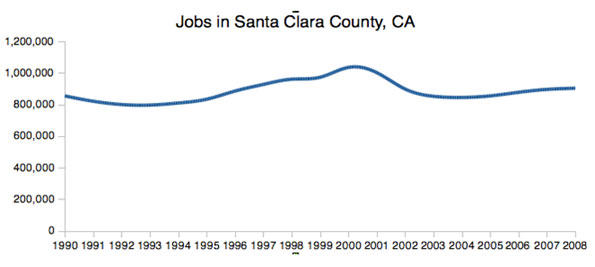
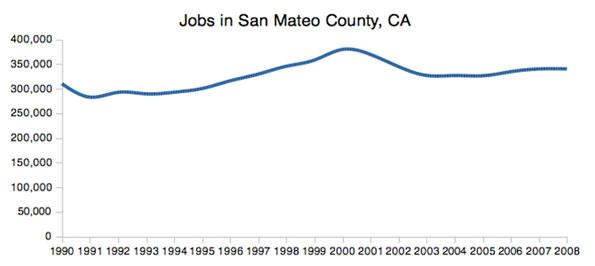
    Let’s consider the counties that make up the heart of these industries. Silicon Valley’s San Mateo and Santa Clara Counties both experienced slow job growth between 1990 and 2009. San Mateo County only added 30,000 net jobs, an average of less than 1,700 new jobs per year, or a compound annual growth rate of 0.5%.

    Santa Clara County added around 50,000 jobs over that 18 year period – about 2,700 jobs per year, but only a CAGR of only 0.3%.

    Both counties added significant new jobs in the late 90s, but these were lost when the dotcom bubble collapsed. The recovery from that decline only reached back to the levels just before the early 90s recession, continuing the long running Silicon Valley boom-bust cycle. Silicon Valley actually added jobs at a slower rate than California as a whole during this period.

    You can see the employment impacts just driving down the 101 freeway; there are more than 43 million square feet of unoccupied space, the equivalent of 15 Empire State Buildings. Twenty one percent of “Class A” space and low rise flex space – used for high-tech research and development – is empty. Unemployment overall in Santa Clara county hovers around 12%, substantially over the national average.

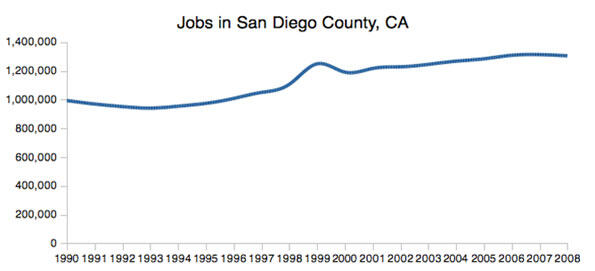
    San Diego County, one of the key centers of the biotech industry, did much better, adding 310,000 jobs over the same timeframe. This is over 17,000 jobs per year, or a CAGR of 1.53%, much better than Silicon Valley, but hardly enough to reflate California’s job market. For example, Los Angeles County added almost a million people during this time, but actually lost jobs.

    A critical consideration may well be that the future could be different from the past for these industries, and that over the next 20 years they will generate far more jobs than in the previous. But the evidence seems to be the other direction.

    California clearly has no shortage of dynamism in high-end economic sectors. There are still plenty of new innovative firms being founded in California or even moving there. And it seems likely these firms will continue to generate significant wealth for the state in the future. Given its current tax structure, the state treasury has significant “operational leverage” to the upside here. Another strong recovery cycle might even replenish the state’s coffers, though won’t offer solace for some time at least.

    But these industries won’t generate many net new jobs. And that is becoming the problem in both Silicon Valley and the state.

    Therein lies California’s dilemma. The ability to generate large amounts of wealth on a narrow job base isn’t enough to support a state of 37 million people. Brazil generates enormous wealth too, and supports lavish stores like Daslu, where you can’t walk in off the street, but there’s a helipad on the roof – and a favela just down the street. But Brazil doesn’t have a middle class economy.

    With innovation the watchword of the day, and no other realistic prospects available in the near term, it is easy to see why places from California to Michigan are placing their hopes on such high end information age jobs. Unlike most, California is already winning the war for the highest value jobs and talent in the space. The headquarters, R&D, core software development, design, and prototyping will be done in California. But it is unlikely to be where the manufacturing, customer support, sales, warehousing, back office support, and other core functions get done. And those are where the jobs are. The back of the iPhone says everything we need to know. “Designed by Apple in California. Assembled in China.”

    California is clearly right to make these industries a priority. The danger is that it comes to focus on them so exclusively that it implements policies that are overly favorable to those select functions, but hostile to everything else. California needs to make sure it has a strategy for middle class and working class jobs beyond the low end service sector. That’s a much harder problem than maintaining Silicon Valley’s dominance, but it’s clearly at least equally as important. The high end portion of various “tech” sectors alone are never going to provide enough jobs to secure a prosperous future for the vast majority of Californians.

    Aaron M. Renn is an independent writer on urban affairs based in the Midwest. His writings appear at The Urbanophile.

  • Move the United Nations to Dubai

    The opening last week of the world’s tallest building, the half-mile-high Burj Dubai, has largely been greeted with guffaws and groans. The Daily Telegraph labeled it “the new pinnacle of vanity”–“a purposeless monument to the subprime era.” The Wall Street Journal compared it to the Tower of Babel. (When the Empire State Building was completed in 1931, in the throes of the greatest financial crisis of the 20th century, it was met with similar jeers. The then-tallest building in the world was called the Empty State Building, and it remained vacant for several years.)

    Yet the Burj’s completion–indeed the whole wild enterprise known as Dubai–could signal a potential opportunity to the global community: turning the place into the headquarters for that other misguided ship, the United Nations.

    Let’s spell out the logic. The United Nations is a pain in the butt. It pays no taxes and annoys hard-working New Yorkers with its sloth, pretensions and cavalier disregard for traffic laws. The place is a sinkhole dominated by anti-American, anti-Semitic and authoritarian fantasies. It is far from the elegant crown jewel that celebrated the U.S.’s global ascendancy after the Second World War.

    Today the U.N. building is a mostly empty shell–water dripping through its roof, asbestos lining its ceiling and an erratic heating and cooling system have forced most UN workers to new facilities. The building is in the midst of a $1.87 billion overhaul–of which the U.S., which could use the cash for myriad other things, would be on the hook for $437 million.

    And the U.N. may be leaving anyway. A relocation committee has recommended that the organization move temporarily to Singapore by 2015. It will be hard to vacate Asia again for New York, which is far away from the bulk of the world’s largest population centers.

    Singapore might make a fine world capital, since it does work like a fine watch. But it’s already crowded, expensive and highly regulated. You have to wonder if hard-working, rational Singaporeans would want to drive up costs and lose their ability to run things as they see fit to accommodate the U.N. bureaucracy.

    In contrast, the al-Maktoum family has transformed a once vast, empty landscape into a Star Wars-like capital city of the future. There is no skyline more arresting than the one built over the past 15 years by Sheikh Mohammed bin Rashid Al Maktoum, the Absolute Ruler of the tiny Emirate. In just 500 square miles, about half the size of Orange County, Calif., the sheikh has created a monument to modern architectural engineering.

    Sheikh Mohammed could offer to build a United Nations City to house the U.N. in any number of vacant office towers. Business Bay has 65 million square feet of office space under construction in more than 200 high-rises. Dubai already has thousands of newly constructed apartments that await the international delegates. More than 2 billion people in Africa, Europe and Asia are within a six-hour flight from Dubai. Travel connections through the world’s largest airport would be a breeze. Dubai has 55 five-star hotels to accommodate every regal and royal delegation, as well as the Harvard Medical School Dubai Center, a $1,400,000,000 facility branded with the Harvard crest, just in case one of the U.N.’s elite workers breaks a gasket.

    Questions of taste and timing aside, you have to admire the sheikh’s chutzpah. The al-Maktoums, descendants of the Bani Yas clan, have ruled Dubai since 1833, first under the protection of the British. The United Arab Emirates was founded in 1971 with big brother Abu Dhabi, the emirate with 96% of the confederation’s oil reserves.

    Like New York, Dubai aimed first to be a capital of capital. Recognizing that oil revenues at $70 a barrel brought immense cash flow to the Persian Gulf, Sheikh Mohammed set out to create a setting where Arab pride and excess oil revenues could be comfortably parked. His boldness caught the attention of the world financial community and soon the tiny emirate employed more construction cranes than any site on Earth.

    For now flying so close to the sun has resulted in a painful and somewhat humiliating fall. With the financial market collapse of 2008 to 2009 international buyers disappeared and property values plummeted. Half of the $300 billion in construction projects screeched to a halt. The Dubai government, with $80 billion to $100 billion of debt, was in trouble, and Dubai World, its investment arm, announced suspension of interest payments on its loans. Enter Abu Dhabi. The neighboring emirate wrote kid brother Dubai a check for $25 billion. What does $25 billion get you in 2010? On Jan. 4, at the grand opening of the Burj Dubai, Sheikh Mohammed announced that the tower would forever be known as Burj Khalifa, named after the Emir of Abu Dhabi.

    Let’s look a bit longer term. Right now there’s 33.6 million square feet of mostly state-of-the-art office space in Dubai. More than 8 million square feet is vacant with millions more in the pipeline. There’s a great airport–as opposed to that aerial dumpster, JFK–that is hours closer to the emerging economic powers of the new century, notably the oil states, India and China. The workforce is skilled and open to foreigners, since the vast majority are foreigners. In Dubai 83% of the 2.2 million residents are from somewhere else. Talk about cosmopolitan.

    But how about New York? “Moving the U.N. to Dubai would be a boon for New Yorkers who have to put up with traffic jams created by the likes of Colonel Qaddafi, scofflaws protected by diplomatic immunity and the loss of real estate revenue they would gain if the U.N. building were turned into something far more useful–condos with a view,” suggests urban historian Fred Siegel, a visiting professor at Saint Francis College in Brooklyn and a fellow at New York’s Manhattan Institute.

    Liberating New York from the United Nations, in fact, would open up some of the best situated real estate in the world. A treasure trove of great apartments and offices right along the East River would suddenly become available, bringing a potential revenue windfall to New York City, which could use it. None of this would threaten the city’s—or the country’s–economic and political status. That grows out of economic and military power, which the U.N. does little or nothing to augment.

    What would Dubai get? It’s an ideal opportunity to refurbish its tarnished image on the world stage in a way that plays to its infrastructural and geographical advantages. The Arabian Sea and the Indian Ocean are increasingly the focal point of the world economic and political systems. Some of the biggest challenges facing the U.N. are concentrated in the south in Somalia and Yemen, to the west in Israel and Palestine, and to nearby Iran and Pakistan. Dubai would have to reconcile itself to a permanent Israeli presence, but that may not be as difficult as many think. Jews, and even Israelis, do business today in Dubai with perhaps less worry about running into manifestations of anti-Semitism than in London or Paris.

    Bringing the United Nations to Dubai makes sense. New York gets rid of one of its worst welfare cheats, and Dubai finds new tenants to fill its vacant towers. Dubai has already built something that looks the part of a 21st-century world capital. Let it get a cast appropriate for its glittering set.

    This article originally appeared at Forbes.com.

    Joel Kotkin is executive editor of NewGeography.com and is a distinguished presidential fellow in urban futures at Chapman University. He is author of The City: A Global History. His next book, The Next Hundred Million: America in 2050, will be published by Penguin Press February 4th, 2010. Coauthor Robert J. Cristiano Ph.D. is a successful real estate developer and the Real Estate Professional in Residence at Chapman University in Orange, Calif.

    Photo:

  • China’s Heartland Capital: Chengdu, Sichuan

    On May 12, 2008, Chinese architect Stepp Lin was focusing intensely on his professional licensing exam in a testing center in central Chengdu when suddenly he felt someone bumping his desk. By the time he looked up to see what it was, most of the other exam takers were frantically fleeing for the exit. It turns out that what he was feeling were the tremors of what was to be the most devastating earthquake to hit China in recent memory.

    China’s heartland province of Sichuan was overtaken by an 8.0 earthquake that rocked the region that day. The quake was so powerful that it was felt as far away as Beijing. Graphic images broadcast around the world showed the devastation caused by the powerful tremor. All in all, it is estimated that more than 60,000 people perished in the Sichuan earthquake.

    During the aftermath, the response from both within China and abroad in terms of aid was highly encouraging. Unfortunately, the footage of primary schools reduced to rubble resulting in the deaths of thousands of children and the subsequent scandals regarding culpability denial and cover-up did not bode well for China’s new image.

    Surprisingly, Sichuan’s capital and largest city, Chengdu, escaped from the earthquake largely unscathed. Most of the serious damage took place in rural areas where buildings, due to lack of sufficient funding and regulation, had not been constructed to safety standards. Building safety codes have since been updated and are now rigorously enforced.

    Perhaps more importantly, the 2008 Sichuan earthquake managed to highlight the growing disparity between the rich and poor, urban and rural areas of China.
    Unlike the United States, where suburbanization has managed to blur the line between rural and urban, the contrast remains stark in the Middle Kingdom.

    It is no secret that within the framework of rapid development, China is urbanizing at unprecedented rates. Beijing and Shanghai continue to lead the country politically and economically, but a group of ‘second tier’ cities is now being targeted by China’s planners for increased new investment. Included in this group are up-and-coming cities like Nanjing, Dalian, Tianjin and Chongqing.

    Yet perhaps no other second tier city represents the future of China more than Chengdu (pronounced chung-doo). Strategically located at the geographic heart of China, Chengdu bridges the gap between the country’s booming eastern seaboard and the still largely mysterious far west.

    Chengdu is one of China’s oldest cities, with continuous settlement dating back to the ancient Kingdom of Shu. Today, the city is renowned for its local spicy cuisine and famous Panda Breeding Center. It is also a popular launching-off point for international trekkers heading onto Tibet. Within China, Chengdu is reputed for its leisurely atmosphere where friendly locals often take off work early to sip tea and relax over a game of mahjong.

    Sitting at an elevation of about 1,600 feet on the western portion of the Sichuan Basin, Chengdu’s climate is mildly humid-neither too hot in the summer nor too cold in the winter. Yet one drawback is the presence of the pervasive fog that hovers low in the sky year-round, making Chengdu one of least-sunny cities in China.

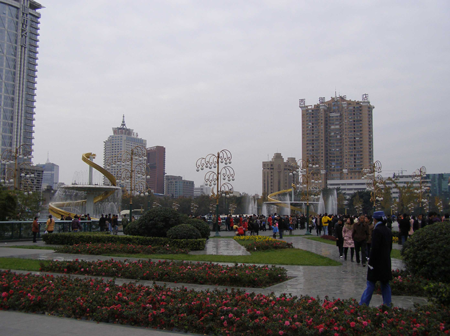
    Similar to Beijing, Chengdu is concentrically organized with ring roads circling the city. At the center of the city is Tianfu Square-a pleasant public space featuring larger-than-life water fountains and a large statue of Chairman Mao. Nearby is the Jin River, which flows through the middle of the city, dividing it in half.

    Despite the slower pace of life, at least in comparison with the rest of China’s hyper urbanity, the Central Government has recognized the city’s advantages. Being the western-most big city in China, Chengdu is China’s gateway to central Asia. As such, the city has been identified as an air traffic hub. Already, Chengdu International airport is one of the busiest in the mainland. Next year, Air China inaugurates its new Chengdu-Los Angeles route: the first direct flight from the city to the United States.

    The new Air China route to LA reflects the growing presence of U.S. firms in the area. Technology companies like Microsoft and Intel have realized the competitive advantages of opening research and development facilities in an area of the country where the cost of doing business is still relatively low. These firms have located their offices in an area in the south of Chengdu that has been designated as the ‘Hi-Tech Zone’ by China’s Ministry of Science and Technology.

    Along with becoming western China’s high tech center, the city is grabbing a foothold on the country’s aviation industry. Chengdu Aircraft Industrial Group (CAC), which was contracted out by Dallas-based Vought Aircraft, supplied the rudder for Boeing’s new 787 ‘Dreamliner’ jet. CAC also supplies parts for Boeing’s 757 series.

    To accommodate the new business, the city is going through a construction boom. Although Chengdu had a late start on its eastern counterparts, the city is attracting high-profile developers like New York-based Tishman Speyer and Singapore’s CapitaLand – both of whom currently have large-scale commercial and retail projects being built in the city. Chengdu has even recruited Hong Kong businessman Allan Zeman to develop a version of Hong Kong’s popular nightlife district, Lan Kwai Fong, scheduled to open in March.

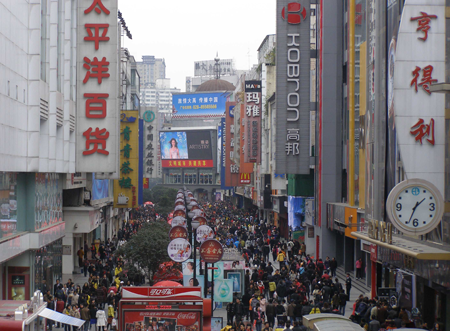
    The city’s development would not be complete without an overhaul of its transportation system. One word summarizes the current state of Chengdu’s roads: chaos. The traffic on the streets remains an assortment of bicycles, motorbikes, automobiles and buses. Yet, as incomes rise and more people purchase cars, the congestion on the streets is becoming unbearable. Furthermore, the fact that the streets do not follow a formal grid pattern, but rather array out from the center of the city, adds another degree of complexity to Chengdu’s traffic dilemma.

    Thankfully, the city’s first subway line is slated to open in 2010. As additional underground lines become operable, it will also give the city a better sense of cohesiveness as the limited number of surface level crossings of the Jin River currently contributes to both a physical and psychological divisiveness.

    In discussing the rise of Chengdu as a hotbed of economic activity, it is worth mentioning the city’s relationship with its closest rival, Chongqing. Chongqing, which was separated from Sichuan Province in 1997 to become an autonomous provincial-level municipality, lies just over 200 miles to the east. The city has the advantage of direct access to the Yangtze River, providing a strategic connection to the river’s terminus of Shanghai.

    Chongqing’s urban development is limited by the surrounding mountainous terrain-thus the reason for the dense high-rise jungle rising in the skyline. Chengdu, in contrast, has an abundance of land for growth and is more likely to sustain long-term development. Also, the fact that Chongqing has been plagued by corruption and local mafia activity in recent years means that foreign firms may be more attracted to safer Chengdu.

    That is not to say that there is not room for both cities in China’s future. In fact, the two cities are likely to form what will become the Chengdu-Chongqing mega-region – the economic powerhouse of western China. Already, other mega-regions in China like the Bohai Bay Rim (Beijing, Tianjin and Dalian), the Yangtze River Delta (Shanghai, Hangzhou, Nanjing and Suzhou) and the Pearl River Delta (Guangzhou, Dongguan, Shenzhen, and Hong Kong) are setting groundbreaking standards in the history of global urbanization.

    The Sichuan earthquake of 2008 managed to bring about an awareness of the major issues still facing China. In stark contrast to the days of the Cultural Revolution when urban areas were viewed as pariahs, the Sichuan quake solidified the triumph of the city over the countryside. As the city on the frontier, Chengdu is likely to become a key player as thousands of migrants arrive from Sichuan and adjacent provinces. How these newcomers are incorporated represents a great challenge for China as it shifts from a largely rural to a predominately urban country.

    Adam Nathaniel Mayer is a native of California. Raised in Silicon Valley, he developed a keen interest in the importance of place within the framework of a highly globalized economy. Adam attended the University of Southern California in Los Angeles where he earned a Bachelor of Architecture degree. He currently lives in China where he works in the architecture profession.

  • Will Anyone Stand Up for American Industry?

    “Esau for one morsel of meat sold his birthright. For ye know how that afterward, when he would have inherited the blessing, he was rejected: for he found no place of repentance, though he sought it carefully with tears.” – Hebrews 12:16-17

    Built from 1933-1936, the Bay Bridge linking San Francisco to Oakland was an engineering marvel of its day. A complex series of multiple spans, when it opened – six months ahead of the more famous Golden Gate Bridge – it was both the longest suspended bridge deck in the world and the longest cantilever bridge in the world. The western suspension bridge section, technically two bridges in one, had to settle for being only the second and third longest suspension bridges in the world.

    The 1989 Loma Prieta earthquake badly damaged the Bay Bridge. The iconic western suspension span was seismically reinforced, but the eastern steel truss section required replacement. San Francisco wanted another iconic span, not just a functional one. A striking self-anchored suspension structure was selected and is under construction.

    The dubious part of this new span isn’t the usual matter of being way late and massively over budget – though it is – but where it’s being made. The steel for the bridge is not being built in America but in China.

    Why is this bridge being fabricated in China? The troubling answer, according to a lengthy article in the SF Public Press, is that no American company can do the job. America, a country that once pulled off the most audacious of engineering projects with panache, one that put a man on the moon in the 1960s, now can’t even build a bridge to replace one it constructed with ease in the 1930s.

    What’s more disturbing, is that China can’t really build it either – but we are teaching them, and paying for them to learn how.

    When you drive across that new Bay Bridge, your tolls will literally be helping to finance the advancement of China’s industrial base and the evisceration of America’s.

    I believe in free trade, strongly. I believe America can compete in a free market. But the United States is a country curiously uncommitted to industry. Other countries build, promote and protect industrial champions. They blockade their markets against American competitors. India freely sells us software and BPO, but passes laws to hamper Wal-Mart and other American firms. China demands many foreign companies do business there only through joint ventures, and transfer technology to local partners. It also intervenes to keep its currency artificially low. Many countries outright ban foreign involvement in many sectors such as energy. They view even their privately owned firms, many of which have close and corrupt ties to the state, as instruments of national and foreign policy.

    These places see Japan as a model to follow, a country that used its closed market to build industrial champions, even in high technology markets. Perhaps in time the same problems that hobbled Japan – asset bubbles, debt, demographic collapse, or an inflexible economy – will similarly afflict these emerging markets. But by that time it might be too late for American industry. And those problems are just as likely to affect us as them.

    This raises difficult questions about the future of America. Can we thrive as a purely post-industrial economy? Can we have a long term prosperous society built on little more than selling each other ever more exotic pieces of financial paper, creative consultancies, typing away at computers, serving up caffe lattes, and the like? Can we have a just social order as a two-tier society of only highly-paid elite knowledge workers and a low end service class, but not the robust middle class a manufacturing economy – along with agriculture and energy – supported?

    Can America even retain its military industrial strength under such conditions? In the past, military technologies launched spin-offs to the commercial world. Today, the reverse is as likely to happen. Already the only major ship builders left in America are captive suppliers to the US Navy. Only the anomalous Jones Act has kept a tradition of small and medium sized commercial shipbuilding alive.

    There’s a positive reinforcement cycle at work. The less we manufacture, the less we can manufacture. We slowly lose the skills, the facilities, the institutions, and the culture that enable a robust manufacturing economy to thrive. Eventually, we won’t be able to recover.

    Maybe we won’t even want to. The less we make, the less we want to make. As we become unmoored from our agro-industrial roots, we fail to see them as central to our national identity and frequently treat them with hostility. As Douglas and Wildavsky put it in Risk and Culture (1982):

    A larger proportion of the population of working age was disengaged from the production process than had been before. The economic boom and educational boom together produced a cohort of articulate, critical people with no commitment to commerce and industry.

    Increasingly, Americans have no personal experience with industry, and even no family experience with it. What was once common is just another niche, much like military service has become. This means most people have little familiarity or affection for industry, agriculture, or energy production. Many, especially urban dwellers, view most productive industry as a negative, as a source of blight where once others saw jobs and a strong tax base.

    Portland provides the perfect example. It views its waterfront as prime territory for residences and recreation, but not for industry. As the Oregonian reports:

    The question makes Jay Zidell uncomfortable. When will he stop building barges on the waterfront and start building high-rises? The room goes silent….Oregon power brokers have nudged the Zidell family for decades to do more with their prime Portland real estate…In the 1970s, Gov. Tom McCall called Jay Zidell’s late father, Emery, to suggest he stop adding industrial buildings. As Jay Zidell has told the story, McCall said: “We have big plans for the waterfront.”

    Those big plans don’t include manufacturing. Portland is the perfect example of where America is heading. It’s a place where thousands of highly educated but often underemployed young people sip lattes by the light rail while on the waiting list for a job at Starbucks. Meanwhile people in third world countries, hungry for more, hustle to build an ambitious future for themselves and their nation. Americans increasingly view manufacturing as an undesirable activity, particularly in an urban context, when in fact we should be looking to build new industrial cities – updated, re-imagined, and re-designed for a 21st century economy.

    Also, too often industry is viewed only as a source of pollution. Many industrial expansions are opposed on environmental grounds. But from a global, not local perspective, an ever stricter regime of regulation is sending firms offshore where pollution standards are usually far laxer. Corporations put a green gloss on their branding campaigns while building their products in China, where they get electricity from one of the new coal fired power plants that open at a rate of more than one per week. They also escape independent unions, anything like the Environment Impact Statement process in the US, and operate in a regime of weak property rights, questionable worker health and safety conditions, and a limited ability for the public to dissent. It’s not just cheap labor, it’s regulatory arbitrage. It’s like inverse colonialism, only this time the joke’s on the West. And the end result is a global environment that ends up worse, not better.

    To really protect the environment, we should be doing more manufacturing at home, where we can keep an eye on it and prevent the worst abuses. It’s like the Steak ‘n Shake boast about their open kitchens: “In sight, it must be right”.

    The sometimes exception to this negative take on manufacturing is, of course, “green” industry, notwithstanding that the concept does not exist except as a transitory state. In a decade there will just be “manufacturing”, and virtually all will adhere to green standards. But if America can’t succeed at traditional manufacturing, why would anyone think it will be different with green manufacturing? Even if so, by then there might not be many major American producers left to succeed.

    American firms and labor have made many mistakes over the years, but more often today they are adopting the new approaches needed to compete in tomorrow’s world. American labor can compete, even against cheap foreign workers, since it is the best and most productive workforce in the world. But not when public policy implicitly favors shipping manufacturing overseas.

    The answer is not protectionism, it’s freeing American labor to compete and developing policies designed to advance American manufacturing interests. Alexis de Tocqueville talked about Americans knowing the difference between raw, naked self interest, and “self-interest well-understood”. Likewise, we need to find a new approach to create “free trade, well understood”, a modern day trade equivalent of speaking softly, but carrying a big stick. Billions for American infrastructure, but not one $4 Bay Bridge toll to finance China’s technology ambitions.

    Alas, this seems unlikely. American industry is trapped between a political right that can’t see beyond instinctive anti-federalism and an overly ideological vision of free trade, and a political left that, while paying lip service to labor interests, no longer embraces industry. Almost alone among nations, America today lacks political champions for its industry. That, more than anything, is why it is being left to wither. Will anyone stand up and be counted before it’s too late?

    Aaron M. Renn is an independent writer on urban affairs based in the Midwest. His writings appear at The Urbanophile.

  • Why New York City Needs a New Economic Strategy

    When Michael Bloomberg stood on the steps of City Hall last week to be sworn in for a third term as New York City’s mayor, he spoke in upbeat terms about the challenges ahead. The situation, however, is far more difficult than he portrays it. American financial power has shifted from New York to Washington, while global clout moves toward Singapore, Hong Kong, and Shanghai. Even if the local economy rebounds, the traditional media industries that employ many of Bloomberg’s influential constituents likely will continue to decline. New Yorkers have long had an outsize view of their city; historically, its mayors have touted mottos that encouraged that view, from Rudy Giuliani’s “capital of the world” to Mike Bloomberg’s “luxury city.” But as Bloomberg begins his new term, New York needs to reexamine its core economic strategy.

    A good first step would be to recognize that the world owes New York nothing. The city cannot simply rely on inertia and the disbursements of Wall Street megabonuses to save its economy. Instead, it needs to rebuild its middle-class neighborhoods and diversify toward a wide range of industries that can capitalize on the city’s unique advantages—including its appeal to immigrants; the port; and its leadership in design, culture, and high-end professional services.

    It’s also time to get rid of the Sex and the City image and start making New York a city where people can have both sex and children. This will become more important as the millennial generation enters its late 20s and early 30s later this decade. This is when many young migrants to the city, including upwardly mobile immigrants, typically become ex–New Yorkers.

    Despite all the “back to the city” hype, New York over the past decade suffered one of the highest rates of out-migration of any region in the country. Young singles may come to New York, but many leave as they get older and have families. An analysis by the city controller’s office in 2005 found that people leaving the city were three times more likely to have children than those arriving.

    If New York is to thrive, it will need to keep more of these largely middle-class families. To do that, it needs to diversify its economy beyond Wall Street, which in 2007 provided roughly 35 percent of all income earned in the city. Since the recession, the city has lost 40,000 financial-service jobs, but the industry has been quietly downsizing for years: over the past two decades, more than 100,000 financial-services jobs have disappeared from New York. In good years, financial services provided an enormous cash engine, but it can no longer provide enough jobs. According to an analysis by the Praxis Strategy Group, finance now accounts for barely one in eight jobs in New York City. Most job growth has come instead in lower-paying professions like health care and tourism.

    To become economically sustainable, New York needs to create policies that help encourage development in areas where its less wealthy citizens live. Most outsiders identify New York almost exclusively with Manhattan, yet roughly three out of four New Yorkers actually live in the outer boroughs: Queens, Brooklyn, Staten Island, and the Bronx. Neighborhoods like Bay Ridge, Whitestone, Flatbush, Howard Beach, and Middle Village are really New York’s middle-class bastions.

    Over the past decade, these communities have provided a critical middle ground between the bifurcated Bloombergian “luxury city” with its high-end enclaves and the many distressed neighborhoods throughout the city. Although the mayor, some urbanists, and many developers would like to make these middle-class enclaves ever denser, their very appeal often lies in their moderate scale, proximity to work areas, decent schools, and parks. Those attributes hold sway, even in a recession. “Brand- new and expensive places have not held up as well as the established family neighborhoods,” says Jonathan Bowles, director of the New York–based Center for an Urban Future.

    Nurturing these neighborhoods will require a distinct shift in public policy. During the Bloomberg years the big subsidies have gone to luxury condo megadevelopments, sports stadiums, or huge office complexes. Consider the 22-acre Atlantic Yards project in downtown Brooklyn, which will include luxury housing and a new arena for the NBA’s Nets; one recent report by the city’s Independent Budget Office put the total subsidies provided by the city, New York state, and the transit authority at $726 million and estimated the project will hurt, not help, the city’s economy over time.

    More than anything, the plain-vanilla neighborhoods that represent New York’s real future will require policies that create a broad array of economic opportunities. Right now New York is so overregulated and highly taxed that only the most high-end business, such as big media and financial firms, can possibly thrive. The city has neglected its smaller firms, typically engaged in such activities as food processing, furniture making, and garment production. Traditionally these industries were run by Russian, German, Polish, and Italian immigrants; West Indians, Latinos, Koreans, Chinese, and South Asians do much of this work today. Over the past decade, the number of self-employed immigrants in New York has grown even as the number of self-employed among the native-born has dropped.

    Earlier generations of urban residents as well as many immigrants today stay in the city to be close to their communities and industries dominated by them. These days many others stay in the city largely because of its cultural attributes and quality of life. This doesn’t mean these workers remain unreconstructed bohemians forever. Their priorities often change as they age, start businesses, and raise families. Different, more mundane issues—stable employment, taxes, safety, schools, and housing affordability—often determine whether they stay in the city. “It’s easy to name the things that attracted us—the neighbors, the moderate density,” says Nelson Ryland, a film editor with two children who works in his sprawling home in Brooklyn’s Flatbush neighborhood. “More than anything it’s the sense of the community. That’s the great thing that keeps people like us here.”

    Technology will boost this sense of community. Online groups like the Flatbush Family Network can facilitate contact in different parts of a city among artists, families, and neighborhood groups, supplementing the traditional community adhesives of schools, churches, synagogues, and clubs. These new online institutions can perform some of the functions that urbanist Jane Jacobs’s “eyes on the street” did in the old, cohesive city neighborhood. Information about the arrival of a promising new store or restaurant, or the unwelcome appearance of a possible child molester, travels through these community networks much as it did when mothers spoke over the washing, men went to the pool hall, or kids hung out at the candy store.

    Bloomberg has built on many of the achievements of his predecessor during his eight years in City Hall. This, combined with huge campaign spending from his personal fortune, is why voters sent him back for a third term. To position the city for prosperity in an economy that’s no longer overly dominated by Wall Street, he’d be wise to spend his final term focused on making new opportunities for people who live far from his own Upper East Side neighborhood—the people who represent the real future of New York.

    This article originally appeared at Newsweek.

    Joel Kotkin is executive editor of NewGeography.com and is a distinguished presidential fellow in urban futures at Chapman University. He is author of The City: A Global History. His next book, The Next Hundred Million: America in 2050, will be published by Penguin Press early next year.