Category: Economics

  • A Canadian Autobahn

    Canada is the largest high-income nation in the world without a comprehensive national freeway (autobahn, expressway or autoroute) system. Motorways are entirely grade separated roadways (no cross traffic), with four or more lanes (two or more in each direction) allowing travel that is unimpeded by traffic signals or stop signs.

    The Economic Advantages of Motorways: Motorways have been associated with positive economic and safety impacts. For example, a synthesis of research by the American Association of State Highway and Transportation Officials (AASHTO) noted the positive impact of US motorway system:

    The Interstate Highway System represented an investment in a new, higher speed, safer, lower cost per mile technology which fundamentally altered relationships between time, cost, and space in a manner which allowed new economic opportunities to emerge that would never have emerged under previous technologies.

    In particular, the AASHTO synthesis indicated that motorway

    …investments have lowered production and distribution costs in virtually every industry sector.

    It is a well known fact that motorways are by far the safest roads. We estimated that 187,000 fatalities had been averted due to the transfer of traffic from other roads to motorways between 1956 and 1996.

    A World of Motorways: Truckers in Japan, Europe (the EU-15) and the United States can travel between virtually all major metropolitan areas on high quality motorways.

    Further, motorway systems have and are being built in developing nations. By far the most impressive is China, which now has approximately 65,000 kilometers of motorway, not including motorways administered at the municipal level (as in Shanghai and Beijing). Only the United States has more, at approximately 85,000 kilometers. China’s plans call for the US figure to be exceeded within a decade. These roads are being built not only throughout populous eastern and central China, but also to the Pamirs at the Kazakh border and to Lhasa, in Tibet, across some of the most desolate and sparsely populated territory in the world. Mexico, a partner with Canada and the United States in the North American Free Trade Agreement also has an extensive motorway system.

    Motorways in Canada: Canada, however, is an exception. Only a quarter of metropolitan areas are connected to one another by motorways. Edmonton and Calgary are among the few metropolitan areas in the developed world that are not connected to comprehensive motorway systems (Vancouver is connected to the US system, but not to the rest of Canada).

    For many trips between Canadian metropolitan areas, it takes less time to travel through the United States on its motorways than on the Canadian roads (such as between Winnipeg or Calgary and Toronto). The principal problem is the long, crowded, slow, two-lane stretch of roadway through the northern Great Lakes region between the Manitoba-Ontario border and between Sudbury and Parry Sound. There is also a long section of roadway in the British Columbia interior that a Calgary talk show host referred to as a “stagecoach” trail. Canada pays an economic price for this lack of a world-class highway system, both in terms of manufacturing and tourism.

    However, parts of Canada are well served by motorways. Much of central and eastern Canada is connected by motorways, with routes from Windsor, Ontario, through Toronto, Ottawa, Montreal, Quebec to Halifax. This route includes only a short segment that is not motorway standard in the province of Quebec as it approaches the New Brunswick border.

    Moreover, despite its reputation to the contrary, the largest Canadian urban areas have world class freeway systems. Few, if any, urban areas in the United States or the developed world have more kilometers of motorway or motorway lanes in relation to their urban area size as Toronto and Montreal.

    A Canadian Autobahn: In cooperation with the Frontier Centre for Public Policy, we proposed a world class highway system for Canada. In a report entitled “A Canadian Autobahn: Creating a World Class Highway System for the Nation” we proposed:

    1. Upgrading the entire transcontinental route from Halifax, through Toronto to Vancouver to motorway standards. These improvements should be completed within 10 years and would cost approximately $28 billion (2009$).
    2. Upgrading other principal routes to at least pre-motorway standard, which would require “twinning” (four-lanes) and minimizing the number of grade crossings. The longest of these additional highways is the Yellowhead route: Edmonton and Calgary to the Canada-U.S. border; Ottawa to Sudbury; and across the island of Newfoundland. These improvements should be completed within 15 years and would cost approximately $33.5 billion).

The transcontinental route would provide a long overdue economic stimulus to urban areas such as Thunder Bay and Sault Ste. Marie. The improved Yellowhead route would provide far better access to the new deepwater, superport at Prince Rupert (British Columbia), which is the closest North American port with connections to major Asian markets. This could materially improve Prince Rupert’s competitiveness relative to larger ports on the US West Coast, such as Los Angeles and Long Beach (which have become much less competitive themselves in the last decade). The improved roadway would make it possible to effectively serve the markets of the US Midwest, South and East through a connection to I-29 in North Dakota.

The report was unveiled at a Calgary event on October 29 and was covered by media across the nation.

What About Greenhouse Gas Emissions: A question was raised about the advisability of expanding highways at a time that the world is attempting to reduce greenhouse gas (GHG) emissions. Such a strategy would seem to be at odds with the popular perception that we shall all have to abandon our cars and move into flats in the central city. This perception presumes that people are prepared to return to the standards of living and lifestyles of 1980, 1950 or even 1750. In all of my presentations on similar issues I am yet to uncover any groundswell of support for the lifestyles of yesterday.

It needs to be recognized that the international commitment to reducing GHGs is based upon an assumption of minimal impact on the economy. GHG reductions will be achieved only if they are acceptable to people, which requires acceptable costs (research by the United Nations International Panel on Climate Change suggests an upper bound of $50 per ton). Cost effectiveness is necessary to not only prevent a huge increase in poverty, but also to allow continued progress toward poverty alleviation and upward mobility. In fact, as recent US research indicates, there is scant real world potential to reduce GHGs from reduced levels of driving.

Given the strong association between economic growth and personal mobility, there is a single realistic path to substantial GHG emission reduction: better technology. Fortunately, developments suggest that technology is, indeed, the answer.

The question, thus, comes down to whether jobs in the northern Great Lakes region (and elsewhere) are more important than strategies that are politically correct, but comparatively ineffectual with respect to materially reducing GHG emissions. It seems likely that people will place a priority on jobs.

Finance: Because of the importance of tying the nation together, it would be appropriate to spend federal and provincial funds on the Canadian Autobahn. User fees, such as a dedicated gasoline tax (as in the United States) or tolls (as in France, China and Mexico) could finance the expansions, using public-private partnerships or “arms-length” government corporations.

Wendell Cox is a Visiting Professor, Conservatoire National des Arts et Metiers, Paris. He was born in Los Angeles and was appointed to three terms on the Los Angeles County Transportation Commission by Mayor Tom Bradley. He is the author of “War on the Dream: How Anti-Sprawl Policy Threatens the Quality of Life.
  • Reducing Carbon Should Not Distort Regional Economies

    A pending bill in Congress to reduce carbon emissions via a “cap and trade” regime would have significant distorting effects on America’s regional economies. This is because the cost of compliance varies widely from region to region and metro to metro. This is all the more important since such legislation may do very little to reduce overall carbon emission according to two of the EPA’s own San Francisco lawyers.

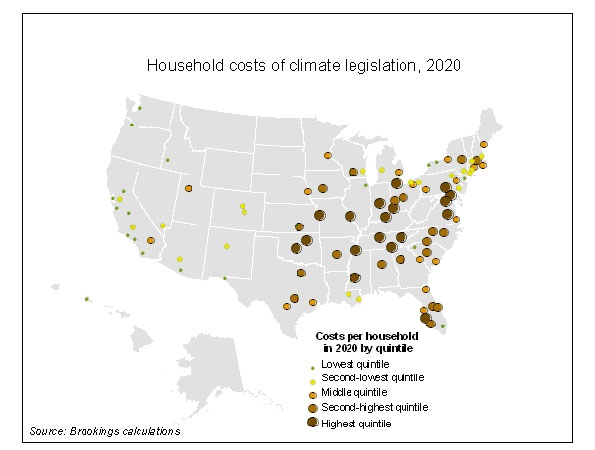
    The Brookings Institution recently calculated the projected cost of compliance under the cap and trade plan on a metro by metro basis and produced the map below for The New Republic:

    The costs of compliance are highest in the lower Midwest through to the Mid-Atlantic and in the South. New England, the Upper Midwest, and the West are the winners from a cost standpoint.

    The actual costs vary from a high of $277 per household per year in 2020 in Lexington, KY to a low of $96 in Los Angeles among the 100 largest metros. Other hard hit metros include Washington, DC ($250), Indianapolis ($246) and Kansas City ($228). Among the winners are Portland ($107), San Francisco-Oakland-Fremont ($119) and Chicago ($135).

    In aggregate, this adds up to a significant amount of money. The Cincinnati metro had 815,000 households in 2008. Brookings did not include their household estimates for 2020, but even with no population growth at all, at $244 per household that still adds up to about $200 million per year in compliance costs. To put that in perspective, Cincinnati is proposing to construct a new downtown streetcar system for that same amount of money. It could conceivably build a new streetcar line every single year in perpetuity for the cost of compliance. Portland has 835,000 households, for an annual compliance cost of $90 million. Though they are about the same size regions, Cincinnati will be paying over $100 million more per year compliance costs. This creates a $100 million disincentive to live or locate a business in Cincinnati vs. Portland.

    In short, cap and trade creates disparities between metros. As the New Republic put it, “place matters” on cap and trade. And because the effects are geographically clustered, these disparities aren’t just local, they are regional. This is enough to immediately prompt the question as to whether or not this was an implicit design goal of the system.

    Among the biggest beneficiaries of cap and trade is California. Its large metros are clustered together at the bottom of the list. I noted previously how California is placing a huge bet on the green economy as its engine of economy renewal. In fact, beyond legacy industries such as high tech, agriculture, and entertainment, California’s political leaders are betting their entire future on green. With so much on the line for California, it should come as no surprise that the state would seek to federalize its policies and institutionalize the advantages it has in this arena through its state level climate regulations. One might even better name this bill “The California Economic Recovery and Competitor Hobbling Act of 2009”.

    This reality isn’t lost on Indiana Governor Mitch Daniels. With Indianapolis the fifth hardest hit metro in the country, it is no surprise he denounced the plan in a Wall Street Journal editorial, saying, “Quite simply, it looks like imperialism. This bill would impose enormous taxes and restrictions on free commerce by wealthy but faltering powers – California, Massachusetts and New York – seeking to exploit politically weaker colonies in order to prop up their own decaying economies.”

    It is clear that getting a bill out of Washington is not just a matter of cost, but of states and regions jockeying for position. The significant regional disparities in impact grind the legislative gears and might ultimately imperil getting legislation passed. Reducing regional disparities could help improve the chances of action on carbon.

    But shouldn’t places that implemented what is considered good policy be rewarded? To some extent, yes. Many places actually voted to cause economic pain for themselves for the sake of a better environment. Other places have fought environmental regulation every step of the way. Clearly, we do want to provide incentives for good behavior, and certainly not reward bad.

    On the other hand, not all the differences in current carbon emissions or abilities to reduce them are the result of good policy. Quite a bit of them are the result of simple good luck. Some places have climates that reduce the need for heating and air conditioning. Other places face more extreme weather.

    Plentiful clean energy sources are unequally spread throughout the country. Not every place has access to large amounts of solar, wind, or hydro power sources. Much of the Midwest and South built coal fired power plants due to plentiful coal supplies in the region. Technology and transportation costs made other sources cost prohibitive. Carbon emissions were not on anyone’s radar then. Some places like Chicago were fortunate to build nuclear plants, which were bitterly opposed by environmentalists at the time, but now are praised by some as a source of low carbon power.

    In short, much of the inequality in carbon emissions results from accidents of geography or history, not deliberate bad choices. People shouldn’t be punished for practices that were rational at the times. As Saul Alinksy put it, “Judgment must be made in the context of the times in which the action occurred and not from any other chronological vantage point.” And while one could say perhaps regions whose climates require excessive heating and cooling shouldn’t be favored places to live, one could say the same about much of the West, including California, whose existence depends on a vast edifice of what many consider environmentally destructive water works.

    To actually get action on carbon – the true imperative – we should adopt the following policy guiding principles:

    1. The goal is carbon reduction, full stop. Encumbering it with additional regional economic gamesmanship, or becoming overly enamored with particular means to that end should be avoided.
    2. Reducing carbon emissions will come with an economic cost. It isn’t realistic to expect that we will get away with pain free reductions. Obviously we should seek to get the best blend of costs and benefits, but let’s not pretend we can have our cake and eat it too, holding carbon action hostage to a standard that can never be met.
    3. The carbon reduction regime should not create significant regional cost disparities. As a purely practical matter, this helps ease passage and should be embraced. Complete equality is never realistic, but when some regions will pay twice as much as others, that by itself creates oppositional voting blocs. If a cap and trade scheme is the preferred approach, then perhaps assistance to high compliance cost areas should partially fund the transition away from coal and towards less polluting sources.
    4. The carbon reduction regime should not encourage business to migrate offshore. We should also not take action that reduces the attractiveness of America as a place to do business and especially to manufacture. Regulatory arbitrage already provides an incentive to move to China, where you can largely escape environmental rules, health and safety regulations, and avoid the presence of independent, vigorous unions. An ill chosen carbon regime could simply enhance China’s allure as a “carbon haven”. Again, this skews manufacturing regions and labor interests against action on carbon, while shifting production to areas with only minimal regulatory restraints.

    In short, action on carbon reduction may well be a good policy goal. But we shouldn’t embrace any means to that end uncritically if it creates huge distortions in regional economic advantage or further damages America’s industrial competitiveness.

    Aaron M. Renn is an independent writer on urban affairs based in the Midwest. His writings appear at The Urbanophile.

  • Obama Still Can Save His Presidency

    A good friend of mine, a Democratic mayor here in California, describes the Obama administration as “Moveon.org run by the Chicago machine.” This combination may have been good enough to beat John McCain in 2008, but it is proving a damned poor way to run a country or build a strong, effective political majority. And while the president’s charismatic talent – and the lack of such among his opposition – may keep him in office, it will be largely as a kind of permanent lame duck unable to make any of the transformative changes he promised as a candidate.

    If Obama wants to succeed as president he must grow into something more than movement icon, become more of a national leader. In effect, he needs to hit the reset button. Here are five key changes that Obama can implement to re-energize and save his presidency.

    1. Forget the “Chicago way.” The Windy City is a one-party town with a shrinking middle class and a fully co-opted business elite. The focused democratic centralism of the machine – as the University of Illinois’ Richard Simpson has noted – worked brilliantly in the primaries and even the general election campaign. But it is hardly suited to running a nation that is more culturally and politically diverse.

    The key rule of Chicago politics is delivering the spoils to supporters, and Obama’s stimulus program essentially fills this prescription. The stimulus’s biggest winners are such core backers as public employees, universities and rent-seeking businesses who leverage their access to government largesse, mostly by investing in nominally “green” industries. Roughly half the jobs saved form the ranks of teachers, a highly organized core constituency for the president and a mainstay of the political machine that supports the Democratic Party.

    The other winners: big investment banks and private investment funds. People forget that Obama, even running against a sitting New York senator, emerged as an early favorite among the hedge fund grandees. As The New York Times’ Andrew Sorkin put it back in April, “Mr. Obama might be struggling with the blue-collar vote in Pennsylvania, but he has nailed the hedge fund vote.”

    At best, the president’s policy seems like Karl Rove in reverse, essentially smooching the core and ignoring the rest. This is a formula for more divisiveness, not the advertised “hope” Americans expected last November.

    2. Focus on Real Jobs, Not Favored Constituencies . The Chicago approach works better in a closed political system controlled by a few powerbrokers than in a massive continental economy like the U.S. Health care and education, which depend on government largesse, are surviving. But the critical production side of the economy that generates good blue-collar jobs – like agriculture, manufacturing and construction – is getting the least from the stimulus.

    These industries need more large-scale infrastructure spending, as well as more focused skills training and initiatives to free capital for politically unconnected entrepreneurial businesses. Instead, productive industries face the prospect of more regulation while capital for small businesses continues to dry up.

    Those in post-industrial bastions tied to speculative capital – think Manhattan and the Hamptons – are the ones most benefiting from Obamanomics. College towns like Cambridge, Mass., Madison, Wis., Berkeley, Calif., and Palo Alto, Calif., will also prosper, becoming even richer and more self-important. It seems, then, that Obama has done best for elite graduates of Harvard and Stanford and other members of the “creative class.”

    The rest of America, however, is still waiting for a real sustained recovery. Industrial and office properties remain widely abandoned not only in Detroit but Silicon Valley. The future sustainability of our economy depends mostly on what happens to those who previously staffed these facilities – those who produced actual goods and services – not just on a relative handful of people working at Google or the national laboratories. In other words, we need jobs for machinists, welders and marketers as well as scientists with Ph.D’s.

    3. Step on the Gas. Providence has handed America – and Obama – an enormous gift in the now recoverable deposits of natural gas found across the continent. Proven levels have been soaring and now amount to 90 years’ supply at current demand. More will be found, and across a wide section of the country.

    Natural gas may be a fossil fuel, but it is relatively clean and thus the perfect intermediate solution to our energy problems. The problem: The president’s green advisers will seek to prevent developing these resources.

    Although Obama should support strong environmental controls on gas extraction, the greens should not be allowed to block this unique and historic opportunity to shift economic power back to North America. Along with modest increases in domestic and Canadian oil, natural gas could end our dependence on fossil fuels from outside North America. This would relieve our military from the onerous task of defending other people’s oil supplies. But most important, the new energy sources could expand our industrial and agricultural economies so they can capitalize on the huge potential growth from markets at home and in the developing world.

    The natural gas era could then finance continued research and deployment of renewable fuels. Let’s give it the 10 or 20 years that great transformations require. Quick fixes will lead us to subsidize the purchase of rapidly dated technology from China or Europe; we should aim at the energy equivalent of the moon shot, helping forge a huge technological advantage.

    4. Rediscover America. As a candidate, Obama spoke movingly about his Kansas roots, but lately he seems to have become all big city all the time. This administration offers very little to people who live in places like Kansas, as many of my heartland Democrat friends complain.

    Urbanites often forget that this is an enormous country. Crowded into dense cities themselves, they fail to look down from the window when crossing the country by plane. The vast majority of America is, well, vast – sparsely settled, if settled at all.

    Moreover, Obama’s people need to understand that 80% of America live in suburbs or small towns. They do not want to live in dense cities or realize a move there would mean living in less than idyllic conditions. If Obama wants to shape a green America, he must find ways that work with the majority’s preferences.

    But so far the president’s housing, transport and planning advisers seem to be pushing the death of suburbia and promoting ever more densification. It’s hardly surprising, then, that suburbs and small towns feel left out. After finally starting to inch toward the Democrats, they are now turning again to the right. If Democrats want to retain their majority, they need the strong support of these constituencies – without it the Congressional majority will be gone by the end of the second term, if not the first.

    5. Chuck the Nobel; Embrace Exceptionalism. Many progressives love Obama because they see him as one of them in the struggle with what the immortal Bill Maher calls “a stupid country.” But the president should remind himself that the country may not be quite as dumb as it sometimes looks from Oslo – or from Dupont Circle, Cambridge or Soho.

    Being smart was part of the reason the Republicans lost the majority. The voters understood the country was wasting resources – and young people – on internecine conflicts for energy that we could produce at home. The Bush years also undermined any GOP claim to fiscal responsibility.

    Initially Obama allowed us to redefine American exceptionalism as something more than monomaniacal use of force and overconsumption. He spoke to our traditions of inclusiveness, adaptability and idealism. He offered the perfect vehicle because he and his story are so exceptional. Yet Obama sometimes seems more interested in serving as the apologizer rather than as commander in chief. His vision appears less American than pseudo-European.

    This is not the path to success for American presidents. Whether Ronald Reagan or Franklin Roosevelt, Harry Truman or even Bill Clinton, a president has to be a spokesman for his country. Right now, on the world stage, Obama is looking more and more like Jimmy Carter.

    I suggest these things because, for all his missteps over the past year, Barack Obama is my president and I want him to succeed. But to do so, first he needs to hit his own reset button – and the sooner the better. Unlike some, I do not believe the Obama presidency is already doomed. Presidents often grow in office: Despite his exceptionalism in other areas, let’s hope that Obama proves the norm here.

    This article originally appeared at Forbes.com.

    Joel Kotkin is executive editor of NewGeography.com and is a distinguished presidential fellow in urban futures at Chapman University. He is author of The City: A Global History. His next book, The Next Hundred Million: America in 2050, will be published by Penguin Press early next year.
    Official White House Photo by Pete Souza

  • A Slow Job Recovery in Silicon Valley

    Although job growth is gradually returning to Silicon Valley, don’t break out the champagne quite yet.

    Lucia Mokres moved to the area five years ago. Last year, when she was working at a contract engineering and manufacturing firm, she saw several clients lose their jobs, as well as both large and small companies go under in the economic crunch. She remembers one conference vividly. While manning the event booth, instead of seeing people pitch work they had for her firm, they instead passed out resumes, asking her team for work.

    Soon after, her job was cut back from 5 days per week to 4 days, which included a 20% pay cut. Mokres said, “That was really hard, as my rent and student loans did not also get cut 20%.”

    She persisted over “many months” to find a better position, which ultimately resulted in a higher salary and better benefits as a clinical scientist in a medical device company based in Menlo Park, Calif. Looking ahead now, Mokres feels optimistic about her future in Silicon Valley and said, “I am in the medical industry, and there will always be a demand for medical technology and healthcare.”

    “There are worse places to be,” she added. “I’m in one of the top two biotech hotspots in the country. Silicon Valley breeds innovation, and therefore will survive.”

    Harold Lee* feels less cheerful. He was the class president at a tier one university several years ago, and since graduating in 2004, he has worked at several of the top companies in Silicon Valley. He is now a product manager at a social networking startup based in Mountain View, Calif. While he couldn’t imagine leaving the area, he summarized his long-term prospects in one word: “limited.”

    Lee counts himself lucky to have a job at a popular startup, when the signs around him are still troubling. “There’s definitely a palpable feeling of companies scaling back,” he said. “Free lunches are no longer free, snacks are rationed out a bit more, and there’s a lot more focus on measured productivity.”

    Reports from friends and peers, particularly those who have been laid off in the last year, have not lifted the gloom. Said Lee, “Things have settled down to the point where people aren’t frightened, but I doubt anyone would be surprised if they got a pink slip tomorrow.” He added, “Trying to get a job is immensely difficult. I have friends who returned to get their graduate degrees in business, who now can’t land anything.”

    The lagging indicator in economics is jobs, which, for the average worker, has the biggest personal impact. Over the last year, California lost 732,700 jobs, the worst hit of all U.S. states, according to the U.S. Bureau of Labor Statistics.

    The job situation in Silicon Valley has not rebounded as quickly as hoped. The area’s jobless rate is nearly double what it was a year ago, according to the state’s Employment Development Department. Nearly three times as many people are actively looking for work, versus during the dot-com bust, when the jobless rate peaked at 9.2 percent in early 2003. The recent number of unemployed is 110,900, representing an 87 percent increase from the prior year, according to the EDD.

    The technology industry has continued to take a beating in the past six months. Cisco cut 700 local jobs in July, and Lockheed Martin slashed nearly 500 local jobs in August, based on state filings. Most recently in October, Sun Microsystems Inc. announced that it would eliminate up to 3,000 jobs across all sites, or 10 percent of its worldwide work force through the new year, due to the takeover by Oracle Corp.

    The larger question is if the recovery in Silicon Valley will be technology-led. Many believe that the tech industry, which dominates local economics, will lead other companies out of the recession. Does a rising tide lift all boats? Due to the slower return of jobs, it will likely take more time for tech companies to generate the tax revenue needed to support the service sector and other programs again.

    However, local leaders and economists feel that the worst has passed. The usual suspects are optimistic. Stanford University recently hosted its fourth annual roundtable, and the panel discussion dove immediately into the economic crisis. Moderated by television host Charlie Rose, the panel included Eric Schmidt, chairman of the board and chief executive officer of Google; Penny Pritzker, who serves on President Barack Obama’s Economic Recovery Advisory Board; Guillermo Ortiz, governor of the Bank of Mexico; Stanford Economics Professor Caroline Hoxby; Garth Saloner, dean of the Stanford Graduate School of Business; and Stanford President John Hennessy.

    Google’s CEO Schmidt told the audience: “We know that things are improving. We’re seeing everyone come up at the same time, which is a good sign.”

    Other experts, who track economic growth, echo similar sentiments. The perennially optimist Stephen Levy of the Center for Continuing Study of the California Economy has told press that, while Silicon Valley will continue to lose some jobs, revival signs are encouraging. He said, “We’re on the road to recovery.”

    Not everyone has the same rosy forecast. Job growth in the Valley has not been creating net jobs for over a decade. Some individuals have done well, but the path to upward mobility may not be as cheery as the professional boosters and Valley insiders suggest. While the information sector for the three major Valley cities – specifically the cluster of San Jose, Sunnyvale, and Santa Clara – grew the fastest of all nonfarm sectors at nearly 31 percent since 2003, overall employment has actually dropped by 6 percent over the last 12 years, according to data from the U.S. Bureau of Labor Statistics.

    Judy Huang has learned this lesson the hard way. After working nine years with local technology companies, she has returned to job hunting and found that the road to recovery is much rockier up close. After witnessing several friends struggle similarly, she set up a community group called “Yes We All Can” to support other job seekers with emotional support and job tips. Huang explained, “We have more fun doing it with a little help from our friends.” Since she started the group in May, roughly a quarter of group members have found job positions.

    Hiring specialists have also seen slow growth. Andrew Adelman has not seen any particular sector bounce back yet in Silicon Valley, although he thinks that the recovery will likely start with companies that focus on efficiencies in operations. Adelman directs CoreTechs, Inc., a temporary contract staffing firm that specializes in technical and accounting positions. He noted, “Most companies we speak to are on freezes until they feel confident in either maintaining their current revenue or some pick up. Until they have that confidence, nothing is going to change.”

    He felt that the last economic crash was focused mainly on Internet companies and supporting services. In his view, the current downturn is much more widespread. Many companies outside the tech industry have had to face staff cutbacks and shrinking revenue, and their paranoia feeds a deeper dread. He said, “The fear this time around is much more pervasive and thus much more damaging in the stagnation it causes. Once the fear starts to wane will be when a true recovery starts to take hold.”

    Lei Han agrees. Based in San Francisco, she started a blog, “Career Coach – I am in your corner,” in February, which allows her to mentor and encourage individuals on a broader scale. From the worker’s perspective, she said, “They are all worrying more about their careers and jobs. Almost everyone I know knows someone who has been laid off.”

    She added, “Ironically, people who have a job are also worried. There is a bit of survivor guilt, as well as survivor nonchalance.”

    Despite recent challenges, there are several reasons for workers to be optimistic. At the top of the list, Silicon Valley still remains the world’s hotbed of innovation.

    John Lekashman, an engineering executive who has lived in Silicon Valley since 1983, has seen the region survive many downturns. He laughed, “We have been iron oxide valley, and silicon valley, and software valley, and social media valley and biotech valley, and solar valley, and nanotech valley, and any of a bunch of other random new ideas that fly.”

    From his experience, workers in Silicon Valley persevere. The region fosters a culture of renewal and failure, which will provide an economic buffer until the jobs become plentiful again.

    * Not his real name

    Tamara Carleton is a doctoral student at Stanford University, studying innovation culture and technology visions. She is also a Fellow of the Foundation for Enterprise Development and the Bay Area Science and Innovation Consortium.

  • Police Pensions and Voodoo Actuarials

    A key argument that public-safety officials use to justify their absurdly high pension benefits –- i.e., “3 percent at 50” retirements that allow them to retire with 90 percent or more of their final year’s pay as early as age 50 — is this: We die soon after retirement because of all the stresses and difficulties of our jobs. This is such a common urban legend that virtually every officer who contacts me mentions this “fact.” They never provide back-up evidence.

    Here is one article I’ve been sent by police to make their point. It was written in 1999 by Thomas Aveni of the Police Policy Council, a police advocacy organization. Here is the key segment: “Turning our attention back towards the forgotten police shift worker, sleep deprivation must be considered a serious component of another potential killer: job stress. The cumulative effect of sleep deprivation upon the shift-working policeman appears to aggravate job stress, and/or his ability to cope with it.

    “Even more troubling is the prospect that the synergy of job stress and chronic sleep indebtedness contributes mightily to a diminished life expectancy. In the U.S., non-police males have a life-expectancy of 73 years. Policemen in the U.S. have a life expectancy of 53-66 years, depending on which research one decides to embrace. In addition, police submit workman’s compensation claims six times higher than the rate of other employees …”

    I don’t doubt that police work can be very stressful, but many jobs are stressful, many have long hours, many are more dangerous, many involve sleep deprivation. As intelligent adults, we all need to weigh the risk and benefits of any career choice. Aveni uses the high amount of workers compensation claims as evidence of the dangers of the job, but given the tendency of police and firefighters to abuse the disability system – miraculously discovering a disabling injury exactly a year from retirement, thus getting an extra year off and protecting half the pension from taxes – I’m not convinced this proves anything. Given the number of officers who are retired based on knee injuries, back aches, irritable bowel syndrome, acid reflux, etc., this suggests that police game the system and know their fellows on the retirement board will approve virtually any disability claim.

    There are so many legal presumptions (if an officer develops various conditions or diseases it is legally presumed to be work related, whether or not it actually is work related) that bolster the scam. “Disabled” officers often go right out and get similar law enforcement jobs, which calls into question how disabling the injury really is. Regarding sleep deprivation, police and firefighters have secured schedules that minimize the long hours; then the officers often choose to work overtime for double salary, which perhaps is the real cause of sleep problems.

    The big whopper in the Aveni article, however, is the claim that officers live to be 53-66. If that were so, there would be no unfunded liability problem because of pension benefits. Police officers would retire at 50-55, then live a few years at best.

    But, for example, according to the state of California pubic employees’ retirement system (CalPERS) actuary, police actually live longer than average these days, which isn’t surprising given that the earlier people retire and the wealthier they are, the longer they tend to live. And according to a 2006 report to the Oregon Public Employees Retirement System, these are the age-60 life expectancies for the system’s workers (meaning how many years after 60 they will live):

    — Police and fire males: 22.6
    — General service males: 23.4
    — Police and fire females: 25.7
    — General service females: 25.7

    So we see that police and firefighters who retire at age 60 live, on average, well into their 80s. That’s real data and not the hearsay used by apologists for enormous police pensions.

    CalPERS actuary David Lamoureux sent me a CalPERS presentation called “Preparing for Tomorrow,” from the retirement fund’s 2008 educational forum. The presentation features various “pension myth busters.”

    Here is Myth #4 (presented as part of a Power Point presentation): “Safety members do not live as long as miscellaneous members.” CalPERS officials explain that “rumor has it that safety members only live a few years after retirement.” Actuarial data answers the question: “Do they actually live for a shorter time?” The presentation considers the competing facts: “Safety members tend to have a more physically demanding job, this could lead to a shorter life expectancy. However, miscellaneous members sit at their desk and might be more at risk to accumulating table muscle!” Fire officials, by the way, make identical claims about dying as early as police officials.

    For answers, CalPERS looked at an experience study conducted by its actuarial office in 2004. It looked at post-retirement mortality data for public safety officials and compared it to mortality rates for miscellaneous government workers covered by the CalPERS system.

    Here are the CalPERS life expectancy data for miscellaneous members:

    — If the current age is 55, the retiree is expected to live to be 81.4 if male, and 85 if female.
    — If the current age is 60, the retiree is expected to live to be age 82 if male, and 85.5 if female.
    — If the current age is 65, the retiree is expected to live to be age 82.9 if male, and 86.1 if female.

    Here is the CalPERS life expectancy data for public safety members (police and fire, which are grouped together by the pension fund):

    — If the current age is 55, the retiree is expected to live to be 81.4 if male, and 85 if female.
    — If the current age is 60, the retiree is expected to live to be age 82 if male, and 85.5 if female.
    — If the current age is 65, the retiree is expected to live to be age 82.9 if male, and 86.1 if female.

    That’s no mistake. The numbers for public safety retirees are identical to those of other government workers. As CalPERS notes, average public safety officials retiree earlier than average miscellaneous members, so they receive their higher level of benefits for a much longer time.

    Here is CalPERS again: “Verdict: Myth #4 Busted! Safety members do live as long as miscellaneous members.”

    The next time you hear this “we die early” misinformation from a cop, firefighter or other public-safety union member (most of them probably believe it to be true, given how often they have read this in their union newsletters), send them to CalPERS for the truth!

    I expected these numbers for the recently retired, given the pension enhancements and earlier retirement ages, but it seemed plausible that police in particular might have had a point about mortality rates in earlier days. But even that’s not true. A 1987 federal report from the National Criminal Justice Reference Center, “Police Officers Retirement: The Beginning of a Long Life,” makes the following point:

    “’The average police officer dies within five years after retirement and reportedly has a life expectancy of twelve years less than that of other people.’ Still another author states, ‘police officers do not retire well.’ This fact is widely known within police departments. These statements (which are without supporting evidence) reflect a commonly held assumption among police officers.

    “Yet, a search of the literature does not provide published studies in support. Two suggested sources, the Los Angeles City Police and Massachusetts State Police, have provided data which also appears to contradict these assumptions. Reported in this paper are results from a mortality study of retired Illinois State Police (ISP) officers. It suggests that ISP officers have as long, if not longer, life expectancy than the population as a whole. Similar results also arise when examining retirees from the Ohio Highway Patrol, Arizona Highway Patrol, and Kentucky State Police.”

    The report also casts doubt on the commonly repeated statistic that police have higher rates of suicide and divorce than other people. The federal report found the divorce rates to be average and suicide rates to be below average. This is important information because it debunks a key rationale for the retirement expansions, although more recent data need to be examined on divorce/suicide rates.

    Police have an oftentimes tough job, but many Americans have oftentimes tough and sometimes dangerous jobs. This needs to be kept in perspective. Public officials need to deal in reality rather than in emotionally laden fantasy when considering the public policy ramifications of pensions.

    This article was excerpted from Greenhut’s forthcoming book, “Plunder! How Public Employee Unions Are Raiding Treasuries, Controlling Our Lives And Bankrupting The Nation” to be published by The Forum Press in November.

  • Getting Real About “Green” Jobs

    Over the past year, Economic Modeling Specialists, Inc. (EMSI) has been fielding questions from local planners (workforce boards, community colleges, and economic developers) on how to look at green jobs, particularly at the regional level. Perhaps nothing has been more hyped, or misunderstood, than the potential impact of this sector on local economies.

    In order to wade through the rhetoric and often overblown expectations, we’ve been doing our best to link labor market data to potential green sectors so people can gain an understanding of trends, earnings, education levels, and skills associated with “green occupation clusters”. So far, we have made three general observations:

    1. Many of these jobs are going to fall within the construction and manufacturing sectors (e.g., welders, roofers, HVAC installers, etc.),
    2. Based on a lack of understanding, concrete information, and large scale demand, green jobs pose a very difficult development mission for local planners, and
    3. It is vital to speak “from the data” as much as possible.

    Such realism is necessary. Given the recession, job loss, and our nation’s otherwise dismal financial condition, many are now questioning the continued emphasis on green jobs, climate change, and cap-and-trade legislation. In recent months we have seen a sizable pushback against some of this policy from groups ranging from the American Farm bureau and even the educational community. Recently, for example, Inside Higher Ed wrote about how “some leaders in workforce development are concerned that more traditional skill trades within the manufacturing and construction fields are being deemphasized by community colleges looking for federal dollars to support newfangled programs.”

    The public is also getting skeptical. A Gallup poll indicated that the recession has dried up some of the support for increased environmental regulation. Similar surveys by Rasmussen and Pew suggest a similar trend in popular opinion.

    None of this suggests that most Americans, or most business, oppose environmental protection. It’s just that that economic growth and environmental protection should not be mutually exclusive.

    Increasingly we find ourselves at a crossroads between two competing points of view – one that thinks that we need to restore economic stability before we deal with environmental issues, and one that believes that if we fail to address environmental concerns aggressively right now, we are forfeiting our future.

    Chasing Trends vs. Being Demand Driven

    The promise of “green jobs” has the allure to square this circle, and reconcile the needs of the economy and the environment. This causes a kind of thinking reminiscent of that associated with the ‘90s dot-com boom. In that era, software and information was the next big thing. Many regional developers tried to get into the game, and some failed miserably. When the bubble burst, many were left empty-handed and embarrassed that they had essentially just wasted a lot of the public’s time, energy, and money on something that they frankly didn’t understand or have any real reason (in a regional context) to be pursuing.

    Given this experience, it’s not surprising that green is being met with skepticism by some local planners, who can and should be rigorously dedicated to spending their dollars wisely and only on things that will advance their region’s businesses and people. This seems to come from an understandable concern that economic development should essentially be “demand-driven” and in touch with needs of the local community.

    At the same time, regional development can be traced back to the needs of local industry. The activities, interests, and employment of local industries directly and indirectly drive much of the employment and earnings in an area (the concept of an economic base). This leads some loath to invest resources into an emerging sector or a new policy, such as green, where there is little demand, enough jobs, or the background to justify the efforts.

    “Policy” vs. “Environment”

    Right now, the primary struggles with green development come from: (1) actually understanding what “green” is and (2) knowing which industries people need to be prepared/trained for. Some of the problem stems from the fact that green is happening according to a top-down, policy driven approach rather than an industry driven one.

    In the U.S. we often see industry development happening from the ground up (e.g., from the local level and up to the national level). Industries develop hubs of production (e.g., Silicon Valley, the Research Triangle, and Hollywood). Regions benefit from this and become specialized and competitive at producing and exporting something that is demanded by the larger economy. This gives rise to specific skill and knowledge sets which further enhance the development of a region. Green jobs don’t really work this way. The “greening” of our economy has sprouted from a particular ideological point of view (global warming, overpopulation, etc.), that drive the initiatives, many of them associated with the stimulus.

    As is often the case, it is not particularly easy to translate the broad rhetoric, concepts, and policy (things like “clean tech”) into local industries, impacts, skills, training programs, and demand. At the local level, it is also incredibly difficult to project future trends of what jobs and industries will begin to thrive or fail. Those who try to use only national predictions to implement new regional training programs or to develop local policies could find their new programs may not result in tangible benefits to the region. In a recession folks need and want jobs (in some cases, any job will do), and discussions about how something like clean tech is going to be the next big thing can be really frustrating (think “dot-com” bubble).

    Finally, a big part of the frustration around green jobs actually comes down to semantics. Politicians and news anchors often refer to green jobs as some sort of new “industry.” Yet in reality green is much less about “what” is being produced than “how” things are produced.

    In this sense, in order to have “green” industry, you first need to have an industry that can be, if you will, “greened”. Here is an illustration that points out the nuance: let’s imagine you have two tire manufacturers. One produces tires using traditional “non-green” methods and the other uses recycled materials and can be classified as “green.” At the end of the day are they both manufacturing tires? Well, yes of course. Are they part of different industries? No. Both companies also likely employ the same sort of people, use the same sort of equipment, and have similar sales and supply chains. Also, from a training/workforce development perspective these industries are going to look pretty identical – with maybe a few minor skills differences.

    Seen from this angle, green is not actually about creating a new industry sector in either a general or specific sense. Rather, it’s more about changing and retooling all existing industry sectors to make them operate differently.

    It Needs to Be Data-Driven

    In the United States, we have a huge amount of data at our disposal for development decisions. Our nation has over 1,800 (and counting) well-established industry codes (NAICS codes) that are standardized for the entire country. The 20 big industry sectors that compose our economy exist because of broad, long-lasting, nationwide demand. But right now, local developers cannot take such a well-researched, data-driven approach to green. There are a lot of people who are highly in favor of green, but in many ways, they don’t bring the sort of objectivity needed to hash things out for the sake of the local workforce. What if green actually isn’t a good idea for a specific community? Something like Biotech is great if you can have it, but if it’s not the right fit for the community, forcing it can be a bad thing.

    Final Remark

    For green to work at the local level, it needs to be demand-driven. It needs to be harmonized with local development efforts, and it must complement and not fight against regional economies. This means helping and not hurting local industries with too much regulation, and allowing regional developers to stay focused on longer-term efforts as opposed to short-term trends.

    Do we want green to succeed? Well, sure. However, as the polls show, we will not have these things at the expense of economic growth. All this is to say that people are going to be more supportive of the green movement if it embraces another aspect of sustainability – economic sustainability. The green movement and economic considerations are not mutually exclusive. If the economy continues to suffer, the green movement will suffer as there will be no money or opportunities to invest in green technologies. Only a broad based economic recovery – based in the revival of productive industry – can make green industry not only desirable, but practicable.

    Rob Sentz is the marketing director at EMSI, an Idaho-based economics firm that provides data and analysis to workforce boards, economic development agencies, higher education institutions and the private sector. He is the author of a series of green jobs white papers.

    Illustration by Mark Beauchamp

  • Numbers Don’t Support Migration Exodus to “Cool Cities”

    For the past decade a large coterie of pundits, prognosticators and their media camp followers have insisted that growth in America would be concentrated in places hip and cool, largely the bluish regions of the country.

    Since the onset of the recession, which has hit many once-thriving Sun Belt hot spots, this chorus has grown bolder. The Wall Street Journal, for example, recently identified the “Next Youth-Magnet Cities” as drawn from the old “hip and cool” collection of yore: Seattle, Portland, Washington, New York and Austin, Texas.

    It’s not just the young who will flock to the blue meccas, but money and business as well, according to the narrative. The future, the Atlantic assured its readers, did not belong to the rubes in the suburbs or Sun Belt, but to high-density, high-end places like New York, San Francisco and Boston.

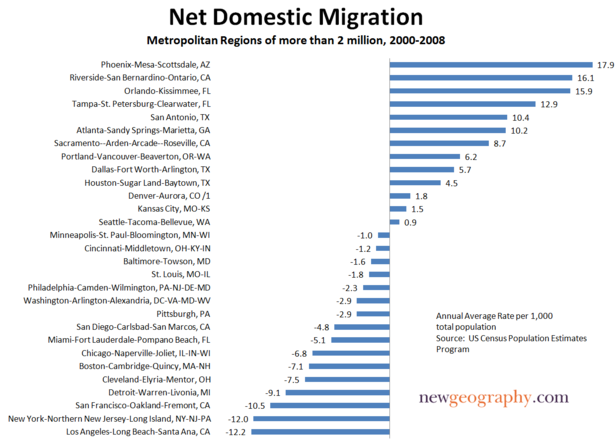
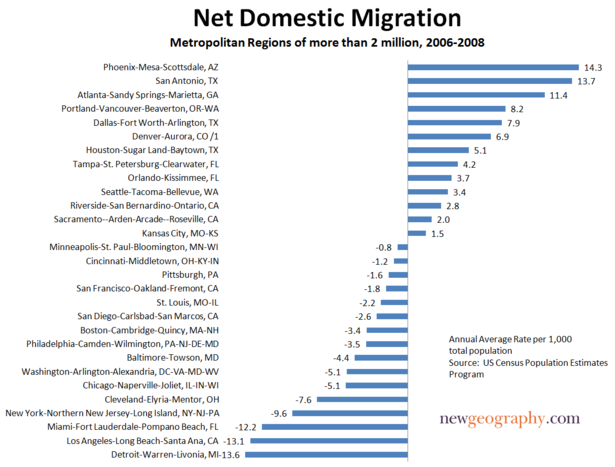
    This narrative, which has not changed much over the past decade, is misleading and largely misstated. Net migration, both before and after the Great Recession, according to analysis by the Praxis Strategy Group, has continued to be strongest to the predominately red states of the South and Intermountain West.

    This seems true even for those seeking high-end jobs. Between 2006 and 2008, the metropolitan areas that enjoyed the fastest percentage shift toward educated and professional workers and industries included nominally “unhip” places like Indianapolis, Charlotte, N.C., Memphis, Tenn., Salt Lake City, Jacksonville, Fla., Tampa, Fla., and Kansas City, Mo.

    The overall migration numbers are even more revealing. As was the case for much of the past decade, the biggest gainers continue to include cities such as San Antonio, Dallas and Houston. Rather than being oases for migrants, some oft-cited magnets such as New York, Boston, Los Angeles and Chicago have all suffered considerable loss of population to other regions over the past year.

    Much the same pattern emerges when you look at longer-term state demographic patterns. A recent survey by the Empire Center for New York State Policy found that the biggest net losers in terms of per capita outmigration between 2000 and 2008 were, with the exception of Louisiana, all blue state bastions. New York residents lead in terms of rate of exodus, closely followed by the District of Columbia, Michigan, Pennsylvania, Massachusetts and California.

    An even greater shock to the sensibilities of the insular, Manhattan-centric media, the report found that most of the movement from the Empire State was not from the much-dissed suburbia, but from that hip and cool paragon, New York City. This can not be ascribed as a loss of the unwanted: According to the report, those leaving the city had 13% higher incomes than those coming in.

    How can this be, when everyone who’s smart and hip is headed to the Big Apple? This question was addressed in a report by the center-left, New York-based Center for an Urban Future. True, considerable numbers of young, educated people come to New York, but it turns out that many of them leave for the suburbs or other states as they reach their peak earning years.

    Indeed, it’s astonishing given the many clear improvements in New York that more residents left the five boroughs for other locales in 2006, the peak of the last boom, than in 1993, when the city was in demonstrably worse shape. In 2006, the city had a net loss of 153,828 residents through domestic out-migration, compared to a decline of 141,047 in 1993, with every borough except Brooklyn experiencing a higher number of out-migrants in 2006.

    Of course, blue state boosters can point out that the exodus has slowed with the recession, as opportunities have dried up elsewhere. True, the flood of migration has slowed across the nation. Yet it has only slowed, not dried up. When the economy revives, it’s likely to start flowing heavily again.

    More important, the key group leaving New York and other so-called “youth-magnets” comprises the middle class, particularly families, critical to any long-term urban revival. This year’s Census shows that the number of single households in New York has reached record levels; in Manhattan, more than half of all households are singles. And the Urban Future report’s analysis found that even well-heeled Manhattanites with children tend to leave once they reach the age of 5 or above.

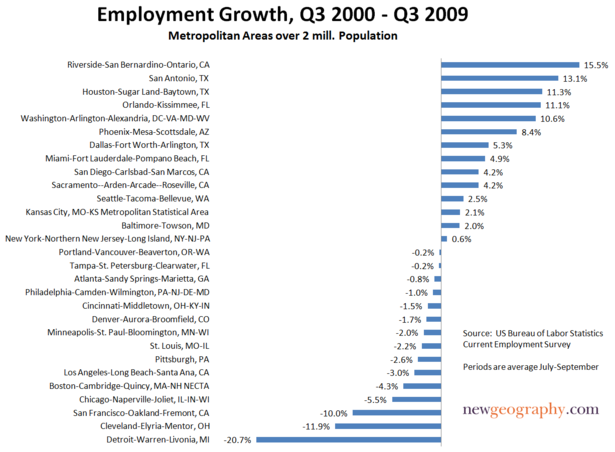
    The key factor here may well be economic opportunity. Virtually all the supposedly top-ranked cities cited in this media narrative have suffered below-average job growth throughout the decade. Some, like Portland and New York, have added almost no new jobs; others like San Francisco, Boston and Chicago have actually lost positions over the past decade.

    In contrast, even after the current doldrums, San Antonio, Orlando, Houston, Dallas and Phoenix all boast at least 5% more jobs now than a decade ago. Among the large-narrative magnet regions only one–government-bloated greater Washington–has enjoyed strong employment growth.

    The impact of job growth on the middle class has been profound. New York City, for example, has the smallest share of middle-income families in the nation, according to a recent Brookings Institution study; its proportion of middle-income neighborhoods was smaller than that of any metropolitan area except Los Angeles.The same pattern has also emerged in what has become widely touted as America’s “model city”–President Obama’s adopted hometown of Chicago.

    The likely reasons behind these troubling trends are things rarely discussed in “the narrative”–concerns like high costs, taxes and regulations making it tough on industries that employ the middle class. One clear culprit: out of control state spending. State spending in New York is second per capita in the nation (anomalous Alaska is first); California stands fourth and New Jersey seventh. Illinois is down the list but coming up fast. Over the past decade, while its population grew by only 7%, Illinois’ spending grew by an inflation-adjusted 39%.

    The problem here is more than just too-large government; it lies in how states spend their money. Massive public spending increases over the past decade in California, New Jersey, Illinois and New York have gone overwhelmingly into the pockets and pensions of public employees. It certainly has not flowed into such basic infrastructure as roads, bridges and ports that are needed to keep key industries competitive.

    The American Association of State Highway Transportation, for example, ranked New York 43rd in the country and New Jersey dead last in terms of quality of roads. Some 46% of the Garden State’s roads were rated in poor condition, compared with the national average of 13%, even as the state’s spending reached new highs. The typical New Jersey driver spends almost $600 a year in auto repairs necessitated by the poor conditions of the roads.

    In contrast, states in the South and parts of the Plains tend to pour their public resources into productive uses. Cities like Mobile, Ala., Houston, Charleston, S.C., and Savannah, Ga., have been investing in port facilities to take advantage of the planned widening of the Panama Canal. The primary goal is to take business away from the increasingly expensive, overregulated and under-invested ports of the Northeast and West Coast. Similarly, places like Kansas City and the Dakotas are looking to boost their basic rail and road networks to support export-heavy industries.

    Even in the face of the Obama administration’s strongly urban-centric, blue state-oriented economic policy, these generally less than hip places appear poised to grow as the economy recovers. Virtually all the top 10 economies that have withstood the recession come from outside the “youth-magnet” field: San Antonio; Oklahoma City; Little Rock, Ark.; Dallas, Baton Rouge, La.; Tulsa, Okla., Omaha, Neb.; Houston and El Paso, Texas. The one exception to this rule, Austin, also benefits from being located in solvent, generally low-tax Texas.

    This continued erosion of jobs and the middle class from the blue states and cities is not inevitable. Many of these places enjoy enormous assets in terms of universities, strategic location, concentrations of talented workers and entrenched high-wage industries. But short of a massive and continuing bailout from Washington, the only way to reverse their decline will be a thorough reformation of their governmental structure and policies. No narrative, no matter how well spun, can make up for that reality.

    This article originally appeared at Forbes.com.

    Joel Kotkin is executive editor of NewGeography.com and is a distinguished presidential fellow in urban futures at Chapman University. He is author of The City: A Global History. His next book, The Next Hundred Million: America in 2050, will be published by Penguin Press early next year.
  • Riding Out the Recession in the Forty Strongest Metropolitan Economies

    A few days ago BusinessWeek released a list of the top 40 metropolitan economies based on data compiled at the Brookings Institution’s Metromonitor project. But, as many old media sites tend to do, they’ve locked the list behind a slow-loading slide show in a cheap attempt to drum up page views. Many of the commenters to the original article couldn’t even find the list.

    So, in the interest of usability, here’s the top 40 in boring list format:

    1 San Antonio, TX
    2 Austin-Round Rock, TX
    3 Oklahoma City, OK
    4 Little Rock-North Little Rock-Conway, AR
    5 Dallas-Fort Worth-Arlington, TX
    6 Baton Rouge, LA
    7 Tulsa, OK
    8 Omaha-Council Bluffs, NE-IA
    9 Houston-Sugar Land-Baytown, TX
    10 El Paso, TX
    11 Jackson, MS
    12 McAllen-Edinburg-Mission, TX
    13 Washington-Arlington-Alexandria, DC-VA-MD-WV
    14 Columbia, SC
    15 Pittsburgh, PA
    16 Harrisburg-Carlisle, PA
    17 Des Moines-West Des Moines, IA
    18 Virginia Beach-Norfolk-Newport News, VA-NC
    19 Honolulu, HI
    20 Rochester, NY
    21 Buffalo-Niagara Falls, NY
    22 Scranton-Wilkes-Barre, PA
    23 Augusta-Richmond County, GA-SC
    24 Colorado Springs, CO
    25 Madison, WI
    26 Albuquerque, NM
    27 Syracuse, NY
    28 Albany-Schenectady-Troy, NY
    29 Kansas City, MO-KS
    30 Raleigh-Cary, NC
    31 Ogden-Clearfield, UT
    32 Boston-Cambridge-Quincy, MA-NH (tied)
    32 New Haven-Milford, CT (tied)
    33 Bridgeport-Stamford-Norwalk, CT
    34 Denver-Aurora-Broomfield, CO (tied)
    34 Baltimore-Towson, MD (tied)
    35 Poughkeepsie-Newburgh-Middletown, NY
    36 Hartford-West Hartford-East Hartford, CT
    37 Indianapolis-Carmel, IN
    38 Memphis, TN-MS-AR

    Trends? Looks like energy economies, state capitals, university-heavy towns, generally affordable regions that avoided the housing boom, and a few old industrial centers that suffered the brunt of decline 25 years ago and now may be positioned for an up-swing.

    Here’s an explanation of the list methodology:

    The Brookings Institution ranked the 100 largest metros by averaging the ranks for four key indicators: employment change, unemployment change, gross metropolitan product, and home price change. Employment was measured by the change from the peak quarter for each metro to the second quarter of 2009. The peak was the quarter in which the metro had the most jobs during the past five years. Unemployment was ranked by measuring the percentage-point change from the first quarter of 2009 to the second quarter of 2009. Gross metropolitan product was measured from the peak quarter to the second quarter of 2009. And the ranking of home prices compared the second quarter of 2009 to the previous quarter. The employment data were provided by Moody’s Economy.com, the unemployment data were collected from the U.S. Bureau of Labor Statistics, and the home price index came from the Federal Housing Finance Agency.

    Source: The Brookings Institution’s MetroMonitor

  • GOP Needs Economic Populism

    You would think, given the massive dissatisfaction with an economy that guarantees mega-bonuses for the rich and continued high unemployment, that the GOP would smell an opportunity. In my travels around the country — including in midstream places like suburban Kansas City and Kentucky — few, including Democrats, express any faith in the president’s basic economic strategy.

    Ask a local mayor or chamber of commerce executive in Kentucky or Kansas City about the stimulus, and at best you get a shrug. Many feel the only people really benefiting from Obamanomics are Wall Street grandees, public employees, subsidized “green” companies and various other professional rent seekers.

    It’s not surprising, then, that most Americans — upward of 60 percent — feel the country is headed in the “wrong direction.” Most of these malcontents are not zealots such as those you might find at a tea party. They are more akin to villagers watching in horror as two armies, each fighting in their name, wage war on each other, leaving desolation in their wake.

    Yet it’s unlikely that the independent-minded will move to the GOP until the party comes up with a credible economic plan that addresses popular concerns. One big problem lies in the very nature of the Republican Party. Since Theodore Roosevelt, the party has devolved into a de facto shill for large corporate interests. One notable exception, to some extent, was Ronald Reagan, whose rise challenged the hegemony of some in the corporate establishment, first in California, when he was governor, and later nationally.

    Republicans may now find it convenient to rail against the Troubled Asset Relief Program, but it’s something many supported under George W. Bush. Even now, most are loath to fight excessive pay and bonuses at places like Goldman Sachs. Instead, it’s populists like North Dakota Democrat Byron Dorgan and Vermont independent Bernie Sanders who seem most outraged by the massive rip-off of taxpayers.

    Republicans also do not seem sympathetic to pro­posals by former Fed chief Paul Volcker and others to break up “too big to fail” banks or reimpose distinctions between investment and mainstream banks. If anything, this illustrates that for all the rhetoric about self-sufficiency and small business, they remain more attuned to Wall Street and K Street than Main Street.

    Yet there may be new opportunities for Republicans on the economic front. This winter, the focus of political debate will shift from health care to energy legislation. Whatever the negatives associated with President Barack Obama’s proposals, Republicans’ long-standing inability to reform clearly flawed health care systems has undermined their credibility. The health insurance industry and right-wing ideologues may applaud their efforts, but it’s unlikely to impress the many middle- and working-class Americans for whom the current system is not working.

    In sharp contrast, the coming debate over energy and climate plays to the weaknesses of the Democrats. All the administration’s talk of reducing our “addiction” to foreign energy can be painted as fraudulent, since the powerful green lobby will militate against developing our country’s huge natural gas and other fossil-fuel deposits, as well as nuclear power.

    In the past election, some of the few good moments for John McCain came in the wake of his embracing a nationalistic, growth-oriented “Drill, baby, drill” agenda. This approach remains popular not only with conservatives but also with moderates and independents, particularly in energy-producing states.

    Obama’s climate change proposals offer an additional opportunity. The mainstream media remain slavishly tied to the Al Gore warming thesis, but skepticism toward the anti-carbon jihad is building via the Web. In recent months, Gallup, Pew and Rasmussen have reported reduced enthusiasm for radical steps to battle climate change. Right now, this seems to be a major concern for barely one in three Americans.

    Yet the “cap and trade” proposals could prove a boon to some of the very corporate interests — on Wall Street and among utilities — still considered core supporters by some Republicans. GOP leaders seem simply incapable of comprehending the discreet charm that Timothy Geithner’s collusive capitalism holds for many corporate chieftains. In this, they resemble the boyfriend who ignores the implications of finding someone else’s Jockeys on his girlfriend’s bed.

    Sadly, those who do tend toward populism, like current front-runners Mike Huckabee and Sarah Palin, appear too socially regressive to appeal to the suburban independents who will decide the elections in 2010 and 2012. Americans may yearn for an economically populist alternative, but not if they think it will bring back the Inquisition.

    In the end, economic populism, not social conservatism, can transform Republicans into something other than a scarecrow party. And they could make this strategy work, if they only had a brain.

    This article originally appeared at Politico.com.

    Joel Kotkin is executive editor of NewGeography.com and is a distinguished presidential fellow in urban futures at Chapman University. He is author of The City: A Global History. His next book, The Next Hundred Million: America in 2050, will be published by Penguin Press early next year.

  • Yes, Manufacturing Matters

    Manufacturing employment has fallen below 12 million jobs for the first time since 1941, and manufacturing jobs as a percentage of total employment has fallen below 9%, the lowest level since the Bureau of Labor Statistics started collecting data in 1939. But annual manufacturing output per worker is also at a record high: $223,915 (in constant 2000 dollars). That’s almost 3 times as much output per worker as in the early 1970s, and twice as much output per worker compared to the mid-1980s.

    That has been the trend over the last 40 years: more output with fewer workers. That’s a good thing, or inevitable, or both – isn’t it? I used to think so; now I’m not so sure.

    Reversing Industrial Decline
    A recent report by the Lexington Institute spells out the depressing picture: After dominating global industrial activity for a century, the United States is losing its edge in manufacturing to other nations. Over the last 30 years, manufacturing has fallen from a quarter to an eighth of the domestic economy, while the share of manufactured goods consumed in America but produced by foreigners has risen from a tenth to a third. The decline of US manufacturing is reflected in record merchandise trade deficits, the loss of over 40,000 manufacturing jobs every month in the current decade, and the shrinking role of American producers in global industries such as electronics, steel, autos, chemicals and shipbuilding.

    US manufacturers continue to generate over 20% of global industrial output and have increased productivity by a third in this decade, but if current trends continue America will cease to be the biggest manufacturing nation in the near future. Many factors have contributed to the slippage in US standing, including high corporate taxes, burdensome regulations, globalization of the economy, and the efforts of trading partners to protect their economies.

    If the erosion of US manufacturing persists, America will become more dependent on offshore sources of goods and the nation’s trade balance will weaken. That will undercut the role of the dollar as a reserve currency and diminish US influence around the world, eventually having an adverse impact on our national security. This can’t be a good thing.

    China Gains in Manufacturing
    China is on its way to surpassing the US as the world’s largest manufacturer far sooner than expected. Does that matter? In terms of actual size, the answer is no. But if size is a proxy for the relative health (and prospects) of each nation’s economy, the answer could be yes.

    The US remains the world’s largest manufactuer. In 2007, the latest year for which data are available, the US accounted for 20% of global manufacturing; China’s share was 12%. The gap, though, is closing rapidly. According to IHS/Global Insight, China will produce more in terms of real value-added by 2015.

    US manufacturing is shrinking, shedding jobs and, in the wake of this deep recession, producing and exporting far fewer goods, while China’s factories keep expanding. Given the massive trade gap between the two nations and uncertainty in the US over when and to what degree manufacturing will recover, China’s ascent has become a point of growing friction.

    Many economists argue that the shrinking of US manufacturing – both in terms of jobs and share of gross domestic product – is a normal economic evolution that started long before China emerged as a manufacturing powerhouse. From their point of view, the shrinking would happen regardless and is actually a sign of health: the sector doesn’t need to be big to be productive.

    To those with this view, China’s rise is normal, healthy and beneficial, for it is the natural course of things for national economies to progress along the continuum from agriculture to manufacturing to services. We have trod that path, and now China is following.

    But another school of thought, held by “manufacturing fundamentalists,” contends that US manufacturing decline is not natural, healthy or beneficial, and must be reversed to retain America’s economic power and well-being. From this perspective, the idea that we can be a nonmanufacturing society – and still be rich, free and independent – is nonsense and folly. Such thinking has led, and will lead, to the collapse of civilizations.

    Even in its weakened state, manufacturing remains a surprisingly large part of the US economy. The sector generates more than 13% of the nation’s GDP, making it a bigger contributor to the economy than retail trade, finance or the health-care industry. Thus it would be devastating if US manufacturers now being hit by the economic downturn never recover.

    Manufacturing Not In Decline
    And yet, according to the Cato Institute, notwithstanding the recent recession that has affected all sectors of the economy, US manufacturing has been thriving in recent years. How can this be so? Again, it’s the productivity. Real US manufacturing output has increased by 81% since 1987. American real manufacturing value-added – the market value of manufactured goods, over and above the costs that went into their production – reached a record-high level in 2007.

    Manufacturing as a share of gross domestic product peaked in 1953 at about 28% of the economy and has been trending downward ever since. Today manufacturing accounts for about 12% of our services-dominated economy, but manufacturing output and value-added are higher than ever in real terms.

    According to the United Nations Industrial Development Organization, US factories are the world’s most productive, accounting for 25% of global manufacturing value-added. By comparison, Chinese factories account for 10.6%.

    That may be hard to fathom, says Cato, given that US factories tend not to produce the sporting goods, toys, tools, and clothing found in Wal-Mart and other retail outlets nowadays. But US factories make pharmaceuticals, chemicals, technical textiles, sophisticated components, airplane parts, and other products. American factories have moved up the value chain.

    In comparison, the percentage of Chinese value-added in high-tech exports is quite small. Economists at the US International Trade Commission estimate that only about 50% of the value of US imports from China is actually Chinese value-added; the rest is value added in other countries and embedded in the components, design, engineering, and labor.

    In iPods, for example, the Chinese value-added is a few dollars on a product that costs $150 to produce and retails for $299. Further, their sale in the United States and elsewhere supports high-paying American engineering, marketing, and logistics jobs, while providing Apple with the profits to conduct R&D to employ more engineers and keep the virtuous circle going. Without complementary Chinese and other foreign labor, far fewer American manufacturing ideas would come to fruition.

    American manufacturing is therefore not in decline, right?

    The Plight of American Manufacturing
    No, that’s not right, and yes, manufacturing is in decline, and therefore so is America. That’s the case strongly made in Manufacturing A Better Future for America, published by Alliance for American Manufacturing.

    The United States is broke because it has stopped producing what it consumes, writes the book’s editor, Richard McCormack, who is also the editor and publisher of Manufacturing & Technology News. Even an increase in consumer demand, he notes, will not put Americans back to work as the spending will only help workers making products overseas.

    About 40,000 US manufacturing plants closed between 2001 and 2008, resulting in the loss of millions of good-paying jobs, according to AAM. Offshoring of production means that the United States is not generating enough wealth to pay its mounting and massive debts. The mindset among America’s economic elite – that the country does not need an industrial base – has put the country and the world economy in a ditch.

    The book refutes some widely promoted myths, including that the US economy can thrive with just service industries as good-paying jobs are replaced by other sectors. It also debunks the notion that lost manufacturing plants will not mean lost research and development. It details the unfair trading practices China employs, and explains the social costs of the decline in manufacturing.

    It is often said our economic future is dependent on innovation and/or job training. These factors are supported most strongly in manufacturing.

    Conclusion
    You can see why I have developed doubts that the diminishing of a manufacturing base and loss of manufacturing jobs are natural, inevitable, or good for the United States and its citizenry. A post-industrial economy does not obviate the need for industry. A large and rising value of intangible goods does not obviate the need for the production of tangible things. And a “new economy” does not obviate the need for a manufacturing base.

    Dr. Roger Selbert is a trend analyst, researcher, writer and speaker. Growth Strategies is his newsletter on economic, social and demographic trends. Roger is economic analyst, North American representative and Principal for the US Consumer Demand Index, a monthly survey of American households’ buying intentions.