Category: Economics

  • Report from Orlando: The Spirit Rocks On

    By Richard Reep

    “In hard times, people turn to God or alcohol” jokes Bud Johnson of Constructwire, a database that tracks planning and construction projects nationwide. Johnson, 50, is an industry veteran and has never seen a recession like this in his career. “This is an exceptionally broad-based downturn,” he says, “and Orlando has been hit harder than most in the South, what with your only real industries being housing and tourism.” Both industries have been trapped like mammoths in a glacier as the credit market stays stubbornly frozen in a modern banking Ice Age.

    At the bottom of the glacier, however, the meltwater continues to flow, and bars and liquor stores seem to be thriving. With 10 new ABC stores open this year, this privately held Orlando-based liquor retailer is doing just fine, enabling many of us to stay sane, if not sober, while waiting for The Recovery. The alchoholic spirits are not the only mood-shifting business doing well in these hard times. Sacred space may not be exactly booming, but religious buildings are being built at a more comfortable pace than nearly any other building type in Central Florida.

    “Ecclesiastical architecture is falling at a rate close to that of a paper airplane, while my other building types have the glide ratio of a rock,” says Peter Kosinski, the architect responsible for the renovation of St. James Cathedral in downtown Orlando. With most other projects on hold, including a share of churches, Kosinski Architecture has still seen most of his religious work proceed, despite the Great Recession. Funding largely comes from donations, and for secular not-for-profits cultural outfits like United Arts, giving has evaporated. Spiritual needs, however, seem to be drawing a steady stream of money to expand or add to temples, churches, synagogues, and other sacred spaces to meet a growing demand in the Central Florida area.

    If the credit Ice Age is a part of a great karmatic rebalancing, it was long overdue and has hit especially hard in our overheated, consumer-driven culture. The cynics, who knew the cost of everything and the value of nothing, drove sacred space largely underground as new subdivisions engorged Orlando with not a square inch reserved for community worship. Religious uses simply don’t fit the profit model of late capitalism, and while our older neighborhoods are dotted with small, walk-to churches, not a cross can be found in the landscape of most newer developments. To the development industry, collective religious worship represents someone else’s unprofitable land sale.

    Cobbling together 15 or 20 acres therefore became a new art form for many evangelical pastors as the late 20th century saw the rise of the megachurch. These huge, Sunday-traffic-nightmares offer sophisticated audio/visual Christian themed entertainment in an arena setting, a perfect way for many to fulfill their spiritual needs. Others, stuck in these vast residential tracts devoid of sacred space, use the house-church method, gathering in groups of 8 or 10 at a member’s residence, taking heart in what Pope Gregory the Great (an early leader) stated: “The real altar of God is the mind and the heart of the just.” And some do both.

    Either way, the religious needs of the people of Central Florida are expanding, and the sanctuaries, temples, synagogues, and mosques are noticeably busier. The 2-year-old Guang Ming Temple, housing the local Renzai Humanist Buddhists, is experiencing a surge in attendance locally. Temple Director Chueh Fan confirms that there is a strong need for a communal spiritual facility. “We feel the hardship of people right now,” she states. “Although the Asian community here is stable, we have been growing over the last 2 years. And we are a middle-sized temple; there are some much bigger in other states.” Guang Ming offers Dharma classes in Spanish, English, Vietnamese and Chinese, and class enrolment is growing quickly.

    Other clerics, such as Reverend Reginald Dunston, also see a need for more religious-based education, and are planning new schools as well as sanctuaries. “Agape Word Ministry is planning a bible-based school,” he explains, “as an alternative to the schools in the area.” Other pastors, such as Jeff Cox of Salem Lutheran Church in Bay Hill, agree that it is important to expand their offerings to include a religious-based education. Education is the one tangible asset that a community is willing to purchase from a house of worship, and while most religions in America struggle for relevance, their schools remain in demand.

    Christianity, exploding in a pluralism not seen since the Reformation, is especially sensitive to its status as the dominant American religion. While over 4,000 new churches open nationwide annually, another 3,700 close, according to David T. Olson in his 2008 book “The American Church in Crisis.” This is near status quo, despite population growth, suggesting a shift away from collective religious worship for many. Hispanics, traditionally more observant, are building megachurches at a far faster clip than non-Hispanics, pointing to a loss of interest in collective Christianity for the majority of the population.

    Locally then, the house of worship is entering a phase of experimentation as new forms, such as megachurches, are tried; it is discarded altogether by the house-church movement; and it is growing in some religions such as Buddhism, with their new temple, and Judaism, with the construction of the new JCC South Campus on Apopka Vineland Road. The mainline Christian denominations that dominate downtown’s skyline serve less and less as a model for new buildings as malls are repurposed, warehouse buildings are adapted, and more novel programs and designs are tried.

    Hindu, Jain, and Muslim traditions are also represented in Orlando, and generally playing to full houses. The Masjid Al-Haqq mosque on West Central Boulevard on a Friday afternoon was brimming full, with more worshippers arriving by car and by foot. Collective spiritual worship of all forms is clearly a rising force within Orlando, and space on pews, benches, chairs and prayer mats are at a premium.

    Missing from many lives, crucial to others, religion is at an odd crossing in Central Florida’s history. To balance empty pocketbooks, some people are filling their cups with booze but others are also imbibing a perhaps long-delayed return to spirituality. This return, however, is marked by a mosaic of multiple religions, rather than a return to the few mainstream denominations that characterized early Orlando’s growth. If Bud Johnson is right, and this surge in spirituality lasts through The Recovery, Orlando will see a boom in new religious architecture that might make up for lost time, creating a revival in sacred space in the Central Florida landscape.

    Richard Reep is an Architect and artist living in Winter Park, Florida. His practice has centered around hospitality-driven mixed use, and has contributed in various capacities to urban mixed-use projects, both nationally and internationally, for the last 25 years.

  • Let Freedom Ring: Democracy and Prosperity are Inextricably Linked

    With autocratic states like China and Russia looking poised for economic recovery, it’s often hard to make the case for ideals such as democracy and rule of law. To some, like Martin Jacques, author of When China Rules, autocrats seem destined to rule the world economy.

    A columnist for the Guardian, Jacques predicted that by 2050 China will easily surpass America economically, militarily and politically. The belief in the power of autocracy even extends to such leading American capitalists as Warren Buffett and Bill Gates, who have nothing but high praise for what Gates enthusiastically describes as a “brand-new form of capitalism.”

    Fortunately a new study released Monday by my colleagues at the Legatum Institute refutes the notion that the road to worldly riches lies in autocracy and repression. In a careful study of everything from economic opportunity, education and health to security, freedom of expression and societal contentment, the Legatum “Prosperity Index” makes a powerful case for the long-term benefits of democracy, free speech and the rule of law.

    Some of this stems from how Legatum measures prosperity. The survey takes into account both wealth and well-being, and finds that the most prosperous nations in the world are not necessarily those that just have a high GDP, but that also have happy, healthy, free citizens.

    The top of the list, which ranks 104 countries, is dominated by flourishing democracies. The only exception in the top 20 is No. 18’s Hong Kong, which ranks first in economic fundamentals and continues to be ruled, if not quite democratically, under a far more permissive system than the rest of mainland China. The next semi-autocratic state on the list is Singapore, at No. 23 – another Confucian-style autocracy with great economic and human capital fundamentals.

    This linking of democracy and prosperity with well-being is by far the most significant aspect of the study. But what else determines the success of nations in the modern world?

    1. Small democracies do best.

    The denizens of the Greek city-states or their Renaissance counterparts would have recognized something of themselves in the small, well-managed countries that dominate the top of the list. The top five, Finland, Switzerland, Sweden, Denmark and Norway – as well as the Netherlands at No. 8 – certainly fit this description. These countries rank highly on the quality of life measurements, and, not surprisingly, their main cities also tend to dominate the most-livable-cities lists. With the exception of Switzerland and the Netherlands, these places do not perform as well in terms of basic economics, scoring between 10th and 18th. Although some might ascribe these rankings to successful social democratic policies, virtually all these mini-states have instated significant market-oriented reforms in recent years.

    Other top players Australia (No. 6) and Canada (No. 7) are far larger than their European rivals. And though their citizens are not as socially coddled as in Scandinavia, they enjoy strong democratic institutions, high levels of social well-being and good governance and education.

    And in purely economic terms Australia and Canada boast better economic fundamentals than the Scandinavian countries. One reason may be their enormous stockpiles of natural resources, now in high demand from countries like China and India. These countries also benefit by a large and often skilled migration from these and other Asian countries.

    2. Among the mega-countries, the U.S. is still way ahead

    Don’t cry for me, America. In terms of the large countries, both in population and size, no one comes close to the No. 9-ranked U.S. Indeed there’s not another country with over 100 million people on the list until you get to Japan at No. 16.

    Like all big countries, America is a complicated place, with distinct areas of strength as well as disturbing weaknesses. The U.S. leads all countries in entrepreneurship and innovation and ranks second in the stability of its democratic institutions – the Swiss are No. 1. Less than optimal health and safety rankings, however, push America from the top. Its economic fundamentals are also sub-prime, ranking only 14th, which isn’t surprising in light of persistent current account and now government deficits.

    Despite its problems, the U.S. still outperforms its other large rivals, not only Japan but also the U.K. (No. 12), Germany (No. 14) and France (No. 17). Yet judged within the ranks, all four of these economies have to be considered successful in terms of delivering prosperity and a reasonably high quality of life to their citizens.

    3. Breaking down the BRICs

    The Index’s most fascinating findings can be found a bit further down. The focus of the world’s economy has been shifting to countries that have been – and in some cases remain – governed by Communist, military or single-party dictatorships.

    Democracy’s efficacy can be seen clearly in success enjoyed by the former European Communist states – the Czech Republic, Poland, Latvia, Estonia, Slovakia and Hungary – all of which land in the first third of the ratings. Similarly, Taiwan (ranked 24th) and South Korea (26th), long ruled by military-dominated dictatorships, show how democratization and rising prosperity can flourish together.

    This pattern can also be seen among the “big boys” of the economic upstarts – the so-called BRIC countries. Here the leaders of the pack are both functioning democracies, Brazil (No. 41) and India (No. 45). These rapidly growing economies are kept out of the top tier by significant shortcomings in vital fields such as education, health and public safety.

    The other two BRIC powers, China and Russia, neither of which can be considered anything close to open societies, lag behind. Russia’s mineral wealth gets it a respectable 39th in economic fundamentals, but a lack of democracy, personal freedom and personal safety – as well as poor governance and corruption – drags it down to a paltry 69th. China, ranked a disappointing No. 75, also performs admirably on economic fundamentals, clocking in at No. 29, but is hammered for glaring shortfalls in democracy, personal freedom and governance as well as health and education.

    4. Autocracy may seem to pay, but not in the long run

    Throughout modern history, autocracy has proved effective in sparking fast growth, but a pervasive democratic deficit, poor governance and lack of personal freedom seem likely to constrain long-term progress. For one thing, the ruling elite in the dictatorship is under no strong compulsion to adjust to the needs of its population. Short of forestalling outright rebellion, nest-feathering tends to gain the upper hand.

    As you get to the bottom of the list, the price of dictatorship rises higher still. In this nether-region, there is nary a democratic state. Some of the low-ranking Third World countries are obvious – like Cameroon (No. 100) or Yemen (No. 101) – but some potentially rich but despotically ruled nations do poorly as well.

    Take, for example, No. 94 Iran, a country with enormous natural resources, a well-educated population and a rich cultural heritage. A reasonably enlightened Iran would likely sit in the top third of the list instead of skipping toward the bottom.

    Even the bottom-ranked country, Zimbabwe, left its colonial period with a thriving agriculture sector and great mineral wealth. Here again despotic rule has shown itself an adept destroyer of economic promise.

    In these times of acute self-doubt not only in America but across the democratic world, the Legatum ratings validate the idea that if democracy is not the inevitable wave of the future it represents by far the most efficient way to manage a society. In the end, democracy and prosperity prove not two distinct elements, but, in fact, inextricably linked to each other.

    This article originally appeared at Forbes.com.

    Joel Kotkin is executive editor of NewGeography.com and is a distinguished presidential fellow in urban futures at Chapman University. He is author of The City: A Global History. His next book, The Next Hundred Million: America in 2050, will be published by Penguin Press early next year.

  • Executive Bonuses: The Junta In The Boardroom

    Public companies and their management boards are run with all the democratic coziness of banana republics. The object of the junta is to transfer the wealth of the shareholders into the bonuses and stock options of the management. As they used to say in China, “business is better than working.”

    Amidst the outcry over excessive executive pay, it is worth noting that, in the caudillo management culture of many public corporations, there is nothing more annoying than a shareholder with an interest in the company that he or she partly owns. The most dreaded corporate day of the year is that of the annual meeting, when outside consultants are hired to screen bothersome questions and choreograph the happy gathering.

    During the meeting itself the greatest scorn is reserved for nosy shareholder questions about executive compensation and board composition, neither of which is deemed to be in the sphere of shareholder influence.

    The annual meeting ends with the appointment of outside auditors, a few planted questions, and — for those meetings held at some remote subsidiary, to keep activist shareholders from showing up — a trip to a regional airport.

    Archaic company by-laws explain why it will be nearly impossible for various regulators to cap the amounts that companies pay to executives. In short, the shareholders work for the managers, not the other way around. (If Goldman Sachs has so much extra cash, why don’t they raise the dividend?)

    Start with board composition, which is usually the domain of one executive: the chairman and chief executive officer. In a functioning system of corporate governance, the jobs would be separate. Chief executives would not also be assigned the job of monitoring their own performance, which is now the case in most public U.S. companies. Good European companies have a supervisory board, which oversees the performance and pay of the senior management.

    In the U.S., not only do foxes run the chicken coops, they get to eat most of the eggs and then write off the meals on their expense accounts.

    Most chairmen/CEOs stack their board and compensation committees with party-line stalwarts, who vote in favor of excessive pay packages in the hope that the recipient or one of his friends will not forget the favor. To break such a back-scratching system should be relatively easy, especially in companies regulated by the Securities and Exchange Commission. Simply mandate that management cannot sit on its own board of directors.

    Cumulative voting or proportional representation of the shareholders is another way to start breaking the management oligopoly of board composition. Board seats could also be allocated to representatives of retired personnel (who built the company) and those who now work in the company.

    Another way to limit excessive pay packages is to impose a binding ratio that caps executive pay based on the compensation of the company’s lowest paid workers. At the moment, CEOs in big public companies have packages that pay them more than a thousand times that of their employees’ lowest wages.

    J.P. Morgan thought the boss should only be paid twenty times the salary of the average company employee. Such an idea might not cap fat cat bonuses, but it would certainly improve the minimum wage.

    How then to claw back executive pay when the big bosses bet the ranch on something like sub-prime mortgages and lose?

    For starters, boards independent of management self-interest will be less forgiving when executives ruin a company or even turn in mediocre results. That so few banking executives were fired after the Great Collapse of 2008 is testament to the lack of shareholder representation on most boards of directors. Who fires the CEO when he reports to himself?

    Next, mandate that incentive compensation like stock options only be paid into segregated retirement accounts, which ought to align performance with long-term success.

    In financial services, the reward for failure should be just that: failure. In the recent crisis, deposed chairmen and chief executives were marched into the sunset with multi-million dollar severance packages. Remember the $64 million sayonara given to Citigroup’s Charles Prince, about the time the company’s shares lost $275 billion in market capitalization?

    A side affect of the government bailouts was to comfort bad managers. But while these corporate executives were pinning medals on their own chests (very much in the tradition of Latin strongmen), the reason given for the sweetheart loans, especially to banks, was to protect depositors. Under this variation of mutual assured destruction, financial institutions with a large depositor base can never be put to the wall, which gives them an effective government guarantee.

    To replace this kind of dependence on bankers who can gamble with deposits without consequences, there needs to be a mechanism that will protect depositors while allowing the larger financial companies to fail.

    For example, depositors could be given the option of buying deposit insurance — privately funded insurance, unlike that offered by the Federal Deposit Insurance Corporation — much in the way that air travelers buy accident insurance. That the FDIC caps out at $100,000 is neither here nor there. Under this scheme, insurance would be available for all amounts, large and small. It would be paid for in the market, not given as a government gift.

    When customers deposited money somewhere, they would decide if they wanted to insure the deposit or not. Those that wanted coverage would pay for it. Those that wanted to reply on their bank’s full faith and credit would leave their money uninsured and hope they have not found the next Lehman Brothers.

    Publishing rates on deposit insurance, much like posted interest rates, would be yet another indicator of a company’s financial health, much like the credit default swaps that are traded in institutional markets.

    The goal is to alert customers to good banks and bad ones, and to make clear that the bad ones will be allowed to fail, which is nature’s way of telling executives that they are overpaid.

    My last modest proposal is to encourage reconstituted boards of directors to auction off the positions of senior management.

    At the moment, managers justify their self-worth with a lot of encomiums about how big salaries and bonuses are necessary to insure that “we get the best people.”

    From what I can see, all that the big salaries insure is that companies keep a lot of mediocre executives, many of whom, judging by recent performance, then spend their time buying wine and sprucing up their vacation homes. Remember what was said, in Henry Ehrlich’s book of business quotations, about the compensation policies of Harold Geneen at ITT: “He’s got them by their limousines.”

    Under my revised system, top executives would be required to show the board that they have, in writing, a comparable offer from a competing firm (baseball works like this). As well, under the auction system, boards could entertain bids by senior executives to fulfill the roles of senior management.

    Clearly, chief executives have a good time in their corporate jets and swank hotel suites, which might lower what other senior managers would need every month to handle the top jobs.

    My guess is that a number of competent executives could be found willing to do the jobs of Fortune 500 CEOs, and for a lot less than what the current occupants charge the companies for their services (the average is over $10 million). Something tells me that Citigroup could have found a CEO for less than the $38 million that it paid to Vikram Pandit in 2008. Maybe it should have looked on eBay?

    Matthew Stevenson was born in New York, but has lived in Switzerland since 1991. He is the author of, among other books, Letters of Transit: Essays on Travel, History, Politics, and Family Life Abroad. His most recent book is An April Across America. In addition to their availability on Amazon, they can be ordered at Odysseus Books, or located toll-free at 1-800-345-6665. He may be contacted at matthewstevenson@sunrise.ch.
  • Fixing the Mortgage Mess: Why Treasury’s Efforts at both Ends of the Spectrum Are Failing

    To get a better idea why the Obama Administration’s efforts to stem the home foreclosure crisis have failed at both ends of the problem, you need only go back to that great scene in Frank Capra’s classic, “It’s A Wonderful Life,” where protagonist George Bailey (Jimmy Stewart) is on his way out of Bedford Falls with his new bride and high school crush, the former Meg Hatch (Donna Reed). The newlyweds are heading toward the train station to leave on their honeymoon when Meg notices a commotion outside the Bailey Bros. Building & Loan Association, founded by George’s revered but now deceased father, Henry, and Henry’s bumbling brother, Billie.

    The “commotion” is actually a run on the bank. George – bless his heart, and with the full encouragement of the new Mrs. Bailey – hops out of Ernie’s cab to see if he can quell the growing crowd assembling outside the locked doors of the Building & Loan. With his usual calm George assesses the situation, asks Uncle Billie to unlock the doors to let the gathering mob into the Building & Loan, and then proceeds to talk (most of) them out of closing their accounts and being refunded the value of their shares.

    George patiently explains to his anxious Association members that he can’t give each of them 100% of the value of their Bailey Brothers Building & Loan Association shares because the funds from those shares have already been loaned out to worthy borrowers so they can afford to build or buy houses in the community. States George from behind the teller counter:

    “…you’re thinking of this place all wrong. As if I had the money back in a safe. The, the moneys not here. Well, your money’s in Joe’s house…that’s right next to yours. And in the Kennedy’s House, and Mrs. Macklin’s house, and a hundred others. Why, you’re lending them the money to build, and then, they’re going to pay you back as best they can. Now what are you going do? Foreclose on them?”

    Just as George appears to be making progress, however, a now former Association member comes running into the Building & Loan pronouncing that Old Man Potter (Lionel Barrymore), who owns the bank and every other business in Bedford Falls, is offering to buy Bailey Brothers Building & Loan shares at 50 cents on the dollar (in an obvious effort to take advantage of the situation by running George Bailey out of business). Saving the day, and confirming that George has indeed made a life-changing decision in his choice of mates, the new Mrs. Bailey, with $2,000 in cash in her purse for their honeymoon, offers the money to the anxious Association members filling the building lobby. George then adroitly parses out their honeymoon money in the smallest increments he can persuade folks to accept under the circumstances.

    The scene tells us much about what went wrong with the residential real estate market nationwide. It is more than merely nostalgic to long for such elegant simplicity in the manner in which deposited funds were invested in things such as home mortgages. However, the only thing quainter than that scene in “It’s a Wonderful Life” is the idea of a bank or other financial institution originating, owning, and servicing the same mortgage. And therein lies the rub for efforts by the Treasury Department to help right the residential mortgage ship of state through the Making Home Affordable mortgage modification program and the Legacy Asset Recovery program.

    The root the problem lies with the complete disconnect between those who actually own the notes secured by the vast majority of residential mortgages in this country and those who “service ” those mortgages. Right now there is little if any incentive for those servicers to participate in the Treasury Department’s mortgage modification initiative (the Making Home Affordable mortgage modification program or “MHAP”), originally projected to foster the modification of 2.5 million mortgages but having resulted in only a fraction of that number in modified mortgages. This is at least in part because the fee structure under the existing servicing agreements does not adequately compensate the servicer for the amount of effort required to accomplish a mortgage modification. Further, there’s no clearly and easily identifiable “owner” of the notes that are secured by the underlying mortgages putting pressure on the servicers to modify these mortgage

    The national mega-banks that have received the lion’s share of Treasury’s multi-trillion bail-out of the banking industry have been, by far, the worst offenders in not embracing and implementing this program. And the problem can’t easily be fixed because it is structural in nature, the by-product of a system ironically intended to keep credit flowing into the residential sales market. For example, in Treasury’s recently released Servicer Performance Report through September 2009, Bank of America had modified under the MHAP only 11% of its approximately 876,000 home mortgages delinquent by 60 days or more (thereby making them eligible for modification under MHAP).

    The structural problems prevail at the investor-end of this morass as well. After much Congressional rhetoric and even more Wall Street teeth-gnashing over mark-to-market legislation late in 2008 that would have forced the holders of mortgage-backed securities (“MBS”) to mark down the value of their mortgage loan portfolios based on reductions in the underlying collateral value, Congress declined to take such action. The Legacy Asset Recovery program (so-called by Treasury because, quite honestly, who wants to invest in “toxic” assets), the investment component of Treasury’s Public-Private Investment Program or “PPIP,” pairs private capital with Treasury capital and then makes up the difference with federal low-cost debt. This program is intended to mitigate potential risks and rewards for these new equity participants by halving the amount of private equity that must be raised (since half of the total equity is provided by the government) and providing all of the required debt. As with any program whose purpose is to encourage private investments in bad debts – recalling the RTC program from the early 90s – potential profit is directly correlated to discounting the Legacy Asset purchasing entity can achieve in negotiations with the MBS holders.

    Regrettably, the assumptions underpinning the theory quickly prove not to be reasonable. At its core, the problem is that, in order for this initiative to work, the MBS holders need to do that one thing they’ve absolutely refused to do thus far: Take any losses.

    MBS holders are betting on their ability to hold onto their mortgage pools for as long as it takes for the excess housing inventory in the marketplace to get absorbed. They are also waiting for the end of the recession (perhaps around the corner but perhaps not) to turn into a full-fledged economic recovery, so that underlying real estate values start to catch up to portfolio values.

    Will this strategy work? Likely not if there’s a slow, largely jobless recovery that doesn’t support the housing market. As of now, the most recent projections for economic recovery in the real estate sector are looking to 2013. In the meantime, Treasury’s programs at both ends of the mortgage crisis will have done very little to stem foreclosures or stabilize capital flows to the housing market.

    Compounding the structural infirmities of these two “recovery” programs is that job growth is most likely to come first in states that have relatively few problems (Washington, D.C.-Metro Area; Great Plains; Texas) and will be far slower in many of the most troubled states, notably California, Michigan and Ohio, and parts of the Northeast. Hindsight being 20/20, rather than focusing so much attention and so many resources on helping the financial industry, which has been by far the largest recipient of Washington’s largess, the focus should have been on job preservation and job creation. The links, after all, between mortgage performance, housing values, and employment are undeniable.

    Peter Smirniotopoulos, Vice President – Development of UniDev, LLC, is based in the company’s headquarters in Bethesda, Maryland, and works throughout the U.S. He is on the faculty of the Masters in Science in Real Estate program at Johns Hopkins University. The views expressed herein are solely his own.

  • Stimulate Yourself!

    Beltway politicians and economists can argue themselves silly about the impact of the Obama administration’s stimulus program, but outside the beltway the discussion is largely over. On the local level–particularly outside the heavily politicized big cities–the consensus seems to be that the stimulus has changed little–if anything.

    Recently, I met with a couple of dozen mayors and city officials in Kentucky to discuss economic growth. The mayors spoke of their initiatives and ideas, yet hardly anyone mentioned the stimulus.

    “We didn’t see much of anything,” noted Elaine Walker, mayor of Bowling Green, a relatively prosperous town of 55,000 in the western part of the state. “The money went to the state and was siphoned off by them. We got about zero from it.”

    Ironically, Walker does not seem overly upset about the lack of federal assistance for Bowling Green. Instead, Walker–a self-described supporter of the president in a part of the country largely resistant to Obamamania–seems more disposed to taking matters into her own hands. Rather than waiting for Obama, Bowling Green is looking to stimulate itself–and other communities would do well to emulate this grassroots approach

    Bowling Green’s “self-stimulation” is part of a concentrated effort at diversification for the city, which has long depended on its General Motors plant, which produces the Corvette. Other single-industry-dominated regions, notably Detroit, have made much noise about moving into other fields, but their emphasis has frequently revolved around high-profile, highly subsidized projects such as “green” industries, entertainment or tourism.

    Instead, says Walker, the first step in diversification lies with boosting small local businesses.

    A primary vehicle for this has been the successful Small Business Accelerator located at an abandoned mall. Buddy Steen, who runs the program in conjunction with Western Kentucky University, claims it has fostered some 38 companies and created over 700 jobs. Blu Pharmaceuticals, developed by Small Business Accelerator, for example, currently employs five but expects to add another 40 workers at its new plant in nearby Franklin. The program’s other firms specialize in everything from electronic warfare to robotics.

    Kentucky may seem an unlikely spot for such ventures, admits local entrepreneur Ed Mills, but things are changing in the Bluegrass State. Mills, a former General Motors executive, and his twin sons, Clint and Chris, founded a Web-based software firm, HitCents, in 1995 when the boys were still in high school.

    Today the company, which develops software for retail and other applications, has over 50 employees and customers from across the country, including GM, as well as a host of local companies, unions and public agencies. “We hope to build a $100 million company, and we think we can do it.” Mills says. “You don’t have to be in California. People think you can’t do this in Kentucky but plainly you can.”

    With its strategic location on Interstate 65 connecting the old industrial heartland to the emerging one along the Gulf, Bowling Green enjoys many advantages. It’s slightly over an hour to Nashville and two hours to Louisville, the area’s two major consumer and cultural marketplaces.

    Other small communities in the state have also realized that any green shoots would have to come from local grassroots. Russellville, a rural community of some 7,200 in the southwest part of the state, is looking at a “back to basics” economic development plan that stresses the export of local food products and crafts.

    “You can ride down the highways and smell the hams smoking,” notes one local economic developer. “We are looking on how to export those hams to the rest of country.”

    Mayor Gary Williamson of Mt. Sterling, a town of 6,000 located in Montgomery County, in the generally more impoverished east, has been pushing a different strategy. His region is dotted with industrial plants of varying sizes. The city is also 45 minutes from Georgetown, site of a large Toyota factory.

    These employers require a steady stream of skilled industrial workers, particularly in such fields as machine maintenance. Williamson and other officials in the area see training such workers–starting at the high school level–as a way to not only keep people employed but to attract other firms to the area. “We want to keep people here, and they will do so if they have jobs after school,” he explains.

    It’s significant that such grassroots-based development–geared to unique local conditions–is taking place in Kentucky. For generations, the state and the rest of the surrounding Appalachian region has been the brunt of both jokes and patronizing attention from the nation’s academes, policy circles and media.

    Most Americans, observed Newsweek in 2008, “see Appalachia through the twin stereotypes of tragedy (miners buried alive) and farce (Jed Clampett).” One prime reflection of that approach can be seen in a CNN report last year that painted a decidedly dismal portrait of the region.

    For generations, Appalachia’s seeming backwardness has led to the creation of numerous federal programs aimed at lifting it into the national economic and cultural mainstream, notes University of Kentucky historian Ronald Eller. In his excellent Uneven Ground: Appalachia Since 1945, Eller describes how these efforts reflected the region’s “struggle with modernity.” Progress has been often associated with efforts to undermine what the late Michael Harrington described as a “separate culture, another nation with its own way of life.”

    Yet, this unique culture also could provide some of the basis for a regional recovery. There’s a growing sense, notes longtime Kentucky League of Cities President Sylvia Lovely, that the region’s fundamental assets–its natural beauty, resources and traditions of craftsmanship–could constitute a distinct advantage in the coming decades.

    More important still could be less tangible values, Lovely notes. “Modernity” in its current unadulterated form–with a lack of community, homogeneity and disconnect from the natural world–could be losing its allure for millions of Americans. In terms of what matters, she suggests, Appalachian towns may possess “if not more information, perhaps more wisdom than those who hold themselves out as experts. “

    Looking at the statistics, the news is not all grim. Despite its still glaring problems, particularly in its rural hinterland, Appalachia has been gaining steadily compared to the rest of the country. In 1960 one-third of Appalachia residents lived in poverty, compared with 1 in 5 nationally; by 2000 the poverty rates had fallen to 13.6%, just a tick higher than the national 12.3%. The region’s continued struggle with the gap between rich and poor, Eller notes, now more reflects broader national trends as opposed to something unique to the region.

    Perhaps the most dramatic changes are illustrated by migration patterns. By the end of the 1960s one out of every three industrial workers in Ohio came from Appalachia. Young people studied, notes Eller, “reading, writing and Route 23,” referring to the main highway to the industrial north.

    Since 2000 Kentucky, as well as Tennessee and West Virginia, have enjoyed positive rates of net migration. Although some parts of the region continue to suffer horrendous poverty and continued out-migration, many other communities–such as Bowling Green, Lexington and Louisville, as well some more rural areas–have attracted more newcomers than they have lost. Overall Appalachian states’ migration statistics look a lot healthier than Ohio and Illinois, not to mention New York or California.

    Walker–who moved to Kentucky from Los Angeles shortly after the 1992 race riots–sees this new migration as part of what will sustain a recovery in the region. Like many newcomers, Walker came to Kentucky not for bright lights but for a good place to raise her children. “Everyone still waves and says hi,” she observes. “That makes a lot more difference to people than many think. In the end, people come here because it’s a better place to live and also to raise your kids. It’s all about families.”

    Ultimately, a combination of folksiness and access to the world brought by technology could spark a continued renaissance not only in Bowling Green but across the region. The fact that the resurgence seems to be the product of largely local efforts not only makes it all the sweeter, but could inspire similar approaches among those communities still waiting for Washington to rescue them.

    This article originally appeared at Forbes.com.

    Joel Kotkin is executive editor of NewGeography.com and is a distinguished presidential fellow in urban futures at Chapman University. He is author of The City: A Global History. His next book, The Next Hundred Million: America in 2050, will be published by Penguin Press early next year.

    Downtown Bowling Green photo courtesy of OPMaster

  • American Agriculture’s Cornucopia of Opportunity and Responsibility

    A complex agriculture, along with urban culture, is one of the fundamental pillars of human civilization, and one of the fundamental bulkwarks of American prosperity. For families and communities involved in farming and ranching it’s also a way of life that is cherished, oftentimes passed on through generations, taking on reverential if not religious overtones.

    At the same time in today’s overwhelmingly urban culture, cooking has become prime time entertainment, dining a social event, and what a person eats is increasingly associated with a healthy body and mind – sometimes a sort of spiritual well being. This elevates agriculture to an important issue even among those who have never spent a day on a farm.

    Sadly, recent years have seen mounting efforts to discount the value, in particular, of the industry’s productive core. A just published feature story in Time magazine – Getting Real About the High Price of Cheap Food – makes the following claim. “With the exhaustion of the soil, the impact of global warming and the inevitably rising price of oil — which will affect everything from fertilizer to supermarket electricity bills — our industrial style of food production will end sooner or later.”

    Yet it is industrial, highly commercialized agriculture that first transformed America – and increasingly such countries as Australia, Brazil, Argentina and Canada – major forces in the world economy. The trend towards smaller-scale specialized production is indeed a welcome addition to our agricultural economy, but it is principally large-scale, scientifically advanced farming that produces the vast majority of the average family’s foodstuffs and accounts for all but a tiny percentage of our exports.

    The attack on “industrial” agriculture reflects a growing trend by environmentalists to subordinate all productive industry to their own particular agenda. Some extremists in the local food movement would discourage cold climate inhabitants from the luxury of a midwinter tropical fruit because of the energy used in shipping. Others propose elaborate schemes for urban farming so that land can be left to nature instead of cultivation.

    For others agriculture is guilty of producing a calorie-heavy, protein-rich diet that has made Americans unhealthy. In this lexicon ranchers, corn, and wheat farmers are not far removed from Afghan poppy growers or coca cultivators in South America.

    The assault on agricultural production and the food system as we know it is certainly not limited to the United States. Farmers in Great Britain, where the often well-heeled advocates of bucolic romanticism hold great sway, have faced withering criticism. The National Farmers Union recently stated that the pressures on land use and practices could seriously damage the agricultural economy, with serious global and moral consequences.

    Farming, they argue, depends “crucially on the productive core business remaining profitable. Without this core, British agriculture would “wither on the vine”, reducing both the global supply of food and making the UK ever more dependent on imports.

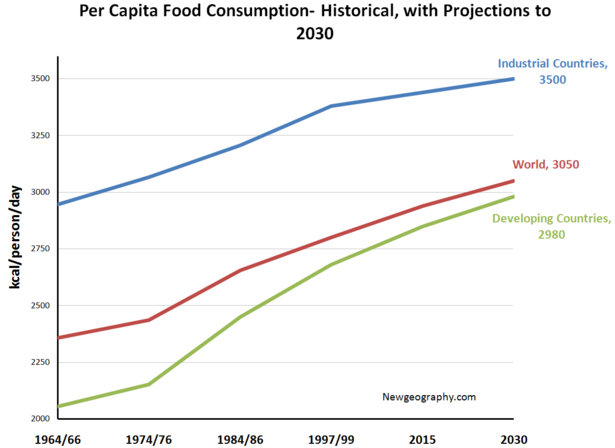
    When applied to the United States, the world’s largest food exporter, the consequences could be devastating. By 2050 the population of the planet will reach around 9 billion people with more than 85 percent of the world’s population located in developing countries. Roughly half will live in developing-country cities. In the United States the population is expected to grow by another 100-milion people by 2050.

    In this context, taking steps to reduce large-scale efficient production does not seem to be either a practical or humane choice. Certainly, better production and stewardship practices should be implemented and consumers can and could do more to drive these practices by making better nutritional decisions and choosing more responsible lifestyles.

    But these concerns should not obscure the fact that American agriculture stands at the core of meeting the challenge of feeding the world’s expanding population. It does this not only by producing a staggeringly diverse array of crops with amazing efficiency, but also by leading the world in the export of the agricultural technology that helps other countries, notably in the developing world, feed their own people.

    Greater Food Security and a Stronger Economy
    America’s agricultural producers have never been more productive and efficient than they are today. In 1953, the nation had a total of 5 million farms, working a total of 1.2 billion acres of land – the peak in production at that time. Over fifty years later, the number of farms in America has fallen by two-thirds, and the amount of land in use by producers has dropped by 25 percent, to around 900 million acres. Of the 2.2 million remaining farms, almost 96% are family owned. Even among the largest two percent of farms, 84% are family owned, challenging the commonly held perception of corporate domination.

    The US food industry is now the biggest in the world. In 2006, it was a $1.4 trillion sector, accounting for 12.3 percent of gross domestic product (GDP) and 17 percent of the country’s workforce – the second largest U.S. employer behind government. In some regional economies such as the Midwest and Upper Great Plains the demand by farmers here, and now increasingly abroad, for sophisticated machinery and equipment has spawned entire new industry sectors in electronics, wireless networks, and new material fabrication. The continual demand for new and improved practices in both crop and livestock production and processing has created new opportunities in the life sciences and biotechnology.

    This represents both an economic achievement and a great environmental benefit. Inputs of capital, labor, and materials have remained nearly steady, yet overall output has increased over two and one half fold over the same period of time. At the same time, efficient agriculture has returned to nature – forests, wetlands, prairie – millions of acres, far more than the land that has been devoted to housing and other urban needs.

    Like successful industrialists, American farmers and ranchers have taken advantage of the latest advances in engineering, technology, and science to do more with less, creating “arguably the most productive, efficient, and technologically advanced production agriculture sector in the world”. Indeed as many American manufacturing industries have fallen behind their foreign competitors, agriculture has remained in the forefront, a bastion of American competitiveness.

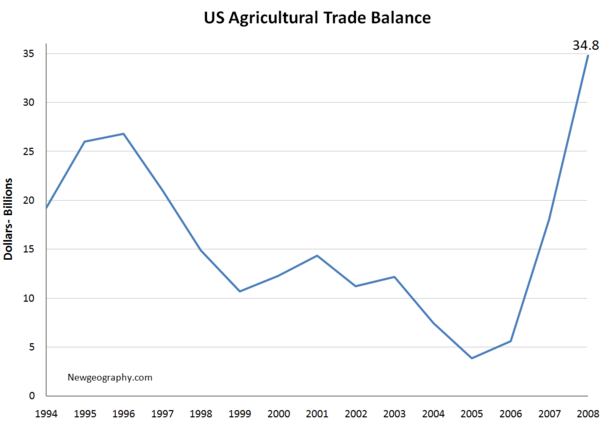
    These increasing levels of productivity have allowed American agriculture to become a powerful player in world agricultural trade. As the nation has seen overall trade deficits mount to record levels in recent years, the agricultural sector has proven a notable exception. American farms, able to “produce far beyond domestic demand for many crops,” have looked to the world market to absorb their output. In 2008, the United States exported over $115 billion worth of agricultural products, a record high.

    For the year, agricultural products made up ten percent of overall American exports, and the nation enjoyed an agricultural trade surplus of 35 billion dollars. While high commodity prices played their part in driving 2008’s export values higher, the agricultural sector has consistently shown export surpluses over the past 15 years, with the nation’s “share of the global market for agricultural goods,” averaging slightly over 20%.

    On the domestic front, production agriculture – and the wider world of agribusiness – provides not only food, fuel, and fiber for Americans, but also a source of employment. Roughly 4.1 million people are directly employed in production agriculture as farmers, ranchers, and laborers; but up to 21 million Americans work in jobs that are tied in some way to agriculture –approximately one out of six participants in the U.S. workforce.

    According to the USDA, the agricultural export industry supported as many as “841,000 full-time civilian jobs,” including “482,000 jobs in the nonfarm sector,” as of 2006. Production of food, fuel, and fiber involves support industries to supply the necessary inputs, and handle the product output, spurring economic activity in associated industries, including the “manufacturing, trade, and transportation sectors.”

    The continual adoption of advanced technologies and methodologies by American farmers and ranchers also creates demand for advanced research and development activity, from both the public and private sectors.These, in turn, spawn educational and entrepreneurial opportunities in a multitude of scientific and engineering fields. USDA research suggests that “each dollar spent on agricultural research returned about $10 worth of benefits to the economy.”

    Scaling Up Sustainable Agriculture

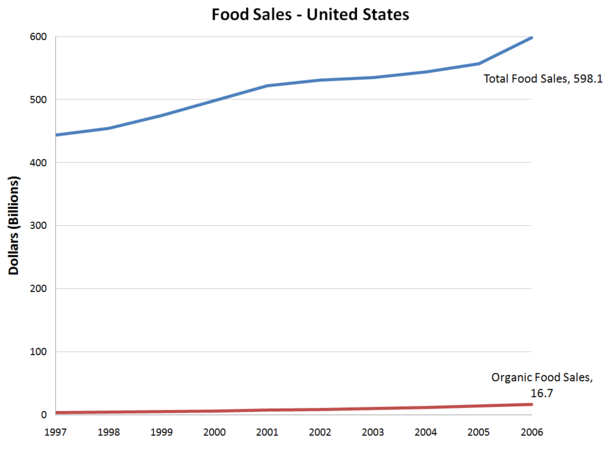
    None of this suggests that there is not room as well for what is known as sustainable, usually smaller scale, agriculture. Organic agriculture, where farmers minimize external inputs and are not permitted to use artificial fertilizers, pesticides or herbicides, is the most widely recognized segment of the sustainable farming industry. U.S. sales of organic food and beverages have grown from $1 billion in 1990 to an estimated $20 billion in 2007, and are projected to reach nearly $23 billion in 2008.

    This is clearly a growing industry, with organic food sales anticipated to increase an average of 18 percent each year from 2007 to 2010, according to an Organic Trade Association Manufacturing Survey. Yet organic foods and beverages account for less than 3 percent of all food sales in the United States – hardly enough supply or demand to feed a nation, much less a growing, hungry planet.

    The same technology that drives commercial, large scale agriculture – and is largely paid for by its profits – could expand the role of this specialized sector. This includes a greater role for what is commonly called precision agriculture. With the aid of technologies such as global positioning (GPS), sensors, satellites or aerial images, and geographic information management tools (GIS), every input can be applied optimally to meet the exact needs of the crop, and can be tracked and tailored with precision. Precision agriculture can be used to reduce energy usage and environmental effects of production agriculture.

    Precision agriculture builds on the strengths of America’s fundamental edge in innovation on the farm and in the factory. In the past, technology has been a major force in driving the shift of agricultural activities of the farm into the agribusiness input industries. Precision agriculture creates new and higher-value opportunities for agribusiness but also enables the farmer to apply the technology right in the field, thereby increasing the competitiveness and viability of farm operations of any size or ownership structure.

    This suggests that there is, in many cases, a false dichotomy between industrial and sustainable agriculture. American agriculture now competes in a truly global marketplace with a cornucopia of opportunities that extend to both systems. Technology and a focus on productivity can help sustainable farming expand, but this should not be at the expense of the larger, commercial sector that not only funds most new research but will continue to play a dominant role in both feeding the world and sustaining that most endangered of species – the American economy.

    Delore Zimmerman is the President of the Praxis Strategy Group an economic research and development strategy consulting company. Matthew Leiphon is a Research Associate with Praxis Strategy Group. Delore grew up in a small farming community in North Dakota, hauling bales and picking rocks for local farmers and ranchers. Matthew is from a North Dakota farm family and spends his fall weekends harvesting small grains and canola.

  • Too Big To Fail Needs to Go

    One of the causes of last year’s financial collapse was the adoption of the concept, ‘Too Big To Fail’. Washington decided long ago that some firms are so large and so integral to the economy that the failure of one of these firms would put the entire economy at risk. So, the government insures them at no cost.

    The problem with free insurance against failure is that it encourages excessive risk taking. This is the much-talked-about moral hazard problem, and it was a serious contributor to how we got to September 2008 in the first place. Since then, we’ve merged big bad financial institutions with big good financial institutions to create even larger financial firms. This has to stop.

    Why would a firm grow to the size we observe?

    Often, the firms’ managers tell us they merge to diversify. It is not true. Research I did with Bill English while I was at the Fed showed that large banks really didn’t diversify after they merged. They merged with firms much like themselves in similar markets.

    Besides, the argument for diversification is flawed on its face. Financial theory is clear. The investor can diversify more efficiently than the firm can diversify on the investor’s behalf.

    Firms also claim that they are merging to obtain economies of scale. That is not true either. A reasonably large literature is available on economies of scale. This literature is clear. Economies of scale are fully exploited when firms are much smaller than the ones that are currently considered Too Big To Fail. Indeed, diseconomies may exist at the size of our largest financial firms.

    Are there other reasons firms might want to become the size we see? Sure, but the participants are not likely to advertise those reasons. Firms constantly strive for market power, and size can help them achieve that market power. Of course, when firms have market power, the consumer loses.

    Firms might also merge to get the free Too Big To Fail insurance. That is clearly not in the best interest of anyone except the insured firm.

    The two most believable reasons that firms become Too Big To Fail are counter to the public’s interest. That’s worth repeating more forcefully. Firms that are Too Big To Fail serve no public interest. Since the public is funding the insurance, it needs to go.

    Washington’s response has been counterproductive. The preferred model seems to be fewer and even larger firms subject to more government regulation. This makes no sense. There is no evidence that regulation prevents financial collapse. The firms that were involved in last September’s nightmare were all heavily regulated. Indeed, they are among the most heavily regulated firms in the world, and we still saw the most devastating financial collapse since 1929.

    Additional consolidation and regulation is not only counterproductive, it approaches criminal insanity. It guarantees that we will see something like September 2009 again.

    We can only speculate as to why policy makers are responding to the financial crisis by increasing regulation of a consolidated financial sector. The most generous speculation is that fewer larger firms are easier to regulate effectively. Easier, maybe, but not more effectively.

    We would all be better off if there were no firms that were Too Big To Fail. So, let’s provide a strong incentive for them to voluntarily split themselves up into little, more efficient pieces. The easiest way to do this is to apply an onerous tax on any firm considered Too Big To Fail.

    This would be equivalent to overpricing the Too Big To Fail insurance. If the insurance is overpriced, no one will buy it. Instead, they will divide themselves up into several smaller, hopefully more specialized, firms.

    Implementing such a tax would be very easy to do, and it would be far cheaper than the alternatives. We need to get on with it before another crisis comes our way.

    Bill Watkins is a professor at California Lutheran University and runs the Center for Economic Research and Forecasting, which can be found at clucerf.org.

  • Central Banking: Feds Rule The Game

    In mid-September President Barack Obama mounted Theodore Roosevelt’s bully pulpit and railed against market greed to an audience of corporate tycoons. The objects of his derision included, and were limited to, bankers, financiers, and speculators in the ‘private’ financial community. Notably absent from the enemy bankers list were quasi-government banking corporations and America’s central bankers.

    Needless to say, the Wall Streeters convened in New York’s Federal Hall sat on their hands, perhaps wondering what had happened to the options that they underwrote for the Obama presidency when they passed around his campaign contribution hat to chip in $700 million.

    To hear President Obama’s version of recent financial history — echoed both by demonstrators and summiteers at Pittsburgh’s G20 jamboree — rapacious speculators and freebooters hijacked otherwise innocent American investors, stuffed their portfolios with inflated or worthless mortgage-backed securities, paid themselves huge bonuses for the effort, and then left the mess to be cleaned up, to use a George Bushism, by “the good folks in Washington.”

    The September New York meeting should have made for a compelling prime-time encounter session: Progressive president takes on the robber barons. After all, voters are leery of health care reform partly because they feel that, despite good intentions, their government has already bet the ranch by bailing out the banks.

    Such are the mixed metaphors of the Obama presidency that there is a constituency that cannot tell if he is a creeping socialist (too many public options) or a Wall Street front man (making the world safe for Goldman Sachs). Nor is there much consensus around the proposals to cap the bonuses of corporate hierarchs, even those who bled their companies dry.

    Certainly it seems odd that, after a global collapse of so many markets, President Obama cannot ignite a bonfire of the vanities at the head of Wall Street. After the recent speech, the corporate Medicis dismissed the need for comprehensive financial regulations and justified their bonuses much the way Babe Ruth once explained why he was paid more than the President (“Well, I had a better year”).

    The reason the U.S. administration does not get more traction with the panegyric of financial outrage is that many Americans now see little difference between the speculators on Wall Street and those running the government in Washington.

    After all, the biggest bets on sub-prime were made at two quasi-government corporations, Fannie Mae and Freddie Mac, and many of the bailed-out corporations earn their daily bread floating and trading U.S. government securities. In that sense, Wall Street treats President Obama as a cranky client, someone who often complains about the fees and commissions, but who has few alternatives to discount his paper.

    Teddy Roosevelt was able to take on corporate interests because, during the early 20th century, the U.S. government wasn’t in the banking businesses. President Andrew Jackson had driven a stake through the heart of the Second Bank of the United States, and throughout the 19th century the economy was in private, non-governmental hands.

    That private oligopoly was broken with the Federal Reserve Act of 1913, which put the U.S. government in the money game of issuing and regulating the currency.

    After 1913, it wasn’t just railroad speculators like Daniel Drew who could water the stock. The regional branches of the Federal Reserve System were also in the business of manipulating prices and values in the American economy. But that does not mean that the regulators always got it right.

    One way to read the history of the Great Depression is as a cautionary tale on the fallibility of central banking and the risks of government intervention in a market economy.

    That is a thesis of Liaquat Ahamed’s Lords of Finance, an account of the European and American central banks that “regulated” their economies into the failures of the 1930s. He makes the compelling case that the central bankers of Britain, France, Germany, and the United States fiddled with exchange rates, gold parity, currency issuance, and interest rates until the market crash of 1929-30 became the Great Depression of the 1930s.

    Central banks are, he asserts, above all political and not economic machines, and that for much of the early twentieth century, the government bankers never had “much of a year.”

    Leading up to the Great Depression, Britain pegged its currency to gold at too high an exchange rate, which led to collapse as traders relentlessly exchanged weakening pounds for Bank of England gold. France (like China today) played the game of low exchange rates, and subsidized its exporters with a cheap French franc, which undercut the European competition and hampered Germany’s re-integration into Europe.

    For its part, the United States insisted that France and England repay its war loans, which, indirectly, kept the economic pressure on Germany, which owed billions in reparations to the former Allies. And the German central bank, at various moments, chose to lessen its debt load with runaway inflation, which wiped out not just interest payments, but savings accounts and democratic government.

    In many ways, in steering the U.S. economy away from Great Depression, Part II, the Obama administration is facing the same dilemmas that confronted the Bank of England, if not the German government, after the 1929 Crash. Although the U.S. dollar is not pegged to gold, it is fixed to an artificially high standard of American living, which is supported with massive debt at all government and household levels.

    To pay off these obligations, the government can let the dollar sink, which will subsidize exporters, but infuriate foreign creditors, such as China. This route would also prime the pump of inflation, which is a tax on savings and a gift to debtors, such as the indebted U.S. government.

    Or Washington can push a strong dollar policy, which our allies and creditors would prefer. But that will make the United States a poorer nation, as national wealth and assets will need to be transferred to pay off the borrowing binge.

    Little did President Obama acknowledge, when he stood at Federal Hall in the shadow of George Washington’s first inaugural, that the speculator he should have been denouncing was none other than the government that he heads. This does not excuse the self-congratulatory bonuses of Wall Street punters or the failures that they engineered, and which President Obama papered over with bailout money and stimulus packages. But it does suggest why few in the crowd, or the electorate at large, cried “bully” when he was finished. They are in the same game.

    Matthew Stevenson was born in New York, but has lived in Switzerland since 1991. He is the author of, among other books, Letters of Transit: Essays on Travel, History, Politics, and Family Life Abroad. His most recent book is An April Across America. In addition to their availability on Amazon, they can be ordered at Odysseus Books, or located toll-free at 1-800-345-6665. He may be contacted at matthewstevenson@sunrise.ch.

  • Can Silicon Valley Attract the Right Workforce for its Next Turnaround?

    In less than 30 years, Silicon Valley has rocketed to celebrity status. The region serves as the top magnet for innovation, often occupying the coveted #1 position of global hot spot rankings. More of an informal shared experience than a physical place, Silicon Valley capitalizes on being centrally located in the San Francisco Bay Area, a broader regional zone that is an economic powerhouse.

    Keeping this leadership position requires constant transformation. The region has weathered and reinvented itself through previous downturns. These next few years, in the wake of what some have termed the Great Recession, will provide another test of economic recovery and relevance.

    Based on a recent in-depth research study of global innovation networks, several elements will be essential to the future success of the Bay Area. Two critical but often overlooked factors are specifically community colleges and local demographics. Both are tied directly to people.

    Almost any conversation of innovation assumes that the top research institutions are prerequisites. Boston has MIT and Harvard; the Bay Area has Stanford University and the University of California at Berkeley. One university professor said frankly, “Stanford is part of what the outside world sees as part of the Silicon Valley secret.”

    These tier-one universities do play a critical role within the local economy, receiving the greatest doses of federal research dollars and enjoying their pick of top young talent. They also soak up the spotlight, so much so that the tiers below them are often ignored by local policymakers.

    This elitist mentality dominates the top of the Bay Area food chain. An eminent faculty leader of a biotech institute was astounded when asked about the role of the other local schools for regional growth. He remarked, “We are more focused on the entrepreneurs than the foot soldiers. We kind of believe that [latter] part will take care of itself.”

    This kind of thinking is delusional. In truth, community colleges provide the bedrock for the region’s university ecosystem. They channel bright students up the local educational chain, helping train and transfer them to the upper tiers. Within the Bay Area, the Foothill-De Anza Community College has served a diverse student body, which includes a combination of younger, older, and re-entry students, for over 50 years.

    In particular, community colleges serve as a gateway to ambitious foreign-born talent. Foothill-De Anza admits more international students than any other community college in the U.S., notes Peter Murray, Foothill’s Dean of Physical Sciences, Mathematics and Engineering. Many of these students from outside the U.S. seek a natural entry to Silicon Valley. Once on a student visa, they aggressively pursue their career interests, often transferring to another state school, such as Stanford or the University of California system, to finish their degrees and join the local workforce. Others gain critical technical skills – such as in database management or bioinformatics – critical to operating sophisticated, technology-based companies.

    The community colleges also learn to do more with less. Although state-assisted, Foothill-De Anza funds students at a relatively low rate of $4019 per student, even compared to other national community colleges that average $8041 per student, according to Community College League of California statistics. This is far below what it costs to send students to Berkeley or Stanford.

    Most recently, the school’s administration has faced painfully deep state budget cuts, re-juggling curriculum priorities and teaching staff loads. They adjust by being flexible. The community college system recently announced a partnership with the University of California at Santa Cruz with ambitious plans to build a new billion-dollar multi-university campus at the NASA Ames Research Center. Carnegie-Mellon University in Pittsburgh and San Jose State University in San Jose, Calif., have joined the unique venture that mixes private, public, and industry spheres.

    The new campus will include a new School of Management, major science laboratories, engineering facilities, classrooms, and homes for 3,000 people on 75 acres. The backers are hopeful that this will lead to a “sustainable community for education and research.” If all goes accordingly to plan, this university will offer a new model of education that combines the best of a local community college, local metropolitan school, two universities at a distance, and a strong industry partner.

    Education constitutes only one part of the region’s human capital outlook. Local population trends can reflect the overall strength of the workforce and its ability for continued growth. On a more fundamental level, innovation efforts rest on people who start and grow new ventures. By understanding current demographics, you garner strong hints for future gaps and issues.

    Looking just at Silicon Valley, the area’s population grew modestly by 1.6% to a total of 2.6 million residents for 2008, according to the latest Silicon Valley Index. Compared to California and the U.S., Silicon Valley’s population consists of fewer children and more people between working ages (25–64). This combination bodes well for work productivity, but also indicates that many who start families soon drift to other states to raise the next set of young workers.

    Silicon Valley does better attracting and retaining foreign talent, who seek new opportunity and prosperity. AnnaLee Saxenian, a dean at the University of California at Berkeley, considers this global migration and circulation to be critical in maintaining regional advantage. Foreign immigration has driven Silicon Valley’s population growth. Looking solely at U.S. Census data estimates for the period of 2000 and 2003, foreign migration to the metropolitan cluster of San Francisco, Oakland, and Fremont rose by 10 percent each year, while domestic migration dropped by nearly 14 percent on average.

    Another good sign is that foreign students, particularly those receiving degrees in science and engineering, continue to stay higher in Silicon Valley than other U.S. regions. Unfortunately, when the student visas end, many of these bright workers, who would otherwise stay in the area, take their skills and dreams back home.

    More worrying, college graduates – both foreign and domestic – are leaving the region on their own volition. No city in the greater Bay Area sits in the top 20 list of places to work after college. If American youth are relocating to other areas, then the region may be destined to simply age in place. Local parents in my recent research study simply did not make the connection that nearly all their grown children lived elsewhere – and what that implication entailed for long-term regional vitality.

    Part of this difference in understanding can be explained by generational biases. Each generation brings a dominant set of traits that shape the tone and direction for local innovation. Baby Boomers (born 1943–1960) are focused on their own pursuits. Even when retired, Boomers stay active as consultants and independent contractors, partly to offset decreased life savings as well as enjoy a self-sufficient lifestyle. Often criticized for being narcissistic, they can help to influence innovation activities for others through policy and funding decisions. A senior research policymaker said emphatically, “What are we going to do for the generations out ahead of us? That’s what I care more about than anything.”

    Generation X (born 1961–1981) is the most entrepreneurial generation in U.S. history, but the smallest in size, so policymakers easily overlook them. Certain tensions exist with the prior generation. Research from Neil Howe and William Strauss show that the Boomers are increasingly resisting the decisions made by Gen X to the point of overlooking their contributions in favor of the next generation.

    This is a drastic mistake for two reasons. First, the average age for a U.S.-born technology entrepreneur to start a company is 39, which sits squarely in Gen X. This generation has already become the primary engine for Silicon Valley. Second, this generation has the best academic training and international experience in American history. They may be small in their weight class, but Gen X packs a hefty punch overall. The challenge will be for the Bay Area to retain this population group, as their family and career needs shift.

    In contrast, the Millennials (born 1982–2005) are generally focused on social bonding, authority approval, and civic duty – attributes that may make parents happy, but do not usually drive new economic growth. As the largest generation in American history, they are proving to be massive consumers of technology and social advocates. By and large, Millennials steer away from high-risk ventures, preferring community-oriented activities, and they bring a different set of demands to the Bay Area.

    In the innovation lifecycle, if Boomers serve as advisors and Gen Xers as the entrepreneurs, then the Millennials could provide potent networkers. Each plays an essential role in regional growth, and all frequently vote with their feet. The critical question is whether the Bay Area is positioned to retain the right workforce mix to harness its next turnaround, or whether the dynamism will shift to other regions both in America and abroad.

    Tamara Carleton is a doctoral student at Stanford University, studying innovation culture and technology visions. She is also a Fellow of the Foundation for Enterprise Development and the Bay Area Science and Innovation Consortium.

  • Mexico’s Real War: It’s Not Drugs

    Balding, affable and passionate, Uranio Adolfo Arrendondo may not be a general or political leader, but he stands on the front lines of a critical battle facing Mexico in the coming decade. This struggle is not primarily about the drug wars, which dominate the media coverage–and thus our perceptions–of our southern neighbor. It concerns the economic and political forces stunting the aspirations of its people.

    For the past 36 years, Arrendondo’s small family-owned school, Liceo Reforma Educativa, where he is principal, has served as an incubator for Mexico City’s aspiring middle class. Modest and reasonably priced, the school has offered small-business owners, professionals and mid-level managers a way to propel their children up the economic ladder.

    Yet today Arrendondo finds many parents lacking the resources for even a modest alternative to Mexico’s troubled state-run schools. “The middle class in Mexico is going down,” Arendondo told me in his office by the courtyard of the brightly painted school in the largely lower-middle-class Iztacalco, one of Mexico City’s 16 diverse delegaciones, or boroughs. “The middle class is predated by both the super-rich and the criminal poor. We are squeezed in the middle of the sandwich.”

    This predicament is not unique to Liceo Reforma, which has some 245 students. Data from the Asociacion Nacional de Escuelas Particulares estimate that as many as 400,000 people have pulled their children out of small private schools over the last few years, placing them instead in the generally much inferior public ones.

    This is just one sign of a worrisome trend toward downward mobility, greatly exacerbated by the economic crisis. And it is all the more painful, as it represents a reversal of progress toward an expanding middle class in the 1970s and 1980s. In those decades, Mexico–spurred by its energy wealth and an expanding industrial base–was finally beginning to break away from its age-old pattern of being a society dominated by a few rich and many very poor.

    To be sure, Mexico City’s sprawling expanse still exhibits this legacy of upward mobility. A good number of the capital’s 20 million people can be seen crowding elegant shopping centers, driving late model cars and eating in crowded restaurants. With the elegant Polanco, not far from the central district, lovely Lomas de Chapultepec, or sprawling, ultra-modern Santa Fe, Mexico City can seem very much a first-world city.

    At the same time, however, much of it–including lower-middle class Iztacalco–needs considerable repair. The root of the problem lies in demographics. Although Mexico’s population growth has slowed, labor-force growth still outpaces economic fecundity. Victor Manuel, director general of a leading high-tech institute in Mexico City, estimates the country’s gross domestic product needs to grow at 7% annually to produce the 2 million new jobs needed each year to keep up with labor-force growth. Over the past decade, that growth has been roughly 3%, and last year declined by as much as 7%.

    In the immediate future, many economists expect Mexico’s recovery to lag that of both the U.S. and its Latin neighbors, particularly Brazil and Peru. The most recent survey of expectations among industrialists conducted by Canacintra, a leading national business chamber of manufacturers, found more than half expected conditions to get worse, 10 times as many who expressed optimism.

    The sluggish economy has had its most dramatic impact on the poor, who constitute upward of 25% to 30% of the population. In contrast to earlier decades, their ranks may now be growing, suggests Alfonso Celestino, a social scientist who works for the government of the sprawling Districto Federal, which includes Mexico City. “Mexico is a first-world city, but large parts are like third-world African cities,” he asserts

    Particularly notable has been the growth of the so called “misery suburbs” or pueblos nuevos, sprouting in the outer periphery of the city. In these areas, as well as poor inner city neighborhoods, unemployed young people are being “absorbed,” as Celestino puts it, into the illicit economy. This burgeoning criminal infrastructure preys directly on the super-rich through kidnappings and their bloody feuds that discourage both investors and tourists.

    Yet it is perhaps more dangerous, as violence has grown and poverty increased, that the middle class has begun to recede. Unlike the very poor and the elderly, such families receive little public assistance and often make do by working in the massive “informal economy” that, by some estimates, constitutes as much as 40% of the entire country’s gross product.

    Even before the economic crash in 2007, large percentages of educated Mexican workers were finding it difficult to get placed in high-skilled jobs. Miguel Angel Juarez Noguez, a junior-high math instructor, graduated with a degree in computer science in 2006, but says few of his friends have found employment inside the information sector.

    He believes his parents, both mathematics instructors, enjoyed far better prospects than he and his family–including two children–now face due to a weak job market and rising cost of living. “Today” he suggests, “you need more education to get less.”

    These problems have been exacerbated by the deep recession in the U.S., whose market created many relatively high-paying industrial and technical jobs. Meanwhile, workers remittances from Mexicans in the U.S., the second-largest source of income for the country after oil, have begun to dry up.

    Many discouraged Mexican immigrants have returned home, notes Celestino, but they find few employment opportunities. And Mexico’s border boomtowns, which once offered considerable opportunity, are now suffering not only from the American recession but from the shift of production to China. Coastal communities have been decimated by a decline in tourism, a result not only of the recession but also of concerns over violence and swine flu epidemic.

    Ultimately, many concede that the basic problem lies not in the outside world but in Mexico itself. Although much can be said for greater transparency and economic liberalism under the current PAN government, most believe the entrenched system of crony capitalism has been barely affected by the political change.

    This system–where bribery is commonplace and connections are necessary to build even a small business–stymies growth by undermining innovation, notes technology entrepreneur Victor Manuel. “People come back from schools, or from the United States, with all sorts of skills and money,” he notes, “but there’s no system here to create an economy they can contribute to.”

    Such frustrations are heightened by a sense that other countries–notably the BRIC nations of Brazil, Russia, India and China–are rushing ahead while the once-promising Mexico falls behind. These countries appear to be tapping their human and material resources more efficiently and strategically than Mexico. “There is no vision from the state,” Manuel says, echoing a common refrain.

    Edgar Moreno, a 37-year-old M.B.A. who currently works for Hewlett-Packard at the ultra-modern Santa Fe district southeast of the city, agrees that political dysfunction is the main impediment to progress. Corruption and inefficiency hamper the development of the nation’s potentially huge energy resource, and that’s one reason why Mexico lacks the capital to develop new enterprises. Real interest rates for entrepreneurial ventures start at 12%.

    Moreno’s own ambition, to develop renewable fuels based on sugar, corn and other crops, is also held back by bureaucratic obstacles that discourage such ventures. “It’s not the location of the country that keeps us from developing the way we should,” he points out. “It’s the laws, the framework, how the government does things. Mexicans have lots of ideas and a lot of interests, but the system is stacked against us.”

    The surge in drug violence–over 7,000 died just last year–adds to the perception that Mexico may be on the verge of becoming a “failed state.” Mexican author Enrique Krauze believes the crime wave constitutes Mexico’s “most serious crisis” since the bloody 1910 Revolution, an upheaval that cost more than 2 million deaths.

    Yet, however terrible the violence, Arrendondo believes the decline of the middle class and upward mobility presents Mexico with a more lethal, long-term threat. The parents of the Liceo’s students, he argues, may not “take up a pistol” like their forebears a century ago but might embrace a return to the anti-American authoritarianism and protectionism of the past.

    This would not be good news for America. Mexico stands as our second export market, well ahead of China. Mexicans are also our closest cousins in terms of blood–four in 10 claim to have relatives in the U.S.–and our tastes in food, music and culture increasingly converge.

    This suggests that what happens to the kids and their parents at Liceo Reforma Educativa matters to us as well. A thriving Mexico would need to send us less of their poor and could buy more of what we produce. Mexico’s fate has at least as much relevance to our future as developments in Iraq, Afghanistan, Europe or even China, where our media and politics focus most of their attention.

    “These kids’ parents are struggling with opportunities lost and destroyed,” Arrendondo told me. “We have to change that. Mexico has to become a place where opportunities are created for kids like these. That’s the most important thing to determine the future.”

    This article originally appeared at Forbes.com.

    Joel Kotkin is executive editor of NewGeography.com and is a distinguished presidential fellow in urban futures at Chapman University. He is author of The City: A Global History. His next book, The Next Hundred Million: America in 2050, will be published by Penguin Press early next year.