Category: Economics

  • Letter From Asia’s Co-Prosperity Sphere

    To visit banks in Hong Kong and Kuala Lumpur, I recently flew into Shanghai and out from Singapore. In two weeks, I rode a lot of trains and met a lot of bankers. When I got home to Europe, it felt like I had traversed a Greater Economic Co-Prosperity Sphere, although I was never sure if it was one that belonged to China, Japan, or the international banking system. Here’s a highly personal, thumbnail report on the region’s development and some of the local rail network:

    China: The complexities of its currency are less significant than the feeling that the renmimbi certainly feels undervalued, when you can buy dinner for $3. Shanghai is an Asian cross between New York and Las Vegas, a port city of grandeur and skyscrapers that, at night, pulse like slot machines. Behind and facing the French colonial façades on the Bund, modern capitalism’s famous boardwalk, Shanghai is awash in modernistic, high-rise towers, as if the Chinese miracle is to produce office cubicles.

    The underground metro lacks the efficiency of Moscow or the elegance of Paris, although the trains are clean and the signs are in English, and the ticket machines feel like off-track betting. Changing from one line to another was often a nightmare. Trips across the city frequently involved long subterranean walks through arcades, on Escher-like stairways, or what felt like the Great Patriotic Underground Long March. But I never tired of the metro signage, such as one billboard that implored: “No jumping off the platform and onto the track.”

    Hong Kong Night Train: On the overnight train from Shanghai, I had a Pullman-like berth in a first-class compartment, where my easy chair looked like it was borrowed from Mao’s office. In the dining car, what I hoped might be blackened tuna was four small, boney fish, more bait than a main course. I went to sleep around what looked like the steel belt of Wheeling, West Virginia, and woke up to a misty, terraced, landscape painting.

    Guangzhou: Housing for the Chinese revolution is a phalanx of high-rise apartment buildings, which can be seen in every village, town, and city, grimly marching their tenants into a brave new world that finds heaven in sixty stories. What will happen to China when the housing projects become slums? On the ride south, in the two hours between Guangzhou and Hong Kong I crossed territories with a population of more than one hundred million. Contemplated from the train, Mao looks less like a revolutionary and more like Robert Moses, New York’s superbuilder.

    Hong Kong: Shanghai may well represent the future working, but, when compared to Hong Kong as a financial center, it remains a second city. In the Special Administrative Region (Hong Kong’s married Chinese name), I talked with bankers who are convinced that the former British colony, still splendid and affluent, is playing the same role for Beijing communists that it once did for the Jardine family: that is, to serve its masters as an entrepôt, money changer, front company, merchant bank, fiduciary, gold vault, and deep-water port for the goods of empire.

    The pleasure of Hong Kong was to visit banks that are not at death’s door. In Europe and the United States, all I ever come across are banks that have lent $500 on the collateral of a toaster. In Hong Kong, not to mention Asia at large, I only encountered banks that had ample deposits, liquid collateral, and positive cash flow. The question I heard most often was what to do with excess deposits; the assumption all around was that the money markets in London and New York are variations on Macau dog tracks.

    Malaysia: The state railway charges about $30 for a night in a compartment, and has fish tanks on the platform in Alor Setar. George Town, the colonial capital of Penang, is Asia’s Jerusalem, a warren of shops owned by Chinese, Malays, Indonesians, Armenians, Indians, Thais, and Englishmen. Penang is the place to go if you want to change your money, faith or identity.

    Down Penang’s east coast, not far from a Chinese temple with ceremonial snakes, is an urban enterprise zone of out-sourced, offshore semiconductor companies, many American, which import chips parts and workers and export the internal combustion engines of the information super highway.

    Kuala Lumpur’s large banks straddle the disparate worlds of retail and Islamic finance. Much of the Asian economic miracle has been fueled with local currency bonds; in Malaysia, they are issued in ringget. But modern finance does not work for those Islamic clients for whom interest is not an article of faith. Hence, banks in Muslim countries like Malaysia and Indonesia often transmute deposits into assets that are veiled to look like interest-bearing bonds.

    Singapore reminds me of a shopping mall with a national flag. To get home to Europe, I flew on Air France as opposed to continuing the journey by train. I knew from a meeting with the Malaysia state railways that there is a gap in the international connections between Singapore and Europe.

    Before leaving, I met with a railroad man who is working to complete the network in Southeast Asia. With this finger on a map, he traced the missing track through the Thai jungle and Cambodian rice paddies, grimly pointing out that one way to tie in the overland service would be to complete the line that crosses the River Kwai.

    One day, tracks will connect Singapore to Kunming, in southern China. And from there, perhaps someday, I will begin my journey home, using an ATM machine to buy my ticket and then to pay for it in renmimbi.

    Matthew Stevenson was born in New York, but has lived in Switzerland since 1991. He is the author of, among other books, Letters of Transit: Essays on Travel, History, Politics, and Family Life Abroad. His most recent book is An April Across America. In addition to their availability on Amazon, they can be ordered at Odysseus Books, or located toll-free at 1-800-345-6665. He may be contacted at matthewstevenson@sunrise.ch.

  • Mobility on the Decline

    Faced with an economic downturn and a bursting real estate bubble, Americans look to be staying put in greater numbers. According to Ball State demographer Michael Hicks, interviewed in an article examining the trend in the San Francisco Chronicle, “Property values have dropped so much, people can’t pick up and move the way they used to.”

    In April, the Census Bureau reported that in 2008, the “national mover rate,” declined to 11.9 percent, down from 13.2 percent in 2007. This marks the “lowest rate since the bureau began tracking these data in 1948.” As William Frey, a demographer at the Brookings Institute, puts it, “the most footloose nation in the world is now staying put.”

    According to Frey, the middle of the decade was marked by a “mobility bubble,” spurred on “by easy credit and superheated housing growth in newer parts of the Sun Belt and exurbs throughout the country”. As the recession took hold through 2008, migration to suburbs and exurbs fell “flat in a hurry,” showing “just how rapidly changing housing market conditions can affect population shifts.”

    While, as Frey suggests, people may be moving into suburbs and exurbs at a slower rate, central cities within metro areas continue to lose population. The Census Bureau reports that during 2008 “principal cities within metropolitan areas experienced a net loss of 2 million movers, while the suburbs had a net gain of 2.2 million movers.” While the downturn in migration may help central cities hold onto some of their population, Frey contends that “it remains to be seen whether the migration-fueled engines of the early 2000s—especially the Sun Belt and outer metropolitan suburbs—will regain their former status.”

  • Why The Left Is Questioning Its Hero

    Much has been made by the national media and the markets about the emergence from our desiccated economic soil of what President Obama has called “green shoots.” But although the economy may already be slowly regenerating (largely due to its natural resiliency), we need to question whether these fledglings will grow into healthy plants or a crop of crabgrass.

    The political right has made many negative assessments of the president’s approach, decrying the administration’s huge jump in deficit spending and penchant for ever more expansive regulatory control of the economy. Polling data by both The New York Times and the Wall Street Journal shows some growing unease about both the expanding federal role in the economy and the growing mountain of debt.

    But this conservative critique, which includes sometimes shrill accusations of nascent “socialism,” isn’t the most important counter to Obamanomics. Perhaps more on point – and politically risky for the administration – are criticisms coming from his supposed bedfellows further to the left.

    One recent example comes from a new report issued by my old colleagues at the liberal-leaning New America Foundation called “Not Out of the Woods: A Report on the Jobless Recovery Underway.” It amounts to a blistering, if largely unintentional, critique of the administration’s policies, providing a sobering antidote to manufactured euphoria peddled by both presidential spin-meisters and some Wall Streeters.

    The report baldly asserts that the president’s programs are simply not sufficient to make up for a “huge job creation deficit” that is getting worse by the day. It estimates the country needs to generate 125,000 or more new jobs a month just to keep pace with population growth – something few see happening for at least several years.

    Even with little immediate hope for such employment gains, the report does cite government and private-sector projections of upward of 10% unemployment well into next year. More worrisome still, the authors assert that the administration’s current program is unlikely to create a return to a “normal” level of joblessness – to between 4% and 5% – until after the president’s first term.

    The New America report then goes on to make some even scarier observations. It claims unemployment rates are far higher in reality than official statistics reveal, citing calculations by Chairman of New America’s Economic Growth Program Leo Hindery of what they call “effective unemployment.” This also includes the millions now working part-time but seeking “full-time and productive work.”

    Hindery is no conservative. He was an adviser to John Edwards and, more recently, to the president himself. Yet his prognosis is grimmer than the ones offered by most right-wingers. He calculates that the real unemployment rate in the country last month was not 9.3%, which is the figure that was reported, but rather closer to an alarming 16.8%. By that measure, more than 30 million people are effectively out of work. That’s nearly one-fifth of the labor force.

    Given current economic policies, the report suggests, we can expect “a six-year recovery for what has been to date only a year-and-a-half recession.” Hiring by government and green industries are clearly not going to make up for the massive losses in productive sectors like manufacturing, business services, energy and agriculture.

    Against this grim background, the president’s program seems inadequate and even chimerical. To be sure, the massive bailout of institutions such as the big banks – as well as Chrysler and General Motors – has provided some reassurance to Wall Street that paper assets may continue their recent upward climb.

    Yet that will do precious little to make a dent in unemployment elsewhere in the economy. Treasury Secretary Timothy Geithner, chief economic guru Larry Summers and others might see “green shoots” for investors, but those could turn out to be more like crabgrass for the rest of us.

    In fact, finance is surviving the recession remarkably unscathed. Just compare the numbers. Since 2007, manufacturing (and other blue-collar-dominated sectors) lost 13% of its employment, while construction payrolls have plunged over 16%. Meanwhile, finance, the industry arguably most responsible for the economic meltdown, has dropped a mere 5% of its jobs. Today unemployment in the financial sector stands at less than 5%, compared with nearly 20% in construction and over 12% for manufacturing.

    So as hundreds of thousands of construction and factory workers are being sacrificed, many grandees of finance – like top executives of Bank of America and Citigroup – remain in their plush perches. Even proven financial demolition experts like Mark Walsh, who led Lehman Brothers’ disastrous march into toxic properties, are now being paid to clean up the mess they so brilliantly created.

    No wonder some factions of the left are becoming uneasy with their hero. Some privately admit that the administration – despite its pro-middle class rhetoric – has adopted an economic program that makes Ronald Reagan seem like the vox populi. One wonders how they will react later this year, when continued high unemployment meets massive, perhaps even record, Wall Street bonuses.

    This state of affairs, as the New America report correctly suggests, does not lead us down a path toward “a strong and sustained recovery.” Clearly, we need something more. For one thing, the country needs to reassert its ability to produce more of what it consumes. (See Joel Kotkin’s earlier column, “We Must Remember Manufacturing.”)

    Others on the left are also making this point, perhaps none more effectively than an article in the Nation called “The Case for Kenosha.” The piece, in short, skewers the Obama administration’s manhandling the auto industry and manufacturing sectors. It accuses Obama of taking the old industrial belt on a “wild ride” that will lead to more plant shutdowns and increased outsourcing to foreign factories. “With ‘fixes’ like these,” the article states, “it’s hard to imagine how Obama plans to fulfill his campaign promise to ‘revive and strengthen all of American manufacturing.’”

    This is not to say that the entire left side of the political spectrum opposes the administration’s economic policy. There is now more than one left in this country, and the gaps between these lefts are every bit as wide as those between, say, small-government libertarians, social conservatives and messianic global interventionists.

    To date, the administration has listed toward the agenda of what may be best described as the left’s gentry wing. These include activists at universities, urban planners and liberal nonprofits, many of whom see in Obama’s pro-green policies and multicultural agenda the fulfillment of their long-time fantasies.

    This, at times, puts them at odds with large parts of the middle- and working-class base of the Democratic Party. The administration’s plans to”coerce” people out of their cars for the alleged good of the environment probably does not offer much “hope” for those working at auto plants. Highly dependent as they are on stocks and asset inflation for their income, the gentry are not likely to object to the administration’s coddling of large financial institutions.

    Then there is the party’s populist contingent, whose inspiration comes more from FDR and Harry Truman than from the likes of Barney Frank and Nancy Pelosi. They are less likely to see much of a difference between a Timothy Geithner or a Hank Paulson. To them, the two Treasury secretaries have both been useful servants for the nation’s “economic royalists.”

    Of course, most conservatives might despair over the populists’ tendency to embrace statist solutions to our economic problems. But would-be inheritors of the Reaganite mantle should at least sympathize with their goal to restore broad-based upward mobility and close-to-full employment. Indeed, if the Republican Party figures out how to take command of the issues like job creation and social mobility, they could even become relevant once again.

    Right now, though, critiques from the left may be more effective than yammering from the still-clueless right. The president knows that talk of green shoots makes people and markets feel better. But unless those shoots show some staying power, the long-term economic consequences – and ultimately political ones, too, for the president and his party – could prove unwelcome indeed.

    This article originally appeared at Forbes.

    Joel Kotkin is executive editor of NewGeography.com and is a presidential fellow in urban futures at Chapman University. He is author of The City: A Global History. His next book, The Next Hundred Million: America in 2050, will be published by Penguin early next year.
  • GM, Business, and The Age of Small

    At its peak, General Motors employed 350,000 people and operated 150 assembly plants. It defined “big business” for America and the world.

    But GM was not always big. It grew through the acquisitions that it made in the early decades of the twentieth century. In those days, the automotive industry was populated by entrepreneurial small businesses led by people like Ransom Olds and Henry Ford. There were more than 200 automobile companies in the United States in 1920. By 1940, only 17 had survived.

    As with all businesses, success and failure was measured by a company’s ability to manage and adapt to change. Change in consumer expectations and demographics. Demands for lower prices and more features. Underlying all of this was the need to constantly improve, to challenge core assumptions, and attend to customer needs. The early automobile companies that could not adapt were driven out of business or forced to merge. In the end, we had the “Big Three” in control of all major American automotive brands.

    And so it was, but only for a time. Our economy is dynamic. It is always changing. This is why consumer products are always adding “new and improved” to even their most popular and profitable labels, and why companies produce competing products — like laundry detergents and cereals — within their brand. Control of shelf space is vital in retail, and an expanded offering of products maintains a company’s all-important market share.

    In a free economy, “Big” has some advantages. It has more resources and reach. “Big” companies can define a market and, to a point, control entry into it. But “Big” also has many disadvantages. It is unwieldy, bureaucratic, inflexible, slow to react and unresponsive to small events. This is why in a dynamic free economy “Big” gives birth to “Small”, which forces innovation and change, and ushers in the next Big Idea.

    Apple was started in a garage to challenge the giant IBM. Microsoft was founded by a college dropout who ran with a platform (Windows) that Xerox created and discarded. Hechinger’s was the first big box hardware store. It was overtaken by The Home Depot, which pioneered a better way to service clients with an even bigger box.

    America is all about good, better, best. Google is now the dominate internet search engine. A small part of its success has been its ability to become part of the vernacular. How many of us have said, “Let me Google that?” Microsoft is not sitting back and accepting Google’s success as a given. It recently launched “Bing”, with features not available on Google. Is Bing the next newer, better search engine? The market will determine if it is, once consumers take it out for a search or two and decide whether or not they like the results.

    The American automobile industry has reached the end of “Big.” GM recently sold its Saturn brand to Roger Penske, a former auto racer turned entrepreneur. Penske will likely bring new energy and focus to a brand that was only a small cog in a giant corporation. I bet that the brand will reemerge stronger in the marketplace. A Chinese company bought Hummer. SAAB is still looking for a new home. The remaining GM brands, including Cadillac and Buick, will be part of a newer and smaller company. This is the natural economic cycle. It is what would have taken place months ago, and saved the American taxpayer billions of dollars had we simply let GM go into an orderly Chapter 11 bankruptcy.

    The problem is that our federal government is attempting to control this process in order to achieve a desired result. Yes, looking at saving GM as a short term federal jobs program is a valid argument (albeit a God-awful expensive one). But we should not let these actions, taken in the midst of a crisis, instill the belief that government control of markets is a viable alternative to free markets that respond to consumer demand.

    The natural flow of our economy is big to small to big again. We are now entering an ‘Age of Small’ throughout our economy. It is an era in which new ideas will drive innovation, and the nimble will overtake the weak. The only thing that can derail this process is the permanent entry of big government into the mix.

    Government is the antithesis of a market economy. It is unwieldy, bureaucratic, inflexible, slow to react, and unresponsive to small events and to its own consumers.

    It is Big when we are at the right moment for Small.

    Dennis M. Powell is president and CEO of Massey Powell, an issues management consulting company located in Plymouth Meeting, PA.

  • Report on the Jobless Recovery: 18.7% Effective Unemployment Rate in May

    Is the recent talk of “green shoots” coming out of this recession realistic? A recent report from the New America Foundation outlines the strong likelihood of a jobless recession that “could perpetuate the crises in the housing and banking sectors and prevent a sustainable and healthy economic recovery.” A jobless recovery will prevent the wage growth necessary to stimulate business investment, maintain consumption, and pay down debt.

    The report outlines a constructed measure of effective employment: BLS’s measurement of unemployed, 2.2 million marginally attached workers, and 9.1 million workers employed part time only because they can’t find full time work plus another 4.4 million Americans who want to work but gave up the search over a year ago. This results in an 18.68% effective unemployment rate.

    Other highlights from the report:

    • The US economy must add 125,000 jobs per month just to keep pace with population growth.
    • Employment growth is further hindered by continued productivity gains through this recession.
    • As of Q1 2009, only 27% of employers experiencing mass layoffs anticipate rehiring some of the displaced workers.
    • The most severe unemployement and job losses are occurring in sectors comprising the productive economy, precisely the sectors that must grow to shift from the debt-financed growth of the recent past to growth driven by production and consumption made possible by rising incomes.
    • Mass unemployment is now fueling home foreclosures on prime mortgages: 5.7% of prime fixed-rate loans were overdue or in foreclosure last quarter, up from 3.2% a year earlier.

    Read the full report at New American Contract and check out the NAC’s Value Added blog.

  • The Geography of Class in Greater Seattle

    Most readers may not be initially very interested in the detailed geography of “class” in Seattle, but it actually matters not only for our area but for the whole debate over the shape of the urban future. Academics, perhaps Americans in general, are loath to admit to class differences, yet they remain very crucial to the understanding of how cities and regions evolve.

    Seattle is a great example of the transformation of a 20th century model of the American metropolis to a 21st century-cum-19th century “old World” model of metropolis. It is often held up as one of the role models for other cities, so its experiences should be considered seriously not only for American cities but for regions throughout the advanced world.

    Many readers, including those afflicted with political correctness, probably many upper and lower class folk uncomfortable with their home areas being labeled as of a particular class, or others, might feel that class is an obsolete Marxist term. They may prefer I use the safer term “socio-economic status” rather than “class.” Let’s admit it: “class” is used widely, as in “the middle class is getting squeezed” or the “tax burden on the lower classes.” As it has been for hundreds of years, class remains a meaningful descriptor of areas of obviously differing well-being.

    We should understand by identifying upper or middle or lower classes this does not imply “better than.” Class simply reflects the mix of inheritance, education, biology, experience, discrimination, and life events that lead to variability in economic well-being. Class is real. But there is certainly a legitimate concern with the identification of heterogeneous areas like census tracts as of a particular class, based on average or median values for the in fact diverse households in a tract. This method is far from perfect but nevertheless we and others find such generalization common, meaningful and useful.

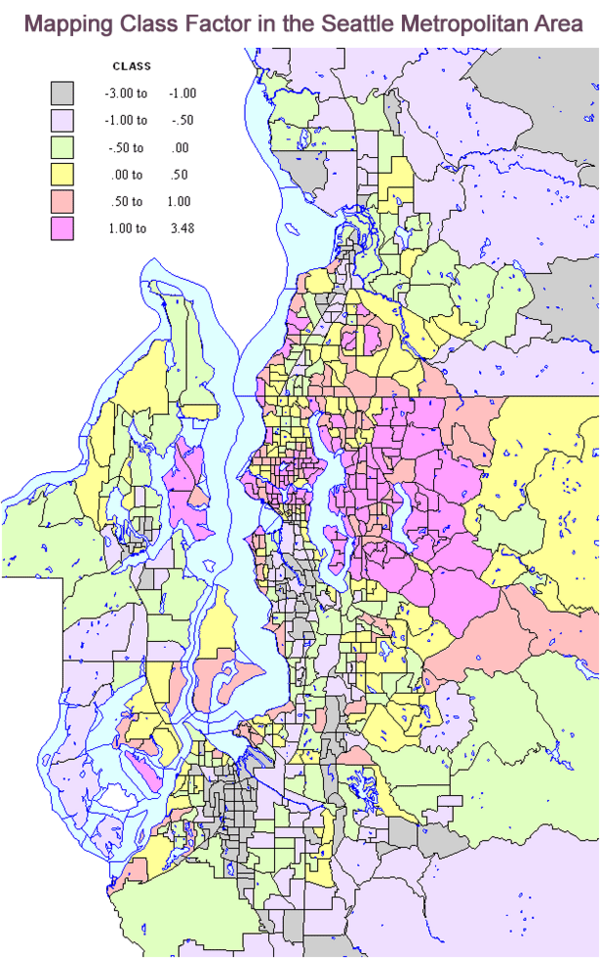
    This map plots “factor scores,” a statistically constructed variable or index divided into six levels of “class:” two upper, two middle and two lower. It is timely to do this, since it was 50 years ago when Calvin Schmid, demographer in Sociology at the University of Washington, and my early mentor, performed a pioneering factor analysis of crime in Seattle – and this was before modern computers! The derived scores most reflect high weighting of the variables: percent of adults with a BA or more, percent in professional versus laboring occupations, median house value and median household income.

    As you look at the map, it’s clear how Seattle reflects very strongly what is generally described as gentrification. This means the reclaiming of the central core by the highly educated and professional, eschewing the suburban metaphorical desert. In the case of Seattle, this process occurring between 1985-2005 resulted in the displacement of over 50,000 less affluent and often minority households to south King county. The city begins to resemble the historic pattern of the rich and important occupying the vibrant core of the city, relegating the working poor to the suburbs, with poor access and inadequate services. Indeed, even now I am involved in a project to assess the lack of access of poor children, often minority or foreign born, to health care in south King county.

    The dominant “upper class” area is the Eastside, east of Lake Washington, and location of the affluent “edge city” of Bellevue, home of the Microsoft campus. A second set of upper class areas are waterfront and view neighborhoods, taking advantage of the Seattle area’s broken topography. The third is simply the University of Washington immediate hinterland. I suspect the location of a large research university with 42,000 students and 22,000 staff increasingly propels Seattle’s unusually high status, income and popularity. I think this is increasingly more important a factor than the presence of an increasingly less important downtown Seattle business center.

    Conversely, lower class areas include traditional zones of mixed housing, industry and transport, such as south Seattle, the older satellite cities of Everett (north), Bremerton (west), and especially Tacoma (south). The largest area of lower class neighborhoods extends from south Seattle through south King county to Tacoma, marked by historical development, displacement from Seattle and high minority population. The second large zone of lower class settlement is the rural fringe, especially in Pierce (south) and Snohomish (north) counties, and may surprise those who think all rural areas are the home of rich estates.

    Then there is the middle class. This is where the suburbs matter most. On the map, middle class areas (yellow and green) are intermediate in location as well and dominate the outer suburban areas as well as some older inner neighborhoods of Seattle and Tacoma. It is unfortunately true that race, ethnicity and class remain highly correlated especially within the core cities of Seattle and Tacoma, reflecting the continuing history of unequal education and job preparation and prospects.

    This analysis suggests one possible future of urban development following something of a European model, with most middle class people in the suburbs, while the rich and poor concentrate either in the urban core or in selected locales in the periphery. As for the city itself, it’s clear that the total landscape is not simply becoming wealthier but increasingly bifurcated between the affluent and the long-term poverty population. And suburbia, home to the vast majority of the region’s population remains the predominant home of the middle and working classes, with pockets of both wealth and poverty.

    Richard Morrill is Professor Emeritus of Geography and Environmental Studies, University of Washington. His research interests include: political geography (voting behavior, redistricting, local governance), population/demography/settlement/migration, urban geography and planning, urban transportation (i.e., old fashioned generalist)

  • Europe: No Longer A Role Model For America

    For decades many in the American political and policy establishment–including close supporters of President Obama–have looked enviously at the bureaucratic powerhouse of the European Union. In everything from climate change to civil liberties to land use regulation, Europe long has charmed those visionaries, particularly on the left, who wish to remake America in its image.

    “There is much to be said for being a Denmark or Sweden, even a Great Britain, France or Italy,” wrote political scientist Andrew Hacker in his 1971 book The End of the American Era .This refrain has been picked up again more recently by the likes of Washington Post reporter T.R. Reid and economist Jeremy Rifkin. Just last year, international relations scholar Parag Khanna shared his vision of a “shrunken” America lucky to eke out a meager existence between a “triumphant China” and a “retooled Europe.”

    But the tendency to borrow from the European toolbox may be somewhat questionable, particularly given that a growing number of Europeans are either uninterested–barely 40% bothered to vote in E.U. Parliament elections last week–or in open revolt against their own system of government. In the elections, for example, parties generally opposed to expanding E.U. power gained ground in countries as diverse as Hungary, Slovakia and the Netherlands. In Britain, the relatively small U.K. Independence Party, which even opposed membership in the U.N., out-polled the Labour Party and trailed only the Conservatives, who announced their own shift toward a more euro-skeptic point of view.

    Although the E.U.’s current top-down bureaucratic approach is clearly losing support, these recent events don’t necessarily mean the E.U. is doomed. It’s just that people who might be happy to accept a customs union and perhaps even a common currency are simply proving loath to hand over land use controls and environmental standards, much less foreign policy, to Brussels-based bureaucrats. At its root this move represents both a cry against control and a cry for greater autonomy.

    For the Obama administration, there may be some significant lessons here. Compared with Europeans, Americans are disposed to dislike too much central control. Turning Washington into a new Brussels, with regulations to cover virtually any human activity, could backfire both on the president and his party.

    But it’s also critical not to see Europe’s new tilt as affirming Reaganite cowboy capitalism. Many European countries, particularly the northern ones, are justly proud of the “social” models of capitalism they embrace. There are many policies–such as Danish incentives for industrial firms to greenify themselves, efficient universal health care and tough fuel economy standards for cars–that should be discussed and perhaps even adopted in some form in the U.S.

    In one sense, we should understand that Europeans are trying to protect their preferred standards when it comes to culture, social structure and lifestyle. They remain, if you will, fundamentally conservative in their efforts to preserve their well-established welfare states.

    But overall the anti-E.U. vote should make it clear that Europe’s overall economic system makes for a poor role model for our country. When the current economic crisis first hit, many European leaders–and their American fans, like Harvard economist Ken Rogoff–saw vindication for the E.U.’s economic policy and a much tougher road for the U.S. over the next year or two. Yet in reality, Europe already has suffered as much as we have from the downturn, and recovery there may also be even slower to emerge. In some countries, such as Greece and France, social unrest has been far more evident than here in the U.S.

    Simply put, European models do not necessarily work better–and when they do, they have occurred in part due to shifts away from strict welfare-state policies. As Sweden’s Nima Sanandaji and Robert Gindehag have argued the recent return to growth in places like Sweden came only after some modest reforms in both taxes and social benefits.

    Yet at the same time, even successful European countries–as well as the whole E.U.–generally experience slower growth than the U.S. with respect to measures like gross domestic product and job growth. This makes it an example of limited utility for America, a country that needs strong economic growth in order to maintain both its quality of life and overall social sustainability.

    The biggest source of divergence between the U.S. and the E.U. lies in demographic trends. For the most part, Europe is aging far more rapidly, and its workforce is shrinking. As demographer Ali Modarres notes, America’s population over the second half of the 20th century grew by 130 million, essentially doubling, while the populations of France, Germany and Britain together increased by 40 million, or 25%.

    As a result, there is virtually no European equivalent for cities like Houston, Phoenix, Las Vegas or Atlanta. American cities sprawl–and will likely continue to do so–because they are newer and because they are growing much faster in a country that is much vaster. Even with 100 million more people, the country will still be one-sixth as crowded as Germany.

    These differences will only become more stark. Opposition to immigration–from both Muslim countries and the E.U.’s own eastern periphery–is growing even in historically tolerant places like Great Britain, Denmark and Holland. Over time, migration into Europe is destined to slow. In Barack Obama’s wildly multicultural America, strong restrictionist sentiments have not gained much political ground, and, at most, efforts are directed not at reducing legal immigration but rather shifting it toward a more meritocratic model.

    So we can expect America’s population to continue growing at close to the highest rate in the advanced industrial world while Europe remains among the most rapidly aging places on earth. America’s fertility rate is 50% higher than Russia’s, Germany’s and Italy’s. By 2040, for example, the U.S. could have a greater population than the first 15 member nations of the European Union. Compare that prediction to 1950, when America had only half the population of Western Europe.

    These numbers point toward separate destinies for the U.S. and the E.U. Throughout history, low fertility and societal and economic decline have been inextricably linked, affecting such once-vibrant civilizations as ancient Rome, 17th-century Venice and, now, contemporary Europe.The desire to have children also reflects a fundamental affirmation of faith in the future and in values that transcend the individual. This is particularly true in affluent societies, where it is socially acceptable to remain childless and technology has made the decision not to have children easier to enforce.

    The U.S.’ demographic vitality will allow it to emerge from the current economic doldrums with more rapid growth than Europe–continuing a trend that has generally held for most of the past two decades. Innovation, largely a product of youthful indiscretion, also will continue to emerge more quickly stateside. Indeed, according to one recent European Commission survey, at the current rate of innovation, it would take 50 years for the E.U. to catch up to the U.S.

    Largely thanks to these demographic pressures, we could see an American economy twice the size of the E.U.’s by 2050. Unlike Europe, we have better prospects for growth, since there’s really no sustainable alternative for our society. In contrast, 40 years from now Europe’s economic growth rate is expected to fall 40%, due directly to the shrinking size of both its labor force and its internal market.

    We can ultimately expect two very different courses to develop. In America, the emphasis needs to be on sustained growth to prevent a massive decline in living standards. In contrast, Europe may be able to maintain a steady level of prosperity–even with lower growth, since its population will be either stagnant or declining–at least until the looming costs of maintaining a welfare state impose onerous economic burdens.

    Environmentally, Europe will become a “green” hero–because lower economic growth means a natural reduction in energy consumption and dreaded greenhouse gas emissions. Americans, on the other hand, will need to depend more on technological fixes–some of them from Europe–and embrace less economically damaging paths to growth. (These include promoting such things as working close to or at home and developing more fuel-efficient cars.)

    Neither Europe nor America–particularly given a much-reduced E.U. bureaucracy–has a better or worse model. We just have to recognize that these are, in the end, increasingly different societies: The former is focused on preservation of its hard-won peace and prosperity; the latter is challenged more by constant, major and sometimes even frightening change.

    Some may still hold out the hope that wise men in the old continent will present us with a road map to the future. But given the revolt going on against this mega-European ideal, we should understand that even many across the pond are having second thoughts about a future controlled by Brussels. Perhaps it’s better to recognize that most solutions to America’s problems–now and in the future–will be concocted not in Brussels, Berlin or Paris, but at home.

    This article originally appeared at Forbes.

    Joel Kotkin is executive editor of NewGeography.com and is a presidential fellow in urban futures at Chapman University. He is author of The City: A Global History. His next book, The Next Hundred Million: America in 2050, will be published by Penguin early next year.

  • Kauai, Hawaii: Local Merchants Make Waves

    Many have by now heard or read the story of the plucky group of Hawaiians on the island of Kauai who, when faced with the loss of their businesses due to the state government’s inability to open park roads to a popular beach and camping area, took care of it themselves for a fraction of the cost and in a fraction of the time. How very Tocquevellian. Or, better, how very American. The story brings a reflexive smile to everyone who hears it, but the events cast a spotlight on the way governments at all levels interact with their communities, and how, in light of significant budget cutbacks, roles are changing.

    In his magisterial commentary on 19th century democratic culture, Democracy in America, Alexis de Tocqueville compared the initial sources of public action in European countries with the United States: “Everywhere that, at the head of a new undertaking, you see the government in France and a great lord in England, count on it that you will perceive an association in the United States.”

    De Tocqueville was overwhelmed at this penchant of Americans to collaborate in common effort. The Frenchman attributed this unique, awe-inspiring American quality to the absence of a large government or aristocratic structure. “They can do almost nothing by themselves,” he wrote, “and none of them can oblige those like themselves to lend them their cooperation. They therefore all fall into impotence if they do not learn to aid each other freely.”

    After December floods washed out the park roads, bridges, and facilities at the Polihale State Park, Hawaii’s Department of Land and Natural Resources (DLNR) studied the damage and released a statement two months later, declaring, “We know that people are anxious to get to the beach. However, the preliminary cost estimate of repairs is $4 million.” An original timeline for the work was set for late summer, but, commented local resident and surfer, Bruce Pleas, “It would not have been open this summer, and it probably wouldn’t be open next summer.”

    The DLNR’s natural response to this natural disaster was to go inward (look to its own capabilities) and upward (look for more State or Federal funds). The public’s role – if there was to be any – was to leave them alone to do the first task, and help them achieve the second; specifically, the main objective was to grab a fee-generated windfall for the department, ironically entitled the “Recreational Renaissance” fund. In February, DLNR’s Chair, Laura Thielen, pleaded, “We are asking for the public’s patience and cooperation to help protect the park’s resources during this closure, and for their support of the ‘Recreational Renaissance’ so we can better serve them and better care for these important places.” The department convened an “information meeting” in March to discuss… how residents could work with the department to open the roads? No, only to provide information on how to lobby the state for more funding.

    This approach did not sit well with area residents who depend on the park for their livelihood. It was reported that Ivan Slack, owner of Na Pali Kayaks, which operates from the beach in Polihale, summed up the community’s frustration: “We can wait around for the state or federal government to make this move, or we can go out and do our part.” Beginning in late March, business leaders and local residents organized — “associated” — to take the situation into their own hands. From food donated by local restaurants to heavy machinery offered by local construction companies, a project that was originally forecast to cost millions and take months (if not years) was nearly completed in a matter of weeks, all with donated funds, manpower, and equipment. As Troy Martin from Martin Steel, which provided machinery and five tons of steel at no charge, put it, “We shouldn’t have to do this, but when it gets to a state level, it just gets so bureaucratic; something that took us eight days would have taken them years. So we got together — the community — and we got it done.”

    This was not just a park clean-up, but a significant undertaking involving bridge-building, reconstructing rest rooms, and use of heavy equipment to clear miles of flood-damaged roadways.

    While unique in its scope, what is happening on the southwestern coast of Kauai is not completely anomalous. Due to the national budget crisis, states and cities around the country are having to take a hard look at the services they offer and find new ways to involve civil society. The organization I head up, California Common Sense, is working with cities and school districts that have to chart this new course. The failure of several revenue-raising ballot initiatives here in the Golden State has provided even more impetus to practice this outward-focused governance.

    In some respects, governments themselves are to blame for setting the service expectations of the past decades. Beginning in the mid-1980s, the “TQM” (Total Quality Management) craze in private industry found its way into the public sector, and a new language of “service provider” (government) and “customer” (citizen) followed. Government no longer was something to participate in, but something to pay for. Later in this transition, scholars like Northwestern University’s John McKnight could see that the results of this new relationship were heading towards a precipice. In an essay for The Essential Civil Society Reader, McKnight commented on this situation in terms reminiscent of de Tocqueville’s fears almost two centuries earlier: “The service ideology [in governments] will be consummated when citizens believe that they cannot know whether they have a need, cannot know what that remedy is, [and] cannot understand the process that purports to meet the need.” This, thankfully, is not the situation in Kauai.

    But we, as citizens, don’t get off the hook that easily. Certainly, we have too often taken on this role as “customer,” believing our taxes are just the prices we pay for the services we desire, from filling potholes to teaching our children. When government does not perform up to our expectations the usual response is either to decry its wastefulness or to acquiesce to higher taxes. These often unproductive reactions come from both the left and right on the ideological spectrum.

    The story in Kauai, and others bubbling up around the country, demonstrate that there is a “third way”: get some friends and pick up a shovel when the government can’t or won’t. Governments on the other side of this equation need to be open to this kind of direct participation; in fact, they should encourage it. What is happening in Polihale is not a syrupy, Rockwellian portrait. It is doubtful that this dramatic participation would have occurred without the dire financial consequences that loomed for many of the residents and businesses involved. It is a manifestation of de Tocqueville’s “self-interest rightly understood”.

    “All feel themselves to be subject to the same weakness and the same dangers,” De Tocqueville wrote, “and their interest as well as their sympathy makes it a law for them to lend each other mutual assistance when in need.” Ray Ishihara, manager of the local Ishihara Market, which has donated food for the volunteers, puts this in more concrete terms: “I think it’s great. Everybody needs help these days in this economy.”

    It is ironic that this should all be taking place in President Obama’s home state. The usually articulate Obama has sounded uncomfortable when attempting to define how he expects Americans to “sacrifice” during this financial crisis. From a policy perspective, the Administration’s only responses appear to be raising taxes on our wealthiest 5%, and, interestingly, increasing Federal funding for volunteer programs.

    One thing the President could do is travel out Kauai’s Route 50 to Polihale State Park during his next trip to Hawaii. There, he could see and celebrate what everyday Americans do when they gather in common purpose. Thanks to their hard work and sacrifice, surf’s up.

    Pete Peterson is executive director of Common Sense California, a multi-partisan organization that supports citizen participation in policymaking (his views do not necessarily represent those of CSC). He also lectures on State & Local Governance at Pepperdine’s School of Public Policy. An earlier version of this article appeared in City Journal.

  • Farmland Prices: The Cost of Growing A Suburb

    Summer in Minnesota – land of 10,000 lakes — is, for many families, about boating, with the Harley the preferred mode of ground transportation. In winter, snow mobiles are popular. Hunting and fishing replace the corner coffee shops as hangouts. Three car garages are considered a minimum – four even better!

    So how did it come to pass that out-of-control land prices would destroy the economics of housing in this small-town region? And why was the pattern repeated in markets like Las Vegas and Phoenix?

    In the 1980’s the Metropolitan Council in Minneapolis became concerned with sprawl. The MET Council thought Portland, Oregon’s policies to control sprawl by creating an Urban Boundary would be beneficial to the Twin City area, a seven county region. This area is topographically simple: no ocean boundary, and, unlike Portland’s region, no mountain ranges. The MET Council did not anticipate that their attempt to control growth would end up contributing to it.

    Farmers who owned land with sewer capacity outside the boundary knew that its value had just skyrocketed. When a supply — land — is limited, those that control it can name their own price. Within the boundary land was too expensive to develop affordable housing. So cities outside the MET Council’s control began to attract developers. Places that nobody had heard of much: Otsego, Albertville, Elk River, and Hugo are all a very long drive from the Twin City core. These towns had two important components for builders: city sewer and cheap land.

    As the tiny towns outside the Urban Boundary attracted more development, they also attracted the national developers. All of the nation’s Top Ten Home Builders discovered this region. Each year 25,000 or so new homes were built and quickly sold to suburbanites who preferred a 30 to 40 mile commute over living near the city core. (Keep in mind that Minneapolis / St Paul has one of the nicest core areas of a major US city. Even downtrodden sections look pretty nice. And Minneapolis stays alive in the evenings and becomes a social Mecca that is also relatively safe.)

    Much of the escalation in home pricing was due to a bidding war over developable farmland. National builders, using their Wall Street dollars, competed for desirable acreage. If Farmer Fred was able to sell his property for $50,000 an acre, when Roy next door put his farm up, the starting price was $50,000 and the final fee was likely to be $60,000, the starting point of the next site for sale. By 2005 the outer small town land that could have been bought for $12,000 an acre a decade earlier was worth more than 10 times that amount.

    In the past, builders would look at the price of a finished lot, and assume that the house they built on it would cost a maximum of four times the finished lot price; a sort of “one-quarter” rule for land costs. If the lot cost $30,000, they would not build a home that ultimately cost more than $120,000.

    By 2005, if outer suburban land sold for $150,000 an acre and the density (after required park areas, wetlands, buffers, and shoreline zones) was two homes per acre, that meant that $75,000 of a new suburban home was in raw land costs. Add to that $25,000 in construction of roads, utilities, fees, etc, and the lot price skyrocketed to $100,000. Using the one-quarter rule, this meant the builder would need to get $400,000 for the finished home.

    At the 2006 Land Development Today Breakthroughs conference I spoke about our research into the impending market crash and its basis. The market had just begun to show signs of slowdown, and nobody was predicting a big fall.

    Our “study” was based on a comparison of our local housing market in the Minneapolis region with markets where we were working in about 40 States. It involved a simple search of major builders in the top markets. We looked at areas where land prices were escalating much faster than inflation in order to see the common elements. The National Association of Home Builders average national price for a 2,400 square foot average home was $264,000. It should be no surprise that impromptu results indicated the average price of a 2,400 square foot home in Phoenix was $331,000 (20% above average), in Las Vegas $442,000 (40% high), and in the Minneapolis suburbs $349,000 (25% high).

    Weather was not one of the common elements. But all three areas — Las Vegas, Phoenix, and the Twin Cities — had explosive growth for two decades until 2007 (2006 for the Twin Cities), and all three had most, if not all, of the nation’s Top Ten Home Builders selling and building.

    In March of 2005 one of my clients made me an offer. If I convinced a certain farmer to sell, I would receive not just the planning fees, but also 5% of the profits. The land in question was about an hour’s drive from the urban core during rush hour traffic. I looked at the site and took out the slope restriction, the Department of Natural Resources tiers, the wetlands, the buffers, and the land that was otherwise not buildable, including the rolling surface areas that resembled more Moto-Cross course than residential developable land.

    The cost for the remaining buildable area would have been about $300,000 an acre. The numbers simply did not work out. Land prices had reached the breaking point. Since there was no possible way to profit, my 5% of zero would still be zero. I suggested that my client not do the deal, and saved him from financial ruin.

    It’s easy to make Government the scapegoat. Even though the MET Council set in motion policies that likely caused sprawl by trying to curb it, it was not the cause of land prices going out of control. All the major developers with their deep pockets outbidding each other for over a decade was what did the economics in. Today, housing prices in the Twin City market have plummeted to a more realistic point that is about what the national average was in 2005.

    Five years before the crash many actually believed that high land prices were a sign of a great economy. Well guess what? They were wrong.

    Rick Harrison is President of Rick Harrison Site Design Studio and author of Prefurbia: Reinventing The Suburbs From Disdainable To Sustainable. His websites are rhsdplanning and prefurbia.com.

  • A New Story for Timeshare

    By Richard Reep

    More employment sectors are increasingly migratory and less fixated on a particular place. Many of us are instead working from home, or from places where we prefer – it might be a coffeeshop, or it might be a vacation condo. Housing’s rigid systems belong to the Old Economy.

    Meanwhile, a new form of housing less than 2 generations old has quickly gained ground as a part of the luxury leisure lifestyle of the middle class: timeshare. Unfortunately, during the real estate boom in the last several years, timeshares have been severely overbuilt, and the market is years, perhaps even decades, away from filling this oversupply. This form of housing is based not on real estate mortgages – although one or two companies still practice this – but based upon points. And the genius of the points-based residence is its transportability, which served the vacation market extremely well.

    By applying a points-based approach to primary housing, a developer will be able to take advantage of the increasing percentage of workers that move frequently for their careers. This unchains workers from their mortgages and lawnmowers, and enables the nomadic nature that has defined several segments of our economy where project-based employment has replaced company-based employment.

    Most timeshare developers privately agree: “The party’s over. It won’t be anything like it was, even if the economy comes back. At least not for a long, long time,” confessed one senior developer for an international timeshare company privately. Meanwhile, many of the communities who assumed a vast market of affluent customers need to start asking big questions.

    One of them is to refocus on the quality of places. Gated condominium developments, with little or no connection to the communities where they reside, are a study in self-absorbed lifestyles. Turning these into real homes and communities will require opening them up, integrating them into the local culture and civic life of their places, and making timeshares something other than…well, simply a commodity.

    It will also require some fundamental changes that are overdue in the timeshare industry itself. The points-based system was originally fabricated as a customer-loyalty system. It will need to be adapted to suit a worker wishing the flexibility to travel from place to place and stay for longer periods of time. Perhaps a more ominous dilemma that the timeshare developers have created for themselves, however, is the crushing maintenance fees, running often $750 to $1000 a week or more.

    The credit-backed future dreams of luxury and leisure remain idle, but the physical properties sit on some pricey and fundamentally attractive real estate at ski area bases, golf courses, desert getaways, and beaches. Few may be in the mood these days to buy a bunch of ephemeral points for a vacation, but the same system would serve well any project-based endeavor that assembles workers for an assignment and disbands these workers when the assignment is completed.

    The movie industry has operated on this model for years, and other industries have begun working in this same manner. In the Old Economy, this was rare, and most pursuits encouraged a young college graduate to put down roots as fast as possible: Start a career, start a family, and buy a house. Increasingly, however, entry-level workers have resisted this, preferring instead to experiment with multiple careers, often moving from place to place, sometimes until well into their thirties. In the technology industry, software developers have tended to work on this model, and especially in digital media, the permanent nature of jobs and companies has given way to temporary alliances and co-ops to get things done – the so-called Digital Nomads.

    Yet even as the workforce and its physical plants adapted, the housing industry instead has trudged along its same path, with mortgages or rental property as the two options. It is time for timeshare to fill the gap in between these two extremes and offer this as a third option. At this point, the timeshare industry has little to lose. Market contraction and the loss of its credit foundation have rendered these companies dormant. There needs to be a paradigm shift to recover at least some of these investments and, over time, create long-term value.

    Timeshare developers built plenty of beach resorts, which are still fairly active, but still can be turned into more semi-permanent communities. Their interior resorts – desert, golf, and ski areas – have an even more urgent need for reinvention. A stronger and more stable sense of community, safety and security, and higher quality of life could draw more workers away from the large metropolitan areas, as baby boomers downshift and global corporations onshore their workers.

    All this adds up to an opportunity for a timeshare developer who wants to fill his units with paying customers. When digital media employment is studied, it might resemble the timeshare model more closely than one thinks. Dominated by no one single old-economy company, digital media assignments are often accomplished by a temporary alliance of multiple small studios that work together, then decamp and move to the next assignment. This is a perfect scenario for a points-based housing system. Freed from the chains of the mortgage banks and from the landlord-lease situation, the points-based system enables free flow of workers who enjoy sampling the tastes of different cities and have no real interest in setting down roots, mowing lawns, and fixing leaky gutters.

    Ski timeshare properties in particular are quite ready for this shift in focus. Ski towns were built upon timber or mining town functions. They already have reinvented themselves and need to do this again. If these towns were to partner with their timeshare properties and incentivize technology and research employers, a new story and a new model could revitalize them.

    Marrying this desire to move to more low-density regions combines what timeshare developers do best – create amenity-laden residential communities – with a free-flow form of ownership. This approach is worth a closer look. We need to thaw the frozen residential concepts and look at new models and new stories that are happening in America and elsewhere. By adapting timeshare to the New Economy at this critical point, an industry can be repurposed and a new sustainable housing option can be born.

    Richard Reep is an Architect and artist living in Winter Park, Florida. His practice has centered around hospitality-driven mixed use, and has contributed in various capacities to urban mixed-use projects, both nationally and internationally, for the last 25 years.