Category: housing

  • Levittowns of the Future

    This essay is part of a new report from the Center for Opportunity Urbanism called "America’s Housing Crisis." The report contains several essays about the future of housing from various perspectives. Follow this link to download the full report (pdf).

    “…a social revolution was being made, not by storming barricades, but by leaping over them.”

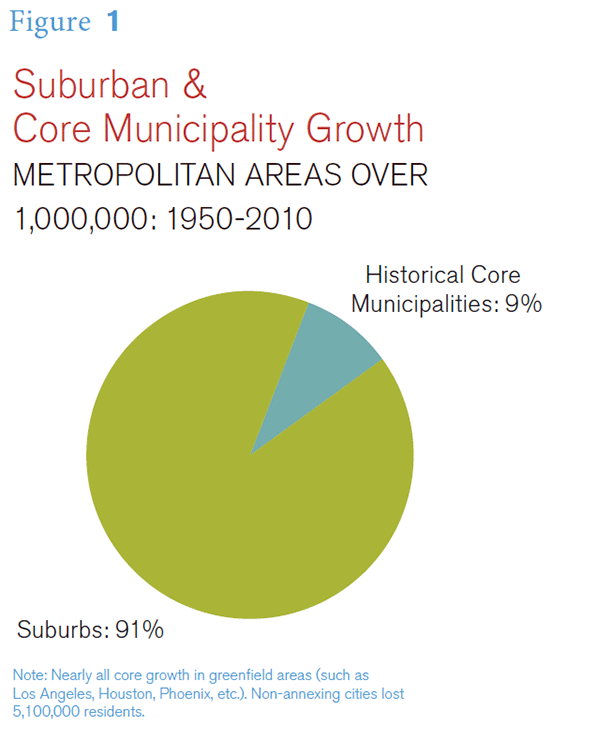
    Seven decades ago, the great post- war American suburbanization began. The seminal development was Levittown, built on potato fields in Nassau County, outside New York City. This archetypical development, with its small houses and modest lots, helped launch a suburbanizing trend that has accounted for virtually all of the population growth in the nation’s largest metropolitan areas. Today’s new houses are at least three times the size of the early Levittown houses, but they reflect the continued preference for suburban communities over the last half century.

    This essay examines the great Post-War suburbanization, incubated in Levittown and its revolutionary impact on American civilization. At the same time, there is no doubt that racial exclusion was part of the formula, abetted not only by people, communities and developers, but worst of all by governments themselves, especially the federal government. These regrettable exclusionary policies at the time also characterized virtually every walk of American life.

    Yet, for the most part, millions— now including millions of minority households—are better off than they would have been without the great suburbanization. As Professional Builder magazine put it:

    At a time when few working people could afford a home, Levitt helped them realize their dream, starting with servicemen and women returning from the war.

    Levitt brought mass production techniques to home building, following in the mold of Henry Ford, who made automobiles inexpensive enough for middle-income households. The higher quality detached housing with yards could not have been built at low enough prices without such techniques, nor could it have been offered at such prices without the additional advantage of less expensive urban fringe land.

    As home ownership expanded, perhaps the most important result was class mobility. In this period the
    American middle class expanded as never before and home ownership skyrocketed.

    This might seem cause for celebration, but an influential group of planners and intellectuals damned it from the very start. These, whom this essay will refer to as the retro-urbanists, tend to idealize the pre- automobile city, which has largely been replaced not only in the United States but in virtually all high income countries. German academic Thomas Sieverts called these views “criticism rooted in an ideological concept of the city.”

    As retro-urbanists have sought to stop or even reverse suburbanization, people stubbornly have continued to choose the suburbs overwhelmingly,
    not materially moved by the nostalgia so often keenly evident among pundits and planners. So far these efforts have achieved only modest gains, mostly in a handful of states, where the retro-urbanists have had sway, but at great cost to the middle class. \

    In the meantime, however, the housing affordability represented by Levittown and most of the suburban development since World War II has  had its reward in a “property owning democracy,” which legendary urban planner Peter Hall of University College, London described as a principal objective of public policy.

    THE SITUATION IN 1946

    The America of 1946 was much different than today. The United States had just emerged from the world’s most destructive war, emerging as the dominant world power and producer (the latter principally because other competitors had experienced massive destruction). Yet, despite this position, Americans in 1946 experienced a far lower standard of living and greater level of poverty than today.

    World War II had made it possible, finally, for the nation to emerge from  the Great Depression, which had been characterized by unprecedented levels of unemployment and economic stagnation.

    Housing was overcrowded, especially in the cities and living standards were far below present standards.

    Michael J. Bennett describes the situation:

    “Home was usually a three or four story tenement or apartment house, a two, three or four-decker for as many families or a single-family shotgun house with tiny rooms off
    a single corridor, so-called because the shotgun could be fired down the corridor without hitting anyone. Only the better-off live in fairly spacious houses on the outskirts of town. Even those houses, however, had small tiny front lawns and were separated from each other by little more than a hedge between gravel or partially paved driveway.”

    Bennett goes on to indicate that only the very rich took showers in the morning, “because they were the only ones with showers” and that “Many families had to share toilets and sinks as well as tubs with people living on the same floor.”

    The nation’s returning soldiers, in unprecedented numbers, would experience a better America, with better lives. There was also a concern among policymakers that the failure to facilitate opportunities for returning soldiers could result in social upheaval or even revolution in the worst case. Some noted the social disruptions that occurred following World War I, in countries like Russia and Germany. There was great interest in trying to ensure that this did not happen in America.

    Just before the end of the war, Congress passed and President Roosevelt signed the Servicemen’s Readjustment Act of 1944, called the “GI Bill of Rights,” which provided assistance to veterans, especially improving access to housing and access to higher education. At the same time, the Federal Housing Administration was aiding home purchases for households not eligible for the “GI Bill.”

    LEVITTOWN AND THE GREAT POST-WAR SUBURBANIZATION

    America’s status as an urban nation was still relatively new as it headed into World War II. The US urban population had not exceeded that of rural areas until the 1920 census. By 1940, the urban population was approximately 57 percent, according to Census Bureau data, well below the 81 percent of 2010. In the following seven decades almost all of the nation’s population growth would occur in America’s urban areas.

    Following the legacy of the New Deal, it was expected that new housing would be largely provided by government. The home ownership rate had dropped to 44 percent from its peak of 48 percent in 1930.ix It was assumed that the new
    housing would be for renters rather than for homeowners. The reality turned out much different.

    One entrepreneur is widely heralded as having blazed the trail for the suburbanization that emerged following World War II, William Levitt, and his company Levitt and Sons. A home builder before the war, in 1947 he established the legendary Long Island, New York, community of Levittown. Levitt revolutionized homebuilding in the United States after having applied factory building techniques to the provision of wartime (defense) housing.

    Levitt began to build rental housing on the suburban fringe of New York City, but switched to owned housing as federal programs and his house production techniques together create auspicious conditions for selling single family houses.

    In 1947, Levitt marketed four different models. Eventually the seven square mile development would contain more than 17,000 new houses. The houses were small, at 750 square feet. There were
    four rooms, the kitchen, the living room and two bedrooms, all on a single floor. The houses, however could be expanded, which many households did. There were no garages. The houses were sold for approximately twice the average wage earner’s annual pay.

    Little more than a decade after the first house was occupied, Levittown achieved a population of 65,000 (1960 census). This was near the peak of Levittown’s population, since with virtually all of the land occupied and a future of declining household size, reductions in population were inevitable. By 2010, the population had dropped to 52,000. However Levittown remained a vibrant community from the beginning and remains so today.

    Levitt took the concept to other metropolitan areas as well. A Levittown featuring somewhat larger houses was developed in the Philadelphia suburbs of Willingboro township in Burlington County, New Jersey and in Pennsylvania’s Bucks County.

    In an essay entitled “Levittown: The Archetype for Suburban Development,” historian Joshua Ruff said that: “… Levittown was about more than just the houses,” adding that it was the “…largest and most influential housing development of its time..”

    Lakewood: Another important suburban community was Lakewood, located near Long Beach in the Los Angeles metropolitan area.xi The Lakewood development included 17,500 houses built between 1950 and 1953.
    The houses were between 825 square feet and 1,050 square feet.xii Lakewood, which claimed to be the largest planned housing development ever, included a regional shopping center.

    However, despite such important early developments, most of the new suburban housing around the nation was built by smaller home builders in the decades to come.

    THE CONSUMER RESPONSE

    The new suburban communities were exactly what returning soldiers and other Americans wanted. As historian Joshua Ruff put it:

    Patience had been killed by 15 years of economic depression, war and an epidemic housing shortage. People wanted the full package—the affordable house, the new appliances, the suburban lifestyle—and they wanted it right away.

    Kenneth Fox, of Yale University, wrote that: “The suburban development that began in the 1940s was revolutionary in two ways: it changed the type of community millions of Americans live in, and it transformed the national social class structure.”

    The American middle class was about to undergo an unprecedented expansion. Before, as author Studs Terkel put it:
    “The suburb, until [about 1946], had been the exclusive domain of the ‘upper class.’ It was where the rich lived. The rest of us were neighborhood folk. At war’s end, a new kind of suburb came into being.”

    According to Fox: “Eventually, suburban cultural changes and white- collar status aspirations fused and produced a shift in the basis of social class differentiation. Income and style of living supplanted occupation and economic status as the parameters defining the major social classes. A broad middle class emerged, encompassing more than one half the metropolitan population in the 1970s.”

    Indeed, according to Fox, middle- class became defined more as lifestyle,
    rather than origins: “Increasingly, and the family that chose to buy a home in a reputedly middle-class community, behave in a middle-class matter, and maintain all appearances of the middle class, could gain acceptance in the middle class, regardless of the parents occupations.”

    Levittown chronicler Barbara Kelly noted a connection between home ownership and upward mobility, indicating that it conveyed “defacto membership in middle class.” She added: “…during the years in which  the government was most active in promoting home ownership, there was a marked expansion of the American middle class, which consisted largely of the definition of its parameters.”

    Harvard historian Robert Fishman noted the rising affluence: “For the first time in any society, the single-family detached house was brought within  the economic grasp of the majority of households.” The US may have been first, but it is not alone in having democratized prosperity.

    Bennett characterized the advances, noting that “…a social revolution was being made, not by storming barricades, but by leaping over them.”

    And despite claims to the contrary, most of the new suburban residents came from migration to the large metropolitan areas, not from core cities. The new suburbanites were as likely to be from a small town or the countryside as a big city.

    HOUSING AFFORDABILITY: WHAT MADE IT POSSIBLE

    It was the affordability of such housing that made these improvements possible. Housing remained affordable across the nation in the decades to come, with some important exceptions.

    According to the US censuses of 1950 through 1970 median house values in the largest metropolitan areas were generally 3.0 or less times the median household income (the “median multiple”), with only two having a higher average (both 3.1).

    At the same time, there were differences in housing affordability. As would be expected, some parts of the country were more attractive than others. Therefore, it is not surprising that house prices in the coastal California metropolitan centers of Los Angeles, the San Francisco Bay Area and San Diego were less affordable, but still remained at or below the 3.0 median multiple standard, in part due to higher incomes.

    The housing bubble and bust were to come later, during which the losses in housing affordability were even greater.

    Home Ownership

    The government role here was crucial. By 1960, homeownership had reached 62 percent, well above the 44 percent  of 1940. In the following three and half decades, the home ownership rate varied up and down in a range of from 62 percent to 66 percent (Figure).

    Then, as mortgage eligibility was relaxed during the housing bubble, the home ownership rate rose to nearly
    69 percent. Following the housing bust, it had fallen to below 64 percent by 2015.

    Some retro-urbanists have characterized the comparatively recent experience of the housing bubble and bust as indicative of an overall failure of postwar US housing programs. Nothing could be further from the truth.

    In fact, US housing programs had been instrumental in producing a significant increase in homeownership and the creation of a much broader middle-class. The evidence remains “the 60 to 65 percent level of home ownership of the 35 years preceding 1995 was sustained. Meanwhile, even after the housing bust, home ownership remains a priority among American households,xxvi including younger people. Even after the Great Recession, the aspiration for home ownership remains strong. Polling by the Demand Institute (operated by The Conference Board and Nielson) found that 77% of respondents considered home ownership “an excellent investment” (Figure).

    THE RETRO-URBANIST RESPONSE

    It might be expected that there would be popular and widespread acclamation of this success. Surely, the results were consistent with the principal priorities of a progressive society, at least in the historic sense, to improve the standard of living and reduce poverty.

    Yet, this was not to be. Retro-urbanists, including many planners, architects and other thought leaders were nothing less than appalled. In reaction to this, the very first words in the preface of Herbert J. Gans’ The Levittowners: Ways of Life and Politics in a New Suburban Community, read: “This book is about a much-maligned part of America, suburbia…”xxix he continues to indicate that these observers of suburbia are similar to literary writing, “which often boils down to cataloguing … Shortcomings from the author’s perspective.”

    Kelly characterizes the criticisms as “…a form of pseudo-intellectual disdain for suburban life in general, with Levittown serving as its archetype.”

    For example, in 1964, architect Peter Blake declared in God’sOwn Junkyardthat the suburban pattern developing in the United States is “making life there only slightly less tolerable than on tenement streets.”

    He continued: “The results are palpable: children play in the street; parents spend most of their time maintaining a front garden they can’t use; the community has to maintain long roads and long utility lines to service its strung-out houses; and the suburbs go broke.” Blake also says that “America’s suburbia is now functionally, aesthetically and economically bankrupt.”

    Dr. Charles Winslow, professor of public health at Yale University said that the “inferior type of small house being provided by speculative builders to meet the veterans demands [were] dollhouses that out slum the slumming is of our prewar slums…” He also said that “families living in these houses might suffer serious mental and physical ills.” 

    Social commentator Paul Barker describes the intensity of the criticisms, noting that “suburban” is a “sneer- word” to architects and planners.xxxvi He also says: “Those who oppose suburbia usually have highly doctrinaire views about how other people should live.” While Sieverts refers to an ideological concept of cities, Barker characterizes it as theological: “Almost all architectural and planning commentaries, in the press or in government publications, still speak of the suburban as an evil that must somehow  be cast out.”

    These kinds of criticisms have often been supported in the press.

    Historian Joshua Ruff dismisses Lewis Mumford’s complaint that Levittown
    was a “uniform environment from which escape is impossible” as “ignoring the architectural sameness (block after
    block of overcrowded apartments) many new suburbanites were fleeing from in Manhattan, Brooklyn and Queens.”

    But, despite their influence and access to the press, the retro-urbanists have been consistently ignored by households making home purchase decisions. As Barker put it, “…such critics are outnumbered many, many times by the millions for whom suburbia is a land of pleasantness, friendship and hope.”xl Moreover, the retro-urbanists did not understand the desires of suburbanizing households. As Gans put it, they came “…for a house and not a social environment.”

    In the final analysis, as Journalist Edward Humes wrote: “But the veterans who snapped up these new houses were coming from a different outlook, a different place—from boarding houses and cramped apartments and lives that just a few years earlier had offered little hope of college or homeownership or lasting financial security.”

    Households continued to move to the suburbs and suburbanization continued to attract nearly all population growth in the major metropolitan areas.
    The Right and Wrong of Suburbanization

    Ruff provides a short summary of the positive and negative perceptions with respect to Levittown (which also apply
    to the great post-war suburbanization): “But Levittown was about more than just the houses. As the largest and
    most influential housing development  of its time, it became a postwar poster child for everything right (affordability, better standard of living) and wrong (architectural monotony, poor planning, racism) with suburbia.”

    As for the “right” that Ruff refers to, it is hard to imagine more important benefits than a dispersion of wealth, affordability and a better standard of living. These are fundamental domestic public policy objectives long held by much of the nation’s leadership, including liberals. A nation of homeowners, “President Franklin D. Roosevelt believed, “of people ho own a real share in their land, is unconquerable.”

    The case for the “wrong” is less clear. Architectural monotony does not negate the imperative to improve the standard of living and reduce poverty. Moreover, architectural monotony is in the eye of the beholder and clearly was of no more than secondary interest to the millions who overwhelmingly chose the suburbs. The very rowhouses that are now so widely celebrated by retro-urbanists were themselves originally stretches of identical structures with little differentiation. Planning that results in better affordability (and an improved standard of living) is good and effective, not “poor.” Finally, as noted above, the racism concern is valid, but is a more general indictment of the nation at the time and has now been moderated by a flood of minority residents to suburbia.

    According to Kelly: “For all the faults attributed to them by their critics, the houses of the postwar subdivisions had widespread appeal. They may have been small and repetitious to their observers, but to their owners they represented something more than basic shelter—they were an opportunity to build a better life, a first step on the road to success. It is at that level that the housing programs of the 1940s made their greatest achievement.”

    THE NEW CITY

    The postwar suburbs developed because they could. History had made it possible and thus virtually inevitable.

    Throughout history, people have routinely adopted new techniques and technologies that made their lives better. Nostalgia did not prevent people from abandoning outhouses for indoor plumbing or iceboxes for refrigerators. People prefer better lives and greater comfort and accept technological  advance as soon as it is affordable. It is  not surprising that people found better lives and comfort preferable to nostalgia and an “ideological concept of the city.”

    Indeed, the city was revolutionized.

    Levittown chronicler Barbara Kelly added that the postwar subdivision suburbs had “evolved into a new form  of city,” while Thomas Sieverts characterized the “strange urban—rural landscape as a new form of city.”

    The suburbs gradually became more independent of the core city, as employment was dispersed throughout the metropolitan area. They were no longer subordinate to the core cities, the legacy cites of the pre-war era. Jon
    C. Teaford of Purdue University wrote that the term: “…‘suburb’ had become a misnomer. Economically and socially periphery is no longer a subordinate dependent of the center and thus no longer a candidate for the prefix sub[emphasis in original]” Similarly, J. John Palen of Virginia Commonwealth University wrote: “Whatever everyone thinks about suburbs, it is now indisputable that they no longer sub [emphasis in original].”

    More than three decades ago, Robert Fishman of the University of Michigan suggested:

    “In my view, the most important feature of the postwar American development has been the almost simultaneous decentralization of housing, industry, specialized services and office jobs; the consequent breakaway of the urban periphery from the center it no longer needs; and the creation of the decentralized environment…”

    He went on to propose a new conception of the city (metropolitan area):

    “The true center of this new city is not some downtown business district
    but in each residential unit. From that central starting point, the members of the household create their own city from the multitude of destinations that are within suitable driving distance.”
    Even “suitable commuting distance” became less of a concern for many, as Alvin Tofler’s”electronic cottage” became a reality for many as working at home expanded, facilitated by improved telecommunications. Today, in the majority of American metropolitan areas, more people work at home than take transit.

    THE PLANNING RESPONSE

    Long before Levittown, there were strong criticisms of the suburbs reaching back into the 19th century and even to the 17th and 18th.

    However, it took the interwar building boom to marshal political  forces to implement planning restrictions intended to stop the growth of the suburbs. Under the Town and Country Planning Act of 1947, Britain’s liberal land-use policies were replaced by urban containment policies that have only become stronger over the years. Greenbelts (urban growth boundaries) were imposed around the cities of England, leaving little land for new residential development.

    The result has been a severe and on- going housing crisis, with house prices having doubled or tripled compared to their pre-urban containment relationship to incomes.lv This is to be expected, since prices tend to rise where the supply
    of a desired good or service (in this case land) is restricted, while demand continues unabated. Not even depressed metropolitan areas like Liverpool and Glasgow have escaped the cost escalation.

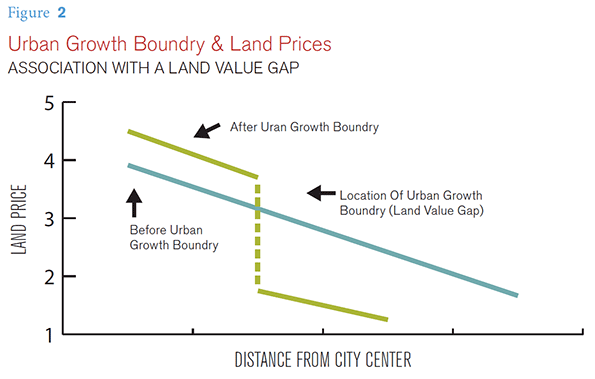
    There is broad agreement among economists and even planning advocates that higher land prices occur within urban containment boundaries. lvi Planners expected that construction of higher density housing would negate the higher land price impact on house prices. Moreover, urban containment planning regimes have routinely included periodic reviews to expand land supply housing affordability. As the discussion below indicates, these approaches have failed as losses
    in housing affordability have been pervasive in more restrictively regulated metropolitan areas.

    It took longer, but similar planning strategies have been adopted in many parts of the US. Their spread, however, has been slowed by America’s federal structure,lvii which did not lend itself to overnight imposition of urban containment policy. Even 70 years after World War II, the radical land use regulatory regime of the United Kingdom has been implemented in only parts of the United States.

    Nonetheless, there were important adoptions of Great Britain style urban containment policy. Things began to change, especially in California and Oregon in the 1970s.

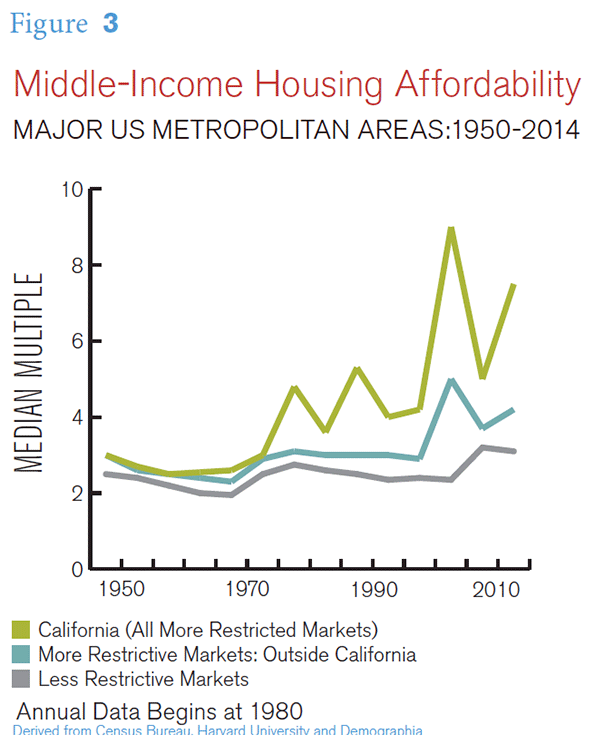
    In California, restrictions were placed on the incorporation of new suburban municipalities that made it more difficult for development to extend from existing municipalities into unincorporated areas.lviii At the same time there were various environmental and land-use regulatory changes that made it more difficult to develop new housing. The net impact of this was fairly immediate house price increases relative to incomes. These housing affordability losses were recognized early some urban planning experts, such as David Dowell  at University of California, Berkeleylix and Bernard Friedan at MIT.lx California’s housing affordability, which had been similar to that of the rest of the nation, began to deteriorate markedly, and by 1980 had reached unprecedented severity.
    Urban containment policies were also enacted in states such as Washington, Florida, Tennessee, New Jersey and Maryland. Local initiatives significantly strengthened land use regulations, such as in the Virginia and Maryland counties of the Washington, DC-VA-MD-WV metropolitan area and the New York metropolitan area.

    By 2000, house prices in some markets had reached five times incomes, nearly double their 1970s ratios. This is consistent with the economic principle that restricting supply tends to result in higher prices, all else equal.

    The tragedy of the housing bust was to follow. Households were lured by
    mortgage products that back-loaded costs so that the greatly inflated prices could seem affordable. The more restrictive  land use regimes could not respond with sufficient supply to meet the increased demand. By the middle 2000’s the highest median multiples reached over 10 in the coastal California metropolitan areas, with some other metropolitan areas exceeding 5.0.

    These price factors led to mortgage defaults, corporate bankruptcies, and a recession so severed that it is called the Great Recesion. It was by far the worst economic reversal since the 1930s. Through the Great Recession, the
    US housing market sent ripples of economic disruption throughout the international economy.

    There were massive house price losses across the nation, with the largest losses where house prices had risen the most. Yet, the house price increases relative to incomes quickly resumed. By 2014, median multiples had reached 8.0 or above in the San Francisco, San Jose, San Diego and Los Angeles metropolitan areas. Housing was also severely unaffordable in the New York, Boston, Miami, Riverside-San Bernardino, and Seattle metropolitan areas and was approaching similar severity in the Denver and the Portland metropolitan areas (Figure).

    The housing distortion was so great that California’s cost adjusted poverty rate became the highest in the nation, 50 percent above that of Mississippi. Despite a California Legislative Analyst’s report documenting the association between regulation and housing affordability losses, the state has continued to strengthen regulation.

    Tomas Rivera Institute raised concerns about the impact of compact development on minority housing affordability:

    Whether the Latino homeownership gap can be closed, or projected demand for homeownership in 2020 be met, will depend not only on the growth of incomes and availability of mortgage money, but also on
    how decisively California moves to dismantle regulatory barriers that hinder the production of affordable housing. Far from helping, they are making it particularly difficult for Latino and African American households to own a home.

    At the same time, throughout most of the country the historic housing affordability was preserved. Even through the housing bubble many major markets remained at or below the 3.0 housing affordability standard. There were also significant house price increases in some liberally regulated markets, but most remained at or below a 3.0 median multiple (such as Atlanta and other Less Restrictive Markets in the Figure above “Middle-Income Housing Affordability”).

    Finally, even in metropolitan areas with strong policies discouraging suburban development and favoring urban core development, most growth continues the periphery. For example, in Portland more than 95 percent of that growth between 2000 and 2010 was in suburbs and exurbs. In San Francisco, 88 percent of the growth was in the suburbs and exurbs.

    TOWARD A MORE ELITIST AMERICA?

    The present preference in planning for urban containment policy threatens to reverse 70 years of social progress. As house prices rise relative to incomes — a phenomenon clearly associated with of urban containment policy — home ownership will be increasingly limited to the more affluent. Paul Barker asks why the strong land use regulations  have survived. Answering his own question, he says that: “The short answer is that it protects the haves against the have-nots.” Robert Bruegmann of the University of Illinois, Chicago provides similar commentary, in chronicling the conversion of suburbs to abodes of the middle class:

    “… Cities have sprawled from time immemorial and for a wide variety of reasons. As long as only a small number of the wealthiest and most powerful families occupied the most
    land in the most attractive locations, there was very little sustained organized protest. Whenever a newly affluent or empowered part of the population started to enjoy this privilege, there was a backlash.”

    Matthew Rognlie at the Mass- achusetts Institute of Technology has suggested that virtually all of the increased inequality identified by French economist Thomas Picketty has been in the housing sector. He suggests that:

    “… the literature studying markets with high housing costs finds that these costs are driven in large part by artificial scarcity through land use regulation …. A natural first step to combat the increasing role of housing wealth would be to re-examine these regulations and expand the housing supply.

    Jason Furman, Chairman of the White House Council of Economic Advisers called for regulatory relief in a recent address on housing affordability and the consequences of high prices on the economy.

    With high house prices and further hedges against property value depreciation in local regulations, some individuals are priced out of the market entirely, and homes in highly zoned areas also become even more attractive to wealthy buyers.
    Thus, in addition to constraining supply, zoning shifts demand outward, exerting further upward pressure on prices…

    Worse of all, these restrictions are largely unnecessary. Better policies can secure a future for the next generation every bit as promising as the generations since World War II came to expect. The words of Presidential candidate Adlai Stevenson in 1952 are as relevant today as then: “Who shall say that the American dream is ended?”

    LEVITTOWNS FOR THE FUTURE

    But there is a solution. Levitowns can still be built. For example, a review of four metropolitan areas shows that new, entry level detached housing can be purchased for from 2.0 to 2.5 times median household incomes in Atlanta, Columbus, Houston and Indianapolis. This is only slightly above the two times average earnings typical in Levittown, when few families had more than one wage earner. Moreover, today’s prices include a garage, and the houses are at least 50 percent larger. Implementation of recommendations in Section 9 could increase the number of new houses that replicate Levittown affordability today.

    A number of policy proposals could improve the potential for improving housing affordability, particularly in the starter home market following the “trail” blazed by Levittown and other early postwar suburbs. These could restore, in the short term, the promise of Levittown for today’s threatened middle-class.

    The first two relate to the stringency of metropolitan land use planning systems, since experience has demonstrated that the administration of urban containment policies not succeeded in maintaining housing affordability. Until these policies are reformed, new Levittowns are simply not likely to be built.

    Recommendation #1

    To retain housing affordability, liberally regulated metropolitan areas should not adopt restrictive housing
    regulations, such as urban containment.

    As is indicated above, urban containment policies have been virtually inextricably linked to the loss of housing affordability. The theory that the higher land prices inside an urban containment boundary will be offset by lower construction prices has proven to be entirely elusive in practice.

    Recommendation #2

    Wherever there is urban containment policy, it can be expected that housing affordability will further deteriorate. This approach needs to be reformed.

    A road map has been provided by the Productivity Commission of New Zealand. In seeking to address the
    severe housing affordability in Auckland, the Productivity Commission has recommended that greenfield land for development be opened up in greater volume once prices have become unduly distorted. As the Commission indicated: “”Where large discontinuities emerge between the price of land that can be developed for housing and land that cannot be developed, this is indicative of the inadequacy of development capacity being supplied…”

    The Productivity Commission’s recommendation for an “event- driven trigger” to open more land for development also could be adopted at the state or metropolitan area level in the United States. This would require establishment of annual housing affordability targets.

    Recommendation #3

    Metropolitan areas with urban containment policies should consider establishing “special housing areas” outside their urban containment boundaries in order to facilitate housing that is affordable to middle income households.

    These new developments could be authorized by governments to allow development of land and housing at prices similar to those, relative to incomes, that prevailed in the early suburban developments, such as Levittown. These districts should be within metropolitan areas (labor markets) and would provide advantages not only to aspiring families, but also to land owners whose land has been rendered worthless from a development perspective by urban containment policy. Limits on land prices should be set, with development proceeding only when land owners are willing to sell for prices within such limits. Generally similar proposals have been made by the New Zealand government (special housing areas), and by United Kingdom government housing researcher Kate Barker. This approach would also be similar in some respects to the successful municipal utility districts in Texas.

    Recommendation #4

    Governments, land developers and homebuilders should examine approaches for liberalizing regulation on starter homes, toward the end of implementing less costly delivery of housing.

    Cost increasing factors such as delays in permitting, more expensive materials requirements and designs (such as favored architectural styles, including “new urbanist” designs) and other requirements that increase costs for starter homes should be reviewed. This would be appropriate in all markets and should be conducted consistent with appropriate health and safety standards. Wherever feasible, reforms should be implemented.

    CONCLUSION

    The legitimate purpose of planning is not so much better cities, but better lives for their inhabitants. This requires housing that is affordable and maximizes discretionary incomes and a reduction in poverty.

    Planning can only be justified by the extent to which it improves people’s lives. Suburbanization, through entrepreneurship and liberal planning accomplished this, and created the Great American Middle Class after the Second World War.

    As Herbert Gans suggested a half century ago:

    “… whatever its imperfections, Levittown is a good place to live. Consequently, it is much less important to plan for new or improved suburban community and to make sure that more people are able to live in suburbs like those now being built. Specifically, the most urgent priority is to make the benefits of suburban living available to the poor and nonwhite families, now condemned to slum ghettos, who want to give their children
    and themselves a better life beyond the city limits."

    Gans further expressed concern that there needed to be a place in the suburbs for lower middle income households: lxxvi

    …The ideal solution is more, better and more variegated new towns in suburbs, but the first priority in the years to come is more communities for the less affluent.”

    Wendell Cox is Chair, Housing Affordability and Municipal Policy for the Frontier Centre for Public Policy (Canada), is a Senior Fellow of the Center for Opportunity Urbanism (US), a member of the Board of Advisors of the Center for Demographics and Policy at Chapman University (California) and principal of Demographia, an international public policy and demographics firm. He is co-author of the “Demographia International Housing Affordability Survey” and author of “Demographia World Urban Areas” and “War on the Dream: How Anti-Sprawl Policy Threatens the Quality of Life.” He was appointed to three terms on the Los Angeles County Transportation Commission, where he served with the leading city and county leadership as the only non-elected member. He served as a visiting professor at the Conservatoire National des Arts et Metiers, a national university in Paris.

  • Saying Goodbye. Again.

    December was a record month. I’ve said goodbye to five different households of friends and neighbors. Two more are on the fence – and the fence is leaning precariously. I’m pretty aggressive when it comes to reaching out and making new friends. I practically drag people off the street and force them to eat dinner in my kitchen. But even I can’t make friends fast enough to keep up with the attrition. San Francisco is a tough town these days, even for the comfortably prosperous.

    Screen Shot 2016-01-17 at 7.54.20 AM

    Screen Shot 2016-01-17 at 7.49.12 AM

    Screen Shot 2016-01-17 at 7.52.49 AM

    No, this isn’t going to be another tiresome rant against the evils of bubble capitalism run amok. Nor will it be an affirmation that the city is a temporary stop between college and childbirth as people make their inevitable way towards the cul-de-sacs of Real Life.

    Screen Shot 2016-01-17 at 7.52.21 AM

    Screen Shot 2016-01-17 at 7.50.35 AM

    Instead, I’m asking questions. First, where are these people moving to? In these five cases: Seattle, Washington. St. Petersburg, Florida. New Orleans, Louisiana. Toledo, Ohio. Pittsburgh, Pennsylvania. Second, what are their new neighborhood destinations like? In short, a place that comes close to the qualities they love about San Francisco, but at a lower price point: older, funkier, walkable, mixed use, and lively. It seems that almost every city in America has a tiny sliver of pre-World War II Main Street urbanism left in a little pocket somewhere. And that’s where these folks are headed.

    John Sanphillippo lives in San Francisco and blogs about urbanism, adaptation, and resilience at granolashotgun.com. He’s a member of the Congress for New Urbanism, films videos for faircompanies.com, and is a regular contributor to Strongtowns.org. He earns his living by buying, renovating, and renting undervalued properties in places that have good long term prospects. He is a graduate of Rutgers University.

  • Black Homes Matter: The Fate of Affordable Housing in Pittsburgh

    “I live here.  I’m from here.  My whole family is here.   We try to stay close together.  This is America.  I’m a Marine, I went to war three times.  I served my country.  It feels crazy not to be able to live in my own area where I grew up,” writes an East Liberty resident in Black Homes Matter, a booklet describing alternative approaches to neighborhood revitalization in the city of Pittsburgh. Since the Reagan-era shut-down of funding for public housing projects, the lack of decent affordable housing for low-income people has become a crisis in many cities.  San Francisco and Seattle are notorious for pushing out poor and working-class residents, but mid-sized cities like Pittsburgh will be following suit unless city governments have the courage to implement equitable development.

    Pittsburgh has been designated the “most livable city” in the US several times in the past decade.  It gets points for its parks and rivers, excellent universities and hospitals, low crime rate, strong family-centered neighborhoods, expanding high-tech economy, and fine dining.  Of course, The Economist and Forbes magazine do not consider how the city’s livability is distributed unequally across lines of race and class.  The facts that we have among the steepest bus fares in the nation, the lowest minimum wages, and high infant mortality among African Americans do not figure in rankings designed to attract tourists and new businesses to the city.

    Housing is one of the sharpest of these class-race fault lines, as gentrification accelerates in desirable neighborhoods.  In a city already segregated by race, affordable housing is rapidly being replaced by high-end units for young professionals attracted by the city’s hi-tech reinvention of itself after the decline of steel and other industries.  The former Nabisco factory in East Liberty now houses a Google hub in the Bakery Square mall and “village,” with an LA Fitness gym, Anthropologie store, and high-priced coffee shops.   Its developer received major public funding because the project borders a “blighted” neighborhood, whose mostly black residents have hardly benefitted from the action.  Few local residents are employed by the new businesses in their neighborhood.

    East Liberty is also the site of a nearly completed Transit-Oriented Development project along the Port Authority’s east bus-way.  Residents of the 360 new apartments, built by private developers with infrastructure provided by the city, will be able to get downtown in twelve minutes.  Rents in the transit center buildings start at $1,100 a month for a studio apartment.   No units have been reserved for tenants whose income is below the city’s median income, which in Pittsburgh is $37,161 overall, and $21,790 for black residents.  Calculating housing expenses at 30% of income, maximum rents would be $929 and $545 respectively.  In the absence of inclusionary zoning, or other enforcement for equity, there is no room in the attractive new development for even the average city resident, let alone those getting by on much lower incomes.  Ironically, these are traditionally the primary users of public transit.  Pittsburgh is on a course to follow Washington DC, where a recent Washington Post study found that neighborhoods with Metro stops are now majority white, and “the Metrorail system is becoming more inaccessible to minority workers.”

    Throughout what was a predominantly black neighborhood, residents are being forced out either through direct eviction from public housing that is being demolished for re-development or because rents have risen beyond their means. In the Pittsburgh Post-GazetteDiana Nelson Jones writes, “Many who are leaving East Liberty can’t find rental housing under $800. Many are having to accept living without adequate services, including transit, outside city neighborhoods where they have earned a sense of belonging. The vast majority are our elders, lifelong laborers and the working poor. Nobody should get sick with stress in the struggle to pay their expenses, then get sent off to the fringes.”  But that is the current reality.  One resident quoted in Black Homes Matter says, “We wasted six months looking for something affordable around here so we finally moved out to Millvale.  I had to buy a car to commute back here to my job and then I had to take another job to pay for the car. I get very little sleep.  And I miss my neighborhood.”

    As a white middle-class resident of a neighborhood bordering East Liberty, I have benefited from the area’s revitalization.  I shop at Trader Joes and Home Depot and eat at Chipotle and Whole Foods.  I have a choice of three nearby yoga studios.  The house I bought twenty years ago for $50K, with help from the Urban Redevelopment Authority because it was in a “transitional” neighborhood, is now worth upwards of $300K.  My street, which was mixed-race back then, now appears to be entirely white, despite being majority rental.   There’s a deep injustice in the fact that many residents who lived through the period of “blight” in the neighborhood are not here to share in its renewal or in the wealth being generated.  Some residents who stay no longer feel at home: “There are people looking at me like ‘what are you doing here?’  I had my first kiss on that street.”

    Along with its “most livable” designation, Pittsburgh is also credited these days for its progressive city administration.  Mayor Bill Peduto, in office since 2014, is listed alongside New York’s Bill De Blasio as a leader willing to tackle structural inequality in his city.  Bakery Square and the East Liberty TOD were initiated before Peduto’s term, and he has recently set up an Affordable Housing Task Force.  A test case will come with the development of the “28 acres,” a vast parking lot between downtown and the largely black Hill District.  This was the site in the 1960s of one of Pittsburgh’s most brutal acts of “urban renewal” – or “negro removal” as activists call it.  8,000 people were displaced and their homes and businesses razed to make way for an arena and parking for the Pittsburgh Penguins hockey team.  The arena has been demolished and the Penguins have relocated, but they still own the land and they refuse to include more than 12% of affordable housing on the site.  With “affordable” defined as 80% of the market rate, even those few homes will be out of reach for descendants of the families that used to live in what was a thriving community.

    It doesn’t have to be this way.  On Pittsburgh’s North Side we have a counter-example: a strong tenant council prevented the eviction of more than 300 low-income families from Section 8 housing slated for redevelopment.  Working with the URA and other agencies, Northside Coalition for Fair Housing acquired properties and used a “rehab for resale” strategy to keep people in their homes.  “The result has been higher-quality housing, safer and more attractive neighborhoods, and increased tenant incomes,” according to the Pittsburgh Fair Development Action Group, which produced Black Homes Matter.  The group advocates a range of strategies to resist displacement and support resident control in neighborhoods threatened by gentrification: inclusionary zoning, community land trusts, rent stabilization, tenant ownership schemes.

    There is no shortage of successful models from around the country.  In Pittsburgh and other cities, we need the political will to hold private property developers accountable to equitable standards and to include residents in determining plans for improvement of their communities.  Affordable housing and accessible transit are essential to neighborhoods that are “livable” for all.

    This essay was first published by the Working-Class Perspectives blog, which offers weekly commentaries on current issues related to working-class people and communities.

    Nicholas Coles holds BA and MA degrees from Oxford University and MA and PhD degrees from SUNY, Buffalo, and has been a member of Pitt’s English Department at the University of Pittsburgh since 1980. Coles is a past-president of the Working-Class Studies Association, and is a founding member of the Pittsburgh Collaborative for Working-Class Studies, a new multi-campus interdisciplinary organization.

    Image of Eastside III development courtesy of mosites.net.

  • Best and Worst: 2015 International Housing Affordability

    Housing affordability and its impact on   middle income households around the world is emerging as a major concern throughout the developed world. The largest element in household budgets is housing, and house prices have skyrocketed relative to incomes in many metropolitan areas, especially those that have adopted strict land use regulation (particularly urban containment, as described below).

    The 12th Annual Demographia International Housing Affordability Survey reports that, as of the third quarter of 2015, Hong Kong has the least affordable housing among major markets in 9 nations, followed by Sydney, Vancouver, with Auckland, Melbourne, San Jose, San Francisco, London, Los Angeles and San Diego. In each of these markets, housing costs are now triple or more their  levels before restrictive land use regulation (house prices have tripled compared to incomes).

    Ranking Similarities: Demographia and the UBS Real Estate Bubble Index

    The Demographia list of least affordable metropolitan areas is largely echoed by UBS, the international financial services company headquartered in Switzerland. The UBS Global Real Estate Bubble Index ranks London, Hong Kong, Sydney and Vancouver as most vulnerable to risk from a real estate bubble. Demographia rates Hong Kong, Sydney and Vancouver as having the least affordable housing. London is ranked 8th in the Demographia Survey. Overall, the five cities rated by UBS as the most vulnerable are included among the eight least affordable in the Demographia Survey. The three other cities ranked in the least affordable eight by Demographia are not considered in the UBS report.

    Background on Middle-Income Housing Affordability

    In his introduction to the Survey, Senator Bob Day (Australian federal Senate) recalls that: “For more than 100 years the average Australian family was able to buy its first home on one wage. The median house price was around three times the median income allowing young home buyers easy entry into the housing market.”

    Senator Day’s description of the experience in Australia tracks with that of other nations. Following World War II and until the early 1970s, virtually all metropolitan areas in Australia, Canada, Ireland, New Zealand, the United Kingdom and the United States had median multiples around 3.0 or below.

    Since then far more restrictive land use policies have spread beyond the metropolitan areas to many others in other nations. This has often included urban containment policies (called “urban consolidation in Australia”), which severely limit or even prohibit new housing construction on or beyond the urban fringe. The result, as basic economics predicts, is higher land prices and skyrocketing housing costs, (despite expectations to the contrary by planners).

    Rating Housing Affordability

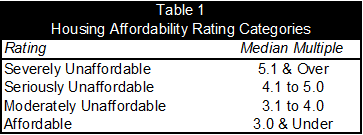
    The Demographia International Housing Affordability Survey uses the "median multiple" price-to-income ratio. The median multiple is calculated by dividing the median house price by the median household income.  Housing affordability ratings are indicated in Table 1.

    Virtually all of the severely unaffordable major markets in this year’s Survey exercise urban containment policy. Meanwhile, no market without strong land use regulation has ever been rated as severely unaffordable in the 12 years of the Survey.

    The Bottom 10: Least Affordable Major Metropolitan Markets

    The kinds of restrictions on development that Senator Day outlines are evident in the most unaffordable metropolitan areas.

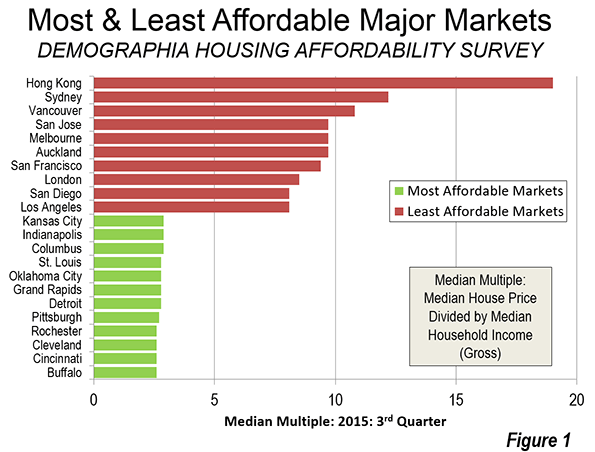
    For the fifth straight year, Hong Kong had the least affordable housing.  Its median multiple was 19.0. Sydney became the second least affordable, at 12.2, leaping by 3.2 points, the largest annual increase ever recorded among major markets in the Survey. Sydney displaced Vancouver, which had the third least affordable housing among the major markets, with a median multiple of 10.8. This is up from 10.6 last year. Each of these is the highest median multiple recorded in these markets in the history of the Survey.

    Three metropolitan markets tied in fourth position with a median multiple of 9.7, San Jose, Melbourne and Auckland. San Francisco was the 7th least affordable market, with a median multiple of 9.4, followed by London (8.5). San Diego and Los Angeles, which both had a median multiple of 8.1 (Figure 1).

    Urban containment markets clearly and nearly perennially suffer declines in housing affordability. In 2013, the same ten metropolitan markets were the least affordable and had an average median multiple of 9.1. By 2015, their average median multiple had risen to 10.5. Housing affordability deteriorated in all 10 markets (house prices rose faster than incomes). This loss in housing affordability was at least 14 times the loss in the 10 most affordable markets (below).

    The Top 10: Most Affordable Major Metropolitan Markets

    Again, the United States, with its multiple regulatory variations accounted for all of the top 10 in housing affordability (actually the top 12, because of a four way tie for ninth position). Buffalo, Cincinnati, Cleveland and Rochester had the most affordable housing, with a median multiple of 2.6. Pittsburgh ranked 5th, at 2.7. Detroit, Grand Rapids and St. Louis tied for 6th, at 2.8. The tenth place tie was between Columbus, Indianapolis, Oklahoma City and Kansas City, with a median multiple of 2.9.

    By contrast, the top ten markets experienced relatively little deterioration in housing affordability over the past two years. In 2013, their median multiple averaged 2.6, and rose to 2.7 in 2015 (Figure 1). The housing affordability deterioration in the bottom 10 markets (all urban containment markets) was 14 times as high, as noted above.

    Among the five megacities (over 10 million population) in the Survey, Osaka-Kobe-Kyoto had the best housing affordability, with a moderately unaffordable median multiple of 3.4.

    All Markets

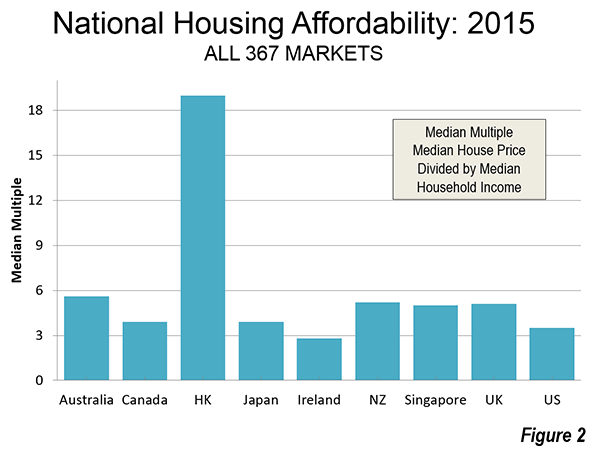
    Overall, the Survey included 368 markets. The most favorable housing affordability was in Ireland, with a median multiple among the markets of 2.8. This was the third year in a row that Ireland had the best housing affordability. In the nine prior years of the Survey, the most affordable housing had always been in either Canada or the United States (Figure 2).

    The United States was the second most affordable in 2015, with a median multiple of 3.5. Canada and Japan tied for third, with median multiples of 3.9. Four geographies with virtually universal urban containment policy were the least affordable, the United Kingdom (5.1), New Zealand (5.2), Australia (5.6) and Hong Kong (19.0).

    Singapore, though seriously unaffordable at 5.0, is far more affordable than its long-time rival,  Hong Kong (19.0). Each has virtually no suburban or rural hinterland and high population density. Yet there is a serious difference in housing policy. In contrast to Hong Kong, Singapore’s e Housing and Development Board, which accounts for approximately 90 percent of housing (which after sale is privately owned) has increased production and reduced new house prices which has led to a lowering of resale house prices as well.

    A Wholly Contrived Crisis

    Senator Day characterizes the housing affordability crisis “wholly contrived,” and “a matter of political choice… the product of restrictions imposed through planning regulation and zoning.” Senator Day calls the economic consequences of present land use policies “devastating.” He argues that governments and central banks have been too hasty to blame unprecedented housing affordability losses on demand factors, while missing the “real culprit,” which is the “refusal of … governments … to provide an adequate and affordable supply of land for new housing stock to meet demand (typically urban containment policy).

    Without reform, prospects for middle income households are grim in the metropolitan areas with urban containment policy. Housing affordability can be expected to deteriorate more, with dire economic and social consequences. According to London School of Economics and Political Science economists Paul C. Cheshire, Max Nathan and Henry G. Overman (see: People Rather than Places, Ends Rather than Means: LSE Economists on Urban Containment).

    "The problem is it is utterly unviable in the long term. With every passing decade the problems would get worse, the wider economic costs would become more penalising, the economy and monetary policy more unmanageable and the outcomes – the divide between the property haves and the property have-nots – more unacceptable."

    Wendell Cox is Chair, Housing Affordability and Municipal Policy for the Frontier Centre for Public Policy (Canada), is a Senior Fellow of the Center for Opportunity Urbanism (US), a member of the Board of Advisors of the Center for Demographics and Policy at Chapman University (California) and principal of Demographia, an international public policy and demographics firm. He is co-author of the “Demographia International Housing Affordability Survey” and author of “Demographia World Urban Areas” and “War on the Dream: How Anti-Sprawl Policy Threatens the Quality of Life.” He was appointed to three terms on the Los Angeles County Transportation Commission, where he served with the leading city and county leadership as the only non-elected member. He served as a visiting professor at the Conservatoire National des Arts et Metiers, a national university in Paris.
    Photo: Sign advertising new house and land packages starting in the $170,000s. Suburban St. Louis, third quarter 2015 (photo by author).

  • Where American Families Are Moving

    Much is made, and rightfully so, about the future trends of America’s demographics, notably the rise of racial minorities and singles as a growing part of our population. Yet far less attention is paid to a factor that will also shape future decades: where families are most likely to settle.

    However hip and cool San Francisco, Manhattan, Boston or coastal California may seem, they are not where families are moving.

    In a new study by the Chapman Center for Demographics and Policy, we found that the best cities for middle-class families tend to be located outside the largest metropolitan areas. This was based on such factors as housing affordability, migration, income growth, commute times, and middle-income jobs. Many of our best-rated cities tend to mid-sized. The three most highly rated were Des Moines, Iowa, Madison, Wis., and Albany, N.Y., all with populations of less than 1 million. Among our top 10 metropolitan areas for families, five are larger than this, but only two—the Washington, D.C. area and Minneapolis-St. Paul—are among the nation’s 20 largest metropolitan areas.

    Download the full report (pdf) here.

    Our bottom 10 includes the media’s favorite two cities, New York and Los Angeles, also the largest metropolitan areas in the nation. Three other large metropolitan areas rank in the bottom 10: Miami, Riverside-San Bernardino, Calif., and Las Vegas. The hipster cities, in other words, are not so amenable to the new generation of young families.   

    Why Families Head to the Suburbs

    In the 1960s, renowned urbanist Jane Jacobs asserted that “suburbs must be a difficult place to raise children.” But they remain popular nonetheless. According to U.S. Census Bureau statistics, in 2011, children between ages 5 and 14 constituted about 7 percent in urban core Central Business Districts (CBDs) across the country, less than half the level in newer suburbs and exurbs. In Manhattan, singles comprise half of all households, based on the American Community Survey. The highest percentage of women over 40 without children, notes geographer Ali Modarres, can be found in expensive and dense Washington, D.C.

    One clear example of the new child-free city is San Francisco, which is now home to 80,000 more dogs than children. In 1970, children made up 22 percent of the population of San Francisco. Four decades later, they comprised just 13.4 percent of the town’s 800,000 residents. Nearly half of parents of young children there, according to 2011 survey conducted by the city, planned to leave in the next three years, largely due to high housing costs. This pattern is accelerating: Since 2011, less-dense ZIP codes have been growing far faster than the more dense ones.

    The desire for affordable, single-family homes is driving this trend. Over 80 percent of married couples live in such housing, compared to barely 50 percent of households of unrelated individuals and single. The choice to move to the suburbs also reflects the preference for a safer setting. FBI crime statistics show the violent crime rate in the core cities of major metropolitan areas is nearly 3½ times higher than in the suburbs. Given the murder rate in many major cities, this gap can be expected to grow.

    Another key motivation in choosing the suburbs, especially for families with children, is frustration with the quality of urban public education. Suburban schools still consistently out-perform those of inner cities in terms of achievement, graduation and college admission.

    In the coming years the progressive penchant for enforced densification—contrary to the preferences of most Americans—could cause some serious intra-party rifts, even in areas that today are reliably Democratic “blue.” The biggest opposition to building more single family housing has often been in liberal bastions such as Marin County, Calif., Boulder, Colo., and Westchester County, N.Y., the official residence of Hillary and Bill Clinton after they left the White House. As one Bay Area blogger observed, “suburb-hating is anti-child”—because it seeks to undermine neighborhoods with children.

    Exclusionary and Opportunity Regions

    America has always had its fancy neighborhoods, often associated also with racial or ethnic exclusion. But increasingly large parts of the country, and this is true in certain cities and suburbs, are evolving into what Dartmouth College’s William Fischel has called “exclusionary regions”—too expensive for middle-class families to access.

    Fischel traces much of this development to regulatory policies that restrict housing supply. In 1970, for example, housing affordability in coastal California metropolitan areas was similar to the rest of the country, as measured by the median multiple (the median house price divided by the median household income). Today, due in part to a generation of strict growth controls, home prices in places like San Francisco and Los Angeles are now three or more times higher than in some other metropolitan areas.

    The impact is being felt disproportionately by younger adults, who, unlike earlier generations, do not benefit from housing inflation, and who face other barriers to home-buying ranging from student debt to weak income growth. Coupled with an overall weak economy, the net worth of people under age 35 has plummeted almost 70 percent from 2004 levels, making affordable housing an even more pressing issue.

    This cash-short generation is moving to more affordable places. Since 2010, the fastest growth in the ranks of college-educated millennials has been to lower-cost regions such as the four large Texas cities (Dallas-Fort Worth, Houston, San Antonio and Austin), Nashville, Tenn., and Orlando, Fla., as well as such Rust Belt cities as Pittsburgh and Cleveland. These cities offer what the “exclusionary” regions once did: an affordable inner-city option for the young and childless as well as suburbs they can move to as they start families. Other families are settling in small, relatively inexpensive metropolitan areas: Fayetteville, Ark., Cape Coral and Melbourne, Fla., Columbia, S.C., Colorado Springs, Colo., and Boise, Idaho.

    High rents, which now constitute the largest share of income in modern U.S. history, could be determining these change in youthful migration. Since 1990, renters’ income has been stagnant, but inflation-adjusted rents have soared 14.7 percent. Housing, long the largest expenditure item, now takes an even larger share of family costs, while expenditures on food, apparel and transportation have dropped or stayed about the same. In 2015, increases in housing costs essentially swallowed gains made elsewhere, notably savings on the cost of energy.

    This situation is most severe in the highest-priced markets. In New York, Los Angeles, Miami and San Francisco, for example, renters spend 40 percent of their income on rent, well above the national average of under 30 percent. In each of these markets there have been strong increases (income adjusted) relative to historic averages. In New York, rents increased between 2010 and 2015 by 50 percent, while incomes for renters between ages 25 and 44 grew by just 8 percent.

    Where the Future Is Being Built

    This wide disparity between “opportunity” and “exclusionary” areas is being locked in place by the persistent lack of new housing in most high-priced regions. Since 2010, among the 10 areas that experienced the biggest increases in housing supply, only one was in a deep-blue urban area: Seattle. The cities producing the most new units—Austin, Raleigh, N.C., Houston, Dallas-Fort Worth, Nashville, Charlotte, N.C., Orlando, Oklahoma City, and Jacksonville, Fla.—have managed to keep their housing costs, and rents, to levels acceptable to middle- and working-class families.

    In contrast New York, San Francisco, Los Angeles and Boston are authorizing far fewer new units per capita than these rising cities. Houston and Dallas-Ft. Worth, with a population roughly one-third of Los Angeles-Orange Country, have produced close to two times as many new units. Overall, California’s rate of new housing permits is one-third that of the Lone Star State.

    This divide will become more pronounced as progressives work to undermine lower-density lifestyles, often in the name of combatting climate change. In California, new single-family homes are gradually being made the exclusive province of the super-affluent, while multi-family units often face opposition from neighbors and even environmentalists. Older residents, with lower property taxes and ideal weather, may stick around, but young people likely will be forced to migrate, particularly as they enter their 30s or get tired of living in their parents’ spare rooms.

    No surprise, then, that expensive and highly regulated markets have seen declines in their numbers of children since 2000. In contrast, affordable cities continue to gain families with children in the 5 to 14 age range. Dallas-Ft. Worth, for example, gained 230,000 youngsters between 2000-2013. In Houston, the number was 190,000 and in Atlanta it was more 167,000 over that span. During the same period, Los Angeles’ child population dropped by 303,000, or 15 percent. In New York it fell by 238,000 kids.

    Increasingly, employers are factoring affordable local housing stock as an equation into their decisions about where they locate—or relocate. A recent SMU study found that high housing prices to be the biggest reason why Toyota left Los Angeles for the Dallas-Fort Worth area.

    The Emerging Family/Childless Divide 

    Although American localities are being pitted against one another not just by politics but by their ability to attract young families, the emerging map of where families live is not necessarily custom-made for conservatives.

    Key Democratic groups, including African-Americans, are also moving to the suburbs, particularly in less expensive cities, largely in the southeast and Texas. The suburbs are also increasingly the chosen destination of immigrants and their offspring, another blue-leaning cohort. Roughly 60 percent of Hispanics and Asians already live in suburbs. Between 2000 and 2012, the Asian population in suburban areas of the nation’s 52 biggest metro areas grew 66.2 percent, while in the core cities it expanded by 34.9 percent. Of the top 20 cities with an Asian population of more than 50,000, all but two are suburbs.

    Republicans also will be challenged to appeal to the rising number of suburban millennials, who also lean Democratic. But there’s some good news for Republicans in that the political future is not going to be shaped primarily in the Obama hotbeds along the coasts, but places, such as the South and the suburbs, where conservatives at are more competitive.

    To compete for diversifying suburban, Sunbelt and smaller city electorates, conservatives need to better show why families of all ethnicities should support them. They must make the case that Republican policies are better for voters economically and can provide the most efficient and effective services, particularly for their children.

    As for Democratic Party leaders, they would do well to push back the narrative of their urban core elites, who tend to characterize suburbs and Sunbelt cities as soulless enemies of culture and killers of the planet. It is time to recognize that most American families, whatever their ethnicity, desire a decent home in a nice neighborhood, whether in a suburb or a city, where children can be raised. In addition, and this is of increasing importance, they want a place where seniors can grow old amid familiar places and faces. These homeowners will likely yield disproportionate influence over elections since they are more likely to vote — and be active in local affairs — than the general population.

    Ultimately, these families will determine the political future of the country. After all, there is no “replacement” generation for singles and childless couples. In the long run, wooing families will determine who wins the political wars not only this year but in the decades ahead.

    Download the full report (pdf) here.

    Joel Kotkin is executive editor of NewGeography.com and Roger Hobbs Distinguished Fellow in Urban Studies at Chapman University, and a member of the editorial board of the Orange County Register. He is also executive director of the Houston-based Center for Opportunity Urbanism. His newest book, The New Class Conflict is now available at Amazon and Telos Press. He is also author of The City: A Global History and The Next Hundred Million: America in 2050. He lives in Orange County, CA.

  • New Report: Building Cities for People

    This is the introduction to a new report: “Building Cities for People” published by the Center for Demographics and Policy. The report was authored by Joel Kotkin with help from Wendell Cox, Mark Schill, and Ali Modarres. Download the full report (pdf) here.

    Cities succeed by making life better for the vast majority of their citizens. This requires less of a focus on grand theories, architecture or being fashionable, and more on what occurs on the ground level. “Everyday life,” observed the French historian Fernand Braudel, “consists of the little things one hardly notices in time and space.” Braudel’s work focused on people who lived normal lives; they worried about feeding and housing their families, keeping warm, and making a livelihood.

    Adapting Braudel’s approach to the modern day, we concentrate on how families make the pragmatic decisions that determine where they choose to locate. To construct this new, family- centric model, we have employed various tools: historical reasoning, Census Bureau data, market data and economic statistics, as well as surveys of potential and actual home-buyers.

    This approach does not underestimate the critical role that the dense, traditional city plays in intellectual, cultural and economic life. Traditional cities will continue to attract many of our brightest and most capable citizens, particularly among the young and childless. But our evidence indicates strongly that, for the most part, families today are heading away from the most elite, more congested cities, and towards less expensive cities and the suburban periphery. (See report appendix “Best Cities for Families”)

    New York, San Francisco, and Los Angeles long have been among the cities that defined the American urban experience. But today, families with children seem to be settling instead in small, relatively inexpensive metropolitan areas, such as Fayetteville in Arkansas and Missouri; Cape Coral and Melbourne in Florida; Columbia, South Carolina; Colorado Springs; and Boise. They are also moving to less celebrated middle-sized metropolitan areas, such as Austin, Raleigh, San Antonio and Atlanta.

    Traditional cities will continue to attract many of our brightest and most capable citizens, particularly among the young and childless. But our evidence indicates strongly that, for the most part, families today are heading away from the most elite, celebrated cities, and towards less expensive cities and the suburban periphery.

    Download the full report (pdf).

  • San Francisco With 200,000 More People — Would we be Better Off?

    You want something truly scary? Take a look at these mockups of what San Francisco might look like if we build all the housing that the developers say we need.

    According to writer Greg Ferenstein,

    The city probably needs somewhere north of 150,000 more units: most high-rises would be concentrated in the Eastern, Downtown, and mid-market areas, while every block in the entire city would need at least one 7-story building. Essentially, San Francisco would be Manhattan downtown and Paris everywhere else.

    Set aside that I never want to live in Manhattan (at any price), and that the infrastructure to handle 200,000 more people would be horrendously expensive (and developers are already refusing to pay their fair share for far lower levels of need).

    It’s not just “how to we build that much housing.” It’s how do we build maybe $20 billion or more worth of transportation capacity to handle that density. Manhattan has a citywide underground transit system with high capacity and no surface traffic issues. SF doesn’t, and won’t, as long as we can’t raise property taxes and refuse to charge developers for the cost of that new system.

    Never mind, let’s take Ferenstein’s idea and play it out. Suppose we decided as a city that we are willing to accept a lot more density in exchange for affordability. (This is something the mayor is promoting). Let’s say that the city really needs to build highrises all over the eastern side of town (why only the east?) and put mid-rise buildings everywhere.

    Let’s say we decide that 47.5 square miles of space are enough for1 million people, and that we are willing to give up everything about San Francisco that we would lose in the process.

    Remember, the streets in the highrise districts in Manhattan are much broader than the streets in SF, able to handle more traffic, with big sidewalks that can handle more pedestrians – and still it’s often overwhelming.

    Right now in SF, for example, I am able to walk down the streets at 5pm without being jammed in a pack of stressed-out pushing people, which is life in parts of NYC. It’s possible to able to take your young kids and your dog for a walk in a place where there’s actually room to walk.

    Imagine Mission and Valencia, being packed with thousands more pedestrians. Don’t even think about the traffic.

    In fact, unless we took entire streets and banned cars, forget about the bicycle lanes – they are narrow and limited and can’t easily handle say 200 percent more traffic.

    But again, whatever. Let’s say that it’s elitist to try to keep the charm of a human-scale city in a world-class city like SF, which Ferenstein calls “quaint.” Let’s say that our only hope of avoiding being a city of just the rich is to build all the apartments and condos anyone could every want to build.

    Let’s say we have that debate and decide that the need for affordable housing trumps all, and we will just have to live with the implications.

    So what happens if we let the developers build 200,000 new units – and prices don’t come down?

    That’s actually a pretty likely scenario. It’s happened in other places (NYC, for example, where lots of new housing is being built and prices are not in any way coming down.)

    It’s happened in SF so far, where we have built more market-rate housing in the past four years than at any point since the 1960s, and prices continue to soar.

    Ferenstein talked to an econometrics expert at a credit agency. Okay. No idea if this person has ever studied housing or housing price trends in San Francisco, but he has a model. It assumes that we have to build housing faster than the population grows. Nice.

    Except that market-rate housing causes population growth as fast as it solves it – that is, if your model is the traditional capital-market model, you can’t keep up with population growth by building. You might as well try to decrease traffic by building freeways; never works, never has – not in San Francisco.

    And how come we never talk about why the population is growing so fast, and why so much of that growth comes from one industrial sector that hires one type of workers?

    I emailed Ferenstein with my questions, and here’s what he said:

    Well, prices don’t fall here because we don’t build enough. It’s been an issue for decades. And, if you build enough units, prices will fall. You just have to build more supply than people. The question is whether it is possible to do so. But, I’m actually not advocating for that. I’m advocating for *some* solution. If the city decides it doesn’t want to grow, then it should be responsible for finding some solution where people can live and work in the same city–somewhere. Maybe it’s San Francisco. Maybe it’s Oakland. Maybe it’s a new city. But there has to be a giant metropolis somewhere. And, San Franciscans must realize, if jobs relocate elsewhere, they will suffer massive inequality and terrible commutes.

    Interesting argument. Of course, we are not talking about a city where people live and work; San Francisco’s housing crisis in large part the result of people living here and commuting to Silicon Valley, on private buses. The Valley cities build no housing at all, and expect us to solve the problem.

    And I would argue that if some tech jobs went elsewhere, we would have less inequality and less terrible commutes – it’s the displacement from too many people moving here for jobs when housing doesn’t exist that has created the problem. Most of San Francisco does better when there is slower growth in bubbly tech industries.

    There’s a much more interesting question that we might want to address: Suppose we built may 20,000 new units, or 30,000, or 50,000, spread all over the city – and every one of them was social housing, that is, housing that was never in the private sector? Would that bring down prices? Would that provide the same level of affordability, or maybe much more, than the Manhattan West model?

    Would that be a better deal?

    At the very least, we would know that the new housing would be affordable, instead of taking a huge gamble that the (failed) free market, and the (failed) econometric projections of the past, would save us.

    Oh, and what if we said that SF no longer wants to be the bedroom community for Silicon Valley, and will stop entitling things like private buses that make that trend possible?

    That’s a bit of a different picture.

    This piece originally appeared at 48hills.org.

    Photo: A mockup by Alfred Two for a Medium story on what an “affordable” SF might look like

  • The Cities Doing The Most To Address The U.S. Housing Shortage

    America is suffering from the severest undersupply of housing since the end of the Second World War. Although population growth has slowed significantly since the 1950s and 1960s, production has slowed down even more so. It’s not surprising that homebuilding declined after the housing bubble burst in 2008, but from 2011 to 2015 it continued to fall, dropping almost a quarter.

    Meanwhile, housing price inflation has re-emerged. Housing now accounts for roughly 35% of household expenditures, up from about 30% in 1985, while expenditures on food, apparel and transportation have dropped or stayed about the same.

    High home prices help to boost rents by forcing potential buyers into the apartment market. As of midyear, rental costs were eating up the largest share of renters’ income in recent U.S. history, 30.2%. Since 1990, renters’ income has not increased, but rents have soared 14.7% (both inflation adjusted).

    In high-priced markets like New York, Los Angeles, Miami and San Francisco, the average renters spend from 42% to 48% of their income on rent, well above the national average. In New York, rents increased between 2010 and 2015 by 50%, while incomes for renters between ages 25 and 44 grew by just 8%.

    The Cities Building The Most New Homes

    Some metropolitan areas are doing a much better job than others at meeting this pent-up demand by building new housing.

    We looked at the volume of construction permits for single and multifamily units in the 53 largest metropolitan statistical areas in the country from 2011 through 2014, and compared them to those metro areas’ existing housing bases.

    To a large extent, the superstars of the past four years have been those areas that have enjoyed both the greatest job and population growth. The top of our list of cities that are increasing their housing supply the most is dominated by metro areas that have generally better housing affordability, with a multiple of median incomes to median housing prices between three and four.

    Leading the way is Austin, Texas, which issued permits for the construction of roughly 71,000 housing units from 2011 through 2014, equal to 11.5% of its existing housing base in 2010. Austin’s new construction was split almost 50-50 between single family and multifamily units.

    Other Texas cities in our top 10 include No. 3 Houston, which permitted the construction of 189,634 new units from 2011-14, the most in the nation over that span, equal to 9.7% of its 2010 base. Dallas-Ft. Worth ranks seventh, with a total of 148,329 units, second most in the nation behind Houston, for a 6.7% expansion of its housing supply from 2010. Most of the rest of our top 10 — including the North Carolina boom towns Raleigh (No. 2) and Charlotte (No. 4) — are located in or adjacent to the southern rim of the country. Only No. 10 Seattle can be considered a “smart growth” region, with the predictable high prices relative to incomes.

    Families vastly favor single-family homes, and they can still find them at a relatively affordable price in many Southern cities. Some two-thirds of housing construction permits in Houston from 2011-14 was for single-family homes, and six of the top 10 metro areas for single-family construction over that span were located in the South. Houston alone produced nearly as many new single-family homes in 2014 as the entire state of California, which has about six times as many residents.

    If you go by new single-family construction as a percentage of the existing housing base, sprawling, suburban, smaller and mid-sized metropolitan areas in the South are in the lead: Raleigh, Austin, Nashville, Charlotte, Orlando, Oklahoma City and Jacksonville.

    But it’s important to recognize that as these areas “sprawl” they are also densifying. Houston ranks second nationally for new multifamily units over the span we looked at with 65,261; Austin, seventh (35,687, representing 18% of its 2010 base); and Charlotte ranks 15th. Some of this growth is concentrated near their urban cores, which have revived in recent years.

    The Doyennes Of Density

    In expensive parts of the Northeast and the West Coast, the favored solution to the housing affordability crisis is to pack more people into a smaller space: force households into smaller homes and apartments by raising the price of single-family dwellings for middle-income buyers through land-use restrictions.

    This approach may produce some units, but it hardly addresses the affordability issue. By most measures, higher-density housing is far more expensive to build. Gerard Mildner of the Center for Real Estate at Portland State University, notes that a high rise over five stories costs nearly three times as much per square foot as a garden apartment. Even higher construction costs are reported in the San Francisco Bay Area, where townhome developments can cost up to double that of detached houses per square foot to build (excluding land costs), and units in high rise condominium buildings can cost up to 7.5 times as much.

    New York epitomizes the limitations of density to address the affordability crisis. The Big Apple ranks third behind Houston and Dallas-Ft. Worth in total residential construction permits from 2011-14 at 140,041 units, but that’s underwhelming given that it’s the most populous metro area in the nation by far. That total represents only 2.0% of the metro area’s 2010 housing base, 42nd best out of the nation’s 53 largest MSAs.

    Nearly 75% of the New York area’s housing construction over that span was multifamily, with permits for 103,000 units from 2011-14, but that only makes for a 2.6% increase in apartment supply over 2010, placing it a meager 39th among the major metro areas over that span.

    That 75% multifamily proportion is common in other expensive, highly regulated markets such as Los Angeles and San Francisco. In Boston, regulatory and land costs have boosted the cost of building a 1,600 square foot apartment to $438,000.

    The failure of high-density housing to relieve the affordability crisis is most evident in the Golden State. The state’s largest metro areas have among the highest ratios of home prices to income. Prices in San Diego, Los Angeles have all risen considerably above the national average, despite only meager economic recoveries. San Jose and San Francisco have also experienced huge home price increases and are among the most unaffordable major metropolitan markets in the nation. Among these, only San Jose ranks in the top 10 in multi-family building permits as a percentage of the 2010 base (fifth).

    The Metro Areas That Are Lagging, And What Lies Ahead

    The lowest rung of our rankings are mostly smaller, old industrial cities with little in the way of population growth. Providence, R.I., barely eked out 1% growth in its housing supply since 2011. Other low-ranking areas include Hartford, Cleveland, Detroit, Milwaukee, Chicago and Rochester.

    Overall, future prospects seem to be brighter in cities that have both reasonable prices and strong economies. These metro areas, which dominate our list, have the advantage also of being able to offer millennials, as they age, the sort of affordable single-family housing that they tend to move into during their 30s and beyond, notes economist Jed Kolko.

    By building both single-family and multifamily housing at a higher clip, these areas are building the foundations for future growth, particularly for the next generation. There will be ups and down in the years ahead, but metropolitan areas producing adequate, diverse and affordable housing seem likely to enjoy future advantages in the race for talent and jobs.

    No. 1: Austin, TX

    New Permitted Multifamily Units, 2011-14: 35,687

    New Permitted Single-Family Units, 2011-14: 35,288

    New Units As Pct. of 2010 Housing Base: 11.5%

    No. 2: Raleigh, NC

    New Permitted Multifamily Units, 2011-14: 15,478

    New Permitted Single-Family Units, 2011-14: 26,892

    New Units As Pct. of 2010 Housing Base: 10.6%

    No. 3: Houston, TX

    New Permitted Multifamily Units, 2011-14: 65,261

    New Permitted Single-Family Units, 2011-14: 124,373

    New Units As Pct. of 2010 Housing Base: 9.7%

    No. 4: Charlotte, NC

    New Permitted Multifamily Units, 2011-14: 20,195

    New Permitted Single-Family Units, 2011-14: 35,536

    New Units As Pct. of 2010 Housing Base: 7.1%

    No. 5: Orlando, FL

    New Permitted Multifamily Units, 2011-14: 19,306

    New Permitted Single-Family Units, 2011-14: 30,883

    New Units As Pct. of 2010 Housing Base: 6.8%

    No. 6: Nashville, TN

    New Permitted Multifamily Units, 2011-14: 13,966

    New Permitted Single-Family Units, 2011-14: 27,292

    New Units As Pct. of 2010 Housing Base: 6.7%

    No. 7: Dallas, TX

    New Permitted Multifamily Units, 2011-14: 63,978

    New Permitted Single-Family Units, 2011-14: 84,351

    New Units As Pct. of 2010 Housing Base: 6.7%

    No. 8: Oklahoma City, OK

    New Permitted Multifamily Units, 2011-14: 4,342

    New Permitted Single-Family Units, 2011-14: 21,000

    New Units As Pct. of 2010 Housing Base: 5.5%

    No. 9: Jacksonville, FL

    New Permitted Multifamily Units, 2011-14: 5,812

    New Permitted Single-Family Units, 2011-14: 20,404

    New Units As Pct. of 2010 Housing Base: 5.5%

    No. 10: Seattle, WA

    New Permitted Multifamily Units, 2011-14: 38,803

    New Permitted Single-Family Units, 2011-14: 31,563

    New Units As Pct. of 2010 Housing Base: 5.4%

    This piece first appeared at Forbes.com

    .

    Joel Kotkin is executive editor of NewGeography.com and Roger Hobbs Distinguished Fellow in Urban Studies at Chapman University, and a member of the editorial board of the Orange County Register. He is also executive director of the Houston-based Center for Opportunity Urbanism. His newest book, The New Class Conflict is now available at Amazon and Telos Press. He is also author of The City: A Global History and The Next Hundred Million: America in 2050. He lives in Orange County, CA.

    Wendell Cox is Chair, Housing Affordability and Municipal Policy for the Frontier Centre for Public Policy (Canada), is a Senior Fellow of the Center for Opportunity Urbanism (US), a member of the Board of Advisors of the Center for Demographics and Policy at Chapman University (California) and principal of Demographia, an international public policy and demographics firm.He is co-author of the “Demographia International Housing Affordability Survey” and author of “Demographia World Urban Areas” and “War on the Dream: How Anti-Sprawl Policy Threatens the Quality of Life.” He was appointed to three terms on the Los Angeles County Transportation Commission, where he served with the leading city and county leadership as the only non-elected member. He served as a visiting professor at the Conservatoire National des Arts et Metiers, a national university in Paris.

    Photo by LoneStarMike (Own work) [CC BY-SA 3.0], via Wikimedia Commons

  • White House Economist Links Land Use Regulations: Housing Affordability and Inequality

    There is a growing body of research on the consequences of excessive land use regulation. The connection between excessive land use regulation and losses in housing affordability, has been linked to  the doubling or tripling of house prices relative to incomes in places as diverse as Hong Kong, the United States, Canada, Australia, New Zealand and the United Kingdom.

    More recently, research has identified serious consequences to national economies, beyond the fact that many households cannot afford to live, much less buy a home in the metropolitan areas with excessive land use regulation. Because residents such area have less income to spend due to the higher house costs, job creation and economic growth are hobbled. Rising inequality is also being cited as a consequence of excessive land use regulation.

    The White House Economic Chairman’s Address

    The issue has caught the attention of the White House (See: “Why White House Economists Worry about Land Use Regulations”). The Chairman of the White House Council of Economic Advisers, Jason Furman delivered an address on the subject to a conference hosted by the Urban Institute and Core Logic in Washington on November 20 (See: Barriers to Shared Growth: The Case of Land Use Regulation and Economic Rents).

    Furman starts with the fundamentals: “Basic economic theory predicts—and many empirical studies confirm—that housing markets in which supply cannot keep up with demand will see housing prices rise.”

    Furman cites research by Christopher Mayer of the University of Pennsylvania and C. Tsuriel Somerville of the University of British Columbia who “conclude that land use regulation and levels of new housing construction are inversely correlated, with the ability of housing supply to expand to meet greater demand being much lower in the most heavily regulated metro areas.” (see Note 1.)

    The Association with Deteriorating Housing Affordability

    Furman told the conference that: “While land use regulations sometimes serve reasonable and legitimate purposes, they can also give extranormal returns to entrenched interests at the expense of everyone else.” He suggested that: “There can be compelling environmental reasons in some localities to limit high-density or multi-use development. Similarly, health and safety concerns—such as an area’s air traffic patterns, viability of its water supply, or its geologic stability—may merit height and lot size restrictions.”

    But, according to Furman, excessive land use regulation can severely impact the housing market:

    "…zoning regulations and other local barriers to housing development allow a small number of individuals to capture the economic benefits of living in a community, thus limiting diversity and mobility. The artificial upward pressure that zoning places on house prices—primarily by functioning as a supply constraint—also may undermine the market forces that would otherwise determine how much housing to build, where to build, and what type to build, leading to a mismatch between the types of housing that households want, what they can afford, and what is available to buy or rent."

    In effect, excessive land use restrictions feed upon themselves to exacerbate the losses in housing affordability (Note 2):

    "… some individuals are priced out of the market entirely, and homes in highly zoned areas also become even more attractive to wealthy buyers. Thus, in addition to constraining supply, zoning shifts demand outward, exerting further upward pressure on prices…"

    Broader Consequences: Rising Inequality and Labor Mobility Stagnation

    But the impacts go well beyond housing affordability losses. Furman expresses concern that the housing affordability losses in some cities make it difficult for households to move from elsewhere to take advantage of higher paying positions. He notes the impact of artificial constraints on housing supply as hindering mobility and suggesting that:

    "Zoning and other land use regulations, by restricting the supply of housing and so increasing its cost, may make it difficult for individuals to move to areas with better-paying jobs and higher-quality schools. Barriers to geographic mobility reduce the productive use of our resources and entrench economic inequality."

    He elaborated on this point:

    "Reduced labor mobility may be a contributing factor to both increased inequality and lower productivity growth in the United States. This reduction in mobility has manifested itself in a wide variety of ways, including the fact that individuals are less likely to change jobs, to switch occupations or industries, or to move within States or across State lines. Businesses are creating and destroying jobs at a lower rate and fewer new businesses are being formed, both of which could be causes or consequences of a decline in labor mobility."

    Part of the key to improving economic growth is greater job mobility.

    "…increasing mobility ‘is going to be an important part of the solution of increasing incomes and increasing incomes across generations,’"

    The greater restrictions imposed on mobility by excessive land use regulation particularly injures middle income and lower income households.

    "But when zoning restricts the supply of housing and renders housing more expensive—even relative to the higher wages in the high productivity cities—then workers are less able to move, particularly those who are low income to begin with and who would benefit most from moving. As a result, existing income inequality across cities remains entrenched and may even be exacerbated, while productivity does not grow as fast it normally would."

    Economic Growth and Distributional Consequences of Excessive Regulation

    Mr. Furman cited ground-breaking research on the economic and distributional effects of excessive land use regulation. This includes:

    Research by Raven Saks of the Federal Reserve Board, which “shows that an increase in labor demand in high regulation cities leads to a smaller increase in the housing stock, greater house price appreciation, and lower employment growth than in low regulation cities.”

    Research by Peter Ganong and Daniel Shoag of Harvard University finding that the historic convergence of incomes between higher and lower income areas of the US has declined substantially. Furman said “One story for this lack of any convergence is that only high-income workers can afford to relocate to the high-productivity cities that have tight land use regulations, which reinforces existing inequality.”

    Research by Chang-Tai Hseih of the University of Illinois, Chicago and Enrico Moretti of the University of California, Berkeley estimating a nearly 10 percent loss in national output from the reduced job mobility (Furman characterizes this modeled estimate as “tentative.”) Furman reported that the researchers attributed most of this loss to restrictions on housing supply.

    Furman also expresses concern about intergenerational equity losses and the fact that over the past four decades land use regulations, along with larger income gains for the more affluent: “have worked toward pricing middle- and lower-income families out of the communities with the best schools.” In fact, in the major metropolitan areas, excessive land use regulations started four decades ago in California and Oregon, but with effects generally similar to what Furman suggests.

    Toward Relief for Future Generations

    The answer, according to Furman is better policies:

    "Thus, within the broader context of declining migration rates, divergence across labor markets, and worsening housing affordability, pursuing more prudent zoning policies could also reduce inequality that is entrenched across generations."

    Furman also notes the importance of studying restrictions, such as excessive land regulation because such an effort can: “…make the economy more competitive by artificial barriers, thus improving both the distribution of income and the productive capacity of the economy.”

    Such improvements are genuine concerns. A year ago, the G-20 group of nations, meeting in Brisbane, adopted a communiqué declaring “better living standards” as their highest priority. They also committed to eradicating poverty. However, since last year, economic growth has been disappointing, as the post-Great Recession recovery appears stalled in second gear, at best. Yet despite the weak economy, housing affordability has deteriorated even more sharply in G-20 member states Australia, Canada, China and the United Kingdom.

    As the US research indicates, real household income growth can be severely hobbled if much or all of the modestly rising incomes is consumed by extraordinarily rising housing costs. This also does nothing to reduce, much less eradicate poverty. Governments from Sacramento and Olympia to Sydney and London should strive to improve the situation by reforming counterproductive and economically destructive land use regulations.

    Note 1: The academic references in this article are detailed in longer discussions in our new reports, A Question of Values: Middle-Income Housing Affordability and Urban Containment Policy, and Putting People First: An Alternative Perspective with an Evaluation of the NCE Cities “Trillion Dollar” Report.

    Note 2: In a footnote to the speech transcript, Furman notes that housing housing affordability requires comparison to incomes rather than simple house price comparisons: “Yet, affordability measures are relative to wages in an area not levels of house prices across cities.” This required nexus to income is not always evident in research on housing affordability.

    Wendell Cox is Chair, Housing Affordability and Municipal Policy for the Frontier Centre for Public Policy (Canada), is a Senior Fellow of the Center for Opportunity Urbanism (US), a member of the Board of Advisors of the Center for Demographics and Policy at Chapman University (California) and principal of Demographia, an international public policy and demographics firm.He is co-author of the "Demographia International Housing Affordability Survey" and author of "Demographia World Urban Areas" and "War on the Dream: How Anti-Sprawl Policy Threatens the Quality of Life." He was appointed to three terms on the Los Angeles County Transportation Commission, where he served with the leading city and county leadership as the only non-elected member. He served as a visiting professor at the Conservatoire National des Arts et Metiers, a national university in Paris.
    Photo: Entering Oregon sign

  • The Detached iHome of the Future

    Will new American housing growth continue to reflect old methods, or will the land development, home building, and consulting industry retool, re-educate, and collaborate to create a new era of more attractive, livable, efficient, and environmentally responsible growth at attainable prices?

    Here is why it would be so significant to make a change: The US Department of Housing has determined that 620,000 new single family homes were completed in 2014, averaging 2,453 square feet on an 8,689 square foot average lot. The average price was $345,800, with a national total of $214.4 billion.

    Those post-recession 620,000 homes have used up much of the existing empty suburban lots from the recession. Assume that 30 percent of a development is consumed by infrastructure, and that typical 8,689 square foot lot represents about 12,400 square foot of growth. That means we have newly-developed — or recently consumed — about 275 square miles of construction, using lot stock. In other words, now that the existing lots are consumed, future growth will annually consume more than 275 square miles of land.

    That development, at $214 billion dollars in home value, is the equivalent of a $650 iPhone 6s for every US resident. Unlike the iPhone that is assembled in a minute, though, a single family home is built by craftsmen over many months in a development that takes years to go through the approval and construction process.
    An iPhone is a marvel of technology, representing billions in research and development, and requiring close communication and collaboration between professionals in engineering, materials, software, and manufacturing.

    The design for the $345,800 home and its neighborhood progress at a snail’s pace. Both floor plans and site plans are rooted in the 1960s, with civil engineering standards from the 1950s handbook. The professionals involved in land development design and construction — surveyors, planners, civil engineers, and architects — are a most un-collaborative group, fostering this stagnation.

    Yet today, innovations in both technology and methods can empower the consulting industry to create neighborhoods and housing that matches the progress of other industries, like those that are creating mobile phones, cars, and medicines. Savvy developers and home builders are beginning to break free, setting new trends by merging planning, architecture, and engineering.

    Of those 620,000 homes, it’s likely that only a few custom built ones had a tight coordination between the room function, the wall and window locations, and the connection to the surrounding viewsheds.

    When land is ‘subdivided,’ the streets, and afterwards the lot lines, are all set to regulatory minimums. This method ‘stretches’ the public street to create the greatest volume of street and the smallest area available for lots. The compression of space forces cookie-cutter, mundane growth. Architectural design was traditionally an afterthought to the subdividing process.

    To develop alternative approaches, we used the ‘down-time’ during the recession to research and develop new geometric relationships between lot and home, as well as to develop better spatial analysis and design software to accomplish ‘Architectural Blending’ for the mass market single family home.

    We saw how advancements in land planning have been made possible by merging engineering and surveying geometry with organic site layout methods. This combination has proven to significantly reduce infrastructure (street-utility length), while increasing average lot area. Redistributed space allows for more flexible designs.

    The merging of interior and exterior spaces, ‘Architectural Blending,’ was first implemented in a design idea coined as ‘BayHomes.’ The term came from the bay-like shape of common open spaces that undulated between home fronts. In 1999, Professional Builder Magazine called BayHomes “New Urbanism with a View.”

    BayHomes are single family detached homes set within townhome zoning, thus, they are in association-maintained environments. They were first implemented in 1998 on The Greens of Hutchinson, Minnesota, offering production housing that coordinated living spaces within the home with adjacent spaces and views, and for the first time merged planning and architecture at attainable prices. Since The Greens, there have been thousands of BayHome designs that have refined the method.

    BayHomes are positioned to provide a panoramic view from the focal point, usually the kitchen, to common spaces adjacent to the home front. BayHomes hide the garages, which makes them ideal along arterial streets to create a ‘village-like’ appearance. By eliminating most of the public street right-of-ways, compared to traditional single family homes the BayHome can achieve duplex density with plenty of landscaped open space providing a lower density feel.

    BayHomes serve a specific consumer who would have otherwise bought a duplex or townhome. The large scale housing market has been and will remain single family homes.

    The next problem became: How to duplicate advantages of a BayHome in a single family home which must front a lot on a public street? The challenge to increase available space was solved through a design technique called coving. A rectangular lot is simple: You have few options — no side views and limited front and rear yards space — whereas ‘coving’ produces a larger, non-rectangular lot, yet still maintains the density of the rectangle.

    When we looked at some traditional designs that would fit on higher density narrow lots, we saw typical floor layouts where — for example — 8.1 percent of the home was consumed by the hallway. If the home cost $200,000, then $16,000 was the cost of the hall. By merging planning and architecture, new models are more efficient within higher density single family-home neighborhoods, reducing or eliminating these common forms of waste within and around the home.

    With a new era of design we can solve problems like these, as well as critical issues. The problem with increased density is the compaction of space, sacrificing livability, efficiency, curb appeal, views, and environment. Some may argue that the environment is not harmed by increased density, ignoring that while the lot and home size is reduced, streets, walks, garages, and other infrastructure elements remain the same size as larger lots. Thus, the ratio of housing footprint to paved areas serving the home increases, and ‘organic’ (landscaped) space is sacrificed.

    As the home buying public becomes aware that it’s possible to have a home of significantly higher value than the typical monotonous design rooted in the 1960s, and that it can be located in a neighborhood of greater character, they will demand change with their pocketbooks. They will be able to look at the streetscapes of nearby cookie cutter subdivisions, and see that neighborhoods of the same density can have a dramatic increase in function, curb appeal, views, safety, efficiency, connectivity, and perception of space. The differences will be as dramatic as comparing a dial phone of the 1960s to the iPhone of today.

    Rick Harrison is President of Rick Harrison Site Design Studio and Neighborhood Innovations, LLC. He is author of Prefurbia: Reinventing The Suburbs From Disdainable To Sustainable and creator of Performance Planning System. His websites are rhsdplanning.com and performanceplanningsystem.com.

    Aerial view of Transoma, a community planned on the principles of coving, from the author.