Category: housing

  • New Report: Putting People First

    This is the abstract from a new report “Putting People First: An Alternative Perspective with an Evaluation of the NCE Cities ‘Trillion Dollar’ Report,” authored by Wendell Cox and published by the Center for Opportunity Urbanism. Download the full report (pdf) here.

    A fundamental function of domestic policy is to facilitate better standards of living and minimize poverty. Yet favored urban planning policies, called "urban containment" or "smart growth," have been shown to drive the price of housing up, significantly reducing discretionary incomes, which necessarily reduces the standard of living and increases poverty.

    This makes the alleviation of poverty, the opportunity for better living standards and aspirations for upward mobility secondary to contemporary urban planning prescriptions. Despite this, calls to intensify land use regulations are becoming stronger and more insistent.

    A New Climate Economy report (NCE Cities report), by Todd Litman, "Analysis of Public Policies that Unintentionally Encourage and Subsidize Urban Sprawl," contends that the failure to implement urban containment policy (smart growth) costs more than $1.1 trillion annually in the United States. The urban containment policies favored by the NCE Cities report seek substantially increase urban population densities and transfer urban travel from cars to transit, walking and cycling.

    There are serious consequences to such policies, which lead to lower standards of living and greater poverty. This report evaluates the NCE Cities report which places urban containment policy as its most important priority. This Evaluation report offers an alternate vision, focused on improving living standards for all, while seeking to eradicate poverty.

    The NCE Cities report relies heavily on social costing and externality analysis of lower density development. While these are useful tools, they are ultimately subjective and should be used with great caution.

    This Evaluation identifies a number of issues with respect to the NCE Cities report cost analysis.

    1. Nearly 90% of the cost is attributable to personal vehicle use, and is based on a fixed cost per mile differential between the Most Compact (densest) quintile of US urban areas and the four quintiles that are less dense. This Evaluation finds a range of differences in per capita mileage among the quintiles that is far smaller than the NCE Cities report estimates. Adjustment for this and other issues would reduce the NCE Cities report cost estimate by nearly 85 percent, to a maximum that is under $200 billion. Other, unquantified issues are identified that could reduce the reduced estimate even further.

    2. The NCE Cities report largely dismisses the housing affordability consequences of urban containment policy. By rationing land, urban containment policy drives up the price of housing and has been associated with an unprecedented loss of housing affordability in a number of metropolitan areas in the United States and elsewhere. Urban containment policy has also been associated with greater housing market volatility. This is a particular concern given the role of the 2000s US housing bubble and bust in precipitating the Great Financial Crisis that resulted in a reduction of international economic output.

    3. Urban containment policy has significant negative externalities. A recent economic analysis associates an annual loss of nearly $2 trillion in gross domestic product in the United States with more stringent housing regulation. This estimate would nullify the NCE Cities report cost of dispersion estimate by more than 1.5 times. More significantly, it would dwarf the NCES Report cost estimate as adjusted in this Evaluation.

    The purpose of public policy in cities is not to focus a particular urban form, planning philosophy, type of housing, population density, or mode of transport. The purpose is rather to seek better lives for people. The most appropriate form of urban planning policy is that which facilitates better living standards and less poverty. There is increasing evidence that urban containment policy is not only irreconcilable with housing affordability and price stability but also with better standards of living and reduced poverty.

    Download the full report (pdf) here.

    Wendell Cox is Chair, Housing Affordability and Municipal Policy for the Frontier Centre for Public Policy (Canada), is a Senior Fellow of the Center for Opportunity Urbanism (US), a member of the Board of Advisors of the Center for Demographics and Policy at Chapman University (California) and principal of Demographia, an international public policy and demographics firm.He is co-author of the "Demographia International Housing Affordability Survey" and author of "Demographia World Urban Areas" and "War on the Dream: How Anti-Sprawl Policy Threatens the Quality of Life." He was appointed to three terms on the Los Angeles County Transportation Commission, where he served with the leading city and county leadership as the only non-elected member. He served as a visiting professor at the Conservatoire National des Arts et Metiers, a national university in Paris.

  • California: “Land of Poverty”

    For decades, California’s housing costs have been racing ahead of incomes, as counties and local governments have imposed restrictive land-use regulations that drove up the price of land and dwellings. This has been documented by both Dartmouth economist William A Fischel and the state Legislative Analyst’s Office.

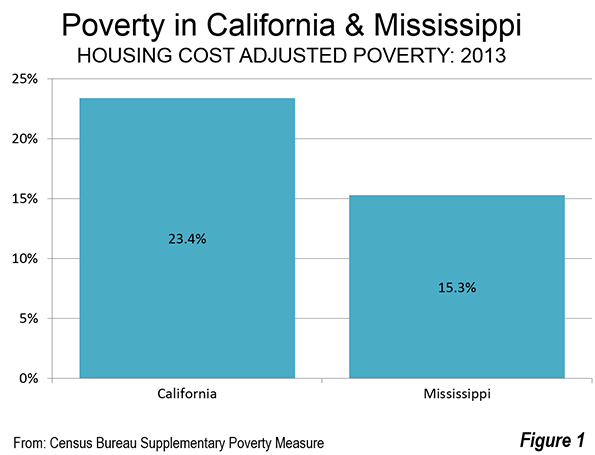
    Middle income households have been forced to accept lower standards of living while less fortunate have been driven into poverty by the high cost of housing.Housing costs have risen in some markets compared to others that the federal government now publishes alternative poverty estimates (the Supplemental Poverty Measure), because the official poverty measure used for decades does not capture the resulting differentials. The latest figures, for 2013, show California’s housing cost adjusted poverty rate to be 23.4 percent, nearly half again as high as the national average of 15.9 percent.

    Back in the years when the nation had a "California Dream," it would have been inconceivable for things to have gotten so bad — particularly amidst what is widely hailed as a spectacular recovery. The 2013 data shows California to have the worst housing cost adjusted poverty rate among the 50 states and the District of Columbia. But it gets worse. California’s poverty rate is now more than 50 percent higher than Mississippi, which long has set the standard for extreme poverty in the United States (Figure 1).

    The size of the geographic samples used to estimate the housing adjusted poverty rates are not sufficient for the Supplemental Poverty Measure to produce local, county level or metropolitan area estimates. However, a new similar measure makes that possible.

    The California Poverty Measure                           

    The Public Policy Institute of California and the Stanford Center on Poverty and Inequality have collaborated to establish the "California Poverty Measure," which is similar to the Supplemental Poverty Measure adjusted for housing costs.

    The press release announcing release of the first edition (for 2011) said that: "California, often thought of as the land of plenty" in the words Center on Poverty and Inequality director Professor David Grusky, is "in fact the land of poverty."

    The latest California Poverty Measure estimate, for 2012, shows a statewide poverty rate of 21.8 percent, somewhat below the Supplemental Poverty Measure and well above the Official Poverty Measure that does not adjust for housing costs (16.5 percent).

    The California Poverty Measure also provides data for most of California’s 58 counties, with some smaller counties combined due to statistical limitations. This makes it possible to estimate the California Poverty Measure for metropolitan areas, using American Community Survey data.

    Metropolitan Area Estimates

    By far the worst metropolitan area poverty rate was in Los Angeles, at 25.3 percent. The Los Angeles County poverty rate was the highest in the state at 26.1 percent, well above that of Orange County (22.4 percent), which constitutes the balance of the Los Angeles metropolitan area. However, the Orange County rate was higher than that of any other metropolitan area or region in the state (Figure 2). San Diego’s poverty rate was 21.7 percent. Perhaps surprisingly, Riverside-San Bernardino (the Inland Empire), which is generally perceived to have greater poverty, but with lower housing costs, had a rate of 20.9 percent. The two counties, Riverside and San Bernardino had lower poverty rates than all Southern California counties except for Ventura (Oxnard) and Imperial.

    The San Francisco metropolitan area had a poverty rate of 19.4 percent, more than one-fifth below that of Los Angeles. San Jose has a somewhat lower poverty rated 18.3 percent (Note 1). The metropolitan areas making constituting the exurbs of the San Francisco Bay Area had a poverty rate of 18.7 percent. This includes Santa Cruz, Santa Rosa, Stockton and Vallejo. Sacramento had the lowest poverty rate of any major metropolitan area, at 18.2 percent.

    The San Joaquin Valley, stretching from Bakersfield through Fresno to Modesto (Stockton is excluded because it is now a San Francisco Bay Area exurb) had a poverty rate of 21.3 percent, slightly below the state wide average of 21.8 percent. The balance of the state, not included in the metropolitan areas and regions described above had a poverty rate of 21.2 percent.

    County Poverty Rates

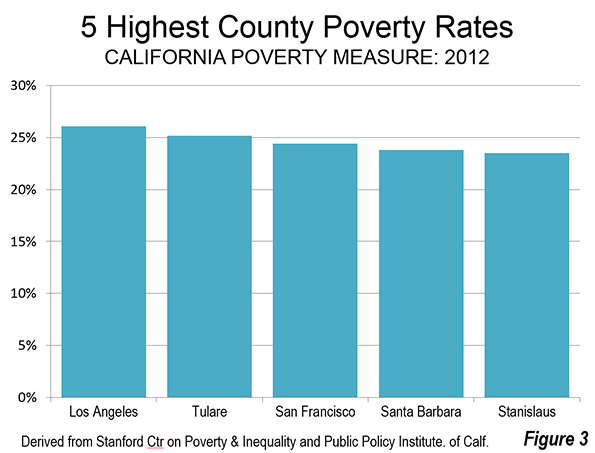
    As was noted above, Los Angeles County had the highest 2012 poverty rate in the state (Note 2), according to the California Poverty Measure (26.1 percent). Tulare County, in the San Joaquin Valley had the second-highest rate at 25.2 percent. Somewhat surprisingly, San Francisco County with its reputation for high income had the third worst poverty rate in the state at 23.4 percent. This is driven, at least in part, by San Francisco’s extraordinarily high median house price to household income ratio (median multiple). In this grisly statistic, it trails only Hong Kong, Vancouver and Sydney in the latest Demographia International Housing Affordability Survey. Wealthy Santa Barbara County has the fourth worst poverty rate in the state, at 23.8 percent. The fifth highest poverty rate is in Stanislaus County, in the San Joaquin Valley (county seat Modesto), which is already receiving housing refugees from the San Francisco Bay Area, unable to pay the high prices (Figure 3).

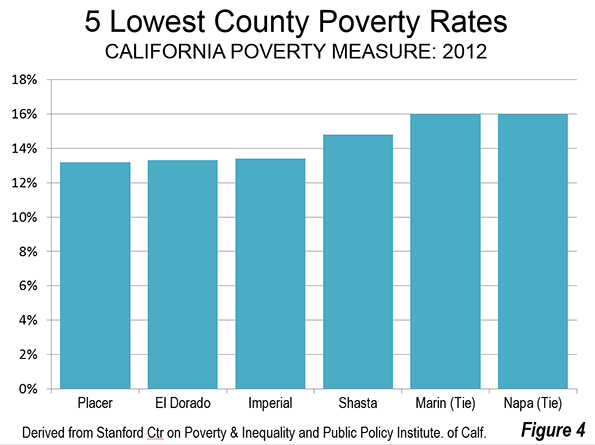
    The two lowest poverty rates were in suburban Sacramento counties (Note 2). Placer County’s rate was 13.2 percent and El Dorado County’s rate was 13.3 percent. Another surprise is Imperial County, which borders Mexico and has generally lower income. Nonetheless, Imperial County has the third lowest poverty rate at 13.4 percent. Shasta County (county seat Redding), located at the north end of the Sacramento Valley is ranked fourth at 14.8 percent. Two counties are tied for the fifth lowest poverty rate (16.0 percent), Marin County in suburban San Francisco and Napa County, in the exurban San Francisco Bay Area (Figure 4).

    Weak Labor Market and Notoriously Expensive Housing

    The original Stanford Center on Poverty and Inequality press release cited California’s dismal poverty rate as resulting from "a weak labor market and California’s notoriously expensive housing." These are problems that can be moderated starting at the top, with the Governor and legislature. The notoriously expensive housing could be addressed by loosening regulations that allow more supply to be built at lower cost. True, the new supply would not be built in Santa Monica or Palo Alto. But additional, lower cost housing on the periphery, whether in Riverside County, the High Desert exurbs of Los Angeles and San Bernardino Counties, the San Francisco Bay Area exurbs or the San Joaquin Valley could begin to remedy the situation.

    The improvement in housing affordability could help to strengthen the weak job market, by attracting both new business investment and households moving from other states.

    Regrettably, Sacramento does not seem to be paying attention. Liberalizing land use regulations is not only absent from the public agenda, but restrictions are being strengthened (especially under the requirements of Senate Bill 375). In this environment, metropolitan areas like Los Angeles, San Francisco, San Jose and San Diego could become even more grotesquely unaffordable, and the already high price to income ratios in the Inland Empire and San Joaquin Valley could worsen. All of this could lead to slower economic growth and to even greater poverty, as more lower-middle-income households fall into poverty.

    Note 1: San Benito County is excluded from the San Jose metropolitan area data. The California Poverty Measure does not report a separate poverty rate for San Benito County.

    Note 2: Among the counties for which specific poverty rates are provided.

    Wendell Cox is Chair, Housing Affordability and Municipal Policy for the Frontier Centre for Public Policy (Canada), is a Senior Fellow of the Center for Opportunity Urbanism (US), a member of the Board of Advisors of the Center for Demographics and Policy at Chapman University (California) and principal of Demographia, an international public policy and demographics firm.

    He is co-author of the "Demographia International Housing Affordability Survey" and author of "Demographia World Urban Areas" and "War on the Dream: How Anti-Sprawl Policy Threatens the Quality of Life." He was appointed to three terms on the Los Angeles County Transportation Commission, where he served with the leading city and county leadership as the only non-elected member. He served as a visiting professor at the Conservatoire National des Arts et Metiers, a national university in Paris.

    Photograph: Great Seal of the State of California by Zscout370 at en.wikipedia [CC BY-SA 3.0], from Wikimedia Commons

  • Goodbye, Single Family Home? But wait…..

    New urbanist utopians love to decry Americans’ love of the single family home, and to extol the virtues of a higher-rising denser city as more efficient and environmentally responsible. Without expounding on the immensely destructiveness of such a utopian viewpoint to physical and psychological well-being of a large majority of people, nor of the scientific absurdity of the claim of efficiency and  environmental goodness, I will for now present only some maps and data of what the real world is like.

    People vary in needs and preferences over the life course. It is indeed the case that young adults, usually unmarried (and yes increasingly for a longer time), and perhaps a fair share of elderly widows or widower, or even empty-nesters, together as many as one-third of persons, may prefer and enjoy an urban lifestyle, and apartment living. These are the people, for example that are flocking into a growing Seattle, bidding up the price of housing, to take up jobs at Amazon and similar businesses, and even supporting planning calls for replacing a sizeable share of single family homes, with higher density housing.

    But this phenomenon ignores the further housing reality that the other two-thirds of people are in families, with children or other relatives, or even unrelated people who rent rooms, who much prefer homes on lots, with some private space. Even those young singles jumping into downtown Seattle may marry, have children, and as they have done generation after generation, and look, yes, for homes with yards and space for a car, so they can go and explore the environs beyond the city.

    What’s out there?

    Table 1 summarizes the national data on population living in different kinds of housing. For whatever reasons you will not find this information in any census publication or city or state reports! They are quite difficult to find and require gleaning from PUMS (Public Use Micro Sample) data.

    Table 1 Shares of population by Type of Housing, 2010
    Type # Units % of Units  Population % of population     Ave HH Size
    Single family 76.5 67.4 216.6 72.2 2.83
    Small apartments 15 13.3 37.7 12.6 2.51
    Large apartments 15.9 14 28.3 9.4 1.78
    Mobile Homes 7.4 6.5 17.2 5.7 2.2
    ALL  114 100 299.5 100 2.6
    Units and population in millions


    The key information is that single family homes. Including duplexes for which each unit a separate address account for 67.4 % of occupied housing units in 2010 (61.6 % in totally separate structures), and housed a convincing 217 million, 72.2 % of the population (not including those in group quarters), at an average household size of 2.83. Note well: that’s almost 3 out of 4!

    Mobile homes are mostly banned from big cities, but in the real world of providing shelter for the less affluent in many areas, they are 6.5% of units, housing over 17 million, another 5.7% of the population, at an average household size of 2.2.

    About 31% of units, 13.3% in structures with 2 to 9 units, and 14% in structures with 10 or more units, are in apartments, and house 22% of the population (12.6 in the smaller structures, 9.4 in the larger) at an average household size of 2.5 and 1.8 respectively, or 2.2 for all apartments. 

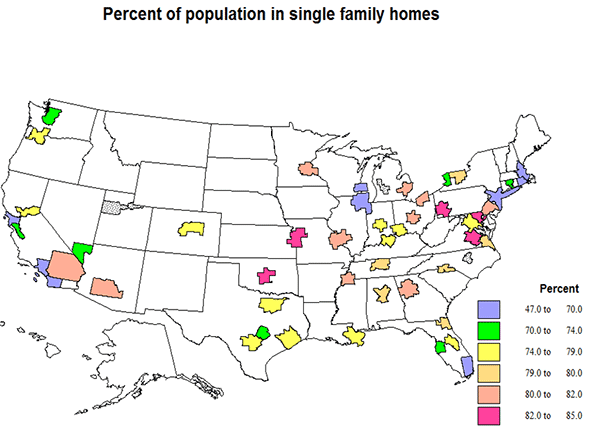
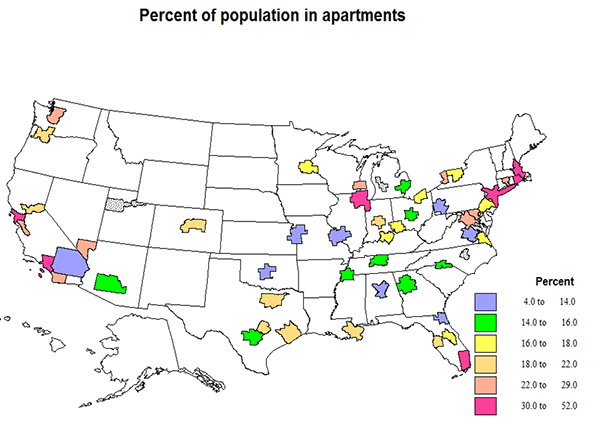
    The relative importance of single family homes and of apartments varies significantly across states (and cities or counties if we had the data), but this is best seen with the help of the included maps.

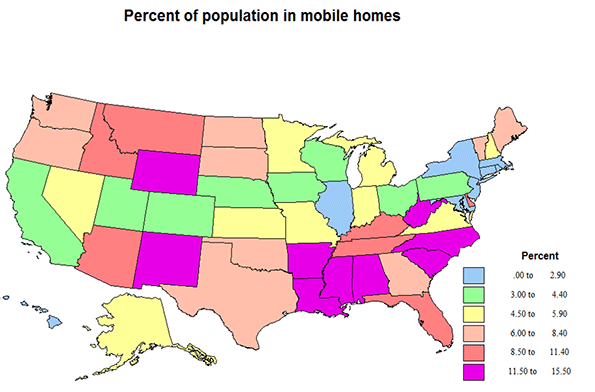
    It is interesting to start with mobile homes, to find out where they are most common. In 11 states over 10% of people live in mobile homes. The highest is 15.5% in SC, followed by NM at 13.9, WY, 13.2, WV, 12.9, MS, 12.6, then AL and NC, 12.1, states with high shares of less affluent people.  Most higher shares are across the warmer south, but are also high in the northern Rockies. Indeed the lowest shares are across the middle of the country from CA to New England. The lowest share is DC at 0.0, then HI, .2, but are also quite low in MA, .7, CT, .9, RI, and NJ at 1.0, mostly small and very metropolitan states. Typical states close to the average of 5.7% are AK and NH at 5.7, MO, 5.5., and NV, 5.2.    

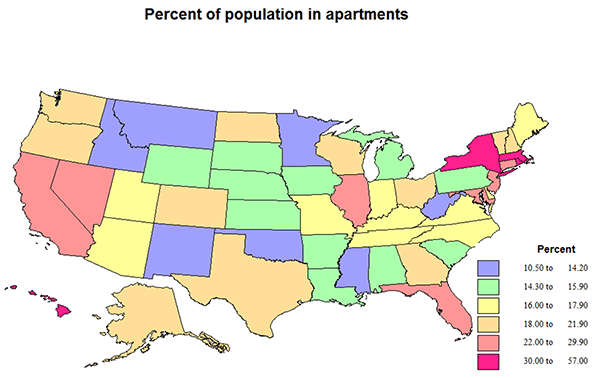
    Apartment living is quite a bit higher in selected states. The District of Columbia is by far the highest at 56%, as it is the central city of a giant metropolitan region. Next highest is New York at 46%, actually a consequence of New York City. These are followed by MA, 35, RI, 34, HI, 34 and NJ, 30.  HI may be expected to have higher apartment shares, due to the high value of desirable land, MA, RI and NJ, because of very high metropolitan shares, including New York City suburbs. Moderate apartment shares occur in CA, 24, IL, 27, FL, 24, and NV, 25.  Average shares of 22% occur in TX, VT, NH, and MD. At the other extreme, apartment living is amazingly low (under 14%) in WV, 10.5, ID 11.9, NM, 12.9, MT, 13.5, OK, 13.8, and MN, 14—mostly less metropolitan.

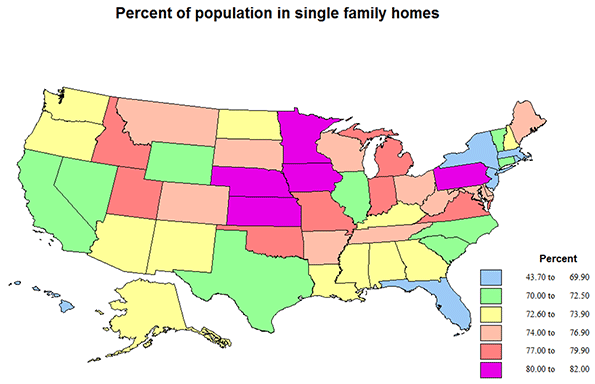
    Single family homes dominate most of the country. The highest shares, over 80, are for IA, KS, MN and NE, a contiguous sub region of the north central US, and somewhat surprising, PA. Actually not surprising: PA, 18, MD, 21, DE, 15, and VA, 10, have unusually high shares of “attached” 1 unit row houses with separate numbers and yards – not the image of single family home in most of the country. Shares are almost 80 in Mormon UT and ID, and in MI. In general, with the exceptions of NY and most of New England, shares are higher across the northern and central US than across the south, perhaps because of the greater shares of mobile homes to the south. The lowest shares are in the states with the highest shares of apartments, DC, NY, but still 52%, MA, 64, RI, 65, HI, 66, and  FL, 67, but already over 2/3! Right at the US average of 72% are AK, AZ, CA, NC, NH, TX and WY, a not geographically obvious or coherent set!
    The story for metropolitan areas

    Data are available for large “millionaire” metropolitan areas. These offer few surprises, reinforcing the story from the data for states. Table 2 distinguishes the information for 52 large metro areas, and the rest of the US. The large metro areas contain a little over half of the US population (51%).

    Table 2 Population by housing types, large metropolitan areas and the rest of the US
          Metro Rest of US
    Type      Units Population  % of Pop Ave HH Size Units Population % of Pop Ave HH Size
    Sing Family          40.2 112 73 2.78 36.3 104 71 2.89
    Apartments 17.7 37 24 2.1 11.8 29 20 2.4
    Mobile 1.7 4 2.6 2.2 5.8 13 9 2.2
    All  59.6 153 100 2.57 53.9 146 100 2.71

    The share of population in single family homes differs only slightly between the large metro areas and the rest of the country, but the share of people in apartments is much higher in  the big metro areas (24 to 20), while the share of people in mobile homes  is much higher outside of the large metro areas (9 versus 2.6). The slightly higher single family share for the metro areas is a little misleading, however, because the metro set has a much higher share of an intermediate category of housing, “1 unit attached”, meaning row houses, separate addresses and yards, but of higher density than the detached single family home.

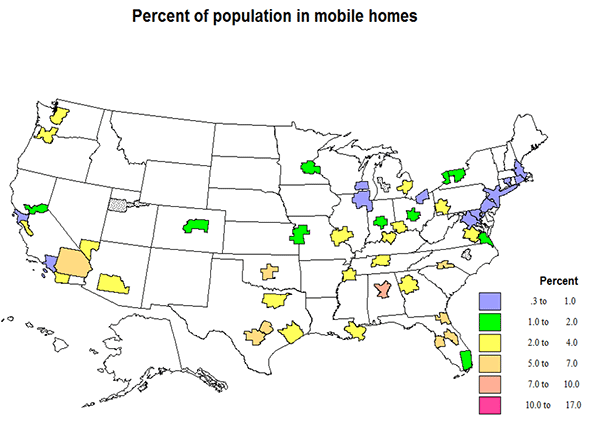
    Mobile home shares are especially lower in the biggest metro areas, most notably megalopolis, as Boston, .2 and Washington DC, .3. The highest metro share are in the south, e.g., Birmingham, 8, Tampa, 7, Riverside, 6, Jacksonville, and San Antonio, 6.

    The share of the population in single family homes  is not surprising for the most part, that is, lowest (under 70%) in most of the older and largest metro areas, NY, Boston, Chicago, San Francisco, Los Angeles, and Miami, and highest in intermediate sized across most of the country. The highest shares ae for Kansas City, 84, Pittsburgh, Oklahoma City and Richmond, 83, and Atlanta, Columbus, Detroit and St. Louis, 82. The cases of Philadelphia, Baltimore, Washington, and Richmond are special, as the high single family shares are actually a result of high shares of row housing, e.g., 32% in Philadelphia, 24 in Baltimore, 20 in Washington, 10 in Richmond.

    The population shares in apartments also reflect the size and importance of the metro area, with the addition of Miami, highest in New York Metropolitan Area, 41, (52% in the NYC part), San Francisco-Oakland, 33, Chicago, 32, Providence,33, Boston, 41, LA-Anaheim, 31.5 (33 in the LA part), and Miami, 30. The lowest shares tend to be in the interior eastern US, plus Richmond in the east and Riverside in the west: Birmingham and Oklahoma City, 12, Riverside and Pittsburgh, 13, and Jacksonville, Kansas City, Richmond and St. Louis, 14. Metro areas in a middle range (23 to 25%) include Seattle, Hartford, New Orleans, Baltimore, Buffalo, Las Vegas, and San Jose, middle sized and scattered across the country.
    Average household size

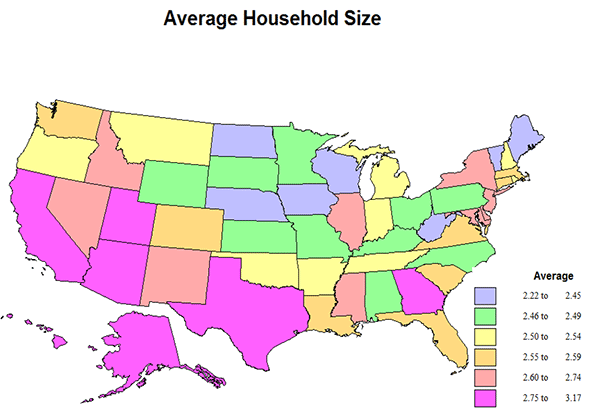
    Average household size in part reflects the kind of housing, but equally the age and ethnic composition of the population, not part of this data set. The average US number is 2.63, but 2.57 in the metro areas, and 2.71 for the rest of the US. It is highest for single family homes, 2.83 for the US, 2.78 in the metro set, 2.89 for the rest of the country, 2.2 for apartment dwellers and 2.2 for mobile home folks. As expected average values for smaller apartment structures (2 to 9) is higher in the smaller buildings than in larger ones, 2.5 compared to 1.8.

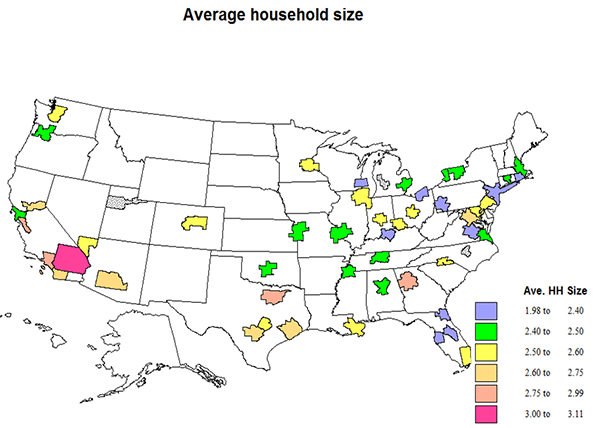
    Average values for states vary from 2.22 in ND (due to a combination of an influx of energy workers, high share of college students, and remaining seniors), 2.26 in the District of Columbia (large share of single persons), 2.35 in ME, 2.36 in IA, and 2.237 in WV (older populations) to the very highest in UT (well..) at 3.17, then CA at 2.95, AK 2.86, AZ and TX, 2.84, reflecting ethnic composition. Right in the middle are NY and DE, 2.63. Metro area average household size varies from a high of 3.1 for Riverside, then 3 for Anaheim, 2.91 for San Jose, 2.83 for Los Angeles and Dallas, all with high Hispanic populations  and levels of young immigrants.  At the low size end are NY at 1.98, the only area under 2, reflecting the high share of apartments and of singles, particularly in New York City, then Jacksonville, 2.23, Tampa, 2.28, Richmond, 2.35, and Orlando, 2.36, — in Florida a result of in-migration of older households without children.   The middle areas at 2.57 are Las Vegas, Miami, and Minneapolis.
    Conclusion

    There is no likelihood of the demise of the single family home, or even of significant attrition, simply because the large majority of people demand them. But there will be some reduction in a few areas where demand for housing is high but the land supply constrained, geographically or by growth management, as in Seattle, coastal California, New York, and Boston, with high shares of non-families. On the other hand, continuing concentration of population in giant metropolitan areas is not inevitable, as a costs drive people elsewhere. In the end, barring a national clampdown on suburbs, the balance of housing types may not change greatly.  

    Richard Morrill is Professor Emeritus of Geography and Environmental Studies, University of Washington. His research interests include: political geography (voting behavior, redistricting, local governance), population/demography/settlement/migration, urban geography and planning, urban transportation (i.e., old fashioned generalist).
  • Urban Rebirth in a Cincinnati Rowhouse

    I filmed this story in Cincinnati’s Over-the-Rhine neighborhood. As always, my far more talented friend Kirsten Dirksen did the editing. There are also glimpses of other nearby neighborhoods such as East Walnut Hills and some views for the city taken from across the Ohio River in Kentucky. Michael Uhlenhake is an architect and long time resident of the city. The story of his own practice and home renovation follows the trajectory of the city as a whole.

    Rust Belt cities like Cincinnati, Pittsburgh, and Buffalo are all much better than many people imagine. I tell folks that if you want Brooklyn, or Portland, or Wicker Park in Chicago, or the Mission in San Francisco, but at 1/10th the price… go to these fabulous, but seriously undervalued smaller cities in the Midwest. Not only will you save a huge amount of money, but waves of cool people have already started to colonize these neighborhoods ahead of you. You won’t be a lone pioneer.

    I love the magnificent architecture, the cool people, and the gorgeous natural beauty that surrounds the city. And I’m incredibly excited that many of the best historic neighborhoods are coming back to life after a fifty year slumber brought on by middle class exodus to the suburbs, deindustrialization, and general neglect. There’s a serious pent up market demand for vibrant, mixed use, walkable neighborhoods all across the country with shockingly little supply. We just haven’t built places like this since World War II and there’s a hunger for it in the real estate market. After decades of decline and abandonment Cincinnati is being repopulated by a new generation of people who value urban living.

    Check out this similar video from Walnut Hills in Cincinnati.

    And here’s one from Yellow Springs, Ohio if a small college town in the country is more your style.

    John Sanphillippo lives in San Francisco and blogs about urbanism, adaptation, and resilience at granolashotgun.com. He’s a member of the Congress for New Urbanism, films videos for faircompanies.com, and is a regular contributor to Strongtowns.org. He earns his living by buying, renovating, and renting undervalued proper

  • Book Review: Designed For The Future by Jared Green

    By the fifth word of Designed for the Future, Jared Green had almost lost me. By the end, he hadn’t quite gained me. This slim, visually interesting handbook presents “80 practical ideas for a sustainable world” from the noted author of The Dirt, a weekly blog sponsored by the American Society of Landscape Architects. Green’s earnest mission is to find hope for the future, and with this book, he edits a collection of essays that points to some projects that do.

    It is a slim, portable, affordable book for the busy design professional in any discipline who is trying to wrap his or her head around the slippery notion of sustainability. Green’s introduction summarizes his process, and then presents each idea in a two-page spread. The ideas range from using mushrooms, which are now compressed into insulation panels (don’t eat your wall), to Rome as an example of walkable urbanism (don’t tell the taxi drivers). Each idea is presented with a photograph and a neat summary of how it contributes to the future. The point of all this activity, however, remains elusive in this otherwise intriguing little book.

    Designed For the Future poses the question to eighty thinkers: “What gives you hope that a sustainable future is possible?” Each replies with a brief description of a project that inspired them to see a way forward. Among the notable but not entirely successful attempts to provide an answer is an essay by Elizabeth Mossop, “Changing Course,” about a design competition to improve management of the Lower Mississippi River in Louisiana. She notes that up until now the river, managed by scientists and engineers, has lost wetlands and added pollution to the Gulf of Mexico. Giving designers a turn might be a good idea, as she suggests. While I’m sympathetic, I keep thinking of the woeful mismanagement of the Everglades in my home state of Florida, and how often well-intentioned healing practices seem forever delayed. It is as if we cannot collectively bring ourselves to veer off our current pathway, no matter who is in charge.

    Some essays, however, are the real thing. “Project Row Houses” by F. Kaid Benfield showcases artist Rick Lowe’s community development project to preserve 22 wood-frame shotgun homes in Houston. The project uses buildings that are already built, improving them rather than replacing them; it provides dignified shelter for historically disadvantaged African Americans, and has spawned urban agriculture, education, and similar enterprises. This is what sustainability should be all about: taking our stuff and making it better, rather than abandoning it and making more stuff.

    Many of the essays are somewhat predictable paeans to urban life. “Seven Dials,” by New Urbanist Victor Dover, extols the virtues of this tiny London street intersection and its surroundings. Developed in the seventeenth century, this West End neighborhood has gentrified nicely into a walkable community. The accompanying photo seems too good to be true: pedestrians actively engaged in their public realm, not a car in sight, the sundial festooned with Union Jacks. As a prosperous, white, upper-middle-class community, it is an easy example of the urbanist’s dream come true, but well nigh impossible to replicate in America’s big-box car culture. Perhaps it could survive as a simulated city somewhere.

    Green’s inclusion of an analysis by Anthony Flint of Unité d’Habitation inspired me. This 11-story apartment block, built in France after World War II, lets daylight in on both sides of each apartment,, and features rooftop uses. It was architect Le Corbusier’s first phase of his Radiant City plan. The design was much maligned in the 1990s by urban activists as a misanthropic disaster, who claimed that traditional neighborhoods were better. But the Unite d’Habitation turned out to be a pretty nice place after all, while many well-intended traditional neighborhood developments have had poor results. There is hope, after all, for modernism.

    Green’s second-to-last entry is an essay on vernacular architecture by Li Xiaodong, a Beijing architect and professor at Tsinghua University School for Architecture. In some ways, this is the book’s most important essay. “It’s about the process, not about design,” says Li, adding, “Architecture should be based in a dialogue with local conditions and lifestyles. It should be a product of that dialogue.” Li beautifully captures the essence of sustainability, seeing it as a thought process, not a look or a lifestyle; about reacting intelligently to local conditions with materials and labor available on hand.

    Green’s examples are heavy on the land planning side of things. Innovations such as 3-D printing are missed, and economics and technology are entirely ignored. And a few essays seem repetitive: Paris is in the book twice.

    The focus is on people, land, water, and air. Reducing pollution and waste are important, and his book illustrates examples of this in abundance. We seem to have bounced back from the bad old days of the Ohio River on fire and air so thick you can take a bite out of it. This book offers assurance we are not backsliding into the wicked ways of the past.

    Reducing the amount of stuff we take from the earth also figures big. Densifying cities, which conserves open space, is the topic of more than one essay. Staying local and using renewable, vernacular materials also has resonance with these contributors. Green’s essayists portray a future where resources are extracted a little more gingerly, and open land is conserved and even integrated into human habitation on a small scale to improve our relationship with nature.

    The classical definition of sustainability includes two other tenets: increasing biodiversity, and spreading a little justice around to other species. The book provides scant evidence that the future holds any hope for these two notions. The wind farm in Lester Brown’s “Wind Mega Complexes” essay even goes against these principles, showcasing the giant wind turbines blamed for bird kills. Regarding biodiversity, Green misses the Mesoamerican Biological Corridor project, an oversight perhaps due to his self-proclaimed “random process” for choosing contributors.

    Green begins the book with the statement, “We can’t give in to fatalism.” For the symptoms of fatalism, he presents examples of cures. Someone, somewhere, is treating these symptoms, he reassures us, saying that things are getting better in many different ways.

    A deeper disease, however, lies undiagnosed in this book. Cities are denser, yes; but they increasingly all look the same. Wetlands are saved, yes; but we continue to “manage” them, as if it would be awful if they were left to themselves. Just when public spaces are getting nicer, most Americans prefer to remain indoors, glued to their devices. None of these imply a future of abundance and beauty. Until our own meaning and purpose are more fully addressed by our present society, it seems difficult to conceive of the kind of future envisaged in Designed For the Future.

    Richard Reep is an architect with VOA Associates, Inc. who has designed award-winning urban mixed-use and hospitality projects. His work has been featured domestically and internationally for the last thirty years. An Adjunct Professor for the Environmental and Growth Studies Department at Rollins College, he teaches urban design and sustainable development; he is also president of the Orlando Foundation for Architecture. Reep resides in Winter Park, Florida with his family.

  • The Really Big Housing Picture

    Everywhere I go it seems there’s some kind of housing crisis. In some places home values are dropping precipitously, people are unable to sell and move on, and formerly middle class homes are being abandoned or converted to poorly maintained rental properties. In other places home values and rents are obscenely high and ordinary people and essential workers are being driven out of whole cities and counties. The national economy has bifurcated and the shrinking middle class is reflected in a two tiered housing market. I’d like to explore the root causes of the situation.

    Woodstock-kidsWikipedia

    Reagan_et_ThatcherWikipedia

    Our current real estate schism is based on two forces. First, we as a society decided decades ago that we didn’t want to be shackled by the social conventions and obligations that hindered individuals in their quest for personal fulfillment and private gain.

    For liberals this took the form of women’s liberation, black liberation, gay liberation… Everyone wanted to throw off the yoke of conformity. For conservatives it took the form of tax revolts, rebellions against regulations of every kind, a search for open space, cheap labor, and new markets.

    These two groups were in no way mutually exclusive. Both the California Hippy and Evangelical Christian from South Carolina were pushing the country in the same direction for decades whether they knew it or not. Everyone was rebelling against social constraints and dismantling the old system that created the broad stable middle class in the first place.

    Screen Shot 2015-07-23 at 9.05.36 PM

    Screen Shot 2015-07-23 at 8.59.17 PM

    Screen Shot 2015-07-23 at 9.06.57 PM

    Screen Shot 2015-07-23 at 9.16.12 PM

    The second force in the housing crisis is based on physical mobility made possible by car culture, affordable commercial aviation, containerized cargo shipping, and modern telecommunications. Geography stopped being a material limitation for the last few generations. As a result, people have self segregated. The rich have congregated in a handful of premium locations and radically driven up the cost of living in those spots. The poor have been left to their own devices in economically and culturally abandoned regions. And the ever diminishing middle class has leveraged itself into a thousand little niches in an attempt to keep up as their incomes and status decline.

    Screen Shot 2015-06-12 at 1.16.04 AM

    Screen Shot 2015-06-12 at 6.52.37 PM

    I was recently at a meeting in Northern California where government officials, local business people, and community organizers all gathered to promote their various objectives. These were all incredibly kind, decent, responsible people who truly cared about their town. The difficulties on hand will be familiar if you live in one of the more expensive parts of the country.

    There’s a desperate need for affordable housing. There’s huge pressure to preserve productive farmland and the natural landscape. There’s fierce NIMBYism that stops new growth of every kind. There’s serious money pressing down on the scarce property that is available. There’s a water shortage brought on by years of drought. And there simply is no culturally or politically tolerable mechanism to reconcile any of these conflicting forces. Honestly, for the people who already own property in the area the situation is pretty sweet – so long as the authorities manage to keep the ever growing homeless camps out of sight. The default setting is to simply let things fester and muddle through.

    Screen Shot 2015-03-18 at 1.26.28 AM

    Screen Shot 2015-03-10 at 5.31.42 PM

    Screen Shot 2015-03-12 at 2.10.06 AM

    Just a month earlier I was at a different meeting in another town where the problem was reversed. A formerly prosperous town was hitting an economic wall as growth and development had come to a complete halt with unpleasant consequences. There was plenty of cheap land all around and everyone was desperate to see it covered in new homes, shopping malls, and office parks as quickly as possible. But market demand evaporated. Developers couldn’t justify building much of anything because there were no buyers on hand. Too much of the existing building stock was already sitting vacant.

    You’d think these two problems could solve each other. Why don’t all the people desperate for affordable housing in one place simply move to the place with abundant vacancies? Of course, it doesn’t work that way. Communities are more than a pile buildings. People need the right mix of employment, education, culture, and so on. You can’t live in a cheap place if you have no access to jobs. And you can’t take a job in a place where there is no available housing.

    Screen Shot 2015-07-23 at 9.05.36 PM

    Let’s go over some of the particulars again. Mass motoring allowed almost everyone to move away from the things and people they didn’t like. If your taxes went up you moved away. If “undesirables” arrived on your block you moved away. If you didn’t like the snow you moved away. Cheap private transportation on America’s highways made it possible for the vast 20th century middle class to remove itself from traditional communities and find bliss is splendid isolation.

    Screen Shot 2015-07-23 at 8.59.17 PM

    Affordable commercial aviation let people migrate to previously remote locations. A car could get you from New Jersey to Florida in a couple of days, but a plane could get you there in a couple of hours. Air transport preferentially poached the affluent, the young, the educated, and retirees from established towns and delivered them to previously obscure destinations. The ability to hop quickly and cheaply from place to place was a tremendous boon to some lucky towns, but the death knell to others.

    Screen Shot 2015-07-23 at 9.06.57 PM

    Containerized shipping brought raw materials and cheap manufactured goods in from every corner of the globe. If workers threatened to strike you moved your company away. Far away. If you found a better tax deal you moved away. If you needed the authorities to turn a blind eye to your company’s waste stream you moved away. The toaster ovens, refrigerators, and steel belted radial tires could all be made somewhere else for a lot less money.  And along with those jobs went a big chunk of the old middle class.

    Screen Shot 2015-07-23 at 9.16.12 PM

    Information technology has added a new layer of mobility to the population. It’s now possible to use your mobile phone to turn your home air conditioner on and off from six thousand miles away. On the one hand this sort of technological magic allows millions of people to earn a living remotely. An accountant from Albuquerque can live in a beach cabin in Hawaii while still drawing her livelihood from New Mexico.

    On the other hand, what happened to blue collar jobs in the past is now happening to white collar jobs. Your CT scan or X-rays can now be sent via the Internet to a technician in the Philippines who will interpret your medical condition remotely. Film editing can be done entirely online from Brazil. Computer code can be written in India. Architectural and engineering work can be done digitally in the Ukraine. If a job can be scanned, or Skyped, or pushed through a fiber optic wire somehow it will eventually be sent to a low wage region to be done by someone who is smarter, faster, and more desperate for work than you are.

    And this isn’t factoring in the jobs that will soon be done entirely by machine intelligence. That accountant in Hawaii needs to pay attention to what she’ll do when her clients all switch to the cheaper advanced computer program that can wiggle around the tax code better than she can. Then again, the guy who writes that computer code will become very rich and might be able to move to Hawaii himself.

    unnamed-5

    unnamed-3

    unnamed

    So what are the options here? First, we can allow the already stressed middle class to continue to shrink so that the U.S. becomes a two tiered society of haves and have nots – with many more losers than winners. Inevitably this will require an increase in both government police and private security to keep the wealthy protected from the pissed off impoverished masses. There are plenty of examples of what that looks like around the world.

    Or, we could tax the rich and redistribute the funds to the formerly middle class population that has trouble feeding itself and keeping a roof over their heads. We also know what that looks like.

    Or we could create a new social, political, and economic national compact that restructures absolutely everything. Some old fashioned societal constraints might be a prerequisite for equity and a renewed middle class. Rights come with responsibilities. Aging Baby Boomers will fight that sort of thing tooth and nail. But Millennials will likely grab at it with both hands. Toss in fuel supply disruptions and a break down in international trade relations and American society might find itself coalescing in very different ways.

    John Sanphillippo lives in San Francisco and blogs about urbanism, adaptation, and resilience at granolashotgun.com. He’s a member of the Congress for New Urbanism, films videos for faircompanies.com, and is a regular contributor to Strongtowns.org. He earns his living by buying, renovating, and renting undervalued properties in places that have good long term prospects. He is a graduate of Rutgers University.

  • Historic Districts: The Past or The Future?

    Preservation seems like an easy idea to support. Who would be against it? History, character, and a sense of place are what great communities are all about. They generate tourism and makes us all culturally richer. Landowners in historic districts even enjoy higher land values than nearby landowners in newer, usually blander developments. What’s not to like?

    Apparently, a lot. Cities unilaterally impose ordinances from time to time, regulating building size, shape and use, and rarely are there complaints, although the changes affect everyone in the city. Here in Florida, building codes were recently stiffened, causing buildings in the entire state to become more expensive, and there were no complaints to speak of. But in the small community of Winter Park, when a proposal was floated to make obtaining historic district status less onerous, indignant protesters with cries of “property rights” were voiced. Protesters who were shy about fighting the State and the City may have finally found, in individual neighborhoods, a small enough foe to bully.

    Protesters claim that they fear restraint of trade, and they’re hoping to cash in on rising land values, particularly where they have been historically low. A historic designation might make an owner think twice before knocking a house down.

    There’s mirth in Cyria Underwood’s eyes as she tells us about coming here to Winter Park from Louisville, Kentucky. A tall, elegant African American woman, Underwood works at the Hannibal Square Heritage Center, and observes Winter Park’s preservation battles like this: “Black people have an oral history tradition, and it’s a good thing we do. We don’t expect our own buildings to get preserved. So here on the West Side, we hand down our oral history from mother to child, father to son. It’d be nice to see preservation taken seriously,” she muses, her eyes still smiling, “but African Americans have learned to make do without it.”

    Interest rates remain low. In neighborhoods like the West Side, where Cyria works, owners feel the pressure to sell. Hannibal Square, built originally for blacks in the 1880s, today houses a mix of families, some of whom go back to the town’s early days. Walkability, playgrounds and parks make this a dream community for urbanists; many residents ride the buses that travel up and down Denning Avenue, and Sunrail’s Winter Park Station is a couple of blocks away. Finally, it seems, this area has come into its own and become a hip, urban community at long last.

    “However,” murmurs Cyria, her eyes twinkling, “the wolf is at the door.” She’s referring to developers who buy small houses on small lots and replace them with much larger homes, townhomes, and even multifamily clusters. West-siders have been clinging on by the skin of their teeth. Service jobs with modest incomes and part-time work (much of it a long bus ride away) have kept this neighborhood afloat. While land values all around have skyrocketed, the West Side — historically African-American — has not been rewarded with such good fortune. Property values are, to put it politely, stable.

    Fairolyn Livingston moved out of the West Side in the ’70s, but comes back frequently. She explains that when a West Side homeowner sells, he or she walks off counting the cash. But Livingston cites more than one seller who couldn’t replace the Winter Park lifestyle with the proceeds from his or her home, and ended up moving into poorer and even less upwardly mobile parts of town. So goes gentrification: the new buyer, often white, unwittingly banishes an African American family to a lower stratum, hardening class divisions.

    Livingston is candid about the younger newcomers. Asked whether they join the neighborhood churches, she chuckles. “Oh, no. There’s no interaction with our community.” The new buyers, however, benefit from the short walk to Park Avenue’s chic restaurants and shops, and can Sunrail to happy hour downtown. The West Side’s character, meanwhile, dissolves under the homogenous new face of urban America, where everywhere resembles everywhere else.

    Cyria Underwood, Fairolyn Livingston and many others are unworried about the preservation battles being waged in Winter Park right now. This is not surprising: preservation of the West Side has not been high on the City’s agenda. The same development pressures are being fought all over.

    Locally, Friends of Casa Feliz, a Winter Park preservation organization, will be co-hosting a West Side History panel discussion this autumn to help keep what is left of the architecture.

    It’s part of keeping a conversation going about the local urban future. Historic districts come into being in most places with a simple majority, but Winter Park’s requirement of a supermajority makes them difficult and rare. Protesters against preservation see this as just fine, and do not want property rights to change.

    While he isn’t a vocal protester, realtor Mark Squires is a realist. With a Clark Gable smile and wink, he is a true denizen of Winter Park real estate. “Everyone wants historic character,” Squires offers, “but nobody wants to pay for it.” Smaller, older homes have tiny kitchens and bathrooms, and are often hard to maintain. Squires and his colleagues find that, for many young couples with kids, Winter Park’s lifestyle is in high demand. The last thing on their busy agendas is fixing cast iron pipes or repainting wood trim. Many buyers want new, as the developers, builders, realtors and lenders are well aware. Every home becomes a potential knockdown, if the price fits the formula.

    Squires’ local reality is that historic preservation, while it might make everyone a little better off, makes home sales harder. Our local economy is geared towards short-term private profit, and the notion that preservation can also be profitable is rarely considered. While developers in Boston, Chicago, and elsewhere have proven that historic preservation can make money, it has yet to be seen as a both/and proposition in Central Florida. City Hall dithers over the proposed historic district ordinance while the bulldozers roll.

    Underwood is philosophical about it. “Willing seller, willing buyer, you know? You can’t control what someone does after you go.” Rich or poor, the same argument applies. The individual decides whether to push the easy button and go for new, or save a little bit of quality for future generations.

    The current wave of transactions, fueled by low interest rates and demand for in-town living, is recasting the character of her neighborhood, as well as of the more affluent areas of the East Side. If the City Commission votes to ease historic district formation, perhaps there will be more than just oral history to remember Old Winter Park by. If not, and more bungalows succumb to the McMansion, we’ll all just have to huddle up around her chair and ask for stories about the buildings that used to be here, and the people who lived within them.

    Richard Reep is an architect with VOA Associates, Inc. who has designed award-winning urban mixed-use and hospitality projects. His work has been featured domestically and internationally for the last thirty years. An Adjunct Professor for the Environmental and Growth Studies Department at Rollins College, he teaches urban design and sustainable development; he is also president of the Orlando Foundation for Architecture. Reep resides in Winter Park, Florida with his family.

    Photo of Cyria Underwood by the author

  • Blaming Foreigners for Unaffordable Housing

    In a number of Western world cities, there is rising concern about foreign housing purchases which may be driving up prices for local residents. Much of the attention is aimed at mainland Chinese buyers in metropolitan areas where housing is already pricier than elsewhere. The concern about housing affordability is legitimate. However, blaming foreigners misses the point, which is that the rising prices are to a large degree the result of urban containment policies implemented by governments.

    London and the United Kingdom              

    The Daily Mail reports that London being deluged with foreign house buyers, who are buying not only expensive properties but also "starter homes," driving prices up. The Mail singles out Russian and Chinese buyers, many of whom pay cash for their purchases. Paula Higgins of the Home Owners Alliance lamented the fact that many foreign buyers are paying cash.  She questions the appropriateness of foreign investment in "family homes." David King, of Priced Out, said: "Foreign investment is driving up prices, making it even harder for ordinary people to get a decent place to live."

    Real estate firms headquartered in Russia are steering their clients to less expensive locations, outside London, such as to the north of England and Wales. A London real estate firm said that only 15% of its sales were to buyers from the UK. There is pressure for the government to protect local home buyers

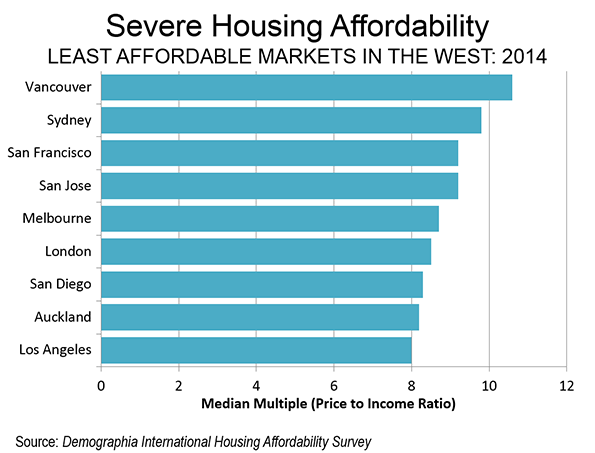
    Certainly these investors are stepping into an already pricey market. The 11th Annual Demographia International Housing Affordability Survey found London house prices to be a severely unaffordable 8.5 times household incomes in 2014. London has the seventh worst housing affordability out of the 86 major markets rated in nine nations. The outside-the-greenbelt exurbs of London have house prices 6.9 times incomes.

    Vancouver

    Vancouver is a city of immigrants. According to data compiled by University of British Columbia (UBC) Geography Professor David Ley, nearly 90 percent of metropolitan Vancouver’s growth over the past two decades has been from foreign immigration (this article contains a graph with the numbers). Yet, there is significant concern about home purchases in the Vancouver area by mainland Chinese. UBC Professor Henry Yu’s history class described the issue in a video (Blaming the Mainlander).

    The Demographia International Housing Affordability Survey found Vancouver house prices to be a severely unaffordable 10.6 times household incomes in 2014. Vancouver has the second worst housing affordability out of the 86 major metropolitan areas rated in nine nations. Hong Kong has the worst housing affordability, with a median multiple of 17.0.

    California and New York

    Ilya Marritz of Public Broadcasting Systems (PBS) radio station WNYC remarked on how foreign investment is driving up prices in the New York and San Francisco bay areas: "There’s this relatively new trend of people buying properties in the city and not actually spending a lot of time living here." The Demographia International Housing Affordability Survey found New York metropolitan area housing to cost 6.1 times incomes, a 65% increase since before the housing bubble.

    The Diplomat, which specializes in Asia-Pacific affairs, commented that “there’s no doubt that China’s presence in the Bay Area market is driving up prices. The Diplomat quoted real estate executive Mark McLaughlin; “it’s added a demographic of buyers who, generally, take a long-term view. They’re not sellers in the next five to seven years.” Chinese buyers are sitting on much of this property as housing in the Bay Area becomes increasingly scarce, causing its value to skyrocket."

    The Demographia International Housing Affordability Survey places both San Francisco and San Jose metropolitan area house prices at 9.2 times incomes, tied for fourth least affordable in the 9 nations.

    The Los Angeles Times reports strong mainland Chinese purchasing activity in the suburbs of Los Angeles, from the San Gabriel Valley to Orange County, particularly Irvine as well as in Riverside-San Bernardino (the Inland Empire).

    The Demographia International Housing Affordability Survey found house prices to be 8.0 times incomes in Los Angeles, the 10th least affordable major metropolitan area in the Survey. Nearby San Diego prices are even higher, at 8.3 times incomes, earning it the 8th least affordable major metropolitan area in the 9 nation Survey.

    New Zealand

    Things have become more heated in New Zealand. The Labour Party opposition housing spokesperson Phil Twyford blamed foreign investors for driving up house prices in Auckland, New Zealand’s only metropolitan area with more than 1,000,000 population.

    "Kiwi families who are struggling to buy their own home want to know the impact offshore speculators are having on skyrocketing Auckland house prices. They are sick and tired of losing homes at auction to higher bidders down the end of a telephone line in another country."

    This evoked considerable criticism for ethnic insensitivity not only among New Zealand’s large Chinese minority, but also ordinary citizens. Radio New Zealand opined: "For a party that has diligently and deliberately courted the ethnic vote, including the Chinese community in Auckland, this was a risky strategy." The Economics Minister accused Labour of playing "the race card." There was predictable reaction in China, which is New Zealand’s largest goods export partner. The Shanghai Daily headlined: "New Zealand housing market debate descends into race row. "Meanwhile, the National Party government continues its difficult task of trying to reverse the consequences of urban containment policy in Auckland.

    The Demographia International Housing Affordability Survey found Auckland house prices to be a severely unaffordable at 8.2 times household incomes in 2014. Auckland has the ninth worst housing affordability out of the 86 major metropolitan areas rated in nine nations.

    Australia

    In Sydney, the Party for Freedom produced a brochure "blaming Chinese property buyers for pushing up home prices, ‘ethnically cleansing’ Australian families from their suburbs and creating a new ‘stolen generation,’" according to The Sydney Morning Herald (" Race hate flyer distributed in Sydney’s north shore and inner city"). The brochure also referred to foreign purchasers as "greedy foreign invaders," and charged them with "pricing locals out of the market." A You-Tube video was posted in which the party chairman burns the flags of China, the Australian ruling Liberal Party, the Labor Party and the Greens and images of Australia’s Prime Minister and the New South Wales Premier.

    Predictably, this brought a sharp reaction from public officials, such as Lane Cove mayor David Brooks-Horn, whose affluent North Shore community was targeted for distribution of the brochures.

    Despite this "vile attack," as New South Wales Multiculturalism Minister characterized it, there remains serious concern in Australia about rising house prices, which many blame on foreign investors aalthough avoiding the extremes indicated above.

    The Demographia International Housing Affordability Survey found Sydney house prices to be a severely unaffordable 9.8 times household incomes in 2014. This is the third most unaffordable market among the 86 major metropolitan areas rated in nine nations.  Today, The Australian Financial Review reported that the median house price in Sydney has reached $1,000,000 for the first time. This is a 23% increase in just one year.

    Melbourne, with prices 8.7 times incomes is sixth least affordable.

    "Supply, Supply, Supply"

    There is a common theme among those who are blaming foreigners for the escalation in their local house prices: foreign buyers have driven up demand, thus increasing prices and driving local purchasers out of the market. That might be a plausible theory if demand by itself raised prices. But, all else equal, demand results in higher prices only when there is a shortage of supply. And a shortage of supply is exactly what has been produced by government policies in each of the metropolitan areas described above.

    The problem lies largely with the blunt policy instrument of urban containment, which makes it virtually impossible to build on wide swaths of suburban greenfield land. Urban containment policy’s most destructive strategies are urban growth boundaries or greenbelts, which often prohibit development on virtually all greenfield sites and other regulations that deny planning permission on the majority of parcels suitable for housing on and beyond the urban fringe. The shortage of supply so important to the price increases has been produced by government policies in each of the metropolitan areas described above (Figure).

    The problem is that urban containment policy "creates its own weather." Investors are disproportionately drawn to markets where there are shortages. Sir Peter Hall and his colleagues pointed out that development plans provide a guide for developers of where to buy within the metropolitan area (in The Containment of Urban England).

    A Canary Wharf buyer in London told The Wall Street Journal: “If I could afford it I’d buy as many as I could”… “Flats [in London] are a great investment. I can’t see that changing." Nor will it so long as the "sure thing" of extraordinary house price increases supported by planning policy continues. San Francisco Bay Area public officials may as well have hung a "Welcome Speculators" banner from the Golden Gate Bridge.

    James Laurenceson, Deputy Director of the Australia-China Relations Institute at the University of Technology in Sydney, told The Sydney Morning Herald.:

    "Housing affordability is a real problem. The real reasons are right in front of our eyes – limited land releases, zoning regulations, development charges, record low interest rates and tax breaks to property investors. There’s not a Chinese buyer amongst them."

    Indeed, most of the cities above became severely unaffordable well before an affluent middle-class was enabled by China’s economic reforms.

    New South Wales Premier Mike Baird characterized the solution as "supply, supply, supply," which he sees as "the principal lever" for improving housing affordability. Housing affordability proposals that do not start with the supply shortage are little more than empty rhetoric. Attempts to blame the prices primarily on foreigners are not only misleading, but also diverts the public from the more important role played by limiting supply.

    Wendell Cox is Chair, Housing Affordability and Municipal Policy for the Frontier Centre for Public Policy (Canada), is a Senior Fellow of the Center for Opportunity Urbanism (US), a member of the Board of Advisors of the Center for Demographics and Policy at Chapman University (California) and principal of Demographia, an international public policy and demographics firm.

    He is co-author of the "Demographia International Housing Affordability Survey" and author of "Demographia World Urban Areas" and "War on the Dream: How Anti-Sprawl Policy Threatens the Quality of Life." He was appointed to three terms on the Los Angeles County Transportation Commission, where he served with the leading city and county leadership as the only non-elected member. He served as a visiting professor at the Conservatoire National des Arts et Metiers, a national university in Paris. 

    Photograph: Opera House, Sydney (by author).

  • Countering Progressives’ Assault on Suburbia

    The next culture war will not be about issues like gay marriage or abortion, but about something more fundamental: how Americans choose to live. In the crosshairs now will not be just recalcitrant Christians or crazed billionaire racists, but the vast majority of Americans who either live in suburban-style housing or aspire to do so in the future. Roughly four in five home buyers prefer a single-family home, but much of the political class increasingly wants them to live differently.

    Theoretically, the suburbs should be the dominant politically force in America. Some 44 million Americans live in the core cities of America’s 51 major metropolitan areas, while nearly 122 million Americans live in the suburbs. In other words, nearly three-quarters of metropolitan Americans live in suburbs.

    Yet it has been decided, mostly by self-described progressives, that suburban living is too unecological, not mention too uncool, and even too white for their future America. Density is their new holy grail, for both the world and the U.S. Across the country efforts are now being mounted—through HUD, the EPA, and scores of local agencies—to impede suburban home-building, or to raise its cost. Notably in coastal California, but other places, too, suburban housing is increasingly relegated to the affluent.

    The obstacles being erected include incentives for density, urban growth boundaries, attempts to alter the race and class makeup of communities, and mounting environmental efforts to reduce sprawl. The EPA wants to designate even small, seasonal puddles as “wetlands,” creating a barrier to developers of middle-class housing, particularly in fast-growing communities in the Southwest. Denizens of free-market-oriented Texas could soon be experiencing what those in California, Oregon and other progressive bastions have long endured: environmental laws that make suburban development all but impossible, or impossibly expensive. Suburban family favorites like cul-de-sacs are being banned under pressure from planners.

    Some conservatives rightly criticize such intrusive moves, but they generally ignore how Wall Street interests and some developers see forced densification as opportunities for greater profits, often sweetened by public subsidies. Overall, suburban interests are poorly organized, particularly compared to well-connected density lobbies such as the developer-funded Urban Land Institute (ULI), which have opposed suburbanization for nearly 80 years. 

    The New Political Logic

    The progressives’ assault on suburbia reflects a profound change in the base of the Democratic Party. As recently as 2008, Democrats were competitive in suburbs, as their program represented no direct threat to residents’ interests. But with the election of Barack Obama, and the continued evolution of urban centers as places with little in the way of middle-class families, the left has become increasingly oriented towards dense cities, almost entirely ruled by liberal Democrats.

    Obama’s urban policies are of a piece with those of “smart growth” advocates who want to curb suburban growth and make sure that all future development is as dense as possible.  Some advocate radical measures such as siphoning tax revenues from suburbs to keep them from “cannibalizing” jobs and retail sales. Some even fantasize about carving up the suburban carcass, envisioning three-car garages “subdivided into rental units with street front cafés, shops and other local businesses” while abandoned pools would become skateboard parks.

    At the end of this particular progressive rainbow, what will we find? Perhaps something more like one sees in European cities, where the rich and elite cluster in the center of town, while the suburbs become the “new slums” that urban elites pass over on the way to their summer cottages.

    Political Dangers

    The abandonment of the American Dream of suburban housing and ownership represents a repudiation of what Democrats once embraced and for which millions, including many minorities, continue to seek out. “A nation of homeowners,” Franklin D. Roosevelt asserted, “of people who own a real share in their land, is unconquerable.”

    This rhetoric was backed up by action. It was FDR, and then Harry Truman, who backed the funding mechanisms—loans for veterans, for example—that sparked suburbia’s growth. Unlike today’s progressives, the old school thought it good politics to favor those things that most people aspire to achieve. Democrats gained ground in the suburbs, which before 1945 had been reliably and overwhelmingly Republican.

    Even into the 1980s and beyond, suburbanites functioned less as a core GOP constituency than as the ultimate swing voters. As urban cores became increasingly lock-step liberal, and rural Democrats slowlyfaded towards extinction, the suburbs became the ultimate contested territory. In 2006, for example, Democrats won the majority of suburban voters. In 2012, President Obama did less well than in 2008, but still carried most inner and mature suburbs while Romney trounced him in the farther out exurbs. Overall Romney eked out a small suburban margin.

    Yet by 2014, as the Democratic Party shifted further left and more urban in its policy prescriptions, these patterns began to turn.  In the 2014 congressional elections, the GOP boosted its suburban edge to 12 percentage points. The result was a thorough shellacking of the Democrats from top to bottom. 

    Will demographics lead suburbs to the Democrats?

    Progressive theory today holds that the 2014 midterm results were a blast from the suburban past, and that the  key groups that will shape the metropolitan future—millennials and minorities—will embrace ever-denser, more urbanized environments. Yet in the last decennial accounting, inner cores gained 206,000 people, while communities 10 miles and more from the core gained approximately 15 million people.

    Some suggest that the trends of the first decade of this century already are passé, and that more Americans are becoming born-again urbanistas. Yet after a brief period of slightly more rapid urban growth immediately following the recession, U.S. suburban growth rates began to again surpass those of urban cores. An analysis by Jed Kolko, chief economist at the real estate website Trulia, reports that between 2011 and 2012 less-dense-than-average Zip codes grew at double the rate of more-dense-than-average Zip codes in the 50 largest metropolitan areas. Americans, he wrote, “still love the suburbs.”

    What is also missed by the Obama administration and its allies is the suburbs’ growing diversity. If HUD wants to start attacking these communities, many of their targets will not be whites, but minorities, particularly successful ones, who have been flocking to suburbs for well over a decade.

    This undermines absurd claims that the suburbs need to be changed in order to challenge the much detested reign of “white privilege.” In reality, African-Americans have been deserting core cities for years, largely of their own accord and through their own efforts: Today, only 16 percent of the Detroit area’s blacks live within the city limits.

    These trends can also be seen in the largely immigrant ethnic groups. Roughly 60 percent of Hispanics and Asians, notes the Brooking Institution, already live in suburbs. Between the years 2000 and 2012, the Asian population in suburban areas of the nation’s 52 biggest metro areas grew by 66 percent, while that in the core cities expanded by 35 percent. Of the top 20 areas with over 50,000 in Asian population, all but two are suburbs.

    Left to market forces and natural demographic trends, suburbs are becoming far more diverse than many cities, meaning that in turning on suburbia, progressives are actually stomping on the aspirations not just of privileged whites but those of many minorities who have worked hard to get there.

    Another huge misreading of trends relates to another key Democratic constituency, the millennial generation.  Some progressives have embraced the dubious notion that millennials won’t buy cars or houses, and certainly won’t migrate to the suburbs as they marry and have families. But those notions are rapidly dissolving as millennials do all those things. They are even—horror of horrors!—shopping atWal-Mart, and in greater percentages than older cohorts.

    Moreover, notes Kolko, millennials are not moving to the denser inner ring suburban areas. They are moving to the “suburbiest” communities, largely on the periphery, where homes are cheaper, and often schools are better. When asked where their “ideal place to live,” according to a survey by Frank Magid and Associates, more millennials identified suburbs than previous generations. Another survey in the same year, this one by the Demand Institute, showed similar proclivities.

    Stirrings of Rebellion

    So if the American Dream is not dead among the citizens, is trying to kill it good politics? It’s clear that Democratic constituencies, notably millennials, immigrants and minorities, and increasingly gays—particularly gay couples—are flocking to suburbs. This is true even in metropolitan San Francisco, where 40 percent of same-sex couples live outside the city limits.

    One has to wonder how enthusiastic these constituents will be when their new communities are “transformed” by federal social engineers. One particularly troubling group may be affluent liberals in strongholds such as Marin County, north of San Francisco, long a reliable bastion of progressive ideology.

    Forced densification–the ultimate goal of the “smart growth” movement—also has inspired opposition in Los Angeles, where densification is being opposed in many neighborhoods, as well as traditionally more conservative Orange Country. Similar opposition has arisen in Northern Virginia suburbs, another key Democratic stronghold.

    These objections may be dismissed as self-interested NIMBYism, but this misses the very point about why people move to suburbs in the first place. They do so precisely in to avoid living in crowded places. This is not anti-social, as is alleged, but an attempt—natural in any democracy—to achieve a degree of self-determination, notes historian Nicole Stelle Garrett.

    Aroused by what they perceive as threats to their preferred way of life, these modern pilgrims can prove politically effective. They’ve shown this muscle while opposing plans not only to increase the density in suburbs, and also balking at the shift of transportation funding from roads, which suburbanites use heavily, to rail transit. This was seen in Atlanta in 2012 when suburban voters rejected a mass transit plan being pushed by downtown elites and their planning allies. Opposition to expanding rail service has also surfaced in the Maryland suburbs of Washington.

    Suburbs and 2016 Election

    To justify their actions against how Americans prefer to live, progressives will increasingly cite the environment. Climate change has become the “killer app” in the smart growth agenda and you can expect the drumbeat to get ever louder towards the Paris climate change conference this summer.

    Yet the connection between suburbs and climate is not as clear as the smart growth crowd suggests.  McKinsey and other studies found no need to change housing patterns to reduce greenhouse gases, particularly given improvements in both home and auto efficiency. Yet so great is their animus that many anti-suburban activists seem to prefer stomping on suburban aspirations rather seeking ways to make them more environmental friendly.

    As for the drive to undermine suburbs for reasons of class, in many ways the  assault on suburbia is, in reality,  a direct assault on our most egalitarian geography. An examination of American Community Survey Data for 2012 by the University of Washington’s Richard Morrill indicates that the less dense suburban areas tended to have “generally less inequality” than the denser core cities; Riverside-San Bernardino, for example, is far less unequal than Los Angeles; likewise, inequality is less pronounced in Sacramento than San Francisco. Within the 51 metropolitan areas with more than 1 million people, notes demographer Wendell Cox, suburban areas were less unequal (measured by the GINI Coefficient) than the core cities in 46 cases.

    In the coming year, suburbanites should demand more respect from Washington, D.C., from the media, the political class and from the planning community. If people choose to move into the city, or favor density in their community, fine. But the notion that it is the government’s job to require only one form of development contradicts basic democratic principles and, in effect, turns even the most local zoning decision into an exercise in social engineering.

    As America’s majority, suburbanites should be able to deliver a counterpunch to those who seem determined to destroy their way of life. Irrespective of race or generation, those who live in the suburbs—or who long to do so—need to understand the mounting threat to their aspirations  Once they do, they could spark a political firestorm that could reshape American politics for decades to come.

    This piece first appeared at Real Clear Politics.

    Joel Kotkin is executive editor of NewGeography.com and Roger Hobbs Distinguished Fellow in Urban Studies at Chapman University, and a member of the editorial board of the Orange County Register. He is also executive director of the Houston-based Center for Opportunity Urbanism. His newest book, The New Class Conflict is now available at Amazon and Telos Press. He is also author of The City: A Global History and The Next Hundred Million: America in 2050. He lives in Orange County, CA.

    Suburbs photo courtesy of BigStockPhoto.com.

  • Homebuyers Confront China Syndrome

    China has hacked our government, devastated or severely challenged our industries and enjoyed one of the greatest wealth transfers in history – from our households to its. China also benefits from by far the largest trade surplus with the United States and also owns 11 percent of our national debt.

    Sometimes it seems to be increasingly China’s world, and we just happen to live in it. Some, such as columnist Thomas Friedman and Daniel A. Bell, author of the newly published “The China Model,” even suggest we adjust our political system to more closely resemble that of the Chinese.

    Yet, a funny thing has happened on the way to global domination – the Chinese are coming here with their money, and, often, with their families. Rather than seeing China as the land of opportunity, more Chinese have been establishing homes in America, particularly in California, where they account for roughly one-third of foreign homebuyers, with upward of 70 percent paying cash. Overall Chinese investment in U.S. real estate has grown from $50 million in 2000 to $14 billion in 2013, surpassing all other foreign investors.

    Read the entire piece at The Orange County Register.

    Joel Kotkin is executive editor of NewGeography.com and Roger Hobbs Distinguished Fellow in Urban Studies at Chapman University, and a member of the editorial board of the Orange County Register. He is also executive director of the Houston-based Center for Opportunity Urbanism. His newest book, The New Class Conflict is now available at Amazon and Telos Press. He is also author of The City: A Global History and The Next Hundred Million: America in 2050. He lives in Orange County, CA.