Category: housing

  • Southern California Housing Figures to Get Tighter, Pricier

    What kind of urban future is in the offing for Southern California? Well, if you look at both what planners want and current market trends, here’s the best forecast: congested, with higher prices and an ever more degraded quality of life. As the acerbic author of the “Dr. Housing Bubble” blog puts it, we are looking at becoming “los sardines” with a future marked by both relentless cramming and out-of-sight prices.

    This can be seen in the recent surge of housing prices, particularly in the areas of the region dominated by single-family homes. You can get a house in San Francisco – a shack, really – for what it costs to buy a mansion outside Houston, or even a nice home in Irvine or Villa Park. Choice single-family locations like Irvine, Manhattan Beach and Santa Monica have also experienced soaring prices.

    Market forces – overseas investment, a strong buyer preference for single-family homes and a limited number of well-performing school districts – are part of, but hardly all, the story. More important may be the increasingly heavy hand of California’s planning regime, which favors ever-denser development at the expense of single-family housing in the state’s interior.

    Read the entire piece at The Orange County Register.

    Joel Kotkin is executive editor of NewGeography.com and Roger Hobbs Distinguished Fellow in Urban Studies at Chapman University, and a member of the editorial board of the Orange County Register. He is also executive director of the Houston-based Center for Opportunity Urbanism. His newest book, The New Class Conflict is now available at Amazon and Telos Press. He is also author of The City: A Global History and The Next Hundred Million: America in 2050.  He lives in Los Angeles, CA.

    Photo by Downtowngal (Own work) [CC BY-SA 3.0 or GFDL], via Wikimedia Commons

  • Florida’s Everglades: A Vernacular Far From Miami

    South Florida connotes a certain lifestyle in media and popular culture. Miami’s bright, tall energy has always been intertwined with the Florida Everglades’ quiet, flat landscape – low, grassy plains soaked with swamp water and edged by dense jungle. The seam where these two opposites meet is neither active nor passive; it is, instead, a third thing, where man’s activity has subtly modified the landscape, and nature has slowed man’s pace closer to its own. The edge of the Everglades has an almost off-kilter Caribbean or Central American sense of place that feels exotic and familiar at the same time. Its pleasant tension reassures me there is still an edge to Florida, when the scratchy blanket of protective regulation is thrown off to reveal informal, naturalized structures that blend beautifully into the natural environment.

    Southwest of Miami lies the city of Homestead, Florida, famous for being the front door through which Hurricane Andrew entered Florida in 1992. Today, Homestead is an exurb of Miami, with a relentless street grid extending west and south. Homestead’s housing, schools, and commercial strips grew after Andrew’s devastation, ending only at the hard edge of the Everglades National Park.

    Along this line, the housing and farmland stops, and is taken over by the wide ‘River of Grass’ –the term of the writer Marjory Stoneman Douglas, which has come to be synonymous with the Everglades’ ecosystems of marshes, swamps, mangrove forests, rocky land, and marine environments. Douglas, as well as local writers Patrick Smith and Carl Hiassen, has brought this unique place to life, with vivid descriptions of the colorful, offbeat character of the people who seem attracted to its vastness, and the freshwater river under it that flows down to the Caribbean Sea.

    Homestead’s western frontier is a jagged edge, a squared-off, pixilated curve defined by a patchwork of rear property lines and rural roads. On one side, houses pop up in between rows of beans; on the other, there grows a green a jumble of ficus and palmetto. At more than one location abandoned asphalt strips crumble into the jungle’s interior, a subdivision extended a little too far. Here, no one ever built a home, and the empty lots pass into a suburban archeology of rusted street signs and vine-choked fire hydrants, a developer’s dream faded away.

    In the agricultural areas, open fields with crops alternate with tropical fruit groves. Mango, papaya, banana, and coconut bloom in the spring, their fragrant scents wafting in the early morning air. Workers in the field are dwarfed by the flat landscape, a world away from the America’s eighth largest metropolitan area.

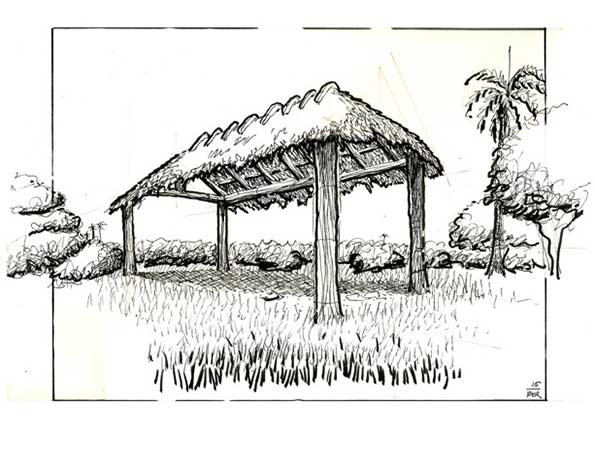
    Here, the vernacular building style is a colorful, deliciously un-Miami-like mix of shipping containers and barn tin. The traditional Seminole chickee —a rough, open hut with a raised floor, on a log frame — lends a tropical, exotic flair to this spotty rim of human inhabitation, pressed against nature’s vast size. The chickee’s thatched palm fronds create a natural insulation barrier that blocks the sun’s heat, and the fully open sides allow the tiniest of breezes to move air through the space underneath. This native response to the land is more appropriate than the thick-walled, stucco-buttered architecture imported from arid Spain and grafted onto Florida’s humid, wet character. The Seminole answer was to work with nature, have a light touch, and when a hurricane blows it all away, build it again. The classic Florida Chickee is an informal structure that the Seminole tribe builds. Some still use as living quarters in a way similar to camping (for those who prefer air conditioning, power, and plumbing, a more modern house is used).This zen approach to fulfilling the human need for shelter is decidedly un-modern and soft, and the chickee presence at the edge of the Everglades lends a certain amount of respect to the power of nature just beyond.

    Civilized life is stripped away, layer by layer, on the margin of the city. Abandoned subdivisions and Native American chickees coexist together, creating a sense of place that overlays the premodern chickee onto the failed subdivisions of modernity. This sense of place tends to mark man’s over-reach into the wilderness. Yet another marker can be found on buildings constructed by modern means, where layers of veneer have not been added: raw materials, unpainted and unadorned, stand crude and timeless against the trees and the sky. The edge’s presence can be sensed where structures start to dissolve into informality.

    Everglades National Park is a hard, urban boundary on the map, but on the ground it is a blurred zone where the slow-moving river of grass influences human activities. The nuanced edge continues into the Everglades themselves, where Florida’s subtle water-nature is uninterrupted. Water flows in a gentle, slow sheet across Florida’s flat limestone bed, coated with organic material barely thick enough for life to cling to. Where the limestone base dips a few inches, grass fails to grow; where a nub rises a few inches above this hard plain, unique tree islands gather. These islands are too densely vegetated to admit any human. Their edges are wrapped in a thick tangle of branches and leaves, a sort of bonsai-forest in miniature. Insects, birds, and other small creatures inhabit these infrastructures, forming their own natural urban civilizations of city-states, out of man’s reach.

    In between approaching jets and the distant rumble of airboats, a larger silence takes over. Penetrating the membrane between inside and outside gives us a new perspective. To confine our efforts to areas that are already strongly modified by human activities suddenly makes philosophical sense. Boundaries, once created, harden over time, and the softness of the western edge of humanity against the eastern boundary of the Everglades seems destined to harden. In its current state, this snapshot of the feathered, nuanced edge of civilization seems to be delicately balanced between the rural and the natural. Agricultural industry on the periphery of the great conurbation of Miami moves at a pace that is in between the seasonal flow of the Everglades and the nanosecond street culture of contemporary western civilization.

    Florida’s ubiquitous industry, tourism, mixes with agriculture even here at the edge of the wetlands, with the airboat rides, fruit stands, and alligator wrestling shows that pepper it. The vernacular architecture of the Everglades is not quite agricultural, yet not quite contemporary Florida either. Its flavor is connected to the Caribbean tropicalism one finds on islands like Puerto Rico, Barbados, and Hispañola. Endlessly adaptable shipping containers sit cheek-by-jowl with chicken coops and thatch awnings to create an ad hoc pedestrian space under palm trees. All is a little too clean and, well, ‘inspected,’ to be really offshore. But it’s also a little more relaxed than the uptight, postmodern built environment we’ve come to expect in America.

    Heading east out of the Everglades is a somewhat wistful journey forward in time. Rural roads lined with mango trees abruptly give way to fruit processing plants, which back up to grocery store strips, and the standard parade of global brand names enters the windshield, a gateway back into contemporary America. Stoplights take longer, the traffic pace quickens, and today’s Florida, like a hair shirt, envelops you in a cocoon of highly regulated infrastructure, put there for your own protection.

    Richard Reep is an architect with VOA Associates, Inc. who has designed award-winning urban mixed-use and hospitality projects. His work has been featured domestically and internationally for the last thirty years. An Adjunct Professor for the Environmental and Growth Studies Department at Rollins College, he teaches urban design and sustainable development; he is also president of the Orlando Foundation for Architecture. Reep resides in Winter Park, Florida with his family.

    Photos by the author: (top) vernacular building style on the edge of the Everglades; early morning workers arrive in Homestead by bus; protypical Chickee hut; unpainted structure, common on the edge of the Everglades.

  • Affordable Housing Maui Style

    I was recently at a friend’s wedding on Maui. It was a beautiful ceremony in a magnificent location. The wedding was a week-long affair and the other guests were thrilled to enjoy the beach and sip drinks along the cascade of infinity pools at the resort. But I’m weird. I can’t sit still that long so I started to explore how the place works – not just the one resort, but the whole Maui tourist economy. First, I checked out real estate prices in the area. The cost of even the most modest homes and apartments are off the charts expensive. Property is pegged to what wealthy outsiders from the mainland and abroad are willing and able to pay rather than what the local population can afford.

    Screen Shot 2015-03-29 at 2.01.11 AM Screen Shot 2015-03-29 at 2.00.58 AM

    I was recently at a friend’s wedding on Maui. It was a beautiful ceremony in a magnificent location. The wedding was a week-long affair and the other guests were thrilled to enjoy the beach and sip drinks along the cascade of infinity pools at the resort. But I’m weird. I can’t sit still that long so I started to explore how the place works – not just the one resort, but the whole Maui tourist economy. First, I checked out real estate prices in the area. The cost of even the most modest homes and apartments are off the charts expensive. Property is pegged to what wealthy outsiders from the mainland and abroad are willing and able to pay rather than what the local population can afford. That got me thinking about where the hotel staff lived. So I asked the people I encountered how they manage under the circumstances. There were a few standard answers.

    Screen Shot 2015-03-29 at 2.42.19 AM Screen Shot 2015-03-29 at 2.31.29 AM Screen Shot 2015-03-29 at 3.11.24 AM Screen Shot 2015-03-29 at 2.32.05 AM Screen Shot 2015-03-29 at 2.15.56 AM

    First, there was upper management who were highly trained and well educated professionals who earned tolerable salaries and, with a spouse’s professional income and a little help from family, were able to own a modest property within a reasonable commute from work. Next, were the clerks, waiters, bartenders, and such. They were generally young and spending a bit of post-college pre-marriage time in a gorgeous place doing work that was either pleasant or at least bearable given the location. The largest proportion of these folks lived in nearby properties owned by older relatives. If dad or grandma is providing free or heavily subsidized accommodations it really doesn’t matter what the place costs on the open market. A good percentage of these homes are seasonal second or third homes and would sit empty or rented to strangers anyway. Having young family members occupy these vacation and retirement properties while they work at the hotels makes perfect sense. The third most common housing arrangement involved a few people pooling their resources and sharing a single apartment to cover the rent. There was a general lack of space and privacy in these situations, but everyone understood it was temporary for a season or two. The Hawaiian adventure was worth any inconvenience.

    Screen Shot 2015-03-29 at 2.52.24 AM Screen Shot 2015-03-29 at 4.50.01 AM Google
     Screen Shot 2015-03-29 at 2.53.09 AM Screen Shot 2015-03-29 at 4.44.48 AM Google
     Screen Shot 2015-03-29 at 2.48.10 AM Screen Shot 2015-03-29 at 5.04.34 AM Google
     Screen Shot 2015-03-29 at 2.48.34 AM Screen Shot 2015-03-29 at 4.56.41 AM Google
     Screen Shot 2015-03-29 at 2.49.27 AM Screen Shot 2015-03-29 at 5.11.31 AM Google

    Within a fifteen minute drive of the beachfront resorts I discovered a variety of housing types ranging from multi-million dollar single family homes to three hundred square foot studio apartments. None of these were what anyone with a normal budget or a family to support would ever call “affordable”. But one way or another the young front-end staff at the hotels find ways to make things work.

    As I explored I was fascinated by the market segmentation of each product type. The subdivisions were sealed off from each other. It would be inconceivable for the people in a $5,000,000 home on a half acre lot to exist in the same pod as a complex of $900,000 two bedroom condos. The condos would be far too trashy for them. And the folks who owned $900,000 condos would be scandalized if someone tried to build $1,800 a month studio rental apartments inside their pod. That would attract “the wrong element”. The pods could all exist next to each other across the shrubbery and landscaped berms so long as they each had their own home owners associations and the roads in and out were completely segregated – preferably with a gate. Endless rules and restrictions, both private and municipal, control each pod to ensure property values are maintained at the appropriate level. This is the default suburban arrangement all over North America – give or take a few zeros and a comma.

    Screen Shot 2015-03-29 at 2.11.29 AM Screen Shot 2015-03-29 at 2.14.52 AM Screen Shot 2015-03-29 at 2.59.00 AM Screen Shot 2015-03-29 at 3.24.54 AM

    It was a little trickier to discover where the maids and gardeners lived. The majority were older than the kids waiting tables and working the front desk and they were overwhelmingly immigrants from the Philippines. Unlike bartenders they were not generally inclined to chat with hotel guests in a casual manner. My inquiries about affordable workforce housing were met with confusion or slight suspicion. But I was eventually able to identify a few neighborhoods and the general living arrangements.

    Screen Shot 2015-03-29 at 2.04.03 AM Screen Shot 2015-03-29 at 2.03.23 AM Screen Shot 2015-03-29 at 2.05.48 AM Screen Shot 2015-03-29 at 2.04.55 AM

    There’s simply no economic or political force on Maui that can provide sufficient affordable housing for the number of low wage workers required to run the tourist economy. Land is too expensive. Government and philanthropic funds are entirely inadequate. And political will to construct subsidized housing absolutely anywhere is a non starter at every level of the approval and community engagement process. The minimum wage in Hawaii is $7.25 per hour. The best paid housekeepers on Maui earn no more than $14.50 per hour. The median home price on Maui is $527,500 although that half million dollar number is actually misleading due to the geography of the island. Jobs are concentrated in a handful of locations where housing is significantly more expensive. Lower cost housing is in remote areas that are outside a reasonable commuting distance. HOA restrictions and a host of municipal regulations prevent too many people from sharing a rented apartment in the more expensive regions. Landlords in prime locations can pick and choose who to rent to and they tend toward Canadian tourists rather than immigrant cleaning ladies. So the sweet spot for these workers involves ordinary tract homes in specific older subdivisions that lack HOAs, are far enough from wealthy neighborhoods to escape regulatory push back, yet are close enough for a tolerable commute.

    Screen Shot 2015-03-29 at 2.31.42 PM Zillow
    Screen Shot 2015-03-29 at 2.30.47 PM Zillow
    Screen Shot 2015-03-29 at 2.30.59 PM Zillow
    Screen Shot 2015-03-29 at 2.31.19 PM Zillow
    Screen Shot 2015-03-29 at 2.31.32 PM Zillow

    Here’s an example I pulled from a real estate site. This 1962 three bedroom one bath tract home is among the least expensive properties on the island. It’s listed for $449,000. It doesn’t get any more affordable than this. It’s been on the market for a year and the price was recently cut by $100,000. If someone were to buy this place with a standard 20% down payment of $90,000 the monthly mortgage would be $1,642. At either $7.25 or $14.50 per hour for low wage workers the numbers don’t add up unless many people occupy the space to get the per person rent or mortgage down to a manageable level. So each bedroom gets multiple sets of bunk beds. The living room is a bedroom. The dining room is a bedroom. The garage is a bedroom. People work day, night, and swing shifts so the same beds and parking spots are used at different times by different people. They call these homes “hot beds” since the mattresses are always occupied and never have a chance to cool. (This is exactly how my Sicilian grandparents grew up in Brooklyn during the Great Depression and war years. This kind of arrangement isn’t really new or different.)

    Screen Shot 2015-03-29 at 5.03.45 PM Screen Shot 2015-03-29 at 5.44.53 PM Screen Shot 2015-03-29 at 5.45.43 PM

    This particular subdivision is protected from gentrification and redevelopment since it’s sandwiched between the airport runway and the oil tank farm of the industrial seaport. Most of these homes are owned and occupied by extended multigenerational families. Cousins arrive, work and save, send money back to their home country, or prioritize their children’s advancement. They scrub things clean and give the walls fresh paint. They make due with the resources they have. The arrangement might not be ideal, but it gets the job done in the absence of any other option. Neighbors tend to live and let live since they’re all in the same position. Local authorities are disinclined to engage in too much code enforcement since the county would simply create a homeless problem they know they can’t resolve. Employers at the resorts wouldn’t like it too much either if members of their cleaning and gardening staff suddenly stopped showing up for work. So there you have it. Affordable housing – Maui style.

    John Sanphillippo lives in San Francisco and blogs about urbanism, adaptation, and resilience at granolashotgun.com. He’s a member of the Congress for New Urbanism, films videos for faircompanies.com, and is a regular contributor to Strongtowns.org. He earns his living by buying, renovating, and renting undervalued properties in places that have good long term prospects. He is a graduate of Rutgers University.

  • Piketty’s Wealth Driven Inequality: Virtually All in Housing?

    The Economist headline reads: "Through the roof: Rising house prices may be chiefly responsible for rising inequality"

    This is no surprise to those of us who have been chronicling the loss of destruction of middle income housing affordability where urban containment policy has been implemented from Australia to Canada, Ireland, New Zealand, the United Kingdom and the United States.

    Matthew Rognlie, a graduate student at the Massachusetts Institute of Technology, has critiqued the highly publicized work of Thomas Piketty (Capital in the 21st Century) to suggest that rising inequality is largely due to the accumulation of wealth in housing.

    House prices have doubled, tripled or more relative to incomes, as regulators have banned or seriously limited new housing on the urban periphery. Younger households have been unable to afford houses as older households have watched their wealth increase.

    The "writing" has long been on the wall. Legendary urbanist Sir Peter Hall lamented the potential abandonment of the "ideal of a property owning democracy" (see The Costs of Smart Growth Revisited: A 40 Year Perspective) under urban containment policy.

    Rognlie suggests that a better title for Piketty’s book would have been Housing in the Twenty-First Century. According to Rognlie: "the literature studying markets with high housing costs finds that these costs are driven in large part by artificial scarcity through land use regulation …. A natural first step to combat the increasing role of housing wealth would be to reexamine these regulations and expand the housing supply."

  • The House of the Future Will be Solid-State

    Housing will take a great leap forward when the house becomes married to the concept of solid-state. This revolution will begin when solid-state – i.e., no moving parts – becomes meshed into notion of shelter; ergo, the solid state house. This will be the housing of the future.

    With the introduction of solid-state circuitry in the 1940s, the transistor replaced the vacuum tube to shrink circuits, improve precision, and eliminate maintenance and wear. This concept revolutionized electronics. Tubes were large, coarse, and had to be replaced when they overheated. Transistors did not. Tubes required a lot of energy and current to move electrons around to do their jobs, rest and recharge, and activate devices. Transistors could do the same jobs with a fraction of the energy, thus reducing heat, cost, and time; they could also be spaced closer together. Radios, which were briefcase sized objects, collapsed from to thumb-sized objects. A radio today is a mere speck; a partition within a larger microchip measured in nanometers.

    The solid-state house is not to be confused with the tiny house. Today, the tiny house movement is still in its nascent stages, and running into some important obstacles. For one thing, the entire economic system is blockading this movement, because the system is entirely designed for the supersized. During the permitting process, whether you permit 400 square feet or 4000 square feet, the same baseline cost applies, and the increase is only incremental. Municipalities, desperate for cash, have no incentive to reduce permitting costs. So the tiny house must pay the same tribute to the king as a McMansion.

    Builders have little interest in not-so-big houses, because they are built more quickly, and with fewer materials. Why would a builder want to sacrifice price? The management of a construction job is the same, whether managing a three month, 400 square foot project or a three month 4,000 square foot project.

    Builders also are accustomed to a supply chain of vendors with whom they have developed relationships. Gypsum wallboard, for example, is, the bread-and-butter staple of interior construction. If you are seeking an interior finish that has less impact on the environment, you will always pay more. The small house movement has not yet figured out how to work around the consumptive, wasteful supply chain, and unwittingly adopts it into the movement, rewarding the same people, taking the same resources from the earth, and injecting the same waste. The notion that the movement is doing less harm only means that a tiny house is less bad than a large house.

    And finally, a tiny house, once it is finished, has hundreds, if not thousands, of individual separate parts, and all of them move. During the daily temperature cycle things warm up, expanding during the day and shrinking at night. Rain wears down finishes and opens up joints between materials. Air conditioning creates a humidity imbalance that nature is constantly trying to correct. Even with today’s current construction methods, these issues are addressed no differently than they were fifty or a hundred years ago.

    Machines within the house — air conditioners, ceiling fans, switches, faucets, water heaters, and on and on and on — all have moving parts. They break down, require maintenance, and have their own supply stream. Whether a house is small or large, it has all the same baggage in terms of motors, lights, machines, and pipe joints. The lengths of straight pipe between joints may be shorter, but the connections, where the leaks occur, are still the same.

    The not-so-big-house will not, in its current form, succeed and converge into a broad ethos for the masses. The ‘system’ is embedded way too deeply into its bones. This system has evolved, Darwinian style, carrying its bad genes into the present. If the McMansion is doomed, so is the small house.

    But a different type of evolution is possible: Lamarckian evolution, in which change can come in one generation. Just as transistors evolved out of tubes, so can a solid-state house evolve out of a current house. This is the pathway towards the future. The ideal solid-state house shall have no separate moving parts, and shall be endlessly customizable out of factory parts. And the solid-state house shall shrink.

    The not-so-big house movement will be the testing ground for the solid-state house. Small projects are the province of invention. A new way of doing things is easier to test when failure is small scale.

    For example, water-carrying pipes currently are rigid PVC or copper because it is cheaper for long distance. In a small house, where water needs to be carried for shorter distances, more flexible hoses can be used, eliminating pipe joints. In the future small house these may be baked into the wall, much like holes in bread, eliminating a second material from the mix.

    Air conditioning may be under the floor or in the walls, operating through microtubules that work like sweat glands in reverse, constantly removing moisture from the air and channeling it into a system that cools air, creating a transpiration cycle that will allow the small house’s microclimate to function in the same way as the space under a tree canopy. LEED, the green certification rating system, requires a hermetically sealed space to minimize energy. But this new system will work best when the windows are open. Reconnecting with nature will be a pleasant byproduct of the solid-state house.

    As many appliances as possible will be 24 volt direct current, and will function without motors, gears, or bearings. A ‘gear room’ or utility room will be where the shameful old appliances, like washing machines, will be placed. Eventually these will be solid-state, too.

    The solid-state house will be at first very small. Finishes — the ‘look’ of the house — can meet any preference. If the current preference is stucco, for example, that can be added. The solid-state nature of the house, with prefabricated wall and roof panels cut to size and fitted together seamlessly will have its own integrity regardless of the clothing it wears.

    The most important part of the solid state house, though, will be its transportability. A foundation system will allow it to anchor firmly to the ground and be connected to local utilities (if required). As a not-so-big house, however, it will also be easily transportable.

    This exciting revolution will allow time and space to finally collapse, and bring architecture into our liquid, postmodern, nanosecond twenty-first century.

    Richard Reep is an architect with VOA Associates, Inc. who has designed award-winning urban mixed-use and hospitality projects. His work has been featured domestically and internationally for the last thirty years. An Adjunct Professor for the Environmental and Growth Studies Department at Rollins College, he teaches urban design and sustainable development; he is also president of the Orlando Foundation for Architecture. Reep resides in Winter Park, Florida with his family.

    Illustration by the author: “The solid state house is a thought project. I created the design and illustrated it [above]. I call the form the qwave. It’s shaped a little like a wave. And the house borrows from old technology – the Quonset™ hut. Quonset hut + wave = qwave.”

  • How the California Dream Became a Nightmare

    Important attention has been drawn to the shameful condition of middle income housing affordability in California. The state that had earlier earned its own "California Dream" label now limits the dream of homeownership principally to people either fortunate enough to have purchased their homes years ago and to the more affluent. Many middle income residents may have to face the choice of renting permanently or moving away.

    However, finally, an important organ of the state has now called attention to the housing affordability problem. The Legislative Analyst’s Office (LAO) has published "California’s High Housing Costs: Causes and Consequences," which provides a compelling overview of how California’s housing costs have risen to be by far the most unaffordable in the nation. It also sets out the serious consequences.

    The LAO says that:

    Today, an average California home costs $440,000, about two-and-a-half times the average national home price ($180,000). Also, California’s average monthly rent is about $1,240, 50 percent higher than the rest of the country ($840 per month).

    LAO describes the evolution:

    Beginning in about 1970, however, the gap between California’s home prices and those in the rest country started to widen. Between 1970 and 1980, California home prices went from 30 percent above U.S. levels to more than 80 percent higher. This trend has continued.

    Much of the LAO focus is on California’s coastal counties, where:

    ….community resistance to housing, environmental policies, lack of fiscal incentives for local governments to approve housing, and limited land constrains new housing construction.

    These causes result from conscious political decisions. While California’s coastal counties do not have the vast stretches of flat, appropriately developable land that existed 50 years ago, building is increasingly  prohibited on that which remains (for example, Ventura County, northern Los Angeles county and the southern San Jose metropolitan area).

    Demonstrating an understanding of economic basics not generally shared by California policymakers or the urban planning community, LAO squarely places the blame on the public policy limits to new housing construction:

    This competition bids up home prices and rents.

    In other words, where the supply of a demanded good is limited, prices can be expected to rise, other things being equal. LAO describes the impact of so-called "growth control" policies, which are also called "urban containment" or "smart growth:"

    Many Coastal Communities Have Growth Controls. Over two-thirds of cities and counties in California’s coastal metros have adopted policies (known as growth controls) explicitly aimed at limiting housing growth. Many policies directly limit growth—for example, by capping the number of new homes that may be built in a given year or limiting building heights and densities. Other policies indirectly limit growth—for example, by requiring a supermajority of local boards to approve housing projects. Research has found that these policies have been effective at limiting growth and consequently increasing housing costs.

    According to LAO, the problem is exacerbated by voter initiatives: "More often than not, voters in California’s coastal communities vote to limit housing development when given the option." It is hard to imagine a more sinister disincentive to aspiration, under which voters can deny equality of opportunity in housing to others by artificially driving up the price.  Because new housing further from coast is also limited, options for a middle income living standard are also diminished.

    These public policies have consequences.

    Notable and widespread trade-offs include (1) spending a greater share of their income on housing, (2) postponing or foregoing homeownership, (3) living in more crowded housing, (4) commuting further to work each day, and (5) in some cases, choosing to work and live elsewhere

    Each of these consequences is described below.

    LAO Consequence #1: Spending a Greater Share of Income on Housing

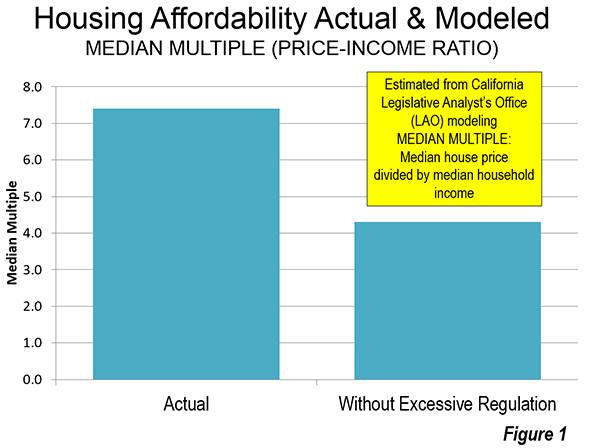
    LAO models the market situation from 1980 to 2010 to estimate the prices that would have prevailed if the regulatory environment had permitted building sufficient to satisfy customer demand at previous lower price levels. In both years, LAO estimates that the median priced house would have cost 80% more than in the rest of the nation (actual data in 1980, modeled data in 2010). This would have kept California house price increases at the national level. I think it would have been better to have modeled from 1970, before the huge house prices before 1980 described by Dartmouth economist William Fischel.

    I have applied this LAO model estimate to the median multiple for California’s six major metropolitan areas (Los Angeles, San Francisco-Oakland, Riverside-San Bernardino, San Diego, Sacramento, and San Jose) to identify how much better middle income housing affordability would be without California’s excessive regulation. Using the LAO estimates the median multiple (median house price divided by median household income) in 2014 would have been at least 40% lower than the actual level in each of the metropolitan areas (Figure 1).
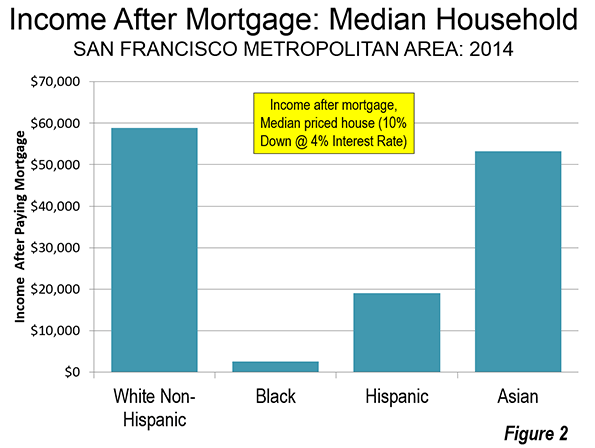
    Many California households already have been priced out of the market. In the worst case, it is estimated that in the San Francisco metropolitan area, a median income White Non-Hispanic household will have nearly $60,000 annually left over after paying the mortgage on the median priced house. This is less than they would have if house prices had remained reasonable, but it’s enough to live on. The median income Asian household would do almost as well, with about $50,000 left over. The median income Hispanic household would have less than $20,000 left, which is considerably less than is likely to be needed for other essentials. The median income Black household would have less than $3,000 left over (Figure 2). If the price ratios of 1980 were controlling, that amount would rise by $16,000.
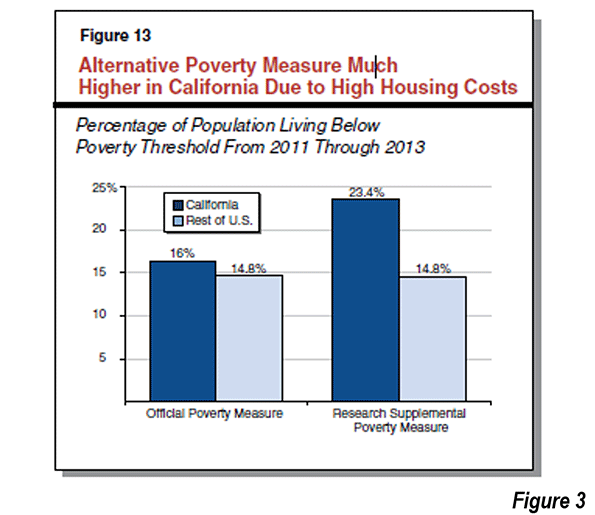
    LAO also points out that the Golden State has the highest housing cost adjusted poverty rate in the nation. The latest data shows housing-adjusted poverty rate is far higher even than that in states with a reputation for grinding poverty. California’s housing adjusted poverty rate is more than 50% higher than that of Mississippi and approaches double that of West Virginia (Figure 3, LAO Figure 13)
    LAO Consequence #2:  Postponing or Forgoing Homeownership

    LAO indicates that California ranks 48th in homeownership percentage, behind only New York and Nevada. LAO emphasizes the value of home ownership:

    Homeownership helps households build wealth, requiring them to amass assets over time. Among homeowners, saving is automatic: every month, part of the mortgage payment reduces the total amount owed and thus becomes the homeowner’s equity. For renters, savings requires voluntarily foregoing near-term spending. Due to this and other economic factors, renter median net worth totaled $5,400 in 2013, a small fraction of the $195,400 median homeowner’s net worth.

    Californians are buying their first houses later. LAO indicates that the average first home buyer in California is three years older than the national average.

    LAO Consequence #3:  Living in More Crowded Housing

    The nation’s worst overcrowding is an unfortunate result of California’s housing policies.

    LAO indicates that California’s overcrowding rate is well above that of the rest of the nation’s rate. Among Hispanics, which were expected to exceed the White-Non-Hispanic population in 2014, to become the state’s largest ethnic group, California overcrowding is more than 2.5 times the Hispanic rate elsewhere. Among households with children, overcrowding in California is four times the national households with children rate. Among renters, overcrowding in California is more than three times the national renter rate (Figure 4, LAO Figure 15).
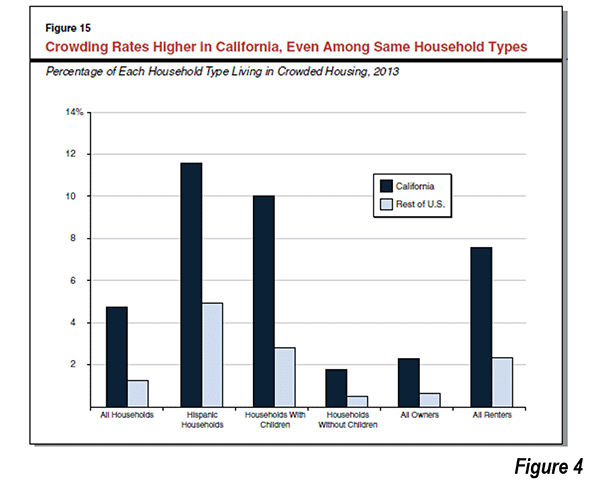
    This has important negative social consequences. According to LAO, research indicates that overcrowding retards well-being and educational achievement:

    Individuals who live in crowded housing generally have worse educational and behavioral health outcomes than people that do not live in crowded housing. Among adults, crowding has been shown to increase stress and aggression, lead to social isolation, and weaken relationships between parents and their children. Crowding also has particularly notable effects on children. Researchers have found that children in crowded housing score lower on standardized math and reading exams. A lack of available and distraction-free studying space appears to affect educational achievement. Crowding may also result in sleep interruptions that affect mood and behavior. As a result, children in crowded housing also displayed more behavioral problems at school.

    Overcrowding is particularly acute in the higher cost coastal metropolitan areas of Los Angeles, San Francisco, San Diego, and San Jose. There, overcrowding among households with children reaches 10%, and among Hispanic households, overcrowding reaches 18%. Among households with children the figure is slightly higher (Figure 5, LAO Figure 16). Overcrowded housing is generally worse, according to LAO, in areas with higher house prices.
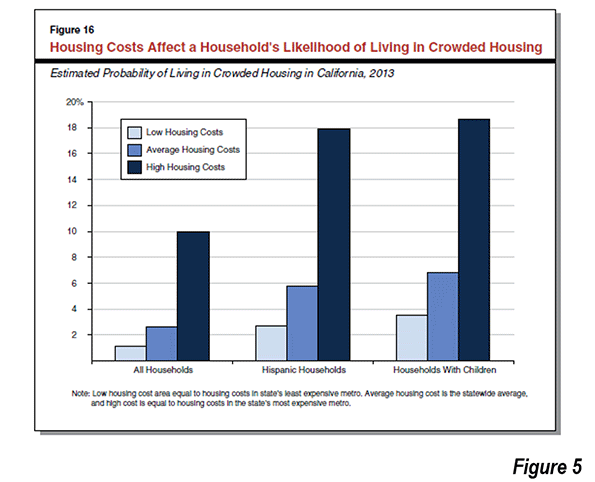
    In a state with a political establishment that prides itself in watching out for low income citizens and ethnic minorities, the need to reform the responsible policies could not be clearer.

    LAO Consequence #4: Commuting Farther to Work

    LAO finds that California’s average work trip commuting times are only moderately above the national average. However, LAO suggests that the commute lengthening impact of higher house prices may be reduced by California’s widespread (I call it dispersed) development pattern, its freeway system and the "above-average share of commuters who drive to work. (Driving commutes are generally fast, and therefore metros with higher shares of driving commuters tend to have shorter commute times.)"

    Nonetheless, according to LAO:

    …our analysis suggests that California’s high housing costs cause workers to live further from where they work, likely because reasonably priced housing options are unavailable in locations nearer to where they work.

    LAO Consequence #5:  Choosing to Work and Live Elsewhere

    LAO also indicates that California’s high housing prices are likely to have reduced its population (and economic) growth. LAO sites the strong net outmigration of California households to other states. LAO also finds in its national metropolitan area analysis that counties with higher growth rates tend to have better housing affordability than counties with lower growth rates.

    There has also been strong net outmigration from the coastal counties to inland counties. This is most evident in the growth of the Riverside-San Bernardino metropolitan area (the Inland Empire) between 2000 and 2010. The Inland Empire captured more than two thirds of the population growth of the Los Angeles Combined Statistical Area (Los Angeles, Orange, Riverside, San Bernardino and Ventura counties). LAO notes the impact of the excess of demand in the coastal counties, again recognizing the nexus between overzealous regulation and the loss of housing affordability:

    This competition bids up home prices and rents. Some people who find California’s coast unaffordable turn instead to California’s inland communities, causing prices there to rise as well.

    LAO also refers to the difficulty that employers have in retaining and recruiting staff. LAO cited survey data from the Silicon Valley, which has for years been California’s economic "Golden Goose" in recent years:

    In a 2014 survey of more than 200 business executives conducted by the Silicon Valley Leadership Group, 72 percent of them cited “housing costs for employees” as the most important challenge facing Silicon Valley businesses.

    In addition, there has been a strong movement of California companies to other parts of the nation, where more liberal regulations foster a better business climate.

    Restoring Housing Affordability

    LAO indicates the importance of fundamental reform and calls for putting "all policy options on the table."

    Major changes to local government land use authority, local finance, CEQA (California Environmental Quality Act), and other major polices would be necessary to address California’s high housing costs.

    In addition:

    The greatest need for additional housing is in California’s coastal urban areas. We therefore recommend the Legislature focus on what changes are necessary to promote additional housing construction in these areas.

    Perhaps the only weakness of the report deals with densification, particularly in coastal counties. For example, LAO suggests that without the housing restrictions the city of San Francisco is population would be 1.7 million, rather than the approximately 800,000 who live there today. In fact that would be unprecedented beyond belief. No core city that had become fully developed and reached 500,000 people by 1950 has achieved growth of this magnitude. The greatest growth was less than 10%, in this category of 60 core cities (which includes the city of San Francisco). Even less likely would be public support for such huge population growth in the second densest major municipality in the nation.

    While LAO does not indicate the additional population that its estimates would have placed in the core of Los Angeles, given the scale of the San Francisco increase, this could be a number of up to 3 million. This area, the broadest expanse of over 10,000 population per square mile density in the nation outside New York City is in the middle of the urban area with the nation’s worst traffic congestion, according to the Texas A&M Transportation Institute. It is doubtful that residents would have the "stomach" to expand roadway capacity to keep the traffic moving. Transit could not have made much difference. Even with its now extensive rail network that has opened since the early 1990s, driving alone accounted for 85% of the additional travel to work from 2000 to 2013 in the city of Los Angeles. Yet, the city of Los Angeles has the most extensive transit in the metropolitan area, including service by all rail lines.

    In reality, core densification is likely to be modest. Keeping housing affordability from getting worse requires regulatory liberalization throughout California, including coastal and inland areas
    The reality is that if California had permitted growth, it would naturally occurred mostly on the periphery. Even with the restrictions on building, the preference for suburban living (largely in detached housing) could not be repressed between 2000 and 2010. Less than 10% of the population growth in the Los Angeles and San Francisco Bay areas occurred in the cores.

    The Challenge

    Should the state of California begin to seriously discuss housing affordability, it will be important to ease restrictions throughout the state, not just in the coastal counties. There are serious barriers to placing the appropriate priority on improving the standard of living and minimizing poverty rates among California’s diverse population. Perhaps the biggest impediment is Senate Bill 375, which is being interpreted by the state and its regional planning agencies to require even more stringent land-use regulation.

    In this environment, LAO rightly raises this concern:

    If California continues on its current path, the state’s housing costs will remain high and likely will continue to grow faster than the nation’s. This, in turn, will place substantial burdens on Californians—requiring them to spend more on housing, take on more debt, commute further to work, and live in crowded conditions. Growing housing costs also will place a drag on the state’s economy.

    It is to be hoped that California’s distorted policy priorities will be righted to restore the California Dream.

    Photograph: Dense suburban development: Inland Empire (San Bernardino Freeway with Uplard toward the top and Ontario toward the bottom) – By author

    Wendell Cox is an international public policy consultant and principal of Demographia in St. Louis. He is a native Los Angelino, having been born within two miles of City Hall. He was appointed to three terms on the Los Angeles County Transportation Commission by Mayor Tom Bradley. Full biography is here.

  • Inside the Bubble

    I was recently asked by a neighbor to write a blog post about greed in the super heated economic bubble here in San Francisco. I told her I think the problems that vex her are more complicated than pure greed, but I’d give it a shot. Keep in mind, where a person stands on any of these issues depends a great deal on their particular circumstances. The point of this post isn’t to argue in favor of one thing or another, but to illustrate how some people experience the city at this moment in time.

    So… my friend has lived in the same spacious rent controlled flat in an old Victorian for many years. Her tenure predates the current tech culture by decades. Chatting over lunch in her kitchen and dining room is like visiting a bygone version of San Francisco where everything is more relaxed and comfortable and perhaps a bit less glossy. Over the last several years she’s seen half the buildings on her block transformed by the tsunami of money that has washed over the neighborhood. The elderly Chinese couple who own her building will eventually pass and when they do she knows their adult children will sell the place and she’ll be forced out. For her it’s not just a matter of leaving the building or even the neighborhood, but leaving the city altogether. There’s simply no possible financial scenario that will allow her to stay in the Bay Area on her income as a freelance graphic designer. That world is gone and she doesn’t have a Plan B.

     unnamed-4

    Her preoccupation with the new money culture in the city has been especially stirred up by the activities of the building directly next door. Back in 2010 the owner of the building had a structural engineer certify that the building was unstable and therefore uninhabitable. This could be seen as a landlord who was deeply concerned for the health and safety of his tenants, or a legal tactic to remove them. A series of challenges ensued, but at the end of the day the building was emptied, fully gutted, and renovated. The apartments were then sold off as condos. The average sale price in 2014 was just shy of a million dollars for each of the one bedroom apartments. Some of the people who purchased the units were investors who then rented them at the current market rate of $4,950 a month.

    Screen Shot 2015-02-27 at 12.57.29 AM Screen Shot 2015-02-27 at 12.57.00 AM Screen Shot 2015-02-27 at 12.55.48 AM

    One of those renovated condos was bought by a young Russian DJ. I’ve met him and he’s actually a perfectly nice guy. I’m listening to his audio stream right now – house trance techno electronica… Evidently he’s a big deal in international music circles. (I’m more of a Billy Holiday Ella Fitzgerald kind of guy, but I digress.) Shortly after he moved in he decided to take six months off and travel to Thailand. While he was gone he left the apartment in the hands of a popular home hosting service that arranges short term rentals to tourists and business travelers. In theory the service was completely turnkey with booking, cleaning and so on. But in reality the apartment needed a bit more care over such a long period of time than the company was able to provide. The Russian asked my friend next door if she could help out. “Could you” this and “Would you mind” that. Individually none of these favors was particularly onerous, but collectively it became a lot of work as the months dragged on. The Russian was having such a good time in Thailand he decided to extend his stay. At a certain point my friend let it be known that her services had gone beyond merely being a helpful neighbor and it was time she was paid for her work. An e-mail exchange ensued with a list of time that had been spent on various projects. The Russian felt that he had been misled. “That seems like a lot of money.” This was coming from someone who just spent nearly a million dollars on an apartment and can afford to spend half a year on vacation in Asia. You can see how this might rub my friend the wrong way. Hence her frustration with the freakish economic situation in the city.

    On the other hand, there are a fair number of people who are living in tiny run down apartments with multiple room mates paying outrageously high rents who feel that a massive rent controlled apartment is a seriously sweet deal. Sure, it will come to an end someday, but dude! Really? You’re bitching that it doesn’t come with a lifetime guarantee? Suck it up cupcake.  Like I said. Where you stand on these issues depends a lot on your particular situation.

    6 EasterDinner(12)2007 IMG_0120 (640x480) 

    For those of you who aren’t intimately familiar with the local dynamics I’ll give you some context. On most nights friends and family gather around our kitchen table for dinner and we discuss the events of the day. Over the last few years we’ve hardly had a month go by where someone hasn’t had to pack up and leave the city because of eviction, unreasonably high rents, or a lack of available housing at any price. Other folks who already owned property decided to cash out and took their substantial profits to more affordable towns.

    Screen Shot 2015-02-28 at 5.21.13 AM

    Last week we had a couple over who had rented a charming house with a back garden in Bernal Heights for nearly twenty years with the enormous benefit of rent control that kept their expenses well below the market rate all that time. The landlord sold the home a few months ago and the new owners evicted them in order to live in the house themselves.

    Screen Shot 2015-02-28 at 5.23.47 AM

    They reluctantly moved to an apartment in Oakland. They don’t hate the apartment or Oakland per se, but it’s definitely a transitional space for them. They’re looking to move as soon as they decide what exactly they want and can afford. There was a lot of talk about how San Francisco has become inhospitable to people with normal budgets. At a certain point I asked them why they hadn’t prepared for the eventuality of the big move. They knew what the real estate market was like. Their eviction couldn’t have come as a surprise. They’re both professionals with solid incomes. They could have pulled together a downpayment and bought property at any point during the last twenty years when prices were more reasonable. Instead they enjoyed the benefits of a great rent controlled place. It was a perfectly reasonable economic decision and it served them very well for two decades. But there were trade offs. Now it’s time to come up with a new plan. Let’s just say they didn’t appreciate my interpretation of their situation.

    Screen Shot 2015-02-28 at 5.40.17 AM

    A couple of months ago we noticed one of the longterm tenants of a nearby building packing up and loading his furniture into a moving van. We were shocked. He had lived in that apartment with rent control for forever. We all thought he’d eventually leave feet first. It turns out that the landlord paid him $30,000 to go voluntarily and he agreed to take the money. Once the landlord gets new tenants he’ll likely receive $3,800 or more per month for that unit so his $30,000 “investment” in freeing up the apartment will be repaid in eight months. $30,000 won’t buy you anything at all in San Francisco, but it’s pretty good seed money in many parts of the country. If this guy is smart he’ll use the cash to put a downpayment on a house in a less expensive town.

    Now, here’s something else to consider. San Francisco is in an enormous economic bubble. It won’t last. These things never do. And when the bubble pops there are going to be a whole lot of folks who paid top dollar for real estate that’s going to be worth infinitely less. Any number of things could puncture the balloon: another Wall Street crash, an earthquake, a shift in foreign investors, or the inevitable maturation of the tech sector and its associated stock options and super sized bonuses… When that day arrives everyone’s situation may change and the general perception of who’s a winner and who’s a loser may flip as well. And we’ll all have to suck it up. That’s life.

    John Sanphillippo lives in San Francisco and blogs about urbanism, adaptation, and resilience at granolashotgun.com. He’s a member of the Congress for New Urbanism, films videos for faircompanies.com, and is a regular contributor to Strongtowns.org. He earns his living by buying, renovating, and renting undervalued properties in places that have good long term prospects. He is a graduate of Rutgers University.

  • Two Sides of the Same Coin: Decline and Gentrification

    Recently I attended a presentation at Mission Dolores Church sponsored by the San Francisco Chronicle called “A Changing Mission”. The discussion was based on a newspaper article and associated short film about the neighborhood. It’s well worth a quick look here.

    Screen Shot 2015-02-25 at 5.35.26 PM Screen Shot 2015-02-25 at 5.34.23 PM   unnamed-3


    Lancaster, Palmdale 039 (800x600) Screen Shot 2014-11-29 at 2.58.26 AM Screen Shot 2014-11-29 at 2.58.59 AM Screen Shot 2015-02-25 at 6.24.53 PM

    A week later I was in Lancaster, California to attend a similar meeting sponsored by the local city planning authority and the Strong Towns organization here. Lancaster is also changing, but in a different way than the Mission.

    If I were to boil down the two situations into crude cartoon blurbs they might go something like this. “The Mission is being overrun with rich white people who are screwing up the place.” And “Lancaster is being overrun with poor brown people who are screwing up the place.” Like I said… crude. Obviously the reality is far more nuanced and complicated than that. But that’s pretty much the gist of things. Gentrification and economic decline are two sides of the same coin and a lot of folks don’t like any of it. The irony is both sides seem to want the same things even if they don’t know it.

    Screen Shot 2015-02-25 at 5.51.18 PM Screen Shot 2015-02-25 at 8.00.33 PM Screen Shot 2015-02-25 at 5.49.56 PM Screen Shot 2015-02-25 at 5.49.29 PM Screen Shot 2015-02-25 at 4.54.25 PM

    There’s a scene in Alfred Hitchcock’s classic 1958 film “Vertigo” where James Stewart mentions an appointment he has with a shady character in the Mission. Kim Novak looks concerned and comments, “That’s Skid Row”. That always gets a laugh from San Franciscans in the audience at the revival theaters. Many people who don’t know San Francisco well assume it’s all tourist spots, internet millionaires, and gay bars. If you walk around the Mission you’ll quickly discover a neighborhood full of families with young children, elderly pensioners, and lots of small mom and pop shops. Until the 1950’s the Mission was a working class neighborhood dominated by German, Irish, Italian, and Greek stock. After World War II white flight to the suburbs left behind a great deal of inexpensive real estate that was eventually filled by Central American and Asian immigrants, as well as various bohemian types. The neighborhood and its low wage workers were quietly ignored by city authorities as well as the more prosperous residents in more fashionable neighborhoods. This was a part of the city no one ever saw on a postcard.

    Screen Shot 2015-02-25 at 5.52.02 PM Screen Shot 2015-02-20 at 12.51.35 AM Screen Shot 2015-02-26 at 1.14.57 AM

    The Mission deteriorated and served as a repository for the low rent light industrial activities that every city needs but are generally kept out of pricier neighborhoods: auto body shops, carpentry shops, iron and steel fabricators, glass cutting shops, upholsters, discount fabric warehouses, plumbing and electrical supply companies… But it was also the perfect place for nightclubs and after hours establishments since there were no hostile neighbors to complain. The Mission was noisy and ugly, but it was that unseemly quality along with the cheap rent that made it possible for a lot of people to scrape by while pursuing other activities that didn’t necessarily pay well. It’s no coincidence the Burning Man and other such movements emerged from the Mission rather than exclusive Pacific Heights or Sea Cliff. You might have to tolerate the occasional drug dealer or prostitute, but there was no HOA regulating your every move. The Mission was all about slack and that’s what made it interesting and vibrant, if a bit rough around the edges.

    unnamed-3 Google Bus 002 Screen Shot 2015-02-25 at 9.30.23 PM  Screen Shot 2014-11-03 at 10.52.50 AM Screen Shot 2014-11-05 at 11.57.26 PM

    As the tech economy out in the distant suburbs heated up over the last twenty years more and more of the smart young IT professionals chose not to live in the dull suburban cul-de-sacs of Silicon Valley. They were looking for a grittier more dynamic environment and found it in the Mission. Tech workers endured a lengthy reverse commute in order to achieve a higher quality of life in their off hours at home in the city. In order to attract talent tech companies in the suburbs created the private so-called “Google Bus” system to shuttle workers from the Mission to corporate campuses an hour and a half outside the city. Tech workers had unlimited budgets compared to the existing Guatemalans, Vietnamese, and artists. Rents and property values rose considerably year after year. Today a one bedroom apartment in the Mission typically rents for $3,800 a month – if you can find a vacancy. If you want to buy that same place it will set you back well north of $850,000 and there is precious little on the market to satisfy the endless demand. If you want a single family home with a little patch of back yard you can buy the ruined shell of an old Victorian for a couple of million dollars and then spend at least as much to renovate it. Evictions and property conversions have skyrocketed. Bodegas and pho noodle shops are being replaced by boutiques and fine dining establishments. Hence all the fuss about gentrification driving out the working class. For the city’s coffers it’s a nice problem to have. The city is flush and is on a prolonged capital improvement spree that is transforming the local infrastructure and public spaces from parks, to school buildings, to libraries, to fire and police stations. Everything is getting a massive face lift and city workers have all been given substantial raises. But for the displaced residents it often means leaving the city altogether.

    Screen Shot 2015-02-25 at 8.25.25 PM Screen Shot 2015-02-25 at 8.27.11 PM Screen Shot 2015-02-25 at 6.25.16 PM Screen Shot 2015-02-25 at 8.23.43 PM Screen Shot 2015-02-25 at 8.23.11 PM

    Now let’s get back to Lancaster which is in the Antelope Valley of far eastern Los Angeles County in southern California. Lancaster was a small agricultural community until in was discovered by the aerospace industry in the 1950’s. The high desert location not too far from Los Angeles made it the perfect place to develop and test rockets, fighter jets, and ultimately the Space Shuttle and Stealth Bomber. Along the way it attracted people from the city who were looking for a more relaxed environment at a lower price point. The area sprouted endless white middle class subdivisions and accompanying shopping centers. For most residents work and culture remained “Down Below” in Los Angeles proper. That became increasingly true as the aerospace industry ramped down and was phased out. What remained of the local economy was based primarily in building and servicing more suburban development.

    Palmdale, Lancaster 056 (800x600)unnamed-5 Lancaster, Palmdale B roll 038 (800x600) unnamed-8 unnamed-6 IMG_0005

    The entire Antelope Valley, including Lancaster, was hit especially hard by the crash of 2008. Homes lost half their value overnight. Foreclosure and unemployment rates shot way up just as tax revenues plummeted and city services were cut. What was once a solidly middle class community became economically insecure and especially sensitive to further downward mobility – real or perceived. Both private developers and the City of Lancaster worked hard to deliver a better more up-to-date “product” incorporating the latest bells and whistles to jump start the resumption of growth after the crash. New homes boasted renewable energy packages and gray water recycling systems. The city began installing bicycle lanes. LEED certified office parks were promoted. And Lancaster’s economic development plan included inducements to battery and electric bus manufacturers for the growing market for clean energy and transportation. So far these measures have been too little too late. The solar and wind farms are great for generating clean power, but they don’t employ very many locals. New homes aren’t selling well and profit margins are down to a couple of thousand dollars per home which just isn’t enough to keep developers interested in building any more. The market for far flung exurban living has simply dried up. The bike paths that are all the rage in reviving city centers are effectively useless out in the distant sprawl. It isn’t the paths that are attracting prosperous new residents – it’s the urbanism the paths encounter along the way. Putting green lipstick on a sick pig hasn’t helped.

    Lancaster, Palmdale 513 (800x600) Screen Shot 2014-11-29 at 1.24.25 AM Lancaster, Palmdale 526 (800x600) Lancaster, Palmdale 533 (800x600) Screen Shot 2014-11-29 at 2.30.56 AM 

    While Lancaster has concentrated most of its efforts on inducing new construction it has ignored its older building stock. Each new home and commercial complex built out on the edge of town only cheapens the older existing suburban fabric. There’s no economic justification for buying, maintaining, or improving a fifty year old home or thirty year old strip mall when brand new homes and shops sit unsold and half vacant. Unfortunately for old timers in Lancaster all that cheap property has proven very appealing to many of the lower income residents from down below in Los Angeles who are rapidly being displaced. Like the Mission in San Francisco many previously impoverished neighborhoods in central Los Angeles are experiencing serious gentrification and all those poor folks who are getting squeezed out have to move and live somewhere else. The last several years have been a perfect storm delivering a massive wave of new arrivals to Lancaster who are not only poorer than the existing population, but overwhelmingly black and brown. This has set off alarm bells with the already stressed locals with vocal demands for government policies to prevent “Them” from moving in. (I’ll refrain from commenting on the whole race thing here. It is what it is.) In the end these are powerful market forces that the city has very little control over. For those people who are financially able their first choice is to sell and move. For those who are trapped in a home that is worth less than they owe the choice is to tough it out and hope for a market rebound or to walk away and take a big loss.

    So there you have it. Gentrification in one community and economic decline in another. These are two sides of the same coin. In the end I suspect the freakish bubble in places like San Francisco will eventually cool while the decline in outer suburbs like Lancaster will level off and stabilize. In the meantime it’s all pretty bumpy for the folks caught in the middle.

    John Sanphillippo lives in San Francisco and blogs about urbanism, adaptation, and resilience at granolashotgun.com. He’s a member of the Congress for New Urbanism, films videos for faircompanies.com, and is a regular contributor to Strongtowns.org. He earns his living by buying, renovating, and renting undervalued properties in places that have good long term prospects. He is a graduate of Rutgers University.

  • Life is Good in St. Louis

    The headline line in the Sunday St. Louis Post-Dispatch asked "Are St. Louis Area’s Home Prices too Low?” This is could not possibly have appeared describing any major metropolitan area of Australia, New Zealand, or the United Kingdom. Nor will newspapers in Vancouver, Toronto, Calgary, Portland, Seattle, Boston, New York or in any of the overpriced markets of California decry low prices any time soon.

    The March 8, 2015 article by Jim Gallagher rightly noted that house prices tended to be higher in cities outside St. Louis, there are "restrictions on building, either geographical or political." Gallagher quotes William Rogers, an economist at the University of Missouri- St. Louis says that "Developers have really serious problems putting up houses in Los Angeles or San Francisco."

    The 11th Annual Demographia International Housing Affordability Survey, produced with Hugh Pavletich of Performance Urban Planning in Christchurch New Zealand,  confirms the low house prices in St. Louis. In 2014, the median multiple, a price to income ratio calculated by dividing the median house price by the median household income, was 2.7 in the St. Louis metropolitan area. St. Louis is tied for fifth most affordable middle-income housing market among the 86 major metropolitan area markets (over 1,000,000 population) in nine nations.

    No one should imagine that the low prices of St. Louis are the result of a depressed economy. Yes, St. Louis is on the periphery of the rustbelt. And yes, the city (core municipality) of St. Louis has lost a larger share of its population than any other large municipality in modern history. Since 1950, the city of St. Louis – a mere 11 percent of the metropolitan area – has lost 63.2 percent of its population, slightly more than the city of Detroit, at 61.4 percent.

    Yet, somehow the city of St. Louis has avoided the financial train wreck of Detroit, nor do planners suggest the next industry should be urban agriculture. At a minimum, the difference suggests that St. Louis, even as it has lost population, has been much better led than the Motor City. Further, the much larger St. Louis metropolitan area (which is the area described in the Gallagher article and rated in the Demographia Survey) is anything but depressed.

    Gallagher indicates that "lots of people here could pay more for houses, but they don’t have to." That is correct. However, households in St. Louis pay approximately the same percentage of their income to buy houses today that most people have since World War II. That is also the same amount that Angelos and San Franciscans paid until the coming of excessive regulation (see Fischel) in the 1970s; since then  house prices there have increased between 2.5 and 3 times.

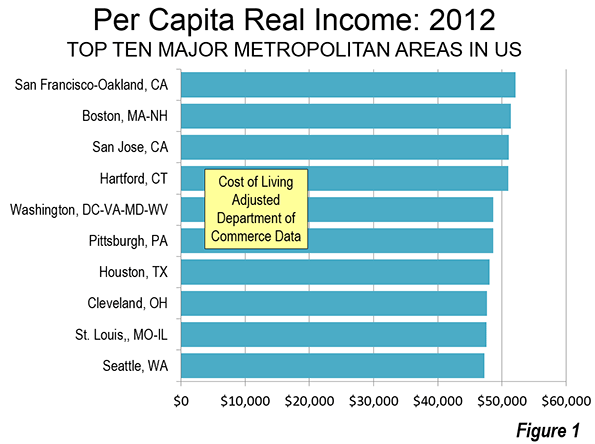
    On the surface, St. Louis appears about average in income. St. Louis ranks 25th, slightly above the middle of the 52 major metropolitan areas in per capita income. But that’s just the beginning of the story. As anyone looking for employment in other metropolitan areas quickly finds out, housing cost differences can be huge and make up most, if not all the difference in cost of living. When the cost of living is considered, real personal incomes in St. Louis rank ninth among the 52 major metropolitan areas. It may be surprising, but St. Louis ranks above number 10 Seattle. While nominal incomes in Seattle are nearly 20% above that of St. Louis, when the cost of living is considered, St. Louisans had nearly 1% more income than Seattleites in 2012 (Figure).

    The metropolitan areas ranked above St. Louis are the usual suspects of nominal affluence. No one would be surprised that San Francisco has the highest incomes, both nominal and adjusted for cost-of-living. San Francisco’s nearly 50% advantage in nominal personal income over St. Louis drops to less than 10% when the cost of living is considered. Given the graduated nature of the federal income tax, the difference could be less. The other most affluent cities are Boston, San Jose, Hartford, and Washington. The cost of living conversion factor (regional price parity) is more than 25% in San Francisco, San Jose and Washington and 18% in Boston. Only in Hartford, among the leaders, has anything similar to a normal cost of living (6% above the national average)

    There are other surprises in the top 10. Both Pittsburgh and Cleveland have higher cost of living adjusted incomes than St. Louis. Less surprising is that Houston is in the top 10, given its robust economy, at least before oil prices dropped.

    There are some interesting omissions from the top 10. Global city New York ranks 17th, just behind "Music City" Nashville. Portland, America’s incubator of house price increasing planning policies, finds itself ranked 39th. Even in Jackson, Mississippi, not large enough to make the over 1,000,000 list, has higher real per capita income than Portland.. Perhaps the biggest surprise is Los Angeles. Like New York, often considered a Global City, the city of my birth is anything but Global City real per capita incomes. Even depressed Detroit (though the suburbs of Detroit are anything but depressed) is ranked 10 positions above Los Angeles and has real per capita income 10% higher.

    All of this should be regarded as good news for St. Louis. Once, to be sure, St. Louis was far more important. As late as 1910, St. Louis was the fourth largest municipality in the United States, trailing only New York, Chicago and Philadelphia. While St. Louis is not depressed, it has grown much more slowly than most metropolitan areas. But the decline has been more in the urban core city than the surrounding areas. Over the past the past 60 years the city of St. Louis lost more than 500,000 residents, while between 1950 and 2010, while the suburbs added 1,400,000.

    Gallagher indicates that construction prices are reasonable in St. Louis. In fact they are not much less than in the stratospheric housing markets of San Francisco and Los Angeles. For example, a 2,500 square foot starter house in the East Bay of San Francisco would cost less than 10 percent more to build than in St. Louis, according to data at building-cost.net.The difference between housing costs in St. Louis and high-cost market is in the land, which is where the cost of excess regulation shows up

    As a metropolitan area, St. Louis has competitive difficulties (see: Shrinking City, Flourishing Region: St. Louis Region). The weather is not as nice as in California. The winters are tougher than in Texas or Florida. But the one great advantage St. Louis possesses is reasonable middle income housing affordability. This is an important competitive advantage that led to only modest domestic migration losses during the 2000, when high priced Los Angeles and New York were bleeding more than 1.3 million net domestic out migrants.

    Also, with the money they don’t have to pay for over-priced housing, St. Louisans can buy more "stuff" or take longer vacations. Nor do St. Louisans get less for their less money. The median sized detached house is the same in St. Louis (1,800 square feet) as in  San Francisco and slightly larger than in Los Angeles (1,744 square feet), according to the American Housing Survey in 2012, yet St. Louisans pay much less.

    The bottom line is that for all of the competitive difficulties, life is good in St. Louis. And, one big reason is housing prices middle-income households can afford.

    Wendell Cox is principal of Demographia, an international public policy and demographics firm. He is co-author of the “Demographia International Housing Affordability Survey” and author of “Demographia World Urban Areas” and “War on the Dream: How Anti-Sprawl Policy Threatens the Quality of Life.” He was appointed to three terms on the Los Angeles County Transportation Commission, where he served with the leading city and county leadership as the only non-elected member. He was appointed to the Amtrak Reform Council to fill the unexpired term of Governor Christine Todd Whitman and has served as a visiting professor at the Conservatoire National des Arts et Metiers, a national university in Paris.

    Photo: St. Louis Skyline (by author)

  • High Density Housing’s Biggest Myth

    Advocates of higher density housing development in Australia’s major cities – inner city areas in particular – are fond of pointing to a range of statistics as evidence of rising demand. Dwelling approvals, dwelling commencements, tower crane counts and various other sources, both reputable and dodgy, are referenced and then highly leveraged to support claims that our housing preferences have fundamentally changed in favour of high density apartments. But what’s the one inescapable fact that these advocates are missing?

    “Higher density living on the rise” is typical of the light weight PR puffery that passes for market analysis these days.  This piece is typical of the boosterism: 

    “Since 2008/09 multi-unit housings’ share of dwelling approvals in Queensland has jumped from 31% to 46%. Much of the increase can be attributed to an increase in approvals for high-rise apartments, with the sector’s share of dwelling approvals doubling between 2008/09 and 2013/14, from about 12% to approximately 24%.” So far, correct.

    But it goes on to draw this unjustified but widely supported conclusion: “the popularity of apartment living in the larger capital cities had been driven by a number of factors including decreasing housing affordability and the changing lifestyle of baby boomers and young professionals.”

    Or how about this piece of PR chasing nonsense pumped out by a bank no less: “Australians are favouring smaller, more affordable homes, with approvals for the construction of flats, townhouses and semi-detached houses nearing their highest level in 20 years.”

    What’s wrong with these conclusions? Simply this: rising dwelling starts for apartments in inner city areas do not necessarily reflect ‘changing lifestyles’ or any ‘popularity’ for this product by home buyers. What it does reflect is a (so far) ravenous investor appetite for the product. This is entirely different to an owner occupier appetite. If owner occupiers were buying these apartments in large numbers, you could then conclude that inner city apartment living was becoming more and more popular. But speculative investors have no intention of living in the product they’re buying.

    Owner occupiers in the main aren’t looking for tiny one or two bedroom units. Some developers have targeted the owner occupier unit market, and their designs feature more three and even four bedroom units, spacious in design and with features designed for living in as adults or families. The price points are vastly different. This is so far a niche market which is performing strongly, but it’s completely different to the cookie-cutter apartment stock which is driving the stats.

    What is happening in Australia now, and which is being reflected in the dwelling stats for apartment construction, is a nation-wide frenzy of speculative investment in inner city apartments, fuelled by negative gearing, SMSFs, foreign buyers and the search for returns in a very low yielding market. For many apartment projects, more than 80% or 90% of the stock is sold to investors, not to people with the intention of living there. This includes a significant proportion of first home buyers as investors, as Michael Pascoe recently pointed out. 

    To meet the investor market, apartments are getting smaller and smaller – to meet the price points demanded by investors. Typically, most projects offer a mix of one and two bedroom units only – and these are designed to squeeze every square inch of efficiency out of them. Construction economics and pricing is all about size, features and finishes and every dynamic is put under the microscope and cut from the project if it means the unit offering can be sold for less without sacrificing margin. Many continue to be offered through project selling agencies or “investment channels” in order to achieve a certain level of pre-sales. ‘Rental guarantees’ from developers provide investors with some certainty that their investment will perform predictably for the first year or two. A successful project is one that is sold out, preferably pre-sold. Actually being occupied is another thing altogether.

    What this is doing is creating a large pool of rental units of similar size and design and in similar locations. And contrary to the sort of froth and bubble many commentators attach to the ‘rising popularity’ of apartments, many are vacant: simply locked up and not used by their owners (often overseas buyers). Others are looking for tenants, but can’t rent for what investors need to get. Inner city apartment vacancy rates are rising, and rents are starting to fall: a sure sign of market where supply is beginning to exceed demand. 

    ‘Official’ vacancy stats produced by Real Estate Institutes only count the properties actively being marketed for rent. The ones that are simply unoccupied and not available for rent don’t form part of the figures. A recent study in Melbourne reviewed water consumption in a number of Docklands Towers and concluded that those apartments with next to no water consumption were effectively empty. They put the vacancy at nearly one in four. Or you can simply look at these towers at night, and count the lights that are on, and draw your own conclusion. Or maybe ask some restaurant or shop owners who took leases in new projects on the promise of “a bustling inner city café society” what the trade is really like.

    Increasingly, smart developers are selling sites with approvals in place but before a sod has been turned. In some cases they’re selling even before the approval has been obtained. Why go through the grief of developing something when someone else is happy to pay you a premium many times what the site cost you? 

    I don’t actually see anything wrong with any of this. Property markets going through booms and busts are not a new thing. Just ask industry people on the Gold Coast. Or have a look at CBD office markets. Plus, if it weren’t for the frenzy of activity we’re seeing in the apartment market now, there’d be precious little else going on. So it’s keeping an industry alive, and all those whose jobs depend on it. Investors are entitled to take risks and they are just as entitled to lose money as make it. There are no guarantees. 

    But please, stop suggesting that what we’re seeing is anything but a case of investor-fueled activity. Investors are buying a financial product, not a lifestyle choice. To suggest it means Australian society is surrendering a three or four bedroom home in favour of a one bedroom apartment is stretching the conclusions that can be drawn from the stats way way way too far.

    Ross Elliott has more than 20 years experience in property and public policy. His past roles have included stints in urban economics, national and state roles with the Property Council, and in destination marketing. He has written extensively on a range of public policy issues centering around urban issues, and continues to maintain his recreational interest in public policy through ongoing contributions such as this or via his monthly blog The Pulse.